Continual Proclamation
Teacher’s Devotional Pass It On
It seems it was just the other day I was 16, getting a car; then 22, getting married. At 26, I had my first child. I turned 30 and thought I was ancient. Then 40, and now—in the blink of an eye, and after my parents have passed—I am the old one at 68. My greatest desire is to pass on a love for Jesus to our family. Both our kids are Christ-followers. My prayer now is for our three grandchildren, for each to trust Jesus, love Him, and seek His will for their lives.
I want to pass my hope in Jesus on to others too. I wrote a memoir about raising our adopted, disabled daughter. It makes me so happy that those words will be here long after I’m gone. I see it as part of my legacy—to share my story of experiencing the goodness of God amid suffering and pain.
From childhood through old age, God has been an anchor for my life. It’s my prayer that those following me will say the same. Psalm 71:17-18 from today’s Scripture passage says, “Since my youth, God, you have taught me, and to this day I declare your marvelous deeds. Even when I am old and gray, do not forsake me, my God, till I declare your power to the next generation, your mighty acts to all who are to come.”
Indeed, we find our hope only in Him. “Praise be to the God and Father of our Lord Jesus Christ! In his great mercy he has given us new birth into a living hope through the resurrection of Jesus Christ from the dead” (1 Pet. 1:3).
Understanding the Bible
Psalm 71 was written by an elderly saint who had clearly faced some challenging times. There is no indication in the text of who wrote this psalm. Some commentators speculate that it was written after Judah’s return from captivity. Others, because of its position between a psalm of David (Ps. 70) and a psalm for David’s son Solomon (Ps. 72), believe that David also wrote this psalm. Though the psalmist experienced many bitter hardships, even persecutions, he never gave up hope in the Lord. He knew that he could call out to the Lord and be heard. Furthermore, he knew that even in death, his hope was in his loving Lord. As a result, the psalmist understood the importance of proclaiming God’s love and hope to the next generation. And such should be our hope and purpose today.
As Your Students Arrive
Ask students to share any pictures they brought of their children, grandchildren, nieces, nephews, or other young people they know. Introduce the lesson by letting the class know that this week’s lesson focuses on how these pictures represent the next generation and why we need to share the Gospel with every younger person we know.
Step 1
Life Connection
Comprehensive Bible Study Student Book Reduction
LESSON 7
For July 14 • Page 47
Continual Proclamation
They come from different backgrounds, but they ended up in the same church. Their ages are across the spectrum, but they meet in the same Bible study group every month. Their mission is the same: To pass the Gospel on not only to their own generation but to subsequent generations as well.
The pastor’s wife, who leads the church’s small group ministry, noticed their interest in ministry from conversations with them. She and her husband overlooked the differences among them and pulled them together as a group called “AIM,” an acronym for “Advancing in Ministry.”
Josh showed up at church on his own one Sunday and has been active ever since. Single and a recent graduate with a computer science degree, he works with the church’s web stream and other online ministries.
Jacob, a biologist, and Sarah, a nurse, are a married couple with a little girl who still find time to host and lead small groups for young families. Mario, a military leadership trainer, and Laura, a teacher, are another married couple who teach a youth Sunday school class as well as participate in other outreach ministries of the church. Pam is a retired chaplain who counsels people of all ages and helps plug new members into ministries according to their spiritual gifts. Six others with the same goals are involved in ministry and the group. They not only want to minister to others, but also to train others who will in turn minister to others as well.
1. Why does God want us to teach generations other than our own about the good news that is in Christ Jesus?
2. In what ways does your church fulfill this calling from God?
3. Do you participate in teaching or outreach ministries? If not, why not?
LESSON FOCUS: Proclaim God’s love and hope to the next generations.
Discuss how all generations need to hear the Gospel.
Form small groups to discuss Questions 1, 2, and 3 in the study book. For Question 1, students might say that their knowledge of how blessed they are as Christians compels them to teach their children about Jesus, or it is a life ministry to which God has called them, or that telling young people about the Lord strengthens their own faith. Answers to Question 2 will perhaps include hiring a dynamic youth minister to guide a vibrant youth group, providing faithful and enthusiastic Sunday school teachers for children of different ages, and offering opportunities for young people to participate in short-term ministries, such as repairing homes during the summer or forming a youth choir to visit nursing homes or prisons. These are but a few examples of how the next generation in a church can learn what it means to be a Christian.
Question 3 invites students to reflect on how they have been or are now being active in spiritually influencing young people. It could be as simple as raising their children in the ways of God or as deeply committed as a teacher of youth in a vital operation of the church. This question should help students see that God always provides opportunities in one’s family and the church to be an example and a teacher of how to be a faithful disciple of Christ.
Photo: © coffeekai/Getty Images
Step 2 Bible Exploration
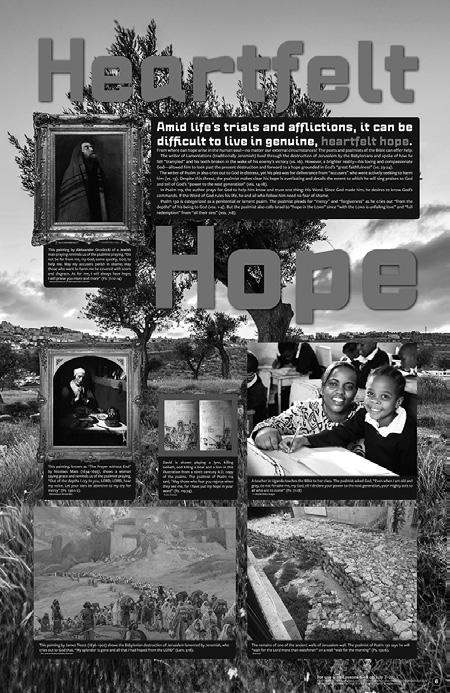
On the poster sheet, read the third paragraph, then point out on the poster the painting of a Jewish man praying and the Sunday school teacher with a class.
Continual Hope
Read Psalm
71:12-14, and highlight these key points in the Scripture:
• The author of Psalm 71 was desperate for God’s help.
• He expressed an intense desire for the Lord to be near him so He would quickly rescue him.
• He asked the Lord to degrade and consume his enemies.
• Meanwhile, he will always have hope in God, whom he will praise ever increasingly.
Bible Commentary
Adversaries/False Accusers
When those who are adversaries of God and His people falsely accuse, they are acting very much like their father the devil. Jesus said that the devil “is a liar, and the father of lies” (John 8:44). For example, the devil falsely accused Job when he said, “Stretch out your hand and strike everything he has, and he will surely curse you to your face” (Job 1:11). Of course, Job proved the devil to be the false accuser that he is by remaining true to the Lord, despite the horrific hardships he endured.
And the devil and his followers continue to accuse God’s people falsely. However, we can take great hope
Study the hopeful message in Psalm 71.
knowing that there will come a time when all heaven will rejoice, “for the accuser of our brethren is cast down, which accused them before our God day and night. . . . Therefore, rejoice, ye heavens, and ye that dwell in them” (Rev. 12:10b, 12a, KJV).
In the meantime, like the psalmist, we can call on the Lord for help, placing our full hope and trust in Him to see us through even the darkest times. And even more importantly, we can guide our children and their children to do the same.
Lesson 7 for July 14 • Page 48
Continual Hope
Psalm 71:12-14, KJV
12 O God, be not far from me:
O my God, make haste for my help.
13 Let them be confounded and consumed that are adversaries to my soul; let them be covered with reproach and dishonour that seek my hurt.
14 But I will hope continually, and will yet praise thee more and more.
Psalm 71:12-14, NIV
12Do not be far from me, my God; come quickly, God, to help me.
13May my accusers perish in shame; may those who want to harm me be covered with scorn and disgrace.
14As for me, I will always have hope; I will praise you more and more.
Sometimes hardships come in trickles, other times in waves. Such was the case of the psalmist here, who was in the “golden years” of life and apparently feeling it (see vs. 9). Whether afflictions that come with aging or some other trial, if we are not careful, we can feel as if God is far from us.
However, nothing could be further from the truth. As the psalmist made clear, help from our loving and gracious God is only a prayer away. Always, our heart’s desire will be for Him to come to us “quickly” (vs. 12). But this is a matter of perspective, for though our circumstance may lead us to believe that the Lord is far away, the reality is that He is always with us. There is no greater reason to rejoice than knowing that our God is with us. And we are assured of His presence through consistent prayer and time with Him, which in turn produces thankfulness in our hearts, no matter the circumstances. This can be hard at times, especially when facing false “accusers” (vs. 13), which was part of the psalmist’s plight.
False accusations can be painful in at least two ways. First, if believed, lies can tarnish the opinions others may have of us. Second, these false accusations can negatively impact the view others may have of our God. So the psalmist prayed that his accusers would be brought to “scorn and disgrace” (vs. 13) instead. When that happens, others will see them for who they are and will not believe their lies.
For more commentary on these Scriptures, read p. 951 in The Wiersbe Bible Commentary: Old Testament.
Now review this part of the lesson by answering Questions 4, 5, and 6
4. Why did the psalmist want the Lord to come to him quickly?
(Suggested Answer) The psalmist’s situation and frame of mind was such that he asked the Lord not to be far from him. So he asked the Lord to come to him quickly to help in his affliction, which was tied to attacks from false accusers.
5. What did the psalmist desire for his adversaries and false accusers?
(Suggested Answer) False accusations can hurt
Comprehensive Bible Study Student Book Reduction
Lesson 7 for July 14 • Page 49
Because we know that the Lord is always with us and will take up our cause against those who falsely accuse us, we also know that He is our only hope in this life and in the life to come. Unlike our false accusers, it is impossible for God to lie (Heb. 6:18). Therefore, we who put our trust in the Lord “have this hope as an anchor for the soul, firm and secure” (vs. 19a). And because our hope is sure in the Lord, out of gratitude and love, our praise can pour out of abundant hearts. Additionally, we can lead the younger generation in doing the same. Considering the hope we have in the Lord, it is so important to help the next generation understand the hope and love that is also theirs if they come to Him in faith.
4. Why did the psalmist want the Lord to come to him quickly?
5. What did the psalmist desire for his adversaries and false accusers?
6. Knowing that the Lord will help, what can we always have?
Courageous Hope
Psalm 71:15-18, KJV
15 My mouth shall shew forth thy righteousness and thy salvation all the day; for I know not the numbers thereof.
16 I will go in the strength of the Lord GOD: I will make mention of thy righteousness, even of thine only.
17 O God, thou hast taught me from my youth: and hitherto have I declared thy wondrous works.
18 Now also when I am
the reputation of innocent people. Worse yet, they can bring reproach upon the good name of God. So the psalmist wanted his adversaries to have that reproach and disgrace on their own heads, thereby negating their false accusations.
6. Knowing that the Lord will help, what can we always have?
(Suggested Answer) Because our Lord will help us in time of need, we can always put our trust and hope in Him. And a trusting, hopeful heart will pour out praise and thanksgiving that is worthy of Him.
Courageous Hope
Now read Psalm 71:15-18, and discuss these ideas:
• Although the psalmist was unable to relate all of God’s righteous deeds, he would declare those that would come to his mind throughout the day.
• The psalmist again promised to proclaim His awesome feats and the righteous deeds of God alone.
• Indeed, the Lord has been teaching the psalmist since his youth, and the psalmist has remained faithful in proclaiming the marvelous deeds of his divine tutor.
Psalm 71:15-18, NIV
15My mouth will tell of your righteous deeds, of your saving acts all day long— though I know not how to relate them all.
16I will come and proclaim your mighty acts, Sovereign LORD; I will proclaim your righteous deeds, yours alone.
17Since my youth, God, you have taught me, and to this day I declare your marvelous deeds.
18Even when I am old and gray, do not forsake me, my God,
• Now that the psalmist has aged and is old, he besought the Lord not to abandon him, but, instead, he would tell the younger generation that God is all powerful and that what He does is full of power.
Bible Commentary
No Retirement in God’s Economy
The Holy Spirit endows every believer with a gift or supernatural ability to serve God and others (1 Cor. 12:1-11). Furthermore, He does not rescind that gift when a person reaches a certain age. There is no retirement in God’s economy. Granted, as a person ages, there may
Comprehensive Bible Study Student Book Reduction
arise certain physical restrictions. Face it, we cannot do at 80 what we did at 18. Nevertheless, though more limited in some ways, the aged among God’s people still have much to offer.
As Paul pointed out to Titus, the older men should be good examples of sobriety, gravity, temperance, faith, love, and patience. And the older women can help younger women in what it takes to help maintain a godly marriage and family (Titus 2:1-5). In other words, the senior saints can guide and mentor younger adults, who can, in turn, raise godly children to love the Lord and others. This is why “gray hair is a crown of splendor; it is attained in the way of righteousness” (Prov. 16:31). From one generation to the next, the “way of righteousness” must be proclaimed, and no one is better prepared to do this than those who have been proclaiming His ways for decades.
After discussing the Scripture and commentary, have the class answer Questions 7, 8, and 9.
7. What should our mouths proclaim?
(Suggested Answer) Our mouths should proclaim all the glorious deeds and acts of salvation accomplished by our mighty Lord. No matter what comes into our lives, good or bad, God will use it for our good and His glory.
8. How long should we proclaim it?
(Suggested Answer) There are two parts to the answer to the question. First, we see that we should proclaim the mighty acts of God all day long. Second, we are to proclaim them our entire lives, from the time we come to faith in the Lord until we go home to be with Him.
9. To whom should we proclaim it?
(Suggested Answer) In general, we are to proclaim God’s glorious deeds to all who will listen. However, from our passage specifically, we are to proclaim the glory of God to the generations to come.
Comforting Hope
Finally, read Psalm 71:19-21, and consider these summary statements with your class:
• The psalmist continued his praise of God by noting God’s actions (what God had done to protect and provide) and God’s character (who God is).
• The psalmist acknowledged that the Lord had allowed numerous bitter hardships to assail him throughout his life.
• Nevertheless, he stated with confidence that God would rescue him from the depths of the earth.
• With utter certainty, the psalmist declared that the Lord would enhance his honor and extend to him His consolation.
Lesson 7 for July 14 • Page 50
old and greyheaded, O God, forsake me not; until I have shewed thy strength unto this generation, and thy power to every one that is to come.
till I declare your power to the next generation, your mighty acts to all who are to come.
The key to having the full assurance of our great hope in the Lord is to recall regularly the wondrous works He has already accomplished in our lives. God’s past goodness to us can encourage and see us through the dark times of life. And when we get on the other side of a trial or ordeal, we can look back at it and see how the gracious, guiding hand of the Lord led us through it, as well. Such was the case of the psalmist, who was ready to proclaim “all day long” (vs. 15) what the Lord had done for Him. We, too, can boldly declare to others the mighty acts of God in our lives. Not only can we declare His deeds boldly, but we should also declare them often.
The psalmist’s challenge was that he did not know how he could name all the righteous and saving acts of God because he could not count them all. However, whether young or wellseasoned, healthy or ailing, in good times or bad, we have every reason to rejoice and praise the Lord. And may our rejoicing be in such a manner that it also instructs and encourages “the next generation” (vs. 18) to come. Future generations need to see the “power” of the Lord, for the more they do, the more apt they are to respond in faith and continue the cycle of passing on God’s truth to the generations after them.
Sometimes we may think that when we become “old and gray,” God forgets us or we have nothing to pass along to those coming behind. We should pray as the psalmist did, “Do not forsake me, my God.” When we do, He hears us and reminds us that He is still with us at all times.
7. What should our mouths proclaim?
8. How long should we proclaim it?
9. To whom should we proclaim it?
Bible Commentary
Hope of the Resurrection
Like the psalmist, we have assurance that one day we, too, will be raised from the dead. Along with the passage in 1 Thessalonians 4, the great hope of the resurrection from the dead is also proclaimed in 1 Corinthians 15. As Paul stated, the trumpet will sound, and in the twinkling of an eye, the dead will be raised. Those who remain will be changed, and death will be swallowed up in victory (1 Cor. 15:51-54). With that glorious hope in our hearts, we, too, can proclaim victory over death, even now, and know that our service to the Lord is not in vain (vss. 55-58). And there is no greater service than proclaiming God’s love and hope to
Comprehensive Bible Study Student Book Reduction
Comforting Hope
Psalm 71:19-21, KJV
19 Thy righteousness also, O God, is very high, who hast done great things: O God, who is like unto thee!
20 Thou, which hast shewed me great and sore troubles, shalt quicken me again, and shalt bring me up again from the depths of the earth.
21 Thou shalt increase my greatness, and comfort me on every side.
those who come after us.
Finally, answer Questions 10, 11, and 12 with your students.
10. How far does the righteousness of God reach?
(Suggested Answer) There is no limit to the righteousness of God. It reaches high, to the very heavens above. He is our glorious, holy God, and there is no one like Him.
11. What did the psalmist see and experience at the hand of God?
(Suggested Answer) God’s love and mercy are without end, and His righteousness is boundless. Therefore, out of love and righteousness, He brings refining trials into the lives of His people. And the psalmist saw and experienced many bitter troubles.
19Your righteousness, God, reaches to the heavens, you who have done great things. Who is like you, God?
20Though you have made me see troubles, many and bitter, you will restore my life again; from the depths of the earth you will again bring me up.
21You will increase my honor and comfort me once more.
Our lesson’s passage closes with the reminder that there is no limit to the righteousness of God. And no matter how bad the troubles of life may be, we can know that our He is with us. Though our troubles may be “many and bitter” (vs. 20), we can know that God will strengthen us in this life. And when the time comes that our bodies are placed in the “depths of the earth,” our hope is still in the Lord, who is like no other and has always “done great things” (vs. 19).
Truly, our hope and comfort is in the Lord, and there is no greater comfort, especially for the aged, than knowing that God’s love and hope have been proclaimed and received by those who will carry on for Christ after we are gone. God will “honor” those who honor Him. Exactly what the psalmist meant when he said the Lord will “restore my life again” is not clear, but a good life lived for the Lord lasts as it affects the generations who come after us.
10. How far does the righteousness of God reach?
11. What did the psalmist see and experience at the hand of God?
12. What promise of restoration and increase did the psalmist hope for? Psalm 71:19-21, NIV
12. What promise of restoration and increase did the psalmist hope for?
(Suggested Answer) After experiencing the refining trials, the psalmist’s great hope was that the Lord would restore his very life and increase his honor and comfort.
WINDOW ON THE WORD
What Is a Psalm?
Psalms are sacred songs or poems people sing during the worship of the Lord. The word is derived from the Greek word psalmoi, meaning “instrumental music,” and specifically for the psalms as we know them in the Bible, they are “the words accompanying music.”
The Hebrew psalms are mostly found in the Book of Psalms, of which there are 150, and all are considered sacred in Christianity and Judaism. According to the traditions of both religions, King David is the author of many of them, which praise the Lord God with many different allusions from joy to grief to contrition.
Comprehensive Bible Study Student Book Reduction
Lesson 7 for July 14 • Page 51
Step 3 Bible Interaction
If possible, photocopy this page and cut out the boxes and give instructions to each group. Make copies of the handout from the Resource Kit for the group using it. Give the skit group paper and pencils.
Discussion Group
Read “Share Your Faith” and answer Questions 13, 14, and 15 in the student book. Answers to Question 13 may include regularly lifting them up in prayer, mentoring one or two of them in a weekly Bible study, and personally bringing them to Sunday worship. Question 14 answers might be exhibiting Christlike patience and understanding when we stumble, or overcoming meekness by gaining confidence and trust in the Lord, or confessing that we must be honest about our lack of biblical or spiritual knowledge. Question 15 invites us to relate the joy we feel when we observe the devotion young people have for the Lord, the gratitude we have toward God for the way young people are serving Christ, or the peace that warms our hearts by being assured of their eternal salvation in Jesus.
Skit: Tell His Story!
Write a contemporary script in which the main character is in a situation in which he or she has the opportunity to share the good news about Jesus with a person who may be a young adult, teenager, or child. Cast the roles of these two characters. Rehearse, then either read the script aloud or perform it before the class. Discuss what each person can learn from this skit as it relates to this week’s Lesson Focus: “Proclaim God’s love and hope to the next generations.”
Explore how to share Jesus with other generations.
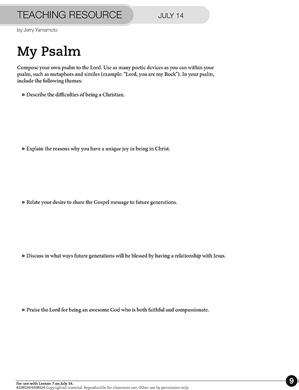
Handout: “My Psalm”
Use your creative skills to compose a worship poem. It will be a personal psalm to address your hardships, reflect upon your walk with Christ, and express gratitude as a child of God. The primary theme of your psalm is to relate how important it is to tell future generations about Jesus. You may want to read your psalms in the group or the whole class.
Lesson 7 for July 14 • Page 52
Share Your Faith
“Even youths grow tired and weary,” said Isaiah, “but those who hope in the Lord will renew their strength. They will soar on wings like eagles; they will run and not grow weary, they will walk and not be faint” (Isa. 40:30-31).
We who love the Lord can and should nurture that “hope in the Lord” in our young people. To see them “soar on wings like eagles” and “run and not grow weary” and “walk and not be faint” should inspire each of us to tell them about Jesus’ love and compassion for them and how He atoned for their sins and redeemed them for God’s heavenly kingdom. When Paul and Barnabas went on their first missionary journey together, others accompanied them, including Barnabas’s young cousin, John Mark. For whatever reason, Paul did not want Mark to join them on their next mission, which caused such a sharp dispute between Paul and Barnabas that the two men split from each other (see Acts 15:36-41). Many years later, Paul and Mark must have reconciled, for while he was in prison, he told Timothy to “get Mark and bring him with you, because he is helpful to me in my ministry” (2 Tim. 4:11).
Thankfully, the senior Paul did not give up on his younger colleague in their ministry for Jesus. John Mark went on to serve the Lord in many significant ways, likely including the writing of the second Gospel. Paul’s patience, forgiveness, and self-reflection regarding Mark probably helped him in being a mentor to Timothy. Jesus Himself viewed younger people with deep affection when He said to His followers, “‘Let the little children come to me, and do not hinder them, for the kingdom of God belongs to such as these’” (Mark 10:14).
13. What could you do to tell other generations about Jesus?
14. What difficulties arise when you share the Gospel with young people? How does the Lord help you overcome those difficulties?
15. Do youth who love the Lord inspire you with your own faith in Jesus? Explain your answer.
Step 4 Life Response
Current believers’ faith does not determine future believers’ faith. God can impact people’s hearts in any number of ways. Nevertheless, we are important vessels of the Lord, and when He calls us to act and speak for Him, we must obey and obey with joy in our hearts and the utmost commitment. To do otherwise would not please our Lord, and to please God should always be imperative in all that we do.
Review “Enlightening Future Generations” in
Comprehensive Bible Study Student Book Reduction
Lesson 7 for July 14 • Page 53
Enlightening Future Generations
In Psalm 71, the psalmist seeks the aid of God both for himself against his enemies and for future generations to whom he vows to proclaim the marvelous awesomeness of the Lord. It is a declaration of hope that can be realized only in the Lord God, and it’s a message He calls us to teach to future generations about the hope we have in Christ.
➤ Write here the names of younger people with whom you could share the Gospel this coming week. Be ready to tell next week what happened when you presented your faith in the Lord with a youth if such an incident occurred.
KEY VERSE
But I will hope continually, and will yet praise thee more and more.
—Psalm 71:14, KJV
As for me, I will always have hope; I will praise you more and more.
—Psalm 71:14, NIV
DAILY BIBLE READINGS
Week of July 15 through July 21
(See The Quiet Hour for devotionals on these passages.)
Mon. 2 Timothy 3:10-17—Equipped for Every Good Work.
Tues. Matthew 4:1-11—Resist Temptation.
Wed. Proverbs 30:1-9—Every Word of God Proves True.
Thurs. Colossians 3:12-17—Let Christ’s Word Abound in You.
Fri. James 1:19-27—Doers of the Word.
Sat. Psalm 119:57-72—Lord, Teach Me Your Statutes. Sun. Psalm 119:73-80—Hope in God’s Word.
Tell other generations about Christ.
Comprehensive Bible Study. Encourage students to think of one or two younger people they know whom they can talk with this week.
Finally, give the class the opportunity to pray either silently or aloud. In their prayers, they can express their gratitude to God for giving them the opportunity to share their faith with a young person or young people. Then they can pray for that person or people.
End the lesson with a closing prayer. Ask the Lord to bless the young people whom your students are mentoring—to give those young people a true understanding of the Gospel and a genuine willingness to serve Jesus as their Lord and Savior. Thank God for your students, who are impacting the lives of these youth—be they children, teenagers, or young adults. And praise the Lord for His love and compassion, which seeks to transform the lives of current and future generations.
As the class members are leaving, hand out copies of this week’s Power for Living. Take or mail copies of Lesson Leaflet to those who couldn’t be with you today, or send them to those you would like to join your class.
Before Teaching Next
Week’s Lesson
For next week’s lesson, assign Psalm 119:73-80 for your class to study. Ask your students to think about things that bring them joy.
Comprehensive Bible Study Student Book Reduction