Download a complete sample lesson at DavidCCook.org/seen
Use SEEN to create a nurturing environment for students to discover God’s truth and wisdom—all while processing what they see in the world.
Every student should feel seen and known in their church, their family, and their community. Walk alongside them as they build confidence that God sees, knows, and loves them too.
SEEN’s easy-to-use conversational format allows you to include all students in intentional, relational Bible study and discussion with practical application. This undated curriculum offers learning materials for a full year or can be purchased by quarter (12 lessons in 3 units).
AGES
Middle to High School*
6th–12th Grades
FORMAT
Designed for classroom or group-based settings
SCOPE & SEQUENCE
3 Years (12 Quarters); Undated
BENEFITS OF seen
Teens don’t hold onto their faith because of curriculum—they stay when they feel known, heard, and seen. SEEN makes it easy for leaders to connect with students on topics that matter to them and to God.
—MATT IRVINE, SEEN EDITOR AND FORMER MINISTER
CUSTOMIZABLE
Whether you want a scripted lesson or freedom to teach for your context, SEEN is built for easy lowprep use, with options for different ages, group sizes, and teaching experience levels.
PRACTICAL
SEEN offers digital tools, videos, Bible background, teaching tips, and more to help teachers—from novice volunteers to seasoned leaders— engage students and give them actionable takeaways.
INTENTIONAL
Created and prayed over by ministry staff, volunteers, and parents, SEEN includes what you need to create environments for all students to thrive and become committed disciples, even when dealing with difficult topics.
BIBLICAL
Every SEEN lesson is built with Scripture at its core. Students discover and discuss Bible passages included in their guides. Instead of focusing on cultural values, students are led to ask questions, think critically, and trust God’s wisdom.
HOW WORKS
CURRICULUM COMPONENTS
LEADER GUIDE
›› 12 lessons
›› Resource articles
›› Teaching scripts
›› Icebreakers
›› Discussion questions
›› Blessings and takeaways
STUDENT GUIDE
›› 6 pages per lesson
›› Student-led group option
›› Journal space
›› Scripture excerpts
›› Memory activities
›› Further verse study suggestions
DIGITAL RESOURCES
›› Leader lesson outlines
›› Videos
›› PowerPoint® visuals
›› Student conversation cards
›› Parent and student connection materials
›› Social media, graphics
4 QUARTERS per Year
3 UNITS per Quarter
4 LESSONS per Unit*
UNIT THEMES SUPPORT DISCIPLESHIP
Each unit of every quarter is designed to lead students from unpacking foundational Bible topics, to focusing on character development, to understanding how biblical principles and Godly character play a role in our life choices and actions.
Teens learn about who God is to them. SPIRITUAL GROWTH UNIT 1
Teens learn who they are in the world and in Christ. CHARACTER DEVELOPMENT UNIT 2
Teens learn how to live like they know who God is and who they are in Christ.
LESSONS GUIDE DISCUSSION AND DISCOVERY
Each lesson has a Connection point (learning objective), Remember Verse, Leader Prep devotional thoughts, Bible Notes, and these four main teaching parts:
PREVIEW—Icebreakers, activities, and/or videos can be used here to get student’s attention and get a glimpse of the main point of the lesson.
CONNECT—Bible discovery and discussion.
EXPLORE—Students react to and review what they’ve learned.
ACT—Actionable takeaways for students.
SEE END OF SAMPLER FOR THE FULL SCOPE AND SEQUENCE OF SEEN
DIGITAL RESOURCES
Downloadable files include
· Engaging videos, slides, and conversation cards
· Shareable social media graphics
· Pre-crafted text messages and newsletters
· Empowering lesson outlines and resource articles
Buy one Digital Resources product per quarter to serve your team with three months of material. Digital versions of the Leader Guide and Student Guide are also available for purchase if you want to go fully digital.
LOOK INSIDE A LESSON
God Is ...
Our Father Spiritual Growth
Quarter 1 Unit 1 Lesson 1
Luke 15:11-24
CONNECTION
Main point students will learn
God is your Father, and He loves you.
REMEMBER
“For us there is but one God, the Father, from whom all things came and for whom we live; and there is but one Lord, Jesus Christ, through whom all things came and through whom we live.”
1 Corinthians 8:6
PREP
Devotional to focus teachers’ thoughts
SUPPLIES
Bibles timer
Digital Resources
Student Guides paper pencils or pens whiteboard, dry-erase markers
(optional: mural paper, tape)
LEADER TIP
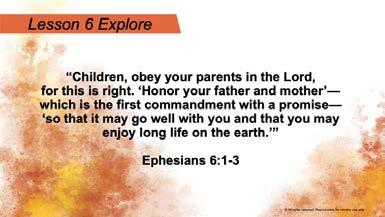
A graphic of the Remember verse is provided in Digital Resources for every session, along with other resources, including a PowerPoint template for you to customize to help lead the session time.
Extra helps and useful info for teachers
God is often described in the Bible as “the Father,” especially in the New Testament. It is a term that acknowledges His love, His concern for us, His authority, and His closeness to us.
As you prepare to lead students to understand God’s role as a father, it may help to focus your mind on the God you know from Scripture, the God you know from your own relationship with Him, and the God you pray to, worship, and follow. The main point of this lesson is to help students grasp not only the power of God, but the personal love He has for them.
The truth is, for you and your students, there can be negative or positive associations with the word father, most often influenced by your experiences with the dad in your life. As you lead students,
be aware of what their experiences and reactions may be, and guide them to see the biblical God who is a loving, good, kind, and protective Father. God’s role is everything a father should be, and we can look to Him to know what a perfect father is truly like.
LEADER’S BIBLE NOTES
This story of the lost (or prodigal) son is the third in a trilogy of stories of the lost. They each tell us something, not only about God’s purposes, but about God’s relationship with His people. The audience Jesus spoke to here was made up of Jews—those who were set apart long ago in the time of Abraham as the treasured people of God.
These stories about finding lost things are meant to paint a picture in people’s minds. It’s familiar imagery—God coming for them, finding them, rescuing them, and restoring them. But there are some differences too. These stories are being told while Pharisees, Jewish religious leaders, look on in disapproval—noting that Jesus is willing to welcome sinners and even eat with them. But Jesus goes on talking—welcoming anyone to hear what He says about the Father God who will not give up on them, who will search for them, and who rejoices when any sinner (not just a Jewish one) is restored to the kingdom. This is the Father we want our students to meet and know and love. There are a few things to remember when studying this Scripture passage: 1) this is a parable (a story that makes a point); and 2) examine the context. If you do nothing else with your students, teach them that the Bible is more than a collection of verses—it is a greater story of God’s relationship with His people that is still unfolding today. If you pluck a verse out, you may get some good from it, but you will miss much
OVERVIEW
Preview: Give a glimpse of today’s Connection point.
Connect: Analyze what the Bible says.
Explore: Hear what students have to say.
Act: Give students something to do.
PREVIEW
Before class, write this statement on the whiteboard (or on mural paper taped to a wall): “My dad ________.”
Deeper background and Scripture context
Find icebreakers, group games, and ways to use videos in the PREVIEW section
LEADER TIP
Encourage students to bring their Bibles or to use Bible apps on their phones. Excerpts of the Scripture with each lesson are also provided in the Student Guides
Scripture excerpts in NIV provided throughout
Use the U1L1 Intro video as students arrive to spark discussion or attract attention. Welcome students as they enter, and invite them to fill in the blank on the wall with the provided markers.
When everyone has arrived and had a chance to add a response, take some time to discuss some of the answers. Don’t press anyone for details, and be sensitive to the fact that for some teens, the idea of “my dad” is hurtful. Be careful not to assume that anything written on the board is meant as a joke.
We all have different experiences with our dads. Some of us have really great memories, and some of us might have gone through hard times with our dads, or maybe we don’t have any memories of our dads at all. The Bible often talks about God as our Father. Jesus even called Him “Abba,” which was a common term used between sons and fathers, much like we might call our fathers “Dad” today. Let’s take some time to look at a parable Jesus told to help us better see God as a loving Father.
CONNECT
CONNECT is the main teaching section. Bold text indicates teaching script. Use it as is or improvise!
Jesus told many parables when He taught. A parable is a story that helps listeners understand a deeper spiritual lesson. Many teachers during Jesus’ time used parables to help their listeners understand specific points because listeners could connect to the more-relatable ideas.
One of Jesus’ most famous parables is about the prodigal son. As we read through it and discuss it today, let’s think about what kind of father this story talks about and how Jesus wanted it to influence the way we see God.
Ask the students to turn to Luke 15 in their Bibles, and let someone read aloud verses 11, 12.
Jesus continued: “There was a man who had two sons. The younger one said to his father, ‘Father, give me my share of the estate.’ So he divided his property between them.”
In Bible times, sons received their inheritance (money and property) from their fathers when the fathers died. In this parable, the younger son asks for his inheritance while his father is still alive, which would have been a huge insult. He’s basically saying that he doesn’t want to have anything to do with his father, and he wants his money now, even though his father would have still provided for him.
Ask the following questions and allow a few students to respond:
Why do you think the son wanted his inheritance early? What does this show you about the son?
How do you think the father felt when he heard his son’s request?
Why do you think the father decided to give his son his inheritance early?
What would you do if your dad gave you a big sum of money?
ZOOM QUESTIONS
Gray boxes feature discussion questions
Imagine living in a society that is built on the concepts of honor and shame. What kind of result would the younger son’s actions have brought on his family? On his father? On his older brother? Why would that be significant?
Ask someone to read Luke 15:13-16 aloud.
“Not long after that, the younger son got together all he had, set off for a distant country and there squandered his wealth in wild living. After he had spent everything, there was a severe famine in that whole country, and he began to be in need. So he went and hired himself out to a citizen of that country, who sent him to his fields to feed pigs. He longed to fill his stomach with the pods that the pigs were eating, but no one gave him anything.”
The son took what his dad gave him and left his family home. During Jesus’ time, people often stayed in their father’s households their whole lives. They wouldn’t necessarily all live in the same house, but they would have a connected home where all the extended family would live and work together. It was the father’s responsibility to care for his family and provide for them. The son in Jesus’ parable is breaking all the traditions by asking for his inheritance early and then moving far away from his family. He’s turning his back on his dad.
Why do you think the son acted the way he did?
Have you ever wanted to do something like that? Why or why not?
The son ends up in a tough situation. He wastes all his money and finds himself in a famine. He ends up having to take a job feeding pigs. Keep in mind that this man is Jewish, and pigs were considered unclean animals according to God’s law. The only people who would have had pigs were Gentiles—non-Jews. So, this son has no money, ends up being a servant to a Gentile, and is defiling himself by being around pigs every day. His situation could not be much worse.
Zoom sections help leaders adapt discussion to more mature learners
At this point in Jesus’ story, we don’t know much about the father, except that he gave his son what he asked for. All we know is that the son seemed to want to live life his own way, and it ended up not turning out as he expected.
Invite students to find groups of two or three others and discuss the following questions:
Share a time you felt frustrated with how things were going at home.
How did you respond in that situation? How did your parents respond?
ZOOM QUESTIONS
Consider the idea that the parable may be representing God’s attitude toward the Israelite people, the Jews, who would have made up the audience for Jesus’ teachings here. Who would the father in the story represent? Who would the younger son represent? Why would Jesus paint such a bad picture of the son’s behavior and situation? What do you think His point would be in doing so?
Ask someone to read Luke 15:17-20 aloud.
Designated lesson section is built to let students lead (coordinates with “VIEW” section in Student Guide)
LEADER TIP
*Instead of continuing to teach the lesson yourself, pause before the marked paragraph and allow students to lead the rest of the teaching in small groups. Students can use the Student Guide View pages or the Your View cards as provided in Digital Resources. If you use this option, skip down to the starred (**) paragraph on the next page after the small group time concludes.
“When he came to his senses, he said, ‘How many of my father’s hired servants have food to spare, and here I am starving to death! I will set out and go back to my father and say to him: Father, I have sinned against heaven and against you. I am no longer worthy to be called your son; make me like one of your hired servants.’ So he got up and went to his father.
“But while he was still a long way off, his father saw him and was filled with compassion for him; he ran to his son, threw his arms around him and kissed him.”
The son comes to his senses and realizes how he has sinned—not just against his dad, but against God as well. He did not honor his father as God’s Word talks about. Once the son realized the way he had sinned, he was eager to get back to his dad to apologize.
The son hopes to go back to his dad and, at best, be his servant. Again, keeping in mind the culture during this time, the son had rejected his father. It would have been unthinkable for his father to take him back and accept him as a son again. It is likely that the father would have been seen as weak in the community if he did this.
*Ask a student to read verse 20 aloud again. Invite the students to think about the father’s response.
During Jesus’ time, older men didn’t run. It wouldn’t have been a respectable thing to do. But this dad sees his lost son coming home, and he runs to him, filled with compassion!
Double stars indicate end of optional student-led section
Why do you think the father responded the way he did?
Ask someone to read Luke 15:21-24 aloud.
“The son said to him, ‘Father, I have sinned against heaven and against you. I am no longer worthy to be called your son.’
“But the father said to his servants, ‘Quick! Bring the best robe and put it on him. Put a ring on his finger and sandals on his feet. Bring the fattened calf and kill it. Let’s have a feast and celebrate. For this son of mine was dead and is alive again; he was lost and is found.’ So they began to celebrate.”
The dad not only allows his son to come home, but he throws him a huge party. When everyone would have expected the father to reject the son, he instead welcomes him back into the family with joy. He restores him fully and shows him great mercy and love.
**Remember that this story is a parable Jesus is telling. It is teaching us something about God as Father and the way He views a sinner who comes to Him asking for forgiveness.
ZOOM QUESTIONS
What is the story teaching us about God and His attitude toward us?
We all have different experiences with our dads. Some good, some bad. But in this parable, Jesus shows us what our heavenly Father is like. Even when we turn away from Him, He’s always waiting to welcome us home. He throws a party and rejoices when we come back to Him! He is a Father who is loving and forgiving and full of compassion.
EXPLORE
Erase the whiteboard or put up a new piece of butcher paper on the wall (or lay one down on the floor). Write this sentence: “My heavenly Father always ___________.” Let students finish the sentence and write down their thoughts in words or images on the board or paper.
Students can also use their guide pages to jot down their thoughts, impressions, and doodles.
Let’s look at a few more Bible verses about God the Father. As we read them, jot down any words that jump out at you or any thoughts or images that come to
Invite students to review and respond (coordinates with Student Guide)
Tips to support leader’s emotional and relational awareness
LEADER TIP
If you have students who come from difficult family situations, pay special attention to them today. If they need to talk or process their feelings, let them know you’re available.
mind. What qualities of God do you hear described? What do these verses mean to you?
“A father to the fatherless, a defender of widows, is God in his holy dwelling.”
Psalm 68:5
“Look at the birds of the air; they do not sow or reap or store away in barns, and yet your heavenly Father feeds them. Are you not much more valuable than they?”
Matthew 6:26
“Every good and perfect gift is from above, coming down rom the Father of the heavenly lights, who does not change like shifting shadows.”
James 1:17
“My son, do not despise the Lord’s discipline, and do not resent his rebuke, because the Lord disciplines those he loves, as a father the son he delights in.”
Proverbs 3:11, 12
Consider inviting students to write a letter to God, confessing a time they rebelled against Him. Now encourage them to write a response from God based on what they learned in the parable today. (Students who don’t want to write could record videos on their phones instead.)
After a few minutes, invite everyone back together. God has great love for you. He is the perfect example of a father who cares, forgives, loves, and shows concern. He also disciplines sometimes—only because He wants us to live in the way that He knows is the very best. You can always trust God and come to Him with any sin you’ve committed. He will forgive you and restore you, just like we read about today.
ACT
Bible application takeaways and challenges
Sometimes God feels so big and distant, you may think that you can’t really know Him and that He doesn’t really know you. But that’s not what we see happening in the Bible. Like the father in the story of the lost son, God wants to wrap His arms around us and make us part of His family. But, for some of us, it can be hard to receive God’s love—especially if we’ve done some foolish things like the younger son. Here are some thoughts you might have as you go through your week, along with some truth from the Bible.
How could I ever know God? I don’t even know what’s happening in my next class!
Ask a student to read 1 John 4:7 aloud.
Dear friends, let us love one another, for love comes from God. Everyone who loves has been born of God and knows God.
If you know how to love others, then you know something about God. Quick! Tell me some ways to love others! (Call on students who have answers, and repeat those answers or write them on the board.) All right! So, you’ve got some good ideas about how to love others—you can trust that you can know God the Father too.
God loves us and forgives us. No matter what sin you’ve committed, God is ready and willing to forgive you. The parable Jesus shared is one that reminds us that God is merciful and truly loves each one of us.
Here’s another thought some of you might have:
I don’t think I’m good enough to be in God’s family. How do I know He really wants me?
Listen to these words from Ephesians 1:4-6, from The Message version of the Bible:
Long before [God] laid down earth’s foundations, he had us in mind, had settled on us as the focus of his love, to be made whole and holy by his love. Long, long ago he decided to adopt us into his family through Jesus Christ. (What pleasure he took in planning this!) He wanted us to enter into the celebration of his lavish gift-giving by the hand of his beloved Son.
Did you catch that? God not only accepts us—even when our lives stink—but He decided He wanted us long, long ago. Before we were even born!
This is the Father we have. This is the Father you get to keep getting to know! Don’t forget to continue learning about Him this week.
And one more thing. If your earthly dad is a good influence in your life, consider this:
What can I do to talk with my dad more this week?
If your earthly dad has not been such a good influence in your life, consider this:
Do I have another godly man in my family I can rely on? What do I need to do to talk with someone like that?
If you don’t have someone in mind, come talk to me.
LEADER TIP
Consider sharing a time you struggled with knowing or accepting God’s love. What helped remind you of God’s love in your life?
LEADER TIP
An important part of deepening your relationships with your students is ending your class time by praying over them. We’ve provided biblically based statements you can use as prayers, or you may want to create your own to remind teens of who God is, what He wants for them, and how to connect with Him.
Lastly, if you see people struggling this week because of something going on with their dads, ask them this, and then tell them the story about the one perfect Father:
I heard this story about this guy who took his dad’s money and ran off. Can you guess how he turned out?
Before you go out this week, let me pray for you: May you accept God the Father’s gift of loving grace, freely given through His Son Jesus, and join in rejoicing with those who once were lost but now are found. In Jesus’ name, amen.
Reminders for you: In the Student Guide are suggestions for verses for further study of God our Father. Remind students that they can contact you during the week if questions come up about anything they heard today. If students express interest in making a commitment to follow Christ, see the Salvation Path section at the back of this book for help in guiding them through this decision concerning repentance and baptism.
In Digital Resources you’ll find Family Connection tools and Student Connection helps for reaching out to your students during the week as well. Remember to let students know that you (or other leaders) are available to speak to them or to their family members if they need more information or would like you to pray with or for them.
CONNECTION
End by praying over students
LOOK INSIDE THE STUDENT GUIDE
God Is ...
Our Father
God is your Father, and He loves you.
Student Guide includes 6 pages of guided journaling space for each lesson, with questions and suggestions for further study
“For us there is but one God, the Father, from whom all things came and for whom we live; and there is but one Lord, Jesus Christ, through whom all things came and through whom we live.”
VIEW section coordinates with Leader Guide for optional student-led discussion
Our Father // Quarter 1 Unit 1 Lesson 1
Circle any words below, or draw any responses, that shine additional light on the idea of God as your Father.
Today we talked about how God is the Father and that He loves you. We all have different experiences with our dads—some good and some bad. But we know from the Bible that God is a Father who is compassionate, loving, just, and good—all the time!
Read the following passage from Luke 15:20-24. As you read, think about how you would feel as the son, who had rejected his father, lost everything, and then decided to return.
“So he got up and went to his father. But while he was still a long way off, his father saw him and was filled with compassion for him; he ran to his son, threw his arms around him and kissed him.
“The son said to him, ‘Father, I have sinned against heaven and against you. I am no longer worthy to be called your son.’
“But the father said to his servants, ‘Quick! Bring the best robe and put it on him. Put a ring on his finger and sandals on his feet. Bring the fattened calf and kill it. Let’s have a feast and celebrate. For this son of mine was dead and is alive again; he was lost and is found.’ So they began to celebrate.”
The father could have been very angry with his son. But when his son returned, the father greeted him with forgiveness, love, and a party!
Why do you think the father responded this way?
God loves you so much. He wants you to turn to Him, to repent and follow Him. When you come back to Him, He is waiting to greet you with open arms.
• 1 John 3:1a “See what great love the Father has lavished on us, that we should be called children of God! And that is what we are!”
How have I experienced my relationship with my own dad?
• How do I experience God as my Father?
• Psalm 68:5, 6 “A father to the fatherless, a defender of widows, is God in his holy dwelling. God sets the lonely in families, he leads out the prisoners with singing.”
• Do I trust that God loves me? Why or why not?
• Romans 8:15 “The Spirit you received does not make you slaves, so that you live in fear again; rather, the Spirit you received brought about your adoption to sonship. And by him we cry, ‘Abba, Father.’”
Students are given lots of space to study and record their thoughts
• John 15:9 “As the Father has loved me, so have I loved you. Now remain in my love.”
God Is ... // Quarter 1 Unit 1 Lesson 1
Scope & Sequence
WINTER
SPIRITUAL GROWTH—GOD IS…
• Our Father Luke 15:11-24
• Our Good Shepherd John 10
• The Holy Spirit John 14:16, 17, 26; 16:12-15
• The One and Only God John 14:6-27
CHARACTER DEVELOPMENT— AUTHORITY
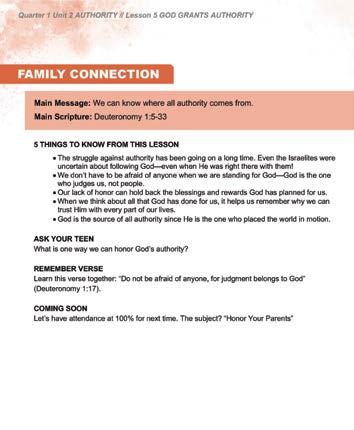
• God Grants Authority Deuteronomy 1:5-33
• Honor Your Parents Exodus 20:12; 1 Samuel 19:1-7
• Respect Everyone Romans 13:1a, 7-10; 1 Peter 2:9-17
• Take a Stand Hebrews 4:12, 16; 10:19-39; 11:1
LIFE SKILLS—POWERFUL WORDS
• Words That Help Proverbs 15:4; 27:6, 9, 17
• Words That Hurt Proverbs 12:18; 16:28; 18:21; Romans 1:28-32; Ephesians 5:1-10
• Words That Heal Proverbs 16:24; Ephesians 4:29; 1 Thessalonians 5:11-18
• Words Under Control James 3:1-18 FALL
SPIRITUAL GROWTH—THE WORD
• Knowing the Story of the Word Romans 1:16, 17; 2 Timothy 3:14-17
• Trusting the Word Psalms 19:7-9; 119; Luke 24:44-48
• Using the Word Colossians 1:1-14
• Studying the Word Psalms 37:7; 66:18; 119:2, 3; Mark 1:35 CHARACTER DEVELOPMENT— WISDOM
• The Value of Wisdom 2 Chronicles 1:7-12; Proverbs 2:1-9; 3:21-23; 8:11