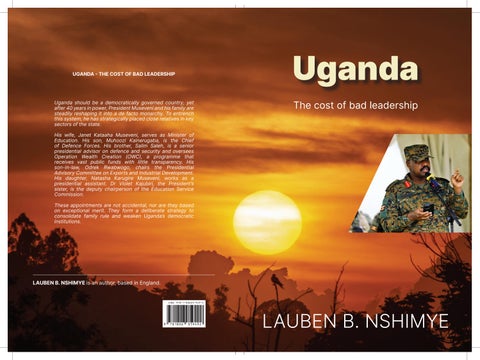
Uganda should be a democratically governed country, yet after40yearsinpower,PresidentMuseveniandhisfamilyare steadily reshaping it into a de facto monarchy. To entrench this system, he has strategically placed close relatives in key sectors of the state.
His wife, Janet Kataaha Museveni, serves as Minister of Education. His son, Muhoozi Kainerugaba, is the Chief of Defence Forces. His brother, Salim Saleh, is a senior presidential advisor on defence and security and oversees Operation Wealth Creation (OWC), a programme that receives vast public funds with little transparency. His son‑in‑law, Odrek Rwabwogo, chairs the Presidential Advisory Committee on Exports and Industrial Development. His daughter, Natasha Karugire Museveni, works as a presidential assistant. Dr Violet Kajubiri, the President’s sister, is the deputy chairperson of the Education Service Commission.
These appointments are not accidental, nor are they based on exceptional merit. They form a deliberate strategy to consolidate family rule and weaken Uganda’s democratic institutions.
All rights to the content of the book belongs to Lauben B. Nshimye and cannot be reproduced or copied without permission of the publisher.
All rights reserved. No part of this publication may be reproduced, stored in a retrieval system, or transmitted, in any form, or by any means, mechanical, electronic, photocopying, recording, or otherwise without the written consent of the author, nor be otherwise circulated in any form of binding or cover other than that which it is published and without a similar condition being imposed on the subsequent purchaser.
Opinions expressed are solely those of the author.
ISBN: 978-1-80605-949-2
Uganda
The cost of bad leadership
LAUBEN B. NSHIMYE
From democracy to family rule.
The Crisis in the Statehouse
Since President Museveni came to power in 1986, rather than building strong institutions to support democracy, he has focused on consolidating his own power. In countries with functioning democracies and the rule of law, governments strengthen institutions; in contrast, under Mr Museveni, institutions have been weakened to the point that he stands above them. This is why, whenever people face problems, whether it’s a land dispute, YouTube associations, musician associations, street vendors in Kampala, traders in Kikubo, or any other issue, they don’t go to government institutions like the Ministry of trade they all end up turning to the President for help, calling out “President Museveni Tuyambe.” The government is not pursuing policies that help the entire population; instead, it prioritises individuals who support the regime, allowing them to profit from taxpayer money.
Mr Museveni’s influence has become so deeply entrenched in Uganda’s political system that no government institution can work independently. Because people have grown so frustrated with a system that feels increasingly dysfunctional, public morals and behaviour have been affected. The situation has deteriorated to the point where some Ugandans now even mock the dead or the misfortunes of others, especially those associated with the regime. A system built this way cannot nurture democracy or protect human rights. It creates a political environment centred on a single individual, paving the way for authoritarianism. Mr Museveni has reshaped Uganda’s politics so profoundly that even after he is no longer in power, it may take many years for the country to return to a healthy democratic path. The damage is so deep that abnormal practices have become normalised.
In the following chapter, I will analyse each section to illustrate the impact that Mr Museveni has had on Ugandan politics since he came to power in 1986.
President Museveni in the State House.
Mr Museveni and the love of power is beyond imagination. After 40 years in office, it is still difficult to compare President Museveni’s attachment to power with that of any other leader. His desire to remain in office appears to grow day by day. If it were possible for President Museveni to prolong his life, simply to remain in power, regardless of the cost, he would likely have done so. This is why sometimes, he sounds self-pitying, which is why you often hear him say, “Me, I am about to go to God.”
Although some Ugandans believe 2026 – 2031 will be his final term, I do not share that view. If he still has even a small reserve of energy, I doubt he will willingly step aside. Even Gen. Muhoozi, often spoken of as the “standing generator,” may eventually find himself disappointed by how long the President chooses to hold on.
While campaigning recently, the President remarked that he often hears young people say, “Agende, mwe mutusibyeko akasajja” literally, “Let him go; you are the ones keeping this old man around.” The phrase reflects a growing sentiment among the youth, who are calling for Mr Museveni to step down and blaming his long-time supporters, particularly older voters, for sustaining his nearly four decades in power.
Also, in the past, Mr Museveni has said things like, “I don’t need to remain in office; Uganda needs me. I have my home in Rwakitura. I am a rich man; I can go to my farm and look after my cattle.” Those remarks, coming from a leader, suggest he knows people are tired of him, yet he frames the issue as if it is Uganda that cannot do without him. For him, leadership appears to be about his person rather than about Ugandans. That explains why, in 2005, he pushed to remove presidential term limits and why, in 2017, the age limit was lifted, changes that came at great cost, including injuries to people like Hon. Nambooze.
Many Ugandans no longer support Mr Museveni for many reasons, including restricted democracy and human rights abuses, but in this paragraph lets discuss corruption.
When he came to power in 1986, the debt burden was about $2.6 billion; under the HIPC initiative in 2000, the country qualified for roughly 80% debt relief. By 2026, Uganda’s debt stands at about $32.3 billion (UGX 116.2 trillion), roughly twelve times higher than in 1986. Despite a hardworking population, thriving trade and farming, and abundant natural resources, gold, limestone, marble, the 3Ts, copper, cobalt, iron ore, etc, the government keeps borrowing. Revenue comes from domestic taxes, foreign grants, traders and farmers, and resource extraction, yet contracts such as the one with the Chinese firm Wagagai for mining in Karamoja are not public, so citizens cannot see how much the state will receive or how the proceeds will be used. According to available records, Uganda has an estimated 31 million metric tonnes of gold in Karamoja. If these mineral resources were managed and used appropriately, they could dramatically transform the lives of many Ugandans.
Therefore, after knowing all these and then assessing Mr Museveni’s record, development outcomes, patronage spending, shrinking civic space, human rights, rising debt, corruption, and weak health and education systems, it is hard to conclude that he has helped Uganda; rather, it appears Uganda has enabled Mr Museveni and his family to amass wealth.
Underdeveloped Uganda under the President Museveni Regime
Like the way Mr Museveni has long portrayed Uganda as peaceful to both Ugandans and the international community, he also insists that the country is developed and the economy is progressing. But unless we choose to be short-sighted, what real development can be attributed to his regime? Even if we focus only on the welfare of people in Kampala, those who have lived long enough will tell you that places like Katanga did not exist when Mr Museveni came to power.
Today, Katanga Slum sits barely half a mile from Nakasero State House. The people living there endure extremely poor conditions: no running water, no drainage system, no toilets, and no basic sanitation. How can citizens live in such an environment while the government claims to have developed the country? It is the government’s responsibility to uplift the life and well-being of every individual. If you cannot improve the lives and well-being of citizens, then there is no justification for occupying the president’s office. What is the purpose of a government if it cannot uplift or improve the lives of the less privileged within our communities? And what does it say about its priorities if the well-being of poor communities is not treated as the nation’s foremost responsibility?
Although NRM leaders and supporters may not welcome hearing this from the public, these are legitimate questions that deserve answers, especially because you collect taxes from us.
The development of a country is measured by high life expectancy, advanced technology, high per capita income, a strong education system, and a high-quality healthcare system. Mr Museveni may claim to have delivered development, but the real question is development from what baseline to what level, and at what cost, especially when the country carries a debt of $32 billion.
While the president and other government officials continue to live in luxury, the government spends vast sums on projects that offer little benefit to ordinary citizens. In contrast, other funds disappear into the hands of corrupt officials.
A recent example is the billions spent on organising Liberation Day celebrations. Yet if citizens truly feel liberated, should the government need to remind them every year, or should it be the people reminding the government of its duty?
If billions can be poured into a single event, why is it impossible to allocate resources to move families living in Kampala’s slums? As a country, we hold many national celebrations each year, Independence Day, Heroes Day, NRM Liberation Day, and Archbishop Luwum Day, each drawing heavily from the consolidated fund. But how can we take pride in honouring the dead with such extravagant expense when so many of the living continue to suffer? What is the difference between state extravagance and corruption?
I believe this is achievable; it is entirely possible to uplift the lives and well-being of people living in slum areas. Imagine taking just one billion shillings: buy land along Gayaza Road for 300 million, build housing units at five million each, and use the remaining funds to construct around 140 small homes. That alone would move 140 families from Katanga. Repeating this annually for ten years would create 1,400 housing units, effectively eliminating the slum.
State house Entebbe.
The president's motorcade convoy.
The President whose Convoy Defines Power and Opulence
Although Uganda is considered one of the poorer countries in the world, President Museveni travels in remarkable luxury whenever he moves around the country. Despite his repeated claims that Uganda is peaceful and faces no serious security threats, he is often accompanied by a convoy of more than 50 vehicles. Most of these vehicles are occupied by the Special Force Command (SFC), the military unit responsible for protecting the president and members of the first family.
According to the parliamentary appropriation report, the State House spends 1.1 billion shillings every day (approximately $305,662). If Mr Museveni were to set aside a portion of his monthly allocations, he could choose one day each month to say, “Today I will forgo the funds designated for my personal welfare as president and return them to our communities, our hospitals, our schools. In a single year, this would amount to $3,600,000, a sum capable of dramatically improving national infrastructure to global standards. Instead of treating Uganda as the project that deserves investment, the country has been reshaped into a project centred on Mr Museveni and his family.
When you see so many young people out every night, turning to drugs and alcohol, it’s not because they truly enjoy it. For many, it has become the only way to escape the harsh reality of what’s happening in the country. These conditions have pushed countless young Ugandans into despair; they no longer feel proud to be Ugandan when they can’t find jobs or afford school fees for their children. Yet, amid their struggle, we have a president who can spend $300,000 of taxpayers’ money in a single day
Mr Museveni doesn’t stay in office to provide genuine leadership, but to benefit from the power that comes with resources and positions. Let me give you an example. Recently, at his farm in Kisoozi, he hosted content creators from across the country. According to several attendees, every question asked during the meeting had been drafted in advance by the State House. They were handed these questions only after being seated in the tent, with no opportunity to raise their own. If a president cannot allow an honest, unscripted question from someone like Mr Yasin, also known as Nateete Publicity, what kind of leadership is he offering?
In 1986, President Museveni said that Africa’s problem is leaders who overstay in power. Recently, while addressing young people, Janet Museveni criticised youth who migrate to Europe instead of building their countries in Africa. While more than 70% of Ugandan youth are unemployed, President Museveni and his family live on a budget of $300,000, resources that could have created jobs for many Ugandans who are forced to seek work in Arab and European countries due to economic hardship. I think this is hypocrisy, and at the same time, a mockery of our young people who are simply looking for alternatives to improve their lives.
The government continues to speak of development, yet there is little tangible evidence. Like many African leaders, Mr Museveni often presents narratives of development and democracy that do not match lived realities. When we compare our countries with the rest of the world, the gap becomes clear. Uganda’s GDP is about $66 billion with a population of 45 million. The combined GDP of
Part of the Katanga Slum area.
all African countries is roughly $2.8 trillion, with a population of 1.5 billion. Meanwhile, Japan, with 123 million people, has a GDP of about $4 trillion. The United Kingdom, with just 69 million people, also has a GDP of around $4 trillion. This means that a country with 69 million people has an economy larger than that of the entire African continent combined. So, where is the wealth and development that African leaders keep singing and celebrating?
Part of the Katanga slum area
The Irony of History: Museveni vs. Amin
On 16 February 2026, while speaking in Muchini, Kitgum District, President Museveni said that “Idi Amin’s mistakes were ruling by force and killings; leadership must be through persuasion and good works, not intimidation.”
These remarks were delivered before religious leaders and loyal NRM supporters, an audience accustomed to applauding even when applause is unwarranted. Yet the moment invites a broader reflection on Uganda’s current realities: persistent human rights concerns, entrenched corruption, and a steadily shrinking civic space. Many listeners may not have grasped the underlying message he was sending to the public and the international community. His remarks appeared directed at the small group of supporters who still take his speeches seriously, suggesting that if security forces are involved in abuses against citizens, neither he nor his family members should be seen as responsible for those actions. In that context, any form of internal or external pressure, whether from institutions like the ICC or from geopolitical tensions such as those between Iran and the United States, would prompt Mr Museveni to distance himself from those implicated in wrongdoing and potentially hand them over to the authorities to protect his family’s interests.
Recently, when asked why he shut down the internet during the election, Mr Museveni responded by saying that he was the one who “built it,” and therefore cares about it more than anyone else. I am not sure whether Mr Museveni or his government invented the internet, but the technology was developed abroad. Claiming personal credit for something created elsewhere simply because it now exists in your country feels like an overstatement.
On another occasion, he said he loves Ugandans, especially the youth, because he is the one who immunised them. The same person who claims to love Ugandans, especially the youth, presides over a system where many young people are languishing in prison, some held for more than five years without trial, such as those accused in the Machete cases. Others have disappeared entirely, like John Bosco Kibalama, with no trace.
We all know that vaccines were not developed in Uganda, and that foreign governments and international partners fund most immunisation programmes. Despite all this, President Museveni still expects citizens to praise him for receiving donated medicine on their behalf.
At 83, and after four decades in power, Museveni continues to rely on heavy-handed tactics to keep control, despite living in an age of technology such as cameras, the internet, and satellite surveillance. This raises a sobering question: if this is how he governs under the scrutiny of modern technology, what might he have been like in the 1970s? If a young, ambitious, and power-driven Museveni had ruled during Amin’s era, without today’s digital accountability, would the history books tell a different story?
The problem with Mr Museveni, his son, and those who subscribe to their ideology is that they believe Uganda’s current challenge is Bobi Wine. They assume that defeating him politically will somehow resolve the country’s deeper issues. What they overlook is that before Bobi Wine, there was Dr Col. Kizza Besigye. The state fought and weakened Besigye politically, yet none of Uganda’s fundamental problems, such as the poor health and education systems, were solved.
Bobi Wine stands for an idea that lives in the hearts of many Ugandans: the desire to live decent lives and access quality public services like people in other countries. For that reason, even if the government were to eliminate Bobi Wine today, another figure embodying the same aspirations would appear tomorrow.
The Crisis in the Security Forces
In this chapter, I will examine Gen. Muhoozi, the current CDF of Uganda and the son of President Museveni. According to history, he himself once fled into exile during Amin’s regime and returned only after his father assumed power. I will explore how, despite that history, his role as CDF has contributed to negative pressures on opposition parties in Uganda.
According to historical accounts, Gen. Muhoozi Kainerugaba was born in 1974 in Dar es Salaam, Tanzania, at a time when his parents were living in political exile. His father, Yoweri Kaguta Museveni, now the President of Uganda since 1986, had fled the country due to the repressive rule of President Idi Amin. Like many Ugandans who opposed Amin’s government, Museveni and his young family sought refuge in Tanzania, which had become a haven for political dissidents, intellectuals, and liberation movements across East Africa.
Muhoozi’s birth in Dar es Salaam unfolded against a backdrop of political struggle, displacement, and uncertainty. His earliest years were shaped not by stability but by exile: a family constantly on the move, a father engaged in underground political activity, and a mother raising her children far from home. These conditions exposed him from birth to the intersection of politics, conflict, and national identity, forces that would later influence his worldview and public life.
Muhoozi Kainerugaba’s upbringing was further shaped by the network of individuals who quietly worked to protect President Museveni’s family during the volatile early 1980s. Among the most pivotal figures was H.E. Marjam Blaak Sow, now Uganda’s Ambassador to Brussels, the Netherlands, and Luxembourg. Her role in safeguarding the family during this period underscores how deeply Muhoozi’s early
life was intertwined with political upheaval and the efforts of those who ensured the family’s survival.
Between 1983 and 1985, as Yoweri Museveni led the guerrilla war against the Obote II government, his family faced escalating threats. Drawing on her diplomatic connections and her position within the UNHCR office in Nairobi, Marjam Blaak discreetly organised the evacuation of Museveni’s family from Kenya to Sweden. The operation demanded careful coordination, confidentiality, and a deep understanding of the political risks involved.
For the young Muhoozi, this marked the beginning of life in exile, an experience that shaped his worldview and exposed him to cultures far beyond East Africa. These formative years abroad would later influence both his identity and his role within Uganda’s political and military landscape. He returned to Uganda in 1986, shortly after President Museveni and the NRA took power. This aligns with the broader return of Museveni’s family and supporters following the NRA’s victory.
When Gen Muhoozi joined the Army
Muhoozi Kainerugaba’s entry into the Uganda People’s Defence Forces (UPDF) marked one of the most scrutinised moments of his early adulthood. His decision to join the military unfolded in a political climate where every move by the First Family attracted intense national attention. When Muhoozi joined the army in 1999, public reaction was immediate and intense. Many Ugandans questioned:
• Why the President’s son was joining the military
• Whether this signalled a future political succession plan
• Whether he would receive special treatment
• What his true intentions were
The debate grew so loud that President Yoweri Museveni addressed it publicly. President Museveni’s Response: “I know Muhoozi, he has no leadership skills to lead even a village”
To calm public concern, President Museveni downplayed the significance of his son’s enlistment. He said that Muhoozi was not joining the national army, but rather a Local Defence Unit (LDU), a community-based force intended to protect villages. He insisted that Muhoozi’s decision was personal and not part of any political grooming. Most strikingly, Museveni added that his son lacked leadership skills, saying that from what he knew, “Muhoozi cannot even lead a village.” This remark was meant to diffuse tension, yet it became one of the most often quoted statements about Muhoozi’s early military life. Ironically, it contrasted sharply with the leadership positions he would later assume.
Rank Progression and Responsibilities.
Despite the LDU explanation, Muhoozi soon transitioned into formal UPDF officer training.
• Second Lieutenant, 1999–2000, Initial officer duties, field exposure
• Lieutenant, early 2000s, Junior command roles
• Captain, mid 2000s, Operational leadership, specialised training
• Major, 2008, Staff Roles after Fort Leavenworth
• Lieutenant Colonel, 2010, Deputy Commander, Special Forces
• Colonel, 2012, Commander, Special Forces Command (SFC)
• Brigadier, 2013, Oversaw the expansion of SFC
• Major General, 2016, Senior strategic roles, regional operations
• Lieutenant General, 2019, Presidential Advisor on Special Operations
• General, 2022, Highest rank, later appointed CDF in 2024
Many UPDF officers have risen through the ranks and taken on significant responsibilities, but Muhoozi Kainerugaba’s career trajectory stands out as uniquely different from that of his peers. Figures such as Dr Col. Kizza Besigye have openly argued that it is highly unusual for an officer to rise from private to full General in roughly twenty-five years. In the UPDF, senior promotions, such as moving from Captain to Major, typically require long periods of service, often between five and ten years. To some observers, the speed and pattern of Muhoozi’s advancement are viewed as signs of institutional favouritism or even corruption. In contrast, others interpret it as a reflection of trust, strategic placement, and the evolving priorities within Uganda’s military hierarchy.
International Trainings
Royal Military Academy Sandhurst (UK), early 2000s
• Egyptian Military Academy, specialised courses
• South African Command and Staff College, mid 2000s
• US Army Command and General Staff College, Fort Leavenworth, 2007–2008. This combination of local and international training positioned him as one of the most globally trained officers in the UPDF.
Gen Muhoozi as CDF
In March 2024, Gen. Muhoozi Kainerugaba was appointed Chief of Defence Forces by his father. In your view, he has used this position to apply pressure on his father’s political opponents. Although he rarely delivers public speeches, he often communicates through his X account, which has become his primary channel of public engagement. If you have been following Mr Muhoozi Kainerugaba’s X account, you will notice that his posts have not been limited to Ugandan affairs. In the past, he has used the platform to make remarks directed at Kenya, South Sudan and, at times, the United States.
With more than one million followers, the platform would ordinarily serve as a powerful tool for anyone pursuing political ambitions. Instead, you can argue that he has used it in ways that undermine the rights of others, including harassing and intimidating individuals who do not support his father’s administration.
For example, after the January 2026 presidential election, an account associated with Muhoozi Kainerugaba posted a message claiming he was searching for Bobi Wine and had ordered security forces to capture him, dead or alive.
Upon learning of this, Bobi Wine fled his home, leaving behind some family members, including his wife. According to Bobi Wine’s wife, security forces then entered the home, harassed and strangled her, and forcibly stripped her while filming the incident as they demanded the password to her mobile phone.
When you read Uganda’s history, you realise that past regimes were brutal, and the current one is not fundamentally different. If the government genuinely had a case against Barbie Kyagulanyi, the Uganda Police would have summoned her to report to the nearest station. If not, they would have gone to her residence, informed her that she was under arrest, told her of the alleged offence, and
taken her to the nearest police facility. If her phone were relevant to the investigation, the police would have confiscated it, taken it to the station, and handed it over to the technical team to extract any necessary evidence. What you do not do is arrest someone and demand that they hand over their phone on the spot without following proper procedure. What the police did was come to her residence, harass, intimidate, and subject her to physical and psychological distress. She collapsed, and instead of taking her to a hospital, they left her unconscious. These crimes are not a display of strength. They reveal a regime that knows its popularity is declining, and as a result, resorts to intimidation tactics to keep control.
A prominent Swiss newspaper, founded in the 1780s, recently published an article about Gen. Muhoozi. According to the paper, “President Museveni’s son wants to play Hitler and Kim Jong Un.” This suggests how the international community view Mr Muhoozi as president of Uganda if he were to succeed his father.
But after hearing or reading this article, some Ugandans, especially regime apologists, will claim that Western countries only comment on our politics because they want to destabilise the country. President Museveni and those who support his government often overlook the reality that when citizens face oppression, they flee to other countries, creating financial and social pressures for those host nations. This is why many foreign governments, through their embassies, prioritise promoting democracy and human rights in the countries where they operate. However, to me, Switzerland’s position is a genuine, independent assessment. Switzerland has no strategic or economic need for Uganda, and its democratic institutions are among the strongest in the world. It consistently ranks at the top globally for democracy, human rights, and political participation, supported by a long tradition of constitutional protections.
Economically, Switzerland’s GDP is about 936 billion USD, compared to Uganda’s 66 billion USD. It has a population of roughly 8 million people, far smaller than Uganda’s 45 million. Given this context,
Switzerland has no incentive to offer a biased opinion. It is simply expressing how it views Mr Muhoozi based on its own democratic and human rights standards.
Although Gen. Muhoozi has held several senior positions within the UPDF, he keeps a notably reserved public profile. For years, many Ugandans, and even observers outside the country, questioned whether he genuinely ran his X account. That uncertainty shifted dramatically during the abduction of Edward Rodgers Ssebuuufu, widely known as Eddie Mutwe, the bodyguard of Robert Kyagulanyi. While security agencies denied holding Mutwe, a few days later, Mr Muhoozi posted photos of him on X, claiming he was in his basement learning Runyankole, his mother tongue. The account shared images of Mutwe appearing tortured, shaved, and naked, photos that could only have originated from high-level security circles. From that moment, the public broadly accepted that the account was indeed under Muhoozi’s direct control.
After Eddie Mutwe was moved from the basement to prison, Robert Kyagulanyi (Bobi Wine) visited him. Upon returning, Bobi Wine told the public that Mutwe had informed him that Gen. Muhoozi had visited him in the basement for questioning. Also, according to Bobi Wine, Eddie Mutwe was tortured using pliers and subjected to electric shocks. This account further strengthened public belief that Muhoozi himself was behind the posts on the Muhoozi Kainerugaba X account.
Under his leadership, the UPDF has harmed many Ugandan families, particularly during the most recent elections. Some families have lost loved ones, others have relatives in prison, and many have been forced to flee the country for their safety. Children have dropped out of school because their parents were killed, detained, or left unable to provide school fees. Others have faced vulnerability and exploitation due to the absence of parental guidance. The National Unity Platform continues to document a growing list of political victims and supports many of the affected children, but the need far exceeds
the resources available, and the number of cases increases each day.
One is then left to wonder how God’s own army could be the very force inflicting such suffering on its citizens. Although these actions have been widely reported and criticised, Gen. Muhoozi appears to remain beyond accountability, as no one is able to question him directly about them. Even when Parliament tried to summon him for clarification, he responded on X by mocking the institution, calling its members “clowns” and claiming he would have them all arrested.
Many supporters of the NRM, including figures like Helen Sseku and others, tend to equate the UPDF with Mr Museveni and his family, and vice versa. In that view, removing him from power is indistinguishable from provoking a war. Yet this raises an important question: if Mr Museveni were removed through a democratic process, who would wage a war against the citizens? To me, this would effectively be the UPDF and other security agencies turning their force against the population.
President Museveni has turned the UPDF into what increasingly feels like a family enterprise, to the point that the public is discouraged
from discussing anything related to the army. They insist that only Parliament may debate UPDF matters, mainly when funding is needed, yet even in Parliament, there is little capacity or willingness to ask hard questions about its operations or interests. Ordinary citizens are expected to stay silent.
But let me be clear: no one should be deceived into thinking that Mr Museveni is unaware of what is happening in the country. He knows that security forces kill, kidnap, and torture citizens in his name. Over the years, he has built multiple layers of security structures across Uganda, duplicating agencies because he believes that relying on a single institution would make him vulnerable if its leadership ever fell out with him. These security agencies produce daily reports, ensuring the president is fully informed about what is happening on the ground around the country. He is aware that many Ugandans no longer want him in power; that’s why he chooses to spend taxpayers’ hard-earned money not on improving schools or ensuring hospitals have medicine, but on buying guns and other military equipment from Russia and elsewhere, tools used against the very citizens who fund his government.
Now that I have spoken openly about the UPDF, many are likely to attack me, believing I have no right to comment on an institution they treat as their own rather than the country's.
As Dr Spire Ssentongo often asks, “What died when we lived?” For many Ugandans, the state of governance under President Museveni raises that very question.
On several occasions, I have heard the police spokesperson, Mr Kituuma Rusoke, publicly state that Bobi Wine has not committed any offence and that, as of now, there is no record of any crime against him. Yet the authorities continue to surround his residence, claiming they have intelligence suggesting that some individuals were planning actions against the government. At the same time, other security officials deny blocking access to his home, even
though we have repeatedly seen many people, including senior NUP party officials prevented from entering Bobi Wine’s residence. In a nutshell, the whole country needs a reboot, with new leadership at every level.
When you ask the security forces why they harass and torture the very people they are meant to protect, they often claim that these abuses are necessary to preserve the peace Ugandans are currently enjoying. But every country has an army and a police force. Do all countries use their security agencies to harass and torture citizens in the name of protecting peace? According to Mr Museveni, Mr Muhoozi, and NRM supporters, peace simply means the absence of war; this is incorrect.
True peace is built on eight pillars:
a. A well-functioning government that delivers high-quality public services, upholds the rule of law, and keeps political stability.
b. Equitable distribution of resources, ensuring fair access to essentials such as healthcare and education, which reduces social disparities.
c. Acceptance of the rights of others, through enforcing laws that protect human rights and fostering cultural norms of mutual respect and inclusion.
d. Low levels of corruption, which enhance public trust in institutions and ensure that resources are allocated for collective benefit rather than personal gain.
e. Free flow of information, supported by an independent media that informs citizens, enabling better decision-making and more rational responses during crises.
f. A high level of human capital, achieved by investing in a skilled and educated population, which boosts economic productivity and encourages active political participation.
g. Good relations with neighbours, promoting harmonious external relations with other nations and peaceful internal relations among different ethnic or religious groups.
h. A sound business environment, created through stable economic conditions and strong institutions that allow the private sector to thrive and contribute to long-term prosperity.
The Leadership Crisis in UPDF
Uganda is facing a profound leadership crisis, and the evidence is visible across multiple institutions. This crisis is not confined to the State House; it permeates government bodies, including the security forces, such as the police and UPDF. In Uganda, a person merely suspected of committing a crime is often treated as though they have already been convicted. This practice directly contradicts Article 28 of the 1995 Constitution of Uganda, which guarantees the right to a fair hearing and the presumption of innocence. Such systemic disregard for constitutional protections reflects a failure of leadership. If effective leadership were in place, the police and other institutions would have addressed and corrected these violations long ago.
All too often, we see security agencies detaining individuals far beyond the time limits mandated by the Constitution. In some cases, those arrested are even subjected to torture before they are brought before a court of law. Meanwhile, many of our leaders behave as though they are above the law. When they are believed to have committed crimes or violated others' rights, no one holds them accountable. This culture of impunity is a clear sign of a deep leadership crisis.
For that reason, that's why CDF can go on his X account and publicly post that he has “killed 22 terrorist NUP members” without justification and even prays that “Kyagulanyi will be the 23rd. This is deeply troubling.
NUP has never been designated as a terrorist organisation; there has been no meeting, either in Uganda or internationally, that has ever classified it as such. In fact, according to the Constitution of Uganda, any organisation designated as a terrorist cannot take part in electoral processes. Therefore, when a leader of an institution
makes such statements, it is a clear sign that the country is in crisis.
As mentioned above, President Museveni himself once said that his son lacks the leadership capacity to govern a small village. In my view, he was right, and I believe Mr Muhoozi has not acquired effective leadership skills, despite having held powerful positions within the UPDF. This is partly because he has not earned these positions on merit and therefore has not had the opportunity to grow through genuine leadership challenges. Even President Museveni knows that many UPDF officers are more qualified and competent than Mr Muhoozi. However, as part of a family strategy to keep power, he appointed his son as CDF.
Furthermore, although he has served as CDF for nearly two years, my research shows that little can yet be clearly attributed to his leadership. That said, it may still be too early to make a definitive judgment about his overall performance. He recently received the Kabalega Star Medal from his father, with one of the stated reasons being “military professionalisation.” Yet a truly professional army would not behave as the UPDF did during the recently concluded Jan 2026 election. For example, during the recently concluded
election (Jan 2026), the UPDF played a significant role in violating citizens’ rights, including acts of torture, kidnapping, and enforced disappearance. Although all these were done, Ugandan officials seem not to appreciate that human rights are universal.
The tactics Mr Museveni used against Milton Obote during the 1981–1986 bush war are like those he employs today against opposition parties, particularly NUP. According to Mr Kahinda Otafiire, the NRA would kill civilians and then claim it was Obote’s army responsible for the atrocities. Many people draw parallels to more recent events. For example, when the government first arrested Bobi Wine in Arua, security forces displayed guns they claimed belonged to him, yet to this day, the whereabouts of those guns are still unclear.
According to the government, NUP members allegedly commit crimes to damage the government’s image abroad and secure asylum in foreign countries. In practice, however, the government has been accused of torturing individuals and then claiming that the same victims were harmed by NUP members to sway public opinion.
One example often cited is the case of a former NUP member, Mwesigwa. He was reportedly kidnapped
and tortured by security agencies, only to be later paraded by UPDF spokesperson Brig. Gen. Felix Kulayigye, who claimed that Mwesigwa had been tortured by NUP members as part of a plot to tarnish the government’s reputation. At that time, Mwesigwa reappeared with a large, fresh wound on his chest, claiming that his torturers had burned him with a flat iron. According to the UPDF narrative, Mwesigwa, had been promised financial support in exchange for taking part in this claim.
In a surprising turn of events, a few weeks later, Mwesigwa returned to the media and accused the UPDF of using him to damage NUP’s image. He said that the UPDF had promised him money, a house, and security protection, but after he fulfilled his role, the institution did not honour the agreement. As a result, he said he felt compelled to come forward and expose what he described as the UPDF’s manipulation, actions carried out by an institution widely regarded as a national army.
Although Uganda is a sovereign state, sovereignty entails the responsibility to protect its citizens and their property. Many officials, including Mr Muhoozi, appear not to uphold these obligations. For example, the country saw the UPDF
surrounding and attacking Mr Robert Kyagulanyi and his NUP supporters with sticks in Gulu City, northern Uganda, during the campaign trail. These are not the actions of someone who aspires to lead a country. Such conduct can even expose him to sanctions from other nations, especially because he was the head of the army at the time these incidents occurred, and no one has been held accountable for them.
They often speak about professionalising the army, but a truly professional force cannot be built on tribalism. Today, Uganda has roughly twelve active and retired four-star generals, yet the pattern of appointments raises serious questions about whether professionalism or patronage is driving military leadership
We have Gen. Museveni, Gen. Muhoozi, Gen. Wilson Mbadi, Gen. David Muhoozi, Gen. Katumba Wamala, Gen. Kale Kayihura, Gen. Ivan Koreta, Gen. Joram Mugume, Gen. Salim Saleh, Gen. Jeje Odongo, Gen. Moses Ali, and Gen. Mugisha Muntu. Out of these twelve, nine come from a single region, Ankole, the president’s home area. You can’t build army bases around a single tribe. Uganda has 56 tribes, and if you aim to build a truly national army, all of them must be included and given fair opportunities for promotion. You cannot elevate one tribe within an institution and still call it a professional or national army. This is uncomfortable for many to acknowledge, but a truly professional army cannot be organised along tribal lines. Such imbalances fuel public resentment and risk pushing the country toward unnecessary conflict.
In my view, I compare President Museveni’s government to water contaminated with poison. Once water is poisoned, you cannot separate the toxins from it; the only solution is to find a new source of clean water. In the same way, Mr Museveni’s government can no longer reform. For Ugandans, the only practical path forward is a complete change of regime.
Gen Muhoozi in using the X account to Oppress others
We have often seen Mr Muhoozi referring to the President of the National Unity Platform (NUP), Hon. Robert Kyagulanyi (Bobi Wine), as “Kabobi.”
In Ankole communities, and generally in western Uganda, where the President comes from, this is not an innocent nickname. It is a deliberate linguistic strategy used when someone wants to attack an opponent not only on a personal level but also within the cultural and communal space.
In Runyankole, the prefix “Ka–” is used to belittle or demean someone. It implies smallness, insignificance, or failure.
In western Uganda, when someone adds Ka to your name, it's intended
to mean: this person is small, unimportant, and undeserving of public attention.
It is a subtle but powerful way of telling you or the community that the intended individual has no value or standing. This is one of the ways a Munyankole man can tarnish someone’s reputation, by shrinking their identity through language.
Myth, Identity, and Faith: The Blend of Chwezi Legends, Bachezi Heritage, and God
When you study Mr Muhoozi’s public messaging, a pattern appears: he uses every available cultural, spiritual, and historical symbol to reinforce the idea that political power should remain within his family. At times, he refers to the UPDF as “God’s army.” Meanwhile, the CDF has publicly claimed to be a Muchwezi. According to biblical principles, these two identities cannot coexist.
The Bachwezi are regarded as semi-divine, legendary figures believed to have ruled the ancient Empire of Kitara in western Uganda. Yet within Christian teaching, the Bachwezi are often associated with spirits that contradict Christian doctrine. From that perspective, one cannot simultaneously exalt God and praise the Chwezi or any spirits linked to them.
However, because Mr Muhoozi and his father are fighting on multiple political fronts (both physical and spiritual), he tailors his message to different audiences. To Christians, he
presents his family as God's chosen to lead Uganda. To those who believe in the Bachwezi heritage or spiritual traditions, he positions his family as the rightful heirs of that lineage.
These narratives are not expressions of genuine belief. They are political tools. Mr Muhoozi understands that his father’s 40-year hold on power has been sustained through coercion and manipulation, not divine mandate or ancestral destiny. The blending of myth, identity, and faith is simply another strategy in a long-standing effort to support control.
Power, Ownership, and Political Exclusion in Uganda
Mr Museveni, Mr Muhoozi, and many within the NRM establishment believe that Uganda is essentially the property of their family or party. From that viewpoint, no one is allowed to challenge either of them on matters of national leadership. This mindset helps explain why figures like Dr Kizza Besigye are currently imprisoned.
Dr Besigye was kidnapped from Nairobi, Kenya, in December 2024 and transferred to Luzira Prison in Kampala. According to the government, Col. Besigye allegedly held meetings in Greece, Switzerland, and Nairobi to obtain weapons for an assassination plot against President Museveni. Officials claim to have video recordings of these meetings. Yet more than a year has passed, and this evidence has never been presented before any court of law. After his abduction and later court appearance, individuals such as Mr Andrew Mwenda publicly defended the government, alleging that Dr Besigye had been plotting to murder President Museveni. I recall an NBS talk show where he and Hon. Semujju Nganda nearly came to blows. Mwenda insisted that Dr Besigye had attended
a meeting in Nairobi where he was supposedly planning to kill President Museveni in cold blood.
Another good example is the recently concluded elections, which were marked by kidnappings, torture of political opponents, and the violent disruption of opposition rallies. These actions reflect a political culture in which the ruling family views other Ugandans as subjects who have no legitimate right to contest high office. This is why officials such as Okello Oryem accuse Bobi Wine of “treason” simply for addressing human rights violations before the European Parliament.
Mr Andrew Mwenda often argues that President Museveni won the election. He claims that Mr Robert Kyagulanyi, before choosing to take part, already knew that President Museveni would disrupt his rallies and that his supporters would face harassment and torture. According to Mr Mwenda, by being aware of these irregularities, Mr Kyagulanyi should simply accept that Mr Museveni won the elections.
What Mr Mwenda does not tell the public is what the law says about organising elections in Uganda. The 1995 Constitution of Uganda, under Article 61, mandates the Electoral Commission to organise, conduct, and supervise free and fair elections. Ugandans and the rest of the world should understand one thing about Mr Andrew Mwenda: he is a sophist.
On the other hand, Hon. Abdu Katuntu, a newly joined member of the NRM, recently revealed this internal mindset during a talk show in Kampala. He said that “there are people who think they own NRM, and they are not happy with people like Yusuf Nsibambi joining their party. They look at Nsibambi as someone who has come to take their property and positions.”
This attitude, treating political power as personal property, lies at the heart of Uganda’s current political crisis.
Public Perception and Pressure: The Politics of Cash Handouts in Times
of Criticism
Whenever Mr Muhoozi faces public pressure or scrutiny, he often turns to his X account, using a mix of playful and polished language to defuse tension. At times, he deletes posts after they attract backlash. He has shared messages such as “abagala kunkuba oluseke like and retweet,” Mbokyeeyo, which translates to a request for likes and reposts from those seeking money. While I cannot verify whether payments are made, many commenters under his posts claim to have received amounts ranging from UGX 500,000 to UGX 5 million.
Mr Muhoozi has used this tactic several times. He employed it when he was under intense public pressure after posting photos of Eddie Mutwe, and again when he faced
backlash for sharing photos of Barbie Itungo Kyagulanyi, Bobi Wine's wife.
As a historian, I analysed Mr Muhoozi’s past public speeches and his posting pattern on X. Based on these facts, I predict that Uganda’s situation will worsen if Mr Muhoozi becomes president. In my view, Mr Muhoozi has no leadership skills to lead our country to the next stage.
Besides that, Mr Muhoozi and his associates may not yet appreciate how damaging his post on X is to his reputation and to public trust; he currently treats tweeting as a bit of fun, but I expect a time will come when he will have to publicly disown the account and deny responsibility for those messages.
The Crisis in different Government Parastatals
In terms of institutions, let me begin with Uganda’s justice system. Like many other government bodies in the country, it has not been spared from dysfunction. And when it comes to members of the NUP, the system treats them almost like unwelcome co-wives, tolerated but never given fairness or dignity. I was listening to Alex Waiswa Mufumbiro, the NUP deputy spokesperson, recount his experience before a judge. He explained that he was kidnapped seven months ago, detained in prison, and repeatedly brought before different courts without ever being told the reason for his imprisonment. Any reasonable person hearing Waiswa’s account would ask: if the state has no evidence against him, why can’t the court dismiss the case? And if the court cannot dismiss it, why can’t he at least be granted bail so he can defend himself while supporting his family?
As I mentioned earlier, our society’s moral fabric has eroded. Even the judge knows that Waiswa is a young, newly married man with a young family who needs him. But because our institutions and social values have collapsed, the judge shows no compassion, keeping him away from the very people who depend on him.
The Uganda EC Boss
In the recent 2026 election, the country once again saw irregularities in the electoral process. Mr Byabakama has still not published the presidential results on the Electoral Commission website. Although he declared Mr Museveni the winner with 71%, he has not provided the sources of the figures he announced. The National Unity Platform has repeatedly demanded that the Electoral Commission publish the presidential results from every village, parish, sub-county, and district across Uganda. Yet Mr Byabakama appears not to have these figures; otherwise, why withhold them?
While NUP continues to demand transparency from the EC chairman, it increasingly seems that the chairman himself may be waiting for this information from a third party, possibly the State House.
Like many other dictators who consolidate power, President Museveni uses the internet to advance his agenda. Yet when a national crisis appears, and citizens turn to online platforms to voice their concerns, the government often shuts down access under the pretext of protecting national security. NUP reports that many people were killed nationwide when the internet was shut down.
Kiruhura District
In Kiruhura district, at the polling station where President Museveni cast his vote, the Electoral Commission’s register listed 577 registered voters. According to the returning officer at the station, President Museveni received 589 votes, a figure exceeding the number of registered voters. There were 5 invalid ballots, and all other candidates, including Mr Robert Kyagulanyi, received zero votes. The voters’ register had been compiled a year before polling day, yet the EC reported that no voters had died, moved, or otherwise left the register, and that all 577 registered voters turned up to vote.
The RDC's Participation in the Election.
Although many NRM supporters are reluctant to acknowledge the violence and irregularities in the recent election, testimony before Parliament’s PAC committee, chaired by Hon. Namugga Goretti, painted a different picture. While appearing before the committee, Hajji Yunus Kakande, a permanent secretary in the office of the presidency, openly admitted that the election in Ssembabule was marred by violence and rigging. According to him, in some areas, the RDCs effectively took over the electoral process from the Electoral Commission and declared their preferred candidates. Although Mr Kakande did not concede that all 146 RDCs were involved in aiding the NRM, he acknowledged that several of them acted in a partisan manner to help the ruling party secure victories in various districts.
The Uganda Oil in Hoima.
In the 2000s, Uganda discovered commercially viable oil reserves in Hoima. Since then, the Ugandan government has partnered with international companies to extract crude oil and transport it to Tanzania for refining. Despite the project being under development for more than a decade, an estimated 95% of Ugandans know very little about it. The agreements between Uganda and the international oil companies are understood by only a small portion of the population, creating the impression that the country’s oil resources do not truly belong to its citizens.
A simple random survey on the streets of Kampala would reveal this information gap. Ask people the following questions:
• Which international companies are exploring oil in Hoima?
• Why was the refinery built in Tanzania instead of being constructed in Uganda?
• How much revenue will Uganda earn from the project?
• How will that revenue be used once it is received?
Most citizens cannot answer these questions. If someone does not know how much the project is expected to contribute to the national economy, it becomes impossible for them to understand or evaluate how the money will be used.
The Crisis in Parliament
The Parliament of Uganda increasingly appears to serve the interests of the regime rather than the public. In any functioning democracy, the Speaker of Parliament is expected to act with neutrality, regardless of their political affiliation. However, on many occasions, Speaker Anita Among has shown clear bias while presiding over parliamentary proceedings.
A striking example occurred during the debate on the Coffee Bill Amendments 2024. While engaging with Minister Denis Obua Hamson, Anita Among was heard asking whether the NRM had the numbers to push the amendment through. She went further by making a tribal remark, urging the minister to “make sure those Baganda don’t make numbers.”
Take another example from Parliament, both before and after the 2021 elections. Eighteen NUP supporters were reported missing. The party did everything possible to ensure these people were found, dead or alive, but to this day, the government of Uganda cannot account for them. How can grown adults simply disappear without a trace? How is that possible in this era? And how can people vanish while Parliament carries on with business as if nothing has happened?
What is the role of Parliament? This is the same institution that appropriates funds for the government. How can citizens disappear, and yet Parliament continues to distribute money to a government that has failed in its most basic responsibility, to protect its people?
In 1986, the President declared, “I will not preside over a government where Ugandans are killed, and the authorities don’t know who killed them.” Forty years later, people still disappear, and others are murdered. Until now, I don't recall a single security officer ever being held accountable for the killing of a Ugandan.
The Crisis in Opposition Political Parties.
When it comes to political parties, the intrigue runs deep: Mr Museveni has heavily infiltrated the opposition. Some parties are believed to cooperate quietly with his administration, while others reveal themselves through their actions, which have eroded trust and weakened Uganda’s democratic struggle. For example, on the Kasuku talk show, Hon. Munyagwa criticised Mr Kyagulanyi’s visit to the EU Parliament as a waste of time, while on the same platform, he also said Kyagulanyi “missed an opportunity” because his representation was unsatisfactory, two statements that contradict one another. Munyagwa spends much of his time attacking the NUP, raising the question of when he addresses his own political work; if his party was formed to challenge the NRM, one would expect him to focus on opposing the NRM government. Politics today is confusing: take Norbert Mao, though he is the president of the DP, I recently heard him say he voted for President Museveni, leaving observers unsure which party he truly supports.
The Crisis in Religious Institutions.
The leadership crisis began with President Museveni’s leadership style. It has since spread into government institutions and is now affecting other sectors, including churches and mosques. The impunity under Mr Museveni and his family rule has reached a level that feels beyond repair. It has seeped into every institution, and now even the churches and mosques are not spared. It is under Mr Museveni’s regime that we now see religious leaders clashing inside the church over leadership positions.
Although the government and religious institutions in Uganda commemorate the death of Archbishop Janani Luwum every year, his legacy is often invoked without confronting the realities he stood against. Archbishop Luwum was brutally killed during the Amin regime, yet even as Ugandans gather annually to honour his courage, it is under the current government of President Museveni that many religious leaders fear speaking openly about state repression, especially in its treatment of the opposition.
Despite preaching about the beauty of the afterlife and the moral duty to stand for truth, many religious leaders hesitate to criticise the government out of fear for their own safety. They have seen the killings of several clerics in recent years, including Sheikh Abdu Karim Ssentamu in 2012, Sheikh Abdul Kadir Muwaya in 2014, Sheikh Mustafa Bahiga in 2014, Sheikh Abdulrashid Wafura in 2015, Sheikh Kasoud Mutumba in 2020, and Sheikh Muhammad Abas Kirevu in 2021. Their silence reflects a climate in which speaking out can carry deadly consequences.
In Uganda, many people have learned to normalise practices that should be recognised as deeply abnormal. Consider the role of a preacher: someone meant to guide society in spiritual and moral
matters. Many religious leaders in Uganda hesitate to comment on politics, especially when it involves criticising the ruling government, because doing so can come at a high personal cost, including threats to their safety. As a result, some religious leaders choose to remain silent, appearing not to see the atrocities committed by the regime.
It's only in Uganda where you will find religious leaders move with the kind of security detail reserved for high-risk state officials. It has become common to see a cleric escorted by two police trucks and more than ten officers, while others even have police posts permanently stationed at their places of worship. As an individual, I find this unsettling, but to President Museveni and his government, it appears entirely normal.
During the campaign of Mr Robert Kyagulanyi, the country saw security forces violently attacking the opposition. Instead of holding the government accountable, the Archbishop of Uganda, Dr Stephen Kaziimba Mugalu, chose to accuse the youth of provoking the security forces rather than condemning the brutality.
We have also seen Muslim leaders attack Sheikh Kiti simply because he speaks against the heavy-handedness of the security forces. Some religious leaders have gone as far as defending Mr Museveni’s government by claiming that “all leaders come from God.” But if that is the case, one wonders: why did President Museveni fight President Amin’s regime, yet Amin was also a leader?
With leaders who defend injustice rather than challenge it, the country lost direction. Take the recent example from February 2026, when Archbishop Paul Ssemwogerere was compelled to halt a planned memorial Mass for the family of Dr Kizza Besigye simply because President Museveni had not authorised it. This service was not scheduled for a public venue like Kololo Grounds, but inside a church, yet it was still blocked.
The government of Mr Museveni has repeatedly urged religious leaders not to involve themselves in Uganda’s politics. I disagree with this view. Every Ugandan has a stake in the country’s political life because we all rely on the same markets for food, the same hospitals for medical care, and the same roads for travel. While Mr Museveni has discouraged religious and cultural leaders from engaging directly in political matters, he himself does not hesitate to intervene in church affairs whenever it suits him, and he does so without seeking permission from anyone.
This normalisation extended further. Security forces routinely deploy police and army personnel to surround the homes of the opposition leaders simply because they challenged the president.
Even when you ask some of the officers why they are stationed there, many cannot justify their presence. Take Mr Kyagulanyi as an example: even if the authorities genuinely believe he is planning something against the government, how does surrounding his residence prevent anything, especially when he is not even at home, the very place they are heavily guarding? The logic collapses under scrutiny, revealing that the deployment is less about security and more about intimidation and control.
And don’t be deceived, deployment comes with costs, but because the government shows little concern for its citizens, this kind of resource wastage will continue if those in power are satisfied. To those who can still listen, this is not the Uganda we deserve. As Ugandans, we must speak out and work hard to stop this impunity if we truly love our country.
The Crisis in our Communities
The absence of the rule of law and genuine democratic practice in Uganda has far-reaching social and security consequences, especially when leadership positions are filled through political choice rather than through the will of voters. When communities believe that leaders are chosen by the ruling party instead of elected fairly, public trust in institutions erodes, and people begin to feel excluded from decisions that shape their lives.
A widely discussed example is Hon. Lutamaguzi of the Nakaseke South constituency. Before the election, it was public information that he enjoyed strong support and was expected by many residents to win. When the final declaration instead announced a different candidate from the ruling party, it deepened the belief that electoral outcomes are predetermined. Situations like this not only undermine confidence in the electoral process; they also create emotional and political fractures within communities.
The Negative Impact appears in several ways:
• Growing resentment and division. When people feel their preferred leaders are denied victory, frustration turns into bitterness. Supporters of different political groups begin to view each other with suspicion, weakening social cohesion.
• Loss of peaceful avenues for resolving disputes. If citizens believe that elections and legal institutions cannot deliver justice, they may stop relying on lawful mechanisms altogether.
• Escalation of conflict in high-crime areas. In communities already struggling with insecurity, the absence of trusted democratic processes can push some individuals toward dangerous alternatives.
Some may resort to hiring armed groups or criminal networks to target those they see as obstacles to their political or personal interests. While such actions are unlawful and harmful, they often appear in environments where people feel that peaceful channels have been closed.
Over time, these dynamics create a cycle of fear, retaliation, and instability. Without credible elections and respect for the rule of law, leaders lack legitimacy, communities become polarised, and the risk of violence increases. Strengthening democratic institutions is therefore essential for restoring trust, protecting communities, and ensuring long-term stability.
My Advice to President Museveni and the Government.
President Museveni recently commented on the escalating tensions involving Iran, Israel, and the United States. He posed an important question: How can African nations protect themselves from global threats? He argued that Africans should study the causes of conflicts elsewhere to avoid similar dangers at home. If that is the case, then President Museveni and Uganda should also reflect on the parallels between Uganda’s leadership and the political histories of countries like Iran.
First, there is the issue of political longevity. Many of the countries that eventually faced foreign intervention, such as Libya, Syria, Iraq, Afghanistan, and now Iran, were led by rulers who remained in power for decades. Long-term rule often weakens institutions and concentrates authority in ways that make a nation vulnerable.
Second, trying to turn a republic into a de facto monarchy has historically created instability. When leaders dismantle democratic safeguards or position themselves and their families as permanent rulers, they invite internal unrest and external scrutiny.
Third, citizens must be able to take part freely in democratic political processes without intimidation or harassment. Iran offers a stark example: during past uprisings, reports claimed that more than 36,000 people were killed by the government. When a state responds to dissent with violence, it deepens grievances and increases the likelihood of crisis.
If Uganda addresses these three issues, leadership longevity, the preservation of democratic institutions, and genuine political freedom, it will reduce the risk of any form of foreign interference in its internal affairs.
This brings us back to Africa, and specifically to Uganda. President Museveni often presents Uganda as a nation grounded in democratic principles. Yet after many decades in power, his actions increasingly resemble those of leaders who look to entrench themselves indefinitely, sometimes even hinting at hereditary succession. When a leader stays in office too long or reshapes the state around personal rule, it creates the same instability and resentment that have fuelled crises in other parts of the world.
In other words, the very lesson Museveni urges Africans to learn from Iran is one he must also apply to himself. When leaders weaken democratic institutions or centralise power, they create the conditions for future conflict. That is the danger Uganda, and many African countries, must confront.
I recommend caution in how President Museveni’s government handles opposition parties. These are modern times: unlike before, when serious abuses could go unchallenged for lack of evidence, almost everything is now documented. That reality matters especially in dealings with opposition groups such as the NUP. Many Ugandans have lost confidence in national institutions and increasingly turn to the international community for help, which is a worrying sign for any government that claims to uphold accountability and the rule of law.
When a family dispute cannot be resolved internally and is taken outside the household, to the LC1 or the police, any sensible person should be concerned. The Ugandan government has done a great deal to ensure that public institutions no longer serve the interests of the people. Most state institutions now run primarily to protect the regime rather than uphold the public good. NUP has filed many cases against the government, but because the judicial system is widely seen as compromised, many of these cases have stalled. As a result, many people, especially members of the elite, will continue taking legal action against the Government of Uganda before foreign authorities. As a regime, these actions undermine your governance systems.
During the recent EU meeting, Dr Sarah Bireete outlined four continental-level offices she holds, none of which were given to her by President Museveni. Despite her international responsibilities, the government sees no value in her work. Instead, they chose to deploy security forces to harass her simply because she takes part in political activities. What they did not predict was that this incident would eventually reach the floor of the EU Parliament.
To those who believe Uganda’s future ends with President Museveni and his family, especially the security officers who carry out unconstitutional directives, this assumption is misguided. Every order must be grounded in the law, and executing an unlawful command violates both domestic and international legal standards.
Many people who do not understand geopolitics may underestimate the seriousness of the EU & Bobi Wine meeting, but for someone who is pursuing democracy, this is not small. As a leader, you should be alert and concerned when other world leaders begin discussing your government in foreign boardrooms. The consequences of such discussions may take time to surface, but they eventually do. When the EU intervened in Libya, it did not happen suddenly; it began with quiet conversations in European boardrooms.