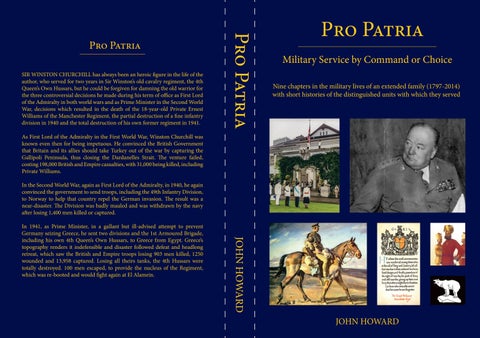
SIR WINSTON CHURCHILL has always been an heroic figure in the life of the author, who served for two years in Sir Winston’s old cavalry regiment, the 4th Queen’s Own Hussars, but he could be forgiven for damning the old warrior for the three controversial decisions he made during his term of office as First Lord of the Admiralty in both world wars and as Prime Minister in the Second World War, decisions which resulted in the death of the 18-year-old Private Ernest Williams of the Manchester Regiment, the partial destruction of a fine infantry division in 1940 and the total destruction of his own former regiment in 1941.
As First Lord of the Admiralty in the First World War, Winston Churchill was known even then for being impetuous. He convinced the British Government that Britain and its allies should take Turkey out of the war by capturing the Gallipoli Peninsula, thus closing the Dardanelles Strait. The venture failed, costing 198,000 British and Empire casualties, with 31,000 being killed, including Private Williams.
In the Second World War, again as First Lord of the Admiralty, in 1940, he again convinced the government to send troops, including the 49th Infantry Division, to Norway to help that country repel the German invasion. The result was a near-disaster. The Division was badly mauled and was withdrawn by the navy after losing 1,400 men killed or captured.
In 1941, as Prime Minister, in a gallant but ill-advised attempt to prevent Germany seizing Greece, he sent two divisions and the 1st Armoured Brigade, including his own 4th Queen’s Own Hussars, to Greece from Egypt. Greece’s topography renders it indefensible and disaster followed defeat and headlong retreat, which saw the British and Empire troops losing 903 men killed, 1250 wounded and 13,958 captured. Losing all theirs tanks, the 4th Hussars were totally destroyed. 100 men escaped, to provide the nucleus of the Regiment, which was re-booted and would fight again at El Alamein.
Pro Patria Pro Patria
Military Service by Command or Choice
Nine chapters in the military lives of an extended family (1797-2014) with short histories of the distinguished units with which they served
JOHN HOWARD
JOHN HOWARD
Pro Patria
Military Service by Command or Choice
The Proceeds of the sale of this book are to be donated to :
SSAFA (The Soldiers’, Sailors’ and Airmen’s Families Association)
This book is a limited first edition and is dedicated to SSAFA (Soldiers’, Sailors’, Airmen’s Families Association). The Armed Forces’ Charity
All rights reserved. No part of this book may be reproduced in any form, or transmitted by any means, without written permission from the copyright owner.
This book is not for general sale. However, a further publication may be considered
First edition 2026
Typeset, printed and bound by Beamreach Book Printing, www.beamreachuk.co.uk
Pro Patria
Military Service by Command or Choice
Nine chapters in the military lives of an extended family (1797-2014) with short histories of the distinguished units with which they served
JOHN HOWARD
BOOKS BY THE AUTHOR
More Lees Than Cheshire Fleas With Tinker, Tailor, Soldier, Restaurateur (2011)
Gallantry and Greed (2021)
This is 60 King Street (2022)
THE AUTHOR
John Howard was born in Knutsford, Cheshire, to parents with extensive involvement in the inn-keeping business. Indifferent wartime schooling led to a five-year apprenticeship as a bespoke men’s tailor. On completion, National Service with the army beckoned and he joined the 4th Queen’s Own Hussars in 1954. The regiment was serving in West Germany and was located 30 miles from the border dividing East and West Germany. This was at the height of the Cold War with Russia and tensions ran high. The 4th Hussars were based at Hohne, one mile from the former notorious Nazi death camp at Belsen.
On demobilisation John joined the Harrods Group, becoming a buyer of men’s leisure and fashion clothing, plus skiwear. After leaving Harrods in 1965, he opened The Tavern, one of only three Danish restaurants in the UK. He, then, in 1973, opened the La Belle Epoque, a fine-dining French restaurant. Retiring in 1990, he was offered the position of custodian of Arley Hall, ancestral home of the Egerton Warburton family. He retired in 1996 due to ill health and took to writing several self-indulgent books. His passion is cricket, a game at which he served administratively at club and county level. He is a life member of Cheshire County Cricket Club.
He now lives with his partner Wendy, who has been a source of strength to him in his writing. He has a son, Clive, three grandchildren and three greatgrandchildren.
ACKNOWLEDGEMENTS
The book, although comparatively easy to write, has been devilish to compile and is an attempt to present something a little more original in the form of military writing. It will be up to the reader to determine this.
As ever, I have relied on the tenacity and skill of the ‘Yorkshire bulldog’ that is photographer Peter Spooner, to get his teeth into some decidedly ‘iffish’ material.
Ever more so, I have relied on my partner, Wendy, to bring the book together with her knowledge of word-processor book production and grammar – all plus the downright toil of deciphering and typing my manuscript. Thank you, Wendy.
We are again most grateful to David Exley of Beamreach Printing for his knowledge and the advice given, which has enabled this the book to be brought to the table.
SSAFA
SSAFA was founded in 1885 by Sir James Gildea (28/6/1838-6/11/1820). The organisation supports former members of the Royal Navy, Royal Marines, British Army, the Royal Air Force and their families in need of physical or emotional care. Thid can include debt, relationship breakdown, homelessness, post-traumatic stress, depression and, not least, life-changimg injuries obtained in wartime conflict.
Sir James Gildea was born in County Mayo, educated at St Columba’s College and Pembroke College Cambridge. He worked variously in aid of the sick and wounded in war in the late Victorian period and raised money for families of those killed in the Zulu War of 1879 and the Second Afghan War of 1880. He founded the Soldiers Sailors Families Association in 1885, which became the Soldiers’, Sailors’ and Airmen’s Families Association in 1919.
More good works followed, which led to his appointment of Companion to the Bath (CB) in 1898 and Commander of the Royal Victorian Order (CVO) in 1901. He was knighted in 1902 and was later appointed Knight Commander of the Royal Victorian Order (KCVO). In 1920 he was appointed Knight Grand Cross of the Order of the British Empire (GBE).
SSAFA
Patron His Majesty King Charles III
President HRH Prince Michael of Kent
The Armed Forces’ Charity 4 St Dunstan’s Hill London EC3R 8AD
Chapter One: The Earl of Chester’s Yeomanry Cavalry I 17
Private Joseph Lee – Regimental Farrier
Chapter Two: The Earl of Chester’s Yeomanry Cavalry II 37 Sergeant George Lee
Chapter Three: The Manchester Regiment I 89 63rd Foot 1758, 96th Foot 1824 – amalgamated 1861
Private Ernest Williams 1/6th Battalion
Chapter Four: The Manchester Regiment II 123 Lance Corporal Sidney Howard
Chapter Five: The Royal Regiment of Artillery 163 Bombardier Oliver Lee
Chapter Six: The Mahratta Light Infantry (British-Indian Army)185
Major Robert Kenneth Lee
Chapter Seven: The 49th (West Riding) Infantry Division 231
Private Geoffrey Lee
Chapter Eight: The 4th Queen’s Own Hussars 279 Raised 1685 as Princess of Denmark’s Dragoons Lance Corporal John Sidney Howard
Chapter Nine: The Duke of Wellington’s Regiment (West Riding) 353 33rd Foot 1751, 76th Foot 1787 – amalgamated 1881
Second Lieutenant Clive Jonathan Howard
In Memoriam 417
Bibilography 419
PREFACE
Being a military historian has given me the maximum amount of pleasure and the opportunity to be able to consider the histories of the various Regiments, Divisions and Corps of the British Army that my family were involved with over the course of time. Time, in fact, is not what many, indeed most, of the fine old County Regiments have. Times have indeed changed, particularly in the 21st century. The army is smaller, more mechanised and digitilised. The Regiments, with their history, tradition, Battle Honours and County affiliation, are largely no more, absorbed into Brigades within Divisions, be they Infantry or Armoured. It is, then, a delight to recall their stories, this potentially for posterity and in the hope that my self-indulgence is not too intrusive. But is it so?
There is, after all, an underlying truth that all the family members mentioned in the book, be they conscripted or volunteers, were doing so to prevent some foreign malpractice threatening peace, and to maintain peace. With the exception of the Boer farmer striving to protect his home and family, the chapters of the book are concerned with the fight against the forces of downright evil. Both World Wars were fought against the conquest and subjugation of other nations and their peoples.
As a twenty-year-old National Service soldier, I was not so high minded in 1954, serving, as I was, my two years with an Armoured Cavalry Regiment in a dark and dreary region of the then Western Germany – this at the height of the Cold War with an aggressive Communist Russia seeking to achieve the conquest of Western Europe. The politics and significance of this was not too obvious to us young soldiers until one bitterly cold Sunday afternoon in late 1954.
My Regiment, the 4th Queen’s Own Hussars, was located at Hohne Barracks as part of the British 7th Armoured Brigade. The postal address was Bergen Belsen. The name Belsen did resonate with us as the site of the infamous Nazi concentration camp, the grotesque images of which were
indelibly fixed in the minds of all who had seen the newsreel pictures or photographs of the camp in 1945, which showed hundreds, if not thousands, of naked skeletal figures both dead and dying, lying together in the open and the dead being bulldozed into long deep burial pits, most of them devoid of any means of identity, more reminiscent of cattle being burnt and buried in the foot-and-mouth disease.
The 4th Hussars were located a little more than a good mile from this former death camp, situated, as it is, on heathland on the edge of a forest. It made sense to a small group of Hussars from HQ Squadron, including myself, that they were duty bound to visit the former camp, which they duly did on an off-duty Sunday afternoon. They found little or nothing had been done to humanise the site of the camp, which had been burnt to the ground in 1945. All that remained was a 12-foot-high monument dedicated to 30,000 Jews who had perished there and a few small stones dedicated to 2,500 or 3,000 dead. What was most disturbing were the elongated mounds of raised earth, under which, we knew, were the burial pits of many thousands of the former inmates. On the very edge of the camp one of the last few fires had been lit. In this were the tattered half-burnt remnants of the grey and white striped pyjamas that inmates wore. Our initial horror was followed by sadness, then anger. It was a subdued bunch of young soldiers that returned to barracks that cold Sunday afternoon.
It did not occur to us then that opposing the Regiment and indeed the British Army of the Rhine, across the heavily fortified border which divided East and West Germany, which Winston Churchill so aptly named the ‘Iron Curtain’, not 30 miles away was the Russian 10th Armoured Division lying in wait. We, the 4th Queen’s Own Hussars, being part of the British 7th Armoured Division, were in turn ready for them, as was the vast American military force in its own particular zone of authority and occupation. The Western Allies stood firm – this to prevent the repetition of the Belsen, Buchenwald, Auschwitz, Treblinka nightmares, which would most certainly have occurred if Russia had been able to gain ascendancy. They must stand firm now, as Russia’s Vladimir Putin threatens world peace.
INTRODUCTION
Although admittedly a student of British military history, I must immediately and most emphatically state that I have no love of war and its dreadful consequences. Even as I write, Vladimir Putin is waging a war of terror and illegal occupation of Ukraine. Amongst its many victims are innocent families including children and the elderly, thousands of whom have been killed, maimed or made homeless. A newly elected president of the USA, Donald Trump, is acting like a bull in a china shop, boasting to be able to end the world’s wars and looking more likely to instigate the next one. Aggressive Israel and trouble-seeking Iran flirt ever more dangerously. Military pundits in the Western and Free World are predicting that China will attack Taiwan in the very near future. If the conflict is not resolved in the Ukraine by then, we shall have a World War III situation, which in all probability would see the random use of nuclear weapons. If we take the end of the Second World War as a horrendous example of how world wars are finalised, this, mainly by a huge nuclear device, will not change. After nearly 80 years of comparative world peace, give or take localised wars in Korea, Vietnam, Afghanistan and Iraq and an assortment of conflicts simmering away in the Middle East, nearly all of which are promoted by the evil hand of Iran, a doomsday scenario looms large over the world. A period of 80 years has been ample time for the practitioners in the development of weapons of total destruction to hone their deadly skills. Regretfully these weapons are available to the most dangerously ambitious and unbalanced dictators, nearly all displaying the characteristics of the man responsible for World War II, Adolf Hitler, a man with a huge appetite for territorial gain and total power.
Wars, of course, have to be fought for freedom of thought and expression and for liberty and are fought by upholders of these ideals – the sailors, soldiers and airmen of free nations, It is to these that this book is dedicated. I might just, of course, add that on many occasions they were the tool that
our mainly Victorian ancestors used to conquer, colonise and extend the British Empire.
This, then, is a story of soldiers and their regiments and corps. Over the centuries mothers have seen their sons leave home to join the armed forces of this United Kingdom – to both the army and the navy. All concerned here were to become soldiers. Moreover, all were members of my greater family – the Howards and the Lees. They are nine in number and all have a close association with the ancient and attractive former market town of Knutsford in the county of Cheshire. Their roots in the town extend back to the turn of the 19th century. Seven of these men were born in the town and two spent their youthful years there. Only two of them could be considered career soldiers. Three volunteered to serve in time of crisis and the remaining four were conscripted in time of war or in anticipation of it.
I have to confess that, as a very small boy, my toys were legions of lead soldiers who spread across my bedroom floor and fought endless battles. I was born in 1933, the year that the aforementioned Adolf Hitler came to power in Germany. The reader can calculate that by the age of six this country was at war with Germany and it would mean that this soldieradmiring boy might just get an innocent’s taste of war, most of which was going to arrive at his own front door and, indeed, to his home and his life in it. Why so?
I had the good fortune to have been born in a public house, a ‘pub’, if you wish. It was not just any old public house. The White Bear is a charming black and white, half-timbered thatched 18th-century coaching inn that once catered for the passengers of the Aurora, a stage coach that operated daily between London and Liverpool. This delightful eye-catching building stands boldly in the view of the traveller approaching Knutsford from the north and west, on main roads from Chester, Warrington and Manchester. It is an inn of irresistible charm. Its popularity was never more in evidence than in the Second World War, when it was a honey pot that attracted soldiers from around the world and played a very small part in major events in the war, to be more precise, of course, as did the town of Knutsford itself, which could be said at one time approached the character of a garrison town.
In the spring of 1940, at the end of May and at the beginning of June, the now-seven-year-old soldier-minded boy met the real thing when the courtyard walls of the White Bear were lined with sitting soldiers, nearly
all in various degrees of undress, to whom my mother was serving cups of tea. These were some of the 330,000 survivors of the military debacle that was Dunkirk. These men would shortly be taken to nearby Tatton Park, then a designated temporary holding destination. In the December of that year, my four-year-old sister, Jeannette, and I were carried down to beds in the ancient cellars of the inn by off-duty Royal Artillery gunners, whose battery of anti-aircraft guns were located at nearby High Legh as part of the defensive ring protecting Manchester and Liverpool. Unfortunately, they failed to do so and both cities were badly blitzed.
The next contingent of soldiers to appear in numbers at the White Bear were members of the many regiments of the British Army who were volunteers seeking to join the recently-proposed formation of the Parachute Regiment. Ringway Airport (later Manchester Airport) and nearby Tatton Park were selected as the places where training would take place: Ringway where aircraft could take off and then land after depositing the trainee paratroopers in Tatton Park itself. All very well, but there was the urgent need to accommodate a proposed battalion of between 500 and 1,000 men. This presented a huge problem for there was little in the form of military barracks in this rural corner of north-east Cheshire.
The problem was resolved by billeting the men with the good citizens of Knutsford, all of whose houses would be no more than three quarters of a mile from Canute Square, where the White Bear was situated. Fledgling paratroopers then assembled early in the mornings for roll call before being transported by lorry to Tatton Park and Ringway. Thus Canute Square became a barrack square for an hour or so every day, where I, in my bedroom eyrie, would watch the proceedings with huge excitement. Thus was the Parachute Regiment formed unofficially in Knutsford and the White Bear was recorded severally in print as its unofficial headquarters; it was visited by veterans long after the war.
More pure delight was enjoyed by myself when two rookie paratroopers were billeted with us at the White Bear. Privates Jimmy Gray and Larry White were both Londoners. What a treat it was for a small boy to watch them in the early morning as they sat in our lounge, waiting for assembly and dressed to kill, so to speak, in their smocks and padded helmets, carrying such equipment as was required, including tommy guns, hand grenades etc! All of the equipment was kept in the understairs cupboard.
In 1943 the American Army arrived in Knutsford – this proving to be the headquarters of a newly forming American Third Army. This army was to be commanded by the celebrated General ‘Blood and Guts’ George Patton, whose personal headquarters was located at nearby Higher Peover Hall, the home of a family whose pedigree stretched back to the Norman period. Patton’s whereabouts were no secret. After his success in North Africa and Sicily, he was greatly feared by the Germans. His presence in England as commander of a division was an indication to them that he was still in disgrace after a disciplinary incident in Sicily. This, of course, was a successful ploy on behalf of the Allies. Patton was, in fact, the intended commander of the American Third Army, whose encircling drive through Normandy in 1944, led by his 2nd ‘Hell-on-Wheels’ Armoured Division, turned the course of the war in Western Europe in favour of the AlliMeanwhile, back in Knutsford in 1943, the town’s Heath was requisitioned to become the 2nd Division’s supply depot, the contents of which were flown in from the USA via Iceland to Warrington’s Burtonwood Airbase and from there on to Knutsford. By now, at the age of 10/11, I was becoming more savvy. The nearness of the depot, as seen from my bedroom window, meant that I observed the regular visits to the White Bear’s private accommodation by the colonel commanding the depot. Even colonels are in need of home comforts.
Victory by the Allied armies in Europe in May 1945 had meant that the Americans had been long gone and brought an end to Knutsford’s connection with war and soldiers. Life became less exciting for a growing boy but it had become obvious that the seeds of interest in war and in the soldiers who fought in them had been sown. However, soldiers and armies were still very much needed. The so-called Iron Curtain had come down in Europe. A line had been drawn across Europe where fighting had stopped – this mainly in Germany. Essentially, this was the line drawn to prevent further Russian expansion. Our former wartime ally was showing no sign of stopping, having already over-run Poland, Czechoslovakia, Hungary, Austria, Bulgaria, Romania and the Baltic States. It then showed no intention of handing back to them their democratic rights for self-government. This situation continued for 43 years, ending with the fall of the Berlin Wall in 1989 and a Europe free of communist control at last.
The implications of all this were of little concern to a youth whose senses, it could be said, were being sharpened at the prospect of National Service, a military necessity, made so by the Cold War and even more so by the Korean War of 1950-53. It might be imagined that I would have been pleased to join the army, given my stated interest in soldiery and war, but normal life intervened. A job of work was needed (post-school days), firm friendships were forming; at age 18 I was courting a young lady and so the prospects became intrusive and less appealing. A protected apprenticeship meant, however, that my military service commenced at the age of 21. As such, when I eventually joined the army, I was three years older and much more mature than my fellow comrades. Also, with a lively hotel home background, I think I could claim to being quite perceptive and observant.
I was conscripted to attend a Catterick training regiment on the lovely Yorkshire Moors, after which I was posted to Germany to join the 4th Queen’s Own Hussars, located at Hohne military base at Bergen-Belsen, situated on moorland roughly between Hanover and Lüneburg. The 4th Hussars were part of the 7th Armoured Brigade in the British Army of the Rhine (BAOR). I was fortunate to be allocated to the Regiment’s Headquarters Squadron, the very beating heart of the Regiment and an opportunity to obtain an overall picture of how an armoured regiment of heavy tanks functioned. I thoroughly enjoyed my years with the 4th Hussars. I made a lifelong friend and was adopted by a fine Lutheran family. One could hardly not enjoy serving with a historic cavalry regiment whose battle honours included Balaclava and which was one of the regiments that comprised the famed Light Brigade that charged so gallantly and misguidedly towards the Russian artillery guns in the Crimean War of 1854-56. As I write, it is hard not to reflect on the way history repeats itself. Russian artillery is presently firing at Ukrainian positions in the current invasion of that country. It is, also, a matter of pride to have served in the regiment in which Sir Winston Churchill served during the late 19th century. I was privileged to have paraded for Sir Winston when he visited his old regiment as its Colonel-inChief in May 1956.
This was the moment in time when I commenced to build my small library of books relating to war and the British involvement in it, this from the time of the Duke of Marlborough, circa 1700. More recently I have added the earlier period of the Hundred Years’ War (1337-1453). However,
it is the Second World War (1939-1945) that continually fascinates me. But I digress. This book is about soldiers and the regiments and corps they served with. I have, however, narrowed the field practically, reducing it to members of both my paternal and maternal families, the Howards and the Lees. The deaths of two of them in the First World War (1914-1918) had a marked effect on my senses. Gathering dust in the then-redundant lofted rest rooms, used by passengers travelling on stage coaches calling at the 18th-century White Bear Inn, was the rough wooden cross that had marked the resting place where my uncle Sidney Howard had lain in a muddy Belgian field. Sidney was killed by shellfire in the Battle of Passchendaele in 1917. He was just 21 years old. He was my father’s older brother and my father and I visited his eventual resting place in the peace of the War Graves Commission cemetery at Westvleteren in Belgium. My father, who had been just 14 years old at the time of his brother’s death, was terribly moved by the occasion. In memory of Sidney’s death, I had been named John Sidney. Equally emotive was that next to the wooden cross was Sidney’s khaki service cap, still bearing the badge of his regiment, the Manchester Regiment. Both the cross and the cap were left behind when, after 45 years at the White Bear, the Howard family moved on; in 1955 I had been with my regiment in Germany and had thus been unable to rescue the items. They were sadly lost. Rather appropriately, after the Second World War, the coaching loft was adopted by veterans of the Parachute Regiment as their HQ and club.
Equally sad was that earlier in the war, in 1915, Sidney Howard’s cousin, Ernest Williams, was killed in action. Ernest Williams’s mother was Annie Howard, a divorcée, my great aunt and my grandfather’s sister. She had remarried Edward Williams, whose sister, Kathryn Williams, had conveniently married my grandfather, Albert Howard.
Unlike his conscripted cousin, Ernest Williams was fascinated by soldiers as a small boy, becoming an army cadet and then a youthful Volunteer with the 6th Territorial Battalion of the Manchester Regiment. He was killed in action, by machine-gun fire, during an attack on the Turkish trenches during the ill-considered Gallipoli Campaign. He was 18 years of age; his body was never found. Like thousands of other British and Colonial soldiers with no known grave, he is commemorated on the war memorial at Helles, erected in their honour on the Gallipoli Peninsula. These sad losses to the Howard family during the Great World War served to further stimulate my
interest in wars and in the soldiers of both the Howard and Lee families who served in them, as well as those who suffered at a later time of danger to world peace – all this as far back as is appropriately recorded.
The story begins in 1797 when Sir John Leicester of Tabley House in Knutsford, in response to threat of invasion by Napoleon Bonaparte’s army, formed the Earl of Chester’s Yeomanry, a volunteer regiment. Fortunately, the threat faded and ultimately, in the early 19th century, the Regiment became heavily involved in enforcing public good order and the Riot Act. Industrial unrest was manifesting itself in the mill towns of East Cheshire –Stockport, Macclesfield, Stalybridge and elsewhere. Industrial property was being threatened by mobs of angry workers. This culminated in the infamous Manchester massacre, or the Peterloo Massacre as it became known, when a crowd of 50,000 in St Peter’s Fields were charged into by the 15th Hussars and the Manchester Yeomanry. The Cheshire Yeomanry was, fortunately, not called into action. They sat passively in a side street. Amongst them was Trooper Joseph Lee, a Knutsford blacksmith and twin brother to my great-great-great uncle, Joshua Lee.
Next in line of duty we meet George Lee, a youthful horse dealer. After leaving Knutsford Grammar School, he joined the Yeomanry as a trooper in the Knutsford troop of the Cheshire Yeomanry. He much later sailed to South Africa as a 40-year-old sergeant with what was then the 22nd Company of the Imperial Cavalry Yeomanry. This was to fight in the so-called ‘Boer War’ (1899-1900). An aggressive and immensely strong man, he achieved later fame as a bare-fist pugilist, being so proficient as to be offered the position of Master of Ceremonies and Referee in the Boxing Ring at Blackpool Tower ballroom – this until the outbreak of the First World War in 1914.
The mention of the above 1914-1918 war concentrates the mind. This unfortunately named ‘Great War’ brought death and destruction to Europe on an unimagined scale. It destroyed the flower of the manhood of the principal participants – France, Germany and, not least, Great Britain, not forgetting Italy, Austria and Russia – with so many thousands of family lives being decimated. Our family, the Howards, felt the losses of the young Ernest Williams and of Sidney Howard, whose sad deaths have already been mentioned.
We remain with the First World War and meet Oliver Lee, a nephew of the aforementioned George Lee. Oliver was a conscripted soldier, who was
initially posted to the Veterinary Corps, probably due to his and his family’s involvement with the horse business. He was, however, soon transferred to the Royal Artillery to become a driver/gunner in a battery of horse-drawn 18-pounder guns. He survived the war and then served in the occupational British Army of the Rhine, returning to Knutsford in 1919. He became a close companion to his uncle, the veteran George Lee, the wartime experiences of both men bringing them closer together.
We move now to the more familiar matters of the Second World War of 1939 to 1945 and to Oliver Lee’s eldest son, Robert (Ken) Lee, who, when war broke out, was working for a British industrial company in Bombay, now Mumbai. He promptly volunteered for service with the British Indian Army and soon rose to the rank of major with the 5th Maratha Light Infantry, part of the 10th Indian Division, commanded then by Major General William (Bill) Slim, who was later to command the British 14th Army in Burma (1944-1945).
Now to another conscripted member of the Lee family, Geoffrey Lee, my mother’s brother, son of Tom Lee, who was the elder brother of Oliver Lee. Geoffrey was posted to Iceland to join the 49th Infantry Division as a Royal Army Service Corps motorcycle dispatch rider. He went, with the Division, to arrive on day two of the Allied Landing in Normandy in 1944 and advanced with them through France, Belgium and Holland before being wounded in October of that same year and invalided out of the war.
The next man was another conscript or, to be precise, a National Service man and to be included with the utmost humility as a representative of the young men of this country whose lives were fractionally disturbed for two years. This was principally to provide protection against the aggression of mainly- communist countries in a then fractured world. I speak humbly of myself. I shall, of course, also be maintaining the theme of this book and the opportunity to research and relate, in this instance, the history of a famous old British cavalry regiment.
We arrive now at the last of the soldiers from Knutsford who were members of that Howard-Lee family. I write with an amount of pride but also with the reticence necessary when presenting the military and also, in this case, the upholding of law and order in the Hong Kong Police. I write of my son, Clive Howard. Although officially retired, he is retained by the United Nations as a lecturer on aircraft security. Clive had little opportunity of not
becoming a soldier. When he was a small boy on holiday in Pembrokeshire, I took him to a local cinema to see the highly regarded military epic Zulu. From that point, I am sure that the die was cast and that one day he would become a soldier. To compound the matter, it so happened that our nextdoor neighbour at home in Knutsford was a Major Edward Nicholson, a former Royal Engineer officer who was also the captain of the British Army Rifle Shooting Team. The major’s marriage was, unfortunately, childless and Clive, a presentable little boy, became as a son to him. The major allowed him access to the array of rifles that he owned. As soon as was possible, the boy was shooting on Saturday afternoons at the firing ranges at Altcar, near Liverpool and, by the age of 14, Clive was the Manchester Rifle Club’s junior champion. Clive and I holidayed by car in Europe, touring battlefields which included those that the Lee and Howard soldiers had fought in during the First World War and, when visiting the American members of the family in Pennsylvania, we were shown George Washington’s encampment at Valley Forge. Back again in Belgium, we took in Huguemont Farm, besieged by the French at Waterloo in 1815.
While at Leeds University, Clive joined the Yorkshire Volunteers, a territorial regiment affiliated to the West Yorkshire Regiment. Obtaining a commission in that unit, he was later recommended for Sandhurst and duly passed the course. He then joined the Duke of Wellington’s Regiment, serving with them as subaltern in Gibraltar. Discovering that he could ill afford the life of a serving officer, he relinquished his commission and left the army to join the Royal Hong Kong Police, where, I think I can safely say with a smidgen of pride, he excelled.
It was my intention to make this a book of nine stories but, in so doing, with time not on my side, I have had little of it to spare to pay tribute to other members of the two families. There are five in number, three of whom have the Knutsford connection. Two have a story worth recording, one of whom has quite possibly had his story told and, if so, better read in the USA. Briefly, then, in loose chronological order, we introduce Harold Howard, Manchester-born, one of six brothers (including my paternal grandfather) and one of three who emigrated to America in the 1890s. Harold had married and was living in Florida with a new-born baby boy, named John Nelson. He could not resist the call to arms, left his wife and child and rushed to join other members of the Howard family (Sidney Howard and Ernest Williams),
who were fighting (and dying) with the Manchester Regiment in Europe. Severely wounded when serving with the 23rd Battalion of the Regiment at Arras in 1917, Harold returned to America, I think with a wooden leg.
Now we have a different story to tell, this of my maternal grandfather, Tom Lee, regretfully it must be said, one of the lesser species of manhood. Knutsford-born, he was conscripted in the First World War, allocated to the Royal Army Service Corps and driving a vehicle for the duration of the war, at a safe distance from the sharp end of it, it must be said. An alcoholic, Tom was later killed in a motor accident while attempting to drink Chester dry on Good Friday in 1934.
Next, to the Second World War and to Neville Lee, Knutsfordborn younger brother to Indian Army major Robert (Ken) Lee. He was conscripted to serve in the Royal Electrical and Mechanical Engineers, a wartime offshoot of the Royal Engineers. His field squadron was attached to the 7th Armoured Division (Desert Rats) of the British Eighth Army in the North African deserts of Libya, Egypt and Tunisia. His section was an ARV one (armoured recovery vehicle). Their job was to recover tanks not too badly damaged in battle, so as to enable them to be reconditioned for further service. A sergeant, he was once given leave to Cairo and, looking forward to being temporarily reunited with his elder brother, Major Ken Lee, this at the Officers’ Club, but where, as a mere sergeant, he was denied admission.
We turn again now to our American Howards and to John Nelson Howard, born in Florida, son of the Great War veteran, Harold Howard. Obviously very intelligent, he graduated with a science degree from Harvard. He became an authority on space and the stratosphere, in which field, in the post-war period of the space race and expertise such as rocketry, his knowledge was to be of such considerable value to America that he was gifted the honorary rank of a general in the United States Army Air Force. I confess to total lack of knowledge of the achievements of John Nelson Howard but must endeavour to redress this, if at all possible. I have some paperwork concerning him but the content was so far above my head as to be stratospherical! He died at his house at Cambridge, Massachusetts, in 2020.
Finally, we meet Brian Lee, the youngest brother to Major Robert and Sergeant Neville Lee. Knutsford-born but moving to Sale with his
family in 1932, Brian was educated at Sale Grammar School. At some time he met and married Betty, moved south and obtained a prominent position with the Oxfordshire Health Authority. True to family form, he obtained a commission in the Territorial Battalion of the Oxfordshire and Buckinghamshire Light Infantry (the Ox and Bucks). He retired early and sadly died too early.
I sincerely hope that in the telling of these stories I have not overemphasised their content. I relate them with the greatest humility. I prefer to think of them as representative of the many families in this country who, possibly, for many good reasons, have no knowledge of the parts their ancestors played over the past century and a half in the service of their country. Certainly, there is clear evidence, as the Veterans march past the Cenotaph on Remembrance Sunday, that they do not forget comrades with whom they served and those who served before them and did not return. Their cap badges and regimental ties are proudly displayed. They represent the regiments and corps of the British Army, some of whose histories are recorded here.
It was with this in mind that this book was written. I was provided with the opportunity to pay tribute not only to the British soldier as represented by the aforementioned members of the Howard and Lee families but also to the regiments and military units they served with. Equally and briefly, with their histories.
In CHAPTER ONE we learn of the formation of the Earl of Chester’s Yeomanry Cavalry in 1797, raised to meet the Napoleonic threat at that time; instead, it served in aid of the civic power at the time of industrial unrest, waiting then for many years for active service. This eventually arrived in the form of the South African (Boer) War of 1899 to 1901, when the regiment was trimmed into two companies of the Imperial Cavalry Yeomanry.
In CHAPTER TWO the regiment had a role in the early days and months of the First World War as part of the Coastal Defence Force in East Anglia before being shipped to the Middle East as part of the Welsh Border Mounted Brigade. It was then dismounted and amalgamated with the King’s Shropshire Light Infantry as its 10th Battalion. Now, as an infantry regiment, it moved to Palestine in 1917, then becoming engaged in the war with Turkey.
Eventual victory in the Orient saw the regiment shipped to France in 1918, where it fought to the end of the war in November. In the Second World War, now re-formed and re-mounted, the Cheshire Yeomanry renewed its acquaintance with Palestine as part of the 1st Cavalry Division in 1940. In 1941 it played a part in the successful Syrian Campaign in a country that was governed by Vichy France. Unfortunately for the regiment, it was then converted to a Signals Regiment, serving then with the British Eighth Army in North Africa, Sicily and Italy where its war ended in August 1945.
CHAPTER THREE is the first of two chapters concerning the Manchester Regiment and concentrates on the part that the 6th Territorial Battalion played in the ill-considered and disastrous Dardanelles/Gallipoli Campaign which culminated in the death of young Ernest Williams. After this campaign the Regiment, as part of the 42nd Division, was shipped to Egypt and Palestine to engage in the Campaign against the Turks. Victory there in 1917 saw the 42nd Division shipped to France and Belgium where it had to withstand the ferocity of the German offensive in March 1918 – this before the tide turned and the British counter-offensive ended on the River Sambre in November 1918.
In CHAPTER FOUR we stay with the Manchester Regiment but choosing to turn our backs on the blood and mud of the First World War and look at the regiment’s early history. It was raised in 1757 as the 63rd Foot and again in 1824 as the 96th Foot but it is essential that I bring its wars together – this for clarity’s sake. It fought in the Seven Years’ War with France (1756-1763), both in the American colonies and the West Indies. It then distinguished itself in the French Revolutionary Wars of 1793-1802. It fought with the Duke of Wellington’s army in the Peninsular War (1808-1814). New Zealand (1846-1847) must be one of the most exotic wars fought by the British Army – this against the gallant and fierce Maori nation. Inevitably the regiment would play a part in the Crimean Campaign, winning the battle honours of The Alma, Inkerman and Sevastopol. To the war, then, in South Africa (1899-1902) where it excelled in the relief and defence of Mafeking, where its soldiers earned two Victoria Crosses. Enough has already been written of the miseries of the First Great War and the horrific casualty rate. Sufficient to say it cost the life of Lance Corporal Sidney Howard.
CHAPTER FIVE: it is impossible to be able to pay sufficient tribute to the Royal Regiment of Artillery, this vital and mighty arm of the British Army. It does not display battle honours, having fought so many campaigns with the Army, and it could be said that its firepower was the deciding factor in battles such as Normandy and El Alamein. It could also be said that it fired its guns almost every day in the First World War to hugely destructive effect. Equally efficient was the German artillery, as seen by the shell that killed Lance Corporal Sidney Howard at Passchendaele in 1917. Bombardier Oliver Lee was a driver/gunner of a team of six horses pulling an 18-pounder field gun and limber as part of a Battery of four to eight field guns. Bombardier Lee lived a precarious life but survived the war, albeit avoiding the ghastly trench war. The regimental motto of the Royal Regiment of Artillery is ‘Ubique Quo Fas et Gloria Ducunt’ and translates as ‘Everywhere, Where Right and Glory Lead’, which, of course, is more than appropriate.
CHAPTER SIX takes us from the hellish battlegrounds of Europe to the continent of Africa. Strictly speaking, we are not with a British Army unit but, instead, we are going to war with a British Indian Army one. At the time of the declaration of the Second World War, the British Indian Army was officered by British soldiers, as was the case with Robert Lee who, although commissioned with the Maharatta Rifles, was head-hunted by the British Army and spent the North African Desert Campaign with the intelligence arm of the army in Cairo before rejoining the Indian 10th Division in Italy, to see the war out. This does not prevent us from following the fortunes of the 10th and, in particular, the very fine and famed 4th Indian Divisions in their campaigns in North Africa and Italy. With the War with Japan still raging in Asia, Robert Lee returned to go to Burma, to become ADC to his old 10th Division chief, General William (Bill) Slim, now commander of the British 14th Army in Burma.
In CHAPTER SEVEN we return to Europe and follow the fortunes of a British Infantry Division, namely the 49th West Riding of Yorkshire Division, amongst whose ranks were numbered such fine regiments as the King’s Own Yorkshire Light Infantry and the Durham Light Infantry, representing the north east of England. The 49th Division landed in France on D-Day plus Two and fought in the dense and uncompromising bocage countryside of
Normandy, incurring severe casualties. They joined in the Allied breakout that trapped the Germans at Falaise in August 1944. They followed ‘The Swan’ through Northern France and Belgium, before being halted by the enemy and by the severe winter in mid-Holland, before triumphantly seeing victory achieved in May 1945 minus the services of Royal Army Service Corps Dispatch Rider Geoffrey Lee who, wounded in southern Holland, saw the war out in ‘hospital blue’.
In CHAPTER EIGHT we join a regiment, not infantry but a cavalry regiment, with a history so illustrious as to be barely believable. I refer to my old regiment, the 4th Queen’s Own Hussars, now long gone after several post-Second World War amalgamations with the 3rd, 7th and 8th Hussars. They are now the Queen’s Own Hussars. The regiment’s battle honours are magnificent. They charged at Dettingen in the War of the Austrian Succession (1740-1748), played their part in the Duke of Wellington’s Peninsular Campaign in Spain (1839-42), skirmished with the Russian cavalry at the Battle of the Alma in the Crimean War (1854-5) and charged disastrously with the Light Brigade at Balaclava. In the Second World War they sadly retreated in disorder and were nearly obliterated in Winston Churchill’s honest and misguided attempt to save Greece from German conquest. Rebooted, they returned to the Desert Campaign in North Africa, where they triumphed at El Alamein, going on to fight with the British Eighth Army in Italy – this to the end of the war. A particular claim to fame was that Winston Churchill served as a young subaltern with the regiment and would always be a 4th Hussar.
In CHAPTER NINE we return to the infantry and to Clive Howard’s regiment, the Duke of Wellington’s (West Riding) Regiment, which, like the aforementioned Manchester Regiment, was raised from two regiments – as Huntingdon’s Regiment in 1702 (33rd Foot in 1751) and the 76th Foot in 1787. Again, it is essential to bring both regiments’ wars together. The history of the ‘Dukes’ is quite long and glorious. It, too, fought at Dettingen in the War of the Austrian Succession, manifold times in India, in Wellington’s Peninsular War, and in the great battle and victory over the re-emergent Napoleon at Waterloo. It fought in the Crimean War in the uphill slog that was The Alma and the colossal melée that was Inkerman. It fought in
wars in South Africa (1899-1902), variously and painfully in the numerous battlefields of the First World War. At Ypres, the Somme, Arras and more. In the Second World War it fought in the Retreat to Dunkirk, suffered greatly in Normandy, fought in the jungles of Burma with the Chindits and in the Korean War in 1950-1953, winning an honour at the Battle of The Hook. It could be said that it had had a busy history.
Let us not forget the former ‘Royal’ Hong Kong Police. Possibly then, and why not now, regarded as the finest police force in the world except for the probability that it has, by now, been politicised by the communist Chinese Government.
Chapter One
THE EARL OF CHESTER’S YEOMANRY CAVALRY
The formative years from 1797
PRIVATE JOSEPH LEE (Regimental Farrier)
Chapter One
PRIVATE JOSEPH LEE
The Earl of Chester’s Yeomanry Cavalry
Historically, the first cavalry of note charged at the Battle of Hastings in 1066, playing the major part in the battle that determined William I’s conquest of England, such as it was. The introduction of the Feudal System meant that the kingdom was divided into Baronies for military purposes. Each barony was obliged to furnish men and money at time of war. Thus were born the Yeoman Archers and Armoured Knights of the 13th, 14th and 15th centuries. The armoured knights of those periods were well horsed and played minor roles in the victories at Crécy and Poitiers in the 14th century.
It was not until the English Civil War (1642-1648) that the greater use of cavalry was seen, well illustrated by Prince Rupert’s charge at the Battle of Edgehill in support of Charles I. Oliver Cromwell was quick to learn success, fully incorporating cavalry into his New Model Army. After the restoration of the monarchy, Charles II favoured a Standing Army, only for Parliament in 1679 to declare it illegal. In 1685, under James II, a Regular Army of 7.000 foot soldiers and 1,700 cavalry was formed. By 1689 this was made of 25 numerically ordered Infantry Regiments, known by the names of their commanding colonels; later they were known by their county name, our own Cheshire Infantry being numbered the 22nd.
The cavalry, in addition to the already-raised Life Guards and Blues and Royals, was increased by a further ten regiments of Dragoon Guards and Hussars, some of which will feature in the ensuing chapters.
The strength of the militias throughout the kingdom at this time was, incredibly, estimated at 150,000, under the direction of the Sovereign and officered by the Lord Lieutenants of each county. This sounds most impressive but it is difficult to imagine it acting as a national force. More likely is it that it would be used on occasions of local unrest. Troops of cavalry (or light horse) were provided by the county hundreds of Wirral, Bucklow, Macclesfield, Broxton, Northwich, Nantwich and Eddisbury, the latter troop commanded by Sir Philip Egerton in 1666. The Northwich, Nantwich and Eddisbury troops contained names of historic note.
During the late 1770s several troops of Light Horse were formed throughout the country, largely due to Lord Chatham and with the blessing of George III. In 1779 the Light Horse of London and Westminster was formed to help suppress the Gordon Riots of 1780.
More significantly, the French Revolution of 1789, shortly followed by the aggressive French Wars, stirred the nation and stimulated its need for self-defence. George III suggested to William Pitt that the land forces should be augmented and Pitt responded by proposing the formation of troops of Yeomanry or Voluntary Cavalry to be attached to the county in which they were formed; they were to be called out in case of invasion or for the suppression of industrial riots.
In 1796 Sir Peter Warburton of Arley in Cheshire presided over a meeting arranged in Northwich in ‘the interest of the inhabitants of the County of Chester’ and convened by the Lord Lieutenant, the 5th Earl of Stamford, ‘in order to receive offers of service from gentlemen willing to accept commissions in a body of Provisional Cavalry, to be raised in the county’. This was to comprise six Troops, to be commanded by a colonel, a lieutenant colonel, one major, three captains and six cornets.
Thus the regiment known as The Earl of Chester’s Yeomanry Cavalry was formed in 1797, commanded by Sir John Fleming Leicester, baronet of Tabley, as its Colonel. Among its first senior officers were such historic names as Thomas Crewe Dod Esq as its Lieutenant Colonel, Thomas Langford Brooke Esq (then the High Sheriff of the county) as Major, and
Founder commander of the Cheshire (Earl of Chester’s) Yeomanry. Picture courtesy of The Tabley House Collection Tabley House
John Shakerley Esq, Ralph Leycester Esq and Henry Augustus Leicester Esq among its Captains.
It must be recorded that, at this time, troops of yeomanry cavalry were formed in Knutsford and Macclesfield which had no connection with Sir
John Fleming Leicester’s regiment, although they eventually would be so at not too later a date.
War with the French Republic was still being waged in 1797, which served as the root cause for the growth of voluntary yeomanry and militia involvement. No sooner had this ended in that year than Napoleon Bonaparte’s aggression in Europe led to war again in 1798, which went well for Great Britain, when Napoleon’s attempt to conquer Egypt and Syria ended in disaster with French defeats at the Battles of the Nile and Alexandria.
The Peace of Amiens (1802) brought a short-lived end to the war and. with it, an end to the threat of invasion that Napoleon had posed. Subsequently, the military volunteer corps, that had been raised to counter an invasion, were stood down. Lord Hobart, Secretary of State, sent a circular letter to the county lord lieutenants, thanking them for the service of their volunteer corps rendered during the war along with directions for their disembodiment. However, with the cooperation of the Prime Minister, William Pitt the Younger, an act of parliament was passed on the 22nd of June 1802, whereby George III declared it lawful for ‘His Majesty to accept offers of service of any Corps of Yeomanry that had served during the war and, also, to accept offers of service of any Corps of Yeomanry that may at ay time hereafter be formed’.
War with Napoleon broke out again in 1805, the French being ready to attempt an invasion of England with a fleet of gunboats and an army of 100,000 poised at Boulogne. The nation was saved by Nelson’s victory over the combined French and Spanish fleets at the Battle of Trafalgar.
In 1803 among the first to second government measures had been Sir John Fleming Leicester, who, like many others, offered to renew the services of his disbanded regiment. Sir John offered to raise three troops of yeomanry cavalry, to be incorporated with the Knutsford Troop, which, for some reason, had fortunately not been disbanded; equally so, neither had the Macclesfield Troop of 1797. It could be said that these two troops were exceptionally patriotic, possibly warriors by nature or just enjoying the camaraderie that soldiering encompassed.
Six troops were formed by government decree to comprise no less than 40 corporals and privates along with their officers. The six troops formed were:
Tabley Troop, with Ralph Leicester Esq as captain
Mere Troop, captained by Edward Venables Townshend
Ashton Hayes, captained by Bell Ince Esq
Knutsford Troop, captained by John Hollins Esq
Macclesfield Troop, captained by John Smith Daintry Esq
Northwich Troop, captained by John Marshal
Note that the close proximity of the Tabley, Mere and Knutsford troops could have meant that recruitment in the Knutsford area was easy to come by and that, within a radius of a couple of miles, this small area had provided half the strength of the Regiment, say 150 men, which, for that time, is quite staggering. Given that this was an agricultural area, these were truly yeomen – patriotic and spoiling for action.
The first officers of the re-formed Regiment were Sir John Fleming Leicester Bart as Colonel, Thomas Langford Brooke as Lieutenant Colonel and Henry Augustus Leicester Bart. as Major. In addition, the staff included: as Adjutant, John Hatchett, as Assistant Surgeon, William Stone, and as Chaplain, Revd Oswald Leycester. Most prominent, however, was
the Surgeon, Peter Holland, uncle to Victorian novelist Elizabeth Gaskell, and an influential figure. As well as being a local doctor, he cared for the apprentices at Gregg’s ‘model’ cotton mill at Styal as well as the inmates of Knutsford Prison. He is thought to have been with the Cheshire Yeomanry at the ‘Peterloo Massacre’ incident in Manchester in 1819. A compassionate man, it would have caused him considerable anxiety. His son, Henry Holland, also a Knutsford resident, was to become surgeon to King William IV, Queen Victoria and Prince Albert. All members of the Regiment took an oath of allegiance.
In addition to Sir John Fleming Leicester’s Yeomanry Cavalry, the County furnished another corps of six troops titled ‘The West Cheshire Volunteer Cavalry’, to which Lord Grosvenor generously subscribed. Its colonel was Thomas Crewe Dod, who served as Lieutenant Colonel to the Regiment formed in 1797. Included, also, were several celebrated individuals, such as Sir Thomas Stanley Massey Baronet, William Henry Worthington Esq and Richard Congreave Esq. There can also be added a troop of 60 men titled The Stockport Independent Gentlemen and Yeomanry and another troop, also of 60 men, from Norton, commanded by Brigadier General Heron until 1807, when he was succeeded by Lieutenant Sir Richard Brook of Norton Priory.
Altogether, in this hectic period, the County of Cheshire provided 14 troops of cavalry with a total strength of 730 horsemen and, also, 58 companies of infantry with a strength of 4,841 men, plus an artillery company of 105 men.
Sir John Fleming Leicester, the first Baron de Tabley, was born at Tabley House and was the fourth and oldest-surviving son of Sir Peter Byrne, an Irish baronet, who, in 1744, assumed the name of Leicester through his mother, Meriel, the only child of Sir Francis Leicester, whose wife Catherine was the third daughter and co-heiress of Sir William Fleming, baronet of Rydal. He inherited his father’s title and estates in 1770, when only eight years old, and lost his mother when only twenty-four – this after completing his education at Trinity College Cambridge, where he was awarded an MA degree.
The Grand Tour meant visits to Italy, where Sir John spent time sketching and visiting the major art galleries. He developed a love of fine art which made him determined to devote his money and energy to the promotion of
the English school of painting and sculpture, as the same time becoming a major collector of British art, which he displayed in the gallery of his home in Berkeley Square and which the public were often invited to view. In 1805 he and Sir Thomas Bernard formed the British Institution for the Promotion of the Fine Arts in the United Kingdom.
He was elected, variously, as Member of Parliament for several constituencies (in all probability rotten boroughs), including Yarmouth in the Isle of Wight, Heytesbury in Wiltshire and Stockbridge in Hampshire. As we now know, he supported the Prince Regent in parliament, who, along with William Pitt, was responsible for the raising of the Yeomanry Cavalry regiments to meet the Napoleonic threat. In so doing, Sir John became one of the prince’s closest friends, so much so that the prince, as a mark of his affection, became godfather to his son, who was named George after the prince.
It makes sense that the prince took little persuading to allow Sir John to use the Prince of Wales’s feathers as his regiment’s badge and. later, for such obvious reason, his title of the Earl of Chester in the eventual title of the regiment Cheshire (Earl of Chester’s) Yeomanry. All this is not to take into consideration the formal events taking place within the blossoming organisation of the regiment. Needless to say, on receiving permission for the Regiment to wear the Prince of Wales’s feathers as its badge, Sir John threw a grand party for the whole of his Yeomanry in Tabley House grounds. Such necessary formalities were conducted at a meeting of the officers of the regiment at the George Hotel in Knutsford on the 3rd of September 1803, where it was decreed:
(1) that Knutsford be the home of the Regiment and that it should assemble on Knutsford Heath
(2) that the Regiment should seek the use of artillery
(3) that the regimental uniform should be the colours red and blue
(4) that the Regiment should meet for nearly a week, to exercise at Chester
The meeting adjourned, resolving that, as colonel, Sir John should apply to the Lord Lieutenant of the County, who, in turn, should apply to the Secretary of State to obtain the permission of His Majesty to permit the
corps to take the name of The Earl of Chester’s Regiment. With formalities duly observed, Sir John could be allowed a self-congratulatory smile. In November, in answer to this request, the Secretary of State wrote to Sir John, granting the title of the Earl of Chester’s Regiment. This was followed by a further letter from the same source, advising Sir John that the title granted should now be The Earl of Chester’s Regiment of Cheshire Yeomanry.
Shortly afterwards, on the 24th of January 1804, the Regiment was reviewed in Tabley Park by His Royal Highness Prince William Frederick who, at that time, was commanding the North Western Military District and who took the opportunity of presenting the Regiment with a standard. The Prince was attended by the Earl of Stamford, Lord Bulkeley and Lord Penrhyn. The regiment, I think, should have been congratulated on the speed with which it gathered itself in preparation for this event, it being a matter of only ten weeks, which included the Christmas period. It must, however, be remembered that the warrior men of Knutsford, Tabley, Mere and Macclesfield had never been stood down since the foundation of Sir John’s earlier regiment of 1797.
It may be of some interest to recall the more illustrious residents of the county who were commissioned into the regiment since its resurrection in 1803; in this instance, from its reformation that year through to 1848, which included the troublesome period when it was mustered to act in aid of the Civil Power, to help to contain the riotous situations, which arose in the Cheshire industrial towns and those of neighbouring counties.
1812: Peter Langford Brooke (captain, Mere)
Charles Leicester (Tabley)
1816: Henry Edward Howard (cornet, Stockport)
1817: John Howard (cornet, Knutsford)
1819: Wilbraham Egerton
Joseph Barra (captain, Tabley)
Sir Henry Mainwaring
Richard Legh-Trafford (lieutenant, Altrincham)
1820: Peter Legh (cornet, Adlington)
1823: James Calverley (cornet, Ashton Hayes)
1825: Thomas Legh (captain, Adlington)
Sir Peter de Malpas Egerton (captain, Ashton Hayes)
1828: Lord William Arden Alvanley (cornet, Macclesfield)
1845: George Harry Grey, Earl of Stamford and Warrington (captain, Dunham Massey)
1847: Hugh Lupus Grosvenor, Duke of Westminster (cornet, Dunham Massey)
1848: Charles Banastre Legh (captain, Morley)
An aristocratic and historic assemblage of the gentlemen of the County indeed! This illustrates how closely knit, as always, was the county hierarchy and how willing to don uniform and serve shire and country.
Worthy of mention among those illustrious names is that of Captain Joseph Barra in 1819. He was a professional soldier of considerable experience in the Duke of Wellington’s armies that fought throughout the Napoleonic Wars in the early 19th century. Commissioned in the 16th Queen’s Lancers, he served throughout the Peninsular War of 1808-1814, in which he was wounded. He commanded a troop at Waterloo in 1815, in pursuit of Napoleon’s broken army. Barra joined the Yeomanry in 1819, becoming its adjutant, then resigning in 1836, to be succeeded by an equally distinguished old soldier, Captain Henry Hill, late of the 11th Hussars.
Perhaps it was because of the service that The Earl of Chester’s Yeomanry rendered the country during the industrial unrest of the early-to-mid 19th century that Queen Victoria issued an edict to Lord de Tabley, which was converted to a Regimental Order dated the 26th of January 1849, the content reading “Lieutenant Colonel Lord de Tabley announces to the officers, noncommissioned officers and privates of the Regiment a signal from Queen Victoria that she wishes to bestow on them the title designated by the name of her royal son, that it should re-assume the original designation of 1903 as ‘The Earl of Chester’s Regiment of Yeomanry ’. The Regimental Order was
issued at its headquarters and is signed ‘H. Hill, Captain and Adjutant, Earl of Chester’s Yeomanry Cavalry’.
The gist of this, of course, was to establish that the current Prince of Wales and Earl of Chester was now Edward, the future King Edward VII; it was a necessary formality.
What, then, of H. Hill, Captain and Adjutant, E.C.Y.C, possibly a drummer boy in the earlier part of the Spanish Peninsular War? He rose through the ranks and fought with the 11th Prince Albert’s Own Hussars with Wellington at Waterloo, eventually resigning his commission and coming to live in King Street, Knutsford, in a house provided at a peppercorn rent by Lord Egerton. He was a somewhat impoverished character but obviously well thought of by the Egertons, and the Leicesters at Tabley House, with whom he enjoyed card games. He succeeded Captain Barra as Adjutant in 1836. He is, also, said to be representative of the fictional character, Captain Brown, in Elizabeth Gaskell’s classic novel Cranford, which is based on country-town life in Georgian and Regency Knutsford.
Having written at length about the military associations of the County’s great and good, it is high time that we introduced the lowly local yeomanry hero and subject of this chapter, Joseph Lee. Twenty-one years of age in 1800, a volunteer yeoman in that year and one of twin brothers, living in Brook Street, Knutsford, newly married and a country blacksmith, Joseph is shown on the muster roll of the Regiment in 1812 as Private Joseph Lee, farrier. Farriers we know as regimental blacksmiths and, apart from routine horse husbandry, they were charged with the unpleasant duty of dispatching severely wounded horses. It is interesting that all subsequent muster rolls of the Regiment did not list a farrier.
Nelson’s victory at Trafalgar in 1805 removed the immediate threat of French invasion of the country. Napoleon had turned his attentions eastward, winning a stunning victory over the allied armies of Austria and Russia at Austerlitz that same year. Nevertheless, yeomanries and militias up and down the country remained on the alert and in good order, sufficient for His Royal Highness Prince William of Gloucester to present a standard to the Regiment at Tabley Park in 1804.
The aggressive and ambitious Napoleon, however, after winning a great victory at Marengo, decided to fight back-to-back campaigns by attacking his former ally, Spain, then turning his attention to Portugal, then regarded
as England’s greatest ally. England felt obliged to go to the aid of Portugal and, thus, the Peninsular War commenced in 1808. It was not decided until 1814, after a series of brilliant victories won by Sir Arthur Wellesley, later created Viscount (the Duke of Wellington).
Sending the army to fight in the Spanish peninsula greatly reduced the country’s capability to defend itself. Thus, there was all the more reason to maintain its volunteer forces. However, other than developing a splendid esprit de corps, the regiments’ services wouldn’t be required but, as we shall see later, they would be, in circumstances they would have preferred not to have been in.
Napoleon’s military adventures had come to a disastrous end. After defeating the Russians at Borodino, he reached a Moscow that had been burnt. This forced him to retreat in the depth of winter, before being finally defeated at Leipzig in 1813. In the meantime, Wellington had invaded France, eventually crushing Marshal Soult’s army at Toulouse. It is, of course, well known that Napoleon, though taken captive, escaped from Elba and reinstated himself in one last deadly attempt to conquer Europe. He was destroyed by his nemesis, the Duke of Wellington, at Waterloo in 1815. So, after 22 years of war with France, a long-awaited peace was attained in Europe and the Earl of Chester’s Yeomanry was, so to speak, without a raison d’être. Not so!
A period of peace, that is peace without war, would now last for 40 years in Europe but that peace would be marred, starting in 1816, by a period of general distress and discontent. The army was reduced in size, leaving many former soldiers without employment. Rioting occurred in both the agricultural and manufacturing sectors of the country. Taxation, as ever, appeared heavier in peace than in war. Trade had stagnated due to the exhaustion of the various European countries caused by continuing wars. As these nations gradually recovered and began to produce their own goods, so did the demand for British manufactured merchandise. Additionally, it did not help the agricultural industry that the harvest of 1816 failed, as had previous harvests. Moreover, the Corn Laws were passed, forbidding the import of foreign corn – this to the benefit of the landowners and farmers but to the disadvantage of the poor.
Of more concern was the rioting caused by the introduction of machinery at the expense of hard labour. Although rioting took place over many parts
of the country, it was in the industrial cotton towns of Lancashire and the woollen towns of Yorkshire that most unrest occurred. The rioting workforce or Luddites, as they became known, were intent on the destruction of the machinery that they saw as a threat to their future livelihood.
We in Cheshire may think of ourselves as inhabitants of lush green pastures and green hills. At the time of the Industrial Revolution, however, our hill towns had become heavily populated, industrialised and productive. Stalybridge, Hyde, Congleton and, in particular, Stockport and Macclesfield were cases in point. Up and down the country and where appropriate yeomanry regiments were stood by in readiness to aid the Civil Power. As early as 1818 the whole Earl of Chester’s Yeomanry Cavalry was mustered for three weeks to quell or prevent disturbances in Macclesfield and Stockport. As a war with France was still being waged at that time, this must have been one of the earliest incidents. What, we wonder, were the feelings of the dissenting industrialised citizens of the county, when confronted with the booted, mounted and uniformed fellow Cestrians?
Of course, our man Joseph Lee, in his role of Regimental Farrier, would have been well to the fore on these occasions. Reprisals against horses as well as yeomen were to be expected. By the end of the war, in 1815, public disorder in the industrial towns had gathered momentum. In 1816 rioting was occurring in agricultural areas of England, particularly in East Anglia, but by 1817 considerable unrest was created by secret societies of a republican nature, which were causing disaffection and contempt for law and order, culminating in one major incident in which the window of a carriage in which the Prince Regent was travelling on return from parliament was broken by a missile.
That year, the whole Regiment, including our man Lee, mustered for a whole week from the 9th to the 15th of March, to deal with disturbances, again in troublesome Macclesfield and Stockport. The whole regiment was again called out on the 29th and 30th of the same month, this time, in addition to Macclesfield and Stockport, to Ashton-under-Lyne and Manchester. Obviously, disorder was becoming more widespread.
It was in 1817 that the famed ‘Blanketeers’ marched from Manchester, draped with blankets in which to sleep. The Yeomanry muster of the 29th and 30th of March of that year was the last occasion that Joseph Lee mustered and marched with the Earl of Chester’s Yeomanry Cavalry, for in 1819 he
reached the age of forty, the cut-off year for service in most active military units. No doubt it will have pleased his wife. His career as a blacksmith was, perhaps, continued but he is shown on later census returns as 19living and working as a weaver in Higher Town, Knutsford. The twice-married Joseph died in 1856 and is buried in Knutsford Parish Churchyard with his successive wives and a daughter Hannah, who had sadly predeceased him. Within three months of Joseph’s death in 1856, his twin brother, Joshua, my great-great-great-maternal grandfather also died and is buried in a nearby pauper’s grave. My great-great-grandfather, Tom Lee, was obviously not well enough established in his public-house businesses to afford a decent headstone for his father.
It is, perhaps, as well for Joseph Lee that he left Sir John Fleming Leicester’s Yeomanry in early 1819 for in that year a vast crowd of 50,000 people, most of whom were short of work, gathered in St Peter’s Field Manchester, to listen to a popular agitator known as ‘Orator’ Hunt. Trouble was anticipated by the authorities and a force of mounted Cheshire and Manchester Yeomanry, supported by the 15th Hussars, a regular cavalry regiment, stood by in adjoining streets, supposedly to suppress any rioting and to capture Mr Hunt. Disastrously, an order was given for the cavalry to charge, which resulted in the deaths and injuries of many innocent men, women and children. The incident became known as the Peterloo (or Manchester) Massacre. Joseph Lee must have been much relieved not to have been associated with the dreadful affair.
The Earl of Chester’s Yeomanry Cavalry remained on standby, rather surprisingly, for a further 29 years, according to regimental records until 1848. The full regiment, in aid of the Civil Power, turned out on eight occasions and on eleven occasions various troop combinations turned out, depending on the dangers presented. When the whole regiment first turned out in 1812, it comprised the original Tabley, Mere, Ashton Hayes, Knutsford, Macclesfield and Northwich troops. Subsequently, as disturbances spread throughout North East Cheshire, South Lancashire and North Staffordshire, so more localised troops of yeomanry mushroomed. The Stockport Troop was formed of absolute necessity, as was the Congleton Troop. Many troop musters were not necessarily called out in aid of the Civil Power, dependent on the local situation. Troop combinations of two or three would prevail but occasionally a local troop would be sufficient. In 1848 the Earl of Chester’s
Artist’s impression of the ‘so-named’ Peterloo Massacre in Manchester’s St Peter’s Field 1819
Yeomanry was required to turn out for the last time, when the Tatton and Congleton Troops were called to Macclesfield, where the first disturbances had taken place in 1812. Thiry six years of service and preparedness!
Before Queen Victoria’s edict was translated into the Regimental Order, issued at the Tabley House Headquarters in January 1849, in which the Queen bestowed on the officers and men of the regiment ‘the titles designated by the name of her royal son (namely Edward Prince of Wales)’ and that the regiment should ‘re-assume the original designation of 1802, as the Earl of Chester’s Yeomanry Cavalry’, another Regimental Order, no. XX, was issued in 1836. This dictated the Regimental Oath of Allegiance, which Joseph Lee, a soldier who had served only in the reign of George III, would obviously not have signed. The Oath reads:
“I, having become a member of the Earl of Chester’s Yeomanry Cavalry, do make oath that I will be faithful and bear true allegiance to Her Majesty. her heirs and successors, and that I will, in duty bound, honestly and faithfully defend Her Majesty, her heirs and successors, and the generals and officers set over me So help me, God!”
SIGNED
WITNESS
DATE
Having had their pledges of loyalty witnessed in the early Victorian period, there was very little the volunteer soldiers of the Earl of Chester’s Yeomanry Cavalry had to do after their involvement in the riotous, industrially disturbed times that had followed the Napoleonic Wars. From 1850 onwards, however, they were kept well on their military toes by very frequent inspections by distinguished professional officers who were either serving with or had served with the famed Regular Cavalry Regiments or with the British Army. Some of them would, shortly, in 1854 and onwards, add renowned Battle Honours to their Regimental Standards.
It is interesting to note the historical names (in Cheshire) of the officers serving with the Cheshire Yeomanry when they were thus inspected. In 1856 the Honourable J B Leicester Warren, the 3rd Lord de Tabley, was a cornet when Lieutenant Colonel Hogg of the 1st Royal Lifeguards inspected. In 1858 Sir C W Shakerley Bart was a lieutenant when Colonel McMahon of the 5th Dragoon Guards inspected. In 1861 Piers Egerton Warburton was a cornet; the Regiment, however, was not inspected. He went on to become Colonel of the Regiment, crucially prior to the start of the Boer War of 1899. In 1863 George Barbour was a cornet when Lieutenant H de Ros of the 1st Lifeguards inspected. In 1864 Robert Stapleton Cotton was a cornet but not inspected. In 1865 Ralph Leycester was a captain when Major General Lord George Paget, late of the 4th Light Dragoons, inspected. Lord Paget had been the Colonel of the Regiment when they so disastrously charged with the rest of the Light Brigade at Balaclava in 1854. In 1866 Thomas Langford Brooke was a cornet. Also serving in 1866 were Charles Petersham (Viscount), 8th Earl of Harrington, cornet, and James Tomlinson (a regular cavalry soldier of some note). In 1867 Charles Cecil de Trafford was a cornet and Thomas Egerton Tatton was a lieutenant; the regiment was not inspected. In 1870 the
Honourable R W Grosvenor was a captain and Henry James Tollemache was a cornet, the regiment being inspected by Major General Sir John Garvock. In 1871 Hugh Birley was a cornet. In 1875 William Brocklehurst and Charles Edward Thorneycroft were sub-lieutenants. In 1879 George Henry Hugh Cholmondeley, Earl of Rocksavage, was a 2nd lieutenant and Lord Arthur Grosvenor also a 2nd lieutenant. In 1884 the Honourable Alan Egerton de Tatton was lieutenant. In 1885/86/90/92/94/95 Gilbert Greenall, Edward Swettenham, Oswald Mosley Leigh, Hugh Cholmondeley, Lord Delamere, Harry Barnston, William H France Hayhurst and Sir P H B Grey Egerton all served as lieutenants. Also, and finally, in 1897 Richard Norman Harrison Verdin was a 2nd lieutenant who would go on to serve the Regiment as its Colonel in a time of war.
At the end of the 19th century and when the Earl of Chester’s Yeomanry Cavalry had frustratingly been endlessly inspected for a period approaching 50 years, the soldiers of Queen Victoria’s Regular Army had, over the same period, fought in no less than 29 wars on every world continent excepting the Americas, not least of all in India, where Sir Charles Napier in 1843 and our own 22nd Cheshire Regiment defeated a vast Baluchi army at Meeanee, resulting in the conquest of the Scinde.
In 1897, however, war was looming in South Africa against the Boer nation and would erupt in 1899. In 1897, as if expecting involvement in this coming conflict, the Earl of Chester’s Yeomanry Cavalry mustered on the Roodee in Chester in front of its Colonel-in-Chief, the 8th Earl of Harrington, and its Colonel, Piers Egerton Warburton. The scene is splendidly depicted in a painting at the head of the staircase in Arley Hall, the ancestral home of the Egerton Warburtons.
Mustered on that day were the four squadrons of the regiment. Each squadron contained two troops:
‘A’ Squadron – the Tatton Squadron
‘B’ Squadron – the Eaton Squadron
‘C’ Squadron – the Arley and Bostock Squadron
‘D’ Squadron – the Forest (Macclesfield) and Congleton Squadron
On parade were 336 men, a great number of whom would eventually volunteer to serve with two Companies raised to serve as Yeomanry Cavalry
in the coming war. Amongst ‘B’ Troop in the Tatton Squadron is listed a Corporal George Lee, whose uncle Joseph Lee, late of the Earl of Chester’s Yeomanry Cavalry, was long dead. An extraordinary and controversial character, we shall pick up his colourful story in the coming chapter.
Chapter Two
CHESHIRE (THE EARL OF CHESTER’S) YEOMANRY
The Boer War – First World War – Second World War
REGIMENTAL BATTLE HONOURS
South Africa 1900-01
Bapaume 1918
Epehy
France and Flanders 1915
Jerusalem
Tell ‘Asur
Somme 1918
Hindenburg Line
Pursuit to Mons
Gaza
Jericho
Syria 1941
SERGEANT GEORGE LEE
Chapter Two
SERGEANT GEORGE LEE
The Earl of Chester’s Yeomanry Cavalry
Although little is known of the personal life of trooper Joseph Lee, the former Cheshire Yeoman and farrier to ‘A’ squadron of the Earl of Chester’s Yeomanry, we certainly know a considerable amount about his nephew, my great uncle George Lee, third son of Tom Lee, my entrepreneurial Victorianinn-acquiring great-great-grandfather.
Born in the now-long-gone Foresters Arms in the Old Market Place, Knutsford, in 1859, he was aged 12 when his uncle Joseph died in 1871. This was sufficient time for Joseph to have maybe regaled him with stories of his adventures with the yeomanry at the time when his uncle’s regiment was so involved in the violent occasions when it was called out in aid of the civil power between 1812 and 1848.
So influenced was he that only three years later, aged 15, when leaving what was then the Knutsford Grammar School, he chose a career assisting the various grooms and ostlers attending the carriages belonging to their owners, when they left them in Stable Street, now Tatton Street, in Knutsford, to do business in the bustling town. This, inevitably, brought him into contact with the horse-dealing fraternity, never a particularly salubrious breed of men but a very necessary one in an extremely active profession. In a very short space of time George was horse-trading himself, this despite the fact that his father had willed him the ancient Rose and Crown Inn in King
Street, Knutsford, the ownership of which it was intended for him to take on when he came of age.
But no! When he did come of age, he arranged to have the inn managed on his behalf, preferring the rugged outdoor life of the horse trader. Well over six foot tall, straight-backed, hard and as tough as old boots, he was, we know, well acquainted with the Earl of Chester’s Yeomanry Cavalry and there was always going to be the soldier in him. He joined the Regiment when aged 18, in 1877, two years before the death by suicide of one old soldier by the name of William Smith. Smith was a former Trumpet Major with the 11th Prince Albert’s Own Hussars, who was said to have sounded the trumpet call which led the Light Brigade to charge down the ‘valley of death’ at Balaclava in the Crimean War against Russia in 1854. Smith went on to play a large part in the affairs of ‘A’ Squadron, based as it was in Knutsford.
Smith had arrived in Knutsford as a time-expired old soldier in 1861, first taking accommodation in the Old Market Place a couple of doors away from my great-great-grandfather’s inn the Foresters Arms. Always a man with a thirst, he befriended landlord Tom Lee and his family, impressing all with his stories of army derring-do, particularly the young George, ensuring that he would be one of the mainstays in the Knutsford Squadron until retired after 24 years loyal service and then well over the regulation age of retirement. Of course, this did in no way prevent him continuing his career as a successful horse dealer. Indeed, one can imagine the benefits of buying and then selling horses to his fellow yeomen. That was brought to an end, however, after a disgraceful fracas with an Irish horse dealer, involving attempted swindle and manslaughter. This is best described in my book ‘More Lees than Cheshire Fleas’. The incident was sufficient to deter him from trading in horse flesh from then on.
The connection with former Trumpet Major William Smith is well worth relating. The town took this avuncular aggressively-outgoing old soldier to its heart, an affection which he reciprocated. Smith joined the Knutsford Squadron in 1863 and became its Trumpet Major, thus reuniting with an old army comrade, one Thomas Mullin, a former Squadron Sergeant Major with what was then the 4th Irish Dragoon Guards. Mullins had earlier retired to Knutsford and it is highly likely that he was the reason that Smith came to live in Knutsford. Yeomanry life in Knutsford would have been enriched by
the participation of these two former cavalrymen. Smith went on to serve until 1874, only five years before his death in 1879.
Smith’s involvement with life in Knutsford took many forms outside his involvement with the Yeomanry. He was variously Crier to the Court of Quarter Sessions, an early member of the Knutsford May Day committee and acting as Marshall in the 1867 procession. This was before the May Day received its ‘Royal’ title. In his last years he was steward of the Tatton Gentlemen’s Club, which still exists today. He was particularly admired for his ability to entertain, either as a singer or for his recitations at charity concerts, usually performed in the Assembly Rooms at the then-celebrated Royal George Hotel (now restaurants, offices, shops and exclusive residential apartments). His most famous rendering was of his own poem ‘The Balaclava Charge’, which will be further related in this chapter.
What, then, of the legend that Smith did ‘sound the charge’ at Balaclava that October day in 1854? Certain facts would point to it being the case; he was, after all, the Regimental Trumpet Major of the 11th Hussars, the famed ‘Cherry Pickers’, so called because of the colour of their uniform trousers. The 11th was the pride and joy of its Colonel-in-Chief Lord Cardigan, who was in command of the Light Cavalry Brigade, which was to charge, misguidedly, on that fatal day. As Cardigan was its commander, it could be assumed that is own Regimental Trumpeter would be the duty trumpeter. We shall see. In 2015, as part of an event in the town containing representations of a military nature relative to Knutsford, there was a tableau associated with Smith and the part he played at Balaclava. It was to be well covered by the press and the town was primed in anticipation.
Now I am, fortunately or otherwise, a former National Service soldier who happened to have served with the 4th Queen’s Own Hussars, which, as the 4th Light Dragoons, was in the second line of advance at Balaclava alongside the 11th Hussars, which Lord Cardigan had at the last moment moved from the first line in an effort, possibly, to preserve them. Having subsequently celebrated Balaclava Day with the Regiment, I was made much aware of events in the Crimea. Since then, I have developed a considerable interest in cavalry warfare, as perhaps this book illustrates. I did some digging via my Regimental Association, which established that in fact the Brigade Trumpeter that day was Billy Brittain of the 17th Lancers, who were in the first line of advance. It is more likely, however, that in the confusion and the
pressure of being suddenly under fire, the ‘Charge’ was not sounded at all and that the regiments who had sedately ridden up the valley involuntarily broke into an angry charge. Very sadly Brittain was severely wounded and carried from the field, only to die in the Scutari hospital, having been nursed by Florence Nightingale herself.
Having disappointed some of my fellow townspeople by reducing the aura that surrounded Smith, I felt some remorse. This was fortunately alleviated one day not long after the aforementioned tableau, when I was holding a copy of Cecil Woodham-Smith’s book ‘The Reason Why’, which on its cover showed an 11th Hussar, cherry-coloured trousers well displayed, attacking the Russian guns and, according to Balaclava-related pictorial catalogues, being a painting entitled ‘The Relief of the Light Brigade’ by Richard Caton Woodville, purporting to be of Lord Cardigan himself on a white horse, going gung-ho at the Russian guns. But wait on! Had not Woodham-Smith’s book stated that Lord Cardigan’s horse was a chestnut mare, correctly depicted on another painting by Caton Woodville, entitled ‘The Charge of the Light Brigade’? What price accuracy of detail in the catalogues?
Who then was on the white horse? Then my eye caught a minor and overlooked detail, which made it amazingly and most conveniently clear. There is a trumpet hanging from the shoulder of this particular 11th Hussar. We see none other than our local hero himself, Trumpet Major William Smith. But why should this be so? It was the obvious practice, wherever possible, for the artist to locate a surviving veteran of the respective action in an effort to obtain sufficient detail from their memory, to be able to create as good and true an image as is ever possible. Foremost among the Victorian war artists was Lady Elizabeth Butler, whose painting ‘Scotland for Ever!’, depicting the Scots Greys’ (2nd Dragoon Guards) charge at Waterloo, never fails to stimulate the imagination.
Back, though, to our man Trumpet Major William Smith. Why is Smith shown in the Caton Woodville painting? He was known as a larger-than-life figure in Knutsford’s affairs. As the Regimental Trumpet Major of the 11th Hussars, his position was exceedingly prominent. All ‘other ranks’ would be in awe of him and he was, to boot, a huge man. It is well known that he brought a wounded comrade astride a horse away from the battlefield, having had his own white horse shot from underneath him, the horse having partially rolled onto him. The obvious clue, though, is the white
horse, so prominent in the action and sufficient to attract attention even if so fleetingly. What, then, of the story of him having sounded the ‘charge’? Well, we know old Bill himself as a good story-teller, and that was a wellspun yarn and very believable. Still, the painting does prove that Knutsford did have a Balaclava hero living in its midst.
Very sad to say, the Trumpet Major Smith story had a tragic ending. Smith, we know, was a bon viveur, a larger-than-life character who lived that life to the full. Alcohol is no stranger to soldiers, as most Regimental Sergeants’ Mess occasions could testify. Smith had served for many years in India –no thirstier place imaginable. On reaching Knutsford, on demobilisation from the Army in 1862, he almost immediately joined the Yeomanry and, in so doing, joined the previously medically-discharged Thomas Mullin, an Irish Dragoon Guardsman. One can imagine the injection of bonhomie and esprit de corps that Smith and Mullin brought to Yeomanry social occasions at its Shaw Heath Knutsford Headquarters Mess. This is not to forget the numerous social events in the town at which he was asked to perform. Perhaps alcohol was a needed pre-performance necessity. If not at the time, it most probably was afterwards. There was, however, a darker side to the outwardly bold and worldly persona that he displayed. That was his use of laudanum, a popular and easily accessible Victorian stimulant that was offered to Victorian society as a medication and was easily obtainable at the local chemist. We know now that it was the recreational drug of those days and Smith, unfortunately was addicted to it. Taken with liberal amounts of alcohol it was a deadly cocktail.
Thus it came about that this particular cocktail was to be the one that brought about the sad demise of Trumpet Major Smith shortly after the 25th anniversary of the Balaclava Charge. Smith, in his role as steward at the Tatton Gentlemen’s Club, on a quiet November afternoon, asked the club’s billiard marker to “run along to Mr Sylvester’s”, the King Street chemist, for “two pennyworth of laudanum” to enable him to concoct a cough mixture. The chemist queried the request but acceded. (It is truly amazing that this dangerous substance could be so easily and cheaply obtained at the time.) Then Smith, armed with the laudanum, excused himself and headed for the nearby Red Cow inn. It is to be noted here that he had in fact been drinking heavily at that period. Perhaps melancholia was at the heart of the matter. He had failed to attend the Balaclava 25th Anniversary Dinner, which may
have had some significance. At the Red Cow, however, he took what proved to be the deadly potion, allied to a good draught of alcohol, and announced to the horrified landlord that he would be dead within 12 hours. He went home and to bed. He was not far out with his estimate, for he died at 5am the following morning – a sad end for a very brave soldier. As a suicide victim and according to the burial rules and rites of the day he was buried anonymously in an unmarked grave in Knutsford Parish Churchyard. Who knows? Maybe very close to that of former Yeoman Trooper Joseph Lee, who had died that same year of 1879, and of his wife and his twin brother Joshua.
This, however, was not the end of the saga. A long-awaited ray of sunshine appeared in the form of a now sadly departed former friend and fellow Knutsfordian, the keen and deadly-accurate local historian Joan Leach MBE. She and I had worked together as presenters of Pete Wildin’s well-informed video ‘Knutsford in Portrait’ (1998). Joan’s eagle eye and keen mind had focused on what she saw as a colossal injustice to Trumpet Major William Smith’s bravery and she was determined to do something about it. Knowing very little of matters military, she quite obviously took two positive steps to address this huge injustice, as she perceived it. She would have contacted the Regimental Headquarters of the 11th Prince Albert’s Hussars and the Imperial War Graves Commission and asked them if it was possible to correct this. Brilliantly, both organisations responded positively. The result was the placement of the elegantly simple white standard headstone that can be seen in military cemeteries all over the world where British soldiers have died.
This, though, was still not quite the end of the story. Joan, the historian, thoughtfully applied the woman’s touch. We do not know where Smith lies but Joan would guess where his huge heart and spirit resided. She arranged for the headstone to be placed next to that of Squadron Sergeant Major Thomas Mullin, formerly of the 4th Irish Dragoon Guards, his old longtime comrade in arms, latterly both of them having been Cheshire Yeomen. Was not that a splendid act of justice and due reverence?
This was not the last Yeomanry-associated matter, however slight, linked to the Charge of the Light Brigade. Amongst the officers of the five cavalry regiments that took part was Major Rodolph de Salis-Soglio, the second in command of what was then the 8th Irish Royal Hussars, a regiment raised
in 1693 as Cunningham’s Dragoons. Re-titled the 8th Hussars in 1822, it distinguished itself in many campaigns, most recently in the Second World War with the Eighth Army in North Africa and in Korea on the Imjin River in 1950/53. Major de Salis happened, happily and coincidentally, to be the brother-in-law of the 2nd Lord de Tabley. The 1st Lord de Tabley, we know, was Sir John Fleming Leicester, founder in 1797 of the later Earl of Chester’s Cavalry Yeomanry. De Salis, having obviously married Sir John’s sister, Barbara, survived the Charge. I have a theory here, on which I am least qualified to expound, but in Cecil Woodham-Smith’s wonderfully descriptive book, it is stated that Lord Cardigan had insisted that the early pace down the valley by the Light Brigade should be a dignified trot, thus maintaining the tradition of the pride that he had in his glorious brigade. Lieutenant Colonel Shewell, commander of the 8th Hussars in the second line, followed Lord Cardigan’s orders to the letter. When they eventually did charge, they collided with remnants of the 11th Hussars who, after charging the guns and inflicting severe damage on the gun crews, were then confronted by the massed Russian cavalry, forcing them to retreat, only to collide with the then-charging 8th Hussars, who continued to charge and who were then also confronted by the Russian cavalry, forcing them to turn and retreat up the valley. There may also be something in the theory that they did not suffer too greatly in the Russian artillery crossfire, due to their pace and the reloading process of the Russian guns. So, de Salis-Soglio survived, resulting in a famous telegram from the Duke of Newcastle, then minister of war, to Lady de Tabley at Tabley House Knutsford. It breathlessly read “Your brother is safe. Newcastle.”
The army, in due course, might have wished that this was not the case, as de Salis, a career officer who was eventually to command the 8th Hussars in the Indian Mutiny, later becoming Lieutenant General, became one of the severest critics of the British Army establishment, obviously based on the behaviour and lack of professionalism of the two warring brothers-in-law commanding the Cavalry Division and Brigade that day, the Lords Lucan and Cardigan respectively.
The extent of the damage to the Light Brigade and its five distinguished Light Cavalry Regiments is worth considering, however painful it is to contemplate. The casualties each regiment incurred beggar belief. For what it is worth, I offer my analysis of these casualties, based as it is again on
what can be gleaned from the pages of Woodham-Smith’s book, although she makes no attempt to be specific..
Seven hundred cavalrymen (not Byron’s 600) charged the guns that day and only 195 returned, leaving 500 dead, missing or captured. The average strength of each regiment would have been 140, made up of 4 troops or squadrons, each of 35 men per squadron. If Woodham-Smith is correct in stating that only 12 members of the 13th Light Dragoons returned, 37 from the Lanccers and a combined total of 70 from the 4th Light Dragoons and 11th Hussars, it would mean that 77 members of the 8th Hussars survived. The first line of attack, after Lord Cardigan had withdrawn his precious 11th Hussars from it, consisted of the 3rd Light Dragoons and the 17th Lancers. They received a massive cannonade, from less than 100 yards, which horrifyingly destroyed the unfortunate 13th and three quarters of the 17th Lancers. It would appear that, in them receiving the cannonade in full, the following 4th Light Dragoons and 11th Hussars were afforded some small protection and were thus able to create their own mayhem among the Russian gunners. The 4th Light Dragoons, commanded by Lord George Paget1, being particularly successful.
The whole episode served to underline the well-known and wellrespected manuals regarding light cavalry duties in wartime conditions: they were to be used specifically in pursuit of a retreating enemy and above all, as skirmishers and scouts; they should never charge artillery guns in a frontal attack, as was so emphatically proven at Balaclava. The Light Brigade as a fighting force was so much reduced as to be of no further use in the Crimean Campaign, which fortunately was not required, as the Siege of Sebastopol dominated the rest of the war.
One can imagine how much enthusiasm for soldiering was engendered among the ranks of ‘A’ Squadron at Knutsford by the presence of Messrs Smith and Mullin. But what of the affairs of what we shall now formally call The Earl of Chester’s Yeomanry but, for convenience sake, The Cheshire Yeomanry? From 1848 onwards until the Boer War (1899-1900) regimental life was good. The regiment was kept on its toes by regular inspections by the Regular Army cavalry officers. It was involved in various minor incidents,
1 Lord George Paget’s home was Plas Newydd, the home of the Marquis of Angelsey – a magnificent house on Anglesey overlooking the Menai Straits
including when, in 1867, it was held ready due to reports that Fenians were about to attack Chester Castle, which did not happen. Otherwise, there was escort duty in abundance. In 1852 the Toft and Arley troops formed a guard of honour for the Queen at Chester. In 1886 an escort was provided at Eaton Hall for the Prince of Wales and Princes Albert and George. In 1887 an escort was provided at Knutsford in honour of a visit from the Prince and Princess of Wales on the occasion of a visit to Tatton Hall where they were entertained by Lord Egerton prior to going on to open the Royal Jubilee Exhibition held in Manchester on the following day. The escort was commanded by the Lieutenant the Honourable Alan de Egerton and the Troop Corporal, being our man George Lee, the now 28-year-old horse trader and the man much inspired by the former presence in the squadron of the late and much-admired Trumpet Major William Smith. By 1895 the by-now 36-year-old George Lee had sold the ancient Rose and Crown inn to the Salford brewery Groves and Whitnall and had followed his brother Robert in becoming landlord of the Lord Eldon inn in Stable Street. From there he was able to obtain occasional alcohol licences for the yeomanry social occasions being held in Alfred Waterhouse’s Victorian Town Hall, these taking the form of concerts and sing-alongs and more. George was thus helping to maintain the esprit de corps instilled in the Knutsford Squadron by Trumpet Major William Smith.
The Cheshire Yeomanry, meantime, was earning itself a fine reputation. In 1874 its headquarters were moved from Knutsford to Chester, which seems appropriate. A Regimental Band was formed there and it was there that its strength was increased to over 500 (the strongest Yeomanry regiment in the country), each man having to provide his own horse or prove that he could obtain one quickly. What an opportunity this was for the horse-trading Lee to make capital gain! By 1880 the Regiment’s reputation for horsemanship was second to none and its yeomen were winning regular prizes at the Royal Military Tournament. In 1888 the Defence Act decreed that all Volunteer Regiments’ ranks would be liable for call-up, if needed, anywhere in Britain. In 1891 the Duke of Westminster relinquished command to Lieutenant Colonel Piers Egerton Warburton. Shortly afterwards, in 1893, the regiment was notified for mobilisation and that it was to join the 9th Yeomanry Brigade, attached to the 5th Division of the Third Army Corps, this with war looming in South Africa. I shall not attempt to outline the cause of the
second war of 1899-1900 with the Boer nation, believing the reader to be well acquainted with it. However, the First Boer War of 1880-1881 had been a near disastrous affair for the British Army, which was outmanoeuvred and outfought on numerous occasions by the tenacious, skilful, and highlymobile Boers. The nation’s prestige throughout the world was also at a very low point. The War had ended in a stalemate but the peace that prevailed was very uneasy, the Boers having gained their independence by the Treaty of 1881 but placing the suzerainty of their country under the British Crown. The Peace was shattered in 1884 by the armed Jameson Raid on Johannesburg. This and other major political and territorial differences, too complicated to relate, all sadly led to war in 1899.
Again the War went badly for the British, resulting in the need for greater reinforcements. This was partly achieved by mobilising the nation’s Volunteer Cavalry Units and naming the whole the Imperial Cavalry Yeomanry. Most shire counties fielded their own yeomanry regiment which, if possible, was made up of four squadrons of approximately 60 volunteers. In this instance they surrendered their county titles to become numbered detachments. They would, however, never lose their county identity, which was so precious to a regiment. The Cheshire Yeomanry provided two companies, each 125 strong, which were numbered the 21st Company, made up of men from the Chester and south Cheshire area, and the 22nd Company, made up of midCheshire men including many Knutsford yeomen.
George Lee was now approaching 41 years of age and would soon become ineligible for military service. But George was not going to miss this opportunity to see some action at last. It was also decided that his Company, the 22nd, would take its own Cheshire horses with them, all 400 of them. This would have made the tough, experienced and resolute Sergeant George Lee’s services indispensable. How could a man who had spent much of his working life as a horse dealer be left behind? He would have been one of the most valuable members of his company and almost certainly would have needed to procure many of the animals that were to make the trip. Unfortunately, in retrospect, it would be proved that the decision to take the Cheshire horses was the wrong one, given that the South African veldt and desert was unremittingly unsuitable for them. The 21st Company did not take Cheshire horses, hoping to rely instead on the supposedly sturdy local Cape ponies, which, however, was to prove to be not always the case.
The two companies of the Earl of Chester’s Yeomanry Cavalry being addressed by their honorary colonel the Earl of Harrington in front of Chester Town Hall, prior to their departure for South Africa in January 1900
The two Companies paraded outside Chester Town Hall for the Honorary Colonel the Earl of Harrington and their Colonel Piers Egerton Warburton and in front of a huge ecstatic and patriotic crowd prior to their departure from Liverpool on SS Lake Erie on the 30th of January 1900 and arriving in Cape Town on the 26th of February. They were two of the best-
equipped yeomanry detachments to leave Britain. The cost of sending them was £5,000, raised by public subscription, which was oversubscribed. It even allowed each man a pair of binoculars – a luxury indeed. The appeal for volunteers also raised a number in excess of requirement and a strict medical examination was enforced. The 21st Company was commanded by Captain Lord Arthur Grosvenor, the future 2nd Duke of Westminster, who was putting both his life and his title on the line. He must not be confused with his namesake and fellow officer Lt Richard Grosvenor.
It is fascinating to look at the peacetime occupations of the volunteers in the Chester Company, comprising, as it did, 26 farmers, 13 clerks and 6 gentlemen; the last group we would probably describe in today’s terms as adventure-seeking mercenaries. There were 5 grooms, 3 tailors, 2 land agents, 2 gamekeepers, 2 undergraduates, 1 architect, 1 brewer, 1 park keeper and 1 jockey. It can be deduced, in analysing the composition of the Chester Company, that Lord Arthur Grosvenor had been rather active in encouraging those in any way involved with his Eaton Hall estate to volunteer; ‘dragooned’ could be a more appropriate word. It is interesting that the land agent, the architect and one gentleman were all members of the Parry family and all joined as lowly troopers.
With the major battles having been fought and largely won, at the last, by the British, at considerable loss of life, the role of the incoming yeomanry detachments had to be clearly-defined and specific. The Boers, beaten in set piece engagements by the larger British army, had not been subjugated. They had formed themselves into small highly-mobile ‘commandos’ and were now fighting a guerrilla war which was extremely difficult to defend against. It was to deal with this that the Imperial Cavalry Yeomanry was formed from the county’s Yeomanry Regiments with the need to meet like with like by having equally mobile units. The Boers, however, were on home ground and had a decided advantage and the yeomanry were operating eventually like rapid reaction police or fire brigades.
The two Cheshire Companies joined a large column commanded by Colonel Thorneycroft, which made a forced 200-mile march across the Karoo desert, which was part of a 500-mile march which lasted 21 days; on one day it completed 46 miles, the standard being 36 miles. This was in order to deal with a large Boer column led by Christiaan de Wet, a widelyrespected Boer commander; it was a column forced to operate on the wide
fringes of the British-dominated central area. The march proved disastrous for George’s 22nd Company; the Cheshire horses were for much of the time short of water and feed, with many dying and more having to be destroyed because of physical exhaustion. The 22nd lost 280 of its remaining 360 horses, 40 having died at sea in transit. Tough old Sergeant George Lee would have been a very sad man indeed at the loss of so many of his beloved horses.
With the de Wet threat thwarted, the Yeomanry then settled into a pattern of patrolling and protecting supply columns, ferrying food and ammunition to the sundry outposts and blockhouses that proliferated and that were part of the system needed to subdue the Boers. Even this expensive and highlyconcentrated system of small forts failed to suppress them. It was, after all, a defensive and protective system designed to keep an uneasy peace and protect British interests. The Boers knew that if they attempted to raise an army, it would be defeated in battle, as it had been in the First Boer War. In simplistic form it was much easier to challenge the British by forming local commando units drawn from the same farming communities. These could be quickly raised and easily dispersed back to their farms and homesteads
Group of No. 1 Section of the 22nd Company, taken at Drachoender (Sergeant George Lee is seen standing fourth from the right)
to be ready for another sortie, bringing a new meaning to ‘working from home’.
Eventually this proved to be the Boers’ Achilles Heel. The British by now had devised a rather unsporting counter measure which would eventually close down the Boers’ modus operandi. This was to reduce their local supply bases and camps, which in reality were their homesteads. So began a systematic campaign of descending on each and every one of them, driving off their livestock and killing every animal that could not be driven. If valuable grain could not be collected, it was destroyed by either being burnt or being thrown into local streams and rivers. It did not stop there. The Boer families, then without provisions, were removed from their homes and concentrated in tented camps and hutments, which were then heavily defended. Thus were born the first ‘concentration camps’, a system to which our former perverted adversary, Adolf Hitler, and his Nazis brought a more devastating and hideous meaning in the 1939-1945 Second World War.
There are figures that indicate that 4,000 horses, 9,000 cattle and 35,000 sheep were rounded up and all pigs and poultry slaughtered. The Yeomanry, including a huge percentage of men with rural and agricultural backgrounds – farmers, estate workers and the like, would have been largely adept in this role. What I am pretty sure of is that this was a highly distasteful business to be involved in. These men were not hardened professional soldiers but volunteer citizens who enlisted to fight their country’s enemy. Many would have had a troubled conscience about the role that they were being asked to undertake. This was not the kind of warfare they had anticipated. In particular, their involvement with the uprooting of whole families of elderly men and women, wives and children would have been hard to stomach. Believing, however, in the gentle nature of the average Briton, I can only assume that they conducted themselves in the most sympathetic manner. The system, however, proved to be hugely successful, as it was bound to be. The roving Boer men without homes and bases, food, ammunition and, worst of all, without parents, wives, sweethearts and children, soon capitulated and the second phase of the Boer War was over. The British did not cover themselves with glory by their methods and we were castigated worldwide but collective international bodies did not exist at the turn of the 19th century – no League of Nations, no European Union, no action. The British Empire was mighty. Foremost among the critics of British colonial
policy was Germany and its Emperor. Jealous of that colonial empire, Germany had similar worldwide ambitions of its own, particularly in West and East Africa. Its burgeoning ambitions were becoming apparent and would come to a head in the not-too-distant future. The Cheshire Yeomanry was not going to be short of future work.
The Yeomanry sailed home for England on the SS Tintagel Castle, arriving in Southampton on the 16th of June 1901, and was back home in Cheshire the following day. Out of the 250 men and officers who had left England one and a half years earlier less than half came back; only 4 officers and 96 other ranks returned home. Of the 150 who did not, 17 were casualties, many dying of the deadly enteric fever. The greatest number, however, being single men, chose to remain in South Africa and stake their fortune there. No less than 61 joined the police forces. The family men and those with business interests returned home as local heroes. Sergeant George Lee, in order to join the South African Expedition, had surrendered the licence of his inn, the Lord Eldon, and a small rented property business to his wife, Isabella Lee, who had occupied herself with the business in his absence and was also actively involved in the Primrose League, representing the Knutsford Branch on many occasions at the Annual General Conference in London. Unfortunately, there appeared to have been little time for them to have children but this did allow them to pursue their own interests. At this juncture we shall leave our man, now a time-expired soldier aged 42 and toughened by his South African experience. He will reappear again.
The success of the Imperial Cavalry in the Boer War, in the immediate peace, led to a committee being formed to debate the future reorganisation of the Yeomanry Cavalry regiments, to make them readier for modern warfare. One major decision was that they were in future to be mounted infantry, as in South Africa, and armed with rifle and bayonet. Goodbye, sword! The whole force was now to be known as the Imperial Yeomanry and the local regiment’s title to be the Cheshire (Earl of Chester’s) Imperial Yeomanry. Its establishment was to be 30 officers and 566 other ranks divided into four Squadrons and would later have a machine gun detachment. A further consequence of the success of the Imperial Yeomanry in South Africa was the plan to increase the number of Yeomanry Regiments from 38 to 56. The South Africa medal was struck and was presented in person to 3,000 Yeomen by King Edward VII. Phew! Those members of the regiment not
present at the London Medal Ceremony had theirs presented at Chester after a service in the Cathedral.
A major ceremonial duty for the Regiment was in 1902, when a detachment of 37 Cheshire Yeomen was sent to London to form part of the Yeomanry force that was to line the route for the coronation of King Edward VII, an event postponed from June to August due to the king being taken seriously ill with appendicitis and only just escaping death. In 1903 the Regiment provided an escort to the Prince and Princess of Wales (the future King George V and Queen Mary), when they were attending the Chester Races after being overnight guests of the Duke of Westminster at Eaton. The Races seem a whole more dignified affair than the glitzy occasion they are today. In May 1903 a disaster overtook the regiment, when the permanent Officers’ Mess in Chester was burnt down with a huge loss of property, including two Regimental Guidons. Arson was strongly suspected. Fire and the Cheshire Yeomanry were to become well-connected in the future.
In 1908 the Territorial Act came into force, which brought into being the Territoritheal Army, a body which would remain until 1967. Among the provisions of the Act was a reduction in the strength of Yeomanry Regiments to a more functional level and the dropping of ‘Imperial’ from a regiment’s title. Thus, the Regiment finally became the Cheshire (Early of Chester’s) Yeomanry. Moreover, the Yeomanry regiments were to be formed once more into brigades. The Cheshire Yeomanry joined the Shropshire Yeomanry and the Denbighshire Hussars to become the Welsh Border Mounted Brigade, the new force being administrated by the County Territorial Association. The new brigade had its headquarters in Shrewsbury and was attached to the East Lancashire Division at Manchester. It had its first camp in May 1909 on the Salisbury Plain.
The training camps were held annually and the one held at Cholmondeley in 1910 was of particular significance in that a memorial service was held to coincide with that being held in London to commemorate King Edward VII, who had died in the May of that year. It was held on Cholmondeley cricket ground, which is splendidly situated between the lake and the castle. It would have been a glorious sight, to mark such a solemn occasion. Royal ceremonials were following each other with great regularity at this time. Firstly, in 1911, the Regiment was invited to send a detachment to London on the occasion of the coronation of King George V and Queen Mary,
undoubtedly the most magnificent of all coronations. Secondly, less than a month later, came the investiture of the Prince of Wales at Caernarvon, which had a special significance for the Cheshire Yeomanry in that among the titles of the Prince of Wales is that of Earl of Chester. Another factor was that it was a member of the Welsh Border Mounted Brigade. Among the 12,500 troops on parade on that most brilliant occasion were 200 Yeomen. It was at this time that dark clouds were being seen on the horizon in the form of the German Kaiser’s militaristic stance, Germany’s colonial expansion and the ominous growth of the German navy. At home industrial unrest culminated in a General Strike at Liverpool for which the Regiment was alerted and made ready to go at short notice. This was almost exactly 100 years after the Yeomanry and Trooper Joseph Lee had been prepared to act in 1812 in aid of the civil power.
In 1914 events in Sarajevo precipitated the beginning of the First World War on the 4th of August. On the following day the Territorial Army was mobilised at pre-war training centres, with ‘A’ Tatton Squadron at Knutsford, ‘B’ Eaton Squadron at Chester, ‘C’ Squadron at Northwich and ‘D’ Squadron at Macclesfield. All the conditions appertaining to war were implemented. Equipment was issued, next-of-kin forms filled in and the squadrons brought up to strength with every man signing the declaration that he would be prepared to serve overseas if the regiment was posted abroad. The whole Regiment was concentrated at Chester and joined by the Denbighshire Hussars and later by the Shropshire Yeomanry. The whole Welsh Mountain Brigade of nearly 2,000 and 1,800 horses entrained from Chester to Norwich.
Before following the fortunes of the Cheshire (Earl of Chester’s) Yeomanry and their comrades in arms in the Welsh Border Mounted Brigade in the early stages of the First World War, let us turn the clock back again to 1901 and the return of the regiment from South Africa and pick up once more on the affairs of former Sergeant George Lee, now plain Mister. The whole South African adventure seems to have acted as a stimulus to what had always been a swaggering buccaneering individual. Now, with adulation heaped on himself and his fellow yeomen by their fellow citizens as returning heroes, his self-esteem knew no bounds. He was a man who placed his health and fitness high among his priorities but other than maintain the few properties he owned and which he let, what was the former horse dealer, yeomanry
soldier, fire brigade superintendent, inn-owning hulk of a man going to do with himself?
George was still only 42 and a very fit and active man. The South African experience had further toughened him up. He was also a man of leisure with much time on his hands, a fairly prosperous man with income to support the casual country lifestyle he knew and enjoyed. He still rode; the numerous country estates that surrounded Knutsford afforded him the opportunity to pursue his country interests. The estates were owned by men with long associations with the Cheshire Yeomanry, almost all having been officers with the regiment – indeed most of them had commanded it. There had been yeomanry troops at Arley, Mere, Tabley, Tatton and Knutsford since the formation of the regiment. George and his brothers had well served the interests of the Tatton Estate and had long been allowed to ride in Tatton Park and to rough shoot in conjunction with the then gamekeeper Kingham and his two sons, both of whom had served with him and the yeomanry in South Africa. One of the Kingham boys went on to become a superintendent with the Cheshire Constabulary. George also liked to load guns for the game shoots on the various country estates, including the Arley estate, the home of his former commanding officer Lieutenant Colonel Piers Egerton Warburton. Arley was an estate for which I was privileged to work for five happy years (1990-1996), as custodian of Arley Hall. For George there was still some involvement with the May Day committee and the Knutsford Freeholders Association, one of whose major objectives was the care and preservation of the historic Knutsford Heath. Living as he did opposite it, its appearance meant much to him and he made it his business to trim the saplings growing at the base of the lime trees, avenues of which surrounded it.
There was, however, a dark side to George Lee’s character. The huge strength of the man needed an outlet and trimming trees was not the answer. There had, also, always been a violent streak in his nature and lurking within him was a bully. The alleged affair that led to the death of the Irish horse dealer he had long put behind him. What he was well aware of was his ability to hurt with his fists and his need to do so. Fortunately for him there existed only a couple of miles away the very arena in which to perform his now favourite physical occupation or sport – blood sport, if you prefer it, that of bare-fist pugilism.
There was until 2015, when it closed simply because of its isolated location, an inn or beer-house called the Chapel House. It could be found along a quiet narrow back lane on the extreme edge of the neighbouring village of Mobberley. The inn had an adjoining barn with an upstairs room in which were held bare-fist fighting contests for prize money, on which more money was gambled away on betting with local bookmakers. To make this even more a den of iniquity, the downstairs room was used for the illegal activity of cock fighting.
George Lee became a leading protagonist in the fighting; it was a violent and bloody black art in which he could satisfy his need for ferocious physical action. If he could, he would cruelly dominate an opponent, with an apparent lack of fear and the ability to absorb punishment. He very soon gained a reputation which extended beyond Knutsford and also beyond the county boundary. It was with a great deal of surprise and disbelief that, in attempting to track his movements prior to the First World War, I discovered that sometime after 1905 he was appointed Master of Ceremonies at Blackpool Tower Ballroom, my image of which was of a glitzy venue for ballroom-dancing competitions. In attempting to visualise George Lee among the sedate bedecked competitors with an audience of seaside holidaymakers, I was left totally astonished. My image of the rough and tough pugilistic Boer War veteran was shattered. It was only when watching a BBC Antiques Roadshow television programme filmed there that the true image was restored, the answer being that, when the summer season ended, so did the ballroom dancing and in its place the Tower Ballroom was converted into a boxing arena and remained so until the spring. George Lee’s reputation was such that his services were sought as Master of Ceremonies in a boxing ring and in one in which many famous fights were fought. This time they were legal and George was doling out pugilistic justice according to the Marquess of Queensberry Rules, gladly stepping in between the professional exponents of the socalled noble art of boxing. He did not mind the odd spot of blood on his white shirt and revelled in the action and the atmosphere created by thousands of chaps baying for blood. Poor Isabella Lee, his long-suffering wife, was again denied his presence when he took an apartment during the winter season in nearby St Annes on Sea. He remained happily in Blackpool until 1914 but probably, as an old soldier, well aware of the
war clouds that were gathering over Europe. So was his old regiment, the Cheshire (Earl of Chester’s) Yeomanry.
With war being declared in early August of that year, George Lee became redundant. Very soon the young men who had packed the Tower Ballroom to watch the boxing were called to serve their country, mostly as members of the ill-fated Lancashire ‘Pals’ Battalions. George returned home, no doubt fretting that he could no longer participate in the war and wishing he was 20 years younger. As he arrived back home in Cheshire, the Cheshire Yeomanry was on its way to Norwich to await whatever was going to be its fate in the coming conflict.
1914 – 1916
On the 3rd of September the 3rd Welsh Border Mounted Brigade rode from its camp at Eccleston to Northgate Station in Chester. It took 13 special trains to transport the 2,000 men and 1,800 horses from Chester to Norwich. From there the Brigade was dispersed along the East Anglian coast as part of the Coastal Defence Force and was allocated a 20-mile section of coast stretching from Great Yarmouth to Southwold, the Cheshire Yeomanry being designated to garrison the Great Yarmouth section. This might have appeared to be a comfortable seaside posting but the calm was nightly disturbed in early November when the German Navy appeared, which, after firing unsuccessfully at a British destroyer, then proceeded to attempt to shell Great Yarmouth, with the threat of invasion always imminent. There was a suspicion that this bombardment was to precede a landing force; fortunately it did not. Equally so, on this occasion, the German gunnery was not up to the mark, all the shells fired falling short and into the sea apart from one which landed on the beach. This was the first shell to land on British soil since the Napoleonic Wars. The shelling of Whitby and Hartlepool followed and then, on the 3rd of December, the Brigade was stood to in readiness to meet a reported German attempt to land an army already loaded into barges. Fortunately, this proved not to be the case but on the 16th of December Scarborough was badly shelled and 127 civilians were killed.
It is very easy now to deduce that Germany had every intention to wage war against a civilian population. News of its atrocities against Belgian
civilians had already begun to filter through. With the fairly close proximity of the major German naval bases, the east coast of England was becoming another front line and the threat of these rapid sorties by squadrons of the German fleet was a considerable nuisance. Much of this was not revealed by the government, to prevent a dip in national morale. Where, though, was the British fleet? It was, of course, much further north at Scapa Flow and there were no British naval bases any nearer. By the time it had put to sea, German warships were safely back in their home ports. It was going to need a major naval engagement between the two fleets to prevent more German attacks. On Christmas Eve another aggressive act against civilians took place at Dover, when a German aircraft dropped a bomb. Nowadays we would call all of this an act of terror.
On the 1st of January 1915 a unique military exercise took place at Beccles – unique in that it was between mounted troops and armoured cars. The idea was that of the Duke of Westminster, the second-in-command of the Regiment. He had not mobilised with it at the start of the war, being something of an aristocratic maverick. While serving in South Africa in the Boer War, after seeing armour-plated trains, he decided to experiment with the idea but, this time, with motor cars. In conjunction with Rolls Royce, and possibly with Knutsford’s Henry Royce, he produced at his own expense a vehicle which would need testing. Thirteen vehicles took to the roads that day against his own Regiment and won the contest hands down. The Duke then took the cars to France, where they took part on the Second Battle of Ypres with little success. Unfortunately, the Generals in command were not enamoured of the presence of the Duke’s private army and arranged for them to be shipped to the Middle East, where they were used against the warring Senussi tribesmen of whom much will be written later. It is interesting to know that these types of vehicle were used by David Stirling’s Long Range Desert Group in the North African Campaign in the Second World War.
Later in January Germany’s latest weapon of war, the Zeppelin, dropped the very first bombs on English targets at Great Yarmouth and King’s Lynn. It is quite obvious that, along with the German Navy, the Zeppelin air fleet was also operating from bases in North Germany, being almost directly opposite and nearest to the East Anglian coast, which was becoming very much a regular target, the Germans making frequent raids throughout that spring and summer.
In September 1915 all Yeomanry regiments were notified that they would shortly be sent abroad as dismounted infantry. This was well anticipated but with considerable regret at the loss of their cherished horses. It was rumoured that the Brigade was to go to Salonika, to reinforce the AngloFrench force that was struggling in that latest theatre of war – a rumour without substance. The Yeomanry was left kicking its heels once again. It was kept on its toes, however, in February 1916, when an ‘A’ Squadron column on the march was bombed by two German planes, one bomb falling accurately only 25 yards away. Fortunately, casualties were prevented by the bomb falling on the other side of a wall to that of the squadron. In two further visits from enemy aircraft 37 bombs fell on or near the regiment, one damaging ‘A’ Squadron’s office. It would appear that the Germans could bomb military installations with impunity and that there was no air cover provided by the Royal Flying Corps. On one occasion the machine-gun section, with much exasperation and with little hope of success, opened fire on one of these intruders. Still, there was some comfort in the fact that the regiment had fired its first shot in anger.
Then, at last, the order to move came. The Regiment was to leave England on the 3rd of March 1916, this being a cause for celebration. The regiment marched away to Norwich to depart for the Middle East, with its drunken cook staff sergeant not even able to stand and having to be pushed in a handcart. Then followed an all-night journey to Devonport where they boarded HMT Haverford, arriving in Alexandria on the 14th of March.
From Alexandria the Regiment, still clad in its heavy serge uniform, was moved to Bini Salama, joining the other members of the Welsh Border Mounted Brigades. Now, along with the Shropshire, Denbighshire, Pembrokeshire, Montgomeryshire and Glamorganshire Yeomanry, all six formed the 4th Dismounted Brigade. At the same time all the regiments lost their machine gun troops, comprising 2 officers and 32 other ranks, who became a machine gun company of 9 officers and 200 men, now to be attached to the Brigade Headquarters. They were later to join with three other companies to form the 74th Machine Gun Battalion and to be attached to the newly-formed 74th Division. This meant that Captain Geoffrey Egerton-Warburton, of a family whose adventures always meant much to me, was seconded to the Machine Gun Corps and remained detached from the regiment for the rest of the war.
Meanwhile it is time to recount the story of the Duke of Westminster and his Armoured Car Regiment recently arrived from France in Alexandria and from there moving on to Mersa Matruh, the headquarters of a force assembled to operate against the Senussi tribesmen. This force moved westward and defeated the Senussi at Agagia, the Senussi survivors fleeing south to Baharia oasis 25 miles away and being pursued by the Duke with 12 armoured cars. The tribesmen had little chance, with cars travelling at 40mph which soon caught them up, being killed or captures along with the accompanying Ottomans. This was not the only adventure in which the Duke of Westminster was involved. It was understood that the Senussi were holding captive the survivors of a sunken merchant ship at Bir Hakkim. The Duke set off in a rescue column of 40 vehicles including ambulances in which they were able to rescue 91 starving men. For this the Duke was awarded a well-earned DSO and the armoured cars were surely considered by the War Office to be of great future value.
From Bini Salama the Regiment moved south by rail to Minya, accompanied by the Shropshire Yeomanry, with the Glamorganshire following later. The regiment had been sent to Minya to deal with our old adversaries, the Senussi, who were a religious sect founded in the middle of the 19th century to revive Islam among the desert tribes – sound familiar? They had followers in Egypt, Sudan and Arabia and, with the assistance of the Germans and the Turks, were persuaded to invade Egypt from two directions – along the coast from Sollum to Mersa Matruh and from Siwa, south of Sollum, through the oases of Baharia, Farafra, Dakhla and Kharga, while further south the Sultan of Darfur was to move against Sudan and Khartoum (nothing changes!). The coastal threat, however, ended with the defeat of the Senussi at Agagia. The force from Siwa had captured the aforementioned oases, causing the 53rd Division and its brigades of Dismounted Yeomanries to be used as garrisons from Fayum to Assiut.
The Regiment’s task was to assist in the capture of Baharia, 100 miles west of the River Nile. The advance had to be gradual, however, for supplies to keep pace with it. To protect the line of communication, blockhouses were to be built every 12 miles and were known as B1, B2 etc. At the same time a light railway was being constructed to facilitate supplies for the blockhouses and beyond. The regiment, although assisting in the construction of the line of communication, was also responsible for sending out rescue parties on
camels. In May all regiments in the Brigade, except the Denbighshire and Glamorganshire, were asked to provide 1 officer and 35 other ranks each, to be transferred to the Imperial Camel Corps. There was no shortage of volunteers.
Also in May, the Regiment began to assist the operations concerning the line of communication, guarding and garrisoning the blockhouses as they were built. They also guarded the railway as that was being extended. The British, seemingly, had a mania for blockhouses, if we remember the part they played in the recent Boer War. Part of the regiment now became designated as the 6th Company of the Camel Corps, which was mobilised and sent to defend the Suez Canal, then threatened by a Turkish offensive in early August. The Canal was successfully defended and the Turks were forced to retreat, pursued by, amongst other detachments, the 6th Company of the Camel Corps commanded by a very brave Colonel de Knoop, who was unfortunately killed by a sniper while leading the Company.
When Blockhouse B6 had been completed and the railway nearly so, the Senussi decided to leave the Baharia Oasis and retreat to Siwa, where they were defeated by a force of armoured cars. With the Sultan of Darfur similarly defeated, the Senussi cause was now thoroughly discredited. They had, however, succeeded in tying down a large British force which, at great expenditure of resources, had never even seen a tribesman and there were very few of them in any case. So the Yeomanry left Baharia with little regret and the squadrons were sent to camps at Mughara and Alamein, both on the coast, where they began training as an infantry battalion. It was here that they learnt that they were to be amalgamated with the Shropshire Yeomanry and formed into a battalion of the King’s Shropshire Light Infantry. They were pleased about this, as they had been brigaded with them since 1909, being good friends and neighbours.
News was eventually received that the new battalion was to be called the 10th Battalion King’s Shropshire Light Infantry (Shropshire and Cheshire Yeomanry Regiments) and was to be commanded by a KSLI Lieutenant Colonel. The Welsh Border Mounted Brigade was dissected and its regiments were formed into new infantry regiments which would form the 231st Infantry Brigade and become part of the 74th Division. The other two new infantry brigades were the 229th and 230th. The 231st Infantry Brigade thus comprised the 10th King’s Shropshire Light Infantry (Shropshire and
Cheshire Yeomanry Regiments), the 24th Battalion Royal Welsh Fusiliers (Denbighshire Yeomanry Regiment), the 25th Battalion Royal Welsh Fusiliers (Montgomeryshire and Welsh Horse Yeomanry Regiments), the 24th Battalion Welsh Regiment (Pembroke and Glamorgan Yeomanry Regiments), the 210 Machine Gun Company and the 231st Trench Mortar Battery.
The former Cheshire Yeomanry, less the two sections allocated (one of 36 men to the Machine Gun Company and a similar number to the 6th Company of the Camel Corps), was now to form two companies of the 10th King’s Shropshire Light Infantry and was to do so until the end of the war. The First World War battle honours, although fought under the regimental title of the 10th KSLI, were awarded equally to the Cheshire Yeomanry. The names inscribed on the Shropshire Rolls of Honour include those of the Cheshire yeomen who fought and died with the KSLI.
From Egypt the regiment was shipped to Palestine to join the KSLI half of it that was already there. The Turkish Army, defeated at the Battle of Romani, had retired across the Sinai Desert to its former positions on the Palestine-Egyptian frontier. The British did not follow immediately, preferring to have a better line of communication by laying a railway line and a water-pipe line across the Sinai. The main objective of the Allied forces was the capture of Gaza but, before that, El Arish. To take this town, a force known as the Desert Column was formed, consisting mainly of the famed Australian Mounted Division, two infantry divisions and the Camel Corps Brigade which included our boys of the 6th Company. El Arish fell without a fight. The enemy, however, stood firm at Maghdaba until the Australian Light Horse charged and broke the Turkish lines, with covering fire being provided by the Camel Corps including the 6th Company. Five days later the Dismounted New Zealand Brigade successfully bayonetcharged the Turks at Rafah, ably assisted by the bayonets of the 6th Company.
The 5th Company of the Camel Corps continued to have an interesting part to play in this particular field of operations, assisting members of the Arab Revolt to blow up the Hejaz Railway, the type of operation encouraged by T E Lawrence. Lawrence, then a young captain with the Arab Bureau, on his own initiative, convinced the Bureau that Faisal Hussein was the man to lead the revolt, but fighting guerrilla warfare as opposed to formal and
siege warfare. This they did to great effect. The Arab tribes were eventually mobilised and, after a long overland march, attacked from the rear the Port of Aqaba which, like Singapore in 1942, was garrisoned and defended against forces attacking it from the sea.
Meanwhile the attack on Gaza was developing, with the 74th Division being largely held in reserve, but after marching over difficult country in darkness they arrived at positions from which all three divisions could advance. All three did so and met fierce resistance, suffering heavy casualties and having to accept defeat. The 2nd Battle of Gaza had followed a 1st Battle which does not rate too highly in the annals of British Military History, in that the British had surrounded the town and should have advanced to occupy it. Having heard, however, that Turkish reinforcements were approaching, they retreated, leaving the Turks to take it. The delighted Turks, themselves having decided to retreat, were presented with a fait-accompli. With the 2nd Battle of Gaza also regarded as a defeat and with the British suffering a casualty rate three times that of the Turks, the question of the tactics employed by a possibly inept generalship was raised and echoes the criticism of generals on the Western Front. At least, for the soldier fighting in the Middle East, it was not a static affair. The gains to be had were greater and territory was there to be taken; it was not, as it was in France and Belgium, a matter of gaining yardage. Nevertheless, the machine gun, as ever, was having the last deadly word. Despite the set-backs suffered, the Gaza battles earned the regiment the right to have Gaza accredited as a battle honour.
The war in the Middle East in 1917 was of a static nature, with a great deal of manoeuvring to little effect. It was not until towards the end of that year that events became more fluid. Adjustments to the Turkish line of defence led to the fall of Beersheba and, at long last, Gaza. General Sir Edmund Allenby KCB GCMG, a former cavalryman with the Inniskilling Dragoon Guards, became Commander in Chief. Under his generalship, the war became one of great movement. How the now-dismounted 10th KSLI must have wished they still had their horses, as British Yeomanry Regiments of the Mounted Division distinguished themselves in charges against Turkish rearguards! While the Mounted Division was covering itself in glory, the PBI (Poor Bloody Infantry) of the 231st Brigade was involved in desperate action in Tireh, where the 10th KSLI fought a fierce battle, losing over 100 casualties in the process. Shortly after this, Jerusalem fell in early
December, allowing the 10th, due to their action at Tireh, to have Jerusalem emblazoned on the Regimental Colours.
The final action for the 10th King’s Shropshire Light Infantry (Shropshire and Cheshire Yeomanry Regiments) took place at the Battle of Tel Azur, in which Private Whitfield of the Shropshire Yeomanry won the Victoria Cross for having single-handedly captured a machine gun position; in the same action Private King of the Cheshire Yeomanry was also decorated for bravery. This battle allowed Tel Azur to be accredited to the regimental standards. Meanwhile on the Western Front in France on the 21st of March 1918 the Germans launched their great offensive, leaving the British Army in full retreat towards Amiens. General Allenby was warned to go on the defensive and all troops that could be spared would be required in France. The 74th Division was to be included, as was the 52nd Division – in all, 9 Yeomanry regiments and 24 infantry battalions. The Yeomanry regiments were destined to become machine gun companies. In April 1918 the KSLI entrained for Kantara, where it joined the rest of the 231st Brigade including the now-210 Machine Gun Company. All NCOs and other ranks of the KSLI on detached duties, having been notified of the regiment’s imminent departure, had to hurry back to rejoin it, as did a large draft of reinforcements totalling 231 officers and men, bringing the regiment to its full strength of 35 officers and 960 other ranks. They sailed for France from Alexandria on the 1st of May.
France 1918
The Cheshire Yeomanry, which had left England in March 1916 as a regiment and destined then for Egypt, returned to Europe as two companies of the 10th Battalion of the Shropshire Light Infantry, part of the 74th Infantry Division. The concentration of the Division was completed and it left for Lattre-Saint-Quentin, where it spent the next month in infantry training. Much of this was new to the regiment, such as the cooperation with tanks and aeroplanes and the dark art of gas warfare; they were also able to improve their marksmanship on the rifle ranges. The Division was now ready to take its place on the front lines, which it did in early July, taking over the right sector of XI Corps’ front between La Bassée Canal and
the River Lys. The KSLI was allotted a position between the Lys Canal and the St Venant-Merville Railway. It is appropriate now to examine briefly the situation on the Western Front. The German offensive of March 1918 had exhausted itself and the Germans had retreated to the strong Hindenburg Line. The Americans, who had arrived in 1917 and in increasing numbers, were becoming battle-hardened and effective. The morale of the French armies, which had been sagging, was restored and was boosted by the presence of the Americans. The British, having licked their severe wounds and being reinforced by new divisions, including those such as the 74th from the Middle East, were now on the offensive with tank warfare tactics greatly improved. Little did they know it but the Combined Allied Offensive would bring the war to an end exactly four months later in November 1918, but not before much effort and further great loss of young lives.
On the 11th of November 1918 an armistice had been signed at 11.00am. The Brigade received the news with weary enthusiasm but the wildly excited population encouraged the men to celebrate with them; they needed little encouragement to do so.
So, the Great War ended for the Cheshire Yeomanry. It had served in East Anglia, Egypt, Palestine, France and Flanders. It had started out as a cavalry regiment, became a dismounted regiment and ended up as an infantry battalion. It had earned numerous battle honours, listed as Egypt, Gaza, Jerusalem, Jericho, Tell ‘Azur, Somme 1918, Bapaume, Epehy, Hindenburg Line, Pursuit to Mons, France and Flanders.
During the length of these campaigns the amalgamated Shropshire and Cheshire Yeomanry, which became the 10th King’s Shropshire Light Infantry, suffered the combined loss of 18 officers and 410 other ranks killed in action, almost a whole battalion, and this is not to forget the hundreds of men wounded and discharged.
The Regiment continued its presence in France until June 1919, where it was gradually dismantled. Finally, the adjutant and 21 other ranks left for England on the 16th of June, where it was disbanded. Of course, the 74th (Yeomanry) Division was long gone. Its commanding officer, Major General Girdwood CB, will long be remembered in yeomanry cavalry history as the man who successfully formed a new infantry division out of 18 dismounted yeomanries and gave it the inspired divisional sign of a broken spur.
Inter-war years
There was no Cheshire Yeomanry regiment in existence until the Territorial Army was reconstituted in March 1920. Prior to the war (1914-1918) there had existed 54 county yeomanry regiments. In 1920 it was decided that only the 14 highest ranking would be re-formed as cavalry, the order of seniority being determined by the year of formation. The Cheshire Yeomanry, being formed in 1797, was thus ranked 8th and the Shropshire 6th. The 14 regiments were to be reissued with swords, and, gradually, eventually to be remounted. They were also warned that they might not retain their horses and would probably become mechanised. This warning, given as it was in 1920, proved to be hugely false, as the yeomanry regiments were horsed until the 1939-1945 war.
The warning sign, for the War Office, was the rearmament of the German army throughout the mid to late 1930s – this while the Yeomanry remained ‘horsed’ and the Professional Army was literally ‘toying with’ the development of light tanks and with the highly vulnerable Bren Gun Carriers. Meanwhile, Hitler’s Army was being equipped with divisions of the huge Panzer tanks, which were to sweep through France in 1940. Even as I write, the strength of the British Army is under parliamentary discussion, with defence cuts pending, and this with Putin doubling his military industrial output.
I digress! The Regiment was re-formed in Chester, with HQ and ‘B’ Squadron centred there. ‘A’ Squadron was formed in the Drill Hall on Manchester Road, Knutsford, and ‘C’ Squadron at the barracks in Crompton Road, Macclesfield. The location of the Drill Hall in Knutsford was no more than three doors away from the house then occupied by that fearsome old Cheshire cavalry yeoman, the former Boer War sergeant, George Lee. How convenient this! He would have fretted at his inability to be in any way involved. He would, also, have sympathised with Albert Howard, the licensee of the local inn, the White Bear, at the loss of his son Sidney Howard with the Manchester Regiment in 1917. After all, the Howards were now intermarried with the Lee family, George’s brother Fred’s son’s daughter having married Albert Howard’s younger son Harry (my father).
Also, in 1920, Fred’s other son, Oliver Lee, was back from Germany after fighting an artilleryman’s war in 1916-1918. What a thrilling opportunity for the childless George to be able to listen to and discuss modern First
World War actions with his favourite nephew! This, and living next door to the headquarters of his former ‘A’ Squadron, must have made life a lot more bearable. Unfortunately for George Lee in 1924 ‘A’ Squadron was moved to Hale. This was a huge break in tradition. The Cheshire Yeomanry’s birthplace was Knutsford. Its first headquarters were situated there until 1874 when it moved to Chester. Since that date it had been the home of, first, the Tatton Troop and, then, ‘A’ Squadron after its formation in 1893. For George, not only had ‘A’ Squadron moved from its next-door headquarters but it had moved out of Knutsford. This must have been a cruel blow for George. Soon his nephew Oliver Lee’s cotton-broking business was to fail, necessitating a family move to Sale, thus denying him further contact with the world and its wars. In 1933 his younger brother, Fred, committed suicide, hanging himself in the White Lion inn’s stable, penniless after frittering a small fortune away. Three months later George’s wife, the much-neglected Isabella Lee, passed away. Now, sadly alone and well aged, George Lee gave up his considerable ghost in June 1934, just six months later. This bullish, swaggering adventurer had strode the Knutsford scene, even in his teenage years as a horse dealer, not always liked and very much feared. It was said that ‘when he died, he should be buried face downward, so that he could dig his own way to hell’. He couldn’t have been that bad, surely? Colonial empires were built on that kind of British bloody-mindedness.
To the Yeomanry once more! Now no longer of rural background and that of estate troops, farmers and their sons, it was recruiting from a more urban base. Now townsmen, offered the opportunity to ride horses and camp in the open, found this an exciting prospect. Recruitment was excellent and the squadrons were up to strength. They trained hard two nights a week under the supervision of a permanent staff instructor, a senior NCO from a regular cavalry regiment, attached for such purpose. Riding School took place every Sunday from April to the annual camp, with squadron mounted parades arranged, again on Sundays and, always, shortly before the annual camp. The camp was a fortnightly love affair and the one occasion that the regiment assembled as an entity. The first day, a Monday, was spent inspecting horses and clothing, and a medical inspection. The following day, Tuesday, started on a troop basis, then squadron and finally regimental basis. There was always a regular-cavalry inspecting officer in attendance, who would dictate events as seemed fit. There was always one tactical exercise during
the first week and normally two the second week, where competition cups were to be judged. On the second Friday the mounted-sports competition cups were presented. As always with the Cheshire Yeomanry, the high spirit of the regiment was in evidence. Mess affairs are a very important feature in the life of a regiment. A good mess can mean a good regiment and a poor one a poor regiment. The Cheshire Yeomanry had long had a reputation for being a high-spirited body, if sometimes of a somewhat destructive nature, with over-exuberance responsible for its reputation for being arson prone. A general, in a book ‘Hussars and Horses’, refers to ‘those mad-cap members of the Cheshire Yeomanry’.
So, throughout the 1930s, an always-up-to-strength Cheshire Yeomanry paraded and prepared for a war that, in the first part of that period, they clearly thought would not take place. The annual camps were a great success and were thoroughly enjoyed. On every occasion when it was examined by the highly ranked inspectors of cavalry, it gave a good account of itself. Much of its success can be attributed to the regular-army cavalry officers attached to it as adjutants and this, of course, applied to every territorial army unit. The regular army kept its finger on the volunteer pulses. It was a different story, however, in the second half of the 1930s, with Hitler coming to power with his Nazi party. There should have been more attention paid to the strength and composition of the British Army. By 1938 Germany had amassed a huge mechanised army that had forcibly entered both the Czech Sudetenland and Austria, and was now threatening Poland. To put this into a bizarre perspective, the Yeomanry was recommended for admission into the 6th Cavalry Brigade, at the expense of the Leicestershire Yeomanry, and to go abroad as part of the 1st Cavalry Division. I do realise that it is easy to be wise after the event but, given that an aggressive German Army was in existence, mounted cavalry divisions were, in the event of war, more likely to become horse meat. The Army, it appeared, was being administered to by a legion of Colonel Blimps. No matter how silly this appears, serving abroad did not automatically mean to another Western European front. The powers that were had anticipated confrontation in another likely sphere of war and one not unfamiliar to the Cheshire Yeomanry – the Middle East. Now, cavalry or mounted infantry in a terrain where horses, if called for, will perform. The Regiment was off, once more, to Palestine, to face a different enemy over the same ground they had fought over as the 10th
King’s Shropshire Light Cavalry barely 22 years before and where it had earned its battle honours of Jerusalem, Jericho, Tell ‘Azur and Gaza.
The Regiment was mobilised on the 1st of September and despatched to Whitwell in Nottinghamshire, where the 6th Midland Cavalry Brigade, consisting of the Cheshire, Warwickshire and Staffordshire Yeomanries, had been allotted an area in the three dukeries of Thoresby, Wallback and Climber. The Cheshire Yeomanry were to be housed at Climber and, unbelievably, on arriving there, were shocked to find that the house and stables had been pulled down several years before. Need anything more be said about pre-war military maladministration! The regiment was then soon reunited with the horses that had been purchased on its behalf and of which many were too old to meet wartime conditions, although most of the officer and other ranks had brought their own.
Thus the 1st Cavalry Division came into being, consisting of the 6th Brigade, of which the Cheshire Yeomanry were part, along with the Warwickshire and Staffordshire Yeomanries. The 4th Brigade comprised the Royal Wiltshire and North Somerset Yeomanries, and a composite regiment drawn from the Life Guards and Royal Horse Guards. The 5th Brigade consisted of the Yorkshire Hussars, Sherwood Rangers and Yorkshire Dragoons. It was decreed that the new 1st Cavalry Division should be sent to Palestine.
The Regiment sailed on the 27th of December for Marseilles, leaving England in arctic conditions, which persisted on their journey through France. They arrived in Marseilles on New Year’s Eve 1939 and embarked, variously, on His Majesty’s transport ships Devonshire, Dilwara and Tairea, plus three horse transports, all of which were escorted by two Australian destroyers. With the ‘phoney war’ in progress on the Western Front and Italy not yet having declared war on France, the journey across the Mediterranean was of the cruise variety and with no chance of being attacked. How different this would be 12 months later. The convoy arrived safely at Haifa in Palestine on the 9th of January 1940 and disembarked on the 12th, where they were then moved to Sidney Smith Barracks in Acre. These were regarded as the best army station in Palestine and named after Sir Sidney Smith, who had gallantly defended Acre against the might of Napoleon’s army at the turn of the 18th and 19th centuries, thus ending Napoleon’s intended conquest of the Middle East and ultimately of India.
You may well ask for what purpose a division of cavalry was being sent to Palestine, a country, though very much troubled since 1918, was not a war zone, especially so when it was learnt that the Division would be returning to England in a year’s time, to allow it to become mechanised. Typically, this was some half dozen years later than it should have been; no money had been available in 1933 but became available once war was actually declared. This shows today’s cuts to H M Forces to be the foolishness they are. There had always been a British military presence in the Middle East, to protect British interests such as the Suez Canal and the precious oilfields of Iran and Iraq. The British Army in Palestine was also fulfilling its traditional role, as it so often does, as an international policeman.
To anyone interested in Middle Eastern affairs, and one cannot help but be so, as today’s situation in Syria, Israel, Gaza, Lebanon and Yemen continues to appal, this region is familiar. The world knows of the discord that permeated throughout Palestine, caused by Jewish demands for territory which would provide a home for the Jews in a land in which the larger part was lived in by the greater numbers of Palestinian Arabs. Rioting had flared up in Jerusalem in 1920 and the violence that occurred then continued until 1939. During this period the British Army assisted in trying to maintain a degree of law and order but, in so doing, became a target for both Jew and Arab. As I write now, some 80 years on, the situation has barely changed. The Jewish nation is firmly established and the Palestinians, in their differing political guises, ever more resentful and aggressive. In 1939, however, and with the advent of the Second World War, the political climate was somewhat calmer and it was into this uneasy environment that the Cheshire Yeomanry and the 1st Cavalry Division arrived in January 1940.
We move quickly on now to 1941 and towards what was to become known as the Syrian Campaign – a misnomer, if ever there was. Not, however, before attempting to analyse the state of the war in the Middle East. In early 1941 the multi-national Allied Army, after chasing the Italian Army all the way across North Africa, was resting and regrouping in Cyrenaica. The position of Greece and its islands in the Aegean Sea and their long-term strategic importance to the Allied cause was recognised as paramount. The Allied commander, General Wavell, bending to the political needs of Winston Churchill, was ordered to send a force to Greece in its defence.
An already-weakened Allied Army was badly depleted due to the need of its famous 7th Armoured Division, the Desert Rats, to re-equip and be repaired in Cairo, Unfortunately, there were insufficient parts, spares and, much more important, no replacement tanks and vehicles to reinforce it. Alone in Cyrenaica was the inexperienced 2nd Armoured Division minus one of its two brigades, which had been sent to Greece. It was unfortunate for the British and their allies that the Germans decided to retrieve the situation that their hapless Italian allies had created. Commanded by a certain General Erwin Rommel, whose Panzer Army had chased the British and French armies to the beaches of Dunkirk, the Germans now proceeded to savage the lone 3rd Armoured Brigade at Agheila and chase the British back to the Egyptian border, isolating the garrison at Tobruk, which was to be besieged for 242 days.
Meanwhile, in Greece, it had been hoped that the arrival of British troops in late March would lead to Eastern European unity involving Greece, Yugoslavia and Turkey, thus providing a bulwark against further Nazi aggression which would subjugate the region and open the door to the oilrich Middle East. The German ascendancy prevailed, however. Yugoslavia was bombed into submission in three days, the Turks showed no interest and the heroic Greeks, war-weary after humiliating the Italians in Albania, had little left to offer. Because of this, the decision was taken to send the 7th Australian Division to Greece and to capture Rhodes with its vital airfields. It was just as well that the Australian Division was not dispatched. Had it been so, the deteriorating situation in the Western Desert would have been desperate.
The small force of largely Australian and New Zealand troops, plus the 4th Queen’s Own Hussars, as the one armoured unit, was left high and dry. Greece surrendered on the 26th of April after the British General Wilson had decided to evacuate, in order to save the country from further devastation in the face of overwhelming German Luftwaffe air domination and powerful Panzer units. Within five days of the Greek surrender, the Royal Navy had evacuated 41,000 of the 53,000 troops that had arrived in the country initially. The balance of 12,000 had either been killed or captured. Among the captured was Captain John Leicester Warren of the Cheshire Yeomanry, whose ancestor Sir John Fleming Leicester Baronet had founded the Yeomanry in 1797. It was bully for him that his batman,
Trooper Scott, was captured with him. The good captain would have been one of several yeomen who had answered the call for volunteers to serve in Greece. More pertinent to the writer was the capture of Lt Col George Kennard, the commanding officer of the 4th Queen’s Own Hussars, who had vainly attempted to slow the advance of forward German units at the Corinth Canal during the retreat and eventual re-embarkation of the expeditionary force. (Your writer was to come into contact with this fine cavalry soldier when he joined the 4th Hussars in Germany 13 years later and he served in HQ Squadron alongside him.) The Germans quickly followed this success by invading Crete, quickly over-running the British garrison. Again, the army had to be evacuated by sea. 16,000 were saved. However, 14,000 were either killed or captured. Included among the dead were two Cheshire yeomen and five other yeomen were captured; all had volunteered to go to Greece.
The capture of Rhodes and its airfields, in turn, brought the Turkish mainland within easy striking distance and the subsequent further threat to British Middle-Eastern interests, which were already being threatened by a hostile Iraqi government with pro-German sympathies. All of this was known to British political and military intelligence and trouble was anticipated. Thus the build-up of a British military presence in early 1940 can be understood.
This accounts for the presence of the 1st Cavalry Division at this time. Prime Minister Winston Churchill, however, became seriously aggrieved that such a large unit with horses was serving no good purpose in Palestine and he ranted that we were missing the opportunity to mechanise the division and that the region provided ideal ground conditions for this purpose. After all, it had long been the intention to bring it back to Britain for this. Churchill was, of course, right in saying this, especially in the light of events in the Western Desert at the time. This we know in hindsight. The success of German paratrooper operations, however, resulting in the fall of Crete and the loss of Rhodes, led British Intelligence to believe that the next blow would fall on either Cyprus or Syria, with Syria, as it was later proved, to be the choice.
Syrian Campaign
With the war going so badly for the British in both the Desert Campaign and in the Far East now that Japan had entered the conflict, resulting in the loss of Malaysia, Singapore, Hong Kong and other British-governed territories, events in the Levant, namely Syria and Lebanon, seemed of little importance to the general public. Fortunately, this was not the case with the British who had long realised that there was a great need to occupy Syria, in an attempt to block German expansionism which had become apparent by pro-German activity in both Iraq and Iran, which, gratifyingly, particularly in respect to Iraq, had been brilliantly handled by a small British force which led to the reinstatement of a deposed government.
The situation, however, was somewhat different in that both Lebanon and Syria were controlled by Vichy France and had been administered by France since the end of the First World War. After Turkey had been defeated and the Ottoman Empire diminished by the 1922 League of Nations mandates making France responsible for Lebanon and Syria and Britain for Palestine and Mesopotamia (later Iraq), events in the 1940 German invasion of France and the defeat and surrender of the French Army north of the River Loire led to the creation of Vichy France, roughly the area south of the Loire, which remained passive, unoccupied by the Germans but policed by a cooperative gendarmerie. Much of the defeated French Army had been disbanded and its soldiers absorbed into the German industrial war effort or in some cases into their armed forces. In theory, Vichy France should have had sympathy with the cause of its British ally but Winston Churchill’s decision to attack the French fleet, as it lay anchored in harbour at Mers-el-Kébir in Algeria, muddied the political waters, resulting in the new ‘Vichy’ French forces occupying huge areas of French Colonial Africa and the Levant, i.e. Lebanon and Syria. They were armed and, if not hostile, were far from cooperative. This was the scenario that confronted the British in 1941 and which led to the Allied invasion of both Lebanon and Syria. Enter then the Cheshire Yeomanry.
The inability to mechanise the bulk of the 1st Cavalry Division left many regiments with their horses, including the Cheshire Yeomanry. Ironically, in the event, this was to prove to be advantageous to the invading Allies.
The terrain allocated to the regiment was in topographical terms ideally suited to a cavalry regiment in its purest and traditional form, that of advanced reconnaissance: establishing contact with the enemy units, determining their strength and firepower, general scouting and, whenever the opportunity arose, overcoming smaller enemy units and taking prisoners. The land was unremittingly dry and treeless with undulating hills; ridges of various heights, many precipitous, were de rigueur. Small streams and larger rivers abounded with ambush always a possibility
The attacking force comprised mainly the 7th Australian Division, the 5th Indian Infantry Brigade, part of the 10th Indian Division commanded by Major Geneal W J Slim MC (much about this splendid soldier in Chapter Six), the mounted Cheshire Yeomanry, a small unit of the Scots Greys (mechanised) and ‘A’ Squadron of the Staffordshire Yeomanry (motorised) and six battalions of Free French. Opposed to them, the Vichy French had 18 battalions, 120 artillery pieces and 90 tanks, with some 43,500 men in total. The invasion was to be a three-pronged affair with the Yeomanry covering the left flank of the 21st Australian Brigade, which was the left side of the three prongs, with the Mediterranean on its extreme
A fully equipped yeomanry trooper 1941. Middle East backdrop.
left. It would not be until the later stages of the campaign that they would have sight of the sea. The bulk of the fighting would take place through the heartland of Lebanon and over the arduous terrain previously described, with the capital Beirut as its ultimate objective. This would eventually be achieved after five weeks of hard fighting, Damascus, the Syrian capital, having fallen earlier to a much-reinforced British force.
It had been anticipated that the bulk of the Vichy Army, after being given due warning, would then surrender and then take the opportunity to join the Free French. Not so! Only 5,668 men opted to join, the remaining 32,000 requesting to be returned to France. Perhaps they felt they were rejoining a winning side. Having served abroad for many years, they would not have known how beastly the Nazis could be. They would, as fit and able soldiers, be absorbed into the German war effort as industrial workers or, indeed, be absorbed into the army.
Aftermath of the Lebanon/Syria Campaign
Without any shadow of doubt the Cheshire Yeomanry had fought, in its small way, a hugely successful campaign, fulfilling the role asked of it to the last detail and this without sustaining substantial casualties. It could be well pleased with itself. What it did not know at that time was that it was to be the last cavalry unit in the British Army, regular or territorial, to fight a war on horseback, making it unique in the annals of British military history. What, then, of its future use in the war? Early signs were that the longed-for and anticipated mechanisation would very quickly take place, especially as the 1st Cavalry Division had been redesignated and had become the 10th Armoured Division, a misnomer, if ever there was, as it was still largely a mounted one. During the period, however, the yeomanry languished rather luxuriously, it must be said, in Lebanon. The powers that be at the War Office were attempting to determine the Division’s future and, with it, that of the Cheshire Yeomanry, which by now had returned to Palestine and was reunited with the rest of the Brigade. During the Syrian Campaign Winston Churchill had returned to the matter of the mechanisation of the 1st Cavalry Division, which he had renamed, as recorded, the 10th Armoured Division, which he suggested
should be organised into two armoured brigades. The 4th and 5th Cavalry Brigades would become the 8th and 9th Armoured Brigades, which eventually saw action in the Desert Campaign. This left the 5th Cavalry Brigade and the Cheshire Yeomanry without any immediate role to play in the area, their fate to be decided now by Middle East Command itself. Events taking place in other theatres of war, however, were going to influence the immediate future of the Regiment. In particular, things were not going well for the Russians that summer in their attempt to prevent the Germans from achieving their principal objectives of Leningrad, Moscow and the Lower Don before the Russian winter set in. This was looking highly likely at this time, with the prospect that the Southern German Army would almost certainly turn south through a compliant Turkey and then on, through Syria and Palestine, to the Suez Canal.
We now obtain a glimpse of British military thinking and planning in its most naïve form, one suggesting blind panic, with Middle East Command deciding to prepare the 5th Cavalry Brigade against this eventuality occurring in the summer of 1942. The plan was that, if the German Army entered Syria, the Brigade with its horses would remain behind in the hills and would sabotage the lines of communication. The idea that this plan would work in the mechanical age, against elite Panzer divisions supported by the Luftwaffe, beggars belief and would, if implemented, have meant the annihilation of the Brigade within weeks. These yeomen were not of the ilk of Cretan guerrillas, clad in sheepskins, living off the land, either tented or finding convenient caves in which to dwell. The idea of ammunition and food being dumped in the hills in advance, without detection and without prior knowledge of German troop movements, was insane. The questionability of the quality of senior officers responsible for such idiocy must surely have come to the attention of more responsible senior military figures. Quite obviously it had not and the plan was implemented, with training commencing immediately.
In fact, the prospect did not faze the Cheshire Yeomanry as much as it probably did the rest of 5th Brigade. After all, theirs had been one of the success stories of the Syrian Campaign, contributing much to its successful conclusion, without sustaining significant casualties. They had fought an open-country war over difficult terrain and the prospect of further adventures under the same conditions was not so daunting.
So much so, they set about the training schedule with some enthusiasm, which, in the role they were going to play, was very different to that of a mounted infantryman armed with rifle and sword. Supported by the occasional machine gun, now, in a small way, they were something akin to mounted artillerymen in that every regiment would have a mortar troop equipped with four 3-inch mortars, with three packhorses each carrying 12 shells allowed to each mortar. The regiment was also to be trained in the use of explosives. They were to become mounted saboteurs, blowing up bridges and enemy installations of every description, rather like a modern Robin Hood and his Merrymen destroying Norman castles. Surely, the more that this plan was examined even by the lowest trooper, the more hairbrained it would appear.
However, a written paper was produced to examine these early proposals, resulting in the mortar ideas being momentarily being put on the back boiler. The suggestion was that it would be more appropriate for better use to be made of the Vickers machine gun and the laying of mines. It is, in retrospect, obvious that tactical ideas were profligate and the concept in the melting pot. This did not prevent a party of officers being allowed the task of reconnoitring the proposed area of operation, to obtain a detailed plan of it. The area was vast and, involving the northern mountains of Lebanon, it would take a considerable amount of time to obtain the necessary topographical information needed for the regiment to operate it successfully. In the event it took a month of hard work and produced a detailed report which brought huge compliments from both Brigade and R.H.Q.
On the 13th of February the Regiment was shaken to its very core. The Commanding Officer had received a personal letter from General Sir Claude Auchinleck, the Commander-in-Chief Middle East Forces, regretfully advising him that the regiment was to be converted to a Signals Unit. Utter disbelief and shock resonated through all ranks, as what this was going to mean in military operational terms dawned on them. The eighth senior of the County Territorial Cavalry Regiments and one that had distinguished itself in a uniquely aggressive role in Syria and Lebanon was now to be condemned to a passive rear echelon one. This was a severe blow to its dignity. Like all county yeomanry regiments, it had been trained to be an offensive unit. It was in the Middle East to fight. It had expected to
become mechanised but whatever tanks were being produced were being sent to Russia and, as the German invasion of that country ground to a halt with the advent of the Russian winter, there was neither the opportunity to become mechanised nor the need to adapt to a guerrilla/saboteurial unit operating behind enemy lines, even though this was one of the Middle East Command’s more bizarre flights of fancy. It would have preferred to be converted to an infantry battalion or a machine-gun regiment like its brother regiment, the Cheshire Regiment. Fate and time, however, had been unkind to it. It had become isolated and, therefore, available for any role that the army could find for it. While the implications of what could be in store for it would shortly dawn; its sister yeomanry regiments of the ilk of the Sherwood Rangers and the Staffordshire Yeomanry were already distinguishing themselves. This was, indeed, a cruel fate for a proud regiment.
However, with the reversal of fortune in the Western Desert and with Rommel’s army in full retreat in October 1942, the military links of communication were stretched to the limit and the Royal Corps of Signals resultingly short of signalmen. Now, of course, the regiment might be forced to be absorbed into the Corps of Signals itself. The prospect of this was, of course, abhorrent to the yeomanry. The Corps was a vast organisation and one that operated on a diversified basis, comprising small specialist sections spread over huge areas and not necessarily ones that followed the line of battle. If absorption was to be the order of the day, then the regiment would have an identity problem. Fighting regiments, be they cavalry or infantry ones, are family orientated with the need for a home, be it a native county or a city one. The Army’s corps do not have this; certainly they have a regular base and huge pride but not with the same intensity.
Fortunately, the Cheshire Yeomanry’s commanding officer was immediately aware of this possibility and sought to prevent this occurring by seeing General Auchinleck and the Signal Officer-in-Chief – this essentially being an attempt to reverse the decision for the regiment to become a Signals one. This was without success, as the Army was drastically short of signallers. However, as the senior of the two remaining yeomanry regiment, the other being the North Somerset Yeomanry, it had the choice of either becoming a Lines of Communication Signals unit or
an Air Formation Signals unit. The regiment’s colonel chose the former, because it meant keeping the regiment together as one unit, whereas the Air Formation option meant a spread of its personnel. The two Yeomanry Regiments were also allowed to add their names to the units, into which they were to be integrated. Thus, the Yeomanry retained its identity, becoming 5 Line of Communication Signals (Cheshire Yeomanry) or 5 L of C Signals (Cheshire Yeomanry). They were also allowed to keep their precious cap badges.
The Regiment’s officers were also offered the choice of staying with it or leaving. Due to the new unit not needing as many officers as a cavalry one, many opted out, seeking commissions with cavalry units fighting in the desert. All requests to leave, however, would be turned down temporarily. An event of great emotional intensity within a fortnight of the regiment learning of its future was when it received a message from Headquarters that their horses were to be taken to the re-mount depots. Imagine the scene, then, when a cavalryman parts company with a ‘friend’ that he has lived and fought with for two and a half years and whom he has groomed, fed and watered several times a day. It was a saddened group of Cheshire Yeomen who watched their horses disappear on the dusty road that day. So it was that the last British Cavalry Regiment was de-horsed.
The Regiment was then shipped off to Egypt, with its HQ near the Pyramids where its training as signallers began. The outcome at the end of the training was that it should join 5 L of C Signals who were responsible for the whole of military communication in Palestine and Trans-Jordan, which included telegraph and telephone lines between GHQ Middle East and the 9th and 10th Armies stationed in Lebanon and Iraq respectively. To fulfil this immense task, there were signals units at Jerusalem, Haifa, Amman and Gaza, some of which places were not unfamiliar to yeomen who had served with the 10th KSLI in the First World War. On completion of their training, the Yeomanry, aka 5 L of C Signals (Cheshire Yeomanry), arrived at Allenby Barracks in Jerusalem and the sound of cavalry trumpet calls echoed around it once more.
However, a regiment that had gone to Egypt as a cavalry unit returned to Palestine as a signals unit with its personnel trained as tradesmen and formed to troops such as DR, W/T, Tele Op, Line, Line Maintenance, Construction and Base Troops. Individual tradesmen became Linesmen
(LMN), Dispatch Riders (DR), Telephone Switchboard Operators (TSBOs), Line Mechanics (LM), Operators Wireless and Line (OWLs), Instrument Mechanics (IMs), Driver Mechanics (DMs), Drivers (DVRs) and Clerks (C). Such now was what a fighting regiment had become. This did not prevent the yeomanry from carrying out its duty.
The Conversion to Signals 1942
The 5 Line of Communication Signals (Cheshire Yeomanry) was split into the following companies:
108 Line Troop joined the 8th Army in Cyrenaica, 1,500 miles away, following it to the invasion of Italy in 1943. From there it was sent to Syria on line maintenance and, thence, back to England, before sailing to Antwerp for repair and rebuilding work. Then it went on to Münster in Germany for similar duty, returning to Antwerp and there to await demobilisation.
9 Construction Group (Cheshire Yeomanry) was sent to Naples in 1943, to construct lines between there and Salerno. Joining the 8th Army, it followed it from Monte Cassino to Rome, then from Perugia to Sienna, where it was attached to the 8th Army Signals and where it was congratulated by General Sir Oliver Leese, whose wife was sister to Sir John Leicester Warren, whose ancestors founded the Earl of Chester’s Yeomanry in 1797. Sir John, at that moment, was in a German prisoner-of-war camp in Germany, having been captured in Greece in 1941. The Troop then returned to Naples and from there back to England.
28th Brigade Signals Section (Cheshire Yeomanry) left Palestine in December 1943 to be a Brigade Signal Section with the 4th British Divisional Signals situated on the Suez Canal. From there it joined the 28th Infantry Brigade on its way to Naples, where it arrived in February 1944, where it fought against the fortified German defensive ‘Bernhardt’ Line at Monte Cassino, where it suffered 75% casualties including several yeomen. The Brigade was then withdrawn into Reserve. The 60-strong 28th Brigade Signal was then dispatched
via Naples to England in September 1944, to act as the regiment’s advance party, it having been abroad for five years, after serving in Palestine, Trans-Jordan, Syria, Libya and Italy.
North West Europe
The Regiment was not long in England and. after a month’s leave, it reformed in Chester and the Wirral from where it left to join the 21st Army Group in Belgium, where it then became the 17th Line of Communication Signals (Cheshire Yeomanry). The Royal Corps of Signals now decreed that the squadrons and troops would become companies and sections. The now HQ Company was at Ghent with 1 and 3 Companies, with the 2 Company at Antwerp. On the 8th of May 1945 Victory in Europe was declared. The regiment then had to wait for demobilisation, which fortunately was at the seaside resort of Ostend.
196 Medium W/T Troops (Cheshire Yeomanry)
Lately mobilised, the troops left Cheshire on Boxing Day 1944 to join 134 Signals at Edinburgh, for training for departure for Norway. This was not to be. Instead, they also arrived in Ostend en route to Germany. They were then recalled to Edinburgh but not before celebrating D-Day in Ostend. They eventually arrived in Norway where they remained until December 1945.
The Yeomanry as an Armoured Regiment 1947-1958
The Territorial Army was re-formed on the 1st or May 1947, the Yeomanry’s connection with the Royal Corps of Signals having ceased and it having rejoined the Royal Armoured Corps, becoming part of 23rd (IND) Armoured Brigade (TA). Along with them were the Staffordshire Yeomanry, the 40th and 41st Tank Regiments, the 1st Liverpool Scottish, who were a motorised infantry battalion, the 267th Field Regiment, Royal Artillery,
the 23rd Signals Squadron, the 23rd Ordnance Field Park, the 23rd Field Ambulance, Armoured Workshops and Military Police Unit. This was a unit fully geared up for war, which at one time had looked most likely, as Russia’s intentions were, to say the least, questionable. The Iron Curtain was coming down and the Cold War beginning. A large military presence was deemed necessary. Militant communism was threatening the recently acquired peace in Asia, and North Korea was flexing its muscles and ominously eyeing its southern neighbour.
The Regiment was equipped with Cromwell and Comet tanks and, like all cavalry regiments, consisted of three Battle Squadrons (A, B and C) and an HQ Squadron. Each Battle Squadron had four Troops, each with three tanks, and HQ Squadron also had two Troops and, more importantly, a Reconnaissance (Recce) Troop. Every territorial unit in 1947 was affiliated to a regular army one. The Cheshire Yeomanry was affiliated to the 5th Royal Inniskilling Dragoon Guards (5 DG) who provided the Yeomanry with an Adjutant, Quartermaster and RSM (Regimental Sergeant Major), professional soldiers intended to keep volunteer regiments well on track. The regiment, however, was fortunate that it attracted many of its former senior officers, including some with illustrious names that resonated back over the years, including that of J L B Leicester Warren, whose ancestor founded the regiment back in 1797.
The Regiment’s squadrons were located across Cheshire, with A Squadron in Knutsford, B and HQ Squadrons in Chester and C Squadron in Birkenhead. It is with some amusement that the writer can record that, while a new drill hall was being built for it, ‘A’ Squadron HQ was temporarily based in the Rose and Crown Hotel which was, formerly, owned by former yeoman Sergeant George Lee, who had fought with the 22nd Company Imperial Cavalry Yeomanry in the South African Boer War of 1900 and whose colourful lifestyle has been outlined earlier in this chapter and to whom it is dedicated.
Volunteers to join the Territorial Army immediately after the Second World War were hard to come by. The country was war weary; even the Russian threat did not act as a stimulus to recruitment, particularly in the lower ranks. Not so with the officer class! This was to change with the advent of National Service and by 1950 former National Servicemen joined the regiment to help beef up establishment levels. The various annual training
camps, held throughout the country at regimental and sometimes brigade level, did much to enhance regimental esprit de corps. The regiment was to continue in its role as a Heavy Tank Regiment within the 23rd Armoured Brigade until the 1st of April 1958, when the brigade was reorganised and, with the Staffordshire Yeomanry, its role was to be that of a Reconnaissance Regiment. Earlier, in 1956, the Regiment’s affiliation to the 5th Inniskilling Dragoon Guards had ended and it began its association with the 3rd Carabiniers Dragoon Guards.
The Yeomanry as a Reconnaissance Regiment 1958-1967
The establishment of a T A Armoured Car Regiment consisted of 42 officers and 542 other ranks. This was one more officer and 153 less other ranks than that of an armoured regiment. Its vehicles consisted of 39 Daimler armoured cars, 47 Daimler scout cars and 23 armoured personnel carriers. In 1961 National Service ended and with it the flow of recruits. Whether this was a part reason for the 23rd Armoured Brigade to be dissolved is possible. Now the regiment was to become a Recce Regiment, along with the Duke of
A Yeomanry Reconnaissance (recce) Troop on military exercise in 1995
Lancaster’s Yeomanry, as part of 42nd (Lancashire and Cheshire) Division T A. This meant a reduction in strength to 36 officers and 360 other ranks; it was equipped with 9 Ferret scout cars and 57 land rovers.
In 1961 the Regiment was presented with its first Guidon (a flag bearing a cavalry regiment’s battle honours). The regiment up to 1965 had suffered some slight misfortunes, which had not endeared it to divisional hierarchy but not quite fatally. Earlier that year came the news that the Territorial Army, in its present form, was to be disbanded and the date fixed as the 1st of April 1967. In its place would be a small Territorial Army Volunteer Reserve or TAVR. The Regiment thus joined TAVR 111, a home defence force with no liability to serve abroad. This was based in Birkenhead and was commanded by a lieutenant colonel, with the regiment retaining its identity.
On the face of things there appeared to be little prospect of any further involvement with the military establishment. The immediate future looked bleak indeed. All was not lost, however. Within four years the Queen’s Own Yeomanry (QOY) was formed, with the Cheshire Yeomanry becoming C (Cheshire Yeomanry) Squadron of the Queen’s Own Yeomanry, based in Chester in a medium reconnaissance role, using Saladin, Fox, Scimitar and Sabre armoured cars, in that order. In 1996 the Squadron received the Freedom of the City of Chester and in 1997 celebrated its bicentenary with a tattoo on the Chester Racecourse.
In 1999 the Squadron left the Queen’s Own Yeomanry to join the Royal Mercian and Lancastrian Yeomanry, with which it served for 14 years, before that organisation was disbanded and renamed the Army Reserve. The Squadron then rejoined the Queen’s Own Yeomanry as a light cavalry squadron and was paired with the Light Dragoons, a regular cavalry regiment. Since then it has operated and trained with the Light Dragoons in Bosnia, North Africa and the UK.
It is 123 years since former Sergeant George Lee returned to Knutsford, after having played his very small part in bringing an end to the war with the Boer nation in South Africa – this as a member of the 22nd Company of the Cheshire (Earl of Chester’s) Imperial Cavalry Yeomanry. Then, well-turned 40 and beyond the age permitted to serve in the armed forces, he was still extremely fit and hyperactive and needing much to stimulate his interests. He still attended ‘A’ Squadron (Knutsford) suppers and sing-alongs at the
Victorian town hall. Afterwards, as innkeeper of the Lord Eldon Inn, he obtained the casual licence to serve the necessary large amount of alcohol. He rough-shot game in Tatton Park, courtesy of Lord Egerton, along with gamekeeper Kingham who had served with him in South Africa. He loaded the guns for his former commanding officer, Lieutenant Colonel Piers Egerton Warburton, at his Arley Estate shoot and was much involved with the local Conservative Party and the building of the new Conservative Club, not forgetting his bare-fisted pugilistic achievements.
George Lee would, no doubt, have had cause to agonise at his inactivity during the First World War and, like everyone else, sat around the home fires, being unaware of the murderous conditions under which the army was fighting in France and Belgium, casualty lists apart, that is. After the war had ended in 1918, his greatest pleasure was to talk with his nephew, Oliver Lee, who fought with a Royal Artillery Field Regiment and whose experiences gave him the opportunity to discuss relatively modern warfare. (More of Oliver Lee in a later chapter) George Lee, that old Cheshire warrior, died peacefully at home in 1934, his long-suffering and childless wife having not long before predeceased him.
We can rest assured that the rank-and-file yeoman, serving with today’s C Squadron, will be imbued with the same spirit of unselfish service to their county and country as their predecessors had been since the Earl of Chester’s Cavalry Yeomanry was formed in 1797. Two hundred and twentyodd years is a very long time for a volunteer regiment not only to survive but to distinguish itself in two world wars and a colonial one, not to forget the patience and forbearance its earlier members had displayed in the face of the hostility and provocation of its fellow-citizens at the time when it acted in aid of the civil power to prevent the industrial rioting in the first half of the 19th century.
What, then, of the officers of the regiment? Having chosen to list so many of the distinguished county gentlemen that served in the regiment from its formation in 1797 to the commencement of the Boer War, I feel that I may have become bogged down with the details of its officers. Sufficient to say that it is overwhelmingly obvious that the Regiment, since the commencement of the 20th century and particularly since its mobilisation at the beginning of the First World War until the present day, has been officered by a breed of gentlemen soldiers of which the County must be extremely proud. Many
of their ancestors served with the regiment in its earliest days. Most of its officers joined it as young subalterns and, as such, could be forgiven for being the highly spirited bunch, incendiarists apart, that is, for which they were renowned. I shall finish with the words of a former commanding officer, Lt Colonel Sir Richard Verdin, to which this chapter owes so much: ‘That the Cheshire Yeomanry be always light-hearted but efficient’.
The Cheshire Yeomanry Guidon, displaying the Regiment’s battle honours. Presented in July 1961 at Chester Castle
Chapter Three
THE MANCHESTER REGIMENT
Raised in 1758 as 63rd Foot and in 1824 as 96th Foot Amalgamated in 1881
REGIMENTAL BATTLE HONOURS
Seven Years’ War (1756-63), Guadeloupe (1759),
French Revolutionary Wars 1793-1802: Egmont Op Zee
South African War 1899-1902: Defence of Ladysmith; South Africa 1899-1902
PRIVATE ERNEST WILLIAMS
Chapter Three
PRIVATE ERNEST WILLIAMS
1/6th (Territorial) Battalion Manchester Regiment
By early 1915 and since the declaration of war on 4 August 1914 and the German invasion of Belgium on the same date, the war itself had stagnated into the trench warfare with which the 1914-1918 war will always be associated. A line of fortified trenches now extended from the Belgian coast to the Swiss border and the British Army was responsible for the part of the line from the coast to the River Somme in France, where the French armies took over.
All had not gone that well for the Allied armies since the beginning of the war. The small British expeditionary force that had been deployed at Maubeuge had been forced to retreat from Mons, fighting losing defensive battles at Le Cateau and Landrecies, but holding up the massed ranks of the invading Germans, hopefully biding time to establish a defensive position from which they could reverse the situation and commence an offensive. So began a long full-scale day-and-night retreat by the Allies, involving the BEF and Second French Army on the left and the whole French force comprised of the Fourth, Ninth, Sixth and Fifth Armies on the right. The armies fell back 125 miles, crossing the rivers Somme, Aisne and Oise. The advancing German armies were forced to follow the line of retreat and, in doing so, overextended their line of supply and left their flanks open to attack. The retreat ended on the River Marne, where the Allies were then able to mount their great counter-attack, driving the Germans north over
the same territory over which they had advanced, eventually arriving back on the Belgian coast together.
By this time, both adversaries were establishing the trench system, with the Germans being far more competent in this form of warfare than the British and French. The British, in particular, were tactically and technically naïve, on many occasions placing their entrenchments on vulnerable forward-facing slopes.
All these armies had arrived back in Belgium in great strength. This being so, it was in Belgium that the early great and costly confrontations took place, with the city of Ypres at their hub. The northern flank of the Allied armies was protected to a degree, when the Belgians opened sluice gates to flood a huge low-lying area between Nieuport and Dixmude, which made it impossible for battle to take place. However, the flooding would also serve to add further discomfort to armies already fighting in an area dominated by rivers and canals, contributing to the image, well remembered, of a muddied and bloody variation of hell on earth.
As early as mid-October 1914 the first great battle of Ypres, a desperate affair, took place, with the British and French just managing to withstand the furious German assault.
It was in the November of 1914 that Turkey declared war on the members of the Entente Cordiale. German influence in Turkish affairs was considerable. Her military advisers had been instrumental in converting a rag-bag Turkish army into a more formidable force. Two large ships of the German navy, the battlecruisers Goeben and Breslau, were dominating the Dardanelles, the narrow strip of water that separated the opposite shores of western Turkey, the northern shore being a narrow peninsula known as Gallipoli, a name which would in military terms resonate throughout 1915. The Dardanelles were obviously of great importance to Allied strategy, leading as they did to Istanbul and the Black Sea, where the Russian fleet was based and whose northern shore was dominated by Russia, a vital member of the Entente, whose armies, it was hoped, would keep open the eastern front against Germany. German influence in Turkish affairs was a direct threat to this and had to be negated. The straits were the principal means of maintaining the supply of munitions to our Russian ally and allowing access for her navy to the Mediterranean. If they could be secured, they would serve to eliminate the German threat to the
huge interests that the British and French had in the Middle East and its oil-rich countries, not to mention Egypt and the Suez Canal, which at this time appeared to be vulnerable to an apparent threat by the Turks.
Winston Churchill, as First Lord of the Admiralty, was insistent that the Dardanelles should be forced and this by the combined navies of Great Britain and France. This would be achieved by bombarding and reducing the Turkish fortifications at the mouth of the Dardanelles. Initially this was unsuccessful, serving only to ensure that the Turks strengthened their defences. However, further heavy and continuous bombardment of the Gallipoli forts by the Allied fleets was more successful. This was enough to encourage the Joint Naval Command that the time was ripe for combined fleets to attempt to force the straits, which, at one point called the Narrows, were only 1,600 metres from shore to shore. A huge fleet sailed north but, when south of the Narrows, it unfortunately, after having spent five days sweeping the heavily-mined straits, sailed into an uncharted minefield with disastrous consequences. The British component of the squadrons was of the more ancient variety and was unable to withstand contact with mines. Consequently, three British battleships were sunk and three more badly damaged. The French also losing two battleships, as a result the engagement was broken off and the naval attempt to force the Dardanelles abandoned
The Dardanelles, however, remained a major military objective in Allied strategy. Turkey presented a huge threat to the Middle East and, if possible, this had to be reduced. Gallipoli was still the key to achieving success in the region. Now it was the turn of the joint British and French armies to attain this by landing their forces on the narrow Gallipoli peninsula. On the 25th of April 1915 this was attempted. However, it would prove ultimately to be a tragic and disastrous expedition. The first landings on Gallipoli were made at Cape Helles on the very tip end of the peninsula by the British 29th Division and the Royal Naval Divisions. Simultaneously, further north, the Australian and New Zealand troops landed at Gaba Tepe, very soon referred to as Anzac Cove. The Lancashire Fusiliers of the 29th Division famously earned six Victoria Crosses before breakfast. However, very little progress was made after the beach-heads had been secured. An advance of six miles was made against a Turkish Army that fought ferociously in defence. It became patently
obvious that additional troops were going to be needed and the 42nd East Lancashire Division, a Territorial division, well-trained, eager for action, then stationed in Egypt, was advised to be ready for deployment. Orders were given to embark ship at Alexandria on the 3rd of May and three days later their troopship arrived off the Gallipoli peninsula. Unfortunately, as was typical of the errors made in the Gallipoli campaign, they arrived at the wrong beach, Gaba Tepe, where the Anzacs had landed a few days earlier. Eventually they were relocated to V and W beaches, their intended points of disembarkation. Amongst the ranks of the 6th Battalion of the Manchester Regiment that deployed on that day was an 18-year-old private by the name of Ernest Williams.
Of what significance is the name Williams, when the object of this book is to follow the fortunes of the Howard and Lee families in their respective military attachments, such as they were? The earlier chapters have referred to members of the Lee family; now it is the time for the Howard family to make an appearance. But why Williams? Ernest Williams was the son of James Pickston and Annie Howard, a marriage that was terminated for what reason I know not. Annie Pickston (Howard) then married Edward Williams, a former trooper in the Denbighshire Yeomanry, who served in the Second Boer War and afterwards joined a unit of the South African Constabulary. It is probable that Pickston and Edward Williams knew each other in South Africa and, when Pickston died, Edward Williams took on the little family. There is a photograph of Ernest Williams, aged two, riding in a pony and trap with Boer farmers as company. The Williams family then appeared in Knutsford circa 1905, where Edward Williams was granted the licence of the Rose and Crown in Knutsford’s principal thoroughfare, King Street.
By a strange set of circumstances Edward William’s sister Kathryn had married my grandfather, Albert Howard, who was brother to Annie Williams, née Howard. Albert, too, became licensee of another Knutsford inn, the 18th-century White Bear in Canute Place. The Howards also had a son who joined the Manchester Regiment. More of that sad story in the following chapter.
A later photograph shows Ernest aged 12 in 1909 in the stable yard of the Rose and Crown, mounted on a grey pony and dressed as a hussar, ready to take part in Knutsford’s Royal May Day procession. What is so
very obvious is that this little boy was fascinated by soldiery and destined to join the British Army, which he did aged 17 in 1914 as a young soldier with the 1/6th Territorial Battalion of the Manchester Regiment. More of the story of the Manchester Regiment in the following chapter.
The Haldane reforms of 1908 saw the formation of the Territorial Army. The Manchester area was soon able to raise eight battalions of Territorial soldiers. These were numbered from one to eight. The battalions numbered 5th, 6th, 7th and 8th, each roughly 1,000 men strong, formed into what was to be known as the Manchester Brigade. This constituted one half of the total strength of the 42nd East Lancashire Division. The other half of the Division was comprised of four Territorial battalions of the Lancashire Fusiliers, who were largely recruited in the City of Salford and its East Lancashire districts. This was known as the Lancashire Fusilier Brigade. The two brigades, each 4,000 strong, constituted the East Lancashire Division with a total strength of 8,000 men. When war broke out in August 1914, the Territorial regiments were instantly mobilised on the 10th of August by Lord Kitchener, the then Secretary of State for War. Soon 14,000 men out of a total divisional strength of 20,000 had volunteered for active service abroad.
The Terriers, as they were commonly known, of the Manchester Brigade had been part-time soldiers then for almost six years. They met on a weekly basis in the local drill halls and, as often as was necessary, on other occasions, be they of a military nature or socially. The main event of the year was the annual fortnight’s camp. For the Manchester Brigade this was held near Caernarfon on the North Wales Coast. This was the time that volunteer soldiers knuckled down to the serious side of soldiering. Here the men were able to fire live rounds on local ranges, undertake route marches, drill as a unit and compete on the various sporting events organised to improve their competitiveness, fitness and esprit de corps. All this was under the critical gaze of the Regular Army officer attached to them, who was able to assess the battalion and its fitness and readiness for war. The camp always ended with a field exercise involving the other three battalions of the Brigade – the 5th, 7th and 8th on this occasion. Manoeuvres involved landing three battalions from the sea, who would then attack positions defended by the remaining battalion, which on this final occasion was the 8th.
The eighteen-year-old Private Ernest Williams
Very soon after the declaration of war, the men of the 6th Battalion were under tented accommodation at Hollingworth Lake near Rochdale in east Lancashire. Here they mustered their strength in anticipation of being sent abroad along with the rest of the Division. The Manchester battalions of
the division entrained from nearby Littleborough on the 9th of September 1914 for Southampton, where, along with the 8th (Ardwick) Battalion, they boarded the SS Corsican. The other battalions of the Division boarded other ships in a convoy of fifteen transports escorted by battlecruisers of the Royal Navy. The Division was the first territorial division to be sent overseas and may have been the first military convoy that had left England since the Napoleonic Wars. Its destination was Egypt and it arrived in Alexandria on the 25th of September, where the Manchester Brigade remained for a time as part of the city’s garrison, the Lancashire Fusilier battalions going on to Cairo.
What then of the men of the 6th Battalion of the Manchester Regiment and their background? On the 4th of June 1915 (a cataclysmic day for the Manchester Brigade) Brigadier General Noel Lee, in a paragraph of a letter sent home, stated that with regard to the 6th Battalion there was ‘not a single rotter in the lot’, which may give the reader some indication of the quality of the men in the battalion. It was essentially comprised of parttime volunteers with central-city middle-class working backgrounds, who lived in some of the more immediate and newly-built suburban districts such as Gorton, Longsight, Blackley and Hulme and also further afield as in north-east Manchester. They came too from Stockport (a traditional recruiting area for the Cheshire Regiment) and its more salubrious districts of Bramhall, Davenport, Cheadle and Cheadle Hulme, as well as from Sale in north Cheshire.
They were young aspiring well-educated men who had attended splendid grammar schools of the ilk of Manchester Grammar School, William Hulme’s Grammar School and Stockport Grammar School amongst many other good schools. They had good white-collar jobs in the City of Manchester, referred to as Cottonopolis because of its connection with the cotton industry. They worked as clerks and office managers for prestigious companies such as Tootal Broadhurst Lee, Calico Printers and Rylands and Sons. Others worked as clerks and managers in major companies in the huge industrial area of Trafford Park, for companies like Westinghouse and Metropolitan Vickers. There were accountants, bank clerks, school teachers, salesmen, civil servants employed by the Corporation and other local authorities, clerks to the stockbroking and legal profession and the huge insurance industry, which employed Sidney Howard, cousin to our
young soldier Ernest Williams, and whose service with the 12th Battalion of the Manchesters we shall discuss in a following chapter. Ernest Williams was not involved physically with the City of Manchester. He helped Edward Williams in the running of the Rose and Crown inn in Knutsford, all the time eagerly waiting for the opportunity to join the army, which he did when he volunteered to serve as a territorial with the 6th Battalion aged only 17 in 1914.
This Battalion truly was a splendid body of young men, in which a strong bond of comradeship and friendship existed. Many of them had studied at the lacrosse, hockey and cricket-playing schools of south-west and northeast Manchester. It was said that the Battalion had no less than 150 men from the Stockport and south Manchester area, who had played lacrosse, it being a fact that this region was the backbone of this sport in Great Britain. And so here they were now, deployed in Alexandria in what they believed was the beginning of a great adventure on behalf of the force for good in the immediate future. It was not long before the cruel reality of war would envelop them in the most tragic of circumstances.
We shall rejoin the young soldiers of the Manchester Brigade in Alexandria, waiting to know something of what was involved for them in the immediate future. A four-mile march in full kit weighing 80 pounds, in a temperature of 80 degrees in the shade, to their accommodation at Moustapha Barracks was an unpleasant introduction to Egypt, as it would be some little time before they would receive their tropical equipment.
The 6th Battalion was soon put to work establishing itself on the 29th of September, working in the morning only and resting from the suffocating heat in the afternoon. Nevertheless, there was a full battalion parade at 4pm followed by marching and rifle drill until 5.30pm. Full training started on the 30th, starting with Reveille at 5am. Twenty minutes later the battalion was paraded on the barrack square, where they were then drilled for three hours, sometimes ‘at the double’. They were then given breakfast at 8.30am. This was followed by the reorganisation of the companies of the Battalion, reduced from eight to four (A,B,C,D). This was the procedure for several days, with afternoons spent enjoying very welcome bathing breaks in the Mediterranean.
Very soon the Battalion was engaged in musketry practice and bayonet fighting drill. This routine continued well into mid-October. However, in
October Turkey declared war on the Entente Cordiale and, as previously recorded, had closed the Dardanelles strait to the western allies, trapping the Russian naval fleet in the Black Sea and at the same time raising fears of some form of Islamic insurrection in Egypt against the occupying British. The whole of the Manchester Brigade, fully armed, was marched through Cairo in a show of strength: this as a deterrent.
It was not long before training took on a much more serious and warlike aspect with exercises involving outpost duty, skirmishing, taking cover and the dreaded and difficult task of digging trenches in hard sand. The digging of these would one day be the cause of considerable and deadly discomfort to the men of the 6th Battalion, despite saving the lives of many others. That this training was becoming necessary became clear when Turkey ditched its declared neutrality and on the 29th of October entered the war on the side of Germany. Martial law was declared throughout Egypt on the 1st of November and Britain formally declared war on Turkey on the 5th. Matters were becoming very interesting indeed for the Manchester battalions.
The training continued to be severe throughout November and December 1914. Constant manoeuvres in the desert progressed ceaselessly in both defence and attack modes. The Manchesters were now beginning to look like regular army soldiers. Their fitness levels were very high indeed and they were bulking up splendidly. They were also becoming more acclimatised and familiar with their situation and relaxed enough to take advantage of the pleasures available to them in their exotic surroundings. The questionable delights of Cairo were at hand. The pyramids were easily reached and duly explored and climbed. Back in camp inter-company and -battalion football and cricket matches were played and on one occasion an inter-county lacrosse match was played between Cheshire and Lancashire players, Stockport men making up the whole of the Cheshire side and half the Lancashire side as well. Christmas was spent pleasurably in the traditional manner with an excellent Yuletide dinner with only the turkey not available, roast beef proving a more than acceptable substitute.
After the New Year, preparations for war continued at a great pace, with an emphasis being placed on inter-battalion cooperation and support, involving all four battalions of the Manchester Brigade. Officially the Western Allies had been at war with Turkey since October 1914 and as
yet there had not been any outbreak of hostilities. Egypt, though, was still part of the Islamic Ottoman Empire but had become a British protectorate with the principal object being to protect the vital Suez Canal. The gateway to Western interests in the East, the canal was of huge strategic value and had been garrisoned by regular British Army units from the date of its construction. These Regular Army units had by now been transferred to the European Western Front and replaced by Territorial Army units, of which the 42nd East Lancashire Division was prominent along with troops of the British Indian Army.
For some time British Intelligence had been aware of Turkish troop movements crossing the Sinai desert peninsula towards the Canal and indeed there were skirmishes along a 32-mile-long section of the Fresh Water Canal from Kantara in the north to the northern shore of the Great Bitter Lake, all of which were easily dealt with. However, on the 1st of February a Turkish force, estimated at 12,000 strong, was reported to be close to the Suez Canal. Surely enough, on the night of the 3rd the Turks attempted to cross the Canal on rafts but were repulsed with heavy casualties. They attempted another crossing at dawn but again were easily beaten off and forced to withdraw.
At this time, the Manchester Brigade had been transferred from Alexandria to Abbassia Barracks in Cairo, where it replaced battalions of the Lancashire Fusiliers Brigade. At the time of the Turkish attempt to cross the Suez Canal, it was involved in plans to build defensive entrenchments that would defend the city in case the Turks had broken through.
We have previously written of the overall policy of the Allied Command in respect of the proposed forcing of the Dardanelles strait by naval power alone. In keeping with this strategy, the British and French navies unsuccessfully bombarded the outer defences off Cape Helles. These defences had been shelled as early as the 3rd of November with the result that the Turks, in anticipation of an assault, had strengthened them. There was a further bombardment on the 25th of February by the combined Allied navies with moderate success, in which a number of shore batteries were silenced, an action which led to furthering the belief that the naval assault would succeed.
This belief was shattered in mid-March when the naval commanders, now convinced that the bombardment had succeeded and the Turkish
shore batteries been sufficiently neutralised, decided the time was ripe for their heavy warships to move through the straits and force their way through the Narrows and on to Constantinople and take Turkey out of the war. We know, of course, that they had not reckoned on the Turks laying the huge uncharted minefield, which, as previously described, the British and French fleets sailed into with disastrous results, losing several battleships and cruisers and the order given for the remainder of what was left of the armada to withdraw. It was rapidly decided that an invasion from the sea by the armies of Britain and France was the only way Turkey could be neutralised and that the initial landings would take place on the 25th of April 1915.
It should be said at this juncture that it was not the intention for the Territorial forces to be involved in the planned invasion and that they would remain in Egypt as a garrison, to meet any further threat by the Turks against the Suez Canal. Future unfortunate events would bring about a change of plans. The proposed initial attacks, as previously recorded, would be carried out by the British 29th Division, the large Australian and New Zealand (ANZAC) force and a French infantry division. The whole force was now to be named the Mediterranean Expeditionary Force. On the 18th of April, just a week before the landing, General Sir Ian Hamilton, who was to command the operation, reconnoitred the landing zone on the peninsula.
What Sir Ian Hamilton could see was the extensive and extremely formidable fortifications that were being installed at all the potential landing grounds and beaches. It would appear that a vast army of Turkish labourers worked through each and every night building a clever web of front-line and communication trenches that extended coast to coast across the peninsula. In this labyrinth could be seen gun pits for field guns and howitzers, with trenches laid out to provide firepower from all angles in such a way that attacking infantry would be constantly subject to deadly enfilading fire. Machine-gun nests, though not visible, would have been strategically sited to bring their murderous fire to bear. It would be so arranged that infantry could almost be shepherded into lines of fire in trying to avoid direct frontal fire and most significantly the dreaded Turkish snipers were in positions chosen to ply their deadly trade against untried infantry, such as was the case with the young men of the 42nd East Lancashire Territorial Division. It
is of considerable significance that the Turkish Army was trained extensively by Liman von Sanders, an extremely talented German officer, whose input into the building of the Turkish fortifications was more than considerable. The German skill and talent for building sometimes unassailable lines of defence would be proven, as when the British Army so tragically attempted to assault the deeply-dug German position on the Somme on the 1st of July the following year, 1916. Again in 1917 and 1918 the German Hindenburg Line was to prove an even more difficult nut to crack. On the 28th of March Sir Ian Hamilton inspected and was duly impressed by the East Lancashire Division, likening them to Regular Army soldiers and having ‘the swank and devil-may-care airs of crack soldiers’, which led him to conclude they would be part of the ‘second wave’ of the assault on the Gallipoli peninsula. Just a few days after the first landings had been made, in an order of the day, he referred to the military capabilities of Manchester soldiers, since they distinguished themselves at the siege of Ladysmith in the Boer War, in which the Manchester Regiment had won two Victoria Crosses.
Throughout the early part of April, the 6th Battalion and the rest of the Division went into an intense period of training, improving their rifle marksmanship on the firing range, (if you couldn’t shoot well, you didn’t go), undertaking long day and night route marches, marching twenty-five miles in a one-night march on the 12th of April. They were now in a state of total readiness and in the highest of spirits. They were going to have to be at their very best very shortly because, as planned and as earlier noted, the Allied Forces had landed on the tip end of the western beaches of the fifty-mile-long, five-mile-wide Gallipoli peninsula at Cape Helles and Gaba Tepe on the 25th of April and things were not going quite as planned. Far from it! It soon became patently obvious that more troops were going to be needed and on the 27th of April the 42nd East Lancashire Division was advised to be ready for embarkation. They were then ordered to be prepared to move on the 29th. They boarded trains for Alexandria on the 2nd of May and boarded the SS Derflinger on the 3rd. The strength of the 6th Battalion on departure was 31 officers and 846 other ranks. Two days later, after arriving at the wrong beach, and then being redirected, they disembarked onto the designated and notorious V and W beaches. It was midnight on the 6th of May before they attempted to obtain some sleep in the shallow temporary trenches they had just dug. It was to be a cold and nervous night,
as they expected to be in action the following morning in support of an attack already launched in what was to become known as the Second Battle of Krithia. However, the battalion was not required to deploy and they remained in the open all day of the 7th.
The horrendous events of the landing on the 25th of April had, perhaps fortunately, not been relayed to them. Perhaps this is the moment to quickly dwell on them. The landings had, of course, been well expected. Continuous bombardment for many weeks had made little impression on Turkish artillery and machine gun emplacements. Barbed wire entanglements had not been cut by shellfire. The Turks, of course, conversant with the terrain, needed little imagination as to which beaches were going to be assaulted. All five (V W X Y S) had been carefully registered. Tough tenacious Turkish troops abounded in the trenches, which, as we know, were carefully constructed by German army engineers.
As the vast naval flotilla of boats carrying the 29th Regular British Army Division, nicknamed ‘The Incomparables’, the naval division consisting largely of Royal Marines, came within range of the Turkish artillery, the flotilla was subjected to heavy shellfire, causing mayhem among the ships and making the landings chaotic. As the men eventually managed to get ashore, having incurred heavy casualties, they came under murderous machine gun fire and rifle fire from the cliff tops overlooking the beaches. On V beach, at Cape Helles, the SS River Clyde was used to land the 2,000 men of the 29th Division, including the 2nd Battalion Hampshire Regiment, two companies of which, in attempting to land from the ship, were mown down by devastating Turkish fire from the shore. On the same beach, the Lancashire Fusiliers were held up by uncut barbed-wire entanglements and were forced to send for wire cutters under heavy fire, at the same time having to take heavy casualties, thus earning the reputation for winning their ‘six Victoria Crosses before breakfast’. They included a Captain Walkinshaw, known forever as ‘Walking-Stick Walkinshaw’ due to his carrying a rolled umbrella and encouraging his men with it, as they struggled ashore. Both the Hampshires and the Lancashire Fusiliers carry the name ‘Gallipoli’ emblazoned on their regimental colours and celebrate the 25th of April as an anniversary.
It’s a galling thing to have happened, but when the 2,000 troops landed on Y beach as a diversionary force, they did so unexpectedly and unopposed
and were able to advance to the deserted village of Krithia, the key objective of the day for the main landing force. Without orders to the contrary the commander obeyed his official order of turning back and taking up his allotted day’s position and then, again according to plan, have his force evacuated. What was there for the taking would never be taken, even as the main landing force advanced to within four to five miles of the village. The name ‘Krithia’ would prove to be a hurtful memory for regiments that fought there in the battle for the Gallipoli Peninsula, none more so than for the Territorial soldiers of the 42nd East Lancashire Division and the young soldiers of the Manchester Brigade.
It would be unfair not to mention the gallant soldiers of the ANZAC force, that had landed at the same time as the 29th Division but further north at Gaba Tepe, or Anzac cove, as it became known. The Australian and New Zealand Army Corps was comprised of two divisions, one from each country with a strength of 18,000 men each. The plan for the Anzacs was to advance across country at the neck of the peninsula and prevent the potentially entrapped Turks from receiving reinforcements and supplies. They landed and met the fiercest and strongest Turkish opposition, occupying the most formidable fortifications. Both sides suffered huge casualties.
Finally, it would be remiss not to mention the French Oriental Expeditionary Corps, which included troops from the French African colonies who were trained for European warfare. As well as landing troops on the peninsula, the French Division had landed at Kumkale on the opposite side of and at the mouth of the Dardanelles. The position seems rather remote and exposed. Unfortunately, their fortunes are difficult to find in British military reference books.
As for 2062 Private Ernest Williams, whom we left shivering on a cliff at night in the open and without blankets with the rest of the 6th Battalion the Manchester Regiment, he would be somewhat nervous of what lay in store for himself and his comrades. They were to lie where they were for most of the 7th of May. However, at 7pm they were ordered to advance to the third line of trenches, which proved to be non-existent, and they had to dig their own trenches, which was a wasteful exercise; due to the high water table they were only able to dig 12 inches down before the trench flooded. They had found themselves behind the Naval Division and acting as reserve troops and only 400 yards behind Australian troops that were occupying the
front-line trenches. There they came under indirect fire from stray bullets and bursting shrapnel. This situation prevailed on the 8th and 9th of May, when several men were wounded but none seriously. On the afternoon of the 11th they were ordered to go forward and take over a section of front line for the first time, replacing a New Zealand regiment and a battalion of the Worcestershire Regiment.
Despite having a guide to show the way, they became lost and entangled in barbed wire. Having extricated themselves from this, there were still several hundreds of yards of rough ground and ravines to traverse. This was achieved shortly after midnight. The Manchesters had to wait thirty minutes due to the New Zealanders and Worcesters not being fully prepared to move. The Turks, suspecting a change in the Allies’ position, opened up with machine gun and artillery fire, causing some 30 casualties, most of which were injuries. On the 12th of May the 6th Battalion supported a Ghurka attack with rapid rifle fire, which was returned by the Turks with interest with heavy rifle and artillery fire.
On the 13th of May Turkish sniper fire was making life a hell for the 6th Manchesters. The Turks had a tremendous advantage in that they, having taken up and developed their defensive positions many months previously, were more than familiar with the topography of this part of the Gallipoli peninsula. They knew exactly where to place their snipers, as opposed to the British and Anzacs, who were still trying to familiarise themselves with the difficult terrain. The advantage being weighed heavily in their favour, the defenders exacted a heavy toll on young soldiers not yet streetwise and not acclimatised to the situation as it was unfolding. These cunning Turkish marksmen were at times able to creep up to within 50 yards of the front-line trenches. In particular they were making life difficult for regimental stretcher bearers, who at night had to enter no man’s land, to recover wounded men lying in the open. Movement at all times was dangerous and a moment’s carelessness would be fatal.
The war diaries indicate that from the 15th of May things were relatively quiet but this didn’t prevent the Battalion losing two very good officers to sniper fire. The days were spent digging deeper trenches and completing a communication trench, leading to the neighbouring 8th Ardwick Battalion’s trenches on their left. On the 20th of May four more men were killed by snipers but on the 21st the Battalion was relieved after thirteen days, the last
nine of which had been in action in the trenches. Since arriving in Gallipoli the Battalion had lost 10 men killed and some 60 men wounded but now, for a short time, they could rest in the tented bivouac area allocated to them, a few miles behind the lines and near the sea.
The hazards of being in action in the front lines should by now be quite familiar to the reader but there were further dangers that would become apparent in the weeks and months ahead. With the water table being high, one would think that water abounded. It didn’t and anyway was not fit to drink. It only served to flood trenches and create a muddied battleground. To attempt to drink it would bring illness and disease, often with fatal results. The immediate lack of latrines in the forward areas forced the men to take emergency measures. Also now, after four weeks of fierce fighting, the decomposing bodies of both the Allied forces and the Turks still lay out in the open. No one, as yet, had seen the possible consequences, being so involved in total warfare. Very soon the swarms of flies appeared, which would make life so unpleasant and, shortly after, came that vilest of pests and the one that could spread death, the rat, both these threats being assisted by the burning and intense summer sun. Typhoid and dysentery could now be counted as among the deadliest enemies of both armies but in particular of the more vulnerable western soldier.
Another difficulty endured by the western troops was the food that was provided, it being monotonous and ill-suited to the hot climate. Tinned bully beef and Maconochie’s vegetable stew, along with bread, cheese, jam and bacon, was the staple daily diet. Fresh vegetables and fruit were not available and anyway would make preparation impossible, each man being responsible for feeding himself. For the men in the front line the regimental cookhouse was a thing of the past. The men themselves formed details, which attended the quartermaster stores to collect their allotted supplies. These supplies came in wooden crates containing the tinned food, which, of course, were immensely heavy. Struggling back to their units frequently made them potential victims to the ever-present sniper
If there was one aspect of the battle for the Gallipoli peninsula that was feared the most by the British contingents, it was the Turkish sniper. With ample time to site machine gun and rifle emplacements prior to the Allied invasion, he had a field day. The Regular soldiers of the 29th Division would possibly have been a little bit more trench-wise than the
peacetime Territorials from the city of Manchester and the surrounding Lancashire industrial towns, whose experience of being in open space was limited. The ranks of the men of the 29th would have included mature noncommissioned officers, whose regiments had suffered at the hands of the superb Boer marksmen in the war of that name only fifteen years previously. The NCOs would have instilled into the regular Tommy the art of avoiding sniper fire. The Anzac contingent was made up of a considerable proportion of outbackers, stockmen, sheep herders and more, who lived their working lives outdoors and were familiar with space and hardened by it. They were regarded by their enemies as being the best of soldiers, canny, tough and wary. They made even better snipers than the Turks, who were poor peasant soldiers from the wild and rural regions of Turkey and were on home ground at Gallipoli. More at ease with the heat, sand and flies, the Turkish sniper could sit patiently all day in his nest, waiting for his victims. He needed little sustenance; the staple ‘mealy’ ration and his water bottle were all he needed. There was little time for the Territorials of the East Lancashire Division to acclimatise after their landing at Cape Helles on the 7th of May. Now designated the 42nd Division, with the Manchester Brigade becoming the 127th Brigade, they had been in Gallipoli for a month and were still ill at ease in this strange environment and, being young inexperienced men, they were uncomfortable in their situation. It was not that they were careless; it was that they did not know they were careless. Their trench systems were newlydug and not the best and they had to move around in often open ground. Again innocent, space was their enemy. So many young Manchester men were shot and killed and died with an expression of surprise on their faces, as unwittingly they offered so many opportunities to the clever Turkish marksman.
It is recorded in the history of the 42nd Division that the first month in Gallipoli was ‘disappointing and, after five weeks of toil and struggle, of valour and sacrifice unsurpassed in history, no more had been achieved than the securing of a mere foothold on the peninsula’. This, of course, was not lost at higher command level and a new major offensive was planned. The object of the exercise was to break through the Turkish line and capture the high ground at Achi Baba. Two previous attempts had been made but had failed. This battle would become known as the Third Battle of Krithia.
On the 26th of May, the 6th began work on improving their defensive trenches, at the same time incurring many casualties throughout the day. The final plans for the big general assault on the Turkish lines had been finalised. The attack was planned for the 4th of June and, before the attack could take place, it was necessary to shorten the width of no-man’s land and to bring the troops within bayonet-charging distance. Then followed an exercise in military fieldcraft that almost beggars belief. Under cover of darkness on the 27th of May each man, having been issued with an entrenching shovel and a sandbag, was ordered to crawl forward, pushing the sandbag in front, until he reached his allotted advanced position. Once there he placed the sandbag in front for protection. Hardly adequate protection, surely? Then in the horizontal position the men proceeded to attempt to scrape a hole, five paces from the next man. This at times took several hours and one can easily imagine the condition of the men by the time dawn arrived.
It is recorded that the exercise was successful and that each new trench was linked by now to the next, forming a complete long trench. Few or no casualties were sustained and it was considered that the manoeuvre was undetected, though it is difficult to imagine that Turkish listening posts did not hear the sound of hundreds of scraping shovels out there in the darkness. They were relieved by the 8th Ardwick Battalion, who continued the digging but unfortunately had to suffer heavy casualties in consequence. The Turkish artillery and small arms would soon be pouring fire on these new positions all day.
The 6th Battalion moved back into the front line on the 31st of May (a date that I have issue with, as it is recorded that on this day Private Ernest Williams, aged 18, was killed in action – more of this in a later paragraph). Many casualties were incurred throughout the day, mainly through sniper fire. There is the suggestion that the war fought by snipers of both sides was a one-way affair and won by the Turks, who had probably been in position for days and certainly would have made it difficult for British snipers to obtain the necessary cover when attempting to establish their ‘nest’. The greater number of British casualties was caused by being shot in the head, which would indicate the rapidity with which the Turkish sniper ascertained his target and the split-second accuracy of his aim.
In the meantime, everything was being made ready for the big Allied
attack on the 4th of June. The object of the attack was to take three successive lines of Turkish trenches and, if successful, push on beyond, to progress as far as was possible. The usual ambivalent military thinking of seeing what might turn up. At most they would probably have settled for the capture of the three lines of trenches and as rapidly as possible converted them into three lines of British trenches. There was here, by now, a great similarity between the Gallipoli campaign and the Western Front in Belgium and France. Nobody knew what to do if a complete breakthrough was achieved. This then was the reason why the order not to penetrate 800 yards further on than the third Turkish line of trenches was issued. So the 20,000 plus men of the Indian Brigade, the 88th Brigade, the 42nd East Lancashire Division and the Royal Naval Division were readied to launch a frontal attack on a front barely 5,000 yards wide across the Gallipoli peninsula. The east and west sea flanks of the attack were protected by the 29th Division on the west coast and by the French Division on the east coast. In retrospect it is appropriate, I think, to call this assault a mini ‘Somme 1916’ situation. However, the width of the battleground of the Somme extended to almost 20 miles as opposed to one of barely one mile. The plans for the Third Battle of Krithia achieved just as little reward, as was to be the format for all First World War offensives. The Royal Artillery had a huge part to play. At 8.00am. on the 4th of June, 80 field guns and howitzers commenced the bombardment of Turkish strong points, which lasted two and a half hours and was supported by six batteries of French 75mm field guns plus salvoes fired by nine ships of the combined British and French navies. After a short break all artillery guns then turned their fire on the first line of Turkish trenches. This bombardment lasted fifteen minutes, at which juncture the Allied infantry, waiting to attack, were ordered, as per the plan, to shout, cheer and wave their rifles (bayonets fixed) in an effort to convince the Turks that an assault was imminent, thereby inducing them to emerge from their entrenchments and man their weapons. The scheme worked quite well, as the artillery then recommenced firing on the now-exposed front-line trenches, causing heavy Turkish casualties. Then the bombardment ceased once more and it was time for the infantry assault. The Manchesters left their trenches, charged across no man’s land into the Turkish front-line trench and engaged the Turks in hand-to-hand fighting, not, however, before their enemy had brought
machine-gun and rifle fire to bear on the advancing Manchester men, causing heavy casualties. This reflects well on the sturdiness of the German-constructed defences, which throughout WWI was to prove to be the scourge of the Allied armies on the western front.
The 4th of June 1915 will be long remembered in the history of the Manchester Regiment with tremendous pride but even more so with great pain and sadness, as ever, with the British High Command. The event was recorded as an Allied success, if at the end of a day, which for the battalions of the 127th (Manchester) Brigade started with their bayonet charge at 12.00 noon and by dusk the capture of the second line of trenches and the penetration of the third line and the Turkish support trenches, this could be considered a success. But for how long and at what cost? The whole Allied front had been expected to advance as one. It did not. On the eastern coast the French attack was a complete failure and it was forced to return to its own trenches. On their left the Royal Naval Division had captured the Turkish frontline-trenches but, because of the failure of the French on its right flank, it was exposed to heavy enfilade fire, which decimated the Division, and it too was forced to retire to its own trenches – all this within an hour.
It is not difficult to realise what these reverses meant to the Manchester battalions. With their right flank now woefully exposed, they too were subject to heavy enfilade fire and, more to the point, infiltration. The magnificent performance of the Manchester battalions, and in particular of the 6th Manchesters in advancing the furthest of the Allied formations, was to be their undoing. In the chaos and confusion of a bayonet charge a considerable amount of control is lost and the individual soldier has to fight on an almost one against one basis. Not only were the Manchesters having to take punishment from their exposed right flank but the impetus of the charge had, here and there, left remnants of Turkish troops to their rear and these were then able to fire into the backs of the charging Manchesters. It was a situation created in hell.
Worse was to come when, on their left flank, the Indian Brigade was unable to sustain its momentum and faltered, having lost virtually all its officers and nearly 400 out of 500 other ranks. The effect was to create a salient, which was now coming under fire from three sides, which was becoming increasingly heavier as the Turks deployed their reinforcements.
The Manchester brigades were now in a situation which was rapidly becoming untenable. Fortunately the 42nd Division’s commanding officer, Major General Douglas, was aware of this and at 6.30pm. ordered the withdrawal of the brigades back to the original captured Turkish front line, which would have been an agonising thing to have to do in view of the bitterness of the fighting and their achievement at having taken so much ground. 700 men of the 6th Battalion had gone into action that morning and by the evening only 160 were left to hold their sector of the new British front line.
At this juncture in the narrative it is time to reflect again on the fate of the subject to whom this chapter of the book is dedicated, the 18-yearold Knutsford boy, 2062 Private Ernest Williams, whom we left for dead on the 31st of May 1915. On that day the 6th Battalion was not in action but was in the process of moving back into the front line, to relieve the 8th Battalion and add further improvements to their trench system in preparation for the attack on the 4th of June. It is recorded that six members of the 6th Battalion were killed in action on the 31st, all shot in the head by the superbly accurate Turkish snipers. These six men were not exactly KIA (killed in action); it was more like being killed in motion. Here is where I have issue with the events of the day. All six were in fact killed within their own lines; technically they were not in action. What is terribly disturbing for me is that their bodies were never discovered and given a military burial. How can that be, when they had been shot? Surely they were not isolated and must have been with comrades? Surely a body is recoverable if it is within its own sector? These men were surely not left to rot within the confines of the British lines? Was it too dangerous for British medics to attend? Was the battalion too afraid of sniper fire to assist? Things just do not add up. I confess to agonising over the terrible death of young Ernest Williams. I hope that the sniper’s bullet was true and that Ernest took a shot to the head and died instantly. For to take a shot to the lung or abdomen might have meant lying and dying in the hot sun. I feel there is some discrepancy in the information I obtained with regard to events at this time. I have used one source only, perhaps not enough to challenge what is written in stone at the Helles Memorial, that Ernest Williams was killed in action on the 31/5/1915. This information has been obtained from the records of the splendid Commonwealth and
War Graves Commission, with whom it is difficult to be churlish. There is a caveat in my reading of the records that states ‘nor can the accuracy [of the information] be absolutely guaranteed’, which gives me a small amount of satisfaction that my interpretation of this particular incident might have some validity.
Our subject is a Knutsford youth who initially spent a few years in South Africa shortly after the Boer War at the turn of the century, a time
The memorial to Private Ernest Williams at the Cape Helles Memorial
and place which may well have been instrumental in forging his love of adventure and foreign places. His arrival at the Rose and Crown Hotel in Knutsford would appear to have done little to diminish his enthusiasms, with his doting mother, Annie Howard, and his worldly Welsh stepfather, Edward Williams, encouraging his manliness. There would always be some certainty that he would fly the family nest fairly quickly. A love of things military is illustrated, even at the age of 12, when he was portrayed in photographs taken in the stableyard of the Rose and Crown dressed in the uniform of a hussar. From school-leaving age Ernest was active in helping his parents in managing the ancient inn but, with war with Germany looming, he joined the 6th Territorial Battalion of the Manchester Regiment at the age of 17 and, as you have previously read, you will know of events as they then gloriously but tragically unfolded.
We had left the remnants of the 6th Battalion to defend the section of the Turkish front line that they had overrun in their mad bayonet charge. Now the Battalion had to endure heavy shelling and a trial by shrapnel plus murderous machine-gun and sniper fire. This was then followed by determined counter attacks by the newly-reinforced and regrouped Turkish infantry, as they fiercely attempted to recapture their lost trenches. A confused and savage battle thus ensued, with the Manchesters suffering further heavy casualties. By the evening of the 4th of June, out of the 700 men who had charged in the morning there were only 160 left, the gallant, to hold that sector of what was now the new British front line. The names of 150 members of the 6th Battalion are inscribed on the Cape Helles Memorial as being killed in action. The monument is built to honour these men, all of whom have no known grave – 150 men who simply disappeared on that day. No doubt all were killed but it does not do to think of how. Whatever the explanation, their bodies were never recovered. If they were recovered, it would be much later, if at all, and by the Turks at that. It is easy to agonise over their awful fate, as they lay out in the hell called no man’s land between the two opposing armies.
What is certain is that, where the 6th Battalion of the Manchester Regiment is concerned, a 700-strong battalion of very fine young Manchester volunteer territorial soldiers was virtually wiped out in the Third Battle of Krithia. All men are equal who wear their monarch’s uniform but this was a quite exceptional battalion, made up of many
professional men drawn mainly from the city, who employed them as white-collar insurance clerks, office workers, bank clerks, school teachers, salesmen and civil servants. Almost all were good friends through their Territorial Army associations and the many sporting clubs they favoured, whether cricket, lacrosse or golf. The city would mourn their passing, as it would its other fine battalions of the 127th Manchester Brigade. The memory of the Gallipoli Campaign would haunt the city of Manchester for years to come. The 4th of June 1915 would be remembered as the date a proud Manchester battalion died.
It would be wise and appropriate at this juncture to cease relating the affairs of the now-much-depleted 6th Battalion in detail. Young Ernest Williams, to whose story this chapter owes its origins, was dead but, for those who would like to have what could be called ‘loose ends’ tied up, I shall end the chapter with as brief a resumé as possible – an abbreviated history of the Battalion up to the Armistice of November 1918 and the end of the First World War
The Battalion would be involved in major and historic battles and events, which despite their enormity and significance we can only touch lightly on, which is a great pity. We left the badly-depleted 6th still holding the trench captured on the 4th of June. They were rested briefly on the Greek island of Imbros, where they were reinforced gradually by drafts from England, bringing them roughly up to strength. A desultory war was then fought until August, when a major offensive was
The commemorative Royal Scroll of Honour presented by King George V in honour of Private Ernest Williams
planned to take place. Shortly after the Third Battle of Krithia on the 4th of June, Sir Ian Hamilton, the officer commanding the expeditionary force, had called Lord Kitchener, the Secretary of State for War, asking for substantial reinforcements and at the same time tellingly advising him that even with such reinforcements the nature of the peninsula meant success would be very difficult to achieve. As a result, three new divisions would soon be sent, two of these with a strength of 40,000.
The plan was for the two new divisions to land at Suvla Bay just to the north of Anzac cove. They would support a breakout to the north by the Australian and New Zealand forces, who had secretly been greatly reinforced. The two forces would then support each other in an attempt to break the stranglehold that the Turks exerted in the north. In modern terms one could correlate this type of tactic with the Anzio landings in Italy in 1944 during the Second World War. In the south, the divisions, including the 42nd East Lancashire Division, would attack northwards up the Cape Helles peninsula with the intention of tying down the Turkish forces and preventing them being transferred north.
The attack from the south was planned to last two days. The 5th Manchesters attacked on the 6th of August and fell into a trap in which the Battalion was decimated by enfilade fire, suffering 229 casualties. The 6th Battalion attacked the following day and met a similar fate, the Turks appearing well prepared for the British attacks and inflicting casualties affecting half of the Battalion. Had the Battalion been at the same strength as the one that had charged on the 4th of June, Manchester would have been in a state of mourning perhaps even greater. As it was, the 7th of August would remain a painful memory in the history of the Manchester Regiment. Needless to say, the failure to achieve success at Cape Helles badly affected the operations emanating from Anzac Cove and Suda Bay, allowing the Turks to transfer troops north and the British High Command to acknowledge that the Turks had gained the initiative.
There then followed a period of largely desultory and negative actions, costing ever more casualties and lasting until late December, when the Allied armies achieved their greatest success – a brilliantly silent overnight withdrawal of a whole army. In a campaign that was the scene of so much bloodletting not a drop was spilled on the 29th of December, especially at V beach, where the 6th Manchesters on the 7th of May 1915
had disembarked with so much optimism. They departed in a sombre and reflective mood. Not since Sir John Moore’s army had retreated from Corunna in the Spanish Peninsular War had a British army left the field of battle, if not totally defeated, certainly deflated.
After departing the Gallipoli peninsula, the 6th Battalion arrived on the Greek island of Lemnos, only 165 strong, very much in need of rest and reinforcements. Remembering that the Battalion strength was 877 on its arrival at Cape Helles in early May 1915, there would be cause to reflect sadly on the loss of so many comrades.
The 42nd Division’s next move was to Egypt, well-remembered as the place where the Division had spent its time training for the Gallipoli invasion. This time it became a major part of the force defending the Suez Canal, assisting in the construction of a series of forts extending west into the desert as a defensive system designed to deal with Turkish incursions against the canal. Surely enough this took place, when a German-led force rapidly advanced westward across the Sinai desert largely undetected. From their Mediterranean port of El Arish the Turks, by now boosted by their victories over the Allied navies in the Dardanelles and their triumph in the Gallipoli peninsula, were fully confident of further success. Matters came to a head at Romani, where the Australian and New Zealand troops withstood fierce Turkish night attacks before forcing them to retire – a decisive battle in which the British 42nd and 52nd Divisions played their full part and which resulted in the total rout of the Turkish force and was a game-changer in the War in the Middle East. For its part in the little-remembered Battle of Romani, it is listed among the accredited battle honours of the Manchester Regiment. The Division’s sojourn on the Egyptian Mediterranean coastline and its steady advance towards Palestine ended on the 1st of March 1917, when the 6th Battalion, now 29 officers and 889 other ranks strong, sailed from Alexandria for France and the Western Front.
Arriving in Marseilles on the 9th of March 1917, the Division was soon in place on the Somme sector and becoming acquainted with the newlyconstructed heavily-fortified defensive position known as the Hindenburg Line. The Division spent many weeks becoming acclimatised to conditions on the Western Front before entering the trenches at the end of April and suffering their first heavy artillery bombardment on the 1st of May. On
the 19th they entered the notorious Havrincourt Wood, where they would be in and out of the trenches there until the 28th of June. From there the Division was moved to Achiet-Le-Petit north-west of Bapaume – this for a rest period, which was to last until the 20th of August.
At this point it would be good to reflect on events involving the 42nd East Lancashire Division since its arrival in France. The battle-hardened core of each of its battalions was very small and each battalion had been brought up to strength in every way possible, including a great number of new army recruits. For those with experience of fighting in Gallipoli fighting Germans in the mud of France was a very different proposition from fighting the Turk in the heat and dust. The 6th had to learn the art of trench warfare à la française, which they did in the time they spent in Havrincourt Wood. This static affair was fought almost entirely at night, where patrols of varying strengths went out into a no man’s land, sometimes to fight German patrols but largely to reconnoitre and attempt to assess the strength and position of the Germans, who were playing the same deadly game. This would be a war of nerves of some intensity and all the time there was the endless night and day shelling of each other’s positions, when a life could be a lottery to a casual shell.
The term ‘rest period’, too, was something of a misnomer. The battalions were being constantly trained and retrained in the everchanging art of trench warfare. Deadly weapons of war were being constantly introduced. The British now had the Stokes mortar, which was so effective in short-distance actions, and the Lewis gun, smaller, lighter, easy to deploy and needing only a two-man team, unlike the Vickers machine gun, which, though being an efficient weapon, was fired mainly from fixed positions and was a largely defensive gun needing a four-man crew. The hand grenade, also, had been much improved upon and even the standard Lee Enfield rifle had been shortened to good effect. Meanwhile, the ever-inventive Germans were making better use of poison gas and the awful flame-thrower was becoming more widely used.
On a lighter note, rest periods were hardly that; the British Army always had means of preventing its soldiers becoming idle. Although there was a labour corps, most regiments did most of their own heavy fetching and carrying, as well as at times being allocated to Royal Engineer units as
manpower. Then, of course, how could one omit the need endlessly to dig new trenches or improve old ones?
We left the 42nd and its Manchester and East Lancashire battalions at Achiet-le-Petit on the 20th of August. On that day they departed by rail for Ypres in Belgium, where on the 31st of July the British had launched a major offensive known as the Third Battle of Ypres. This much-foughtover hellhole had been the huge graveyard of thousands of soldiers of many nations since 1914. The Manchester battalions were to fight there until the 22nd of September. The names Beck House, Borry and Iberian Farms would linger long in Manchester minds.
The 6th and other battalions were then transferred north to the coastal region of Belgium near Nieuport, moving into trenches on the Yser Canal on the 2nd of October and from then until the 1st of February 1918 the Manchester battalions fought a tit-for-tat war that the cold and wet winter conditions dictated. This, anyway, was one sector where it was impossible to launch an offensive. The 6th was then rested near to Bethune, a rest that lasted until the 11th of March, when it was given orders to be ready for action in two hours.
On the 21st of March 1918 Germany launched its massive onslaught and bombardment along a 50-mile-long section of the British front line, stretching from east of Arras to south of St Quentin, involving 100 divisions. This was called the Kaiser’s Battle or Kaiserschlacht and it was intended that it would end the war. The German Stormtroopers swept away everything in their path. The British lines, of course, extended further north and south of the 50-mile-long front, on which the Germans were concentrating their attacks. Many units were resting and not in the path of the German advance. These included the Manchester brigades, including, of course, the 6th Battalion, who were rushed by buses and lorries south to Doullens, eventually arriving at their destination at Ayette. They were soon in the thick of the fight at Bihucourt, Gomiecourt, and with distinction at Ablainzevelle, and then, after losing ground, at Gommecourt, Foncquevillers and Hebuterne. The German main advance of the 21st of March had by the end of April ground to a halt but not before it had advanced to a depth of 30 miles into the British Fifth Army sector. The Manchester brigades were back in the trenches at Hebuterne on the 6th of June but spent much time preparing for the great Allied offensive at
Amiens, which would begin on the 8th of August and which would bring an end to the war.
This heralded the great advance of the Allied armies over the whole of the Western Front. The Manchester battalions were prominent at the battle for Bapaume and also at Miraumont and Warlencourt. The Regiment was awarded Bapaume as an accredited battle honour. The British advance south east of Arras now gathered momentum. The Manchester battalions were back in Havrincourt Wood and on the 27th of September they were soon to breach the once-impregnable Hindenburg line at Flesquières. The next obstacle to the British advance was the River Selle, which flowed through Le Cateau, from which area the British Army Expeditionary Force commenced its retreat to the River Marne back in 1914. Now it was the British Army’s turn to force the German Army to retreat. The river was crossed on the 20th of October at Solesmes, where the 6th Battalion was involved in fierce hand-to-hand fighting with bayonets and hand grenades. Casualties in this action were heavy. However, these were the last that the 6th Battalion was to suffer in the Great War. The Allied armies continued their advance through the Mormal Forest to the River Sambre, where on the 11th of November firing ceased at 11.00am. and an armistice was declared. Technically the war was not over until 1920, when the peace negotiations were concluded, and it was not until August 1921 that the peace treaty was formally ratified. Up to this date it was necessary for the British and their allies to police the borders of a defeated Germany. For its part the British became known as the British Army of the Rhine or BAOR. This, of course, would mean that the Manchester battalions would not return home as complete units. It was, of course, logistically impossible to ship huge numbers of men back to Britain. For a while the situation brought about an understandable undercurrent of discontent within the ‘other ranks’ of the Manchester battalions and indeed many other British units. Of course, British army discipline prevailed. It would be wrong to end the story of the Manchester battalions in such a manner. The young men of Manchester and East Lancashire, initially all pre-war volunteer Territorial soldiers, had fought valiantly in the differing conditions of war – against the Turks in the heat and dust of the diseaseridden Gallipoli and in the searing heat of the Egyptian desert, ending with their gallant crusade against German oppression in the muddy and
bloody trenches of Belgium and France. So many of these young men would never return home, being remembered by cemeteries, monuments and memorials, that tell the reader that thousands died without a known grave, including the young Ernest Williams, to whom this chapter is dedicated.
The Cape Helles Memorial in Turkey to the British and Commonwealth servicemen who died in the Dardanelles Campaign
Chapter Four
THE MANCHESTER REGIMENT
Raised in 1758 as 63rd Foot and in 1824 as 96th Foot Amalgamated in 1881
EMBLAZONED BATTLE HONOURS FROM THE FIRST GREAT WAR 1914-1918 TO THE END OF THE SECOND WORLD WAR 1939-1945
Second World War: Dyle; Defence of Arras; Caen; Scheldt; Lower Maas; Poer; Reichswald; Gothic Line; Malta; Kohima
There are, in all, 97 accredited battle honours
LANCE CORPORAL SIDNEY HOWARD
Chapter Four
LANCE CORPORAL SIDNEY HOWARD
12th ‘Service’ Battalion Manchester Regiment
In the previous chapter we followed the very brief and tragic military career of the 18-year-old Private Ernest Williams, which ended with him being killed in action in the disastrous Gallipoli Campaign of 1915 and having, like thousands of other young soldiers, no known grave. In this chapter we follow the life and death of his cousin Sidney Howard. The reader may remember that the cousins were the sons of two inter-related families, the heads of which managed Knutsford inns before and during the First World War. Ernest William’s father, Edward Williams, managed the Rose and Crown in King Street and Albert Howard the White Bear in Canute Square, at a time when Knutsford was a distinctly rural country town. The two young men, with no more than a couple of years difference in their ages and with similar backgrounds, were the greatest of friends.
The First Great War was to change their young lives emphatically and finally. For Ernest Williams, already a 17-year-old volunteer soldier with the 1/6th Territorial Battalion of the Manchester Regiment, the war could not come soon enough. For Sidney Howard, already making a good impression with his office-bound work in the City of Manchester, it was something he probably dreaded, as he waited for his turn to be to be called to the Colours and join Kitchener’s new army in France. By the time he would receive his calling-up papers he would have been aware that the casualty lists were
horrifyingly long, particularly in the Battle of the Somme in 1916, after which he would join the 12th Battalion of the Manchester Regiment.
“Why not’ the more interested reader may ask, ‘the county regiment, the Cheshires?” Both young men had, after all, been living in Knutsford since the turn of the century. The Howards, however, had very firm family roots in the parish of St Ann’s in the centre of Manchester; this since the 18th century. They had a latent loyalty towards the city, so much so that Albert Howard’s brother Harold, who had emigrated to America circa 1895,
Lance Corporal Sidney Howard age 22 in 1916
came hurrying to England at the outbreak of the war, leaving a wife and sixmonth-old baby at home in Florida. He volunteered to join the Manchester Regiment and joined the 22nd Manchester Pals Battalion. More, but not much, of Harold Howard later.
In the previous chapter I chose to follow the military fortunes of Ernest Williams’s 6th Territorial Battalion Manchester Regiment and the part it played within the 42nd East Lancashire Division, this after his death on the 4th of June 1915. I propose to do the same in this chapter. We followed the 42nd Division to the end of the Gallipoli Campaign, its arrival in Egypt and the part it played in the defeat of the Turks at Romani, its arrival in France in March 1917 and its involvement in the major campaigns until the end of the war, including the Third Battle of Ypres and in the German offensive in March 1918 to the triumphant end of the war in November of the same year. It may very well be that the progress of Sidney Howard’s 12th Battalion Manchester Regiment and its mother division, the 17th (Northern) Division, might have been involved in the same battles during the war. If so, I am sorry. The course of history cannot be denied and I shall attempt not to duplicate the actions, should they occur.
What, then, of the history of the Manchester Regiment? Its distinguished history began in 1757, when it was raised as the 2nd Battalion of the 8th Foot (King’s), becoming a regiment in its own right the following year, 1758, when it became the 63rd Foot. In 1824 the 96th Foot was raised, the 63rd and 96th becoming the 1st and 2nd Battalions of the Manchester Regiment in 1881. It was, then, the only regiment in the British Army to carry the name of a city in its title.
The Regiment had fought gallantly since its formation in the many wars across the continents of the world where Britain had its diverse interests. Its first actions took place in the American colonies in the Seven Years’ War against the French (1756-1763), when the French controlled the eastern coast of Canada. Three seaborn brigades, commanded by General Lord Amherst, attacked the fortified city and harbour of Louisbourg. The French put up a stubborn defence but the British succeeded in securing a landing at Freshwater Cove. The day after the landing a brigade commanded by General Wolfe moved to a dominating position on the north side of the harbour, where it was able to bombard the city into subjection and it surrendered in 1758. This success encouraged Prime
Minister William Pitt the Elder to order the attack on the city of Quebec. Three brigades, led by General Wolfe, sailed up the St Lawrence River, landing on an island below the city. After an early frontal attack, which failed with considerable casualties, Wolfe then made what was to become the legendary assault in which his regiments landed in darkness and scaled the Heights of Abraham, thus being in a position to attack General Montcalm’s force from the rear. The city fell in June 1759. Unfortunately, both generals, Wolfe and Montcalm, were lost in the battle
The British then turned their attention to the West Indian French island colonies, including Guadeloupe, which had been previously won and lost. On this occasion, an expeditionary force of eight British regiments, including the 63rd Foot, bombarded and eventually succeeded in capturing the island’s capital, Basse-Terre. Leaving the 63rd to defend the capital, Major General Barrington, in a series of attacks, forced the French to surrender on the first of May 1759. The 63rd was awarded ‘Guadeloupe 1759’ as an emblazoned battle honour. (The island was lost again to the French during the war of American Independence.) (The British, however, recaptured the island during the Napoleonic Wars of 1803-1815.) After this, the island of Martinique was taken in February 1762 and Havanna that same year. The storming of Morro at that time led to the surrender of the French. It is interesting to note that casualties in the disease-ridden Havanna Campaign were three times greater than those inflicted by the French.
The Treaty of Amiens in 1802 had restored Martinique to France but, with the resumption of the war by Napoleon, the island again became a target for the British. A two-division force that included the 63rd and was commanded by General Sir George Beckwith landed with one division on the west coast, the other on the south coast. This tour de force was too much for the French, who surrendered on the 4th of February 1809, allowing the 63rd to add ‘Martinique 1809’ to its emblazoned battle honours. Guadeloupe, too, was taken in 1810, this for the fourth time, with, again, the 63rd figuring prominently, allowing the Regiment to add ‘Guadeloupe 1810’ to its honours.
Back in Europe, the 63rd Foot distinguished itself in the French Revolutionary Wars of 1793 to 1802, claiming the ‘Battle of Egmont op Zee’ as a further battle honour. With Napoleon’s armies waging successful war
across Central Europe, British involvement settled on campaigns in Portugal and Spain. The Napoleonic Wars of 1803-1815, from the British point of view, commenced in Italy at the Battle of Maida in July 1806 with British interest centred largely in the Mediterranean. The action then transferred itself to the Spanish peninsula in what then became officially known as the Peninsular War, 1808-1814. Although the 63rd featured prominently throughout this war, the writer is unable to be specific regarding its actions. Indeed, 66 infantry regiments fought throughout the six-year campaign and all would claim ‘Peninsular 1808-1814’ as a battle honour. Regiments that fought in Portugal might claim ‘Roliça’ or ‘Vimeiro’ as a battle honour. Many that fought in Spain could claim ‘Badajoz’ or ‘Salamanca’. The whereabouts of the 63rd I am not able to determine.
The Peninsular War is famous, in popular terms, for the emergence of Lieutenant General Sir Arthur Wellesley as a great tactical general – some would say perhaps the greatest, although the Duke of Marlborough would run him close. There is a great similarity in the way both conducted their campaigns. The Peninsular War, in broad terms, is remembered for certain phases of it. In the opening battles in Portugal the British under Wellesley defeated the French at Roliça and Vimeiro. However, most controversially, the Convention of Cintra allowed the whole French army to evacuate Portugal. This caused the recall to England of Wellesley, who was severely reprimanded and publicly castigated.
The British Army, now in Spain and commanded by Sir John Moore, was by now faced with a far greater French army than that formerly in Portugal. Moore’s army was forced into a humiliating retreat through some of Spain’s most formidable mountain regions, as it headed north towards Corunna on the north-west coast of Spain, where the Royal Navy was waiting to evacuate it. The winter weather was relentlessly horrific; snow, ice and rain were allies of the pursuing French army. It was a very near disaster. A battered British army fought a great defensive battle (shades of Dunkirk and Gallipoli), which enabled the evacuation to succeed. Unfortunately, the brilliant Moore was tragically killed.
After Moore’s death Wellesley returned to Portugal in command of a combined British and Spanish army that, in crossing into Spain, defeated the French at Talavera before retiring back into Portugal when faced with an ever-strengthening French army. In Portugal Wellesley, now Lord
Wellington, constructed an impregnable defensive line at Torres Vedras, where after halting General Massena’s advance at Busaco, he retired his army for the winter of 1810-1811. After a hard winter blockading Torres Vedras, Massena’s army withdrew into Spain, with Wellington following. After relieving besieged Ciudad Rodrigo, Wellington was successful at Fuentes de Oñoro in May 1811 and again in Albuhera and then at Aroyo dos Molinos in November. Heavy British casualties were incurred during the capture of Ciudad Rodrigo and even heavier casualties were inflicted on the British in attempting to capture Badajoz in March and April 1812.
In July 1812, however, the French were badly defeated at Salamanca. A further victory at Vitoria in June 1813 saw the end of the French occupation of Spain. An ill-equipped British army then besieged San Sebastian and Pamplona, which unfortunately allowed the French to build fortified positions there. Nivelle was taken in November 1813 before the French were finally driven out of Spain.
It was 32 years later that the now-96th Foot (Manchester Regiment) found itself in a very far-flung corner of the burgeoning British Empire, New Zealand. The Treaty of Waitangi (1840) had guaranteed the Maori nation possession of their homelands. Disputes with the New Zealand government over the sale of their lands had the sympathy of a strong opposition, leading to internecine conflict and disorder. It was felt necessary, in 1846, to ask the British government for military assistance, to restore peace and allow a satisfactory solution to the problem to be found before talks could take place. The result was that a brigade of their infantry regiments was sent, which included the 96th Foot, The British regiments, however, found it no easy task to capture the formidable Maori stockades. The 96th returned home the following year but it was not until 1866 and two more campaigns involving larger numbers of British infantry regiments that a sort of peace prevailed. The question of ownership is still a bone of contention today. The battle honour ‘New Zealand’ was awarded.
It would be only seven years before the 96th Regiment found itself in the Crimea as part of a large British army that was to fight alongside French and Turkish allies against Russia. The conflict, which lasted just one year, in huge retrospect is now regarded as the worst-managed war that the British Army was ever engaged in. The supply system was virtually non-existent and what did exist was highly unsuitable: troops badly fed and inadequately
clothed for a Russian winter, much time spent in tented accommodation and, until the arrival of Florence Nightingale, totally lacking in nursing and medical supplies, and, above all, officered in the senior ranks extremely badly and not without a certain amount of arrogance. All would lead to the reorganisation of the British Army from top to bottom. It was the ‘bottom’ of the army, however, that gave most encouragement. Never before had the common British soldier had to show his true qualities of sheer grit and downright bravery, given the conditions they faced in the campaign and the quality of the massed ranks of the Russian infantry and cavalry that they came up against in the conflict.
This was shown first, in the campaign, at the Battle of the River Alma in September 1854, which was the first great obstacle in the allied armies’ advance on Sevastopol. The Russians held high ground, with their flank against the sea. The combined French and Turkish armies attacked the Russian left flank and the British assaulted their centre-front position, which, fortunately, had not been strengthened. Attacking uphill, the British came under heavy artillery and small arms fire. Their infantry, however, including the 96th, eventually reached the summit, where they were involved in murderous close-quarter fighting. The introduction of the Guards and Highland Brigades soon turned the course of the battle and caused the Russians to retreat towards Sevastopol.
Again, in the November of 1854, in an early morning fog, the Russians attacked the British trenches at Inkerman – a battle in which the opponents stood almost toe to toe and fought with bayonet and rifle butt in what became known as the ‘Soldiers’ Battle’, the officers having almost no control of the engagement. This and other Crimean War battles were later recaptured by Victorian artists, of whom Lady Butler was, perhaps, foremost, particularly in portraying Inkerman, where the Guards’ battalions and their courage and resolution were wonderfully depicted. The 96th Foot, in particular, distinguished itself and was awarded ‘Inkerman’ as an emblazoned battle honour. The 96th was also honoured for its part in the long, bitter and costly siege of Sevastopol. No less than 49 infantry battalions were awarded ‘Sevastopol’ as a battle honour.
We next see the 96th Foot in action on another continent, Asia, this time in Afghanistan in the Second Afghan War of 1878-1880. Does this not have for the reader a familiar ring to it? Russian and Turkish interest
in Afghanistan forced the British cabinet to issue an ultimatum to the Amir of Afghanistan, warning him not to break his treaty with the Indian government. This was ignored and so the British and Indian armies invaded the country in three areas. One column, including the 96th, advanced up the Kurram valley and took part in actions at Charasiab and Kabul, earning itself the emblazoned battle honour ‘Afghanistan 1879-1880’. The war ended with a force commanded by Major General Sir Frederick (Bobs) Roberts marching 313 miles in 21 days to totally defeat the Afghan army at Kandahar on the 1st of September 1880, thus avenging British reversals at Ghuznee and, in particular, at Maiwand in 1880, when the Berkshire Regiment was virtually annihilated.
Only nine years elapsed before the Manchester Regiment was called into action again. This time the continent was Africa. The war between Great Britain and the Afrikaner nation, which had long been anticipated, broke out in October 1899 and became known as the Boer War. The reader will probably be familiar with all the political and territorial detail – too long for the writer to dwell on. What did emerge by the end of the conflict in 1902 was that the British still had many military lessons to learn, especially about tactics and the appreciation of the use of local terrain. The Boers proved to be more than worthy adversaries and the British suffered many costly and embarrassing defeats. The Boer soldier was a brave and versatile enemy, who could ride and shoot with a high degree of proficiency over territory he was on familiar terms with. The accuracy of their rifleman snipers was terrifying and a taste of what could be expected in future conflicts.
The beginning of the war was a chastening experience for the British, when the Boers were able to lay siege to the important towns of Ladysmith, Kimberley and Mafeking. Ladysmith and Kimberley were relieved in February 1900 and, after a prolonged and painful siege, Mafeking was relieved the following May. However, it is the relief of Ladysmith with which we are involved and it is here that the Manchester Regiment fought one of its most gallant actions. During the four-month siege the Boers made only one assault on the city, at Caesar’s Camp. The Manchesters suffered 150 casualties here and, in the process, two Victoria crosses were awarded, to Privates J Pitts and R Scott; these were the first of the 14 that the Regiment would earn in future conflicts. The Manchesters celebrate Ladysmith Day on the 28th of February, as they do Kohima Day on the 15th of May and Guadeloupe
Day on the 10th of June and Inkerman Day on the 5th of November. A proud history, indeed! As a postscript to the Boer War, the British learnt two words which have become familiar in military terminology: guerilla and commando.
The long-expected first Great World War broke out in August 1914 and the Manchester Regiment, in addition to its 1st and 2nd Regular Army Battalions, was able to mobilise its Territorial service and Manchester Pals Battalions. The 12th Service Battalion was formed in early September 1914 at Ladysmith Barracks in Ashton-Under-Lyne, the Regiment’s depot, entraining on the 4th of September for Bovington Camp near Wool in Dorset, where it commenced basic training. Three months later, on the 2nd of December, after being under canvas for that period, the Regiment marched to Ferndown near Wareham, an area well-known to the writer, when the Royal Armoured Corps was formed and young men of my vintage spent time there, training in all things armoured. Thence it was back to Bovington Camp, where the army had now kindly provided them with hutted accommodation. The next move for the battalion was to Hursley Park near Winchester, where it completed the initial part of its training, which by now had been ten months’ long in the process. Now ready for overseas action, the 12th entrained at Winchester on the15th of July 1915. It sailed from Folkestone that very same night with a strength of 30 officers and 975 other ranks, who disembarked at Boulogne on the 16th, from where, after several short stops, it arrived at Wizernes, moving on then to Hazebrouck.
On the 19th of July it moved to Godewaersvelde on the Belgian border and on the 21st to Ouderom, where it joined Lieutenant General Sir Edmund Allenby’s 5th Army Corps, part of Lieutenant General Sir Herbert Plumer’s Second Army.
We can now establish that the 12th Battalion Manchester Regiment was part of the 17th (Northern) Division and, as the 52nd Brigade of the Division, was brigaded with the 9th Battalion Northumberland Fusiliers, the 9th Battalion the Duke of Wellington’s Regiment and the 10th Battalion of the Lancashire Fusiliers – a fighting brigade approximately 4,000 strong. Before introducing the 12th Manchesters into the front line, which was very shortly about to happen, it would be advantageous for the reader to be made aware of events in the war to date and this as briefly as possible; this, of course, from the British point of view.
The retreat of the allied armies (the British from Mons) ended at the River Marne, where the Germans, now over-extended, had been defeated and were in full retreat northwards. The race northwards ended, of course, on the north coast of Belgium, Belgium now becoming the scene of major operations. It was, of course, from here that the trench system commenced and would run south through Belgium and France, ending on the Swiss border. It was now that the Germans established their superiority in the devilish art of developing extremely strong defensive positions, culminating in the Hindenburg Line. The Germans were always able to pick the best of the lie of the land. It must be remembered that, as invaders, the Germans were digging their defences in conquered countryside and had had time to do so. The problem for the Allies, in basic terms, was to drive them back to Germany. Also, as the aggressors, the Germans had been putting their invasion plans together for many a year. This is an over-simplistic resumé, I fear!
In purely British terms, the scene of the bulk of the fighting was in the area surrounding the town of Ypres, in what was to become known as the Ypres Salient, the town itself being the last strategic strong point between Belgium and the Channel ports. If the Germans could take the city, they would threaten Calais and Boulogne, their ports of supply. Take the city they did, on their retreat from the Marne. Then, as if to prove the point made in the last paragraph, they vacated it, withdrawing to the ridges and high ground that formed a semi-circle from the north, east and south, which, of course, would provide them with the best defensive positions. Thus, the salient was formed, being a bulge that projected into the German lines, overlooked on three sides and on the high ground. Is it any wonder that Ypres would become the hell-hole for the British and French?
The First Battle of Ypres was a German assault on the city, which, if successful, would allow them to swing south and regain the coastal road to the Channel ports. In October they violently assaulted the badly sited Anglo-French positions. On the 29th of October they broke through at Gheluvelt, five miles from the centre of Ypres, but bayonet attacks by British infantry closed the gap. Further north, at Langemark, rapid British-infantry rifle fire created much slaughter among the Germans, causing their assault to falter and fail. This had been a costly affair from the casualty point of view, the small British expeditionary force suffering 86,000 casualties in a four-month period.
The next confrontation of great significance took place at Neuve Chapelle, a village 18 miles south of Ypres, where the salient bulged eastward. The topography of the battle zone had changed in that it was a German bulge into the British defensive line, which threatened the British supply lines. A plan was devised that would prove to be the basis of all major operations by the BEF for the next two years. This involved the methodical bombardment of the German positions, followed by an infantry charge that, it was hoped, would take the first and second trenches, while their occupants were sheltering from the shellfire and then repeat the process to take the reserve lines and make a complete breakthrough. The heaviest bombardment of the war, to date, then took place in an attempt to destroy the German bulge. Three hundred pieces of artillery were lined up along just two miles of front, which fired a 35-minute bombardment, followed by the infantry assault. The attack took place on the 10th of March 1915 and met with considerable success in the early stages but, unfortunately, not completely. The Germans formed new defensive lines and the battle waged savagely until the 12th of March at considerable cost to the British, who lost 213 officers and 4,065 other ranks killed or missing in action, with 359 officers and 8,174 other ranks wounded. A high price to pay for just a realignment of trench system!
The Manchester Regiment did not play a part in the First Battle of Neuve Chapelle. However, it did so in the Second Battle of Ypres in late April 1915, when, six weeks after Neuve Chapelle, the Germans launched a huge offensive on the 22nd of April, in which chlorine gas was used extensively for the first time. This offensive was hugely successful, so much so that it failed only two miles from the centre of the city, having started the day four miles distant. They then dug their trenches at the point they had reached. Gallant defensive action by Canadian forces in the face of a second gas attack enabled the Northumbrian Division to hard march into the gap in the line left by demoralised French troops, who had retreated under the gas attack. The German advance was stopped and the Second Battle of Ypres had had thus run its course. The Germans had obtained the upper hand in territory gained and, also, in tactical ground gained, allowing them to fire into the reduced salient from three sides and at a very short distance. The Northumbrian Brigade of the Division lost 1,900 officers and men within the first three weeks of their arrival on the Belgian front, almost half of its strength of 4,000. The total cost in casualties in the Second Battle of Ypres
was given as 60,000, which was 35% of the men taking part. The battle lasted one month and was fought over a front of nine miles. The commander of the Second Army, Sir Horace Smith-Dorrien, who had fought the battle, was replaced by General Sir Herbert Plumer, Smith Dorrien having been deemed surplus to military requirements.
We are now, at last, to rejoin the 12th Battalion of the Manchesters, situated at Ouderdom, a small town south west of Ypres, where it was learning the art of trench warfare which, of course, it was new to and with raw troops, at that. The Battalion had its first experience of this when, on the 24th of July, it moved into the line at Vierstraat, several miles due east of Ouderdom. The men were then in and out of line until the 29th of July when they marched three miles to a chateau west of Hooge. On the 1st of August they were back in the front line south east of St Eloi. They were now in the much-fought-over battleground of Ypres, scene of such savage battles as those enacted in the First and Second Ypres campaigns. What they made of this stricken battle-scarred terrain is easy to guess. It would have filled them with considerable trepidation. In the near future they were going to see more of the area than they could have wished.
The 12th was now fully engaged in the deadly but somewhat static game of trench warfare. It was variously in and out of trenches near St Eloi, where it was used in a diversionary role during an attack by the 6th British Division. Then to the Ridgewood Trench and out and in again, being replaced at regular intervals by the other regiments comprising the 52nd Brigade of the 17th Northern Division. The ‘out’ intervals were spent in various rest camps such as Dickesbusch.
The Battalion was not involved in the great but gory Battle of Loos, which commenced on the 25th of September and was, perhaps, the last comparatively fluid battle of the British Army in the war. Loos lay due north of the densely-populated mining area centred on the city of Lens. The Germans, as ever with time at their convenience, had constructed the most formidable fortifications built by well-equipped German mining companies. Using gas for the first time, the British boke through the German forward defences, capturing the renowned Hohenzollern Redoubt before being confronted by an even more formidable second line of defence, which incorporated the huge industrial slag heaps in which the Germans had tunnelled, allowing themselves to build concrete observation bunkers and raised platforms
for artillery spotting and fire control. Thus the Germans had a wonderful overview of the battlefield, which they used to their considerable advantage. Three days after their successful breakthrough the British were back where they had started, having lost the notorious Hohenzollern Redoubt in the process. It did not help the British cause that their artillery support was inadequate. The British armaments industry, at this stage of the war, was in a sluggish state. Slow production meant a shortage of shells and, shame to say, a great proportion of the shells were duds. Sir John French, the Commander in Chief, did not survive this setback and was replaced by Sir Douglas Haig, of whom there would be future questions about his ability to make the correct command decisions.
Meanwhile, after much toing and froing in the trenches during September with a fairly low casualty rate, the Manchesters spent most of October either in the rest camp at Godewaersvelde or in the Brigade Reserve at La Clytte or Ridgewood before finally returning to the trenches a mile south of Hooge, where they were constantly in and out until, as a prize for their vigilance and dedication, they were moved into the ramparts of Ypres itself. Hardly a holiday camp this, where they were continually bombarded with both high explosive and gas shells. They were between here and the Hooge trenches until Christmas Day when they moved to a rest camp at Busseboom. They would certainly have enjoyed their turkey dinner. In the New Year of 1916 it was in trench action again in the Hill 60 area before it was withdrawn on the 6th of January, ending up in billets at Eperlecques, where the men remained for a month, training in trench-attack and hand-grenade techniques, in order to be ready for the coming Somme offensive. The 6th of February saw them return to the Ypres Salient and surrounding entrenchments, where they engaged in what was by now a hard static slogging-match between opposing artillery, in which the frontline infantry was at the receiving end. The Battalion suffered heavy casualties and obtained its first gallantry medal when a Captain Betts won a Military Cross. Heavy snowfalls in February hardly made trench life any easier. In early March the Regiment marched south to Bailleul. An officer wrote that “after eight months in the Ypres Salient he hoped that the 12th would never see it again”. It is with the writer’s foreknowledge that his hopes were going to be so badly dashed.
After a rest period at Outersteen, the 12th were back in trenches at Houplines on the 23rd of March, being in and out of these for the rest of
March and throughout the whole of April. The middle of April saw the Germans go on the offensive, which, as always, was preceded by extremely violent artillery bombardments. The men were back in the Houplines trenches from the 7th of May until mid-May before being relieved by New Zealand regiments. They would then not see the frontline for three months, moving constantly and variously westward and to the rear and to sundry rest and training areas, before finally arriving via St Omer at Pontainville on the 11th of June for serious retraining. On the 30th of June they left for the huge concentration area at Bois des Tailles where, amongst the gathering regiments, would be found their fellow Mancunians of the 18th, 22nd and 24th Battalions of the Manchester Regiment. The 30th of June might resonate with the reader of British military history as the day preceding the launching of the fatal attack on the River Somme and the day on which a British army nearly died.
Fortunately, it was not until the 3rd of July that the 12th Battalion entered the fray, after having marched to Morlancourt on the 2nd, where it was made ready to move at a quarter of an hour’s notice.
After the disaster that befell Sir Herbert Plumer’s Second Army at the Battle of Loos, the British High Command had time to reflect on the lessons it had learnt during that battle, so as not to make the same huge tactical mistakes again. Plans for the 1916 offensives were now being finalised with their great allies, the French, who, with much more at stake in protecting their homeland, were deploying huge armies in great battles in the Artois and Champagne regions and, in so doing, were suffering colossal losses in manpower; in a six-week period during the Second Battle of Artois, they suffered over 100,000 casualties. In September 1915 the French launched an offensive in the Champagne region in a battle that lasted just six days. Casualties ran at 25,000 per day – this for a two-mile advance. Then, on the 21st of February 1916, the Germans launched massive attacks against the French army centred on the city of Verdun. Very soon this was to become a slaughter house that would eventually cost the lives of 380,000 Frenchmen and 320,000 Germans. It was not for nothing that this battle, which ended in late October, was called ‘Le Minceur’ or ‘The Mincing Machine’.
In December 1915 joint Anglo-French plans for a spring/summer offensive had been finalised. Now, with the French sucked into the cauldron that was Verdun, their need for the British to open a new offensive was
imperative; this to hopefully take the pressure off the Verdun sector and for the Germans to release troops, in order to contain British advances on the chosen new front. The area selected was that of the gentle rolling countryside to the north of the River Somme. A 14-mile-long frontal attack was proposed, running north to south. This would be anchored in the north by the British and at the south end by the French Sixth Army of 12 divisions, which would ‘play a supporting role’. To the rear of the new British front was the River Ancre.
As usual, the Germans, with time to prepare defensive positions, had chosen the ground well. As ever, they occupied the higher ground, this being a north/south ridge. Along this were nine fortified villages lying on their own ridges, slightly ahead of the main ridge and thus having valleys which ran up to the main ridge. One immediately thinks of ideal lines of fire. From north to south and north of the Ancre, were Gommecourt, Serre and Beaumont Hamel. To the south lay Thiepval, Ovillers, La Boisselle, Fricourt Mametz and Montauban. All would become commonplace in British military history as scenes of great bravery and loss of precious life.
In what now seems a matter of course the British had to make their attack up this rolling treeless chalk landscape, affording, except in very few places, little or no cover whatsoever. British artillery, comprising 1,500 guns and howitzers, had, for a given period prior to the attack on the 1st of July, fired 1.7 million shells; that is 11 shells per day for every yard of the whole front. What the British did not know was to what extent the fortifications were destroyed or damaged. Naturally, optimism ran high among the awaiting infantry. What could survive in the face of this endless night and day bombardment? We, of course, now know to what extent and to what depth the Germans had dug their concrete emplacements; very very deep, as it transpired.
Almost all our readers now know what happened. Shortly after the officers had blown their whistles for the men to leave the trenches and, as it was thought, take a mere walk into the German trenches on that warm sunny Saturday morning, the seven-day bombardment would presumably have enabled the infantry to take their stroll. It had not! The barbed-wire entanglements were mainly only chewed up. More disastrously, the British soon found out how deep the Germans had dug their fortifications – very deep indeed but not too deep as to prevent the German machine-gun crews
racing to their battered parapets and quickly mounting their guns, even using British shell holes to their advantage. Ironically, British discipline also contributed to the carnage that was to follow. The steady lines of infantry, marching slowly in good order towards them, gave the German machine gunners ample time to align their sights and the slaughter began. Along the 12-mile section of front 65,000 men from 65 very fine shire, city and town battalions marched into a maelstrom of rapid automatic fire. Within half an hour the British suffered 30,000 casualties; 10,000 of them killed. By the end of the day another 90,000 troops were thrown into the attack, with 30,000 of these becoming casualties. In hindsight, it took until March 1918 for the Germans to show the British how to successfully storm enemy trenches. It would have brought more success if infantry, unhampered by equipment, had raced with bayonet and hand grenade to within bombthrowing distance. A little gungho, I know, but …!
Little or no success at all was achieved against the nine fortified village positions on the first day of the Battle of the Somme. It was achieved, however modestly, by the 30th (New Army) Division in whose 21st Brigade was the 19th Manchester Regiment (4th Pals). Their sphere of action was at Mametz, leading onwards to Montauban on the southern end of the Front and with the British right flank guarded by General Fayolle’s French army, which also played a significant role in this particular action.
It was on the 3rd of July that the 12th Manchesters of the 52nd Brigade, 17th (Northern) Division, went into action against Railway Copse and Bottom Wood near Fricourt. They afterwards moved into trenches north of the village, ready to launch their attack on the ‘Quadrangle’, a trench connecting Mametz Wood with the village of Contalmaison. On their right flank the 7th (Regular Army) Division was to launch its attack on Mametz Wood. Unfortunately, the attack on the wood failed, with only one battalion reaching its objective. However, the Quadrangle attack by the 52nd Brigade was highly successful, with the 10th Lancashire Fusiliers and the 9th Northumberland Fusiliers succeeding in getting within 100 yards of their objective unseen and then being able to take the position by bayonet and then holding it successfully against German counterattacks.
For good and obvious tactical reasons, it became necessary for the 52nd Brigade to capture a line of trenches known as the Quadrangle Support. Because of the need to attack over the brow of a hill, a night attack was
launched at 2.00am by the two Fusilier battalions. After a momentous and confused struggle, the attack failed. Another attack was then planned for the following morning, this time by the 9th Duke of Wellington’s Regiment and the 12th Manchesters. For good reason, the order to attack in broad daylight across the treacherously exposed brow of a reverse slope would have been greeted with much apprehension. Sure enough, the battalion advanced in perfect order but, coming under withering fire, it was shot to pieces. Small gains were made but could not be consolidated and the shattered remnants of the two battalions were withdrawn. The 7th of July 1916 will long be remembered in the annals of the Regiment with great pride but the cost to the Regiment in casualty terms was devastating. Out of a Regiment going into action approximately 1,000 strong there were losses, killed or wounded or missing, of 16 officers and 539 other ranks. The shattered 52nd Brigade was thus withdrawn and replaced by the 51st Brigade. Many fine British regiments were virtually destroyed on the 1st of July, including the Accrington Pals Battalion of the East Lancashire Regiment and the 10th Battalion of the West Yorkshire Regiment, both of which sustained greater losses than the 12th Manchesters, who had had to wait a week before joining this ghastly league of the worst-off regiments, the 10th West Yorkshire suffering 710 casualties, the highest number.
The grisly Battle of the Somme continued throughout the rest of the summer and the autumn, grinding its way to a halt on the 18th of November, 140 days after the calamitous first day of July. We have learnt about the losses sustained by the British Army on the Somme battlefield but I think it appropriate to record some of the glorious exploits of our colonial cousins from Australia, Canada, New Zealand and South Africa. On the 19th of July, at Fromelles forty miles north of the Somme, the 5th Australian Division attacked in broad daylight. The Division, comprised of inexperienced troops, was shot to pieces and suffered 5,533 casualties, this being the most costly day in Australian military history. Again, at Pozières on the 23rd of July, the 1 ANZAC Corps, after having arrived on the Somme front only two days previously, attacked this highly fortified village and, in so doing, was to sustain 3,500 casualties. Over a five-week period Australia suffered 23,000 casualties. Their efforts had been supreme, quickly gaining them a reputation for being the finest fighting soldier known. It was the Australians who achieved the greatest success rate on the Somme, making the deepest
penetrations and capture of enemy territory. To put this into some kind of perspective, the furthest territorial gain by the Allied armies on the Somme was six miles.
Delville Wood was located to the north of the village of Montauban and was a vital part of the German defensive system, tying all strategically located woods into their overall fortifications. On the 15th of July the 3,153 men of the South African Brigade attacked and took this important wood and were told to hold it at all costs. Then began a seven-day siege in which they were blasted day and night by the German artillery, reducing the wood to pulp and making movement inside it out of the question. Relief was impossible until the eighth day, when just 143 men of the Brigade emerged. At the assembly of the Brigade at the end of the battle the 1st South African Brigade could muster only 780 men out of the 5,628 officers and men who had landed in France only six months previously. Was it any wonder that Delville Wood would become known as Devil’s Wood?
Little is ever mentioned in relation to the French themselves and their involvement in the Battle of the Somme. Actually, they were magnificent. Advancing on an 8-mile front, as opposed to the British 12-mile front, they achieved greater initial success at the outset of the attack with only 5 divisions as opposed to the British Army’s 15 divisions. Located at the southern end of the British Front, they could possibly have advanced further but they feared that their left flank would be exposed as the British advance faltered.
What, then, in retrospect, of the Battle of the Somme? Its first day must be regarded as the blackest in the annals of the British Army – 20,000 dead and 40,000 wounded, and all before noon. By the end of the Battle, in November, a further 360,000 casualties had been incurred. The Germans lost roughly the same number of men over the five-month period that the Battle was fought, namely 437,000 as opposed to the British Expeditionary Force’s 420,000. It might, in vulgar terms, be called a draw. However, if one adds the 200,000 French casualties to the mix, it could be considered a German success. To talk in these cold numerical terms, however, is to dishonour the memory of the thousands of gallant soldiers, be they British Commonwealth, French or German. A visit to the British military cemeteries, dotted in their hundreds around France and Belgium, is sufficient to ensure that the memory of these men and the sacrifice they made will remain unforgotten.
To return to the shattered remnants of the very brave 12th Manchesters, after a short route-march they were entrained to Maricourt and then to Hailly, where they were temporarily reorganised and made ready to receive the numerous reinforcements they needed. From here on it is possible that the Battalion might have begun to lose its Manchester identity. The Battalion, being at a halfstrength of 500-plus, needed as many men again to bring it up to its full strength. One of its future replacements would be a Manchesterborn Knutsfordian, Sidney Howard. The Battalion moved variously until it reached Albert, where it remained in training until the end of July.
Sergeant and Officer 96th Regiment in summer review order 1832
A couple of facts regarding the Somme Battle might interest the reader. Even before the battle had ended, the Germans were constructing a new defensive system ten miles behind the front line. Then, in February 1917, they withdrew to the new line and, in the process, surrendered almost 1,000 square miles of territory, ten times more than the British and French had captured in 1916. When the Allies reached this new line, they found a perfectly sited defensive system waiting for them, stronger even than the one they had so expensively attempted to storm in July. It is, also, an unpalatable fact that, when the German offensive commenced in March 1918, its first attack was launched against the southern end of the British Front against
under-strength battalions. Using infiltrating tactics, including the use of flame-throwers, their storm troopers penetrated to a depth of 35 miles over the area between Albert and Bapaume. Land which the British had fought over for four months in 1916 was captured in one day.
Still the Battle of the Somme raged on and there was little respite for the battered and still very much understrength 12th Manchesters. On the 1st of August they moved into the Brigade support trenches in the old German second line between Longueval and Bazentin Le Petit, where they relieved the 16th Yorkshires. Here they were severely shelled prior to a planned assault on the German line and defensive position known as the Orchard Trench, this in conjunction with Brigade comrades-in-arms, the 9th Northumberland Fusiliers. It was a night attack, launched at 12.50am and led by the Battalion’s bombers. The attack stalled and was eventually repulsed. The troops were then relieved by the 10th Lancashire Fusiliers and moved into the Brigade Reserve at Montauban Alley. The attack on the Orchard Trench proved to have been a costly failure, the Battalion suffering 169 casualties killed, wounded or missing, the tragedy coming on top of their staggering loss of men at the Quadrangle.
During August the Battalion was constantly on the move. Then, on the 15th, it and the rest of the Brigade left the Corps Reserve, proceeding to Candas, where they became attached to the British Third Army. Over this period, they were constantly receiving fresh drafts of new men. The moves the Battalion made with the Third Army saw them removed from the south-eastern British Front, in which they had seen action at the heart of the Somme battle to an area to the north-west of the battle zone and, more significantly, in the operational direction of Arras which, when the Battle of the Somme was over, would emphatically be their next major field of operation. Meanwhile much time was being spent to the rear of their new sector. The casualties suffered at the Orchard Trench on top of the horrific losses at the Quadrangle meant that the Battalion was unable to function properly as a fighting unit. Most of the moves of the Battalion, which were made in and out of the fighting, were, when out of it, involved in receiving new drafts of men and training them in trench warfare. There was, however, no such thing as a quiet sector on the Western Front. If a regiment was not attacking, it sat in its trenches, having to absorb constant shelling and sniping. Fortunately, the High Command had no plans for any offensives,
even of the smallest variety. Night-patrolling in No Man’s Land was, as ever, an alternative.
The Somme Battle was still rumbling on throughout August and September, where the Brigade still remained in and out of the line and, when moved out further west, were receiving welcome reinforcements. A switch to the south-eastern sector near Albert in late October saw them at Carnoy, very close to their near-disaster affair in the Quadrangle at Mametz. A move north again saw them in action at Le Transloy. This proved to be a bad move, as it was paid much attention by the German artillery on the 1st of November, which destroyed the frontline trenches and caused the Battalion very severe casualties. This did not prevent it being moved into even more notorious hot spots in the battle front such as Trones Wood and Ginchy, where heavy autumn rain was proving to be as difficult to withstand as the Germans, with the men having to prevail with water and mud up to their waists. By now it can be well assumed that young Sidney Howard had arrived at the Battalion some time during the later stages of the battle. It could have been in the trenches at Ginchy where, shortly before Christmas 1916, he was invalided out with trench foot, a common complaint with both armies, fighting in such debilitating conditions. The Manchesters were relieved from the misery of these conditions on the 15th of November when they and the Brigade were withdrawn from the Front and were motored to the training area at Saisseval. They remained there for a whole month in training and receiving ever-new drafts. The reader may have noted that the 15th of November officially brought an end to the Battle of the Somme and two exhausted opposing armies paused for breath. The British High Command, however, was planning its next major campaign which would become known as the Battle of Arras.
In the early part of the year 1917, the Division was variously employed in small actions at places whose names resonate today – Guillemont, Bronfay, Lesboeufs, Saillisel, Le Transloy and so on. February saw the Battalion moving in and out of training establishments before spending the whole of March in intensive training at both Foncquevillers and Sus-Saint-Léger. This, of course, was in preparation for the next major battle on the Western Front, that of Arras, which duly commenced on the 9th of April. The Brigade moved off on the 4th, reaching its destination, Simencourt, south-west of the city, on the 8th, the day the battle commenced.
The British opened the Arras battle with a severe bombardment with gas shells followed by the heaviest of artillery barrages. The attack, the First Battle of the Scarpe, was a huge success; 10,000 prisoners were taken along with over 100 guns. To ensure the early success of the Arras battle, it was necessary to capture the Vimy Ridge, the key to the whole operation. In one of the most carefully planned attacks of the war, this was undertaken by the 100,000-strong Canadian Corps along with one British division. The ridge was finally captured on the 12th of April at a cost of 10,000 casualties.
The British Third Army, including our 17th Division and commanded by Sir Edmund Allenby, was now, with the Vimy Ridge secure, able to press forward to the south of Arras. This it did successfully. Over a six-week period the British Front Line moved east for distances up to six miles on a front of twenty miles. In comparison to the Somme battle, this was racing. The British 9th Division, in particular, distinguished itself, advancing further and with the minimum casualties. However, the attack gradually ground to a halt. In the meantime, the German salient, protruding, as it did, into the British sector, was reduced drastically and their front straightened. It was here, east of Arras, that the great German fortification that the British knew as the Hindenburg Line, and previously referred to, commenced, continuing south, as it did, to Soissons nearly 70 miles away. In shortening their line the Germans had succeeded in bringing themselves closer to the vital railheads and depots so necessary for their campaign.
Meanwhile, to the south of Arras, we return with the 17th Division and the 12th Manchesters to the early stages of the battle. Strengthened by now with the return of Sidney Howard back from England, having recovered from his trench foot, at this time the 17th Division was in reserve to the British Third Army. It was shortly moved to the trenches south west of Feuchy, where it stayed until the 14th of April and where the troops were immediately heavily shelled, sadly losing their commanding officers – their adjutants and two lieutenants – these among other numerous casualties. Until the 18th of April, they alternated between the trenches at Feuchy and Monchy, before going into Reserve at Arras.
On the 26th of April, while in the trenches at Monchy, the Battalion was ordered to make a night attack to capture German trenches on the River Scarpe Front between Roeux and Delves, initially successful, with its objectives gained. The situation deteriorated, however, when a flank
was exposed, with two platoons becoming isolated all day and subjected to constant counter-attack, with their ammunition exhausted, and having also lost their officer, all their NCOs and 75% of their total strength. Worse was to come. As a result of the failure in not obtaining support, both the Battalion’s flanks were exposed. The whole action, as such, was a very gallant failure, costing the Battalion 6 officers and 120 other ranks. This, for the moment, was its last spell in this particular sector in the Battle of Arras. The troops were removed to the training area at Sus-Saint-Léger and, while resting there, their recent gallant efforts were highly praised by the Divisional General.
On the 9th of May the 12th Battalion, which was presently under the orders of 17 Corps, was in support of this corps when it launched an attack on the trenches astride the Biache-Gavrelle Road. Shortly after this, the 52nd Brigade said goodbye to the 17th Division and was switched to the divisional reserve of the 9th Division, their area of deployment becoming between Gavrelle and Plouvain, being north of the River Scarpe and north west of Arras itself. The troops were then in and out of trenches at Gavrelle until late May, having had to endure several bouts of intense shelling. The Battalion was relieved on the 29th of May and rested at Coullemont until late June.
Back again in the Gavrelle trench, the Battalion was alternated by relief periods obtained at St Nicholas Camp throughout July, August and into early September. The Gavrelle Trench line was far from being a quiet sector of the Arras Front. Apart from the heavy shelling and trench mortaring, the German snipers were, as ever, busy and often too successful. Gas shelling, too, made life uncomfortable, especially when mixed in with high explosive and fragmentation shells. There was the usual number of night raids by both sides, many times by bombing parties and by attempts to capture prisoners.
Much work was found for infantry battalions, when not occupying their stretch of the front line. One of the most dangerous jobs was the night excursions into their own defensive barbed-wire entanglements, where constant attempts to maintain its strength were made in the dark, which would suddenly be lit by German flares and, if discovered, would be subject to shrapnel shelling and more. Even when they were not in the line, the Army, as ever, knew how to utilise the infantrymen’s services. The
constant shelling of both the frontline trenches and the rear areas frequently caused damage at the Front to trench parapets and in causing a trench to collapse. These had to be made good as, of course, did communication trenches, all often supervised by Royal Engineers. Shelling also played havoc with communication cabling, which was of great importance to military observers and the various command posts, and had to be re-laid under the surface. There was, too, the mundane job of acting as porters, carrying forward the various necessities. All this was the job of the ‘working party’. There was little respite in this aspect for the 12th Battalion.
There was also the need to cause the Germans other discomforts apart from the counter battery shelling of their positions. Such an occasion was a raid on the opposing front line south of Gavrelle. The object of the raid was to ‘harass, kill and obtain information’. The raid, although reaching its objective despite losing its direction, was considered a failure, capturing only three prisoners but in the process incurring casualties in which 1 officer and 28 other ranks were killed, wounded or missing. Not to be denied, however, the 12th Manchesters asked for permission to try again, which was granted. So, at midnight of both the 16th and 17th of September, after an artillery barrage had lifted, all four companies, with the two leading companies, having crept to within 40 yards of the enemy trenches, successfully attacked them, driving the Germans out and capturing six dugouts and two SAPS along with trench mortars, machine guns and the taking of several prisoners. The dugouts, SAPs and trench mortar positions were then destroyed by engineers who had closely followed the Manchesters. The cost in casualties in relation to the ambition of the raid was fairly light, being 6 other ranks killed and 27 wounded, including 3 officers. Congratulatory letters were received from no less than the Commander-in-Chief himself. In this action the Battalion’s officers won the Military Cross, while ten other ranks won the Military Medal, with one DCM. It gives the writer great pride to know that his uncle (his father’s brother) the 23-year-old Sidney Howard, now Lance Corporal Howard, took part in this successful little operation.
The Battalion was then taken out of the line on the 22nd of September and moved to Hauteville where, very much in need of reinforcements, it received a draft of 7 officers and 125 other ranks from the 1st Duke of Lancaster’s Own Yeomanry. Thus, the Battalion grandly became ‘the 12th (Duke of Lancaster’s Own Yeomanry) Battalion Manchester Regiment’ or
‘12th (DLOY) Manchester Regiment’. The reader may well have noted in Chapter Two an identical occurrence when the Earl of Chester’s Cheshire Yeomanry amalgamated with the Shropshire Yeomanry to become the '10th Battalion of the King’s Shropshire Light Infantry’, going on to distinguish itself in the Middle East and on the Western Front, where one of its riflemen won the Victoria Cross.
From Hauteville the Battalion next moved to Brévillers, after receiving a further small draft of men from the 3rd Battalion of the Manchester Regiment and the Duke of Lancaster’s Own Yeomanry. Here, the much-reconstituted Battalion went into training for the next major British offensive, that of the Second Battle of Passchendaele, which was part of the Third Battle of Ypres, which had been raging since it commenced on the 31st of July. This battle will be well remembered for it coinciding with the beginning of the summer rains, meaning that the enemy of the infantry soldier, mud, was to make life even more horrendous when coupled with the intense shellfire that was synonymous with the Ypres Salient.
The Battalion left Brévillers on the 5th of October, knowing that it was now heading for Belgium and to the Ypres sector. The news must have been greeted by the Manchesters with great disappointment. Having fought in the area in the Second Battle of Ypres back in July 1915, that being their first taste of battle, and, like every regiment that had fought there, it held extremely unpleasant memories, the Ypres Salient being regarded by the British Army as being the very worst place to fight on the whole of the Western Front. It had to be held, however, as it was the key to the Channel ports. It was here that the Battalion came under the command of the Fifth British Army. It then moved camp to come under tactical command of the 29th Division, that having been formerly active in the Gallipoli campaign until it again fell under the command of the 17th Division.
The 12th Manchesters finally arrived at Elverdinge, where they were shelled and bombed by German aircraft. It was here on the 26th of October 1917 that no. 251767 Lance Corporal Sidney Howard was killed. A huge proportion of the casualties in the First World War were killed by shellfire and not necessarily when under severe bombardment. Artillery could choose its targets at random, often extending its range of fire to the rear areas and soft unsuspecting positions. Such was what happened to Lance Corporal Howard. He didn’t die attacking with rifle and bayonet, as he had done in the attack
on the Gavrelle trenches. It is said that you never hear the shell that kills you. So it was with Sidney Howard, who received a direct hit that blew his legs off. He is buried in the as-ever-beautiful British Military Cemetery at Dozinghem in Belgium, his family claiming his rough wooden burial cross and a photograph of where it was initially planted in the thick Passchendaele mud.
A rough wooden cross on a muddied Belgian field marks L/Cpl Sidney Howard’s first resting place
Sidney Howard’s death occurred towards the end of the Second Battle of Passchendaele and part of the Third Battle of Ypres, which would end on the 10th of November. There was no such thing as an easy sector on the Front Line in France or Belgium. The 52nd Brigade and its Manchester Battalion had done its share of hard fighting up to its entry into the Second Battle of Passchendaele on the 4th of October, this being a battle that would last for a further five weeks before it ceased. But what about what had occurred during the previous ten weeks, including the whole of August and September, the anticipated hot summer months? Well, it rained and rained and rained. The low-lying area which is Flanders very soon became one huge swamp. The area lies at and just below sea level. The series of ditches that drained the natural marshland had soon been destroyed by the incessant artillery war that had been waging since mid-October in 1914. Very soon, conditions deteriorated to such an extent that it was virtually impossible to fight a war. The infantry could not advance, artillery pieces could not be moved easily,
if at all. The only way to move was by the introduction of a roadway system consisting of duckboards laid on trestles above the deep soft mud. It was perilous to have to walk on these boardwalks. To fall off into the sea of mud could often mean certain death by drowning. At times it was impossible for men to be rescued and, knowing their awful fate, they would ask their comrades to shoot them.
All the time and as ever, the Germans enjoyed the privilege of holding the high ground on the ridge, where their machine guns could sweep the open wetlands, looking for the slow-moving British, encumbered, as they were, by the filthy ground conditions. As ever, the well-planned defensive positions harboured the mass of German artillery that incessantly pounded the whole British Front. Such were the conditions in which Lance Corporal Sidney Howard was caught and died. Despite having to take the brunt of the weather and the stubborn German defences, the British Army ploughed doggedly onwards, sustaining huge casualties. They were commanded by Sir Hubert Gough, a former cavalryman who believed in attacking at all costs and with a reputation for having little regard for the lives of his soldiers. He even ignored the overall plan of battle laid down by Field Marshal Haig, whose inability to rein him in was proof for Haig’s critics of his inability to command and of his disregard for the cost of human lives.
Gough was then relieved of his command by Sir Herbert Plumer, who wanted the campaign to end but was over-ridden by Haig and so the battle continued. By now, the British Expeditionary Force had, during the summer campaign, suffered 300,000 casualties. To finish the job, Haig turned to the Canadian Corps commanded by Lieutenant General Sir Arthur Currie. The Canadians had fought under Gough on the Somme in 1916 and had hinted at government level that they would not be prepared to fight under him again. So, Haig transferred them to Plumer’s Second Army. Even then, and before they accepted the role of attacking force, Currie insisted on certain conditions being undertaken, demanding more artillery support and for wooden roadways to be built across the mud. These demands were met but Currie insisted on some assurance that the Canadians’ attempt to take the Passchendaele Ridge and the shattered village that lay on it would not be in vain. Convinced, the Canadians took the ridge, taking two weeks to do so at a cost of 15,000-plus casualties, that being the number that had been anticipated. This brought the Third Battle of Ypres to a close, relieving the city
of the pressure that had been exerted on it by the Germans. It is worth noting that a German stretcher-bearer was awarded the Iron Cross for his courage in rescuing wounded soldiers, while under fire. His name was Adolf Hitler.
Since the death of Sidney Howard on the 26th of October 1917 the 12th Manchesters, after several moves involving training and pioneer work, were back in the trenches on the Water Velitbrock Stream on the 9th of November, on which night they were severely shelled, one shell alone accounting for the whole of C Company headquarters, including 3 officers and 23 other ranks wounded but with 1 officer and 16 other ranks missing. This is a ghastly fact and clearly demonstrates the devastation that shellfire can cause. Missing could mean blown to pieces or buried alive. On that same night, poor C Company had more misfortune when their No. 9 Platoon was rushed by the Germans and wiped out. In the process the farm that they were defending was captured. No. 12 Platoon C Company counter-attacked but failed. A further attack to take this farm was planned for midnight but not before the firepower of C Company had been strengthened by the addition of more Lewis guns. This was because nearly all C Company’s rifles were made useless owing to the waterlogged ground and the mud which had choked the barrels and mechanisms. If the reader, by now, has not grasped what the fighting conditions were like, this fact will have confirmed that they were hellish and defy description. The midnight attack also failed. The accompanying British artillery barrage had, unfortunately, opened up before time, the exposed Manchesters having to give up their attempt, suffering 32 casualties in the process.
It will be remembered that, officially, the Third Battle of Ypres ended on the 10th of November but we know that battles do not end like that and that small actions continued to be the order of the day, the war of attrition carrying on unabated. Fortunately for the 12th Battalion, it was taken out of the line on the 13th and was sent to a training camp. During this time large numbers of men had to be treated for trench foot. Is this any wonder, given the dreadful conditions under which they had been living in and fighting in for months on end? It was at this time that the Battalion was transferred to the British Second Army. The troops were again in and out of the front line north of Ypres itself, before, after several more moves, arriving back in France on the 15th of December at Hernancourt to the west of Achiet-lePetit and back in the Third British Army area.
They were soon in the trenches at Rocquigny on the 21st of December in support of the 59th Division on the 5 Corps Front, providing working parties in the Hindenburg support line. There was no quiet Christmas for the Battalion, as the Germans welcomed them with a bombardment of gas shells, forcing them to stand by in the trenches wearing their gas masks. Was this an example of the German type of humour? They reproduced this tactic on New Year’s Eve, lobbing gas shells over to keep the poor British on their toes, while their infantry enjoyed its Christmas goose ‘mit kartoffeln’.
The 1st of January 1918 found the Battalion reinforcing the Cambrai Front north of Havrincourt and west of Flesquières in what was to become the Second Battle of the Somme. Even as early in the year as this, it was obvious that the Germans were about to take the initiative. Huge troop movements had been observed; artillery and mortar fire had intensified and successful local attacks had resulted in some loss of ground. It was becoming very apparent that the collapse of Russia the previous year meant that the German and Austrian armies engaged on the Eastern Front were now freed to fight in Belgium and France, giving them huge impetus and a superiority in numbers and equipment, particularly in artillery in which the Germans, it is sad to say, excelled. The arrival of the Americans in 1917 was beginning to equate in numbers but these brave and willing soldiers would not be fit to fight as an entity until the summer of 1918. The 12th Manchesters would now remain south-west of Cambrai, in and out of the trenches at Flesquières or in Divisional Reserve, resting at Havrincourt. This situation prevailed throughout March and it was ominously quiet until the apocalyptic 21st, a day well remembered in the annals of British military history as the commencement of the great German Spring Offensive, which the enemy hoped would bring defeat to the Allied armies and the end of the war on German terms.
It is now the moment to put the German offensive into perspective. Surely the 21st of March and the attack on the British is best remembered by the British as their worst moment of the war – apart, that is, from the first day on the Somme? Then, however, the British were at least attacking; here they were under the German cosh. The initial attack on the British lines of defence was only the first part of a huge four-part assault, mounted at various periods over the spring and early summer, on different sectors of the Allied Front with the vast resources of men now available, returning from
the Russian Front. The Germans could muster 60 divisions totalling one million men. In addition, the great German artillery expert, Colonel Georg Bruchmüller, was given control of the artillery-fire plan, setting up new tactics called the ‘Feuerwalze’ or ‘Fire Waltz’. The first object was to blast the enemy communication systems, then eliminate their artillery followed by the destruction of front-line strong points, all this to be achieved before the infantry assault began. Gas shells would be fired at the rear areas, to hamper troop reinforcements and movement. Then, more gas and high explosives would saturate the trench system. The overall name for the series of coming battles was ‘Kaiserschlacht’ and the four major offensives were named ‘Michael’ and ‘George’, which were the most important, to be followed by ‘Georgette’ and ‘Blucher/Yorck’ – all aimed at the various sectors of the Front in a staggered timescale.
The Michael offensive was launched at a sector of the 20-mile Front between Bapaume and Peronne. It had formerly been occupied by the French but was now held by Sir Hubert Gough’s Fifth Army, the French having moved to an area further south. There was now an obvious join between the British and French armies. This the Germans sought to exploit by driving in a south-westerly direction and forcing a wedge between them. The Fifth Army thus inherited the trench system formerly occupied by the attackminded French, who rarely dug deep trenches and poorly maintained those that they had dug. After the hell imposed on the British by the German artillery with their Fire Waltz tactics came a ferocious assault by the German Stormtroopers and their shock tactics. Within two days the British had been driven out of their positions and the Fifth Army was falling back everywhere, in chaotic retreat. Certainly the commanders of the British armies had lost all contact with the various units under their command within the first hours of the German assault. However, as the German offensive had long been anticipated, it was far from being a surprise and, once the British lines were broken, it could be said that to a great extent during the general retreat the army fought a fairly skilled withdrawal.
Bapaume and Peronne soon fell and, not long after that, so did the vitally important town of Albert, a town that had been the centre of the supply system providing to the needs of all five British armies. It was here that the German advance began to stall. The very speed and success of the German infantry with their shock-and-storm-trooping tactics was, to an extent, their
undoing. In their rapid advance they chose to bypass British units prepared to fight, whereas they were not prepared to be held up; the oft-times-isolated British units were left to be dealt with by following reserve troops. This, on many occasions, left British units time to reorganise. The capture of Albert, with its still-fulsome supply stores, was, apart from several miles further west, the extent of the German advance, which was calculated to be 30 miles deep in its penetration, The problem for the Germans was that, given the rapidity of their advance, they had out-run their vital artillery support, which was left labouring its way cross country and crossing the devastated former Somme battlefields of 1916. Meanwhile, the German troops that had captured the British supply depots were gorging themselves on their ample content, which, in quality, was not anything like what they were used to. For three vital days the Germans looted and destroyed this, leading to a breakdown in discipline.
During such time and while the fighting troops of Gough’s Fifth Army were desperately attempting to attain some semblance of reorganisation during their frantic retreat, the troops in the rear and reserve areas were being mobilised into coherent fighting formations. Storemen, clerks, cooks and the like were taken from their stores, depots, offices and training establishments in an effort to plug the numerous gaps. Meanwhile, not too far away, at a conference at Doullens, Douglas Haig, the British Commanderin-Chief, made an historic offer to place his armies under the general control of the recently recalled great French General Foch. This was a wise decision, which would contribute significantly to ultimately bringing the war to an end. Also, at senior command level, the loss of so much territory cost Sir Hubert Gough his position, being replaced by Sir Henry Rawlinson, and the battered Fifth Army was re-formed to become the new Fourth Army.
At the sharp end, the German operation named Michael was grinding to a halt, thanks to some sterling and very brave actions fought, that day in particular by the Australians at Villers-Bretonneux, which ultimately prevented the Germans from capturing the great city of Amiens. The other major German offensives, named Georgette and Blücher/Yorck, were planned to follow Michael and duly did so. Georgette was launched on the 9th of April, driving from east of Arras in a north-westerly direction towards the Channel coast. It obtained considerable success but not without some good fortune for the Germans in that Sir Herbert Plumer’s Second Army,
whose field of operation this was, had been asked by Douglas Haig to provide reinforcements to help stem the tide of battle that was going so badly in the Fifth Army sector. Consequently, Plumer’s Second Army was understrength and ill-equipped to meet the German thrust, which, in its violent assault, decimated the Portuguese Division and four unfortunate British divisions. While the Germans failed to capture Ypres, they did capture the Messines and Passchendaele Ridges, which had been so bloodedly fought over in 1917 and which had cost Sidney Howard his young life. To rescue the situation and halt the German drive to the vulnerable Channel ports, the now-Supreme Commander, the French General Foch, moved fresh French divisions to this sector, to replace the four shattered British Divisions, at the same time sending four divisions south to new positions between the River Aisne and the German positions on the Chemin Des Dames, where they could rest and lick their wounds, rebuild and refit. Unfortunately, this was the very sector of the Allied line that the Germans had selected for the launch of the Blücher/Yorck phase of Ludendorff’s spring offensive. So, after only two weeks had passed since they were chopped to pieces by Georgette, they were overwhelmed once again. The Germans, once more, took much territory. Paris, that was 70 miles from the Front at the beginning of the Blücher/Yorck push was soon only 30 miles away. The Third Battle of the Aisne, which this became known as, can be regarded as one of the most unfortunate events in British Army history. It was, in retrospect, regarded as a failure of the British Intelligence Services and their inability to interpret information received regarding German troop concentrations.
It is now time to rejoin the 17th Division and the 12th Battalion of the Manchester Regiment and follow their fortunes in the crisis that confronted Sir Hubert Gough’s Fifth Army in the Second Battle of the Somme. Not much of a battle this! In the early part of 1918, the usual exchanges of hostilities occurred but were confined to standard trench warfare except that there was an increase in the intensity. On the German side, it was apparent that much was afoot. In fact, it had long been known that they were going to launch a spring offensive. It was wrong to think the Allies would be caught unawares. They were, in fact, alert to the certainty of it. What they did not expect was the ferocity of it and the sudden terror of Georg Bruchmüller’s Feuerwalze artillery bombardment that demoralised the British Front and the rear defensive line troops. On the 20-mile Front it was no longer a Second Battle
of the Somme; from the 21st of March it was a battle for survival fought over the totally-devastated old Somme battlefields.
The German breakthrough was successful over the whole Somme Front and so began a general retreat that was to extend to a full 30 miles and come to a halt west of Albert on the 22nd of March. It would be right to call it a debacle. The British did turn and fight where they could and, in all the chaos, a semblance of order was attempted and to a certain extent achieved by the British High Command. It was more than likely that, because of the anticipated German offensive, the British knew where best to stand and fight but they were undone by the speed and troop numbers employed by the Germans. Very rapidly, the divisions of the Fifth Army were in total disarray. The seasoned divisions in the same sector, such as the 17th Division, including the 2nd, 9th, 35th, 47th and 63rd plus the Naval Division, all totalling some 80,000 men, were soon a mix of broken brigades and regiments, as were the remaining divisions of Gough’s 180,000-plusstrong Fifth Army.
Brigades lost contact with each other, as did regiment with regiment. Units were cut down or captured. Units were caught up in isolated fire fights. So, the panic spread; it became very much a case of self-survival. Flanks were constantly exposed and subjected to enfilading fire from machine gun and rifle. Casualties to the 12th Battalion were heavy when they were in contact with the Germans, as were those of the rest of the 52nd Brigade, notably the 10th Lancashire Fusiliers, the 9th West Yorkshire, the 7th Borders and the 6th Dorsets. To some extent this would suggest that the tenuous communication system was working. Back the Division went south-westwards over the Somme battlefield where they had fought so gallantly in 1916; through Rocquigny, Flers, Courcelette, Martinpuich, Pozières, Fricourt with its wood near Mametz where they had suffered so badly, on through Méaulte and Dernancourt, bypassing Albert itself to the south before turning north west, leaving Albert to the rear, arriving at Hénencourt on the 27th of March where the exhausted army was told that there was to be no further retreating and they must stand and fight and die.
The 17th Division did stay, did fight and many died in this final defensive position due west of Albert and to the north-south-flowing River Ancre, which the Germans had their backs to. Through the months of April, May,
June and July, a fiercely contested battle was fought, which ebbed to and fro in the defence of the city of Amiens. War was now becoming a more fluid affair, with the Germans straining for a final breakthrough, knowing that their resources in men and equipment were becoming exhausted. Gradually, the British gained the upper hand and the battleground further north. Then, on the 2nd of August, scouts reported that the Germans were withdrawing, abandoning their positions and re-crossing the River Ancre. On the 8th of August, news came that the Fifth Army, now under the command of Sir Henry Rawlinson and re-numbered Fourth Army, had launched a massive attack from south of Amiens. The Great Allied Offensive had, at last, been launched.
On the 12th of August the 17th Division was ordered south of the River Somme, to relieve the 3rd Australian Division. They left the Villers Bretonneux area to return north of the Somme, where they transferred to the British Third Army and where they were soon in action over the old Somme battlefield at Thiepval Ridge and Martinpuich. They suffered heavy casualties near High Wood when the 38th Division on the right retired, leaving their right flank exposed and causing the Battalion 150 killed, wounded or missing. In return, apart from causing equally heavy German casualties, they captured 150 prisoners, 43 machine guns and 5 trench mortars. Now progressing east, they took Le Transloy and were astride the Bapaume-Peronne road at Rocquigny and by the 6th of September were back in Havrincourt Wood. The Germans made a stand at Gouzeaucourt on the 9th, to give their retreating units breathing space. British objectives were achieved but were then subject to the usual German counter attacks, which were all repulsed. Gouzeaucourt was a major thorn in the British side. Despite being much of a last-ditch battle, it did help the Germans to retire and prepare for further defensive engagements.
The next objective for the British divisions attacking north east was the bridging of the River Selle, using bridges constructed under fire by the Royal Engineers, the encounter earning itself one of legendary repute, with engineers stripped to the waist in the river, carrying pre-constructed wooden bridges and planks for the infantry to walk over, the Germans, of course, having destroyed all the bridges across the Selle. Thus, General Sir Julian Byng’s Third Army would soon be preparing itself for a final push towards Maubeuge, as was General Horne’s First Army on its left, heading
for Valenciennes. As satisfying as it was, the success of the British divisions had come at great loss of manpower. It was only from the 8th of August that they had had to learn to fight a fluid war and be constantly attacking on the front foot. This, until the end of the war, was over a period of only three months, not a lot of time for an army that had virtually been trench-bound for three and a half years.
As ever, the Germans in retreat were a canny foe. Despite obviously losing ground, their ability to select defensive positions was incredibly clever, being created to cause maximum casualties to attacking troops. One cannot help but feel, indeed know, that some of the highest casualty rates of the war were suffered in that three-month period. On the 14th of October a roll call of the strength of the 12th Manchesters revealed it to be 4 officers plus the colonel, the adjutant and the medical officer, and ‘roughly’ 300 men, this out of a normal Battalion strength of 1,000; it was more than two thirds below strength. Apply that process across the board and you have divisions and armies equally under strength. On the same day, the Battalion was asked to take up defensive position in expectation of an attack. Say no more! The most brutal fact here was that there were only four officers left alive. That is truly disturbing. Is it surprising, then, that on the 1st of November the Regiment paraded for its Divisional Commander, to enable him to award ribbons for bravery earned since the 25th of August within a 67-day period? They amounted to 1 Distinguished Service Order (DSO), 6 Military Crosses (MC), 2 Distinguished Conduct Medals (DCM) and 42 Military Medals (MM).
In the process of it fighting its way so slowly for four-plus years across Belgium and France, the Manchester Regiment was able to add to its emblazoned battle honours awarded the names Ypres 1915, 1917, 1918, The Somme 1916, 1918 and the Hindenburg Line. Among 44 accredited battle honours awarded, the names much associated with the 12th Battalion were Thiepval, Le Transloy, Ancre 1916, 1918, Scarpe 1917, Passchendaele, Bapaume 1918, Cambrai 1918, Selle and Sambre.
So, in November, within a few miles of the Belgian border and the city of Maubeuge, were the three British divisions which have featured in this book – the 42nd (East Lancashire) Division in which Private Ernest Williams served and died with in Gallipoli, the 17th (Northern) Division in which Lance Corporal Sidney Howard served and died with at Passchendaele and
the 63rd (West Riding) Division with which Driver Oliver Lee of the Royal Field Artillery served and whose fortune, along with that of his division, will be featured in the following chapter. A final word on divisions such as the above-named that fought in Belgium and France in the First World War. They were all infantry divisions. Yes, there were cavalry divisions but they were soon converted to infantry. The late introduction of the tank was in support of the infantry and the armoured division was a thing of the future, which will be touched on in the following chapters. No, it was still a war fought largely on foot and the British Infantry Regiments virtually walked their way to victory at the German border.
Chapter Five
THE ROYAL REGIMENT OF ARTILLERY CAPTAIN GENERAL HM THE KING
Raised in 1716 (The Royal Horse Artillery in 1793)
MOTTOS
Ubique: Quo fas et gloria ducunt
EMBLAZONED BATTLE HONOURS
The Guns are accorded the same ceremony as the Colours of a regiment when on parade
BOMBARDIER OLIVER LEE
Chapter Five
BOMBARDIER OLIVER LEE
The Formation of the Royal Artillery
The Royal Regiment of Artillery was formed in 1716 shortly after the formation of the first score of infantry and cavalry regiments and comprised the Royal Field Artillery and the Royal Garrison Artillery. (The Royal Horse Artillery was formed later in 1793.) Its motto is ‘Ubique (everywhere) Quo Fas et Gloria Ducunt’ (wherever right and glory lead). The ‘Everywhere’ motto is most appropriate, as most British armies from the time of the War of the Spanish Succession in 1701-1715 marched with their accompaniment of artillery in varying strengths dependent on the magnitude of the campaigns. These included the War of the Austrian Succession 1740-1748 (Dettingen), the Seven Years War 1756-1763 (Minden and Quebec) and the Napoleonic Wars 1803-1815, which included the Peninsular War with France, so brilliantly won by the Duke of Wellington, and culminating in the defeat of Napoleon at Waterloo in 1815. Most artillery actions up to then had been fought by both arms of the artillery in open warfare, with the Field Artillery (Royal Field Artillery or RFA) and Garrison Artillery, in the form of larger artillery pieces used in siege warfare and practised so successfully by the Duke of Marlborough in the War of the Spanish Succession and perfected in the Crimean War at the siege of Sebastopol.
We are, however, in this instance not concerned so much with siege warfare but with the speedier, lighter and more fluid form of artillery warfare, this due to the involvement with this arm of the corps of artillery
that Oliver Lee, this particular member of the Howard and Lee families, became so violently involved with in the 1914-1918 so-called Great World War. The use of more mobile artillery guns was seen to good effect in the South African War of 1899-1902 (the Boer War) by another Lee, who saw action with the Imperial Cavalry (Cheshire) Yeomanry (see Chapter Two). At the commencement of the First Great World War British artillery techniques and equipment were largely as they had been in the Boer War and dependent on the then tried and trusted 18-pounder field gun. Oliver Lee and this gun were to become inseparable in the coming mid to late years of the war.
Oliver was born in 1898 at the Hat and Feather Inn in Knutsford’s King Street; now long-gone, its site is occupied by the Gaskell Memorial Tower and an Italianate-style building, the Belle Epoque restaurant, which was formerly named the King’s Coffee House. The inn had its own stables and smithy, from which his father Fred Lee ran a carriage-hire business. The motor vehicle had not yet appeared on Knutsford’s ancient streets and the horse was still playing a major transportation role throughout the country, which the Lee family embraced fully both from their love of horses and because of their commercial value. (You will remember that his uncle George had been a horse dealer from school-leaving age.) Oliver Lee’s early life was spent with the smell of the stables in his nostrils, which would, as it turned out, be of much use to him when he eventually went to war. Of course, given his year of birth, this meant that at the age of eighteen, in 1916, he would be called to the colours and to fight for his country in the 1914-1918 conflict, which by now was being waged with great ferocity and a horrific loss of young lives. What were his thoughts, I wonder, when he was conscripted, rumours abounding regarding British casualties in Belgium and France at the Battle of Loos and Ypres in 1915 and the Somme in 1916? I say ‘rumours’ because the War Office was loath to publish casualty lists. However, the growing lists of dead in the ‘In Memoriam’ columns of the national press told the story, as did the stories told by wounded and returning soldiers.
In the Battle of the Somme, which commenced on the 1st of July 1916 and ended on the 19th of November, the total number of casualties for Allied armies was 600,000, the same number that the Germans suffered. A staggering total of 1,200,000 men were killed over a five-to-six-month period. The bulk of casualties in the First World War were caused by artillery
fire; this on a ratio of 58% to the 42% killed in open warfare. Many technical advances had been made since the Battle of Mons in August 1914 at the start of the war, when the small British Expeditionary Force (BEF) had to withstand the advancing might of the invading German armies and was forced to retreat.
The BEF had little idea of what to expect and its artillery, as excellent as it was, was based on the highly mobile tactics that involved the four to six- gun batteries of the Royal Field Artillery, which at Mons were drawn up in three brigades, comprising 19 batteries of largely 18-pounder guns and a small number of bigger howitzers. In addition, there were five batteries of the elite Royal Horse Artillery that also fired the 18-pounder in the chaotic situation that developed. The British artillery never had time to function in a set-piece action; its batteries were forever having to alternately advance and retire, all at a great pace, involving hitching and unhitching their horsedrawn guns and ammunition limbers. As good a gun as the 18-pounder was, it did have its limitations. Its maximum range was just under four miles, as the gun was not able to elevate to a great degree. However, in the retreat from Mons it caused carnage as it fired over open sights into the massed ranks of the advancing German infantry, having to hastily bring the horse teams forwards, hitch the guns to the limbers and withdraw rapidly, hoping that there was time to rescue them. No army likes to lose its artillery, considering it a disgrace. 27 guns were lost; 22 officers and 180 other ranks along with 257 horses were killed but, along with the infantry, the British artillery managed to retain its strength. The end of 1914 and the start of 1915 saw the beginning of the static trench warfare that was to take so many lives in the next four years.
Artillery warfare then began to be a deadly science and a killing one, to huge effect. In 1915 the British fought a losing battle at Loos, when they were outgunned by the Germans, having insufficient artillery and only 5% of the necessary heavy guns. The 18-pounder, used extensively as a wirecutting weapon, was instead used to fire gas shells in place of shrapnel and high explosive. The Germans were shelled for four 12-hour periods over four days. But gas does not cut barbed wire entanglements nor did it kill many German defenders, there being insufficient numbers of gas shells. Ground was taken at the cost of 50,000 British casualties and lost again to enemy counter-attacks.
A new offensive was planned in the area of the River Somme but by mid-1916 everything was to change. The munitions industry in Great Britain was now working to full capacity and providing the latest artillery weapons, which included 8-inch howitzers, 12-inch howitzers and trench mortars which carried a heavy payload with accuracy. Unbelievably, 3,000 field and heavy guns and 1,400 trench mortars were deployed on the Somme on the 1st of July over a front of not more than ten miles. Over one million shells were fired in a bombardment which lasted five days. Yet only 10% of the German front-line defenders were killed. We know only too well what terrible losses the remaining 90% were able to inflict on the advancing British infantry: 50,000 casualties before lunch on the first day, in a battle which was disastrously to continue until November and result in the ghastly figure of 600,000 British lives lost, the cream of the nation’s young men.
It was against the awful losses incurred in 1915 (300,000) by the British that Field Marshall Lord Kitchener proposed to raise his new Volunteer Army of 500,000, formed into 18 divisions. (This was to rise to 30 divisions.) By the end of 1915 the number of volunteers had become a trickle but not before two million men had joined the army and the territorial force. In October 1915 Lord Derby became director general of recruiting and introduced conscription, whereby men were called up as required and directed to where they were needed.
The conscription system, unlike the volunteer system, would have been more of an orderly and precise process. Men were notified by post to report to local depots and barracks, whereby their fitness for service would have been ascertained and their background and home area taken into consideration. Thus, it would have been logical to the army that Oliver Lee, with his rural Cheshire background and living in a country inn with a stable full of horses, should be attached to an arm of the military that used the animal extensively. In 1914 mechanisation was far from becoming implemented. The British cavalry divisions of it would continue to fight the war on horseback until 1918, but this was something of an elite corps. The Army Service Corps was transporting both men and supplies in horsedrawn vehicles. The Royal Artillery, particularly The Royal Field Artillery, needed horse teams to haul their guns in and out of action. So, it was to the Royal Field Artillery that Oliver Lee reported in late 1916.
On the 31st of August 1914 the War Office issued an instruction that larger units of the Territorial Army were to form a reserve unit. All men who had agreed to serve overseas were separated from the rest. These men formed a ‘First Line’ division, namely the 49th (West Riding) Division, which went to France in April 1915 and fought at Loos in the September of that year. The men who stayed at home formed the ‘Second Line’, becoming the 62nd (2nd West Riding) Division. They were to remain at home in England from September 1914 to January 1917. It was always an extremely difficult time for Second Line units, who suffered greatly from lack of equipment of every sort and which affected training to a considerable degree. Like every Second Line unit, it was responsible for the training of new recruits. It was after completing this training that the 62nd Division was required to regularly send drafts of men to the First Line 49th Division, as its casualties mounted. The 62nd was thus never up to full fighting strength, which delayed any departure to the Western Front.
It thus spent two years moving its divisional headquarters – from Derbyshire, Nottinghamshire, Newcastle, the Salisbury Plain (firing exercises), Norfolk and finally to Bedford and Northampton, where it
A naïve-looking Private Oliver Lee sits first left on second row of Passing Out Parade photograph
received its final orders to embark for France; the divisional ammunition column sailed from Avonmouth to Rouen on the 30th of December 1916. The rest of the division sailed from Southampton to Le Havre in early January 1917 and by the 18th of January it had joined the Third British Army under the command of General Sir Julian Byng and was then concentrated between the River Canche and the River Authie north of the River Somme. In its ranks was Army Service Number 14413, driver Oliver Lee, who had joined the division at Northampton in October 1916 and was allocated as a driver to ‘A’ Battery of the 3rd Brigade of the 62nd Division.
We associate the term ‘driver’ with the motor vehicle and drivers were required to drive those in the 1914-1918 Great War. Oliver’s older brother Tom (my not-so-illustrious grandfather) had driven a vehicle while serving with the Army Service Corps in the same conflict. Oliver’s familiarity with horses had no doubt been responsible for him being drafted into the Royal Field Artillery and trained as a driver in a battery of 18-pounder field guns in a two-gun section of the six-gun battery of 18-pounder field guns, which were attached to an infantry division.
Oliver, though familiar with horse husbandry, had been through the army veterinary training course and was responsible along with three other drivers for the care of the 4/6-horse team that pulled the 18-pounder field gun and its ammunition limber along with the four gunners of the gun crew, the drivers sitting astride their 4/6-horse team. They were as ever responsible for the feeding and harnessing of the horses in their allotted horse lines.
A field battery was made up of three 6-gun batteries, forming a brigade of 18 guns, and was commanded by a major, with a captain as second-incommand and each section commanded by a lieutenant. It was the work of the drivers to get their gun team into position, be it the routine change of military frontage back into camp or positioning the guns ready for action at the front itself. The horse teams would then retire to the horse lines, hopefully out of range of the enemy’s guns. They were, as ever, when called upon, ready to withdraw the guns. This, on occasion, could be a frantic and fraught affair in the event of an enemy advance, which could threaten to overwhelm the batteries, as we have seen at the Retreat from Mons and the Battle of Le Cateau, when guns were fired over open sights and many lost.
However, by 1915, the late-1914 days of fluid warfare were long gone and
the static trench warfare that extended from the Belgian coast to the Swiss border was taking a heavy toll of lives in all the armies involved, were they British, French or German. By the time the 62nd (West Riding) Division had arrived in France in the early January of 1917, artillery warfare had become a science, a huge killing machine that was taking thousands of lives among the infantry in the trenches. Guns were larger, more powerful and could fire further and with greater accuracy. The 18-pounders, as ever, were an efficient weapon but were a simpler one to understand and operate. Their role as a front-line one was varied – firing airbursts of shrapnel over the heads of enemy infantry, showering them with lethal fragments, gas shells and high explosive. They were also used for shelling and hopefully destroying barbed wire and they were ideal for ‘direct fire’ and aimed at specific targets as opposed to ‘indirect fire’, which was an indiscriminate form of artillery warfare to be dealt with shortly.
In the normally static trench warfare that prevailed from 1915, a field battery of 18-pounder guns or indeed an artillery unit of any size would arrive at its designated zone of operation or battle area and its allotted horse and gun parks. From there the gun batteries would be moved forward to their allocated firing positions; in the case of the 18-pounder battery this would be further forward due to its relatively short range of fire i.e. 3.7 miles. On arrival they would dig their gun pits and fortify them to the best of their ability, all this, hopefully, without being observed by the enemy. Thus every effort would be made to camouflage the gun position. If this were to be discovered, it could be shelled by the larger elements of the German artillery, placed further behind the front line, firing heavy guns of the 150mm howitzer variety, which because of their higher trajectory could fire further and carry a more deadly payload. It would then be hoped that heavy British guns, like the 60-pounder, might in turn locate and destroy the heavy German gun battery. This sounds a simple matter but was far from easy and invariably failed. This kind of artillery duelling was called ‘counter battery’ firing.
With the guns in position, they could be fired as and when they would be needed. Most probably this would be in support of a British offensive, either that, or it would be to fire on German positions pending an anticipated attack or firing on advancing German infantry as they attacked the British positions.
Meanwhile Oliver Lee and his three co-drivers, having detached the guns, would take their horse teams to the rear and to the chosen horse lines, where they would feed and groom them. This would hopefully be out of range of German artillery, which showed little mercy if it could locate them.
As has already been advised, by the time the 62nd (West Riding) Division had arrived in January 1917, many major battles had been fought at great loss of life to both British and French as well as German armies. Most of this was as a result of artillery fire. Ypres and Loos in 1915, and the Somme in 1916, were murderous affairs. The German machine gun, though, was used equally to deadly effect, particularly on the Somme, where despite days of continuous shellfire, the British artillery failed to destroy the deeply-dug concreted German defensive system and this despite the advances made in artillery technology.
Early computerisation was being used to establish wind speed, air temperatures and to assist with gun elevation calibration and registration, not forgetting the early methods used to determine the line of fire, such as the use of aiming posts, mirrors and the prismatic compass. There was, as always, the need for charts of every description appertaining to the topography of the areas of battle.
To be an artillery officer or non-commissioned officer in the Royal Artillery required a considerably high level of intelligence. In many cases too, though they did not meet the enemy face to face, there were occasions when such officers were asked to perform acts of sustained individual bravery.
It was necessary, if at all possible, to observe what the enemy was doing from as close as the situation allowed. Observation Posts (OPs) needed to be established and, of course, these had to be built, hopefully, without being discovered. Church towers, steeples, ruined buildings, trees and pits dug into high ground were favourites but these invited the attention of the German observers. The OPs were manned by extremely courageous officers, assisted by equally brave NCOs, usually a bombardier signaller/telephonist. In the event of being prior to an offensive action, the OP would be manned by divisional officers.
This team would, in the case of observing prior to a British attack, feed information back to the command post, indicating enemy movement, preparation and strength. During a general artillery bombardment they
could be able to select a target for a gun battery, and then be able to determine the accuracy of the shoot and advise the command post accordingly. It was difficult and dangerous work and of the utmost importance. Many times, in the heat of an artillery battle, German shelling would cut the telephone cables, as could heavy traffic in the form of the wheel of the gun carriages and the hooves of the heavy horses. In this case, if messages could not be semaphored back, which was most unlikely, then the telephonist or an additional gunner would have to act as a runner, a highly visual and dangerous occupation.
It should be noted here that Royal Artillery units in the First World War did not fight as regiments of artillery, as they were to do in the Second World War, but almost always fought in support of infantry divisions, comprised of three brigades, each with four infantry regiments. Each division was allocated four brigades of Royal Field Artillery. Each artillery brigade comprised three batteries, each with six 18-pounder field guns. It should be noted that an infantry division included a battery of heavy guns provided by the Royal Garrison Artillery.
A battery of 18-pounder field guns prepares for action, as the infantry move into the line
As has previously been mentioned, the 18-pounder field battery really did have to fight in support of the infantry, almost, if necessary, shoulder to shoulder in a fluid battlefield situation. It could be on occasion an exhilarating but extremely dangerous experience. Many times, the horse teams with their drivers would have to be called forward from rear positions, in order to rescue guns threatened by advancing enemy infantry, for to lose guns brought dishonour to a battery. I wrote briefly in the previous paragraph of the Royal Garrison Artillery and its heavy weaponry. Comprised amongst its miscellany of guns were the 12-inch howitzer, the 9.2-inch howitzer and the 60-pounder. Of necessity, the position of these larger guns was further to the rear. They had, of course, a much greater range of fire power and were mostly dug down in gun pits and, once in position, were difficult to move at short notice. They could, though, be threatened by enemy counter battery fire if their location was identified.
The Royal Garrison Artillery owed its origins to the siege-train warfare of previous centuries, when an army marched, needing to bring its enemy to eventual battle but not before it had reduced fortified towns and cities to ruin by prolonged heavy shelling, this to prevent them becoming active in the rear of the marching army. In the 1914-1918 conflict, however, instead of reducing fortified cities, the heavier guns were now being used to reduce enemy front-line defensive positions in the area chosen by the British Army for its annual offensive, as, again, Ypres and Loos in 1915 and the Somme in 1916 had been.
A vast array of heavy artillery was assembled prior to the commencement of an attack, which would, when open fire was ordered, start a bombardment which would, if required, last several days and nights. Invariably the activity observed by the enemy OPs had indicated the coming attack and they simply moved men and equipment out of range or dug their defensive positions deeper. The Germans were masters of the art of choosing where they wanted to defend, always giving themselves a more advantageous field of fire. Many times they didn’t defend their first line of trenches, simply counter attacking and retaking them from exhausted British infantry.
The barrage of fire utilised by both sides was of a similar nature, much of it to confuse the enemy of its intentions. We have spoken of the duelling nature of the counter barrage. There were other alternative forms of the barrage, which included the slow barrage, where one round or shell was fired every
A battery of field guns in action, as the ammunition teams race into battle
four minutes, and the Chinese barrage, which was fired at irregular intervals and was particularly confusing for infantry waiting to be assaulted. More widely used, though, in offensive operations was the creeping barrage, in which shells were fired over the heads of advancing infantry and exploding 80 to 100 metres in front of them as they advanced.
In general, there were two ways of firing. One was ‘direct’ fire, when guns were aimed at specific targets, and ‘indirect’ fire, when guns fired aimlessly and endlessly at random throughout the day and night. This was a demoralising business and the cause, in the British case, of there being more casualties caused by this type of shelling than by direct fire (58% to 62%). It sadly was the cause of the death of my uncle L/cpl Sidney Howard, who was killed one wet October night at Passchendaele in 1917, when serving with the Manchester Regiment.
This stagnated and hideous mud-and-blood-soaked warfare almost makes the world of the 18-pounder seem somewhat gallant, though the business of killing will never attain that attribute. Madly-charging horse and gun teams, often firing two thousand rounds a day, with a typical firing rate of three rounds per gun a minute for the first ten minutes, sometimes over open sights alongside infantrymen, would have been an exciting affair, if only it were not such a deadly one.
The 62nd (2nd West Riding) Division, now incorporated within the British Third Army, was preparing for battle in the valley of the River Somme, between the rivers Canche and Authie, moving south and west and eventually becoming operational along the line of the pleasant valley of the River Ancre, which flowed roughly north to south before joining the River Somme itself.
The bloody battles that took place from the 1st of July to the 19th of November 1916 on the Somme were a painful memory. To some extent both sides were now licking their awful wounds and basically were sparring. Certainly, the British had gained ground through their offensive but at what terrible cost, with 57,000 plus casualties on the first day alone! Their first-line brothers in arms, the 49th (West Riding) Division, had been in France since 1915 and were a battle-hardened division in Sir Henry Rawlinson’s Fourth British Army, which had fought on the Somme in 1916. The 49th Infantry Division was comprised of three brigades, each brigade consisting of four regimental battalions of 1,000 men. Thus, a brigade was 4,000 strong and an infantry division 12,000 strong. The 49th (West Riding) Division was, of course, a Yorkshire division to its very core, comprising four battalions each of the West Yorkshire and Duke of Wellington’s regiments and two battalions each of the York and Lancaster Regiment and the King’s Own Yorkshire Light Infantry. Fifteen infantry divisions fought with the Fourth British Army on the Somme that year. Now, the units that comprised Rawlinson’s severely mauled Fourth Army were being reorganised and restrengthened. The valley of Ancre would now become the field of operations for Sir Julian Byng’s Third British Army, of which the 62nd (West Riding) Division was an essential part. How, I wonder, did the names Mametz, Fricourt, Montauban, Pozières, Thiepval and Beaumont-Hamel resonate amongst its ranks?
The British Third Army had played its part in the Somme action. Its operational area was to the north of the Fourth Army, guarding its extreme left flank, and was used in a diversionary role prior to the main assault. What did take the British by surprise was that, having fought a bitter defensive battle and conceded ground so grudgingly, the Germans, having finally stopped the British advance, such as it was, did not fortify their new defensive line but held it temporarily, while they retreated to a pre-chosen line of defence, this being the infamous Hindenburg Line which was to cause the Allied armies many problems right to the end of the war.
The Hindenburg Line had long figured in Germany’s plans. Constructed with typical Germanic thoroughness and engineering skills, it presented a formidable barrier. Ground had been given away, to give the defenders every advantage over an attacking force. The terrain, wherever possible, was high and the fields of fire long. Trench systems were dug deep; they were concreted and incorporated pill boxes, machine-gun nests, command posts and dense barbed wire entanglements, to mention just a few features. The ground that the Germans conceded, on their retreat to their new line of defence, was in places quite extensive and would have presented the British with some considerable advantages. To prevent this, the Germans burnt and razed to the ground anything and everything that led to their new positions.
The slow, calculated, retreat to the Hindenburg Line was completed between the 14th and the 19th of March 1917. But this is not to say that all had been quiet on the Ancre front since the battle of the Somme ended in late November 1916. The British, ill-inclined and temporarily ill-equipped, were in no position to follow up their limited success, particularly as further action would have to be fought in winter conditions. Sufficient it was to keep up the pressure on the Germans in their temporary defensive system. What followed was a series of localised actions and mini-skirmishes, exchanges of trench swapping, light attacks for small gains repelled by counter attacks, night raids on each other’s trenches with prisoner-taking a principal objective, and snipers on both sides active.
Although this was an infantry war, the static nature of trench warfare meant that the artillery war was changing. More and larger guns and howitzers were being introduced, to terrorise entrenched infantry. This did not mean that the 18-pounder batteries were redundant. Far from it! Their manoeuvrability meant that they could be put into and taken out of firing positions at relatively short notice. If the OPs reported enemy front-line movement of a particularly ominous nature, the 18-pounder battery was brought quickly into play. Minor artillery duels were common and small single targets could be selected. This was artillery sniping with a 18-pounder in lieu of the infantryman’s Lee Enfield rifle. This was the type of artillery warfare that driver Oliver Lee was introduced to in February/ March of 1917.
The spring of 1917 brought about the usual optimism among the British
military elite. Casualty lists were perhaps not the issue that they were the previous year. Bringing an end to this terrible conflict was the real issue and that could only be achieved by attacking the enemy.
The region chosen for the British spring offensive had at its centre the strategic city of Arras, which was within the British Third Army’s field of operation and so the 62nd (West Riding) Division operation took its place in the line in what was named the ‘Arras Offensive’, which commenced on the 9th of April. The direction of the attack was north-easterly. On the 11th of April the 62nd took part in the attack on Bullecourt, located to the south east of Arras, which achieved moderate success but they were forced on the defensive by a German counter-attack launched on the 15th of April. The ensuing battle became stalemated but was resumed again at Bullecourt on the 3rd of May, as the Third Army continued to attempt to outflank Arras from the east.
This operation was to continue until the 17th of May. Earlier to this, north of Arras and as part of the same spring offensive, the Third Army’s Canadian Corps had stormed and taken the vital Vimy Ridge but by the end of May the British offensive had run out of steam but not before the battle had cost more British lives on a per-day basis than on the Somme. Our young man, the 19-year-old driver Oliver Lee, was surviving as an artillery man; his chance of doing so was greater than that of an infantryman. In just over three months of active service he would certainly have achieved a degree of manhood.
The attention of the British now directed itself to the formidable obstacle that was the Hindenburg Line. No serious attempt to breach this had as yet occurred but a series of small actions took place between the 20th and 28th of May. What was interesting in this period was that there was clear indication that the general fields of battle were becoming more fluid.
This was to manifest itself at the Battle of Cambrai, when on the 20th and 21st of November the tank made its first major appearance in a battle. The guns of the 62nd Division were firing in support of its infantry battalions, who went on to capture the notorious and much-fought-over Bourlon Wood on the 27th and 29th of November. However, attention was now being paid to events further north in Belgium, where Sir Herbert Plumer’s Second British Army had commenced the Third Battle of Ypres, which would lead
to the blood-soaked muddy battleground of Passchendaele. More of this in Chapter Four.
The winter of 1917-1918, with both sides war weary, did not prevent each side continuing to conduct a nasty artillery war of attrition, which mostly involved the endless shelling of each other’s positions on an indiscriminate basis, more often on soft targets well beyond the front lines. However, signs were that the Allied Anglo-French armies were getting the upper hand, despite the fact that the collapse of Russia in 1917 had meant the release to the Western Front of huge reinforcements from German armies of the East. This, however, was balanced by the entry into the war of America. Thousands of fresh, eager, young and aggressive American soldiers were flooding onto the tired battlegrounds of France. During the winter of 19171918 plans were in the pipeline for the coming year’s spring offensives. This time there was one major difference; it was the Germans that took the initiative and launched their great offensive on the 21st of March 1918, choosing as its point of attack the dividing line of operations between the French and British armies.
Part of the main thrust of the German attack was in the direction of the strategic town of Bapaume, which was mainly in the field of operation of Hubert Gough’s Fifth British Army, mostly located in the old battlegrounds of the Somme. There had been little activity on this front over the winter, with the exception of the artillery’s counter-battery war. The Fifth Army had taken over a section of the line held by the French and consequently it was a longer and thinner defensive line. Sir Julian Byng’s Third Army was further to the north in the direction of Arras but this did not prevent it being drawn into the battle. The Third Army front was 28 miles long and was covered by 14 infantry divisions, compared to the 42-mile front, which was manned by nine infantry divisions and three cavalry divisions, so the blow fell where it was intended, resulting in a chaotic shambles of a retreat, which led to the fall of Bapaume and loss of much territory. However, the German attack was unsustainable, eventually overreaching itself and petering out after two weeks and, with it, Germany’s last effort to take the fight to the Allies, making the rest of the war at last a more fluid one and for the Allies potentially a winning one.
Meanwhile there was still an amount of war to be fought. The Third British Army, brought under pressure north of Bapaume, was forced to
give ground, to avoid being outflanked, due to the Fifth Army cracking and being overwhelmed by the German Storm Troops and giving ground northwards in a direction where the First Battle of Arras was fought on the 28th of March. The 18-pounder gun batteries of the 62nd (West Riding) Division were never ever still, fighting constant actions while retreating, often firing over open sights at the advancing Germans. They were never ever so valuable as then. Many guns were lost and gunners killed. Oliver Lee and the ‘A’ Battery of the 31A Brigade and his co-drivers were in and out of the line, harnesses jingling, hitching guns to limbers and unhitching them, whether retreating or standing to fight. What the writer would give to know of the thoughts of such young men knows no bounds! Soon the day was saved and the tables eventually turned, when to the south of the front Sir Henry Rawlinson’s Fourth British Army launched its successful attack on Amiens on the 8th of August, which took it to the Hindenburg Line itself.
Sir Julian Byng’s Third Army, having stopped the German advance in its sector, was now beginning its own offensive operations to the north and west of Arras where the 62nd (West Riding) Division was prominent on the 26th and 28th of August in the Battle of the River Scarpe, which ran east-west and through the city. Shortly after that, on the 2nd of September, the Division was successfully attacking the Drocourt-Quéant Line, a heavily fortified extension of the Hindenburg Line, running from Quéant in the south to Drocourt in the north. The division was then involved in the furious battle to crack the Hindenburg Line at Havrincourt on the 12th of September and on the Canal du Nord on the 27th to the 30th of September. By now the Germans were in desperate retreat. Cambrai had fallen and they were fighting isolated rearguard actions, as on the little River Selle between the 17th and 23rd of October, during which the important junction town of Solesmes was captured on the 20th. They fought their last battle of the war on the River Sambre on the 4th of November.
Most readers will appreciate that by this date the war was coming to its end, which it did on the 11th of November 1918. The 62nd (West Riding) Division crossed the Sambre on the 9th of November, reaching the southern suburbs of Maubeuge, not too far from Mons, from where almost catastrophically the British Army had been forced to retreat in 1914. The Division was selected to form part of the army which would advance across
assured Lance Bombardier Oliver Lee
Cologne
Belgium and occupy the Rhine bridgeheads; it was the only territorial formation to receive this honour. The Division crossed the German border on the 15th of December, reaching its allotted area around Schleiden on Christmas Day.
The Division then became part of the occupying force, known as the British Army of the Rhine or the BAOR, as it was referred to. A photograph of driver Oliver Lee shows him with a comrade, taken at Cologne in the Rhine valley in 1919. It shows a young man aged 21, looking mature and quite chipper, but what this young man and others like him endured during the hell that was the First World War beggars belief. He survived it, probably miraculously on many an occasion. Thousands did not. He was one of the ‘lucky ones’. The photograph shows as a backdrop Cologne Cathedral, standing grandly on the banks of the Rhine. I was struck forcibly by the difference to the photographs that so vividly portray the battlefields of Belgium and France, in every instance showing scenes of utter destruction and desolation. The Franco-Prussian War, the Prussian attack on Denmark, the First World War and soon the Second World War were proof that the
An
(left) poses in front of
Cathedral 1919, then serving with the British Army of the Rhine (BAOR)
average German had no conception of the horror that its armies were inflicting on peaceful nations
So, a German army, having surrendered in November 1918, returned home, believing that it had not actually lost the war but had been betrayed by its government. Ironically, they returned to the Germany that they had left behind, serene and untouched by the brutality of war. Certainly, the Germans at home had suffered much deprivation but what in comparison to the death and destruction its armies had wreaked on its neighbours? Until the end of the Second World War Germany had chosen to fight its wars on the territory of neighbouring countries. Germans at home were not privy to the terror of invasion. It is largely because of this that Adolf Hitler was able to lead his country into the Nazi multiinvasions of 1939/1940. The German people would not understand the meaning of total war, until the revengeful Russians arrived in Berlin after having sacked Prussia en route, and Sir Arthur Harris, the Royal Air Force and the American Eighth Air Force had brought death and destruction to Germany’s fine cities. Perhaps then the penny dropped that war is against all humanity.
So the now demobilised Oliver Lee, 21 years old, former driver of a team of horses that pulled a battery of 18-pounder guns around a battered France for almost two years in conditions that defy the imagination, arrived home to the sleepy Cheshire country town that was Knutsford. He shortly married the beautiful Dorothy Jackson, a former Knutsford Royal May Queen, and she bore him three sons of whom, had he lived long enough, he would have been extremely proud – Kenneth, Neville and Brian, who will feature in later chapters of this book. Oliver Lee, after a career in stockbroking and industrial management, died suddenly of a heart attack in 1939 aged 47. Who knows what brought about the attack but what one cannot help but believe is that the severe stress placed on his young heart in the war in 1917 and 1918 could have had something to do with it
What we do know, and I have referred to in Chapter Two on the life and affairs of Oliver’s uncle George Lee and the Cheshire Yeomanry, is that much intensely enjoyable time was spent together discussing modern warfare, such as it was then, probably giving more satisfaction to George
Lee than to Oliver, who may have wished not to be reminded of the horrors of the 1914-1918 war. Nevertheless, the two men grew close to each other; George, with no children of his own and no son and heir, took Oliver to his heart, treating him as the son he had never had and, I think I am right in saying, bequeathing him his estate. This rightly deserved.
Chapter Six
THE MAHRATTA LIGHT INFANTRY
Raised circa 1770
EMBLAZONED BATTLE HONOURS
Mysore; Seedaseer; Benu Boo Ali; Seringapatam; Mooltan; Kahun; Gujerat; Punjab; Central India; China 1860-62; Abyssinia; Afghamistan 1879-80; Burma 1885-1887; British East Africa 1901
World War One: Basra; Ctesiphon; Kut-al-Amara; Defence of Kut-al-Amara; Baghdad; Sharqat; Mesopotamia 1914-18; Persia 1918; Megiddo; Nablus; Sharon
World War Two: Tobruk 1941; Keren; Gobi II; Tobruk 1942; The Sangro; Tengnoupal; Sangshak; Burma 1942-45; Advance to Florence; The Gothic Line; Ruywa; The Senio; Italy 1943-45
MAJOR ROBERT KENNETH LEE
Chapter Six
MAJOR KENNETH LEE
1st/5th Mahratta Light Infantry
10th Indian Infantry Division 1940 – 1946
To commence this chapter on the military career of the late Major Kenneth Lee is to first of all scrape the bloodied French and Belgian First World War mud out of my head and presently look forward to some research and writing that takes the reader to warmer climates where war was waged, not forgetting, however, that Chapter Four deals with the deadly Dardanelles Campaign in which young Ernest Williams lost his life in the dust and heat of the Gallipoli peninsula in Turkey.
My uncle Kenneth was born in 1915 to Oliver and Dorothy Lee, Oliver Lee, of course, being the subject matter of Chapter Five. Shortly after Ken Lee was born, his father was called up for military service on the Western Front during the 1914-18 World War. Ken’s father survived the war; many thousands of fathers did not. Nevertheless, war was frequently the subject of conversation in the Lee household, as Oliver spent a great deal of his time with his uncle George Lee, the Cheshire Yeomanry sergeant who had fought in the South African War of 1899-1902. It is said that Oliver, like his uncle George, was an uncompromising character with something of the army still left in his mental make-up; Ken and his two brothers were subject to firm domestic discipline, so much so, it is said, that when the opportunity presented itself, Ken would flee the family home.
This he surely did. In 1934, aged 19, Ken left Cheshire to join the Belfast Repertory Company to become an actor. This rather exotic choice of
career was difficult to understand, given that he had entered upon a bright academic career as a pupil of The Manchester Grammar School, a boys’ grammar school considered to be one of the finest in England. Anyone who met him later in his lifetime would recognise the flamboyance in his make-up. He was strikingly handsome. The few years training as an actor would more than help his future ambitions. Like many other young actors, he would have found steady work hard to come by. He had a love of life that demanded that he live it in some style. His mother’s family, the Jacksons of Knutsford, lived graciously in the town and probably influenced to a degree his future lifestyle.
It was necessary, however, that Ken should join a real world that would provide him with a career in business. As such, in 1937, he joined Manchester-based Turners Asbestos Cement Company as a 22-year-old trainee. The company very soon identified his prodigious talent and huge personality, so much so that within one year, aged only 23, he was promoted to Sales Manager in India. Back home in Europe in 1938 a coming war with Germany was widely anticipated and, of course, war was declared in September 1939. By 1940 Hitler had made his move and, as before in 1914, Germany invaded Belgium and then France. The debacle at Dunkirk and the danger to Great Britain were sufficient to activate the soldierly gene that lay somewhere in the Lee breast and Ken joined the British Indian Army, an army with a 200-year-old history of fighting alongside the British, initially in India and then further afield in the First World War. This was the 5th Mahratta Light Infantry, formed in 1923 but whose ancestor, the Mahratta Infantry, had fought as far back as at Plassey in 1757, when Robert Clive took an army to relieve the city of Calcutta. More of the history of the Mahratta regiments later. First let us consider the Indian Army as a whole.
From a colonial point of view, as the British attempted to colonise India through the largely native forces assembled by the British East India Company in the late 17th/early-18th century period, we know that the country abounded with armies raised in the service of India’s numerous rulers and that these armies at some stage might have to be fought against or alternatively harnessed to help subdue the unruly and uncooperative rajahs, maharajahs and princes that abounded. It was obvious that there were vast resources in military manpower that could be tapped into. Amongst the most notable of these dissenting rulers were Suraj-ud-Dowlah, the ruler of
A suave Major Robert Kenneth Lee sits confidently in his jeep as part of a roving battlefield intelligence-gathering team. Northern Italy 1944
Bengal, Bihar and Orissa in 1757, Hyder Ali 1756-63, Mir Kasim the Nawab of Bengal and Oudh 1764, Tipu-Sultan 1789-91, the Maharajah of Scindia 1803-1805, the Rajah of Bhurtpore 1826, and the Ameers of the Scinde 1843. In addition, between 1796 and 1825, a period of 30 years, literally dozens of small actions and battles were successfully fought.
The battles that were fought varied in scale – skirmishes, sieges or bloody full-scale encounters. As British interests in India grew, so did the size of the East India Company’s army, which by now needed the services of more British Regular Army regiments. Many battles were fought with just one British battalion involved but, more often, the larger part of the British force was made up of Indian regiments that came from all over the country and proudly carried the name of their state, province or city, as their brothers-inarms, the British, did with their shire regiments. Indian battalions would be Dogras, Rajputs, Sikhs, Mahrattas, Punjabis, Madrasi, Gurkhas and more. They would serve as cavalry, infantry and artillery, eventually becoming the British-style Indian Army of today.
The narrative, however, is gaining too much pace too soon. I would like the reader to be acquainted, if he or she is not already acquainted, with some
reference to the early days of the British military involvement in India and the participation of Indian forces in conjunction with it. The British East India Company or John Company, as it is informally known, was firmly established, as we know, in the west of the country by the beginning of the 18th century. However, its ambitions for growth were being envied and challenged by both the French and the Dutch. Opportunities for trading were immense. In 1751, when the French were besieging John Company forces in Trichinopoly, Robert Clive persuaded the governor of Madras, one of the three chief centres of India, to attack Arcot, the political capital of the Carnatic. A force of 200 British and 300 Indian troops occupied a halfruined fort, repaired its defences and then successfully withstood a siege that lasted 50 days.
In 1757 Calcutta was captured by Suraj-ud-Dowlah, the ruler of Bengal, Bihar and Orissa. In response, a force was raised to relieve the city. One thousand British and 1,500 Indian troops, led by Admiral Watson and the emerging hero of India, Robert Clive, met Suraj-ud-Dowlah’s 50,000-strong army at Plassey on the 23rd of June and, despite being outnumbered by almost thirty to one, won an outstanding victory at the cost of only 72 casualties.
The French, meanwhile, remained a constant threat and determined not only to retain possessions obtained earlier but, wherever possible, to remove the British from their possessions. This they did successfully in the Northern Circars and on the eastern Indian seaboard south of Madras, when they captured the British forts of Cuddalore and St David. Again, a small force of British and Indian troops was dispatched to retrieve the situation, which it achieved, defeating the French at the mouth of the River Godavari in 1758. The following year of 1759 saw another small Anglo-Indian force, led by the brave and skilled Major Forde, storm the fortress of Masulipatam. That same year of 1759 saw the extremely well-travelled and energetic Major Forde defeat a recently-landed seaborne Dutch force on the banks of the River Hooghly, which ended Dutch ambitions in India.
During the Seven Years’ War (1756-1763) against France in Europe, of which, of course, the wars described in the previous paragraphs were an Asiatic extension, the French were still very active in the eastern Madras seaboard. This time utilising the private army of Hyder Ali and supported by the French, led by General Lally, they met a combined British and Indian
force, led by Sir Eyre Coote, and were defeated at Wandiwash in 1760. As a result, the French-occupied city of Pondicherry surrendered after a fourmonth-long siege.
Action for British Indian forces in the mid-18th century continued aplenty. A combined Anglo-Indian force of 11,000, commanded by Sir Hector Munro, was required to deal with the troublesome Nawabs of Bengal and Oudh. This was successful at Buxar in 1764, when an army of 45,000, led by the deposed Nawab of Bengal, was thoroughly beaten.
In 1774 a British-led Bengal army had its first encounter with the Mahrattas as their fierce opponents. Much will be heard of the Mahrattas throughout this chapter. The action took place near Bareilly on the 23rd of April and was in defence of the King of Oudh, an ally of the British. Later the Bengal-based army was active in a prolonged set of operations in Western India, which lasted from 1776 to 1782. This was mainly to assist in the defence of the Bombay Presidency. Under the command of General Goddard, the Bengal army crossed India from east to west, starting from Madras, fighting numerous actions en route and finally conquering the erring provinces of the Carnatic. The renewal of the war with France in 1788 meant three years of conflict with Hyder Ali, the ruler of Mysore.
In September 1781 Sir Eyre Coote’s forces heavily defeated Hyder Ali’s army at Sholinghur despite being outnumbered by seven to one. Then disaster struck the Anglo-Indian forces when a column led by General Mathews, the commander-in-chief in Bombay, was decimated, leading to a British-led force of 1,800 troops being besieged in the port of Mangalore by 60,000 troops of the army of Tipu Sultan, the son of Hyder Ali.
Tipu Sultan was becoming as much a thorn in the British side as his father Hyder Ali was, particularly when he invaded Travancore in 1789. This latest action led to what became known as the Third Mysore War. A feature of the war was the siege of the supposedly-impregnable fortress of Nundy Droog, an amusing name for a fortress which was finally successfully assaulted by Lord Cornwallis’s troops, he being of little repute due to his part in the surrender of the American colonies. Tipu Sultan escaped unscathed and took refuge in his stronghold of Seringapatam. This did not prevent Cornwallis capturing it in 1791 but not the slippery Tipu Sultan. The busy Cornwallis’ services were required once more, when asked to quell an uprising in the independent state of Rampur. The
elusive Tipu Sultan was far from finished. He re-established himself in the refortified fortress of Seringapatam and it took a three-column brigade from Bombay, led by General Stuart, three weeks to dislodge him finally on the 4th of May 1799.
Between 1796 and 1825 British and Indian troops fought actions all over Middle India from east to west. These actions, as yet, were being fought in the same old traditional way – that of armies constantly on the march in column, eventually seeking set-piece battles, which, from an infantryman’s point of view, were usually bloody static head-to-head affairs, including many sieges. Artillery was now playing a greater part in all phases of the wars, particularly in siege warfare. However, it was the cavalry that would change the nature of a battle, due to their mobility. Just as in the wars being fought against Napoleon in Europe, where the British fought in squares (the French in column), so it was in India. I am, of course, generalising here, as I do when I state that the enemies of the Anglo-Indian forces were for the most part assembled, if this is not too kind a word, en masse. As such they were difficult to control and, when faced with resolute troops wonderfully well-officered, as they were in the main, were likely to panic.
We resume our relationship with the Mahrattas in the form of the Maharajah Scindia, whose forces were causing problems further north in the Punjab. To deal with this gentleman and his armies, it took no less than Lord Lake, the commander-in-chief in India, to bring him to heel. His main army stormed the fortress of Ally Ghur in September 1803 and then successfully fought the Battle of Delhi itself a week later, on the 11th of September. Twelve days later a division commanded by a certain Sir Arthur Wellesley, of later fame, contested the Battle of Assaye. Later, Lord Lake’s army completed its campaign with victories at Leswarree and the city of Deig in December.
However, as they say about wars in general, it was not over by Christmas. In 1817 a detachment of British and Indian troops was attacked at Kirkee by the army of Peshwa, the chief of the Mahratta Confederacy. The attack was repulsed and the war moved south towards the heart of the confederacy itself. After actions at Poona and Seetabuldee, the Mahratta forces were defeated at Nagpore in December 1818. Shortly afterwards, on the 22nd of December, the Marquess of Hastings’ army defeated the Holkar army at Mahedpoor and the British and Mahrattas became good friends once more.
The reader will appreciate that during the four Mahratta wars the AngloIndian Army did not include Mahratta regiments; the Mahrattas, being a caste class, would have had considerable problems bearing arms against their brother soldiers.
By 1825, after many small battles and skirmishes across the Indian subcontinent, India entered a relatively peaceful period, with a couple of notable exceptions, in which the commanders of the British forces involved had strong connections with the county of Cheshire. Firstly, in 1804, the Rajah of Bhurtpore decided to revolt and eventually took refuge in the fortress of Bhurtpore. A force led by Lord Lake laid siege unsuccessfully, incurring 3,000 casualties in the process. In 1826, however, Cheshire’s own Lord Combermere’s army again besieged the fortress. This time the assault was successful, becoming a legend in the annals of British Army history and featuring constant attempts by extremely brave individual soldiers, or ‘forlorn hopes’, to lay explosive charges against the main gate. It took two weeks to achieve this and to defeat very stubborn adversaries.
Then, much later, in 1843, the Amirs of the Scinde, encouraged by the reverses suffered by the British in the First Afghan War, decided to violate their treaty. They first attacked the British residency in Hyderabad before a small force, including one British regiment, the 22nd Cheshire Regiment, led by Sir Charles Napier, defeated the Baluchis at Meeanee, located just several miles from the city. A second successful action at Hyderabad led to the annexation of the Scinde, which was not included in the instructions to Napier. This resulted in the sheepish telegraph sent to London by him, which read ‘Peccavi – the Latin for ‘I have sinned’, being a pun for ‘I have Scinde’. In that same year General Sir Hugh Gough’s army defeated the ‘again’ troublesome Mahrattas in Gwalior Province, as did General Sir George Grey’s forces, the decisive battle being fought at Maharajpore and Punniar
The 1840s continued to be a period of unrest. This time the action moved north-west to the Punjab, which was the extent of the frontier between British India and the Sikh Kingdom of the Punjab. However, after the death of its leader Ranjit Singh, the Sikh Army crossed the boundary at the River Sutlej, which was considered to be an act of war. The British soon found that the Sikh soldier was a determined enemy. In December 1845, under Sir Hugh Gough, two divisions of the British
and Indian troops, which for Indian campaigns was a large force, met and defeated the Sikh Army on successive days, at Moodkee and Farozeshar, engagements in which both sides suffered heavy casualties. In consequence, the Sikhs withdrew over the frontier. In January 1846, however, the Sikhs again crossed the Sutlej but were well beaten at Aliwal. The final battle took place at Sobraon, which, from the British point of view, was a very costly victory. Unfortunately, despite a peace treaty which entailed that the administration of the Sikh Kingdom be entrusted to a Council of Regency, an uneasy state of affairs continued, which made the British feel compelled to conquer the Punjab. Lord Gough then attacked a strong Sikh fortification at Chillianwallah, forcing the Sikhs to abandon their position. After that Gough proceeded to Mooltan which fell after a four-month long campaign, the final action of which took place at Goojerat in February 1849, Gough achieving a final and total victory.
The story of the Indian Army Mutiny of 1857-58 has long been told and retold and the reader should be familiar with it, so much so that I shall not attempt to retell it. The mutiny started in the barracks at Meerut, the news reaching the commander-in-chief at Simla on the 12th of May. The mutineers had captured Delhi, the heart of British administration in India. As a result, a British force laid siege to it and, after a costly three-month-long action, successfully stormed the city in September 1857. Meanwhile, further east, the city of Lucknow was under siege by the mutineers, a siege which lasted from May 1857 to March 1858. The privations of the trapped troops and of the women and children in particular can well be imagined. The suffering, which lasted almost a whole year, is of legendary proportions but was bravely born. Gallant actions were fought, particularly with regard to the defence of the Residency. Reinforcements gradually arrived and the women and children were successfully rescued. The British were then able to besiege and capture Lucknow itself. To ensure that the mutiny was completely put down meant numerous columns of troops being dispatched throughout Central India to restore good order and discipline and bring the Indian Army back to its excellent best. It must be remembered that most of the Indian regiments remained loyal and were involved in bringing the mutineers to heel. Of course, the British now, with the approach of the
twentieth century, were taking the opportunity to reorganise. One of the more unfortunate introductions to its formations was that in every Indian Army brigade there was to be one British battalion as proof of Indian Army loyalty. The final action in the Anglo-Indian Campaign was at Chitral in 1895, where a small British force, after being besieged there for seven weeks, was relieved by an Indian Pioneer Regiment, this after it had marched 200 miles.
For the major part of the 19th century there had not been just one Indian Army but three, based in and recruited from the wholly separate individual residencies of Bengal, Bombay and Madras, each of whose armies dealt with the various revolts and insurrections on their own patch, so to speak. Obviously, to obtain the best possible military effect both administratively and in the field of action, it would be imperative for some kind of uniformity to be introduced and for the three armies to become one. This became the mission of a new overall commanderin-chief, he being Viscount Kitchener of Khartoum, who was appointed commander-in-chief in 1903 and who, over the next seven years, introduced the necessary reforms. Although, when the three armies had been unified in 1891, the regiments still retained the name and number of the residency in which they had been raised, Kitchener abolished this and renumbered all regiments in a single sequence. He also abandoned a system in which a regiment, rooted in matters appertaining only to the residency in which it was raised, now could be liable for service anywhere in India and all were required to complete a tour of duty on the north-west frontier in the belief that there was a threat of an invasion of India by Russia via Afghanistan. (We know, of course, that the Russians did eventually invade Afghanistan but, like all forces involved in the affairs of that country, they were very soon forced to withdraw.) The need to keep a large force on the north-west frontier allowed the British Indian Army to structure itself along brigade, division and army lines that would be immediately available in the event of an outbreak of war. This reorganisation, from the official point of view, meant a shortage of the officer class of soldier. To avoid the necessity and expense of sending Indian officers back to England to attend the staff college at Camberley, Kitchener founded a new staff college at Quetta, at the same time ensuring that both colleges followed a similar syllabus.
At the outbreak of the First World War the Indian Army was 150,000 strong and of high calibre. The Indian Government offered the British Government two infantry and two cavalry divisions for service anywhere in the world. The Indian Expeditionary Forces in the 1914-1918 War were deployed in the following manner:
Force A: 2 cavalry and 2 infantry divisions (mentioned above), including the Lahore infantry division (which included Mahrattas), sent to France in 1914
Force B: 2 infantry brigades sent to East Africa
Force C: 1 whole battalion, 4 half-battalions of infantry and 3 varied batteries of artillery sent to Uganda
Force D: 1 cavalry and 7 infantry divisions sent to Mesopotamia in December 1916
Force E: 3 cavalry and 1 infantry division sent to Egypt in 1914
Force F: 1 infantry division of only 3 brigades sent to Egypt
Force G: 1 infantry brigade sent to Gallipoli in 1915
The infantry divisions sent to France in the autumn of 1914 were quickly in action and performed bravely in cold and wet European conditions, particularly in the Battle of La Bassée in October and November. In March 1915 the Meerut Division formed part of the assault force at the Battle of Neuve Chapelle, suffering many casualties, particularly among officers. The two infantry divisions were then withdrawn to Egypt in October 1915. The cavalry divisions remained in France until the spring of 1918, when they were sent to Egypt to become part of the Desert Mounted Corps, joining up there with Force E.
Force B in East Africa was divided, with one brigade being sent to Tanganyika and five infantry battalions given the task of defending the Ugandan Railway. The largest force sent out from India was Force D, comprising, as it did, seven infantry divisions. Unfortunately, at the time, Force D consisted only of the 6th Poona Division, which was sent ahead of the force to the mouth of the Euphrates in November 1914, to guard British oil installations in the Basra area. The 8000-plus-strong Poona Division then proceeded to get a little ahead of itself. With little sign of the Turkish
forces, it proceeded to advance into the interior and, of necessity, follow the course of the River Tigris. Initially all went well, with the division defeating several Turkish attempts to halt its progress. The capture of Baghdad itself looked a feasible scenario.
As so often in warfare, long advances meant extended lines of supply. Logistics, as they are known today, are key to an army’s success, as Germany’s Field Marshall Rommel found out before El Alamein, Napoleon after Moscow and Adolf Hitler, again, before Moscow in the Second World War. The 6th Poona Division outstripped its rear echelons, preventing them from supplying much-needed food, ammunition and medical supplies. The advance came to a halt at Kut, where the division became trapped and besieged, before it surrendered in April 1916, despite the efforts of two divisions to relieve it. On investigation, conditions at the front proved to be deplorable. Medical arrangements were appalling and there was a severe shortage of food and fresh clothing. As a result, the commanding officer of the campaign, Sir John Nixon, was replaced by Lieutenant General Sir Stanley Maude. A new chief of the Indian Army, General Sir Charles Munro, was also appointed. The changes both in Mesopotamia and in India itself revitalised the army. Maude built his forces up to great strength and proceeded this time to advance successfully along the Tigris. Baghdad eventually fell in March 1917, the advancing army continuing its advance on Mosul, which was reached just before the Armistice in November 1918.
Meanwhile the original Force E, sent to Egypt to guard the Suez Canal against Turkish aggression, was strengthened with the intention now of taking the fight to the Turks and ejecting them from Palestine. The involvement here of the Cheshire Yeomanry has been outlined in Chapter Two and, therefore, I shall not describe this campaign in detail here. Sufficient to be brief and state that an initial Allied advance towards Gaza was bloodily repulsed, its commander-in-chief Lieutenant General Sir Archibald Murray then being replaced by General Sir Edmund Allenby, hot-foot from the Western Front, who, after a feint towards Gaza, broke through on the Turkish right at Beersheba, which resulted in Jerusalem falling in December 1917.
In early 1918 the two Indian cavalry divisions initially sent to France with Force A were now sent to Palestine in exchange for British infantry
regiments needed to resist the major German offensive of March 1918. Delays in bringing sufficient divisions up to strength after the early success and fall of Jerusalem meant that it was not until late 1918 that Allenby was ready for his offensive. Now he reversed the direction of the attack, feinting this time to the right on the 18th of September. The four divisions of XXI Corps, were the 3rd (Lahore) Division, which included in its 9th (Sirhind) Brigade the Mahrattas fighting alongside the 2nd Dorset Regiment, the 7th (Ferozepore) Brigade and the 8th (Jullundur) Brigade, which included our old friends the 1st Battalion of the Manchester Regiment, the other divisions being the 7th (Meerut) Division, the 60th and the 75th Divisions. The attack was a huge success but a costly one in terms of casualties. Wheeling right, XXI Corps, after breaking through, had left the planned gap in the Turkish line through which the two divisions of the Desert Mounted Force advanced northwards through and across the narrow coastal plain, all at great speed and with immense courage, hustling the Turks out of their rearguard defences. The 4th Cavalry Division covered 70 miles in 34 hours, losing only a handful of horses. The 5th Cavalry Division moved even faster, their objective being further north and on the 23rd of September a detachment of the Jodhpur Lancers captured the important port of Haifa, after sweeping away Turkish machine gun emplacements, while above the town 15 troopers of the Mysore Lancers overran a battery of artillery.
Meanwhile the four infantry divisions of XXI Corps carried on with the wheeling movement to the right and into the dry craggy Judaean hills, where they defeated the retreating Turks at Nablus. Those Turks that escaped in the battle were caught on the 21st of September, their way being blocked at Beisan by the fast-moving 4th Cavalry Division. Harried in their rear by the infantry divisions, and bombed and machine gunned from the air by the Royal Air Force, the Turkish Eighth Army totally disintegrated and its survivors were taken prisoner. Allenby was now in a position to exploit the situation, sending the divisions of XXI Corps along the coast into Lebanon, to capture its capital Beirut. At the same time the Desert Mounted Corps headed for Syria, capturing its capital, Damascus, on the 1st of October. The campaign finally came to a halt on the 21st of October, with all the Turks now back behind their southern border and their imperial ambitions in tatters. Turkey itself, however, was
never conquered and occupied. Just like its ally Germany, it did not suffer the degradations that go hand in glove with defeat.
The Battle of Megiddo, as it became known and which lasted barely a week from the 18th of September, was a triumph of arms for the Indian Army. Though officered from the top by British generals, the Indian soldier fought bravely alongside the men of the 18 British and Irish infantry battalions and the 8 English yeomanry regiments, not forgetting the many Anglo-Indian corps and division troops of artillery, engineers, pioneers, machine gunners et al. One must also not forget the wonderful fighting ability of the Australian Mounted Division and their New Zealand fellow cavalrymen. Victory, of course, did not come without casualties. General Allenby’s troops suffered in all 5,600, of whom 853 were killed, the cavalry sustaining 650 casualties. There is no official record of the casualties suffered by the Turkish Army. Certainly 12,000 men were taken prisoner and 9 infantry divisions and 1 cavalry division were either destroyed or disbanded.
1918 – 1939
By the end of the First World War the strength of the Indian Army had risen by 420,000 to 573,484 men and there was an obvious need for reorganisation. It is far beyond the ability of the writer to advise the reader of the reforms necessary to transform such a huge army into the more efficient one that it became by the beginning of the Second World War. The many problems included the geographical aspects, the various languages and customs, and the caste system, which did not allow for mixed regiments. Indian soldiers did not serve with ‘strangers’ – the major problem, of course, being the religious one that ultimately ended with the partition of the country in 1947. It must be said, however, that the army handled this very diverse situation with considerable calm despite the huge difficulties. The Indian soldier fought for his honour and standing, his family, his caste and his regiment.
The British officers that volunteered to serve with the Indian Army were those that had achieved distinction in their graduation from Sandhurst, such was the competition for places. Having achieved this, they were posted to India to serve one year with a British regiment, mainly to enable them to learn
the Urdu language, which was essential. Having been eventually accepted by the regiment of his choice, an officer would spend short periods with it before joining, in order to get to know his fellow officers. Once inducted, so to speak, he was then able to enjoy ‘the life of Riley’, India offering, as it did, a wide range of intellectual and sporting activities including polo, hunting jackals with hounds, big game hunting, pig sticking – all available to cavalry officers. The infantry officer settled for the team sports of hockey and cricket. I am not sure whether our man, Kenneth Lee, ever had time or occasion for much or any of all this, joining the Indian Army, as he did, at the outbreak of World War Two. It must be noted, however, that a process of Indianisation began in 1923, which led to an increase in the number of Indian officers throughout the army. To facilitate the process, an Indian military college was set up at Dehra Dun in 1932, becoming the Indian equivalent of Sandhurst.
I paint a pretty picture too easily. The army still had a major role in peacetime Indian affairs, whether military, political or administrative. Again, in the early 1920s the high command structure was altered to provide the army with a geographical as well as an operational framework. The army was divided into three roles – a field army, a covering army and one based on internal security. The field army was made up of 4 infantry divisions and 5 cavalry brigades. The covering army, whose role was to suppress minor disturbances on the frontier and act as a screening force in case of invasion, consisted of 12 infantry brigades plus supporting arms. The
A sepoy and officer, Maratha Light Infantry 1939
internal security troops, 43 battalions strong, were given the role of assisting the civil power. As many as one third of all troops in India were occupied in this way by the time of the outbreak of World War Two. Although the army had fought two major frontier campaigns in the inter-war period, namely the Third Afghan War of 1919 and the operations against the Faqir of Ipi between 1936 and 1937, by far its largest task was that of internal security and acting in aid of the civil power, the civilian police finding it increasingly hard to cope with industrial unrest and terrorism, with the result that the burden of maintaining law and order fell on the army and, in particular, on British and Gurkha regiments.
The types of wars fought between the varying volatile Indian princelings and against early French colonisation across the whole of India in the mid18th to the mid-19th century, as described earlier in this chapter, were long gone. Set-piece battles between large armies were over. Certainly there was fighting to be done but now this was focused on the North-West Frontier and against aggressive warring frontier tribes, such as the Mahsuds, Wazirs, Afridis, Orakzai, Mohmands and others. There was never any intention by the Indian Government to occupy their tribal frontier lands; they knew that the cost of doing so was prohibitive and extremely dangerous, as is well known even today. There would always be minor incursions that might be solved by negotiation by government officials but quite frequently there would be a major flare-up, which would have to be dealt with by the army. This meant the deployment of the ‘frontier column’.
A frontier column consisted of a brigade of three to four infantry regiments plus supporting arms, which included a mountain battery of artillery carried by mules, a field company of sappers and miners, a field ambulance, a supply issue section and a second-line pack transport. A column of such large size would be accompanied by several platoons of scouts. This could be a long and complicated march and campaign, and a highly vulnerable one, as the army often found out to its cost. Most often the column would have to move along river valleys with high hills on either flank, a situation which, if not scouted beforehand, could lead to disaster. A system of picketing was used. The advance guard would post pickets on the opposing hills. Their location would then be passed on to support company and artillery, so that all would know which hills were being picketed. This was done by the pickets carrying signal flags. Then, after the main column
had passed, the battalion, acting as rearguard, would collect the pickets, again using flags or heliograph.
This system, along with the rugged terrain, meant that progress was dreadfully slow, with a column being lucky if it covered more than six miles a day, and less, if it were attacked. This would mean that it would have to make camp several times. The infantry battalions formed the perimeter of the camp and the supporting columns were placed in the centre. The men slept chained to their rifles. However, fortified camps were never attacked at night; it was much easier for the tribesmen to attempt an attack during daylight. Efficient picketing would prevent this but woe betide a column whose pickets failed them! Snipers, too, were a constant threat, made even more so by men who had served with the British Army in the First World War, who could shoot and knew the value of camouflage and concealment
1939 – 1945
It is time now to catch up with the activities of the gentleman to whom this chapter is dedicated, my uncle Kenneth Lee, whose youthful career I have described in the early pages of this piece and who had joined the Indian Army in 1940 and, to be precise, chose to join the Mahratta Light Infantry. The Mahratta regiments were recruited from the then Bombay Residency and the province of Maharashtra, with Bombay or Mumbai, as we know it today, its major city. The highly intelligent and personable 24-year-old sales manager for the Turners Asbestos Cement company, Kenneth, decided it was time to go to war but not to go back to England to join in it. In the short time he had been in India he had developed an appreciation of its charms and decided to join the Indian Army and one of their regiments. What more convenient than the Mahratta Light Infantry, his local regiment, so to speak! So it was to Quetta, not Sandhurst, that he went and, when commissioned as an officer, he reported to the Mahratta depot and barracks at Belgaum many miles to the south of Bombay. From there he would be posted, along with his regiment, to one of India’s infantry divisions, in his case the 10th Indian Infantry Division, commanded then by a certain Major General William ‘Bill’ Slim, later commander-in-chief
of the British Fourteenth Army – more of him and the 10th Indian Infantry Division later. For now, let us turn our attention to the 5th Mahratta Light Infantry.
The first two battalions of the Mahratta infantry can claim 200 years of service to the Crown. The foremost in seniority in the old Bombay Army, they were part of the 1,500 Indian troops that had fought with Admiral Watson and Robert Clive’s army so brilliantly at the Battle of Plassey in 1757, defeating the 50,000-strong army of Suraj-ud-Dowlah. As a warrior class they were formidable and certainly unruly and unrulable, to the extent that they fought two major wars against the British. One was in 1803-5, led by the Maharajah Scindia, and, after the battle of Assaye, Sir Arthur Wellesley (later the Duke of Wellington) remarked that ‘their conduct was seldom equalled and never surpassed’. In the second major war against the British in 1816-18 the army of the Peshwa, chief of the Mahratta Confederacy, was finally defeated at Nagpur in 1817. The other two wars were equally hardfought but were successfully won by the British. Enough of the rebellious nature of the Mahrattas! More of the loyal 200-year service to the Crown by the Mahratta soldiers but not yet necessarily in regimental form! They were in action with the expedition to the Northern Circars in 1758 and in the war in the Carnatic in 1759 and again with Major Forde’s troops, when they defeated the Dutch at the River Hooghly in 1759. Mahratta soldiers served with Sir Eyre Coote’s force in the siege of Pondicherry in 1761 during the Seven Years War.
Mahrattas fought with Sir Hector Munro’s forces against the Nawabs of Bengal and Oudh in 1764. When, in Western India, the ruler of Mysore, the troublesome Hyder Ali, was active in the Mahratta territory of the Bombay Residency, Mahratta infantry were part of General Goddard’s army that defeated him in the provinces of Gujarat and the Carnatic. With Sir Eyre Coote’s forces in the Second Mysore War (1781-3), they defeated him again at Sholingur and Mangalore and with Lord Cornwallis’ troops in the Third Mysore War (1779-91). By the turn of the century the Mahrattas were now formally part of the British Army in India and fully-regimentalised. In 1799 they were part of a Bombay column of three brigades commanded by Major General Stuart, again to deal with Tipu Sultan, the son of Hyder Ali. The campaign began with a victory at Seedaseer and was followed by a siege of the fortress of Seringapatam, which fell after a three-week-long engagement.
This was in the Fourth Mysore War, in which the Mahratta infantry were proud to be awarded their first official battle honours of Mysore, Seedaseer Beni Boo Ali and Seringapatam. These honours were shared by the eight British county regiments that fought alongside them.
Their steadiness in the conquest of the Scinde prompted Sir Charles Napier, the commander of the small British force involved, to say “With the Bombay soldiers of Meeanee and Hyderabad I could walk through all lands. They are active, daring, hardy chaps, worthy of the Shivaji himself.”
In the above battles of Meeanee and Hyderabad they fought alongside the 22nd of Foot (the Cheshire Regiment), whose regimental anniversary of Meeanee is the 17th of February. They were heavily involved in the hard-fought and costly First and Second Sikh Wars of 1845-6 and 18489 respectively. In the Second Sikh War they distinguished themselves magnificently, winning battle honours in the Siege of Mooltan (1848), at Gujarat (1849) and Punjab (1848-9). They won their final battle honour of Central India (1857-8), when they fought with British regiments to restore order after the Indian Mutiny of 1857-8. This was their last major campaign in the Indian sub-continent.
It was, however, not the end of Mahratta Infantry involvement in British military affairs across the world. They were to fight variously in wars in Africa and before their participation in the 1914-18 World War. We shall follow their progress via the battle honours that they won up to that war. Firstly, we turn our attention to the Second China War of 1859-60, into which, because the Chinese government failed to observe the conditions of the treaty they had entered after the war of 1842 – the contentious Opium War. A British expeditionary force was sent to capture Canton in 1858. This coincided with the end of the Indian Mutiny in 1858, thus allowing the force to be reinforced by troops released from the Mutiny, which included the Mahratta Infantry: battle honour ‘China 1860-62’. The British regiments, fighting alongside the Mahrattas in China, were the Royal Scots, West Surreys, East Surreys, Royal East Kents (the Buffs) and the Essex.
The Mahrattas were next in action in the Abyssinian War of 1867-8, this in order to release British and German citizens held captive by King Theodore. A British/Indian force, commanded by Sir Robert Napier, marched 300 miles in unmapped country, to storm the King’s fortress, which they did without losing a man: battle honour ‘Abyssinia 1867-8’. They were
very soon back in Asia, engaged in the Second Afghan War 1878-80. (There would be three wars in Afghanistan, not including the ongoing conflict of the early 21st century.) The 1867-8 war was caused by Russia and Turkey sending missions to Kabul, encouraging the Amir of Afghanistan to break his treaty with the Indian government. As a result, a British and Indian army invaded in 1878. They advanced in three columns along the Peshawar and Kurram valleys, the other column moving towards Kandahar and Kabul. This last column enjoyed mixed success, being besieged at Sherpur, before finally repelling the large besieging Afghan army. There was a disaster at Maiwand in July 1880, when the Royal Berkshire Regiment was isolated and decimated, and a mauling for a column led by Sir Donald Stewart. The British were again then besieged in Kandahar. However, a relieving column, led by Major General Sir Frederick Roberts and including our Mahratta infantry, marched 313 miles in just under three weeks to defeat the Afghans and relieve Kandahar in September: battle honour ‘Afghanistan 1879-80’ was awarded.
Five years later, in 1885, the Mahrattas, along with ten British infantry regiments, were engaged in the Third Burma War (1885-1887). This was due to the King of Burma abusing British interests in his country. Victory was quickly achieved by the British Indian forces, which had sailed to Mandalay. However, a large contingent was forced to remain in the country, to suppress the banditry of the dacoits: battle honour awarded ‘Burma 1885-87’. There was a further battle to be fought by the Mahratta Light Infantry, when operations took place in British East Africa in 1901. This was in conjunction with British involvement in the South African War of 1899-90: battle honour awarded ‘British East Africa 1901’.
The next battle honours awarded to the regiment were those awarded in the First World War and they were many. These were: Basra, Ctesiphon, Kut-al-Amara, defence of Kut-al-Amara, Baghdad, Sharqat, Mesopotamia 1914-18, Persia 1918, Megiddo, Nablus and Sharon. I have written earlier in the chapter of the operations in which the Mahrattas were involved in Egypt, Palestine and Mesopotamia. I think this might be sufficient for the reader, except to say that after the Mesopotamian Campaign, the regiment was awarded 2 Distinguished Service Orders, 4 Military Crosses, 6 Indian Orders of Merit and 15 Indian Distinguished Service Medals for their bravery and dedication. I can now return to Kenneth Lee and his involvement with
the regiment in the Second World War and equally his activities out of it; the regiment, that is
We must, therefore, return to the 10th Indian Infantry Division, which was being formed in Iraq in the early part of 1941. It was part of Iraqforce, the Division having first fought in Iraq, in Syria and in Iran, potentially barring the road from Europe to India to the Axis powers. Initially it had been commanded by Major General W A K Fraser, who, after falling ill, was replaced by Major General Bill Slim. The Division’s order of battle, prior to its piecemeal dispatch to Iraq, was of four Indian infantry brigades, the 20th, 21st, 24th and 25th. The 25th Indian Infantry Brigade included our regiment, the 1st Battalion of the 5th Mahratta Light Infantry, who were brigaded with the 2nd Battalion of the 11th Sikh Regiment and the 3rd Battalion of the 9th Jat Regiment. The now-Captain Kenneth Lee joined his regiment as a company commander but his obvious talents and high intelligence were very soon to be recognised and he was destined for matters of greater import than fighting an infantry officer’s war, however important that was. More of this later!
Let us look first at events that had been taking place in the Middle East in the early part of the Second World War in which the Mahratta Light Infantry played its part. Its initial involvement in the war was in the Horn of Africa, when in June 1940, while the British were licking their wounds after Dunkirk, Mussolini, strong in his North and East African colonies, was further flexing his muscles, invading British Somaliland in August 1940 and bombing an air base in Kenya. After initial reverses and defeats at Tug Argan, British forces were forced to evacuate to Aden. By December 1940, however, a multi-national British Commonwealth force, including two Indian Army divisions, which again included Mahratta Light Infantry battalions, arrived. The impetus was from then on with the British, who proceeded to liberate Abyssinia, Somaliland and Eritrea. A Sudan-based force, including Mahrattas, won a great victory at Keren in Eritrea in April 1941. battle honour ‘Keren’ being awarded. Later, in November 1941, Italian forces surrendered after the Battle of Gondar in Abyssinia, 220,000 of them becoming prisoners of war. Meanwhile, in North Africa, the Italians were suffering further humiliation in the Libyan Desert, fighting against the British Desert Army. However, that situation was changing with the arrival in North Africa of the German Afrika Korps, commanded by General
Erwin Rommel. More of this situation later; the Mahrattas would meet his army soon enough.
We are, first of all, obliged to regard the overall political situation in the Middle East in the early days of the Second World War, in which Major Kenneth Lee and his regiment, the 1st Battalion of the 5th Mahratta Light Infantry and the 10th Indian Infantry Division, of which it was a component part, were involved. Events in North Africa and in the Mediterranean war zone had been going extremely badly for the Allies. Rommel was making his presence felt in Libya and Egypt. Greece had fallen in April 1941. Now trouble was brewing in Iraq – a vital cog in the British scheme of things, the
port of Basra being so essential in supply terms. In March the pro-British Regent Emir Abdullah was forced to flee the country. The new Prime Minister was Rashid Ali, a man known to be working with the Axis powers. The Anglo-Iraq Treaty of 1930 allowed the passage of troops through the country. Basra Port too was vital in that the USA planned to use it to supply the Allies. As a precaution, troops including part of the 10th Indian Infantry Division were sent on the 18th of April. Rashid Ali, not now waiting for German airborne troops, prepared to attack the air base at Habbaniya on the 2nd of May but, before the assault got under way, the small garrison attacked the gathering enemy force and routed it. The base was then successfully defended for two weeks until a force named Habforce relieved it. The garrison troops then joined Habforce in the pursuit of Rashid Ali, capturing Fallujah on their way to Baghdad. Rashid Ali had not the stomach to defend it and it fell on the 19th of May, Rashid fleeing to Iran on the 30th of May.
Syria
Matters still did not improve for the Allied cause in the Middle East. Crete was captured in late May 1941. Whom would the Axis attack next –Cyprus or Syria? To prevent or thwart any attack on Syria, the British had decided to invade it after the defeat of the Turkish Ottoman Empire in 1918. The Empire was partitioned into areas of British and French control and influence. The British gained control of Palestine in 1920 and ruled it as Mandatory Palestine, while the French gained mandatory control of Syria and Lebanon. There was a problem. In 1940 Britain and France were allied against Germany but, since the defeat of the French Army in 1940, France was divided into Occupied France and Vichy France, the latter bowing its knee to Germany and, in effect, becoming a strange bed-mate to it. French colonial countries, including Syria and Lebanon, were thus controlled by Vichy France.
What kind of response would there be to a British invasion of Syria? Would the French fight or roll over? Confidence in the British camp was so high as to suggest that the French would have no stomach for a fight and that the campaign would last only five days. It lasted five weeks! The British had no qualms relating to the justification of an invasion. On the 2nd of May the German Embassy in Paris was instructed to seek the permission of the Vichy government for the transport of aeroplanes and war material across Syria to Iraq, while French Admiral Darlan, still sore at losing his fleet to the British fleet at Mers-el-Kebir, agreed to hand over three quarters of the war material there to be transported to Iraq. Fortunately there was insufficient time for the Vichy French to do this.
Syria was invaded on the 8th of June. The invading force was made up of the 7th Australian Division and the 5th Indian Infantry Brigade along with six battalions of Free French. They were opposed by Vichy General Dentz’s force of 18 battalions of infantry, 120 guns and 90 tanks – in all a force of 43,500 men. The Allied force was thus outnumbered and outgunned. After the first week Field Marshall Wavell realised he would not succeed without reinforcements. On the 20th of June Habforce arrived fresh from the conquest of Baghdad and were to advance on Palmyra. Simultaneously, two brigades of our boys, the 10th Indian Infantry Division, moved rapidly up the River Euphrates on Aleppo, while from Egypt came two brigades from the newly-
formed British 6th Division. During the 10th Indian Infantry Division’s advance Captain Kenneth Lee, commanding his Mahratta company, would have endured his baptism of fire in this, the Syrian Campaign, which started on the 8th of June from the Palestinian border. It had been forecast as a five-day joyride, with the anticipation that the Vichy French would have little appetite for a battle, and it ended with a victory parade in Beirut on the 16th of July, this after a hard-fought campaign that had lasted 35 days. This serious miscalculation of the time needed to achieve its principal objective of defeating the French and occupying Lebanon was due to the over-confidence and false optimism expressed by the Free French.
Of the 37,736 men who surrendered on the 12th of July only 5,668 agreed to join the Free French, the remaining 32,000-plus opting to be sent back to France despite the German occupation, illustrating how badly the Free French generals had misjudged the attitude of their men. Going home at the time must have sounded a pleasing proposition – going home to what, though? They were still fighting soldiers by profession. This would not have been lost on the Vichy Government and their German masters. In broad terms the number going back to France was equal to three or four divisions. If the returning men did have sympathies with Nazi Germany, there was an opportunity to serve with what at the time was a winning side. After all, Germany was then fighting a victorious war against Russia. French soldiers with German allegiances and anti-communist beliefs had already been mobilised, as had divisions from occupied countries, including Holland and Belgium. Little did they know that after Stalingrad their future would be very bleak indeed.
North Africa 1940-1943
We turn our attention now to the war being fought in North Africa, specifically in Libya and Egypt. There had always been since the mid-19th century a British military presence in Egypt, largely to protect the Suez Canal and British interest in the Middle Eastern oil industry. This presence had also been beefed up somewhat since Mussolini began extending his colonial ambitions in East Africa, including in the British Somaliland. More to the point, the vast country that was Libya was also an Italian protectorate.
With the fall of France in 1940 and the disarray that Britain was in after Dunkirk the posturing Mussolini felt confident in declaring war on both countries on the 10th of June 1940. Looking eastward towards Egypt, he saw what looked like a small British force standing in the way of Italian expansion, which in fact was the case. Also at this time the Italian dictator’s plans for further conquest in East Africa were being relatively unchallenged. However, as we know, his ambitions in that part of Africa were shortly to be shattered but not before he made the biggest mistake of his many mistakes by threatening the Egyptian border with Libya. This was anticipated and on the 14th of June British armoured regiments crossed the border and captured the Italian fort of Capuzzo. Thus began the see-saw Desert War that was to eventually end with the splendid British victory at El Alamein but not before the intervention of Germany’s great desert commander, Erwin Rommel, had caused the British the greatest of anxieties not to mention many heavy reverses.
Pitched into this chaotic affray were Indian Army units, eventually including the 4th, 10th and a brigade from the 8th Indian Infantry Division. Any attempt by the writer to summarise the war in Libya and Egypt between June 1940 and the Allied victory at El Alamein in October 1942 is a virtual impossibility but I shall try. On the 13th of September 1940, three months after Italy had declared war, the Tenth Italian Army, commanded by General Graziano, mustering six divisions and being 300,000 strong, crossed the frontier and entered Egypt, advancing as far as Sidi Barrani, where it was attacked by the British 7th Armoured and 4th Indian divisions, the component parts of a force known as the Western Desert Force and commanded by General Richard O’Connor. This happened on the 8th of December. It was estimated that Sidi Barrani was defended by 75,000 troops with 120 tanks and 100 guns. The two attacking British divisions fielded a force of 25,000 men and a total of 275 light cruiser and Matilda tanks. The British then cut the road west of Sidi Barrani, rolled up the surrounding defensive positions and isolated the town which rapidly surrendered, the Allied forces taking 20,000 prisoners.
The Italian army was now in full retreat, harassed by the 7th Armoured Division and the newly-arrived 6th Australian Division. Bardia was next to fall, this to the Australians, who took a further 30,000 prisoners. The pursuit continued with the Australians chasing the Italians along the coast
road via Derna and Barca and taking Benghazi and isolating Tobruk in the process. Meanwhile the 7th Armoured Division struck across the unmapped waterless desert in a south-westerly direction with Benghazi, also, as its destination, which the Italians were already evacuating. The formation designated this task was called Combeforce after its commander. Only 2,000 strong, this daring formation duly reached Msus north east of Beda Fomm, going on to cut the road just as the retreating Italians were arriving. The small British force stopped the Italians in their tracks and the convoys of men and equipment soon began to pile up. Fighting became furious but Combeforce did not give way and the battle was resolved, and when the 4th Armoured Brigade came up to take the Italians on their flank at Beda Fomm, the rout was complete. In two months Field Marshall Archibald Wavell’s forces had swept west for 700 miles, destroyed an army of nine divisions and had captured 130,000 prisoners and over 400 tanks until the final and victorious Battle of Alamein in the autumn of 1942. This was the high-water mark of the North African Campaign for the British. From then on, a set of circumstances occurred and dubious political decisions were taken that would undermine the Allied cause to a near-fatal end.
Firstly, the British were exhausted. Their equipment was in need of being repaired and replaced. Divisions and regiments needed rest and reinforcement. Accordingly, the 7th Armoured Division was ordered back to Egypt for rest and was re-equipped. It was replaced by the 2nd British Armoured Division, green and fresh out of England. Wavell was anxious to be allowed to continue his advance into Tripolitania and to drive the Italians out of Africa but pity Wavell, who had far-ranging responsibility in Africa and the eastern Mediterranean! Mussolini had ordered his troops in Eritrea to take the field and draw troops into that particular area of conflict. Far worse was the need to help Greece, now being threatened by the Germans, this after the Greeks had given the Italians a lesson in mountain warfare. The British government then ordered Wavell to halt his advance and to provide men and equipment for a campaign in Greece. Both decisions – one being to halt, the other to help Greece – were among the worst decisions taken during the Second World War and they almost lost it for the Allies, despite the plight of the gallant Greeks, whose situation was dire and doomed.
Thus, the seasoned 6th Australian Division with tough New Zealand troops and a brigade from the 2nd Armoured Division, including my old
regiment the 4th Queen’s Own Hussars, was sent to Greece. This left the defence of Cyrenaica to one brigade and the support group of the 2nd Armoured Division and another new arrival, the 9th Australian Division. The decision to halt the advance on Tripoli was soon to be felt by the British. The port itself was the major port of entry for the Italian armies, so it would also become that for Mussolini’s great ally Germany. The British must surely have anticipated this. What they did not anticipate, however, was that when a German army did arrive, which it did on the 12th of February 1941, it would be commanded by their old adversary General Erwin Rommel, whose Panzers had unceremoniously swept the British Expeditionary Force out of France and Belgium in 1940. From the moment of Rommel’s arrival with his aerial corps the British were going to have a hard time. With the exception of a few small triumphs, the major battles were going to be won by this brilliant tank-warfare exponent. It would be many many months before the British would match the glorious deeds of General O’Connor’s Western Desert Forces at Sidi Barrani, Bardia and Beda Fomm.
Let us take a closer look at General Rommel and his Afrika Korps and their triumphant march across North Africa and, sad to say, the discomfort they inflicted on the British and Commonwealth forces on their journey. Rommel’s Desert Force comprised the 5th Light and 15th Panzer Divisions, who were equipped with the latest Mark III and Mark IV Panzer tanks, the Mark III with a 50mm gun and the Mark IV a 75mm gun, which far outranged any British tank gun. Both divisions employed anti-tank units which fielded the fearsome 88mm multi-purpose antitank gun. The 5th Division was a strong unit fielding 70 light tanks and 80 Mark III and Mark IV Panzers. It arrived along with the crack Italian Ariete Armoured Division.
It was with this force that Rommel attacked at El Agheila on the 31st of March, after having arrived in Libya only a few weeks earlier. The British, being completely unprepared, did not expect so sudden an attack. The 5th Light and two Italian divisions sliced through scattered British units, which were soon in full retreat. Rommel’s method was to strike one immense blow with all the forces at his disposal, catch his opponent off-balance and then maintain a relentless pursuit, bouncing them out of every position before they could build defensive ones. After only three days, Benghazi fell on the 3rd of April. On the 11th of April, the 9th Australian Division was forced to
withdraw into Tobruk, where it would remain besieged for many months. Bardia was captured on the 12th of April, followed by Sollum and Fort Capuzzo on the 13th.
Thus, in only two weeks Rommel had swept the British out of Libya and so, after arriving there on the 13th of February and being in the country for only two months, it could be said that he took to desert warfare like a duck to water or more appropriately a camel to sand. The splendid victory at Beda Fomm by Combeforce was worth nothing; it would be a long time before the British would in any way emulate those feats of arms.
During the last two weeks of April Rommel spent his time investing Tobruk, at the same time welcoming his Panzers onto the field of battle. Those two weeks enabled Wavell to gather his force and to counter-attack the Germans at Sollum and Fort Capuzzo, push them back from the frontier and relieve Tobruk. This attack, codenamed Brevity, commenced on the 14th of May with an assault on the Halfaya Pass, which was held up by Italian artillery. The attack pressed on to Fort Capuzzo, which was taken and quickly recaptured by the Germans. The British were then forced to defend the Halfaya Pass, which they did for two weeks before being pushed out by two German battle groups. Operation Brevity, therefore, failed in its objective to relieve Tobruk.
Wavell was now reinforced by a delivery of 238 tanks including 82 of the latest Mark VI Crusaders, which, though fast, carried only two-pounder guns and were seriously outgunned. Armed now with this inferior additional armour, an optimistic Wavell was ready to take the fight to Rommel. The operation was codenamed Battleaxe and its stated aim was “the destruction of Rommel’s forces and the achievement of a decisive victory in North Africa”. If the operation should fail, the British believed that it would at least relieve Tobruk. Briefly a three-pronged attack by the 7th Armoured Division and the 4th Indian Division, supported by the 4th Armoured Brigade, would take the old frontier posts at Fort Capuzzo and Sollum and break through to Tobruk, whose garrison would join the attacking force and secure a line along the axis between Derna and Mechili. The attack commenced on the night of the 14/15th of June. However, the Germans anticipated this assault and were well prepared to receive it with their usual well-sited lines of 88mm anti-tank guns. A tank battle ensued which confirmed the superiority of the 75mm-armed Panzers over the comparatively lighter two-
pounder-armed British tanks. All advances made were heavily repulsed and were followed by the expected counter-attack. By the end of the first day the 7th Armoured Division’s tank strength was reduced by half, while Rommel’s forces were largely untouched. The British left flank was badly exposed and the 5th Light and 15th Panzers broke through it and headed north towards the Halfaya Pass, causing panic and a general retreat, which ended 30 miles behind the wire and exactly where they had started three days earlier. By the end of the operation the British had lost nearly 80% of their tanks, the Germans lost just 12 tanks. It is likely that the British, at the end of ‘Battleaxe’, began to realise what they were now facing in North Africa, namely a better-equipped German army – a professional force led by possibly one of the greatest generals of the war. He was a man who had run rings around the British commanders, so much so that Winston Churchill, on learning of this debacle, decided to replace General Wavell with General Sir Claude Auchinleck. It would mean that it would be five months before the British would attack again.
They decided to attack in the autumn of 1941. An operation was planned and given the code name Crusader and was scheduled to commence in November. Both sides had been seriously reinforced in men and equipment. General Auchinleck had received three more motorised infantry divisions and ten more armoured regiments over the summer period and with them a further 115,000 men, none of whom were desert-trained. Included in the armoured equipment were the latest tanks, among which was the Valentine, a fast vehicle but alas still only armed with the two-pounder gun. Also welcome were the first American tanks, the General Stuart or ‘Honey’, as it was known. This was another fast tank, capable of achieving 36 mph and, better still, of carrying a 37mm high-velocity gun with more impact than the two-pounder, most of the existing tanks having been modified and upgraded. The army was also in receipt of an ample supply of anti-aircraft guns.
On the Axis side, Rommel received a modest number of Medium Mark IIIs but more importantly the 90th Light Division, which arrived without tanks or transport. His efforts to obtain more 88mm guns were only grudgingly rewarded and the number sent amounted to only 35 by the time Crusader started. The elite and now much-respected 5th Light Division received the new Panzer Mark IIIs and was renamed the 21st Panzer Division. In
addition, Rommel received three more Italian divisions. Thus, Rommel now had at his disposal three German and six Italian divisions. With regard to the question of German reinforcements, it must be remembered that Germany had now declared war on Russia and this became Hitler’s more important theatre of war. It is interesting to know that at this time the British enjoyed air superiority by having a desert air force 700-aircraft strong as opposed to an Axis air force 320 strong.
Under pressure to attack from the ever-impatient Winston Churchill, Auchinleck refused to do so until his forces were well-trained in desert warfare and, more importantly, were up to strength. The now Western Desert Force was expanded and rechristened the Eighth Army. Its commander was Lieutenant General Sir Alan Cunningham and it consisted of two corps, one being 13 Corps under Lt General Godwin-Austen, the other 30 Corps commanded by Lt General Norrie. The aim of Auchinleck’s autumn offensive was (1) to trap and destroy the enemy forces in Cyrenaica and (2) to occupy Tripolitania and drive the enemy out of Africa. Easy? Said quickly it would appear to be so.
The Germans, however, would not be so obliging. The ever-optimistic British were now flexing their military muscle; the Eighth Army was now a huge force. Its tank force outnumbered the German and Italian force by a ratio of nine to four and if only the German Panzers were part of the equation, the British would have a superiority of four to one. Could all then be achieved by weight of numbers? However, the veterans of the previous operation, known as Battleaxe or ‘Blunderaxe’, as it popularly became known among the troops, would breathe a word of caution into the ears of their newly-arrived comrades-in-arms and relate to them the power, speed, determination and professionalism of the Afrika Korps and the fear that a Panzer Mark IV tank can engender on its approach and what the sharp crack of an 88mm gun can mean as you advance. Yet confidence was skyhigh as the British armoured and motorised infantry divisions rolled out on the 18th of November. The British plan for Operation Crusader was that 13 Corps was to attack and pin down the Germans and Italians along the frontier wire from the Halfaya Pass to Sidi Omar, while 30 Corps, which had the nine armoured regiments of the 7th Armoured Division as its cutting edge, would hook round the desert flank to ‘seek out and destroy’ the German armour before relieving Tobruk. Again, it looks good on paper
but there was a formidable enemy force waiting and anticipating their move, led by the brilliant Rommel, whose planned attack on Tobruk on the 23rd was pre-empted by the British assault.
What followed over the next six days is far too long and complicated for me to attempt to describe in detail. Both corps had their trials and tribulations, none more so than the 30 Corps in its sphere of operation, which was centred on Sidi Rezegh and its forward airfield. To capture and hold it was essential. The task was allotted to the crack 7th Armoured Division.
Unfortunately for them Rommel, alerted by the British move towards Tobruk, was already in the right position to thwart them with his 15th Panzer and 90th Light Divisions, exactly where you would not want them to be. Rommel then realised that Crusader was an all-out attack. He dropped his plan to attack Tobruk and instead decided to drive a wedge between 13 and 30 Corps at their position around Sidi Rezegh. He disengaged from a furious battle against the British 4th and 22nd Armoured Brigades and on the 21st of November sent the 13th and 21st Panzers to attack the airfield which had already fallen. This resulted in a ferocious affair in which several famous British cavalry regiments were virtually destroyed, including the 7th and 8th Hussars. The airfield was by now littered with ‘burning aircraft, knocked-out tanks, shattered guns and dead and wounded infantry’ and the three crack armoured brigades of the 7th Armoured Division were virtually destroyed. Rommel was understood to have said that he was fortunate to be able to deal with each brigade in succession, which says much about British tactics. This was to be called the Battle of Sidi Rezegh and by far the bitterest battle so far in North Africa; Rommel was having the best of it by far. The 7th Armoured Division and its three crack armoured brigades, though not entirely defeated, were still in contact with the Germans in local battles. The 1st South African Division, too, was soon to meet Rommel’s forces and in so doing took a hammering in which its 5th Brigade was destroyed, the South Africans losing 3,000 men and most of their equipment. Much worse was to follow. Rommel dispatched the 21st Panzers to hold the escarpment above Sidi Rezegh and then sent the 15th Panzers and the Ariete Division south-west to take 30 Corps in the rear and flank, causing complete mayhem which resulted in 30 Corps fleeing eastwards with the Germans chasing them, sometimes catching up with them and mingling with them in glorious disorder. This fiasco the British named the November
Handicap. Rommel, now with the wind in his sails, decided to continue his advance and cross the frontier wire into Egypt, a move which cost the Allied commander, General Sir Alan Cunningham, his position, his place being taken by General Ritchie. Rommel’s move became known as Rommel’s Raid. The raid did have some benefit for the British in that it enabled them to recover and repair a considerable number of broken-down and slightly damaged tanks and gave them time for the three battered armoured brigades of the 7th Armoured Division to be restored into some fighting order.
Rommel, after his excursion into Egypt, soon turned round to rejoin the fray at Sidi Rezegh. However, his army was exhausted and his armour badly worn-out, as a result of which he began a slow fighting retreat westwards. That went on until the 27th of December, by which time his forces had withdrawn from Cyrenaica and behind the Tripolitanian boundary. The British were now to lick their wounds and congratulate themselves on driving the Germans so far back and on relieving Tobruk but overall it had been a costly and chastening campaign and they had not yet seen the back of Rommel and his indomitable Afrika Korps; he was to reappear far too soon for their liking.
On the 21st of January 1942 he attacked with a force of only 111 tanks, taking the British by surprise. With the 7th Armoured Division re-equipping in the Nile Delta, it was the newly-arrived and inexperienced 1st Armoured Division that received the unwanted attention of Rommel’s Panzers and, as had happened with the 7th Armoured Division before, its units were widely dispersed and dealt with one by one. From Agedabia he soon reached Msus, going on to take Benghazi and then hustling the British back as far as the Gazala Line, 150 miles east of Msus, and this by the 4th of February, having taken only two weeks to do so.
The so-called Gazala Line was an indication of British defensive obsessions and one look at relevant battle maps and charts would indicate even to those less acquainted with military tactics that it would never stand a serious chance of remaining intact against a general so accomplished as Erwin Rommel. It consisted of a series of defensive ‘boxes’ that stretched from Gazala in the north to Bir Hakeim in the south. The boxes were located sixteen miles apart, each surrounded by minefields and thick barbed wire, with the gaps hopefully controlled by roving armoured units. The ‘box’ seemed to be an obsession with the British in the Second World War. It
was widely used in the British retreat from Burma in the war against Japan and appeared to be a throwback to the Napoleonic Wars and the British deployment of infantry squares or boxes, as seen at Waterloo. Is this a little too fanciful? Each box was manned by a full brigade from 13 Corps. The desert behind the boxes was the responsibility of the two divisions of 30 Corps – the 1st and 7th Armoured.
The most important of the boxes was the one furthest south at Bir Hakeim, the pivot point for any hook round its southern desert flank, which must have been glaringly obvious to Rommel and key to his planned offensive. The Bir Hakeim box was manned by the 1st Free French Brigade. Sixteen miles to the north was the box occupied by the British 150th Infantry Brigade. North again was the box held by the 201st Guards Brigade. The rest of the boxes all the way north were defended by British and South African brigades. The British were numerically stronger than the Germans, having 700 tanks distributed amongst their 14 armoured regiments, while the axis had just 7 regiments - 4 German and 3 Italian - with a total of 560 tanks, only 278 of them being Panzers, the Italians fielding their obsolete M13s to make up the numbers.
Rommel’s assault on the Gazala Line began on the evening of the 26th of May with a frontal attack in the north and the anticipated sweep around the southern desert flank, which would then hook east and north towards Sidi Rezegh – all this behind the defences of the Gazala Line. The Panzers achieved immediate success and by the afternoon of the 27th they had overrun the 7th Armoured Division HQ, scattered the 7th Motor Brigade and followed that by doing the same to the 7th Armoured Division itself and were ready to attack the 201st Guards Brigade in the Knightsbridge Box. Once again, the British were paying the price of committing their armour piecemeal. Fighting was particularly heavy around the 150th Infantry Brigade box, which soon became known as The Cauldron.
After a pause in the battle during which Rommel’s forces, replenished with supplies brought through the Gazala Line, awaited a British counterattack which never materialised, Rommel then opened up the second phase of the Battle of Gazala and The Cauldron by fiercely attacking the 150th Brigade box and the French in the Bir Hakeim box. The 150th Brigade box fell on the 1st of June, a gap then opening between the Bir Hakeim box and the Guards Brigade box at Knightsbridge. The French box was evacuated
on the 11th of June. Rommel, from his defensive position in The Cauldron, was easily repulsing British attacks, which were met by the usual screen of anti-tank guns and 88s, General Ritchie’s attacks being regarded as too slow, too obvious and with uncoordinated units attacking piecemeal and always being repulsed with heavy losses. By the evening of the 6th of June, the total British tank strength had fallen to 170, meaning that 530 tanks had been lost, which is almost criminal.
Rommel’s attention then turned to the remaining British boxes on the 12th of June. The 2nd and 4th Armoured Brigades were trapped between the 21st and 15th Panzers and the Guards Brigade was cut off in the Knightsbridge box on the 13th, from which it extricated itself to join in the British retreat, which became known as the Gazala Gallop. Finally on the 20th of June 1942 the Germans captured Tobruk and the British cup of woe was overflowing.
On the 25th of June General Auchinleck relieved General Ritchie of his command and took control of the Eighth Army himself. However, a muchweakened Afrika Korps was still on the move, Rommel launching another attack on the 26th, which caused considerable panic. Mersa Matruh fell on the 27th, causing even more alarm and confusion, the Western Desert now becoming full of the retreating British and advancing Germans and Italians until both collided against the defences of the Alamein Line. Following a short period of reorganisation Rommel was ready once more to go on the attack, which he did on the 1st of July. He hoped then to swing north to isolate 13 Corps west of Alamein. He had intended to make his main thrust against the two most northern of the British boxes, that of the 1st South African Division and another held by the 18th Indian Brigade six miles south. This he did on the 1st of July. The German 90th Light and the 15th Panzer Divisions became pinned by these two boxes and then the other Panzer division, the 21st Panzer, got sucked into a battle with the 18th Indian Brigade at Deir el Shein. The Indians gallantly held out until the evening, by which time the remaining British armour arrived from the west, to ruin Rommel’s plan of attack.
Rommel’s main thrust was along the vital Ruweisat Ridge south of Deir el Shein and he was heading to the coast road when stopped by the 22nd Armoured Brigade at dusk. On the 3rd of July he tried again with a greatly reduced force which was checked by the 1st Armoured Division, thus
becoming surrounded. It had been Auchinleck’s intention to pin Rommel down with 30 Corps and cut across his rear with 13 Corps. Now he sent the bulk of his armour to 30 Corps. Rommel, however, took on 13 Corps with his 21st Panzers. As a result, neither of the two British corps was able to press home its attack and Rommel was able to disengage and withdraw. After this there was a two-day lull when both sides rested, were reinforced and resupplied.
Undeterred, Rommel returned to the attack on the 9th of July, which resulted in a series of brief short battles, lasting until the end of July, without anything conclusive being achieved. The critical situation around Alamein and the continued success of Rommel during a summer that had brought him to within 60 miles of Cairo also brought Winston Churchill to Egypt on the 4th of August, this with the intention of sacking Auchinleck, which he did, just as Auchinleck was preparing an offensive in late July. Churchill’s low opinion of Auchinleck was not shared, however, by Rommel, who rated him quite highly. Auchinleck was replaced by General Alexander as Commanderin-Chief Middle East. General ‘Strafer’ Gott was given command of the Eighth Army but sadly was killed when the plane that was flying him to his appointment was shot down by German fighter planes. This, then, brought the command of the Eighth Army to Lt General Bernard Law Montgomery or ‘Monty’ as he was popularly known. He in turn brought fresh generals from England in the persons of Lt General Sir Oliver Leese, who took on 30 Corps, and Lt General Brian Horrocks, who took on 13 Corps.
Montgomery’s appointment soon revitalised the British. His job was to strengthen their forces and also to thicken the line of British boxes that extended from the Mediterranean coast to the Qattara Depression, the area of quaking sands and salt flats that formed the southern flank of the British defensive line. With both flanks secure, Monty set about strengthening his boxes, which were now to be manned by divisions instead of brigades. These included many famous units which, extending north to south, started with the tough and experienced 9th Australian Division, then the newlyarrived 51st Highland Division with a score to settle with Rommel after their defeat at his hands in France in 1940. Then followed the redoubtable 2nd New Zealand Division, the hard-worked 1st South African Division, the professional 4th Indian Division, used so many times as the cutting edge of the Eighth Army and which included a battalion of the Mahratta Light
Infantry, the Greek Brigade and finally two British divisions, the already well-tried 50th and the newly-arrived 44th (Home Counties) Division. South of the Ruweisat Ridge and ready to attack the flank of any force aiming to hook round Alam Halfa were the 7th Armoured Division and General Kœnig’s Free French Brigade.
Montgomery, a cautious general, spent time thickening his defences and building his armoured strength, to give the Eighth Army numerical superiority, at the same time creating an armoured corps with the 1st Armoured and the newly-arrived 10th Armoured. There would be no more columns, no more ad hoc formations. The Eighth Army would now fight in divisions. By the end of August Montgomery had re-equipped much of the army with new tanks carrying greater firepower, including the American Grant and the 300 Sherman. The tank force now totalling 800 tanks, the artillery regiments were being equipped with the new six-pounder and the infantry battalions with the two-pounder. A disillusioned army was now feeling much better about itself. There would be no more Tobruks, Mersa Matruhs or Gazalas.
Meanwhile Rommel was mustering his forces for the big push to capture Cairo and destroy the British Army. The Afrika Korps had the men and machines to defeat the British, including the ever-present battle-hardened 15th and 21st Panzers, the 90th Light Division and a brigade of parachute infantry. It also had the Italian army, including the seasoned Ariete and Littorio Armoured Divisions and the Trento, Bologna and Brescia Infantry Divisions, supported by the Folgore Parachute Division. However, Rommel was without the one commodity needed to keep his army mobile, namely petrol. He still had only 200 front-line tanks at his disposal against Montgomery’s 800. Nevertheless, the Germans had Rommel, the master tactician, who was unfazed by the size of the Eighth Army and, also, as yet, had never lost a battle. Thus, confidently, on the night of the 30th/31st of August he launched an attack in the direction of Alam Halfa.
This time Rommel struck through the minefields on the southern flank; the heavily-defended boxes further north were not to his liking. He would prefer to get behind their defensive line, which would have been one of his principal objectives. However, he found the southern minefields much more of an obstacle and found himself well within the range of artillery fire from the New Zealanders and the 7th Armoured Division. By dawn
on the 31st of August he had advanced only eight miles behind the Alam Halfa Ridge and here his troops were held up by the artillery and tanks of the 22nd Armoured Brigade. With the dawn came the bombers of the Desert Air Force to make matters more hazardous for the Axis. Rommel was now causing severe casualties among the regiments of the 22nd Brigade, who were then part of the 10th Armoured Division. However, its regiments, including the Scots Greys and the City of London Yeomanry, were able to advance and by dusk had halted the Germans. During the night the German Divisions were bombed constantly, the bombers being guided by the light of flares. A further German assault on the Alam Halfa Ridge was made on the 1st of September, but it was reduced in scale due to lack of petrol. The 15th Panzers, attacking at 6.30am, were driven off by 8.30. Rommel’s forces were then bombed all day and night. With petrol supplies drying up, they began to withdraw gradually on the 2nd of September and from this moment on the initiative lay with the British forces under Montgomery, who now started to build an attacking force which would finally break Rommel. It would take seven weeks for the British to be ready for their great advance and battle, which would start at El Alamein on the 23rd of October.
I do not propose to further the topic of the war fought in North Africa, between the British and Commonwealth armies with their various commanders and Erwin Rommel’s Afrika Korps with its Italian allies. The tide had now turned. A considerable British army now opposed Rommel and one which would have to be defensively contained. The reader will be more than conversant with the events that occurred after the initial battle that started on the 23rd of October 1942 and which ended successfully on the Cape Bon peninsula in Tunisia via Tripoli with the surrender of the Afrika Korps at Enfidaville on the 13th of May 1943.
But, as briefly as can be related, the battle that started on the 23rd of October ended on the 6th/7th of November, taking place on the 40-milewide strip of land between the Mediterranean coast and the Qattara Depression – a long comparatively narrow battlefield, heavily mined and easier to defend than to attack. The two-week long battle was a brutal and costly slogging match, which was bravely won by the British-led divisions of the Eighth Army.
I think it would be appropriate now to bring our focus back to our man, the now-Major Kenneth Lee, his regiment, the 5th Mahratta Light Infantry,
and the 10th Indian Infantry Division and indeed the performances of the Indian Army units fighting with the Eighth Army in the North African Campaign of 1940-1943.
Pride of place must go to the 4th Indian Infantry Division, who with the British 7th Armoured Division, the legendary ‘Desert Rats’, were regarded as the two finest British divisions engaged in the North African Campaign. They played a decisive part in Operation Compass in December 1940, destroying the Italian Maletti Group near Sidi Barrani. That same month of December the Division was rushed to British Sudan to prevent the numerically superior Italian Army from threatening Red Sea supply routes and the Suez Canal. The East African Campaign ended at Keren in Eritrea in March 1941, when an Italian army of 42 divisions was defeated by 19 British and Indian battalions. The Division then returned to Egypt minus its 5th Brigade which was sent to Syria, where it was involved in the advance on Damascus in June 1941. Then the Division, rejoined by its 5th Brigade, was heavily involved in the mayhem caused by Rommel’s Afrika Korps, as described earlier, in the battle that ebbed and flowed past Tobruk from June 1941 onwards. Unfortunately, it lost its 11th Brigade when Tobruk fell on the 21st of June 1942. A reconstituted division, including now the 161st British Infantry Brigade, fought at El Alamein and went on through to the fall of Tunis in May 1943. It would go on and fight in the Italian Campaign until November 1944. Field Marshall Wavell regarded it as one of the greatest fighting formations in military history.
Now we must turn our attention to our boys of the 10th Indian Infantry Division, in whose 25th Indian Infantry Brigade was the 1st Battalion of the 5th Mahratta Light Infantry, in which Captain (later Major) Kenneth Lee commanded one of its companies. The Division, as has been mentioned earlier, was formed in Iraq in early 1941 and fought with Iraqforce in Iraq and Syria. It was commanded in its early days by Major General William (Bill) Slim, who left it in March 1942 to take command of what would become the British Fourteenth Army in Burma (the so-called forgotten army), with matters going badly wrong for the British Army in Libya and ultimately in Egypt. The 10th Division was shipped hurriedly from Syria to Libya, where its brigades were committed piecemeal to the ferocious action in ‘The Cauldron’ around Gazala in April 1942, which, as we know, was a disaster for the Eighth Army. The 10th fought hard in the battles around El
Adem and Sidi Rezegh. In particular, the 20th Indian Brigade, attached to 4th Armoured Division, distinguished itself but the battle was lost and the retreat to the defensive El Alamein line began. This was no orderly retreat, however; it became a panic-stricken headlong dash for safety, becoming known, as mentioned earlier in the text, as the ‘The Gazala Gallop’.
It was here that the 10th Indian Infantry Division experienced its worst scenario, that of the sacrificial lamb. Major General William Gott, the 13 Corps commander, ordered it along with the 2nd Free French Brigade to hold a defensive position on the Egyptian/Libyan border for three days, to allow the Eighth Army to retreat in some order to El Alamein. Its commander, Major General T W ‘Pete’ Rees, responded that the Division had only just concentrated and that defensive works were not yet complete and were inadequate and that the Division was unlikely to withstand a fullscale attack by Rommel. Gott immediately visited Rees and relieved him of command of the Division, telling him that he lacked resolution, the command then passing to Major General John Nicholls. However, just as Rees had foretold, the Division was overrun at the Mersa Matruh defences. Rees was posted to command the 19th Indian Infantry Division under his old friend Bill Slim in Burma, where he distinguished himself.
Being overrun in the North African desert campaigns was not always fatal. Sometimes, in the confusion of a battle, remnants of units might slip away and join a general retreat. In this instance, remnants of the 25th Indian Infantry Brigade were sufficient for it to be reconstituted and then assigned to the 8th Indian Infantry Division in November 1942. The 1st Battalion of the 5th Mahratta Light Infantry became part of the 21st Indian Infantry Brigade and brigaded with them was a battalion of the Royal West Kent Regiment and the 8th Gurkha Rifles. The Mahrattas with the 21st Division were then to fight in the Italian Campaign, landing in Taranto in September 1943, and would fight with them until the end of the Italian Campaign in May 1945. I do not propose to follow the fortunes of the 1st/5th Mahrattas in this chapter, proposing to join them again in the final chapter, when they and their Brigade’s actions might hopefully become entwined with those of my old regiment, the 4th Queen’s Own Hussars, who also fought the Italian Campaign to its triumphant end.
What, though, of my uncle Major Kenneth Lee and his adventures, or should we say misadventures, if that were the case when the 10th Division
was overrun at Mersa Matruh? If he was involved, he survived, joining the general debacle and the Gazala Gallop. Certainly, he arrived safely back in Cairo, where, temporarily without a command, his huge potential was spotted by the British Intelligence and he was sent on an air photography interpretation course in Haifa in Palestine. This was followed by a place on the Middle East Staff College course, also in Haifa, which again was followed by a posting to GHQ at Cairo as a G-2 (operations), where he became an expert at reading aerial photographs and lecturing army personnel on the subject. He stayed with GHQ Cairo until the war in North Africa ended with the surrender of the Afrika Korps at Enfidaville in Tunisia in May 1943. With the end of the North African Campaign the army no longer had a need of his services in Cairo and he left there to become once more a major, commanding a company of his ‘family’ regiment, the 1st/5th Mahratta Light Infantry, now part of the 8th Indian Infantry Division. His former division, the 10th Indian, after its mauling in Mersa Matruh, was regrouped and retrained and sent to Iraq to join the Tenth Army. After a year of relative inactivity and training, the 10th Indian Infantry Division was sent to Italy in March 1944, to join the Eighth Army once again and fight on the Adriatic Front to the end of the war.
The life of a British Army Staff Officer in Cairo during the North African Campaign, it has been said, really was all ‘beer and skittles’. When not working hard at their GHQ desks, their social lives verged on the exotic. Cairo was the social capital of the Middle East and we British certainly knew how to take advantage of it. One convivial occurrence worth mentioning was when Major Lee’s younger brother Neville, a sergeant with the Royal Mechanical and Electrical Engineers and commanding an armoured recovery vehicle unit attached to the 7th Armoured Division, in Cairo on leave from the desert fighting, was taken to his brother’s Officers’ Club and was entertained there right royally.
It is very much worthwhile, at this juncture, to comment on the work done during the Desert War by the support units of the Eighth Army, such as the Royal Mechanical and Electrical Engineers (REME) and the Royal Army Ordnance Corps (RAOC), who entered the battles when at their height, to repair and recover broken-down tanks and other vehicles. There were also the Royal Army Service Corps (RASC), who with little protection ventured out to supply the army with food and ammunition,
the Royal Army Medical Corps (RAMC), whose ambulances and field hospitals brought comfort and medical attention to the wounded on the field of battle, not forgetting the Royal Engineers who acted alongside the infantry at El Alamein, lifting mines to enable the advance to continue and the Royal Corps of Signals, whose communication work was extraordinary.
I have said that I would leave the Italian Campaign to the last chapter of the book, but it is necessary to mention Major Kenneth Lee’s activities there. Although he was serving with his regiment, the Army frequently appeared to take advantage of his experience as an intelligence officer and gave him a roving role, accompanied by an American Army Intelligence counterpart. This two-man team, in a jeep driven by Major Lee, probed forward areas for signs of enemy activity. On one occasion, when I was in conversation with Sheila, Major Lee’s wife, she related a story told to her by the visiting former American comrade of how, when their jeep had unfortunately driven into a minefield, Major Lee was safely able to extricate them both from it.
After Major Kenneth Lee had successfully survived the trials and tribulations of the wars both in North Africa and in Italy, not forgetting Iraq, his wartime adventures were far from over. In the Far East the war with Japan was still at its height. Although the Americans were winning a deadly war in the Philippines and the Pacific islands, the Japanese army was still knocking hard at the door to India via the Burmese jungles and plains. However, the commander of the British Fourteenth Army, General William (Bill) Slim, former commander of the 10th Indian Infantry Division, was beginning to get the better of Japanese armies in Burma. To assist him in succeeding, he needed the service of any officer who might be available to him in his quest for victory in Burma. His eyes must have fallen on one of his brightest former officers, namely Major Kenneth Lee of the 1st/5th Mahratta Light Infantry, who was with him when the 10th Indian Infantry Division was formed in Iraq in early 1941. This time Major Lee’s services were elevated in that he was promoted as an aide-de-camp (ADC) to the General, who would have noted his intelligence work with GHQ Cairo during the North African Campaign. Major Lee stayed with General Slim’s headquarters staff to the end of the war and the defeat of the Japanese. During this period, he was mentioned in dispatches.
Kenneth was duly demobilised, arriving home to Cheshire with a beautiful high-caste Indian wife, who quickly turned to intense Catholicism, which restricted their daily life. After a formal separation she took to convent life in Lancashire. The now-Mr Kenneth Lee then met Sheila, an extremely intelligent and beautiful actress, who was his intellectual equal and who had a career as a therapist and ergonomist with a private practice, their relationship producing two boys who became very fine young men. Sadly, he was not privileged to witness their various young achievements. In 1946 he joined Thomas Hedley (later Procter and Gamble) becoming head of personnel, after attending a course at the National Institute of Industrial Psychology in 1954.
In 1954 Kenneth joined Amplivox Hearing Aids as sales manager and in 1957 joined Multitone as sales director and was concerned with marketing a medical pager called the Personal Call Pager (in Pocket). This was used in the TV programme ‘Emergency Ward 10’ and went on to be a necessary and important instrument for doctors and surgeons. The pager, designed by Multitone, could be considered the forerunner of the mobile phone, which he predicted. In 1960 he started Robert Lee and Company Management Consultants with offices in Baker Street, London. Initially part of the work involved the recruiting of senior personnel for companies. Robert Lee & Co. also advised on marketing and designed and undertook management training courses for companies, in 1961 making a film for the Central Office of Government Information. In 1967 Kenneth Lee moved the offices of the company to 24 Berkeley Square, where he became very successful, now taking a partner and with his wife Sheila becoming a director.
Sadly, in 1971, Robert Kenneth Lee, an adventurous, creative and charismatic Cheshire gentleman, died prematurely of a heart attack while riding his horse along Rotten Row in Hyde Park; even his death was achieved in some style. The reader should by now have realised my considerable admiration for my Uncle Ken, whose life was lived so fully and so brilliantly. Sheila died more recently; her sons, Tom and David, are a continual credit to their mother and to the father they can hardly remember, being of such tender age at the time of his death.
The Story of Colonel Sir William Mather OBE, MC, TD
Taking part in the same air-photography interpretation course at Haifa in Palestine with the then-Captain Kenneth Lee was a certain Lieutenant William Mather, the son and heir to Mather and Platt, a hugely successful Manchester-based heavy engineering company. His family home was in the Macclesfield area, not a dozen miles from Major Lee’s home in Knutsford. He had served as a territorial soldier with the Cheshire yeomanry. Before joining General Wavell’s Western Desert Army, he joined the 9th Infantry Brigade to interpret aerial photographs during Wavell’s successful campaign of the winter of 1940. On returning to Haifa, he obtained a place on a Middle East Staff College course, which was followed by a posting to GHQ Cairo as G-3 (operations) with responsibilities in Iraq, taking part in the occupation of the country, when attached to the 14th/20th Hussars. His activities in both GHQ Cairo and Iraq were running parallel to those of the now-Major Lee.
After eight months in Cairo, William Mather was posted to the 22nd Armoured Brigade, becoming G-3 to its commanding officer, Brigadier Carr DSO. He was to fight with them at the disastrous Battle of Gazala. The Brigade began the battle with 168 tanks, had 100 delivered during it and ended up as a squadron with 14. It is hard to believe that such losses could occur. It only emphasises the extent of Rommel’s superiority in firepower and his ability to out-think and outmanoeuvre the British. Mather survived the battle and a leg wound, which might initially have been fatal. After three months in hospital, he was then posted to the 1st Armoured Brigade as brigade major. However, before he had time to report to them, he was sent as G-2 (liaison) to the newly-arrived commander of the Eighth Army, General Bernard Montgomery. Here again we see the similarity between the army careers of Majors Lee and Mather. Lee had been sent to join the Fourteenth Army commander, General Slim, as his ADC, who was much involved in the defence of the Burma/Indian frontier. Mather was much involved with the preparations for the Battle of El Alamein. Then, during the battle, Mather was responsible for controlling one of the six passages which had been cleared through the extensive minefields.
After El Alamein, Mather was made Brigade Major to the 9th Armoured Brigade, Montgomery keeping a promise allowing him to do so. After
the victory, he organised a victory parade through Cairo. After the North African Campaign was over, he was sent to Italy as G-2 (operations) at Eighth Army headquarters and then, after a month, as G-3 tactical HQ, which meant running General Montgomery’s personal HQ. In early 1944 Montgomery returned to England to take over 21st Army Group, afterwards sending for Mather, along with nine other officers, to act as instructor at the Staff College at Camberley. Shortly afterwards, he requested to be returned to active operations and was again posted to Montgomery’s Tactical HQ, then in Holland. It was from there that Montgomery dispatched two liaison officers, including Major Mather, to link up with American General Hodges’ First Army’s advanced headquarters at Spa, only to find them abandoned and the Americans gone. Returning to action before Christmas 1944 he was given command of C Squadron 1st Royal Tank Regiment. It was with 1 RTR, at the village of Heck on the east bank of the River Rhine, that Major Mather won the Military Cross. The Regiment continued its advance to the River Elbe, during which, on occasion, he acted as both second-in-command and at one time took command of the Regiment, when its colonel’s tank was put out of action. Major William Mather MC had had quite a war!
Author’s Note
The reader should be aware that there will be some duplication regarding the campaigns and wars of the various chapters. This is mostly unavoidable and, I trust, not too difficult to follow. The preceding Chapter Six is a case in point. Events concerning the North African campaigns 1941-43 and the Crimean War’s Battle of Balaclava 1854 serve as a setting for their inclusion in Chapter Eight, which will further them on an individual and regimental/ divisional basis.
Chapter Seven
THE 49TH (WEST RIDING) INFANTRY DIVISION
Formed 1907
EMBLAZONED BATTLE HONOURS
In 1939: the 146th Brigade
The King’s Own Yorkshire Light Infantry raised 1755 as the 53rd Foot
The Royal Lincolnshire Regiment raised 1685 - the 10th Foot in 1791
The York and Lancaster Regiment raised 1758 as the 65th Foot
In 1939: the 147th Brigade
The Royal Scots Fusiliers raised 1687 - the 21st Foot in 1751
The Royal Leicestershire Regiment raised 1688 - the 17th Foot in 1751
The Duke of Wellington’s Regiment raised 1702 - the 33rd Foot in 1751
In 1944: the 70th Brigade
The Durham Light Infantry (three battalions) raised 1756 – the 68th Foot in 1758
The 70th Brigade was disbanded in 1944 and was succeeded by the 56th Brigade
In 1944: the 56th Brigade
The South Wales Borderers raised 1689 – the 24th Foot in 1751
The Gloucestershire Regiment raised 1694 – the 28th Foot in 1751
The Essex Regiment Raised 1741 – the 44th Foot in 1751
(All the above regiments have earned many Emblazoned Battle Honours since their formation. All served in France, Belgium and Holland in 1944 – 1945)
PRIVATE GEOFFREY LEE
Chapter Seven
PRIVATE GEOFFREY LEE
49th (Polar Bear) Division
West Riding of Yorkshire Division
It is most unkind of me to say so but the difference between the character featured in the previous chapter and that of the person now featured in this one is like chalk and cheese. I am speaking mainly in military terms. Previously we followed the army career of my uncle – the brilliant, ambitious charismatic Major Kenneth Lee, formerly of the 1st Battalion of the 10th Mahratta Light Infantry of the Indian Army. Now we look at the short conscripted military career of another uncle, namely Geoffrey Lee, brother to my mother Bessie and cousin to Major Kenneth Lee. Geoffrey Lee’s war was, however, bot without its share of danger, excitement and involvement in the Second World War against Hitler’s Nazi Germany, in which he served as a private with the Royal Army Service Corps but, more interestingly, as a motorbike dispatch rider, serving with the 49th (West Riding of Yorkshire) Infantry Division in Iceland, France, Belgium and Holland from 1941 to 1944. The 49th Division were known as the Polar Bears because of the shoulder flash badge worn in acknowledgment of their time as the garrison force in Iceland.
There was some difference in the manner the two cousins were brought up in Knutsford. Ken Lee’s father, Oliver, whom we met in Chapter Six as a First World War artilleryman, had married well. He had his son educated at the splendid Manchester Grammar School and gave him a much more refined social upbringing. By contrast, Geoffrey’s father (my grandfather)
Tom Lee was an outright no-gooder, drunkard, coward and wife-beater –not a good family environment for Geoffrey and my mother to be brought up in. There was some little relief for them when Tom Lee was conscripted like his younger brother Oliver to serve in the 1914-1918 war. Oddly enough, he was to serve with the Royal Army Marine Corps, as was Geoffrey 20 years later. Mercifully for the family, fate would come to their assistance when Tom Lee, on a Good Friday in 1934, took the train from Knutsford to Chester in an attempt to drink the city dry. Failing in his efforts, due to his being literally blind drunk, and getting the worst of an argument with a passing motor car, he died of a fractured skull. If I appear flippant about the tragic accident, it is because I was one year old and, of course, have no memory of him. All I knew, at a later date, was that there was a collective family sigh of relief at the time. The good Lord, they say, works in wondrous ways. Tom Lee was actually killed in the shadow of Chester Cathedral.
What then of Geoffrey Lee? I found him a delightful uncle, with whom I would have loved to have spent time. There was a great deal of the Irish about him; his mother Annie (my grandmother) was a Dublin ‘Duffy’ and a delight, who spoilt me as a small boy. She had mischievous Irish humour running through her veins, as did Geoffrey. He even looked Irish, with handsome black wavy hair, green eyes and a nose broken by his father on an occasion when he was defending his mother. In fact, he used to box at the Knutsford YMCA when a youth. Later, an apprentice joiner, he turned out to be a master craftsman who before the 1939-45 war enjoyed his motorbike
and the company of young ladies, with whom he enjoyed great success. His mischievous humour was engaging. He had an impish way of knowing some of the worst characteristics of my mother’s many dubious friends at the White Bear Inn in Knutsford, where he would play on their differences, their likes and dislikes, spark some little fires and step neatly aside to watch the flames. This might sound awful to the reader but, in retrospect, the whole family was highly amused by his gentle Irish promptings.
Receiving his call-up papers in the summer of 1940, he was, after basic and trade training, allocated to his job as a dispatch rider or ‘Don R’ in army speak. No doubt the fact that he was a motorbike owner would have made this more likely when initially interviewed at the recruitment stage in the autumn of 1940. He was posted to join the 49th Infantry Division, then
serving as the garrison force in Iceland. Two of the three brigades of the 49th Division were not long returned from the disastrous Norwegian Campaign of April 1940, where their pride had been dented in the ensuing debacle, The two brigades were thus joining the 147th Brigade sent to Iceland instead of reinforcing the rest of the Division in Norway. Perhaps the reader will allow me the space to attempt as briefly as possible to describe this ill-conceived and poorly executed expedition, which became known as ‘The Norwegian Campaign’ of April 1940.
In France, the so-called Phoney War was being slumberously fought. The Allies were being lulled into a false sense of security but shortly all hell would break loose, as the Germans executed their overall plan for the wholesale capture of the countries of Western Europe. Once launched their attacks would be irresistible and the force of German arms always too great to be withstood. In May 1940 Rommel’s Panzers would break through the Belgian frontier fortresses, leading to that country’s rapid capitulation. They would go on sweeping through Belgium and northern France, driving the BEF before them, until it arrived on the Dunkirk beaches from which, thankfully, it was extricated. Soon German parachutists were dropping on the already heavily-bombed Dutch city of Rotterdam, Holland soon falling to the Wehrmacht. Meanwhile the rest of the huge French Army was fighting a losing battle, retreating slowly to the River Loire, where on the 25th of June 1940 it surrendered, its humiliation complete.
Earlier, in the spring of 1940, the Allies had had to sit back helplessly while the Germans swept easily across the Danish border until they arrived on its most northern coast, capturing its ports, including Esbjerg. These were useful as points of departure for the eventual capture of the major Norwegian ones. Soon a German force of three assault divisions and four support divisions was launched, covered by 800 operational and 300 transport aircraft. Within 48 hours the major ports of Kristiansand, Stavanger, Bergen and Trondheim had fallen. The capital Oslo, having previously been captured, gave the Germans railway and main road access to central Norway. To the north lay the one major port not yet taken, Narvik. However, a force of ten German destroyers, each carrying 200 men and supported by the battle cruisers Scharnhorst and Gneisenau, captured the town on the 9th of April.
Winston Churchill, at that time the First Sea Lord of the Admiralty, was determined to recapture and hold the northern ports. With the German
assault on Belgium and France as yet unlaunched, it could be said that at that moment in time the British Army had not been exposed to battle conditions. Here Winston was given the opportunity to take the war to the Germans in helping the Norwegians recapture and hold the more northerly ports of Trondheim and, in particular, Narvik. A mere glance at an atlas would tell even those with a less discerning eye that a coastline as variegated as that of Norway’s, with its rugged cliffs, deep fjords, thousands of offshore islands, a lot of the area unnavigable, would provide unwelcoming conditions for a force landing by sea – this too at a time of the year when winter had not relaxed its steely grip on the countryside. There was deep deep snow and hard frosts, conditions in which the British Army had not been trained to fight. Winston himself noted, before the ill-fated campaign started out for the Arctic Circle, that ‘they lacked air support, anti-aircraft guns, anti-tank guns, transport and, above all, training’.
In this chapter we are, of course, following the part played in the campaign by the 49th (West Yorkshire) Infantry Division and not the campaign as a whole. So, it is to the three brigades of the Division we turn our attention and, in order of battle, they were:
The 146th Brigade
4th Battalion, 10th Royal Lincolnshire Regiment
4th Battalion, King’s Own Yorkshire Light Infantry
Hallamshire Battalion, York and Lancaster Regiment plus 69th Field Regiment RA. 231st Field Company RE, 146th Field Ambulance
The 147th Brigade
1/5th Battalion West Yorkshire Regiment
1/6th Battalion Duke of Wellington’s Regiment
1/7th Battalion Duke of Wellington’s Regiment plus 70th Field Regiment RA, 230th Field Company RE, 147th Field Ambulance
The 148th Brigade
1/5th Battalion Sherwood Foresters Regiment
8th Battalion Sherwood Foresters Regiment
1/5th Battalion Royal Leicestershire Regiment plus 71st Field Regiment RA, 229th Field Company RE, 137th Field Ambulance
In December 1939 the 2nd Battalion South Wales Borderers replaced the 1/5th Battalion Sherwood Foresters
The 49th West Riding Infantry Division was a territorial unit formed in 1907 that had served, as already noted in a previous chapter, with great distinction in the First World War, earning itself three Victoria Crosses. The Duke of Wellington’s Regiment will feature again in more detail in a following chapter.
Churchill, as First Sea Lord, was responsible for all naval operations and had little difficulty in persuading the government of the need to mount the expedition to take and hold Narvik and Trondheim. However, he was aware of the huge risk involved. There never ever could have been the slightest chance of achieving this; the proposition was ridiculous. The Germans, operating from airfields captured in the main body of Norway, could have bombed the British bases to pieces and could have made the problem of supply from the British mainland impossible. And what would be the point of being there anyway? The whole exercise could only be a token gesture of support for the Norwegian people and the opportunity to be able to flex a bit of British muscle – this without yet realising the power of German military might to come. Dunkirk was only a month away. Had the Germans attacked through France a month earlier, the expedition would not have been launched. What is it about the British that makes them venture on apparent lost causes, such as those that cost the lives of so many British and Commonwealth soldiers in the First World War? Gallipoli stands out as their most foolish enterprise. Later, in 1941, the expedition to Greece almost cost us the war in North Africa, when crack Australian and New Zealand forces were taken out of the British Desert Army to be lost in Greece and then Crete. In 1942 it was the turn of the Canadians to be flung fruitlessly onto Dieppe’s hostile and impregnable beaches. If nothing was achieved in terms of military success, at least the peoples of France, Greece and Norway knew they had the goodwill of the British in their time of oppression. What then of the British landings on the Norwegian coastline and, in particular, of the fate that awaited the soldiers of the 146th and 148th Brigades of the British 49th Infantry Division and, in particular, the six infantry battalions involved?
The broad and overambitious plan for the campaign was to ‘rescue and then defend the port of Narvik on the very far northern coast’. Similarly, an attempt would be made to do the same at the much-further-south port of Trondheim. The attack on Trondheim was to be a two-part operation. A
force code-named ‘Maurice Force’ would, having landed at Namsos, attack Trondheim from the north, while ‘Sickleforce’, having landed at Åndalsnes, would attack from the south. The attack from Namsos in the north was codenamed ‘Operation Henry’ and that from the south ‘Operation Primrose’. Involved in the attack from the north was the 146th Infantry Brigade, including the 4th Lincolns and 4th King’s Own Yorkshire Light Infantry. The Hallamshire Battalion of the York and Lancaster Regiment was to be landed at Trondheim. The 148th Brigade would raid Stavanger and then link up with the 146th Brigade. A third brigade, the 24th Guards Brigade, and including the South Wales Borderers detached from the 148th Brigade, would land at Narvik. The forces sailed from the 12th of April and onwards. To say that what happened there was chaotic is to dignify the word. A glance at a map of Norway would immediately indicate that the distances of the objectives were too far apart to achieve any cohesive conclusion, particularly made more difficult by the severe late winter weather conditions. It did not help matters that both the naval and land-force commanders had been issued with different and contradictory orders, and both the 146th and 148th Brigades had been given the wrong maps.
Narvik
On the 15th of April the South Wales Borderers landed at Harstad, near Narvik, and, along with other units, moved into positions above and around the port, always threatening to assault but always failing to do so, to the extent that its garrison was emboldened to attack the would-be besiegers. The situation was worsened by the arrival of further German reinforcements. For his lack of offensive spirit and initiative, the British Army commander, General Mackesy, was relieved of his command and on the 13th of May was replaced by Lieutenant General Claude Auchinleck, who figured largely in the previous chapter as commander of the British Desert Army. On the 15th of May the Borderers were relieved and sailed back to Harstad and from there they re-embarked on HMS Effingham for Bodo, 160 miles further south. Unfortunately, when only 12 miles from Bodo, they hit a shoal at 25 knots and sank. Fortunately, no lives were lost but all their equipment was, including ten Bren Gun Carriers, field ambulances, other vehicles and
ammunition. Eventually they arrived at Bodo, where they were to guard the airport for a week, during which they were constantly heavily bombed, as was the wooden town itself, which was razed to the ground. The position at Bodo was now untenable and the evacuation began on the 29th of May. Along with the 1st Scots Guards, the Borderers remained as the rearguard, eventually being evacuated, and were back at their base at Harstad by the 31st of May.
Namsos and Maurice Force
Meanwhile the 2,166-strong 146th Brigade, as part of Maurice Force, which itself was 6,000-strong and was commanded by Major General Carton de Wiart, a First World War Victoria Cross winner, had arrived at Namsos on the 16th and 17th of April. The Force included three battalions of French chasseurs alpins, well-equipped, it was hoped, for the snowbound conditions except, ridiculously, they were without their skis. Much more to the point, the Force was without artillery and air support and had very little motor transport, which meant a 20-mile march to Grong and a further 50-mile march via Kvam to Steinkjer, to link with a Norwegian force. The whole Allied force now comprised 4,000 French, 2,200 British and 2,000 Norwegians. They were faced by 5,000 German mountain troops, well-trained, well-armed and, more to the point, with continuous air support.
The stretched and by now weary 4th Lincolns were forced to withdraw along the road to Steinkjer and likewise the 4th KOYLI were forced to retreat via Sparbu and Mære, reaching Fisknes on the 22nd of April, before going on to reach Namsos after marching through heavy snow day and night. From Namsos they embarked by troop ship, arriving back in England after being away for just two weeks – not an encouraging experience as an introduction to the war. Meanwhile back at Steinkjer with the 4th Lincolns: on the 22nd of April they were being machine-gunned by the Luftwaffe, being shelled by destroyers in the fjord, while facing enemy infantry, and having their rearguard needing to swim the river. All the Battalion’s equipment had to be left behind. Thus, Maurice Force, battered by extremely mobile German forces, supported by droves of Stuka dive bombers, and shelled by light
artillery, had been forced from the Trondheim Fjord area and was well on the defensive.
The Hallamshires, after being in action at Beitstad, were now in reserve at Namdalseid before being relieved by the 13th Chasseurs. They were then eventually embarked on the 28th of April, joining the Lincolns on HMS Afridi which was bombed on its journey to Scotland. Ninety-three men having been killed including 13 Hallamshires, the survivors were transshipped to other destroyers and disembarked on the Clyde on the 8th of May. Again, not another uninspiring chapter of events! The best was done, however, in the most difficult circumstances, given the truly awful plan of action, which was going to stand no chances whatsoever of achieving any success.
Ǻndalsnes and Sickleforce
As we know, the force codenamed Sickleforce comprised the 148th Brigade of the 49th Light Infantry Division and consisted of the 1/5th Battalion, Leicestershire Regiment – (Royal Leicestershire after 1946) and the 1/8th Sherwood Foresters, the 168th Light Anti-Aircraft Battery and the Royal Artillery. The Brigade’s objective was to land at Åndalsnes, a mere 120 miles south west of Trondheim, and then take Dombås, a key railway junction, a further 60 miles inland. It was then to hold the railway, to prevent German reinforcements reaching Trondheim 55th Field Company, Royal Engineers – for how long is not specified but, with instructions to finally link up with the 146th Brigade at Trondheim, it could not be for very long.
There was considerable confusion and muddle in loading the Brigade at Rosyth before it departed from there on the 17th of April on the cruisers Curacao, Carlisle, Galatea and Arethusa. Confusion there most certainly was, with the result that, when they landed at Åndalsnes on the 19th of April, they landed with 1 lorry, 3 motorcycles, 4 Bofors guns (with ship’s carpenters’ sights) and 12 ‘Shell’ tourism motor maps (scale 16 miles to 1 inch).
A further instruction to the 148th Brigade was to link up with the Norwegian GHQ further south in the Lillehammer area. On linking with the 2nd Norwegian Division, its commanding officer insisted that
efforts should be made to concentrate every available man in the decisive Lillehammer front. With the 148th Brigade virtually without transport and, as a Norwegian colonel observed “the British were armed only with rifles, light machine guns, and without A/A guns, no heavy anti-tank guns, no artillery”, they were entirely dependent on the Norwegians for it. The Brigade was also dependent on the Norwegians for communications, artillery support, maps and even rations. Thus, after only a day in Norway, the prospect of disaster loomed large for the Brigade.
It came on the 21st of April, when three German battalions, supported by heavy mortars, tanks and Stuka dive bombers, struck west and east of Lake Mjøsa, causing very heavy casualties to both the Leicesters and the Sherwood Foresters, who had regrouped at Balbergkamp, where more than 100 men were captured and much equipment lost. On the 23rd, stands were made at Tolstad and Tretten by two companies of the Leicesters and Norwegian dragoons. The result was annihilation or capture. The remains of the 4,000-strong Brigade, namely 9 officers and 300 men, were evacuated to Dombås by the 26th of April, this episode being a disaster that lasted just one week.
The whole inglorious episode was compounded by the arrival of the 15th Infantry Brigade, who landed at Åndalsnes just as the remnants of the 148th
The Second Battalion South Wales Borderers disembark at Greenock, following the disastrous Norwegian Campaign
were leaving, which seems so typical of the manner in which the Norwegian Campaign was planned and conducted, although the word ‘planned’ is being more than kind. The 15th Infantry did put up some kind of desperate show, repulsing several German assaults, causing heavy German casualties and holding their position at Dombås until the 30th of April. The cost in casualties, however, reflected the severity of the battle. In six days’ fighting the Brigade lost 30 officers and 830 other ranks. The whole of Sickleforce was evacuated on the 30th of April and the 1st of May. They had lost 1,402 men, the 148th Brigade suffering terrible casualties. As the British were evacuating Norway, so was King Haakon and his government on the cruiser HMS Glasgow, Thus the Norwegian Campaign came to its lamentably sad and ill-managed end.
Just as the northern ports of Great Britain were welcoming home the badly defeated brigades involved in the Norwegian debacle, so the southern ports of England were receiving the equally badly-mauled remains of the British Expeditionary Force from France and Belgium via the Dunkirk beaches, fortunately in considerable numbers due to Adolf Hitler’s kindness in not allowing Rommel’s Panzers to go in and finish the job. Equally so, the debt of gratitude the British Army owed to the Royal Navy off the coasts of both France and Norway at that awful time in British history was immense, so many fine ships and their crews having been lost. The last word, as ever, was with Winston Churchill. With regard to the Norwegian affair, he described it as “a muddy waddle going backwards and forwards”. A KOYLI colonel described it as “not a bright story in the history of the British Army. Indeed, it is doubtful whether British troops have ever been forced to retire with so little effort on the part of the enemy”. What the British soldier did learn was that the German Army was a brilliantly clinical machine of war, wellorganised, well-led and ruthless. Surely some lessons in the art of warfare must have been absorbed by the British High Command!
Iceland
As the catastrophic expedition to Norway was coming to its embarrassing and near-tragic conclusion for the 146th and 148th Brigades of the 49th (West Riding of Yorkshire) Infantry Division, its remaining brigade, the
147th, was being released from its designated task of reinforcing its brotherbrigade in the Norwegian fiasco. The War Office, by now having realised that all was lost, was repatriating the battered 146th and 148th Brigades. Both brigades had suffered substantial casualties with the result that the 148th Brigade, having only 9 officers and 300 men left, would never see active service again and would be replaced in the Division by the 70th Infantry Brigade. Now the heavily-reinforced 146th, the intact and untried 147th and the newly-joined 70th formed a reconstituted 49th Infantry Division, which had been designated a wholly-new and unexpected task, that of garrisoning the now- independent Iceland, which, of course, at that time was no concern to Great Britain.
However, with British interest in Western Europe now terminated by Hitler’s expansionist policy, enforced by his ruthlessness and wholly efficient Wehrmacht, there were not many places left for the British to go. We stood alone and grasped at any available straws. It was tough-going and would get tougher. The Battle of Britain would shortly commence, followed by the horrors of the Blitz. The German U-boat fleets were already taking a steady toll of British shipping and were the major threat to British survival. It was the potential danger from them that caused Winston Churchill in April 1940 to write “it seems indispensable that we have a base in Iceland for our flying boats and for fuelling the ships on the northern patrol”.
So, what could be described as an act of war was carried out by the British, when Royal Marines landed on the 10th of May 1940 and a peaceful transfer of control took place. After an initial distrust of British interest, the Icelanders came to accept that our mutual interests were paramount. Although Iceland was a long way from their bases, the Germans could not be dismissed as a possible invader. Their ‘archaeologists’, as elsewhere in pre-War Europe, had shown an interest in the country. Initially the British were treated with cold hostility and were boycotted but soon, however, forbearance, tolerance and friendly discussion won the day. Arbitration, diplomacy and cooperation followed instead of what might have been German terror and suppression enforced by the Gestapo.
What the 147th Brigade would make of its intended destination heaven only knows. Very little was known about Iceland by the British nation as a whole. It would have been a considerable culture shock to the bluff and hearty Yorkshire men of the 1/5th West Yorkshire Regiment, whose home
towns included York and Harrogate, as it would to the men of the 1/6th Duke of Wellington’s Regiment, coming as they did from Skipton, Bingley and Keighley, not to forget those of the 1/7th Duke of Wellington’s Regiment, coming, as they did, from Upper Mill, Milnsbridge and Slaithwaite. Remember also the gunners and engineers from Bradford, Halifax and Sheffield. Surely they knew that this was a large very cold island in the north Atlantic, that it was roughly the size of England and, though very cold, for much of the year, that it was not part of the Arctic Circle!
The better-informed soldiers of the 49th Division would have known that their home for the next couple of years would be a volcanic island of 40,000 square miles, which, though not covered in ice as they had expected, was a land of varied terrain containing some of the world’s most extreme examples of nature. Its landscape contained fierce volcanic peaks of which no less than 22 were active. Glaciers and ice caps covered 15% of the country, one ice cap being the third largest in the world. Then there were the hot springs, all 780 of them, from which erupted spouting geysers. Adjacent to the springs were bubbling mud pots. This may all sound like some vast witches’ cauldron and was an attraction, that is if your Yorkshire ‘Tommy’ was allowed to visit.
There was, though, an island to be garrisoned. Some of its small coastal towns, villages and fjords would have to be fortified and new bases would have to be built. The Brigade’s regiments were going to have to be splintered into companies with defensive responsibilities. For each and every one of them, this was going to mean a considerable amount of isolation for most of the Division’s troops.
The 147th Brigade arrived just as the Icelandic winter was ending in May. There was still snow about but the days were becoming lighter. The Brigade was commanded by Brigadier G Lamme M.C. and was named Alabaster Force. It landed in the south west of the island, roughly throwing a defensive screen around the capital Reykjavik. The 1/6th Duke of Wellington’s were responsible for screening the capital to the south west. The 1/7th Duke’s screened off an area including Kaldadarnes and Hafnarfjordur, while to the north west of Reykjavik the 1/5th West Yorkshire Regiment was responsible for the area including Akranes and Brautarholt. Later in June the now-reinforced 146th Brigade arrived, their destination being the north of the island of Akureyri, where the 4th Lincolnshire Regiment and the
Hallamshire Battalion of the York and Lancaster Regiment disembarked to take up defensive positions. Likewise, the 4th Battalion of the King’s Own Yorkshire Light Infantry was disembarked on the east coast at Seydisfjordur, Reydarfjord and Eskifjordur.
What, then, to do to convert this island home for the then 120,000 Icelanders into a fortified base which would serve to help turn the tide of German Nazism? The island would need to be defended north, south, east and west, with the heavier emphasis placed on its south-western perimeters, where an attack would have stood a better chance of success. It must be remembered that the Icelandic coast was not dissimilar to that of Norway, being virtually impregnable due to its rugged fjords. One can imagine the concerted groan of dismay emanating from the ranks of the 146th Brigade, it having not long left the inhospitable coast of Norway and perhaps hoping for a respite from its fruitless and near-disastrous Norwegian expeditions. They had obtained a cushy British home base only to find their destination was going to replicate that from which they had been so embarrassingly ejected, except that this particular destination was going to be even colder and certainly more bleak, barren and unwelcoming.
In October the newly-joined 70th Brigade arrived, to replace the decimated and now non-active 148th Brigade, commanded by Brigadier Kirkup. The Brigade comprised the 1st Battalion of the Tyneside Scottish, who were originally the 12th Battalion of the Durham Light Infantry, and the 10th and 11th Battalions of the same regiment, the Durham Light Infantry or DLI. Crucially, they arrived with the 143rd Field Regiment Royal Artillery, whose three batteries of 25-pounder guns were strategically distributed across the island. Pity the poor 146th Brigade’s regiments, dispersed, as they then were, in the furthest and most desolate parts of Iceland. There were eight ports in Iceland of varying size, all of which needed fortifying and defending, as did the seven air landing strips, and most importantly a naval base had to be built and then manned and defended. The brigades would be divided and subdivided into defensive units spread across the island’s 40,000 square miles, including many isolated and remote parts. There were no comfortable barracks available. Iceland did not have an army. Accommodation was scarce and very little of it could be requisitioned. Most units were initially in tented camps and later were issued with ‘DoIt-Yourself’ kits of Nissen huts, some with wooden walls and corrugated
iron roofs. Very soon small hutted camps were erected by the men in time for the winter. Fortunately, the British had arrived in the Icelandic summer, when daylight extended to 23.00 hours in August, enough daylight then for divisional engineers to carry out their numerous tasks including road building, as the roads on the island could only be compared to tracks. It would be a different story in the winter, when there were only four hours of daylight available, when very little could be accomplished. One considerable feat of construction was the creation of the great new Reykjavik airport, which had entailed carrying 250,000 tons of lava by truck.
The troops stationed in or nearer to Reykjavik were considerably luckier than their comrades in the further remote and desolate outposts allocated to them. Even then the capital generally failed to impress. It was at the time a strange blend of European city and wild vast shack town, described in typical military verse form as:
This bloody town’s a bloody cuss
No bloody train, no bloody bus
And no one cares for bloody us
In bloody Iceland.
All bloody cloud and bloody rain
No bloody kerb, no bloody drain
The council’s got no bloody brain
In bloody Iceland.
The literary prowess of your average British Tommy always did leave much to the imagination. Bless him!
What then of the soldiers stationed in the further far-flung outposts? Inter-communication between the various units was almost impossible. In the winter, Iceland virtually becomes divided into four islands and the only possible form of transport between the parts was by sea around the coast.
To Yorkshire and Durham soldiers, most of whom were either volunteer territorials or conscripted men, coming as they did from largely industrial towns and cities in the north of England and used to cinemas, billiard halls, trains and buses, sporting venues and home comforts, arriving in volcanic Iceland was like arriving by rocket to the moon. Still, once acclimatised, these north-country men cheerfully set about making the best of their
situation, turning their Nissen-hutted accommodation into something that replicated their English homes, using what was available from their surroundings to do a daunting task if ever there was one, considering that the terrain had little to offer even the most imaginative members of the regiments and that the local flora was non-existent. In the long dark hours of winter, the indoor games of darts, dominoes and cards served to keep the men entertained. Iceland was also ‘dry’; there were no bars or inns. Certainly, there were bars in the hotels in the larger towns of Reykjavik and Akureyri, if you were lucky enough to be stationed there. In these were dances, where local hostesses were usually outnumbered by 20 to 1 and where the scramble for a dancing partner resembled a rugby scrum, speaking of which, for the more athletically minded, games of ‘rugby sevens’ were a great way to let off steam.
Let us not forget that the 49th Division was an infantry division and it was paramount that it kept its fighting shape. The vast expanse of country available provided the ideal opportunity for it to develop its fighting qualities at every level, be it divisional, brigade, regiment or company. All would undergo battlefield training, often with live ammunition and under fire from the artillery batteries. ‘Schemes’ or field exercises all contributed to the Division becoming a well-honed military force; the individual soldier, too, becoming familiar with the weaponry at his disposal. Soon the Division was a slick formation with a very high esprit de corps, enough for it to adopt as its divisional insignia the ‘Polar Bear’, a badge that one day would distinguish itself in the liberation of western Europe and suffer considerably in that cause.
From the moment that the Polar Bear Division arrived in the early summer of 1940, after having been outfought in the ridiculously ill-planned assault on western Norway which had coincided with the Dunkirk debacle, all had gone wrong for the British cause. Only Wavell’s Desert Army victories over the Italians in North Africa brought comfort to the nation, whose cities were being bombed to bits. Even that would change with the advent of Germany’s General Rommel. Soon the ill-judged but well-meant foray into Greece ended in near ignominy, followed rapidly by the tragic loss of Crete, leaving Malta at the mercy of the Axis powers. Only the efforts of British, Indian and Colonial forces in defeating Vichy French and proGerman alliances in the Middle East prevented the Nazis threatening the oil
fields and isolating Russia. Then Hitler made what would turn out to be his greatest mistake when he invaded Russia in the summer of 1941, thus taking the pressure off the British, although the bombing continued relentlessly and Rommel continued to run the British Army ragged.
Then, in early December, the second greatest mistake of World War II happened, when the Japanese carrier fleet attacked the great American naval base at Pearl Harbour and declared war on that country and on Great Britain and its Asian empire. For a while, in early 1942, all went badly for the British and its now American ally. Singapore, Hong Kong and the Philippines soon fell and the British were fighting a retreat through Burma.
Soon, though, the tide would turn. The German advance in Russia had been halted in the Russian winter in Stalingrad and elsewhere. Soon the British Eighth Army would redeem itself at El-Alamein in late October and chase the Africa Korps out of Egypt, Libya and eventually Tunisia, where it linked up with the Americans, who had landed in Morocco in mid-November. This was the beginning of the end of German domination in the Mediterranean and ultimately in Europe. The advent of America’s entry into the War meant certain tactical realignments. One huge one for the British occupation of Iceland was that the Americans would take over the administration and defence of the country and develop it further in the cause of the war against Germany.
Since their arrival in Iceland, in late May and early June 1940, the 49th (West Yorkshire) Infantry Division had been witnessing from afar all the disasters that were befalling their country and their brothers-in-arms. Now they were going home, hopefully to join the battle to defeat Nazi Germany and the Axis powers. In July 1942 a 4,000-strong United States marine brigade arrived, allowing the Division’s 70th Brigade to embark for Scotland in December of that year. They were the last of the Division’s brigades to leave, the 147th Brigade having departed in April, followed by the 146th Brigade in August 1942.
So, the brigades of the 49th Division that had arrived in Iceland in 1940, the 147th and 70th, raw and untried as they were, and the 146th, badly mauled in Norway and now seeking to re-establish its fighting confidence, were, after nearly two years, leaving the country and returning to Britain, to reassemble there with the long-term objective of being part of an Allied force that would liberate western Europe. It would be a further one and a
half years until June 1944 when the Division would land on the Normandy beaches several days after the initial assault on the 6th of June. The time spent in Iceland had, it was maintained, succeeded in turning the Division into a formidable fighting unit but it now had to prove itself. Certainly, after its Norwegian experience, the men knew a great deal about the formidable qualities of the German soldier.
In leaving Iceland, they had left a country where, on their arrival, they had been received by a population that quite naturally had shown a degree of hostility to them. The British were an invading force that was going to occupy their country. For how long they knew not and there was indeed a certain amount of support for Germany. However, by the end of their stay these genial north-country English soldiers had, it could safely be said, won the affection of the Icelanders. As for my uncle, Private Geoffrey Lee, the Royal Army Service Corps’ dispatch rider, I wonder how he and his motor cycle coped in a country without roads. He literally would have become a ‘dirt-track rider’. However, with distances between the various divisional headquarters being miles apart, I suspect his area of involvement would have been confined to that of Reykjavik and the south west or that he was virtually redundant.
Back in Britain
The 49th Division arrived back in Britain in the latter half of 1942. To be specific, its actual destination was to be South Wales and its borders. The 146th Brigade, finding itself based in Hereford and Ross-on-Wye, the 147th Brigade in Chepstow and Monmouthshire and the 70th Brigade in Carmarthenshire. After a short period, the 70th was moved to Crickhowell and then to Snowdonia in North Wales, where it commenced training as mountain troops before moving back to Pembroke. There were many changes in the Division formation at command level as it prepared itself for the assault on Europe. General Bernard Montgomery, Commander-inChief British Forces, and now back in Britain from the Italian Campaign, had ordained that no commanding officer should command over the age of 40. In command of the 49th was now Major General E H ‘Bubbles’ Barker CBE DSO MC, who replaced Major General Curtis. Barker, being
nicknamed ‘Bubbles’ for his effervescent spirit and puckish sense of humour, was a highly-decorated First World War officer who would often be seen in the foremost of positions, setting an inspiring example to his troops.
He believed in the physical fitness of his soldiers and, above all, in their training for battle. Across the English Channel, the German coastal defences were under the command of our old friend and fiercely combative foe, Field Marshall Erwin Rommel. He had turned the west coast of France into an impregnable fortress. The Allies knew exactly what lay in front of them, as they prepared to land their combined armies. With that knowledge in mind, every new device that planners in the art of modern mechanised warfare could devise in anticipation was taken into consideration. This was not just a case of landing an army on a foreign shore. This was going to be the largest invasion by sea ever undertaken and failure would be of disastrous proportions. It had to succeed and would also assist our then great ally, Soviet Russia, desirous as it was for a second front to be opened up.
With these enormous tasks apparent, the Allied armies trained hard and long, and with them the 49th Division, who had to play their important part in the operation. There were changes with the arrival of Bubbles Barker. The 5th Battalion, the West Yorkshires, left the 147th Brigade and were replaced by the 11th Battalion Royal Scots Fusiliers. The concept that part of the Division be converted into mountain troops was binned and in the spring of 1943 the Division became part of I Corps and was earmarked as an assault division. A new 49th Recce Regiment was formed in Porthcawl, while in Suffolk, after four years of training, the Suffolk Yeomanry, formed in 1792, became the Division’s Anti-tank Regiment, consisting of four batteries, each with three troops, each battery having a troop towing 17-pounder guns, another with self-propelled guns and a third with 6-pounder guns. The serious work would now commence in training the Division to become the Advanced Assault Division, for which it had been earmarked, first in Scotland and then, prior to and nearer to the invasion date, in East Anglia.
Scotland
In Scotland, the Polar Bear Division, with its shoulder badges now displaying a fierce-looking bear, had to train in combined operations with the navy, and in July 1943 the 3rd British and 50th Tyne Tees Divisions accompanied the 49th to Scotland where they were located mainly in the Inverness area and then in Rothesay on the Isle of Bute. All divisions were now to be made familiar with the type of warfare that the invading Allies were anticipating. At sea they trained in beach landings from assault craft. The divisional artillery units learnt to operate the American Priest self-propelled tank with its 105mm gun, which was to land, waterproofed, from the sea and then, when ashore, the gunners would revert to their towed 25-pounder guns. The divisional engineers would learn to work with the infantry in a pillboxand blockhouse-storming, barbed-wire cutting role. Their bridge-building and mine-clearing skills would be called into use a little later. All battle exercises on the Scottish coastline and on its many lochs were conducted under the fiercest artillery and mortar fire, ensuring that the troops would be accustomed to the noise and confusion of real battle conditions. There were many accidents but all served to prepare both north-country divisions for the war to be fought in the Normandy countryside, which countryside was, however, not quite what was expected. The word ‘bocage’ would soon be the name for the toughest and most dangerous battlegrounds imaginable.
East Anglia
The Polar Bear Division left Scotland in January 1944, their destination being East Anglia. Having endured the strenuous training involved as an assault landing division, the Polar Bears had now to swallow the disappointment of being allocated the back-up role of following the 50th Tyne Tees Division after it had made its assault landing on the Normandy shore. This would now involve a complete change of tactical training. Now they would learn and train in tank and infantry cooperation, engage in field firing with tanks and artillery, in river-crossing exercises, night operations and road movement. Special brigade camps were arranged for signallers, snipers and pioneers. More transport drivers were constantly active in learning the job
of waterproofing their vehicles and driving them through deep water. Infantry organisation, too, changed. Support companies were formed, equipped with mortars, anti-tank guns and Bren Gun Carriers, and they included assault pioneer platoons. The mortars themselves were stronger and had a 10-pounder gun, which had a range of up to two miles. A mortar was now included in a Bren Carrier with room for a crew of three gunners plus a driver and a sergeant in command. It carried high explosive and smoke bombs, rifles, and PIAT anti-tank rifles. The brigades also had to train in the new battle drills in defence and attack, this being judged necessary from experience gained in the North African Campaign. General Montgomery visited and briefed his commanding officers on his plans for the invasion, after which Major General Barker, with the aid of a full-scale model of the Division’s area of operation added the greater detail.
The Countdown and Concentration and Channel Crossing
The brigades of the 49th Polar Bear Division now began to leave their East Anglian camps and to gather at concentration areas adjacent to their ports of departure. For the Polar Bears, the main marshalling area for the Division was near to Lewes in Sussex and the main port of departure would be Newhaven. This would be for the marching infantry regiments. The Division transport would leave from the West India Docks in London. The men, on arrival in Sussex and elsewhere, then entered sealed transit camps, this in the interest of security. The camps proved to be excellent and included entertainments such as cinemas, concerts and sing-alongs, together with very good canteens. Here the troops received their final briefings with regard to their landing area and their objectives. They were also issued with maps, 200 French francs each (equalling £1), special ration packs and seasickness pills and bags.
The Polar Bears were due to arrive on the Normandy beaches on D-Day + 7 and in their allotted sector of operation. They would then take over from the brigades of the 50th Tyne Tees Assault Division, who would have fought their way off the beaches and moved as far inland as German resistance would allow. Their landing, of course, would have been a well-organised affair. The cross-Channel journey was a long and dreary but comfortable
Normandy
one in former steam ships and American Liberty ships. On arrival off their appointed landing zone, they disembarked into assault landing craft and then directly on to the beaches of France. The divisional transport followed, from the huge Landing Craft Tanks and from the artificial Mulberry Harbour, which had been towed across the Channel. By D-Day + 9 the 49th Polar Bear Division was safely ashore. Now the real work of helping to liberate Western Europe was to begin.
Arrival and First Action
First ashore was the 4th King’s Own Yorkshire Light Infantry (KOYLI) of the 146th Infantry Brigade, which was able to concentrate at Coulombs, seven miles inland from La Rivière, which at that time was the limit to the British advance off ‘Gold’ Beach. They were ultimately confronted with the ‘bocage’ (countryside with thick hedgerows), a place and name that would haunt the division for many weeks. It would prove deadly to fight in, with the advantage lying with the defenders. As ever, it seems to me, as in the First World War, that in general the British were mainly the attacking force and the Germans the defenders, and, as then, they knew how to defend. The bocage would prove to be as deadly a defensive enemy as the German Wehrmacht itself, this in regard to both infantry and armoured units.
With thick hedges and earth banks three to four feet high with ditches on either side, a sudden open cornfield, fortified farmhouses, barns and cottages, the terrain presented a formidable proposition. Consider also undulating hills, steep valleys, woods, thickets and streams, which provided the Germans opportunity to hide their camouflaged Panzer tanks, antitank guns and hundreds of deadly-accurate snipers. Their infantry was also equipped with a Panzerfaust anti-tank destroying weapon, fired from the shoulder, which could kill a tank at a range of 60 yards. It was an ideal weapon for bocage fighting.
By the 11th of June and after landing west of Arromanches, the 7th Duke of Wellington’s of the 147th Brigade were dug in at St Gabriel. The Hallamshires of the 146th unfortunately had a ‘wet beach landing’ before marching three miles to join the rest of the brigade at Rucqueville, the divisional transport having been delayed by the shortage of landing craft
and by being landed at the wrong beach. Bad weather had also meant that troops were still landing on Le Hamel beach on the 12th and not reaching the divisional headquarters until the 14th. The Division, then complete, concentrated at Rucqueville on a bend of the River Seulles, south-west of Creully.
On the 12th and 13th of June, the 7th Armoured Division took a battering from the German Panzers at Villers-Bocage and, unfortunately, the two brigades of the 49th Division, detailed to assist, could not be prepared in time to do so. Now the 146th Brigade was ready for action and relieved the 69th Brigade of the 50th ‘Tyne and Tees’ Division. The Polar Bears were now committed to the 50th Division sector north-east of Tilly sur Seulles and the 4th Lincolns of the 146th Brigade were now dug in at Coulombs, after relieving the 6th East Yorkshire Regiment. There now developed the regular strafing and mortaring (stonking) which the British detested and which made sure they dug their slim trenches deeply. Private Geoffrey Lee, my uncle, usually unforthcoming about his war service as most soldiers were, confessed, when being questioned by this then callow youth, that the mortaring by the German ‘minenwerfer’ was his most terrifying experience of the war. He dug his trench very deeply indeed. By the 14th of June the 70th Brigade was ready for action after having waded ashore on the 12th. The two Durham Light Infantry battalions marched the six miles in hot sunshine. The Tyneside Scottish had already assembled at Ducy-Sainte-Marguerite, where they were joined by the Durhams.
We can now look at some of the actions that the 49th Division’s brigades were involved in during the early Normandy campaign, having relieved the 50th Tyne and Tees brigades, who, having smashed through the so-called Atlantic Wall on D-Day and advanced several miles, were now in temporary reserve where they were to rest and await replacements. Meanwhile, by the middle of June, the feared Panzer divisions had arrived to strengthen German resistance and now the fighting was to become bloodier. Let us first look at the overall picture of what had occurred on and since the initial landing on D-Day. Success had been achieved in that the Allied armies were safely ashore in great strength and by the end of that day had advanced at the furthest seven miles, which was, however, only roughly half the distance that it had hoped to advance and which would have included the city of Caen.
The furthest west of the five designated beach landing areas were allotted to the United States (U.S.) First Army under General Omar Bradley. It had landed its US VII Corps under General Collins on Utah Beach, where it met with little resistance. Further east the US V Corps under General Gerow had landed on Omaha Beach, where it is well recorded that its 1st Infantry Division suffered huge loss of life. The beach, mainly surrounded by cliffs, was heavily fortified. The exposed American infantry lacked its armoured support, and its tanks, waterproofed as they were, were launched too far out from the beach and sank in deep choppy water. East of the two American beaches were the three beaches ‘Gold’, ‘Juno’ and ‘Sword’, which had been assaulted by the British Second Army, commanded by General Sir Miles Dempsey. On Gold Beach was to land the British XXX Corps commanded by Lieutenant General Gerard Bucknall, in which the 50th Tyne Tees had played its part by breaching the coastal defences between Arromanches and La Rivière, thus allowing our 49th Division to replace them in the line several days later. Again, further east still, the two divisions of British I Corps, commanded by Lieutenant General Sir John Crocker, had also succeeded in destroying the German beach defences, the 3rd Canadian Infantry Division having achieved its success between La Rivière and St Aubin. Furthest east of all, on Sword Beach, the British 3rd Infantry Division had successfully destroyed the defences between Lion and Ouistreham, where its left easterly flank had been secured by the British 6th Airborne Division, who had taken the bridges over the River Orne as far as Ranville. The attacks on the beaches on the Canadian left flank and on Sword Beach had been greatly assisted by the British 4th, 41st and 48th commando brigades. Unfortunately, it must be said that, shifting our attention back again to the two American beaches, in particular to Utah, it had been planned that the American 82nd and 101st parachute divisions would greet them, having secured the dropping area and eliminated German opposition; it was not to be. The dropping aircraft, affected by incoming flak, had disrupted the American flying formations so that the paratroops were dispersed over a wide area. It did not help that much of that area was marshland and flooded. So, in effect, the right flank of the invading Allied forces was insecure and nowhere approaching its D-Day objective. Very soon, however, the two widely-dispersed American airborne divisions began to find their direction and gather in sufficient strength
to oppose the German divisions that were slowly arriving. After these had been harassed by continuous Allied airstrikes, it became imperative for the German divisions to travel by night, to avoid loss of armour and transport. Hiding in woods and orchards by day, it took one German division 11 days to arrive at the Front, having lost a tenth of its strength on the way. Also, by now, the French Resistance groups were becoming active, destroying bridges and railway equipment, and ambushing isolated German units. After several days of hard fighting, they were joined by the divisional troops of the US VII Corps, advancing from Utah Beach. Soon the Americans were gathering in sufficient strength to attack through the Cotentin Peninsula and capture the vital port of Cherbourg. With Omaha Beach now also secure, the American V Corps was extending eastward, its troops very soon establishing contact with the British XXX Corps.
Our concerns, though, are now with the progress of the units of XXX Corps and, in particular, with the recently arrived 49th Polar Bear Division and its southerly progress, however slow, against a strengthening German Army, which included several illustrious and sometime-notorious divisions. Included in the sector allotted were the 2nd Panzers, 12th Panzers and the Panzer Lehr Division, all of which participated in the Villers-Bocage debacle of the 11th -14th of June, when the famed British 7th Armoured Division took a battering, in which battle, as we have already noted, the 49th Division, detailed as it had been to take part, was unable to reach its position in time, the 7th Armoured, having advanced so rapidly, being six miles in front of the approaching supportive infantry. Perhaps the 49th, as a new division, was saved a similar embarrassment. It would, though, quite shortly find itself at the very sharp end of the action.
The first real taste of battle afforded the Polar Bear Division was on the 16th of June at the village of Cristot, an action which commenced in comic form in that a recce patrol had entered the village and found it empty. However, the patrol leader failed to report this and consequently the 4th King’s Own Yorkshire Light Infantry (KOYLI) was ordered to capture it. The attack proceeded with the support of naval gunfire and the whole of the Divisional artillery. Cristot was thus reduced to ruin and then, ironically, further reduced by a 400-strong detachment of German infantry from the 12th Panzer Division, supported by six tanks, several SP guns and the usual mortars. The KOYLIs, with the support of the tanks of the 24th Lancers and
preceded by a rolling artillery barrage, commenced their attack through a waist-high cornfield, which was subjected to a heavy ‘stonk’ by the enemy mortars, causing the advance to falter along with casualties. The KOYLIs, not enjoying their first taste of battle, regrouped and the advance recommenced. The village was taken, as was the ground several hundred yards behind it, and the position consolidated. The British, then, successively had to withstand the customary German attacks, which they did with the loss of only 3 killed and 29 wounded. In its first five days in action the KOYLI suffered 66 casualties in total.
For the moment we shall forget the trials and tribulations of the regiments comprising the 146th Brigade and turn our attention to those of the 147th Brigade, namely the 11th Royal Scots Fusiliers and the 6th and 7th Battalions of the Duke of Wellington’s Regiment, the DWRs. However, ‘misfortunes’ is a more apt description, particularly with respect to the 6th DWR, which was shortly about to endure the severest test of the men’s courage and fighting ability. It is appropriate to say that, though the brigades of the 49th Division were highly trained, they were largely still composed of young raw inexperienced soldiers, with the exception of those of the 146th Brigade who had endured the two-week fiasco in Norway four years almost exactly to the day of that military blunder.
The 147th, you will have noted, had avoided the Norwegian Campaign, having been sent, as they were, to partly garrison Iceland. This was as yet an untried brigade and it was destined to be tested to the limit on the very same day (16th of June) that the 4th KOYLI had captured Cristot. They were relieved by the 7th DWR. A mile further south the 6th DWR entered the fray. Its mission was to capture Le Parc de Boislande, a thick wood half way between Cristot and the village of Fontenay-le-Pesnel. Up to this date German resistance had, as at Cristot, been token. Now the going was to become violent. In the path of the advancing British were two of the Wehrmacht’s crack divisions – the Panzer Lehr and the 12th SS (Hitlerjugend) Panzer Division, who sat largely hidden in the dense bocage country. Preceded by a rolling artillery barrage and supported by the tanks of the 24th Lancers, they succeeded in capturing the wood but suffered heavy casualties in the process, numbering 52 killed and 107 wounded. The 24th Lancers also received tank losses and its ‘C’ Squadron, later relieved by the Sherwood Rangers Yeomanry.
Map of the Battle for Fontenay-Le-Pesnel 26th June 1944
At dusk on the 17th the supporting tanks and anti-tank guns were withdrawn, leaving the forward companies of the already depleted 6th DWR in an exposed situation and awaiting the anticipated German counterattack, which came on the 18th but not before the DWR’s position had been blanketed and saturated with heavy shell and mortar fire for four hours. The counter-attack was heavy and supported by tanks. The forward companies of the 6th DWR at first put up a brave defence of their position but were forced back. Many were surrounded and perished fighting. The ferocity of the Hitlerjugend attack demoralised the surviving Dukes, who eventually broke and, unfortunately, ran from the battle in great disorder, leaving their equipment behind and the wood in the hands of the enemy. They suffered heavy casualties, losing 16 officers and 220 other ranks.
It was obvious that the fate of the 6th DWR would be avenged by their brothers-in-arms of the 7th DWR, who, shortly after the 6th DWR’s retreat from the Parc de Boislande, attacked the north end of the wood in midafternoon of the 18th of June, supported by heavy artillery concentration. The assault companies of the 7th quickly overran the German positions and it was all over in 25 minutes, with all objectives captured. The inevitable German counter-attack followed immediately but was broken up by the divisional artillery. The 7th DWR on this their first day in action also suffered heavy casualties, losing in all 5 officers and 63 other ranks, killed, wounded or missing.
Obviously, Montgomery had plans in hand for the continuation of the battle; the impetus had to be sustained. The major operation, designed to further penetrate the German line and advance, was named ‘Operation Epsom’. The 49th Division had its part to play. There was good news for it when the 8th Armoured Brigade came under its command, consisting of the 4th/7th Royal Dragoon Guards, the 24th Lancers, the Nottinghamshire Yeomanry and its armoured regiment, the 12th Battalion King’s Royal Rifle Corps (KRRC). There was also some bad news in that storms in the Channel had destroyed the artificial Mulberry Harbour and as a result much-needed supplies of reinforcements. Ammunition and vehicles were delayed, as were the units of VIII Corps. Thus, the build-up of the British offensive was significantly slowed, serving to allow Field Marshal Rommel breathing space and to allow more units to move into his defensive line.
The aforementioned and much-hyped ‘Operation Epsom’ commenced on the 26th of June. The main central thrust was to be made by the divisions of the newly-arrived VIII Corps, the 43rd Wessex to the left (eastern) flank. To the right (western) flank was the 15th Scottish Division and through the centre, spear-heading the attack, was the 11th Armoured Division. The extreme western flank of the British line was headed by the 50th Tyne and Tees Division, who were 1,000 yards away from the 49th’s zone of action. The Polar Bears attacked on the 25th of June on a two-brigade front – the 146th Brigade to the west and the 147th to the east. They were supported by a barrage of 250 artillery and naval guns, one gun to no more than ten yards of front. One is immediately reminded of the concentration of artillery fire power in the First Great War, which caused the greatest number of enemy casualties then, as it would do in Normandy in 1944. There then followed the bitterest of fighting on this narrowest of frontages against the British attack. Initially, it was the German Panzer Lehr Division and the fanatical 26th SS (Hitlerjugend) Panzergrenadier Regiment. Here the British regiments of the 49th Division came of age. These young raw soldiers from the north-east of England were exposed to some of the fiercest
The Durham Light Infantry pass knocked-out Sherman and Panther tanks on their way to Fontenay-Le-Pesnel
and most savage battles of the war. They were to distinguish themselves in the woods and fields of the beautiful Normandy countryside, turning it into a rustic hell on earth. The 4th Lincolns, 4th KOYLI and the Hallams (York and Lancaster) were fiercely engaged between St Pierre and Fontenay-lePesnel, as were the 11th Royal Scots Fusiliers and the 6th and 7th DWRs to the left flank.
The attack by the 49th Division commenced on the 19th of June and ended on the 1st of July. Their attack preceded that of the divisions of the VIII Corps, which commenced on the 26th of June. The 49th Polar were thus heavily engaged in a bitter struggle for 13 consecutive days. It is almost unbelievable that a relatively fluid battle could be fought over a wooded part-greenfield, part-wheatfield, part-wooded area that was as narrow as two miles wide and elongated as long as three miles, if that, and crisscrossed by road and country lanes, at the heart of which lay the village of Fontenay-le-Pesnel, through which and to the east ran the main road to the as yet uncaptured city of Caen. The same road ran west to Caumont and the American army zone of operations. To the west, before Caumont and guarding the western flank of the Polar Bears, was the 50th Division based on a north-south line of Tilly-sur-Seulles and Juvigny.
Thus a confrontation seemingly endless, to the soldier that is, raged for those 13 days in charming localised places, such as Le Parc de Boislonde, St Nicolas Ferme, La Grande Ferme, La Petite Ferme, Barbee Ferme, Tessel Wood, Le Manoir, Tessel-Bretteville, Vendes and most terribly of all at Rauray, all of which ultimately fell to the 49th Division, Rauray being the Division’s final objective, the defending of which would prove to be a bloody and casualty-costly affair. At least Rauray was an objective of some substance. The farms, certainly, were important positions to overcome but many objectives were no more than a particular hedge, tree or small copse and an advance of 1,000 yards was a considerable achievement. When the battle finally ended on the 1st of July, there was the butcher’s bill to be paid and it was horrendously large. Of the 146th Brigade, the Hallamshire (York and Lancaster) Battalion lost 123 men on the 25th of June and, after a further month’s fighting, had lost 33 officers and 400 other ranks. The Lincolns lost 75 men on the 25th and the Royal Scots Fusiliers lost 7 officers and 200 other ranks. The 6th DWR lost 23 officers and 350 other ranks. The 70th Brigade, in reserve to Operation Epsom, were to suffer terribly when at Mézidon in
Operation Goodwood, where the Tyneside Scots suffered 100 killed and 300 wounded, captured or missing. The 11th Durham Light Infantry had 200 casualties and the 10th Durham Light Infantry 150 casualties, which would unfortunately and tragically result in the breaking up of the 70th Brigade, who were later replaced by the 56th Brigade, consisting of the 2nd South Wales Borderers, the 2nd Gloucestershire Regiment and the 2nd Essex Regiment. It was finally estimated that the British casualties in the battle for Normandy totalled 24,000 killed or missing presumed killed.
For their part in the battle around Fontenay in Operation Epsom the Lincolns, the Hallamshires, the KOYLI, the DWR and the Royal Scots Fusiliers were awarded the battle honours Fontenay-le-Pesnel and The Defence of Rauray – all won at such a high cost of life. Unfortunately, there was the sad story to relate concerning the 6th DWR. The reader will have already noted their misfortune in the Parc de Boislonde, when, having captured it at great cost of life, they were then ignominiously routed from it. They were subsequently placed into the 147th Brigade reserve for a short period and then reintroduced into the line on the 26th of June. Having been heavily reinforced by raw replacements, they were allotted the task of stopping the gap between Juvigny and Fontenay-le-Pesnel, which they did until the 30th, when they were withdrawn, having been shelled and heavily mortared with frightening ferocity by the Hitler Youth SS Division, suffering numerous casualties, particularly at senior officer level. Under such a murderous barrage and in many cases leaderless, through officer and NCO casualties, the young soldiers of the DWR became jittery and there were cases of self-inflicted wounds, hysteria and shell shock, with many men leaving their positions and retiring to the rear. As a result, the 6th DWR was withdrawn again into the Brigade reserve and gradually sent back to the beachhead and thence to the UK to quarters at Colchester where they provided reinforcements for the 7th Battalion. In the 14 days since their introduction into the line, the 6th DWR suffered 23 officer and 350 other rank casualties. A sad story. With regard to the effectiveness of German mortar fire, it is calculated that it was responsible for 65% of Allied casualties in the Normandy campaign. The German Panzer divisions included mobile Nebelwerfer (Smoke Mortar) brigades who with their sixbarrelled weapons could bring down the most concentrated and terrifying firepower on selected targets. Is it any wonder that Private Geoffrey Lee’s
most vivid recollection of his time with the 49th Division was the need to dig a deep slit trench? Dig or die was the watchword. Next to the rifle, the infantryman’s best friend was his pick or shovel, many of which carried their owner’s name engraved on them.
After the feverish and ferocious actions in the Battle of Rauray, there followed a short period of relative inactivity in that there was little ‘push’ involved. For three weeks the 49th Division continued to hold a 3,000-yard front, westwards from Rauray. That is not to say there was no activity at all, far from it. There was constant shell and mortar fire to contend with and vigorous patrolling was carried out. Casualties mounted and replacements arrived to take their places. Not least of all was the arrival of the 1st Battalion of the Royal Leicestershire Regiment on the 6th of July, which joined the 11th Royal Scots Fusiliers and the 7th Duke of Wellington’s Regiment, thus becoming part of the 147th Brigade. It will have been perceived by now that the 49th Division was gradually, through reinforcements, losing its North East England identity.
There was, however, a significant engagement in mid-July when the Hallamshires and the KOYLI (King’s Own Yorkshire Light Infantry) of the 146th Brigade were heavily involved in the capture of Barbee Farm and the village of Vendes, which were taken at a high rate of casualties and then lost again to enemy counter-attacks. Not to be denied, a further British attack on Barbee Farm and Vendes was launched, preceded by a massive artillery and mortar bombardment. The infantry found that both objectives had been vacated. What was left of farm and village resembled a charnel house. That day the KOYLI suffered 48 casualties and the Hallamshires more severely still, its ‘C’ Company alone suffering 83 casualties. In a month’s action in Normandy the Hallamshires lost an appalling 33 officers and 460 other ranks.
Between the 21st and 24th of July the Polar Bear Division was withdrawn from the front line and moved to a new position south east of Caen, relieving brigades of the 51st Highland Division and the 3rd British Division. This was after another of General Montgomery’s miscalculations, namely Operation Goodwood, 18-20 July, where the three armoured divisions – the 11th, the Guards and the 7th Desert Rats – were involved. Insufficient progress was made and the operation stalled, the 11th Armoured, in particular, taking heavy casualties in what was the biggest tank battle in British military history.
The 11th Armoured had previously suffered heavily in Operation Epsom, 20th of June -1st of July. On both occasions Montgomery had claimed success. He was failing to impress Eisenhower and Brooke, however, who were entertaining the idea of replacing him.
The 49th Division, in making its move to the Caen section of the Normandy battlefield, had joined British I Corps and come under the command of the 1st Canadian Army – a partnership it would continue with until the end of the war. The Division was located variously south east of Caen, between the city and Troarn, at Démouville, Grentheville, Frénouville, Emiéville and Le Poirier. After a period of desultory activity, with the inevitable exchange of shell and mortar fire, the Allied armies stirred into attacking mode. They featured the 1st Canadian Army and now, with it, the 49th Division, who had become heartened by the startling success of the four American Army corps attacking from the base of the Cherbourg peninsula in Operation Cobra, which had commenced on the 25th of July and was threatening to destabilise the German defensive lines of communication. Now, on the 7th of August, Operation Totalize was launched by the British, in sympathy with the American offensive. This was going to be a tough and deadly affair, as Hitler was still convinced that the major attack would come from the British and Canadian armies and continued to concentrate his Panzer divisions to prevent a thrust towards Paris. Unfortunately, Operation Totalize (7-10 August) had ground to a halt by the 10th. However, the regiments of the 146th and 147th Brigades had made significant progress to the west of the advance, taking Chicheboville, Airan, Billy and Conteville by the 13th of August. As ever, the Germans retreated in good order, fighting rearguard actions in well-placed defensive positions such as at Vimont, where the Royal Scots Fusiliers and the 7th DWR of the 147th Brigade met stiff resistance, receiving substantial casualties. The fiercest resistance, however, was met by the 70th Brigade on the left flank of the attack at Mont de la Vigne, four miles east of Mézidon and on the line of the River Dives. Here the 10th Durham Light Infantry suffered terribly, receiving over 200 casualties on the 17th of August.
Sadly, on the 19th of August and after the fierce battle that ranged around Mézidon, the three battalions of the 70th Brigade were informed that the Brigade was to be disbanded and replaced by the regular 56th Independent Brigade, which we are already aware consisted of the 2nd Battalion of the
South Wales Borderers (2nd SWB), the Gloucestershire (2nd Gloucesters) and the 2nd Essex Regiment. The C.O., 8 officers and 164 other ranks of the Tyneside Scottish were posted to the 7th Argyle and Sutherland Highlanders in the 51st Highland Division, as were 5 officers and 101 other ranks to the 5th Black Watch and 3 officers and 57 other ranks to the 7th Black Watch. The 10th and 11th Battalions of the Durham Light Infantry (DLI) were divided among the Green Howards, the Dorsets, the East Yorkshires and the Devons of the 50th Tyne Tees Division. As for the 56th Independent Brigade, whose insignia was a Sphinx, it had landed on the Normandy beaches on D-Day under the command of the 50th Northumbrian Division and was shortly to come under the command of the 7th Armoured Division in its drive towards Tilly-sur-Seulles.
With Vimont now cleared, the 49th Division’s brigades had advanced beyond Moult, only to meet the tenacious and ferocious German defence at Mézidon. Thus, Operation Totalize ground to a halt. Operation Tractable, however, now commenced on the 14th of August with General Crerar, First Canadian Army, prepared for another big set-piece attack towards Falaise. The Polar Bears’ pursuit of a German army attempting a delaying retreat towards the River Seine began on the 16th of August. Despite sharp, little well-placed rearguard actions, a mass of well-placed mines and blown bridges, the advance was rapid. The Division’s Recce Regiment calculated that in two weeks it had advanced 50 miles. The whole advance was regarded by the British as something of a ‘swan’. Hardly that but, taken into context with what had transpired since the 6th of June, it could be considered so.
The advance of the Recce Regiment brought about action at Bonnebosq, where the Royal Scots Fusiliers with 147th Brigade excelled. The whole 147th Brigade deployed to take Ouilly-le-Vicomte on the 27th, with the Leicesters playing a big part, defending the bridgehead, with their Pioneer Platoon stretching ropes across the River Touques. The 7th Duke of Wellington’s Regiment (The Dukes) reached St Gratien, then crossed the Touques between the Leicesters and the Fusiliers. The first action of the 2nd Essex with the 56th Brigade was on the 28th of August, when they took Cormeilles. The 2nd Gloucesters with the 56th Brigade had a fierce engagement at Épaignes, which cost them 12 killed and 41 wounded. Meanwhile, the Recce Regiment was employing three squadrons – A Squadron at Quilleboeuf, B Squadron
at Vieuxport and C Squadron in reserve. In short, the 49th Polar Bear Division had been given the task of destroying the enemy between the River Risle and the River Seine and finally clearing the Forêt-de-Bretonne, an area seven-by-six miles large. The order of advance in line from the coast was the 6th Airborne Division, the 49th Division, the 7th Armoured Division and the 51st Highland Division. All were shortly to arrive on the River Seine, only to hear that the Americans had reached the river earlier, just 60 miles to the east. The 43rd Wessex Wyvern Division, however, had forced a vital bridgehead at Vernon, which then saw the 1st Guards Armoured Division charge towards Brussels, the 11th Armoured Division to Antwerp and the 7th Armoured Division to Ghent. All three divisions would concentrate on clearing the formidable Reichswald Forest, in an effort to cross the River Rhine and enter Germany.
Meanwhile, on the extreme left seaward flank the 6th Airborne Division had been recalled to the UK, this with Arnhem and Operation Market Garden in mind, leaving this flank for the 49th to contend with. The Allies, however, had need to acquire Channel ports to shorten their supply lines, the most important of these being the great ocean port of Le Havre, which was surrounded by water on three sides. The task of capturing the port was allocated to British I Corps, consisting of the Polar Bears (49th) and the 51st Highland Division. The codeword for the investment of Le Havre was Operation Astonia. The port was garrisoned by 11,000 troops, who manned concrete gun emplacements containing 76 field and medium guns. The 49th crossed the Seine at Caudebec-en-Caux with huge difficulty, having problems with the great tidal river, and, also, in strength at Rouen, after dealing with stiff opposition at Gainneville. The attack on Le Havre itself began on the 2nd of September with success being achieved ten days later, on the 12th; this after extremely hard-fought engagements, which cost the Division over 300 casualties. It must be said that the battle was won with the help of 1,000 RAF Lancasters and Halifaxes, which dropped 1,500 tons of bombs on the night of the 6th. Also, throughout the battle, the navy provided extra firepower by deploying HMS Erebus and the battleship HMS Warspite, whose heavy guns wrought constant destruction to the city. In all, the RAF dropped 4,900 tons of high explosive. It is with great sadness that it should be noted that 5,000 French civilians were killed during Operation Astonia.
After the capture of Le Havre, the Division moved to rest areas in the Le Havre district before moving on to Dieppe, where they were reorganised and refitted. From Dieppe they then drove north through the Pas de Calais and into Belgium on the 18th of September. At the time, they were to witness the great aerial armadas flying en route to Arnhem, to play their gallant but tragic role in Operation Market Garden. The Division was rapturously greeted by vast numbers of Belgians, happy to see the arrival of the British ‘Tommies’ and the back of the oppressive ‘Boche’. After passing through town after town, leaving Belgium, they entered southern Holland. It was here that the German LXVII Corps had been ordered to stop the Allied advance at all costs north of Antwerp, which the 11th Armoured had taken, while the Guards Armoured Division liberated Brussels and Nijmegen and the north part of the island taken by the 43rd Wessex Division. The task of I Corps was to clear a rectangle of land of southern Holland 40 miles wide and 30 miles deep, the two main towns being Breda and Tilburg. By the 21st of September the Division had moved 200 miles north to an assembly area ten miles south of the Antwerp-Turnhout Canal. On the 27th the Division took over from the 7th Armoured Division. The Turnhout Canal was reached by the 24th by the Recce Regiment who liberated Turnhout but found that all the canal bridges had been blown. The 146th and 147th Brigades crossed the Albert Canal on the 22nd, this despite all bridges blown and all barges sunk. However, the engineers, in four hours in torrential rain, had built two Bailey bridges.
The 4th Lincolns patrol in the Nijmegen area
It was during the battle for the canals that my uncle, Private Geoffrey Lee, a dispatch rider with the Royal Army Service Corps, was wounded. He had taken dispatches from Rear Headquarters up to the front line and was returning with situation reports necessary to the Rear Command. The return journey was in the dark of night along the same road he had ridden earlier. Unfortunately, during the day the Germans had heavily shelled it. With little light available, driver Private Lee drove into a shell hole and was severely injured – an injury that was to end his war; this after coming safely through the hell that was Normandy.
By now the Polar Bears were gaining momentum. The 146th and 147th Brigades had crossed the Albert Canal on the 22nd and 23rd and had taken the village of Ryjkevorsel. Despite counterattacks, they pressed on and the bridgehead widened. They were held up at Mendicité, a large well-defended workhouse (asylum). This had to be taken to allow the Polish Armoured Division to thrust through into the heart of southern Holland. After many attempts, the Mendicité blockhouse was taken at some cost of life. It was here that Corporal J W Harper of the Hallams won a posthumous Victoria Cross. The Polish Armoured Division poured through the bridgehead in early October and, by the 3rd, the 146th Brigade had taken Poppel, en route to Tilburg. In the centre of the line of advance, the 147th Brigade were north of Gammel and were involved in heavy and indecisive fighting. By the 20th of October, I Corps advanced, with the Polish Armoured Division on the right, the 49th Division in the centre and the 4th Canadian Division on the left, directed on the line Breda-Roosendaal and Bergen-op-Zoom. The
Wounded and demobilised former Dispatch Rider Private Geoffrey Lee enters civvy life in Knutsford
Polar Bears’ line of advance was west from Westmalle through Brecht to Roosendaal, a distance of 20 miles. As expected, the advance was heavily opposed. Esschen was taken on the 26th after a nasty little battle but, further north of the advance, it was at Roosendaal that they encountered very stiff opposition. In the meantime, the twin main objectives of Breda and Tilburg had been captured by the 28th but Roosendaal, a large country town, was a difficult proposition. The town was to be attacked by the 147th Brigade from the south, with the 1st Leicesters on the left, the 7th Dukes on the right and the 4th KOYLI and 11th Royal Scots Fusiliers to pass through and capture the town. The attack went in on the 28th and, after a fierce battle, the town was captured by the 30th, with the 1st Leicesters taking heavy casualties. Previously, the Division had taken Esschen and Nispen; after Roosendaal, the road lay open to Kade and their final objective, Willemstadt. The main obstruction to the advance was the River Mark, which was forced by assault boats and then bridged to allow the heavy armoured groups to cross. Kade was taken and when the Division finally arrived at Willemstadt, they found it deserted. Here the advance came to an abrupt halt, being faced with the broad Hollands Diep, part of the Scheldt estuary.
Corporal J W Harper VC – Hallamshires
A very wet November started with a rest and recuperation period, by which time Field Marshal Montgomery had regrouped his forces for his battle for the Rhineland. The First Canadian Army had I Corps to the left and 2nd Canadian Corps on the right. The British Second Army faced the German bridgehead west of the River Rhine, with 30 Corps to the south, 12 Corps in the centre and 8 Corps to the north. The Polar Bear Division (49th) was allocated to 12 Corps with the task of advancing on Venlo, 35 miles south of Nijmegen. By the 14th of November most divisional troops had moved from Roosendaal to Budel, 26 miles from Venlo and, by the 21st, the 146th Brigade was again in action. The advance continued to Blerick, a western suburb of Venlo. It was now decreed that the 15th Scottish Division would relieve the Polar Bears, who would now move through Nijmegen to relieve the 50th Tyne Tees Division, who were garrisoning the notorious ‘Island’, of which Arnhem, still held by the Germans, was at the northern tip, The Island being 10 -12 miles on each side of a rectangle formed by the Nederrijn the Waal and the Rhine. The Polar Bears would remain on this flat dismal flooded ‘island’ of hamlets and dykes from November 1944 to March 1945. Only two brigades, the 147th on the right flank at Haalderen and the 56th north west at Elst, could be accommodated on this limited area of battle. There were several sharp engagements – in particular at Zetten and at Haalderen – where the Dukes (DOW) scored a notable victory over the 16th German Parachute Regiment. The German offensive in the Ardennes then threw the middle front on the defensive, which meant that both the 146th and 147th Brigades were constantly engaged in localised patrolling and fighting, much of this by small boats in freezing flooded water. The Battle of Zetten was fought in a blinding snowstorm. Actions in January 1945 saw the Polar Bears suffer 220 casualties but they did take 400 prisoners and kill or wound 300.
On the 2nd of February the Allied Second Army started its offensive, to clear the Rivers Rhine and Maas. The 49th Division was ordered to patrol offensively, to stimulate a possible advance and thus draw off German reinforcements to the Second Army battles in the Rhineland and west of the Siegfried Line. Thus, the Polar Bears were to miss the ferocious fighting as the Allies moved nearer to the German frontier. This meant the clearing of the Reichswald Forest and the capturing of the towns of Goch and Cleves. The situation remained the same for the Polar Bears on The Island. In early
April, however, the plan was for the 147th Brigade to clear the southeast corner of The Island; then, for the 146th to advance northward through the bridgehead and then for the 56th Brigade to take Arnhem. The KOYLI forced a bridgehead over the Wetering Canal and took Zand. The Dukes took Haalderen and the Lincolns Angeren. The Hallams reached Kranenburg and then crossed the Neder Rijn. By the 5th of April the whole Island was in British hands.
The main objective was now to take Arnhem, which was intended to be captured from the east, which involved the Division having to first cross the Neder Rijn from west bank to east and then move northwest over the River Issel. This they did successfully, taking the town of Velp en route. The 56th Brigade made the crossing on the 12th of April. The Gloucesters led and forced the bridgehead and the Essex and South Wales Borderers followed through. By nightfall the South Wales Borderers were in the centre of the town and in the morning the 146th Brigade passed through Arnhem. On the 13th of April the 147th Brigade moved from The Island by boat from Nijmegen. Thus, began Operation Dutch Cleanser, which was a full-scale offensive by the Canadian Army, to force a wedge from Arnhem to the Zuider Zee; this to cut off the 120,000-strong German forces trapped in west Holland, being by-passed by the Allied advance. On the 17th of April it was decided that the 1st Canadian Corps would advance no further into
General Bernard Montgomery (seated right) with Major General ‘Bubbles’ Barker, with Polar Bear officers
north-west Holland, in an effort to prevent the Germans flooding the whole countryside west of Utrecht.
Then followed the liberation of Utrecht and Amsterdam. Food convoys were then able to pass through the 49th Division’s lines to reach the nearstarving Dutch population, 25,000 of whom had already died of starvation. On the 3rd of May much staff car activity was observed at Wageningen. The German general Von Blaskowitz, GOC of the German Army in Holland, signed the document of unconditional surrender; this in the presence of Prince Bernhardt. Two days later, on the 5th of May, news came of the unconditional surrender of all German troops in north west Germany, and in Holland and Denmark.
In the eleven months of tough unrelenting struggle, the Polar Bears suffered nearly 11,000 casualties, including 1,842 killed in action and 7,750 wounded. The 2nd Gloucesters lost 718, the 2nd Essex 804, the Hallamshires 847, the 11th Royal Scots Fusiliers 797 and the 1/4th KOYLI 986. During the campaign the 7th Lincolns suffered 203 dead. In Normandy, the 6th Duke of Wellingtons suffered 369 casualties and the Tyneside Scottish 101 dead.
These losses are truly heart-wrenching. Most of these must surely have occurred in the three-month period between June 6th, July and August, when the deadly struggle for supremacy was fought in the tremendously difficult fighting terrain that was the Normandy bocage countryside.
The 2nd Battalion Essex Regiment enter Arnhem
However, that the British and Canadian armies prevailed was not entirely due to the infantry soldier, but was mainly achieved by the tremendous firepower that the Allied artillery regiments had been able to bring to the battle. Superior intelligence and reconnaissance enabled the gunners to detect any significant enemy concentration of force. Thus identified, this would be heavily ‘stonked’ by the artillery and dispersed. Additional to the success of the Allies was the total control of the air above the battlefields. Fighter planes and bombers ranged freely overhead, strafing and bombing the enemy at will, not to forget the long-range bombardment that the offshore battleships and cruisers would bring to bear at their leisure.
Although the battle for Normandy was obviously won on the ground and in the air by the Allies, it must be said that it was really won by the overall success of the plan of battle devised by the joint members of the Allied Planning Committee led by General Dwight D Eisenhower, Supreme Commander of the Allied forces. In short, this was to convince the Germans that the Allies would invade via the Channel ports and land in the Pas de Calais in northern France. This convinced Rommel, and his fellow generals concentrated their finest Panzer and infantry divisions in that area. Truth was, on the 6th of June 1944 Allied troops landed on five beaches far away in Normandy. Running north to south were the Canadians, then two British beach landings and then the two American beaches further south. Two American parachute divisions would land deep inland ahead of their beach landings; one British parachute division would drop and hold the land furthest north of the British beaches.
The plan would then, somewhat hopefully, be that, when the penny dropped and the Allied landings in Normandy were the reality, the elite German divisions would attack the furthest north of the Allied forces, namely the British and the Canadians, they being the nearest forces that could threaten the German industrial Ruhr and heartland. This, of course, led to the terrible three-month-long grinding battle for Normandy. This, however, was only half of the overall plan. The two American beaches opened out into mainly broad areas of flat French countryside, ideal for an armoured army such as was the American one. Much more to the point was the fact that this was the American Third Army and was commanded by no less a commander than the feared and controversial battle-winning General George (Blood and Guts) Patton who, after capturing the vital
The 1st Battalion Leicesters prepare to sail down the Rhine for the attack on Arnhem
‘A’ Squadron 49th Recce Regiment arrive in Utrecht 7th May 1945
Monty Satchell
port of Cherbourg and winning the battle for for St Lo, was able to do two things. One was to charge deep into the heart of France. The other was to swing left and behind the Germans facing the slowly on-coming British and Canadians, not forgetting the Polish Army contingent, and thus trapping and partially encircling them at Falaise. The German Army was left with no other alternative than to retreat in total disorder, followed by the advancing Allies, amongst which was the 49th West Riding (Polar Bear) Division, beginning its long ‘swan’ through France, Belgium and to the end of their war in Holland.
It is strange to end this chapter with a story peculiar to my part of Cheshire and one that is highly relevant to preceding text. Part of the American Third Army, namely the 2nd Armoured Division, had been, along with its then commanding officer General George C Patton, hidden in plain sight in the heart of the Cheshire countryside, Patton apparently out of the war due to a disciplinary incident in Sicily. What the Germans did not know was that it was intended that Patton would lead the barn-storming, looping, non-stop American Third Army in a drive that would eventually have a huge impact on the end of the war in May 1945.
It is even stranger to think and know that part of the plan for the vital phase for the Battle for Normandy was finalised in a beautiful Cheshire inn set in the village of Lower Peover, deep in Cheshire countryside. In the early spring of 1944, General Dwight D Eisenhower, the Allied Supreme Commander, met for dinner with General Patton in the inn known as The Bells of Peover, in close proximity to the small medieval church of St Oswald.
The object of Eisenhower’s secret visit was to discuss and finalise the vital part that Patton and his Third Army would play in the coming invasion in June. It could almost be said that the war might have been won in Lower Peover!! This said with a tongue furthest in the cheek.
Chapter Eight
THE 4TH QUEEN’S OWN HUSSARS
Raised in 1685 as the Princess of Denmark’s Dragoons 4th Queen’s Own Hussars in 1861
EMBLAZONED BATTLE HONOURS
Wars of the Austrian Succession 1749-1748: Dettingen
Peninsular War 1808-1814: Talavera; Salamanca; Vitoria; Toulouse; Peninsular
First Afghan War 1839-1842: Ghuznée 1819; Afghanistan 1839 Crimean War 1854-55: Alma; Balaclava; Inkerman; Sevastopol
Great War Mons; Le Cateau; Marne 1914; Aisne 1914; Ypres 191415; St Julien; Arras 1917; Cambrai 1917; Somme 1918; Amiens
Second World War Ruweisat; Alam el Halfa; El Alamein; Coriano; Senio Pocket; Rimini Line; Argenta Gap; Corinth Canal; Greece 1941
Chapter Eight
LANCE CORPORAL JOHN HOWARD
4th Queen’s Own Hussars
John Howard was born in March 1933 at the White Bear Inn, an 18thcentury half-timbered and thatched former coaching inn in the centre of the ancient and attractive market town of Knutsford, made famous in Elizabeth Gaskell’s book as ‘Cranford’, based on many of the eccentric characters in the town in the early nineteenth century. It might just be mentioned here that during the same month and year Adolf Hitler came into power in Germany, an event which is the cause of much that has already been written in this book. I cannot claim a military background except, of course, that the object of this book is to establish the links with the army which my family has had since 1800. Maybe it was as a small boy, in playing among the dated debris stashed in the loft of the inn, that I came across a khaki peaked cap with what turned out to have the badge of the Manchester Regiment on it and beside it a rough-and-ready cross with the name of ‘Lance Corporal Sidney Howard’ on it. A later conversation with my father revealed that Sidney Howard was his older brother who had been killed in the then last war (First World War) at a place called Passchendaele, which at the time meant nothing to a small boy.
My first contact with soldiers was in early June 1940 when, during a hot afternoon, I observed my mother serving cups of tea to a throng of men in various modes of dress or undress, who sat on the floor and around the walls of the inn’s courtyard. These were, I was told, from Dunkirk, which meant
nothing to a seven-year-old boy nor did the line of private cars that stretched along the road outside the inn. The cars proved to be going to Knutsford station to collect more of these dishevelled men and take them to tents in Tatton Park, which my nurse later took me to see. From these disconnected events a more regular military pattern developed. Shortly the Dunkirk men disappeared and in their place came a khaki horde of men, all with different badges, most of them looking very tough indeed. These proved to be infantry soldiers volunteering to join the proposed Parachute Regiment, training at Ringway (Manchester Airport). Without a local barracks to accommodate them, they were then billeted in the houses of the good citizens of Knutsford. Nearly every family adopted a would-be parachutist. The White Bear could accommodate two at a time. Our first were privates Jimmy Grey and Laurie Green, late of the Royal Sussex Regiment; both were Londoners and heroes to a small boy. What was more exciting was the stash of Tommy guns, hand grenades, helmets, gas masks and other military hardware. Later I learnt that Grey stole mother’s jewellery and suffered from venereal disease. Later we had Laurie Wightman, a lovely Irishman, and after him Captain Turnbull of the Seaforth Highlanders, who had a propensity to climb through the inn’s bedroom window in the early hours and whose highland-dress uniform I stripped of its attractive regimental buttons prior to his attending a ball at the famed Royal George Hotel. These I then swapped for a regimental badge that I did not have in my collection, such being the currency for small boys, along with pieces of shrapnel brought over from France. Fortunately, my mother recovered them, after a walk in the blackout. The White Bear was well-known as the unofficial headquarters of the Parachute Regiment. Knutsford rapidly became a garrison town. Up the road at High Legh the Royal Artillery had a battery of anti-aircraft guns protecting Manchester and Liverpool. On occasion, artillery gunners would carry my four-year-old sister and myself down into the inn’s deep beer cellars, when the sound of German bombers was heard, on their way to blitz those two cities. This, in turn, meant visits to the inn by night-fighter pilots from the nearby Byley RAF airbase. Then in 1943 came the Americans, who built a supply depot on the Knutsford Heath, which, along with the town square, was clearly observed from my bedroom windows, which faced north and west and made the most perfect observation post. Then the Headquarters Company of General Patton’s American 2nd Armoured Division arrived. Its officers
were located in various large houses in town, with General Patton himself located in Over Peover Hall. This division, known as ‘Hell on Wheels’, would in the following year of 1944 play merry hell with German forces in the Allied breakthrough in Normandy.
It was rather unfortunate that the Americans and the British paratroopers did not see eye to eye and I was to witness many running fights from my bedroom observation post. These were always broken up by jeeploads of white-helmeted black American Military Policemen, who indiscriminately laid into all and sundry with their batons – all very exciting to this then ten-year-old boy. Some small military seeds must have been sown then. My tin-soldier armies were always strewn across the bedroom floor in deadly conflict and I was soon able to read military books. My mother’s guests often included British officers and American colonels. One of her friends, a Gaiety Girl taking refuge from the London blitz, was having an affair with one of the highest-ranking generals in the British Army. My mother and her fellow Knutsford business-lady friends were always welcome in the various officers’ messes and were invited to balls given in their honour at the Royal George Hotel. My father, as well as managing the White Bear, was working part-time at Ilford’s film-producing factory; at the same time, at the close of the inn at night, he took on the role of air-raid warden. All this and much more was closely monitored by this observant and impressionable schoolboy.
With the war over, schooling was the predominant issue. I did not excel, pleading that only a limited amount of time was given to study during the war. One half of the day was given to it; the other half was invariably spent down in the town’s communal air-raid shelter. As a result, in later years, it was thought that a trade would serve me best. My father did not want me to follow him in the licensed-hotel trade, having been forced to do so himself due to the early death of his father. An apprenticeship was thus the order of the day for this 16-year-old youth. I was to train to be a bespoke tailor and ultimately a cutter, which might have been pleasant enough, had matters developed naturally.
An apprenticeship, certainly in my case, was to last five years, which would mean that I would be a fully-fledged tailor at the age of 21. But there was a certain fly in the ointment. At this juncture I had to serve a two-year period in Her Majesty’s Armed Forces as a National Service man. All my very
good friends, as 18-year-olds, had served their two-year stints variously and were working in their settled professions. Now it was my turn. Of course, as a 21-year-old, I was a barely sophisticated young man who had spent his life up to that point in the rarefied atmosphere of a lively old inn, mixing with an extremely interesting clientele and with my mother’s strange collection of friends. My father was a different animal. Always a sportsman, he was a captain of Knutsford Cricket Club and, as a footballer, had been on the books of Grimsby Town F.C., that being cut short by his father’s untimely death. I played cricket with him occasionally and a lot of very good county youth football.
Now a different life beckoned or should I say threatened. I was now the butt of my friends’ cruel humour in that I would shortly be conscripted and sent to the alleged military hell-hole known as Catterick Camp in North Yorkshire. Actually there was a 75% chance that this would be the case. Catterick Camp was the major training camp for the Royal Armoured Corps. Many counties had cavalry yeomanry regiments, as of Napoleonic War days. Their volunteer ranks had included my great-great uncle, Joseph, and my great uncle, George, the latter having fought in the Boer War in 1900. Both of them had been in the Cheshire Yeomanry, and ‘A’ Squadron had its base in Knutsford. The idea was that, if you had served with an armoured regiment as a trained soldier, you were on short call in any future conflict and also, if you preferred it, you could continue as a Volunteer Yeoman or Territorial Soldier. Of course, that is precisely what happened and I duly arrived at Catterick in May 1954, the Korean War having ended only the year before.
After a period of ‘square bashing’, which included weapon training on the Yorkshire firing ranges, we rookie soldiers were then allocated a trade within the Armoured Corps. I fancied myself as a Gunner/Driver. This was not to be and to my disappointment I was assigned to a secretarial school and trained as a typist. I suppose the army thought that this more mature and rather languid tailor was hardly suitable material for the rough and tumble of a tank battle squadron. However, in the immediate future, this particular trade would serve me well. The next stage was to be allocated to one of the many fine old regiments that made up the Royal Armoured Corps and then join it wherever it was based. It was determined that I was to join the 4th Queen’s Own Hussars serving in Germany with the then very large British
Army of the Rhine or BAOR, as it is briefly known. This regimental posting meant little at the time, until some better-informed soldier advised me that the 4th Queen’s Own Hussars had been Sir Winston Churchill’s regiment as a young soldier at the turn of the 19th century and that he was now its Honorary Colonel-in-Chief. As a wartime schoolboy, I was well aware of what Sir Winston meant to the country in those days, leading it to ultimate victory against Nazi Germany, after enduring so many setbacks and times of dire peril. He was a heroic figure to me and now I was to serve with his old cavalry regiment.
Winston Churchill as a Subaltern in the 4th Queen’s Own Hussars
Sir Winston was born at Blenheim Palace on the 3rd of November 1874. His father, Randolph, was the Member of Parliament for Woodstock and his mother was Jeannette Jerome, an American lady known affectionately as Jennie, of course. They were known as Lord and Lady Churchill. His father Randolph was a major figure in the Conservative Party and his grandfather was the Duke of Marlborough. Lord Randolph had formerly been a secretary to his father when he was Lord Lieutenant of Ireland and it was in Ireland that Winston spent his earliest years. His father enjoyed a glittering political career, having been Secretary of State for India in 1885, Chancellor of the Exchequer in 1886 and Leader of the House of Commons. After four happy years, young Winston returned to England where he was educated variously, at home by a governess and then at St James’s, a private school, which proved to be a difficult place for a small boy and which seriously affected his health. Then in 1883, aged nine, he was transferred to a small private school in Brighton. Three years later, in 1886, he eventually passed the examinations to attend Harrow School, aged twelve. Not the brightest of pupils, he persevered. He spent four and a half years at Harrow, during which time his father had become aware that a career in the army was best for him. Unusually, Lord Randolph had been hugely impressed with his son’s skill with his large toy-soldier army and his grasp of military tactics. From then on Winston spent three years of his time at Harrow in the Army Class, to which boys were admitted in consequence of having passed preliminary examinations which would prepare them for
both the Sandhurst and the Woolwich examinations. This he succeeded in doing but not without the need to work assiduously on certain obligatory subjects including Mathematics, Latin and English. His Latin was sketchy, his English superb and his Mathematics an Everest to climb. Nevertheless, climb it he did, learning a very difficult subject in six months.
He failed the Sandhurst examination on two successive occasions at Harrow before he left the school and was forced to resort to the ‘cramming’ process under a certain Captain James. This proved successful in a modified way in that his pass marks only qualified him for a cavalry cadetship at Sandhurst. Higher pass marks would have qualified him for the infantry, which was a much-preferred profession, the cost of becoming a cavalry officer being excessively expensive. His father was furious, having wanted him to join the 60th Rifles, telling him that “in the infantry one has to keep a man; in the cavalry a man and a horse as well”. Little did Lord Randolph foresee that it was not just one horse but two official chargers and one or two hunters, to say nothing of a string of polo ponies. Winston, though, was thoroughly delighted at the prospect. After all, had he not proved himself a swordsman by winning the Public Schools’ Fencing Championship while at Harrow?
After 12 years of schooling, the Royal Military College at Sandhurst served as the intermediate period in Winston’s life, comprising, as it did then, lessons in tactics, fortifications, topography (map-making), military law and military administration. How the curriculum would change over the years, taking into consideration the terrible lessons the British Army learnt in fighting the Boer War and the two great World Wars and not forgetting all the other actions fought that would apply even to the very present day! Winston was often thrilled by invitations to dine at the Staff College where the cleverest officers in the army were trained for higher command. Here were studied divisions, army corps and whole armies, of bases, of supplies, of lines of communication and more. Despite the thrills all this brought him, it appeared to have all been in vain and that wars between civilised nations had come to an end. The world was growing sensible, pacific and democratic. The British Army had not fired on white troops since the Crimean War. There were, of course, still wars to be fought against Zulus and Afghans and against the Dervishes in the Sudan. How very quickly this was going to change, particularly with the advent of the Boer War!
Winston had left Harrow in 1892, aged 18, and had entered Sandhurst in 1893. He thoroughly enjoyed Sandhurst, particularly the Riding School, to the extent that his father arranged for him to attend the Riding School at Knightsbridge Barracks with the Royal Horse Guards. Later, when he joined his regiment, he would go through another full five-month-long course. It could truly be said that he was well trained in horse management and that horsemanship was his greatest pleasure at Sandhurst. He and his fellow cadets hired local horses, organised point-to-points and steeplechases, and generally had a fine time in their off-duty moments.
All this improved his status with his father, with whom he was encouraged to attend the theatre and political parties where he met the upand-coming men in the Conservative Party. He was taken to stay with his father’s racing friends and met a different set of people with other topics of conversation. In 1895, sadly, as the relationship was flourishing, the very sick Lord Randolph Churchill died at the age of just 46. Winston was only 21 and had left Sandhurst in the Christmas of 1894. Contrary to the manner in which he had just scraped through the entrance examinations, he had flourished there, passing out with honours and eighth out of his batch of 150 fellow cadets. So, in December of 1894, he was fully qualified to take the Queen’s commission.
The 4th Queen’s Own Hussars had recently returned from Ireland, in 1893, and was quartered in the East Cavalry Barracks in the Aldershot Garrison. It was commanded by Colonel Brabazon, the most colourful of cavalry colonels and an old friend of the Churchill family. Winston, as a Sandhurst cavalry cadet, was asked on several occasions to attend and dine with the officers of the 4th Hussars in their Regimental Mess, always the most glittering of occasions, as I was to find out myself some 50 years later, but I must quickly add ‘not as an equal’. During these occasions Colonel Brabazon persuaded Winston that the 4th Hussars was the regiment for him, so in March 1895 he was gazetted to the 4th Queen’s Own Hussars.
In those days a newly-joined officer was given a recruit’s training for the first six months. He rode and drilled with the Troopers and received exactly the same instruction and training as they did. At the same time, he had to try to set an example to the men. This was a task not always possible to discharge with dignity or indeed with success: mounting or dismounting from a bareback horse at a trot or a canter, jumping a high bar without stirrups or even a
saddle and sometimes with hands clasped behind the back, jogging at a fast trot with nothing but the horse’s hide between the knees, which occasioned many minor mishaps – this in front of 20 furtively grinning recruits delighted to see their officer suffer the same indignities as themselves. All this would one day in the very near future lead to the spectacle, the thrill and the charm of the glittering jingle of a cavalry squadron moving at the trot - the stir of the horses, the clank of their equipment, the tossing of plumes, the brilliant uniforms of the men, all of which goes to make for a wonderful show of equine military splendour.
The continuing years of peace had meant that, with the exception of its colonel and the senior major, none of the officers had sampled any form of military action. This was true virtually across the whole army. There had been, as has already been recorded, minor actions in the Sudan and on the Indian frontier but to Winston these were not real wars. How matters would soon change with the advent of the Boer War! The only real war being fought at that time was the guerrilla war between Spain and the rebels in Cuba. Winston, thirsting for some action, saw this as the ideal opportunity to gain some experience and he applied successfully, along with fellow subaltern Reginald Barnes, to accompany Marshal Martinez Campos, the Captain General of Spain, in an expedition across Cuba in a supreme attempt to quell the revolt. The journey had been facilitated by the army allowance to officers of five months’ winter leave, which included two and a half months of uninterrupted rest. The two subalterns sailed to Havana via New York in early November 1895. There they joined the Spanish columns and duly made several contacts with the rebels. To Winston’s delight they came under fire on several occasions before returning to England at the turn of the year, having established that the Spanish had little chance of ending the war successfully.
In the spring of 1896 the 4th Hussars marched to Hounslow to prepare for their coming posting to India that autumn. For Winston, this period of waiting and preparing allowed him a considerable amount of leisure time, during which he made a great many useful future contacts. None more so than General Sir Bindon Blood, who had had much success in the Indian Frontier campaigns. With that, the 4th Hussars left for India and, after a month’s voyage, landed in Bombay, from where they went on to join the British garrison at Bangalore. There Winston was billeted in a
bungalow with subalterns Barnes (again) and Baring and there they devoted themselves to the sport of polo, not before the 4th had bought a string of fine polo ponies from the Poona Light Horse Regiment. This is not to forget that the 4th Hussars had military duties to perform, which they fulfilled to the letter and in which Winston participated for three years. During those years he decided to further his knowledge by reading history, philosophy and economics with books sent from home by his mother. This period of devoted learning was possibly to be the making of this great Englishman. Polo, however, was of the utmost concern and a priority for Winston, and the 4th Hussars, within six weeks of arriving in India, competed in the tournament for the prized Golconda Cup, which was played in Hyderabad. Between there and Secunderabad, five miles away, were six or seven polo teams, among which were the 19th Hussars, which the 4th had just relieved at Bangalore. There was bad blood between the 4th and 19th Hussars due to some unfavourable comments made 30 years earlier. This, however, applied to the lower ranks and not the officers. The 4th, having had to make the long journey across the Deccan to compete, was informed on arrival that, unfortunately, it had been drawn against the favourites, the Golconda Team. After going three-nil down in the first few minutes, the 4th rallied and won the game nine goals to three. Then on successive days it demolished all other opponents and established the record of winning a first-class tournament within 50 days of arriving in India. Shortly after that Winston took three months leave in England, sailing from Bombay at the end of May 1897.
The Malakand Field Force
While Winston was enjoying life in England, he learnt of the revolt of the Pathan tribesmen on the Indian frontier and also that a field force of three brigades had been formed to attend to the problem. The force was to be led by Sir Bindon Blood, who had promised to accommodate him in the event of such an occurrence. With further support from on high Winston achieved his desire and promptly left for India, where he was informed that at present there were no officer vacancies but, if he arrived as a war correspondent, he could possibly be accommodated. Thus he came to report for both the Pioneer and the Daily Telegraph. The next step was to obtain leave and the
blessing of his regimental colonel, who duly obliged, and, after a six-day rail journey from Bangalore, he arrived at Nowshera, the railhead for the Malakand Field Force.
During a five-day wait, he equipped himself with the necessary military gear for campaigning, gear which, until of late, had been the auctioned possessions of recently-killed officers – a little ghoulish, perhaps, but this was an army tradition. The need to send such a strong military contingent as the Malakand Field Force was due to the great road to Chitral through the Swat valley and across the Swat River being constantly under threat from the fierce and warring Swat tribesmen, who were attacking the garrisons holding the Malakand Pass. Thus this expedition of 12,000 men and 4.000 animals set off to march into the mountains, through the Dir and Bajaur valleys and past the Mohmand country, subduing the equally aggressive Mohmand tribe en route.
The sight of such a large British force excited the Mohmand tribesmen, who, as ever, sniped away whenever the opportunity arose, which was when the brigades pitched their tented encampments for the night. After suffering the loss of 40 officers and men, and many horses and pack animals, Sir Bindon sent orders to General Jeffreys, commander of the 2nd Brigade, to retaliate by entering the Mohmand Valley and doling out military justice to the natives by destroying their crops, breaking their water reservoirs, blowing up their sun-baked-clay castles and shooting anyone who resisted. Blood then offered Winston the opportunity of joining Jeffreys’ brigade in this questionable exercise, which he, spoiling for action, accepted with alacrity.
So it was that on the 16th of September 1897 the 2nd Brigade, 3,000 strong and led by the Bengal Lancers, advanced into the cul-de-sac that was the Mohmand Valley. Jeffreys split his brigade into three separate battalion-strength detachments. They were spread out fanwise across the valley and were soon reduced to small groups in the search for the Mohmands, of whom there was no sight nor sound; the villages and plains were deserted. Eventually Winston, riding with the Bengal Lancers, was made aware of clusters of figures on a hill, which field glasses determined were tribesmen waving their swords. The Lancers then dismounted and opened fire with their carbines, at which the whole hill erupted with returning fire. Eventually the infantry arrived in the form of the 35th
Sikhs. It was decided that one company of the Sikhs should attack the hill, with Winston joining two companies which would proceed up a long spur to the left of a village. This they did for almost an hour, climbing upward in intense mid-day heat.
At this juncture Winston became aware that there was no sign of the rest of the brigade and that they were a very small company, which included 5 British officers and 85 Sikhs and was in a very exposed position. They finally reached the last village, which was deserted. Winston, with a subaltern and 8 Sikhs, now lay separated from the rest of the company, who remained in the village. The company captain shortly arrived to advise the subaltern that the company was going to withdraw from the height of its knoll. Within ten minutes the whole mountain above them erupted in a blaze of gunfire, with hundreds of frenzied screaming tribesmen advancing down the mountain until they were a mere 100 yards from their position but held up briefly by the rifle fire of the small Sikh group. Then the battalion adjutant arrived, urging them to retire. This proved disastrously difficult, and in the immediate moment two of the Sikhs lay dead and three of them were wounded, the subaltern having had his eye shot out. The adjutant, who had subsequently retired, then returned with another British subaltern, a Sikh sergeant major and several soldiers. Everyone now assisted in bringing the wounded down the mountain without a covering rearguard, as a result of which the very brave adjutant was shot and soon slashed to death by a Pathan swordsman. Winston now being alone, firing his revolver and running like fury, was shortly back amongst the Sikhs.
From there, a three-quarter-mile downhill stretch lay ahead, before the plain could be reached. From the adjoining parallel spurs raced the tribesmen, all the time firing into their flanks and attempting to cut them off. Two wounded officers and six wounded Sikhs were carried to comparative safety. However, one officer and a dozen soldiers, who were either dead or wounded, were left behind, to be mutilated by the Pathans. At the bottom of the spur was the Company Reserve with the lieutenant colonel in charge of the battalion then taking charge of the situation. Soon all the survivors of the company and the reserve were drawn up two deep and shoulder to shoulder in the old steady British way. After the tribesmen, some 300 strong, had gathered in a half moon around the flank, the colonel then called Winston aside telling him to contact the ‘Buffs’ (Royal West Kent Regiment), who
were known to be only half a mile away, to make haste or they would be wiped out. Before he left, he heard the order given by the company captain “volley firing, ready, present, fire” then another volley and then a third, which saw the tribesmen forced to withdraw and a company bugler sounding the advance. The Buffs had now arrived and were immediately ordered to retake the spur from which the Sikh Battalion had been driven, in order to recover the body of the adjutant.
Meanwhile, the other company of the 35th Sikhs who had ascended the mountain had suffered an even grimmer experience. Worse still, the general and his staff, including an artillery battery, half a company of sappers and miners and several officers, were embroiled in a night-time battle in a village, which involved door-to-door and hand-to-hand fighting. It also transpired that Sir Bindon Blood and the leading brigade had been heavily attacked the night before. Sir Bindon then gave the order to General Jeffreys that his brigade should stay in the Mohmand Valley and lay it waste in retaliation. This proved not to be so easy, with every village resisting fiercely and every village costing the lives of two or three British officers and roughly 20 native soldiers. Winston Churchill ruminated whether it was worth it. Had his thirst for action at last been quenched? The answer to that, as the reader probably knows, was emphatically “No”.
After the minor setbacks of the 16th of September, Winston was given, as a temporary measure, a posting to the 31st Punjab Infantry, where he developed a great respect for the Punjabi soldier. He also hoped that he might be permanently attached to the Malakand Field Force – this due to the word spreading far and wide among the frontier tribes of the comparative success of the Mohmands against the British Indian Army. Thus emboldened, by the end of September 1897 the more powerful Afridi tribe who lived in Tirah, a tremendous mountain area to the north of Peshawar, revolted. This obviously had to be suppressed and the Indian Government decided to do so. Two whole fighting divisions, each of three brigades with accompanying artillery along with engineer and other supporting units, were mustered, preparatory to invading Tirah. The operation was considered to be the most serious operation since the Second Afghan War of 1878-80 and, of course, Winston wanted to be part of what would become known as ‘The Tirah Campaign’ of 1897-8. This proved to be difficult, however, and, despite all his efforts and connections,
he failed in his attempt. Also, and quite rightly, his regiment, the 4th Hussars, wanted him back at their base at Bangalore. There he fretted away, while the campaign was fought.
It may have been just as well that Winston did not achieve his wish to join the Tirah Expedition. The wicked mountainous terrain was no place for cavalry regiments. It was a war for the infantry, with nine British battalions and their native Indian Army comrades embroiled in a ceaseless war of attrition waged by the Afridi tribesmen, in which convoys were constantly ambushed. The British Army achieved its objective in reaching the heart of the Tirah Central Plain and laying waste to it. Then it had to return through the notoriously dangerous mountain passes, where, for the full length of the route back to base, it was constantly harried and fired on. On hearing of this, Winston interpreted it as a rout as opposed to a route march. However, it was thought that another expedition against the Afridi might be mounted the following year and he redoubled his efforts via his mother’s attempts to influence the British military hierarchy. All such efforts went unheeded and Winston’s name became an irritant. He did not help himself in that his reporting of the campaign on behalf of the Daily Telegraph contained criticisms of the way that the wars were being conducted by the commanders, and this coming from a lowly subaltern. At this time he had also had published his book ‘The Malakand Field Force’, which, despite its unchecked punctuations, proved to be a great success. Meanwhile, back with the 4th Hussars at Bangalore, life was once more about polo. The successful regimental polo team went off to Meerut to compete in the annual cavalry tournament, where they were beaten in the semi-final by, above all, the Durham Light Infantry, the only infantry team to ever win the Cavalry Cup.
Kitchener and Churchill
The fighting on the Indian frontier had scarcely finished when rumours regarding a new campaign in the Sudan began to circulate, soon becoming a certainty. The first phase of the new offensive against the tyrannical Dervish Empire began in 1898. The British and Egyptian force of 20,000 had already reached the confluence of the Nile and the River Atbara and, in a fierce
action, had defeated the army of Mahmud, the Khalifa’s lieutenant. There remained only the final phase of the battle for Sudan. This was an advance of 200 miles south to the Dervish capital of Khartoum, where the decisive battle against the full strength of the Dervish army would take place. The ambitious and adventurous Winston could hardly wait to become involved, but this, at first, was not going to be easy to attain. Winston and his mother’s persistence at promoting him at every opportunity had begun to rankle with the military hierarchy. Amongst them, unfortunately and in particular and of all people, was Sir Herbert Kitchener commander-in-chief of the Egyptian Army, whose unconcealed disapproval and hostility to Winston was barely hidden. Moreover, Winston’s critical reportage of the handling of the Army’s campaigns in India via the Daily Telegraph was ruffling many military feathers. Many people were saying “Who is this fellow? How has he managed to get to these different campaigns? How should he write for the papers and serve as an officer at the same time? How could a subaltern praise or criticise his senior officers? Why should generals show him favour? How does he get so much leave from his regiment?” Other people were more abusive and the expressions ‘medal hunter’ and ‘self-advertiser’ were often used.
All this was while he was with his regiment in Bangalore. After the Tirah Expeditionary Force had been demobilised, he was entitled to a period of leave. So, off he went to London to argue his case. Here his mother again attempted to use her influence but to no avail. Kitchener himself was approached by her but without success. Not even a fortuitous intervention on his behalf by the Prime Minister, Lord Salisbury, did anything to further Winston’s cause. Ultimately, the War Office itself had the last say on the matter and advised him that he was to be attached as a supernumerary lieutenant to the 21st Lancers and that he was to report to their Regimental HQ in Cairo. A proviso added that in the event of him being killed or wounded, no charge of any kind would fall on British Army funds. Very comforting! Soon he was on his way to Cairo via Marseille but not before contracting with the Morning Post for a series of letters on the coming campaign.
The Eve of Omdurman
The British Army had campaigned in Egypt and the Sudan since 1882 when in that year, after Khedive Ismail, the ruler of Egypt, had been deposed, Colonel Arabi Pasha carried out a military coup-d’état, making himself Minister of War. This led to nationalist riots in Alexandria, resulting in British intervention which included the naval bombardment of the city’s forts and the defeat of Arabi’s army at Tel-El-Kebir by a force led by Sir Garnet Wolseley. Then, in the same year of 1882, Sudanese rebels totally defeated Egyptian armies commanded by Hicks Pasha and Baker Pasha, a situation somewhat restored by actions fought at El Teb and Tamai by an Anglo-Egyptian force led by General Sir Gerald Graham. In 1885 an unsuccessful attempt was made to restore the authority of the Khedive of Egypt in the Sudan, where the Mahdi had led a successful revolt. A belated attempt to save General Gordon, besieged in Khartoum, failed. The Mahdi’s forces, despite his death and their defeat, still held sway. Actions had to be fought in 1896, largely by a combined Egyptian-Sudanese army commanded by British officers. The first fighting was at Firket, followed by the recovery of Dongola province, the latter action terminating the 1896 campaign. Now, in 1898, retribution was going to be sought. The Khalifa and his Dervish army had been steadily pushed back along the Nile towards Khartoum by what was termed ‘the grand advance’, with the Khalifa suffering defeats at Berber and, in particular, at Atbara. Now a huge AngloEgyptian army of 8,200 British and 17,600 Egyptians with 80 guns and 50 Maxim guns, both marching and sailing down the Nile, had finally stopped and then built an arc-shaped defensive bridgehead called a zebira with its back to the river just south of the Kerreri Hills. This was then protected by a thorn hedge. On the river itself lay a flotilla of gunboats, which added further firepower. Within the zebira, alongside the massed infantry and on its riverside left flank, was the one British cavalry regiment allotted to the expedition. This was the 21st Lancers in whose ranks was Supernumerary Lieutenant Winston Churchill.
To the south of the British position lay the city of Omdurman, containing the tomb of the late Mahdi. The basic plan of action was relatively simple; it was to draw the 60,000-strong Dervish army onto the British position, decimate its massed ranks by the concentrated guns of the artillery and
then to counterattack, driving the Dervishes back to Omdurman, to capture the city whose defences would already be being pounded by the flotilla of gunboats and to move on to nearby Khartoum and, if necessary, pursue and destroy any further resistance. So it came to pass on the 2nd of September 1898 that the Khalifa launched a 15,000-strong Dervish army on the AngloEgyptian position. At 6.45am a full-frontal attack was met by the gunfire of the massed artillery at 3,000 yards. The slaughter was immense and the attack disintegrated. There followed another mass attack at 9.40am, which was similarly dealt with, again with great slaughter.
Meanwhile, on the extreme left flank were drawn up the 21st Lancers, champing at their bits, watching the battle unfold and observing that the Dervishes were broken, scattered and retreating towards Omdurman. To a cavalry regiment, this scenario was a gift from the gods; this was what cavalry were trained for – pursuit of the enemy. Patrols were sent out to reconnoitre the ground, which proved to be excellent with just small groups of retreating Dervishes hurrying south in disarray. However, one patrol reported that there was a body of them, approximately 1,000 strong, interposed between the regiment and the Arab line of retreat. The colonel of the regiment then decided that he would attack them. What was not known was that the Khalifa had posted a small force of 700 men on his extreme right, to prevent his line of retreat to Omdurman being harassed. The men were hidden by a shallow contour in the ground. Moreover, the Dervish scouts had observed the Lancers leaving the zebira and reported back to the Khalifa who immediately sent a force of 2,000, believing that the cavalry were being sent to cut him off from Omdurman. Thus, an unseen force of 2,700 was anticipating the arrival of the Lancers.
The 21st Lancers, advancing at a walk, were only aware of a 100-strong party of Dervishes to their left front. The Lancer squadrons, still at the walk and in column, then wheeled across the front of this small group, breaking into a trot but still in column. This proved to be too tempting a target for the Dervishes, who with one accord dropped to their knees and fired into the passing column. At 300 yards they could hardly miss and the Lancers took casualties in both men and horses. For the Lancers there was only one recourse. The colonel ordered the regiment to wheel into line. The trumpet sounded and all 16 troops of the 21st Lancers were committed to their first charge in war. The pace was fast and the distance short. Yet,
before it was half covered, the whole aspect of the affair changed. There appeared from a dry watercourse, where before all had been a smooth and level plain, a dense mass of fierce warriors. The shock of the collision was enormous.
The first contact brought down nearly 30 Lancers and some 200 Arabs. Many Lancers had time to remount, the impetus of the cavalry carrying them on into the mass of the enemy. There followed the most ferocious handto-hand fighting. The Lancers, those still horsed that is, fought with lance and sword and had little time to unstrap their carbine rifles. The Dervishes fought with spears, swords and rifles, which they thrust into the bodies of the Lancers. They cut reins and stirrup leather and tried to hamstring the horses. Winston Churchill had the wisdom to carry a Mauser pistol as well as a sword. Preferring the Mauser, he was able to shoot several Dervishes. He and the Regiment fought their way through to the other side, well out of the melée. The Regiment was drawn up afresh and galloped round the flanks of the Dervishes, where the men dismounted and were able to open fire with their magazine carbines. This was sufficient to stop the Dervishes as they advanced again and it forced them to retreat. The whole action had taken only minutes but in those few minutes 5 officers and 65 men and 119 horses had been killed or wounded.
Lord Kitchener now felt that he could dispense with the services of a British cavalry regiment and the 21st started for home three days after the battle, Winston being allowed to sail back along the Nile. Back in England, he was to reflect on his financial situation. Being a cavalry officer with a string of polo ponies to keep on a low salary was a worrying business. Taking stock, he was now both a war correspondent and an acknowledged author of two published books. He resolved, therefore, that in 1899 he would return to the 4th Hussars in India, compete in the polo tournament and then resign his commission. This is precisely what he did. A welcome addition was that the 4th Hussars won the inter-regimental tournament of 1899, beating the 4th Dragoon Guards by four goals to three, with Winston scoring a hat-trick and the winning goal. At this point we say goodbye to Winston, now that he has left the 4th Hussars. The reader will be familiar with the part that this great man would go on to play in the history of Great Britain.
The 4th Queen’s Own Hussars
What then of the 4th Queen’s Own Hussars? It was raised as Princess Anne of Denmark’s Regiment of Dragoons in 1685 by order of King James at the time of the Monmouth Rebellion, being part of the large standing army formed at Hounslow. As we are already aware, it was the custom of the time to refer to a regiment by the name of its colonel and thus the newly formed regiment was commonly known as ‘Berkeley’s Dragoons’. This custom caused much confusion, the Regiment being named after many successive colonels before it was redesignated as the 4th Dragoons in 1751. The title of the Queen’s Own Dragoons was added in 1788. In 1861 the name was changed again to the 4th (Queen’s Own) Hussars and in 1920 it received the title of the 4th Queen’s Own Hussars, which it remained until 1958 when it was amalgamated with the 8th (King’s Royal Irish) Hussars, to become the Queen’s Royal Irish Hussars. It has subsequently been amalgamated again with the 3rd and 7th Hussars, to become the Queen’s Royal Hussars.
Berkeley’s Dragoons first saw service against the Stuart cause in the short-lived Jacobite Rebellion, led by Graham of Claverhouse, the celebrated ‘Bonnie Dundee’. Shortly afterwards, the Regiment went with William of Orange on his campaign in the Low Countries. This was the War of the League of Augsburg (1689-97) and the regiment played its part in the three-day siege of Namur in 1695 – reputably a famous action, in which the British casualties amounted to 4,000. The Regiment next played its part in the War of the Spanish Succession (1701-15) where it fought in the Duke of Marlborough’s Spanish Campaign, distinguishing itself at the Battle of Almanza when, as Essex’s Dragoons, it charged against French and Spanish forces in a battle that was eventually lost. In 1715 the Regiment went to Scotland, to help suppress the Jacobite Rising, led by the Earl of Mar, who commanded the army of James Francis Edward, the Old Pretender, which, after defeat at Sheriffmuir by the Duke of Argyle, was finally defeated at Dunblane. The spirited conduct of Evans’ Dragoons (4th Hussars) contributed greatly to the event.
It was in the War of the Austrian Succession (1743-48) that the Regiment gained its first and very distinguished battle honour, that of Dettingen, previously referred to, on the 27th of June 1743. With the involvement of the Duke of Wellington’s Regiment, then the 33rd Foot, which, on the extreme
left flank, was, along with the 21st and 23rd Foot, being hard pressed first of all by French infantry and then by the elite Maison du Roi (Household Cavalry), the Earl of Stair, the commander of the British element of the combined Anglo-German Army, ordered six cavalry regiments, including the 4th Hussars, to gallop to the aid of the infantry, detaching them from his right wing and sending them crashing into the French Household Cavalry with great destruction, the regiment at the time being styled Rich’s dragoons. In a later campaign during the war, at the Battle of Lauffeld in July 1747, the Allied army, now commanded by the Duke of Cumberland, met the French Army, commanded by its greatest general of the time, Marshal Maurice de Saxe. He, as he had done at the earlier Battle of Fontenoy in May 1745, obtained the upper hand in a fierce contest that led to a general Allied retreat towards Maastricht. This was prevented from becoming a rout by Sir John Ligonier’s British cavalry, including the 4th Hussars, who performed feats of great valour by charging through the French ranks, allowing the infantry to retire unmolested.
The 4th Hussars did not campaign during the Seven Year War (175663) nor were they involved in the sundry campaigns being fought in the conquest of India, those being waged largely by the troops of the East India (John) Company. It was not until the Napoleonic Wars of 1803-1814 that they were engaged again in battle, in particular in the Peninsular Campaign of 1808-1814. They were to fight under the Duke of Wellington right through the Peninsular War from 1809 and were still with him at the end of the Napoleonic Wars, after he and his army had fought their way into France, ending their war at the Battle of Toulouse in 1814. They won their first battle honour in Spain at Talavera on the 27th of July 1809 under Sir Arthur Wellesley (later the Duke of Wellington). Here, as at Albuhera, the British cavalry were cut to pieces and, after a melée of a fight, certain defeat was turned into victory but at a cost of 6,250 British casualties. At Albuhera, on the 16th of May 1811, the most bloody battle was fought by a combined British and Spanish army of 36,000 commanded by General Beresford, the British element numbering 12,000. They were faced by a French army of 24,000 commanded by the redoubtable Marshal Soult. The cavalry action at Albuhera is regarded as an almost perfect example of a cavalry engagement. In this brilliant encounter the 4th Dragoons (Hussars), Rich’s Dragoons and the 3rd Dragoon Guards between them defeated three French cavalry
regiments with terrible execution. The British casualties too were excessive; 3,500 men were lost out of a force of 12,000. At the Battle of Salamanca on the 22nd of July 1812 the Duke of Wellington fought his first largescale battle, commanding a force of 42,000 including 15,000 Portuguese. In the early stages of the battle the left wing of the French, commanded by Marshal Marmont and totalling 40,000, became separated from the centre in an attempt to secure command of Wellington’s line of retreat. After heavy fighting, the scales were turned by the attack of the 6th Division and within an hour the enemy left flank was completely beaten and in full retreat. Wellington then brought up his Light Division but the main body of the French army managed to escape across the River Tormes. The British Cavalry Division commanded by Lieutenant General Stapleton Cotton, with the 4th Hussars commanded by Lord Edward Somerset prominent, had charged the French line which broke and the day was gained for Wellington. The British suffered more than 5,000 casualties and the French 6,000 not including prisoners.
The defeat of the French at Salamanca opened the door to Madrid, with the French now on the back foot and in retreat. The 4th Hussars played their part in the Battle of Victoria in June 1813, which marked the beginning of the end of the French occupation of the Spanish peninsula. There followed victories at San Sebastian, Nive and Orthez. The final battle that ended the war was the costly affair at Toulouse in 1814, the 4th Hussars distinguishing themselves and earning Toulouse as a battle honour. The Regiment might have thought that it had fought its last battle for a while. They did not consider that the defeated, captured and imprisoned Napoleon would escape from the Island of Elba, land back in France, march on Paris, assume again the title of Emperor, form a huge army, march into Belgium and confront an Allied army at Waterloo, hoping to defeat it and reign once more over Europe. That, however, did not take into consideration that his principal opponent would be his old enemy the Duke of Wellington. The 4th Hussars played no part at Waterloo on the 18th of June 1815. This action involved eight Heavy Dragoon regiments and seven Light Dragoon/Hussar regiments, the Heavy Brigade playing the greatest part.
The Regiment next departed to India in the mid-1820s, where it would remain for 20 years. During this time it was one of the two Light Dragoon/ Hussar regiments that would participate in the First Afghan War (1839-
42). This campaign was to replace the de-facto ruler of Afghanistan with a puppet successor and began with the storming of the fortress of Ghuznee in July 1839, which earned the Regiment the emblazoned battle honour Ghuznee 1839. The Regiment then returned to India, fortunately escaping the disastrous retreat from Kabul from which there was only one survivor. The 4th Light Dragoons (4th Hussars) were next to feature, famously, in the Crimean War (1854-55), where they would play their part in perhaps what still, certainly in the annals of British military history, was the most gloriously foolish cavalry charge ever, perpetrated by two of the most senior cavalry officers in the British Army of the time. This was, of course, the Charge of the Light Brigade at Balaclava, made more famous by Lord Tennyson’s poem of the same name. The Light Brigade consisted of five regiments; in order of seniority, they were the 4th Light Dragoons/4th Hussars, 8th Light Dragoons/8th Hussars, 11th Light Dragoons/11th Hussars, 13th Light Dragoons/13th Hussars and the 17th Lancers. We have touched briefly on the Crimean War through the endeavours of the Duke of Wellington’s Regiment and its participation in the successive battles involved, namely, in order, The Alma, Balaclava, Inkerman and Sebastopol. The 4th Hussars participated in all these actions and earned emblazoned battle honours for doing so. In the battles just recorded the regiments all played their traditional roles of skirmish, reconnaissance and pursuit but with the very notable exception of Balaclava on Tuesday the 25th of October 1854. The British and French army had landed in the Crimean Peninsula in September 1854 with the intention of curbing Russian expansionism which was then threatening Turkey. The three-hour Battle of the Alma on the 20th of September had been fought and won at a cost of 2,000 British casualties. The road to Sebastopol beckoned via the British base at Balaclava. Here, across this line of communication, lay a huge Russian army of 20,000 infantry and 5,000 cavalry, well-recovered from its Alma defeat and now blocking the line of supply. The main road to Balaclava enters through a gorge a mile above the town and opens on to the plain of Balaclava. The extent of the plain is some three miles by two miles and is bisected by a hog’s back ridge, which runs left to right and forms a natural causeway named by the British the ‘Causeway Heights’. On each side of the ridge were two valleys called the South and North Valleys, both shut in by hills. The North Valley was so much enclosed as to form a narrow pocket, fenced on one
Artist impression of 4th Queen’s Own Hussar officer campaigning in the Crimea 1854
side by the Causeway Heights and on the other by a range of hills known as the Fedioukine Hills. Along the Causeway Heights lay the Worontzoff Road which was vital to the British, as previously described. To protect this road, a half circle of six redoubts had been built, each containing 12-pounder naval guns manned by Turkish troops who were treated with contempt by the arrogant British commander Lord Raglan.
The presence of a vast 11,000-strong Russian force with 38 guns had been reported by a Turkish spy but this had been treated lightly. The Russians continued to advance on the Causeway, with only two British cavalry brigades and a battalion of the Argyle and Sutherland Highlanders standing between them and Balaclava. Soon four of the six redoubts had been overwhelmed, with their Turkish defenders fleeing and the Russians taking possession of the 12-pounder guns. Tactically, it was imperative to withdraw the cavalry along the length of the South Valley and to position them on the slopes of the Causeway Heights just beyond a dismantled no.4 redoubt. The retreat of the cavalry marked the end of the first phase of the battle. The Causeway Heights were lost and the road to the base from the Heights also and the Russians were coming on in great strength. At this point Lord
Cardigan condescended to come up from his yacht (yes!) and took over the command of the Light Brigade from the splendid Lord George Paget of the 4th Light Dragoons (Hussars). Belatedly two infantry divisions, under their two commanders the Duke of Cambridge and Sir George Cathcart, were made ready and eventually began to march down to the plain but too late to alter the course of events. The cavalry covered the 650-strong Argyles, who were drawn up before the gorge which formed the entrance to Balaclava. At this point the Army commander Lord Raglan ordered the restless and impatient cavalry and its commander Lord Lucan to wait for the infantry to arrive and to withdraw level with the no.6 redoubt.
At this time, as well as capturing the guns on the Causeway Heights, a second Russian force with artillery had established itself on the slopes of the Fedioukine Hills which fenced the North Valley on the north side. The Russian dispositions were thus: on the north side 8 battalions of infantry, 4 cavalry squadrons and 14 guns; to the south on the Causeway Heights 11 battalions of infantry, 30 guns and a field battery. At the end of the North Valley was a mass of cavalry, 12 guns guarded by 6 squadrons of Lancers and a total of 62 guns in place. Now came a sudden development when the main body of Russian cavalry slowly wheeled to the left and began to cross the Causeway Heights into the South Valley and to bear down on Sir Colin Campbell’s little force barring the way to Balaclava. Five hundred and fifty men of the 93rd Argyles were left to stand between the Russians and Balaclava. The Highlanders, who had been lying behind a hillock, suddenly sprang into sight and formed two lines of red-coated soldiery who fired three volleys into the massed Russian cavalry ranks, causing them to retire. Now came the turn of the Heavy Brigade commanded by Brigadier General the Honourable James Scarlett, whose Brigade was made up of the Royal Dragoons, the Royal Scots Greys, the 4th Irish Dragoons, the 6th Inniskilling Dragoons and the 5th Dragoon Guards, who took their opportunity when the Russian cavalry attempted to outflank them. This gave the Heavy Brigade its chance to charge, which it did with great effect. The introduction of the 4th Irish Dragoons who took the Russians in the flank was a deciding factor. The Russian mass broke, then disintegrated and fled, and thus ended what could be described as the second phase of the battle.
With the Russian cavalry in full retreat, Lord Cardigan refused the opportunity to unleash the Light Brigade in pursuit, allowing the Russians,
along with their artillery, to escape and re-form at the eastern end of the North Valley. Meantime, of the two infantry divisions ordered to join the battle only the 1st Division was present. Cathcart’s 4th Division was not in place, even after receiving orders to assault and recapture the redoubts on the Causeway Heights. Because of the victory obtained by the Heavy Brigade, the Russians now no longer threatened Balaclava and, had also been pushed out of the South Valley. They held the Causeway Heights, however, and the redoubts overlooking the 1,000-yard-wide empty North Valley. Lord Raglan now saw that this was the moment to recover the redoubts and the Causeway Heights. He then issued the orders which were to be the cause of future controversy; the truth of what was written was badly misinterpreted. It stated that “the cavalry were to advance and take the opportunity to recover the Heights” and Lord Lucan undoubtedly was expected to understand that he was to advance his cavalry and recapture the redoubts at once, without waiting for infantry support. Lord Lucan, however, could not imagine attacking without infantry. He mounted his division, moving the Light Brigade to the end of the North Valley and the Heavy Brigade on to the slopes of the Worontzoff Road behind them, and then waited for the infantry to come up. Suddenly there was a commotion as the Russians were seen to make an attempt to take away the British naval guns with which the redoubts were armed and this had to be prevented at all costs. A fourth order was then issued to Lord Lucan, which ran “Lord Raglan wishes the cavalry to advance rapidly to the front, follow the enemy and try to prevent the enemy carrying away the guns” and more. The written order was given to Captain Thomas Leslie, Raglan’s aide-de-camp, who had it snatched from him by a tempestuous Captain Edward Nolan, who rode off, with Lord Raglan, shouting after him “Tell Lord Lucan the cavalry is to attack immediately!”
Lord Lucan found the order obscure and absurd. Artillery to be attacked by cavalry? Never! He fussed and fumed, maddening his staff. The impetuous Nolan then repeated Raglan’s final remark to him, “Lord Raglan’s orders are that the cavalry are to attack immediately.” Lord Lucan’s temper then became much frayed. Confused, he angrily addressed Nolan, “Attack, sir? Attack what? What guns, sir?” An equally angry Nolan then furiously gestured in the direction of the end of the North Valley, where the Russian cavalry, earlier routed by the Heavy Brigade, were now established with their
guns, saying “There, my Lord, is your enemy. There are your guns.” Lord Lucan then rode over to his detested brother-in-law, Lord Cardigan, at the head of his Light Brigade. Military courtesy, however, prevailed. The order was explained and Cardigan was ordered to advance down the North Valley with the Light Brigade, while he himself followed with Scarlett’s Heavy Brigade. Cardigan then pointed out to Lucan the hazards that the advance would face and Lucan acknowledged this. Cardigan is alleged to have said to his second-in-command, Lord George Paget of the 4th Hussars, “Well, here goes the last of the Brudenells.” Paget, to whose diary these comments are attributed, was then told that he was to be in command of the second line and that he was expected to give his best support. Paget, with a cigar in his mouth, replied “You shall have it, my Lord.”
The Brigade lined up in two lines from right to left. In the first line were the 11th Hussars commanded by Colonel Douglas, the 17th Lancers commanded by Captain Morris and the 13th Hussars commanded by Captain Oldham. In the second line were the 8th Hussars commanded by Colonel Shewell and the 4th Light Dragoons (4th Hussars) commanded by Lord George Paget. At the last moment Lord Lucan infuriatingly interfered, ordering the 11th Hussars to fall back in support of the first line, leaving the 13th Hussars and the 17th Lancers to lead, thus converting the brigade into a three-line formation. The 11th Hussars was Cardigan’s old regiment and the snub was quite evident, Lucan’s own regiment, the 17th Lancers, remaining proudly at the front. Lord Cardigan, resplendent in the gorgeous uniform of the 11th Hussars, then moved along to the head of the Light Brigade and drew his sword. A trumpet sounded and the order was given, “The Brigade will advance. Walk. March. Trot.” The three lines of the 636-strong brigade moved off, followed a few minutes later by the Heavy Brigade. The Light Brigade advanced with beautiful precision but before it had advanced 50 yards, the Russian guns opened up. Then Captain Nolan suddenly rode across the front of the brigade’s advance, shouting and waving his sword in what is believed to have been an attempt to halt or redirect the brigade, perhaps realising that his actions had caused this directional error. This we shall never know, as seconds later Nolan was killed by a shell fragment. The first few hundred yards of the advance was over ground which led to both the Causeway Heights and the guns at the end of the North Valley. The many observers were then horrified to see the brigade, instead of continuing
on towards the Heights, veer left and towards the guns at the end of the North Valley. Now the batteries of guns and the rifles of the battalions of infantry on both sides of the valley began to pour down fire on the Light Brigade, which was still holding its parade-ground precision. Now, however, becoming maddened by the murderous crossfire, it quickened its pace. Breaking into a canter, still the Light Brigade held its formation, drawing further ahead of the following slower Heavy Brigade, which now, under fire itself, was called to a halt by Lord Lucan, not wishing to see the Heavies destroyed as it appeared that the Light Brigade was being.
There was to be a small ray of light in the fortunes of the brigade, when the French Chasseurs d’Afrique, consisting of French troopers on Algerian horses, charged the gun batteries and infantry battalions on the northern Fedioukine Hills with great success, forcing the Russians to retreat and thus preventing further slaughter of the survivors of the charge on their return along the valley. By now the first line of the brigade was more than half way down the valley but the casualties were so heavy that the regiments could no longer retain their discipline and broke into a gallop. The front line of the 13th Hussars and the 17th Lancers raced towards the guns. Paget’s 4th Light Dragoons increased its pace and caught up with the 11th Hussars. Colonel Shewell’s 8th Hussars maintained a steady trot, refusing to increase their pace. The second line, therefore, consisted of the 4th Hussars and the 11th Hussars, with the 8th Hussars to the right rear. Utter chaos prevailed, with dead and dying troopers and horses strewn over the battlefield and the following regiments having to ride over and through them. The first line was within 80 yards of the Russian front when the 12 guns fired a salvo into it, so that it no longer existed, with only 50 men from the two regiments surviving the blast and Captain Morris lying dead. The survivors were then involved in the attempt to silence the guns, cutting and thrusting at the Russian gunners. Then, in swept the second line of 11th Hussars and 4th Light Dragoons (4th Hussars). The 4th Light Dragoons, in particular, fell on the gunners in a savage frenzy and slaughtered them, with the Regiment gaining absolute mastery of every gun. The 11th Hussars, meanwhile, had outflanked the battery on the left and charged a body of lancers with much success only to be met, as were the 13th and 17th survivors, by the massed Russian ranks. The remnants of the 13th Hussars and the 17th Lancers had broken through the battery only to find themselves confronted by the
advancing mass of Russian cavalry and certain destruction. There was little left to do but attempt to leave the field.
The 4th Light Dragoons, having silenced the guns, pressed on beyond the battery, in the process colliding with retreating 11th Hussars. The two regiments, numbering just 75 men, then joined together and, led by Lord Paget, finding themselves facing the massed cavalry, turned to retreat only
Private Samuel Parkes of the 4th Hussars wins the Victoria Cross in the Charge of the Light Brigade at Balaclava 1856. Image courtesy of Queen’s Own Hussars
to find their way blocked by a formidable body of Russian lancers, which they charged, breaking their way through and making their slow and painful journey back up the valley, collecting the pitiful remnants of the 13th Hussars and 17th Lancers on their way. What then of the last line of the Light Brigade, Colonel Shewell and the 8th Hussars? They, in their majestic and measured advance down the valley, had suffered the least from the cannon fire. Perhaps, in line, they were a difficult target and loading and firing the guns was a slow procedure. They arrived in decent shape only to find that the 4th Light Dragoons had done their work for them and the guns had been silenced. Colonel Shewell and the 8th then found that he and his regiment were now face to face with the massed Russian ranks. They, too, turned to retreat only to find their way blocked by cavalry. Lining up his 75-strong regiment, he and the 8th Hussars charged the Russians, bursting their way through to join what was left of the Light Brigade. In all, out of the 636 men who charged on the 25th of October 1854, only 195 returned. The 13th Hussars was wiped out, only 13 men returning. Of the 4th Light Dragoons, so severely engaged in the battle for the guns, only 33 returned. For the 11th Hussars and the 17th Lancers, 37 men from each regiment came home. The 8th Hussars suffered the least, 75 men returning. The Light Brigade no longer existed as a fighting force and as for their commanding officer, Lord Cardigan, there was no sight nor sound of him throughout the battle. He was last seen leading the brigade into the smoke but not again until he reappeared after all was over
At the end of a day of staggering military incompetence at brigade and divisional levels, which resulted in the virtual annihilation of the Light Brigade, very little had been achieved. Perhaps more could have been done if the two British infantry divisions, supported by the eager and triumphant Heavy Brigade along with the large French contingent, had been brought into action; a victory of some proportion might have been achieved. But no! Inertia was apparent. From the Allied point of view, they had successfully retained Balaclava itself. The British also felt that they had obtained an ascendancy over the Russians. From the Russian point of view, they had gained control of three redoubts, and had captured and taken away seven heavy naval guns, which would later be put to good use against the Allies in the coming siege of Sebastopol. Most importantly they were now in control of the Worontzoff Road, thereby cutting off
communication and the vital line of supply between the British and their base six miles away, thus ensuring that starvation conditions would prevail in the coming winter.
The most magnificent aspect of that terrible day’s action was the incredible bravery of the British cavalry troopers and their regimental officers. All ten regiments carry the emblazoned battle honour ‘Balaclava’ on their colours. The 4th Light Dragoons (4th Hussars) celebrates Balaclava Day on the 25th of October every year. One hundred years on, the writer had the privilege of sharing the honour with them in Germany. On that day in 1854 Private Samuel Parkes of the 4th won a Victoria Cross for defending his Trumpet Major against a savage attack by six Cossacks. Lord Raglan, the commander of the British Army in the Crimea, who had been commissioned as a subaltern with the 4th Hussars in 1804, was not made responsible. Lord Lucan, the commander of the Cavalry Division at Balaclava, nicknamed ‘Lord Look-on’ by Captain Nolan, was made responsible for the disaster but not punished. After the battle Lord Cardigan left the remnants of the Light Brigade, who had had nothing to eat all day, standing for five hours, while he rode down to his yacht to enjoy a hot bath and a bottle of champagne with his dinner! Despite the bravery and the fortitude of the British soldier being proven yet again, the Crimean War was the supreme example of British military incompetence and the inability to provide the basic essentials for an army in the field. Inadequate planning led to an army being sent a great distance to fight with neither adequate nor appropriate clothing – poor supply, poor catering arrangements, poor food and, worst of all, very little attention, if any, to medical requirements. The last of these would bring forth Florence Nightingale, the darling of the campaign in nursing terms, and her staff. Good would soon emerge from the bad in terms of army reforms. In particular, staff colleges were instituted, in which the conditions whereby commissions and promotions were obtained were thoroughly overhauled and the likes, it was hoped, of Lord Cardigan, deemed the ‘noble yachtsman’ by Nolan, would be confined to the past.
The end of the Crimean War brought a period of peaceful soldiering for the Regiment, for most of the time, as we know from Winston Churchill’s experience, being stationed in India at Bangalore, although it did serve a period of time in the Transvaal in South Africa. It did not, however, serve in the South African or Boer War of 1899-1902 because of its Indian service;
it was one of only four of the cavalry regiments in the British Army that did not. Thirty cavalry regiments did. If you add to that total all the county yeomanry regiments that were mobilised and converted into the Imperial Cavalry Yeomanry, it adds up to a really enormous cavalry army of many many thousands. See the earlier Chapter Two, in which the author’s great uncle George Lee featured with the 21st (Cheshire) Company of the Imperial Yeomanry. The Boer nation itself, comprised, as it was, largely of farmers, was able to put a mounted army in the field. The result was that this was a more fluid and mobile war, in which we know the Boers excelled, much to British embarrassment. It would be the last time that cavalry armies operated on a larger scale. The next war, the Great War of 1914 to 1918, would be a murderously static affair and the cavalry regiments that participated did so mainly dismounted, as infantry. The Boer War was to prove to be another learning curve, following what was supposed to have been learnt in the Crimean War. The Boers taught the British tactical and operational lessons that unfortunately would never be put into practice in the First Great World War.
The First Great World War 1914-1918
In the First World War, featured in previous chapters, I involved Private Ernest Williams and Lance Corporal Sidney Howard, of the 6th and 12th Battalions of the Manchester Regiment respectively, who were both killed in action. I also involved Lance Bombardier Oliver Lee of the Royal Field Artillery. We followed their fortunes and those of their regiments from the beginning of their participation to the end of the war. All the great battles were featured on several occasions and the chapters, it could be said, followed along almost identical lines. It would be too repetitive to do the same with the 4th Queen’s Own Hussars; the Regiment did participate in the great campaigns but as dismounted cavalry, then serving as infantry. It must be emphasised that they did not serve as front-line infantry but as and when they were needed. There were, of course, occasions on which cavalry regiments did play their traditional role in the war, particularly at the beginning, at Mons in 1914 and much later, in 1918, when the tide of battle had turned. Until that point horses and machine guns were incompatible.
I shall, therefore, list the occasions when and where the Regiment played its part, earning battle honours in the process. It won its first at Mons in August 1914 and its second at Le Cateau a few days later. The Retreat from Mons in August and September 1914. The Marne in September 1914, the Aisne in the same month and Messines in October and November 1914. Armentières in October and November 1914. Ypres in the same months and Ypres again in April and May 1915. Without research, it can be assumed that of the battle honours earned in 1914, most were for battles largely fought mounted. Langemarck in October 1914 and Gheluvelt also in 1914. St Julien in April and May 1915 and Bellewaarde in late May 1915. This last battle was its final battle until Arras in April-May 1917. From May 1915 until April 1917 it was not called into action. This included the whole of 1916, the year that the calamitous Battle of the Somme was fought, the poor infantryman’s battle, if ever there was one. After Arras came the Scarpe also in April and May 1917, Cambrai in November and December 1917, the Somme in March and April 1918 at the time of the great German Spring Offensive, Amiens in August 1918, the Hindenburg Line in September and October 1918, the Canal du Nord, again in September and October 1918, and finally the Pursuit to Mons in November 1918, with the Regiment now remounted and this time in pusuit of the enemy from the very place from which it had been pursued four years earlier.
The Regiment sailed home in 1919 and was posted to Colchester, before sailing again for India in 1921. Returning to England and York in 1930, still a horsed regiment, it had survived the amalgamation of cavalry regiments then prevalent and had retained its identity in the process. Sadly, however, in 1936 the Regiment, along with the rest of the cavalry regiments, was deprived of its horses and became a mechanised unit, issued with light tanks. In September 1939 Adolf Hitler and Nazi Germany invaded Poland. Britain and France then went to war on her behalf. The 4th Hussars, at the time, were stationed at Tidworth. Meanwhile, in North Africa, General Sir Archibald Wavell and his relatively small British and Commonwealth Army had been giving Mussolini’s large Italian army a thorough drubbing, turning it out of its North African colonies and taking many thousands of prisoners in the process. This moment of great triumph was badly needed by the British after the debacles and near-disasters of the Norwegian Campaign and Dunkirk.
The Greece Tragedy 1940
While Wavell was ill-treating the Italians in North Africa, another Italian army had invaded northern Greece via Albania and there a small ill-armed and ill-prepared Greek army had dealt Mussolini’s army another body blow and ejected him out of its country. It was then extremely likely that Hitler would take up the baton on behalf of his fellow dictator and enter Greece. This time the invasion would come through the great and, at the time, invincible German Panzer Army supported by the massed squadrons of the Luftwaffe. In anticipation of this event, Churchill deemed it necessary to succour Greece in its hour of need. Germany at the time was not at war with the Greeks but Churchill, in support of the small nation that was after all the seat of European civilisation, felt that the British might just be able to deter Hitler in his expansive ambitions. The lessons of the Norwegian Campaign had not been learnt. The British goodwill towards Norway had been well meant, heroic and well received by the Norwegians in their particular hour of need; it was, however, an ill-judged affair and a major disaster. Now Winston was determined to chance the British army in another campaign that was fraught with danger. Surely the success of Rommel’s Panzer divisions in northern France in the spring of 1940 would have alerted the British to the danger of the possibility of another Panzer invasion, against which, we must have known, we would have little success in defending ourselves? Greece was not a country in which to fight open warfare; it is mountainous beyond belief. The roads north to south are few and precarious. Perhaps the British belief was that these difficult lines of communication could be defended because of their narrowness. There could, though, have been little real confidence in their ability to contain a determined Panzer army. In addition, as yet, the Germans had not unleashed the full fury of the Luftwaffe. Also, at this point, the British had not come up against Hitler’s elite parachute divisions; they would shortly do so, not just on the mainland of Greece but, more significantly, in Crete – this in the very near future.
Meanwhile, in Africa, on the Tripolitanian border at Agheila, standing victorious was General Wavell, unaware that he was shortly to be denuded of much of his successful Commonwealth Army. Come, then, Winston’s order for him to be relieved of his crack 6th Australian and the New Zealand Infantry Divisions, the 4th Queen’s Own Hussars and the 3rd Royal Tank
Regiment, the last two armoured regiments mentioned being the component parts of the 1st Light Armoured Brigade! This force was to be joined in Greece by the 12th and 20th Greek Infantry Divisions and the 19th Greek Motor Division. The army was commanded by the British General Wilson. The great majority of the Greek army of 15 divisions was in Albania; the other 3 Greek divisions were in Macedonia from where General Papagos refused to withdraw them, ensuring that after a four-day fight they ceased to exist. The 19th Motorised Division, which had also joined them, was also destroyed.
Let us, however, revert to events relevant to General Wavell’s army at Agheila. It could be said that at that moment, with 130,000 Italian soldiers in the bag as POWs, along with 400 tanks and 1,290 guns captured, Wavell was feeling some satisfaction. This sensation was not to last. Perhaps Wavell was somewhat complacent and was relaxed enough to allow his mighty 7th Armoured Division to return to the Nile for rest and refit. It had been replaced in the line by an armoured brigade and part of the support group of the 2nd Armoured Division. The 6th Australian Division was on its way to Greece and was replaced by the 9th Australian Division. Neither of these formations was fully trained; worse still, they had been stripped of equipment and transport to bring the Greek expedition up to scale. Moreover, one Australian brigade had been kept back at Tobruk due to maintenance difficulties further forward. Some of the old British malfunctions were raising eyebrows, no more so than at Intelligence Headquarters in England.
It had been observed that some German armoured formations had been arriving in Tripolitania. The concerned British chiefs of staff telegraphed Wavell; his cogent and coherent answer, though reasoned, again verged on the complacent side. Then, to add to what could appear to be a developing situation, there was the name of General Erwin Rommel, he who had tormented the British Expeditionary Force in France in the previous year. Rommel – the master of Lightning Armoured Warfare! The weakened British force at Agheila lay ripe for the taking, with no 7th Armoured Division to cover its exposed desert flank. Erwin Rommel was just the man to exploit the situation.
This he did with a vengeance. Under the cover of 100 Luftwaffe fighters and 100 bombers and dive bombers, he launched his offensive on the 31st of March 1941. Forward outposts were soon overrun and the support group of
the 2nd Armoured Division was driven out of Agedabia by 50 German tanks and was driven 35 miles north east to the Benghazi area. Soon the British units became disorganised and were overrun, suffering serious losses. This uncovered the left desert flank of the 9th Australian Division. The situation meant that the 7th Australian Division, intended for Greece, was needed by Wavell, thus weakening the forces scheduled for Greece. Benghazi was then evacuated. Still the British believed that the German effort was a major diversion. It did not help that a car containing two lieutenant generals, O’Connor and Neame, was ambushed and the two highly-regarded and important generals were captured. The loss was grievous. By the 6th of April the Germans had reached Mechili by the desert route, with the 2nd Armoured Division suffering vehicle loss through mechanical failure and aerial bombing. The 3rd Armoured Brigade ceasing to be of little value as a fighting unit, the retreat continued on and past Tobruk where Wavell left the fortified town to be defended by the 9th Australian Division and a brigade of the 7th Australian Division along with a small armoured force. The town, supplied by sea, was gallantly defended by the Australians for several months before they were later relieved. In the meantime, the Germans had pushed on to take Bardia and Sollum, in the process ejecting the British out of Cyrenaica and being poised to cross the border into Egypt. It had taken Rommel and his Panzers from the 31st of March to the 12th of April to perform this feat of arms, covering nearly 300 miles in the process. Churchill quite rightly considered this defeat in the desert, while the Greek operation was in full flow, a disaster of the greatest magnitude.
It is to the Greek mainland that we must now turn back our attention and the disaster that was about to unfold, involving the 4th Queen’s Own Hussars. The movement to Greece had begun on the 10th of March 1941. Arriving then in Athens, the British Commonwealth and Greek Divisions moved north to take up a defensive position on the Aliakmon Line, which extended from the mouth of the river of that name through Veroia and Edessa and on up to the neutral Yugoslav border. Wilson’s army, all told, numbered 7 divisions. The great majority of the Greek Army, numbering 15 divisions, was in Albania facing the Italians. The remaining 3 divisions were in Macedonia and about to be decimated. The Allied forces in northern Greece were faced by the German Twelfth Army of 15 divisions, four of which were armoured divisions. Five of these divisions, including three
Map of German advance through Greece 1941 and the retreat of the British and Commonwealth Forces, leading to the destruction of the 4th Hussars
armoured, would take part in the southward drive towards Athens. The German Army was gathered, ready to strike from Germany’s ally Bulgaria, where it had constructed several airfields from which would fly over 800 operational aircraft. Against this air ‘armada’ was pitted the RAF with a strength of just 80 operational aircraft. To add to its woes, the RAF was handicapped by the scarcity of landing grounds.
The great weakness of the Aliakmon position lay on its left flank which could be turned by a German advance through southern Yugoslavia. However, Greek General Papagos did not believe that a withdrawal of Greek forces from Albania to cover this possibility was feasible and they stayed put with eventual tragic circumstances. The British 1st Armoured Brigade reached the forward area on the 14th of March, where it was joined by the New Zealand Division a few days later. The 4th Hussars was located on the River Vardar, and, as it should be, as an armoured cavalry regiment operating in advance of the army, it was equipped with 50 Mark VIB light tanks, which Winston Churchill had condemned because of their poor performance in the retreat to Dunkirk in May 1940. Its Brigade comrades, the 3rd Royal Tank Regiment, were issued with modern cruiser tanks but were hampered by a lack of spare parts. The Germans attacked at first light on the 6th of April and the 4th Hussars was suddenly confronted by the Adolf Hitler SS Division, as its monstrous Panzer tanks ground their way up the winding mountain road. Easily outgunned by the Panzers, the 4th Hussars began what would be its long retreat south, through the length of Greece, bombed and strafed by the Luftwaffe all the way with nothing to prevent it being so. Before this ultimate situation, there were actions to be fought – one-sided, however.
The Germans also invaded Yugoslavia on the 6th of April and had made rapid advances towards Zagreb. On the 13th of April they entered the badlyblitzed capital, Belgrade, and on the 17th of April Yugoslavia capitulated. Very soon the Allied left flank was threatened. The 1st Light Armoured Brigade was on the River Vardar, the 4th Hussars at Yanitsa, the New Zealand Division on the River Aliakmon and on their left the 12th and 20th Greek Divisions. The leading troops of the 6th Australian Division were also just arriving. By the 8th of April the Yugoslav resistance in the south was crumbling and the left flank of the Aliakmon line was threatened. The 4th Hussars, with the 1st Light Armoured Brigade and an Australian brigade
group, was posted to block the approach from the Belas mountain range. The German advance was briefly delayed by demolitions at Axioupolis, but on the 10th of April the attack on the flank guard began. It was held up by two days of severe fighting, the 4th Hussars sustaining casualties and losing tanks during the battle. General Wilson then decided that this hardpressed left flank should be pulled back to Kozani and Grevena. This was achieved by the 13th of April but, in the process, the 12th and 20th Greek Divisions began to disintegrate and were no longer able to play any further part. The Expeditionary Force was now alone. By the 14th of April the New Zealand Division was withdrawn to guard the important mountain pass north of Mount Olympus, with one of its brigades covering the main road to Larissa. The German offensive had now gained momentum but its attacks were temporarily held. However, with his left flank still menaced, Wilson decided to withdraw to Thermopylae. The Greek General Papagos agreed with this, primarily to save his country from devastation. A glance at a map will show that the distance between the actions being fought, from below the Aliakmon River to Thermopylae, was of considerable length (170 miles), over and along precipitous roads and mountain passes. This was a nightmare scenario for the British, given the strength of the Luftwaffe.
The Germans had to be kept at bay in the Tempe Gorge, the Olympus Pass and other points, to let the whole Allied force pass through the bottleneck of Larissa. Wilson expected the most dangerous threat to be on his eastern flank and he placed a brigade group at Kalambaka to deal with it. The crisis, however, came at the Tempe Gorge and the Olympus Pass, the latter being sternly defended by the 5th New Zealand Brigade. The Tempe Gorge was even more critical as it was the shortest approach to Larissa. It was defended at first only by the 21st New Zealand Battalion, which was later reinforced by an Australian brigade. It was held for the three days needed for all the Expeditionary Force to pass through Larissa. Once they were through this position, however, the Luftwaffe, given good weather, was able to exercise its air superiority, most of the remaining RAF aircraft having been destroyed on the ground at the Larissa airfield. The German Air Force now came out unopposed and in great strength, to continually harass the stream of British and Commonwealth troops on their way to Thermopylae, which they reached by the 20th of April. The defensive position had been gained courtesy of the stubborn, brave and skilful rearguard actions, in which the
4th Hussars had played its part. These had checked the German advance at all points, inflicting severe losses. On the 13th of April the 4th Hussars had fought their first pitched battle at Grevena, losing five tanks. After this, on the 14th, they were heavily dive-bombed by scores of Stukas and on the 16th they were ordered to withdraw to Kalambaka, to act as rearguard to the Brigade. The following day they were ordered to commence their 170mile withdrawal to Thermopylae. On the 18th of April they were furiously bombed and machine-gunned and, as a result, their colonel ordered the squadrons to make their own way. They rendezvoused at Pharsala with just 30 tanks and they were behind Thermopylae by the 20th, having lost 17 tanks through technical breakdown on the previous night. The now-surplus tank crews having to be sent on to Athens, what was left of the Regiment was reorganised, with many men remaining as armed infantry. The rapid retreat continued after the Regiment had passed Thermopylae – on through Levadia and on to Thebes which it reached on the 20th of April, progressing then to Glyfada, from where what was left of it was reorganised. It was ferried to the Peloponnese on the 22nd of April. There it was made responsible for the defence of the northern coastline from Patras in the west to Corinth in the east – a distance of 70 miles. With the might of the German Army advancing on the Peloponnese, it was obvious that the Regiment, decimated as it was, would now be sacrificed for the good of the rest of the retreating Expeditionary Force, which was hurrying south to the embarkation beaches at Nauplion and Kalamata.
Headquarters Squadron, strengthened now by a company of Australian infantry, took up a defensive position on the north side of the Corinth Canal, where it was heavily bombed on the 26th of April and then assaulted by the elite German parachute troops. HQ Squadron was totally lost. Prior to this, on the 24th of April, the regiment had been instructed by brigade to leave the Corinth area on the 27th and embark from Kalamata on the night of the 28th/29th. The remnants of the three sabre squadrons of the regiment – A, B and C Squadrons minus their tanks attempted to do so independently with mixed success. It would be established later how many men succeeded in escaping. How many, though, were either killed or were among the 10,000 troops left on the beaches at Kalamata, to spend the rest of the war as prisoners? Those that did escape had further misfortunes, many being evacuated to Crete, where they had to suffer further harassment
when the German paratrooper force captured the island. Fortunately, a fair number were evacuated from there and disembarked at Alexandria in Egypt. These included two groups of men, numbering 171 in total, who had lost their tanks but not their lives. They were under capable officers and were now going to provide the nucleus of a new and rejuvenated 4th Queen’s Own Hussars, which, as part of the 7th Armoured Division, was in the late summer of 1942 going to play its part in the defeat of Rommel’s Afrika Korps and, in so doing, earn emblazoned battle honours at Ruweisat Ridge, Alam El Halfa and finally at El Alamein. It could be said, though, that as painful as the defeat in Greece was, it would be the only British regiment to bear the name ‘Corinth Canal: Greece 1941’ on its colours. As a footnote, that old 4th Hussar and then-Prime Minister visited the regiment prior to El Alamein both to encourage and congratulate it. Perhaps even to express his regret for sending his old regiment to its doom in Greece!
The Regiment was to be reborn. This would mean it would be re-equipped and re-manned. This process would take place at base camps in the Nile Delta in Egypt. The procedure would last until late May 1942, when it was deemed fit and ready for action in the Desert War that had been waged in North Africa since 1940. Unfortunately for the regiment, it arrived at the moment when German General Erwin Rommel’s Africa Corps appeared to be in the ascendancy and in the maelstrom that were the attritional Gazala battles which began on the 26th of May and would not end until the 21st of June, concluding with the Germans’ victory at the Battle of Knightsbridge.
The 4th Queen’s Own Hussars’ battle squadrons would be allocated to units already suffering substantial losses in tanks and men, with B Squadron allotted first to the 4th City of London Yeomanry and then immediately on to the Queen’s Bays, at which point it then met with disaster. Rommel, faced with the British line of fortified ‘boxes’ or strongholds, which ran for 40 miles from the Mediterranean coast to Bir Hakeim in the south, cunningly, on the night of the 26th of May, directed his Panzer divisions round the southern end of the line, turning into the heart of 30 Corps. In their path was B Squadron, which was totally destroyed, losing all but one of its tanks. Avoiding possible encirclement, Rommel then broke through the British line to the west, securing his supply lines and forcing 30 Corps to retreat towards Egypt. He then advanced towards Tobruk. At this juncture 13 Corps, battered, disorganised and outflanked, also fled towards Egypt, with
vehicles of every description, most of the time four abreast. The debacle was, ironically, named the ‘Gazala Gallop’ and the ‘June Handicap’. General Auchinleck now had to prevent total disaster and fought delaying battles at Mersa Matruh and Fuka before standing at El Alamein on the 30th of June, where a series of battles were fought which eventually would lead to a final British victory, achieved in October and November 1942.
The name El Alamein, of course, resonates through British military archives as the turning point in the Second World War against Nazi Germany. It was here that the commander of the British Eighth Army, General Claude Auchinleck, decided to stand and not retreat any further and fight the First Battle of El Alamein, after which he was replaced by General Bernard Montgomery. Much has been said and written of him as the victor of El Alamein and so he was but Auchinleck was the architect of the victory. Once, questioned as to who he thought was the best of the British generals of the Second World War, Sir Winston Churchill replied “Auchinleck”, recognising the fact that Auchinleck fought the toughest of the North African battles ‘on the move’ or ‘on his feet’, so to speak, whereas Montgomery was the supreme defensive general and one who liked the odds stacked heavily in his favour in terms of men and materials. For Auchinleck had previously, from November 1941 to January 1942, launched Operation Battle Axe, which took the British as far as El Agheila by the 21st of January 1942 before Rommel launched his counter-offensive on the same day, which would take him as far as Gazala, resulting in the aforementioned bloody battles of ‘The Cauldron’ and ‘Knightsbridge’, which were his victories and which would then take him as far as El Alamein.
It was at the First Battle of El Alamein that the 4th Queen’s Own Hussars won the first of the three battle honours that are emblazoned on the regiment’s colours. This was at Ruweisat Ridge; it commenced on the 2nd of July 1942 and would be fought again on the 14th and the 22nd of the same month.
Ruweisat Ridge was one of the few features that stood out on the flat, desolate desert terrain and was a low east-west rocky outcrop just south of El Alamein. At its highest point it held a commanding view of the surrounding country and had to be held at all costs. If lost, it would give the enemy total observation. The battle that started on the 2nd of July turned out to be one of the typical last-ditch actions in which the British excel. It was
The North African Desert battlegrounds over which the reconstituted 4th Queen’s Own Hussars fought 1942-1943
impossible to dig into the rocky ground but a scratch force of field artillery, anti-tank guns and machine guns, manned by the 18th Indian Brigade, held it with grim determination. Heralded by artillery bombardment, the German 15th and 21st Panzer Divisions attacked and penetrated the outer defences. Ironically, the obsolete two-pounder anti-tank gun, so useless at medium and long range, took on the Panzers at point-blank range, knocking out 18 of them. Nevertheless, by evening, the Germans had managed to pinch off and destroy the British positions on the Ruweisat Ridge’s western edge.
It would be churlish not to mention the efforts of the 1st South African Brigade to defend a fortified ‘box’ of trenches and gun emplacements that was located just north of the ridge and which was a thorn in the Germans’ side. This was brought under heavy artillery fire on the 2nd of July, while the depleted Panzers pushed hard to the east of the ridge. All that remained there was a rag-tag formation of units called ‘Robcol’. On being told that there was to be no retreat, the anti-tank gunners responded heroically. The Panzers advanced but were met by the British and Indian gunners and infantry, who engaged them at close range and refused to back down despite heavy casualties on both sides. Finally, that afternoon, just as the position was about to collapse, the tanks of the 22nd Armoured Brigade, including those of the 4th Queen’s Own Hussars, backed by six-pounder anti-tank guns able to work at longer range, engaged Rommel’s Panzers and brought them to a halt. This was the first of the battles for Ruweisat Ridge and would be continued on the 14th and 22nd of July, being all part of the First Battle of El Alamein.
The second emblazoned battle honour earned by the 4th Queen’s Own Hussars in the Second World War was when they fought 39 days after the last of the Ruweisat Ridge battles. This was the Battle of Alam El Halfa from the 30th of August to the 2nd of September. Rommel’s famed Panzer divisions had been repulsed and badly mauled at Ruweisat but far from defeated. Alexandria and Egypt were still within striking distance. In the period following Ruweisat, Rommel had refreshed and re-equipped them and launched them eastward.
By now, General Bernard Montgomery had taken command of the Eighth Army and the positions that his predecessor, General Auchinleck, had created. It was here that Montgomery’s defensive skills were displayed
– not only that, but his sense of anticipation as to what he believed Rommel’s plan of battle would be. Rommel had often attacked with looping moves from the south and into the rear echelons of his opponent, as he had done at the Gazala Battle of Knightsbridge. Montgomery made as to anticipate this by apparently strengthening his southern flanks –this by building dummy defensive installations and laying minefields. However, this, of course, was a bluff, with Montgomery believing that the direction of Rommel’s advance would be a north-easterly one. Obligingly, the British 7th Armoured Division retreated in the same direction, this only to lead the Panzers into the trap that Montgomery had laid. Further north and east the British armour and artillery had dug strong defensive positions directly across the line of the anticipated German advance at the Alam El Halfa ridge. Here the Germans were checked by the British heavy
Sir Winston Churchill wears the uniform of his old regiment at a 4th Hussars’ dinner in his honour prior to the Battle of El-Alamein (The autograph is that of Sir Winston’s grandson, Winston)
armour, strongly attacked from the air and heavily shelled by artillery, which included the guns of the recently arrived British 44th Division and the New Zealand Division. At the same time the British Light Armoured Brigades, which included the 4th Queen’s Own Hussars, were harassing the enemy transport echelons, all of which stopped the Africa Corps in its tracks and forced them to retire from the battle and to think, then, only of the coming great defensive battle that would be fought in October and November.
There was no entry in the war diary of the 4th Queen’s Own Hussars apart from ‘Heavily engaged; many casualties’.
The third emblazoned battle honour won by the 4th Queen’s Own Hussars was that of El Alamein. This was fought between the 23rd of October and the 2nd of November and is well known as being an attritional affair lasting ten days, before Rommel signalled Adolf Hitler that the battle was lost. British Military Records show the battle as being the Second Battle of El Alamein, the First having been waged between the 1st and 27th of July, in which the 4th Queen’s Own Hussars won its first emblazoned battle honour in the Battle of the Ruweisat Ridge.
On the night of the 23rd/24th of October, when 800 guns opened fire on and over the vast minefield that lined the whole of the north to south perimeter, sappers moved in with the infantry, attempting to clear narrow lanes through which the British Armour would follow. This meant that the whole of the Armour was moving slowly tail to tail through the minefields under heavy artillery fire, this being a costly business. The initial attack was foiled and the British forced to withdraw. This was not easy when tanks were in single file and forced to turn within their own length. Meanwhile, the battle in the north sector raged on.
Shortly after this fiasco, the 7th Armoured Division, including the 4th Queen’s Own Hussars, was moved to the northern sector, then coming under the command of the legendary New Zealand General Freyberg and his 2nd New Zealand Division, all within the command of XXX Corps. Here, after several days of hard fighting, it had broken through by the 1st of November and at a cost of 5,000 killed and 9,000 wounded. By the 2nd of November, however, Operation Supercharge was launched. Here a massive infantry attack, supported by 300 guns, had forced a gap, unfortunately sacrificing the 9th Armoured Brigade in doing so.
General Freyberg then gave the order to the 4th Queen’s Own Hussars to act as vanguard to his New Zealand Division. Suddenly the regiment was in the open and swinging north towards Fuka. The rapid advance continued, reaching the coastal road, when, on the 7th of November, they ran into the German rearguard at Sidi Barrani. They were, by then, in the rear of its defenders, attacking them and forcing them to surrender. The regiment then continued its pursuit to Sollum and then to Tobruk and on to Gazala, where the retreating Africa Corps had selected another rearguard position. By that time the regiment had covered over 400 miles from El Alamein and was not in a good enough condition to fight another battle. They were, thus, taken out of the line and returned to Egypt and the Nile Delta, to rest and re-equip.
By now the Americans had entered the war in Western Europe and then an Anglo-American force landed in Morocco in Northern Africa, thus placing the Axis armies in a vice that would eventually lead to the surrender of their armies. The 4th Queen’s Own Hussars had by then been awarded their third North African Campaign emblazoned battle honour and were now preparing to rejoin the British Eighth Army, as it made ready to participate in the fight to free Italy of its Nazi German occupiers and their fascist Italian dictator ally, Mussolini.
The regiment would, thus, shortly be able to obtain further revenge on the Axis in Italy. However, it was not until the 17th of April 1944 that it received warning of a probable move to the Italian front and duly, by the end of the month, it had embarked at Alexandria and disembarked at Taranto on the 4th of May. On the 23rd of May it was visited by Major General Galloway, the commander of the 1st Armoured Division, which the regiment now came under the command of. On the 1st of June it came under the command of its old friend the Eighth Army and was now reunited with its Sherman tanks and its reconnaissance troop of Stuarts. It then began exercising within the remit of the 1st Armoured Division. On the 22nd of June the Division came under the command of V British Corps commanded by Lieutenant General C Allfrey CB DSO MC, who visited the regiment in late June. On the 27th of June it received scout cars to replace the recce troop Stuarts. Significantly, on the 1st of July, an infantry officer arrived to advise on infantry and tank cooperation. Still in its infancy, this was only becoming a tactical necessity during the Normandy campaign which was being fought at the same period.
The regiment then spent most of July in the V Corps area at Lucera before being moved to Alife, where the 1st Armoured Division was concentrated with the 66th Infantry Brigade and the motorised 43rd Indian Infantry Brigade.
By the 16th of August the Division had concentrated at Recanati, where it was visited on the 19th by its now commanding officer Major General R H Hill DSO. On the following day it was visited by Lieutenant General Sir Oliver Leese Bt KCB CBE DSO and, to cap it all, the regiment was inspected by its Colonel-in-Chief Sir Winston Churchill, accompanied by the Chief of the Allied Armies Sir Harold Alexander. It was quite obvious that the regiment would shortly be going into action once more. This it did on the 4th of September 1944, when its Shermans gave covering fire to the Hampshire Regiment attacking Coriano and where it suffered its first two casualties of the Italian Campaign.
At this juncture it might be helpful to the reader to be given a brief summary of the Italian Campaign from its outset to the moment when the 4th Queen’s Own Hussars went into action at Coriano. In short, following the massive victory over the Germans and Italians in North Africa, the Allied armies had regrouped to attack southern Europe, but where – southern France? Italy? The Balkans? Greece? A splendid deception scheme had convinced the Axis that it would be perhaps one of these. But no, Sicily was the target and the operation was named ‘Husky’. Lord Alexander was placed in command of the 15th Army Group, consisting of the US Seventh Army and the British Eighth Army. The Eighth Army, as ever, was commanded by General Montgomery and the US Seventh Army by General George Patton, who, after appearing in North Africa, would certainly announce his presence in Sicily.
The invasion of the island commenced on the 9th of September, Patton’s Seventh Army landing to the south and west, between Licata and Pozzallo, and soon moving in several directions, its 3rd Infantry Division to the west towards Marsala and north west towards Palermo. Meanwhile, its 1st Infantry Division and 2nd Armoured Division struck at the heart of the island, the American right (eastern) flank being protected by the 45th Infantry Division, which, after capturing Pozzallo, moved inland with its right flank now parallel to the left flank of the British XXX Corps, the Canadian Division and the British Commando Units, which, along with
the British 51st Division, had landed between Pozzallo and Pachino in the south east corner of the island. Further north of this corner of Sicily, between Pachino and Syracuse, British XIII Corps had landed. Its 50th Infantry Division, 5th Infantry Division and Commando Units were well ashore and were shortly to be heading north along the eastern coast towards Syracuse, which fell immediately and Augusta soon after that. They would then progress towards Catania before being confronted by the formidable barrier presented by Mount Etna, which was to be bypassed on the coastal side as well as inland. Great progress was made by both armies as they headed to their ultimate goal – the capture of the port of Messina, and, just a step across the straits of that name, the opportunity to obtain a foothold on the Italian mainland.
Patton’s dashing Seventh Army won that race by a short head. The British Eighth Army, advancing on a much narrower front along the coastal road, had been hindered by demolitions along its route and its every move had been observed from the heights of Mount Etna, the mountain itself proving to be a barrier needing to be bypassed. The island finally fell on the 17th of August after a campaign that had lasted just 37 days. Unfortunately for the Allies, the bulk of the German Army had quite brilliantly retreated across the straits over a couple of nights, under cover of darkness, and was heading quickly north to take up a defensive line much further up the Italian peninsula. However, the unsuccessful attempt to defend Sicily had proved a costly business for the Germans, particularly with regard to the Italian Army’s participation, now defending its homeland for the first time. It can safely be assumed that the bulk of it had been destroyed. The island had been garrisoned with a 405,000-strong force, of which 315,000 were Italian and 90,000 German. The Axis forces suffered 167,000 men killed, of which 130,000 were Italian. 68,000-plus Germans escaped, along with a very small number of Italians, the majority of the remaining Italians being taken prisoner. The Italian tale of woe would continue for the rest of the war but the worst of it would be in the immediate future.
The first incident came on the 24th of July 1943, when Italy’s fascist dictator Mussolini was deposed and on the following day arrested. That same day Marshal Badoglio was charged by the king to form a new government. Then on the 15th of August an overture was made by the Badoglio government to the effect that, as soon as Allied forces landed on
the Italian mainland, the Italian government was prepared to join them against Germany. This offer to change sides at this juncture smacked of cowardice. Were the Italians to be trusted? Had they not declared war on Britain and France in 1940, when it appeared that Hitler was going to gain the upper hand in Europe after Dunkirk and the pending fall of France? Now, again, Italy had decided to ‘spring to the aid of the victors’. There followed a period of negotiation from which both sides attempted to extract the best of conditions for themselves with, of course, the Allies having the dice heavily loaded in their favour; a broad concept was that in the event of a surrender of Italian forces and them coming on side with the Allies, they would endeavour to overturn their German counterparts wherever possible. This scenario could bring about the most fraught of situations, given that it was true to say that the Italian Army was in constant fear of the Germans and their ability to extract the most severe of revenges. The Allies, also, had little confidence in the Italians’ ability to carry out this aspect of the agreement.
We go back now to the war that was going to develop on the Italian mainland. The invasion of Italy commenced on the 3rd of September 1943 and the important port of Reggio fell immediately. The 5th British and 1st Canadian Divisions were soon on the narrow and hilly Calabrian roads which the Germans did not oppose with firepower, instead choosing demolition. In a very few days Rosarno was reached and Pizzo taken by an amphibious landing by an infantry brigade. So much for the Calabrian toe of Italy. Plans were now afoot for an airborne assault on Taranto on the Puglian heel of the country, which would isolate Brindisi and threaten Bari. There was, however, a greater operation being planned. This was a major landing on the western seaboard with the capture of the important port of Naples – the end game. The area to be invaded was a little to the south of the city of Salerno. The name of the operation was Avalanche and it was to be carried out by the Fifth Army, commanded by the American General Mark Clark and comprised British X Corps, which would land just further north of the American VI Corps. The assault was to be launched on the 9th of September but this was compromised by the surrender of the Italians on the 3rd of September. The Fifth Army, now primed for action against what should have been something of an exercise against weak and compliant Italian shore defensive positions, found these now occupied by
crack German troops and they became involved in a grim battle, which, in the British sector, was fought on the beaches and was a close-run thing. On the southern flank, the Americans made a huge advance of eight miles into more open country. Matters were desperate when the Germans drove a wedge along the River Sele between the two Allied corps, which threatened to push the British X Corps into the sea. The situation was saved mainly by the heavy shellfire from the offshore fleet of battleships and cruisers and air support from the Allied Strategic Air Forces. Meanwhile the Germans, realising the importance of the Salerno landing, were rushing three divisions down from the north and, at the same time, disengaging the LXXVI Panzer Corps from the Calabrian Front, thus allowing the Eighth Army to gain some momentum and make towards the Battle for Salerno. The link held when the American 82nd Airborne Division was dropped into the action and the 7th Armoured began to disembark in the British X Corps area. The day was saved and the Germans, realising that the Allies had now obtained a firm hold on the Italian mainland, began to retire towards their winter defensive line, the Winterstellung, but not before offering stern resistance as they retired.
Map of the North Italian Campaign battleground 1944
On the Fifth Army Front, Naples soon fell to British X Corps. On the western Tyrrhenian Front, however, the fighting was to become extremely fierce. The River Volturno had to be forced before the Winter Line could be attacked. Prior to that the German Bernhardt Line had to be breached and behind that was the Gustav Line, in the centre of which was the fortress of Monte Cassino; before this could be attacked, the River Garigliano and its tributary the River Rapido had to be crossed. Both rivers were deep and fast-flowing. The scene was set for one of the fiercest battles of the war. To be brief, unless the position was taken, the way to Rome along the Liri valley was blocked. It was not until the 18th of May 1944 that the Polish flag was hoisted over the ruins of the Monastery of Monte Cassino and this was after over six months of bitter fighting. This particular phase of the war in Italy has been well related in many volumes, as has that of the landing of Allied forces at Anzio on the west coast of Italy, 50 miles south of Rome, on the 22nd of January 1944. The reason for this operation (Shingle) was the impasse created by the Gustav line, 80 miles long from sea to sea, with the fortress of Monte Cassino in the centre of it, blocking the way to Rome. In simple terms, in an effort to circumnavigate this impasse, it was hoped that the Anzio landing might panic the Germans on the Gustav Line, who would now be aware that there was a considerable Allied force behind them, and that this might take their attention away from the defence of it, so that they might possibly begin to withdraw. This was to underestimate the stubbornness of the German High Command and its forces. Despite Allied attacks mounted on the Gustav Line to coincide with the Anzio landing, the Germans stood firm and the battle of attrition for Monte Cassino continued furiously for a further four months, at a terrible cost in terms of casualties.
The maintaining of the Allied bridgehead at Anzio was to become one of the ugliest encounters of the war. Unlike the German defensive battle of the Gustav Line at Monte Cassino, this was to be Hitler’s largest aggressive assault of the Italian Campaign. He threw dozens of divisions at the bridgehead, the British and Americans taking a fearful pounding. They held their positions, however, and were gradually and heavily reinforced. Once again, the participation of the Allied Tactical Air Force was crucial, dominating the battle during the day; yet, again, one must not forget the part the guns of the Navy played in targeting German concentrations. Soon
the Allies were applying pressure on the enemy and the breakout eventually came, with Mark Clark’s American 88th Division cheekily diverting its advance to allow his troops to be the first to enter Rome, which occurred on the 4th of June 1944. Two days later, on the 6th of June, the Allies landed on the beaches of Normandy and the battle for France and Western Europe commenced.
To some extent Italy became a less important theatre of operations and even more so when Operation Anvil was launched on the 24th of August. By this time, on the Western Front, the Battle for Normandy had been won by the Allied armies, who were chasing a defeated German army out of France and Belgium, and into Holland. More significantly, General Patton’s armoured divisions of his Third US Army were racing through the heart of France and approaching Strasbourg and the German border itself. Operation Anvil involved landing the French First Army and the American Third Army between Marseille and Hyères on the French Mediterranean coast and for them to race up either side of the River Rhone to link with Patton’s army, thus isolating German forces in mid and south-west France.
To achieve this successfully, it had been necessary to strip General Alexander’s armies, who were speeding in pursuit of Field Marshal Kesselring’s beaten army north of Rome, of seven divisions and 100,000 men. This reduced the potency of his forces, with the result that the Allied Fifth and Eighth Armies were unable to maintain momentum and secure the complete victory that Alexander had felt could quickly be achieved. Thus, the Italian campaign became something of a sideshow, with battles to be fought before the War in Europe was ended almost a year later. Before catching up with the 4th Queen’s Own Hussars at Coriano, we can follow events as they unfolded. General Mark Clark’s Anglo-American Fifth Army pursued the enemy; this was an army, stripped, as has been mentioned, to equip the American Seventh Army in its landing on the French Riviera on the 28th of August. The Fifth Army headed towards Pisa and the western coast of Italy, while the British Eighth Army attacked north on either side of the River Tiber towards Lake Trasimene, confident of breaking through the Apennines and into the Po Valley. Kesselring’s divisions fought hard to slow the Allied advance, giving themselves time to complete their strong Gothic Line position, which stretched across Italy from north of Pisa in the
west, continuing north of Florence to Pesaro on the Adriatic. After ten days the impetus was lost and Field Marshal Alexanders’ armies were stalled on the line from Rosignano to the west, via Arezzo in mid Italy and to Ancona, again on the Adriatic. Arezzo fell to the British on the 16th of July. The Americans reached the River Arno east of Pisa on the 18th, and then took Livorno, while the Polish Corps of the Eighth Army captured Ancona. The New Zealand Division broke through the centre, forcing the enemy to withdraw through Florence. The Germans destroyed all the city’s bridges with the exception of the venerable Ponte Vecchio, which was deemed unfit for military use. Up to this point the Allies had advanced 250 miles.
During this time Kesselring’s forces had been strengthened by the arrival of several more divisions, giving him a strength of 26 divisions against Alexander’s 23 divisions. The American component of the Fifth Army was now reduced to just four divisions due to the demands of Operation Anvil, now named ‘Dragoon’, which severely embittered its commander General Mark Clark. The Americans, however, sought the glory of victory through the middle of France. Who could blame them? They were the masters of rapid advance, albeit chasing a disorganised enemy on a wider field of battle. Now the Allied Army in Italy, held up as it was, had the chance to regroup and plan the next offensive. This was to be an all-out attack along the whole of the German line and was scheduled for the 26th of August. The plan was to attack along the Eighth Army’s Adriatic flank and hopefully draw the Germans across from their centre to defend it and thus allow the British XIII Corps to punch a hole through a weakened centre. The Adriatic flank presented good going through successive river valleys, if the going was good and dry. If so, the Eighth Army’s ten divisions would break through the Gothic Line, take Rimini and enter the Po Valley. General Mark Clark’s Anglo-American eight divisions would also break through the centre of the Line and converge on Bologna. However, in broad terms, what happened was that, after hard fighting, gains were small, casualties were heavy and the advance was brought to a halt. There followed a period of cold, wet, winter fighting with the Fifth and Eighth Armies pushing slowly northward and with the fiercest fighting on the V Corps sector of the Eighth Army’s front, where the 4th Hussars was getting its share of the action. Rimini then fell on the 20th of September. Earlier, on the 3rd of September, the Gothic Line had been breached when the Fifth Army struck and the 8th Indian Division,
including our own 1st Mahratta Light Infantry, achieved this by advancing over trackless mountains. Unfortunately the weather then broke to slow the advance down and Kesselring received further reinforcements. General McCreery, now in command of the Eighth Army, then knew that the going would be extremely hard. The mountain rivers were in flood and it was not until the 6th of January 1945 that the Allies were advanced to a line north of Ravenna and south of Imola and Bologna itself.
Let us just look back to the earlier days of the Allied autumn offensive and to the taking of the Coriano Ridge, riding with the 4th Hussars, who only the day before the attack had been visited by its Colonel-in-Chief Sir Winston Churchill. Before this we need to look at the Gothic Line itself. It was started in September 1943 at each end, with its west flank south of La Spezia and its east flank behind the Foglia River on the Adriatic coast, having at its centre the well-fortified Futa Pass, built by forced Italian labour, which was temporarily taken off it to construct the Gustav and Caesar Lines in the south. After the fall of Rome, work was resumed to stop the Allied advance. The Germans fought fanatically to slow the Allied armies in their drive north; hence Kesselring’s determination to do battle at Lake Trasimene and Arezzo. The Line was 200 miles long coast to coast, linked by strong points approximately seven miles apart, which blocked all the routes through the mountains and more strongly as the foothills and the flatter coastal areas were reached. The Line included extensive minefields, antitank ditches, bunkers and built-in tank turrets. The flanks were also well guarded against amphibious landing. The wonderful Italian approach roads were destroyed in retreat and hardly a single bridge over the many rivers remained, the Germans being masters in the black art of demolition. To add to Field Marshal Alexander’s problems was the loss of the seven divisions to Operation Anvil and the arrival of eight fresh German divisions.
The Eighth British Army, on the centre and east sectors, had available two fresh new corps – V Corps and I Canadian Corps – with six divisions between them, including 1st Armoured Division. General Clark’s AngloAmerican Fifth Army could only produce a corps of two divisions on his front but had British XIII Corps under his command and in reserve. The Eighth Army would attack in line across the whole of its front, which included the Apennines, and for which it had no trained mountain troops. The Polish II Corps would attack along the coast. I Canadian Corps would
attack the centre and our V British Corps the left, the 4th Hussars being included as part of the 7th Armoured Brigade group.
Back now to the 25th of August 1944 with the all-out attack on the German position and, in particular, to the matters concerning the 4th Queen’s Own Hussars, who were now regrouping at Senigallia where its tank strength was 88, mainly Sherman tanks plus Stuarts. It then moved on to the River Foglia at Montecchio and from there to the River Conca, which it crossed, before moving on to the Coriano Ridge, where it went into action with ‘C’ Squadron, providing supporting fire to the Hampshire Regiment. The action on the ridge developed with the Germans responding with heavy shelling and mortaring, causing the Hampshires many casualties and the 4th its first two killed. Patrols did manage to enter Coriano itself but were forced to retire, leaving the town in strong enemy hands. The 4th lost three tanks, and a foot patrol was ambushed and badly shot up, all this action taking place in heavy rain. It is interesting to note that tank crews dismounted and acted as foot patrols. This was due to extensive training in this manner, thus reducing the risk of suffering heavy tank losses. The crews, of course, then acting as infantry, were exposed to enemy ambush. In addition, further tank losses were incurred via minefields.
The Regiment then came under the command of 2nd Armoured Brigade. The battle for Coriano continued for several days of hard fighting in country reminiscent of the bocage country in Normandy, with narrow lanes and dense woodland but with the huge difference that the terrain was mountainous, the rivers small but many and, due to continuous rain, mostly in flood – in short, great defensive countryside held by the best defence army in Europe and fanatically so. Yet the Germans did give ground but grudgingly. The 4th Hussars moved its squadrons, fighting independently, via Passano, Senio Pocket, Rimini Line, Argenta Gap and Proasteion, and crossing the Fornaci and Marano rivers. Cerasolo was soon reached and, with all destinations achieved under heavy shell fire, the River Marecchia was reached in conjunction with the 43rd Gurkha Brigade, with the regiment now concentrating under the command of the 46th Division after being operationally released by the 56th. All ground gained was under torrential weather conditions. By the 30th of September the regiment had been in continuous battle from the 3rd to the 25th of September but its first action, on the 4th, had been preceded by long day-and-night forced
marches, with the greater majority of its officers and men having had no sleep for over 60 hours before entering battle. The work of the regiment was recognised on the 21st of September with a message of congratulation from the commander of the 1st Armoured Division.
Many attacking plans were discussed in early October with a view to again taking the fight to the enemy, in particular to secure a bridgehead over the River Savio and exploit the ground north west of Cesena. On the 27th of October, however, the commanding officer informed the regiment of the new role that it was going to play in future operations, namely that it would concentrate at Jesi under the command of the 9th Armoured Brigade and that it would be reorganised. It would comprise 160 turretless Sherman and Stuart tanks, which would be used to lift the fighting personnel of one infantry brigade, and it would start training with the infantry in December. On the 2nd of November the regiment was visited by the GOC of the Eighth Army, Lieutenant General Sir Richard McCreery, who stressed the importance of its new role. On the 5th of November ‘C’ Squadron received its Sherman carriers, to become known as Kangaroos, and, with a battalion of the Queen’s Regiment, worked out the art of lifting an infantry battalion. Meanwhile ‘A’ and ‘B’ Squadrons were back in the line – this time at Ravenna with ‘A’ Squadron and at Classe with ‘B’ Squadron. These proved to be desultory affairs as the New Year of 1945 approached: all offensive action by the Allies ceased on the 15th of December and a winter defence line was formed. Meanwhile ‘C’ Squadron was perfecting the technique of bussing and debussing infantry, under the direct command of V Corps Infantry Training Unit. All would remain relatively quiet until a new offensive was launched in January.
When the Eighth Army was brought to a juddering halt on the 30th of August at the Coriano Ridge, which we now know was manned by the 1st German Parachute Division, the 26th Panzers and the 29th Panzer Grenadiers, it was time for its then commanding officer, General Sir Oliver Leese, to reflect on events leading up to that date. He stated that the fighting was as bitter as that at El Alamein and Cassino. The Eighth Army had, by the end of September, advanced 30 miles in 26 days, crossing the rivers Uso, Savio, Conca, Ronco and Lamone. It had turned the German left flank and laid claim to severely mauling 11 German divisions and taking 8,000 prisoners. Unfortunately, on the debit side, it had incurred 14,000 casualties,
including 7,000 British infantry. It had lost 210 tanks, which resulted in the British 1st Armoured Division being disbanded – this in less than three months since its arrival in Italy. Moreover, one brigade in the 56th Division was reduced to cadre basis. By the 26th of October, all Allied bridgeheads had been destroyed. The fallen Allied soldiers were certainly not the sowrongly-christened D-Day Dodgers. The gentlemen of the 4th Queen’s Own Hussars won battle honours at Coriano and would go on to win further honours, namely the Senio Pocket, the Rimini Line and the Argenta Gap. More of these actions later! Let us take stock and reflect on events from the beginning of the year 1945 to the end of the war.
To reflect on the overall situation leading up to the proposed Allied spring offensive of 1945, the order of command was subject to much change. At the very top of the tree Field Marshal Sir John Dill, the head of the UK military mission in the United States, had sadly died of cancer and was replaced by General, later Field Marshal, ‘Jumbo’ Wilson. His position as Supreme Allied Commander in the Mediterranean theatre was then taken by General, later Field Marshal, Sir Harold Alexander, whose position as GOC the 15th Army Group was taken by the American general Mark Clark, then commanding the largely American Fifth Army. In turn Clark’s command of the Fifth was taken by Lieutenant General Lucian King Truscott Jr. From the British Eighth Army point of view, we know that that much earlier General Montgomery had left to take command of the 21st Army Group in Normandy and had been replaced by General Sir Oliver Leese, who in turn left to command an army group in South East Asia. To take over the Eighth Army came General Sir Richard McCreery.
While the changes were taking place, the winter war of attrition was continuing. On the Fifth Army’s eastern sector, four American divisions pushed slowly through the Apennines towards Bologna, incurring 6,000 casualties in the process. The British XIII Corps, then under command of the Fifth Army, also took heavy casualties. Meanwhile, on the western sector, the Eighth Army was fighting its way slowly across a series of river obstacles, with its Indian Divisions with their mountain-fighting experience advancing via the lower hills. The plain of the Romagna was entered, Ravenna captured by the Canadians and the approach to Bologna open via Forli and Faenza, the latter falling on the 16th of December. This was the last significant advance in 1944. The Eighth Army was now across
the River Lamone on a wide front. The Germans, though, had taken up a new defensive line along the River Senio and awaited the Allied spring offensive.
I shall try to keep with the Eighth Army’s sphere of operation and refer to Truscott’s Fifth Army’s operations as and when necessary. However, I shall refer briefly here to the German offensive of the 26th of December – Wintergewitter or Winter Storm – which caused two American infantry regiments to break. The attack stalled, however, when confronted by the Eighth Indian Division. It would be appropriate to detail the difficulties faced by General Mark Clark in his attempt to gather a combined force strong enough to obey the order to attack and finish the war in Italy. By now it was generally accepted that the Italian Campaign was a sideshow to events of the war in Europe. The Allied armies had blitzed their way through France and Belgium and were preparing to launch into Germany via Holland. The German Christmas offensive in the Ardennes had shocked everyone. The Russians were converging on Poland but, worst of all, from General Clark’s point of view, was the reduction in size and quality left to him in order to accommodate Operation Anvil/Dragoon, the invasion of the south of France by the joint American and French forces. Clark was dealt a very poor hand indeed, losing some of the best of his formations including General Juin’s French Expeditionary Corps. Clark had also lost the 82nd American Airborne Division and soon the British XIII Corps was to be returned to the Eighth Army. His dwindling numbers were compensated by the arrival of the 26,000-strong Brazilian Expeditionary Force, which was to fight well, and a mountain division from the USA. In addition, he also had South African and Italian divisions at his disposal. In all, Clark had the strength of ten divisions under his command.
The Eighth Army had lost even more formations during the winter, when the German withdrawal from Greece had created both a vacuum and an emerging crisis that would develop into major unrest and an eventual civil war. To combat ELAS, the Greek communist organisation, Operation Manna was deployed and the British Eighth Army was the only available source of the troops which were needed to counter an anticipated communist takeover of the country. Included in the British forces were 23rd Armoured Brigade, the 3rd Greek Mountain Brigade and the British 2nd Parachute Brigade. They were followed shortly by the 4th Indian Division
and 139 Brigade of the 46th Division, and later the 4th British Division. General McCreery had lost the strength of a whole corps. Remembering too that the Eighth Army had earlier lost the 7th Armoured Division and the 30th and 50th Infantry Divisions to the Normandy Campaign, he was also soon to lose I Canadian Corps to the 21st Army Group in the North European theatre.
To balance the depleted Eighth Army came the 43rd Gurkha Lorried Infantry Brigade, three Italian combat groups, the Jewish Hebron Brigade and 2nd Commando Brigade. By March 1945, the Eighth Army had deployed three British divisions, namely 6th Armoured, 56th (London) including the 4th Hussars and 78th Infantry, the Indian 8th and 10th Divisions, two Polish divisions and the 2nd New Zealand Division plus a miscellany of ten various brigades, including six armoured ones. This gave the 15th Army Group a total of 17 divisions, including a reserve equivalent to several more divisions. Against this the Germans could field 21 German and 4 Italian Fascist divisions. Against the numerical supremacy of the Axis forces, one must take into consideration the Allied air superiority, which made daytime movement of troops virtually impossible. The Axis forces were well led, at first by Marshal Kesselring and eventually by General Von Vietinghoff.
It is worth noting that the Italians had, by September 1944, amassed a partisan army 145,000 strong but hardly coordinated, with the usual mix of varied political affiliations but including six principal anti-fascist parties, coordinating the formation of the CNL (National Liberation Front). Friction within the organisation led to two left-wing parties becoming the driving force within it. The Italian partisan movement proved to be a major problem for the Germans and their fascist allies and necessitated the formation of a large internal security force, virtually the strength of another army, under SS General Karl Wolff, equating to an estimated ten divisions. The Italian partisans did, therefore, contribute significantly in many ways to the war against the Axis powers, mostly by tying down such vast numbers of security forces.
Preparations for the spring offensive of 1945 now gathered pace. The offensive was scheduled for the 9th of April with the code name Operation Grapeshot. My concern is with the British Eighth Army and, in particular, with V Corps and within this mainly the 56th London Division, containing
the 4th Hussars, which was part of the 9th Armoured Brigade and was mainly involved as an Armoured Personnel Carrier Regiment (APC), using converted battle tanks such as turretless Sherman and Priest tanks. The Shermans carried nine men and the Priests more, all such tanks becoming known as Kangaroo Carriers. They were to carry the 56th Division’s 167 and 169 (Queen’s) Infantry Brigades into battle, the Queen’s Brigade being the 2/5, 2/6 and 2/7 Queens. The 167 Brigade’s infantry battalions were the 9th Royal Fusiliers, the 1st London Scottish and the 1st London Irish Rifles. Also included in 56th Division was the 24th Guards Brigade and the 2nd Commando Brigade.
The rest of V Corps comprised the 78th Division, which included three infantry brigades plus the 2nd Armoured Brigade, the 2nd New Zealand Division, comprising an armoured brigade, two infantry brigades and a mixed brigade of cavalry, motor and machine-gun battalions. The 8th Indian Division constituted three infantry brigades plus a tank brigade and the Italian Cremona Combat Group of two infantry regiments and a partisan brigade. Also under V Corps command was the II Polish Corps, containing the 3rd Carpathian and the 5th Kresowa Divisions. Also under command was the Royal Artillery, consisting of two army groups and the 6th Armoured Division Artillery. Also, under Polish command, were 7th Armoured Brigade and the 43rd Gurkha Brigade plus two British armoured regiments.
The whole British Army was 633,000 strong. German General Vietinghoff, commanding Army Group C, had three armies under his command with a total of 394,000 men. The German 10th Army was directly opposed to the Eighth Army on the eastern, Adriatic, side of the front. In addition, but not involved, the Germans had 91,000 men protecting communications and a further 100,000 guarding the northern provinces. Vietinghoff’s Army Group C had 1,436 pieces of field artillery at its disposal, 400 anti-tank guns and 450 self-propelled guns, not all of these, of course, facing the Eighth Army. In addition, the Germans had only 261 tanks, all of them opposing the Eighth Army. The British Artillery was the most feared arm of the British Army in consideration of the part it played at El Alamein in North Africa and the part it had in dictating the Normandy battleground.
The Eighth Army operation, due on the 9th of April, was code-named Buckland. It was preceded, however, by Operation Lever on the 5th and 6th,
which drove a wedge into the German position and was led by 167 Brigade of the 56th Division, with the Royal Fusiliers ferried into action by the 4th Hussars’ Kangaroos. The 4th Hussars operated one squadron of 53 Shermans and one squadron of 56 Priests. Ferrying was appropriate because the line of attack was to be over the water-logged flat fields of the Romagna, adjacent to Lake Comacchio – a wet region fortified by the Germans, who incorporated the flood banks into their defensive position. Operation Buckland itself was preceded by aerial bombardment, firstly on the afternoon of the 9th, when a force of 825 B17 Fortresses and B24 Liberators carpet-bombed a two-mile-square piece of ground, dropping 1,511 tons of bombs onto it and onto another area nine-miles square. As ever with this type of operation, accuracy left a lot to be desired, the 3rd Polish Carpathian Division losing 38 officers and men killed and 188 wounded. On the next day 30 men of the 2nd New Zealand Division were killed. Friendly Fire, as it is called, is never friendly. The 8th Indian Division’s bridges were also heavily hit, resulting in many casualties. Much damage was done to telephone communications. The Germans, however, suffered no losses of men and material, nor was their morale affected.
Maybe not at that moment but within the hour 234 Mitchell Bombers attacked, dropping 24,000 fragmentation bombs over a 30-minute period. Then Desert Air Force and XXII Tactical Air Command fighter bombers attacked communications and HQ, before turning their attention to targets in the forward area. In all, 720 aircraft struck at command posts, strongpoints, gun and mortar positions and tanks, a raid which lasted until 7.30pm. Earlier the massed artillery, code name Festa, opened up, each assaulting division having 380 guns in support. In all, 1,200 guns and heavy mortars were firing and did so on four occasions, each lasting 20 to 30 minutes. At the end of each occasion, the fighter bombers would swoop again, strafing the German line with bombs, rockets, machine guns and cannon. By the end of daylight the Germans had endured five hours of bombing and shellfire. Surely by now German morale might have been waning?
When the guns eventually fell silent, they did so for only minutes before beginning a protective barrage as the infantry assault went in. On our V Corps front the attack was led by the 2nd New Zealand and the 8th Indian Divisions, who were soon, with bayonet and hand grenade, over the River Senio. It is pleasing to know that the 1/5 Mahrattas distinguished themselves,
uttering the Mahratta war cry of Shivaji Maharaj Ki Jai as they attacked. One of their sepoys won a VC in the process. With the Senio behind them, the New Zealanders’ next objective was the River Santerno, to which they were part ferried by ‘C’ Squadron of the 4th Hussars. The river was crossed on the 10th of April and the New Zealanders were ready for their next operation. Shortly afterwards, on the 12th of April, the 4th Hussars was carrying the 1st Royal Fusiliers of 17 Brigade of the Indian 8th Division over and beyond the Santerno.
The 4th Hussars were then to become part of a force raised to take advantage of the gains made by the New Zealanders and 8th Indians on D-Day + 3. This was to be a mobile force that would comprise a breakout force of infantry and armoured regiments, supported by bridge-building engineers and two artillery field regiments plus a Royal Horse Artillery regiment. This, in turn, was followed by a Kangaroo army, a mobile force comprising the 9th Lancers, an anti-tank battery, an assault troop of Royal Engineers and the 4th Hussars, which was to carry the 2nd London Irish Rifles into action. The Kangaroo army comprised over 100 tracked armoured vehicles. The Irish Rifle companies were each married to a squadron of 4th Hussars, thus creating a battle group within a battle group. They were soon in action on the Correchio Canal, where Panzer tanks forced the Irish Rifles to dismount from their Kangaroos.
From here on, the fiercest of battles was to be fought by Eighth Army’s divisions against the most tenacious enemy that fought for every inch of flooded ground. It would be to little avail. Every credit must be afforded the Germans, faced now by British armoured units becoming more free to move. The massed guns of the artillery never failed to pound their defensive position to pieces and, when the artillery fire slackened, which it rarely did, there was torment inflicted by the fighter bombers. Still the Germans showed great resilience but what army could survive the continuous onslaught of the Eighth Army, as it pushed on towards Bologna and Ferrara? A break through the narrow gap at Argenta was most vital of all for success and this was duly achieved. The British divisions were then faced by what should have been the sternest of tasks, this being the Genghis Khan Defensive Line along the River Idice. There was, however, one last action to be fought – along the River Gaiana – before this Line could be reached.
As yet, though, the second phase of Operation Grapeshot had not been fully executed. The largely-American Fifth Army stood ready to mount its final assault through the Apennine Mountains – that, too, in the direction of Bologna. It had fought its way gradually through the mountains, its American 10th Mountain Division providing its main cutting edge. It was also ably supported by the 1st Brazilian Division, which, after early apprehensions, was proving itself battleworthy. On the 17th of April the 10th Mountain Infantry stood poised to descend on the Po Valley and link up with the Eighth Army, thus reaching the Germans in a pincer movement, from which the only answer was retreat. Now the US 1st Armoured Division was set free on open ground. What should have been an orderly German retreat was becoming a rout. The only three defensive positions the Germans could hold were the Panaro in the west, the Reno in the centre and the Po itself to the east. They would be prevented from doing so by the speedy aggression of the Allies. The Americans were now northwest of Bologna, the city having been evacuated on the 20th of April. British XIII Corps was across the Idice and our V Corps had cracked open the Argenta Gap. Now the race for the River Po began. Again the Fifth and Eighth Armies met determined opposition, which they either bypassed or dealt with. Soon all organised resistance was at an end. The two Armies continued their advance, with the American 10th Mountain Division claiming the honour of being first to cross. So little opposition now being met, all units were given permission to cross at will. The 10th Mountain Division was followed across by the 85th and 88th American Fifth Army Divisions. There was room for exploitation; Verona and the River Adige beckoned.
On the 25th of April, General Graf van Schwerin surrendered the LXXVI Panzer Corps to the Eighth Army. The American Fifth Army then came into its own and, in typical American style, fanned out and raced across North West Italy, again giving the Germans little opportunity to regroup. How is it that the Americans are always able to do this? Élan! On the 2nd of May the Germans surrendered. By now the 56th Division had reached Venice. The 4th Hussars had continued, wherever it was needed, to carry into battle in its Kangaroos the Infantry Regiment of the 56th Division, whether Guardsmen, Buffs, Royal Fusiliers, London Scottish, London Irish Rifles or the three battalions of the Queen’s regiments. It was now going to enjoy a very short peace.
The advance into North East Italy finally saw the 4th Hussars up against the border between Italy and the then Yugoslavia, enjoying life while stationed at the Italian cavalry barracks at Villa Opicina close to Trieste. The city had been untouched by war and provided numerous opportunities for the war-weary regiment to indulge itself. Restaurants were aplenty. There was an opera house. There was sailing and swimming in the Gulf of Trieste. There was skiing at Cortina. For the officers, they were soon to be reunited with horses, as every cavalry regiment should be; soon there was drag hunting, with mounted point-to-point racing and show jumping. Then – joy of joys! – it was able to welcome back the regimental band, so vital to the morale of a regiment, playing as it does for parades, concerts, dances and reviews. Not least of all was the sound of the trumpet calling Reveille, Stables, Parades, the Last Post and the various orders.
This small paradise was not to last long and the regiment moved to Monfalcone, situated between Trieste and Udine, and from there to Lübeck in Schleswig Holstein. In early 1948 it returned to England and Colchester, where shortly it was warned for service in Malaya. Duly, in August 1948, it left Southampton in the troopship Dilwara, bound for Singapore. During the nine-month period spent at Colchester, the regiment underwent a change of use. It was no longer to be a tracked armoured vehicle regiment but was to become an armoured car regiment, which would suit the purpose that was to be required of it in Malaya, where in June 1948 what was actually termed the Malayan Emergency began. This was a communistled insurrection against the government and, after attempts to cause riots and instigate strikes, it turned to a campaign of armed rebellion, terror, murder, coercion and economic disruption. Working from the jungle, the rebels planned to exploit the discontent of half a million Chinese squatters living on the jungle edge, from whom they could obtain recruits, information, food and money.
The 4th Hussars’ squadrons were spread far and wide across the country – at Ipoh, Taiping, Kuantan, Kuala Lumpur and Raub, with a squadron in Hong Kong used as a base for leave from the threat of terrorism. The main task of the regiment was to constantly patrol the roads and tracks and to protect access to the two main industries of rubber planting and tin mining. The regiment was also tasked to dismount and patrol into the jungle, normally the role of the infantry. Other duties included being
train guards, escorts for VIPs and the maintenance of close liaison with the police and the planters. There was always the threat of ambush. One such episode was when a troop was ambushed north of Ipoh. The troop leader and six soldiers were killed and the rest of the patrol wounded. A young subaltern, recently arrived from officer cadet school, took command, killing six terrorists and driving the rest into the jungle, for which he earned the Military Cross (MC) and a lance corporal the Distinguished Conduct Medal (DCM). The campaign continued until it was eventually won by a strategy which involved removing the squatters from the jungle edge and rehousing them in new villages protected by local forces. By this means the communists were isolated from their support and were denied food, money, recruits and information. The battle in the jungle was eventually won by the British infantrymen, supported by the police field force, the SAS and locally-enlisted Malayan scouts.
After this, the regiment returned to England and to Tidworth and, variously, to Warminster and Castlemartin in Pembrokeshire, before gathering itself and moving, in 1953, to Hohne, a garrison camp on the edge of the Lüneburg Heath in north-western Germany and very close to the infamous Nazi concentration camp at Bergen-Belsen. The regiment was included in the 7th Armoured Brigade, part of the famous 7th Armoured Division – the Desert Rats.
This pretty well brings the curtain down on the history of the 4th Queen’s Own Hussars, except for my joining the regiment at Hohne in December 1955. I had been clicking my heels at Catterick Camp ever since passing off the parade ground as a virgin National Service soldier in the spring of that year. As yet the 4th Hussars, being at full strength, was not able to accommodate me. I had not even had the opportunity to test my ability as a regimental clerk. I had spent the autumn languishing in a ‘B’ Squadron barrack room at the then 68th Training Regiment, accompanied only by a huge and genial trooper waiting to be posted to the 1st Royal Tank Regiment, then in Egypt. His skill as a cricketer was to be confirmed after demobilisation, when he arrived at my home. He was attending Old Trafford Cricket Ground as a playing member of Northamptonshire Cricket Club. In November 1955, the 7th Royal Tank Regiment arrived home from Hong Kong to replace the 68th, this coinciding with my summons to join the 4th Hussars in Germany.
I arrived shortly before Christmas on a snowy winter night and, due to the unrepentant winter weather, was unable to determine the topography of the countryside, which, when the snow melted in March, proved to be extremely dismal. The Hohne Garrison was located on the edge of barren moorland and the Lüneburg Heath, the latter, in fact, proving to be very beautiful when explored. The Garrison, however, was much nearer to the damp and dreary moorland. The British Army and its NATO allies found good use for it, using it for tank and artillery firing ranges. Previously, and most horrifyingly, during the Second World War the Nazi Germans had hidden there a concentration camp, which became known to the world as ‘Belsen’ and which, along with other concentration and extermination camps such as Auschwitz-Birkenau, Dachau and Buchenwald and more, came to represent the depths of evil with which Hitler and his Nazi regime came to be synonymous. Here, on this bleak piece of moorland, as many as half a million Jews and Eastern European men, women and children were either starved to death or died of disease. It meant weekend walks to the place over which, though a mass graveyard of a few commemorative columns, most certainly no birds ever flew.
The Hohne Garrison was one of scores, if not hundreds, of British Army camps or barracks located throughout the British Zone of occupied and defeated Germany. It was part of the British Army of the Rhine or BAOR, as it was better known. Germany was then divided and governed by the four major powers that had fought and won the Second World War – Great Britain to the northwest, the United States of America to the midwest, France to the
Trooper 23020138 Howard, at ease
southwest and Russia over the greater part of Germany to the east. Russia also governed the countries that it had overrun during its army’s victorious march across Europe. Amongst these were Poland, Czechoslovakia, Austria, Hungary, Romania, Bulgaria and the Baltic States, all now becoming what was known as the Eastern Bloc. There was a demarcation line of barbed wire, minefields and watchtowers manned by the Russian Army and East German police. This was not to keep the Western Allied armies from invading Eastern Germany but to prevent East Germans from fleeing from the occupying Russian and East German repressive regime. Either side of this wall of barbed wire, dividing Germany from north to south, were the armies of the East and West. In the British Zone in the west was stationed the vast British Army of the Rhine. This included the 4th Queen’s Own Hussars, which was part of the 7th Armoured Brigade, being part of the 7th Armoured Division, the legendary Desert Rats, whose badge young conscripts such as myself had the temerity to wear on our sleeves.
To maintain this huge army, which was designed as a deterrent to Russian expansionism, it had been necessary to introduce National Service, whereby the likes of myself and thousands of other young men were told to say a temporary goodbye to their civilian working lives and put on the Queen’s uniform. What percentage of BAOR were National Service men I do not know but it must have been a hefty one. Our Drill Sergeants at Catterick were our first glimpse of the regular soldier but they were minus their own home regiment. Now I was to join this ancient, historic and proud British cavalry regiment with all its traditions, and at its home, to boot.
I have previously said how much I would have preferred my army trade to be that of a gunner or tank driver but, instead, I was to man a typewriter. As it happened, there was a vacancy in the Orderly Room of Headquarters Squadron for what is termed a Regimental Part One Order Clerk, whose duty it was to issue daily regimental orders, issued by HQ and redirected to the orderly rooms of the Regiment’s A.B.C. Sabre (tank) Squadrons. Among standing orders issued monthly were the names and addresses of all the out-of-bounds brothels in the Northwest British Zone, namely in Bremen, Hamburg and Hannover. This was meant to deter my fellow hussars. However, I suspect they were rather glad of the information. Among other functions that I performed were the postings of regimental personnel in and out of the regiment.
As I grew more efficient and attuned to life in the orderly room, I came to know the HQ Squadron Officers. These were the officers who were in effect managing the regiment. From the huge barrack block in which it was located orders and instructions flowed out to the officers and men of the sabre squadrons. HQ officers included the adjutant, Captain T W (Tommy) Tilbrook, for whom I mainly worked – a charming man whom it was a pleasure to serve, Lieutenant Merton, who was the communications officer, and, not least of all, Lieutenant Colonel G A F (Loopy) Kennard, the regiment’s
The massive ‘Conqueror ‘tank, which, after trials with the 4th Hussars and other regiments, was graded obsolete
The 4th Queen’s Own Hussars parade for their Colonel-in-Chief Sir Winston Churchill, at Hohne Barracks, Bergen-Belsen 1966 (Sir Winston in the foreground in black overcoat)
Recce troop prepare for their early departure to patrol the east-west German border Soldiers of the Russian 10th Armoured Division watch a football match in Berlin 1955
commanding officer. ‘Loopy’ was a legendary figure in the British Cavalry, who, when serving as a squadron officer with the regiment in the ill-fated expedition to Greece in 1941, was captured and served out the war as a prisoner, the 4th Hussars having been decimated. Full of zest and energy, he was to command the armoured regiment that it was with the flair and style of a horse cavalry one. Strangely enough, he and I arrived at Hohne within days of each other. Two years after I left the regiment in 1956, Lt Col Kennard was replaced by Lt Col George Butler of the 8th King’s Royal Irish Hussars and the two regiments amalgamated, becoming the Queen’s Royal Irish Hussars.
The Cold War, in the meantime, was rumbling on. Thank heavens it remained ‘cold’! Our reconnaissance troop, in their smart little Dingo armoured cars, would leave barracks on freezing mornings and move up to the wire, where they would eyeball their Russian counterparts, while we so-called Cold War Warriors remained in our heated rooms. I believe the situation was such that, if suddenly the Russians attacked, the Regiment and the rest of BAOR would retire immediately to a given defensive position and be allowed exactly three hours to do so. To rehearse for this possibility, field exercises were mounted regularly over the German countryside. This was long before the Berlin Wall was built and the Cuban Missile Crisis was enacted. By then Lance Corporal J S Howard (unpaid) was long gone, with only rather pleasant memories to sustain him. The friends he made were special. Where now were Jim Brand, Gough Gingall or others? My dearest friend was the late John Anderson, who later became senior partner with Messrs Strutt and Parker, the noted land agents, and with whom I kept in constant touch. Another friend, with whom I still exchange Christmas cards, was Fräulein Elizabeth Heidt who worked for the president of the Regimental Institute and who, after marrying, went out to Namibia as a missionary’s wife.
Belsen itself remains clear in the memory; now a museum, it was then an area of recently-planted shrubs and small conifers that failed to hide the long mounds of earth covering massed graves. You only had to dig a toe into the soil to discover burnt remains of former inmates’ clothing and German cap badges. The Second World War had ended only ten years previously, Germany still in ruins. A visit to Berlin revealed only a panorama of destruction; the Off-duty 4th Hussars inspect the ghastly detritus left at the former Belsen extermination camp – this, ten years after the camp was discovered in 1945. (The author is seen on the right)
The picture and the snow-covered mass grave speak for themselves
city had been flattened and work on reconstruction had not yet started. The Kaiser Wilhelm Church stood starkly alone, to be a symbol of the futility of war. The German people themselves, at least those in the Bergen-Belsen area, were a brow-beaten lot, who claimed little knowledge of what had happened to the inmates of the concentration camp that lay just a few miles away. We had little contact with local Germans. That was left to the more enterprising members of the regiment, who sold their and your cigarette ration for a variety of items of much greater value. The needy Germans would sacrifice much for the currency of the day, namely cigarettes, coffee, soap, nylons and so on.
One did take the opportunity to travel, however, when the possibility presented itself. A so-called wireless exercise allowed us to enjoy the beauty of the Baltic ports and the resorts of Travemünde and Timmendorfer Strand. I also had the pleasure of visiting my adopted German family, the
The central memorial to 30,000 Jews who perished ‘at the hands of the murderous Nazis’
Heidts, and their home at Hermannsburg on the gloriously wild Lüneburg Heath. So, what of my two years as a National Service soldier? I have long reflected on this period of my life and confess that I thoroughly enjoyed the experience. It could certainly be said that I was fortunate in the position that I occupied in the regiment. It was certainly a more gentle form of soldiering. I am sure that I might have equally enjoyed being the member of a tank crew. The impression that it did make on this observant and sensitive fellow was that I was lucky to have had the opportunity and privilege to serve in one of the greatest British cavalry regiments. It sharpened my awareness of its traditions and history, and more than stimulated my passion for British military history; my large collection of military books confirms this. I should really adopt the Regimental Motto of the late 4th Queen’s Own Hussars –Mente et Manu – With Mind and Hand.
The Regimental Battle-Honours badge of the 4th Queen’s Own Hussars
Chapter Nine
THE DUKE OF WELLINGTON’S REGIMENT (WEST RIDING)
Raised in 1702 as Huntingdon’s Regiment (33rd in 1751) and in 1787 as the 76th Foot. These two regiments became the Duke of Wellington’s West Riding Regiment in 1881
EMBLAZONED BATTLE HONOURS
War of the Austrian Succession 1740-48: Dettingen; Third Mysore War (1798-1791); Fourth Mysore War (1799); Serangapatam; First Maratha (1803-1805); Ally Ghur; Delhi (1803); Laswarree; Deig
Peninsular War 1808-14: Corunna; Nive; Peninsular
Hundred Days 1815: Waterloo
Crimean War 1854-55): Alma; Inkerman; Sevastopol
Abyssinian War 1867-68: Abyssinia
South African War 1899-1902: Relief of Kimberley; Paarderburg; South Africa 1900-1902
Great War: Mons; Marne1914,1918; Ypres 1914,1915,1917; Hill 60; Somme 1916, 1918; Arras 1917,1918; Cambrai 1917,1918; Lys; Landing at Suvla
Third Afghan War 1919: Afghanistan 1919
Second World War: Dunkirk 1940; St Valéry-en-Caux; Fontenay-le-Pesnil; North West Europe 1940, 1944-45; Djebel Bou Aoukas; Monte Ceco; Sittang 1942; Chindits 1944
Korean War 1950-53: The Hook 1953; Korea 1952-53
An elephant with Howdah and Mahout, circumscribed ‘Hindoostan’, is also borne on the colours
SECOND LIEUTENANT CLIVE HOWARD
Chapter Nine
2ND LIEUTENANT CLIVE HOWARD
The Duke of Wellington’s Regiment (West Riding)
33rd Foot 1751, 76th Foot 1787 – amalgamated 1881
The peace that was welcomed by the Treaty of Ryswick in 1697, which ended the war of the League of Augsberg (1689-97), proved to be fragile. Signed by William III of England and Louis XIV of France, it provided that on the death of Charles II his Habsburg rule of Spain and his possessions should pass to Archduke Charles of Austria. But when Charles died in 1700, William and his Protestant allies of Holland, Austria and the Protestant states of Germany were dismayed to find that he had left all his dominions to Philip of Anjou, the grandson of Louis XIV who, in contravention of the treaty, lost little time in accepting his grandson as King Philip V of Spain, thus uniting the two countries into a formidable Catholic empire and upsetting the balance of power in Europe, Louis XIV being confident that the English and the Dutch, who had been constantly warring with each other, would be too war-weary to oppose him.
Insult was added to injury when the exiled King James II died in 1701 and Louis proclaimed his son James Francis Edward (the Old Pretender) as James III and rightful king of England, which was more than William and his parliament were prepared to suffer. War was declared in May 1702, by which time William had died and Anne was queen. What followed was the War of the Spanish Succession (1702-1715) and the need to raise more regiments to form a new army, the old one having been decimated by Robert Harley’s parliament. What was left of the old army was augmented
and 15 new regiments created, one of which was raised in Gloucester on the 12th of February 1702 by George Hastings, the 8th Earl of Huntingdon, who became its colonel. Though having the reputation of something of a ‘bounder’, he had nevertheless dutifully served as 21-year-old captain of the 1st Foot Guards. The Earl of Huntingdon’s regiment would shortly be given the title of the 33rd Regiment of Foot and will now be referred to as such.
Outlines of the Affairs of the 33rd Foot 1702-1793 (in brief)
At the commencement of the War of the Spanish Succession the Allied army was 60,000 strong and was commanded by John Churchill, Duke of Marlborough. The 33rd Foot was one of 14 battalions of British infantry within a contingent 12,000 strong. It was Marlborough’s intention to capture the French fortresses lining the Meuse and Maas rivers, which he succeeded in doing, taking those at Venloo, Ruremonde, Liege and Huy – all by August 1703. We move now to 1704 and what really was the object of the war. Certainly Marlborough’s objective, in purely military terms, was to defeat the might of France in battle. The other was to undertake what in today’s terms would be called regime change.
The War of the Spanish Succession 1702-1715
In March 1704 the 33rd was part of an Anglo-Dutch and Portuguese force sent to invade Spain via Portugal in order to defeat the occupying French and install the Habsburg Archduke Charles as King Charles III of Spain. There were early successes – in 1705 at Valencia de Alcantara, Albuquerque and Badajoz, in 1706 at Alcantara, Ciudad Rodrigo and Salamanca, and finally in June at Madrid, where Archduke Charles was proclaimed king. Unfortunately this was not to the liking of the Spanish nation, which rose up in revolt against the new king.
From then on matters went badly wrong, the Allies being soundly beaten at Almanza and suffering 7,000 casualties. A brilliant victory at Saragossa did not prevent a final humiliation when they were forced to surrender at Brihuega. 3,862 men became prisoners of war, including 117 from the 33rd,
the Regiment having until then performed splendidly during the campaign. However, the misfortunes suffered in Spain were more than compensated for by the success of Marlborough’s army in the Netherlands and the Rhineland, where glorious victories were won at Blenheim in 1704, Ramilles in 1706, Oudenarde in 1708 and Malplaquet in 1709. The Treaty of Utrecht in April 1713 brought a successful end to the War of the Spanish Succession.
War of the Austrian Succession 1740-1748
A period of peace saw many of the army’s cavalry and foot regiments disbanded, including the 33rd in 1714. The death of Queen Anne that same year saw King George I on the throne and, with the likelihood of a Jacobite rising in Scotland, he persuaded parliament to re-raise eight regiments of foot, including the 33rd. Apart from some expeditions to thwart Spanish territorial ambitions, peace reigned from 1720 until 1740. That year Emperor Charles VI of Austria died, leaving his vast Habsburg territories to his daughter, the young Maria Theresa. France immediately supported the rival claimant to the imperial throne, the Elector Charles Albert of Bavaria, who in turn was supported by King Frederick II of Prussia. Once more the balance of power in Western Europe and the security of the Netherlands was threatened. As a result, Britain allied herself with Maria Theresa. In 1742 King George II ordered 16,000 troops to join the Dutch, Hanoverians and Austrians and so Britain was committed to the War of the Austrian Succession.
The whole Allied army now marched east towards Germany. In command was the 70-year-old Earl of Stair. On the 19th of June 1743 King George II arrived to take command. When the advance had come to a halt at the River Main near Frankfurt, there ensued the great Battle of Dettingen in which King George and his 40,000-strong army defeated the 70,000-strong French army commanded by Marshal Noailles, the 33rd Foot being well to the fore. However, in 1745 the French, having recovered from their defeat at Dettingen, were now commanded by their great commander Marshal Saxe, who with an army of 60,000 defeated an Allied army of 47,000 commanded by the Duke of Cumberland in the village of Fontenoy. The British contingent of 17,000 included the 33rd Foot.
The reverse at Fontenoy led the Scottish Prince Charles Edward to bid for the restoration of the Stuart line to the throne of England. With his arrival in Scotland in July 1745 the rebellion of ’45 began, forcing the government to recall ten regiments from the continent, including the 33rd. The debacle at Derby and the defeat at Culloden in April 1746 brought the rebellion to a close.
The 33rd returned to the continent in July 1746, joining the Allied army commanded by General Sir John Ligonier, where at Rocoux in October it was again defeated by Marshal Saxe’s superior forces. In March 1747 the Duke of Cumberland returned to take command of the Allied forces – this to little avail, when he was defeated at the village of Lauffeldt near Maastricht. Amongst the Allied casualties were 90 men of the 33rd. By now both the Allies and the French were war-weary and, with no advantage obtained by either side, the Peace Treaty of Aix-la-Chapelle was signed in October 1748.
The Seven Years’ War 1756-1763
This was a European and Colonial naval war between Great Britain and Prussia on one side and France, Austria, Russia, Sweden and Saxony on the other, and in which Prussia under Frederick II was confirmed as a great power. It was the war in which Britain defeated France and acquired the first British Empire. Although the War of the Austrian Succession had ended in 1748, hostilities had continued; the naval and colonial war between Britain and France for control of the seas and of North America, the West Indies, West Africa and India rumbled on. With France engaged in the European war against Britain’s great ally Prussia, the advantage was with the British. The French, pinned down by Prussian military activity, were unable to reinforce their colonial possessions and the British were able to pick these off one by one.
Such was the power and control of the British fleet that it was able to blockade the French fleets at both Brest and Toulon. When the French eventually put to sea, they were defeated at Quiberon Bay off Brittany and Lagos Bay in the south of Portugal. The British were then able to raid the French coast at will, destroying towns and harbours and at the same time forcing the French to reinforce their coastal towns, thus relieving the
pressure on Frederick II and Prussia. These were heady days indeed for the British and justification for the way that William Pitt the Elder had plied his colonial policy.
Eventually the French lost all their possessions in India, much of this due to the military prowess of Robert Clive, who won a famous victory for the British East India Company at Plassey in June 1757, having earlier recaptured Calcutta. When Pitt came to power, he was determined to drive the French out of Canada, capturing Louisbourg at the mouth of the St Lawrence River. Then in September 1759 General Wolfe defeated the French commander Montcalm, to take Quebec. Other military expeditions were successful and finally Montreal was captured in 1760 and with it all Canada and its vast resources of timber, fishing and furs. In the West Indies the British took Martinique, St Lucia, St Vincent, Grenada and Tobago from the French and they took from Spain Havana and Cuba as well as Manila in the Philippines. Many of these island countries would be returned when peace was declared. However, we must return to the European War and the fortunes of the 33rd Regiment of Foot. This I shall attempt to do with some brevity. At the end of the War of the Austrian Succession in 1748, the Regiment was posted to Minorca and from there to the Isle of Wight where it concentrated for the purpose of harassing the French, which it did when it was part of a large force of 12,000 which assaulted St Malo in 1758 and failed. Its next objective was Cherbourg which also failed due to bad weather preventing a landing. In July 1758 the British again attempted an assault on Cherbourg, this time succeeding. Another attempt was then made to capture St Malo by land –this on the 10th of September – which again failed, with disastrous results when the British were caught by a French force of 10,000 – this with their backs to the sea. The 33rd’s casualties were undisclosed.
In 1760 the 33rd then became part of Prince Ferdinand of Brunswick’s 80,000-strong European army, which would spend the following two years marching, counter-marching and camping in atrocious weather and fighting savage battles in between, some won and some lost, including a crushing defeat at Korbach, which was followed shortly by an equally emphatic Allied victory at Warburg, in which the French suffered 7,000 casualties as opposed to 1,237 Allied ones. The next major confrontation was at Kloster Kamp, where Prince Ferdinand’s forces were ignobly routed. Fortunately the 33rd were in reserve that fatal day, after which the Allied main base at Kassel
fell to the French. An attempt by the Allies to retake Kassel in March 1761 failed miserably. However, in July 1761 the 33rd were involved in a great Allied victory at Vellinghausen, which caused the French 6,000 casualties as opposed to just 1,600. The last major engagement of the Seven Years’ War was at Wilhelmsthal in July 1762, which resulted in a convincing victory for Prince Ferdinand and the Allied army. In November 1762 an armistice was signed which was ratified by the Treaty of Paris in 1763, with France losing all conquests in Germany and 75 millions of pounds sterling being added to the British National Debt.
The American War of Independence 1776-1783
It would be an insult to the intelligence of the reader to describe the reason for the American War of Independence. Either way, it would make painful reading. Little attempt will be made to describe the major events of the war except where relevant to the 33rd, whose progress we shall continue to follow during its involvement.
With hostilities now inevitable, the British government was forced to augment the extremely weak garrison stationed in the American colonies. The 33rd was one of six infantry regiments dispatched to America in February 1776 under the command of Lord Cornwallis, who was the Honorary Colonel of the Regiment and who had asked that the 33rd be part of the 3,000-strong force which was to fight a six-year campaign in the colony. After landing in Cape Fear in North Carolina, it joined the force of General Clinton who then unsuccessfully attacked Charleston. Clinton then sailed north to join General Howe at Staten Island, south of New York. Howe’s Command of 25,000 was organised into seven brigades with a reserve under Lord Cornwallis, which included the 33rd, who were included in the successful attack and capture of New York on the 15th of September 1776.
On the 12th of October Howe sent Cornwallis’s 4,000-strong force to capture Fort Washington, which it did, moving then to capture Fort Lee. Howe’s objective for 1777 was the capture of the American capital, Philadelphia, which he achieved in September of that year but not before a successful action had been fought and won at Brandywine Creek. The
American commander, George Washington, then attacked Howe at Germantown but was defeated, the 33rd being highly involved. The British Army then wintered in Philadelphia. Unfortunately for the British, Howe felt compelled to resign his command due to lack of reinforcement from England. Worse than that, General Burgoyne had been utterly defeated by General Gates at Saratoga. This was doubly bad for the British in that France, with debts to pay for losing so much in the Seven Years’ War, signed a treaty with the Americans upholding their independence. This would ultimately prove fatal.
In May 1778 General Sir William Howe was replaced by Henry Clinton. An argumentative man, Clinton quarrelled with his subordinates including Cornwallis. The government in London then foolishly ordered Clinton and his army back to New York, thus surrendering much hardwon territory. Then, worst of all, France entered the war in July 1778, at the same time taking the opportunity to capture and recapture Britishheld territories. Meanwhile Clinton was holed up in New York, where, in an action at Verplanks on the Hudson River in December 1779, a force of 7,600 men, including the 33rd, sailed to Carolina where they captured the port of Charleston.
After consolidating Charleston, Clinton sent columns to the interior, including one of which the 33rd was part, to Camden which became a base. The American General Gates then planned to take Camden. Cornwallis, on hearing this, raced to Camden to take command and won a great victory against Gates. In less than one hour Cornwallis shattered the only American army in the south, Gates losing 1,000 killed and 1,000 captured. The British losses were 324 killed or wounded, the 33rd losing 99 men killed or wounded.
This brilliant episode led to Cornwallis being given virtually an independent command, whereupon he struck northward with a force of 3,200 which included 328 men of the 33rd. Forced to divide his force by the tactics of the brilliant American General Greene, one of his columns was badly beaten at Compens. Undeterred, Cornwallis followed Greene, catching him at Guilford Courthouse and with a force of 1,900 soundly beat Greene’s force of 4,300 but at a great loss of 532 killed or wounded, the 33rd suffering 74 casualties. Cornwallis’s severely-weakened force withdrew to Wilmington by early April 1781.
By now Greene had recovered his strength and was seeking battle once more. On the 25th of April Cornwallis marched north with a force of 1,600, including the 33rd, which after a three-week long 300-mile march reached Petersburg where he was reinforced by 1,700 troops from New York, bringing his strength to 6,481 but of which 1,600 were sick. For three months his force was constantly on the move on both sides of the James River, keeping French General Lafayette guessing as to his next move. Lafayette was, ominously, then in command of the American troops.
Events now occurred that influenced the course of the war, when Clinton ordered Cornwallis to take up a defensive position at Yorktown, which he did by the 22nd of August with a force of 7,000, which included the 33rd. Less than 20 miles away at Williamsburg lay Lafayette with a force of 5,000, waiting for the arrival of Washington’s army. Cornwallis, too, was waiting for the arrival of reinforcements in the form of a force of 5,000 and a fleet of 26 ships, which were anticipated to arrive by the 5th of October. However, unknown to Clinton, a large French fleet commanded by Admiral de Grasse had established itself in Chesapeake Bay, making relief by sea doubtful. Washington then arrived at Williamsburg on the 11th of September, thus bringing together a force of 16,000 with which to besiege Yorktown and which included a powerful train of artillery.
On the 28th of September the Americans and French arrived before Yorktown and began an artillery bombardment which pounded the fortifications to pieces over a three-week period with no sign of Clinton’s relieving force. Cornwallis faced the truth that all was lost and on the 19th of October 1781 he formally surrendered. By a cruel stroke of irony Clinton’s fleet arrived with 7,000 men and was forced to sail back to New York. It was particularly sad that the brave Cornwallis had to suffer the humiliation of surrender. The 33rd temporarily cease to exist with most of the men made prisoners of war. After fresh drafts from England the Regiment re-mustered and a statement of strength noted that on the 28th of May 1783 it totalled 465 officers and men; it was posted to Nova Scotia before arriving home in 1786. In August 1782 the 33rd became associated with the County of Yorkshire and Cornwallis learnt that the Regiment was to be called the 33rd Yorkshire West Riding Regiment of Foot.
The Raising of the 76th Regiment
British involvement in the Indian continent saw the need for four fresh regiments of foot to be raised, amongst them being the 76th. All four regiments were then sent to India, where only five British (King’s) regiments were supporting the Honourable East India Company, which was largely reliant on native troops. The reader may well ask “what has the 76th of Foot to do with the 33rd?”. The answer in short is that in 1881 the two regiments would be amalgamated to become the 1st and 2nd Battalions of the Duke of Wellington’s Regiment (West Riding). If at all possible, I may refer to the 76th in more detail but my concern is with the 33rd who arrived in Madras between the 16th and 20th of July 1788 and would then participate in the Fourth Mysore War against Tipu Sultan in 1799, where it won its first battle honour ‘Seringapatam’. Amongst its first young officers was a lieutenant, the Honourable Arthur Wesley, later to become the Duke of Wellington.
Arthur Wellesley and the 33rd Regiment
On the 21st of September 1792, following King Louis XVI’s detention by revolutionaries, France declared itself a Republic. At first the British government attempted to remain neutral, while at the same time attempting to influence the French not to attack Holland with which Britain had a defensive treaty. However, on the 21st of January 1793 King Louis was executed, an event that spread alarm throughout Europe, with William Pitt the Younger ordering the French ambassador home. This did not prevent France declaring war on Britain and Holland. Also in 1793 Captain the Honourable Arthur Wesley (as the future Duke of Wellington’s name was then spelt), with financial support from his elder brother, the Earl of Mornington, purchased his majority from Major Ralph Gore of the 33rd. Five months later in September 1793, again with the help of his brother, he purchased the colonelcy from John Yorke. Wesley was then aged 24. He had advanced through the purchase system from ensign to lieutenant colonel in just six years. Arthur Wesley was born in 1769 in the family home of Dangan Castle in County Meath. After many unhappy years in Ireland there was little alternative to a military career.
Two months later, in November 1793, after Wesley had assumed command of the 33rd, it was sent to Ireland minus its elite flank company which had been sent to the West Indies, where a British force under General Sir Charles Grey captured the French possessions of Martinique, St Lucia and Gaudeloupe before the ravages of the endemic diseases of these tropical islands so decimated the British that they were forced to surrender. Meanwhile in Europe the French Revolutionary War was progressing. Britain and its allies, the Austrians and Prussians, were endeavouring to protect the integrity of the Netherlands and deny the French the use of the Dutch ports. To prevent this, a British force under the command of Frederick, the young Duke of York, whose force included the 33rd, was sent from Ireland along with the 8th and 44th of Foot and formed the 2nd Brigade, part of a seven-brigade-strong force commanded by Major General Lord Moira, Arthur Wesley being given command of the 2nd Brigade which formed the rearguard. By now the French Revolutionary Army was twice the size of that of the Allies, which had been reduced when the Austrian contingent departed to strengthen its military presence in Poland. The French pressure on the Duke of York was now forcing him to make several of his famed retreats. Although he commanded a force of 32,000, it was admitted to be of indifferent quality. The 33rd was now part of the 3rd Brigade, commanded by Arthur Wesley, which on the 15th of September 1794 had been ordered to recapture the town of Boxtel on the River Dommel. However, Lieutenant General Abercromby deemed that the town was too strongly held and ordered a withdrawal which became chaotic when the infantry and cavalry regiments collided in disorder and only a rearguard action by the 33rd, when it stood to receive a French cavalry charge, prevented disaster. The Duke of York and the Prussians continued their withdrawal northward. Pausing on the successive river lines, by the end of October 1794 they were on the north bank of the River Waal at Geldermalsen, where, at the end of December, due to the river freezing, the French were able to cross and capture a position held by the Dutch, who shortly were to arrange terms with France. The French were driven back over the river but on the 5th of January 1795 they crossed again, only to be repulsed by the 33rd, 42nd and 78th of Foot. The winter of 1794-5 was the coldest in living memory, creating much misery and demoralisation within the British ranks, who continued their retreat, forever harassed by the French cavalry. The cold was so intense
that the hands and feet of some men were frozen to such a degree that they would drop off. At last, in March 1795, the Cabinet called a halt to the disastrous campaign and evacuated the British remnants via Bremen. The 33rd embarked for England on the 13th of April 1795. During the ten months that it had been campaigning in Europe it had seen only six men killed in action. However, 200 had died from disease and another 192 had been left behind, sick in hospital. Arthur Wesley wrote ‘I was on the Waal from October to January and all that time I saw only once one general from Headquarters’. He wrote later ‘I learnt what one ought not to do and that is always something’. On returning home, somewhat disillusioned, he took the post of ADC in Dublin Castle and represented his Irish constituency in parliament.
The Regiment, on arriving back in England, went into camp at Warley, where it was able to refit and recruit, certainly in Yorkshire where in Halifax a recruiting company had been stationed since 1794. The Regiment then went to Lymington, at which camp they received sailing orders – this time for the East Indies. In April 1796 it reached Cape Town where it disembarked. There it was joined by Arthur Wesley, who was now a colonel, having been appointed to that rank in May 1796. After a lengthy delay at The Cape it arrived in Calcutta on the 17th of February 1797.
After a short period of largesse at officer level, the 33rd was called to arms again, when Spain joined the European War on the side of the French, which gave the British the chance to appropriate the Spanish colonies in the Pacific. A force of 7,000 was assembled with the intention of capturing Manila. The force, which included the 33rd, set sail in 1797 but unfortunately it only got as far as Penang when word was received that Tipu ‘Tiger of Mysore’ might grasp the opportunity to take advantage of perceived British military weakness and so it returned.
In April 1798 Lord Mornington, the elder brother of Arthur Wesley, became Governor General of India. At the same time he was raised to the English peerage as Baron Wellesley. Shortly afterwards Arthur Wesley also changed his name to Wellesley.
On September 1798 the 33rd left Calcutta for Fort St George in Madras. The move to Madras was to enable the Regiment to join a force assembling for another campaign against Tipu Sultan, who was again intriguing with the French. In command of the British force was Lieutenant General George
Harris, with Colonel Wellesley in command of the Nyzam of Hyderabad’s contingent which included the 33rd. However, the responsibilities of overall command meant temporary command falling to a Major John Shee, a soldier for whom Wellesley had little time. As in 1792, the British objective was once more to capture Tipu Sultan’s fortress of Seringapatam and to demolish his Mysore empire. On the 3rd of February 1799 Lord Mornington in his role of Governor General gave the order to invade Mysore. Having concentrated at Vellore, General Harris’ army of 37,000 marched on the 11th of February 1799, while another force under Lieutenant General James Stewart advanced from Bombay. It was not long before the 33rd was in action, as, on the 26th of March, after reaching Malavalli 14 miles south of Bangalore, it was attacked the following day by 20,000 horse and foot. Wellesley’s contingent, including the 33rd, was on the British left flank and bore the brunt of Tipu’s attack. This they withstood with great success, repulsing 10,000 of Tipu’s infantry and causing them 1,000 killed or wounded, with Harris’ force losing 70 all ranks only. Having driven back Tipu’s protective screen, Harris was able to advance to within two miles of the fortress by the 5th of April and to begin the siege.
Unfortunately, during the siege Wellesley and the 33rd along with the 12th Foot were involved in a night attack on an outpost known as the Sultanpet Tope or ‘thicket’. Disastrously the attack failed when the force lost direction in the dark, became fragmented and, coming under murderous fire, was obliged to withdraw, suffering 12 killed or missing and 40 wounded. Unfortunately, among the missing were nine grenadiers of the 33rd, who were later tortured to death. This news reached the army on the 27th of April and would thus explain the revengeful ferocity of the British assault, which began on the 4th of May, by now joined by General Stewart’s Bombay Force. The assault was led by Major General David Baird with Wellesley having to be content with command of the Reserve. The attack was twopronged; the left column included both the 33rd and the 12th Foot and, led by Lieutenant Colonel Dunlop, attacked the north-western rampart. Enterprisingly and surprisingly General Harris launched his attack at 1pm on the 4th of May, correctly believing that an oriental enemy would not expect an attack in the searing heat of mid-day. The garrison was taken completely by surprise. The British were through the outer ramparts in six minutes and in two hours the fortress was completely taken. The British flag
was flying by 4pm and in the slaughter that followed Tipu Sultan was at last killed, his army suffering 9,000 killed. The British casualties amounted to 203 all ranks killed, 667 wounded and 22 missing. The 33rd escaped with just 6 other ranks killed and 20 wounded, thus having earned its second battle honour – Seringapatam.
Following this huge victory, its colonel Lord Cornwallis, who had been serving in Ireland as Viceroy and Commander-in-Chief, wrote to Wellesley from Dublin Castle congratulating him on the performance of his regiment. Wellesley, just two days after the battle, was appointed governor of the fallen fortress. This was an unpleasant task involving hanging, flogging, putting a stop to looting and disposing of hundreds of rotting corpses. Then, in July 1799, he was given command of all the forces in Mysore. Later, in 1801, after a period of pleasure and relative inaction, Wellesley was promoted to Major General, forcing him to relinquish command of the 33rd, a regiment that had earned him a fine reputation both in action and as a model of discipline. The choice of his successor should have been the highly-regarded Lieutenant Colonel John Sherbrooke but he had been forced to return to England in 1800 due to ill health. Sherbrooke, on retiring, had recommended Arthur Gore of the 78th Highlanders, who accepted the honour.
The destruction of Tipu’s power in Mysore brought the British into conflict with the Mahrattas, who were the subject matter of the preceding chapter regarding Major Kenneth Lee and the Mahratta Light Infantry in the Second World War. Little, then, was written of their history or background. They were a loose confederation of five Indian princes who occupied an area of 970 by 900 miles and lived by pillaging and plundering their neighbours. New on this occasion was the fact that they were being led and trained by the French. By August 1803 war was inevitable. Two principal armies were formed, the northern army being commanded by General Gerard Lake and the southern army being under Arthur Wellesley. Unfortunately, the 33rd was unable to join Wellesley’s force, being kept with the Reserve and unable to serve under its former commander and not share the glory of his victory at Assaye on the 23rd of September 1803. Later that year Wellesley had the knighthood of the Order of the Bath conferred upon him.
On the 3rd of October 1805 General Marquess Cornwallis, who in March 1803 had reluctantly accepted the post of Governor General and Commander in Chief in India, died at Ghazipur in the province of Benares
aged 67. He had been Colonel of the Regiment for 39 years. On the 30th of January 1806 Major General Sir Arthur Wellesley KG was appointed his successor. In 1805 the 33rd had moved to Hyderabad where it remained for the next four years before leaving for Bangalore in 1810. The Regiment’s two flank companies were involved in a little-known episode on the island of Mauritius, or Isle de France, as it was then known. The island and neighbouring islands had been used by the French as a naval base, from which to wreak havoc on British shipping en route to and from India, even carrying out raids on the Indian coast. To put an end to this piracy, Lord Minto ordered an expedition to bring the French to heel. A force under the command of Colonel Henry Keating, consisting of the 69th and 86th of Foot and the flank companies of the 12th and 33rd, easily took the outlying island of Bourbon (now Réunion) and then joined a force of 10,000 men from India under the command of Sir John Abercrombie, who launched the attack on Mauritius on the 29th of November. After heavy fighting, a flag of truce was hoisted on the fortress of Port Louis. On the 2nd of December the islands were then secured for the Honourable East India Company. British casualties were 167 killed or wounded, of which 3 killed and 13 wounded were of the 33rd, including its colonel James Campbell. In 1811 the Regiment was moved to Madras prior to returning to England, which it did in July 1812. After an absence of 17 years, on the 1st of January 1813 at the personal insistence of the Prince Regent, Wellesley, by then General the Marquess Wellington, relinquished the colonelcy of the 33rd for that of the Royal Horse Guards. He was now numbered among the very elite of the military establishment.
Gerard Lake and the 76th Regiment
I wrote earlier of the raising of the 76th Foot in 1787, this by royal warrant, and its later amalgamation with the 33rd in 1881. Having distinguished itself in the Third Mysore War (1789-91), it now found itself fighting in the First Mahratta War of 1800 to 1805, as did the 33rd. This, however, if not side by side, was against the same common enemy – the Mahrattas. As previously indicated, I shall deal more fleetingly with the battles and actions that the 76th fought, even though they were truly glorious, and
shall now revert to the situation regarding the Mahrattas. Following the breakdown of the Treaty of Amiens in May 1803 the war against France was resumed. As this was likely to stimulate the Mahrattas into hostilities, the Governor General, Lord Richard Wellesley (former Lord Mornington who had been created a marquess in the Irish peerage) decided to break up their confederacy. As has already been reported, two armies were formed, one in the south, the Deccan, under Arthur Wellesley and the other in Hindustan in the north under Lieutenant General Gerard Lake. I have already written of the actions of the 33rd with Wellesley in the Deccan and now give attention to the adventures of the 76th under Gerard Lake, who had shortly returned from a decisive victory at Sassnee on the 4th of February 1803 and was now marching north through Hindustan, where the principal threat came from Perron, a French officer who commanded the Mahratta Infantry and exercised wide powers under Scindia, the most powerful of the Mahratta princes. Lake’s task was to annex Scindia’s territories in the north and deliver the Mughal Emperor of India from his clutches and in the process destroy Perron’s army in the field.
On the 7th of August Lake left Cawnpore for Carouge on the Ganges, where he assembled an army which consisted of 9 cavalry regiments, three of whom were British, and 14 battalion of Foot, of which the 76th Foot was the only British regiment with a strength of 24 officers and 780 other ranks. The total force amounted to 15,000. On the 28th of August Lake had advanced on his first objective, the fortress of Ally Ghur, which was defended by a garrison of 4,000 Mahrattas and screened by another 11,000 horse and foot. The Mahratta cavalry was first driven off and then the fortress stormed. Scindia’s fort was overrun in two hours. Such was the demoralising effect of this defeat on General Perron that he surrendered himself shortly afterwards. Now Lake set out for Delhi, 18 miles distant, on the 11th of September and, having just shortly arrived, was confronted by a force of 19,000 Mahratta horse and foot, commanded by another of Scindia’s French generals, Louis Bourquain. Lake, depleted by the Ally Ghur casualties and the need to garrison the captured town, could only deploy 4,500 all arms, including three cavalry regiments, just one British, the 76th, as at Ally Ghur, and seven native infantry battalions. Outnumbered by more than four to one, he dared not attack but developed a strategy in which his cavalry appeared to advance and then retreat through lines of hidden
infantry. The Mahrattas fell for this ruse and left their defences, only to be met by a solid wall of musketry fire followed by a bayonet charge supported by the returning cavalry. The resulting rout claimed 3,000 Mahratta dead or wounded plus 68 guns and huge amounts of Scindia’s treasure. Lake lost 461 killed or wounded, of which 138 were from the 76th.
After this battle Lake was able to enter Delhi on the 14th of September, where Louis Bourquain surrendered to him, with Emperor Shah Alam then being granted British protection. Delhi, as the ancient capital of Hindustan, was safe and all the Mahratta territory to the north as far as the Punjab was now secured for the East India Company. Lake’s next task was the capture of Agra, which lay 120 miles south of Delhi on the River Jumna and after a ten-day march the British-Indian Force arrived before the city on the 4th of October. In command of the 5,000-strong garrison were two of Scandia’s coopted English officers who eventually persuaded their troops to surrender, the 76th becoming the first British troop to occupy the great fort of Agra, which was regarded as the key to Hindustan.
With Agra secure, Lake could now concentrate his efforts on Scindia’s 9,000 horse and foot, reported to be moving north west of Agra. On the 27th of October he set off with a force of three British light cavalry regiments, five native cavalry, the 76th Foot and seven native infantry regiments. On the 31st of October, after an exhausting forced march, he caught up with the enemy near the village of Leswarree, 90 miles south of Delhi. He then immediately launched his cavalry on the Mahratta hordes, who, though appearing to be retiring, were actually redeploying and, having done so, inflicted heavy casualties on the British and native cavalry, forcing Lake to withdraw and await the arrival of his infantry. At 11.00am the 76th and four native battalions arrived, after having marched 25 miles since 3.00am. During this time the Mahratta commander proposed to surrender all his guns, if Lake would grant certain terms, which Lake agreed to do. In doing so, however, he had been duped by the Mahrattas who by then had consolidated their dispositions. Realising this, Lake attacked, coming under murderous fire. The British 76th and the Indian troops were then attacked on their left flank by the Mahratta cavalry, who were dispersed by the steady musket fire of the 76th who in turn were again attacked by Mahratta cavalry but were saved by the intervention of the 19th British Light Dragoons. The British and native infantry then advanced, driving the enemy off their
guns which were left to be captured. A desperate battle then ensued as the Mahrattas fought for every inch of ground before giving way and then being set on by the British and Indian cavalry, who turned a retreat into a rout. The Battle of Leswarree cost Scindia 5,000 of his men with 2,000 taken prisoner. For Lake his victory had been won at great cost, losing 13 officers and 159 men killed, and 29 officers and 623 men wounded. The greatest number was in the 76th which lost 43 killed and 170 all ranks wounded. However, the battle marked the end of the Mahratta Empire and on the 17th of December Scindia sued for peace. On the 30th a treaty was ratified and the British Army retired to Agra.
Almost immediately, however, a new menace appeared in the form of Jaswant Rao Holkar, the only Mahratta chieftain still unconquered, who contemptuously dismissed all attempts at negotiation and continued to plunder and ravage. In March 1804 he invaded the territories of Britain’s ally, the Rajah of Jaipur. On the 16th of April Lord Wellesley ordered General Lake to again take to the field. The exceptionally hot weather at the time forced Lake to withdraw the bulk of his army to Cawnpore, leaving two separate columns in the field with which to bring Holkar to heel. It was intended that the two columns should join together at around Jaipur, which they failed to do; both columns withdrew when faced with Holkar’s entire army and all his artillery.
What was then intended as a well-ordered withdrawal turned into a disastrous retreat and, after struggling for seven weeks over 270 miles, they at last reached Agra on the 31st of August, losing 3,000 native infantry or sepoys. The 76th of Foot was not involved. This setback was to prove costly. The Jats, recently British allies, sensing weakness and opportunity, threatened to seize the newly-acquired territory in Hindustan and worse was expected when the Rajah of Bhurtpore was discovered to be conspiring with Holkar to drive the British from India. In response to these threats Lake left Cawnpore on the 3rd of September 1804 and concentrated his army on Delhi, which was being besieged by Holkar. This time the forces, which included the 76th, reached Delhi in time to raise the siege.
Holkar, having failed at Delhi, sent his infantry to Deig, while he and his cavalry went on a plundering expedition. Lake then split his force, accompanying his cavalry in pursuit of Holkar and sending the rest of his force to Deig under the command of Major General Fraser who, when ten
miles short of the great fortress of Bhurtpore, was confronted by 14,000 Mahratta infantry with 160 guns and a strong body of cavalry. To oppose this, Fraser could only muster a force of 5,760 which included the 76th. Fraser, unfazed by the disparity in numbers, decided to attack on the morning of the 13th of November. This he did with great verve, smashing through two successive lines of defence and carrying the attack on for a further two miles. By noon the Mahrattas had conceded defeat, losing 2,000 men killed. The British-Indian casualties totalled 168 killed and 462 wounded, including Major General Fraser, who, having lost a leg while leading his troops from the front, died of his wounds. Lake then resolved to go on to capture Deig, where Holkar’s infantry had taken refuge. This he reached on the 2nd of December but could not begin the siege until the artillery arrived, which they did on the 10th of December. By the 23rd the fortress was breached, allowing the storming party to gain entry, which they did, with the fortress falling on Christmas Day 1804. British casualties amounted to 48 killed and 184 wounded, the 76th losing 5 killed and 19 wounded.
The capture of Deig cleared the way for the attack on Lake’s main objective, Bhurtpore, where he and forces encamped before its walls on the 2nd of January 1805. Known as the bulwark of Hindustan, the fortress was one of the largest and strongest in India, its ramparts extending four miles in circumference and towering 50 feet above a wide flooded deep ditch. Inside the fortress Rajah Jaswant Singh’s Jat garrison had been reinforced by Holkar’s Mahrattas and now totalled 50,000. Lake’s force of native infantry had been stiffened by four European regiments. Along with the 76th were the 22nd (Cheshire), the 75th (Gordon Highlanders) and the Bengal Europeans, the total number being 7,800.
The first assault was launched on the 9th of January and was repulsed with losses of 456 killed or wounded, among which were 30 of the 76th flank company. A second assault was made on the 21st of January. The storming party of 420 men included 150 from the 76th. This too was a disaster and a withdrawal was ordered. Just then another attacking column arrived. This and the remnants of the storming party then renewed their assault, which again failed, costing Lake 601 killed or wounded. Of the 150 men of the 76th in the storming party 81 were killed or wounded. A third assault was on the 20th of February, which proved even more costly. The storming party from the 76th, 75th and Bengal Europeans, on entering the trenches, found them
full of a wildly intoxicated enemy. The storming party at this point refused to go forward into what was considered a suicidal and hopeless position. However, they were shamed into following two sepoy battalions who were continuing the attack. It was all to no avail and again the assault was called off, Lake’s force suffering 900 casualties, of which 62 were of the 76th. A fourth attack was planned, which went in at 3.30pm on the 21st of February, which again, after a hopeless struggle lasting two hours, was abandoned, with the British casualties even heavier – 987 officers and soldiers having fallen and among them 133 of the 76th. The four attempts on Bhurtpore had cost Lake’s forces a total of 2,940 officers and men killed or wounded, the 76th suffering a total of 306 casualties.
Still Lake would not admit defeat and he retired to await reinforcements and supplies, which fortunately were to be unnecessary, as in March 1805 Rajah Jaswant Singh opened negotiations and on the 10th of April a treaty was signed and the British Army was dispersed to various camps around Agra. I say ‘fortunate’ with some emphasis. When would Lake have ceased to assault the impregnable fortress of Bhurtpore and at what further terrible cost in casualties? Had the British gained a foothold, there were still 50,000 Mahrattas and Jats inside the fort to be dealt with; a huge bloodbath would have followed. Gerard Lake was a brave and much-loved leader of his men. He was, however, impetuous and inclined to rough-and-ready methods of which Bhurtpore stands as an example.
In August 1805 the Regiment was ordered home to England. As was customary when a regiment was being posted home, a call was made for volunteers to serve with other regiments remaining in India. Thus no fewer than 386 men of the 76th elected to transfer to the 75th Gordon Highlanders and the Bengal Europeans. A little later another 92 men volunteered for the HEIC’s European foot. When, on the 1st of February 1806, a final muster was taken, the Regiment could produce only 161 rank and file. The reader may wish to know that in 1826 Lord Combermere’s army stormed the fortress of Bhurtpore, which fell after a two-week siege, the British casualties this time totalling just 500.
The Regiment arrived in England on the 10th of July and, having recruited up to strength, settled into barracks in Lincoln and in July 1807 was posted to Jersey.
The 76th Regiment in Spain, Walcheren and North America
In May 1808 the Regiment returned to England and was posted to Colchester. This was only for a brief stay, as in November 1807 a French army marched into Spain and Portugal, Napoleon Bonaparte then placing his brother Joseph on the Spanish throne. The Spanish and Portuguese took up arms in protest but were no match for the French. They then appealed to the British government for help, whereupon Sir Arthur Wellesley and an expeditionary force were sent to Portugal, where at Rollica on the 17th of August 1808 and four days later at Vimiera he defeated the French. Unfortunately, the Convention of Cintra allowed the French army to evacuate Portugal and caused the recall of Wellesley and two other generals. This affair did not involve the 76th Foot. The British Army in Spain and Portugal then came under the command of Sir John Moore. Moore reinforced and prepared to move into Spain but not until a force of 18,000 all arms was dispatched to Corunna under General Sir David Baird. Among the 14 infantry battalions was the 76th. Baird landed on the 13th of October and moved south east towards Salamanca, to join forces with Moore coming north from Cuidad Rodrigo. The combined army was then to advance on Madrid. By the 13th of November Baird was at Astoria but, following the defeat of a Spanish army, he was ordered to Vigo on the Atlantic coast. Before he could move, he learnt of the Spanish intention to resist the French and so he returned to Astoria. In late December, however, Napoleon himself entered Spain with 200,000 men and easily dispersed the Spanish army. Moore, with no more than 38,000 men, could not risk a pitched battle and had no option but to withdraw, joining up with Baird at Benavente on the 20th of December.
Thus, on the 23rd of December 1808, there began the dreadful retreat to Corunna. Between there and Moore lay 180 miles of some of the wildest country in Spain, with the 6,000-foot mountains of Galicia presenting a formidable barrier. This would have been a difficult march in summer but now snow, ice and perpetual sub-zero temperatures added to the miseries. It was recorded many times that men, and the women and children in the baggage train, were found frozen to death in the morning after a night’s halt. Under such conditions morale and discipline failed, especially among the infantry, who resorted to disgraceful instances of pillage and plundering in
search of food, drink and fuel. At Lugo Moore stood his army and prepared to give battle but the French did not engage and for two days the British lay waiting in the worst of the weather with their provisions exhausted. On the 12th of January 1809 the remnants of Moore’s army staggered into Corunna, ragged, shoeless and starving. On the 14th of January the transport ships entered the harbour and by the 16th the dismounted cavalry, all the artillery minus eight guns and the non-combatants were on board. Everything was ready for the withdrawal of the fighting men that night. However, at two o’clock the French attacked. By five o’clock they had been repulsed at all points. During the battle General Sir John Moore was mortally wounded, his burial made famous by Wolfe’s great poem. During the whole campaign the 76th lost 170 men killed, wounded, or dead from exposure.
After arriving home in England to Colchester, at the end of January the 76th was moved to Ipswich. At about this time it was proposed to send a force to capture the island of Walcheren, the concept behind this little known British adventure being to capture this island, which dominated the mouth of the Scheldt estuary, and thus deny the French the port of Flushing, to capture or destroy the French ships harboured there and to go on to do the same at Antwerp, destroying also the arsenals and dockyards in both places. It was also anticipated that the expedition would keep French troops in Holland, thus preventing them joining Napoleon’s army which was attacking Austria. The most powerful force ever to leave England was assembled, comprising 40,000 troops of all arms and 238 vessels of all classes from 100 gunships of the line to frigates, sloops and transports. In command of the land forces was Lieutenant General the Earl of Chatham, who for his dilatory habits was known as ‘the late’ Lord Chatham. Among his troops was the 76th with the 2nd and 84th Foot in the 3rd Division commanded by Lieutenant General Sir Thomas Grosvenor. Setting sail on the 28th of July 1809, it arrived off Walcheren on the 29th. The plan was for the major part of the force to move up the East Scheldt and advance on Antwerp, while the remainder besieged Flushing.
An essential part of the plan was to capture the island of Kadzand, which controlled the entry to the West Scheldt, which the French had reinforced in anticipation, making assault impractical. Troops had already been landing at Ten Haak on Walcheren when the 3rd Division (76th included) landed in Veere on the 1st of August. All, then, was ready to besiege Flushing. On
the 10th of August the French opened the sea dykes, ensuring life was more difficult for the British. The bombardment of Flushing began from both land and sea on the 13th of August. Three days later the port surrendered but too late for the capture of the French fleet, which had already escaped up the Scheldt to Antwerp. During this affair Chatham lost 738 killed or wounded, the 76th losing only 1 killed. The French losses were 7,000, including 5,000 taken prisoner.
Two divisions, including the 3rd, were then sent to an advanced anchorage at Santvliet, ten miles from Antwerp, and were on their way to the city when on the 30th of August the expedition was called off, when knowledge was received that the French had greatly reinforced the city. More disastrously, an epidemic known as Walcheren Fever had broken out, causing alarming reductions in the army’s fighting strength. Already by late August 4,000 officers and men were stricken. The disease was, in fact, well known to Napoleon but not to the English planners. On the 7th of September Chatham withdrew to England, leaving a garrison of 19,000 in Walcheren. By the 1st of October 1,000 men had died and 9,000 were sick. The 76th had 107 men in hospital as well as 539 invalided home. The island was finally evacuated on the 23rd of December. Apart from the reduction of Flushing the Walcheren Campaign had achieved nothing. The regiments that had participated were virtually skeletons. The British losses were 106 killed and 4,000 having died from disease, with 11,500 being in hospital at the time of the evacuation. This was not one of Britain’s better military expeditions. The 76th would suffer much later from poor military decisions and expeditions.
Spain 1813
The 76th, after various postings in England and Ireland, were in June 1813 ordered out to Spain to join Sir Arthur Wellesley’s army which had driven the French out of Spain and was pressing them back to the mountain barrier of the Pyrenees and the borders of France itself. Arriving near San Sebastian on the 16th of July, it became part of Major General Lord Aylmer’s Brigade along with the 84th and 85th of Foot. After an unsuccessful attack on the 23rd of July San Sebastian fell on the 31st of August, the town then, unfortunately, being subjected to an orgy of looting, arson and debauchery. On the 1st of
September Aylmer’s Brigade was sent into the city to restore some semblance of order. Although opposed by Napoleon’s most able general, Marshal Soult, by early September Wellington had harried his enemy across the River Bidassoa and into France. The next obstacle was the River Nivelle, which Soult had been fortifying for the previous three months. Wellington duly attacked it with his centre and right columns. Aylmer’s Brigade was on the left flank, to hold back the French right. Within a matter of hours the French had been driven from their positions with a loss of 4,265 men. The 76th suffered only one man wounded but played a huge part by keeping 25,000 French from the main battle. The next objective was Bayonne but heavy rain forced Wellington’s army into camp on the 16th of November. Before Bayonne could be attacked, the River Nive had to be crossed. Operations started on the 9th of December and by the end of the day half the army was across. Here Soult saw the opportunity to counterattack, which he did, the battle lasting another four days before Wellington claimed victory. As at the Nivelle, Aylmer’s Brigade was on the left and nearest the sea. Although engaged, the 76th suffered only 1 drummer killed and 15 others wounded. The next engagement was not until the 27th of February 1814, when Soult was again beaten at the Battle of Orthez in which the 76th was in reserve. Soult continued his retreat to Toulouse, where he was again defeated on the 14th of April but not until after the Toulouse garrison had made one last aggressive sortie. This final action brought an end to the Peninsular War when, on the 18th of April, a ceasefire was declared. On the 28th of April Napoleon was exiled to Elba and on the 30th of May the Treaty of Paris brought an end to the war in Europe.
The War in America 1812-1814
In July 1812, taking advantage of Britain’s preoccupation with the Spanish peninsula, the American Congress, with its eyes on Canada, used the practice of the Royal Navy to search American ships for deserters as a pretext for declaring war on Britain and therefore Canada. President Jefferson declared that it would be an easy victory and merely a matter of marching to Quebec to acquire Canada. However, after two years the Americans had achieved very little.
Then, with the Peninsular War ending in 1814, the British were able to send 16,000 reinforcements from the battle-hardened regiments. On the 14th of June 1814 the 76th embarked from Bordeaux, 31 officers and 609 other ranks strong, commanded by Lieutenant Colonel John Wardlaw. The convoy took two months to complete the voyage to the St Lawrence River, where the Regiment disembarked at several ports along the river and at the end of August assembled at Chambly. The British commander Lieutenant Colonel General Sir George Prevost, a cautious commander, resolved to cross the American frontier and advance on New York. Between New York and the British base at Montreal lay the vast 120-mile-long waters of Lake Champlain, command of which was essential for the protection of his lines of communication. The two navies on the lake were roughly equal and the British navy was confident of its ability to protect the army. The advance began on the 31st of August, the 76th marching from Chambly as part of Major General Robinson’s brigade. The whole column amounted to three brigades commanded by Lieutenant General Francis de Rottenburg.
The first objective was the capture of the small town of Plattsburgh with its harbour on the western shore of Lake Champlain, some 60 miles south of Montreal and 30 miles inside American territory. Apart from minor skirmishing, Plattsburgh was reached on the 6th of September. The Americans were strongly entrenched on the River Saranac south of the town and could have been swept aside if Prevost had been a forceful general. Instead he decided to wait for the navy, which, however, was delayed due to some ships needing to be fitted out. On the 11th of September Rottenburg was given the order to attack, which was being pressed home by the flank companies of all the regiments, including that of the 76th. Then the order to retire was sounded, much to the anger and consternation of the troops. Unfortunately, the 76th and others were well in advance of the main body and failed to hear the bugler’s call to retire and consequently became isolated and surrounded, thus then being forced to surrender. The 76th lost 1 officer killed, and 3 officers and 31 other ranks captured. Such was the annoyance of the British that 500 men threw down their arms and deserted to the Americans, this figure not including any soldiers from the 76th. The reason for the retirement was that after two and a quarter hours of fighting the naval force had been totally defeated and, without naval support, any military advantage was worthless. Under the circumstances Prevost had
little alternative other than to withdraw. However, the chaotic situation that prevailed during the advance and then the retirement had been sufficient to raise such an outcry, particularly by the navy, that Prevost was recalled to be tried by court martial. A more intelligent appreciation was that the naval and military commanders both failed to grasp the limits of each other’s capabilities. The 76th was withdrawn to cantonments back in Canada and played no further part in the war.
There were, however, British victories elsewhere. On the 24th of August 1814 Major General Robert Ross defeated the Americans at Bladensburg and on that evening entered Washington and set the Capitol ablaze. On the 24th of December 1814 the Americans sued for peace and with the Treaty of Ghent the ‘War of 1812’ was formally concluded.
The Waterloo Campaign and the 33rd
While the 76th Foot had been part of the force that played their small role in the conclusion of the American ‘War of 1812’, the 33rd Foot had returned from India and was posted to its depot at Hull. Events in Europe had seen Napoleon thwarted in his attempt to conquer Russia and, in failing to capture Moscow, suffer the humiliating winter retreat that cost him 400,000 men. He still, however, controlled huge parts of northern Europe including the Netherlands, where the British had so near tragically and disastrously been involved in their campaign to seize Flushing and Antwerp in the Walcheren expedition of 1809. Napoleon was then heavily defeated by the Allies at Leipzig in 1813. Not to be deterred, he turned his attention to the war in Spain, where Wellington’s army ejected him and invaded France. Finally, at Toulouse, he was at last beaten, forced to abdicate and exiled on the small island of Elba, where I shall pick up the story shortly.
The British were still very much preoccupied with the perceived threat from the French occupation of the Netherlands and they appear not to have learnt the lessons of the hazards presented by adventuring in that country. In July 1813, as part of an overall Allied strategy to drive the French out of the low countries, Holland was invaded. After much changing of plans a British force of 6,000 infantry, including the 33rd, and one cavalry regiment set sail from Great Yarmouth under the command of Major General Sir Thomas
Graham, a veteran of the Peninsular War. It disembarked at Willemstat on the 17th of December, the French having only lately evacuated the town and retired to Breda and Bergen-op-Zoom. They also had a strong garrison in Antwerp along with their Russian and Prussian allies. The British came into contact with the French at the village of Merxem, which was carried at bayonet point. The 33rd distinguished itself without incurring casualties. There followed an unsuccessful attempt to capture Antwerp. Following that, Graham’s attention was focused on Bergen-op-Zoom, a strongly-garrisoned fortress on the Eastern Scheldt estuary, which had always been of great strategic importance. Graham, who, having earlier deliberated about an attack but had deferred it, was now pressed by the Secretary of State for War for action. By doing so the force could then be withdrawn and sent to reinforce the army in America.
Thus a plan was hurriedly put together to attack at night, which went horribly wrong when a column acting as a feint instead attacked the French, raising an alarm. The result was a fiercely contested battle which through sheer weight of numbers resulted in the French driving Graham’s force out of the town. It must be conceded that the attempt to take Bergenop-Zoom was an abject failure brought about by the bungling of senior commanders and their disregard of orders, only General Graham emerging with any credit. The British lost 2,550 men of whom 400 were killed, 500 wounded and, disgracefully, 600 captured. The 33rd’s casualties were 29 killed, 69 wounded and 58 captured. Despite this catastrophe the 33rd and the rest of Graham’s force regrouped and prepared to besiege Antwerp. Happily, circumstances rendered any fresh campaign unnecessary, when Napoleon, having abdicated on the 6th of April, was conveyed to Elba on the 28th of April. On the 30th of May 1814 the Treaty of Paris brought about the cessation of hostilities. Graham’s troops, including the 33rd, remained in Belgium where they were joined by the King’s German Legion and 15,000 Hanoverian militia, who, under the command of the Prince of Orange, were tasked with maintaining the provisions of the Treaty of Paris pending the final settlement of Europe by the Congress of Vienna. There followed a period of marching and garrisoning for the 33rd and other British regiments, which was brought suddenly to an end when news arrived that Napoleon had escaped from Elba and, having landed in France, had gathered his old army together and on the 20th of March 1815
entered Paris in triumph, King Louis having fled. In response, the four Allies – Great Britain, Russia, Austria and Prussia – agreed to each put an army of 150,000 into the field.
The strategy was that an Anglo-Dutch-Belgian force under the command of the now Duke of Wellington would, with a Prussian force led by Marshal Blucher, attack France from the north, while the Russians and Austrians were to attack across the middle and lower Rhine.
Napoleon with the Armée du Nord, numbering 125,000 men, decided that he would deal with his enemies piecemeal and, since Wellington and Blucher were the most menacing and nearest to Paris, he would attack them first. His plan was to strike at the point where the two allied armies joined and on the flank of each, thus forcing them back on their respective lines of communication. Thus he decided to advance on the axis of the Charleroi to Brussels road. By the 14th of June his army had concentrated in the Maubeuge area, roughly 40 miles south west of Brussels. The 33rd was by then at Soignes as part of the 5th British Brigade commanded by Major General Sir Colin Halkett together with the 30th (East Lancashire), 69th (Welch) and 73rd (Black Watch). The 33rd was commanded by Lieutenant Colonel William Elphinstone. The regimental strength was 38 officers and 535 other ranks. The 5th Brigade was an element of the 3rd Division commanded by Lieutenant General Sir Charles Alten, which in turn was part of 1 Corps commanded by Prince William of Orange. Halkett and Alten were both tried and trusted generals, having served with Wellington in the Peninsular War.
Napoleon began his advance into Belgium on the 15th of June and by mid-morning had driven the Prussians, who had been concentrating their army at Ligny, out of Charleroi. On hearing this, Wellington ordered his troops to be ready at a moment’s notice. That same night Wellington and his officers were attending a ball in Brussels given by the Duchess of Richmond. In the early hours of the 16th a messenger arrived with the news that the French had advanced to the vital crossroads at Quatre Bras, where the outnumbered Belgians, Dutch and Hanoverians were being hard pressed by Marshal Ney’s corps. The 5th Brigade and other troops were immediately ordered to march the 20 miles from Soignes. As the regiments arrived at Quatre Bras, they were deployed piecemeal and for much of the day Wellington’s force was inferior to that of Ney. It was not until 4pm on
the 16th of June that the 33rd and the 5th Brigade reached Quatre Bras, There attempts were made to take up reasonable defensive positions and the men were in the process of deploying when they were heavily assaulted by Ney’s cavalry, commanded by General Kellerman, a commander of high repute. The regiments, recognising this threat, attempted to form squares. The 33rd succeeded in doing so but not so the 69th (Welch) who, when trying to manoeuvre, were ordered to deploy back into line by the Prince of Orange. The French cuirassiers, seizing their opportunity, then rode down and destroyed two companies of the 69th, the other two escaping into the squares formed by the 44th (Essex) and the 42nd (Black Watch). The 33rd’s square then came under cannon fire which forced it to disperse into a wood, which prevented the French cavalry from following. The situation was now saved by the arrival of the 4,000-strong Guards Brigade and Ney was forced to concede the day. By nightfall the Battle of Quatre Bras was over. The Allies had suffered 4,700 killed or wounded, the French under Ney 4,300. The 33rd’s losses were 16 killed and 71 wounded with 9 missing.
Meanwhile Napoleon’s main attack on the 16th of June had been against Marshal Blucher’s Prussians, who had been concentrating at Ligny. At the end of the day the Prussians had suffered 16,000 casualties and the French 12,000, thus forcing Blucher to withdraw. It was not until the morning of the 17th of June that Wellington learnt of Blucher’s defeat and withdrawal, which in turn forced him also to draw back towards Brussels. He then took up a defensive position some 15 miles south of the Belgian capital. Wellington knew this position very well, having reconnoitred the stretch of high ground at Mont St Jean, behind which lay the village of Waterloo. Despite harassment from Ney’s pursuing cavalry, Wellington’s columns were well protected by Lord Uxbridge’s cavalry and smart fire and movement from his horse artillery. The retreat was a copybook operation despite the storm that drenched the Allies and the rain that continued through the night.
By the morning of the 18th of June Wellington’s forces were drawn up into line of battle along the Mont St Jean ridge. The Allied force totalled 67,600 men and 156 artillery pieces. Of the Allied army only 25,000 were British, the rest being Belgian, Dutch and German. From the ridge Wellington could look down across the low valley where Napoleon was similarly deploying his superior army of 71,940 men and 246 guns. Thus, in an area of no more than three square miles, 140,000 men with 30,000 horses and 400 guns were
assembled. By 9am on the 18th of June the 5th Brigade had taken a position right of centre between the two defensive flank positions of Hougoumont and La Haye Sainte farms. The Brigade’s four regiments were formed into two lines. In the first were the 30th and the 73rd, with the 33rd and the 69th in the second. Then at 11.15 Napoleon’s guns opened fire as a prelude to his infantry attack, the 5th Brigade having been ordered to lie down behind the reverse slope, so that most of the round shot passed harmlessly over their heads. Napoleon’s main attack was directed at Wellington’s centre and, in particular, at Hougoumont, where the 1st Guards Brigade would tie down two French divisions on the day.
Then at 1pm Napoleon launched d’Erlon’s magnificent corps of 16,000 men towards Mont St Jean, where by the crest of the ridge they were counterattacked by Picton’s Division. It appeared that d’Erlon’s superiority in numbers would prevail until the intervention of the British Household and Union heavy cavalry brigades reduced his men to a fleeing rabble. D’Erlon had been defeated but at the cost of 4,500 British, Dutch and Belgian infantry dead. Now, if Napoleon could capture La Haye Sainte, he could hardly fail to break Wellington’s centre. To achieve this, he sent Marshal Ney and his 4,500 force of cavalry force of cuirassiers, dragoons and Polish lancers against the Allied infantry but not before his field guns had played havoc on the ranks of the waiting infantry. The French artillery now ceased fire, for fear of hitting their own infantry. With the French infantry now almost at the top of the ridge and the French cavalry threatening, the situation was critical. At that moment, however, the Allied cavalry, consisting of the 1st (Household) Cavalry Brigade on the right and the 2nd (Union) Cavalry Brigade on the left, swept into action. Such illustrious cavalry regiments as the Scots Greys, the Inniskillings, the Royals, the Royal Household Guards and the Life Guards entered the battle with great effect, smashing into the battered and depleted ranks of d’Erlon’s corps, causing further havoc as it retreated across the valley. Such was the momentum of the charge that it lost its head and control of formation, despite attempts by the trumpeters to sound the recall. The sight of the then-silent French grand battery of guns was too much of a temptation to the horsemen and it was charged. In doing so, the heavy British horses became blown and vulnerable on the muddied ground. Seeing this, the French launched their fresh light cavalry of lancers and cuirassiers against the tired returning flanks of the British
Heavy Brigade. The slaughter was terrible. Never was it more obvious that, in a cavalry battle, the lance was far more deadly than the sword.
Meanwhile, at the top of the Allied ridge, the infantry were now fully exposed to Marshal Ney’s cavalry. To avoid destruction, the long lines of Redcoats and their allies deployed into a multitude of defensive squares where for the next two hours they were endlessly attacked. By the end of that period the French cavalry were destroyed by staunch infantrymen and their steady and relentless musketry fire, leaving sad heaps of dead men and horses in front of the squares, their returning remnants being harassed by British Light Cavalry. Parodying the earlier deadly experience endured by the British Heavy Cavalry, within its own squares the 33rd Foot had performed gallantly. During this two-hour-long battle Ney’s cavalry had made four successive but fruitless charges.
However, the battle was still undecided and finely-balanced. It was 6pm. For Wellington the bad news was that La Haye Sainte Farm, in the centre of his command, had finally fallen, its gallant defenders having run out of ammunition, leaving his left flank exposed. He also knew that Napoleon had yet to commit the cream of his army in the form of the Imperial Guard and the famed Old Guard. On his right, however, Hougoumont still held firm. The most encouraging thing was the ever-increasing noise of battle coming from the east, where German General Blucher’s badly-beaten but not-yet-beaten Prussians were answering Wellington’s plea for assistance by gathering and marching resolutely towards the sound of battle. Intelligence reports made Napoleon aware of the great danger that Blucher posed and that time was running out. He ordered Ney to attack again with his infantry, which he did, hurling fresh divisions towards the squares, which by then were redeploying into line and were sweeping the advancing French with their deadly musketry fire.
The battle was now at its most crucial point and as yet Napoleon had not committed his Imperial Guard. Now desperate, he was forced to commit this elite force of 15,000 men to the battle. It was now 7 o’clock. The Guard advanced in echelon formation and, as it approached the 5th Brigade, General Hackett formed the 33rd along with the remnants of the 69th, the 30th and the 73rd into line and moved them forward to protect the left flank of Maitland’s Guards Brigade. The 5th Brigade was then met with deadly grapeshot, causing heavy casualties, including Hackett himself. Maitland’s
Brigade had been lying in the corn behind the crest of the ridge with Wellington behind, in order to avoid casualties caused by French artillery fire. When the French reached the crest of the hill, Wellington called “Stand up, guards!” and to their commander “Now, Maitland, now’s your chance.” The Guards gave a devastating volley and then charged. The French broke and, as this happened, the third French column was caught in the flank by the fire of the 52nd and rolled back on the fourth column. With Blucher now joining the battle, Wellington waved his cocked hat for the general advance and the whole Allied line swept forward. Smitten now on his right flank by Blucher’s Prussians, his guards in full retreat before exultant British cavalry and cheering infantry, Napoleon made one last effort to stem the rout with his Old Guard, but to no avail. They too were swept aside and Napoleon was forced to flee the field.
It was by now 9pm and just light enough to reveal the dreadful carnage of the day-long struggle. Scattered over the field were 15,000 dead or wounded of Wellington’s Army, 7,000 of Blucher’s and 25,000 French, all intermingled with the mutilated bodies of 6,000 or 7,000 horses. The 33rd’s losses, from when it entered the field at Quatre Bras, amounted to 277 killed, wounded or missing, out of a total strength of 561. Wellington, overcome with emotion when the casualty lists were brought to him, wept and said “Next to a battle lost, the greatest misery is a battle gained”. On the 1st of July the victorious Allies entered Paris and soon Napoleon left France for the last time, when he was exiled to St Helena on the 7th of August.
After leaving France in December 1815 and returning to England, the 33rd was employed in garrison duties in Glasgow, Guernsey and Dublin. Its next spell of overseas service came in 1822 when it was posted to Jamaica. The West Indies postings were notorious in that they were regarded as the graveyard of the British soldier. This was to be no exception and, in the ten years the 33rd served in Jamaica, it lost 11 officers and 560 other ranks to malaria, dysentery, yellow fever and other diseases. During this period it saw little in the form of action. The most notable occurrence was in 1853 when Queen Victoria granted the regiment the title of ‘The 33rd (or The Duke of Wellington’s) Regiment’, allowing the title to be borne on the Regimental Colours along with the Dukes motto. Then in Dublin on the 28th of February 1854 a new stand of Colours was presented to the Regiment, emblazoned with the name of the Duke of Wellington, his crest and his motto. It is worth
noting that Sir Arthur Wellesley, 1st Duke of Wellington KG, GCD, GCH, had died at Walmer Castle on the 14th of September 1852 aged 82. On the day following the presentation, the Regiment began embarking for the Middle East, where war had broken out between Russia and Turkey.
The Crimean War
After the defeat of Napoleon, Russia under Tsar Nicholas I had become the most feared state in Europe and its ambition for expansion clearly evident. Nicholas then demanded a protectorate over all Orthodox Christians in the Sultan’s territories. On this being refused, he invaded Turkish territory north of the Danube. On the 30th of November 1853 the Russian Black Sea Fleet, based on Sebastopol, attacked and destroyed a Turkish squadron in the Black Sea. The threat to Constantinople and a desire to divert Russian attention from India and Pakistan drove the British into the arms of their late enemy, the French. Napoleon III of France was also fearful of Russian ambitions, particularly in the Mediterranean. He could see that an alliance with the British was the only way to scotch the menace that Russia represented. Thus the two nations declared war on Russia on the 28th of March 1854 and the Crimean War began.
For fear of elongating this chapter on the actions and movements of the 33rd Duke of Wellington’s Regiment in the war, I shall attempt brevity and assume that the reader will be familiar with the great battles that took place in the Crimea. The names of The Alma, Balaclava, Inkerman and Sebastopol resonate from the pages of British history books. This is not to say that they will be overlooked but they will be dealt with more briefly.
The British ‘Eastern Expedition’ comprised 27,000 all arms in five infantry divisions and one of cavalry. It was commanded by Field Marshall Lord Raglan, aged 66. He had of late commanded a desk in Whitehall. Raglan’s cavalry division was commanded by Lieutenant General the Earl of Lucan; his subordinate and commander of the Light Brigade was his brother-in-law Lord Cardigan. The brothers-in-law were sworn enemies and neither had commanded more than a troop of horse; only the 35-yearold Duke of Cambridge, in command of the 1st (Guards and Highlanders) Division, had done so. None of the commanders was under the age of 60.
The 33rd was allotted to the 1st Brigade of the Light Division along with the 7th (Royal Fusiliers), the 23rd (Royal Welch Fusiliers) and the 2nd Brigade including the 19th (Green Howards), the 77th (East Middlesex) and the 88th (Connaught Rangers). Since Waterloo, 40 years earlier, Wellington’s army had been neglected. Certainly there had been minor wars in Africa, Afghanistan, China and New Zealand but not a major campaign, The present war was to be a vital affair and the British Army was ill-prepared for it – less experienced, less organised and less well-provided-for than it had been in the Napoleonic Wars.
The campaign got off to a bad start. The Allies were confined for three months at Varna on the Black Sea, where a cholera epidemic broke out because of inadequate sanitary arrangements. Within six weeks the British had buried 600 men and the French 750; dysentery and typhoid also took their toll.
By September 1854 Lord Raglan and his French counterpart, Marshal SaintArnaud, had formulated their plan, the overall objective being the capture of Sebastopol. After landing at Kalamita Bay, the two armies, along with a Turkish contingent, would march 40 miles south to Sebastopol, while the British fleet would establish a base at the harbour of Balaclava. The four French divisions along with the Turks would follow the coast. The four British divisions would march on the inland flank. The total Allied force amounted to 64,000 all arms, of which 27,000 were British, 30,000 French and 7,000 Turkish. The Russian strength was unknown but was estimated wildly at being between 45,000 and 70,000, although naval sources put it as high as 140,000.
Colour Sergeant Spence equipped for the Battle of Alma. Crimea 1854
The advance began on the 19th of September and after 20 miles the cavalry patrols reported a large mass of Russian cavalry on a ridge above a valley but knew nothing of what lay behind it. The Russian commander, Prince Menshikov, hoped to draw the Allied force on to what he considered an impregnable position on the River Alma. For the Allies to win the battle, the river had to be waded and precipitous rocky cliffs climbed in the teeth of severe musketry and cannon fire. This was magnificently achieved and I apologise to the reader for the omission of the glorious detail. In three hours the Russians were swept from their formidable position. The casualties, of course, were heavy, the Allies losing 3,326 all ranks killed or wounded, of which 1,983 were British. The 33rd suffered 239 killed or wounded, more than any of the other British regiments in the Light Division, although all of them suffered over 200 casualties. The Russian casualties amounted to 4,600, which could and should have been more, if Lord Raglan had not forbidden Lord Lucan’s Cavalry Division to attack the fleeing Russians.
The Allies resumed their march on the 23rd of September – this after spurning the opportunity of entering and capturing the temporarily vacated town of Sebastopol, which had been the objective of the expedition. On the 26th of September Balaclava was occupied after an unopposed march, Raglan then opting to use Balaclava as his main base of supply – a disastrous decision as the harbour was too small. Preparations then started for the siege of Sebastopol, which began on the 17th of October and which would prove to last a year. In late October the Russians decided to take the initiative and resolved to destroy the base at Balaclava. Their attack on the 25th of October was repulsed by the memorable stand of the 93rd Highlanders, the famed ‘thin red line’, after which the Heavy Cavalry Brigade hastened their retreat. This was followed shortly afterwards by the costly, fruitless but gloriously spectacular ‘Charge of the Light Brigade’ against three-sided Russian batteries, a story in itself of the misinformation, misunderstanding and mismanagement which reflected on the way the whole campaign was fought.
On the 26th of October the Russians launched an attack on the eastern flank of the British line against the 2nd Division with a force of 5,000. However, they did not press home their attack and withdrew into Sebastopol, after suffering heavily from the devastating musketry fire brought to bear on them. In fact, this Russian attack proved only to be a reconnaissance in
force for a major attack against the 2nd Division at Inkerman. The attack was launched at 5am on the 5th of November in two columns, each 20,000 strong. In the darkness and in thick fog their approach was unobserved almost up to the 2nd Division’s position. It was then discovered that the Russians were scaling the heights to the front of the 2nd Division. The commander of the Light Division, Sir George Brown, immediately deployed his division, with the 1st Brigade of the 7th, 23rd and 33rd occupying the left-flank slopes and protecting a redoubt known as the Lancaster Battery. Similarly, the other divisions were deployed over the ridges and a furious fight began. In the face of volleys of musketry and grapeshot the Russians pressed home their attack. Regardless of mounting casualties, they were in greater numbers due to Raglan not being able to deploy his troops because of the unexpectedness of the attack. What followed was what became known as ‘The Soldiers’ Battle’. It was not fought by divisions or brigades but by companies – detachments and small groups of men who, as they reached the battle, piled in with rifle and bayonet whenever danger threatened. No tactical brilliance marked the grim struggle; it was only the dogged tenacity of the long-service infantryman and the initiative of junior ranks that prevailed on the day. Once again the linear formations of the British proved to be far superior to the massed formations of the Russians, who were forced to withdraw after a battle lasting eight hours. The Russian losses amounted to 4,976 killed and some 10,000 wounded. The British casualties totalled 2,040 killed or wounded, while the French lost 1,465 killed or wounded. In terms of total casualties to both sides it was the most costly battle since Waterloo. The 33rd suffered 11 killed and 54 wounded.
With the advent of the most bitter winter in the Crimea for more than a century, hostilities ground to a halt. The British soldier, as so many times before, was now to suffer again not from enemy action but from gross maladministration. The dispatches of William Russell for The Times told that the army had been sent out with no proper regard for logistics. Lord Raglan himself admitted that his medical department had broken down, with many conscripted orderlies being unqualified. The commissariat had no transport to bring supplies from Balaclava seven miles away, so weary infantrymen and half-starved cavalry horses were used. The main source of food was salt pork and coffee beans; there was no wood to burn for warmth and clothing was inadequate. By the end of December the death rate had
risen to 100-plus per day. In the overcrowded hospital at Scutari Florence Nightingale and her nurses were struggling to tend to 8,000 sick and dying. One of the widespread causes of sickness was scurvy. In December 1854 20,000 pounds of lime juice arrived at Balaclava but due to the ineptitude of the supply and transport services it was not until February that it was made available. The cavalry horses also suffered; exposed in open lines and without adequate fodder, they succumbed in hundreds. Lucan complained to Raglan that his cavalry division was useless as a fighting force, having lost almost 1,000 horses out of a strength of 2,216.
When the deadly winter had given way, hostilities were once more resumed. These naturally centred on Sebastopol, its continuing siege and further attempts by the Anglo-French force to capture it. An attempt to do so against its major feature, the Redan, was planned for the 18th of June, the anniversary of Waterloo of which the 33rd had been a part, but it proved to be a disaster. The French losses were 3,551 killed or wounded. The British battalions suffered 269 killed and 1,285 wounded, the 33rd losing 23 killed and 49 wounded. The British then repulsed an anticipated night attack by the Russians on the 26th of June. This was against the Light Division, whose musketry fire forced the Russians to break and flee back to the Redan. On the 8th of September another mighty effort was made, which proved to be the final attempt to capture the fortress. A French force of 40,000 was given the task of assaulting the Little Redan and the Malakov Tower. A British force of 14,000 was again committed to an assault on the Great Redan. Among the British force were 300 officers and men of the 33rd with equal numbers of the 7th and 23rd Fusiliers, making up the 1st Brigade, which fought its way to the top of the parapet, held on for an hour, suffering heavy casualties, before being overwhelmed by superior numbers. Meanwhile the French had carried the Malakov. This so demoralised the Russian commander that he conceded that Sebastopol was no longer defensible. By evening the British were astonished to find the Redan evacuated and the next morning found amongst the smoking ruins of Sebastopol the bodies of 8,000 Russians and 5,000 British and French. In this final assault the British alone lost 158 officers and 2,026 other ranks killed or wounded, the 33rd losing 21 killed and 54 wounded.
The capture of Sebastopol marked the virtual end of the war. The Russians occupied the nearby heights but with their base gone they had no
further stomach for a fight and so the winter of 1855/56 passed with nothing happening other than the occasional skirmish. Meanwhile overtures were being made for peace, resulting in an armistice in February and on the 30th of March 1856 the Crimean War was concluded with the Treaty of Paris. During the war the 33rd had suffered its greatest number of casualties and not all from enemy action, disease claiming 357 lives, while 587 were killed or died of wounds. The Regiment sailed for home on the 17th of May 1856. Despite the bungling prosecution of the war, the Allies achieved what they set out to do and halted Russian expansionism in the Near East.
The Indian Mutiny
After returning from the Crimea, the 33rd was posted to Aldershot and then to Dublin, where it remained for a short time before being sent to Mauritius, arriving on the 5th of May 1857. May was not a good month for the British in India. For some time the sepoys and sowars of ‘John Company’ (East India Company) had been unsettled. Then early in 1857 the Lee Enfield rifle was introduced, which necessitated the use of greased cartridges. When in use, the end of the cartridge had to be bitten off in order to empty the powder down the barrel. Owing to lack of consideration the grease was made up of a mixture of both pig and cow fat. The pig was forbidden to Muslims and the cow sacred to Hindus. A rumour quickly spread that the British intended to make the sepoys ‘unclean’ so that they could be forced to become Christians. On the 10th of May Indian troops at Meerut mutinied and within a week the whole Bengal Army was in revolt, from Calcutta to Delhi. Delhi was by then in the mutineers’ hands and needed to be retaken. A three-month siege then ensued and it was not until the 14th of September that it was taken by storm, but with heavy casualties. Lucknow was besieged from May 1857 to March 1858 and this involved, in succession, the defence of the residency, the reinforcement of the garrison, the relief and the withdrawal of the women and children, and the siege and capture of the city. The final stages of putting down the mutiny involved a number of independent columns acting in Central India.
The 33rd (DWRs) played its part. The Governor General of India demanded reinforcements by British regiments. The 33rd was thus ordered
to Bombay, arriving on the 7th of August, Bombay being, of course, on the western side of the Indian continent and far from troubled Western Bengal. As a show of intent in that part of India the Regiment was widely dispersed, its companies being fragmented into detachments, mostly to the south of Bombay and with its headquarters in Poona.
On the 1st of November 1858 and before the mutiny had been quelled, the East India Company was dissolved. The government was invested in the Crown, Lord Canning becoming the first viceroy. In December there was an outbreak of mutiny in Kolhapur, which involved most of the 33rd being sent to quell it. The Regiment was then moved north of Bombay with its headquarters being in Deesa. Again, the companies were widely dispersed and engaged mainly in arduous campaigning against rebels such as Tantia Topi, whom they pursued over a thousand miles of Central India. By the end of 1859 order had again been restored throughout India, the Regiment remaining at Bombay, then moving to Poona and finally to Karachi in 1866.
The Abyssinian War
In 1864 the native ruler of Abyssinia, the self-appointed ‘King’ Theodore, in seeking aid from Britain and on being ignored by the foreign secretary Earl Russell, was so angered by the apparent contempt of the British government that he imprisoned the British consul in his fortress capital of Magdala, having already imprisoned sundry missionaries and others of various nationalities. In March 1866 a British envoy was sent to intercede with the despotic ruler for the release of all prisoners. The envoy seemed to have succeeded but when he was on his way back to the coast, Theodore changed his mind, seized the party and took them all back to Magdala where he clapped them all in irons. These, though, were the days of British gunboat diplomacy and the government felt obliged to take action. Thus was raised the Abyssinian Field Force, totalling 12,000 British and Indian troops and commanded by Lieutenant General Sir Robert Napier. Apart from batteries of Royal Artillery the British element consisted of two squadrons of the 3rd Dragoon Guards, the 4th (King’s Own) and the 33rd, later joined by the 26th (Cameronians) and the 45th (Sherwood Foresters). The 33rd was in the 1st Brigade commanded by Brigadier General J E Collings.
Sir Robert Napier’s objective was the capture of Theodore’s fortress capital and the release of the captives. Perched on a craggy plateau 10,000 feet above sea level, Magdala was 390 miles from the Red Sea coast and before it lay a daunting wilderness of barren mountains, steep valleys and rock-bound tracks over 7,000-foot-high passes. All had to be achieved at speed within the dry season between January and June. By the 2nd of March the force was half way to Magdala, by the 18th of March an advance force of 2,000 reached Ashangi, on the 22nd of March Napier laid his plans for the final march to Magdala and by the 31st of March a force of 11,000 was assembled within striking distance of Theodore’s fortress. Theodore in the meantime had been conducting a scorched-earth policy in front of the advancing British. On the 5th of April the Talanta plain was reached, 12 miles from Magdala. Here Theodore decided to do battle with disastrous results, when on the 10th of April a force of 3,500 ventured out to fight. Here the 4th (King’s) firepower claimed 800 killed and 1,500 wounded. The following day he refused Napier’s offer of unconditional surrender and the assault was launched on the 13th of April. The 2nd Brigade, now including the 33rd, was at the head of the assault, which was a great success, much of it due to the individual actions of two brave members of the 33rd, who were later awarded the Regiment’s first Victoria Crosses. Inside the gates was found the body of Theodore who had shot himself. With his death Magdala fell. After a five-and-a-half-month-long campaign battle casualties were astonishingly low. Not one officer or soldier was killed and only 29 wounded, including five from the 33rd, which begs the question “What were the Abyssinians using as weapons?”. At last the 33rd returned home on the 21st of June 1868 and for the next seven years performed garrison duties at Aldershot, Colchester and sundry stations in Ireland before returning to India, where it arrived in late 1875 and was posted to Kamptee in the Madras Presidency. In December 1879 it was posted to Lucknow.
The 76th Regiment 1815-1881
I am turning my attention once more to the affairs of the 76th Foot, knowing of its eventual amalgamation with the 33rd. After the American War of 1812, the 76th, being understrength, continued on the American establishment. The strongest regiments in Canada being required in
Europe to meet the threat posed by the escape of Napoleon from Elba in 1815, in 1816 it was moved to Quebec where it remained until June 1818, when it moved to Kingston. Then for the next seven years it wandered uneventfully between Quebec, Kingston, Fort George and Montreal, when at last in 1827, after 14 years foreign service, it sailed from Quebec, to join the Irish establishment. It stayed in Ireland until January 1834 when it sailed for the West Indies where it disembarked at St Lucia in the Windward Islands. In 1838 the 76th was sent to Demerara, where yellow fever soon took its toll when its Lieutenant Colonel G H Dansey, 5 other officers and 102 other ranks died. From Demerara it went to Nova Scotia via Barbados and Bermuda and by October 1842 it was back in Ireland. In February 1845 it was stationed in Manchester, where its companies were dispersed between Manchester, Stockport, Wigan and the Isle of Man until in May 1846 it sailed from Liverpool to Glasgow, spending two years in sundry stations between Edinburgh and Aberdeen, These were troubled times, in which, due to the Corn Law riots, troops were scattered throughout the kingdom to meet such a situation and were called out ‘in aid of the civil power’. These distasteful duties did not endear them to the population as a whole and it was not until police forces took them over that the army’s popularity was to improve.
While in Edinburgh in 1847, the Regiment was reorganised into two battalions – six companies each in the new 1st and 2nd Battalions. This arrangement proved to be very short-lived and the whole Regiment was reunited when it was posted to Corfu in March 1848. The next 30 years up to 1881, when it was formally linked with the 33rd, proved an uneventful period of garrison duties, mostly overseas. Over this period it was stationed in Malta, Canada, Ireland, India, Burma, India, England and Ireland.
Amalgamation: The Duke of Wellington’s Regiment
In 1874, due to a swing in the political pendulum, Edward Cardwell, a man who had done so much to bring about the reformation of the army, lost his office as Secretary of State for War. Further changes in government resulted in Hugh Childers becoming the latest holder of the position and he decided that Cardwell’s reforms did not go far enough and a major decision
resulted in the amalgamation of regiments and thus on the 1st of July 1881 the 33rd Duke of Wellington’s Regiment (West Riding) was amalgamated with the 76th Regiment of Foot. Should the reader seek further information regarding the organisation of the army at this particular period, he should consult ‘General Orders No. 41’ of 1 May 1881 and July 1881. Regretfully I have little time and space to report on this one extremely important item, which was that the 33rd now had a second battalion.
The two battalions were then to serve variously after amalgamation. From 1881 it went from Ireland to Bermuda in 1887, to Halifax Nova Scotia in 1888, to Barbados in 1891 and in 1893 to South Africa where it was involved in many small campaigns before moving to India in 1897, when after two years in Bangalore, it was sent to Rangoon in Burma in October 1899. That same year war with the Boer Republic broke out.
The Boer War 1899-1902
Again for expediency’s sake, I propose to deal with the Boer War referring only to the part that the Duke of Wellington’s (West Riding) Regiment played in it. From here on, for brevity’s sake, the Regiment will now be called ‘The Dukes’.
Following the discovery of gold in the Transvaal in 1880 the great influx of foreigners, mainly British, had so threatened Boer supremacy that the Republic’s president, Paul Kruger, wary of British intentions, had determined to curb the influence of these ‘Uitlanders’ (or foreigners) by denying them the vote and other rights. Then, having secured an alliance with the sister republic of the Orange Free State, Kruger began to build up his military strength. In June 1899 the British High Commissioner met Kruger in a last attempt to obtain some representation for the Uitlanders, but without success. Because of the deteriorating situation the British Government decided to reinforce the weak British garrison in the British Cape Colony. This was the pretext that Kruger had been waiting for. On the 9th of October 1899 he issued an ultimatum demanding the withdrawal of all British troops from the frontiers and the evacuation of all British troops landed since the 1st of June. Hostilities began when on the 11th of October the ultimatum expired.
The Boers had developed a system of warfare well suited to the South African conditions. It was based on the principle of inflicting as much loss as possible on an enemy, while running as little risk as possible of suffering retaliation. This was ‘hit and run’ warfare, carried on by formations of varying size, mounted on the hardy ponies that they had ridden since boyhood. These units were to be eventually known as ‘commandos’ and the type of warfare ‘guerilla’. Both terms would become well used in the Second World War, when adopted by the British themselves. However, the British were unprepared for this type of warfare due to having only fought small colonial wars against illarmed native tribes. Moreover, the British were seldom as good marksmen as the Boers nor were they as skilled in fieldcraft. Most important of all, they had vastly fewer mounted men (an omission that was finally partly corrected with the mobilisation of the County Yeomanries, in which our own Sergeant George Lee served within the Imperial Cavalry). The days when troops were formed into four lines, firing volleys by numbers, were hardly preparation for what was to come. It was not surprising that the British suffered a series of humiliating defeats in the opening months of the war, particularly in their attempts to relieve Kimberley and Ladysmith and drive the Boers out of the Cape Colony. All three defeats occurred between the 9th and the 15th of December, which became known as ‘Black Week’.
Among the regular units sent to reinforce the existing force was the 1st Battalion of the Duke of Wellington’s Regiment (the ‘Dukes’), mustering 1,013 all ranks. The Regiment arrived at Cape Town on the 20th of January 1900. From there it went by rail 400 miles to Naauwpoort, where it joined 13 Brigade of the 6th Infantry Division. In January 1900 the 3rd (Militia) Battalion of the ‘Dukes’, having volunteered for overseas service, was posted to South Africa, where it arrived on the 24th of March.
Of the actions involving 13 Brigade of the 6th Division, including the Dukes, the first was the capture and relief of Kimberley, which was relieved on the 15th of February, the Dukes suffering 1 NCO killed and 29 all ranks wounded. The next objective was to make contact with and defeat Piet Cronje’s army, whose object was to join up with Boer Commander de Wet by crossing the River Modder. Cronje then became trapped on the Modder and, after a nine-day battle near Paardeberg, was forced to surrender. This was the first major setback for the Boers, who lost 4,500 men, mostly taken as prisoners of war. British casualties were 300 all ranks killed and
900 wounded, the Dukes suffering 23 killed and 106 wounded. The Dukes was awarded the battle honours of Kimberley and Paardeberg. The British, under Lord Roberts, then entered Bloemfontein, the capital of the Orange Free State without firing a shot on the 14th of March 1900. Roberts then captured Pretoria, the capital of Transvaal, on the 5th of June. Previously, Mafeking had been relieved on the 16th of May and on the 30th of May Johannesburg had surrendered. It would have seemed then that the Boers were finished but, in fact, a long-drawn-out guerilla war was only just beginning. After a hard-fought action at Rhenoster Kop, the Dukes lost their commanding officer and 5 others killed and 24 other ranks wounded. The Regiment manned the defensive blockhouse system, with blockhouses sited at intervals of 1,000 yards, with a battalion being responsible for upwards of 60. This did not prevent the Boers attacking the railways and on the 31st of August a train, with an escort of 47 men from the Dukes, was ambushed, the Dukes losing 6 killed, 17 wounded and 24 taken prisoner. By the end of April the Boer leaders conceded that there was little hope of winning and on the 30th of May 1902 the Peace Treaty of Vereeniging was signed.
The war had cost the British 20,720 killed but the Boers only an estimated 4,000. Of the British dead 13,250 all ranks died of disease, the 1st Dukes losing 54 all ranks killed and 223 all ranks wounded. The 1st Battalion arrived home at Southampton on the 8th of October 1902. As a result of the Boer War and the way it was managed, Lord Haldane began the reorganisation of the army, in particular the auxiliary forces, when in 1908 the yeomanry and volunteers were as a territorial force. From Southampton the 1st Dukes was posted to York, remaining there until 1905 when it was posted to India, serving in Sitapur to 1908, then to Ambala until 1912 and to Lahore in 1913. In 1914 there was rumour of war in Europe.
The First World War
It must be assumed that the reader is well aware of the situation in Europe in 1914 and the reasons why war broke out between Great Britain, France and Russia, on one side, and Germany and Austria, on the other. In three previous chapters we have followed the progress of two battalions of the Manchester Regiment and a horse-drawn battery of the Royal Artillery.
In doing so we have followed a familiar line of progress and battles being fought in the same parts of Belgium and France. To do this again with the Duke of Wellington’s Regiment would be a repetitive exercise. Therefore I shall confine the history of the Dukes in the First World War to its battle honours in the conflict and to significant acts of individual bravery.
At the outbreak of war the 1st Battalion was in Lahore in India and was one of eight British infantry battalions which remained in India throughout the war. The 2nd Battalion was in Dublin in 13 Brigade, 5th Division, 11 Corps. It sailed for France on the 14th of August. The 3rd Battalion (Special Reserve) was mobilised on the 8th of August. The 4th, 5th, 6th and 7th Territorial Battalions, forming the 2nd West Riding Infantry Brigade, were in camp when war was declared. After a fortnight they were concentrated at Doncaster. On the 31st of August each was authorised to raise a second battalion. The 8th Battalion, the first of the Dukes service battalions of Lord Kitchener’s New Armies, was authorised to be raised in August. Between 1915 and the end of the war no fewer than 14 territorial and service battalions fought in Belgium, France, Gallipoli and Italy. Five of their members won the Victoria Cross and emblazoned on the Regimental Colours were Mons, Marne - 1914,1918, Ypres - 1914, 1915, 1917, Hill 60, the Somme - 1916,1918, Arras - 1917, 1918, Cambrai - 1917, 1918, Lys, Piave and Landing at Suvla. Those awarded the Victoria Cross were: on the Somme in October 1916, Second Lieutenant Henry Kelly; in August 1917, Private Arnold Loosemore at Langemarck; in April 1918, Private Arthur Poulter at the River Lys; in August 1918, Second Lieutenant J P Huffam at St Servins farm, Haucourt, and finally, also in August 1918, Private Henry Tandey on the St Quentin Canal. Tandey had previously been awarded the DCM and MM for his bravery. His VC made him the most decorated private in the First World War.
The total casualties of the British Army during the four years of war have never been exceeded. More than 950,000 men had been killed. The wounded exceeded two million, while 190,000 had been taken prisoner. The Duke of Wellington’s Regiment’s dead were over 8,000.
Between the Wars
At the end of the First World War, the so-called ‘war to end all wars’, there were over two million British citizens serving abroad, with another 1,600,000 at home, the majority of whom needed demobilising. By September 1919 all the wartime battalions of the Dukes had been disbanded and the army reduced to roughly 240,000. The Lloyd George government then proceeded to reduce the army by another 50,000. As a result, the army’s role once again became that of policing the empire. The two regular battalions of the Dukes remained safe, despite cuts in their strength. The First Battalion had remained in India throughout World War I and was stationed at Quetta in 1919. It was then posted to Lahore, where rioting had broken out in April when agitators of the Indian National Congress Party, aided and abetted by Afghan sympathisers, fomented insurrection with rioting.
On the 20th of February 1919 the Emir of Afghanistan was murdered. His son Amanullah proclaimed a jihad or holy war against the British and entered British territory on the 8th of May, thus starting the Third Afghan War. An incursion into Waziristan on the 25th of May was duly forced back by a relief column. Further south the Afghans invaded Baluchistan. On the 15th of May the Dukes joined the 11th Infantry Brigade along with two battalions of the 10th Gurkha Rifles. Then with the 57th Infantry Brigade it attacked and captured the Afghan fortress of Spin Baldak. On the 8th of August a peace treaty was signed, the Dukes being awarded the battle honour ‘Afghanistan 1919’. The Battalion went from India to Egypt in 1920. Thence to Palestine and on to Gibraltar in 1923. In 1922 it was part of a force sent to prevent the Turks following the fleeing Greeks through the Dardanelles and into Europe.
The 2nd Battalion arrived home from Germany in June 1919 and was shortly sent to Dublin, where it was involved in peacekeeping activities, being sent twice to Belfast to quell rioting. In November 1922 it was posted to Egypt and then to Singapore in March 1926. Then it went to India in 1928, where in March 1934 it was posted to Nowshera in the North West Frontier Province, where it became part of the Nowshera Brigade along with the 3/2nd and 2/5th Punjabi Regiments. In 1934 the Fakir of Alingar, a firebrand Pathan mullah of the warlike Yusafzai tribe, raised insurrection against the British Raj in the Malakand Agency. The major village of the
area was Loe Agra, the capture of which was the objective of the Nowshera Brigade. The column named Nowsel met fierce opposition but Loe Agra was reached on the 25th of February and taken without need of assault. The column then withdrew to Nowshera on the 3rd of March. In its absence, the Fakir of Alingar once more descended on Loe Agra and the whole process began again. This time the Pathans were cleared from Loe Agra and the whole area swept clear.
A further campaign involving the Nowshera Brigade along with the Peshawar Brigade was in the Mohmand country, whose tribes resented the British road-making presence. This developed into a fierce long-drawn-out campaign which was centred on Dand and began on the 15th of August and lasted until the 30th of September, when a sharp action at Wucha Jawar, involving three British brigades, repulsed determined attacks. The repulse of this final act of Mohmand aggression brought peace. The Dukes’ casualties are not specified. Unfortunately, however, they occupied Dand. This was an unhealthy place where day shade temperatures averaged 104° and which was shut in on all sides. A sluggish stream flowed through it and it was the perfect breeding ground for mosquitoes, with several hundred mules living inside the perimeter which produced swarms of flies. This malodorous cocktail of disease produced malaria and during a ten-day period 192 men of the Dukes had to be evacuated with the disease, reducing the strength of the battalion to 310. ‘Loe Agra’ and ‘Mohmand’ were awarded as battle honours – all well deserved. From Nowshera the Regiment was moved to Multan in the Punjab. It was still there at the outbreak of war in 1939. Meanwhile the 1st Battalion was posted to Malta in 1935, before returning to England in 1937, where it too prepared for war.
The Second World War 1939-1945
Again I must ask the reader, as I did when referring to the First World War, to allow me licence not to refer in full to the activities of the Duke of Wellington’s Regiment during the Second World War. Pleading to be allowed to use the exploits of the 49th British (West Riding) Infantry Division, which was formed in Yorkshire and included two battalions of the Dukes, a battalion of the King’s Own Yorkshire Light Infantry and a battalion of
the West Yorkshire Regiment, we have already followed its progress and fortunes in the Norwegian Campaign of 1940, the D-Day Landings and the Battle for Normandy, the breakout to the Seine, the taking of Le Havre, the race through Belgium, the Dutch winter campaign, the capture of Arnhem and the liberation of Utrecht and Amsterdam. During this period the Dukes earned the battle honours of Fontenay le Pesnel and Tilly sur Seulles, all of which have been referred to in Chapter Seven.
I refer briefly to the reason for the Second World War. Germany’s Chancellor Adolf Hitler, dismayed by the settlement conditions imposed on his country with the loss of the First World War, started to rearm in defiance of the Treaty of Versailles. He subsequently reoccupied the Rhineland in 1936, annexed Austria in March 1938, took possession of the Sudetan area of Czechoslovakia in October 1938, then annexed the rest of the latter in March 1939, before finally invading Poland on the 1st of September, leaving little alternative to Britain and France than to declare war on Germany on the 3rd of September. What followed was the Phoney War in which a British expeditionary force was sent to France and which included the 1st Battalion of the Dukes, as a part of the 3rd Brigade of the 1st Infantry Division. There it helped prepare defensive positions based on the ‘indestructible’ French Maginot Line. This proved useless when on the 10th of May three German army groups invaded through Belgium, Holland and Luxembourg and rapidly overran immediate defensive positions resulting in the Dunkirk debacle, when 330,000-plus British and French soldiers had to be rescued from the Dunkirk beaches. For their gallant part in the rearguard action the Dukes won the emblazoned battle honour ‘Dunkirk’. Meanwhile two battalions of the Dukes, the 2/6th and 2/7th of the 46th Division, not in the line of the initial German thrusts, had made their way back variously to the French coast and had been shipped safely home after hair-raising adventures. The 2/6th, eventually exiting France via St Malo, arrived in Southampton on the 18th of June. The 2/7th, after playing a major role in the defence of the port of Saint-Valery-en-Caux, were evacuated from there on the 12th of June. The actions of the 2/7th earned the Dukes the battle honour of ‘SaintValery-en-Caux’. While this was happening, the 49th Infantry Division’s brigades were getting a severe mauling in their Norwegian adventure.
The 1st Battalion was next involved in the North African Campaign in 1943, as part of the British First Army’s 1st Division, winning battle honours
of Banana Ridge, Djebel Bou Aoukaz, Medjez Plain, Gueriat el Atach Ridge and Tunis. Next the 1st Battalion was part of the force that captured the tiny island of Pantelleria, the Italian garrison capitulating without a fight. The 1st British Division (1st Dukes included) along with the American 3rd Division next landed at Anzio on the 22nd of January 1944, where, after an unopposed landing, the Germans were able to bring four divisions into action, thus commencing one of the most-hard-fought battles of the war. The Regiment earned battle honours Anzio, Campoleone and later Monte Ceco on the Gothic Defensive Line, after fighting its way there through Italy in the Italian Campaign. Throughout the campaign the 1st Dukes had continued to suffer heavy casualties. On the 27th of January 1945 the 1st Division was pulled out of Italy and sent to Palestine, arriving at Haifa on the 22nd of February.
The 2nd Battalion of the Dukes was located at Multan in the southern Punjab in September 1939 and was totally unprepared for the type of jungle warfare in which it was to become embroiled when Japan entered the war in December 1941. On the 20th of January 1942, after the Japanese had seized Hong Kong, the garrison of Singapore capitulated and on the same day the Japanese launched an attack on Moulmein in southern Burma. There then followed over two years of endless retreat for the British, with intermittent victories obtained in different parts of Burma, some by guerrilla warfare waged by Orde Wingate’s Chindits. The Japanese, though gradually losing the war, eventually arrived at the Indian frontier, where, after gallant defensive battles by the British at Imphal and Kohima, they were finally defeated. The actions were numerous and I apologise for the lack of attention to their detail. The British Army was both stoic and heroic. The Fourteenth Army and its commander Lieutenant General William (Bill) Slim was fighting a savage war of attrition of which little was heard; indeed the Fourteenth Army became known as ‘The Forgotten Army’. It will live long in the annals of the British Army. Its commander, Bill Slim, was thought of, certainly by soldiers, as the best fighting general of the Second World War. The Dukes played their part in this exhausting campaign, earning battle honours of Chindits 1944, Burma 1942-44, Paungde and Kohima.
At the end of the war the 1st Battalion was stationed near Gaza in Palestine, where it endeavoured to keep the peace between the Arabs, who had a genuine claim on the country, and the Jewish settlers, whose numbers
were increasing greatly due to their displacement during the Second World War. The Jewish community had a military organisation, the Haganah, whose expertise in civilian disobedience and sabotage caused many problems. The Haganah generally did not stoop to murder but this did not stop the Irgun Zvai Leumi and the Stern Gang from doing go. The 2nd Battalion was at Dehra Dun in India, where it remained until December 1945, when it moved to Meerut where it remained before moving to Delhi in 1947. The transfer of power from Great Britan to India was not achieved without anti-British rioting and looting in the major cities before it developed into communal riots between Hindus and Muslims. British battalions were brought in to help the police.
Nevertheless, on the 15th of August 1947 the partition of the Indian subcontinent took place and Pakistan was born. All nine battalions raised in the Second World War were disbanded by 1947, many of which, although wearing the Dukes’ badges, had been absorbed into other arms of the army, three of them becoming artillery regiments. There then followed a period of rationalisation, reduction and reorganisation.
The Korean War
After the Second World War, Germany had been divided into four zones of occupation – controlled by Britain, France, USA and the USSR. The British Army of the Rhine (BAOR) formed the military element in the British zone. By this time Russia had begun to pose a threat to Western Europe, the blockade of Berlin being the most outrageous act. As a result, in April 1949 the North Atlantic Treaty was signed, joining 12 countries together in a defensive alliance. Thus the North Atlantic Treaty Organisation (NATO) was born, one element of which was the BAOR. In December 1951 the 6th Armoured Division joined BAOR with the 1st Battalion of the Dukes, stationed at Minden.
On the 25th of June 1950 the North Koreans launched a surprise attack across the 38th Parallel against the unprepared and weak forces of South Korea. At the end of World War II Korea had been divided at the 38th parallel, with the USSR occupying the northern part of the country and the USA the south. However, the Russians would not agree to the unification
of the country, this leading to many clashes on the border and the eventual invasion by a North Korean Army which was well trained and well armed by the Russians, whereas the South Koreans had only what amounted to an armed constabulary. By the 26th of June the invaders had captured Seoul and were pressing on towards the southern port of Pusan. The United Nations Security Council then stepped in and authorised General MacArthur to send an American force from Japan. Initially this became a disastrous situation with both the Koreans and the Americans penned in around Pusan. At this juncture the British became involved, dispatching the 27th Infantry Brigade from Hong Kong. Two British battalions were then joined by the 3rd Royal Australian Regiment to become the 27th Commonwealth Brigade. MacArthur then launched a successful seaborne attack on Inchon, forcing the North Koreans to retreat back across the 38th Parallel and to the Yalu River on the Chinese border, thus provoking the Chinese to enter the war in November 1950. The United Nations Forces were now faced by Mao Tse-Tung’s People’s Liberation Army. There followed a see-saw war of advance and retreat by both sides until August 1951 when the Front became stabilised along the 38th Parallel.
In August 1951 the 27th and 29th British Brigades were combined with the 25th Canadian Infantry Brigade to become the 1st Commonwealth Division. Early in 1952 the 1st Battalion of the Dukes was earmarked for Korea. The Regiment landed at Pusan on the 30th of October 1952, where it replaced the Welch Regiment in 29th Brigade. After a month’s preparation they were in the line on the 1st of December at Yong Dong, overlooking the Samichon Valley. It had been found that the only sure way of stopping the Chinese hordes was to select features of tactical importance and to hold these at all costs. The Hook was one such feature. Yong Dong was counted among the hills dubbed ‘vital ground’ and capturing the Hook was a necessary objective to be taken before an assault on Yong Dong. There followed much patrolling and skirmishing on a minor scale until May 1953, when the Chinese made a series of massed attacks on the Hook. The major Chinese assault came on the 28th/29th of May and involved much savage hand-to-hand fighting. The Hook’s defensive positions had been subjected to heavy and sustained artillery fire which was then returned, the counterfire causing huge losses in the massed ranks of the Chinese whose casualties amounted to 250 killed and 800 wounded, the British losses being 149. The
Dukes’ casualties were 3 officers and 17 other ranks killed and 2 officers and 84 other ranks wounded and 20 other ranks listed as missing. This was in addition to the 50 casualties from artillery and mortar fire between the 10th and the 28th of May.
For its heroic defence of the Hook the Regiment was awarded the battle honour The Hook 1953. On the 27th of July 1953 the Korean War came to an end with the declaration of a truce. So ended a three-year struggle that cost the Commonwealth and American forces 400,000 casualties, while the North Korean and Chinese were estimated to have lost over one and a half million, the country still remaining divided.
After leaving Korea the Dukes moved to Gibraltar in December 1954, leaving for Cyprus in 1956, where they remained until 1957. From then on its postings were: Northern Ireland (1957-1959), England (1959), Kenya (1960-1961), England (1962), British Honduras (Belize) (1962-1963), Germany (1964), Norway (1965), Cyprus (1967), Hong Kong (1968-1970), Northern Ireland (1971), England (1972), Northern Ireland (1973), England (1974), Cyprus (1975), Northern Ireland (1976), Germany (1977), Canada (1978), Northern Ireland (1979), Germany (1980), Northern Ireland (19811982) and Gibraltar (1983). Here is an appropriate time to introduce Clive Howard, who was then a soldier who served with the Duke of Wellington’s Regiment, albeit for too brief a period – namely between 1980 and 1983. Clive Howard was born in and lived in Knutsford from 1957. Circumstances at times dictate the course of future events and certainly, in his case, the die was cast by the age of 14 and determined by the fact that a certain Major Edward Nicholson, late of the Royal Engineers, had been his nextdoor neighbour. For Clive this was a very important circumstance indeed. More significant was the fact that Major Nicholson did not have a son and heir and that this small boy with soft curly auburn hair was forever at his front door and was made most welcome. Even more significantly, young Clive found that the house was filled with military trophies and guns. Major Nicholson was, in fact, the captain of the British Army Rifle Shooting Team that competed annually at Bisley and elsewhere. Taking this small boy under his wing, the major taught him to shoot with the Lee-Enfield rifle. Very soon Clive was being taken, on Saturday afternoons, to the firing ranges at Altcar just outside Liverpool and by the age of 14 he had become the Manchester Rifle Club’s junior champion. From then on weaponry would be close to his
heart and feature hugely in his future career. Also of great significance was the company of men, many of whom were former soldiers. Men’s talk and camaraderie came early into his nature, later playing a considerable part in his future career, at times to his detriment.
His father too played no small part in his early formative years, being a national service soldier who had served with an elite armoured cavalry regiment and having a keen interest in military history, once, when on holiday, took him aged ten to see the film ‘Zulu’, this making a huge impression on the boy. Later, when he was in his mid-teens, he was taken by his father on a tour of the battlefields of Belgium and France. They visited the battlefield of Waterloo and, in particular, Hougoumont Farm, where his father left the farm to slowly drive the car (appropriately a French Renault 5) up the slope of the field, following the line of advance taken by the divisions of Napoleon’s ‘Grande Armée’. How appropriate it was that amongst the waiting British infantry regiments had been the 33rd Foot (DWR)! Impressionable nonsense, it could be said, but all highly-likely factors.
Later, in the early 1970s, his parents opened a Danish restaurant, which because of its cricket décor and orientation had become a favourite with county cricketers from Lancashire, Warwickshire and other counties and with Test cricketers, many from the West Indies, through to the continued presence of the great Lancashire batsman Clive Lloyd. This, of course, meant schoolboy infatuation with the game, which would later amount to total involvement with it. This was an impressionable youth at large in a highlyprofiled man’s world.
This life continued into his scholastic career as a pupil of the King’s School Macclesfield, when he and fellow sixth formers could be found in the ‘British Flag’ during the lunch break, enjoying a pint and a smoke, which prompted Mr Cooper, the headmaster, in his end of term report to state that ‘Clive would do much better if he stopped using the King’s School as his Gentleman’s Club’. On then to Further Education and a degree course at Leeds Polytechnic. Leeds is well known for a proliferation of decent watering holes, which he duly explored as students tend to have done through the ages. Here, though, he found his true vocation and joined the Yorkshire Volunteers Territorial Army Unit. Through a good and wise commanding officer, he rapidly obtained officer rank and was sent as a potential officer to the Military Academy Sandhurst, where as a cadet he excelled and duly
entered the Regular Army as a subaltern with the 33rd Duke of Wellington’s Regiment. He rapidly became a good and efficient junior officer, a tough fair leader of men, who enjoyed the life the army offered, seeing service at home in the Catterick base camp and in Gibraltar where its close proximity to the North African coast allowed for adventure soldiering in the Moroccan Atlas Mountains. During his time with both the Yorkshire Volunteers and the Dukes he had exercised abroad in Germany and Canada.
The army does offer its officers an extremely fine social life through the Officers’ Mess, a decorous and refined institution. However, it can frequently, when sufficient port has been downed, become an uninhibited playground for seemingly genteel officers. 2nd Lt. Howard, having spent almost all his young lifetime enjoying the very best of social lives, was completely at home in such an environment. He had arrived at the Dukes with a reputation for being the social lion of the Yorkshire Volunteers’ Officers’ Mess and had been seen as just that by his father, when a guest of that Regiment’s Mess there. However, an infantry officer’s life needs a great deal of financial input; it can be an expensive business and it helps if there is some private family income available. Regretfully, in Howard’s case this was not forthcoming. A divorce situation existed at that time; there was little or no contact between the
The band of the Green Howards march through York towards York Minster prior to a Regimental colour ceremony
Second Lieutenant Clive Howard marches with the colour party of the Yorkshire Volunteer Regiment with the colours furled
The late Lady Katherine Worsley, Duchess of Kent, confers with officers of the Yorkshire Volunteers
parents and no help was forthcoming. Even if financial assistance had been available, it would have been only to bolster the social side of an army career, which it should not do. The bottom line was that Clive was not able to afford the life of an officer in the British Army, which no doubt he could have done if he had been more circumspect. He, therefore, had little alternative other than to resign his commission. Had he learnt the loud and clear message from this episode? We shall discover shortly. However, the writer believes that the army lost a potentially good officer. The question then was “How badly was Howard damaged psychologically by this massively disappointing event?” He, however, had confidence in his ability to succeed and he applied for a position with the Royal Hong Kong Police.
There was no question that Clive Howard did have considerable ability and his regiment was only too pleased to furnish the necessary details of that ability to his prospective employers. They immediately recognised that he would bring with him military attributes that could be utilised by the Force – discipline, man management, British authority and many other qualities not the least being his familiarity with military weaponry, some of the qualities for which the British army was world-famous. This was now a new challenge that he felt capable of meeting.
In 1948 a Police Training School had been opened at Wong Chuk Hang. In 1982 2010 graduates passed through the school. They included 149 probationary inspectors, 32 women inspectors, 1,774 constables and 55 women constables. Among the probationary inspectors was Clive Howard, late of the Duke of Wellington’s Regiment – a young man with the need to prove himself. Most European recruits came from Great Britain. It is safe to say that most British recruits were transferring from the various British constabularies and were young men looking for a more adventurous form of policing in an overseas location. Hong Kong was an attractive proposition. Very few British recruits were ex-army. I think it can also be certain that few came as former army officers. Howard, with the blessings of the Dukes behind him, was something of a rarity. He brought with him military skills that would prove to be invaluable to the force. In addition to being a natural commander of men, he was an exceptionally talented master of modern military weaponry. Although the Royal Hong Kong Police was not a paramilitary organisation, the political and geographical conditions dictated the need for military readiness. Severe rioting, possible invasion and the like had been its experience since its formation. Howard sailed through the training school. The fact that he was a former graduate of the Royal Military Academy Sandhurst, a well-educated former pupil of a firstclass English grammar school and a young man with actual army experience made this a formality.
Clive’s first posting, after obtaining his inspectorship, was with the Narcotics Bureau and, in particular, with the mobile Anti-drugs Unit, in which police teams went out, mostly after midnight, visiting gambling casinos, illegal gambling dens, brothels and other such places where it was suspected that drug abuse was likely. His most important posting was as Commandant of the Police Tactical Unit or PTU. This was the sharp-steel spearhead of the RHKP, specialising in anti-riot squad formations. It had proved to be a vital component in the success of the police in controlling the prolonged rioting in 1967. Now, in a new state-of-the-art training complex, their main role was that of a rapid-response force in internal security, roughly equalling in strength a battalion of infantry. They are split into four companies, operating weapons and are trained to shoot in the imposing indoor shooting ranges. As well as carrying traditional anti-riot gear, they are equipped with armoured cars, armoured water-cannon vehicles and
personnel carriers; they also have a helicopter unit on standby. Much of this equipment had unfortunately to be used against the rioting element of the Vietnamese refugees, held in camps prior to their repatriation. The reputation of the PTU was such that their riot-control techniques, perfected in 1967, became a model for police forces throughout the world. This clearly was a working environment in which Clive Howard, with his army background, would excel. He was in his element and both he and the Unit flourished. Sadly, the situation had to end. The statutory rotation
Clive Howard, Senior Inspector of Ranges and Weapon Training in the control room of the Royal Hong Kong Police Tactical Unit
Police recruits march past in a Passing Out Parade at the Police training School at Aberdeen, Hong Kong.
system determined planned job changes and included the less glamorous postings of police station commanders with their customary glut of routine paperwork, in which Clive did his share.
One posting that did provide him with a great amount of personal satisfaction was to the Ballistics Office. Given his considerable experience in weaponry, he would now be involved in the Technical Laboratory side of guns and their abuse. A more than pleasant aspect of this tour of duty were trips to America to visit the gun-manufacturing companies Winchester, Smith and Wesson, and Colt.
Clive’s most significant contribution to the Royal Hong Kong Police was virtually his last assignment, when he became the organisation’s Chief Drill and Musketry Officer. This was tailor-made for him, the equivalent of a Regimental Sergeant Major in the British Army; anyone with knowledge of the British Army will know of the part that RSMs play in an army unit. His responsibility was for the basic military training of recruits and, therefore, for the smartness of the RHKP –the training with weapons and, of course, the parade-ground drilling that creates that vital component of a good military force, discipline. His time as the Chief Drill and Musketry officer coincided with that momentous time in British and Hong Kong history when in 1997, after one hundred years as a British Colony, Hong Kong was handed back to China. This was to be an occasion of great ceremony and the RHKP and Clive Howard had a major part to play in it. Howard knew much, if not all, you had to know regarding ceremony. His time served ceremonially in the Duke of Wellington’s Regiment and, more significantly, on the Sandhurst parade ground now
Princess Alexandra, Honorary Commandant General of the Royal Hong Kong Police, talks to Clive Howard, commander of the Guard of Honour, at Police HQ in Wanchai, Hong Kong
came to total fruition. It was the duty, on that day of sad end of Empire, for the police to perform the ceremonial duties which applied when Hong Kong Governor Chris Patten officially left Government House for the last time. A plan of Ceremonial Departure had to be determined in the months prior to the day and carried out to the letter on the day itself. This was achieved without a hitch and with the greatest style by Howard and his policemen. The specially-drilled Rifle Display Team performed with customary clockwork proficiency. Not long after this, with 30 years of service under his belt, Howard retired in 2022.
He and his wife and family continued to reside in the New Territories, with him moving into aviation security with AVSECO at Hong Kong International Airport as a senior security manager, concentrating on airport and in-flight security.
Howard retired again in 2022, returning home to Knutsford. He is now self-employed but contracted to the United Nations based in Canada, for whom he lectures on airside security throughout Europe and the Middle East, working under his company, titled ‘Avsec Ltd’.
The Hong Kong Governor Chris Patten inspects a guard of honour commanded by Clive Howard
The Guard of Honour for the Government House ceremony pose proudly with the Union Jack. This would be the last time that the national flag would be displayed, as Communist China takes control of the British Colony. Clive Howard is centre of the first standing row, in white shirt
The Union Jack is lowered and the Last Post sounded during the ceremony in honour of Hong Kong Governor Chris Patten (extreme left), as he leaves Government House for the last time in 1957.
Commanding the ceremony, Clive Howard is seen bottom right
So, there we have it! Nine stories relating the glorious histories of certain British Army units and of a handful of Cheshire soldiers from one extended family, who served with them variously from 1815 to 2015. What, then, of the future for an army drastically reduced in size and considered in some quarters to be unfit for purpose? It is some 80 years since the end of the Second World War – another ‘war to end wars’! The devastation wrought then surely was a warning that this must not happen again. After all, only 20 years had passed between the two World Wars. Now, if great care is not taken, we stand on the brink of another.
Certainly wars have been fought since 1945. Although all wars are aberrations, some have to be fought, hopefully for a cause which is good and just, and for freedom from oppression. Some, like the Korean War of 1950-1953, have been of great significance; if this war had not been fought, Chinese communism would have had a greater foothold in South East Asia. Similarly, America’s war in Vietnam was savagely waged on the same principle of preventing the spread of communism. Since the end of the ‘Cold War’ with Russia and the fall of the Berlin Wall in 1989, the British Army has been gradually reduced in size. Certainly, lesser wars have been fought, if there is such a thing as a lesser war. The communist insurgency in Malaya, the Falklands War and Northern Ireland were not decided quickly. Parts of the old British Empire have had to be policed, as in Kenya, Yemen, Cyprus and Borneo. This, in general, has meant action for smaller detachments of troops, occasionally at brigade level or by a single infantry battalion but mostly by the specialised forces, such as the SAS, Paratroops or Royal Marine commandos.
Now Vladimir Putin’s war on Ukraine has changed everything. Suspecting wider Russian expansion, the European countries are hastily strengthening their armed forces. NATO is on full alert. The war itself, after Russia’s initial land-grab of south-eastern Ukraine, has presently turned into a grinding match of desperate defence by a Ukraine needing assistance in the form of up-to-date and preferably advanced weaponry, which has mainly been provided by the larger European countries (France, Germany and Great Britain), and American involvement would greatly improve Ukraine’s chances of survival.
The length of the front line is enormous and, at the time of writing, is static and, to the writer, becoming reminiscent of the trench warfare of the First World War. What is of most import is that these front lines have to be manned by soldiers and that they, of necessity, have to be infantry. With this in mind, in the UK’s case, it could mean the need for an increase in the size of the infantry and the need for conscription. I speculate greatly but ‘boots on the ground’ are a sheer necessity. It could be apparent to the reader as to where I am leading, namely the resurrection of the historic and proud county regiments and their brothers-in-arms. I apologise for my bias here but I am also acutely aware that the Ukraine War will be decided by superior firepower, as ever by the artillery but much more so by aerial bombardment, using high-tech weaponry, which can be seen to deadly effect by the massive use of drones and missiles.
Meanwhile Putin, taking advantage of the current battlefield impasse, is turning his frustration on the Ukraine’s civilian infrastructure; its towns and cities are being ravaged by Russian air attack and their populations terrorised. War at its terrible worst is being waged against the innocent young and old by the ruthless and merciless Russian.
I had hoped to end the book on an optimistic note but have failed to do so. It will take a great deal of endeavour by a determined free world to change the course of things
IN MEMORIAM
This book is dedicated to the memory of Ernest Williams, age 18, killed in action 31 May 1915
A boy whose love of adventure and desire to be a soldier cost him his young life and Sidney Howard, age 23, killed in action 26 October 1917
A young man on the threshold of a career in the world of business
And in memory of all soldiers, young or old, who died in the cause of freedom and country died in the cause of freedom and country
What passing bells for those who die as cattle?
Only the monstrous anger of the guns
Only the stuttering rifles’ rapid rattle can Patter out their hasty orizons.
No mockeries now for them from church or bells
Nor any voice of mourning save the choirs –
The shrill demented cries of wailing shells, And bugles calling for them from sad shires.
Wilfred Owen
BIBLIOGRAPHY
Bonner, Robert, The 12th Battalion, the Manchester Regiment (Knutsford, 1994)
Churchill, Sir Winston S, Frontiers and Wars (London, New York, 1995)
Crichton, Peter, To War with a 4th Hussar: Fighting in Greece, North Africa and The Balkans (Yorkshire, 2019)
Delaforce, Patrick, The Polar Bears: from Normandy to the Relief of Holland with the 49th Division (Stroud, 1995)
Hartley, John, The 6th Battalion of the Manchester Regiment (Yorkshire, 2010)
Holland, James, The Savage Storm: the Battle for Italy 1943 (London, 2023)
Savory, J M; Brereton, ACS, The History of the Duke of Wellington’s Regiment 1702-1992 (Yorkshire 1993)
Sinclair, Kevin, Asia’s Finest: an illustrated account of the Royal Hong Kong Police (London, 1983)
Strong, Paul; Sanders, Marble: Artillery in the Great War (Yorkshire 2011)
Verdin, Sir Richard, Cheshire (Earl of Chester’s) Yeomanry 1797-1967 (Birkenhead 1971)
Woodham-Smith, Cecil, The Reason Why: the story of the Charge of the Light Brigade (London 1953)