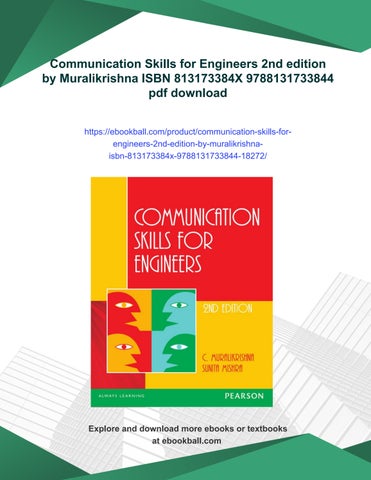
Communication Skills for Engineers 2nd edition by Muralikrishna ISBN 813173384X 9788131733844 pdf download https://ebookball.com/product/communication-skills-forengineers-2nd-edition-by-muralikrishnaisbn-813173384x-9788131733844-18272/
Explore and download more ebooks or textbooks at ebookball.com
Get Your Digital Files Instantly: PDF, ePub, MOBI and More Quick Digital Downloads: PDF, ePub, MOBI and Other Formats
Communication Skills Stepladders to Success for the Professional 2nd edition by Richard Ellis ISBN 1841502984 9781841502984
https://ebookball.com/product/communication-skills-stepladdersto-success-for-the-professional-2nd-edition-by-richard-ellisisbn-1841502984-9781841502984-18266/
Essential Communication Skills for Nursing and Midwifery 2nd Edition by Philippa Sully, Joan Dallas ISBN 0723435278 9780723435273
https://ebookball.com/product/essential-communication-skills-fornursing-and-midwifery-2nd-edition-by-philippa-sully-joan-dallasisbn-0723435278-9780723435273-2284/
Improve Your Communication Skills 2nd edition by Alan Barker ISBN 0749456272 9780749456276
https://ebookball.com/product/improve-your-communicationskills-2nd-edition-by-alan-barkerisbn-0749456272-9780749456276-18218/
Communication Skills for Dummies 1st edition Edition by Elizabeth Kuhnke ISBN 1118401247 9781118401248
https://ebookball.com/product/communication-skills-fordummies-1st-edition-edition-by-elizabeth-kuhnkeisbn-1118401247-9781118401248-18274/
Communication and Interpersonal Skills for Nurses 1st Edition by Alec Grant, Shirley Bach ISBN 1844451623 9781844451623
https://ebookball.com/product/communication-and-interpersonalskills-for-nurses-1st-edition-by-alec-grant-shirley-bachisbn-1844451623-9781844451623-730/
Advanced Communication Skills 1st edition by Matthew Richardson ISBN 1801200777 978-1801200776
https://ebookball.com/product/advanced-communication-skills-1stedition-by-matthew-richardsonisbn-1801200777-978-1801200776-16474/
Thermodynamics for Engineers 2nd Edition by Kaufui Vincent Wong 1032581921 9781032581927
https://ebookball.com/product/thermodynamics-for-engineers-2ndedition-by-kaufui-vincent-wong-1032581921-9781032581927-17816/
Geometry of Surfaces A Practical Guide for Mechanical Engineers 2nd edition by Stephen Radzevich 9783030221843 3030221849
https://ebookball.com/product/geometry-of-surfaces-a-practicalguide-for-mechanical-engineers-2nd-edition-by-stephenradzevich-9783030221843-3030221849-18820/
Geometry of Surfaces A Practical Guide for Mechanical Engineers 2nd edition by Stephen Radzevich 9783030221843 3030221849
https://ebookball.com/product/geometry-of-surfaces-a-practicalguide-for-mechanical-engineers-2nd-edition-by-stephenradzevich-9783030221843-3030221849-18828/
COMMUNICATION SKILLS FOR ENGINEERS SECOND EDITION
'U 6XQLWD 0LVKUD 8QLYHUVLW\ RI +\GHUDEDG
'U & 0XUDOLNULVKQD 2VPDQLD 8QLYHUVLW\
&RS\ULJKW 'RUOLQJ .LQGHUVOH\ ,QGLD 3YW /WG /LFHQVHHV RI 3HDUVRQ (GXFDWLRQ LQ 6RXWK $VLD 1R SDUW RI WKLV H%RRN PD\ EH XVHG RU UHSURGXFHG LQ DQ\ PDQQHU ZKDWVRHYHU ZLWKRXW WKH SXEOLVKHU¶V SULRU ZULWWHQ FRQVHQW 7KLV H%RRN PD\ RU PD\ QRW LQFOXGH DOO DVVHWV WKDW ZHUH SDUW RI WKH SULQW YHUVLRQ 7KH SXEOLVKHU UHVHUYHV WKH ULJKW WR UHPRYH DQ\ PDWHULDO SUHVHQW LQ WKLV H%RRN DW DQ\ WLPH ,6%1 H,6%1 9789332501348 +HDG 2IILFH $ $ 6HFWRU .QRZOHGJH %RXOHYDUG WK )ORRU 12,'$ ,QGLD 5HJLVWHUHG 2IILFH /RFDO 6KRSSLQJ &HQWUH 3DQFKVKHHO 3DUN 1HZ 'HOKL ,QGLD
CONTENTS Preface
vii
INTRODUCTION
INFORMATION TECHNOLOGY AND COMMUNICATION 1 Information Technology In India and the Process of Communication Communication: Aspects and Issues 2 Vitals of Communication 3 Creativity in Communication 5 Communicating with Concern and Empathy 6 The Johari Window 8 Interpersonal Communication 9 Body Language 11 Persuasive Communication and Negotiation 12 Roles We Take on During Negotiation 13 Summary 14 Review Questions 15 PART I
GRAMMAR MATTERS
1
17
CHAPTER 1
TENSES, THE ACTIVE AND THE PASSIVE VOICE, AND REPORTED SPEECH 19 Tenses 19 The Passive 31 Reported Speech 34 Summary 37 PART II
COMMUNICATION MATTERS
39
CHAPTER 2 NON-VERBAL COMMUNICATION: BODY LANGUAGE The Communicating Body 41 Studying Body Language 42 Distance and Positioning 49 Body Orientation 50 Summary 54 Review Questions 54
41
iii
iv
CHAPTER 3 LISTENING SKILLS The Lynchpin of Communication Hearing and Listening 56 Active Listening 57 Kinds of Listening 58 Barriers to Good Listening 61 Chinese Whisper 64 Good Listening 65 Summary 67 Review Questions 68
Contents
56 56
CHAPTER 4 SPEAKING AND NEGOTIATION SKILLS The Art of Speaking 69 Speech Styles 70 Presentation Skills 73 Negotiation Skills 90 Summary 95 Review Questions 95 CHAPTER 5 READING SKILLS Eye Movements and Chunking Speed Reading 98 The SQ3R Method 102 Summary 104 Review Questions 104 CHAPTER 6 WRITING SKILLS The Basics of Writing 105 The Process of Writing 107 Paragraph 109 Instructional Writing 112 Précis Writing 114 Abstract Writing 116 Note-Taking 119 Summary 121 Review Questions 122
69
96 96
105
CHAPTER 7 CREATIVITY AND MIND-MAPPING Creativity 123 Times When We Are Creative 124
123
v
Contents
Ways in Which You can be Creative 125 Developing Your Creativity 126 Factors that Block Creativity 128 Mind-Mapping: The Networking of Ideas 129 Mind-Mapping and the Learning Process 130 Mind-Mapping: Some Do’s and Don’t’s 134 Summary 136 Review Questions 136 CHAPTER 8
RÉSUMÉ WRITING, CURRICULUM VITAE (CV) AND STATEMENT OF PURPOSE (SOP) 137 Deęnition of a Résumé 137 Guidelines for Eěective Résumé Writing 140 Curriculum Vitae (CV) 143 Statement of Purpose (SOP) 148 Summary 152 Review Questions 153 CHAPTER 9 TEAM-TALK, GROUP DISCUSSION AND INTERVIEWS Importance of Talk in a Team 154 ConĚict Management 156 Communication in Teams 157 Group Discussions (GD) 159 Structuring the GD 160 Interviews 162 Techniques of Interviewing 164 Preparing for an Interview 165 Kinds of Questions Expected at Interviews 168 The Interview Process 169 Summary 171 Review Questions 172 CHAPTER 10 TELEPHONE SKILLS, MEETINGS AND MINUTES Telephonic Communication 174 Meetings 176 Minutes Writing 179 Summary 184 Review Questions 184
154
174
vi
Contents
CHAPTER 11 BUSINESS LETTERS, TECHNICAL WRITING, E-MAIL WRITING Business LeĴers 185 Business LeĴer: Samples 190 Characteristics of a Good Business LeĴer 193 Forms of Layout 197 Technical Writing 203 E-mail Writing 209 Summary 216 Review Questions 217 CHAPTER 12 REPORT WRITING, PROJECT AND PROPOSAL WRITING Report Writing: Theory and Practice 218 Methods of Reporting 224 Proposal Writing 235 Summary 238 Review Questions 238
APPENDIX Appendix A Appendix B Appendix C Appendix D Bibliography
239 Vocabulary Expansion 241 Common Errors in English Communication Practice Exercises 258 Model Question Papers 264 275
254
185
218
PREFACE The learning and teaching of communications has generally been limited to the spoken and the wriĴen skills—presentations, group discussions, writing of leĴers, reports, etc. For students enrolled in professional courses, it extends to document writing or maybe, project writing. Experience, however, shows that a good communicator has more than just these skill sets. It is primarily an aĴitude, a willingness to communicate, share one’s ideas and information that makes one a good communicator. Language and the knowledge of the various formalities associated with speaking and writing do maĴer. However, given the right aĴitudinal input, communication becomes much easier and one emerges as an eěective communicator. This book discusses additionally these aĴitudinal factors that make one a good communicator and links them up with the skill sets that enable eěective communication. It speaks of the writing and the speaking skills in the context of creativity, negotiation, interpersonal skills and problem solving. Specięcally, the book aims at developing the communication skills of Engineering and other professional students. For this target group, good communication skills are necessary for recruitment and to enhance their opportunity for further growth in the profession. The book aĴempts to locate the common communication needs of this group in diěerent situations and to guide and equip the readers and learners to fulęll them appropriately. The book follows a skill-based approach. It isolates the skill sets required in diěerent communicative situations, gives the students a comprehensive view of the requirements and ęnally reinforces them further through exercises and activities. Communication Skills for Engineers (CSE) thus is a comprehensive book that focuses on the communication needs of users from the Engineering and other professional areas. It does not look at “communications”—Ěuency in speaking and writing—in isolation but discusses the whole aĴitudinal framework that enables eěective and purposeful exchange of information. It aims at enabling students to identify and develop skill sets necessary to succeed in their profession. This second edition of CSE covers some additional topics that include a discussion of grammar dynamics and activities thereof; information technology (IT) and communication; the niĴy-griĴy of e-mail writing, interview skills; designing SOPs, a CV and Resumé writing, and aspects of improving reading skills among others. This has been done to cater to a wider range of felt needs among Engineering students and other professional students. To accommodate these additions, some of the earlier chapters have been collated appropriately. In this process, we have tried our best to keep the book’s main points as well as its pedagogy intact. We hope that the second edition of CSE will continue to help the students, teachers and trainers from Engineering and other professional streams. Acknowledgements This book is a combined eěort of many minds. It was conceived when we were teaching MBA, and MCA students and took shape in the course of our lectures to B.Tech., B.E., B.A., B.Sc. and B.Com. graduates. However, many inĚuences have gone into its making. We would specially like to thank the following people: •
Our teacher, Prof. N. Krishnaswamy, for his encouraging inĚuence and useful advice. He was instrumental in planting the idea of this book in our minds. vii
viii
• •
• • •
• •
Acknowledgements
Late Prof. G. V. Raj for his valuable role in giving us the English language teaching (ELT) orientation in our early days of teaching. Our students from Osmania University, Jawaharlal Nehru Technical University (JNTU) and University of Hyderabad, whose responses and reactions helped to shape the contents of the book in a big way. Prof. Tutun Mukherjee for her timely appreciation and for her assessment of our book proposal. Dear friends like Vħaya, Joy, Seetha and Srinivas for goading us to persevere in our efforts and giving valuable suggestions and ideas. K. Srinivas, the then commissioning editor of Pearson Education who is now the publishing manager, for his relevant, practical and timely suggestions in the formative stages of the book. Brig. Sambhi, former Principal of Karshak Engineering College, for his creative ideas and suggestions. Our dear daughter, Shivani, for her growing understanding, and support and for having put up with our preoccupied minds during the long months of writing. Dr Sunita Mishra Prof. C. Muralikrishna
INTRODUCTION Information Technology and Communication
Objectives This introductory section takes an overview of the role of Information Technology in communication and also on the subject of communication. It discusses the different aspects and issues relating to communication. It underpins the value of creativity in communication in addition to delving on interpersonal communication, body language, persuasive communication and negotiation.
INFORMATION TECHNOLOGY IN INDIA AND THE PROCESS OF COMMUNICATION Many outstanding technologies have come into the lives of people towards the end of the 20th century. This is especially true in the ęeld of electronics. Many electronic types of equipment like mainframe computers, mini computers, personal computers, e-mail, cell phones, i-pods, and other gadgets have become part of our lives. In this informaton age, we come across a lot of personal or oĜce data that needs to be processsed by computers and this is called information technology or IT. Information technology (IT) accounts for a signięcant part of India’s GDP and export earnings, while providing employment to a large number of its tertiary sector workforce. Technically equipped immigrants from India have been seeking jobs in the western world since the 1950s as India’s education system produced more engineers than its industry could absorb. Thus, India’s growing stature in the information age enabled it to form close relations with both the United States of America and the European Union. Out of around 400,000 engineers produced per year in the country, approximately, about 100,000 are well equipped in both technical competency and the English language skills. India has developed a number of outsourcing companies specializing in customer support through the Internet or telephone. For instance, by 2008, India had a total of 49,750,000 telephone lines in use, a total of 233,620,000 mobile phone connections, a total of 60,000,000 Internet users— comprising 6.0% of the country’s population, and 4,010,000 people in the country had access to broadband Internet— making it the 18th largest country in the world in terms of broadband Internet users. Total ęxed-line and wireless subscribers reached 325.78 million in June, 2008.
2
Communication Skills for Engineers
On the other hand, from the dynamics point of view, it needs to be mentioned that Management Information Systems (MIS) has assumed vital importance. MIS is the application of IT to the communication process in organizations. Generally, in MIS most of the information processing is done by the computers. The span of activities undertaken by MIS includes among others generating, processing and transmiĴing information. MIS is used for interpersonal and organizational communication in addition to strategy planning and improving customer care. Thus, managers can seek vital clarięcations, information from and give instructions and directions to fellow-personnel of the organization through the systems. An important eěect of IT on organizations is one of leveling. Personnel in organizations, whether they are superiors or subordinates, work in an information-sharing ambience where everybody is involved non-hierarchically in the developmental work of the organization. Interestingly, the IT age continues to demand proęciency in English communication skills from most of its initiators, mid-level force and end-users. It is in this context that one needs to look at the niĴy-griĴy of communication.
COMMUNICATION: ASPECTS AND ISSUES When American playwright and diplomat Clare Boothe Luce visited George Bernard Shaw in his London Ěat years ago, she found him writing at his desk. To express her admiration, she began, “Mr Shaw, you are the only reason I’m standing here.” Shaw looked up and replied, “Who did you say your mother was, my child?” (Reader’s Digest)
Communication, as we see it here, can be a complicated process of give-and-take with innumerable intricacies and dimensions. OĞen, however, it is seen as a set of competencies, primarily including the wriĴen and the spoken mode. It is taught as a package involving training in skills pertaining to writing, speaking, reading and listening (L. S. R. W). But general observation shows that eěective communication involves a lot more than proęciency in the L. S. R. W skills. More than language, it needs an aĴitude, a willingness to give and take; to open up to others and accept others; to have empathy and capacity to look at situations from varied perspectives. Given these aĴitudinal factors, language becomes just an aid to promote communication. This chapter aims to give an overall view of most of these important factors and show how they enable communication. A complicated process in itself, communication takes place all around us all the time. In fact, we all spend around 70% of our time receiving or sending messages. Essentially, it involves the sender or the communicator, and the receiver. It is sent in a certain medium through encoded messages. The receiver, in turn, decodes the message and sends back the reactions to the sender in the form of feedback. The beauty of the whole process, however, lies in the nature of communication itself. Language, be it in any form, has the potential to mean many things at the same time. Thus, the sender sends a message, which the receiver is free to make meaning of depending on the mode of transmission, the kind of encoding and of course, more importantly, the receiver’s own state of mind while receiving the message.
Introduction
3
VITALS OF COMMUNICATION The features that have been looked into in this section are, function of language and elements of human communication.
The Function of Language Language embodies and conveys thought. It is an important means that we rely on to convey our thoughts and feelings. In its spoken and wriĴen forms, language is the commonest and most important means of communication in all social activities among human beings. Along with language there are other elements, which contribute to communication. In the following section, some of these elements are brieĚy examined.
Elements of Human Communication Human communication, as a process, is not a dull and passive process. It is a dynamic and active process comprising several important elements. These elements may be enumerated as follows: 1.
2.
3.
4. 5. 6.
7.
8.
Initiation: Communication begins when a source initiates a statement. A statement is initiated in order to transmit some thought, need, idea or information. The receiver aĴends to the statement transmiĴed by the source, interprets the statement and decides how to respond. Feedback: The response of the receiver that is sent back to the source forms the feedback. The source modięes further statements based on the feedback. Feedback helps the source to know if the message was received correctly or not. Channel: Channel connects the source (e.g. a speaker) and the receiver (e.g. listener). A speaker and a listener are connected to each other by sound waves and (or) the light waves. That is, language carried by sound waves; and facial expressions and body gestures carried by light waves. Situation: Situation is the place or seĴing in which a communicative event occurs. Purpose: Purpose consists of the intention of the source, or speaker. It is the communicative aim of the speaker. AĴitudes: The speaker and the listener, carry with them certain ideologies, world-views, beliefs, likes, dislikes and aptitudes. They are also under the inĚuence of varying emotional and mental states. These factors aěect the aĴitudes of the speaker and the listener at the time of communication. Knowledge: The speaker has to possess adequate knowledge of the message that is to be transmiĴed. Knowledge that is based on observation, study and personal experience helps the speaker to communicate eěectively. Expression: Expression consists of the ability to transmit or communicate. Fluency, clarity and intelligibility of expression pave the way to eěective communication. The Ěow of information, as embodied in the message that is transmiĴed, is smooth when expression
4
Communication Skills for Engineers
is clear. This helps the speaker and the listener to avoid communication gaps and also arrive at consensus and decisions. Improper or faulty expression leads to breakdown of communication. 9. Language: Language is one of the most important elements of the communication process. The eěective use of language consists in selecting appropriate words and paĴerns of sentences while communicating. These linguistic paĴerns, suitably supported by facial and body gestures, enable eěective communication. 10. Intellectualism: Communication is sustained and it becomes eěective only in an intellectual ambience. That is, the speaker and the listener have to express and understand views calmly, rationally, reĚectively, precisely and eĜciently. When intellectualism is absent, thoughts and ideas are likely to be ineěectual.
See What This Communicates! Once upon a time, there were four people. Their names were Everybody, Somebody, Nobody and Anybody. Whenever there was an important job to be done, Everybody was sure that Somebody would do it. Anybody could have done it, but Nobody did it. Everybody got angry because it was Everybody’s job. Everybody thought that Somebody would do it, but Nobody realized that nobody would do it. So consequently, Everybody blamed Somebody when nobody did what Anybody could have done in the ęrst place.
ACTIVITIES 1.
Read the sentences below (A) and see in how many diěerent contexts you can use them. Create small contexts around them and use them to illustrate the given modes of expression(B). Add more to the list if you can. A
B
a. The door is open.
Giving information Making an oěer Rejection Acceptance
b. You are joking! This can’t be true.
Extreme happiness Shock Anger
c. The possibilities are endless.
Appreciation /Frustration Amazement /Confusion
Introduction
5
2. Try to read the following groups of sentences separately stressing the underlined word. Make a note of the diěerent meanings that emerge. (A) Even he does not write regularly. Even he does not write regularly. Even he does not write regularly. (B) You don’t know me? You don’t know me? You don’t know me? (C) Yes. I don’t remember. Yes. I don’t remember Yes. I don’t remember (D) Is this possible? Is this possible? (E) I can’t write the examination. I can’t write the examination I can’t write the examination
CREATIVITY IN COMMUNICATION While doing the above exercises, you must have realized that responding to a communicational situation needs creativity. The meaning has to be always put together like the pieces of a jigsaw puzzle. One always has to “make” the ęnal picture for oneself. When we talk of creativity in communication, we mean the capacity to read hidden messages, to see a link not seen before, to infer the unsaid, unspelt consequences or even to tailor a response that can alter a communication situation to one’s advantage! A wiĴy creative receiver can create meanings in the encoded message the sender had never imagined. Creativity in day-to-day interactions is also one’s ability to break out of stereotyped reactions, to see beyond the set, accepted paĴerns and give a novel twist to existing “reality” or beĴer still, create a “reality”! Albert Einstein was travelling to universities in a chauěeur driven car, delivering lectures on his theory of relativity. One day while in transit, the chauěeur remarked: “Dr.Einstein, I have heard you deliver that lecture thirty times. I know it by heart and bet I could give it myself”. “Well, I will give you the chance,” said Einstein. “They don’t know me at the next college, so when we get there I’ll put
6
Communication Skills for Engineers
on your cap, and you introduce yourself as me and give the lecture”. The chauffeur delivered Einstein’s lecture Ěawlessly. When he ęnished, he started to leave, but one of the professors stopped him and asked a complex question ęlled with mathematical equations and formulas. The chauěeur thought fast. “The solution to that problem is so simple”, he said, “I’m surprised you have to ask me. In fact, to show you just how simple it is, I’m going to ask my chauěeur to come up here and answer your question.” —Readers Digest
ACTIVITIES 3. Given below, is a list of ten sentences. Take one minute to think about each and talk on it for a couple of minutes. The sky is blue The height of success. The ceiling is very high. Bicycling under water is fun. Classes are not to be aĴended. It is fun to fail. Among the stars. Children are mean. The blackboard is green. My useless fridge. 4. Try to establish links between the pairs of objects given and talk about each of the pairs. Apple // Computer Horse // House Armchair // Fridge Star // College Pigs // Saints Trees // Chocolates Hill // Eagle Insect // Money Bird // Ceiling Chair // Piano.
COMMUNICATING WITH CONCERN AND EMPATHY Very oĞen we come across managers who would say: “I do a lot for my employees. I expect a lot out of them. I work hard to be friendly towards them and treat them right. However, I feel
7
Introduction
they are ungrateful. I think if I stayed back at home for a single day they would waste time at the oĜce canteen. What can I do to make them independent and responsible?” Problems like this are common. A large part of it is because we fail to communicate our concern or empathy. A very closely related quality that plays an equally important role in communication is empathy. Empathy is a quality that will allow you to understand the mental and psychological state of the person we are communicating with. This will help us to adapt our response and pitch it at an acceptable and appropriate level. Important here is the concept of empathetic listening, which can be explained as listening with a view to understand. We generally listen with an intent to reply. Most of the times, we are either talking or geĴing ready to talk. When we listen, we generally listen at one of the four levels. We may be ignoring the person, not really listening at all. We may be pretending to listen. We may be doing selective listening, hearing only certain parts of the conversation, or we may be practising attentive listening, paying aĴention to every word that is being uĴered with utmost care. What is required oĞen, however, is empathetic listening that forms the ęĞh grade of listening. This is something beyond the skill-based acquisition of the skill. Here listening is done with a purpose to understand, to see the world from the speaker’s perspective intellectually and emotionally, but not necessarily agree with the speaker. This kind of listening has an almost therapeutic eěect on both the speaker and the listener, primarily because it gives a person a “psychological air”. This “psychological air” deeply impacts communication, expanding both the speaker’s and the listener’s area of inĚuence on one another. Paradoxically, this kind of listening is also risky. To listen deeply, one also has to open oneself up and become vulnerable. To have inĚuence, thus, one has to risk being inĚuenced. The poet doesn’t invent. He listens. —Jean Cocteau
Listening to a Disturbed Person At some point or the other, all of us have been disturbed or we have interacted with people who are disturbed. It could be a friend who feels that injustice has been done to him/her at the workplace, or a neighbour whose feelings have been wounded. Some people are good at expressing their hurt feelings, some are not. Sometimes, we even try to suppress them and push them to the back of our mind. But unexpressed feelings do not disappear. They are like springs. You push them down but they express themselves sooner or later, may be at the wrong place or time. A person who has suppressed feelings cannot act or think straight because he/she does not feel straight. Only aĞer the feelings are released can the person think straight and look into the problem objectively. Above everything else, more than advice, evaluation or judgement, a disturbed friend needs to fulęll the desire to be understood. Do not listen to their words, listen to their feelings. Respond with the whole of yourself. The best way to ‘talk’ to a disturbed person is to listen.
8
Communication Skills for Engineers
THE JOHARI WINDOW The concept of the Johari window is an important idea that explains factors behind mutual understanding. Named aĞer Joseph LuĞ and Harry Ingram, it explains communications along two dimensions: exposure and feedback. Exposure is the extent to which the individual is willing to divulge his feelings and information in trying to communicate. Feedback is the extent to which the individual manages to elicit exposure from others. They translate these factors into four windows—open, blind, hidden and unknown (see Fig.1). The “open” window is the information about you, which you as well as others can see. The “blind” window encompasses the factors about you that others can see but not you. This, oĞen, is the result of your defensive behaviour that prevents others from telling you things about yourself. The “hidden” winOpen Blind dow is the information known to you but unknown to others. These include facts about yourself that you hide from others. Finally, the “unknown” constitutes factors that that neither you nor others are aware of. Advocates of the Johari window see openness, authenticHidden Unknown ity and honesty as valued qualities in interpersonal relationship. They also imply that it is in the interest of the individual to expand the size of the “open” window, increase self-disclosure and be more Figure 1: Johari Window willing to listen to feedback from others about oneself.
ACTIVITIES 5. Select a relationship in your life where your emotional account is nil. Write ęve reasons from your perspective on why you think the situation is so. Now try and approach the problem from the other person’s point of view and review the situation. Were your assumptions all correct? 6. Give ęve reasons for and against the statements given below. 1. Siblings can be your best friends because, a. b. c. d. e
Siblings are one’s greatest enemies because, a. b. c. d. e.
2. You are your greatest friend because,
You are your greatest enemy because,
a. b. c. d. e.
a. b. c. d. e.
9
Introduction
3. Holidays are wonderful a. b. c. d. e.
Holidays are not wonderful a. b. c. d. e.
4. Higher education should be subsidized a. b. c. d. e.
Higher education should not be subsidized a. b. c. d. e.
5. Children are cruel a. b. c. d. e
Children are not cruel a. b. c. d. e.
7. Recall any incident in your life, which brought forth in you something that, belonged to the “unknown window” till then. How have you been managing that aspect/quality since then? 8. Imagine, you have just died and your friends want to put up your picture in your class with the following words wriĴen below: “Here was a person who… ” Complete the paragraph in about 30 words.
INTERPERSONAL COMMUNICATION I can live two months on a good compliment. —Mark Twain Possessing good knowledge of interpersonal relations and being able to achieve the delicate balance that communication requires goes a long way in ęne-tuning our reĚexes to achieve eěective communication. For instance, it would be extremely inappropriate on our part to complain to a new recruit at our oĜce against the boss or a nagging spouse at home. It is very important to be able to decide who should be told what, when and how. Communication is generally divided into ęve levels, depending on the nature, scope and depth of interaction:
10
Communication Skills for Engineers
Passing Communication This refers to the daily niceties or phatic communication paĴerns like “hello, good morning” and “good night” etc. The purpose here is to merely acknowledge the person’s presence. Here a detailed response is neither expected nor given. When somebody wishes you in oĜce saying “Hello! How are you?” you deęnitely do not sit back and say, “Not well at all! Know what happened on the road today?…”
Factual Communication OĞen, most of the organizational work depends on the exchange of factual information. Giving instructions, evaluating and passing on information accurately and concisely fall under this category. Interpersonal communication is carried on here with minimal possible emotional risk. Examples of such communication are: Is the report ready? Has the new employee joined today? How many more customers are there to meet?
Thoughts and Ideas Here, the exchange is at a slightly higher level of communication. This includes exchange of ideas that suggests a more involved interpersonal communication. However, it also throws open the possibility of rejections – hence, the risk involved is more.
Feelings The feeling level of communication involves a higher degree of risk. During this kind of interaction, there is exchange of sentiments and feelings making the sender vulnerable to rejection.
Peak Communication This is the highest level of communication that is most diĜcult to achieve. It ensures perfect understanding between two individuals or a group of individuals. Creativity and a synchronized work culture are the building blocks of this kind of communication. A bore is a man who, when you ask him how he is, tells you. —Bert Leston
ACTIVITIES 9. Look at the statements given below and categorize them into the diěerent communication levels. 1. Oh God! It’s late already.
Introduction
11
2. Will you ever learn to see straight? 3. I think we have reached the end of the road. 4. How do you do? 5. It’s rather late, isn’t it? 6. I agree that capitalism has its merits but we can’t overlook its demerits. 7. We all agree. We can achieve this together. 8. Have you received any answer to the leĴer? 9. It is a pleasure working together. How else do you think we have survived our boss? `10. I strongly believe that the developed countries are causing more harm to humanity than the underdeveloped ones. 10. Complete the following incomplete dialogue using three diěerent situations illustrating the 2nd and 3rd levels of communication: A. B. Oh yes! I know. A. B. A . Sure. I’ll remember.
People who feel good about themselves produce good results. —Henneth Blanchard and Spencer Johnson.
BODY LANGUAGE Body language is an important factor that one has to keep in mind while communicating. Most of our communication in every day maĴers takes place through body language. Most important are the gestures, the tone and the facial expression. If the spoken words do not match the body language, it is the message covered by the body language that creates the ęnal and lasting impression. The body language of the person who is being spoken to is of immense importance for a good communicator. It is an important feedback not only to decide how one’s message has been accepted but also to determine whether it is the right time to convey the message at all! Arms folded around one’s chest, for example, can signify a defensive aĴitude. It could mean “I don’t want to know” or “I feel vulnerable as you talk to me”. If the ęsts are clenched, in addition, it suggests holding back of emotion or information; ęnger on the lips while speaking can show incongruence of thought or speech. Looking away while someone is speaking or rubbing the eye deęnitely suggests avoidance. The siĴing posture also can signify the aĴitude
12
Communication Skills for Engineers
of the speaker. Reversing the chair and siĴing, or leaning over the back can indicate power and control. Slumping with arms folded or clasped on the lap can convey dejection or submissiveness, while leaning back on the chair with legs crossed and hands behind the back signify authority, the “I don’t need to fear you at all!” aĴitude. While it is necessary to consider body language as an important clue in the communicative process, one should also remember that it is largely situational. They do not mean anything by themselves, but acquire their precise meaning only in association with other symbols.
ACTIVITY 11. Given below is a list of ten activities. Form groups of two and enact the situations without talking. Ask the class to guess the situation. Discuss the responses and clues on the basis of which they formed their opinion. a. A father is indignant because he feels his son is going astray and not concentrating on his studies. The son feels his father is unnecessarily pressurizing him. b. Two friends have met aĞer a long time at a party. They are overjoyed to ęnd one another and are engrossed in their talk. c. You are trying your best to convince your client that the soĞware you have newly developed will work. He, however, is sceptical about the whole product. d. Your teacher is trying hard to explain a concept to you. In between, he forgets a name and is trying hard to recollect it. e. Your subordinate is trying hard to ĚaĴer and praise you. You, however, are very suspicious of his motive .You want to tell him so, but you are holding back out of courtesy. f. Your friend has come to you with a grave professional problem. You are thinking hard of the possible solutions. Your friend, too, is troubled. g. You are a junior employee in a company. The company is facing a ęnancial crisis and laying oě people. You have been called into the boss’s room and asked to sit. The boss looks grave and you are nervous. h. A colleague is very enthusiastically trying to explain a plan to you. You are alert, eager and taking in every word. i. You are wild with your employee but trying to control your anger. Your employee is conscious of his guilt and is apprehensive. j. You are worried, tensed and very confused. Your friend is trying to cool you down and comfort you. She is strong, cool and conędent, but very concerned.
PERSUASIVE COMMUNICATION AND NEGOTIATION In the ęlm titled “The Shop Around the Corner”, a character says, “when my boss calls me an idiot, I agree. AĞer all, I’m no fool.” —Readers Digest.
Introduction
13
OĞen we judge situations, decide our role in the context and react in the way we consider appropriate. A very important skill that is used subtly in all communication situations is “negotiation”. To be able to negotiate during communications, one has to be ęrst conscious of one’s role and also see how others perceive it. This is followed by each participant demarcating his area of operation and negotiating space, and deciding whether and how much to empower the other participant. The next stage is one where the exchange is decided. The terms and conditions here are largely a fallout of the ęrst two factors. The nature of exchange one proposes or accepts depends on the role one has ęxed for oneself and also the degree of empowerment that has been negotiated and agreed upon. The next and ęnal stage can be called the disclosure stage that comes by if the ęrst three stages have been positively set. At this stage, participants let down their barriers and are willing to disclose information about themselves. This stage is risky, but it also paves way for successful “peak” communication. Participants moving through exchange and disclosure stage communicate with a high sense of interpersonal rapport.
ROLES WE TAKE ON DURING NEGOTIATION Psychologists believe that the roles we take up during interaction are either that of the parent, the adult or the child. The parent role largely constitutes the “that is how it is” aĴitude. It also includes admonitions, giving rules, laws and value judgments. The child is the impulsive and emotional aspect of a person that can throw tantrums and get depressed. Simultaneously, it also includes creativity and curiosity of a person. The third side to an individual is his adult – the aspect that weighs, decides and displays appropriate emotions and expressions. During interpersonal communication, transaction can take place between similar roles in individuals or between diěerent roles. The negotiation could be between the parents in two individuals, between the parent in one and child in another or between the adult in one and parent in the other. What is important here is that, during negotiations one should be conscious of the role he himself is playing, recognize the role the other is adopting and react accordingly. Some of the factors that play an important role while negotiating successfully are given below: • •
•
Be conscious of the way you and your participants have positioned yourselves and the factors that each is looking for in the communication situation. It helps oĞen if the participants are fair and willing to commit themselves. A communication situation built on a sense of fairness and trust can result in strong, satisfying, lasting relationships. We oĞen conclude that our win depends on somebody’s loss and we work towards a win-loose situation. Eěective communication situations however are oĞen built around win-win situations. The situation allows both parties to beneęt or empower themselves, either materially or emotionally. Two Most Common Traits of Managers Who Failed
1. Rigidity: they were unable to adapt their style to changes. They were unable to respond to feedback. They couldn’t listen or learn. 2. Poor relationships: they were harshly critical, insensitive or demanding. They alienated those when they worked with.
14
Communication Skills for Engineers
ACTIVITY 12. Given below are two situations. Analyze them, discuss what kind of negotiation situation they project and think of solutions. a. An old piano is for sale. The prospective buyer and the seller agree on the cost. The buyer ęrst wants the chair and then the musical pages to be given free. The seller agrees. Encouraged, the buyer next wants the delivery also to be done free. b. Ravi is the head of a designing team in a company producing electrical equipments. He has a good team, he gives innovative ideas and leads them from the center. Of late, however, he has been experiencing burn out, and exhaustion. He has spoken to the boss and arranged for a two-week vacation with his family. A week before leaving, the company gets the news that top executives from an internationally reputed company will be coming for a visit to see the prototypes developed. Ravi’s boss feels that he should stay back and take care of the presentation since he himself has designed most of the products and is the backbone of the team. He even thinks that with his impressive persuasion he might be able to increase the budgetary allocations for the department. Ravi, however, feels that he must go because the team can take care of the presentation. His wife too has arranged for leave in her oĜce and it will not be possible to postpone it for a later time.
SUMMARY •
The IT age reinforces the continuing demand for proęciency in English communication skills from most of its initiators, mid-level force and end-users.
•
Communication is a complicated process of give-and-take with innumerable intricacies and dimensions.
•
For communication, more than language, what is needed is an aĴitude, a willingness to give and take; to open up to others and accept others; to have empathy and a capacity to look at situations from varied perspectives.
•
Creativity in day-to-day communication is one’s ability to break out of stereotyped reactions, to see beyond the set and accepted paĴerns.
•
Empathy is a quality that will allow one to understand the mental and psychological state of the person we are communicating with.
•
The two dimensions of communication, according to the Johari window are, exposure and feedback. These can be looked at through four windows—open, blind, hidden and unknown.
•
It is always desirable to expand the size of the ‘open window’, increase self-disclosure and be more willing to listen to feedback from others about oneself.
•
Passing communication, factual communication, thoughts and ideas, feelings and peak communication are the ęve levels of communications based on the nature, scope and depth of interaction.
Introduction
15
•
Much of eěective communication is non-verbal. Body language is an important factor of the non-verbal communication.
•
Negotiation depends on the nature of exchange one proposes or accepts. It depends on the role one has ęxed for oneself and the degree of empowerment that has been negotiated and agreed upon.
•
The roles people take during interaction can be that of the parent, the adult or the child.
•
Eěective interpersonal communication depends on appropriate handling of these three roles.
REVIEW QUESTIONS 1. What is Information Technology? 2. What are the eěects of MIS on organizations? 3. What is communication? 4. What factors are necessary for eěective communication? 5. What is creativity in the context of day-to-day communication? 6. What is the function of language? 7. What are the elements of human communication? 8. What is empathy? 9. What do you understand by the term ‘Johari window’? 10. What are the implications of the Johari window? 11. What are the diěerent levels of communication? 12. How are these levels of communication related to interaction? 13. How is the nature of a specięc interaction determined?
7KLV SDJH LV LQWHQWLRQDOO\ OHIW EODQN
PART 1 Grammar Matters
7KLV SDJH LV LQWHQWLRQDOO\ OHIW EODQN
CHAPTER 1 Tenses, the Active and the Passive Voice, and Reported Speech
Like everything metaphysical, the harmony between thought and reality is to be found in the grammar of the language. —Ludwig WiĴgenstein
Chapter Objectives This section aims to give the students the basics of grammar. It deals with tenses, the active and the passive voice and the reported speech. It also deals with the main and auxiliary verbs, the finite and the non-finite verbs and the way they are used in the different tense forms. The chapter deals with grammar within very limited space. Hence, only some of the very important concepts have been dealt with.
TENSES The verb The verb is one of the most important elements of English grammar. It can be described as a word that expresses action in a sentence. Look at the following expressions. a. b. c. d. e. f.
You wait patiently. You wait. Wait patiently. Wait. patiently you
20
Communication Skills for Engineers
The first four here can be seen as complete expressions. They can stand alone. The last two, however, cannot be independent. The main difference between them, if you see closely, is that the last two do not have a verb. It is the verb that forms the nucleus of a sentence. Hence, it makes the sentence meaningful. We can have a sentence with only the verb but there cannot be any sentence without a verb.
The Main and the Auxiliary Verbs Now, look at the following sentences: a. b. c. d.
Children play happily. We can do the work in three days. The workers have been working overtime. The typed papers had been lying on the table for months when the enquiry was made.
In the ęrst sentence, the verb is “play”. It expresses the action in the sentence. But in the second sentence, the verbs are, “can” and “do”. And in the third sentence, “have”, “been” and “working’ are verbs. These verbs, however, are not similar. They are either the main or the auxiliary verb. Generally, words like “play”, “do” or “work” are the main verbs. And words like “can”, “have”, “been”, etc, are the auxiliary verbs. It could be said that words that express the action in a sentence are the main verbs while verbs that help determine the time frame are auxiliary verbs. The following are the categories of words we use as auxiliaries. “Modal” forms -- can, could; will, would; shall, should; may, might; must, ought to. “Be” forms – is, am, was were, are. “Have” forms—have, has, had. Now, change the tense of the sentences given above: a. Children played happily. b. We could do the work in three days. c. The workers had been working overtime. d. The typed papers have been lying on the table. We ęnd in each of the cases that one of the words identięed as the auxiliary verb changes the form in case of a tense change. But in case there is no auxiliary verb, the main verb changes its form (as in the case of the ęrst sentence). A sentence will always have only one main verb. But it can have one or more than one auxiliary verbs. Look at some more sentences: a. Man is mortal. b. This city has an eĜcient government. c. All children are creative by nature. d. Dinosaurs were both vegetarian and non-vegetarian.
Tenses, the Active and the Passive Voice, and Reported Speech
21
These sentences have the words we have earlier identięed as auxiliary verbs. But as you see, they are the only verbs in the sentence. Hence, they are the main verbs in these sentences. One proof of this is that, in case of a change of tense too, these forms will undergo change.
ACTIVITY 1. Look at the following sentences and identify the main and the auxiliary verbs in each. Point out when the main verb is changing its tense. a. The identities of the people were not revealed. b. The glaciers in the north and the south pole are melting fast. c. The atmosphere is geĴing polluted very fast. d. The rare birds had leĞ their habitat before the team of experts could reach them. e. I have broken my hand. f. This building has stood the test of time. g. We have been waiting for the bus since ęve o’ clock.
The Finite and the Non-Finite Verb One more distinction you should keep in mind is that between the ęnite and the non-ęnite verb. The verb which carries the tense in a sentence is always the Finite verb and the others are the non-ęnite verbs. Look at the following pairs of sentences— a. b. c. d.
the grass on the other side is always green. the grass on the other side was always green. the grass on the other side has been always green. the grass on the other side had been always green until we crossed over and saw it for ourselves.
We ęnd that in the ęrst pair, there is only one verb and naturally, it caries the tense. But in the second pair, there is more than one verb, and when there is an auxiliary verb, it is the auxiliary that caries the tense. In a sentence, the verb which carries the tense is called the ęnite verb and the others are called the non-ęnite verbs. If a sentence has only one verb, the main verb is the ęnite verb. But if there is more than one verb, the verb carrying the tense is the ęnite and the rest are non-ęnite verbs. It is necessary for you to be clear about these two types of verbs to master the tenses that follow in the later sections.
The Forms of the Verb Look at the following sentences: a. b. c. d. e.
We walk to the ground every morning. The bus generally arrives on time. The children played the whole day yesterday. The executive members are planning for a meeting next month. The students have seen the exhibition.
22
Communication Skills for Engineers
These ęve sentences use the ęve forms of the verbs that are used in diěerent ways to express the tenses. The ęve forms are the following: a. b. c. d. e.
The base form: walk The –es form (the third person singular): arrives The past tense form: played The be –ing form: planning The have –en form: seen
These are the ęve forms of the verb in English. It is important to note that these are the different grammatical forms of tenses. The tenses in English do not necessarily coordinate with the times they express. Hence, it is important to see how these diěerent forms express the diěerent time sequences. Given in the units that follow, are descriptions of the tense form and the time sequences they express. The verb “be” has ęve forms—”is” “am” “are” “were” “was”. The ęrst three are used for the present tense form and the last two for the past tense form.
The Simple Present Form Look at the following sentences: Rammohan drives the buses in this route. Mahanadi Ěows into the Bay of Bengal. We experience the eěects of ozone depletion every day. He/she feels it is good in the long run. They/we feel it is good in the long run. The simple present tense, we have seen, uses two forms—the third person singular –es form and the base form. We use it to indicate things that happen all the time and to show universal truths: a. b. c. d.
The earth goes around the sun. The moon reĚects the rays of the sun. The Ěight takes oě at 5 pm. Continuous working leaves one tired and exhausted.
Sometimes we also use the simple present to show how oĞen we do things or how oĞen things happen. a. Rohit sometimes plays cricket. b. How oĞen do you go to the dentist? c. We usually take the road to the right of the park.
Tenses, the Active and the Passive Voice, and Reported Speech
23
We use do/does to express questions and negative sentences: a. Do you believe in Darwin’s theory of evolution? b. Rice doesn’t grow in cold countries. c. We don’t oĞen do things according to others wishes. Do we?
ACTIVITY 2. Fill in the blanks by using the right form of the verb given in brackets. a. b. c. d. e.
The shopping mall We oĞen I have a jeep but I The river Amazon How oĞen
(open) at 9am everyday. (see) (do) drive it oĞen. (Ěow) into the Pacięc Ocean. (do) you write to your parents?
The Present Continuous Form Look at the following sentences: Don’t make so much noise. I am studying. It is not possible to go out now. It is raining. Have you heard the latest? Ram is ęnally writing the report. Can you call the children inside? They are making a lot of noise. The present continuous uses the “be (is, am, are)—ing” form of the verb. It is used to denote action continuing the present at the moment of speaking. a. b. c. d.
Talk slowly. The patients are resting. We have to go soon. Sheela is leaving. Take an umbrella with you. It is raining. Be careful. The vehicle is still moving.
It is also used to show action around the time of speaking. a. You are working a lot today. Do you have a deadline to meet? b. The population is rising very fast. c. Your English is geĴing beĴer. Keep trying.
ACTIVITY 3. Fill in the blanks, using either the simple present or the present continuous(be —ing form of the verbs put in brackets. Indicate which of these situations are temporary and which are permanent.
24
Communication Skills for Engineers
a. Arundhati is in India now. She (stay) at the Taj Banjara. She generally (stay) there whenever she visits. (live)in Delhi now. But we are from Bhubaneswar. b. My parents c. I (teach) Physics. But this semester, I (teach) Mathematics too! (drive) the bike. But because of a shoulder pain I d. I generally (drive) the car these days. e. He never (smoke) in public. Looks like something is diěerent today. We ęnd in these sentences, that the combination of the simple present and present continuous is also used to show the diěerence between the permanent and the temporary. There are some verbs in English that can be used in the simple present form only, even when they denote the present continuous action. For example, we can say a. “I don’t understand you.” Not, “I am not understanding you.” b. “I believe you.” Not, “I am believing you.” The following are some of the verbs that cannot be used in the present continuous form. want realize
need mean
like forget
love remember
belong prefer
see seem
hear know
Simple Past Look at the following sentences: a. Look! it is raining again. b. Yea. And it rained the whole of yesterday too! c. I am hiring a taxi to go to work today. What about you? d. I usually work from home on such days. Guess I’ll do the same. The simple present generally uses the “–ed” to form the past tense. However, there are many important verbs that are irregular. a. leave—leĞ b. go—went c. cost—cost
We leĞ for the party at 6 pm yesterday. I went to Chennai to see a friend of mine. This dress cost me a packet.
Questions and negatives in the simple present use did/ didn’t. a. We walked home. b. Did you walk home? c. They didn’t walk home.
ACTIVITIES 4. A friend of yours has just come back from a holiday. You are asking her about it. Make complete sentences, using the clues given.
Tenses, the Active and the Passive Voice, and Reported Speech
25
a. stay/cousin b. what/place/see c. meet/old friends d. visit /library 5. Fill in the blanks, using past tense forms. (not/bath) this morning before going to work. He simply (not/have) time. b. AĞer the party, we (decide) not to eat anything because we (be) not hungry. c. She (be) not interested in the book because she (not/understand) it. a. Rakesh
Past Continuous Look at the following sentences: a. I saw Ramesh in the garden. He was reading a book. b. We could not go out yesterday. It was raining all night. c. Tom burnt his hand when he was cooking dinner Like the present continuous, the past continuous too uses the “be—ing” form. But while the former uses the “is”, “am”, “are” (the present tense forms) , the laĴer uses “was” and “were”(the past tense forms). The past continuous is used to show action that continued for some time in the past. look at the following sentences. a. The child is tired. She was playing all day. b. I have seen the plane. It was Ěying very low in this area. The past continuous is also used to show that some action was continuing when something else happened and intervened. a. I was working when the door bell rang. b. We were walking when the car hit us from behind. c. Mohan was cooking when I reached home.
ACTIVITIES 6. Make sentences using the words in brackets. Use them in the simple past or the past continuous form. a. (phone/ring/have/a shower) My phone
.
26
Communication Skills for Engineers
b. (watch/a ęlm/television/news Ěashed) We were . c. (sleep/lightening/struck) . I was d. (discuss/ the issue/ director/walk in) We were . 7
Fill in the blanks using either the simple past or the past continuous. a. Raghu roof. b. Smita c. I d. Susan
(fall) oě the ladder while he (take) a photograph when I (break) a plate last night when I (wait) for me when I
(paint) the (not/look). (wash). (arrive).
Present Perfect Look at the following sentences: a. Sita is looking for her keys. She cannot ęnd it. b. She has lost the keys. c. I have seen the ęlm. I am not really interested in seeing it again. The present perfect tense uses the “have –en” form, or the past participle form with “have/ has”. It is used to show action that happened in the past but is connected with the present. a. I have lost my papers. (I am still searching for them.) b. Sonia has gone to Delhi. (She is still in Delhi.) c. The team has arrived. (They are still here.) Contrast this with the simple past tense. a. I lost my papers. (But I managed the situation somehow) b. Sonia went to Delhi. (She has come back last week) c. The team arrived. (But they had to leave for security reasons) We see in these sentences that both the present perfect and the simple past show past action. But while present perfect suggests that the impact of the past action is still there in the present, the simple past might simply focus on the fact that the action is over. The simple present is oĞen used with “just” to show that the action in question has just been completed. “Sheela has just completed the assignment.”
Tenses, the Active and the Passive Voice, and Reported Speech
27
ACTIVITY 8. This exercise has situations. Read them and write a suitable sentence using the verb given in brackets. a. Rupa’s table was dirty. Now it is clean. (arrange) . She b. Yesterday Sapan was playing cricket. But today his leg is in a cast. (break) . He c. The car has stopped. There is no petrol in it. (run out of) The car has . The present perfect is also used to show that you have not done something during a period of time which continues up to the present. a. b. c. d.
I have never been to the 3D theatre. I haven’t smoked for a year now. I haven’t acted in a play since last September. Suman hasn’t wriĴen to me for a year now.
OĞen, we use “for” and “since” with the present perfect tense. “For” is used to show a period of time. “Since” is used to show a point of time when the action began. Present perfect is used with expressions like this morning/this evening/today/this week/ this term etc., especially when the period is not ęnished at the time of speaking. a. b. c. d.
I have wriĴen ten pages since today morning. We have seen ęve accidents this week. Sheela has taken twelve classes a week this term. We have driven thirty kilometers this evening.
The present perfect is also called the tense of indeęnite time. It cannot be used with the mention of specięc time. So when a specięc time has to be mentioned, we use the simple past instead. Look at the following examples: I ate out with my friends last week (not) I have eaten out with my friends last week. I saw the movie last week (not) I have seen the movie last week. I spoke to Meena on Wednesday (not) I have spoken to Meena on Wednesday.
28
Communication Skills for Engineers
ACTIVITY 9. Answer the questions given, and ęll in the blanks using the clues. a. Have you seen the new canteen? yet, but I’m I b. Have you been to the new block of the department? once, but I I now. c. Have you bought your new car? Oh yes! I have it with me since
. seen it for
.
Present Perfect Continuous Look at the following sentences: a. i. Has the bus come? ii. No, we all have been waiting. b. i. The ground is wet. Did it rain? ii. Yes, it has been raining since morning. The present perfect continuous uses both the “have –en” and the “be—ing” form. It is generally used to show action that began and has continued for some time in the past. These are actions that might have just got over or still continuing at the point of speaking. Look at some more examples: a. b. c. d. e.
You are out of breath. Have you been running? I have been talking to your teachers about your problem. They feel that…………. The roads are Ěooded. It has been raining for four hours now. I have been watching the TV since ęve O’clock. Aren’t you tired? You have been talking the whole evening.
Now, look at the following sentences: a. Ranga’s clothes are soiled. He has been painting the ceiling. b. The ceiling was white. Ranga has painted it. In the ęrst sentence here, the emphasis is on the action itself. But the second emphasizes on the completion of action. a. There are dark circles around Rekha’s eyes. She has been working hard to complete the book. b. Rekha has ęnished working on the book. In the ęrst sentence here, the emphasis is on the act of Rekha’s working on the book. But in the second, the emphasis is on the completion of the action. The present perfect continuous, thus, is used when we want to stress on the act of doing something. And only the present perfect is used when it is necessary to highlight the completion of the action.
Tenses, the Active and the Passive Voice, and Reported Speech
29
You can be a liĴle ungrammatical if you come from the right part of the country. —Robert Frost
ACTIVITIES 10. In the sentences given below, ęll in the blanks by puĴing the verbs in the correct form — present perfect or the present perfect continuous. (spoil) the freshly painted wall. a. Look! Somebody b. I smell cooked food. Have you (cook). c. Shekhar is an actor. He (appear) in several ęlms. d. I (read) the book you gave me. But I ish) it yet. e. I (loose) my key. Can you help me look for it?
(ęn-
11. Given below are some situations. Read them and make sentences using the words given. Use the have –en form for this. a. Rupa is from Maharastra. Now she is traveling all over India to raise funds for charity. Rupa, from Maharastra, (traveling) all over India. b. Jagan is a tennis champion. He began playing when he was 11. He is playing for India still. Jagan tennis since he was 11. c. Jane and DiĴy started making advertisements when they were in college. They are still working together on several projects. Jane and DiĴy (work) together since their college days.
Past Perfect Look at the following sentences: a. When I arrived at the party, most of the guests had leĞ. b. By the time we found the umbrella, the rain had stopped. c. The car broke down yesterday. The brakes had failed earlier. The past perfect tense uses the past form (had) of the “have—en” form to make sentences. In the ęrst sentence here, we ęnd two time sequences. One is “arriving at the party”, and the other is “leaving of the guests”. If “arriving at the party” is a past, the “leaving of the guests” happens before this past. The past of the past here uses the past perfect tense. Hence, it is the past of the past. The same is found in the other two sentences too. In all these sentences, there are two time sequences. One—the past, and the other—the past of the past. The past perfect is used to show the past of the past.
30
Communication Skills for Engineers
Look at some more examples: a. i. Was Sheela there when you reached the spot? ii. No. she had already leĞ. b. i. Could the police catch the thief yesterday? ii. They tried their best but thief had leĞ much before they could arrive.
ACTIVITY 12. Fill in the blanks using the right form of the verbs given below. a. Jim was not at home when I reached. (already/leave) He b. The man was a complete stranger to me. (never/ see/before) I c. I was very tired when I reached home. (play/tennis/wholemorning) I d. Mr Mathur no longer had his car. He (sell/last month) d. I invited Margaret for dinner. But she could not come. (promise/someone else) She
The Future In English, the future tense does not have a specięc form. It is generally expressed by using a combination of various other tenses. Some of the ways of expressing the future time are as follows: By using the present continuous form with a future word. a. I am going to meet the principal tomorrow. b. The plane is leaving in an hour’s time. c. We have to increase the speed. The shops are closing in an hour. By using the modals to show possibility or probability in future. a. It might rain in the evening. b. The train should reach in two hours time. c. I shall write the ęnal exams this year. Both “will” and “is going to” express action one intends to do in future. But with a diěerence. — will expresses impulsive decision, taken on the spot. I will see to it that we don’t fail again. — is going to expresses scheduled future action. We are going to write to the Principal about this.
Tenses, the Active and the Passive Voice, and Reported Speech
31
ACTIVITIES 13. In these sentences you have to talk about your future plans. Use the right words to answer these questions. a. i. Which car are you going to buy? ii. I am not sure. I
(Maruti Suzuki)
b. i. Is Raghu coming with us to the picnic tomorrow? (even/bring/his sister) along ii. He said he would try to. He with him. c. The computer is troubling me a lot. I
(take it/workshop.)
d. i. Where are you going to be transferred to? (have to/shiĞ/Bangalore). ii. I 14. Fill in the blanks in the following sentences. a. I wanted to be the ęrst one to give the news. But I was too late. Someone her. (already/tell). it. (lock) b. I couldn’t open the door because someone c. Seema and Hari . I could hear them.(argue) d. I about this for some time now. (know) to my room. (go) e. I signed the register and f. I couldn’t take the bike because Ravi it. (use) g. When he warned them about the police, they the country. (leave) him somewhere before. (see) h. I think I i. when I reached her room, she the assignment. (do) j. We for hours when I suddenly realized that something was wrong with the engine. (drive)
THE PASSIVE Look at the following sentences: a. Rajiv has completed the experiment. b. The experiment has been completed. a. Many of the residents saw the Ěying saucer. b. The Ěying saucer was seen by many. In the passive form of the sentence, it is the object of the action that is highlighted rather than the agent or instrument of action.
32
Communication Skills for Engineers
In the passive form, we use the correct form of the “be” verb (is/are/were/was) along with the past participle form of the verb in the sentence. So we have forms like: a. b. c. d.
the work was done ... the room was cleaned … the house was built … the inęltrators were seen …
Apart from the “be” form, the passive also uses the “have / has been ………..” form. We have forms like: a. b. c. d.
My bicycle must have been stolen. All the trees in the area have been cut. The monitor has been repaired. The whole class has been punished.
Compare this to the active forms of the sentences: a. b. c. d.
The boys next door must have stolen my bicycle. The illegal traders have cut all the trees in the area. The new service engineer has repaired the monitor. The Principal has punished the whole class.
As mentioned before, the active forms of the sentences focus on the agent of the action— who has done the action is as important or sometimes more important than the action. In the passive however, the action, not the doer, becomes important.
ACTIVITY 15. Fill in the blanks, using verbs of your choice in the appropriate passive form. a. b. c. d. e.
No decision on this maĴer can The book will have to The injured man It is customary for the luggage to We all wanted to
till next morning. as soon as possible. to the hospital. by the customs oĜcials. before day break tomorrow.
The Passive is used when: a. The doer of the action is not known. b. The doer of the action is not important c. The doer of the action prefers not to be known.
33
Tenses, the Active and the Passive Voice, and Reported Speech
Forms of the Passive The following are some of the commonly used forms of the passive: Simple present: a. The rooms are cleaned everyday b. People are injured in accidents everyday. (Everyday, routine action.) Simple past: a. The documents were destroyed. b. Patients were neglected. (Action in the past.) Present continuous: a. Shops are being closed down everyday. b. Problems in policy implementation are being discussed in detail. (Action taking place at the time or around the time of speaking.) Past continuous: a. We suddenly realized that we were being followed. b. Diěerent ways of lessening the border tension were being discussed when the war broke out. (Action that continued for some time in the past.) Present perfect: a. All of us have been invited to the party b. Shyama has been elected president. (Action was in the past time but it is still valid at the time of speaking.) Past perfect: a. The rooms looked much beĴer. They had been cleaned. b. We simply could not voice our protest. We had been asked to keep quiet. (Action that took place before the past action mentioned in the sentences.)
ACTIVITY 16. Given below are some sentences. Read them and write down another sentence with the same meaning. begin the sentence the way it has been suggested and note whether you are using the active or the passive voice. a. All the students should enter their suggestions in the register kept in the oĜce. . Suggestions b. The Principal postponed the meeting due to his ill health. The meeting
.