THE BASICS OF GENEALOGY
STEP 1: START WITH WHAT YOU KNOW
The best place to begin your genealogical research is with your own family. Sit down and write down everything you know about your immediate family: your parents, grandparents, and any other relatives you can think of You’ll want to record basic details like:
Full names (including maiden names for women)
Birth dates and places
Marriage dates and locations
Death dates and locations
Talking to relatives is a great way to gather this information Family members often have valuable stories, photographs, and documents that can provide clues for your research
STEP 2: ORGANIZE YOUR INFORMATION
As you start gathering data, it’s essential to keep everything organized Many people use a family tree template or genealogy software to track their findings A family tree is a simple chart that visually represents relationships, with each generation branching out from the previous one
Several online platforms, like Ancestry com, FamilySearch, and MyHeritage, offer tools to help you build and organize your family tree These platforms also allow you to search through vast databases of historical records to find further information about your ancestors
STEP 3: RESEARCH HISTORICAL RECORDS
Once you have a basic framework for your family tree, you can begin diving into
historical records to uncover more details Genealogists rely on various types of primary and secondary sources to confirm relationships and trace family lines. Some key resources include:
Census Records: In the U S , for example census records are collected every ten years, starting in 1790. These records list individuals in households, providing names, ages, occupations, and places of birth
Vital Records: Birth, marriage, and death certificates are vital for confirming key dates and relationships These documents often include information about parents spouses and locations.
Military Records: If your ancestors served in the military, these records can provide insight into their lives, including their service dates, rank, and sometimes even physical descriptions
Wills and Probate Records: Wills provide valuable information about an individual’s assets and relationships Probate records can shed light on family members, property distribution, and more
Church Records: Baptisms, marriages, and burials often were recorded by churches, especially before civil registrations were common These can be invaluable when other records are scarce
Immigration and Naturalization
Records: If your ancestors immigrated from another country, records of their arrival and naturalization process can offer clues about their origin and journey
Newspapers and Obituaries: Local newspapers often published birth,
THE BASICS OF GENEALOGY
marriage, and death announcements
Obituaries, in particular, can provide family details that are difficult to find elsewhere.
STEP 4: USE ONLINE DATABASES AND ARCHIVES
With the rise of digital resources, genealogical research has become much more accessible
Numerous websites host vast collections of digitized historical records, which you can search from the comfort of your home
Some popular sites include:
Ancestry.com: Offers a massive collection of records, family trees, and historical documents.
FamilySearch: A free service offered by The Church of Jesus Christ of Latter-day Saints, with millions of records and usercontributed family trees.
FindMyPast: Focused on British and Irish genealogy, with access to census records, newspapers, and military records.
MyHeritage: Includes a vast array of records, DNA testing, and family tree building tools.
National Archives (U.S. and UK): The U S National Archives offers digitized records from military, immigration, and civil records, while the UK National Archives has an extensive collection of government and legal documents
Many libraries, museums, and historical societies also have local archives that may not be available online Don’t be afraid to reach out to these institutions as they often have specialized knowledge and
continued page 6
resources about the area your ancestors lived
STEP 5: VERIFY AND DOCUMENT YOUR FINDINGS
Genealogy is all about documentation As you find new information, it’s crucial to document your sources carefully Proper citation not only helps you keep track of where each piece of information came from, but it also ensures that your research can be verified by others. When citing sources, include key details like:
The name of the record or source
The date of the record
Where the record is held (i e , archive or website)
Specific location or page number, if applicable
This practice is essential for building credibility and preventing the spread of inaccurate information Many genealogists follow the Genealogical Proof Standard (GPS), which lays out criteria for determining whether a piece of evidence is reliable.
STEP 6: REACH OUT TO THE GENEALOGICAL COMMUNITY
Genealogy is a collaborative endeavor Online forums, social media groups, and local genealogical societies provide opportunities to connect with other researchers, share discoveries, and ask for help You may find others who are researching the same ancestors or regions, which can help you break through brick walls in your research.
It’s also worth considering DNA testing as part of your research Many companies, such as AncestryDNA, MyHeritage, FamilyTreeDNA and 23andMe offer DNA tests that can help you connect with distant relatives and uncover new information about your genetic heritage
THE BASICS OF GENEALOGY
continued
STEP 7: DON’T FORGET TO TELL THE STORIES
Genealogy isn’t just about collecting dry facts It’s about telling the stories of those who came before you As you uncover details about your ancestors’ lives, think about the context what were their challenges, triumphs, and personal histories? Share their stories with family members, write them down, or even create a family history book These narratives bring your family’s history to life and ensure that future generations will know and appreciate the lives that shaped them
Genealogy is a rewarding pursuit that allows you to uncover the rich tapestry of your family’s past Whether you ’ re just beginning your journey or have been researching for years, remember that the process is as much about the journey as it is about the destination. By starting with what you know, carefully researching historical records, verifying your findings, and sharing the stories of your ancestors, you’ll build a deeper connection to your roots and a meaningful legacy for future generations Happy researching!
EDITOR’S NOTE
by Stephanie Date
I’m beyond excited to take on this new role as editor of The Heritage Newsletter though I must admit, it’s been a few years since I last edited anything (unless you count my high school yearbook, but please, let’s not) So, bear with me as I dust off those old editing skills!
For those of you who don’t know, my journey with LGS started in 2019 when my husband’s job brought us to Corvallis, and we moved our two youngest to Albany, Oregon At that point, I had already dabbled in genealogy here and there Through Ancestry com, I’d occasionally get a message from a distant cousin, and we’d exchange excited “wait, you ’ re related to me?” notes, trying to trace back our shared ancestor Well, one day I got a message from a certain Dulca Bailey Yes, that Dulca Bailey the LGS Dulca Bailey. She almost deleted me, since we were distant cousins, but she noticed my Albany location and thought, “Hmm, maybe we ’ re actually family!”
And just like that, I was sucked into the genealogy vortex Since then, my family and I have had the privilege of getting to know Dulca a lot better over the past couple of years Not to mention my new involvement in LGS (Thanks for roping me in, Dulca!)
On top of that, I’ve recently started an online Genealogical Principles course through Boston University It spans seven weeks, and I thought, “Hey, why not share some of the key points I’m learning?” Whether you ’ re a genealogy newbie or a seasoned pro, maybe this will spark a memory or help sharpen your research skills!
In this issue we ’ re stepping back to the beginning with The Basics of Genealogy! I hope you’ll join me on this genealogical adventure!
page 7
SALEM ALMOST WASN’T OREGON’S CAPITAL CITY: A TALE OF POLITICAL DRAMA AND SURPRISING TWISTS
by
Stephanie Date
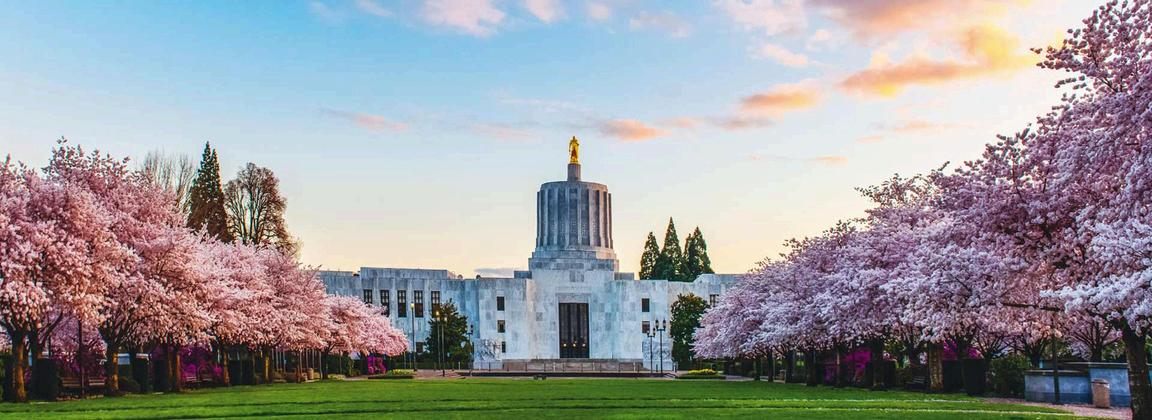
Oregon’s capital, Salem, today is a bustling hub of government, history, and civic pride Believe it or not, this iconic city almost wasn’t the state’s capital at all! The story of how Salem came to hold this title is filled with political intrigue, rivalries, and just a little bit of historical drama Buckle up as we travel back to the 1800s to explore how a mix of geography, timing, and some seriously intense political maneuvering almost left Salem out of the running.
THE SEARCH FOR A STATE CAPITAL: IT WASN’T LOVE AT FIRST SIGHT
When Oregon became a state in 1859, the fledgling state had to choose a capital an important decision with both political and practical ramifications At the time, the state was still in its infancy, and the Portland area was booming with its proximity to the Pacific Ocean and a rapidly growing population Portland seemed like a no-brainer for the capital city However, not everyone agreed
Enter Salem, a city that, despite being centrally located, didn’t exactly have the political clout or infrastructure of Portland Salem was a small town, still growing, with dirt roads and wooden buildings But it did have one thing going for it location. Situated almost exactly in the middle of the state, Salem was accessible to the majority of Oregon’s residents, making it a geographically strategic choice Plus, Salem had the support of a group of politicians who were ready to battle for the honor of hosting Oregon’s government
THE BATTLE FOR CAPITAL STATUS: PORTLAND VS. SALEM
For years, Portland had been Oregon’s unofficial capital In 1851, a law was passed to make Portland the capital, but there was a catch: the law was never implemented because of political infighting and disagreements about the location. As tensions brewed between Portland’s supporters and those backing Salem, the capital issue became a heated topic in Oregon’s legislature
In the mid-1850s, Oregon’s lawmakers decided to hold a vote to settle the matter once and for all On one side was Portland, with its port and bustling economy, eager to become the state’s central political hub On the other was Salem, advocating for its strategic central location, which could serve as a compromise between the rapidly growing Willamette Valley to the south and the expanding cities to the north
But Salem wasn’t the only contender Other cities, including Oregon City and Corvallis, threw their hats into the ring, each making their case Oregon City had once been the state’s first capital, but it didn’t have the population or influence it once did Corvallis, a small but growing town, was also in the mix But, as we know, Salem would eventually win out but not without a fight.
OREGON HISTORY PROJECT
In 1855, the Oregon Territorial Legislature passed a law to relocate the capital to page 8
Salem at least temporarily The idea was to move the capital every few years, a quirky solution to keep all parts of the state happy. This back-and-forth arrangement was as confusing as it sounds and led to some strange turns of events
For example, in the 1860s, there were brief moments when legislators actually considered moving the state’s capital back to Portland, making the capital’s location feel more like a game of political musical chairs than a settled decision
But it wasn’t until 1864 that Salem really secured its status as the permanent capital. The push for this final decision came after the state legislature authorized the construction of a permanent Capitol building complete with all the grandeur you’d expect for a state capital. But not everyone was convinced Salem deserved the honor In fact, some Portlanders were so upset by the decision that they tried (and failed) to launch a movement to move the capital back to their city. Despite all the drama, the final move solidified Salem’s place in Oregon’s history
WHY SALEM WON: A COMBINATION OF POLITICS AND PRACTICALITY
So, what tipped the scales in Salem’s favor?
It wasn’t just a matter of location; it was also the tireless efforts of Salem’s political advocates, who were persistent in lobbying for their city to become the permanent capital Many of these politicians had a vision of a centrally located state capital that could serve all Oregonians, not just the northern or southern parts of the state Furthermore, the construction of infrastructure in Salem, like roads and railways, helped make it more accessible and gave it the ability to handle the growing demands of state government
While Portland had the larger population and more commerce, Salem had the determination, geographical advantage, and a little bit of good old-fashioned political luck on its side
Today, Salem stands proudly as Oregon’s state capital, hosting the state government, the Oregon State Capitol building, and numerous historical landmarks Despite the early competition and political struggles, Salem’s central location turned out to be a key factor in its success And while Portland may have the population and cultural cachet, Salem’s governmentcentered role has given it an identity all its own
So next time you visit Salem, take a moment to appreciate the fascinating history behind Oregon’s capital. From political wrangling to strategic decisionmaking, Salem’s rise to prominence is a testament to the power of geography, persistence, and a little bit of political maneuvering And who knows? If a few more votes had gone in Portland’s favor, we could have been telling a very different story about where Oregon’s government calls home!