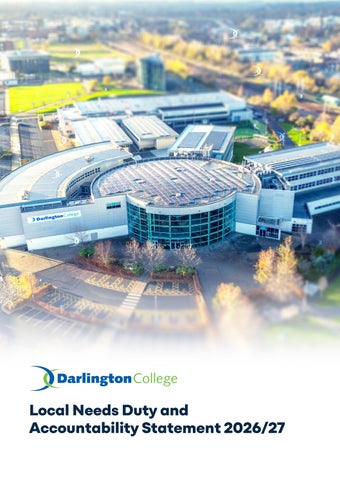

Local
Needs Duty and Accountability Statement 2026/27
College Mission, Vision And Values
Improving the lives of our students and community through excellence in teaching and learning, in a highly supportive, safe, and modern environment, working collaboratively with business for the sustainable success of the region.

Mission: Provide a high quality, inspirational education experience for all. Vision: To provide exceptional opportunities that will inspire and enhance the community that we serve.
To underpin our Mission and Vision we have five Strategic Priorities
Quality Community Opportunity Resources People
We focus on providing high quality education enabling all learners to achieve excellent outcomes. We reduce inequalities, focus on inclusion, provide an inspiring, inclusive and safe working environment for all. We provide a range of opportunities to develop cultural capital ensuring our learners are ready to succeed and progress to their destination of choice.
We understand and are proud of our role within the local community. We take pride in our work and are respectful of one another. We will work with stakeholders to shape education in the town, to strengthen further the links with industry and co design curriculum so students are work ready with a clear line of sight from education to the workplace.
We work tirelessly to We will provide a provide a range ofhigh quality opportunities for our physical and virtual students and infrastructure that support them to focuses on become capable enhancing further independent pedagogical learners. We provide practice, systems a range of and processes that experiences that enable everyone to support them in excel. We continue navigating theirto modernise, route through enhance and education, into their improve our working careers and beyond.environment for the We work benefit of our collaboratively with community. We local stakeholders continue to create to support the inspirational, world college to grow in a class and safe sustainable and facilities that help efficient way, whilst embed excellence in maintaining daily practice. excellence across
the organisation. We are central to the development of the town and support the local community to access opportunities that become available to them.
We will provide a highly productive, supportive environment that allows all members of the college community to thrive. We will develop further our reputation that makes us an employer of choice. We will invest in our colleagues and provide opportunities for them to develop within the organisation and beyond.
Our Values are encapsulated within a single word “INSPIRE”
Inclusion – provide an inclusive environment that celebrates difference, reduces inequalities and creates a safe space for all
Navigate – ensure our learners have the tools, skills and resilience to navigate life, education and their future careers
Support – have in place extensive, responsive, wraparound care and support for your learners as and when they need it
Pride – take pride in being a part of the college, the work we do and understand the impact we have
Independence – learners become independent, ready to progress and thrive in their destination of choice
Respect we are respectful of each other and ourselves in every aspect of our work
we
Darlington College, established in 1897 to enhance the efficiency of manufacturing and commerce within the market town, has a long history of serving the local community of Darlington and Tees Valley, the North East and North Yorkshire. Over the years, the college has grown and developed into a high-performing organisation that offers a broad and varied curriculum, which takes account of the skills needs within the local, regional and national priorities, through the regular and valued contributions of our employers who help us to evolve and enhance our curriculum to meet the changing needs of businesses.
We are committed to excellence in our unwavering pursuit of providing opportunities for all. We strive to provide learners with high-quality, inclusive education that provides learner progression into employment, further study and meaningful participation in society, whilst supporting local economic and community needs.
• Skills for work – vocational, technical, and professional education that leads directly to jobs or apprenticeships.
• Behaviours for work - Preparing learners to be employment-ready by fostering the attitudes, resilience and professional behaviours needed for success at work.
• Progression and opportunity – helping young people and adults move on to higher-level study, better employment, or new careers.
• Social mobility and inclusion – widening access to education, especially for those who may have been disadvantaged at school.
• Serving the local economy – training a workforce aligned to regional employers, industries, and skills shortage.
• Lifelong learning – supporting adults to retrain, upskill, or return to education at any stage of life.
Our dedication to inclusion ensures that every learner has access to the resources and support they need to succeed. We respond pro-actively to the evolving needs of local businesses, fostering strong partnerships, stay attuned to market demands and tailor our courses to prepare a workforce that can meet and exceed employer expectations.
We recognise that our strength lies in our staff. Ensuring the college is a good place to work is of paramount importance and helps us to provide the best possible service to our community. We are committed to creating a supportive, dynamic and rewarding environment where every member of staff can flourish. Our portfolio, from Entry Level to Level 7, includes a wide range of study programmes, T Levels, apprenticeship standards, adult and higher education across a broad range of vocational pathways. In more recent years, and in response to local community needs, we’ve developed bespoke curriculum pathways for 14–16 year-olds to complement their parents Elective Home Education (EHE) choice, as well as alternative provision to support schools where individual young people are struggling to cope with the national curriculum and prefer a hands-on practical skill-based study programme.
The curriculum is aligned to national priorities (such as the Government’s Industrial Strategy; Get Britain Working) as well as local and regional priorities (including Local Skills Plans), taking close and regular account of what our employers say about the skills they need. Their input into our curriculum design is hugely important, making sure our learners are fully prepared for their next steps into work or higher levels of learning. Our role is to remain agile and continue to evolve our curriculum as technology and national priorities evolve, so we remain current and relevant in our offer. In recent years, this has seen the introduction of curriculum within automation such as robotics; clean energy and heat sources; de-carbonisation; and clean construction including retrofit of existing properties. Our facilities are second-to-none and extremely welcoming. Our main campus is large and bright and full of creative, high-performing teachers who mould the curriculum into engaging practical skills development and essential knowledge, alongside sharing their vast experience of the world of work, which enable our learners to thrive during and after their time with us. We are welcoming and inclusive of all and enable our learners to achieve incredible outcomes and progress to their destination of choice. Our impact therefore is that we change lives for the better through every interaction and contribute to increasing the economic strength and cohesive, responsible society of the region.
Recent strategic developments include
• A collaborative project with Darlington Borough Council to provide adult skills in the town centre, through the refurbishment of the Northern Echo premises. Anticipated opening - September 2026.
• An extension to the college to accommodate c.50 14–16 year-olds on school roll who will follow vocational pathways in construction, motor vehicle; hairdressing; health/childcare; digital arts/media. Anticipated opening - September 2026.
• A STEM centre on the Science Park to provide vocational and academic courses in STEM subjects such as science, engineering, maths, anticipated to open September 2029.
Meeting Local Needs
The college wholeheartedly accepts its role in meeting local needs and examples of our responsiveness by demonstrating a credible line of sight from local intelligence to strategic intent and action planning to sustained impact are included within this report.
Context and place
• Tyne and Wear

Darlington within the wider LSIP regions of the North East, Tees Valley and North Yorkshire.
Darlington College is a single campus, general further education college. On a regional level, the college is geographically situated in Darlington, which is within the Tees Valley, but the college’s catchment area extends into North Yorkshire and County Durham, both of which are approximately 2 miles from the college site. At the juncture to Tees Valley, County Durham and North Yorkshire, the college is a significant provider of learning and skills and contributes to the economic development and prosperity of the North East combined mayoral authority (NECA); the York and North Yorkshire mayoral combined authority (YNYCA) as well as (TVCA) mayoral combined authority 6
Darlington College Accountability Statement 2026 - 2027
Meeting local needs: the college’s strategic intent is to positively reflect within its curriculum portfolio the needs of the three Local Skills Plans, the three Combined Authorities strategic plans and the requirements of local/regional employers, ever changing and adapting its curriculum to meet the local, regional and national skills requirements.
On a local level, Darlington is a “town of two halves” with significant localised disadvantage and prosperity. The town covers an area of approximately 200 km2. Its current population is 112,489 having risen by 1.4% since 2023. Of this population 68,642 are of working age (16-64) – within this 80.0% are economically active; 58% of these work in the borough and 21% commute out of the borough. Of the working population (16-64), 6.5% have no qualifications (2024).
Darlington has become progressively more deprived: of the 296 Local Authorities in England, Darlington is now ranked 40th most deprived local authority in the latest release of English indices of deprivation 2025 (previously 77th, and prior to that 96th); with 20% of neighbourhoods in Darlington now classified as highly deprived (compared to 10% across England as a whole). This is higher than the neighbouring borough and county councils of Stockton on Tees, North Yorkshire and County Durham. This demonstrates a progressively declining position in relation to deprivation. The wards most severely impacted by deprivation are located in the North Road and Eastbourne areas. From analysis of college learner postcodes, we know the vast majority of our Darlington learners come from the most deprived wards - Park East, Eastbourne, Bank Top and Lascelles, Red Hall and Lingfield, Stephenson, North Road, Northgate, Pieremont where, on average, 35% of children live in poverty. (DBC Child Poverty slide pack).
The number of children and young people under the age of 16 years living in Darlington is 20,040 (2024) which equates to 17.8% of the population. Children and young people from minority ethnic groups account for 9.8% of all children living in the area compared to 32.2% for England. The largest minority ethnic groups are Any Other White, followed by Asian and Mixed. Darlington also has higher numbers of Gypsy, Roma Travellers with approximately 3 times the national average – a substantial number are domiciled only during the winter months due to travelling at other times; many are not educated beyond the age of primary school but the college has been successful in re-engaging young Gypsy, Roma Travellers who access the college aged 14+ for skills-based training. Meeting local needs, the college has clearly set its strategy around being an “inclusive” provider planning the opening of a 14-16 Skills Centre specifically to re-engage young people with persistent absence and those currently outside of school education.
The unemployment count for Darlington’s working age population is 4.1% (2025). This holds an underlying issue regarding youth unemployment: the unemployment count for 18–24-year-olds stood at 7.4% (Sept 2025) compared with 5.8% for England and 6.2% for the North East. There are currently estimated to be 7,839 children in Darlington (34%) living in poverty compared to 29% for England.
Education and attainment in Darlington and surrounding areas: For young people, there is a choice of two routes: studying A level with Queen Elizabeth Sixth Form College (and a small 6th form A-level offer at Carmel secondary school); or studying vocational qualifications at Darlington College. The Education in England Annual Report shows the disadvantage gap to be 21.8 months in Darlington, compared to 21.6 months in the North East, and 19.2 months in England. The research also shows many young people from disadvantaged backgrounds choose to study vocational provision within an FE institution in preference to A Level provision and many choose Darlington College.
The college works with c.9 primary schools and c.66 secondary schools. School performance is mixed. Our enrolments show most of our young learners come from schools performing below average, or well below average, where Progress 8 scores are low.
The growth in the number of 16-19 learners who fail to achieve GCSE Grade 4 English and maths whilst at school has become a progressive challenge: in 2025-26 the number of 16-19 learners registered for English was 1078 (up from 624 over a 5-year period) and for maths was 1146 (up from 671 over a 5-year period). However, meeting local needs, the college has set its strategy to provide high-quality differentiated opportunities for a fresh start in English and maths, to re-engage and re-enthuse learners who believe themselves to be failures in these subjects, the impact of which is that learners are achieving qualifications in English and maths often for the first time in their lives.
Travel to learn patterns for the Tees Valley are generally self-contained in that most learners travel within the local area for education rather than long distances outside of the locality. This is generally the case for Darlington and other urban centres where learners benefit from good standard public transport. However, many individuals travel to the college from rural areas of North Yorkshire as we remain their most local provider. In meeting local needs, the college’s strategy is to remain the college of North Yorkshire and we liaise closely with North Yorkshire County Council to ensure appropriate provision of bespoke college transport to provide the residents of these rural communities with continued and equal access to high-quality learning and skills training. Rural travel barriers do however, impact attendance and punctuality of learners due to unreliability of extended journey times due to bad weather or heavy traffic conditions.
Approach to Development of the Annual Accountability Statement
Darlington College is actively represented on many and varied partnerships across the region. Our approach to determining our priorities involves significant work to support our key stakeholders – learners, residents, employers, schools, community groups, local authorities, combined authorities and various boards and committees.
The college works in partnership with approximately 1500 employers, many of whom routinely discuss their requirements for skills. Regular, sector-based employer boards enable us to focus on sector skills needs and how adaptations to curriculum can improve outcomes for employers. Also key to understanding of the skills needs of the region is our engagement with the chambers of commerce (specifically the North East and the West and North Yorkshire Chambers of Commerce) and the combined authorities’ strategic plans for the areas of TVCA, NECA and YNYCA.
Governors and senior leaders participate in strategic planning days where the college’s impact on local, regional and national skills needs is discussed and the college’s direction of travel for the future is agreed. The Strategic Plan is developed for a 3-year period. Alongside this, annual targets are set and performance/impact is measured, overseen by the Committees of the Governing Body (Quality and Standards; Finance, Employment and Estates) which in turn report into the Board Meeting of the Corporation. Governors and senior leaders are well-informed about the skills requirements of the three devolved areas and the wider national priorities. This is enhanced by inviting “specialists” to Board Strategy days to lead informative discussions and share up-to-date knowledge of the labour market landscape, the roles and skills in demand as well as national and regional priorities for growth.
From strategy, intent, and well-formed views of the requirements to meet skills needs, the college then moves into its cyclical process of curriculum planning, which begins with an evaluation of the very latest labour market intelligence to inform the annual plan. The aspect of “meeting local, regional, national skills needs” is central to this process, alongside the “quality of provision” and “financial viability”. This annual cycle is overseen by senior leaders and Governors. Whilst the annual plan sets a baseline for the budget setting process, it also acts as a dynamic document, with regular reviews and changes over the course of the year to address in-year demands from employers requesting specific skills.
The Annual Accountability Statement, informed by external intelligence around skills and priorities, is a strategic annual document that sits alongside the three-year Strategic Plan, the annual curriculum plan and Self-Assessment Report. There is a clear line of sight between these documents. The draft of the Accountability Statement is considered by senior leaders, Governors and other stakeholders prior to the final version being published.
CONTRIBUTION TO NATIONAL, REGIONAL, LOCAL PRIORITIES
In meeting NATIONAL PRIORITIES . . .
Skills & Economic Growth
• Adult Skills Fund – we have grown direct delivery of high-quality adult programmes which meet devolved authority priority areas such as construction (8% of starts; achievements 91%), engineering (12% of starts; achievements 85%), health and care (13% of starts; achievements 90%) digital (5% of starts; achievements 93%), business and professional (8% of starts, 88% achievements), visitor economy (13% of starts; achievements 95%).
• Skills Bootcamps – we implemented construction and Retrofit Bootcamps in TVCA in 2025-26.
• Apprenticeships – we have grown the volume of high-quality apprenticeship provision in priority areas such as construction, engineering, business, professional and management and health sectors, whilst Improving standards - OAR above national rates (75% predicted for 2025-26)
• Technical education (T Levels) – we have implementation three T levels in Childcare and Education; Engineering; Health with a plan to implement two further Digital T Levels from September 2026 and a further Digital T Level from September 2027. 100% of placements with employers are secured.
Social Mobility & Levelling Up
• Participation rates for young learners challenged by circumstances – 93% of our cohort of young people are challenged by circumstances, socio-economic; low prior attainment; care experienced; ethnicity and culture; SEND, EHCPs and High Needs, but despite this, their retention and participation remain strong - currently at 95% mid-year 2025-26.
• Looked After Children – year on year we have seen growth in the number of looked after children actively engaged and enjoying their learning at the college in a wide range of curriculum subjects. Their retention and participation remain strong - currently at 93% mid-year 2025-26.
• SEND and EHCPs – we have also seen increasing numbers of children presenting with SEND and EHCPs and can evidence strong retention and participation - for those with SEND, (44% of the 16-18 cohort; 96% retention); for those with EHCPs (12% of the 16-18 cohort; 96% retention).
• Adult retraining – we have introduced a wide range of L3 programmes under the FCFJs which are popular. As a result, we have over-achieved our FCFJs funding allocations in all devolved authorities.
• Access to HE – we have widened the opportunities for first-generation adult learners to access a range of Access to HE courses, including health, social sciences, providing pathways into nursing and diverse high-employability career paths in sectors like business, law, education, government and politics. Further Access courses planned for 2025-26.
Quality and Standards
• Ofsted grade – we remain Good.
• Achievement, attendance – 93% of our 2024-25 learners faced challenges including socio-economic, low prior attainment, experience of care, SEND, EHCPs and High Needs. Despite this, our overall achievement rates remain good at 85% Attendance overall remains good at 87% overall . This includes all English and maths sessions and courses specifically designed for young people who would otherwise be NEET having been previously persistently absent or entirely disengaged from school.
• Destinations - From 2024-25 we know 86% of learner destinations, of which 95% recorded positive destinations into employment, apprenticeships, further and higher education, supported living or voluntary work.
• Employer satisfaction surveys – we are rated “good” by employers.
In meeting REGIONAL PRIORITIES . . .
Alignment to Regional Skills Plans
• Curriculum mapping – we map our curriculum provision against regional growth sectors, as detailed in the table on page 13.
• Investment in facilities – our investment is aligned to regional industrial strategy. Recent investments include The Ingenium Building (college extension for engineering workshops and classrooms); an automation/robotics suite; a business centre; an immersive classroom; electric vehicles training suite; VR headsets and a wide range of VR content; a clean energy/heating centre; smart-house technology; a health ward (including a GP surgery and care home facility).
• Co-design with employers – we work closely with employers to ensure our provision meets their specific needs. This includes for example - sports journalism added to our national journalism contract; childcare centres and engineering companies contributing to the design of the T Levels in Education and Childcare and Engineering; adopting facial and body massage techniques in beauty and focus on posture of masseurs to reduce sickness absence days in local hotels and spas; increasing emphasis on communication skills and increasing knowledge of recent food trends for local restaurants and patisseries; upskilling graduates in basic engineering tool knowledge and use for a local engineering company; redesigning the college’s group tutorial model taking account of feedback from a variety of organisations about the need for increased confidence in face-to-face communications; working with a bus company to train unemployed adults for a career in bus driving.
Employer & Civic Partnerships
• Number/scale of regional employer partnerships – we partner with around 1500 employers in the region including large-scale and SMEs and micro-organisations.
• Collaborative bids – we regularly partner with other providers on projects such as the Strategic Development Fund, two LSIFs projects (Tees Valley and North Yorkshire) and jointly with Darlington Borough Council to bring a STEM Centre to Darlington.
• Participation in regional boards – our CEO/Principal regularly attends education boards, for example the v University College Partnership Board and sits on Principals’ Boards within Tees Valley and North Yorkshire. Our Deputy CEO/Principal sits on the North East Institute of Technology and Construction Technical Excellence College Boards.
• FE+ - is a strategic partnership of all the FE colleges in the Tees Valley. It enables colleges to work together and speak as a single voice on behalf of FE across the region. FE+ partners have collaborated on a range of ventures including the delivery of SDF and LSIF projects, working closely with inward investors and advising on skills policy with local and national stakeholders. A collaboration with Balfour Beatty created a Tees Valley Net Zero sponsored Academy which is in its first full year of delivery 2025-26.
Labour Market Responsiveness
• Rapid curriculum adaptation to emerging sectors – we have implemented green energy and retrofit in to our existing construction courses, advanced automation and robotics into our engineering courses and electric vehicle maintenance into our motor vehicle courses. Further new developments include cyber security, data analytics and AI into our digital courses.
• Labour market intelligence – we routinely refer to ‘ Lightcast’ labour market data, which provides us with the insight to shape continuous development for the future.
• Employer boards influencing curriculum – our regular contact with employers through our employer boards enables us to keep focused on the exact needs of employers within the region.
Community Impact
• NEET young people – our wide range of vocational courses offer over 1800 young people of Darlington the opportunity to further their skills, knowledge and behaviours to become career ready. We support young people who would otherwise be NEET to re-engage with mainstream education within the college, for example, young people from Gypsy Roma Traveller communities; Pre16 Elective Home Education young people; school roll pupils who are persistently absent and at risk of being excluded; and our vocational foundations programmes is specifically designed for those young people at risk of dropping out of college.
-
• ESOL provision we have seen significant growth in the volume of learners for whom English is an additional language, as we continue to respond to local migration patterns. We are very welcoming and develop cultural awareness as well as English and vocational skills. This includes a growth in the number of young, unaccompanied children aged from 14 onwards who are placed in care.
• SEND provision – we work closely with a range of local authorities to secure the right place for individuals with wider SEND, High Needs and EHCPs and have implemented a local internship model with Amazon to secure future employment for young people. In 2024-25, five young people who may not have secured work, were offered employment by Amazon as a result of the programme.
• Outreach in deprived wards – we liaise with 66 secondary and 9 primary schools, via school liaison activities and over 2000 Year 10 students attend the college every July for engagement. The majority of young learners to the college come from the deprived wards of Darlington.
Employer Responsiveness
• Apprenticeships - an extensive range of standards support employers with over 700 active apprentices at any one time.
• SME engagement – our employers provide master classes within the college, work and industrial experience/placements, apprenticeship opportunities, bootcamps, adult workforce upskilling, new recruitment opportunities, and help us shape our curriculum via employer boards and co-design.
• Bespoke training – we provide employers with bespoke training and development such as our basic engineering workshop tool course for an intake of graduates into a local large-scale Engineering company.
• Adult upskilling – we are the largest provider of high-quality adult education in Darlington. Our curriculum offer including apprenticeships, adult skills funded qualifications, free courses for jobs provides individuals with opportunities to upskill or reskill in a new curriculum specialism.
Civic Role
• Community use of estate – through our Business Gateway, Restaurant and Central Point, we accommodate community events such as the Mayor’s Ball; Christmas markets; Rotary Club meetings; employer fairs; HE fairs; business conferences (NCTJ and CIPD national conferences). Employers use our facilities for interviews. Local providers hire space to run adult skills courses.
• Participation in local boards – our CEO/Principal attends education boards, for example the 11-19 partnership of School and College Heads/Principals within Darlington. Our Deputy CEO/Principal sits on the Safeguarding Partnership and Wellbeing Boards of Darlington Council.
• Partnerships with schools – we partner in local initiatives such as the 2025-26 initiative to increase children’s oracy skills, by incorporating aspects of oracy within our Year 10 engagement session.
• Role in local regeneration projects – our CEO/Principal chairs the Plan for Neighbourhood Board with oversight of the Pride in Place capital investment programme.
• Support for local infrastructure – we are central in developing plans to bring a £24m STEM centre to Darlington’s education quarter.
HEADLINE TARGETS
1. Continue to grow the number of enrolments for young people, from 1800 2025-26 to 2000 by 2028-29.
2. Continue to grow the proportion of learners in high priority sectors for TVCA, NECA and YNYCA from 42% at the end of 2024-25 to 57% by the end of 2026-27.
The table below shows the proportion of learner starts -
* This will increase to the end of year position. Targets for 2026-27 will be set closer to 2025-26 end of year position.
3. Continue to grow the proportion of apprentices in high priority sectors for TVCA, NECA and YNYCA – from 81% at the end of 2024-25 to 85% by the end of 2026-27.
* This will increase to the end of year position. Targets for 2026-27 will be set closer to 2025-26 end of year position.
4. Continue to grow the number of T Level courses offered year by year –from 3 in 2024-25 to 6 in 2027-28.
5. Implement new Pre-16 Centre from September 2026, providing alternative education for those persistently absent and at risk of exclusion from school.
6. Implement Adult Skills Centre from September 2026, providing town-centre adult learning opportunities and complimenting the Learning and Skills adult provision which will be delivered within the same Northern Echo venue.
7. Develop and implement HTQs and work in partnership with Teesside University to increase young people engaging in higher level learning by age 25 through extending the choice of higher-level learning opportunities within the town from 10 in 2024-25 to 15 by September 2027.
Darlington College Accountability Statement 2026 - 2027
Existing
FdA Counselling
FdA Early Years
FdA working with Children and Young People
HNC Building Studies
HNC Mechanical Engineering
HND Mechanical Engineering
BA (Hons) Education and Training
Cert Ed Further Education and Skills
PGCE Further Education and Skills
HTQ Engineering
Planned
FdA Counselling
FdA Early Years
FdA working with Children and Young People
HNC Building Studies
HNC Mechanical Engineering
HND Mechanical Engineering
BA (Hons) Education and Training
Cert Ed Further Education and Skills
PGCE Further Education and Skills
FdA Outdoor Leadership and Coaching
FdA Criminology
BA (Hons) Therapeutic Counselling
FdA Business Management
HTQ L4 Early Years
FdA Sports Science
8. Increase pathway opportunities in STEM at L2 from 6 in 2025-26 to 8 2026-27.
9. Implement STEM Centre in Darlington, offering wider STEM subjects at L3 and above, commencing operation in September 2029.
LOCAL NEEDS DUTY
We have a clear and accurate understanding of the college’s unique geographical position, located at the western edge of the Tees Valley and very close to the North East and York and North Yorkshire Combined Authorities. Our courses are therefore aligned to the priorities of all three Local Skills Plans ensuring we meet the needs of local and regional employers and communities. We are aware that the three Local Skills Improvement Plans will be rewritten next year, with stronger input from devolved authorities alongside Employer Representative Bodies. We aim to stay at the forefront of curriculum development to ensure the college continues to deliver the skills identified in the updated LSIPs. Skills mapped against 3 LSIPs – see Page 13.
The college’s strong partnerships with employers and wider stakeholders have led to significant growth in apprenticeships, increasing from £2.1m in 2021–22 to £3.3m in 2025–26 and employer satisfaction rates remain “Good” leading to repeat business. Close collaboration with chambers of commerce, local authorities and mayoral combined authorities ensures the college meets local and regional skills needs, with stakeholders confirming its positive impact.
Engagement with employers and other stakeholders is highly effective and the college has a strong reputation for delivering good quality and a good service to employers. Relationships are excellent, facilitated by an effective team of business development advisors, engagement coaches and curriculum delivery teams, plugged into inward investment opportunities and well informed about skills gaps within the region. This has led to significant growth in apprenticeship numbers over the years, based on the college’s high reputation for high-quality provision, leading to new and repeat business (apprenticeship income increasing. The online survey of employers provides a rating of “good”. Our employer boards enable us to engage with employers around curriculum design to ensure our curriculum meets their ongoing and changing skills needs.
An example of the very strong working partnerships with employers is evident with a new partnership with Balfour Beatty to offer a “Net Zero” academy, which is a scholarship opportunity for learners to develop skills in welding, instrumentation, pipefitting, civil operations and electrical engineering, earning £100 per week, paid by the employer. This two-year course commencing September 2025 will provide future opportunities for the learners to become employed apprentices.
The college engages very well with the chamber of commerce around local/regional skills gaps, local authorities and the mayoral combined authorities of TVCA, NECA and YNYCA which leads to a very strong understanding of the skills needs in the local and regional areas. Stakeholder feedback confirms the college adds value to the area through training and upskilling opportunities, as evidenced in the last Ofsted report.
Darlington College works very well in partnership across the regions we serve. For example, within the Tees Valley, we are part of the FE + group of colleges and work collaboratively on projects such as the Strategic Development Fund, two LSIF projects and collective bidding for capital investment via the combined authority. In North Yorkshire we have also collaborated on two LSIF projects and an ongoing teaching and learning project. In the North East we collaborate with wider colleges through our strategic board position on the North East Institute of Technology and with our involvement in the Construction Technical Excellence College where we are involved in the curriculum.
GOVERNING BODY STATEMENT
The Corporation of Darlington College confirms its commitment to meeting its statutory duties under the Skills and Post-16 Education Act 2022, including the Local Needs Duty and the publication of this Annual Accountability Statement.
As the governing body, we recognise our responsibility to ensure that the college delivers high-quality education and training that is effectively aligned to local labour market needs, particularly those identified by employers, and local, regional and national skills priorities. In preparing this statement, the Corporation has considered:
• The Local Skills Improvement Plans (LSIPs) for TVCA, NECA and YNYCA
• Local and Combined Authority strategic economic priorities
• Employer engagement feedback and labour market intelligence
• Learner progression, achievement and destination data
• Community need, including disadvantaged and underrepresented groups
We are satisfied that the College’s 2026–27 curriculum offer is aligned with identified skills shortages and growth sectors, including health and social care, digital, construction, green technologies, advanced manufacturing for example. The Corporation is satisfied, through reporting and analysis, that the college’s curriculum planning supports:
• Economic growth and productivity in our region
• Employer workforce development needs
• Clear progression pathways for young people and adults
• Inclusion, widening participation and social mobility
• The transition to net zero and sustainable industries
The Corporation has challenged and supported senior leaders to ensure that employer engagement is meaningful and sustained, that curriculum development is informed by labour market intelligence, and that performance measures are transparent and robust.
We will continue to monitor delivery against these priorities through our curriculum, quality and finance oversight arrangements with regular oversight of:
• Achievement rates and learner progression
• Apprenticeship performance and employer satisfaction
• Attendance, retention and learner experience
• Impact of provision on local workforce skills gaps
• Financial resilience and value for money
The Corporation is confident that this statement reflects both our strategic intent and our accountability to learners, employers, communities and public funders. We remain committed to continuous improvement and to ensuring that Darlington College plays a central role in supporting inclusive economic growth in the local/regional area. Approved by the Corporation on: 30 / 06 / 2026


Achievement 16-18 to be above
Achievement 16-18 to be above national benchmark, with a target of 87% national benchmark, at XX%
Apprenticeship Achievement to be above Apprenticeship Achievement to be national benchmark, with a target of 75% above national benchmark, at XX%
Positive destinations at level 3 (16-18) to
Positive destinations at Level 3 be above 78% (16-18) to be above XX%.
Positive customer feedback -
Positive customer feedback secured upper quartiles for enjoy and achieve – enjoy and achieve in quartile X and above external benchmark
Improved engagement within local community to extend the opportunities available for local residents.
Undertake community projects to enhance the services and environment available to local residents.
Become an active member of the local Plan for Neighbourhoods
Actively plan and grow curriculum offer to meet LSIP skills requirements across the three regions.
Launch of the new Adult Skills Centre within the old Northern Echo Building XX.XX.XXXX
Launch of new Pre16 Centre within the college.
XX% of young people taken part in Work Experience.
XX staff involved in volunteering through Time for Tees initiative.
Provide £300 funding to plant local trees
Work with the Council to provide a strong project plan for distribution of the £20m Pride in Place funding
Incorporated clean energy and retrofit in construction courses and launched new construction and retrofit bootcamps, robotics and automation in engineering courses, electric vehicle maintenance in motor vehicle courses
Hold 5 employer boards to take feedback 5 boards held during 2025-26 providing and ensure co-design of curriculum meets significant feedback and employer skills gaps. co-design opportunities.
Positive customer feedback on
Positive customer feedback secured –learning new skills. learning new skills in quartile X and above external benchmark 4. Financial Security
Maintain a secure financial footing with good financial health
Good financial health status achieved
Positive staff feedback on Darlington Positive staff feedback College as a good place to work. through XXXXXXXX
Ensure retention of staff is above the Turnover of staff XX%
5. Culture sector average (CIPD survey, Education Sector average 17% turnover/ 83% retention) Retention of staff XX%
This
This government grant is designed to offset the cost of transitioning to a reformed SEND system. For Darlington College the grant of c.£200K will be used to prepare for the emerging SEND reforms by strengthening inclusive practice, developing staff capability, improving accessibility and redesigning support systems and we will use this as an investment in a sustainable, inclusive mainstream model.
Examples of how we intend to use this fund include –
• Further development of our CLEAR teaching framework which incorporates our Universal Design for learning (UDL)
• Further training for teaching staff in adaptive teaching, graduated response, SEND awareness, neurodiversity-affirming practice, trauma-informed practice, communication strategies and use of assistive technology.
• Further development of curriculum resources for multiple means of access and assessment.
• Peer coaching focused on inclusive pedagogy.
• Potential new posts such as specialist practitioners to assess and support learners.
• Further investment in assistive technology.
• Potential improvements to estate to enhance quiet study areas, low-arousal spaces, improved signage, accessible classrooms.
The College will develop a three-year SEND transformation programme where Year 1 enables the college to understand the need and build capacity, Year 2 enables us to fully implement change in practice and Year 3 provides sustainable and demonstrable impact.
Local Skills Improvement Plan Tees Valley
https://www.necc.co.uk/wp-content/uploads/2023/08/Tees-Valley -Local-Skills-Improvement-Plan-2023.pdf
Local Skills Improvement Plan North Yorkshire
https://wnychamber.co.uk/local-skills-improvement-plan/
Local Skills Improvement Plan North East https://nelsip.com/
Get Britain Working Tees Valley
https://teesvalley-ca.gov.uk/work/get-tees-valley-working-plan/
Get Britain Working North Yorkshire
https://www.northyorks.gov.uk/adult-education-and-training/getbritain-working-economic-inactivity-trailblazer
Get Britain Working North East (Economically Inactive Trailblazer Project)
https://www.northeast-ca.gov.uk/projects/economically-Inactive-t railblazer-project#:~:text=The%20recently%20launched%20%E2 %80%9CGet%20Britain,the%20Get%20Britain%20Working%20S trategy.
Annual Financial Statements July 2024
https://darlington.ac.uk/wp-content/uploads/2025/01/DarlingtonCollege-Financial-Statements-2023-2024-Signed.pdf
Ofsted Inspection Report
https://reports.ofsted.gov.uk/provider/31/130656