MATT BARTELL, BRAD BOLLMANN, CJ MEDIA, DUSTIN CORBANO, ROB FISCHETTI, JOEY HONO, JOSH GEEG, TONY LAUGHRIN, JOSH LEGG, ADAM MAH, MIKEL MOORE, NIKKO MORA, CLAY MORGAN, JORDAN MUENCH, AARON MULDER, LUIS NIEVES, STEPHEN PLATT, CHRIS SIEMBIEDA, KONSTANTIN STANCHEV, SCOTT SULLIVAN, JAY TASTAN, CARVIN THOMPSON, TYLER WATT, MIKKO YANG
INDEX...
Where to get ?
DARC MAG is FREE to view online download from DARCMAG.COM
Pick up your copy also at these locations:
AMAIN 2860 Fair St. Chico, CA 95928
Casa Drift 4629 S 108th St, Greenfield, WI 53228
Coastal RC Drift 2561 El Camino Real, Carlsbad, CA 92008
DARC 10420 Plano Rd #105, Dallas, TX
Drift In' 3515 Franklin St suite c, Michigan City, Indiana
Drift Manji RC 5 Valley Road, Liversedge, UK
Drift Ninjas RC 6625 Robinson Ave, Allen Park, MI
Drift Scene 315 Fingerlakes Mall, 1579 Clark Street Road, Auburn, NY
High Voltage Garage 1199 E Central Ave, Wichita, KS 67214
HobbyTown RVA RC Drift Garage 9900 West Broad Street, Glen Allen, VA
HobbyTown Rockford, IL 3782 North Alpine Road, Rockford, IL
Pop's Dirty South 1717 Rabbit Ln, Lake Charles, LA 70605
RC Car World 2305 Garry Road, Cinnaminson, NJ
RC Drift Scene 315 Fingerlakes Mall, Clark Street Road, Auburn, NY
RC Driftway 3065 Cranberry Highway, East Wareham, MA
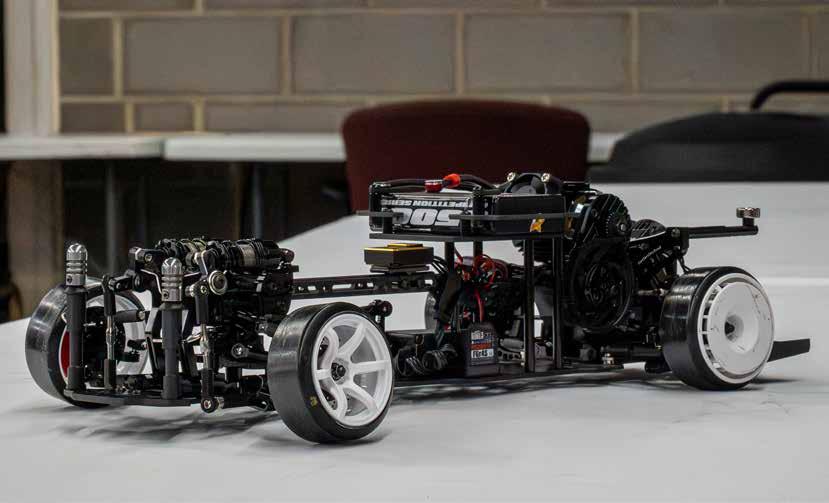
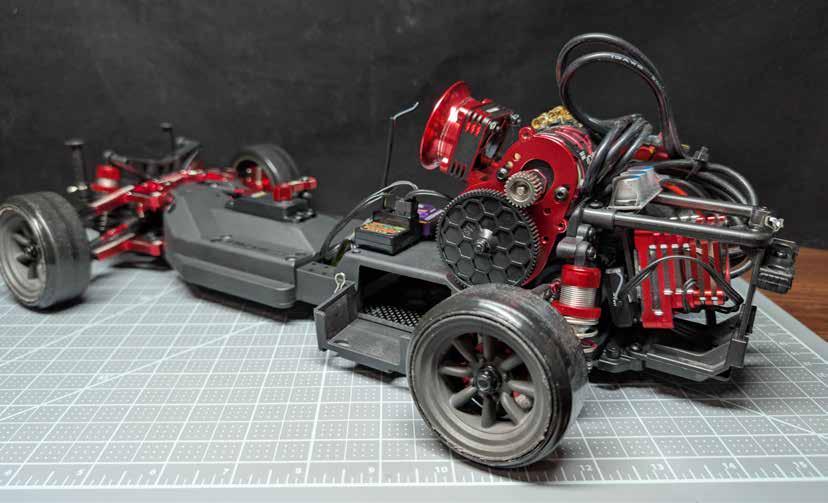
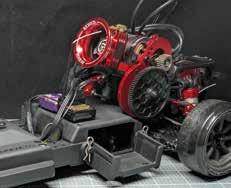
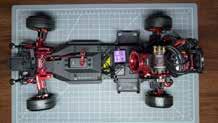
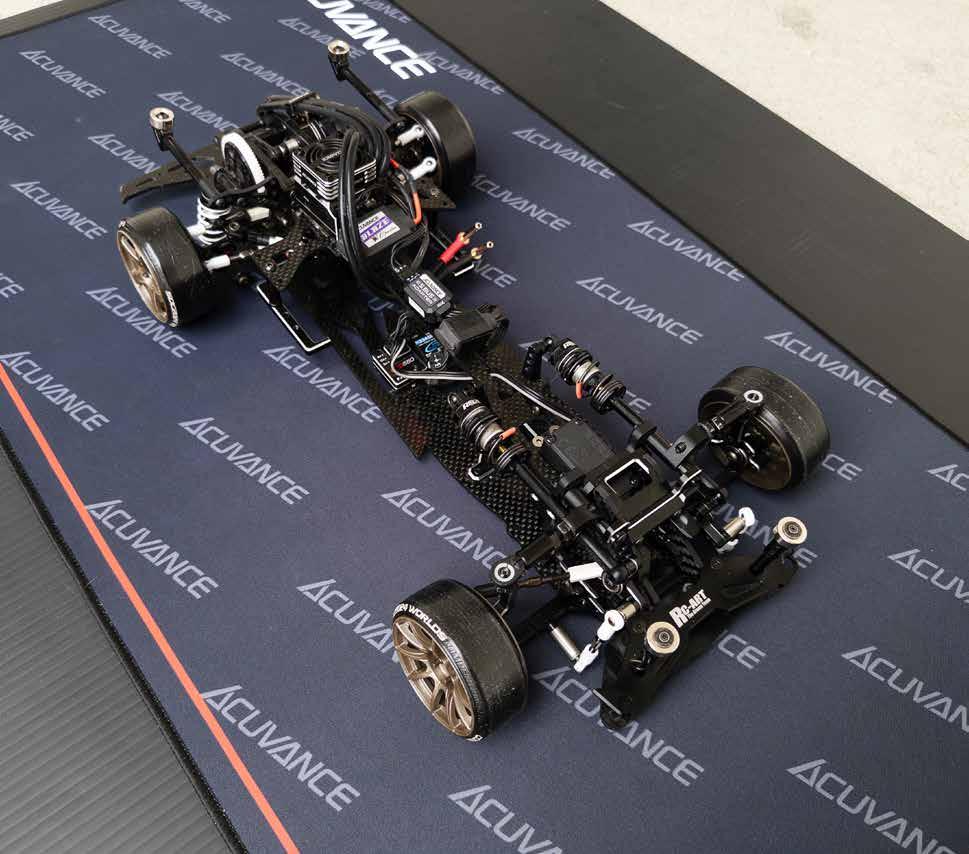
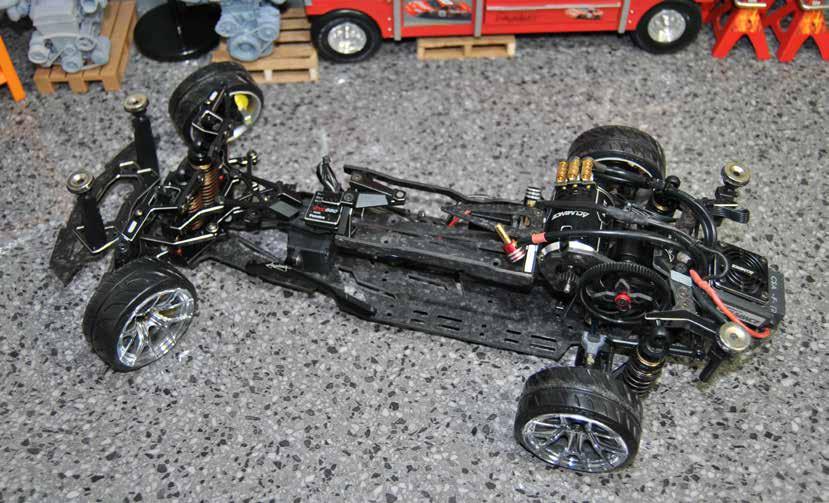
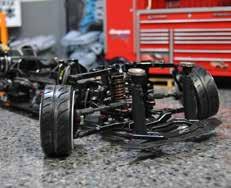
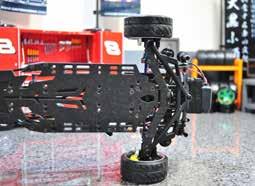
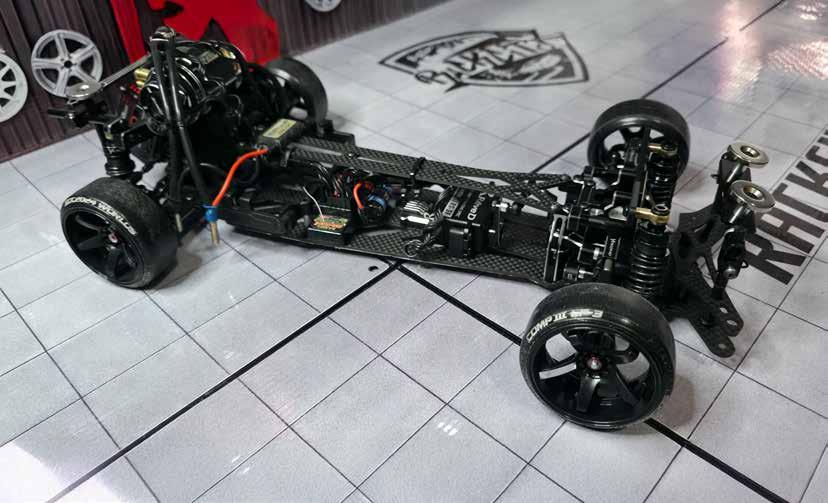
The base for my build is a standard off-the-shelf MST RMX 2.5 RTR chassis, but nearly every part has been upgraded or replaced, leaving only the idler gears and shims as original. A major highlight is the Rhino Racing CLSD conversion in the gearbox, paired with a 50% Shark front end to enable an IFS suspension setup. The CLSD, essentially a tunable gear differential, is built with various springs and gears; I run an 8-gear soft spring setup for quicker lock-up. At low speeds, the CLSD acts as an open diff, allowing independent wheel movement. As speed increases, it locks, functioning like a spool for synchronized wheel spin. This transition delivers smoother control compared to a solid spool, which is better for aggressive, tight turns, but sacrifices grip.
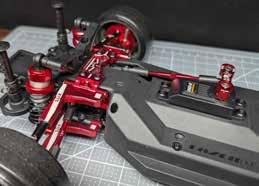
The CLSD was designed for Yokomo gearboxes and, with a Rhino Racing conversion kit, fits the MST RMX 2.5 by lowering the idler gears and adding spacers for a snug fit. My chassis is over 90% MST aluminum or carbon fiber, with a Bingo Wasp deck and Yeah Racing front knuckles. Ceramic bearings provide less resistance and greater durability, though at a higher cost.
I bought the chassis “used” in January 2025, brand new in the box. Alignment is mostly by feel, but recent setup checks show 8° camber, 3° toe, and 4° caster up front; the rear runs 2.5°camber and about 1° toe, enhanced by an MST active toe kit. Rear suspension is soft, front is medium, and weight balance is close to 30/70 rear-biased, aiding traction under throttle.
Electronics are mid-range but competitive: a Yokomo V4 gyro (soon to be ReveD Revox), ReveD RSST servo, and Hobbywing XR10 Pro G3 ESC paired with a D10 10.5t motor. The setup is controlled by a FlySky Noble NB4+ transmitter and powered by Scale Reflex 3500mah shorty batteries.
The all-black chassis stands out for its versatility with different bodies. Total cost is just under $3,000 - not necessary, but a rewarding personal project. Many start with the RMX RTR but don’t upgrade as extensively; I wanted to prove the MST’s competitive potential with proper tuning. Winning the Wisconsin SDC regional validated my approach, though the real reward is the community and the thrill of constant tuning and improvement.
The KKPIT PDK-SR is a unique RC drift chassis that has emerged as a “sleeper” in the competitive scene since its release in the Summer of 2023. Built around the slide rack platform, this chassis features every available KKPIT hop-up, including a limitedrun prototype flex deck that not only enhances the aesthetics, but also improves its performance and weight distribution. With no aftermarket conversions, this build is a testament of KKPIT’s engineering and upgrade capabilities.
The chassis is equipped with full aluminum upper and lower arms, providing both strength and precision. The aluminum front knuckles stand out with six outer tie rod mounting holes, offering expanded tuning options for steering geometry. At the rear, an aluminum toe block allows up to 4° of toein, adjustable in 1° increments. The factory setup runs -4° front toe, -11° front camber, 6.5° caster, and a front width of 220mm. In the rear, the specs are 2° toe, -2° camber, and a width of 197mm. Dampers are standard aluminum bodies paired with optional KKPIT purple springs, offering a responsive and consistent feel on the track.
The standout feature of this chassis is undoubtedly the prototype flex deck. This limited-run component features a custom design cut into the lower deck, which not only adds visual appeal but also shaves 10 grams off the total weight. The flex deck contributes
to the dynamic handling, especially when navigating tight corners and long sweepers. To further enhance rear grip under heavy load, a small modification was made by dremeling the tail end of the chassis, allowing for the rear toe blocks to be flipped and increasing squat during acceleration.
In terms of electronics, the build is competition-ready. The ESC is mounted on a 35mm standoff directly above the differential - a unique setup that started as an experiment, but resulted in a rear weight shift that complements an aggressive driving style. The steering electronics package includes a Reve D RSST PRO servo for precise steering and the “tried and true” Yokomo V4 gyro. For consistency, the motor and ESC setup is a Hobbywing D10 10.5T motor paired with the XD10 ESC, delivering a balanced power band and responsive throttle control. The chassis also runs a firm-set Yokomo ball diff, preferred for its durability and smooth operation.
Overall, the KKPIT PDK-SR stands out as a rare and capable drift chassis, especially when equipped with KKPIT’s full lineup of hop-ups. The combination of thoughtful engineering, unique modifications, and dialed-in electronics makes it a formidable choice for competitive RC drifting, proving that even rising star platforms can shine with the right setup.
Mikel Moore - KKPIT PDK-SR
CHASSISBUILDERSSHOWCASE
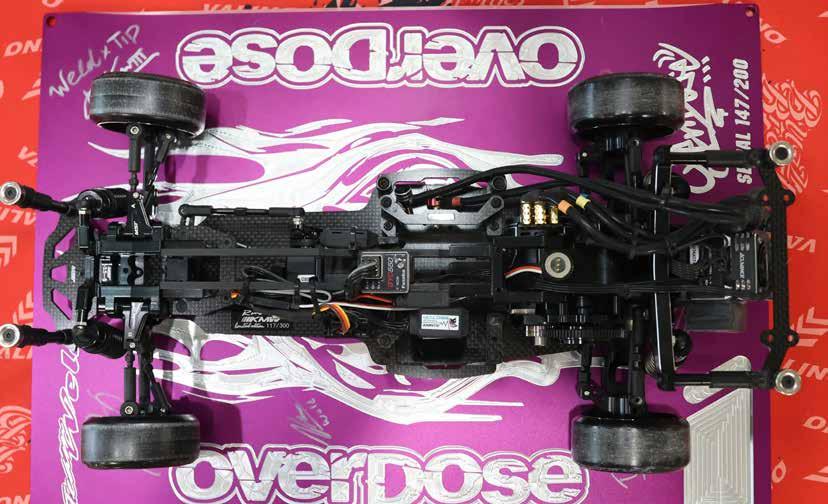
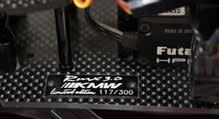
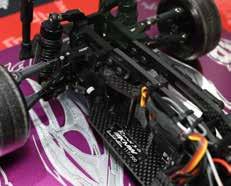
The MST KMW chassis is a modern, highly adaptable design, able to change multiple center of gravity distributions, first released around 2021 with a retail price of $1,100. Its popularity was immediate, selling out quickly. Over the years, I’ve owned and traded about seven or eight of these chassis, but I’ve always kept #117, the first limited edition I purchased. MST engineered this chassis to be versatile, allowing for multiple motor positions - low, high, or rear mount - and flexible battery placement, either lengthwise or in line with the chassis. The steering servo can also be mounted forward or closer to the center for optimal balance.
All components are either carbon fiber or aluminum, with no need for aftermarket upgrades; MST’s attention to detail is impressive. The chassis was only offered in black, with redesigned carbon decks specific to this model. It features multiple preset configurations for caster, camber, and toe block settings. I set mine up according to the manual and found it slides exceptionally well, an easy chassis to drift and enjoy. The only upgrade I added was a set of ceramic bearings from Avid RC for extra smoothness.
The tuning process is straightforward. I use 15wt oil in the front shocks and 25wt
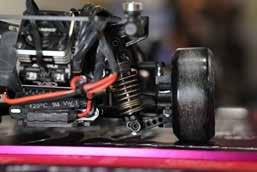
in the rear. The shocks are KMW-specific, all aluminum, paired with MST medium springs in the front and hard springs in the rear. The chassis comes factory-equipped with rear active toe and a ball differential, which can be set up on either the right or left side, depending on preference.
For electronics, I run an Acuvance Rad ESC, Futaba 550 gyro, CD700 servo, and utilize the S-bus for tuning the ESC directly from the radio. The motor is an Agile 10.5 with an LV42 torque rotor swap, cooled by a single fan. Power is supplied by Maclan 4400 130C batteries, which deliver excellent performance.
All together, with electronics and bearings, the setup totals around $2,300. In terms of driving, this is one of the smoothest chassis I own. It holds the angle well without washing out, and the mechanics are remarkably quiet. The aluminum ATK knuckle set is adjustable for KPI angle (0 or 6 degrees) and axle towing distance (0, 0.75, or 1.5). The chassis offers over eight changeable center-of-gravity settings for motor distribution in RMX (rear-mid) and RR (rear-rear) configurations. The aluminum MB rear suspension system further enhances tuning, allowing adjustments to vehicle roll force and rear wheel steering to fine-tune tail slip and handling.
Luis Nieves - KMW 3.0, #117/300 Limited Edition Photos: @keensightz
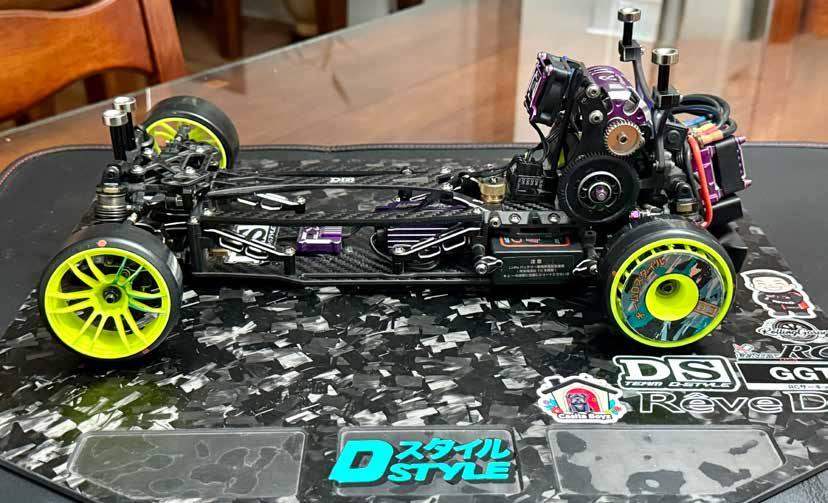
My MyxSpec Team Reve D RDX, also known as Ube Shenron, is a fully upgraded RDX built for precision and performance. With guidance from Vincent Nguyen (VSpec) and Keith at GGT, I’ve enhanced the chassis using Reve D aluminum front toe blocks, front lower arms, MC1 front upper arms, and a custom front upper arm brace reinforced with carbon braces and MC1 camber link mounts. This unique OEM+ Reve D aluminum front end maximizes front caster adjustability, Ackermann tuning, and rigidity, all tailored to my driving style.
My tuning setup includes: front camber at -8°, caster at -12°, toe out 0.4°, and ride height 9mm; rear toe in 0.5°, camber -4.5°, and ride height 5mm. Dampers are Axon high big-bore short with 4h pistons and 10wt oil up front (with Reve D titanium shock shafts and soft RTune springs), and Axon Revoshock II with 12h pistons and 40wt oil in the rear (paired with hard RTune springs).
I run Reve D UL12 and GA18 Aerodisc wheels, secured with Reve D aluminum wheel nuts (5.5mm front and rear).
Every chassis upgrade is Reve D, including Hikaru knuckles/axles, aluminum bellcrank steering, slim tie rods, titanium turnbuckles, rear servo mount, titanium screws, ceramic bearings, carbon deck, double stacked FRP and carbon side decks, four aluminum side braces,
high motor mount, 1.2mm sway bar (mounted to rear knuckle/hub plate), rear hubs/knuckles, 42mm 2.6 rear arms (pro squat), #7 RF toe blocks (1mm spaced), #7 RR toe blocks (2.6mm spaced), suspension pins, 44.5mm steel universal drive shafts/axles, 7mm EZ rear hubs plus spacers for 4mm offset, then a Yokomo ball diff with steel cup outdrives (MatsuHaya spec). Gearing is set to 74/32 (FDR 6.01) with WrapUp-Next POM idler gears and Reve D aluminum idler shafts.
For electronics, I rely on Reve D’s full suite: 3700mah LiPo batteries, RS-ST Pro servo, REVOX gyro, Absolute1 13.5T motor, BREVE ESC, G Force Boost Monster capacitor, and Sanwa M17S radio. The total investment in the chassis and electronics is around $1800-$2000 (excluding the transmitter). The result is a car that delivers exceptional precision and responsiveness. While some may find it twitchy, its sensitivity allows for easy throttle modulation and sharp flicks, maintaining speed and stability at big angles. This setup offers both agility and control, which fits my driving style for technical tracks and sweeping corners.
Mikko Yang - Reve D RDX Photos: Adam Mah
CHASSISBUILDERSSHOWCASE
When it comes to RC drift chassis, the Kyosho Fazer D2 may not be rare in terms of production. It’s a recently released model, after all, but spotting one with some of the latest available options is definitely uncommon. Mine stands out locally, and I take pride in keeping it updated with the newest upgrades as soon as they’re released.
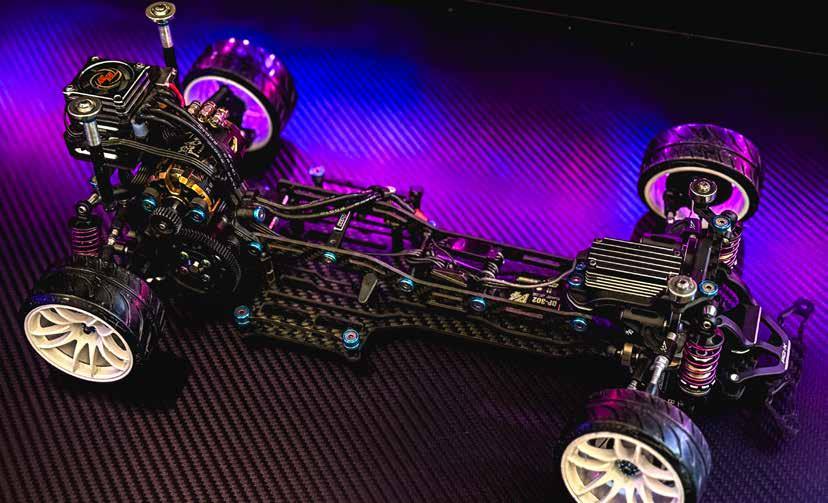
My Fazer D2 was produced in 2025. Since picking it up, I’ve made a ton of modifications. I’ve swapped in a Yeah Racing carbon fibre lower chassis, aluminum front and rear hubs, and upgraded the suspension with aluminum components all around. Every electronic component has been upgraded too, along with the differential, steering bracket, and drive shafts. I’m always looking out for the next improvement that hits the market.
I’m running Kyosho shocks and dampers filled with Kyosho 300 oil. My differential of choice is the Kyosho ball diff, which has been solid for my driving style.
For the electronics, I went with a Hobbywing Xerun D10 13.5T motor and a Hobbywing Xerun XD10 Pro ESC. For the steering, I use a Yokomo SP-02D V2 servo paired with the Yokomo DP-302 V4 Drift gyro. Power comes from a GensACE battery, and I control it all with a Sanwa MT-R remote.
The chassis itself features an adjustable wheelbase, which I really appreciate. It opens up a much larger range of body options, letting me mix things up whenever I want.
What I like most about this chassis is its uniqueness in my local scene. It’s not something you see every day, especially with the level of upgrades I’ve put into it.
In terms of alignment, I keep camber minimal, about -1° in both the front and rear.
The front toe is set to 3° out, rear toe is at zero, and the Ackermann angle is dialed in at 5°.
If you’re curious about the cost, the base kit retails for around $285. With all the upgrades and electronics I’ve added, the total value of my chassis is now close to $1,500. How does it drive? With all the upgrades, it feels fantastic. The car holds angle and speed through the corners, but remains forgiving, making every session behind the wheel an absolute blast. I enjoy every chance I get to take it out on the track.
Scott Sullivan - Kyosho Fazer D2
My RC drifting journey began with the 3Racing Sakura D3. Released in 2012, the D3 started as an allwheel-drive counter-steer chassis and marked my first real step into CS drifting, right before RWD became the standard. It was also my first-ever modified chassis, and over the years, it’s evolved into something truly unique.
The most significant change I made was converting the D3 from a front motor to a rear motor (RR) platform and switching it to RWD by removing the old rear belt. Even though I’ve moved away from belts, I still have a soft spot for them, so I added a CLSD pulley system for the drivetrain. One of my favorite parts of this build is the rear suspension geometry. Years ago, I created a multilink system from spare D-Like parts, and it behaves a lot like the manufactured D-Like multilink setups available today.
The front end was a blank canvas since it used to be the rear, so nothing could be reused. In 2015, I installed a Wrap-Up Next VX Dock, which served as the servo mount, steering system, and shock mount all in one. I drilled four holes with a hand drill and a sharpie to get the fit just right. Now, I’m running the Rhino Racing DDSS system, installed with a bit more skill and better tools. To keep my knuckles, I flipped a Yokomo front upper arm mount upside down for extra height, and modified a plastic YD shock
tower to clear the servo. With these mounts flipped, I couldn’t use a standard shock tower, so I built a custom IFS (Inline Frontal Suspension) setup using some wipers as pivots and the original Rhino IFS shock adapter at the rear.
The multilink rear suspension is a highlight for me. The angled upper tri-arm shortens the wheelbase and toes inward under compression, creating a snap and stability I haven’t felt with other setups. I use custom Topline TRF-based dampers, D-Like VM pistons, Topline diaphragms, and a mix of springs, usually Reve D or Mikuni.
For electronics, I run an Acuvance Agile 10.5 motor, Acuvance Xarvis ESC, Futaba CT500 servo, Futaba GYD 559 gyro, and R334SBS-E receiver. I stick with Acuvance and Futaba for their reliability and tuning options.
Up front, I run -10° camber with minimal negative toe, just enough to open up the Ackermann past 45°. The rear has -2° camber and active toe from -0.5° to -2°.
As for cost? When my wife asks, I always say, “Hi Honey, they gave it to me…” The base D3 was $130, but with years of upgrades, it’s now priceless. With this RR platform and DDSS, my D3 delivers unmatched angle, consistency, and fun. It’s the chassis I trust most, and it just keeps getting better.
Tyler Watt - Sakura D3 Photos: Scale Magic
Luis Nieves - Bao La Fantasy II Drift
Chassis
CHASSISBUILDERSSHOWCASE
The chassis being showcased today is the Fantasy II Drift chassis. It was initially introduced back in 2016/2017 and continued to be developed into a complete chassis in 2017. Since then, it has been produced in small batches, usually 10 to 15 at a time, as Bao oversees the quality of the parts and putting the kits together, and also handles the shipping. I like it so much, I own three. Two are set up, one has not been assembled yet.
The car is unique in many ways, from the rear floating axle and the twin front steering towers. Every year of production sees some form of design advancement to the chassis, drive train, or hubs. The rear can be set up with one, two or three shocks; I run one chassis with two shocks, in the standard locations, the other I run with three shocks, the outer shocks have no springs. The car handles very well in either configuration.
The chassis is set up with a CLSD differential, Yokomo Big Bore dampers with tapered pistons and they’re running 10wt in the front and 20wt in the rear. The chassis is set up with the battery running front to
back, the ESC mounted in the back of the chassis. I run my car 70% rear and 30% up front, -3° rear camber and -1° toe in. The car handles really well, but a little different as the rear acts like a solid axle car. It can still transfer weight due to the center pivot points. I run the rear suspension on the softer side, but still get good side grip due to the rear setup.
The CLSD gives good power transfer to the rear axles. I recently upgraded to the titanium axle that Bao recently came out with and also use the scale disc brakes he produces. The disc brakes are one of the most scale sets on the market, available in several colors with calipers displaying optional manufacturer names. The chassis decks are in forged carbon fiber, and have the Fantasy logo on several of the aluminum pieces.
The chassis alone retails at $850. I would estimate one like mine is $2100 with Acuvance and Futaba electronics. The chassis is top notch as far as fit and finish goes, as small batch production allows Bao to check every part and finish of each piece. It’s unique and slides very well.
As an RC drift enthusiast, I’ve always been a fan of Yokomo chassis. After owning the YD-2S, one of my all-time favorites, I was eager to try its successor, the Yokomo Rookie Drift 2.0 (RD 2.0).
When Yokomo shifted direction with the RD, I jumped at the chance to get one. It’s a great entrylevel chassis, easy to find, and reasonably priced at $200–$220. Straight out of the box, it impressed me with its driveability and competitive performance.
My RD 2.0 is fully equipped with all the available Yokomo option parts. When I first purchased it, there weren’t many upgrades, but as new parts were released, I added them, starting with a high-traction gearbox spacer, a 33mm spacer to connect the decks, and a Yokomo ball diff. Now, it features every aluminum upgrade available, surpassing even the Super Drift 3.0’s stock components. I highly recommend upgrading the bell crank, upper and lower arms, front knuckles, and rear hub carriers to aluminum. These parts see the most wear, and the switch to aluminum eliminated a lot of play and slop in the chassis.
There’s nothing particularly unique about my setup, I took a solid beginner chassis and turned it into a competition-ready machine. My goal was to upgrade efficiently from the start so I could focus on tuning and driving, rather than constantly chasing new parts. The RD 2.0’s
adjustability lets you build a competitive car without breaking the bank. Some say the tuning options can overwhelm beginners, but I see it as a chance to learn and grow as a driver.
I run RC Art UC Dampers, inspired by DOSLOG on YouTube and Angel Saya at DARC. These conversion dampers use an internal spring instead of a diaphragm, offering consistent pressure and low maintenance. I pair them with Reve D R-tune red springs in the rear, blue springs in the front, and 10wt mineral oil. The smooth, grounded feel helps me prioritize control and speed through tuning rather than spring stiffness.
My electronics setup is all Reve D: RS-ST servo, Revox gyro, Breve ESC (chosen for its Bluetooth programming), Absolute 13.5T motor, and a Sanwa M17 transmitter. I also use Acuvance Blaze Capacitor, Trace Bector, and Pulse Master for added performance. My chassis is worth around $2,000 with all electronics and upgrades.
For alignment, I run 8° front camber, 1–2° toe out up front, and 3° camber with 0.8° toe in at the rear. The car is fun to drive, and I tune it to chase, always aiming to keep up with fast competition drivers and match the angles of the most stylish drifters.
Carvin Thompson - Yokomo Rookie Drift 2.0
RC CAR WORLD: A DECADE OF DOMINANCE IN RC DRIFTING
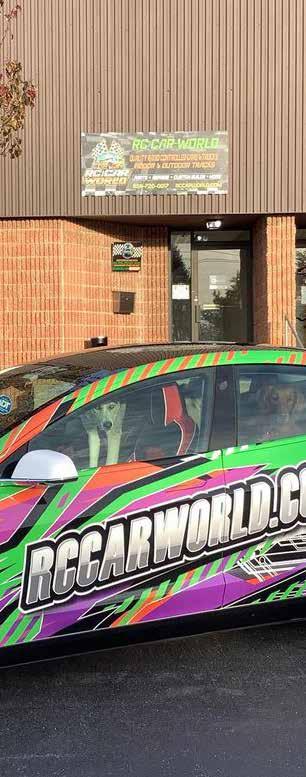
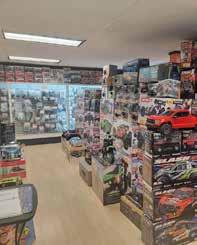
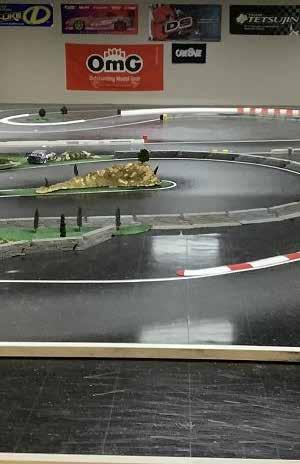
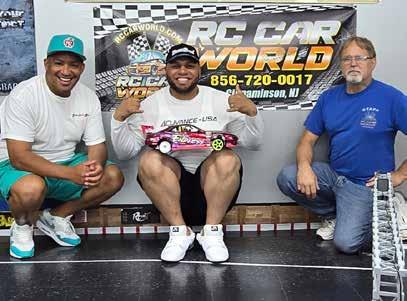
RC Car World (RCCW) isn’t just a retail shop; it’s been a pivotal force in the global RC drift community for over a decade. Since 2013, owners Mike and Gia Sienczenko have cultivated a thriving hub, evolving from a humble carpet track to epoxy, and now state-of-the-art P-tile, continuously pushing the boundaries of the sport. What began as a small local spot has blossomed into one of North America’s premier RC drift tracks, even hosting legends like Tetsujin’s Atsushi Mizunaga in its early days.
FROM UNDERDOGS TO CHAMPIONS
A pivotal moment arrived in 2019 when five drivers who weren’t well-known—including Berto Cosse, Rob Fischetti, and Alex Jordan—representing RCCW and Team Endless, descended upon the US RC Drift Championships in Houston. Against a field of top talent from across the nation, Berto Cosse emerged victorious, claiming the coveted title of US RC Drift Champion. This monumental win wasn’t just a personal triumph; it firmly cemented RCCW’s reputation on the map, drawing drivers from coast to coast eager to experience our signature aggressive drifting style and the vibrant personalities that define our community.
SHAPING THE FUTURE: THE RCCW LEGACY
The momentum continued as Alex Jordan took the helm as track curator and coach, a role in which he continues to elevate drivers and sculpt the Northeast drift scene. RCCW has served as a crucial proving ground for many prominent and sponsored drivers, who honed their skills here before making their mark nationwide. This commitment to progression led to the founding of the Scale Drift Series (SDS) at RCCW, a competition designed to mirror the authenticity and intensity of 1:1 drifting more closely than any other major event worldwide.
THE NORTHEAST’S DRIFTING EPICENTER
Today, RCCW is a magnet for top talent, regularly drawing drivers from across twelve states—NJ, NY, CT, NH, DE, MA, PA, RI, MD, ME, VA, WV—and even Quebec during intense SDS rounds. Our track becomes the ultimate monthly proving ground where the Northeast’s best vie for supremacy. Our drivers, like SDS and North American Championship (US/CA) winner Anthony Torres, are not only dominant on our home turf but also seasoned competitors on the broader international stage, frequently traveling to compete at other prestigious events, including the annual North American Championship in Quebec.
MORE THAN JUST COMPETITION: THE RCCW EXPERIENCE
Beyond the fierce competition, RCCW offers a truly unique experience. Saturdays and major events pulsate with an energy akin to a Grid Life festival, creating an unforgettable atmosphere. Expect genuine Jersey hospitality: no drama, just a welcoming vibe filled with lighthearted banter and friendly trash talk. Spontaneous challenges and call-outs are a regular occurrence. Do you believe you have what it takes to be the best? Come test your skills, soak in the unparalleled vibes, and become part of the RCCW legacy!
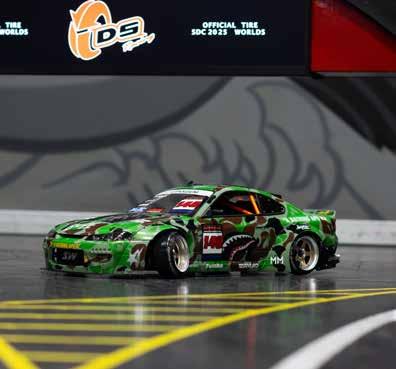
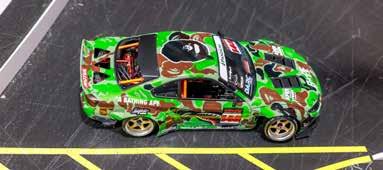
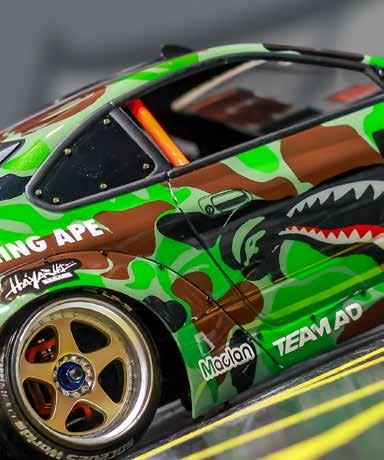
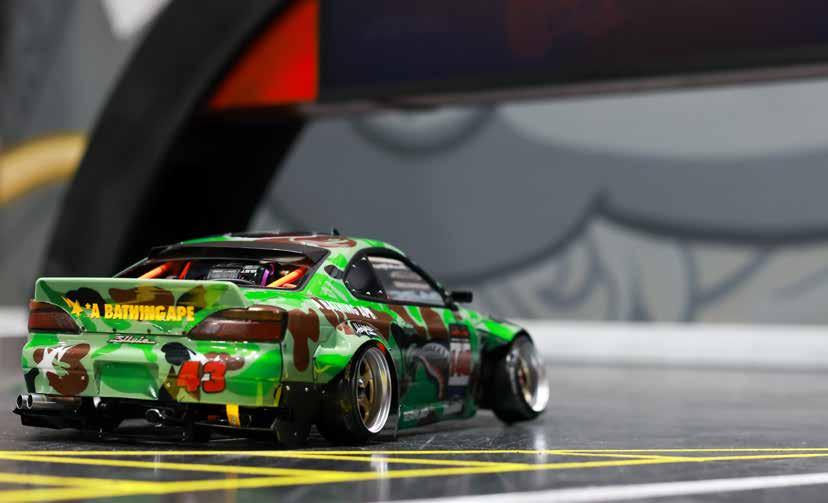
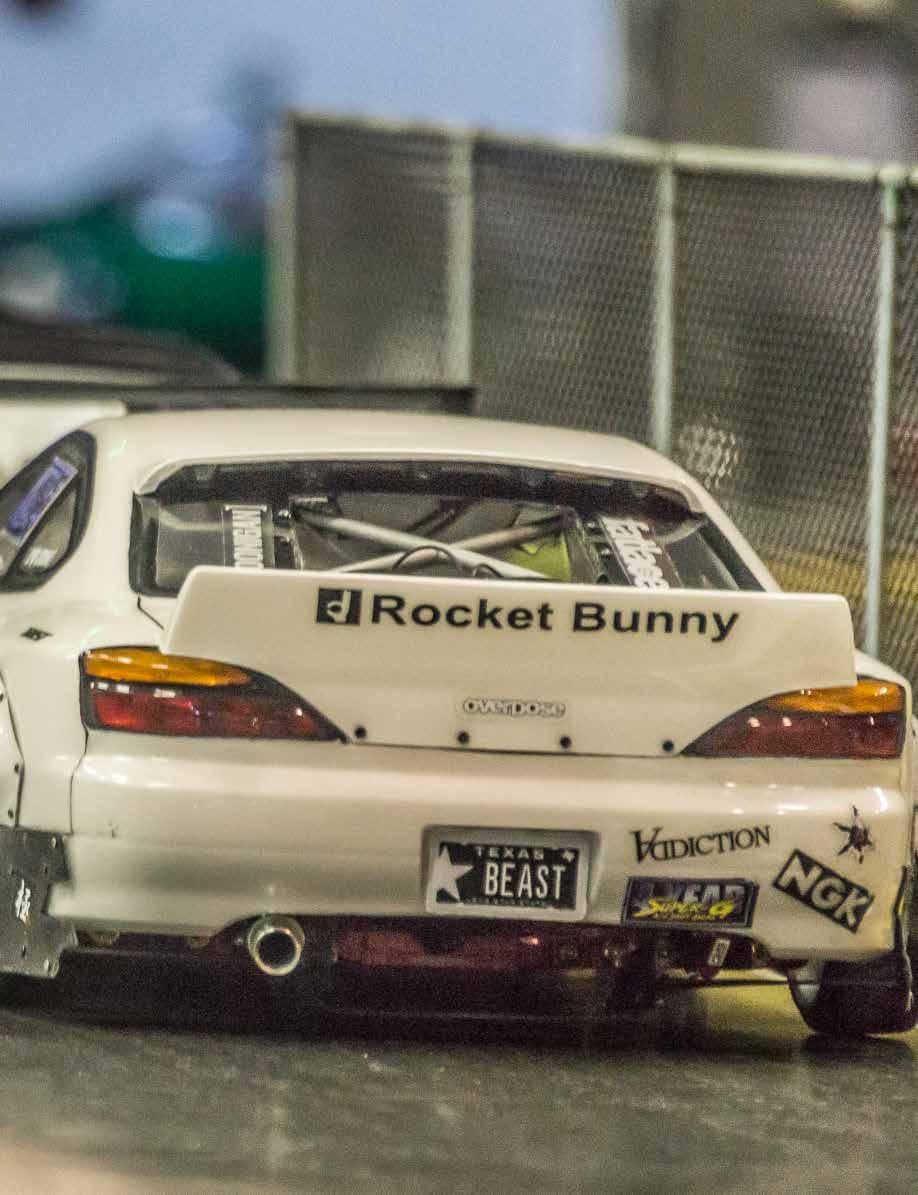
This Addiction RC Rocket Bunny S15 is painted with Mission Models paints. This theme is based on the BAPE X Liberty Walk S15 real life drift car, with my personal details. The color combo (green, brown, black) gives it that aggressive, “don’t mess with me” vibe. Perfectly dialed, the wheel tuck and stance are spot-on for a drift build - low, but still practical for track sliding. The wheels are the new Hayashi Type NIZ with a bronze face. This was my Comp body for SDC Worlds 2025.
JOSH GEEG - BAPE S15
Photos: @keensightz
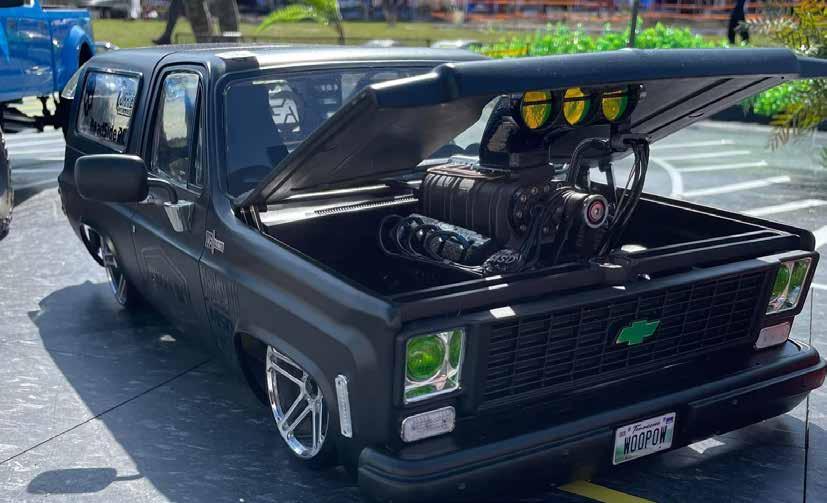
My Behemoth K5 build began as a project for the legendary USTE23 (Ultimate Scale Truck Expo), but then made it down to slide on the Street Break track and took home Best Engine Bay. Two years in, I’m still improving it. Starting with an MST FXX, I kept the front and transmission, then 3D-printed a custom rear bulkhead to fit a narrowed AR44 axle and 4-link suspension. The massive 3D-printed engine, full interior, and aluminum roll bar (from Akers Engineering) make it stand out. At just under 9 pounds, it’s a headturner and a blast to drive.
CHRIS SIEMBIEDA - THE BEHEMOTH K5
Photos: Dustin Corbano
FLORIDA’S FIERCE SILVIA PAIR
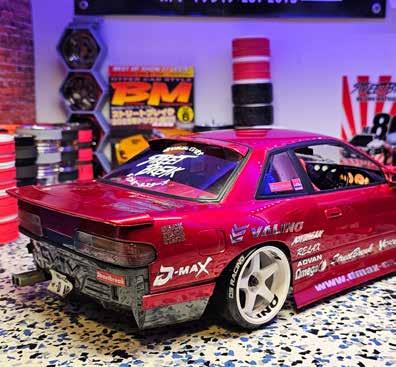
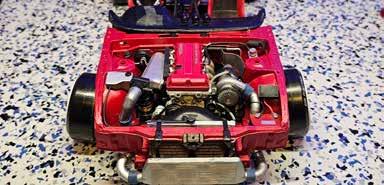
Josh Legg’s Addiction D-MAX S13 sitting on a Yokomo YD-2Z. This build was inspired by the guys at Street Break. My main goal was to have a scale build that could still drive aggressively and get doors with all the guys at the track. Even with a fully resin printed engine bay and dash, it still drives great. I don’t know if I will ever be “done” with this build, as I hope to keep pushing the limits of what is possible and inspire others to build their own.
JOSH LEGG - D-MAX S13
Jay Tastan, Chasing Dreams: Building the S13 Silvia in Two Worlds. My build is an Addiction D-MAX S13 Silvia, inspired by my real S13 with a D-MAX body kit and SR20DET. I’ve loved S chassis and drifting since I was young, and with support from the community, I’ve made my dream a reality. Thanks to Josh Legg, I built a scale 3D resin-printed engine bay and SR20DET for my RC, closely matching my real car. My RC is based on a stock YD2-ZX chassis, modified to fit the printed parts. The Street Break crew and the global drift community constantly inspire and motivate me.
JAY TASTAN - D-MAX S13
The sound of this car was all I needed to build a replica of Rob Parson’s car, circa 2018, “The Unprofessionals” era. After a motorcycle injury in 2011, Rob Parsons built a handcontrolled drift car and founded Chairslayer Foundation to help others with spinal cord injuries experience drifting and overcome challenges. This 180SX was produced by 24K RC. It features resin printed mirrors and intercooler, with a hand made aluminum drag wing, and pipe from SRC. The livery is 100% painted from TurboDork and Mission Models. It was a huge learning experience for the next one.
CHRIS SIEMBIEDA - THE CHAIRSLAYER 180SX
Final Bout Street Style - This RC drift build channels pure street style with an ABC Hobby Type X 180SX shell, slammed to perfection and dripping with JDM attitude. Decked out with ABC rear spats, a Type X wing, Addiction over fenders, and authentic badges, it nails the classic ‘90s drift look. Details like window tint, Eto muffler, SRP handles and squirters, M3 mirrors, and a custom plate holder push the realism. It’s a scale legend—ready to slide, show off, and turn heads on any RC circuit.
MATT BARTELL - 180SX
Being a big fan of Naoki Nakamura, I had to build a shell that would showcase his style. Starting with an S14.9 from 24K RC a Taka livery (the quality is unreal), and I added the exhaust and stainless mesh from SRC, resin printed intercooler and mirrors, and some handmade carbon “big wang gang” struts. Paint was custom mixed from Createx and TurboDork. The wheels were painted with Citadel contrast paints for a killer anodized effect. This shell is also equipped with a Team AD Hyper backfire LED kit that looks incredible on the track.
CHRIS SIEMBIEDA - 24K TAKA S14.9
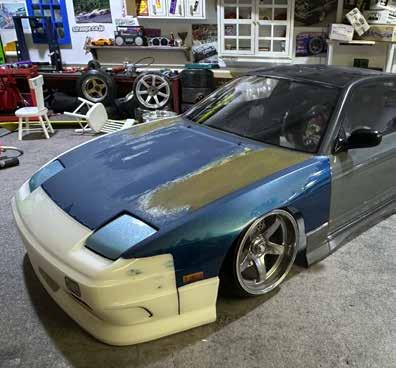
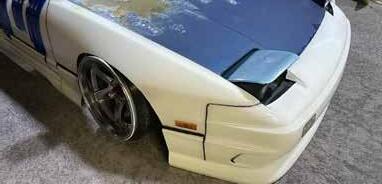
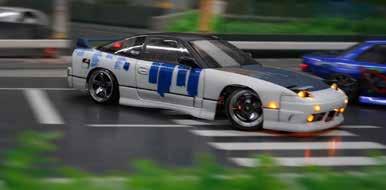
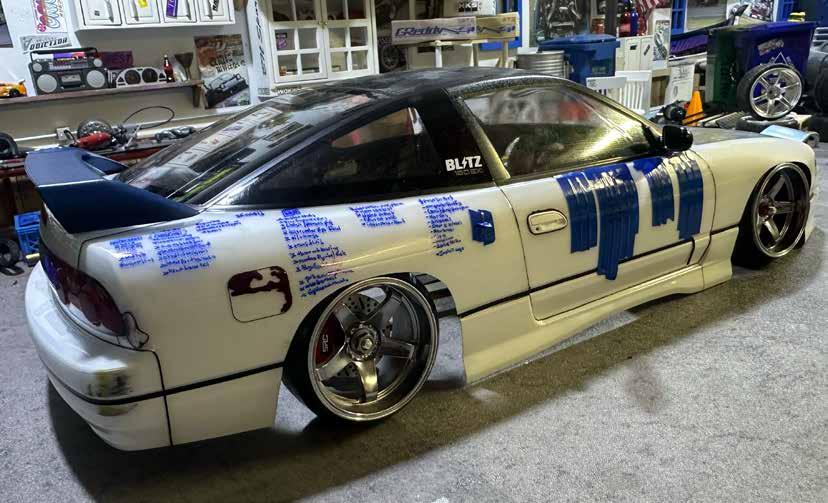
Prizza Mike’s “T-Boned 240SX” ABC hobby 180SX type X shell. The blue writing is from the “to do list” of repairs on the car. He was T-Boned in this car and replaced the roof and entire left hand side of the car. I actually built a replica of it when it was a Pignose 240SX, this is the replica after the T-Bone accident was fixed. The blue tape had the OG “ to do list” on it, then it wore off and was written on the car. My favorite part : I copied all the “to do list” and wrote it on a 1/10 scale on the shell.
BARTELL - “T-BONED 240SX”
MATT
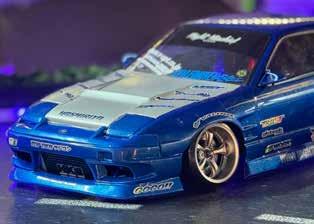
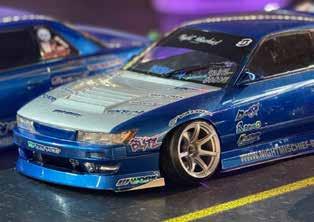
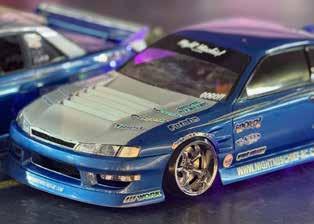
STORY ON THE BLUE CARS / NightMischief - What started as a random idea among friends back in 2012 turned into something way more meaningful over a decade later. In mid 2023, I picked up an RMX and built my first shell, a white Pandora 180SX. I’ve always believed your first RC shell should be built for you, exactly how you want it.
By late 2024 I was moving into a new house and decided to get back into drifting seriously. One of the first things I unpacked was all my RC gear. Before I moved, I let my best friend Devin take a few laps with my car and, after we left, we started talking about what kind of shell he’d want to build. He said something about a metallic blue S13.
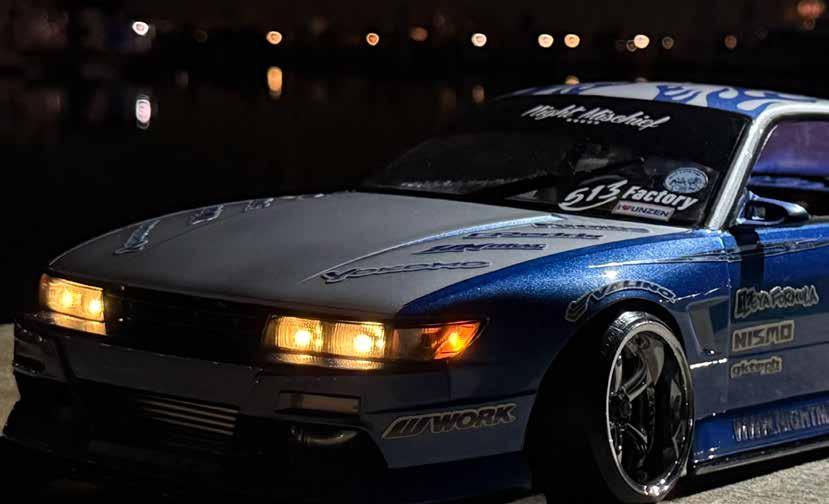
I hit up Jason, another close friend, and we all decided to surprise Devin. With help from his parents, we got him an RMX ready to run. I built him a Pandora Origin Lab S13 Onevia in a deep metallic blue packed with flake so it would sparkle under the lights. Devin’s been my best friend for over 15 years, so I told him I’d build a blue car too. I picked up an Addiction D-Max S13, painted it the same shade of blue but with a silver hood to give it a little contrast.
CLAY MORGAN - NightMischief
Once mine was done, I started posting on Instagram and in the MKE group, and the response was crazy. Not long after, Cam met up with us at Seven Tails Circuit. We ran door-to-door all night and immediately clicked. Within a few months, he built his own blue Pandora BN Sports S13 coupe, and we later all chipped in to get him an Addiction Spirit Rei coupe.
Jay, who’s been tight with us for over 15 years, was building an Addiction Origin Lab S15 around that time. Decker, another lifelong friend, followed soon after.
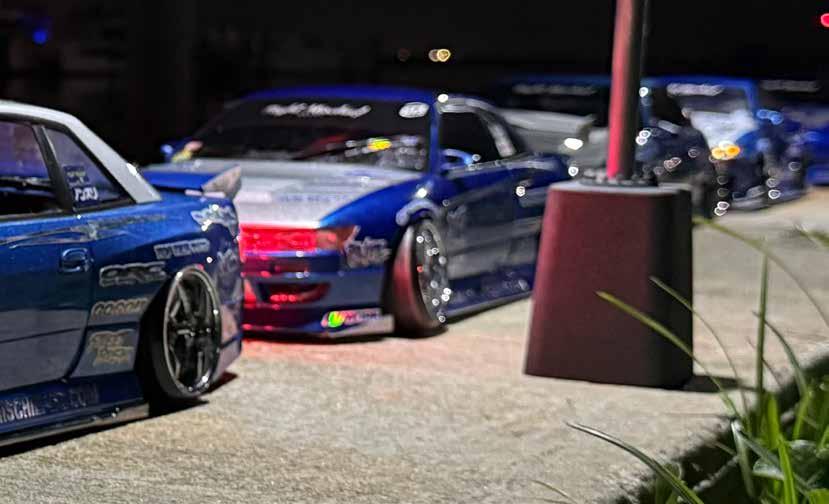
This hobby has brought a lot of us back together. At Street Break, when we all showed up with our cars lined up in blue, it felt like a full-circle moment. We decided to design matching decals, each one different, but tied by the same color and the same story.
NightMischief isn’t just a name anymore. It’s us, and the blue cars that brought us back.
ALL I WANT FOR DRIFTMAS
“All I want for Driftmas is a Bomex Addiction Supra.”
Matt Bartell - Scale Artist DARC Mag contributor
“For Driftmas, I want the new Reve D active toe kit. GGT just got their shipment, and I want to put it on my Kaiju.”
Adam Mah - RC Drift Talk Podcast - DARC Mag contributor
“If I could choose anything for Driftmas, I’d want either a fully painted Reve D GR86 or a GR Corolla body painted by TPaint
House, SlideCustoms, or Mackyworks.”
Mikko Yang – Team Reve D driver
“I would like Pandora’s new 180SX, releasing this New Year. It’s a brandnew 180SX body type that was developed with direct input from the 180SX community, and
I’m excited to see it hit the market!”
Nikko Mora - RC Drift event organizer
“For Driftmas, I’m looking forward to whatever new Overdose items come out!”
Rob Fischetti - East Coast RC Drift OG
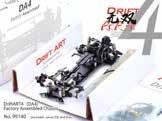
“A great Driftmas gift for someone looking to get into a micro drift chassis would be a pre-assembled Drift Art with Drift Art electronics. It’s a fantastic setup at a very reasonable price! Once you get your new car, have fun and stay consistent with seat time to master the gyro assist - you’ll be eating doors for days!”
Brad Bollman – Owner, RC Supremacy
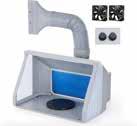
“For Driftmas, I’m hoping to get an air brush portable paint booth.”
Josh Geeg - Scale Artist
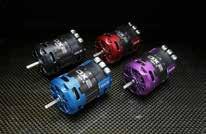
“For Driftmas, I’m hoping to get either a Yokomo DX2 11.5T motor or the RSST Pro servo, both in red. I just picked up an Overdose GALM and I plan on a red-colored build this time around.”
Tony Laughrin - RC drift chassis builder
DriftIn Judges
Judging in RC Drift: Gratitude and Growth
By Aaron Mulder, RC Drift Network
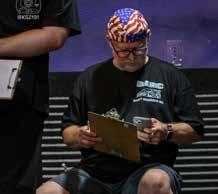
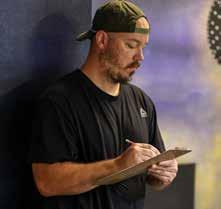
This past year, I’ve had the honor of judging events across Texas from Drift Wars at RCHQ to multiple rounds of SDC. The experience has shown me how much time, effort, and passion go into keeping our community strong.
Judging isn’t easy, it’s a tough job, no question. It requires focus, consistency, and a real commitment to fairness. But it’s also rewarding, because it gives you a deeper respect for every driver putting their heart on the line and every judge working to make it all happen. Sometimes it’s obvious. Someone spins out, hits the wall too hard, drops two tires. That’s it, no debate. But those moments are getting rare. Drivers are getting better. The gaps between runs are small now, with most battles coming down to little things. A hesitation, a missed line, a weird throttle transition.
There’s no rulebook that covers every situation perfectly. That’s why judges have to use their judgment. Each judge is focused on something specific: one watches the lead line, another tracks proximity and speed, the third watches angle and transitions. They’re not watching like fans, they’re analyzing and trying to give everyone a fair look.
To everyone who’s judged, driven, hosted, or simply shown up to support, thank you. You’re the reason this scene keeps growing. Every event, every comp, every night at the track happens because people care enough to give their time.
Moving forward, I hope we keep remembering that. Whether you’re on the driver’s stand or holding the clipboard, we’re all here for the same reason: to have fun, to get better, and to build something together.
Over time, I’ve seen how most of the frustrations, debates, and heated moments eventually fade. What lasts are the friendships, the lessons, and the shared love of the hobby. That’s what matters most.
• If you’ve judged before, I see you.
• If you’ve taken a loss and handled it with respect, I see you.
• If you’re showing up, building your scene, and keeping it fun, I see you.
Here’s to the next round, and to everyone keeping RC drift alive and evolving.
DARC Judge Ken Kennedy
DARC Judge Mike Vandenbroader
DARC Judge Waren Johnson
Casa Drift Judge Ari Wilson
Casa Drift Judge Josh Schwulst
Casa Drift Judge Logan Wilson
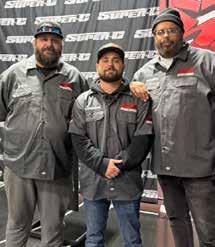
Super G Judges 2025
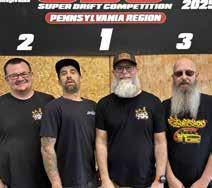
412 Judges
There’s a valid argument for slow, smooth, and scale-looking tandems. Before Formula Drift (FD) really took off, most drifting was done on city streets, so you had to go reasonably slow to avoid hitting curbs and other obstacles. Full scale drifting in big motorsports sped everything up and has gotten increasingly faster over the years.
“FD has definitely influenced RC drifting” says Rob Fischetti, a veteran in the RC drift world. “RC drift bodies are definitely more realistic now. There were always a lot of “S chassis” such as the S13, S14, S15, 180SX, 240SX. Around 2012, there were more street style bodies. That was also before FD really hit the mainstream, so there weren’t any major liveries or paint jobs. Now, RC drift bodies are on another level. Addiction bodies have over a dozen pieces! Old school bodies were usually one piece, although some came with a separate bumper.”
“I started with an Eagle Racing TA05 that I got from Mike Pezee, then I transitioned from AWD to RWD with a Yokomo Drift Package DIB. It had a Private Garage conversion which flipped the layout of the chassis to be rear motor instead of front motor. ‘I pulled the front drive shafts out during one session and it was really hard to drive, so I ordered a gyro and I never looked back.”
Old School Corner
by Rob Fischetti and Joey Hono
Maruma, Uras are other brands that I miss.”
Rob tells us about the tracks on the East Coast around 2012.
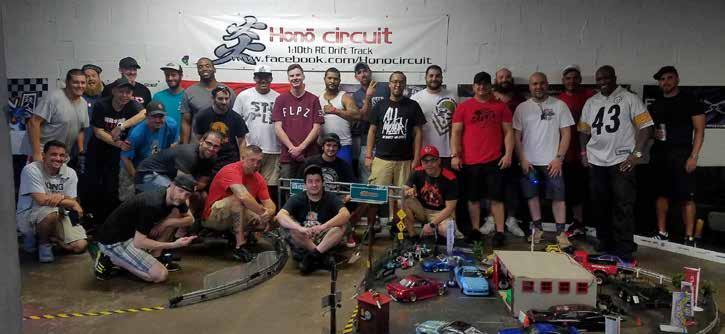
“Skavenger was a track based in the Bronx, NY, in a public park, where we were allowed a space to make a track and used a generator to charge our batteries. It had some slight elevation changes so it was cool to see your chassis and suspension work. I also used to go to Hono Circuit on the weekend. There were a decent amount of people, probably 8 or more. I drove from New York, others came from New Jersey and other nearby states for big events. Joey Hono put a lot of work into the scale scenery at Hono Circuit, such as a scale garage, lift, and a scale gas station.”
BlackStar Hobby, Raikou Drift, and a few overseas shops like RC Dori Dori were the main sources of RC drift parts in America. Raikou Drift was also an American RC drift tire producer. “I wish ‘Active Hobby’ still made parts for my current chassis. They made Yokomo ‘Drift Package DIB’ parts (which was the predecessor of the YD-2) and also universal parts to use on anything, in multiple color options. Spice,
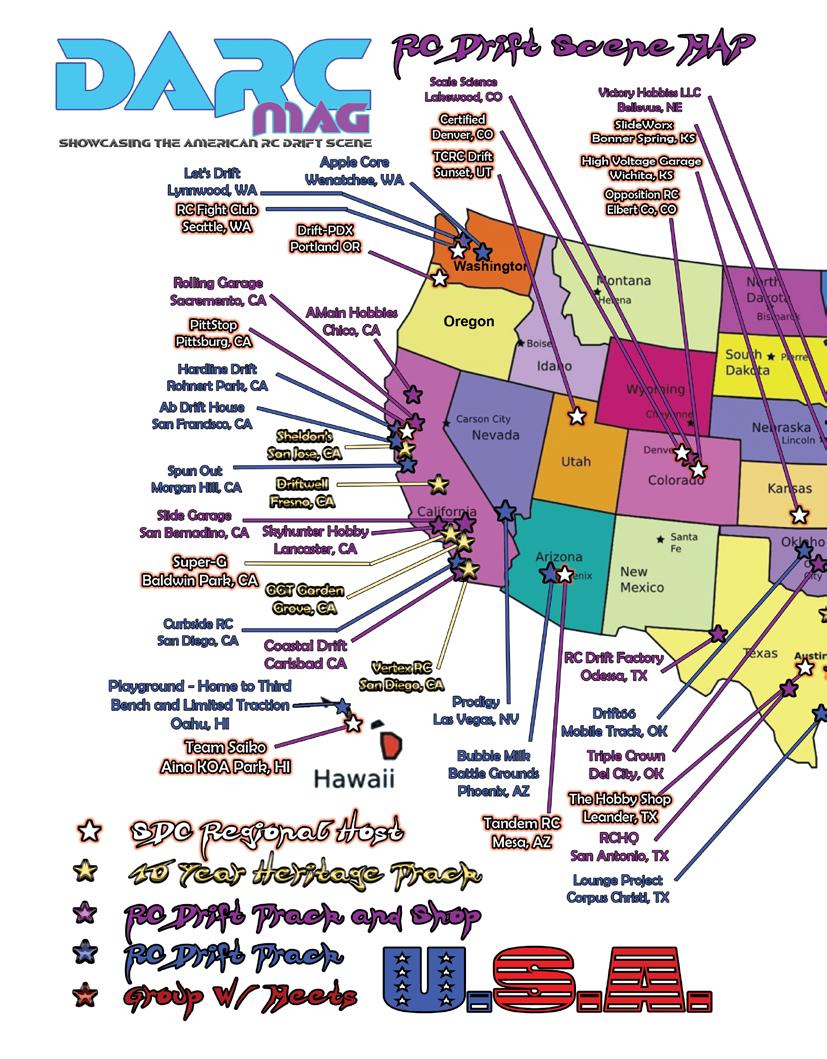
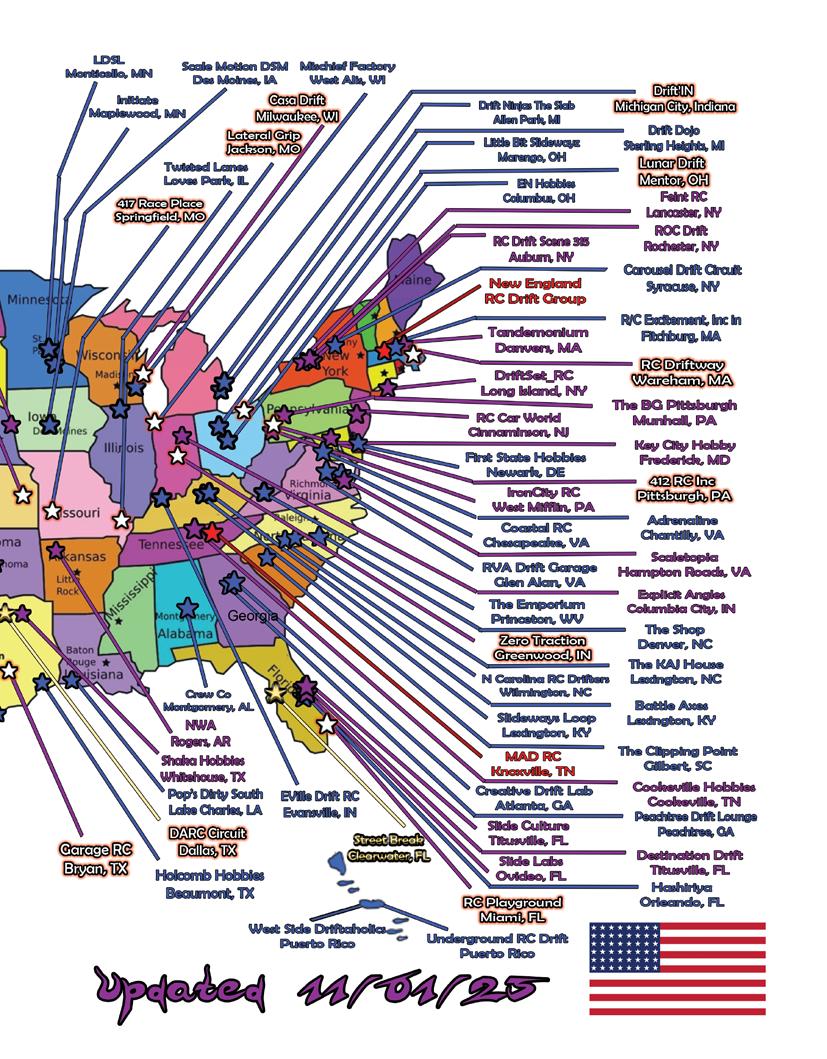
People don’t know how easy they have it, now that there are close to 60 tracks in the country.
DARC Mag caught up with the man himself, Joey Hono of Hono Circuit. “Rob was a Redskull” says Joey.“
“Hono Circuit was in an eight car garage. It started as two spots for the circuit, but soon grew to three spots for the circuit and one spot for my 2JZ 180SX. Eventually the full eight car garage was dedicated to the track. It was probably around 20’ by 45’ in the end. We had a 1/10 indoor crawler course as well. Hono Circuit was one of the first few RC drift tracks in the US and the first indoor track on the East coast. The other US tracks were all on the West coast. People called me the ‘Dictator of speed’ at Hono. The surface was polished concrete and we used hard tires and had sticky limits set by MST ‘Color Dot’ tires.”
The “Color Dot” was the MST Coding system which determined the hardness or softness, subsequently determining the speed. The tires literally had a colored dot on the inner side wall. “I think we capped at red and wanted silver, but allowed drivers to get softer if their car wasn’t keeping pace. It was real looking, scale speed, and it was more of a camaraderie of brothers having fun trying to drift at the same speed and use their skill to make trains. It was the spirit of drift, not who could bring the better weapon. Hono Circuit was lightning caught in a bottle, it was a perfect mix of fraternity and drifting. That place created a whole generation that is still active and I know I did it right. Maybe with too much bravado. I was a Redskull, that’s how we rolled.”
down Hono and went to the new local track, the speed was dumb fast and I had no say. I geared up a rear motor chassis for a few high speed sessions, but I decided it wasn’t for me.”
After talking with Joey Hono, we had to go back to Rob and get his take on the increased pace. “It feels like ever since I went to World’s in 2019 in Amsterdam, it’s been fast and has gotten faster. High speeds aren’t my favorite, but if you don’t keep up, you just get left behind, and that’s no fun. But, you can’t go to a track and try to change the way they do things. Still, I believe slower and smooth is better and encourages closer tandems as well. When going fast, the reaction time to adjust can be so small.”
Everybody is striving to go faster now. Softer tires and ridiculous gear ratios with 28 tooth pinion gears. Old school drifters were always fighting to go slower back then with harder tires and smoother surfaces, but fast definitely won. Joey tells us about his experience with the old school to new school speed transition. “At Hono I could make a pace mandatory, but when I closed
This is a real part of the hobby that is falling through the cracks. Wouldn’t it be great for US tracks to host an Old School night with slow and smooth Street-style drift?
The Hono Circuit-RedSkulls Facebook page is still live.
RC DRIFT LEGENDS:
with Nikko Mora photos: @c_j_media
Final Bout is an annual full scale drifting competition held in Wisconsin with grassroots teams who love to embrace the crazy side of drifting. It emphasizes style and camaraderie over high-budget professional racing, rekindling the excitement most long-time drift fans felt when they first discovered drifting in the 90s and early 2000s. Originating in 2014, the competition was created for North American teams to celebrate stylish and exciting drifting, with the top drivers from the four US regional special stages in attendance.
Nikko Mora felt that RC drifting would be a great feature to add to the event. Nikko explains “I reached out to the organizers of Final Bout and proposed the idea of incorporating an RC drift track. I called upon Matt Bartell, Akira Yang, Brian Jewell, Jason Tang, Jacob Vos, Kaylee Riffer, and many other people from the RC community who had great taste in style and driving to help out with the planning, track layout, and rounding up drivers.”
Sponsors for Final Bout include Koyo, Chase Bays, TF Works, Race Treads, Zeknova, Mastermind, and Thrash Racing, along with the RC sponsors MKE Drift RC, MadisonSteezRC, Scale Motion Drift Club, KTH Design Lab, and Fingeritchin513.
2025 was the first year that Final Bout had an RC drift track at their event. “The surface that was given to us was smooth concrete, which I personally love. My chassis sees a lot more outside than inside driving. We did a small test run before and opted to use Yokomo DRCA tires. A lot of people came from out of state and brought their RC cars. Some of them were only used to P-Tile or polished concrete, so for them to drift on the rougher surface was a little different. For the most part everyone enjoyed
Final Bout BUT NEW!
the driving, the track was the perfect amount of grip, even though we were outside. There was more side bite than you’d usually expect with tile surfaces, but it made for quick and exciting driving. A lot of people were having problems with their gyros wanting to ‘track’ more, due to the lower grip levels, so they needed to really turn them up. The track, which was 10 meters by 10 meters, was based upon a real track called Sekia Hills, which closed in 2012 and has since been converted into a solar farm. We built the base of the track on what used to be an old amusement park, now USAIR Raceway.”
The Final Bout RC drift track was well attended. “There were many spectators that came from the West coast, East coast, even some people from Ireland (JuiceBoxForYou) stopped by. This year’s special guest was C’s Garage from New Zealand. There were no competitions or games, no prizes, and we didn’t have a body competition, but we held a gallery, where everyone brought their best bodies to put on display for the event attendees. There was no charge for the track setup to the event organizers and we did not pay a vendor fee, we just mutually agreed to be there. The RC track was free to drive, all drivers needed to do was pay the entry fee for the main event. There was plenty more that we wanted to do but weren’t able to, but this leaves a lot on the table for next year!”
Nikko created the brand Fingeritchin513 earlier this year and also makes RC YouTube videos featuring his builds, RC experiences, and rare RC aero collectibles
Check Nikko out on YouTube or IG @nikko.180 @fingeritchin513
often via Wi-Fi modules or laptop-connected cards. The result is a driving experience with minimal cogging, incredible responsiveness, and a deep sense of connection to the model. While some may balk at the price tags, the performance is on par with larger scales, making the investment justifiable. As many have learned, “Buy once, cry once.”
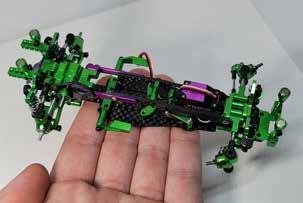
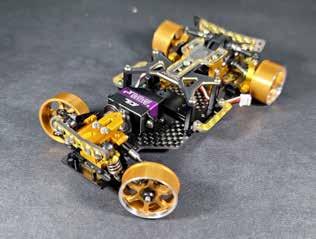
In the world of radio control drifting, there’s a growing scene that’s small in size but massive in spirit: micro RC drifters. Typically, any chassis with a wheelbase less than 100mm falls into the 1/28th scale category, while those between 100mm and 115mm are considered 1/24th. These are not just Kyosho Mini-Zs in disguise, the setups and experiences are entirely different. However, purpose-built micro drift cars can be purchased for about the same price as a Mini-Z, but with far more options and performance potential.
The micro drift hobby has seen a remarkable progression in quality, performance, and availability. Brands are constantly raising the bar, and now, even plastic kits straight out of the box can be legitimate contenders at competitions worldwide. The micro scene is maturing to the point where “out of the box” success is not only possible, but common, especially with the base tunes provided in the manuals.
Manufacturers are finally addressing features that once faced daunting production challenges or were dismissed as “too niche”. Usukani, for example, has released a compact hydraulic shock set that has quickly become the new standard for micro suspension. Electronics have also taken a giant leap forward. Where sensored brushless setups were once rare and unreliable, today’s micro drifter can choose from six top brands: Atomic, Drift Art, BM Racing, XRX, Rhino Racing, and TG Racing. These manufacturers offer sensored brushless technology with a variety of tuning options. Parameters for motor KV, gearing, ESC, and servos are now all adjustable,
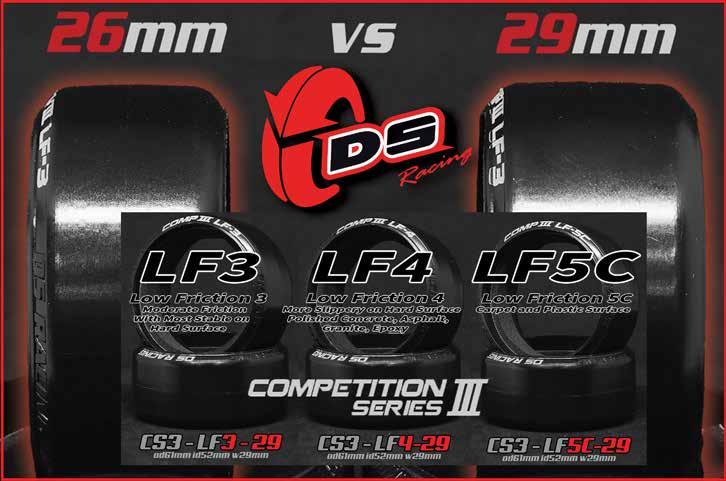
Wheel and tire options have also rapidly expanded in recent years. DS Racing’s LF and LFS tires have become the “go to” choice for matching compound to surface and driving style. The wheels themselves use an “AWD key slotted axle”, a mounting standard familiar to Mini-Z enthusiasts, but not to be confused with the RWD drivetrain configuration. Brands such as XRX, GUO Racing, DXR, and PN Racing offer both aluminum and plastic wheels compatible with DS and similar tires, giving drivers plenty of options for style and performance.
Innovation isn’t limited to electronics and tires. Brands such as Drift Art and BM Racing are investing heavily in quality parts and chassis for the micro crowd. Drift Art stands out for its unique kits and customization options, enabling hobbyists to build a car that’s not only competitive, but truly their own. BM Racing continues to introduce new products that complement the evolving micro drift demographic. Both brands are widely stocked, making it easier than ever to find replacements and upgrades without the stress of chasing rare parts.
Despite the technical advancements, the toughest challenge remains the sameputting in the seat time. The right advice at the right time can also save a hobbyist from endless frustration and wasted money (for example, “You need a gyro or you’ll just spin in circles!”). As a beginner eight years ago, the most daunting part was showing up at a track, watching skilled drivers tandem inches apart, and feeling like an obstacle. It was the advice and support of experienced local drifters, specifically Hector, Lester, Drew, and Javier at Drift Lab Circuit, that kept beginners from giving up. While RC drifting has a learning curve that can be intimidating, RC drift communities are
welcoming and encouraging to new drivers. These pockets of support, as well as practice, are invaluable.
Globally, the micro drift scene is blossoming. In Indonesia, dedicated groups host highlevel events and competitions. In the United States, the movement towards micro RC drifting is gaining momentum. Apex Garage, in Deerfield Beach, Florida, is a standout track with talented drivers who have migrated from the 1/10th scale world and are legitimizing the visuals and style of 1/24th scale drifting. RC Playground Miami also has exciting plans on the horizon, promising to push the micro side of the hobby even further.
One of the greatest strengths of micro RC drifting is surface versatility. RC Supremacy, a leading influence in the scene, once released a video showcasing micro drifters sliding on everything from carpet to tile and beyond. With modern tuning options, including different tire and wheel sizes, compounds, and gearing, drivers can dial in their cars for nearly any surface they encounter.
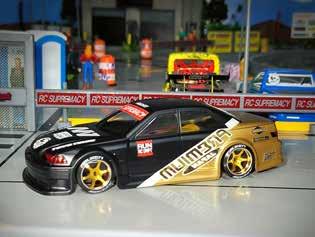
The variety of available bodies and scale accessories is staggering. Trucks, vans, sedans, supercars, flatbeds, and American muscle are all on the menu. For those who love to tinker, nearly any model car within the 1/24th to 1/28th scale range can be adapted, including injectionmolded models and even diecast metal bodies (though the latter are heavier, they’re still driftable).
The “Ready to Drift” market for micro scales is still developing, with few truly complete kits that include a radio. However, affordable transmitters from Flysky, DumboRC, and Sanwa are popular choices, offering significant tuning ability right from the transmitter. Even smaller 1/64th scale drifters (about the size of a Hot Wheels car) are emerging, with gyros, ESCs, and servos that fit on a thumbnail, proving just how far the technology has come.
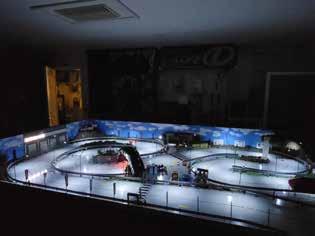
Perhaps the most appealing aspect of small scale drifting is accessibility. There’s no need for a dedicated, full-size track. A vinyl mat rolled out in a 10’x10’ room is all that’s required for a proper session, even with multiple drivers.The rise of home-built scale tracks is a particularly exciting trend. Hobbyists are transforming garages and basements into detailed circuits, pouring creativity and passion into every build. Each new track inspires others to push the boundaries, making the 1/24th scale scene even more dynamic and exciting. The manageable size and cost encourage passionate experimentation, innovation, community, and building.
Micro RC drifting has evolved into a mature, accessible, and deeply creative hobby. With advancements in chassis design, electronics, and tuning, there’s never been a better time to get involved. Whether drifting around furniture at home or linking up with friends for a late-night session, the micro scene offers big thrills in a small package. Ultimately, it’s the community that brings with it the willingness to help, share, and celebrate each other’s successes, that keeps the spirit of micro RC drift alive and growing.
Brad is the leading expert in micro RC drifting, have a look at his online shop rcsupremacy.com
INNOVATION IN MOTION
The Scale Magic of the Russian Arm Camera Rig, by Tyler Watt Photos: Scale Magic
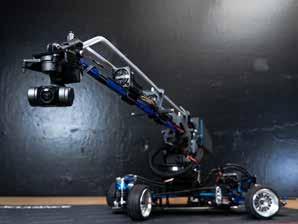
In the world of RC drift, we have seen tinkering projects that deserve to be recognized. These are innovative and creative designs that make this hobby that much better. This tinkering project is called the Russian Arm, created by Tyler Watt of Scale Magic MFG.
Its Purpose
The purpose of this rig is to capture interesting footage of RC cars from a more immersive viewpoint. When you think of RC camera cars, you generally think of a small camera strapped to a chassis or body shell, capturing a static angle of the action. My intention was to create something with more dynamic movement, allowing me to convey the scale intensity we all feel when we rip around the track.
Build Components
The Robotics
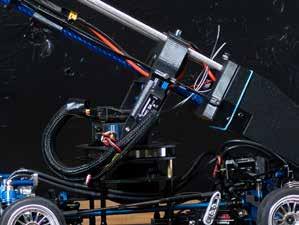
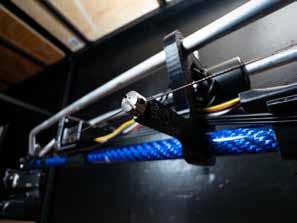
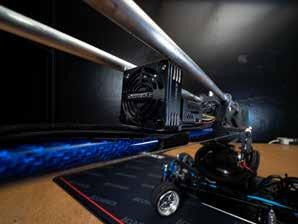
There is a pan and tilt mechanism at the base which is a robotics item that uses two servos to function. In order to attach the arm to this base, I designed and 3D printed a mount that held small diameter pipes that create the structure of the arm. From there, I planned how I wanted to lay out all of the electronics and designed mounts for them, along with other structural components.
The foundation of the build is a Wrap-Up Next FR-D V3, which I was stoked to do, as it was my first RWD drift chassis. My focus is on the drifting category of the RC world, and when I ask myself how a rig like this could be applied elsewhere, I can’t think of another good use for it. Slower pace and smooth surface gives this rig the best opportunity to capture some cool action footage. The arm I’ve attached to the chassis is one that I’ve pieced together using off the shelf parts, along with some custom designed pieces that help bring it all together.
The Camera
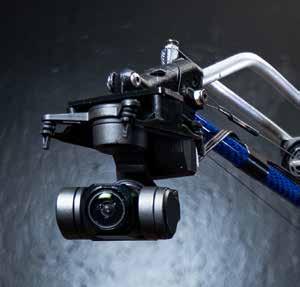
The star of the show is the DJI O3 Air camera system, paired with a universal O3 camera gimbal. Both of these units are ‘plug and play’ but require some additional devices and custom cables to communicate. The saving grace for the O3 Air system is the ChaddRainsFPV O3 Armer. The DJI O3 video system will not output its full power unless there is an ‘armed’ signal sent to it, similar to that of a flight controller. The O3 Armer sends this ‘armed’ signal so you can use it to its fullest capacity. With that, the camera was ready to rock and all that was left was the movement of the arm and gimbal. For the gimbal, I chose to wire up a custom cable that allowed me to control it over S.BUS, which is commonly used for receivers and servos. That was simple to do, but dang, those connectors were tiny! This meant
my gimbal and the two servos from the pan and tilt base could be connected to a Futaba receiver and controlled with a stick transmitter, mapping all four channels individually.
The Power System
Lastly, I had to power it all, which came with its own headaches. I chose to use LiPo batteries because they’re easily accessible and the form factor lets me design them into the rear of the arm, which acts as a counter weight. Each device consumed power differently so I chose to isolate the camera to one battery and the radio receiver/gimbal to another. I opted for the HobbyWing Universal Battery Eliminator Circuit (UBEC). This device helped me send the radio receiver and gimbal the lower voltage power they required from a larger, longer lasting battery. This in turn helped get the total weight counterbalanced perfectly.
Testing and Tuning
Doyouhaveatinkeringproject?
Letusknow:darcmagpub@gmail.com
TINKERING CLUB
During initial testing everything worked as planned, which is kind of crazy when you think about it. It went straight from the bench to the track, just ripping around, with no adjustments. To be fair, I did spend six months hyper focused on the individual parts of the build. The only real changes that I made early on were
opening up the chassis throttle range, so it could move a bit quicker, and redesigning the gimbal plate, as it took a pretty solid beating.
How well does it work?
There are some changes I would like to make, but for now I have enjoyed learning its capabilities as it stands. I liken it to someone who is just starting out in drifting. It’s best to learn the chassis as it is to understand what adjustments are needed. On a personal scale of 1 to 10, I’d say it’s a solid 7. The factors I consider are drivability, arm smoothness, and image quality. I have been able to capture some pretty awesome shots with this rig. If I were to compare it to its full scale counterpart, then it’s doing its job very well. The intention is neither to be the follow nor the lead camera car, but rather to compose specific shots from angles that aren’t otherwise possible.
Tyler is the photographer behind Scale Magic MFG. Follow him on Facebook, YouTube and IG to keep up with his amazing shots!
Website scalemagicmfg.com
IG scalemagic
YouTube @scalemagic
Facebook Scale Magic
PRECISE DRIFTING - POWERED BY TSM
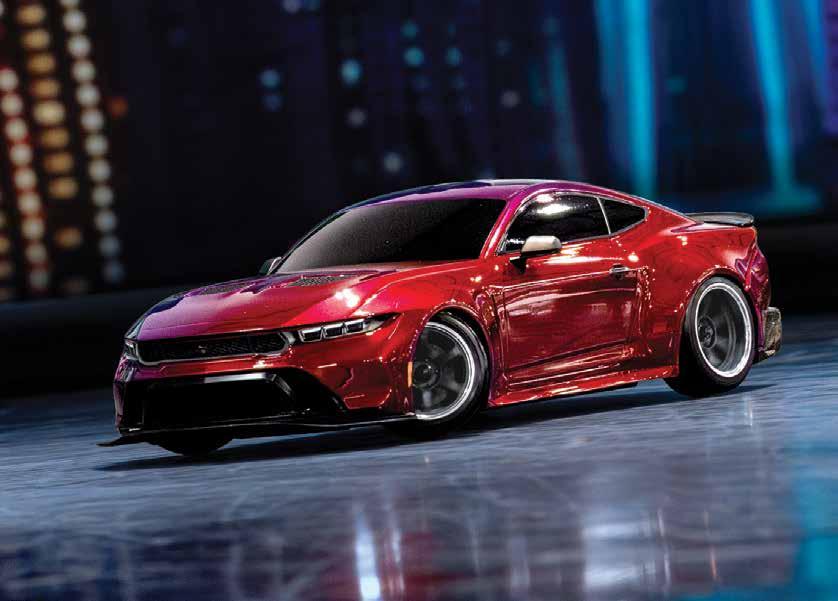
Traxxas 4-Tec® Drift delivers the ultimate experience in modern, smooth, drifting action. Advanced TSM® Drift technology makes 4-Tec Drift easy to master and endless fun on the track. Use the included Wireless Module to take advantage of three customizable and powerful drift modes in the Traxxas Link™ app for maximum control.
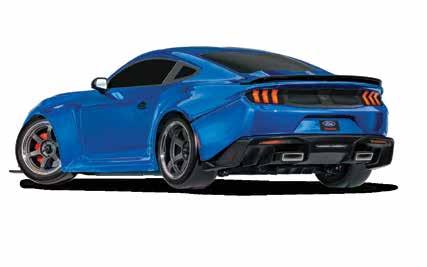
A new rear-wheel-drive 4-Tec 200 mm platform with clipless Mustang body features an all-new front suspension tuned for optimal drift geometry. Take your Traxxas experience to a new level with the 4-Tec® Drift.
HIGH ANGLE STEERING
CUSTOMIZABLE DRIFT MODES TWO SETS OF TIRES INCLUDED HARD AND SOFT COMPOUND
Drift Without Borders: Inside the Overdose CrossGames
By Stephen Platt Photos @keensightz
What are the Overdose CrossGames? The DARC Mag team traveled to The Hobby Shop (THS), Austin, Texas, on September 6th, to find out firsthand.
We arrived to a packed house, full with drivers from across the country, including Rob Fischetti, Jake Dotter, Brian Lynch, Anthony Torres, and Junior Barba. Led by Atsushi Ito, President and CEO of Weld Overdose, and featuring one of the world’s top RC drifters, Ryo Ishii, the Overdose team were friendly, approachable, and eager to learn more about the American scene. They were also joined by American RC drifter Victor Ho, who is the newest addition to the team.
In American RC drifting, the term “Games” usually infers a series of lighthearted drift activities, such as parallel parking challenges, last-man-standing, and maybe some skill-based contests. However, what quickly unfolded was a full-on RC drift competition, complete with qualifying rounds and intense battles. To add to the fun, the competition was concluded with a quick game of rock-paper-scissors with Atsushi.
The CrossGames was much more than just a competition. What truly stood out was the spirit of connection. Here was a group of passionate RC drifters from Japan who had traveled across the world to simply meet and share the RC drift hobby with the American community. The Overdose crew weren’t there to sell products or promote a brand, they genuinely wanted to hang out, have fun, and perhaps showcase their skills. Language barriers faded away as everyone connected through their shared passion for the hobby.
The THS crew did not disappoint, making sure everyone felt at home. Merv handled logistics, Randall emceed the event, and Joe kept things running smoothly. Atsushi ran the competition by RCDC rules, which is the Japanese standard. The result? An event that blended fierce competition with the joy of community, welcoming both new friends from Japan and old friends from all over the country.
Let’s delve a little deeper into what the Overdose CrossGames are. Here’s how Takayuki Shida, AKA Taka, from Overdose RC Drift products explains it:
“CrossGames is the title of the event organized by Overdose. It started as an ordinary competition series in Japan in 2013, but it’s always been flexible - sometimes a competition, sometimes just a gathering, depending on what the community wants. We’ve held CrossGames not only in Japan, but also in Malaysia, Spain, the Netherlands, Norway, Denmark, Germany, and the US. At overseas events, we often bring the Japanese competition style, judged by Atsushi Ito (CEO), because that’s what people want to experience.”
For those wondering if there’s a running tally of top performers, Taka keeps it simple:
“No, we don’t keep statistics on who’s the best CrossGames performer for each event.”
Finally, when asked about the inspiration behind CrossGames and its connection to full-scale drifting, Taka shared:
“Overdose is all about drift. We want to bring as much real drifting knowledge as possible into the RC drifting scene. Sometimes we even hold RC drifting events at real car events.”
The Overdose CrossGames is more than a competition. It’s a bridge between RC drift communities worldwide. If you want to truly understand what makes it so special, you’ll have to go and experience it for yourself.
IN FOCUS
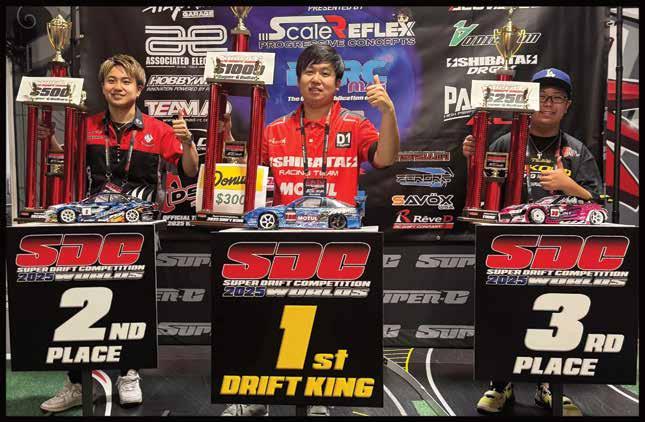
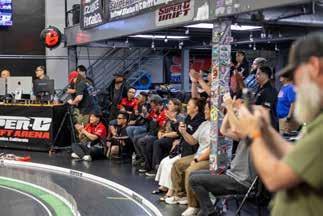
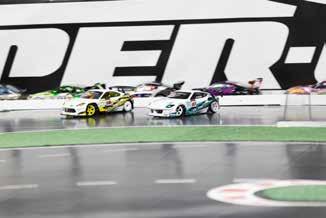
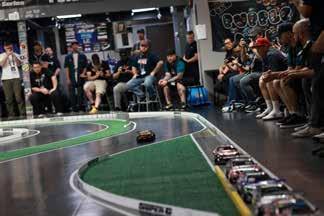
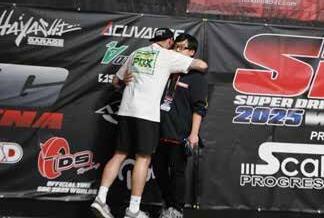
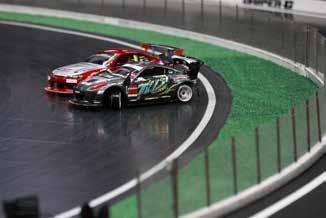
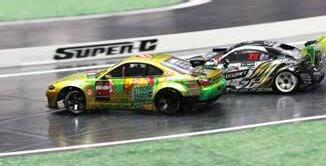
The 2025 SDC Worlds Competition at Super-G in Baldwin Park, California, brought the heat once again, packed with adrenaline, fierce battles, and unforgettable moments, living up to its reputation as the year’s most important event for American RC drifting.
There were epic battles between rivals, both domestic and international, including some interesting twists and turns, but nothing as controversial as last year’s “LED-Gate”.
By Team DARC Mag Photos @keensightz
bracket, going on to clinch the only available 32nd spot in the top bracket.
Last year, several drivers were recalled after their qualifying run for having their LED lights on, and disqualified from scoring. This saw Ryo Ishii, one of the top drivers in the world, bumped down to the lower brackets. Given Ryo’s undeniable talent, the other drivers had their work cut out, as he proceeded to dominate every battle in the lower
There has been speculation since, with the theory that having driven in the 21 lower bracket battles, Ryo may have had the advantage of highly broken-in tires. This could be the reason why, this year, everyone in top 32 were issued fresh tires, thereby eliminating the “bump up” driver from having the advantage of more “break-in” laps on their tires. The myth that Ryo benefitted from having overly broken in tires was dispelled this year, as he continued through to the final battle on a fresh set.
Another change this year was in the qualifying setup. There was a limit of 94 qualifiers out of 180 registered drivers to make it to the battles. If a driver zeroed out for all three rounds, they did not automatically qualify and therefore did
not get to compete in any battles. Additionally, everyone had three qualifying runs as opposed to what was previously two. The decision was also made that “burn tunes” were permitted. Super-G Co-Owner, Steve Fujita, explains, “A burn tune is tuning your car to be able to melt your tires in order to gain traction. However, I didn’t see anyone with an advantage burning.” This was ironic, as “burn tuning” was a big topic of discussion leading up to the competition.
Jake Dotter had his much awaited rematch with Junior Barba. Last year, Junior and Jake were head to head in the top four to see who would face off Ryo for the final battle and a chance to win it all. This year, Jake was in the lower brackets and climbed his way up to the 32nd position of the top bracket, securing the win against Junior along the way. Jake was welcomed into the top bracket with his first battle being against Hayato Yoshiba, another of the top drivers in the world, who was there to defend his RCDC Japan title. DARC Mag spoke to Jake Dotter about this twist of fate. “I wasn’t even looking ahead
to see who the winner of the lower brackets would end up battling in the top 32. I was just trying to stay focused on getting that 32nd spot first. Once I did, I was told I’d be battling Hayato! I just laughed and said, ‘Hell yea!’ I look up to him a lot for style and aggression when driving, so being able to go head to head with him was a dream come true. I wasn’t nervous or scared, but rather very excited. It was even cooler watching him go on and win the whole event.”
Many drivers were comparing their performances to Junior Barba’s, as he took second place to Ryo Ishii last year. Justin Wamsley was excited that he scored one point higher in qualifying than Junior Barba, which in itself was a big accomplishment. However, when the battle came up between Justin and Junior, Junior did secure the win. It was a “win” for both drivers and they both deserve recognition.
As an American RC Drift publication, we want to recognize the top American drivers who made it to the top 8 (W = Winner): • Put Suttiyapiwat, W, Thailand (Reve D) vs Justin Wilming, USA (RCO)
• Junta Shiroi, Japan (Team Overdose) vs Ryo Ishii, W, Japan (Team Overdose)
• Hayoto Yoshiba, W, Japan (Shibata) vs Joseph Durkee, USA (Acuvance, Futaba, Team AD)
• Parsa Godazandeh, USA vs Makoto Nakajima, W, Japan (Yokomo).
Having the highest qualifying score of the American drivers from the top 8 battles, the tie for fifth was decided for Justin Wilming. Justin was the highest placed American driver and he will go on to represent the US in the WTDC Worlds, courtesy of Super-G.
Out of the top 8 battles, just one showdown didn’t feature an American driver, which was the face-off between Japan’s own Junta Shiroi and Ryo Ishii, both repping Team Overdose. The tension was real as these two went headto-head, but in the end, Ryo advanced.
The final battle featured Ryo and Shibata team driver, Hayoto Yoshiba, both respected RCDC Japan champions, in a highly competitive showdown. Their skillful performances were so evenly matched that the judges called for a rare ‘one more time’ run to determine the winner. After a thorough review of the second run, Hayoto was awarded the victory, wrapping up the event
with an exciting and memorable finish.
The battles have been fought and the winners have been announced. That’s it, right? We spoke with Steve Fujita, Super-G Co-Owner, about some of the after effects of Worlds and the ongoing work that has to be done. Steve explains, “There are a lot of questions to answer, in general, and people and situations needing attention. Not to mention clean up so we can reopen for business as usual. I am also trying to record what we experienced and what we can do better next year, while it’s still fresh in my head, which is really important. Several manufacturers have reached out to us, congratulating us, asking about next season, and wanting to work with us on other projects. There is a lot to do still, probably more than anyone would think.”
After speaking with Steve about some of the judging calls, it became apparent that he’s up there watching every run and every call, and
personally overseeing everything to make sure it is run correctly by the same Super-G standard that everybody has grown to expect and respect.
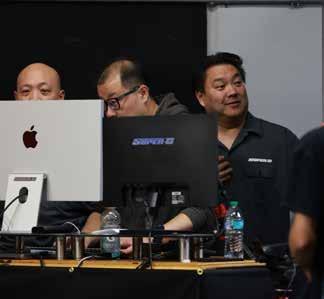
While Steve remained perched firmly on the edge of the judge’s booth with an optimal view point of the entire venue, including the track, Joey Tam, Super-G CoOwner, announced the event and kept everybody informed of every detail. If anybody had any questions, it could be easily understood by his verbal cues. Joey was planted in the master control station, a desk with several computer monitors, a microphone, and all of the software to live stream the event on their Super-G Drift YouTube channel. At the time of the finalizing of this article, day one of SDC Worlds had 6,600 views, day two 6,400 views, and day three the top 32 bracket battles had 4,900 views. The live stream was well organized, well orchestrated, and covered all of the crucial views of the track to give everybody a realistic immersion into the
experience and make them feel like they were a part of the competition. The live stream was also broadcast on monitors throughout the venue. Even though everybody was there live, several heads were looking up at the screen for the best view. The SDC stream control and camera network is unmatched and carries professionalism, which gives the hobby and competition aspect the credibility of a Formula Drift event.
Ultimately, the 2025 SDC Worlds Competition at Super-G was more than just a contest of skill.
It was a celebration of community, innovation, and the relentless pursuit of excellence in RC drifting. It was a whirlwind of unfamiliar faces, but everybody was there with purpose. If you sat down and talked to people, you realized that they were some of the highest profile members of the RC drift community in the country, all gathered together. From the spirited rivalries on the track, to the dedication behind the scenes, every detail contributed to an event that raised the bar for what’s possible in the sport. As drivers, organizers, and fans reflect on the unforgettable moments and lessons learned, anticipation is already building for what next year will bring.
The Interview Featuring Mikko Yang
by Adam Mah of RC Drift Talk Podcast - YADMAH
I’d like to introduce Mikko Yang, Super G’s Drift King of 2020, who recently placed 2nd overall in the Super G Drift Competition, Southern California region. He is a competitor, social media influencer, and a great role model in the RC drift world.
Adam: Hey Mikko, thanks for taking the time for this interview. Please tell us a little about yourself.
Mikko: I’m Mikko Yang, I am a Chinese/Filipino RC drifter based in Los Angeles, California. I’m a Team RêveD USA Factory Driver sponsored by GGTRC, Rolling Garage RC, and Vertex RC USA. I am the 2020 USA SDC Drift King Champion. I’ve competed in RC drifting since 2006, from All-Wheel-Drive (AWD) 50/50 days to early Counter Steer (CS) days and now the current day of Rear-WheelDrive (RWD). I’m all about having fun, competing, sharing knowledge, and spreading the love and passion for RC drifting.
Adam: What is your real life dream car build?
Mikko: When I was a kid, my dream car was a Toyota AE86. Now it’s the Tesla Model Y, which I see as a full scale RC car.
Adam: What track do you call home?
Mikko: GGT RC Drift Circuit in Garden Grove, CA. Their spec tire is DRC, DRP, AS-01 and the track fees are $20 daily, $60 month pass.
Adam: Do you prefer leading or chasing?
Mikko: Leading for sure, that’s what got me to where I am today. My sensei Keith at GGT RC would only let me lead and he’d chase me, lap after lap, to help and guide me to improve my driving. That was my most influential training experience, helping me to progress the most and find my style of driving. Leading improves consistency, helps you figure out a good flow, and gives you the ability to adapt to any track.
Adam: What is D-Style?
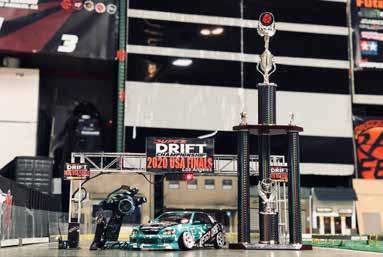
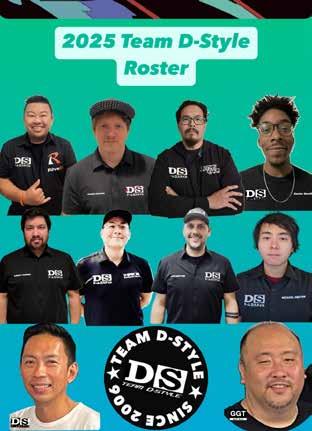
Mikko: My Uncle Jon Mundo, aka “Mundo Time”, was the OG Cali DK in 2006. He and I started our Team D-Style. It’s a team full of passionate RC drift enthusiasts who enjoy having fun, competing, traveling, and spreading knowledge within the RC drifting community. Our team philosophy is “Fast is slow, slow is smooth, but smooth is fast.” We’ve got members in SoCal and now in Portland.
Adam: Which is your favorite team body and why?
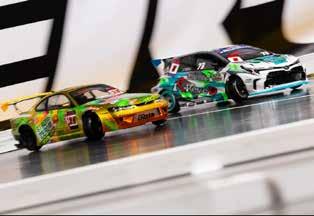
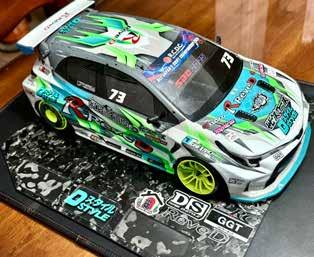
Mikko: 2022 Team D-Style Altezza Ranger bodies for the pure fun vibes and all the cool videos we made together, including making it on ESPN Sports Center’s IG Page and even on Japanese TV.
Adam: You have traveled around the world to different RC drift competitions. Can you share with us which competitions you’ve competed in and where they were?
Mikko: I’ve competed at RCDC Japan 2024, WTDC Indonesia 2023, Yokomo Drift Meeting International at Yatabe Arena 2018-2019, Yokomo Drift Meeting USA 2017-2019, North American Cup 2023 at Elite Drift Shop in Quebec Canada, the RC Drift Club Comp Series USA 2006-2010, HPI/HB RC Drift Competitions 2006-2010, Groovy Drift USA Drift Nationals 2008, Drift Speed Competitions USA 2008-2010, Super Drift Showdowns 2016-2019, SDC Finals/Worlds 2020-2024 USA, Rolling Garage RC Competitions 2021-2025, and IRCDF Finals 2024 USA.
Adam: What has been your most memorable competition and why?
Mikko: SDC Finals 2020 where I was designated the first USA SDC Drift King. Also YDM Japan 2018, my first international trip and competition. That was my first time driving and competing with legendary Japanese RC drifters and visiting incredible RC tracks I’ve only seen and admired through social media.
Adam: Which competitions are you looking forward to in the coming season?
Mikko: I will be competing at SDC Worlds 2025 USA, WTDC Philippines 2025, IRCDF Finals 2025 USA, and the RCDC World Championship Japan 2025.
Next year, I hope to participate in more international competitions, RCDC 2026 Japan, Clash of Titans 2026 Europe, RC Drift IO (formerly RC Drift UK), IRCDF 2026, SDC 2026, and to compete in more out of state competitions.
Adam: Can you give us a few similarities and differences between driving styles in the state side competition and global competition scenes?
Mikko: The driving style in the US is more about linking zones together with a constant flow and transition between zones. Internationally, drivers set up for
the zone, then point and shoot with a sharp flick and continuous flow through the zone. Then they set up for the next zone. These differences also affect the judging criteria, scoring systems, and track layouts.
Both styles involve gaining speed then having a hard flick initiation to a big angle, it’s the linking between zones that is handled differently.
Adam:RC drift is currently going through a big boom and growing rapidly in the States. How would you describe the change in the scene from when you first started?
Mikko: The main changes are advances in technology, use of social media, availability of parts in the US market, and access to more RC drift tracks. In the past, we made our own tracks at parking lots or parks, but now we’re much more fortunate to have spaces dedicated to RC drifting.
Adam: What advice was given to you that has changed how you see RC Drift?
Mikko: “Fast is slow, slow is smooth, but smooth is fast”, “Be you, stay true to yourself, always have fun no matter what, enjoy it”, “Don’t think, just do…”, “Believe in Drift”.
Adam: What would be your advice to a newcomer?
Mikko: Practice consistency, learn the line and stick to it, don’t worry about speed, or others. Learn track etiquette and respect everyone. RC drift tracks are a place to relax and chill in a stress-free zone. Breathe… just relax… hang loose AND just drive.
Follow Mikko on Instagram @dmyx_rd
Follow Adam on YouTube, Facebook, and Instagram: @yadmah
TRACK SPOTLIGHT
Scale Science: RC Drift is Alive in Denver
Scale Science, Denver’s longest running RC drift track, was founded by Jordan Muench on July 1, 2017. Despite being warned by the local hobby shop that “RC drift in Denver is dead”, Jordan strived forward with $400 of RC parts in the trunk of his Honda Accord. Scale Science has since grown into a thriving community. At their third annual Potluck Matsuri, Jordan took a panoramic photo to fit over 100 drivers into the frame, a living rebuttal to that early skepticism. Every time we reach another milestone, I reiterate that quote to remind myself why I do this,” reflects Jordan.
The Mission Scale Science’s mission is simple and bold: HAVE FUN. That’s the driving force behind every event, lap, and new member. Over the years, this “have fun” attitude has not only grown the community, but sharpened everyone’s driving skills. “We love teaching others to drive and spreading our love of RC drifting throughout our own community and beyond,” explains Jordan.
Events
Scale Science’s signature events, Potluck Matsuri and MiniMatsuri, embody their “HAVE FUN” spirit, with over 100 drivers from many states and countries attending. Potluck Matsuri centers on fun laps and creative build-offs, while the Mini-Matsuri celebrates the local scene and Scale Science’s July birthday. Additionally, Scale Science hosted a 24-hour drift stream on YouTube, connecting with over 20 tracks worldwide.
Despite technical hiccups, the experience was memorable and showcased the global RC drift community’s creativity, energy, and camaraderie. “I learned a lot of hard lessons with that stream, including the fact that YouTube would only pre-record the first two to four hours and nothing beyond that!” Jordan laughs. But the effort was worth it, “(the technical mishap) made the event just a memory, and I fully enjoyed it.”
The Mascot Scale Science’s mascot, Wolfgang the Mad Scientist, has roots in founder Jordan’s early fascination with the JNCO jeans character of the same name. Inspired by Wolfgang’s quirky style, Jordan designed his own version, infusing it with Scale Science’s unique personality. The character truly came to life, thanks to Nick Harland of Zeromax, who transformed Jordan’s black-and-white concept into a vibrant figure full of scientific flair. “I’m so glad Wolfgang has been embraced, becoming a symbol and playful spirit for our track,” Jordan adds.
The Track Scale Science regularly updates its track layout to keep driving fresh and engaging. In the early carpet days, the track could be reconfigured three or four ways with minimal effort, maintaining interest without major changes.
During the P-tile era, layouts were assembled and disassembled weekly, fostering experimentation and refining group driving. Now, in their new location with polished concrete, layouts change two to three times a year to accommodate intricate scale accessories which
need to be moved with each modification. Less frequent changes allow drivers to truly dial in their setups, with layouts ranging from tight technical lanes to wide, fast sweepers.
Scale Scenery
All of the scale scenery is created as a group effort. Jordan explains, “Ruben Aguero, from Red Eye Dioramas, fabricated and finished all of our designs.
Calvin Castile created the lighting, Vinny Walk produced the vegetation and trees, and I made the mountains with brick retaining walls, the highlands pedestrian bridge model, and the sky painting backdrop.”
Scale Science also has some awesome scale contributions from visitors including KPOPRC, who printed a scale “Blucifer” with red eyes that actually light up. The real Blucifer is a sculpture of a mustang, located at Denver International Airport, colored bright blue with illuminated glowing red eyes. It is renowned for having killed its sculptor, Luis Jiménez, when a section of it fell on him at his studio.
The Midnight Oil
Scale Science is known for its late-night sessions, often staying open well past closing time. Officially, they’re open Thursdays from 7pm to midnight, but sessions often stretch to 2 or 3am. Fridays and Saturdays run from 7pm to 2am, yet the doors frequently stay open later. The late-night vibe draws a dedicated crowd, and it’s not uncommon for drivers to
leave at sunrise. For many, these long nights are a memorable part of the Scale Science experience.
Pace
Scale Science sets their pace for optimal tandem drifting - neither too fast nor too slow, with the DS Racing LF-3 as their standard tire and their chassis tuned to match. While competitions are seen as a “necessary evil”, they don’t let them define the experience. The focus remains on fun, and not taking the hobby too seriously. Having said that, competitions are a key driving factor for manufacturers to innovate and produce the highest quality products for everyone. Ultimately, Scale Science believes a healthy balance between competition and enjoyment is essential for growing the community and keeping the spirit of RC drifting alive.
Credits
Jordan is grateful for the support of so many. “I want to thank Rheandal, Daniel, and Racquel for their unwavering support in keeping Scale Science alive. I’m thankful to everyone who contributes: drivers, supporters, and the wider RC drift community, especially Super G and GGT for their early help. Special appreciation goes to the local crew for their dedication, honest feedback, and event planning. Lastly, I’d like to give a humongous and heartfelt shout out to my wife and daughter for putting up with my absence every week for the last eight years. Thank you for supporting me, even when it was hard to, so I could pursue something I’m passionate about, even though on paper it doesn’t always make sense. I’d also like to thank anyone in the future that may be visiting our track. I look forward to sliding with you and hearing your sideways story.”
Introducing the ultimate speed controller that surpasses the power of the RPX2 and combines the ease of use of the RPX3!
Equipped with state-of-the-art power MOS FETs, its output characteristics have been tested and proven in racing. It maximizes the performance of stock motors and allows for easy adjustment of the excess power of modi ed motors. Program settings are inherited from the RPX2, and optimized program data for each category is pre-set, ensuring exceptional ease of use during initial setup. Colors available are black, blue, red, and purple.
*The BL-R26P series programmer is compatible, but a rmware update for the RPX4 is required.
SALE
NOW ON SALE
Master Drift MD3.0 (Black) 108,000JPY
MD3.0 is a new agship competition machine that sets a new trend! The MD3.0 features an innovative belt drive for the rear drive, o ering a controllable drifting style. While adopting a drive style that provides a smooth launch, the counter gear and short belt also bring out a direct feel. The high-pitched drive sound and sharp pickup, reminiscent of a multi-cylinder engine, are appealing and make you want to grab the throttle. The rigidity of the front end increases the surface pressure on the front tires, which enhances controllability when exiting corners. Both front and rear suspension arms are suspension pin type H-arms, but they can also be changed to the conventional MD series A-arms, and we look forward to the development of optional parts in the future. As this is a limited edition color version, sales will end once the initial production run is sold out. There are no plans for future reproductions.