ADAM MAH, MATT BARTELL, ROBERT BENAVIDES, KELLY BERRETH, CHUCK COPE, CJ MEDIA, JAKE DOTTER, JOHN ESCASA, STEVE FUJITA, CODY GARLAND, JOSH GEEG, KELLY KAZAMA, “MASTER KEN” KENNEDY, JERRY LUMSDEN, LUIS NIEVES, MIKE PEZEE, RACK CITY RC DRIFT, ANGEL SAYA, SCALE MAGIC, KONSTANTIN STANCHEV, TROY (ROADSIDE RC), ROY URATA, MATT YOUKHANA
INDEX...
Where to get ?
DARC MAG is FREE to view online download from DARCMAG.COM
Pick up your copy also at these locations:
412 RC INC 3109 W Liberty Ave suite 200, Dormont, PA 15216
Casa Drift 4629 S 108th St, Greenfield, WI 53228
Coastal RC Drift 2561 El Camino Real, Carlsbad, CA 92008
DARC 10420 Plano Rd #105, Dallas, TX
Drift In' 3515 Franklin St suite c, Michigan City, Indiana
Drift Manji RC 5 Valley Road, Liversedge, UK
Drift Ninjas RC 6625 Robinson Ave, Allen Park, MI
Drift Scene 315 Fingerlakes Mall, 1579 Clark Street Road, Auburn, NY
High Voltage Garage 1199 E Central Ave, Wichita, KS 67214
HobbyTown RVA RC Drift Garage 9900 West Broad Street, Glen Allen, VA
HobbyTown Rockford, IL 3782 North Alpine Road, Rockford, IL
Pop's Dirty South 1717 Rabbit Ln, Lake Charles, LA 70605
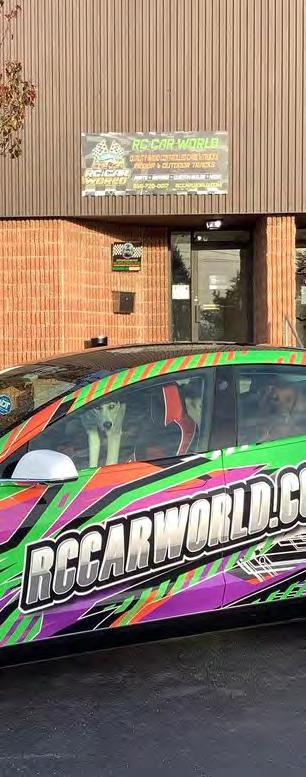
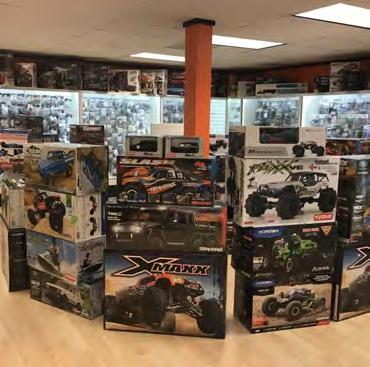
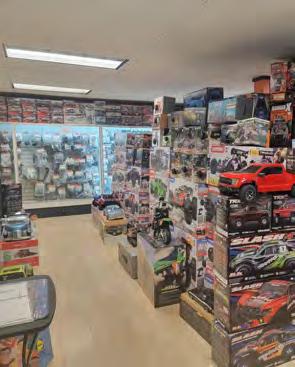
RC Car World 2305 Garry Road, Cinnaminson, NJ
"RC Drift Scene 315 Fingerlakes Mall, Clark Street Road, Auburn, NY
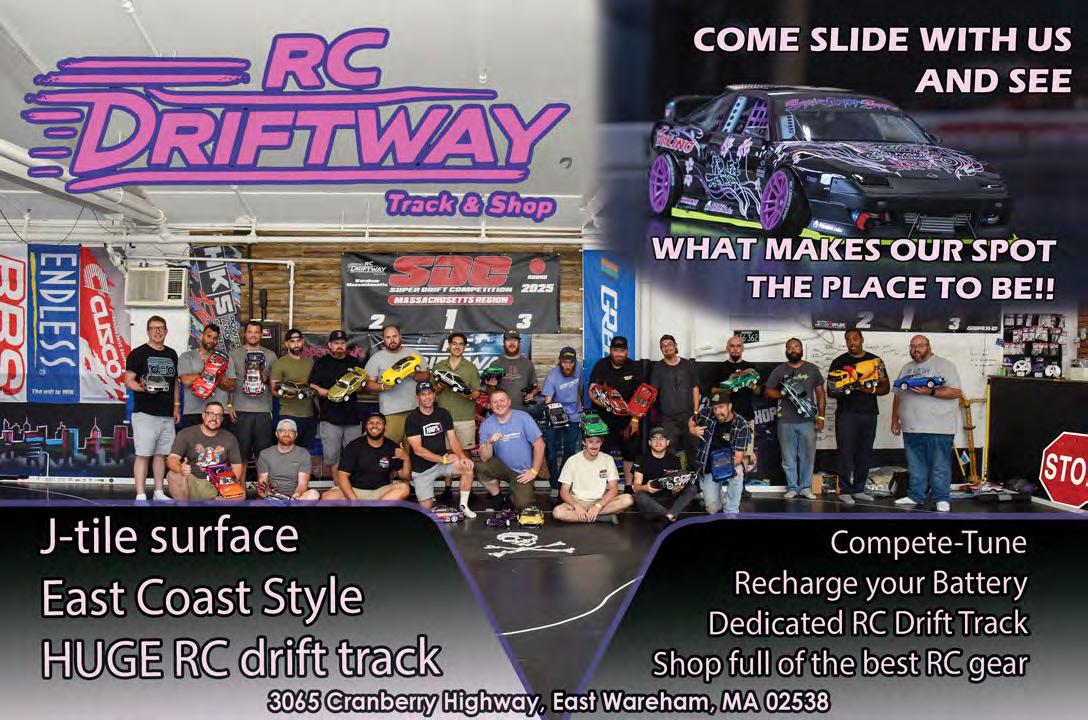
RC Driftway 3065 Cranberry Highway, East Wareham, MA
Tandem RC - Mesa, Arizona 909 S Dobson Rd #19, Mesa, AZ 85202
Triple Crown RC Hobbies 2825 Epperly Drive, Del City, OK
Vertex RC 5595 Magnatron Blvd t, San Diego, CA 92111
Zero Traction 500 Polk St suite 9, Greenwood, IN
CHASSISBUILDERSSHOWCASE
RC drift chassis have evolved from 4WD conversions to purpose-built RWD machines. Today, they come in countless variations, with conversions, aluminum and carbon upgrades, and models from manufacturers worldwide. DARC Mag will bring you the best of these works of art.
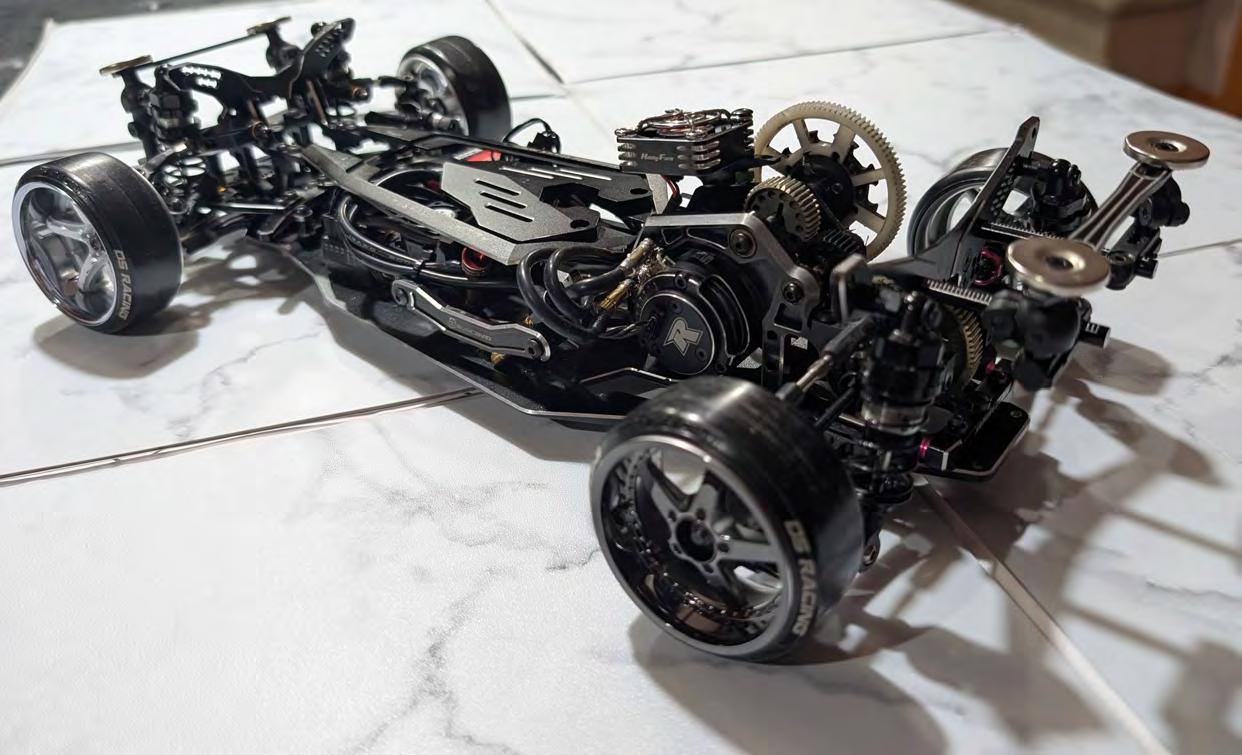
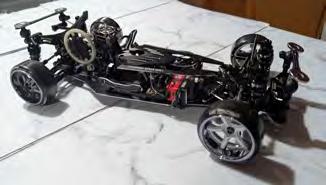
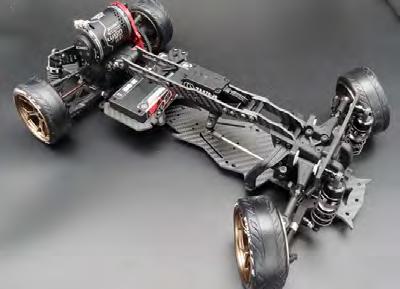
Chuck Cope - Nemesiz D4
This base chassis was originally a 3-Racing Sakura D4.
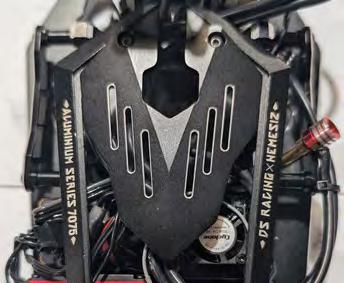
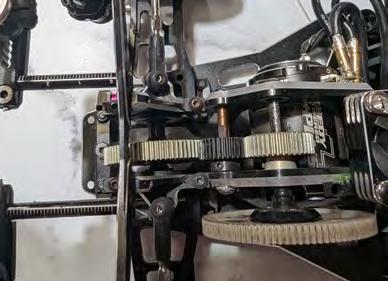
Based on research, I would say it was produced in 2017 or 2018. It has had a full Nemesiz conversion which made it fully aluminum, chassis, upper deck, shock towers and all control arms. It also has 3-Racing upgrades, including a curved slide rack for steering, adjustable rear toe, and a teflon gear drive conversion which converted it from belt drive to idler gear transmission.
This chassis was purchased from a track owner based in Malaysia, so I don’t know the complete history of it but it was well taken care of and like new when I acquired it.
The dampers are Eagle Racing, they’re pretty old and I’ve never seen any others like them. They are fully aluminum and the top mounts aren’t the caps, there are separate aluminum caps under the mounting caps.
For electronics, it has a Hobbywing XR10 stock spec ESC. I went with that because it is smaller than other ESCs so it fits nicely under the upper deck.
The motor is a Reedy 17.5 that I had when I put it together. It has an AFGRC A50BL servo that I bought to try out. I liked it so much that I bought two more for other chassis. The gyro is a Yokomo DP-302 V4.
I eyeball the steering geometry to get it close to my other cars. The front camber is at 5 degrees and the rear is at 3 degrees. The back toe is 1 degree in. After having Angel help me with my older Overdose set up and him explaining how older chassis need a different set up, I’m planning on reworking this one.
You can still buy a D4 chassis from 3-Racing for around $160. I believe the Nemesiz upgrade kit was around $350. Since these aren’t well known I would value it at around $400-$600. It’s really hard to judge since you don’t see these on the market.
For its age and style it drives really smoothly. It is slow but I hope to solve that with a better alignment in the future. I don’t have this chassis to compete or to be the fastest on the drift track, I picked this up because it was so unique and cool looking.
Jake Dotter - D1-Fighter
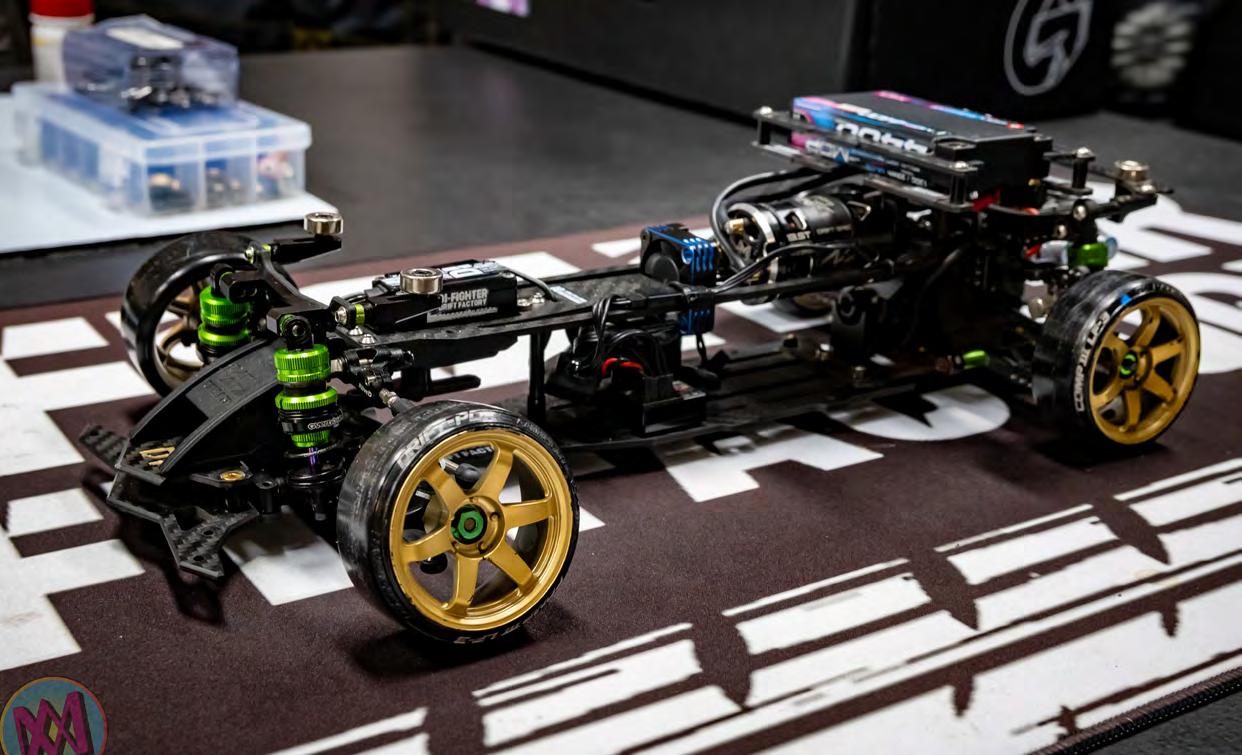
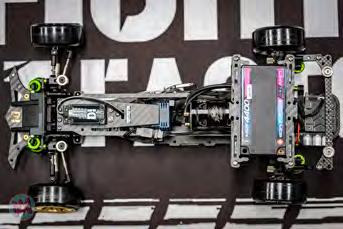
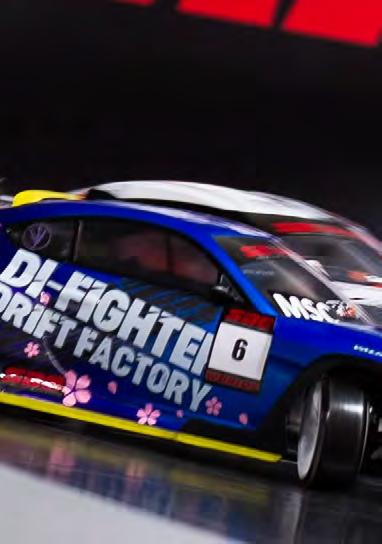
The D1-Fighter conversion starts as a GRK Evo2. I converted my Evo2 into a Reve D MC2 then converted it to a D1-Fighter. It still utilizes the front shock tower, front upper arms, rear shock tower, rear upper arm mount, and transmission spacer from the Reve D MC2 conversion. I also run Reve D delrin 45mm rear arms, Reve D rear hubs, Yokomo rear toe blocks (RF is a D block, RR is a brass E block), GRK aluminum front lower arms, and GRK “Y” knuckles.
The base retail price for the D1-Fighter is $210 shipped. I value my chassis around $1500 with electronics.
My current shock package is the Tamiya TRF type with a green dress up kit, Azada shock shafts, Tamiya X rings, Wrap-Up-Next 3 hole pistons, and Yokomo 350wt oil. I typically run Overdose dual springs 2055 front and 2050 rear.
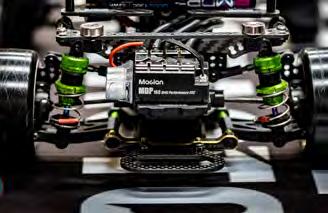
I’m currently running a Futaba CD700 servo, Futaba GYD550 gyro, Maclan MDP ESC, Maclan MDP 13.5 motor, and Maclan MDP batteries, all paired with a Futaba 10px. I can tune the Futaba servo and gyro from my radio and make changes on the track.
The front steering geometry is set to 0 degrees of toe, -9 degrees of camber, -8 degrees of caster, and the Ackermann is slightly open at full lock. I run a 217mm track width, measured from the bottom of the wheels. For the rear, I run 0 degrees of camber, 1.6 degrees of toe in, and 0 anti squat shims. “Toe block shims” allow you to space the toe blocks up to add anti squat (not allowing the rear end to squat) or down to add pro squat (forcing the rear end to squat). Both can allow you to gain more traction for straight line speed. The track width is 195mm measured from the bottom of the wheels.
The D1-Fighter is very sleek, streamlined, and looks aggressive. With my weight bias set at 35F/65R, my car is very stable. It’s easy to place it wherever I want on the track, but still nimble enough to make quick corrections. I try to tune my cars to hold the line after initiation. When I enter hard, the car won’t over rotate and spin or shallow out mid way. It’ll drive into, through, and exit the corner smoothly. It’s super stable and predictable. Whether running shallow or deep angles, it stays planted. You’re not fighting it, it just flows.
CHASSISBUILDERSSHOWCASE
Jerry Lumsden - Yokomo MD-2.0
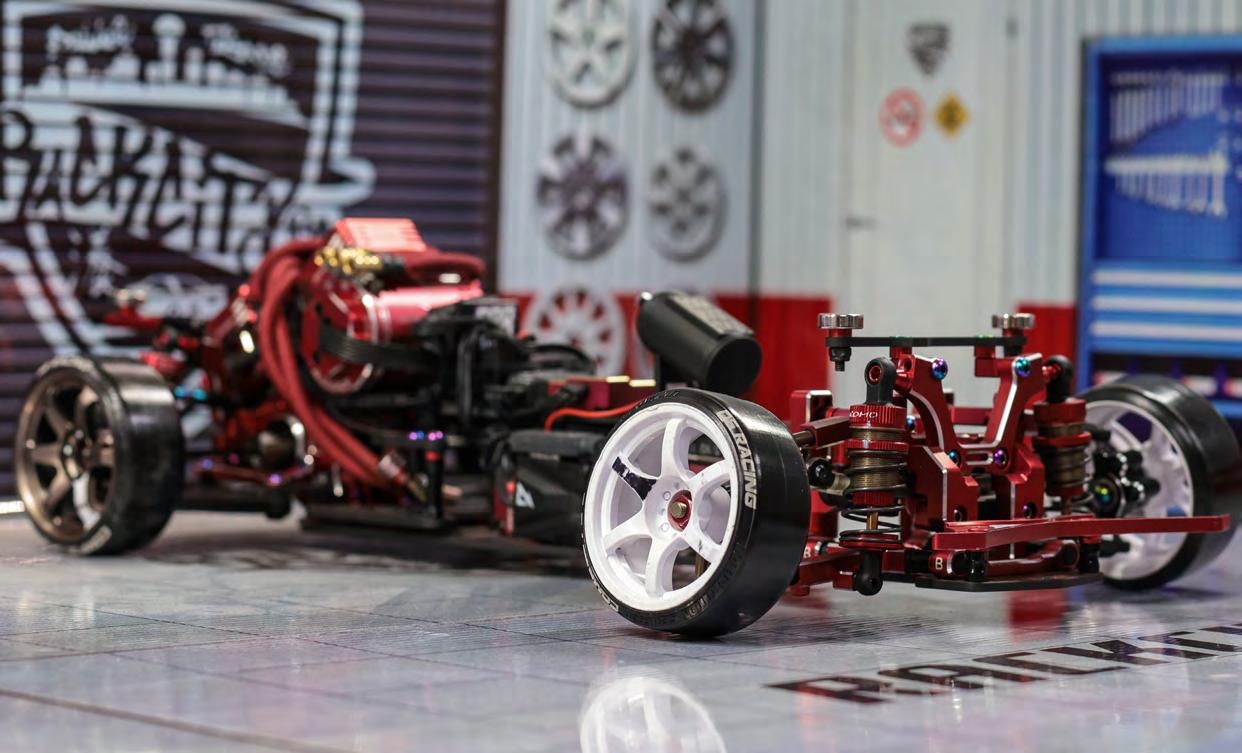
Jerry, AKA JJ, is one of the competitive members of Rack City and, at the time of the article, is neck and neck for the top position in the 2025 North Texas SDC Competitions.
This chassis is a Yokomo MD2.0, produced in April 2024.
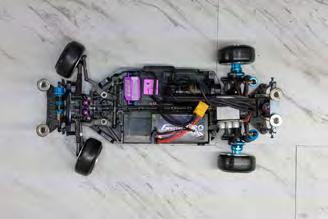
I replaced the “deck” with the Bingo Wasp MD2.0 v1 to lighten the chassis up a little bit. I also added the JSM dazzle hardware set. I recently converted the front end with Yokomo RD2.0 front lower arms and suspension mounts to improve the handling and stability. Other than that, the MD2.0 comes fully hopped up out of the box, not many upgrade parts are offered for the Yokomo MD.
The unique thing about this chassis is that I run the RD2.0 front lower arms setup. The chassis comes standard with the hole placement for the RD2.0 adjustable suspension mounts, which allows you to convert it with original Yokomo parts. I like that the MD2.0 chassis comes almost fully upgraded out of the box and most of the parts are color anodized. If you get one of the limited edition versions, the weight distribution is more towards the center of the chassis.
The dampers are Yokomo “Big Bore” dampers with Topline hard diaphragms, Yokomo 6 hole pistons, MST 5wt mineral shock oil, and Yokomo P-tile springs.
The diff I run is the Yokomo ball diff, but the chassis does come stock with a gear diff. I do run the ball diff a little firm. I prefer the ball diff.
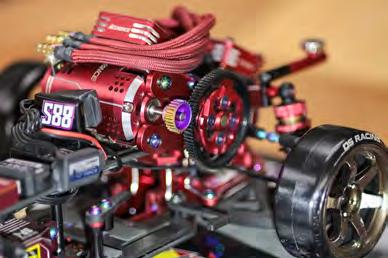
The electronic setup I’m running on is the Yokomo SP-03D V2 servo and Yokomo DP-302 v4 gyro. I’ve always had good experience with that combination and it suits my driving style. The ESC/motor setup is Acuvance Xarvis XX with an Acuvance Agile 10.5T, which pairs very well with my controller, the Futaba 10PX. The 10PX allows you to link to the ESC and adjust your ESC parameters from your controller. My favorite part about the electronic setup on this chassis is the battery volt meter, a miniature nitrous bottle from Cre8ve.
Yokomo MD2.0 retails for about $800 but the estimated value of this MD2.0 is about $2,200-2,500. The chassis is really smooth and consistent, as long as you keep up with the maintenance.
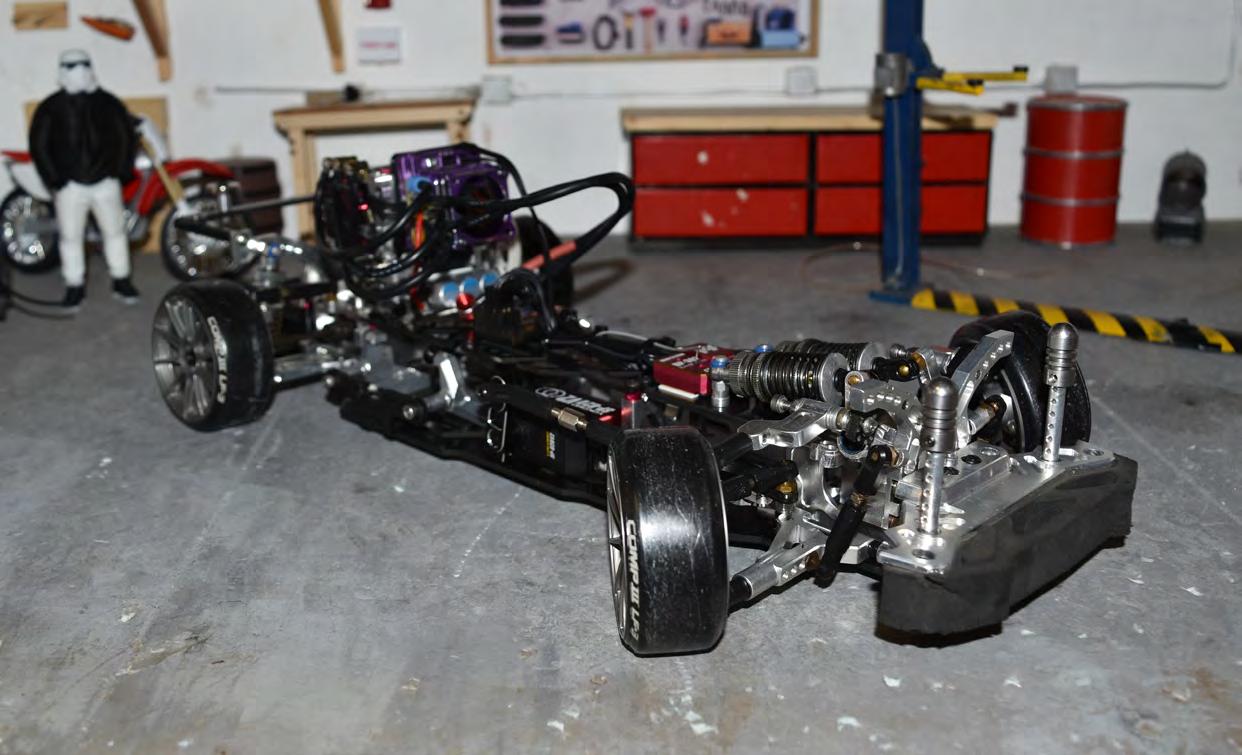
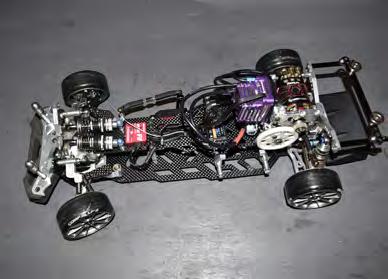
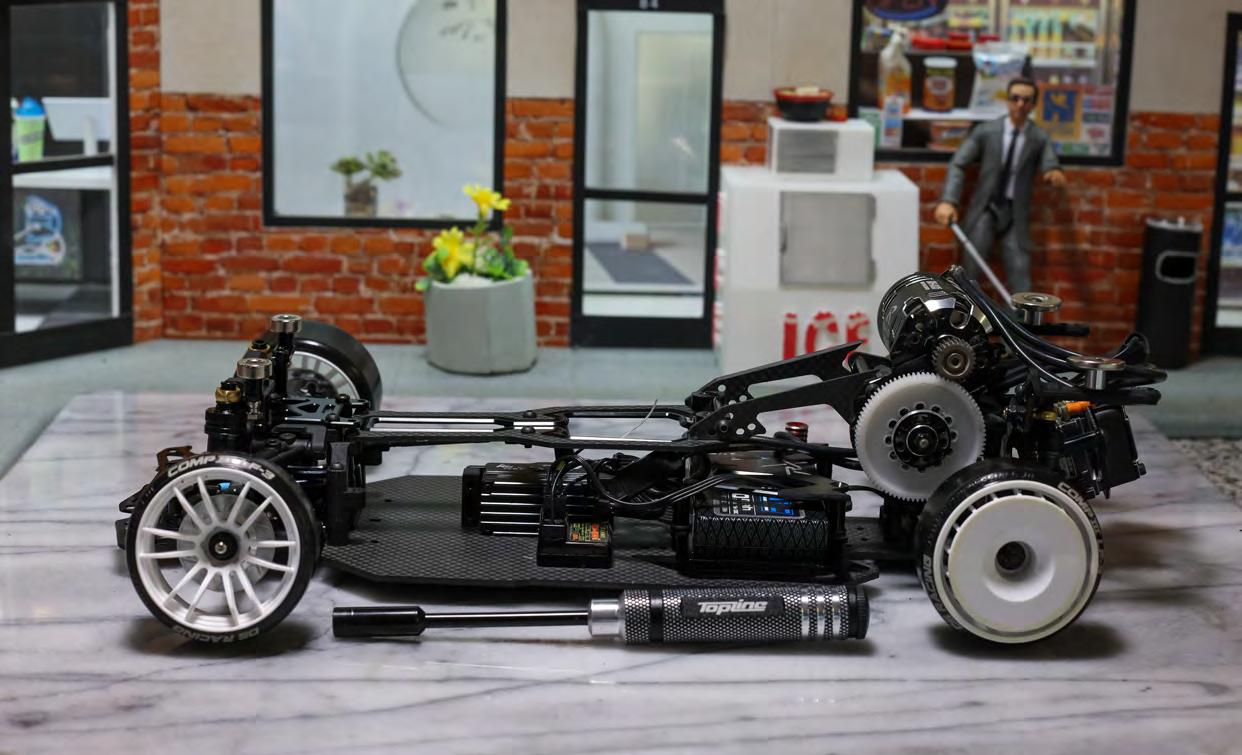
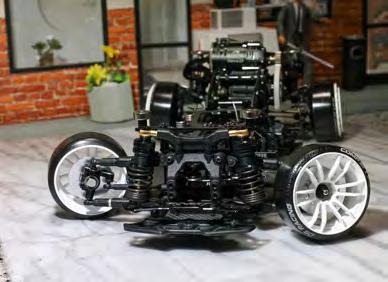
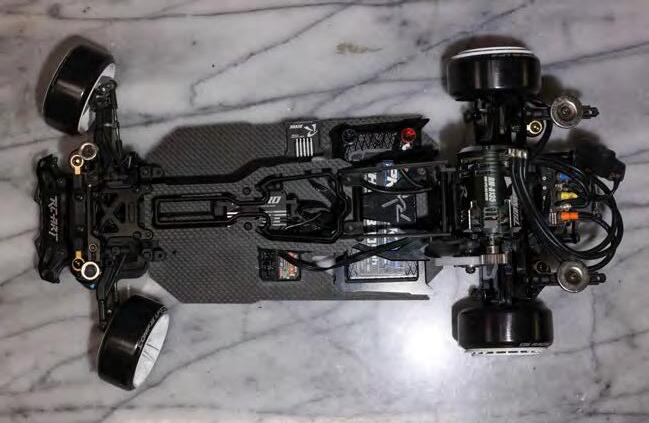
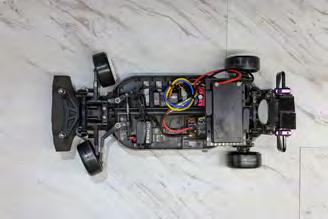
This chassis is an R31 with a Kazama conversion. I got it from a friend who bought it in a shop in Texas. It is very unique and the only information we could find about it was an old Facebook post from 2019 about the original build. It may very well be the last one in existence.
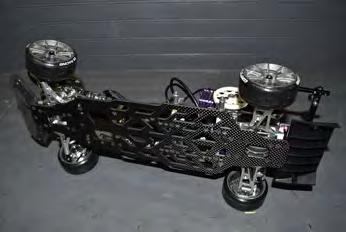
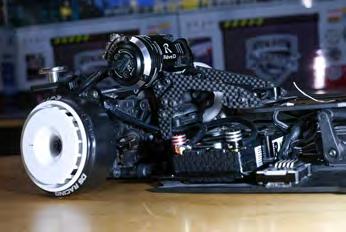
I believe it was produced in 2018 and was originally a 4 wheel drive race car. It has an independent front suspension very similar to the current Shark. I completely disassembled it, soaked it in my ultrasonic cleaner, and reassembled it exactly as it was. I wanted to keep it original. I also found some wheels as close to the original as well as the body, which I’m still working on. My plan is to keep the setup the way it was when I got and keep the parts as close to the original as possible.
It has a spool in the rear with a belt drive. It is a rare find. I tend to collect odd ball stuff.
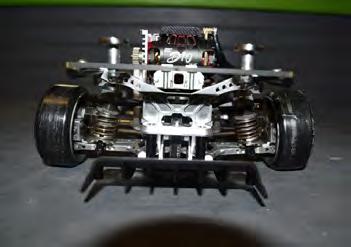
It may be the first chassis with the front shocks in the Inline Frontal Suspension (IFS) configuration. The rear spool also makes it drive uniquely.
I’m planning to de-anodize the electronics so they match, but I will do this once I figure out which electronics are going to stay with it. The current lower deck is not adjustable, but parts of the top deck are. The original creator made many of the carbon fiber parts. Currently, I have Hobbywing motor and ESC and Yokomo servo and gyro, LF3 comp tires and an old Lexus body.
I have driven it a couple of times, and it drives very well. I definitely like it more than my Master Drift 2.0. The rear dampers are set stiff with the front very soft. I like to bounce my front ends.
It’s set at 7 degrees toe out, -5 degrees camber. Positive Ackermann about 15 degrees difference. I have +4 degrees camber in the rear and about 2 degrees toe in. I’m still working it out.
I paid $350 for the chassis, and $200 on the used electronics, plus $50 for wheels and tires, but it’s worth more to me. It drives pretty well, but I am still playing with it. It’s definitely different from my other chassis, and I own some pretty cool chassis.
Kelly Kazama - R31
CHASSISBUILDERSSHOWCASE
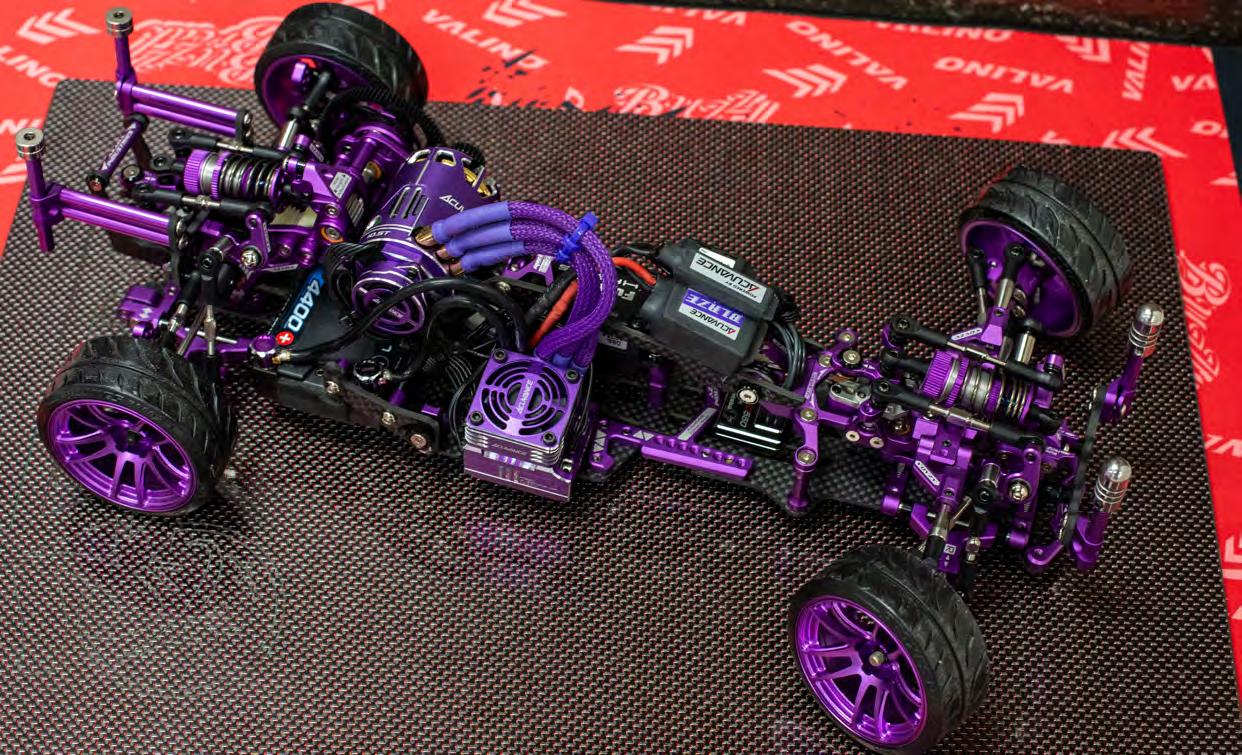
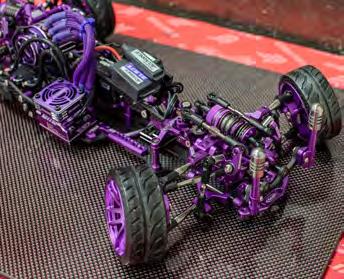
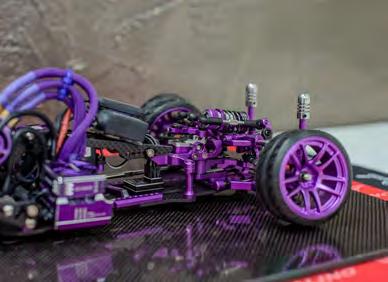
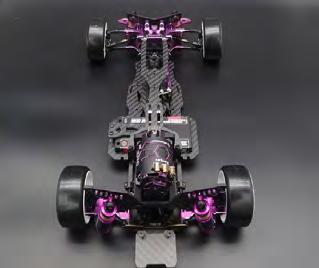
This chassis is the Azada Merlin, which dropped in October 2024. There were initially 120 that were going to be produced, 60 in red and 60 in purple. I was able to get one of each, and they are works of art.
It uses a mono shock in the front and rear for the up and down motion, but has steel rods for the side-to-side weight transfer style suspension. It is set up in a way so it can work in unison at any angle in the side-to-side motion. Seeing all the parts moving in unison and watching it work blows your mind. The shocks come prebuilt and feel like silk.
fledge motor, Futaba 550 GYD, and a CD700 servo for the steering. This is my ‘go to’ electronic setup. I run a Futaba 10PX radio, so adjustments can be made on the fly.
In terms of price, they were just under $1400 on the preorder. With electronics, another $800, plus the Overdose aluminum wheels in purple, that’s another $120, and the Buzz Break Toyo Proxies888 of $65, makes a grand total of $2600 with shipping for everything added in.
All of the adjustments were factory preset, I did however shorten the width, as it was set up to be 220mm wide. I brought it down to 205mm in the front and 195mm in the rear, all the links have hatch markings to measure by. It also came with an M size (short wheelbase) chassis deck. I’m running 2 degrees of camber in the back, .5 degrees of toe in on the rear, and the stock monoshock spring. On the front, I’m running 10 degrees camber and 2 degrees of toe out. For electronics, I’m running a purple Acuvance RAD ESC and 10.5
I like that the chassis out of the box is super smooth and needs very little tuning to get it to drift well. It feels super stable and planted and is very easy to drive and catch angles with. You can faintly see when it weight-shifts when entering the sweeper or hair pin turns.
I love driving the thing, I have been driving it with a clear shell as I have not had time to paint it yet. It feels planted and I can move her around the track, either pulling in tight or sending her wide in the sweeper, and she flicks at a moment’s notice.
Luis Nieves - Azada Merlin
This base chassis is a Reve D RDX.
I opted for a RC-ART RDX Comba Conversion with RC-ART UC DAMPER (TRF specification). It’s definitely not common in the United States by a long shot and they started production in 2024 as far as I know.
I’ve been working hard in the offseason, shifting focus from burn tunes and overheated tires to aggressive entries and higher carry speed. The goal was simple: find a sweet spot between tire heat, wear, and snap. That meant a full overhaul, trial after trial, and a lot of track hours. Credit goes to Master Ken, who built and converted my RC-ART chassis. His baseline let me re-tune consistently without hitting the tuner’s equivalent of writer’s block. For testing, I ran slower tires to force the car to keep up with benchmark builds. Most of the time I used the WRAP UP NEXT SG-2 Damper, but something felt missing. Switching to the TopLine TP-225L helped, though it sat too tall. The real fix was the RC-ART UC Damper conversion. With the SG-2, I had been using softer Quantum Type S springs, but the UC required stiffer Quantum Type I springs.
I went with the ART Aluminum rear
shock tower / chassis stiffener / ART Battery Support / ART Aluminum battery tray.
The big ticket on this chassis is the sway bar (1.2mm) and the ART Conversion Damper set. This chassis likes snap, a lot!
For dampers we are running Topline TP-225L with the ART TRF UC DAMPER conversion.
Currently we dropped in a gear diff for the chassis. Since we are running the RDX we opted for the Reve D electronic suite with RS-ST PRO, REVOX, ABSOLUTE 1 13.5T, and BREVE ESC.
We are running 3 degrees toe out with 13 degrees camber. This car is tuned for mid-high scrub. As for the rear end we are running 5 degrees camber and stock toe.
Since this is a sponsored build the car price is hard to estimate, but I would say around $2,000+ retail.
I would say the way the car is set up right now and the feel is aggressive but not beginner friendly.
Angel Saya - RC Art RDX
OUR INITIAL THOUGHTS
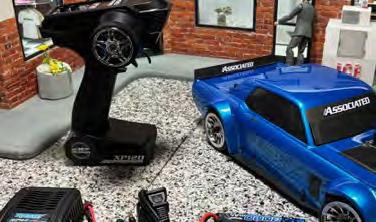
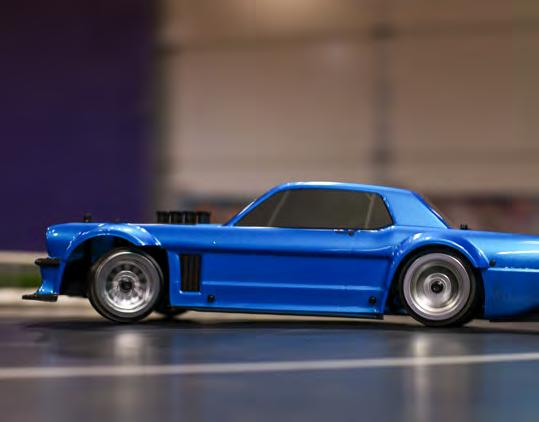
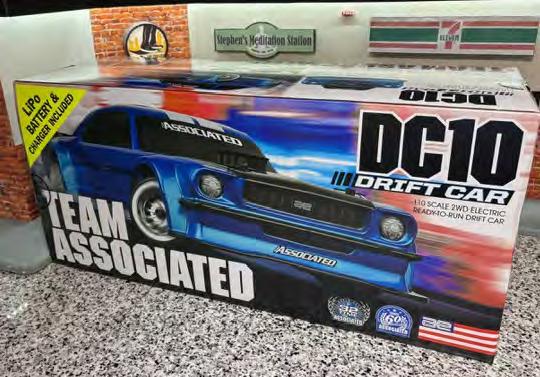
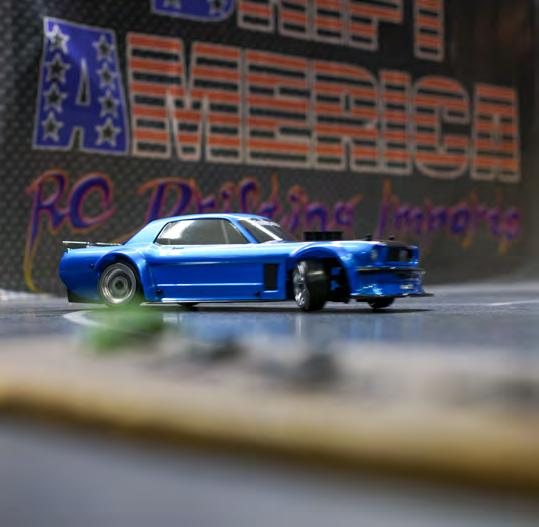
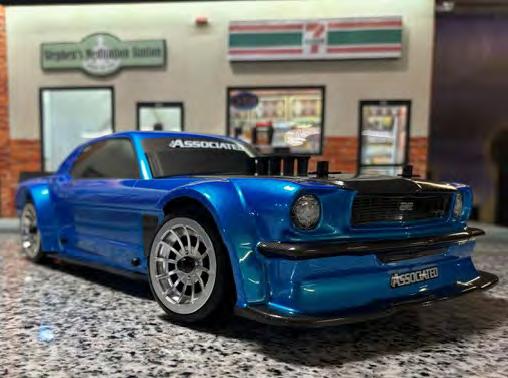
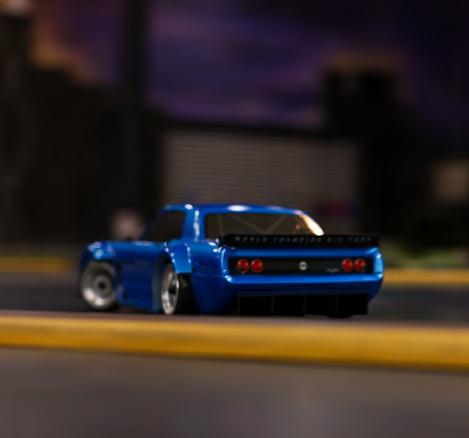
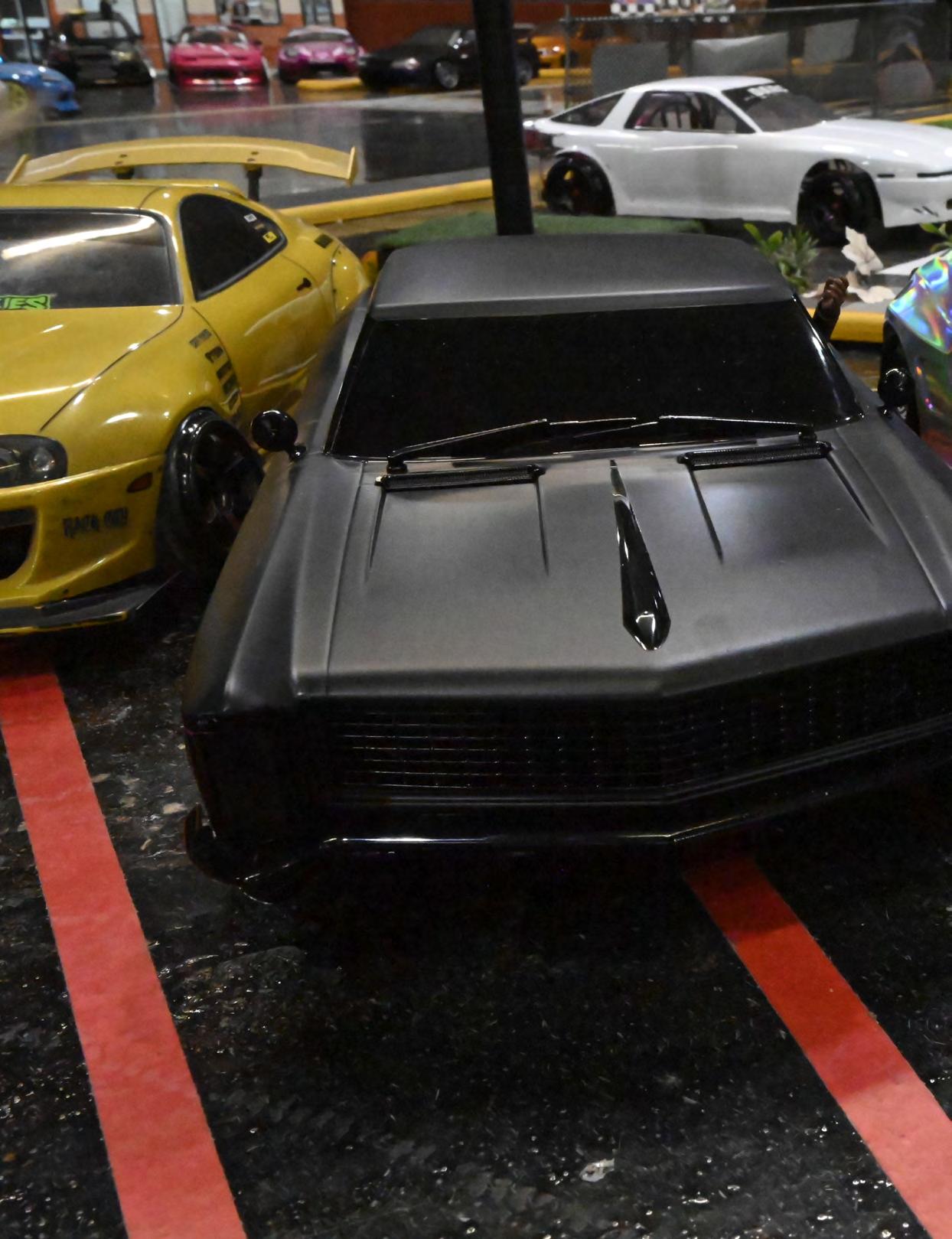
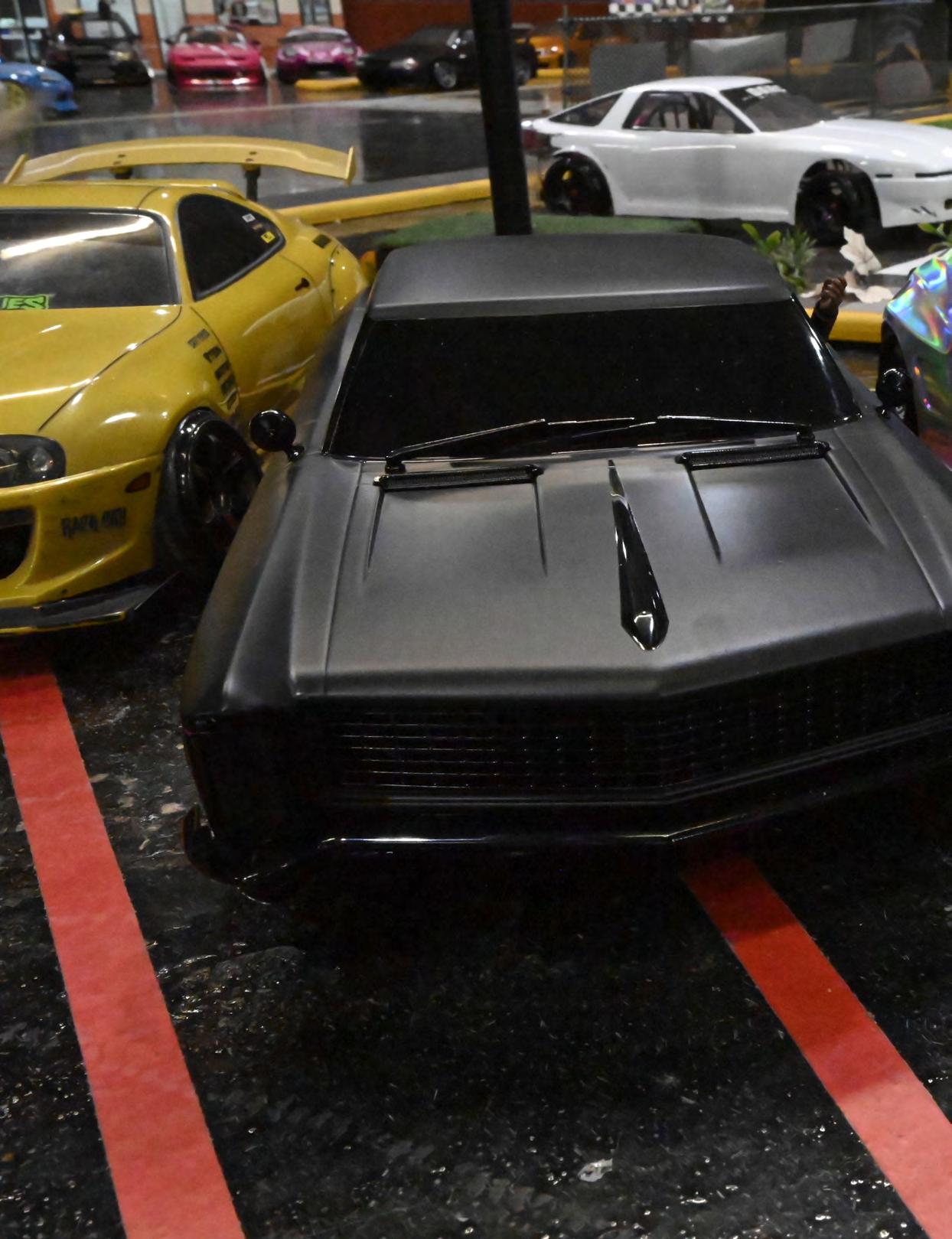
Our initial thoughts when taking it out of the box are…. It’s a really good-looking body! We’d say it’s a ‘65 Mustang, with a wide-body kit. Body measurements are 206mm wide front and rear. It looks similar to the Ken Block Hoonicorn, but it doesn’t have the hood intake or dual turbos, and it has a clean street-style look. It does come with body posts, which might be a good thing for newcomers. Magnetic mounts look clean, but they tend to pop off pretty easily during crashes. So in this case, the body posts may make more sense, especially for beginners.
After we unpacked everything, the first thing we noted was that it comes with a LiPo battery and a pretty decent charger. That’s a big plus! A lot of “Ready to Run” (RTR) kits don’t include a LiPo or give you a basic NiMH setup that you would need to upgrade right away. This setup gets you going out of the box, and that’s great to see.
We gave the car a quick once-over, plugged in the battery, powered it on, and checked to make sure everything was working. Everything seemed to be in order. Steering was smooth, throttle was responsive, and the gyro was active. No issues out of the box, which is always a good sign.
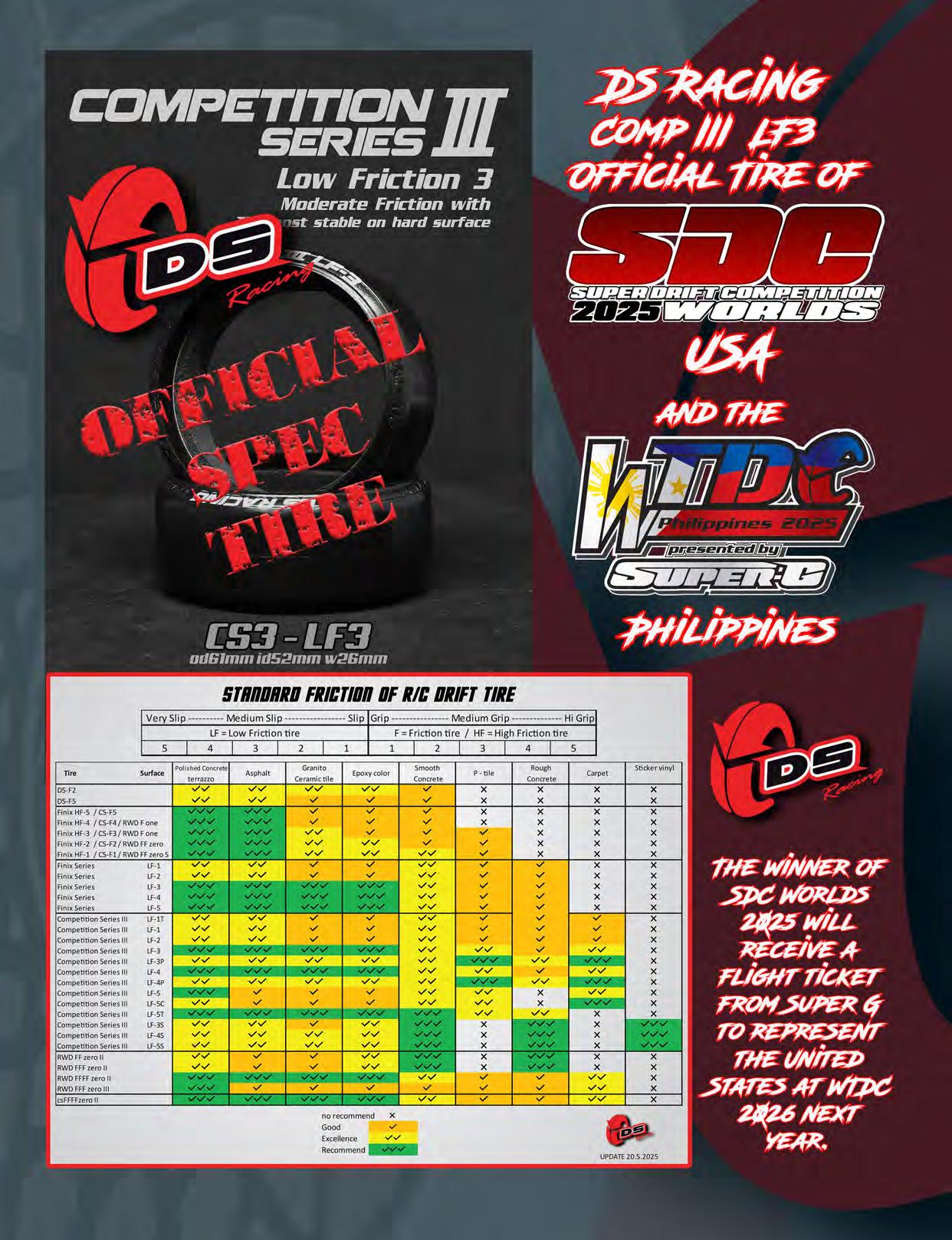
Before putting it on the track, we noticed that the stock tires didn’t look ideal for the Japanese P-tile surface at our local drift track. So we swapped them out for a set of DS Racing LF-3s, which are our track spec tires. These tires tend to hook up well and give us a more consistent feel.
On the first run, the car drove decently, not bad at all for an RTR, but it definitely felt like it needed some adjustments. We went through all the basics : camber, caster, front and rear toe. We set the front to -5 degrees
camber and 1 degree of toe out on each side. We also set the rear toe to -2.5 degrees in. This is a standard baseline setup that usually works well at our track.
Back on the track for the second run, and it was noticeably better. The car was more predictable, more responsive, and overall a smoother drive. With the gyro turned up, it handled really well. The only issue we noticed was a bit of gyro wobble, which is common when the gyro gain is set high. But when we turned the gyro down to reduce the wobble, the car became harder to drive. So it’s a bit of a tradeoff and you’ll have to find your own balance depending on how you like your car to feel. A way of working around this would be to change the steering components to aluminum upgrades. This gets rid of a lot of the play, reducing steering slop and allows you to turn up the gyro higher without causing gyro wobble. Part numbers ASC72260 aluminum bellcrank steering arm and ASC72209 aluminum steering rack, for less than $40 will do the trick.
One thing that stood out was the radio. For an entrylevel RTR, it feels pretty good in your hands. Controls are responsive, and we didn’t feel like we were being held back by the transmitter’s response time at all. That’s a win in our book.
The chassis itself felt solid. No weird flexing, it felt like good quality. The shocks are surprisingly well built for an RTR car, plush but not too soft, and they help the car feel planted once you get the tuning dialed in.
If there’s one thing we’d change, it’s the rear spool. While a gear diff is preferred, a locked solid spool is what you would expect in any RTR kit. It will work fine, especially for beginners, but it does limit your tuning options and doesn’t offer the same smoothness on transitions. That said, if you check the Team Associated website, they’ve got several upgrades available, including a gear diff and all the other goodies you’d expect from a kit-level build. So you’re not stuck, you can easily bring this RTR up to expert specifications over time.
Final thoughts - we’re genuinely impressed. This is a very capable RTR drift car, and it’s great for beginners or even seasoned drivers who want a solid base to build upon. The handling is good, the electronics are decent for the price, and the overall feel of the chassis is better than you would expect from an RTR car.
Would we recommend it? Yeah, definitely! Especially if you’re new to RC drifting or just want something you can quickly get on the track. Sure, it’s not perfect - but no RTR is. The important part is that it’s fun, upgradable, and drives well with just a few small tweaks. In our opinion, this is one of the best RTR drift kits available right now.
We’re already looking forward to throwing a few more upgrades on it and seeing how far we can push it!
Set Up Tip - Adjustments to the camber, caster, front and rear toe can be made easily. All you need is a camber tool and a 3.5mm turnbuckle wrench. It’s better to put the chassis on a setup station but the angles can be determined with a camber tool as well. Someone at your local drift track should have a setup station that you can use.
RC CAR WORLD: A DECADE OF DOMINANCE IN RC DRIFTING
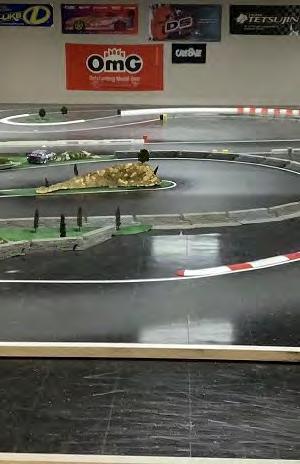
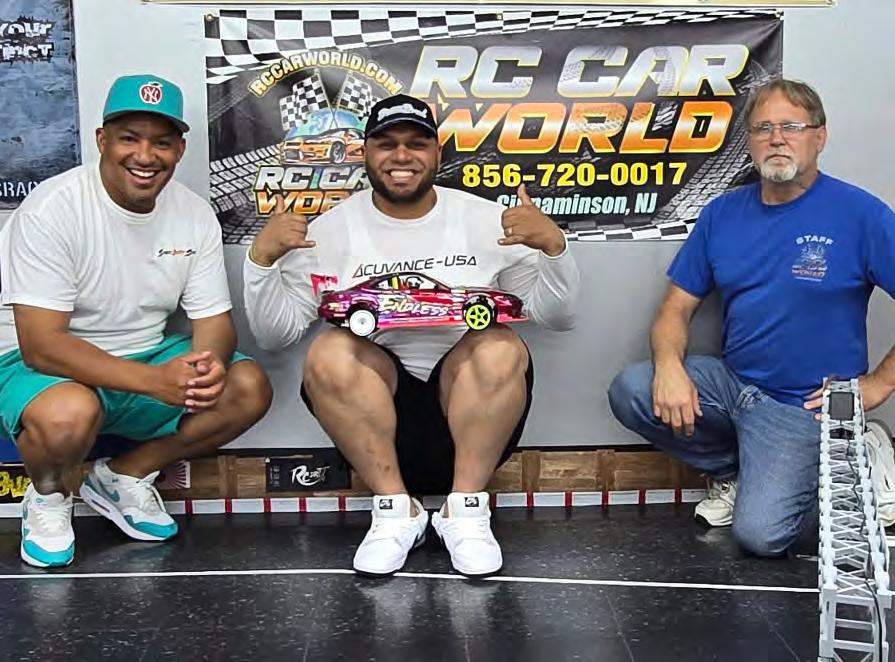
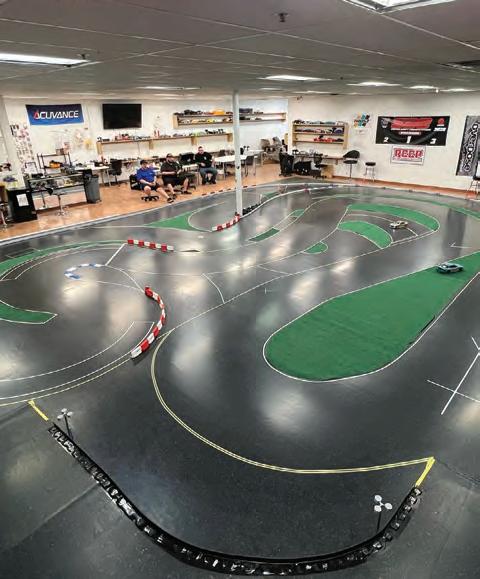
RC Car World (RCCW) isn’t just a retail shop; it’s been a pivotal force in the global RC drift community for over a decade. Since 2013, owners Mike and Gia Sienczenko have cultivated a thriving hub, evolving from a humble carpet track to epoxy, and now state-of-the-art P-tile, continuously pushing the boundaries of the sport. What began as a small local spot has blossomed into one of North America’s premier RC drift tracks, even hosting legends like Tetsujin’s Atsushi Mizunaga in its early days.
FROM UNDERDOGS TO CHAMPIONS
A pivotal moment arrived in 2019 when five drivers who weren’t well-known—including Berto Cosse, Rob Fischetti, and Alex Jordan—representing RCCW and Team Endless, descended upon the US RC Drift Championships in Houston. Against a field of top talent from across the nation, Berto Cosse emerged victorious, claiming the coveted title of US RC Drift Champion. This monumental win wasn’t just a personal triumph; it firmly cemented RCCW’s reputation on the map, drawing drivers from coast to coast eager to experience our signature aggressive drifting style and the vibrant personalities that define our community.
SHAPING THE FUTURE: THE RCCW LEGACY
The momentum continued as Alex Jordan took the helm as track curator and coach, a role in which he continues to elevate drivers and sculpt the Northeast drift scene. RCCW has served as a crucial proving ground for many prominent and sponsored drivers, who honed their skills here before making their mark nationwide. This commitment to progression led to the founding of the Scale Drift Series (SDS) at RCCW, a competition designed to mirror the authenticity and intensity of 1:1 drifting more closely than any other major event worldwide.
THE NORTHEAST’S DRIFTING EPICENTER
Today, RCCW is a magnet for top talent, regularly drawing drivers from across twelve states—NJ, NY, CT, NH, DE, MA, PA, RI, MD, ME, VA, WV—and even Quebec during intense SDS rounds. Our track becomes the ultimate monthly proving ground where the Northeast’s best vie for supremacy. Our drivers, like SDS and North American Championship (US/CA) winner Anthony Torres, are not only dominant on our home turf but also seasoned competitors on the broader international stage, frequently traveling to compete at other prestigious events, including the annual North American Championship in Quebec.
MORE THAN JUST COMPETITION: THE RCCW EXPERIENCE
Beyond the fierce competition, RCCW offers a truly unique experience. Saturdays and major events pulsate with an energy akin to a Grid Life festival, creating an unforgettable atmosphere. Expect genuine Jersey hospitality: no drama, just a welcoming vibe filled with lighthearted banter and friendly trash talk. Spontaneous challenges and call-outs are a regular occurrence. Do you believe you have what it takes to be the best? Come test your skills, soak in the unparalleled vibes, and become part of the RCCW legacy!
THEBATTLES(TSUISO)
By Steve Fujita
In the last issue, we covered the first stage of RC Drift Competitions, Qualifying. Now we explore the Battle stage, which is probably the most well known and also the most exciting.
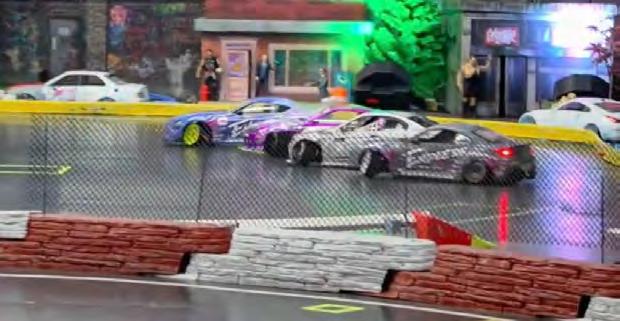
The Battles - Tsuiso (translates to Tandem Drift) - This is the second and final stage of an RC Drift Competition. This tests the competitors’ skill in both performing under pressure (leading), and their ability to chase and mimic the other driver (chasing). As with the Qualifying Stage, the judges will be closely watching and dissecting each run. The objective is to out-perform your opponent and advance to the next round.
Format - Each Battle involves 2 competitors, the winner advances to the next round and the loser is eliminated from the competition. This continues until there are only 2 competitors left, and the winner of the final round is the winner of the competition.
Each Battle consists of 2 runs. The competitors line up at the starting line, one is designated to Lead and the other to Chase, and are referred to as Lead and Chase. The runs are typically started with a starting light, starting tone, someone counting down, etc. The Lead MUST go at the specified moment, whereas the Chase can go at any time (before or after). The only limitation for the Chase is they must not impede the Lead.
After the run, the competitors trade places and run again, giving each competitor 1 Lead run and 1 Chase run. Once both runs are complete, the judges will weigh the performance of each competitor and announce a winner. In the event a winner cannot be chosen, an OMT (One More Time) is called, and the competitors will line up, and do it all again. Since the previous runs did not produce an obvious winner, those runs are disregarded as if they never happened. There is a limit of 3 OMTs. If it reaches the 3rd OMT, a winner must be called by the judges.
Lead Objective - The objective of the Lead is pretty straight forward. They must try to take the Qualifying Line and be as perfect as possible, driving deep in the zones and with the designated amount of angle (or more) while exhibiting the maximum amount of style.
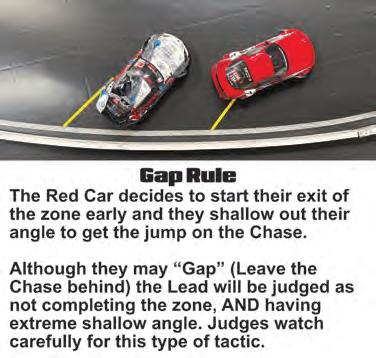
In addition to the “basics”, the Lead can demonstrate their superior skill by getting as close to the walls and barriers as possible (even touching them without disrupting the chassis), holding more than the designated angle while still maintaining speed, being smooth and consistent throughout the turns with minimal to no corrections in line and angle, and demonstrating an aggressive, confident style (this means quick and snappy transitions, and early, hard initiations with full commitment for all maneuvers). All of this is taken into account when the Leads are compared. Sacrificing Line or Angle to “Gap” (leave behind) the Chase will count against the Lead, as the primary objective of the Lead was not fulfilled.
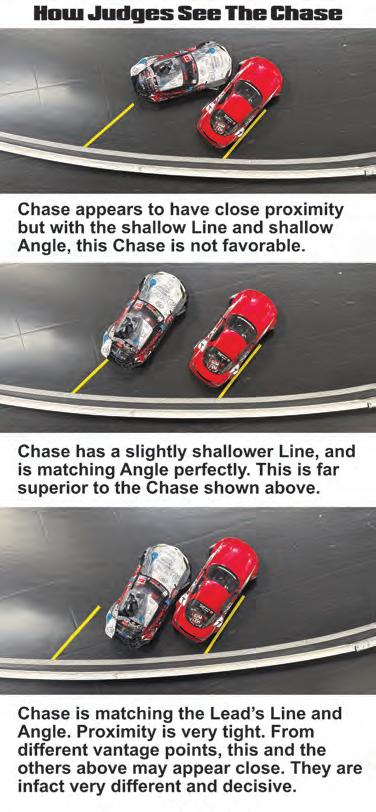
Chase Objective - The objective of the Chase is a little more complicated. The primary objective is to follow the line set by the Lead, while mimicking their angle and maintaining close proximity to them. The Chase can also display dominance over the Lead by holding more angle, being deeper in the zones, pulling off extremely close transitions while not impeding the Lead, and / or exhibiting extremely tight proximity throughout the run. Sacrificing line or angle to accomplish tight proximity counts against the Chase.
True Lead and Chase Objective - The objectives above are those according to the rules. However, the objectives go deeper than that.
The Lead wants to complete the course so well that it forces the Chase to sacrifice their Line and / or Angle to keep up, entering the zones so aggressively that it makes it difficult for the Chase to mimic and overall makes the Chase feel and appear they cannot match what the Lead is doing. This can force mistakes by the Chase as it draws them outside of their comfort zone and puts them in a position of reacting instead of applying pressure to the Lead.
The Chase, although they cannot impede the Lead or knock them off line, can apply enough pressure to force the Lead to make mistakes. Aggressively chasing, closely mimicking the Lead’s moves, being able to match their Line and Angle, and even nudging the Lead along, is enough to make the strongest Lead driver crack. Making the Lead feel as if they are not in control of the battle is really the true, underlying objective of the Chase.
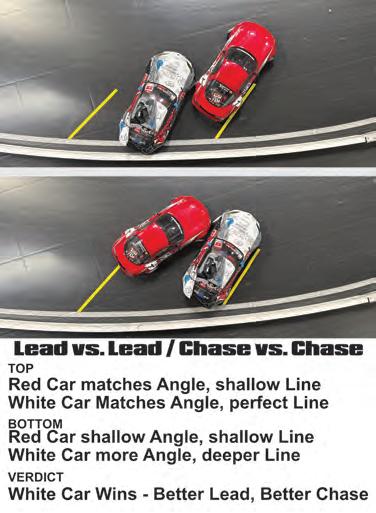
Judgement - After both runs are completed, the judges weigh the runs against each other. Typically it’s Lead against Lead and Chase against Chase. There is usually something that tips the decision one way or the other. 99.9% of the time, one of the competitors will make an error large enough to decisively tip the scales.
First question is, were there any errors that would automatically influence the decision? Did someone hit a barrier, impede the Lead, cause a collision, go out of bounds, straighten out (lose drift), etc.? If so, the call would be clear. If not, then Leads and Chases are compared.
When comparing Leads, how well did each competitor complete each zone? Was their angle matching the designated angle through the entire zone? Did they enter late, or exit early? Were there any corrections in Angle or Line? How smooth were they through the entire course? How aggressively did they drive?
When comparing Chases, how well did they follow the Lead’s line? Did they match or exceed the Lead’s angle? How was their proximity to the Lead? Were they struggling to keep up, or were they able to apply pressure to the Lead?
Within the Leads and Chases there is usually something that will influence the call one way or the other. If the Leads are close and there is a definite winner of the Chase, then the winner of the Chase will take the win. By the same token, if the Chases are close, but there is a definite winner of the Leads, then the winner of the Leads will take the win. It is a rare occurrence where both Leads and Chases are equal, but when they are, that is when the OMT is called.
I Get It, It’s Just Like Formula Drift
Formula Drift (FD) is the 1:1 (real car) leading Drift series in the United States. Although many of the rules have been modeled after FD, since these are RC Cars, not all the rules transfer correctly. Without the mass behind the cars, hitting the walls doesn’t have the same effect. The same goes for contact between the cars. Not to mention the panels can’t dent and crumble like real cars, instead they bounce. We will cover the rules of RC Drift for the Super Drift Competition Series (SDC) in the next issue of DARC Mag. - Steve Fujita
VIP LUXURY AND STYLE WITH SUPERB DETAIL: TWO-TONE PANDORA
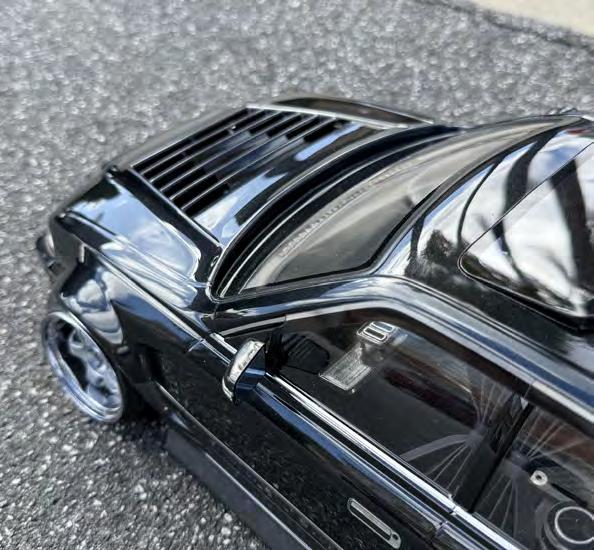
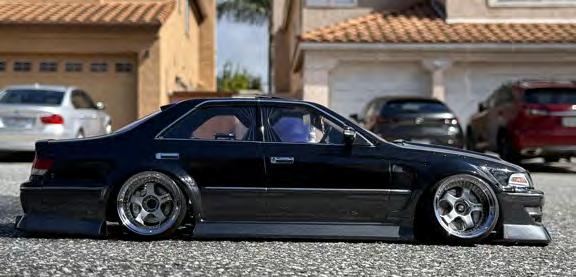
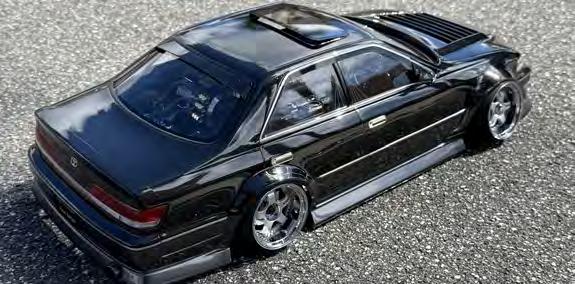
What we have here is a custom VIP style two-tone Pandora JZX100 Mark2. VIP builds have always been my thing, even from the start! Back then I was known to kill VIP builds, though it’s been a long while since I’ve built, but I took on a request from a friend. I wasn’t much of a fan of the Pandora JZX, but I wanted to throw my VIP touches to one, plus this was the body provided. I chose a pearl black base with gunmetal bottom for that OG VIP two-tone look. Added a list of details I had in mind, and somehow executed pretty well! Lots of one-off items were created in this build.
Mike Pezee - JZX100 Mark2
Can you spot all the add ons?
• LED side mirrors (Killer Body)
• Curtains
• Front and rear light buckets (DMagic)
• Dash and steering wheel
• VIP tray tables
• Sunroof tilt
• Door handles
• Roof/trunk spoiler
• Rear view mirror/ broadway style
• Front grille
• Front mounted intercooler
• Exhaust
• Removable headlight eyelids (not pictured)
• Junction Produce fusa (ETO Works)
• Handmade bumper fog buckets
• Window visors
• Hood spoiler
• Burnt tip exhaust (Yokomo)
Hachiroku - Rust in Peace
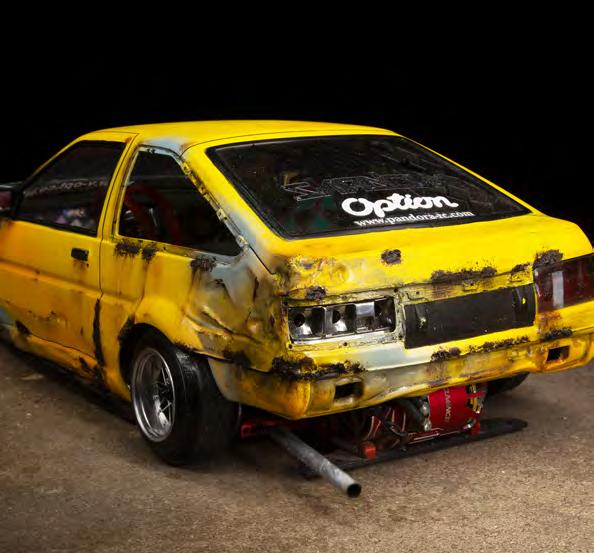
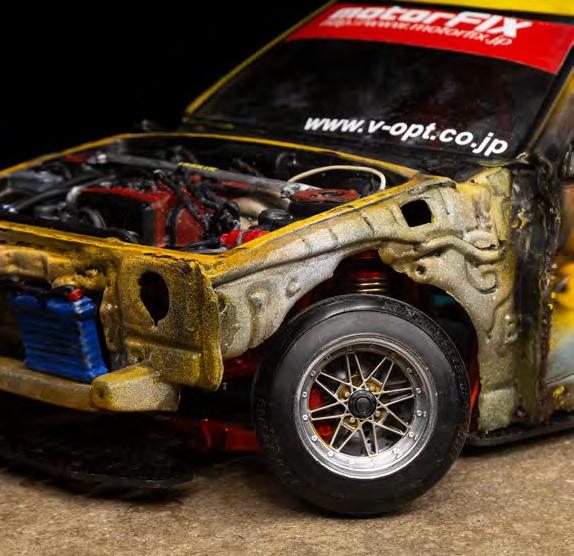
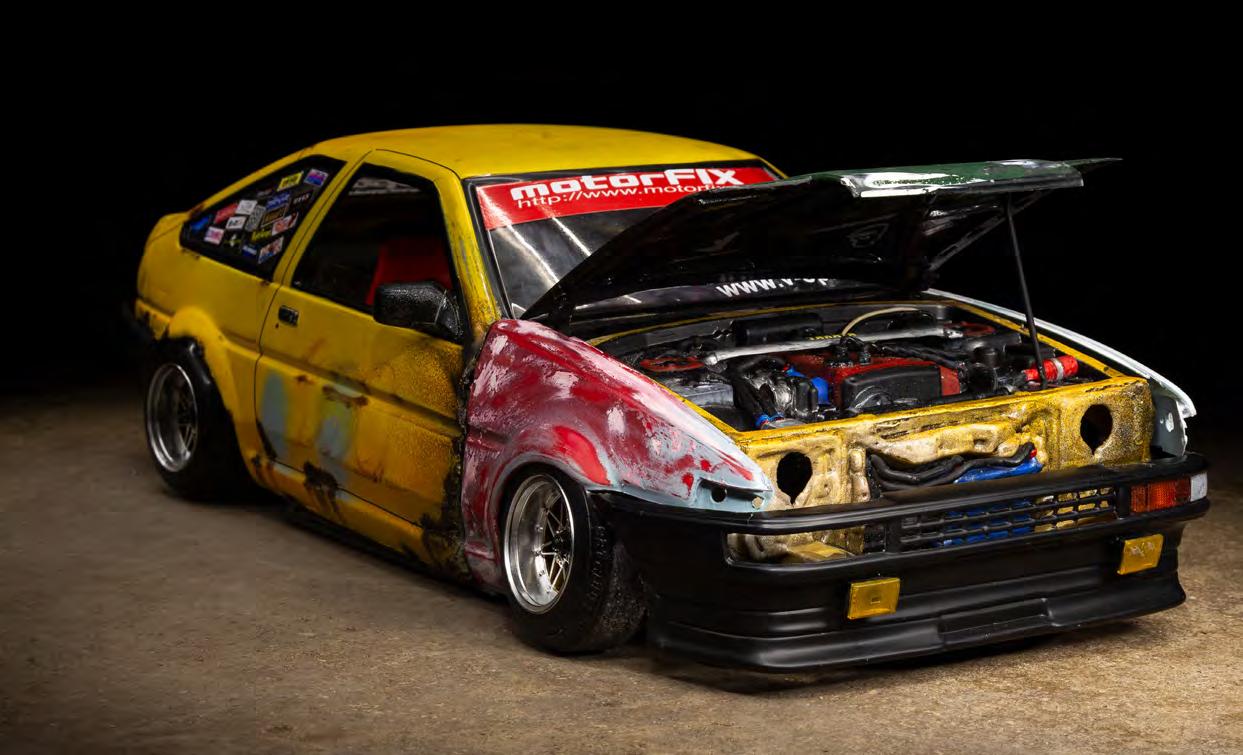
Having featured the VIP two-tone Pandora, this is a yellow Pandora AE86, whose appearance is at the other end of the scale but, nevertheless, still impressive! Weathering an RC drift build is a whole other ball game. This build features an inner fender set, which has been built up structurally. It’s the first time Matt has ever built a polycarbonate engine bay while cutting out every single piece of empty space. Other features include mismatched panels, some new and old parts, rusting detail, Scale Dynamics wheels.
Matt Youkhana - Pandora AE86
SIDEWAYS CLASSIC - The Pandora Trueno Resurrection
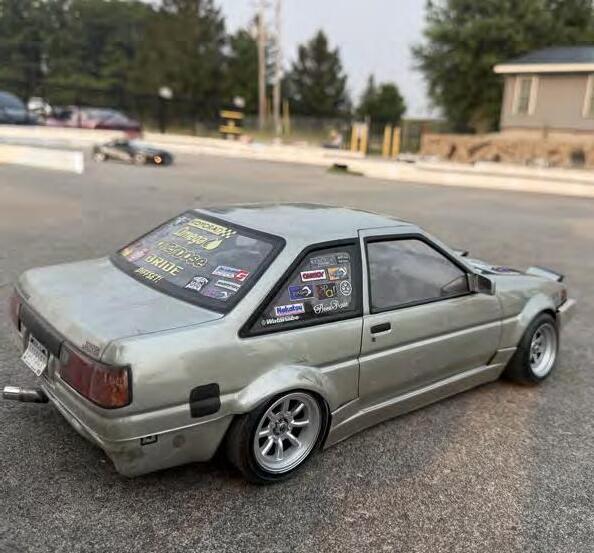
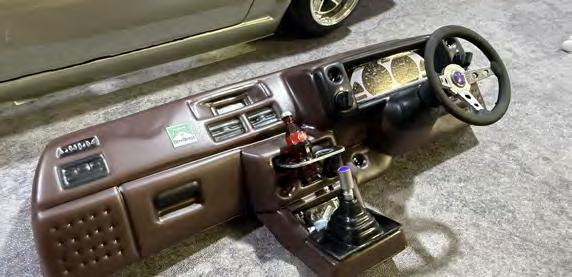
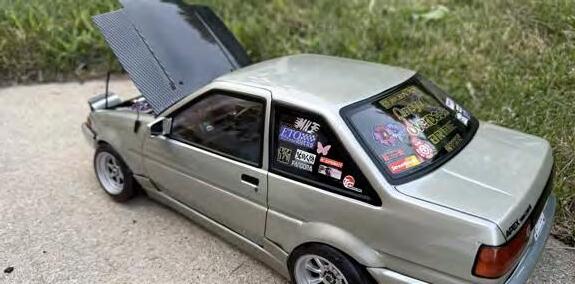
This Pandora 86 Trueno Coupe is a killer tribute to the classic AE86. Painted in rose beige metallic with a custom carbon hood, SRP mirrors, and SRP antenna for some extra detail. The Wrap-Up-Next badges, Pandora engine bay, and rear under panel really amp up the realism. Plus, there’s a custom rear lip and catback exhaust to give it that drift-ready vibe. Sitting on LP86 wheels and sporting a prototype TNG suspension (a gift from the president of D-Like), this ride looks as good as it performs on the track.
Matt Bartell - Pandora 86 Trueno Coupe
Evo-lution of A Bathing Ape
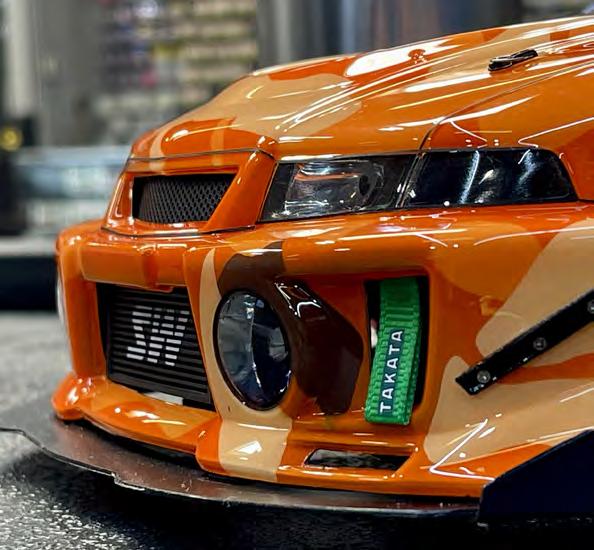
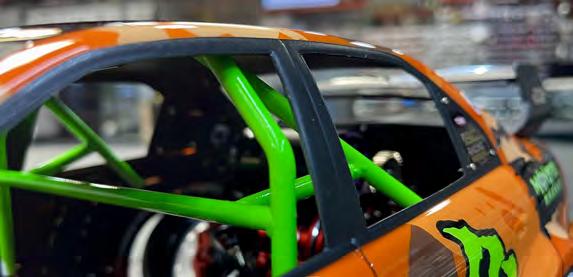
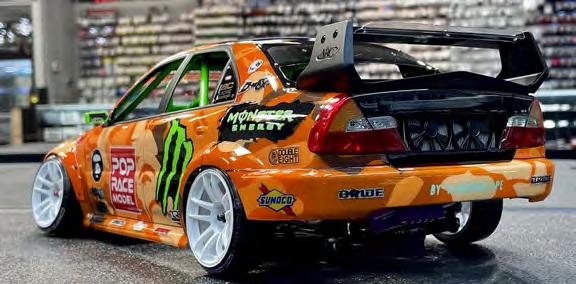
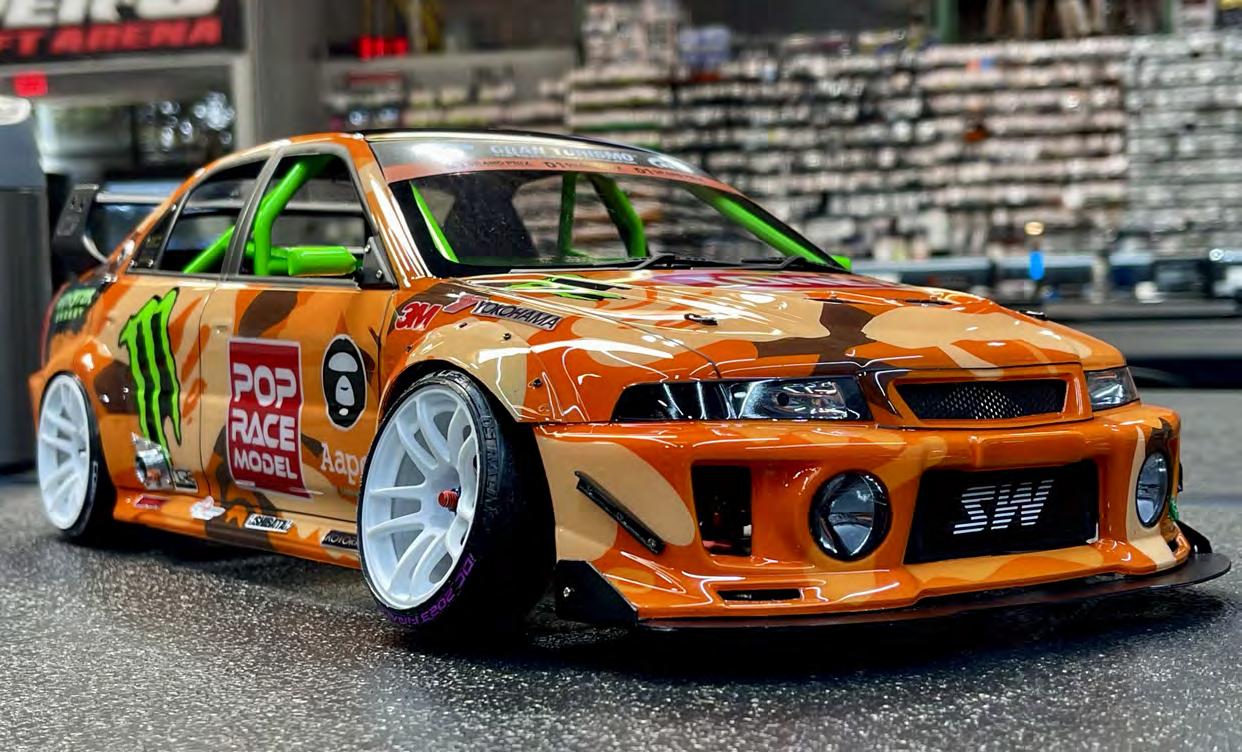
Here’s my MST EVO 5, inspired by Japan’s Team Orange, known for turning rally cars into drift cars. I followed that path, basing the livery on Daigo Saito’s BAPE design, using different shades of orange broken up with dark brown. It’s a competition-built body with full scale drift details, all functional and eye-catching, painted with Mission Models paint. The front splitter and side canards are lexan, with +9 mm Demi-Works overfenders for the wide track. Overdose Buzzbreak mirrors are fluorescent green to match my handmade styrene roll cage. The custom rear door exit exhaust is aluminum sheet and tubing, fixed with self-tappers. The stock wing gets a clear gurney flap for extra downforce, and the build is finished with Overdose Buzzbreak N820S wheels.
Josh Geeg - MST Mitsubishi EVO 5
Drift-zilla Gets Nuts!
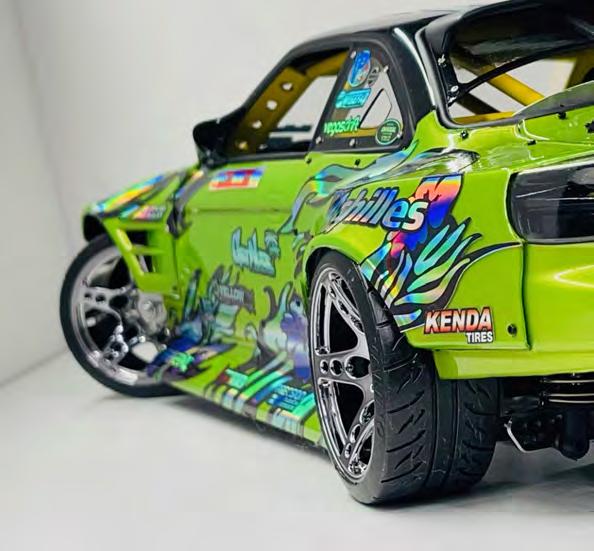
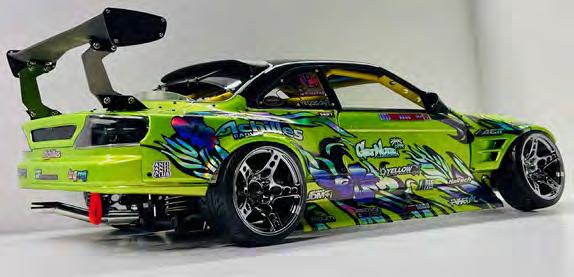
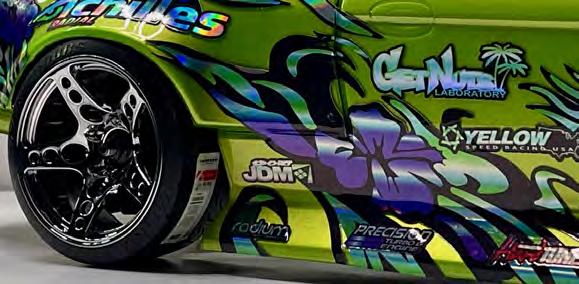
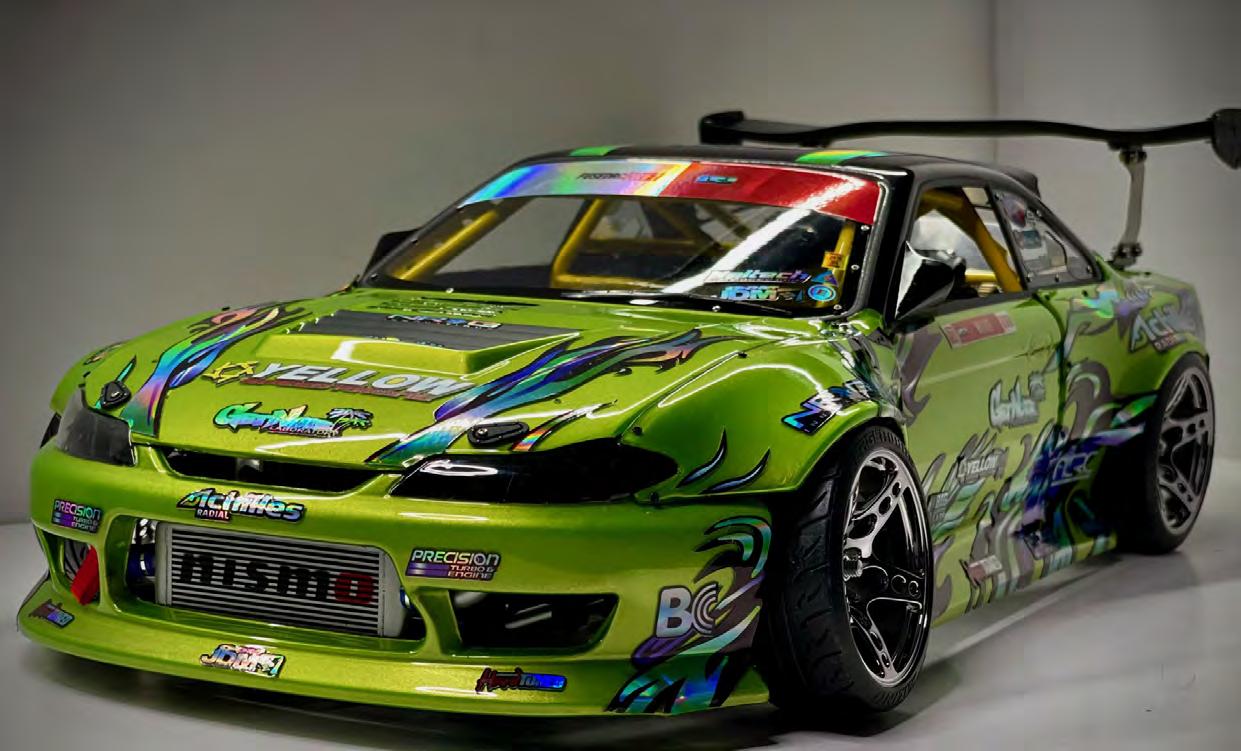
This is my 24k S14.9. The color is a mix of Mission Models pearl lime green and metallic green. The livery is a decal set by Fused RC. What makes this S15 unique is its color and detailed features. From the Japanese made ETO exhaust, to the custom made roll cage, it will catch your eye. The livery has a holographic touch to it. The rear wing was produced by Easy88made, which is no longer available. The wheels are chrome 24k HGK Eurofighters. The rear window was cut for that scale radiator cooling track look. An aluminum handmade rear window deflector was a nice touch to this build. The rear bumper was cut in half to expose the chassis and the exhaust. The front intercooler has been resin printed.
Josh Geeg - 24k Nissan S14.9
Lo-Life Hilux - Mini-Truckin’ into DARC MAG
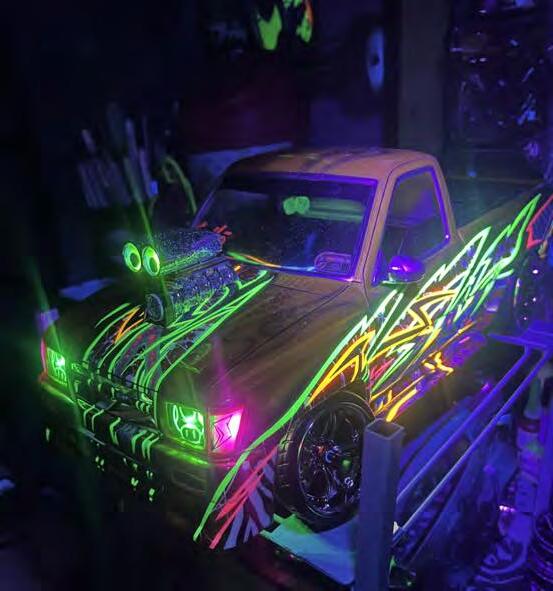
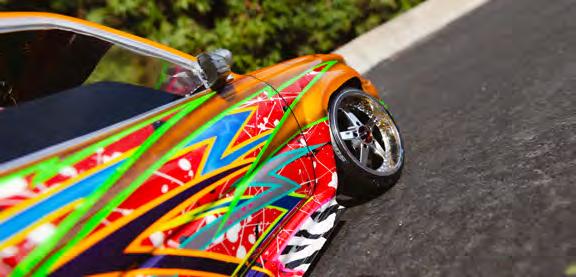
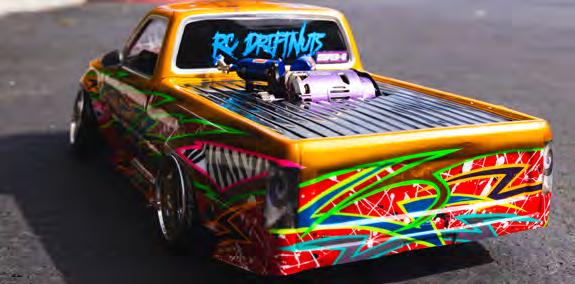
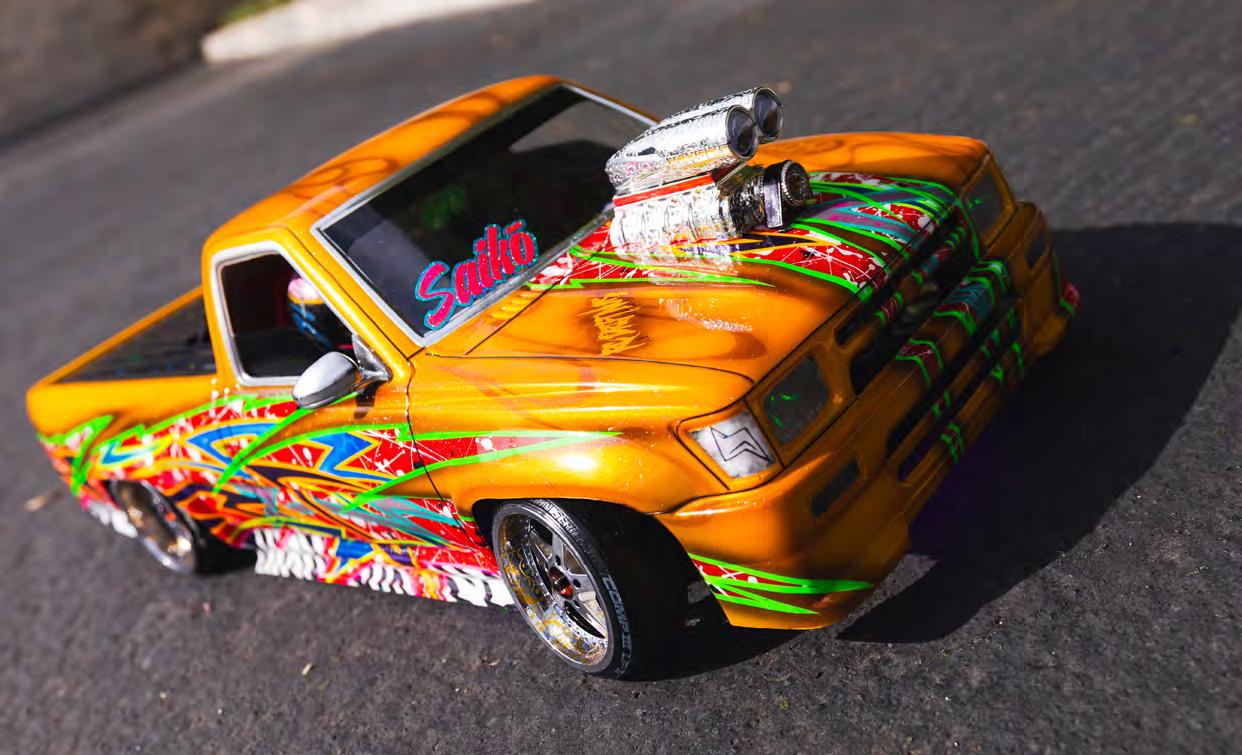
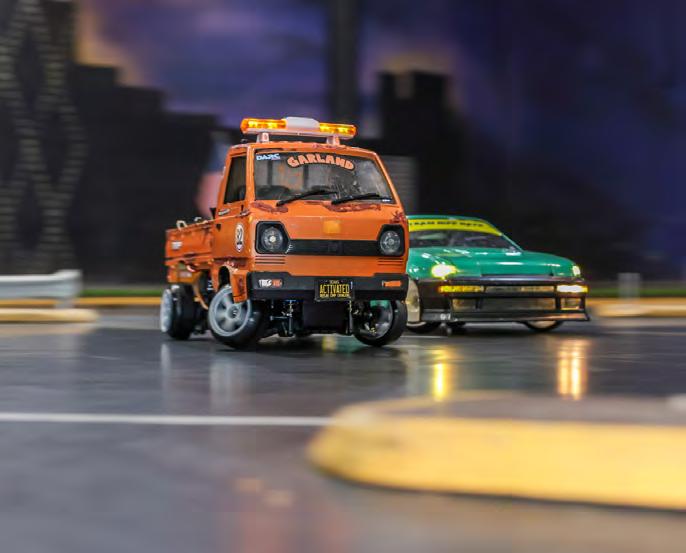
Here is a collaboration build between @RcDriftNuts (myself) and my buddy @offthegriddesigns (Jeremy). I’ve always wanted to do a mini truck and my team mates from @Notachi_Socal wanted to do an all mini truck line up for an SDC round, so that’s where Jeremy came in to do his thing. I spoke to my buddy @scalemagic and he gave me some inspiration for the lights. Each light and lens is hand made. The engraved wheels and blower were inspired by the lowrider world. Crazy idea after crazy idea led to a paint matched dash, headliner, door cards and what mini isn’t complete without glowing dice? This is what the hobby is all about, being creative and having fun. Thanks again for this opportunity to showcase our work and passion for the hobby.
Robert Benavides - Toyota Hilux
Photo by Konstantin
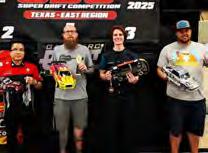
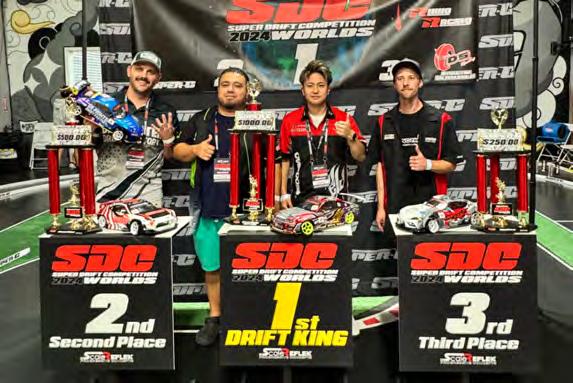
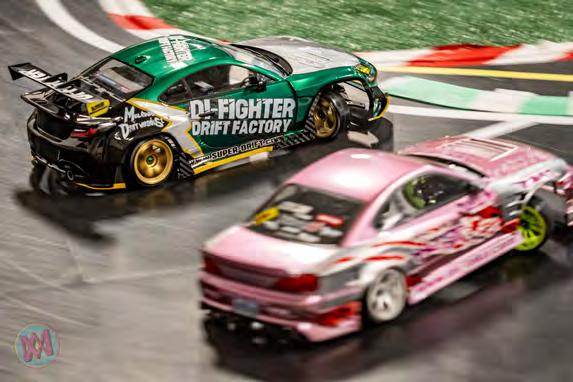
Top of the Bracket at SDC Worlds 2024 Jake Dotter in the Chase, Junior Barba in the Lead
What they’re saying You’re
As a member of Drift America RC (DARC), it’s been amazing to see this project come to life and to be part of the experience from the start.”
- Carvin Thompson - RC Cut N Paste
)
“I had high expectations, and this has easily surpassed them. I’m really excited for the upcoming issues and I expect this to grow next round! Make sure to grab one for yourself!”
- Steve Fujita - Super G
“I found myself so excited to look at it. I forgot the excitement in looking at “the new mag”. It’s been long overdue. Thank you for doing this project. I’m sure when people get their hands on it, they will be hooked.”
- Joey Tam - Super G
)
“This magazine showcases American RC drift culture like nothing has before, printed in hard copy to keep forever.”
“Such
a great mag. Need more!”
)
- Kazuki Yamashita - Team Yokomo ( )
Anthony Mileski - Drift’IN ... ride with us
- Baxter Hayes ( )
“Proud to be part of the DARC Mag movement, not just as a stocking retailer, but as an official advertiser too! Support the scene and reserve your 1st and 2nd Editions today at www.412rc.com, or swing by 412RC Inc to grab your copies in person!”
- Robert Kuehner - 412 RC
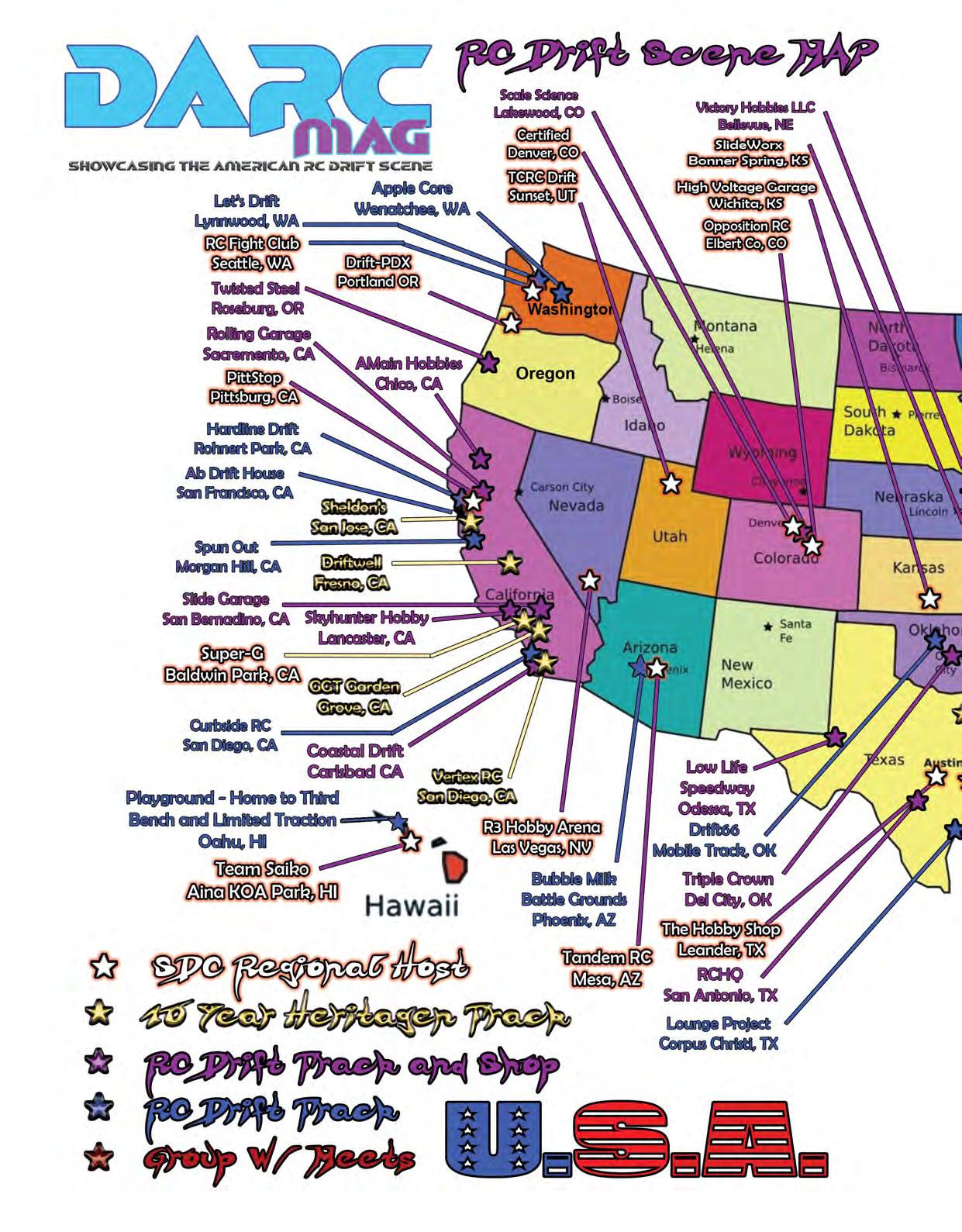
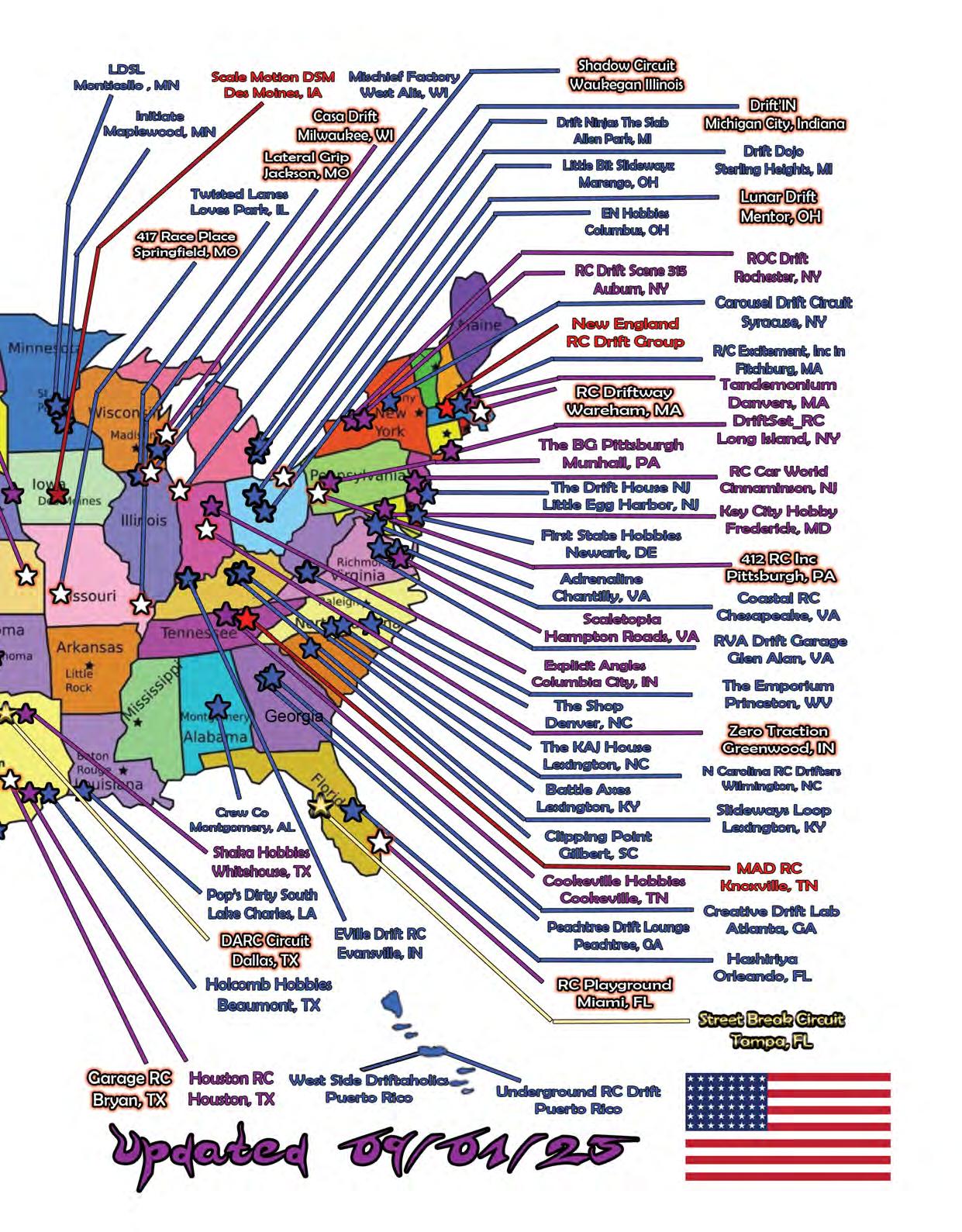
“I received the DARC Mag. I was surprised at the wonderful perfection of the product. Also, the distribution chart of drift circuits in the U.S. is very interesting. There are so many.”
“Great job with the magazine! I received it yesterday and really have enjoyed the articles and quality! It’s nice to have a magazine to read again, so much better than a screen!”
- Jeffery Ebersole
)
)
)
2025 UPDATES
Hawaiian Drift By Roy Urata
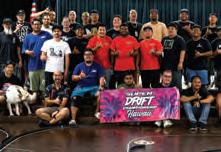
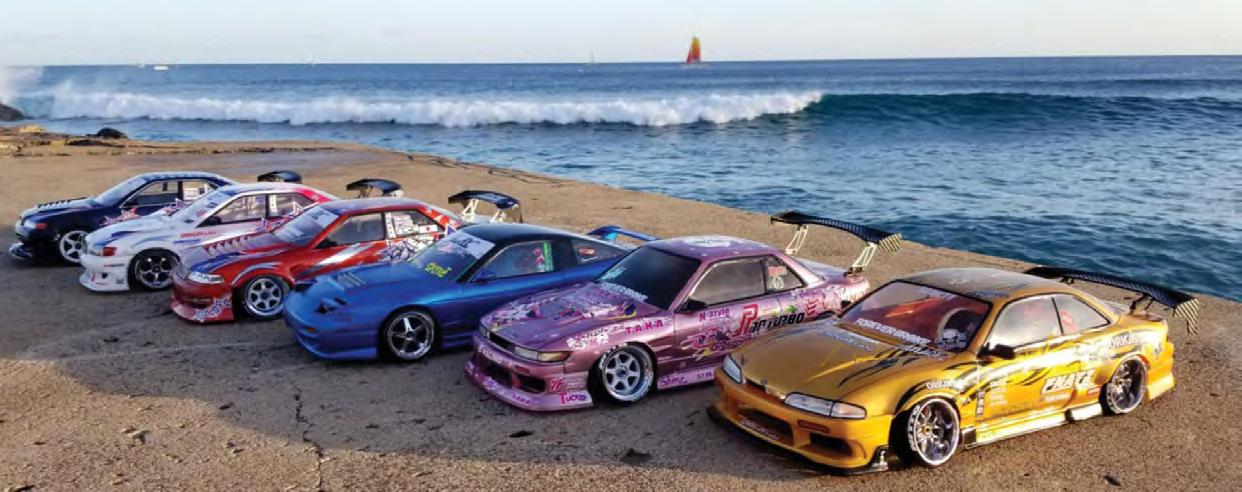
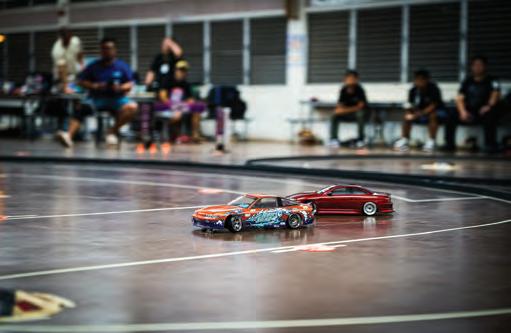
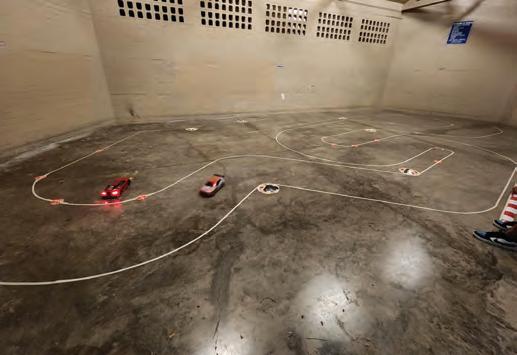
There are eight major islands in the Hawaiian Island chain, starting with Hawai’i Island, also known as Big Island. From east to west, we then have Maui, Lana’i, Moloka’i, Kaho’olawe, O’ahu (where Team Saiko is based), Kaua’i, and Ni’ihau. Currently there are no official RC drift tracks open in the state, all RC drifting takes place at public parks on polished concrete in pavilions.
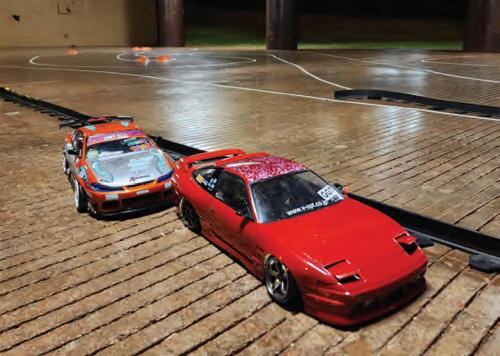
The majority of the drifting is done on Oahu, at two different pavilions, Aina Koa Park and Pacific Palisades Playground. Currently we host our practice sessions at Aina Koa Park. Due to increased park activity, it wasn’t feasible to host SDC there this time. So for this season, we are renting a school cafeteria nearby for the competitions.
The current teams are Team Saiko (my team), Limited Traction Hawaii, Third Bench, and Slide Track. The scene in Hawaii has been growing pretty steadily and there is a pretty stable number of drivers. There’s been a steady increase in the SDC Series competitors as well.
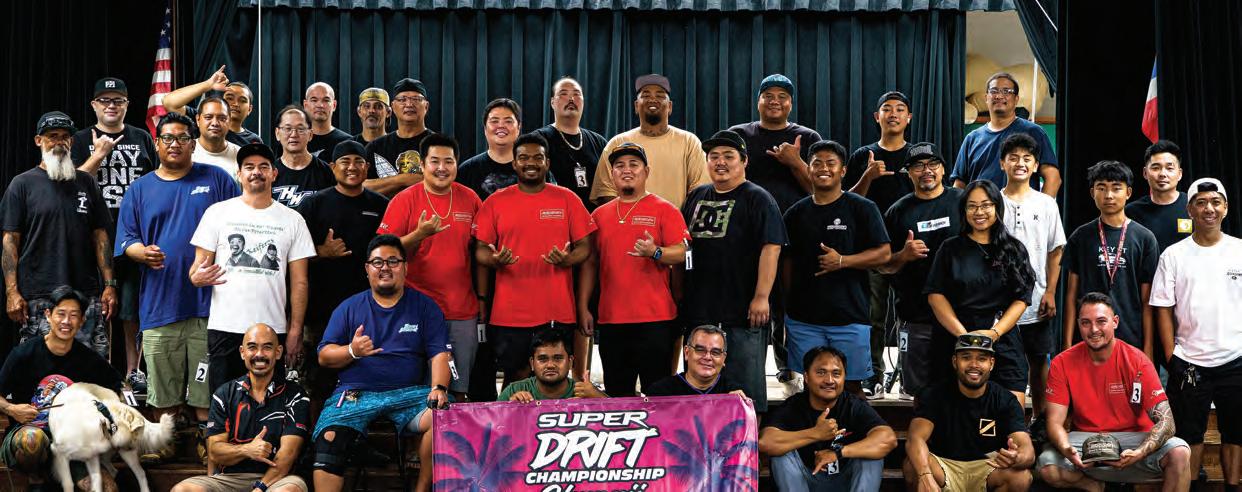
SDC Hawaii has been taking place since 2020, my wife and I being the main organizers. I don’t get to compete because I’m a judge. We take the competition side very seriously, from an organizational standpoint, putting together the best event possible for the drivers. We host SDC Hawaii specifically for the local drivers to have the opportunity to find out how they stack up against the best drivers in the country, and now some of the best drivers internationally. We try to do things to make SDC special like having merchandise for the drivers and our partners who step up to help us provide prizes for the events. We try to give back to our partners and the drivers and make it known that SDC Hawaii is very special to us. We’re very grateful to have everyone’s support.
We’ll be going back to SDC Worlds again this year for our 5th year. My favorite parts of the trip are the late night sessions. The whole event is basically a reunion for all of us from across the country. Now, with
All Photos by @johnescasa
the addition of the international drivers, we get to meet them as well. Last year I had the pleasure of meeting Rob Fischetti. Other drivers that I’ve met at different finals are Jordan Myers and Josh from Team Heartbreak, all the Rolling Garage guys, some of the newer Super G drivers, and Tyler from Scale Magic. It’s a great opportunity to get to hang out and catch up with them when we’re in town.
We have a steady flow of drivers from the mainland and international areas as well. We’ve been really lucky to have drivers from Japan, Europe, Washington State, Vegas, California, Colorado, New Jersey, and all over the country. Some drop by on their layovers when they’re headed to Japan. We’ve also had a couple notable drivers from Japan join us over the years and had a great time.
a short time and space is limited in your luggage, contact us and we’ll see if we can help you out by supplying batteries. Normal drift nights here in Hawaii are Tuesday, Thursday, Friday, and usually there’s also a Sunday daytime session. If you want to stay on the South Shore in town, but outside of Waikiki, you should check out the Ala Moana Hotel. If you want to stay a little outside of town or outside of downtown, there is a Hampton Inn & Suites in Kapolei. It’s attached to a mall and we’ve heard from some people that they like to stay there. It’s still relatively close to things, reasonably priced, and you’re not having to deal with the hustle and bustle of Waikiki.
In the future we hope to have a big event out here to give all of our friends a great excuse to come and visit us here in Hawaii. Keep in touch with us for that!
If you’re planning on making an RC drift trip to Hawaii, I suggest flying into Honolulu or to the island of Oahu. If you’re visiting for only
Roy Urata - @teamsaiko
https://www.facebook.com/TeamSaikoRC
“Getting You Started in RC Drifting”
When Troy started his YouTube channel, Roadside RC, he didn’t expect video-making to become such a large part of his life. Over time, it continued to grow and attract followers. Despite its success, Roadside RC is still a fun side-project for Troy, fueled by passion and love for the hobby. The DARC Mag team caught up with Troy following his review of the first issue of DARC Mag to find out more about his love of RC drifting.
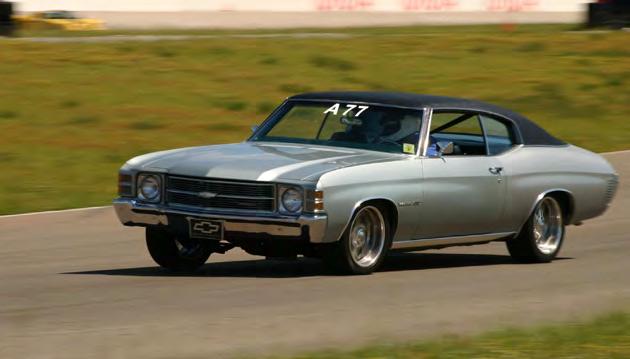
Like many folks, Troy dabbled in RC as a kid…then his interest faded as he got older. He had a 1971 Chevelle that he took to car shows, autocross, open track days, and other car culture events. But when he had kids, he decided that the pits of a racetrack weren’t a safe place for young children. It was around this time a co-worker showed him a video of a wild RC car called the Traxxas X-Maxx. This was exactly what he had always dreamed of as a kid and he knew he had to have one.
was immediately hooked by the smooth driving and challenge of drifting. “My first real drift video was all about me learning to drift. I had picked up a used MST RMX with less than ideal electronics and tune. I sat on a bucket in my garage and spent hours trying to figure out how to drift. Watching the video makes me giggle, as I was miserable. Remembering that time is what focuses me on helping new folks in the hobby. With bad information, bad tune, bad electronics, RC drifting can be really frustrating! I want to help folks get over that first frustration hurdle.”
It was the X-Maxx that pushed him to start making videos in 2017. “If you have ever owned one...they do crazy stunts that you never would have thought possible. I would tell my friends and co-workers about the tricks I was doing with the truck...nobody believed me....so I started videoing them.”
Around 2019, his friend Chris, who worked at the local hobby store, forced Troy to drive his drift car. He
There are two main things that Troy does in Roadside RC that have impacted the new RC drifters and really hit home with them. Troy explains “One is testing and reporting and the other is keeping the startup budget affordable. There is a lot of confusing information about RC drifting swirling around online. It was hard to trust a lot of what I read, so I decided to test it for myself and report my findings. When I receive messages about a start-up budget, they never say, ‘I have $5K and want to get started in RC drifting’. It is always, ‘I have $100, how is the best way to get started’. Helping these folks get started is a passion of mine.”
Roadside RC made an RC drift video series exploring what it was like drifting in the ‘real world’ (if you want to check this out, head to the video ‘RWD RC Street Drift - Train Station’). “Folks are usually protective
of their cars and refuse to use them anywhere but the track. My car was a clapped-out MST RMX, so I figured ‘Why not?’ I drifted at train stations, stores, and even a couple skate parks. While it was a horrible idea for the car, it was a lot of fun trying to see what the car could do. Sometimes we forget that we are playing with toy cars and it can be OK to have fun with them.”
Troy started out with bashing, which is basically driving the car to its limits and performing wild stunts until it breaks. “I got tired of always breaking stuff. Crawling and drifting caught my attention because there is a higher interest in performance, tuning, and upgrading. I really liked both crawling and drifting and found many other folks who cross over between the two. One advantage of RC drifting is, if your local drift spot is open, you can drift. Since the locations are typically indoors, it doesn’t matter if it is hot, cold, raining, or snowing, you can do it in any weather.”
of them as I can!”
One of the pitfalls of being a You-Tuber is that he doesn’t really have a ‘main’ chassis. “It’s tough to get a single car fine-tuned when I’m always jumping from chassis to chassis. In the last couple weeks I have been working on the Kyosho Fazer D2 and the Team Associated DC10. I also have my son’s Shark, my Redcat RDS, and a Yokomo chassis all sitting on the workbench. It’s a constant rotation of components and cars as I try things out for different videos.”
Troy is the first to admit that he’s never the best driver at any track, and he never has the best setup car. “I’m not an SDC-champion. I don’t always get it right when I test a product or provide a suggestion on how to tune. I am just a guy trying to help others. I hope that, on most days, the information I provide will be useful to someone.”
Troy’s local go-to track is Cookeville Hobbies. “It’s a great hobby store that has a crawler course and drift track. It’s a local hang-out spot, you simply come in, chill with others, and have a good time. Plus they even have an indoor crawler course at their location. I always look at the DARC Mag RC Drift Map and dream of all the other tracks I can visit. I would love to get a ‘Drift Track Tour’ going and visit as many
Having the encouragement of friends was, and continues to be, an important part of the hobby. “I am always grateful to them for their guidance and discussions. Also, the folks watching the videos I create are who keep me going. I have contemplated not making videos on many occasions over the years…but then I receive a comment from someone telling
me how much my videos have helped them get started in RC drifting and that turns it all around for me.”
PRECISE DRIFTING - POWERED BY TSM
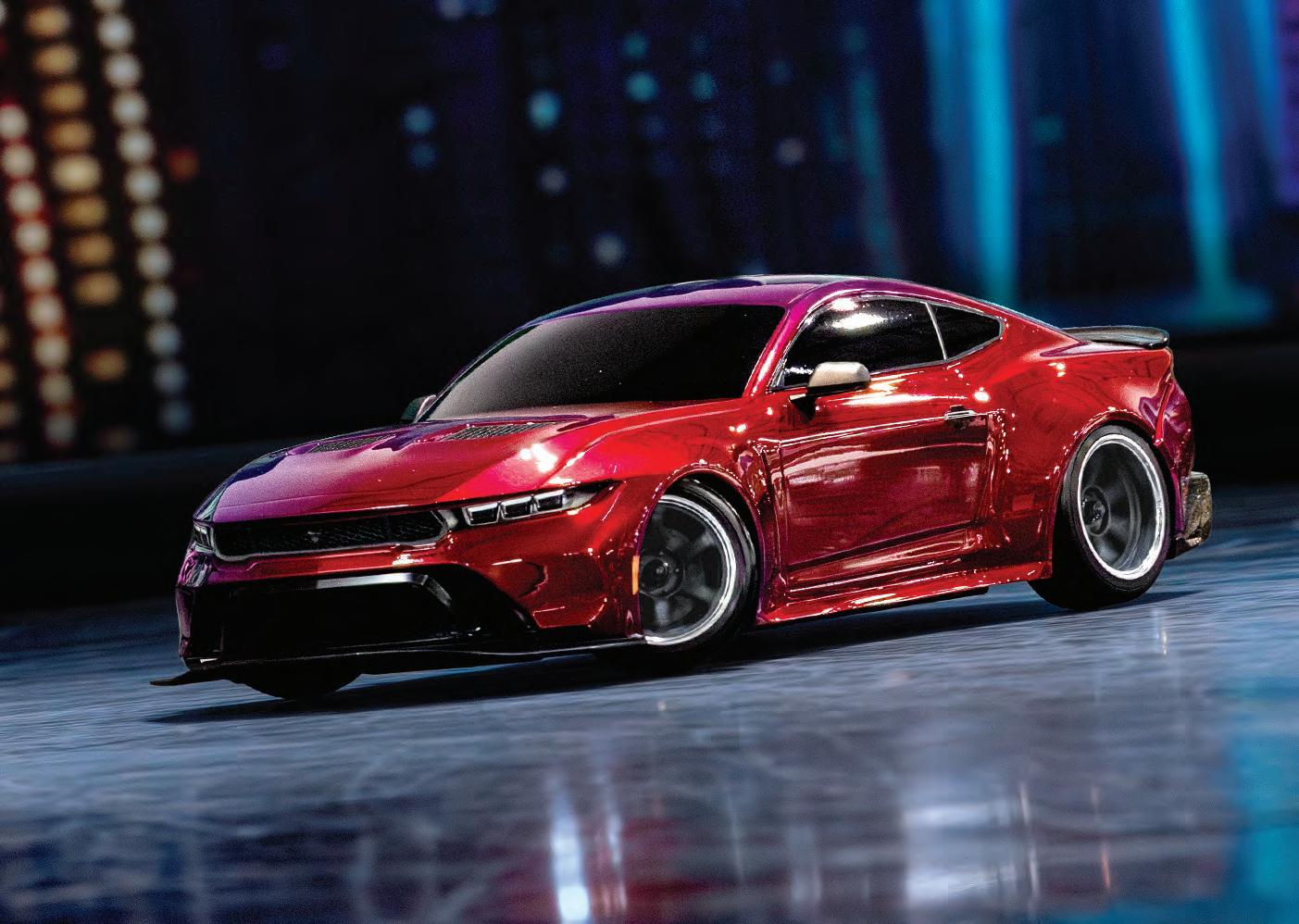
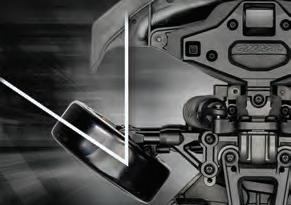
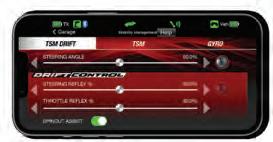
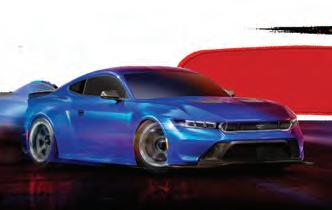
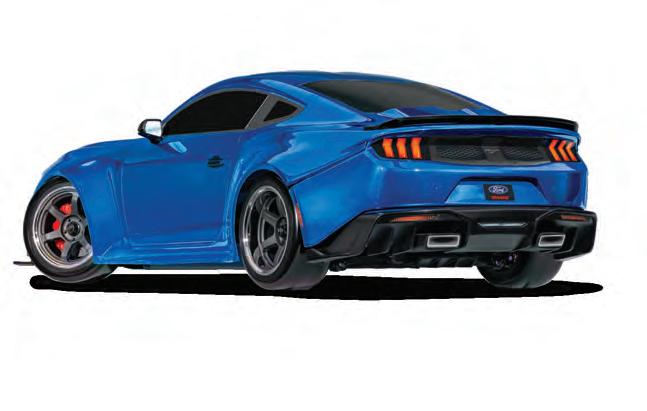
Traxxas 4-Tec® Drift delivers the ultimate experience in modern, smooth, drifting action. Advanced TSM® Drift technology makes 4-Tec Drift easy to master and endless fun on the track. Use the included Wireless Module to take advantage of three customizable and powerful drift modes in the Traxxas Link™ app for maximum control.
A new rear-wheel-drive 4-Tec 200 mm platform with clipless Mustang body features an all-new front suspension tuned for optimal drift geometry. Take your Traxxas experience to a new level with the 4-Tec® Drift.
HIGH ANGLE STEERING
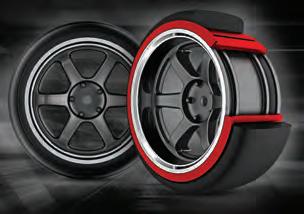
CUSTOMIZABLE DRIFT MODES TWO SETS OF TIRES INCLUDED HARD AND SOFT COMPOUND
GOT A TAMIYA YOU WANT TO DRIFT? CODY GARLAND DOES!
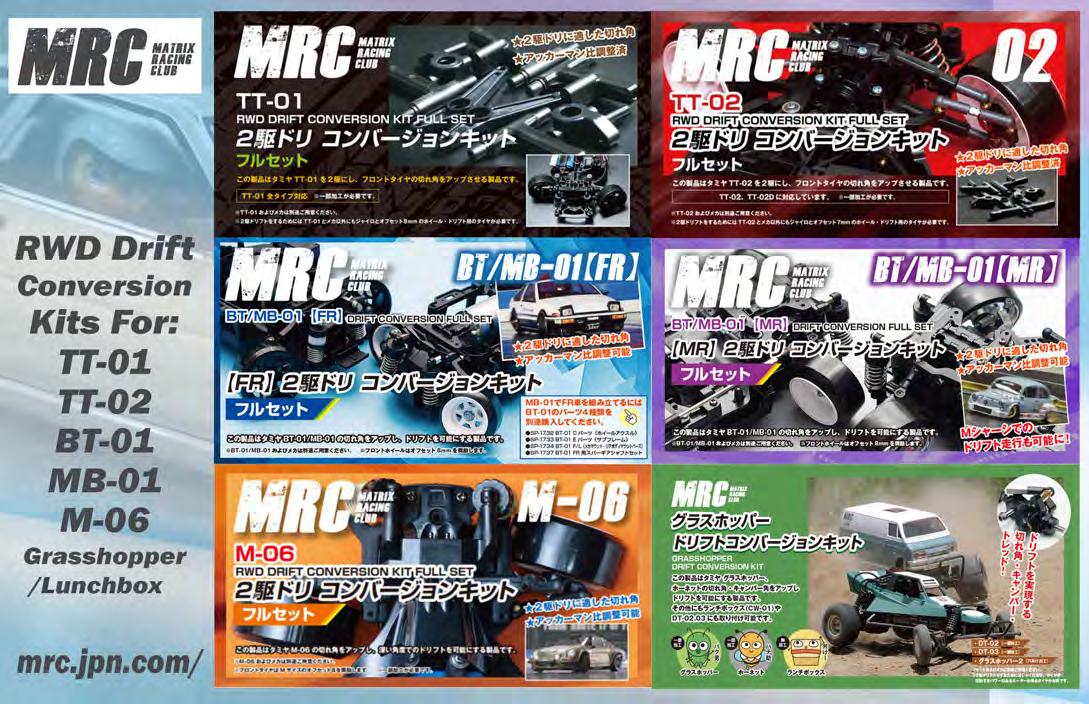
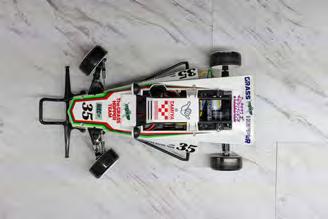
After converting one Tamiya chassis to RWD, I had to keep going and try converting them all. So far, I have converted six : the Grasshopper, TT-02, TT-01, M-06, BT-01, and MB-01. Things have gotten out of hand, I think I have a problem!
The Tamiya chassis conversion kits are made by a small Japanese business called Matrix Racing Club (MRC). They have a P-Tile drift circuit at their facility where they test their products. They have a very useful YouTube channel, which goes into detail on set ups and what is good to run with their products. They’re not just focused on competition, but also on having fun! Some drivers, such as those at Mosso Racing in Japan use Tamiya platforms with MRC products for high level competition.
The “OGs”, the TT-01 and TT-02 kits, are awesome and very popular. The MRC kits for the MB-01 and BT-01 are new to the United States.
THE GRASSHOPPER
I recently converted an old school dirt buggy, the Tamiya Grasshopper, to an RWD drift setup. I built it to MRC’s kit specs. It doesn’t have full angle like their other kits provide, but it definitely provides more angle than stock. So when it comes to drifting the Grasshopper, as long as you don’t push it too hard, it will drift very smoothly and it’s a joy to watch the front end bounce! I use a Yokomo servo and Yokomo V4 gyro in it, which makes it drift more smoothly. And it just looks too cool with the 2.2 large diameter wheel and tire combo that MRC makes. It’s definitely fun and puts the biggest smile on everybody’s face.
People in Japan are using TT-02 style shocks and springs in the front of the Grasshopper. I haven’t done that yet, as I have a feeling it’s not going to bounce like it currently does. I am going to modify the rear springs though. The Grasshopper comes with a 380 size motor and I’m planning to install a big Tamiya brushed motor. Once that’s done, the factory rear springs will not clear the new motor. It’s been suggested to 3D print a high cantilever system on the rear to provide the clearance needed. That is in the works currently, and hopefully it will make it look more like a grasshopper with its rear legs disguised as shocks!
THE TT-02
You can start with a bone stock TT-02 kit. The benefit of the MRC conversion is that is all you really need in order for it to perform very well as a chassis. The next question is what electronics to use? The least expensive way is a brushed motor and ESC, and then use a Yokomo servo and gyro. I have around $400 invested in one of my TT cars but if you opted for a brushless setup, like in my TT-02, it will cost more. With a brushless setup, you would be more in line with what people are driving at the tracks and be able to keep up with them.
I recommend keeping the kit as close to stock as possible at first, as the tuning provided in the kit is more than sufficient to learn to drift
TAMIYA GRASSHOPPER
with. After that, you can tune to whatever driving style you prefer. Some people in Japan are using Top Line lower arms in the rear with modern hubs. They achieve this by ditching the original Tamiya design rear arms, and use cups and hinge pins versus the old style. There are no rules and the possibilities are endless with this chassis.
THE TT-01
The TT-01 set up is pretty much the same as the TT-02. The only differences between the kits are the wipers and front arms, and they are only changed slightly to correct for angle. I have my TT01 set up to factory MRC specs with a brushed motor. I don’t plan on changing it much, and that’s what I like about the Matrix Racing Club. Once you have it built, it’s all about learning to drive and having fun!
THE M-06, BT-01, AND MB-01
The M-06 rear motor layout is very interesting and provides good grip, but with the MRC conversion, the amount of steering angle they have produced with this kit is tremendous. It has always drifted really well and is popular
with both old and new old drivers. It’s interesting that it has a selectable wheelbase from 210mm all the way to 239mm. MRC also has a new kit for the M-06 with a wheelbase of 256 mm and wider arms to convert it to a full-size chassis.
Tamiya also makes a BT-01 with two variants: front motor, and rear motor. Those provide 50/50 weight balance or a traditional rear weight balance car. They can be tuned for either as well.
Then there is the MB-01, which is almost the same as the BT-01 platform, it’s just shrunk down to a mini chassis, AKA M-Chassis.
Some bodies, like the VW Bug and BMW 320I, only come in the 210/225/239mm M-Chassis size. The M-06 and MB-01 give you the fun advantage of being able to run different bodies from what everyone else is running.
FINAL THOUGHTS
All six conversion kits are great but I still keep going back to my original TT-01. Close second is the M-06!
The main advantage of the MRC Tamiya conversions is the ease of building. The manual isn’t available in English yet, but you’re able to build from the well documented pictures, plus there’s always YouTube and Facebook. I can think of some “plastic fantastic” style chassis in a similar price range, rolling chassis compared to rolling chassis, I would go with the Tamiya MRC Conversion. They are also producing a lot of new carbon fiber parts for most chassis kits. At the end of the day, it’s about how you want to go about doing it. Personally, I have more fun building and converting Tamiyas than I do building higher end kits. That’s why I stick with MRC Tamiyas.
TAMIYA
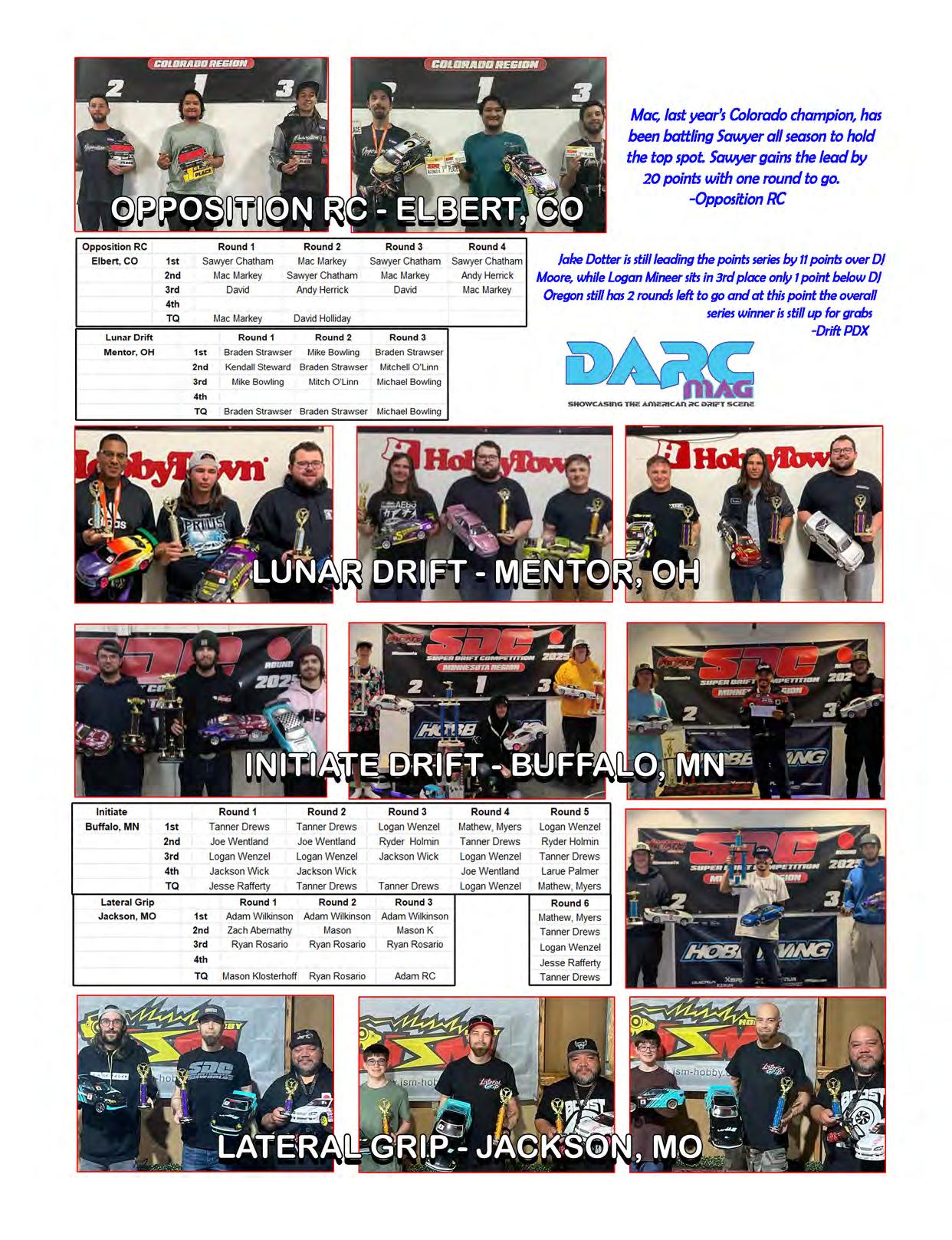
Jake Dotter has dominated the Oregon SDC Series two years running. With strong placements in the 2025 season and a 4th-place finish at the SDC Worlds in 2024, Jake has become a foundational figure in the Pacific Northwest RC drift scene.
Adam: Jake, tell us a bit about yourself.
Jake: I’m an autobody tech with 18 years in the trade. I’m based in Vancouver, WA but originally from Forest Grove, OR. Outside of drifting I enjoy snowboarding, hiking, camping, traveling, and Disneyland.
Adam: What teams and sponsors are you affiliated with?
Jake: I’m sponsored by D1-Fighter and Maclan. I’m part of Midnight Suns, Team PDX, and D-Style.
Adam: What chassis are you running?
Jake: My main setup is a D1-Fighter conversion based on a GRK Evo2. I like center motor cars because they look and feel right (see Chassis Showcase for full details of Jake’s rig).
Adam: Any new tech you’re experimenting with?
The Interview Featuring Jake Dotter
by Adam Mah of RC Drift Talk Podcast - YADMAH
Jake: I’m currently playing with the Acuvance Merv-Era motor. It allows me to add weight back to the car in another spot that can benefit. This is only because of my GRK 5R having the motor inline and mounted up pretty high. By saving weight up high, I’m able to put more weight down low and on the rear of the chassis. This helps with kickout and adds additional pressure on the tire, creating grip. The only reason I was even interested in this motor was because of how much I enjoyed the small D-Like motor. The Merv-Era Acuvance has adjustable timing, so it seemed like a good fit for me.
Adam: How would you describe your driving style?
Jake: Fast and aggressive. Meihan-style. I hit corners with speed and flick the car hard. My entries are intense, but I slow mid-corner to stay in control.
Adam: What’s your home track?
Jake: Drift-PDX in Portland. Day passes are $20. My go-to food spot nearby is Satellite Tavern. If you’re flying in, PDX Airport is just 15 minutes away.
Adam: How did you get into RC drifting?
Jake: I resisted it at first because I was focused on rock crawling. But some crawler friends were drifting between runs. Eventually, I bought a YD2S RTR and cleared my garage for drifting. We learned together as a group. That support made the hobby so much more fun.
Adam: What sparked your love for full-scale drifting?
Jake: Riding in a friend’s SR-swapped 240SX in 2006 did it. I bought my own 240, swapped the engine, and never looked back.
Adam: What 2025 events are you excited about?
Jake: I split them into Matsuris and comps. The Matsuri I look forward to every year is The Model Hobby Expo in Monroe WA, hosted by RC Fight Club (RCFC) and Rain City Raji Con (RCRK). It’s like a family reunion for all the Pacific North-West drivers. I help to host
“Drift 2 Death” at Drift-PDX in the new space. Come hangout with us for 50 hours straight driving if you can!
For competitions, I’m continuing with the Oregon SDC rounds. I’m going to SDC Worlds 2025 at Super-G, which is always a fun event where I get to see everyone from around the world. Also, the IRCDF finals (I judge the Oregon series), and Cross Games in Texas. I can’t wait for that one.
Adam: What are your goals?
Jake: In 2025, I’m refining my style and taking more risks. In 2026, I want to hit as many major international events as I can. This includes the SDC Worlds (the big RC Drift Competition for America), IRCDF (International RC Drift Federation), TDC (TDC originally stood for Thailand Drift Championship, then it was hosted outside Thailand and changed to WTDC “World Tournament Drift Championship”), RCDC (RC Drift Championship Japan), COT (Clash of the Titans) and maybe the UK finals. I want to travel with my tiny car, meet new people, and be an ambassador for the hobby.
Adam: Who inspires you?
Jake: Drivers like Jordan Meyers, Adam Hokoki, Mikko, Vittorio, and Matt Timmer. They combine aggressive driving with amazing style. Also, paint schemes and livery designs really fire up my creativity.
Adam: Do you have a biggest rival?
Jake: Honestly, everyone. The talent level has skyrocketed the past two years. It keeps me pushing harder to improve.
Adam: Who would you like to Tsuiso Battle?
Jake: Junior Barba from Texas. He knocked me out at SDC Worlds 2024. I got nervous and blew it. I want a rematch.
Adam: What track styles do you prefer?
Jake: Fast transitions and big entries. I love tracks that flow well and allow for big trains and backies. Layouts should let people drive long laps without bunching up.
Adam: You are a big component to track design at both Drift PDX and the car shows that we attend, what type of track features do you typically include?
Jake: The tracks have to flow so that everyone can stay tight. You need a long straight to gain speed before the long sweeping corners. You should be able to throw the car hard and float out to a wall. A tight switchback mid track helps get people excited mid lap and keeps people driving longer. The goal is to see cars on track and people laughing and chatting while driving. I like to put zones in dangerous spots to create excitement or absolute chaos.
Adam: What supplies do you recommend for a garage or pop-up track?
Jake:
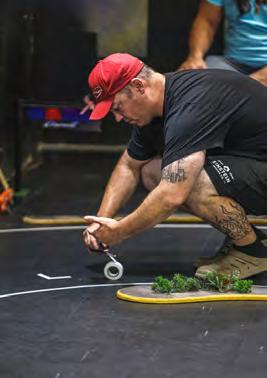
¾ inch paper tape (for layout design), Uline tape for clean lines, garden edging or bricks for barriers, Nobori flags, grass patches, fake plants, extra bodies for detail.
More detail means more enjoyment for everyone.
Adam: Shout-outs?
Jake: Neal Sauter, Alexander William, and Lance Cornelius. Without them, I wouldn’t be drifting. They pushed me to get into it and helped launch Midnight Suns. We created a local scene that’s grown tremendously. A ton of friendships and opportunities came from their efforts.
Follow Jake on @jake_dotter Follow Adam on @yadmah
TEAM SPOTLIGHT
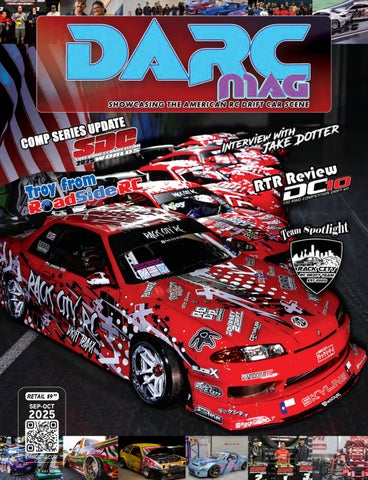
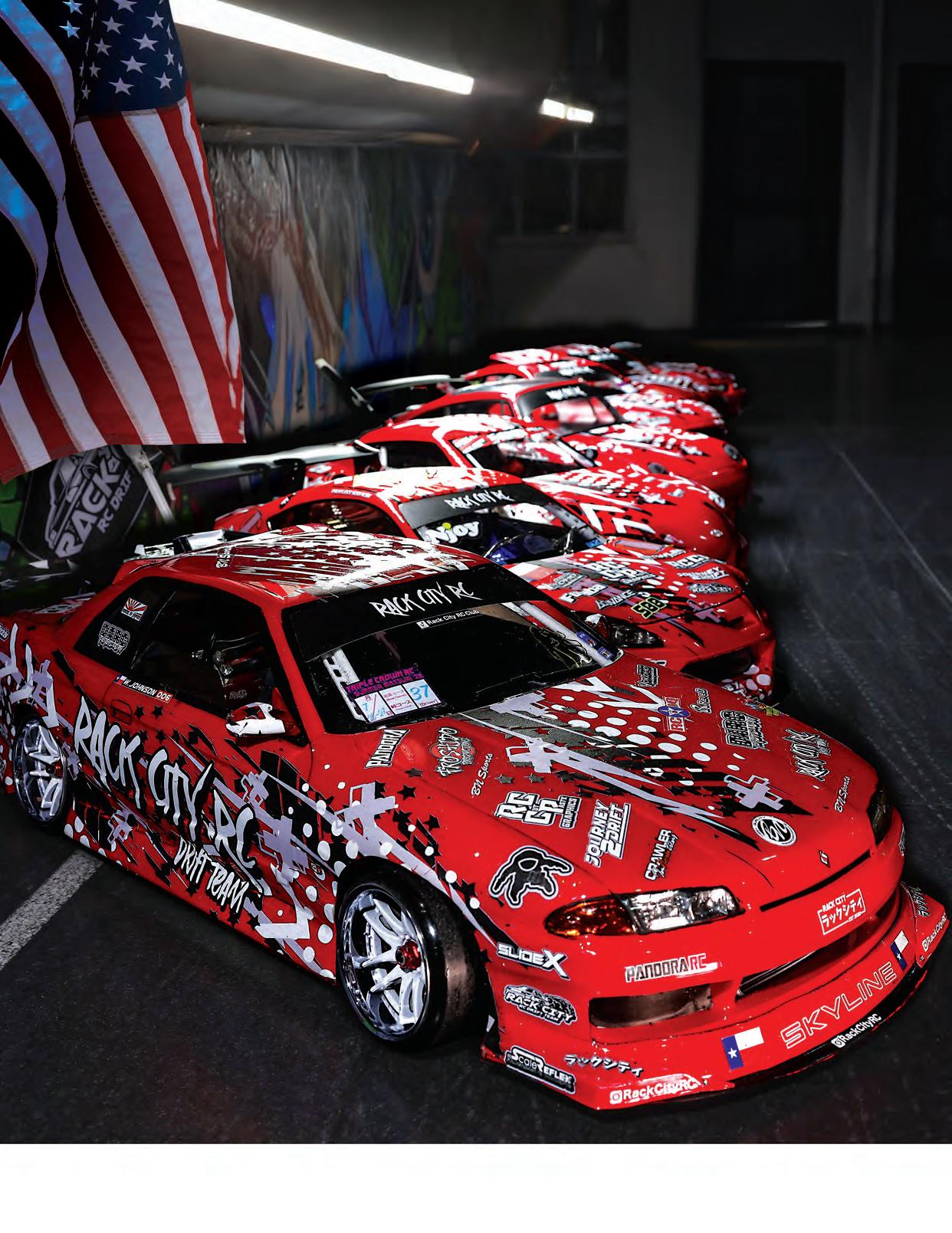
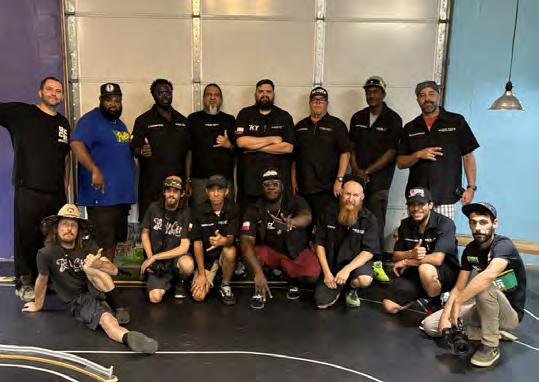
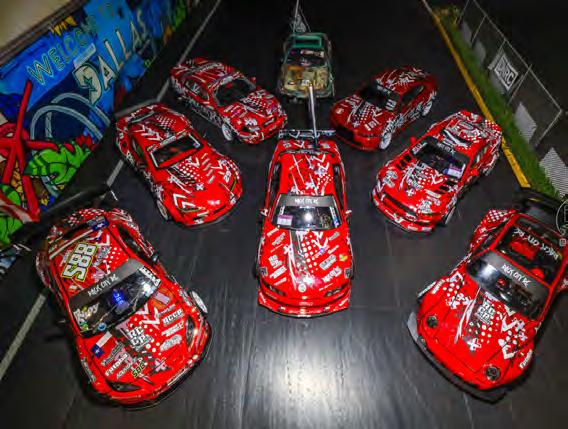
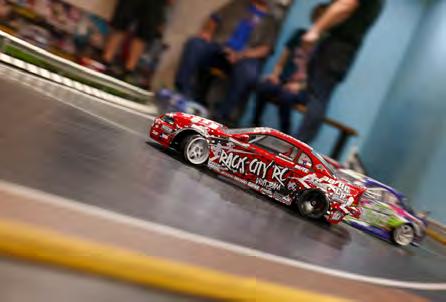
Rack City RC Drift
RC drifting is the only RC hobby that forms such organized teams to drive together. Matching bodies, matching liveries, team track days, and team group chats make team life the way to go for RC drifting. This squad pulled up back in 2020 and has been a huge part of the scene ever since. As they add to the team, the Rack City tandem train continues to grow. DARC Mag met with the Rack City RC Drift Team to hear their story and get an in-depth look of what team life is like.
Rack City started unofficially in August 2020 and just celebrated their 5 year anniversary. The group members wanted to get into RWD RC drifting but couldn’t find anything as “all of the RC drift websites looked sketchy.” They would meet up as often as possible at each others’ houses, basketball courts, and parks to drive their cars. Eventually, they started meeting every week at an old Walmart parking lot. Carvin’s (one of the members of Rack City) first introduction to RWD drifting was through Taylor V. Having met Taylor to tune his Sakura D3, he found out that a local track, DARC, was reopening soon.
“Waren, TK, LaDarrin and I visited DARC on the grand reopening day, it became our home track and the rest is history! After being exposed to the hobby, we saw all the other teams on social media and we just
We named ourselves Rack City because of all the money we were spending!”
There are officially 20 team mates, from Dallas, San Antonio, Corpus Christi, and Ohio. Each member brings a certain vibe, skill set or quality to the group. “We never appointed a captain but Waren became the face of the team. He was the best driver and posted regularly on social media.” ‘Mad Mike’ Vadenbroader is always pushing against the grain and has something interesting cooking in his mad scientist workshop. He believes that the main benefit of having a team is camaraderie. Mike explains, “We know when each other is going to the track so we can hang out together. Because we drive together so frequently we know how each other drives, so we can predict what others will do and it leads to epic tandem trains. Plus, with team members spread out across the state or even other states, no matter where you go to slide, there’s a high probability of being able to slide with a teammate.”
Carvin is in charge of graphics, plus organizing and coordinating the team, he keeps the energy real and positive, bringing the artistic creations. He adds, “I love competing with my team mates in comps. Either way, Rack City advances.” There are 2
JJ’s on the Team, one from Dallas and one from Corpus Christi. “I like driving with JJ (from Dallas) to test my speed. Mike’s car is well rounded and it will show me where my car lags. I like driving with Waren to help be more disciplined with my lines and angles.” Carvin also points out, “One of the perks for Rack City is that I own RC Cut & Paste Graphics, so we can bring our ideas to life.”
Although there are advantages to team life, it can be hard too. “Trying to coordinate track days can be a tricky process. Deciding on liveries and designs, and working around different schedules and budgets can also be challenging. We’ve also had several teammates quit or leave the hobby.” Despite being sponsored by RC Cut & Paste Graphics, they would welcome further sponsorship and collaboration with other RC companies.
“We’d love to make partners and relationships with manufacturers and producers in the hobby.”
“We respect each others’ time, money, and individuality. We don’t add pressure on one another to participate in projects.”
When approached by people wishing to join, the team operates a vetting process. “We feel a potential teammate for character and all around coolness. You can’t have a bad rep. If tracks and groups have banned you, you probably won’t get in. It’s important to demonstrate a profound love and dedication towards the hobby. Wanting to improve your skills is a must, whether it’s driving, tuning, painting, or competing. We don’t like quitters.”
John “JJ” from Corpus Christi, joined Rack City in 2023, “It was a no brainer when it came
to joining. The best thing about being on the team for me is driver confidence. When you see a driver with a Rack City livery, even if you barely know them, they are your RC family. You know you can tuck in on them and get exhilarating laps. Joining the team is the best thing I’ve done in my RC career and I’m stoked to see how we will grow.”
Lucky has been RC drifting for 5 years, 3 with Rack City. “I met the guys at a ComicCon and then at a car show. I was invited to join the team, it’s been awesome traveling around representing Rack City and Texas. We’ve drifted at a private track with the Driftaholics in Puerto Rico. We try to make it to Las Vegas every year to drift with the guys out there, the drivers are top notch.” Other highlights for the team are Fuel Fest and SDC Worlds 2024, where JJ from Dallas was on a winning streak.
The main goal of Rack City RC is to enjoy the hobby and have good times with their friends. They aim to represent the drift RC hobby in a fashion that promotes its growth throughout the U.S.A. and to inspire others to join the hobby. In the next five years, they would like to see that the team has grown with the hobby, and to be a well respected and recognized name in the RC drift world. We hope that they will encourage more people to get teams organized and tell their story in the future.
Follow Rack City on Facebook or Instagram @rackcityrc.drift
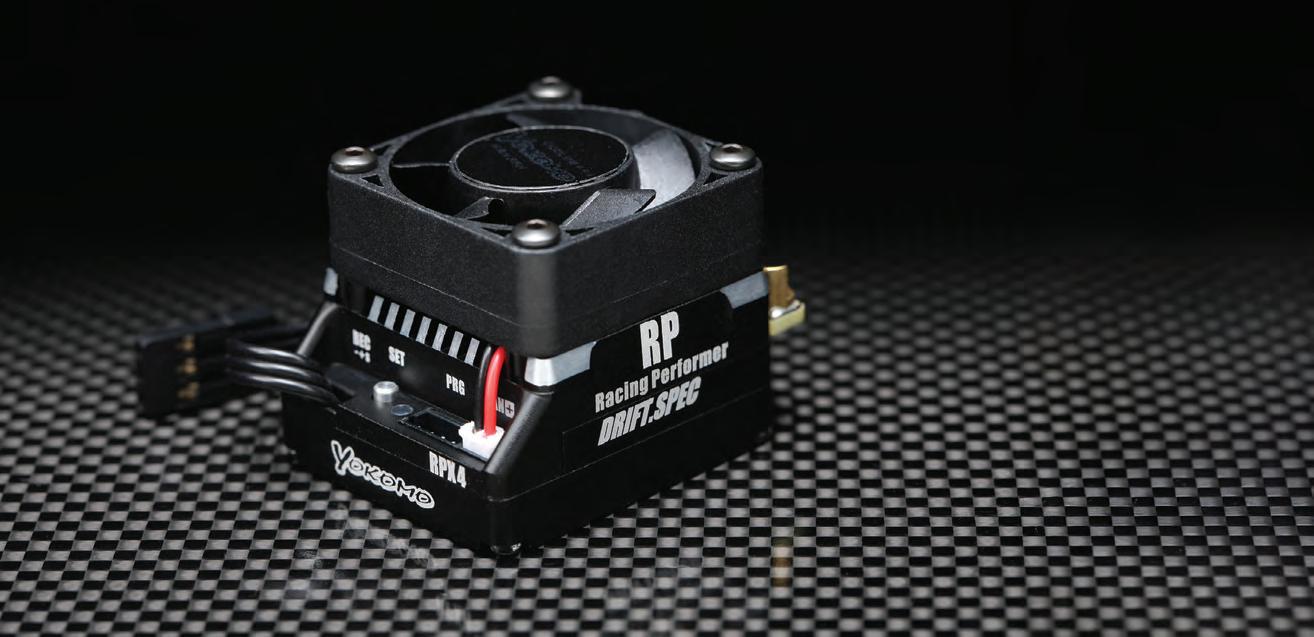
The RPX4 speed controller combines the power of the RPX2 with the ease of the RPX3. Featuring advanced power MOSFETs proven in racing, it delivers maximum stock motor performance and easily tames modi ed motors. Pre-set programs optimized for each category make setup simple. Available in black, blue, red, and purple.
*Compatible with BL-R26P programmer ( rmware update required).
MDR-030 END OF AUGUST!
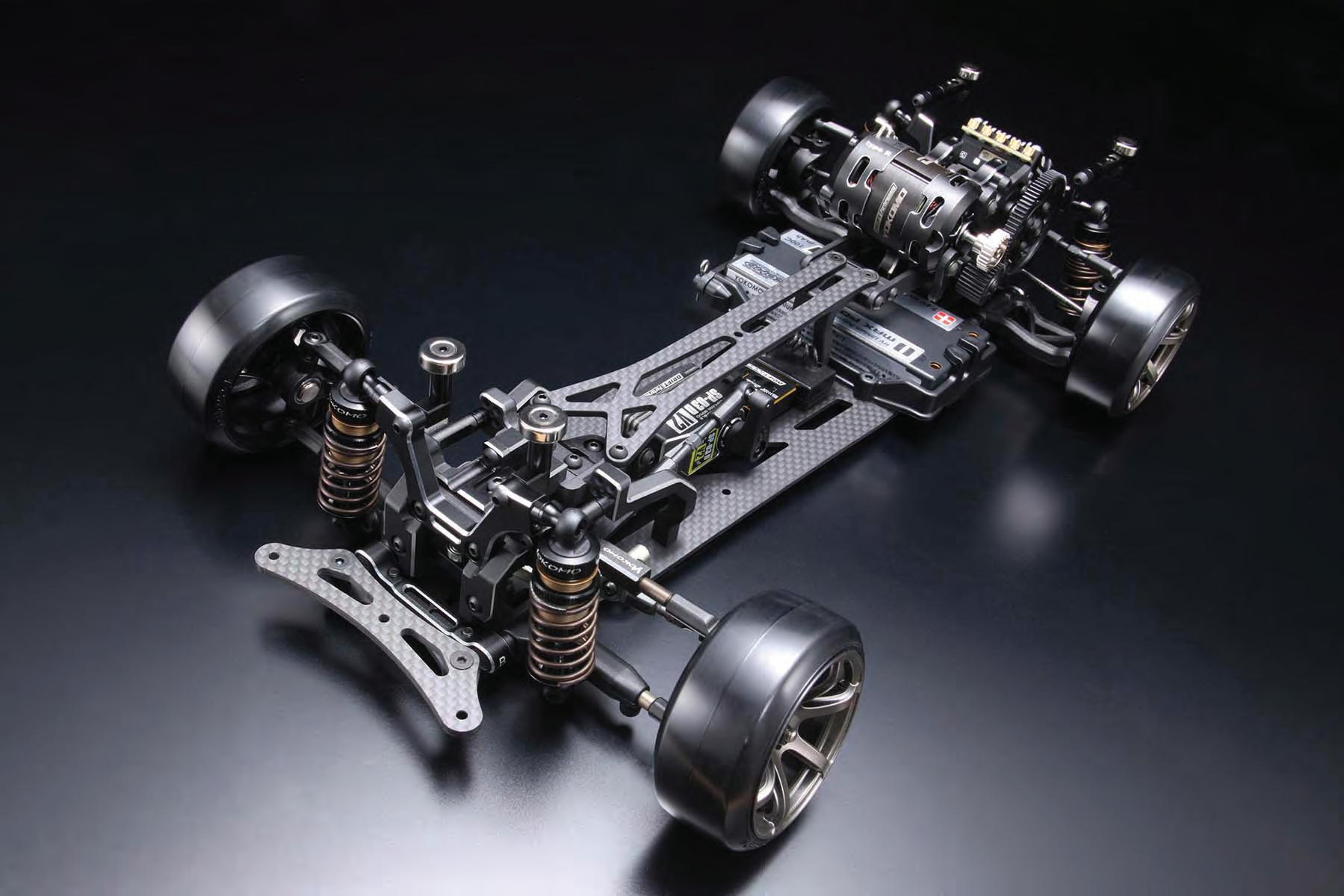
Master Drift MD3.0 108,000JPY
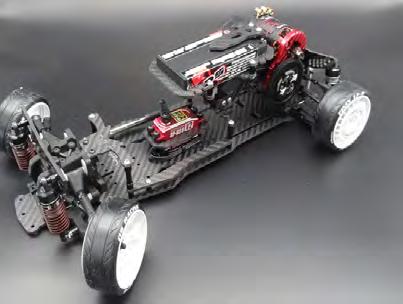
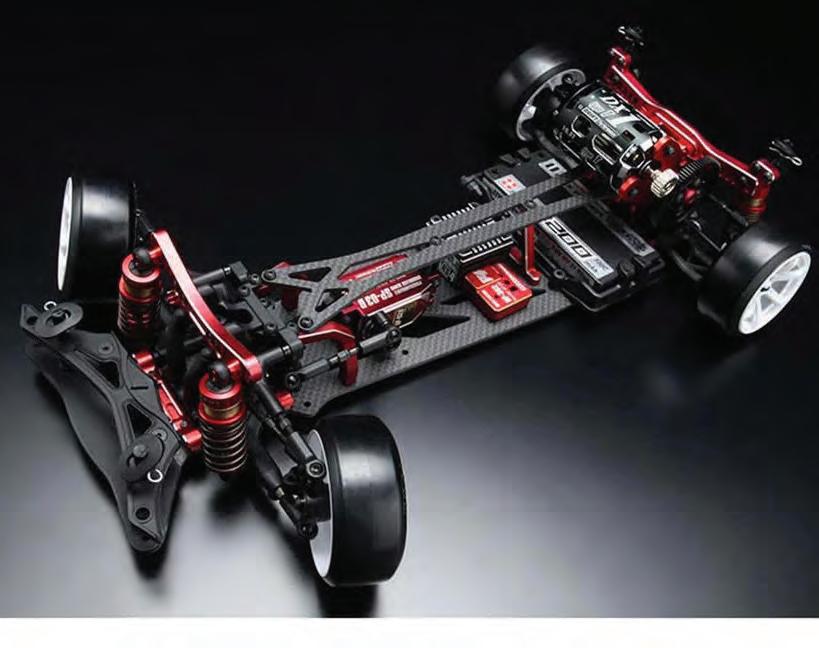
The MD3.0 is the new agship competition machine, featuring an innovative rear belt drive for smooth launches and a direct, responsive feel. Its high-pitched drive sound and sharp pickup evoke a multi-cylinder engine, while increased front-end rigidity boosts corner-exit control. Suspension pin-type H-arms come standard but can be swapped for traditional MD series A-arms, with more options expected. Standard nish is black, with limited blue, purple, and red anodized versions available.