T H E
M A G A Z I N E
O F
D I V E R S
A L E R T
N E T W O R K
ALERTDIVER SOUTHERN AFRICA
THE GREAT WHITE WAS HERE! SCUBA OPERATOR CHOICE | SPEARFISHING SAFETY | THE SAFETY PARADOX | BEYOND THE RESCUE | CREATING CAREERS IN DIVING THE BRAIN BENEATH THE BREATH | MANGROVES OF MADAGASCAR | SOGOD BAY: INTO THE HIDDEN WORLD OF MARINE DIVERSITY
YOUR DIVE SAFETY ASSOCIATION
THIRD QUARTER 2026
Editor DAN Southern Africa
Publisher DAN Southern Africa
Contributors DAN Team, Stephen Frink, Wild Alliance Africa, Bryan Hart, Lana P Sorrell, Barry Coleman, Christo van Jaarsveld, Karen van den Oever, Tamsyn Signe, Emmanuel Dugrenot, Alex Brylske, Serena Lucrezi, Shannon Hunt, Alyssa Mitchell, Angie van der Hoogen, Esther Jacobs from the Earth Legacy Foundation, Adam Sokólski, Eliel Alfon, Gabriela Guberman.
Team Morné Christou, Dr Frans Cronje
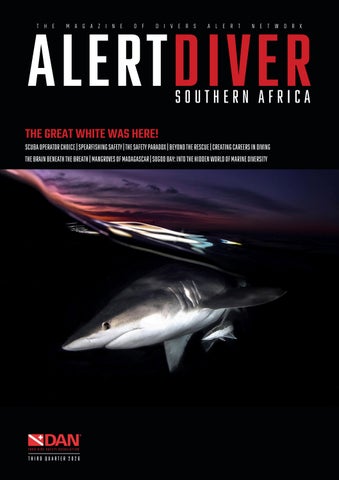
Cover Photograph Photographer’s Name: Bryan Hart Equipment Used: Canon EOS-1D X Mark II in a Nauticam housing; Tokina fisheye lens at 15 mm; pair of Ikelite DS160 strobes; 9-inch Zen glass dome port. Location: Aliwal Shoal (Shark Park at 5pm - Sunset), KwaZulu-Natal, South Africa Chasing the Setting Sun! Capturing a close-focus wide-angle shark portrait against the colours of the setting sun requires many elements to come together. These distinctive “over-under” images of Aliwal Shoal’s blacktip sharks are created using a large dome port positioned half above and half below the surface. It may look effortless, but almost everything is working against the photographer. The sharks are constantly moving—and often extremely close to the housing. The light is fading quickly, while bubbles and water droplets cling to the dome and can easily render an image unusable. Balancing the exposure above the surface with the shark below requires careful control of the ISO, aperture, shutter speed, strobe power and strobe positioning. It pushes both the camera setup and the photographer to the limit. A disciplined routine is essential: wipe the dome with a gloved hand, shoot a burst, review the images, adjust the camera and strobe settings—and repeat before the light disappears.
Contact Website www.dansa.org Advertising mail@dansa.org General mail@dansa.org Phone +27-11-266-4900 Diving Emergencies +27-82-810-6010
@dansouthernafrica
@DANSA.org
@dan_sa_org
@divesafety
Alert Diver Philosophy The views expressed by contributors are not necessarily those advocated by the publisher or DAN Southern Africa. While every effort is made to ensure the accuracy of information and reports, the publisher and DAN Southern Africa do not accept any responsibility whatsoever for any errors, omissions, or any effects resulting therefrom. To the best of the publisher and DAN Southern Africa’s knowledge, contributors have not indulged in plagiarism. Although the utmost is done to avoid such occurrences, the publisher and DAN Southern Africa will not be held responsible for the contributors’ or writers’ indulgence in plagiarism. No part of this publication may be used or reproduced in any form without the written permission of DAN Southern Africa. E&OE.
CONTENTS
IMAGE BY BRYAN HART
6 10 16
Perspectives Member Profile: Marc Kaiser Designing The Future Of Underwater Exploration When The World Changes Your Dive Plans
66 72
20 24 32 36 41
Mission Blue The Great White Was Here! Dengue Fever Right Place, Right Time, Right Training Your Certificate Doesn’t Expire, But Your Competence Can
86 93 99
43 50
Scuba Operator Choice Mastering The Mind, Mastering Fear & Panic During a Dive Spearfishing Safety Medical Line: When To Dive After Sutures
113 Frogfish: Fish From Another Planet 120 Sogod Bay: Into A Hidden World Of Marine Diversity 131 Parting Shot: Too Close for Comfort 133 Member Review
17
55 64
76 84
The Safety Paradox Beyond The Tropics: Rethinking Diver Impact Work Below Water Beyond The Rescue
Creating Careers In Diving The Brain Beneath The Breath Shark Stories: Why Sharks Need Better Storytellers, Not Better PR 106 Mangroves Of Madagascar: Where Forest And Ocean Meet
When we speak about dive safety, it is tempting to think of it as something we can complete. We earn a certification, have our equipment serviced, renew our DAN membership and choose a dive operator. We follow the procedures and believe we are ready. All of those things matter. But safety is not a box we tick once. It is a series of choices we continue making—before, during and after every dive. This edition of Alert Diver brings that idea to life in many different ways. Marc Kaiser’s remarkable journey reminds us of the value of curiosity. His career has taken him through commercial diving, hyperbaric medicine, freediving and decades of work devoted to understanding the underwater world. What stands out is not simply the scale of his experience, but his willingness to keep learning.
SAFETY IS A CHOICE WE KEEP MAKING PERSPECTIVES
SAFER DIVING STARTS WITH THE CHOICES WE MAKE TEXT BY MORNÉ CHRISTOU CEO, DAN SOUTHERN AFRICA
That is one of the qualities shared by the safest divers I know. They do not assume that experience has given them every answer. They remain observant, interested and open to new knowledge. The article “Your Certificate Doesn’t Expire, but Your Competence Can” makes an equally important point. A certification records what we demonstrated at a particular moment in time. It does not guarantee that our skills, fitness or confidence remain unchanged years later. There is no shame in recognising that we need a refresher, a little practice or the support of an experienced professional. In fact, that honesty is a mark of maturity. The greater risk lies in allowing pride to convince us that we are prepared when we are not. Preparation also extends beyond our own abilities. Choosing a dive operator should involve more than comparing prices or counting stars beside a business’s name. We should be asking meaningful questions about equipment maintenance, emergency planning, staff experience, oxygen availability and how the operation responds when conditions change. Price will always matter, particularly in a challenging economy. But the lowest price can become very expensive when essential safety systems have been compromised. Several articles in this issue explore what happens when pressure builds underwater. Fear, panic and stress are not signs of weakness. They are human responses—and they can affect divers at every level of experience. The goal is not to pretend that we never feel afraid. It is to recognise the early signals, manage our breathing, slow down and act before a manageable problem becomes an emergency. Training helps create that space
between an unexpected event and our response. We see the value of that preparation in “Right Place, Right Time, Right Training”. When Steve Corbin suffered a sudden cardiac arrest at the DEMA Show, trained people nearby recognised what was happening and acted. CPR, early defibrillation and teamwork changed the outcome. Those responders did not know that they would be called upon that day. They were simply ready when an ordinary moment became extraordinary. That is why DAN training reaches far beyond diving. The skills we learn may be needed on a boat, at home, in the workplace or while standing in a crowded exhibition hall. When every second counts, knowledge must become action. Safety, however, is not only about preventing accidents or responding to emergencies. It is also about protecting the places that make diving possible. The mangroves of Madagascar, the extraordinary marine diversity of Sogod Bay and the shark stories shared in this edition remind us that divers have a close relationship with the environments we visit. We are privileged witnesses to a world that many people will never experience directly. With that privilege comes responsibility. The way we dive, the operators we support, the images we share and the stories we tell can all influence how others value the ocean. Conservation does not begin only with major campaigns. It begins with everyday behaviour: excellent buoyancy, respectful wildlife encounters, thoughtful travel choices and an understanding that we are visitors underwater.
The same principle applies across our diving community. A safer future depends on skilled professionals, capable instructors, responsible operators, informed divers and young people who can see a meaningful career in the industry. We all have a role in creating that future.
That culture is built one decision at a time.
At DAN Southern Africa, our work is often most visible when something has gone wrong and a diver calls our emergency hotline. But some of our most important work happens long before that call— through education, research, training, medical guidance and the steady promotion of a stronger safety culture.
None of us will ever become too experienced to learn, too qualified to practise or too accomplished to make a safer choice.
Ask the extra question. Practise the skill again. Choose the responsible operator. Call the dive when something does not feel right. Share the story that helps someone understand the ocean differently.
And that may be the most important lesson of all: safety is not a destination we reach. It is a commitment we renew every time we enter the water.
“The safest divers keep learning, keep practising and never leave preparation to chance.”
Hometown: Pompano Beach, Florida Age: 66 Years Diving: 53 Why I’m A DAN Member: I’ve encountered dive emergencies from every vantage point: on the phone, in the chamber, and at the bedside. I understand that DAN is not simply an insurance provider; it is a coordinated medical system that brings order and expertise to critical moments. When seconds count, structure, preparation, and coordination change outcomes. Like many divers of a certain age, Marc Kaiser grew up watching early underwaterbased, black-and-white television shows. His family’s first colour TV arrived in 1968, just in time for The Undersea World of Jacques Cousteau, but his fascination with diving began earlier.
MARC KAISER WHY I’M A DAN MEMBER MEMBER PROFILE DIVE SLATE
GUIDED BY CURIOSITY TEXT BY STEPHEN FRINK Above: In 2017, Kaiser set the U.S. Freediving Masters Division national record in the Men’s Variable Weight category at 208 feet (63.4 m) - Image by Kirk Krack.
In the mid-1950s, his father was stationed in Guam with the U.S. Navy and learned to scuba dive there. As a child, Kaiser listened intently to his father’s stories and studied his shell collection, imagining himself underwater one day. By the time he was able, he was snorkelling in the shallows, collecting shells, and watching fish. At age 13 he enrolled in his first dive class in Norfolk, Virginia, at a shop that trained military personnel and employed several Navy master divers. He received his certification the week of his 14th birthday. By 15 he was a certified Scubapro repair specialist, and by 16 he was a provisional National Association of Scuba Diving Schools (NASDS) instructor. Even then, his plan was to be self-employed, working in or under the water. Kaiser worked as a shipyard diver in Norfolk during the summer after his freshman year of college before relocating to Miami, Florida, to continue his marine science and engineering studies. There he met Rick Frehsee, a part-time professor and emerging figure in dive photojournalism as a freelance underwater photographer for National Geographic, Skin Diver, and other publications. The two later collaborated on the 1980 U.S. Divers catalogue in St. Croix.
alongside Rutkowski and Morgan Wells for the next decade. During those years, he forged relationships with many of hyperbaric medicine’s early pioneers, including Peter Bennett, who founded DAN in 1980 at Duke University Medical Centre. This group helped define and expand the science of hyperbaric medicine, refining treatment for decompression illness and broadening its application into wound care and other medical disciplines. After his internship, Kaiser worked part-time at NOAA Diving as a student and then was hired as NOAA’s first instructor of diving and hyperbaric medicine. At 21, he was the youngest NOAA unlimited certified diver, a certified dive medical technician, and an instructor with the National Association of Underwater Instructors (NAUI). He also served on the NOAA Diving Control and Safety Board and as a line diving officer for approximately 360 of NOAA’s scientific divers.
During a class tour of the National Oceanic and Atmospheric Administration (NOAA) hyperbaric facility at Virginia Key, Kaiser met Frehsee’s friend, Dick Rutkowski, who would later become his mentor. With strong endorsements from Frehsee and the college dean, Rutkowski invited Kaiser to work and participate in an upcoming hyperbaric training program held by NOAA and the Undersea and Hyperbaric Medical Society (UHMS). The program lasted three weeks, six days a week, with days often stretching to 14 hours. Sundays were spent diving in Key Largo. Kaiser went on to become one of the program’s principal instructors, serving
IN JULY 1961, A YOUNG KAISER FORESHADOWED A LIFE DEFINED BY SCUBA DIVING AND FREEDIVING IMAGE BY MARC KAISER
From 1985 through 1988, following Rutkowski’s retirement, Kaiser served as acting director of the NOAA Diver Hyperbaric Training Center. During this period, he also operated a consulting company that assisted with hyperbaric chamber installations overseas. Kaiser’s work with NOAA led to missions to Hydrolab, an underwater saturation habitat deployed off St. Croix. Serving on a twoperson dive team, he provided 24/7 safety support for aquanauts living and working at depths of up to 150 feet (46 meters), gaining a rare inside view of saturation research and life on the seafloor. Kaiser also participated in the NOAA and Oceaneering saturation experiment at Duke University, evaluating nitrogen tolerance as a potential alternative to helium. He was one
of 10 NOAA and Navy divers who were saturated for nine days at 165 feet (50 m), breathing a 95% nitrogen and 5% oxygen mix, with daily air excursions to 200 feet (61 m). While the experiment yielded valuable data, nearly all participants developed decompression sickness and required treatment — a powerful reminder of diving’s inherent risks. In January 1989, Kaiser and three physicians established the Hyperbaric and Problem Wound Centre at Miami’s Mercy Hospital, also known as the Diving Medical Centre. Kaiser bought out his partners two years later and continued operating the centre until October 2011. The program ranked among the busiest hyperbaric treatment centres for sport divers in the U.S. and was one of the few hospital-based programs in the country equipped to provide around-
KIRK KRACK, KAISER, CAROLINA SCHRAPPE, AND LIZ PARKINSON PREPARE FOR A FREEDIVING VIDEO SHOOT FOR WATER BORN TV AT LIGHTHOUSE POINT, FLORIDA - IMAGE BY MARC KAISER
the-clock, critical-care hyperbaric services 365 days a year. Kaiser also volunteered with DAN as a chamber program evaluator for Caribbean facilities and served as regional coordinator for Florida and the Caribbean. Additionally, he served on the UHMS Safety Committee for many years. He founded Precision Health Care Inc. in 1998 to provide turnkey wound care and hyperbaric programs for hospitals and governments — work that remains his primary professional focus. For a man whose entire career involved compressed gases, physics, and physiology related to diving and chamber applications, freediving is one of his great passions. He spent a great deal of time travelling from his home in South Florida to snorkel in the Bahamas with his two daughters. Because
they were too young to become certified scuba divers, Kaiser pursued formal freediving training, initially for himself and to ensure he and his daughters remained safe. His friends recommended Performance Freediving, run by Kirk Krack, Mandy-Rae Cruickshank, and Martin Štěpánek. After speaking with them, he enrolled in their local Intermediate Freediver course, during which he discovered things about himself and human physiology that he had not known, despite his professional background. The experience culminated in a static breath-hold of 5 minutes and 17 seconds on his first attempt. He arranged a meeting with Krack, and as his skills improved, his world expanded. They remain good friends and collaborated with Goh Iromoto to create Water Born and Water Born TV, producing a
KAISER, DICK RUTKOWSKI, AND MORGAN WELLS WORKED AT THE NOAA HYPERBARIC FACILITY AT VIRGINIA KEY, FLORIDA - IMAGE BY MARC KAISER
series of YouTube and Facebook videos on freediving. Among Kaiser’s many achievements, he was honoured as the DAN/Rolex Diver of the Year in 2002, and he set the U.S. Freediving Masters Division record in Men’s Variable Weight at 208 feet (63.4 m) on May 21, 2017.
Now 66 years old, with a wife and two grown daughters, some of his most aggressive exploits are behind him. He continues to spend time in and under the water, guided by the same curiosity that began with a shell collection and a black-and-white television and supported by the safety network he trusts when it matters most.
KAISER CRUISES TIGER BEACH OFF WEST END, GRAND BAHAMA ON A DIVER PROPULSION VEHICLE - IMAGE BY JASON WASHINGTON
DESIGNING THE FUTURE OF UNDERWATER EXPLORATION DIVE SLATE | PROGRAM SPOTLIGHT DAN invites student teams from around the world to help shape the future of human undersea exploration by tackling real-world problems that professional divers face. Part of the three-year 2051 Sea Odyssey STEM project, this international university challenge is supported by the U.S. Office of Naval Research and developed by DAN, the University of North Carolina at Chapel Hill, the international ocean engineering and technology company DEEP, and the University of Utah. The challenge centres on underwater tools and logistics planning, calling on students to design or prototype innovative solutions that improve diver safety, efficiency, and operational capability in demanding underwater environments. Teams are encouraged to think creatively and rigorously, addressing challenges encountered in naval, commercial, scientific, and public-safety diving. Proposed concepts may include multifunctional or modular tools, stabilisation and anchoring systems, datadriven assistive technologies, or models that optimise underwater operations. Projects
must incorporate quantitative performance metrics, human factors, safety considerations, and real-world environmental constraints. Open to teams of three to 12 undergraduate or graduate students from the same university, the competition emphasises interdisciplinary collaboration and applied STEM problem-solving. Each team works under the guidance of a faculty mentor and contributes directly to advancing the future of underwater work. Running throughout 2026, the University Challenge includes milestone reviews and culminates in a finalist pitch event. The two finalist teams will be invited to DEEP in Florida to present their solutions, and the experience will be featured in a documentary series highlighting innovation in human undersea exploration. For students passionate about diving, engineering, and ocean exploration, the DAN University Challenge offers a rare opportunity to turn ideas into impact. Learn more at DAN.org/2051-sea-odyssey.
WHEN THE WORLD CHANGES YOUR DIVE PLANS DIVE SLATE | TRAVEL SMARTER You’ve packed your gear in anticipation of that long-awaited trip. Then the headlines shift. Political unrest disrupts airport access. A regional conflict closes the airspace. A government advisory changes overnight. Suddenly, your carefully planned dive adventure feels uncertain. Force majeure is a term every traveller should understand, especially in today’s unpredictable world. It means “superior force.” In travel contracts, it refers to unforeseeable, external events beyond anyone’s control that prevent a trip from proceeding as planned — such as natural disasters, civil unrest, war, government actions, or sudden border closures. When a force majeure event occurs, airlines, resorts, and tour operators may be legally excused from fulfilling their contracts exactly as written. That might mean cancelled flights, postponed dive charters, or modified itineraries, often without the usual penalties, but also sometimes without guaranteed refunds. This matters when travelling to remote destinations where infrastructure and geopolitics can shift quickly. Force majeure doesn’t automatically mean
no recourse, but it does mean flexibility becomes essential. Airlines may offer rebooking options, resorts may allow date changes, liveaboards may reschedule departures, but the terms vary widely. Some providers offer credits instead of refunds. Others may only refund unused portions of the trip. Government travel advisories can also play a role. If a warning is issued after you’ve booked, your options may differ from a situation where unrest was already known at the time of purchase. WHAT ABOUT TRAVEL INSURANCE? Many travellers assume that travel insurance covers everything. Unfortunately, it doesn’t. Policies list specific covered reasons for trip cancellation or interruption. Some include certain force majeure events, such as natural disasters that make your destination uninhabitable, but not all policies cover civil unrest or acts of war. Timing matters. Coverage often depends on when the policy was purchased relative to when an event became foreseeable. Optional upgrades, such as cancel for any reason, can provide broader flexibility,
though they typically reimburse a percentage of prepaid costs and must be purchased within a limited window. For DAN members, understanding the distinction between travel assistance, evacuation benefits, and trip cancellation coverage is critical. Assistance services help when you’re in trouble abroad. Insurance benefits may reimburse covered financial losses. They serve different but complementary purposes.
excellent, affordable additional insurance to all our members.
trip
Purchase trip insurance early. Many timesensitive benefits depend on when coverage is secured. Stay informed. advisories as approaches.
Monitor official your departure
Maintain flexibility. bookings if possible.
Consider
travel date
refundable
HOW CAN I TRAVEL SMARTER? You don’t need a crystal ball to protect your dive investment. Buy trip insurance. Read the policy before you need it. Pay close attention to definitions and exclusions. DAN offers
Have a plan B. Alternate destinations or flexible scheduling can save a trip. We can’t control global events, but we can be prepared. By understanding force majeure and choosing coverage wisely, you can navigate uncertainty with confidence.
MISSION BLUE DIVE SLATE ALIWAL SHOAL HOPE SPOT PROGRAMME TAKES YOUNGSTERS TO SEA TO STRENGTHEN MARINE CONSERVATION EDUCATION AND STEWARDSHIP TEXT & IMAGES BY WILD ALLIANCE AFRICA www.wildallianceafrica.org
@aliwalshoalhopespot
@aliwalshoalhopespot
From first-time snorkellers to future ocean advocates, one humble Mission Blue marine youth education programme shows how a single encounter with the ocean can transform a young person’s understanding of the ocean and broader life perspectives. In less than a year, the Mission Blue Aliwal Shoal Hope Spot Youth Ambassador Programme has taken more than 150 young South Africans out to sea and into tidal pools along the Aliwal Shoal Marine Protected Area in Southern KwaZulu-Natal. The programme primarily focuses on participants from underserved communities and has given them their first opportunity to snorkel in tidal pools, explore the Aliwal Shoal reef system, and learn about hands-on marine conservation through lived experience. Target groups have included young people from more rural local areas, as well as youth outreach groups from Genesis Hope South Africa and Made for More. By connecting young people directly with the ocean, the initiative is strengthening local conservation awareness and helping build a new generation of informed ocean stewards. Sponsored by Mission Blue and implemented by Wild Alliance Africa, the programme combines on- and offshore experiences with practical learning about Marine Protected Areas, marine biodiversity, plastic pollution, estuary health and the role that a healthy ocean plays in supporting communities and the planet.
lasting connection that extends far beyond the shoreline. They return home with newfound practical knowledge that could potentially influence broader perceptions, sustainable consumerism and buying habits of their families as they each become advocates for a thriving ocean within their own communities. Every child we reach has the potential to create a ripple effect that benefits our marine environment for generations to come.” Mission Blue, founded by legendary oceanographer Dr Sylvia Earle, established the ever-growing global network of 169 Hope Spots to identify and champion marine ecosystems critical to the health of the world’s ocean. Hope Spots unite communities, scientists, conservation organisations and local champions in support of the global goal to protect 30 percent of the ocean by 2030. South Africa is home to several Hope Spots, with the Aliwal Shoal Hope Spot recognised internationally for its extraordinary marine biodiversity and importance as one of the country’s most significant marine protected areas. Russel Symcox, Founder of Wild Alliance Africa and Lead Champion of the Mission Blue Aliwal Shoal Hope Spot, said the programme shows the power of connecting young people directly with nature.
Claire Taylor, Co-Champion of the Aliwal Shoal Hope Spot and Mission Blue Youth Ambassador Programme Lead for Wild Alliance Africa, says direct experiences in nature are essential to building a conservation ethic.
“The future of our ocean depends on the choices young people make today. By giving them meaningful experiences in nature, we are nurturing future conservation leaders who understand both the beauty and fragility of our marine environment.
“You cannot protect what you do not know or love. Giving young people the opportunity to experience the ocean firsthand creates a
We are incredibly grateful to the team at Mission Blue for investing in this programme and helping us build the next generation of ocean custodians.”
As South Africa works towards stronger environmental stewardship and contributes to global ocean conservation goals, the Mission Blue Aliwal Shoal Hope Spot Youth Ambassador Programme is demonstrating that investing in young people can deliver meaningful community reach and lasting support for marine protection. ABOUT MISSION BLUE Mission Blue is a global ocean conservation organisation founded by Dr Sylvia Earle. Through its worldwide network of Hope Spots, Mission Blue works with local champions, scientists and communities to protect marine ecosystems vital to ocean health and biodiversity.
ABOUT WILD ALLIANCE AFRICA Wild Alliance Africa is a South African conservation organisation dedicated to protecting marine and terrestrial ecosystems through education, community engagement, citizen science and collaborative conservation initiatives. As the implementing partner of the Mission Blue Aliwal Shoal Hope Spot Youth Ambassador Programme, Wild Alliance Africa is helping inspire the next generation of ocean stewards through immersive environmental education. www.wildallianceafrica.org @aliwalshoalhopespot @aliwalshoalhopespot
THE GREAT WHITE WAS HERE! LOCAL DIVING A DEAD WHALE, A SETTING SUN AND AN ENCOUNTER TO REMEMBER TEXT & IMAGES BY BRYAN HART
At 12.45 pm, I received a WhatsApp: “Got any plans to go see the dead whale off Umhlanga?” My response: “What dead whale?!” A video clip followed, showing a bloated whale carcass in clean water, with several actively feeding sharks — including a Great White. By 2 pm, a crew had assembled, the boat was loaded with dive gear, and we were powering out of the sheltered Vetch’s Pier Basin and into the teeth of a strengthening north-easterly wind, with our heading set for the last recorded location of the dead whale… Whale populations have increased over the years following the introduction of protections against commercial whaling. At the same time, maritime transport has grown substantially, increasing the number of ships travelling our oceans. With ships and whales often using the same ocean corridors, vessel strikes remain a significant threat to whales along the South African coastline. Sharks are extremely difficult animals to interact with and study. Human encounters generally happen on their terms, or when sharks are drawn in by a food source — a drum full of sardines, a bait ball, a speared fish… or a whale carcass!
Then, suddenly, the air smelt different. The surface of the ocean presented an oily slick and there it was — the dead whale! We approached the carcass carefully so as not to startle any potential feeding sharks and to avoid fouling the motors on anything attached to the whale. As we came alongside, we observed a beautiful juvenile Tiger Shark hanging on to the jaw area of the dead Humpback, almost in a catatonic state of euphoria! When whales die, bacteria inside the animal’s digestive tract and organs multiply rapidly, breaking down the remaining organic matter. This decomposition releases large amounts of gas, which can become trapped inside the whale’s body cavity, helping the carcass remain buoyant on the surface — while simultaneously releasing some of the most throat-punchingly foul smells imaginable! Meanwhile, the divers were donning their gear and preparing to enter the water, opting for scuba so they could spend more time below the surface with the sharks. A bigger shadow caught my eye, and the baby Tiger suddenly decided it was time to let go… The divers slid cautiously into the water, not knowing what might be lurking underneath. The team consisted of Angie van der Hoogen, Dr Ryan Daly, Nats Dos Santos and Michael Tarr — all seasoned watermen with a passion for sharks.
We had been at sea for an hour searching for the dead whale. The fading light and strengthening wind did not make for optimal spotting conditions, and our initial excitement was fading as rapidly as the setting sun.
This was not my first whale-carcass diving expedition, so I opted to wait and see before climbing into my wetsuit. I politely agreed to stay on the boat and “TOP” — drive the boat — while they jumped in for the first look.
We made the call to turn back, but with a plan to stay around the 70 m depth mark and simply cruise with the following sea. AT LEAST WE HAD TRIED!
As they descended, they were greeted by a very large Tiger Shark, which came off the dead whale to investigate who — or what — the divers were before disappearing.
THE UNMISTAKABLE PROFILE OF A GREAT WHITE SHARK — LARGE BLACK EYE, SPINDLE-SHAPED BODY, PROMINENT DORSAL FIN AND DISTINCTIVE LUNATE TAIL.
THE GREAT WHITE CONSISTENTLY APPROACHED OUT OF THE SUN, WITH DIVERS TO HER RIGHT AND THE WHALE CARCASS TO HER LEFT. BITE MARKS AROUND THE WHALE’S BLOWHOLE MAY INDICATE AN EARLIER INJURY, AS THIS AREA IS DIFFICULT FOR SHARKS TO GRIP EFFECTIVELY.
Things then went very quiet, and the team made the decision to get back on the boat and switch to snorkelling, feeling that the bubbles from scuba had disturbed the sharks.
setting sun at my back, I could see a few metres underwater. As I drifted closer to the divers and the whale, I suddenly noticed that the carcass seemed a little longer than when we had first found it.
The dead whale was still relatively “fresh” and intact. There were several areas where the tough skin had not been bitten, suggesting that there had not yet been sustained scavenging on the whale.
I quickly corrected myself as the unmistakable outline of what we had come to see appeared beneath the surface, swimming directly towards the divers. The Great White was here!
Big, powerful sharks such as Tigers and Great Whites are comfortable feeding at the surface and can play an important role in breaking through the whale’s tough skin, exposing the soft, nutrient-rich blubber beneath, which in turn becomes accessible to smaller scavengers. As decomposition progresses and the carcass loses buoyancy, it may eventually sink to the seabed, where an entirely different community of marine organisms can benefit. This phenomenon is known as a “whale fall”. From the surface, I noticed that the area behind the whale’s blowhole had been targeted, with numerous bite marks visible. This is not an obvious feeding area for sharks, as its relatively smooth, flat surface can make it difficult for them to bite and tear away chunks of flesh. Because of this unusual concentration of bite marks, we wondered whether this could have been the area where the whale had been struck by a vessel. If the injury had broken the skin, it may have provided the sharks with an easier starting point from which to feed. Still at the helm of the dive boat, I travelled slowly upwind of the dead whale. The plan was to drift with the wind towards the carcass while, at the same time, avoiding the pungent smell of rotting flesh! From my position on the boat, with the
The four divers enjoyed some quality time with the shark while I sat there contemplating my next move. I kitted up and began preparing to get in. I was debating the pros and cons of tying the boat to the dead whale so that I could join the rest of the crew. The FOMO was progressing towards panic when Nats popped up and very kindly offered to assume top-man duty, giving me a chance to get in! Great Whites are among the most beautiful animals in the sea. They are purpose-built, with every part of the shark contributing to its effectiveness as an apex predator. The shark at the dead whale was a 4 m female. At this size, she was still considered young and not yet fully developed. She was in prime condition, with no scars or gashes and no fishing line trailing from her jaws. The shark and the team became very comfortable with one another. She would approach the divers from out of the sun, with the dead whale on her left and us divers on her right. She seemed completely at ease and, with each pass, we were able to get very close to her. It was an incredible experience, and one that will forever live in my mental logbook! Of course, part of the reason for embarking on this adventure was to capture images of
LARGER SHARKS, SUCH AS TIGER AND GREAT WHITE SHARKS, USE THEIR POWERFUL JAWS AND LARGE, SERRATED TEETH TO CUT THROUGH THE WHALE’S TOUGH SKIN AND REACH THE SOFT, NUTRIENT-RICH BLUBBER BENEATH.
THE GREAT WHITE SHARK APPROACHES DIVERS DURING A REMARKABLE CLOSE ENCOUNTER.
sharks, taking advantage of the fact that they would be naturally drawn to this remarkable food source. Sharks fall into the “action” or “wildlife” category of photography. For this reason, a mirrorless or DSLR camera paired with a fisheye lens is one of the most effective photographic setups for the job. My go-to camera settings for shark photography are Manual mode, f/8 at 1/125 sec, adjusting the ISO accordingly. Auto ISO, with an ISO 1000 limit set, can also be a workable option. A fisheye lens allows you to get close to your subject while still fitting it all into the frame. The closer you are to your subject, the less water there is between the camera sensor and the shark — resulting in cleaner, sharper images. DSLR and newer mirrorless cameras are designed to focus quickly and shoot multiple images in a fraction of a second — perfect for capturing constantly moving sharks. Sharks generally have darker upper bodies and lighter bellies. The white belly is prone to overexposure when photographing sharks with strobes and can turn pink or rose-coloured during editing. Reducing the power of the strobes and positioning them farther back or above the camera can reduce the amount of light hitting the underside of the shark, minimising the chances of overexposure and backscatter. Using manual white balance in-camera, or selecting Tungsten White Balance mode, can also assist with some of the challenges encountered when editing shark images and obtaining accurate colour. Much, however, depends on one’s editing skills and image-processing workflow. Backscatter is one of the main problems when photographing sharks underwater. It
can be caused by bubbles on the dome of the camera housing or particles suspended in the water — including, in this case, bits of dead whale, fish and scales — reflecting the light from the strobes. Backscatter appears as unsightly dots across your prized photograph and has been responsible for many otherwise great images ending up on the discard pile. Finally, wiping bubbles off the dome with a gloved hand should be done as often as possible, particularly after some close action! And once you have considered all of that, remember the fundamentals of underwater photography: Shoot up. Get close. Then get closer still! Divers interacting with sharks around a dead whale is not something new in South Africa. There have been at least two other welldocumented dives involving whale carcasses along the east coast of Southern Africa — one at Aliwal Shoal and another at Ponta do Ouro. The Aliwal whale carcass attracted some very large Tiger Sharks and Great Whites, while the Ponta event featured Tiger Sharks and Zambezi Sharks. At each of these events, there were some “close calls” where things could potentially have gone horribly wrong. However, the people who deliberately seek out opportunities to dive around dead whales generally understand the risks involved and feel strongly about conserving these apex predators through observing and documenting these extraordinary events. Fortunately, the number of variables that need to align for a dive like this to happen is immense. It is not something that happens often — and it is certainly something you have to make happen!
Shortly after our Durban whale-carcass adventure, another dead whale appeared off Port Elizabeth. A Great White was observed patrolling around the carcass, but unlike “our Great White”, this shark was VERY “bitey-bitey” and took exception to the research vessel and its crew stationed near the whale. The Port Elizabeth Great White decided to express its dissatisfaction with these
uninvited dinner guests by proceeding to deflate the boat’s pontoons with its razorsharp teeth! This will not be the last whale carcass to float past our shores here in KwaZulu-Natal. With whales and ships sharing these waters, there will undoubtedly be future encounters — and perhaps another opportunity for a group of like-minded thalassophiles to drop everything and do it all again!
Curious Great White Too Close for Comfort
Michael Tarr interacting with a curious Great White off Durban, South Africa’s KwaZulu-Natal
WATCH VIDEO
COVER THROUGH DAN LIFESAVING BENEFITS - 24/7 EMERGENCY HOTLINE - ACCESS TO DIVE MEDICAL EXPERTS - DIVING RESOURCES TO KEEP YOU SAFE Your gateway to dive safety services & worldwide dive coverage at low annual rates!
WWW.DANSA.ORG
Cases of dengue fever, also known as breakbone fever due to its hallmark symptom of extreme joint pain, are substantially on the rise globally. Most cases occur in the warm tropical and subtropical areas of South Asia, Africa, and Central and South America. Cases spiked in the U.S. in 2024, with the highest number in Florida. Data from the World Health Organisation (WHO) show that 104 countries reported cases of the disease in 2025. With 390 million cases reported each year, consider the statistics carefully when planning your next dive destination. Florida’s humid, subtropical weather, especially in the south, is the perfect breeding ground for mosquitoes. Most dengue cases in Florida are travel-related, meaning those infected had recently visited other areas, but there are reports of locally transmitted cases.
DENGUE FEVER EDUCATION
A GROWING GLOBAL THREAT TEXT BY LANA P. SORRELL, EMT, DMT Above: Stay hydrated if you become sick. Mild cases can often be managed at home, while severe dengue may require hospitalisation. Image by Pawich Sattalerd/iStock.
The dengue virus (DENV) belongs to the Flaviviridae family and is transmitted to humans by the Aedes mosquito species, which you can identify by the white stripes on its back and legs. The Centers for Disease Control and Prevention (CDC) estimates that roughly one in four people who become infected with the virus will develop dengue fever, but most remain asymptomatic.
No medications can cure dengue, but good fluid intake, rest, and a balanced diet are important. Measures that strengthen your immune system, increase your platelet count, and manage your symptoms to support recovery are beneficial. Avoid taking anything that can interfere with your body’s ability to clot, including nonsteroidal antiinflammatory drugs (NSAIDs) and aspirin.
Dengue’s incubation period is four to seven days from exposure to symptom onset; in some cases it can take up to 14 days. Symptoms include the following:
Nutritional supplements may be helpful. The American Journal of Tropical Medicine and Hygiene published a 2021 literature review that highlights studies from several countries on how supplementing with certain micronutrients may “offer hypothetical benefits to dengue fever patients via numerous potential mechanisms, including modulation of the host immune response.”
High fever around 104°F (40°C) Pain behind the eyes Nausea and vomiting Rash Severe headache Joint and muscle pain Swollen glands Fever can initially be absent, mild, or biphasic, so some early symptoms — such as nausea, vomiting, headache, eye pain, rash, lymphadenopathy, and abdominal or joint pain — could be confused with a diverelated injury if they’re first noticed after a dive. Other infections, including mosquitoborne illnesses such as Zika and chikungunya, may present similarly, hence the need for medical evaluation. The WHO has three classifications for symptomatic dengue cases: with or without warning signs and severe dengue. Severe cases of dengue fever that include shock can occur during primary infection but often happen with a subsequent infection; a previous infection with one dengue strain can be followed by reinfection with another strain. Fortunately, dengue fever is rarely fatal. If you become sick from this infection, stay hydrated and seek medical attention. Your physician may suggest managing mild cases at home with proper fluids and pain medication. Severe cases may require hospitalization to ensure adequate recovery.
Some nutrients mentioned in the article are vitamins C, D, and E, and zinc. Kiwi, dragonfruit, and papaya are rich in vitamins A, C, and E, and potassium.
There is no known treatment for dengue, so prevention is key. The fear of mosquito bites may keep some people from spending time in nature, especially when planning their next dive vacation, but there are several preventative measures you can take to significantly reduce your risk so you can spend time outside without hesitation.
Prevent standing water in items such as pet bowls, gutters, trash and recycling bins, bird baths, and children’s toys, as these are breeding grounds for mosquitoes. Install a bat house. Mosquitoes are one of bats’ favourite meals.
Wear long sleeves and pants if you know you will be in a mosquito-prone area. Use insect repellent. Use a house fan in your backyard or patio to keep mosquitoes away. Place marigolds, lemongrass, and other mosquito-repelling plants around outdoor areas.
With proper planning, we can enjoy the summertime outdoors without fear of becoming the next human buffet for mosquitoes. When planning your next dive trip, consult the WHO or CDC at cdc.gov/dengue/areas-with-risk for details about your prospective destination to determine whether it is a risk area.
COVER THROUGH DAN LIFESAVING BENEFITS - 24/7 EMERGENCY HOTLINE - ACCESS TO DIVE MEDICAL EXPERTS - DIVING RESOURCES TO KEEP YOU SAFE Your gateway to dive safety services & worldwide dive coverage at low annual rates!
WWW.DANSA.ORG
RIGHT PLACE, RIGHT TIME, RIGHT TRAINING EDUCATION WHEN TRAINING SAVES A LIFE TEXT BY SHANNON HUNT | IMAGES BY STEVE CORBIN Above: Steve Corbin prepares for his first dive after coronary bypass surgery.
Cardiac emergencies can happen anywhere, often without warning, and survival depends on what happens in the first few minutes. Immediate recognition and activation of emergency medical services (EMS), highquality CPR, and early defibrillation are critical links in the chain of survival. A rescuer demonstrated those links at last year’s Diving Equipment and Marketing Association (DEMA) Show in Orlando, Florida, when attendee Steve Corbin experienced a sudden cardiac arrest on the exhibit floor. Dean Zerbe, a newly certified DAN Examiner and former paramedic, was nearby and stepped in to help. Other trained bystanders who assisted include Cathy Sytsma, Laura Checkley, Francisca Joseph, and Pam Hodder. Corbin and Zerbe share their perspectives on what happened. Steve, please tell us what happened that day at DEMA. SC: It was Friday, Nov. 14, 2025. I had been working from home, but I decided to go to the show around noon to meet some friends. I was running late, so I hustled to the venue and walked to my friend’s booth on the exhibit floor. There were no signs of anything wrong with me. When I got to his booth, a person there said my friend was not at the show that day. I thanked him, shook his hand, and then felt a rush of warmth over me. That was the last thing I remembered before waking up in the ambulance. Dean, where were you when the incident occurred? What first caught your attention? DZ: I was visiting a travel booth at the DEMA Show with my business partner. Initially, I had my back to the incident. I heard a commotion, and my partner directed my attention to the scene.
What did you do when you reached the scene? DZ: I walked over and noticed an older adult male on his back on the floor, with three people assisting him. I saw two or three people on their phones yelling, “Start CPR,” and the woman closest to me was on the phone with EMS. I asked my business partner to go get oxygen and an automated external defibrillator (AED). People on scene were trying to move him into a left lateral position, but I noted that his breathing was abnormal and appeared to be agonal, with irregular, growling respirations. We immediately returned him to his back. One woman checked for a pulse and said there was none. I checked and confirmed there was no pulse. I remember telling the three other people on the floor, “OK, let’s do this.” During the first few compressions, I felt the uncomfortable but familiar sensation of ribs giving way. I went through an unknown number of rounds before another person took over the airway. I was starting to get tired when I heard a woman say she could take over, so at the end of that round I turned compressions over to her. Shortly afterwards, an AED arrived. We attached the pads, analysed the rhythm, and delivered a shock before resuming CPR. After a few more rounds, the person started breathing. An emergency medical technician (EMT) from the convention arrived with oxygen and placed a nonrebreather mask on the man. A woman confirmed he had a pulse and started gently shaking the man. He eventually began to talk. I stepped back from the scene and only then noticed the large crowd that had gathered. From that point, I was just another observer. I saw the man sitting up on the gurney and talking to the EMS crew as they were taking him to the ambulance.
CONNING TOWER OF U-352
CONNING TOWER OF U-352
Steve, were you assessing you?
aware
of
anyone
SC: I was unconscious. My awareness didn’t return until I was in the ambulance. When you regained consciousness, what was the first thing you noticed? SC: I was in the ambulance, and the paramedic told me I was being taken to the hospital. My cellphone rang, and it was my son. The paramedic answered and told him what happened, which is when I became aware of the severity of my condition. What was recovery like following the incident? SC: I was transferred to Orlando Regional Medical Centre on Nov. 16 to repair a left anterior descending (LAD) artery blockage, which required surgery to restore normal blood flow. The treatment included a coronary artery bypass grafting (CABG) to reroute blood flow using the mammary artery. I spent nine days in the hospital. Within hours after the surgery, I was sitting up and later walking. Upon release, I began walking regularly and gradually increasing my activity. About five weeks after returning home, I joined the local gym and started physical therapy with Orlando Health three times a week. Under the supervision of Dr Doug Ebersole, I performed the Bruce protocol stress test to evaluate my heart function as a step toward returning to diving. Dean, how did this incident affect you? DZ: I worked as a paramedic in California in the 1990s and early 2000s. I ran many codes, and only one person survived. I was prepared for this man not to survive. I was not prepared to see him talking to the EMS crew while leaving. That created an unexpected emotional response in me.
Steve, what does it mean to you knowing that trained responders were nearby and acted quickly? SC: I was blessed to be at DEMA around people who were ready to act. I have lived my life by a motto that I learned from my military service and technical dive training: “Train for not if it is going to happen but when it is going to happen.” I encourage everyone to get trained and certified, as you never know when you will need those skills. Dean, did this change or reinforce how you feel about your training and preparedness? DZ: This emphasised the importance of early AED access and reinforced the need to teach the skill. My association with DAN as a newly minted Examiner, as part of the Powered By DAN program with Scuba Educators, helps spread this skill to others. Looking back, what stands out most to you about that day? SC: This was a potentially fatal event, but I was at the right place at the right time and with the right people who had the right training, experience, and willingness to step up and save a life. I have won the biggest lottery in the world and will never forget it. DZ: The most striking thing is how normal the day was and then seeing how a group of people with common training can pull together to make a difference. As Corbin and Zerbe described, that day started as a normal day for both of them. First aid training is critical not only in diving but also in everyday life, because emergencies can happen anywhere, at any time, even on a normal day.
“When every second counts, training turns bystanders into responders.”
PROS CHOOSE DAN PROFESSIONAL LIABILITY THAT IS REVOLUTIONISING INSURANCE FOR DIVE PROFESSIONALS AND DIVE BUSINESSES IN SOUTH AFRICA. Discover a smarter way to protect yourself and your business because your peace of mind is our priority!
WWW.DANSA.ORG
YOUR CERTIFICATE DOESN’T EXPIRE BUT YOUR COMPETENCE CAN EDUCATION | TEXT BY BARRY COLEMAN | WWW. DIVEISC. COM Returning to diving is not simply about whether your certification remains valid. It is about whether you—and the divers around you—can be confident in your present ability. A recreational scuba certification can remain valid for life. The diver holding it, however, does not stay the same. Certification confirms that a diver completed the required training and demonstrated the necessary knowledge and skills at a particular time. It does not guarantee that the same level of comfort and practical ability remains five, ten or twenty years later—particularly when those skills have not been used. INACTIVITY DOES NOT AFFECT EVERY DIVER EQUALLY Time away from diving is only one consideration. Previous experience makes an important difference. A diver with 1,000 dives will generally regain familiarity and comfort more quickly than
someone who completed an entry-level course, made only five dives and then stopped diving. The inexperienced diver has had less opportunity to reinforce the skills, judgement and natural underwater responses developed through regular diving. Their comfort may therefore decline more quickly and take longer to rebuild. However, a high dive count does not automatically guarantee current competence. The length of inactivity, the diver’s age, health, fitness, equipment familiarity, previous diving conditions and ability to manage stress must all be considered. For this reason, treat the commonly used 12month period as a practical guideline—not an inflexible dividing line. A diver who has not dived for more than 12 months should normally complete a structured refresher before returning to open water. However, some divers may need one sooner, while a highly experienced diver may regain comfort more quickly. The important question is not simply, “When
was my last dive?” It is, “Can I comfortably and reliably perform the skills I may need on this dive?” Answer that question honestly and without ego. SKILLS MUST REMAIN COMFORTABLE Scuba skills should not be practised only during initial training. Several essential skills should be reviewed regularly in confined water or suitable open water: Mask removal and replacement: Remain calm, continue breathing and maintain position while removing, replacing and clearing the mask. Buoyancy control: Establish neutral buoyancy, hover, maintain depth and control ascents and descents without relying on the bottom. Regulator recovery: Recover and clear a displaced regulator without panic or losing control. Out-of-air response and controlled ascent: Respond as both the donor and receiver, establish a reliable alternate air supply and complete a controlled ascent together. Remembering the steps is not the same as performing them comfortably underwater. Regular practice maintains familiarity, and familiarity gives a diver the mental capacity to recognise and manage a problem before it develops into an emergency. A refresher must therefore involve more than watching a video or completing an online knowledge review. It should include equipment preparation and genuine inwater practice under the supervision of a qualified dive professional. YOUR READINESS AFFECTS EVERYONE’S DIVE Deciding against a refresher affects more than the individual diver.
A diver who is stressed, uncomfortable, consuming gas rapidly, or struggling with buoyancy may require the continuous attention of a buddy, divemaster, or the entire group. The planned dive may need to be changed, shortened or abandoned. Other divers—who have paid for and prepared for the experience—may spend their dive watching and assisting one person instead of enjoying it themselves. More importantly, no one wants to be part of a dive during which another person is seriously injured. When a diver knows they may not be ready but refuses a refresher because of ego or embarrassment, they may place an unfair responsibility on everyone around them. Taking a refresher is not an admission of failure. It shows consideration for the dive team and respect for the buddy who may have to assist if something goes wrong. Any embarrassment of acknowledging that skills need attention is insignificant compared with the consequences of panic, an uncontrolled ascent or a preventable accident. CONDITIONS STILL MATTER Competence must also be considered against the proposed diving environment. Entry-level divers are generally qualified to dive in conditions like, or better than, those in which they were trained. A diver trained in warm, calm and clear water should not assume the same certification establishes readiness for cold water, strong current, poor visibility, surf entries or demanding boat dives. A certification card records what a diver achieved in the past. It does not assess the diver’s readiness today. The safest divers are not necessarily those with the highest certification or the greatest confidence. They are those willing to assess themselves honestly, practise essential skills and seek assistance before pride becomes a problem for everyone underwater.
When planning a scuba diving vacation or selecting a local dive shop, most divers default to two primary metrics: price and marketing accolades. A quick scan of a destination’s dive centres often reveals a sea of "Five-Star" banners, pristine gear displays, and competitive package deals. To the untrained eye, a premium facility designation implies an uncompromised commitment to diver safety. However, the dive industry’s open secret is that current classification systems are built on commercial capabilities, not operational safety. To elevate industry standards and protect divers, we urgently need a standardised, dedicated dive safety grading system. Relying solely on retail presence, equipment inventory, or course availability leaves divers vulnerable. By shifting the consumer focus from cost to comprehensive safety metrics— anchored by specialised professional roles and proactive risk management frameworks
SCUBA OPERATOR CHOICE EDUCATION
CHOOSE GRADING, NOT PRICE TEXT BY CHRISTO VAN JAARSVELD Author’s View: The views expressed in this article are the author's. References to Divers Alert Network (DAN) and the Diving Safety Officer (DSO) qualification do not imply endorsement, and the views expressed do not necessarily reflect the policies, positions or recommendations of DAN or its affiliates. www.seaxplore.co.za
the dive community can incentivise safer operations globally. THE ILLUSION OF THE FIVE-STAR FACILITY The current hierarchy of dive centre grading is heavily dictated by training agencies. When a dive centre proudly displays a "FiveStar" rating, consumers naturally assume this reflects a gold standard in emergency preparedness, boat skipper experience, and safety protocols. These ratings are primarily business and educational benchmarks. To achieve high-tier status under major training agencies, a facility must generally meet criteria such as: Offering a full suite of recreational and professional courses. Maintaining a modern retail showroom with specific equipment brands. Actively promoting agency-specific training materials and philosophies. Running consistent marketing campaigns and community events. While these metrics indicate a thriving business and excellent educational infrastructure, they do not guarantee that the rental regulator was serviced last month, that the boat carries sufficient emergency oxygen, or that the crew is well-versed in lost-diver protocols. A minimalist, budgetfriendly dive shop operating out of a beach shack could theoretically maintain stricter safety discipline than a high-turnover, fivestar resort facility. Because the market lacks an independent, safety-first grading index, consumers remain blind to these critical operational realities. THE DANGER OF COMPETING ON PRICE ALONE Scuba diving is an inherently equipmentdependent sport that takes place in a hostile environment. Maintaining a truly safe diving operation requires significant, continuous capital investment. When consumers treat
diving as a commodity and choose operators based strictly on the lowest price, they inadvertently trigger a dangerous race to the bottom. To survive on razor-thin margins driven by price wars, budget operators are frequently forced to cut corners where it hurts most: Equipment Maintenance: Delaying hydrostatic testing for cylinders, postponing compressor filter changes (leading to contaminated air), and skipping annual regulator overhauls. Staff Compensation: Underpaying Dive Masters and Instructors, which leads to high staff turnover, burnout, and the employment of inexperienced guides who lack local environmental knowledge. Emergency Preparedness: Carrying expired medical supplies, failing to maintain functional VHF radios, or skimping on emergency oxygen volumes to save space and money. A dedicated safety grading system would effectively dismantle this race to the bottom. If consumers can clearly see that a slightly more expensive shop holds a "Grade A" safety rating while a cheaper competitor holds a "Grade C," the financial premium becomes justified. Safety transforms from an invisible operational cost into a measurable, marketable asset. PROFESSIONALISING SAFETY: THE DIVING SAFETY OFFICER (DSO) A robust safety grading system cannot rely on self-reporting; it requires qualified personnel to implement and audit rigorous standards. This is where organisations like the Divers Alert Network (DAN) play a pivotal role. DAN offers a specialised course designed to train and qualify individuals as Diving Safety Officers (DSOs). The DSO program is a rigorous educational pathway that builds the knowledge, operational confidence, and analytical skills
required to oversee complex diving environments. A qualified DSO does not replace an instructional staff member; rather, they act as an independent risk manager within the organisation. Their responsibilities include: Developing and enforcing standard operating procedures (SOPs). Auditing staff compliance with global safety standards. Coordinating regular, live emergency drills for the crew. Overseeing the structural integrity of gas blending, compressor stations, and marine vessels. Integrating a qualified DSO into a public safety grading system provides immediate clarity for consumers. When an operator employs or uses a consultant as a dedicated, DAN-trained DSO, it signals that the business treats safety as an active, daily discipline rather than a passive legal liability. PROACTIVE RISK MITIGATION THROUGH HIRA A core methodology that qualified DSOs utilise to transform dive centre operations is the Hazard Identification and Risk Assessment (HIRA) system. Developed extensively by DAN, HIRA is a scalable, proactive framework designed to catch operational flaws before they manifest as accidents or fatalities. Instead of reacting to a crisis, a DSO utilising the HIRA system systematically breaks down a dive operation into core risk areas. Under a formal grading framework, a facility that conducts monthly HIRA audits and logs clean air tests would rank significantly higher than one that operates on unmonitored baselines. This provides a transparent roadmap for operators wanting to improve their grade and offers consumers undeniable proof of operational integrity. THE CONSUMER TOOLKIT: HOW TO HIRAVET A DIVE SHOP YOURSELF
Until a formalised, public safety grading system is universally adopted, divers must act as their own safety inspectors. By adapting professional HIRA principles into a simplified consumer checklist, you can look past the glossy brochures and vet a shop yourself. When you walk into a dive centre or step onto their boat, look for these, actionable safety indicators: 1. THE BREATHING GAS INFRASTRUCTURE The air inside your cylinder is your single most critical life-support component. Air Quality Certificates: Ask to see their latest quarterly air purity test certificate. It should be publicly displayed near the filling station or front desk. Compressor Room Hygiene: Investigate the compressor area. Is it clean, wellventilated, and free from oily residues or fuel cans stored near the intake? Nitrox Verification: If diving enriched air, does the shop require you to personally analyse your tank, sign a dedicated logbook, and record the oxygen percentage and maximum operating depth (MOD)? 2. EMERGENCY OXYGEN READINESS In a diving emergency, immediate administration of 100% medical oxygen is the primary first-aid treatment. Physical Location: Ask the staff directly, "Where is the emergency oxygen unit located on the boat?" It should be clearly marked, easily accessible, and never locked away. Oxygen Volume: Is there enough oxygen to sustain an injured diver (or multiple divers) for the entire duration of the boat journey back to the nearest emergency medical facility? Delivery Systems: Ensure the kit contains both a demand valve (for breathing patients) and a non-rebreather mask, alongside a pocket mask for nonbreathing divers.
3. OPERATIONAL STAFF DYNAMICS A highly capable staff is your best insurance policy when conditions degrade unexpectedly. Ratios and Briefings: Ask about the maximum guide-to-diver ratios. Listen to the dive briefing: does it explicitly cover emergency procedures, lost-buddy protocols, and recall signals? Staff Tenure: Ask your guide how long they have worked with this specific operator. High staff turnover is a classic red flag for overworked personnel. Emergency Action Plans (EAP): Ask if they have a written, location-specific EAP. They should be able to instantly produce a document detailing evacuation routes, EMS contact number and hyperbaric chamber contacts. DRIVING CULTURAL CHANGE ACROSS THE INDUSTRY Implementing a formal dive safety grading system would fundamentally shift consumer behaviour and industry culture. When divers vote with their wallets by using tools like the consumer HIRA checklist and choosing
highly rated safety operations over cheap, unverified alternatives, the market will naturally adapt. Operators who previously invested solely in flashy retail spaces or deep discounts will redirect budgets toward hiring DSOs, executing HIRA protocols, and upgrading life-support infrastructure. Ultimately, scuba diving should be defined by the thrill of exploration and the joy of the underwater world—not by the anxiety of questionable safety practices. By advocating a dedicated safety grading system, the diving industry can bridge the gap between commercial success and diver well-being. It is time to look past the superficial five-star logos and cheap price tags, demanding instead a transparent standard that ensures every diver returns safely to the boat and shore. Christo van Jaarsveld is a business owner with more than 32 years of experience in the SCUBA industry. He is an Instructor Trainer as well as a Technical Diving Instructor. In addition, Christo is also a DAN Instructor Trainer and DAN Diving Safety Officer. He is a passionate, active diver with more than 16000 dives. www.seaxplore.co.za
COVER THROUGH DAN LIFESAVING BENEFITS - 24/7 EMERGENCY HOTLINE - ACCESS TO DIVE MEDICAL EXPERTS - DIVING RESOURCES TO KEEP YOU SAFE Your gateway to dive safety services & worldwide dive coverage at low annual rates!
WWW.DANSA.ORG
MASTERING THE MIND MASTERING FEAR & PANIC DURING A DIVE EDUCATION | TEXT BY KAREN VAN DEN OEVER Scuba diving is often described as the ultimate escape, a gateway to tranquillity, adventure, and the mesmerising world beneath the waves. But for many divers, there may come a moment that arrives unannounced, an experience that’s rarely discussed openly: the sudden surge of anxiety or fear that can overtake you, even in the most familiar environments. Whether you’re a seasoned diver or just starting out, understanding and managing these moments is crucial—not just for your enjoyment, but for your safety. THAT “SOMETHING’S WRONG” MOMENT Imagine drifting weightless, surrounded by the gentle rhythm of your own bubbles and the distant calls of marine life. Out of nowhere, a problem arises—a regulator freeflows, your mask floods, or you realise your buddy isn’t beside you. In an instant, your breathing accelerates, your thoughts become laser-focused on the problem, and the serene underwater landscape suddenly feels like it’s closing in. Your hands might fumble with your equipment, and a sense of dread begins to build.
www.cmas.co.za
This intense reaction is more common than you might think. Yet it often remains unspoken, hidden behind the stoic surface many divers strive to maintain. The truth is that fear happens to everyone. What separates a safe diver from a dangerous situation is not the absence of fear, but what you do with it. FEAR IS HUMAN—PANIC IS DANGEROUS Let’s be clear: experiencing fear underwater is not a sign of weakness. It’s a normal, human response to stress or unexpected change. In fact, recognising and accepting your fear can keep you safe. The critical distinction is between fear and panic. Fear is an appropriate stress response. It’s your mind’s way of alerting you to something that needs attention—maybe an unfamiliar sensation, a change in the environment, or an equipment issue. Fear sharpens awareness, and when managed, it prepares you to respond thoughtfully. Panic is when fear overwhelms your ability to think clearly and act deliberately. Panic
can cause your attention to narrow until you lose sight of everything except your immediate distress. This is when rash decisions are made—bolting for the surface, abandoning equipment, or losing contact with your buddy. In scuba diving, panic is not just unpleasant; it can be lifethreatening. The difference is crucial: fear is information. Panic is a loss of control. RECOGNISING THE EARLY SIGNS The good news is that panic rarely appears out of nowhere. It usually starts with something small—a flooded mask, a strong current, or simply the realisation that you’re deeper or farther from the boat than you intended. The earlier you recognise these warning signs, the better your chances of regaining control and staying safe.
Breathe. Focus on your breathing. Take slow, deep breaths in and out. This simple action steadies your mind and body, lowers your heart rate, and helps clear the fog of adrenaline. Often, a few deep breaths are all it takes to regain enough calm to think clearly. Think. Assess the situation. What exactly is wrong? Is your regulator free-flowing, or is your mask leaking? Are you separated from your buddy, or just momentarily disoriented? By thinking deliberately, you engage your problem-solving skills and remember your training. Act. Only after you stop, breathe, and think should you act. Respond calmly and methodically. Clear your mask, signal your buddy, or ascend slowly and safely if necessary. Whatever the problem, you’ll handle it better with a clear mind and steady hands.
Common early signs include: TRAINING YOUR MIND BEFORE YOU DIVE Rapid or shallow breathing Racing thoughts or mental “tunnel vision” Clumsy or shaky hands Feeling overwhelmed or wanting to rush to the surface STOP, BREATHE, THINK, ACT: UNDERWATER SURVIVAL MANTRA
YOUR
When you notice fear creeping in, it’s time to apply a simple, powerful technique: Stop, Breathe, Think, Act. This four-step process is your lifeline in a stressful situation. Let’s break it down: Stop. The first and most important step. Don’t rush to solve the problem immediately. Unless you’re facing an immediate life-threatening emergency, freeze in place. Grabbing your buddy, ascending too quickly, or tearing off your mask in a panic will only make things worse. By stopping, you interrupt the spiral toward panic. www.cmas.co.za
The Stop, Breathe, Think, Act process isn’t just for emergencies—it’s a skill to practice on every dive. Before you ever get in the water, visualise yourself encountering a problem and calmly working through these steps. Many instructors build scenario-based training into their courses for this reason. The more you rehearse, the more likely you’ll default to this process in a real situation. It’s also helpful to talk openly with your dive buddies about the possibility of fear and how you plan to handle it. Agreeing on hand signals for “I need a moment” or “I’m not okay” can make all the difference when stress levels rise. COMMON PREPARE
TRIGGERS
AND
HOW
TO
Every diver has specific triggers—situations or sensations that are more likely to cause fear or discomfort. Some of the most common include:
Equipment issues (free-flows, mask leaks, or buoyancy problems) Poor visibility or strong currents Unexpected separation from your buddy Encounters with unfamiliar marine life Diving deeper or longer than usual Building underwater confidence relies on repeated exposure to skills in controlled settings, where divers can practice essential tasks until they become automatic. By consistently rehearsing skills and safety drills in different conditions, divers foster the muscle memory and calm needed to manage stress underwater. The aim is not to eliminate stress entirely, but to normalise its presence so it becomes manageable, especially in advanced or overhead environments like cave systems where a direct ascent to the surface is not possible, and psychological discipline is as vital as technical skills such as gas planning. In these challenging scenarios, emotional control is just as critical as physical preparedness to ensure safety and competence below the surface. RECOGNISING PANIC IN OTHERS: THE LEADERSHIP RESPONSIBILITY For more experienced divers, particularly dive leaders and instructors, managing fear is not only a personal skill, but a leadership responsibility. Panic is rarely announced. It shows itself subtly at first: a diver breathing rapidly, moving erratically, fixating on a minor issue, or failing to respond to signals in a timely manner. An experienced diver learns to read these cues early. A slightly elevated breathing rate, unusually tight body posture, wide eyes behind a mask, or uncharacteristic silence can all signal rising stress. The goal is not to confront or embarrass, but to intervene calmly and early, establishing eye contact, offering a steadying hand signal, or slowing the pace of the dive.
www.cmas.co.za
Just as we are trained to monitor depth, gas supply, and time, we must also monitor the emotional state of those around us. A calm presence, clear communication, and decisive but unhurried action can prevent another diver’s fear from escalating into panic. Leadership underwater is as much about emotional awareness as it is about technical skill. “One shouldn’t practice the skills until one merely remembers them; one should practice the skills until one can never forget them”. Confucius AFTER THE DIVE: TURN IT INTO A SKILL, NOT A SCAR If you do experience a moment of fear—or even panic—don’t beat yourself up. Talk about it with your buddy or instructor after the dive. What triggered it? What helped you regain control? Every diver, from beginners to professionals, has faced these moments. Sharing your experience not only helps you learn but also normalises these reactions within the dive community. CONCLUSION Fear is a normal part of the journey, and learning to manage it is one of the most valuable skills you’ll ever develop as a diver. The best divers aren’t the ones who “never feel fear.” They’re the ones who notice it early and manage the fear before it turns into panic. By recognising the difference between fear and panic, practising the Stop, Breathe, Think, Act process, and supporting each other through honest conversation, we make diving safer and more enjoyable for everyone. The next time you feel that sudden spike of “something’s wrong,” remember: Stop. Breathe. Think. Act. You’re not alone, and you’re more prepared than you think.
SPEARFISHING SAFETY EDUCATION PRACTICAL WAYS TO REDUCE YOUR RISK TEXT BY TAMSYN SIGNE - IMAGE BY MATT STOW & TAMSYN SIGNE Above Image: Indonesia Hunting - Spearo Tamsyn Signe - Photography Matt Stow - Freediving Africa
www.freedivingafrica.co.za
info@freedivingafrica.co.za
@freediving_africa
@tam.needs.water
If you’re spearing in South African waters, there’s a high probability you were introduced to the sport by an enthusiastic friend, with your lack of formal instruction offset by the adrenalin of finding yourself in the ocean, gun in hand, enthralled by the primal excitement of the hunt and returning victorious with your own dinner. Let’s face it: selectively and sustainably harvesting from the ocean feels like a return to the way life was meant to be, and it’s easy to overlook the risks while the rewards are high. The reality is that deaths and incidents occur, most of them preventable; our goal is to share some of the best ways to improve your odds of returning alive to enjoy another day of diving. NEVER DIVE ALONE Everything is fine until it’s not. The reality of South African diving is that the ocean is wild, and conditions can deteriorate rapidly. When the unexpected happens and you run out of luck or skill, having a competent buddy with you can be the difference between a good story around the fire later and leaving your shocked loved ones with a funeral to plan. Shallow-water blackouts kill far more spearos than you’d care to know each year, with blackouts being even more common than in freediving due to the (unnecessary) prevalence of overweighted diving, which increases risk. Having a skilled buddy and operating in a one-up, one-down diving rhythm provides safety backup if you push your dive a bit too far and need support at the surface. It is also invaluable when you shoot that fish of a lifetime and need a swift second shot to subdue it, or someone to literally have your back and prod away the sharks trying to tax your spoils.
HAVE AN EMERGENCY PLAN Having an emergency plan is critical for when things go wrong. In the case of a shark bite, prop strike or even a medical emergency such as a heart attack in the water, knowing what to do and where to go can shave minutes off critical response time. Know where your nearest hospital is, the quickest way to get there from your local spot, and save emergency service numbers on speed dial so that you’re not searching for them when your attention is better spent keeping your buddy stable and getting them help. Document your local emergency plan and critical numbers, such as DAN Southern Africa’s, laminate it, and keep it in your dive bag. Don’t forget to include your own emergency contacts and their numbers so that, if you’re the unconscious or injured victim, your buddy knows who to call first. DAN membership is also invaluable in the case of an incident, providing immediate, coordinated emergency response. If you stubbornly insist on diving alone, at least inform a contact of where you’ll be and when you expect to return to make the search operation swifter if you don’t come home. A tracking device like a Garmin inReach in a waterproof case clipped to your float is also considerate should you insist on being alone and would prefer your body to be located more easily for recovery in the event of an accident. KNOW AND RESPECT YOUR LIMITS A skydiving mentor of mine from many years back had a saying: “When you start, you have a full bag of luck, and an empty bag of skill. Make sure you bank experiences into the skill bag before you empty your bag of luck.” A successful dive starts long before you get into the water.
INDONESIA BLUE WATER HUNTING - SPEARO MATT STOW - PHOTOGRAPHY TAMSYN SIGNE - FREEDIVING AFRICA
Running out of talent is both humbling and dangerous, and happens more quickly than you expect. Had a heavy work week chasing deadlines until late? Spent a late night at a friend’s birthday celebration with a bit more alcohol than usual? Did a long road trip in the heat without hydrating on the way? New baby wrecking your sleep? All of these factors affect awareness and capacity and should be considered before you jump in. If you’re feeling a bit more fragile than usual, dial it back. Keep the dives a bit shorter or shallower, and take note when your body shows signs of strain. Ask your buddy to keep a closer eye than normal on you. Calling things early, or calling off the dive if conditions are worse than you feel comfortable with, is a sign of maturity, not weakness. KNOW AND MANAGE YOUR GEAR There are two good reasons to know and manage your gear well: increasing your chances of success and staying safer. Struggling with gear in the water not only wastes your window of opportunity for shooting good fish, but also sends out signals of struggle and discomfort that transmit into the underwater ecosystem, potentially spooking fish and attracting predators. There are few things as frustrating as getting off the boat on a fast drift and wasting the best diving window struggling with your gun, float or mask. Before you get anywhere near the ocean, test your gear setup and understand exactly how it works so that, when you’re underwater, your full focus is on the hunt, not fiddling with your equipment.
GET TRAINED – IN FREEDIVING SKILLS AND EMERGENCY RESPONSE We’ve said this repeatedly, to the point of being boring: TAKE A FREEDIVING COURSE! You have no idea what you don’t know until you’re trained, and you’re risking not only your own life but those of your buddies if you’re untrained. Know how to check your buoyancy. Be competent at doing rescues. Know that the snorkel needs to come out of your mouth, and the reasons why. Be able to identify the signs of impending hypoxia, as well as early signs of trouble and impending loss of motor control in your buddy. Almost as important is the ability to administer emergency response. Having done a first aid course and being knowledgeable in both CPR and trauma management (think massive trauma and bleeding out from a shark bite or prop strike) can save a life and is an invaluable investment in your own skill. When diving in the wild ocean, shark interactions during a hunt are frequent, and sustaining a bite to the foot or calf can be severe enough to result in the loss of critical amounts of blood. Knowing what to do when every minute counts is a huge advantage. If diving off a boat, carry a comprehensive first aid and trauma kit, and include a roll of industrial-strength plastic wrap – it’s a really useful tool to keep bleeding, open wounds contained while rushing for emergency care after a bite or injury. In short, there’s no substitute for good training. BEWARE UNTRAINED OPERATORS
After you’ve shot a giant fish is not the time you want to be figuring out how your knife holster works or how to securely attach your catch to the stringer. Everything should be second nature.
One of the most frustrating parts of the social media age is the ability of every kid who owns a smartphone to start their own channel, promoting themselves as tour
MOZAMBIQUE BARACUDA - SPEARO MATT STOW - PHOTOGRAPHY TAMSYN SIGNE - FREEDIVING AFRICA
operators and experts, touting training and outings to fund their hobby, and positioning themselves as trustworthy operators. Here’s the bottom line: if your chosen operator or instructor isn’t explicit about their qualifications and shows more enthusiasm about social media reviews than safety, they might not be qualified to be taking responsibility for you in the ocean. Lobbying is currently underway by reliable schools and operators who have done the work to become reputable, shining a spotlight on these activities, and we look forward to more accountability in the near future. Not only is this behaviour a major safety risk to clients; it also carries legal consequences. The Consumer Protection Act gives consumers the right to demand that services are performed with reasonable skill and care, regardless of whether or not an accident occurs, and suppliers are also obliged to conspicuously bring to the attention of guests, in a standardised manner, any unusual or elevated risks of an activity – which would also include a lack of trained instructors. More significantly, common-law negligence and duty of care, reinforced by these CPA provisions, have legal ramifications, with courts leaning towards protection of participants even when waivers are in place. Finally, most informal operators don’t have any sort of liability insurance or DAN membership/emergency response in place. When the chips are down and you’re potentially bleeding out, would you be comfortable in the hands of a 20-year-old who has no formal training, no emergency plan, hasn’t done a first aid course and has no idea what to do?
When we asked specialist tuna charter operator Richard Colyn (Onemoredriftspearfishing) for his views, he had this to say: “For me, the fundamental rule that should never be broken when spearfishing offshore for yellowfin tuna — and really applies to all forms of spearfishing — is to never dive alone. When I take divers offshore, I am in the water with them at all times. Equally important is having a qualified and experienced skipper topside whose primary responsibility is to maintain constant visual contact with the divers. When you’re 60–70 km offshore, losing sight of a diver is an extremely serious situation. In open ocean, a diver can disappear from view remarkably quickly, and if you become separated from the boat, the chances of being located again can be very slim. A second rule we follow when targeting yellowfin tuna is that the fish must be subdued at approximately 14 metres, before being brought to the surface. A large yellowfin reaching the surface while still fighting significantly increases the risk of the diver becoming entangled in shooting line, float line or other equipment. At depth, we want the fish under control before beginning the final ascent. The vessel itself is another critical part of the safety equation. When you are travelling this far offshore to target yellowfin, the boat needs to be maintained in exceptional condition. Engines must be serviced regularly, all VHF radios and communication equipment must be fully operational, and safety equipment must be checked and ready for use. That far offshore, a mechanical or communications failure can very quickly become a serious emergency.
EASTERN CAPE BAARDMAN - SPEARO NICK STOW - PHOTOGRAPHY MATT STOW - FREEDIVING AFRICA
Weather and sea conditions also need to be considered very carefully. One thing I think is often overlooked is that conditions considered acceptable for offshore fishing are not necessarily safe for offshore spearfishing. With divers physically in the water and the boat needing to remain in close contact with them, factors such as wind, swell, current, visibility and the speed at which conditions may deteriorate all have to be taken into account. Our decision on whether to go to sea is therefore based on whether the conditions are safe for diving, not simply whether they are safe for the vessel. Ultimately, offshore spearfishing safety comes down to discipline and preparation: never dive alone, never lose visual contact between the boat and divers, make sure the fish is under control before bringing it to the surface, and never compromise on the condition of the vessel, communications equipment or weather assessment. No fish is worth relaxing those rules.”
Veteran spearo Pottie Potgieter also highlighted the importance of knowing where your buddy is at all times – particularly in bad viz. With the power and range of modern spearguns, the risk of injuring your buddy is very real! With a chuckle underpinned by decades of experience, he also raised the ease with which one can quickly run out of talent when conditions change, and how important it is to dive within your limits.
Spearfishing can be one of the most rewarding, thrilling ocean adventures you’ll embark on, and the joy of bringing home a fresh fish to share with friends and loved ones who aren’t able to do the same is very difficult to match. If the bug has bitten, do yourself and your family a favour: get trained, build skill and have your backup plans in place to ensure that you can enjoy the ocean and the fruits of your labour for many years to come, bringing home fish and stories to share over a cold beer or a warm braai fire.
INDONESIA BLUE WATER HUNTING - SPEARO TAMSYN SIGNE - PHOTOGRAPHY MATT STOW - FREEDIVING AFRICA
WHEN TO DIVE AFTER SUTURES FROM THE MEDICAL LINE D AN ME D IC S & RE SE ARC HE RS ANSW E R Y O U R D IV E ME D IC INE Q UE S T IONS Q | On the day before my flight for a liveaboard dive trip, I slipped on some steps and got a laceration that took 14 stitches to close. Given the flight time and the liveaboard cruising time, it will be four days from the time of the accident to the time of the first dive. Is it safe to dive with a recently sutured wound? No, it is not advisable to dive with a recently sutured wound. A laceration that required sutures represents a significant break in the skin’s protective barrier. Sutures hold the wound edges together while the body goes through the early stages of healing, which include inflammation, tissue repair, and the gradual reestablishment of a protective skin layer. The wound remains vulnerable during this period, which is typically the first several days to weeks, depending on the wound location and severity. Submerging a recently sutured wound in seawater poses several important risks. First, infection is a major concern. Seawater contains a wide variety of microorganisms, including bacteria capable of causing serious skin and soft-tissue infections.
Some marine bacteria can cause rapidly progressing infections that may require urgent medical treatment. The risk is even higher in warm, tropical environments, where bacterial concentrations are greater, and infections can develop more quickly. Second, mechanical stress can compromise the wound closure. Diving involves movement, exposure to equipment, and frequent contact with ladders, decks, wetsuits, and buoyancy gear. These forces can place tension on the sutures, potentially causing the wound to reopen — a process known as wound dehiscence. Even minor trauma or repeated rubbing against equipment may disrupt the healing process. Third, the dive environment itself can delay proper care. Many dive trips, especially liveaboard expeditions or trips to remote locations, occur far from advanced medical facilities. If a wound becomes infected or reopens while at sea, appropriate treatment may be delayed, increasing the risk of complications. For these reasons, the safest recommendation is to delay diving until the
wound has adequately healed — long after the sutures have been removed — and until a health care professional confirms that the wound has closed sufficiently to tolerate water exposure. Depending on the injury’s location and severity, sutures typically remain in place for seven to 14 days or longer. Full healing may take additional time. It is understandable that divers may be reluctant to postpone a long-planned trip, especially when travel and liveaboard logistics are involved. Diving is a recreational activity, however, and protecting your health
should take priority over a scheduled dive itinerary. A serious infection or wound complication could not only jeopardise your health but also disrupt the trip for others. If you sustain a wound requiring sutures before a dive trip, it’s best to consult with your treating physician and delay diving until the wound has healed sufficiently. Taking the time to properly recover greatly reduces the risk of infection and helps ensure you can safely enjoy diving again soon. - Camilo Saraiva, MD
PERCEPTION AND REALITY IN MOUTHPIECE RETAINING STRAP USE | TEXT BY EMMANUEL DUGRENOT, PHD
THE SAFETY PARADOX THE DATA ARE CLEAR: THE MRS SAVES LIVES BY BUYING TIME FOR A BUDDY TO PERFORM A RESCUE. THE RELUCTANCE TO USE THE STRAP IS A HUMAN FACTORS ISSUE, NOT A TECHNICAL ONE. TO LOWER THE FEELING OF DANGER, THE DIVE COMMUNITY MUST MOVE AWAY FROM ANECDOTAL DEBATES ON FORUMS AND TOWARD STRUCTURED, EVIDENCE-BASED TRAINING.
In the high-stakes world of closed-circuit rebreather (CCR) diving, the margin for error is notoriously thin. While this technology offers the seductive promise of silent, extended exploration, it carries a fatality rate between 1.8 and 3.8 deaths per 100,000 dives, which is significantly higher than open-circuit scuba. When we look at the postmortem data, a chilling pattern emerges. Regardless of the initial trigger (hypoxia, hypercapnia, or oxygen toxicity), the final common pathway to death is almost always drowning following a loss of consciousness (LoC). The mouthpiece retaining strap (MRS), colloquially known as a gag strap, was designed to break this fatal chain. Yet, as our international survey reveals, the tool remains one of the most contentious pieces of kit in the technical diving arsenal. Data of Survival vs. Culture of Reluctance The foundational evidence for the MRS comes from the French navy, which documented 54 cases of LoC underwater. In every instance where an MRS was used in a team diving setup, there were zero fatalities due to drowning following an LoC. For a recreational community where drowning is the primary killer, this should be a smoking gun for safety standards, but our survey of 563 divers illustrates a stark divide. Despite the data, the MRS lacks widespread adoption. The reluctance isn’t just a matter of forgetting to buy a strap; it is rooted in a deep-seated perception of risk. Divers often view the MRS as a potential trap rather than a safety net. The primary psychological barrier the study identified is the fear of being strapped into a failing system. In a rebreather emergency, such as a caustic cocktail — when water enters the breathing loop and reacts with the carbon dioxide (CO2) absorbent to create a caustic solution — the diver’s immediate instinct and training is to spit out the mouthpiece. Critics of the MRS argue that in
such a crisis the strap adds a layer of physical and cognitive friction that could delay a lifesaving transition to a bailout regulator. CHALLENGES AND PERCEIVED DANGERS To understand why some divers perceive the MRS as dangerous, we must look at the specific failure modes they fear most. The most cited concern is how the MRS complicates the bailout procedure. If a diver needs to switch to an open-circuit regulator, they must first clear the strap. In a highstress, high-CO2 (hypercapnic) state, fine motor skills deteriorate. Divers fear that the extra second required to slip the strap over their head or unclip it could be the difference between life and death. The survey also touched on possible physical challenges. Gear interference: The strap can snag on hoods, mask straps, or helmet hardware. Comfort: While some divers think that the MRS relieves jaw fatigue, others find it restrictive or uncomfortable, leading to distraction that could compromise situational awareness. Caustic flood: The nightmare scenario for many is having a caustic solution held against their lips and gums by a strap they cannot immediately shed. THE POWER OF TRAINING Perhaps the most significant finding of our research is the correlation between formal training and the perceived value of the MRS. Divers with formal MRS training rated the strap’s importance at a median of 74 out of 100, compared with a median of only 49 for those without training. Training addresses the fear of the unknown. When a diver is taught how to configure the strap correctly — ensuring it is tight enough to maintain a seal but loose enough to be shucked in an instant—it becomes a tool rather than a trap.
THE MOUTHPIECE RETAINING STRAP (MRS) IS DESIGNED TO HELP PREVENT REBREATHER DIVING FATALITIES.
DESPITE DATA SUPPORTING THE LIFESAVING CAPABILITY OF THE MRS FOLLOWING A LOSS OF CONSCIOUSNESS, DIVERS OFTEN VIEW THE MRS AS A POTENTIAL TRAP RATHER THAN A SAFETY NET.
Divers who have never practised a bailout with an MRS assume it will be difficult. Those who incorporate the MRS into their standard safety drills and bailout practice find that the movement becomes fluid. If you can stay calm and remember your training, you will reduce the transition time to a negligible margin.
move past the current hardware limitations that fuel diver skepticism.
TRAINED DIVERS FEEL SAFER
The lack of ergonomic diversity in existing MRS options is a significant hurdle. Many straps are manufactured as single-block units, which forces the diver to use a specific, proprietary mouthpiece, thus ignoring physiological differences among the dive community. A mouthpiece and strap assembly designed to fit the jaw of a large, heavy diver, for example, is often functionally unusable and potentially painful for a small, thin person.
The survey results suggest that training not only teaches how but also validates why. Trained divers are more likely to acknowledge the reality of an LoC. A diver without an MRS who loses consciousness will drop the mouthpiece and drown within 60 to 90 seconds. A diver with an MRS stays on the loop. Even if the gas in the loop is bad, the lack of water in the lungs provides a rescue window, allowing a buddy to intervene. Untrained divers often use the strap incorrectly by pulling it too tight or using an ill-fitting design. These mistakes lead to a negative first impression. Formal training introduces standardised equipment and proper adjustment techniques, which eliminate the physical discomfort that often masquerades as a safety concern. ROLES OF AGENCIES
MANUFACTURERS
AND
The survey highlights a gap in the industry. Not all manufacturers provide an MRS, and not all training agencies incorporate it into their standards, despite recommendations by the Rebreather Forum 4 and the Rebreather Training Council. This lack of standardisation contributes to perceptions that the MRSis optional or experimental. If we treated the MRS with the same cultural ubiquity as a seatbelt and viewed it as a standard and practised safety requirement, the perceived danger would likely evaporate. For this shift to occur, the industry must
Our findings suggest that if manufacturers integrated the MRS into the primary mouthpiece design, ensuring both compatibility and ease of release, the barrier to entry would be lowered significantly.
When a diver must choose between a lifesaving strap and a mouthpiece that causes jaw fatigue or a poor seal, comfort often wins over safety. For the MRS to become a global standard, it must accommodate a wide array of interchangeable, medical-grade silicone mouthpieces that respect the anatomical differences in dental arches and jaw widths. The effectiveness of the MRS is predicated on its ability to maintain a watertight seal during an LoC. A strap that merely keeps the mouthpiece in the vicinity of the mouth is insufficient; the system must include an effective lip cover that is held firmly against the perioral tissue. Without a proper seal, the diver may still aspirate water around the edges of the mouthpiece, even if it remains in place. The challenge for designers is to create a lip cover that is soft enough to conform to various facial structures yet firm enough under the tension of the strap to prevent ingress. The mechanism of removal is also central to the perception of feeling trapped. Rigid or complex clipping systems can be intimidating, especially when imagining a high-stress bailout scenario.
Our study highlights a growing preference for elasticised tension systems. Unlike fixed straps that require manual unclipping or dexterity-intensive manipulation, elastic MRS designs allow the diver to simply pull the mouthpiece forward and clear it from the jaw in one fluid motion. This elasticity provides a dual benefit: It maintains enough tension to provide an effective seal of the lip cover against the face during an LoC, yet it offers a fail-safe path for immediate removal without the need for fine motor skills. By prioritising these intuitive, elastic designs and customizable, sealing components, manufacturers can transform the MRS from a perceived hindrance into a seamless extension of the diver’s life-support system. A NEW SAFETY CULTURE The results of our MRS survey point to a clear path forward. The challenges—interference with bailout, fear of entrapment, and physical discomfort—are real, but largely perceptual rather than inherent.
The data are clear: The MRS saves lives by buying time for a buddy to perform a rescue. The reluctance to use it is a human factors issue, not a technical one. To lower the feeling of danger, the community must move away from anecdotal debates on forums and toward structured, evidencebased training. By integrating the MRS into the beginning of the CCR certification process, we can change the narrative. We can move from a culture that fears the strap to one that recognises it as a vital line of defence against the most common cause of death in our sport. The MRS may pose some challenges, but they are not insurmountable and do not justify foregoing additional protection against a preventable drowning. For many divers, the MRS is truly a lifeline.
“Training turns the MRS from a perceived risk into a trusted lifeline.”
A DIVER WITHOUT AN MRS WHO LOSES CONSCIOUSNESS WILL DROP THEIR MOUTHPIECE AND CAN DROWN WITHIN 60 TO 90 SECONDS.
COVER THROUGH DAN LIFESAVING BENEFITS - 24/7 EMERGENCY HOTLINE - ACCESS TO DIVE MEDICAL EXPERTS - DIVING RESOURCES TO KEEP YOU SAFE Your gateway to dive safety services & worldwide dive coverage at low annual rates!
WWW.DANSA.ORG
BEYOND THE TROPICS RETHINKING DIVER IMPACT RESEARCH | TEXT BY SERENA LUCREZI - TREES, NORTH-WEST UNIVERSITY, SOUTH AFRICA Every scuba diver remembers the golden rule drilled into them by their instructor: “Take only pictures, leave only bubbles.” For decades, marine conservationists and scientists have focused on scuba divers to understand how their underwater presence affects fragile ocean ecosystems 1. We have watched videos of fins snapping delicate branching corals, photographed silt suffocating reef structures, and quantified how often an anxious underwater photographer accidentally rests a knee on a living reef. Investigating diver behaviour is crucial. As diving tourism grows globally, understanding what drives underwater actions and how to manage them is fundamental to keeping the industry sustainable and the oceans healthy 2. However, a critical issue jeopardises how we interpret and apply this research: The tropical bias 3. When scientists study diver damage, most data comes from warmwater tropical destinations, including places like the Red Sea, the Great Barrier Reef, or the Caribbean. In these environments, brittle, fast-growing hard corals dominate, and holidaying recreational divers often (although not always) float in calm, warm
waters wearing thin wetsuits. Studies in these regions frequently report alarming rates of contact 1. While these findings are vital for tropical coral management, a fundamental question must be asked: Can we take findings from a shallow, tropical hard-coral reef and apply them to a temperate, high-latitude, or rocky reef destination? The short answer is no. Context is everything. ECOSYSTEMS DIFFERENCES
AND
GEOMORPHOLOGY
To understand why diver impact varies so dramatically around the world, we first have to look at the characteristics of dive destinations and dive sites 4. In low-latitude tropical ecosystems, hard corals create complex, three-dimensional physical structures. These branching and tableshaped colonies are structurally fragile; a single misplaced fin kick or heavy gauge clip can instantly shatter decades of growth. Contrast this with high-latitude or temperate dive sites, such as those along the coasts of Southern Africa, southern
Australia, or Northern Europe. Here, the geomorphology is different. Dive sites often centre on ancient granite boulders, sandstone ledges, volcanic pinnacles, or deep wall drop-offs. The biogenic cover consists of resilient soft corals, sponges, kelp forests, encrusting algae, and tough macroinvertebrates. High-latitude habitats also differ among themselves; a cold-water kelp forest presents vastly different physical conditions, structural complexities, and ecological vulnerabilities than a subtemperate rocky reef 3. Furthermore, dive sites are rarely just flat, horizontal reefs; underwater topography varies dramatically, featuring vertical wall faces, overhanging ledges, swim-throughs, and overhead cave structures where buoyancy control, finning technique, and spatial awareness present entirely different physical challenges for divers. A fin kick on a rocky ledge covered in encrusting coralline algae or resilient soft coral soft tissue will not necessarily yield the same structural devastation as a fin kick on a fragile table of hard coral. High-energy environments, where strong swell, heavy surge, and powerful ocean currents are the norm, also mean native organisms are naturally adapted to severe mechanical stress. This does not mean high-latitude reefs are immune to damage 3. Delicate bryozoans, gorgonians, and deep-reef fauna can suffer from severe physical abrasion. But assuming that diver contact causes identical ecological damage across all geography is risky.
Gear and buoyancy: Diving in cooler, highlatitude waters demands proper thermal protection, specific weighting, steel cylinders, and additional accessories. These elements alter buoyancy characteristics, trim, and physical mobility. Conditions and skill: High-latitude destinations often involve rough surface entries, boat launches through surf zones, restricted visibility, and significant surge. These conditions naturally filter the diver demographic. Divers seeking out these destinations may be more experienced, hold higher certifications, or be local enthusiasts who dive regularly rather than once-a-year vacationers. This is not to suggest that diving in tropical environments is easy. Managing buoyancy amidst complex reef structures, navigating strong tidal currents, and dealing with heat stress or challenging boat entries, among other challenges, present clear physical and technical demands for any diver. Psychological mindset: Diver motivations vary greatly. High-latitude divers are often driven by adventure, marine megafauna encounters (such as sharks, rays, or seals), and technical challenges, whereas tropical holidaymakers may focus on relaxed sightseeing or casual underwater photography. Because physical strain, equipment dynamics, and psychological drivers differ, behavioural patterns recorded in tropical studies cannot simply be generalised to high-latitude diver populations, and vice versa.
DIVER PROFILES DIFFER It is not just the ecosystems that differ; it is the divers themselves. Diver behaviour is intimately tied to local dive conditions, equipment configurations, diver demographics, and the complex construct we call experience 5,6. Consider the typical profile of a diver on a high-latitude dive off the wild coast of South Africa versus a resort diver in the tropics:
THE DANGER OF GENERALISATION IN DIVE MANAGEMENT Why does this distinction matter so much? Because scientific generalisations could lead to skewed management decisions. When marine park managers or policymakers rely solely on generalised global studies, they risk implementing one-size-fits-all conservation measures that do not fit local reality.
FOR INSTANCE: Over-regulating low-risk activities: Restricting diver access or setting arbitrary carrying capacities based on tropical coral thresholds can unfairly penalise local operators whose dive sites possess high ecological resilience. Missing true local impacts: By focusing strictly on physical coral contact (the classic tropical metric), managers might overlook the actual localised threats in high-latitude environments, such as marine life harassment during megafauna interactions, anchor damage on sensitive rocky pinnacles, or fish feeding behaviours.
underwater footprint is shaped not just by how you kick your fins, but by the unique character of the waters you explore. Let's champion science that respects that diversity, because protecting our oceans starts with truly understanding them. REFERENCES CITED 1
Giglio, V. J., Adelir‐Alves, J., Balzaretti Merino, N., Bravo‐Olivas, M. L., Camp, E. F., Casoli, E., ... & Ferreira, C. E. (2025). DiverReef: A global database of the behaviour of recreational divers and their interactions with reefs over 20 years. Ecology, 106(2), e4519. https://doi.org/10.1002/ecy.4519 2
Managing dive sites sustainably requires hyper-local science. We must evaluate local benthic sensitivity, monitor real local diver movements, and identify the specific sociobehavioural drivers of the local diving community. MOVING FORWARD: TAILORED SCIENCE FOR LOCAL SEAS Diver impact research remains one of our most valuable tools for protecting the marine environments we love to explore. Understanding how divers interact with the underwater world helps dive leaders, instructors, and conservation organisations like DAN design targeted education, refine buoyancy training, and establish smart marine protected area (MPA) guidelines.
Dimmock, K., & Musa, G. (2015). Scuba diving tourism system: A framework for collaborative management and sustainability. Marine Policy, 54, 52-58. 3
Lucrezi, S., Ferretti, E., Milanese, M., Sarà, A., & Palma, M. (2021). Securing sustainable tourism in marine protected areas: Lessons from an assessment of scuba divers’ underwater behaviour in non-tropical environments. Journal of Ecotourism, 20(2), 165-188. 4
Abrego, D., Howells, E. J., Smith, S. D., Madin, J. S., Sommer, B., Schmidt-Roach, S., ... & Baird, A. H. (2021). Factors limiting the range extension of corals into high-latitude reef regions. Diversity, 13(12), 632. https://doi.org/10.3390/d13120632 5
However, as researchers and ocean advocates, we must celebrate and account for the rich diversity of our global underwater landscapes. Southern Africa's ocean environments, from temperate kelp forests and rocky reefs to subtropical shark hotspots, are unique, dynamic, and resilient ecosystems that demand their own tailored research frameworks. The next time you strap on your tank for a dive, take pride in knowing that your
Lucrezi, S., Milanese, M., Cerrano, C., & Palma, M. (2019). The influence of scuba diving experience on divers’ perceptions, and its implications for managing diving destinations. PloS ONE, 14(7), e0219306. https://doi.org/10.1371/journal.pone.0219306 6
Fuchs, G., Reichel, A., & Shani, A. (2016). Scuba divers: The thrill of risk or the search for tranquility. Tourism Recreation Research, 41(2), 145-156.
WORK BELOW WATER RESEARCH WHERE OCEAN HEALTH MEETS WORKFORCE HEALTH TEXT BY ALEX BRYLSKE References: Afrin, N.Z., Schofield, C., & Neate, F.C. (2022). Work Below Water: The role of the scuba industry in realising sustainable development goals in small island developing states. Marine Policy, 136, 104918 - https://doi.org/10.1016/j.marpol.2021.104918
The scuba industry has long taken pride in leading ocean conservation efforts. We educate our guests to be reef-friendly, support marine protected areas, and many of us participate in citizen science programmes. However, a groundbreaking article in Marine Policy suggests we've been overlooking an essential part of the picture and this missing piece could be vital for securing the industry's future in Small Island Developing States (SIDS) and beyond. The research paper, titled "Work Below Water: The role of the scuba industry in realising sustainable development goals in small island developing states," makes a compelling case: the dive industry isn't just about protecting reefs - it's about protecting the people who work on them. And when we get both right, we position ourselves as essential partners in what governments and donors call the "blue economy." The numbers tell the story. Let's start with what we already know we're worth. Coralreef-related tourism generates approximately US$36 billion annually worldwide, with roughly US$19 billion coming directly from dive tourism. In the Caribbean alone, scuba diving contributes more than US$7.9 billion per year to local economies. Shark diving in the Bahamas? About US$113.8 million annually to that single nation's economy. In countries such as Fiji, Palau, the Maldives, and the Bahamas, marine tourism - centred on diving contributes between 20 and 50 percent of GDP and over 30 percent of employment. These aren't niche figures. We are a foundational industry in many of the world's most ocean-dependent nations. Yet the research uncovers a troubling paradox: despite our economic importance, the dive industry's workforce remains mostly invisible in national policy discussions about jobs, safety, and sustainable development.
MEET THE 'WORK WORKFORCE
BELOW
WATER'
The authors introduce a powerful concept: the "work below water" workforce. This includes everyone who uses compressed gas to work underwater - dive guides, instructors, boat crew, dive fishers harvesting lobster and sea cucumber, MPA rangers, coral restoration teams, and scientific divers. What unites this diverse group are two things: They are vital to the blue economy that SIDS governments are investing in. They face serious occupational risks that are often poorly managed, underreported, and lacking sufficient support from the national infrastructure. Diving is a high-risk job. Decompression sickness, drowning, and serious injuries happen more often, especially in remote areas far from hyperbaric chambers and advanced medical facilities. Yet, in many places, there is no clear national framework that: Recognises diving as a formal job Sets and enforces safety and training standards Gathers trustworthy data on accidents, injuries, and deaths Provides career paths and good working conditions Research shows troubling facts. In some Caribbean dive fisheries, 81 percent of divers have experienced decompression sickness at least once, and many more than once. In Fiji's sea cucumber industry, death rates are three times higher than in other fishing sectors. Even in dive tourism, accident reports are often voluntary and incomplete, safety infrastructure is inconsistent, and working conditions - wages, contracts, job security - often do not meet international labour standards.
For operators, this is not just an ethical concern. It's a business risk: accidents, liability, staff turnover, and damage to reputation at the destination level, which can affect everyone. THE SDG CONNECTION: MATTERS NOW
WHY
THIS
Here's where the research becomes strategic. The authors argue that two of the United Nations' Sustainable Development Goals (SDGs) - SDG 14 (Life Below Water) and SDG 8 (Decent Work and Economic Growth) - are fundamentally connected, with the dive industry operating at the intersection. SDG 14 emphasises the conservation and sustainable management of the oceans. Most of us are familiar with this - it's the "save the reefs" goal. However, SDG 14 has mainly been addressed in isolation, as an environmental goal: establishing marine protected areas, restoring coral reefs, and reducing pollution. SDG 8, on the other hand, aims to create safe, fair, and productive jobs. It promotes decent working conditions, occupational safety, and inclusive economic growth. The key link is SDG Target 14.7, which was designed explicitly for SIDS and the least developed countries. It calls for "increasing the economic benefits to Small Island Developing States and least developed countries from the sustainable use of marine resources, including through sustainable management of fisheries, aquaculture and tourism." The research suggests that achieving SDG 14.7 - or an actual blue economy - requires addressing both sides of the equation: healthy oceans and healthy, safe jobs for those working below the water. This is the "work below water" framework: connecting ocean health with workforce health, environmental sustainability with social sustainability, and conservation with decent work.
WHAT THIS MEANS FOR DIVE OPERATORS So why should a dive centre owner in Cozumel, a liveaboard operator in the Maldives, or a resort-based operation in Palau care about UN policy frameworks? Actually, there are three reasons: 1. Safety and labour standards becoming a competitive advantage
are
Governments, donors, and certification schemes are increasingly viewing tourism through an SDG perspective. That means they're asking not just "Are you reeffriendly?" but also "Do you provide safe, fair jobs? Do you invest in local staff? Can you demonstrate your contribution to both environmental and social goals?" Operators who can answer "yes" - and support it with documentation - will be better positioned for: Blue economy funding and partnerships Inclusion in national sustainable tourism marketing Premium market segments that value both the planet and people Reduced liability and reputational risk 2. We have a seat at the policy table - if we claim it The research notes that in many SIDS, the scuba industry is absent from national discussions on the "future of work" and blueeconomy strategies. That's a missed opportunity. As a sector that generates significant GDP and employment, we have standing to engage with tourism ministries, labour agencies, and Blue Economy working groups. We can advocate for: Recognition of diving as a profession Investment in safety infrastructure (chambers, search and rescue, medical training)
Training pipelines that create pathways for local youth into diving careers Realistic, enforceable standards that protect workers and businesses alike But we need to show up with data, with examples of good practice, and with the language policymakers are already using which increasingly means the SDGs. 3. Guests increasingly care about the 'who' as much as the 'where' The travel market is shifting. More guests especially younger, higher-spending segments - want to know that their travel choices support not just environmental conservation but also fair treatment of workers and benefits to local communities. This is an opportunity to differentiate. Operators who can tell a credible story about: How they keep their staff safe How they invest in local employees and create career pathways How their guests' dives contribute to both reef health and community wellbeing ...will stand out in an increasingly crowded market. PRACTICAL CAN DO
STEPS:
WHAT
Enhance working conditions and provide written contracts. Create clear pathways for local staff to advance from entry-level roles to instructor and management positions. Invest in professional development and showcase these commitments to guests and partners. Link your environmental efforts to SDG 14. Clearly present your reef-safe practices, marine life protocols, and conservation partnerships as contributions to "Life Below Water." Encourage guests to join citizen science initiatives or support local MPAs. Connect their diving experience to the larger environmental picture. Use SDG language when engaging with government and partners. When speaking to ministries, NGOs, or funders, frame your work around SDG 14.7 (sustainable tourism that benefits SIDS economies) and SDG 8.8 (safe and secure working environments). Position yourself as a partner in reaching national goals, not just a business seeking support. Track and share your impact. Create simple systems to monitor local employment, training hours, incident rates, and conservation efforts. Turn that data into stories for your website, social media, and partnership pitches.
OPERATORS
The good news is that much of what the research recommends aligns with what good operators already do - or aim for. The key is to make it visible, systematic, and part of your value proposition. Build and reinforce your safety culture. Write down your emergency action plans. Log safety drills and staff training. Establish clear incident and near-miss reporting. Make safety a part of your brand, not just your insurance file.
WHERE WE GO FROM HERE The "Work Below Water" research presents a compelling story for the dive industry: we're not just tour operators - we are vital workers in the blue economy, and our success relies on connecting ocean health with workforce health. For too long, the discussion about sustainable diving has focused mainly on the environment. This research clearly shows that environmental sustainability and social sustainability - such as decent, safe jobs - are connected. You can't have one without the other.
The dive industry has a chance to lead by example. We can prove that it's possible to run profitable businesses that protect reefs, offer safe and fair jobs, and make a real difference in the communities and countries where we work. We can demonstrate that SDG 14 and SDG 8 are more than just policy goals - they are practical tools for building better, more resilient dive businesses. But we must act now. That involves investing in our people just as much as we
invest in our boats and compressors. It also includes participating in policy discussions and bringing data, not just stories. It means sharing the full story of what we do - not only the beauty of the reef but also the dignity and skill of the people who guide guests there. The oceans need us, but so do the people who work underwater. When we get both right, we don't just create better businesses - we build a stronger industry.
COVER THROUGH DAN LIFESAVING BENEFITS - 24/7 EMERGENCY HOTLINE - ACCESS TO DIVE MEDICAL EXPERTS - DIVING RESOURCES TO KEEP YOU SAFE Your gateway to dive safety services & worldwide dive coverage at low annual rates!
WWW.DANSA.ORG
Dive training strongly emphasises what to do physically in an emergency. Open-water divers learn skills such as sharing air with their buddies, towing a tired diver, and performing an emergency swimming ascent. As divers earn more certifications — such as rescue diver, solo diver, basic life support, and emergency oxygen administration — they build stronger emergency management skills. Some divers may go their entire dive careers without needing to use these skills. But risk is an inherent part of diving, and the chance that a dive incident will occur is always present. That reality is why we teach these skills and practise them throughout dive training. What we don’t often discuss during diving or first aid training is what happens after an emergency ends. Witnessing or being involved with a real-life incident can carry a psychological impact that lingers long after the situation is over.
BEYOND THE RESCUE RISK MITIGATION
SUPPORTING DIVERS AFTER A CRISIS TEXT BY SHANNON HUNT Above: Witnessing or being involved with a real-life incident can carry a psychological impact that lingers long afterwards. Psychological first aid gives divers the tools to continue assisting when the impact goes beyond the physical.
During an incident, the body experiences an acute stress response, commonly referred to as the fight-or-flight response. The brain perceives a threat and sends a distress signal to the hypothalamus. This signal prompts the adrenal glands to release adrenaline and cortisol, which in turn cause the heart to beat faster, breathing to speed up, muscles to tighten, and a cascade of other physiological reactions to occur. While this response can be lifesaving in the moment, the intense stress surrounding an incident can contribute to psychological trauma and, in some cases, lasting changes in the brain’s structure and function. There is not a single indicator of how people involved with an incident will be affected, whether they were an injured party, rescuer, dive buddy, or bystander. Factors such as the incident’s severity, their past experiences, and their relationship to those involved can affect how someone feels after an incident, but none of them provides certainty. People can experience the same incident and walk away with different emotional responses. Some people may become quiet and withdrawn, others may respond with loud or aggressive behaviour, and some may appear to not be affected at all. No reaction is right or wrong. Every response is valid, and everyone involved may need something different to process the trauma. Psychological first aid is one of the most widely used tools to help individuals manage the immediate stress and trauma of an incident. Three basic action principles guide how to assist someone after a dive incident: look, listen, and link. Look: Just like in first aid training, the first step is assessing the scene. A responder should evaluate if a scene is safe, both physically and emotionally. After determining an environment is safe, the next step is identifying who most needs assistance.
Listen: Once it’s clear who needs support, initiate care by approaching in a respectful manner, introducing yourself, and offering assistance in whatever they need. Not everyone will want help, and you should respect that choice. If they are open to support, be an active listener. Avoid interrupting or judging them, and be fully present in the conversation. Link: When providing care to someone in distress, it’s important to understand your role. The goal is not to fix what happened but to provide compassion and validation while helping the person access additional support. Encourage them to connect with trusted family and friends. When appropriate, guide them toward professional mental health resources. Together, these three action principles provide a framework for responding to the distress of an incident with support and validation. Psychological first aid is intentionally practical and approachable. Divers can learn more through the new DAN e-learning course, Surface Support: Navigating Trauma After a Dive Incident. Dive and first aid training prepare divers to respond when something goes wrong. Psychological first aid gives divers the tools to continue assisting when an incident’s impact goes beyond the physical. Together, these skills ensure divers are prepared for not only the emergency but also the recovery that follows.
“The rescue may end when the immediate danger has passed, but the emotional impact can remain long after the incident is over.”
CREATING CAREERS IN DIVING SPECIAL INTEREST HOW I STOPPED LOOKING FOR JOBS AND STARTED CREATING THEM TEXT BY ALYSSA MITCHELL, PADI MASTER INSTRUCTOR, DAN INSTRUCTOR, OWNER OF DIVE INTO IT www.dive-into-it.com
@dive-into-it
@dive_into_it_courses
“Is there even a job waiting for me when I finish my Divemaster?” It’s probably the question I hear most often from aspiring dive professionals. With thousands of new Divemasters and Instructors qualifying every year, it’s easy to believe the industry is saturated. My answer always surprises them. I don’t believe successful dive professionals find jobs. I believe they create careers. The instructors who build lasting careers aren’t necessarily the ones with the most certifications or the most logged dives. During my time in the liveaboard industry, I’ve met literally thousands of people over the years. Among them, there are always those who stand out. Lars was one such person, first joining my boat as a guest. He was what we call a repeat customer, returning faithfully each season for his annual pilgrimage and the chance to step away from normal life. Working in pharmaceuticals, he came to do what he loved most away from work, and over those trips a friendship formed. After learning about Dive Into It and its focus on developing dive professionals, he took a life-changing leap of faith that would change the direction of his life: leaving a career in pharmaceuticals to retrain with Dive Into It and become a dive professional. This fitted perfectly with my concept of training in multiple environments and different countries. The commitment and dedication required to change your life completely sets certain students apart. It’s not just another Divemaster course. I strive to be different in a market of regular internships, and I thrive on the feedback and appreciation from trainees when you can see their commitment. Through my concept, I don’t simply produce another Divemaster; I develop someone who has trained in a variety of conditions, from salt water to fresh water, shore to boat, day trips to liveaboards. In conjunction with Mark from Legacy Diving Services, my
students also benefit from going that bit further with equipment maintenance, function and operation, introductions to technical diving techniques, gas blending and sidemount diving — essentially exposing a candidate to as many aspects of the diving industry as possible. Lars completed his training more than prepared for his IDC and passed with flying colours, with his first job already lined up. His first season was with one of Thailand’s liveaboard operators, secured not only because of his professionalism but also because of who he trained with and the skills he had learned, giving him a strong start in this evolving industry. He travelled from Germany to South Africa to start his professional journey with me in a completely different environment from the one he was used to. Of course, we organised an epic trip to Kruger National Park, where he saw his first lion, as well as an
unforgettable visit to the famous Raggies Cave at Aliwal Shoal, where it all began for me 17 years ago. He then moved to Thailand and continued his Divemaster training. His willingness to learn beyond the minimum requirement is what stood out to me as his mentor. He adapted to tropical diving after South Africa’s rough launches and conditions, building confidence through experience rather than simply logging dives. He eventually became an instructor in the Maldives after months of hard work in South Africa and Thailand. Success wasn’t the result of one certification; it was built through commitment, adaptability and a willingness to keep learning. Good professionals contribute to safer diving through preparation, sound judgement and an understanding that professional development isn’t about collecting cards. I have always believed that my role isn’t simply to certify divers. My goal is to prepare professionals who can thrive anywhere in the world and who always put safety first. The dive industry may seem crowded, but there will always be opportunities for professionals who continue learning, support others and approach every dive with safety, humility and professionalism. Certifications open the door, but character, experience and continuous growth determine how far that journey will take you. Many people imagine working in diving means spending every day underwater, surrounded by turtles, colourful reefs and endless sunshine. The reality is very different. You are the unsung hero of the dive boat, and “oops” is not part of the dive plan. Professional diving means loading cylinders before sunrise, servicing equipment, completing paperwork, comforting nervous students, making difficult weather calls and accepting responsibility for every diver who enters the water. Ironically, diving itself is often the easiest part of the day. Those fifty minutes underwater can feel like the quietest part of the day, and the
preconceived idea some people have of working in the diving industry doesn’t always align with what the job actually involves. I used to regard my time underwater as a break from all the regular tasks and chores involved in running a boat full of 30 people who want to dive four times a day, or a dive shop running three boat dives a day. You are vigilant, keeping your guests safe while maintaining the impression that all is well and everyone is having fun. You are constantly looking around, checking gauges and instruments, time, depth, gas supply and nodecompression limits. You are continually evaluating and adapting dive profiles to different abilities and dynamic marine environments. It’s a juggling act and a huge responsibility. Even underwater, with the myriad variables to consider, there are other thoughts in the background: How’s the schedule going? What time is it? I need to send transfer lists or check students’ knowledge reviews, contact the office about a faulty compressor, broken air conditioning or faulty equipment, deal with not enough food, lost or missing phones, flying after diving, organising evacuations and sick divers — choices and decisions constantly balancing people’s enjoyment and safety. At times, you need to help the cook move a sack of carrots, fill tanks, analyse nitrox mixes, wash the boat, rinse and hang up suits and BCDs, buy fuel for tomorrow, help a customer find the ghost pipefish in the fish book, fix that leaking second stage, and answer emails and enquiries simultaneously. It’s not all about that brief time underwater. It’s a job like any other, and there are days when you just can’t dive, whether because of ear infections, exhaustion or work-related injuries from carrying too many cylinders. Yet we put the pain aside and keep smiling for our guests. They may have flown thousands of miles and spent months saving for and looking forward to their dive trip, so we strive to make every aspect of that journey as good as possible for them. For just over three hours of a 24-hour day, we
get to do what we love: take them diving. Yes, diving is what we’re here for, but the dive itself is just the tip of the proverbial iceberg of the job we do.
Some need confidence, others need patience, and some simply need someone who believes in them before they believe in themselves.
This industry is a lifestyle. It’s not for everyone, but I wouldn’t change it for the world. That’s why I focus on building dive professionals who are genuinely prepared for the industry, rather than simply chasing a title.
Over time, Dive Into It evolved beyond recreational courses. Today, we offer everything from beginner certifications and professional-level training to technical diving, liveaboard adventures in Thailand and safari-and-dive experiences in South Africa. The business grew not because I tried to be bigger than everyone else, but because I tried to be different. Several Divemaster candidates who started their professional journey with Dive Into It have gone on to become instructors. Watching someone arrive with a passion for diving but little confidence, and seeing them develop into a professional capable of teaching others, reminds me why I started this business in the first place. The diving industry can sometimes encourage competition, yet I’ve found collaboration to be far more powerful. By working with local operators, instructors and industry partners, everyone benefits, including the divers.
When I left South Africa at twenty-four (10 years ago), I wasn’t chasing a job. I was chasing experience. Every opportunity led to another because I kept learning beyond the minimum standard. Today, as a PADI Master Instructor and founder of Dive Into It, I don’t measure success by the number of certifications I issue. I measure it by the professionals my students become. Whether you’re in Thailand, South Africa or almost any popular dive destination, you’ll often hear the same phrase: “There are too many instructors.” For a long time, I believed the market might be saturated too. Then I realised something important: the problem wasn’t that there were too many instructors. The problem was that too many people were offering exactly the same thing. When I founded Dive Into It, I wasn’t opening another dive centre with a boat and equipment. In fact, I don’t own either. Instead, I focused on what I believed divers value most: exceptional instruction, personalised experiences and genuine relationships. Rather than competing with established dive centres, I partnered with them. I rented equipment, worked alongside local operators and built a business around education rather than infrastructure. It allowed me to keep overheads low while investing my energy where it mattered most: my students. I’ve always believed that teaching extends far beyond certification cards. Every diver learns differently.
Building a business in diving has not always been easy. There have been quiet seasons, logistical challenges, financial uncertainty and moments when it would have been easier to walk away. Like many small business owners, I’ve questioned whether the effort was worth it. Then I watch a student take their first breath underwater. I see a newly qualified Divemaster lead a dive with confidence. I receive a message months later from someone who tells me diving changed their life. Those moments remind me that success in our industry isn’t measured by the number of boats you own or how many certifications you issue. It’s measured by the impact you have on people. There will always be crowded markets. There will always be someone with a larger dive shop, newer equipment or a bigger marketing budget. There is only one version of you.
COVER THROUGH DAN LIFESAVING BENEFITS - 24/7 EMERGENCY HOTLINE - ACCESS TO DIVE MEDICAL EXPERTS - DIVING RESOURCES TO KEEP YOU SAFE Your gateway to dive safety services & worldwide dive coverage at low annual rates!
WWW.DANSA.ORG
THE BRAIN BENEATH THE BREATH SPECIAL INTEREST WHAT NEUROSCIENCE REVEALS ABOUT HOW FREEDIVING CHANGES US TEXT BY ANGIE VAN DER HOOGEN, MOLCHANOV FREEDIVING INSTRUCTOR, RETREAT FACILITATOR AND DUC FREEDIVING OFFICER IMAGES BY MARC THORESSON saltescape.co.za
@salt.escape.sa
@marc_with.a.sea
Every freediver is familiar with the feeling. The dive starts well. Equalisation is effortless, your movements are fluid and each preparation breath feels familiar. Then, somewhere in the descent, something changes. A thought appears. "Something doesn't feel right." Nothing in the environment has changed. Your buddy is watching you. You're well within your limits. Yet your heart rate rises, your breathing feels urgent and the dive begins to unravel. What changed wasn't the ocean. It was your brain. For decades, freediving has largely been explained through the lens of physiology. We understand the mammalian dive response, carbon dioxide tolerance, pressure adaptation and oxygen conservation. These remain fundamental to safe diving. Yet a growing body of neuroscience suggests another story is unfolding beneath the surface, one that may explain why freediving has such a profound effect on how we think, feel and respond to stress. The most remarkable adaptation may not be happening in our lungs at all. It may be happening in our brain. Elaine Hicks, LCSW, therapist, freedive instructor and researcher of the neuroscience of freediving, describes breath-holding as a unique opportunity to observe the brain in dialogue with the body. Unlike many sports where external performance dominates attention, freediving continually redirects our awareness inward. Every descent becomes an ongoing conversation between the brain and the body's internal signals.
This internal awareness, known interoception, has become one of fastest-growing areas of neuroscience.
as the
Interoception is our ability to sense what is happening inside the body. It includes recognising the heartbeat, changes in breathing, muscle tension, temperature, pressure and the subtle sensations that often precede emotion or action. Far from being passive background information, these signals are now understood to play a central role in how the brain predicts what is happening and decides how we should respond. For many years, scientists believed the brain primarily reacted to the world around us. Increasingly, research suggests the opposite may be true. Rather than passively receiving information, the brain is constantly generating predictions. It compares incoming sensory information with previous experiences, updating its internal model of the world moment by moment. Neuroscientist Lisa Feldman Barrett has described the brain less as a reactive organ and more as a prediction machine, continuously asking one question: What is most likely happening now? Freediving provides an unusually demonstration of this process.
clear
Consider the first involuntary breathing contractions during a static breath hold. To a beginner, they often feel alarming. The brain interprets these unfamiliar sensations as evidence that something is wrong, prompting anxiety, unnecessary muscle tension or an early surface. Yet experienced freedivers recognise the same sensations very differently. They understand that contractions are a normal physiological response rather than an immediate sign of danger. The sensations themselves have not changed. What has changed is the brain's interpretation.
The same principle applies during depth training. One diver reaches fifteen metres and feels overwhelmed. Another reaches the same depth feeling calm and in control. Physiology may explain part of the difference, but neuroscience suggests another factor: experience has refined the brain's predictions. Repeated, safe exposure allows the brain to update what those internal sensations mean. In other words, freediving doesn't simply train breath-holding. It trains perception. Research into interoception, including the work of neuroscientist Professor A. D. (Bud) Craig, suggests that our awareness of internal bodily signals forms the foundation of conscious experience itself. The more accurately we perceive these signals, the better equipped we are to distinguish between genuine threat and normal physiological change. This matters because the brain is constantly balancing energy, safety and survival. Every unnecessary stress response carries a physiological cost. If the brain repeatedly predicts danger when none exists, it mobilises the body accordingly. Heart rate increases. Muscles tighten. Breathing becomes inefficient. Attention narrows. For a freediver, these responses are not only unhelpful. They often become self-fulfilling. The more urgently we try to control the dive, the more the dive begins to control us.
can feel frustratingly vague to someone whose nervous system is interpreting unfamiliar sensations as potential threat. Neuroscience perspective.
offers
a
more
useful
The goal is not to suppress discomfort. It is to become more accurate in how we perceive it. Every well-executed breath, every easy equalisation, every comfortable static breath-hold and every relaxed ascent provides the brain with new evidence. Over time, those experiences reshape its predictions. Situations that once felt overwhelming gradually become familiar. Confidence, then, is not blind belief. It is the brain's record of accurate prediction. Recent research is also revealing that breathing influences far more than oxygen exchange. Rhythmic breathing appears to coordinate activity across widespread brain networks involved in attention, emotion, memory and decision-making. Each breath provides information that helps the brain update its understanding of the body's internal state. Freediving takes this relationship one step further. When breathing temporarily stops, the brain receives an entirely different pattern of internal information. Carbon dioxide rises. The urge to breathe strengthens. Heart rate changes. Attention narrows inward. Rather than escaping these sensations, skilled freedivers learn to observe them without immediately reacting.
Ironically, the solution is rarely to "relax."
This may be one of freediving's greatest lessons.
Relaxation is an outcome, not a strategy.
Not every signal demands a reaction.
Experienced instructors often tell students to "slow down", "soften" or "trust the process". While well intended, these cues
Some simply require awareness.
Perhaps this explains why so many divers describe carrying something home from the ocean that extends beyond improved breath-hold times or deeper dives. They often report feeling more composed under pressure, more aware of their stress responses and better able to navigate challenging situations long after leaving the water.
We enter the water believing we are training our breath and body. We leave having trained the system that was guiding every breath all along. What changed wasn't the ocean. It was your brain. ABOUT THE AUTHOR
These outcomes are increasingly understandable through neuroscience. Freediving provides repeated opportunities to experience intense internal sensations. It allows the brain to recalibrate its expectations, refine its predictions and become more accurate in distinguishing discomfort from danger. Of course, none of this suggests that freediving should be viewed as therapy, nor does neuroscience replace the importance of proper instruction or conservative diving practices. Safety remains the foundation of our sport. But perhaps it changes how we think about what we are really training. For years we believed freediving was mostly about expanding physical limits. Now neuroscience different.
suggests
something
Every dive is also an opportunity to educate the brain. Not through force. Not through fighting discomfort. But through learning, experience and the quiet accumulation of evidence that tells the brain, again and again: This is familiar. And perhaps that is one of the most remarkable things about freediving.
Angie van der Hoogen is a Molchanov Freediving Instructor, retreat facilitator, and the Freediving Officer for Durban Undersea Club (DUC). Through her company SALT Escape, she offers workshops, courses, and retreats that reconnect people to the ocean and to themselves. Join her community on Instagram or visit her website. Images provided by Marc Thoresson.
"What's the scariest encountered?"
shark
you've
ever
It's a question I've been asked countless times over the years. People usually expect a dramatic tale — a charging great white, a close call or a split-second escape that left my heart pounding. When I tell them that some of my most unforgettable shark encounters have been filled with wonder rather than fear, I can almost see the disappointment on their faces. I believe that's because long before most of us ever slip beneath the surface we've already been introduced to sharks through someone else's story. For generations, sharks have been cast as villains. They arrive to ominous music, lurk in dark water and exist only as something to
earthlegacyfoundation.org
@earthlegacyfoundation
@EarthLegacyFoundation
@earthlegacyfoundation
SHARK STORIES SPECIAL INTEREST
WHY SHARKS NEED BETTER STORYTELLERS, NOT BETTER PR TEXT BY ESTHER JACOBS, PROJECT DIRECTOR AT THE EARTH LEGACY FOUNDATION
@earthlegacyfoundation
fear. It's a narrative so deeply embedded in our culture that many people can picture a shark attack more vividly than they can imagine a shark simply swimming through its world, doing exactly what evolution designed it to do. Psychologists have long known that our brains are wired to remember emotionally charged stories far more readily than dry facts. It's why we can recall a frightening scene from a film we watched decades ago, yet struggle to remember statistics we read last week. Our minds evolved to pay attention to stories because stories once helped us survive. If something dangerous happened to another member of the tribe, remembering that story could keep us alive. The problem is that our brains don't always distinguish between a compelling story and a representative one. If the only shark stories we hear are about attacks, then that's the reality we begin to believe, even though those encounters represent an extraordinarily small fraction of the millions of interactions humans have with the ocean every year. One of my favourite memories underwater doesn't involve an apex predator at all. It involves my daughter, Alba, and a pyjama shark. During one of her very first ocean dives at Dolosse in Mossel Bay, we were peering beneath rocky ledges when we spotted the shark resting quietly. Alba froze, then moments later frantically gestured to me with such a massive grin on her face that she almost let her regulator fall out of her mouth. Her excitement was contagious. She couldn't stop talking about her first shark encounter while on scuba and its beautiful markings. She wasn't afraid because no one had yet taught her that sharks were something to fear. She simply saw an extraordinary animal.
Watching her that day made me realise just how much of our perception of sharks is inherited. Fear can be shaped as much by the stories we're told as by our own experiences. Over time, those stories can begin to feel like fact. As divers, we know those stories often bear little resemblance to reality. After years of telling shark stories through my work with Earth Legacy Foundation, I've come to believe that changing people's minds rarely begins with a scientific paper. More often, it begins with a single unforgettable encounter. One such encounter I had wasn't with the species of shark you might imagine. It involved two puffadder shysharks and what I can only describe as a very “private” moment. While exploring the reef, I noticed one shark firmly gripping another by the flank with its jaws. For a split second, my mind raced through every dramatic possibility. Was this aggression? Had one shark attacked the other? Then it dawned on me. I wasn't witnessing a fight at all. I had stumbled upon a pair of puffadder shysharks in the early stages of courtship. The male was holding the female with his teeth - a perfectly normal part of shark mating behaviour - as he gently guided her away, presumably in search of a quieter corner of the reef where they could complete the process. It remains my first and only shark mating encounter, and I suspect not many divers can claim to have accidentally interrupted such an intimate moment. What struck me afterwards wasn't just how rare the sighting was, but how quickly I'd assumed the worst. Even after years of working with sharks, my brain's first instinct had been to interpret what I was seeing as violence rather than courtship. That says something about the stories we've all grown up with.
When we think about sharks, we instinctively imagine hunting, feeding and attacking. We rarely imagine courtship, curiosity or the everyday behaviours that make them, quite simply, animals getting on with their lives. Yet that's exactly what I had witnessed. Just two sharks following an ancient ritual that has ensured the survival of their species for millions of years. The sort of story that rarely makes the news, but perhaps the type of story we most need to tell. Ironically, the encounter that changed my perception of sharks the most wasn't one where I feared for my own safety. It was one where I feared for theirs. I was fortunate enough to witness one of the now-famous predation events involving the
ORCA ON STARBOARD SIDE WITH WHITE SHARK IN HIS JAWS
orca known as Starboard and a white shark. It was over astonishingly quickly. In little more than ninety seconds, one of the ocean's most iconic apex predators had become prey. Like so many people, I'd grown up viewing white sharks as virtually untouchable. They were the ultimate symbol of power in the marine world. Yet standing there, watching such an extraordinary animal overwhelmed with ruthless efficiency, I felt something I hadn't expected. Overwhelming sadness. The encounter stripped away the mythology I'd unconsciously carried for years. It reminded me that sharks are not invincible monsters sitting outside the natural order. They are simply another thread in an incredibly complex web of life. Even the animals we fear most are vulnerable. Even apex predators have predators - most of
Alert Diver
Dive Safety
50 Shades of Sharks What an encounter
A rare glimpse of puffadder shyshark courtship, as the male grips the female before the pair disappear into the reef.
WATCH VIDEO DIVERS ALERT NETWORK
them human, some of them not. That moment made me appreciate sharks even more. Looking back, I realise that none of these experiences changed my mind because of facts or statistics. They changed me because they gave me different stories. That's true of conservation too. As conservationists and scientists, we often assume that if people only knew more, they would care more. So we publish compelling reports, produce excellent research and communicate the evidence as clearly as we can. Science is indispensable because it tells us what is happening beneath the waves. But stories answer a different question: why we should care.
Think about the conservation campaigns that have changed the world. Most weren't driven by statistics alone. They were fuelled by images, faces and individual moments that made distant problems suddenly feel personal. Emotion opens the door, and the facts are what walk through it. Perhaps that's why divers have such an important role to play in shark conservation. Every one of us returns from a dive carrying stories. We share photographs over coffee, describe encounters to friends and post videos that offer fleeting glimpses into a world most people will never experience for themselves. Whether we realise it or not, we become ambassadors for the ocean every time we choose which stories to tell.
Alert Diver
Dive Safety
When Predators Collide Orca vs Great White
In June 2023, Esther Jacobs captured Starboard hunting a great white shark alone off Mossel Bay — a rare encounter completed in under two minutes.
WATCH VIDEO DIVERS ALERT NETWORK
We can reinforce old narratives built on fear, or we can tell richer, more truthful ones. Stories of curious pyjama sharks tucked beneath rocky ledges, of dusky sharks weaving effortlessly through sardine bait balls and of white sharks that are every bit as vulnerable as they are magnificent. The public often says sharks have a public relations problem, but I'm no longer convinced that's true. Public relations is about managing perception. Storytelling is about creating understanding. If we want future generations to value sharks, we don't simply need more facts. We need more people willing to tell authentic stories about what these remarkable animals are really like.
DUSKY SHARK - PHOTOGRAPHER - KRISTIN ROUTLEDGE - EARTH LEGACY FOUNDATION
Long after the dive computers have been rinsed, the wetsuits have dried, and the bubbles have disappeared into the blue, the stories we choose to tell may be the most powerful conservation tool we have.
It's a philosophy we've embraced at Earth Legacy Foundation for years: conservation succeeds when people fall in love with what they're trying to save. Because sharks never needed better public relations… they've always needed better storytellers.
MANGROVES OF MADAGASCAR WHERE FOREST WHERE FOREST AND AND OCEAN OCEAN MEET MEET
SPECIAL INTEREST SPECIAL INTEREST || TEXT TEXT && IMAGES IMAGES BYBY GABRIELA GABRIELA GUBERMAN GUBERMAN
There are places in this world that make you believe in magic. The mangroves of Madagascar are one of these places. Home to some of the largest remaining mangrove forests in the Western Indian Ocean, their labyrinth of roots supports an extraordinary diversity of life. Off the western coast of Madagascar, between the arid landscape and turquoise ocean, stretch vital pockets of mangroves: ribbons of floating forest that support local people in more ways than one. Supporting fisheries and providing timber, charcoal, honey and protection from coastal erosion, these forests sustain thousands of livelihoods along Madagascar's western shoreline. During Madagascar's frequent cyclones, these forests absorb enormous amounts of wave energy, buffering the coastline from storm surges and erosion. For many coastal villages, mangroves are not only a source of food and income, but also their first line of defence against the sea. This country’s broad continental shelf, large tidal range and the sheltered waters of the Mozambique Channel create ideal conditions for these forests to flourish. Exploring the coastline from the water, one realises just how extensive these forests are and the vital role they play in maintaining the delicate balance of a remarkably complex ecosystem. Diving beneath their surface reveals another dimension – a rare world hidden from view and a sacred place of refuge. Beneath a tangled maze of branching buttress roots lies a hidden world – a world where the ebb and flow of the tide brings fresh nutrients. Twice each day, these tides flush the forest, carrying oxygen-rich seawater inland before retreating again, transporting nutrients between land, sea and forest in one of nature's most efficient recycling systems. It is a place where life exists on the threshold between earth and ocean; a world of quiet mysteries and dancing light beneath a canopy of leathery leaves.
Between the clear blue water of the ocean and the dry expanse of arid land stretches a carpet of dark green foliage: a maze of mangrove forests that form a filigree of rivulets and secluded channels. This is a landscape transformed by the tide, creating beneath its roots an ephemeral yet enduring sanctuary. Beneath this tangled lattice of roots, juvenile fish, prawns and crabs find refuge from predators. Many of the animals that later populate Madagascar's coral reefs and offshore waters begin life hidden amongst these submerged forests. In a place where the water is constantly changing, two vastly different worlds can be found every six hours. Winding between the trunks at low tide reveals a forest full of life: an environment where crabs scamper up the silt-covered roots and fall from branches overhead, their scuttle and splash filling the silence. Merely six hours later, as high tide engulfs the mangroves in fresh seawater, the maze of foliage looks entirely different. Where the trees were standing on stilts, their network of sturdy roots spread out beneath them, they now appear to float effortlessly upon the water. Submerged in saltwater, the narrow trunks of these special trees rise above the water’s glassy surface, like slender stilts supporting flying trees. Few trees can survive such extremes. Some mangrove species filter salt before it reaches their tissues, while others expel it through their leaves, allowing them to thrive where almost no other trees can survive. The mangrove trees that form this glade — creating an island of green and a haven for wildlife — are well weathered by the tide. Their gnarled trunks are cloaked in mud, algae and oysters, testimony to the thousands of tidal cycles they have endured. Every trunk becomes a miniature reef, colonised by barnacles, algae and countless tiny invertebrates that transform each trunk into a thriving ecosystem.
Here on a forgotten coast, the ocean reaches into the forest, filling a network of channels with nutrient-rich seawater. As the tide slows amongst the roots, it drops its burden of silt and organic matter. The forests also act as enormous natural filters, trapping sediments before they can smother the coral reefs offshore. Grain by grain, these forests quietly build the coastline beneath them. As this clear saltwater weaves between the trees, a secret world is born. It is a bubble of magic beneath the surface, like the sacred space inside a temple of oyster-encrusted pillars. It feels like a natural monument, one I'm fortunate to spend a couple of hours exploring. Though we have chosen a mangrove glade said to be free of crocodiles, a small team remains on the surface, keeping watch. Only once they signal that all is clear do I slip quietly beneath the water. Dipping beneath the surface, I am immersed in an otherworldly realm. Time stops, and the mangrove pulls a cloak of wonder over anyone within its network of channels. Floating suspended between roots, I weave my way beneath a canopy of glowing emerald leaves with camera in hand. The intricate maze of roots calms the water, allowing sediments to settle and revealing an underwater world in remarkable clarity. The sky has just begun to brighten; an orange band over the eastern horizon blossoms as the cool morning air nips at my exposed shoulders. Crouching low in the warm tropical water, I tiptoe over silty mud towards the tangle of submerged roots. Careful not to stir up the sediment and risk ruining the water’s incredible clarity, I inch into the tangle of trees like a predator stalking its prey. Slowly and carefully, I position myself for the shot – waiting for the glowing sunrise to pierce through the leaves. As the sun escapes the horizon’s grip, it peers through a dense net of branches and roots.
The forest is alive – both above and below the surface. I’m accompanied by crabs and fish of all kinds as they seemingly welcome me into their secret realm. Curious about the intruder, the crabs climb up my legs and nip my toes when I accidentally step too close to their holes. Little schools of young fish dart between the natural pillars, dancing in the morning sun’s beautiful rays. This world beneath the surface is a temple of otherworldly beauty. High tide between mangrove buttresses is like swimming through a sacred sanctuary: a hidden haven of magic and a cradle of life. Hidden beneath the mud below me lies another remarkable secret. More than just a sanctuary for aquatic life, the oxygen-poor sediment stores vast amounts of carbon for centuries, making mangrove forests one of the planet's most important natural allies in slowing climate change. Because oxygen penetrates these waterlogged sediments so slowly, fallen leaves and branches take a remarkably long time to decay, locking away carbon for centuries. As the day comes to a close and light begins to seep from the land, this latticework of a floating forest is alive with sounds – teeming with life both big and small. A myriad of birds fill the leathery canopy with their graceful, feathered forms, while roosting calls slice through the balmy evening air. The squabble for a perch continues while the last rays of light fade from the sky and the water’s surface becomes an artwork of burnt amber and dark mauve. The shimmering silhouettes of surrounding trees reflect as jagged inky lines atop the water – dancing shadows streaked across the canvas of a calm surface. The soft lapping of our minuscule wake against the tree trunks adds to the quiet cacophony of natural sounds. Peaceful, surreal and unforgettable. Here, drifting silently between the immobile tree trunks, we float atop a tapestry of embroidered light: a gilded satin surface that flows between the trees. This shimmering liquid
laps sweetly against their muddy bark, like the embrace of an old companion in this fragile ecosystem. Curious crabs peek out from their homes inside gnarled trunks, watching us intruders as we weave cautiously between the submerged branches. Their brown exoskeletons are so well camouflaged against the silt-covered wood that only round eyes on tall sockets and the occasional angular body are visible. Every now and again, a loud splash breaks the entrancing silence: a jarring sound created either by an unseen terrapin or a crab falling from the branches above. Ripples radiate out from the place in question, expanding circles that distort the perfect reflections of branching trees against a pastel sky.
The latticework that forms a mangrove forest hides a plethora of secrets. Every submerged root, muddy trunk and oystercovered branch supports a remarkable web of interconnected life, making these forests among the richest and most important ecosystems on Earth. This mangrove is a rare and secluded sanctuary, the kind so hard to find. It is a gift to have experienced one of our world’s last wild places like this, and simply to know such a grove exists. Far from modern civilisation, in the places where maps show but a vague coastline void of any detail, one can still find true wilderness. the_passionate_pisces patreon.com/ThePassionatePisces
BRING A BUDDY BRING A BUDDY TO DAN - AMAZING REWARDS - EVERY BUDDY MATTERS - EVERY DIVE COUNTS - DIVE SAFER TOGETHER Invite your dive buddy to join DAN using your referral number — and help strengthen the dive community.
WWW.DANSA.ORG
FROGFISH FISH FROM ANOTHER PLANET
MASTERS OF MASTERS OF DISGUISE. DISGUISE. BUILT BUILT TO TO SURPRISE. SURPRISE. SPECIAL INTEREST | TEXT & IMAGES BY ADAM SOKÓLSKI
Some underwater creatures are so extraordinary that even the most experienced divers stop and stare. Frogfish belong to that exclusive group. I still remember seeing my first frogfish, many years ago, and thinking it looked more like a character from a science fiction movie than an actual fish. As an underwater photographer, I’ve spent years searching for unusual marine life, but few creatures have fascinated me as much as frogfish.
this place is often called the frogfish capital of the world. In just a few days of diving, I found frogfish of every size and colour—from tiny specimens to large individuals, in yellow, red, orange, black and white. Some were spotted; others were perfectly disguised as sponges, algae or rocks. Each one looked completely different, as if it belonged to an entirely different group of animals. Despite all these differences, they shared one goal – to remain invisible. MASTERS OF CAMOUFLAGE
Since then, I’ve encountered frogfish on photographic expeditions in Indonesia, Malaysia, the Philippines, and Zanzibar. They remain among my favourite subjects to photograph underwater. Recently, I travelled to Dauin, on the Philippine island of Negros, and it quickly became clear why
Frogfish (family Antennariidae) are among the ocean’s greatest masters of camouflage. Their bodies can display an astonishing range of colours, while their skin is covered with warts, flaps, and fleshy appendages that make them resemble sponges, corals, tunicates, or algae-covered rocks.
They can even change colour. Unlike octopuses, they don’t do it instantly, but over the course of several weeks they can gradually adapt to a new environment. This remarkable ability means that even highly experienced dive guides can spend several minutes scanning the seabed before spotting their distinctive outline. For a macro photographer, this is one of the biggest challenges. More than once, a dive guide has pointed at a frogfish just a few dozen centimetres away, while all I could see was a patch of seabed. Only after noticing an eye or the slightest flick of a fin did the entire fish suddenly reveal itself. The funny thing is that, despite photographing frogfish for years, I still find myself fooled by their camouflage.
THE FISH THAT WALK Most fish swim. Frogfish prefer to walk. Their pectoral and pelvic fins function almost like tiny legs, allowing them to move slowly across the seabed. They rarely swim, and when they do, it’s usually only for short distances. Much more often, you’ll see them “strolling” along the bottom, balancing themselves on their fins. There’s no rush. They don’t need to. Frogfish are ambush predators. They can remain perfectly motionless for hours, waiting patiently until an unsuspecting victim comes within striking distance.
THE WORLD’S FISHING ROD
MOST
EXTRAORDINARY
the incredibly lifelike movement of the lure. FASTER THAN THE BLINK OF AN EYE
The frogfish’s most distinctive feature is a modified first dorsal spine that functions like a miniature fishing rod. At its tip is a fleshy lure that resembles a small worm, a shrimp, or another tiny marine creature. Biologists call this lure the esca. The frogfish gently wiggles it in front of its mouth, perfectly imitating the movements of a small animal. Curious fish move closer, convinced they’re about to enjoy an easy meal. Instead, they become the meal. Research suggests that the esca of at least one species, the striated frogfish, may also release chemical cues that attract potential prey. Even so, their greatest weapons remain their exceptional camouflage and
A frogfish strike lasts only a few milliseconds, making it one of the fastest feeding movements in the animal kingdom. It doesn’t bite its prey. Instead, it opens its enormous mouth with explosive speed, creating such powerful suction that the victim is literally sucked in together with the surrounding water. The entire event happens faster than a human can blink. Most divers never actually see the strike – they only notice that the victim has suddenly disappeared. Its mouth and stomach can expand dramatically, allowing it to engulf surprisingly large prey—sometimes as large as the frogfish itself.
ALIENS OF THE REEF Around 50 species of frogfish have been described worldwide. Some grow to only a few centimetres in length, while others can exceed 30 centimetres. Among the species most encountered by divers are:
commonly
Painted Frogfish (Antennarius pictus) – famous for its incredible variety of colours. Giant Frogfish (Antennarius commerson) – one of the largest members of the family. Warty Frogfish (Antennarius maculatus) – one of the most common reef species. Hairy Frogfish (Antennarius striatus) – a smaller species with striking, contrasting colour patterns.
Each of them can look completely different. Beginner underwater photographers often assume they are photographing several different species, when in reality they may simply be seeing different colour forms of the same fish. A MACRO PHOTOGRAPHER’S DREAM For underwater photographers, frogfish are dream subjects. They rarely swim away, giving you plenty of time to perfect your lighting and composition. At the same time, they can be surprisingly demanding. Their eyes are tiny, their bodies often blend seamlessly into the background, and finding the right shooting angle requires patience. They also have an annoying habit of choosing places where it’s difficult to position either the camera or the strobes. Waiting for them to shift even slightly can seriously test a photographer’s patience.
The greatest reward comes when you manage to capture their personality. Despite their appearance, these are not “ugly fish”. Every frogfish seems to have its own character. Some look fierce, others almost comical, while some seem permanently surprised. That’s exactly why so many photographers keep coming back to them. IS DAUIN WORTH THE TRIP? If seeing frogfish is on your diving bucket list, it’s hard to imagine a better destination than Dauin in the Philippines. Its famous black volcanic sand is renowned for "muck diving"–dives where, instead of colourful coral reefs, divers search a seemingly barren seabed for extraordinary creatures hidden in plain sight. It was here that I had the opportunity to observe frogfish of almost every imaginable size and colour. For any macro www.bluephoto.com.pl
photographer, Dauin is a truly special place. Every dive brings new surprises, while the local guides have an almost unbelievable ability to spot animals that remain completely invisible to the rest of us. After years of photographing nudibranchs, shrimps, and countless other tiny reef inhabitants, I can honestly say that frogfish still manage to surprise me. They are both amusing and brilliantly adapted to their environment. They look as if they’ve arrived from another planet, yet every bizarre feature is the result of millions of years of evolution. And that’s why, every time a dive guide points out another frogfish, I can’t help but smile behind my regulator. I know I’m about to come face to face with one of the most extraordinary creatures in the underwater world.
@adam_sokolski_bluepix
@blue_photo_adventures
Tucked along the coast of Southern Leyte, Sogod Bay remains one of the Philippines’ best-kept diving secrets. Its nutrient-rich waters sustain an extraordinary concentration of marine life—from elusive macro critters hidden in sandy slopes to vibrant coral walls teeming with activity. Here, geography shapes abundance. Seasonal currents funnel plankton into the bay, fuelling a dynamic ecosystem where reef dwellers, pelagics, and rare species coexist in remarkable density. Beneath the surface, a diverse underwater landscape unfolds—from gently sloping seagrass beds to coral gardens and dramatic vertical dropoffs—creating ideal habitats for an impressive range of marine life. Conservation is equally important. A concerted effort among local fishing communities, private stakeholders, and government initiatives has established a
SOGOD BAY TRAVEL
INTO A HIDDEN WORLD OF MARINE DIVERSITY TEXT & IMAGES BY ELIEL ALFON Above: View of Sogod Bay from Padre Burgos with Limasawa Island at the horizon.
www.elielalfon.smugmug.com
network of Marine Protected Areas (MPAs), helping preserve the bay’s ecological balance while promoting sustainable tourism. Across the bay, a series of distinct dive sites reveal the full spectrum of Sogod’s underwater world. NAPANTAO MARINE SANCTUARY Located on the eastern side of the bay, Napantao Marine Sanctuary is widely regarded as one of the most pristine reefs in the Philippines. This strictly protected area features dramatic drop-off walls adorned with massive gorgonian sea fans and vibrant soft corals, while expansive table corals cap the reef above. The reef swarms with thousands of anthias, their orange clouds pulsing in the current.
Look closer, and you’ll find frogfish, nudibranchs, and other cryptic species tucked into the reef. Along the ledges, whitetip reef sharks are occasionally seen resting, adding to the sense of a thriving, balanced ecosystem. LIMASAWA ISLAND The island is situated at the entrance of Sogod Bay. While historically known as the site of the first recorded Catholic Mass in the Philippines, Limasawa today is equally compelling beneath the surface. Pods of dolphins are commonly seen en route to the island. The island offers several dive sites. Its protected waters feature steep, colourful walls lined with healthy hard corals and massive barrel sponges. Schools of anthias
Limasawa Island continues on page 6
PRISTINE CORAL REEF
MASSIVE TABLE CORAL AT THE TOP OF THE WALL
LARGE GORGONIAN FANS AND OTHER SOFT CORALS COVER THE STEEP WALLS
WHITETIP REEF SHARK RESTING AT THE LEDGE
GIANT FROGFISH ON A SPONGE WAITING FOR ITS MEAL
LARGE BARREL SPONGES ARE COMMON FEATURES
A GREEN TURTLE SWIMMING OVER THE REEF SHOAL
blanket the reef, while patient observers may encounter nudibranchs, frogfish, and occasional sea turtles drifting through the blue.
deliberate search, where patience reveals some of the ocean’s most extraordinary life. Both day and night dives offer equally compelling experiences.
LITTLE LEMBEH & MALITBOG PIER
PADRE BURGOS PIER
On the western side of the bay lies Little Lembeh, Sogod Bay’s premier muck diving site. Malitbog Pier lies south of Little Lembeh. At first glance, the sandy slopes at both sites may appear unassuming—but with a keen eye and an experienced guide, the seabed reveals an astonishing diversity of life.
By day, Padre Burgos Pier is an active local hub. By night, it transforms into a surreal underwater world. Usually dived only after dark, this muck-diving site is a favourite among photographers and macro enthusiasts.
Encounters here can include flamboyant cuttlefish, mimic octopus, harlequin shrimp, tiger shrimp, juvenile frogfish, an array of nudibranchs, and many other interesting marine critters. Each dive becomes a slow,
LETTUCE CORALS AND OTHER TYPES OF HARD CORALS AT THE REEF SHOAL
Under the narrow beam of a dive light, the sandy bottom comes alive with seahorses, nudibranchs, frogfish, and well-camouflaged stargazers. The shallow depth allows for extended bottom time, making it ideal for slow exploration and careful observation.
CLOSE UP WIDE ANGLE VIEW OF A NUDIBRANCH
FLAMBOYANT CUELEFISH
HARLEQUIN SHRIMP
HYPSELODORIS OBSCURA NUDIBRANCH
ORNATE GHOST PIPEFISH
TIGER SHRIMP
PYGMY SEAHORSE
THORNY SEAHORSE
STARGAZER
WARTY FROGFISH
ROBUST GHOST PIPEFISH
AMBON SCORPIONFISH
LEAF SCORPIONFISH
PINTUYAN
BEST TIME TO VISIT
On the southwestern edge of Sogod Bay lies Pintuyan, one of the Philippines’ most reliable locations for natural whale shark encounters. Unlike other destinations, these interactions are strictly non-invasive—no feeding is involved.
Diving in Sogod Bay is possible year-round, though the prime season runs from November to May. As the tail end of typhoon season can extend into December, the most consistent conditions are typically found between February and May.
From November through May, plankton-rich waters attract whale sharks to the area, offering snorkelers and freedivers a rare opportunity to observe these gentle giants in their natural feeding behaviour. Encounters are often quiet and unhurried, with whale sharks gliding gracefully through the water column. The experience is both humbling and unforgettable.
During this period, visibility ranges from 60 to 100 feet (20–30 metres), and water temperatures remain warm at 80–86°F (27– 30°C). These months also provide the best chances for natural whale shark encounters.
VISITORS ENJOYING THE BLUE SKIES AND CALM WATERS DURING THE PRIME SEASON
“Warm water. Clear visibility. Wild whale sharks. Sogod Bay at its best.”
SNORKELERS EXPERIENCING A WHALE SHARK ENCOUNTER AT PINTUYAN
WHALE SHARK VIEWED FROM ABOVE AT PINTUYAN
GETTING THERE Accommodations around Sogod Bay are generally small, intimate dive resorts that emphasise personalised service. One wellregarded option is Sogod Bay Dive Resort in Padre Burgos, known for its welcoming atmosphere, deep knowledge of the dive sites, and experienced guides. Its house reef offers diverse marine life and easy access for night dives from the resort. There are two main ways to reach Sogod Bay. The most common route is to fly from Manila or Cebu to Tacloban, followed by an approximately four-hour private land transfer to Padre Burgos. Alternatively, travellers can take a three-hour ferry from Cebu to Maasin in Southern Leyte, then continue with a one-hour land transfer to the resort. A HIDDEN GEM WORTH DISCOVERING Sogod Bay remains largely untouched by mass tourism, preserving both its quiet charm and its extraordinary underwater
SOGOD BAY DIVE RESORT HOUSE REEF
biodiversity. The small coastal town of Padre Burgos offers a relaxed atmosphere, where life moves at a gentle pace, and the local community extends a warm welcome. For divers willing to venture off the beaten path, Sogod Bay offers something increasingly rare—uncrowded dive sites, thriving marine ecosystems, and authentic encounters with nature. It remains a true hidden treasure, rewarding those willing to look beyond the usual dive map and discover one of the country’s most quietly spectacular marine ecosystems. ABOUT THE AUTHOR Eliel Alfon is a retired architect based in the United States, an avid traveller, and a passionate underwater photographer. Since 2005, he has travelled extensively in search of remarkable marine life and the beauty of the underwater world. www.elielalfon.smugmug.com
PARTING SHOT BRYAN HART Equipment Used: Canon 1 DX MK2 in Nauticam Housing | Tokina Fisheye lens at 15 mm | 9-inch ZEN Glass dome port Location: Durban, South Africa’s KwaZulu-Natal Image Description: Too Close for Comfort Michael Tarr gets up close and personal with a curious great white off Durban, KZN, South Africa. The shark had been calmly circling a whale carcass, passing predictably between her buffet and the divers — until one pass brought her unexpectedly into Mike’s personal space. Great whites may roll their eyes back when biting prey, yet she kept hers very much open. Mike was relieved not to be considered prey, although the team wondered whether something closer to carrion was still up for debate! Why she chose Mike remains a mystery. Sadly, he wasn’t wearing a heart-rate monitor — now that would have made for interesting data!
DELIVER OXYGEN FASTER WHEN EVERY SECOND COUNTS Respond to a dive incident faster with DAN emergency response gear.
WWW.DANSHOP.CO.ZA
REVIEW FROM A DAN MEMBER | WAYNE LEIBACH With 35 years of experience in the industrial and construction sectors, as well as nine years as a diving professional, I have found DAN’s courses exceptionally valuable. They gave me the confidence to provide first aid when needed, while DAN dive cover and 24/7 assistance offer a reassuring safety net.
CALLING THE DAN HOTLINE
DIVE ESSENTIALS
IMPORTANT FACTORS
WHEN SHOULD I PHONE THE DAN HOTLINE? All diving emergencies Non-diving medical emergencies Diving medical information, such as fitness to dive, medication, and travel medical advice and enquiries Travel notifications and advice Diving medical examiner contact details International medical centres or doctors who want to confirm DAN memberships WHAT DO I NEED TO HAVE READY? The caller and/or patient’s name and contact number The nature of the emergency The patient’s DAN membership number, if applicable or known The patient’s medical aid information, if the incident occurred within South Africa The patient’s travel insurance information, if applicable
If the caller is not at the scene, at least one local contact number should be provided in order to reach the person who needs assistance, or those who are in charge of their care.
WHAT HAPPENS AFTER I HAVE LOGGED THE EMERGENCY? DAN makes a conference call to one of the on-call diving medical officers (DMOs) when an emergency call is received and the nature of the event has been established. The DMO will provide specialist diving medical advice regarding how and what should be done immediately and will also make decisions concerning the further management of each case, depending on the situation. WILL I GET EVACUATION BY AIR? Aeromedical resources, such as helicopters and air ambulances, cannot be dispatched unless authorised by the DMO. It may take longer to activate an air ambulance than it would take to mobilise emergency medical services via a ground ambulance. Several factors, aside from costs, will determine aeromedical evacuation.
The DAN hotline provides emergency medical assistance to injured divers. We encourage you to call early, even when you are uncertain, rather than wait until the situation has become critical as the opportunity to assist becomes more restricted.
TRANSPORT THE AVAILABILITY OF TRANSPORT Is an air ambulance or a helicopter available?
THE INJURY THE NATURE OF THE INJURY How urgently does the patient need advanced life support and should they be moved to intensive care?
THE LOCATION THE LOCATION OF THE PATIENT What are the optimal logistical considerations for efficiently and safely moving the patient to a place where they can receive medical assessment and appropriate medical care, with appropriate medical support, during the transfer?
LANDING ZONE VARIOUS ASPECTS REGARDING THE LANDING ZONE OR AIRPORT Are these appropriate for a helicopter or a fixed-wing air ambulance? Are these open, particularly at night? What are the customs or immigration requirements? What are the implications of getting the patient to the landing zone or airport, or the crew to the patient?
HOTLINE INTERNATIONAL CALLS +27 82 810 6010
Your gateway to dive safety services & worldwide dive coverage. www.dansa.org