Interview
Olivia Rivière & Lisen Pousette SPIRITUS
4.–9.3.2026
Copenhagen- and Stockholm-based choreographic duo Olivia Rivière and Lisen
Pousette have, since 2017, investigated the embodied potential of extended vocal practices. With a background in classical choral education, their work expands the notion of choreography to include voice as motor, material and dramaturgical structure.
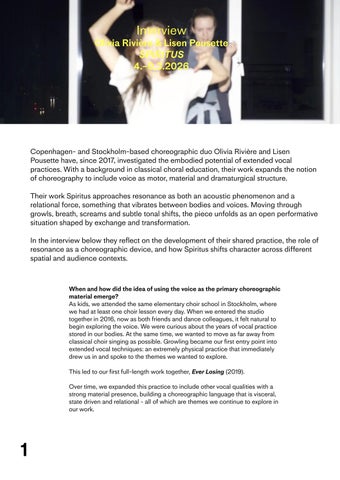
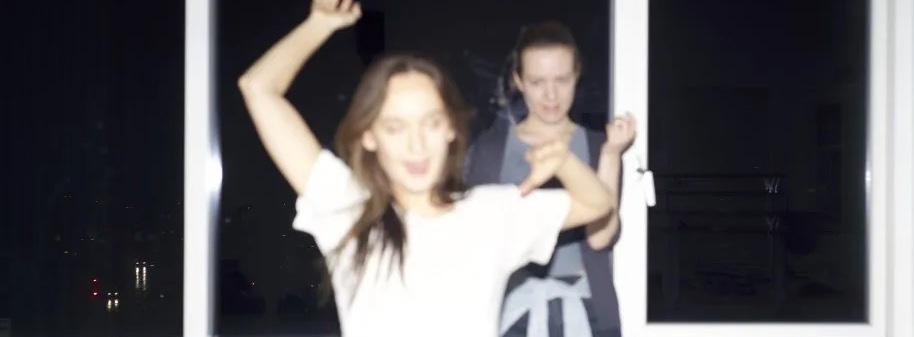
Their work Spiritus approaches resonance as both an acoustic phenomenon and a relational force, something that vibrates between bodies and voices. Moving through growls, breath, screams and subtle tonal shifts, the piece unfolds as an open performative situation shaped by exchange and transformation.
In the interview below they reflect on the development of their shared practice, the role of resonance as a choreographic device, and how Spiritus shifts character across different spatial and audience contexts.
When and how did the idea of using the voice as the primary choreographic material emerge?
As kids, we attended the same elementary choir school in Stockholm, where we had at least one choir lesson every day. When we entered the studio together in 2016, now as both friends and dance colleagues, it felt natural to begin exploring the voice. We were curious about the years of vocal practice stored in our bodies. At the same time, we wanted to move as far away from classical choir singing as possible. Growling became our first entry point into extended vocal techniques: an extremely physical practice that immediately drew us in and spoke to the themes we wanted to explore.
This led to our first full-length work together, Ever Losing (2019).
Over time, we expanded this practice to include other vocal qualities with a strong material presence, building a choreographic language that is visceral, state driven and relational - all of which are themes we continue to explore in our work.
What do you consider to be the strength of your shared dynamic, and how does it manifest in the work?
We would say that we are both very similar and can have a “twinning” effect, for example, we share loads of reference points and have very similar artistic preferences and at the same time, we have differences that complement and keep us fascinated with each other.
Right now we are in the midst of organising a minifestival echoing some of the particularities we look for in choreographic sound and listening, at Weld in Stockholm, where we realised after gathering some works together that we wanted to take part in this festival are duos. This was a fun surprise! And it feels significant, what sensitivities these types of relations bring about.
How do you draw on your background in vocal and choral practice when structuring movement and timing?
Working choreographically with voice and sound makes it equally important to see the dramaturgical curve of the choreography respectively the sound and voice material. We’d like to think of the idea that one could separate the sound from the rest of the work and still fully feel the core of the piece. We also look at it musically, considering how it functions in its own right. Since we work somatically, the voice is often the motor for movement, forming how we develop movement practices and scenes.
What role does resonance play for you, both as a physical experience in the body and as a dramaturgical device?
A big role! When we made Spiritus we departed from the idea of resonance as something you can’t control - this was tricky and even contradictoryhow to choreograph something that is uncontrollable? We have worked with the idea of resonance as a responsive relationship - a call, a response, and a transformation - and we are happy that we have dared going more and more into formats where we can let the material be more improvised and listening, and understanding more what types of framework we need for that.
Has the work changed character in its encounter with different spaces and audiences?
Yes, it has. We premiered Spiritus in a quite characteristic and raw theatre space, so not the typical black box. Being in a less theatrical space felt important for this work. At that time, the audience were seated in small islands of chairs. After that, Spiritus was lucky to tour to quite a few different places. But it wasn’t until we experienced the piece in a gallery setting, at Shower Gallery in Seoul, that something started to shift more clearly. The immediacy and intimacy of an audience being more convivial and close was something we wanted to keep.
At the same time, change and transformation - regardless of the spaceare part of the essence of Spiritus. As we write in the performance text, we enter un-set performative situations that spin off each other.