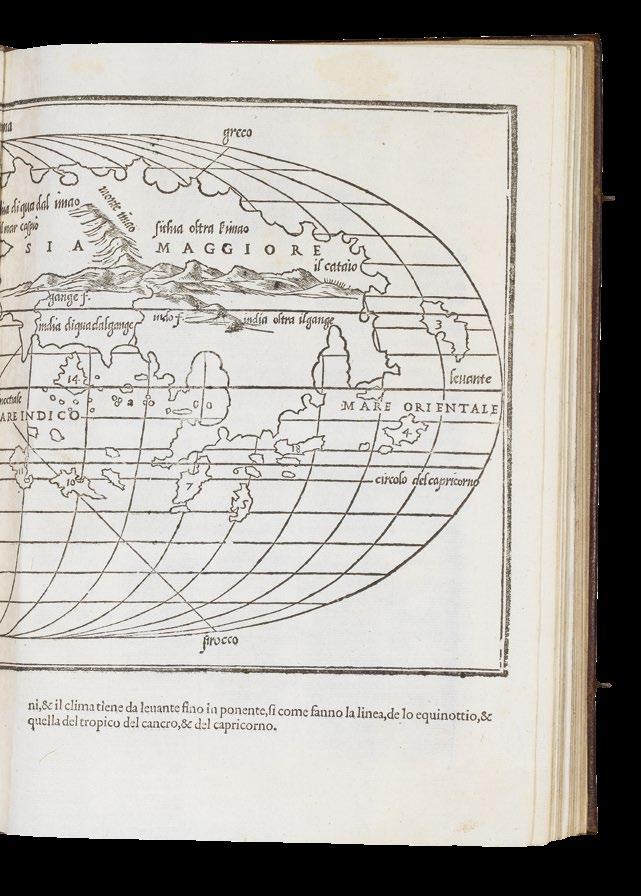
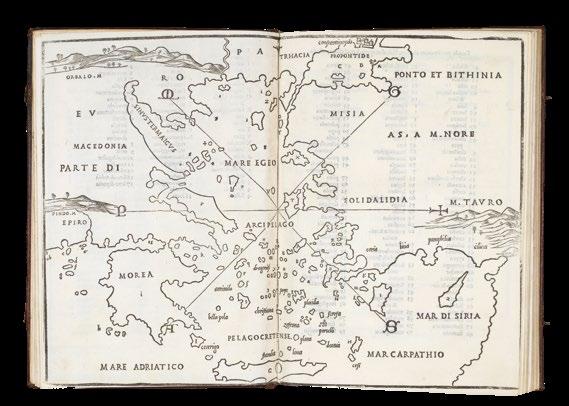
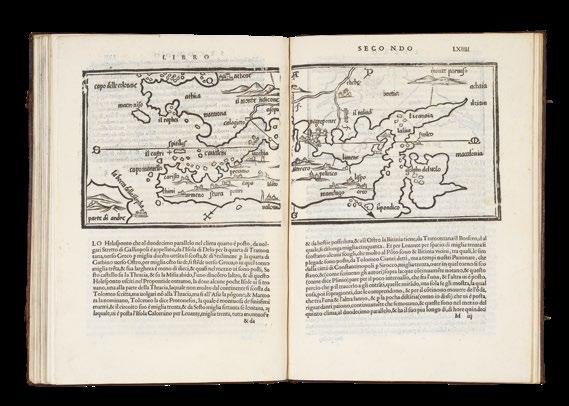
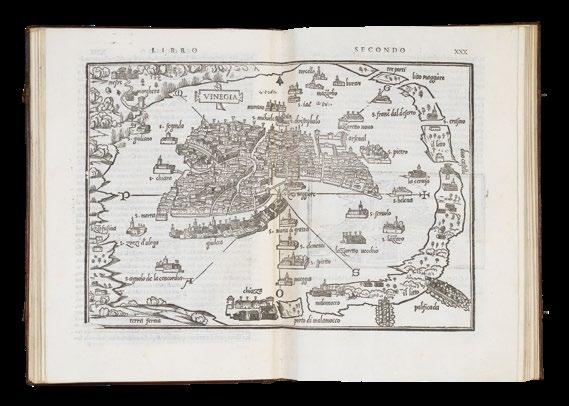
Catalogue edited by Arnie Anonuevo, Daniel Crouch, Rose Grossel, Kate Hunter, Ellida Minelli, Mia Rocquemore and Nick Trimming
Design by Ivone Chao
Photography by Louie Fasciolo and Marco Maschiao
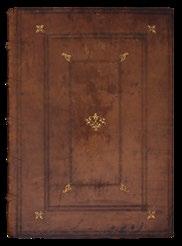
Cover: item 1
Terms and conditions: The condition of all books has been described. Each item may be assumed to be in good condition, unless otherwise stated. Dimensions are given height by width. All prices are net and do not include postage and packing. Invoices will be rendered in £ sterling. The title of goods does not pass to the purchaser until the invoice is paid in full.
Printed by Park Communications on FSC® certified paper. Park is an EMAS certified company and its Environmental Management System is certified to ISO14001. 100% of the inks used are vegetable oil based, 95% of press chemicals are recycled for further use and, on average 99% of any waste associated with this production will be recycled. This document is printed on Galerie Matt made of material from wellmanaged, FSC®-certified forests and other controlled sources. The pulp used in this product is bleached without the use of chlorine (ECF).
Early Modern
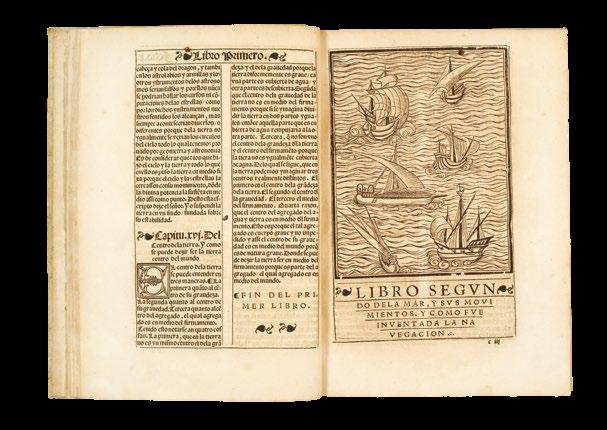
PTOLEMAEUS, Claudius; translated by ANGELUS, Jacobus, and edited by Nicolaus GERMANUS.
Cosmographia.
Publication Ulm, Lienhart Holle, 16 July 1482.
Description
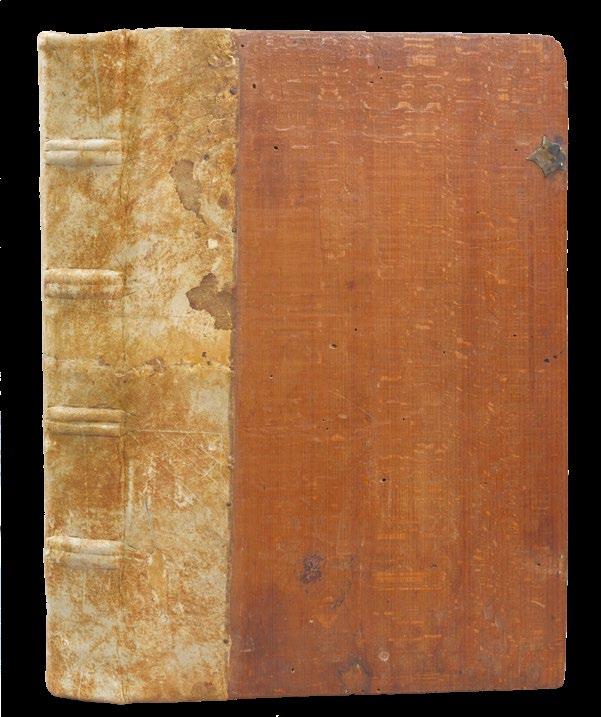
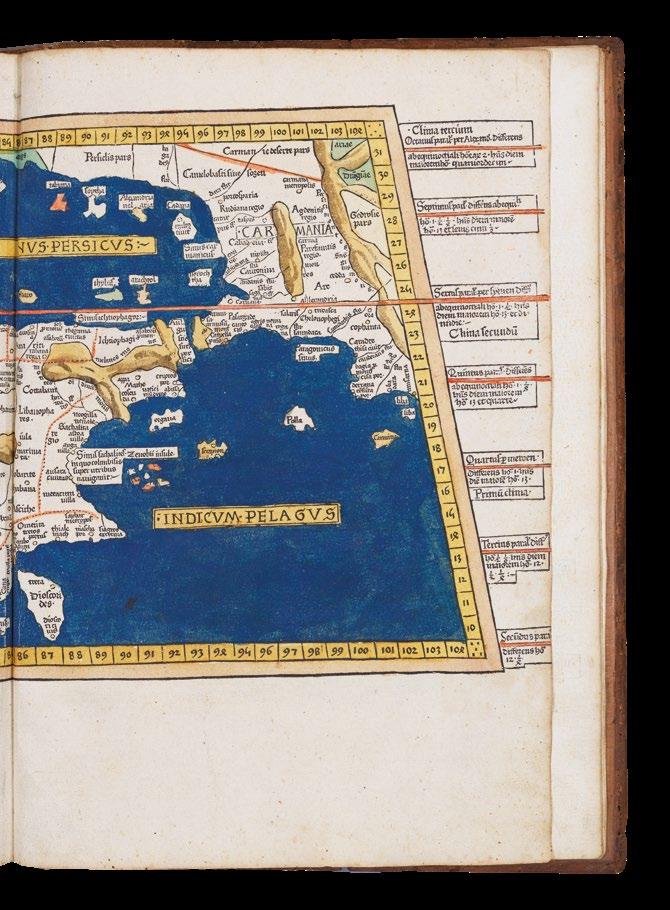
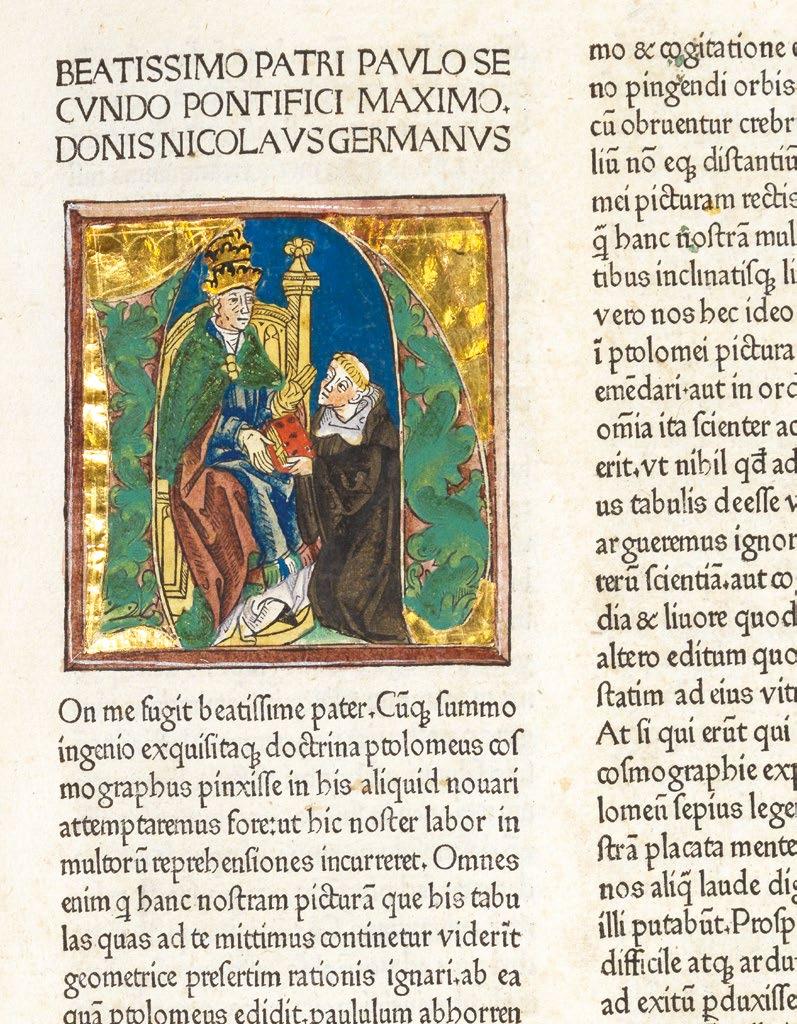
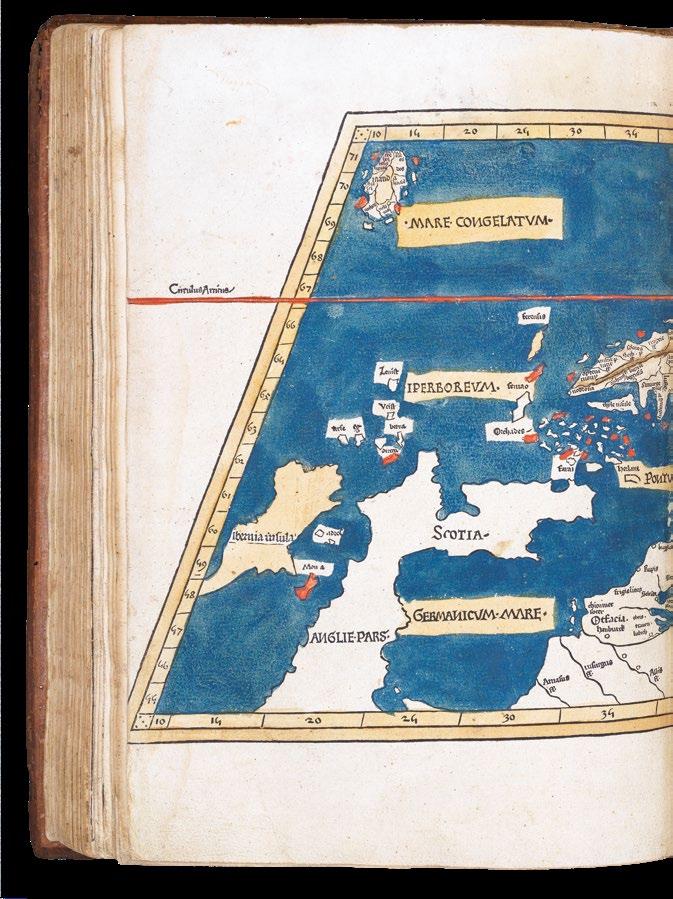
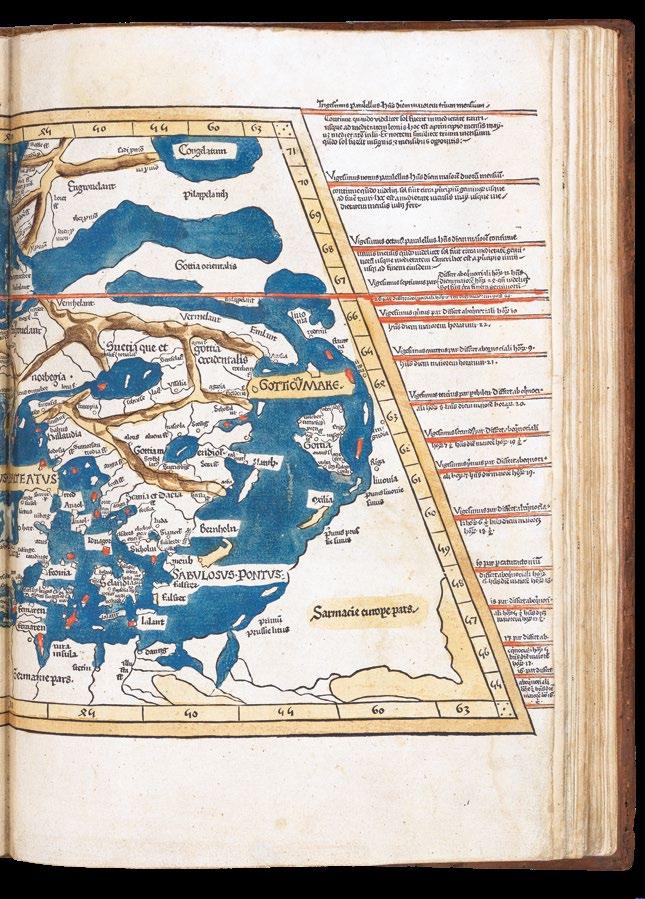
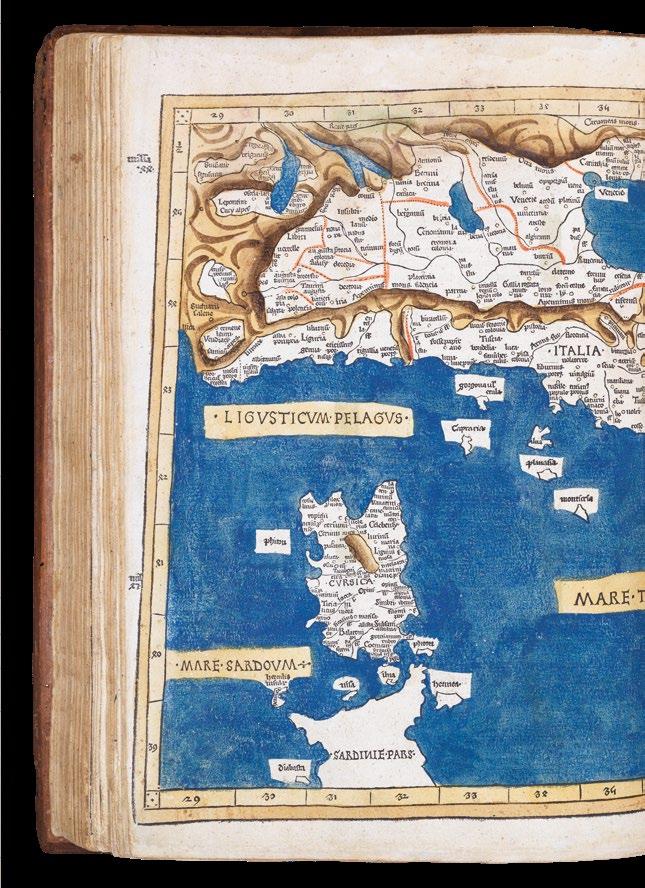
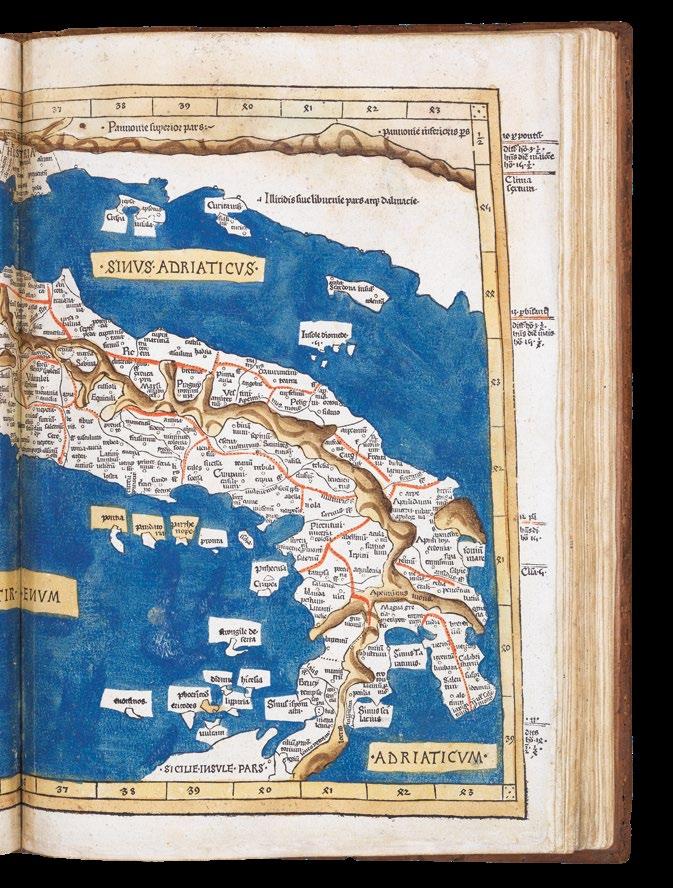
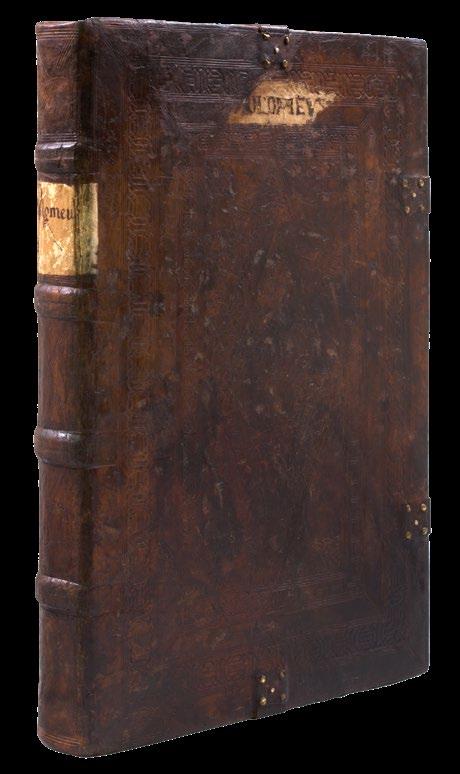
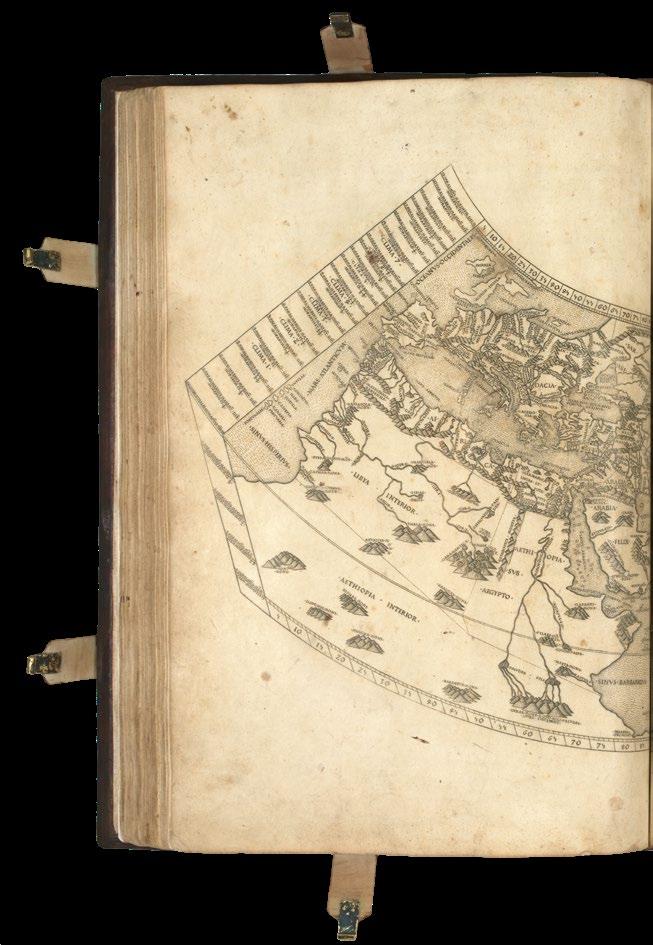
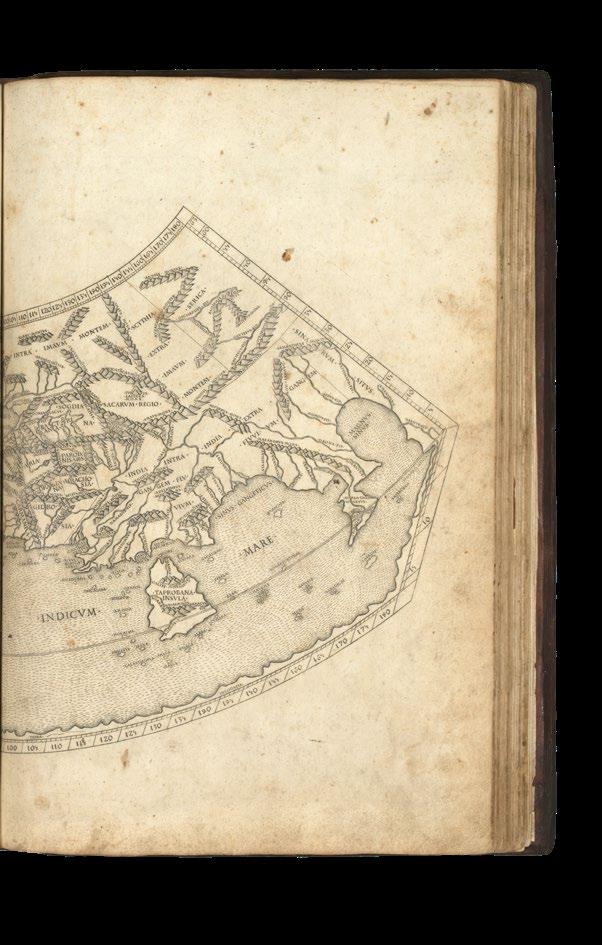
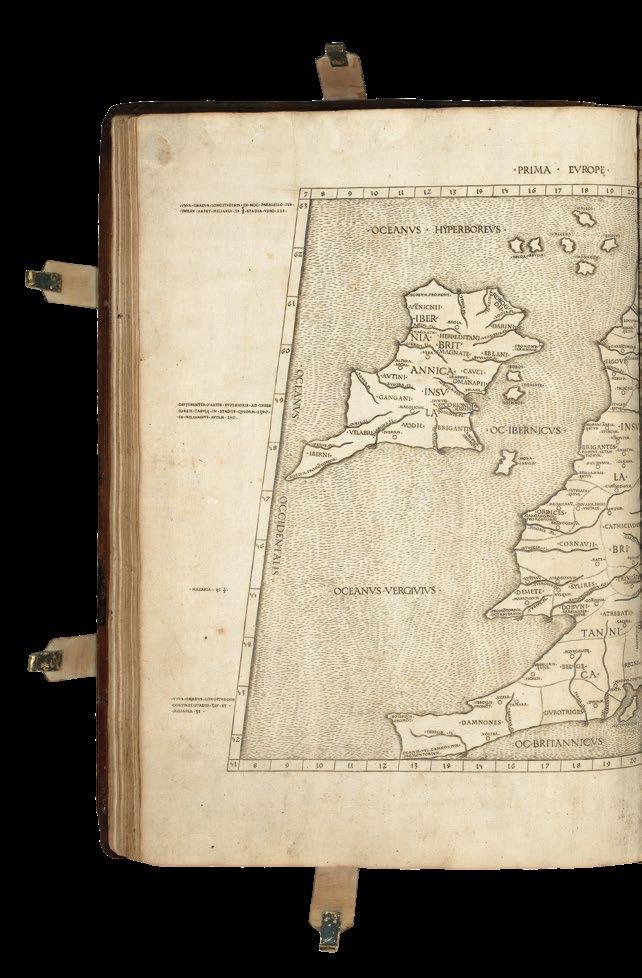
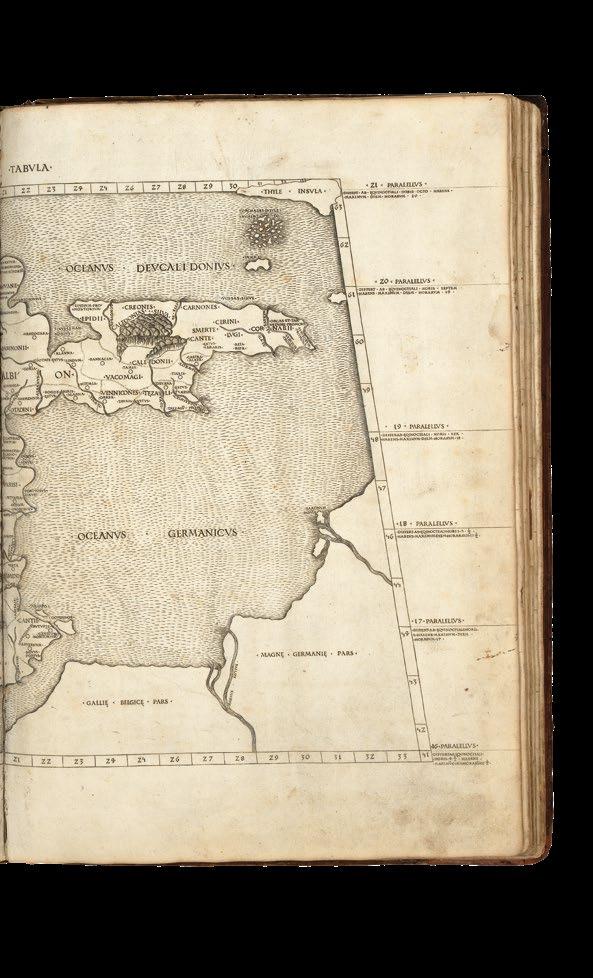
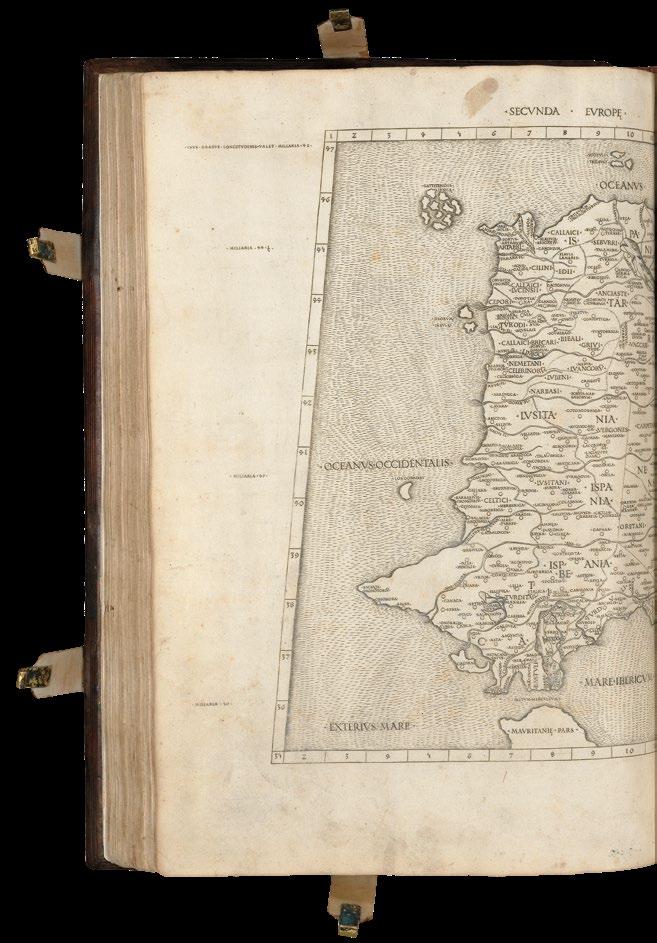
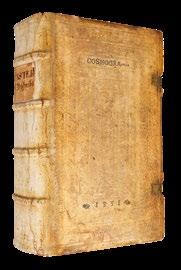
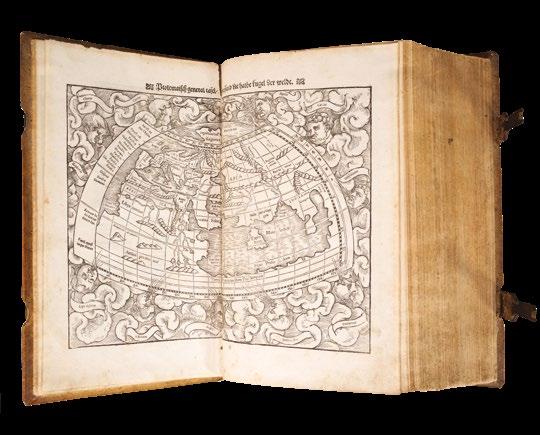
Folio (428 by 310mm), 102 leaves, doublecolumn, 44 lines and headline, Gothic letter, 32 double-page woodcut maps with fine original hand-colour, 4 woodcut diagrams in the text, 2 large illuminated historiated initials, one showing Donnus Nicolaus presenting his book to Pope Paul II, the other of Ptolemy, 159 other woodcut initials coloured in red, green and ochre, paragraph marks and initial-strokes supplied in ochre, tear to d6, and repaired tear to the map ‘Tertia Africa’, some dampstaining and discolouration throughout, including spotting affecting the final three maps, skilful reinforcement to weakened lower page corners on maps, single leaf free endpaper bearing ownership inscription, re-cased in contemporary doeskin over clasped oak boards, joints reinforced with vellum waste, remnants of one clasp remaining.
[Bound after]: ‘Registrum’ from Johannes Reger’s 1486 edition of Ptolemy’s ‘Cosmographia’,decorated with 17 5- and 6-line manuscript initials in red and blue, 30 leaves bound in 6s (not 8s as is usually the case); 9 leaves in the ‘Registrum’ uncut, tear to d6.
Ptolemy’s Second Projection, and the first map signed by its author
A fine example in a contemporary binding, here bound with Johannes Reger’s ‘Registrum’ made for his 1486 edition of the work.
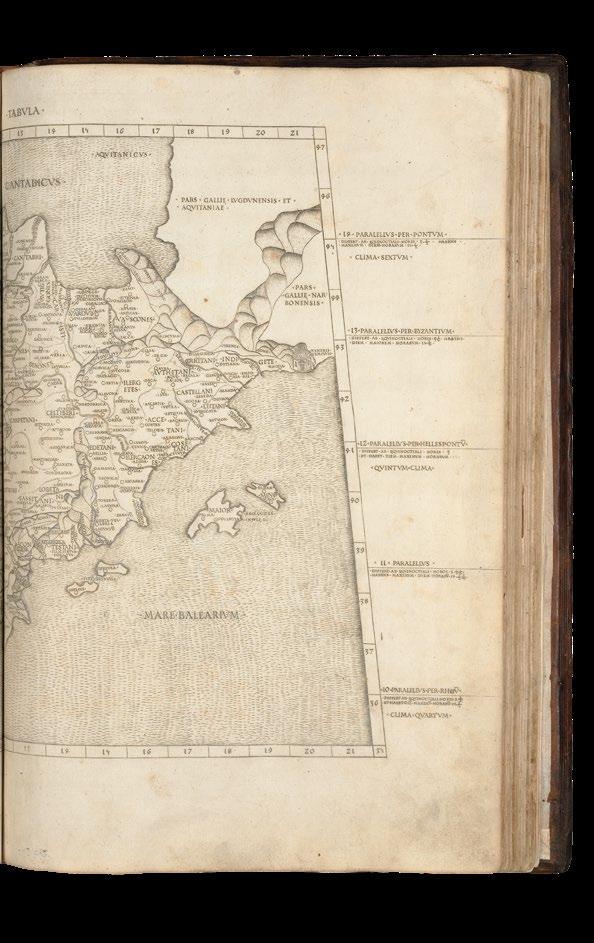
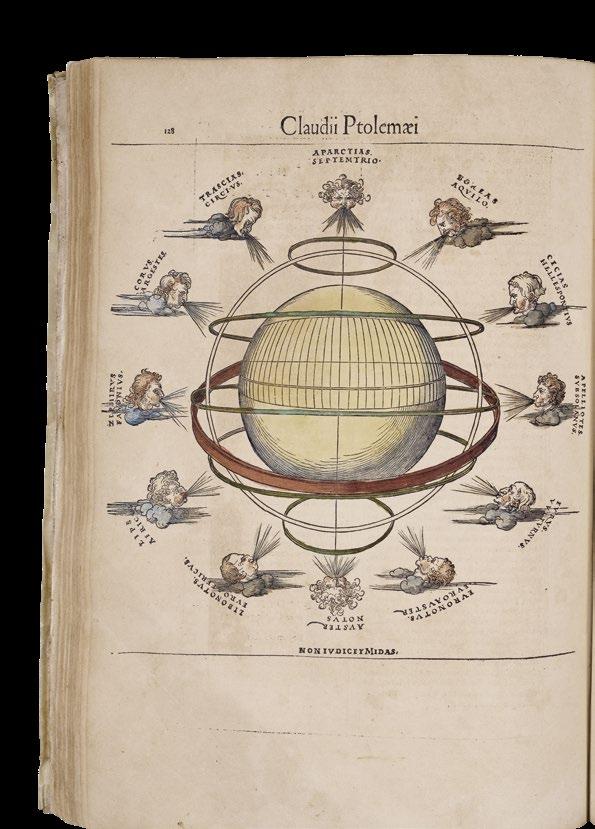
The text of Claudius Ptolemy’s (c.100-170AD) ‘Cosmographia’ was translated into Latin from the original Greek by Jacobus Angelus (c.13601411) and was first published, in Renaissance times, at Vicenza (1475), Bologna (1477) and Rome (1478). The sumptuous edition published at Ulm in 1482, however, far surpassed all earlier efforts and remains one of the most important publications in the history of cartography. This is the first redaction of the ‘Geographia’ to be printed outside Italy, the earliest atlas printed in Germany, the first to depart from the classical prototype to reflect post-antique discoveries, the first to be illustrated with woodcuts rather than engravings, and the first to contain hand-colored maps, the design and execution of which were ascribed to a named cartographer, and the first to incorporate the five modern maps by Nicolaus Germanus (c.1420-1490). Though printed outside Italy, the paper this magnificent atlas was printed on was imported from Italy, and payment made in part by complete copies of the finished atlas.
The maps
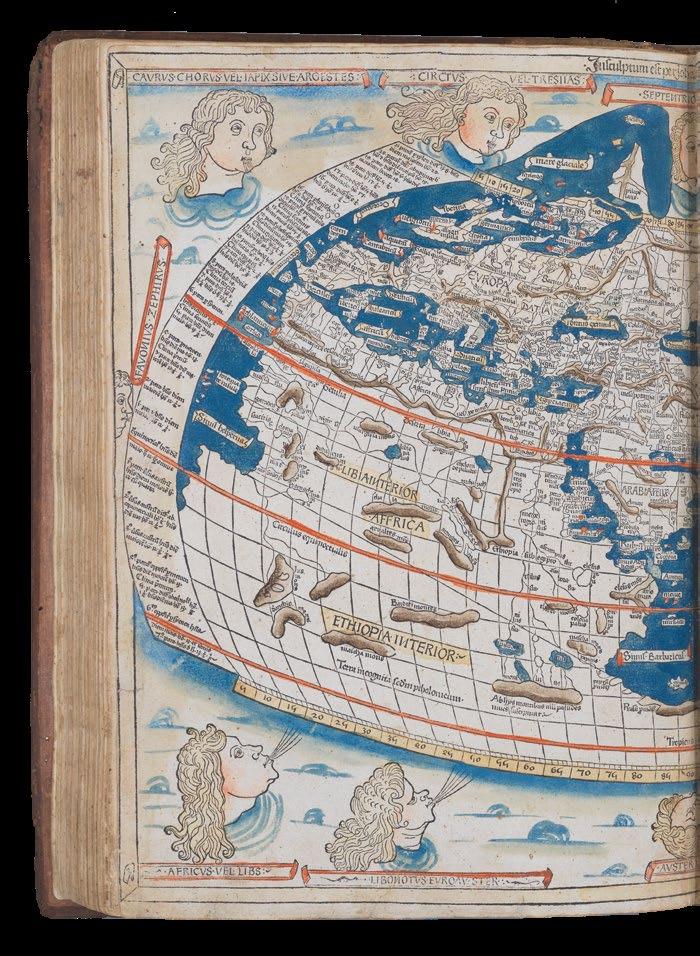
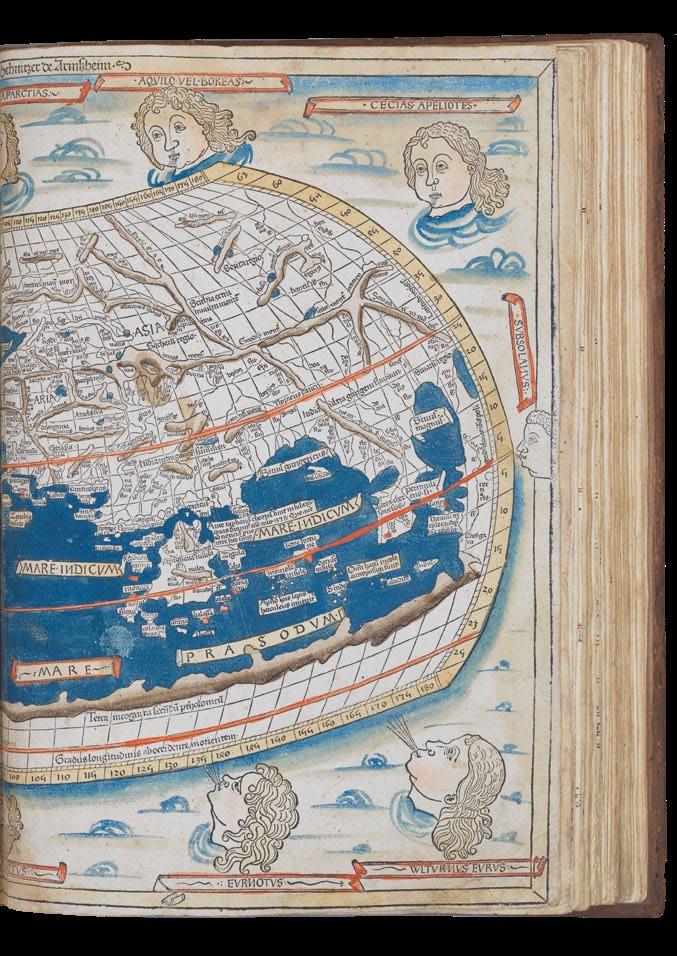
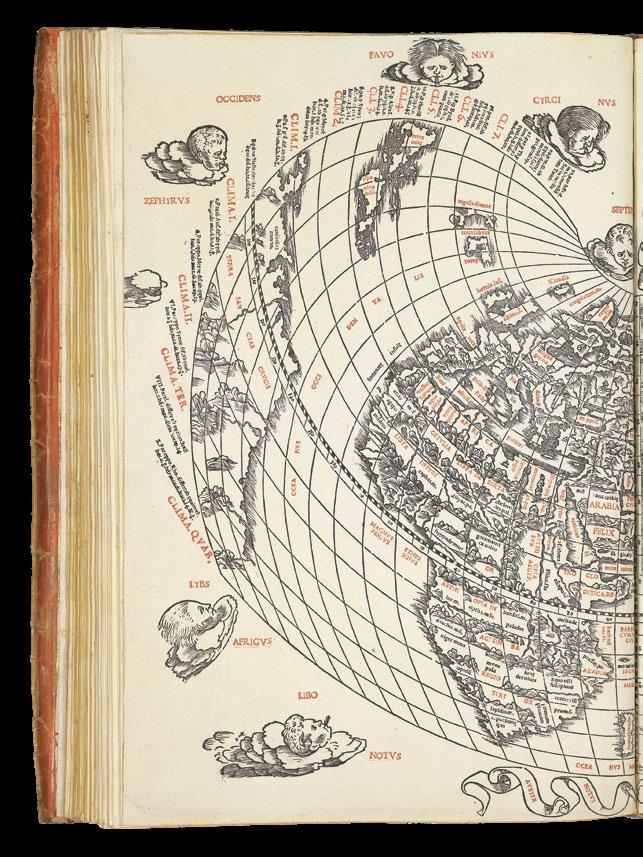
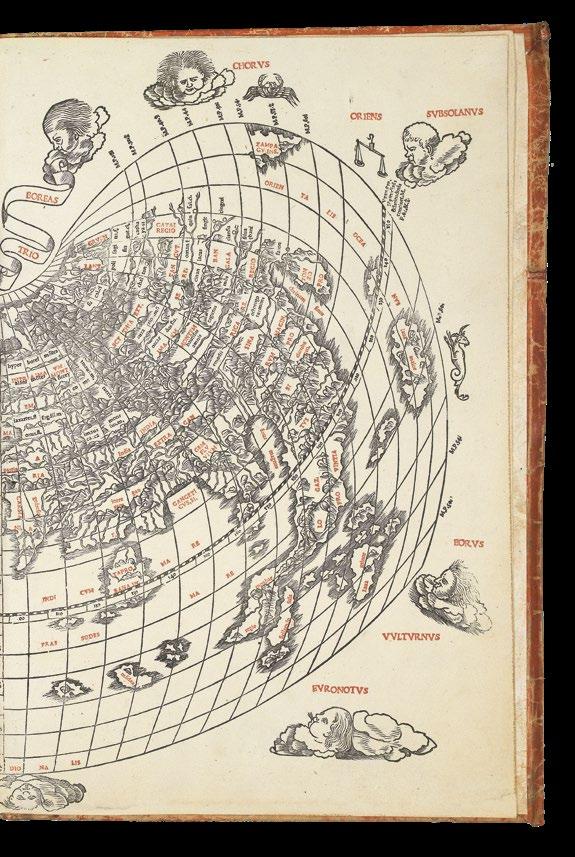
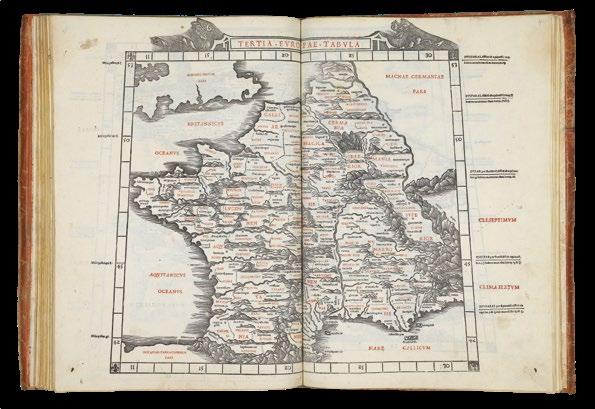
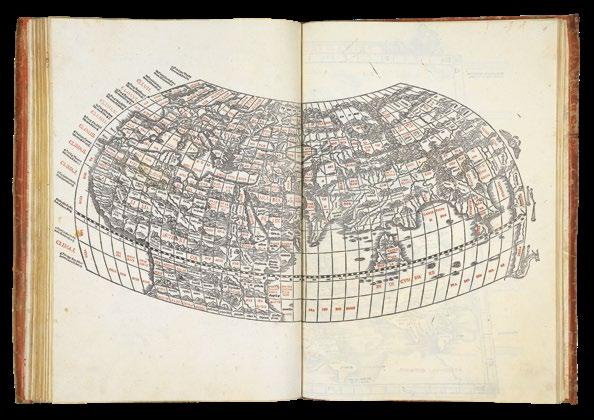
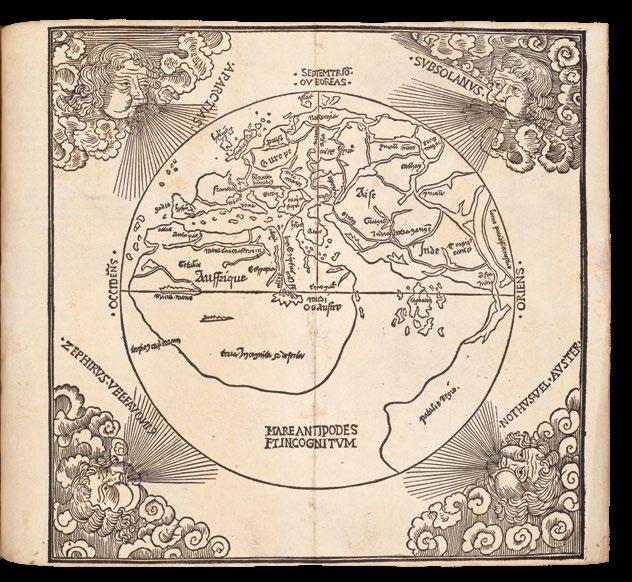
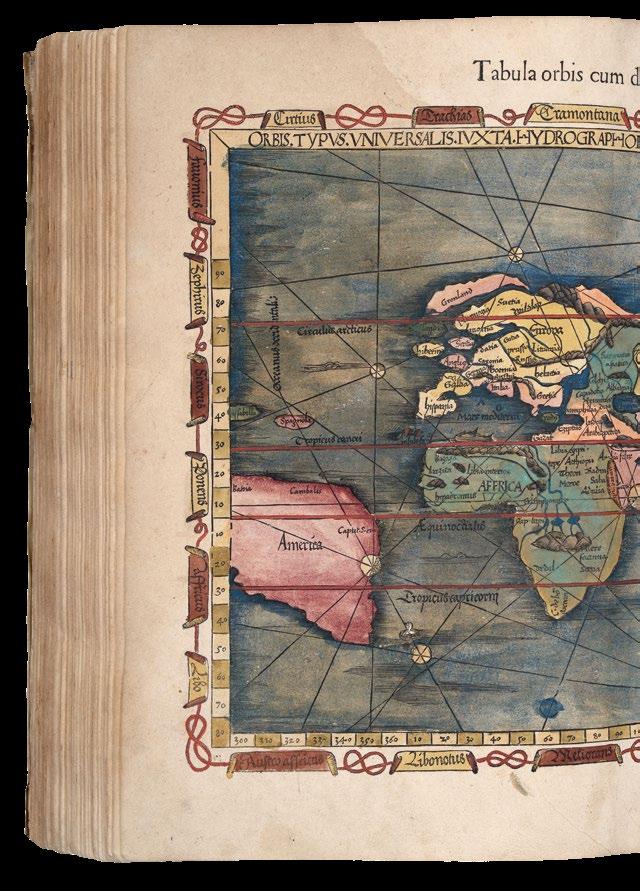
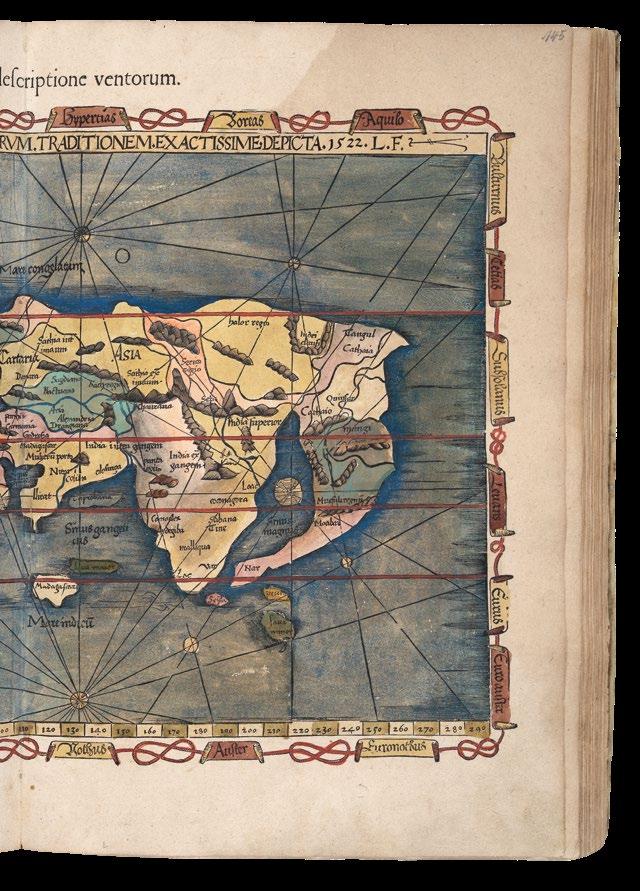
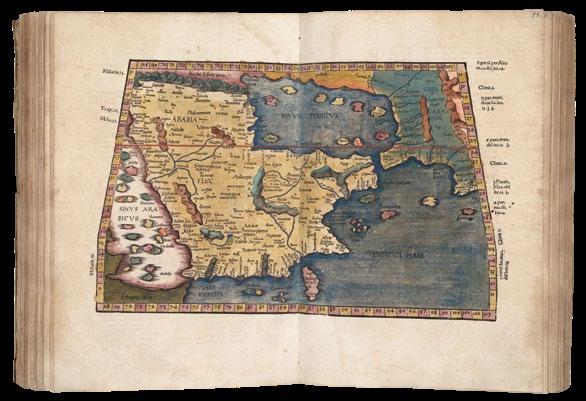
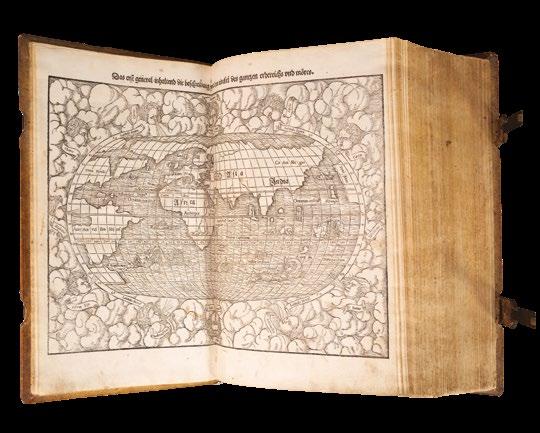
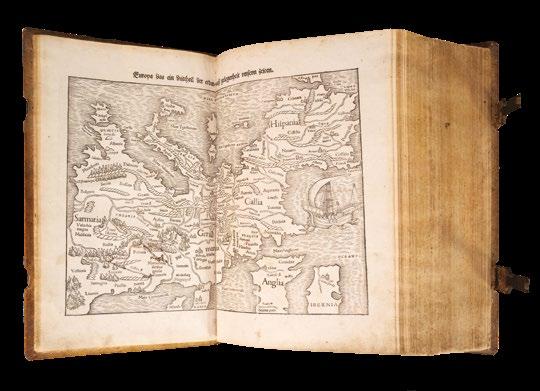
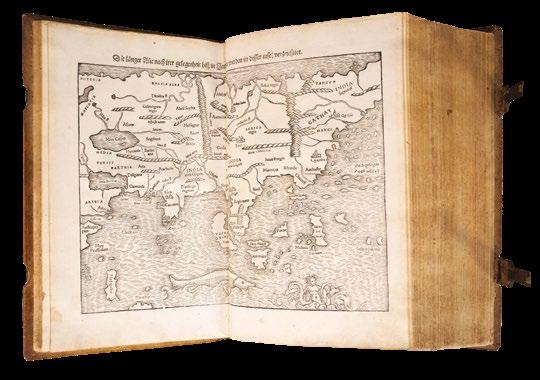
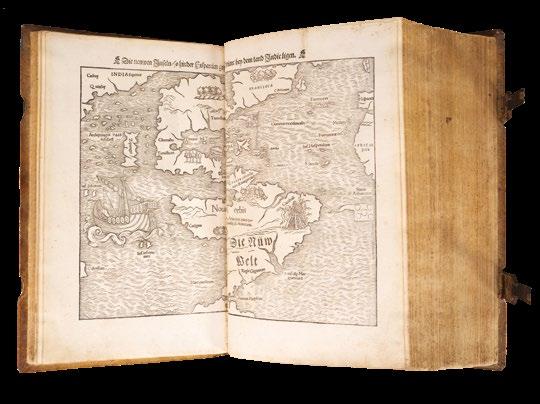
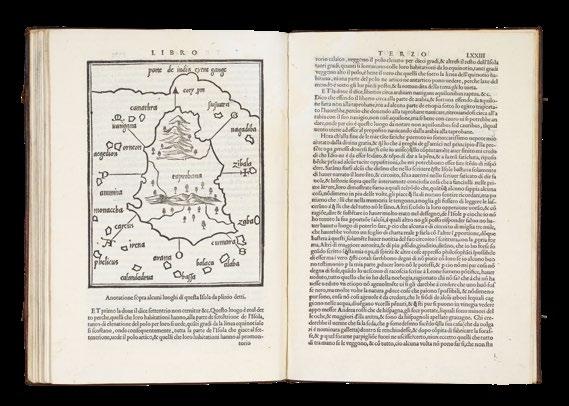
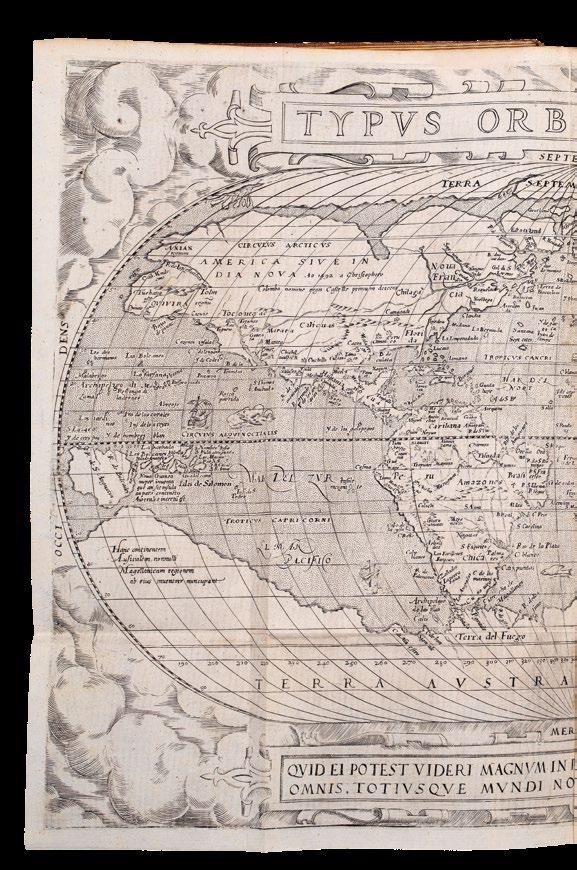
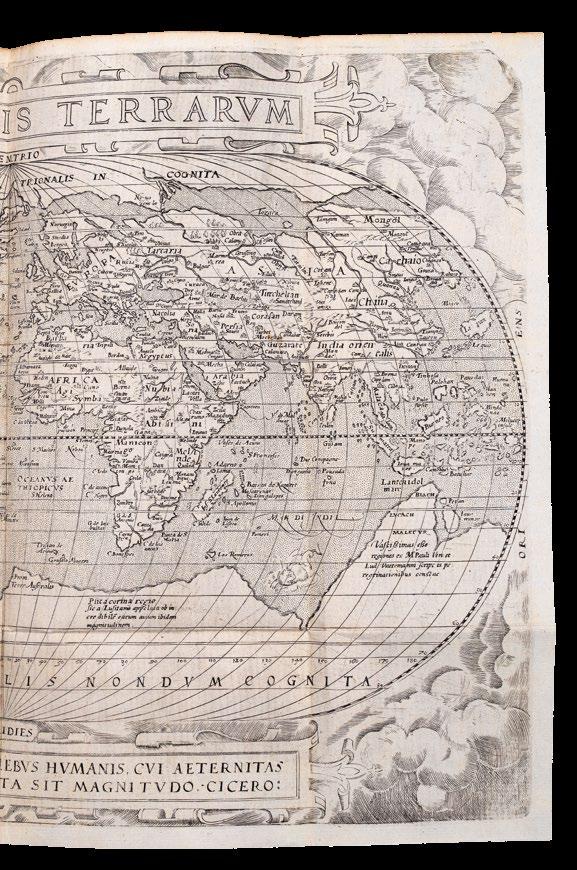
The 1482 edition is the first printed edition to contain the full complement of 32 maps, and its world map, extended to the northwest, is the first printed cartographical representation of Greenland, Iceland and the North Atlantic.
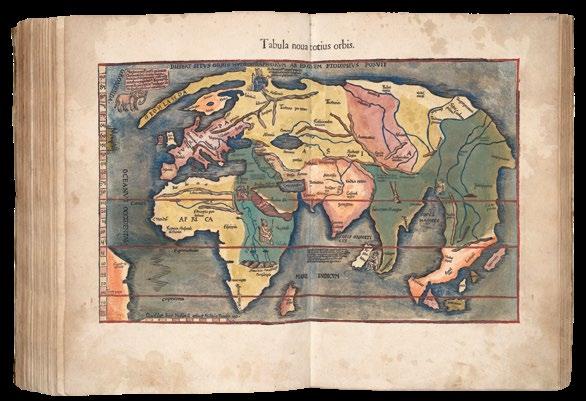
“The artist responsible for the woodcut maps identifies himself at the top of the world map as Johannes of Arnsheim, making it the earliest datable printed map to bear a signature” (Campbell p.137). He has incorporated as his sign a backwards N into the woodcut text on each map.
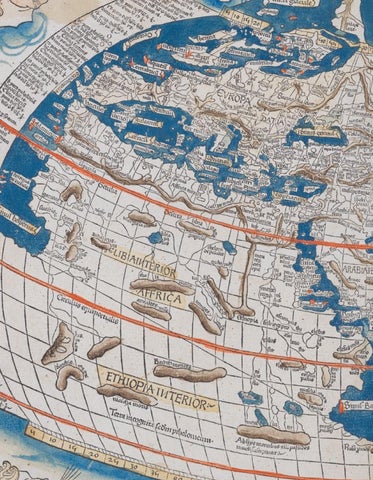
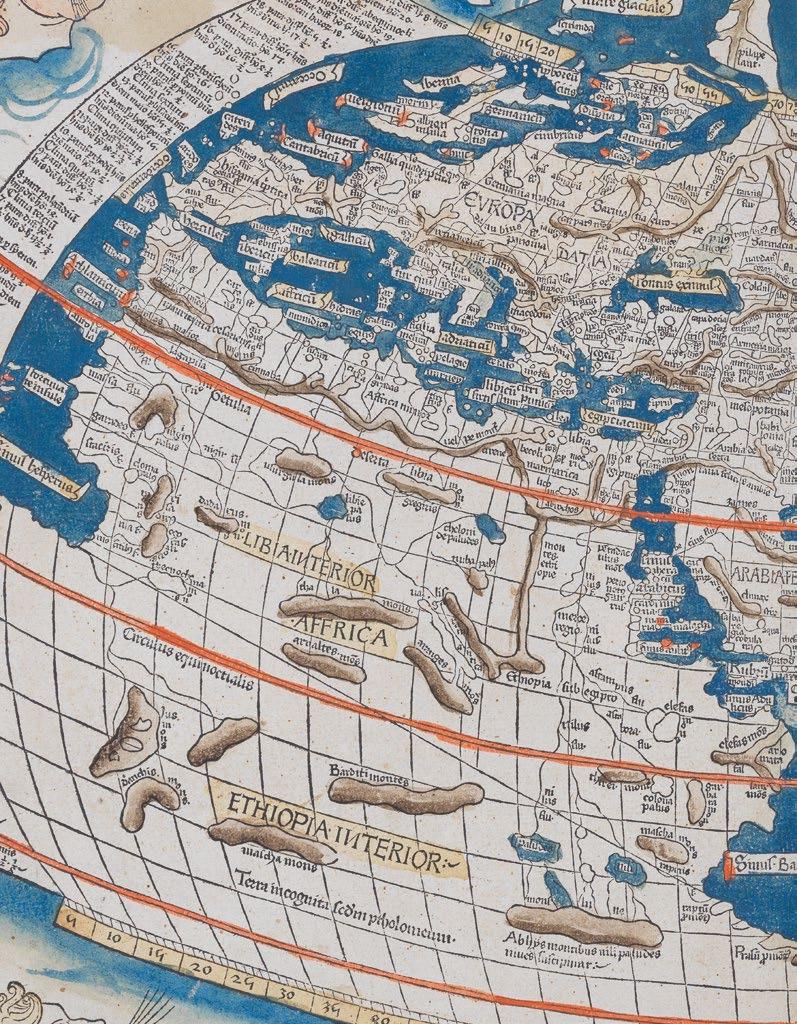
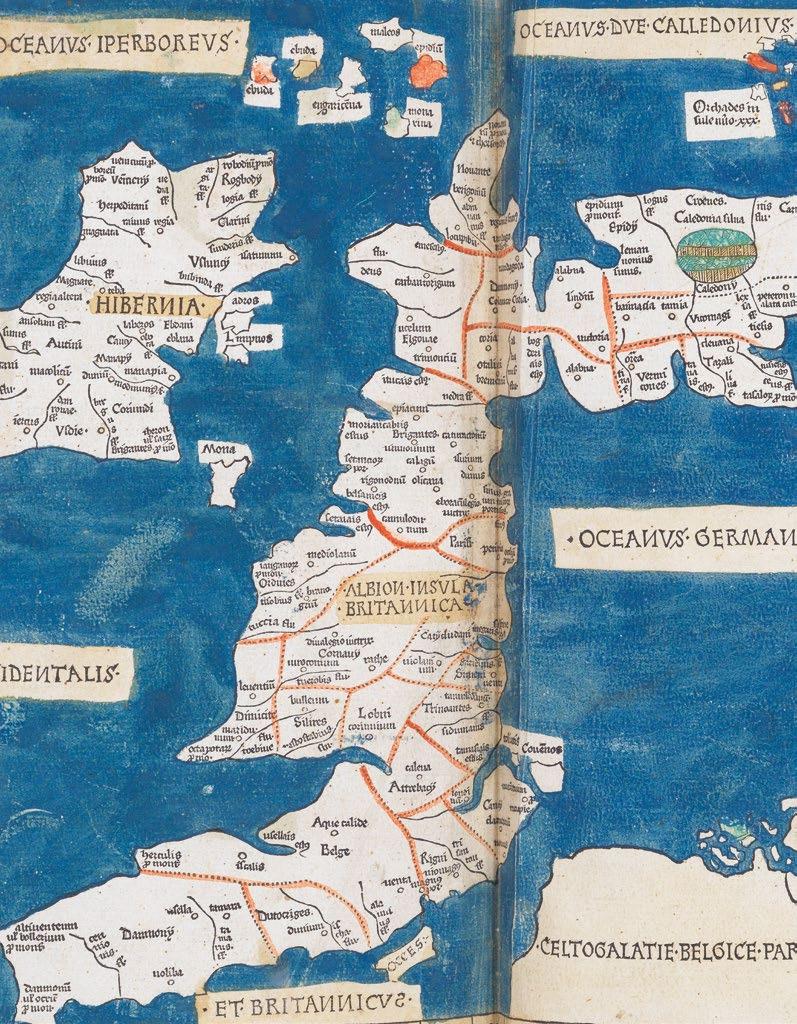
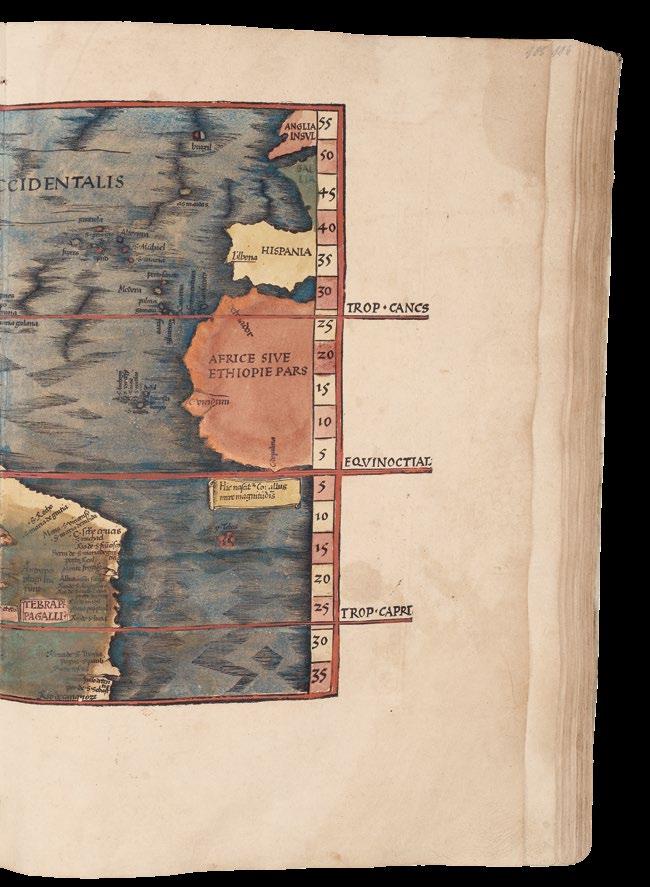
The Ulm edition, moreover, was the first to depart from the classical prototype by expanding the atlas to reflect post-antique discoveries about the size and shape of the earth. To the canonical twenty-seven Ptolemaic maps were added five “modern maps” of Spain, France, Italy, the Holy Land and northern Europe. The world map is of particular interest as it is the first to be signed, by Johannes Schnitzer (i.e. woodcutter) of Armszheim, who in trade mark fashion has reversed every capital N, and inadvertently provided two Tropics of Cancer. This map is the first to be based on Ptolemy’s second projection, in which both parallels and meridians are shown curved to convey the sphericity of the earth. Armszheim, furthermore, updated the Ptolemaic world picture by incorporating improvements that were probably based on a manuscript of the 1470s by Nicolaus Germanus (c.1420-1490), a Benedictine monk of Reichenbach Abbey in Bavaria, who is depicted in the first illuminated letter of the atlas presenting his book to the dedicatee Pope Paul II. One notable addition is a rudimentary depiction of Scandinavia to the north, within an extension of the map’s
Watermark:
Late fifteenth century Italian watermark of a flower with 7 petals throughout, with the exception of the front endpaper/ “initial blank”, which bears the watermark of an upper case letter “B” on a crowned shield. These were used by the le Bé family of Troyes, in this case “Ioane le Bé”. Three members of the Troyenne papermaking le Bé family bore the Christian name “Jean”: Jean I started his business in 1406. Jean II owned two paper mills around the 1470s, and Jean III lived in Troye in the first half of the 16th century. The le Bé family were accredited papermaker for the Université de Paris from 1520 onwards.
Dimensions 414 by 297mm (16.25 by 11.75 inches).
References
Camptell, T., Earliest Printed Maps, p. 179-210; Schreiber 5032; Skelton, R.A., Bibliographical note prefixed to the facsimile of the 1482 Ulm Ptolemy; P-J Troley, Mémoires historiques et critiques pour l’histoire de Troyes, t.2 p.636.
top border. This is also the earliest printed map to show the northernmost reaches of the Atlantic Ocean. The world map embodies what is perhaps the most readily apparent feature of the Ulm Ptolemy: its beauty.
The text
“The text is the early Latin translation by Jacopo d’Angelo [Jacobus Angelus], and its maps are the reworking of the Ptolemaic corpus by the cartographer Donnus (Dominus) Nicolaus Germanus. Three recensions of Nicolaus’s reworkings have been distinguished: the first, drawn on a trapezoid projection reputedly devised by Nicolaus himself and, therefore, also known as the Donis (Donis = Dominus) projection; the second on a homeotheric projection and with three additional modern maps; and the third on the same projection with further revisions and two additional modern maps. The Ulm Ptolemy derives from the third recension, and thus represents Nicolaus’s most mature work” (Campbell).
Printing history
“That the stock of the 1482 edition was not exhausted by 1486 is indicated by the existence of a number of copies (some in early binding) containing the additional texts printed by Johannes Reger in the latter year for his own edition...” (Skelton) - The present work is just such a book.
“For Leinhart Holle, the handsome edition of the ‘Cosmographia’ which he printed at Ulm in 1482 was an unprofitable investment. Only one more book came from his press; and by 1484 he was out of business and gone from Ulm, and his stock of type, blocks, and printed sheets passed into the hands of Johann Reger, Ulm factor or agent (pro-visor) or Giusto de Albano, of Venice...
Reger lost little time in bringing the ‘Cosmographia’ back on the market. He compiled a gazeteer or geographical index to the text under the title ‘Registrum alphabeticum super octo libros Ptolemei’, to which he prefixed a ‘Nota ad inueniendum igitur regiones’; explaining its purpose and use; and he also obtained, or composed, an anonymous tract entitled ‘De locis ac mirabilibus mundi’... they were printed by Reger in 1486 and inserted into some unsold copies of the 1482 edition...
In the map Europa IV in the 1482 edition, Reger found the Ptolemaic name Chetaori, corresponding to his birthplace Kemnat in Bavaria; he introduced this into Ptolemy’s list of towns in bk. II ch. 10 [not present in this 1482 edition of the main text], and inserted in his “Registrum’ the entry: ‘Chemmat siue chetaori li 2 c 10 ta 4 e Hic iohannes reger duxit origine et ano etatis 32 compposuit hoc register in vlma anno domini 1486”. This is the evidence for Reger’s authorship of the ‘Registrum’, which is otherwise unsigned” (Skelton).
Cladius Ptolemaeus
Claudius Ptolemy was an Alexandrine Greek, and a dominant figure in both astronomy and geography for more than 1500 years. He compiled a mapmaker’s manual usually referred to simply as the ‘Geography’. He demonstrated how the globe could be projected on a plane surface, provided coordinates for over 8,000 places across his the Roman world, and expressed them in degrees of longitude and latitude. Now maps drawn by Ptolemy himself are known to survive, but maps compiled from his instructions as outlined in his ‘Geography’ were circulated from about 1300. This Ulm edition of Ptolemy’s ‘Geography’ is one of the earliest printed.
Provenance
1. Inscribed on front free endpaper “Donnait Le Sr. munery mon beaufrere [given by my brother-in-law Sr. Munery] anno 1672 Morel Senator” 2. Inscribed on d2 “Josephus Mattheus de Morel 1718, Franciseii de Morel”
This is probably André de Morel (Maurel) (1603-1690), Senator in the Parlement de Provence. Morel’s family began their social elevation under Charles d’Anjou (1446-1481) who was also King of Naples and Earl of Provence. It is said that the King put Pierre de Morel in his will and, at his death in 1481, he inherited a part of his library. The family served the French Crown as advisors and officers during wars in Northern Italy and Spain until Henri IV of France. Then in the late 1620’s André de Maurel became a prominent magistrate and member of Parliament of Provence. He ruled his office for 67 years and was known as Senator Morel. His second son, Joseph de Maurel (1658-1717) was Bishop of Saint PaulTrois-Chatêaux between Aix and Valence. His heir and nephew, François de Maurel, Captain in the ‘Regiment de Toulouse’ in 1719, inherited his belongings after his death.
PTOLEMAEUS, Claudius
Cosmographia.
Publication
Rome, Petri de Turre, 1490.
Description
Folio (425 by 282mm), loose endpaper/ initial blank on different paper, minor wormholes to first two gatherings, occasional minor staining to margins not affecting text, very occasional manuscript annotations in faded ink, 27 double-page engraved maps, minor staining to world map, some loss to right edge of ‘Quinta Asia Tabula’ not affecting printed area, ‘Sexta Asia Tabula’ with small closed tear to title, small open tear to right edge and some brown staining, some minor brown staining to ‘Decima Asia Tabula’, minor wormholes to final two gatherings. Contemporary calf decorated in blind with intricate roll tool borders enclosing central diamond with woven rope motif, clasps with cross straps replaced, some areas of repair including triangular area c.50-60mm to upper cover and small area to lower left hand corner of lower cover, early paper label with manuscript lettering in iron gall ink.
Collation:
A8 (first leaf blank) B-C8, D6 (second leaf incorrectly signed D3), E6, a10 (first leaf blank), b-g8, h3 (lacking final blank leaf), 27 engraved maps, 2a8 (2a1r blank, 2a1v registrum super tractum de tribus orbis partibus, 2a2r-2c5r de locis ac mirabilibus mundi et primo de tribus orbis partibus), 2b8, 2c6 (lacking final blank leaf, 2c5r colophon: Hoc opus Ptholomei memorabile quidem et insigne exactissima diligentia castigatum iucondo quodam caractere impressum fuit et completum Rome anno a nativitate Domini .M.CCCC.LXXXX die .IV. Novembris. arte ac impensis Petri de Turre, 2c5v blank).
References
BMC IV, 133; BSB-Ink P-861; Goff P-1086; HC 13541; Nordenskiöld 7; Sabin 66474; Shirley 4; Scammell, The World Encompassed 40; Tooley, Landmarks of Mapmaking.
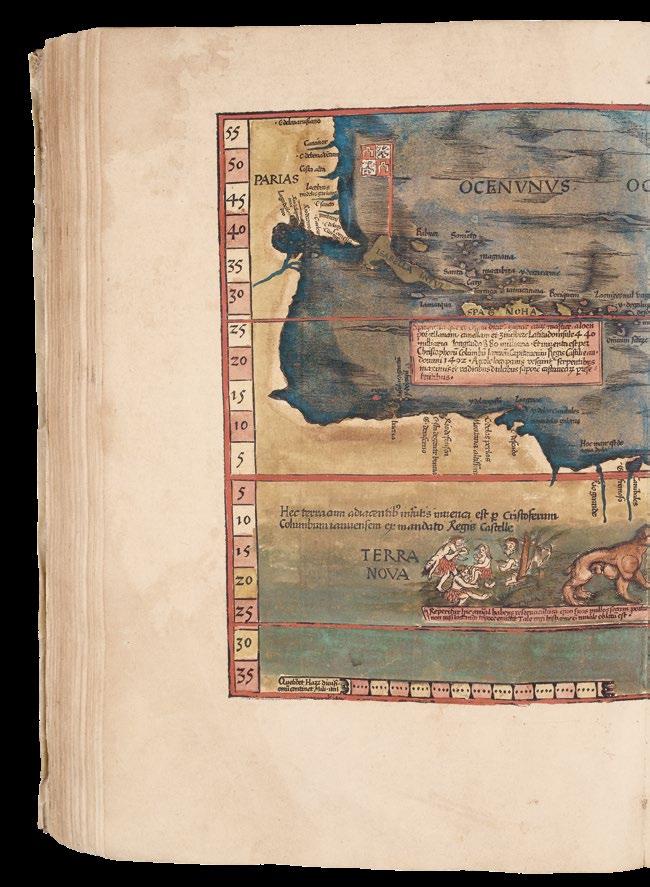
Ptolemy’s first projection, with the “finest Ptolemaic plates produced until Gerard Mercator”
The “handsome” second Rome edition of Ptolemy’s ‘Geographia’ (Scammell).
The plates for the Rome editions of Ptolemy were several years in the making, and they are considered to be “the finest Ptolemaic plates produced until Gerard Mercator engraved his classical world atlas” a century later (Shirley). They were produced by two German printers, Conrad Sweynheym and Arnold Buckinck, and “it is believed that Sweynheym was the one who first thought of applying the very new art of copper-engraving to the printing of maps, and he might have taken a hand in the actual engraving of them himself” (Scammell). The first edition was printed in 1478, and the present edition was printed 12 years later from the same plates.
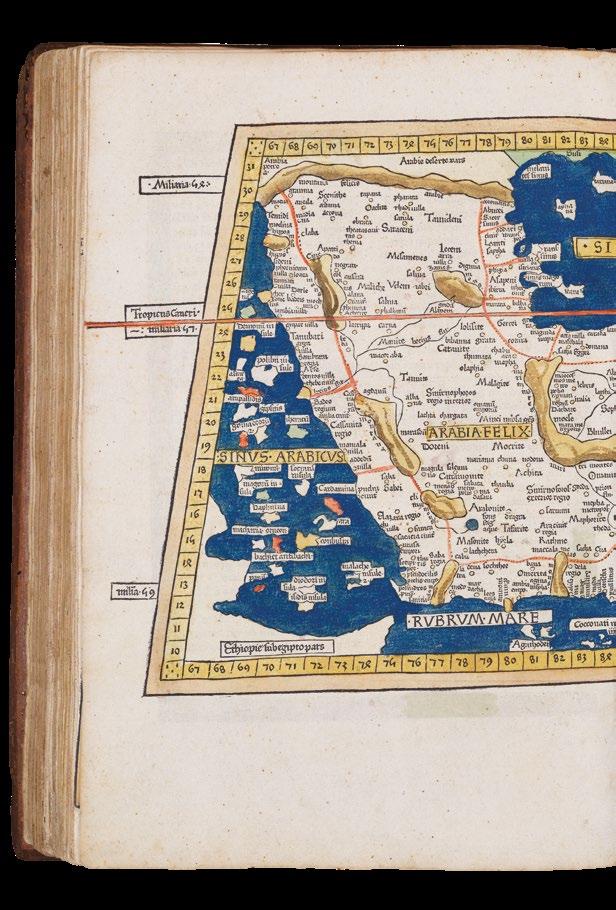
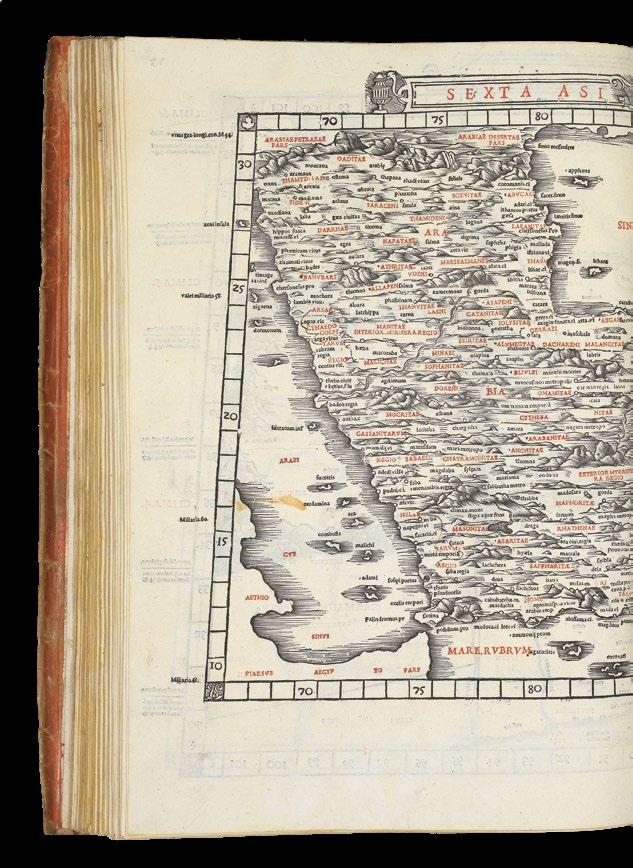
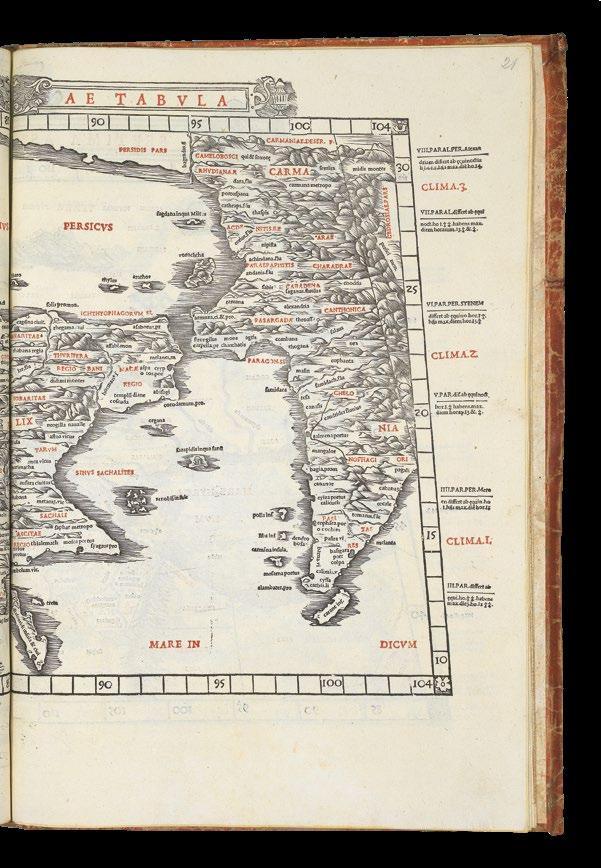
While the Bologna edition of 1477 was the first atlas and edition of Ptolemy to use copperplate maps, the Rome edition is generally regarded as superior for its clear captions, accurate projections and overall design. It includes more geographical details, including in particular names in Arabia. Unusually, the seas are pock-marked. The early Italian Ptolemys, particularly the Rome editions, are “superb testimonials of Italian craftsmanship without the picturesque but unscientific monsters of the medieval maps or the addition of the adventitious decoration of later work, relying for their beauty solely on the delicacy of their execution and the fineness of the material employed” (Tooley). As Tooley observes, the maps in the atlas have no external border decorations or co-ordinate lines, relying instead on the clarity of the engraving.
MONTALBODDO, Antonio Fracanzano da; translated into Latin by Archangelo MADRIGNANO
Itinerarium Portugallensium e Lusitania in Indiam & inde in occidentem & demum ad aquilonem.
Publication [Milan, Giovanni Angelo Scinzenzeler], 1508.
Description
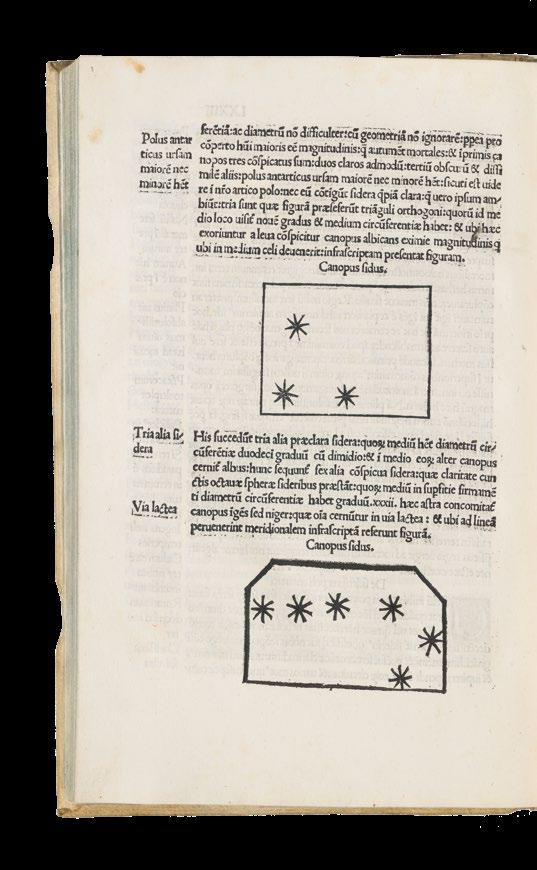
Folio (276 by 195mm). Letterpress titlepage with large woodcut map, vignette star charts and initials; contemporary panelled blind-stamped vellum over boards, decorated in blind, gilt lettering-piece on the spine, remains of two pairs of clasps and catches.
Alden and Landis, 508/4; Borba de Moraes, I:580; Brunet, III:474; Church, 27; Cooper, ‘The Library’, 4th series, iii, (1922-23), page 53-54; Fumagalli, 985; Harrisse [Discovery], 58; Hattendorf, 111; Németh, 175-198; Quarrie for ODNB online; Sabin, 50058; Streeter, 3.
The first depiction of the “Arabian”gulf
The Henry Huth - James C. McCoy copy of the first printed collection of voyages; the earliest mention of the ‘Arabian’ gulf; and, “after Columbus’s letter, the most important contribution to the early history of American discovery”.
A magnificent example, with a superb provenance, of the extremely rare first edition in Latin of the first printed collection of voyages, written by Fracanzano da Montalboddo, and considered “after Columbus’s letter the most important contribution to the early history of American discovery” (Sabin).
The work was first printed in Italian in 1507 under the title ‘Paesi novamente retrovati’, and it was translated into Latin the following year by the Milanese monk Arcangelo Madrignano, after which it quickly became “the most important vehicle for the dissemination throughout Renaissance Europe of the news of the great discoveries both in the east and the west” (PMM).
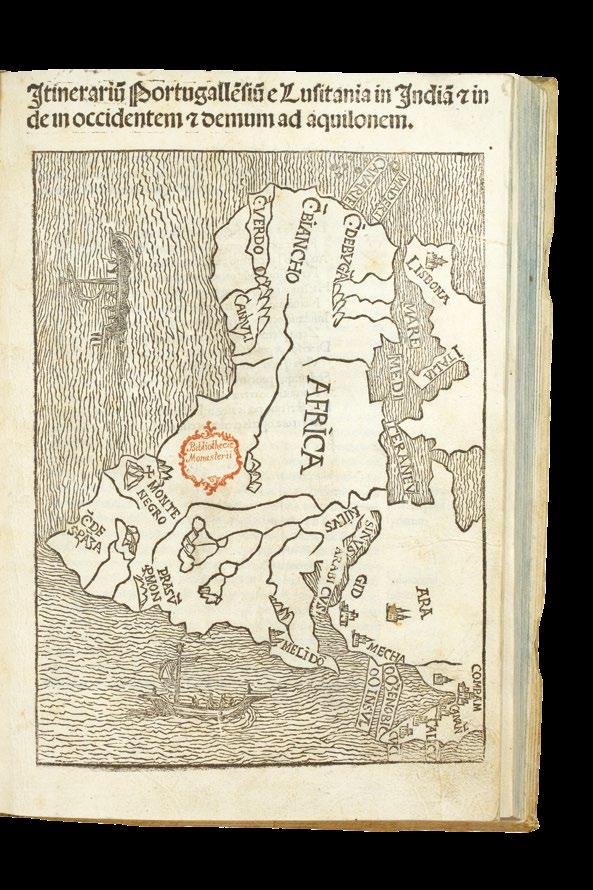
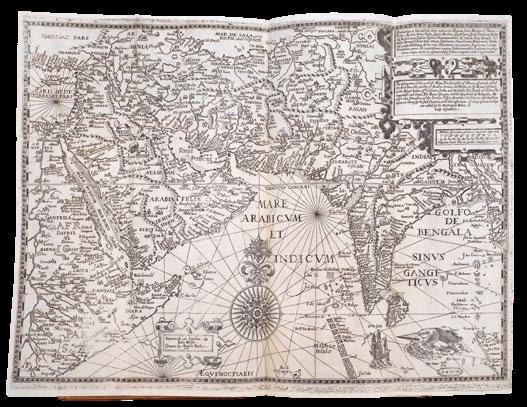
With the woodcut map, which appears for the first time in this Latin edition, is the first large map of Africa, the first known map in which that continent is depicted as surrounded by the ocean, as well as the earliest “modern” printed map to show Mecca. This is the second issue, distinguished by naming The Gulf as ‘Sinus Arabicus’, as opposed to ‘Persicus’.
Also with the rare two-leaf index, which is of crucial importance to the ‘Itinerarium Portugallensium’ as it gives an outline of the subsequent contents, identifying individual voyages and discoveries, whereas the text of the book runs continuously from section to section without distinguishing where a new one begins. These leaves were apparently printed after the publication of the work, and so inserted into the few available copies after the fact, and are therefore almost invariably missing.
The work, which contains six nominal sections, commences with the 1456 voyages of Alvise de Cadamosto in Ethiopia and along the West African coast, which appeared for the first time in this work. Cadamosto traveled to Senegal, Gambia, and the Cape Verde Islands in 1455 and 1456. This is followed by accounts of: Pedro de Sintra’s expedition along the west coast of Africa as far as Sierra Leone in 1462; Vasco da Gama’s epochal voyage to Africa and India (1497-99), which “opened the way for the maritime invasion of the east by Europe” (PMM), supplied by letters from Venetian spies in Portugal; and Pedro Alvares Cabral’s discovery of the Brazilian, Guianaian and Venezuelan coasts in 1500. The third section is a continuation of the Cabral narrative of the voyage on to India. The fourth is an account of Columbus’s first three voyages (1492-1500), undoubtedly based on Peter Martyr’s ‘Libretto de tutta la navigatione de Re de Spagna de le isole et terreni novamente trovati’, as well as narratives of the expeditions of Alonso Niño and Vicente Yañez Pinzon along the northern coast of South America. The fifth is Vespucci’s letter to Lorenzo
de’ Medici describing his third voyage in 1501-1502. The sixth is a compilation of information derived from several sources concerning the Portuguese discoveries in Brazil and the East.
Montalboddo’s collected voyages, called by Henry Harrisse “the most important collection of voyages”, and asserted by Boies Penrose that “for news value as regards both the Orient and America, no other book printed in the sixteenth century could hold a candle to it”, was the forerunner of the later compilations of Grynaeus and Huttich, Ramusio, Eden, Hakluyt, the De Brys, and Hulsius, “an auspicious beginning to the fascinating literature of the great age of discovery” (Lily Library online).
Provenance
1. Early ink library stamp of ‘Bibliothecte Monasterii’ on the map;
2. Henry Huth (1815–1878), collector of Americana, his sale Messrs. Sotheby, Wilkinson & Hodge, The Fiftieth Day, 11th July, 1919, lot 7731, morocco, gilt library label on the inside front cover;
3. James Comly McCoy (1862-1934), collector of Canadiana and French Americana, morocco, gilt library label on the inside front cover;
4. With Sotheby’s 10th November, 1959.
From the distinguished libraries of two titans of the book collecting world:
Henry Huth (1815-1878)
From an exceedingly wealthy family, Huth shunned a career in the Indian Civil Service, and instead joined the family banking firm. His “interest in old books went back to his schooldays, and he was said to have been fired with enthusiasm by seeing “a curious old book” in Baldock’s Holborn bookshop. In Mexico in 1840 he acquired a number of rare Spanish books and a Chinese Bible from a man who stopped him in the street, but it was in the later 1840s that he began collecting in London with his brother Louis (d. 1905) from whom he bought a copy of the 1512 Burgos edition of the ‘Cronica del Cid’. Louis later became a well-known collector of oriental porcelain. In 1852 Huth met the bookseller Joseph Lilly, who exercised a good deal of influence on his purchases over the years and was generally his agent, but Huth bought throughout the trade and made it his practice on his way from the City to his home at 30 Princes Gate, London to stop at a number of leading booksellers. Books of American interest he acquired from Henry Stevens of Vermont. Several of his grandest purchases were through Bernard Quaritch, including, in 1874, a copy of the 42-line Bible of Johann Gutenberg (Mainz, c.1455) which had been bought at the sale of the Perkins library from Hanworth Park in 1873. From Quaritch also, and from the same sale, he obtained the magnificent 1462 Fust and Schoeffer Bible on vellum... In the late 1860s
Huth conceived the idea of a catalogue of his collection, a work he began himself, but which from 1871 was worked on by Hazlitt and F. S. Ellis, though Huth himself read the proofs. The work lasted some years, eliciting adverse remarks from Huth about its cost, and he did not live to see its completion in five volumes in 1880. Huth was found dead on 11 December 1878, having had a stroke on the stairs of his house at 30 Princes Gate, and fallen backwards, fracturing his skull. His wife and family were away for the weekend and he was believed to have died the previous day. His son Alfred took over the care of the collection, which was finally sold by Sotheby, Wilkinson and Hodge between 1911 and 1920, raising over £350,000. Before the sale the British Museum was allowed to select fifty volumes. Of the remaining books many found their way into the British Museum’s library and other institutional libraries, especially in the United States” (Quarrie).
James Comly McCoy (1862-1934)
Once described erroneously by F.D. Cooper, in a review, as “a rich American living in Paris”, he in fact lived for much of his life in Graesse. However, McCoy was rich enough to acquire a considerable and important library of books related to the Jesuits in North America, about which he, and others, wrote: ‘Canadiana and French Americana in the library of J.C. McCoy: a hand-list of printed books from 1508 to 1928’ (1931); ‘Jesuit Relations of Canada, 1632-1673. A Bibliography’ (1937).
[ROSSELLI, Francesco].
[Untitled Carta Marina].
Publication [Florence, c.1508].
Description
Double-page engraved chart, printed from two copper-plates on separate sheets, joined, with contemporary colour wash in part.
Dimensions 201 by 386mm (8 by 15.25 inches).
References
Bifolco, ‘Cartografia e Topografia Italiana del XVI Secolo’, 7; Boffito and Mori, ‘L’inventario Rosselli’, in ‘Piante e vedute di Firenze: studio storico topografico cartografico’, Appendix II: 146-150; Museo Galileo, ‘A Land Beyond the Stars’, online; Metcalf, ‘Mapping an Atlantic World’, 2020; Shirley, ‘The Mapping of the World’, 29.
The first printed sea-chart of the world
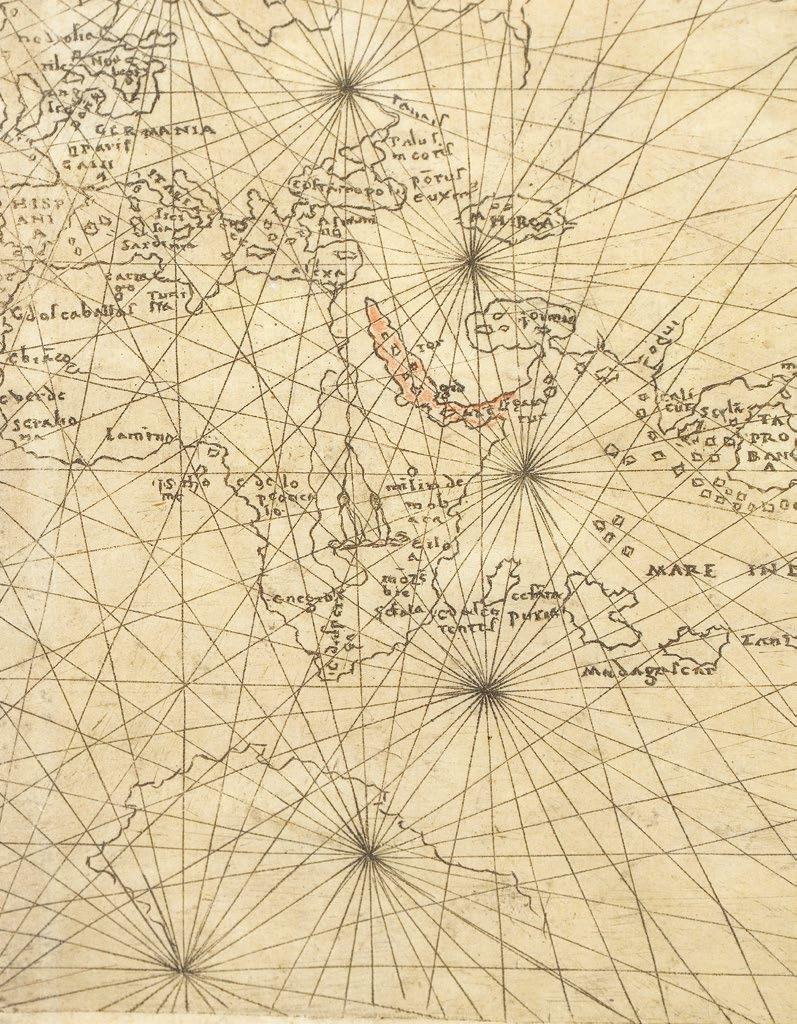
Rosselli’s exceptionally rare sea-chart of the world is the first such printed, heralding the arrival of a new brand of utilitarian global cartography, changing the lives of navigators and mariners immeasurably, and forever; and eventually superseding the production of the great planispheres of the Age of Discovery, for recording the discovery of new territories. These expansive, and ever-expanding maps, composed of multiple animal skins, had developed from early, smaller single skin, sailing charts or portolans. These had been in use from potentially as early as 1200, although the earliest surviving example is the ‘Carte Pisane’ (c.1290). These, largely undecorated charts were intended for use aboard ship, they saw hard service and had short lives. Rosselli’s chart takes great pains to combine the elements of both its humbler manuscript portolan, and grand planisphere predecessors, in many ways. It is compact and portable in size, replete with rhumb lines radiating from a single compass point at the heart of the map, but that is surrounded by a further symmetrical ring of compass points, which extend the sweep and scope of the chart, quite literally, to all four corners of the earth.
Cartography
The Americas Centred on the, yet unnamed, Atlantic Ocean, Rosselli’s chart is divided down the middle by the prime meridian, which runs through the Canary Islands, pole to pole, 90 degrees to 90 degrees. Rosselli has adopted the cartography expressed in the celebrated “Contarini” map of the world, known in only one example, at the British Library (Maps C.2.cc.4.). Named for its creator, Giovanni Matteo Contarini, that map uses a Ptolemaic conical, fan-shaped, projection, but it was engraved by none other than Rosselli himself, only two years earlier, in 1506 - when it was the first printed map to show the New World. In the years after Columbus first made landfall in Hispaniola (1492), Vasco da Gama had reached India by sea (1498), and Cabral had landed in Brazil (1500). And Columbus had made three more voyages: the second voyage (1493-1496) encompassed the Antilles, Santo Domingo, Cuba (which he thought was Cathay/China), and Jamaica; the third voyage (1498-1500), took his fleet to the coast of Venezuela, and the delta of the Rio Grande de la Costa; and the fourth voyage (1502-1504), explored the coasts of Jamaica, Cuba, Honduras, the Mosquito Coast of Nicaragua, and Costa Rica.
The Americas feature prominently on Rosselli’s chart, and as with the Contarini map, it is updated to include the discoveries of Columbus’s fourth voyage (1502-1504). Columbus’s discoveries in the West Indies are shown: Spagnola features large, and Cuba is shown as an island. However, unlike the companion map, only South America, labelled “Terra S. Crucis”, is shown as a separate new continent - albeit with a rather tentative
western and southern coastline - while North America, labelled “Tyerra de Labrador”, remains firmly attached to the Asian peninsula of “Tangut Provincia...”, part of the Ptolemaic oikumene of Europe, Africa and Asia, helping to explain why Columbus, sailing west of Cuba, believed he had arrived at China.
A Southern Continent
An unnamed southern continent, lacking a southern coastline, appears in the ocean beneath Africa - named on the companion map as “Antarcticus” - and as such is one of the earliest maps to deviate from the Macrobian model of a southern continent. The first printed spherical map to show a southern landmass had appeared in the 1483 printing of Macrobius’s ‘In somnium Scipionis expositio. Saturnalia’. The Macrobian world map, the most influential of all pre-Renaissance views of the world, included an antipodean, southern continent. This woodcut map, like Vespucci’s, shows a globe split into two - Europe and the balancing Antipodes - and surrounded by ocean at the edges. This remarkable image, which survived by manuscript transmission from the fifth century into the age of printing, had a strong and lingering effect on post-Renaissance and pre-discovery geography. Its large southern continent carries the legend ‘Pervsta / Temperata, antipodum / nobis incognita’. For a thousand years the Macrobian world map formed the basis of world geography, until Renaissance exploration replaced it with discovered fact, and all pre-discovery mapping was to some extent based on it, as were all ideas of a southern hemisphere, a southern continent, or an antipodes.
Fit for an Atlas?
Around the middle of the fifteenth century, cartographers began to experiment with incorporating recent discoveries into another cartographic medium, the ‘Geography’ of Claudius Ptolemy. In Rome, in 1507, the third printed edition of Ptolemy’s Geography was published. Reprinting of the copperplate maps of the 1478, and 1490 editions, this new atlas was superior for its clear captions, accurate projections and overall design. And, it included Johann Ruysch’s (1460-1533) version of the Contarini map, ‘Universalior Cogniti Orbis Tabula’. Although the cartography has been updated, the format remains that of a fan-shaped conic projection. It is not hard to imagine that Rosselli may have been aware of Ruysch’s map, and its relationship to his own and Contarini’s earlier great work, giving rise to feelings of indignant proprietorship,... possibly spurring the production of this, Rosselli’s more original imagining of the modern planisphere, and his, unique for the time, companion map of the world on an oval projection - the very first on such a projection, and the first to attempt to show the whole world within a grid of 360 degrees longitude, and 180 degrees latitude. One of the only four known examples of that
map is found as part of a contemporary pairing with Rosselli’s planisphere at the National Maritime Museum at Greenwich (G201:1/53).
Perhaps Rosselli’s intention had been to issue a modern atlas of his own (the size of the mapsheet certainly corroborates this idea), an ambitious plan that foundered after the production of just these two maps, in the face of competition from rivals such as Marco Beneventano in Rome, who had issued his Ptolemaic atlas in 1507, and Bernardus Sylvanus in Venice, who would issue his updated atlas in 1511.
The mapmaker Francesco Rosselli (1445-1513), who was one of the earliest known mapsellers, was active in Florence up to his death. Francesco’s son, Alessandro Rosselli, continued his father’s workshop, until his own death in 1527, when “an inventory was taken of the shop, [which] document provides historians with insights into the workshop of an early sixteenth-century chart and mapmaker. The Rosselli shop specialized in the printing and engraving of maps and town plans, but many other kinds of maps and charts are listed in the inventory, including small painted mappaemundi, decorated and plain portolan charts, and some charts composed from several pieces of parchment. Among the maps mentioned in the inventory is a large mappamundi, a map of India, a map of Italy, and city maps of Florence, Rome, and Constantinople. The inventory also includes supplies and books of drawings” (Metcalf).
Rarity
Only two other examples known, one at the Biblioteca Nazionale Centrale, Florence; and the National Maritime Museum, Greenwich.
The first atlas wholly printed in colours, incorporating the first printed map to indicate Japan
PTOLEMAEUS,
Claudius; Bernadus SYLVANUS
Liber geographiae cum tabulis et universali figura et cum additione locorum quae a recentiorbus reperta sunt.
Publication Venice, Jacobus Pentius de Lencho, 1511.
Description
Folio atlas (425 by 292mm), bookplate to verso of initial blank leaf, title in red with manuscript ownership inscription, poem on verso printed in red and black, 6pp preliminary text printed in red and black, 115pp text printed in red and black with four woodcut and letterpress diagrammatic illustrations, manuscript notes throughout in margins of text in same hand as ownership inscription, small area of abrasion damage to colophon, infilled with ink facsimile, 28 woodcut maps printed in red and black (each double-page with all but the final world map in two sections on facing pages), sixteenth century red vellum, remnants of old ties, japp fore-edges.
Collation:
[4]; A8, B-H6 (first leaf of G unsigned), I8 (first leaf unsigned), 28 maps.
References
Jerry Brotton, A History of the World in Twelve Maps (London: Penguin, 2012); Patrick Gautier Dalche, ‘The Reception of Ptolemy’s Geography’ in David Woodward (ed.), The History of Cartography, Volume 3 Part 1: Cartography in the European Renaissance (Chicago: University of Chicago Press, 2007); Nordenskiöld Collection 2:204; Phillips, Atlases 358; Sabin 66477; Sander 5979; Shirley, Mapping of the World, 32; David Woodward, ‘Techniques of Map Engravings, Printing and Coloring in the European Renaissance’ in David Woodward (ed.), The History of Cartography, Volume 3 Part 1: Cartography in the European Renaissance (Chicago: University of Chicago Press, 2007).
A very fine example of the Venetian edition of Ptolemy’s ‘Geographia’. This is the first illustrated edition of Ptolemy’s work in which an attempt was made to update the information given on the maps, and the only Italian edition of Ptolemy to feature woodcut maps.
It is also one of the earliest examples of two-colour printing in cartography with the major regional names printed in red, others in black, using inset type. Woodward suggests that the dual-colour printing style is done to mimic contemporary portolan chars, which used black and red to distinguish toponyms of various importance. The text in the book says that it used the maps of navigators to update Ptolemy’s original work, and the influence may also have extended to the aesthetic (Woodward).
Sylvanus had already produced an edition of Ptolemy in Naples in 1490, but this was to be based on different principles. He explains in a preliminary note that Ptolemy’s work must be updated, and adds that as Ptolemy himself used the work of navigators, so will he. Sylvanus was trying to tread a delicate line between critics of Ptolemy’s work and those who appreciated the framework provided by the classical geographer (Dalche).
The atlas includes two world maps, one drawn to Ptolemy’s specifications and the other using contemporary geographical knowledge. The modern cordiform world map is only the second map in a Ptolemaic atlas to show America, and the first western printed map to indicate Japan. Sylvanus uses a cordiform map projection, a style developed through the Renaissance to symbolise the link between inner emotions and the external world (Brotton). Sylvanus’ method was subsequently adapted by Apianus and Vavassore. In this projection, the degrees on the central meridian were in correct proportion to those of the parallels. Whereas every other map in the atlas is printed on the reverse of other maps or texts, this is blank on the reverse. This map was Sylvanus’ attempt to update the picture of the world presented by Ptolemy.
The Americas are shown in three unconnected parts: “terra laboratorum”, “terrae Sancta Crucis” (South America) and “terra cube”. “Terra laboratorum”, or North America was supposedly named after the labourer who saw it first, according to an inscription on Wolfenbüttel’s 1534 world map. The projection used distorts the coastline of South America almost unrecognisably; the words “canibalum romon” appear in the north, a product of common contemporary belief about native cannibalism.
The outline of eastern Asia follows Ptolemy and retains the “Tiger Leg” used by Waldseemüller and Contarini and the Ptolemaic name “Catigara”. Japan appears, named “Zampagu ins”, and shown correctly as an island for the first time. A previous depiction by Ruysch identified Japan with one of the islands discovered by the Spanish in the Caribbean. Asia’s coastline is left open to the east, as is the western coast of the Americas, allowing for the possibility that they were contiguous. The map is labelled in the style of Ptolemy; rivers and mountain ranged are shown and named, but very few place names appear.The entire continent of Europe contains only “magna Germa”, “Italia” and “dalma”.
An earlier owner, Francisco de Chiapanis, has made extensive manuscript notes in the preliminary text of the atlas. He seems to have been particularly interested in the mathematical basis of Ptolemy’s work, with diagrams and calculations working out ideas in the text. Francisco also approves of the editor’s tone in the book, noting “Modestia Auctoris” next to a line apologising for the author’s inexperience.
MONTALBODDO, Antonio Fracanzano da
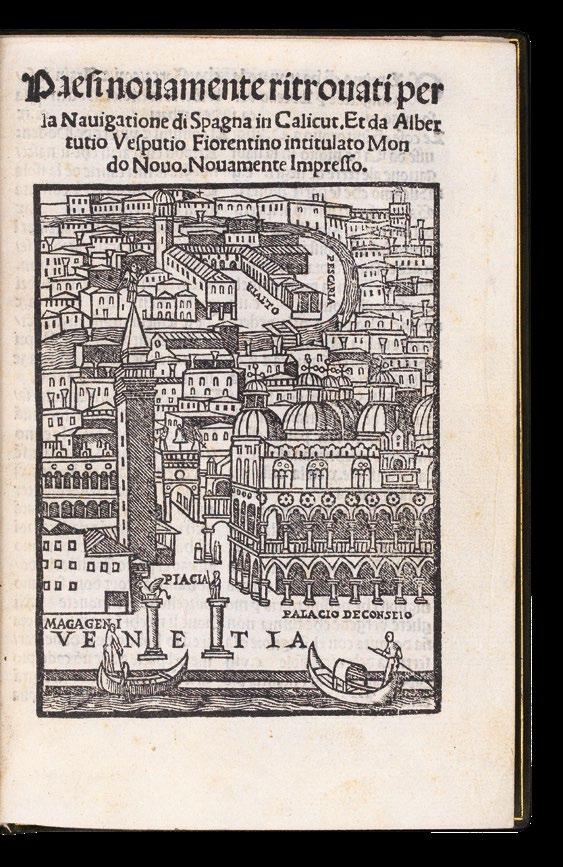
Paesi nouamente ritrovati per la Navigatione di Spagna in Calicut Et da Albertutio Vesputio Fiorentino Intitulato Mondo Nouo. Nouamente Impresso.
Publication
Stampata in Venetia, per Zorzo de Rusconi Millanese. Nel.M.D.XXI.adi.xy.de Febraro, 1521.
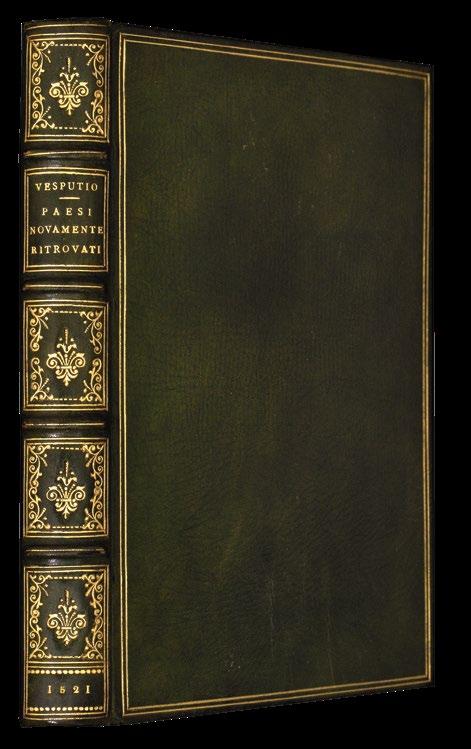
Description Octavo (150 by 100mm). Title-page with woodcut bird’s-eye view of Venice, woodcut diagrams in the text, woodcut initials; twentieth century full green crushed morocco, gilt, all edges gilt.
Collation: 124 leaves; A4, b-q8.
References
Borba de Moraes II, 70; Church 41; Essling 1954; Fumagalli & Amat di S. Filippo 1003; Gasparoni, ‘Gli annali di Giorgio Rusconi (1500–1522’, 2009; Harrisse 90 and Add. 52; JCB I, 68; Penrose 277; Sander 4875; Sabin 50053.
With an early bird’s-eye view of Venice
The earliest surviving printed collection of narratives about the voyages to America is a little booklet of sixteen folios, published by Albertino Vercellese da Lisona at Venice in 1504, with the title: ‘Libretto de tutta la navigatione de re de Sfagna de le isole et terreni novamente ritrovati’, known in only two examples, at the Marciana Library in Venice and the John Carter Brown Library in Rhode Island.
The ‘Libretto...’ was then included by Antonio Montalboddo, along with additional accounts of Portuguese voyages to Africa and India, in his ‘Paesi novamente retrovati...’. Almost immediately, that work was translated into Latin, by the Milanese monk Arcangelo Madrignano, after which it quickly became “the most important vehicle for the dissemination throughout Renaissance Europe of the news of the great discoveries both in the east and the west” (PMM).
The current version of the Paesi, in Italian, was first printed in Venice by Giorgio Rusconi (1500-1521) in 1517, with the first appearance of the bird’s-eye view of Venice on the title-page, which would be reprinted several times over the next, more than, one hundred years in editions of Niccolò da Poggibonsi’s, ‘Viaggio da Venetia’, first published in Venice by Rusconi’s frequent collaborator, Niccolo Zoppino from 1518.
The work includes accounts of the voyages of: the 1456 voyages of Alvise de Cadamosto in Ethiopia and along the West African coast; Pedro de Sintra’s expedition along the west coast of Africa as far as Sierra Leone in 1462; Vasco da Gama’s epochal voyage to Africa and India (1497-99), which “opened the way for the maritime invasion of the east by Europe” (PMM), supplied by letters from Venetian spies in Portugal; and Pedro Alvares Cabral’s discovery of the Brazilian, Guianaian and Venezuelan coasts in 1500, and of the voyage on to India; an account of Columbus’s first three voyages (1492-1500), undoubtedly based on Peter Martyr’s ‘Libretto de tutta la navigatione de Re de Spagna de le isole et terreni novamente trovati’; as well as narratives of the expeditions of Alonso Niño and Vicente Yañez Pinzon along the northern coast of South America; Vespucci’s letter to Lorenzo de’ Medici describing his third voyage in 1501-1502; and a compilation of information derived from several sources concerning the Portuguese discoveries in Brazil and the East.
Montalboddo’s collected voyages, called by Henry Harrisse “the most important collection of voyages”, and asserted by Boies Penrose that “for news value as regards both the Orient and America, no other book printed in the sixteenth century could hold a candle to it”, was the forerunner of the later compilations of Grynaeus and Huttich, Ramusio, Eden, Hakluyt, the De Brys, and Hulsius, “an auspicious beginning to the fascinating literature of the great age of discovery” (Lilly Library online).
The printer
Giorgio Rusconi, self-professed Milanese, was a profuse printer of more than 200 works, in Venice from 1500–1522. Between 1515 and 1518, he collaborated with Niccolo Zoppino, who published the ‘Viaggio da Venetia’ (from 1518), which reprints the woodcut image of Venice on the title-page of this edition of Montalboddo (from 1517).
Rusconi “seems to have begun his Venetian career in the workshop of Manfredo Bonelli, who had been printing since 1491. The names of the two men appear together in four editions of the year 1500, while Rusconi alone signs two editions in the same year. It is probable that Bonelli taught Rusconi the art of printing” (Gasperoni). After his death the business was continued by his sons Giovanni Francesco and Giovanni Antonio, and his widow Elisabetta.
Provenance
1. With the “Duplicate released” ink library stamp of the Lilly Library, Indiana University;
2. With Arthur Lauria, Paris, November 1967, sold to; Gregory S. Javitch (1898-1980), of Montreal, renowned bibliophile with an important collection of very fine books relating to Native Americans; his collection Jesuit Relations is housed at the University of Alberta. A Russian-born, Canadian leader in the land reclamation sector in Ontario, Javitch formed an important collection of 2500 items that he called “Peoples of the New World”, encompassing both North and South America, which was acquired by the Bruce Peel Special Collections at the University of Alberta. It was considered the finest such private collection in Canada at the time and formed the cornerstone of the library’s special collections. The present volume remained in Javitch’s private collection.
LA SALE, Antoine de
La Salade, nouvelleme[n]t imprimee laquelle fait mension de tous les pays du monde Et du pays de la belle Sybille avec la figure pour aller au mont de la belle Sibille Et aussi la figure de la Mer & de la terre et plusieurs belles remonstrances.
Publication [Paris, veuve de Michel Le Noir, 1521].
Description
Quarto (254 by 180mm), (4 ff.), lxiii ff. lxxiii, numerous illustrations within text, three folding plates, several leaves (mainly the last nine) with loss to upper corner, skilfully repaired in facsimile, some stains and wormholes on the last leaves, contemporary full panelled calf, blind fillet borders, with gilt foliate device to corner and centre, spine in six compartments separated by raised bands. Collation: [sig. ?4 a-d6 e-f4 g6 h-i4 k6 l-n4]
References
Bechtel, L.54-L55; Brunet, III, 854; Shirley [World], 50; Tchйmerzine, IV, pp. 59-61.
The earliest printed map to name the Antipodes
An eclectic miscellany of moral, didactic, and chivalric treatises, ‘La Salade’ also contains the earliest printed map to name the Antipodes.
Prepared by Antoine de La Sale for his pupil, Jean II of Anjou, Duke of Lorraine, the title, ‘La Salade’, is not only a pun on de La Sale’s name, but also reflects the varied composition of the work - as de La Sale notes in the introduction, “in the salad are several good herbs” (trans.).
The contents cover a variety of subjects edifying for a fledgling duke: a treatise on the eight virtues useful to a prince, stories and stratagems from ancient authors like Valerius Maximus and Frontinus, accounts of de La Sale’s own adventures in Sicily, geography, and the ceremonies and ordinances of Philip IV of France. ‘La Salade’ is also one of the earliest European texts to provide information about Iceland and Greenland, previously “unknown to our astrologers due to their long harsh winters” (trans.).
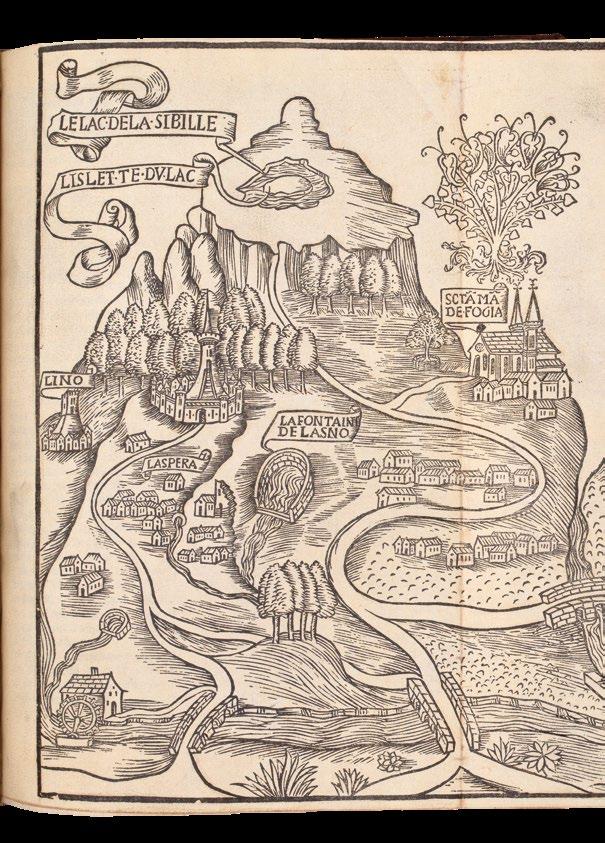
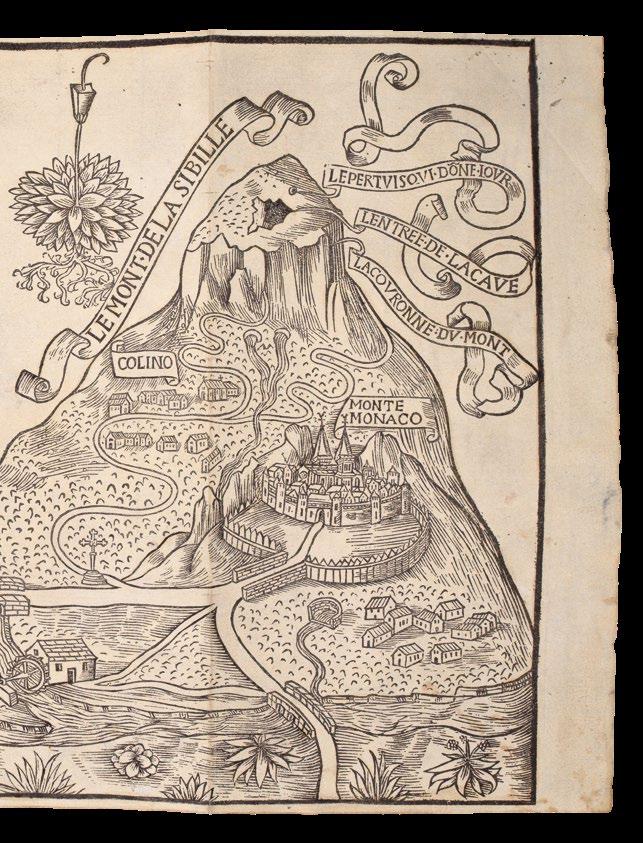
The text is illustrated throughout and includes folding plates that depict “Le Mont de la Sibille” and the genealogical tree of the House of Aragon – as well as a map of the world.
The map
The world map is a “curious ensemble” (Shirley), combining ideas from the classical world (in particular, those of Pomponius Mela) with medieval and more contemporary concepts. It is also the earliest printed map to name the Antipodes. England and Scotland are shown separated by a strait, as is the case also in early portolan charts, while Africa appears as a peninsula. Present in the south is the “Regio Patalis”, a name drawn from Pliny, which hints at the presence of Australia.
Antoine de La Sale (c.1386-c.1461)
Born the illegitimate son of Bernard de La Sale, French mercenary captain turned Tard-Venus bandit, de La Sale entered the court of the dukes of Anjou in 1402. In the 50 years that he spent in their service, he moved through the ranks, from page to squire, to soldier, to administrator, eventually taking up a position as “gouverneur”, that is tutor and mentor, to Jean II of Anjou, Duke of Lorraine, for whom he wrote ‘La Salade’. In 1448, he became “gouverneur” to the sons of Louis de Luxembourg, Count of St Pol, for whom he wrote a book similar to ‘La Salade’, known as ‘La Sale’. Among his other works are a treatise on the organization of tournaments, a “consolatio” to Catherine de Neufville, on the death of her son, and ‘Le Petit Jehan de Saintré’, a light and witty chivalric romance.
Rare: we are only aware of one example of the first edition appearing at auction in the last 40 years.
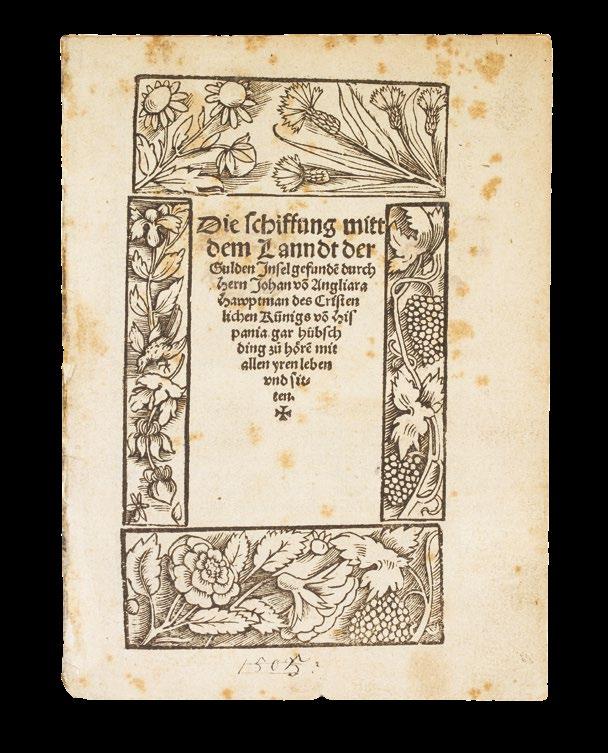
ANGLIARA, Juan de; [possibly after Fr. Juan DIAZ]
Die schiffvng mitt dem Lanndt der Gvlden Insel gefvndē durch Hern Johan vō Angliara Hawptman des Cristen lichen Kunigs von Hispania gar hubsch ding zu hore mit allen yren leben und sitten.
Publication [Augsburg, Jorg Nadler, c.1522].
Description
Quarto (180 by 130mm). Title-page with decorative woodcut border, [4] pages, final blank; disbound, preserved in black morocco-backed cloth slipcase and chemise.
References
Alden & Landis, ‘European Americana: a chronological guide to works printed in Europe relating to the Americas, 14931776’, 520/3; Church, ‘Catalogue of books relating to the discovery and early history of North and South America’, 44; Palau, ‘Manual del librero hispano-americano’, 12666; Sabin, ‘Dictionary of books relating to America from its discovery to the present time’, 1565; Harrisse, ‘The Discovery of North America’, 1560.
A rare German language edition, translated from the even rarer Italian edition printed in Ferrara in 1521 (only known in one example at the British Library).
Since “Juan de Angliara” is otherwise unknown to New World scholarship, and given that his name is very similar to Peter Martyr d’Anghiera, it is very likely that authorship of this little pamphlet is misleadingly pseudonymous. Nevertheless, the author describes himself, as an Italian captain of a Spanish ship bound for Calcutta. As in the best traditions, after a violent storm, they find shelter on an unknown island, on April 23rd, 1519. They meet the inhabitants, who lead them to a city full of gold,... after which they return to Spain with the good news. Some say the island was actually Peru, others that it was Cuba.
The latter theory is borne out by the similarity of this text to Juan Diaz’s ‘Littera mandata dell insula de Cuba de India’, an account of Juan de Grijalava’s expedition to the Yucatan, first published in Italian (probably Venice, c.1520). Juan de Grijalba (c.1480-1527) was a conquistador, and nephew of the great Diego Velázquez, whom he accompanied to Cuba in 1511. In 1518, Velázquez, as governor of Cuba, “sent Grijalba to explore the Yucatán Peninsula. Setting sail from Cuba with four ships and about 200 men, Grijalba became the first navigator to set foot on Mexican soil and the first to use the term New Spain. He and his men mapped rivers and discovered Cozumel Island. During their explorations, the men heard tales of a rich civilization in the interior. At last Grijalba met with its representatives, thus becoming the first European to learn of the existence of the Aztec empire farther to the north. When he returned to Cuba, his uncle was furious that his nephew had made no attempt at settlement, although Grijalba’s orders had been to explore only. As a result, Grijalba was passed over and the job of colonization was given to Hernán Cortés. Grijalba accompanied Cortés on his expedition (1519), but it was Grijalba’s explorations that paved the way for Cortés, thereby leading to the conquest of Mexico” (Britannica online).
Rare: one of only a handful of institutional examples known.
VESPUCCI, Giovanni
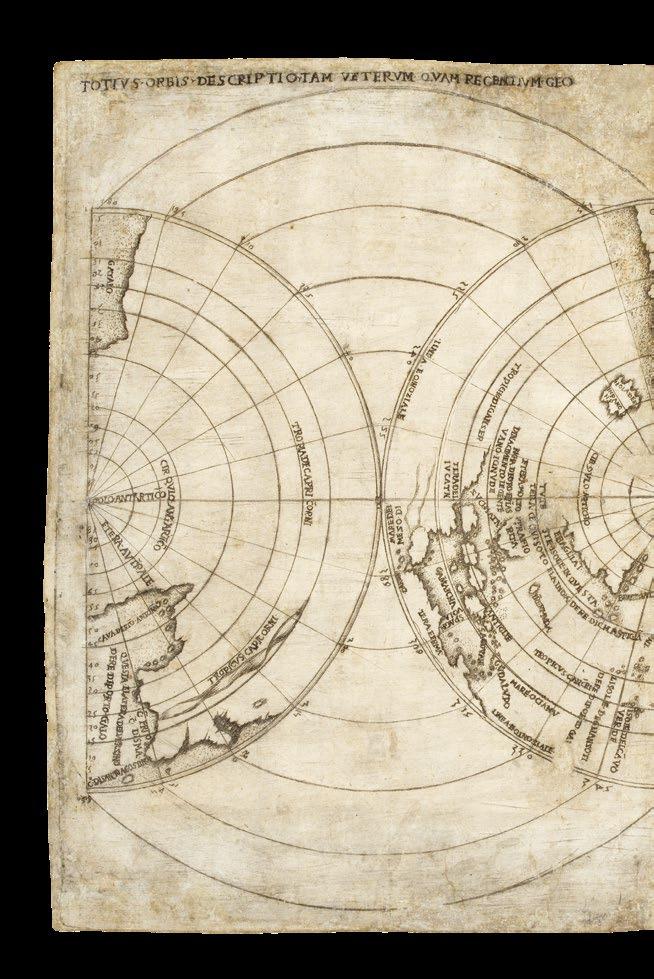
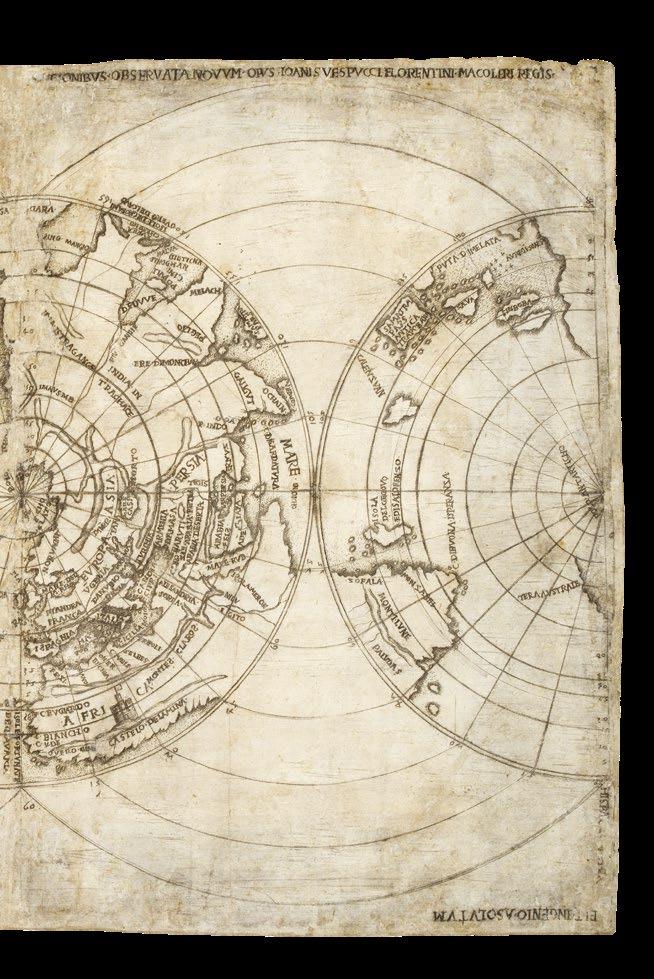
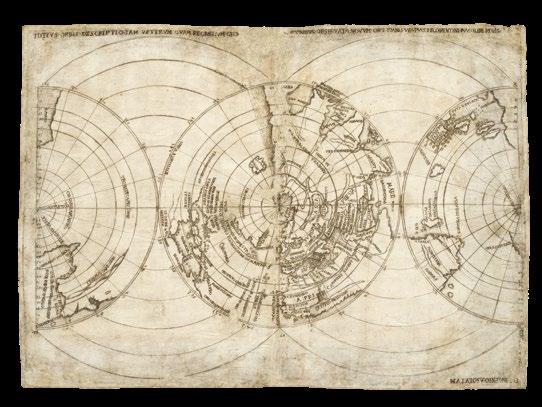
Totius orbis descriptio tam veterum quam recentium geographorum traditionibus observata novum opus Ioanis Vespucci Florentini Nauc leri Regis Hispaniarum miera art e et ingenio absolutum. Description of the whole world, according to the traditions of both ancient and modern geographers, a new work by Ioannis Vespucci, Florentine navigator, to the King of the Spanish, of beautiful art, and absolute genius.
Publication [Florence, 1523-1524].
Description
First plate, first state. Double-page engraved map of the world on an equidistant azimuthal split polar projection, some repairs, particularly to the centrefold.
Dimensions 290 by 406mm (11.5 by 16 inches).
References
First plate, first state: Nordenskiöld, 1897, p. 153, pl. 40.
First plate, second state: Bifolco, ‘Cartografia e Topografia Italiana del XVI Secolo’, 9; Houghton, inv. 51-2573; Nebenzahl 1990, pp., 78-79, pl. 25; Shirley, ‘The Mapping of the World’, 54.
Second plate: Christian Heitzmann, ‘Wem gehören die Molukken? Eine unbekannte Weltkarte aus der Frühzeit der Entdeckungen’, in ‘Zeitschrift für Ideengeschichte’, 1.2 (Summer, 2007), pp. 101–110.
General: Ferreira, ‘EVE - Encyclopaedia of Portuguese Expansion’, 2009; Museo Galileo, ‘A Land Beyond the Stars’, online; Robles Macias, ‘No, Mapmaker Juan Vespucci Was Not a Medici Spy’, in ‘Imago Mundi’, Vol. 72, No. 1 (2020), pp. 41-46; Woodward, ‘The History of Renaissance Cartography’, page 374, image 10.9.
The map that cleaved the world in two
The first printed world map to show the results of the Treaty of Tordesillas (1494), by which the western world was divided between Spain and Portugal.
The first map to present an argument for the location of the antimeridian, which would divide the eastern world in the same way. The first printed map on a spherical double-hemisphere projection. The first printed map on a double-hemisphere polar projection, The first map to bifurcate, or split, a hemisphere in its representation of the world.
The first printed map to show a full southern hemisphere.
Giovanni Vespucci’s world-changing treaty map, lost to cartobibliography for nearly 150 years. The only known example of the first state of the map, prepared in advance of the negotiations at Badajoz (Spain) and Elvas (Portugal), on the Spanish-Portuguese border, between March and May of 1524, which paved the way for the Treaty of Zaragoza in 1529, which in turn, determined the anti-meridian, splitting the eastern hemisphere in two, and so dividing the whole world between the two superpowers.
Vespucci’s map is a powerful persuasive cartographical tool, that directly reflects, and hopes to influence, the immediate politics of its day, whereby Spain and Portugal vied with each other for world domination.
A “new work”
Vespucci states in his title, that his “novum opus” has been created according to the traditions of both ancient and modern geographers. However, his map is astonishingly more “modern”, than it is “ancient”.
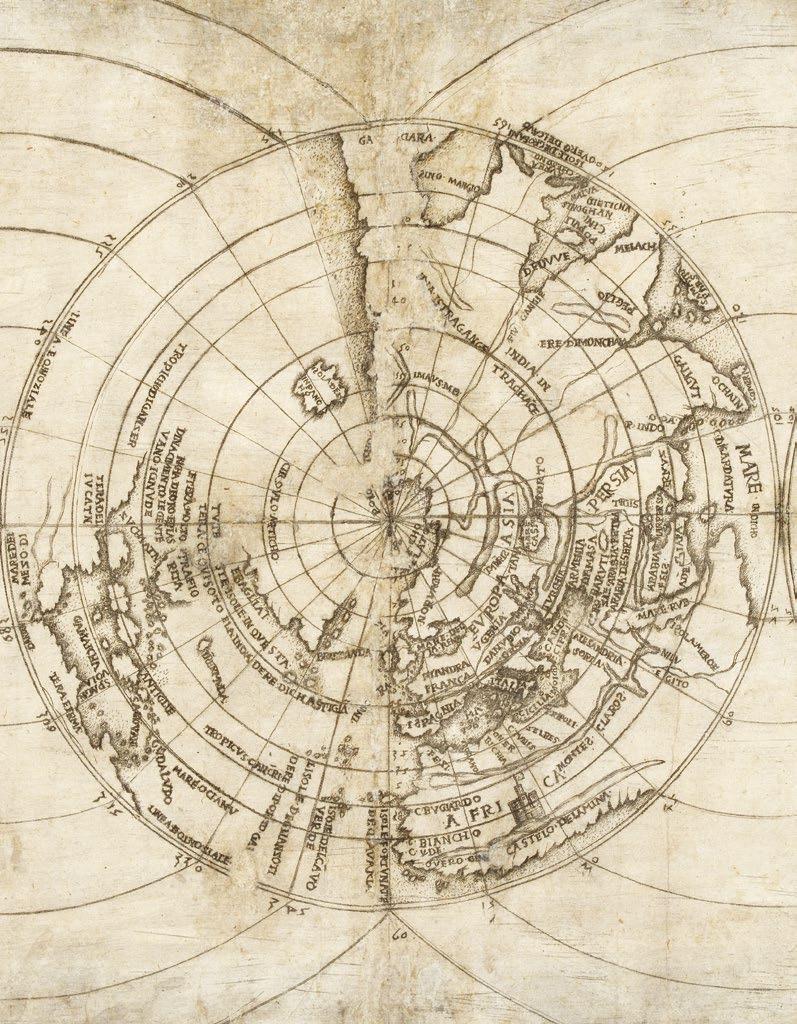
Vespucci’s map, is the first printed map to present the world as a pair of spherical equidistant azimuthal double-hemispheres, on a polar projection. Although, there is a slim chance that Vespucci was aware of the manuscript version in Henricus Glareanus’s (1488-1563) magnum opus ‘De Geographia Liber’(1510-1520), now at the John Carter Brown library, illustrated with five maps, including a pair of the world as northern and southern hemispheres (entitled - ’De geometriae principiis ad sphaerae astronomicae noticiam neces sariis. caput primum’ )-, on polar azimuthal projections, and inspired by it - it seems unlikely, as Glareanus’s work wasn’t actually published until 1527, in Basel.
Other inspiration may have been drawn from Visconte de Maggiolo’s beautiful manuscript map of the world, on a circumpolar projection, in 1511, based on the cartography of the Contarini-Rosselli map of 1506. And, in 1507, Martin Waldseemuller, in an inset above his main cordiform map of the world, ‘Universalis Cosmographia’, had depicted the world in two distinct halves along Ptolemy’s prime meridian: east to the left, and west to the right. However, he also adopted Ptolemy’s beehive / second projection, and truncated the southern portion of each “sphere”.
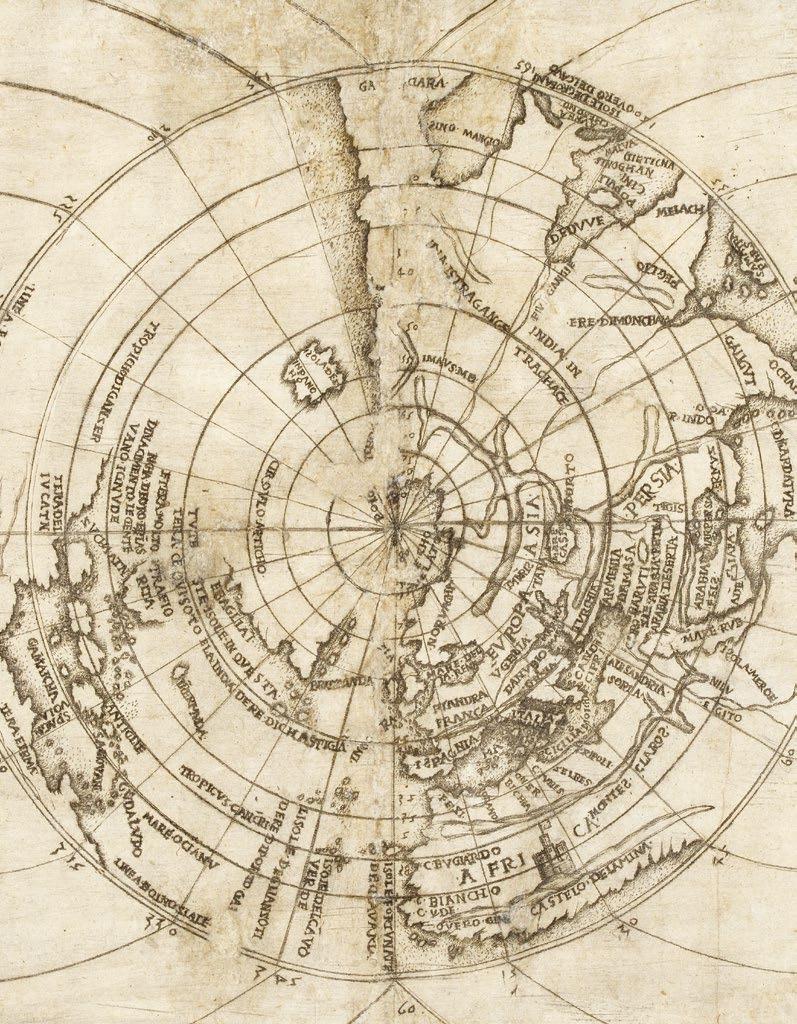
Uniquely for the time, the southern hemisphere is bifurcated along the traditional prime meridian established by Ptolemy, which passes through the Canary Islands - “Isole Fortunate de Chanaria” - marked here at 180° at the top of the map, and at 360° at the bottom. This kind of bifurcated projection was later made famous by Eckebrecht’s majestic ‘Nova orbis terrarum’ (1630), but inspired, according to Rodney Shirley, by a similar bifurcated world map by Heinrich Braun in 1574.
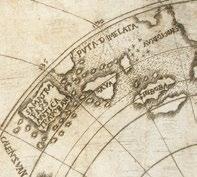
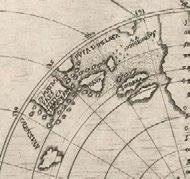
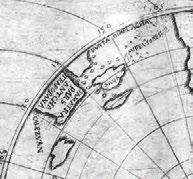
Although not named, the results of the Treaty of Tordesillas (1494), which established a line of demarcation, by which the western world was divided between Spain and Portugal, are explicitly located for the first time on a printed map, between 315° and 345°; as is the, crucially, as yet potential, anti-meridian, between 150° and 180°, proposing to divide the new discoveries on the other side of the world, in the same way, also for the first time. The original line of demarcation is further emphasized on the later issue of the map, held at Houghton, by the addition of hachures between 315° and 330° in the cusp between the western regions of the southern and northern hemispheres.
Vespucci’s map should also have been the first printed world map to show the Magellan Strait, created and published, as it was, in the certain knowledge that the world could be circumnavigated, after the successful return of the Magellan-Elcano expedition, in the ‘Victoria’, in 1522... But, very significantly, it isn’t, and the discovery of the Magellan Strait is deliberately omitted.
Spain’s ambitions
It is in this bit of topographical obfuscation, that Giovanni Vespucci, nephew of the illustrious Amerigo, navigator to King Charles I of Spain (and also Charles V, Holy Roman Emperor), who had himself voyaged in South American waters, reveals to a modern audience the true intention of his “novum opus”: the map directly reflects, and hopes to influence, the politics of its day, whereby Spain and Portugal vied with each other for world domination.
The northern hemisphere, dominated by the Spanish / Holy Roman Empire appears intact and whole, as the centre of world - but the southern hemisphere is rendered in two, on either side of it: west to the left, and east to the right. Spanish claims mostly to the left, Portuguese mostly to the right.
On the Manzoni map, the extent of the current Spanish possessions in the northern Atlantic region, and therefore the strength of their potential negotiating position, are shown, in Italian, between 315° and 345° as “Tute que[ste] isole in questatera c[he] qi soto e la India de Re di Chastiglia” (All these islands in this land that are below are the Indies of the King of Chastille). Portugese claims to the Atlantic, are clearly indicated at the Azores, which are labelled “Isole degli Anzoti [sic] de Re di Portogal[o]”
(Islands of the Azores of the King of Portugal), and in Brazil as “Questa e la tera del Verzino de Re di Portogalo” (This is the land of Verzino of the King of Portugal). As both Spanish and Portuguese agreed that the world was to be divided into two equal (by volume) halves, logic would have Spain also being potentially entitled to territories found between 150° and 180°,... which, on Vespucci’s map, include the “Isole de Grofani overo del cavo”, indicating a vague location for the Moluccas, the islands where the valuable clove trees grow,... just outside the neatline of the northern hemisphere,...
With all these factors combined, Vespucci’s map is a dramatic visual representation of Spanish intent, and was to play a pivotal role in carving up the most contested part of the newly discovered world, and to substantiate Spain’s claim to the highly valuable territories in the southeast, including the elusive Moluccas.
The Treaty of Tordesillas (1494) Vespucci’s map is the first printed map to show, by named claimed territories, the world as it was divided along the line of demarcation established at the Treaty of Tordesillas (1494), at 370 leagues west of the Cape Verde Islands, between Spain and Portugal, pole to pole. Spain had gained everything to the west, which was most of the Americas, except for the Brazilian bulge of South America; and Portugal, could claim lands to the east, including Africa.On this map, the Spanish possessions of the northern hemisphere are extremely accurately rendered, according to the traditions of the “modern” geographers of the title; whereas the contested Spice Islands, and other potentially valuable lands to the southeast, are quite deliberately presented according to the traditions of the “ancient geographers” of the map’s title, and are not. Old names, mythical names, vague names, are deliberately referenced: “Samatra pars antica Trapobana” (Sumatra), “Zava” ( Java), “Puta di Meleta [sic]” (changed in the Houghton example to a more recognizable “Melaca”, i.e. Malay peninsula), “Aureo isones [sic, i.e. isoles]” (Golden Islands),“Sinbora” (later changed in the Houghton example to “Sinbara”, “Calensuan”, a mythical island, and “Isole de grofani [sic] overo del cavo” (Islands where the clove trees grow), deliberately placed outside the neatline, in a kind of no-man’s land...BUT, clearly within the potential Spanish-claimed territory of 150° to 180°.
The Treaty of Tordesillas, signed at Tordesillas on 7 June 1494 divided the world beyond Christian Europe between Charles V of Spain and John II of Portugal along a meridian 370 leagues to the west of the Cape Verde Islands. This line of demarcation was about halfway between the Portuguese Cape Verde Islands and the islands recently discovered by Columbus, named in the treaty as Cipangu and Antilia (Cuba and
Hispaniola). The division gave to Portugal all the lands to the east (Brazil to India), and to Spain all the lands to the west (from the Caribbean to the Pacific). However, the Treaty of Tordesillas only specified the line of demarcation in terms of leagues from the Cape Verde Islands. It did not specify the line in degrees, nor did it identify the specific island or the specific length of its unit of measurement: the “league”. It was, therefore, open to more than a little interpretation.What is more, the line of demarcation did not, initially, encircle the earth.
Portugal’s discovery of the Spice Islands, or Moluccas, in 1512 caused the Spanish monarchs to try to halt Portuguese expansion further east by arguing that the Treaty of Tordesillas divided the earth into two equal hemispheres. When the survivors of Magellan’s circumnavigation returned having visited the Moluccas in 1521, Spain claimed the islands fell within its western hemisphere. The meridian line of demarcation now required an antimeridian. In 1523, the Treaty of Victoria called for the Badajoz Junta to meet in 1524 in order determine where just such a line might fall.
The Treaty of Zaragosa (1529)
That the Manzoni map dates to 1524, or, more likely, shortly before, can be determined quite simply, as the only other example known, printed from the same copper printing plate as this map, at the Houghton Library, Harvard, has an imprint, and is dated 1524.
Therefore, in spite of there being no official record of the fact, given all the implications of the visual and topographical cues/clues it contains, this map, was in all probability prepared specifically for, and presented by, Giovanni Vespucci, who was one of the Spanish delegation at the initial negotiations in order to establish an anti-meridian, that would divide the eastern hemisphere, between Spain and Portugal, as the northern hemisphere had been by the Treaty of Tordesillas.
These negotiations were held between the two superpowers at the towns of Badajoz (Spain) and Elvas (Portugal), on the Spanish-Portuguese border, between March and May of 1524. Each side sent three cosmographers, and three cartographers, as well as lawyers and other dignitaries; but difficulties in determining the exact longitude of the Moluccas, and therefore whether they lay within legitimate Spanish claims, or Portuguese, resulted in... no result.
In light of this failure, “preparations for sending a new fleet to the Moluccan archipelago in 1525 were intensified in northern Spain; however, diplomatic contacts were maintained, as exemplified that same year by the Emperor’s proposal of ceding to the Portuguese Crown for six years the monopoly of Moluccan spice commerce in exchange for 40,000 ducados.
Despite the unresolved dispute, the good relations between the two
crowns grew. In two years, 1525 and 1526, two marriages were celebrated
between the ruling dynasties. Dona Isabel, daughter of the Portuguese King, married Charles V, and the marriage of Dom João III to the Castillian Princess, Dona Catarina, was also celebrated. This favourable political situation, paired with the difficulties the Castillians experienced when trying to send their fleets to the Moluccan archipelago on a regular basis, finally afforded the opportunity to resolve the ongoing dispute... The possibility that began to take shape was that of “purchase” of rights to the islands by the Portuguese Crown. The Spanish Crown was involved in various conflicts in Europe, so that all financing was essential to maintaining the Monarchy’s financial viability.
Thus, although the negotiations dragged on for a few more years, both parties reached an agreement at the beginning of 1529. On 22 April, 1529, a treaty was signed in Zaragoza, which stipulated that the Spanish Monarchy would set aside all its claims to possession of the Moluccan Islands, including the right to navigate and engage in commerce in these waters. Thus, the Tordesillas semi-meridian would become a meridian, lying 297.5 leagues west of the archipelago, and joint studies were proposed to resolve conclusively the matter of the zone of demarcation where the islands were situated. The Portuguese Crown, in turn, agreed not to build additional fortresses in the region, and was also to pay 350,000 ducados, in exchange for which this Monarchy´s rights would be recognized” (Ferreira).
Giovanni Vespucci’s depiction of the Americas
Two other world maps have been attributed to Giovanni Vespucci. The less certain attribution is the ‘Geocarta Nautica Universale’ – the Turin planisphere (1523) -, which has also been attributed to Nuño Garcia de Toreno. An exceptionally beautiful map, and extremely detailed in its charting of the Americas, it is renowned for its depiction of its most important cartographical feature, which is that it shows, for the first time, “the long coastal stretch of South America to the south of the Rio de la Plata, in which the Strait of Magellan is both depicted and labeled “strecho de todos santos”” (Royal Library of Turin, online). A feature that is conspicuously absent from the Manzoni example of Vespucci’s ‘Totes orbis descriptio’ (1523-1524).
The more certain attribution is the map at the Hispanic Society of America: another magnificent portolan planisphere of the world. It is reported to be a copy of the official Spanish chart known as the ‘Padrón real’, which was constantly updated with the latest cartographical information from the most recent voyages and expeditions of discovery. It is signed: “Ju[an] Vespuchi pilato desus ma[jes]ta me fezit en seujlla [a] ño d[e] 1526” ( Juan Vespuchi, his majesty’s pilot made me in Seville in the year of 1526).
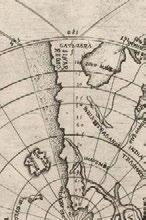
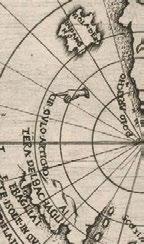
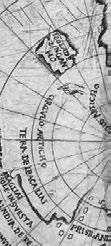
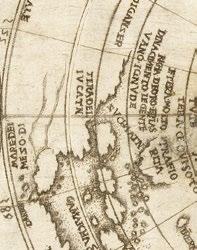
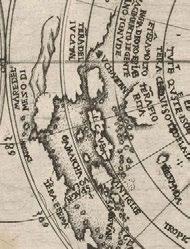
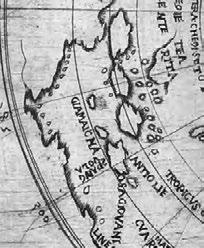
Both of these manuscript planispheres differ from the depiction of the Americas in the present map. This is mainly the Manzoni map is much smaller, and so necessarily abbreviated. However, the Manzoni map is closer in more ways to the Hispanic Society map, than to the Turin version. The former is “constructed as a portolan chart with compass roses and rhumb lines across the entire surface. The chief compass rose, which extends into Mexico, illustrates the Portuguese influence in cartographic ornamentation during the sixteenth century... Africa, southern Europe, and Asia Minor are well known, also the coasts of Florida, Mexico, Central America and northern South America. On the east coast of the present United States, another Florentine, Giovanni da Verrazzano, has been credited with claiming New England for Francis l of France and for discovering New York Bay in 1524. Estêvão Gomes, a Portuguese pilot in the service of Spain, explored the coast as far north as Maine and the Penboscot River (R:desgamos). Vespucci himself had attended the meeting at Badajoz which authorized this expedition. The Bacalaos, now known as the Grand Banks, Cape Race in Newfoundland, Stag River and the land of the “bartoas” are recorded by Vespucci, along with the new land of Ayllón. This first settlement within the boundaries of the United States had been made by Lucas Vazquez de Ayllón of Toledo near the Santee River (R:Jordan) in South Carolina” (Columbia Univesrity online). The Manzoni example of Vespucci’s printed precursor to this planisphere of 1526, shows a similar American coastline: from the Grand Banks “Tera del Bachagli” in the northeast, to Florida “Tera Fiorita” (see page 21), the Gulf of Mexico, the West Indies, the Yukatan, Brazil, and an open-ended eastern coastline of South America, as detailed above. There is no western coastline, although one is assumed, as Japan appears as a distinct island to the west, labelled “Isolades Inpangho” (a misspelled “Zinpangu”, after Contarini) (see page 20).
The first map of a full separate southern hemisphere Vespucci’s is the first printed map of the world to show the whole southern hemisphere, preceded only by the manuscript version of Henricus Glareanus’s southern hemisphere, polar azimuthal projection, not published until 1527, in Basel.
Ancient philosophers wished the world a sphere, since that would fulfill ideas of a perfect, harmonious form. Aristotle proposed a theoretical proof for this theory: and predicted a great southern landmass to counterbalance the “oikoumene”, the “known world” in the north. Further, Pythagoras (580-500 BC) had identified five climactic zones: the Arctic and Antarctic, or North and South frigid zones; the North and South temperate zones, extending from the Tropic of Cancer to the Arctic Circle and the Tropic of Capricorn to the Antarctic Circle; and the
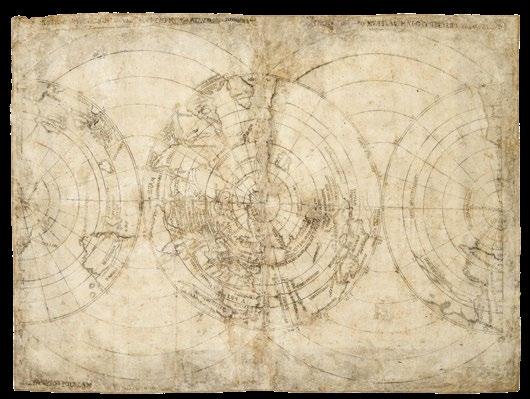
Recto
Verso
torrid zone between the two tropics. First circulated in manuscript, and then printed from 1472, maps of these ideas would have been readily available, and well known to Vespucci.The first printed spherical map to show a southern landmass appeared in the 1483 printing of Macrobius’s ‘In somnium Scipionis expositio. Saturnalia’. The Macrobian world map, the most influential of all pre-Renaissance views of the world, included an antipodean, southern continent. This woodcut map, like Vespucci’s, shows a globe split into two - Europe and the balancing Antipodes - and surrounded by ocean at the edges. This remarkable image, which survived by manuscript transmission from the fifth century into the age of printing, had a strong and lingering effect on post-Renaissance and pre-discovery geography. Its large southern continent carries the legend ‘Pervsta / Temperata, antipodum / nobis incognita’. For a thousand years the Macrobian world map formed the basis of world geography, until Renaissance exploration replaced it with discovered fact, and all prediscovery mapping was to some extent based on it, as were all ideas of a southern hemisphere, a southern continent, or an antipodes.
In terms of other spherical models, Vespucci may have been familiar with some of the earliest terrestrial globes: Martin Behaim’s ‘Erdapfel’ (1492), and the Hunt-Lenox globe (1508), but neither of these depict a southern continent. Francesco Rosselli’s map on an oval projection, of 1508, depicts a separate, and interestingly-shaped “Antarcticus”, beneath Africa. Rosselli’s map is also, according to the National Maritime Museum at Greenwich, which houses one of four known surviving examples, “the earliest extant map to show the world in 360 degrees of longitude and 180 degrees of latitude within an oval projection”, co-ordinates that Vespucci also depicts. But none of the more recent two-dimensional models for the world, Vespucci may have had to hand, by Ptolemy (c.150CE),Waldseemuller (1507-1513), Apianus (1521), and Bordone (1522), pay any heed to a southern continent, let alone a whole southern hemisphere.
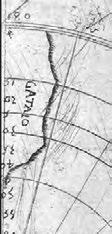
In Vespucci’s map, the western half the southern hemisphere extends from the equator, “Line a eqinozonale”, to the Antarctic Pole, “Polo Antartico”, encompassing the Tropic of Capricorn, “Tropiade capricorni”, and the Antarctic circle, “Cirqulo antartico”. It includes the eastern seaboard of South America, including “Tera Ferma” (captioned in the northern hemisphere), names Brasil for the Portuguese, as “Questa e la tera del Verzino de Re di Portogalo”, and the landmass extends beyond “Cava desto Anton” to an open-ended southern land, “Etera Autrale” [sic]. Opposite, at the top of the map, is an extension of the Asian mainland, as “Gataio”.
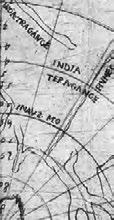
The eastern half of the southern hemisphere similarly extends from the equator to the “Polo Antarticho” [sic], includes southern Africa to the Cape of Good Hope “C. de Buona Isperanza”, and the islands of “De Iglecovo” and “Di Sa Lorenzo” off the eastern coast; before gliding across the Indian Ocean to the Spice Islands, and mainland Asia, as mentioned above. However, a mysterious little piece of coastline, which might be an extension of the east coast of South America is labelled “Tera Australe”.
Three states of the map
Vespucci’s map is exceptionally rare. Only three examples are recorded: this one, printed from the first known state of the first plate, undated, from the library of Count Giacomo Manzoni, Rome, which has been lost to cartographical history since his collection was sold after his death, at auction, as ‘Catalogue de la bibliothèque de feu M. le comte Jacques Manzoni’ (4 volumes, Città di Castello, 1892-94); another example printed from the same first copper printing plate, but a later state, with the addition “Errati si quioid excusoris culpa 1524”, and other significant changes to the topography, now at the Houghton Library, Harvard; and a third example, printed from a completely new, second plate, undated, now at the Herzog August Bibliothek, Wolfenbüttel (Germany), investigated by Christian Heitzmann, and reported in 2007.
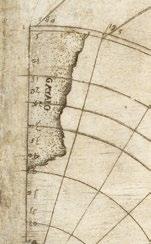
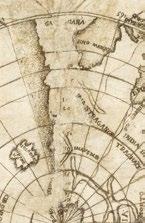
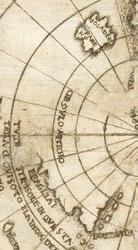
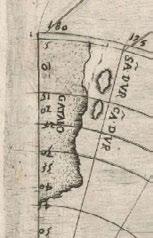
It is our thesis that the Manzoni example and the Houghton example are printed from the same copper printing plate. A direct comparison between the Manzoni examples of Vespucci’s map, and the Houghton example, makes it abundantly clear that the Manzoni map precedes the example at Houghton. The Houghton example has been re-worked, beyond the addition of an exculpatory phrase, “Errati si qd excusoris culpa”, blaming all errors in the map on the engraver, and the addition of the publication date of 1524, in the following significant ways: placenames have been added, particularly to important Spanish possessions, such “Cuba”, in the Houghton example; as well as cartographical changes, to the west coast of the Yucatan; the inclusion of the new islands of “Sa Dur” and “Ca Dur” off the coast of Asia, and the partial erasure of the coastline of the nearby mainland, and inclusion of an alternative, in the southern hemisphere; as well as some superficial corrections to spelling mistakes, and the addition of embellishments, like a manicule to indicate the Arctic circle.
Further, the example at HAB, is printed from an entirely new copper printing plate, and is a rather crude and inaccurate copy of the later issue at Harvard, repeating the later additions made to that map, to place-names, topography, and embellishments, such as the manicule; as well as making a number of new simple spelling mistakes, and other errors associated with trying to copy a printed map, in reverse, onto a copper plate.
Differences in the extant examples: (A) Manzoni, (B) Harvard, (C) HAB
Detail of the
with pointer in later editions.
Detail of Asia’s west coast with the island of “Isolades Inpangho” ( Japan).
(B)
Arctic Circle,
(C)
(C) (A)
Detail of the top left of the map: an extension of the Asian mainland marked “Gataio”.
(B)
(C)
(B) (A)
(A)
(A)
Giovanni Vespucci
Giovanni di Antonio Vespucci, was born in Florence in 1486. He was first mentioned in historic sources by Pietro Martyr d’Anghiera, in his ‘De orbe nouo Decades’ (1516), and is described by him as “a versatile heir to Amerigo’s nautical and astronomical knowledge. Like his uncle, he explored the coasts of South America by ship” (reported by Heitzmann). In official Spanish documents Giovanni Vespucci is often referred to as “Juan Vespuche”, or “Vespuchi”. He was a mapmaker, navigator and merchant “best known as the nephew of the world-famous navigator Amerigo Vespucci. Juan Vespucci worked from 1512 to 1525 as a royal pilot for the Casa de la Contratación de las Indias in Seville, Spain. The Casa was in charge, among other tasks, of the exploration and mapping of the lands now called America. Juan Vespucci took part in a transatlantic expedition in 1514 to Castilla del Oro (now Panama). He also signed at least two extant manuscript maps: a portolan chart of Europe and the Mediterranean in 1520 and a planisphere in 1526... Juan Vespucci was dismissed from the Casa in 1525 and thereafter devoted himself fully to trade with the Indies. He disappears from the records in 1527, after having completed at least one more voyage to New Spain” (Robles Macias).
Reports that this Giovanni Vespucci was a Medici spy have been dismissed.
Rarity
Exceptionally rare. Only three examples are recorded: this one, an undated first state, from the library of Count Giacomo Manzoni, Rome, which has been lost to cartographical history since his collection was sold after his death, at auction, as ‘Catalogue de la bibliothèque de feu M. le comte Jacques Manzoni’ (4 volumes, Città di Castello, 1892-94); a later state, printed from the same copper printing plate, with the addition of “Errati si quioid excusoris culpa 1524”, beneath the northern hemisphere, and with other significant changes to the topography, now at the Houghton Library, Harvard; a third example, printed from an entirely new copper printing plate, duplicating the details of the Houghton example, undated, now at the Herzog August Bibliothek, Wolfenbüttel (Germany), identified by Christian Heitzmann, and reported in 2007.
Provenance
1. Library of Count Giacomo Manzoni, Rome
2. Private collection, Switzerland
Detail of Southeast Asia, and the Spice Islands.
Detail of the coast of north and central America.
(B)
(B)
(A)
(A)
(C)
(C)
MÜNSTER, Sebastian
Erklerung des newen instruments der Sunnen Nach allen seinen Scheyben und Circkeln.
Publication
Oppenheim, Jakob Kobel, 1528.
Description
Quarto (215 by 150mm). Letterpress titlepage, woodcut map and three illustrations, floriated initials abundantly throughout; later grey paper boards, title printed on spine, bottom margins untrimmed, later endpapers, small tears in final two leaves skilfully restored, very small loss to text in upper left corner of D4.
References
Burmeister Münster, 31; Karrow 58/BI; Woodward, The History of Cartography, p1211.
The consolidation of cartography
An era-defining landmark in cartographic ambition.
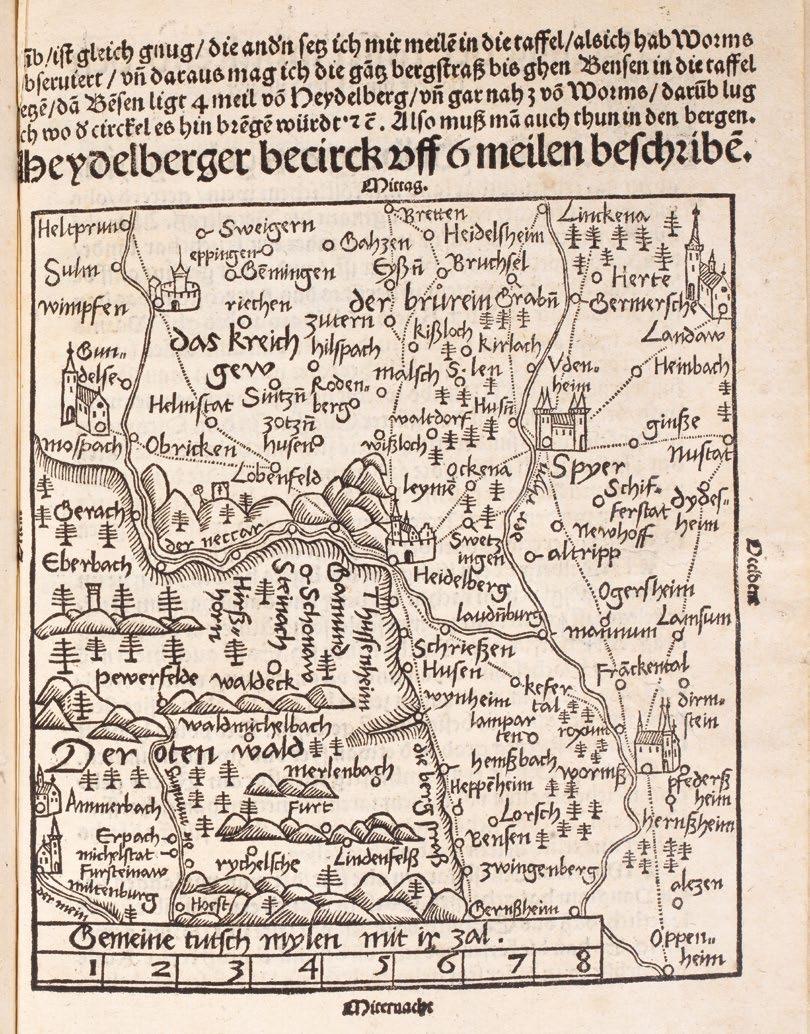
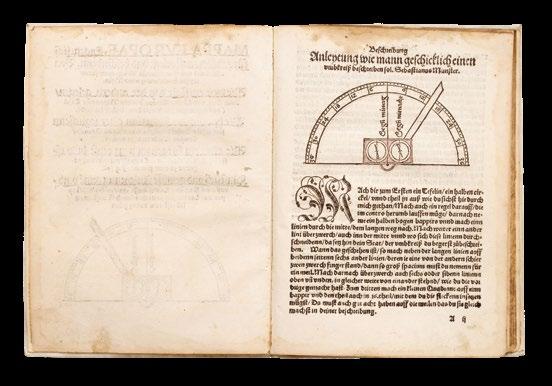
Previously, cartography had been a patchwork affair. Whether through collaboration or plagiarism, multiple sources, measurements, and methods were used to create maps. Münster’s ‘Instrument of the Suns’ changed the game. He called on leading cartographers - including Apianus, Tansterrer, and Glareanus - to submit maps of their duchies created using a standardized method. From Austria to Switzerland, Bavaria to Franconia, Münster’s ambition was to create the first accurate map of the German Empire.
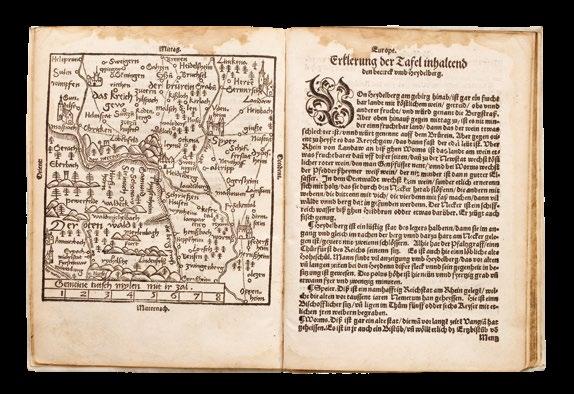
The pamphlet opens with a practical guide to fashioning an ‘instrument of the sun’. This was intended for the surveying of topographical and horological data needed to create an accurate map. The bulk of the text describes its construction and use, and is illustrated with a woodcut of the semi-circular tool. The project is concluded with a near-full-page map of Heidelberg, surveyed by Münster himself to instantiate his method.
Having thus demonstrated the principles of scientific map-making, Münster employs energetic rhetoric to plead for co-operation in producing what would be the first accurate cartographic depiction of the Germanspeaking lands.
“Please, O dear Germans, help us to raise this common German fatherland to a just and honourable end. To bring its hidden ornamentation to light, so that you and I will gain eternal praise and memory among our descendants”. Driving home the nationalist fervour, Münster promises “The strong German nation will not let you down in any way”.
Several cartographers rose to the challenge, and the fruits of this labour culminated in Münster’s 1544 Cosmographia - the most widelyread general atlas of the sixteenth century. It drew on 120 reports submitted to Münster, using the method detailed in the present pamphlet. Such systematic co-operation constitutes a landmark in the history of cartography - Münster had stamped scientific rigour into the map-making world.
Rare. This edition is not held in any institution outside of Europe; later editions are owned by Harvard (1529) and Minnesota (1534).
MÜNSTER, Sebastian
Mappa Europae, Eygentlich für gebildet aussgelegt und beschriebenn.
Publication Frankfurt, Christian Egenolph, 1536.
Description
Quarto (200 by 150mm). Title-page woodcut vignette, two double-page woodcut maps at the rear, one bound upside-down, one full-page map, illustrated profusely throughout with woodcuts, including two surveying instruments hand-coloured in part; modern vellum, title inked to spine, bookbinder’s ticket on the front pastedown, top edge dyed blue, some damp stains in margins throughout, small tear to bottom margin at D2-3, not affecting text, small early repairs to heads of both double-page maps.
References Bagrow, ‘Carta Itineraria Europe Martini Ilacomili, 1511’, Imago Mundi XI, pp14950; Hantzsch, pp39-41, 75-76, 148 (note 63); I Graesse IV, 622;Karrow, Mapmakers of the Sixteenth Centuries, 58/P; Woodward, The History of Cartography, p1211; VD16 M6677.
The work that turned Europe upside down
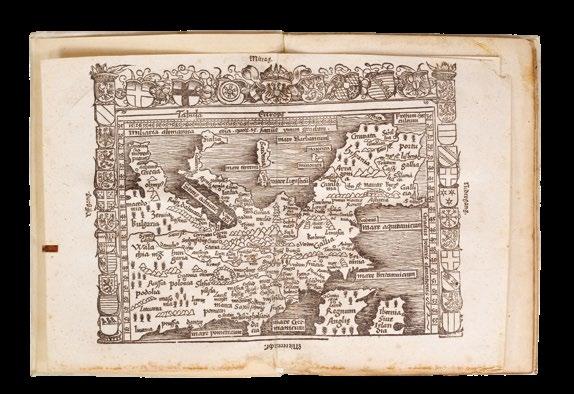
Extremely rare first edition of Münster’s first geographical work, including the earliest acquirable map of Europe oriented to the south.
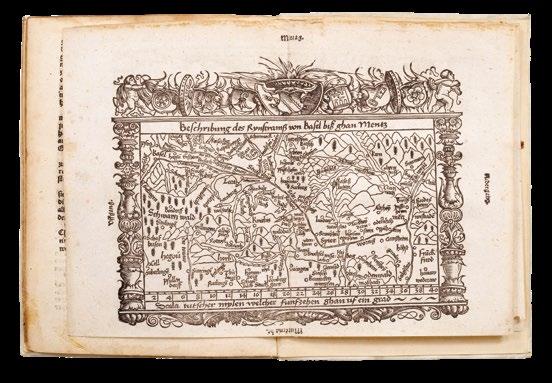
Declared “the later Cosmographia in microcosm” (Karrow), this very early pamphlet is a lay practical guide on map making, reading, and navigation across Europe. It is the first appearance of Münster’s ‘inverted’ map - an innovation so radical that the binder instinctively turned the double-page map of Europe ‘the right way up’ in error. This innovation in orientation was beneficial for both cartographers and travellers, as coastlines and journeys could be plotted simply with a sundial or compass. Such ease of navigation cemented this ‘inversion’ as the first ‘modern’ orientation.
Although Erhard Etzlaub, a Nuremberg chronicler, was the first to use this southern orientation in his 1499 map of Rome, it is more likely that Münster took inspiration from Martin Waldseemuller’s later 1511 world map - as evidenced by the ten sketches of it found in Münster’s schoolbook.
Therefore, whilst not originating from Münster directly, he was the first to map Europe with a southern orientation, and his later adoption of this in the Geographia (1540) and Cosmographia (1544) set a firm cartographical standard.
A second striking feature of this sixteenth-century German cartographic style was a focus on involving the audience. Reading maps was recommended in tandem with the use of precision instruments, which is exemplified in the present work by the repeated sundial woodcut. Münster also details how such a sundial can be made and used, providing a cheaper alternative to the magnetic surveying instruments of learned cartographers. Furthermore, Münster instructs readers on: how to determine latitude, distances between cities, navigation by sun compass, and how a reader can create their own map. By publishing in the vernacular, cutting-edge cartography could be recognised by a lay audience. ‘Mappa Europae’ was intended as a popular alternative to Münster’s earlier ‘Germaniae descriptio’ (1530), written in academic Latin. “The Mappa should thus be understood as a prospectus designed to encourage general interest in cosmography, no more the domain of a limited number of learned people... but now aimed at the masses and townsfolk” (Burmeister).
After this practical guidance, Münster describes key cities, states, and countries in Europe. His guide-book style descriptions point towards the development of commercial travel in the sixteenth century; whilst his two regional maps of Heidelberg and Basel were closer to home, Münster includes woodcut vignettes to accompany places as exotic as Tartary and Turkey. Holland is described as having strong men with good manners, who are devout and loyal. England, on the other hand, had beautiful women but a vindictive, superstitious, and cruel people. Münster makes note of which countries contain wolves, poisonous animals, and vineyards, which lends an entertaining insight into the concerns of the Discovery Period. Rare: we have traced only one North American example of the 1536 edition (NYPL), lacking both double-page maps. Two examples of the second edition are held in Harvard and Yale, although the former lacks the maps. No complete example has come up at auction in the last fifty years.
PICCOLOMINI, Alessandro
De la Sfera del Mondo. [and] De Le Stelle Fisse.
Publication Venice, 1540.
Description
Quarto (215 by 155mm), 47 full-page woodcut star maps, minor dampstaining to lower margin of a few tables, contemporary ownership inscription to title and last page, contemporary vellum.
References
Thomas Hockey et al, Biographical Encyclopedia of Astronomers, (New York: Springer, 2007), 904-5; Owen Gingerich, Piccolomini’s star atlas”, Sky and Telescope 62 (1981): 532-4; John North, Cosmos: An Illustrated History of Astronomy and Cosmology (Chicago: University of Chicago Press, 2008), 277; R. Suter, “The Scientific Work of Alessandro Piccolomini,” Isis 60 (1969): 210-22; Deborah Warner, The Sky Explored: Celestial Cartography 15001800, (New York: Liss, 1979), 200.
The first printed star atlas
First edition of the first printed star atlas.
Piccolomini (1508-1579) was a humanist from a prominent noble and scholarly Sienese family. Two of his ancestors were popes. He produced translations of classical texts, poetry, and commentaries, as well as his astronomical works, ‘De La Sfera del Mondo’ and ‘De Le Stelle Fisse’. Both are works of mathematical astronomy, rather than observation.
‘De La Sfera del Mondo’ deals with the structure of the universe. In it, Piccolomini defends the Ptolemaic system, with an immobile earth at the centre of the universe. His opinion would only change nearly two decades later, when new observations of planetary movements forced him to reframe the Ptolemaic model as a useful tool for the astronomer rather than gospel.
‘De Le Stelle Fisse’ was the first printed star atlas and “the first handbook for stargazers” (Gingerich), identifying each of the 48 Ptolemaic constellations. Piccolomini was the first to use a lettering system to identify the prominent stars in each constellation, a practice later copied by the German astrologer Johann Bayer, whose work forms the basis of the system of star nomenclature we use today. Piccolomini used Ptolemy’s system of star magnitudes, although he reduced it to four rather than five, and assigned different symbols to each one. The charts show only the shape of the constellations, rather than overlaying them with a pictorial map. The constellations are often not oriented to the north, but shown in their most recognisable position, making it easy for the amateur astronomer using the book. Any myths associated with the constellation are added in the accompanying text.
Unusually for scientific works of the time, they are both written in Italian rather than Latin. While at university in Padua, Piccolomini had been a member of the Society of Infiammati, which strove to promote the vernacular, and had helped to found the Society of Intronati in Siena with a similar aim. It is also exceptional in that it is dedicated to a woman, Laodomia Forteguerri, whereas women were more commonly the dedicatees of poetry or tracts on feminine virtues. Forteguerri, however, was herself exceptional: a Sapphic poet who led a team of women to help build defences when Siena was besieged by Charles V. Piccolomini admired her sonnets and delivered a lecture on them to the Infiammati, the first secular Italian female poet to have her work discussed in an academic setting. He supposedly dedicated ‘De la Sfera del Mondo’ and ‘De Le Stelle Fisse’ to her after she complained that she could not study astronomy because she was a woman. It is certainly true that traditional academic texts would be barred to anyone without a classical education (which most women did not have), which adds weight to his decision to publish in the vernacular to reach a wider audience.
PTOLEMAEUS, Claudius; and Michael VILLANOVANUS, known as ‘SERVETUS’
Geographicae Enarrationis, Libri Octo. Ex Bilibaldi Pircheymheri tralatione, sed ad Graeca & Prisca exemplaria a Michaele Villanovan (d.i. Servertus) secondo recogniti, & locis innumeris denuo castigati.
Publication
Prostant Lugduni, apud Hugonem a Porta, 1541.
Description
Folio. Large woodcut printer’s device on title-page; double-page woodcut old map of the world, 26 old regional maps, 2 modern maps of the world, 20 new regional maps and one full-page, most with text enclosed in elaborate woodcut borders, probably by Hans Holbein and Urs Graf, text with 2 full-page woodcuts of a diagram and armillary sphere showing the projection of the winds by Albrecht Dürer (l4 verso), all with magnificent contemporary hand-colour in full, 4 large woodcut diagrams, woodcut initials, colophon n4 present, seventeenthcentury limp vellum.
Alden & Landis 541/9; Burden 4; Davis ‘On the Protestantism of Benoit Rigaud’, 1955, page 246; Phillips Atlases 366; Sabin 66485; Shirley 47-49.
The first map in an atlas to name America; Ptolemy’s third projection
Beautifully coloured in a contemporary hand throughout, and very rare as such, this is the second edition of Ptolemy’s ‘Geographia’ to be edited by Michael Villanovanus, better known as Servetus, (c.1490-1570). It was printed by Gaspar Trechsel for Hugues de la Porte (1500-1572) in Lyon, a well-known protestant publisher and bookseller, and a prominent member of the Grande Compagnie des Libraries de Lyon (founded in 1519), many of whose works were on the list of condemned books, some of which were destroyed on the banks of the Saône by order of the Archbishop in 1568 (Davis).
Nevertheless, the most inflammatory remarks from the earlier editions of the text have been removed. While working as an editor for the publishers Melchior (c.1490-1570) and Gaspar Trechsel, Servetus, who was born at Villanueva, in Aragon, Spain, wrote the preface and many of the descriptions for the versos of these maps, for an edition which was first published in 1535. He unwittingly translated verbatim the text accompanying map 41, ‘Tab. Ter. Sanctae’, of the Holy Land, from the 1522 and 1525 editions, in which it states that Palestine “was not such a fertile land as was generally believed, since modern travellers reported it barren”. Excising the offensive text for this new edition did not save Servetus, when he was burnt at the stake in 1553, this heresy was charged to him, along with 39 other counts, which included the sins of writing against the Holy Trinity and infant baptism. As a result, many copies of the book were burned with him on the orders of John Calvin.
The maps, which are very rarely found with such fine contemporary colour, as here, include 27 depicting the ancient world, 22 of the modern world, and one of Lotharingia. They are printed from the same woodblocks that were created by Laurent Fries for the 1522 edition of Ptolemy’s ‘Geographia’, after the original 1513 maps of Martin Waldseemuller (1470-1520). Fries was originally a physician, at a succession of places in the Alsace region, with a short spell in Switzerland, before settling in Strasbourg, in about 1519. By this time, he had established a reputation as a writer on medical topics, with several publications already to his credit. Indeed, it was thus that Fries met the Strasbourg printer and publisher Johann Grüninger, an associate of the St. Die group of scholars formed by, among others, Walter Lud, Martin Ringmann and Martin Waldseemuller. It would seem that Gruninger was responsible for printing several of the maps prepared by Waldseemuller, and for supervising the cutting of the maps for the 1513 edition of Ptolemy, edited by the group.
Three of the maps relate to the Americas: ‘Terra Nova’, the first map in an atlas dedicated to America; ‘Tabula noua totius orbis’, to which he added images of Russian, Egyptian, Etheopian, Trapobanan and Mursulian kings, and an elephant off the coast of Greenland; and ‘Orbis typus universalis’, the ‘Admiral’s map’, and the first map in an atlas to name America’.
Albrecht Durer (1471-1528) created his image of the armillary sphere for the Gruninger edition of Ptolemy’s Geography, 1525. His simple and elegant rendition of the inhabited parts of the globe, within the floating spherical astrolabe, is less a scientific instrument and more a framework for the schematized world; belying the complex nature of Ptolemy’s text.
APIANUS, Petrus; and Gemma FRISIUS
Petri Apiani cosmographia, per Gemmam Phrysium, apud Lovanienses medicum ac mathematicum insignem, denuo restituta. Additis de eadem re ipsius Gemmae Phry. libellis.
Publication
Antwerp, in pingui gallina Arnoldo Berckmanno, 1545.
Description
Quarto (250 by 165mm). Title-page with large woodcut vignette, further illustrations and diagrams throughout, five with volvelles, of which four have moveable parts, and one with a thread pointer, fine original colour thrroughout, printer’s device at end, limp vellum.
A fine example Apianus’s important contribution to the geography of the Renaissance with fine original colour. Apianus’ work was edited by his student, Gemma Frisius (1508-1555); it contains his account of Peru, and describes the discovery of America by Amerigo Vespucci, in 1497. The woodcut illustrations demonstrate the astronomical, cartological, mathematical and geographical concepts discussed in the treatise.
The ‘Cosmographia’ is one of the most popular books on cosmography ever published. It went through no fewer than 45 editions, was published in four languages, and was manufactured in seven cities, by at least 18 printers. This popularity derived principally from its maps and discussion of the New World, but also from its ingenious use of volvelles. Indeed, Frisius’s revisions to the work include a fourth volvelle showing the phases of the moon, not present in the original edition.
Peter Bienevitz (1501-52), better known as Petrus Apianus (1495-1552), was professor of mathematics and astronomy, holding chairs at Ingolstadt and Innsbruck. First published in 1524, the ‘Cosmographia’ was his first major work. It covers “the division of the earth into climatic zones, the uses of parallels and meridians, the determination of latitude, several methods for determining longitude including that of lunar distance, the use of trigonometry to determine distances, several types of map projections, and many other topics” (Karrow). Editions of the ‘Cosmographia’ printed after 1533 also include Frisius’s treatise on topographical triangulation, in which he was the first person to propose it as a means of locating and mapping places: a landmark in the history of cartography.
We have been unable to locate another example in original colour.
MEDINA, Pedro de Arte de navegar.
Publication Valladolid, Francisco Frenandez de Cordova, 1545.
Description
Quarto, (295 by 210mm), eight parts in one, text in two columns with woodcut border, title-page and woodcut on f3v printed in red and black, with woodcut royal arms of Spain, section titles to each part, numerous woodcuts in text, including world map on d1r and woodcut map of the Atlantic Ocean with adjacent coasts of North and South America, Europe and Africa on d6r, limp vellum.
References
Adams, M-1027; Alden and Landis, 554/44; Burden, 19; Hattendorf, 20; Mortimer and Harvard, II:369; Palau, 159669; Sabin, 47345.
First edition of the first practical treatise on navigation
First edition of the first practical treatise on navigation; with the first appearance of Medina’s seminal map of the Atlantic and Americas.
Pedro de Medina (1493-1567), was a mathematician, astronomer, and geographer. He started his career as tutor and librarian to the Dukes of Medina. He then began to practice cosmography, and became an examiner of pilots and sailing-masters in Seville in 1539. He was dissatisfied with the level of teaching and quality of the texts and charts he taught with, and wrote his ‘Arte del navigare’ to remedy the deficiency. This was the first European treatise on navigation, which is why de Medina “may be said to be the founder of the literature of seamanship” (Church).
Medina was with Hernan Cortes on his voyage of exploration to the New World. Later in his life, back in Spain, he collected information from returning pilots, and thus was in an extraordinarily advantageous position to compose a state-of-the-art map for his navigational manual when it was published in 1545. By 1549 he had become ‘cosmografo de honor’ after Charles V asked him to make navigational charts.
The ‘Arte de Navegar’ was the first work to give sailors reasonably correct information on the navigation of American waters, and the map is extraordinarily accurate, far in advance of any map in normal circulation, due largely to its Spanish provenance.
The Map
Printed from a single wood block the map is the second Spanish printed map of the New World, after the Peter Martyr map of 1511. Extremely important as an early Spanish map of America, this is the definitive published depiction of eastern America, and is noteworthy for being among the few early published maps of America by someone who had actually travelled to America. All editions of the ‘Arte de Navegar’ are rare. The original Spanish woodcut is the rarest of all the printings, and the first state of the original block appeared only in the first issue of the ‘Arte de Navegar’. The map was reprinted in the first edition of ‘Libro de grandezas... de Espana’, Seville, 1548, with the lower half extended to include the Strait of Magellan. The map was later printed in Martin Cortes’s ‘Breve compendio’ of 1551 and Medina’s ‘Regimento de navegacion’ of 1552. The map charts the entire eastern seaboard and Gulf of Mexico in detail. Rio Espiritu Sanctus is probably the mouth of the Mississippi, and appears here within fresh memory of the de Soto expedition. The Yucatan appears here correctly as a peninsula, and in this is preceded only by the Gemma world map of one year earlier, but that work likely does so unintentionally as a result of its primitive cutting of the block. Curiously, the 1554 Italian edition of the Medina reverts back to the island configuration. The Isthmus of Panama itself is orientated nearly perfectly, so that at its neck one would correctly travel west to east if crossing from the Atlantic to Pacific, rather than east to west. In general,
the Gulf is uncannily accurate; indeed, in this maiden appearance of 1545, there is no other obtainable document with such sophistication.
The map’s depiction of the east coast is equally impressive. The Chesapeake and Delaware Bays are primitively recorded, still an area of considerable mystery in Europe at mid-century. Just north of Delaware Bay is a fat peninsula which juts into the Atlantic and whose eastern tip is fishtail shaped. This could be Long Island, or it could be Cape Cod. Its shape is that of Long Island, and its position relative to the previously mentioned bays is that of Long Island. If it is Long Island, then its basic accuracy is extraordinary, and would not be matched for many years.
The map labels this region ‘bacallaos’, after the cod fish which fishermen had reaped so plentifully from the Atlantic coast. By correlation to Newfoundland and Nova Scotia, this piece of land should be Cape Cod, sans its secondary extensions. Medina’s designation of ‘bacallaos’, also, would suggest a latitude more of the Cape than of Long Island. Yet another argument in favour of its being Cape Cod is its latitude, which at this point in time could, unlike longitude, be ascertained with reasonable accuracy: by absolute latitude it should be Cape Cod; it is, in fact, already slightly north of the Cape’s true latitude, so it would be even further off if it were Long Island.
The answer to this paradox may be the latitudinal misplacing of entire sections. Two or more advanced prototypes may have been misaligned with each other; this ‘Cape’ may be both the Cape and Long Island, superimposed from different charts. Error in grid alignment was certainly a problem when composing an original map from the finest data available for each region.
Continuing further north, Medina charts the entrance to the St. Lawrence at about 54 degrees north, which is about 5 degrees too far north. This would be consistent with the error in Cape Cod’s latitude. The map reaches up to 65 degrees north latitude. It is interesting to note that the 1545 map pre-dates the foundation maps of Gastaldi and Ramusio of the east coast, and rivals their geography though not exclusively focusing on that coast. Nordendkiold (p 50) comments that “notwithstanding its small size, this map is remarkable for its correct delineation of the Isthmus of Panama, for the insertion of the famous papal line of demarcation between the ultramarine possessions of Spain and Portugal and, finally, on account of its original being one of the few printed maps in the Pyrenean peninsula before A.D. 1570”.
Spain was supreme in the exploration of the New World at this time, the knowledge of its geography was vastly superior to that of other nations, all of which is clearly reflected in the map. The consequences, politically, militarily, and economically, of revealing any of her knowledge were obvious to the Spanish Crown; it is primarily because of this that there were so few printed cartographical works during this time in Spain, and those that survive are very scarce.
Rarity
Although the work would become hugely popular throughout Europe and be translated into German, French, English and Italian, this original edition in Spanish is of extreme rarity. We are aware of only two other example appearing at auction since World War II: Sotheby’s 1961; Sotheby’s in 1989; and the same copy at Christie’s in 2008, which made $578,500.
MÜNSTER,
Sebastian
Cosmographei, oder beschreibung aller lander, herrschafften, fürnemsten...
Publication
Basel, Heinrich Petri, 1550.
Description
Folio (330 by 215mm). Letterpress titlepage with woodcut architectural border, 111 woodcut maps, plans, and views, including 63 double-page, illustrated with over 900 vignette woodcuts; contemporary panelled pigskin over bevelled oak boards, roll-tooled border containing small portraits, double central panels composed of different flower roll tools, original brass clasps and catches, manuscript title on a paper label on the spine, in five compartments separated by raised bands, marginal annotations in two hands, including in Hebrew, a few small tears in top and bottom margins, two affecting text, one skilfully repaired, water stains towards the end in the bottom margins.
References BL, T.MUN-1c; Burden, 12; Burmeister, 87; Graesse, IV: 622; Oehme, ‘Introduction fo the Facsimile of the 1550 Edition of Münster’s Cosmographia’; Ruland, 84-97; Sabin, 51380; Shirley, [Atlases], T.MUN-1c.
The Book that “sealed the fate of ‘America’ as the name of the New World”
A fine example of Sebastian Münster’s “Cosmography”, containing the first separate printed map of the Western Hemisphere; the first “set” of maps of the four continents, and the first printed map to name the Pacific Ocean.
The cartography
While individual continents had been mapped as entities, in print, before 1540 (Africa in Montalboddo’s ‘Itinerarium Portugallesium’, 1508; Europe by Waldseemüller, 1511; America by Stobniza, 1512; Asia in Münster’s edition of Solinus, 1538), Münster was the first to publish a set of maps of the four continents.
The maps are also famous for their decorative elements - Magellan’s ship, the ‘Victoria’, is prominent on the map of the Americas, the ‘monoculi’ (or cyclops) on the map of Africa, the shipwreck of St. Paul on the second map of Africa, and the drawing of the elephant on the map of Ceylon. Also, the map of Europe is unusual (by modern standards) as being printed with south at the top of the page.
Coming half a century after Columbus’s initial landfall in the Indies, Münster’s map of America is the first separate printed map of the Western Hemisphere, and shows Japan as a hypothetical close insular neighbour of America. Two decades after Magellan’s circumnavigation, it is also the first printed map (along with Münster’s world map) to refer to Magellan’s great ocean by the name he had christened it - Mare Pacificum. Also of note is the strange constriction of the North American land mass towards the top of the continent. This is the first printed depiction of a confusion resulting from Verrazano’s report of the sighting of a ship in a body of water on the other side of an isthmus. Verrazano’s isthmus was, in reality, nothing more than the Outer Banks between Capes Lookout and Henry; his oriental sea, which he thought would lead to the blessed shores of Cathay (China) was, in fact, the Pamlico and Albermarle Sounds. In the Northeast, Münster has labelled Francisca (Canada), named by Verrazano after France and Francis I, shortly before his northerly return back to Europe. In the Atlantic Ocean, Münster has correctly located a Spanish and a Portuguese standard, intended to reflect the division of the unknown world in two by the Papal Treaty of Tordesillas (1494). Zipangri (Japan), still known only from Marco Polo (who had heard tales of it but had never been there), appears as a very large, north-south oriented rectangular island off the “California” coast. In 1540, when the map was created, two or three years would still elapse before the first known European encounter with Japan. The Venetian merchant, Polo, was also the source for Münster’s belief in the complex of 7,448 islands situated between Japan and the Asian mainland. As with Japan, Polo himself never ventured there; but by their number and the description of them given Polo by his hosts, it is likely that these islands were the Philippines. By Münster’s time, direct
European contact with the Philippines had been made, both by Magellan (who died there) and almost certainly by eastward-bound Portuguese explorers before him. (Münster, on his map of Asia, has included the real Philippine island of Puloan.) It was a result of this archipelago of 7,448 islands and Europe’s underestimation of the Pacific’s true vastness that pushed Japan so close to North America on Münster’s map. A large illustration of Magellan’s ship, and the Unfortunate Islands he and his desperate crew passed on their ill-fated voyage, are shown below Japan. Their luckless path across the Pacific bypassed, though barely, islands of the Polynesian groups; these islands were rich in foods that might have sustained many of them, and particularly endowed with the sorts of plants whose citrus content would have spared them scurvy. Disease, violence, and starvation took the lives of all but 18 of the 277 members of the expedition.
The map of Africa also contains many interesting, if not curious, features: a one-eyed giant seated over Nigeria and Cameroon, representing the mythical tribe of the “Monoculi”; a dense forest located in today’s Sahara Desert; and an elephant filling southern Africa. The Niger River begins and ends in lakes. The source of the Nile lies in two lakes fed by waters from the fabled Mountains of the Moon, graphically presented as small brown mounds. Several kingdoms are noted, including that of the legendary Prester John, as well as “Meroë,” the mythical tombs of the Nubian kings. Few coastal towns are shown, and there is no sign of the vast island of Madagascar. A simplified caravel, similar to those used by the Portuguese (and Columbus), sails off the southern coast. One of the intriguing aspects of this map is the loop of the Senegal River, which is shown entering the ocean in today’s Gulf of Guinea. Actually, this is the true route of the Niger River, but that fact will not be confirmed until the Lander brothers’ expedition in 1830. Strangely, this loop disappeared from subsequent maps of Africa for the following two hundred years!
A further interesting feature of the work is the plate of monsters of both land and sea, taken from Olaus Magnus’ ‘Carta Marina’ of 1539, with abundant tusks, horns and twin-spouts. One vignette shows a galleon trying to outrun a monster by throwing their cargo overboard, while one sailor takes sight with a musket. Ortelius also adapted many of the monsters for use on his map of Iceland in 1587.
The mapmaker
Sebastian Münster (1488–1552), cosmographer, humanist, theologian and linguist, was famous in his own age as a Hebraist, composing a Hebrew grammar and a list of Hebrew, Latin and Greek synonyms which were used widely by sixteenth-century humanists. A Franciscan friar from around 1506, Münster studied in Tübingen and taught in Basel and Heidelberg before leaving the order and moving to Basel in 1529, where
he took up the chair in Hebrew. Whilst in Basel, Münster indulged in his other great love: that of cartography. The love affair had begun some years earlier in Tübingen, when under the tutelage of Johann Stöffler. Münster’s notebook of the time contains some 43 manuscript maps, most of which were based upon others’ work, except, that is, for his map of the Rhine from Basel to Neuss.
Münster would produce his first map in a printed broadsheet of 1525. The map, which covers Germany, also came with an explanatory text (only extant in the second edition of 1528), which lays out Münster’s vision for a new great survey of Germany. He readily conceded that the job was too great for one man and so called upon fellow academics to cooperate and supply detailed maps and text of their respective areas, with Münster working as the great synthesiser. Although the project would never get off the ground, much of its methodology and material would be used, with great success, in his ‘Cosmographia’.
Throughout the next decade he produced, and had a hand in, several important works that would cement his reputation as one of the leading cartographers of his day; these included, among others, Johann Honter’s celestial charts (1532), his own ‘Mappa Europae’ (1536), and Aegidius Tschudi’s map of Switzerland (1538). In 1540, he published his edition of Ptolemy’s ‘Geographia’, which contained not only new maps of Germany and the Low Countries, but also, for the first time, a set of maps of the four continents.
In 1544, Münster produced his greatest work, the ‘Cosmographia’. It was the culmination of a lifetime’s study, in which he distilled the geographical information he had gathered over the past 30 years.
Münster organises the work in a series of periegesis or geographical travels. He begins by describing the area’s geography, history, ethnography, flora and fauna, and, famously, strange peoples, fabulous plants, and wondrous events.
The work would prove to be so popular that some 40 editions were published between 1544 and 1628, with the number of maps expanding from 26 in the 1544 to 262 by 1628. Its huge popularity would not only - as Burden states - “seal the fate of America as the name of the New World”, but would form the basis of general knowledge of many other parts of the world as well.
Provenance
1. Otto Schäfer Stiftung, Schweinfurt, Germany; 2. Ex Libris Dr F Buffner on the front pastedown; 3. Library stamp on title-page.
LAS CASAS, Bartolomé de Brevissima relacion de la destruycion de las Indias.
Publication
Seville, Sebastián Trujillo et Jácome Cromberger, 1552-1553.
Description
9 parts in 8 volumes. Octavo (210 by 410mm). Some title-pages printed in red and black; nineteenth century green morocco backed green cloth, gilt.
An indictment of the brutal Spanish conquest of the New World
An extremely rare complete set of first editions of the tracts collectively known as the “Brevissima...”, with the additional 4-leaf appendix to the first part, counted here as a separate treatise.
Bartolomé de Las Casas (c.1474 - 1566) was a Dominican missionary, based in Hispaniola, who exposed to the world the oppression of indigenous peoples there, and throughout Latin America, by the Spanish, and called for the abolition of their enslavement. He is also the first person to be ordained in the Americas, in about 1512.
Initially a soldier, in 1502 Las Casas voyaged to Hispaniola with the governor of the island, Nicolas de Ovando, on his mission to conquer the Caribbean. In 1513 he participated in the violent conquest of Cuba, for which he was rewarded some land, and the native Americans who lived on it, as “encomienda”. He set about evangelising them, and along the way, recognised their humanity. In August of 1514, he renounced his “ownership” of the people, and returned to Spain, the better to advocate for them. He attracted influential support: first in the person of Francisco Jimenez de Cisnero, the archbishop of Toledo, and future co-regent of Spain; and then of Charles I (V) himself. In denouncing the “encomienda”, Las Casas recommended a more peaceful approach to conquest by recruiting farmers as colonists, and founding a joint settlement of free native Americans, and colonists. The venture, based in Venezuela, was an abject failure.
Greatly dispirited, Las Casas returned to Hispaniola in 1522, determined to dedicate himself completely to his religious vocation. He became a Dominican monk there in 1523. By 1527, he was prior of the convent of Puerto de Plata in northern Santo Domingo, and began to dedicate himself to writing down all that he had witnessed since arriving in America, aiming to expose the “sin” of domination, oppression and injustice, that the Spanish were inflicting on the peoples of the New World. The resulting work, ‘Historia de las Indias’, was published posthumously, at Las Casas’s request, but not in its entirety until the late nineteenth century. However, his ‘Brevissima,...’ - “A Short Account of the Destruction of the Indies” - which he wrote in 1542, while awaiting an audience with Charles I (V), was published ten years later, as Part one here. By writing it, Las Casas hoped to show that the “reason why the Christians have killed and destroyed such an infinite number of souls is that they have been moved by their wish for gold and their desire to enrich themselves in a very short time”.
Charles I (V), responded by introducing the “Leyes Nuevas” - New Laws - by which the “encomienda” was no longer considered an hereditary grant, and the enslaved native Americans to be set free within a generation. On his orders, Las Casas was ordained Bishop of Chiapas in Guatemala, and returned, with 44 Dominicans to America in 1545. Once there he issued a proclamation forbidding absolution to be granted to those colonists who held native Americans in “encomienda”, which he enforced rigorously,
in the face of much opposition. In 1547, Las Casas returned once more to Spain.
But he did not give up hope, even when he came into direct confrontation with Juan Gines de Sepulveda - see Part 5. Sepulveda had written a polemic, ‘Democrates segundo; o, de las justas causas de la guerra contra los indios’ - “Concerning the Just Cause of the War Against the Indians”, in which he stated that the native Americans “are inferior to the Spaniards just as children are to adults, women to men, and, indeed, one might even say, as apes are to men”. This incensed Las Casas, who confronted him in 1550 at the Council of Valladolid, to no avail, and the rights of the indigenous peoples of America, as inferior to those of Europeans, was irreversibly established.
The parts:
1 & 2: ‘Brevissima relacion de la destruycion de las Indias’. Seville, Sebastián Trujillo, 1552. Title-page printed in red and black. First edition of Las Casas’s first and most celebrated tract, which relates the cruelties of the Spaniards towards the native Americans. With the four supplementary leaves containing the “carta y relacion que escrivio cierlo hombre”, acknowledged as the second treatise.
3: ‘Entre los remedios que don fray Bartolome de Las Casas, obispo de la ciudad real de Chiapa, refirio por mandado del Emperador rey nuestro senor en los ayuntamientos que mando hazer su magestad de pertados y lestrados y personas grandes en Valladoid el ano de mil e quientos y quarenta y dos, para reformacion de las Indias’. Seville, Jácome Cromberger, 1552. Title-page printed in red and black. First edition. In which Las Casas offers recommendations for the “reformation” of the Native Americans.
4: ‘Aqui se cotiene unos auisos y reglas para los confessores q oyeren confessiones delos Espano les que son, o han sido en cargo a los Indios de las Indias del mare Oceano: colegidas por el obispo de Chiapa don fray Bartholome a las casas o casaus dela orden de Sancto Domingo’. Seville, Sebastián Trujillo, 1552. Title-page printed in black. First edition. Outlining the 12 rules by which those hearing confessions were to be governed in giving absolution, as set out by Las Casas in his diocese of Chiapa.
5: ‘Aqui se contiene una disputa, o controversoa; entre el Obispo do fray Bartholome de las Casa o Casaus obispo q wue dela ciudad Real di Chiapa que es en las Indias, parti de la nueva Espana, y el doctor Gines ne Sepulneda Coronista del Emperador nuestro Senor sobre q el doctor contendia: q las congistas delas Indias contra affirmo auer si do y fer ipossible no serio: tirancicas injustas & iniquas’. Seville, Sebastián Trujillo, 1552. Title-page
printed in red and black. First edition. Containing three sections: first, a summary of the motives which have led to differences of opinion between Las Casas and Sepulveda, prepared by Domingo de Soto; second, the objections Dr. Sepulveda raised to Las Casas’s reasoning; third, entitled ‘Relicas’, contains Las Casas’s response to Sepulveda.
6: ‘Este es un tratado qel obispo dela Real de Chiapa dofray Bartholome de los Casas, o Causas compuso por commission del Consejo Real delas Indias’. Seville, Sebastián Trujillo, 1552. Title-page printed in red and black. First edition. Addressing the question of slavery, and restitution.
7: ‘Aqui se cotiene treynta proposiciones muy juridicas: en las quales sumaria y succintamente se toca muchas cosas pertenecietes al de recho q la y filesia y los principes christianos tienen, o puede tener sobre los infieles de qual aquier especie que sean’ Seville, Sebastián Trujillo, 1552. Title-page printed in red and black. First edition. Containing 30 propositions regarding the work entitled ‘Confessionario’, related to treatise 4 above. Firmly addressing complaints regarding the 12 rules outlined in that treatise.
8: ‘Principia que da ex quibus procedendum est diputantione ad manifestan dam et defendendam insticiam Yndorum: Per Episcopu. F. Bartholomeu a Casaus ordinis predicatou., collecta’. Impressum Hispali in ineb., Sebastián Trujillo, [n.d.] Title-page printed in red and black. First edition. An address directed to members of the clergy intended to clarify Las Casas’s principles regarding the rights of the native Americans to person and property.
9: ‘Tratudo copra batorio del Imperio soberano y principado universal que los Reyes de Castella y Leon tienan sobre las indias; compusto por el obispo don gray Bartholome d las Casas, o Casaus de la orden a Sancto Domingo. Ano 1552’. Seville, Sebastián Trujillo, 1553.Titl-page printed in red and black. First edition, with 80 leaves. Attempting to prove the sovereignty and universal dominion, of the Kings of Castella and Leon over the native Americans.
Full runs of Las Casas’s Indian tracts are of the greatest rarity. “Most valuable for the particulars it contains of the cruelties committed by the Spaniards in Peru, Mexico, and adjacent kingdoms of South America, from the year 1493, when the Spaniards first commenced to inhabit the continent... carried on for such a length of time and with a pertinacity so remarkable as to call forth even in those times a remonstrance against such inhuman barbarity” (Church).
Provenance
1. With the bookplate of Edward N. Crane, his sale March 1913; 2. With Geo. W. Smith.
LOPEZ DE GOMARA, Francisco
Con privilegio del Principe nuestro Senor: Cronica de la Nueua España: con la conquista de Mexico, y otras cosas notables: hechas por el valeroso Hernando Cortes, Marques del Valle, Capitan desu Magestad en aquellas partes. Con mucha diligencia corregida, y anadida pozelmesmo autor.
Publication
En Çaragoça, En casa de Augustin Millan, 1554.
Description
Folio (280 x 210mm). Woodcut title-page printed in red and black, some repaired tears; twentieth century full speckled calf antique.
Collation: Leaves i - lxxvi [lacking lxxvii] then lxxviiicxiii, cxiii.
References
The ‘Celebrated Library of Boies Penrose Esq’, sale catalogue, (London: Sotheby’s, 1971); JCB I, pp.175-176; Mathes, ‘Historiography of the Californias: Imprints of the Colonial Period, 1552-1821’;Palau, VII, 141146; Sabin 27728; Wagner, ‘The Spanish Southwest 1542-1794: An Annotated Bibliography’, 1997, 2; Wagner, ‘Francisci Lopez de Gomara, La Historia de las Indias y conquista de Mexico’, 1924, pages 29-30.
The conquest of Mexico
First published as part II of ‘La Historia de las Indias’ (1552) in Saragossa, a second edition appeared in 1553, and other editions quickly followed, including this one, when volume I was dated 1555. It is very likely that the suppression of the work began almost as soon as it was first published, with copies confiscated directly from booksellers. When it was first published in 1552, Gomara’s was the first printed history of Mexico.
Gómara organized the work in two parts, the first of which, not present here, contained a dissertation on world geography, location of the Indies, Columbus’s discoveries, and colonization of Hispaniola and Peru. The second part, as here, presents Cortés’s biography, the Conquest of Mexico, Cortés’s travels to Cuba, Santo Domingo, Honduras, and his trips back to Mexico, the Francisco de Ulloa in 1539, and Juan Rodríguez Cabrillo in 1542. The second part also includes descriptions of the indigenous population in Mesoamerica at the time of the conquest.
Each part stands alone as a distinct work. The book was first published in 1552 (known only by a single example held in John Carter Brown Library), and was almost immediately suppressed by an order of the Crown, dated November 17, 1553, requiring that all copies be seized and returned to the Consejo Real, and imposing a penalty of 200,000 maravedis on anyone who should reprint it. This was probably the reaction of the Crown to the claims of the Cortés family regarding their rights in Mexico, and Gómara’s hagiography ran contrary to its purposes. Despite this, the work soon became widely known and was published in Paris, Venice, Rome, Antwerp, and London.
Rarity: Only one North American institutional example of this issue is recorded, at the JCB; only one example has appeared at auction, Sotheby’s 1963, when it was sold bound with Part I.
Provenance
1. Shelfmarks of a Spanish Library on the spine; 2. New York bookdealer, Lathrop C. Harper (1867-1950).
STADEN, Johann von
Warhafftig Historia vnnd Beschreibung einer Landtschafft der wilden, nacketen, grimmigen Menschfresser Leuthen, in der Newen Welt America gelegen.
Publication
Gedruckt zu Franckfurt am Mayn, Durch Weygandt Han, in der Schnurgassen zum Krug, 1557 [dedication, page 14, 1556].
Description
Small quarto (165 by 135mm). Vignette title-page printed in red and black, sectional vignette title-page, and 39 woodcut vignettes in the text; modern tan morocco backed tan cloth, gilt.
A sensational tale of cannibalism in the New World
An exceptionally rare contemporary piracy of Staden’s tale (probably tall) of cannibal captivity in South America. The work is illustrated throughout with woodcuts by Jörg Breu, previously published in the German edition of Varthema’s travels. Staden was captured by the Tupinambá people while on his second expedition to Brazil. When he published a sensational account of his trials in Marburg, in 1557, it was an instant best-seller, which was reprinted many times, in translation, and imitation. This undated Frankfurt edition, printed the same year, replaced Staden’s woodcuts with some of Breu’s, and without the map present in the legitimate publication.
Hans Staden (1525-1576) a German soldier and explorer, whose account of his experiences in South America, principally Brazil, would become one of the most popular travel books of the sixteenth century.
Staden made two voyages to South America, the first under the Portuguese lasted from April 29, 1547 to October 8, 1548; the second in a Spanish vessel from the 4th day after Easter, 1549 to Feb. 20, 1555. It was during this second voyage that he he was taken prisoner by the Tupi people in Brazil and spent nine months in captivity until rescued by a French vessel. Upon his return wrote an account of his time among the Tupi. The work, first published in 1557, is divided into two sections, the first giving an account of his life among the Indians; the second being devoted to a description of the customs of the indigenous peoples.
The work’s popularity rested in no small measure on the fact that it shaped European stereotypes about wild men eating savages, fuelling popular fantasies about the New World peoples that could justify a sense of European superiority. It also became popular in Protestant states because it served as a morality tale about God’s grace and the value of true faith. Claims of cannibalism were fabricated to portray them as other and barbarous. This may be exaggerated to sell his work but it did not mean that there wasn’t cannibalism, and much of the description in the second book is of great ethnographic importance.
Rarity: Only one North American institutional example known, at Yale; only two examples offered at auction since 2005.
Provenance
1. Contemporary ownership inscription of “P. Smidt Vor 27” on the title-page;
2. With ?Worser, February 1970.
BASSANTIN, Jacques
Astronomique discourse par Jaques Bassantin Escossois.
Publication
Lyon, Par Jan de Tournes, 1557.
Description
Folio (440 by 310mm). Pages numbered [1]-285 (verso blank). Title-page with large woodcut printer’s device, with 175 woodcuts in the text, including numerous diagrams, 13 of which are full-page volvelles and one half-page volvelle, composed of a total of 36 moving parts preserving a number of diagram indicator strings (negligible water-staining in upper inner margin of quires a to e and h to p, minor corner loss at p. 29, minor marginal loss at p. 170, repaired marginal tear at p. 230, very slight occasional staining). Late 18th-century tan calf backed tan paper boards, the spine in seven compartments with six raised bands, red morocco lettering-piece in one (extremities a little rubbed).
Collation
a-i(4), k-t(4), v(4), x-z(4), A-I(4), K-N(4).
References
Brunet I, 692; Horblit 89; Mortimer, French, no.47; Deborah Jean Warner, The Sky Explored: Celestial Cartography, 1500-1800 (Amsterdam, New York: Liss, 1979), 17; George F. Warner, The Library of James VI 1573-83 (Edinburgh: Constable, 1893), lix.
“A Scottish astronomer of considerable reputation”
A very rare complete first edition of James Bassantin’s copiously illustrated, large-format compendium on calculating planetary positions.
The ‘Astronomique discourse’ was based on Petrus Apianus’ 1540 work ‘Astronomicum Caesareum’. Like that famous work, it includes among its 175 woodcuts many beautiful and intricate volvelles. There are a total of 14 volvelles, 13 of which are full-page, and this copy contains all 36 moving parts. The discs of these paper instruments perform many functions conventionally associated with the astrolabe, such as simulating the movement of planets, reckoning time, and assisting with the practical matters of surveying and astrology. “A Scottish astronomer of considerable reputation,” Bassantin cut no corners in the production of his work: “The size of this volume and the extent of its illustration and ornamentation make this an unusually fine example of the attention given to the printing of scientific works at this period” (Mortimer).
The text is arranged in several ‘treatises’ of increasing complexity, beginning with information about understanding sine tables and trigonometry, moving to the application of these principles to the terrestrial and celestial spheres and to the interaction of planets, and closing with a lengthy section concerning practical problems of the heavens. The final section contains the majority of the volvelles. While Bassantin gives the reader much information in textual and tabular formats, his illustrations provide the bulk of the didactic force and do so without sacrificing beauty: particularly in the armillary sphere supported on the back of Atlas, the handsome volvelle of the constellations of the northern hemisphere, the glowering moon-faces in discussions of eclipses, and the fine metalwork form of the paper instruments.
James Bassantin (c1500-1568) studied at the University of Glasgow and seems to have taken pride in his Scottish heritage even as his work took him to the continent. He identifies himself as “Escossois” on this work’s title-page and lists eight Scottish towns in his tables of longitude and latitude. Bassantin eventually settled in France as a teacher of mathematics, first at Lyon and then in Paris. He spent time in the French court, and dedicated his ‘Astronomique discourse’ to Catherine de’ Medici, Queen of France. His revised edition of Jacques Foucard’s ‘Paraphrase de l’astrolabe’ (1555) shows him to have been familiar with the most recent advances in German and Italian mathematics and astronomy. Bassantin returned to Scotland in 1562 and, en route, predicted that there would be “captivity and utter wreck” for Mary, Queen of Scots, recently widowed and returned from France, and that the crowns of England and Scotland would eventually combine, bringing an end to the House of Tudor (Melville). Bassantin’s astrological acumen seems to have appealed to the superstitious James VI of Scotland (to become James I of England and Ireland) who kept in his library a copy of the ‘Astronomique discourse’ inherited from the collection of Mary (Warner, Library).
The present copy carries the ownership inscription of Jean Perrin (1613-95), doctor to the dukes of Lorraine, who served Marguerite de Lorraine, the second wife of Gaston d’Orléans (1608-60): “J. Perrin, doctor physicus et medicus ... D. Ducissae Aureliacae, 1641”.
The correct collation of the volvelle parts to this 1557 first edition has long been a matter of debate among bibliographers, with Mortimer calling for 36, although most otherwise well-preserved copies retain between 33 and 35 parts. The present volume is one of only a very few known to contain all 36 parts.
Provenance
Jean Perrin (1613-95), doctor to the dukes of Lorraine, who served Marguerite de Lorraine, the second wife of Gaston d’Orléans (1608-60), inscribed on the title-page: “J. Perrin, doctor physicus et medicus ... D. Ducissae Aureliacae, 1641”.
BORDONE, Benedetto di
Isolario di Benedetto Bordone nel qual si ragiona di tutte l’Isole del mondo, con li lor nomi antichi & moderni, historie, fawle, & modi del loro viere, & in qual parallelo & dima giaciono. Ricorretto et di Nuovo ristampato. Con la gionta del Monte del Oro noiamente ritrouto.
Publication Venice, Francesco di Leno, [c1565].
Description
Small folio (300 by 202mm), [10], titlepage printed within woodcut borders, full-page diagram, 112 woodcut maps (of which seven are double-page), full contemporary gilt-panelled morocco, foliate corner-pieces, and a blank coat of arms, surmounted with a coronet.
A particularly fine example of Bordone’s ‘Isolario’ in a superb contemporary binding.
Bordone’s work is particularly important from an American point of view, as it contains the “gionta del Monte del Oro novamente ritrovato” mentioned on the title-page, the earliest authentic description of Pizzaro’s entry into Peru to appear in a printed book.
The isolario, or “book of islands”, was a cartographic form introduced and developed in Italy during the fifteenth and sixteenth centuries. Like the portolano, or pilot-book, to which it was related, it had its origin in the Mediterranean as an illustrated guide for travellers in the Aegean archipelago and the Levant. Bordone’s ‘Isolario’ was the second isolario to be printed and the first to give prominence to the transatlantic discoveries.
Divided into three books, the ‘Isolario’ is devoted, respectively, to the “islands and peninsulas” of the western ocean, to the Mediterranean, and to islands of the Indian Ocean and the Far East. While this order corresponds very roughly to that of Ptolemy, it gives conspicuous priority to the discoveries across the Atlantic. In addition to a page of diagrams illustrating the construction of a circular world map and wind roses of “ancient” and “modern type”, there are three general maps: Europe, the Aegean, and an oval world map. The work also contains 107 small maps, plans, or views, including a nearly three-quarter page plan of Mexico City before the conquest of Cortez – which qualifies because it is an island. According to Cortazzi, the ‘Isolario’ also contains the earliest European printed individual map of Japan.
HOGENBERG, Frans
[The Royal Exchange, London Interior Court, from the South].
Publication [London Frans Hogenberg, c1569].
Description Engraved print.
Dimensions 383 by 530mm (15 by 20.75 inches).
The First Commercial Building in London, and the Earliest English Copper Engraved Topographical Print
The rare first state of Hogenberg’s print of the Royal Exchange. In the sixteenth century, the power dynamics in Europe shifted. The dominant financial forces in the European market were no longer simply those with vast domestic and overseas territories, likes Spain. The rise of the mercantile classes, and the corresponding ideology that the pursuit of wealth could be both patriotic and devout, increased the importance of commerce in the construction of English nationhood, as Hogenberg’s print shows.
Frans Hogenberg, who collaborated with Georg Braun to create the ‘Civitates Orbis Terrarum’, emigrated to London in 1568 with his brother Remegius after the Duke of Alva became regent of the Spanish holdings in the Low Countries, and stayed until 1587. Two years before he arrived work had begun on the Exchange, the first commercial building in England, inspired by Sir Thomas Gresham’s experience of the bourse in Antwerp. It was clearly significant enough to his contemporaries for Hogenberg to record the occasion: he also produced a print of the exterior. Gresham (1519-1579) was a banker and merchant, whose expertise in currency helped rebuild the pound under successive Tudor monarchs. The Exchange was designed both to provide a centre of commerce as England’s financial power grew, and also to act as a source of income for Gresham, who rented out the shops in the building. The print shows the Exchange without the column crowned by a grasshopper added in the final stages of building, which appears in the second state. Gresham’s crest was a grasshopper, probably a play on the first syllable of his name. The royal arms are suspended above the courtyard, with Gresham’s arms underneath: Elizabeth I would officially open the Exchange in 1571, granting it a royal title and the right to sell alcohol.
Rare: we have not been able to trace any other examples of this state of the print. The British Museum holds the second state.
WILLES, Richard; after Richard EDEN
The History of Travayle in the West and East Indies, and other countreys lying eyther way, towards the fruitfull and ryche Moluccas. As Muscovia, Persia, Arabia, Syria, Fgypte, Ethiopia, Guinea, China in Cathayo, and Giapan: With a discourse of the Northwest passage Gathered in parte, and done into Englyshe by Richarde Eden, Newly set in order, augmented, and finished, by Richard Willes.
Publication London, Imprinted... by Richard Jugge,... Cum Pivilegio, 1577.
Description
Octavo (179 by 129mm). Black letter; woodcut vignette, historiated initials; contemporary full calf, each cover decorated with blind and gilt fillet border, and gilt arabesque centrepiece, a bit worn, hinges strengthened, preserved in a grey cloth slipcase and chemise.
References
Alden & Landis, ‘European Americana: a chronological guide to works printed in Europe relating to the Americas, 14931776’, 577/2; Church, ‘Catalogue of books relating to the discovery and early history of North and South America’, 119; Cordier, ‘Japonica’, 71; Payne for ODNB online; Sabin, ‘Dictionary of books relating to America from its discovery to the present time’, 1562; ESTC 649.
The Macclesfield copy, and a superb example of this revised and augmented edition of the first collected voyages to be published in English, Richard Eden’s ‘The Decades of the Newe Worlde or West India’ (1555), including a beautiful woodcut illustration of the stars in the skies of the South Pole.
This new edition incorporates, for the first time in English, Peter Martyr’s fourth ‘Decade’, which gives account of the voyages of Hernandez de Cordoba, Grijalva, and Cortes; Maffei’s account of Japan; and the first account in English of Pereira’s description of China. All in addition to the translations of Martyr’s ‘De orbe novo’ and Oviedo’s ‘History of the West Indies’, Lodovico di Varthema’s travels in 1503 to Arabia, including Mecca, and Medina, Egypt, Persia, Syria, Ethiopia and East India, which had appeared in the earlier edition of 1555.
Richard Willes (c1546–1579) was educated at New College, Oxford, before becoming a Jesuit in 1565 at Mainz. From there he went to Rome, then Perugia, before returning to England, and the Anglican Church, in 1572, to write poetry and study geography. He found patronage with the firmly protestant family of Francis Russell, earl of Bedford, and published this ‘History of Travayle...’ dedicated to Bridget, countess of Bedford; “it included a treatise on Frobisher and the north-west passage, addressed by Willes to the earl’s daughter, Anne, countess of Warwick, an investor in Frobisher’s ventures. A major revision of Richard Eden’s ‘Decades of the Newe Worlde’ (1555), the ‘History...’ added substantial new material on Asia, nearly all derived from continental sources and including accounts of China and Japan translated by Willes and never before printed in English (he refers to G. P. Maffei, the Jesuit historian of the Indies, as his “olde acquaynted friend”. It has been judged “one of the outstanding compilations of travel literature to be published in England” (Parker).
The remainder of Willes’s life is uncertain. Gabriel Harvey called him “a greate travelour, very well lernid” (Smith). Edmund Spenser mourned his death in the ‘Teares of the Muses’ (first published in 1591, but possibly written earlier, or incorporating earlier material). Francis Meres lauded Willes in ‘Palladis tamia’ (1598) among the English Latin poets who “have attained good report and honourable advancement in the Latin empyre” (Smith). Richard Hakluyt used material from Willes’s ‘History of Travayle in the Principal Navigations’ (1589; 1598–1600)” (Payne).
Eden, Richard (c.1520–1576), had a varied career, in the treasury (1544–6), as a chemist, and dabbled in in alchemy, being employed by Richard Whalley, a prominent Nottinghamshire gentleman (and subsequent prisoner at Her Majesty’s pleasure), search for the secret of turning base metal into gold. In 1552 Eden became a secretary to Sir William Cecil, who hoped to find gold by means of exploration and discovery of the Far East. Eden’s translation of considerable portions of Peter Martyr d’Anghiera’s ‘De orbe novo decades’, Gonzalo Oviedo’s ‘Natural hystoria de las Indias’, and other works, and publication as ‘The Decades of the Newe Worlde
or West India’ (1555), is considered his most important work, but he also revised Thomas Gemini’s abbreviation of Vesalius’s ‘De humani corporis fabrica’ (1559), translated Martin Cortes’s ‘Breve compendio de la sphaera y de la arte de navigar’ as ‘The Arte of Navigation’ (1561), the first such work in English, and Ludovico de Varthema’s ‘Itinerario’, which was included by Richard Willes here.
Provenance:
1. Early manuscript annotation to title-page;
2. With the Earls of Macclesfield, with their North Library bookplate on the inside front cover, and blind library stamp on the title-page and elsewhere; their sale, the ‘Macclesfield Library Part Nine: Voyages, Travel and Atlases’, March 15th 2007, lot 3082.
GONZALEZ DE MENDOZA, Juan; and Giuseppe ROSACCIO
Il gran regno della China, novamente dalli Reverendi Padri di S. Agostino, S. Francesco, & Gesù, discoperto Si narra dell’isola del Giapon. Con l’arrivo d’essi signori Giaponesi à Goa.
Publication Venice, Brescia and Bologna, G. Rossi, 1589.
Description
Small quarto (210 x 140mm). 8 leaves, title- page decorated with a woodcut border and the Arms of Philip II on the verso, double- page woodcut map; modern vellum.
References Cordier 10-11; Palau 105507 note; StreitDindinger IV, 2008.
The first map to show Korea as a peninsula, the only known example of this issue
The first appearance of Giuseppe Rosaccio’s influential map of China (Cordier), to illustrate the work of Gonzalez de Mendoza, showing Korea as a peninsula.
Juan González de Mendoza (1545-1618) was a Spanish bishop and briefly one of Europe’s leading authorities on China. Although he never in fact visited the East himself, González published a ‘Historia de las cosas más notables, ritos y costumbres del gran reyno de la China’ (The History of the most notable things, rites and customs of the Great Kingdom of China) (1585). It was based on the journals of Spanish explorer Miguel de Luarca, who had made a journey to Ming China five years earlier.
Accompanying excerpts from González’s descriptive text is a woodcut map of China by Rosaccio. The Venetian Rosaccio was primarily a physician, serving Grand Duke Cosimo II in Florence from 1607. He was also a prolific author, however, the majority of his forty written works concerning geography and exploration. For the ‘Historia...de la China’ he produced this iconic map that would help shape the European perception of China for several decades, not least through its influence on the work of cartographers such as the de Jodes. It is the first map to show Korea as a peninsula, in contrast to the cartographic myth of the Korean island that persisted for centuries to come.
Although it was soon superseded by the research and experiences of Jesuit missionaries in the early-seventeenth century, and despite accusations of plagiarism from the work of Bernardino de Escalante, the ‘Historia... de la China’ was a great publication success, with an Italian translation appearing in 1586 and an English version two years later. The present example is one of these rare Italian editions, published in 1589, in this case by Giovanni Rossi, with another issue published simultaneously, in Bologna and Florence, by Francesco Tosi. Founded in 1633, the de Rossi printing press was the most important and prolific in Rome during the seventeenth century. Just before the death of its founder, Giuseppe de Rossi (1570-1639), it was inherited by his son Giovanni Giacomo (1627-1691).
Rare: apparently the only known example issued by Rossi, with only the Tosi issue recorded in commerce (2011), and in the New York Public Library.
LINSCHOTEN, Jan Huygen van
John Huighen van Linschoten his Discours of Voyages unto ye Easte & West Indies. Devided into Foure Bookes.
Publication London, John Wolfe, 1598.
Description
4 parts in one volume. Folio (290 by 190mm), mostly black letter, double column. [6] leaves, blank, engraved general title-page by William Rogers (Johnson, p.2, Rogers no.3), dedication, ‘To the Reader’, pages numbered 1-197 ‘The First Booke’, [1] leaf sectional vignette title-page with engraved map of the Congo, pages numbered [197]- 259 (ie 295) ‘The Second Booke’, [1] leaf sectional vignette titlepage with engraved double- hemisphere map of the world, Shirley 182, pages numbered 307- 447 ‘The Thirde Booke’, [1] leaf sectional vignette title- page with engraved map of Spain, pages numbered [451]-462 ‘The Fourth Booke’; doublepage engraved folding map of the world ‘Typus Orbis Terrarum’ (Shirley 169), 8 large double-page folding maps, and 3 folding views of St. Helena and Ascension, 4 woodcut maps in text, woodcut initials, factotums and head-piece ornaments; EXTRA-ILLUSTRATED with 29 plates by the van Deutecum brothers from the Dutch edition, some minor reinforcement at some of the folds, otherwise a fine crisp example; full calf, five line gilt panelled boards, spine with raised bands, each compartment with similar gilt panels, gilt titles.
Collation: A(4), B-I(6), K-Q(6), R(8), *s(2), S-U(6), X-Z(6), Aa-Ii(6), Kk-Pp(6), Qq(7) 280 by 188mm. (11 by 7.5 inches).
References
Alden and Landis, 598:57; Borba de Moraes, I:417; Church, 321; ESTC, S111823; Hill, 182; Howgego, L131, G40; Luborsky and Ingram, 509; Parker, 159-161; Sabin, 41374; Schilder, 195-228; Shirley [World], nos. 167 and 216; Shirley [Atlases], G.Lin 2a; Streeter Sale, 1:31; Worms, 1705; Worms and Baynton-Williams.
“The navigator’s vade mecum for the Eastern seas” - one of the most influential English travel books of the sixteenth century
The very rare English edition of Linschoten’s ‘Itinerario’, first published in Dutch in 1595-1596, and translated from the Dutch by William Phillip.
Linschoten’s was the first printed work to include precise sailing instructions for the East Indies. Its exposition of a route to the south of Sumatra through the Sunda Strait allowed Dutch and, later, English merchants to circumvent the Portuguese stranglehold on passage, and, therefore, trade, to the East through the Straits of Malacca. This enabled the British East India Company and the Dutch East India Company to set sail for the Spice Islands and, ultimately, China and Japan, and was of such economic utility that, according to Church, and others, “it was given to each ship sailing from Holland to India” and soon became “the navigator’s vade mecum for the Eastern seas” (Penrose).
“This important work contains all the knowledge and learning related to the East and West Indies and navigations to those parts that was available at the end of the sixteenth century. It was held in such high esteem that for nearly a century a copy was given to each ship sailing to India as a guide to the sailing directions. The fact that most copies were in continual use is in no doubt the reason that fine copies, especially with all correct plates and maps, are so very rare” (Hill).
The work is made up of four parts. The first, provides the account of Linschoten’s travels in Asia and includes accounts of the east coast of Africa, Arabia, and as far east as Japan. The chapter is accompanied by fine folding maps of the world, Arabia and India, the southeast coast of Africa, a superb map of east Asia and the East Indies and finally one of southwest Africa.
The second book focuses on the west coast of Africa, around the Cape of Good Hope to Arabia and India. It also details the New World accompanying which is a fine map of South America extending northwards to Florida. The third book is derived from the discoveries of the Portuguese Royal pilot Diego Affonso, and details the navigation from Portugal to India, and onwards to the East Indies. Similar detail is also provided for Spanish America and Brazil. Accompanying this is the superb “Spice Islands” map illustrated with spices of the region. The final fourth book provides economic details provided by the territories of the King of Spain.
In fact, until its publication, no other book contained anything like the amount of useful information on the East and West Indies, and it soon became required reading for all navigators sailing to the East, with chapters on the coast of “Arabia Felix”, ie., the southern coast of the Arabian peninsula, the island of Ormus, and Islamic India.
“This is the first work outside of Portugal and Spain to provide detailed practical information on how to get to and engage in trade with America and India. The work was indispensable to sailors on the route to the Indies [and] served as a direct stimulus to the building of the vast English and Dutch overseas empires” (Streeter).
Jan Huyghen van Linschoten (1563-1611)
Linschoten was a native of Enkhuizen who travelled to Spain in 1576 to join his two elder brothers. The family moved to Lisbon during the troubles of 1581. Through family contacts the young Linschoten became attached to the retinue of Vincente de Fonseca as he was sent to Goa as Archbishop. Arriving in September 1583 he spent time travelling through Malabar and Coromandel. All the while he compiled a secret account of his findings. In 1586 Dirck Gerritsz (1544-1604) passed through Goa returning from Japan having also been to China. He was probably the first Dutchman to visit the former. He passed much of his knowledge to Linschoten. The archbishop returned to Europe in 1587 to report to Philip II but Linschoten remained. Expecting his return, he later found out that he had died at sea. He resolved to return himself and through the auspices of Dutch traders such as the Fuggers and Welsers in India obtained the position of a factor on one of their returning vessels in 1589. He remained on the island of Terceira in the Azores for two years and made his way back to Holland in September 1592. He continued to gather further information from Dutch sailors even accompanied William Barentsz’s second voyage to the Kara Sea in 1594-95. In 1594 he received permission to publish his work. The ‘Itinerario’ was an instant success and combined his firsthand accounts with translations of Portuguese and Spanish documents. The work provided accurate sailing information and detailed descriptions of how to trade in both Asia and South America and the nature of their commodities. Legend has it that examples were given to every Dutch ship sailing to Asia.
Translation
Word of the significance of the book reached the publisher John Wolfe (fl.1579-1601) who records in the dedication:
“About a Twelvemonth agoe, a learned Gentleman brought unto mee the Voyages and Navigation of John Huyghen van Linschoten into the Indies written in the Dutche Tongue, which he wished might be translated into our Language, because hee thought it would be not onley delightfull, but also very commodious for our English Nation. Upon this commendation and opinion, I procured the Translation thereof accordingly, and so thought goo to publish the same in Print...’. That gentleman was identified in the address to the reader: ‘Which Booke being commended, by Richard Hackluyt, a man that laboureth greatly to advance our English Name and Nation”.
Wolfe was ideally placed to undertake the work, being “the first London bookseller to produce a sequence of map-illustrated works. He clearly kept a rolling-press and was possibly the first regular London book-printer to do so” (Worms & Baynton-Williams). The translation was undertaken by William Phillip. The maps and plates were engraved
by Robert Beckit, Ronald Elstrack and William Rogers. Most are re-engravings of those in the Dutch edition. “Wolfe’s turbulent career, his clashes with his old master John Day and the Stationers’ Company, his imprisonments, secret presses, and faked imprints have sometimes obscured his other achievements. He had an extensive international trade and was ‘the father of news publishing’ in London” (Worms).
“Financial help came from a group of London merchants who provided ten pounds to Hakluyt to see the book in print alongside a further thirty shillings towards the production of maps to accompany it” (Parker).
Extra
illustration
This is a slightly taller example than the Church copy. The English edition did not include copies of the thirty or so illustrations of native peoples found in the Dutch edition. However, ‘sets of the Dutch engravings were apparently imported by the publisher and bound into some exemplars’ (Luborsky & Ingram), as found in this example. Examples do vary in content and some are found with examples of the Dutch maps inserted. Indeed, the British Library possess three examples, none are complete. This example only includes the English engraved maps.
List
of maps
Most of the maps and views of the English edition are re-engravings of the plates of the original Dutch edition of 1595-1596, with captions in Latin and English.
1. [Anonymous after] ORTELIUS, Abraham, ‘Typus Orbis Terrarum’. An English derivative of Ortelius’ more up to date plate of 1587 and the earlier more decorative cloud border. Shirley (1993) 167.
2. [Mozambique], ‘The description of the Islandes and Castle of Mozambique...’, engraved by William Rogers.
3. [Arabia, the Indian Ocean and India], ‘The description of the coast of Abex...’ A much-improved depiction of the Arabian Peninsula. Al-Qasimi (1999) p. 32 Dutch edition only; Ankary (2001) pp. 74-6, 148-9 referring only to the Dutch plate; Gole (1978) no. 8 listing only the Dutch plate; Schilder (2003) pp. 220-3; Tibbets (1978) no. 51: “The surprising fact about the representation of the [Arabian] peninsula is the close resemblance of the outline to that of a modern map when compared with other engraved maps of the time. There is a vague suggestion of the Qatar peninsula, which is not seen again until the nineteenth century” (Tibbets).
4. [East Africa], ‘The description or Caerd of the Coastes of the Countreys following called Terra do Natal...’, engraved by Robert Beckit, including the western half of the Indian Ocean along the coast of South Africa, all of Madagascar.
5. [Southeast Asia], ‘The Trew Description of All the Coasts of China...’, extending from the island of Korea and Japan south of ‘Beach’ (Australia), Java, Timor, the Philippines, the Indochina peninsula, and most of the coast and much of the interior of China), Chang (2003) pl. 16, p. 147 Dutch only, p. 192 no. 134 English; Geldart (2017) p. 19; Hubbard (2012) p. 47, fig. 36; Schilder (1976) no. 18 Dutch; Schilder (2003) pp. 222-6; Suarez (1999) pp. 178-9; Suarez (2004) p. 79; Walter (1994) no. 12 Dutch.
6. [St. Helena]
a. ‘The Island of St. Helena full of Sweet and pleasaunt ayre fructfull ground and fresh water...’,
b. ‘The true description, and situation of the Island St. Helena, on the East, North, and West Sydes’, both engraved by Raygnald Elstrak.
7. [Ascention Island], ‘The True Description of the Island of Ascention...’, engraved by William Rogers.
8. [Southwest Africa], ‘The description of the Coast of Guinea...’. Norwich (1983) no. 239a Dutch; Schilder (2003) pp. 215-19; Tooley (1969) p. 67 Dutch.
9. [South America], ‘The description of the whole coast lying in the South Seas of Americae called Peru...’, displays the whole of South America, Caribbean and Florida. Schilder (2003) pp. 226-8.
10. [The Spice Islands Map], ‘Insulae Molucca celeberrimae...’, extends from southeast Asia to the Solomon Islands and northwards to include the Philippines. The famous Spice Island map, so called for its depiction of the spices nutmeg, clove, and sandalwood along the bottom after the original by Petrus Plancius who obtained his information covertly from the Portuguese maps of Bartolomeu Lasso. Schilder (2003) pp. 117-22; Suarez (1999) pp. 177-9.
HAKLUYT, Richard, and WRIGHT, Edward
The Principal Navigations, Voyages, Traffiques and Discoveries of the English Nation, Made by Sea or Over-land...
Publication
London, George Bishop, Ralph Newberies and Robert Barker, 1599–1600.
Description
3 works bound in 2 volumes, folio (286 by 181 mm), complete with the rare WrightMolyneux world map on two sheets joined, map carefully trimmed to the neatline, with repaired closed tear and light restoration around folds, eighteenth-century bookplate of John Seale of Mount Boon, Devon, to front pastedown of second volume, vol. I sig. I6 with chip to fore edge just grazing shoulder note, a few leaves in same volume with very minor peripheral damp staining; vol. III sig. I5 with text misaligned with consequent slight shaving of shoulder note, contents generally very clean and fresh, mid-eighteenth century calf, recent red morocco labels to style, neat restoration at extremities, covers panelled in blind, light red speckled edges.
Dimensions
Map dimensions: 630 by 430mm. (24.75 by 17 inches).
References
Borba De Moraes, pp. 391–92; Church 322; ESTC S106753; Grolier English 100, 14; Hill 743; JCB (3) I:360–61; LOC European Americana 598/42; Penrose, Boies, ‘Travel and Discovery in the Renaissance 1420–1620’, p. 318; Pforzheimer 443; Printing and the Mind of Man 105; Quinn, p. 490; Sabin 29595-97-98; STC 12626; cf. Shirley 221.
“The great prose epic of the Elizabethan period” with both the Wright-Molyneux world map and the rare suppressed ‘Voyage to Cadiz’
The Wright-Molyneux Map is the first English map on Mercator’s projection, it is the first map to name Lake Ontario, and one of the first maps to use the name “Virginia”. Richard Hakluyt’s ‘Principall Navigations’ is first collection of English voyages, published at the height of Elizabethan maritime prestige and “the great prose epic of the Elizabethan period”.
The Wright-Molyneux Map
Gerard Mercator (1512-1594) revolutionized cartography with his development of an isogonic cylindrical projection that mapped a sphere on to a flat plane. Mercator expected that his projection would be a valuable tool for navigators but he neglected to provide practical guidelines on how use it. Edward Wright (c1558-1615), a professor of mathematics at Cambridge University, modified Mercator’s system and published his results, ‘The Correction of Certain Errors in Navigation’, in 1599 and again in an improved edition entitled ‘Certaine errors in navigation, detected and corrected’ (London, 1610). Wright’s book contained new mathematical tables and instructions on plotting straight-line courses on maps based on the Mercator projection. The system developed by Wright contributed to the supremacy of the British Navy and is still in use today.
Wright published ‘A Chart of the World on Mercator’s Projection’ in 1599 based on his projection of a globe engraved by the English globe maker Emeric Molyneux in 1592. It was the first map to use Wright’s improvements on Mercator’s projection. It quickly became famous, even catching Shakespeare’s attention: in “Twelfth Night”, first performed in 1602, Maria says of Malvolio: “He does smile his face into more lines than is in the new map with the augmentation of the Indies” (Act III, Scene II). Unlike many maps and charts of the era that represented the often fantastic speculations of their makers, Wright’s ‘Chart of the World’ offers a minimum of detail and even leaves areas blank wherever geographic information was lacking. These undefined areas are especially evident along Wright’s coastlines. For example, the coast of California above Cape Mendocino is blank.
Wright’s world map depicts a wider Pacific Ocean than other maps of its time. On the American continent, Wright labels upper California ‘Nova Albion’; other maps designated this area ‘Anian’ but Wright adopted the name given the region by Sir Francis Drake. ‘Quivira’ still appears on the West coast. Further to the east, the map also shows a ‘Lake of Tadouac’ reminiscent of the Sea of Verrazano. This lake is connected to the Atlantic Ocean by a river that appears to run south of the St. Lawrence River. It is also connected to a large body of water to the north. Lake Tadouac is apparently an early reference to either the Hudson Bay or to the Great Lakes, neither of which were “discovered” by Europeans until eleven or twelve years after Wright’s map was published. Wright’s map is also one of the earliest maps to use the name “Virginia”.
The present example is in the second state, also from 1599, with the cartouche with engraved text describing Drake’s discoveries in the Americas added to the lower left of the map.
Top left are the arms of Elizabeth I; top right a strapwork cartouche with a text about Francis Gaulle’s discoveries in the Pacific; and bottom centre another cartouche with a general description of the chart.
The Principall Navigations
Comprising 243 narratives of voyages and travels in the New World in some 1,700,000 words, ‘The Principall Navigations’ is the greatest assemblage of travel accounts and navigations to all parts of the world collected up to its time, and a vital source for early New World exploration. “It is difficult to over rate the importance and value of this extraordinary collection of voyages” (Sabin).
This second edition of Hakluyt’s voyages is, in fact, an entirely different book from the initial 1589 compilation and was greatly expanded from the single-volume original. Boies Penrose considered that “the first edition of the Principal Navigations transcended anything that had gone before, though it, in turn, was surpassed by the second edition”. Indeed, Hakluyt devoted his life to the work and “throughout the 1590s, therefore, this indefatigable editor set himself to the formidable task of expanding the collection and bringing it up to date … this was indeed Hakluyt’s monumental masterpiece, and the great prose epic of the Elizabethan period … Much that was new and important was included: the travels of Newbery and Fitch, Lancaster’s first voyage, the new achievements in the Spanish Main, and particularly Raleigh’s tropical adventures …The book must always remain a great work of history, and a great sourcebook of geography, while the accounts themselves constitute a body of narrative literature which is of the highest value in understanding the spirit and the tendencies of the Tudor age” (Penrose).
Hakluyt’s Principal Navigations was one of the major prestige publications of the Tudor state, seeking to do for English exploration what Holinshed’s Chronicles had done for the nation’s history, a key work in promoting overseas ventures. Hakluyt himself never travelled further afield than France, but he met or corresponded with many of the great explorers, navigators, and cartographers including Drake, Raleigh, Gilbert, Frobisher, Ortelius, and Mercator. In addition to long and significant descriptions of the Americas in volume 3, the work also contains accounts of Russia, Scandinavia, the Mediterranean, Turkey, Middle East, Persia, India, south-east Asia, and Africa. Hakluyt owed a good deal to Sir Francis Walsingham’s support and probably gathered intelligence for him in Paris; the first edition was both dedicated to and licensed for publication by him. After Walsingham’s death in 1590, the patronage of Sir Robert Cecil was increasingly important to Hakluyt. Volume I of the second
edition of the Principal Navigations was dedicated to the lord admiral, Lord Howard of Effingham, but the other two were dedicated to Cecil.
Here the first volume contains the original printing of the rare ‘Voyage to Cadiz’, which was suppressed by order of Queen Elizabeth after Robert Devereux, the Earl of Essex, incurred her wrath by returning to England from Ireland without leave in 1599 to marry Sir Philip Sidney’s widow, the daughter of Sir Francis Walsingham. This copy is the second issue of the second edition with volume I dated 1599. The first issue is dated 1598, and its title page makes reference to the Earl of Essex’s voyage to Cadiz, which was ordered to be suppressed because Elizabeth was angered by Essex’s status as a popular hero of the war against Spain. However, the printed leaves detailing the voyage to Cadiz, pp. 607-619, which ought also to have been suppressed, are here present in their original uncancelled state.
The third volume is devoted almost entirely to the Americas, the South Seas, and various circumnavigations of the world. It includes the accounts of Niza, Coronado, Ruiz, and Espejo relating to New Mexico; Ulloa, Drake, and others concerning California; and Raleigh’s account of Guiana. “Hakluyt was a vigorous propagandist and empire-builder; his purpose was to further British expansion overseas. He saw Britain’s greatest opportunity in the colonization of America, which he advocated chiefly for economic reasons, but also to spread Protestantism, and to oust Spain” (Hill).
Edward Wright’s world map was, according to Quinn’s 1974 census for ‘The Hakluyt Handbook’, only to be found in 19, of the 240, predominantly institutional, examples of the book surveyed. Quinn notes that this survival rate is, even allowing for the high mortality levels traditionally attached to decorative world maps in books, “sufficiently low to raise the possibility that not all copies were equipped with the map, either because it was made available after many sets had been sold, which would mean that its date might be later than 1599, or because it was an optional extra supplied at additional cost”. Quinn’s survey included all major booksellers’ catalogues and public auctions in the English speaking world.
Subsequent to this 1974 census, the only other copy we know to have appeared in commerce with the map in the past half-century is the Grenville–Crawford–Rosebery copy, bound in early nineteenth-century red morocco, which lacked the map until a supplied copy was inserted sometime between its sale at auction by Sotheby’s in 1933 and its reappearance in the Franklin Brooke-Hitching sale, Sotheby’s, 30 Sept. 2014, lot 579. Hakluyt’s use of this map in his publication was to show “so much of the world as hath beene hetherto discovered, and is comme to our knowledge”.
The historical importance of the work cannot be overstated. It is truly “an invaluable treasure of nautical information which has affixed to Hakluyt’s name a brilliancy of reputation which time can never efface or obscure” (Church). ‘The Principall Navigations’ “redounds as much to the glory of the English nation as any book that ever was published” (Bancroft).
Rarity
Known examples of the Wright-Molyneux map British Library, London (3 copies); Bodleian Library, Oxford; Chatsworth House, Derbyshire; Eton College Library, Windsor; Huntington, San Marino (2 copies); Newberry Library, Chicago; Lilly Library Bloomington; Clements Library, Ann Arbor; Princeton (2 copies); New York Public Library, New York; Philadelphia Public Library, Philadelphia; Naval War College, Newport; JCB Library, Providence; University of Virginia, Charlottesville; Mitchell Library, Sydney.
Provenance
Sir John Henry Seale, 1st Baronet (1780–1844) of Mount Boone in the parish of Townstal near Dartmouth in Devon, was a Whig Member of Parliament for Dartmouth in 1838. He was created a baronet on 31 July 1838. He owned substantial lands in Devon, mainly at Townstal and Mount Boone. Together with the Earl of Morley of Saltram House near Plymouth, he built several bridges in Dartmouth, most notably the Dart crossing.
ORTELIUS, Abraham
Abrege du Theatre d’Ortelius, Contenant la description des principales parties & regions du Monde, representees en petites, & illustrees de sommaires expositions. Derniere edition, corrigee en plusiers lieux, & augmentee de quelques Cartes nouvelles.
Publication Antwerp, Chez, Jean Baptist Vrients, 1602.
Description
2 parts in one volume. Oblong octavo (120 by 180mm). Vignette title-page, engraved dedication, double-hemisphere terrestrial and celestial maps, a view of the Escorial’, 118 numbered maps, and a further 5 unnumbered maps in the ‘Addition’; contemporary limp vellum, remains of two pairs of ties, preserved in green cloth clamshell box.
References Koeman, Atlantes Neerlandici’, III, Ort 60; Phillips, ‘Atlases’, 416; Shirley, ‘The Mapping of the World’, 231; Van der Krogt, ‘Koeman’s Atlantes Neerlandici’, 332:04.
The world in your pocket
A fine example of Ortelius’s miniature atlas. “The “pocket edition” of Ortelius’s ‘Theatrum Orbis Terrarum’ was the first response to the demand for cheaper atlases” (van der Krogt).
The first pocket-sized version of Ortelius’s ‘Theatrum’ was published in 1577, by Peter Heyns, with maps engraved by Filips Galle. Initially, and romantically, titled ‘Spieghel der Werelt’, or ‘Mirror of the World’, it was later renamed ‘Epitome’ in 1588. The work consisted of 73 maps, and had an accompanying rhyming vernacular text. The work proved hugely popular and a following twelve editions in Dutch, French, English, and Latin, were published by Galle between 1578 and 1601.
Vrients acquired the rights to Galle’s atlas in 1602, published this atlas, and a further edition of the atlas in 1609.
The mapmaker
Abraham Ortelius (1527-1598) took an active interest in cartography from an early age. He began his career as a “kaarten afzetter” (illuminator of maps) purchasing single (generally wall) maps from booksellers and colouring them for re-sale. He travelled extensively in his search for new material and was a well-known face at the Frankfurt bookfairs. It was whilst travelling that Ortelius built up his unrivalled web of contacts, which included many of the leading historians, scientists, and cartographer’s of the day.
These contacts would prove invaluable in the compiling and completion of his ‘Theatrum orbis Terrarum’ first published in 1570. The work was “the first true atlas” (van der Broecke): all the maps were of a uniform size and style, with an engraved title, accompanying text, and - hitherto unheard of in cartographic publications - a list of the source material. With its comprehensive scope, the atlas was a huge step forward compared with the contemporary “Lafreri” atlases, which were bound up to order and so reflected the whims of the customer. Even though it was the most expensive work published at the time, it proved an instant success with four versions of the first edition being printed in 1570 alone. The work would go on to be published for 42 years, with some 31 editions being produced.
The publisher
Joannes Baptista Vrients (1552-1612), had a close connection to Cornelis Claesz, “the dominant printer and merchant in the Dutch Republic for printed and hand-drawn maps, charts, rutters and atlases relating to overseas trade” (Zandfliet), for the period 1580-1610. Vrients is probably best known for acquiring the plates and stock printed by Christopher Plantijn of Abraham Ortelius’s ‘Theatrum…’ Ortelius’s heirs in 1602. In spite of publishing some important and beautiful maps, and editions of the ‘Theatrum’, Vrients was bankrupt within ten years, and his stock was sold at auction in April 1612 when the Plantin-Moretus family bought several hundred plates.
Provenance
With Kenneth Nebenzahl 1959, purchased by; The Free Library Philadelphia, with the “Ashurst Fund”, their deaccession stamp verso of title-page.
ACOSTA, Jose de; [translated by Edward GRIMESTONE]
The Naturall and Morall Historie of the East and West Indies. Intreating of the remarkable things of heaven, of the elements, mettalls, plants and beasts which are proper to that country: together with the manners, ceremonies, lawes, governments, and warres of the Indians. Written in Spanish by the R.F. Ioseph Acosta, and translated into English by E.G.
Publication
London, Printed by Val: Sims for Edward Blount and William Aspley, 1604.
Description
Quarto (190 by 140mm). Woodcut head-, tailpieces, and initials, without initial and final blanks, signatures 23-6 misbound; contemporary full calf, each cover decorated with gilt and blind fillets, and the gilt supra libros of George Sandys in the centre, preserved in a modern ochre cloth slipcase and chemise.
Collation: leaves [3], pages 590 [i.e. 592], leaves [7]. Provenance: 1. From the library of George Sandys (1578-1644), colonial treasurer of the Virginia Company, with his supra libros, and fore-edge inscription; 2. The Earls of Macclesfield, their sale: ‘Macclesfield Library Part Nine: Voyages, Travel and Atlases’, March 15th, 2007, lot 3078 (supra-libros misattributed to “Sanders” family).
References
Alden & Landis, ‘European Americana: a chronological guide to works printed in Europe relating to the Americas, 1493-1776’’, 6041; Arents, ‘Tobacco: a catalogue’, 67; Church, ‘Catalogue of books relating to the discovery and early history of North and South America’, 358; Davis, ‘Volumes from George Sandys’s Library’, in ‘The Virginia Magazine of History and Biography’, volume 65, number 4, pages 450-457; Ellison for ODNB online; ESTC 94; Grizzard, ‘Jamestown Colony’; ‘Hill, ‘The Hill collection of pacific Voyages’, page 3; Howgego, ‘Encyclopedia of Exploration to 1800’, A7; Sabin, ‘Dictionary of books relating to America from its discovery to the present time’, 131.
From the library of George Sandys: “one of the most important men in the history of colonial Jamestown” (Grizzard)
George Sandys’ copy of the “most convincing, detailed, and reliable account of the riches and new things of America” (Hill), with his supra-libros, and inscription on the fore-edge. Undoubtedly Acosta’s work would have been essential reading for Sandys in association with his career as colonial treasurer of the Virginia Company, and “one of the most important men in the history of colonial Jamestown” (Grizzard). Only ten other titles are recorded from Sandys’s library. Most of them are Latin language editions classical or religious texts, although they include his own ‘Relation of a journey Begun an: Dom: 1610’ (1621), and an English translation of Pliny, 1601.
In 1621 the Virginia Company was controlled by George Sandys’s brother, Sir Edwin Sandys, and the earl of Southampton, so it is not altogether surprising that Edwin appointed George treasurer for the colony, member of the council of state in Virginia, and member of his majesty’s council for Virginia in London. He sailed in July 1621, “arriving in Jamestown, Virginia, in October; with him was another Sandys kinsman, the newly appointed governor, Sir Francis Wyatt. As treasurer, Sandys was granted 1500 acres in Virginia, but these turned out to be virgin forest, and on his arrival he was forced to purchase 200 acres of cleared plantation where he could grow the crops necessary for the survival of his tenants. Wyatt and Sandys pursued a moderate and tolerant approach to colonization in Virginia, in the belief that the Virginian natives were about to convert to Christianity. Their hopes were shattered on 22 March 1622 by a great Indian uprising, in which over 300 of the colonists died. Sandys himself led the first English counter-attack against the Indians and a popular ballad celebrating this exploit has survived. Sandys’s remarkably frank letters to friends and relatives about the appalling conditions in the colony after the uprising had the misfortune to be impounded in London and used as evidence of Sir Edwin’s mismanagement of the company. After the crown dissolved the Virginia Company and assumed direct control of the colony in 1624, Sandys was reappointed to the colony’s council (26 August), but in 1625 he returned home, narrowly escaping from Turkish pirates on the way. Before leaving for Virginia, Sandys had published a verse translation of the first five books of Ovid’s ‘Metamorphoses’ (1621). Two further books were completed on the voyage to Virginia, “amongst the roreing of the seas, the rustling of the Shrowdes, and Clamour of Saylers” as Sandys later wrote; the remaining books were completed during the long evenings in the colony. On 24 April 1626 Sandys was granted a patent from the king for exclusive rights to print and sell the work for twenty-one years, and the completed ‘Ovid’s Metamorphosis Englished’ was published in the same year... More successful as translation is his version of Book One of Virgil’s ‘Aeneid’, not published until 1632 but probably completed before the outward voyage to Virginia. Previous Virginian adventurers had drawn parallels between themselves and
Virgil’s empire-building Trojans, and through this translation Sandys was able to express many of the emotions of early colonization. On his return from Virginia, Sandys became a gentleman of the privy chamber of Charles I.... Sandys remained involved with Virginia after his return from the colony. Despite his absence in England, he was reappointed to the colony’s council in 1626, and again in 1628, presumably in the expectation that he would return. But he remained in England, serving on a royal commission which advised on the state of the colony in 1631 and at some time before 1638 he was appointed to the subcommittee for foreign plantations under the Laud commission. When Sir Francis Wyatt returned for a brief spell as governor (1639–42), one of his first actions was to appoint Sandys as the colony’s agent in London. Sandys was twice directly involved in attempts to revive the Virginia Company, first in 1631, and second in 1640, when he presented a petition to the House of Commons for the restoration of the company’s former constitution” (Ellison).
Jose de Acosta was a Jesuit missionary and naturalist, who spent seventeen years in Latin America, working as a missionary in Peru from 1571 to 1576, then travelling extensively in Mexico: “he provided great detail in his descriptions of sailing directions, trading commodities, etc. Consequently, his work revealed to the rest of Europe the great wealth that Spain was drawing from America. Eventually Spain grew more secretive in these matters. Acosta gives important accounts of the Strait of Magellan and the navigators who had sailed through to the Pacific” (Hill). Acosta also theorized that Latin America’s indigenous peoples had migrated from Asia to Latin America, although the Bering Strait was not yet known to Europeans.
This is the first edition in English of the complete text of Acosta’s work, originally published in part, in Latin, in Salamanca in 1588, then in full in Spanish, in Seville, in 1590.
LESCARBOT, Marc; and Jan SWELINC
Contenant les Navigations, Decouverts, & Habitations faites par les Francois es Indes Occidentales & Nouvelle-France.
Publication
Paris, Jean Millot, 1609.
Description
First edition. 2 parts in one volume. Octavo (170 by 100mm). Three folding engraved maps by Jan Swelinck after Lescarbot, ‘La Nouvvelle France’ and ‘Port Royal’ laid down on archival tissue, some worming; contemporary black calf, green paper label on the spine, head of the spine chipped with loss, recased preserving the original binding, modern scarlet morocco, gilt, clamshell box.
“First detailed map devoted to Canada”; the first published history of the French settlements in America; The Shirley - Lathrop HarperStreeter - Javitch copy
First edition of the first published history of the French settlements in America. With the rare map ‘Figvre de la terre nevve, grand riviere de Canada, et cotes de l’ocean en la Novvelle France’, which is the “first detailed map devoted to Canada and by far the most accurate available at the time. Pre-dating the more familiar Champlain map by three years” (Burden).
The map, of ‘... la Nouvvelle France...’, here in the first state, “extends up the St. Lawrence River as far as the Indian Village ‘Hochelaga’, or Montreal as we now know it. The first trading post in Canada, founded in 1600 at ‘Tadousac’, is shown at the mouth of the ‘R. de Saguenay’ and just next to that is the River ‘Lesquemin’ mistakenly named in reverse. ‘Kebec’ is shown here for the first time on a printed map in its Micmac form, meaning the narrows of the river. On 13 May 1604 Pierre du Gua de Monts, leading a group of settlers, landed at ‘P. du mouton’, on the coast of Nova Scotia. With him was Samuel Champlain, the famous explorer who came from the same region in France as de Monts. Although there were of differing religious persuasions they were good friends. They eventually built a settlement on an Island on Passamaquoddy Bay called ‘Saincte Croix’. In 1605 and again in 1606, Champlain sailed along the New England coast, past the land of the ‘Etechemins’ Indians, or Micmacs as they are more commonly known. He went as far as ‘Malebarre’ or Nauset Harbor on the coast of Cape Cod. ‘P.Fortune’ is Stage harbor. Later in 1605 the small outpost of Sainte Crox was moved to Port Royal where it was to remain until finally abandoned in 1613. During the second New England voyage, Marc Lescarbot was left in charge of the Port Royal colony” (Burden).
Port Royal is the subject of the second map, ‘Figvre dv Port Royal en la Novvelle France’, here in the first state. “First visited by Samuel de Champlain and Pierre du Gua de Monts in 1604, the Port Royal settlement was encouraged by Jean de Biencourt de Poutrincourt, who fell in love with the site during the same voyage. It was not until the summer of 1605, however, that they abandonned their initial site of Sainte Croix in favour of Port Royal. Marc Lescarbot, disenchanted with French life, arrived at the new colony of Port Royal in the summer of 1606. He immediately became one of the leaders and at one point, when Champlain was away exploring with Poutrincourt, was left in charge of the fledgeling colony. Upon their return he put on a play, the first in North America, to welcome them home” (Burden). This appears in ‘Les Muses’, the second part of the current work. A collection of poems and a masque, ‘Le Theatre de Neptune en la Nouvelle France’, is a kind of “nautical spectacle, organized to celebrate Poutrincourt’s return to Port- Royal. The god Neptune comes in a bark to bid the traveller welcome; he is surrounded by a court of Tritons and Indigenous people, who recite in turn, in French, Gascon, and Souriquois verse, the praises of the leaders of the colony, and then sing in chorus to the glory of the king while trumpets sound and cannon
are fired. This performance, given on 14 Nov. 1606 in the impressive setting of the Port-Royal basin, was the first theatrical presentation in the French language in North America” (Baudry).
The first part of the work is divided into three “books”, the first of which is the ‘Histoire’, a compilation of accounts of the voyages of Verrazano, Laudonniere, Gourgues, and Villegagnon; the second book contains the voyages of Cartier, Roberval, De Monts, Poutrincourt, and the first voyages of Champlain; and the third book gives a description of the manners and customs of the local native tribes. In his work Lescarbot “did not confine himself to narration, but expressed many personal ideas. He had very precise opinions about the colonies, which he saw as a field of action for men of courage, an outlet for trade, a social benefit, and a means for the mother country to extend her influence. He favoured a commercial monopoly as a way to meet the expenses of colonization; for him, freedom of trade led only to anarchy, and produced nothing stable” (Baudry).
The Author
Marc Lescarbot (1570-1641) received a thorough classical and modern education in Paris, before turning to canonical and civil law. Thereafter he “took a minor part in the negotiations for the Treaty of Vervins made between Spain and France... He usually lived in Paris, where he associated with men of letters, such as the scholars Frédéric and Claude Morel, his first printers, and the poet Guillaume Colletet, who wrote a biography of him that has unfortunately been lost. He was likewise interested in medicine,... but he also travelled and maintained contact with his native region [of Guise], where he had relatives and friends, such as the Laroque brothers, his rivals in poetry, and where he recruited a number of clients. Because of one judge’s venality he lost a case, which gave him a temporary distaste for the bar. Consequently, when one of his clients, Jean de Biencourt de Poutrincourt, who was associated with the Canadian enterprises of the Sieur Dugua de Monts, proposed that he accompany them on a voyage to Acadia, Lescarbot lost no time in accepting. He composed an ‘Adieu à la France’ in verse, and embarked at La Rochelle on 13 May 1606. He reached Port-Royal (Annapolis Royal, N.S.) in July, spent the remainder of the year there, and the following spring made a trip to the Saint John River and the Île Sainte-Croix. But in the summer of 1607 the revocation of de Monts’s licence obliged all the colony’s residents to go back to France. On his return there, Lescarbot published an epic poem on ‘La défaite des sauvages armouchiquois’ (1607), and then undertook to compose a vast history of the French establishments in America, the ‘Histoire de la Nouvelle-France’ [as here]. The first edition of this work appeared in Paris in 1609, published by the bookseller Jean Millot. The author first described the voyages of Laudonnière, Ribaut, and Gourgues to Florida, those of Durand de Villegaignon and Jean de Léry to Brazil, and then
those of Verrazzano, Cartier, and Roberval to Canada. This last part, the least original of his work, is little more than a second-hand compilation. He next undertook to recount de Monts’s ventures in Acadia, and this part of his book is clearly original. He had spent a year at the PortRoyal habitation and met the survivors of the short-lived settlement at Sainte-Croix; he had talked with the promoters and members of the earlier voyages, François Gravé Du Pont, de Monts, and Champlain; and he had visited old fishing captains, who knew Newfoundland and the Acadian coasts. He therefore reported what he had himself seen or learned from those who had taken part in the events or witnessed them at first hand...
Lescarbot devoted the entire last part of his Histoire to a description of Indigenous people, in whom he was keenly interested. He frequently visited the Souriquois (Micmac, or Mi’kmaw) chiefs and warriors, observed their customs, made a collection of their remarks, and noted down their chants. In many respects he judged them to be more civilized and virtuous than Europeans, but, like a good Frenchman, he pitied them for their ignorance of the pleasures of wine and love” (Baudry).
Lescarbot, “a very picturesque figure, has a special place among the chroniclers of New France. Between Champlain, the somewhat unpolished man of action, and the missionaries concerned with evangelization, this lawyer-poet appears as a scholar and a humanist, a disciple of Ronsard and Montaigne. He possessed the intellectual curiosity, the taste for learning, and the Graeco-Latin culture of the Renaissance. Although a Roman Catholic, he maintained friendships with Protestants, and preserved in religious matters an attitude of independent judgement and of free inquiry that caused him to be considered unorthodox. By all these traits of character, he was a faithful reflection of his period, and showed himself a worthy subject of King Henri IV, whom he venerated.
His abundant and varied literary production is evidence of his intelligence and of the range of his talents. Apart from the works already mentioned, we know that he wrote some manuscript notes and some miscellaneous poems. In addition, he probably composed several pamphlets, published anonymously or left in manuscript, including a ‘Traité de la polygamie’, of which he himself spoke. He was also a musician, a calligrapher, and a draftsman, and Canadian folklorists can claim him as their precursor since he was the first to record the notation of Indigenous songs” (Baudry).
Rarity
Exceptionally rare: available records show only two other complete copies of this work have appeared at auction since this example was offered at the Streeter sale in 1966.
Provenance:
1. Contemporary ownership inscription of Sir George Shirley of Ettington and Astwell, Northamptonshire (1559-1622) on the title-page, Shirley is recorded as travelling to Holland with the Earl of Leicester’s expedition in 1585, and as donating £40 for the purchase of books for Bodley’s library; 2. New York bookdealer, Lathrop C. Harper (1867-1950), his sale 1948; 3. Thomas W. Streeter, his sale, Parke-Bernet, 1966, lot 92, purchased by Peter Decker for;
4. Gregory S. Javitch (1898-1980), of Montreal, renowned bibliophile with an important collection of very fine books relating to Native Americans; his collection Jesuit Relations is housed at the University of Alberta. A Russian-born, Canadian leader in the land reclamation sector in Ontario, Javitch formed an important collection of 2500 items that he called “Peoples of the New World”, encompassing both North and South America, which was acquired by the Bruce Peel Special Collections at the University of Alberta. It was considered the finest such private collection in Canada at the time and formed the cornerstone of the library’s special collections. The present volume remained in Javitch’s private collection.
MARTYR d’ANGHIERA, Peter; Richard EDEN; and Michael LOK
De Novo Orbe, or the Historie of the west Indies, Contayning the actes and adventures of the Spanyardes, which have conquered and peopled those Countries, inriched with varietie of pleasant relation of the Manners, Ceremonies, Lawes, Governments, and Warres of the Indians.
Publication
London, Printed for Thomas Adams, 1612.
Description
Quarto (182 by 145 mm). Woodcut initials. Without A1 blank, title-page and early leaves with pale marginal stains, other occasional throughout, 2P4-8 with rust hole affecting a few letters, some worming in gutter margins catching a few letters, several gatherings sprung; contemporary limp vellum, yapp fore-edges, remains of 2 pairs of ties, preserved in a brown morocco backed slipcase and chemise.
References
Alden & Landis, ‘European Americana: a chronological guide to works printed in Europe relating to the Americas, 14931776’, 612/13; Arents, ‘Tobacco: a catalogue’, 6; Church, ‘Catalogue of books relating to the discovery and early history of North and South America’, 358; ESTC 650; Sabin, ‘Dictionary of books relating to America from its discovery to the present time’, 1563.
“Whoso committe themselves unto the huge, and mayne Ocean, in a small vessell, may sooner expect to be swallowed in that vastity of waters, through the rage and furie of the Sea, then [sic] hope to gaine the desired, and intended haven” (Lok)
The first complete English translation of the complete eight books of Peter Martyr d’Anghiera’s ‘De orbe novo’ “decades”, one of the earliest, and important accounts of the history of the discovery, and conquest, of the New World, from Columbus to Cortes.
Fragments of the “Decades” had been published since 1504 (Venice), but were not published in full until December 1530 (Alcala de Henares, by Miguel de Eguia). Richard Eden (c.1520-1576) translated the first three “Decades” into English, published by William Powell as ‘The Decades of the newe worlde or West India, Conteyning the nauigations and conquestes of the Spanyardes’, in 1555. That text was revised, most likely by Eden himself, and published by Richard Willes as ‘The History of Travayle in the West and East Indies, and other countreys...’, in 1577, after Eden’s death. That edition included full translations of the first four decades, and abridgements of the fifth, sixth, seventh, and eighth.
Michael Lok (c.1532-1620), after many years of merchant adventuring, and being imprisoned for related debts, translated the fourth to eighth “Decades”, as here, “by the Industrie, and painefull Travaile”, entered at Stationers Hall for copyright on the 9th April, 1612.
Peter Martyr, “the first historian of America, was born at Arona, in Italy, about 1455, and died at Grenada, in Spain, in 1526. He possessed eminent ability and learning, and is believed to have been the first writer to notice in his works the discovery of America by his countryman Columbus, as he is the first who published a treatise descriptive of the peculiarities of the natives of the New World. In 1483 he went to Rome where he became acquainted with Cardinal Ascanio Sforza and Pomponius Laetus, to both of whom many of his letters were addressed. He was extremely fond of letter-writing, and, having a wide circle of correspondents, it was no doubt owing to him that the news of Columbus’s discovery, which he probably received from the discoverer himself, became speedily known to a number of notable people outside of Spain. In 1494 he was ordained priest and appointed as tutor to the children of Ferdinand and Isabella. Seven years later he was sent on a diplomatic mission to Egypt, an account of which he has given us in his Legatio babylonica. He was the friend and contemporary of Columbus, Vasco de Gama, Cortés, Magellan, Cabot, and Vespuccius. From personal contact with these discoverers, as well as from his official position as a member of the Council for the Indies, which afforded him the free inspection of documents of undoubted authenticity, he was enabled to obtain, at first hand, much valuable information regarding the discoveries made by the early navigators. These facts he embodied in his “Decade”, which were based upon his extensive correspondence, but were written with more care and give more ample details. His works were held in the highest esteem by his contemporaries and have always been placed in the highest rank of authorities on the history of the first association of the Indians
with the Europeans, and are indispensable as a primary source for the history of early American discoveries” (Church).
The initial blank [A1] is often lacking, the last example to appear in available records with the blank was Sothebys 1987.
Provenance
1. Seventeenth century ownership inscription of “M:r Lange” on the inside front cover;
2. Ownership inscription on the title-page, and lengthy note on the inside front cover in the same hand, dated 1817; the ‘Frank S. Streeter Library: Navigation, Pacific Voyages, Cartography’, Christie’s, April 16th, 2007, lot 351.
PALLACHE, Don Samuel [aka Morenu ha-Rav Shemuel PALACHI]
An archive of original documents related to the trial, in London, of Samuel Pallache, on charges of committing “pyracie, spoyle and outrage at sea”, in 1614-1615.
Publication [1376-1615].
Description
Folio (423 by 327mm). 20 original manuscript pen and ink documents, on vellum and paper, pasted into nineteenth century album, quarter calf, gilt.
References
Abrahams, ‘Two Jews before the Privy Council and an English Law Court in 161415’, in ‘The Jewish Quarterly Review’, Vol. 14, No. 2 (Jan., 1902), pp. 354-358. Including two documents from the ‘Acts of Privy Council’, also included here.
Castries, ‘Les sources inédites de l’histoire du Maroc de 1530 à 1844’ (1850-1927).
Gans, ‘Don Samuel Palache as Teacher and Pirate, Founder of Our Community’, (c.1977).
Garcia-Arenal and Wigers, ‘A Man of Three Worlds’ (1999).
Israel, ‘The Jews of Spanish North Africa, 1600—1669’, in ‘Transactions & Miscellanies (Jewish Historical Society of England)’, Vol. 26 (1974-1978), pp. 71-86.
Prins, ‘De vestiging der Marranen in Noord-Nederland in de 16de eeuw’ (1927).
Ruiz Ferndandez, ‘England and Spain in the Early Modern Era’ (2019).
Sharp, Rev., Samuel, in ‘The True Travels, Adventures and Observations of Captain John Smith’ (1630). “Thames, Gravesend, England April 5, 1629 along with five other ships, Four Sisters, Lyon, the Lyon’s Whelp, the Mayflower and the Talbot, arriving in Salem June 1629”.
Zwarts, ‘De eerste Rabbijnen en Synagogen van Amsterdam’ (1929).
“Pyracie Spoyle and Outrage at Sea” : the Trials and Tribulations of Samuel Pallache: triple agent, envoy, merchant, peace negotiator, Rabbi, privateer, pirate.
This archive, the majority of which is unpublished, offers a unique and richly documented window onto the career of Samuel Pallache (d.1616), the Fezborn Jewish rabbi, merchant and diplomat who stood at the centre of one of the earliest, and long-lasting, treaties of friendship and free trade concluded between a European Christian power and an Islamic state, of the early modern period. A man of the Jewish diaspora, Pallache operated as a triple-agent between Spain, Morocco and the Dutch Republic, helped to engineer an unprecedented accommodation between Christendom and Islam, for which he was awarded a heavy gold chain and medal from the Dutch for his services, while simultaneously becoming the protagonist of one of the most politically sensitive piracy trials in early Stuart London.
At the heart of the archive lies the contradiction that made Pallache so indispensable and so dangerous: he appears, in these papers, as trusted envoy, practising Jew, broker of military aid, international merchant, litigant, and alleged pirate. The documents allow the reader to follow the same man as he negotiates warships for Muley Zaydan with the States General, carries commercial consignments for Amsterdam merchants, and then finds himself in London prisons while Spanish, Dutch, English and Moroccan authorities argue over whether he is to be honoured as an ambassador or condemned as a criminal. The material is both narrative and evidentiary: it speaks in the formal voices of kings, ambassadors and admirals, and in the anxious, often defensive language of merchants, shipowners and mariners whose fortunes have been entangled with his.
Samuel Pallache and the Christian–Islamic treaty
The Treaty of Friendship and Free Trade of January 1611 between the Dutch Republic and the kingdom of Morocco – one of the first formal instruments of its kind between a European Christian state and an Islamic power, of the early modern period – is unintelligible without the figure of Samuel Pallache. Born into a family of Iberian Jews expelled or driven from Spain in the aftermath of the pogroms of 1391 and the expulsion of 1492, Samuel was the son of Isaac Pallache, Rabbi of Fez in 1588, and grew up in a milieu where service to Muslim rulers could coexist with deep attachment to Jewish learning and communal authority. By the first decade of the seventeenth century, he had become an indispensable go-between for the Sa‘dian sultan Muley Zaydan, charged with courting European allies against Spain, while also cultivating Spanish favour and selling information to Philip III.
When Pallache and his brother Joseph first presented themselves at Amsterdam in 1608, their passports described them simply as Jews from Fez, refugees from Moroccan civil war, omitting their recent and
compromising service in Spain. Within a year, he was back in the Dutch Republic as interpreter and effective fixer for Zaydan’s ambassadors, Hammu ben Bashir and later Ahmed ben Abdallah alHayti alMaruni, who were tasked with negotiating a comprehensive agreement of military and commercial cooperation. In February 1609, Zaydan’s request for three warships led the States General to dispatch two, under Wolfert Hermansz, with Pallache aboard, laden not only with arms and troops but with merchandise supplied by an Amsterdam consortium for sale in Morocco – an early indication of the inextricable entanglement of trade, diplomacy and private profit in his career.
The treaty eventually signed in January 1611 guaranteed free trade between Morocco and the Dutch Republic and provided a framework for military collaboration against Spain, explicitly recognizing the interests of the Moriscos – the recently expelled Spanish Muslims now swelling the ranks of Barbary corsairs. Pallache’s signature appears alongside that of alMaruni on the treaty itself, and that the States General immediately resolved to honour him with a gold chain, a heavy gold medal weighing some 17.5 ounces, and a payment of 600 florins. In a world in which Jews had been formally expelled from England since 1290 and were only just beginning to enjoy secure communal life in Amsterdam, it is extraordinary to find a Jewish rabbi, still signing his own name occasionally as Palatio, recognized by a leading Protestant power as formal party to a diplomatic instrument with a Muslim king.
It is this combination – Iberian Jew by ancestry, Moroccan by political service, Dutch by patronage and protection – that made Pallache the indispensable hinge of the one of the earliest, long-lasting, treatybased relationship between a European Christian state and an Islamic monarchy. His ability to move between languages, courts and legal systems, and to exploit simultaneously the anti-Spanish agendas of both Muley Zaydan and the Dutch States General, enabled him to be instrumental in presenting, as interpreter, not only the words but smoothing the practical mechanisms of a treaty whose provisions on trade and naval assistance would shape the geopolitics of the North Atlantic and western Mediterranean for decades.
Biography
The documents sketch, in outline, the life of a man who embodied the displacements of the late medieval and early modern Jewish diaspora. Descended from Iberian Jews who chose exile over forced conversion or death in the riots of 1391 and the expulsion of 1492, the Pallache family left Spain for North Africa, adopting along the way the name Pallache (or Palluche, Palache, Palatio) in place of Palacio. By 1588, Samuel’s father Isaac appears in Fez as rabbi of the Jewish community, part of a
long-standing Jewish presence encouraged and protected by the Marinid dynasty, which had established the Mellah, the first formal Jewish quarter in North Africa, at Fas al-Jadid (New Fez).
Samuel himself first enters the surviving record around 1602, when, in his late forties, he and his brother Joseph travelled to Spain with a passport from the sultan Ahmad alMansur of Morocco, tasked with purchasing gems in Lisbon and covertly offering Spanish officials “secrets to sell”. On alMansur’s sudden death from plague in 1603, Morocco descended into civil war between his sons Muley Zaydan, Muley alShaykh and Abu Faris, and the Pallaches opportunistically offered their services to Philip III, promising to assist in the capture of the strategically vital port of Larache – while at the same time making much the same offer to Henri IV of France and Ferdinand I de’ Medici, Grand Duke of Tuscany. By 1607, suspect promises to have Joseph’s sons baptised and the family’s deep entanglement in Spanish intelligence had attracted the attention of the Inquisition, and they fled across the French border.
From 1608 to 1614, Pallache’s base of operations shifted decisively to the Dutch Republic. He emerges as a founding member and haham (reverend) of the Sephardi congregation Neve Shalom in Amsterdam, whose services were initially held in his own house, and as a figure of immense prestige within the emerging IberianJewish community of the city; tradition held that the first minyan in Amsterdam was formed in his home, and that he was the first Sephardi to arrive in the Netherlands openly as a Jew rather than as a cryptoChristian Marrano. His Sifré Tora, the scrolls of the Law he carried with him on his journeys as envoy, were bequeathed after his death to Neve Shalom by his widow Malca and their son, in a transaction carefully recorded for the considerable sum of a thousand guilders.
Professionally, this period saw him make at least five voyages between Amsterdam and Morocco, negotiating on Zaydan’s behalf with the States General, retrieving and forwarding funds, and repeatedly overpromising to both Moroccan and Dutch patrons. He was sued by Amsterdam merchants and declared bankrupt after failing to remit proceeds from goods carried on the Moroccan voyages; he dealt simultaneously with the Duke of Medina Sidonia on intelligence concerning Dutch plans for a fort at La Mamora; he offered his services at various moments not only to Zaydan, Philip III and the States General but also to Henri IV, Ferdinand I, Ahmed I of the Ottoman Empire and James I of England. It was this constant triangulation – always in search of leverage, always hedging against the collapse of any single patron – that eventually set in motion the events documented in this archive and brought him to a London courtroom in 1614.
London, Piracy and Diplomacy
The trial, in London, of Samuel Pallache, on charges of committing “pyracie, spoyle and outrage at sea”, in 1614-1615, became a national, and international, cause célèbre: raising several very delicate diplomatic questions, pertinent to the febrile balance of power between the nations, and religions, of the North Atlantic Coast, and western Europe. The charge of piracy was far from a mere maritime technicality, because the Treaty of London of 1604 between England and Spain had ended officially sanctioned English privateering, and Spain’s ambassador in London, Count Gondomar, was determined to see the new regime enforced. At the same time, England’s relations with the Dutch Republic were formally cordial but practically strained by commercial competition and James I’s attempt to tax foreign fishermen, while Anglo-Moroccan contacts via John Harrison revolved around trade in arms and the ransom of captives.
In this delicate context, the seizure of a ship associated with Pallache, and his presence as a Moroccan envoy and Dutch protégé in English waters, posed intractable questions. Was he to be treated as a lawful privateer acting under letters of marque from an allied Muslim ruler, as a merchant risking his cargo in dangerous seas, or as a pirate whose activities threatened Spanish shipping and thereby the “peace” purchased by James I in 1604? The documents in this archive preserve the competing answers offered by James and his Lords of the Admiralty, by Gondomar on behalf of Philip III, by Muley Zaydan from Morocco, and by Prince Mauritz and the States General, who had every interest in ensuring that a man who had signed their treaty and worn their gold chain did not end his days on a London gallows.
The archive represents not only formal diplomatic exchanges, but also the legal minutiae: warrants, indictments, depositions and affidavits in which shipowners contest title to vessels, mariners swear to routes and captures, and Pallache himself attempts to frame his actions within the lawful categories of early modern maritime warfare. In the end – and this is part of the archive’s narrative appeal – he emerges victorious: against the odds, and despite his enemies in Madrid and the suspicions of some in London, he avoids a criminal conviction, but at the cost of his health, his fortune and, within a year, his life. When he died in 1616, Prince Mauritz is recorded as having accompanied his body to burial in the Jewish cemetery at Ouderkerk aan de Amstel, a gesture that encapsulates both the honour and the ambiguity attending his career.
Historical Significance
Taken together, the twenty documents form the core of an archive that will be of exceptional interest to historians of early modern diplomacy, Jewish studies, Atlantic history and the law of the sea. They provide a ground-level view of the messy negotiations, broken promises, lawsuits, and polished documents, that underpinned Pallache’s life and the nation states he worked for. They demonstrate the centrality of a Jewish go-between – signing his name Pallache or Palatio, serving in turn (and sometimes simultaneously) the king of Spain, the sultan of Morocco and the States General – to the creation and maintenance of that new diplomatic architecture.
The documents are also a rich source for the history of Sephardi settlement in the Dutch Republic. They intersect directly with the work of Gans, Prins and Zwarts on the first rabbis and synagogues of Amsterdam, who argue that Neve Shalom’s services began in Pallache’s own house and that his Sifré Tora remained objects of value and memory in the community after his death. For legal historians, the London material speaks to questions raised in Abrahams’s classic article on “Two Jews before the Privy Council and an English Law Court in 1614–15”, while for historians of Morocco and Spanish North Africa the papers resonate with the documentary traditions collected by de Castries and analysed by GarciaArenal, Wiegers and Israel.
This is therefore not merely an assemblage of interesting seventeenth century papers but a tightly focused dossier on a single, extraordinary individual, Samuel Pallache – rabbi pirate, triple agent, and servant of three masters – whose life and work connect the Papal Bull forcing Jews of medieval Madrid to pay tithes, the Moroccan Mellah of Fez, the infant Sephardi synagogues of Amsterdam, and the Admiralty Court in London.
Provenance
With the library label of Mozes Haimen Gans on the inside front cover. Thence by descent.
Mozes (“Max”) Haiman Gans (1917–1987), Dutch author, journalist, and jeweller. In 1943 Max Gans managed to escape to Switzerland, where he founded the Joodse Coördinatie Commissie in Genève, which acted on behalf of the Dutch Jews under Nazi occupation. Upon his return to Amsterdam, he took over the jeweller’s shop ‘Premsela & Hamburger’ from his father-in-law, who had been killed in a Nazi concentration camp, and wrote the standard reference work on antique silver. Max was active in Jewish affairs, becoming the head of the Central Committee for Jewish Education of the Netherlands Ashkenazi Congregation (NIK) and, in 1950, assistant editor and then, from 1956 to 1966, the editor of the Dutch Jewish Weekly ‘Nieuw Israelitisch Weekblad’ (NIW).
A private collector of Judaica, Gans published in 1971 his monumental ‘Memorbook, A Pictorial History of Dutch Jewry from the Middle Ages to 1940’, with some 1,100 illustrations. An English translation was published in 1977. In addition, he published three smaller albums on the Amsterdam Jewish quarter before 1940 and after – all of which were also translated into English. In 1976–77 he held the appointment of Professor Extraordinary in Dutch Jewish history at the University of Leiden.
Exhibited
Victoria and Albert Museum, London, 1956 on the occasion of the 300th anniversary of the Jewish community in England, item 54.
Publication
All but two documents are unpublished - items 14 and 16, which appear in Abrahams, ‘Two Jews...’ (1902).
Contents:
1. Antisemitism in the Iberian Peninsula POPE BENEDICT XII; and Pedro Martínez de LUNA Y PEREZ DE GOTOR. Transcript of a Papal Bull, in a clerical hand, signed [Alfonso Domingo, public scribe], July 17th, 1376.
Folio. Manuscript in pen and ink on vellum, 51 lines in Spanish, docketed on verso in Spanish.
Transcribed for local dissemination in Madrid, this is a re-iterative “official” transcript of a Papal Bull first delivered by Pope Benedict XII in August of 1337, caused all Jews living in the Parish of Madrid to pay tithes on everything they produced.
2.The fateful voyage begins [JOHNSON, John; Richard CHANDLER; Edward BEALE; George PRESTON; and George ELLIOT]. Affidavit, in a clerical hand, signed by Janielis le Blancq, notary public, and witnessed by Farobi Sutton. [...], 21st November, 1614.
Single sheet, manuscript pen and ink in English on recto, docketed on verso.
An ‘Affidavit’ in which John Johnson and his associates, Richard Chandler Beale, and George Preston, affirm that they sold the good ship ‘George Bonaventura’ to Samuel Pallache, “about three yeares now last past”; and have no further claim on it, or its cargo.
3.Pallache’s commission from the States General AERSSENS, Cornelis. Autograph Document Signed “Cornelius Aerssens”, on behalf of “The generall estates of the United Low Countries”, “To all Governers, Admirals officers and Magistratesof the Townes and Colleges of the Admiraltie, Superintendants Captains, and ordinarie soldiers horse and foote by Water and Lande, finalli to all other to whom it shall appertaine and intimation be made thereoff greetinge”. The Hague, March 3rd, 1614.
Single sheet, folio, manuscript pen and ink on paper, in English, and a little bit of Dutch.
This official letter, drawn up by influential Statesman Cornelis Aerssens (1545-1627), shows Samuel Pallache would be permitted, as Muley Zaydan’s agent in the Dutch Republic “to recruit a crew to be employed on a warship and a “jaght” [yacht] that Pallache had prepared in Rotterdam.
4.“To damnefie the enemi”!
MULEY ZAYDAN, SULTAN OF MOROCCO. Autograph Letter of Marque Signed “Zidan”, to “all Suche, as shall see or heare thes[e] present letters redd”. Morocco, 30th June 1614.
Single sheet, folio, folded to make 4 pages, manuscript pen and ink on paper, written on the first in French and translated into English, docketed in English on the last.
Giving “Commission unto Sr. Agent Samuel Palache to take With our shippes all Spaniards and Pirates w[h] thei mai meet w[it]h or find, as well in their voyage going for Holland, as after their arrival in the said countrie, and to go and seeke after them in the maine sea, or upon their retorne hither ...to damnefie the Enemi”.
5. Pallache, in his own words [PALLACHE, Samuel]. Unsigned Document, in a clerical hand. [London, c.early October, 1614].
Single sheet, folio, folded to make 4 pages, manuscript pen and ink on paper, written on all sides in English, docketed in English on the last.
A synopsis of Samuel Pallache’s deposition, taken shortly after his arrest at Dartmouth, in which he is at pains to establish his credentials as a privateer, with commissions, from first the States General, and then Muley Zaydan. How could Pallache be a pirate himself, when his commissions were to attack the real pirates, and other enemy ships?
The document begins with a brief outline of the differences between legal “privateering” and illegal “piracy”, the latter of which Pallache is accused. This is followed by a bite-sized history of the civil war in Morocco, between Muley Zaydan and his bother Muley al-Shaykh.
6. Whose ship is it, anyway?
HALINGE, Ludovicus de. Autograph Declaration Signed “Ludovicus de Halinge”. [Plymouth, c. October, 1614].
Single sheet, folio, manuscript pen and ink on paper, written on the recto in Latin, docketed in English on the verso.
A statement from Ludovicus de Halinge regarding ownership of Samuel Pallache’s ship in Plymouth, the ‘George Bonaventura’, which being “made and purchased in Holland (by Samuel Palachi as an Agent of the King of Barbary”, confers no rights of ownership to the Spanish.
7. James I stands up for Pallache [ANONYMOUS]. Unsigned Document. [Whitehall, c. early November, 1614].
Single sheet, folio, manuscript pen and ink on paper, written on the recto in English, docketed on the verso in English.
Recording the various steps in the decision-making of the Lords Admiralty to grant bail to Samuel Pallache.
8. Samuel Pallache is granted bail [JAMES I, KING OF GREAT BRITAIN AND IRELAND]. Unsigned Document, in a clerical hand. [London], 25 die Octobris anno Domini, 1614. [i.e. 4th November, 1614].
Single sheet, folio, folded to make 4 pages, pen and ink on paper, written on the first in Latin, and docketed on the last in English.
In response to a letter received from the States General in November of 1614, Samuel Pallache is granted bail, and given into the custody of Sir William Craven.
In this document, James I grants Pallache safe conduct.
9. Questioning witnesses
[CLEYSON, Cornelis; Clayse CLAYSON; Symon CORNELISON; Crine GARRETSON; Barnard CORNELISON; and Henry CLAYSON]. Unsigned Document, in a clerical hand. [London], Tertio die Novembris 1614. [i.e. 13th November 1614].
Single sheet, folio, folded to make 4 pages, pen and ink on paper, written on all sides, in English, docketed in Latin on the last.
A lengthy deposition of the Crew of the ‘George Bonaventure’, after their arrest in Dartmouth. “Cornelius Clayson of Horne in Holland, sailor” attests: that all of the company, bar Pallache, and his dresser, are Christians.
10. The Dutch stand up for Pallache
[THE STATES GENERAL]. Unsigned letter, to “Roy de la grande Bretaigne”, from the States General, in a clerical hand. The Hague, 26th November, 1614.
2 sheets: folio, one folded to make 4 pages, with an additional single sheet, manuscript pen and ink on paper, written on 5 sides in French.
From Dartmouth, on the 2nd of November, 1614, Pallache had written to the States General, a letter at turns pleading and threatening, claiming that the motive of the Spanish [i.e. the Spanish Ambassador in London, Diego Sarmiento de Acuna, count of Gondomar (1567-1626)] in pressing charges of Piracy against him was intended to “undermine the good understanding between Holland and Morocco and to discover details of the pacts between the two countries.
This letter is the States General’s fulsome and frank response: outlining in the greatest detail the legitimacy of the commissions given to the Pallache by the States General, and the “King of Barbary” (i.e. Muley Zaydan).
11. Prince Mauritz stands up for Pallache PALLACHE, Samuel. Autograph Letter Signed “Samuel Pallache” to “Nobliss.mo Princephe” [i.e. Prince Mauritz of Nassau]. 20th December, 1614 [i.e. 2nd January, 1614].
Single sheet, folio, manuscript pen and ink on recto, in Spanish.
Pallache had written to the States General, upon his arrest at Dartmouth, on the 2nd of November, 1614. In testament to the regard in which Pallache was held by them, the States General, and Prince Mauritz responded to Pallache’s supplications, and threats, by writing directly to James I.
This is Pallache’s very grateful reply to Prince Mauritz of Nassau.
12. The warrant for Pallache’s re-arrest BARON HOWARD OF EFFINGHAM, Charles, Earl of Nottingham, and second Baron Howard. Autograph Letter Signed “Carolus comes Notinghem Baro Howard de Effingham” [, to “Williamo Smith”, 27th December, 1614 [i.e. 6th January 1615].
Single sheet, folio, folded to make 4 pages, manuscript pen and ink, written on the first in Latin, docketed in English on the last.
In this Warrant, the Lord High Admiral, famous commander of Queen Elizabeth I’s fleet against the Spanish Armada (1588), demands “Prefect, William Smith, Marshal of England and Ireland” on behalf of James I, “that you do not omit to arrest and capture Samuel Palach the Jew wherever you find him, and keep him safely and securely under guard, or keep him under guard under guard”, until he can appear before the Admiralty, at the behest of the Spanish Ambassador, the Count of Gondomar, on a charge of civil Piracy.
13. Still on trial
[ANONYMOUS]. Unsigned Document, in a clerical hand. [Whitehall, c.13 Jan: 1614. [i.e. c.23 January 1615].
Single sheet, folio, manuscript pen and ink on paper, in English, docketed in English on verso.
The conundrum at hand, for the Admiralty, is whether Samuel Pallache can be tried for criminal Piracy, at the insistence of the King of Spain, if he is an Agent of the King of Morocco (who is at war with Spain) to the Dutch Republic (who has a Truce with Spain), and has letters of safe-conduct from King James (previously granted in November).
The question is further dissected in the next document:
14. Envoy, privateer, or pirate?
[ANONYMOUS]. Unsigned Document, in a clerical hand. [Whitehall], 13 Jan: 1614. [i.e. 23 January 1615].
Single sheet, folio, folded to make 4 pages, manuscript pen and ink on paper, written on side sides, in English.
This legal document gives a formal opinion on whether, or not to convict Samuel Pallache of Piracy, at the insistence of Diego Sarmiento de Acuna, count of Gondomar. The lawyer gives six good reasons why Pallache should not be found guilty, starting with the premise, “supposing”, he is an Agent of the “king of Barbary”, (i.e. Muley Zaydan, sultan of Morocco), employed as ambassador to the Dutch Republic.
15. Gondomar pings his master
GONDOMAR, Diego Sarmiento de Acuna. Autograph Letter Signed “Don Samiento de Acuna” by hand of Julian Sancheze, to “Rey Catolico mi senor” [i.e. Philip III, King of Spain]. London, 8th February, 1615.
Single sheet, folio, folded to make 4 pages, manuscript pen and ink on paper, written on the first in Spanish, docketed in English on the last.
An official diplomatic communique to the King of Spain, from his ambassador Diego Sarmiento de Acuna, count of Gondomar, informing his majesty that he has “complained before the most serene King of Great Britain and the lords of his Council of State, criminally, against Samuel Palache, a Jew, for the plunder and homicides he has unjustly and piratically committed against vassals of the King, my lord” and has commissioned two lawyers to “carry out all the necessary diligence in the said case”.
16. Privy Councillors pronounce on the charge of “piracy, spoyle and outrage at sea”
CALVERT, Sir George. Autograph Document Signed. Whitehall, 20th March, 1614 [i.e. 30th March 1615].
Single sheet, folio, manuscript pen and ink on paper, in English.
At a special meeting of the Privy Council, Pallache’s immediate fate is announced: he had been tried not by the Admiralty, but by a special tribunal, which had included the Lord Chief Justice of England, Sir Julius Caesar, and the Master of the Rolls, found not guilty of a criminal charge. Gondomar should seek restitution for Spain in the civil courts.
17. But Gondomar just won’t give up!
WINWOOD, Ralphe. Autograph Letter Signed to “My very lovinge friend S.r Daniell Dunn knight judge of the Admiralty”. Greenwich, 20th March, 1614 [i.e. 30th March, 1615].
Single sheet, folio, manuscript pen and ink on recto, address on verso.
In which Ralph Winwood, James I’s Principal Secretary of State, writes to Admiral Sir Daniel Dun alerting him to the fact of another angle of Count Gondomar’s campaign against Samuel Pallache. Winwood was a member of the Privy Council that announced the verdict on Samuel Pallache the same day as this note was penned.
18. Gondomar protesteth way too much GONDOMAR, Diego Sarmiento de Acuna, Count. Autograph Letter Signed to Sir Daniel Dun, March 21st, 1614 [i.e. March 31st, 1615]; continued March 23rd, 1614 [i.e. April 2nd, 1615].
Single sheet, folio, folded to make 4 pages, manuscript pen and ink on paper, written on all sides, in Latin.
Since November of 1614, Samuel Pallache had been living, on bail, with Sir William Craven, lord Mayor of London. Throughout, the Count of Gondomar, who was twice Philip III’s ambassador to the court of James I (1613-1618, and 1619-1622), had been working against Pallache. He insisted that Muley al-Shaykh (Muley Zaydan’s brother) of Morocco was an ally of Spain and had been supported by it,... even though he had died in 1613... The point being, that if Spain and Morocco could not be considered warring nations, then it would be impossible for Pallache’s raids on Spanish ships to be the actions of a privateer,... he must, and could only be, a pirate.
19. Final judgement
[ANONYMOUS]. Unsigned Document, in a clerical hand, signed by “William Hareward, notary public” in the presence of “Sir Daniel Donne” [i.e. Dunn]. 27th March, 1615 [i.e. 6th April, 1615].
Single sheet, folio, folded to make 4 pages, manuscript pen and ink on paper, written on the first and second in Latin, docketed in English on the last.
This is the judgement of the court, that in the criminal case for piracy brought by the plaintiff, Count Gondomar, legate of the Spanish King, against Samuel Pallache. It is the judgement of the court that the petition is found to be unsound, and should therefore be rejected, and that Pallache should be awarded costs.
20. One last roll of the dice PHILIP III, KING OF SPAIN. Autograph Letter signed “Yo El Rey”, El Pardo, 14th December, 1615, to his brother-in-law, Archduke Albert of Brussels, “Archiduq Alb.o”, in the fine clerical hand of, and countersigned by, his Secretary of State, Juan de Cirica.
Single sheet, folded to make 4 pages, written on the first page, address on the last, papered seal.
Provenance: 1. The Property of the late Andre de Coppet of New York [Sold by Order of the Executors], Sotheby’s, New York, Monday, 1st April, 1957, lot 2307.
Virtually with his dying breath, Samuel Pallache secures one last, and cunning, contract with Spain to work on their behalf, and against their enemy nations.
This letter, dated 14 December 1615, was written while Samuel Pallache’s trial in London was ongoing, and was delivered to Philip III’s brother-in-law Alberto, with other relevant documents, by hand of the friar, Brother Gregorio of Valencia. The letter informs Alberto that, with the advocacy of the Marquis of Guadalestre, the King has taken Samuel Pallache “Hebrew by birth” into his service.
Full description available on request.
Notes on the text:
Pallache: In this archive Samuel Pallache signs him self this way, although others often refer to him as “Palache”, “Palachie”, or “Palatio”, and variants thereof.
Dutch Republic: this is the state composed of the seven united northern provinces of what we now refer to as The Netherlands. The southern provinces are usually referred to as Flanders. Holland, is an actual province, of that name.
Dates: Letters written in England, bear dates according to the Julian calendar. These have been translated into the Gregorian calendar, and appear in parallel in [...]. Letters written elsewhere, whether in English or not, bear dates according to the Gregorian calendar.
SCHOUTEN, Willem Corneliszoon; [translated by William PHILLIP]
The Relation of a Wonderfull Voiage made by William Cornelison Schouten of Horne. Shewing how South from the Straights of Magelan, in Terra Del-fuogo [sic]: he found and discovered a newe passage through the great South Sea, and that way sayled round about the world. Describing what Islands, Countries, People, and strange Adventures he found in his saide Passage.
Publication
London, T. D[awson]. for Nathanaell Newbery, and are to be sold at the signe of the Starre, under S. Peters in Corne-hill, and in Popehead Alley, 1619.
Description
First edition in English. Small quarto (180 by 135mm). Vignette woodcut map on title-page (repeated on verso of D2), extra-illustrated with engraved folding frontispiece, folding map and 5 folding plates; eighteenth-century blind-tooled calf, rebacked preserving the original backstrip, preserved in a grey cloth slipcase and chemise.
References
Alden & Landis, ‘European Americana: a chronological guide to works printed in Europe relating to the Americas, 14931776’, 619/122; Church, ‘Catalogue of books relating to the discovery and early history of North and South America’, 377; ESTC 21828; Palau, ‘Manual del librero hispano-americano’, 305124; Sabin, ‘Dictionary of books relating to America from its discovery to the present time’, 77962.
“A newe unexpected and neverheretofore discovered Passage” (Phillip)
The Macclesfield copy of the very rare English language edition, translated from the Dutch by William Phillip (fl. 1596-1619) extra-illustrated with engraved plates from the Dutch edition of 1649, and added soon after, as witnessed by the early manuscript index on the front free endpaper.
Jacob Le Maire and Cornelis’ Schouten, his second in command, left Texel in June 1615 on a mission to find a new route to reach the Spice Islands which would circumvent the trade monopoly of the Dutch East India Company (VOC) through the Strait of Magellan. In this they ultimately succeeded by rounding the southernmost tip of South America, south of Tierra del Fuego; simultaneously dispelling the myth that a great southern continent was joined to South America. The new cape was named Horn (or Hoorn) after Shouten’s ship which had been destroyed by fire in Port Desire, Patagonia.
Continuing across the Pacific, Le Maire and Schouten discovered numerous islands, sailed up the northern coast of New Guinea, reaching Ternate in the Moluccas, the headquarters of the VOC, in September 1616. Their return was initially greeted with celebration, but the pair were soon accused of having encroached on the rights of the VOC, were tried, found guilty, and shipped home on Spilbergen’s ship which was completing its own voyage around the world. Le Maire died on the way, and his journals were confiscated by the VOC. Schouten and Spibergen published an abbreviated version of the voyage, and it was not until 1622, after a long trial, that Isaac Le Maire was able to regain custody of his son’s journals and to publish them in full.
Schouten’s work was hugely popular and went into seventeen Dutch, one Latin, one German, and five French editions in addition to this English edition with the translation by William Phillip. The extra plates here are extracted from one of the Dutch editions, appearing to agree with those from the 1649 edition. They include a double-page double-hemisphere map of the world, a folding chart of the Pacific, a view of the Strait of Magellan with sailors hunting seals, four of rather tragic skirmishes at sea between the Dutch and the native Americans, including offshore of the “Cocos” islands, and another off Hope Island, and one on land. The copy in the John Carter Brown Library is also extra-illustrated, albeit with the three maps and six plates that appeared in the earlier Dutch editions.
Rare: no other examples appearing in commerce since this one, Bois Penrose’s, and T.W.Streeter’s were all offered in 2007.
Provenance
1. With an early (c.1650) manuscript index on the recto of the first blank; 2. With the early shelfmarks of the Earls of Macclesfield, and with their subsequent North Library bookplate on the inside front cover; their blind library stamp on the title-page and elsewhere.
BLAEU, Willem Janszoon
[Pair of nine-inch table globes].
Publication Amsterdam, 1602 [but c1621].
Description
Terrestrial and celestial globes, each with 12 hand-coloured engraved gores heightened in gold, with two polar calottes, over a papier mâché and plaster sphere, rotating on brass pinions within a brass meridian ring with graduated scale, and a graduated brass altitude quadrant, set into a seventeenth century Dutch wooden base with an engraved horizon ring, adumbrating scales, calendar, almanacs etc., generally in fine condition original hour circles, lacking pointers.
Dimensions
Diameter: 230mm (9 inches).
References
Van der Krogt, Globi Neerlandici BLA III; Dekker GLB0152, GLB0083 (terrestrial) and GLB0151 (celestial).
A pair of table globes by Blaeu
Biography
Willem Janszoon Blaeu (1571-1638) started “one of the most successful publishing houses of the seventeenth century” (Dekker). Originally trained in astronomy, he quickly became a leading maker of maps, atlases and instruments. At the time the Low Countries hosted the best cartographers in Europe, and Blaeu produced ever more accurate and more beautiful globes, spurred by his rivalry with fellow Dutch cartographer and publisher Jodocus Hondius.
Blaeu’s globes were luxury items for wealthy and intellectual merchants and nobility who benefited from Blaeu’s access through the Dutch East India Company to the latest navigational discoveries and geographical information. As van der Krogt observes, “During the preceding century, more than half of the known world, including the entire western hemisphere, had been charted and, more recently, during Blaeu’s own time, large portions of the Pacific were being explored”. Dutch explorers had played a key role in the expanding European worldview: from Olivier van der Noort’s circumnavigation of the earth, to Willem Barentsz’s attempts to find the Northeast Passage. Blaeu also had the advantage of considerable personal technical skill: he studied under the astronomer Tycho Brahe to create a star catalogue for his first celestial globe.
Even at the time, Blaeu’s globes were an expensive purchase: the terrestrial globe cost 16 guilders and the celestial globe cost nine guilders. However, it was also the most advanced cartographic document of the age: it was a monument and tool, to be used as much as admired.
Blaeu’s pair of nine-inch table globes are amongst the rarest to survive in comparison with the smaller or larger globes by Blaeu (four, six, 13.5, and 26 inches).
Geography
Willem Jansz Blaeu collected information that Dutch mariners gathered from around world and brought back to Amsterdam. Crews were instructed to record information about the lands they visited and the skies they saw. Blaeu incorporated these observations in maps and globes. Through his web of contacts and thanks to assiduous research, he was also able to obtain the most recent information about the latest discoveries in the western hemisphere and the South Pacific, where Dutch explorers were particularly active at the time.
Since the globe was published after 1618, Blaeu was able to include the discoveries made by Henry Hudson in his attempt to find a passage to the East Indies. He also included recent Pacific discoveries of the celebrated voyages of Willem Cornelis Schouten and Jacob Le Maire, who both traversed the South Pacific and the Atlantic. The findings of Schouten and Le Maire in the Tierra del Fuego region are also incorporated.
The Strait of Le Maire is drawn and the hypothetical southern continent is labelled “Terra Australis Incognita Magalanica”. Olivier van Noort’s track is drawn and labelled. His route is indicated with a broken line and the words: “Navigationis Olivierij ductus” (several times). There are various decorative features, such as animals on the different continents, many ships on the high seas and allegorical and mythical figures around the cartouches.
The nine-inch globe is not just a smaller version of the one published in 1599. Drawings of animals and people do often correspond to those on the earlier globe, but Blaeu made several significant changes.
- The west coast of North America is drawn differently and the river system of Brazil is altered.
- The hypothetical southern continent is labelled: Terra Australis Incognita Magallanica.
- There are nine ocean names in handsome curling letters: Mare Congelatum, Mare Atlanticum, Oceanus Aethiopicus, Mare Arabicum et Indicum, Mare di India, Oceanus Chinensis, Mar del Zur, Mare Pacificum, Mar del Nort.
- Willem Blaeu, always eager to display the latest discoveries, traced the route of Van Noort’s route with a broken line. The findings of the voyage of Schouten and Le Maire in the Tierro del Fuego region are included, despite the 1602 date (names: Fr. Le Maire, Mauritius, Staten Landt, C.Hoorn, I.Barneveltij).
Astronomy
The first maker of globes from the northern Netherlands was the cartographer Jacob Floris van Langren (before 1525-1610). He published his first terrestrial and celestial globes in 1586 with a diameter of 325mm, the terrestrial globes being based on the work of Mercator. The second edition of the celestial globe was improved after the observations of the southern hemisphere by Pieter Dirkz Keyser and Frederik de Houtman were incorporated by the geographer Petrus Plancius (1552- 1622), who was also influential as a globe maker.
Two other famous Dutch mapmakers produced celestial globes: Jodocus Hondius the Elder (1563-1612), one of the most notable engravers of his day, and Willem Jansz Blaeu (1571-1638).
Publication history
According to Peter van der Krogt, the following states are known:
Terrestrial
First state: 1602 (no known examples).
Second state, c1618-1621 (no known examples).
Third state: 1602, but c1621 (the present example).
All the states are dated 1602 but the second state must have been published after 1618, since it includes the discoveries of Schouten and Le Maire (1615-1617), but not the name “Blaeu”.
Elly Dekker makes no distinction between the different states. The third state can be divided into states 3a and 3b. All globes have a different production number, some of which are illegible today. This terrestrial nine-inch globe is marked with “fabr. nr. 90”.
Celestial
First state: 1602 (known in a catalogue record but no known example surviving).
Second state: presumably published after 1621. All 30 known celestial globes are in the second state, as this one, which is marked with “fabr. no. 89”.
Rare: there are 19 recorded pairs, of which 14 are in institutions.
HERRERA [Y TORDESILLAS], A de; [Jacob Le MAIRE; Willem CORNELIS SCHOUTEN; Giovanni Battista BOAZIO]; et al.
Description des Indes Occidentales, qu’on appelle aujourdhuy le Nouveau Monde: Par Antoine de Herrera,...avec la Navigation du Vaillant Capitaine de Mer Jacques le Maire, & de plusieurs autres...
Publication
Amsterdam, Chez Emanuel Colin de Thovoyon, 1622.
Description
Folio (310 by 200mm), first French edition second issue (title page cancelled, with Paris imprint added to that of Amsterdam) engraved title with vignettes and map, [8], 103, [1, blank], [6], 107-254 pp., headand tail-pieces, with decorated initials; 27 engraved plates, pictorial title page, 17 maps and charts (16 double-page, 1 folded), 4 city views, 5 text engravings (scenes from Le Maire voyage), portrait of Le Maire not present as usual for the French edition; seventeenth century vellum.
References
For the ‘Description des Indes Occidentales’, see: Alden and Landis, 1622/68; Brunet, III, cols. 132-133; Burden, 195-198; Cox, I:41n; Medina, 455n.; Tooley [California], 107; Wagner, 145-146 and no. 291. For the Boazio plates, see: Burden, 65 and 70; in the February 2016 ‘Addenda for The Mapping of North America’, note 71, Burden refers to this set and the number of known copies; Church, 134A, 136, 138; Kraus, 121-127 and nos. 29 and 49a; Keeler.
“The first town plan of anywhere in the presentday United States”
The first French edition of Herrera’a rare work here extra-illustrated with Boazio’s exceedingly rare views of Santo Domingo (Dominican Republic); Santiago (Cape Verde Islands); Cartagena (Columbia); and San Augustine (Florida) - first known engraving of any locality in the present-day United States.
The importance of this French edition of Herrera’s ‘Description des Indes Occidentales’, and the other 1622 editions in Latin and Dutch, lies in its engraved pictorial title page with the first map to delineate California as an Island and in the inclusion of the first comprehensive account of Jacob Le Maire’s voyage. The 14 maps in the Herrera’s section are almost identical to those in the original 1601 ’Descripcion’, save for some resizing and changes in a few details. The most interesting are probably the ‘Description de las Yndias Occidentalis’, which depicts the Papal line of demarcation dividing the world between Spain and Portugal, and the ‘Description de las Indias del Poniente’, which depicts a large part of the Pacific with the Moluccas, the Philippines and the Ladrones accurately positioned.
Le Maire and Cornelis Schouten, his second in command, left Texel in June 1615 on a mission to find a new route to reach the Spice Islands which would break the trade monopoly of the Dutch East India Company (which had been grant a monopoly trade through the Strait of Magellan). The pair succeeded to break the monopoly by rounding south America south of the Straits of Magellan. The new cape was named Horn (or Hoorn) after Shouten’s ship which had been lost due to fire at the Patagonian port Desire. In doing so they also dispelled the myth of a great southern continent joined to South America.
They would continue to sail across the Pacific, discovering numerous islands along the way, and sailing up the northern coast of New Guinea. By September 1616 Le Maire reached Ternate in the Moluccas, the headquarters of the Dutch East India Company. Initially well received, they were soon accused of having encroached on the rights of the Company and were tried, found guilty and shipped home on Spilbergen’s ship which was completing its own trip around the world. Le Maire died on the return voyage and his journals were taken by the Company. Schouten and Spibergen published an abreviated version of these journals; and it was not until 1622, after a long trial, that Isaac Le Maire was able to regain custody of his son’s journals and to publish them in full.
The four additional city views (Santo Domingo in the Dominican Republic; Santiago in the Cape Verde Islands; Cartagena in Columbia; and San Augustine, Florida) were drawn, and possibly engraved, by the Italian artist Baptista Boazio.
The Boazio views are “probably the most interesting and important published graphic work pertaining to Drake and his career” (Kraus) They
are also the first representations of those four cities. Indeed, the view of St Augustine is the first known engraving of any locality in the presentday United States. Their history is uncertain. There is no indication that Boazio participated to the voyage but he must have obtained a version of these views from someone who did:
“It was undoubtedly in the course of the return voyage that the author of this view-plan [of St. Augustine] was able to copy the figure of the Dorado fish [and of the other creatures decorating the plans] from John White’s original drawings” (Kraus) John White was the Governor of the first English settlement in America, who along with the other surviving settlers returned to England from Roanoke Island with Drake’s expedition. Two issues of these views were printed in Leiden in 1588, both extremely rare: a large paper issue (16.5 by 22 inches) was printed to illustrate Walter Bigges and Master Croftes, ‘A Summarie and true discourse of Sir Francis Drake’s West Indian Voyage’ published in London in 1589; the present smaller size (7.5 by 11.25 inches) has captions in Latin and French and a numerical instead of alphabetical key, and was probably printed to illustrate the Latin and French translations of ‘A Summarie and true discourse’, published in Leiden in 1588. While the pictures are broadly similar, the present examples show greater detail, whilst the larger ones include more sea monsters and other embellishments.
Priority regarding date of publication between those two issues has not been established with certainty but there are indications that the smaller issue came first:
“A close comparison of details, however, suggests that the smaller engravings come from an earlier set of drawings and that the larger maps represent revisions as well as embellishments, probably done by the same artist” (Mary Frear Keeler).
There were two subsequent issues of the smaller Boazio plates: the first in 1589, published in Cologne, used the same plates but with only the Latin text below; the plates themselves are set within the text, with printed text to the verso; the second, 1590, Nuremberg printing was either printed from new plates or the plates have been heavily revised.
Rarity
Only two complete sets of the four large views have appeared at auction in the last fifty years, each accompanied by an example of a map of Drake’s Atlantic voyage: the DuPont sale at Christie s in 1991 for $231,000; and bound into the Macclesfield example of Saxton’s atlas, Sotheby’s, 2007, for £669,600. A large coloured view of Cartagena was sold at Christies in 1996 for $16,100.
There is no record of any copy of the 1588 smaller size issue having gone through auction. In 1970, Kraus, p.156, estimated that there were eight recorded complete sets of the large Boazio plates and seven complete sets of the smaller plates (1588 and 1589).
OCLC records eight complete sets of the large plates, but only two complete sets of the small 1588 plates: New York Public Library, and the Huntington Library. There is an incomplete set (lacking San Augustine) of the smaller 1588 plates in the Kraus’ Sir Francis Drake Collection housed in the Library of Congress. Of the 1589 small plates we were able to trace nine complete examples.
A comparison of the Boazio maps in the present book with the plates in the Huntington Library, New York Public Library, and the Library of Congress confirm that the 4 sets are identical.
CLOPPENBURG, Johannes
Gerardi Mercatoris - Atlas sive Cosmographicae Meditationes de Fabrica mundi et fabricate figura De novo multis in locis emendates et Appendice auctus Studio Judicu Hondii.
Publication
Amsterdam, Sumptibus Johannis Cloppenbergii, Anno 1630.
Description
2 works in one volume. Oblong 4to., (250 by 275mm). 2 letterpress sectional titlepages, additional allegorical title-page with magnificent contemporary hand-colour in full, heightened with gold, a total of 180 engraved maps with contemporary hand-colour in outline, contemporary blindpaneled vellum over paste-board, title in manuscript on the spine.
Koeman, C. Atlantes Neerlandici, cop. 1967-1971, V. II, cat. Me 29 A -cat Me 29B (p.339-343); see Tiele, P.A. ‘Nederlandsche bibliographie van land- en volkenkunde’. 1884. p. 168.
From the inventory of the Van Keulen family of cartographers
First edition of Cloppenburg’s version of the miniature Mercator-Hondius atlas, with the ‘Appendix’, containing twenty-two maps. A finely coloured example, and rare as such, from the inventory of the Van Keulen family of cartographers. Including, as the last map in the ‘Appendix’, ‘Nova Virginiae Tabula…’: the first reduced version of “the first and most important derivative of John Smith’s map of Virginia” (Burden 193), first published in 1612. Smith’s map had been reprinted by Jodocus Hondius between 1618 and 1629, and then when he died Blaeu purchased the plate and used the map in his ‘Atlantic Appendix’, 1630, and afterwards in virtually every edition of his atlas.
By 1630, there were a reduced number of choices for consumers wanting to buy a small format atlas: the Ortelius ‘Epitome’ was published only through the first decade of the seventeenth century, although there were Italian imitations; Bertius’s ‘Tabularum’ was last published at the end of the second decade; and the Mercator-Hondius ‘Atlas Minor’, the copperplates of which had been sold outside the family and shipped to England where they were used by Samuel Purchas, were replaced by the Janssonius issue of 1628, with new and enlarged maps. As with Janssonius’s issue, the plates for Coppenburg’s edition were engraved by Petrus Kaerius, or Pieter van den Keere. They were slightly larger than these, but also modelled on the folio sized map from the original Mercator-Hondius atlas of 1606.
Cloppenburg’s atlas was short-lived, he managed to publish further editions of in Latin in 1632, and another in French in 1636, after which it is possible that it was in fact suppressed. Or, perhaps he just went out of business.
The van Keulen family operated a chart-making and publishing firm in Amsterdam for nearly 200 years. It was founded by Johannes van Keulen (1676-1718) who registered his business as a “bookseller and cross-staff maker”, and in 1680 obtained a privilege from the States General of Holland and West Friesland allowing him to print and publish maritime atlases and shipping guides. This privilege, which protected against the illegal copying of printed material, was especially important for the cartographer’s atlases, which were produced with extensive initial costs. Van Keulen named his firm ‘In de Gekroonde Lootsman’ (In the Crowned Pilot), and began collaborating with cartographers Claes Janz Vooght and Johannes van Luyken.
The firm would go on to become one of the most successful publishing firms in Amsterdam; and produce “the largest and finest marine atlases in Holland” (Koeman). Van Keulen’s first atlas was his ‘Zee Atlas’ with about 40 charts. “The culmination in the development of Dutch pilot books was reached with the publication of ‘De Nieuwe Groote Lichtende
Zee-Fackel…’ in 1681...The work was immediately recognized as superior to anything else on the market and enjoyed a considerable reputation for accuracy and detail’ (Martin & Martin, 11).
On the death of Joannes in 1704 the firm passed to his son, then his grandson, and on the death of Cornelis Buys van Keulen the name of the firm “was altered after much palaver into Gerard Hulsst van Keulen. The surviving son conducted the publishing business with more ambition than before. A considerable number of books appeared in the period 1778-1801. Greater activity was developed in the cartographic branch and new issues of the “Zee-Fakkel” again saw the light” (Koeman page IV 279).
The Weduwe (i.e. Anna Hendrina Calkoen, Widow of) Gerard Hulst van Keulen, was head of the firm between 1801 and 1810, and the company continued to publish under her imprint until 1885, although by then the firm was being operated by the descendants of employee Jacob Swart Boonen. One of these was Gerrit Dirk Bom, who published a history and bibliography of the firm, ‘Bijdragen tot eene geschiedenis van het geslacht - Van Keulen - als Boekhandelaars, Uitgevers, Kaart - en Instrumentmakers in Nederland; eene Biblio-cartographische Studiein’, Amsterdam: H.G. Bom, 1885, in the hopes of finding a buyer for the company. However, the possessions of the firm were sold at auction in 1885, bringing 200 years of “DeGekroonde Lootsman” to an end.
Much of what was offered was purchased by the Amsterdam antiquarian book and map-seller Fredrik Muller & Co., who (according to the Library of Congress), sold the items individually at public sales in 1887.
Rare: no examples of this atlas with contemporary hand-colour have appeared at auction in current records; uncoloured examples of this edition are found at: Yale University Library; Indiana University; State Library of Victoria; Bibliothèque Nationale de France; Zeeuwse Bibliotheek Middelburg; University of Amsterdam; Bibliothèque cantonale et universitaire - Université de Fribourg; and the Universidad de Salamanca.
Provenance
1. Contemporary ownership inscription of ‘B.o D Zirbor’ (ie Biblioteque D Zirbor), on the first section title-page; 2. Inscribed by Frederik Muller upper right-hand corner of the front free endpaper: “971 V.K. from van Keulen’s Library Amsterdam”.
DUDLEY, Robert; and others
Direttorio Marittimo di Don Roberto Dudleo Duca di Northumbria fatto p[er] ordine del Ser[issimo]Gr: Duca di Toscana suo Sig[no]re e diviso in due Tomi et ogni Tomo in due libri co[n] suoi Capitoli.
Publication [Firenze, c1637-1647].
Description Folio (290 by 196mm). Original working autograph and holograph manuscript, in Italian, illustrated throughout with diagrams, and drawings of instruments, on seventeenth-century Italian paper, with various watermarks including a Sun (similar to Heawood 3893) and a Medici Coat-ofArms (similar to Heawood 786), extensively revised at the time, some pages edited with paste-overs, others excised; early drab Italian stiff paper wrappers, stabbed and sewn as issued.
Collation: 282 pages, foliated in pencil; pages [i-iv] bio-bibliography by Domenico Maria Manni; 1: title-page; 2: additional draft title-page, and dedication; p3-14: prospectus of contents (cancelled), followed by autobiographical ‘Proemio’; p15-139: ‘Direttorio Marittimo’, revised texts of 28 chapters of ‘Dell’arcano del mare’, incorporating theological ‘Proemio’, pp39-40; p140-146 addenda.
Condition: a few leaves missing between folios 86 and 87 (chapter xix and the beginning of xx), some lower margins trimmed, occasionally crossing the text
References
R. Dudley, Dell’Arcano del mare, 6 books in 3 volumes, Florence, 1646-1647; Dell’arcano del mare, second edition, Florence, 1661; Arthur Gould Lee, The Son of Leicester, the Story of Sir Robert Dudley, London, 1964; J. T. Leader, Life of Sir Robert Dudley, Florence, Barbera, 1895; J. F. Schutte, S. J., ‘Japanese Cartography at the court of Florence; Robert Dudley’s maps of Japan, 1606-1636’, in Imago Mundi (23), 1969, pages 29-58; Giovanni Targioni-Tozzetti, Notizie degli aggrandimenti delle scienze fisiche accaduti in Toscana nel corso di anni LX. del secolo XVII, 3 volumes. Florence, 1780; Manoscritti e alcuni libri a stampa singolari esposti e annotati da Pietro Bigazzi. Firenze, Tipografia Barbera, 1869.
Dudley’s original manuscript manual for the use and instruction of the officers of the Tuscan fleet
The only known manuscript example of any part of Robert Dudley’s magnum opus, ‘Dell’arcano del mare’ held in private hands. An astonishing survival: a working manuscript, seemingly specifically assembled for the eyes and instruction of the officers of the Tuscan Navy, the Knights of St. Stefano, rather than for a public audience. This suggestion is borne out by the wording of the first title for the work that Dudley has crossed out (page 2): ‘Compendio del Direttorio Marittimo: Il pr[im]o Tomo e intilato, Supplemento della Navigare. Nel pr[im]o libro si discorre dell ‘arte, piu Curiosa di Navigare...’.
This was also the theory of Sir John Temple Leader, previous owner, and Dudley scholar: “It seems probable that the Arcano del Mare was only a resume of several previous works by Dudley. One of them is the MS. volume, quarto size, of which I possess the original, mostly in Dudley’s own hand. It is called the ‘Direttorio Marittimo’, and was written in very faulty Italian for the use and instruction of the officers of the Tuscan fleet. In it most of the subjects enlarged upon in the Arcano, are treated concisely, including great circle sailing and all kinds of navigation ; the administrative management of a fleet, and its manoeuvres in a naval battle, etc. The book is in ancient covers of thick paper, and preceded by a dedication to the Grand-Duke, and by a sketch of Dudley’s own naval life, written in his own hand with all his corrections and underlinings” (Leader, page 19).
Leader acquired the ‘Direttorio’ from Florentine librarian, collector, and bookseller, Pietro Bigazzi, from who he also acquired Gian Carlo de’ Medici’s (1611-1663), first edition of ‘Dell’Arcano del mare’, and a second edition, too. Leader writes about all three works, and the story of their acquisition, in his ‘Life of Sir Robert Dudley’ (1895).
The texts of the ‘Direttorio’ have clearly been written by Dudley, over time, but from at least as early as 1643-1644, and are further annotated by him up until 1647 (he died in 1649), and then further annotated by others, up until the publication of the second edition of 1661. They include: Dudley’s autobiography, in which he sets out his credentials as an expert in all things maritime - exploration, navigation, naval warfare, and architecture; several drafts and a completed version of a theological preface, or ‘Proemio’, which was eventually published in the second edition of the ‘Dell’arcarno del mar’ (1661); 28 chapters of material related to the text of the first edition of the ‘Dell’arcano del mare’ (1646-1647); theoretical navigational material not published in either edition of the ‘Dell’arcano del mare’.
Contents
Pages [i-iv]: later bio-bibliography
Written by Domenico Maria Manni (1690-1788) director of the Bibilioteca Strozzi, polymath, editor and publisher, also a member of Academia dell Crusca. He owned the ‘Direttorio’, according to Giovanni
Targioni -Tozzetti (1712-1783), see ‘Notizie degli aggrandimenti delle scienze fisciche: accaduti in Toscana nel corso dianni LX del scolo XVII Florence’, 1780, volume I., page 80. These notes include mention of the manuscript design by Dudley of the Mole at Livorno in the time of Cosimo II (1590-1620) which was then in the Magliabechiana library. Manni also notes two imperial folio volumes, in the Palatina di Pitti library, of “Marine Treatises”, i.e. Dudley’s manuscript Treatise on marine architecture, began before 1610, in English and continued in Italian, by Dudley, until about 1635 (see Maria Enrica Vadala, ‘Il Trattato dell’architettura maritima di Roberto Dudley, storia e dispersione di un manoscritto’, Studi secenteschi, vol. 61 (2020), pages 193-237).
Manni writes: “Leaving aside many superfine circumstances which have given the Author the opportunity of attending to the theory and practice of the art of navigation, it will suffice to say that as a young man he had a natural sympathy for the sea, so that although he had a very pleasant charge on land in 1588 under his father, then Generalissimo, he nevertheless wanted to exercise the maritime militia, on which the greatness and reputation of the Kingdom of England then depended. Desirous still of discovering new countries (which pert made to manufacture and arm vessels of war), Author confided much in the great knowledge and experience of the famous seafarer and learned mathematician Abram Kendal of England, his master. Hence it followed that in 1594 he began his voyage to West India to discover and open the passage of the Guyana or Walliana Empire in America, and at that time he was much nominated as a great and rich nation; as he did with good success being General by sea and land with his vessels and people etc.”
Pages 1-2: Title-pages and Dedication
Dudley opens his ‘Dorettorio’ with a heart-felt dedication, officially to Grand Duke Ferdinand II, as was proper, and as he did ‘Dell’arcano del mare’. However, in this instance, he goes to great pains to go above and beyond that dedication to extend his tribute to the “Generalissimo del Mare”, i.e. Gian Carlo de’ Medici (1611-1663), Cardinal from 1644, “High Admiral of the Tuscan Navy”, “General of the Mediterranean Sea”, and “General of the Spanish Seas”. Gian Carlo was the second son of Cosimo II de’Medici, Grand Duke of Tuscany, and Maria Maddelena of Austria, and the recipient of a superb example of ‘Dell’arcano del mare’, with which the current manuscript was previously housed.
Humbly, Dudley hopes that “in [the ‘Direttorio] one can find something not useless for the common good of Navigation for your Highness and for Prince Giovanni Carlo Medici”. And thanks the Medici family for their support during the “past 37 years that he has been in voluntary exile …and under their protection”, dating the dedication to 1643-44.
Dudley then notes that he took the trouble to finish the ‘Direttorio’ in the best way that his experience in 50 years of maritime affairs (i.e. since 1594) has been able to produce and plan, but if he has erred in anything he hopes he will be excused.
Pages 3-14: ‘Supplem[en]to della Navigaz[io]ne perfetta Tomo primo libro I : proemio’
Dudley writes of his many maritime achievements in exploration, warfare, and naval architecture, clearly intending to give authority to the following texts: “Setting aside many superfluous circumstances which have occasioned the author to turn his attention to the theory and practice of the art of navigation, suffice it to say that he is Nephew of three Grand Admirals of England (or Generalissimi of the Sea, which is one of the highest offices held under that of the Crown) and that he had from his youth a natural sympathy for the sea, and this in spite of his having in 1588 held the very honorable post of Colonel in the land forces, which he exercised under the command of his father, the General in Chief and Grand Master of England…”
As Tyacke reports: this ‘proemio’ or autobiographical preface is not printed in the first edition of the ‘Dell’Arcano del mare’; nor is it the “theological proemio” which is printed in the second edition of 1661; but rather an account of Dudley’s career before he arrived in Florence. It is clearly designed to establish his credentials and to add great authority to the ‘Direttorio’. The text describes how Dudley had learnt the art of navigation and maritime discipline at about the age of 17, had experience of battle under his father the Earl of Leicester, and of navigation, and of designing warships and of participating in sea battles. There is a version of the text he wrote for Richard Hakluyt’s ‘Voyages…’ (1600) (volume III page 574) about his voyage to Trinidad and to the Orinoco, and Guiana in 1594 (see George F. Warner, ‘The voyage of Sir Robert Dudley …to the West Indies’, (1594-1595), Hakluyt Society, 1899).
In this autobiographical preface Dudley writes: “Si contento, non di meno, che consumasse il capricio e la spesa dall India Occidentale, p[er] scoprire et aprire il passo dell Imperio di Guiana o Walliana in America molto nominato in quel tempo pazione grande e vicca si come fece essendo Generale per mare...si fece padrone dell Isola della Trinita scopri la Guiana” – “He was happy, nevertheless… to discover the West Indies and open the way to the Empire of Guiana or Walliana in America, much known at that time as a great and wealthy country, and to be the General for the sea voyage … he made himself master of Trinita Island [Trinidad]; He discovered Guiana”. Dudley always claimed that he got to the river Orinoco in Guiana, in 1594 before Sir Walter Ralegh.
Dudley then writes about the famous learned mariner and mathematician Abraham Kendal who was his ship’s master on his voyage to Trinidad,
and then records how he had sent Captain Wood on a voyage to China (which in the event was unsuccessful). He records his own participation in the raid on Cadiz to destroy the Spanish fleet being assembled in 1596; he says in this and other voyages he practised navigation and the maritime and military disciplines, using great circle sailing and longitude: ‘di gra circoli e della longitude’, adding the words “come Arcano” – “as in the Arcano”, presumably a bit later.
He says that mariners have not well understood, nor practiced, navigation, according to great circles, and the other “spiral and horizontal methods”, with practical longitude.
It is his intention to explain how to do this, and a later insertion, by Dudley, in the margin, says that the first book teaches the method of using the hydrographical and general charts of the Author.
Pages 15-139: ‘Direttorio Marittimo’, revised texts of 28 chapters of ‘Dell’arcano del mare’, incorporating theological ‘Proemio’ (pages 39-40)
This is a theological preface to the ‘Direttorio’, and Dudley assures the censors that these potentially troublesome mathematical matters were in fact created by God himself along with natural and supernatural elements. Dudley formulates his argument for scientific knowledge, of which there are three types: the natural, supernatural, and the efficacy of the scientific (i.e. geometry and mathematics, see page 39) “le cose mathematiche sono certe, sicure et infallibili p[er] dimonstrazione e pero sono pui excellenti delle cose naturali...ma sono inferiori, delle cose supernaturali et immutabili”. An earlier version, on page 15, has crossed out “intelletto humana non arriua” – “Mathematical things are as certain and infallible by demonstration and therefore they are superior to the natural senses …but they are inferior to the supernatural things to which the human intellect cannot reach”.
There are no fewer than four early versions of the theological ‘Proemo’ in the ‘Direttorio’, two of which are incomplete revisions of difficult passages. However, the “theological proemio” which appears on pages 39-40 of the ‘Direttorio’ is published in the second edition of the ‘Dell’arcano del mare’ (1661), but not, apparently, in the first edition. Either it, or something similar must have been available to Lucini or Bagononi, the publishers of the second edition of 1661.
This section of the ‘Direttorio’ is composed of early versions of important passages in Books One, Two and Five of ‘Dell’Arcano del mare’: a compendious study of naval theory and practice, treating of longitude and latitude and Great Circle sailing. They appear as drafts and revisions of twenty-eight chapters (lacking part of Chapters 19 and 20); but the order and headings of the chapters does not correspond with that of the ‘Dell’arcano del mare’.
The subjects in this part of the ‘Direttorio’ cover many of those in the ‘Dell’arcano del mare’: how to navigate along known and unknown
coasts; knowing which winds prevail; currents and the times of tides of places; how to use ‘Tables of Ephemerides’ for celestial observation; how to ascertain magnetic declination values with a meridian compass across the globe. In the field of cartography, Dudley considers how to determine latitudes and longitudes across the oceans, and explains the errors of “horizontal” or common charts in navigation. He proposes the use of mathematical instruments, as well as celestial observation, to accomplish correct navigation. Interestingly, he also proposes to establish longitude by the use of a clock “oriuolo mecuriale”. As in the ‘Dell’arcano del mare’, Dudley focusses on his preferred method of navigating by Longitude and Great Circle sailing - using his own invention of tables of “traversali sfericali”, and his charts based on what we now call “Mercator’s projection”, giving his latitudinal values.
Here the ‘Direttorio’ is heavily re-worked with some passages entirely re-written by the author in the margins, and in places makes direct reference to the text of the ‘Dell’arcano del mare’. This suggests that some parts of the ‘Direttorio’ may well have been written during, or after, the text for the ‘Dell’arcano del mare’, was being printed. On page 3 of Dudley’s autobiographical ‘proemio’, Dudley adds “come Arcano” – “like the Arcano”; on page 122, a reference to the “master of the Arcana, who holds the secret of longitude” is mentioned; further on pages 21- 22 when in discussing the method of using the “spiral” charts (Cap 8 and 9), Dudley refers to the “carte hydrografice del 2[do] libro” – “hydrographic charts in Book 2”, which is exactly where they appear in the published ‘Dell’arcano del mare”. These chapters of the ‘Direttorio’ are illustrated with numerous small drawings, and a number of larger diagrams, but the numbering of the figures, while referencing specific charts, do not correspond to the engraved figures in the published ‘Dell’arcano del mare’. It is possible that the references may correspond to the set of 268 manuscript charts now preserved in the BSB, in three volumes (Cod icon 138-140). Similarly, these chapters also contain text not found in the published ‘Dell’arcano del mare’. Dudley describes the likely effects of bad weather in high latitudes above 66°N, and the usual weather in temperate and tropical latitudes (pages 133-134); and ‘Cap XXIV’ contains Dudley’s explanation of how to find the North Star with a diagram (page115).
Pages 140-146 Addenda
Apparently new text, in which Dudley formulates his ideas on the application of science to navigation on the high seas: “la 2 da parte di q[ues]to libro tratta de naviagare con scienza in alto mare Cap 6”; incomplete sections on astronomical and military subjects; and a few additional notes in other hands.
Dudley and the Medicis
Robert Dudley (1573-1649) first published his ‘Secrets of the Sea’ in 1646 when he was 73. It was the culmination of his life’s work, and a testament to his close bond with one of the greatest ruling families of Italy, it is dedicated to Ferdinand II de’Medici. For his services to three Medici Grand Dukes of Tuscany (Ferdinand I, Cosimo II, and Ferdinand II), as philosopher, statesman, civil and military engineer, naval architect, hydrographer and geographer, mathematician and physician, Dudley was rewarded with status during his lifetime, a public funeral and a memorial monument upon his death.
Dudley was the son of the Earl of Leicester (the one time favourite of Elizabeth I) and Lady Douglas Sheffield, the widow of Lord Sheffield. Although born out of wedlock, Robert received the education and privileges of a Tudor nobleman. He seems to have been interested in naval matters from an early age, and in 1594, at the age of 21, he led an expedition to the Orinoco River and Guiana. He would later, like all good Tudor seamen, sack Cadiz, an achievement for which he was knighted.
His success upon the high-seas was not matched, unfortunately, by his luck at court, and at the beginning of the seventeenth century he was forced to flee, along with his cousin Elizabeth Southwell, to Europe. Eventually, in 1606, he ended up in Leghorn, Italy, which he set about turning into a great international naval and commercial seaport, in the service of Ferdinand I.
Dudley, successful at last, married his cousin, converted to Catholicism, helped Ferdinand wage war against the Mediterranean pirates, by designing and building a new fleet of fighting ships for the Italian navy, served as Grand Chamberlain to three Grand-Duchesses of Tuscany in succession: Maria Maddelena, widow of Cosimo II; then Christina of Lorraine, widow of Ferdinand I; then to Vittoria della Rovere, Princess of Urbino, and wife of Ferdinand II, who created Dudley Duke of Northumberland.
Gian Carlo de’ Medici (1611-1663)
It is not surprising that Dudley should dedicate his ‘Direttorio’ to his greatest patrons, Grand Duke Ferdinand II, and Gian Carlo de’ Medici. Nor that they should have owned examples of his greatest work, ‘Dell’arcano del mare’. What is very pleasing is that this working manuscript for the ‘Direttorio’, should also once have been in the possession of at least two other previous owners of both Gian Carlo’s first edition ‘Dell’arcano del mare’: Pietro Bigazzi, Florentine bookseller; and Sir John Temple Leader. Gian Carlo de’Medici shared Dudley’s passion for all things maritime. The second son of Cosimo II de’Medici, Gian Carlo was made “High Admiral of the Tuscan Navy” in 1638, held the title of “General of the Mediterranean Sea”, and appointed “General of the Spanish Seas” by Philip IV of Spain during the 40 years war. In 1644, he reluctantly
resigned his naval appointments when Pope Innocent X appointed him Cardinal. As a young and attractive man, he found the religious life a trial, and in 1655, the Pope returned him to Florence, after he became a bit too friendly with Queen Christina of Sweden. There he remained until his death, working in close collaboration with his brothers, in the government and cultural enrichment of the grand duchy. Gian Carlo was “passionate about science, letters and above all music. Founded the Accademia degli Immobili and contributed to the construction of the Teatro della Pergola, inaugurated in 1658.... and enrichment of the Galleria Palatina di Palazzo Pitti” (Cardella, Lorenzo. ‘Memorie storiche de’ cardinali della Santa Romana Chiesa’. Rome, Stamperia Pagliarini, 1793, VII, 51).
The close bond between Dudley and Gian Carlo is attested to by a letter written in September of 1638 from Dudley to Gian Carlo, who had just been appointed High Admiral of the Tuscan Navy, offering his homage and swearing his fealty, saying, that “if his nautical experience of many years merited employment in the service of his Highness, he, though old, would be always ready to obey the Admiral’s commands” (John Temple Leader in his ‘Life of Sir Robert Dudley,...’ 1895, pages 115-116).
Domenico Maria Manni, Pietro Bigazzi, and the Biblioteca Moreniana (Moreniana Library)
A Florentine bookdealer and collector, Pietro Bigazzi was also a librarian, and clerk of the Academia della Crusca, from 1854. His large library had come from a number of sources, including that of Domenico Maria Manni (1690-1788) director of the Bibilioteca Strozzi, who has supplied the four pages of bio-bibliography at the beginning of the ‘Direttorio’. See ‘Manoscritti e alcuni libri a stampa singolari esposti e annotati da Pietro Bigazzi’, Firenze, Tipografia Barbera, 1869, in which it is noted: “manuscript ceded, many years ago, to Mr. Temple Leader, a distinguished English gentleman, domiciled among us; solicitous repairer of the Tuscan Memoirs”.
The Biblioteca Moreniana “was created when the Provincial Deputation of Florence acquired the bibliographic collection that had belonged to Pietro Bigazzi.
The collection of literary writings, the majority of which were part of the library owned by Domenico Maria Manni and Domenico Moreni, consists mostly of records on Tuscan history and culture. Later, several other literary collections from well-known scholars and collectors of Tuscan antiquities were added. In 1942, the library was housed in Palazzo Medici Riccardi and opened to the public. Other historically significant collections of manuscripts were added later. Today the library is managed by the Metropolitan City of Florence” (Biblioteca Moreniana, online).
John Temple Leader (1879-1903)
Possessed both the first and second editions of Dudley’s ‘Dell’Arcano dell mare’, and this manuscript, the ‘Direttorio Marittimo’. He describes his relationship with Pietro Bigazzi, the Florentine bookdealer from whom he purchased all three items, in his biography of Dudley: “Long ago I bought from Signor Pietro Bigazzi, together with many other books which had belonged to Dudley, the first two volumes and the fourth of the ‘Arcano del Mare’, the first edition of his great work which was published at Florence in 1646-47. The third volume was wanting, perhaps lent to some friend who had forgotten to return it. Two or more years after this, Signor Bigazzi brought me, as a New Year’s gift, the missing volume of this very same incomplete set. He had discovered it on the low wall or ledge of the Palazzo Riccardi, and bought it from the salesman who had permission to sell his books there. My joy on thus unexpectedly receiving the missing part may be easily imagined by collectors and lovers of old books. The four volumes thus happily reunited after a long separation were in the old binding with the arms of a Cardinal of the Medici family” (pages 18-19).
Other Dudley manuscripts related to ‘Dell’arcano del mare’ Manni noted that the Palatina di Pitti library held two imperial folio volumes, in manuscript, of “Marine Treatises” by Dudley. They were on marine architecture, begun before 1610 in English, and continued by Dudley in Italian until about1635 (see Maria Enrica Vadala: ‘Il Trattato dell’architettura maritima di Roberto Dudley, storia e dispersione di un manoscritto’, Studi secenteschi, vol. 61 (2020), pp. 193-237) .
The Bayerische Staatsbibliothek holds several manuscripts by Dudley related to the ‘Dell’arcano del mare’, including: a of 268 manuscript charts, in three volumes, (Cod icon 138-140); and another relating to naval architecture and the conduct of naval warfare (Cod.icon 221) British Library (Add MS 22811).
Provenance:
1. Domenico Maria Manni (1690-1788), polymath, editor and publisher, also a member of Academia dell Crusca, and Director of the Biblioteca Strozzi, who has supplied 4 pages of bio-bibliography at the front of the manuscript;
2. Pietro Bigazzi, Florentine collector, librarian, and bookseller, a number of annotations in pencil, including on the flyleaf (“Ms citato del Targioni negli aggrandimenti Vole 10 pag.80”), sold to:
3. Sir John Temple Leader (1879-1903), who also bought Gian Carlo de’ Medici’s (1611-1663), first edition of ‘Dell’Arcano del mare’, and a second edition, from Bigazzi;
4. By descent to Richard Luttrell Pilkington Bethell, 3rd Baron Westbury (1903-1917), who sold Leader’s collections “piecemeal”.
LINSCHOTEN, Jan Huyghen; and Bernard PALUDANUS
Histoire de la navigation de Jean Hugues de Linschot Hollandois: aux Indes Orientales contenant diverses descriptions des lieux jusques à présent descouverts par les Portugais, observations des coustumes et singularitez de delà et autres déclarations, avec annotations de B. Paludanus,... sur la matière des plantes et espiceries, item quelques cartes géographiques et autres figures. Troixiesme édition augmentée...
Publication
Amsterdam, Chez Evert Cloppenburgh, Marchand libraire, demeurant sur le Water à la Bible Doree, 1638.
Description
Third edition with French text. Folio (302 by 195mm). Three parts in one volume. Engraved title-page, half-page portrait of Linschoten, two further title-pages, six double-page maps [?AND FOLDING??], and 36 double-page plates; magnificent contemporary binding of French red panelled morocco, gilt, decorated with fillets and fleur-de-lis, with the armorial supra-libros of an earl’s coronet and monogram “SX” on the front cover, superb matching doublures, and highly decorative marbled endpapers.
Armorial.bibsoc.org.uk - CAP004; Church 252; JCB (3) II:271; Klooster, ‘Dutch in the Americas’, p. 8 & Catalogue Item 5; Palau 138584; LOC European Americana 638/67; David E. Parry, ‘The Cartography Of The East Indian Islands’, pp. 84–85; Lach, ‘Asia In The Making Of Europe’, Volume 1, pp.198–204 & 482–489; Sabin 41373; Shirley 187; Tiele 686–88.
“Very nobly furnished, and... richly bound and gilded” (John Evelyn)
One of the most important of all travel books, Linschoten’s was the first printed work to include precise sailing instructions for the East Indies. Its exposition of a route to the south of Sumatra through the Sunda Strait allowed Dutch and, later, English merchants to circumvent the Portuguese stranglehold on passage, and, therefore, trade, to the East through the Straits of Malacca. This enabled the British East India Company and the Dutch East India Company to set sail for the Spice Islands and, ultimately, China and Japan, and was of such economic utility that, according to Church, and others, “it was given to each ship sailing from Holland to India” and soon became “the navigator’s vade mecum for the Eastern seas” (Penrose).
“This important work contains all the knowledge and learning related to the East and West Indies and navigations to those parts that was available at the end of the sixteenth century. It was held in such high esteem that for nearly a century a copy was given to each ship sailing to India as a guide to the sailing directions. The fact that most copies were in continual use is in no doubt the reason that fine copies, especially with all correct plates and maps, are so very rare” (Hill).
This French language edition consists of three books. The first book concerns the East Indies and East Africa, including regions as far east as Japan. Klooster describes the work as “a magnificent panorama of pictures and maps of the non-European world … [that] contained so much detailed and accurate information about shipping lanes, winds, and currents, that seafarers could use it virtually as a handbook”. The work is also especially valuable for its eyewitness account of India, termed by Lach “the most important of the firsthand accounts published independently of the great travel collections”. He further states that Linschoten’s description of Goa is “one of the most original and reliable narratives prepared during the sixteenth century on life at the hub of Portugal’s Eastern empire and still is regarded as one of the best sources for Goa’s history at the peak of its glory … [The] maps, which are much better and more detailed than earlier printed maps, were clearly derived from the latest and best Portuguese charts of the Eastern oceans and sea coasts”.
The second book, here as ‘Le grand routier de mer … Continant une instruction des routes & cours qu’il convient tenir en la Navigation des Indes Orientales, & au voyage de la coste du Bresil, des Antilles, & du Cap de Lopo Gonsalves’. It describes the navigation of the coasts of West Africa around the Cape of Good Hope to Arabia, together with the coasts of the New World. It includes a real “roteiro” after the Portuguese Royal pilot Diego Alfonso, containing sailing directions from Portugal to India, and instructions for sailing from island to island in the East Indies.
The third book, ‘Description de l’Amerique & des parties d’icelle, comme de la Nouvelle France, Floride, des Antilles, Iucaya, Cuba, Jamaica, &c.’ gives an account of America and the African coast.
Jan Huyghen van Linschoten (1563-1611)
Linschoten was a native of Enkhuizen who travelled to Spain in 1576 to join his two elder brothers. The family moved to Lisbon during the troubles of 1581. Through family contacts the young Linschoten became attached to the retinue of Vincente de Fonseca as he was sent to Goa as Archbishop. Arriving in September 1583 he spent time travelling through Malabar and Coromandel. All the while he compiled a secret account of his findings. In 1586 Dirck Gerritsz (1544-1604) passed through Goa returning from Japan having also been to China. He was probably the first Dutchman to visit the former. He passed much of his knowledge to Linschoten.
The archbishop returned to Europe in 1587 to report to Philip II but Linschoten remained. Expecting his return, he later found out that he had died at sea. He resolved to return himself and through the auspices of Dutch traders such as the Fuggers and Welsers in India obtained the position of a factor on one of their returning vessels in 1589. He remained on the island of Terceira in the Azores for two years and made his way back to Holland in September 1592. He continued to gather further information from Dutch sailors even accompanied William Barentsz’s second voyage to the Kara Sea in 1594-95. In 1594 he received permission to publish his work. The ‘Itinerario’ was an instant success and combined his first-hand accounts with translations of Portuguese and Spanish documents.
This is the third French language edition of Linschoten’s navigation. The first was published in 1610, then present work is a fine and fresh example of the third edition in French, with commentaries by B. Paludanus reprinted from the edition of 1619. “Fine copies of this work with all the maps and plates are extremely rare” (Church).
Provenance:
From the library of the Earls of Sussex, probably acquired by Algernon Capel / Capell, 2nd Earl of Essex, Viscount Maldon and Baron Capell of Hadham (1670-1710), who following his father, Arthur Capel / Capell, 1st Earl of Essex’s example, built a distinguished library of important atlases, voyages and travels, and natural history, at Cassiobury, near Watford, about which John Evelyn wrote, on 18th April, 1680: “The library is large, and very nobly furnished, and all the books are richly bound and gilded”; with the supra-libros of Capell-Coningsby, George, 5th Earl of Essex (1757-1839) on the front cover.
38
RADISSON, Pierre-Esprit
[Hudson Bay Company - Quebec fur trading contract].
Publication Rouen, 19th April 1655, and Quebec, 12th October 1655.
Description
Single sheet, folio (365 by 235mm), folded to make 4 pages, manuscript pen and ink on paper, written on two sides in French, signed “Pierre [-Esprit] Radisson” as witness, together with merchants “[Germain] Le Barbier” and “P[ierre] Le Forestier”, and other local officials of Rouen and Quebec; some staining, minor paper loss, not affecting the text.
“good, loyal, dry and merchantable fat beaver”
A contemporaneous statement of the commercial terms of the St Lawrence–Atlantic fur trade
An original fur-trade contract, unusually detailed, and crucially witnessed by Pierre-Esprit Radisson: explorer, captive, cultural intermediary, and architect of the Hudson’s Bay Company.
An extraordinary survival, this is the only known document in private hands bearing Radisson’s signature, illuminating the formative years of one of the most consequential figures in early Canadian history.
The document comprises two parts: an initial contract, prepared in Rouen, France, for a shipment of textiles and haberdashery aboard the vessel ‘Les armes de Nimiereques’ bound for Quebec; and a further notarial act drawn up after the ship’s arrival, cancelling the agreement in the presence of Radisson.
The initial contract is an unusually detailed statement of the commercial terms of the St Lawrence–Atlantic fur trade, down to the allocation of risk, freight, and insurance on both the transatlantic and inland legs. It records Germain Le Barbier’s acknowledgement that a barrel of mercery, bales of drapery and cloth, shipped in his name, are in fact for the account and risk of Estienne Le Forestier and Company of Quebec, with payment to be made not in coin but “in good, loyal and merchantable beaver”, specifying proportions of “very good, fat beaver” and “very good, dry beaver”, and fixing prices per pound, free of export dues and other charges to France.
Having reached Quebec, the parties appear before the royal secretary and notary “estably par le Roy a Quebec”, in October 1655, where Le Forestier acknowledges that he never delivered any merchandise to Le Barbier and therefore agrees that the Rouen concordat is null on both sides.
It is in this Quebecois act – drafted less than fifty years after the city’s founding – that “Pierre Radisson” signs as a named witness, alongside Pierre François and the contracting merchants, his autograph here identified as the only example currently known in private hands.
Radisson: explorer, captive, fur-trader, and negotiator Pierre-Esprit Radisson (c.1636/40–1710) occupies a central place at the intersection of Indigenous North America, New France and the emerging English commercial empire, and his work as explorer, cultural intermediary and architect of the Hudson’s Bay Company makes him a key figure in Canadian history.
Probably born in Paris, he emigrated as a teenager to New France and settled at Trois-Rivières, where he was captured in an Iroquois raid in the early 1650s, adopted into a Mohawk family and drawn into the ritualised violence, diplomacy and kinship structures of the Longhouse world. After nearly two years he escaped via the Dutch post of Fort Orange and returned to France around 1654, having acquired languages,
practical ethnographic knowledge and frontier survival skills that later underpinned his success as trader and negotiator.
Radisson returned to Canada by the later 1650s and formed his celebrated partnership with his brother-in-law Médard Chouart des Groseilliers, pushing westwards toward the upper Great Lakes and into regions now forming Wisconsin and Minnesota, thereby opening new lines into the interior fur trade.
Radisson’s disputes with French authorities over licensing and penalties led him and Des Groseilliers to seek English backing; through repeated voyages to London in the 1660s they persuaded Charles II and a group of London and court investors to finance a direct trade into Hudson Bay. A decision which led directly to the royal charter of 2 May 1670, which established the “Company of Adventurers of England trading into Hudson’s Bay”, granting them monopoly rights over the lands draining into the Bay and creating the “Hudson’s Bay Company” – for centuries a dominant economic and political force across much of what is now Canada.
Radisson’s later career involved shifting service between French and English patrons, further voyages to Hudson Bay, and prolonged litigation. He died in London in 1710; his ‘Voyages’ have long been mined as literary and historical sources, but securely dated documents from his early life in New France are exceptionally scarce.
Against that background, this 1655 contract placing Radisson in Quebec as a literate young man trusted to witness a significant mercantile act offers an unusually firm documentary anchor within a biography otherwise dominated by later reconstructions and his own retrospective narrative. It shows him already integrated into the world of colonial merchants and royal officials, participating in the legal culture of New France just as the fur trade that would define his career was consolidating around the St Lawrence corridor.
The document: witness to colonial, economic, and social history
A crucial artefact of the mid-seventeenth-century fur trade, this document supplies direct evidence of the institutional life of early Quebec, and a unique autograph witness to Radisson’s formative years.
The contract gives a granular view of how European textiles and mercery were converted into graded beaver pelts, stipulating qualities (“tres bon castor gras”, “tres bon castor secq”), prices and the exemption of the pelts from export duties and damage en route to France, thereby documenting the economic logic that underpinned colonial settlement and later Hudson’s Bay Company expansion.
Drafted first before royal notaries in Rouen and then endorsed and annulled before the King’s Officer at Quebec, the document also illustrates the legal and bureaucratic mechanisms tying a young North American colony to metropolitan France. Its survival, having physically
travelled across the Atlantic and back, and its explicit reference to Quebec less than fifty years after its foundation, place it among the relatively small corpus of mid-seventeenth-century manuscripts related to New France still outside institutional collections.
The presence of Radisson’s signature in Quebec in 1655 significantly enhances its research value for historians of New France, Indigenous–European relations and the origins of the Hudson’s Bay Company. The manuscript is a primary source document that simultaneously illuminates early colonial commerce, the material basis of beaver-fur capitalism, and the lived trajectory of one of Canada’s foundational figures.
The Contract
Transcription
“[Je sous] signé recongnois et confesse que les marchandises.....chargés a mon nom, savoir une baricque de mercerie NB......de draperie NC.ND. NE.NF.NG et une balle de thoille NA.....marqué comme cy a costé, dedans le navire.....les armes de Nimiereques cappitaine et maistre...... Richard … Frederic Dincuse de pres cy devant Rouen pour faire le voyage… a Quebec pays de la Nouvelle France sont pour compte et risques....de Estienne Le Forestier et Compaignie jusqu´au lieu de Quebec.....auquel lieu ledict Le Forestier et Compaignie on ordre de monstera la livraison dedans le navire parce que ce examptera de tous droits dentree et austres frais qui se pouroiera faire dedans le pays a descharge desdites marchandises et pour le payamen desdites marchandises me submestre et obliger donner soixante pour cent en bénéfice audict Le Forestier....ordre suivant l´arresté que j´en ai fait au bas desdictes factures, lesquels soixante pour cent, avec le montant desdictes marchandises, avec les frais rendus a bord suivant lesdictes factures, je m´oblige quinze jours apres l´arrivée du navire livre aux Le Forestier et Compaignie ou a son ordre la totalité de la susdite valleur tant pour le principal que bénéfice, en castors bons loyaus et marchands, savoir la moitié et jusqu´a deux tiers sil n´est possible en tres bon castor gras et non en moindre sorte a reson de quatorze livres la livre, et la moitié ou ung tiers en tres bon castor secq diver et marchand a reson de six livres la livre, le tout rendu et dans le navire quitte et franc de tous droits de sortie et generallement de tous austres droits sil y en a, mesme de lexemption des frais et avarie desdicts castors jusqu´en France, comme aussi au susdit concorda et conditions me submestre et obliger recepvoir de Le Forestier et Compaignie ou a son ordre du navire...... nommé Le Sacrifice d´Abraham cappitaine......Guillaume Poullet de Dieppe et présent a la Rochelle les marchandises quil a recues de la ceste ville par le messager et austre quil a donné ordre envoye de Paris par le messager qui va directement a la Rochelle suivant l´aresté que jen ai fait au bas des dictes factures, ou sera comprins et adiouté le port tant d icy
que de Paris à La Rochelle et tous austres droits et frais jusque a rendre les dictes marchandises a bord, à la reserve du.......et assurance, ne seront comptes ni comprins sur les dictes factures des ceux dicts navires, tesmoingts, en quoy jai signé le present triple, l´un acomply et le austre de mulle valleur a Rouen...”
Translation
“[I, the undersigned] acknowledge and confess that the goods... loaded in my name, namely a barrel of haberdashery NB... of drapery NC.ND. NE.NF.NG and a bale of cloth NA... marked as hereinafter, inside the ship... the arms of Nimiereques, captain and master... Richard (?) Frederic Dincuse of Rouen, to make the voyage...Quebec, in the province of New France, are for the account and risk of Estienne Le Forestier and Company until the place of Quebec...at which place the said Le Forestier and Company have orders to take delivery of the goods in the ship because this will exempt them from all import duties and other costs that may be incurred in the country for the discharge of the said goods and for the payment of the said goods, I hereby submit and undertake to give sixty per cent in profit to the said Le Forestier....in accordance with the order I have made at the bottom of the said bills, which sixty per cent, together with the amount of the said goods, with the costs incurred on board in accordance with the said bills, I undertake to deliver to Le Forestier and Company or to his order, fifteen days after the arrival of the ship, the total amount of the above-mentioned value, both for the principal and for the profit, in good, loyal and merchantable beaver, namely half and up to two thirds, if possible, in very good, fat beaver and not of a lesser kind, at fourteen pounds per pound, and half or one third in very good, dry and merchantable beaver at six pounds per pound, all delivered and in the ship, free of all exit duties and generally of all other duties, if any, including exemption from the costs and damage of the said castors until they reach France, as also in the above agreement and conditions, I undertake and oblige myself to receive from Le Forestier and Company or at their order from the ship... named Le Sacrifice d’Abraham, captain...Guillaume Poullet of Dieppe, present at La Rochelle, shall deliver the goods he has received from this city by the messenger and other person he has given orders to send from Paris by the messenger who is going directly to La Rochelle in accordance with the order I have made at the bottom of the said invoices, which shall include and add the port charges from here to Paris to La Rochelle and all other duties and expenses until the said goods are returned on board, with the exception of the... and insurance, which shall not be counted or included in the said invoices for the said ships, in witness whereof I have signed this triplicate document, one copy to be retained and the other of equal value in Rouen...)”
Signed by both Le Barbier and Le Forestier at the conclusion, each with a paraph manu propria.
The Supplemental Deed
Having made the voyage from Rouen to Quebec, a supplementary deed is appended to the document on 12th October 1655, in part:
Transcription
“Advenant le douziesme jour d´octobre mil six cent cinquante cinq sont compareus par devant moy, secretaire du Conseil estably par le Roy a Quebec, notaire en la Nouvelle France at tesmoing soussigés le sieur Germain Le Barbier et Pierre Le Forestier, lesquels ont consenty et deuclare daccord par ensemble de ce qui suit scavoir ledit.......de Estienne Forestier son frere......par devant Maurice et Borel, tabellions royaux audit Rouen, en datte di dix neufviesme jour avril mil six cent cinquante cinq laquelle il nous a monstrée et exhibée et icelle rendue qui....quil soit spéciffié par le concordat en l´autre part que ledit Pierre Germain Le Barbier seroit obligé de payer audit Forestier les marchandises....quinze jours après l´arrivée en France....Paris moyennant la livraison qui luy en serait faite, ledit sieur Forestier recognoist quil n´a livré aucune marchandise audit sieur Le Barbier et que, partant, il a deuclaré d´accord que le concordat soit nulle tant de sa part que de la part dudit sieur promettant.......fait et passé à Quebecq le jour et an susdit, en pressence de Pierre François tesmoing et Pierre Radisson tesmoing soussignés avec les parties”.
Translation
“On the twelfth day of October, sixteen hundred and fifty-five, appeared before me, secretary of the Council established by the King in Quebec, notary in New France, and witnessed by the undersigned Germain Le Barbier and Pierre Le Forestier, who have agreed and declared in agreement with each other as follows, namely that the said......Estienne Forestier, his brother......before Maurice and Borel, royal notaries in Rouen, on the nineteenth day of April, sixteen hundred and fifty-five, which he showed and presented to us and which was returned to him, which....is specified in the agreement in the other part, that the said Pierre Germain Le Barbier would be obliged to pay the said Forestier for the goods....fifteen days after arrival in France....Paris upon delivery thereof to him, the said Sieur Forestier acknowledges that he has not delivered any merchandise to the said Sieur Le Barbier and that, therefore, he has declared that the agreement is null and void both on his part and on the part of the said Sieur.......Done and executed in Quebec on the day and year above stated, in the presence of Pierre François, witness, and Pierre Radisson, witness, who have signed with the parties)”.
DUDLEY, Robert
Dell’arcano del Mare di D. Ruberto
Dudleo Duca di Northumbria, e Conte di Warwich …
Publication Florence, Giuseppe Cocchini, 1661.
Description
Six parts in two volumes. Folio (550 by 425mm), two printed titles with engraved vignettes, traces of removed library stamps, double-page plate of the author’s patent of nobility, 216 engraved plates (of which 66 have volvelles or moveable parts), 146 engraved charts (of which 88 are double-page), contemporary calf, panelled, foliate roll-tool border, foliate corner and central tool, spine in seven compartments separated by raised bands.
References
Phillips, Atlases 457, 458 and 3428; cf. Shirley, BL, M.DUD-1a–1e; Lord Wardington, ‘Sir Robert Dudley and the Arcano del Mare’, The Book Collector 52 (2003), pp.199-211.
Collation:
Volume I
— Book 1. [4], 30pp., printed title with plate of a navigational instrument, [2] engraved facsimile of the Patent, 30 engravings on 27 sheets, 22 of which have moveable volvelles.
— Book 2. 24pp., 15 engravings on nine sheets, five of which have volvelles and 15 large (six double-page or folding) engraved charts, four relating to America, five of the European coasts, four of Asia, and two of Africa, a few maps evenly age-toned.
— Book 3. 25pp., eight engraved plates on six sheets (three plates being of ships in battle formation, etc.) and four sheets with plates of fortifications and cities with walled defences.
— Book 4. 12pp., 18 engravings on 14 sheets (of which seven are double-page and one has a volvelle) all designs of ships in plan and in section.
— Book 5. 26, [2]pp., 145 engravings on 89 sheets, 38 have moveable volvelles. Volume II.
— Book 6. [4], 41pp., title with plate of the great bear, 131 engraved charts (82 double-page), 58 covering Europe, Greenland, and Canada, 17 of Africa, 23 of Asia, and 33 of America.
The first atlas on Mercator’s Projection
The ‘Arcano de Mare’ is one the “greatest atlases of the world” (Wardington). This sumptuous atlas, first published in 1646 when its author, Robert Dudley, was 73, was not only the first sea atlas of the world, but also the first to use Mercator’s projection; the earliest to show magnetic deviation; the first to show currents and prevailing winds; the first to expound the advantages of ‘Great Circle Sailing’ – the shortest distance between two points on a globe; and “perhaps less importantly the first sea-atlas to be compiled by an Englishman, all be it abroad in Italy” (Wardington).
Robert Dudley (1573–1649) was the son of the Earl of Leicester (the one time favourite of Elizabeth I) and Lady Douglas Sheffield, the widow of Lord Sheffield. Although born out of wedlock, Robert received the education and privileges of a Tudor nobleman. He seems to have been interested in naval matters from an early age, and in 1594, at the age of 21, he led an expedition to the Orinoco River and Guiana. He would later, like all good Tudor seamen, sack Cadiz, an achievement for which he was knighted.
His success upon the high-seas was not matched, unfortunately, by his luck at court, and at the beginning of the seventeenth century he was forced to flee, along with his cousin Elizabeth Southwell, to Europe. Eventually he ended up in Florence at the court of Grand Duke Ferdinand I of Tuscany, where he not only married his cousin and converted to Catholicism, but also help Ferdinand wage war against the Mediterranean pirates. In his spare time he set about his great life’s work: the ‘Arcano del Mare’.
The atlas is divided into six books, or sections: book one deals with longitude; book two covers errors in the then-existing sea charts, and includes the portolano for the Mediterranean and 15 general maps; book three deals with naval and military discipline, notably the former, and there is a long section on naval tactics, especially remarkable for a plan of the construction of a navy in five grades of vessel; book four describes the method of designing and building ships of the “Galerato” and “Galizaba” types and is concerned with naval architecture, giving the lines and dimensions of ships; book five is devoted entirely to navigation and methods of measuring the sun’s declination and the relative positions of the stars; book six contains the sea atlas.
For the beautifully engraved charts, Dudley employed the services of Antonio Francesco Lucini. Lucini states in the atlases that the work took him 12 years to complete and required 5,000lbs of copper. The charts are by English and other pilots, and it is generally accepted that the work was both scientific and accurate for the time. It is assumed that Dudley used the original charts of Henry Hudson, and for the Pacific Coast of America used his brother in-law Thomas Cavendish’s observations.
Rare. The last example to come on the market sold for £731,000 in Christies London, 2019, and, before that, $824,000 in the Frank Streeter sale, Christies New York, 2007.
Provenance
1. Sir John Temple Leader (1879-1903); first Villa Maiano, and then at the Castello di Vincigliata near Fiesole, which he purchased in 1855 and restored in neo-medieval style, furnishing and richly embellishing it with paintings and furniture of the fourteenth and fifteenth centuries; 2. By descent to Richard Luttrell Pilkington Bethell, 3rd Baron Westbury (1903-1917), who sold Leader’s collections “piecemeal”.