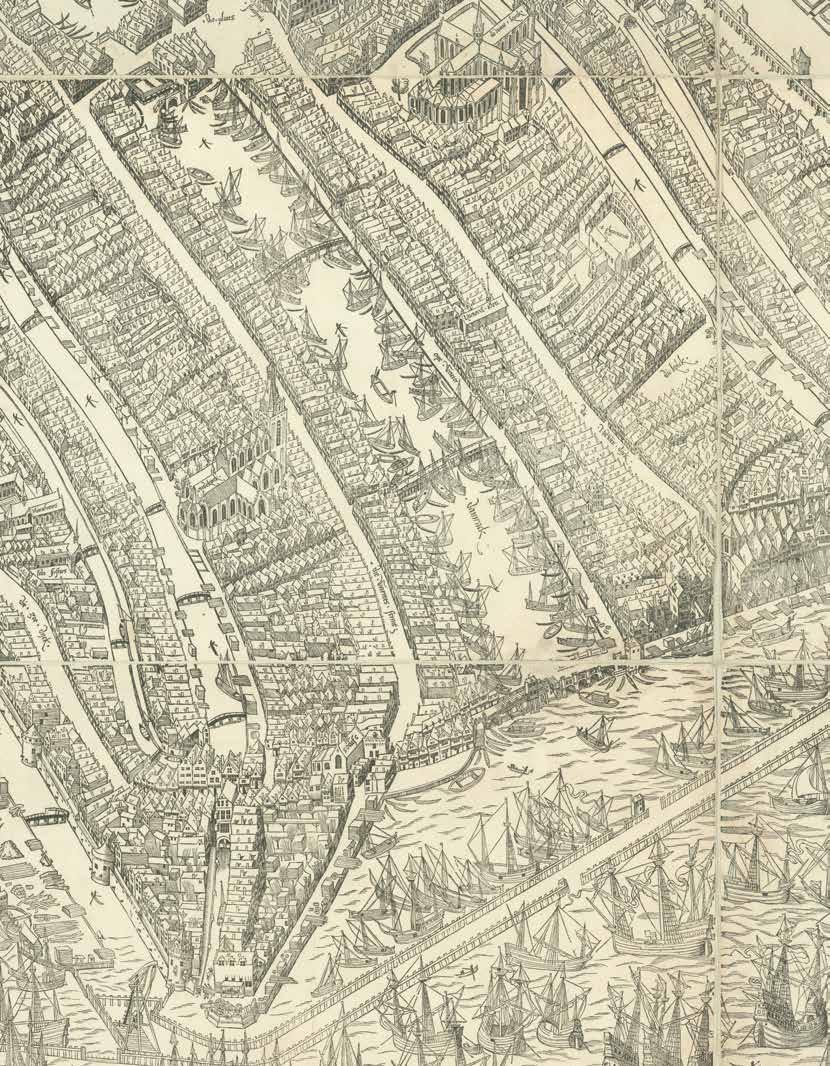
Watermark (on several sheets): A yet unidentified foolscap with four pointed extensions and two shorter ones with bells, including an elongated staff with three balls. Not identified in Churchill, Laurentius, Voorn or Heawood.
Condition: overall fine condition, untrimmed, and in loose sheets, some sheets a bit darkened in the corners, a few small areas of restoration to margins, perhaps pressed at some stage, apparently once framed (some dark lines in the margins do suggest this), very clean, printed on thin paper.
Dimensions (if joined) 1065 by 1095mm. (42 by 43 inches). Individual sheet measurements: (297 by 378mm; 242 by 387mm; 283 by 378mm; 287 by 392mm; 305 by 392mm; 287 by 387mm; 302 by 374mm; 304 by 387mm; 242 by 387mm; 304 by 393mm; 245 by 378mm; 308 by 387mm)
References Hollstein 47 (Cornelis Anthonisz. Teunissen); Karrow 6/11.3; cf. Exh. cat: Prints and the Pursuit of Knowledge in Early Modern Europe. Harvard Art Museums and Block Museum of Art. Ed. by Susan Dackerman. Cambridge/Mass. 2011, cat. no. 87.
Inventory number 15054
€400,000
professor Joseph Martin von Reider (1793-1862) in Bamberg/Germany. This map was already untraceable for A.E. d’Ailly in 1934, when he compiled his Catalogus van Amsterdamsche Plattegronden, and it turns out that von Reider’s collection was dispersed already from 1858, when von Reider donated major parts of it to the Bavarian state. Today, neither the Staatliche Graphische Sammlung nor the Bayerisches Nationalmuseum in Munich can trace this map in their collections, although they had acquired major parts of von Reider’s print collection in 1920. It is possible that it must be counted among the losses of WW2. Subsequent editions can be distinguished from earlier ones by the number of wormholes in the woodblocks, but, above all, from the modified texts in the cartouche in the upper right. Spellings were reviewed already for the second edition, and in how far the third edition differed from the second, is not yet clearly established. However, d’Ailly assumed in 1936, that “Ian Iansz” who is mentioned as printer on the fourth edition, only added his name to the text of the cartouche, after he had taken over unsold prints of the third edition from Cornelis Anthoniszoon’s widow. The sixth edition was printed by Manuel Colijn, probably between 1636-1664. The date of 1544, when the map was first printed, remains prominent in all editions, probably to pay tribute to its inventor, who is mentioned in the cartouche throughout.
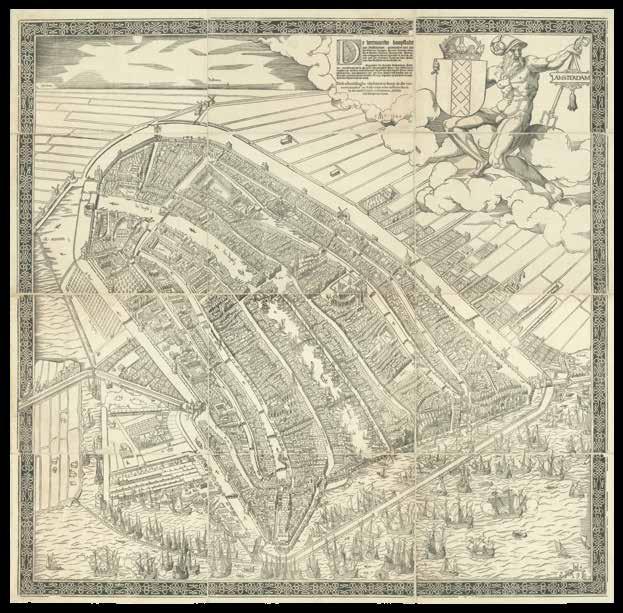
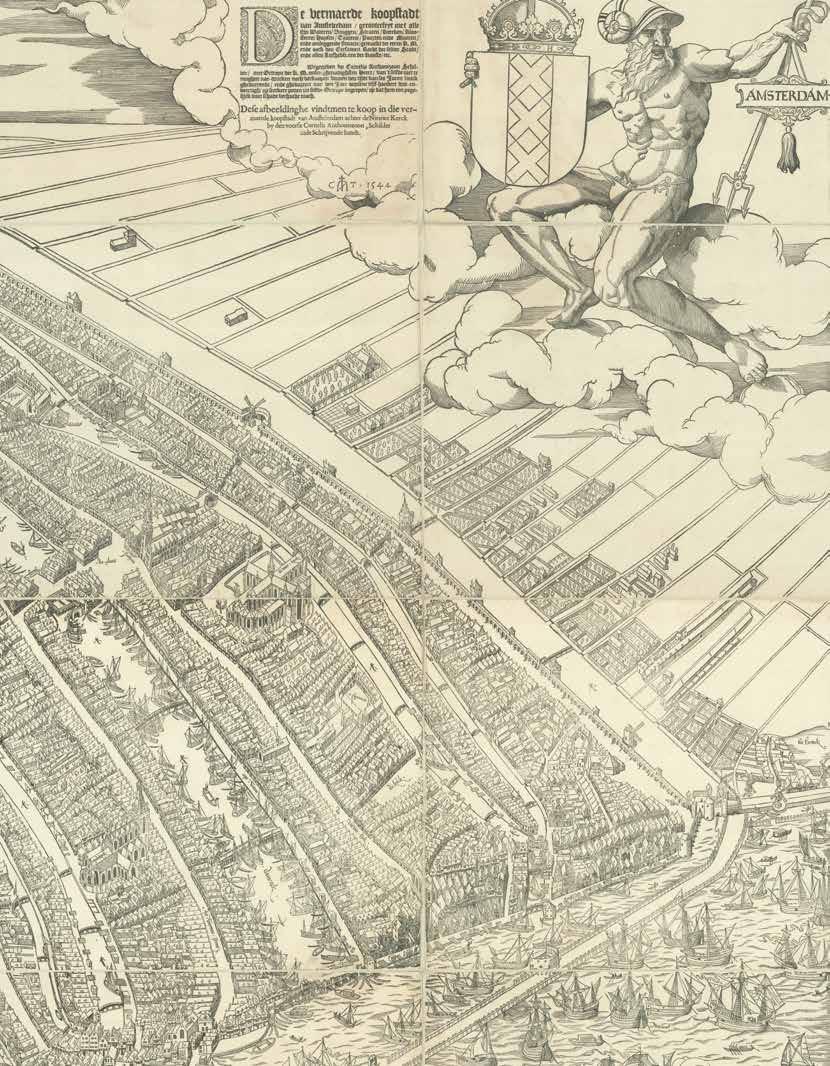
“Cornelis is celebrated for is talents as painter, draftsman and printmaker... Yet indivisible from these practices was the Amsterdamborn artist’s longtime preoccupation with mapmaking. Trained by his father in the art of engraving, Cornelis was the first printmaker to utilize that medium to chart the seas, at the time the primary conduit for trade in the Dutch Republic. In 1543 he published the Caerte van Oostland, a handbook based on both personal observations and reports from sailors that mapped the sailing route from Amsterdam to the Baltic, and which discussed the instruments and methods for surveying uncharted waters. During the time he was compiling the Caerte, Cornelis undertook the parallel project of documenting the territory contained within the Dutch borders, and in particular his native city of Amsterdam. A series of pen-and-ink studies - each a small-scale meditation on the topography of Amsterdam - culminated in 1538 in a monumental painted map, for which the municipal government awarded the artist thirty-six gulden, and which received pride of place in that city’s Stadthuis (town hall). That painting, the oldest surviving plan of Amsterdam, fuses the artist’s expertise in survey techniques with his knowledge of the science of perspective. Six years later, Cornelis produced the map on view here, which translates the Stadthuis painting with minor alterations into the woodcut medium. He printed the map using twelve woodblocks, whose assembled sheets comprise an area of more than one square meter. The View of Amsterdam bristles with information about the city at midcentury. It depicts not only moments of civic and religious significance, but also less conspicuous sites such as
bridges.... houses, yards, ports, and walls, many identified with inscriptions and each rendered with the microscopic attention to detail characteristic of Netherlandish painting of the time. Livestock and neatly partitioned swaths of land - the motors of an earlier economy - coexist with wellmaintained roads, canals, and scores of multi-masted ships decked along the Amstel River, signposts pointing to Dutch prosperity. Cornelis’s map provides a window into Amsterdam at a time when modern progress jostled with the city’s late-medieval past. As with its painted predecessor, the city itself is the subject of the image: it is shown virtually without people. A bearded allegorical figure representing Amsterdam perches on a solid mass of clouds in the upper right. Clutching a trident in his left hand and propping the heraldic crest of Amsterdam on his leg, the figure, who closely resembles Neptune (the Roman god of the sea), watches vigilantly over the calm waters that usher a golden age of trade into the city. In the impression exhibited here, Cornelis or an associate has added color washes, which dramatize the effect of shadows cast by clouds, and which inject a local flavor that uncolored versions of the View could not, as in the use of red pigment on the tiled roofs and brick buildings. The View of Amsterdam achieved immediate success and was reprinted well into the seventeenth century. Circulated and collected widely, this map advertises not only Amsterdam’s advances in scientific knowledge, but also the prodigious talents of its local artists and its growing commercial prosperity - claims demonstrated, respectively, by the map’s method of construction, its form, and its content.” Quotation from Exh. cat: Prints and the Pursuit of Knowledge in Early Modern Europe. Harvard Art Museums and Block Museum of Art. Ed. by Susan Dackerman. Cambridge/ Mass. 2011, cat. no. 87, pp. 348f.
Rare. We are not aware of any other example coming up for sale in the past 40 years. We are only able to trace one example of the map in the United States. Karrow lists 7 known complete, and two incomplete, examples of the various states of the map. They are as follows:
State II - Universiteit van Amsterdam (lacking upper right sheet).
State III - Bibliotheque Royale, Brussels; Gemeentelijke Archiefdienst, Amsterdam; Rijksmuseum, Amsterdam; Nederlands Scheepvaart Museum, Amsterdam.
State IV - Gemeentelijke Archiefdienst, Amsterdam; Rijksmuseum, Amsterdam (lacking lower right sheet); Rijksuniversiteit Leiden; Minneapolis Institute of Arts.
State V - Koninklijk Oudheidkundig Genootschap, Rijksmuseum, Amsterdam.
NIELS, Theodoor; SAVERIJ, Salomon [engraved figures after] VENNE, Adriaan van de; BERCKENRODE, Balthasar Florensz van [engraved map]
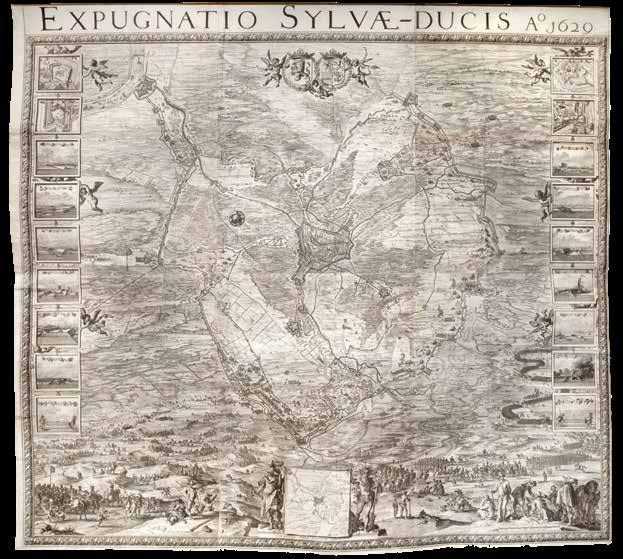
Expugnatio Sylvae-Ducis Ao 1629.
Publication [Amsterdam], H.J. Van Wouw, 1631.
Description Engraved wall map on six sheets joined, eighteen inset views of the battle and siege works to left and right of the map.
Dimensions 1274 by 1405mm (50.25 by 55.25 inches).
Inventory number 14959
€103,500
The Siege of the Swamp Dragon
Large separately published six sheet map of the Siege of ‘s-Hertogenbosch during the Eighty Years War.
Hostilities between the Habsburg Empire and the Dutch Republic resumed in 1621, following the ending of the Twelve Years’ Truce. The Habsburgs tried to punish the rebellious Dutch Republic by cutting it off from its hinterland by a land blockade. The blockade caused an economic crisis for the Republic and it reacted by trying to harm Spain in its colonies. In 1628, one of the many schemes undertaken met with spectacular success when Admiral Piet Hein of the Dutch West India Company captured the Spanish treasure fleet. With this windfall from the Stadtholder Frederick Henry decided to break the Habsburg blockade by launching a campaign against ‘s-Hertogenbosch.
‘s-Hertogenbosch, also known as moerasdraak (swamp dragon), was the main fortress in the Spanish blockading line, and enormous sums of money had been poured into the improvement of its defences. As the ground surrounding the city was a marsh, the city was generally deemed to be impregnable, as the water-saturated soil seemed to make an application of current siege methods such as trench-digging and undermining impossible.
The Siege
Frederick Hendrik laid siege to the city in April 1629, with an army of 24,000 infantry, 4,000 cavalry, and 4,000 peasants. He quickly set up a circumvallation and ordered the diverting of the two main streams feeding the swamps (the Dommel and the Aa) around the city by means of a forty kilometer long contravallation consisting of a double dike, which completely enclosed the fortress; having thus created a polder, he began to drain it by the use of horse drawn mills. After the soil had sufficiently dried out his siege trenches could begin to approach the city walls. So impressive were the siege works that noblemen travelled from throughout Europe to see them.
Attempts by the Habsburgs, under the command of Hendrik van den Bergh, Frederik’s cousin, to relieve the city proved unsuccessful, as the circumvallation proved too strong, and Frederik’s forces dug themselves ever closer to the city along the southern road from the direction of Vught, continuously bombarding the defences. During the siege 28,517 cannonballs were fired. On 18 July the large Fortress Isabella fell, followed the next day by Fort Anthony. Despite repeated sallies by the 2,500 men of the garrison, the attackers slowly worked their way to the southern city gate. There they undermined Bastion Vught; in the early hours of 11 September a massive explosion caused a large breach in the ramparts. On 14 September its military governor Anthonie Schetz surrendered the city.
The fall of ‘s-Hertogenbosch was an enormous blow to the prestige of the Spanish monarchy and the worst defeat in the North since the Spanish armada in 1588.[3] As a result their position in the North would soon
crumble and Frederick Henry, encouraged by the success, would start a series of other sieges, assisted by his cousin Van den Bergh, who changed sides after being accused of treason.
The Map
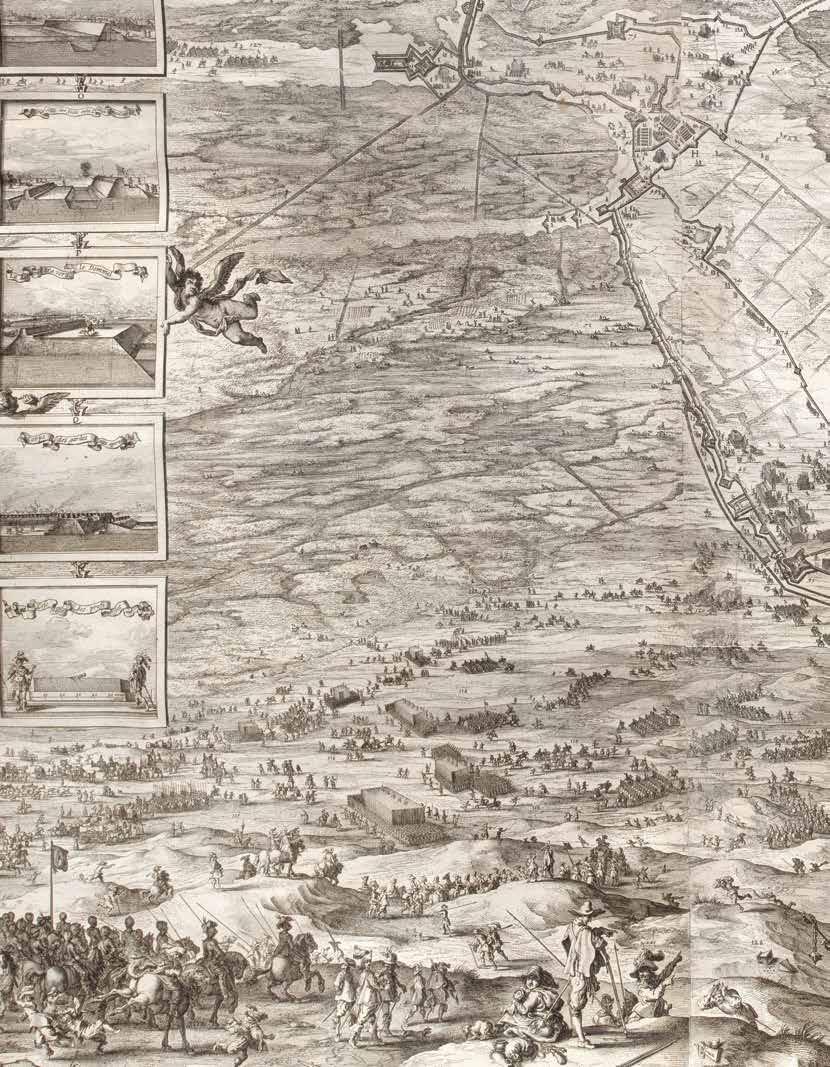
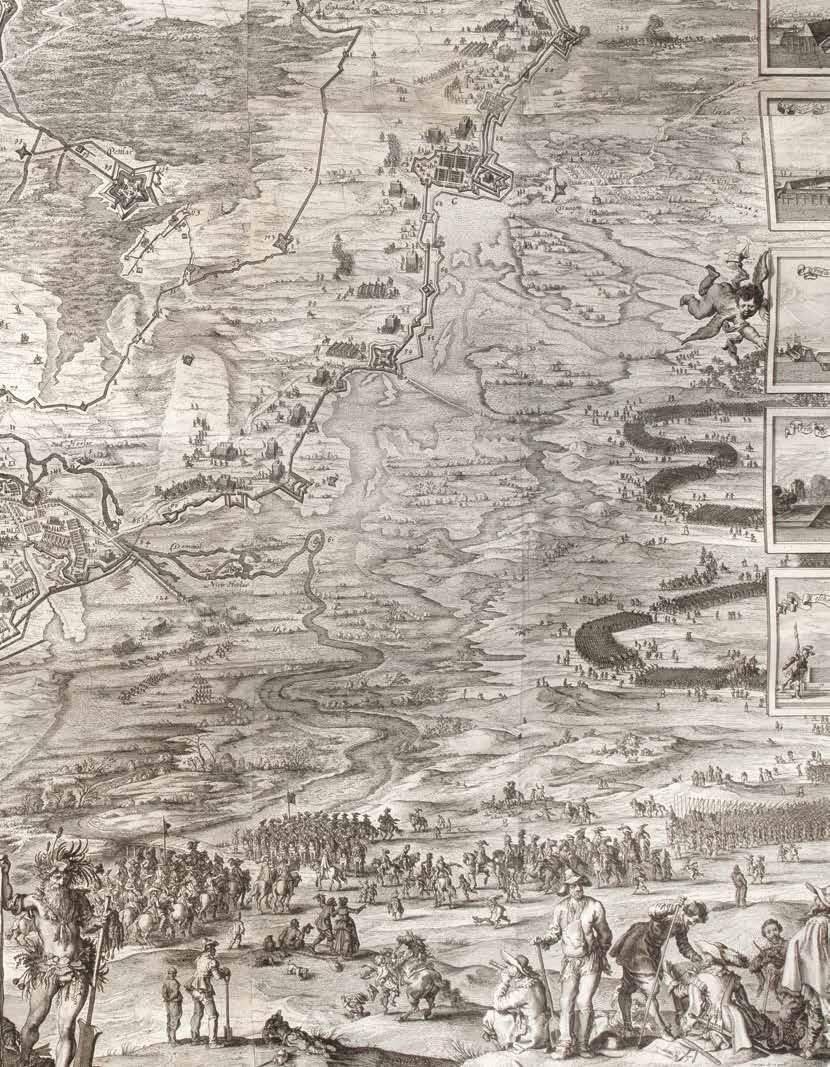
The map on six sheets provides a complete narrative of the siege; to the left and right are 18 inset views (nine on each side), for seige works, dikes, and principal forts. To the foreground two figures of Mars and a river god hold up a plan of the city. A group of figures to the lower right depict, from right to left, Frederick Hendrik surveying the battle field, the artist Adriaan van de Venne, who turns his head to the viewer, and was responsible of the figurative work on the map, and the military engineer and author of the map Theodoor Niels, who is shown seated consulting a map. Beyond the immediate foreground several battle scenes are shown depicted various stages of the siege. To the centre of the map ‘s-Hertogenbosch is shown surrounded by the extensive siege works, the circumvallation line is clearly marked - a chain of small and larger fortifications connected with a continuous parapet - designed to withstand a relief attempt from the outside, and the smaller contravallation line and dike which Hendrick used to drain the swamp. Prominence is given to the Dutch camp at Vught south of the city. The intricate trench works, so vital for victory, are meticulously delineated and the breaching of the city wall is clearly marked. All prominent landmarks, and aspects of the siege are marked by a number that correlated with an explanatory text which accompanied the map.
The author of the map was Theodoor Niels, a military engineer in the Dutch army. Niels together with Jan Adriaansz Leeghwater, whose water mills and dike work had managed to dry the land surrounding the city, were the leading military engineers at the siege. Niels was principally responsible for the construction of the extensive trench network, which meant spending a great deal of time on the frontline; a fact that almost cost him his life, when on the night of the 22nd June 1629, the defenders exploded a mine under one of his trenches, burying him alive. Assumed death he was only rescued when his head and hands were spotted poking out from beneath the rubble. He was fated as a hero, and awarded a gold medal for his bravery. Unfortunately, his luck would eventually run out when, in 1633, he was killed during the battle of Rijnbeek.
On December 7th 1629, the States General recognized Niels vital role by not only awarding him a gold medal and a substantial cash sum, but also granting him a privilege – of four years – in order to produce a great map of the battle.
To enable him to complete the task Niels employed some of the leading artists and engravers working in Amsterdam at the time. These included: the figure and genre painter Adriaan van de Venne, who was
responsible for the scenes in the foreground, and whose sketches would be engraved by Salomon Savery; the plan of the siege would be completed by Balthasar Florenz van Berckenrode, whose monumental wall map of Amsterdam, published in 1625, had met with such great praise, and whose map of Breda of 1637, bears striking similarity to the present work.
Rarity
We are only aware of four institutional examples, all of which are located in the Netherlands: Leiden University Library; Amsterdam Rjksprentenkabinet; Dordrecht, Museum Simon van Gijn; and Rotterdam, Atlas van Stolk.
HOEFNAGEL, Jacob; Claes Jansz VISSCHER
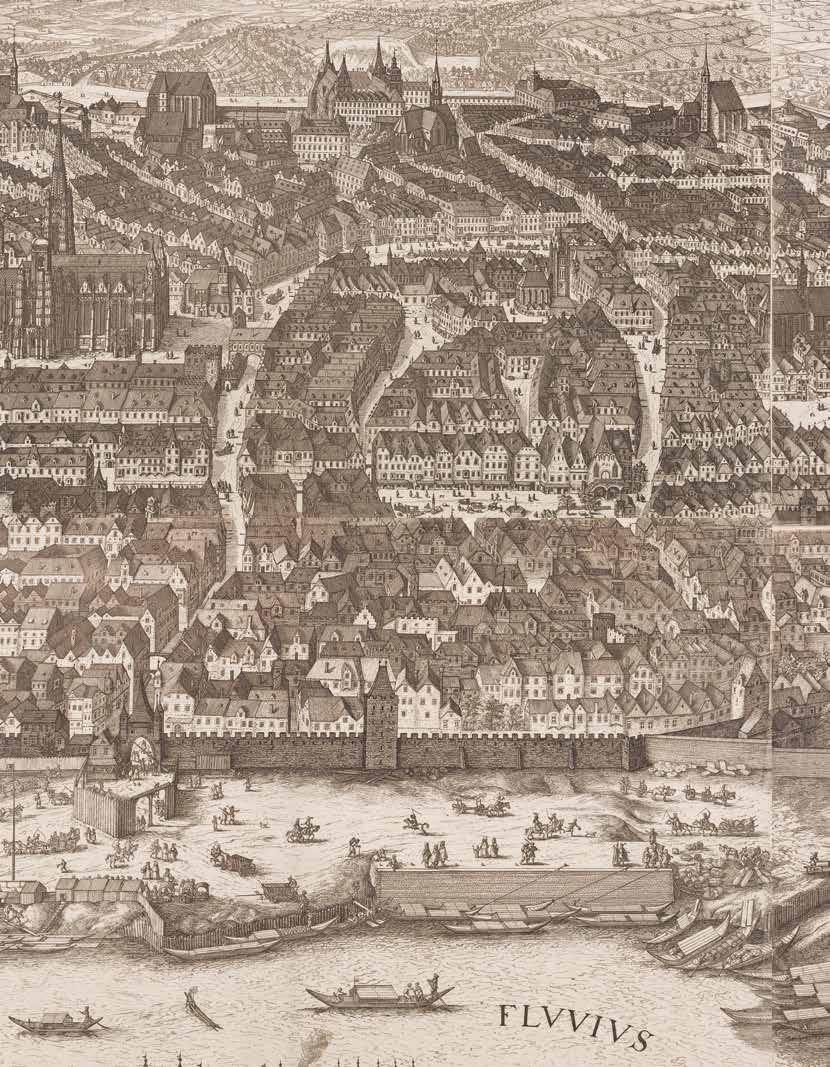
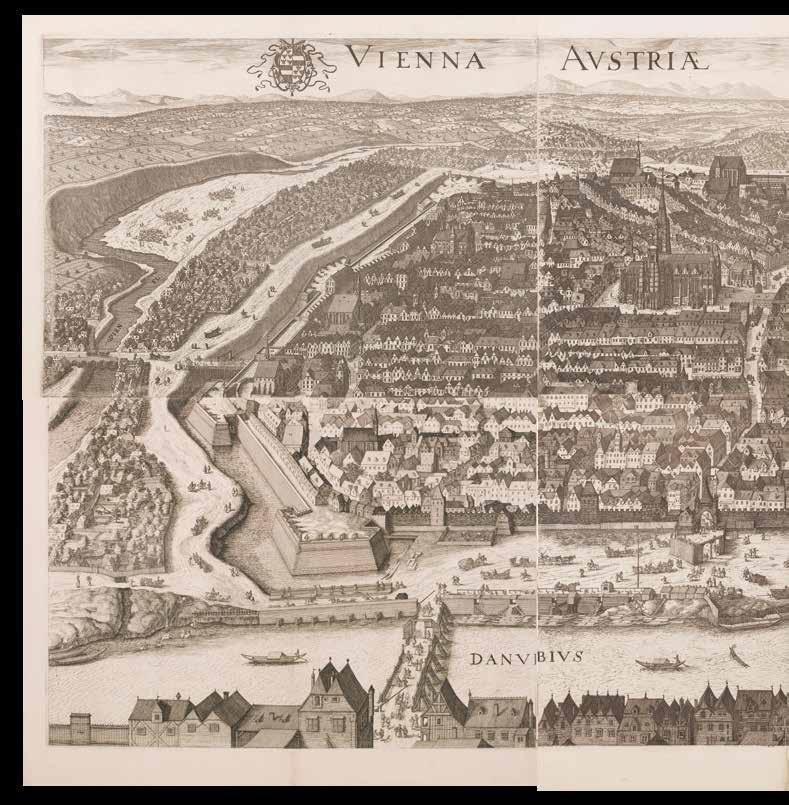
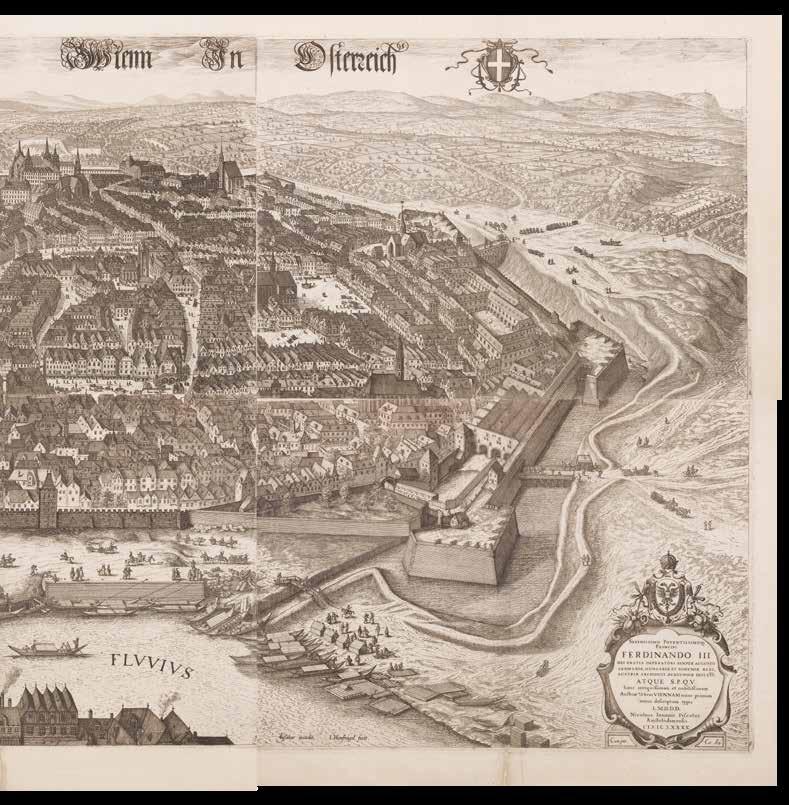
Vienna Austriae Wienn in Ostereich.
Publication
Amsterdam, Claes Jansz Visscher, 1640.
Description
Engraved birds-eye plan, on six sheets, with good margins, tears to centrefolds, skilfully repaired.
Dimensions (if joined) 795 by 1595mm (31.25 by 62.75 inches).
References Fischer, Karl, ‘Wien 1609. Ansicht aus der Vogelperspektive von Jacob Hoefnagel’, Winkler-Hermaden, 2015.
Inventory number 34340
€70,000
The iconic view of Vienna
One of the rarest and most influential plans of Vienna.
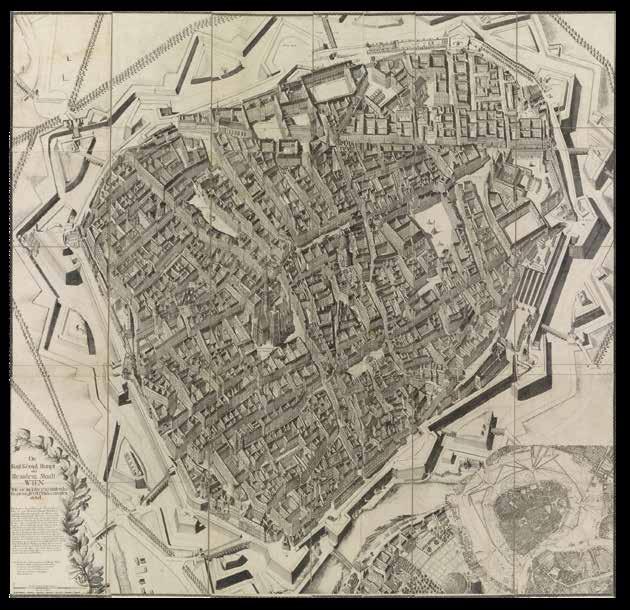
This bird’s-eye view by Jakob Hoefnagel, first published in 1609, is one of the most famous views of Vienna. It depicts the city from the northeast, across the Danube. Framed by its surroundings, the high vantage point reveals a detailed depiction of not only the city fortifications, and church towers but also individual houses and other public buildings. The view is considered the most detailed and accurate depiction of the city before it was radically restructured in the later seventeenth and early eighteenth century. Several of the buildings bear numbers, which correspond to a printed key that could be pasted beneath the view.
Jakob Hoefnagel (c.1573- 1632), painter, engraver, art dealer, and diplomat - son of the painter Joris (or Georg) Hoefnagel (1542-1600) -worked at the court of the Holy Roman Emperor Rudolf II in Prague. After his father’s death, he succeeded him as imperial court painter in November of 1602. He most likely settled in Vienna, in 1604, when he set about making plans to produce a large view of the city. Hofnagel dedicated the view to Rudolf’s brother and rival, Matthias, who had become the Arch Duke of Austria, and King of Hungary and Croatia in 1608. He would later be crowned Holy Roman Emperor, in 1612, following Rudolf’s abdication. Unfortunately, Hoefnagel did not find favour with Matthias, and returned to Prague, before fleeing, in 1620, to Sweden for supporting Frederick V, the “Winter King”, and eventually settling in Hamburg.
After Hoefnagel’s death, the copper platesfor his plan of Vienna passed into the possession of the Amsterdam publisher Claes Janszoon Visscher, who published a second, essentially unchanged edition in 1640, as here, dedicated to the Holy Roman Emperor Ferdinand III. A third state from 1683, in which Hoefnagel’s name no longer appeared, shows significant changes, especially regarding the fortifications, which had by the time been greatly extended. A reduced version appeared as early as 1617 in volume VI of Braun and Hogenberg’s ‘Civitates Orbis Terrarum’. Its inclusion in the ‘Civitates’ ensured its position as the most influential view of the city for the remainder of the seventeenth century.
Rarity: All issues of the plan are extremely rare, with only 2 institutional examples of the 1609 issue known; 4 of this, the 1640 issue; and one of the later 1683 issue. We have been unable to trace any examples, in available records, appearing in commerce since the WWII.
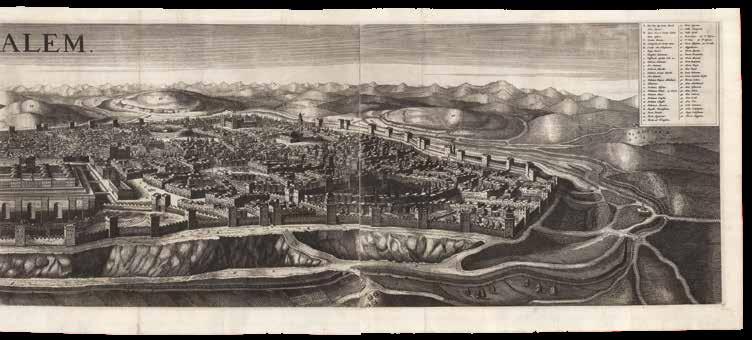
Jerusalem
HOLLAR, Wenceslaus
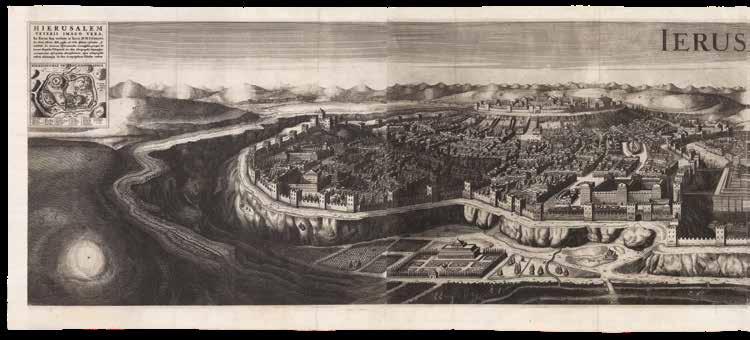
Jerusalem.
Publication ?[Cambridge, Field, 1660].
Description
Engraved view with one inset plan, on four sheets.
Dimensions
440 by 2030mm (17.25 by 80 inches).
References
NHG Hollar 1732 I; Pennington 1130.
Inventory number 18374
€11,500
An exceptionally fine impression of Hollar’s panorama of Jerusalem.
Wenceslaus Hollar contributed engraved plates to numerous Bibles, showing religious and ancient artefacts, scenes, views, plans and maps. Many of these were drawn after Juan Batista Villalpando whose seminal work on the Holy Land at the beginning of the seventeenth century influenced generations of scholars, architects and artists. Although Villalpando was accused of heresy for misinterpreting scripture, eventually being found innocent by the Spanish Inquisition, his Biblical cartography and imagery had a great impact on the architecture and construction of later monasteries, churches and even wider urban spaces.
The main image on the present print is a magnificent view of Jerusalem, encompassing the great city walls, the countless small and large buildings within it, and the surrounding hills. The river valley in the foreground is cultivated with trees and fields, while within the walls the city appears to be constructed according to a grid-like system, dominated by the Temple atop Mount Moriah at the centre of the view. Hollar included a numerical key in the upper right-hand corner of his plan to identify Jerusalem’s various structures, spaces and sites, which are further examined in an aerial inset plan in the opposite corner.
Oriented to the west, the inset plan show the entirety of the city as well as those parts of the surrounding area that contained sites and buildings of religious or historic importance. In fact, the number of sites shown outside of the city walls exceeds that within, since only the most important monuments, structures and places inside Jerusalem are shown, unobscured by the mass of nameless buildings that appeared on many contemporary views. Among the sites that do appear are the palace of Herod, the Hippdrome and, of course, the Temple of Solomon, which naturally bears a close resemblance to the more detailed illustrations found in Villalpando’s ‘in Ezechielem Explanationes’, which Hollar also replicated. The relief and layout of the surrounding area are represented pictorially, as are its important locations, such as the Mount of Olives, the Garden of Gethsemane and the Camp of Pompey, which was set up during the seige of 63 BC. The Kidron Brook runs north to south along the eastern walls of the city, and further to the east, beyond the Mount of Olives, the neighbouring town of Bethany is represented as a modest collection of buildings.
JAILLOT, Alex Hubert
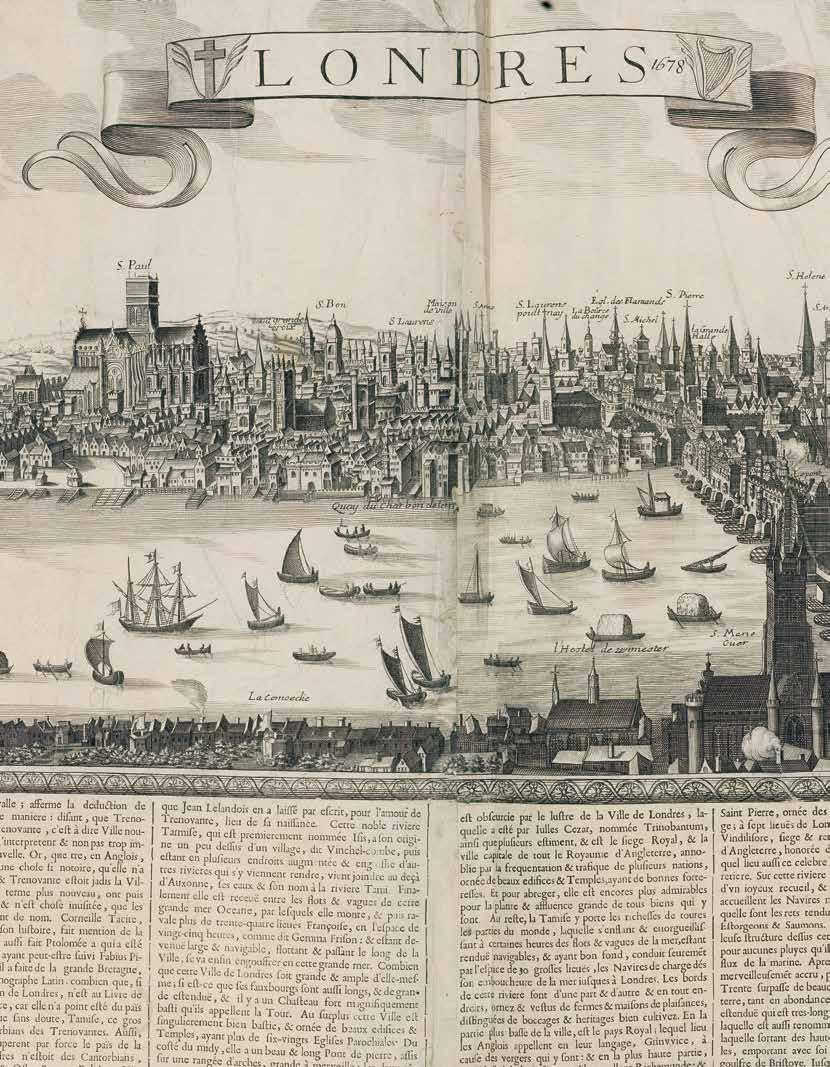
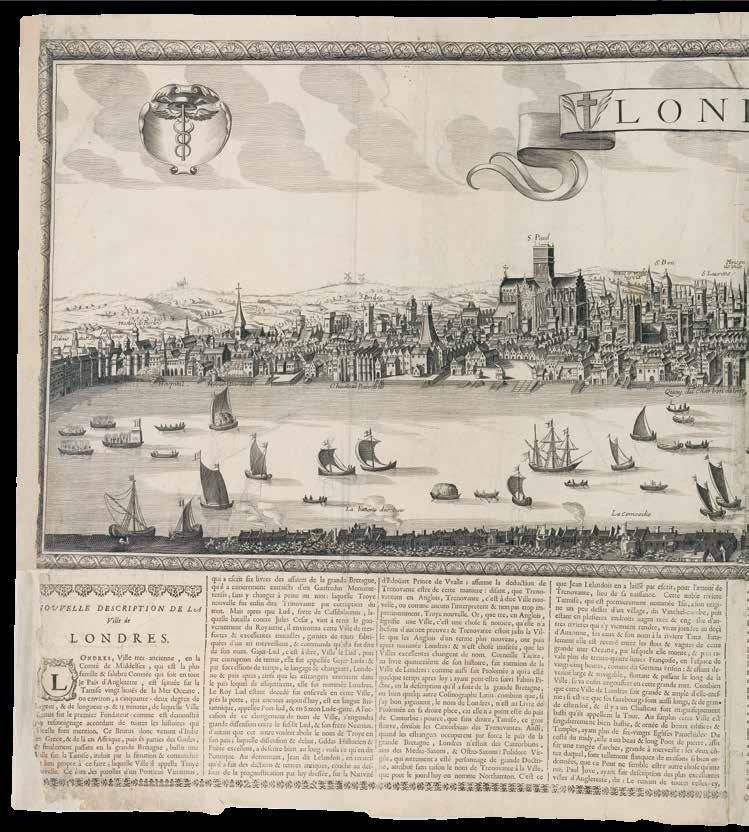
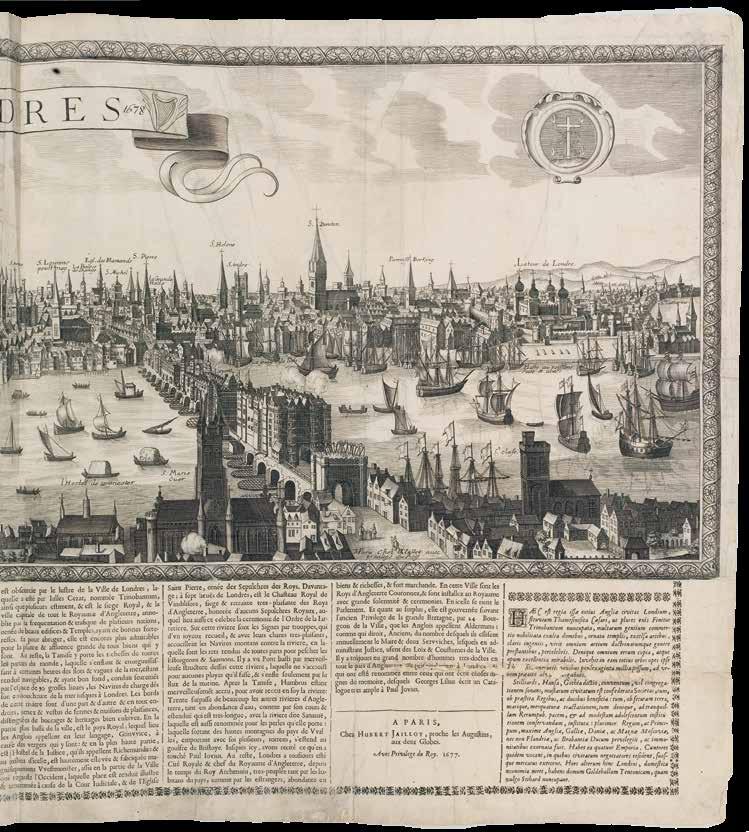
Londres 1678.
Publication Paris, Jaillot, 1678.
Description
Engraving on two sheets, joined, letterpress text below, loss to left margin, affecting image and text.
Dimensions 530 by 1053mm (20.75 by 41.5 inches).
References Scouloudi p. 41.
Inventory number 34337
€80,000
Early Stuart London
An iconic view of London, at it was at the beginning the seventeenth century, taken from Southwark and looking north. Based on Claesz Jansz Visscher’s (1587-1652) “excudit” panorama published in about 1620, the only extant example of which is housed in the Folger Shakespeare Library in Washington. The view is not a slavish copy of Visscher’s work, as St Katherine by the Tower is correctly named; and the style is more reminiscent of Nicholas Berey’s view of the city, published in 1660. This is probably not a surprise as Berry was Jaillot’s father-in-law.
London extends from Whitehall in the west, to St Katherine’s by the Tower, in the east. It is presented as an industrious and prosperous city. The Thames teems with all manner of sailing vessels, fit for passengers, trade, and war: ferries, wherries, barges, pinnaces, barks, and galleons.
London bridge is far from falling down, and is lined with houses and businesses, and heads from the decapitated on spikes. The old St Paul’s is prominent, as are both the Swann (’La Batterie des Ours’) and Globe (’La Comoedie’) theatres in Southwark. The old Banqueting House (burnt down in 1619), as well as the buildings at the north end of London bridge, which were destroyed by fire in 1633.
The text below provides information on the city’s history, its geographical position, the River Thames, and its role as the principal political and commercial hub in England.
The Frenchman Alexis-Hubert Jaillot was born in the small hamlet of Avignon in Franche Comte. In 1657 he traveled to Paris with his brother Simon and found employment as a sculptor. He was fortunate to meet the Flemish engraver Nicolas Berey, the publisher and mapmaker to the Queen. His subsequent marriage to Jeanne Berey resulted in Jaillot joining his father-in-law in trade. Much of Jaillot’s work depended on the maps of his predecessor, Nicolas Sanson d’Abberville (1600-1667), the greatest French map-maker of his generation and the founder of the French School of Geography. The great fire of 1672 destroyed the Blaeu mapmaking empire in Holland and Jaillot quickly acted to fill the gap now left in the market. Near 1670, Sanson’s sons entered into collaboration with Jaillot to produce the monumental ‘Atlas Nouveau’, which included enlarged and embellished renderings of Sanson’s magnificent maps. Jaillot’s efforts awarded him the title of Royal Geographer by Louis XIV.
Rarity: Scoloudi records only one example in the British Museum. We have been unable to trace another extant example.
WENING, Michael [after] HALLART, Ludwig Nicolaus
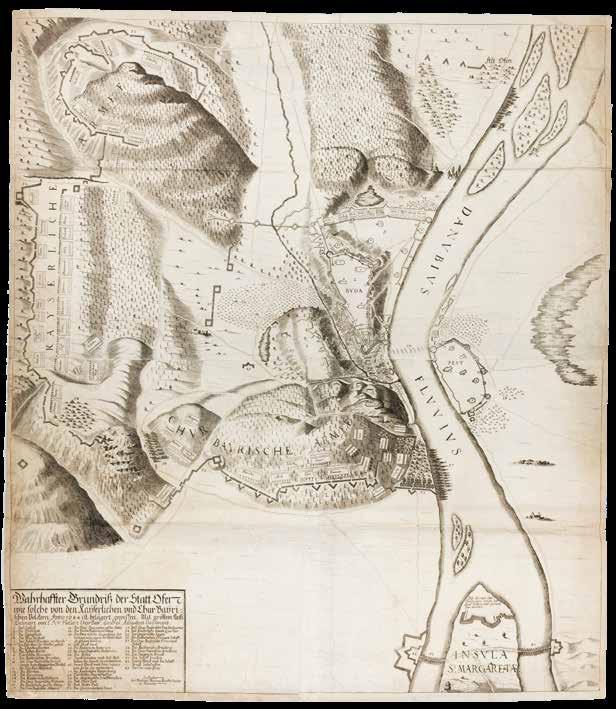
Wahrhaffter Grundriss der Statt Often wie solche von den kayserlichen und chur bayrischen Völckern Anno 1684 ist belägert gewessen mit gröstem Fleiss deliniert von L. N. v. Hallart.
Publication Munich, Michael Wening, 1684.
Description Engraved plan, on four joined sheets, title and key lower left.
Dimensions 860 by 760mm (33.75 by 30 inches).
References
Dóra Bobory, review of Journal des campagnes du duc Charles V de Lorraine. Ferenc Tóth, ed.; Bibliothèque d’Études de l’Europe Centrale 20. Paris: Honoré Champion, 2017.
Inventory numbe 34339
€8,500
The Battling for Buda
An exceptionally rare depiction of the 1684 siege of Buda (the Stadt Ofen of the title), on the western bank of the Danube, a natural boundary between the Habsburg and Ottoman Empires, by the forces of the Holy Roman Emperor, Leopold I (reigned 1658–1705), led by Charles V, Duke of Lorraine (1643–1690), supreme commander of the imperial army, and hero of the eventual 1686 reconquest of Buda. Failing to find favour with his own French King, Lorraine had changed sides as a young man, and subsequently became one of the most successful commanders of the Habsburg army.
The Habsburgs and the Ottomans had been fighting each other for 300 years, when the Ottoman 1683 attempt to take Vienna was defeated by a coalition between the Habsburgs and the Polish-Lithuanian Commonwealth. That significant victory marked a turning point in this series of conflicts, and inspired Leopold I to create a Holy League, a coalition of the Polish–Lithuanian Commonwealth, the Holy Roman Empire-Habsburg monarchy, the Venetian Republic, the Tsardom of Russia, and the Kingdom of Hungary. Effectively a crusade, indeed sometimes referred to as the “last crusade”, this super-army systematically dismantled the Ottoman stranglehold, by first reconquering Hungary, fort by fort along the Danube, then Transylvania, and finally Belgrade in 1699.
This meticulous plan, from a drawing by Ludwig Nicolaus von Hallart/ Hallard (1569-1727) shows the Holy League’s troops arraigned in the countryside surrounding Buda, in particular Lorraine’s Imperial forces, and the Bavarian troops led by Hallart (himself), Bavarian General, and Lieutenant-Adjutant. A Saxon nobleman, diplomat and soldier, and military engineer, Hallart drew a series of maps and views between 1684 and 1688 chronicling the Holy League’s battles with the Ottoman Empire along the Danube, published by Michael Wening (1645-1718).
Court engraver for Maxmilian II Emanuel, the Elector of Bavaria, from 1675, Wening is best known for an engraving of the firework display to celebrated Maxmilian’s birthday in 1680, and the ‘Historico-Topographica Descriptio’, published in four volumes between 1701 and 1726, which included 846 engravings of Bavarian landscapes.
Rarity: We were only able to locate one other example of this plan, in Museum of Military History, Budapest.
JAILLOT, Alex Hubert
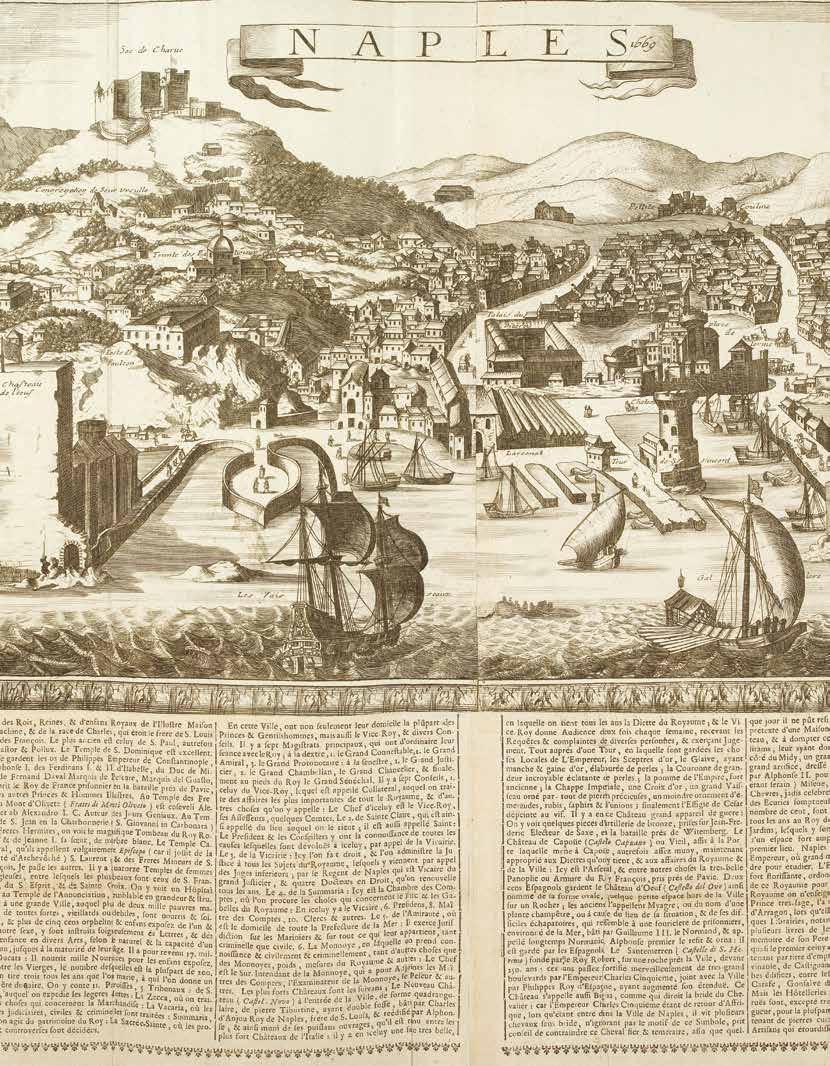
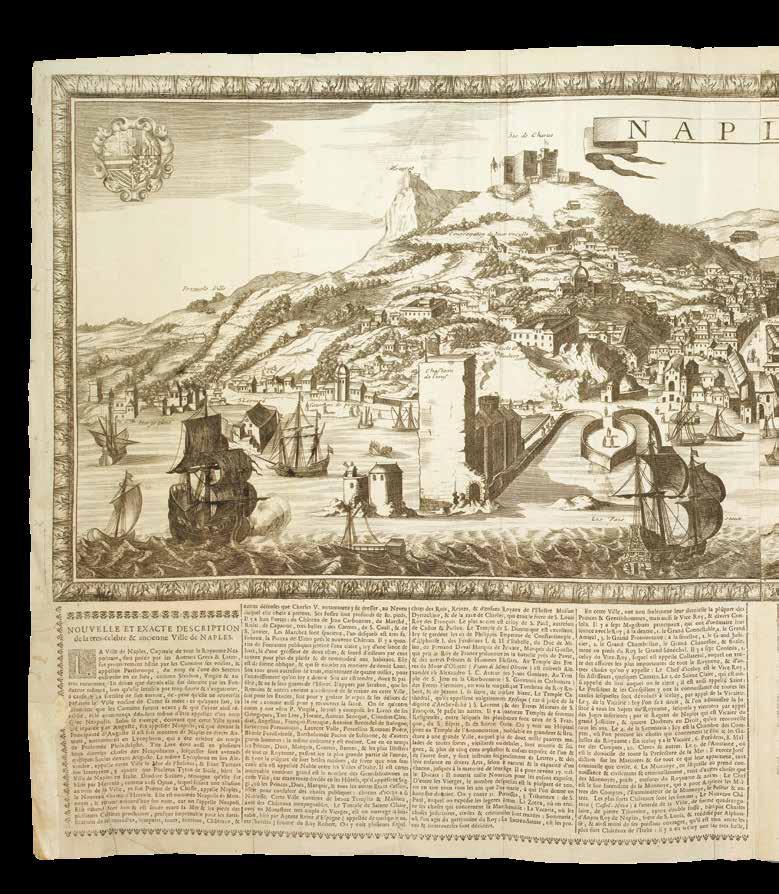
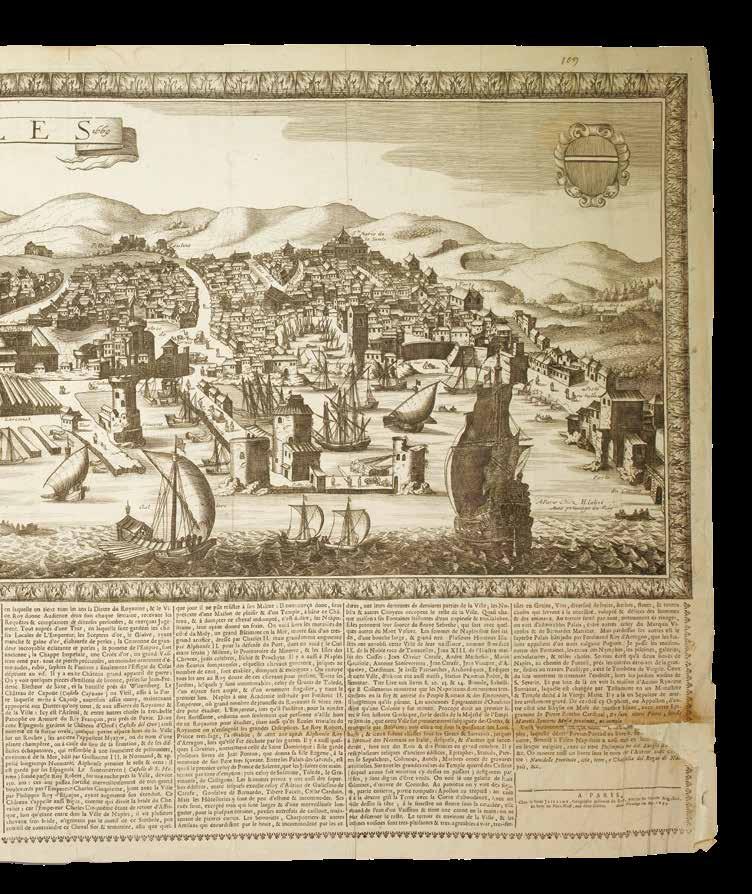
Naples. 1699. Nouvelle et exacte description de la tres-celebre & ancienne Ville de Naples.
Publication Paris, a chez H. Jaillot, 1699.
Description
Engraved panoramic view, on four joined sheets, with letterpress text below, loss and repairs to letterpress lower right, old folds strengthened on verso.
Dimensions
563 by 1040mm (22.25 by 41 inches).
Inventory number 34336
€46,000
The city that keeps Virgil’s golden egg?
Legend has it that the Roman poet Virgil, who over the course of history had assumed the mantle of sorcerer, placed a precious golden egg, in a crystal case, inside an iron cage, within the foundations of the Castel dell’Ovo (Chateau de l’oeuf). The talisman’s power was so strong that so long as the egg remained, so would Naples flourish,... And so it did, as this magnificent panorama of the city, shown at the end of the seventeenth century, is clear testament to.
Sailing vessels from all over the world fill the turbulent seas, and find refuge in the safe fortified harbour, protected by the Chateau de l’oeuf, signalling Naples as a powerful centre for international trade. The numerous docks teem with commercial activity, and the ruling classes promenade at leisure. Watching over all is the towering Castel Sant’Elmo (Soc de Charue), and at the centre of the scene, the Royal Palace (Palais du Viceroy). Below the view is text celebrating Naples’s history, and explaining its geography.
However, the year after this superb panorama was published, and nearly two centuries of Habsburg Rule, the death of Charles II (1665-1700) threw Europe into the all-consuming chaos of the War of Spanish Succession. In 1714, as a result of the Treaty of Rastatt, Naples would fall under the Austrian rule of Charles VI, Holy Roman Emperor,... but not for long,...
The Frenchman Alexis-Hubert Jaillot (1632-1712) was born in the small hamlet of Avignon in Franche Comte. In 1657 he travelled to Paris with his brother Simon and found employment as a sculptor. He was fortunate to meet the Flemish engraver Nicolas Berey, the publisher and mapmaker to the Queen. His subsequent marriage to Jeanne Berey resulted in Jaillot joining his father-in-law in trade. Much of Jaillot’s work depended on the maps of his predecessor, Nicolas Sanson d’Abberville (1600-1667), the greatest French map-maker of his generation and the founder of the French School of Geography. The great fire of 1672 destroyed the Blaeu mapmaking empire in Holland and Jaillot quickly acted to fill the gap now left in the market. Near 1670, Sanson’s sons entered into collaboration with Jaillot to produce the monumental ‘Atlas Nouveau’, which included enlarged and embellished renderings of Sanson’s magnificent maps. Jaillot’s efforts awarded him the title of Royal Geographer by Louis XIV.
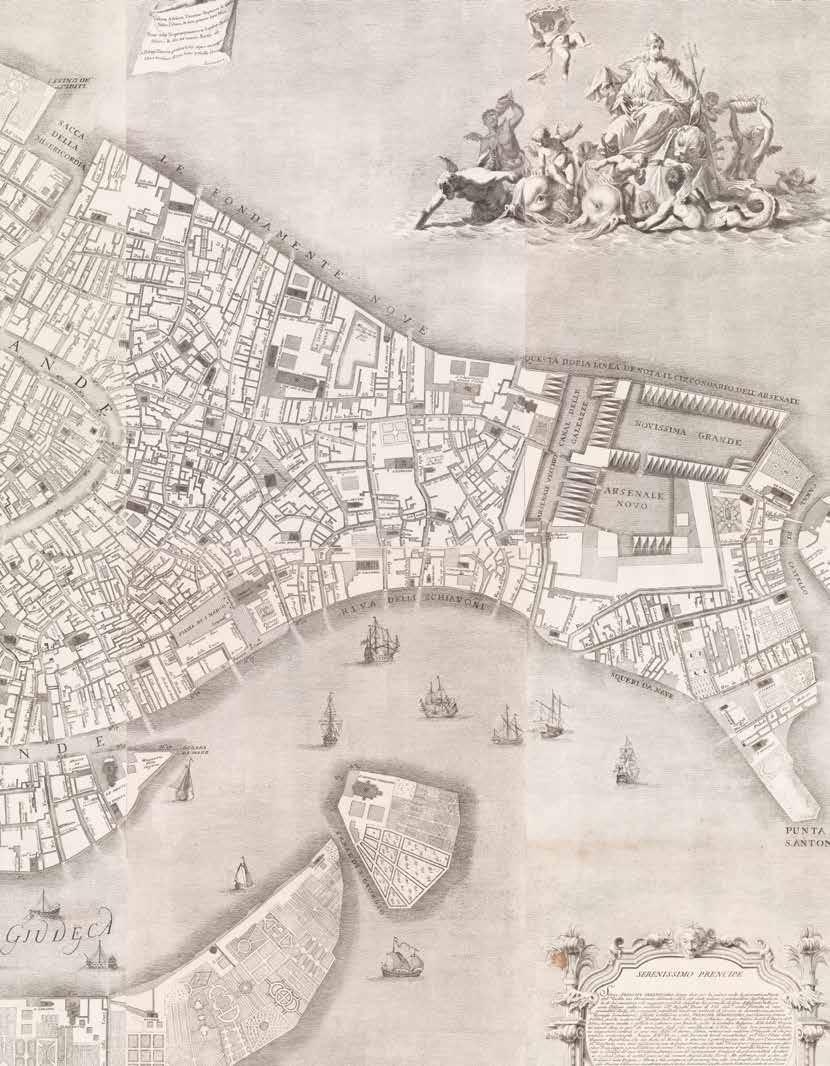
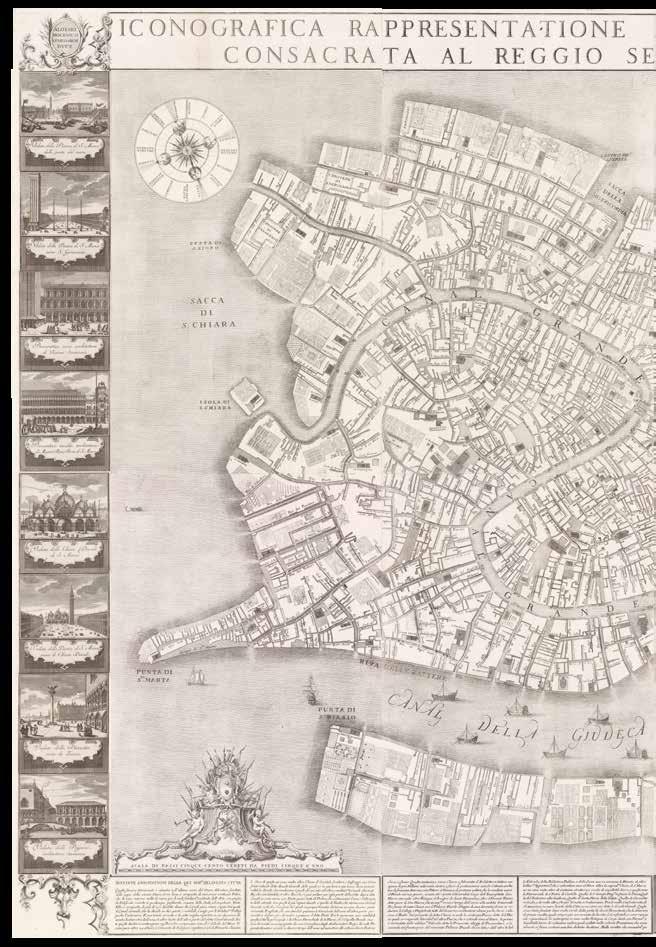
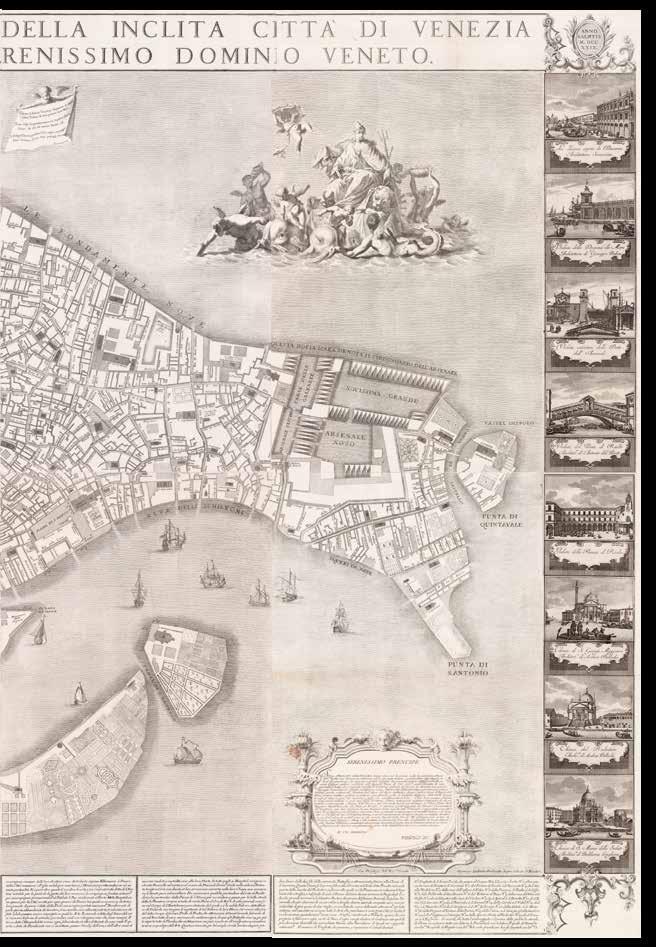
UGHI, Lodovico
Iconografica Rappresentatione
della Inclita Città di Venezia
Consacrata al Reggio Serenissimo Domino Veneto.
Publication
Venice, Giuseppe Baroni á S. Giuliano, 1729.
Description
Large engraved wall map on eight sheets, title to banner at top, 16 views of Venice to left and right borders, text below.
Dimensions 1457 by 2016mm (57.25 by 79.25 inches).
Inventory number 34329
€100,000
First State of Ughi’s landmark map of Venice
One of the largest maps of Venice ever published, and the first map of the city based upon accurate field surveys.
Lodovico Ughi’s topographical map is a landmark in the cartographic history of Venice. Successive Venetian mapmakers from the time of Jacopo di Barbari did not significantly alter the appearance of the city: among the exceptions is Ughi’s work. Not only is it one of the largest printed plans of Venice, but it also served for centuries as a model for subsequent maps.
At the sides are 16 views: the Piazza San Marco, the Doge’s Palace, the Basilica di San Marco, the Arsenal, the Rialto Bridge, the church of San Giorgio Maggiore, the church of Santissimo Redentore, and the church of Santa Maria della Salute. The views have been tentatively assigned to the Venetian artist and engraver Francesco Zucchi (1692-1764), made after Luca Carlevarij’s ‘Fabriche e Vedute di Venetia’, published in 1703.
To the lower left is the coat of arms of Francesco Morosini, surrounded by putti and military equipment. Francesco Morosini (1619-1694) was the last of the “warrior Doges”. He is most famed for his victories over the Ottomans during the Morean War (1684-1699), in which he captured most of the Morea. For this he was awarded the honorary title “Peloponnesiacus”, and was the first Venetian citizen to have a bronze bust placed during his own lifetime in the Great Hall.
To the upper right is a personification of Venice with the lion of Saint Mark at her feet, surrounded by marine creatures representing her marriage to the sea and the riches she derives from it. The image is taken from a drawing by the Venetian painter Sebastiano Ricci (1659 - 1734). The cartouche at the bottom right holds a dedication written by Lodovico Ughi to Alvise Mocenigo, the Doge in 1729. He calls the city “blessed by the Virgin, divine, Queen of the Adriatic, always envied, a constant sustainer of the Catholic religion, known throughout the world for her justice, feared by her enemies, defended in all times by her sons who have sacrificed their lives”. Below the map is a long text panel providing information about Venice.
There are two states of the plan.
The first state - the present example - bears the imprint of the Venetian engraver and publisher Giuseppe Baroni. Few examples of the first state exist as Baroni died the year after publication.
The second state bears the imprint of Lodovico Furlanetto who acquired the plates after Baroni’s death.
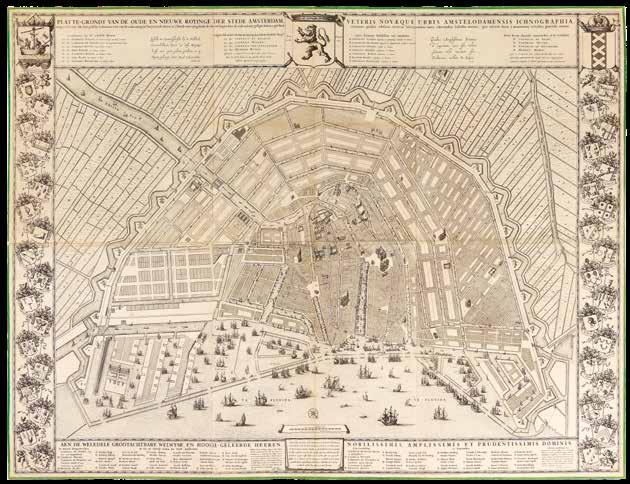
STALPAERT, Daniel
Platte-Grondt van de Oude en Nieuwe Royinge der Stat Amsterdam.
Publication
Amsterdam, Johannes Covens and Cornelis Mortier, 1662 [but c1730].
Description
Large engraved wall map on six sheets joined, mounted on linen, edged in green silk, light wear to old folds.
Dimensions
1230 by 1615mm (48.5 by 63.5 inches).
Inventory number
1919
€23,000
The Golden Age of the Dutch Republic
Rare wall map of Amsterdam by the States’ architect Daniel Stalpaert (1615-1676), flanked by the arms of the city and the principal families, commissioned by the city, under the guidance of a committee that included Johannes Blaeu, with a list of dedicatees, the city councillors, along the lower border.
The plan shows Amsterdam at the height of her powers, with the great Three Canals Project nearing completion. The Project, which was begun in 1610, was brought about by the rapid growth in the city’s population. The population had doubled between 1567 and 1610 to 50,000, and would by 1660 have quadrupled to 200,000. In order to cope with the ballooning population, the city council implemented the construction of three great semicircular canals, the erection of buildings on pilings, sanitary arrangements for each house, a network of drains and sewers, and the construction of merchants’ houses with storage facilities on the upper floors and warehouses near the mouth of the Amstel. The council expropriated the land, dug the canals, and laid out lots for sale to private individuals for housing, thus allowing some of the cost of construction to be recouped. At the end of the project Amsterdam had expanded from 450 to 1,800 acres.
[BRETEZ, Louis] and [TURGOT, Michel-Etienne]
[Plan de Paris].
Publication Paris, 1739.
Description
First edition, folio (560 by 450mm), folding key sheet, 20 double-page engraved maps, plates 18 and 19 joined, numerous plans, maps, views and cameos pasted to verso of each sheet, full calf, fillet border, spine rebacked preserving original gilt decoration.
Dimensions 550 by 840mm (21.75 by 33 inches).
References Millard 39.
Inventory number 24441
€35,000
Turgot’s monumental plan of Paris
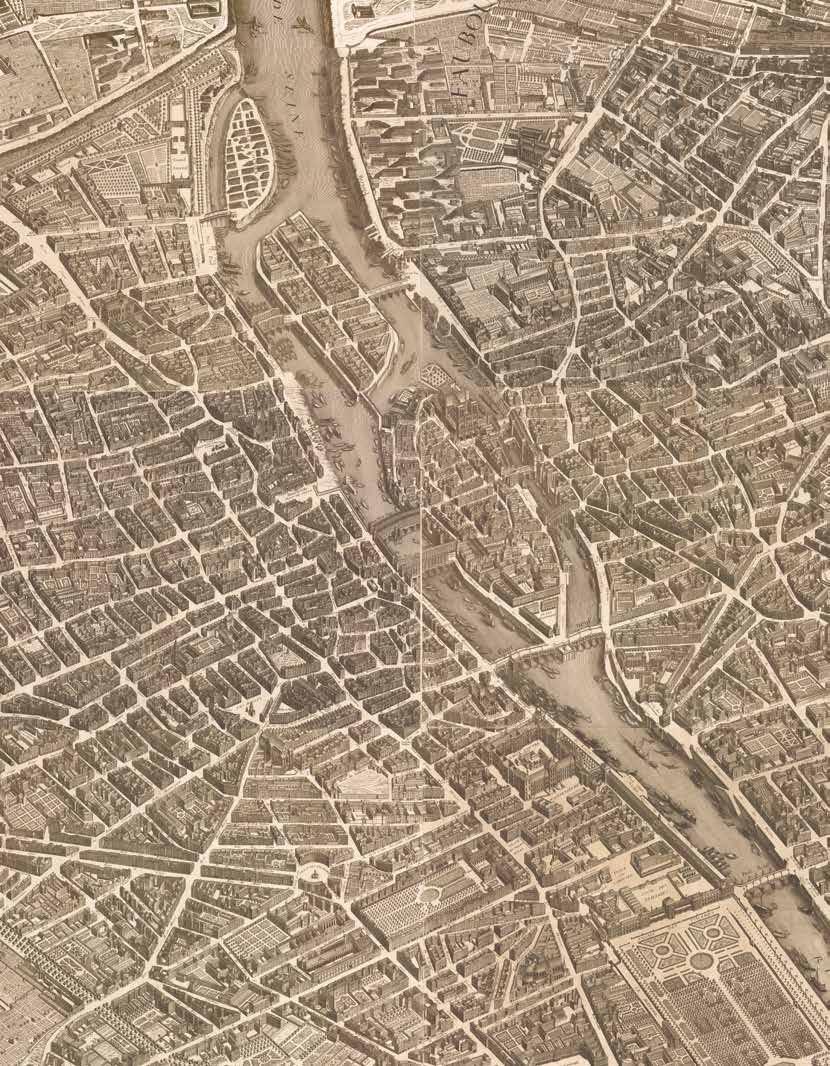
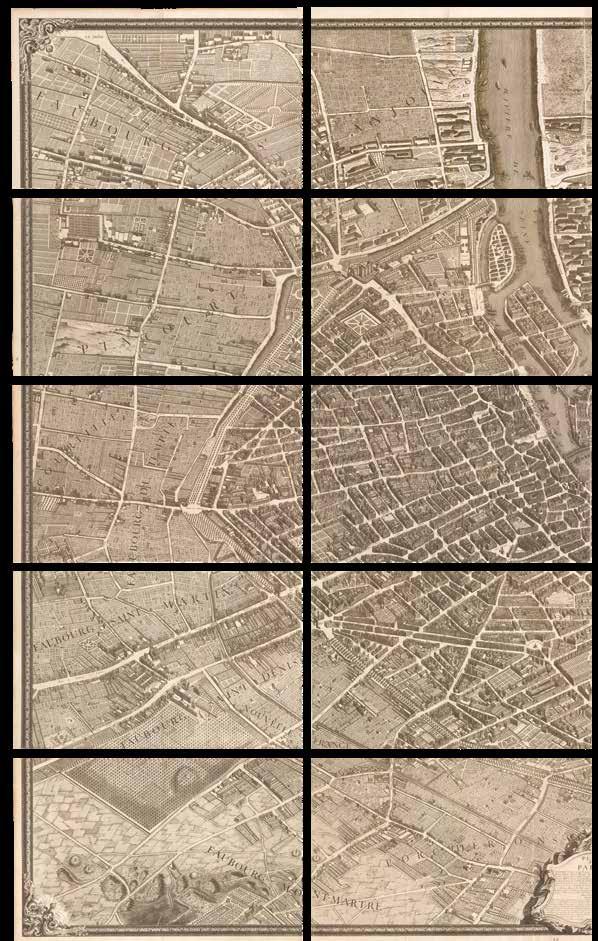
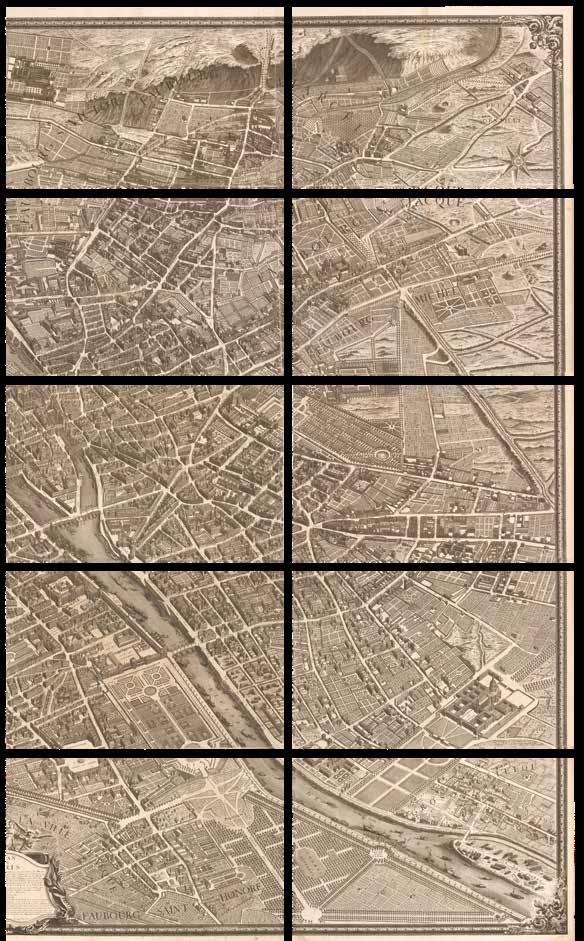
Turgot’s fine plan of Paris during the reign of Louis XV, which, if joined, would measure some 2360 by 2400mm.
In 1734 Michel-Étienne Turgot (1690-1751), Mayor of Paris, decided to promote the reputation of Paris to Parisian, provincial and foreign elites by implementing a new plan of the city. He asked Louis Bretez, a member of the Royal Academy of Painting and Sculpture, and professor of perspective, to draw up the plan of Paris and its suburbs.
Louis Bretez began his work in 1734, and was given permission by Turgot to enter all the mansions, houses and gardens in Paris, in order to gain accurate measurements and drawings. The endeavour would take two years.
Turgot depicts Paris in isometric projection, a slightly more scientifically rigourous example of the seventeenth century birds-eye view. This was somewhat against the grain of cartographic thinking at the time, with many cartographers abandoning the visually appeal birds-eye view, for the more scientifically accurate geometric plan.
In 1736, Claude Lucas, engraver of the Royal Academy of Sciences, engraved the 21 copper sheets of the plan. The plan was published in 1739, and the prints were bound in volumes offered to the King, the members of the Academy, and the Municipality. Additional copies were to serve as representations of France to foreigners.
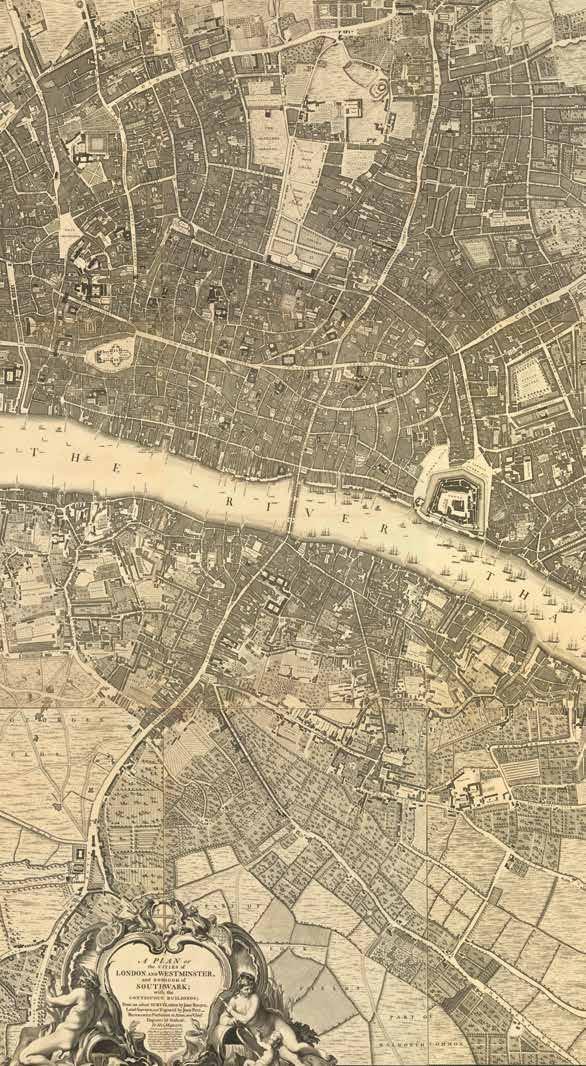
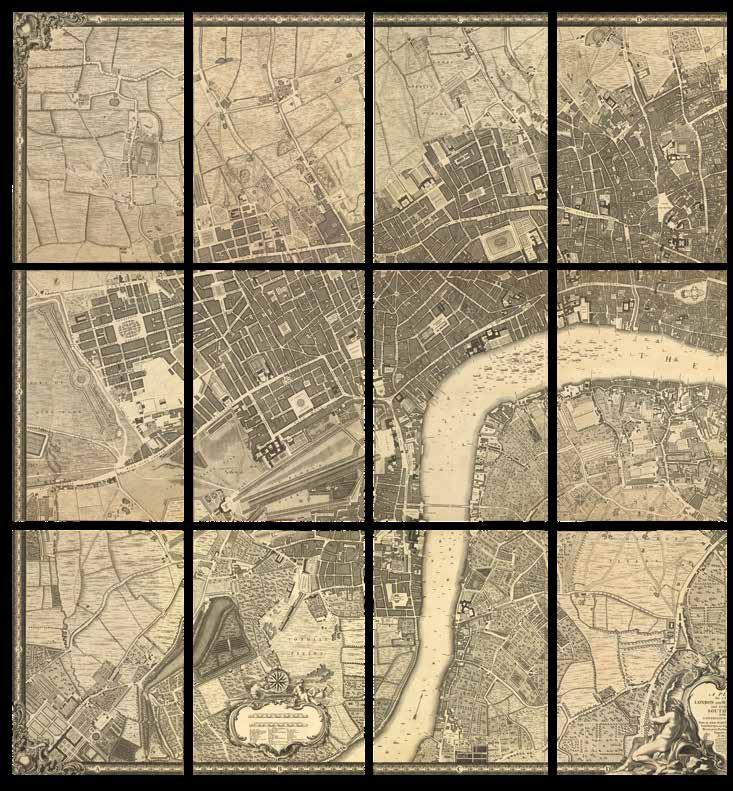
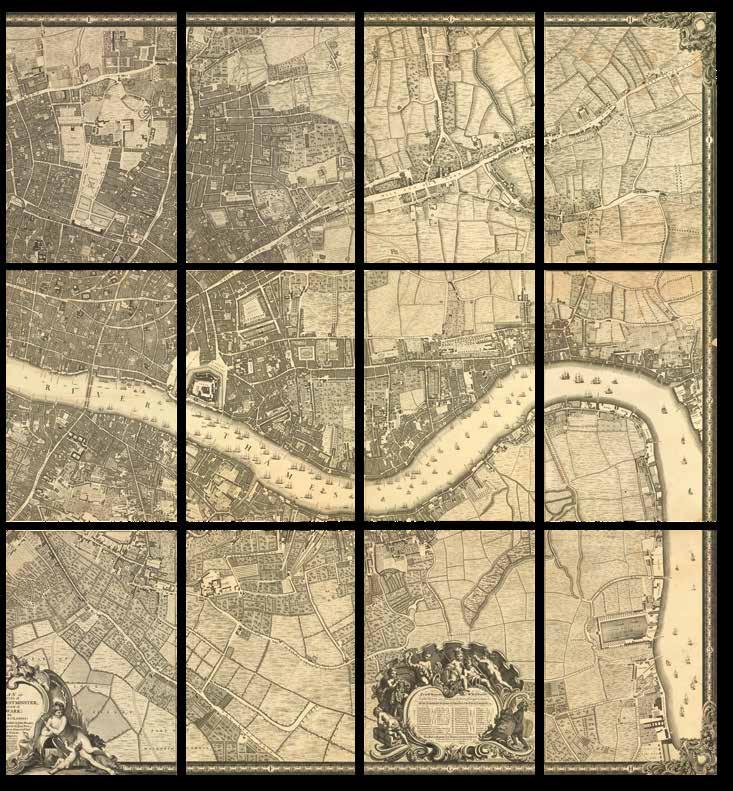
ROCQUE, John
A Plan of the Cities of London and Westminster and Borough of Southwark, with the contiguous Buildings. From an Actual Survey taken by John Rocque, Land Surveyor and engraved by John Pine.
Publication London, John Pine and John Tinney, 1746.
Description Engraved plan on 24 sheets.
Dimensions 2100 by 4000mm (82.75 by 157.5 inches).
References Howgego 96 (1).
Inventory number 20790
€115,000
John Rocque’s magnificent map of early Georgian London
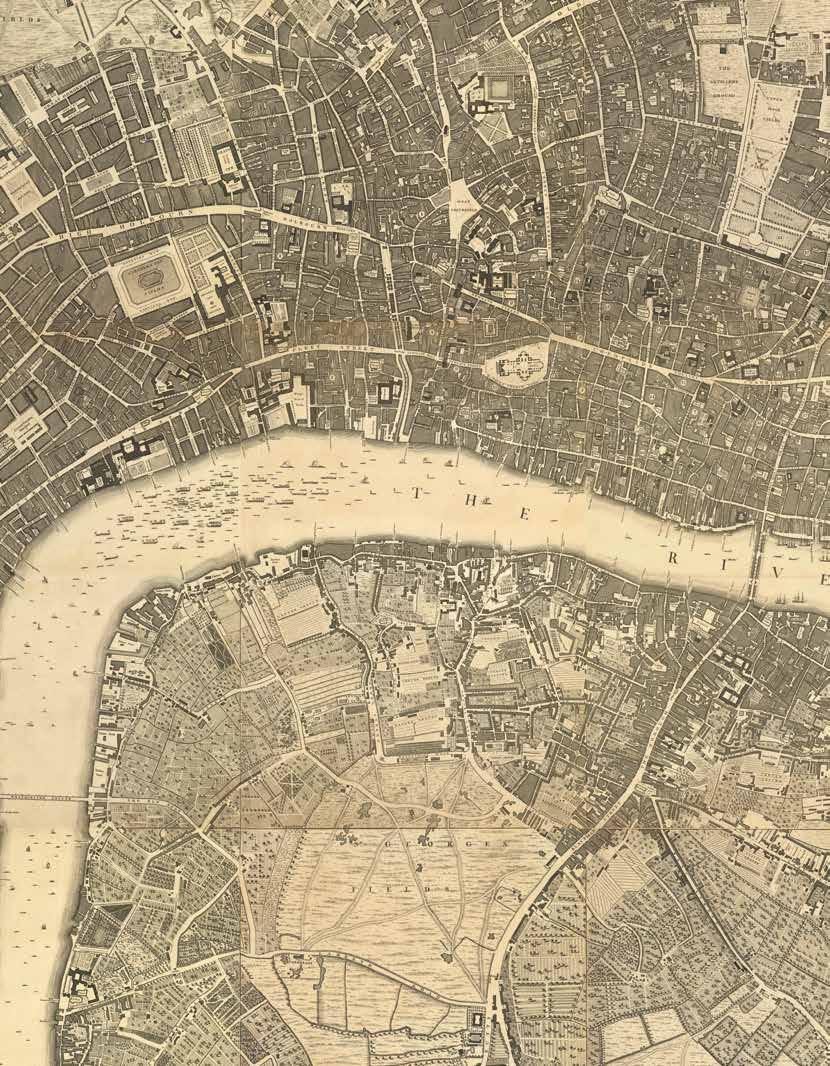
It would appear that John Rocque, a French Huguenot, emigrated with the rest of his family to London in the 1730s, where he began to ply his trade as a surveyor of gentleman’s estates, and with plans of Kensington Gardens, and Hampton Court. However, in 1737 he applied his surveying skills to a much great task, that of surveying the entire built-up area of London. Begun in the March of 1737, upon a scale of 26 inches to 1 statute mile, the map would take nine years to produce, eventually being engraved upon 24 sheets of copper and published in 1746. The plan stretches west to east from Hyde Park to Limehouse and north to south from New River Head to Walworth.
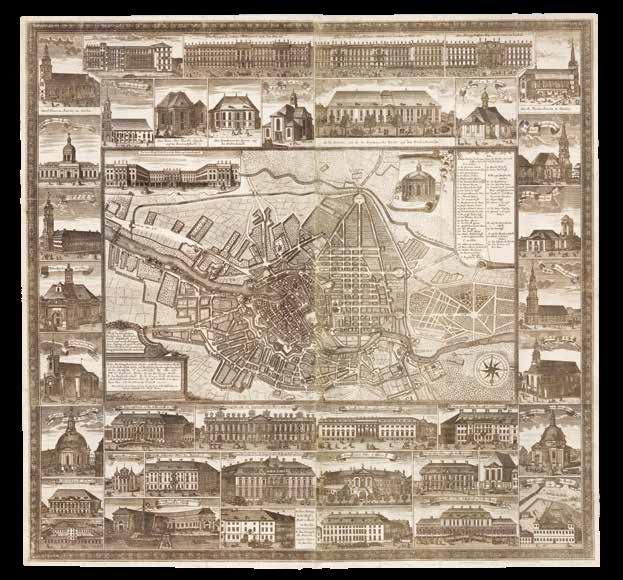
SCHLEUEN, Johann David
Abriss der Koniglichen
Preussischen Residentz-Stadt Berlin.
Publication Berlin, 1747.
Description Engraved plan, surrounded by 41 vignette views.
Dimensions 812 by 895mm (32 by 35.25 inches).
References Schulz, Berlins 65.
Inventory number 24520
€11,500
The Capital of Prussia
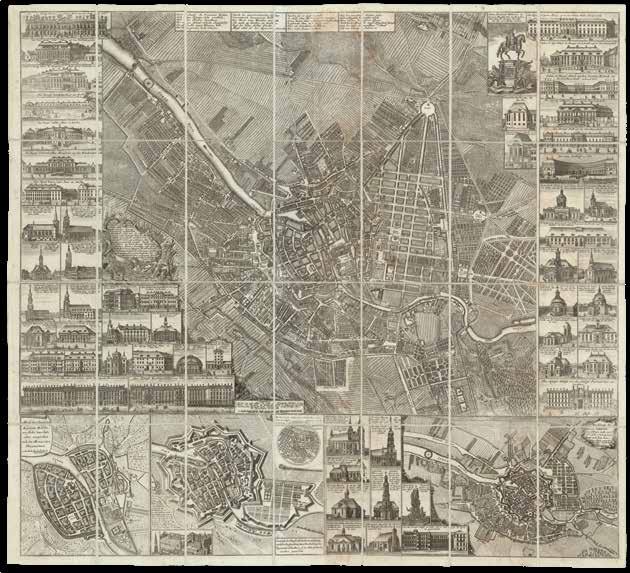
A fine and detailed plan of eighteenth century Berlin. Berlin was made capital of the Kingdom of Prussia in 1701 and in 1709 the city was merged with the historic town of Cölln and the suburbs of Dorotheenstradt, Friedrichs-werder and Friedrichstadt to form the “Royal Capital and Residence City” of Frederick I. The King enlarged the army and made the city a major garrison, creating new squares and avenues to serve as military parade-grounds. The construction boom would be continued with great zeal by his successor Frederick II (Frederick the Great), who added an Opera House, several new palaces, and churches, many of which are illustrated in the 41 vignette views that surround the plan. By the end of Frederick’s reign Berlin bore all the trappings of a major European capital, to rival London, Paris, and Amsterdam. Johann David Schleuen (1711-1774) printmaker and publisher, worked together with his three sons Johann Georg (1737-1799), Johann Friedrich (1739-1784) and Johann Wilhelm (1748-1812); specialised in maps and topographical views.
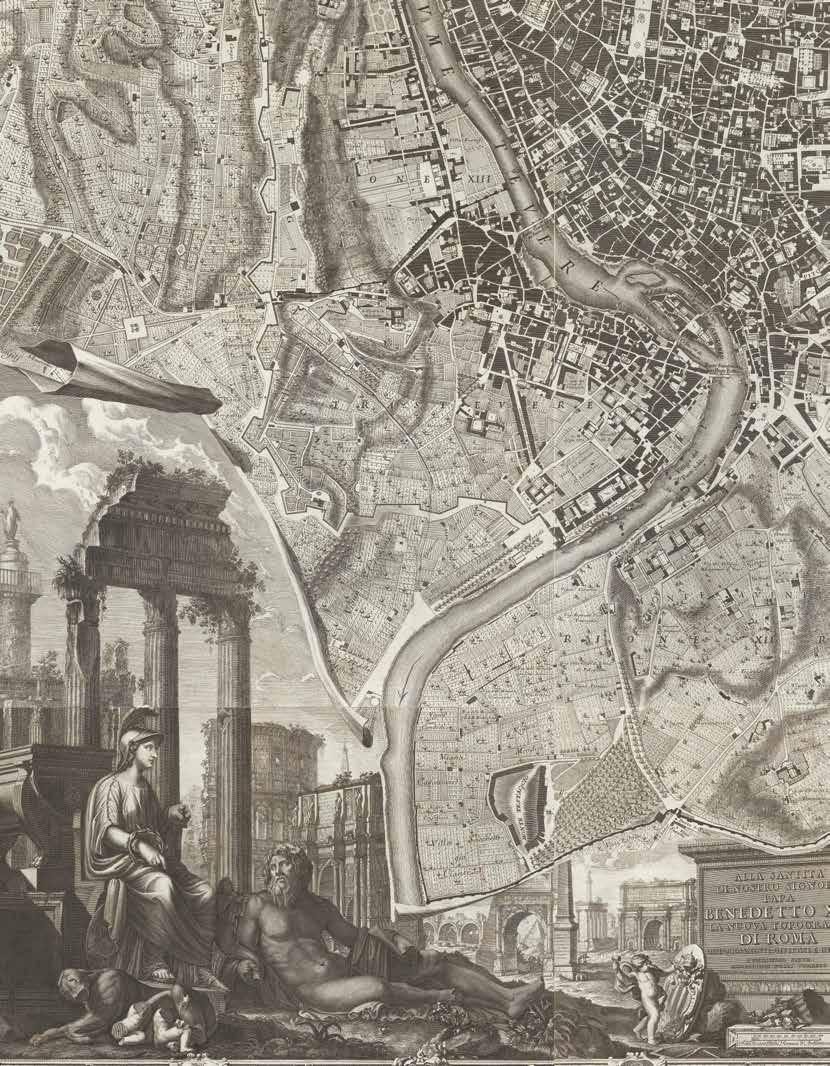
NOLLI, Giovanni Battista
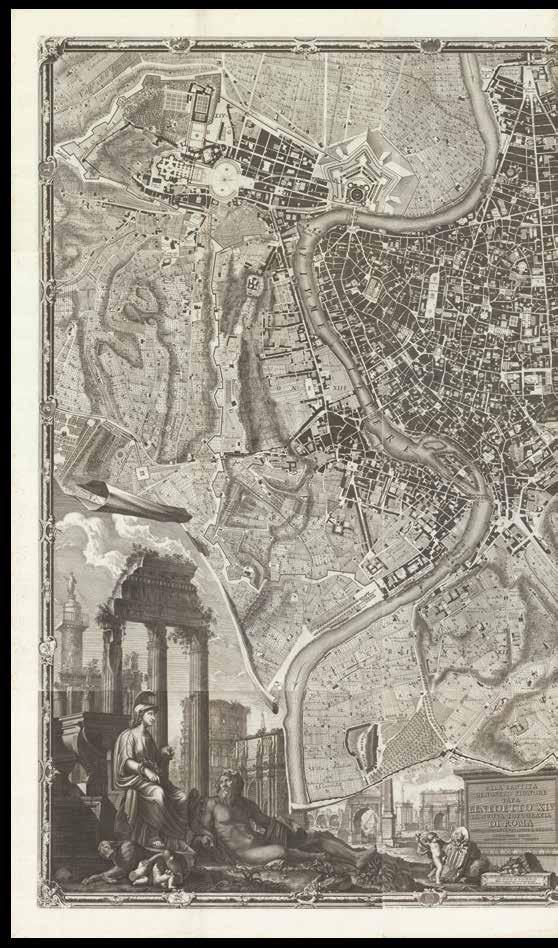
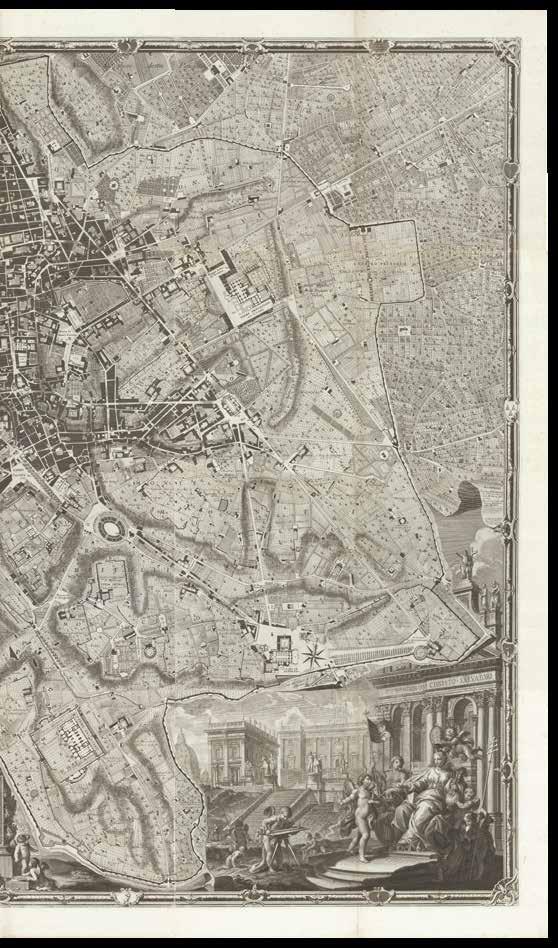
[Plan of Rome] Alla Santita di Nostro Signore Papa Benedetto XIV La Nuova Topografia di Roma Ossequiosamente Offerisce e Dedica Umilissimo Servo Giambattista Nolli Comasco.
Publication [Rome, 1748].
Description Engraved plan on 12 sheets.
Dimensions 1912 by 2190mm (75.25 by 86.25 inches).
References Frutaz CLXIXa.
Inventory number 15151
€46,000
Nolli’s fine plan of Rome
The finest of the eighteenth century plans of Rome and the first plan of the city based upon geodetic principles.
With Rocque’s plan of London and Bretez’ plan of Paris, Nolli’s plan ranks as one of the greatest eighteenth century plans of any European city. Rome essentially appears in its Renaissance form, with large areas within the ancient walls still occupied by villas with extensive fields, orchards, and gardens. The Colosseum, for example, still stands in virtually open country. Many important ancient sites, such as the Circus Maximus and the Forum, are shown in an unearthed state. The lower sheets are almost entirely taken up by lavish, finely engraved ornamentation by Stefano Pozzi. In the lower left corner is a montage of classical landmarks, including the Colosseum, Arch of Constantine, the Forum and Trajan’s Column, before which are allegorical figures including Romulus and Remus in the form of broken ancient statuary. The lower right corner contains an allegorical representation of the Church seated before Michelangelo’s assemblage of buildings on the Capitoline Hill.
Giovanni Battista Nolli (Como 1701 - Rome 1756) was born into a family of surveyors and builders active in Lombardy. He started his career at the Land Registry in Milan, newly set up by Charles VI of Austria. There, he was introduced to the latest methods of surveying and mapping, which included the use of the plain table, an instrument that provided for more accurate and efficient drawings, compared to the standard systems. Nolli moved to Rome in 1736, where he soon became part of a circle of antiquarians and intellectuals who were planning a new and most exact map of the old and new city. Nolli’s experience in Milan proved extremely useful, and he quickly took the lead on the project, which was set off by Cardinal Guadagni granting him with a permit to enter churches and enclosed monasteries in order to take the most accurate measurements. The plan was sponsored by the Milanese banker Belloni, friend of Nolli, and it took several years’ work and a large team of architects to complete. The result was deemed a masterpiece, though commercially it did not translate into quick sales – of 1826 printed examples, 162 had been booked. By the end of the eighteenth century, however, the plan had already become a rare and precious edition, its accuracy and precision making it the basis for most of the subsequent mapping of the city.
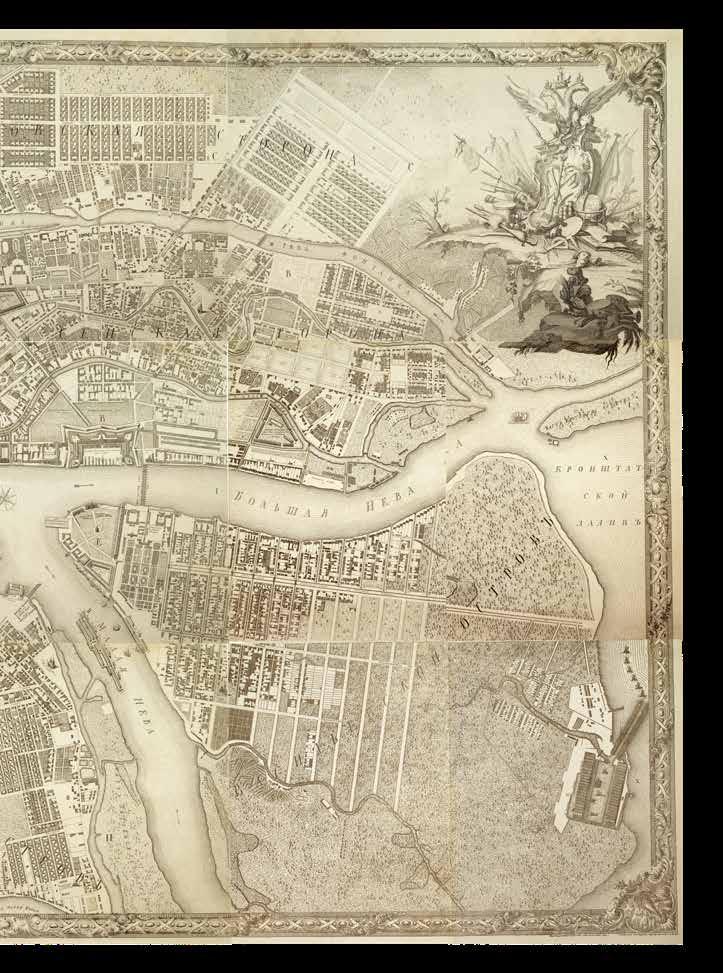
[MAKHAEV, Mikhail Ivanovich, TRUSKOTT, I.F., SOKOLOV, I. and others]
Plan de la Ville de St. Petersbourg avec ses Principales Vües dessiné & gravé sous la direction de l’Academie Imperiale des Sciences & des Arts. [Title also in Cyrillic: Plan stolichnago goroda Sanktpeterburga : Map of the capital city Saint Petersburg showing the main avenues].
Publication St Petersbourg, Petersburg Academy of Sciences 1753.
Description
Large wall map on nine engraved sheets, with sheet seven reproduced in printed heliogravure facsimile.
Dimensions 1415 by 2065mm (55.75 by 81.25 inches).
References SK 5346 and 5347; cf. Obol’ianinov 2048.
Inventory number 14711
€46,000
Makhaev’s map of St Petersburg “to the glory and honour of the Russian Empire”
Makhaev’s extraordinary large-scale map of St. Petersburg; one of the masterpieces of Russian engraving art.
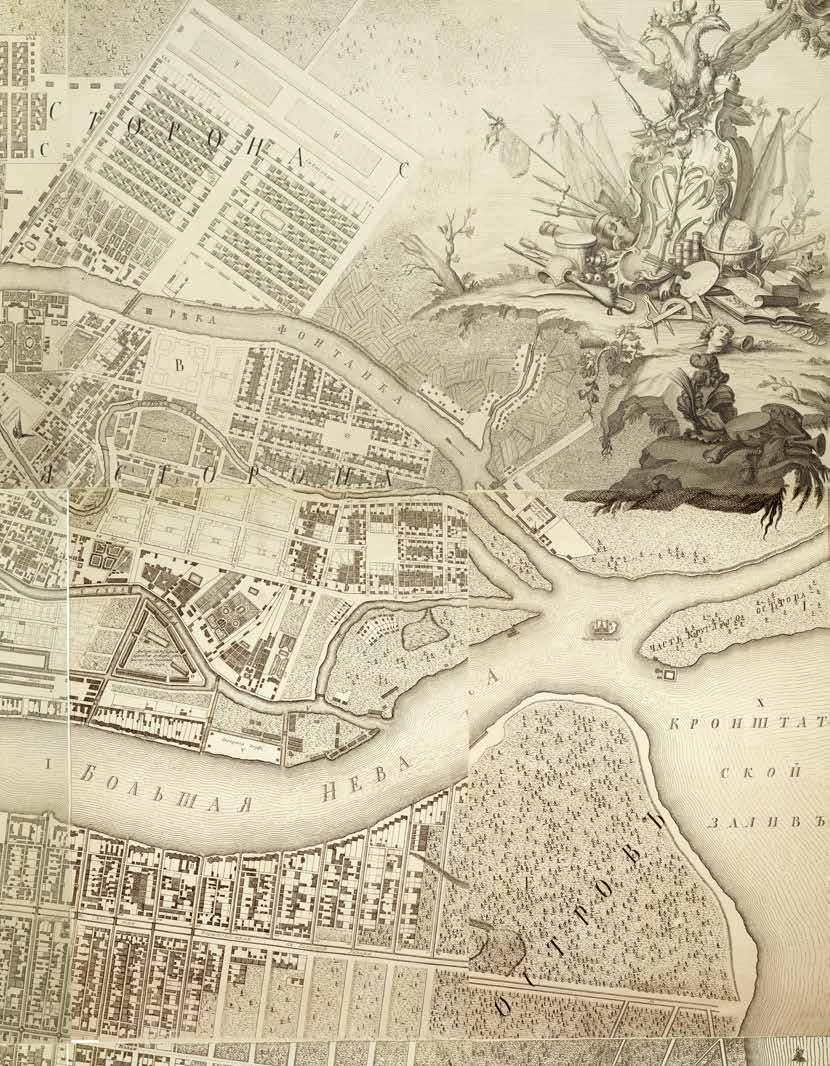
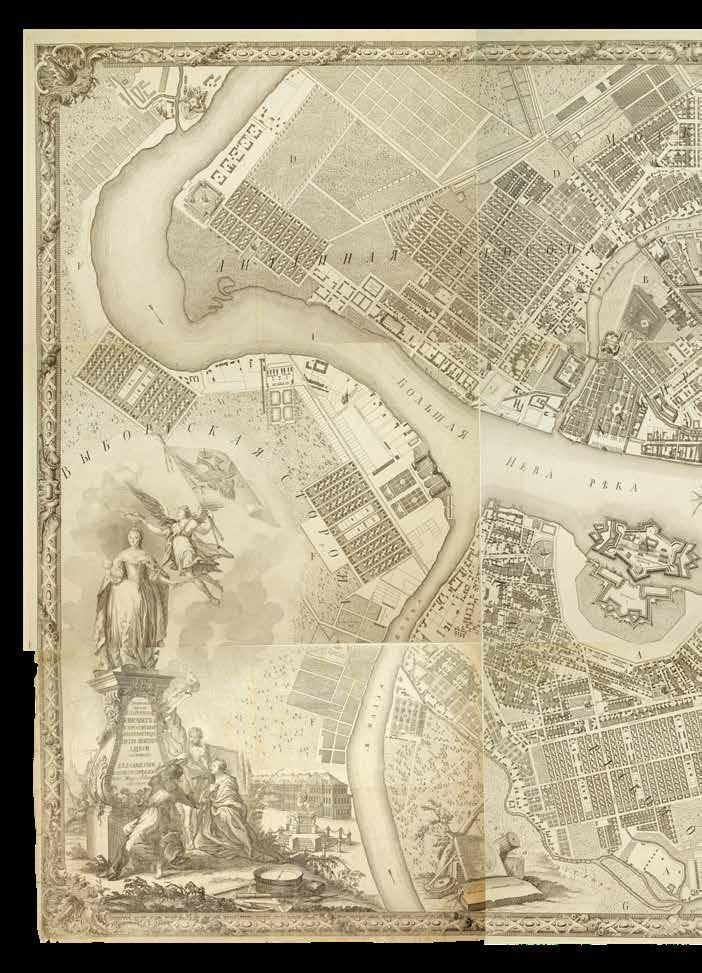
Published in limited numbers to mark the first jubilee of the city in 1753, and dedicated “to the glory and honour of the Russian Empire” Markhaev’s map was commissioned to commemorate the city’s remarkable growth in the 50 years since its foundation.
The extraordinary map is on a scale of 1:3350 and gives an accurate view of the existing streets, palaces and public buildings of the city, as well as prospective building projects. The decoration includes the Arms of the City, and attributes of the sciences, arts, commerce, and the art of war at the top right. The majority of the design was by Makhaev and so, correctly, his name is usually attributed to the whole work. However, numerous artists contributed to the views and panoramas, and the map itself was prepared at the Geographic Department of the Academy of Sciences and supervised by the junior scientific assistant I.F. Truskott. under the guidance of I. Sokolov, who also engraved the figure of the Empress Elisabeth Petrovna after a portrait by Louis Caravaque.
Only 100 prints were taken and were distributed amongst major library and palace collections in Europe. This small production run, together with the high mortality rate associated with large-scale wall maps, means that the map is now extremely rare.
BRETEUIL, Louis Charles Auguste le Tonnelier, baron de
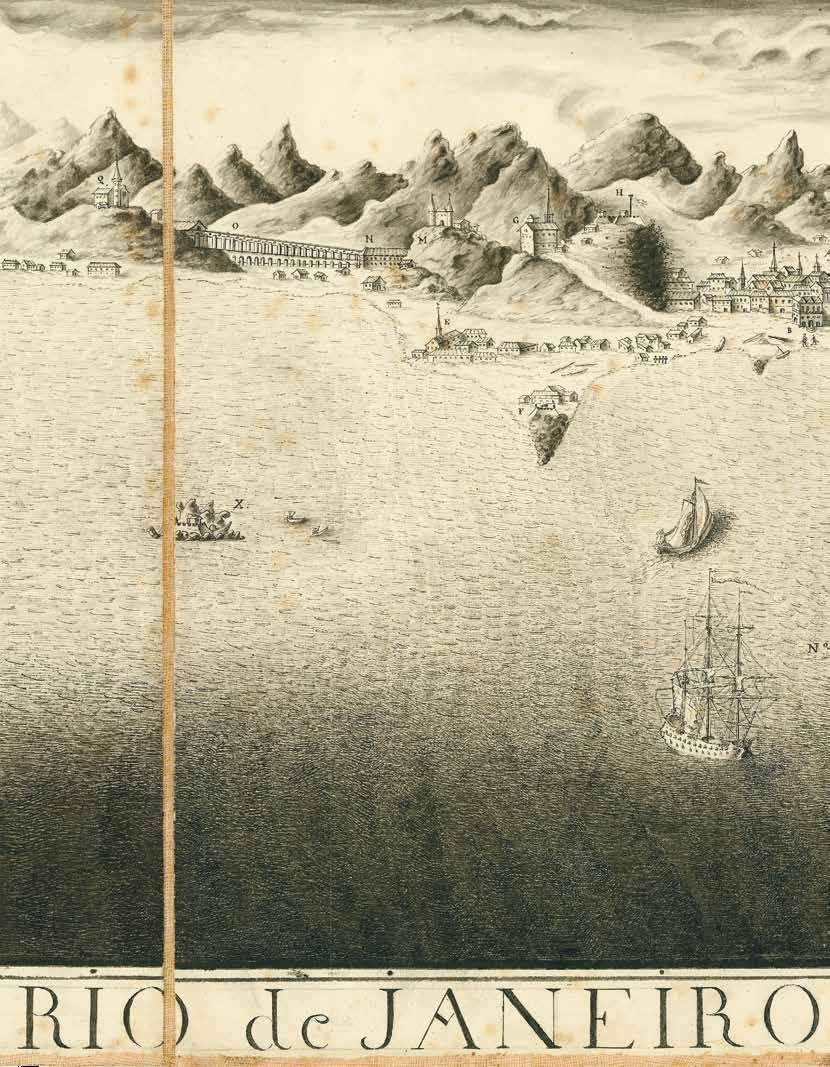
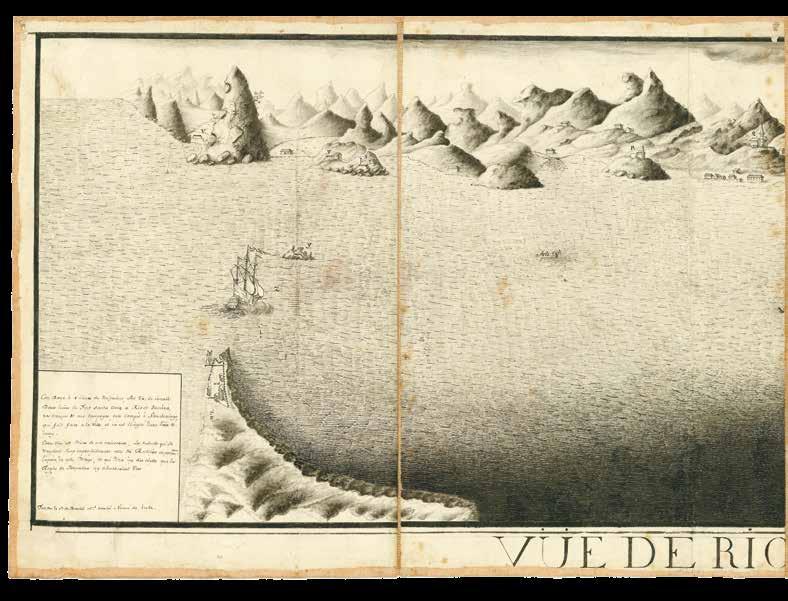
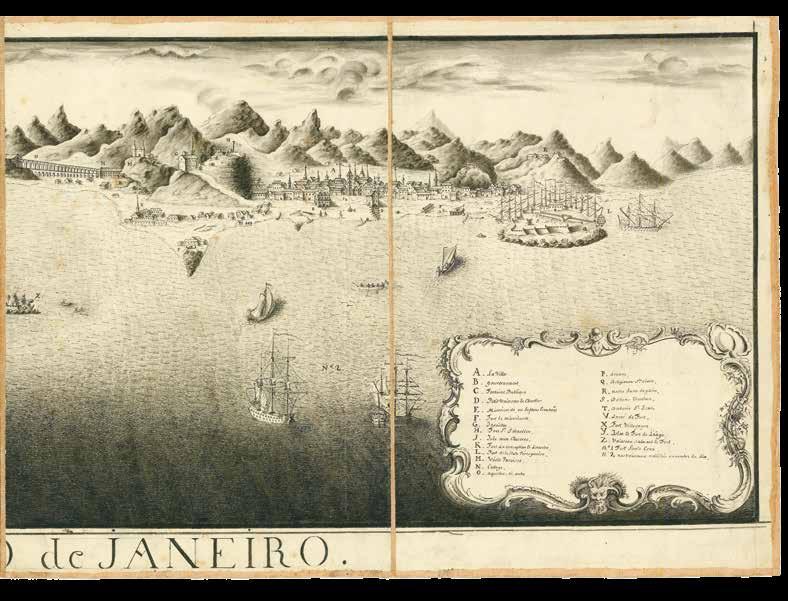
Vüe de Rio de Janeiro [together with] Plan de la Baye de Rio Janeiro et de ses Deffense, 1757.
Publication [1757].
Description
Manuscript plan of the bay of Rio de Janeiro in pen and ink with wash, signed “Breteuil fecit” [together with] a pen and ink prospect of Rio de Janeiro, both dissected and mounted on canvas.
Dimensions
View: 290 by 790mm (11.5 by 31 inches); Plan: 535 by 735mm (21 by 29 inches).
References Pedro Corrêa da Lago, Brasiliana Itau (São Paulo: Capivara, 2009); Thomas Arthur de Lally, Memoirs of Count Lally, (London, 1766), 183.
Inventory number
2402
€103,000
A
plan of Rio de Janeiro by the Comte de Breteuil, the last prime minister of pre-revolutionary France, together with one of the earliest manuscript prospects of the city
A detailed map of Rio de Janeiro made in 1757 by the Comte (later Baron) de Breteuil, together with a prospect of the city, sacked by a French corsair in 1711.
Louis Charles Auguste le Tonnelier, baron de Breteuil, baron de Preuilly (1730-1807) was a French aristocrat, diplomat and statesman. He was the last Prime Minister of France to serve under the Bourbon monarchy, appointed by Louis XVI only 100 hours before the storming of the Bastille.
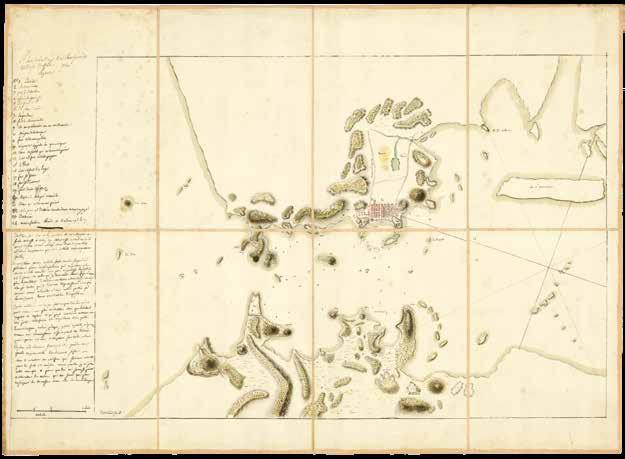
Breteuil was born in 1730 at the château of Azay-le-Ferron into a well-connected aristocratic family. He was educated in Paris before joining the army, where he served under Thomas Arthur, comte de Lally, baron de Tollendal (1702-1766) in his ill-fated command of the French forces in India during the Seven Years’ War against England. With orders to join the French forces in India, Lally and Breteuil sailed from France on 2 May 1757 under the command of Vice Admiral Anne Antoine, Comte d’Aché (1701-1780). During the voyage, an epidemic forced the fleet to put in at Rio de Janeiro for six weeks. The Portuguese, neutral in the conflict between France and England, initially refused access to the city. This, quite possibly, was a result of the fact that the French had sacked Rio in 1711 under René Du Guay-Trouin, a former corsair who took the supposedly impregnable city with a force half the size of the defending garrison. It is likely that the present plan and prospect were drawn up during this hiatus, perhaps in contemplation of emulating Du Guay-Trouin’s previous exploits. Indeed, the text states that the map is based upon a plan made during the expedition of “Mr Duguay”, together with corrections. It also indicates that the plan was made in conjunction with a prospect of the city (presumably the accompanying view offered here) and states that the plan and its companion view may be relied upon as accurate.
The plan is titled ‘Plan of the Rio de Janeiro Bay and its Defenses’, and is signed in at the bottom right “Breteuil fecit”. A manuscript legend towards the right of the plan lists the following:
1. The City; 2 The Benedictines; 3. Fort St Sebastien; 4. The Parish City; 5. The Jesuits; 6. The Franciscans; 7. The aqueduct; 8. Fort Mercy; 9. Island of the goats and snakes; 10. Bishop’s residence; 11. Fort Conception; 12. Aqueduct; 13. Submerged sand bank; 14. Island and fort of the city of Gagnon; 15. The harbour; 16. Island and Fort Delage; 17. Fort St Jean; 18. Fort St Theodore; 19. Fort Santa Cruz; 20. Battery Delapre Vermek; 21. Submerged sand bank; 22. Chapel and Battery of Notredame of her travels; 23. Battery; 24. Oil Manufacture of Baleine Pt Leroy.
The prospect, or view, is itself inscribed “realised for the Comte de Breteuil”, thereby reinforcing the pairing of the two images, and the text towards the lower right of the image remarks: “This Bay has 8 deep- water anchorages. Two link the Fort Santa Cruz to Rio de Janeiro. Our troops and our crew are camped in San Domingo, which faces that city. This
view is busy with our vessels. The parts that went imperfectly have been corrected while travelling through the Bay, placing here objects that perspective wouldn’t admit.”
Inside a large text box at the lower right, the following are identified:
A. The City B. Government C. Public Fountain D. Small Vessel in Construction E. [Orphanage] “Mercy to the Found Children” F. Fort of Mercy G. Jesuits H. Fort St Sebastian J. Island ovf the Goats K. Fort of the Conception and Levesche L. Anchorage of the Portuguese Fleet M. Old Parish N. College O. Aqueduct P. Customs Q. St Claire R. Notre Dame de Gloire S. Batterie Theodore T. Battery St Jean V. Fort X. Fort Villegayen Y. Island and Fort of Laage Z. Vessel greeting the Fort n1 Fort Santa Cruz n2 The six vessels of the French fleet.
Correa do Lago includes a chapter dedicated to drawings and watercolours in his catalogue of the collection of Olavo Setubal. In this he describes a 1760 prospect of the city by Blasco (‘Propescto da cidade do Rio de Janeiro vista da parte norte da Ilha das Cobras’) as “the most detailed and complete panorama of the eighteenth century”. The present drawing predates Blasco’s work by some three years. The next oldest prospect in the Setubal collection is dated 1795. Furthermore, no comparable prospect can be found in the Coleção Brasiliana Fundação Estudar (part of the Oscar Americano collection).
Provenance
Bibliothèque des ducs de Luynes, Château de Dampierre, France.
ESPINOSA de los Monteros y Abadía, Antonio
Plano topográphico de la Villa y Corte de Madrid.
Publication Madrid, 1769.
Description
Large engraved plan on nine sheets, letterpress text pasted onto the lower sheets, remnants of original colour, losses to margins. A full condition report is available upon request.
Dimensions 1850 by 2465mm (72.75 by 97 inches).
References
De los Reyes Gómez, ‘El impresor Antonio Espinosa de los Monteros en Madrid: avance para su estudio’, Revista General de Información y Documentación, 14, 2004; Molina Campuzano, Instituto de Estudios de Administración Local, ed. Planos de Madrid de los siglos XVII y XVIII, 1960; Ortega Vidal, ‘Los planos históricos de Madrid y su fiabilidad topográfica’. Catastro. ‘Ciclo de Conferencias con motivo del 250 Aniversario de la Planimetría General de Madrid 1749- 1999, 2000.
Inventory number 1817
€46,000
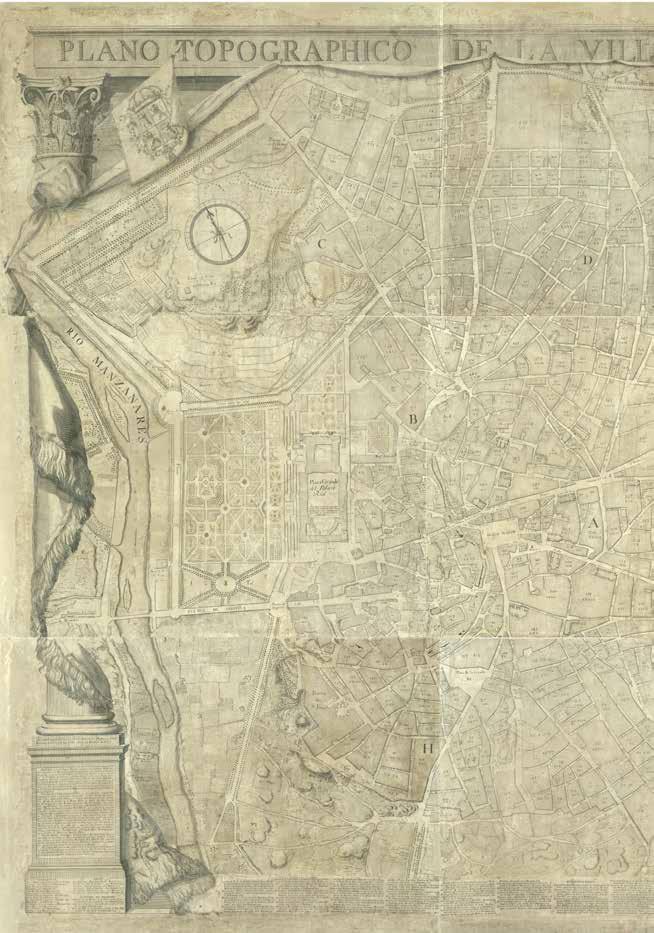
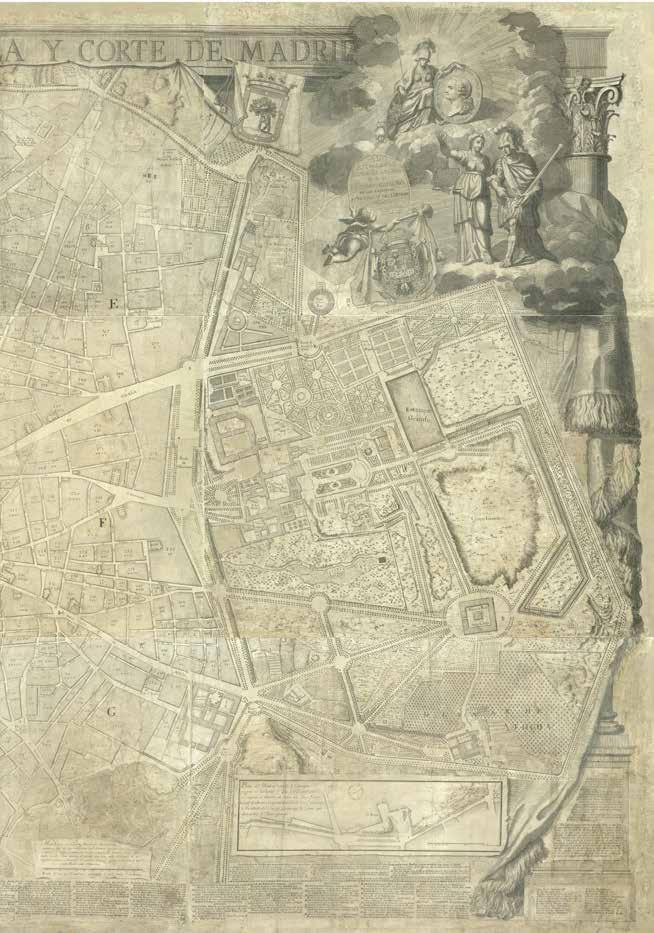
The first plan of Madrid to show the eight quarters in which the city had been divided a year prior; the first to include the numbering of building blocks; and the first to show the orientation and plans of churches. It was published during the reign of Charles III under the direction of one of his most prominent government reformers, the Count of Aranda, following an extensive urban transformation aimed at aligning Madrid with the other European capitals.
In the mid-eighteenth century Madrid counted a population of 150,000 and over 7,500 houses. The city was characterized by the pronounced unevenness of the ground and large areas of crop land, and its core was formed by a network of narrow and poorly illuminated streets, which hindered the implementation of hygiene measures and facilitated criminality. The king (Ferdinand VI) therefore commissioned a survey, known as the ‘Visita General’, with the purpose of reorganizing the city administratively and urbanely and, most important, to establish the correct taxation for each household. The survey was assigned to four architects who with their teams visited and numbered every building, and drew plans of every street, resulting in a general planimetry composed of 557 maps.
The plan is set within lavish ornamentation in the style of Piranesi. It stretches from the Manzanares river and the Royal Palace on the left, to the renewed Paseo de San Jerónimo and Parque del Retiro on the right, giving ample room to this eastern part of the city. An inset map shows the old Paseo de San Jerónimo before it was demolished and altered by order of the Count of Aranda. Marked in black near the Plaza Mayor are the ancient Muslim walls, reflecting the growing interest in archaeology. On the lower register are letterpress texts describing the history of Madrid, listing hospitals, churches and convents, and the subdivision of the quarters and their barrios. Some details, such as the square in front of the Royal Palace, were never actually implemented.
Antonio Espinosa de los Monteros y Abadía (1732-1812), was one of the most important engravers of his time. He spent three years in Rome before training at the Real Academia de San Fernando in Madrid, where he became a fellow. He was engraver at the Mints of Seville and Segovia, opened printing presses in Segovia and Madrid, with the present plan being his most ambitious project. It has been suggested that Espinosa might have not been the sole author of the plan, and that a likely candidate could have been the architect and military engineer José de Hermosilla y Sandoval (1715-1776), who was involved in the projects of the Prado, the hospital in Atocha and the church of San Francisco el Grande, which are all drawn with a great level of detail on the plan. Further to this, it is possible that the basis for the present map would have been Pedro Teixeira Albernaz’ plan of 1656, the two sharing similar size, scale, and orientation. Rare. We were able to locate seven institutional copies: Biblioteca Nacional de España (3); Bibliothèque nationale de France; British Library; University of Connecticut Library; University of Toronto Library. We were unable to trace another copy appearing on the market in the last 50 years.
SCHLEUEN, Johann David
Die Königl. Residenz Berlin.
Publication Berlin, 1773.
Description Engraved map, dissected and mounted on linen.
Dimensions 812 by 895mm (32 by 35.25 inches).
Inventory number 14533
€17,500
The Capital of Prussia
A fine and detailed plan of eighteenth century Berlin.
Berlin was made capital of the Kingdom of Prussia in 1701 and in 1709 the city was merged with the historic town of Cölln and the suburbs of Dorotheenstradt, Friedrichs-werder and Friedrichstadt to form the “Royal Capital and Residence City” of Frederick I. The King enlarged the army and made the city a major garrison, creating new squares and avenues to serve as military parade-grounds. The city had now become a major European capital, fit to compete with the rest.
The plan is based upon Samuel von Schmettau’s map of 1748. Schleuen has augmented it with the latest urban developments, shown the demolition of the seventeenth century fortifications, and added the prospects of the city’s most important buildings. In the lower half are four inset maps of Berlin through the ages, by Merian, Schultz, Faltz and Dusableau.
Rare. The first edition of the map was published in 1753-54, with a second edition, as present, appearing in 1773. Copac records only one institutional example of the first edition, kept at the British Library.
CARLETTI, Niccolò; and Giuseppe ALOJA
Mappa Topografica della Città di Napoli e de’ suoi Contorni.
Publication Naples, 1775.
Description
Wall map on 35 double-page engraved sheets.
Dimensions
540 by 705mm (21.25 by 27.75 inches). If joined 2.70 by 5.30 meters.
References
Naddeo, ‘Topographies of Difference: Cartography of the City of Naples, 16271775’, 2004; Pane and Valerio (editors), ‘La citta di Napoli... piante e vedute dal XV al XIX secolo’, 1987, pp. 269-306.
Inventory number 17696
€86,500
Naples becomes a metropolis
In his ‘Lettera ad un amico’ (Letter to a friend) of 1750, Giovanni Carafa, Duca di Noja, had implored the municipal government of Naples to create a new map of the city “as the only way to render illustrious the sumptuous public works of our glorious monarch, which are the first fruits of the return of Naples to its ancient state of a metropolis”, Charles the Bourbon, otherwise known as the King of Naples and Sicily, Charles VII and V (1734-1759). Charles had instigated a landmark cadastral survey of the Kingdom, in 1740.
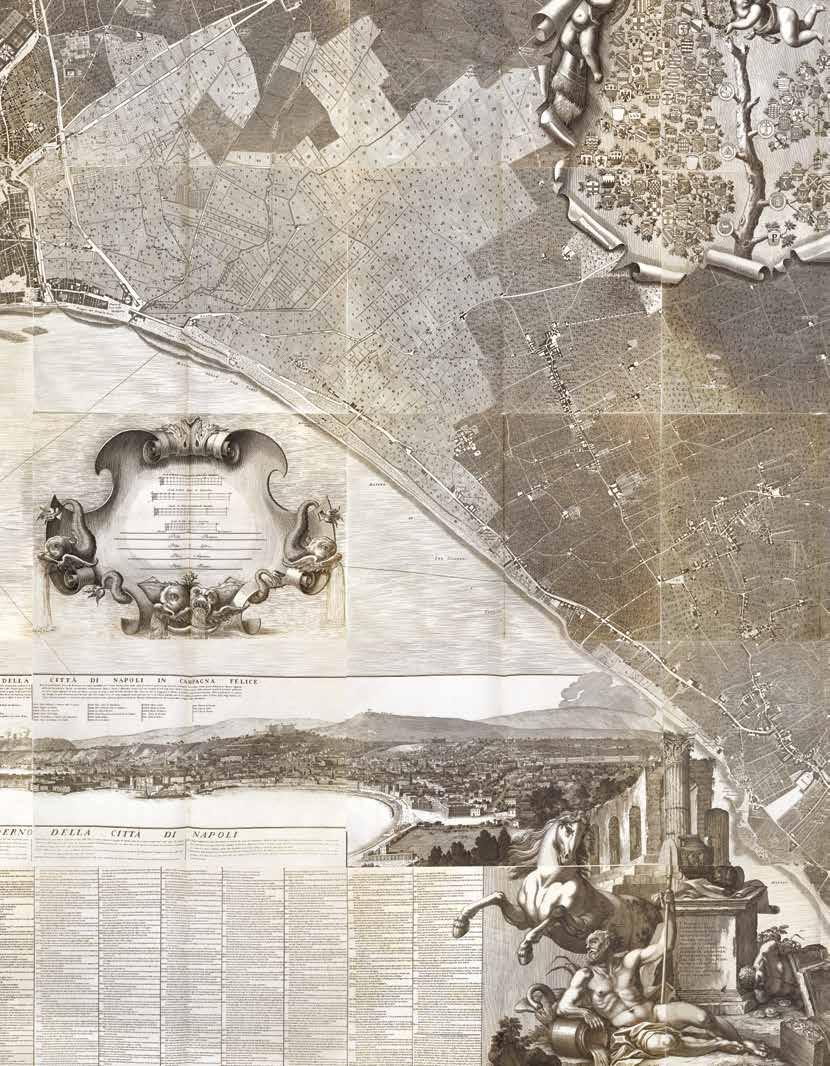
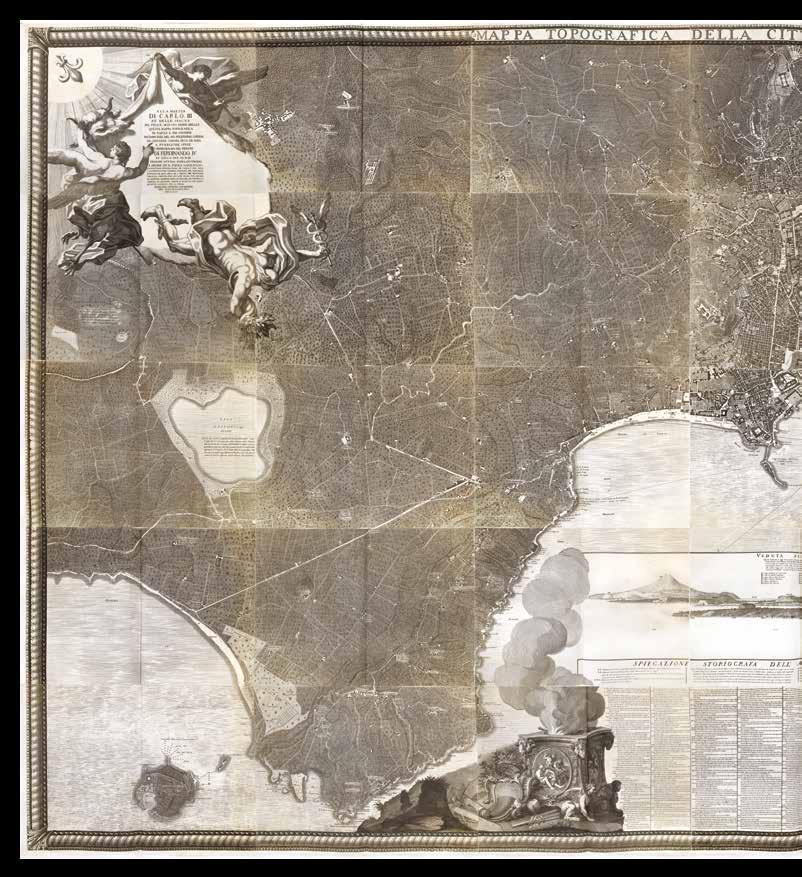
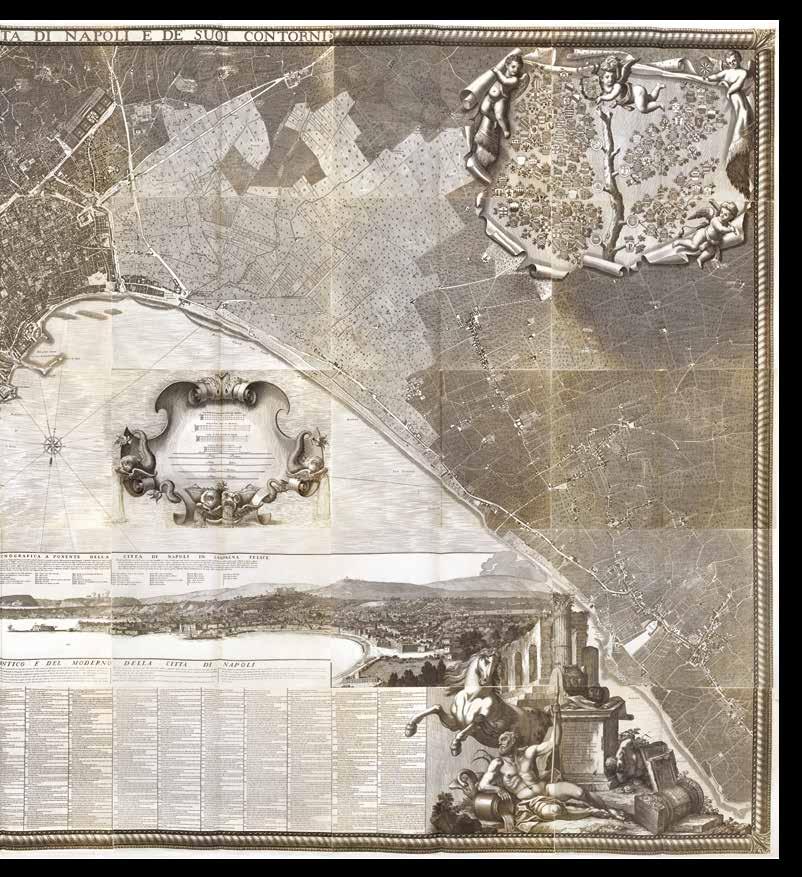
The municipality agreed with Carafa, and he and land-surveyor Antonio Francesco “Vanti” created a manuscript plan. However, the magnitude of the project and Carafa’s numerous other interests meant that when he died, in 1768, nothing very definitive had been achieved. Giovanni Pignatelli, Principe di Monteroduni, took on the commission. He employed local professor of architecture Niccol√≤ Carletti to make revisions to Carafa and Vanti’s plan, and to compile the extensive annotated list of ancient and modern sites in and around Naples, which accompany it, the ‘Spiegazione storiografa...’.
Giuseppe Aloja was employed as sole engraver. In addition to the ‘Mappa topografica...’ itself, and the neo-classical decorations, a panoramic view of the coast from the Ponte della Maddalena in the east to the island of Ischia in the west, the ‘Veduta scenografica a ponente della Citta di Napoli in Campagna Felice’ appears. In it, a number of Naples’s most prominent landmarks are featured: the Albergo dei Poveri, Europe’s largest poorhouse; the Royal Residence at Capodimonte; the steeple of the Church of the Carmine; the cuppola of the cathedral; and its many castles and villas. The result conveys “a sense of extraordinary urban density, depicting extra-monumental Naples as a streetless mass of impenetrable structures,... an urban breadth” (Naddeo), synonymous with the idea of Naples as “metropolis”.$%$%By the time the map was eventually published, twenty years after Carafa’s proposal, Charles the Bourbon had become King of Spain, as Charles III (1759-1788), bequeathing the duel crowns of Naples and Sicily to his son, Ferdinand IV and III. Nevertheless, and ignoring the son, the municipal government went ahead and dedicated the plan to Charles III: Fame, Mercury and Parthenope (the mythical founder of Naples) swoop down from heaven, bursting through the fabric of the map itself, bearing an ox hide with an encomium to Charles on it. The municipal government congratulate their own civic achievements in as high a fashion. In the upper right-hand corner putti also tear their way through the map, pulling it back to show an heraldic tree symbolizing the genealogy of both the civic parliament of the city of Naples and of the map itself.
HUBER, Joseph Daniel von Scenographie, oder, Geometrisch perspect. Abbildung der kaÿl. königl. Haupt u. Residenz Stadt Wien in Oesterreich, auf allerhöchsten Befehl aufgenommen und gezeichnet vom Jahr 1769 May Monats bis letzten October 17724 unter der glorreichen Regirung beider kaÿl. königl. apost. Maÿest Iosephi II F Mariæ Theresiæ.
Publication [Vienna], J[akob] Adam, 1769-1776.
Description Engraved bird’s-eye view on 24 sheets, dissected and laid down on linen.
Dimensions
3500 by 4200mm (137.75 by 165.25 inches).
Inventory number 34338
€30,000
The splendour of Baroque Vienna
Joseph Daniel von Huber (c1730-1788)
After completing his education at the academic grammar school in his native Vienna, Joseph Daniel Huber joined the Military Engineering Academy in 1751, at the age of 21. The Academy, which was the oldest educational institution of its kind in Austria, trained its students in the fields of mathematics, geometry, mechanics, geodesy, hydraulics and Festungsbaukunst, or fortress studies. During his studies, Huber produced a map of Klagenfurt, which probably represents his first official foray into surveying and cartography.
He then joined the Austrian army under Generalquartiermeiseter Count Johann Franz Anton Quasco, whose job it was to locate prime positions for the army to make its camps and facilitate travel between them. Knowledge of the landscape, roads and rivers was therefore essential, and so the Generalquartiermeister had a team of officers at his disposal to survey and sketch the terrain. More often and not, these officers lacked the necessary skills to provide their superior with an accurate and intelligible overview of the land, and each Generalquartiermeister thus also had a personal draughtsman. Huber served in this role under Count Quasco, and during the Seven Years’ War he executed several maps before being taken captive by the Prussians in 1760. After two years of imprisonment he was released, and spent the following years continuing to produce pieces of strategic cartography for the Austrian army.
After the conclusion of the Seven Year’s War, the Generalquartiermaiesterstab was established as a peacetime institution, founded in order to survey and describe the imperial territory of Empress Maria Theresa. Huber continued in its employ, producing a manuscript bird’s-eye plan of Prague which, despite the incredibly level of detail and the favour it eventually found with the Empress herself, was never brought to print. Having demonstrated his skill as a cartographer with his description of Prague, Huber was soon charged by Maria Theresa with the task of surveying her capital and primary residence, Vienna.
For the next eight years, Huber worked with a team of surveyors and draughtsmen on what would become the finest plan of Baroque Vienna. The first edition of the ‘Scenographie oder Geometrisch Perspect. Abbildung der Kayl. Königl. Haupt und Residenz Stadt Wien in Oesterreich’ was eventually printed in 1778 and, despite its unwieldy 24-sheet format and prohibitive cost, went on to become one of the most widespread depictions of Vienna during the late eighteenth century and beyond.
Baroque Vienna
During the sixteenth and seventeenth centuries, the city of Vienna faced a number of attacks from Ottoman forces, including the First and Second Turkish Siege of the city, which occurred in 1529 and 1683, respectively. Following the 1699 Treaty of Karlowitz, which brought an end to the
Great Turkish War, extensive building activity and reconstruction took place, transforming Vienna into a truly Baroque city. Architects such as Johann Bernhard Fischer von Erlach and Johann Lukas von Hildebrandt constructed a large number of new estates and palaces for the nobility, including the Palais Liechtenstein, Schonbrunn Palace and te Belvedere. In 1704, an outer fortification was added and two years later the city was surveyed and mapped by Leander Anguissola and Jakob Marinoni. After an outbreak of the plague in 1713, the population of Vienna began to grow steadily, increasing by a quarter in 50 years. New factories attracted workers from the countryside, and the government was forced to take measures to combat the inevitable issues that arose from this rapid urbanisation. The sewer system was swiftly developed and street cleaning programmes were implemented. In addition, the postal system began to expand and the state issued the first official house numbers. The Konskriptionsnummern system was used to ensure the efficient collection of taxes, facilitate administrative tasks such as the census and the collection of building statistics, and for the conscription of soldiers.
The Plan
Two years before Huber’s commission, the court mathematician Joseph Anton Nagel had been charged with measuring and depicting the urban centre within the city walls. Work did not begin on the project until 1770, but four years later a plan of the inner city of Vienna was executed, although due to financial pressures, it did not go to print until 1780-81. Huber is likely to have had access to Nagel’s work, and indeed to have borrowed several details from the slightly earlier plan. Like Nagel, Huber oriented his map to the southwest, positioned a similar decorative vignette in the same place, the lower right-hand corner, and presented the inner city in great detail, including the Konskriptionsnummern. The addition of these important housing numbers makes both Nagel and Huber’s views important precursors of the cadastral survey that would grow in popularity throughout Europe during the eighteenth and nineteenth centuries, as growing prosperity encouraged homeowners and landowners to have plans and surveys made of their estates.
Huber’s plan, however, goes beyond the schematic representation of Nagel’s, since it also describes the elevation of the land and the height of individual buildings. While the former is represented by hachures, the latter is achieved by the use of isometric perspective, by which the buildings are shown as three-dimensional. This is also known as military perspective or cavalier perspective, so-called because the features appear to be viewed from the elevation of a ‘cavalier’, a type of raised platform inside a fortification from which soldiers would shoot at an oncoming enemy. This perspective allows Huber not only to represent all of Vienna’s buildings, but also each of its buildings’ facades, levels, doors and windows. Trees, bridges, street-
lighting, walls, gardens and boats are also depicted as three-dimensional objects. The isometric perspective employed across the plan makes Huber’s work an important art historical source, as well as a geographical, cartographical and demographic one.
At the centre of the plan is Vienna’s densely packed urban centre, surrounded by the Ringmauer, the star-shaped wall built in 1200 and fortified with regular towers. Just outside of this structure is the Wiener Glacis, the open space that separated Vienna proper from its surburbs. Although it original served the city’s defenders as a field of fire against their attackers, it later became used for civilian purposes, with Emperor Joseph II ordering tree thousand trees to be planted there in 1770. Encompassing the entire city is the Linienwall, erected in 1704 on the orders of Leopold I to protect Vienna against further attacks. During its construction, all residents of the city between the ages of 18 and 60 were forced to take part. Shown on the plan are the eighteen chapels built along the Linienwall between 1740 and 1760, which were intended as places for travellers to stop and pray while entering or leaving the city.
Also featured across the plan are a number of the new Baroque buildings constructed in Vienna during the preceding decades, such as the Karlskirche consecrated in 1737, as well as older structures including St Stephansdom, which towers above the other buildings at the heart of the inner city. The elaborate walled gardens of the nobility’s estates are juxtaposed against neighbouring fields, and it is even possible to spot several pedestrians wandering the city streets. In the upper right-hand corner, the title cartouche is surmounted by the Empress’ coat of arms and the Hapsburg eagle.
The incredible intricacy with which Huber depicts the city and its structures makes his ‘Scenographie’ one of the most attractive and important visual sources about Baroque Vienna.
RATZER, Bernard
To his Excellency Sir Henry Moore Bart. Captain General and Governour… This plan of the city of New York is most Humbly Inscribed by…Bernd. Ratzen.
Publication London, Jefferys & Faden, January 12, 1776.
Description Engraved map.
Dimensions
580 by 840mm (22.75 by 33 inches).
References
Deak, ‘Picturing America, 120; Cohen & Augustyn, ‘Manhattan in Maps’, pps. 73-77; Haskell, ‘Manhattan Maps’, 319; Stokes, ‘Iconography of Manhattan Island’, Vol. I, pl. 42; Cumming, ‘The Montresor-RatzerSauthier Sequence of Maps of New York City’, ‘Imago Mundi’, 31, pp. 55-65.
Inventory number 34074
€28,000
Rare first state of the “Ratzen plan” of New York
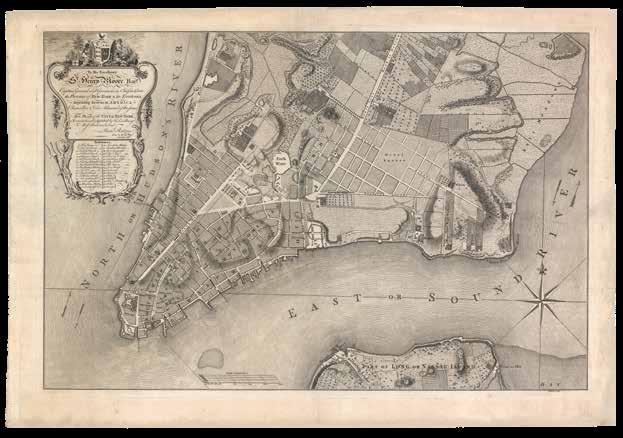
Ratzer’s fine plan of lower Manhattan.
“Made just prior to the Revolution, the Ratzer plan is the most accurate an useful survey of New York then circulating” (Deak).
The map is usually referred to as the “Ratzen Plan” due to the misspelling of the mapmaker’s name in the title. It was the work of Bernard Ratzer, British engineer, and was a result of the Stamp Act Riots of 1765. Fearing that the city might soon become a battleground, and needing detailed information about its layout, the British authorities commissioned Ratzer to survey and construct a map of the city.
The manuscript was completed in 1767, and very few examples of this first state were printed in 1769. It lacks a publisher’s imprint and date, and was probably prepared primarily for circulation within the British Administration. This must account for its great rarity. Nevertheless, it was advertised for public sale in the New York Gazette, 21 August 1769. Another copy of the first state can be found in the Stokes Collection, New York Public Library. A second state, with the imprint of Thomas Jefferys, Jr. and William Faden, was published in January 1776, at the beginning of the American Revolution. Almost all surviving copies of the map are in the second state.
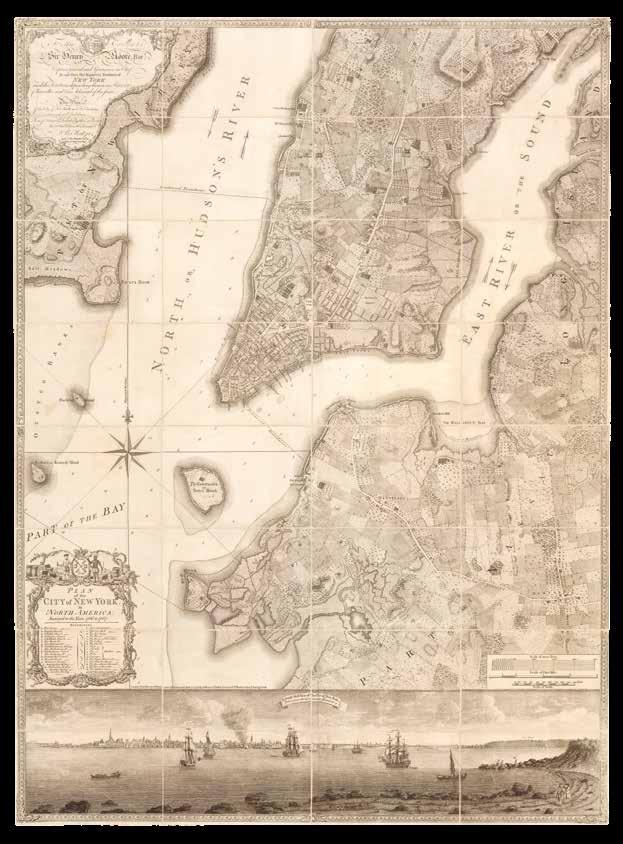
While this map focuses on the developed part of the city, at the tip of Manhattan Island, Ratzer also prepared an even larger map that shows both the city and its environs. It is usually referred to as the “Ratzer map” (see item 19). This second map was first published in 1770, and republished in 1776. In referring to these two maps, Cohen & Augustyn state that they are perhaps the finest of an American city produced in the eighteenth century. The “geographical precision combined with its highly artistic engraving was unsurpassed in the urban cartography of its day”.
The topography and renderings of estates and farmlands on the Ratzen plan are given with such fine detail that it makes clear what a small town New York was before the Revolution. A key beneath the title identifies 31 important sites. The landmarks and property lines are reported with such accuracy that the map is sometimes used to settle title disputes to this day.
Stokes called it quite simply “the most accurate and reliable map which we have of New York at this period”, and Cumming praises Ratzer as “an experienced surveyor and fine draftsman”.
RATZER, Bernard
Plan of the City of New York, in North America surveyed in the Years 1766 & 1767.
Publication
London, Publishd according to Act of Parliament Jany. 12, 1776: by Jefferys & Faden, Corner of St. Martins Lane, Charing Cross, 1776.
Description Large engraved map, on 3 sheets joined, dissected and mounted on linen.
Dimensions 1225 by 905mm (48.25 by 35.75 inches).
References
Cohen and Augustyn Manhattan in Maps pp.73-77; Cumming, “The MontresorRatzer-Sauthier Sequence of Maps of New York City, 1766-76” in Imago Mundi Vol. 31 (1979), pp. 55-65.
Inventory reference 22020
€275,000
“one of the most beautiful, important, and accurate early plans of New York” (Stokes)
“Perhaps the finest map of an American city and its environs produced in the eighteenth century” (Augustyn).
This superb and elegant map takes in the southern end of Manhattan island, as far north as 50th Street today, the marshy New Jersey shores of the Hudson, Kennedy, Bucking and Governors Islands, and parts of present day Brooklyn along the East River. It shows the city of about 25,000 people, surrounded by countryside that includes much of Manhattan and Brooklyn. The view at the bottom, “A South West View of the City of New York, Taken from the Governours Island at *” is after a watercolor by Captain-Lieutenant Thomas Davis. The title and list of references appears within a rococo cartouche lower left, the dedication to Sir Henry Moore, the Governor of New York, in another upper left, a scale lower right.
The map is the ultimate culmination of Ratzer’s surveys of 1766 and 1767. The first map generated by those surveys, his “Ratzen” plan of just the city, was sent back to London and engraved by Thomas Kitchen, Hydrographer to the Duke of York and later the King, and published in 1769, with Ratzer’s name misspelled. By about 1770 a more extensive plan of the city and its environs was completed and published undated by Kitchin. The present map was published, unchanged, by Jefferys and Faden, although it was rarely included in Faden’s “North American Atlas” of 1777, and the map remains exceptionally rare.
Bernard Ratzer served in the British Army in the 60th or American regiment, surveying the east coast of North America during the French and Indian War and later the Revolutionary War. His earliest known map is a manuscript chart of Passamquoddy Bay in Maine in 1756. Various other manuscript plans of forts followed, and he collaborated with Sauthier on his survey of New York, published in 1776. In 1769 Sir Henry Moore gave him the task of surveying the New York - NewJersey border.
Ratzer’s map is a significant improvement his earlier plan: the wharves along the Sound are shown and the streets given names, new buildings and streets on either side of the Bowery are entered, and Ratzer has included careful topographical surveys of the eastern tip of long island adjacent to ‘The Sound or East River’. ”The Methodist Meeting House, not completed until 1768, is identified, and the scale has been reduced by half – 800 feet to one inch. The enlarged area extends north to approximately present 42nd street, and the New Jersey Shore and Long Island bordering the East River are included. The cultivated fields, roads, buildings, and names of chief property owners are shown in remarkable detail” (Cumming).
ANONYMOUS
[Kyoto as the Imperial capital].
Publication [c1800].
Description
Original pen and ink and watercolour drawing on Japan paper, and laid down on heavier stock as a scroll, with a wooden batten at one end, and ties at the other.
Dimensions 1150 by 800mm (45.25 by 31.5 inches).
References
Hasegawa, ‘The History of Mapping of Kyoto - Between Picture and Survey’, online.
Inventory numbe 34341
€11,500
A beautiful pictorial map of Kyoto
and surrounding hills
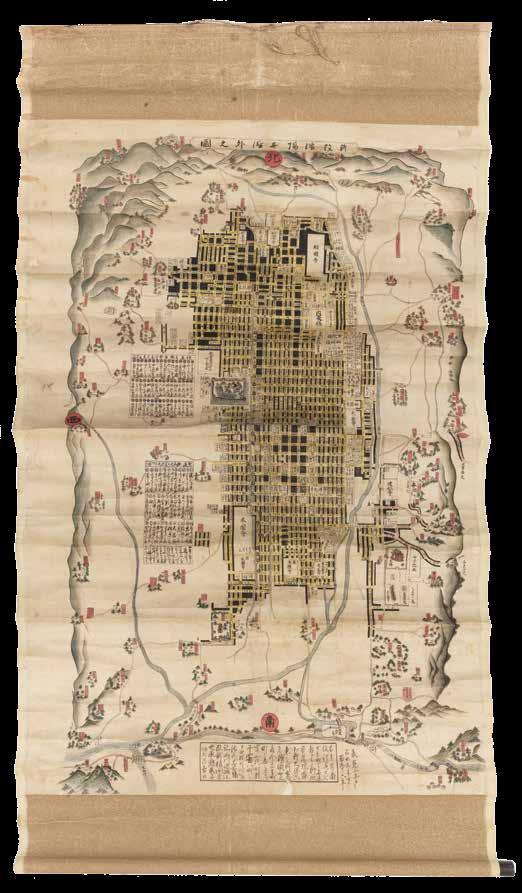
A very fine manuscript map of Kyoto, showing the grid-pattern of the city proper, suburbs, and outlying towns and villages all surrounded by, and in contrast to, the soft gentle hills of the Kyoto Basin. The style is very typical of that which first practised in the last decades of the seventeenth century by Hayashi Yoshinaga, whose first guide map appeared in 1686. Hayashi published several maps of Kyoto with the title “Shinsen zōho Kyō ōezu” (Newly revised and Enlarged map of Kyoto), “all typically shaped with the North-South direction longer than the East-West one, all not adhering to an exact scale, and all meant as guides to sightseeing in Kyoto. They are representative of the cartography of Kyoto in the mid-Edo period, and were greatly influential for other maps of the city. They introduced new graphic conventions (older maps tended, for example, to fill sections of the city in black ink, a feature absent in most of Hayashi’s maps), and new textual content, including detailed annotations about temples, shrines and other famous places, and catalogues of house names associated with family crests” (John Rylands Library).
Kyoto is one of Japan’s largest cities and also one its oldest. Originally founded as Heian in 794, it had its golden age during 794 to 1185. Home to many cultural landmarks and historical sites, Kyoto is thought of as “the heart of Japan”. The city still bears the name Kyoto, or ‘Capital City’, even though the emperor and the National Diet are located in Tokyo. For most of Japan’s history, Heian was the center not only of government but of learning and the arts.
Kyoto was laid out in 794 on the model of Chang’an (modern Xi’an), the capital of China’s Tang dynasty, by order of the emperor Kammu. The plan called for a “rectangular enclosure with a grid street pattern, a bit more than 3 miles north to south and a bit less then 3 miles east to west. The Imperial Palace, surrounded by government buildings, was in the city’s north-central section. Following Chinese precedent, care was taken when the site was selected to protect the northern corners, from which, it was believed, evil spirits could gain access. Thus, Hiei-zan (Mount Hiei) to the northeast and Atago-yama (Mount Atago) to the northwest were considered natural guardians. Hiei-zan especially came to figure prominently between the eleventh and sixteenth centuries, when warrior-monks from its Tendai Buddhist monastery complex frequently raided the city and influenced politics. The Kamo and Katsura rivers - before joining the Yodo-gawa (Yodo River) to the south - were, respectively, the original eastern and western boundaries. But the attraction of the eastern hills kept the city from filling out to its original western border until after World War II. Kyoto is actually cradled in a saucer of hills on three sides that opens to the southwest toward Osaka” (Encyclopedia Britannica online).
[DOIN, Ochikochi (i.e. Fujii HANCHI), after]
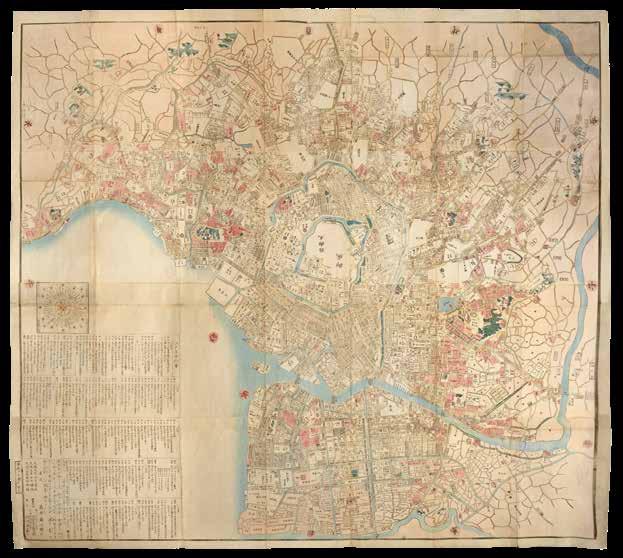
Bunken Edo oezu. [Survey of the districts of Greater Edo].
Publication
Edo, Suharaya Mohe, c.1803.
Description
Large folding woodblock map, with stencilled colour.
Dimensions
1635 by 1965mm (64.25 by 77.25 inches).
Inventory number 24668
€23,000
The dawning of the age of Bunka-Bunsei
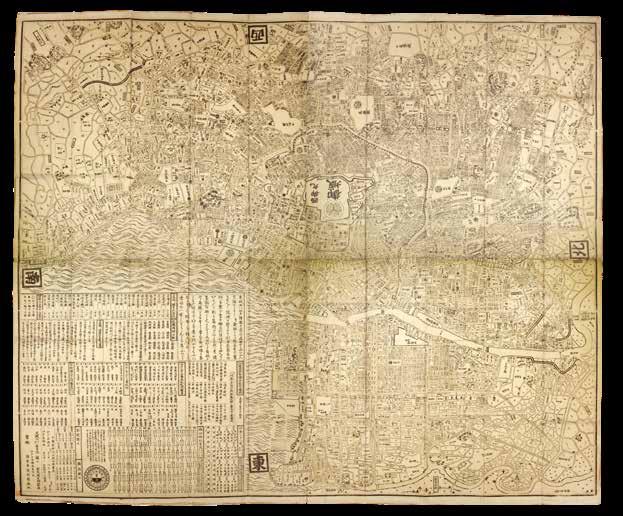
Oriented with west to the top, Suharaya Mohe’s large map of greater Edo, now Tokyo (from 1868), has its origins in the city plan of “Ochikochi Doin”, actually the surveyor Fujii Hanchi, first issued in 1671, and augmented several times over many years. However, a map with the title ‘Bunken Edo oezu’, as here, was first issued by Suwara Jiemon, in 1727, also subsequently revised several times until 1778, when the Kanamaru publishing house issued their own map with this same title.
Suharaya Mohē’s (1731-1782) revised version is a beautiful and highly detailed map of the city at the heart of the Tokugawa shogunate (1603-1868) empire, at the turn of the nineteenth century, and the dawn of a new era in Japanese culture. Right at the centre of the map, where the Edo Castle should be, is a blank space. Ostensibly for security reasons, this affectation also attempted to add an aura of mystique to the seat of Tokugawa power, and the ruling shogun himself, Ienari (1773-1841). Ienari’s administration (1787 to 1837) followed one of great austerity, and this period of his rule became known as the Bunka-Bunsei (Culture - Benevolent Government) period (1804-1829). As is amply reflected in this map, this was a period of increasing urbanisation, which saw the rise of an extravagant merchant class, a proliferation of lavish spending, subsequent financial insecurity, and inevitable corruption. In turn, this would lead to the eventual unravelling of the shogunate’s rigid feudal system, and an end to Japan’s isolationist policy, which had hitherto limited contact and trade with the outside world.
Nevertheless, the map also reflects the continuing demands of the shogunate’s Sankin-kotai policy that required the most powerful lords, the daimyo, to live every other year in Edo, highlighting their residences, other private properties, temples, and marketplaces. The large legend at the left of the map outlines much of this information, as well as adding information on pilgrimage routes, distances from Edo’s logistical centre at Nihonbashi (the Japan Bridge), constellations, and lucky and unlucky days.
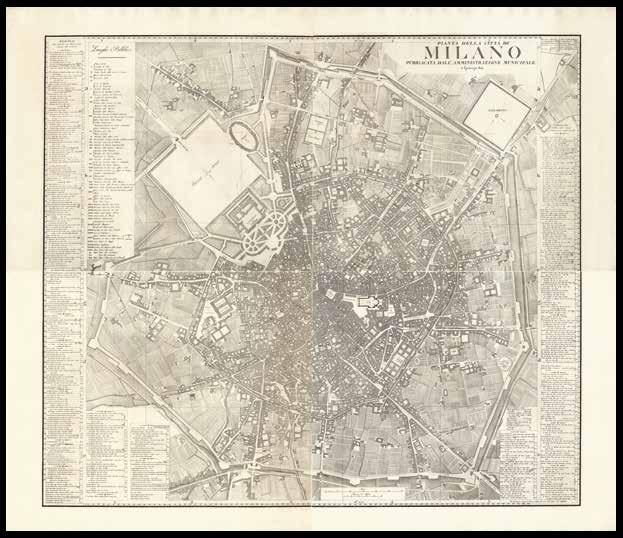
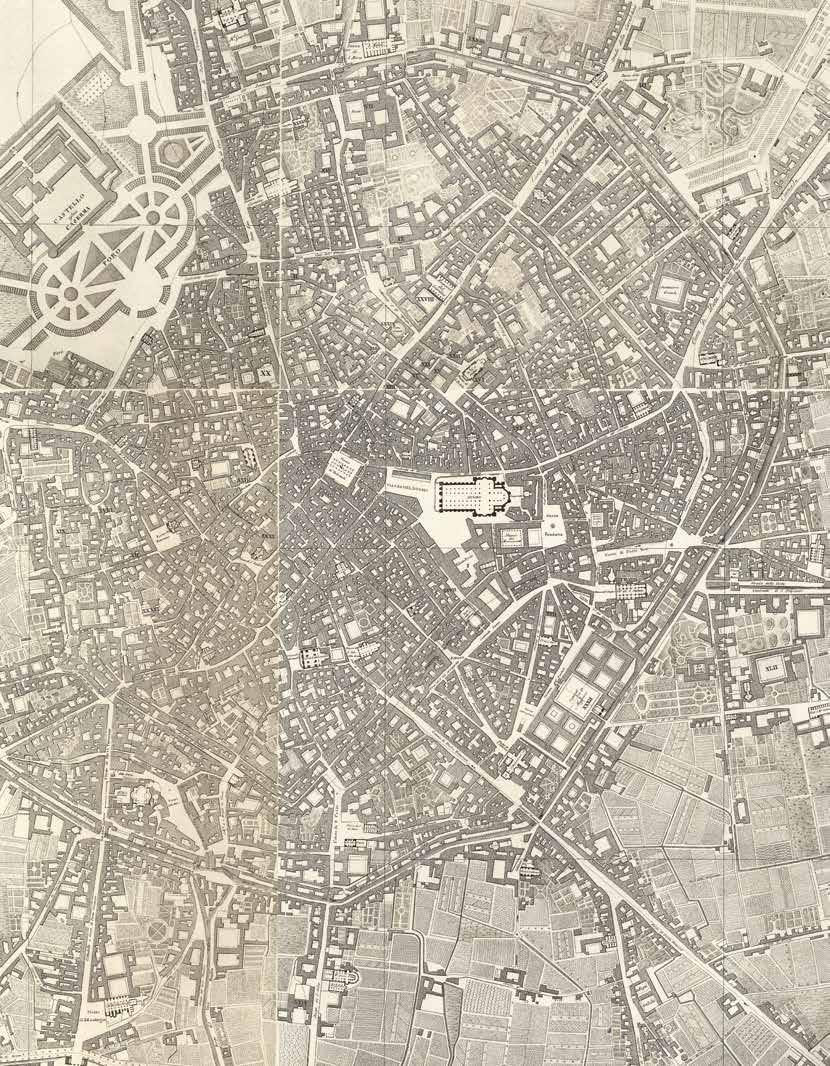
A map of Napoleonic Milan
[ASTRONOMI DI BRERA]
Pianta della città di Milano [Plan of the city of Milan].
Antonello (2014) ‘Bonaparte and the astronomers of Brera Observatory’, Cornell University; Buzzi (2005) ‘Le vie di Milano: dizionario della toponomastica milanese’, Hoepli Editore; Catizzone (2009) ‘Un tesoro ritrovato: Dal rilievo alla rappresentazione’, Gangemi.
Inventory number 15892
€11,500
One of the earliest ‘modern’ maps of Milan, published at the very end of Napoleonic rule in northern Italy.
From 1796 to 1814, the modern regions of Lombardy, Veneto, Emilia-Romagna, Friuli Venezia Giulia, Trentino, South Tyrol and Marche were collectively ruled by France under Napoleon Bonaparte’s Kingdom of Italy. Milan was the state capital, and the Palazzo Brera its main cultural centre, housing the gallery of the national Academy, a museum of antiquities, a botanical garden, an extensive library and an observatory. Napoleon was intent on making it a learned establishment of global importance; in fact, one of his earliest actions after setting up his new government in Milan was to meet with Barnaba Oriani, the unofficial head of the Brera Observatory.
Perhaps to reaffirm its control over the Kingdom, the Napoleonic regime commissioned new maps of its territories, declaring the existing material insufficient and demanding that the newly unified provinces be shown collectively. The Brera Observatory was supplied with new instruments and charged with surveying the Duchy of Milan. The initial attempt in 1804 was disastrous, with the majority of the surveyors falling ill, one drowning in a river and the leader dying from excessive labour. Yet in 1807, the astronomers finally produced a plan of the city, which is widely considered the first modern map of Milan. It is entitled ‘Pianta di Milano. Capitale del Regno d’Italia’ (‘Plan of Milan. Capital of the Kingdom of Italy’).
The only surviving copy of the map is held in the Milan State Archives, having been rediscovered and restored in 2007. The present map, however, is almost identical in cartography, and was also produced by the astronomers of the Brera Observatory. It is dated to 2 January 1814 and bears the title ‘Pianta della città di Milano’ (Plan of the city of Milan). There are a few minor distinctions in the topography of the 1807 and 1814 maps which reflect the political developments in Milan. The Villa Bonaparte and the Contrada Bonaparte notably lose their references to the French leader, the former becoming “Villa Reale” and the latter the “Strada Risara”. The defeats faced by Napoleon’s army in 1813 pointed towards his inevitable fall from European dominance, and indeed he would abdicate his rule in April of the following year, officially releasing his Italian territories on 30th May 1814. The changes in this map, published only four months earlier, mirror the decline of French influence over Italy, and in particular, Milan.
Nonetheless, the plan is consistent in depicting the same roads, buildings and squares as shown on the earlier plan. It is incredibly detailed, with house numbers and names listed, and the interior of certain buildings and gardens pictorially illustrated. An index on the left gives the names of the streets, alleyways, buildings and piazzas presented on the map, while to the right there is text explaining some important information about the topography of the city, including its height above sea level and the circumference of its walls. Of particular note is the Sforza Castle in
the upper left corner, which had been remodelled under the Napoleonic regime with the addition of the piazza castello, and is shown surrounded by the tree-lined Forum and the immense Cavalry Barracks.
The present map is extremely rare. We have been able to trace only four institutional examples worldwide, held at The British Library, Bayerische Staatsbibliothek, University of Illinois, and Universitäts- und Landesbibliothek Darmstadt. Furthermore, we have only been able to trace one other example appearing at auction.
Woodblock printed map of Edo, north oriented to the right.
Dimensions 1210 by 1340mm v(47.75 by 52.75 inches).
References Beans, A List of Japanese Maps of the Tokugawa Era I, 39.
Inventory number 15206
€9,000
A large detailed cadastral map of Edo [Tokyo], showing landowners, main temples and shrines and other points of interest depicted pictorially in relief.
During the end of the Edo Period, Rangaku, or “Dutch Learning,” dominated Japanese art and science. This map exemplifies the union of Japanese traditional printmaking and Dutch cartography. The latter half of the Edo Period is known as the Bakumatsu Era, when traditional feudal authorities resisted the increasing western influence, creating a tense social division. It represents the historical, social and political characteristics of the Bakumatsu era. At the center of Edo, present-day Tokyo, marks the head of state and the Japanese legal authority. Within the central living quarters, there is a Western circle called nishinomaru. The royal living quarters are surrounded by a group of mansions, called the daimyo-koji, or “warlord ally.” The relationship between spatial orientation and hierarchy is very clear, as all of the surrounding structures face the center.
North is oriented to the right.
Insets: 江戶方角道法 Edo hōgaku dōhō (distance chart), 江戶年 中行事 Edo nenju gyōji (list of daily events for Edo).
First printed Genroku 9 [1696], later revised Bunsei 5 [1822], reprinted Tenpō 14 [1843], and current edition Ansei 6 [1859].
HOBURG,
Maryanne Regal
Silicon Valley.
Publication Silicon Valley. City Graphics of America, P.O. Box 261, Fremont, California, 94537, Price $3.95 1982.
Description Colour printed pictorial map.
Dimensions
390 by 510mm (15.25 by 20 inches).
Inventory number 14915
€32,500
Foundation map of Silicon Valley - inscribed by the artist
First issue, pre-publication state, of this first map of Silicon Valley, inscribed by the artist. With “Decathelon” Club misspelled, which is ironic, given that it is spelled correctly in at least two other places on the map: a teacher near the center of the lower edge asks her pupils “to spell decathlon”; and the track where “Bruce Jenner trained for the decathlon” is shown. The latter is one of the many suggested captions for the published issue, present in this map in a form of overprinting. In this printing the zip code is given as 94537.
Hoburg famously took her camera, drove around the burgeoning community of technical companies, sketched what she saw, and created what would be recognised as the foundation map of Silicon Valley: providing a fascinating snapshot into the early days of the tech boom in California, and the map is filled with the logos and buildings of software and computer companies. Some of the companies shown have survived, and are now household names: IBM, Toshiba, and Hewlett Packard. At the lower edge is the distinctive original rainbow logo of what is arguably now the most famous software company in the world, Apple. The map also shows some of the victims of the failure of the market. Atari, at the upper right, would fold in 1984, following the recession in the video game industry in North America. VisiCorp, in the centre, suffered ongoing legal battles, and is now owned by Paladin. For the companies in the map, however, the risks were worth it to be at the cutting edge of technology.
The map was produced by a small graphic design company, City Graphics of America, who offered local businesses a place on the map for a fee. They would then simplify the urban landscape to make room for the names of the businesses and comic illustrations. The next issue, dated 1983 and printed on the same scale as the current map, not surprisingly includes many more businesses.
We know of no other example of this proof state of the map. The David Rumsey Map Collection includes an example of the published version, and a later edition on a larger scale.
Oblong folio album (245 x 380 mm). 57 ff. 50 full-page pen and ink drawings of imaginary cities and their armies; 50 emblematic cartouches each containing an octave describing the opposite city, some with Latin mottos; dedication in ornamental border; allegorical cartouche with octave praising Venice on the verso. Contemporary red morocco with gilt triple fillets enclosing large oval centerpiece composed of double fllets in arabesque patterns with armorial shield, edges gilt. Stored in custom-made half morocco case.
References Manfredo Tafuri, Venice and the Renaissance (Boston: MIT Press, 1995). Lionello Puppi, Scrittori vicentini d’architettura del secolo XVI (Venice: Accademia Olimpica, 1973).
Inventory number 23967
€172,000
Imaginary Cities
Unique album with splendid manuscript designs for imaginary fortified cities, created for and dedicated to Marino Grimani in the year of his appointment as Doge of the City and Republic of Venice, which he would reign over until his death. Grimani served as Superintendent of Fortresses before becoming Doge and worked for many years on the design and construction of the Palmanova fortress, the greatest of the Renaissance star forts and constantly embattled by the Ottomans as well as by other forces for centuries to come. Vericci’s album constitutes a paragon of Renaissance idealism: a utopian vision which champions the might derived from pushing human genius to the limits of the imagination, combining mathematics, philosophy, and military prowess with art, poetry, and design. Little is known about the author-artist Marco Vericci, some of whose other ingenious military designs survive in the Biblioteca Bertoliana in Vicenza, but he may have worked with Grimani on the designs for Palmanova. Italian art historian Lionello Puppi has cautiously suggested that “Vericcius” may be a pseudonym of Fillipo Pigafetta, a Venetian soldier and mathematician who wrote extensively on military fortifications. In this album, Vericci illustrates and whimsically describes fifty imaginary cities whose designs are based on the utopian mathematical ideals of the Renaissance star fort. The cities, with names like “Mirabella”, “Grimanopoli”, and “Durissima”, are situated in elaborate landscapes (almost all are island fortresses, like their model) and are rendered in exquisite detail. The octave opposite each illustration describes the strengths and virtues of each fantastical fortress in the vein of Italo Calvino’s novel “Invisible Cities” - which also featured a litany of imaginary towns all reflective of La Serenissima herself. The last illustration but one depicts the 1571 Battle of Lepanto, a major naval victory by the Holy League over the Ottomans. The Palmanova fortress was dedicated exactly 22 years, to the day, after the battle - thus its inclusion here links the glory of Lepanto explicitly to the achievements of Doge Grimani, in addition to re-situating this imaginative work in its real-life context of simmering conflict not just between Europe and the Turks, but also between Venice and Austria - her enemy to the North. Some light soiling and spotting; some early marginal repairs where ink has corroded the paper; traces of paste on first two leaves with loss to a few letters. Otherwise in excellent state of preservation and still in its richly gilt morocco binding commissioned for the Doge of Venice (his arms in the centre of the back cover rubbed).
BLAEU, Johannes
Atlas Major Sive Cosmographia
Blaviana, qua solum, salum, coelum accuratissime describuntur.
Publication
Amsterdam 1665 [but later].
Description 11 volumes. Folio (555 by 360mm). Three engraved allegorical frontispieces, architectural frontispieces, letterpress titles with engraved vignettes and divisional half-titles, 594 engraved maps and plates, mostly double-page, some folding, extra-illustrated with 18 engraved maps, engraved illustrations, coloured throughout in a contemporary hand, frontispieces and engraved titles heightened in gold, all edges gilt; publisher’s vellum gilt with yapp fore-edges, covers panelled with stylised foliate roll, and large centre and corner arabesques, with central armillary sphere tool, spine in eight compartments by horizontal rolls, decorated with foliate corner pieces around a central rose tool, remnants of original ties.
References
Brotton, 265-290; van der Krogt 2:601; Koeman I, BL 56 (pp.203-227); Phillips 3430.S.; Kramer, ‘Ex bibliotheca Reisachiorum’, Scriptorium 34 (1980), pp.91-95; Shirley, British Library.
Inventory number 23247
€800,000
A fine extra-illustrated edition of Blaeu’s greatest work. Containing 18 extra maps by Visscher and de Wit, together with the allegorical frontispieces for Europe, America, and Africa, present in very few copies, all finely coloured and heightened in gold.
The ‘Atlas Major’ in its various editions was the largest atlas ever published. It was justly famed for its production values, its high typographic standard, and the quality of its engraving, ornamentation, binding, and colouring. The atlas frequently served as the official gift of the Dutch Republic to princes and other authorities. It is one of the most lavish and highly prized of all seventeenth-century illustrated books.
“In its sheer size and scale it surpassed all other atlases then in circulation, including the efforts of his great predecessors Ortelius and Mercator” (Brotton). The work was published simultaneously in five different languages, Latin, French, Dutch, Spanish, and German. What Blaeu managed to achieve was to contain the world in a book, an endeavour that in many respects would never be equalled.
Publication history
Blaeu’s great work was born in 1630 when he published his first atlas, the ‘Atlas Appendix’. The book consisted of 60 maps, and was billed by Blaeu as a supplement to Mercator’s atlas. His great rivals, Henricus Hondius and Johannes Janssonius, had expanded and reissued Mercator’s work. They were so frightened of Blaeu’s move into the publication of atlases that they rushed out a rival ‘Appendix’ by the end of the same year.
Over the next 30 years this great publishing rivalry would spur the production of ever larger and more lavish atlases. In 1634, Willem Blaeu produced his ‘Atlas Novus’, containing 161 maps; this was expanded in 1635 to two volumes, containing 207 maps. The house of Blaeu was so successful that in 1637 they moved into larger premises. The new building was the largest printing house in Europe, with its own print foundry and nine letterpresses. Unfortunately, Willem did not live long after the move and he passed away the following year. He was succeeded in business by his son Joan, who also inherited the lucrative and influential post of Hydrographer to the Dutch East India Company (V.O.C.).
Over the next 20 years Joan expanded the ‘Atlas Novus’: adding a third volume in 1640 covering Italy and Greece; in 1645, a fourth volume on the British Isles; and in 1654 a volume relating to China, the Atlas Sinensis. This was the first western atlas of China, based on the work of the Jesuit Marteo Martini. Janssonius managed to keep pace with his more illustrious rival. In 1646 he published a four volume atlas, adding a fifth – the first folio sea atlas – in 1650, and in 1658 a sixth consisting of 450 maps, some 47 more than Blaeu’s similar work.
In 1662, Blaeu announced that he would auction his bookselling business in order to finance the imminent publication of his great atlas.
From a brief look at the numbers it is clear that Blaeu needed the capital. The creation of the five editions took six years, from 1659 to 1665. It is estimated that 1,550 copies over all five editions were printed. If one totals up the entire print run, it comes to just over 5.4 million pages of text, and 950,000 copper plate impressions! Such a vast undertaking in capital and labour was reflected in the price of the work, with the French edition the most expensive at 450 guilders. The atlas was not only the costliest ever sold, but also the most expensive book of its day. To give us some idea of comparative value, the average price of a house in Amsterdam at the time of publication was 500 guilders.
The maps
The maps are embellished in the Baroque style, and are among the most beautiful ever made. Of particular note are the famous side-panelled maps of the continents, the 58 maps devoted to England and Wales (vol. V), Martini’s Atlas of China, the first atlas of China published in Europe (vol. X), and a series of 23 maps of America, including important early maps of Virginia and New England (vol. XI). Of particular note is the double hemispheric world map, newly prepared for the atlas by Joan. Jerry Brotton suggests that this is the first world map in an atlas to portray the Copernican solar system.
Contents
Volume I World, Europe and Scandinavia. 61 maps and plates; map of Denmark replaced by: VISSCHER, Nicolas ‘Regni Daniae Novissima et Accuratissima Tabula’; extra-illustrated with: VISSCHER, Nicolas, ‘Europa delineata et recens edita’, with Blaeu text to verso.
Volume II Northern and Eastern Europe. 39 maps and plates, extraillustrated with eight maps: JANSSONIUS-WAESBERGIOS [and] Moses PITT, Novissima Russiae Tabula; DE WIT, Frederick, Regni Poloniae et Ducatus Lithuaniae Voliniae; BLAEU, Johannes, Ukrainae Pars quae Podolia; BLAEU, Johnanes, Ukrainae pars, quae Barclavia Palatinatus; BLAEU, Johannes, Ukrainae pars quae Pokutia; BLAEU, Johannes, Ukrainae pars quae Kiovia Palatinatus; VISSCHER, Nicolas, Totius Regni Hungariae Maximaeque; DE WIT, Frederick, Insula Candia Ejusque Fortificatio.
Volume III Germany. 96 maps, extra-illustrated with 1 map: VISSCHER, Nicolas,...Pomeraniae Ducatus Tabulam.
Volume IV The Low Countries. 63 maps, extra-illustrated with two maps: VISSCHER, Nicolas, Novissima et accuratissima XVII Provinciarum Germaniae Inferioris; VISSCHER, Nicolas, Belgii Regii accuratissima Tabula.
Volume V England and Wales. 58 maps.
Volume VI Scotland and Ireland. 55 maps.
Volume VII France and Switzerland. 70 maps.
Volume VIII Italy. 60 maps, extra-illustrated with 1 map: DE WIT, Frederick, Insula sive Regnum Siciliae.
Volume IX Part 1. Spain and Portugal. Part 2. Africa. 41 (28 + 13), extra-illustrated with three maps: VISSCHER, Nicolas, Hispaniae et Portugalliae Regna; VISSCHER, Nicolas, Portugalliae et Algarbiae Regna; VISSCHER, Nicolas, Africae Accurata Tabula.
Volume X Asia. 28 maps, Blaeu Asia replaced by: VISSCHER, Nicolas, Asiae Nova Delineatio, with blaeu text to verso; extra illustrated with 1 map: VISSCHER, Nicolas, Terra Sancta sive Promissionis. olim Palestina.
Volume XI America. 23 maps, extra-illustrated with 1 map: VISSCHER, Nicolas, Novissima et Accuratissima Totius Americae Descriptio.