become reality on that St. Mary’s, Idaho hunt, preceding the mountain lion hunt. On the hunt “this wolf looked right through me. Right through my soul,” Brown recalled of the day he lay in wait, letting out an occasional answered howl that eventually found him able to take successful aim. “While I was in Canada, I learned how to call the wolves and let out a howl,” Brown shared. “I waited ten minutes and howled again. This time, I had a couple howl back at me. And when they wouldn’t howl back and didn’t howl back, I knew they were coming to check me out. They were coming.”
Brown, owner of PR Whitetails in Leslie, Michigan was.
“Recently I had the joy of being asked to help cook at Ultimate Whitetails for a large gathering of hunters,” Brown shared. “I’ve always enjoyed cooking. For three days I hung out with guides and got to see the sights. But there was one guy I’ll always remember. He shot a huge nontypical deer. As he’s telling the story he’s got tears in his eyes. I thought to myself ‘that’s awesome.’ This was his life dream. He was thrilled. Here’s an honest hardworking guy able to enjoy the thrill of the hunt and connect with others who share a love of nature. Opportunities like these might only come once in a lifetime. I’m grateful the deer industry can provide that.”
Upcoming Whitetail and Cervid Events
Tri-State Associations Magazine Deadlines 2026
Spring: March 10th
Summer: June 9th
Fall: September 22nd
Winter: December 15th
Use this QR Code or go online to DeerSites.com for more deadlines and up to date event information!
Indiana Deer & Elk Farmers Association - July 31-Aug 1st - Nappanee IN KALA Summer Showcase - Aug 8, 2026
Whitetail Deer Farmers of Ohio Convention - Aug 13-14, 2026
Southern Top 30 - Aug 20-21, 2026 - Louisiana
Whitetails of Louisiana - Aug 21-22, 2026 - Marksville, LA
TDA Annual Convention - Aug 28-29, 2026 - San Antonio, TX
EXECUTIVE BOARD OF DIRECTORS
Chris Ezell President Dangerous Whitetails of Oklahoma 7134 W. 420 Rd
Chelsea, OK 74016 918-697-5389
chrisezell@rocketmail.com
Amy Nold Secretary The 723 9498 Highway nine Dustin, Oklahoma 74839 660-492-0215 noldfarmsllc@yahoo.com
Riverbend Trophy Whitetails 3616 Boston Pool Rd. Hominy, OK 74035 Mkbs5484@icloud.com 918-430-5484
Joe Smith 14421 Buggy I Jones, OK 73049 405-696-3880
Kevin Wallace Treasurer Wallahachie Whitetails PO Box 28 Wellston, OK 74881
Doug Varner Double D 6925 Winchester St Dallas, OK 75231
Keith Day
Atypical Whitetails PO Box 821 Sperry, OK 74073
Whitetails of Oklahoma Update
On February 7,2026 Whitetails of Oklahoma hosted their annual fundraiser in Salisaw . It was a day filled with auctions, food and fellowship. Thank you to all those who attended and contributed to making this event possible. In the weeks following the event a Group of hunting preserve owners and board members attended the capital to express their support of house bill 1074. Seeing our members and board working together and getting involved is a great feeling.
On March 29,2026 a members meeting for the purpose of board of directors election will take place at The 723 Ranch in Dustin, Oklahoma. Meeting will start at 4:00 pm. Voting members in good standing will be allowed to vote and votes will be tallied at the meeting. If you are unable to attend your proxy can to sent with a member of your choice. Please be sure and refer to the bylaws for instructions. All members have been sent a copy via email.
Amy Nold Board Secretary
EXECUTIVE BOARD OF DIRECTORS
Karla Kretschmer
President
AB Whitetails 2052 Nation Rd Chetopa, KS 67336 620-920-0578
karlakretschmer@outlook.com
Kevin Constant Treasurer
K&D Wildlife 4193 Clark rd. Meriden, KS 66512
785-224-8889
kanddwildlife@gmail.com
Joe Bisogno, Jr. Vice President
Timber Hills Lake Ranch 1369 Valley Road Mapleton, Kansas 66754 913-515-1507
joebisogno@yahoo.com
Jake Lamb 2nd Vice President
Sand Creek Whitetail 10865 School Creek Rd Saint George, Kansas 66535 785-210-6412
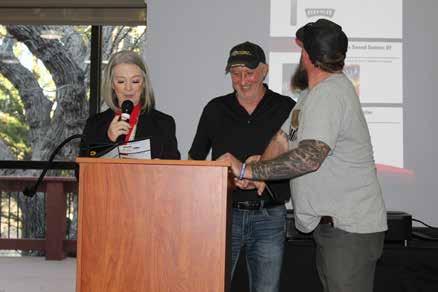
Congratulations to Tim Duley. He was our lucky winner of our golf Kart.
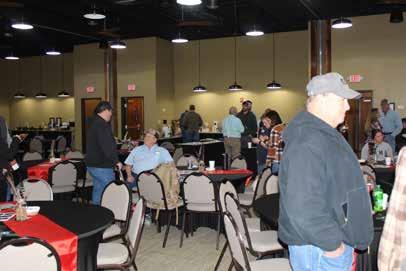
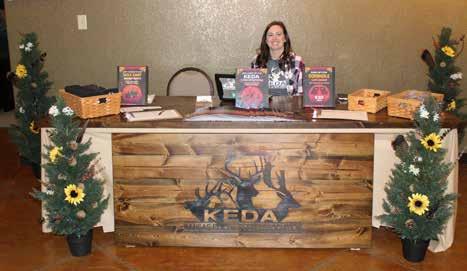
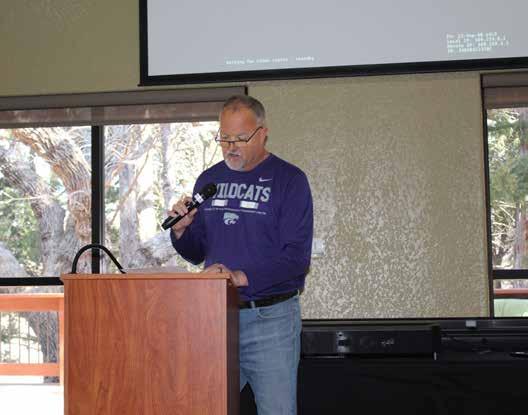
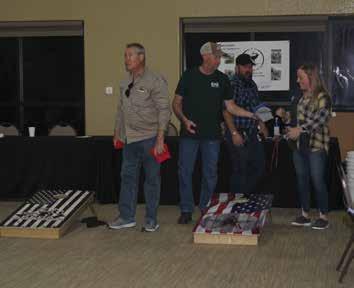
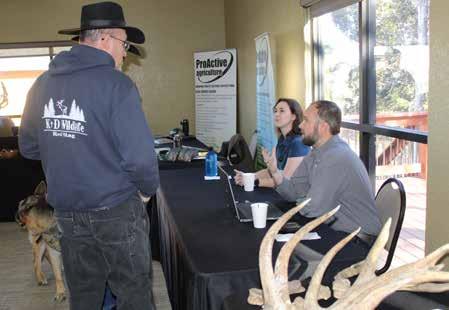
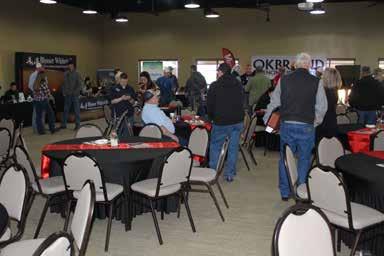
On behalf of the KEDA board, thank you to everyone that attended our convention this past weekend. We had folks from five other states, which is amazing. Thank you to our speakers, y’all were wonderful. We had great diversity represented with our booths, thank you for your time and information. Thank you to everyone who donated to our auctions. Our event was made possible because of you. We are so blessed to have such a great representation of our cervid family.
Our summer picnic has been scheduled for Saturday, August 1, 2026 At K & D Wildlife Breeding & Preserve. Hope to see y’all there.
Remember, Change starts with 1.
Sincerely,
Karla Kretschmer President Kansas Elk and Deer Association
THE MOST RECOMMENDED FIREARMS FOR HUNTING
By: Gail Veley • Sponsored by the Whitetails of Oklahoma
Choosing a firearm for hunting comes down to a few important considerations. These include how rapidly you may need to shoot, the desired ballistics or projection and flight distance of your ammunition, recoil and ease of handling. While there are just as many gun variations as there are opinions as to the best one, perhaps the best firearm for hunting whitetail is a .30-30 Winchester rifle, offers Chris Ezell, owner of Dangerous Whitetails of Oklahoma in Chelsea, Oklahoma. As a teenager, Ezell inherited his grandfather’s .30-30. He still remembers the thrill of being handed a deeply treasured rifle that to this day, he faithfully uses for whitetail hunting.
The .30-30, ideal for hunting medium sized game such as deer and bear from 150 to 200 yards away, uses a lever-action round and was first available in 1895. Known for its smokeless powder, it is today a popular “go-to” choice for vast numbers of hunters. In addition to the .30-30, variations of Winchester rifles such as the .270, introduced in 1925, and the .243, introduced in 1955, may offer flatter bullet trajectories and longerrange accuracy in open country for bigger sized game like elk. While the .270 can be ideal for adults, the .243 is more often recommended for youth hunters. Other rifles, such as a 410-shotgun, are more light weight with almost no recoil, and used primarily for home defense, small game hunting, pigeon hunting and wildlife management. “You want to be comfortable using various types of firearms because of the all the different scenarios you can find when you’re out hunting,” Ezell, 48, said. “Whether it’s heavy brush areas or areas without long shots, or wide-open areas where a shot needs to fly longer and flatter, you want to be set up to aim for the neck rather than shoulder to not damage the meat.”
The invention of the gun can be traced back to 10th Century China, when gunpowder projectiles were mounted on spears for portable fire lances. By the 15th Century rudimentary firearms were instrumental in the demise of the Byzantine Empire, leading to
the establishment of Europe and the colonization of America, Africa and Oceania. The 19th Century saw a clear acceleration in the development of what today is the modern gun. For the modern-day hunter, ease of handling any firearm accurately also includes an ideal shooting technique, said Jason Stefanowicz of Awesome Whitetails in Middlebury, Pennsylvania. Having learned to shoot at age 22 from a former Marine sniper who at that time was in his 40’s, Stefanowicz remembers one important take-away. “It’s all about the breathing,” he said. “Most people tend to hold their breath when they shoot. If you exhale as you’re shooting, you won’t move around as much.” Stefanowicz, 52, also strongly believes in investing in the best scope you can afford. “That seems to be the Number One thing people cheap out on,” he said. “When it’s morning and evening and generally darker, you can see through a higher quality scope so much better. It can make all the difference.”
In terms of providing or lending the most straight forward firearm to his hunting clients, Brandon Bollinger of 2 Brothers Whitetail in Loranger, Louisiana, prefers the .270 or the .308. “Most folks can handle them fairly easily and they work well in lots of different scenarios,” he said.
MISSOURI DEER ASSOCIATION
EXECUTIVE BOARD OF DIRECTORS
Amy Nold (‘26)
President Nold Farms LLC 51 SW 1501 RD Urich, MO Henry 64788 660-492-0215 noldfarmsllc@yahoo.com
Nick Forsythe (‘27)
Secretary / Treasurer
Corner Stone Whitetails 25710 Hwy C Bland MO 65014 573-418-8350
cornerstonewhitetails@gmail.com
DIRECTORS
Matt Kirchner (‘25)
Missouri Whitetails 29158 Hwy. C Alexandria, MO 63430 660-341-0554 mkirchner32@gmail.com
Donald Hill (‘27) Oak Creek Whitetail Ranch 178 Oak Creek Ln Bland, MO 65014 573-943-6644 donald@oakcreekwhitetailranch.com
Bradley Lueckenhoff (‘26) Vice President Little Flat Creek 200 Washington St Suite 4 Purdy, MO 65734 417-342-2516 bradjlueck@gmail.com
Bradley Puff (‘26)
High Adventure Ranch 308 Mikel Ave St. Louis, MO 63043 314-578-4590 bpuff@highadventureranch.com
Jeni Haddock (‘25)
Walleye Whitetails 7751 Walleye Rd Pierce City, MO usa 65723 417-316-1059 jeni.haddock@gmail.com
Nathan Blosser (‘27)
Blosser Whitetails 4515 South 250th Rd Buffalo, MO 65622 417-327-4670 417-327-9590
Missouri Deer Association Update
We will have 5 board seats up for election this year:
• Amy Nold
• Bradley Luckenhoff
• Brad Puff
• Matt Kirchner
• Jeni Haddock
Nomination deadline: May 15th!
If you are interested in joining the board, please reach out to our Board Secretary:
Nick Forsythe
Secretary / Treasurer
Corner Stone Whitetails
25/10 Hwy C Bland, MO 65014
573-418-8350
cornerstonewhitetails@gmail.com
We will also be updating our website to a new service to help improve communication between members.
Amy Nold MDA President
DAY ONE FORMULA
FEEDING DIRECTIONS: WHITE-TAILED DEER
• Fawns up to 1 week of age: Feed 16 oz. of formula daily, divided into 4 – 6 feeding.
• Fawns 1 week to 1 month of age: Feed 24 to 30 oz. of formula daily, divided into 4 feedings.
• Fawns 1 month to 2 months of age: Feed 30 to 35 oz. of formula daily, divided into 2 to 3 feedings.
• Fawns 2 months to weaning: Gradually decrease formula and number of feedings to approximately 15 oz. of formula once daily until fawn is fully weaned at 12 to 14 weeks of age. Provide a weaning diet and fresh clean water to the fawn.
For oral use only. These feeding directions are guidelines. As each animal is an individual, the feeding rate may be increased or decreased according to the needs of the neonate.
Feeding directions for other species can be found on our website.
• All-Milk Protein from Premium Food-Grade Milk Ingredients
• Essential Vitamins and Complex Minerals
• Balanced Fatty Acids
• Improves Digestion
• Promotes Growth and Performance
• No Refrigeration Needed
• Easily Palatable
• 18 Month Shelf Life
• Available in 20# & 8# pails
• 24/7 Technical Advice & Support
• Formula for other Exotics and Wildlife Available
FOX VALLEY ANIMAL NUTRITION, INC. COVERING EVERY NEONATAL NEED
By: Gail Veley
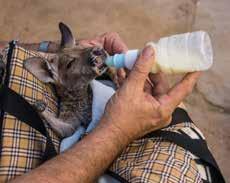
It wasn’t just belief in his products that prompted Nick Vlamis to start his company, Fox Valley Nutrition, Inc., in 1995. It was because the need for his products weren’t being filled anywhere else. Since the very beginning Nick has valued every customer, particularly the four-legged ones, by producing milk replacers, supplements and feeding supplies for young wildlife, domestic and exotic animals. Since founding his company, Nick has been helping orphaned neonates maximize their health, growth and performance potential through species-specific milk replacers and supplements. “It’s a blessing for all the animals that we save,” Nick said. “It makes it much less about making money and more about gratification. My customers are not just an invoice. And the quality of our products has never been compromised.”
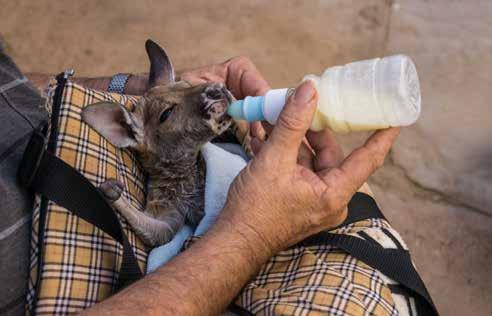
Fox Valley, headquartered in Huntley, Illinois, sells their products in the U.S.A., Canada, Australia, Costa Rica, The Netherlands, Germany, Italy, Spain and also in the United Kingdom. They specialize in species-specific milk replacers, made with the finest raw ingredients available, to create the same composition found in natural milk. To date, more than 60 different types of milk replacers are offered to various species ranging from whitetail deer fawns, elk, moose, kittens, puppies, goats, cows, llamas, wallabies, raccoon, shrew and baby humpback whales among many others. In starting Fox Valley, Nick knew he’d be successful because “no one else had anything species-specific. Back then a raccoon would fall under feline. Everyone was taking existing puppy or kitten formulas and trying to make it work for other animals,” he said. “However, if you have a formula as close as possible to the actual animal you have, it can cause better health and greater
performance. Anything less can result in feeding problems and other issues.”
Not only do Fox Valley’s milk replacers aid in the overall health of each neonate, but their supplements do also, as they are formulated to combat dehydration, diarrhea and disturbed intestinal flora. “I got my start at a National Wildlife Rehabilitators Association conference,” Nick explained. “We were always finding orphaned fawns. I let them have free field trails of my formulas. They saw it worked and had great trust in it, making me believe I was on the right track.” Customers also trust that should they call Nick with questions, he will make every effort to speak to them directly. He has spent immense time promoting his products to veterinarians, colleges, conferences, trade shows and other venues. He knows the results speak for themselves, yet finds great joy when customers write or call to express their gratitude. Nick also feels great gratitude for his employees Walter Amador, Chris and Heather Vlamis as well as Tyler Eldrup and Jonathan Cielo. Amador’s scientific background is key to carefully blending all product nutritional ingredients
to “spec.” Nick’s son Chris manages key components in the development and distribution of products, while Heather’s (Nick’s daughter-in-law) computer knowledge and synergistic personality greatly assists in customer service through phone orders and in creating an effective website. Nick is also very grateful to Tyler Eldrup and Jonathan Cielo who oversee the packing and shipping of products.
“We have the best wildlife milk replacer available,” Nick said. “The products are easy to mix and have an 18-month shelf life. They also come in convenient sizes in sturdy, reusable plastic buckets and have been thoroughly field-tested by rehabilitators.” Should product prices ever increase, Nick will always explain the reason to his customers. “I will not substitute a cheaper product to make a buck,” he said. “I will always offer the same high-quality products I have stood behind since day one. I believe Fox Valley Nutrition is the Cadillac of neonatal formulations. We strive to be a growing world-class manufacturing organization that responds to customer-driven demands while consistently exceeding expectations.”
e most widely used MK™ kit on the market. is formulation contains higher concentrations of active ingredients than the original MK™ kit, allowing for lower dose volumes and the use of a smaller dart, resulting in improved accuracy during capture.
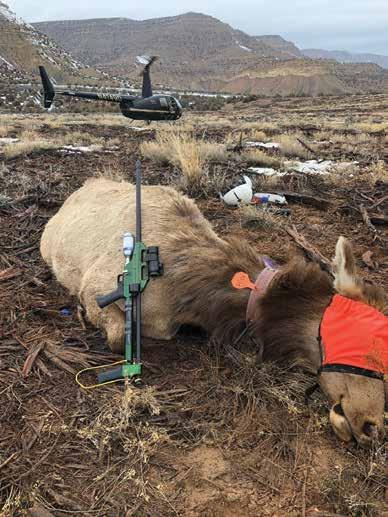
Developed by a zoo veterinarian to allow wildlife handlers to induce a reversible sedation with smooth induction and faster reversal. Recommended for procedures or sedation scenarios under 15-20 minutes.
Contains higher concentrations of active ingredients than the MKB Kit, allowing for lower dose volumes and a smaller dart to improve accuracy during capture. Recommended for super exotics and large cervids that may be more diffi cult to sedate.
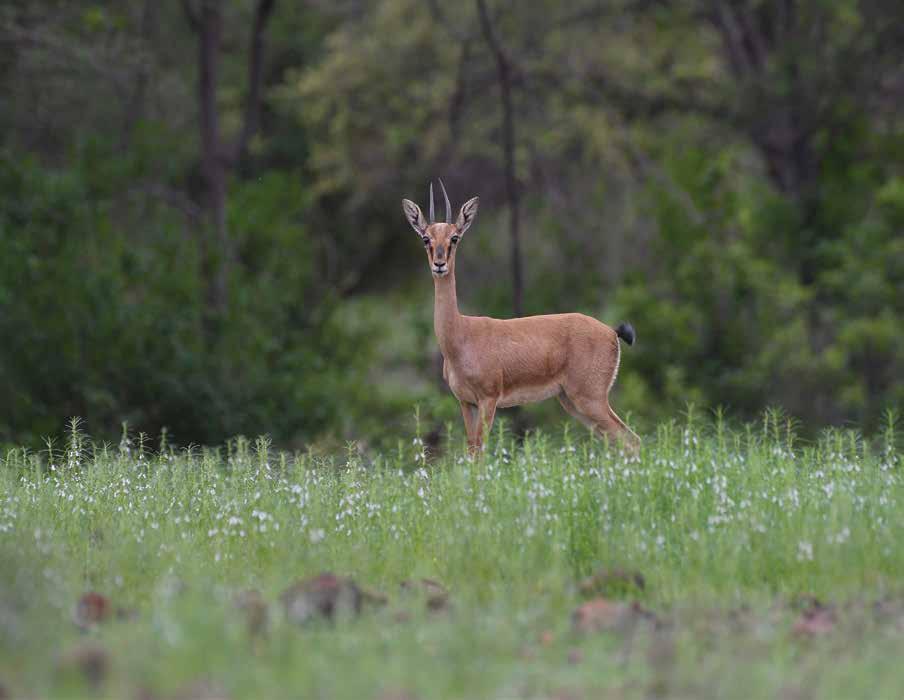
is kit builds on our MKB™ formulation by adding midazolam for superior muscle relaxation and more reliable sedation. Recommended for immobilizing large exotic hoofstock species, including bongo, kudu, gazelle, eland, other African hoofstock and certain domestic wildlife species.
WHAT TO EXPECT IN CONGRESS IN 2026
This year, Congress and the administration will face several major deadlines and policy decisions that are expected to shape the legislative agenda. Lawmakers will work to avoid another government shutdown while attempting to advance unfinished priorities, including full-year appropriations and reauthorization of the farm bill. At the same time, trade policy, court rulings, and the upcoming midterm elections are expected to influence both congressional activity and the broader political environment.
Appropriations
Congress must pass full-year spending bills or a short-term funding extension before January 30 in order to prevent another government shutdown. Neither the Democrats or Republicans are understood to want a repeat of last year’s shutdown, which was the longest in history. As of the week of January 5th, the Agriculture-FDA, Legislative Branch, Military ConstructionVeterans Affairs appropriations packages have been enacted through the Continuing Resolution which brought an end to last year’s shutdown. Congress has introduced appropriations bills for Commerce-Justice-Science, Energy and Water, and Interior-Environment which are expected to be passed by Congress before the January 30 deadline. No agreement has been reached on other appropriations measures.
Farm Bill
Agriculture Committees in both the House and the Senate will attempt to pass a five-year farm bill after the 2018 bill expired in 2023. While many policies that the farm bill provides have been continued through short-term extensions and the One Big Beautiful Bill Act, lasting updates to conservation, forestry, rural development, and the farm safety net were not extended. Senate Agriculture Chair John Boozman (R-AK) is committed to advancing a bill which includes increasing the limits on federally backed farm loans. However, there are concerns about staffing shortages at the Department of Agriculture after their workforce was cut by several thousand people last year.
In July, the United States-Mexico-Canada Agreement is up for review. President Trump has indicated that he may pull out of the $1.5 trillion trade agreement rather than extend it for another 16 years. However, the agreement has been credited with protecting consumers from rising prices amid the President’s tariff regime, meaning the administration may choose to maintain the U.S.’ participation in the pact.
Tariffs
The Supreme Court will also issue a ruling on President Trump’s tariff policies by June at the latest. The court will issue a ruling on President Trump’s use of the International Emergency Economic
Powers Act to set 10-50 percent tariffs on most imports as well as duties on Mexico, Canada, and China to address fentanyl trafficking. Midterm Elections
In November, Republicans will seek to maintain control of both the House of Representatives and the Senate in the midterms. Democrats are unlikely to win the 4 seats they need to take control of the Senate. However, Republicans have a very thin majority in the House, so Democrats are widely expected to win control of that chamber. As a result, Minority Leader Hakeem Jeffries (D-NY) is anticipated to become the House Speaker after the elections. In order to secure this victory, Democrats are expected to continue to campaign on affordability, how tariffs affect affordability, and the release of the Epstein Files.
Congressional Maps
The congressional map may be reshaped before the November midterm elections. After Texas began a redistricting effort to secure 5 extra Republican seats, states across the country have redrawn their maps. Republicans in Florida and Kansas as well as Democrats in Virginia, Illinois, and Maryland will continue the redistricting effort this year ahead of the elections.
Overall, the year ahead is expected to be defined by shortterm legislative solutions, election-year politics, and movement around trade and economic policy. While Congress is likely to move forward on must-pass items such as appropriations, progress on longer-term priorities may take a back seat. With the midterm elections approaching and potential changes to congressional maps, political considerations are expected to play a significant role in shaping outcomes across policy areas.
By: Gail Veley • Sponsored by the New York Deer and Elk Farmers Association
Understanding your end market and determining hunting ranch demand is perhaps the most important factor in your longevity as a deer farmer, offers Dave Vanderzee, President of The New York Deer and Elk Farmers Association. “I think whenever there is a learning curve, the most successful people can see things three plays ahead,” he said. “If you can determine or predict the trends in what hunters are demanding, you can be more ready to meet those demands.”
While the industry from its inception has always catered to producing clean and classical typical whitetails, nontypical whitetails began to take center stage in the early 2,000’s when ranches adopted Safari Club International scoring methods. “The farmer learned they were going to get paid by the inch,” Vanderzee explained. “And farmers wanted to add more mass based on SCI scores. They added lots of drop tines and started this quest to stray away from the typical frame. The buck Free Agent, a very large nontypical, was one of the first ‘blow up’ deer. You could breed pretty much anything to him and those deer would grow substantial mass. We were all encouraged to do this.”
Consequently, there was a massive production of ‘Christmas tree’ looking whitetails. “The farmers and
hunters were quite happy with these very unique and different looking deer,” Vanderzee said. “Different from what they would ever see in the woods. Until, that is, the marketplace got saturated. All of a sudden, a deer magazine called ‘Typical’ was getting published alongside magazines about nontypicals. The average hunter came to realize this was the style that was coming off of hunting ranches. And a traditional hunting ranch patron may like one or two of them, but not a whole wall.”
As close to two decades of breeding nontypicals continued on, Vanderzee believes those deer farmers who actually never deviated from raising typical deer, actually came out ahead. “Like with any fashion or trend, it goes back to basics at some point,” he said. “The deer farmer was a victim of his own success. Everybody was producing bigger deer and even though they should get extra money for them, everybody had them. Additionally, bucks can really fight at that size and do a lot of damage. If you don’t sell them off by November 5th you’ve got a big problem.” As issues such as these became more at the forefront of production, the trend began to shift back to the look of a clean typical, Vanderzee added. However, several end market venues still exist for deer of all shapes and sizes including disabled veteran’s hunts, children’s hunts or first-timers. “As
things have changed the people that are still in it, are really in it, and have increased their herd size in response to catering to market trends. Having closed borders here is New York as well as in other states, we, like other farmers, have to export or grow our own making it a little more challenging.”
Nonetheless, adapting to changing trends while making a profit could come down to avoiding the Law of Diminishing Returns (which states that increasing a single factor of production while holding all other factors constant will eventually lead to a decrease in output) as well as practicing a few simple rules. “At a bare minimum join your state deer association and be known,” Vanderzee said. “Don’t be a secret. And form an alliance or relationship with local farmers or preserves where transport would be cheaper when it comes time to sell and ship deer. Pool resources with trailers. Rent or buy a timeshare or trade it for fencing or barter in some manner. These may be ways to increase your profit line or provide a financial cushion while you determine where your next steps lie with production.”
FREE business card ads for members of MO, KS and OK Associations
If you would like your farm or business featured on our business card pages, email digital pdf file or scanned image (must be readable resolution) of your business card to:
Meagan Lewis for Oklahoma members: mjlewis2020@icloud.com
Karla Kretschmer for Kansas and Missouri members: karlakretschmer@outlook.com
This gives Tri-State members a way to reach out to one another for services and to buy or sell deer! There will be limited pages for these cards, the overflow would be placed in the next issue and cards will be rotated each quarter.
If you have any questions please contact Kathy Giesen: 435-817-0150
IF YOU HAVEN’T TRIED PNEU-DART’S RDDS, YOU’RE MISSING MORE THAN YOUR TARGET
Did you know impact trauma can negatively influence medical treatment? We do. Which is why we’ve spent 55+ years perfecting the ideal remote delivery device. Shorter in length and lightest on the market, our disposable RDDs, with patented Slo-Inject ® technology, provide ultimate accuracy while reducing the potential for problematic hematomas. Pneu-Dart. When you can’t afford to miss.®
Science that delivers the health & productivity you require
G
FORC E™
SCIENTIFICALLY FORMULATED NATURAL SUPPLEMENT TO HELP GROW LARGE, HEALTHY DEER AND BIG ANTLERS!
Nutrient rich formula contains highly bioavailable ingredients, including our proprietary calcium/phosphorous complex with Antler D TM, that are required to support body and bone growth, especially for fast growing bucks
Contains probiotics and targeted enzymes to support gut health and proper digestion
Available in pellet or powder that can be top dressed or mixed in feed. Great for antler growing season and young bucks, too
PeaceMaker
PRECISELY FORMULATED TO HELP MAINTAIN A NORMAL AND RELAXED DISPOSITION IN ALL CERVIDS
Provides optimal levels of magnesium, Vitamin B1 and inositol to promote calmness and provide help for restless animals
Contains no herbals, tryptophan or chemicals, eliminating concerns of unwanted side effects
Use PeaceMaker to “keep the peace” during pre-rut, rut, transportation, weaning and anytime destructive behavior may occur
ENTERIC HEALTH FORMULA
POWERFUL SOLUTION FOR HEALTH & PRODUCTIVITY
Helps maintain digestive health and productivity
Contains micro-encapsulated probiotics, targeted enzymes and a novel fiber complex
Use in does before fawning, during lactation and all cervids during times of environmental stress
FAWN ARRIVAL™ POWDER & PASTE
HELPS PRODUCE HEALTHY, FAST GROWING FAWNS
Helps maintain normal digestive health
Supports a healthy immune system
Feed powder for 14 days to bottle fed fawns
Paste is ideal for fawns left on does
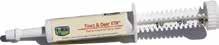
FAWN & DEER XTR™
ROBUST FAST RESPONSE FOR FAWNS & OLDER DEER
Innovative formula delivers max digestive support, especially in newborns
Rapidly delivers help for GI health and a functioning immune system
May also be used post-tranquilization to support healthy recovery
2025 Membership Drive, Featuring 4 Grand Prize Winners!
As most of you know, D&K Design has been at the forefront of overseeing a membership drive for many state deer associations for the past years. As part of servicing 19 states with quarterly publications, we were proud to also offer this service. 2025 we included in our grand prize drawing, donations from each state association. Many of their members stepped up to donate a product or service.
Memberships are collected throughout the year and at events such as NADeFA and Top 30. Each participant that spent over a certain amount on memberships was included in our end of year drawing.
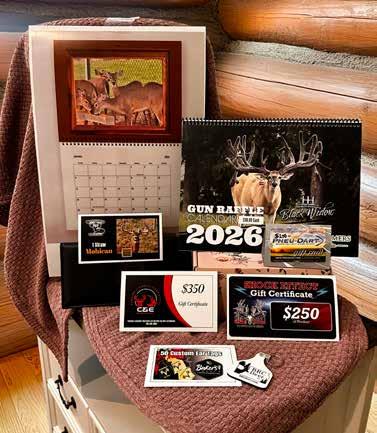
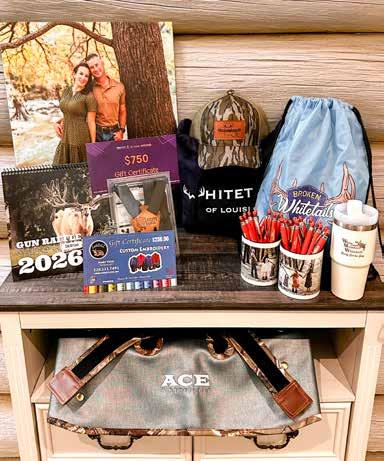
Meryle Frey’s Winnings ~
• $250 Shock Effect Certificate
• 50 Custom Ear Tags
• $350 C&E Solutions certificate
• Legends binocular harness
• Ohio Gun Raffle Calendar
• 10 Personalized calendars
• 1 Straw of Mohican
• $250 Gift Certificate from Pneu-Dart
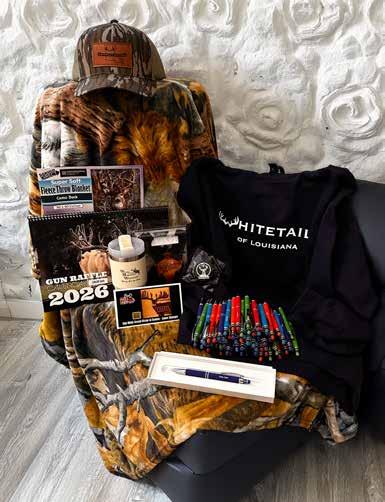
2025 winners included Shane and Jennifer Horrocks of C&E Bio Solutions and Max Rax feed company, Amber Boldt, a loyal D & K Design supporter, James Weaver of Dutch Creek Whitetails in Fredericksburg, Ohio and Meryle Frey from Fish Lake Whitetails in Indiana.
Winners received gifts, valued at over $1,800. which also included certificates for deer industry goods and services.
“I found the semen straw of Cruiser from Rocky Ridge Whitetails to be very worthwhile and appealing,” James Weaver said. “I say YIPPEE! I hope I win again!”
Merle Frey felt that winning for him was a bonus, on top of the fact that he became a member of several state associations. “The items that were in my basket were things I was already using like Shock Effect and products from C & E Bio Solutions,” he said. “I’m also really glad to have gotten a semen straw of Mohican that Woodard Whitetails donated. Being a member of these associations has been worth it even without winning, and I appreciate everyone who donated the items I won.”
Shane and Jennifer Horrocks, huge supporters of each state association, strong advertisers and advocates for state memberships, were equally pleased. “What a great way to have our enthusiasm rewarded by winning a raffle,” Shane said. “Our basket was very thoughtfully hand selected by Kathy and we really appreciated receiving it.”
Amber Boldt, who has gladly pitched in and helped transport D & K Design booth to industry events, was very pleased with her raffle win as well.
This helps keep the momentum going and further fuels my desire to have every state continue to donate items, in an effort to make these raffles one of the most anticipated activities at our events. We sold over $8,000 in memberships total! I appreciate everyone who has donated in the past and plans to donate in the future. Your support will win you recognition throughout the year. Ask me for more details!
MELANISTIC DEER
SHOWING A PRESENCE ON DEER FARMS
By: Gail Veley • Sponsored by the Pennsylvania Deer Farmers Association
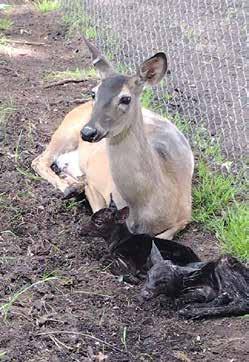
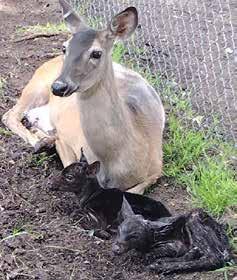
It was a beautiful cool May morning this past spring, when Adam Lindsey casually walked past the pen of a doe who had just given birth at his farm Size Matters Whitetail, in Bronson, Michigan. He glanced over and immediately stopped to refocus on the new fawns, still wet, pure black and glistening, curled up on the ground. Holding his breath, he couldn’t stop staring. Literally blown away that their breeding efforts had come to fruition, he then ran to his wife Ashley to announce the great news. They now had two melanistic fawns, one buck and one doe.
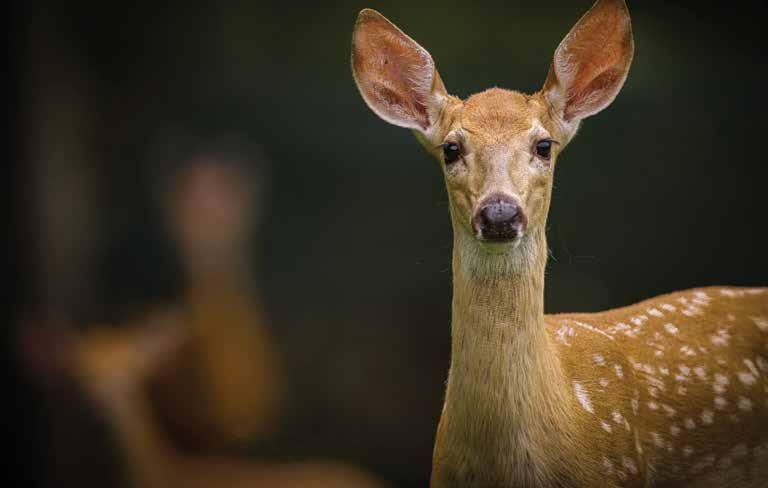
“We were proactively trying and that was our hope and dream to have melanistic fawns,” Lindsey said. “But we’d never had one born before then.” Melanistic deer, first discovered and recorded in 1929, are the rarest known form of whitetail deer. Their morphologically dark bodies contain a high deposition of the dark pigment known as melanin, caused by specialized cells called melanocytes responsible for producing the darker pigmentation. A rare genetic recessive gene mutation can produce a melanistic deer, with a believed average of a one in every 10,000 chance. In addition to melanistic
whitetails, melanistic fallow deer and mule deer have been spotted in the wild. And unlike albino deer, whose life spans tend to be shorter, melanism is not believed to hinder a deer’s lifespan, nor do melanistic deer appear to be more susceptible to typical whitetail ailments.
Melanistic whitetail deer have been found in states such as Mississippi, Michigan, Virginia, Texas, South Carolina and Pennsylvania. In a quest to add to their uniqueness, Mick and Mike Goodman of Goodman’s Whitetail Haven in New Stanton,
Pennsylvania, are creating their own melanistic piebald deer herd.
“I always loved piebald,” Mick said. “About 10 to 12 years I really started pushing them and wanted to breed the melanistic deer into them. After a lot of effort, we now have melanistic piebalds.”
The Goodman’s and Lindsey credit Bob Rosebrock of Rosebrock Whitetails in Lott, Texas for allowing them to follow their dream. Goodman subsequently produced his breeding buck “Black Velvet,” their very first melanistic piebald. While melanistic deer can be every bit as hardy and
substantial in terms of frame as their brown and white pelage counterparts, piebalds can be smaller bodied. Goodman’s future breeding plans include breeding “Outstanding,” one of the top piebalds in the country right now, whose 317” and 7 x 7 typical main frame includes a little extra, in order to continue producing piebalds who are every bit as large and hearty as brown whitetails.
“Looking ahead, I feel the market should be really good for melanistic deer,” Lindsey said. “I have had a lot of interest in people wanting to buy those babies. Both are “SS” with negative GEBV values. That will be a plus side for the industry. But you can’t necessarily get more melanistic deer just from breeding them to those that are melanistic. As we predictably breed, we can increase those chances over time. At our farm, the goal in to breed for 75 percent brown deer and 25 percent melanistic.”
Goodman feels that while the market for melanistic deer has yet to be officially established, it looks very promising. “Never give up on your dreams,” he said. “Although it may be more difficult to produce melanistic deer, we went after what we wanted and are very happy with the results. We look forward to more success.”
HUNTERS – EMBRACING CAMARADERIE, NATURE AND CONSERVATION
By: Gail Veley • Sponsored by UDFOM
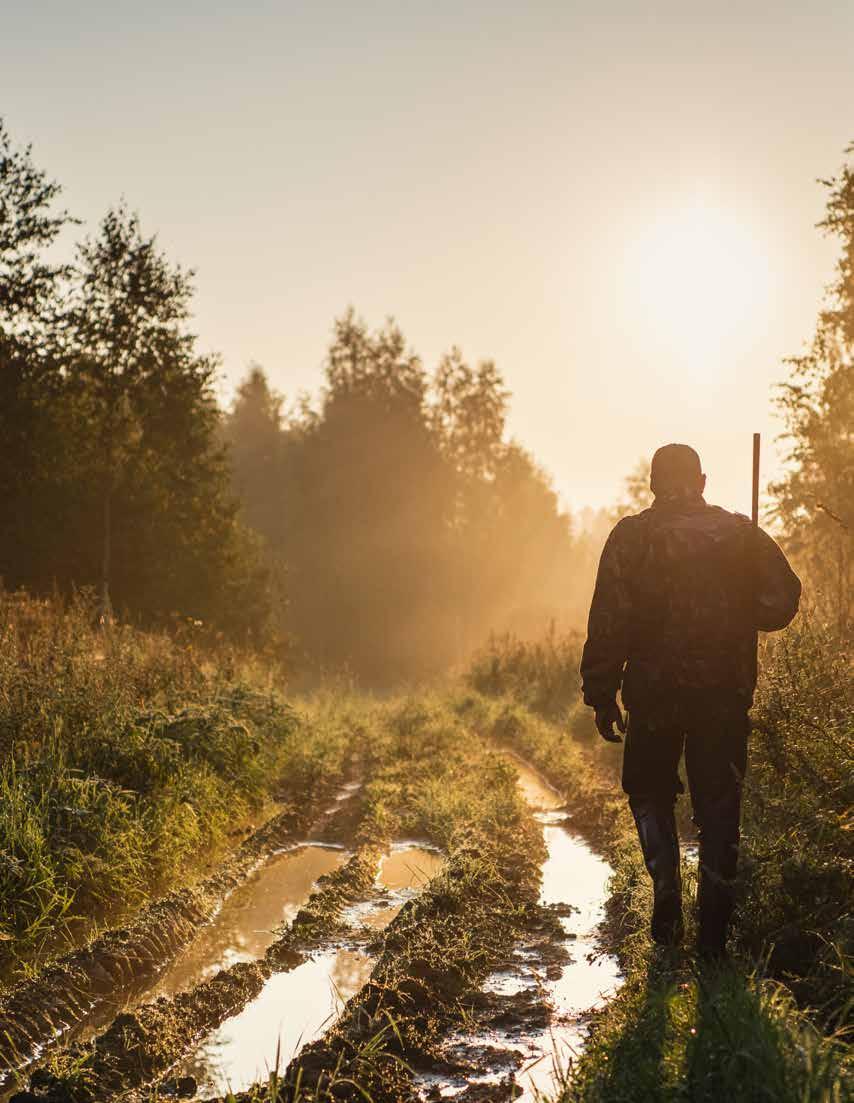
Kenny Brown fixed his rifle scope on the large cat high in a tree. Over the pounding of his own heart, piercing rush of adrenaline and frenzied barking of hounds, he could hear his guide telling him “Take your shot!! Take your shot now!” A twig snapped. He fired. And in an instant the hunter became the hunted as a 163-pound mountain lion came intentionally cascading down on top of the two men. As both jumped and struggled themselves out the way, the cat landed ten feet from them and raced off, it’s now obliterated and bloody paw leaving a trail. “Go! Go,” the guide called out. Brown, then 42, sprinted as fast as his legs could carry him, even falling, knocking the wind out of himself as he traversed back down through the steep snow at 7,000 feet, the same mountain he had just spent the better part of two hours crawling up. Panting hard, he once again found his target, now unable to tree itself yet still in full defense mode. As the dogs circled and barked, the cat lunged, grabbing one dog square on the head. Instantly, another dog bit the cat on the rump, causing it to let go and spin. Brown reacted in the microsecond it took for his finger to pull the trigger. And fired. The cat was down. Done.
Brown, now able to release every bottled-up emotion, cried. Cried from physical pain. From relief. From satisfaction. Satisfaction that was now interrupted by another urgent matter. Romey, the dog seized by the mountain lion, was bleeding badly and needed urgent vet care. “We’ve got to get him to the vet,” the guide said, with a tone far different than the one used earlier to order a gunshot. Brown jumped up, grabbed Romey and literally slid on his buttocks further down the side of the mountain, landing in a creek next to
a road, where vehicles were waiting. Romey survived. It was a welcomed ending to a hunt in St. Mary’s Idaho, that brought two treasures for Brown, a 92-pound gray timber wolf and a mountain lion. The mountain lion was found on a hunch. The timber wolf was found after spotting a moose kill.
“I’ve always been an avid hunter,” Brown said. “Growing up I did rabbit hunts and whitetail hunts and then took a liking to hunting the predator side. I always wanted to shoot a wolf and spent a week in Canada to no avail.” However, Brown’s dream would become reality on that St. Mary’s, Idaho hunt, preceding the mountain lion hunt. On the hunt “this wolf looked right through me. Right through my soul,” Brown recalled of the day he lay in wait, letting out an occasional answered howl that eventually found him able to take successful aim. “While I was in Canada, I learned how to call the wolves and let out a howl,” Brown shared. “I waited ten minutes and howled again. This time, I had a couple howl back at me. And when they wouldn’t howl back and didn’t howl back, I knew they were coming to check me out. They were coming.”
After Brown’s successful wolf harvest, fellow hunters at base camp helped gather up and bring the wolf back. While Brown has yet to ever hunt a wolf or mountain lion again, the memories remain etched in his soul. From the thrill and adrenaline to the camaraderie shared among hunters, this is what drives the sport. This is the very backbone of what hunting preserves provide to those who are also in search of their treasure, just the same way Brown, owner of PR Whitetails in Leslie, Michigan was. “Recently I had the joy of being asked to help cook at Ultimate Whitetails for a large gathering of hunters,” Brown shared. “I’ve always enjoyed cooking. For three days I hung out with guides and got to see the sights. But there was one guy I’ll always remember. He shot a huge nontypical deer. As he’s telling the story he’s got tears in his eyes. I thought to myself ‘that’s awesome.’ This was his life dream. He was thrilled. Here’s an honest hardworking guy able to enjoy the thrill of the hunt and connect with others who share a love of nature. Opportunities like these might only come once in a lifetime. I’m grateful the deer industry can provide that.”
SUDOKU
The rules for sudoku are simple:
A 9x9 square must be filled in with numbers from 1-9 with no repeated numbers in each line, horizontally or vertically.
To challenge you more, there are 3x3 squares marked out in the grid, and each of these squares can’t have any repeat numbers either.
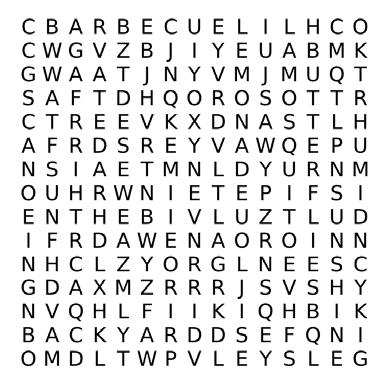
Adventure
Backyard
Barbecue
Butterflies
Canoeing
Festivals
Fireworks
Gardening
Hayride
Trophy Breeder Bucks Showcase Book 2026 Application
Reservation for space and buck info will be due no later than August 12th, 2025. If you have an existing picture ready to go, that will also be due at that time. If you would like to send in a last minute photo of your buck, the cutoff date is September 1st by 8am CST. Placement will be in order of first come first serve. Printing and mailing will start September 4th and be in hand between September 16th20th. Just in time for semen sales getting ready for Breeding Season. These will be mailed to Breeders and Ranch members of the 20 state associations we service.
More information will be mailed out to all current advertisers closer to the date.
Pre-register and we will contact you for further information
PRIME SPOTS WILL BE AUCTIONED
ONLINE AT MCCLUNG SALES: JULY 2026 Name: First
• United Deer Farmers of Michigan
• West Virginia Deer Farmers Association
• Whitetail Deer Farmers of Ohio
• Whitetails of Louisiana
• Whitetails of Oklahoma
Buckaneer
Package: *
44 ISSUES FOR 1 YR.
Reaching out to over 2500 members (11 Publications x 4 quarters)
19 State Associations - Approx. 2500 readers
$200 / Issue ($8815. / Yr) ~ Full Page
$113 / Issue ($4990. / Yr.) ~ Half Page (55-59% Discount off single ad placement)
Yearling Package:
*
4 ISSUES FOR 1 YR.
(1 Publication x 4 quarters)
$267 / Issue ($1069. / Yr) ~ Full Page
Doe-Re-Mi Package:
16 ISSUES FOR 1 YR. (4 Publications of your choice x 4 quarters)
$233 / Issue ($3730. / Yr) ~ Full Page
$128 / Issue ($2052. / Yr.) ~ Half Page (48-54% Discount off single ad placement)
$145 / Issue ($581. / Yr.) ~ Half Page (40-48% Discount off single ad placement)
Magazine ANNUAL
$540 ~ Full Page*
$250 ~ Per Quarter Page
$135 ~ Per Quarter Page - Current Advertiser in quarterly magazines.
$180 ~ Per Quarter Page
- Current Member of any of the Associations we serve
* Must be a current advertiser, limited space available
2026 Membership Application
PLEASE NOTE: If you are a resident of any of these states and required to be an active member, please select the correct level above. If you are not sure of your membership status with a state and you sign up, your payment will cover you for the next year.