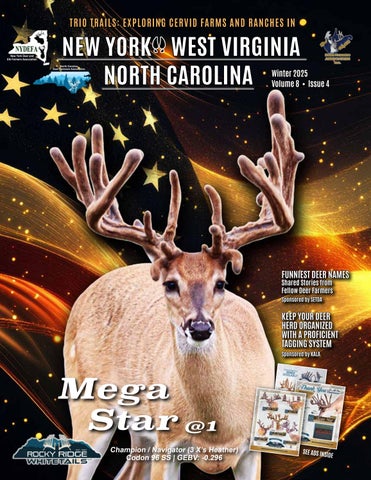
TRIO TRAILS: EXPLORING CERVID FARMS AND RANCHES IN
New York Deer and Elk Farmers Association
NEW YORK WEST VIRGINIA NORTH CAROLINA
Winter 2025 Volume 8 • Issue 4
FUNNIEST DEER NAMES Shared Stories from Fellow Deer Farmers Sponsored by SETDA
KEEP YOUR DEER HERD ORGANIZED WITH A PROFICIENT TAGGING SYSTEM Sponsored by KALA
Mega Star @1 Champion / Navigator (3 X’s Heather) Codon 96 SS | GEBV: -0.296
SEE ADS IN
SIDE
JANUARY 2026 | WINTER
Inside This Issue: 32
23
44
key Mic
Ricochet
Mast e Bake r r
Featured
Content
Your Deer Herd Organized 23 Keep with a Proficient Tagging System
Advertisers Index.................................................. 51 Breeder Buck Showcase..................................... 12 Business Cards............................................... 34, 37
First State to Release 29 Oklahoma Farmed Deer to Combat CWD in Wild Herds
Event Calendar...................................................... 21 Magazine Advertising Information....................... 50 NADEFA Information........................ 16, 17, 24-25 Puzzle Page............................................................ 52 Whitetail Sales & Auction Flyer.............................4
for Fawns in the Spring 32 Caring More than a Labor of Love
44
Funniest Deer Names - Shared Stories from Fellow Deer Farmers
New York Deer and Elk Farmers Association Board of Directors...................................................6 Membership Application.................................... 46 Member Message....................................................9 President’s Message...............................................7 Tax Information and Forms......................... 39-43 North Carolina Deer Farmers Association Note to Members....................................................5 West Virginia Deer Farmers Association Board of Directors ..................................................2 Membership Application.................................... 48 Vice Presiden’t Message........................................3
SPRING DEADLINE MARCH 24TH, 2026
1 11
Board of Directors
Melinda (MJ) Christy
Vice-President Greenbrier Mountain WT’s 360 Rainbow Lane Ashbury, WV 24916 240-695-7730 greenbriermountainwhitetails.com
Bob Perrine Mountain Clean WT’s 421 Buckeye Road Horner, WV 26372 304-452-8689 bob@mountaincleanwhitetails.com
Mark Cobb
Secretary/Treasurer Gobblers Ridge Exotics 215 Eastwood Road Ravenswood, WV 26164 304-532-4514 mark.cobb@gmail.com
Kenny Shoemaker Double K Farm 1985 Wright Farm Road Old Fields, WV 26845 304-538-2219 doublekfarm1@yahoo.com
Andi Manspile S & J Whitetails 2851 James River & Kanawha Turnpike Rainelle, WV 25962 304-222-9914 amanspile@gmail.com
2
Debra Jett Back To Our Roots Wildlife 1549 Grannies Creek Rd Newton, WV 25266 304-553-5208 jettswildlife@gmail.com
Vice President’s Message Wi nte r
2 0 2 5
Greetings Deer Farmers! With the beginning of the new year we are all hopeful for a good start. West Virginia Department of Agriculture still has 59 available tests for DNA and CWD testing available to Class 1 farms. You submit a request for the number of tests you would like to do and the Dept of Agriculture will send you an approval for the amount they can along with a tissue sampling gun and the testing tubes. This is a great thing to do while fawning, as you can create a small hole on the ear from the sampler and put your tags right in the spot. This is a great way to make your does more marketable as you can show their CWD resistance. As a state, it’s time for us to put WV back on the map in the deer farming community nationwide. Keeping up with the national movement of CWD resistant herds is the future. Currently, several states are working to purchase CWD resistant deer to release into the wild providing us with other outlets for sales. This is an area where I feel our state is lacking. I know change and hard and I know many hate the idea of CWD and checking for resistance. Unfortunately, everyone asks now what level of resistance deer have unless they are strictly going to a preserve. Even if your target is preserves, testing for free and finding out of your her has these quality genes does your farm no harm! There is nothing negative about using this free system to see where your farm stands. If you have any questions about this program feel free to reach out to me, Dr Alt or your local inspector. I hate to see the test kits go to waste. Hopefully everyone is getting their winter rest before having to prepare for fawning! Enjoy the down time! Sincerely, MJ Christy Vice President WVDFA Greenbrier Mountain Whitetails
3
4
Member Messages Fa l l
2 0 2 5
North Carolina Deer Farmers Association Interested in reaching out to your fellow members? Feel free to send in short messages, notes on things like fawns, family, or farm life in general! Helpful tips or fun photos are always welcome! Send to deerassociations@gmail.com or call/text Sam Uchytil at 320-905-2622
• Herd Health Consultation • Diagnostic Program • Vaccine Programs
PREPARE FOR FAWNS TODAY!
“PRE-ORDERS” NOW- SAVE $200 PER BOTTLE
AI-1 VACCINE
FULL COVERAGE VACCINE
Pneumonia, Abscess, Foot Rot, Lumpy Jaw, Diarrhea, Scours, Enteric Issues NO BOOSTER NEEDED!
Josh Newton | 484-951-3229 | info@cervidhealth.com | fusionanimalhealth.com 5
Board of Directors New York Deer and Elk Farmers Association
Dave Vanderzee
President Easton View Outfitters 518-210-8889 eastonviewoutfittersllc@gmail.com
Mike Kerry
Four Season Whitetails 315-783-2848 fourseasonwhitetails@hotmail.com
Robert Root
Moriah Elk Farm 607-657-8069 rootnyelk@aol.com
Tom Peryea
518-561-3555 tomselkranch@juno.com
Tim Rater
French Creek Whitetails 716-355-8870 timrater21@gmail.com
Mike Rosenwie
Concord Whitetail Scents 716-912-7314 rosey9473@hotmail.com
Mike Czora
Prime Whitetails 585-330-9100 mike@primewhitetails.com
Wayne Hettenbaugh
Valley View Whitetails NY 716-499-9367 whett6@hotmail.com
Dan Jennings
JB Farms 413-822-1040 dan.jennings02@gmail.com
6
President’s Message Wi nte r
New York Deer and Elk Farmers Association
2 0 2 5
Happy New Year from New York! I hope this message finds you well and that you, your family, and all of your animals are off to a healthy and productive start to the new year. I want to take a moment to share important information regarding a new New York State tax law that may provide a significant financial benefit to eligible deer and elk farmers who have purchased new or used equipment since January 2023. Under New York Tax Law Section 606(a), eligible farmers may qualify for a 20% refundable investment tax credit on qualified farm equipment. To claim this credit, you will need to file Form IT-211-ATT along with Form IT-212. Required information includes a description of the property, its principal use (which for farmers is production), the date the equipment was acquired, and its useful life. If you qualify as an eligible farmer and placed the equipment into service on or after January 1, 2023, you may claim a refund of any unused portion of the credit, rather than carrying it forward to future tax years. An eligible farmer is defined as a taxpayer whose federal gross income from farming equals at least twothirds of their total federal gross income. This total income includes earned income, pension payments (including Social Security), interest, and dividends. Married couples should also note that they may file Married Filing Separately, with one spouse qualifying as the eligible farmer, and still claim the credit. As an example, an eligible farmer who purchases $100,000 worth of qualified equipment could receive a $20,000 refund check from New York State, in addition to claiming standard depreciation deductions on that equipment. I strongly encourage all members to speak with their accountant or tax advisor to determine whether they qualify and to take advantage of this important investment credit. Programs like this are designed to support our farms, strengthen our operations, and encourage continued investment in the future of our industry. Finally, we are in the process of updating the NYDEFA website (nydefa.org). In the near future, members will be able to pay association dues online. If you need to contact us in the meantime, please reach out by email at nydefa18@gmail.com. Wishing you a successful year ahead. Sincerely, David Vanderzee President, NY Deer & Elk Farmers Association
Tax information and forms can be found on pages 39-43. 7
PICTURE PERFECT WHITETAILS
HYPNOTIC G/S VOODOO'S MAGIC 0.00 RENO / BIG BOY
MONEY VOO DOO’S MAGIC G/S SHOT FREEZE FRAME / GXL 0.02
CONTACT
AUSTIN PRADON INFO@PICTUREPERFECTWHITETAILS.COM
HYPNOSIS
HYPNOTIC OFFSPRING
S/S -.148
Member Message Wi nte r
New York Deer and Elk Farmers Association
2 0 2 5
Greetings deer farmers, Welcome to 2026! I wish Gods blessing on everyone and there deer farm this year. There is nothing really exciting happening on my farm right now. I got the pregnancy test results back from my does and did very well on ET. AI wasn’t quite what I wanted to see but not terrible. I lost one of my top pedigreed doe fawns in a wind storm a week ago but like I told Shawn Shafer if I told Eddie Ray how terrible this was he would look at me and say you have no idea what your talking about! I agree we have been super blessed as we haven’t had to deal with EHD like a lot of farms had to. I am excited about attending the upcoming events this winter. First off my dear wife and I have Amtrak tickets to go to the Top 30 auction in Indiana. In February we plan to attend the PA deer farmers breeder and fundraiser auction. Then in March we plan on attending the much anticipated NADEFA convention at the Kalahari resort in Sandusky Ohio. If you have never been there you really need to go its 4 days of deer farming friends, seminars, antler contests, auctions and so much more. If you get overwhelmed you can always use your free pass and try out the indoor water park! You wont see me there as I am scared of water! I am also scared of height so I guess thats why I ended up a deer farmer! NY deer farmers make sure you hand in your annual report to DEC before March 31st. The report year runs from March 1st to Feb 28th. They will no longer send you a notice. NY State Ag & Markets has grant money to pay for NADR testing again. This year they will include test tubes as well. Let me know if you need any more info or forms. With that said if you use and appreciate the money you save with this grant just remember the folks at Ag & Markets didn’t just one day wake up and say ;we need to help the deer farmers with the CWD issue! This was the hard work of a lot of people including NADEFA,Capital Hill Consulting group, and the ones going to the DC fly in including our own Dave Vanderzee and Dan Jennings. If we appreciate the money we save in testing we really should be at the NADEFA convention and show our support. If you cant make it but want to donate something for the fundraiser auction I would be more then happy to take it along. Have a great 2026!! Dana Hoover MountainSide Whitetails
9
Science that delivers the health & productivity you require G FORCE
™
SCIENTIFICALLY FORMULATED NATURAL SUPPLEMENT TO HELP GROW LARGE, HEALTHY DEER AND BIG ANTLERS!
Nutrient rich formula contains highly bioavailable ingredients, including our proprietary calcium/phosphorous complex with Antler D , that are required to support body and bone growth, especially for fast growing bucks Contains probiotics and targeted enzymes to support gut health and proper digestion Available in pellet or powder that can be top dressed or mixed in feed. Great for antler growing season and young bucks, too TM
™
PeaceMaker
™
PRECISELY FORMULATED TO HELP MAINTAIN A NORMAL AND RELAXED DISPOSITION IN ALL CERVIDS Provides optimal levels of magnesium, Vitamin B1 and inositol to promote calmness and provide help for restless animals Contains no herbals, tryptophan or chemicals, eliminating concerns of unwanted side effects Use PeaceMaker to “keep the peace” during pre-rut, rut, transportation, weaning and anytime destructive behavior may occur
ENTERIC HEALTH FORMULA
HELPS PRODUCE HEALTHY, FAST GROWING FAWNS Helps maintain normal digestive health Supports a healthy immune system Feed powder for 14 days to bottle fed fawns Paste is ideal for fawns left on does
™
POWERFUL SOLUTION FOR HEALTH & PRODUCTIVITY Helps maintain digestive health and productivity Contains micro-encapsulated probiotics, targeted enzymes and a novel fiber complex Use in does before fawning, during lactation and all cervids during times of environmental stress
scan to Learn more
FAWN ARRIVAL POWDER & PASTE
FAWN & DEER XTR
ROBUST FAST RESPONSE FOR FAWNS & OLDER DEER Innovative formula delivers max digestive support, especially in newborns Rapidly delivers help for GI health and a functioning immune system May also be used post-tranquilization to support healthy recovery
Science Geared For Deer
H ead G ear LLc 1383 arcadia road , suite 102 / Lancaster , pa 17601 pHone 717-509-5724 www . HeadGearLLc . com
11
Breeder Buck 2025 Showcase Magazine is here! Just in time for semen sales, getting ready for breeding season! We created this magazine in order for 2025 Breeder and Hunting Preserve advertisers to showcase their most recent photos of their bucks close to the last days of antler growth. We realize establishing a collective deadline for all states Fall magazines to publish on the same date to obtain last-minute photos would be impossible to achieve. With this magazine, advertisers have one more chance to showcase their bucks.
Scan QR Code to View the ~ Thank you to 2025 Magazine! all that participated!
12
13
Dependable Sedation Starts Here Gentle on the animal and trusted by veterinarians, handlers and owners for every species or procedure
MKB2™ Kit MK2™ Kit
PROPRIETARY FORMULA
PROPRIETARY FORMULA
(Medetomidine/Ketamine/Butorphanol 20/100/50 mg/mL + Atipamezole 40mg/mL + Naltrexone 50mg/mL)
(Medetomidine/Ketamine 10/200 mg/mL + 2X Atipamezole 20mg/mL)
Th e most widely used MK™ kit on the market. Th is formulation contains higher concentrations of active ingredients than the original MK™ kit, allowing for lower dose volumes and the use of a smaller dart, resulting in improved accuracy during capture.
MKB™ Kit
PROPRIETARY FORMULA
Contains higher concentrations of active ingredients than the MKB Kit, allowing for lower dose volumes and a smaller dart to improve accuracy during capture. Recommended for super exotics and large cervids that may be more diffi cult to sedate.
MKBM™ Kit
PROPRIETARY FORMULA
(Medetomidine/Ketamine/Butorphanol/Midazolam 20/100/30/20 mg/mL + Atipamezole 40mg/mL + Naltrexone 50mg/mL)
(Medetomidine/Ketamine/Butorphanol 10/50/25 mg/mL + Atipamezole 20mg/mL + Naltrexone 25mg/mL)
Developed by a zoo veterinarian to allow wildlife handlers to induce a reversible sedation with smooth induction and faster reversal. Recommended for procedures or sedation scenarios under 15-20 minutes.
Th is kit builds on our MKB™ formulation by adding midazolam for superior muscle relaxation and more reliable sedation. Recommended for immobilizing large exotic hoofstock species, including bongo, kudu, gazelle, eland, other African hoofstock and certain domestic wildlife species.
Get in Touch TEXT / CALL
WEBSITE
(940) 373-7171
wildlife@mixlab.com
www.mixlab.com
LEARN MORE
The information in this advertisement is general and provided as an informational aid. It does not cover all possible uses, actions, precautions, side effects, or interactions of the medications shown, nor is it intended as medical advice or for evaluating the risks and benefits of any medication. Consult your veterinarian for diagnosis and treatment of health problems. The information and statements here have not been evaluated by the Food and Drug Administration (FDA), and the FDA has not approved these medications to diagnose, cure, or prevent disease. Medications compounded by Mixlab are prepared at the direction of a veterinarian and are not intended for use in food or food-producing animals. Mixlab does not recommend, endorse, or represent the efficacy, appropriateness, or suitability of any dosing, products, procedures, treatments, services, opinions, veterinary providers, or other information contained in this advertisement. Mixlab is not responsible or liable for any advice, course of treatment, diagnosis, or other information, services, or products obtained through this advertisement.
14
14
S/S -0.170879 HWR THE GENERAL / XX TRIPLE OUGHT / BAMBI 727 / DR. D
ALCRAZ CATLIN DUTSCHMANN | (254) 644 - 8094 | CATLIN@HATADARANCH.COM
15
16
Phone: 330.454.3944
Email: info@nadefa.org 17
Limited INTRODUCTORY Offer!
USDA 840 Microchip
This new reader will be your favorite time saver ever! Memory stores in the 10’s of millions of events, plus so much more ….
Avid MiniTracker IV
877- 330- EZID (3943) Sales@EZidAvid.com http://shop.ezidavid.com www.EZidAvid.com
STRAIGHT SHOOTER GAME FENCING
18
Services Provided
Material Sales
Installing Peace of Mind ... One Job at a Time
< Enclosures < Breeder Pens < Predator Wire < Shade Cloth < Custom Gates < Clearing < Water Gaps < Agriculture Fence < Lifetime Workmanship Warranty
< All Net Fence < Gates
3527 Blue Road, Tuscumbia, AL 35674
< Galv. Pipe & T-Post < Fence Tools
(256) 381.2675
FREE CONSULTATION
www.ssgamefence.com
USE PROMO CODE
TRYDEERDOC25
FOR 20% OFF YOUR ORDER
HIMALAYAN SALT LICK NATURAL MINERAL ROCK SALT 4636 BIT & SPUR RD. MOBILE, AL. 36608 (866) 333-7362 // DEERDOC.NET
WWW.DEERDOC.NET // (866) 333-7362 20
INGREDIENTS: 100% ROCK SALT ANALYTICAL CONSTITUENTS: SODIUM 34.5% PACK WT: APPX 3-3.5KG
Upcoming Whitetail and Cervid Events Tri-State Associations Magazine Deadlines 2026 Spring: March 24th Summer: June 23rd Fall: September 29th Winter: December 29th Northern Top 30 - Jan 14-16, 2026 - Shipshewanna, IN Illinois Deer Farmers Association Fundraiser - Feb 20-21, 2026 - Altamont, IL Alabama Deer Association Spring Auction - Feb 21, 2026 - Cullman, AL Iowa Whitetail Deer Association Winter Banquet - Feb 21, 2026 - Timberghost Ranch Lodge Kansas Deer & Elk Association Convention - Feb 28, 2026 United Deer Farmes of Michigan Annual Convention - March 6-7, 2026, Bath Township, Michigan Southeast Trophy Deer Association Spring Fling - March 6-7, 2026 - Orlando, FL Whitetails of Wisconsin Annual Banquet & Fundraiser - March 13-14, 2026 - Wisconsin Dells, WI NADeFA Spring Open - March 20, 2026 - Sandusky, OH KALA Summer Showcase - Aug 8, 2026 Whitetail Deer Farmers of Ohio Convention - Aug 13-14, 2026 Southern Top 30 - Aug 20-21, 2026 - Louisiana TDA Annual Convention - Aug 28-29, 2026 - San Antonio, TX
Use this QR Code or go online to DeerSites.com for more deadlines and up to date event information!
Provided by D&K Design, Publisher for State Association Magazine VISIT OUR WEBSITE FOR MORE EVENT DETAILS: DEERSITES.COM
21
21 21
KEEP YOUR DEER HERD ORGANIZED WITH A PROFICIENT TAGGING SYSTEM By: Gail Veley • Sponsored by The Kentucky Alternative Livestock Association
As your deer herd grows in number, it becomes increasingly more important to keep them organized through the use of ear tags. In a farm setting, ear tags are typically used to help monitor disease, maintain accurate health, movement and sale records, establish potential research protocols and breeding programs. Using specific colored and numbered ear tags could also “help you keep track of which bucks your deer were produced from,” offers Dustin Blosser, manager since 2021 of Woodard Whitetails in Glasgow, Kentucky. “It’s also a very good way to make sure age classes are in order. While each farm has different ways of doing it, it’s important that it’s done accurately.”
makes going through your inventory and finding a deer much faster and easier, Blosser, 26, said. “You don’t realize at first how you might start memorizing tag numbers and which deer are which. Someone rattled off “4012” and I knew what pen this doe was in, and who her parents were right off the top of my head.”
Assessing accurate population trends, survival rates and utilizing proficient management strategies can be several reasons wildlife agencies use ear tags. Tags can come in the form of metal, plastic, scanned electronic identification (EID) tags or even Passive Integrated Transponder (PIT) microchip tags. PIT tags, commonly used by various wildlife agencies, are transplanted under the skin and only activated when a deer passes close by to a specialized antenna and later, accounted for via computer records.
With fawns, smaller, temporary tags are typically attached and subsequently changed out after two months of age for an official farm tag. Blosser recommends using an ear tag clearly visible to the naked eye which can be read in a mere few seconds if necessary. “With our farm tags, the color changes to coincide with the year they were born. We have their number on one side and put our farm name and the sire and dam’s name on the other side. It’s good for farm tours and in letting people know right away about their pedigree. We also use four digits. Tags used this year start with “4” which stands for 2024. With our bucks we put a “B” at the end of the number and attach the tag in their right ear and attach the doe tags in the left ear. It’s really important to pay attention to whether it’s a buck or doe when you’re tagging. Seems like every year we have an intern that gets one or two wrong.”
However, deer farmers rely on easyto-read highly visible ear tags as it
Rather than just using numbers, ear tags are also available with letters
that (given there are 26 letters in the alphabet) can span over a much longer interval of time compared to numbers. Each farm ear tag should also be accompanied by a mandatory state “premise I.D.” Department of Agriculture tag. Although both can be placed in the same ear, Blosser recommends putting them in opposite ears to avoid potentially losing both should an ear, for example, get stuck in a fence. Likewise, it’s important to invest in fade resistant and very thick durable tags, as deer tend to chew on them. Adding more minerals to their feed is thought to help prevent this from happening, according to research. Ultimately, an ear tag could help a hunter make a split-second decision, as farm tags get replaced with preserve tags when stocker deer are sold. “If you know what a certain color tag costs, then you can be better prepared when that perfect buck shows up,” Blosser said. “You have the ability to make that splitsecond decision, if need be, and take home the trophy you’ve always wanted.”
23
2025 N
Scan the QR code to see 2026 event details
24
See you a
NADeFA Convention Photos
at the 2026 Convention!
25
26
28
OKLAHOMA FIRST STATE TO RELEASE FARMED DEER TO COMBAT CWD IN WILD HERDS
D
By: Tim Condict • Sponsored by Whitetails of Oklahoma
uring the last legislative session in Oklahoma, Representative Nick Archer introduced House Bill 3462 called The Chronic Wasting Disease Genetic Improvement Act, and Senator Grant Green carried the legislation in the Senate. HB3462 is designed to address the urgent threat posed by Chronic Wasting Disease (CWD) to our Oklahoma native deer population. With leveraging groundbreaking research, including that of Dr. Chris Seabury, this legislation proposes a scientifically informed, innovative approach to enhance the genetic resilience of our native deer against CWD. HB3462 also represents a proactive, comprehensive strategy to mitigate the impact of CWD, by establishing a pilot program focused on genetic improvement and resistance breeding within our states whitetail population. This pilot program is based on many years of genetic research targeting the SS allele at codon 96, which is associated with reducing the susceptibility to CWD. It is widely known that combining Dr. Seabury’s genomic estimated breeding values (GEBV’s) with the SS allele, builds the most durable and CWD resistant deer possible. This research underpins the bill’s strategy of utilizing CWD genetically durable deer to bolster the durability of Oklahoma’s native deer population against CWD. The Legislature required the rules to be prepared by November 1st of 2024, through the Oklahoma Department of Agriculture working together with the Oklahoma deer industry and the Oklahoma Department of Wildlife. The Oklahoma Department of Wildlife was also required to gather 1,000 whitetail deer DNA tissue samples from across the different deer zones throughout
Oklahoma to establish a baseline. This type of bill needs to be passed across the country. The only reason any agency or association might oppose this type of legislation is because they know it will work. I believe they fear our research efforts will lead to the end of their CWD slush fund and expose state wildlife agencies across the country for culling valuable multi-million dollar farmed deer herds, destroying the farmers income and dreams. I think it’s past time to get started on working to pass this in your own state by attending the Leadership Meeting on Saturday afternoon February 8th, 2025, at the Whitetails of Oklahoma Convention and Southern Top 30 Auction.
The following is an outline of how our program works:
35:15-44-22. Chronic Wasting Disease Genetic Improvement Program (CWDGIP) (a) The CWDGIP is only available to whitetailed deer producers who are Oklahoma Farmed Cervidae licensees. (b) Producers choosing to participate in the CWDGIP shall register with the Animal Industry Services Division (AIS) of Oklahoma Department of Agriculture, Food, and Forestry (ODAFF or The Department) and remit a fee of $100 per year, payable no later than January 1. (1) A late fee of $100 will be assessed for payment after February 1. (c) An inventory of all participating deer shall be submitted to AIS at the time of registration. (1) Participating deer shall be identified with an official USDA ear tag.
(2) Genetic testing information for the individual deer shall be submitted at the time of registration. (3) Details of the alleles at Codon 96 and the Genetically Estimated Breeding Value (GEBV) of offspring of participating does shall be submitted to AIS upon receipt of the testing results. (d) Beginning February 1, 2026 and ending April 15, 2026, white-tailed deer does of any age and bucks that are less than 24 months of age, born and raised in Oklahoma by registered CWDGIP producers may be released onto private land pursuant to the landowner meeting the requirements of Oklahoma Department of Wildlife Conservation regulations as outlined in Section 1. (1) White-tailed deer shall be released only if: (A) Their genetic testing proves they have the SS allele at Codon 96. (B) Their GEBV is at or below -0.0560. (C) They are identified with one (1) orange bangle ear tag in each ear that is at least 2” X 1 5/8” in size and the previously applied USDA official ear tag shall remain in place. (2) The White-tailed deer that meet the genetic traits in (1) of this section may be released during the same time frame in subsequent years.
“
Watch for more updates to come on the CWD Genetic Improvement Program
29
30
31
CARING FOR FAWNS IN THE SPRING MORE THAN A LABOR OF LOVE
E
By: Gail Veley • Sponsored by The Pennsylvania Deer Farmers Association
arly on in the start of each new year, Amy Stefanowicz takes inventory of everything she’ll need for the upcoming spring. Fawning season and the expectation of 54 fawns might be a few months away, but then again, it’s as though it’s right around the corner. Bottles, nipples. Check. Fawn paste, probiotics, goat’s milk, puppy training pads, cleaning supplies. Check, check, check. Known for her expertise in successfully raising calm and well-acclimated deer, Amy and her husband Jason of Awesome Whitetails in Middlebury, Pennsylvania may have the science of raising fawns perfected as this year marks their fifth season. In addition to meticulously managing a fawn’s health and immune system, Amy believes acclimating them to outside stimulus is just as important. Given that deer generally become comfortable with specific individuals, she plays a radio 24/7 inside the barn to get them used to strange noises and voices. “I’ve found this really helps them to not overreact if someone new comes around,” Amy said.
32
However, the most pressing initial issue is a fawn’s intake of colostrum within 12 hours of birth. Good, diligent mamas and babies that latch on pave the way for the next steps Amy takes. After each doe fawn (and struggling buck fawn) intakes sufficient colostrum, they are pulled and moved into a fawn facility where they spend up to three weeks isolated inside a 2 x 3 feet durable polymer box complete with drainable rubber (piglet) flooring, allowing urine and droppings to fall into a black tray beneath the flooring, covered by a puppy pad. Unlike wood that may allow germs to soak in and remain active and risky, Amy knows plastic does not do that and is much easier to clean. This can ensure a healthier fawn, one that will be introduced to other healthy fawns. Sometimes fawns may need more intensive care and if so, may spend time in a bedroom or dog crate inside the house, until they are strong and healthy enough to be in the official fawn barn. Building up their strength and immunities also involves the careful administration of vaccines, so as to not puncture their fragile skin. Next, ear tags are attached and microchips inserted. Inside each 2 x 3 fawn box Amy also places a small bowl of natural dirt to softly and safely introduce them to their eventual life outside in the deer pens, which usually occurs after week three. “Unless you have a jumper,” Amy, 46, explained. “They might need to go outside sooner.”
Amy’s bottle-feeding regimen includes a combination of goat’s milk and red cap milk, given at 6 a.m., 2 p.m. and 9 p.m. for four weeks, followed by two feedings from week five until week nine, when henceforth bottles are offered merely once a day. After 13 weeks, fawns fully transition to solid food and water. Through this micro-management system, Amy has gained a reputation as being somewhat of an expert on the process of raising healthy, calm and well-acclimated deer. Her advice has even been sought out by numerous others in the industry. “Jason and I just firmly believe in our process,” Amy said. “We feel it’s worth it in the long run and have found our deer are more ready to face whatever may come as they grow into healthy mature adults.”
FREE business card ads for members of NYDEFA, WVDFA, and NCDFA If you would like your farm or business featured on our business card pages, email digital pdf file or scanned image (must be readable resolution) of your business card to the email address below. This gives NYDEFA & WVDFA members a way to reach out to one another for services and to buy or sell deer! There will be limited pages for these card spreads, first come first serve. The overflow would be placed in the next issue and cards will be rotated each quarter. NY Email to: dana@abcmailbox.net or call Dana at: 315-595-2202
NC Email to: Brian Pierson at: brypierson88@gmail.com
WV Email to: mark.cobb@gmail.com or call Mark at: 304-532-4514
Your Business Card HERE! 34
35
36
Dana & Ella Hoover 4456 Champlin Rd. Penn Yan, NY 14527 P 315.595.2202 F 315.595.8863 dana@ibyfax.com Raising Quality Whitetails Bucks, Does, & Fawns For Sale
37
512-920-4757
orders@WildlifeCaptureEquipment.com
979-203-6735
info@DanInjectDartGuns.com
Let our 25+ years of experience in the field be yours
HUMANE DARTS
Side-Ported Needles Re-Usable!
NET GUNS & NETS
38
CARRY RUGS
Use as close as 1 yard! Lightweight! Virtually Silent! Low Maintenance
PISTOLS Great For Short Range Shots!
BLOWPIPES
HOODS AND MASKS
C02 DART GUNS
Made of Aluminum Won’t Bend or Break!
JAB STICKS
Fully Automatic. Liquid Releases within 1-1.5 seconds!
Department of Taxation and Finance
Instructions for Form IT-211 Special Depreciation Schedule See the instructions for your tax return for the Privacy notification or if you need help contacting the Tax Department.
General instructions
In lieu of the deduction for depreciation allowable for federal income tax purposes, an individual, partnership, estate or trust may, in accordance with section 612(g) of the Tax Law, elect to deduct special depreciation. This deduction shall not be in excess of twice that allowed for federal purposes on qualifying property acquired before 1969. Special depreciation is defined below. The deduction for special depreciation has been discontinued for property acquired after December 31, 1968, except in certain cases where qualified property was acquired after that date under a bona fide plan, contract, order, or other binding commitment in effect on December 31, 1968, or where physical construction of the property began before January 1, 1969. In lieu of this deduction, the taxpayer is allowed an investment credit for taxable years ending after December 31, 1968. If a taxpayer elects to claim the investment credit on qualified property, the taxpayer may not claim the deduction for special depreciation. The investment credit is claimed on Form IT-212, Investment Credit. Use Form IT-212 to claim a manufacturing and production, retail enterprise, waste treatment, pollution control, or research and development investment credit. An election made by an individual, partnership, estate, or trust is binding for all succeeding taxable years unless the Commissioner of Taxation and Finance consents to a change in such election.
Definitions
Special depreciation is the deduction allowed on certain depreciable property newly acquired before 1969, not to exceed twice the amount of federal depreciation allowed on the same item of qualified property (see Classification of property below and on page 2). Any amount for depreciation or amortization that was excluded or deducted on the item of property in arriving at your federal adjusted gross income must be added back to federal adjusted gross income in figuring New York adjusted gross income. For taxable years beginning on or after January 1, 1968, no deduction for depreciation will be allowed for the portion of tangible personal property that is rented or leased to another person or corporation.
IT-211-I (8/15)
Qualifying property is tangible property that: – is depreciable pursuant to section 167 of the Internal Revenue Code (IRC); and – has situs in New York; and – is used in the taxpayer’s trade or business and: • if constructed, reconstructed or erected by the taxpayer, was completed after December 31, 1963 (and then only with respect to that portion of the basis thereof or the expenditures relating thereto that is properly attributable to such construction, reconstruction or erection after December 31, 1963); or • if purchased by the taxpayer, was acquired in a transaction (which constitutes a purchase as defined in section 179(d) of the IRC) consummated after December 31, 1963, provided the original use of the property commenced with the taxpayer, in New York State, after December 31, 1963. A trade or business is any activity producing income that would have been subject to the unincorporated business tax under former Article 23 of the Tax Law, or that would have been subject to such tax except for the practice of certain professions as described under section 703(c) of the Tax Law, if such tax were imposed for the taxable year. Qualifying property is used in the trade or business when it is utilized in the actual course of the regular business operations of the taxpayer. The holding of property for investment purposes does not constitute the use of property in a trade or business.
Classification of property
Class A property is: – property whose original use began in New York State by the taxpayer after December 31, 1963; or – property acquired, constructed, reconstructed, or erected after December 31, 1963, by a contract that was, on or before December 31, 1967, and at all times thereafter, binding on the taxpayer; or – property whose physical construction, reconstruction, or erection began on or before December 31, 1967, or if begun after that date by an order or an order by purchase as defined by section 179(d) of the IRC placed on or before December 31, 1967; or – property acquired, constructed, reconstructed, or erected after December 31, 1967, under a plan of the taxpayer that was in existence on December 31, 1967, and not substantially changed and such acquisition, construction, reconstruction, or erection would qualify under section 48(h) paragraphs (4), (5) or (6) of the IRC.
39
Page 2 of 3
IT-211-I (8/15)
Classification of property (continued) This deduction is allowed only if the tangible property was delivered or the construction, reconstruction, or erection was completed on or before December 31, 1969. Class B property is property acquired, constructed, reconstructed, or erected on or after January 1, 1968, under the same conditions as Class A property, except that the elective deduction for special depreciation will be allowed only on property that is principally used by the taxpayer in the production of goods by manufacturing and certain other similar processes and activities as defined under section 612(g)(4) of the Tax Law. Note: For any taxable period beginning on or after January 1, 1968, the deduction for special depreciation with respect to tangible property leased or rented to any person or corporation will not be allowed.
Limitation on amount of deduction
– For Class A and B property, the total of all deductions in any taxable year(s) may not exceed the cost or other basis of the property for federal income tax purposes. – For Class B property used in a business carried on both in and out of New York State, the total allowable deductions for any taxable year(s) may not exceed the federal cost or basis multiplied by the percentage of the business income allocated to New York State for the taxable year for which the deduction is claimed.
Classification of qualifying property Class A property leased to others For taxable years prior to January 1, 1968, where the taxpayer claimed an elective depreciation deduction on qualifying tangible personal property rented or leased to another person or corporation, the amounts allowed for depreciation for federal income tax purposes are not required to be added to federal adjusted gross income for a taxable year beginning after December 31, 1967, until the total of the New York deductions previously allowed equals the original federal cost or basis. If, upon sale or other disposition, the basis of the property (adjusted to reflect the elective depreciation adjustments previously allowed) is lower than its federal basis, adjustments in accordance with section 612(g)(6) of the Tax Law must be made, where applicable, for the taxable year such sale or disposition of the property occurs. Example 1: If tangible personal property leased to others and subject to an elective depreciation adjustment for 1966 and 1967 had an original cost of $21,000, a New York adjusted basis of $9,000, and a federal adjusted basis of $15,000 as of December 31, 1967, reflecting federal depreciation at the rate of $3,000 annually, no adjustment under section 612(b)(6) is required until the remaining New York basis has been recovered through the regular federal depreciation deduction that would occur, in this case, at the end of 1970. If the property is sold at a time when the federal adjusted basis exceeds the New York adjusted basis, the excess is to be added back in accordance with section 612(g)(6). Therefore, upon a sale of the property in January of 1971, when the
federal basis would be $6,000 and the New York basis zero, the amount to be restored would be $6,000. Where only a prorated portion of the special depreciation deduction is allowed, as in the case of property used partly for purposes other than leasing, a similar proration is made with respect to the other related statutory adjustments. Treatment of Class B property after maximum allowance of elective deduction Where the total of all elective depreciation deductions allowed with respect to an item of Class B property is limited to a percentage of the cost or other basis of such property because the business in which it is used is carried on both in and out of New York State, the amounts allowed for depreciation for federal income tax purposes are not required to be added to federal adjusted gross income between the time the total of such deductions equals the maximum allowable, by reason of the allocation percentage limitation referred to above, and the time such total equals the full cost of the property. Example 2: A taxpayer doing business both in and out of New York State acquired qualifying property at a cost of $60,000 in 1968 when he had a 40% business allocation and elected to claim special depreciation equal to twice the federal deduction. Federal depreciation was allowed in the amounts of $6,000 for 1968, and $7,500 for 1969 and subsequent years. The amounts to be reported for New York purposes are: 1968 – Adjustment for federal amount .... $6,000 Accumulated NYS depreciation at twice the federal rate (12-31-68) ....... $12,000 1969 – Tentative adjustment for federal amount ..................................... $7,500 Tentative New York elective depreciation ....................................... $15,000 Tentative accumulated New York State depreciation (12-31-69) .......................................... $27,000 Maximum elective depreciation allowable (40% of $60,000) ............... $24,000 Excess accumulated depreciation ....................................... $3,000 Allowable 1969 depreciation ($15,000 minus $3,000) ..................... $12,000 1970 and subsequent years – No deduction for special depreciation is permitted, and the amounts allowed for depreciation for federal income tax purposes are not required to be added to federal adjusted gross income. Ordinary depreciation rules (federal depreciation at the rate of $7,500 per year) are allowable subject to taxpayer’s standard annual business allocation percentage up to the time New York accumulated depreciation equals federal cost basis.
(continued)
40
IT-211-I (8/15)
If the property is held through 1974, the depreciation for 1974 will be limited to $6,000 (that is, the amount needed to make the total of the New York depreciation deductions for all years equal to the federal cost), and no further depreciation allowance will be made with respect to such property for New York State purposes after the total New York depreciation equals the original $60,000 cost basis (around October 20, 1974). The amounts allowed for depreciation for federal income tax purposes that are required to be added to federal adjusted gross income are $1,500 for 1974, $7,500 for 1975, and $1,500 for 1976, when the property becomes fully depreciated for federal income tax purposes.
Adjustment of basis upon sale or disposition In any taxable year when property is sold or otherwise disposed of, the basis of such property must be adjusted to reflect any deduction allowed for either special depreciation or research and development expenditures.
If the adjusted basis for New York purposes is lower than the adjusted basis of the same property for federal income tax purposes, the difference between the adjusted basis must be added to federal adjusted gross income. The New York State basis of property is the federal original cost or other basis less the aggregate of amounts allowed for special depreciation for all taxable years from the year of acquisition to and including the year of sale or other disposition. The New York State basis of qualifying property used for research and development purposes for which a full deduction was allowed is zero. A sale or disposition of qualifying property includes any transfer or exchange without regard to whether gain or loss from the transaction is recognized for federal income tax purposes.
Carryover of unused deductions
If the deductions allowable for any taxable year exceed the taxpayer’s New York adjusted gross income before the allowance of such deductions, the excess may be carried over to the following taxable year or years of the same taxpayer and subtracted from federal adjusted gross income for that year(s). If a carryover is claimed, complete details of the computation of the carryover must be submitted with the taxpayer’s New York State personal income tax return. No carryover of research and development expenditures will be allowed for tax years after December 31, 1993.
Page 3 of 3
Parts 1 and 2
These parts are to be completed by all electing individuals, partnerships, estates, and trusts. Property reported in Parts 1 and 2 should be entered in sufficient detail to permit identification of the specific items, and consideration must be given to the limitations of the amount allowable as an elective deduction with respect to any item of property. Submit additional Forms IT-211, Parts 1 and 2 as needed (be sure to include your name and social security number or employer identification number). If Form IT-211 includes items of Class A and Class B qualifying property, prepare a separate Form IT-211 for each class and combine the totals of each class for use in Part 3 of this form. If Class B qualifying property is used in a business carried on both in and out of New York State, report the New York business allocation percentage for the first year for which an elective deduction is made as part of the description of each item of property reported in Parts 1 and 2.
Part 3 – Summary Estates and trusts: • If an amount computed on line 7 or 8 is attributable to items reflected in the federal distributable net income of the estate or trust and is reported on a fiduciary return, enter the line 7 amount on Form IT-225, New York State Modifications, line 1, Total amount column and enter addition modification A-210 in the Number column. Enter the line 8 amount on Form IT-225, line 10, Total amount column and enter subtraction modification S-207 in the Number column. • If an amount computed on line 7 or 8 is attributable to items not reflected in the federal distributable net income of the estate or trust and is reported on a fiduciary return (Form IT-205 or, if allocation is required, Form IT-205-A), enter the amount on the fiduciary return as follows: – For Form IT-205, enter the amount on line 2. – For Form IT-205-A, enter the amount on line 7. Treat any amount computed on line 7 as an addition and any amount computed on line 8 as a subtraction. Transfer the amount(s) to Form IT-205 or Form IT-205-A.
Specific instructions
In the spaces provided, print or type your name and social security number or employer identification number as they appear on the return with which Form IT-211 is being filed. Enter the tax year information and mark an X in the box to indicate the return with which Form IT-211 is being filed.
Submit Form IT-211 with Form IT-201, IT-203, IT-204, or IT-205.
41
IT-212
Department of Taxation and Finance
Investment Credit Tax Law – Section 606(a)
Submit this form with Form IT-201, IT-203, IT-204, or IT-205. Names as shown on return
Type of business
Date you started your business in New York State
Identifying number as shown on return
Location of the qualified property (if more than one, submit a schedule)
NAICS code (see instructions)
Part 1 – Computation of credit (see instructions) 1 2 2a 3 3a 4
.00 .00 .00 .00 .00 .00
5 6 6a
.00 .00 .00
Employer identification number ............ 7 Shareholder’s share of investment tax credit from the S corporation (see instructions) 7a Shareholder’s share of investment tax credit from the S corporation as an eligible farmer (see instr.) 8 Shareholder’s share of research and development credit from the S corporation (see instr.)
7 7a 8
.00 .00 .00
8a Enter the total amount from any additional Forms IT-212 .............................. 9 Total (add lines 1 through 8a) ..............................................................................
8a 9
.00 .00
10 Fiduciaries: Enter credit allocated to beneficiaries ..................................................................... 10 11 Subtract line 10 from line 9 ........................................................................................................ 11 12 Available carryover credit from last year’s Form IT-212 ............................................................. 12 13 Investment tax credit (add lines 11 and 12) .................................................................................... 13 14 Total addback of credit from line 21 (fiduciaries: see instructions) .................................................. 14 15a Total investment tax credit (see instructions) ................................................................................ 15a 15b Net investment tax credit recapture (see instructions) .................................................................. 15b
.00 .00 .00 .00 .00 .00 .00
Individual or fiduciary Beneficiary
1 Credit from line 25, column F .......................................................................... 2 Credit from line 25, column G ......................................................................... 2a Credit from line 25, column H ......................................................................... 3 Share of investment tax credit from the estate or trust .................................... 3a Share of investment tax credit from the estate or trust as an eligible farmer ... 4 Share of research and development credit from the estate or trust ................ Partnership name:
Partner
S corporation shareholder
Employer identification number ............. 5 Partner’s share of credit shown on Form IT-204-IP, line 49 ............................ 6 Partner’s share of credit shown on Form IT-204-IP, line 50 ............................ 6a Partner’s share of credit shown on Form IT-204-IP, line 50a .......................... S corporation name:
Part 2 – Summary of addback of credit on early dispositions (see instructions) 16 Individual’s and partnership’s addback of credit on early dispositions (from line 31) .................... 17 Beneficiary’s share of addback of credit on early dispositions ................................................... 18 Partner’s share of addback of credit on early dispositions ......................................................... 19 S corporation shareholder’s share of addback of credit on early dispositions ............................ 20 Estate’s or trust’s addback of credits on early dispositions (from line 31) .................................... 21 Total (add lines 16 through 20) .......................................................................................................
212001250094
42
16 17 18 19 20 21
.00 .00 .00 .00 .00 .00
Page 2 of 2
IT-212 (2025)
Part 3 – Investments in qualified property (see instructions) For each property, complete columns A through D here and columns E through H on the corresponding lines below. Item
A – Description of property
B – Principal use of property
C – Date acquired
D – Useful life in years
22 Item
E – Investment credit base
F – Investment tax credit
G – Investment tax credit for H – Investment tax credit for eligible research and development property farmers on qualified property
(column E × 4% [0.04])
(column E × 7% [0.07])
.00 .00
22
Total column F through column H amounts from any additional Forms IT-212 ............ 23 Enter amount from Form IT-212-ATT, line 11 .... 23 24 Enter amount from Form IT-212-ATT, line 19, column C ................. 24 25 Total investment tax credit (add amounts in columns F through H) 25
(column E × 20% [0.2])
.00 .00
.00 .00
.00 .00
.00
.00
.00
.00
.00
.00 .00 .00
Individuals: Enter the line 25, column F amount on line 1. Enter the line 25, column G amount on line 2. Enter the line 25, column H amount on line 2a. Fiduciaries and Partnerships: See instructions. Part 4 – Early dispositions of qualified property and addback of credit on early dispositions (see instructions) A – Description of property B – Date C – Date D – Life E– F – Percentage G – Total investment tax credit H – Addback of credit on acquired
property ceased (months) Unused life to qualify (months)
allowed
(E ÷ D)
early dispositions (F × G)
26 27 Enter amount from Form IT-212-ATT, line 12 .................................................................................... 28 Total (see instructions) ................................................................................................................... 29 Interest rate ....................................................................................................................................... 30 Multiply line 28 by line 29 .................................................................................................................. 31 Total addback of credit on early dispositions (add amounts on lines 28 and 30) .................................... Fiduciaries: Enter the line 31 amount on line 20.
.00 .00
.00 .00 .00 .00
27 28 29 30 31
.00 .00
All others: Enter the line 31 amount on line 16.
Part 5 – Beneficiary’s and fiduciary’s share of investment tax credit and addback of credit on early dispositions A – Beneficiary’s name B – Identifying number C – Share of D – Share of E – Share of (same as in Form IT-205, Schedule C)
Total
Fiduciary
investment tax credit (see instructions)
investment tax credit for research and development property
.00 .00 .00 .00
investment tax credit for eligible farmers on qualified property
.00 .00 .00 .00
.00 .00 .00 .00
F – Share of addback of credit on early dispositions
.00 .00 .00 .00
Part 6 – Application of credit and computation of refund and carryover (see instructions) 32a Total credit (from line 15a) ............................................................................................................. 32a 32b Tax due before credits ................................................................................................................ 32b 33 Credits that you applied before this credit .................................................................................. 33 34 Net tax (subtract line 33 from line 32b) ............................................................................................ 34 35 Amount of credit used for the current tax year .................................................................................... 35 36 Amount of credit available for refund or carryover to next year (subtract line 35 from line 32a) ...... 36 If you are a new business or an eligible farmer, mark an X in the appropriate box: 37a New business ..................................................................................................................... 37a 37b Eligible farmer ..................................................................................................................... 37b 37c Amount of credit to be refunded ................................................................................................. 37c 38 Amount of credit available for carryover to next year (subtract line 37c from line 36) ..................... 38 39 Unused expired tax credits (see instructions). Enter the earliest year (yyyy) of unused credit carryover included in the carryforward ....................... 39 212002250094 40 Amount of credit to be carried over to next year (subtract line 39 from line 38) 40
.00 .00 .00 .00 .00 .00
.00 .00 .00 .00
43
Deer, with their memorable antics, characteristics and often times unusual behavior, earn a place in a deer farmer’s heart and perhaps a funny name along with it. The following is a list compiled by deer farmers willing to share their story.
13
Master Baker
Couch Tater
Ms. Fancy
Pants
12
Ever Ready
15
5
16
Reject
1
Little Boy Broken
1 Sterrett Knob Whitetails, Fredericksburg, Ohio. “Reject” got his name after he was left for dead by his mother. After turning into a big and sturdy buck, he let Levi Miller’s kids ride him like a horse. After he was later sold to Eric Klick, he continued to live a good life and died of old age.
2
4 11
Hammer Time
Houdini
3
MVP Whitetails. Kaufman, Texas. “Ping Pong” was named after his flighty disposition and propensity to run into and bounce off of fences. He was later renamed “Ricochet.”
4
5
Upper Midwest Trophy Whitetails. Hazel, South Dakota. “Hammer Time” – a buck named after the local game warden and “Ever Ready,” a son of Excel.
Funniest Deer Names Shared Stories from Fellow Deer Farmers 44
8
9
10 11
2 Base Down Farm. Morriston, Florida. “Minnie” is one of several girlfriends of breeding buck “Mickey.” Minnie was born weighing two pounds six ounces but is alive and well today. “Nala,” named after the young lioness from The Lion King, has a very noticeable mane. “Houdini,” earned her name after escaping from a fawn proof pen.
6 Shallow Pond Whitetails. Shipshewana, Indiana. “Humpy” - named by Dave Schwartz for the buck’s protruding shoulder blades.
12
7
Baker Whitetails. Junction, Illinois. “Master Baker” – a buck named by Chase Baker after Kyle Neal of Neal’s Whitetail Ranch in Ewing, Illinois, dared him to do it.
Awesome Whitetails. Middlebury Center, Pennsylvania. “Mallory” - given her name after she became a family pet and responded with twitching ears to being called “Mal Mal.”
13
2 Ping Pong
7 Mallor y
9 y icke
M
Haas Fallow Deer Farm. Warrenton, Missouri. “Couch Tater” named so after being abandoned by his mother, being bottle fed and spending a lot of time on the couch watching television, and “Dart” after being delivered and saved by owner Jeff Haas, who still greets him with a bark.
Me rcy Me
1
15
3
Ricochet
Minnie
14 Double H Whitetails, Dundee, Ohio. “Bambi Boo Boo” got his name when as a young buck fawn, he made a “boo boo” inside the house.
8
14 Bambi Boo Boo
10
6
Humpy
Nala
16 Other deer names at 2 Base Down might be self-explanatory such as “Ms. Fancy Pants” or an abandoned three-pound fawn named “Mercy Me.” When a young buck fawn broke his leg, they named him LBB for “Little Boy Broken,” who went on to be a prized breeding buck, while teaching a valuable lesson. Never give up on a fawn. “When we raise and name deer, we have fun doing it,” Leffler said. “With our breeding buck Mickey, we figured if a mouse named Mickey could put Florida on the map, then our very own “Mickey” could do that for our farm.” 45 45
46
WEST VIRGINIA DEER FARMERS ASSOCIATION, INC. MEMBERSHIP APPLICATION
Date: ____________________________________ ____ New Member ____ 202_ Renewal Primary Member Name: ___________________________________________________________________ Second Farm Member Name:_______________________________________(Family/Farm membership only) Farm Name:_____________________________________________________________________________ Address: _______________________________________________________________________________ City: _______________________________________ State: _________________Zip: _________________ Home Phone:___________________________________ Other Phone:_______________________________ License#: _______________________________ E-mail: ______________________________________ What type of deer and/or services will you offer: __ Whitetail __ Elk __ Red Deer Other ___________ __ Scents __ Urine __ Antlers __ Venison __ Breeding Stock __ Shooters
Annual Membership Levels ___ Active WV Propagator (voting privileges) $75 ___ Associate Member (no voting privileges) $25
___ Family Membership (2 voting privileges) $100 ___ Other ___________________________
Active WV Propagator is a proprietor, partnership, firm, corporation, division of an organization or individual actively engaged in whole or in substantial part, in the husbandry of domestic deer for commercial sale of venison or the breeding of stock to support such operations. Family Membership, membership is same as Active WV Propagator but includes 2 voting privileges from the same household. This includes spouse, significant other, partner or child 18 years or older. Associate Member is anyone who has an interest in cervid farming, but does not own deer. Associate Members do not vote and cannot hold office in the Association. They may attend all activities sponsored by the Association and they will receive the WVDFA Newsletter. Other, Lifetime membership, sponsors, or representatives apply. I hereby make application to the West Virginia Deer Farmers Association, Inc. and certify that the information I have provided is true and correct to the best of my knowledge. Would you approve sharing your information with other deer farms or folks interested in deer farming? ______
Signature_____________________________________Date___________________ Make Checks/Payments payable to: WV Deer Farmers Association, Inc. C/O Mark Cobb, Secretary 215 Eastwood Road Ravenswood, WV 26164 48
49
Mult-State Magazine Advertising Pricing Guide ~2026 Advertising Packages~
• Alabama Deer Association • Illinois Deer Farmers • Indiana Deer And Elk Farmers Association • Iowa Whitetail Deer Association • Kansas Elk and Deer Association • Kentucky Alternative Livestock Association • Minnesota Deer Association
Buckaneer
• Missouri Deer Association • New York Deer and Elk Farmers Association • North Carolina Deer Farmers Association • North Dakota Deer Ranchers • Pennsylvania Deer Farmers Association • South Dakota Deer & Elk Breeders • Southeast Trophy Deer Association
Package: *
44 ISSUES FOR 1 YR. Reaching out to over 2500 members (11 Publications x 4 quarters) 19 State Associations - Approx. 2500 readers $200 / Issue ($8815. / Yr) ~ Full Page $114 / Issue ($4990. / Yr.) ~ Half Page (55-59% Discount off single ad placement)
Yearling
Package: *
4 ISSUES FOR 1 YR. (1 Publication x 4 quarters)
Doe-Re-Mi
• Texas Deer Association • United Deer Farmers of Michigan • West Virginia Deer Farmers Association • Whitetail Deer Farmers of Ohio • Whitetails of Louisiana • Whitetails of Oklahoma
Package: *
16 ISSUES FOR 1 YR. (4 Publications of your choice x 4 quarters) $234 / Issue ($3730. / Yr) ~ Full Page $129 / Issue ($2052. / Yr.) ~ Half Page (48-54% Discount off single ad placement)
Exotic
Package Add On *
TEXAS DEER ASSOCIATION MAGAZINES 4 ISSUES FOR 1 YR. (Can be added to Buckaneer or Doe-Re-Mi package)
Reaching out to over 800 TDA members
$268 / Issue ($1069. / Yr) ~ Full Page $145 / Issue ($580. / Yr.) ~ Half Page (40-48% Discount off single ad placement)
(3 Tracks Publications & 1 Auction Catalog)
Single Issue In Any Of Our Eleven State
Single Issue In TDA Publications:
Publications:
Two Page: $1500. One Page: $950 1/2 Page: $650
Full Page: $420.00
1/2 Page: $263.00
$428 / Issue ($1712. / Yr) ~ Full Page $267/ Issue ($1068. / Yr.) ~ Half Page (55-59% Discount off single ad placement)
To Order Advertising, Contact:
Kathy Giesen at: deerassociations@gmail.com 435-817-0150 or 260-222-3478 Fax: 435-359-5333 www.deersites.com Find us on Face book: DeerSites * Quarterly recurring payment pricing available upon request 50
NEW!
NEW!
ADVERTISERS INDEX Blosser Whitetails............................................ 22
NexGen is now MixLab.................................. 14
CC Bar Whitetails.......................Center Spread
Picture Perfect Whitetails.................................8
Cervid Health Management.............................5
Pine Creek Deer Farm.................................... 35
Cervid Solutions, LLC...................................... 16
Pneu-Dart, Inc................................................... 30
Clay Kuntry Whitetails..................................... 28
Prime Acres...........................Inside Back Cover
Crescent Ranch................................................ 36
Rocky Ridge Whitetails.................................... 13
DanInject USA................................................... 38
..... Cover, Inside Front Cover, 11, Back Cover
DeerDoc............................................................. 20
Rocky Top Whitetails....................................... 49
EZid, LLC............................................................ 18
Straight Shooter Game Fencing................... 18
Hatada................................................................ 15
Tajada Whitetail Ranch................................... 31
HeadGear, LLC................................................. 10
Walnut Ridge Whitetails................................. 19
K3 Land & Whitetail Services, Water Tower
White Ghost Ranch......................................... 47
Whitetails, JoJo’s Whitetails........................... 11
Woodard Whitetails........................................ 33
NADR - North American Deer Registry....... 12
Magazines Published Quarterly By:
Meet Our Team
D K &
D E S I G N
67 41st Ave. NW, Hickory, NC 28601 435-817-0150 • Fax: 435-359-5333 Website: deersites.com Facebook: DeerSites (Editorial Provided by Contributing Writers)
Customer Care / Sales / Design
Editor / Publisher
deerassociations@gmail.com
advertising4@mac.com
Samantha Uchytil
Kathy Giesen
Journalist
Gail Veley
gbveley@live.com
51
Word Search windy frosty brisk frostbitten thermometer turtleneck chills hibernate scarf toboggan hocky shiver cold snowplow eggnog
SUDOKU The rules for sudoku are simple: A 9x9 square must be filled in with numbers from 1-9 with no repeated numbers in each line, horizontally or vertically. To challenge you more, there are 3x3 squares marked out in the grid, and each of these squares can’t have any repeat numbers either.
Answers to puzzles can be found on our website: www.deersites.com
52