Hello to everyone! I hope everybody had a great July 4th celebrating our countries 250th!
The weather here has still been crazy as I am sure many other places. It seems that here in central lower Michigan we have a tornado every 10 days or so. I believe we have set a state record thus far. The last couple weeks have brought us 95 to 100 degree temps with the humidity to match. This morning I awoke to 65 degrees.?? I will take it!
Fawning season still goes on for us at PR Whitetails. It has been a very interesting and tough season. All I can say is I am ready for it to be over. I hope everyone else’s has been good.
We have been continually working on separating our state industry form the DNR and solely being under the Dept. of Ag as we discussed at our convention this past March. Recently the House Bill 5645 past 103 to 4. What this means is we have more work to do with the Dept. of Ag to get some details hashed out before it goes to the senate. When that might be is un known at this point due to summer recess and it being an election year. We will continue to keep all of the members informed.
On another note we are continuing work for the next convention. Hoping to make this next one bigger and better and change it up a bit.
With that being said thank you to all and God Bless..
Ken Brown UDFoM – President PR Whitetails - Owner
UDFOM Annual Event Continues to Grow in Popularity
AWord of SincereThanks from President Ken Brown
Our annual UDFOM event March 6th and 7th in Bath, Michigan was nothing short of outstanding. We had the biggest attendance record to date, excellent food, a substantial fundraiser and a new venue, The Eagle Eye Golf and Banquet Center. While we always enjoyed our previous event location in Gaylord, we feel our new centrally located venue will allow more people to participate and bring more favorable weather. Close to 350 people attended both Friday and Saturday for a multitude of activities from cornhole, Pop the Balloon, the Golden Ticket raffle and much more. We heard nothing but praise from everyone who attended about how well organized and fun the event was.
We appreciate the support of everyone who participated including deer farmers from states such as Kentucky, Indiana, Ohio, Wisconsin, Illinois and other places as well. Funds raised during our event will be used to continue our CWD research efforts and
to pay our lobbyist firm, Karoub Associates, whom we deeply appreciate and need. Here in Michigan, we feel very upbeat about the future of deer farming. And like our fellow deer farmers from other states, we are constantly working through CWD issues but feel optimistic that together we will prevail.
We encourage everyone to mark their calendars for our 2027 UDFOM Annual Event. It seems the deer industry just gets better each year, and we enjoy being one of the reasons the industry remains strong. Thank you!
United Deer Farmers of Michigan
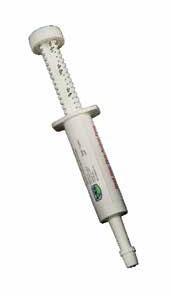
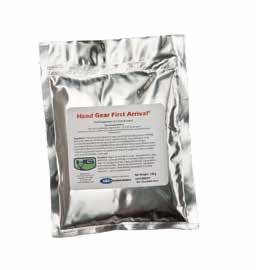
Fawn Arrival™ Powder & Paste
Supports digestive health and natural immunity
Powered by Encrypt® fiber technology
Powder (Bottle Fawns Only)
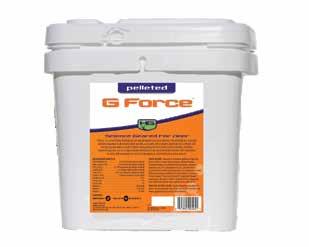
G Force™ Pellets & Powder
Drives early bone growth and structural development
Optimizes efficient nutrient utilization
Powered by proprietary Calcium & Phosphorous Complex and Enzyme pack!
Pellet or Powder
Top dress or mix in feed
Start now.
FEATURE STORY
Rolling Ridge Ranch –Offering Quality Family-Style Hunts
By: Gail Veley
While Chris Tresnak values every aspect of raising deer from keeping up with current trends, making genetic improvements, practicing good animal husbandry to valuing conservation. All of these things are at the very core of everything he does. At his 325-acre ranch, Rolling Ridge Ranch in Branch, Michigan, typical deer frolic in large, uncrowded wooded pens. “High and wide suits us best,” Tresnak said. “A typical with extras is okay, too.” That commitment is more than talk: Rolling Ridge Ranch is among the first deer farms in Michigan to earn MAEAP verification, the state’s voluntary environmental-stewardship certification administered through MDARD.
Begun in 2020 through the vision and inspiration of his fatherin-law, Mike Dery, Rolling Ridge Ranch, named appropriately for the Michigan topography upon which it sits, is ready to offer hunts on a more expanded level this upcoming hunting season. Perhaps one of the best features about Rolling Ridge, in addition to the 5-bedroom lodge and large, deep wellstocked fishing pond, is the fact that “the only time you see a fence is when you are driving in,” Tresnak said. He and his own father, Ed Tresnak and Mike help guide hunts while also assisting frequently in day-to-day operations. In creating the ranch and developing the herd, genetics from Gary Edwards, Matthias Decker, Chris Bozzer and the late Gina Bozzer were acquired, along with a lot of knowledge about how to do things right. “I feel really lucky to have worked with all of those people,” Tresnak, 41, said. “And I feel very fortunate that I get to be full-time deer farmer.”
In Tresnak becoming a full-time deer farmer, fate played a large hand. “I knew my father-in-law before I knew his daughter Megan, my wife,” Tresnak’s story begins. “I grew
up fishing on Lake Michigan, and in college I was fortunate to work at a local marina during the summers — that’s how I met Mike. After a night of fishing, we’d go out and really got to know each other that way. Two years later Megan came to visit, and the rest is history. That was 20-some years ago.”
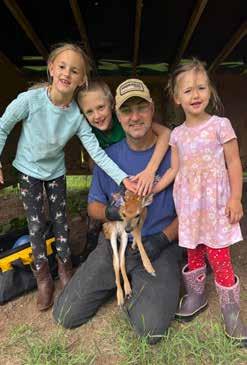
Today, Megan and their three children, Mason, 8, Clara, 6 and Bella, 4, all help out on the ranch, especially during fawning season. Yet, as much as the deer take center stage, educating the public on how to acquire adequate hunting skills is just as important. In September of 2024 they offered “Learn to Hunt,” a clinic given by a professional hunter that incorporated the farm to dinner table concept. “It was awesome to do this,” Tresnak said. “We want to impress upon people to not take where food comes from for granted.” Future clinic dates are still being determined. As Tresnak reflects on how the dream of creating Rolling Ridge Ranch unfolded, he’s glad for the hard work and hours everyone put in to take an old, rough and run-down farmstead, gut it and refurbish it into the modern yet rustic, pristine place it is today.
Whether it’s a solo hunt or a group, Rolling Ridge is booking family-style hunts for the upcoming season. The ranch is located in Branch, Michigan, about 30 minutes from Ludington. Reach out by phone or email to talk through options, or visit www:huntrollingridgeranch.com.
Name:
United Deer Farmers of Michigan Membership Application
March , 2026 - March , 2027
Business Name: Species Raised:
Mailing Address:
City, State, Zip:
Home Phone: Cell Phone:
Email Address: Website:
Membeship Status: New Renewal
Would you like to volunteer for any of the following UDFoM committees (check all that apply):
This will be a full registration & includes voting privileges, with a maximum of one vote per year per application.
Full Membership - $50 annually This will be a full registration & includes voting privileges, with a maximum of one vote per year per application.
If you would like to pay with a credit card please enter your information here:
Name on card Card # Exp
Three digit code on back Type of card
Signature
I hereby make application for membership to United Deer Farmers of Michigan, agreeing to conform to the Code of Ethics and Bylaws governing the Association.
Signature Date
IF YOU HAVEN’T TRIED PNEU-DART’S RDDS, YOU’RE MISSING MORE THAN YOUR TARGET
Did you know impact trauma can negatively influence medical treatment? We do.
Which is why we’ve spent 58+ years perfecting the ideal remote delivery device. Shorter in length and lightest on the market, our disposable RDDs, with patented Slo-Inject ® technology, provide ultimate accuracy while reducing the potential for problematic hematomas. Pneu-Dart. When you can’t afford to miss.®
THE MOST PRODUCTIVE WAY TO START AND OPERATE A HUNTING PRESERVE
By: Gail Veley • Whitetails of Louisiana
Providing an unforgettable and unique high fence hunting experience might appear much easier than it actually is. Several important factors are key in starting and operating a successful hunting preserve. The first is “location, location, location,” offers Russel Ogle, Manager of Double Play Hunting Preserve in Athens, Ohio. “Convenient land choice can make things a lot easier if you’re catering food in or having the local AG Department or DNR out for a fence inspection.”
Secondly, you need to know who is going to have jurisdiction over your preserve. Is it your state Department of AG or your state DNR? What is the minimum size your preserve is allowed to be? “In most states exotics fall under the department of AG and whitetails fall under the DNR,” said Brandon Bollinger of 2 Brothers Whitetails in Loranger, Louisiana. “In some states the minimum preserve size is 100 acres and in other states the minimum size is 250 acres. You’re also required to have 60/40 cover versus open land for your animals. You can’t have a preserve that’s merely on something like a soybean
field. That’s not ethical.” Bollinger, who has served for 14 years in a consulting role for those interested in starting a preserve, knows firsthand how important it is to follow correct protocol. “What a lot of people don’t realize is that operating a preserve becomes just like deer farming, because you need barns and tractors and if you approach it like farming, it’s advantageous to do it that way. For example, your interior fence for any pens you might have could be paid for by the Natural Resource Conservation Service (NCRS).”
Exterior fencing (an expense which falls on the preserve owner) should be eight feet tall and very sturdy, yet not overly rigid. Preparation to install a fence could involve extensive tree removal. “Make sure you have a 60-foot lane, 30 feet on each side for mowing,” Ogle said. “It’s important that the fence is clear for the sake of repairs or trees not falling on it. As far as the actual fence itself, hotwire should be placed on the bottom to keep predators out. You can use single fence posts every 15 feet using eight-inch pine posts, but steel pipe posts might hold up longer.”
Management of the animals inside the fence becomes top priority once your property is inspected and approved for operation. And while most species found in a preserve can potentially co-exist if introduced before the rut, Bollinger does not recommend mixing fallow deer with whitetails, as fallow deer will crowd a feeder or food plot, making it harder for whitetails to eat. Elk and red stag tend to be aggressive towards each other and may fight as well as interbreed. Axis deer and whitetails mingle really well, with axis deer being subordinate to whitetails. Managing and improving the genetics of your livestock can also be an easier task with interior pens, where breeding procedures and fawning can take place. “The does will tend to want to return and be easier to catch up to repeat this process year after year,” Bollinger said.
Managing water and food sources is yet another important component. If possible, growing your own food with clover and alfalfa rich food plots is less expensive and unlike grain, is less of an attractant for unwanted visitors like raccoons or opossums. Water sources are
vitally important as well. Having a tranquil pond with ample water in the middle of a preserve may seem like a great idea “but the deer need to be able to find it,” Bollinger. “You need to place water buckets along your fence line because newcomers will walk the fence for days and can die of dehydration.” These animal husbandry practices also extend to having a good relationship with a veterinarian, as preserve owners and managers are required to take a Chemical Immobilization course on darting, and have a veterinarian prescription, in order to get medication for darting.
While the details and efforts to successfully run a preserve are immense, it is perhaps equal to booking hunts and providing comfortable accommodation. “I think the Number One most important thing in attracting hunters is having a nice lodge with separate bedrooms that include their own bathrooms,” said Daniel Thomas of Daniel Thomas Whitetails in Springhill, Louisiana. “I’ve seen it where there’s one bathroom down the hall. It’s much nicer to have your own. We are charging good money for the hunt, and a lot of the value depends on the accommodations.”
Thomas feels Number Two involves providing a covered outdoor firepit where everyone can gather outside to share their stories. “A lot of homes have indoor fireplaces. You
are there at the lodge to do things differently and not be inside,” Thomas shared. “Most of the time guests want to be outside.” Number Three, provide hunting stands that are large enough for two hunters (or a hunter and their son or daughter) and their guide, to all comfortably hunt from. “A normal stand might be 5 x 6-feet, but I like a 6 x 8-foot stand,” Thomas added.
Number Four, find quality guides for your hunts. “Some who have hunted their whole life or are natural outdoorsmen don’t need much training,” Thomas said. “But some who aren’t as experienced might need a bit more training in being able to judge a quality animal and determine the best fit for what a hunter is looking for.”
Number Five, provide adequate meals and refreshments. Dinners might feature Steak Night, Seafood Night or Italian Night. Lighter meals are generally better before hunts, while larger meals are generally consumed after hunts.
Placement of your hunting lodge is again based on “location, location, location,” Ogle said. “Choose an area at the highest point of the property for the best views. And make it a family-friendly place. People are there to relax and you need to cater to the customer. Occasionally, hunters need to convince their wives into coming along so they themselves can have a chance to come.
We offer a hot tub, pool tables, shuffleboard, arcade games, poker and a game room.”
Among other important things, have a legally approved liability waiver and provide sufficient refrigeration and a sanitary spot if you are processing your deer on site. Be able to recommend a good taxidermist. Learn the importance of trail camera placement and drone utilization so you can take inventory of your deer, Bollinger emphasized. “Join NADeFA, understand DNA, GEBV’s and what NADR is. Join your state deer association and keep up with regulations and how they may affect you. And have a thorough understanding of stocker bucks and prices.”
Limited INTRODUCTORY Offer!
This new reader will be your favorite time saver ever! Memory stores in the 10’s of millions of events, plus so much more ….
Use this QR Code or go online to DeerSites.com for more deadlines and up to date event information!
Indiana Deer & Elk Farmers Association - July 31-Aug 1st - Nappanee IN
KALA Summer Showcase - Aug 8, 2026
Missouri Deer Association Picnic & Meeting - Aug 8, 2026 - Clark, MO
Whitetail Deer Farmers of Ohio Convention - Aug 13-14, 2026
Pennsylvania Deer Farmers Association PA Eastern Fall Stocker Auction - Aug 29th - State College, PA
Southern Top 30 - Aug 20-21, 2026 - Louisiana
Whitetails of Louisiana - Aug 21-22, 2026 - Marksville, LA
TDA Annual Convention - Aug 28-29, 2026 - San Antonio, TX
Iowa Whitetail Deer Farmers Winter Meeting - Feb 27, 2027 - Waterloo, IA
Pennsylvania Deer Farmers Association Winter Benefit Auction - Feb 26-27
DREAM GENOMICS
DEEP INTO PHASE TWO OF CWD CUTTING EDGE TECHNOLOGY
WBy: Gail Veley • Sponsored by the Illinois Deer Farmer’s Association
ith Phase One for developing a blood test for early CWD detection essentially in their rearview mirror, scientists at Dream Genomics, a visionary biotech firm started in 2023 and based out of Northbrook, Illinois, are now deeply entrenched in Phase Two, Biological Confirmation. This second phase is moving ever closer to finishing up, explained Dr. Gary M. Pusateri, CEO and Founder of Dream Genomics. Biological confirmation, Phase Two, entails gathering sample after sample from virtually anywhere CWD is detected in the U.S. and Canada in whitetails, mule deer and elk, and pinning down the specific genes that distinguish themselves as being the answer to the diagnosis of CWD.
Phase Two has involved extensive travel, time, effort and research on behalf of Dr. Pusateri as well as Dr. Michael Falduto, Chief Technology Officer and Founder and Dr. Scott Magnuson, Chief Scientific Officer and Founder. The more testing that takes place during Phase Two, the closer they come to being 90 percent accurate
(or better) as to which specific genes reveal the presence of CWD, regardless of the location a deer farmer raises deer. As this dedicated trio of scientists works diligently to finish Phase Two and continue onto Phase Three, Assay Development, they are very grateful for those investors who have allowed their work to move forward. However, they are also hopeful that new investors will contribute in order to more fully guarantee their work can be seen to full fruition. “We aren’t connected to a university,” Dr. Pusateri explained. “We currently rely on support from our investors, grants and self-funding for everything that we do.”
To come full circle in their gamechanging quest, Phase Three, the final phase, involves moving accurate and targeted samples onto PCR plates. Assuming CWD positive genes become paired down to the fewest specific and acutely accurate number needed for testing, more tests could be run per plate, therefore not costing a deer farmer as much money to test their herd. “This is why Phase Two is so important,” Dr. Pusateri explained.
“We want to ultimately be so accurate that both time and money are saved. We are doing whatever it takes to be at that point. We are looking at a 24hour turnaround once Phase Three becomes fully operational.”
If any deer association, private individual or corporation is interested in donating or investing in Dream Genomics research, please contact Dr. Pusateri at his office at 847-2919602 or his cell phone at 715-8917878 or email him at gpusateri@ dreamgx.com. Potential investors can also check out the website at www:dreamgx.com. “The best part about supporting our research is that you have two very large opportunities to gain,” Dr. Pusateri said. “One, in making live diagnostics available to all and helping the entire industry permanently move forward. Secondly, with potential personal gains from investing in the company. If the USDA accredits this test, a deer that tests negative could potentially be moved anywhere, opening doors for deer farmers to completely flourish rather than be held back by regulations.”
PARTNERING ON A BUCK
What You Should Know
By: Gail Veley • Inidana Deer and Elk Farmers Association
In an effort to minimize risk, capitalize on gains and join the evolving market of SS genetics, many deer farmers have taken to developing partnerships on bucks. “Partnerships are getting more and more common,” said Ryan Halfman of Black Label Whitetails in Portland, Michigan. “Having a partnership can really help you lower your investment in gaining access to a really nice buck. The idea is really causing a surge because the whole market is redefining itself due to markers. A huge advantage with partnerships is that you share both the risk and the reward.”
A partnership may involve two individuals, a few or several individuals depending on what is desired and agreed upon. Parameters of a partnership involve the acquisition of a certain number of semen straws each year for breeding on your farm, in exchange for sharing management costs of the buck such as marketing and advertising. Agreements are also reached on where the buck will reside, with the understanding that it could be exempt from potential boarding charges and will also be used for live cover in the breeding season.
When Joe Johnson of Whiskey River Whitetails in Canton, Ohio first became aware of breeding buck Black Rifle owned by Josie Borkholder of Lone Pine Whitetails in Nappanee, Indiana, he was immediately taken in. The big typical fiveyear-old buck who measured 273” at age four, whose pedigree included Triple Digit, High Heat, Storm Express and Ms. Patrick, started the wheels turning for Joe. “I got into the business in 2023. Shortly after that, I saw Black Rifle for the first time at an IDEFA event,” he said. “Then I saw him in person the next day. After buying so much from Josie, I had the idea to sit down and talk to him about a partnership. Neither one of
us knew how to draw up a partnership in legal terms. Josie initially sent me a document to review. We went back and forth three or four times and then we agreed to it.”
“We are both in 50-50,” Joe said. “Our agreement is that there is no status quo. We split the cost of semen straws and marketing with respect to the semen straws that we get. We use our shares for A.I. or live cover and we don’t share the offspring. Our agreement also includes a clause that if Black Rifle were to die, any semen still available would be split 50-50.” Black Rifle, a homegrown buck raised at Lone Pine, now resides at Whiskey River. Typically in partnerships, should a third party or additional partners want to participate, all partners
would need to agree. And should a partner want out of a partnership, the other partner or designated partners get first right of refusal in buying the share. “I would caution against having too many partners,” Halfman, who has partnered on bucks at more than ten different farms, advised. “While I believe in proactively seeking partners and recognizing good opportunities, it’s simpler to have less partners involved.” Although partnership contracts are designed to be binding, Halfman feels a lawyer is not necessarily needed. “I’m a handshake kind of guy,” he said. “I believe in trust. Partnerships can be great. It can help build your reputation. And reputation is everything in this industry.”
Dependable Sedation Starts Here
Gentle on the animal and trusted by veterinarians, handlers and owners for every species or procedure
COMPLETE KITS WITH SEDATION AND REVERSAL AGENTS, OR SOLD SEPARATELY.
The information in this advertisement is general and provided as an informational aid. It does not cover all possible uses, actions, precautions, side effects, or interactions of the medications shown, nor is it intended as medical advice or for evaluating the risks and benefits of any medication. Consult your veterinarian for diagnosis and treatment of health problems. The information and statements here have not been evaluated by the Food and Drug Administration (FDA), and the FDA has not approved these medications to diagnose, cure, or prevent disease. Medications compounded by Mixlab are prepared at the direction of a veterinarian and are not intended for use in food or food-producing animals. Mixlab does not recommend, endorse, or represent the efficacy, appropriateness, or suitability of any dosing, products, procedures, treatments, services, opinions, veterinary providers, or other information contained in this advertisement. Mixlab is not responsible or liable for any advice, course of treatment, diagnosis, or other information, services, or products obtained through this advertisement.
LEARN MORE
Stefanowicz
Dedication is exactly what every successful deer farmer learns and what Stefanowicz now exuberates not just in owning and operating Awesome Whitetails in Middlebury Center, Pennsylvania with her husband Jason, but also in her job as an Accounts Receivable staff member for D & K Design. D & K Design, producer of 11 quarterly state deer association magazines, saw Stefanowicz as the perfect fit for the job.
“I’ve known Amy for years, along with Jason,” said D & K Design Magazine Editor Kathy Giesen. “When I heard that Amy was looking for a part-time job, Jason joked that she could come work for me. Well, I took him up on it. Amy is very personable, well-known in the deer industry and very detail oriented. We are so glad to have her on board.”
As a young girl growing up on a hobby farm near Telford, Pennsylvania where
“Amy with all of her kids”
great example of devotion back then, and along with it they both nurtured their daughter’s interest in agriculture, 4-H and even bowling. As the years passed, Stefanowicz found herself drawn to both horses and teaching, and even dreamed of becoming a barrel racing competitor on the national circuit. Ultimately, she was compelled to pursue early childhood education at Montgomery Community College, shortly after graduating from Dock Mennonite Academy.
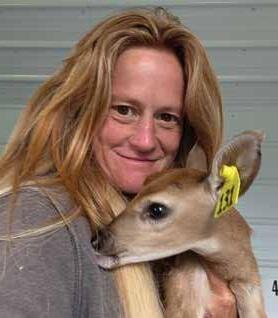
Later, she met Jason at a birthday party, ultimately fell in love and married him on September 11th, the same day as her birthday, in 1999. Now, through the creation of their deer farm and the daily caring for deer, Stefanowicz has found the perfect combination of her passions as a teacher and animal lover. Her advice on raising fawns has been sought out by uncountable people in the deer
as devoted to their deer as she and Jason are, as it allows her and Jason to attend industry events on a fairly regular basis.
If she had but one wish, it would be that her parents were still alive, sharing in all the joys and challenges of raising deer. However, she finds comfort in knowing her success is firmly rooted in the life lessons they taught her. If you don’t already know Amy, visit the D & K Design booth at the next event they may be found at, and say hi!
~ Amy
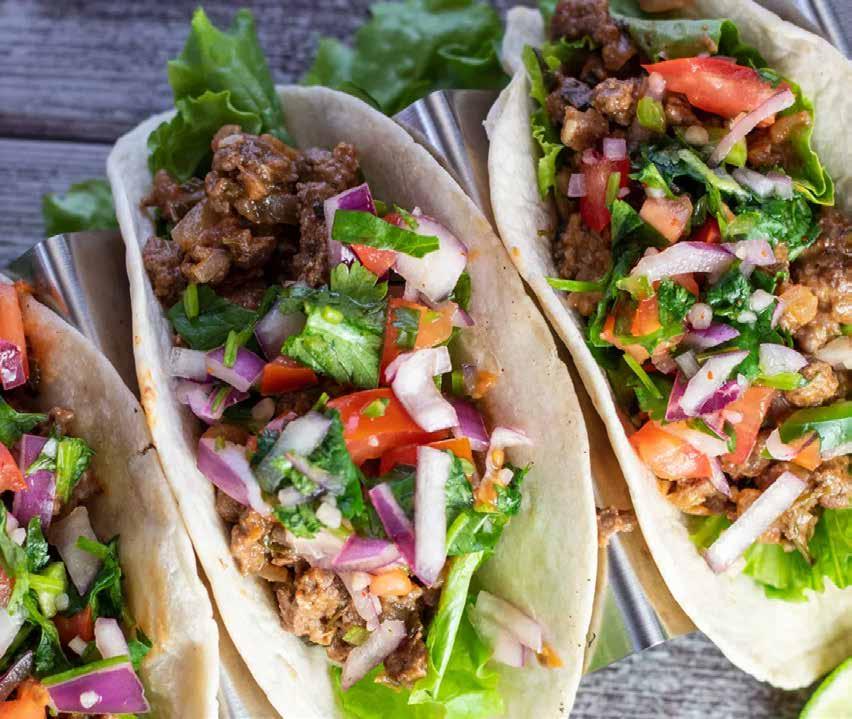
GROUND VENISON TACOS
With my quick, flavorful ground venison tacos, the meat is sauteed with a mixture of herbs and spices until perfectly cooked! Simply serve the ground venison taco meat on your favorite tortillas with the condiments you love, and dinner is served!
Ingredients
• 1 Tablespoon Olive Oil
• ½ Cup Diced Onion
• 1 Teaspoon Minced Garlic
• 1 Pound Ground Venison
• 1 Large Diced Roma Tomato
• ¼ Cup Chopped Cilantro
• 3 Tablespoons Lime Juice
• ¼ Cup Water or Broth (to help cook down the venison)
• 4-8 Tortillas
• Seasonings – 1 ½ tablespoon chili powder, ½ tablespoon cumin, ½ tablespoon paprika, ½ teaspoon salt & pepper, ¼ teaspoon garlic powder, and ¼ teaspoon onion powder
Instructions
1. Sauté onion. In a large skillet or non-stick frying pan, heat 1 tablespoon of olive oil over medium-high heat. Once the oil begins to shimmer and gets close to smoking, add ½ cup of diced onion and sauté for 4 to 5 minutes or until the onion is translucent, tender, and fragrant.
2. Sauté venison. To the onion, add 1 teaspoon of minced garlic and sauté for an additional 30 seconds to 1 minute before adding 1 pound of ground venison. Then, loosely break up the venison and stir into the onion and garlic. Allow the venison to sear for 2 to 3 minutes, then flip and break up the venison as it browns.
3. Add seasoning. Once the ground venison is browned, add the seasoning, including 1 ½ tablespoon of chili powder, ½ tablespoon of cumin, ½ tablespoon of paprika, ½ teaspoon each of salt & pepper, ¼ teaspoon of garlic powder, and ¼ teaspoon of onion powder. Next, add ¼ cup chopped cilantro, 1 large diced Roma tomato, 3 tablespoons of lime juice, and ¼ cup of water. Stir the mixture until combined.
4. Simmer taco meat. Next, bring the ground venison taco meat to a boil, reduce heat to low, and then simmer for 5 minutes or until the taco meat reaches your desired consistency. When the taco meat is done, remove the pan from the heat and serve in about 4 to 8 of your favorite taco shells/tortillas. Top with desired condiments and serve!
How to EffEctivEly MarkEt your Brand
By: Gail Veley • Sponsored by the Kentucky Alternative Livestock Association
Actually, it’s quite simple. If you want customers to buy deer from you, they need to know who you are. In an industry where many deer farmers could be “one test away” from losing everything, keeping your farm viable and profitable is paramount. In doing so, the financial ability to breed for markers and be seen in a more problem solving or proactive role to government agencies becomes more of a reality, said Grayson Steele of ACE Whitetails in Anderson County, Kentucky.
ACE Whitetails, started in 2022, caters more to the stocking end of the industry and breeds mainly typical deer. They find Facebook to be among one of the best ways to get their name and their product noticed. “I think the KALA magazine is helpful, too,” Steele, 25, said. “Being an active KALA member allows you to network within the state and is your first line of defense in staying proactive and aware of legislation. Attending events really helps. Websites and social media are another way for people to find out about you. But the more you get out there the better everyone will know you. There shouldn’t be an event where you don’t know someone.”
As effective as face-to-face networking can be, following a solid business model will also set you up for greater success, said Jason Becker of Finley Ridge Whitetails in Campbellsville, Kentucky. “Everyone getting in the deer business should develop a business model and figure out what you want to do and pick the right does and genetics from the beginning,” Becker, 50, said. “What you produce should depend on who you plan to market to. Your market for stockers is completely different than that for breeders, and your investment strategies are also a whole different thing. There are amazing bucks out there that no one has ever heard of. Partnering with other well-known farms could help spread the word.” Becker agrees that Facebook is an effective marketing tool as well as attending events such as the Blue Grass Trophy Buck Auction held each August in Lexington, Kentucky. “As the industry continues to focus the SS allele and breed for CWD resistance it will give us a lot more opportunities for revenue,” he said.
Breeding for CWD resistance has caused the industry to “re-look” at genetics, explained Mary Ann Hall of
Solid Rock Whitetails in Winchester, Kentucky. Begun in 2018, Hall feels the reputation of Solid Rock has become what markets them the most, as they are very well known in the industry for producing healthy stockers. They also have a good reputation for making things right and being there for advice after the sale. “We let our clients know that we feel our bucks are as healthy as they can possibly be at the time of a sale,” Hall, 52, said. “We are known for honesty. People say our bucks last for the hunting season and we sell both in and out of state.” In Hall’s opinion, given where the industry is at today, being established makes things easier. “When you start out, you’re looking at two to three years before making money and that makes it tough,” she said. “It’s harder now for new farmers and CWD issues makes it even harder. KALA helped defeat House Bill 700. But it’s always in the back of everyone’s mind how tough this industry can be. Having a deer farm where you stand out from the crowd makes a difference.”
Trophy Breeder Bucks Showcase Book 2026 Application
Reservation for space and buck info will be due no later than August 12th, 2026. If you have an existing picture ready to go, that will also be due at that time. If you would like to send in a last minute photo of your buck, the cutoff date is September 1st by 8am CST. Placement will be in order of first come first serve. Printing and mailing will start September 4th and be in hand between September 16th20th. Just in time for semen sales getting ready for Breeding Season. These will be mailed to Breeders and Ranch members of the 19 state associations we service.
More information will be mailed out to all current advertisers closer to the date.
Pre-register and we will contact you for further information
PRIME SPOTS WILL BE AUCTIONED
ONLINE AT MCCLUNG SALES: JULY 2026
Name: First Last
Oklahoma Treading New Territory with Releasing CWD Resistant Deer into the Wild
By: Tim Condict and Gail Veley • Sponsored by the Missouri Deer Association
In Oklahoma, deer farmers are breeding as fast as possible for genetic resistance, inspired by the passage in February 2024 of House Bill 3462, the Chronic Wasting Disease Improvement Act. HB 3462 made it possible this past spring to release deer that are “SS” and make the GEBV cutoff of -0.056 into wild populations. This was a “first” for Oklahoma and hopefully may set a precedent for other states to be given permission in the future by government agencies, to do the same.
“In the first part of 2026, we didn’t have such a surplus of resistant deer that we wanted to sell them just yet,” said Whitetails of Oklahoma (WOO) Vice President Tim Condict. “But we still put some on the ground just to break the ice. Most likely it will be 2028 before we have enough to actually sell quite a few.” The state tested more than 500 wild deer last year and got the results in March, indicating that around 40% had one or more “S” marker and only about 2.5% had “SS” markers. The wild deer also had an average GEBV score of -0.000. In other words, they could use some help. CWD continues to be found around the Oklahoma border (especially Arkansas) with a few cases inside the border having been found in Northwest Oklahoma. “The Oklahoma Department of Agriculture continues to be fantastic at helping the breeders to be able to help the landowners who want to protect their property and wildlife from developing a significant prevalence rate,” Condict said. “We figured to cover the state it would take around 2,000 bred does. So, it’s not going to happen immediately, but other states sitting on their hands or
adopting failed policies when there is an available answer, seems to me, to be close to a dereliction of their duty.”
Condict feels other states should look at adopting a similar program to assist Mother Nature in her drawnout process of making the wild deer population more resilient. Just the mere introduction of genetic diversity upon the landscape could make the wild deer much healthier and robust, along with resistance to CWD. “The cool thing about the Oklahoma law is the fact that it doesn’t cost the wildlife agency or the taxpayers a penny,” Condict explained. “The deer are purchased by private landowners and released with an orange tag in each ear on their property. Hopefully landowners will spread the word to not harvest those animals. In a lot of states, the public is fed up with an agencies approach to CWD. As bad as they hate to admit it, genetic durability is the only answer.”
Condict and each member of WOO believe it would be great if the state wildlife agencies around the country could work with breeders and together, help slow the growth of the prevalence of CWD in the wild herds,
to better protect both wild and farmed herds. “Hopefully, everyone will start reaching out to their own state legislators and senators to educate them on the facts surrounding CWD and the ability of using deer breeders to solve it,” Condict said. “CWD will never be gone but the idea is to limit its relevance. Many breeders around the state have great pedigreed bucks with great GEBV’s and “SS” markers with reasonably priced semen to assist everyone across the nation with the ability to protect your farm. We look forward to the day when wildlife agencies across the country fully welcome the news of a solution to the problem, after 60 years of failure. We really appreciate the support we have received from our state, and the help we have received from Dr. Christopher Seabury and NADR to actively address our concerns in Oklahoma.”
If you would like your farm or business featured on our business card pages, email a digital pdf file or scanned image (must be readable resolution) of your business card to:
Ken Brown prwhitetails@gmail.com
This gives UDFOM members a way to reach out to one another for services and to buy or sell deer! There will be limited pages for these card spreads, first come first serve. The overflow will be placed in the next issue and cards will be rotated each quarter.
NADEFA 2026 FLY-IN
In April, NADeFA members from across the country gathered in Washington, D.C., for the 2026 Fly-In to advocate for critical funding in the fight against Chronic Wasting Disease (CWD). Representatives from Oklahoma, Michigan, Pennsylvania, Texas, Alabama, Missouri, North Dakota, New York, Ohio, North Carolina, Kansas, Louisiana, Minnesota, and West Virginia met with their respective lawmakers to underscore the urgent need for federal support. NADeFA members had a total of 85 meetings, including with House and Senate offices from both Democratic and Republican offices, the U.S. Department of Agriculture (USDA), and industry partners. These meetings allowed members to educate Congressional members on CWD and reinforce the importance of NADeFA’s FY-27 appropriations requests.
NADeFA members advocated for two comple-mentary federal funding efforts to combat CWD. First, they supported providing $15 million under the Chronic Wasting Disease Research and Management Act to fund competitive grants for states, Tribes, universities, and researchers to study disease transmission, develop vaccines and live diagnostic tests, identify genetic resistance, and expand management and education efforts. Second, they called for $17.5 million for the Cervid Health Appropriations Program, including $12.5 million for the CWD Herd Certification Program and surveillance activities, and $5 million for timely indemnity payments to remove infected animals.
As next steps, Capitol Hill Consulting Group will follow up with House and Senate Appropriations staff, the USDA, Senator John Hoeven, and House Agriculture Committee Chair GT Thompson on behalf of NADeFA to further support the FY-27 appropriations requests.
Appropriations Update
After receiving the President’s budget request, the House and Senate Appropriations Committees started to draft their 12 annual appropriations bills. The House Appropriations Committee has released the schedule for FY27 appropriations bill markups, where each Subcommittee will review its bill. The first markup was held on April 17, with the last one scheduled for June 24. The Senate has yet to release its markup schedule, as they are still holding hearings with agencies to discuss the President’s budget request.
Conclusion
As Congress continues to shape federal funding and longterm agricultural priorities, NADeFA remains steadfast in its mission to advocate for meaningful support in the fight against CWD. NADeFA is committed to ensuring the cervid industry has the resources it needs. We’ll continue to work closely with lawmakers, agency partners, and stakeholders to keep CWD at the forefront of federal policy discussions. Thank you for your continued support as we advance this important work.
Word Search
SUDOKU
The rules for sudoku are simple:
A 9x9 square must be filled in with numbers from 1-9 with no repeated numbers in each line, horizontally or vertically.
To challenge you more, there are 3x3 squares marked out in the grid, and each of these squares can’t have any repeat numbers either.