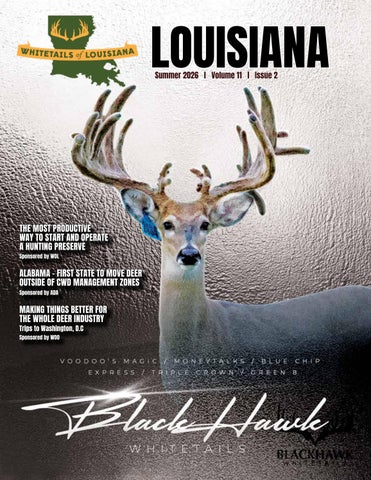
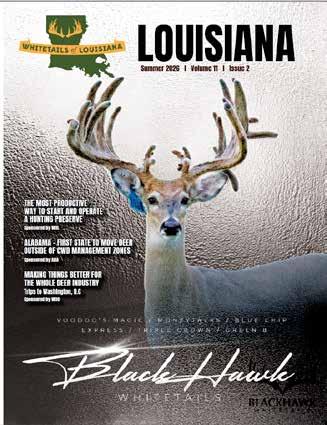
THE MOST PRODUCTIVE WAY TO START AND OPERATE A HUNTING PRESERVE
Sponsored by WOL
ALABAMA - FIRST STATE TO MOVE DEER OUTSIDE OF CWD MANAGEMENT ZONES
Sponsored by ADA
MAKING THINGS BETTER FOR THE WHOLE DEER INDUSTRY
Trips to Washington, D.C
Sponsored by WOO
2026 l Volume 11 l
JOSH KAPLAN
President
212 Aspen Drive, Raceland, LA 70394
985-227-3664
jkaplan@blackhawkwhitetails.com
MYRA BOLLINGER
Administrator
Whitetails Of Louisiana
P.O. Box 436, Folsom, LA 70437
985-892-0056
whitetailsoflouisiana@gmail.com
ZACARY MARTIN (‘27)
5530 Hwy 129
Jonesville, LA 71343
417-691-3316
zacarymartindjw@gmail.com
RICK PRIEST (‘27) 18610 Lake Harbour Ave.
Baton Rouge, LA 70816
225-572-9212
rick@bigladeer.com
JASON BORDELON
8834 Hwy 114
Cottonport, LA 71327
318-730-8254
jbordelon@sqsolutions.com
DANIEL THOMAS
Vice President
242 Daniel Thomas Road
Springhill, LA 71075
318-469-9404
dbthomas40@gmail.com
KRISTINA ROTHSCHILD
Secretary/Treasurer
3220 Tisdale Road Eros, LA 71238
318-355-4197
krisrothschild@yahoo.com
JARRETT ROGERS
625 Bear Creek Road
Quitman, LA 71268
318-914-3049
drwhitetails.llc@gmail.com
KEVIN MEADOWS (‘26)
123 Journie Grace Street
Benton, LA 71006
318-423-8997
kevinmeadows0123@gmail.com
JOSH MCCOY 3045 Westfork Baton Rouge, LA 70818
225-485-7205
jmccoy@dynamicgrp.com
MakingThingsBetter fortheWholeDeerIndustry Trips to Washington, D.C.
By: Gail Veley • Sponsored by Whitetails of Oklahoma
When representatives from the deer industry travel to Washington, D.C. each spring to address legislative matters, they are usually known and readily recognized by those they meet with. “The group that goes to Washington, D.C. every year and represents us are vital to our industry,” said Chris Ezell, President of Whitetails of Oklahoma and Vice President of NADeFA. “We accomplish a lot with deregulation and awareness of our industry, to those who matter in making decisions for our future.”
The relationships formed with legislators is vital “in fostering an understanding of the scale and impact of the deer industry,” said NADeFA President Ryan Halfman. “Having that recognition also helps with creating awareness with those that may not yet fully understand our industry.” The most recent trip to Washington, D.C. included NADeFA Executive Director Shawn Schafer, Associate Executive Director Troy Zacchini, Halfman, Ezell and representatives from other states such as North Carolina, Louisiana, New York, Texas, West Virginia,
Pennsylvania, Michigan, Minnesota as well as quite a few from Ohio. In all, 25 representatives were there.
While the deer industry is regulated at the federal level by the USDA, state by state regulations for deer farming can vary greatly, However, the CWD Herd Certification Program, overseen by the USDA, offers priority and indemnity to those farms that are part of it, no matter what state you are located in. Keeping this protection ongoing is one goal or component of going to Washington, D.C. During their meeting with the USDA, “I think we got their attention by pointing at long time issues with TB testing and the CWD Herd Certification Program, in the hopes it can be updated to what today’s science and ongoing research is suggesting,” Halfman said. “I, among many others, don’t want this to be a 20-year battle. I want the recognition of Dr. Seabury’s work to be a part of the options that we discuss.”
Often times while in Washington, other meetings include very basic entry level conversations as to what the issues are with those who are already familiar with the deer
industry, who are willing “to walk through the mud with you,” Halfman explained. Meeting schedules also typically include the Congressional Sportsman Foundation, Safari Club International and various congressman and senators. Through it all “we feel very optimistic about our future,” Halfman said. “The tide is definitely turning much more in favor of the deer industry.”
Halfman would also like to personally thank every spouse, employee or family member who steps in to take care of each deer farm and additional businesses, so that the representatives who wish to travel to D.C. can get away to do so. “It was great to have so many people willing to take time out of their busy lives and come. It places extra efforts on families and lots of sacrifices are made behind the scenes to make it all possible. We all appreciate that support,” he said.
Alabama First State to Move Deer Outside of CWD Management Zones
By: Gail Veley • Sponsored by the Alabama Deer Association
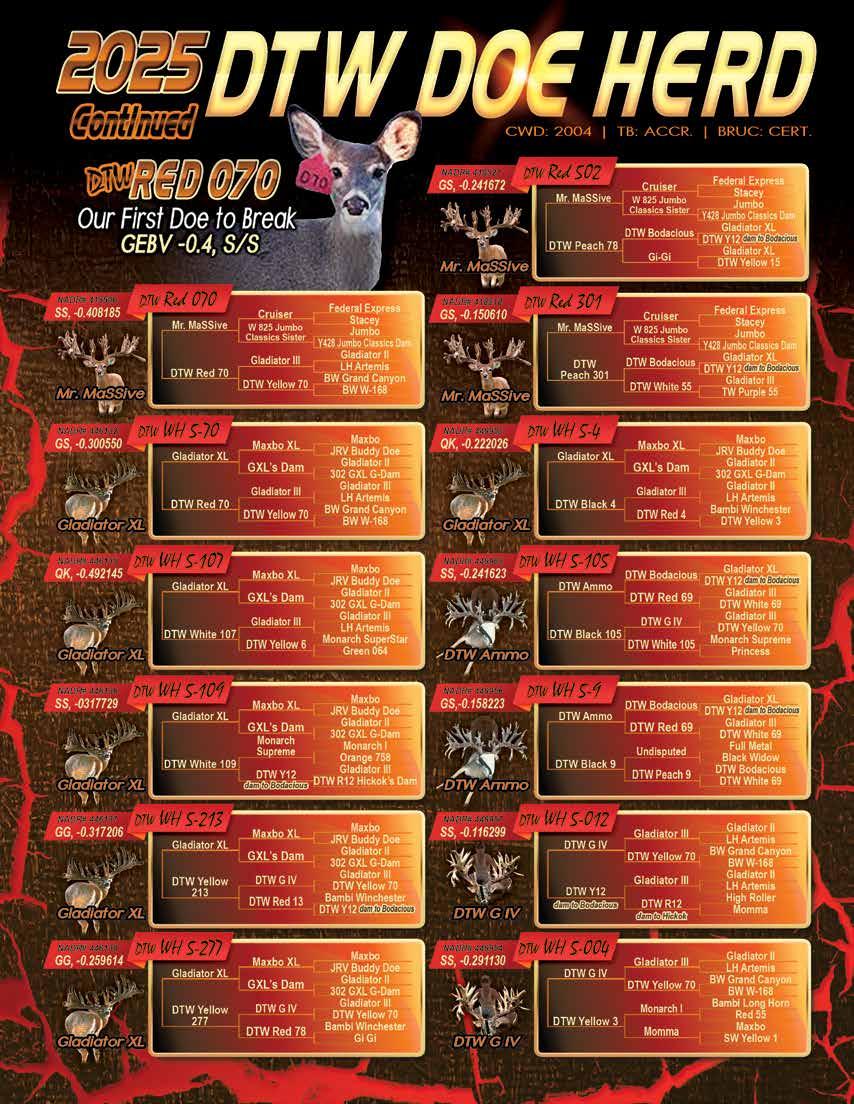
Apositive case of CWD is not causing quite the angst it used to for Alabama deer farmers. In March (2026) options officially became available for allowing Alabama deer farmers to continue selling and moving deer, should a CWD positive case be found nearby in the wild or another farm. Through the passage of House Bill 509, and the work of the Alabama Board of Director’s, Alabama has become the first state to allow for the movement of deer outside of CWD Management Zones. Management zones, decided upon by The Alabama Department of Conservation, are placed around areas where CWD is found. Every deer farm located within a designated zone, the duration for which lasts five years, is affected. To date, there is currently one CWD Management Zone in Alabama, located in the northwest corner of the state and encompassing 2.5 counties. About 15 to 16 deer farms are located within this zone. However, these farms can still do “business as usual” if they follow the protocols of one of three options available to them. The first option is to live test 50% of their herd every three years. The second option is to place a double fence 10 feet away from where breeding pens are located, and live test 25% of their herd every three years. The third option is to breed towards resistance and to quantify the GEBV’s found within a herd. Any deer that falls below the accepted -.056 value can be moved without further
restrictions, as long as it is live tested within six months.
“Option three provides incentive because it would turn out to be less costly and give you much more marketable deer,” said ADA Member Troy Zacchini. “I’d like to personally thank everyone who sat down and took the time in February to make these options a realty. It was a great team effort.” These individuals include Representative Jeff Sorrels, Dr. Misty Edmundson, Associate State Veterinarian for the Alabama Department of Agriculture, Charlanna Skaggs, Deputy Commissioner for the Alabama Department of Conservation and Natural Resources and Chris Lewis, Director of the Wildlife and Freshwater Fisheries Division for the Department of Conservation and Natural Resources. Moving forward “most farms are going with the third option,” said ADA President Cameron Odom. “And some have already put up a double fence. But it’s really too soon to tell what everyone is ultimately going to do. We are grateful for everyone
who saw this through.” Before HB 509 was passed in 2025, Alabama deer farmers were required to kill and test 10% of their herd if a CWD positive case was found at their farm or within close proximity to their farm. Farms affected by trace backs were also included, leading Odom in 2016, owner of Five O’s Whitetail Ranch in Citronella, Alabama, to ahis own closed herd. “Now, the entire industry is moving towards breeding for resistance,” Odom said. “The Alabama Department of Conservation does quite a bit of CWD testing during hunting season, and a whole new group of deer farms could fall under a management zone if a positive case is found. We’ve wanted to make it easier to raise and sell deer. Dr. Seabury’s science was considered and embraced in developing the options that now pave the way for us to do that. Alabama deer farmers are very grateful.”
From Deer to Here
“Secure Your Spot on the Front Cover”
BONUS: Showcase your Buck or product across the ENTIRE COVER. Our new art template seamlessly integrates what you’re selling into a stunning full-page display + it comes with a FULL PAGE AD INSIDE.
BONUS: YOUR AD + THEIR NAME Unforgettable back cover impact - Personalization meets prime real estate + 4 BACK COVER OFFERS Get ready! WOL cover spots will be on sale at the upcoming AUCTION, along with
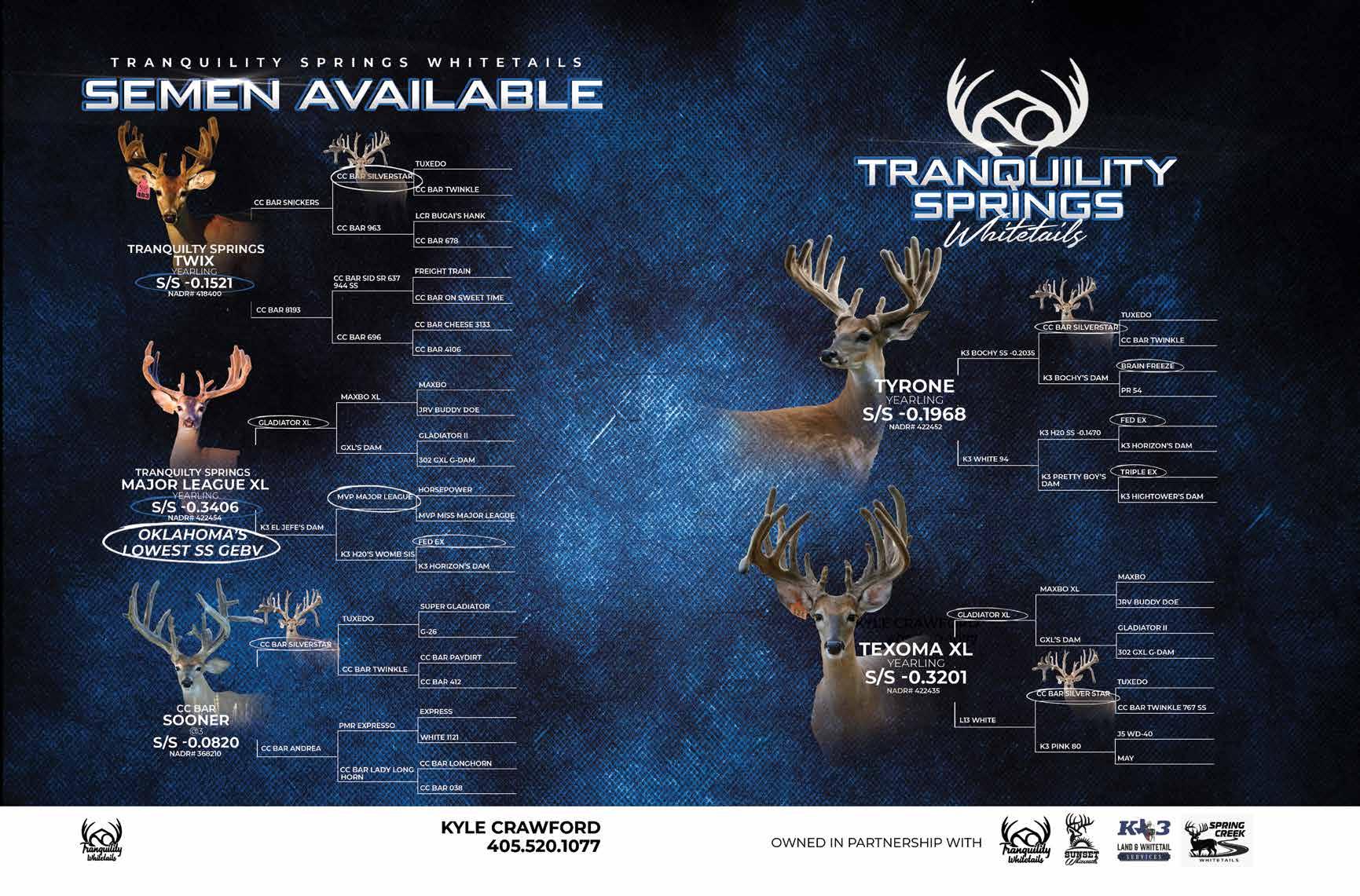
“Kyle – looking for premium bloodlines? Supremes Legacy brings you topshelf genetics that perform!”
Upcoming Whitetail and Cervid Events
Whitetails of Louisiana Magazine Deadlines 2026
Spring: February 14th
Summer: May 26th
Fall: September 8th
Winter: December 1st
Use this QR Code or go online to DeerSites.com for more deadlines and up to date event information!
Indiana Deer & Elk Farmers Association - July 31-Aug 1st - Nappanee IN
KALA Summer Showcase - Aug 8, 2026
Whitetail Deer Farmers of Ohio Convention - Aug 13-14, 2026
Pennsylvania Deer Farmers Association PA Eastern Fall Stocker Auction - Aug 29th - State College, PA
Southern Top 30 - Aug 20-21, 2026 - Louisiana
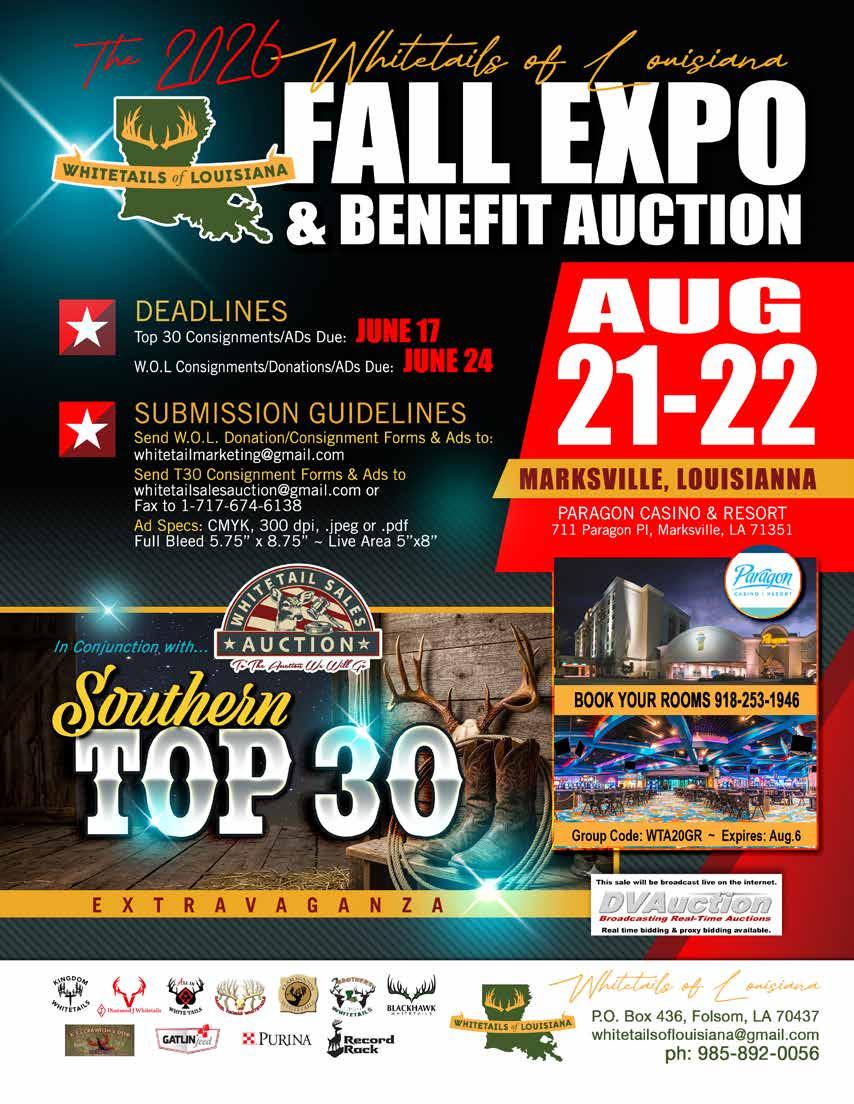
Whitetails of Louisiana - Aug 21-22, 2026 - Marksville, LA
TDA Annual Convention - Aug 28-29, 2026 - San Antonio, TX
Iowa Whitetail Deer Farmers Winter Meeting - Feb 27, 2027 - Waterloo, IA
Pennsylvania Deer Farmers Association Winter Benefit Auction - Feb 26-27
Trophy Breeder Bucks Showcase Book 2026 Application
Reservation for space and buck info will be due no later than August 12th, 2025. If you have an existing picture ready to go, that will also be due at that time. If you would like to send in a last minute photo of your buck, the cutoff date is September 1st by 8am CST. Placement will be in order of first come first serve. Printing and mailing will start September 4th and be in hand between September 16th20th. Just in time for semen sales getting ready for Breeding Season. These will be mailed to Breeders and Ranch members of the 20 state associations we service.
More information will be mailed out to all current advertisers closer to the date.
Pre-register and we will contact you for further information
PRIME SPOTS WILL BE AUCTIONED ONLINE AT MCCLUNG SALES: JULY 2026 Name: First
THE MOST PRODUCTIVE WAY TO START AND OPERATE A HUNTING PRESERVE
By: Gail Veley • Whitetails of Louisiana
Providing an unforgettable and unique high fence hunting experience might appear much easier than it actually is. Several important factors are key in starting and operating a successful hunting preserve. The first is “location, location, location,” offers Russel Ogle, Manager of Double Play Hunting Preserve in Athens, Ohio. “Convenient land choice can make things a lot easier if you’re catering food in or having the local AG Department or DNR out for a fence inspection.”
Secondly, you need to know who is going to have jurisdiction over your preserve. Is it your state Department of AG or your state DNR? What is the minimum size your preserve is allowed to be? “In most states exotics fall under the department of AG and whitetails fall under the DNR,” said Brandon Bollinger of 2 Brothers Whitetails in Loranger, Louisiana. “In some states the minimum preserve size is 100 acres and in other states the minimum size is 250 acres. You’re also required to have 60/40 cover versus open land for your animals. You can’t have a preserve that’s merely on something like a soybean
field. That’s not ethical.” Bollinger, who has served for 14 years in a consulting role for those interested in starting a preserve, knows firsthand how important it is to follow correct protocol. “What a lot of people don’t realize is that operating a preserve becomes just like deer farming, because you need barns and tractors and if you approach it like farming, it’s advantageous to do it that way. For example, your interior fence for any pens you might have could be paid for by the Natural Resource Conservation Service (NCRS).”
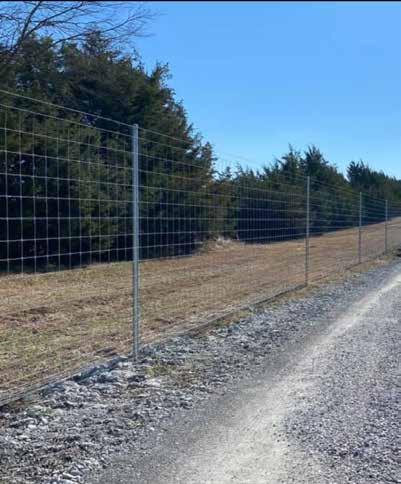
Exterior fencing (an expense which falls on the preserve owner) should be eight feet tall and very sturdy, yet not overly rigid. Preparation to install a fence could involve extensive tree removal. “Make sure you have a 60-foot lane, 30 feet on each side for mowing,” Ogle said. “It’s important that the fence is clear for the sake of repairs or trees not falling on it. As far as the actual fence itself, hotwire should be placed on the bottom to keep predators out. You can use single fence posts every 15 feet using eight-inch pine posts, but steel pipe posts might hold up longer.”
Management of the animals inside the fence becomes top priority once your property is inspected and approved for operation. And while most species found in a preserve can potentially co-exist if introduced before the rut, Bollinger does not recommend mixing fallow deer with whitetails, as fallow deer will crowd a feeder or food plot, making it harder for whitetails to eat. Elk and red stag tend to be aggressive towards each other and may fight as well as interbreed. Axis deer and whitetails mingle really well, with axis deer being subordinate to whitetails. Managing and improving the genetics of your livestock can also be an easier task with interior pens, where breeding procedures and fawning can take place. “The does will tend to want to return and be easier to catch up to repeat this process year after year,” Bollinger said.
Managing water and food sources is yet another important component. If possible, growing your own food with clover and alfalfa rich food plots is less expensive and unlike grain, is less of an attractant for unwanted visitors like raccoons or opossums. Water sources are
vitally important as well. Having a tranquil pond with ample water in the middle of a preserve may seem like a great idea “but the deer need to be able to find it,” Bollinger. “You need to place water buckets along your fence line because newcomers will walk the fence for days and can die of dehydration.” These animal husbandry practices also extend to having a good relationship with a veterinarian, as preserve owners and managers are required to take a Chemical Immobilization course on darting, and have a veterinarian prescription, in order to get medication for darting.
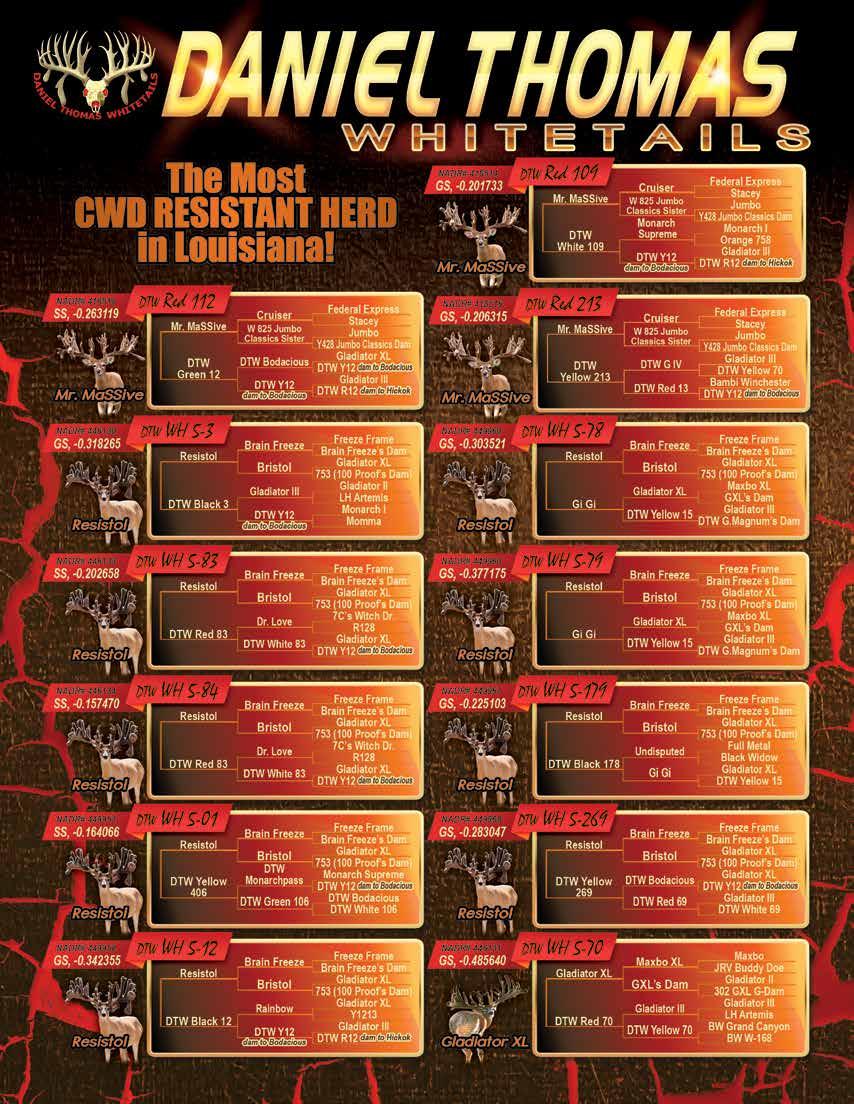
While the details and efforts to successfully run a preserve are immense, it is perhaps equal to booking hunts and providing comfortable accommodation. “I think the Number One most important thing in attracting hunters is having a nice lodge with separate bedrooms that include their own bathrooms,” said Daniel Thomas of Daniel Thomas Whitetails in Springhill, Louisiana. “I’ve seen it where there’s one bathroom down the hall. It’s much nicer to have your own. We are charging good money for the hunt, and a lot of the value depends on the accommodations.”
Thomas feels Number Two involves providing a covered outdoor firepit where everyone can gather outside to share their stories. “A lot of homes have indoor fireplaces. You
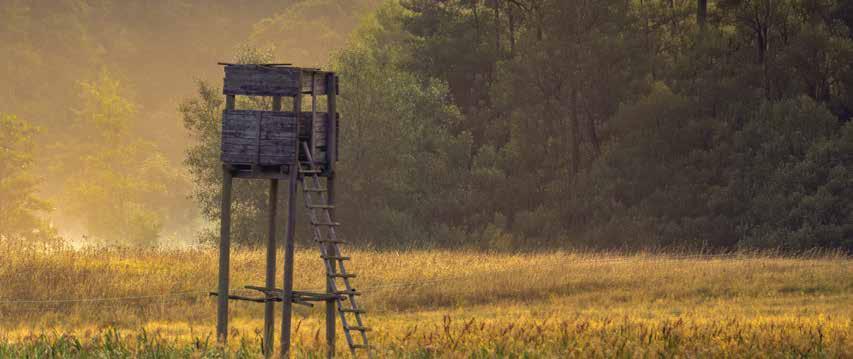
are there at the lodge to do things differently and not be inside,” Thomas shared. “Most of the time guests want to be outside.” Number Three, provide hunting stands that are large enough for two hunters (or a hunter and their son or daughter) and their guide, to all comfortably hunt from. “A normal stand might be 5 x 6-feet, but I like a 6 x 8-foot stand,” Thomas added.
Number Four, find quality guides for your hunts. “Some who have hunted their whole life or are natural outdoorsmen don’t need much training,” Thomas said. “But some who aren’t as experienced might need a bit more training in being able to judge a quality animal and determine the best fit for what a hunter is looking for.” Number Five, provide adequate meals and refreshments. Dinners might feature Steak Night, Seafood Night or Italian Night. Lighter meals are generally better before hunts, while larger meals are generally consumed after hunts.
Placement of your hunting lodge is again based on “location, location, location,” Ogle said. “Choose an area at the highest point of the property for the best views. And make it a family-friendly place. People are there to relax and you need to cater to the customer. Occasionally, hunters need to convince their wives into coming along so they themselves can have a chance to come.
We offer a hot tub, pool tables, shuffleboard, arcade games, poker and a game room.”
Among other important things, have a legally approved liability waiver and provide sufficient refrigeration and a sanitary spot if you are processing your deer on site. Be able to recommend a good taxidermist. Learn the importance of trail camera placement and drone utilization so you can take inventory of your deer, Bollinger emphasized. “Join NADeFA, understand DNA, GEBV’s and what NADR is. Join your state deer association and keep up with regulations and how they may affect you. And have a thorough understanding of stocker bucks and prices.”
SUGGESTIONS FOR OPERATING A FUNCTIONAL DEER FARM
By: Gail Veley • Sponsored by Whitetails of Louisiana
Afully functional deer farm should include a few major amenities: A handling facility and storage barns, adequate pen sizes with natural features and drainage ability and a well-planned alleyway with swing gates designed to contain deer in specific locations. Managing large numbers of deer through fluctuating conditions such as fawning season, breeding season or for medical procedures creates the need to be able to keep, maintain and move deer easily and safely.
Since starting Cedar Road Deer Farm in 2009 in Bremen, Indiana, owners Robert and Gilbert Yoder have added pens over the years to the eventual tune of four 200 x 300-foot pens and three 150 x 150-foot wooded, naturally landscaped pens. Larger pens are the exclusive home to two and three-year-old bucks, button bucks, mature bucks and weaned buck fawns, respectively. Smaller pens are used for expectant does and does with un-weaned fawns. Close to 15-20 bucks live in their designated pen, however, Cedar Farm strives to sell every buck at two years old and rarely has any three-yearold bucks on their property, as older bucks become harder to manage.
In designing the farm, Robert, 61, purposely placed the pens closer to
the road, in order to better acclimate the deer to stimulus and to better shield them from predators. Every pen is connected to an alleyway and corral large enough for safe passageway yet narrow enough to send them efficiently to the handling facility, and allows for one deer at a time to be let out or back in.
Managing deer also calls for managing challenging weather conditions. Yoder routinely adds sand to wet areas and also placed drain tiles around water troughs with below ground pipes to ensure frozen water, standing water or mud is never an issue. Yet there are so many other necessities in smoothly operating a deer farm that coincides with functionality, offers Brandon Bollinger of 2 Brothers Whitetails in Loranger, Louisiana. The list includes raccoon and predator free feeders, safe, extra hose in case of frozen water pipes, high quality and well-maintained fencing, mineral rich soil and food plots with joint vegetables rich in antioxidants, vitamins, minerals, calcium and magnesium, clover and humic acid. Other necessities include pesticide sprays, wormers, custom grain mixes for proper nutrition, an established relationship with a vet,
vaccines, darts and tranquilizers, tools for cutting antlers, scissors for pulling cidrs, tanks for shipping semen, a deer trailer, generators and a thorough knowledge of genetics and DNA.
Creating a well-functioning farm also includes the ability to spot illness and deciding whether or not you will have CWD monitored or non-monitored pens, staying abreast of regulations that effect you, staying current on your license and insurance, registering deer with NADR in addition to joining NADeFA and your state association and other state associations that you do business with. “Understanding your end market is also vitally important,” Bollinger said. “Are you going to raise stockers or breeders, typicals or non-typicals. Are you a closed border state? Who can you sell to or buy from? Make sure you understand what could be in store for you and how you plan to handle it. This may be the difference between and success and longevity or failure.”
IF YOU HAVEN’T TRIED PNEU-DART’S RDDS, YOU’RE MISSING MORE THAN YOUR TARGET
Did you know impact trauma can negatively influence medical treatment? We do. Which is why we’ve spent 58+ years perfecting the ideal remote delivery device. Shorter in length and lightest on the market, our disposable RDDs, with patented Slo-Inject ® technology, provide ultimate accuracy while reducing the potential for problematic hematomas. Pneu-Dart. When you can’t afford to miss.®
Dedication is exactly what every successful deer farmer learns and what Stefanowicz now exuberates not just in owning and operating Awesome Whitetails in Middlebury Center, Pennsylvania with her husband Jason, but also in her job as an Accounts Receivable staff member for D & K Design. D & K Design, producer of 11 quarterly state deer association magazines, saw Stefanowicz as the perfect fit for the job.
“I’ve known Amy for years, along with Jason,” said D & K Design Magazine Editor Kathy Giesen. “When I heard that Amy was looking for a part-time job, Jason joked that she could come work for me. Well, I took him up on it. Amy is very personable, well-known in the deer industry and very detail oriented. We are so glad to have her on board.”
As a young girl growing up on a hobby farm near Telford, Pennsylvania where
Amy Stefanowicz
great example of devotion back then, and along with it they both nurtured their daughter’s interest in agriculture, 4-H and even bowling. As the years passed, Stefanowicz found herself drawn to both horses and teaching, and even dreamed of becoming a barrel racing competitor on the national circuit. Ultimately, she was compelled to pursue early childhood education at Montgomery Community College, shortly after graduating from Dock Mennonite Academy.
Later, she met Jason at a birthday party, ultimately fell in love and married him on September 11th, the same day as her birthday, in 1999. Now, through the creation of their deer farm and the daily caring for deer, Stefanowicz has found the perfect combination of her passions as a teacher and animal lover. Her advice on raising fawns has been sought out by uncountable people in the deer
as devoted to their deer as she and Jason are, as it allows her and Jason to attend industry events on a fairly regular basis.
If she had but one wish, it would be that her parents were still alive, sharing in all the joys and challenges of raising deer. However, she finds comfort in knowing her success is firmly rooted in the life lessons they taught her. If you don’t already know Amy, visit the D & K Design booth at the next event they may be found at, and say hi!
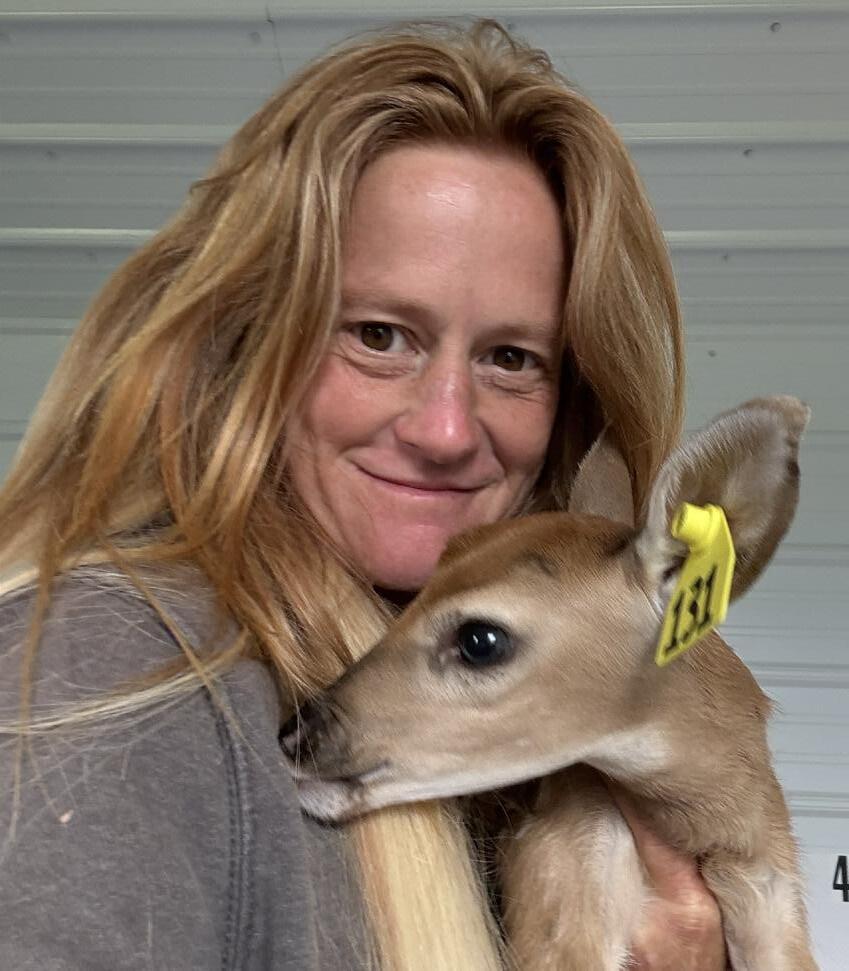
~ Amy
“Amy with all of her kids”
FREE
members of Whitetails of Louisiana
If you would like your farm or business featured on our business card pages, email digital pdf file or scanned image (must be readable resolution) of your business card to the email address below.
This gives Whitetails of Louisiana members a way to reach out to one another for services and to buy or sell deer! There will be limited pages for these card spreads, first come first serve. The overflow would be placed in the next issue and cards will be rotated each quarter.
Email to:
Myra Bollinger whitetailsoflouisiana@gmail.com
COMPLETE KITS WITH SEDATION AND REVERSAL AGENTS, OR SOLD SEPARATELY.
By: Gail Veley • Sponsored by the Southeast Trophy Deer Association
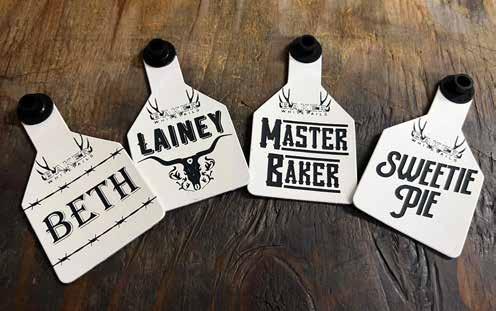
Deer, with their memorable antics, characteristics and often times unusual behavior, earn a place in a deer farmer’s heart and perhaps a funny name along with it. The following is a list compiled by deer farmers willing to share their story.
Upper Midwest Trophy Whitetails. Hazel, South Dakota. “Hammer Time” – a buck named after the local game warden and “Ever Ready,” a son of Excel.
Haas Fallow Deer Farm. Warrenton, Missouri. “Couch Tater” - named so after being abandoned by his mother, being bottle fed and spending a lot of time on the couch watching television, and “Dart” after being delivered and saved by owner Jeff Haas, who still greets him with a bark.
Awesome Whitetails. Middlebury Center, Pennsylvania. “Mallory”given her name after she became a family pet and responded with twitching ears to being called “Mal Mal.”
Baker Whitetails. Junction, Illinois. “Master Baker” – a buck named by Chase Baker after Kyle Neal of Neal’s Whitetail Ranch in Ewing, Illinois, dared him to do it.
Shallow Pond Whitetails. Shipshewana, Indiana. “Humpy” - named by Dave Schwartz for the buck’s protruding shoulder blades.
Double H Whitetails, Dundee, Ohio. “Bambi Boo Boo” got his name when as a young buck fawn, he made a “boo boo” inside the house.
MVP Whitetails. Kaufman, Texas. “Ping Pong” was named after his flighty disposition and propensity to run into and bounce off of fences. He was later renamed “Ricochet.”
Sterrett Knob Whitetails, Fredericksburg, Ohio. “Reject” got his name after he was left for dead by his mother. After turning into a big and sturdy buck, he let Levi Miller’s kids ride him like a horse. After he was later sold to Eric Klick, he continued to live a good life and died of old age.
2 Base Down Farm. Morriston, Florida. “Minnie” is one of several girlfriends of breeding buck “Mickey.” Minnie was born weighing two pounds six ounces but is alive and well today. “Nala,” named after the young lioness from The Lion
King, has a very noticeable mane. “Houdini,” earned her name after escaping from a fawn proof pen.
Other deer names at 2 Base Down might be self-explanatory such as “Ms. Fancy Pants” or an abandoned three-pound fawn named “Mercy Me.” When a young buck fawn broke his leg, they named him LBB for “Little Boy Broken,” who went on to be a prized breeding buck, while teaching a valuable lesson. Never give up on a fawn. “When we raise and name deer, we have fun doing it,” Leffler said. “With our breeding buck Mickey, we figured if a mouse named Mickey could put Florida on the map, then our very own “Mickey” could do that for our farm.”
• All-Milk Protein from Premium Food-Grade Milk Ingredients
• Essential Vitamins and Complex Minerals
• Balanced Fatty Acids
• Improves Digestion
• Promotes Growth and Performance
FEEDING DIRECTIONS: WHITE-TAILED DEER
• Fawns up to 1 week of age: Feed 16 oz. of formula daily, divided into 4 – 6 feeding.
• Fawns 1 week to 1 month of age: Feed 24 to 30 oz. of formula daily, divided into 4 feedings.
• Fawns 1 month to 2 months of age: Feed 30 to 35 oz. of formula daily, divided into 2 to 3 feedings.
• Fawns 2 months to weaning: Gradually decrease formula and number of feedings to approximately 15 oz. of formula once daily until fawn is fully weaned at 12 to 14 weeks of age. Provide a weaning diet and fresh clean water to the fawn.
For oral use only. These feeding directions are guidelines. As each animal is an individual, the feeding rate may be increased or decreased according to the needs of the neonate.
Feeding directions for other species can be found on our website.
• No Refrigeration Needed
• Easily Palatable
• 18 Month Shelf Life
• Available in 20# & 8# pails
• 24/7 Technical Advice & Support
• Formula for other Exotics and Wildlife Available
Word Search
SUDOKU
The rules for sudoku are simple:
A 9x9 square must be filled in with numbers from 1-9 with no repeated numbers in each line, horizontally or vertically.
To challenge you more, there are 3x3 squares marked out in the grid, and each of these squares can’t have any repeat numbers either.
I AM JOINING AS: (PLEASE CHECK ONE) ACTIVE MEMBERSHIP (VOTING PRIVILEGES): $100.00/YR.
ASSOCIATE MEMBERSHIP (NON- VOTING): $50.00/YR.
LIFETIME MEMBERSHIP (VOTING PRIVILEGES): $750.00
I HEREBY MAKE APPLICATION TO THE WHITETAILS OF LOUISIANA AND I CERTIFY THAT THE INFORMATION I HAVE PROVIDED IS TURE AND CORRECT TO THE BEST OF MY KNOWLEDGE:
Mission and Purpose :
To promote the business of raising and marketing Whitetail Deer in the state of Louisiana.
To promote high ethical standards in the care, handlin g, and harvesting Whitetail deer
To provide educational opportunities for members of the corporation and other interested people through the sharing of inform ation concerning whitetail deer.
To serve as a collective voice in governmental issues that affec t whitetail deer producers, so as to enhance the whitetail deer industry. To require members of the corporation to operate in a legal, honest and forthright manner with fellow members, other whitetai l deer producers and the general public
• Whitetail Deer Farmers of Ohio
• Whitetails of Louisiana
• Whitetails of Oklahoma
Buckaneer
Package: *
44 ISSUES FOR 1 YR.
Reaching out to over 2500 members (11 Publications x 4 quarters)
19 State Associations - Approx. 2500 readers
$200 / Issue ($8815. / Yr) ~ Full Page
$113 / Issue ($4990. / Yr.) ~ Half Page (55-59% Discount off single ad placement)
Yearling Package:
4 ISSUES FOR 1 YR.
(1 Publication x 4 quarters)
$267 / Issue ($1069. / Yr) ~ Full Page
Doe-Re-Mi Package:
16 ISSUES FOR 1 YR. (4 Publications of your choice x 4 quarters)
$233 / Issue ($3730. / Yr) ~ Full Page
$128 / Issue ($2052. / Yr.) ~ Half Page (48-54% Discount off single ad placement)
$145 / Issue ($581. / Yr.) ~ Half Page (40-48% Discount off single ad placement)
$540 ~ Full Page*
$250 ~ Per Quarter Page
$135 ~ Per Quarter Page - Current Advertiser in quarterly magazines.
$180 ~ Per Quarter Page
- Current Member of any of the Associations we serve
* Must be a current advertiser, limited space available
L OUISIANA D EPARTMENT OF A GRICULTURE & F ORESTRY