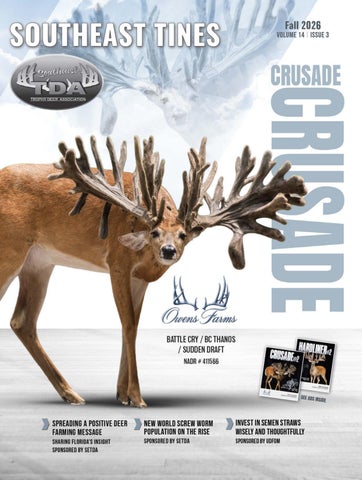
AUGUST 2026 | FALL
Inside This Issue: 24
34
5
31
50
6
Featured
Content
5
Advertisers Index.................................................. 55
6
Spreading a Positive Deer Farming Message - Sharing Florida’s Insight New World Screw Worm Population on the Rise
24
How to Rattle Up a Buck
31
Invest in Semen Straws Wisely and Thoughtfully
34
The Good, The Bad, The........
50
Increase Chances of Hunting Success with Properly Placed Trail Cameras, Deer Stands and Scent Hiding
Board of Directors.................................................. 2 Business Cards........................................ 45, 47, 49 CHeRI....................................................................... 11 CHGC NADEFA 2026 Fly-In................................. 26 Dream Genomics - Deep into Phase Two of CWD Cutting Edge Technology.......................... 21 Event Calendar........................................................ 9 Magazine Advertising Information................... 54 Membership Application..................................... 14 Meet Troy Zacchini: The Future NADeFA Executive Director................................................ 16 President’s Message.............................................. 3 Puzzle Page............................................................ 54 Recipe: Venison Crunchwraps........................... 40 Scholarship Information..................................... 52
WINTER MAGAZINE DEADLINE NOVEMBER 3RD, 2026
1 1
BOARD OF DIRECTORS DIRECTORS PRESIDENT
Matt Young Taxidermist Tillman Outdoors LLC 13669 Buckskin Rd Brooksville, FL 34601 352-206-4745 sportsmens9@yahoo.com
VICE PRESIDENT
Blaine Flynn Flynn Farms McDavid, FL 850-380-5259 blaine@flynnfarmsus.com
TREASURER
Wendy O’Brien 5 Star Bookkeeping & Tax Service LLC Spirit Ranch 26838 Mondon Hill Rd Brooksville, FL 34601 352-584-0971 spiritranchfl@gmail.com
SECRETARY
Laura McWatters T&L Farms 341 SW Ballard Ct. Lake City, Florida 32024 561-644-8029 buckfeathers@bellsouth.net
Benny Wilkison Lil Oak Whitetails 3193 NW 216th St Lawtey, Fl 904-424-7233 liloakwhitetails@yahoo.com
Tim Cromwell 18015 NE CR 1471 Hampton, FL 32044 352-727-9528
Sam Petersheim Crescent Ranch 6547 Midnight Path Road #87 Sarasota, FL 34242 217-273-3331 samkey80@gmail.com
Michael “Andrew” Owens Whitetail Country Plantation Live Oak, FL 386-956-9836 mandrewowens@gmail.com
Les Simon Simon & Simon Exotics Farm 12301 Masked Duck Rd Weeki Wachee, FL 34614
2
President’s Message Fa l l
2 0 2 6
SETDA Working to Stand Strong Together A Word of Encouragement from SETDA President Matt Young Our unique state of Florida has much to offer our fellow hunters. From whitetail velvet hunting season to exotics to traditional whitetail hunting, it seems there’s always something to look forward to. I recently enjoyed a velvet hunt so much I didn’t make it back home until 1 a.m.! While we’ve spent much of the summer in a drought, we recently had a deluge of rain in certain areas of our state. While that is a much-welcome relief, so is the fact that we’ve only a few reported cases of EHD this year. As we glance ahead to fall, we look forward to fostering a deeper understanding of what our general members and board members need to become more cohesive in our decision making. We value everyone who chooses to raise deer in a state that is as unique as its people. We are always seeking to stand strong together. Please mark your calendars for March 5th and 6th of 2027, when our annual Spring Fling is scheduled to take place at our usual venue in Orlando. If anyone has any thoughts or any concerns they would like to share with me, please feel free to give me a call or send me a text. Thank you! I’m looking forward to spending time with everyone!
3
Spreading a Positive Deer Farming Message
Sharing Florida’s Insight By: Gail Veley • Sponsored by the Southeast Trophy Deer Association
S
am Petersheim fills and checks the feeder he provides outside his fence for the local wild deer, as often as he fills and checks the feeders inside his fence, for his very own deer. Of the eight wild does who visited his feeder this past spring, only three out of the eight had fawns, while one adult doe had only one fawn. “What happened to the other 60 percent?” Petersheim wonders. Actually, he already knows the answer. “We have an abundance of bobcats and coyotes and panthers here in Florida and fawns are part of what they live on.”
Petersheim started deer farming in 2002 in Illinois, eventually ending up in 2022 in Myakka City, Florida at Crescent Ranch, where through it all he’s noticed a trend. While making money is certainly a goal with deer farming, it is not the number one goal. “Deer can be raised on land not suitable for other farmed species yet can still provide safe forage and habitat for native species such the gopher tortoise and sandhill cranes. We look out for them, too,” Petersheim, 70, explained. “The average life span of an adult deer in the wild is about 1.5 years, if they even make it to adult-
hood. The deer at a farm or preserve receive the very best care. Raising deer is very therapeutic and very addictive. You get to see the fruits of your labor into building what you have. We are working hard to perpetuate a species that isn’t as prevalent in the wild as it used to be.” As more and more land is encroached upon by humans for development, wild spaces for hunting are becoming more rare. “People are not being able to hunt in the wild as they did in the past because of poor land management practices, fighting with other hunters and shooting deer too young,” said Blaine Flynn of Flynn Farms near Pensacola, Florida. “This forces hunters into high fence hunting, which offers something the wild might not. A chance to leave with something.” Flynn feels there are many false misconceptions about high fence hunting. “You can find good and bad hunts, but I’m a firm believer that the industry as a whole is doing everything as ethically as we can,” Flynn, 38, emphasized. “The only time you see a fence at my place is when you’re pulling in. With preserves, we
can control the genetics inside the fence and keep bad genetics out. This will ultimately benefit wild deer, too. Deer farming is also a recognized and supported form of agriculture. It is not illegal to raise deer.” In addition to sharing a deep passion for raising quality deer, Petersheim and Flynn value the friendships and working relationships they have formed from being in the industry. And perhaps even greater in longterm value is breeding towards CWD resistance, driven 100 percent by deer farmers and preserve owners. “If the state of Florida started letting us turn our deer out in the wild, we could possibly save the native deer population here,” Flynn said. “Deer farmers are changing their entire breeding programs and leaving prominent bucks on the back burner in order to make genetic advancements towards CWD resistance. At the end of the day, there is no greater commitment towards conservation then this.”
5 5
New World Screw Worm Population on the Rise
A
By: Gail Veley • Sponsored by the Southeast Trophy Deer Association
parasitic fly that was eradicated from the United States in the early 1980’s has re-emerged and is now affecting several areas of Mexico and parts of Texas. The New World screwworm, a greenish-gray fly with distinctive red eyes, lays its eggs in the open wounds, cuts or lesions of living animals. Once the eggs hatch, the larvae (maggots) feed on the animal’s living tissue for approximately seven days, causing severe damage as they grow. After reaching maturity, the larvae leave the wound, pupate, and eventually emerge as adult flies, continuing the cycle by infesting other animals. A single female screwworm can lay up to 300 eggs in a single event, allowing infestations to spread rapidly. If an infestation goes undetected it is often fatal to the affected animal, said Dr. Juan Campos, DVM, Assistant Professor in the Department of Large Animal Clinical Sciences and the Department of Wildlife Ecology and Conservation at the University of Florida. “The screwworm can affect a wide range of warm-blooded species, including livestock, dogs, hogs and humans. One of the first signs is a lesion that doesn’t heal, grows rapidly, and has a distinct, unpleasant and recognizable odor. The lesion can progress quickly, expanding from the size of a ping pong ball to that of a baseball within just 24 hours. However, when detected early and treated promptly, affected animals often have a good chance of survival. Administering an appropriate dose of approved antiparasitic medications can effectively treat infestations, while strategic usage can significantly reduce the risk of new cases. “Treating captive-raised deer will be particularly challenging, as they are not as tame as regular
6
livestock,” said Dr. Campos. “If the fly spreads, new management efforts may increase costs for producers. Additional personnel might be needed to monitor herds and identify cases early.” A breakthrough in screwworm control occurred in the 1960’s through an eradication program that included large-scale releases of sterile flies. Scientists discovered that the female screwworm mates only once in their lifetime. Based on this finding, they developed the Sterile Insect Technique, which involved mass-producing, sterilizing, and releasing male screwworm flies into the wild. No viable offspring were then produced, causing a population decline. Although the effort took approximately two decades to achieve its objective, it was ultimately successful, leading to the eradication of the screwworm from the U.S. and much of North America. The parasite was not detected again until cases were reported on a cattle operation in Mexico, in November of 2024.
While the re-emergence of the screwworm is concerning, Dr. Campos emphasized that awareness, surveillance, and prompt reporting remain the most effective tools for controlling its spread. “People should be vigilant, but they should also understand that this is a manageable situation,” Dr. Campos said. “The fly cannot survive prolonged cold winters, which limits its ability to establish populations in northern regions. Producers and veterinarians should contact their state Dept. of AG or animal health authorities immediately if they suspect a case. No one will be penalized for reporting an infestation. Communication is essential, and no one should hesitate to reach out.” Monitoring the movement of the screwworm remains a priority for the U.S. Department of Agriculture’s Animal and Plant Health Inspection Service (APHIS), which continues to coordinate public outreach efforts. To learn more about the New World screwworm, visit the APHIS website. www:screwworm.gov.
SERIOUS NUTRITION FOR SERIOUS RESULTS. FFF
FFFF
,
SSSSSSS NNNNNNNNN
, RRRRRR RRRR®
.
RRRRRRRRRR....
©2025 CCCCCCC, IIIIIIIIIIII. AAA RRRRRR RRRRRRRR.
Shady Oaks WHITETAILS
All Texas Genetics
Does, Stocker Bucks, and Breeder Bucks for Sale Deer from these Genetics Available: Papalote NADR #342948 Oasis NADR #334591 Starlink NADR #418268
Codon 96: S/S, GEBV: -0.004365 Codon 96: S/S, GEBV: 0.113170 Codon 96: S/S, GEBV: -0.064458
CCW Aftershock NADR #172897 Big Stitch NADR #50551 Star Buck NADR #418268
Codon 96: G/S, GEBV: -0.281115 Codon 96: G/S, GEBV: -0.007484 Codon 96: G/S GEBV: -0.078975
Mark Crews - 863.634.3257 Paula Crews - 863.697.1129 Ally Hiler - 863.261.2015 Indiantown, FL
BullBarnFence.com (724) 675-8296 | sales@bullbarnfence.com 406 Cornell Road • Blairsville, PA 15717 8
Bodyguard @ 7
Upcoming Whitetail and Cervid Events SETDA Southeast Tines Magazine Deadlines 2026 Spring: February 4th Summer: May 5th Fall: August 4th Winter: November 3rd
KALA Summer Showcase - Aug 8, 2026 Missouri Deer Association Picnic & Meeting - Aug 8, 2026 - Clark, MO Whitetail Deer Farmers of Ohio Convention - Aug 13-14, 2026 Illinois Deer Farmers Fall Picnic - Aug 15th - Carlyle, IL Pennsylvania Deer Farmers Association Fall Auction - Aug 29th - State College, PA Southern Top 30 - Aug 20-21, 2026 - Louisiana Whitetails of Louisiana - Aug 21-22, 2026 - Marksville, LA TDA Annual Convention - Aug 28-29, 2026 - San Antonio, TX North Dakota Deer Ranchers Summer Picnic - Aug 30, 2026 - Towner, ND Iowa Whitetail Deer Farmers Winter Meeting - Feb 27, 2027 - Waterloo, IA Pennsylvania Deer Farmers Association Winter Benefit Auction - Feb 26-27
Use this QR Code or go online to DeerSites.com for more deadlines and up to date event information!
9 9
10
11
12
13
SOUTHEAST TROPHY DEER ASSOCIATION Laura McWatters 341 SW Ballard Ct. Lake City, Florida 32024 14
15
MEET TROY ZACCHINI THE FUTURE NADEFA EXECUTIVE DIRECTOR By: Gail Veley • Sponsored by The Alabama Deer Association
T
roy Zacchini, the current Associate Executive Director of NADeFA, is prepared to fill some big shoes as NADeFA Executive Director Shawn Schafer moves towards retiring from a job he’s dearly loved and served with great pride. This fall, Zacchini will officially step into his new role. “I’m just very grateful the board thinks I’m up to the task.” Zacchini, 48, said. “I would like to think a lot of people would like the opportunity to be the executive director of NADeFA. I’m humbled that the board thinks I’m capable, and they feel optimistic that they found who they’ve been looking for.” It was a little luck combined with fate that brought Zacchini, owner since 2000 of Troy Hunt’s Club in Forest Home Alabama, and Schafer together. After flying to Washington D.C. on deer farming legislative matters in the spring of 2025, the two discovered their gates to catch a flight home were right next to each other. “Shawn started sharing with me what his job was, and that he was thinking about retiring,” Zacchini said. “I asked him if he thought it was something I could do.” Shortly after that time, Schafer has been steadfastly preparing Zacchini to take on the monumental role of executive director. Zacchini is very comfortable with public speaking, having worked with legislatures, led bible studies and also worked as a hunting guide before starting his own breeding and hunting operation. He understands what being in the spotlight is all about, being a descendant of the famous Italian “Zacchini Brothers” circus performers from the 1930’s and 1940’s, who spent time with both the
16
Ringling Brothers and Barnum and Bailey circuses. Edmundo and Hugo Zacchini were the daring performers behind their flying human cannon ball act, deemed the most dangerous profession one would possibly have, having only a thin landing net between them and certain death. The Zacchini’s, who resided in Tampa, Florida, also walked high wires, performed trapeze acts, rode horses and dazzled audiences from all over the world. Troy Zacchini plans to bring the same passion and energy his ancestors brought to their daring circus acts, to his role as Executive Director for NADeFA. His wife Angela and their two sons, Tavio, 17, and Teovanni, 15, are excited for their father to take
this next step. Zacchini received a bachelor’s degree in biology in 2000, from Stetson University in Deland, Florida. He has spent the better part of his life living in Alabama, where he has enjoyed being a lifelong bow and gun hunter. “NADeFA feels confident that Troy will do a great job,” Schafer said. “He has the experience and intestinal fortitude needed to carry the torch as we in the deer industry navigate the ever-changing trends and regulations. We welcome him fully and look forward to everyone else doing the same.”
512-920-4757
orders@WildlifeCaptureEquipment.com
979-203-6735
info@DanInjectDartGuns.com
Let our 25+ years of experience in the field be yours
HUMANE DARTS
Side-Ported Needles Re-Usable!
NET GUNS & NETS
PISTOLS Great For Short Range Shots!
BLOWPIPES
HOODS AND MASKS 18
CARRY RUGS
C02 DART GUNS
Use as close as 1 yard! Lightweight! Virtually Silent! Low Maintenance
Made of Aluminum Won’t Bend or Break!
JAB STICKS
Fully Automatic. Liquid Releases within 1-1.5 seconds!
USE PROMO CODE
TRYDEERDOC25
FOR 20% OFF YOUR ORDER
HIMALAYAN SALT LICK NATURAL MINERAL ROCK SALT 4636 BIT & SPUR RD. MOBILE, AL. 36608 (866) 333-7362 // DEERDOC.NET
WWW.DEERDOC.NET // (866) 333-7362 20
INGREDIENTS: 100% ROCK SALT ANALYTICAL CONSTITUENTS: SODIUM 34.5% PACK WT: APPX 3-3.5KG
DREAM GENOMICS
DEEP INTO PHASE TWO OF CWD CUTTING EDGE TECHNOLOGY
W
By: Gail Veley • Sponsored by the Illinois Deer Farmer’s Association
ith Phase One for developing a blood test for early CWD detection essentially in their rearview mirror, scientists at Dream Genomics, a visionary biotech firm started in 2023 and based out of Northbrook, Illinois, are now deeply entrenched in Phase Two, Biological Confirmation. This second phase is moving ever closer to finishing up, explained Dr. Gary M. Pusateri, CEO and Founder of Dream Genomics. Biological confirmation, Phase Two, entails gathering sample after sample from virtually anywhere CWD is detected in the U.S. and Canada in whitetails, mule deer and elk, and pinning down the specific genes that distinguish themselves as being the answer to the diagnosis of CWD. Phase Two has involved extensive travel, time, effort and research on behalf of Dr. Pusateri as well as Dr. Michael Falduto, Chief Technology Officer and Founder and Dr. Scott Magnuson, Chief Scientific Officer and Founder. The more testing that takes place during Phase Two, the closer they come to being 90 percent accurate
(or better) as to which specific genes reveal the presence of CWD, regardless of the location a deer farmer raises deer. As this dedicated trio of scientists works diligently to finish Phase Two and continue onto Phase Three, Assay Development, they are very grateful for those investors who have allowed their work to move forward. However, they are also hopeful that new investors will contribute in order to more fully guarantee their work can be seen to full fruition. “We aren’t connected to a university,” Dr. Pusateri explained. “We currently rely on support from our investors, grants and self-funding for everything that we do.” To come full circle in their gamechanging quest, Phase Three, the final phase, involves moving accurate and targeted samples onto PCR plates. Assuming CWD positive genes become paired down to the fewest specific and acutely accurate number needed for testing, more tests could be run per plate, therefore not costing a deer farmer as much money to test their herd. “This is why Phase Two is so important,” Dr. Pusateri explained.
“We want to ultimately be so accurate that both time and money are saved. We are doing whatever it takes to be at that point. We are looking at a 24hour turnaround once Phase Three becomes fully operational.” If any deer association, private individual or corporation is interested in donating or investing in Dream Genomics research, please contact Dr. Pusateri at his office at 847-2919602 or his cell phone at 715-8917878 or email him at gpusateri@ dreamgx.com. Potential investors can also check out the website at www:dreamgx.com. “The best part about supporting our research is that you have two very large opportunities to gain,” Dr. Pusateri said. “One, in making live diagnostics available to all and helping the entire industry permanently move forward. Secondly, with potential personal gains from investing in the company. If the USDA accredits this test, a deer that tests negative could potentially be moved anywhere, opening doors for deer farmers to completely flourish rather than be held back by regulations.”
21
22
C E RV I D H E A LT H M A N A G E M E N T Powered by
Weaning fawns and preparing your females for breeding season starts with a vaccine program developed by deer farmers for deer farmers...
AVAILABLE NOW Sign up for The Hoof Prints Membership and save $100 per bottle.
AI-1 VACCINE
Don’t Delay. Order Today at cervidhealth.com or Call the Office at 484-951-3229.
BUILD BETTER HERDS | CERVIDHEALTH.COM
23
HOW TO RATTLE UP A BUCK By: Gail Veley • Whitetail Deer Farmers of Ohio
M
ony Weaver can still remember November 14th, 1985 like it was yesterday. It was only 2 p.m. and he had already rattled in nine bucks that day. Out of the nine, he didn’t shot any because they were quit small. But his intuition and discoveries about deer behavior had clearly paid off. “There is one key ingredient to successful buck rattling. The buck has to be in the mood,” explained Weaver of M & M Whitetails in Apple Creek, Ohio, started in 1994. In his 55 years as a hunter, Weaver has spent the better part perfecting the ideal rattling situation. Rattling, or knocking a set of antlers together, is designed to entice a buck in the rut into shooting range, based on making the buck believe that there are does in estrus close by and other bucks are fighting over them. However, “there’s no way a human can make that much noise,” Weaver said, in reference to the sound of two bucks fighting. This makes a hunter’s strategy very important. After successfully rattling in a 160” buck many years ago, Weaver carefully pinched the rattling antlers he was using between his thighs and silently bent over to pick up his bow and arrow. The moment he stood to take aim, the antlers slipped through his legs and came crashing down onto the tree stand, causing his promising buck to spin around quickly, and take flight. Weaver, 71, firmly believes in rattling from a tree stand for safety and to remain inconspicuous. “Rattle for 30 seconds, wait 15 minutes and try again,” he said. “If in two hours you haven’t attracted a buck, it’s not the right time.” The practice of rattling, dating back to the late 1800’s, was primarily done by market hunters in Texas and other southwestern parts of the U.S. It wasn’t until Hart Stillwell wrote an article on rattling that was published in Outdoor Life
24
Magazine in May of 1951, that the concept became popular to a larger audience. Today there are vast products designed to mimic the sounds of two fighting bucks, but Mony feels a good old-fashioned set of antlers, synthetic or natural, works just as well. “When a buck gets close, don’t keep rattling,” he said. “You don’t want them to know where you are. Use medium sized antlers. If they’re too big a buck might stay away thinking the competition might be more than they can handle.” Weaver recalls rattling in a buck so full of testosterone that all of its hair was standing on end. “He kept going around and around the tree I was in,” he shared. “I didn’t shoot him because he was too small. Regardless of size, you need to watch your safety and respect them. A wild buck is safer overall than a buck in a pen, because of human familiarity. But I still didn’t come down and out of that tree for quite a while.” Weaver has also rattled in bucks from a deer blind, where situated outside was an eight-point decoy, piquing the curiosity of each buck that investigated, if nothing
else. Dragging tree branches across tree trunks can also simulate the sounds of a scuffle. “Once, I had a buck come running just because I climbed up into a tree,” he said. Weaver’s hunting adventures are documented in two books he’s written called Buck Rubs and Turkey Scratches, Part One and Two.
25
NADEFA 2026 FLY-IN In April, NADeFA members from across the country gathered in Washington, D.C., for the 2026 Fly-In to advocate for critical funding in the fight against Chronic Wasting Disease (CWD). Representatives from Oklahoma, Michigan, Pennsylvania, Texas, Alabama, Missouri, North Dakota, New York, Ohio, North Carolina, Kansas, Louisiana, Minnesota, and West Virginia met with their respective lawmakers to underscore the urgent need for federal support. NADeFA members had a total of 85 meetings, including with House and Senate offices from both Democratic and Republican offices, the U.S. Department of Agriculture (USDA), and industry partners. These meetings allowed members to educate Congressional members on CWD and reinforce the importance of NADeFA’s FY-27 appropriations requests. NADeFA members advocated for two comple-mentary federal funding efforts to combat CWD. First, they supported providing $15 million under the Chronic Wasting Disease Research and Management Act to fund competitive grants for states, Tribes, universities, and researchers to study disease transmission, develop vaccines and live diagnostic tests, identify genetic resistance, and expand management and education efforts. Second, they called for $17.5 million for the Cervid Health Appropriations Program, including $12.5 million for the CWD Herd Certification Program and surveillance activities, and $5 million for timely indemnity payments to remove infected animals. As next steps, Capitol Hill Consulting Group will follow up with House and Senate Appropriations staff, the USDA, Senator John Hoeven, and House Agriculture Committee Chair GT Thompson on behalf of NADeFA to further support the FY-27 appropriations requests.
26
Appropriations Update After receiving the President’s budget request, the House and Senate Appropriations Committees started to draft their 12 annual appropriations bills. The House Appropriations Committee has released the schedule for FY27 appropriations bill markups, where each Subcommittee will review its bill. The first markup was held on April 17, with the last one scheduled for June 24. The Senate has yet to release its markup schedule, as they are still holding hearings with agencies to discuss the President’s budget request.
Conclusion As Congress continues to shape federal funding and longterm agricultural priorities, NADeFA remains steadfast in its mission to advocate for meaningful support in the fight against CWD. NADeFA is committed to ensuring the cervid industry has the resources it needs. We’ll continue to work closely with lawmakers, agency partners, and stakeholders to keep CWD at the forefront of federal policy discussions. Thank you for your continued support as we advance this important work.
27
28
30
INVEST IN SEMEN STRAWS WISELY AND THOUGHTFULLY
A
By: Gail Veley • Sponsored by the United Deer Farmers of Michigan
ny deer farmer who’s bought semen straws for the last five to six years more-than-likely “has too much semen,” explains Alex Draper of DD Deer Farms in Clio, Michigan. Although semen straws allow a deer farmer to breed with perhaps the best buck on the market, that same buck may be replaced by another the following year with even better and more desirable traits, making semen straws of the previous year’s buck obsolete. “If you bought more semen from a buck than you can use in one breeding season, you may have wasted your money,” Draper advised. Individual semen straws, which can vary greatly in price depending on the buck, typically cover two to three does through vaginal A.I. or one to two does through the use of an insemination gun. And while diversifying genetics can be the focus of a deer farmer each breeding season, Draper, 71, a deer farmer of 32-plus years, cautions to study conception rates and to consider your budget and goals beforehand. Should your budget allow for five semen straws, buy five of the same buck you desire to breed to, rather than one straw from five different bucks. “If you only buy one straw from one buck, and you only end up with one surviving fawn from that straw that dies later in the fall, you’ve lost the genetic potential of that entire straw,” he said. “Buy enough to make a difference. It’s better to make sure you end up with the offspring you were after. When you are buying semen, you also need a good grasp on genetics and should breed for paper (pedigrees) or better genetics going forward.”
course for his farm. This fall and in subsequent years to come, he will be focusing on genetic breeding values (GBV’s) which estimate an animal’s genetic merit for a particular trait and while defining the superiority or inferiority of it’s offspring. In the case of whitetail deer, Draper along with other deer farmers, are realizing the increased need to breed for CWD resistance. To this end, Draper may use some of the semen straws from his old inventory to help perpetuate this goal. “Be aware that some big bucks on the scene now have no GBV’s,” he said. To date, as a result of making informed choices about the purchase of semen straws, more than half of the breeder bucks on Draper’s farm possess the “SS” allele or better. Through his studies, Draper has found he likes “K’s” and “H’s” and anything equal to the “SS” allele but without a “G” link to it. Alleles, defined as one or two alternative forms of a gene that arise by mutation and are found at the same place on a chromosome, may strongly determine a whitetail’s potential resistance to CWD.
“Don’t get me wrong, I like my typicals, but most of the stuff that has favorable GBV’s has a more nontypical look,” explained Draper, whose background and professional engineering career centering around science is influencing him to move away from typicals, and later go back to them when genetics are more favorable and able to sustain many generations of CWD resistant deer. “Here in Michigan, we look it at as a long-term goal and can start with the base that we are creating,” he said. “The science side of me is making me want to focus on the breeding markers and leave a good foundation (legacy) for others to benefit from. It’s not about chasing pedigrees but about the markers. Michigan has a good stocker buck market to move us a couple years down the road. Our ultimate goal is to develop our breeding operations to have all great markers and develop the GBV’s that protect against CWD for future sales of those protected deer.”
However, even though keeping up with industry trends has it’s advantages, Draper, whose focus in the past few years has been on raising typicals, is now charting a different
31
32
33
The Good, The Bad, The .......... By: Dr. Bill Leffler
I wasn’t sure I could tell this story because I am still trying to forget it ever happened, but God got us through it, so here goes. As deer farmers, we all have or one day will experience the highs and lows that are part of it. We press on and continue because we love the life and the deer. I thought by now that I had seen nearly every way a deer could die, I was wrong.
34
On April 21st while seeing patients I got a panicked call from a friend that a large, out of control, forest fire was heading at my farm. I immediately left and raced home. The normal 45-50 minute drive was going to be much shorter. Along the way my phone kept blowing up with friends calling to let me know the fire had jumped the highway, roads were blocked, and that I may not make it home. I told them that nothing would
stop me from getting home to my family and animals. Just before getting home, my neighbor, Robert Partin, called to tell me that if the wind doesn’t shift, we may be spared. It took me an extra 20 miles avoiding the fire to get home, but I made it. As I pulled through the front gate, 6 helicopters were already scooping water every 2 minutes from the large pond, I had dug, in the middle of our hay field. This
was the closest source of water left due to the severe drought. They continued all day, stopping briefly only to make quick repairs and refuel, until sunset. The water was being used to save my neighbors’ homes and buildings. Deer don’t like helicopters flying close overhead or landing within 30 yards from their pens. By the time we saw this and told them to stay the hell away from our pens and animals it was too late. My son opened the gate to the pen by our house for his cut and bloody bottle feds before they killed themselves as well. He asked to open other pens, but I told him we couldn’t. We could only pray for them. In Florida, you cannot allow the escape of cervids or any exotics without potential serious legal and/or financial consequences. My family had already been ordered to evacuate, but our animals come first. It took my daughter three trips to relocate all of
our horses along with enough basic supplies to last them a few days to one of my oldest friend’s farm, Rob Tomczak, and another trip to load up 4 large dogs, their crates, and supplies. My son and son-in-law were busy moving all of our vehicles, large farm equipment, my 30’ boat, multiple trailers, and the full fuel tanks across the street to a large clearing at our preserve. Unfortunat ly, the barn still had 3 tons of deer feed and over 150 large round bales of hay in it. They all quickly filled the water and feed troughs in every deer pen before heading to the house to help my wife. All this time I had been on a tractor discing up the ground outside of our perimeter fence creating a fire break which the other land owners had neglected to do. Smoke and ash filled the sky and fell like rain. The wind had changed and was now blowing
20-25 mph pushing the fire directly at us. Tony Parker, a wonderful friend, was on his frontend loader attempting to make the fire break even larger. We worked well into the night until it became unsafe, the sky was now glowing red and I feared we would get trapped outside of my fence. The firefighters had finally started to arrive with lots of large equipment. Tony instructed them not to destroy my fence under any circumstance but rather to use the gates and explained about what would happen if animals escaped. I am grateful that they did just that and did not destroy my fence. A private preserve just 2 miles away was not so lucky. Every beautiful green grassy road on my farm I turned into bare dirt as well. It was now becoming difficult to breathe even in the tractor. We were given our 3rd and final orders to leave. I pray that I never again hear my wife or kids say, “what do we take, what do we leave”. I told them to first grab whatever is priceless to your heart and can never be replaced, then money and valuables, legal papers and documents, insurance information and policies, some clothes, and all medications. My son knows me and knew that my mind was running in a hundred different directions at once, the first thing he loaded into my truck for me 35
were my parents’ urn and ashes. Embers were flying in the strong winds, some had blown more than 600 yards across our farm to start a fire in our preserve. Fortunately, more fire fighters and equipment were just arriving and quickly got it under control before joining the others to save our farm. Just before midnight we finally evacuated. My final sights were the shadows of bulldozers moving inside and outside of my deer pens, and the sky all ablaze as flames greater than 90 feet had now reached my property. Our dreams, future, farm, and animals were in God’s hands. There was little sleep or rest that night at my son-in-law, Mark Jones’s house in Gainesville, but we were all so thankful just to get there. By dawn I was headed back to find out what was left of our farm and preserve. In Florida, law officers cannot stop you from taking care of livestock, so, through the barricades I went again. The smoke was so thick I could barely see, or maybe it was the tears in my eyes. Our farm was still there, charred and scorched
36
in places, but still there. Tom and Laura Mcwatters, dear friends, came down to assist me and my family that day and I am grateful. Fences needed repair, deer needed water, and horses needed hay. I promise to never allow them to follow me again, as we drove down the highway with flames burning on both sides of the road as we transported a large round roll of hay in the bed of our trucks. Helicopters flew for the next two days bucketing water once again almost every two minutes from my pond until it got too low, as the crews and large equipment continued to fight the fire. We were allowed to move back home after the 6th day, but by July 28th the fire was still only 50% contained. In total, the Cow Creek Fire in Levy county destroyed nearly 2,400 acres but no homes or buildings were lost due to the heroic efforts of so many. The start of the fire, thought to be arson has not been proven. Lightning restarted the fire once again just outside of my farm’s burnt fence. My family and I we were able to quickly put out, and water trucks came that night to
ensure it stayed out. Hot spots, scattered small fires, and smoke lingered for months. As of today, nearly all the timber that burned in and around Goethe State Forest has been cut and logged. My deer didn’t seem to mind as the loggers worked near them. I think that they were relieved to see the trees go and the risk of another fire. The rains finally returned, along with lightning. We don’t complain about rain or even hurricane’s that much, but recently within 1 week, lightning killed 3 deer in separate pens. Now I can scratch that one off the list of ways a deer can die. All in the life of a deer farmer. We are truly blessed.
37
SCAN QR TO ORDER
START THEM RIGHT.
BUILD THEM EARLY.
Supports digestive health and natural immunity Powered by Encrypt® fiber technology
Drives early bone growth and structural development Optimizes efficient nutrient utilization
Powder (Bottle Fawns Only) Daily support through early feeding
Powered by proprietary Calcium & Phosphorous Complex and Enzyme pack!
Paste (All Fawns) At birth and during stress
Pellet or Powder Top dress or mix in feed
Every fawn is valuable. Start them right.
Start now. Feed daily.
Fawn Arrival™ Powder & Paste
G Force™ Pellets & Powder
Optimize herd health. Grow better fawns. Build bigger bucks. SALES@HEADGEARLLC.COM | 484-951-3229
39
Ingredients
Venison Crunchwraps
•
1 pound Ground Venison
Sauce
For the Crunchwraps
•
2 teaspoons Worcestershire Sauce
•
½ cup Mayonnaise
•
•
1 teaspoon Salt
•
2 tablespoons Diced Pickles (or Dill Pickle Relish)
4 Burrito Size Flour Tortillas, Warmed Fo
•
4 Taco Size Flour Tortillas
•
1 teaspoon Garlic Powder
•
1 tablespoon Yellow Mustard
•
4 Tostadas
•
1 teaspoon Onion Powder
•
1 tablespoon Ketchup
•
•
½ teaspoon Black Pepper
•
2 teaspoons White Vinegar
8 Slices American or Cheddar Cheese
•
2 tablespoons Water
•
1/2 teaspoon Paprika
•
2 tablespoons Finely Chopped White Onion
•
2 tablespoons Diced Pickles
•
½ cup finely Shredded Lettuce
Instructions 1. Make the sauce: in a small bowl, add mayonnaise, diced pickles, yellow, mustard, ketchup, apple cider vinegar, sugar, and paprika. Mix the ingredients together and then sit in the fridge until you’re ready to serve. 2. Preheat a large skillet or griddle to medium high heat with a tablespoon of oil. Once preheated, add in the ground venison and cook it until it’s brown breaking it up as it cooks. Season all over with Worcestershire sauce salt, garlic powder, onion powder, and black pepper. Add in water and mix until the seasonings are well distributed. Removed from heat. 3. To assemble the crunch wraps, start with one warmed burrito size tortilla. It’s important that the burrito is warmed so that it doesn’t rip while wrapping. Add a thin layer of the sauce, then top with 1/4 of the ground venison and add two slices of cheese. Top with the tostada, add some more sauce and top with shredded lettuce, diced onion and diced pickles. Top the filling it a taco sized tortilla and wrap up the edges of the burrito sized tortilla around the taco size tortilla so that they are overlapping. 4. Continuous assembling the remaining crunch wraps until you run out of ground venison. 5. Take the assembled crunch wraps back to your skillet or griddle. Place them down and let them cook for one or two minutes to seal, adding oil to the skillet as needed. Flip over and let cook for another minute on the other side to toast it. 6. Serve warm and enjoy. 40
41
Dependable Sedation Starts Here Gentle on the animal and trusted by veterinarians, handlers and owners for every species or procedure COMPLETE KITS WITH SEDATION AND REVERSAL AGENTS, OR SOLD SEPARATELY.
MKB™ Kit
MK Kit
MK2™ Kit
Medetomidine/Ketamine/ Butorphanol 10/50/25 mg/ml 10ml + Atipamezole 20mg/ml 30ml + Naltrexone 25mg/ml 10ml
Medetomidine/Ketamine 5/150 mg/ml 30ml + Atipamezole 20mg/ml 30ml
Medetomidine/Ketamine/ Butorphanol 20/100/50 mg/ml 10ml + Atipamezole 40mg/ml 30ml + Naltrexone 50mg/ml 10ml
Other Sedation Kits
OTHER POPULAR PREPARATIONS
MKB2™ Kit
Medetomidine/Ketamine/Butorphanol 20/100/50 mg/mL + Atipamezole 40mg/mL + Naltrexone 50mg/mL
MKM™ Kit
Medetomidine/Ketamine/Midazolam 3.3/150/5 mg/ml 10ml + Atipamezole 20mg/ml 30ml
MKBM™ Kit
Medetomidine/Ketamine/Butorphanol/Midazolam 20/100/30/20 mg/mL + Atipamezole 40mg/mL + Naltrexone 50mg/mL
• Medroxyprogesterone Acetate 200mg/mL • Dexamethasone Sodium Phosphate 24mg/mL • Atipamezole Hydrochloride 20mg/mL • Tolazoline HCl 100mg/mL
Get in Touch TEXT / CALL
WEBSITE
(940) 373-7171
wildlife@mixlab.com
www.mixlab.com
LEARN MORE
The information in this advertisement is general and provided as an informational aid. It does not cover all possible uses, actions, precautions, side effects, or interactions of the medications shown, nor is it intended as medical advice or for evaluating the risks and benefits of any medication. Consult your veterinarian for diagnosis and treatment of health problems. The information and statements here have not been evaluated by the Food and Drug Administration (FDA), and the FDA has not approved these medications to diagnose, cure, or prevent disease. Medications compounded by Mixlab are prepared at the direction of a veterinarian and are not intended for use in food or food-producing animals. Mixlab does not recommend, endorse, or represent the efficacy, appropriateness, or suitability of any dosing, products, procedures, treatments, services, opinions, veterinary providers, or other information contained in this advertisement. Mixlab is not responsible or liable for any advice, course of treatment, diagnosis, or other information, services, or products obtained through this advertisement.
42
43
SETDA MEMBERS BUSINESS CARDS
Welcome to our SeTDA members Business card page. This is a way for members, both old and new, to reach out to each other for your services or to buy and sell deer. If interested in getting into future business card pages, send your Farm or Business Cards to; info@southeasttrophydeerassociation.com. Business cards will be rotated quarterly, if your card isn’t in this issue it will likely be in next quarters magazine. All cards can be viewed at https://www.southeasttrophydeerassociation.com/page-18108. Thank You, SeTDA BOD’s
45
46
46
SETDA MEMBERS BUSINESS CARDS
47
LIGHTER WEIGHT. MORE EFFECTIVE. MINIMAL TRAUMA. IF YOU HAVEN’T TRIED PNEU-DART’S RDDS, YOU’RE MISSING MORE THAN YOUR TARGET
Did you know impact trauma can negatively influence medical treatment? We do. Which is why we’ve spent 58+ years perfecting the ideal remote delivery device. Shorter in length and lightest on the market, our disposable RDDs, with patented Slo-Inject® technology, provide ultimate accuracy while reducing the potential for problematic hematomas. Pneu-Dart. When you can’t afford
E B R AT I N
SERVIC
E
O
F
EL
G
C
to miss.®
PneuDart.com > 866.299.DART 48
49
INCREASE CHANCES OF HUNTING SUCCESS WITH PROPERLY PLACED TRAIL CAMERAS, DEER STANDS AND SCENT HIDING By: Gail Veley • Sponsored by the United Deer Farmers of Michigan
I
t was the early 1980’s, and students at Missouri State University were deep in the woods, thoughtfully stretching a thin line of string, low and across a well-traveled deer path. They had just invented, so to speak, the first active infrared device to study deer behavior. One trip of the string by an unknowing cervid would capture one brief moment, until the string was reset. This unique device later led to the creation of the first trail camera, which caught images using a 35-millimeter camera triggered by infrared signals. “When trail cameras first started gaining real popularity, in the early 2,000’s, they were only a novelty item,” explained Tom Nelson of Grand Ledge, Michigan. “In about 2005 more and more people were using them. But they were in their infancy stage and hard to install.”
50
Using these cameras involved putting a camera card in a reader, physically retrieving the card, checking the photos and potentially leaving a lot of human scent behind. Today, trail cameras include GPS and wireless tracking abilities, making the ability to check them remotely much easier, but perhaps a time-consuming or addictive 24/7 activity. Trail cameras changed everything for hunters and for those who don’t want to merely hunt “old school” and be surprised at what they encounter. Placing a trail camera to track trophy treasures is a bit of an art. “You need to use trees that are at least close to 12 inches in diameter to put the attachment strap around, and then off the trail a bit so they are harder to notice,” Nelson said. “About waist high is pretty good with very few obstacles around so you get a good look at the landscape.”
Wearing rubber gloves to install cameras will also help hide your scent and detract from educating deer as to where humans may have been. And whether you are checking one camera or 10, careful camera placement might also ensure it doesn’t get stolen, as good ones can cost as much as $300. While cameras can reveal a lot about native and transient deer activity, “I’ve heard hunters say that they’re not going hunting because they had nothing on their camera,” Nelson shared. “But a couple years ago I shot a prize buck on my property, and I never had a picture of him. So, I say you should go hunting regardless of what you find.” Cameras, in addition to tracking game, can also help determine the best location for a morning versus an evening deer stand. Ideally, choosing
a deer stand location preseason could allow you pick an adequate cover tree such as an older or mature oak or pine, with ample branches or leaves that stay on longer in the fall to help provide camouflage. With this type of cover “deer will walk right by you.” Nelson said. While the first tree stands amounted to a wooden seat affixed to a wooden ladder, the idea of hiding from your prey can be attributed to Native Americans, who used to dig holes in the ground to hide from and ambush their next meal. Yet, the idea of being on higher ground for hunting eventually took precedence, hence the invention of the first commercial tree stand by Andy Anders. Initially produced in the 1940’s, Anders modeled his tree stand based on stands used by Japanese snipers in World War II. Today, rather than wood, tree stands are made primarily out of metal for longer durability. Often incorporated into deer stands are deer blinds. Instead of merely being used on the ground, they are frequently used as an additional component of the tree stand. They can be elevated eight, 10 or 20 feet high for more efficient vantage points and protection, replacing exposed platforms used to sight deer and with it, the necessity to wear a safety harness. “In choosing an ideal tree stand location you also always want to look for travel corridors and ridge lines in determining where your stand or blind will be,” Nelson said. “Deer tend to want to stay in cover
and utilize narrower passages going to food plots. Wind direction is an important factor, too, where your scent won’t be easily discovered. Having more than one tree stand could work in your favor especially if you have limited time. For the average hunter a tree stand or blind will pay off and better the chances that you will harvest something.” Nelson still remembers sitting stone quiet in a tree stand with a young, first-time hunter, when the hydraulic crack of his now opened soda can abruptly broke through the forest serenity. “I was not expecting that,” Nelson said. “I just about jumped out of my skin. He still remembers that, and he’s never done it since.” Thus, Nelson also recommends carrying hand snippers to clear anything you might brush up against while entering or exiting a tree stand or blind, adding to the ability to be as silent and undetected as possible. Eliminating unnecessary noise and disguising your personal scent can
further ensure greater hunting success. In knocking your scent down, deer may never detect your presence or might think you trekked through an area hours ago, or even the day before rather than recently. “The goal is to be as 100 percent as scent-free as you can,” Nelson said. “Shower with unscented soap and use unscented detergent for laundry. Hang your clothes outside to dry and keep them sealed in a plastic bag until you have arrived at your hunting destination to change. Wear rubber boots because they will not soak in scent.” Charcoal liners, found inside camouflage clothing, also absorb human scent. Ozone machines screwed into the tree of your stand location can help create an ozone layer knocking down human scent. In addition, using doe or buck urine can both attract deer and cover human scent. Lastly, Nelson strongly suggests carrying a few important items with you on every hunt. These include a knife, flashlight, toilet paper, a snack such as granola bars, water in a nonplastic bottle and a cord-of-rope. “Remember that while they are ways to make hunting easier, hunting really isn’t supposed to be easy,” Nelson emphasized. “I had a friend who would wear a flannel shirt and never camouflage and hunted the old-fashioned way walking through the woods. He wasn’t always successful, but he had a great time. Sometimes it’s more about the adventure, and being out in nature, that’s most important.”
51
2027
December 15th 2026
Mailing Address: 341 SW Ballard Ct. Lake City, Florida 32024 Email: TandLFarmsLLC@yahoo.com Phone: 352-206-4745
Limited INTRODUCTORY Offer!
December 15th 2026
USDA 840 Microchip
This new reader will be your favorite time saver ever! Memory stores in the 10’s of millions of events, plus so much more ….
Avid MiniTracker IV
877- 330- EZID (3943) Sales@EZidAvid.com http://shop.ezidavid.com www.EZidAvid.com
52
S/S -0.170879 HWR THE GENERAL / XX TRIPLE OUGHT / BAMBI 727 / DR. D
ALCRAZ CATLIN DUTSCHMANN | (254) 644 - 8094 | CATLIN@HATADARANCH.COM
54
ADVERTISERS INDEX BDRL Whitetails..................... Center Spread
NADR - North American Deer Registry.... 23
Blosser Whitetails.................................12-13
Owens Farms..................................................
Bull Barn Fence Factory.............................. 8
..........Cover, Inside Front Cover, Back Cover
Cargill Feed & Nutrition............................... 7
Patterson Whitetail Farms.... Inside Back Cover
CC Bar Whitetails....................................... 44
Pine Creek Deer Farm............................... 41
Cervid Health Management...................... 23
Pneu-Dart, Inc............................................. 48
Cervidae Health Research Initiative......... 10
Prime Acres................................................. 49
Crescent Ranch.......................................... 30
Rocky Ridge Whitetails........................15, 22
DanInject USA............................................. 18
Rocky Top Whitetails................................. 27
DeerDoc...................................................... 20
Scott’s Game Farm....................................... 4
EZid, LLC...................................................... 52
Shady Oaks Whitetails................................. 8
Hatada......................................................... 53
Stubbs Whitetails....................................... 17
HeadGear, LLC............................................ 38
Tranquility Springs Whitetails..............32-33
K3 Land & Whitetail Services, Water Tower
Walnut Ridge Whitetails............................ 46
Whitetails, JoJo’s Whitetails...................... 39
White Ghost Ranch.................................... 19
MC Farms.................................................... 43
Woodard Whitetails................................... 25
MixLab......................................................... 42
Meet Our Team Magazines Published Quarterly By:
D K &
D E S I G N
Editor / Publisher
Kathy Giesen
advertising4@mac.com
Production Artist
Samantha Uchytil
deerassociations@gmail.com
Accounts Receivable
Amy Stefanowicz
astefanowicz72@gmail.com
Journalist
Gail Veley
gbveley@live.com
55
Word Search Autumn Brisk Caramel Cider Crisp Festivals Harvest Maize Orchard
SUDOKU The rules for sudoku are simple: A 9x9 square must be filled in with numbers from 1-9 with no repeated numbers in each line, horizontally or vertically. To challenge you more, there are 3x3 squares marked out in the grid, and each of these squares can’t have any repeat numbers either.
56
Answers to puzzles can be found on our website: www.deersites.com
Pinecones Pumpkin Quilt Scarecrow Squash Stew Sunflower Turkey