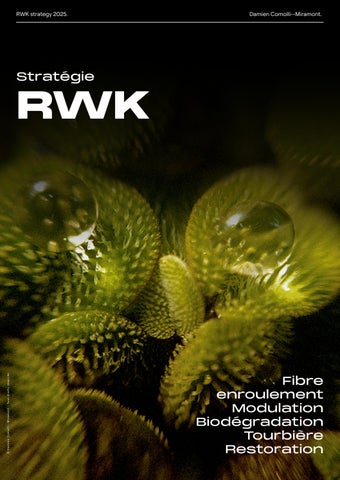
Peatlands are wetlands capable of providing numerous ecosystem services: CO₂ capture, maintenance of biodiversity, regulation of erosion phenomena... Many of them have undergone devastating changes due to intensive exploitation starting in the 1950s—an activity that Europe has been gradually prohibiting. The former extraction sites have turned into ponds, and the ecological balance struggles to reestablish itself.
How can we help pioneer and native vegetation reclaim its original habitat?
With the help of algorithmic tools, I reinterpret a coreless filament winding process—Institute for Computational Design in Stuttgart— to compose fibrous modules. These modules become the foundation of large fully biodegradable floating rafts that serve as supports for reintroduced plant species.
This research project thus illustrates how digital tools invite us to weave new connections between material, process, and a territory in transformation. It questions directly the issues of short-lived and regenerative design.