12 | Population Aging and Public Health Infrastructure in Delaware: A Comparative Analysis of Delaware and Four Comparison States
Athena A. Bruess, B.S.; Grace Hrustich, M.P.H.; Lauren C. Camphausen, M.S.; Yendelela L. Cuffee, Ph.D., M.P.H.; Jennifer A. Horney, Ph.D., M.P.H., C.P.H.; Katlyn Culhane-Suluai, M.P.S.; Daniel A. Harris, Ph.D., M.P.H.
18 | Role of Higher Education Institutions in Advancing Healthy Aging: Education, Engagement, and Experiential Learning Collaborations
Cynthia Newton, Ph.D., M.P.A.; Julia O’Hanlon, M.P.A.; Elizabeth Orsega-Smith, Ph.D., F.S.B.M.
24 | Identifying Barriers to Fall Prevention for CommunityDwelling Older Adults in Delaware: A Qualitative Study
Margaret Gulledge, O.T.D., O.T.R./L.; Jolaolu Jimoh, P.T., D.P.T., M.Sc.; Gianna Clemente, O.T.R./L.; Tina Lopez, O.T.R./L.
32 | Exploring Cognitive Load and Relative Neural Efficiency in Aging: Preliminary Insights from fNIRS and the SLUMS Assessment
Nancy Getchell, Ph.D.; Elizabeth Orsega-Smith, Ph.D.; Serena Schade, M.S.; Elham Bakhshipour, O.T., Ph.D.; Barry Bodt, Ph.D.; Gregory Dominick, Ph.D.
40 | Reducing Dementia Risk with the BrainSpan Program: A Public Health Practice Vignette
Matthew L. Cohen, Ph.D.; Kimberly Van Buren, M.S., C.C.C.-S.L.P.; Mindy J. Myers, MA, C.C.C.-S.L.P.; Christopher R. Martens, Ph.D.; Steven Huege, M.D., M.S.Ed.
44 | Factors Predicting Loneliness in Older Adults Attending Delaware Senior Center Programs
Serena A. Schade, M.S.; Julia O’Hanlon, M.P.A.; Adam Davey, Ph.D.; Elizabeth Orsega-Smith, Ph.D.
50 | Successful Aging: Taking A Ride With Weston
Vicki K. Sheraton
52 | Loneliness Moderates the Association between Neighborhood Disadvantage and Cognitive Function Among Older Adults
Regina S. Wright, Ph.D.; Desirée C. Bygrave, Ph.D.; Alexa C. Allan, M.A.; Alyssa A. Gamaldo, Ph.D.
60 | Global Health Matters Newsletter – May/June 2026
84 | Impact of an Intergenerational Service Learning Program on Goal Attainment Among Homebound Older Adults: A Multi-Site Community Study
Yeonjae A. Lee, B.S.; Meti Negassa, M.D., M.P.H.; Maggie Ratnayake, L.P.C.M.H.; Maddi Riemenschneider, L.M.S.W.; Keith Chan, PhD, L.M.S.W.
90 | Lessons Learned from the February 2026 Blizzard: An Interview with Two Village Networks
Danielle R. Swallow, C.C.-P.; Nicole M. Minni, G.I.S.P.
93 | Milford Wellness Village – Foundation of Value-Based Care in Rural Delaware: A daptive Reuse, Social Determinants of Health, and an Integrated Continuum of Care
Jeanne De Sa, M.P.P.; Andrew Spicer, M.P.P.
98 | Let’s Rethink Aging
Susan Getman, B.A., M.A.
101 | Fecal Incontinence as a Marker of Multisystem Cardiopulmonary-Kidney Disease and Mortality in US Adults: A Nationally Representative Cohort Study
The Delaware Journal of Public Health (DJPH), first published in 2015, is the official journal of the Delaware Academy of Medicine and Public Health (Academy). Submissions: Contributions of original unpublished research, social science analysis, scholarly essays, critical commentaries, departments, and letters to the editor are welcome.
Questions? Contact managingeditor@djph.org
Advertising: Please contact ksmith@delamed.org for other advertising opportunities. Ask about special exhibit packages and sponsorships. Acceptance of advertising by the Journal does not imply endorsement of products.
Any report, article, or paper prepared by employees of the U.S. government as part of their official duties is, under Copyright Act, a “work of United States Government” for which copyright protection under Title 17 of the U.S. Code is not available. However, the journal format is copyrighted and pages are not be photocopied, except in limited quantities, or posted online, without permission of the Academy/DPHA. Copying done for other than personal or internal reference use-such as copying for general distribution, for advertising or promotional purposes, for creating new collective works, or for resale- without the expressed permission of the Academy/DPHA is prohibited. Requests for special permission should be sent to managingeditor@djph.org
Aging and Public Health
Delaware is growing in many ways. The state’s overall population has increased by nearly 21% since 2006, with much of the growth occurring downstate (Sussex grew 57%, Kent grew 30%, and New Castle, 12% -- all over the same 20 years). The evidence indicates that most of the senior migration happened to Sussex County, likely due to its desirable factors with still a relatively affordable cost of living.1
Delaware also has the eighth-oldest population in the country and, equally importantly, the rate of growth of the senior population is the sixth highest in the country. There has been a 92% increase in Delaware residents over the age of 65 since 2006.1 Our number of older adults is doubling, and many are retired, or retiring. According to Pew Research, most older adults currently live in their own home or apartment. Most (60%) say they would prefer to stay in their home and have someone care for them. Others state they want to move into assisted living (18%), move in with family (11%), or move into a nursing home (1%).2
While we are glad to see Delaware be a location of choice for all generations, and that our older generations in particular are enjoying beach living, this multi-pronged change is highlighted by rapid population growth and a demographic shift, loss of workforce to retirement, and increased retirees requiring healthcare from a diminishing (younger) workforce. This change in the labor force can mean a loss of experience and access. It also means that Delaware needs to stand up a healthcare workforce well-studied in the medical needs of seniors (e.g., geriatrics, polypharmacy, complex medical decision making3), preferably practicing where those seniors are enjoying their retirement.
In 2022, we featured work in our Place Matters issue on aging in place,4 and in this issue of the Delaware Journal of Pubic Health, we hear from researchers (including the author of one of the 2022 articles) looking into how to help our seniors age gracefully, as well as from authors working in the fields of home health care and assisted living. We are deeply grateful to this issue’s Guest Editors, Elizabeth Orsega-Smith and Julia O’Hanlon, for their work curating this issue.
And as always, we look forward to your comments.
REFERENCES
1. Abernathy, T. (2025, Mar 31). The trends shaping Delaware’s future. Delaware State Chamber of Commerce. https://www.dscc.com/wp_trendsshapingdefuture.html
2. Parker, K., & Lin, L. (2026, Feb 26). Most older adults who live at home want to age in place, but they aren’t entirely confident they’ll get to. Pew Research Center. https://www.pewresearch.org/short-reads/2026/02/26/most-older-adults-who-live-at-home-want-to-age-in-place-but-they-arententirely-confident-theyll-get-to/
3. Gupta, S. (2022, August 25). Challenge of a dual burden in rapidly aging Delaware: Comorbid chronic conditions and subjective cognitive decline. PLOS Global Public Health, 2, e0000579. Advance online publication.
4. Ratnayake, M., Lukas, S., Brathwaite, S., Neave, J., Henry, H. (2022, August). Aging in place: Are we prepared? Delaware Journal of Public Health, 8(3), 28–31. https://Doi.org/10.32481/djph.2022.08.007
Omar A. Khan, M.D., M.H.S. Editor-in-Chief, Delaware Journal of Public Health
Katherine Smith, M.D., M.P.H. Publisher, Delaware Journal of Public Health
Fr the Gu t Editors
Elizabeth Orsega-Smith, Ph.D., F.S.B.M.
Professor, Graduate Program Director, Health Behavior Science, University of Delaware
Julia O’Hanlon, M.P.A.
Lead Policy Scientist, Institute for Public Administration, University of Delaware; Staff Liaison, Delaware League of Local Governments
As Guest Editors, we are pleased to present this issue of the Delaware Journal of Public Health dedicated to one of Delaware’s current public health priorities: promoting healthy aging across the lifespan. As the state’s population continues to age, it faces both opportunities and complex challenges that require innovative research, cross-sector collaboration, and evidence-informed public health action. This special issue brings together a diverse collection of scholarship and practices that reflect the breadth of work currently underway to improve the health, well-being, and quality of life of older Delawareans.
The contributions in this issue represent the multidisciplinary nature of public health, featuring perspectives from researchers, clinicians, healthcare systems, community organizations, policymakers, and government agencies. Together, these articles demonstrate that advancing healthy aging requires collaboration across disciplines and sectors, recognizing that the determinants of health extend far beyond healthcare alone.
The research presented in this issue examines the complex interplay among cognitive health, psychosocial well-being, environmental influences, and public health infrastructure that shape aging experiences, with particular attention to Delaware’s older adult population. Collectively, the manuscripts explore innovative approaches to understanding cognitive aging through functional nearinfrared spectroscopy (fNIRS) and cognitive assessment, identify barriers to implementing evidence-based fall prevention programs, evaluate the capacity of public health infrastructure to respond to population aging, and examine how neighborhood conditions and social isolation influence cognitive health and overall well-being. Additional work investigates the predictors of loneliness among older adults participating in Delaware senior center programs, providing important insights into the social determinants of healthy aging. Together, these studies illustrate the value of integrating neuroscience, epidemiology, qualitative inquiry, health services research, and community-engaged approaches to address the multifaceted challenges of aging.
The articles collectively emphasize the importance of creating environments that enable older adults to remain healthy, engaged, and independent within their homes and communities. Aging in place depends not only on access to high-quality healthcare, but also on coordinated investments in housing, transportation, public health infrastructure, social services, technology, and community engagement. A central message emerging from this collection is that healthy aging can be approached from a systems-based perspective.
Importantly, the work presented throughout this issue underscores that no single discipline or organization can address the complexities of population aging alone. Sustainable solutions will require integrated systems that intentionally connect healthcare, public health, social services, community organizations, and policymakers to address the social, environmental, and structural factors that influence healthy aging. Meaningful collaboration among academic institutions, healthcare organizations, state agencies, nonprofit organizations, and community partners is essential for translating research into practice and improving health outcomes for older adults.
Delaware is uniquely positioned to build upon these partnerships. Recent statewide initiatives, including collaborative efforts surrounding the development of a medical school and expanded investments in rural health, present important opportunities to strengthen the state’s healthcare workforce, expand access to care, and improve health equity. These initiatives are particularly relevant for older adults living in Delaware’s rural communities, where provider shortages, transportation barriers, and social isolation often limit access to healthcare and health promotion services. The work highlighted in this issue offers a strong foundation upon which these emerging initiatives can build.
This issue is intended not as the culmination of a conversation, but as a catalyst for continued dialogue, research, and action. The findings and perspectives presented here highlight both the progress that has been made and the work that remains to ensure that Delaware is prepared to meet the needs of its growing older adult population. We hope these articles stimulate new research collaborations, inform policy development, strengthen community partnerships, and inspire innovative approaches to promoting healthy aging. Equally important, we hope they encourage readers from every sector to consider their role in creating communities where all individuals have opportunities to age with health, dignity, purpose, and connection.
The future of healthy aging in Delaware will depend on our collective commitment to translating evidence into practice, fostering collaboration across disciplines, and developing policies and programs that support older adults throughout their lifespan. We are honored to share this collection of work and look forward to the continued advancement of aging research, practice, and policy across Delaware and beyond.
Thank you to all contributors for their scholarship, innovation, and commitment to improving the health of older Delawareans. Their time and perspectives shared are valued. We appreciate the opportunity to serve as guest editors and thank Drs. Omar Khan and Kate Smith for their support and time in coordinating this issue.
FOR IMMEDIATE RELEASE
Contact:
Tim Gibbs, MPH
Director and Principal Investigator, Delaware Health Force tgibbs@delamed.org, 302-427-2400 (mobile) THE ACADEMY AND TAPP NETWORK LAUNCH HEALTHCARE LABOR STATISTICS DASHBOARD AND REGIONAL MAP TOOL TO STRENGTHEN DELAWARE'S HEALTHCARE WORKFORCE
New Data Tools OfferUnprecedented Insight into Delaware'sHealthcareWorkforceLandscapeAheadof the 2026 Delaware HealthcareWorkforce Summit
NEWARK, Del., July 24, 2026 – The Delaware Academy of Medicine and Public Health (the Academy) and Tapp Network have completed a collaboration to deliver two powerful workforce intelligence tools: a Healthcare Labor Statistics Dashboard and a Regional Map tool designed specifically to surface rural healthcare workforce data across Delaware. Together, these resources give policymakers, healthcare leaders, educators, and advocates the data they need to make informed decisions about Delaware's healthcare workforce and are part of a larger suite of tools at dehealthforce.org
The Healthcare Labor Statistics Dashboard provides users with a comprehensive, interactive view of healthcare employment trends across the state, including occupation-level data, wage information, and workforce supply and demand indicators. Complementing it, the Regional Map tool zeroes in on Delaware's rural communities, allowing users to visualize geographic gaps in the healthcare workforce and identify where targeted recruitment and retention efforts are most urgently needed.
“Healthcare access is a social driver of health, and for far too many Delawareans, especially those in our rural communities, that access remains out of reach. This dashboard gives us the focused, granular picture we need to understand where those gaps are and how to close them,” says Tim Gibbs, MPH, Director and Principal Investigator of Delaware Health Force.
These tools were developed in partnership with Tapp Network to support the work of Delaware Health Force (DHF), the Academy's workforce initiative dedicated to addressing the state's growing healthcare workforce shortages. With Delaware facing increasing pressure on its health systems, particularly in rural and underserved communities, access to real-time, localized data is essential for building a sustainable healthcare pipeline. DHF is a public/private partnership with the State of Delaware Department of Health and Social Services.
“Delaware Health Force is making the state’s healthcare workforce data far easier to see and use, and Tapp Network is proud to have helped build the workforce development tools and technology behind it. The Healthcare Labor Statistics Dashboard gives educators, employers, and public agencies a clearer, interactive view of Delaware’s workforce in one place. This first release is a foundation, and we are excited to start receiving feedback and continue to evolve this tool over time,” says Joseph DiGiovanni, Co-Founder of Tapp Network.
“The tide has changed. Across the country and right here in Delaware, we are now reckoning seriously with rural health in a way we have not before. This dashboard will enable us to drill down into the rural health needs of southern Delaware and beyond, and to use that data to drive the public health solutions our communities deserve,” says Kate Smith, MD, MPH, Executive Director of the Academy.
The release of these tools comes at a pivotal moment. On September 30, 2026, DHF will host the 2026 Delaware Healthcare Workforce Summit in Dover, a statewide convening bringing together healthcare employers, educators, workforce development leaders, and policymakers to address the state’s most pressing healthcare workforce needs.
The Delaware Academy of Medicine and Public Health is a nonprofit organization committed to advancing health and health equity in Delaware through education, research, and community engagement. Delaware Health Force is an initiative of The Academy focused on addressing healthcare workforce shortages across the state. For more information, visit dehealthforce.org or contact Tim Gibbs, MPH at tgibbs@delamed.org.
Tapp Network is a digital transformation and AI implementation agency serving government agencies, healthcare organizations, and nonprofits nationwide. The firm builds workforce development systems, analytics platforms, and digital infrastructure for state and community partners, including work supporting the Rural Health Transformation Program. Tapp Network is TechSoup’s global AI services partner, reaching more than one million organizations in over 200 countries. Learn more at tappnetwork com
We Are All Aging: Is Delaware Ready?
Rita M. Landgraf Adjunct Faculty, University of Delaware; Former Delaware Secretary of Health and Social Services (2009-2017)
ABSTRACT
Aging is a universal experience, yet public health systems have historically approached it as a specialized issue rather than a population-wide priority. As the proportion of older adults increases, particularly in states like Delaware, the implications for health systems, infrastructure, and community design are profound. This commentary examines the 2024 National Plan on Aging and its relevance to Delaware’s rapidly aging population. With more than one in five residents already age 65 or older and continued growth projected over the next decade, Delaware faces both challenges and opportunities. This paper argues for a multisector public health framework that integrates health care, housing, transportation, and community systems.
A NATIONAL PLAN ON AGING STRATEGIC FRAMEWORK
Delaware is already an aging state—and the pace of change is accelerating faster than our systems are prepared to manage. Aging is the only universal process shared across the population, yet health and social systems in the United States have historically treated aging as a specialized issue rather than a population-wide public health concern. As the demographic profile of the nation shifts, this approach is no longer sustainable. More than 55 million people in the United States are now aged 65 years and older, and the proportion will continue to rise for decades. Aging intersects with nearly every domain of public health, including chronic disease prevention, injury control, mental health, housing, transportation, workforce stability, emergency preparedness, and community design.
In 2024, the U.S. Department of Health and Human Services released “Aging in the United States: A Strategic Framework for a National Plan on Aging.”¹ This framework reframes aging as a shared societal responsibility and positions public health systems as central actors in preparing communities for longer lives. This framework is a blueprint and catalyst for activation at the state and local levels.
The Strategic Framework for a National Plan on Aging represents the first coordinated federal effort to articulate a unified vision for healthy aging across the life course. Developed through collaboration among 16 federal agencies, the framework is intentionally cross-sectoral, encompassing public health, health care, housing, transportation, labor, education, and social services. Rather than prescribing discrete programs, the framework establishes shared principles and domains of action intended to guide policy development and systems alignment at federal, state, and local levels.
The National Plan recognizes that outcomes in later life are shaped by cumulative exposures across the lifespan and by structural determinants such as income, neighborhood conditions, discrimination, and access to opportunity. This orientation closely aligns with contemporary public health practice.
It also acknowledges that aging is experienced differently across populations and that disparities by race, ethnicity, income, disability status, geography, and historical marginalization significantly influence health, independence, and quality of life in later years. Ageism and ableism are identified as pervasive structural barriers that shape policy, practice, and lived experience.
The framework reinforces a prevention-oriented public health lens, emphasizing upstream investments to prevent falls, social isolation, unmanaged chronic disease, caregiver strain, and avoidable institutionalization. Independence, dignity, autonomy, and community participation are elevated as core outcomes of successful aging policy.
The framework centers around four interrelated domains:
• Age-Friendly Communities - focus on the built environment, transportation, public spaces, and opportunities for social participation.
• Coordinated Housing and Supportive Servicesrecognize housing as a determinant of health
• Increased Access to Long-Term Services and Supports - addresses both home- and community-based services and institutional care.
• Aligned Health Care and Supportive Services - call for integration of medical care with social supports, including behavioral health, dementia care, and palliative care.
Together, these domains emphasize that healthy aging depends on integrated systems rather than isolated programs.
The National Plan on Aging aligns closely with existing age-friendly movements, including AARP’s Network of Age-Friendly States and Communities2 and the World Health Organization’s Decade of Healthy Aging (2021–2030).3 These frameworks share a focus on creating environments that enable people to meet basic needs, remain mobile, build relationships, and contribute to society across the life course.
These age-friendly initiatives all emphasize community design, transportation, housing, social inclusion, and access to services— areas traditionally outside the health sector but deeply influential on population health. The WHO Decade of Healthy Aging further underscores the role of combating ageism, fostering age-friendly environments, delivering integrated care, and ensuring access to long-term care. Together, these national and global efforts reinforce the importance of multisector collaboration and provide a common language for action.
While the Older Americans Act requires every state to prepare a State Plan on Aging,4 these plans are often programmatic and limited to aging services funded under the Act. Best practice has evolved toward the development of multisector or Master Plans for Aging aligning public health, Medicaid, housing, transportation, workforce development, and private-sector partners under a shared vision. To date, approximately fourteen states have adopted or are implementing comprehensive multisector or Master Plans on Aging.5 Note – As of yet, Delaware is not one of the fourteen states.
The National Plan on Aging provides an important federal anchor for state opportunities and efforts, offering consistency in values, structure, and goals while preserving flexibility for local context and innovation.
DELAWARE’S AGING DEMOGRAPHIC REALITY: A STATE-LEVEL IMPERATIVE
While national trends underscore urgency, Delaware’s demographic trajectory is particularly pronounced. Delaware is among the fastest-aging states in the nation, with a demographic profile shaped by increasing longevity, in-migration of retirees, and declining birth rates.
Recent U.S. Census estimates indicate that 21.8% of Delaware’s population—more than one in five residents—is now age 65 or older (65+).6,7 This proportion already exceeds the national average and reflects a structural shift in the state’s age distribution. In absolute terms, approximately 229,000 Delawareans were aged 65+ in 2024, a number that has grown rapidly over the past two decades.
Projections suggest this trend will accelerate. By 2030, older adults are expected to comprise approximately 23% of the state population,8 with continued growth thereafter. Over a longer horizon, adults aged 65 and older are projected to approach onethird of Delaware’s population by 2040, fundamentally reshaping the state’s age structure.
The growth trajectory is already evident. Between 2006 and 2022, Delaware’s population age 65+ increased by more than 60%,9 far outpacing younger age groups. Particularly notable is the rapid expansion of the 885 and older (85+) population, which will drive demand for long-term services and support.
These demographic shifts carry significant implications. Aging populations are associated with higher prevalence of chronic disease, increased demand for behavioral health services, and greater reliance on home- and community-based care. At the same time, older adults represent essential contributors to communities through caregiving, civic engagement, and economic participation.
These demographic shifts make clear that Delaware is not only participating in national aging trends but experiencing them at an accelerated pace, reinforcing the need for a
coordinated, multisector public health response. For Delaware, the demographic data reinforces the central argument of the National Plan on Aging: aging is not a siloed issue confined to aging services but a cross-cutting population dynamic that must be embedded within public health planning, infrastructure development, housing policy, and workforce strategy.
IMPLICATIONS AND OPPORTUNITIES FOR DELAWARE
Delaware is well positioned to build upon the National Plan on Aging and related age-friendly frameworks by advancing a comprehensive, multisector approach tailored to its demographic and institutional landscape. First, Delaware should pursue the development of a Multisector Plan on Aging that complements— but extends beyond—the federally required State Plan on Aging. Such a plan would formally align public health, health care, Medicaid, housing, transportation, emergency preparedness, and community development systems.
Second, higher education should serve as a strategic partner. Delaware’s academic institutions, including the University of Delaware and Delaware State University, are well positioned to develop interdisciplinary approaches to aging and public health, modeled after institutions such as Portland State University’s Institute on Aging,¹⁰ which integrates research, education, and community partnerships to inform aging policy and practice across sectors. University-led initiatives can support research, data integration, workforce development, policy analysis, and community-engaged practice, strengthening Delaware’s capacity to respond to population aging and to prepare a workforce skilled in aging-related fields.
Third, Delaware should leverage and integrate emerging civic and advocacy efforts focused on age-friendly and multigenerational communities. Rethinking Delaware, a new advocacy initiative led by former Cabinet Secretaries, senior-level public leaders, and advocates represents an important platform for advancing livable, walkable, inclusive community design. Public health agencies can serve as conveners, ensuring that health equity, accessibility, and inclusion remain central to redevelopment, zoning, transportation, and economic development conversations.
Finally, Delaware should explicitly align its aging strategy with AARP age-friendly principles and the WHO Decade of Healthy Aging. Doing so would situate the state within a broader national and global movement, facilitate shared measurement and accountability, and reinforce aging as a population-wide public health priority rather than a niche concern.
CONCLUSION
Aging is not a marginal issue affecting a subset of the population; it is a shared and predictable future that calls for intentional design, sustained investment, and coordinated leadership. For Delaware, advancing a multisector approach that engages public health, higher education, civic leadership, and community partners represents both a responsibility and an opportunity. By aligning policy, infrastructure, and community systems with the realities of an aging population, the state can promote health, independence, and dignity across the lifespan. The question is no longer whether Delaware is aging—it is whether we are prepared to meet that future with vision and action.
Professor Landgraf may be contacted at landgraf@udel.edu .
REFERENCES
1. Administration for Community Living. (2024). Aging in the United States: A strategic framework for a national plan on aging. U.S. Department of Health and Human Services.
2. AARP. (n.d.). Network of age-friendly states and communities. AARP. https://www.aarp.org/livable-communities/network-age-friendly-communities/
3. World Health Organization. (2021). Decade of healthy ageing 2021–2030. World Health Organization. https://www.who.int/initiatives/decade-of-healthy-ageing
4. U.S. Congress. (1965). Older Americans Act of 1965, as amended. https://acl.gov/about-acl/authorizing-statutes/older-americans-act
5. West Health. (2026). Multisector plan for aging: National map and state activity. https://multisectorplanforaging.org/map
6. U.S. Census Bureau. (2024). QuickFacts: Delaware. https://www.census.gov/quickfacts/DE
7. USAFacts. (2024). How many people live in Delaware? https://usafacts.org/data/topics/people-society/population/state/delaware
8. Delaware Planning for Local Adaptation Needs. (2023). Aging in place projections for Delaware. https://climatechange.delaware.gov
9. WHYY. (2025). Delaware’s aging population strains health care systems. https://whyy.org
10. Portland State University Institute on Aging. (n.d.). Institute on aging. Portland State University. Retrieved May 2026, from https://www.pdx.edu/institute-on-aging/
The Infrastructure of Aging Well: How Delaware Is Preparing for Its Future
Christen Linke Young, J.D.
Cabinet Secretary, Delaware Department of Health and Social Services
Dava Newnam
Delaware Department of Health and Social Services
Shekeila Hines, P.T., D.P.T.
Delaware Department of Health and Social Services
In the winter of 2025, Mr. Stewart*, a 78-year-old gentleman in Wilmington, Delaware, reached out to the Department of Health and Social Services – where we serve as leaders – in a moment of crisis. His electricity had been turned off, he was facing eviction in a home deemed uninhabitable, and his health was rapidly deteriorating. He hadn’t filled some of his prescriptions, was forgetting to take others, had missed follow-up medical appointments, and didn’t always have enough food.
While Mr. Stewart’s needs were particularly acute that day, his story is one that is familiar to all of us: too many Delawareans do not have the support they need to age with dignity.
As Delaware’s demographics change, we know we will continue to experience rapid growth in the number of older adults who need this support. Delaware is one of the fastest-aging states in the nation. Today, nearly one in four Delawareans is age 60 or older, and by 2040, older adults are expected to make up approximately one-third of our population.1 At the same time, continued migration into rural Kent and Sussex counties without the benefit of natural support systems is increasing demand on health care systems, long-term care services, transportation, housing, and community-based supports.
As we confront those demographic changes, we are keenly aware we need more infrastructure to meet the needs ahead. But – as Mr. Stewart’s story shows – infrastructure for an aging population means something broader than buildings and budgets. It means access to physicians, behavioral health clinicians, pharmacists, nurses, and specialists. The infrastructure includes family caregivers, home care workers, and respite services that sustain Delawareans’ ability to age gracefully at home. Meals delivered to a door and the services to have a ramp installed at a threshold are additional components of a community ready to support aging. Meeting the moment Delaware faces requires us to build all of it — and to build it now. Indeed, at the Department of Health and Social Services, we are working urgently across every program and partnership to build the structures we need to ensure we can support our neighbors in the years ahead.
GROWING THE HEALTH CARE WORKFORCE WE NEED
One of the most pressing infrastructure needs facing Delaware is health care workforce capacity.
Older adults often require more frequent and complex care which increases pressure on hospitals, primary care providers, long-term care facilities, rehabilitation providers, and direct care workers. At the same time, Delaware, like much of the nation, is experiencing workforce shortages across health care disciplines. State workforce analyses have identified ongoing
shortages in nursing, primary care, behavioral health, and direct support professions, particularly in Kent and Sussex counties.2 Recruitment and retention challenges continue to impact providers, while many experienced health care professionals are approaching retirement age.
That is why we are incredibly proud to be partnering with stakeholders across the region to launch Delaware’s first fouryear medical school.3 The new school will be accepting students for the fall of 2028. Students in the early cohorts who commit to practicing after graduation in Kent or Sussex counties can receive full scholarships to attend tuition free. Delaware has been working towards this goal for decades, and through Governor Matt Meyer’s leadership this administration is delivering a critical new tool to support our increasing demand for physicians.
At the same time, health care workforce infrastructure goes far beyond physicians. We are also making major investments in training programs for other kinds of health care workers – nurses, behavioral health professionals, physician associates, and more. Strengthening this workforce is essential not only to expand access, but to support a broader shift toward delivering care where people are. In rural communities, it also presents an opportunity to build a more sustainable, homegrown workforce to train and support individuals from the communities they serve to provide care locally.
SUPPORTING CARE IN COMMUNITIES AND HOMES
Delaware also needs infrastructure to support rapidly rising needs for home and community-based services (HCBS), a central strategy for meeting the needs of an aging population.
Many Delawareans want to age in their homes and communities for as long as safely possible. Research makes clear that access to HCBS not only aligns with personal preferences, but consistently leads to better outcomes while reducing reliance on more costly institutional care.4
Delaware has a long history at the cutting edge of HCBS investment. For instance, adult home care services are not mandatory in Medicaid, but Delaware has been a long and strong believer in investing in this space. For Medicaid beneficiaries, we offer access to a wide variety of needed and medically-necessary home and community-based services: home care, respite, meals, and home modifications, among other core services. And unlike the majority of states, Delaware does not require a formal waitlist.5 Moreover, thanks to a General Assembly committed to the wellbeing and personal choice of Delaware seniors, we are able to offer uniquely robust state-funded benefits for people not enrolled in Medicaid, allowing a broader group of older adults to access this care than almost anywhere else in the country.
As the population ages, demand for these services continues to grow rapidly. We are investing in growing the workforce of HCBS service providers. Just as important, we are catalyzing innovation in service delivery, using remote monitoring and telehealth tools to complement in-home support, and driving creative care delivery models that will build capacity in the years ahead.
MEETING FAMILY CAREGIVER NEEDS
A third critical piece of infrastructure to support older Delawareans is robust support for family caregivers.
Family caregivers – spouses, children, and other loved ones –provide dedicated care for thousands of our neighbors. Statewide, 200,000 Delawareans are family caregivers for parents or other loved ones and they provide the equivalent of nearly $2 billion in unpaid care services.6 Yet caregivers often feel alone in the tireless work they do, without adequate resources to meet the demands they face.
We as a state must do more to support family members in this work. That’s why, in late 2025, Delaware launched DelaCARES, a statewide caregiver support platform developed through collaboration between the Division of Developmental Disabilities Services (DDDS) and the Division of Services for Aging and Adults with Physical Disabilities (DSAAPD). The platform provides free online education, resources, and support tools for caregivers caring for loved ones at home. Sometimes all it takes is knowing where to turn for trusted guidance and verified resources to ease the mental burden when coordinating appointments, managing medications, balancing a household, and carrying the emotional responsibility of caring for someone. Designing systems that support caregivers is one of the most effective ways to expand care capacity without expanding institutional settings.
ADDRESSING NEEDS BEYOND HEALTH CARE
We also know that infrastructure to support an aging population extends far beyond what we have traditionally understood as the role of the health care system – and it’s critical we build capacity to address non-medical drivers of health like housing, food, and transportation.
Safe, accessible, and affordable housing plays a critical role in healthy aging. Communities must increasingly consider how housing design, accessibility modifications, and supportive living environments affect health, independence, and longterm care needs. Much of Delaware’s existing housing stock was not designed with aging in mind. Many homes lack basic accessibility features (such as no-step entrances, widened doorways, grab bars, and accessible bathroom layouts) that allow individuals to safely remain in their homes as their mobility needs change. Services like our agency’s Home Modifications Program have demonstrated how relatively small investments such as ramps, grab bars, and bathroom modifications can prevent injuries, reduce hospitalizations, and allow individuals to remain safely in their homes and communities as they age in place.
At the same time, for too many of our neighbors, simply having a stable place to sleep can be a challenge. To meet the needs of our population as it grows and ages, Delaware must continue to invest in housing supply, and comprehensive homelessness
prevention and support should continue to consider the needs of older adults.
Transportation infrastructure shapes access to care, particularly in rural communities where distance and provider shortages can create significant barriers. Ensuring reliable, flexible transportation options is essential to connecting individuals with health care services and community supports, and creating efficient ways to meet transportation needs is critical. These solutions may include volunteer driver programs, demandresponse transit, and ride-sharing partnerships that help older adults access transportation without requiring smartphone technology. Another component of the transportation solution is finding opportunities to bring care right to Delawareans’ homes and communities using mobile health, and we are also piloting new technologies in our rural communities to support Delawareans’ needs.
Food and nutrition programs are also essential. Nutrition insecurity among older adults is closely tied to poorer health outcomes, increased hospitalization risk, and social isolation.7 Investments in meal delivery and community nutrition programs are investments in preventive health care. The Department of Health and Social Services supports older adults through a variety of nutrition programs, including meals served in congregate settings and home delivered meals. Not only do these meals nourish the body, they reduce social isolation through social connections, and provide culturally familiar meals that offer comfort, dignity, and a sense of belonging.8 As Delaware advances Lieutenant Governor Kyle Evans Gay’s Food Is Medicine Initiative, we are elevating the role of nutrition as a key component of health, recognizing that food is not only nourishment, but an important tool for promoting health, and preventing disease.9
MOVING FORWARD
All of these pieces — physicians and health care workers, HCBS innovation, caregiver support, and attention to social drivers of health — constitute the infrastructure Delaware needs. We are not just planning for the future; we are delivering these services today. The policies described here are not abstractions. Indeed, we are happy to report that Mr. Stewart who contacted us last winter is thriving today. As temperatures dropped in his unheated home, the Department of Health and Social Services helped him transition from crisis to stability, starting with emergency shelter and temporary housing, while longer term solutions were explored. Along the way he caught up on important medical appointments, reestablished a routine with his medications and worked closely with state staff to navigate housing and benefit programs. By spring, he had been approved for Long-Term Care Medicaid services and secured a home at a senior living community that offered independence while receiving the in-home supports he needs. Today, he is safely housed, receiving comprehensive care management, and most importantly, connected to a vibrant community that gives him joy and dignity.
That is the future we are building for every Delawarean.
*Name has been changed to protect the individual’s privacy.
Secretary Linke Young may be contacted at timothy.mastro@delaware.gov .
REFERENCES
1. Delaware Division of Services for Aging and Adults with Physical Disabilities. (n.d.). State Plan on Aging 2024–2028. Delaware Department of Health and Social Services. Available at: https://dhss.delaware.gov/wp-content/uploads/sites/2/dsaapd/pdf/state_plan_on_ aging_20_24.pdf
2. Delaware Department of Health and Social Services. (n.d.). Health Workforce Subcommittee Report.
Available at: https://dhss.delaware.gov/wp-content/uploads/sites/4/2025/04/healthworkforce.pdf
See also: Delaware Health Workforce Data Center.
Available at: http://dehealthforce.org/
3. Delaware Department of Health and Social Services. (2026, Jun 2). State and Thomas Jefferson University Partner to Establish Delaware’s First Medical School. Available at: https://news.delaware.gov/2026/06/02/state-and-thomas-jefferson-universitypartner-to-establish-delawares-first-medical-school/
4. Centers for Medicare & Medicaid Services. (n.d.). Home & Community Based Services.
Available at: https://www.medicaid.gov/medicaid/home-community-based-services/index.html
5. KFF. (n.d.). Number of People Waiting for HCBS by Target Population and Whether States Screen for Eligibility.
Available at: https://www.kff.org/medicaid/state-indicator/number-of-people-waiting-forhcbs-by-target-population-and-whether-states-screen-for-eligibility/
6. AARP. (n.d.). Caregiving in the U.S. 2025: Caring Across States.
Available at: https://www.aarp.org/pri/topics/ltss/family-caregiving/caregiving-in-the-us2025-caring-across-states/
7. Administration for Community Living. 2024 Profile of Older Americans. Available at: https://acl.gov/aging-and-disability-in-america/data-and-research/profile-older-americans
8. Administration for Community Living (ACL). (n.d.). Nutrition Services Program. Available at: https://acl.gov/programs/health-wellness/nutrition-services
9. Office of the Lieutenant Governor. Delaware Food is Medicine Committee. Available at: https://ltgov.delaware.gov/delaware-food-is-medicine-committee/
Population Aging and Public Health Infrastructure in Delaware: A Comparative Analysis of Delaware and Four Comparison States
Athena A. Bruess, B.S.
Department of Epidemiology, University of Delaware
Grace Hrustich, M.P.H.
Department of Epidemiology, University of Delaware
Lauren C. Camphausen, M.S.
Department of Epidemiology, University of Delaware
Yendelela L. Cuffee, Ph.D., M.P.H.
Department of Epidemiology, University of Delaware; Partnership for Healthy Communities, University of Delaware
Jennifer A. Horney, Ph.D., M.P.H., C.P.H.
Department of Epidemiology, University of Delaware; Partnership for Healthy Communities, University of Delaware
Katlyn Culhane-Suluai, M.P.S.
Partnership for Healthy Communities, University of Delaware
Daniel A. Harris, Ph.D., M.P.H.
Department of Epidemiology, University of Delaware
ABSTRACT
Consistent growth in the number of older adults in the United States has led many health systems to evaluate their capacity for supporting an aging population. Delaware needs to identify priorities and action areas to support the state’s increasingly older population. Using publicly available data from national surveillance systems and state reports, this analytic essay compared demographic aging trends, age-related chronic disease prevalence, and public health infrastructure across Delaware, Maryland, Pennsylvania, Rhode Island, and Vermont. These states were chosen given their similar geographical location or population size. Between 2015 and 2024, the proportion of Delaware residents aged 60 years and older grew from 23.7 percent to 29.3 percent, placing Delaware as second among comparison states in the proportion of older adults. Relative to the comparison states, Delaware had the highest proportion of older adults moving into the state, with 18.8 percent of adults aged 60 years and older relocating from another state in 2024. In 2024, Delaware had the highest prevalence of several age-related health conditions, including diabetes (13.3%), stroke (3.5%), arthritis (26.2%), and neurological difficulties (15.8%). Delaware had the highest disparities relative to the comparison states on measures of economic hardship, food instability, and uninsured populations. Despite these demographic, economic, and disease trends, Delaware had the second-lowest geriatric healthcare workforce capacity, reporting 39.3 geriatricians and nurse practitioners per 100,000 adults aged 65 years and older in 2025, compared with 74.1 in Rhode Island. These findings suggest that Delaware’s aging population is growing rapidly, and that the state may be facing substantial preparedness gaps related to meeting the needs of older Delawareans. Strategic investments in workforce development, economic supports, community-based services, healthcare access, and dementia preparedness will be critical to ensuring Delaware is prepared to meet the evolving needs of its growing older adult population.
INTRODUCTION
The United States is experiencing an important demographic shift as the number and proportion of adults aged 65 years and older increases. While these trends represent important public health achievements, they also create unique and growing demands for healthcare services, long-term care capacity, caregiver support and burnout, and chronic disease management. For example, public health and clinical infrastructure must adapt to meet the complex physical, cognitive, and social needs of older adults.1 Older adults experience a disproportionate burden of chronic conditions and disability, making population aging an increasingly important
public health issue. Addressing these challenges will require coordinated efforts that support healthy aging at the individual level while also strengthening healthcare systems, communitybased services, and policies that promote access to care and longterm support.1 The COVID-19 pandemic exposed vulnerabilities within the systems that support older adults, with long-term care facilities experiencing exceptionally high mortality rates due to the advanced age of residents, high burden of frailty and chronic illness, and congregated living environment.2 These findings highlight the importance of a strong public health system capable of addressing the unique needs of older adults during both routine care and public health emergencies.
Delaware has one of the oldest populations among neighboring and similarly sized states, and it continues to experience increased domestic migration of older adults from other parts of the country.3 Previous research has described Delaware as facing a “dual burden” of high rates of chronic disease and cognitive decline.4 As a result, there are a growing number of older adults requiring healthcare services, caregiver support, and long-term care resources.4 Delaware has implemented initiatives including the Delaware State Plan on Aging and investments in dementiarelated services to support healthy aging, improve access to care, strengthen caregiver resources, and enhance coordination across aging-related programs.5 While these initiatives represent important progress, gaps remain in understanding whether Delaware’s public health infrastructure is keeping pace with population aging and how the state’s preparedness compares with neighboring and similarly sized states.
The purpose of this analytic essay was to compare demographic aging trends, age-related chronic disease burden, economic security, and geriatrics workforce across Delaware, Maryland, Pennsylvania, Rhode Island, and Vermont.
METHODS
This descriptive analysis was conducted as part of the Public Health Exchange (PHE), a conference held biannually by the Partnership for Healthy Communities at the University of Delaware. The PHE brings together community organizations, academic institutions, health systems, and state government around a central theme or topic in public health. The theme for the PHE, scheduled for the fall of 2026, is focused on growing and developing the public health workforce in Delaware. The PHE advisory committee conducted a comparative analysis of demographic, chronic disease, and workforce trends and capacity over time in Delaware to inform the event.
Authors AB and GH conducted an environmental scan of publicly available data sources and reports related to trends in demographics, chronic diseases, and workforce capacity (analysis conducted between April and June 2026). All data were compiled from the following websites and data sources: United States Census Bureau,3,6 CDC’s Behavioral Risk Factor Surveillance System,7 America’s Health Rankings,8–11 Medicare Website,12 and U.S. Physician Workforce Data Dashboard.13 To evaluate and compare Delaware’s trends, we also examined trends for neighboring states (Maryland and Pennsylvania) and states with similar population sizes (Rhode Island and Vermont).
Demographic, Public Health, and Workplace Indicators
The primary indicators examined in this analysis included demographic, chronic disease, workforce, and economic measures relevant to population aging. Demographic indicators included the percentage of residents aged 60 years and older and the percentage of adults aged 60 years and older who migrated to Delaware from elsewhere in the United States. Chronic disease indicators included the prevalence of age-related chronic conditions and functional impairments, including diabetes, stroke, arthritis, mobility difficulties, neurological difficulties, impairments with independence, and Alzheimer’s disease and related dementias (ADRD). Public health infrastructure indicators included the absolute number of geriatricians, geriatric clinicians per 100,000 adults aged 65 years and older, nursing home availability and beds, and state dementia preparedness initiatives. Economic indicators included the Economic Hardship Index, dependency ratio, food insecurity, and uninsured population.6,9–11 All relevant data were abstracted into Excel and plotted to visualize and compare changes in key indicators over time by state. As a descriptive analytic essay, no hypothesis tests were conducted. Some analyses were conducted in SAS 9.4 (Cary, NC).
RESULTS
Population Aging and Demographic Shifts
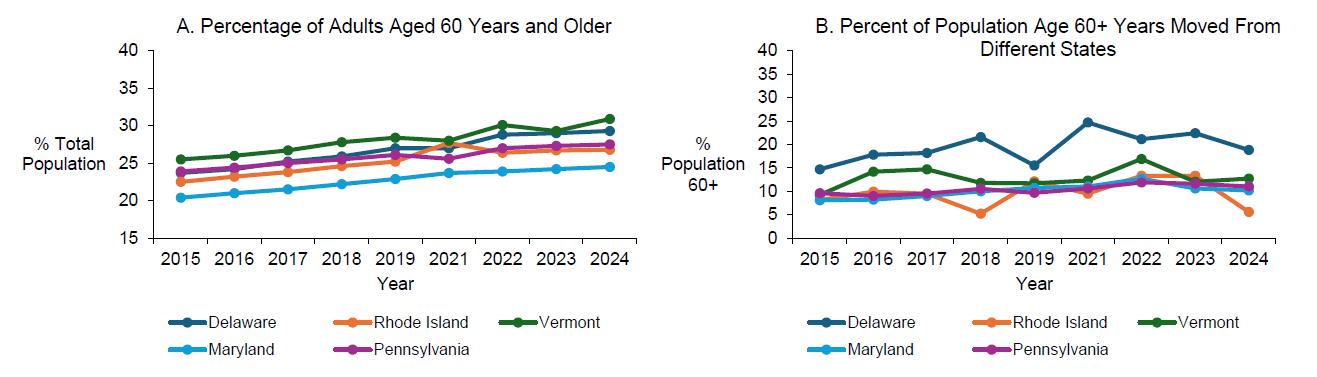
The proportion of residents aged 60 years and older increased in all states, with Delaware rising from 23.7 percent in 2015 to 29.3 percent in 2024 (Figure 1).3 Relative to the four comparison states, Delaware had the second-highest proportion of residents aged 60 and older; however, Delaware had the highest proportion of older adults aged 60 and older moving into the state from other states. For example, in 2024, 18.8 percent of adults aged 60 and older moved to Delaware from another state, which was 48 percent higher than in Vermont during the same period.3
Trends in Age-Related Chronic Conditions and Functional Impairments
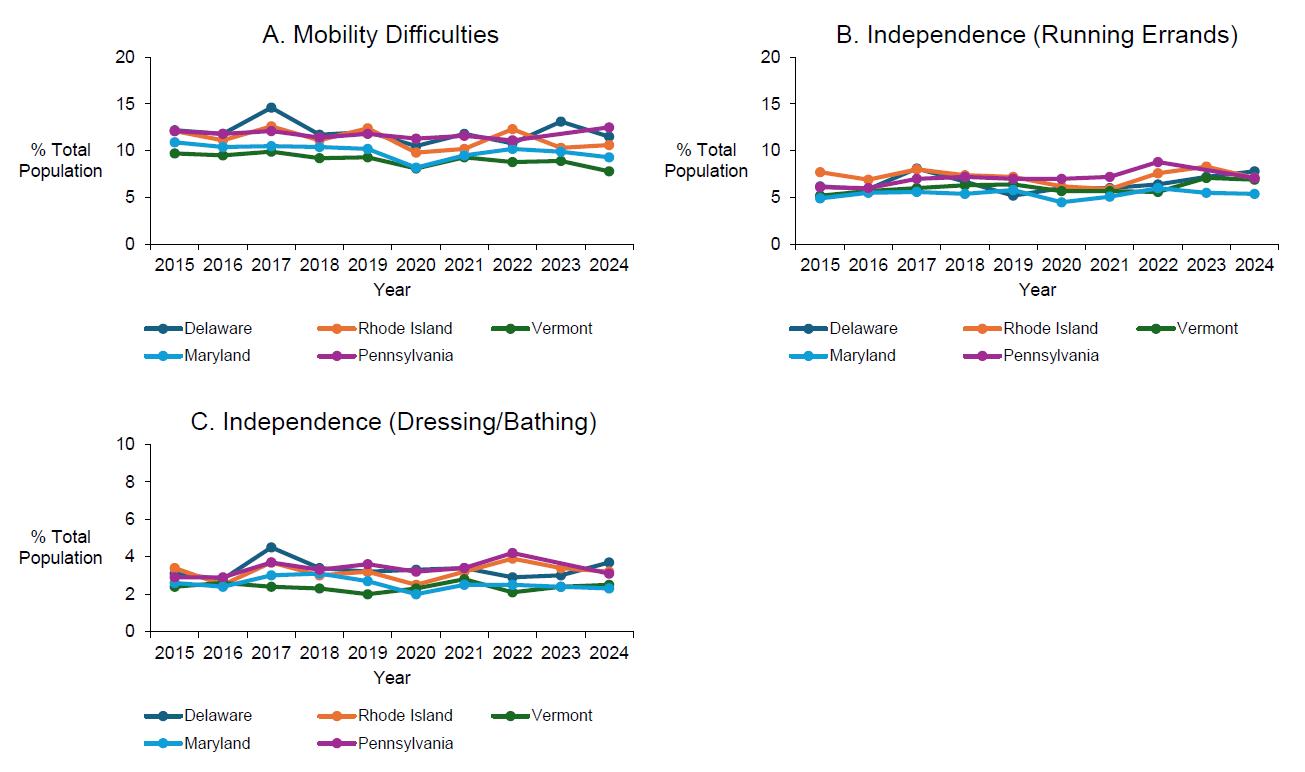
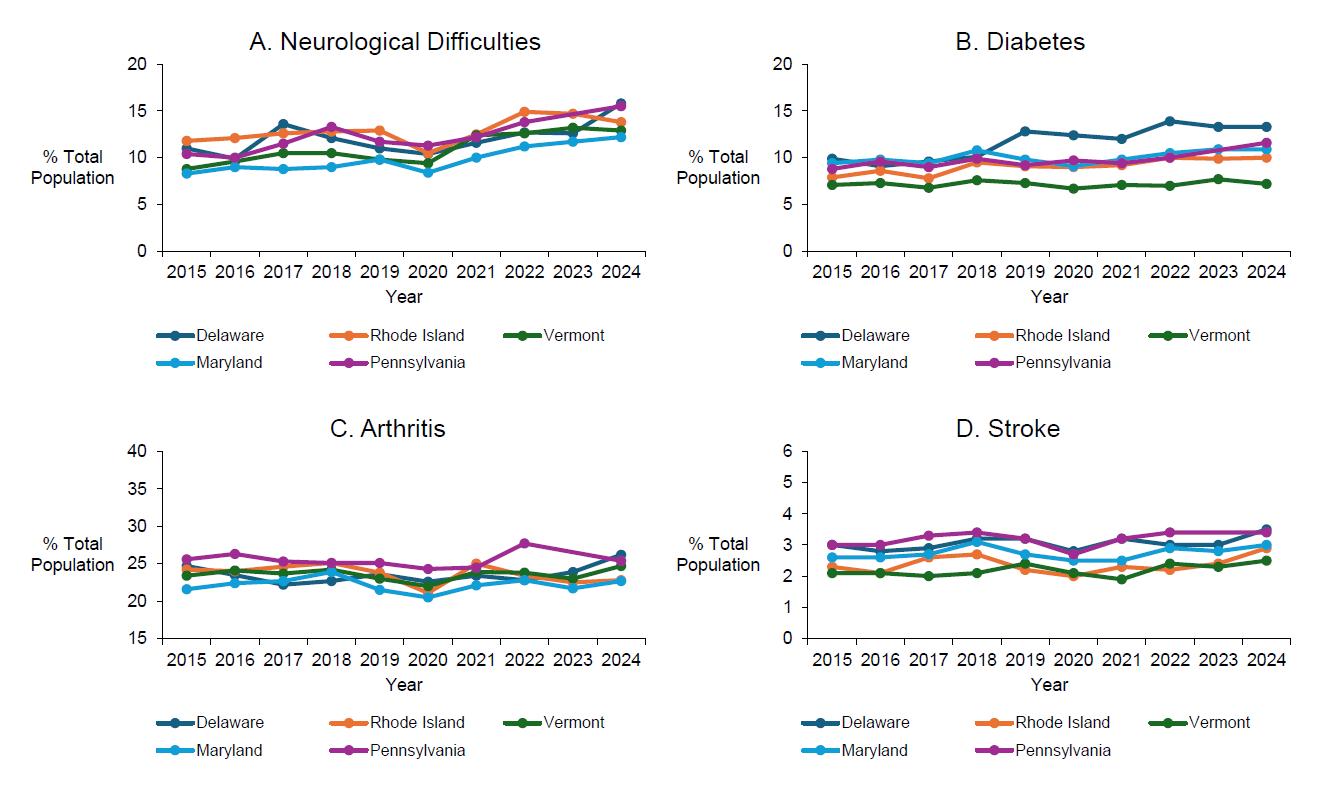
Delaware’s overall population had a high prevalence of mobility difficulties (11.5% in 2024; rank relative to comparison states = 2nd), neurological difficulties (15.8% in 2024; rank relative to comparison states = 1st), and impairments with independence (e.g., running errands and dressing/bathing; Figure 2).7 Delaware also had the highest population proportion of individuals with diabetes (13.3% in 2024; relative to comparison states = 1st), stroke (3.5%; relative to comparison states = 1st), and arthritis (26.2%; relative to comparison states = 1st; Figure 3).7
Figure 1. Demographic Shifts in the Aging Population
Over 11 percent of Delawareans aged 65 years and older were diagnosed with ADRD in 2020. The prevalence of ADRD was highest in New Castle County (12.3%), with over 11,000 individuals diagnosed in 2020. Compared with neighboring counties in Maryland (Cecil, Harford, and Kent Counties) and Pennsylvania (Chester and Mongomery counties), New Castle County, Delaware, had one of the highest rates of residents living with ADRD, though Baltimore City County, Maryland reported the highest prevalence overall.14–16
Public Health Infrastructure and Preparedness for an Aging Population
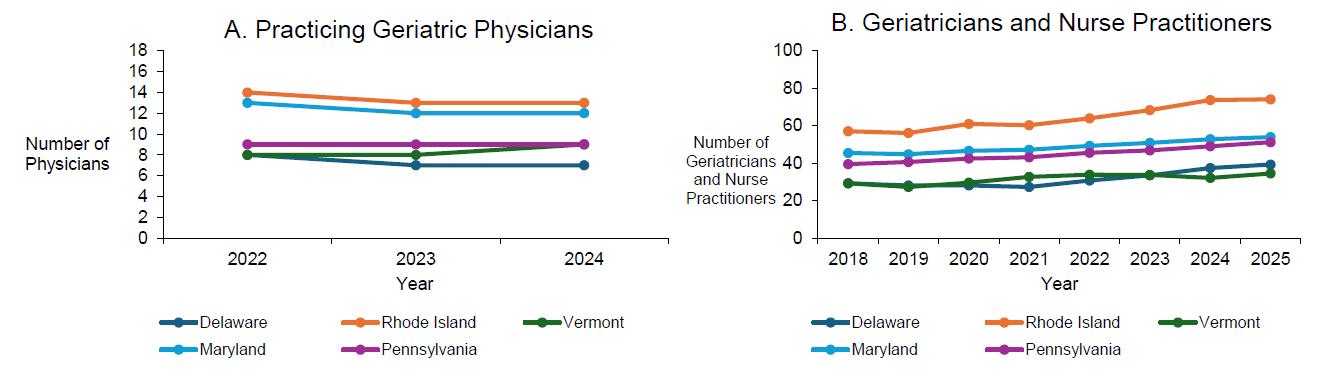
In 2024, Delaware had the lowest number of geriatricians (n=7) relative to all comparison states, with Rhode Island having the highest number (n=13; Figure 4).13 While the U.S. Physician Workforce Database reported only the number of geriatricians,13 the America’s Health Rankings Database included nurse practitioners and additional clinicians specializing in geriatric care. Using this broader measure of workforce capacity, Delaware remained among the lowest-ranked states, with 39.3 geriatric clinicians per 100,000 adults aged 65 years and older in 2025.8 As of 2023, Delaware had 44 nursing homes and a total of 4,859 licensed beds, which represents a decrease from 48 homes in 2020.12
Trends in Economic Indicators Among the Total Population
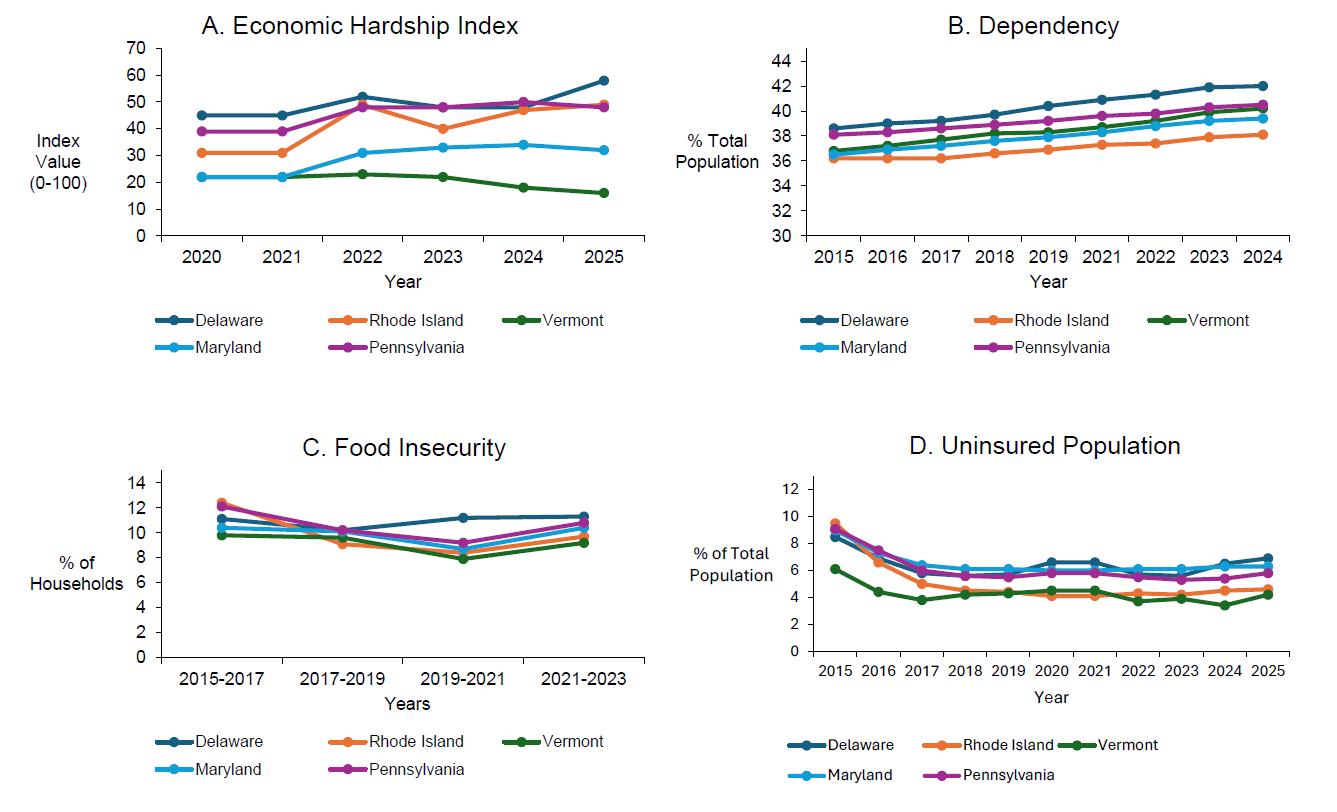
Delaware consistently ranked the poorest on measures of economic hardship among the overall population between 2020 and 2025, receiving a score of 58 in 2025 (lower scores are better; Rhode Island = 49; Vermont = 16; Maryland = 32; Pennsylvania = 48; Figure 5).9 Delaware’s poorer ranking appears to be driven, in part, by increases in the proportion of the population that was considered “dependent” (e.g., children 0-17 and adults 65 years and older; Figure 5).10 The proportion of the population with food insecurity was highest in Delaware at 11.3 percent of households relative to the four comparison states,11 and Delaware had the highest proportion of uninsured adults in 2025 (6.9 percent of the total population; Figure 5).6
DISCUSSION
We conducted a comparative analysis of Delaware and four comparison states to describe temporal trends in population aging, age-related chronic conditions, public health infrastructure and workforce, and economic security. The findings indicate that all five states are experiencing significant population aging, accompanied by increasing chronic disease burden, everyday limitations, and economic dependency. However, differences were observed across states in workforce capacity, healthcare access, and preparedness to support healthy aging. These findings provide important context for understanding Delaware’s readiness to meet the needs of its growing older adult population and to identify opportunities for strengthening aging-related public health and other infrastructure.
Delaware’s Division of Services for Aging and Adults with Physical Disabilities published the State Plan on Aging for 2024 to 2028, identifying several priorities to support the state’s growing older adult population.5 The plan’s priorities include promoting healthy aging, strengthening caregiver support, expanding access to long-term services, addressing social determinants of health,
and improving coordination across healthcare and communitybased services. The plan also emphasizes the importance of datadriven decision making, workforce development, and reducing barriers to healthcare access among older adults.5 In particular, the State Plan’s emphasis on workforce development aligns with our finding that Delaware has one of the lowest levels of geriatric workforce capacity among the comparison states, despite having of the oldest populations and highest burdens of age-related chronic diseases.3,7,8 While these represent important priorities, the current analysis demonstrates that there could be additional emphasis on recruiting and incentivizing growth in a clinical and public health workforce with expertise in geriatrics.
In 2024, Delaware State University and Education, Health, and Research International launched the Delaware Geriatric Workforce Enhancement Program.17 This federally funded initiative is designed to strengthen the healthcare workforce through geriatric-focused training, clinical placements, research, and community partnerships. The program specifically aims to improve the capacity of healthcare and supportive care professionals to meet the needs of older adults, particularly in the more rural Kent and Sussex counties.17 Delaware is currently pursuing its first four-year medical school, which state leaders have identified as a strategy for creating a long-term pipeline of physicians to serve Delaware communities.18 Given its early stage, Delaware could use this as an opportunity to expand its geriatric workforce through investments in education, training, recruitment, and retention initiatives. Workforce development strategies should also extend beyond physicians to include nurse practitioners, physician assistants, social workers, public health professionals, community health workers, and dementia care specialists.
Economic well-being is an important determinant of healthy aging, which influences access to healthcare, nutrition, housing, and supportive services. We observed that Delaware faces several economic challenges that may affect the health and quality of life of older adults. Between 2020 and 2025, Delaware consistently ranked lowest among the comparison states on the Economic Hardship index, indicating greater levels of socioeconomic disadvantage. Delaware also reported the highest prevalence of food insecurity and uninsured adults relative to the comparison states.6,9,11 These findings indicate that many Delaware residents may face financial barriers that limit access to preventive healthcare services, chronic disease management, and other resources necessary for healthy aging. In addition, Delaware’s population experienced increasing “dependency” over time, reflecting growth in the proportion of residents who are either younger than 18 years or older than 64 years of age. Dependency encompasses individuals of non-working age and those who are most likely to rely on socially-funded programs (e.g., Medicare and Medicaid).10 As the number of older adults increases, growing economic dependency may place additional pressure on federal and state budgets, age-related health services, and family caregivers. Economic insecurity may worsen the impacts of chronic disease, disability, and cognitive decline by creating barriers to nutritious foods and healthcare services, all of which are important for maintaining health and independence among older adults.19,20 These findings reinforce the importance of addressing social determinants of health alongside healthcare infrastructure when planning for population aging.
Figure 2. Age-related functional impairments.
Figure 3. Age-Related Chronic Conditions and Functional Impairments
Dementia preparedness represents an increasingly important component of the state’s readiness to support healthy aging. As diagnoses of ADRD continue to rise, states will face growing demands for diagnostic services, specialized healthcare providers, caregiver support programs, resources for long-term care and memory care, and community-based services. Nationally, ADRD care costs exceed $321 billion annually including approximately $206 billion in Medicare and Medicaid expenditures.21 Analysis of Delaware and the comparison state’s ADRD plans reveal common priorities and notable differences in strategy. Delaware’s State Plan on Aging and dementia-related initiatives emphasized expanding access to biomarker testing, strengthening dementia-specific training for first responders, and improving awareness of cognitive health.5,22 Maryland focuses on statewide leadership and
coordination through the development of dementia and brain health initiatives, while also investing in provider education related to dementia risk reduction, diagnosis, and treatment.23 Rhode Island’s plan is centered on clinician education, dementia-specific training for Adult Protective Services personnel, and centralized coordination through a Dementia Services Coordinator position.24 While Delaware has made important investments, comparison states have implemented additional strategies that may strengthen dementia preparedness. Delaware could strengthen its dementia preparedness efforts through investments in approaches similar to what the comparison states have implemented and through intentional efforts to grow the State’s expertise in geriatrics and its capacity for ADRD research.
This analysis has several strengths and limitations. A strength
Figure 4. Geriatric Workforce
Figure 5. Trends of Economic Security
is the use of a multi-state comparative framework that examines demographic aging trends, chronic disease burden, workforce capacity, economic indicators, and dementia preparedness simultaneously. This type of analysis provides a comprehensive assessment of health aging infrastructure. However, several limitations should be considered. This analysis is descriptive and does not establish causal relationships between population aging and infrastructure outcomes. Data were obtained from multiple sources that may differ in methodology, definitions, and reporting periods, which may affect comparability across health and infrastructure indicators. Additionally, state-level analyses may overlook county- and community-level variations, particularly regarding healthcare access and workforce distribution.
CONCLUSION
Population aging is placing new burdens on public health infrastructure across the United States and creating new challenges for healthcare systems, public health agencies, and community organizations. As the proportion of older adults continues to grow, states must ensure that their public health infrastructure can support the increasingly complex health and social needs associated with aging. This comparative analysis of Delaware, Maryland, Pennsylvania, Rhode Island, and Vermont highlights shared challenges and opportunities for strengthening preparedness for healthy aging. Between 2015 and 2024, Delaware experienced one of the largest increases in the proportion of residents aged 60 years and older. Additionally, Delaware experienced the highest influx of older adults moving into the state among the comparison states. These demographic changes are accompanied by a substantial burden of chronic disease, disability, and ADRD. Despite ongoing efforts to support healthy aging, Delaware continues to face challenges related to geriatric workforce capacity, economic security, and access to aging-related services. Current demographic trends and population projections forecast that the number of older adults in Delaware will continue to increase over the coming decades. This further emphasizes the need for proactive planning and investment in aging-related public health infrastructure.25 Continued focus on workforce development, dementia preparedness, community-based services, and public health infrastructure is critical for ensuring that Delaware is prepared to meet the needs of its growing older adult population. Ms. Bruess may be contacted at aabrue@udel.edu
REFERENCES
1. Khan , H. T. A., Addo , K. M., & Findlay , H. (2024). Public Health Challenges and Responses to the Growing Ageing Populations. Public Health Challenges, 3(3), e213.
2. Lebrasseur , A., Fortin-Bédard , N., Lettre , J., Raymond , E., Bussières , E. L., Lapierre , N., Faieta , J., Vincent , C., Duchesne , L., Ouellet , M. C., Gagnon , E., Tourigny , A., Lamontagne , M. È., & Routhier , F. (2021). Impact of the COVID-19 Pandemic on Older Adults: Rapid Review. JMIR Aging, 4(2), e26474.
3. United States Census Bureau. (2026). Geographical Mobility in the Past Year by Age for Current Residence in the United States. Census.gov. Accessed May 27, 2026. https://data.census.gov/table?t=Age+and+Sex:Residential+Mobility&g=040XX00US10,24,42,44,50
4. Gupta , S. (2022). Challenge of a dual burden in rapidly aging Delaware: Comorbid chronic conditions and subjective cognitive decline. PLOS Global Public Health, 2(8), e0000579.
5. Division of Services for Aging and Adults with Physical Disabilities. Delaware State Plan on Aging 2024-2028. Delaware Health and Social Services; 2024 https://dhss.delaware.gov/wp-content/uploads/sites/2/dsaapd/pdf/State_Plan_on_Aging_Draft_2024_to_2028.pdf
6. United States Census Bureau. (2026). Types of Health Insurance Coverage by Age. Census.gov 2026. Accessed May 27, 2026. https://data.census.gov/table?q=B27010&g=040XX00US10,24,42,44,50
7. Centers for Disease Control and Prevention. (2025, Nov 13). BRFSS Prevalence & Trends Data. BRFSS Prevalence & Trends Data. Accessed May 27, 2026. https://www.cdc.gov/brfss/brfssprevalence/index.html
8. United Health Foundation. (2025). Geriatric Clinicians. America’s Health Rankings. Accessed May 28, 2026. https://www.americashealthrankings.org/explore/measures/geriatrician_sr_2
9. United Health Foundation. (2024). Economic Hardship Index in the United States. America’s Health Rankings. Accessed May 27, 2026. https://www.americashealthrankings.org/explore/measures/EHI_a
10. United Health Foundation. (2024). Dependency (Ages <18 or >64) in the United States. America’s Health Rankings. Accessed May 27, 2026. https://www.americashealthrankings.org/explore/measures/dependency
11. United Health Foundation. (2024). Food Insecurity in the United States. America’s Health Rankings. Accessed May 27, 2026. https://www.americashealthrankings.org/explore/measures/food_insecurity_household
13. Association of American Medical Colleges. (2024). U.S. Physician Workforce Data Dashboard. AAMC. Accessed May 27, 2026. https://www.aamc.org/data-reports/report/us-physician-workforce-data-dashboard
14. Alzheimer’s Association. (2026). Alzheimer’s and Public Health Action in Delaware. Alzheimer’s Disease and Dementia. Accessed May 27, 2026.
15. Alzheimer’s Association. (2026). Alzheimer’s and Public Health Action in Pennsylvania. Alzheimer’s Disease and Dementia. Accessed May 27, 2026. https://www.alz.org/professionals/public-health/state-overview/pennsylvania
16. Alzheimer’s Association. (n.d.). Alzheimer’s and Public Health Action in Maryland. Alzheimer’s Disease and Dementia. Accessed May 27, 2026. https://www.alz.org/professionals/public-health/state-overview/maryland
17. Perez-Gonzalez, J. (2024, Aug 1). Del. launches $5M program for aging population amid workforce shortage. WHYY. Accessed June 2, 2026.
18. Sawicki, R. (2025, Nov 12). Governor Meyer Announces Generational Plan to Overhaul Rural Healthcare in Delaware. State of Delaware News. Accessed June 2, 2026.
19. Pooler, J. A., Hartline-Grafton, H., DeBor, M., Sudore, R. L., & Seligman, H. K. (2019). Food Insecurity: A Key Social Determinant of Health for Older Adults. Journal of the American Geriatrics Society, 67(3), 421–424
20. McMaughan, D. J., Oloruntoba, O., & Smith, M. L. (2020). Socioeconomic Status and Access to Healthcare: Interrelated Drivers for Healthy Aging. Frontiers in Public Health, 8, 231
21. Dhana, K., Beck, T., Desai, P., Wilson, R. S., Evans, D. A., & Rajan, K. B. (2023). Prevalence of Alzheimer’s disease dementia in the 50 US states and 3142 counties: A population estimate using the 2020 bridged-race postcensal from the National Center for Health Statistics. Alzheimer’s & Dementia: The Journal of the Alzheimer’s Association, 19(10), 4388–4395
22. Alzheimer’s Association. (2025). Delaware State Alzheimer’s Plan Overview. Alzheimer’s Impact Movement. Accessed May 27, 2026. https://alzimpact.org/Delaware
23. Alzheimer’s Association. (2025). Maryland State Alzheimer’s Plan Overview. Alzheimer’s Impact Movement. Accessed May 27, 2026. https://alzimpact.org/Maryland
24. Alzheimer’s Association. (2025). Rhode Island State Alzheimer’s Plan Overview. Alzheimer’s Impact Movement. Accessed May 27, 2026. https://alzimpact.org/Rhode_Island
25. National Council on Aging. (2024). Get the facts on older Americans. NCOA. Accessed June 22, 2026. https://www.ncoa.org/article/get-the-facts-on-older-americans/
Role of Higher Education Institutions in Advancing Healthy Aging: Education, Engagement,
and Experiential
Cynthia Newton, Ph.D., M.P.A.
Learning Collaborations
Program Director and Biomedical, Behavioral, and Allied Health Center Director, Delaware State University
Julia O’Hanlon, M.P.A.
Health and Aging Policy Services Coordinator, Institute for Public Administration, University of Delaware
Elizabeth Orsega-Smith, Ph.D., F.S.B.M.
Professor, Graduate Program Director, Health Behavior Sciences, University of Delaware
ABSTRACT
Delaware is experiencing a significant demographic shift as its older adult population continues to grow. Currently, approximately 18 percent of Delaware residents are age 65 years and older, and projections indicate that more than one in five Delawareans will be over age 65 by 2030. Concurrently, chronic disease prevalence, physical inactivity, cognitive decline, and other aging-related health challenges continue to place increasing demands on healthcare systems, community services, and public health infrastructure. Addressing these complex issues requires coordinated, interdisciplinary approaches that integrate research, education, workforce development, and community engagement. This paper highlights the collective contributions of Delaware’s public institutions of higher education in advancing healthy aging initiatives across the state. Programs and activities supported by Delaware State University, Delaware Technical Community College, and the University of Delaware are unique in scope and topic but collectively contribute to research, workforce training, evidence-based program implementation, policy development, and community outreach. Beyond individual programs, this paper emphasizes the value of interdisciplinary partnerships among academic institutions, healthcare organizations, government agencies, and community stakeholders. Such collaborations enhance opportunities for experiential learning, translational research, workforce development, and evaluation of programs that support older adults across rural, suburban, and urban communities. Looking forward, Delaware’s higher education institutions are uniquely positioned to strengthen statewide collaboration through shared educational opportunities, aging-focused workforce initiatives, coordinated research efforts, and a proposed statewide aging summit. By leveraging collective expertise and resources of the state’s rich academic programs, Delaware can develop a coordinated strategy to promote healthy aging, improve quality of life, and prepare for the needs of its rapidly growing older adult population.
INTRODUCTION
At the state level, Delaware’s older adult population continues to grow. Current data shows that approximately 18 percent of Delaware residents are age 65 or older (65+),1 and projections indicate that by 2030, more than 20 percent of Delaware’s population will be 65+, signaling a substantial demographic shift at the state level.2 Health data from the Delaware Department of Health and Social Services (DHSS) further shows that chronic disease remains a major issue among adults in the state. Delaware’s older adult population presents significant public health challenges around chronic disease and long-term care needs. The 2024 Behavioral Risk Factor Surveillance System dataset provides current insight into issues such as physical activity, chronic disease burden, and aging-related health risks3 impacting these older adult populations. These patterns indicate that Delaware is not only aging, but doing so in a way that will increase demand for community-based interventions, healthcare services, and policies that address both chronic disease and social determinants of health among older adults.
While healthcare for our older adults will place heavy demands on clinical providers and services, supporting older Delawareans in healthy aging and disease prevention offer important opportunities for collaboration among traditional healthcare providers, community-based organizations, policy makers, and researchers. Delaware’s higher education community plays an especially critical role in advancing a collaborative approach to promoting healthy aging, spanning from a traditional educational and scholarship perspective to experiential learning and community engaged research that addresses varied emerging needs. Through this article, we examine and feature some of the many examples of activities already taking place among our academic institutions in Delaware, however there remain substantial opportunities to expand partnerships and strengthen collaboration within and among our academic and communitybased programs. Such efforts not only support our residents and their families, but present unique, interdisciplinary approaches for scholars and students in a variety of settings and within many interest areas.
IMPORTANCE OF INTERDISCIPLINARY PARTNERSHIPS
In addition to specific degree programs and courses offered, current interdisciplinary partnerships play a critical role in advancing both clinical and translational research while engaging students at the undergraduate, graduate, and professional levels. These collaborations support state agencies and community organizations through program evaluation, needs assessment, data collection, and providing support for development and implantation of evidence-based programs to support our residents. At the same time, they provide students with valuable experiential learning opportunities and direct engagement with the community.
New or expanded partnerships can address emerging initiatives such as rural health initiatives and educational programs aimed at enhancing and expanding our healthcare workforce to meet the increasing demands associated with caring for and keeping our aging population healthy. For example, the new Delaware medical school4 (funded through the Rural Health Transformation Program) will work with a consortium of academic and clinical partners from across the state. One of the goals of this initiative is to assist in keeping students here in Delaware after they matriculate and continue their education and professional development. This consortium-based medical school will also focus efforts in rural and underserved communities in the state with needed services in rural and underserved communities. The following examples feature current programs and partnerships among our public higher education institutions. This is not an exhaustive list, but a snapshot that illustrates how each institution is addressing public health and aging issues while presenting ideas for expanding, bridging, and collective impact.
DELAWARE TECHNICAL COMMUNITY COLLEGE
Certified Nursing Assistant and Patient Care Technician
Delaware Technical Community College offers a range of workforce training programs designed to support the needs of the aging community across various healthcare settings. Among these are the Certified Nursing Assistant (CNA) program, which prepares individuals to provide essential care in long-term care facilities, and the Patient Care Technician (PCT) program, a stackable credential that equips students with advanced skills to support patient care in hospital environments. Additionally, the Home Health Aide program trains graduates to deliver high-quality, in-home care, helping to meet the growing demand for skilled professionals who can assist individuals who desire to age in place. Together, these programs create a strong pipeline of compassionate, welltrained workers dedicated to serving older adults.
Occupational
Therapy Assistant
The Delaware Technical Community College Occupational Therapy Assistant (OTA) program plays a vital role in preparing skilled practitioners who support public health initiatives, particularly in long-term care settings and services for the aging population. The program maintains consistent enrollment and strong student success outcomes while integrating hands-on clinical experiences that place students in real-world healthcare
environments, directly benefiting community partners. Through applied learning and workforce-focused training, graduates are well-prepared to deliver compassionate care and improve quality of life across diverse patient populations.
Practical Nursing and Associate Degree Nursing
Delaware Technical Community College’s Practical Nursing (PN) and Associate Degree Nursing (ADN) programs prepare students to meet the healthcare needs of diverse populations, including older adults, through a strong foundation in clinical practice including public health and community-based care. During the 2025–2026 academic year, these two programs graduated 355 nurses, including 301 ADN graduates and 54 PN graduates, helping strengthen Delaware’s healthcare workforce. Nursing students participate in extensive experiential learning, completing approximately 90-145 clinical hours per course in a variety of healthcare settings, including hospitals, long-term care facilities, and public and community health agencies. These hands-on experiences foster clinical competence while supporting the health and well-being of individuals, families, and aging populations throughout the community.
DELAWARE STATE UNIVERSITY
Geriatric Workforce Enhancement Program
The Geriatric Workforce Enhancement Program (GWEP) at Delaware State University represents an innovative and transformative approach to geriatric education, workforce development, and community engagement in partnership with the Milford Wellness Village. Supported through federal funding from the Health Resources and Services Administration (HRSA), GWEP seeks to improve healthcare outcomes for older adults by enhancing the knowledge, skills, and competencies of the healthcare workforce in geriatrics and age-friendly care. The program advances health equity by addressing disparities in healthcare access and quality among older adults, particularly those residing in underserved and rural communities. Through community outreach events, health promotion initiatives, curriculum development, strategic partnerships, and practice transformation activities, GWEP seeks to reduce barriers to care while promoting culturally responsive and inclusive healthcare practices. The program prepares a culturally responsive healthcare workforce while simultaneously fostering meaningful intergenerational engagement to advance person-centered, agefriendly care. Beyond workforce education, GWEP also supports family and informal caregivers through evidence-based training programs, educational resources, support groups, and community services designed to enhance caregiving capacity.5
Master of Occupational Therapy Program
The Master of Occupational Therapy (MOT) program prepares occupational therapy practitioners who are clinically competent, culturally responsive, and committed to addressing the evolving health needs of diverse populations across the lifespan. Through its emphasis on experiential learning and service, including faculty-led clinical experiences at a local veterans’ home, where students engage directly with older adults whose experiences reflect diverse military, social, and cultural histories, the program cultivates practitioners who are prepared not only to deliver high-quality occupational therapy services but also to contribute meaningfully to the health and well-being of communities, including many older adults. This accredited program
(Accreditation Council of Occupational Therapy Education) helps graduates enter the workforces equipped to serve a variety of populations including older adults.
Community Health Worker Certificate Program
The Community Health Worker (CHW) Certificate Program in the Department of Public and Allied Health Sciences represents an approach to public health workforce development that combines community engagement, health equity, and intergenerational learning. Designed to prepare individuals committed to improving health outcomes in underserved communities, this new program equips participants with the knowledge, skills, and competencies necessary to serve as trusted liaisons between community members and healthcare systems. Through a flexible, community-centered curriculum, the program not only addresses immediate workforce needs but also creates pathways for lifelong learning and professional advancement while fostering meaningful connections. Community health workers occupy a unique position within healthcare and public health systems. Offered through both in-person and fully online formats, the program accommodates working professionals, caregivers, and individuals with family responsibilities. An important feature of the program is its role as a workforce and academic pipeline. Upon completion of the certificate, participants have opportunities to apply their coursework toward Delaware State University’s public health degree programs, including the Associate of Science and Bachelor of Science pathways. This stackable credential model supports lifelong learning and creates educational opportunities for individuals at different stages of their academic and professional journeys. Adult and Continuing Education and Prior Learning Assessment Programs
Delaware State University’s Office of Adult and Continuing Education (ACE) and Prior Learning Assessment (PLA) initiatives provide a model for expanding educational access and supporting workforce development. Together, these programs recognize that meaningful learning occurs throughout the lifespan and across multiple environments, including workplaces, military service, community organizations, volunteer experiences, and family caregiving roles. ACE serves as an important gateway for individuals seeking career advancement, professional development, and entry into highdemand occupational fields through a diverse portfolio of online certificate programs. Complementing the ACE framework is Delaware State University’s PLA, also known as Credit for Prior Learning (CPL), which serves as a mechanism for evaluating and awarding academic credit for knowledge and competencies acquired through employment, military service, professional certifications, volunteer activities, community engagement, and other experiential learning opportunities.
UNIVERSITY OF DELAWARE
Center for Community Research and Service, Joseph R. Biden School of Public Policy and Administration
The Center for Community Research and Service (CCRS) works to create more just and equitable communities and enhance the wellbeing of underserved populations at the local and national level. Through research, program evaluation, and dissemination, CCRS engages with communities and the health and social service systems serving them to measure and track health
indicators throughout the lifespan of Delawareans. Partnerships with state and local entities have focused on topics that impact residents of Delaware from birth through old age, including housing and homelessness, substance use disorders, and health services provision. Recently, CCRS partnered with the Delaware Division of Medicaid and Medical Assistance (DMMA) to report on home care service utilization, an important support for the state’s aging population.
Delaware Center for Cognitive Aging Research
This center at the University of Delaware provides a framework that allows for multidisciplinary Alzheimer’s Disease and related dementia research to be coordinated. The center not only provides a framework for those researchers but also conducts outreach to the community to promote awareness and education to both community members but also clinicians and students engaged with older adults who may be at risk for developing Alzheimer’s Disease or related dementia. In addition, cognitive assessment is a key core component as the center provides the expertise in administration of assessment tools and interpretation of the results. The center maintains a registry of older adults and their cognitive status for research purposes.
Community Engagement Initiative
The University of Delaware created the Community Engagement Initiative (CEI) in 2016 as a way to enhance the university’s capacity to serve as a community partner throughout the state of Delaware. The University received the Community Engagement Classification in 2015 and was reclassified in 2026 by the Carnegie Foundation for the Advancement of Teaching. Through this initiative, the University has recognized a variety of partnerships to mobilize university-wide capacity in the areas of community priority including the Partnership for Arts and Culture, the Partnership for Public Education, the Partnership for Healthy Communities, the Wilmington Partnership and the Newark Partnership. CEI further expands hands-on and research opportunities for undergraduate and graduate students to work with the communities in the State of Delaware to address social and health challenges. Some of these previous activities have included older adult populations in senior centers.
Cooperative Extension Programming
Dining with Diabetes
Dining with Diabetes (DWD) is an evidence-based National Extension curriculum. DWD is a 4-part series with a 3-month reunion. Each class is two hours and includes an interactive lesson and a cooking demonstration with recipe sampling. The program is designed for people with diabetes, their family members, caregivers, and support persons, but is also beneficial for adults over the age of 18 looking to prevent diabetes. Classes are taught by two University of Delaware Cooperative Extension employees, one of whom is a Registered Dietitian. DWD teaches the basics of meal planning, as well as ways to reduce sugar, salt, and fat in foods, without giving up good taste. The goals of DWD are for participants to learn about diabetes and its relationship to nutrition and physical activity, develop new diabetes selfmanagement skills and gain confidence in using them, observe new healthy cooking techniques, taste diabetes-friendly recipes, and interact with others in the program. DWD programs are held once or twice a year in each county, and have been offered in Delaware for over 10 years.
Wits Workout is a peer-reviewed, pilot-tested brain health resource tool developed to provide programming to older adults (aged 55 and older) in community settings. Based on the research, intellectual challenge and social connectedness are two of several factors contributing to brain health throughout life. Wits Workout has two main goals: to provide purposeful opportunities for older adults to engage intellectually, and to increase their socialization through ongoing group participation. Wits Workout activities are built to be novel, fun, and challenging. There are 24 units delivered over 6-weeks. Each unit has a training component featuring educational topics on memory, brain health, or aging.
Institute for Public Administration, Joseph R. Biden School of Public Policy and Administration
Through its programs and experiential learning opportunities, the faculty, staff, and students at the Institute for Public Administration (IPA) strive to develop public leaders while improving the quality of life for those in Delaware and beyond. IPA’s Health and Aging Policy Services works with a variety of governmental and nonprofit organizations on policies and programs that address the diverse needs and issues facing older Delawareans, including healthy aging and social isolation. IPA’s work in this area includes applied research, needs assessments, data and mapping tools for policy analysis, project management, and professional development services. Featured partnerships include the Delaware Senior Center Grant in Aid (GIA) Funding Formula and DE-PLANs, a hub site developed in partnership with the Delaware Sea Grant program. Health and Aging Policy Services staff and students partner regularly with state agencies, community-based organizations, and other academic units on campus at the University of Delaware to offer comprehensive expertise and outcomes. Collaborative research examples include work with the College of Health Sciences’ Health, Behavior and Nutrition Sciences department on the evaluation of healthy aging and intergenerational programs among community-based organizations in Delaware. IPA also actively seeks partnerships with its sister centers and institutes, including the Center for Research and Community Service, in the Biden School.
Osher Lifelong Learning Institute, Professional and Continuing Studies
As one of the earliest and largest lifelong learning programs in the country, Osher Lifelong Learning Institute (OLLI) holds programs in Dover, Lewes, Newark, Ocean View, and Wilmington. Structured as academic cooperatives, OLLI programs are open to adults aged 50 and older to take and teach a variety of classes together, with course offerings determined by member interest as well as the passions and expertise of the dedicated volunteer member-instructors at each program’s location, with no grades, exams, or educational prerequisites. Members form strong governing Councils throughout the state, and lead efforts to offer travel tours, host the art shows, a biannual Book Sale, Earth Day, Regional Writers Seminar and provide more than 20 concerts and performances each semester. OLLI members mentor students in the Sussex community and at UD, and they actively engage in local community outreach with partner organizations sharing speakers, gathering spaces, their skills, and their expertise.
Partnership for Healthy Communities, College of Health Sciences
The Partnership for Healthy Communities (PHC) works with community partners, the academic community (faculty, staff, students), and policy makers to translate research findings into practice to improve the overall community’s (including older adults) health. This is accomplished via supporting engaged research, while providing students with service-learning opportunities to achieve the vision of equality in health for all members of the community. Through the use of neighborhood, school, places of worship, and work setting partnerships, PHC focuses on assisting communities with health disparities in acquiring access to holistic care so that the community may thrive and reach optimal health. PHC further assists by working with the communities in developing advocacy efforts and translational briefs to inform local and state policy makers and improve community health. Strategic PHC initiatives include Healthy Communities Delaware, Delaware State Health Improvement Plan, and UD Health for All.
UD Health for All, College of Health Sciences
Health for All is a program under the Partnership for Healthy Communities with the support of Highmark Blue Cross Blue Shield and the Laffey McHugh Foundation. This program provides mobile services and community outreach to all three counties across the State of Delaware. This outreach includes education and behavioral health outreach and physical health screenings. These activities provide hands-on experiences for University of Delaware undergraduate and graduate students in data collection, research opportunities, and community outreach. The outreach activities focus on the communities in need of health care services, and draw upon cross college and cross university collaborations and engagement. Examples of these activities include blood pressure screenings, blood glucose screenings, visits with a nurse practitioner, and educational sessions that occur at a variety of community settings including local libraries, senior centers, retirement communities, and community centers.
FUTURE OPPORTUNITIES
Higher education institutions in Delaware have a critical responsibility to not only generate aging-related knowledge through research and training but also to remain informed about statewide programs and initiatives. Thus, they can help identify opportunities to strengthen, expand, and align efforts that address the needs of an aging population.
Academic institutions can play a unique role in creating and providing educational opportunities that transcend institutional boundaries and disciplinary silos. These opportunities may include aging-focused certificates, micro-credentials, and continuing education programs tailored to older adults. Such opportunities are also applicable across professions in healthcare, public health, social services, business, and government. For example, the Geriatric Workforce Enhancement Program (GWEP) at Delaware State University fosters collaboration between academic units, primary care providers, communitybased organizations, and caregivers to promote age-friendly, person-centered care. GWEP aims to improve healthcare outcomes for older adults by enhancing the training and education of the healthcare workforce in geriatrics.
To build on aging-focused programs like these and others, there remains significant potential for public and private higher education institutions to collaborate and develop interdisciplinary research, evidence-based training, and community engagement initiatives. By leveraging complementary expertise and resources across institutions, these partnerships can generate impactful research and workforce development opportunities that address the diverse needs of older adults living in rural, urban, and suburban communities throughout Delaware. Such collaborative efforts can enhance the state’s capacity to promote healthy aging, improve quality of life, and respond effectively to the demographic shifts associated with an increasingly older population.
Our academic institutions have an important responsibility to educate students about the diverse career pathways and workforce opportunities associated with serving an aging population, as well as the meaningful impact they can have on the health and well-being of older adults and their communities. As Delaware’s older adult population continues to grow, so too does the demand for professionals with expertise in aging-related fields, creating expanded employment opportunities across healthcare, public health, social services, policy, technology, and community-based organizations.
Higher education institutions can play a key role in preparing and retaining this workforce by partnering with career services at their respective institutions to increase awareness of agingfocused careers and employment opportunities that serve older adults within the state of Delaware. Additionally, strengthening connections with community-based organizations, healthcare systems, government agencies, and nonprofit partners can expose students to internships, experiential learning opportunities, and career pathways that they may not otherwise consider. By creating clear pathways from education to employment, institutions can contribute to workforce development efforts while supporting the state’s capacity to meet the needs of its growing older adult population.
Our public academic institutions within the State of Delaware are uniquely positioned to lead and facilitate critical conversations about demographic trends, evidence-based interventions, and collaborative strategies to support Delaware’s growing older adult population. While there are many initiatives already in place, enhancing the current ones and deliberately seeking new ones are essential to better serve the shifting population. Given the state’s size and interconnectedness, faculty and staff across institutions often maintain strong partnerships with public health agencies, healthcare systems, community organizations, and policymakers engaged in aging-related initiatives. Organizations such as the Division of Services for Aging and Adults with Physical Disabilities (DSAAPD) and DHSS play vital roles in monitoring demographic trends, assessing the needs of older adults, and supporting programs that enhance health, independence, and quality of life throughout the state. Higher education institutions can complement these efforts by contributing expertise in research, evaluation, workforce development, and community engagement. Through collaboration both within and across institutions, Delaware’s academic community can strengthen the state’s capacity to collect, analyze, and disseminate data that inform policy and practice.
Moving forward, we as leading public academic institutions within the state of Delaware can offer an annual joint forum or summit based on the opportunities that exist within our institutions to showcase and better inform the citizens of Delaware. Importantly, the summit would foster dialogue around critical issues facing Delaware’s growing older adult population while creating opportunities to develop strategic partnerships across sectors that would also include the general public and essential community-based organizations. Discussions could focus on advancing interdisciplinary research, expanding educational and training programs, strengthening the aging services workforce, implementing evidence-based community programs, and improving statewide data collection and dissemination efforts. By leveraging the expertise and resources of multiple institutions and stakeholders, a statewide aging summit could help establish a shared vision and coordinated action plan for promoting healthy aging, enhancing quality of life, and ensuring Delaware is well-positioned to meet the needs of its increasingly older population.
Dr. Orsega-Smith may be contacted at eosmith@udel.edu
REFERENCES
1. America’s Health Rankings. (2025). Explore States – Delaware. https://www.americashealthrankings.org/explore/states/DE
3. Centers for Disease Control and Prevention. (2025, Sep 12). 2024 BRFSS Survey Data and Documentation. Cdc.gov https://www.cdc.gov/brfss/annual_data/annual_2024.html
4. McLeod, C. (2026, Jun 2). State and Thomas Jefferson University partner to establish Delaware’s first medical school. State of Delaware News. https://news.delaware.gov/2026/06/02/state-and-thomas-jefferson-universitypartner-to-establish-delawares-first-medical-school/
5. Delaware State University. (2025, July 29). Geriatric workforce enhancement program. Wesley College of Health & Behavioral Sciences at Delaware State. https://wchbs.desu.edu/departments/nursing/geriatric-workforce-enhancementprogram
FOR IMMEDIATE RELEASE
July 24, 2026
Contact: Jen Rini
Cell: 856-912-2933
jennifer@deha org
Health Leaders Urge Measles Awareness and Vaccination
(Dover, DE – July 24, 2026) – Leading health advocates are encouraging vaccination awareness and action following this week’s declared measles outbreak announcement from the Delaware Division of Public Health.
The First S tate Health Leaders Alliance is a group of healthcare stakeholders who have joined forces to advocate collectively on ways to strengthen healthcare in Delaware. The leaders represent nurses, physicians, pharmacists, public health and medicine, persons with disabilities and caregivers, home care, health care facilities, and hospitals.
“Measles is highly contagious and dangerous but for more than 50 years the MMR vaccine has been a proven safe and effective prevention measure. As Delaware remains on high alert to track measles cases, please know that you can take the steps to protect yourself and your loved ones. Vaccines save lives. The First State Health Leaders Alliance remains vigilant and is committed to raising awareness about the importance of vaccination alongside our colleagues, stakeholders, and facilities. We urge Delawareans to contact your provider with questions, check your vaccination status and learn where you can get vaccinated if you or a loved one are not up to date on your vaccinations. Follow the Division of Public Health for updates. We are proud that Delaware officials are leading on strategies for proven public health measures that will strengthen our communities.”
Follow de gov/measles and the Division of P ublic Health social media channels for information and updates.
What to Know:
● Follow de.gov/measles for the latest updates from the Delaware Division of Public Health.
● Confirm MMR vaccination status. Visit the DelVAX Public P ortal or contact your health providers. Testing shows the MMR vaccine to be 97% effective atpreventing measles for those who have received two doses of the MMR vaccine and are not severely immunocompromised.
● Vaccinations are available to both adults and children at many pharmacies, federally qualified health centers (FQHCs), and providers throughout Delaware and also at public health clinics for the uninsured or underinsured. Individuals should contact their preferred facility in advance to confirm supply and availability.
● A list of state run Public Health Clinics is at https://publichealthalerts delaware gov/publichealthclinics/
For information on First State Health Leaders Alliance members, please see the below:
Ability Network of Delaware
Delaware Academy of Medicine and Public Health
Delaware Association for Home & Community Care
Delaware Healthcare Association
Delaware Health Care Facilities Association
Delaware Nurses Association
Delaware Pharmacists Society
LeadingAge NJ & DE
Medical Society of Delaware
Identifying Barriers to Fall Prevention for Community-Dwelling Older Adults in Delaware: A Qualitative Study
Margaret Gulledge, O.T.D., O.T.R./L.
Assistant Professor, Occupational Therapy Program, Delaware State University
Jolaolu Jimoh, P.T., D.P.T., M.Sc.
Assistant Professor, Kinesiology Program, Delaware State University
Gianna
Clemente, O.T.R./L.
Occupational
Therapist, Cape Henlopen School District/Nemours
Tina Lopez, O.T.R./L.
Occupational Therapist, Tidal Health
ABSTRACT
Objective. Falls are a major public health concern among older adults in the United States, and Delaware reflects this growing burden. Fall-related mortality increased steadily from 2012 to 2021, coinciding with a rapidly aging population. Despite the availability of effective evidence-based fall-prevention programs, adoption remains limited among high-risk populations. Grounded in implementation science, this study aimed to identify barriers and facilitators influencing the uptake of fall-prevention interventions among community-dwelling older adults and healthcare providers in Delaware. This project began November 2024 with data collection and analysis concluding March 2026. Methods. A qualitative descriptive, multi-method design was employed including semistructured interviews with nineteen older adults and focus groups of nine healthcare providers in southcentral Delaware. Interviews and focus groups were audio recorded, transcribed, and analyzed using inductive and deductive coding. Themes were analyzed using Theoretical Domains Framework and Behavior Change Wheel to categorize barriers and facilitators affecting fall prevention participation. Results. Barriers to fall prevention spanned multiple domains, including limited awareness of programs, financial and transportation challenges, provider gatekeeping, time constraints, and inconsistent referral practices. Older adults frequently underestimated their fall risk, underreported falls, and demonstrated low adherence to preventive behaviors, often compounded by social isolation. Facilitators included willingness to adopt prevention strategies, individualized fall action plans, family and social support, use of emergency alert technologies, and strong provider motivation to address fall risk. Conclusion. Gaps in fall prevention reflect implementation challenges rather than a lack of available evidencebased programs. Interconnected behavioral, structural, and system-level barriers influence both older adults and healthcare providers. Coordinated, evidence-informed implementation strategies are needed to expand program reach and improve outcomes for Delaware’s growing older adult population. Policy Implications. Standardized fall risk screening, interprofessional referral pathways, and population-specific implementation strategies for Delaware communities may help reduce fall-related morbidity and mortality among the state’s rapidly aging population.
INTRODUCTION
Falls are the leading cause of injury-related death among older adults in the United States. According to the Centers for Disease Control and Prevention (CDC) 2023 data, approximately one in four adults aged 65 and older experiences a fall, accounting for more than 36 million falls annually, over 14 million of which require medical attention.1 Falls result in approximately 3 million emergency department visits and 1 million hospitalizations annually, and fall-related deaths increased by 11% between 2021 and 2024.1 The direct medical cost of falls exceeds $50 billion annually in the United States, with Medicare absorbing approximately 75% of these expenditures.2
Delaware is particularly vulnerable to this growing public healthcare burden. As of 2025, adults aged 65 years and older comprised 21.8% of the state’s population, ranking Delaware fifth nationally, with this population projected to increase by 40% by 20403,4 In 2020, Delaware recorded 46,119 falls among older adults, resulting in 88 fall-related deaths at a rate of 48.2 per 100,000 population.1 According to the most current data provided by the CDC, in 2023, Delaware ranked ninth nationally in fall prevalence, with 67.7% of fall incidents among adults aged 65 years and older classified as traumatic.1 More recently, the Delaware Trauma Registry within the Delaware Trauma System of Care documented 5,234 falls in 2024, resulting in 611 head injuries and traumatic brain injuries (TBIs) and 84 deaths statewide.5 Of
these incidents, 3,652 falls (69.8%) occurred among adults aged 65 years and older, accounting for 70 deaths and 471 head injuries and TBIs.5 Beyond TBIs, falls contribute to fractures, functional decline, loss of independence and reduced quality of life, negative outcomes that evidencebased fall prevention programs are specifically designed to mitigate.6-8 These Delaware-specific findings underscore the disproportionate burden of fall-related injury among older adults in Delaware and highlight the urgent need for targeted, statewide prevention strategies. They reinforce the urgency in understanding why eligible older adults do not consistently participate in available fall prevention interventions. Multiple organizations have developed clinical guidelines supporting a multifactorial approach to fall prevention, commonly recommending routine screening, medication review, balance assessment and intervention, exercise, and home safety evaluation.6,7,9 In 2011, the American Geriatrics Society (AGS) published clinical practice guidelines that were subsequently adopted by the Centers for Disease Control and Prevention (CDC) and the Centers for Medicare & Medicaid Services (CMS). These guidelines recommend annual fall risk screening, exercise interventions, home modification strategies, clinical management, and multifactorial prevention programs.6 Several evidence-based fall prevention programs are available in Delaware for community-dwelling older adults, including A Matter of Balance, Stepping On, the Otago Exercise Program, Enhance Fitness, and Healthy Steps for Older Adults. Many of these programs are offered through senior centers, health departments, Area Agencies on Aging, and community organizations,8,10-14 such as Modern Maturity in Dover which costs Bingocise, A Matter of Balance classes, and Tai Chi, to name a few.15
Despite the availability of these evidence-based resources, fall rates continue to increase nationwide. Studies suggest that limited participation in fall prevention programs may contribute to this trend, with accessibility remaining a persistent barrier, particularly among high-risk and underserved populations.6-8 Disparities in access are further influenced by race and ethnicity, socioeconomic status, educational attainment, insurance coverage, and proximity to primary care services, all of which affect engagement with fall prevention resources.6-7 Evidencebased interventions are readily available in Delaware, so the challenge was to understand why existing programs have not achieved reductions in falls. For example, there are 30 senior community centers across all three counties offering a range of fall prevention classes and activities.16 Volunteer Delaware 50+ offered 28 classes of A Matter of Balance in 2025 throughout the state.17 ChristianaCare offers multiple community-based fall prevention programs, including Safe Steps, ThinkFirst to Prevent Falls, caregiver seminars, and fall prevention bingo.18
Implementation science addresses the persistent gap between evidence-based interventions and consistent adoption in clinical and community practice.19 Within fall prevention, this reflects the disconnect between the availability of effective prevention strategies and routine implementation among older adults and healthcare providers. The continued gap between research and practice highlights the need to better
understand the structural, behavioral, and systemic factors that influence participation in fall prevention programs. Identifying barriers and facilitators affecting implementation is essential for developing targeted strategies to expand the reach of evidence-based fall prevention interventions to populations most at risk. Accordingly, this study was guided by the following research question: What barriers and facilitators influence the adoption of evidence-based fall prevention guidelines and strategies among older adults and healthcare providers in Delaware?”
Prior qualitative and mixed-methods studies have identified barriers and facilitators influencing participation in fall prevention programs among older adults. Vincenzo and colleagues20 conducted focus groups interviews using constructs from the Health Belief Model and found that cues to action included financial incentives, printed educational materials, audiovisual reminders, and daily prompts. Shankar and colleagues21 interviewed 63 older adults presenting to emergency departments following fall-related visits and identified varying levels of concern about falls, uncertainty about prevention strategies, and greater provider interest in prevention than patient interest. A scoping review by Sibley and colleagues22 examined 22 publications and identified 293 factors influencing implementation of community-based fall prevention exercise programs. They concluded that insufficient evidence exists to determine the most effective implementation strategies for fall prevention, further supporting the need for the present study. Guirguis-Blake and colleagues7 similarly confirmed in a systematic review conducted for the U.S. Preventive Services Task Force that exercise and multifactorial interventions reduce fall risk; however, barriers related to access and adherence persist. To date, no known fall prevention intervention study has simultaneously examined these barriers across communityactive and homebound older adults alongside healthcare and social service providers within a Delaware-specific context to gain perspective from various viewpoints and triangulate responses.
METHODS
Study Design
This study employed a qualitative descriptive, multi-method design. Qualitative description was selected because it is well suited to exploring participant experiences, perceptions, and contextual factors influencing fall prevention. A multi-method approach incorporating individual semi-structured interviews and interprofessional focus groups was used to enable triangulation across data sources and participant perspectives.
Participants and Recruitment
Older Adult Cohort. Nineteen community-dwelling older adults were enrolled between April and October 2025, comprising ten community-active and nine homebound individuals. Community-dwelling older adults were defined as individuals residing in noninstitutional settings and included both community-active and homebound participants. Community-active participants were recruited through convenience sampling at informal outreach tables at the Modern Maturity Senior Center in Dover, Delaware.
Homebound participants were recruited through flyers distributed by Meals on Wheels outreach volunteers. The participants were primarily African American, with four Caucasian, and one participant identified as Hispanic. Of the nineteen participants, eleven were women and eight were men with ages ranging from 60 to 99 years (median age range 70-79). Most of the participants (73.3%) lived alone and all were insured through Medicare and Medicare advantage.
Healthcare Professional Cohort: Nine healthcare providers participated in interprofessional focus groups conducted between July to October 2025. Participants were recruited through mass email invitations distributed to clinical staff at Bayhealth Medical Center in Dover, Delaware. Bayhealth was selected because it serves as a major healthcare system for Kent and Sussex counties, which include large rural populations within central and southern Delaware. Participants included two physicians, one nurse practitioner, two registered nurse case managers, one social worker, one occupational therapist, and two physical therapists. All participants were female, with clinical experience ranging from 4 to 39 years (mean of 14.6 years).
Data Collection
Sociodemographic data, including age, sex, race and ethnicity, health insurance status, and living situation, were collected using a demographic questionnaire. Additional information regarding professional role, clinical specializations, and years of experience were collected from healthcare provider participants. Older adult participants were interviewed in settings of their choosing, including private homes, the Modern Maturity Center, and the Delaware State University Library in Dover, Delaware, to promote participant comfort and engagement.
Interprofessional focus groups were conducted at Bayhealth
Medical Center facilities with a multidisciplinary group of healthcare providers and were designed to facilitate discussion across professional roles and perspectives. Semistructured interview and focus group guides were developed to elicit perspectives regarding awareness of fall prevention programs, perceived barriers and facilitators to participation, experiences with healthcare providers, and personal or professional motivation to engage in fall prevention activities. All interviews and focus groups were audio-recorded and transcribed using Microsoft Teams on laptop computers and mobile devices.
Data Analysis
All interviews and focus groups were initially transcribed using Microsoft Teams automated transcription and subsequently reviewed manually against the original audio recordings to verify verbatim accuracy. Transcripts were managed and organized using Atlas.ti qualitative analysis software. Data analysis proceeded through two complementary analytic approaches. Inductive analysis involved open coding of transcripts to identify emergent themes grounded in participants’ experiences and language. Deductive analysis subsequently mapped these themes to predefined implementation science constructs aligned with the study aims, enabling structured comparison across participant groups.
To align the findings with established implementation science frameworks, deductive coding was guided by the Theoretical Domains Framework (TDF)23 and the COM-B (Capability, Opportunity, Motivation, Behavior) model (Figure 1).24 Participant-identified barriers and facilitators were mapped to the 14 domains of the TDF, and subsequently synthesized within the broader COM-B behavioral dimensions to characterize determinants influencing fall prevention implementation.
Figure 1. The Capability, Opportunity, Motivation, Behavior Model
Members of the research team independently coded transcripts and subsequently convened consensus meetings to discuss coding interpretation and resolve discrepancies. Analytical rigor and confirmability were enhanced through a multi-layered verification process, incorporating independent reviewer analysis, consensus coding procedures, and structured analytical comparison across participant groups. The AI-assisted analytic tool embedded in Atlas.ti was used to support organization and comparison of coding patterns; all final coding decisions and thematic interpretations were performed by the research team.
RESULTS
Themes representing barriers and facilitators to fall prevention participation emerged across multiple domains of the TDF among older adult and healthcare provider participants. Representative quotations are presented to illustrate key findings.
Knowledge and Program Awareness
Limited awareness of available fall prevention programs emerged as one of the most prominent barriers identified among both older adults and healthcare providers. Older adults across community-active and homebound settings frequently reported little to no awareness of specific fall prevention resources, with one participant stating, “Didn’t never know I had such a thing.” Healthcare providers similarly acknowledged gaps in knowledge regarding available community-based programs. One nurse practitioner observed that “you can’t make a recommendation for what you don’t know,” while a physical therapist described uncertainty regarding available community resources and referral options.
Facilitators within this domain centered on accessible and engaging educational approaches. Participants expressed strong preferences for visual and experiential learning formats, with one participant stating, “I’m a visual and a program…. If I can’t get a program, give me a visual, a book, a paper, a handout. Something to look at.” These findings suggest that dissemination efforts should prioritize accessible, visually engaging educational materials alongside systematic provider education regarding available fall prevention resources and referral pathways.
Physical Capacity and Skills
Barriers related to physical capacity and functional skills reflected the cumulative effects of aging. Participants frequently described progressive balance impairment, reduced mobility, and declining physical function as central contributors to fall risk. One participant described a rapid deterioration in balance over several months resulting in 40 to 45 falls within a single year. Another reported that “I also noticed I could tell my balance was Depreciating. Or whatever we call it.” Facilitators within this domain included active information seeking, proactive home modifications such as grab bars and ramps, and the use of mobility aids to support safety and independence. One participant stated, “… I use a walker when I leave (home) ‘cause, the knee gives way sometimes, so I have to. I don’t try to take no chances” Participants demonstrating greater awareness of fall risk also
reported more frequent discussions regarding falls across healthcare settings, including repeated screening and followup by multiple providers.
Behavioral Regulation and Adherence
Low adherence to recommended preventive behaviors emerged as a significant barrier. Participants described inconsistent use of recommended safety equipment, including shower chairs, canes, and other assistive devices. One participant stated “The cane just got in my way.” These findings suggest that resistance to assistive devices and avoidance of preventive behaviors were often influenced by concerns related to independence, identity, and perceived functional ability.
Facilitators within this domain included cautious selfmanagement behaviors, regular engagement in physical activity, and development of individualized safety strategies. One participant described careful attention to footwear as a key component of her fall prevention strategy, including the use of shoes with grip soles and avoidance of slippery surfaces.
Social Influences and Isolation
Social isolation emerged as a significant barrier to participation in fall prevention strategies. Multiple homebound participants described living alone, lacking nearby family support, and having limited access to assistance during emergencies.
Conversely, strong family relationships and social support networks functioned as important facilitators. Participants described maintaining regular communication with family or spouses, and benefitting from shared accountability and support related to safety and daily activities. As a participant stated “… yes, ‘cause I keep my phone on me at all times so that if I need to call somebody, I can. But I live with my daughter and her husband, so there’s always somebody else. There’s always somebody around” This created a sense of safety and security for those older adults who lived with other people.
Environmental Context and Structural Barriers
This domain reflected the greatest concentration of barriers affecting participation in fall prevention related activities. Participants described delays in seeking care or reporting falls, financial constraints, inadequate clinical follow-up, limited access to home modifications, low self-efficacy, provider communication gaps, and transportation challenges. Transportation barriers were particularly prominent, with participants stating, “No, I don’t drive anymore” and “My other problem is transportation.” A social worker described the compounded challenges faced by homebound individuals who were unable to leave their homes due to architectural barriers such as front and back steps yet lacked the financial resources necessary to install ramps or other accessibility modifications.
Emergency alert technologies emerged as important fall prevention strategies within this domain. Participants described the use of the Life Alert button and Apple Watches that automatically contacted emergency services following a fall, home camera systems used for safety monitoring, and personal emergency response devices. These technologies
were perceived as practical, accessible strategies that enhanced safety and supported independent living. In their study, Lin and colleagues found that older adults who use technology are open to new experiences and more open to seeking help if needed.25
Professional Role, Identity, and Provider Relationships
Several older adult participants described feeling dismissed or unheard by healthcare providers, particularly in relation to age and gender. One participant stated, “I hate to say it, but I also think when you’re a woman of a certain age, they stop listening to you. He treated me like, oh, you’re just a dumb woman.” These experiences of perceived invalidation reduced participants’ willingness to disclose falls, discuss safety concerns, and seek additional support or care.
Facilitators within this domain related to participation in fall prevention activities included trusting relationships with healthcare providers and proactive engagement from community organizations. Participants who expressed confidence in their healthcare teams were more likely to participate in fall risk discussions and seek preventive support. One participant praised the Modern Maturity Center as an example of effective community outreach, citing its use of printed newsletters, posted signage, and verbal announcements during meals to promote awareness of available programs and resources.
Fall Risk Perception and Consequence Beliefs
Complacency and underestimation of fall risk were common themes among older adult participants. Participants frequently describe awareness of potential safety concerns without consistently adopting preventative behaviors. For example, some individuals acknowledged difficulty getting out of the bathtub while continuing to use it without adaptive equipment or safety modifications with one participant stating, “there’s a shower chair in there, I don’t use it”. Fear and anxiety related to falling also contributed to avoidance behaviors and reluctance to disclose falls, rather than engagement in preventive strategies with one stating that “And I have a fear of falling every day when I take my dogs for a walk because if they were to jump or whatever. I fear I fall every time”
Facilitators within this domain included increased personal awareness of fall risk, recognition of functional limitations associated with falling, and behavior adjustments intended to improve safety and reduce vulnerability to future falls. A participant stated that “Basically, being careful and mindful of the fact when in a situation, where they might fall. You know, there’s certain things you don’t do when you get to a certain age. Why would I go across a floor that’s been waxed? So you know you have to remember your surroundings and make sure that you have proper equipment or the proper dress so that you don’t fall.” Self-awareness may improve overall safety and enhance behavioral modification to reduce fall risk.
Healthcare Provider-Specific Findings
All providers expressed strong motivation to address fall prevention; however, time constraints within primary care and clinical practice settings often resulted in falls being
deprioritized when competing medical concerns were present. Physicians and nurse practitioners consistently identified physical and occupational therapy as primary referral resources for fall prevention. However, referral practices varied and were frequently influenced by assumptions regarding patients’ financial resources, transportation access, and ability to participate in services, with one provider stating that ‘I think a big thing is affordable transportation…Yes, I identified you could benefit from this service, but short of me physically putting them in my vehicle and taking them, that I think is it’s the cost and the transportation…It just that’s the reality’
Provider gatekeeping emerged as a notable barrier, with some clinicians limiting recommendations or referrals based on perceived patient limitations rather than patient preferences or goals. As a result, some older adults who may have benefited from fall risk prevention services did not receive referrals to available programs or interventions. A case manager reported her reluctance to refer patients for community-based fall prevention programs due to the long wait list. She reported that “I haven’t actually referred anybody because when I look it’s always so far out, so I don’t really have an answer to that question”
Physical and occupational therapists were the only provider groups to consistently emphasize physical activity and exercise as primary fall prevention strategies, consistent with established evidence-based guidelines.
Summary of Themes
The findings converged around three overarching themes: (1) knowledge and perception gaps, including limited awareness of fall prevention programs among both older adults and healthcare providers; (2) socioeconomic and structural barriers, including financial constraints, transportation limitations, and provider gatekeeping; and (3) professional roles and motivations, including strong provider motivation tempered by time constraints and inconsistent referral practices.
DISCUSSION
The findings of this study highlight a complex and interconnected set of barriers that influence participation in fall prevention screening and interventions among community-dwelling older adults in Delaware. These barriers were not isolated to a single domain, but instead operated across individual, interpersonal, and systemic-level factors.
Knowledge gaps emerged as a foundational barrier among older adults and healthcare providers, consistent with findings reported by Vincenzo and colleagues,16 who similarly identified limited cues to action and insufficient awareness of available fall prevention resources within social and healthcare environments. Importantly, provider knowledge gaps often mirrored those of patients. When clinicians lacked awareness of available programs and referral resources, opportunities for fall prevention intervention were limited regardless of provider motivation. Shankar and colleagues21 similarly reported that older adults presenting to emergency departments following falls were frequently
uncertain about how to prevent future falls, even when receptive to preventive interventions.
The underestimation of fall risk and underreporting of falls observed in this study are consistent with patterns previously described in gerontological literature. Concerns related to personal identity, particularly fears of being perceived as frail, dependent, or losing independence appeared to contribute to resistance toward assistive devices and reluctance to disclose falls to healthcare providers.26 These findings underscore the importance of person-centered approaches that support older adult autonomy while addressing stigma associated with aging, fall risk, and functional decline.
Transportation and financial barriers emerged as important structural determinants that cannot be addressed through individual motivation alone. Delaware’s geographic distribution and limited rural transportation infrastructure may prevent even highly motivated older adults from accessing center-based fall prevention programs. Expanding home-based service delivery, telehealth integration, and strengthened partnerships with organizations such as Meals on Wheels and senior centers may provide scalable approaches for improving access among transportationlimited and homebound populations.
Provider gatekeeping emerged as a modifiable systemic barrier with significant equity implications. When clinicians limit referrals based on assumptions of a patient’s financial resources, transportation access, or ability to participate, rather than actual individual preferences and goals, older adults who may benefit from preventive services may not receive appropriate referrals. Standardizing fall risk screening within clinical workflows and establishing clear interprofessional referral pathways may help reduce variability in referral practices and improve equitable access to fall prevention services.
The strong motivation to address fall risk observed across healthcare provider groups represents an important implementation asset. Education, peer support, interprofessional collaboration, and clinical decision support tools may help strengthen existing motivation and support more consistent integration of fall prevention practices into routine care. In addition, the expanding efforts of the Delaware Coalition for Injury Prevention, including the designation of September 2025 as Falls Prevention Awareness Month and the provision of more than 120 free community fall risk assessments demonstrate the feasibility of coordinated, statewide fall prevention initiatives.
Limitations
Several limitations should be acknowledged. The sample was recruited through convenience methods within two of Delaware’s three counties, limiting broader generalizability. Although the inclusion of racially diverse participant samples strengthens understanding of barriers affecting populations historically underrepresented in implementation research, the homebound cohort, recruited through Meals on Wheels may not represent the full diversity of homebound older adults across the state.
Provider recruitment through a single hospital system may also have introduced selection bias toward clinicians already engaged in fall prevention efforts. In keeping with the qualitative inquiry, these findings are intended to provide contextualized insight into participant experiences rather than broad population-level generalization. Future research should include larger, more geographically diverse samples and longitudinal designs to assess the persistence of identified barriers and the effectiveness of tailored intervention strategies.
Public Health Implications
Falls among older adults are preventable, and substantial evidence supports the effectiveness of fall risk screening and multifactorial prevention interventions. However, these evidence-based resources do not consistently reach the populations at greatest risk. Findings from this study demonstrate that barriers to fall prevention programs span individual, interpersonal, and system level factors. These barriers impact both community-dwelling and homebound older adults, as well as healthcare and social service providers.
Addressing these gaps will require coordinated, personcentered implementation strategies that: (1) increase awareness of available fall prevention resources through targeted education for older adults and healthcare providers; (2) reduce structural barriers to access by expanding homebased services and transportation support; (3) standardize fall risk screening and interprofessional referral pathways within clinical workflows, consistent with AGS and CDC guidelines;6-8 (4) incorporate emergency alert technologies and home-based safety monitoring strategies; and (5) build upon the strong provider motivation already present within Delaware’s healthcare workforce.
Development of a Delaware-specific fall prevention and implementation model grounded in the qualitative findings of this study represents an important next step toward improving equitable and sustainable access to fall prevention services. As Delaware’s older adult population continues to grow, implementation efforts focused on accessibility, coordination, and engagement will be essential to reducing preventable fall-related injury, disability, and mortality.
To address the findings of this study, the research team was awarded a $50,000.00 grant June 1, 2026 by the Delaware Health Sciences Alliance.
ACKNOWLEDGEMENTS
The research team would like to express their gratitude to Modern Maturity Center and James Tompkins, PT, DPT, FACHE for their support with this project.
FINANCIAL DISCLOSURE
This project is funded by the National Institutes of Health Research Centers in Minority Institutions (NIHRCMI) and is supported by the Delaware State University Interdisciplinary Health Equity Research Center.
Ms. Gulledge may be contacted at LGulledge@desu.edu .
REFERENCES
1. Centers for Disease Control and Prevention. (2023). WISQARS (Web-based Injury Statistics Query and Reporting System). https://www.cdc.gov/injury/wisqars/index.html
2. Centers for Disease Control and Prevention. (2023). Keep on your feet— preventing older adult falls. https://www.cdc.gov/injury/features/olderadult-falls/index.html
3. U.S. Census Bureau. (n.d.). QuickFacts: Delaware. https://www.census.gov/quickfacts/fact/table/DE/PST045225
4. Delaware Population Consortium. (2022). Annual population projection, version 2022.2. State of Delaware.
5. Delaware Trauma System of Care. (2024). Delaware Trauma Registry annual report. Delaware Division of Public Health.
6. Panel on Prevention of Falls in Older Persons, American Geriatrics Society and British Geriatrics Society. (2011). Summary of the Updated American Geriatrics Society/British Geriatrics Society clinical practice guideline for prevention of falls in older persons. Journal of the American Geriatrics Society, 59(1), 148–157
7. Guirguis-Blake, J. M., Perdue, L. A., Coppola, E. L., & Bean, S. I. (2024). Interventions to prevent falls in older adults: Updated evidence report and systematic review for the U.S. Preventive Services Task Force. Journal of the American Medical Association, 332(1), 58–69 https://doi.org/10.1001/jama.2024.4166
8. Burns, E., Karaka, R., & Moreland, B. (2023, January). A CDC compendium of effective fall interventions: what works for community-dwelling older adults: 4th Edition. National Center for Injury Prevention and Control. Centers for Disease Control and Prevention. https://stacks.cdc.gov/view/cdc/124200
9. Centers for Disease Control and Prevention. (2025). STEADI: Older adults fall prevention. https://www.cdc.gov/steadi/index.html
10. National Council on Aging. (2026). Evidence-based falls prevention programs for older adults.
11. Mohamed Hassan Saleh, N., El-Gilany, A. H., Noshy Abd El-Aziz Mohamed, H., & Mahmoud Elsakhy, N. (2022). Effect of Matter of Balance program on improving balance and reducing fear of falls among community-dwelling older adults. Egyptian Journal of Health Care, 13(1), 1106–1116
12. Administration for Community Living. (2024). Falls prevention program. https://acl.gov/programs/health-wellness/falls-prevention-program
13. U.S. Preventive Services Task Force. (2024). Falls prevention in communitydwelling older adults: Interventions. https://www.uspreventiveservicestaskforce.org/uspstf/recommendation/fallsprevention-community-dwelling-older-adults-intervention
14. Pennsylvania Department of Aging. (2025). Falls prevention for older adults. https://www.pa.gov/agencies/aging/health-topics-for-older-adults/fallsprevention
15. Modern Maturity Center. (n.d.). Programs and services. Modern Maturity Center. https://www.modern-maturity.org
19. de Waard, D., Gainer, R., Sim, M., Cote, C., Tremblay, P., Bonnar, P., & Hirsch, G. (2025). A beginner’s guide to implementation science. JTCVS Techniques, 32, 96–101 https://doi.org/10.1016/j.xjtc.2025.05.005
20. Vincenzo, J. L., Patton, S. K., Lefler, L. L., McElfish, P. A., Wei, J., & Curran, G. M. (2022). A qualitative study of older adults’ facilitators, barriers, and cues to action to engage in falls prevention using health belief model constructs. Archives of Gerontology and Geriatrics, 99, 104610. https://doi.org/10.1016/j.archger.2021.104610
21. Shankar, K. N., Taylor, D., Rizzo, C. T., & Liu, S. W. (2017). Exploring older adult ED fall patients’ understanding of their fall: A qualitative study. Geriatric Orthopaedic Surgery & Rehabilitation, 8(4), 231–237 https://doi.org/10.1177/2151458517731745
22. Sibley, K. M., Tittlemier, B., Olarinde, F., Leadbetter, B. K., & Bouchard, D. R. (2024). Factors influencing older adult community fall prevention exercise implementation: A scoping review. Age and Ageing, 53(8), afae186. https://doi.org/10.1093/ageing/afae186
23. Atkins, L., Francis, J., Islam, R., O’Connor, D., Patey, A., Ivers, N., Foy, R., Duncan, E. M., Colquhoun, H., Grimshaw, J. M., Lawton, R., & Michie, S. (2017). A guide to using the Theoretical Domains Framework of behaviour change to investigate implementation problems. Implementation Science: IS, 12(1), 77 https://doi.org/10.1186/s13012-017-0605-9
24. Michie, S., van Stralen, M. M., & West, R. (2011). The behaviour change wheel: A new method for characterising and designing behaviour change interventions. Implementation Science: IS, 6(1), 42 https://doi.org/10.1186/1748-5908-6-42
25. Lin, X. Y., Moxley, J., Sharit, J., & Czaja, S. J. (2025). Beyond the digital divide: Factors associated with adoption of technologies related to aging in place. Journal of Applied Gerontology, 44(6), 959-969. https://doi.org/10.1177/07334648251318789
26. Peterson, K. F., & Adams-Price, C. (2022). Fear of dependency and lifespace mobility as predictors of attitudes toward assistive devices in older adults. International Journal of Aging & Human Development, 94(3), 273–289 https://doi.org/10.1177/00914150211027599
July 2026
The NATION’S HEALTH
The Nation’s Health headlines
Online-only news from The Nation’s Health newspaper
July 2026
The Nation’s Health headlines
Online-only news from The Nation’s Health newspaper
White House budget would imperil already-strained public health system
Natalie McGill
Qualified experts increasingly absent from public health decisions
White House budget would imperil already-strained public health system
Sophia Meador
Natalie McGill
Healthcare disparities persist in US for people of color
Qualified experts increasingly absent from public health decisions
Sophia Meador
Sophia Meador
States looking for revenue to protect public health programs
Healthcare disparities persist in US for people of color
Mark Barna
Sophia Meador
New Jersey county using AI to map, address community public health threats: Q&A
States looking for revenue to protect public health programs
Yanit Asamnew
Mark Barna
Mistrust in science threatening public health around the world
New Jersey county using AI to map, address community public health threats: Q&A
Natalie McGill
Yanit Asamnew
Extreme weather, conflict driving global food insecurity
Mistrust in science threatening public health around the world
Sophia Meador
Natalie McGill
Drink this in: Hydration tips to keep you healthy
Extreme weather, conflict driving global food insecurity
Sophia Meador
Teddi Nicolaus
Journals adapt, set guardrails as AI use in publishing grows
Drink this in: Hydration tips to keep you healthy
Teddi Nicolaus
Teddi Nicolaus
Journals adapt, set guardrails as AI use in publishing grows
Teddi Nicolaus
Interventions on cardiovascular disease could prevent maternal deaths, NASEM report says Mark Barna
Newsmakers: July 2026
Sophia Meador
Interventions on cardiovascular disease could prevent maternal deaths, NASEM report says Mark Barna
Newsmakers: July 2026
Sophia Meador
Many other articles available when you purchase access
Visit https://www.thenationshealth.org/user
Many other articles available when you purchase access
Visit https://www.thenationshealth.org/user
Nancy Getchell, Ph.D.
Exploring Cognitive Load and Relative Neural Efficiency in Aging: Preliminary Insights from fNIRS and the SLUMS Assessment
Department of Kinesiology and Applied Physiology, College of Health Sciences, University of Delaware
Elizabeth Orsega-Smith, Ph.D.
Department of Health Behavior and Nutrition Sciences, College of Health Sciences, University of Delaware
Serena Schade, M.S.
Department of Health Behavior and Nutrition Sciences, College of Health Sciences, University of Delaware
Elham Bakhshipour, O.T., Ph.D.
Department of Kinesiology and Applied Physiology, College of Health Sciences, University of Delaware
Barry Bodt, Ph.D.
Biostatistics Core, College of Health Sciences, University of Delaware
Gregory Dominick, Ph.D.
Department of Health Behavior and Nutrition Sciences, College of Health Sciences, University of Delaware
ABSTRACT
Objective. To examine whether prefrontal cortex activation measured by functional near-infrared spectroscopy (fNIRS) during the St. Louis University Mental Status (SLUMS) exam differs by cognitive status and whether relative neural efficiency (RNE) can serve as a physiological marker of cognitive impairment. Methods. This exploratory study was conducted in 2024 at a senior center in a small Mid-Atlantic U.S. city. Thirteen community-dwelling adults aged 65–85 years completed the SLUMS while wearing an fNIRS sensor positioned over the prefrontal cortex. Participants were classified as having normal cognition (NOR), mild cognitive disorder (MCD), or dementia (DEM) based on SLUMS scores. ∆HbO served as the indicator of cognitive effort, and RNE was calculated by combining normalized SLUMS performance and oxygenation values. Group differences were tested using ANOVA with confirmatory nonparametric analyses. Results. RNE differed significantly among groups (F₂,₁₀ = 5.26, p = 0.0275). Post-hoc comparisons showed lower RNE in the DEM group compared with the NOR group (p = 0.0224). Confirmatory Kruskal-Wallis testing supported these findings (p = 0.0287), with a significant DEM–NOR difference on Dunn’s test (p = 0.0311). Descriptive hemodynamic patterns indicated higher ∆HbO and ∆HbR variability in the DEM group across SLUMS question blocks. Conclusions. Older adults with dementia demonstrated reduced neural efficiency during SLUMS administration, suggesting greater cognitive effort relative to performance. These preliminary findings indicate that SLUMS items impose different cognitive workloads depending on impairment level. Policy Implications. Integrating physiological markers such as neural efficiency into cognitive screening may enhance early identification of impairment, support more targeted referral pathways, and inform public health planning for Delaware’s aging population.
INTRODUCTION
Age-related cognitive decline—including impairments in memory, attention, and executive functioning—can undermine daily independence, increase safety risks, and elevate healthcare needs.¹,² These challenges are becoming more consequential as adults aged 65 and older now represent 17.3% of the U.S. population (57.8 million people), a proportion projected to reach 22% by 2040.³
Given the growing prevalence and impact of cognitive decline, effective and sensitive screening tools are essential for detecting early changes and enabling timely intervention.
Cognitive assessments are valuable instruments for evaluating cognitive function in aging populations. Common options include the Montreal Cognitive Assessment (MoCA), Mini-Mental State Examination (MMSE), and the St. Louis University Mental Status (SLUMS) exam. The MoCA assesses memory recall, attention,
executive function, visuospatial skills, language, and orientation, though debate exists regarding appropriate cutoff scores due to high sensitivity and lower specificity.⁴ The MMSE includes questions on attention, orientation, memory recall, language, and registration, but scores may be influenced by education and cultural background.⁵ The SLUMS exam assesses attention, immediate and delayed recall, memory, orientation, numeric calculations, spatial and executive function, and extrapolation, and demonstrates good internal consistency reliability.⁶ While MoCA and SLUMS are more sensitive to mild cognitive impairment, the MMSE is more sensitive to probable dementia.⁵
The SLUMS has been suggested as a possible tool for cognitive assessment instead of the MoCA due to the similar scoring, reliability, and availability in many languages.7 Developed in 2006 at Veterans Affairs facilities, SLUMS is widely recognized
for its sensitivity in detecting mild neurocognitive disorder and has demonstrated strong reliability across various demographic groups. The SLUMS is free to use and administer, compared to the MoCA exam which has required a paid training program since 2020, and the MMSE exam which is available for purchase. The SLUMS shares many features with the MoCA, may be implemented in a shorter time period compared to the MoCA, and provides cutoff scores for normal, mild cognitive impairment, and dementia-related impairment, and it adjusts scores based on education level, enhancing its precision across populations with varying educational backgrounds.7,8 Research comparing these tools has highlighted significant correlations between SLUMS and MMSE scores, further cementing SLUMS as a reliable option for cognitive screening. 9,10
Unlike MoCA and MMSE, SLUMS, while widely implemented as a cognitive assessment, has limited research exploring the underlying physiological mechanisms associated with its administration, particularly in older adults. Previous studies have investigated cerebral artery blood flow and functional connectivity in relation to MoCA and MMSE scores, revealing significant associations between these assessments and neurovascular function.11 - 13 Emerging evidence underscores the link between neurovascular function and cognitive performance as measured by MoCA and MMSE scores. Nakaoku et al. demonstrated that reduced cerebral artery blood flow, particularly in regions associated with executive function and memory, correlated with lower cognitive assessment scores, suggesting vascular contributions to cognitive decline.11 Wang et al. expanded on this by examining restingstate functional connectivity, revealing that disruptions in key neural networks were significantly associated with diminished MoCA and MMSE performance.12 Similarly, Zou et al. identified that alterations in cerebrovascular reactivity and connectivity patterns were predictive of early cognitive impairment, reinforcing the role of neurovascular integrity in maintaining cognitive health.13 Collectively, these studies highlight the utility of MoCA and MMSE as sensitive indicators of underlying neurovascular changes, whereas lower MoCA and MMSE scores are consistently associated with reduced cerebral perfusion, disrupted functional connectivity, and impaired neurovascular coupling—neural signatures that reflect diminished executive and memory function. These findings suggest that similar relationships may exist for SLUMS; however, research examining neural activity during SLUMS administration remains scarce. To address this gap, our study uses functional near-infrared spectroscopy (fNIRS) to investigate prefrontal cortex (PFC) activity in older adults during SLUMS administration. fNIRS measures brain oxygenation and hemodynamic changes and is well-suited for real-time cognitive assessment due to its motion tolerance, portability, and ecological validity.¹⁴–¹⁸ fNIRS can detect changes in cognitive load, working memory, neural efficiency, and engagement.¹⁹–20 Executive function correlates strongly with oxygenation changes measured via fNIRS.21-23
Recent work shows that fNIRS-derived biomarkers may outperform traditional screening tools in detecting mild cognitive impairment.24 fNIRS has been used across diverse populations—including young adults, individuals with mental illness, older adults, and Alzheimer’s patients—and consistently reveals associations between oxygenation patterns and cognitive status.25-30
Aging is associated with increased reliance on PFC resources, with compensatory activation reaching a ceiling around age 70.31 As tasks become more demanding, older adults may recruit additional neural resources despite declining performance. Relative neural efficiency (RNE) quantifies the balance between cognitive effort and performance.32-37 Higher RNE reflects optimized processing; lower RNE reflects inefficiency or compensatory over-recruitment.
This exploratory study integrates SLUMS performance with fNIRS-derived neural efficiency measures to examine cognitive workload in older adults classified as having normal cognition (NOR), mild cognitive disorder (MCD), or dementia (DEM). By assessing prefrontal oxygenation across SLUMS question blocks, this work aims to clarify how cognitive screening tasks influence neural activation and resource allocation. Understanding the neurophysiological demands of SLUMS may refine screening accuracy and support improved diagnostic approaches for early detection of cognitive decline. Since this was an exploratory study, we did not have predefined hypotheses; however, based on prior findings linking MoCA and MMSE scores to reduced prefrontal activation and altered neurovascular coupling in aging and cognitive impairment, we explored whether SLUMS performance might show similar relationships with fNIRS-measured PFC activation. Rather than assuming a specific pattern, we examined whether group differences (NOR, MCI, DEM) would emerge in relative neural efficiency of the hemodynamic response. This exploratory approach allowed us to investigate whether SLUMS-related neural patterns align with those observed in other cognitive screening measures and may set the stage for a better understanding into how neural efficiency varies among individuals with different levels of cognitive impairment. This research is particularly relevant given the need for early detection of cognitive decline in aging populations. Understanding how cognitive screening tools elicit neural responses can refine diagnostic criteria and enhance screening accuracy. SLUMS is widely recognized for its utility in detecting mild cognitive impairment (which is described as mild neurocognitive disorder or MCD in the assessment), yet its neurophysiological basis has remained largely unexplored. By combining behavioral measures (SLUMS) with fNIRS-based neural efficiency analysis, our study aims to bridge this gap, offering valuable data on the cognitive workload associated with executive function tasks in older adults.
METHODOLOGY
Participants
13 community dwelling older adults between the ages of 65-85 years (9F/4M, 75.46 + 3.77 years) participated in this study. Participants were recruited from a senior center in a small city in the Mid-Atlantic region of the United States. Participants were included if they had no diagnosis of mental/psychiatric disorders. Exclusion criteria were a history of gait disorders, mild to severe osteoarthritis, heart conditions, pulmonary or renal dysfunction, and other neurological disorders. All study procedures were reviewed and approved by the University of Delaware Institutional Review Board prior to participant recruitment and data collection. The research was conducted under approved IRB protocols (e.g., Protocol #1477774-13), and all activities adhered to federal regulations governing human subjects research, including the Common Rule (45
CFR 46) and relevant institutional policies. Participants were informed of the study purpose, procedures, risks, and benefits, and provided written informed consent before participation. All data were collected, stored, and analyzed in accordance with IRB requirements to ensure confidentiality, minimize risk, and uphold the highest ethical standards for human subjects research.
Task Procedure
Data collection took place within the senior center described above. Participants were provided with a brief introduction to the SLUMS exam and to fNIRS before they began the study. Next, one researcher placed the fNIRS sensor pad on their forehead and sensor data was checked on Cobi Studio software (fNIR Devices LLC, Potomac, MD, USA). If optical density data fell outside the recommended collection range (40-40,000), the signal gain was adjusted accordingly until it was within that range. Participants were then instructed to minimize head and body movements and empty their mind for a 30-second baseline of fNIRs data collection. This was followed by the administration of the SLUMS by a second researcher. The researcher sat across from the participant and asked 11 questions regarding thinking and memory skills. The SLUMS test includes questions assessing the following topics: attention, immediate and delayed recall, memory, orientation, numeric calculations, spatial and executive function, and extrapolation. Responses to the questions are scored on a scale of 1 – 30, with higher scores indicating lower levels of cognitive deficit. Once the participant completed the final question, the sensor pad was removed. The entire session took between 15 – 20 minutes, with no session lasting longer than 25 minutes.
Imaging Procedure
Optical signals were recorded on a fNIR Devices System 2000s, a continuous wave functional near-infrared spectroscopy device (fNIR Devices LLC, Potomac, MD USA). An 18 optode (4 light sources/10 detectors creating 16 measurement channels, with two near short-separation channels to help isolate scalp and superficial signals from cortical hemodynamics) sensor pad was applied to the participants forehead using the sensor’s vertical axis and situated in the Fp1 and Fp2 locations defined in the international 10 – 20 system of cerebral electrode placement (Figure 1).38-40
fNIR Devices sensor pad with four light sources and ten detectors identified (top), illustration of sensor pad placement on participant (bottom, left) and approximate optode position superimposed on prefrontal cortex (bottom, right).
fNIRS Processing and Analysis
fNIRS data processing was completed in fNIRSoft Pro; although the sensor pad includes two short-separation channels, fNIRSoft Pro does not implement short-separation regression. Because this was an exploratory pilot study, we did not perform external regression of superficial signals. As a result, ΔHbO values may include mixed cortical and extracerebral contributions. Physiological noise (heartbeat and respiration) was attenuated using a 20th-order FIR band-pass filter (0.1–0.5 Hz) as implemented in fNIRSoft Pro, and ambient light contamination was removed using the software’s default ambient light filter.41 Motion artifacts were removed using the default SMAR filter in fNIRSoft Pro, which identifies spikes exceeding ±3 standard deviations
Figure 1. fNIR Devices Sensor Pad
within a 1-second sliding window and replaces them using cubic spline interpolation.42 Monte Carlo simulations indicate this algorithm is suitable for different kinds of noise.42 The light was converted to oxygenation data using the Modified Beer-Lambert Law, and further signal processing steps were used as described below.
In oxygenation data, linear detrending was applied to remove global drift. This filter removes the influence of systemic variables and improves the sensitivity of HbO to independent variables.43 It also leverages the principle that HbO and HbR should be negatively correlated during functional activity, but become more positively correlated during motion artifacts, enabling correction for head movement.44,45 Finally, an area-windowed nonlinear median filter was applied to remove sharp spikes.37,41
Oxygenation data were divided into 9 question blocks based on the SLUMS (Table 1). Questions 1–3 were combined into one block because of the type and simplicity of the questions and the speed with which they could be answered (less than 1–2 seconds). The hemodynamic response in the prefrontal cortex requires several seconds to detect changes in oxyhemoglobin and deoxyhemoglobin concentrations; onset typically occurs 1–2 seconds after neural activity begins, with a peak between 4–8 seconds.47-49 Each of the remaining questions (4–11) was analyzed individually as a question block for a total of nine blocks.
Table 1. SLUMS Questions with Corresponding fNIR Question Blocks
1
4
5
6
Outcome Measures
The fNIRS system provided measures of hemodynamic change in concentration, oxygenated (ΔHbO) and deoxygenated hemoglobin (ΔHbR) were calculated for each participant, and the 16 channels of data were averaged within each of the 9 question blocks. Block-level averaging was used to obtain coarse descriptive trends appropriate for this pilot study. For our analysis of relative neural efficiency (RNE), we used ΔHbO as our measure of cognitive effort,29,50 calculating an average across the entire SLUMS test for each individual, then
normalizing these values across the 13 participants. SLUMS scores were also normalized across participants, and RNE was calculated using established formulas.29, 32,35
Pz is the normalized SLUMS performance score, CEz is the normalized ΔHbO measures from fNIRS, and RNE is the resultant relative neural efficiency. The resultant relative neural efficiency (RNE) is an index of SLUMS performance relative to standardized cognitive effort. 17,32,33 RNE represents the perpendicular distance of the normalized performance score relative to the normalized cognitive effort scores (see equations 1 and 2). In addition, we tracked ΔHbO and ΔHbR over individual SLUMS questions to descriptively examine their changes over the course of the SLUMS exam.
Statistical Analysis
Several different statistical analyses were performed on measures. For the RNE data, we first checked that parametric assumptions were not violated for a one-way analysis of variance (ANOVA). We checked the residuals for outliers, and the largest standardized residual is “2” with no outliers. Further, there were no patterns in the residuals suggesting structure unaccounted for in the model. We examined the normality of residuals using the Shapiro-Wilk test (p=0.2090) and the Anderson-Darling test (p=0.2040), and both failed to reject normality. To test the homogeneity of variance across groups the Brown-Forsythe (p=0.8240) test failed to reject homogeneity. Therefore, we moved forward using parametric statistical tests. We used a one-way ANOVA to compare mean values of RNE among the different groups, then followed these with a Tukey-HSD post-hoc test for paired comparisons. We also calculated confidence bounds for the RNE mean within each group. Given the small sample size, we ran confirmatory nonparametric tests corresponding to the ANOVA (Kruskal-Wallis) and the Tukey-HSD (Dunn) test.
RESULTS
Participants
Thirteen community-dwelling older adults between the ages of 70 and 83 years participated in the study. Based on SLUMS classifications, three participants were categorized as having normal cognition (NOR), six as having mild cognitive disorder (MCD), and four as having dementia-range scores (DEM). The NOR group had a mean age of 72.33 ± 2.08 years and a mean SLUMS score of 27.33 ± 0.71. The MCD group had a mean age of 77.67 ± 4.03 years and a mean SLUMS score of 24.17 ± 1.33. The DEM group had a mean age of 74.50 ± 3.32 years and a mean SLUMS score of 17.50 ± 3.11. All participants completed the full protocol, and no data were missing.
Cognitive Workload and Relative Neural Efficiency Analysis
First, we plotted pairs of normalized SLUMS scores (performance) vs. normalized change in oxyhemoglobin for each participant,
coded for classification to develop an RNE graph (see Figure 2)
On this graph, the X-axis indicates normalized cognitive effort based on ΔHbO and the Y-axis represents normalized cognitive performance based on SLUMS scores. The dotted zero line that extends from the lower left to upper right side represents a neutral efficiency condition, E = 0, which is the e point at which performance and activation are balanced; that is, cognitive effort matches behavioral performance.
Participants are classified as DEM (red), MCD (yellow) and NOR (green). The X-axis indicates cognitive effort based on normalized ΔHbO and the Y-axis represents cognitive performance based on normalized SLUMS scores.
RNE values that are above the zero line indicate that performance on the SLUMS exceeds neural activation, representing efficient cognitive resource allocation. RNE values below the zero line indicate that neural activation exceeds cognitive processing, representing inefficient cognitive resource allocation. Perpendicular lines run from the zero-efficiency line to each point. The length and direction of each line indicate how much
and in what direction each participant deviates from balanced efficiency.19,21,32-34 Short lines are close to balanced efficiency, where long lines above the diagonal indicate efficient processing and long lines below the diagonal indicate inefficiency processing. The distribution of points around the zero-efficiency line reflects different patterns of cognitive resource allocation. Higher performance with lower neural effort reflects more efficient processing, whereas higher effort with lower performance reflects reduced efficiency. Following the principles of neurovascular coupling, cases in which both performance and effort are low may indicate under-engagement or limited recruitment of prefrontal resources; according to cognitive load theory, this suggests individuals are not fully engaging the prefrontal cortex to support task demands.32-34 Alternatively, cases with both high performance and high effort may reflect compensatory activation: individuals (particularly lder adults or individuals with cognitive impairment) may recruit additional neural resources in order to maintain performance.32-34,37 These regions of the plot provide a qualitative framework for interpreting how individuals balance cognitive demand and neural activation.
Figure 2. Graph of Relative Neural Efficiency of Participants
Significant differences existed between DEM and NOR (p = 0.0224)
Next, we compared RNE values across groups to see if group differences existed in relative neural efficiency values (Figure 3). Least squares means and standard errors were recorded for DEM (-0.628, 0.318), MCD (-0.054, 0.260), and NOR (0.942, 0.367) along with 95% confidence intervals for the mean; DEM (-1.34, 0.08), MCD (-0.63, 0.53), and NOR (0.12, 1.76). The ANOVA indicated significant differences existed among the groups (F2,10=5.26, p = 0.0275) with R2=0.51 proportion of the variation explained; the Tukey-HSD post-hoc test indicated that differences existed only between DEM and NOR groups (p=0.0224). A confirmatory Kruskal-Wallis test found a significant difference among groups (p=0.0287) with a difference only between DEM and NOR groups, post-hoc Dunn test (p=0.0311).
Oxygenation Patterns Across SLUMS questions
Next, we examined the patterns of ΔHbO and ΔHbR over the question blocks in the SLUMS. These patterns are descriptive only and were not subjected to statistical testing. In the prefrontal cortex, when neural activity increases, there is typically an increase in oxyhemoglobin (HbO) and a corresponding decrease in deoxyhemoglobin (HbR), meaning that as HbO levels rise due to increased blood flow during brain activation, HbR levels tend to fall simultaneously or with a slight delay. All three groups appear to show a positive hemodynamic response across the blocks, demonstrating neurovascular coupling between the variables where increased HbO and decreased HbR concentrations indicate increased PFC activity. However, looking across the three categories, the DEM group shows far higher values of HbR during the first three blocks, followed by higher values of HbO in the five subsequent blocks.
DISCUSSION
This exploratory study provides a novel perspective on cognitive screening by assessing prefrontal cortex (PFC) activation during SLUMS administration using functional near-infrared spectroscopy (fNIRS). Our preliminary findings indicate that, in this small sample, individuals with dementia exhibit significantly lower Relative Neural Efficiency (RNE)
than those with mild cognitive impairment and normal cognition. This pattern suggests that executive function deterioration may be accompanied by heightened cognitive workload and inefficient neural resource allocation, consistent with the hypothesis that excessive cortical recruitment reflects a compensatory response to cognitive deficits. However, given the small and uneven group sample in this exploratory study, these interpretations should be viewed as preliminary and hypothesis-generating rather than conclusive. Because this study is preliminary and underpowered, interpretations of the RNE regions should be viewed as descriptive rather than diagnostic, and future work with larger samples will be needed to validate these patterns. At the same time, this is an important first step in understanding oxygenation patterns and cognitive efficiency during administration of the SLUMS.
Despite SLUMS being a widely used cognitive assessment, the physiological mechanisms underlying its administration remain largely unexplored. Compared to MoCA and MMSE, SLUMS has been validated as an effective tool for detecting mild cognitive impairment while maintaining accessibility and cost-effectiveness.51 Unlike MoCA and MMSE, SLUMS incorporates education-adjusted scoring, which enhances its applicability across diverse populations.⁸ The neurophysiological disparities identified in SLUMS administration parallel trends observed in MoCA studies, where altered cerebral blood flow patterns correlate with cognitive impairment severity.¹²
The present findings suggest that integrating behavioral performance with fNIRS-derived measures such as Relative Neural Efficiency (RNE) may offer a useful complementary perspective in cognitive screening. In this exploratory sample, individuals categorized as “with dementia” showed lower RNE than those with normal cognition, indicating a mismatch between neural activation and task performance. Although no physiological conclusions can be drawn from the descriptive oxygenation patterns, the RNE results highlight the potential value of assessing how efficiently cognitive resources are allocated during screening tasks. Incorporating fNIRS-based metrics alongside traditional assessments like the SLUMS may, with further validation, help refine approaches to identifying individuals who experience greater cognitive effort for a given level of performance. Future studies with larger samples are needed to determine whether such combined behavioral-neurophysiological markers can enhance early detection or inform tailored intervention strategies.
Additionally, integrating real-time neuroimaging into cognitive assessments could provide a more dynamic and individualized approach to cognitive screening. While traditional cognitive exams rely primarily on behavioral performance, neuroimaging can reveal underlying neurophysiological deficits that are not always apparent through scoring alone. Understanding how impaired neurovascular coupling influences SLUMS performance could lead to tailored cognitive therapies targeting vascular health and metabolic function in aging populations.
Given the exploratory nature of this study, future research should expand sample sizes to strengthen the reliability of findings and explore additional neurophysiological markers of cognitive decline. Direct comparisons between SLUMS and other cognitive assessments using fNIRS would clarify
how different screening tools engage distinct neural networks. Additionally, longitudinal studies tracking neural efficiency across cognitive screening sessions could assess how dementia progression influences oxygenation dynamics over time. Further investigation into the relationship between executive function and neural efficiency is needed to determine whether compensatory cortical activation remains consistent across different cognitive domains. Understanding how neurovascular deficits manifest across distinct cognitive processes could lead to more refined interventions addressing specific impairments in aging individuals. By advancing neurophysiological research in cognitive screening, this study contributes to the growing body of evidence supporting the integration of neuroimaging into dementia diagnostics. The insights gained from fNIRS may ultimately help develop individualized cognitive assessment.
Limitations
While this exploratory study provides valuable insights into prefrontal cortex (PFC) activity during SLUMS administration, several limitations must be acknowledged. First, the small sample size (n = 13) limits the generalizability of our findings to broader populations. Future research should incorporate larger (>30), more diverse (at least 10/ cognitive category group) samples to enhance statistical power and validate neurophysiological patterns across different demographic groups. In terms of the use of fNIRS, while it is a powerful tool for assessing cortical activation, it primarily measures hemodynamic responses and does not directly capture neuronal activity. Because of the design of our sensor pad, we were restricted to measuring oxygenation of the prefrontal cortex, which omitted other brain regions that may have been active when completing the SLUMS. Complementary neuroimaging techniques, such as EEG or fMRI, could provide a more comprehensive view of neural mechanisms underlying cognitive assessments. Another limitation is the absence of longitudinal data as the current study captures a single assessment session, but cognitive function and neural efficiency fluctuate over time. Longitudinal studies tracking changes in oxygenation patterns and Relative Neural Efficiency (RNE) across repeated SLUMS administrations could provide deeper insights into cognitive decline progression. Finally, because the nature of the study is exploratory without directly testing hypotheses, the strength of causal inference is limited, and the results should be interpreted primarily as hypothesis-generating rather than generalizable.
Public Health Implications
This exploratory study examined cognitive workload during SLUMS administration by integrating behavioral performance with fNIRS-derived measures of Relative Neural Efficiency (RNE). The only statistically significant finding was that participants classified in the dementia group demonstrated lower RNE than those with normal cognition, suggesting reduced efficiency in how cognitive resources were allocated during the task.
As the prevalence of cognitive impairment and dementia continues to rise among older adults, there is a critical need for accessible and objective methods to support early detection
and monitoring. These findings suggest that combining cognitive screening with physiological measures of neural efficiency may improve the identification of cognitive decline beyond traditional performance-based assessments alone. Community-based settings, such as senior centers, may provide valuable opportunities for implementing innovative screening approaches that facilitate earlier intervention, support healthy aging, and ultimately reduce the public health burden associated with cognitive decline including dementia. Future research with larger samples, standardized timing, and longitudinal designs will be essential for determining whether RNE or related fNIRS-based metrics can enhance early detection or support more tailored intervention strategies in aging populations.
Dr. Getchell may be contacted at getchell@udel.edu
REFERENCES
1. Harada, C. N., Natelson Love, M. C., & Triebel, K. L. (2013). Normal cognitive aging. Clinics in Geriatric Medicine, 29(4), 737–752
2. Roberts, R., & Knopman, D. S. (2013). Classification and epidemiology of MCI. Clinics in Geriatric Medicine, 29(4), 753–772
3. Administration for Community Living. (2024). 2023 Profile of Older Americans [PDF]. https://acl.gov/sites/default/files/Profile%20of%20OA/ACL_ ProfileOlderAmericans2023_508.pdf (acl.gov in Bing)
4. Coen, R. F., Robertson, D. A., Kenny, R. A., & King-Kallimanis, B. L. (2016). Strengths and limitations of the MoCA for assessing cognitive functioning: Findings from a large representative sample of Irish older adults. Journal of Geriatric Psychiatry and Neurology, 29(1), 18–24
5. Sze Tim, S. Y., Mong-lin, Y., Brown, T., & Andrews, H. (2018). Association between older adults’ functional performance and their scores on the mini mental state examination (MMSE) and Montreal Cognitive Assessment (MoCA). Irish Journal of Occupational Therapy, 46(1), 4–23
6. Noyes, E. T., Major, S., Wilson, A. M., Campbell, E. B., Ratcliffe, L. N., & Spencer, R. J. (2022). Reliability and factor structure of the Saint Louis University Mental Status (SLUMS) examination. Clinical Gerontologist, 46(4), 525–531
7. Mansoor, D., & Erten-Lyons, D. (2021). I have to pay to use the Montreal Cognitive Assessment: What should I do? Journal of the Academy of Consultation-Liaison Psychiatry, 62(2), 253–255
8. Siddiqui, M., Nyahoda, T., Traber, C., Elliott, S., Wang, V., Toledo-Franco, L., & Rodin, M. B. (2023). Screening for cognitive impairment in primary care: Rationale and tools. Missouri Medicine, 120(6), 431–439
9. Cao, L., Hai, S., Lin, X., Shu, D., Wang, S., Yue, J., Liu, G., & Dong, B. (2012). Comparison of the Saint Louis University Mental Status Examination, the MiniMental State Examination, and the Montreal Cognitive Assessment in detection of cognitive impairment in Chinese elderly from the geriatric department. Journal of the American Medical Directors Association, 13(7), 626–629.
10. Szcześniak, D., & Rymaszewska, J. (2016). The usefulness of the SLUMS test for diagnosis of mild cognitive impairment and dementia. Psychiatria Polska, 50(2), 457–472
11. Nakaoku, Y., Oishi, N., Hase, Y., Hase, M., Saito, S., Mitsueda, T., Matsui, M., Toyoda, K., Nagatsuka, K., Kalaria, R. N., Fukuyama, H., Ihara, M., & Takahashi, R. (2018). Montreal Cognitive Assessment score correlates with regional cerebral blood flow in post-stroke patients. Clinical Neurology and Neurosurgery, 174, 68–74.
12. Wang, Z., Ren, K., Li, D., Lv, Z., Li, X., He, X., Wang, D., & Jiang, W. (2022). Assessment of brain function in patients with cognitive impairment using fNIRS and gait analysis. Frontiers in Aging Neuroscience, 14, 799732.
13. Zou, J., Yin, Y., Lin, Z., & Gong, Y. (2023). The analysis of brain functional connectivity of post-stroke cognitive impairment patients: An fNIRS study. Frontiers in Neuroscience, 17. Doi: 10.3389/fnins.2023.1168773
14. Curtin, A., & Ayaz, H. (2018). The age of neuroergonomics: Towards ubiquitous and continuous measurement of brain function with fNIRS. Japanese Psychological Research, 60(4), 374–386
15. Gentili, R. J., Shewokis, P. A., Ayaz, H., & Contreras-Vidal, J. L. (2013). Functional near-infrared spectroscopy-based correlates of prefrontal dynamics during a cognitive-motor executive adaptation task. Frontiers in Human Neuroscience, 7, 277
16. Koiler, R., Schimmel, A., Bakhshipour, E., Shewokis, P. A., & Getchell, N. (2022). Impact of fidget spinners on fine motor skills in individuals with and without ADHD: An exploratory analysis. Journal of Behavioral and Brain Science, 12(3), 82–101
17. Shewokis, P. A., Shariff, F. U., Liu, Y., Ayaz, H., Castellanos, A., & Lind, D.S. (2017). Acquisition, retention and transfer of simulated laparoscopic tasks using fNIR and a contextual interference paradigm. American Journal of Surgery, 213(2), 336–345
18. Vassena, E., Gerrits, R., Demanet, J., Verguts, T., & Siugzdaite, R. (2019). Anticipation of a mentally effortful task recruits Dorsolateral Prefrontal Cortex: An fNIRS validation study. Neuropsychologia, 123, 106-115.19.
19. Stojan, R., & Voelcker-Rehage, C. (2019). A systematic review on the cognitive benefits and neurophysiological correlates of exergaming in healthy older adults. Journal of Clinical Medicine, 8(5), 734.
20. Fishburn, F. A., Norr, M. E., Medvedev, A. V., & Vaidya, C. J. (2014). Sensitivity of fNIRS to cognitive state and load. Frontiers in Human Neuroscience, 8, 76
21. Park, J. H. (2023). Can fNIRS-derived biomarkers better discriminate mild cognitive impairment than a neuropsychological screening test? Frontiers in Aging Neuroscience, 15, 1137283.
22. Liang, X., Qiao, D., Ren, T., Wen, Y., Xu, Y., Ma, L., Li, Q., Li, G., & Liu, Z. (2023). Neural association between cognitive function and anhedonia in adolescents with melancholic major depressive disorder: A fNIRS study. Journal of Affective Disorders, 338, 305–311
23. Han, Y., Huang, J., Yin, Y., & Chen, H. (2023). From brain to worksite: The role of fNIRS in cognitive studies and worker safety. Frontiers in Public Health, 11, 1256895.
24. Mei, X., Liang, M., Zhao, Z., Xu, T., Wu, X., Zhou, D., & Zheng, C. (2024).
Functional connectivity and cerebral cortex activation during the resting state and verbal fluency tasks for patients with mild cognitive impairment, Lewy body dementia, and Alzheimer’s disease: A multi-channel fNIRS study. Journal of Psychiatric Research, 179, 379–387
25. Pinti, P., Tachtsidis, I., Hamilton, A., Hirsch, J., Aichelburg, C., Gilbert, S., & Burgess, P. W. (2020). Present and future use of fNIRS in cognitive neuroscience. Annals of the New York Academy of Sciences, 1464, 5–29.
26. Yeung, M. K., & Chan, A. S. (2020). Systematic review of fNIRS in MCI and dementia. Journal of Psychiatric Research, 124, 58–76
27. Nóbrega-Sousa, P., Gobbi, L. T. B., Orcioli-Silva, D., Conceição, N. R. D., Beretta, V. S., & Vitório, R. (2020). PFC activity during walking: Effects of aging. Neurorehabilitation and Neural Repair, 34(10), 915–924
28. Aksoy, M. E., Kocaoglu, B., İzzetoglu, K., Agrali, A., Yoner, S. I., Polat, M. D., Kayaalp, M.E., Yozgatli, T.K., Kaya, A., & Becker, R.. . .. (2023). Assessment of learning in arthroscopy training. Knee Surgery, Sports Traumatology, Arthroscopy: Official Journal of the ESSKA, 31(12), 5332–5345.
29. Aksoy, M. E., Izzetoglu, K., Utkan, N. Z., Agrali, A., Yoner, S. I., Bishop, A., & Shewokis, P. A. (2025). Behavioral and neural activity in surgical training. Journal of Surgical Education, 82(5), 103486.
30. Curtin, A., & Ayaz, H. (2019). Neural efficiency metrics in neuroergonomics. In Neuroergonomics (pp. 133–140). Academic Press.
31. Bakhshipour, E., Koiler, R., Milla, K., & Getchell, N. (2021). Cognitive demands of the Purdue Pegboard Test. In Advances in Neuroergonomics and Cognitive Engineering (pp. 55–61). Springer.
32. Getchell, N., & Shewokis, P. (2023). Cognitive effort in contextual interference paradigms. Brazilian Journal of Motor Behavior, 17(1), 59–69
33. Shewokis, P. A., Ayaz, H., Panait, L., Liu, Y., Syed, M., Greenawald, L., Shariff, F., Castellanos, A., & Lind, D. S. (2015). Brain-in-the-loop learning using fNIR and simulated virtual reality surgical tasks: Hemodynamic and behavioral effects. In Foundations of Augmented Cognition (pp. 324–335). Springer.
34. Paas, F., Tuovinen, J. E., Tabbers, H., & Van Gerven, P. W. (2016). Cognitive load measurement. In Cognitive Load Theory (pp. 63–71). Routledge.
35. Sharmin, S. (2025). Cognitive effort analysis in digital learning environments. In Proceedings of the 27th International Conference on Multimodal Interaction (pp. 711–715).
36. Anderson, A. A., Smith, E., Chowdhry, F. A., Thurm, A., Condy, E., Swineford, L., Manwaring, S. S., Amyot, F., Matthews, D., & Gandjbakhche, A. H. (2017). Prefrontal hemodynamics in toddlers at rest. Frontiers in Neuroscience, 11, 300
37. Anderson, A. A., Parsa, K., Geiger, S., Zaragoza, R., Kermanian, R., Miguel, H., Dashtestani, H., Chowdhry, F. A., Smith, E., Aram, S., & Gandjbakhche, A. H. (2018). Task performance and learning style effects on PFC hemodynamics. PLoS One, 13(6), e0198257.
38. Homan, R. W., Herman, J., & Purdy, P. (1987). Cerebral location of international 10-20 system electrode placement. Electroencephalography and Clinical Neurophysiology, 66, 376–382
39. Zimeo Morais, G. A., Balardin, J. B., & Sato, J. R. (2018). fNIRS Optodes’ Location Decider (fOLD): A toolbox for probe arrangement guided by brain regions-ofinterest. Scientific Reports, 8, 3341
40. Ayaz, H., Shewokis, P. A., Curtin, A., Izzetoglu, M., Izzetoglu, K., & Onaral, B. (2011). Using MazeSuite and fNIRS to study spatial navigation. Journal of Visualized Experiments, 56, 3443.
41. Ayaz, H., Izzetoglu, M., Shewokis, P. A., & Onaral, B. (2010, August). Slidingwindow motion artifact rejection for functional near-infrared spectroscopy. In 2010 Annual International Conference of the IEEE Engineering in Medicine and Biology (pp. 6567-6570). IEEE.
42. Cui, X., Bra, S., & Reiss, A. L. (2010). Functional near infrared spectroscopy (NIRS) signal improvement based on negative correlation between oxygenated and deoxygenated hemoglobin dynamics. NeuroImage, 49(4), 3039–3046
43. Fairclough, S. H., Burns, C., & Kreplin, U. (2018). FNIRS activity in the prefrontal cortex and motivational intensity: impact of working memory load, financial reward, and correlation-based signal improvement. Neurophotonics, 5(3), 035001.
44. Artemenko, C., Soltanlou, M., Ehlis, A. C., Nuerk, H. C., & Dresler, T. (2018). The neural correlates of mental arithmetic in adolescents: A longitudinal fNIRS study. Behavioral and Brain Functions : BBF, 14(1), 5
45. Xu, J., Liu, X., Zhang, J., Li, Z., Wang, X., Fan, F., & Niu, H. (2015). FC-NIRS: A functional connectivity analysis tool. BioMed Research International, 2015, 248724.
46. Benerradi, J., Maior, H. A., Marinescu, A., Clos, J., & Wilson, M. L. (2019). Exploring machine learning approaches for classifying mental workload using fNIRS data from HCI tasks. ACM International Conference Proceedings.
47. Arbib, M. A., & Bonaiuto, J. J. (2016). From neuron to cognition via computational neuroscience. MIT Press.
48. Huppert, T. J., Hoge, R. D., Diamond, S. G., Franceschini, M. A., & Boas, D. A. (2006). Temporal comparison of BOLD, ASL, and NIRS responses. NeuroImage, 29(2), 368–382
49. Peng, K., Yücel, M. A., Aasted, C. M., Steele, S. C., Boas, D. A., Borsook, D., & Becerra, L. (2018). Detecting prefrontal pain response using fNIRS. Neurophotonics, 5(1), 011018.
50. Gemmeric, R., Müller, O., & Schaller, A. (2025). Application of fNIRS in occupational workload studies. Frontiers in Public Health, 13, 1560605.
51. Spencer, R. J., Noyes, E. T., Bair, J. L., & Ransom, M. T. (2022). Systematic review of Psychometric Properties of the Saint Louis University Mental Status (SLUMS) Examination. Clinical Gerontologist, 45(3), 454–466
Matthew L. Cohen, Ph.D.
University
of
Delaware
Reducing Dementia Risk with the BrainSpan Program: A Public Health Practice Vignette
Department of Communication Sciences & Disorders; Delaware Center for Cognitive Aging Research
Kimberly Van Buren, M.S., C.C.C.-S.L.P.
University of Delaware Department of Communication
Mindy
J. Myers, MA, C.C.C.-S.L.P.
Sciences & Disorders
University of Delaware Department of Communication Sciences & Disorders
Christopher R. Martens,
Ph.D.
Delaware Center for Cognitive Aging Research; University of Delaware Department of Kinesiology and Applied Physiology
Steven Huege, M.D., M.S.Ed.
University of Delaware Department of Kinesiology and Applied Physiology; ChristianaCare Swank Center for Memory Care
ABSTRACT
Approximately a third of Delawareans age 65 and older have dementia or mild cognitive impairment. Although a cure remains elusive, there is reason for optimism: disease-modifying treatments are now available, and as many as 45% of dementia cases may be preventable through sustained attention to modifiable risk factors across the lifespan. Most modifiable risk factors are addressed through behavior change, such as nutrition and physical activity, or depend on health behaviors, such as medication adherence or hearing aid use. Large U.S. and international trials of multidomain interventions show that older adults can improve cognitive test scores when they adhere to intervention components. To succeed in real-world settings, however, brain health lifestyle interventions must address patients’ capabilities, opportunities, and motivation for behavior change, including through personcentered goals. BrainSpan is a six-session program that educates midlife and older adults about brain health and helps them build motivation and resources to improve brain health behaviors. Since 2023, ten cohorts totaling 158 participants have completed BrainSpan in and around Delaware. This vignette describes BrainSpan’s implementation and potential next steps.
INTRODUCTION
In 2020 (the most recent estimate), approximately 22,300 Delawareans were living with clinical Alzheimer’s dementia, representing 11.3% of adults over age 65.1 Additionally, approximately 22% of adults age 65 and older have mild cognitive impairment (MCI), a risk factor for or prodrome of dementia.2 The burden of dementia extends well beyond those diagnosed: in 2025, roughly 37,000 family caregivers provided an estimated 67 million hours of unpaid care, and Medicaid costs reached $354 million.1 As the population ages in Delaware and globally, the number of people living with ADRD is projected to rise substantially over the coming decades, primarily among adults aged 85 and older - people who are currently middle-aged. At the same time, there is greater reason for optimism than there was a decade ago. Although a cure for ADRD remains elusive, the FDA has approved the first new Alzheimer’s disease treatments in more than a decade.3 In addition, prevention and early intervention are increasingly recognized as effective strategies: as many as 45% of dementia cases may be preventable through sustained attention to modifiable risk factors across the lifespan, such as hearing loss and social isolation.4 A central challenge is how to address these risk factors at scale in real-world settings, making this a core objective of the Alzheimer’s Association’s 10year strategic plan through 2035.5
Thanks to the generosity of the Howard W. Swank, Alma K. Swank, and Richard Kemper Swank Foundation, the Delaware Center for Cognitive Aging Research6 and Swank Memory Center at ChristianaCare have created new programs to improve the brain health of Delawareans. From 2017–2022, their program Memory Ambassadors provided education and cognitive screening to approximately 812 Delawareans, along with feedback participants could share with their primary care providers (PCPs). The program also trained dozens of graduate student clinicians to conduct cognitive and hearing screenings.7–9
Building on the success of Memory Ambassadors and lessons learned, and with continued support from the Swank Foundation, a program called BrainSpan™: Education, Support, and Empowerment for Brain Health in Aging (formerly called Brain-WISE) was developed. A single-arm pilot trial of BrainSpan has been published elsewhere.10 This public health practice vignette complements that report by describing the program’s implementation and potential next steps in Delaware.
PURPOSE
The US Study to Protect Brain Health Through Lifestyle Intervention to Reduce Risk (US POINTER) trial11,12 along with its predecessors13,14 has shown that multi-domain lifestyle interventions (i.e., those targeting multiple risk factors, such as physical inactivity and poor nutrition) can improve cognitive
test scores in older adults. US POINTER is part of a broader network of studies in more than 25 countries examining the potential of multidomain interventions to support brain health.13 As these interventions move from efficacy trials, which test whether they can work under controlled conditions, to effectiveness studies and broader dissemination and implementation, participant engagement and institutional adoption will become increasingly important. Some multidomain interventions have had low adherence to certain components, perhaps because participants are often expected to follow all components regardless of their individual risk and protective profiles. The availability and required expertise of interventionists may also constrain scalability.
Most modifiable dementia risk factors involve health and lifestyle behaviors, including physical activity, nutrition, sleep, hearing aid use, and adherence to medications for chronic conditions. According to the Capability, Opportunity, and Motivation Model of Behavior Change (COM-B),15 improving brain health through behavior change would require not only knowledge of what to do, but also the motivation and resources to act. Yet many multidomain interventions to date have underemphasized motivation, skill-building, behavior maintenance, and personcentered rather than generic brain health goals.16,17
The BrainSpan program was designed to address the capabilities, opportunities, and motivation needed to initiate behavior change, while also being feasible for group delivery by multiple types of practitioners in real-world settings. This includes speech-language pathologists, a large and underutilized workforce in clinical practices focused on brain health.8,18
INTERVENTION
As described in the pilot trial report,10 BrainSpan comprises six sessions, each including approximately 30 minutes of psychoeducation through recorded video prepared by Dr. Cohen and 30 minutes of individual or small-group activities and discussion. Health recommendations are from authoritative bodies with BrainSpan-specific input from content experts. Sessions are designed to increase knowledge about cognitive aging, ADRD, modifiable risk factors, and lifestyle behaviors that support brain health; foster motivation and social support to address personal risk factors; facilitate access to resources (e.g., community exercise programs, cognitive behavioral therapy for insomnia [CBTi]); and help participants establish brain health habits (i.e., procedural memories) that may persist despite declines in declarative memory or other cognitive
skills (Table 1). Participants sit in small groups of three to five, ideally with a team member serving as a table leader to support the primary interventionist. Interventionists are trained in Motivational Interviewing principles.19 Participants receive a workbook, access to a resource website, and invitations to complete individual cognitive and hearing screenings. In each session, participants develop person-centered goals related to the content. At the end of the program, they reflect on these goals, prioritize them, and make plans to pursue them.
Population
Efficacy trials of multidomain interventions often use relatively narrow inclusion criteria to maximize experimental control and the likelihood of detecting effects among participants most likely to improve on cognitive tests. BrainSpan was able to use broader inclusion criteria because it is designed to improve participants’ capability, opportunity, and motivation for brain health, rather than cognitive test scores alone. In addition, many health behaviors that support brain health are beneficial across levels of functioning. Therefore, any adult who was independent (i.e., without dementia and living in the community) was eligible, including people with subjective cognitive decline and mild cognitive impairment.
One advantage of BrainSpan is its flexibility: participants can tailor the type and intensity of behavior change to their needs, abilities, and goals. Participants are strongly encouraged to discuss intended changes with their Primary Care Provider (PCP). At present, the program is only available in English, although there is interest in translating it into other languages.
Place and Time
BrainSpan groups have been held in and around northern Delaware since July, 2023. To date, two cohorts have been hosted at a continuing care retirement community, one at a house of worship, two at a senior center, one at a Jewish Community Center, and four at the University of Delaware’s Newark campus. The campus-based cohorts included separate sessions for participants recruited from a YMCA, a faith community, and referrals from the Swank Memory Care Center.
Implementation
BrainSpan has enrolled 158 participants across 10 groups, with group sizes ranging from 15 to 32. The primary interventionist(s) have included different combinations of authors MLC, a neuropsychologist; KVB, a Speech Language Pathologist (SLP); and MJM, an SLP. Supporting interventionists, who served as table leaders, have been primarily graduate student clinicians,
Session 1 Introduces the concept of normal versus abnormal cognitive decline; MCI and dementia due to ADRD; modifiable and non-modifiable risk factors; chronic condition management; and ways to discuss brain health with a primary care provider
Session 2 Physical activity, including recommendations from the National Institute on Aging and a recent global consensus on optimal exercise for older adults 20
Session 3 Nutrition, with emphasis on the MIND Diet. 21 Typically, a dietician joins for Q&A.
Session 4 Hearing health (e.g., over-the-counter versus clinician-fitted hearing aids), and social and cognitive stimulation (e.g., cognitive training programs, enriching everyday activities, senior center programming)
Session 5 proactive use of cognitive aids and strategies to preserve independence
Session 6 Sleep and mental well-being, including sleep hygiene, signs of and treatment for sleep apnea, CBTi, gratitude journaling, mindfulness, how and when to seek mental health treatment.
Table 1. BrainSpan Content
along with several University of Delaware undergraduate students. Graduate student clinicians whose scope of practice includes cognitive or hearing screenings or motivational interviewing received clinical hours towards their degree or licensure.
Evaluation and Adverse Effects
Cohen et al.10 reported a single-arm pilot trial with 143 participants. The program showed high attendance and strong acceptability; for example, 96% of participants agreed or strongly agreed that BrainSpan was worthwhile. Brain health knowledge, assessed using the Dementia Awareness Scale.22 increased significantly with a large effect size. Motivation, assessed using the Motivation to Change Lifestyle and Health Behaviours for Dementia Risk Reduction Scale23 increased with a moderate effect size. No participant experienced any adverse effects, and there were no unintended consequences of the program.
Qualitative data from participants were not formally captured; however, a few anecdotes indicate the program’s community impact. Following two sessions at a retirement community, BrainSpan participants banded together to petition their caterer to offer more MIND diet-friendly foods at the evening buffet and label them as such. In the same community, there was reportedly a run on berries (which are emphasized in the MIND diet) at the neighborhood grocery store. Following a group at a senior center, one of the participants offered to pick up two of the other participants and introduce them to her activity group, illustrating the program’s emphasis on local solutions to improving lifestyle behaviors. Similarly, following a recent group of participants referred by the Swank Clinic, participants self-initiated contact information exchanges to stay in touch and form a walking group.
Sustainability
The establishment of BrainSpan was primarily supported by a pilot grant from the Howard W. Swank, Alma K. Swank, and Richard Kemper Swank Foundation. We are actively pursuing additional funding to support BrainSpan’s effectiveness and implementation and continue offering the program in Delaware and beyond. Additionally, we are interested in partnering with healthcare systems to evaluate BrainSpan’s financial viability within broader healthcare offerings and to identify ways to make the program budget-neutral.
The challenge of sustaining services like BrainSpan extends beyond the program itself and beyond Delaware. International efforts are underway to study and advocate for the economic value and potential cost savings of dementia risk reduction, with the goal of enabling clinicians to bill insurance for prevention services.24,25
DISCUSSION AND PUBLIC HEALTH SIGNIFICANCE
Approximately a third of Delawareans age 65 and older have mild cognitive impairment or dementia.2 At least 45% of cases of dementia may be preventable by addressing modifiable risk factors,4 and 71.4% of Delawareans have at least one such risk factor.1 Given that many areas of Delaware are under-resourced in primary care and mental health services, relatively low-cost behavioral interventions such as BrainSpan are well-positioned to deliver a strong return on investment in Delaware and beyond. Dr. Cohen may be contacted at mlcohen@udel.edu .
2. Manly, J. J., Jones, R. N., Langa, K. M., Ryan, L. H., Levine, D. A., McCammon, R., Heeringa, S. G., & Weir, D. (2022). Estimating the prevalence of dementia and mild cognitive impairment in the US: The 2016 health and retirement study harmonized cognitive assessment protocol project. JAMA Neurology, 79(12), 1242–1249
3. Kim, B.-H., Kim, S., Nam, Y., Park, Y. H., Shin, S. M., & Moon, M. (2025). Second-generation anti-amyloid monoclonal antibodies for Alzheimer’s disease: Current landscape and future perspectives. Translational Neurodegeneration, 14(1), 6.
4. Livingston, G., Huntley, J., Liu, K. Y., Costafreda, S. G., Selbæk, G., Alladi, S., Ames, D., Banerjee, S., Burns, A., Brayne, C., Fox, N. C., Ferri, C. P., Gitlin, L. N., Howard, R., Kales, H. C., Kivimäki, M., Larson, E. B., Nakasujja, N., Rockwood, K., … Mukadam, N. (2024). Dementia prevention, intervention, and care: 2024 report of the Lancet standing Commission. Lancet, 404(10452), 572–628
6. Martens, C. R., Cohen, M. L., Lanzi, A. M., & Johnson, C. L. (2021). Expanding Alzheimer’s research at the University of Delaware and Beyond: The Delaware Center for Cognitive Aging Research (DECCAR). Dela J Public Health, 7(4), 24-30. 10.32481/djph.2021.09.006
7. Cohen, M. L., Lanzi, A. M., Saylor, A. K., Boulton, A. J., Rittereiser, J. C., Ritona, M. K., & Ellison, J. M. (2023). Adults who screen positive for cognitive impairment: predictors of follow-up. Annual conference of the gerontological society of America, Tampa.
8. Lanzi, A. M., Ellison, J. M., & Cohen, M. L. (2021). The “counseling+” roles of the speech-language pathologist serving older adults with mild cognitive impairment and dementia from Alzheimer’s disease. Perspectives of the ASHA Special Interest Groups, 6, 987–1002
9. Cohen, M. L., Ryan, A. C., & Lanzi, A. M. (2021). Prevention of and early intervention for cognitive decline due to Alzheimer’s disease and related disorders. Dela J Public Health, 7(4), 118-122. 10.32481/djph.2021.009.014.
10. Cohen, M. L., Van Buren, K., Myers, M. J., Ellison, J. M., Martens, C. R., & Lanzi, A. M. (2025). A non-randomized pilot trial of brain-WISE: A group-based program for brain health and dementia risk reduction in community settings. Journal of Geriatric Psychiatry and Neurology, 38, 430–443
11. Baker, L. D., Snyder, H. M., Espeland, M. A., Whitmer, R. A., Kivipelto, M., Woolard, N., Katula, J., Papp, K. V., Ventrelle, J., Graef, S., Hill, M. A., Rushing, S., Spell, J., Lovato, L., Felton, D., Williams, B. J., Ghadimi Nouran, M., Raman, R., Ngandu, T., … for the U.S. POINTER Study Group. (2023). Study design and methods: U.S. study to protect brain health through lifestyle intervention to reduce risk (U.S. POINTER). Alzheimer’s & Dementia, 20(2), 769-782. https://doi.org/10.1002/alz.13365
12. Baker, L. D., Espeland, M. A., Whitmer, R. A., Snyder, H. M., Leng, X., Lovato, L., Papp, K. V., Yu, M., Kivipelto, M., Alexander, A. S., Antkowiak, S., Cleveland, M., Day, C., Elbein, R., Tomaszewski Farias, S., Felton, D., Garcia, K. R., Gitelman, D. R., Graef, S., ..., Carrillo, M. C. (2025). Structured vs self-guided multidomain lifestyle interventions for global cognitive function: The US POINTER Randomized Clinical Trial. Journal of the American Medical Association, 334, 681–691.
13. Kivipelto, M., Mangialasche, F., Snyder, H. M., Allegri, R., Andrieu, S., Arai, H., Baker, L., Belleville, S., Brodaty, H., Brucki, S. M., Calandri, I., Caramelli, P., Chen, C., Chertkow, H., Chew, E., Choi, S. H., Chowdhary, N., Crivelli, L., Du, Y., … Carrillo, M. C. (2020). World‐Wide FINGERS Network: A global approach to risk reduction and prevention of dementia. Alzheimers Dement, 16(7), 1078-1094. 10.1002/ alz.12123.
14. Ngandu, T., Lehtisalo, J., Solomon, A., Levälahti, E., Ahtiluoto, S., Antikainen, R., Bäckman, L., Hänninen, T., Jula, A., Laatikainen, T., Lindström, J., Mangialasche, F., Paajanen, T., Pajala, S., Peltonen, M., Rauramaa, R., Stigsdotter-Neely, A., Strandberg, T., Tuomilehto, J., Kivipelto, M. (2015). A 2 year multidomain intervention of diet, exercise, cognitive training, and vascular risk monitoring versus control to prevent cognitive decline in at-risk elderly people (FINGER): A randomised controlled trial. Lancet, 385(9984), 2255–2263
15. Michie, S., van Stralen, M. M., & West, R. (2011). The behaviour change wheel: A new method for characterising and designing behaviour change interventions. Implementation Science: IS, 6(1), 42
16. Mace, R. A., Law, M. E., Cohen, J. E., Ritchie, C. S., Okereke, O. I., Hoeppner, B. B., Brewer, J. A., Bartels, S. J., Vranceanu, A.-M., & the My Healthy Brain Team (2024). A mindfulness-based lifestyle intervention for dementia risk reduction: protocol for the My Healthy Brain Feasibility Randomized Controlled Trial. JMIR Research Protocols, 13, e64149.
17. Yaffe, K., Vittinghoff, E., Dublin, S., Peltz, C. B., Fleckenstein, L. E., Rosenberg, D. E., Barnes, D. E., Balderson, B. H., & Larson, E. B. (2024). Effect of personalized risk-reduction strategies on cognition and dementia risk profile among older adults: The SMARRT Randomized Clinical Trial. JAMA Internal Medicine, 184(1), 54–62
18. Cohen, M. L., Lanzi, A. M., Rothbart, A., Keatley, E., Strong, K., Paul, D., & Sohlberg, M. M. (2026). Promoting brain health in the context of normal aging and mild cognitive impairment: a tutorial. American Journal of Speech-Language Pathology. https://pubs.asha.org/doi/pdf/10.1044/2026_AJSLP-25-00494
19. Miller, W. R., & Rollnick, S. (2023). Motivational interviewing: helping people change and grow (Fourth Ed.). Guilford Press.
20. Izquierdo, M., de Souto Barreto, P., Arai, H., Bischoff-Ferrari, H. A., Cadore, E. L., Cesari, M., Chen, L.-K., Coen, P. M., Courneya, K. S., Duque, G., Ferrucci, L., Fielding, R. A., García-Hermoso, A., Gutiérrez-Robledo, L. M., Harridge, S. D. R., Kirk, B., Kritchevsky, S., Landi, F., Lazarus, N., Fiatarone Singh, M. A. (2025). Global consensus on optimal exercise recommendations for enhancing healthy longevity in older adults (ICFSR). The Journal of Nutrition, Health & Aging, 29(1), 100401.
21. Morris, M. C., Ventrelle, J., & Morris, L. (2024). The official MIND diet: A scientifically based program to lose weight and prevent Alzheimer’s disease. Little, Brown and Company.
22. Heger, I., Deckers, K., van Boxtel, M., de Vugt, M., Hajema, K., Verhey, F., & Köhler, S. (2019). Dementia awareness and risk perception in middle-aged and older individuals: Baseline results of the MijnBreincoach survey on the association between lifestyle and brain health. BMC Public Health, 19(1), 678
23. Kim, S., Sargent-Cox, K., Cherbuin, N., & Anstey, K. J. (2014). Development of the motivation to change lifestyle and health behaviours for dementia risk reduction scale. Dementia and Geriatric Cognitive Disorders. Extra, 4(2), 172–183.
24. Frisoni, G. B., Ribaldi, F., Allali, G., Bieth, T., Brioschi Guevara, A., Cappa, S., Cipolotti, L., Frederiksen, K. S., Georges, J., Jessen, F., Koch, G., Masters, H., Mendes, A. J., Frölich, L., Garibotto, V., Grau-Rivera, O., Pozzi, F. E., Religa, D., Rostamzadeh, A., Kivipelto, M. (2025). Brain health services for the secondary prevention of cognitive impairment and dementia: Opportunities, challenges, and the business case for existing and future facilities. The Journal of Prevention of Alzheimer’s Disease, 12(5), 100098.
25. Mattke, S., Chen, J., & Reiman, E. M. (2025). A preliminary economic evaluation of a potential program for the primary prevention of Alzheimer’s disease. The Journal of Prevention of Alzheimer’s Disease, 12(9), 100334.
Factors Predicting Loneliness in Older Adults Attending Delaware Senior Center Programs
Serena A. Schade, M.S.
Health Behavior and Nutrition Sciences, University of Delaware
Julia O’Hanlon, M.P.A.
The
Biden School of Public Policy and Administration, University of Delaware
Adam Davey, Ph.D.
Health
Behavior and Nutrition Sciences, University of Delaware
Elizabeth Orsega-Smith, Ph.D.
Health
Behavior and Nutrition Sciences, University of Delaware
ABSTRACT
Loneliness, a risk factor for chronic diseases, is experienced by one-third of older adults. Objective. This study aimed to explore the factors predicting loneliness among older adults attending Delaware senior center programs. Methods. Participants attending Delaware senior centers completed pre-and post-program surveys, including loneliness (UCLA Loneliness Scale), self-rated physical and mental health (SF-12), and demographic items. This study was conducted using data from a state-wide evaluation project of 16 senior centers during the summer of 2024. Results. Participants included 234 older adults (median age = 74.0±8.3yrs; 205Female/27Male). Nearly a third of participants visited the senior center 3 - 4 times in the past week (32.9%) or 1 - 2 times (33.1%). Approximately half of participants reported living with a spouse or another family member (55.6%) and 38.5% reported living alone. Three-quarters of participants identified as white (73.1%), and participants reported average physical and mental health (PH:47.8±8.4; MH:50.9±5.3) via the SF-12. Senior center attendance, pre-program loneliness scores, self-rated mental health, self-rated physical health, and identifying as white were significant predictors of post-program loneliness in older adults attending senior centers. Estimated marginal effects suggested that more frequent attendance may be associated with lower loneliness amongst individuals with higher baseline loneliness. Conclusion. Our findings suggest that more frequent senior center attendance is associated with lower post-program loneliness and highlight the multifaceted nature of loneliness, including the influence of health and demographic factors. Policy Implications. Resources are needed for senior centers to tailor programs to provide opportunities for social engagement and to increase outreach to older adults at risk for loneliness, as senior centers provide important infrastructure to support healthy aging and mitigate loneliness.
INTRODUCTION
Approximately 33% of older adults in the U.S. report feelings of loneliness and 29% feel socially isolated.1 Loneliness is a risk factor for cardiovascular diseases, dementia, type 2 diabetes, and depression.2–6 Being widowed or unmarried, low participation in social activities, poor self-reported physical and mental health, and the experience of depressive symptoms are risk-factors for experiencing loneliness as one ages.7 Conversely, social support has been linked to greater satisfaction with life and reduced risk of depression.8 Furthermore, those with higher levels of social support have been found to have decreased risk of all-cause mortality and cardiovascular diseases in comparison to those with low levels of social support.4,9 Thus, loneliness and social isolation among older adults is a public health concern that needs attention.
One potential solution to alleviating social isolation and loneliness in older adults is to provide social engaging community programs, such as those offered at senior centers. Senior centers are often located within local communities, making them easy to reach for older adults who may have limited transportation options. These community hubs for older adults offer a variety of low cost, accessible programs such as exercise classes, health education, meal programs, trips, games, and crafts, among
others.10 By increasing accessibility and offering low-cost programs, senior centers help reduce barriers to participating in health-promoting activities.11 Senior centers allow older adults to make new friends and build supportive relationships through their programs as exemplified in one study, where participants stated that their friends from the senior center support them through life’s challenges and that these friendships extend beyond the center.12 There are more than 11,000 senior centers across the U.S..13 Specifically in Delaware, there are 37 senior centers serving the approximately 231,070 older adults that reside in the state.14,15 The role of senior centers extends beyond reducing social isolation and providing access to health-promoting activities. Senior centers are important public infrastructure to support successful aging amongst older adults. Senior centers have the potential to contribute to successful aging in their members. Rowe and Kahn’s Successful Aging Model provides a theoretical framework for the present study, wherein dimensions of healthy aging include reducing disease and disability, engaging with life, and maintaining high cognitive and physical functioning (Figure 1).16 Rowe and Kahn present the life-course perspective which posits that successful aging is influenced at the institutional level and is a societal-level objective.16 By offering programs that support each dimension of successful aging (e.g., exercise classes and health education programs aid in reducing disease
and disability; trips, building a sense of community, and other social programs support engagement with life; and cognitive programs and exercise classes support the maintenance of mental and physical function) senior centers are an integral community setting to improve the quality of life in older adults.16 Senior centers provide institutional support for healthy aging not only through their program offerings, but also by reducing barriers to healthy aging, such as social isolation, lack of transportation, and by minimizing fees for their members.
In 2024, the Delaware’s Division of Services for Aging and Adults with Disability (DSAAPD) provided small grants to 16 senior centers across the state of Delaware to support healthy aging programs. Funded programs varied by site and were specific to the needs and preferences of each center and included art programs (e.g., painting, jewelry making), exercise classes (e.g., Bingocize, line dancing), nutrition education, and language learning programs (Spanish classes). The present study is a secondary analysis of matched pre-and post-program data from the evaluation of DSAAPD mini grant funded programs.
This exploratory study aimed to answer the following research question: what factors predict loneliness in older adults attending senior center programs? We hypothesized that preprogram loneliness, whether one lives alone or not, the number of days they attend the senior center, race/ethnicity, and selfrated mental and physical health will be significant predictors of post-program loneliness.
METHODS
Participants
Participants included individuals at least 50 years of age who were already enrolled in classes at participating senior centers. There were no exclusion criteria. The minimum age of 50 was selected as senior center membership was open to those 50 years and older in most of the centers participating in this study. Senior center sites included those who were DSAAPD small grant recipients. The study was conducted as a single group, quasi-experimental design with pre-and post-program assessments and surveys were administered by each center’s program administrators in 2024. Program duration and length of time between pre-and post-testing varied between 1 – 5 months, depending on each senior centers program implementation. The study protocol was approved by the University of Delaware’s Institutional Review Board (IRB #: 2157640-1). The study protocol and reporting of results is consistent with the TREND statement checklist for reporting non-randomized behavioral evaluations.17
Measures
The pre-program questionnaire consisted of the UCLA Loneliness Scale,18 the Medical Outcomes Survey (SF-12),19 demographic items,21 and an item assessing senior center attendance. The post-program questionnaire included the same measures as the pre-program questionnaire, except demographic items. The UCLA Loneliness Scale is a three-item measure wherein
scores range from 3 – 9, with higher scores indicating higher levels of loneliness and those with scores ≥6 are considered to be lonely.18 Questions include: “How often do you feel that you lack companionship?”, “How often do you feel left out?”, and “How often do you feel isolated from others?”.18 The UCLA loneliness scale is valid (correlation coefficient = 0.91) and reliable (Cronbach’s α = 0.72) for use in the older adult population.18
Self-rated mental and physical health was measured using the Medical Outcomes Survey SF-12, which is a 12-item scale assessing how daily activities are impacted by global selfrated health over the past 4 weeks and the frequency to which individuals have experienced positive or negative emotions (e.g., feeling calm, feeling energetic). Scores range from 0 – 100, where higher scores indicate greater self-rated health.19 The SF-12 is validated for use with older adults, with a Cronbach’s α = 0.86 indicating a high level of reliability and intraclass correlation coefficient of 0.59 indicating moderate program-reprogram validity.20
Demographic items included age, sex, living status (e.g., alone, with spouse in own home, with other family members in own home, with others in own home), and race/ethnicity. Race/ ethnicity was self-reported by participants by selecting one of the following options: Hispanic, White alone, non-Hispanic, Black or African American alone, non-Hispanic, American Indian and Alaska Native alone, non-Hispanic, Asian alone, non-Hispanic, Native Hawaiian and Other Pacific Islander alone, non-Hispanic, Some other race alone, non-Hispanic. Multiracial, non-Hispanic.21
Senior center attendance was assessed with an item asking participants, “Over the past 7 DAYS, how many times did you visit the senior center?”, with four possible responses (attended 0 times, 1 - 2 times, 3 - 4 times, 5 or more times).
Statistical Analysis
Participants who provided matched pre-and post-program data (N = 234) were included in the analyses. Analysis was conducted using Stata (StataCorp. 2025. Stata Statistical Software: Release 19. College Station, TX: StataCorp LLC.). Race/ethnicity and living situation were dichotomized as white and non-white and living alone vs. living with others, respectively due to sample size considerations. Descriptive statistics were calculated and normality was assessed via Shapiro-Wilk tests. Post-program loneliness scores were regressed on pre-program loneliness, number of post-program senior center visits, and also adjusted for pre-program mental health and physical health, race/ ethnicity, and living situation. Hypothesis testing relied on robust bootstrapped standard errors with 1000 replication samples and used α=0.10 due to the exploratory nature of our dose-response hypothesis. Estimated marginal effects were then calculated and plotted to explore the interaction between post-program loneliness and the number of senior center visits.
RESULTS
Participants (N = 234; age = 74.0 ± 8.3yrs; 205F/27M; Table 1) varied in their senior center attendance in the past week, wherein many attend their senior center 1-2 times per week (n = 88; 33.1%) or 3-4 times (n = 76; 32.9%). Twenty-eight participants attended 5 or more times (12.1%), and 39 participants (16.9%) attended zero times in the past week. With respect to living
situation, the majority of participants reported either living with a spouse/partner in their own home (n = 98; 42.6%) or living alone in their own home (n = 90; 39.1%) and 42 participants reported living with family members or other people in their own home (18.3%). Participants reported average physical (47.8 ± 8.4) and mental health (50.9 ± 5.3) via the SF-12. Loneliness scores at both pre-and post-testing indicated low levels of loneliness (pre: 3.86 ± 1.3 v. post: 3.89 ± 1.3) via the UCLA Loneliness Scale, 35 (15.3%) participants reported significant feelings of loneliness, with scores ≥6.18
Table 1. Participant Demographics
A multiple linear regression model examined predictors of post-program loneliness, adjusting for pre-program loneliness, post-program visits, physical health, mental health, race/ethnicity, and living situation (Table 2). The overall model was statistically significant, F(6, 205) = 12.91, p < 0.001, explaining 36.3% of the variance in post-program loneliness scores (adjusted R2 = 0.3625). Higher pre-program loneliness scores were significantly associated with higher post-program loneliness scores (B = 0.43, p < 0.001). Greater self-rated mental health (B = -0.05, p = 0.02) and physical health (B = -0.02, p = 0.047) were associated with lower post-program loneliness scores. White participants reported higher post-program loneliness compared to nonwhite participants (B = 0.28, p = 0.05). Participants’ living situation was not significantly associated with post-program loneliness (p = 0.52).
Estimated marginal effects (Figure 2) depicted that the association between senior center attendance and predicted post-program loneliness differed by baseline loneliness. Those with low preprogram loneliness (score = 3), predicted post-program loneliness decreased from 3.85 amongst those who reported 0 senior center visits to 3.18 in those who visited 5 or more times in a week. Those with high baseline loneliness (score = 6), predicted loneliness decreased from 5.12 to 4.45.
DISCUSSION
The present study aimed to answer the following research question: what factors predict loneliness in older adults attending senior center programs? Aligning with our hypothesis, postprogram loneliness amongst senior center attendees was predicted by the weekly frequency senior center attendance, pre-program loneliness scores, self-rated mental health, self-rated physical health, and race/ethnicity. Senior center attendance was a
significant predictor of post-program loneliness and marginal estimates suggest that more frequent senior center attendance may be associated with greater reductions in loneliness amongst those with higher baseline loneliness. Although senior center attendance largely varied in our participants, two-thirds visited the senior center either 3 - 4 times (32.9%) or 1 - 2 times in the past week (33.1%). Our findings support those from previous literature, in which senior center attendance was associated with significantly lower loneliness, however our results differ regarding the dose-response relationship.22 Xie and colleagues found that attending the senior center at least 4 days per week was associated with significantly lower loneliness compared to those who attended less than once per week, but attending 2 - 3 days per week was not associated with loneliness.2 Our findings contribute to the limited literature regarding senior center participation and loneliness in older adults, emphasizing a need for future research to explore this potential dose-response relationship further.
Multiple linear regression with bootstrapping (n = 212; 1000 replications); dependent variable:
Table 2. Regression Results
Figure 2. Predicting Post-Program Loneliness by Pre-Program Loneliness and Number of Senior Center Visits
Our findings that lower mental health scores are a predictor of higher post-program loneliness supports previous literature associating loneliness and depressive symptoms or mental distress in older adults.23,24 Ward and colleagues discussed the bi-directional relationship between loneliness and depression in older adults, such that experiencing loneliness may exacerbate symptoms of depression and depression symptoms may lead to socially isolating oneself or feeling lonely.25 Regarding physical health our findings align with previous literature in which lower physical function and greater difficulty with activities of daily living were associated with higher levels of loneliness.26,27 Our finding that individuals who identified as white were more likely to experience higher loneliness scores contrasts previous literature, in which those belonging to ethnic minorities experienced greater levels of loneliness, mediated by socioeconomic disparities (e.g., income, education, cultural acclimation).28–30 Future research should further explore potential cultural and socioeconomic factors (e.g., income, family norms, education level, intergenerational relationships) contributing to loneliness among older adults.28–30 Lastly, contrary to our hypothesis, whether one lived alone was not a significant predictor of loneliness. Although living alone may impact loneliness in older adults,2 several studies have also found living situation to be unrelated to loneliness or social isolation.31,32
Senior center programs offer opportunities for improving physical and mental health as well as to engage with life, which are pillars of successful aging as described by Rowe and Kahn.16 Consistent with this framework, greater senior center attendance was associated with lower loneliness and both mental and physical health were significant predictors of loneliness.16 Together these findings highlight the potential role of senior centers in promoting healthy aging through supporting social connection and health promoting activities. This study has several important limitations. First, the sample consisted exclusively of older adults who attended senior center programs in a single U.S. state and was derived from a statewide program evaluation. As a result, the findings may not be generalizable to older adults who do not participate in senior center activities, including those who may be more socially isolated or at greater risk for loneliness. Consistent with this, participants in the present study reported low levels of loneliness on average, suggesting that the sample may represent a more socially engaged segment of the older adult population. Additionally, as this study was cross-sectional, we examined senior center attendance in a one-week timespan which may not be reflective of participants’ normal attendance or attendance at other times of year (e.g., during the winter or holidays). Our findings demonstrate real-world applicability as the population represents those who attend the senior center and they attended program(s) of their choice, although this limits casual claims as class type and participation level were not controlled for. Furthermore, additional psychosocial factors (e.g., income, education level, marital status, chronic diseases) were not available for the present study and could add meaningful insight to future research. Future research and health promotion programs should explore how to reach individuals who are at risk for or experiencing social isolation, as they may not be attending senior center programs. Senior centers act as public infrastructure to improve older adults’ quality of life and contribute to successful aging, therefore research in this setting should be explored further.
Public Health Implications
The prevalence of loneliness among older adults is a public health concern, with 31.6% of community-dwelling older adults reporting significant feelings of loneliness and 55% of those residing in assisted living communities.34,35 As the older adult population continues to grow, addressing loneliness is an increasingly important public health priority since numerous studies have linked feelings of loneliness with higher risk of chronic health conditions (e.g., cardiovascular disease, depression) and dementia.3–6,8, Overall, our findings emphasize that older adults’ experience of loneliness is multifaceted, including potential biological (physical and mental health) and cultural influences (race/ethnicity). Health promotion programs should include targeted outreach to those who are experiencing or at risk of loneliness to improve social connection and ultimately reduce the risk of chronic mental and physical health conditions.3,33 The present study provides evidence of health-related and demographic factors that impact loneliness in older adults and suggests that senior centers may play a role in mitigating loneliness, particularly among individuals at greater risk. These findings can inform community programming, resource allocation, and policies aimed at promoting social connectedness, well-being, and independence among older adults.
ACKNOWLEDGEMENTS
The authors would like to thank the participants in the evaluation project and the senior center administrators. As well as undergraduate and graduate research assistants who assisted with data collection: Brynna Torpey, Mihret Walelgne, Jillian Orellano, and Valerie Simmet.
FINANCIAL DISCLOSURE
The state evaluation project was funded by DSAAPD. Ms. Schade may be contacted at sschade@udel.edu .
2. O’Súilleabháin, P. S., Gallagher, S., & Steptoe, A. (2019). Loneliness, Living Alone, and All-Cause Mortality: The Role of Emotional and Social Loneliness in the Elderly During 19 Years of Follow-Up. Psychosomatic Medicine, 81(6), 521–526
3. Petitte, T., Mallow, J., Barnes, E., Petrone, A., Barr, T., & Theeke, L. (2015). A Systematic Review of Loneliness and Common Chronic Physical Conditions in Adults. The Open Psychology Journal, 8, 113–132
4. Freak-Poli, R., Ryan, J., Neumann, J. T., Tonkin, A., Reid, C. M., Woods, R. L., Nelson, M., Stocks, N., Berk, M., McNeil, J. J., Britt, C., & Owen, A. J. (2021). Social isolation, social support and loneliness as predictors of cardiovascular disease incidence and mortality. BMC Geriatrics, 21(1), 711
5. Christiansen, J., Lund, R., Qualter, P., Andersen, C. M., Pedersen, S. S., & Lasgaard, M. (2021). Loneliness, Social Isolation, and Chronic Disease Outcomes. Annals of Behavioral Medicine: A Publication of the Society of Behavioral Medicine, 55(3), 203–215
6. Sutin, A. R., Stephan, Y., Luchetti, M., & Terracciano, A. (2020). Loneliness and Risk of Dementia. The Journals of Gerontology. Series B, Psychological Sciences and Social Sciences, 75(7), 1414–1422
7. Dahlberg, L., McKee, K. J., Frank, A., & Naseer, M. (2022). A systematic review of longitudinal risk factors for loneliness in older adults. Aging & Mental Health, 26(2), 225–249
8. Yen, H. Y., Chi, M. J., & Huang, H. Y. (2022). Social engagement for mental health: An international survey of older populations. International Nursing Review, 69(3), 359–368
9. Blazer, D. G. (1982). Social support and mortality in an elderly community population. American Journal of Epidemiology, 115(5), 684–694.
10. Turner, K. W. (2004). Senior Citizens Centers. Journal of Gerontological Social Work, 43(1), 37–47
11. Li, X., & Xu, Z. (2024). Disparities Between older adults’ potential and realized access to community-based care: a multilevel analysis of geo-referenced check-in data from senior centers in Nanjing, China. Buildings (Basel, Switzerland), 14(12). Advance online publication.
12. Aday Ronald, H. (2019). Wallace, Brandon, and Krabill JJ. Linkages Between the Senior Center as a Public Place and Successful Aging. Activities, Adaptation and Aging, 43(3), 211–231
13. NCOA. (n.d.). Helping Senior Centers Power Community & Connections for Older Adults. Accessed May 30, 2026. https://www.ncoa.org/page/senior-centers/
14. U.S. Census Bureau. (2023). QuickFacts. Delaware. Accessed October 4, 2024. https://www.census.gov/quickfacts/fact/table/DE/AGE775223#AGE775223
15. Delaware Health and Social Services. (2024). Useful Links: Senior Centers in Delaware. State of Delaware. Accessed October 5, 2024. https://dhss.delaware.gov/dhss/dsaapd/seniorcenterlinks.html
16. Rowe, J. W., & Kahn, R. L. (2015). Successful Aging 2.0: Conceptual Expansions for the 21st Century. The Journals of Gerontology. Series B, Psychological Sciences and Social Sciences, 70(4), 593–596
17. Des Jarlais, D. C., Lyles, C., & Crepaz, N. (2004). Improving the Reporting Quality of Nonrandomized Evaluations of Behavioral and Public Health Interventions: The TREND Statement. American Journal of Public Health, 94(3), 361–366
18. Hughes, M. E., Waite, L. J., Hawkley, L. C., & Cacioppo, J. T. (2004). A Short Scale for Measuring Loneliness in Large Surveys: Results from Two Population-Based Studies. Research on Aging, 26(6), 655–672
19. Ware, J., Jr., Kosinski, M., & Keller, S. D. A. (1996). 12-Item Short-Form Health Survey: Construction of scales and preliminary tests of reliability and validity. Medical Care, 34(3), 220–233
20. Shah, C. H., & Brown, J. D. (2020). Reliability and Validity of the Short-Form 12 Item Version 2 (SF−12v2) Health-Related Quality of Life Survey and Disutilities Associated with Relevant Conditions in the U.S. Older Adult Population. Journal of Clinical Medicine, 9(3), 661
21. Centers for Disease Control and Prevention (CDC). Behavioral Risk Factor Surveillance System Survey Questionnaire. Atlanta, Georgia: U.S. Department of Health and Human Services, Centers for Disease Control and Prevention, [2023].
22. Xie H, Camacho C, Jauregui B, Han B, Cohen D. Association between Senior Center Attendance and Older Adults’ Health. J Appl Gerontol Off J South Gerontol Soc. Published online August 26, 2025:7334648251369686. doi:10.1177/07334648251369686
23. Van As, B. A. L., Imbimbo, E., Franceschi, A., Menesini, E., & Nocentini, A. (2022). The longitudinal association between loneliness and depressive symptoms in the elderly: A systematic review. International Psychogeriatrics, 34(7), 657–669
24. Losada, A., Márquez-González, M., García-Ortiz, L., Gómez-Marcos, M. A., Fernández-Fernández, V., & Rodríguez-Sánchez, E. (2012). Loneliness and Mental Health in a Representative Sample of Community-Dwelling Spanish Older Adults. The Journal of Psychology, 146(3), 277–292
25. Ward, M., Briggs, R., McGarrigle, C. A., De Looze, C., O’Halloran, A. M., & Kenny, R. A. (2023). The bi-directional association between loneliness and depression among older adults from before to during the COVID-19 pandemic. International Journal of Geriatric Psychiatry, 38(1), e5856.
26. Philip, K. E. J., Polkey, M. I., Hopkinson, N. S., Steptoe, A., & Fancourt, D. (2020). Social isolation, loneliness and physical performance in older-adults: Fixed effects analyses of a cohort study. Scientific Reports, 10(1), 13908.
27. Shankar, A., McMunn, A., Demakakos, P., Hamer, M., & Steptoe, A. (2017). Social isolation and loneliness: Prospective associations with functional status in older adults. Health Psychology: Official Journal of the Division of Health Psychology, American Psychological Association, 36(2), 179–187
28. Iveniuk, J., Piedra, L. M., Kotwal, A., Wilder, J., & Hawkley, L. (2026). How Race, Gender, and Cohort Shape Social Isolation and Loneliness in Older Americans. Journal of Applied Gerontology: The Official Journal of the Southern Gerontological Society, 45(5), 951–962
29. Raymo, J. M., & Wang, J. (2022). Loneliness at Older Ages in the United States: Lonely Life Expectancy and the Role of Loneliness in Health Disparities. Demography, 59(3), 921–947
30. Garcia Diaz , L., Savundranayagam, M. Y., Kloseck, M., & Fitzsimmons, D. (2019). The Role of Cultural and Family Values on Social Connectedness and Loneliness among Ethnic Minority Elders. Clinical Gerontologist, 42(1), 114–126
31. Hsu, H. C. (2020). Typologies of Loneliness, Isolation and Living Alone Are Associated with Psychological Well-Being among Older Adults in Taipei: A CrossSectional Study. International Journal of Environmental Research and Public Health, 17(24), 9181. Advance online publication.
32. Sundström, G., Fransson, E., Malmberg, B., & Davey, A. (2009). Loneliness among older Europeans. European Journal of Ageing, 6(4), 267–275
33. Stegen, H., Duppen, D., Savieri, P., Stas, L., Pan, H., Aartsen, M., Callewaert, H., Dierckx, E., & De Donder, L. (2024). Loneliness prevalence of communitydwelling older adults and the impact of the mode of measurement, data collection, and country: A systematic review and meta-analysis. International Psychogeriatrics, 36(9), 747–761
34. Rautiainen, L. J., Jansson, A. H., Aalto, U. L., Kautiainen, H., Laakkonen, M.L., Roitto, H.-M., Strandberg, T. E., Cardeña, A. C., Coll-Planas, L., Litt, J. S., Kolster, A., & Pitkälä, K. H. (2026). Loneliness, social inactivity and social isolation of older adults in assisted living facilities. Experimental Gerontology, 218, 113119.
35. Ong, A. D., Uchino, B. N., & Wethington, E. (2016). Loneliness and Health in Older Adults: A Mini-Review and Synthesis. Gerontology, 62(4), 443–450.
Successful Aging: Taking A Ride With Weston
Vicki K. Sheraton Executive Director, Howard J. Weston Community & Senior Center, Inc.
Once upon a time a group of third graders were asked what they thought about senior citizens. The response was shocking! “Smelly old mean people who sit around all day and complain,” was the most common response. Not Weston Senior Citizens!
The Howard J. Weston Community and Senior Center was established in 1978. Its mission was and continues to be to enhance the quality of life for the senior population by providing much needed services and programs. Back in 1978, those programs and services were primarily providing a hearty noontime meal and a place to socialize. My how times have changed. While we continue to provide those basic services, our center now offers a huge variety of activities and services designed to meet the needs and wants of our members. And these activities and services change as needed. During the pandemic, our center was forced to close. We offered drive-by meals and introduced virtual classes to reduce members’ isolation. We even got permission from the Governor to conduct “Parking Lot Line Dancing!” To date, our activities and services now include, but are not limited to the following:
Nutrition
• Noon-time meal
• Homebound Meals
• Dine Out Club
For many of our members, our noon-time meal is their main meal of the day. Our Dine Out Club provides our members, especially those who live alone, with an opportunity to dine out with others.
Physical Fitness
• Fitness Center/Exercise Classes
• Corn Hole/Bocce
• Line Dancing
Our physical fitness activities are designed to meet the needs of our members in their 60’s as well as those in their 90’s. Bocce and corn hole offer less exertion while our fitness center and fitness classes are designed to be flexible enough to challenge our active agers as well as our more sedentary members. Many of our members attend these classes to build their strength after surgery. Every bit of movement helps!
Crafts
• Ceramics
• Arts & Crafts
• Quilting
• Knitting/Crocheting
While our craft classes produce beautiful items, the health benefits are just as attractive. “Use it or lose it” was a statement I remember my grandmother saying as she suffered from arthritis. These activities not only keep those fingers moving, they also keep the brain thinking. Counting stitches or measuring quilting fabrics helps keep the mind active. Problem solving also comes into effect when mistakes are made.
Health & Wellness
• Chair Massages
• Health Screenings/Shot Clinics
• AARP Driver’s Safety Classes
• Bible Study
Our health and wellness services and groups help to promote both mental and physical health. Our health screenings and shot clinics promote the physical health of our members. Bible study, poetry or just relaxing with a good book or a chair massage promote mental health.
Social
• Red Hat Ladies/Women’s Club
• Intergenerational Pen Pals
• Veteran’s Social Club
Our social clubs are vital to our center. These clubs afford our members the opportunity to get together and discuss common areas of interest, learn a new skill, plan a volunteer activity or just get together for lunch.
Services
• Legal Aid/Stand by Me 50+
• AARP Tax Assistance
• Senior Roll Call/Vial of Life
Our many services provide low cost or free resources for our members. These services may help a member who needs legal advice, help connect a member with low-cost insurance or provide free tax preparation. Senior Roll Call and the Vial of Life provide safety measures for our seniors, especially those living alone.
Cards
& Games
• Bingo
• Shuffleboard/Billiards
• Wii Bowling
• Card Games/Pokeno
The cards and games offered at our center provide variety to our members. The varying skill levels required for the different games allows us to meet the challenge of the diverse mental and physical levels of our members. It is always touching to see a member helping another member when skill levels begin to diminish.
Perhaps one of our more popular activities is Wii Bowling. Weston is a member of the “Wii Generation” Bowling League of Northern Delaware. This league is open to all senior organizations and living facilities in Northern Delaware. Center teams bowl weekly, competing against other teams in the league. Friendly competition ends in a roll-off among the top four teams. At the culmination of the season, teams gather for a celebratory banquet where individuals and teams are recognized and trophies are awarded.
In addition to these regularly scheduled activities, our center also offers overnight and day trips, seasonal activities and parties, social dinner dances, health and safety classes (like Stop the Bleed, Stroke Awareness, Diabetes Awareness and Matter of Balance), and basic shenanigans whenever warranted. The crazier the activity, the more they seem to like it. Our members have a strong competitive side! We have been known to challenge other centers to a morning of Jeopardy or Family Feud.
Our center added an adult day care center in 2005 to meet the needs of those requiring more assistance due to dementia or other mental or physical challenges.
Our center is an extended family, and personally, the center is my family! Former Representative John Matushefske and my mother, Sandra S. Krett, founded the center in 1978. My mom worked as Weston’s Executive Director for 47 years. When asked to take her place, I hesitated; nepotism came to mind. But, after consideration, I thought, “why not?” I felt compelled to continue the legacy that my mother had started.
The center was and is an integral part of my family: my father ran errands for the center for years; my brothers and I volunteered at the center and we grew up at Weston. My boys and now my granddaughters are growing up at Weston. The love is contagious and the losses are painful. Members care for and look out for one another. They are quick to expand their circle of friends and always willing to teach a new skill. It warms my heart when a member says to me, “Weston saved my life when my husband passed,” or “I don’t know what I would do if I didn’t have a safe place to spend the day with my friends.” This shows our center is an integral and valuable part of their life and that we are meeting our mission.
The energy of our members is truly amazing. The statement “age is just a number” is certainly true. Weston members range in age from 50 – 99 and our 90-year-olds are just as active as some of our 50-year-olds. Our members never pass up an opportunity to have a good time or try something new.
Hunter S. Thompson, often paraphrased: “Life should not be a journey to the grave with the intention of arriving safely in a pretty and well-preserved body, but rather to skid in broadside in a cloud of smoke, thoroughly used up, totally worn out, and loudly proclaiming ‘Wow! What a ride!’” And that’s exactly what we want our members to do!
Some might ask, “Are senior centers still relevant?”
We say, “Absolutely!”
While other community-based centers and fitness clubs are present on almost every corner, senior centers address the specific needs of our aging population. Our programs and services are age-specific: our fitness center equipment is designed for the “over 50” crowd. But, of most importance, senior centers provide a safe and comfortable environment for senior participants. Members are aging together; they bond with others who are experiencing the same life changes. They like having a place they can turn to for help when questions like “Is this letter a scam?”, “Can you interpret this form for me?”, or “Can you check and make sure my supplemental insurance is the best for me?” arise. Members feel safe. They know that there are people looking out for them, that there are people who care, and that they are not alone on this part of life’s journey. They know that we are family!
Ms. Sheraton may be contacted at westonsrcenter@aol.com .
Loneliness Moderates the Association between Neighborhood Disadvantage and Cognitive Function Among Older Adults
Regina S. Wright, Ph.D.
Department of Health Behavior & Nutrition Sciences, University of Delaware
Desirée C. Bygrave, Ph.D.
Department of Psychology and Educational Studies, Benedict College
Alexa C. Allan, M.A.
Department of Human Development and Family Studies, The Pennsylvania State University
Alyssa A. Gamaldo, Ph.D.
Department of Psychology, Clemson University
ABSTRACT
Objective. Neighborhood disadvantage has been linked to reduced cognitive performance and cognitive decline among older adults; however, potential moderators of this association, such as loneliness, have not been well studied. Therefore, the objective of the study was to examine associations between neighborhood disadvantage and cognitive function, and whether associations are moderated by self-reported loneliness. Methods. Data were analyzed from the Healthy Heart and Mind Study, a cross-sectional study with data collection ranging from October 2016 to January 2020 in New Castle County, DE and surrounding areas. The analysis included 136 older adults (36% male) with a mean age of 68.04. Neighborhood disadvantage was assessed using the Area Deprivation Index (ADI), which provided state and national rankings of neighborhood deprivation. Cognitive function was assessed with the Verbal Fluency Test (executive function), the Visual Reproductions Test (shortand long-term visuospatial memory), the Logical Memory Test (verbal memory), and Digit Span Forward and Backward (working memory). Loneliness was measured with the UCLA Loneliness Scale. Descriptive statistics were calculated and linear regression analyses were run, adjusted for age, sex, and education. Results. Results showed that higher state and national ADI scores (more disadvantage) were associated with worse short-term visuospatial memory. Loneliness moderated the relationship between national ADI scores and short-term visuospatial memory. Conclusions. Overall, our findings suggest that older adults living in more disadvantaged neighborhoods in and surrounding New Castle County, De may be susceptible to poor visuospatial memory performance, and the relationship may vary based on low or high self-reported loneliness. Policy Implications. Our findings suggest a need to increase exploration of the role of neighborhood factors in older adult cognitive functioning. Health policies focused on ameliorating individual-level risk factors for cognitive dysfunction and decline may need to be expanded to target neighborhood-level factors and the intersection of neighborhood, loneliness, and social ties.
INTRODUCTION
Neighborhood disadvantage, operationalized as poverty, educational level, income level, employment, and housing infrastructure within a neighborhood, has consistently been associated with negative cognitive health outcomes, including poorer cognitive test performance,1 cognitive decline,2,3 cortical thinning in Alzheimer’s disease signature regions,2 increased risk for cognitive impairment and dementia,3 and decreased brain volume (e.g., hippocampal and total brain volume.4,5 In particular, using the area deprivation index (ADI), a metric of socioeconomic disadvantage within a neighborhood, which includes Census data about income, education, employment, and housing quality,6 neighborhood disadvantage has been reliably linked to negative cognitive performance outcomes. For example, a cross-sectional study of non-cognitively impaired middleaged and older adults showed that residing in a disadvantaged neighborhood was associated with worse cognitive performance in the domains of executive function, verbal learning, and delayed recall.1 Within a population-based cohort study of older
adults, researchers observed that higher levels of neighborhood disadvantage (national and state) were associated with greater odds of mild cognitive impairment (MCI).3 Similarly, higher risk for progression to dementia in cognitively unimpaired participants was associated with every decile increase in national and state ADI.3
A guiding theoretical framework for examining neighborhood context as a correlate of cognitive functioning is Bronfenbrenner’s socio-ecological model.7 This model was proposed to help contextualize the various environmental systems that impact human development. Bronfenbrenner posited that it is not only the immediate settings that impact human development, but the larger social contexts in which those settings reside. Moreover, the interaction between a person and the environment is critical to understanding human development. Kilanowski later applied the socio-ecological model to health, wherein she argued that health is affected by the interaction between the characteristics of the individual, the community, and the environment, with the environment encompassing physical, social, and political
components.8 Lastly, this inquiry is guided by the Healthy People’s social determinants of health framework, which posits that where people are born, live, learn, work, play, worship, and age affects a wide range of health outcomes and risks.9 It is from these contextual viewpoints that we consider the role of neighborhood as a distinct and necessary component of understanding manifestations of cognitive function among older adults.
Considering the growing evidence that neighborhood disadvantage influences cognitive performance and promotes cognitive decline, it is critical to understand which variables modify this association. One understudied potential moderator of this relationship is loneliness, a common complaint in older adulthood10 that independently contributes to cognitive decrements.11,12 Disadvantaged areas tend to have higher loneliness levels than advantaged areas, although the specific determinants are not well understood. Scant research has shown that increased residential density and reduced walkability of neighborhoods,13 as well as quantity and quality of green space,14 partly contribute to greater loneliness among older adults. Interestingly, one study of adults aged 50 and older indicated that loneliness was higher in the most deprived areas independent of individual-level factors such as demographic factors, social engagement and health.15 A recent analysis and conference proceeding examined the relationship between neighborhood disadvantage, as measured by the ADI, loneliness, and depressive symptoms in a sample of older adults enrolled in the Baltimore Study of Black Aging. Findings showed that higher ADI scores were associated with greater self-reported loneliness and depressive symptoms.16
In sum, a growing body of literature suggests that greater neighborhood disadvantage is associated with poorer cognitive functioning, and there is emerging evidence to support the notion that the association may be more pronounced among individuals who self-report loneliness; however, we are not aware of any studies that have examined these linkages together among older adults. To address this gap, the current study explored two specific objectives. First, it examined the cross-sectional association between neighborhood disadvantage and domains of cognitive function: executive function, short- and long-term nonverbal and verbal memory, and working memory. It was hypothesized that older adults who reside in neighborhoods with greater disadvantage would perform worse on these measures. The second objective examined whether self-reported loneliness moderates the cross-sectional associations between neighborhood disadvantage and cognitive performance in the same domains. It was hypothesized that the inverse association between neighborhood disadvantage and cognitive function would be more pronounced among lonely older adults.
METHODS
Participants
Participants were drawn from a sample of 165 communitydwelling, cognitively normal non-Hispanic Black and White adults aged 60 years and older enrolled in the Healthy Heart and Mind Study between October 2016 and January 2020 in Newark, Delaware, and surrounding New Castle County communities. The overarching aims of the Healthy Heart and Mind Study were to examine associations among subclinical cardiovascular disease, brain pathology, and cognitive functioning in older adults
and to determine whether these associations varied by race. Psychosocial, sociodemographic, and behavioral correlates were also assessed. Participants were recruited using community-based strategies, including newspaper advertisements, flyers, email announcements, health fairs, community outreach events, and word-of-mouth referrals. Prospective participants completed an initial telephone prescreening followed by in-person eligibility assessments across two study visits.
Eligibility screening excluded individuals reporting a history of clinical cardiovascular disease (e.g., angina, myocardial infarction, arrhythmias, valvular disease, heart failure, or coronary revascularization), renal, hepatic, pulmonary, hematological, or neurological disease (e.g., stroke, transient ischemic attack, epilepsy, multiple sclerosis, Parkinson’s disease), HIV/AIDS, chemotherapy or radiation treatment within the past year, type 1 diabetes or uncontrolled type 2 diabetes (HbA1c > 7), severe hypertension (systolic blood pressure ≥ 180 mmHg or diastolic blood pressure ≥ 110 mmHg), anticoagulant use, severe psychiatric disorder (e.g., schizophrenia), heavy alcohol use (>14 drinks/week), MRI contraindications, severe head injury involving loss of consciousness (>30 minutes), or fewer than eight years of formal education. Further details regarding HHM study participants and exclusion criteria have been previously reported.5
Neighborhood disadvantage was operationalized and assessed with the area deprivation index (ADI). The ADI is a scientifically validated, census-based mapping tool that measures neighborhood socioeconomic disadvantage at the census block group level, based on income, education, employment, and housing quality. The ADI is available for customized local-level mapping and free download for every neighborhood in the U.S. through the Neighborhood Atlas, which computes ADI rankings from residential addresses for every neighborhood in the U.S.6,17 State ADI scores range from 1 to 10 (deciles) and national ADI scores range from 1 to 100 (percentiles) with higher scores indicating greater neighborhood disadvantage.
Perceived loneliness was assessed using the UCLA Loneliness Scale (Version 3), a 20-item measure of perceived loneliness and satisfaction with one’s social relationships Participants rated how often each statement described their experience (e.g., “How often do you feel alone?”) on a 4-point scale ranging from 1 (never) to 4 (often). Positively worded items (1, 5, 6, 9, 10, 15, 16, 19, and 20) were reverse-scored, and all items were summed to create a total loneliness score. Scores ranged from 20 to 80, with higher scores indicating greater loneliness.18
Cognitive Performance Measures
The Visual Reproduction Test, a subtest of the Wechsler Memory Scale-IV (WMS-IV), measured visuospatial memory.19 Participants were shown a total of five printed cards with geometric designs of increasing complexity for 10-seconds each. The final two cards were the most complex with two designs printed on each card. After each 10- second exposure, the geometrical designs were covered, and participants were asked to immediately draw what they remembered of the design(s) on the card for immediate recall. Delayed recall of the figures was obtained after approximately 30 minutes. During the delayed task, participants were not shown the cards again but had to draw the card designs from memory. Scores were based on the number of correctly drawn figures, and total correct responses were
generated for both immediate and delayed recall, such that higher scores reflected better recall.
Logical Memory I and II, subtests of the Wechsler Memory Scale-IV (WMS-IV), measured short-term and long-term verbal memory using immediate and delayed recall conditions.18 During the Logical Memory I immediate condition, a story was narrated aloud. The participant then recalled verbatim what they remembered to the examiner. Participants then listened to a longer second story then recalled verbatim what was remembered. The Logical Memory II delayed condition was administered approximately 20 minutes later. During the delayed condition, participants were instructed to recall verbatim details of the two stories from the immediate condition. The total number of correct responses was recorded for each condition, such that the higher scores reflected better recall.
The Digit Span subscale from the Wechsler Adult Intelligence Scale-IV (WAIS-IV) measured memory span and working memory.20 The test consists of two parts: Digit Span Forward and Digit Span Backward. During these tasks, random number sequences of increasing length are presented verbally to the participant at the rate of one number per second. In Digit Span Forward, the participant repeated the same number sequence after the examiner. In Digit Span Backward, the number sequences were repeated in reverse order. The tasks were discontinued when the participant failed both sequences of any given set. The number of correct sequences from each task was scored. Higher scores reflected better memory span and working memory performance.
The Verbal Fluency subtest from the Delis-Kaplan Executive Function System (D-KEFS) measured executive functioning.21 During the Letter Fluency condition, participants were instructed to generate as many words as possible beginning with the letters F, A, and S, with 60 seconds allotted for each letter. During the Category Fluency condition, participants generated as many words as possible belonging to the categories of animals and boys’ names, with 60 seconds allotted for each category. During the Category Switching condition, participants alternated between naming fruits and furniture items for 60 seconds. Responses were recorded and scored according to standardized administration procedures. Total correct responses were recorded for each condition, with higher scores reflecting better cognitive flexibility and executive functioning.
For analysis, we utilized raw scores (i.e., total correct responses) for each cognitive performance measure and its conditions/tasks (e.g., immediate/delayed, forward/backward). Raw scores were used in the analyses as continuous variables.
Procedure
The Healthy Heart and Mind Study protocol included a telephone pre-screening to determine initial eligibility, followed by two in-person study visits completed within a 14-day period. During Visit 1, participants completed a comprehensive health screening conducted by a nurse practitioner at the University of Delaware’s Nurse Managed Primary Care Center in Newark, DE. Next, participants completed self-report demographic questionnaires; residential addresses were collected as part of these questionnaires and used to derive state and national ADI scores. Participants also completed psychosocial and
health behavior measures, including the UCLA Loneliness Scale, which were administered by trained research staff. A neuropsychological test battery was then administered by trained research staff to assess cognitive domains including attention, executive functioning, and memory. Visit 2 consisted of a fasting blood draw, vascular imaging, and magnetic resonance imaging; however, those data were not included in the current analysis. Participants received a $50 gift card upon completion of each study visit. Following completion of all study procedures, participants were debriefed. The study protocol was approved by the Institutional Review Board at the University of Delaware, and all participants provided written informed consent prior to participation.
Statistical Analyses
Descriptive statistics used to characterize the sample (frequencies, means, standard deviations, and ranges) were computed using IBM SPSS Statistics Version 30. Linear regression analyses were conducted using Hayes’ PROCESS macro for SPSS (Version 5.0), Model 1, to examine whether loneliness moderated the association between ADI and cognitive outcomes. Age, sex, and educational attainment were included as covariates in all moderation models.
RESULTS
Descriptive Statistics
The analytic sample consisted of 136 participants who completed both study visits and had complete data for study variables of interest. Of the original HHM Study sample (N = 165), 29 participants were excluded due to missing or incomplete address data required for ADI determination. No significant differences were observed between included and excluded participants with respect to age, sex, race, or educational attainment. Within the analytic sample, participants had a mean age of 68.04 years (SD = 5.97), and 36% were male. Approximately 45% identified as Black or African American. The sample had a high level of secondary and post-secondary educational attainment, with 78.6% (n =107) of participants having attained at least a high school diploma, and 52.9% (n = 72) having attained at least a partial college education, a college degree, or specialized professional training. Mean self-reported loneliness, as assessed by the UCLA Loneliness Scale, was 35.66 (SD = 10.49) reflecting a moderate degree of perceived loneliness. Descriptive statistics for cognitive measures and all other variables are included in Table 1
The mean state ADI decile score was 3.96, indicating that participants, on average, lived in neighborhoods characterized by relatively lower levels of socioeconomic disadvantage at the state level. However, 25% of participants had a state ADI score of 5 or greater, indicating that their neighborhoods were among the most disadvantaged within the state. The map in Figure 1 illustrates the distribution of neighborhood disadvantage within Delaware. The mean national ADI percentile score for participants’ neighborhood disadvantage at the national level was 28.49, which reflects even less relative disadvantage when participants’ neighborhoods are compared to all U.S. neighborhoods versus Delaware neighborhoods.
Male
National ADI, Loneliness, and Cognitive Function Associations
Regression analyses also indicated that the overall model predicting Visual Reproduction II (delayed recall) from national ADI scores and loneliness scores was significant, F(6, 83) = 4.19, p = .001, explaining 23.3% of the variance (R² = .23). National ADI score was a significant predictor of Visual Reproduction II performance (b = -0.27, SE = 0.11, p = .019), indicating that higher national-level neighborhood disadvantage was associated with poorer delayed visual reproduction performance. No other overall models predicting cognitive performance in the remaining domains were significant. While loneliness scores did not have a significant main effect (b = -0.16, SE = 0.12, p =
Table 1. Distribution of Sample Characteristics (N=136)
Figure 1. Neighborhood Atlas Area Deprivation Map for the State of Delaware
indicating that the association between national ADI scores and Visual Reproduction II (delayed recall) performance also varied as a function of loneliness.
Probing of the interaction for conditional effects showed that the relationship between ADI national and Visual Reproduction II (delayed recall) performance differed across levels of loneliness. Specifically, at lower levels of loneliness (loneliness score = 26), the association between national ADI and Visual Reproduction II (delayed recall) performance was negative and approached significance (b = -0.089, SE = 0.048, t = -1.87, p = .065, 95% CI [-0.185, 0.006]). At moderate levels of loneliness (loneliness score = 32), the association was weaker and nonsignificant (b = -0.047, SE = 0.038, t = -1.24, p = .218, 95% CI [-0.123, 0.028]). At higher levels of loneliness (loneliness score = 48.44), the association shifted toward a positive direction but remained non-significant (b = 0.069, SE = 0.047, t = 1.45, p = .150, 95% CI [-0.025, 0.163]).
Johnson–Neyman analyses further clarified this interaction by identifying regions of significance. The association between national ADI and Visual Reproduction II (delayed recall) performance was statistically significant when loneliness was low (i.e., loneliness scores ≤ 23.98; b = -0.104, SE = 0.052, p = .05) and again when loneliness was high (i.e., loneliness scores ≥ 58.87; b = 0.142, SE = 0.071, p = .05), but not statistically significant across moderate levels of loneliness (approximately 23.98 < loneliness scores < 58.87). Specifically, greater neighborhood disadvantage was significantly associated with worse delayed recall, among older adults with lower levels of loneliness and significantly associated with better delayed recall among older adults with higher levels of loneliness. This indicates that the relationship between neighborhood
disadvantage and Visual Reproduction II (delayed recall) performance is not constant, but instead emerges primarily at the extremes of loneliness. These findings are illustrated in the Figure 2 interaction plot. No other moderation models yielded significant effects on cognitive performance.
DISCUSSION
The objectives of this study were 1) to examine crosssectional associations between neighborhood disadvantage, as operationalized by state and national ADI scores, and cognitive performance in the domains of visuospatial memory, verbal memory, working memory, and executive function, and 2) to examine whether self-reported loneliness moderates these associations. Analyzing data from 136 older adults residing in the New Castle County, DE area, results showed that greater neighborhood disadvantage at both the state and national levels was associated with poorer delayed visuospatial memory. There were no significant associations between neighborhood disadvantage and immediate visuospatial memory, immediate and delayed verbal memory, working memory, or executive function. Additionally, self-reported loneliness moderated the association between neighborhood disadvantage at the national level and delayed visuospatial memory. That is, the relationship between neighborhood disadvantage and delayed visuospatial memory was significant when loneliness was low, non-significant at moderate levels of loneliness, and significant when loneliness was high. Significant, positive associations between state- and nationallevel neighborhood disadvantage and delayed visuospatial memory are consistent with prior research with older adults, which showed that area-level deprivation is associated with lower cognitive performance, even after adjusting for individual-
Figure 2. Interaction Plot Illustrating National ADI x Loneliness Predicting Visual Reproduction II Performance
level socioeconomic variables such as education.22,23 Other studies have reported a similar pattern of findings with other domains of memory,2,24 wherein verbal memory typically yields significant findings; in our study, only visuospatial memory was significant. Visuospatial memory is the ability to retain and process an object’s identity and spatial location, and is a critical ability needed for many daily tasks. It is complex, incorporating mechanisms such as perceptual processes and working memory functions,25 If living in a disadvantaged neighborhood negatively influences this cognitive domain, reduced ability to remember and identify an object and its spatial location could be very problematic in under-resourced or unsafe neighborhoods. Further research is needed to determine whether this domain in particular is particularly sensitive to deprived environments and whether reduced visuospatial memory performance affects older adults’ ability to navigate problematic built environments. Furthermore, it is plausible that null findings for the remaining cognitive domains were due to lack of sensitivity of the other cognitive performance measures to detect any influence of neighborhood disadvantage. Also potentially driving null findings is the reality that, while there was variability in disadvantage within the sample, most participants had relatively low levels of neighborhood disadvantage as 75% did not reside in deprived neighborhoods.
Regarding the counterintuitive finding that lesser loneliness may strengthen the positive relationship between neighborhood disadvantage and long-term visuospatial memory, and greater loneliness may reduce the positive relationship, the rationale is not clear. The nascent literature on neighborhood disadvantage and loneliness among older adults has shown trends for a positive association between the two variables, such that individuals living in more deprived neighborhoods are more likely to self-report a lonely existence.13,14 Our study results support the counternarrative that being lonely in a disadvantaged neighborhood may be protective. In the absence of a body of literature to support this finding, it is possible that remaining isolated from surrounding deprivation may have some protective influence. Inversely, having social ties and/or support in a deprived neighborhood may be harmful for some individuals if those ties are not safe or beneficial. Recent work in the area has confirmed that social factors can reduce or eliminate the observed associations between deprived neighborhood conditions and poor health outcomes,26,27 but our findings suggest there may be nuance to this relationship. Adding further complexity, patterns of social ties and support that may influence these relationships vary by race/ethnicity. Past research shows that Black and White adults are similar with regard to proximity of social networks, but Black adults have smaller networks, more contact with network members, and more family members in their networks.28 While we did not measure social ties or support in this study, we did not find racial differences in self-reported loneliness. Indeed, future work that examines these relationships should consider the nature of individuals’ relationships within the neighborhood, whether those relationships are protective or harmful, and perceived benefits of social ties and support. Moreover, future studies should incorporate measurement of subjective perceptions of the neighborhood Indeed, future work that examines subjective perceptions of the neighborhood to promote understanding of the influence of neighborhood disadvantage.
This study has several strengths. Primarily, this study contributes to the early stages of literature exploring the moderating role of loneliness as it relates to neighborhood disadvantage and cognitive functioning. Second, this study leveraged data from participants from the Delaware area, which is particularly important as it is projected that by 2030, Delaware’s older adult population, aged 60 and older, will make up 28.4% of the state’s population.29 Third, this study included a comprehensive battery of neuropsychological measures tapping into a breadth of cognitive domains. Lastly, our sample included a relatively diverse sample of older adults (36% male, 45% Black/African American) which increases the generalizability of our findings to other Delawareans.
Study Limitations
Although our study revealed interesting findings about cross-sectional associations between neighborhood disadvantage, loneliness, and cognitive function among older adults, a few study limitations should be noted. This study explored objective neighborhood disadvantage with a single index of deprivation. Additional studies should examine other objective characteristics of the neighborhood as well as subjective perceptions of neighborhood quality and other characteristics (e.g., physical built disorder, social cohesion, etc.). Inclusion of both objective and subjective characteristics of the neighborhood has implications for improved understanding of neighborhood-related loneliness and cognitive performance. Next, this study was crosssectional with a limited sample size. Longitudinal research with larger sample sizes is needed to confirm the reliability of these linkages. Lastly, due to the composition of our sample (relatively well educated) and the geographic setting (urban/suburban), findings would not generalize to more diverse, severely disadvantaged, or rural settings within or outside of the U.S.
Policy Implications and Conclusions
As loneliness is increasingly recognized as a public health issue, particularly among older adults, understanding the influential role of loneliness on the relationship between neighborhood and cognitive function will be critical to disentangling its impacts on healthy aging. For example, research points toward the investment in policy level mental health and welfare programs that support health behaviors, activity patterns, and social engagement that protect health and well-being.30 Further research is warranted exploring the associations among neighborhood, loneliness, and cognitive function, to support the development of interventions, resources, and policies that can help reduce loneliness and encourage neighborhood-based social ties among older adults.
FINANCIAL DISCLOSURE
The Healthy Heart and Mind Study was supported by an Institutional Development Award (IDeA) Center of Biomedical Research Excellence from the National Institute of General Medical Sciences of the National Institutes of Health under grant number P20GM11312 Dr. Wright may be contacted at rsims@udel.edu .
REFERENCES
1. Zuelsdorff, M., Larson, J. L., Hunt, J. F. V., Kim, A. J., Koscik, R. L., Buckingham, W. R., Gleason, C. E., Johnson, S. C., Asthana, S., Rissman, R. A., Bendlin, B. B., & Kind, A. J. H. (2020). The Area Deprivation Index: A novel tool for harmonizable risk assessment in Alzheimer’s disease research. Alzheimer’s & Dementia: Translational Research & Clinical Interventions, 6(1), e12039.
2. Hunt, J. F. V., Vogt, N. M., Jonaitis, E. M., Buckingham, W. R., Koscik, R. L., Zuelsdorff, M., Clark, L. R., Gleason, C. E., Yu, M., Okonkwo, O., Johnson, S. C., Asthana, S., Bendlin, B. B., & Kind, A. J. H. (2021). Association of neighborhood context, cognitive decline, and cortical change in an unimpaired cohort. Neurology, 96(20), e2500–e2512
3. Vassilaki, M., Aakre, J. A., Castillo, A., Chamberlain, A. M., Wilson, P. M., Kremers, W. K., Mielke, M. M., Geda, Y. E., Machulda, M. M., Alhurani, R. E., Graff-Radford, J., Vemuri, P., Lowe, V. J., Jack, C. R., Jr., Knopman, D. S., & Petersen, R. C. (2023). Association of neighborhood socioeconomic disadvantage and cognitive impairment. Alzheimer’s & Dementia: The Journal of the Alzheimer’s Association, 19(3), 761–770
4. Hunt, J. F. V., Buckingham, W., Kim, A. J., Oh, J., Vogt, N. M., Jonaitis, E. M., Hunt, T. K., Zuelsdorff, M., Powell, R., Norton, D., Rissman, R. A., Asthana, S., Okonkwo, O. C., Johnson, S. C., Kind, A. J. H., Bendlin, B. B., & the Association of Neighborhood-Level Disadvantage With Cerebral and Hippocampal Volume. (2020). Association of neighborhood-level disadvantage with cerebral and hippocampal volume. JAMA Neurology, 77(4), 451–460
5. Wright, R. S., Allan, A. C., Gamaldo, A. A., Morgan, A. A., Lee, A. K., Erus, G., Davatzikos, C., & Bygrave, D. C. (2025). Neighborhood disadvantage is associated with working memory and hippocampal volumes among older adults. Neuropsychology, Development, and Cognition. Section B, Aging, Neuropsychology and Cognition, 32(1), 55–68
6. Kind, A. J. H., & Buckingham, W. R. (2018). Making neighborhood-disadvantage metrics accessible - The Neighborhood Atlas. The New England Journal of Medicine, 378(26), 2456–2458
7. Bronfenbrenner, U. (1977). Toward an experimental ecology of human development. The American Psychologist, 32(7), 513–531
8. Kilanowski, J. F. P. R. A. C. F. (2017). Breadth of the Socio-Ecological Model. Journal of Agromedicine, 22(4), 295–297
9. Office of Disease Prevention and Health Promotion. (n.d.). Social determinants of health. Healthy People 2030. https://health.gov/healthypeople/objectives-and-data/social-determinants-health
10. Donovan, N. J. & Blazer, D. (2020). Social Isolation and loneliness in older adults: review and commentary of a National Academies Report. The American Journal of Geriatric Psychiatry: Official Journal of the American Association for Geriatric Psychiatry, 28(12), 1233–1244
11. Kearns, A., Whitley, E., Tannahill, C., & Ellaway, A. (2015). Loneliness, social relations and health and well-being in deprived communities. Psychology, Health & Medicine, 20(3), 332–344
12. Boss, L., Kang, D. H., & Branson, S. (2015). Loneliness and cognitive function in the older adult: A systematic review. International Psychogeriatrics, 27(4), 541–553
13. Jamalishahni, T., Turrell, G., Villanueva, K., Foster, S., & Davern, M. (2022). Contribution of the built environment to inequity in loneliness by neighbourhood disadvantage in Australia. Cities & Health, 6, 1067–1080
14. Jamalishahni, T., Turrell, G., Foster, S., Davern, M., & Villanueva, K. (2023). Neighbourhood socio-economic disadvantage and loneliness: The contribution of green space quantity and quality. BMC Public Health, 23(1), 598
15. Victor, C. R. & Pikhartova, J. (2020). Lonely places or lonely people? Investigating the relationship between loneliness and place of residence. BMC Public Health, 20(1), 778
16. McCain, D., Morgan, A. A., & Wright, R. (2021). Associations between neighborhood SES disadvantage and feelings of depression and loneliness in older adults. Innovation in Aging, 5(Supplement_1), 910
17. University of Wisconsin School of Medicine 2015 Area Deprivation Index v2.0. Available from: https://www.neighborhoodatlas.medicine.wisc.edu/
18. Russell, D.W. (1996). UCLA loneliness scale (version 3): reliability, validity, and factor structure. Journal of Personality Assessment, 66(1), 20-40.
19. Wechsler, D. (2009). Wechsler Memory Scale–Fourth Edition (WMS–IV) administration and scoring manual. Pearson.
20. Wechsler, D. (2008). Wechsler adult intelligence scale–fourth edition (WAIS-IV) [Administration and Scoring Manual]. Pearson.
21. Delis, D. C., Kaplan, E., & Kramer, J. H. (2001). Delis-Kaplan Executive Function System (D-KEFS): examiner’s manual. The Psychological Corporation: San Antonio, TX.
22. Fernandez-Blazquez, M. A., Noriega-Ruiz, B., Ávila-Villanueva, M., ValentíSoler, M., Frades-Payo, B., Del Ser, T., & Gómez-Ramírez, J. (2021). Impact of individual and neighborhood dimensions of socioeconomic status on the prevalence of mild cognitive impairment over seven-year follow-up. Aging & Mental Health, 25(5), 814–823.
23. McCann, A., McNulty, H., Rigby, J., Hughes, C. F., Hoey, L., Molloy, A. M., Cunningham, C. J., Casey, M. C., Tracey, F., O’Kane, M. J., McCarroll, K., Ward, M., Moore, K., Strain, J. J., & Moore, A. (2018). Effect of area-level socioeconomic deprivation on risk of cognitive dysfunction in older adults. Journal of the American Geriatrics Society, 66(7), 1269–1275
24. Safai, A., Buckingham, W. R., Jonaitis, E. M., Langhough, R. E., Johnson, S. C., Powell, W. R., Kind, A. J., Bendlin, B. B., & Tiwari, P. (2025). Association of neighborhood disadvantage with cognitive function and cortical disorganization in an unimpaired cohort: An exploratory study. Alzheimer’s & Dementia: The Journal of the Alzheimer’s Association, 21(3), e70095.
25. McAfoose, J., & Baune, B. T. (2009). Exploring visual-spatial working memory: A critical review of concepts and models. Neuropsychology Review, 19(1), 130–142
26. Allan, A. C., Gamaldo, A. A., Wright, R. S., Aiken-Morgan, A. T., Lee, A. K., Allaire, J. C., Thorpe, R. J., Jr., & Whitfield, K. E. (2023). Differential associations between the area deprivation index and measures of physical health for older black adults. The Journals of Gerontology. Series B, Psychological Sciences and Social Sciences, 78(2), 253–263
27. Lee, H., & Waite, L. J. (2018). Cognition in Context: the role of objective and subjective measures of neighborhood and household in cognitive functioning in later life. The Gerontologist, 58(1), 159–169
28. Airouch, K. J., Antonucci, T. C., Janevic, M. R. (2001). Social networks amonb blacks and whites: The interaction between race and age. Journals of Gerontology Series B: Psychological Sciences and Social Sciences, 56(2), S112-S118.
29. Flexman, R. (2021). Lifelong learning: a key weapon in delaware’s fight against cognitive decline. Delaware Journal of Public Health, 7(4), 124–127
30. Li, L. (2025). Mental health interventions with older adults and the policy implications. The Public Policy and Aging Report, 35(2), 53–56
2026 Delaware Healthcare Workforce Summit
Wednesday, September 30, 2026
8:30 AM to 2:30 PM
Focus on Behavioral Health, with updates on Delaware’s Rural Health Transformation Program
Dover, Delaware
Bayhealth Conference Center
Details to follow
Presented with support from the Office of Healthcare Provider Resources, Delaware Division of Public Health
FOCUS
Fogarty bids farewell to Acting Director
Dr. Peter Kilmarx and welcomes Director
Dr. Steven Schiff
PROFILE
Preeti Manavalan, MD, investigates and addresses hypertension among people living with HIV
Q & A
Cheryl Moyer, PhD, studies early detection of neonatal jaundice while mentoring Fogarty fellows
DIRECTOR’S COLUMN
Deputy Director Steve Smith emphasizes Fogarty’s mission during its leadership transition
NATIONAL INSTITUTES OF HEALTH • DEPARTMENT OF HEALTH AND HUMAN SERVICES
Global Health Matters
Adapting to a changing global health landscape
LEADERSHIP TRANSITIONS provide an opportunity to reaffirm an institution’s core values while embracing new perspectives. At the Fogarty International Center, we are undertaking a leadership transition at a time when international biomedical research and global health are experiencing profound transformations. During this period of change, our commitment to advance global health research through capacity building and partnership remains steadfast.
Fogarty has been truly fortunate to have Dr. Peter Kilmarx as Acting Director. Fogarty’s mission is to support global health research conducted
“ OUR COMMITMENT TO ADVANCE GLOBAL HEALTH RESEARCH THROUGH CAPACITY BUILDING AND PARTNERSHIP REMAINS STEADFAST.“
Dr. Steven Schiff, MD, PhD, will serve as the 9th Director of the Fogarty International Center and the NIH Associate Director for International Research. A pediatric neurosurgeon and scientist with decades of experience, Dr. Schiff has made significant contributions to global health, including research on ACTING
by U.S. and international investigators, to build partnerships between health research institutions in the U.S. and abroad, and to train the next generation of scientists to address global health needs. Dr. Kilmarx’s longstanding commitment to scientific excellence, collaboration, mentorship, and sustained investment in people has reinforced Fogarty’s role as a trusted partner in the global scientific community. NIH’s international programs have helped position the United States as a global leader in biomedical research.
Fogarty has developed an extensive network of trainees and grantees who strengthen scientific capacity and expand the global health workforce. Scientists supported by Fogarty have played critical roles in groundbreaking research supported by the NIH. The enduring value of Fogarty’s investments is evident not only in scientific discoveries, but also in the capacity to respond to new challenges. The individuals and institutions supported by Fogarty are
constantly responding to emerging global priorities.
Fogarty’s initiatives promote both scientific excellence and responsible stewardship of U.S. resources. Fogarty and NIH international collaborations strengthen global capacity to detect, prevent, and respond to emerging health threats, thereby supporting U.S. health security. Research conducted across diverse populations also informs the development of vaccines, therapeutics, and diagnostics used in the United States. In this way, global health research and international partnerships yield benefits both abroad and at home.
New Leadership for a Changing Global Landscape
infectious diseases, neurological disorders, and sustainable health technologies. He has played a key role in advancing global neurosurgery and interdisciplinary research collaborations, and he is a recipient of NIH Director’s Pioneer and Transformative Research Awards.
Dr. Schiff will assume the position of Fogarty’s director at a time when global health research is evolving in significant ways. Global burdens of disease are shifting with many low- and middle-income countries experiencing rising rates of noncommunicable diseases alongside persistent infectious threats, requiring more integrated and multidisciplinary approaches. Advances in data science, genomics, and digital technologies are transforming how research is conducted and how quickly findings can be translated into practice. The global health funding landscape is also evolving, while research institutions in many countries are becoming stronger and making substantial contributions to scientific knowledge.
These shifts underscore the importance of global health capacity building. Training the next generation of scientists remains essential. The skills required are expanding from expertise in traditional biomedical research to competencies in advanced data analytics, implementation science, cross-sector collaboration, and cost-effectiveness. Strengthening institutions alongside individuals is critical to ensure sustainable and locally driven research capacity. To be most effective, sustained commitment is needed. Progress in global health depends on long-term investment in people, institutions, and partnerships.
As we look ahead, there are exciting new opportunities for global health research. Emerging technologies offer new tools for understanding disease and improving health outcomes. An increasing recognition of local expertise is helping to shape more effective and enduring solutions. The future for Fogarty will require flexibility to respond to new challenges while maintaining focus on enduring priorities based on collaboration across borders, disciplines, and sectors.
Welcome to Fogarty, Dr. Schiff!
BUILDING ON A STRONG FOUNDATION, THE FOGARTY INTERNATIONAL CENTER AND OUR NEW DIRECTOR ARE WELL POSITIONED TO ADAPT TO A CHANGING LANDSCAPE AND TO CONTRIBUTE TO A FUTURE IN WHICH SCIENTIFIC DISCOVERY CONTINUES TO IMPROVE HEALTH FOR PEOPLE AROUND THE WORLD AND AT HOME.
Global Health Matters
Fogarty International Center
National Institutes of Health Department of Health and Human Services
The Fogarty International Center is dedicated to advancing the mission of the National Institutes of Health by supporting and facilitating global health research conducted by U.S. and international investigators, building partnerships between health research institutions in the United States and abroad, and training the next generation of scientists to address global health needs.
profile
To become an independent researcher, this former fellow innovates at home and abroad
A year before she began her Fogarty fellowship, Preeti Manavalan, MD, had the opportunity to travel to Moshi, Tanzania, thanks to her mentors, Melissa Watt, PhD, Professor at the University of Utah and adjunct Professor at Duke University, Blandina Mmbaga, MD, PhD, Director of Research at Kilimanjaro Clinical Research Institute and Professor of Pediatric and Child Health at KCMC, and Nathan Thielman, MD, Director of Duke’s Global Health Pathway program and Professor of Medicine at Duke. “I worked very closely with Drs. Watt and Mmbaga’s team on a research project, got to learn more
4 GLOBAL HEALTH MATTERS
about the community and to meet with different clinical and community partners,” says Manavalan.
Once she returned home, Manavalan met with her mentors to develop her research question and proposal. She asked herself, What can I bring to the table to help the community? Her answer: A medical background in primary care combined with a passion for improving care for people living with HIV. Next, she considered, What are the needs in the community? Here she thought about the fact that people living with HIV have a twofold increased risk of cardiovascular disease, such as heart
Preeti Manavalan MD
Fogarty Global Health Fellow 2018-2019
Foreign Institute
Kilimanjaro Christian Medical Center in Moshi, Tanzania
U.S. Institute
Duke University
Project
Investigate and address hypertension among people living with HIV in Moshi, Tanzania
Current affiliation
Assistant Professor of Medicine in the Division of Infectious Disease and Global Medicine at the University of Florida
attack or stroke, compared to individuals without HIV.
These thoughts led to her decision to examine hypertension in people living with HIV in Moshi, Tanzania, for her Fogarty LAUNCH project. “One of the best ways to reduce the risk of cardiovascular disease is by addressing hypertension,” says Manavalan.
Pilot study
Returning to Tanzania for her fellowship year, Manavalan, who currently works as an Assistant Professor of Medicine in the Division of Infectious Disease and Global Medicine at the University of Florida, immediately set to work accomplishing the three aims of her study. Her first objective was figuring out the prevalence of hypertension among people living with HIV. “I spent time going to one HIV clinic, in particular, and screening as many people as I could. In a two-month period, we screened more than 550 people. We found a prevalence of about 20%.”
Manavalan’s research team, from left to right: Godfrey Kweka, Preeti Manavalan, Pankrasi Shayo, Lisa Wanda, Jerome Mlangi, Kelvin Haukila
Her team also administered a survey to get more information about hypertension care and the entire continuum of hypertension care for patients living with HIV.
During the second phase of her study, Manavalan talked to clinical and general providers and interviewed about 30 people living with both HIV and hypertension and their medical providers to learn about the barriers and facilitators to hypertension care.
Finally, Manavalan used the gathered quantitative and qualitative data to fulfill the third aim of her study to develop an intervention to improve hypertension care for people living with HIV. “I integrated the intervention into an HIV clinic and conducted a small six-week pilot study,” she explains. Her analyses described feasibility, fidelity, and acceptability of the intervention from both patient and provider perspectives.
Sobering results
“We found that more than half of the people with both HIV and hypertension had never had their blood pressure measured before, and only about 10% were currently on any sort of treatment. So no one had a controlled blood pressure,” says Manavalan. On a positive note, the study results proved that a community health worker-delivered educational intervention could be integrated into existing HIV care. The work led to the publication of five manuscripts and provided preliminary data for a larger-scale Fogarty project on which Manavalan currently serves on a multi-principal investigator team along with her previous mentors, Drs. Mmbaga and Thielman and Dr. Julian Hertz, an emergency medicine
physician, Associate Professor at Duke University. Their new project is: “Adapting and piloting an evidence-based intervention to improve hypertension care among Tanzanians living with HIV.”
For this new project, Manavalan and her colleagues decided to adapt the Control of Blood Pressure and Risk Attenuation program (COBRA) using lessons learned from her pilot study and then integrate it into a Tanzanian context. COBRA is an evidence-based hypertension intervention developed over decades and studied in more than 30 clinics in three countries in Southeast Asia. Though her pilot study shares similarities with COBRA, it had too few participants to qualify as evidence-based. Manavalan notes, “One of the things that I learned during my Fogarty year was implementation science, which taught me that it’s really important for whatever you’re adapting to be actually efficacious.”
The team adapted the intervention over a year using participatory design methods, and then rolled it out in HIV clinics. One hundred people living with HIV enrolled in the six-month study. “At the beginning, nobody had controlled blood pressure. At the end of the study, we were able to achieve 75% hypertension control; there was a 30-point reduction in systolic blood pressure and close to a 15-point reduction in diastolic blood pressure.”
She adds that 96 out of the 100 participants completed all components of the intervention over the six-month period, and data analysis shows both high feasibility and high acceptability.
Based on these very positive outcomes, her team is hoping to scale up the intervention in Tanzania. “One of the clinics has actually decided to implement it on their own, which is exactly what we could hope for,” says Manavalan. Another welcome result is that the study contributed to the building of local sustainable research and capacity. “We have the same research team as we did in 2018, and hopefully, as we continue to submit more applications, we’ll continue to build on this research infrastructure.” She is also thinking about how to translate lessons learned to the United States, where she’s already working on a project funded by the National Institute of Mental Health.
A global health researcher needs to think of new ideas to help the community, says Manavalan. With the right mentorship, collaborators and research team, a Fogarty fellow will be successful because at the end of the day, it is all about the people. “Community members and clinic partners are the experts, and can provide invaluable insight and feedback. My success today is largely due to the relationships I forged during my training.”
Manavalan’s areas of focus are HIV/AIDS and Preventive Health Care.
The HIV clinic in Moshi that was the main study site for Manavalan’s Fogarty fellowship project.
Photo’s courtesy of Preeti Manavalan
FOCUS I FOGARTY IN TRANSITION
AT FOGARTY Transformation
June, 2026, will be remembered as a month of transformation for the Fogarty International Center. In that month Dr. Peter Kilmarx, acting director since 2025 and deputy director since 2015, resigned from government service, and Dr. Steven Schiff became Fogarty’s ninth Director.
This Warhol-inspired rendering of Drs. Kilmarx and Schiff is courtesy of Adobe Firefly.
Schiff also assumed the duties of Associate Director for International Research at the National Institutes of Health (NIH), the nation’s medical research agency, on that date.
Schiff will lead Fogarty in its mission of supporting and facilitating global
health research conducted by U.S.based and international investigators, building partnerships across the globe, and training the next generation of scientists to address global health needs. He’ll oversee the center’s annual budget of approximately $95 million, the
FOGARTY WISHES PETER KILMARX THE FONDEST OF FAREWELLS
PETER KILMARX, MD, AN EXPERT ON INFECTIOUS DISEASE RESEARCH AND HIV/AIDS PREVENTION, RETIRED FROM GOVERNMENT SERVICE ON MAY 30. He served as acting director of the Fogarty International Center and acting associate director for international research at the National Institutes of Health during two periods: from April 2025 through May 2026 and from January 2023 to May 2024. He originally joined Fogarty in 2015 to serve as deputy director.
Among his numerous awards, Kilmarx received the USPHS Presidential Unit Citation for “extraordinary courage and the highest level of performance in action throughout the United States Government’s response to the Ebola outbreak.” He’s also a recipient of the U.S. Public Health Service Distinguished Service Medal based on his response to HIV/AIDS and other infectious diseases as well as his work building health research capacity worldwide.
During a fireside chat shortly before his retirement, Kilmarx’s comments about his career often surprised his audience.
Advocating for Fogarty
“ What’s been most rewarding is this last year and being in this role of acting director,” said Kilmarx. During a period of uncer tain funding, he spent “a good amount of time” with NIH Director Dr. Jay Bhattacharya, other NIH leaders, and Fogarty supporters discussing why NIH and Fogarty conduct global health research and the impact it has. This period has been “kind of an unintended career path… to try to preserve this work.”
As an example, Kilmarx highlighted the recent trials and tribulations of the Health in Extreme Weather Initiative for which he was co-chair of the steering committee and its executive committee. The initiative’s original title referred to ‘climate change,’ a research topic that is no longer a priority under the current administration, and so the reason the initiative had come under fire. Kilmarx said that he responded to critics by explaining that “we’re not meteorologists, we’re not actually studying climate change, we’re looking at hurricanes and forest fires; we’re not studying what’s causing them—we’re not focused on
majority of which is distributed through grants. In his role as an NIH associate director, he will provide planning and advice for basic, clinical, and translational medical research supported by NIH programs and conducted across international sites.
the relationship between smokestacks and weather. We’re studying the weather and health.” By refocusing and renaming the initiative, he and other committee members were able to help continue the work.
“I’m optimistic by nature,” said Kilmarx. “Many people from across NIH are really committed to [global health research] and I think we have a mutual understanding of its importance.” When others have misconceptions about Fogarty’s work and threaten to withdraw support, he recommends “taking the time to explain.” Kilmarx has met with NIH leadership accompanied by Barbara Sina, PhD, acting director of Fogarty’s Division of International Training and Research, to clarify the center’s programs and mission. “And
Dr. Peter Kilmarx and Dr. Paul Farmer, co-founder of Partners in Health.
FOCUS
they said, ‘Okay, that sounds fine, go ahead and continue,’” he said. Even when a political appointee was embedded within Fogarty for a few weeks—ostensibly to cut programs—Kilmarx felt hopeful. “This is actually better. It could have been someone coming down and saying, ‘Stop, stop, stop, stop, stop.’ We can talk to the appointee.” And talk Kilmarx did, energetically and effectively, which resulted in most of Fogarty’s programs being spared. “With all that we know about the importance of our work for science, for research, for health, including for Americans’ health, if we just keep up this messaging, we will continue.”
John T. Monahan, JD, Professor, Senior Lecturer in Law, Senior Fellow, Public Policy, and Senior Advisor in Office of the President at Georgetown University, said of Kilmarx’s extraordinary stewardship during this period of uncertainty and transition: “Peter Kilmarx’s legacy is far more than a long and distinguished career of accomplishment in public health and science. Peter has repeatedly demonstrated character, commitment, and passion when assuming leadership roles during times of change. When called upon, Peter has always led with a steadfast
Dr. Madhukar Pai, Director of McGill Global Health Programs and Director of the McGill International TB Centre, alongside Dr. Peter Kilmarx.
commitment to improving the health of people at home and around the world.” Fogarty Program Director Laura K. Povlich, PhD, added that Kilmarx’s “perseverance, support, and encouragement as acting director will be remembered and appreciated well beyond his time here.”
Helping secure Fogarty’s future may be Kilmarx’s greatest achievement while serving the international center, but it’s certainly not his only contribution. During his tenure, Kilmarx spearheaded various analyses of NIH global health activities, built coalitions with high-level NIH and external stakeholders, and represented Fogarty and the NIH in national and international forums. He also co-led the African Postdoctoral Training Initiative (APTI), which brings African postdoctoral fellows to NIH, and other programs to transform health professional education and research in Africa. Additionally, he worked to build global capacity for pandemic preparedness and encouraged the use of data, metrics and AI to increase impact and strengthen capacity.
Life before Fogarty
In the earliest years of his government service, Kilmarx frequently responded to outbreaks of two infectious diseases: HIV and Ebola. He joined the Epidemic Intelligence Service (EIS) at the Centers for Disease Control and Prevention (CDC) in Atlanta in 1994 and led household surveillance efforts during the 1995 Ebola outbreak in Kikwit, DRC. University of Washington’s Dr. Judy Wasserheit, an internationally recognized leader in infectious disease research and a former Fogarty Advisory Board member, recalls: “Peter Kilmarx was an EIS officer in CDC’s Division of STD Prevention when I was the division director and the seeds of the exceptional leadership and management skills that Peter has consistently exhibited were clear even then—the insightful analytic intelligence based on data; the integrity; the ability to listen to
Dr. Jean Nachega, associate professor at the University of Pittsburgh and Director of the Centre for Infectious Diseases at Stellenbosch University, Cape Town; Dr. Peter Kilmarx; and Dr. Jean-Jacques Muyembe-Tamfun, general director of Institut National pour la Recherche Biomedicale, Democratic Republic of Congo.
Dr. Peter Kilmarx in Thailand.
FOCUS
what’s said, and, equally important, to what is not said and to respond with the honesty, transparency, and empathy that are the cornerstones of trust; the perseverance and resilience that I think have served all of us especially well recently; and the creativity and style.”
Kilmarx next directed CDC’s northern Thailand HIV/STD prevention research field station from 1996 to 2002. Dr. Timothy Mastro, Director of CDC Thailand at that time and now board chair of the North Carolina Global Health Alliance, notes, “I would call Peter the ‘Swiss army knife of epidemiology.’ He could pretty much do it all. We had Peter up in Chiang Rai, Thailand, where we had cohort studies looking at the natural history of HIV while we were trying to develop an intervention and do prevention research. And Peter was perfect. He was very personable, quickly learned how to speak Thai quite respectfully. He fit in with the Thai staff, engaged with the ministry officials, and the medical societies there. He was very good at data analytics, writing protocols. We had a lot
of data, so we needed somebody that could crank out those articles, and Peter did that quite a lot.”
Focus on Africa
Following Thailand, Kilmarx directed CDC’s Botswana office from 2002 to 2005. During the latter post, he implemented the President’s Emergency Plan for AIDS Relief (PEPFAR) and conducted HIV and TB prevention research. He observed, “West Africa circumcises so they have a low prevalence of HIV infection—because circumcision is very effective at preventing female-to-male transmission of HIV. By contrast, southern and eastern Africa, which doesn’t circumcise, had very high HIV rates.” This observation was borne out by the completion of three randomized controlled trials, between 2005 and 2007, of voluntary medical male circumcision to prevent female to male HIV transmission, which showed a greater than 50% reduction in HIV
acquisition in the circumcised men. At the CDC, Kilmarx next became Chief of the Epidemiology Branch from 2006 to 2010. During that time, he initiated the CDC response to the Ebola outbreak in Kasai Occidental, formerly a province of DRC. Next at CDC, he became Senior Advisor to the Director for Health Reform from 2010 to 2011 and then oversaw its Zimbabwe office from 2011 to 2015. There he provided oversight for 30 staff members who managed the implementation of U.S. efforts to reduce HIV/AIDS, tuberculosis (TB), and malaria. During this busy period, he led the “building of a laboratory specimen transport system and a health information system. All 1,200 districts had a flip phone that they could send in reports on rabies
In the earliest years of his government service, Kilmarx frequently responded to outbreaks of two infectious diseases: HIV and Ebola.
Dr. Peter Kilmarx and Dr. Linda-Gail Bekker, a professor of Medicine and Chief Executive Officer of the Desmond Tutu Health Foundation, University of Cape Town.
Dr. Peter Kilmarx with his colleagues at the U.S. Public Health Service Epidemiology Branch, Division HIV/AIDS Prevention, CDC in 2010.
cases and diptheria cases and the numbers of mothers and children treated and those kinds of things.”
The 2014–2016 Ebola outbreak, the largest to date (with more than 28,600 cases reported), occurred during his time in Zimbabwe. He was deployed to Sierra Leone, where he served as the CDC Ebola response team leader during September and October, 2014. In Sierra Leone, Kilmarx’s responsibilities included standing up “all these different new capacities…with essentially unlimited resources from the CDC Foundation.” (Importantly, the foundation accepted “a big donation from Mark Zuckerberg” following a media appeal from Kilmarx.) “We started a public health laboratory system. We started a behavioral research program, a communications system, a dead body management system,” says Kilmarx. He even helped engage the British Army to help with logistics and security.
“The biggest challenge was actually then going to Guinea, which was, in contrast, the most frustrating professional experience I’ve ever had,” said Kilmarx. In Guinea, he served as the CDC’s principal deputy team leader for the same ongoing Ebola epidemic during January and February 2015. He found Guinea to be very different
from Sierra Leone for “a long list of reasons,” through primarily due to it being a Francophone country. While the British Army helped in Sierra Leone, due to their history, “it was not as easy to have the French and Guineans work together.”
Despite this, the Ebola epidemic dissipated and eventually disappeared in both Sierra Leone and Guinea around the same time. Kilmarx believes that, in Guinea, the indigenous leaders were responsible for this positive outcome. As he imagines it, they told their people “this is how it is transmitted, and you have to stop washing your face with the water that you use to wash the dead bodies, and we’re going to fine you a chicken if you’re hiding a sick person in your house—those are the kinds of things that ultimately ended it. It was the people taking care of themselves.”
The original spark
Kilmarx, a proud Rhode Island native, is a graduate of Dartmouth College. After earning his MD from DartmouthBrown’s Combined Program in Medicine, he completed both his internal medicine residency and infectious disease clinical fellowship at Johns Hopkins
Hospital in Baltimore. He’s co-authored papers that use data to track metrics to measure national health research capacity as well as numerous peer-reviewed journal articles and book chapters. He’s a fellow of the Infectious Diseases Society of America and serves on the editorial board of Sexually Transmitted Diseases. In retirement, he plans to live in Thailand near his wife’s family, where he will garden and raise fish. Tracing the origins of his vocation for global health research inevitably leads back to the two-year period Kilmarx spent as a Peace Corps volunteer, when he helped develop fisheries in the DRC (then Zaire)— fisheries, by the way, that are still productive today.
In his foreword to “Through Grateful Eyes: The Peace Corps Experiences of Dartmouth’s Class of 1967,” Kilmarx explains his own decision to join in 1983: “I had fulfilled the premed requirements but was not feeling sufficiently mature to begin medical
Dr. Peter Kilmarx with former Botswana President Festus Mogae
Left to right: Dr. Peter Kilmarx, former NIH Director Dr. Francis Collins, and former Fogarty Director Dr. Roger Glass
FOCUS
school. I thought the Peace Corps would give me an opportunity for service, for adventure, and to know myself better.”
Recurring themes in ‘Grateful Eyes’ echo his own ideas and impressions, Kilmarx notes. “The descriptions of culture shock, loneliness, austerity, adventures, and professional and health challenges will resonate with readers who have lived and worked immersed in the culture of a developing country … the writers, like me and most volunteers, grew up during their service to learn about themselves, their role in society, and their potential to make a difference.” After Zaire, he returned home “instilled with the motivation and mindset to complete medical school with honors and embark on an exciting career in global health and government service. And I’ve been privileged to remain involved in various ways with both Dartmouth and the Peace Corps.”
In 2025, when Jody Olsen, a former director of the Peace Corps, visited NIH to discuss her memoir, ‘A Million Miles,’ Kilmarx introduced her to the assembled guests. He said then, “You never say ‘former’ Peace Corps volunteer, you say ‘returned’ Peace Corps volunteer, because it’s a lifelong commitment.” For Kilmarx, it undoubtedly has been.
“PETER’S GREATEST CONTRIBUTIONS TO PROGRESS IN GLOBAL HEALTH HAVE BEEN THE WAYS IN WHICH HE HAS CONSISTENTLY HELPED CATALYZE OR ACCELERATE PARADIGM CHANGES IN GLOBAL HEALTH RESEARCH.” – DR. JUDY WASSERHEIT
“
“YOU NEVER SAY ‘FORMER’ PEACE CORPS VOLUNTEER, YOU SAY ‘RETURNED’ PEACE CORPS VOLUNTEER, BECAUSE IT’S A LIFELONG COMMITMENT.” FOR KILMARX, IT UNDOUBTEDLY HAS BEEN.
Courtesy of Daniel
Dr. Peter Kilmarx and Dr. Patty Garcia, former Minister of Health of Peru and professor, School of Public Health at Cayetano Heredia University in Peru.
Peter Kilmarx and his wife, Nicha.
Dr. Peter Kilmarx and Marco Antonio Zago sign a new cooperation agreement between São Paulo Research Foundation and the NIH to strengthen connections between scientists in São Paulo and the U.S.
FOGARTY WELCOMES ITS NEW LEADER, STEVEN SCHIFF
Steven Schiff, MD, PhD, joined the Fogarty International Center as its ninth Director in June. He has also been appointed Associate Director for International Research at the National Institutes of Health (NIH).
A pediatric neurosurgeon, Schiff currently serves as the Harvey and Kate Cushing Professor of Neurosurgery, Vice Chair for Global Health, Department of Neurosurgery, and Professor of Epidemiology and of Electrical and Computer Engineering at Yale University.
NIH Director Dr. Jay Bhattacharya said of him: “Dr. Schiff brings nearly 40 years of experience in global health, epidemiology of microbial diseases, and pediatric neurological disorders to NIH. His groundbreaking work on developing the concept of predictive personalized public health will bring a cutting-edge scientific mind to the NIH leadership team.”
Schiff founded the Center for Neural Engineering at Penn State
“
University and has worked to develop the Center for Global Neurosurgery at Yale. He received the NIH Director’s Pioneer and Transformative Awards in 2015 and 2018, respectively. He has worked toward the sustainable control of infant infections in the developing world, and this has evolved into an exploration of what he calls ‘predictive personalized public health.’ He also led the discovery of a highly lethal infant brain disease, known as neonatal paenibacilliosis, which is an invasive infection caused most commonly by the bacterium P. thiaminolyticus, and is increasingly recognized as an underdiagnosed cause of neonatal sepsis, particularly in resource-limited settings as well as recently recognized in U.S. infants.
After receiving his undergraduate degree in Biology from MIT, Schiff earned his MD and completed his general surgery internship, PhD, and neurosurgery residency at Duke Uni-versity. He completed his pediatric neurosurgery fellowship at
HIS GROUNDBREAKING WORK ON DEVELOPING THE CONCEPT OF PREDICTIVE PERSONALIZED PUBLIC HEALTH WILL BRING A CUTTING-EDGE SCIENTIFIC MIND TO THE NIH LEADERSHIP TEAM.
Children’s Hospital of Philadelphia. He is a fellow of the American Association for the Advancement of Science, American College of Surgeons, American Association of Neurological Surgery, American Physical Society, and the American Epilepsy Society. He serves on the U.S. Food and Drug Administration’s Medical Devices Advisory Committee and as a member of the Executive Committee, Topical Group on Medical Physics of the American Physical Society. He has published nearly 250 scientific papers across a variety of topics, including neural control engineering, sustainable health engineering, and global health.
DR. SCHIFF BRINGS NEARLY 40 YEARS OF EXPERIENCE IN GLOBAL HEALTH, EPIDEMIOLOGY OF MICROBIAL DISEASES, AND PEDIATRIC NEUROLOGICAL DISORDERS TO NIH.“
— DR. JAY BHATTACHARYA
12
Workshop in Lviv focuses on advancing ethical research in Ukraine
Fogarty’s training programs in Ukraine face profound challenges due to the ongoing war. Yet in late March, Ukrainian Catholic University (UCU) hosted a threeday workshop in Lviv on HIV and mental health research, epidemiology, and bioethics. The meeting brought together Fogarty trainees, faculty, and other partners who remain dedicated to building rigorous, ethical, and local research capacity in the embattled country.
“The Lviv workshop stands as a powerful example of sustained global partnership—advancing science, strengthening capacity, and supporting the next generation of researchers,” says Jack DeHovitz, MD, Distinguished Service Professor at SUNY Downstate Health Sciences University and Director of the Special Treatment and Research (STAR) Program.
Three Fogarty-funded programs jointly coordinated and provided instruction for the Lviv conference.
Loyola University Professor Emily E. Anderson, PhD, presented on behalf of the Loyola-Ukrainian Catholic University International Bioethics Research Training Program. Both Adam Levine, MD, Director of Brown University Center for Global Health Equity, and Brown University Professor Timothy Flanigan, MD, represented the Building Capacity in HIV/TB and Mental Health in Ukraine’s Humanitarian Crisis program.
“As the newest Fogarty research training program in Ukraine, it was incredibly helpful for our recently recruited trainees to have an opportunity to interact and network with more senior trainees and faculty mentors from across Ukraine as they begin to develop their research projects and career interests,” says Levine.
Finally, DeHovitz and David Odegaard, MPH, Director of Training and Education for the STAR program, led activities provided by the New York State International Training and Research Program.
A grounded practice
Each of the three programs met individually on the first day. The programs from SUNY Downstate University and Brown University both focused on orientation for new trainees. Meanwhile the Loyola program highlighted the various achievements of alumni and advanced trainees.
Participants from all three programs congregated during the second two days, which boasted a full-day research
symposium. There, presentations highlighted the work of UCU faculty members as well as Fogarty trainees and faculty, including Texas A&M University’s Israel Liberzon, MD, who leads an NIH-funded program focused on psychologic aspects of trauma care. Sessions created space for peer exchange, reflection, and the strengthening of professional networks, an essential component of the Fogarty program’s longterm impact.
Many of the Lviv attendees are at the earliest stages of their research careers, with limited, prior experience in manuscript writing or study design. All the sessions, then, aimed not only to provide technical knowledge, but also to inspire trainees to begin developing their own proposals and collaborations. For example, one general workshop for HIV epidemiology trainees— designed for early-stage investigators, including
trainees from Ukraine’s Ministry of Health and communitybased HIV organizations—emphasized building foundational skills in implementation science and research development.
NIH Update
Alumni and advanced bioethics trainees led the conference’s well-attended core session, Responsible Conduct of Research (RCR). Structured around the lifecycle of a research study—from developing a research question to publication and peer review—the curriculum highlighted ethical principles at every stage. Topics included bias and source verification, IRB review and participant protections, informed consent, data integrity, and authorship practices. Small-group discussions of case studies helped to reinforce lessons in ethical decision-making.
Throughout the Lviv conference, participants presented their ideas, received mentorship, and spoke about pressing public health challenges in Ukraine. Discussions highlighted critical areas of inquiry, including the impact of conflict on HIV transmission and care continuity, disruptions to treatment systems, and the mental health needs of civilians and members of Ukrainian armed forces. All conversations underscored the importance of research that is responsive to rapidly evolving conditions while remaining grounded in the lived experiences of affected populations. Finally, a tour of UCU’s new clinical facilities offered insight into how care delivery and training are integrated within the local context.
Across the conference, across an array of presentations, one consistent theme emerged: ethical research is not simply a set of rules, but a practice grounded in integrity, mentorship, and community.
“By combining scientific training with case-based learning and collaborative exchange, the Lviv workshop exemplified Fogarty’s mission in funding both research and bioethics training—to equip researchers not only to generate evidence, but to do so responsibly,” concludes Anderson.
Photos courtesy of Jack DeHovitz
Jack DeHovitz
Emily Anderson
Adam Levine
Cheryl Moyer. PHD, MPH
Q A&
Bridging Barriers to Care
by Mariah Felipe-Velasquez
Cheryl Moyer, PhD, MPH, is a Professor of Learning Health Sciences, Obstetrics and Gynecology, and Health Management and Policy at the University of Michigan Medical School. She is also Associate Director for Education and Mentorship at the University’s Center for Global Health Equity. Moyer has served as an investigator for the Northern Pacific Global Health Leadership, Education, and Development for Early-Career Researchers (NPGH LEADERs) consortium since 2011. NPGH LEADERs is one of six consortia that currently make up Fogarty’s LAUNCH Global Health training program, which supports one year of mentored training for researchers from the United States and low-and-middle income countries.
Why child and maternal health research in Ghana?
My first public health job focused on breast cancer screening in rural eastern North Carolina, where we saw huge challenges in the way providers and patients communicated. There wasn’t always a language barrier, but there were profound gaps in understanding on both sides. When I moved to Michigan, I was pulled into work that was underway in Ghana. One of my mentors, Dr. Tim Johnson, led a program to help establish in-country OB-GYN training, with the goal of increasing the number of practicing OB-GYNs in Ghana. Through the relationships Dr. Johnson and others at Michigan cultivated in Ghana, I got connected to Ghanaian colleagues doing maternal and newborn health research, and the rest is history. I think the thing that is interesting to me now is that when I began my public health career, I had no intention of working globally. Yet in hindsight, the
work I began domestically has had a huge impact on the work I do globally. Bridging the gap between patients and providers is a universal challenge. How do Ghanaian researchers and their western partners relate?
Even early on, our work in Ghana tried to focus on finding the “win-win”, where projects were designed for mutual benefit. Yet structurally, global health has often been driven by western institutions writing grants and then bringing in partners. Today, we’re seeing a growing effort to change that dynamic and support Ghanaian colleagues in leading the research.
For my own projects, I try to make sure my partners are the ones driving the agenda, while I contribute where my expertise adds value. I think Fogarty’s approach to capacity building and programs like LAUNCH have really helped shift the culture and established long-term networks that are allowing for this shift to stronger and more sustainable partnerships.
Does your current project in Ghana translate to the United States?
My current project is focused on early detection of neonatal jaundice, which is a condition that develops in the first few days after a baby is born. As a baby’s blood cells break down, a bright yellow waste product is created called bilirubin. Too much bilirubin in the blood, which can cause a newborn’s skin and eyes to look yellow, can cause brain damage and even death. If identified early, treatment can be relatively simple. Most hospitals in Ghana have access to phototherapy, the technology used to treat neonatal jaundice. Yet many cases go undetected for a variety of reasons.
To mitigate this, we’re studying a low-cost tool called a “Bili-Ruler” to see if it can reliably help identify babies who need further testing, specifically in children with darker skin tones. The Bili-Ruler allows mothers, healthcare providers, and researchers to compare a baby’s underlying skin tone to a series of increasingly yellow color blocks on the ruler. Lighter colors indicate lower levels of bilirubin, and darker colors indicate higher levels of bilirubin. We are testing to see if mothers’ scores align with healthcare provider scores, as well as if Bili-Ruler scores align with other ways to identify jaundice. Other ways to identify jaundice require expensive equipment (such as using skin-based light refraction via transcutaneous bilirubin assessment, or TCB), or invasive
blood tests that may take 12-24 hours to process given laboratory limitations. Our hope is that if mothers’ scores align with healthcare providers’ scores, and if the Bili-Ruler approximates other measures of jaundice, it might be possible to send the Bili-Ruler home with mothers and families to monitor their newborns and improve the chances of early detection in the week after birth.
Even though this study is happening in Ghana, we deal with challenges in accessing health care in the U.S. as well, especially in rural areas. In my state of Michigan, our upper peninsula has very few healthcare providers compared to the rest of the state, and many residents need to drive for hours to seek basic healthcare. We are also aware of how many of the devices that we use in the U.S. might not work as well among dark-skinned patients. Our study is exploring how well this low-tech, low-cost device works in Ghana, but this information is likely to be useful in the United States as we seek to find tools that work across diverse populations. So, while the context may seem vastly different
on the surface, we have a lot more in common than not.
Why is mentorship so important to you?
My focus is always to try and meet people where they are. We all bring different life experiences to our work, and we are all at varying stages of growth. I work to create space for people to process their experiences, especially because in global health research trainees are often navigating unfamiliar environments. If someone isn’t feeling well mentally or physically, they won’t be able to do their best work.
My personal metric for ‘good mentorship’ is if it transcends that initial relationship of mentor and mentee and ultimately helps both of us see the world a little differently. If I can help someone grow, I hope they’ll pay that forward to others. Watching mentees go on to lead their own work is one of the most rewarding parts of my career.
What is your advice for future global health researchers?
Recognize that this work isn’t glamorous. It’s hard. You’ll be far from
home, dealing with challenges you didn’t anticipate while simultaneously trying to do complex research sometimes for the first time. Even so, trainees should know that these experiences, whether or not they choose to stay in global health research, will shape them both personally and professionally. Even when it seems like systems are working against you, you can still show up every day, bringing rigor, authenticity, and integrity to the inevitable challenges. For those who stay in global health, the trick is seeing each new challenge as an opportunity to learn something new.
“IN HINDSIGHT, THE WORK I BEGAN DOMESTICALLY HAS HAD A HUGE IMPACT ON THE WORK I DO GLOBALLY.
BRIDGING
THE GAP BETWEEN PATIENTS AND PROVIDERS IS A UNIVERSAL CHALLENGE.”
Moyer (right) guides trainees through the procedure using a medical manikin.
Photos courtesy of Cheryl Moyer
Moyer (right) demonstrates a technique for trainees using a doll.
NEWS&Updates
CUGH 2026 CONFERENCE: How one researcher and practitioner translated lessons learned
in Zambia to North Carolina
WHAT IS THE FUTURE OF GLOBAL HEALTH? In April, attendees of the 2026 annual conference for the Consortium of Universities for Global Health (CUGH) explored possible answers to this question. The Washington, DC meeting, which assembled leaders from academia, government, the private sector, and other organizations, reflected CUGH’s commitment to strengthening global health through partnership and scientific rigor.
The 2026 annual program featured more than 40 panels, 500 abstracts, and 200 speakers, including Michael Herce, MD, MPH, Associate Professor of Medicine and Associate Director of International Operations at the University of North Carolina (UNC) Institute for Global Health and Infectious Diseases.
Herce—a recipient of both Fogarty’s Launching Future Leaders in Global Health (LAUNCH) Research Training Program and its International Research Scientist Development Award—described how he implemented lessons learned in Zambia for North Carolina.
Innovation inspiration
“Going all the way back to 2020, my colleagues and I at UNC were caring for COVID-19 patients in the ICUs,” says Herce. It was an “inescapable” fact that most of the severely affected patients early in the pandemic were from predominantly Black, Latino, and other medically underserved communities in rural areas outside of Chapel Hill. This imbalance reminded Herce of battling HIV in Zambia, where his team had worked for over a decade with communities on the fringes of the medical system. Could Herce and his team bring services for COVID-19, including testing and monitoring, and later vaccination and treatment, to communities in North Carolina just as his team had done for HIV in Zambia?
Despite “obvious differences” between Zambia and North Carolina—very different pathogens, for one—Herce thought a similar approach of partnering with local organizations “who knew their communities better than anyone else” might be effective. In Zambia, his team and its collaborators had constructed health care delivery platforms that trained community health workers to offer HIV services in the places where people congregated and socialized, like bars, clubs, and community events. His aim in North Carolina, then, was to provide health services closer to where people lived and worked at “pop-up events and community venues, like churches and parks, to reach people affected by COVID-19.”
Importantly, Herce had an unseen advantage when putting innovation into action. Over the past decade, he’d “naturally gravitated” towards
implementation science, a methodology that helps researchers rigorously consider “what lessons might be transferable across settings to improve population health worldwide.”
Strategies
Implementation science offers frameworks—which are “really well thought out evidence-based playbooks”—to guide decision-making and to address contextual differences, barriers, and facilitators in order “to bring an evidence-based practice into a routine care setting,” says Herce. When translating insights from the HIV response in Zambia to the COVID response in North Carolina, Herce and his team began by determining which stakeholders could help implement a new community-based model of health service delivery. The team identified federally qualified health centers or “FQHCs” (outpatient clinics that qualify for Medicare and Medicaid reimbursements) as partners for healthcare delivery and local community-based organizations as leaders of the response. Use of participatory research and implementation science methods helped bring these different organizations together into a single
Fogarty’s Dr. Peter Kilmarx (left) and CUGH
Executive Director Dr. Keith Martin share a moment on the podium at the CUGH 2026 conference.
Courtesy of Robb Cohen Photography & Video
consortium capable of coordinating with government agencies, sharing resources, and articulating common goals and priorities to fight COVID-19. Next, implementation strategies refined in Zambia, such as creating mobile care teams, were adapted to overcome barriers when offering COVID-19 services in North Carolina. Hurdles
The greatest challenge faced by Herce and his team was constant change. He says, “Different waves of COVID, different guidelines, different expectations, changing technologies… things were moving so fast, we had to constantly think about adaptation.” Co-creation helped with this; Herce’s team would sit down with community partners and think about how best to work together and identify workflows that would be feasible.
“We used focus groups and rapid appraisal methodology to test how we were doing and get an early sense of acceptability, feasibility, and appropriateness of what we’d cocreated,” says Herce. They reviewed the routinely collected data, which included the proportion of people accessing services at brick-andmortar health centers or accessing services in the community. “We fed that data back to the group and then
all the partners would meet to make iterative refinements to our model to make sure we adapted to the ever-changing situation during the pandemic.”
“Another major challenge was overcoming bureaucratic and insurance-related barriers in the U.S. healthcare system,” says Herce. “We also had several mass testing and vaccination events that were just far more complicated than anything we’d tried to do in Zambia, where you’re trying to reach several hundred people in one go.” A small phalanx of IT workers and healthcare administrators was needed to register patients, document services provided to patients in electronic records, and furnish instructions. This was “incredibly logistically complex to do, for example, at a farm site or in a school parking lot in a rural area.”
Yet, the firm resolve of both partners and communities made overcoming hurdles easier than anticipated, says Herce. Human resources
“There was such a clamoring for community-centered service within the organizations and the communities themselves,” recalls Herce. One group working with the Latino community in central North Carolina, The Hispanic Liaison, trained community health workers to go door-to-door in the hardest-hit neighborhoods and take a household inventory of needs, distribute COVID-19 self-test kits and educational materials, and schedule people for appointments. “In 10 months, a team of about eight community health workers
conducted almost 1,200 home visits and distributed over 4,700 selftest kits. So this cultural and civic engagement organization pivoted to create a community health worker program … just amazing.”
The community responded favorably overall, says Herce. “On average, three out of four participants liked or really liked and approved of our model.” This was echoed in focus groups where his team heard “over and over again” that delivery of COVID-19 services by “trusted” community and healthcare organizations in the spaces where people live and work made them more appealing.
Herce believes a legacy of his work is organizational transformation for community partners and FQHCs in North Carolina. Today, they’re all much better positioned to deliver community-based health services, he says. “Investments in global health can change policy and practice in beneficial ways in the United States— in ways that we can’t always predict. If you had asked me a decade ago whether aspects of my work in Zambia could address a pandemic in my home country, I would have struggled to imagine it. But it absolutely helped save American lives.”
Dr. Michael Herce giving a shot at the COVID-19 community health fair in Central North Carolina.
Courtesy of Michael Herce
Kristen Weymouth (left) and Janelle Cruz at the Fogarty International Center exhibitor table at the CUGH 2026 conference.
NEWS&Updates
Could solving a medical mystery help explain complex brain diseases?
A medical mystery on the island of Guam has perplexed investigators for more than half a century.
In a recent National Institutes of Health lecture, Daniel Perl, MD, posits that renewed investigations of cases of amyotrophic lateral sclerosis (ALS) and dementia on Guam could lead to therapies or cures for patients with related neurological disorders.
Interdisciplinary science, international collaboration, and contemporary technologies, including AI, just might solve this long-standing mystery, suggests Perl, a professor at Uniformed Services University of the Health Sciences.
Singular backstory
Perl begins his lecture with some necessary historical context. In 1898, Spain ceded Guam, an island 30 miles long and 4-12 miles wide, along with the Philippines, Puerto Rico, and Cuba to the United States. Shortly thereafter, the U.S. Navy began to rule this U.S. territory in the Western Pacific. On December 8th, 1941— the day after the attack on Pearl Harbor— Japan invaded Guam, which surrendered three days later. The Japanese occupied the island until the summer of 1944, when U.S. troops reclaimed it and began staging the Western Pacific theater of World War II there.
To better understand the island’s endemic diseases (and prevent troop infections), the U.S. Navy set up the ‘Naval Medical Research Laboratory 2’ (later renamed ‘US Naval Institute of Tropical Medicine’). Scientists recruited for the island lab included Harry Zimmerman,
a pathologist at Yale University, and Albert Sabin, a virologist at the Cincinnati Children’s Hospital. The two shared a tent while working together in the hospital and research facilities (essentially, a series of Quonset huts). Notably, Zimmerman and Sabin developed a vaccine against Japanese encephalitis during their time on Guam.
In June 1945, Zimmerman submitted a monthly report that noted how Guam’s civilian medical wards had admitted seven or eight patients, all Chamorro natives, with ALS (also called ‘Lou Gehrig’s disease’). A devastating neurological condition, ALS destroys the nerve cells that control movement, eventually leading to paralysis and death. Guam’s population at the time of Zimmerman’s report was about half of the current count of 169,000 people, with native Chamorro inhabitants comprising half of that total.
Worldwide incidence of ALS is only about 2 cases per 100,000 people, so several cases on Guam would indicate an unusually high prevalence, explains Perl. Surveys and surprises
After the war ended, the NIH sent two neurologists, Drs. Leonard Kurland and Donald Mulder, to investigate this Guam anomaly. In 1953, they conducted a doorto-door survey of the entire island and discovered the Chamorro population were dying from ALS at a rate 50 to 100 times higher than anywhere else in the world. Their survey documented more than 350 cases in a single village of 700 people.
In some patients, Kurland observed rigidity, bradykinesia (slowed movements),
resting tremor, the classic Parkinsonian gait, and a progressive dementia similar to Alzheimer’s disease. Notably, these same patients showed a poor response to Levodopa (L-dopa is commonly used to treat Parkinson’s disease movement symptoms). Scientists began referring to this condition as Parkinsonism dementia complex (PDC), with some believing PDC constituted a separate disorder from ALS in Guam. Based on his own research, Perl argues that “it looks much more like a spectrum of disease rather than two separate diseases ”
In 1961, Asao Hirano, MD, a neuropathologist practicing at Montefiore Medical Center in the Bronx, published a series of papers on the Guam ALS cases. His postmortem findings showed prominent upper motor neuron degeneration with lateral cortical spinal degeneration. Kurland sent Hirano’s slides to other neuropathologists, asking, “Is there anything different here?” Perl notes that Nathan Malamud, PhD, a neuropathologist at the Langley Porter Institute at UCSF,
“WORLDWIDE
I NCIDENCE O F
ALS IS ON LY ABOUT 2 CASES PER 100,000 PEOPLE, SO SEVERAL CASES ON GUAM WOULD INDICATE AN U NUSUAL LY H I GH PREVALENCE.”
Daniel P erl, MD
answered: “Yes. There are neurofibrillary tangles… and a lot of them.”
Following Malamud’s observation, Hirano looked more closely at his samples and found neurofibrillary tangles in the motor neurons of the spinal cords of virtually all Guam ALS cases. In comparison, he analyzed 50 cases of ALS from his New York laboratory and found no neurofibrillary tangles. Another feature of the tangles in Guam patients is they appeared in the superficial layers of the cortex as opposed to the deeper layers, which is the opposite of the distribution seen in Alzheimer’s disease. Perl himself has retested samples from this era and found that these tangles are not the beta amyloid deposits commonly seen in Alzheimer’s disease.
‘Unusual epidemiology’
Hirano’s findings prompted the NIH to establish a special Guam field office led by Kurland. His team established the mean age of onset for ALS as 46 years and for PDC as 53 years. Of adult Chamorro deaths, 13% were due to ALS, while 11% were due to PDC. At its peak, ALS and PDC together accounted for nearly a quarter of all adult deaths on Guam.
“Now it gets even more complicated,” says Perl. The field office had recorded these patterns between 1960 and 1985, but then “all of a sudden the pathology changes.” Beginning in the late 1980s, more than 61% of the PDC cases began showing amyloid plaques, similar to what is observed in brain specimens obtained from cognitively intact people of comparable age in New York City (and well below what is encountered in moderate or severe Alzheimer’s disease).
Adding to the complexity, scientists identified a second locus of ALS/PDC on Japan’s Kii Peninsula. In 1911, Dr. Kinosuki Miora had noted an unusually high prevalence of ALS there and in
1975, Dr. Yoshiro Yase’s follow-up investigation found high incidence of ALS in two villages: Kozagawa had 15 cases per 100,000 people, while Hobara had 55 cases per 100,000. Though these incidence rates are below those seen in Guam, they are substantially higher than elsewhere. Unusually, Kozagawa and Hobara are 125 miles apart and incidence rates in the intervening villages are not high, observes Perl: “So very unusual epidemiology here, but appearing to be a similar phenomenon as Guam.”
Vanishing act
In the 1980s, incidence of ALS and PDC on Guam began decreasing, while the age of onset increased by 10 years, says Perl. Over time, no new cases appeared on the island, while longterm survivors now account for the few remaining cases. “Genetic diseases don’t just go away like that, and they also don’t change characteristics [age of onset],” says Perl.
Perl says that, despite recent advances in both genetic studies and potential therapies, Guam ALS continues to confound scientists.
Something in the environment caused this disease… and something in the environment—(either removal of a harmful agent or introduction of a protective one)
made it stop, says Perl. Theory after theory has been pursued—in particular, a toxic plant called cycad, common on the island, has been extensively investigated as a possible cause—yet Perl and other scientists believe none of the explanations suffice. Adding to the mystery, new, high-tech imaging revealed that brain proteins in early Guam ALS samples match those found in chronic traumatic encephalopathy (CTE, the concussion disease most commonly seen in athletes).
Perl says the Guam cases show features of ALS, Parkinson’s, and Alzheimer’s—a “neurological triple threat” unlike anything seen elsewhere. If one or more environmental change can eliminate a fatal neurological disease in 30 years, that’s not just an oddity, it’s a blueprint. To that end, he’s spent decades collecting and preserving samples from Guam patients, which are available for international and interdisciplinary investigations. Perl believes that solving this medical mystery could create the “Rosetta Stone of neurodegeneration” and would lead to an improved understanding of brain disease with profound implications far beyond the island.
Tumon Bay, Guam Courtesy
people
Community
Dieffenbach receives lifetime achievement award from CROI The Conference on Retroviruses and Opportunistic Infections (CROI) presented Carl W. Dieffenbach, PhD, senior advisor to Fogarty’s director, with its first-ever Lifetime Achievement Award. This award honors a distinguished senior investigator whose career spans decades of groundbreaking contributions to HIV research. To receive this award, an individual must have dedicated at least 25 years to advancing the understanding of the biology, prevention, or treatment of HIV, with a lasting impact on both science and the global research community. “Dieffenbach’s career exemplifies these criteria through a sustained record of scientific leadership, innovation, and impact,” the International Antiviral Society noted in a press release. During his tenure as director of the Division of AIDS (DAIDS) at the National Institute of Allergy and Infectious Diseases, he oversaw a global HIV/AIDS research portfolio exceeding $1 billion. Under his leadership, DAIDS-funded research played a pivotal role in the development of antiretroviral therapies and long-acting formulations for the treatment and prevention of HIV. Dieffenbach is a graduate of the University of Maryland who earned his PhD in biophysics, with a focus on virology and host immune responses to viral infection, including interferon biology, from Johns Hopkins University in 1984. Following postdoctoral research, Dieffenbach was appointed assistant professor at the Uniformed Services University of the Health Sciences, where he investigated influenza, coronavirus, and HIV. Dieffenbach originally joined DAIDS in 1992 as chief of the Preclinical Therapeutics Group.
Green tapped as CEO of NIH Clinical Center
Jonathan M. Green, MD, MBA, is the NIH Clinical Center’s new Chief Executive Officer (CEO). In this role, he will oversee the center’s nearly $700 million annual operating budget and day-to-day operations of the 200bed, 870,000-square-foot facility that saw more than 3,000 inpatient admissions and nearly 72,000 outpatient visits last year. The Clinical Center, the world’s largest research hospital, is adding 570,000 square feet to the NIH’s Bethesda campus footprint, an expansion that is expected to be completed in 2029. Green joined NIH in 2018 as Director of the NIH Office of Human Subjects Research Protections, where he led the consolidation of 12 Institute and Center-specific Institutional Review Boards (IRBs) into a single IRB serving the entire NIH intramural research program. Prior to NIH, he served as Professor of Medicine, Pathology, and Immunology and Associate Dean for Human Studies and Executive Chair of the IRB at Washington University School of Medicine in St. Louis. Green’s research explored the molecular mechanisms of T cell activation. He received his medical degree from Wayne State University and then completed residency training at Boston City Hospital, a fellowship in pulmonary and critical care medicine at the University of Michigan Medical Center, and post-doctoral training at the University of Chicago. He continues to serve as an attending physician in the Medical Intensive Care Unit and Pulmonary Consult Service at the Clinical Center with board certification in internal medicine, pulmonary diseases, and critical care medicine.
Clemens, Holmgren named co-winners of 2026 Gairdner Global Health Award
John Clemens, MD, and Jan Holmgren, MD, PhD, are co-recipients of the 2026 John Dirks Canada Gairdner Global Health Award for advances in understanding cholera disease and immunity, and for the development and evaluation of safe, effective, and affordable inactivated oral cholera vaccines that have enabled cholera control worldwide. Clemens, an epidemiologist, and Holmgren, an immunologist, have worked together for over 40 years.
Clemens is Senior Scientific Advisor to the Director General, International Vaccine Institute (IVI) in Seoul, South Korea and Adjunct Professor of Epidemiology, UCLA Fielding School of Public Health in Los Angeles. He designs, conducts, and analyzes large population-based epidemiologic studies and vaccine field trials in low-income countries. A graduate of Stanford, he received his medical degree from Yale University. From 1983 to 1988, he served as a research scientist at the International Centre for Diarrhoeal Disease Research, Bangladesh (icddr,b). After returning to the United States, he held senior positions at the University of Maryland and the NIH. In 1999, he became the first Director-General of the International Vaccine Institute (IVI) in Korea, where he led the team that developed a killed oral cholera vaccine (Shanchol). In 2011, he moved to UCLA as Professor of Epidemiology and Founding Director of a new Center for Global Infectious Diseases.
people
From 2013 to 2021, Clemens served as Executive Director of icddr,b and since then he’s worked at IVI. Clemens, who is credited with more than 500 peer-reviewed publications, received the 2010 Sabin Gold Medal.
Holmgren is a Senior Professor at the University of Gothenburg in Sweden. After completing his medical and research training, he served as a scientist at the Swedish Medical Research Council from 1970 to 1980. He’s published more than 600 papers in microbiology, immunology, and vaccinology. Among his achievements with colleagues, Holmgren discovered the AB subunit structure and function of cholera toxin; identified the cholera toxin receptor; explained the key immune mechanisms and protective antigens in cholera; defined mucosal immunization routes for targeting immunity to specific sites; developed the first effective oral cholera vaccine, Dukoral; and aided the technology transfer that enabled local cholera vaccine production in Vietnam and later in India. Holmgren, an elected member of several scientific academies, has served on the boards of numerous national and international organizations, including Gavi, icddr,b, and IVI. He’s received numerous scientific awards, including the Sabin Gold Medal.
Stuart, Wutich elected to National Academy of Sciences
The National Academy of Sciences elected 120 new members plus 25 new international members in recognition of their distinguished and continuing achievements in original research. Among its new members, the Academy recognized two researchers who work in the field of global health.
Kenneth Stuart, PhD, is a National Institute of Allergy and Infectious Diseases grantee who works in the area of malaria. Stuart is a Professor in the Departments of Pediatrics and Global Health in the Schools of Medicine and Public Health at the University of Washington. He also serves as a principal investigator in Seattle Children’s Research Institute’s Center of Global Infectious Disease Research and an affiliate investigator in the Vaccine and Infectious Disease Division at the Fred Hutchinson Cancer Center. A graduate of Northeastern University, he earned an MA in Biology from Wesleyan University and a PhD in Zoology from the University of Iowa. He conducted postdoctoral research at the National Institute for Medical Research in London and at SUNY Stony Brook before becoming an Assistant Professor of Biology at the University of South Florida. Later, he founded the Seattle Biomedical Research Institute that merged with Seattle Children’s Research Institute. His expertise is in molecular and cell biology, immunology and host-pathogen interactions with a focus on protozoan pathogens.
Amber Wutich, PhD, is a Regents Professor, President’s Professor, and Director of the Center for Global Health in the School of Human Evolution and Social Change at Arizona State University in Tempe. An expert on water insecurity, Wutich directs the Global Ethnohydrology Study, a cross-cultural study of water knowledge and management in more than 20 countries. Her two decades of community-based fieldwork explore how people respond, individually and collectively, to extremely water-scarce conditions. She leads Action for Water Equity, a participatory convergence study that develops collaborative water solutions with water-insecure U.S. communities, and Arizona Water for All, a participatory study that works with Arizona’s most water-insecure communities to improve household water security. An ethnographer and methodologist, Wutich has authored more than 200 papers and co-authored eight books. She also edits the journal Field Methods and directs the NSF Cultural Anthropology Methods Program. Wutich is a MacArthur Fellow, who has been recognized with awards such as Carnegie CASE Arizona Professor of the Year.
Kaplan wins Pierre Galletti Award
The American Institute for Medical and Biological Engineering (AIMBE) is proud to present its highest award, the Pierre Galletti Award, to David L. Kaplan, PhD, Stern Family Endowed Professor of Engineering, Distinguished University Professor, and Professor in the Department of Biomedical Engineering at Tufts University. The award recognizes his pioneering work in silk-based biomaterials, translational impact on the biomedical sciences, and for his advocacy on behalf of bioengineers across all aspects of human health. His research focuses on biopolymer engineering, tissue engineering, regenerative medicine, and cellular agriculture. He has published more than 1,000 peer-reviewed papers and serves as editor-in-chief of the American Chemical Society’s Biomaterials Science and Engineering. The Pierre Galletti Award, named after AIMBE’s Founding Member and Past President, recognizes a career-long commitment to advancing the field through transformative research, service, and advocacy.
HEALTH Briefs Global
Coalition will monitor infectious diseases at 2026 FIFA World Cup
The 2026 FIFA World Cup, jointly hosted by 16 cities across North America, expects 6.5 million soccer fans traveling from more than 100 countries. The National Center for Health Security and Resilience, a partnership of Georgetown University and MedStar Health, will operate the Health Security Operations Center (HSOC) to monitor infectious disease transmission across the host cities (11 in the United States, three in Mexico, and two in Canada) in the hopes of mitigating global health risks. HSOC plans to integrate wastewater surveillance, electronic health record (EHR) data, environmental monitoring, open-source intelligence, and international health alerts and then provide daily situation reports with actionable intelligence for state and local public health departments, health systems, and partner organizations. HSOC leads a coalition of more than 30 organizations, including Samsung Electronics America, University of Nebraska Medical Center’s Global Center for Health Security, Verily Health, and the American Society of Tropical Medicine and Hygiene.
Ebola outbreak confirmed in DRC, Uganda
A total of 635 confirmed cases, 127 confirmed deaths and 119 suspected cases caused by Ebola virus disease have been reported in the Democratic Republic of the Congo (DRC) and 19 confirmed cases and two deaths in Uganda as of June 10, according to the DRC and Uganda Ministries of Health. The Africa Centers for Disease Control and Prevention is monitoring the outbreak and working with partners to coordinate and reinforce cross-border surveillance, preparedness, and response measures. Scientists have determined that this outbreak is caused by Bundibugyo virus, one of four types of ortho-ebolaviruses that cause illness. Ebola virus disease is contagious, spreading through contact with bodily fluids, such as vomit, blood, or semen, and with surfaces and materials, such as clothing contaminated with these fluids. Symptoms of this viral hemorrhagic illness include fever, vomiting, diarrhea, muscle pain, and, at times, internal and external bleeding. Medical personnel, trained by the NIH-Fogarty-funded Emerging and Re-emerging Pathogens Research Training Program, have been deployed to the epicenter of the outbreak. In an article published in The Lancet, Fogarty grantee Dr. Jean Nachega highlights the evolving epidemiology of the outbreak, the challenges posed by the absence of licensed Bundibugyo virus-specific vaccines and therapeutics, and the urgent need to strengthen surveillance, diagnostics, clinical care, community engagement, research preparedness, and regional and global coordination. Nachega, who holds faculty positions at University of Pittsburgh and Stellenbosch University, also discusses broader implications for epidemic preparedness and response in Africa and beyond.
Fogarty grantee to lead international Hepatitis B cure team
The National Institute of Allergy and Infectious Diseases awarded a five-year $24 million grant to a multinational Hepatitis B and HIV Cure Consortium led by Johns Hopkins Medicine with research groups in Brazil, India, Senegal, Uganda, and the United States. The consortium seeks a cure for hepatitis B, a lifelong, incurable viral infection that can cause both acute and chronic disease. Hepatitis B can be prevented by a safe and effective vaccine given shortly after birth. Scientists estimate that roughly 300 million people worldwide are already infected with hepatitis B virus, with more than a million new cases added each year. Sunil Solomon, MBBS, PhD, a former Fogarty trainee, will lead the ‘Shared Resources Core,’ a team within the consortium that is working to create a repository for human specimens (blood, liver tissue, and peripheral blood mononuclear cells) for use by project teams. Solomon is the recipient of several international awards, including a Fogarty Research Fellowship from Brown University and Johns Hopkins University.
All text produced in Global Health Matters is in the public domain and may be reprinted. Please credit Fogarty International Center. Images must be cleared for use with the individual source, as indicated. In rare cases when a correction is needed after an issue’s printed version has been finalized, the change will be made and explained in the online version of the article.
HEALTH Briefs Global
Severe childhood malaria linked to continuing mental harm
Cerebral malaria and severe malarial anemia are the most severe and most prevalent manifestations of malaria, respectively. Together they affect more than one million children annually. Studies have linked these conditions to impairments in overall cognition one to two years after illness and diminished academic achievement up to five years later. The researchers asked: Do these negative effects continue as children become teens? They examined cognitive function and academic achievement in Ugandan children ages 4 to 15 years old for the study. The team evaluated overall cognitive ability, attention, reading and math skills of children who’d experienced an episode of severe malaria and compared these scores to those of matched children without a history of severe malaria. Results showed that childhood cerebral malaria and severe malarial anemia are associated with some cognitive impairment and decreased academic achievement in later childhood and adolescence. The Journal of the American Medical Association published the study, which was supported by a Fogarty Global Brain Disorders Research program grant. First author Paul Bangirana, PhD, is a former Fogarty Fellow, while senior author Chandy John, MD, is a former Fogarty advisory board member.
The impact of malaria vaccine in Ghana, Kenya, and Malawi
Scientists estimate that the RTS,S/AS01 malaria vaccine (Mosquirix) saved the lives of one in eight children who were eligible to receive the shot in Ghana, Kenya, and Malawi from 2019 to 2023. The international team, which included researchers from the U.S. Centers for Disease Control and Prevention, randomly assigned 158 groups (each with a birth cohort of roughly 4,000 children) to either roll out the vaccine in 2019 (79 areas) or to implement it at a later date (79 areas). The inoculation is administered according to a four-dose schedule. By 46 months, nearly 1.3 million children had received the first dose of Mosquirix, while 1.2 million had received the second dose, 1.1 million a third dose, and 436,527 a fourth. Use of the vaccine led to a 13.2% reduction in death, while severe malaria infections were reduced by 21.6%, according to the study published in The Lancet. GlaxoSmithKline and the U.S. Department of Defense’s Walter Reed Army Institute of Research jointly developed the vaccine. Ghana, Kenya, and Malawi are the first three African nations to offer the shot.
Article features Fogarty-trained scientist leading Zambian HIV efforts
A recent New York Times article highlighted the work of Dr. Lloyd Mulenga, a former Fogarty grantee who leads Zambia’s national HIV program. The Times notes that, following the closure of the United States Agency for International Development (USAID), the United States has continued to pay for a significant amount of the HIV care in Zambia through bridge funding. Zambia also has retained the support of the Global Fund to Fight AIDS, Tuberculosis and Malaria, yet that organization, which is reliant on U.S. support, plans to implement its own budget cuts. Meanwhile, the State Department is negotiating new health assistance agreements with countries that previously benefitted from USAID funding, and, in Zambia, it has tied support to U.S. access to Zambian minerals. The article outlines the necessary cuts to Zambian health systems made by Mulenga to address the reduced funding. While Mulenga acknowledges new infections and increased deaths, he told The Times that he believes the distribution of prevention drugs, including lenacapavir (a shot that provides protection from HIV for six months), may make up for expired programs and initiatives. Mulenga received support from Fogarty through the UNZA-Vanderbilt Training Partnership for HIV-NCD Research program and the AIDS International Training and Research Program. .
FUNDING NEWS
On behalf of the Fogarty International Center at the U.S. National Institutes of Health (NIH), the following funding opportunities, notices, and announcements may be of interest to those working in the field of global health research.
Funding Announcement
Global Infectious Disease Research (GID) Training Program
(D43 Clinical Trial Optional)
Emerging Global Leader Award (K43 Independent Clinical Trial Required) (PAR-24-295)
Emerging Global Leader Award (K43 Independent Clinical Trial Not Allowed) (PAR-24-296)
Impact of an Intergenerational Service Learning Program on Goal Attainment Among Homebound Older Adults: A Multi-Site Community Study
Yeonjae A. Lee, B.S.
Johns Hopkins University School of Medicine
Meti Negassa, M.D., M.P.H.
Maggie Ratnayake, L.P.C.M.H.
Lori’s Hands
Maddi Riemenschneider, L.M.S.W.
Lori’s
Hands
Keith Chan, PhD, L.M.S.W.
Silberman School of Social Work, Hunter College
ABSTRACT
Objective. More than two million older adults are homebound and five million need help leaving their homes. They often experience social isolation, food insecurity, and lack of connection to community resources. Affordable, adaptable, comprehensive home-based services for those aging in place are lacking. This study examined the benefits of an intergenerational home-based service-learning program on goal attainment in 1) social support, 2) home safety and cleanliness, 3) access to community resources, 4) food access, and 5) improving physical health. Methods. 201 homebound and near-homebound older adults enrolled in Lori’s Hands in Newark, DE; Baltimore, MD; and Metro Detroit, MI were surveyed between December 2021 and May 2026. Descriptive and chi-square analyses were conducted to examine changes in domain-specific subjective assessment of goal attainment over time. Results. Findings indicated that 83% of clients reported positive changes in at least one of the five target service areas over six or more months of participation in the program. The majority of participants reported 1) home safety and cleanliness and 2) social support as their most important goals. Results from the chi-square test indicated statistically significant differences in goal attainment for all five service areas. Conclusions. Results from this study suggest that intergenerational in-home support services can improve social support, home safety and cleanliness, physical activity, food access and nutrition, and access to community resources for homebound older adults, thereby supporting aging in place and reducing the load on informal caregivers. Policy Implications Policies and practice can support a pipeline of health professionals through innovative service-learning models to benefit older adults, caregivers, students, and the broader community.
INTRODUCTION
An estimated 61 million adults in the United States, or approximately 1 in 4 adults, live with a disability.1 Among individuals reporting at least one functional limitation, more than 72% are aged 50 years or older.2
As people are living longer, more individuals are managing chronic health conditions and disabilities that can lead to increased risk of becoming homebound.3 Under Medicare guidelines, individuals are considered homebound when leaving the home due to illness or injury and requires considerable effort and assistance from another person or the use of supportive devices such as a cane, wheelchair, walker, or crutches.4
Approximately 7 million older adults in the United States are homebound.5 This population of homebound older adults is a growing population with complex needs, and they incur twice the Medicare spending of non-homebound individuals.4
For many homebound community-dwelling older adults, mobility limitations and other chronic health conditions interfere with activities necessary to remain independent at home, including grocery shopping or housework. Homebound individuals tend to be older than 65 and have greater difficulty performing activities of daily living (ADLs) and instrumental activities of daily living (IADLs).6,7 These challenges may hinder participation in social activities and community engagement.8 Furthermore, research has highlighted social isolation and loneliness as risk factors for chronic illness and mortality among older adults.9,10
Compared to those who are not homebound, homebound older adults often experience social isolation, food insecurity, lower perceived social support, and lack of connection to community resources but home-based care approaches and research are limited.6 Past research has identified gaps in services that address the ADL needs of homebound older adults, particularly among those living alone and with limited access to environmental and community resources.11
Lori’s Hands, founded in 2009 as a registered student organization at the University of Delaware and a 501(c)3 nonprofit organization since 2011, trains undergraduate and graduate students to provide weekly non-medical, in-home support to older adults living with chronic conditions and disabilities, many of whom are homebound.12 In pairs, students conduct weekly home visits to assist with essential tasks that support aging in place, including grocery shopping, prescription pick-up, laundry, accessing technology, and navigation of community resources, while also providing companionship and social support.13 In turn, older adults provide students with an opportunity to learn firsthand about health, aging, and caregiving in a community-based setting. Integrative service-learning models such as Lori’s Hands may also help address unmet community needs related to food security, medication management, and care coordination.14
Although home and community-based programs for older adults have been a growing service sector,15 evidence supporting the effectiveness of these programs remains limited due to implementation challenges and difficulties in developing quality measures focused on individuals receiving these services.16 Intergenerational relationships have been shown to promote the health of older adults while enhancing learning experiences for younger populations.17 Chan et al. found that length of being enrolled with Lori’s Hands was associated with reduction in psychological distress.18 However, few studies have longitudinally evaluated the impact of intergenerational home-based interventions on practical aging-in-place outcomes across multiple domains. This study examined the benefits of Lori’s Hands, an intergenerational home-based service-learning program, on participant goal attainment in social support, home safety and cleanliness, access to community support resources, food access, and physical activity among community-dwelling older adults.
METHODS
Recruitment
Data was collected from a sample of 201 community-based aging adults with chronic illness who are either near-homebound or homebound. Participants were located in Newark, DE; Baltimore, MD; and Metro Detroit, MI and were sampled between December 2021 and May 2026. Lori’s Hands sites have established relationships with service providers in their communities such as local hospitals, dialysis clinics, homecare providers, care management agencies, advocacy organizations (e.g., ALS Association) and disability support service centers. The program also conducted outreach to and within community institutions such as places of worship, neighborhood groups and associations, disease-specific support groups, senior centers, and service organizations to recruit participants. The program required clients to pass a background check and home safety assessment to be eligible for enrollment. Students had to be in good standing with their institution, pass a background check, and complete requisite training prior to volunteering.
Program
Lori’s Hands operates an intergenerational, mutually-beneficial model in which pairs of trained college student volunteers conduct weekly in-home visits with enrolled participants. Visits typically lasted one to two hours per week and were structured around each participant’s identified goals across the five service domains described below. Service delivery was aligned with the academic calendars of participating university partners; weekly
visits occurred consistently throughout fall and spring semesters, with reduced availability during university break periods, including winter and spring recess, and during the summer semester when fewer student volunteers were available.
During each visit, student volunteers provided individualized support based on each participant’s priority goals and presenting needs. Activities included, but were not limited to, grocery shopping and errand assistance, prescription pick-up, light housekeeping and laundry support, assistance with technology use and telehealth navigation, connection to community resources, care coordination support, and companionship. At enrollment, program staff collaboratively identified each participant’s top two priority goals for participation across the five service domains, which guided the nature and focus of activities undertaken during weekly visits. Student volunteers completed asynchronous training prior to beginning service and had access to supervision and support from program staff throughout their participation.
Data Collection
Qualitative feedback from clients and students generated through focus groups and individual interviews were used to tailor a survey.19 Based on these findings and research of existing instruments to measure community-based support for aging adults, data were collected via phone or in-person by Lori’s Hands program staff or trained interns who conducted the interviews. Staff entered client responses directly into an online form, which then stored responses into a database.
Surveys were administered at the time of participant enrollment, at 6 months post-enrollment, and annually thereafter. The presurvey consisted of a participant rating the extent of current accessibility on a 5-point Likert scale in each of the 5 domains and then identifying their top two priorities for participation in Lori’s Hands. Post-surveys consisted of the same questions and format.
The outcome variable in this study was composed of 5 items, 1) “How much social support do you have presently?”, 2) “How easy is it for you to maintain a safe and clean home, whether on your own or with support?”, 3) “How easy is it for you to get groceries or meals, whether on your own or with support?”, 4) “How easy is it for you to remain physically active, whether on your own or with support?”, and 5) “How easy is it for you to access health and community resources and coordinate your care, whether on your own or with support?” Responses ranged from 1 (“Lowest” or “Not at all easy”) to 5 (“A lot” or “Extremely easy).
Information on program participants was de-identified to protect their confidentiality, and IRB (#12345 Blinded for Submission) approval was obtained for this project.
Statistical Analysis
Data were cleaned and processed prior to analysis using STATA. Records were first ordered chronologically based on the final survey completion date. Domain-specific survey variables (measures of social support, home safety, food access, physical activity, and access to health/community resources) were then renamed to standardized labels for ease of analysis. Participants with missing data in any of the five core domain variables were excluded from the analytic dataset. In addition, because longitudinal analyses required repeated observations, participants with only a single completed survey were removed. The final cleaned dataset therefore included only participants
Table 1. Baseline Sociodemographic and Clinical Characteristics of Longitudinal Sample by Chapter — Lori’s Hands Program
Characteristic
with complete domain data and at least two survey responses over time. Chi-square tests of independence with Cramer’s V were conducted to examine the association between participation in the service-learning partnership and goal attainment of homebound older adults.
RESULTS
A total of 201 participants with a mean age of 78.0 years (SD = 10) enrolled in Lori’s Hands were included. The majority of the participants were White (64.2%) and most lived alone (73.1%). 59% of the participants had been enrolled in Lori’s Hands for more than 2 years.
Participants most commonly identified improving home safety and cleanliness (50.2%) and social support (34.8%) as their primary goals for participation in Lori’s Hands. Secondary goals had a similar pattern with social support (35.3%) and home safety and cleanliness (26.4%) being the top two priorities (Table 1).
After at least 6 months of participation in Lori’s Hands, 83% of participants reported stable or improved outcomes in at least one of the five target service areas. Among the participants who selected the top goal, positive change or maintenance was observed for the stated goal in the majority of participants across all domains, including highest percentage in social support (Table 2).
Chi-squared analysis comparing baseline and most recent survey responses of 201 participants demonstrated statistically significant differences across all five target domains. The proportion of participants demonstrating improvement ranged from 34.8% in physical activity to 45.8% in home safety and cleanliness (Table 3).
DISCUSSION
The findings from this study suggest that intergenerational home-based service learning may support aging in place by improving social support, home safety and cleanliness, food access and nutrition, physical activity, and access to care resources among homebound older adults. Loneliness and social isolation are increasingly recognized as significant public
health concerns due to their association with adverse physical and mental health outcomes, including depression, cognitive decline, cardiovascular disease, and increased mortality.20 Individuals who are homebound are particularly vulnerable to social isolation because of limited opportunities for social engagement outside the home. Programs such as Lori’s Hands may help address these barriers by fostering meaningful social connection and companionship through routine home visits from student volunteers. In our study, social support emerged as one of the most important goals identified by participants, highlighting the importance of interventions that address both social and functional needs among older adults aging in place. Home safety and cleanliness also represented a major area of goal attainment in our cohort. Maintaining a safe and cleanliving environment is critical for reducing fall risk, supporting independence, and preserving quality of life among older adults.21 Homebound individuals may face additional challenges in maintaining their living environments due to mobility limitations, chronic illness, or lack of informal caregiving support. Interventions designed to reduce environmental hazards and improve home safety such as assistance with stair use or laundry, may help older adults maintain independence and reduce adverse outcomes associated with falls and functional decline.21 Through companionship and assistance with routine household tasks, programs like Lori’s Hands may help older adults maintain safer home environments while supporting continued independence within the community.
Physical activity plays a critical role in healthy aging, longevity, and the preservation of functional independence, while mobility limitations among older adults may contribute to reduced activity levels and progressive functional decline.22 Regular visits from student volunteers may encourage movement such as walking to answer the door and engagement in shared activities that support mobility and confidence in physical functioning. These interactions may help older adults remain active and engaged while aging in place.
Table 2. Client Priority Domains and Percentage Reporting Stable or Improved Outcomes After ≥6 Months
Table 3. Chi-square Analyses Comparing the Distribution of Target Domain Scores Between Baseline and Most Recent Survey (N = 201)
Food insecurity and inadequate nutrition are increasingly recognized as important determinants of health among older adults and are associated with frailty, hospitalization, and poorer overall health outcomes.23 Homebound older adults may experience additional barriers to obtaining groceries, preparing meals, or accessing nutrition-related resources.24,25 In our study, participants reported improvements in food access and nutrition, suggesting that companionship-based home support may help address practical barriers related to food access while promoting overall well-being.
Prior literature has shown that difficulties using technology, unintuitive interface, and age-related functional and cognitive impairments may discourage older adults from engaging with telehealth platforms.26 Additionally, limited access to healthcare and community resources has been associated to increased emergency department utilization, hospitalization, and mortality.27,28 Homebound older adults often experience barriers to accessing resources, and our findings suggest that participation in Lori’s Hands may improve perceived access to and utilization of resources. Individualized assistance provided through intergenerational home visitation programs may help improve digital engagement, healthcare navigation, and connection to local resources among older adults.
Our overall findings are positive and demonstrate considerable promise in the benefits of intergenerational programming such as Lori’s Hands.
Strengths and Limitations
The current study examined the impact of an in-home, intergenerational program where student learners provided practical support to a hard-to-reach and underserved population of homebound or near-homebound older adults with disabilities and/or chronic conditions. Our findings can help inform the evidence base of programming to promote wellbeing and independence using an intergenerational framework.
Strengths of this study include its participant-centered approach, which evaluated outcomes based on individualized goal attainment that reflected the priorities and lived experiences of older adults rather than solely standardized clinical metrics. The longitudinal nature of participation allowed for assessment of meaningful changes over six or more months, with more than majority of the participants being part of the program for more than two years, providing insight into sustained engagement and impact over time. Additionally, the multicenter design, which included participants from Newark, Delaware; Baltimore, Maryland; and Metro Detroit, Michigan, improves the generalizability of the findings across diverse community settings. Another major strength was the comprehensive evaluation of multiple functional and social domains relevant to aging in place, including social support, home safety and cleanliness, food access, physical activity, and access to care resources. Furthermore, the model emphasis on intergenerational connections provides learning opportunities for healthcare trainees.
While these findings are noteworthy, some limitations should be acknowledged. One limitation is that the sample of participants were primarily identified through word-of-mouth and organization referrals, which may have excluded homebound older adults who may be the most isolated and disconnected.
Future efforts should seek further input from community stakeholders to engage homebound older adults who are at the highest risk for social isolation and poor IADL supports, especially among minority and underserved older adults who are not meaningfully and sufficiently connected to services and their community. Furthermore, the participants in this study were primarily female, retired, and non-Hispanic. In regard to racial composition, the study sample was majority White but also included a representative sample of Black/African American and Asian participants. Future research can examine the impact of this program on addressing the needs of a greater diversity of older adults who are aging in place with chronic illness in the context of risk factors for access to care. Lastly, the outcomes of these studies were assessment of subjective experiences collected via a survey, which may have introduced self-report bias.
Public Health Implications
Older adults increasingly wish to age in place, but many face challenging environment; more geographically dispersed families, higher numbers of older adults living alone, rising healthcare and living costs necessitate creative and affordable strategies to support aging in place.29 Even when older adults are able to remain in their homes, maintaining quality of life may be difficult due to social isolation, food insecurity, functional decline, and limited access to community resources. Community-based interventions are therefore important to support older adults aging in place.
This study demonstrated that companionship care delivered through an intergenerational service-learning model may support aging in place by improving social support, home safety and cleanliness, food access and nutrition, physical activity, and access to care resources, with social support and home safety emerging as two domains with the greatest improvement. This unique model also provides valuable real-world learning opportunities for healthcare students while fostering meaningful intergenerational relationships. Programs such as Lori’s Hands may therefore represent a sustainable and adaptable approach to promoting well-being and independence among communitydwelling older adults. Further research is warranted to understand the impact of intergenerational service-learning home-based community service programs
FINANCIAL DISCLOSURE
This authors of this study were funded by the National Institute of Aging, the National Institute of Minority Health and Health Disparities, and the Health and Aging Policy Fellows Program.
REFERENCES
1. Centers for Disease Control and Prevention. (n.d.) Disability and Health Overview. Disability and Health. Accessed May 24, 2026. https://www.cdc.gov/disability-and-health/about/index.html
2. Census , U. S. (n.d.). PUMS Data. Census.gov. Accessed May 24, 2026. https://www.census.gov/programs-surveys/acs/microdata/access.html
3. Verbrugge, L. M., Brown, D. C., & Zajacova, A. (2017). Disability Rises Gradually for a Cohort of Older Americans. The Journals of Gerontology. Series B, Psychological Sciences and Social Sciences, 72(1), 151–161
4. Medicare. (n.d.). Home Health Services Coverage. Accessed May 24, 2026. https://www.medicare.gov/coverage/home-health-services
5. Ornstein, K. A., Leff, B., Covinsky, K. E., Ritchie, C. S., Federman, A. D., Roberts, L., Kelley, A. S., Siu, A. L., & Szanton, S. L. (2015). Epidemiology of the Homebound Population in the United States. JAMA Internal Medicine, 175(7), 1180–1186
6. Cohen-Mansfield, J., Shmotkin, D., & Hazan, H. (2010). The effect of homebound status on older persons. Journal of the American Geriatrics Society, 58(12), 2358–2362.
7. Xiang, X., Chen, J., & Kim, M. (2020). Trajectories of Homebound Status in Medicare Beneficiaries Aged 65 and Older. The Gerontologist, 60(1), 101–111.
8. Cheng, J. M., Batten, G. P., Cornwell, T., & Yao, N. (2020). A qualitative study of health-care experiences and challenges faced by ageing homebound adults. Health Expectations : An International Journal of Public Participation in Health Care and Health Policy, 23(4), 934–942
9. Holt-Lunstad, J., Smith, T. B., Baker, M., Harris, T., & Stephenson, D. (2015). Loneliness and social isolation as risk factors for mortality: A meta-analytic review. Perspectives on Psychological Science: A Journal of the Association for Psychological Science, 10(2), 227–237
10. PNAS (n.d.). Social isolation, loneliness, and all-cause mortality in older men and women. Accessed May 24, 2026. https://www.pnas.org/doi/full/10.1073/pnas.1219686110
11. Emerson, E., Fortune, N., Llewellyn, G., & Stancliffe, R. (2021). Loneliness, social support, social isolation and wellbeing among working age adults with and without disability: Cross-sectional study. Disability and Health Journal, 14(1), 100965.
12. Chan, K. T., Marsack-Topoleswki, C., LaFave, S., Ratnayake, M., Graves, J., Fenski, D., & Jones, L. (2023). Teaching Note-Supporting Homebound Older Adults and Caregivers Through Integrative Service Learning. Journal of Social Work Education, 59(4), 1249–1257
13. AARP. (n.d.). A Watchful Eye and a Willing Ear for an Older Adult. Accessed May 24, 2026. https://www.aarp.org/caregiving/home-care/rise-of-companion-care/
14. Gresh, A., LaFave, S., Thamilselvan, V., Batchelder, A., Mermer, J., Jacques, K., Greensfelder, A., Buckley, M., Cohen, Z., Coy, A., & Warren, N. (2021). Service learning in public health nursing education: How COVID-19 accelerated community-academic partnership. Public Health Nursing, 38(2), 248–257 https://onlinelibrary.wiley.com/doi/10.1111/phn.12796
15. Chen, Y. M., & Berkowitz, B. (2012). Older adults’ home- and community-based care service use and residential transitions: A longitudinal study. BMC Geriatrics, 12(1), 44.
16. MACPAC. (2018). Managed Long-Term Services and Supports: Status of State Adoption and Areas of Program Evolution. MACPAC. Accessed May 24, 2026. https://www.macpac.gov/publication/managed-long-term-services-andsupports-status-of-state-adoption-and-areas-of-program-evolution/
17. Fried, L. P., Carlson, M. C., McGill, S., Seeman, T., Xue, Q. L., Frick, K., Tan, E., Tanner, E. K., Barron, J., Frangakis, C., Piferi, R., Martinez, I., Gruenewald, T., Martin, B. K., Berry-Vaughn, L., Stewart, J., Dickersin, K., Willging, P. R., & Rebok, G. W. (2013). Experience Corps: A dual trial to promote the health of older adults and children’s academic success. Contemporary Clinical Trials, 36(1), 1–13
18. Chan, K. T., Marsack-Topolewski, C. N., Ratnayake, M., Kaplan, D. B., Voet, K. A., Riemenschneider, M., & Graves, J. (2025). The Impact of an Intergenerational Service Learning Program on Psychological Distress for Homebound Older Adults. Journal of Gerontological Social Work, 68(1), 61–78 https://www.tandfonline.com/doi/full/10.1080/01634372.2024.2373290
19. Karpyn, A., Kim, J., Larock, J., Silberg, T., Tracy, T., & Seibold, M. (n.d.). Lori’s Hands: Impacts on Participating Clients. University of Delaware. https://www.cresp.udel.edu/wp-content/uploads/2021/01/UD-CRESP_LHClient-Report_Final_1.21.21.pdf
20. National Academies of Sciences, Engineering, and Medicine. (2020). Social Isolation and Loneliness in Older Adults. National Academies Press. Accessed May 25, 2026. https://www.nationalacademies.org/projects/HMD-HSP-17-25/ publication/25663
21. Cho, O. H., Kim, H., & Hwang, K. H. (2025). The Effectiveness of the Safety and Home Injury Prevention for Seniors: A Study Protocol for a Randomized Controlled Trial. Healthcare (Basel), 13(21), 2695
22. Freiberger, E., Sieber, C. C., & Kob, R. (2020). Mobility in Older CommunityDwelling Persons: A Narrative Review. Frontiers in Physiology, 11, 881
23. Roberts, S., Collins, P., & Rattray, M. (2021). Identifying and Managing Malnutrition, Frailty and Sarcopenia in the Community: A Narrative Review. Nutrients, 13(7), 2316
24. Huang, D. L., Rosenberg, D. E., Simonovich, S. D., & Belza, B. (2012). Food Access Patterns and Barriers among Midlife and Older Adults with Mobility Disabilities. Journal of Aging Research, 2012, 231489. Advance online publication.
25. Rajasooriar, D., & Soma, T. (2022). Food access, mobility, and transportation: A survey and key informant interviews of users of non-profit food hubs in the City of Vancouver before and during the COVID-19 crisis. BMC Public Health, 22, 6
26. Birati, Y., & Tzemah-Shahar, R. (2026). Barriers to Digital Health Adoption in Older Adults: Scoping Review Informed by Innovation Resistance Theory. Journal of Medical Internet Research, 28, e75591.
27. Oseroff, B. H., Ankuda, C. K., Bollens-Lund, E., Garrido, M. M., & Ornstein, K. A. (2023). Patterns of Healthcare Utilization and Spending Among Homebound Older Adults in the USA: An Observational Study. Journal of General Internal Medicine, 38(4), 1001–1007.
28. Soones, T., Federman, A., Leff, B., Siu, A. L., & Ornstein, K. (2017). Two-year mortality among homebound, older adults: An analysis of the National Health and Aging Trends Study. Journal of the American Geriatrics Society, 65(1), 123–129.
29. Farber, N. (2011). Aging in Place: A State Survey of Livability Policies and Practices. AARP Public Policy Institute; National Conference of State Legislatures.
Lessons Learned from the February 2026 Blizzard: An Interview with Two Village Networks
Danielle R. Swallow, C.C.-P.
Coastal Hazards Specialist, Delaware Sea Grant
Nicole M. Minni, G.I.S.P.
Associate Policy Scientist, University of Delaware Institute for Public Administration
A blizzard sent heavy snow and high winds across Delaware on February 22-23, 2026, resulting in a state of emergency. Kent and Sussex Counties experienced the worst of the impacts, with thousands of downed trees, a foot and a half of snow in places like Lewes and Long Neck, and the loss of power to 85,000 utility customers. Residents and businesses were without power for up to four days during bitterly cold temperatures.
Delaware is often spared large-scale disasters, but the February blizzard received a major disaster declaration from the Trump Administration - a potent reminder that even our small state can experience big impacts. Notably, some of the communities hit hardest by the blizzard are rapidly aging as they undergo development pressures and an influx of retirees from neighboring states. In coastal towns like Bethany Beach and Lewes, adults over the age of 65 comprise at least half of their full-time population (Figure 1).¹ As these communities transition from rural to higher density development and from youthful to older populations, the need for more comprehensive planning and services arises. This includes transportation infrastructure, affordable housing, health and social services, and emergency planning. “We’re losing ground, and we’re not keeping pace with the growth in aging,” according to the state Division of Services for the Aging and Adults with Physical Disabilities.² Moreover, the eastern side of the county has extremely low elevations and high vulnerability to flooding and coastal storms due to its proximity to the Atlantic Ocean and the Inland Bays. Climate change is increasing flood risks and also causing more extreme weather. Sussex County’s hazard mitigation plan notes that the county lies within a “hotspot for potential damage and vulnerability to sea level rise.”³ Sea level rise increases the height of daily tides, causing more frequent and impactful flooding during high tides and storms. This is the same region that is seeing major growth in the population of older adults. Given these risks, what are the public health and emergency management implications of severe weather and disasters if existing infrastructure and services are inadequate for the needs of older adults?
History tells us that older adults are a uniquely vulnerable population that bears disproportionate impacts from disasters and extreme weather events.4 Older adults account for the majority of fatalities from hurricanes, wildfires, heat waves, and other extreme events.5 Physiological limitations and preexisting conditions such as cardiovascular disease or dementia can make it difficult for some adults to safely shelter in place or evacuate.6 Older individuals are more sensitive to heat stress and hypothermia and may experience greater mental stress over the course of a disaster, making it difficult to think, remember, and comprehend their situation.6 Post-disaster they may lack the financial means to rebuild or have trouble completing complicated aid and insurance claims, especially if those are online.7
As eastern Sussex County struggles to adapt to its growth and aging population, two independent, non-profit organizations – the Village Volunteers and the South Coastal Village Volunteers, Inc. - have emerged to help address local needs of the aging population.
Both organizations provide basic services and social connections for residents who are choosing to stay in their homes as they age. These small, membership-driven organizations practice the national model of neighborshelping-neighbors and are run by volunteers and a small cadre of staff. They support aging in place by offering transportation to medical appointments and grocery stores, light technology support, and basic household tasks such as taking out the trash and changing light bulbs. They also provide companionship through phone calls and in-person visits to help combat social isolation.
Figure 1. Estimated Percent of Adults Age 65 and Older, Based on American Community Survey Data from 2020-2024.
Village Volunteers was founded in 2010. Today its 215 volunteers support approximately 280 members in the Lewes, Milton, Rehoboth Beach, and Dewey Beach communities. South Coastal Village Volunteers, Inc. is in its sixth year of service in Bethany Beach, Millville, Ocean View, and South Bethany zip codes. They have 170 active volunteers supporting 87 members. Both Villages report that the average age of their members is 85 years. Since Village membership is solely comprised of older adults needing assistance as they age who happen to reside in hard-hit areas of the County, we asked these organizations to describe their experiences during and immediately after the February 2026 blizzard. We spoke to Anna Mosier, Executive Director of Village Volunteers, and Diane Strobel, Operations Manager of South Coastal Village Volunteers.
During the February blizzard, what needs surfaced that are within the Village’s control to manage, and how did you manage them?
Anna: We went into remote work status during the storm and forwarded incoming calls to our homes. We also placed outgoing calls to some of our most vulnerable members to make sure they had food and were staying warm. Transportation assistance to medical appointments and grocery stores is one of the core services that the Village performs. Volunteers sign up to drive the members to their various appointments. Due to power outages and poor road conditions, most doctors and dialysis offices closed for one or more days immediately following the storm. We usually need four days’ notice to find a volunteer to cover a transportation need, but some of the doctors rescheduled their patients right away. We had to scramble if the original volunteer couldn’t make it. I have members who missed dialysis or other treatment and needed to resume treatment at once. If folks couldn’t get out to treatment, it could set them back health-wise. The vulnerability is definitely there. We even have a client that is getting both dialysis and cancer treatment. My staff and I re-arranged our schedules and got in our cars to cover medical appointments or urgent grocery trips that couldn’t be covered by our volunteers. We did encourage people to use Meals on Wheels or food delivery drivers. But I would say transportation assistance was the hardest thing for us to execute.
Diane: We had sprung into action ahead of the storm so that we could function remotely. We forwarded our office phones to our personal cell phones. Some members had an urgent need to go to the grocery store. We gave Bethany Beach town government a list of our members who live in high-risk areas of the floodplain, just so they knew where they were in case there was flooding. We also called most of our members the day before the storm to give them information about the upcoming weather and how to be safe. Using our volunteers to communicate weather and safety information to members is very effective because they view them as a trusted source – the member is more likely to take the volunteer’s information to heart.
Did any needs arise that felt beyond your control or mission?
Anna: Snow removal, 100%. Snow removal is not something we do. Plus, many of our volunteers are in their sixties to seventies and shoveling a foot of snow is beyond what they can handle. Snow was the biggest barrier to getting out or having deliveries sent to a home. Some of our members use a walker or have trouble with balance. They can’t shovel. And it took a while for the snow to melt. Also, many of our members live in 55+ communities – everyone there is the same age, meaning there are no young people in the neighborhood to help shovel. It’s on my mind to develop a contact list of vetted vendors who our members could call next winter if and when there is a snowstorm.
Also, I spoke to members of a Better Breathers group, a support group for people living with lung disease, and I asked them how they managed during the storm. It was eye-opening. The folks in their group had to limit their supplemental oxygen use during the storm. Think about that – they had to turn their oxygen tank off and manage without added oxygen, because they had no idea when they would get their electricity back on, or they didn’t stock up on enough tanks ahead of time. Even when the state of emergency was lifted, drivers could not deliver new tanks because a foot of snow was in their way. If a person can’t breathe, they can’t shovel, so that limited access to services for some of the area’s older adults. Those drivers don’t want to walk across the snowy walkway up to a person’s house. Some people nearly ran out of oxygen, so imagine the stress involved with questions like, am I going to die if I don’t have this oxygen?
Diane: We had a member who was transported to a shelter during the storm without the Village’s knowledge. We didn’t learn about it until that member called us after the fact. That’s when we realized we had a lapse in our system in terms of communications with emergency responders about which shelters had opened. We cannot expect the police to identify our members and report their whereabouts, but our staff could have found out where the Ocean View police were transporting individuals who needed shelter. That way if we lost track of a member, we could have contacted the right shelters to locate them. This member ended up being transported to a shelter in Millsboro which didn’t seem particularly close to us.
What are some critical emergency preparedness gaps that need addressing before the next big storm or disaster?
Anna: Within the Village, we need to update our intake process to find out which members will need help during a disaster and then we need to share that information with responders. But to be honest, the Village is not the best group to be the central holder of that information. We only serve 280 individuals. I have initiated conversations with Beebe Healthcare about the Epic electronic health record system and My Chart portal to explore if this type of information can be tracked. Maybe they can be master keepers of this information. Ultimately, our communities need a well-documented and systematic way to identify which older adults have the most needs during a disaster and share that info with the emergency response community. We can’t just rely on small non-profits.
In addition, we need to have broader conversations with our county and municipal leaders to put more protocols in place to support our aging neighbors, especially in eastern Sussex County. Our ratio is so far off in terms of access to services, public transportation, or having a youthful workforce to support the needs.
Diane: Most of our members cannot drive and evacuate on their own. Because of the seasonality of the area we live in, many homes are not occupied year-round, so there are fewer neighbors who can go door-to-door to check on folks who shelter in place. Some houses are empty at this time of year.
Also, there are so many different neighborhoods and jurisdictions and not enough coordinating. Many residents live in unincorporated areas of Sussex County. We need to leverage more preparedness and response capabilities within each neighborhood because homeowner associations know who is in need, at home, or homebound in their neighborhood. We need a standardized set of homeowner association contacts and more Community Emergency Response Teams to foster communication and preparedness. Churches can be coordinated with as well. Our members have ties and services to them, so engaging more with churches seems like a worthwhile task.
What are the public health implications if these gaps are not addressed?
Anna: Both the physical, behavioral, and mental health aspects of older adults can be affected during emergencies. People can die if they are without oxygen or get injured during the process of evacuating. Another huge issue is social isolation and the anxiety that arises due to unknowns, like when the power will return.
Diane: It can take a long time to get an ambulance from one part of town to another. Wait times will go up if there is a big emergency affecting many people, and that can lead to mortality or longer hospital stays. The capacity of our first responders is limited, especially in certain parts of our county.
Is emergency preparedness a key component of aging in place?
Anna: Yes, emergency preparedness is and should be a definite part of aging in place planning. People must know their job is to keep themselves safe as they age. When they were raising children, they were good at making sure their kids had a fire escape plan for the house but now they don’t think about their own needs as they age. All of us fall somewhere on the bell curve of life - we need help when we are young and we need help when we are old. Our policies and plans need to reflect that.
Diane: Yes, as we get older, we are going to face personal health emergencies. Some of the same steps to prepare for those crises, like making go-bags, medication lists, or identifying next-ofkin contacts, are relevant to other emergencies. This location of Delaware is fragile. Our population’s age and proximity to the ocean and bays, plus the distance from airports make preparedness especially important.
Statistics show that the safety of older adults during disasters is a critical public health issue. Nationwide, 96% of older adults live independently, but planning has typically focused on nursing homes and assisted living facilities.⁵ As one of the fastest aging states in the Nation, Delaware must confront the reality that more of its older adults are choosing to age at home and not inside facilities. With extreme weather on the rise, we can apply lessons from the February blizzard to foster more local capacity for health and social services, improve coordination, and integrate emergency preparedness into public health and aging in place policies.
CONCLUSION
Eastern Sussex County, Delaware is experiencing a wave of development and population growth, partly due to in-migration of older adults to the coast. Adults over the age of 65 are fast becoming the dominant demographic in a region with significant vulnerability to coastal flooding and a lack of adequate infrastructure and services. This includes a shortage of affordable housing, medical offices, transit, and emergency response units that can affect this population during major events and disasters. Additional coordination and capacity building at the local level, as well as more robust integration of emergency preparedness into public health and aging in placec efforts, are needed.
Ms. Swallow may be contacted at dswallow@udel.edu
REFERENCES
1. U.S. Census Bureau. (2026). Age and sex: Delaware. American Community Survey 5-Year Estimates Subject Tables, Table S0101. https://data.census.gov/
2. Smith, M. (2023, July 19). Delaware in 2040 Virtual Policy Forum – Demographic Changes and the Impacts on Infrastructure [Webinar]. University of Delaware Institute for Public Administration. https://capture.udel.edu/media/1_g515njzq
3. The Olson Group Ltd. (2022). Multi-jurisdictional hazard mitigation plan. Sussex County, Delaware. https://sussexcountyde.gov/all-hazard-mitigation-plan
4. Federal Emergency Management Agency & American Association of Retired Persons. (2022). Guide to expanding mitigation: making the connection to older adults.
Milford Wellness Village – Foundation of Value-Based Care in Rural Delaware:
Adaptive Reuse, Social Determinants
of Health, and an Integrated Continuum of Care
Jeanne De Sa, M.P.P. and Andrew Spicer, M.P.P. Healthsperian LLC
ABSTRACT
This article offers insights into an innovative community-based organization improving the health of individuals residing in Delaware, with a focus on older adults and rural populations. We profile Milford Wellness Village (MWV), an integrated health and social services campus hosting over 30 service providers and offering a suite of interventions that help residents to age in place, address chronic conditions, and reduce overall health care costs. Specifically, MWV’s adaptive reuse of community facilities, establishment of an integrated continuum of care, and adoption of value-based payment approaches make it a unique entity worthy of ongoing study. As communities across the country wrestle with how to address public health concerns, improve service delivery, and enhance outcomes for vulnerable populations, innovative models like MWV can serve as a blueprint. Adoption of valuebased payment is a growing priority for stakeholders across the health care system who are seeking ways to reform traditional approaches to reimbursement to address cost growth while ensuring access to high-quality care. For many providers and payers, the path forward has been challenging, but examples of successful models offer important lessons for national efforts.
INTRODUCTION
Milford Wellness Village (MWV), is an integrated health and social services campus hosting over 30 service providers and offering a suite of interventions that help residents to age in place, address chronic conditions, and reduce overall health care costs. MWV’s programs support measurable improvements in population health infrastructure, access to care, workforce capacity, and care for uninsured and vulnerable populations. The organization’s success rests with a combination of elements, including the strategic adaptive reuse of a legacy institutional asset: the former 22-acre Bayhealth Milford Memorial Hospital campus. By transforming this space into a co-located, multiorganizational ecosystem, MWV delivers a comprehensive continuum of care under one roof. Additional focus on social supports such as food, housing and other determinants of health contributes to a proactive and patient-centered model that improves health outcomes.
This is value-based payment in action. By orienting around outcomes rather than volume, MWV offers a tested framework for shifting public health from reactive intervention to proactive, community-centered care.
DELAWARE’S CHALLENGES AND NEED FOR COMMUNITY-BASED MODELS
Across Delaware, and particularly in the rural expanses of Kent and Sussex Counties, traditional, fragmented health care delivery models fail to meet the multi-layered needs of older adults, a growing population with substantial care needs.1 As the population ages, geographic dispersion is compounded by resource scarcity. Older adults in those rural counties face systemic vulnerabilities: a lack of localized specialized
providers, extensive transportation barriers, social isolation, and fragmented transitions of care that drive avoidable emergency department utilization and early institutionalization in nursing facilities and generate higher costs to state Medicaid programs and the federal government.2
Successful efforts to keep people at home or in their communities with appropriate supports, often referred to as “aging in place,” require more than isolated clinical interventions, which is one reason they have stalled in many areas across the country. Instead, the challenge is to design a system where individuals can access needed and complex services under an organized structure of care coordination in their community. That approach must prioritize prevention and chronic condition management, put the patient in the center of its programs, and pursue improved outcomes across its programming.
MILFORD WELLNESS VILLAGE: EVIDENCED-BASED APPROACH AND COMMUNITY FOCUS
This imperative was the animating force behind the establishment of MWV. The organization transformed a massive infrastructure vacancy into a centralized, walkable, and collaborative “destination” for health care and related social services. On-site clinical care providers and referral partners offer a range of services, and help to improve primary care, and integrate post-acute institutional care and all-inclusive community aging programs (PACE). To provide administrative and programmatic infrastructure, MWV engaged Education Health and Research International (EHRI), an approach that enabled independent clinicians to function as a coordinated system rather than a collection of co-located practices.
For example, EHRI administers the WeCare community care program, which deploys personal health nurses and care coordinators to serve at-risk seniors across southern Delaware. The organization holds licenses for and administers evidencebased programs including Chronic Disease Self-Management Education (CDSME), Diabetes Self-Management, falls prevention programs, and medication management. EHRI also manages federal grant partnerships with the Administration for Community Living (ACL) and the Health Resources and Services Administration (HRSA) and leads regional workforce development through the Delaware Geriatric Workforce Enhancement Program (GWEP). Where MWV’s clinical tenants manage direct patient care, EHRI manages referral infrastructure, data systems, community outreach, and the program design that ties clinical services to measurable population health outcomes.
VALUE-BASED PAYMENT IN ACTION AT MWV AND OPPORTUNITIES FOR RURAL HEALTH TRANSFORMATION
In general, value-based payment programs include reimbursement to providers that include financial incentives to produce quality outcomes and cost efficiency, rather than paying solely for volume of services. Often those programs include coverage of services such as care navigation, chronic disease management, or provision of social services related to improvements in health and wellness.3 Rural populations have high rates of chronic disease, leading them to benefit from different kinds of interventions that help them with management and education of beneficiaries. Additionally, those populations tend to be older than average, with needs unique to low-income seniors.4,5 Access to important social supports is also a challenge, with medical transportation a common issue.
Payment to entities who provide those services can yield savings in health care costs in other parts of the health care system, such as Medicaid (which helps state and federal budgets) and Medicare (which reduces spending by the federal government), and support broader public health goals for populations.6 Programs generally design such payment to include a per member per month (PMPM) fee for entities offering services and then include performance-based rewards for outcomes in the areas of cost and quality.7
Entities participating in those value-based payment programs do not need to be typical providers of medical services; they could include organizations helping to manage a bundle of services and interventions that have an impact on health costs and quality. In some cases, they may also provide medical services or work in alignment with medical organizations such as primary care providers who are at risk for the costs of care they provide. Integrated campus models, such as those that colocate primary care, behavioral health, senior care, and social services, are particularly well-suited to this kind of intervention. They can expand evidence-based services to existing and new populations, monitor outcomes, and scale efforts that reduce health care costs over the long term, including reducing Medicare and Medicaid spending through lower utilization of inpatient and emergency services.
Integrated care campuses that host multiple service providers at a shared site have capabilities in coordinating health and social services for rural populations and represent a promising application of value-based care. MWV’s WeCare community care program offers perhaps the most direct evidence of value-based impact in action. A three-year independent evaluation by the University of Delaware found that WeCare enrollees demonstrated improvements in quality of life and maintained or reduced scores on activities of daily living, outcomes that signal reduced risk of costly institutionalization. A companion study conducted in partnership with the Delaware Division of Medicaid and Medical Assistance and the Delaware Health Information Network (DHIN) documented measurable cost savings in health service utilization among WeCare enrollees compared to a matched control group of non-enrolled older adults.8
These findings position MWV not merely as a provider of services, but as a demonstrable driver of downstream savings in Medicaid and Medicare spending, the very outcome-linked model that value-based payment frameworks are designed to reward. In part, success is due to the “hub” design, which much like the MWV, allows for the inclusion of various health professionals and local resources as needed to enhance patient care across medical episodes. Effective models of this nature include a focus on social determinants of health, support for activities of daily living and delivery of personal nursing care, chronic disease, falls prevention, nutrition programs, housing support and transitions to primary care and specialty care. A robust data management system also enhances overall capabilities to serve patients and deliver on outcomes. This type of model may also be positioned to serve as a replicable template for rural health transformation, where access constraints make integrated, hub-based service delivery particularly valuable.
ADAPTIVE REUSE – INFRASTRUCTURE AS A SOCIAL DETERMINANT OF HEALTH
When a community hospital relocates or closes, the resulting structural vacancy frequently triggers a cascade of negative outcomes due to reduced social and community-based supports— leaving local populations without nearby emergency infrastructure and hollowing out economic stability.9 The redevelopment of the former Milford Memorial Hospital campus presents an alternative paradigm. Rather than demolition or conversion into non-civic commercial space, the 256,000-square-foot medical facility underwent an intentional adaptive reuse strategy.
This structural rehabilitation achieved two major policy goals: it bypassed the multi-year timelines and high capital costs of ground-up development, and it preserved a trusted, central geographic location deeply familiar to southern Delaware’s senior population.
This approach was important for seniors navigating chronic disease, which requires a fluid, uninterrupted network of support. By relying on traditional town planning principles to design a user-friendly, interconnected floor plan, MWV brings over 30 mission-aligned service partners into immediate physical and clinical alignment.
When independent providers operate within a shared physical environment, structural communication barriers dissolve, producing the kind of coordinated, outcome-driven care that value-based payment frameworks are designed to incentivize. A physical therapist, a primary care provider, an adult day care director, and a home-care coordinator can easily communicate without the traditional bureaucratic friction of disparate health systems. State health leaders and rural health advocates have increasingly spotlighted the Milford Wellness Village as a premier, real-world case study for the execution of Delaware’s Rural Health Transformation Plan.10 While state policy outlines macro-level goals—reducing reliance on overburdened hospital emergency rooms, scaling the rural medical workforce, and mitigating care fragmentation and bridging rural gaps—MWV offers an operational proof-of-concept.
INTEGRATION OF CONTINUUM OF CARE – ARCHITECTURE
MWV organizes services across four sequential tiers: community screening and prevention; primary and preventive clinical care; specialty and advanced clinical coordination; and long-term care coordination and social support. This structure reflects the actual trajectory of a rural senior navigating the health system, from first contact through ongoing management of complex chronic conditions. Technology infrastructure supports continuity across these tiers through a phased integration strategy anchored by the DHIN. Building on prior DHIN collaboration in nutrition services, MWV is developing shared patient identifiers, EMR integration across provider partners, and closed-loop referral tracking, the data architecture that makes coordination visible, measurable, and improvable over time.
Furthermore, the campus structurally addresses the aging continuum in three ways:
Primary Prevention, Allied Health, and Chronic Care. The continuum is supported by localized primary care medical homes, including Village Primary Care and La Red Health Center, which emphasize multi-generational care, behavioral health integration, and proactive chronic disease screening. Specialized providers like Aquacare Physical Therapy and Easterseals Delaware enhance service provision, the latter providing vital community outreach, case management, and respite care resources for families navigating the complexities of cognitive or physical decline.
All-Inclusive Community Care and Aging in Place. For seniors with preferences to remain at home but requiring institutional-level support, the campus integrates PACE Your LIFE (Program of All-Inclusive Care for the Elderly). This program customizes medical, nutritional, rehabilitative, and social care delivered by an interdisciplinary team onsite, removing the administrative and physical burden from family caregivers.
High-Acuity Post-Acute and Institutional Care. At the physical core of the village sits the Polaris Healthcare & Rehabilitation Center, a state-of-the-art 100-bed skilled nursing facility. Polaris acts as a crucial transitional bridge, managing complex postacute discharges from regional hospitals (such as Bayhealth’s clinical network). Featuring dedicated Activities of Daily Living
(ADL) simulation labs equipped with mock home environments, the facility focuses heavily on functional rehabilitation to safely transition seniors back to independent living.
WORKFORCE DEVELOPMENT
A critical element of the MWV model is its proactive approach to workforce shortages and the need for targeted solutions to improve care in rural Delaware in particular. By integrating dedicated education and training infrastructure directly into the village, the campus links healthcare reform with economic development.
MWV focuses on building a workforce that is trained to address the needs of an aging demographic and is working on programs that will help train and enhance the care system and talent pipeline. Working with partners at Delaware State University (DSU), Milford Wellness Village and EHRI have made strides in clinical model development and advanced care pathways. MWV programming has support from the federal government; HRSA awarded a $5 million grant to DSU and its lead partner EHRI. This funding expands evidence-based CDSME targeting older adults with complex chronic conditions throughout the region, providing public health researchers with measurable data on health literacy and emergency care reduction.
CONCLUSION
Meeting the compounding public health challenges of rural aging does not inherently require the creation of new, siloed systems. Instead, the solution lies in the strategic, communityfocused reorganization of existing assets around a valuebased framework, one that ties coordination, prevention, and chronic disease management to measurable reductions in cost and utilization. The WeCare program’s documented cost savings in Medicaid and Medicare utilization demonstrate that this orientation produces real results. By transforming a vacant institutional footprint into an integrated, collaborative health village, Delaware has established a highly reproducible blueprint for geriatric care systems. This model proves that when clinical precision, social support, and structural innovation intersect, and when payment structures reward outcomes rather than volume, aging in place evolves from a policy ideal into a tangible, sustainable community reality. In a state where the senior population is expanding faster than the health system can absorb it, that combination of better outcomes for vulnerable populations and measurable savings across the broader care continuum supports the broader goals of value-based payment.
FINANCIAL DISCLOSURE
The authors are consultants at Healthsperien, LLC. Healthsperien, LLC is a Washington, D.C.-based health care policy consulting firm focused on strategic, regulatory, legislative, and implementation issues. While Healthsperien provides strategic and policy advisory services to Milford Wellness Village, the insights and analysis presented in this article represent the authors’ independent professional perspectives.
Ms. De Sa may be contacted at jdesa@healthsperien.com and Mr. Spicer may be contacted at aspicer@healthsperien.com
REFERENCES
1. USA Facts. (2026). How many people live in Sussex County, Delaware? https://usafacts.org/answers/how-many-people-live-in-the-us/county/sussex-county-de/
2. Smith, M.L., Prohaska, T.R., MacLeod, K.E., Ory, M.G., Eisenstein, A.R., Ragland, D.R., Irmiter, C., Towne, S.D., & Satariano, W.A. (2017). Non-emergency medical transportation needs of middle-aged and older adults: A rural-urban comparison in Delaware, USA. Int J Environ Res Public Health, 14(2), 174. Doi: 10.3390/ ijerph14020174.
3. Centers for Medicare & Medicaid Services. (2026). What are value-based programs? https://www.cms.gov/medicare/quality/value-based-programs
4. Winikoff, J.B. (2026). Population & migration. Economic Research Service, United States Department of Agriculture. https://www.ers.usda.gov/topics/rural-economy-population/population-migration
5. Centers for Disease Control and Prevention. (2024). Leading causes of death in rural America. Rural Health. https://www.cdc.gov/rural-health/php/about/leading-causes-of-death.html
6. Kangovi, S., Mitra, N., Grande, D., Long, J.A., & Asch, D.A. (2020). Evidencebased community Health worker program addresses unmet social needs and generates positive return on investment. Health affairs, 39(2), 207-213. https://www.healthaffairs.org/doi/10.1377/hlthaff.2019.00981
7. Medicaid and CHIP Payment and Access Commission. (2022). Medicaid managed care payment.
8. Karpyn, A., Orsega-Smith, E., O’Hanlon, J., Wolf, B., Samson, R., Wallace, J., Richason, G., Seibold, M., & Tracy, T. (2022). Innovative title III senior healthcare program: Year 3 final report. Center for Research in Education and Social Policy, University of Delaware.
9. Tachibana, C. (2022). Economic impact of rural hospital closures. University of Pennsylvania Leonard Davis Institute of Health Economics. https://ldi.upenn.edu/our-work/research-updates/economic-impact-of-ruralhospital-closures/
10. Delaware Health and Social Services. (n.d.). Rural health transformation program. State of Delaware. https://dhss.delaware.gov/dph/rural-health-transformation-program/
STRONGER TOGETHER
Learn to manage the symptoms of your diabetes by participating in evidence-based programs, led by someone who knows just what you’re going through. By propping each other up, we can all become stronger than we ever thought possible.
BUILT TO HELP YOU
With Children’s Mental Health Challenges
Who:
Pediatricians, family physicians, nurse practitioners, physician assistants, and OB-GYNs serving patients 21 and under.
DCPAP equips providers with expert guidance, training, and resources to navigate children’s mental challenges with confidence:
Immediate access to a child and adolescent psychiatrist during office hours: Mondays, Tuesdays, and Thursdays, 12–2 p.m.
Consultations within 24 hours for screening, diagnosis, and treatment.
Ongoing training and education through live and recorded webinars, clinical guidelines, and more.
Referral assistance to connect patients with specialized care.
Challenge:
Many providers feel ill-equipped to diagnose, treat, or manage children’s mental health conditions.
Timely behavioral health support is critical:
DCPAP’s provider-to-provider collaboration model connects you with child and adolescent psychiatrists for expert guidance.
With timely support, you can confidently address behavioral health concerns, improving patient outcomes.
Common topics for DCPAP consultations:
ADHD, Anxiety, Depression, and other mental health concerns.
Medication management and treatment considerations.
Disruptive behavioral problems.
Let’s Rethink Aging
Susan Getman, B.A., M.A. Executive Director, Delaware Association for Home & Community Care; Charter Member, First State Health Leaders Alliance
ABSTRACT
Ageism and ageist attitudes and behaviors have a negative impact on the well-being of older adults in Delaware, the fifth oldest state in the country. An integrated, cross-sector public health agenda that addresses both the achievements and challenges of growing older is essential to ensure that Delawareans can age with the highest quality of life possible. Rethinking how we age and valuing longevity can make Delaware, the First State, First in Aging.
Thirty years ago, I made a significant professional change when I shifted my focus from youth development to support for older adults. My elementary and middle school aged children were appalled. “Why do you want to work with old people?” they asked. That was my first encounter with implicit ageism, the unconscious bias that includes generalizations and prejudices related to age.
As defined by the Gerontological Society of America, “ageism refers to stereotypes (how we think), prejudice (how we feel), and discrimination (how we act) towards others or oneself based on age.”1 Susan Douglas of the University of Michigan writes, “Unlike racism, sexism, or homophobia, which are routinely denounced, ageism is one of the few remaining utterly acceptable and highly institutionalized forms of bias in the United States and, indeed, in many parts of the world. And no matter your race, gender, sexuality or class position, it is the one “ism” no one can avoid confronting themselves, unless you die prematurely.”2 The 2020 National Poll on Healthy Aging found that 82 percent of the 50- to 80-year old survey respondents experienced some form of ageism daily.3 Cultural, institutional, and societal ageism frequently occurs in the media and entertainment industries, advertising, workplace, and society in general.4 When ageism occurs in healthcare, as it did during the COVID-19 pandemic when the elderly were considered “expendable,” health outcomes are negatively impacted and the opportunity for older people to age well is significantly diminished.
After children are born, each year of life and related developmental milestones are celebrated – until age 21, when getting older becomes something to dread and ageist attitudes prevail. Think about the messages on birthday cards that joke about the infirmities of old age, like “Happy Birthday: So which body part stopped working this year?” or “Happy Birthday, you decrepit old fossil!” Ashton Applewhite, activist and author of the book This Chair Rocks: A Manifesto Against Ageism, notes that “We’re aging from the minute we are born. Aging is not something icky and sad that only old people do.”5
In some ways it’s not surprising that negative aging stereotypes persist. Definitions of aging emphasize biological decline, loss of functionality, or an age-related increase in mortality.6 Others classify aging as a disease, prompting researchers Víctor Manuel Mendoza-Núñez and Ana Belén Mendoza-Soto to counter this position. They propose that
seeing aging as a disease is a form of ageism “that cause[s] rejection and marginalization of older adults, generally considering them as fragile and unproductive. For this reason, it is recognized as one of the main enemies of healthy aging…”7
The United Nations, in collaboration with the World Health Organization (WHO), named 2021-2030 as the UN Decade of Healthy Aging, with a focus on combating ageism by recognizing that aging should be viewed as “both an achievement and a challenge.” Promoting physical, mental and social well-being and functional independence throughout the lifespan is fundamental so that wellness can be achieved and maintained at all ages.8
Thus, advocating against ageism and in support of healthy aging requires a public health agenda that promotes wellbeing, independence, and quality of life for the aging population – particularly in Delaware, which has the fiftholdest population in the nation.9 The state has made positive, although often uncoordinated, strides toward this objective. The Delaware Academy of Medicine and Public Health has an established Section (primary professional unit) that focuses on the intersection of aging and public health and “works to stimulate public health actions to improve the health, functioning and quality of life of older persons and to call attention to their health care needs.”10
The Delaware Division of Aging and Adults with Physical Disabilities provides a variety of services for older adults, people with disabilities, and caregivers and coordinates its work with other divisions within the Department of Health and Social Services. The Division is responsible for developing and administering a State Plan on Aging that includes services funded by the Older Americans Act. The plan “promotes healthy, vibrant aging, and supports and encourages our older adults to age in place where, and how, they choose.”11
Recognizing the importance of Delaware’s senior centers as community hubs that promote physical and social well-being and provide essential services for older Delawareans, the Delaware General Assembly provides more than $10 million annually through the Grants-in-Aid program to supplement other funding sources developed by the centers.12 This investment is unique to Delaware, as senior centers in other states must rely on other funding sources and not on their state governments. Although participation in senior centers
decreased during the pandemic, involvement has rebounded as centers developed new service delivery models, including virtual programming, and increased physical fitness and wellness activities.
Many organizations in Delaware promote healthy aging and independence, but this article offers a few examples to consider. AARP Delaware, for example, is “dedicated to empowering adults 50 and older to choose how they live as they age. [They] advocate for the health, financial security, and overall well-being of Delaware residents through community programs, expert resources, and member benefits.”13 The University of Delaware’s Partnership for Healthy Communities promotes well-being and equitable health outcomes for people of all ages throughout the state.14
A broad range of personal assistance, home health, and skilled nursing providers in each county offer services that enable individuals to maintain their highest level of independence in the places they feel safest and most comfortable – home. And home and community-based hospice organizations give palliative and supportive care when life as we know it is ending.
Finally, in 2021, the General Assembly passed a resolution to establish the bipartisan Aging-in-Place Working Group that provided 23 recommendations to help seniors remain in their homes, including strengthening family and professional caregiver support, expanding access to resources, and helping with home modifications.15 Later, a Long-Term Care and Memory Care Task Force developed five recommendations that resulted in passage of two bills related to long-term care facilities. The Caucus on Aging was also formed to address senior issues.16
And yet, ageism persists and disproportionately affects people who are marginalized due to gender, race and ethnicity, wealth, and other factors. Individuals age differently not only because of genetics or lifestyle choices, but also because of the family, social, and physical environments in which they live and grow older. Research cited by the National Council on Aging reveals that financial stability and longevity are closely connected: “Low-income older adults die 9 years earlier than those with greatest wealth.” Food insecurity, inadequate housing, isolation, and lack of access to healthcare and other services contribute to the differences in how well people age.17
Delaware can do even more by recognizing ageism, rethinking aging, and reframing the conversation about growing older. By using a longevity lens throughout government, education, business, and community, we can and should develop a statewide public health agenda for residents of all ages. Here are some suggestions, with the caveat that some may already be in the works:
• Implement the recommendations of the Aging-inPlace Working Group, including establishment of standing legislative committees on aging, reframing aging and combatting ageism, investigating potential racial disparities that may hamper health equity, and promoting a more proactive approach to health and planning for aging.
• Develop an integrated statewide plan on aging with government, business, and community partners (MPA: Multisector Plan for Aging or Master Plan on Aging) that addresses both the achievement and challenge of living longer lives.
⚬ Pass legislation like the Longevity Ready Maryland Act, which embeds longevity-planning across state government, “moving aging services from a category reserved for a specific group of people at a specific time of life to a unified, whole-ofgovernment process that better prepares Maryland for longer lives across the lifespan.”18
• Conduct a multi-sector study of long-term care services that includes development of a Direct Service Workforce Strategic Plan to enhance recruitment and retention of critical caregivers that enable people to live at home as they grow older (see Indiana Direct Service Workforce Report19 and the New Jersey Direct Care Workforce Strategic Plan20).
• Become an AARP Age-Friendly State.
• Engage educators in a process of debunking stereotypes about older people using resources such as the Rutgers Toolkit for Teaching about Aging 21
• Include financial preparation for later life in the financial literacy course that is now a Delaware high school graduation requirement.
• Encourage legislators to include information about healthy aging in community meetings and newsletters, as well as offering resources to meet the challenges faced by individuals and families.
• Recommend that businesses, chambers, and community organizations provide information to employees and constituents on preparing for aging, caregiving, and longevity planning.
This list is not exhaustive. But I am convinced that Delaware has the capacity to be a leader in helping its residents age well and reduce ageism. We are the First State. Let’s rethink growing older and make Delaware the First State in Aging.
Ms. Getman may be contacted at dahcc.director@gmail.com
REFERENCES
1. Gerontological Society of America. (n.d.) Ageism in Health Care. https://www.geron.org/Resources/Ageism-in-Health-Care
2. Douglas , S. J. (2021). The Ageism of the Pandemic. Georgetown Journal of International Affairs. https://gjia.georgetown.edu/science-technology/the-ageism-of-the-pandemic/
3. University of Michigan Institute for Healthcare Policy & Innovation. (2020). Everyday ageism and health. https://ihpi.umich.edu/national-poll-healthy-aging/national-findings/everydayageism-and-health
4. American Society on Aging. (2025). Ageism fact sheet. https://asaging.org/wp-content/uploads/2025/09/Ageism-Awareness-Day-FactSheet-2025.pdf
5. Spencer , G. (2022). Old Age Is Old School: Ashton Applewhite K’74. Hamilton College Connections and Careers. https://www.hamilton.edu/news/stories/ashton-applewhite-old-school-antiageism-activist
6. Gianfredi , V., Nucci , D., Pennisi , F., Maggi , S., Veronese , N., & Soysal , P. (2025). Aging, longevity, and healthy aging: The public health approach. Aging Clinical and Experimental Research, 37(1), 125. Advance online publication.
7. Mendoza-Núñez , V. M., & Mendoza-Soto , A. B. (2024). Is Aging a Disease? A Critical Review Within the Framework of Ageism. Cureus, 16(2), e54834.
8. World Health Organization. (n.d.) Helping People Live Well at All Ages. https://www.who.int/news/item/26-06-2025-helping-people-live-well-at-all-ages
9. World Population Review. (2026). Oldest states in the United States 2026. https://worldpopulationreview.com/state-rankings/oldest-states
10. Delaware Academy of Medicine and Public Health. (n.d.). https://delamed.org/initiatives/public-health/sections/aging-and-public-health/
11. Delaware Division of Services for Aging and Adults with Physical Disabilities. (n.d.). https://dhss.delaware.gov/dsaapd/
12. Delaware General Assembly. (2025). House Bill 230. https://legis.delaware.gov/BillDetail?LegislationId=142646
14. University of Delaware Partnership for Healthy Communities. (n.d.). https://sites.udel.edu/healthycommunities/
15. Delaware General Assembly. (2022). Aging-in-place working group. https://legis.delaware.gov/TaskForceDetail?taskForceId=442
16. Delaware House Democrats. (2023). Taks force recommendations would overhaul long term and memory care industry. https://housedems.delaware.gov/2023/05/26/task-force-recommendationswould-overhaul-long-term-and-memory-care-industry/
17. Tavares , J., Cohen , M., Pallis , M., Glova , K., & Sethi , R. (2025). The 80%Low-income older adults die 9 years earlier than those with greatest wealth. National Council on Aging Issue Brief.
18. Longevity Ready Maryland. (n.d.). Longevity ready Maryland (LRM): Creating resilient infrastructure for a growing population of older adults. https://lrm.maryland.gov/
19. Indiana Family and Social Services Administration. (2022). Indiana Direct Service Workforce Plan.
21. Rutgers University. (2024). Toolkit for instructors: Teaching about aging. https://socialwork.rutgers.edu/sites/default/files/2024-10/Toolkit%20for%20 Teaching%20about%20Aging%20%281%29.pdf
LUNG CANCER
A lung cancer screening detected my cancer early, when it was most treatable. It could do the same for you.
Talk with your health care provider to schedule a lung cancer screening today. If you don’t have one, a nurse navigator can help — whether you have insurance or not.
You’re eligible for a lung cancer screening if you:
• Are between age 50 and 80; and
• Smoked a pack a day for 20+ years in the last 15 years; or
• Smoked two packs a day for 10+ years in the last 15 years.
Call 2-1-1 or scan the QR code to visit HealthyDelaware.org/Lung.
Fecal Incontinence as a Marker of Multisystem Cardiopulmonary-Kidney Disease and Mortality in US Adults: A Nationally Representative Cohort Study
Department of Internal Medicine, Cape Fear Valley Health, Fayetteville, NC
ABSTRACT
Objective. To determine whether fecal incontinence is associated with cardiovascular, pulmonary, and kidney disease, individually and in combination, and with all-cause mortality among community-dwelling US adults. Methods. Nationally representative cohort study using the National Health and Nutrition Examination Survey (NHANES) 2005–2010 with linkage to the National Death Index through December 31, 2019. The analytic cohort comprised 14,731 adults aged 20 years or older, with 14,718 eligible for mortality analysis. Fecal incontinence, defined as accidental leakage of mucus, liquid stool, or solid stool during the prior 30 days. A composite cardiopulmonary–kidney (CPK) burden was calculated as the count of three affected systems: cardiovascular disease (self-report), pulmonary disease (current asthma, emphysema, or chronic bronchitis), and kidney disease markers (estimated glomerular filtration rate <60 mL/min/1.73 m², urine albumin–creatinine ratio ≥30 mg/g, or self-reported kidney disease). Multisystem CPK burden was defined as ≥2 affected systems. Survey-weighted prevalence ratios (PRs) for each cardiopulmonary–kidney outcome from modified Poisson regression and hazard ratios (HRs) for all-cause mortality from Cox proportional hazards models, with sequential adjustment for sociodemographic, cardiometabolic, and shared functional/mood/urinary factors. Results. Among 14,731 adults (weighted mean age 46.8 years; 51.2% women), the weighted prevalence of fecal incontinence was 8.4% (95% CI, 7.8%–9.0%). Adults with fecal incontinence were nearly a decade older than those without (mean age 55.6 vs 46.0 years) and had higher prevalences of urinary incontinence (62.0% vs 32.6%), depressive symptoms (17.4% vs 6.2%), and functional limitation (30.3% vs 13.8%) (all P<.001). After full adjustment, fecal incontinence remained associated with kidney disease markers (PR, 1.16; 95% CI, 1.02–1.32) and with simultaneous involvement of all three CPK systems (PR, 2.38; 95% CI, 1.47–3.86). During follow-up, 2,395 deaths occurred. Crude mortality was 80.8 per 1,000 personyears among adults with both fecal incontinence and multisystem CPK burden, versus 10.6 in adults with neither. After adjustment, multisystem CPK burden alone (HR, 1.80; 95% CI, 1.58–2.04) and combined fecal incontinence plus burden (HR, 2.14; 95% CI, 1.66–2.77) predicted mortality. Fecal incontinence alone did not (HR, 1.06; 95% CI, 0.87–1.28). With multisystem CPK burden as the reference, the combined group did not demonstrate a statistically significant mortality increment (HR, 1.19; 95% CI, 0.92–1.54; P=.18). Conclusions and Relevance. Fecal incontinence in US adults is associated with disproportionate cardiopulmonary–kidney disease, functional impairment, and mortality, but the association with mortality was related to multisystem disease rather than to bowel symptoms themselves. Disclosure of fecal incontinence is a low-cost clinical signal that warrants integrated systemic assessment, including routine kidney function testing, rather than purely anorectal evaluation.
INTRODUCTION
Fecal incontinence which is defined as the involuntary loss of stool, affects roughly 8% of community-dwelling US adults, rises sharply with age, and is consistently underreported by patients and underdiagnosed by clinicians.1-3 The condition is among the most common reasons older adults are admitted to long-term care, and it tracks with reduced quality of life, social isolation, and depressive symptoms.4 Continence depends on the coordinated function of stool consistency, rectal sensation, sphincter integrity, pelvic floor coordination, central and peripheral neural control, cognition, and the ability to reach a toilet in time.⁵ In older adults a defect in any of these systems can produce leakage, and defects rarely
occur in isolation. Clinical guidelines therefore recommend evaluation that addresses bowel habit, neurologic function, mobility, mental health, and coexisting illness rather than focusing solely on the anorectum.6,7
Despite this conceptual frame, fecal incontinence is often handled in practice as an isolated bowel-control problem. Patients seldom volunteer the symptom, and clinicians seldom ask.8,9 Whether routine inquiry could identify adults whose bowel symptom signals broader systemic disease and so guide cardiovascular, pulmonary, and renal evaluation, has not been established. Multimorbidity is now the dominant pattern of chronic illness in US adults,10,11 and cardiovascular–kidney–metabolic frameworks recognize that
disease in one organ system commonly indicates disease in others.12,13 Whether fecal incontinence belongs within this multisystem picture, and whether it carries independent prognostic information beyond the comorbidities it accompanies, has not been characterized in a nationally representative US adult sample.
These questions carry particular weight in Delaware. Delaware is among the oldest states in the nation: adults 65 or older now outnumber children, and chronic disease accounts for at least 61% of deaths statewide, with cardiovascular disease and cancer alone responsible for 39%.12, 13 The state ranks in the bottom fifth of all states for chronic kidney disease and carries a stroke mortality rate well above the national figure (46.5 vs 37.6 per 100,000), burdens that fall disproportionately on non-Hispanic Black Delawareans, who die of stroke and diabetes at nearly twice the rate of their White neighbors.13 An older population layered on a heavy, unevenly distributed cardiopulmonary–kidney burden is precisely the setting in which a low-cost marker of multisystem disease would be most useful.
We used data from NHANES 2005–2010 with linked mortality follow-up to address two questions relevant to an aging US population. First, is fecal incontinence associated with cardiovascular, pulmonary, and kidney disease, individually and in combination? Second, does fecal incontinence carry independent mortality risk, or is a change in mortality associated with co-existing systemic disease? The aim was practical which is to determine whether bowelsymptom inquiry, a low-cost, scalable clinical question has value as a public health sentinel of broader vulnerability in adult US populations.
METHODS
Study Design and Population
We conducted a cohort analysis of NHANES 2005–2010, a continuous, multistage probability survey of the noninstitutionalized US civilian population.14 NHANES combines household interviews, standardized physical examinations, and laboratory testing through mobile examination centers (MECs). The 2005–2010 cycles were chosen because the Bowel Health Questionnaire, which contains the leakage items used to define fecal incontinence, was administered to adults aged 20 years and older during these years.15 Adults with positive MEC weights and complete data on fecal incontinence and on the cardiovascular, pulmonary, and kidney domains were eligible. The mortality cohort additionally required eligibility for National Death Index linkage and nonmissing follow-up time. NHANES protocols are approved by the NCHS Research Ethics Review Board. This secondary analysis of de-identified public-use data was deemed exempt by the Cape Fear Valley ACGME Institutional Review Board.
Exposure
The primary exposure was fecal incontinence, defined as accidental leakage of mucus, liquid stool, or solid stool at any frequency during the prior 30 days. Gas-only leakage was excluded because it is common, nonspecific, and not the focus of clinical intervention. Secondary definitions tested liquid or solid stool leakage, weekly leakage, and any leakage including gas.
Cardiopulmonary–Kidney (CPK) Burden
Three system domains were defined a priori. The cardiovascular domain was positive for self-reported diagnosis of congestive heart failure, coronary heart disease, angina, myocardial infarction, or stroke. The pulmonary domain was positive for current asthma, emphysema, or current chronic bronchitis. The kidney domain was positive for estimated glomerular filtration rate (eGFR) <60 mL/min/1.73 m², urine albumin–creatinine ratio (UACR) ≥30 mg/g, or self-reported weak or failing kidneys. eGFR was calculated using the 2021 CKD-EPI creatinine equation without race,16 and the albuminuria threshold followed contemporary KDIGO guidance.17 The CPK score was the count of affected domains (0–3). Multisystem CPK burden was defined as ≥2 affected domains. For mortality analysis, a four-level joint exposure was constructed: neither fecal incontinence nor multisystem CPK burden (reference), fecal incontinence only, multisystem CPK burden only, and both.
Covariates
Sociodemographic variables included age, sex, race and ethnicity, educational attainment, family income-to-poverty ratio, marital status, and NHANES cycle. Behavioral and access variables included smoking status, alcohol use, physical activity, insurance, usual source of care, recent health care visits, and overnight hospitalization. Clinical covariates included body mass index, waist circumference, obesity, diabetes (self-report, glucose-lowering medication, or hemoglobin A1c ≥6.5%), hypertension (self-report or antihypertensive medication), urinary incontinence, depressive symptoms (Patient Health Questionnaire-9 ≥10),18 and functional limitation.
Outcomes
Cross-sectional outcomes were each cardiopulmonary–kidney domain, any CPK domain, multisystem CPK burden, and tri-domain burden. The longitudinal outcome was all-cause mortality, ascertained through the 2019 public-use linked mortality file with follow-up beginning at the MEC examination date. Cause-specific deaths were summarized descriptively and all-cause mortality served as the primary survival end point because of stable event counts.
Statistical Analysis
All analyses used NHANES sampling weights, masked variance strata, and primary sampling units. MEC weights were divided by 3 across the pooled cycles per NHANES guidance.14 Categorical variables were summarized as unweighted counts with weighted percentages and continuous variables as weighted means with standard errors (or weighted medians with interquartile ranges for skewed distributions). Differences by fecal incontinence status were tested with Rao–Scott chi-square and survey-weighted regression.
Survey-weighted modified Poisson regression with a log link was used to estimate prevalence ratios (PRs) for each cardiopulmonary–kidney outcome.19 Three sequential models were fit. Model 1 adjusted for age, sex, and race and ethnicity. Model 2 added educational attainment, family income-to-poverty ratio, smoking, body mass index, diabetes, hypertension, insurance, physical activity, and NHANES cycle. Model 3 added urinary incontinence, depressive symptoms, and functional limitation.
Mortality was analyzed with survey-weighted Cox proportional hazards models. The primary contrast used adults without fecal incontinence and with low CPK burden (0–1 affected domains) as the reference. A secondary contrast re-leveled the reference to multisystem CPK burden alone, isolating any incremental risk attributable to coexisting fecal incontinence. Two-sided P<.05 defined statistical significance. Analyses used R, version 4.3, with the survey and survival packages.20,21
RESULTS
Study Population
Of 31,034 NHANES participants, 17,132 were aged ≥20 years and 16,539 had positive MEC weights. The analytic cohort included 14,731 adults, out of which 14,718 were eligible for mortality analysis. Weighted mean age was 46.8 years (SE, 0.3); 51.2% were women, and 71.0% non-Hispanic White. The weighted prevalence of fecal incontinence was 8.4% (95% CI, 7.8%–9.0%). Stool-only fecal incontinence was 6.9% (95% CI, 6.4%–7.5%), and weekly fecal incontinence was 2.5% (95% CI, 2.3%–2.8%) (Table 1).
Adults with fecal incontinence were nearly a decade older than those without (weighted mean age 55.6 vs 46.0 years; P<.001) and more often female (57.8% vs 50.6%; P<.001) (Table 2). They had higher prevalences of obesity (41.8% vs 34.3%), diabetes (18.3% vs 9.9%), hypertension (45.7% vs 29.2%), urinary incontinence (62.0% vs 32.6%), depressive symptoms (17.4% vs 6.2%), and functional limitation (30.3% vs 13.8%) (all P<.001). Loose stool form (Bristol types 6–7) was approximately threefold more common among adults with fecal incontinence (17.3% vs 5.7%; P<.001), whereas constipation-range stool was similarly distributed (6.8% vs 7.0%; P=.79).
Cardiopulmonary–Kidney Burden
Each cardiopulmonary–kidney domain was more common among adults with fecal incontinence: cardiovascular disease, 17.1% vs 7.5%; pulmonary disease, 15.3% vs 9.8%; kidney disease markers, 25.2% vs 12.7%. Multisystem (≥2 domains) burden was 14.5% vs 5.2%, and tri-domain burden was 2.7% vs 0.4% (Table 3).
In age-, sex-, and race/ethnicity-adjusted models (Model 1), fecal incontinence was associated with each domain individually and with multisystem and tri-domain burden (Table 4). After adjustment for socioeconomic, behavioral, and cardiometabolic factors (Model 2), associations attenuated but remained statistically significant for all outcomes. After further adjustment for urinary incontinence, depressive symptoms, and functional limitation (Model 3), most domain-specific associations were no longer statistically significant. Two persisted: kidney disease markers (PR, 1.16; 95% CI, 1.02–1.32; P=.03) and tri-domain CPK burden (PR, 2.38; 95% CI, 1.47–3.86; P<.001).
Mortality
Over follow-up, 2,395 all-cause deaths occurred. Crude mortality was 10.6 per 1,000 person-years among adults without fecal incontinence and with low CPK burden, 20.3 among those with fecal incontinence only, 66.8 among those with multisystem CPK burden only, and 80.8 among those with both (Table 5). Both groups containing multisystem CPK burden remained associated with all-cause mortality after full adjustment: multisystem CPK burden only (HR, 1.80; 95% CI, 1.58–2.04) and combined fecal incontinence plus burden (HR, 2.14; 95% CI, 1.66–2.77). Fecal incontinence alone was not (HR, 1.06; 95% CI, 0.87–1.28; P=.56) (Table 6).
With multisystem CPK burden alone as the reference, the combined group did not demonstrate a statistically significant mortality increment (HR, 1.19; 95% CI, 0.92–1.54; P=.18) (Table 7).
DISCUSSION
In a nationally representative cohort of US adults, fecal incontinence is associated with significantly higher chronic disease burden, functional impairment, and mortality. Adults with fecal incontinence had nearly twice the prevalence of cardiovascular disease, more than twice the prevalence of multisystem cardiopulmonary–kidney burden, and roughly six times the prevalence of disease in all three organ systems simultaneously. These differences narrowed once urinary incontinence, depression, and functional limitation were accounted for, indicating that much of the cross-sectional clustering travels along shared pelvic-floor, mood, and mobility pathways rather than through a discrete anorectal mechanism. Two associations persisted after full adjustment: kidney disease markers and the simultaneous involvement of all three organ systems. These point to settings in which fecal incontinence carries information beyond the overlap with other functional impairments.
CPK indicates cardiopulmonary–kidney; PHQ-9, Patient Health Questionnaire-9; CI, confidence interval.
The mortality findings clarify a long-standing question: is fecal incontinence itself a determinant of survival, or a marker of the disease burden that is? In our analysis, the mortality signal followed multisystem disease, not bowel control. Crude mortality among adults with both fecal incontinence and multisystem CPK burden was nearly eightfold that of the reference group, but after adjustment the difference between multisystem disease alone and multisystem disease with fecal incontinence was not statistically significant. This pattern is consistent with prior cohort study in older adults, in which the apparent prognostic effect of fecal
Table 1. Weighted Prevalence of Fecal Incontinence Definitions, Cardiopulmonary–Kidney Burden, and Selected Comorbidities
Characteristics
Cardiopulmonary–Kidney Domains
Categorical variables: unweighted counts (weighted percentages). Continuous variables: weighted means (SE). P values from Rao–Scott design-adjusted chisquare (categorical) and survey-weighted regression (continuous). †P value reflects overall difference across smoking status categories. Fecal incontinence (FI) = accidental leakage of mucus, liquid stool, or solid stool at any frequency in the prior 30 days. Cardiovascular disease domain: self-reported congestive heart failure, coronary heart disease, angina, myocardial infarction, or stroke. Pulmonary disease domain: current asthma, emphysema, or current chronic bronchitis. Kidney disease marker domain: estimated glomerular filtration rate (eGFR) <60 mL/min/1.73 m², urine albumin–creatinine ratio (UACR) ≥30 mg/g, or self-reported weak or failing kidneys. CPK indicates cardiopulmonary–kidney; PHQ-9, Patient Health Questionnaire-9.
incontinence largely reflected coexisting cognitive, functional, and self-rated health vulnerabilities.22,23 The implication is not that fecal incontinence is unimportant — the symptom marks a high-risk group — but that the appropriate clinical response is to evaluate the systemic disease the symptom signals, not to treat fecal incontinence as a freestanding mortality risk factor. The persistence of the kidney-marker association after full adjustment deserves separate consideration. Adults with fecal incontinence remained 16% more likely to have reduced eGFR, albuminuria, or self-reported kidney disease, after accounting for diabetes, hypertension, urinary incontinence, depression, and functional limitation. Several mechanisms can explain this. Diabetic and uremic autonomic neuropathy can impair both renal autoregulation and anorectal sensorimotor control.24 Vascular injury, chronic low-grade inflammation, and skeletal muscle dysfunction which are all features of cardiorenal disease extend to pelvic and visceral function.25,26 Polypharmacy in cardiorenal management, including agents that alter stool consistency or rectal sensation, may also contribute. Whether the kidney–fecal incontinence link reflects a discrete pathophysiologic mechanism, or a sensitive readout of multisystem frailty cannot be determined here, but the association is sufficiently consistent to warrant attention to kidney function in adults presenting with bowelcontrol symptoms.
A second clinically actionable finding concerns stool form. Loose stool was three times more common among adults with fecal incontinence, while constipation-range stool was equally distributed. This asymmetry mirrors population-based work identifying altered bowel habit, rather than sphincter integrity alone, as the dominant determinant of late-onset fecal incontinence.27,28 Liquid stool overwhelms even an intact continence apparatus, particularly when rectal sensation is blunted by aging or autonomic neuropathy. Evaluation focused on stool form, transit, medication contributors, and dietary triggers therefore offers a more tractable lever for symptom control than evaluation centered on sphincter anatomy alone.
These findings sit within a broader public health response to aging. Fecal incontinence is consistently underreported by patients and underdiagnosed by clinicians,8,9 making the moment of disclosure a high-yield clinical opportunity that bowel-focused management alone fails to exploit. Singledisease guidelines align poorly with multimorbid patients, in whom competing priorities, polypharmacy, and treatment burden complicate care.29,30 Care models for multimorbidity emphasize patient-priority alignment, functional preservation, and longitudinal team-based management,31,32 and fecal incontinence fits comfortably within these frameworks as both target and indicator.
Survey-weighted modified Poisson regression with log link. Reference category for each outcome is absence of that outcome. Model 1 adjusted for age, sex, and race/ethnicity. Model 2 added educational attainment, family income-to-poverty ratio category, smoking status, body mass index, diabetes, hypertension, insurance status, physical activity, and NHANES cycle. Model 3 added urinary incontinence, depressive symptoms, and functional limitation. CPK indicates cardiopulmonary–kidney; CI, confidence interval; PR, prevalence ratio.
Table 3. Weighted Prevalence of Cardiopulmonary–Kidney Burden by Fecal Incontinence Status, NHANES 2005–2010
Table 4. Survey-Weighted Prevalence Ratios for the Association Between Fecal Incontinence and Cardiopulmonary–Kidney Outcomes
Our findings also map directly onto Delaware’s disease landscape. The state’s aging, hypertensive, diabetic, and disproportionately kidney-affected population is the same profile that defined the highest-risk stratum in our analysis, and the racial gradient in Delaware’s stroke and diabetes mortality mirrors the multisystem burden that fecal incontinence flagged nationally.33 In a setting where clinician time is scarce and competing chronic-disease priorities crowd the primary care visit, a single question about bowel control, which may be embedded in routine chronic-disease management and in aging-services referrals, offers Delaware a cheap, scalable way to surface systemic illness that would otherwise stay hidden. The opportunity is greatest precisely where the disease burden is heaviest and least evenly shared.
Strengths of the analysis include the use of a large, nationally representative sample with standardized assessment, the inclusion of objective kidney measures alongside self-report, the
sequential modeling strategy that distinguished demographic and cardiometabolic adjustment from functional and mood adjustment, and the direct mortality contrast that isolated incremental risk of fecal incontinence beyond multisystem disease. Limitations include the self-reported nature of fecal incontinence and several disease components, which would most plausibly bias estimates toward the null, the cross-sectional design of the comorbidity analysis, which precludes inference about temporal order. The absence of anorectal manometry, defecography, validated severity instruments, and detailed medication data also limits mechanistic resolution. Residual confounding from unmeasured factors including formal frailty measures, cognitive impairment, and post-baseline institutionalization is possible. Cause-specific mortality analyses were limited by sparse event counts. Quantitative bias analyses such as the E-value33 could refine the interpretation of these associations in future longitudinal studies.
Crude (unweighted) rates per 1,000 person-years. Cause-specific deaths shown as unweighted counts. CV indicates cardiovascular; PY, person-years; Resp., respiratory.
Reference group: adults with no fecal incontinence and low cardiopulmonary–kidney burden (0–1 affected domains). Multisystem CPK burden = ≥2 affected domains. Adjustment sets parallel those used in Table 3. CPK indicates cardiopulmonary–kidney; FI, fecal incontinence; HR, hazard ratio; CI, confidence interval.
Table 7. Direct Comparison of Joint Fecal Incontinence and Cardiopulmonary–Kidney Groups Using Multisystem CPK Burden Alone as the Reference (Fully Adjusted Model)
Survey-weighted Cox proportional hazards model with full adjustment as in Table 4, Model 3. CPK indicates cardiopulmonary–kidney; FI, fecal incontinence; HR, hazard ratio; CI, confidence interval.
Table 5. Crude All-Cause Mortality and Cause-Specific Deaths by Joint Fecal Incontinence and Cardiopulmonary–Kidney Burden Group
Table 6. Survey-Weighted Cox Proportional Hazards Models for All-Cause Mortality by Joint Fecal Incontinence and Multisystem Cardiopulmonary–Kidney Burden
CONCLUSIONS
Among US adults, fecal incontinence identified a population with substantially elevated cardiopulmonary–kidney disease burden, functional impairment, and mortality. The mortality signal traced to coexisting multisystem disease rather than to bowel symptoms themselves, and after full adjustment fecal incontinence remained independently associated with kidney disease markers and with simultaneous tri-domain disease. These findings argue for treating disclosed fecal incontinence as a clinical signal that warrants integrated assessment of kidney function, cardiovascular and pulmonary review, mood, mobility, and urinary continence rather than as an isolated bowel-control complaint. Routine bowel-symptom inquiry is a low-cost, scalable addition to clinical practice that may help identify high-risk adults whose systemic disease would otherwise remain undisclosed.
ACKNOWLEDGMENTS
The authors thank the National Center for Health Statistics for the design, conduct, and public release of NHANES, and the participants who contributed data. This analysis used publicly available NHANES and linked mortality data; no personidentifiable information was accessed.
Dr. Ogbu may be contacted at: ogbuemmanuelchukwuemeka@gmail.com .
REFERENCES
1. Whitehead, W. E., Borrud, L., Goode, P. S., Meikle, S., Mueller, E. R., Tuteja, A., Weidner, A., Weinstein, M., & Ye, W. (2009). Fecal incontinence in US adults: Epidemiology and risk factors. Gastroenterology, 137(2), 512–517.e2.
2. Ditah, I., Devaki, P., Luma, H. N., Ditah, C., Njei, B., Jaiyeoba, C., Salami, A., Ditah, C., Ewelukwa, O., & Szarka, L. (2014). Prevalence, trends, and risk factors for fecal incontinence in United States adults, 2005–2010. Clinical Gastroenterology and Hepatology: The Official Clinical Practice Journal of the American Gastroenterological Association, 12(4), 636–643.e2
3. Menees, S. B., Almario, C. V., Spiegel, B. M. R., & Chey, W. D. (2018). Prevalence of and factors associated with fecal incontinence: Results from a population-based survey. Gastroenterology, 154(6), 1672–1681.e3
4. Bartlett, L., Nowak, M., & Ho, Y. H. (2009). Impact of fecal incontinence on quality of life. World Journal of Gastroenterology, 15(26), 3276–3282
5. Bharucha, A. E. (2003). Fecal incontinence. Gastroenterology, 124(6), 1672–1685
6. Bharucha, A. E., Dunivan, G., Goode, P. S., Lukacz, E. S., Markland, A. D., Matthews, C. A., Mott, L., Rogers, R. G., Zinsmeister, A. R., Whitehead, W. E., Rao, S. S. C., & Hamilton, F. A. (2015). Epidemiology, pathophysiology, and classification of fecal incontinence: State of the science summary for the National Institute of Diabetes and Digestive and Kidney Diseases workshop. The American Journal of Gastroenterology, 110(1), 127–136
7. Bordeianou, L. G., Thorsen, A. J., Keller, D. S., Hawkins, A. T., Messick, C., Oliveira, L., Feingold, D. L., Lightner, A. L., & Paquette, I. M. (2023). The American Society of Colon and Rectal Surgeons clinical practice guidelines for the management of fecal incontinence. Diseases of the Colon and Rectum, 66(5), 647–661
8. Johanson, J. F., & Lafferty, J. (1996). Epidemiology of fecal incontinence: The silent affliction. The American Journal of Gastroenterology, 91(1), 33–36
9. Dunivan, G. C., Heymen, S., Palsson, O. S., von Korff, M., Turner, M. J., Melville, J. L., & Whitehead, W. E. (2010). Fecal incontinence in primary care: Prevalence, diagnosis, and health care utilization. American Journal of Obstetrics and Gynecology, 202(5), 493.e1–493.e6
10. Barnett, K., Mercer, S. W., Norbury, M., Watt, G., Wyke, S., & Guthrie, B. (2012). Epidemiology of multimorbidity and implications for health care, research, and medical education: A cross-sectional study. Lancet, 380(9836), 37–43
11. Ndumele, C. E., Rangaswami, J., Chow, S. L., Neeland, I. J., Tuttle, K. R., Khan, S. S., Coresh, J., Mathew, R. O., Baker-Smith, C. M., Carnethon, M. R., Despres, J.-P., Ho, J. E., Joseph, J. J., Kernan, W. N., Khera, A., Kosiborod, M. N., Lekavich, C. L., Lewis, E. F., Lo, K. B., Elkind, M. S. V. (2023). Cardiovascular–kidney–metabolic health: A presidential advisory from the American Heart Association. Circulation, 148(20), 1606–1635
12. US Census Bureau. (2025). Older adults outnumber children in 11 states and nearly half of US counties.
13. Delaware Department of Health and Social Services. (2024, June). The burden of chronic disease in Delaware 2024. Division of Public Health. Accessed May 10, 2026. https://dhss.delaware.gov/wp-content/uploads/sites/12/dph/pdf/ BurdenOfChronciDiseaseInDelaware2024Final.pdf
14. Johnson, C. L., Paulose-Ram, R., Ogden, C. L., Carroll, M. D., Kruszon-Moran, D., Dohrmann, S. M., Westat, M. S., Curtin, L. R. (2013). National Health and Nutrition Examination Survey: Analytic guidelines, 1999–2010. Vital and Health Statistics. Series 2, Data Evaluation and Methods Research, (161), 1–24
15. National Center for Health Statistics. NHANES 2005–2010 Bowel Health Questionnaire documentation, codebook, and frequencies. Centers for Disease Control and Prevention.
16. Inker, L. A., Eneanya, N. D., Coresh, J., Tighiouart H., Wang, D., Sang, Y., Crews, D. C., Doria, A., Estrella, M. M., Froissart, M., Grams, M. E., Greene, T., Grubb, A., Gudnason, V., Gutiérrez, O. M., Kalil, R., Karger, A. B., Mauer, M., Navis, G., Levey, A. S. (2021). New creatinine- and cystatin C–based equations to estimate GFR without race. The New England Journal of Medicine, 385(19), 1737–1749
17. Stevens, P. E., Ahmed, S. B., Carrero, J. J., Foster, B., Francis, A., Hall, R. K., Herrington, W. G., Hill, G., Inker, L. A., Kazancıoğlu, R., Lamb, E., Lin, P., Madero, M., McIntyre, N., Morrow, K., Roberts, G., Sabanayagam, D., Schaeffner, E., Shlipak, M., Levin, A. (2024). Kidney Disease: Improving Global Outcomes CKD Work Group. KDIGO 2024 clinical practice guideline for the evaluation and management of chronic kidney disease. Kidney International, 105(4S), S117–S314.
18. Kroenke, K., Spitzer, R. L., & Williams, J. B. W. (2001). The PHQ-9: Validity of a brief depression severity measure. Journal of General Internal Medicine, 16(9), 606–613
19. Zou, G. (2004). A modified Poisson regression approach to prospective studies with binary data. American Journal of Epidemiology, 159(7), 702–706
20. Lumley, T. (2004). Analysis of complex survey samples. Journal of Statistical Software, 9(8), 1–19
21. Therneau, T. M., & Grambsch, P. M. Modeling Survival Data: Extending the Cox Model. New York: Springer; 2000
22. Jamieson, H. A., Schluter, P. J., Pyun, J., Arnold, T., Scrase, R., Nisbet-Abey, R., Mor, V., Deely, J. M., & Gray, L. (2017). Fecal incontinence is associated with mortality among older adults with complex needs: An observational cohort study. The American Journal of Gastroenterology, 112(9), 1431–1437
23. Wu, J. M., Matthews, C. A., Vaughan, C. P., Markland, A. D. (2015). Urinary, fecal, and dual incontinence in older US adults. Journal of the American Geriatrics Society, 63(5), 947–953
24. Wald, A. (2007). Fecal incontinence in adults. The New England Journal of Medicine, 356(16), 1648–1655
25. Ronco, C., Haapio, M., House, A. A., Anavekar, N., & Bellomo, R. (2008). Cardiorenal syndrome. Journal of the American College of Cardiology, 52(19), 1527–1539.
26. Go, A. S., Chertow, G. M., Fan, D., McCulloch, C. E., & Hsu, C. Y. (2004). Chronic kidney disease and the risks of death, cardiovascular events, and hospitalization. The New England Journal of Medicine, 351(13), 1296–1305
27. Bharucha, A. E., Zinsmeister, A. R., Schleck, C. D., & Melton, L. J., III. (2010). Bowel disturbances are the most important risk factors for late onset fecal incontinence: A population-based case-control study in women. Gastroenterology, 139(5), 1559–1566
28. Markland, A. D., Goode, P. S., Burgio, K. L., Redden, D. T., Richter, H. E., Sawyer, P., & Allman, R. M. (2010). Incidence and risk factors for fecal incontinence in black and white older adults: A population-based study. Journal of the American Geriatrics Society, 58(7), 1341–1346
29. Tinetti, M. E., Bogardus, S. T., Jr., & Agostini, J. V. (2004). Potential pitfalls of disease-specific guidelines for patients with multiple conditions. The New England Journal of Medicine, 351(27), 2870–2874
30. Boyd, C. M., Darer, J., Boult, C., Fried, L. P., Boult, L., & Wu, A. W. (2005). Clinical practice guidelines and quality of care for older patients with multiple comorbid diseases: Implications for pay for performance. Journal of the American Medical Association, 294(6), 716–724
31. Tinetti, M. E., Fried, T. R., & Boyd, C. M. (2012). Designing health care for the most common chronic condition—Multimorbidity. Journal of the American Medical Association, 307(23), 2493–2494.
32. Wagner, E. H. (1998). Chronic disease management: What will it take to improve care for chronic illness? Effective Clinical Practice, 1(1), 2–4.
33. Gupta, S. (2016). Burden of multiple chronic conditions in Delaware, 2011-2014. Prev Chronic Dis, 13, 160264. 10.5888/pcd13.160264
34. VanderWeele, T. J., & Ding, P. (2017). Sensitivity analysis in observational research: Introducing the E-value. Annals of Internal Medicine, 167(4), 268–274
Delaware Academy of Medicine & Public Health
Become a Member!
Join the Delaware Academy of Medicine and Public Health (the Academy), support your profession, network with colleagues, attend excellent educational events, and invest in a cause you believe in! Membership includes opportunities to expand your public health expertise through Academy newsletters and publications, networking and professional development, and sponsored events It also includes access to the many resources of the Academy, including its suite of events and services
Your Membership Includes:
Publications
The Delaware Journal of Public Health, Delaware’s only peer-reviewed, PubMed-indexed public health journal, plus a monthly newsletter
Networking
Year-round opportunities to connect, collaborate, and share best practices with professionals across public health, dentistry, and medicine throughout Delaware
Student Membership Benefits
Reduced-fee membership with access to networking and mentorship from Delaware-based public health and health professionals
Professional Development
Signature events including the Academy Annual Meeting an annual public health conference, and coordination of National Public Health Week activities statewide
Get In Touch With Us
membership@delamed org
P O Box 89, Historic New Castle, DE, 19720
delamed org
Membership Levels
Individual: $50 per year
Retired: $25 per year
Student: $15 per year
Institutional Membership
Less than 15 employees: $150 - $500 15-99 employees: $500 - $1,000
100-499 employees: $1,000 - $2,500
500 or more employees: $2,500 - $5,000
Student Sponsorship
Up to 10 students $100
Up to 20 students: $250
Delaware Academy of Medicine & Public Health
Institutional Membership
Institutional membership pricing is based on organization size and for-profit status
Nonprofits must provide proof of status Benefits include networking (in-person and virtual), job postings, advertising opportunities, and specialized public health training
Please note: Memberships are reviewed individually to ensure alignment with Academy goals and ethics The Academy maintains full editorial independence, and institutional contributions do not influence content or editorial policies
Number of Employees
Organization Type
For-Profit
Staff Memberships
Benefits
Networking opportunities
Public health job postings
Newsletter & social media advertising
Student mentorship
Student sponsorship
Specialized training opportunities
Members-only event rates
Member calendar access
Discounted DJPH advertising
Discounted public health certification exams
Access to APHA webinars & trainings
Access to Advisory Council
Impact of Neonatal Intensive Care Unit (NICU) Environment on Maternal Breast Milk Utilization: A Retrospective Study
Leia Heckman, M.S., C.C.C.-S.L.P., C.L.C., O.M.T. and Kelsey Flynn, M.S., C.C.C.-S.L.P., C.L.C., C.N.T. Department of Speech Pathology, ChristianaCare
Amy Mackley, R.N. and Kelley Kovatis, M.D. Department of Neonatology, ChristianaCare
ABSTRACT
Introduction. Prematurity remains a significant cause of infant and childhood morbidity and mortality. Infants who are exclusively breastfed during the first 6 months of life have improved outcomes. A majority of premature infants are discharged home on formula. Neonatal Intensive Care Unit (NICU) design may influence parental involvement and, in turn, affect breast milk utilization. This study assesses breast milk utilization at discharge, before, and after transitioning from a traditional open-bay NICU to a private, single-family room (SFR) NICU. Methods. This is a retrospective observational study of infants born at <32 weeks gestation admitted to a level III NICU before and after a transition from a traditional open-bay to a SFR NICU. Infants who received care in both NICU environments were excluded. The primary outcome was breast milk utilization at discharge. Standard descriptive statistics were used. Results. A total of 276 infants were included in the analysis. Demographic and clinical variables did not differ except for increased socioeconomic disadvantage and eligibility for donor breast milk. There was a significant increase in overall breast milk utilization (p=.04) but not maternal breast milk (p=0.61) in the SFR. Infants admitted to the traditional open-bay unit were younger at first oral feeding attempt (34.2 weeks (2.9)) compared to infants in the SFR room (35.2 weeks (2.4), p=0.007). Conclusion. Transition from a traditional open-bay model to a single-family room (SFR) model affected the time of oral feeding initiation but did not significantly impact breast milk exposure, breastfeeding attempts, or parental involvement in feeding. Breastfeeding outcomes may be more strongly influenced by clinical practices and support systems rather than by the physical environment. Understanding the impact of the NICU environment on feeding practices can inform institutional policies aimed at optimizing breast milk utilization.
INTRODUCTION
Prematurity remains a significant cause of infant and childhood morbidity and mortality. Premature infants who are fed breast milk have lower rates of infection, decreased incidence of necrotizing enterocolitis (NEC), and reduced odds of retinopathy of prematurity (ROP).1 Human milk is associated with improved long-term outcomes, including decreased incidence of respiratory and gastrointestinal illnesses, lower risk of metabolic diseases, and improved neurocognitive performance.1,2 Recognizing these benefits, the American Academy of Pediatrics (AAP) recommends exclusive breast milk feeding during the first six months of life.3
Despite the AAP recommendations, most infants admitted to the Neonatal Intensive Care Unit (NICU) are not fed human milk exclusively during the first six months of life and are frequently discharged on formula. Among infants born between 24 and 35 weeks gestation, 21% do not receive any breast milk during their NICU admission.4 Between 52% and 77% of very low birth weight (VLBW) infants are discharged on formula only.4,5,6,7
The cause of reduced breast milk utilization in the NICU is multifactorial. The NICU environment may influence parental involvement and, in turn, affect breast milk utilization. Singlefamily room (SFR) NICUs may provide more opportunities
for skin-to-skin contact and maternal-infant bonding, factors known to support lactation and breastfeeding.8 In contrast, openbay NICUs, which accommodate multiple infants in a shared space, may limit privacy and contribute to maternal discomfort, reducing opportunities for breastfeeding and milk expression.4
To date, limited research has examined the impact of NICU design on parental involvement and human milk utilization. In April 2020, our level III NICU transitioned from a traditional open bay layout to a private SFR model, providing a unique opportunity to evaluate how NICU design influences feeding practices. We hypothesize that premature infants admitted to the SFR NICU will demonstrate greater parental involvement and increased human milk utilization compared to those cared for in the open bay setting.
METHODS
Study Design
This is a retrospective observational study conducted at a Level III NICU in Newark, Delaware. The Institutional Review Board determined this study exempt from review.
The study included infants born at <32 weeks gestation admitted to and discharged from the open-bay NICU (January 1, 2018 – April 26, 2018) and from the SFR NICU (September 7, 2020 –December 23, 2021)). Infants who received care in both NICU
environments were excluded.
Demographics and clinical data were obtained from the electronic medical record. All data were de-identified after demographic and clinical data were extracted from the chart.
Outcomes
The primary outcome was breast milk utilization at discharge. This was defined as utilization of breast milk in 80% of feedings for 48 hours prior to discharge.
Secondary outcomes included growth parameters, postmenstrual age (PMA) at first feed, PMA at first oral feed, feeding method (breastfeeding or bottle feeding), breast milk utilization during admission, breastfeeding attempts per eligible days, length of stay, family participation and involvement in infant feeding.
The frequency of breastfeeding attempts was standardized among patients by calculating the total number of breastfeeding attempts documented during the total number of days after the first oral feeding. Breast milk utilization during admission was defined as the infant receiving donor breast milk or maternal breast milk during a single feeding, as documented in the patient’s electronic health record, and calculated over the infant’s length of stay.
Family participation was defined by recording the presence of the family/family members at the bedside. Area Deprivation Index (ADI) is a validated, multifaceted, geo-mapping tool used to rank neighborhoods by their level of socioeconomic disadvantage. It is measured on a scale of 1 to 100, where a higher number represents a higher level of disadvantage. A score greater than 75 defines a high-risk group for poor health outcomes. A higher deprivation score is associated with lower breastfeeding rates.9
Statistical Analysis and Sample Size
Using previously published data on improving breast milk utilization, we estimated a sample size of at least 250 infants (125 in each group) to detect a 30% increase in breast milk utilization.10
Baseline and demographic characteristics for each infant were summarized by standard descriptive statistics. Point estimates are reported with 95% confidence intervals and exact p-values. Linear regression models were used to evaluate the relationship between independent and dependent variables.
RESULTS
A total of 275 infants were included in the analysis (140 traditional and 135 SFR). Demographic and clinical variables did not differ between the two groups, except more infants in the SFR were eligible for donor milk due to a change in unit-wide donor breast milk eligibility criteria (Table 1). Infants were eligible for donor breast milk if < 34 weeks gestation and/or weighing < 1500 grams. There was no difference in breast milk utilization (Traditional 43% vs SFR 44%, p=0.53) at discharge. Fewer infants were breastfeeding at discharge in the SFR (21% vs 14%, p=.05) (Table 2). Neither the mean chronological Trad 1.56 days (±1.6) vs SFR 1.94 days (±2.2), p=0.32 nor corrected gestational age (CGA)
Trad 29.8(±2.5) weeks vs SFR 29.5(±2.5) weeks, p=0.32 at first enteral feed differed significantly between groups. There was a significant increase in overall breast milk utilization (maternal or donor breast milk, p=0.04) in the SFR group but this was driven by the use of donor breast milk rather than maternal breast milk utilization. There was no difference in breast milk use (Trad 54% vs SFR 64%, p=0.75) or percentage of infants that breastfed at the
Table 1. Characteristics of Study Population
Table 2. Comparison of Breast Milk Utilization and Feeding Practice for Premature Infants Born at <32 Weeks Gestation in Traditional Open NICU to Private, Individual NICU.
first oral feed (Trad 8% vs SFR 16%, p=0.87).
The CGA at the first oral (PO) feed differed between the groups (Trad 34.3 (±2.9) weeks vs SFR 35.2 (±2.4) weeks, p=.007). This remained statistically significant in linear regression modeling. There was a trend toward more parental participation in the first oral feed in the SFR NICU (13% vs 20%), although this did not meet statistical significance (p=0.11). The number of breastfeeding attempts over the length of stay was significantly higher in the traditional group compared to the SFR group (p=0.02). However, after adjusting for number of eligible PO feeding days, this was no longer statistically significant (p=0.43) (Figure 1). Infants in the SFR received more breast milk at the first feed (p=.04).
DISCUSSION
This study adds to the expanding literature on how NICU design influences feeding and neonatal care practices. In our cohort, transition from an open-bay NICU to a SFR design was not associated with improved breast milk utilization at discharge. Further, the SFR transition was associated with delayed initiation of oral feeding, without significant differences in breast milk exposure, breastfeeding attempts, or parental involvement in feeding. This contrasts with previous studies that have suggested SFR NICU design improves parental participation and maternal breast milk utilization.
The relationship between SFR design and human milk/ breastfeeding outcomes is complex. In a prospective study comparing SFR and open-bay NICU care, SFR exposure was associated with earlier first milk expression, earlier first breastfeeding attempts, and increased odds of exclusive direct breastfeeding after discharge.8 Other pre-post studies of SFR transitions have reported increased parental presence in the SFR unit.11,12 However, skin-to-skin outcomes and other familyintegrated measures have not consistently improved in the SFR design.13 In contrast, our study demonstrated decreased breastfeeding and maternal breast milk utilization after SFR transition. The cause of this observation is not known. Mothers in open bay NICUs are surrounded by staff and other mothers which may impact breastfeeding through observation, role modeling,
and verbal persuasion.13-15
We also observed increased donor human milk use in the SFR. Although mother’s milk is optimal,7,8,12,13,15-24 pasteurized donor human milk is the recommended alternative when maternal milk is unavailable or insufficient, however interaction between donor milk and maternal milk supply can vary. Similar to our findings, other studies have found a negative correlation between donor breast milk and maternal breast milk utilization. 25, 26 The availability of donor milk could potentially result in delayed establishment of breast milk supply which may negatively impact long-term breastfeeding success. While donor milk confers important clinical benefits, it should be implemented alongside collaborative lactation support to avoid unintentionally decreasing maternal breast milk utilization. Consistent with this observation, in our study fewer lactation orders were placed after the transition to the SFR unit. Our data cannot distinguish whether reduced lactation orders reflect fewer breastfeeding mothers, decreased resource utilization, or altered identification of need. Nonetheless, this finding identifies a targeted intervention for our unit.
Strengths of our study include evaluation within the same institution across close but separate time periods, reducing the likelihood that major shifts in policies or culture confounded results. However, limitations include a retrospective, singlecenter design, which may limit generalizability. Additionally, key breastfeeding related variables such as a qualified duration of skin-to skin care, timing and frequency of pumping/first breast milk expression, and granular measures of parental presence were not available.
Our findings suggest that breastfeeding outcomes and oral feeding progression may be more strongly influenced by clinical practices and support systems than by the physical environment alone. The observed delay in oral feeding initiation in the SFR setting highlights an opportunity for targeted interventions that are highly relevant to neonatal teams. Evidence-informed guidance supports use of standardized, cue-based approaches and objective feeding readiness assessment to individualize the
Figure 1. Comparison of Breast Milk Utilization and Oral Feeding Practices at First Enteral Feed, First Oral (PO), and Discharge for Infants Admitted to the Traditional Open NICU to Infants Admitted to the Private, Individual NICU (SFR).
transition from gavage to oral feeding, improve consistency across caregivers, and promote safe feeding advancement. Implementing structured feeding readiness tools and multidisciplinary feeding pathways tailored to unit specific design may help mitigate delays and optimize maternal breast milk utilization at discharge. Dr. Kovatis may be contacted at kelley.kovatis@christianacare.org.
REFERENCES
1. Duijts, L., Jaddoe, V. W., Hofman, A., & Moll, H. A. (2010). Prolonged and exclusive breastfeeding reduces the risk of infectious diseases in infancy. Pediatrics, 126(1), e18–e25
2. Vohr, B. R., Poindexter, B. B., Dusick, A. M., McKinley, L. T., Wright, L. L., Langer, J. C., Poole, W. K., & the NICHD Neonatal Research Network (2006). Beneficial effects of breast milk in the neonatal intensive care unit on the developmental outcome of extremely low birth weight infants at 18 months of age. Pediatrics, 118(1), e115–e123
3. Eidelman, A. I., & Schanler, R. J. (2012). Breastfeeding and the use of human milk: An analysis of the American Academy of Pediatrics 2012 Breastfeeding Policy Statement. Breastfeeding Medicine: The Official Journal of the Academy of Breastfeeding Medicine, 7(5), 323–324. Advance online publication.
4. Pineda, R. (2011). Direct breast-feeding in the neonatal intensive care unit: Is it important? Journal of Perinatology: Official Journal of the California Perinatal Association, 31(8), 540–545
5. Hallowell, S. G., Rogowski, J. A., Spatz, D. L., Hanlon, A. L., Kenny, M., & Lake, E. T. (2016). Factors associated with infant feeding of human milk at discharge from neonatal intensive care: Cross-sectional analysis of nurse survey and infant outcomes data. International Journal of Nursing Studies, 53, 190–203.
6. Bigger, H. R., Fogg, L. J., Patel, A., Johnson, T., Engstrom, J. L., & Meier, P. P. (2014). Quality indicators for human milk use in very low-birthweight infants: Are we measuring what we should be measuring? Journal of Perinatology: Official Journal of the California Perinatal Association, 34(4), 287–291
7. Parker, M. G., Greenberg, L. T., Edwards, E. M., Ehret, D., Belfort, M. B., & Horbar, J. D. (2019). National trends in the provision of human milk at hospital discharge among very low-birth-weight infants. JAMA Pediatrics, 173(10), 961–968
8. Grundt, H., Tandberg, B. S., Flacking, R., Drageset, J., & Moen, A. (2021). Associations between single-family room care and breastfeeding rates in preterm infants. Journal of Human Lactation: Official Journal of International Lactation Consultant Association, 37(3), 593–602
9. Patterson, J.A., Keuler, N.S., Buckingham, W.R. (2021). Differences in exclusive breastfeeding rates in US hospitals according to baby-friendly hospital initiative designation and area deprivation index category. Breastfeed med, 16(10, 799-806. Doi: 10.1089/bfm.2021.0050.
10. Lee, H. C., Kurtin, P. S., Wight, N. E., Chance, K., Cucinotta-Fobes, T., HansonTimpson, T. A., Nisbet, C. C., Rhine, W. D., Risingsun, K., Wood, M., Danielsen, B. H., & Sharek, P. J. (2012). A quality improvement project to increase breast milk use in very low birth weight infants. Pediatrics, 130, e1679–e1687. Advance online publication.
11. Wielenga, J. M., Pascual, A., Ruhe, K., Aarnoudse, C., & van Kaam, A. H. (2025). Effect of shifting from open bay to single-family rooms on closeness in a NICU. Acta Paediatrica (Oslo, Norway), 114, 2306–2314.
12. Ottonello, G., Rossi, S., Dasso, N., Da Rin Della Mora, R., Calza, S., Caracciolo, G. M., Artuso, I., Serveli, S., Esibiti, F., Rebuffi, C., Parodi, S., & Scelsi, S. (2025). The effects of the introduction of the single-family room in neonatal and paediatric intensive care on the outcomes of paediatric patients, families, staff, and organizations: A mixed method systematic review. BMC Health Services Research, 25, 1407
13. Kainiemi, E., Hongisto, P., Lehtonen, L., Pape, B., & Axelin, A. (2021). Effects of single family room architecture on parent-infant closeness and family centered care in neonatal environments-a single-center pre-post study. Journal of Perinatology: Official Journal of the California Perinatal Association, 41, 2244–2251
14. Doede, M., & Trinkoff, A. M. (2020). Emotional work of neonatal nurses in a single-family room NICU. Journal of Obstetric, Gynecologic, and Neonatal Nursing: JOGNN, 49(3), 283–292
15. Teixeira-Poit, S. M., Fields, B., Jenkins, M., Jones, S., Matthews, C., Gharbi, V., Lowe, S., Kendrick, F. A., Ryman, S., & Funderburk, R. (2025). Nurse and parent perspectives of a neonatal intensive care unit redesign from open-bay to singlefamily rooms. Journal of Perinatology: Official Journal of the California Perinatal
Association, 45, 851–856
16. Dahan, S., Bourque, C. J., Reichherzer, M., Prince, J., Mantha, G., Savaria, M., & Janvier, A. (2022). Community, Hope, and Resilience: Parental Perspectives on Peer Support in Neonatology. The Journal of Pediatrics, 243, 85–90.e2
17. Feeley, N., Robins, S., Charbonneau, L., Genest, C., Lavigne, G., Lavoie-Tremblay, M. (2019). NICU nurses’ stress and work environment in an open-ward compared to a combined pod and single-family room design. Adv Neonatal Care, 19(5), 416-424.
18. Rossman, B., Greene, M. M., & Meier, P. P. (2015). The role of peer support in the development of maternal identity for “NICU Moms”. Journal of Obstetric, Gynecologic, and Neonatal Nursing: JOGNN, 44(1), 3–16.
19. Esquerra-Zwiers, A., Schoeny, M. E., Engstrom, J., Wicks, J., Szotek, J., Meier, P., & Patel, A. L. (2021). The interaction of donor human milk availability and race/ethnicity on provision of mother’s own milk for very low birth weight infants. Breastfeeding Medicine: The Official Journal of the Academy of Breastfeeding Medicine, 16, 46–53
20. Allana, A., Lo, K., Batool, M., & Hand, I. (2022). Impact of donor human milk in an urban NICU population. Children (Basel, Switzerland), 9(11), 1639
21. Gennattasio, A., Perri, E. A., Baranek, D., & Rohan, A. (2015). Oral feeding readiness assessment in premature infants. MCN. The American Journal of Maternal Child Nursing, 40, 96–104, E9–E10
22. California Perinatal Quality Care Collaborative (CPQCC). Transition to oral feedings: Potentially better practices toolkit (2018).
23. Brigham and Women’s Hospital. (2016). Pediatric Newborn Medicine Clinical Practice Guideline: Feeding in the Weeks Leading up to Discharge. https://www.brighamandwomens.org/assets/BWH/pediatric-newborn-medicine/ pdfs/feeding-weeks-discharge.pdf
24. Pinchevski-Kadir, S., Shust-Barequet, S., Zajicek, M., Leibovich, M., Strauss, T., Leibovitch, L., & Morag, I. (2017, November 1). Direct Feeding at the Breast Is Associated with Breast Milk Feeding Duration among Preterm Infants. Nutrients, 9(11), 1202
25. Williams, T., Nair, H., Simpson, J., & Embleton, N. (2016, May). Use of Donor Human Milk and Maternal Breastfeeding Rates: A Systematic Review. Journal of Human Lactation: Official Journal of International Lactation Consultant Association, 32(2), 212–220
Closing the Training Gap on Addiction Can Save Lives
Eliza Zimmerer, L.C.S.W., M.P.H., C.A.S.A.C.
If you ask clinicians which patients feel hardest to care for, many will describe a person navigating substance use disorder (SUD). Ask patients with SUD about their last visit to the doctor, and many say the same thing from the other side: walking into a doctor’s office feels like the most challenging part of getting care.
As a practicing therapist working with people in all stages of recovery, including active substance use, I appreciate both sides and believe that neither is to blame. Providers and patients are navigating a system where they don’t have full support or knowledge to make change, and this has drastic consequences. Physicians are 82% more likely to experience burnout than those in other fields.1At the same time, they report not having enough training or knowledge around SUD to face patient interactions confidently.2 Yet, in 2024, more than 48 million Americans had a substance use disorder.3 Among those who needed treatment, just over 80% did not receive it.3 Additionally, nearly 80,000 people died from overdoses in the same year.4
This isn’t an oversight – it’s a systemic failure.
Clinicians are navigating a system that has asked them to do more with less, year after year. They’re managing heavy caseloads, complex patients, and endless administrative tasks. When someone comes in with SUD, it can feel like one more thing they aren’t fully equipped to address.
Meanwhile, many patients arrive carrying past experiences of dismissal or judgement. They’re juggling complicated health and life challenges while determining how much to share. Disclosing substance use can feel risky – not because they don’t want care, but because they’re unsure how they’ll be received. Many might not disclose their use, or may avoid seeking care altogether.
The result is a cycle where both sides brace themselves for conflict. Not because they’re at odds, but because the system hasn’t given them the tools to meet in the middle.
I believe that patients and providers deserve better, and there are tools that can help. That’s why, when I heard about Shatterproof’s new program – Provider’s Pathway: Supporting Patients with Substance Use Disorder, created with funding from Elevance Health Foundation, I was excited to share it. This training is an effective and efficient tool to strengthen patient-provider trust by addressing stigma and providing basic knowledge on substance use disorders.
In 2025, I worked with a colleague to roll out the training to a group of psychiatry residents. They were intelligent, motivated, and eager to help patients, but hesitant about caring for patients with SUD. Despite four intense years of medical school, most had received minimal education on SUD. They weren’t resistant; they were uneasy. And that unease came from gaps in training, not from a lack of empathy.
The hesitancy lifted as they learned a few core concepts: how to talk about substance use without judgement, the effectiveness of FDA-approved medications to treat substance use disorders, and how and when to administer screeners. Supporting patients with SUD began to feel less like a burden and more like a collaborative standard of care.
This training doesn’t just matter for addiction specialists. Primary care physicians, dentists, surgeons, and emergency medicine doctors will all encounter patients with substance use disorders. When clinicians know how to meet people where they are, visits become smoother, treatment plans become clearer, and patients offer more information. Trust grows, and providers spend less time feeling frustrated or stuck.
The residents who learned from Provider’s Pathway represent just a handful of clinicians in a massive system, but they will carry new lifesaving skills into every clinical setting they enter. In the future, when a patient discloses substance use, it won’t derail the visit; it will feel like an opportunity for understanding.
I don’t have the answer to fixing healthcare in America, but I love to discover tools that improve the experience for both patients and providers. Shatterproof offers more than just an opportunity for continuing education – it builds a pathway to follow that addresses the negative outcomes of addiction stigma, one provider at a time.
To learn more about Provider’s Pathway and Shatterproof, visit: www.providerspathway.shatterproof.org
Ms. Zimmerer may be contacted at eliza@zimmererlcsw.com .
REFERENCES
1. American Medical Association. (2025, May 15). National physician burnout survey. https://www.ama-assn.org/practice-management/physician-health/nationalphysician-burnout-survey
2. Campopiano von Klimo, M., Nolan, L., Corbin, M., Farinelli, L., Pytell, J. D., Simon, C., Weiss, S. T., & Compton, W. M. (2024). Physician reluctance to intervene in addiction: A systematic review. JAMA Network Open, 7(7). e2420837. https://doi.org/10.1001/jamanetworkopen.2024.20837
3. Substance Abuse and Mental Health Services Administration. (2025, July 28). SAMHSA releases annual national survey on drug use and health. https://www.samhsa.gov/newsroom/press-announcements/20250728/samhsareleases-annual-national-survey-on-drug-use-and-health
4. Garnett, M. F., & Miniño, A. M. (2026, January 29). Drug overdose deaths in the United States, 2023–2024 (NCHS Data Brief No. 549). National Center for Health Statistics, Centers for Disease Control and Prevention. https://www.cdc.gov/nchs/data/databriefs/db549.pdf
GET SCREENED FOR COLON CANCER STARTING AT AGE
45. AT AGE 45.
There are multiple ways to detect colon cancer early, when it’s most treatable. Talk with your health care provider about which type of screening is right for you.
IF YOU DON’T HAVE A HEALTH CARE PROVIDER OR ARE UNINSURED OR UNDERINSURED, YOU MAY QUALIFY FOR A FREE SCREENING. VISIT HEALTHYDELAWARE.ORG/COLON OR CALL 211.
Caregiving may be one of the most important, and challenging, roles you’ll ever take on. No matter where you are in your caregiving journey — starting to plan; taking care of a family member in your home, in a facility, or from a distance; or managing end-of-life caregiving responsibilities — having resources at your fingertips will make the process easier. AARP developed this family caregiver guide with you, the caregiver, in mind and as a starting point to help you find the services and support you might need throughout your journey.
In partnership with the Delaware Division of Libraries, Access Creative Aging is designed to provide Delaware’s older population with opportunities for artistic expression, social interaction, and enhanced mental and physical health through meaningful engagement in the arts.
Aging in Place Senior Care Services
https://aginginplacecs.com or 302-722-8240
Our goal is to alleviate “Caregiver Stress” and help families through the process of providing the care that a loved one needs. We look to be a solid line of support so that you have peace of mind that your loved one’s needs are met with empathy and compassion.
Delaware Aging and Disability Resource Center (ADRC)
https://delawareadrc.com/ or 1-800-223-9074
Delaware ADRC serves individuals, caregivers, and professionals in Delaware seeking support, general information, assistance, or referrals for themselves or someone else in their care.
Delaware Division of Services for Aging and Adults with Physical Disabilities (DSAAPD)
https://dhss.delaware.gov/dsaapd/
DSAAPD helps older Delawareans, individuals with physical disabilities, and caregivers navigate services that promote independence, safety, and inclusion. Through advocacy, community partnerships, and direct care, DSAAPD supports healthier lives and long-term stability statewide.
Delaware Senior Resource Network
https://www.delawareseniorresourcenetwork.com/
Inform and educate the local community about services for seniors, including aging well, daily money management, end of life planning, financial planning, full relocation assistance and property disposition, geriatric care management, healthcare alternatives, home healthcare, legal assistance, real estate management & sales, and senior living communities.
Lori’s Hands
https://lorishands.org
Building mutually beneficial partnerships between community members with chronic illness and college students.
Meals on Wheels Delaware
https://mealsonwheelsde.org/
Raise funds, other resources, and awareness to support meal delivery programs to homebound seniors in Delaware.
New Castle County Senior Services
https://www.newcastlede.gov/462/Senior-Services
New Castle County has a lot to offer its residents who are 50 and over. Many of you are caring for a relative or parent while addressing your own needs as you plan for retirement, and we know that people over 50 are remaining more active than ever. Our government is committed to providing residents 50 and older with a variety of options for better living, including activities, discounts, and safety programs.
Public Health Delaware
About the Journal
updated November, 2025
Established in 2015, the Delaware Journal of Public Health is a peer-reviewed electronic publication created by the Delaware Academy of Medicine and Public Health. e publication acts as a repository of news for the medical, dental, and public health communities, and is comprised of upcoming event announcements, past conference synopses, local resources, and peer-reviewed content ranging from manuscripts and research papers to opinion editorials and personal interest pieces, all relating to the public health sector in Delaware. Each issue is largely devoted to an overarching theme or current issue in public health.
DJPH content is informed by the interest of our readers and contributors. If you have an event coming up, would like to contribute to an Op-Ed, would like to share a job posting, or have a topic in public health you would like to see covered in an upcoming issue, please let us know.
If you are interested in submitting an article to the Delaware Journal of Public Health, or have any additional inquiries regarding the publication, please contact us at managingeditor@djph.org .
Information for Authors
e DJPH accepts a wide variety of submission formats, including research articles, systematic reviews, letters to the editor, commentaries/ narratives, analytic essays, history essays, public health practice vignettes, and interviews. e DJPH also accepts images and advertisements pertaining to relevant, upcoming public health events, and presentation reviews. Additional types of submission not previously mentioned may be eligible; please contact us for more information.
e initial submission should be clean and complete, without edits or markups, and contain both the title and the author(s) full name(s). Submissions should be 1.5 or double spaced with a font size of 12. Articles may be submitted through our online portal, at https://djph.org/submissions/submit-an-article . Graphics, images, info-graphics, tables, and charts are welcome and encouraged to be included in articles. Please ensure that all pieces are in their nal format, and all edits and track changes have been implemented prior to submission. To view additional submission requirements, please refer to the website (https://djph.org/submissions/submit-an-article).
Trial registration information is required for all clinical trials and must be included in the nal article.
Abstracts
Authors must submit a structured or unstructured abstract along with their article. Abstracts should have a minimum of 200 words, including headings. Please see the submission guidelines for more information.
Submission Length
While there is no prescribed word length, full articles will generally be in the 2,500 to 4,000-word range, and editorials or narratives in the 1,500 to 2,500-word range. If there are any questions about the length of the submission, please contact us.
Copyright e DJPH and its content is copyrighted by the Delaware Academy of Medicine and Public Health. e contents are listed under Creative Commons License –CC BY-NC-ND.
Images are NOT covered under the Creative Commons license and are the property of the original photographer or company who supplied the image.
Opinions expressed by authors of articles summarized, quoted, or published in full within the DJPH represent only the opinions of those authors and do not necessarily re ect the o cial policy of the Academy, the DJPH, or the institution with which the authors are a liated.
Con icts of Interest
Any con icts of interest, including political, nancial, personal, or academic con icts, must be declared prior to the submission of the article, or in conjunction with a submission. Con icts of interest are any competing interests that may leave readers feeling misled or deceived, and/or alter their perception of subject matter. Declared con icts of interest will be published alongside articles in the nal publication.
Nondiscriminatory Language
Use of nondiscriminatory language is required in all DJPH submissions. e DJPH reserves the right to reject any submission found to be using sexist, racist, or heterosexist language, as well as unethical or defamatory statements.
e Delaware Academy of Medicine and Public Health is a private, nonpro t organization. e Academy was founded in 1930 as the Delaware Academy of Medicine. e Delaware Public Health Association was o cially reborn at the 141st Annual Meeting of the American Public Health Association (APHA) held in Boston, MA. At this meeting, on November 5, 2013, the DPHA was o cially transferred to the Delaware Academy of Medicine by action of the APHA Governing Council.
e mission of the Delaware Academy of Medicine and Public Health is to enhance the well being of our community through education, the promotion of public health, research, and targeted investments in human capital and development. Delawa re Academy of Medici ne and Public Health www.dela med.org Follow Us: P.O. Box 89 Historic New Castle, DE 19720