



Texas’s rapidly growing and increasingly female labor force requires childcare systems that are robust, accessible, and affordable. Dallas County provides a critical bellwether for a statewide crisis characterized by gaps in accessibility, affordability, and quality. This report, commissioned by Texas Women’s Foundation in partnership with Every Texan, explores the profound structural challenges tied to this issue and their quantifiable economic implications in Dallas County and beyond. It also establishes the need for targeted investment to strengthen labor force participation and bolster regional and statewide economic performance.
In the 2024 Economic Issues for Women in Texas Report, published by Texas Women’s Foundation in partnership with Every Texan, a clear connection is established between women’s economic outcomes and the strength of public and social infrastructure, including childcare, education, healthcare, and social services [i]
The report also demonstrates that as Texas’ population continues to grow, the population of women is expanding more rapidly than that of men, further increasing women’s central role in sustaining the state’s labor force and economic performance. Women already play an outsized role in the Texas economy, and that role is becoming increasingly critical. Employers across multiple sectors are relying more heavily on women to meet workforce demands and drive business growth, particularly as women attain higher levels of education at significantly higher rates than men.[ii]
This growing reliance on women in the labor force amplifies the economic consequences of inadequate public and social infrastructure, most notably childcare and out-of-school-time care (OST). When childcare and OST systems fail to meet demand, the resulting labor force constraints ripple through businesses, communities, and the broader Texas economy.
The core premise emerging from Texas Women’s Foundation’s research is clear: Investments in public and social infrastructure are not ancillary social support, but foundational economic inputs Strong childcare systems enable women’s workforce participation, stabilize household earnings, and support long-term economic growth.
Accordingly, throughout this report, childcare is presented as a non-optional economic input, functioning as essential infrastructure for Texas families and the broader economy. Similarly, out-of-school time (OST) programs form a critical extension of this infrastructure by providing continuous care for parents of school-aged children.[iii] After-school and summer programs help bridge the gap between the school day and standard work hours, reducing care disruptions that can undermine employment stability.[iv]
To this end, when childcare and OST systems falter due to underfunding, high costs, or limited availability, the consequences are immediate and measurable: parents (predominantly mothers) are forced to reduce work hours or exit the labor force altogether,[v], [vi] businesses experience instability and lower productivity, and state and local governments forgo tax revenue and economic growth [vii], [viii]
Dallas County presents a perfect microcosm of the statewide childcare crisis, defined by high costs, significant access gaps and quality concerns.
Childcare prices have risen sharply across Texas, far outpacing family income growth, pushing costs toward parity with major household expenses.
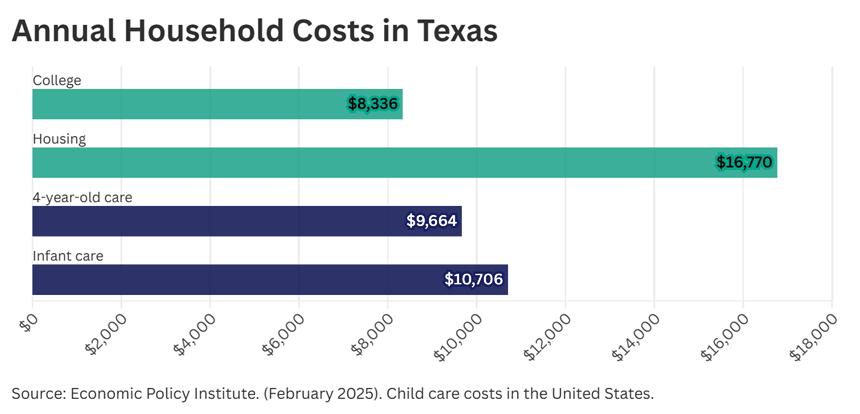
High Cost: In Texas, center-based infant care costs over $11,000 annually on average. [ix], [x], [xi] Infant care alone is more expensive than college tuition in Texas at a fouryear public university.[xii]
Exceeding Benchmarks: In Dallas County, these costs absorb 12.5% (center-based) and 11.1% (home-based) of the median family income,[xiii] which is nearly 1.8 to 1.6 times the federal 7% affordability benchmark.[xiv]
In Relative Expense: For a Texas household with an infant and a four-yearold in childcare, the annual cost is $20,370 The cost is significantly higher than the $16,770 estimated annual cost of housing.
Minimum Wage Burden: A minimum wage worker in Texas would have to work full time for 37 weeks (from January to September) just to afford care for one infant [xv]
In 2025, the state's $100 million investment intended to provide 10,000 additional childcare scholarships was effectively offset by rapidly increasing operational costs, primarily in payroll and food/supplies (up 9% between 2023 and 2024).[xvi], [xvii] This resulted in a failure to cut the massive waitlist, which actually rose from approximately 95,000 to 100,000 by the end of 2025, according to a Texans Care for Children analysis of Texas Workforce Commission (TWC) data. This demonstrates that continuous, systemic funding is necessary, as providers must raise tuition to cover rising expenses like competitive wages, which in turn drives up the required scholarship amount.


The University of Nebraska (BECI/BPC) "Child Care Gaps Assessment" quantifies the substantial lack of accessible childcare within a reasonable driving distance. The childcare gap in Texas is alarming. Of children age 5 and under with working parents, approximately 1,414,600 have a potential need for childcare in Texas. [xviii] While supply stands at approximately 1,332,870 licensed slots, geographic distribution means that access is uneven 111,490 children lack care within a reasonable driving distance, representing a geographic access gap of 7.9% of total potential need.[xix] Rural areas are particularly impacted by lack of childcare, with an overall gap of 12 8% (40,490 children lack access), nearly double that of the overall gap of 6.5% for urban areas (71,000 children lack access).
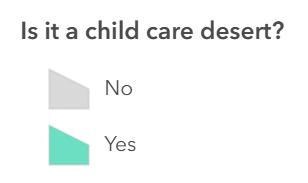
In more than half of Texas counties, the number of children under five is at least triple the number of available licensed child care slots, effectively making these areas child‑care deserts.[xx]
Dallas County State of Texas
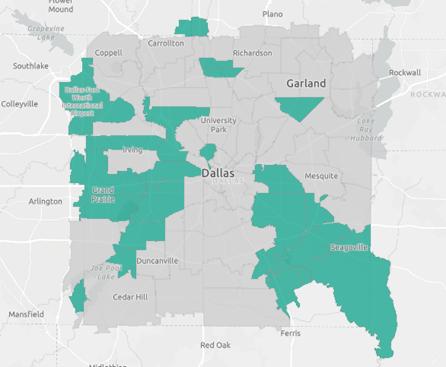
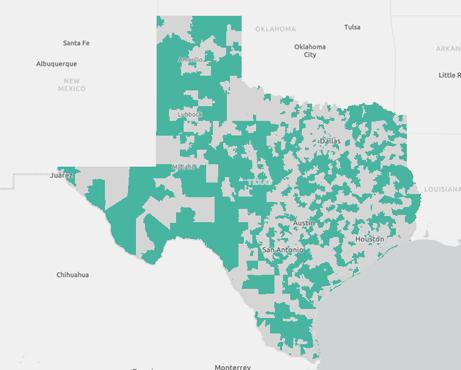
Source: Every Texan analysis of Texas Workforce Commission data, 2025
Access alone isn’t enough Families need childcare that is both available and highquality The Texas Rising Star (TRS) system is the state’s quality rating and improvement system for early childhood programs When a childcare program participates in Texas Rising Star, this means the program offers quality care that exceeds the minimum standards of the Texas Health and Human Services Commission Child Care Regulation (CCR) [xxi] In December 2024, almost one third (31 3%) of Texas children receiving childcare subsidies did not attend childcare centers or homes that were Texas Rising Star (TRS) providers [xxii]
Persistent challenges in the affordability and availability of childcare impose a measurable drag on labor force participation and regional economic performance. In Dallas County, these constraints translate into economic losses that accumulate over time and suppress annual economic output This section summarizes both the longterm economic liability associated with sustained childcare shortages and the scale of foregone economic activity linked to constrained maternal labor force participation.
The Buffett Early Childhood Institute (BECI) employs a future value framework to estimate the cumulative economic losses regions experience when childcare shortages persist over time.[xxiii] These estimates reflect the combined effects of reduced household earnings, business productivity losses related to absenteeism and turnover, and forgone public revenue.
Texas-wide: The BECI model projects a potential long-term (losses that accumulate over the next 10 years) economic impact of $5.5–$8.3 billion across the state
Dallas County: For Dallas County specifically, the estimated cumulative long-term economic loss over 10 years is $562 million to $859 million. This estimate serves as a critical baseline, underscoring the deep, compounding nature of the childcare crisis.
These long-term estimates provide context for the economic risks associated with persistent gaps in access and affordability, but do not represent annual or policyrecoverable losses.
Building on this long-term context, this analysis estimates the upper-bound scale of annual economic activity associated with constrained labor force participation among mothers with young children in Dallas County. Using locally derived wage data and an earnings-based economic multiplier of 1.96, the analysis quantifies the direct and indirect economic activity linked to maternal employment.
The Labor Force Participation Constraint: Dallas County has a high baseline maternal labor force participation rate among mothers with young children (64.7%), yet approximately 43,400 mothers with young children remain outside the labor force.[xxiv] While individual employment decisions reflect a range of factors, extensive research indicates that childcare affordability and access are among the most significant constraints for this population.
Annual GRP Loss: Based on average annual earnings, Dallas County foregoes an estimated $1.63 billion in direct earnings associated with non-participation among these mothers. When accounting for indirect and induced economic activity using the regional multiplier, this corresponds to approximately $3.19 billion in annual Gross Regional Product (GRP).
This estimate reflects the maximum potential scale of economic activity associated with maternal labor force participation and should not be interpreted as the amount that any single policy intervention would recover. Subsequent sections estimate the portion of this activity that may be realistically unlocked through improvements in childcare affordability and access


The economic benefit of policy action is directly modeled by quantifying the return from targeted cost reduction, using an economic elasticity framework to project changes in maternal labor force participation associated with reductions in annual childcare costs.
Rather than assuming full labor force re-entry among non-participating mothers, this analysis[2] models incremental, behaviorally grounded responses to sustained cost relief The results, amplified by Dallas County’s 1 96 earnings multiplier, demonstrate that an investment in childcare functions not merely as a social cost, but as a marketaligned strategy to support labor force participation and economic growth.
Table 1. Illustrative Labor Force Scenarios
Note: Labor force response estimates are based on an established elasticity of maternal labor force participation with respect to childcare costs, which captures the percentage change in labor force participation associated with a percentage change in annual childcare expenses. The analysis applies a mid-range elasticity value ( 0.2), consistent with the economic literature; alternative values produce similar directional results.
The key takeaway is the multiplier effect: increases in maternal labor force participation generate economic impacts that extend beyond direct earnings, producing additional indirect and induced activity throughout the regional economy This reinforces the conclusion that childcare support functions as essential economic infrastructure with measurable effects on regional output.
[2] The analysis defines mothers with young children as those with at least one own child under age 6, including mothers who also have older children in the household
The findings in this report underscore a clear policy implication: childcare and out-ofschool time (OST) systems function as core economic infrastructure that directly shape labor force participation, business productivity, and economic performance. Persistent gaps in affordability, access, quality, and provider stability constrain labor supply, particularly among women, while also limiting the state’s and region’s ability to meet growing workforce demands.
At the local level, counties and municipalities are uniquely positioned to address place-based gaps in care availability and to coordinate care infrastructure with housing, transportation, and workforce development strategies. Local action can help ensure that childcare and OST capacity is available where families live and work, reducing geographic and temporal barriers that disrupt employment, especially during non-school hours and school breaks.
Taken together, the evidence suggests that sustained, coordinated investment in childcare and OST is not simply a social support strategy, but a foundational economic strategy Addressing care infrastructure gaps can reduce labor force constraints, support women’s continued participation in the labor market, and strengthen regional economic resilience. Future policy decisions, at both the state and local levels, will shape whether these systems continue to act as bottlenecks or evolve into enablers of long-term economic growth

This table documents the assumptions and calculations underlying the labor force and earnings estimates presented in the main text.
Parameter
Monthly childcare cost reduction
Annual cost reduction ($)
Average annual childcare cost (S)
Share of annual costs offset
Elasticity of maternal LFP
Percent change in LFP
Baseline labor force participation rate
Total mothers (ages 20-64, child <6)

Baseline employed mothers
Additional working mothers
Average annual earnings per mother ($)
New annual earnings generated ($M)
Monthly equivalent of annual support
Monthly reducation x 12
Based on regional cost estimates
Annual reduction / Annual cost
Mid-range estimate from literature
Elasticity x % cost change
ACS estimate for Dallas county mothers
Baseline employed x %ΔLFP
Notes: Estimates reflect annualized childcare cost reductions delivered monthly Labor force impacts are modeled using a constant elasticity of maternal labor force participation with respect to childcare costs ( 0 2), consistent with peer-reviewed economic literature Scenarios are illustrative and do not assume a specific program design, eligibility criteria, or allocation of public funds between childcare and out-of-school time programs.
3 Center-based infant care costs are estimated based on statewide daily market rate data for licensed child care centers in Texas. The 2025 Texas Child Care Market Rate Survey reports a mean full-day daily rate of $42 20 for infants ages 0–11 months at licensed centers statewide, yielding an annualized cost of approximately $11,000 (calculated as mean daily rate × 5 days × 52 weeks). This figure is consistent with estimates from prior years and reflects a statewide average.