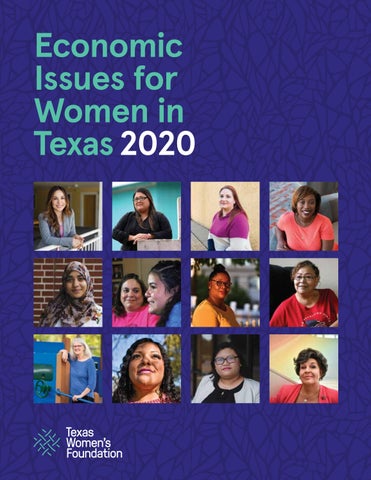
Economic Issues for Women in Texas 2020
Contents
Introduction . . . . . . . . . . . . . . . . . . . . . . . . . . . . . . . . . . 1 Executive Summary. . . . . . . . . . . . . . . . . . . . . . . . . . . . . 2 Demographics: The Women and Girls of Texas. . . . . . . . 3 Pay: Working Women, Working Families. . . . . . . . . . . . . 9 Education: A Pathway to Economic Security . . . . . . . . 15 Child Care: A Critical Work Support for Women . . . . . 21 Health Insurance: A Financial Shield for Women . . . . . 27 Housing: The Anchor for Economic Security . . . . . . . . 34 Policy Recommendations. . . . . . . . . . . . . . . . . . . . . . . 41 Conclusion . . . . . . . . . . . . . . . . . . . . . . . . . . . . . . . . . . 42 Endnotes. . . . . . . . . . . . . . . . . . . . . . . . . . . . . . . . . . . . 43 About. . . . . . . . . . . . . . . . . . . . . . . . . . . . . . . . . . . . . . . 45
© 2020 Texas Women’s Foundation
Introduction
We are pleased to present the third edition of Economic Issues for Women in Texas. This 2020 study, based on research conducted by Every Texan (formerly the Center for Public Policy Priorities), again takes a comprehensive look at the four building blocks that are fundamental to the financial security of a woman and her family: child care, housing, education and health care. This study also reveals dramatic changes in our state’s demographics, and the challenges and opportunities we face in creating a more equitable society. Published every three years, Economic Issues for Women in Texas examines both policies and practices at the state level, while identifying areas where innovation and investment can help strengthen women and their families. We encourage our Army of Advocates across Texas to use the study—and its platform of specific recommendations and potential actions—with lawmakers, as well as business and community leaders, to help shape policies and practices that impact women and girls. We also take the study to various cities around the state, convening with partners and advocates from local communities to engage and mobilize around priority issues, initiatives and programs. To illustrate the findings of the study, we turned to the lived experiences of a diverse group of Texas women. Their stories are different—from an immigrant who fled an Iraqi war zone to further her education in the states, to a new mother struggling to pay for health care, to a single mother needing affordable child care while working and finishing school. And yet, they all share a common goal: to create a better life for themselves and their families. These real-life stories reflect the experiences of thousands of other Texas women who face the same realities of financial insecurity. From story-telling, information sharing and advocacy, to convening and engagement, we hope that Economic Issues for Women in Texas facilitates a common understanding of the challenges to women’s economic security in our state, and motivates a shared commitment to drive solutions that support women and their families and build a stronger Texas for us all. Strong Women. Better World.
Roslyn Dawson Thompson, President & CEO Texas Women’s Foundation
Texas Women’s Foundation | 1
Executive Summary A better world must have strong women. Since 2014, Texas Women’s Foundation has been focusing on four key issues, or building blocks, that are interwoven in the fabric of economic security for women, girls and their families.1 These are education, child care, health insurance and housing. Women make up half the state’s population, but are not as economically secure as men.2 While overall poverty across the state has declined, the gender pay gap persists, and women earn less than men in every single occupation.3 This has lifelong financial consequences for women and their families. Strengthening the building blocks provides a path so Texas women and girls can move from surviving to thriving.
The Building Blocks of Economic Security Education is a primary pathway to better-paying jobs and economic security. With each step up in their education, women in Texas tend to earn more. For full-time workers, women with a bachelor’s degree earn twice as much as women with a high school diploma.4 In fact, every year since 2014 has seen women continuing to complete college at a higher rate than men.5 Hispanic women, especially, are closing the gap, and are now the fastest-growing group among women enrolling in and completing Texas public college educations.6 But women hold the majority of outstanding student debt, meaning that many attain a degree only to enter the workforce in debt.7 Access to child care is a critical work support Texas women need. In many cases, the lack of affordable child care keeps women who want or need to work outside of the job market. With 63 percent, or 2.5 million, Texas mothers working, child care is a critical support.8 This is a slight increase over the results from the 2017 Economic Issues for Women in Texas study.9 For many families, however, the cost of child care is out of reach, and 84 percent of Texas families spend more than 7 percent of their income on child care.10 Programs exist to support the child care needs of working, low-income mothers, but they are limited by funding and fail to reach many women.11 Plus, many Texas women live and work in parts of the state that are considered child care deserts – especially predominantly Hispanic or rural areas.12 Health insurance is a financial shield that many working-age women do not have. In fact, Texas women are twice as likely to be uninsured as women in other parts of the United States.13 For uninsured women, illness or an accident poses a serious threat to their economic security. While Texas saw a decrease in the rate of uninsured women after implementation of the Affordable Care Act, the rate of uninsured women is increasing once again.14 Since Texas has chosen not to expand Medicaid, many working Texas women are uninsured because they earn too much to receive regular Medicaid, but cannot afford to purchase health insurance.15 Women of color are the least likely to have accessible and affordable health insurance.16 Stable housing is a foundation of economic security. For most women, housing represents the single largest cost in their budgets, and this cost burden is especially high for women of color.17 Although single mothers renting face the highest housing costs, the rate of housing cost burden has decreased from 63 percent in 2012 to 45 percent in 2018.18 When women have access to affordable housing, they have more resources for investments in education, child care and health insurance. At Texas Women’s Foundation, we invest in the power of women and girls to drive positive change. Our research informs our advocacy, programs and grantmaking to advance economic and leadership opportunities for women, girls and families to build stronger, more equitable communities. It is important for all Texans to understand the role these building blocks play in women’s economic security and the economic strength of Texas.
2 | Texas Women’s Foundation
Demographics: The Women and Girls of Texas
Texas women are hard-working, driven and diverse— qualities famously associated with this bold state. With the population of Texas evenly split between men and women, the state’s economic prosperity depends on the success of women at home, at school, at work and in their communities.19 Over the past decade, the population of Texas has grown 19 percent, and the number of Texas women has mirrored that.20 This means that today over 14 million women and girls call Texas home.21 Women’s financial security is essential to the continued economic prosperity of Texas.
PROFILE OF AN AVERAGE TEXAS WOMAN If there is one representative of a typical Texas woman, she is: • a Millennial (age 36)23 • a woman of color24 • living in a city25 • earning $35,000/year or less26 • working to support her family27
The majority of women in Texas live in urban areas that drive the state’s economy. The state’s three largest cities—Houston, San Antonio and Dallas—are home to over 50 percent of the state’s women and girls.22
3
CHANGING DEMOGRAPHICS Today there are nearly as many Hispanic women as White women in Texas.28 The state of Texas benefits from this diversity of ethnicity and experience.
Women of Color Are the Majority
Texas Women by Race and Ethnicity, 201829
Most Texas women and girls are women of color.30 While the largest single racial and ethnic population of Texas women is NonHispanic* White women (41 percent), there are nearly as many Hispanic or Latina women (39 percent).31 Black or African-American women are 13 percent of the Texas women population, and Asian women are 5 percent.32
2%
5%
13%
Over the past decade, Texas has seen the largest population increase among Hispanic women and girls, with 1.3 million more Hispanic women living in Texas in 2018 than in 2008.33 The actual growth rate of the population of Black and Hispanic women is similar, at 27 percent and 31 percent respectively, over the past 10 years.34
41%
While Asian women** comprise just 5 percent of all Texas women, their population has increased 75 percent, making them the fastestgrowing group.35 At the same time, this overly broad grouping can limit understanding of women that identify with one or more racialethnic categories by masking differences and obscuring the way people, institutions and policies may treat members of these groups differently.
BL ACK
39%
HISPANIC
WHITE
ASIAN
OTHER
Population Growth of Texas Women by Race and Ethnicity, 2008-201836 +3%
5,823,105
5,992,714 5,649,781
+31% 4,317,361
1,435,687 423,671 2008
2009
2010
2011 BL ACK
2012
2013
HISPANIC
2014 WHITE
2015
+27%
1,828,090
+75%
741,140
2016
2017
2018
ASIAN
*Note: Going forward, White, Black, and Asian are Non-Hispanic throughout the report unless otherwise specified.
4 | Texas Women’s Foundation
**Note: “Asian” includes Asian Indian, Chinese, Vietnamese, Filipino, Korean, Japanese and other Asian per the U.S. Census Bureau. “Other” includes Native Hawaiian and Other Pacific Islander, American Indian and Alaska Native, and two or more races, not broken out due to low numbers.
POPULATION OF TEXAS WOMEN BY AGE37 2008 POPULATION
2018 POPULATION
PERCENT INCREASE
AGE 0-17
3,276,492
3,623,071
11%
AGE 18-24
1,190,761
1,365,595
15%
AGE 25-64
6,296,435
7,469,276
19%
AGE 65+
1,416,044
1,993,719
41%
GENERATIONAL SHIFT Texas is experiencing a generational shift: younger Texas women are mostly Hispanic, while older women are mostly White.41
The Next Generation of Texas Women is Diverse More than one million Texas women have joined the working age group (ages 25-64) over the past decade.38 With a median age of 36 years old (vs. 40 nationally), many of these women are Millennials and potential digital natives, and they bring a unique lived experience as well as other education and training to the workplace and their communities.39
As Texas women grow older, they have the opportunity to open doors of education, capital and leadership to younger women. It is key that older White women understand the needs and values of younger women of color to ensure the opportunities they have forged are also available to the next generation.
While Hispanic women comprise the majority of younger women, older Texas women (ages 65+) are majority White and are the fastest-growing age group, increasing in number 41 percent over the past decade.40
At the systemic level, Texas must invest in a diversified workforce, while also creating policies and systems of care to make sure older women are financially secure.
Population Growth of Texas Women by Race and Ethnicity, 2008-201842 62%
50%
47% 43% 37% 33%
31%
23% 14%
12% 4% 0-17
13% 5%
3%
2% 25-64
HISPANIC
4%
1%
18-24
WHITE
10% 6%
BL ACK
ASIAN
1%
65+
OTHER
Texas Women’s Foundation | 5
Over Half of Texas Women Are Single
WOMEN ARE PROVIDERS Over a woman’s lifetime, she is likely to be the sole provider for herself or her family at least once.43
Over a woman’s lifetime, she is likely to be the sole provider for herself or her family at least once. More than half of Texas women are single due to divorce, being widowed or never marrying. In fact, Texas women are increasingly financially independent— almost a third never marry.44 Women must be able to earn enough to provide for themselves and their families by accessing good-paying jobs or starting businesses and being paid equitably. Every woman should be able to experience financial independence and security.
Marital Status of Women, 15 and Older in Texas45 *May not sum to 100% due to rounding.
31%
Women Are the Face of Poverty in Texas
47%
While Texas children are equally likely to experience poverty regardless of their gender, when they become adults their economic prospects diverge. Women are twice as likely as men to experience poverty.47 That means nearly one in six Texas women and girls lack sufficient financial resources to care for themselves and their families.48
12% 3% MARRIED
WIDOWED
8% DIVORCED
SEPAR ATED
POVERTY THRESHOLDS (U.S. HEALTH AND HUMAN SERVICES 2020)46
FAMILY SIZE YEARLY FAMILY INCOME
1
2
3
4
$12,760
$17,240
$21,720
$26,200
WHAT IS POVERTY? Federal poverty guidelines say a family of four earning less than $26,200/year is in poverty - whether they live in Harlingen or Austin, even though the cost of living greatly differs.49
6 | Texas Women’s Foundation
NEVER MARRIED
Texas’ healthy economy means that over the past decade, poverty rates have declined across the board, but a stubborn gap between men and women in poverty remains.51 This puts over 2.3 million women in Texas earning less than the poverty threshold.52
POVERTY GAP When a girl becomes an adult woman, she’s more likely to experience poverty than a man. Over her lifetime, the economic gap between her and her male counterpart never closes.50
Percent of Population in Poverty by Age in Texas53 24% 21% 21% 18% 16% 12%
10%
UNDER 18
18-24
25-44 MALE
10%
9%
45-64
12%
65+
FEMALE
Texas Poverty by Race and Ethnicity54 23% HISPANIC
Texas Poverty by Household Type55
19%
31% 11%
ASIAN
11% 17% 21% BL ACK
8%
18%
9%
MARRIED COUPLE
SINGLE-FATHER
SINGLE-MOTHER
WHITE
8%
WOMEN
MEN
Texas Women’s Foundation | 7
The Most Vulnerable Women While Texas women experience poverty at higher rates than men, two in 10 Hispanic or Black women experience poverty, a rate twice that of White women.56 It is important that policies and programs recognize the effects of the intersection of gender and race to truly have the strongest outcomes. In addition, single-mother-led households are almost four times
more likely to experience poverty than two-parent households. Single-father-led households are twice as likely to live in poverty.57 Finally, a woman’s education also impacts her chances of experiencing poverty. As women further their education, the poverty gap between men and women decreases.58 But even women with college degrees
experience poverty at higher rates than men with college degrees.59 For Texas women, poverty is a fierce reality. The causes for the lifelong income gap between Texas men and women intersect with race and ethnicity, family size and educational level. Texas women need more than a onesize-fits-all policy. They need policies that create the building blocks for economic security.
Poverty by Educational Attainment60 29% 20%
17% 11%
LESS THAN HIGH SCHOOL
7%
HS GR ADUATE
MALE
8 | Texas Women’s Foundation
12%
SOME COLLEGE, ASSOCIATE’S DEGREE
FEMALE
4%
5%
BACHELOR’S DEGREE OR HIGHER
Pay: Working Women, Working Families
Texas Women’s Earnings Are a Critical Part of Family Income When women become mothers, most do not stop working: 63 percent, or 2.5 million, of Texas mothers are working.61 That’s because more than one out of every three Texas families depends on a woman’s wages to cover the bills.62 These women breadwinners may be single heads of household, or they out-earn their partners. In addition, 22 percent of Texas mothers are co-breadwinners, meaning they bring home at least 25 percent of their household’s income through their wages.63 That means almost 60 percent of Texas women are breadwinners for their households.64
Even though families increasingly depend on women’s earnings, the jobs women hold, the wages they are paid, and work policies and supports available to women reflect out-of-date assumptions that a woman’s work is less valuable to a family than a man’s.
9
Texas Women and the Wage Gap In Texas, the gender wage gap has not budged over the past decade. Every hour that Texas women work, they earn $2.83 less than their male counterpart, based on median hourly wages.65 Over a single 8-hour day, women fall $22.64 behind.
Texas women on average earn 86 cents for every dollar that men earn, and Black and Hispanic women are paid even less.66
among full-time workers in Texas, women earn $10,136 less per year than men on average.68 This gender wage gap means that women basically work for free the final two months of the year.
It’s easy to assume that women earn less because they work part time or seasonally. Actually,
Median Hourly Wage 2018 (Ages 25-64)67 FEMALE (ALL)
$17.03
MALE (ALL)
$19.86
HISPANIC, FEMALE
$13.24
HISPANIC, MALE
$15.89
BL ACK, FEMALE
$17.19
BL ACK, MALE
$17.88
WHITE, FEMALE
$19.86
WHITE, MALE
$25.82
ASIAN, FEMALE
$22.07
ASIAN, MALE
$29.80 $-
$5.00
$10.00
$15.00
$20.00
$25.00
$30.00
$35.00
Median Earnings, Full-Time Year-Round Workers (16+)69 $71,768
$64,570 $52,097
$50,031
$48,395
$39,895
ALL
$36,230
ASIAN
WHITE MALE
10 | Texas Women’s Foundation
$29,416
HISPANIC FEMALE
$42,181 $37,969
BL ACK
For working women in Texas, the gender wage gap is also determined by geography. A woman working in Lubbock, for example, may earn $10,000 a year less on average than her male counterpart, a difference that means every month she has $800 less to pay her family’s bills.70 Meanwhile, a woman working in Dallas is paid more equitably—but still not as much as a man. As noted earlier, educational levels are well correlated with poverty, and post-secondary training and education is important for economic security.72 But the gender wage gap persists even among college-educated men and women.73 The effect of women being paid less than men for the same work is significant over a lifetime and impacts future generations.
GENDER WAGE GAP FOR FULLTIME, YEAR-ROUND WORKERS71 Dallas County
-$2,592
Hidalgo County
-$6,215
El Paso County
-$7,180
Travis County
-$7,323
Harris County
-$8,551
Tarrant County
-$9,708
Lubbock County
-$10,281
Smith County
-$10,619
Median Annual Income by Educational Attainment74
$60,570 GR ADUATE OR PROFESSIONAL DEGREE
$89,921
$49,005 BACHELOR’S DEGREE
$67,259
$31,216 SOME COLLEGE OR ASSOCIATE’S DEGREE
$45,735
$24,037 HIGH SCHOOL GR ADUATE (INCLUDES EQUIVALENCY)
$36,373
$16,629 LESS THAN HIGH SCHOOL GR ADUATE
$30,042
FEMALE
MALE
Texas Women’s Foundation | 11
Getting Good-Paying Jobs Income and the types of jobs that women hold are also strongly associated with societal gender norms. Many women work in fields or roles like child and elder care, retail and restaurant service, which pay less than the roles men typically hold.75 Middleskill jobs are those that don’t require a bachelor’s degree, and well-paying ones offer annual incomes of at least $35,000. These jobs in IT, health care and
Women’s Median Earnings Across Occupations79
trades also often serve as stepping stones to higher pay. Nationally, women are less likely than men to be employed in well-paying middle-skill occupations.76 In Texas, there are no job categories where the median wage for women is over $75,000 per year.77 In fact, 60 percent of women work in jobs that pay a median wage of less than $35,000.78
Men’s Median Earnings Across Occupations80 < $20K
5%
$75K+
0%
< $20K $50K-75K
$75K+
18%
21%
24%
32%
$50K-75K $35K-50K
16%
$20K-35K
42%
The gap between what men and women earn varies significantly based on the type of job. When looking at all workers (including seasonal and part-time), men and women are paid nearly the same in the social service sector, working as counselors, health educators or social workers.81 The gap between them is largest in the sales sector, working in advertising, marketing, real estate and financial services.82
12 | Texas Women’s Foundation
$20K-35K
9%
$35K-50K
33%
This gap in occupational wages occurs not only because men are paid more than women in every field on average, but also because men are disproportionately employed in some occupations (such as oil field workers) which pay higher wages than occupations dominated by women (such as personal care workers), even though educational requirements are similar.83
Texas Women’s Occupations: Year-round workers by median earnings, descending by the number of women working in that field84 GENDER WAGE GAP FOR FULLTIME, YEAR-ROUND WORKERS Women’s Median Earnings
Wage Gap Compared to Male Workers
Office and administrative support occupations
$ 35,559
86%
Management occupations
$ 61,472
71%
Sales and related occupations
$ 32,340
62%
Educational instruction and library occupations
$ 49,900
89%
Business and financial operations occupations
$ 60,947
78%
Health diagnosing and treating practitioners
$ 71,093
74%
Food preparation and serving-related occupations
$ 20,515
89%
Health care support occupations
$ 26,672
87%
Health technologists and technicians
$ 40,844
87%
Personal care and service occupations
$ 23,989
80%
Building and grounds cleaning and maintenance occupations
$ 20,268
75%
Community and social service occupations
$ 43,338
89%
Computer and mathematical occupations
$ 74,563
91%
Legal occupations
$ 65,248
54%
Transportation occupations
$ 32,493
70%
Life, physical and social science occupations
$ 65,835
86%
Law enforcement workers, including supervisors
$ 43,276
72%
Firefighting, prevention and other protective service workers
$ 35,903
85%
Installation, maintenance and repair occupations
$ 38,887
86%
Occupation
$20K-35K $35K-50K $50K-75K
POLICY RECOMMENDATIONS: • State legislators can strengthen equal pay for equal work policies that can reduce the income wage gap, especially for women of color.
•T he State of Texas should establish a paid family and medical leave program that supports workers during pregnancy, adoption or extended periods of medical care.
Texas Women’s Foundation | 13
Family Budget for a Single Mother and Two Children Living in Houston*
For a single mother with two children living in the Houston area, the jobs she is statistically most likely to hold do not pay enough to support her family.85 Even if she works in a field dominated by men, like computer science, engineering or management, she will be paid less than her male counterparts.86 Families who depend entirely or significantly on a working woman’s salary are systematically economically challenged by the gender wage gap. This analysis is available for 26 Texas metro areas areas (including Dallas, Fort Worth, Austin, San Antonio and El Paso) at familybudgets.org.
*Note: This budget assumes health insurance is provided by the employer (100% of Working Adults, 50% of Dependents) with family paying remaining.
14 | Texas Women’s Foundation
Education: A Pathway to Economic Security
Education is a leading pathway to betterpaying jobs and economic security. With each step up in their education, women in Texas tend to earn more.87
Higher Education and Texas Women Overall, Texas women are well-educated, with 1.4 times as many women as men completing public college in 2018.89 More women than men are earning degrees from all types of higher education institutions in Texas: twoyear schools as well as four-year public and private universities.90
Higher Education Enrollment (2014-2018)88 1,000,000 800,000 600,000 400,000 200,000 0 2014
2015
2016
FEMALE
2017
2018
MALE
Since Texas Women’s Foundation began reporting on educational attainment (Economic Issues for Women in Texas, 2014), women of all races have been more likely to both enroll in and complete Texas higher education than their male counterparts.91 15
Much of Texas women’s overall lead in educational attainment over men is due to Hispanic and Black women.93 Hispanic women have historically outpaced Hispanic men 5 to 4 in college degree acquisition, and for every three Black women with
bachelor’s degrees or higher, there are just two Black men with degrees.94 Systemic barriers to higher education for people of color mean that, as a percent of population, Hispanic and Black women still lag in educational attainment (with only 17 percent
and 27 percent, respectively, having a bachelor’s or higher) as compared to White and Asian women (with 39 percent and 57 percent, respectively, having a bachelor’s or higher).95
Texas College Completion by Ethnicity (Public Universities and Community Colleges), 201892 FEMALE
MALE
RATIO FEMALE : MALE
BLACK
25,081
14,024
1.8
HISPANIC
76,269
51,393
1.5
WHITE
72,858
54,804
1.3
OTHER
6,095
4,827
1.3
ASIAN
11,064
9,298
1.2
ALL
200,311
146,113
1.4
Educational Attainment by Race and Gender, as Percent of Overall Population96
INNOVATIVE FINANCIAL AID Two programs that make college more affordable in Texas are TEXAS Grants and College Promise. The Texas Legislature established TEXAS Grants program (Toward EXcellence, Access and Success) to make sure that well-prepared high school graduates with financial need can go to college.106 College Promise programs vary by place, but all incentivize college by providing financial aid or free tuition to qualified students, such as for the first two years of community college.107
16 | Texas Women’s Foundation
17%
HISPANIC
14% 57%
ASIAN
63% 27%
BL ACK
23% 39%
WHITE
40% 0%
10%
20%
30%
WOMEN WITH BACHELOR’S DEGREE OR HIGHER
40%
50%
60%
70%
MEN WITH BACHELOR’S DEGREE OR HIGHER
Community college has proven to be a very successful pathway for women to enroll in higher education, with Hispanic women leading in enrollment. From 2014 to 2018, Hispanic women’s
community college enrollment increased by 23 percent. During that same time, 26 percent more Hispanic women also enrolled in four-year schools.97
ELIZ ABE TH AND VIC TORIA’S S TORY Elizabeth Cruz works as a custodian in El Paso, and is realizing that her dreams of attending college and working in education are a real possibility. Her daughter Victoria is a middle-school student with dreams of attending college and becoming a pediatric nurse in Texas. Two-generational programs like Con Mi MADRE help close gaps in economic opportunity by providing Latinas with college visits, scholarship awareness and hope for a post-secondary education. Hear their story at txwfecoissues.org.
Ivory Towers and Glass Ceilings Though more women are getting degrees, there remain stark differences in women’s overall educational attainment compared with men. While women outpace
men in earning degrees through the master’s level, when it comes to specialized or advanced degrees (professional school degree and doctorate)—the credentials
Educational Attainment for Women Over 2599
required for the highest-paying careers—women fall behind men as they strive to bust through the ceiling of the ivory tower.98
Educational Attainment for Men Over 25100
2.4% 15% 36%
3.4% 17%
33%
46%
47% *May not sum to 100% due to rounding.
LESS THAN HIGH SCHOOL
ASSOCIATE’S, BACHELOR’S OR MASTER’S
HIGH SCHOOL GR AD OR SOME COLLEGE
PROFESSIONAL OR DOCTOR ATE
Texas Women’s Foundation | 17
EARNING COLLEGE CREDITS IN HIGH SCHOOL Students who enroll in dual-credit courses (which provide high school and college credit) are more likely to enroll in college, have higher first-year college GPAs and complete college.101
SHAHAD’S S TORY Shahad Alfartosy was born in Iraq and lived her childhood in a war zone. She was exposed to an academic environment that was unstable and unsafe, so she, her parents and her four siblings applied to come to the U.S. as refugees in 2007. On an eighth-grade field trip, she visited Alief Early College High School, one of Texas’ 169 dual-credit programs, where students can complete 60 hours of college courses while in high school. Graduating from college early allowed her to enroll in competitive medical programs earlier than she expected. She has already earned her bachelor’s degree in biology and is currently pursuing a master’s in biomedical sciences at the University of Houston. On the path to becoming a doctor, Shahad Alfartosy plans to attend medical school next and do what she can to aid the humanitarian crisis in her homeland. Hear her story at txwfecoissues.org.
education
Women Bear the Greatest Burden of Student Debt While women complete college at higher rates than men, they also are burdened with greater debt in pursuit of those accomplishments. Women hold nearly two-thirds of the outstanding student debt in the United States—about $929 billion.102 The irony is that women earn these degrees with the promise of higher-paying careers, yet while working in these higher-paying jobs, they are paid less than their male counterparts.103
18 | Texas Women’s Foundation
Incurring debt has not always been a requirement for paying for college. Sky-rocketing tuition and cuts to state-funded student aid have squeezed students, forcing them to take on student loans. To cover costs, a middle-income student must work 21 hours a week for the entire year at a minimum wage job ($7.25 an hour).104 Many experts believe that this is too many work hours for students to successfully meet academic demands at the same time.105
Tuition & Fees Climbing for Community Colleges and Public Universities108
$7,650
$2,342
2014
$7,986
$2,359
2015
$8,319
$2,446
2016 PUBLIC UNIVERSITIES
$8,669
$8,875
$2,559
2017
$2,419
2018
$9,251
Up 21%
$2,506
Up 7%
2019
COMMUNIT Y COLLEGES
Investing Less, Expecting More In 2015, the Texas Higher Education Coordinating Board adopted the 60x30TX plan, which aims for 60 percent of Texans ages 25-34 to hold a college degree or post-secondary credential by 2030.109 For Texas women especially, this ambitious goal is within reach and brings women to the forefront of fueling the state’s economic engine. Yet, the state has been slowly reducing public investment in Texas colleges and universities since 2000.110 The effect is higher tuition and fees and less statefunded financial aid for students in need. Both affect women more than men.
Texas public university tuition has increased more than 20 percent in the past five years alone.111 That’s on top of tuition doubling from 2000 to 2015.112 It should be noted that tuition makes up only about a third of the cost of going to college. The remaining expenses—shelter, food, books and other school supplies— make up the majority of a student’s costs.113 At the same time that students face higher college costs, more students who qualify for statefunded student aid are getting nothing. Since there is not enough funding to meet the needs of all students who qualify, the state has prioritized awarding aid to
full-time students attending fouryear colleges and universities. That leaves little left for part-time students and those attending two-year programs. This hits non-traditional students—those who are over age 24 or who are parentless, parents, veterans or homeless—particularly hard.114 The state has set its sights on investing in the full-time fouryear model of higher education, but the reality is that the number of students at four-year universities who attend part time has increased by 78 percent.115 This indicates that the state’s student funding priorities are out of sync with today’s reality, and disproportionately affect women and students of color.
Texas Women’s Foundation | 19
HIGH DEBT, NO DEGREE For-profit institutions have high tuition, low completion rates and high default rates, often leaving students with debt but no degree.116
BR ANDI’S S TORY Brandi Miller was studying to become a dental hygienist and was only seven months away from graduating at Virginia College when the for-profit institution she was attending suddenly closed down with only two days notice for students. When predatory for-profit colleges in the U.S. close unexpectedly, thousands of students are left with student debt, partially completed degrees and credits that many other schools will not accept. As a single mother of four sons, Brandi was very distraught, but Catholic Charities of Lubbock encouraged her to enroll in South Plains College, where she is completing her basics. With her heart now set on helping children in foster care, she plans to transfer to Lubbock Christian University to complete her bachelor’s degree and earn a master’s degree in social work. Hear her story at txwfecoissues.org.
In summary, women, and especially women of color, are leading Texas in college completion, although they still face barriers to attaining the highest level of professional or doctorate degrees.117 While Texas women are acing college, they take on more student loans than men. Moreover, because of the gender pay gap, it takes Texas women more time to pay off that debt.118 While education remains a primary pathway to better-paying jobs and economic security for Texas women and their families, in the end they pay a higher price than men.
20 | Texas Women’s Foundation
POLICY RECOMMENDATIONS: •S tate legislators can address college affordability through increased funding of TEXAS Grants and College Promise programs to support women, especially women of color, who have been burdened by high student loan debts as they enter the workforce.
Child Care: A Critical Work Support for Women
Access to child care is a critical work support for Texas women. Some 2.5 million working women in Texas have children and must depend on a variety of child care options, including support from family, near where they live and work.119
LABOR FORCE PARTICIPATION OF TEXAS MOMS120
NUMBER
PERCENTAGE
Women (ages 16-64) in the workforce, with children
2.5 Million
63%
Children under 6 with all parents in workforce
1.3 Million
60%
Children ages 6-12 with all parents in workforce
1.8 Million
63%
21
Child Care Expenses According to the U.S. Department of Health and Human Services, child care is affordable if it costs no more than 7 percent of a family’s income. By this standard, only 16 percent of Texas families can afford year-round infant care.121 When a family spends more than this on child care, there is less money available for rent and other basic needs, and the family is vulnerable to unplanned expenses like medical bills or car repairs.
The cost of child care varies greatly by the type of care offered and the child’s age. Full-time infant care in Texas is almost as expensive as college, at over $8,000 per year in 2019.122 While child care costs decrease as children grow older, the average annual expense for after-school and summer care for schoolage children still totals more than $5,000.123
Year-Round Full-Time Infant Care in Texas is Almost as Expensive as College124 $8,235
INFANT
$9,251 $7,439
TODDLER
$6,961
$6,481
PRESCHOOLER
SCHOOL AGE
Child care cost is a significant part of any working family’s budget, but for full-time minimum wage workers who make about $15,000 a year, child care requires almost half of their pre-tax earnings.125 A lack of affordable child care can force a woman who wants or needs to work to remain outside of the job market, threatening her family’s economic stability.
AVER AGE COLLEGE TUITION & FEES
Counties such as Dallas, Bexar and Travis, and cities like San Antonio and Austin, have raised minimum wage from $7.25 to $15 per hour for their employees, moving them closer to a true living wage.127
Median Daily Costs for Child Care Compared to Minimum Wage128
$120
$58 $29
LICENSED CHILD CARE CENTERS
22 | Texas Women’s Foundation
$26
$25
LICENSED CHILD CARE HOMES
REGISTERED CHILD CARE HOMES
DAILY MINIMUM WAGE ($7.25/HR)
DAILY LIVING WAGE ($15/HR)
CRIS TINA’S S TORY Cristina Guajardo moved from Minnesota to Texas two years ago, seeking quality child care services for her infant child so that she could work and attend college classes. In trying to juggle parental priorities and professional pursuits, Texas’ single-parent households often face day care challenges of waitlists, affordability and transportation. Cristina and her toddler are part of the Jeremiah Program in Austin, a two-generational program that provides a combination of quality early childhood education, a safe and affordable place to live and professional empowerment so that families find stability and a path out of poverty. Hear her story at txwfecoissues.org.
After-School Programs For working mothers of school-age children, an affordable, quality after-school program is a necessary support. Yet only 15 percent of schoolage kids participate in after-school programs, due to lack of availability and cost.129 In Texas, over 1.5 million children would take part in an after-school program if one were available and affordable in their area.130 Instead, each day there are over 935,000
K-12 students who are alone and unsupervised after school.131 When after-school programs are not available, working parents must make the difficult choice between curtailing their working hours (which can contribute to the gender wage gap) or leaving their child in unsupervised situations. This can disproportionately affect employed parents with low-flexibility schedules.132
ASHLE Y ’S S TORY Ashley Walker is a working mother of six who was able to enroll her children in a free after-school program supported by Dallas Afterschool. Unfortunately, many parents live in child care deserts, which are areas of Texas with more than 50 children under age 5 that contain either no child care providers or so few options that there are more than three times as many children as licensed child care slots. Ashley works at a non-profit, Frazier Revitalization, and has seen how community after-school programs have not only helped kids stay out of trouble, but also lift families out of poverty. Hear her story at txwfecoissues.org.
Texas Women’s Foundation | 23
Child Care Deserts Affordability is not the only child care barrier working women face. Nearly half of working women across Texas lack access to appropriate child care in the community where they live or work.133 Child care supply is especially low among certain populations, with 55 percent of Hispanic families, 62 percent of low-income families and 63 percent of rural families living in
areas without enough licensed child care providers or homebased care.134 The effects of a lack of available child care are most pronounced for mothers with children under the age of 6. These women’s participation in the work force is roughly 3 percentage points lower than working mothers’ participation rates in neighborhoods with adequate
child care.135 This difference is not observed in men’s labor force participation rates. When looking at families with the lowest incomes, the labor force participation gap becomes even larger—child care deserts are associated with maternal labor force participation rates that are nearly 5 percentage points lower than other areas.136
Subsidized Child Care The Texas Workforce Commission offers child care subsidies for low-income families to enable parents to work, attend workforce training or pursue education. This subsidy is paid directly to child care providers, some of which are certified through the Texas Rising Star program, although many opt out.137 Over a million Texas children could qualify for subsidized child care, but fewer than 10 percent of
eligible children receive it due to lack of funds and lack of child care providers who accept subsidies.138 The money for subsidized child care comes from the federal Child Care Development Fund and local state matching funds. In 2018, Texas received a significant increase in federal money, which has led to shorter waitlists in some parts of the state.139 But statewide, about 46,500 children were still waiting for subsidized
child care as of September 2018, according to the Texas Workforce Commission.140 This map of Texas Rising Star child care providers illustrates the lack of child care availability in rural areas, especially West Texas and the Panhandle.141 It further shows that the availability of quality subsidized child care varies greatly based on where a family lives.
Texas Rising Star child care providers with star ratings142 STAR LEVEL: TRS 2 STAR TRS 3 STAR TRS 4 STAR NO STAR R ATING
24 | Texas Women’s Foundation
WOMEN WORKING IN CHILD CARE Child care workers are racially and ethnically diverse, and the field is heavily dominated by women. They are also often underpaid, undervalued and overlooked.143
DAWN’S S TORY Dawn Leach has spent 20 years teaching the next generation of child care providers in her role as manager of the Children’s Lab School, a training school for students in the Child Development Department at Austin Community College. Since 1980, she has been involved in teaching children and educating parents, and has been a longtime administrator. She has seen how access to adequate, affordable child care factors into students’ academic success and workforce opportunities. Dawn also has seen how the job description of a child care provider has grown, while earnings and community support have remained stagnant. Hear her story at txwfecoissues.org.
Work Place Policies Employers can play an important role in helping women manage work and child care responsibilities through different strategies. Employers can institute family-friendly policies and work options and supports, such as paid family leave, dependent care reimbursement accounts, flex time, telecommuting and greater employee choice in managing time. Many workers find these options attractive, and research suggests that they strengthen
financial security as well – women in states with family leave policies are less likely to receive public assistance during the year after the birth of a child.144 Employers also see benefits from these policies. Employers who offer many of these options to their employees report that the top reasons for family-friendly policies are employee retention, helping employees manage worklife balance, recruitment and increased productivity.145
Texas Women’s Foundation | 25
Pre-K in Texas is Required, But Not Available Texas has a long history of public support for early childhood education programs. In response to advocacy by Texas Women’s Foundation and business and education leaders from across the state, in 2019 the Texas Legislature passed a bill requiring all pre-K programs to meet high-quality standards and mandates that all districts must provide full-day pre-K to eligible 4-year-old students.146 However, inadequate funding means many districts are still
Number of Texas Children Participating in Full or Half Day Pre-K (2018-19 School Year)149
working to increase access to a full-day program.147 Pre-K programs also don’t offer extended hours, making it difficult for mothers to work full time, though their family’s economic stability may require it. Head Start, the federally-funded early childhood education program for low-income children and families, also serves tens of thousands of children in Texas and could be expanded.148
Number of Texas Children Participating in Early Head Start/Head Start (2018-19 School Year)150
11,374
14%
100,367
138,554
42%
58%
67,910
86%
HALF DAY
FULL DAY
E ARLY HE AD START
HE AD START
POLICY RECOMMENDATIONS: • State legislators can build on existing pre-K programs with quality community providers and provide additional funding to support full-day programs for students that qualify. • School districts should take advantage of what funds exist to support full-day pre-K programs, and the State should work to close the gaps. In 2019 the State Legislature passed a bill requiring full-day pre-K for all four year-olds but did not change the structure of pre-K funding—currently districts can take advantage of separate early education funding or get a waiver. 26 | Texas Women’s Foundation
•E mployers can institute family-friendly policies and work options, such as paid family leave, dependent care reimbursement accounts, flex time, telecommuting and greater employee choice in managing work hours. •D onors can fund resources like Texas Women’s Foundation’s Child Care Access Fund that includes support for families on subsidy wait lists, helps connect children to after-school programs and advocates for working women.
Health Insurance: A Financial Shield for Women
Education, child care and housing are building blocks that boost Texas women’s workforce participation and their economic security, while health insurance is a vital protection of that financial well-being. For a woman without health insurance, a single medical emergency can threaten her financial stability and have a profound impact on her overall economic security.
Health Insurance Coverage Type, Texas Women Ages 19-64151
23%
Health Coverage for Texas Women Texas women who have health insurance obtain it in three ways: • Through their employer, or their spouse’s or parent’s employer, • Directly purchased from an insurer, including through the Health Insurance Marketplace, or • Through public programs, such as Medicare, Medicaid or Veteran Affairs programs. After that, about one in four Texas women are left without the financial shield provided by health insurance.152
57%
3% 9% 8% EMPLOYER SPONSORED
DIRECT PURCHASE
PUBLIC
UNINSURED
OTHER
27
The Uninsured Women of Texas
Young, Working and Uninsured
Texas women are twice as likely to be uninsured compared with other women across the country.153 That means over 1.9 million adult Texas women live without the financial shield of health insurance coverage.154 Women of color experience even higher uninsured rates in Texas, with around one in four Hispanic women and one in seven Black women uninsured.155 Working-age women are the most likely to be uninsured, because many children are eligible for Medicaid or the Children’s Health Insurance Program (CHIP) and women over 65 qualify for Medicare.156
Since Texas Women’s Foundation began reporting on this issue (in Economic Issues for Women in Texas 2014), young women ages 18-34 have had the highest uninsured rates in Texas. In 2014, 36 percent were uninsured.161 As shown in the 2017 report, after the Affordable Care Act began in early 2014, coverage improved to 27 percent of young women being uninsured.162 Today, the percentage of uninsured women is again increasing, and women working full time at the lowest-paying jobs are the least likely to have health insurance.163
Percent of Women Ages 19-64 Uninsured157
Texas Uninsured Rates by Race and Ethnicity158 26%
23% 14% 11%
UNITED STATES
TE X AS
WHITE WOMEN
BL ACK WOMEN
HISPANIC WOMEN
ASIAN WOMEN
Texas Uninsured Rates for Women Working Full Time by Income Level160
Texas Women’s Uninsured Rates by Age159
SENIOR (65+)
11%
10%
2% 47% 35% 20%
ADULTS 35-64
27%
10%
27%
ADULTS 18-34
BELOW 100% FPL CHILD (UNDER 18)
100-185% FPL
185-200% FPL
11% FPL = FEDER AL POVERT Y LEVEL
28 | Texas Women’s Foundation
ABOVE 200% FPL
ONE IN FOUR TEXAS WOMEN ARE UNINSURED. Texas ranks 50th in the nation for health insurance coverage for women.164
Texas Women are Directly Impacted by Health Policy From 2013 to 2016, the uninsured rate among women in Texas improved by 5 percentage points, with 600,000 gaining health insurance.165 However, from 2016 to 2018, the number of women without health insurance coverage rose again.166 As Texas opted out
of Medicaid expansion and federal funding was cut for insurance marketplace navigators, 200,000 more Texas women became uninsured.167 Texas women and their families are directly impacted by changes in health policy.
Changes in the Number of Uninsured Texas Women168
2013
2016
2018
2.8 Million
2.2 Million
2.4 Million
21% Uninsured
16% Uninsured
17% Uninsured
Texas Women in the Gap The Affordable Care Act (ACA) includes the opportunity for states to increase health care access to people with low incomes by expanding Medicaid, a joint state-federal program. The intention of Medicaid expansion was to fill the gap made up of people who couldn’t afford to purchase health insurance, but earned too much to qualify for traditional Medicaid.169
Today, Texas is one of 14 states that has not chosen to expand Medicaid coverage.170 That means today in Texas, adults without dependents or a disability are not eligible for Medicaid, regardless of how low their incomes may be.171 One of every five uninsured Texas women making less than the Federal Poverty Level falls in the Medicaid coverage gap—that’s over 400,000 women.172
Texas Women’s Foundation | 29
MARIA LUISA’S S TORY Maria Luisa Hernandez was raised by her grandparents along the Texas-Mexico border in El Paso without health insurance. When home remedies wouldn’t do, she and her family traveled the short distance across the border to the City of Juárez to buy medicines at the Mexican pharmacies because seeking medical attention in the U.S. was too expensive. In her later years, she experienced health problems with her legs that led to her retirement. She paid for doctor appointments out of pocket and tried to navigate the confusing health insurance market for three years without much success. The price and paperwork of health insurance discouraged her from having coverage until she turned 65 and qualified for Medicare. Hear her story at txwfecoissues.org.
Other Barriers to Health Care Health insurance coverage is not the only barrier women face when accessing health care. Other barriers for Texas women include:
• Language—navigating the health care system and communicating with providers in a non-native language.
• Financial—being unable to pay out-of-pocket costs, like deductibles and co-payments.
• Education—navigating the system and receiving health information at an accessible reading level.
• Location—health centers are located in urban areas; there are few resources in rural parts of the state.
• Immigration status—fearing to seek health care to which they are entitled by law.
VAN’S S TORY Van Trinh and her family immigrated to the U.S. in 2009 from Saigon, Vietnam. The fast-growing metropolitan region of Houston has the third-largest Vietnamese population in the nation. Often their needs and struggles are lost in translation. Reading through legal paperwork can be especially difficult for Texans with limited English proficiency. A graduate of the University of Houston, Van now works at Boat People SOS-Houston, a non-profit providing social and legal services for immigrant and refugee families. She helps other families currently facing the same challenges that her family continues to face. Hear her story at txwfecoissues.org.
30 | Texas Women’s Foundation
RACE, ETHNICITY AND LACK OF HEALTH INSURANCE Many counties have higher uninsured rates for residents of color than the state average. In Harris County, there is an 18-percentage-point disparity in the uninsured rate for people of color as compared to White men and women.173
Health Insurance Coverage Impact Texas women who lack health insurance are less likely to seek preventive and well-woman care, more likely to let prescriptions lapse and less likely to access prenatal care, especially in the critical first trimester of pregnancy.174 Black women receive prenatal care at a rate of almost half that of White women in Texas, while Hispanic women are a third less likely to receive prenatal care.175 Women who don’t receive prenatal health care throughout their pregnancy are at an increased risk of complications, including premature birth and maternal death.176
Since 2016, the state has made substantial investments to drive enrollment to the Healthy Texas Women program (HTW). This means that low-income mothers who no longer qualify for Medicaid after the birth of a child are now automatically enrolled in the HTW program.177 Accordingly, more mothers whose births are covered by Texas Medicaid— which pays for more than half of Texas births—are receiving some postpartum health care.178 That care is limited: HTW provides family planning services and basic health screenings, including postpartum depression, but generally does not reimburse providers to treat the conditions
detected.179 Women diagnosed with one of these conditions have to pay out-of-pocket for care, or delay or forego treatment. This coverage gap is particularly concerning given the high rates of maternal mortality and severe maternal morbidity among Texas women.180 Medicaid expansion would cover comprehensive health services. It makes fiscal sense for Texas, with 90 percent federal funding for Medicaid expansion, to provide comprehensive care so women can be their healthiest before pregnancy and also continue to get care after their child is born.181
Texas Women’s Foundation | 31
Black Mothers at Risk Black women in Texas are at greatest risk for pregnancy-related death and are more than twice as likely to die during pregnancy as White women.182 Over the past decade, Black women have consistently experienced a much higher maternal mortality rate than White or Hispanic women.183 This is the case in Texas and in the nation as a whole, and regardless of income, education, marital status or other health factors.184
Yet, most pregnancy-related deaths are potentially preventable. The Texas Department of State Health Services determined that almost 80 percent of pregnancyrelated deaths could have been prevented.185 Factors contributing to Black women receiving a lesser quality of care than others include lack of health insurance, coupled with other sources of racial and ethnic health care disparities, like communication difficulties
FR ANCHESCA’S S TORY Franchesca Williams struggled with child care, health costs and other needs as a single mother. Living in a rural community limits her professional opportunities as she works toward completing her bachelor’s degree in nursing at the University of Texas at Tyler. She rotated living with various friends and family, receiving lots of medical information and motivation from Nurse Family Partnership throughout and after her pregnancy. Franchesca is currently on multiple waiting lists for federal housing choice vouchers and is grateful that she had Medicaid for the first month following her son’s birth. Hear her story at txwfecoissues.org.
Women and Paid Sick Days For Texas women, paid sick leave is important for those who have health insurance as well as those who don’t. Without paid sick days, a woman faces the difficult choice between losing wages and taking time to care for sick children, go to the doctor or get well herself. The most recent data found 38 percent of women in Texas lack access to paid sick leave.188 Even when both parents work, mothers are more likely than fathers to stay home from work when a child gets sick.189 Research shows that providing paid sick days leads to decreased employee turnover, better financial stability for workers and fewer missed days of work: a win for employers, for families, and for society at large.190
32 | Texas Women’s Foundation
between patient and provider, cultural barriers, provider stereotyping and lack of access to providers.186 This impacts not only physical health care but also mental health care for issues like postpartum depression, which impacts Black women at a higher rate than White or Hispanic women.187
TEXAS WOMEN AND MENTAL HEALTH In Texas, the majority of mental health providers are White (61%), but women of color are the growing population in Texas.191 Developing a more diverse mental health workforce is key.
Women and Medical Debt When a Texas woman cannot pay her medical bills, those costs turn into mounting medical debt that compromises her financial security, harms her credit score and can even limit her housing and job opportunities. Nationally women are slightly more likely to report difficulties paying medical bills,192 and studies have shown women are more likely to forego, ration or delay medical care due to medical debt.193
One in four Texans (both men and women) have unpaid medical debt that has been sent to collection agencies.194 But while medical debt affects all Texans, it disproportionately affects communities of color (where at least 60 percent of the population is of color) at a rate of nearly three in ten, compared to only two in ten predominately White communities.195 The overall median medical debt in collections across Texas is about $830 per person, but $850 for communities of color.196
The toll of medical debt weighs on an entire family. National surveys find that families with medical debt are more likely to forego seeking preventive health care or prescriptions, to take on other forms of debt such as payday lending debt and to cut back on necessities like food.198 Racial disparities in medical debt worsen the racial inequalities that exist in housing access, educational attainment and key areas of economic opportunity.
• State leaders should end the Health Repeal lawsuit, which would eliminate the entire Affordable Care Act (ACA) with no replacement. Protections that would be eliminated include, among others, the prohibition on insurance companies to charge women more than men.199
working women, so they can go to the doctor or stay home when they or their children are sick.
POLICY RECOMMENDATIONS: •S tate legislators can craft a health insurance option that closes the “Coverage Gap” for low-income adult women and helps Texas retain billions in federal aid from the 1115 Medicaid Transformation waiver (a program that brings $4 billion each year in federal health dollars for hospital care for uninsured Texans and innovative care projects).
•S imilarly, private sector employers can enact policies to provide paid sick days. For women, the inability to earn paid sick days can have particularly devastating consequences.
• State and local legislators can make paid sick leave an earned benefit that is available to more
Texas Women’s Foundation | 33
Housing: The Anchor for Economic Security
For most Texas women, housing is their largest monthly expense.200 Where a woman lives determines where her children go to school, how long her commute to work is and whether she feels safe. Home ownership is also a way for women
to build assets and even pass them to future generations. It is easy to see why affordable, quality housing is the anchor for economic security for Texas women and their families.
TEXAS HOUSING COSTS ARE TOO HIGH201 TEXAS HOMEOWNERS
Housing Cost Burdened Spending >30% of income on housing
Severely Housing Cost Burdened Spending >50% of income on housing
34
21%
1.3 million households
8%
Over 490,000 households
TEXAS RENTERS
45%
Nearly 1.7 million households
22%
Over 807,000 households
Women & Housing Burden
Traditionally, the rule of thumb is to budget spending less than one-third of one’s monthly income on housing. When a family pays more than that, they are “housing cost burdened,” meaning there may not be enough money left for essentials like groceries, medicine and transportation.202 The growing cost of housing in the state means that 1.3 million Texas homeowners are burdened by housing costs, as are 1.7 million Texas renters.203
One in three single mothers and women living alone struggle to pay bills because of high housing costs.208 For Black women, the housing cost burden is an even greater threat to family financial stability, and Black Texans have the highest rates of housing burden across all family types.209 The housing burden of Black single mothers and Black women who live alone is 7 to 8 percentage points higher than any other racial or ethnic group.210 This fact reveals an urgent disparity in housing cost that disproportionately impacts Black women.211 As women of color are the majority in Texas, their housing instability and lack of economic security puts the state’s overall financial well-being at risk.212
More than 800,000 renters are severely housing cost burdened, meaning they spend more than half of their income on housing.204 In looking at the composition of homeowners and renters in Texas, a large percentage of married couples are homeowners, while over half of single mothers and half of single women living alone are renters.205 And whether as homeowners or as renters, single women are the most acutely affected by the housing burden.206
Housing Burden by Homeownership Status and Family Type in Texas207 51% 45%
39%
27%
25%
13%
10%
6% MARRIED COUPLE
SINGLE-FATHER
13%
13%
SINGLE-MOTHER
HOMEOWNER
MALE, LIVING ALONE
FEMALE, LIVING ALONE
RENTER
Women of Color, Especially Black Women, Experience Housing Cost Burden in Texas213 44%
40% 32% 31%
26% 15% 14% 14% 12%
14%
36%
19% 18%
25%
22%
23%
28%
31% 25%
28%
34%
37%
27%
15%
7%
MARRIED COUPLE
SINGLE-FATHER WHITE
SINGLE-MOTHER BL ACK
ASIAN
HISPANIC
MALE, LIVING ALONE
FEMALE, LIVING ALONE
OTHER R ACES/ETHNICITIES
Texas Women’s Foundation | 35
WOMEN & SEVERE HOUSING BURDEN In Texas, almost one in five single women and single mothers experience severe housing burden—spending more than 50% of income on housing.214
PATRE VIA’S S TORY Patrevia Moore wanted a home in a good neighborhood, close to good schools for her daughters and closer to the highway to get to work. Patrevia participated in the Financial Empowerment and Individual Development Account Programs at the Center for Transforming Lives. She relied on the Fort Worth Housing Authority, subsidies and federal programs for housing for the past eight years. Through these programs, she was able to save up money, month-by-month, and receive matching funds to put a down payment toward owning a home. She is one of the many women who experienced unstable housing before she was able to start building a legacy with her children. Hear her story at txwfecoissues.org.
Women & Eviction In Texas, the eviction rate is 2.17 percent, which means there are 206 evictions every day—though eviction rates vary by city, with Fort Worth and Corpus Christi having eviction rates twice that of other cities.215 If evicted renters do not leave their home by the specified date, police may forcibly remove an individual or family and place their belongings on the street.216 Texas is a state with limited tenant protections or landlord-tenant balanced policies (as is Florida, with a similar eviction rate of 2.5 percent).217 For comparison, in California, a state with similar demographics and
36 | Texas Women’s Foundation
higher housing costs, the eviction rate is less than 1 percent due to tenant protections.218 Families experiencing housing burden, and especially severe housing burden, are one crisis away from being evicted. Women of color with low incomes and domestic violence survivors and their families are the most likely to be evicted.219 Women and their children who are evicted from their homes often lose their possessions, are expelled from their community or schools, lose jobs, get a permanent court record and are more likely to experience mental health conditions like
depression.220 Evictions are reported on credit reports, making it even more difficult to secure subsequent housing. Increasing the availability of legal aid would help Texas women and their families avoid the devastating effects of eviction and increase knowledge of their rights. Across the country, 90 percent of landlords are represented by attorneys.221 On the other hand, most tenants do not have legal counsel. When tenants have an attorney, their odds of keeping their home increase exponentially. 222
TENANT RIGHTS The Violence Against Women Act provides some protections to domestic violence survivors living in federally-assisted housing programs, though not all tenants may be aware of their rights.223
Housing & Domestic Violence Survivors Women make up the majority of domestic violence survivors.224 Stable and affordable housing options are key to helping survivors seek safety and avoid homelessness. Ninety percent of survivors who seek family violence services will experience homelessness at least once as a result of fleeing an abusive relationship.225 Almost half will be homeless two or more times.226 The Texas Council on Family Violence recently found the
highest unmet need for survivors was housing.227 In a state as large as Texas, access to housing services for domestic violence survivors varies across urban and rural areas. Two key supports for domestic violence victims are transitional housing and rapid re-housing programs. Transitional housing provides a rental unit and/or rental assistance, with supportive services provided by an expert in the dynamic of domestic violence, for up to two
years. Rapid re-housing is similar, but is typically short-to-medium term in length. Even with these housing options, 47 percent of family violence agencies with transitional housing services have six or more survivors on their waitlist or who are turned away for housing every month.228 For rapid re-housing programs, 55 percent of agencies use a waitlist or turn away six or more survivors every month.229
DISAPPEARING AFFORDABLE RENTS From 2008 to 2018, Texas lost over 586,000 housing units renting for less than $800 a month, and added 517,000 costing $1,400 or more.230
Texas Women’s Foundation | 37
37
TIME TRADE-OFF A short commute, or affordable housing? A higherpaying job, or working close to home? Increased public transportation and affordable mixed-use housing could alleviate these tradeoffs.
Housing and Transportation Housing impacts a woman’s access to transportation and how long it takes her to get to and from work. While the average commute time for women in Texas is 26 minutes, for 350,000 women (6 percent) it takes over an hour to get to work.231 Where a woman lives and works also significantly influences her economic stability. For working-age women in Texas (ages 25-64), a longer commute
time often results in a lower housing burden (decreasing from 21 percent to 15 percent for women with an hour commute or more), and is correlated with higher median wages.232 But longer commutes also require a personal car that is dependable or a well-integrated public transportation system. Women often seek higher wages and affordable housing at the cost of a long commute, which puts an emotional and economic strain on their families.
Median Hourly Wages by Commute Time (minutes)235 $20.74
$21.35
$19.07 OVER 350K TEXAS WOMEN TRAVEL 60+ MINUTES TO WORK233
AVERAGE COMMUTE TIME FOR WOMEN IN TEXAS IS
26 MINUTES234
38 | Texas Women’s Foundation
$16.88 $14.89
<15
15-29
30-44
45-59
60+
DISASTER RECOVERY ONGOING Though Hurricane Harvey hit the Houston area in 2017, more than two years later some families and individuals still have not received the basic assistance they need to make their houses decent and livable.236
Housing Support Families with very low incomes, including the elderly and people with disabilities, may be eligible for government-funded housing assistance. Two out of five families living in Texas public housing are single-femaleheaded households.238 But with just 50,000 public housing units in the state, the need far exceeds availability. In Houston, the wait list opened for one week in 2016 and more than 68,000 families signed up.239 The Dallas Housing Authority selects families from its wait list based on a lottery system, and families must sign up again every 18 months if they are not selected.240 The Housing Choice Voucher, the other government-funded support, pays a portion of rent to landlords on behalf of lowincome individuals and families.
Female-headed households also make up the majority of Housing Choice Voucher users in Texas.241 However, under Texas law, landlords cannot be punished for discriminating against families with federal housing vouchers. In Houston, this results in one in four families who receive a housing voucher never getting to use it because they cannot find a location within the allowed 90-day window.242 In Austin, a survey found 91 percent of landlords decline to rent to families paying with vouchers.243 The availability of public housing and vouchers also varies widely across the state. Some women move to a rural area where housing support is available, but then have to secure reliable transportation and face a longer commute to work.
Female-Headed Households Make up Vast Majority of HUD Housing Choice Voucher Users237
17%
83%
MALE-HE ADED
FEMALE-HE ADED
Texas Women’s Foundation | 39
SERENA’S S TORY Serena Smuckers is a transgender woman living with a disability on a fixed income determined by her Social Security benefits. An advocate for trans healthcare who moved to Dallas in 1981, she has never used HUD-supported housing, but is considering it now because it’s been difficult to find affordable, long-term housing solutions in her community. In pinching pennies, Serena has become a full-time caregiver for a medically fragile stranger she found online in exchange for a roof over her head. Hear her story at txwfecoissues.org.
Women Build Assets through Homeownership One way a woman can achieve economic stability for herself and her family is by building equity through homeownership. However, women are less likely to apply for home loans (fewer than a third of loan applications list a woman as the primary applicant in Texas) and they are
slightly more likely to be denied (11 percent denied vs. 9 percent for men).244 Debt-to-income ratio was the most common reason for denial (one in three), followed by credit history (one in five).245 Statewide trends also point to fewer people, including women, seeking home ownership due to
the cost. The number of Texas renters is growing at twice the rate of homeowners.246 This has economic repercussions for women now and in the future, as well as for the economic stability of the state.
POLICY RECOMMENDATIONS: • Public Housing Authorities and other community housing partners should prioritize transitional housing for survivors of domestic violence, as some communities like Travis County have already begun to do. • The State of Texas should disaggregate domestic violence survivors from other “special populations” to understand their needs and prevalence within the
40 | Texas Women’s Foundation
broader population of people experiencing homelessness. • The State of Texas and philanthropy should invest in legal and mediation services for women and families facing eviction, a serious problem that disproportionately impacts women of color. • The State of Texas should remove barriers to tenant protection. When the City of Austin passed a
resolution to prohibit landlords from discriminating against tenants based on their source of payment, the Texas Legislature outlawed the ability for cities to enact such antidiscrimination policies. Tenant protections would positively impact the livelihoods of Texas women who bear more housing burden and are more likely to be renters.
Policy Recommendations: Overview There are important actions Texas policy makers and leaders can take to support women in the workforce and the economic security of families, especially when it comes to reducing disparities for women of color. The economic building blocks of education, child care, health insurance and housing are a starting point for policies leading to a stronger future for all communities. Working women deserve equal pay. Policy makers and business leaders can: • Strengthen equal pay for equal work policies that reduce the gap, especially for women of color. • Establish paid family and medical leave programs that allow women to take time off for pregnancy, adoption or medical care without sacrificing work. Education is a pathway to economic security. Policy makers can: • Make college and higher education more affordable through increased financial aid through the TEXAS Grant program to enable eligible students to attend public institutions of higher education and College Promise models. Child care is a critical work support for families. Policy makers and business leaders can: • Build on school finance reforms of 2019 by fully funding effective full-day pre-K programs for eligible families and increasing partnerships with quality community providers. • Increase subsidized child care with quality incentives as a crucial component to addressing income gaps and economic stability.
Health insurance is a financial shield against the unexpected. Policy makers can: •C raft health insurance options that close the coverage gap for low-income adult women and help Texas retain billions in federal aid from the 1115 Medicaid Transformation waiver. • Improve access to health care and recognize the Affordable Care Act as an essential tool for addressing health coverage disparities for women of color in Texas. • Support leave policies, such as paid sick leave, on the state, local and private employer levels, to ensure women do not have to choose between their wages and their health, or the health of their children and family members. Housing is the anchor of economic security. Policy makers can: •H elp communities work to secure funding from federal partners for the transitional housing model, especially for survivors of domestic violence. • I nvest in legal and mediation services for women and families facing eviction, a serious problem that disproportionately impacts women of color. Texas has a lot going for it, but the state is falling short when it comes to investing in its greatest resource—people. To help Texas fully realize its potential, it must be a place where all women, girls and families have a fair opportunity to thrive. These policies, along with continued public-private partnerships, will go a long way toward providing fair opportunities that enable women of all backgrounds to reach their full potential.
Texas Women’s Foundation | 41
Conclusion Texas women are diverse and vibrant. Their success is key to making the state great. But as this report shows, there are key economic issues that impact Texas women negatively and disproportionately—and these, in turn, affect the state’s future workforce and economy. Even with growing numbers of women in business and civic leadership positions, graduating from college and serving the state in countless ways, too many women continue to encounter barriers—such as
access to affordable child care, the burden of housing costs and college loan debt, the impacts of pay inequity and the lack of health insurance—that inhibit their economic security. Single mothers with children and women of color face the greatest challenges. Their struggle does not reflect how hard they are working, but demonstrates the effect of systemic barriers across the state—barriers that can be overcome through positive policy-making, publicprivate partnerships and a deep
PERL A’S S TORY Perla Sauceda became pregnant her senior year at Donna High School. Unable to afford child care, she dropped out of school. Six years later, she saw a flyer that changed her life’s trajectory and she transitioned into a rewarding career. Proyecto Azteca’s “Youth Build” program allows people between ages 16-24 to earn a GED, while simultaneously being paid to construct homes for low-income families. Since earning her GED, she and her husband saved money and built a home for their three children. Perla also plans to further her education by pursuing a bachelor’s degree in social work from the University of Texas-Rio Grande Valley. Hear her story at txwfecoissues.org.
CHECK OUT THE REPORT WEBSITE! Featuring stories, audio clips and photos – you can hear directly from the Texas women highlighted in this report at: txwfecoissues.org
42 | Texas Women’s Foundation
commitment to equity for all Texans. When women and girls have access to critical life and work supports—education, child care, health care and housing—they are more economically secure. This report calls on all Texans to learn about these issues, share knowledge and advocate for changes that can ensure women, girls and families in Texas have every opportunity to thrive and build strong communities for all.
1. Texas Women’s Foundation. (2014). Economic issues for women in Texas 2014. https://bit.ly/2Vx3Qop 2. CPPP analysis of 2018 U.S. Census Bureau; American Community Survey, 1-year estimates. Table DP05. 3. CPPP analysis of 2018 U.S. Census Bureau; American Community Survey, 1-year estimates. Table S2411. 4. CPPP analysis of 2018 U.S. Census Bureau; American Community Survey, 1-year estimates. Table B20004. 5. T exas Higher Education Coordinating Board. (2018). Report Search. https://bit.ly/2VW60Nl 6. Texas Higher Education Coordinating Board. (2018). Reports 2014 to present. https://bit.ly/2Y4mk15 7. American Association of University Women. (2019). Women’s student debt crisis in the United States. https://bit.ly/3eHFM9Q 8. National KIDS COUNT analysis of data from the U.S. Census Bureau, Population Reference Bureau, American Community Survey 2018. Children with all available parents in the labor force in Texas. https://bit.ly/2Kv8v3K 9. Texas Women’s Foundation. (2017). Economic issues for women in Texas 2017. Child care. https://bit.ly/3eLc83o 10. Economic Policy Institute. (2019). The cost of child care in Texas. https://bit.ly/2VuDYcK 11. Waller, Allyson. Over a million Texas children could qualify for subsidized child care — but less than 10 percent of them receive it. The Texas Tribune, October, 31 2018. https://bit.ly/3eFNTDX 12. C enter for American Progress. (2018). America’s child care deserts in 2018. https://ampr.gs/3cFrDrS 13. T he Henry J. Kaiser Family Foundation. (2020). Women’s health insurance coverage. Jan 2020 Fact Sheet. https://bit.ly/3bAbkMR 14. CPPP analysis of 2018 U.S. Census Bureau; American Community Survey, 1-year estimates. Table S2701 15. The Henry J. Kaiser Family Foundation. (2020). Status of state Medicaid expansion decisions. https://bit.ly/3awHVBV 16-18. CPPP analysis of 2018 U.S. Census Bureau; American Community Survey, PUMS. 19. C PPP analysis of Texas Demographic Center Population Estimates. (2018). https://bit.ly/3cILbMa 20-21. CPPP analysis of 2008-2018 U.S. Census Bureau; American Community Survey, 1-year estimates. Table B01001. 22. See note 2. 23. C PPP analysis of 2018 U.S. Census Bureau; American Community Survey, 1-year estimates. Table S0101. 24. See note 20. (B,D,H,I). 25. See note 22. 26. See note 3. 27. G lynn, Sarah Jane. (2017). Breadwinning mothers continue to be the U.S. norm. Center for American Progress. https://ampr.gs/2XZitm3 Special thanks to California Budget & Policy Center for sharing the methodology behind their report “Supporting Working Mothers in California” (2018) by Kristin Schumacher, which allowed us to replicate breadwinner data for Texas. https://bit.ly/3bKtZWc 28-34. CPPP analysis of 2018 U.S. Census Bureau; American Community Survey, 1-year estimates. Table B01001 (B,D,H,I).
35. C PPP analysis of 2018 U.S. Census Bureau; American Community Survey, 1-year estimates. Table B01001D. 36-38. See notes 28-34. 39. See note 23. 40-42. S ee notes 28-34. 43-45. CPPP analysis of 2018 U.S. Census Bureau; American Community Survey, 1-year estimates. Table S1201. 46. U.S. Department of Health & Human Services. (2020). Office of the Assistant Secretary for Planning and Evaluation. Poverty Guidelines for 2020. https://bit.ly/2VQsak8 47-48. CPPP analysis of 2018 U.S. Census Bureau; American Community Survey, 1-year estimates. Table B17001. 49. C PPP. (2018). Five things to know about how poverty is measured: Official Poverty Measure vs. Supplemental Poverty Measure. https://bit.ly/2W6MNsv 50. See notes 47-48. 51. CPPP analysis of 2018 U.S. Census Bureau; American Community Survey, 1-year estimates. Table C17001 (B,D,H,I). 52-53. See notes 47-48. 54-57. CPPP analysis of 2017 U.S. Census Bureau; American Community Survey, 1-year. Public Use Micro Sample (PUMS). 58-60. CPPP analysis of 2018 U.S. Census Bureau; American Community Survey, 1-year estimates. Table B17003. 61. See note 8. 62-64. See note 27. 65-67. CPPP analysis of 2018 U.S. Census Bureau; American Community Survey, 1-year. Public Use Micro Sample (PUMS). 68-71. CPPP analysis of 2018 U.S. Census Bureau; American Community Survey, 5-year estimates. Table B20017. 72. See notes 58-60. 73-74. See note 4. 75. CPPP analysis of 2018 U.S. Census Bureau; American Community Survey, 1-year estimates. Tables S2402 and S2412. 76. I nstitute for Women’s Policy Research. (2016). Pathways to equity: Narrowing the wage gap by improving women’s access to good middle-skill jobs. https://bit.ly/2KrEd1J 77-82. See note 3. 83. CPPP analysis of 2018 U.S. Census Bureau; American Community Survey, 1-year estimates. Table S2401. 84. See note 75. 85-86. CPPP. (2017). Family Budgets. https://bit.ly/2yGMZ9r 87. See note 4. 88. See note 6. 89. See note 5. 90. National Student Clearinghouse Research Center. (2019). Completing College – State – 2019. https://bit.ly/2ziYXGG 91. See note 1. 92. See note 5. 93. CPPP analysis of 2018 U.S. Census Bureau; American Community Survey, 1-year estimates. Table S1501. 94. See note 5. 95-96. CPPP analysis of 2018 U.S. Census Bureau; American Community Survey, 1-year estimates. Table B15002.
97. See note 6. 98-100. See note 93. 101. C ommunity College Research Center. (2012). What we know about dual enrollment. https://bit.ly/356Nt51 102. See note 7 103. See note 4 104. C PPP. (2019). Degrees of debt: college students left to fend for themselves as state support declines. https://bit.ly/2VOp006 105. Lumina Foundation. (2015). A benchmark for making college affordable. https://bit.ly/3cJyAIA 106. Texas Higher Education Coordinating Board. (2020). College for All Texans. https://bit.ly/3cHr9kX 107. CPPP. (2019). A better way to do free college in Texas. https://bit.ly/3ayJMGc 108. Texas Higher Education Coordinating Board. (2019). Texas college tuition and fees 2014-2019. 109. Texas Higher Education Coordinating Board. (2020). 60x30TX. https://bit.ly/2XZStGZ 110. C PPP. (2019). Degrees of debt: Why is Texas investing less and expecting better college graduation rates? https://bit.ly/351xW6y 111. See note 108. 112. See note 110. 113. G oldrick-Rab, S. (2016). Paying the price: College costs, financial aid, and the betrayal of the American dream. Chicago: The University of Chicago Press. 114. C PPP. (2019). Degrees of debt: Don’t forget financial aid for the non-traditional students. https://bit.ly/2S3zEip 115. C PPP analysis of Texas Higher Education Coordinating Board’s Sources and Uses Reports (2016) as reported in Degrees of debt: Don’t forget financial aid for the non-traditional students. https://bit.ly/2S3zEip 116. See note 7. 117. See note 93. 118. See note 7. 119-120. See note 8. 121. See note 10. 122. CPPP calculation based on Texas Institute for Child & Family Wellbeing (2019) Texas child care market rate survey. https://bit.ly/34ZlZ1f Average tuition from Texas Higher Education Coordinating Board (2019). https://bit.ly/3czYMoW 123-124. CPPP calculation based on Texas Institute for Child & Family Wellbeing (2019) Texas child care market rate survey. https://bit.ly/34ZlZ1f 125-126. Texas Institute for Child & Family Wellbeing. (2019). Texas child care market rate survey. https://bit.ly/34ZlZ1f 127. Garcia, Nic. (2019). Dallas County raises minimum wage for its employees to $15 an hour. Dallas Morning News, September 17, 2019. https://bit.ly/2S23wvE 128. See notes 125-126. 129-131. Texas Partnership for Out of School Time. (2018). 2017-18 Report. https://bit.ly/357HKMs 132. Center for American Progress. (2016). Workin’ 9 to 5: How school schedules make life harder for working parents. https://ampr.gs/3eFWre1 133. C hildren at Risk. Child Care Desert Map. Retrieved February 2020 from https://bit.ly/2Y22O5o 134-135. See note 12. 136. See note 133.
Texas Women’s Foundation | 43
137. T exas Rising Star. (2020). About TRS. https://bit.ly/3eKTmZX 138-140. See note 11. 141-142. Texas Rising Star. Map of Texas Rising Star Certified Providers. Retrieved November 2019 from: https://bit.ly/2KsUWBX 143. First 3 Years Texas. (2020). The future of Texas: Invest in our early childhood workforce today. Retrieved February 2020 from: https://bit.ly/2VA3DAW 144. Houser, L. & Vartanian, T. (2012). Pay matters: The positive economic impacts of paid family leave for families, businesses and the public. Rutgers Center for Women and Work. https://bit.ly/2S2018l 145. Matos, K., & Galinsky, E. (2014). 2014 National study of employers. Families and Work Institute. https://bit.ly/3cHzaq3 146. Texas Education Code Chapter 29.153 subsection C. https://bit.ly/2VuNTz0 147. CPPP. (2019). The State of Pre-K after the 2019 Legislative Session. https://bit.ly/3ax9mLS 148. CPPP analysis of Office of Head Start. (2019). Program Information Report (2018-2019) [Data File]. https://bit.ly/2KwjolQ 149. Texas Education Agency. (2019). TPEIR report: Texas public prekindergarten programs and enrollment Ages 3 and 4 (2018-19). https://bit.ly/2S0ktXg 150. See note 148. 151-152. CPPP analysis of 2018 U.S. Census Bureau; American Community Survey, 1-year estimates. Table C27004. 153-154. See note 13. 155. See notes 16-18. 156. Texas Health and Human Services. (2020. CHIP and Children’s Medicaid. https://bit.ly/2VBnyzv 157. See note 13. 158-160. See notes 16-18. 161. See note 1. 162. Texas Women’s Foundation. (2017). Economic issues for women in Texas 2017 https://bit.ly/3buhGNM 163. See notes 16-18. 164. See note 13. 165-168. See note 14. 169-170. See note 15. 171. Chen, Lucy et al. The Commonwealth Fund. (2019). Medicaid expansion in Texas: Potential economic and employment implications. https://bit.ly/2Ktdlib 172. See note 13. 173. C PPP analysis of 2017 U.S. Census Bureau; American Community Survey, 1-Year Estimates, Selected characteristics of health insurance coverage in the United States. https://bit.ly/3cJH5mY 174. K aiser Family Foundation. (2020). Women’s health insurance coverage. https://bit.ly/3cDllsE 175. Texas Department of State Health Services. (2018). Overview of maternal health issues. PowerPoint March 24, 2018. Hellerstedt and Hollier. https://bit.ly/2RYAsoM 176. M artin, N. & Belluez, J. (2019). The extraordinary danger of being pregnant and uninsured in Texas. ProPublica & Vox. December 6, 2019. https://bit.ly/2S4z5ou
44 | Texas Women’s Foundation
177. Texas Health and Human Services (2018). Texas Women’s Health Programs Report Fiscal Year 2017. https://bit.ly/2KwuG9T 178. K aiser Family Foundation. (2019). Births financed by Medicaid. Texas 2016. https://bit.ly/2VOyYP4 179. Texas Health and Human Services. (2020). Healthy Texas Women: Benefits. https://bit.ly/3atehgN 180. Texas Department of State Health Services. (2018). Maternal Mortality and Morbidity Task Force and Department of State Health Services Joint Biennial Report. https://bit.ly/2x3q3kx 181. Kaiser Family Foundation. (2020). Who could Medicaid reach with expansion in Texas? https://bit.ly/2VRnNFn 182-184. See note 180. 185. See note 175. 186. A merican College of Physicians. (2010). Racial and ethnic disparities in health care. https://bit.ly/2VuPiFM 187. Taylor, J. & Gamble, C. (2017). Suffering in silence: Mood disorders among pregnant and postpartum women of color. https://ampr.gs/3eIdOeh 188. Institute for Women’s Policy Research. (2017). Access to paid sick time in Texas. https://bit.ly/3eLwERK 189. Ranji,U. & Salganicoff, A. (2014). Data note: Balancing on shaky ground. Women, work and family health. https://bit.ly/2x6JZTC 190. Dallas Women’s Foundation. (2017). Health insurance: A financial shield against the unexpected. https://bit.ly/3buhGNM 191. Texas Department of State Health Services. (2020). Mental health workforce by race and ethnicity. https://bit.ly/2Y71DSp 192. Kaiser Family Foundation. (2016). The burden of medical debt. https://bit.ly/2XZYqE4 193. Rustgi, S. et al. (2009). Women at risk: Why many women are forgoing needed health care. The Commonwealth Fund. https://bit.ly/3cIWgge 194-197. Urban Institute. (2019). Debt in America: An interactive map. https://urbn.is/2XZtnbt 198. NORC at the University of Chicago. (2018). Americans’ views of healthcare costs, coverage,and policy. NORC at the University of Chicago. https://bit.ly/2KGGSFf 199. CPPP. (2020). State leaders try again to take health care away from Texans. https://bit.ly/2Vy6sCo 200-201. CPPP analysis of 2018 U.S. Census Bureau; American Community Survey, 1-year estimates. Table B25091. 202. U .S. Department of Housing and Urban Development. (2020). Affordable Housing. https:// bit.ly/2RZrXcX 203-204. See notes 200-201. 205-211. See notes 16-18. 212. See notes 28-34. 213-214. See notes 16-18. 215. Desmond, M., et. al. Eviction Lab National Database: Version 1.0. Princeton: Princeton University, 2018, https://bit.ly/2yAhDSa 216. Eviction Lab. Who is most at risk of eviction? Accessed January 2020: https://bit.ly/3cKNAFQ 217-218. See note 215. 219. See note 216.
220. D esmond, M., et. al. (2018). Eviction Lab National Database: Version 1.0. Princeton: Princeton University, 2018, https://bit.ly/2Yc3dT5 221-222. Desmond, M. (2016). Evicted: Poverty and Profit in the American City. Broadway Books. 223. D el Gallo, K. & Voyles, M., Texas Council on Family Violence. (2019). Exploring the intersections of homelessness, domestic violence & housing. Presentation 224. Center for Disease Control. (2019). Intimate partner violence. https://bit.ly/2yAvM1J 225- 226. Wood, L., Backes, B.L., McGiffert, M. , Wang, A., Thompson, J. & Wasim, A. (2019). Texas state plan 2018: Availability of services at Texas family violence programs and assessment of unmet needs of survivors of family violence. The University of Texas at Austin Steve Hicks School of Social Work, Austin Texas. 227-229. See note 223. 230. J oint Center for Housing Studies of Harvard University. (2020). America’s Rental Housing 2020. https://bit.ly/2VU5hfC 231. C PPP analysis of 2018 U.S. Census Bureau; American Community Survey, 1-year estimates. Table B08012. 232. See notes 16-18. 233-234. See note 231. 235. See notes 16-18. 236. T exas Housers: Texas Low Income Housing Information Service, January 2020. https://bit.ly/3by04kh 237. U .S. Department of Housing and Urban Development. (2018 based on 2010 Census). “Picture of subsidized households” query tool: https://bit.ly/3cGlE6c 238. T exas Department of Housing and Community Affairs. (2019). State of Texas analysis of impediments to fair housing choice 2019. https://bit.ly/2x2yJaI 239. H ouston Housing Authority. (2016). Housing Choice Voucher (HCV) Program wait list. https://bit.ly/3aBJuhY 240. Dallas Housing Authorities. Residential Communities. https://bit.ly/3eKXEk1 241. See note 237. 242. Walters, Edgar and Satija, Neena. (2018). Section 8 vouchers are supposed to help the poor reach better neighborhoods. Texas law gets in the way. Texas Tribune, November 19, 2018. https://bit.ly/2VBpDeN 243. A ustin Tenants Council. (2012). Voucher holders need not apply: An audit report on the refusal of housing choice vouchers by landlords in the Austin MSA. https://bit.ly/2VyxI3S 244- 245. Home Mortgage Disclosure Act Data (2016) as reported in Texas Department of Housing and Community Affairs: State of Texas analysis of impediments to fair housing choice 2019. https:// bit.ly/2x2yJaI 246. Garnham, Juan Pablo. More Texas renters are struggling to find affordable housing, new report finds. The Texas Tribune, January 31, 2020. https://bit.ly/2Y72Lp7
This study was produced by Texas Women’s Foundation.
Acknowledgments
Texas Women’s Foundation is a catalyst for positive change across the state, with a focused mission and vision to empower strong women to build a better world. A community-supported organization, Texas Women’s Foundation invests in the power of women and girls to drive positive change. Through research, advocacy, programs and grantmaking, we advance economic and leadership opportunities for women, girls and families to build stronger, more equitable communities for all.
Thank you to the women who shared their stories and the organizations that connected us with these amazing women.
Our Economic Security Initiative helps ensure that Texas women, girls and families have the knowledge, financial competence and capacity, and work supports to enable them to move from surviving to thriving. “Economic issues for Women in Texas” is a study published every three years by Texas Women’s Foundation. It looks at policies and practices across Texas and identifies areas of opportunity where innovation and investment can help strengthen women and their families. Learn more at: www.txwf.org.
Formerly Center for Public Policy Priorities
This report was authored by Cassie Davis, Research Analyst, and Amy Knop-Narbutis, Director of Research and Data, of Every Texan with support from intern Cindy Ji. Since its founding in 1985, Every Texan (formerly the Center for Public Policy Priorities—CPPP) has expanded opportunity and equity for Texans of all backgrounds. Based in Austin, Texas, Every Texan is a nonprofit organization that researches, analyzes, and advocates for public policies to expand equitable access to quality health care, food security, education, and good jobs. Learn more about how Every Texan is making Texas the best state to live in at everytexan.org.
Thank you to our storytellers: Shahad Alfartosy, Elizabeth and Victoria Cruz, Cristina Guajardo, Maria Luisa Hernandez, Dawn Leach, Brandi Miller, Patrevia Moore, Perla Sauceda, Serena Smuckers, Van Trinh, Ashley Walker and Franchesca Williams. Thank you to our connectors: Deirdre Anderson (Jeremiah Program), Ann Cass (Proyecto Azteca), Kimberly Clarke (The Center for Transforming Lives), Cassie Davis (Texas Appleseed), Jannette Diep (Boat People SOS), Cami Fields (Resource Center), Alejandra Gaytan (Con Mi Madre), Christina Hanger (Dallas Afterschool), Kori Hattemer (Foundation Communities), Katie Mitten (Texans Care for Children), Sabrina Robbins (Catholic Charities), Clarissa Webb (Children’s Defense Fund) and Laura Young (University of Texas Health Science Center at Tyler). Thank you to our portrait photographers: Cara Campbell (Franchesca Williams), Rudy Gutierrez (Elizabeth and Victoria Cruz, Maria Luisa Hernandez), Allison Hess (Shahad Alfartosy, Van Trinh), ©Delcia Lopez/Photography (Perla Sauceda), Justin Rex (Brandi Miller), Spencer Selvidge (Cristina Guajardo, Dawn Leach) and Ben Torres (Patrevia Moore, Serena Smuckers, Ashley Walker). Thank you to our data partners: Krista Del Gallo, Molly Thibodeaux and Molly Voyles (Texas Council on Family Violence), Sarah Jane Glynn (Center on American Progress), Eva Sikes (Texas RioGrande Legal Aid), Kristin Schumacher (California Budget & Policy Center) and Lila Valencia (Texas Demographic Center).
Texas Women’s Foundation | 45
Economic Issues for Women in Texas 2020