ECONOMIC ISSUES FOR WOMEN IN TEXAS:
Amarillo Metro Area
By identifying the issues that affect women’s economic security, we can discover opportunities and target resources to drive positive change for the more than 130,000 women and girls living in the Amarillo metro area.2 This fact sheet complements the state report, Economic Issues for Women in Texas, and examines the building blocks of economic security important for women and families in the Amarillo metro area, comprising Armstrong, Carson, Oldham, Potter and Randall counties. It is one in a series of nine metro fact sheets focusing on Amarillo, Austin, Dallas, El Paso, Fort Worth, Houston, McAllen, San Antonio and Tyler metro areas.
In the Amarillo metro area, 30% of households are female-headed yet they represent 58% of households WOMEN’S EARNINGS living in poverty 1
Women in the Amarillo metro area earn over $9,000 less than men a year 5
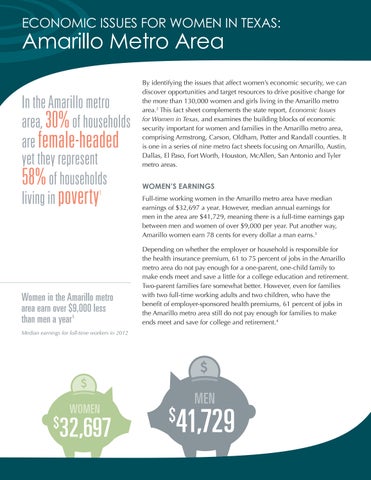
Full-time working women in the Amarillo metro area have median earnings of $32,697 a year. However, median annual earnings for men in the area are $41,729, meaning there is a full-time earnings gap between men and women of over $9,000 per year. Put another way, Amarillo women earn 78 cents for every dollar a man earns.3 Depending on whether the employer or household is responsible for the health insurance premium, 61 to 75 percent of jobs in the Amarillo metro area do not pay enough for a one-parent, one-child family to make ends meet and save a little for a college education and retirement. Two-parent families fare somewhat better. However, even for families with two full-time working adults and two children, who have the benefit of employer-sponsored health premiums, 61 percent of jobs in the Amarillo metro area still do not pay enough for families to make ends meet and save for college and retirement.4
Median earnings for full-time workers in 2012
WOMEN
32,697
$
MEN
41,729
$
75% of jobs in the Amarillo metro area pay less than $38,088
per year – which cannot sustain a single mom with one child 6
The occupational sector with the highest female employment is Educational Services, which includes teachers, administrators and teaching assistants. Women employed in this sector earn on average $2,859 per month. One sector with high female employment and higher wages is Hospitals, which employs many licensed nurses and technicians.7 5 MOST COMMON JOB SECTORS FOR AMARILLO METRO WOMEN
AVG MONTHLY EARNINGS
5 MOST COMMON JOB SECTORS FOR AMARILLO METRO MEN
AVG MONTHLY EARNINGS
1. Educational Services
$2,859
1. F ood Services and Drinking Places
$1,290
2. F ood Services and Drinking Places
$1,113
2. Food Manufacturing
$3,401
3. Ambulatory Health Care Services
$2,724
3. F abricated Metal Product Manufacturing
$7,167
4. Hospitals
$3,514
4. Specialty Trade Contractors
$3,170
5. General Merchandise Stores
$1,894
5. Educational Services
$3,012
Source: Bureau of Labor Statistics, Quarterly Workforce Indicators for 2013 Q3
WOMEN AND POVERTY
Both females and males in Amarillo experience lower poverty rates than in Texas as a whole, but females are still more likely to live in poverty. Over 21,000 women and girls in the Amarillo metro area live in poverty.8 Female-headed households make up 30 percent of all households in the Amarillo area, but 58 percent of all households in poverty. This represents the highest concentration of household poverty among female-headed households of the selected metro areas.9 For a single parent with two children, poverty is defined as living on less than $18,769 in income per year.10 AMARILLO METRO AREA
TEXAS
Female poverty rate
17%
19%
Male Poverty Rate
15%
16%
# of women and girls in poverty
21,225
2,358,471
# of men and boys in poverty
17,559
1,911,747
Female-to-male poverty ratio
1.2x greater
1.2x greater
# of female-headed households in poverty
8,160
728,042
# of male-headed households in poverty
3,550
290,887
% of households that are headed by females
30%
30%
% of households in poverty that are headed by females
58%
53%
POVERTY INDICATOR BY GENDER
Amarillo’s poverty is highly concentrated among female-headed households11
Source: ACS (2012 5-year estimates), Table B17017 and B17001
THE BUILDING BLOCKS OF WOMEN’S ECONOMIC SECURITY
EDUCATION
HEALTH INSURANCE
Women in the Amarillo metro area earn more with each step up in their education. Women with a high school diploma earn 42 percent more than women without a high school diploma. Women with a bachelor’s degree earn 58 percent more than women with an associate’s degree.12 However, the “leaky pipeline” shows that there are still many barriers for students, female and male.13
Health insurance is a financial shield that 19 percent of women and girls in the Amarillo metro area lack. Forty-three percent of all uninsured females in the Amarillo metro area are between the ages of 18 to 34; 41 percent are women between 35 and 64.16
Over 23,000 women and girls in the Amarillo metro area don’t have $49,510 Graduate or professional
Education Pays14
Median earnings for women 25 and over with earnings
$42,389
health insurance
Bachelor’s
17
$26,827 Some college or associate’s $20,785 High school
The “Leaky Pipeline” for Amarillo metro students15
$14,670 Less than High School
26 percent of female eighth-graders completed a higher education credential 11 years later
FEMALE
100%
70%
62%
26%
MALE
100%
68%
50%
17%
Fall 2001
2005-2007
2006-2011
2012
Begin in 8th Grade
Graduate High School
Enrolled in TX Higher Ed
Achieved TX Higher Ed Credential
CHILD CARE
3,426 children received financial assistance for child care, but 9,790 would likely be eligible18
3,426
9,790 Percentage of renter families burdened by housing costs in the Amarillo metro area 24
With 64 percent of children under six living in families with all available parents in the labor force,19 child care is a significant need for women in the Amarillo metro area. Too many families are not able to access child care subsidies. In 2013, the average monthly waitlist for child care subsidies in the Panhandle Workforce Development Area was 242 children.20 This means that low-income parents who are working or in job-training programs are not able to receive the financial assistance for child care they qualify for and that helps them to become and remain employed. High child care costs force many lower wage women to stay out of the workforce. In the Amarillo metro area, typical cost for full-time care for one child is $4,974 per year, while a typical single mom has an income of $22,743 a year.21 HOUSING
High housing costs squeeze a family’s budget, making it difficult to afford other basic needs, such as food, clothing, transportation and medical care. The housing burden is high for single mothers in the Amarillo metro area, and there are more than three times as many single mothers as single fathers.22 Over half of single-mother families in the Amarillo area who rent their homes spend at least 30 percent of their income on housing costs.23
22
%
TWO-PARENT
This study was produced by the Texas Women’s Foundation, the research and advocacy arm of Dallas Women’s Foundation. The study was conducted by the Center for Public Policy Priorities. For endnotes and sources, visit www.TexasWomensFdn.org
68
%
SINGLE FATHER
54
%
SINGLE MOTHER
CONCLUSION Strengthening the economic security of women and girls is critical to the success and future of the Amarillo metro area. These economic building blocks—women’s earnings, education, health care, child care and housing—affect women’s ability not only to be more financially secure in the present, but to move up in the future. We hope this report will spark a desire to learn more about issues affecting women in this area, and help drive change for women and their families. We invite you to contribute your voice and resources to make the ripple effect felt for families and communities throughout the Amarillo metro area.
ECONOMIC ISSUES FOR WOMEN IN TEXAS:
Austin Metro Area In the Austin metro area, 30% of households are female-headed yet they represent 53% of households living in poverty 1
Women in the Austin metro area earn almost $9,000 less than men a year 5
By identifying the issues that affect women’s economic security, we can discover opportunities and target resources to drive positive change for the more than 900,000 women and girls living in the Austin metro area.2 This fact sheet complements the state report, Economic Issues for Women in Texas, and examines the building blocks of economic security important for women and families in the Austin metro area, comprising Bastrop, Caldwell, Hays, Travis and Williamson counties. It is one in a series of nine metro fact sheets focusing on Amarillo, Austin, Dallas, El Paso, Fort Worth, Houston, McAllen, San Antonio and Tyler metro areas.
WOMEN’S EARNINGS Full-time working women in the Austin metro area have median earnings of $40,613 a year, one of the highest earnings of the selected metro areas. However, the full-time earnings gap between men and women is almost $9,000 per year.3 Depending on whether the employer or household is responsible for the health insurance premium, 64 to 67 percent of jobs in the Austin metro area do not pay enough for a one-parent, one-child family to make ends meet and save a little for a college education and retirement. Twoparent families fare somewhat better. However, even for families with two full-time working adults and two children, who have the benefit of employer-sponsored health premiums, 58 percent of jobs in the Austin metro area still do not pay enough for families to make ends meet and save for college and retirement.4
Median earnings for full-time workers in 2012
WOMEN
40,613
$
MEN
49,611
$
67% of jobs in the Austin metro
area pay less than $46,488 per year – which cannot sustain a single mom with one child 6
The occupational sector with the highest female employment is Educational Services, which includes teachers, administrators and teaching assistants. Women employed in this sector earn on average $3,376 per month. One sector with high female employment and higher wages is Professional, Scientific and Technical Services, which employs accountants, lawyers and management analysts, and includes other specialized services.7 5 MOST COMMON JOB SECTORS FOR AUSTIN METRO WOMEN
AVG MONTHLY EARNINGS
5 MOST COMMON JOB SECTORS FOR AUSTIN METRO MEN
AVG MONTHLY EARNINGS
1. Educational Services
$3,376
1. P rofessional, Scientific and Technical Services
$7,898
2. F ood Services and Drinking Places
$1,298
2. Educational Services
$4,124
3. P rofessional, Scientific and Technical Services
$4,677
3. F ood Services and Drinking Places
$1,619
4. Ambulatory Health Care Services
$3,395
4. Administrative and Support Services
$3,137
5. Administrative and Support Services
$2,566
5. Merchant Wholesalers, Durable Goods
$7,252
Source: Bureau of Labor Statistics, Quarterly Workforce Indicators for 2013 Q2
WOMEN AND POVERTY
Austin has the lowest disparity between male and female poverty of the selected metro areas, but females are still more likely to live in poverty than males. Over 130,000 women and girls in the Austin metro area live in poverty.8 Female-headed households make up 30 percent of all households in the Austin area, but 53 percent of all households in poverty.9 For a single parent with two children, poverty is defined as living on less than $18,769 in income per year.10 AUSTIN METRO AREA
TEXAS
Female poverty rate
16%
19%
Male poverty rate
14%
16%
# of women and girls in poverty
132,078
2,358,471
# of men and boys in poverty
116,282
1,911,747
Female-to-male poverty ratio
1.1x greater
1.2x greater
# of female-headed households in poverty
44,147
728,042
# of male-headed households in poverty
23,709
290,887
% of households that are headed by females
30%
30%
% of households in poverty that are headed by females
53%
53%
POVERTY INDICATOR BY GENDER
Female poverty is lower in Austin than in other metro areas, but women are still more likely to live in poverty than men11
Source: ACS (2012 5-year estimates), Table B17017 and B17001
THE BUILDING BLOCKS OF WOMEN’S ECONOMIC SECURITY
EDUCATION
HEALTH INSURANCE
Women in the Austin metro area earn more with each step up in their education. Women with a high school diploma earn 63 percent more than women without a high school diploma. Women with a bachelor’s degree earn 41 percent more than women with an associate’s degree.12 However, the “leaky pipeline” shows that there are still many barriers for students, female and male.13
Health insurance is a financial shield that 17 percent of women and girls in the Austin metro area lack. Forty-four percent of all uninsured females in the Austin metro area are between the ages of 18 to 34; 37 percent are women between 35 and 64.16
Education Pays14 Median earnings for women 25 and over with earnings
$52,512 Graduate or professional
Over 145,000 women and girls in the Austin metro area don’t have
health insurance
17
$42,943 Bachelor’s $30,541 Some college or associate’s
The “Leaky Pipeline” for Austin metro students15
$24,132 High school $14,798
25 percent of female eighth-graders completed a higher education credential 11 years later
Less than high school
FEMALE
100%
73%
57%
25%
MALE
100%
68%
49%
17%
Fall 2001
2005-2007
2006-2011
2012
Begin in 8th Grade
Graduate High School
Enrolled in TX Higher Ed
Achieved TX Higher Ed Credential
CHILD CARE
4,032 children received financial assistance for child care, but 47,012 would likely be eligible18
4,032
47,012
With 62 percent of children under six living in families with all available parents in the labor force,19 child care is a significant need for women in the Austin metro area. Too many families are not able to access child care subsidies. In 2013, the average monthly waitlist for child care subsidies in the Capital Area and Rural Capital Area Workforce Development Area was 516 children.20 This means that low-income parents who are working or in job-training programs are not able to receive the financial assistance for child care they qualify for and that helps them to become and remain employed. High child care costs force many lower wage women to stay out of the workforce. In the Austin metro area, typical cost for full-time care for one child is $6,586 per year, while a typical single mom has an income of $28,452 a year.21 HOUSING
High housing costs squeeze a family’s budget, making it difficult to afford other basic needs, such as food, clothing, transportation and medical care. The housing burden is highest for single mothers in the Austin metro area. Sixty percent of single-mother families in the Austin area who rent their homes spend at least 30 percent of their income on housing costs.22
Percentage of renter families burdened by housing costs in the Austin metro area23
40
%
TWO-PARENT
53
%
SINGLE FATHER
60
%
SINGLE MOTHER
CONCLUSION This study was produced by Texas Women’s Foundation, the research and advocacy arm of Dallas Women’s Foundation. The study was conducted by the Center for Public Policy Priorities. For endnotes and sources, visit www.TexasWomensFdn.org
Strengthening the economic security of women and girls is critical to the success and future of the Austin metro area. These economic building blocks—women’s earnings, education, health care, child care and housing—affect women’s ability not only to be more financially secure in the present, but to move up in the future. We hope this report will spark a desire to learn more about issues affecting women in this area, and help drive change for women and their families. We invite you to contribute your voice and resources to make the ripple effect felt for families and communities throughout the Austin metro area.
ECONOMIC ISSUES FOR WOMEN IN TEXAS:
Dallas Metro Area In the Dallas metro area, 30% of households are female-headed yet they represent 53% of households living in poverty 1
Women in the Dallas metro area earn 85 cents for every dollar that a man earns, the smallest wage gap of the nine selected metro areas6
By identifying the issues that affect women’s economic security in the Dallas metro area, we can discover opportunities and target resources to drive positive change for the 2.1 million women and girls living in the Dallas metro area.2 This fact sheet complements the state report, Economic Issues for Women in Texas, and examines the building blocks of economic security important for women and families in the Dallas metro area, comprising Collin, Dallas, Denton, Ellis, Hunt, Kaufman and Rockwall counties.3 It is one in a series of nine metro fact sheets focusing on the Amarillo, Austin, Dallas, El Paso, Fort Worth, Houston, McAllen, San Antonio and Tyler metro areas.
WOMEN’S EARNINGS Dallas women typically earn more than women in any of the nine metro areas included in this study. The gender wage gap was also the smallest in the Dallas metro area, with women earning 85 cents for every dollar that a man earns (statewide, women earn 79 cents per dollar). Although smaller than statewide, the full-time earnings gap still exists, with men earning over $7,400 more per year than women.4 Depending on whether the employer or household is responsible for the health insurance premium, 62 to 70 percent of jobs in the Dallas metro area do not pay enough for a one-parent, one-child family to make ends meet and save a little for a college education and retirement. Twoparent families fare somewhat better. However, even for families with two full-time working adults and two children, who have the benefit of employer-sponsored health premiums, 15 percent of jobs in the Dallas metro area still do not pay enough for families to make ends meet and save for college and retirement.5
Median earnings for full-time workers in 2012
WOMEN
40,714
$
MEN
48,148
$
70% of jobs in the Dallas metro area pay less than $44,496 per
year – which cannot sustain a single mom with one child 8
The occupational sector with the highest female employment is Educational Services, which includes teachers, administrators and teaching assistants. Women employed in this sector earn on average $3,256 per month. One sector with high female employment and strong wages is Professional, Scientific and Technical Services, which includes accountants, lawyers and management analysts. As shown below, men who work in this subsector tend to earn more.7 5 MOST COMMON JOB SECTORS FOR DALLAS METRO WOMEN
AVG MONTHLY EARNINGS
5 MOST COMMON JOB SECTORS FOR DALLAS METRO MEN
AVG MONTHLY EARNINGS
1. Educational Services
$3,256
1. Professional, Scientific, and Technical Services
$8,089
2. Ambulatory Health Care Services
$3,177
2. Administrative and Support Services
$3,532
3. Professional, Scientific and Technical Services
$4,930
3. Food Services and Drinking Places
$1,736
4. Food Services and Drinking Places
$1,345
4. Merchant Wholesalers, Durable Goods
$7,039
5. Administrative and Support Services
$2,710
5. Educational Services
$4,279
Source: Bureau of Labor Statistics, Quarterly Workforce Indicators for 2013 Q2
WOMEN AND POVERTY
Although the female poverty rate in the Dallas metro area is lower than in Texas, over 332,000 women and girls in the Dallas metro area still live in poverty.10 Female-headed households make up 30 percent of all households in Dallas, but they make up 53 percent of all poor households.11 For a single parent with two children, poverty is defined as living on less than $18,769 in annual income.12 DALLAS METRO AREA
TEXAS
Female poverty rate
16%
19%
Female poverty is lower in Dallas than other metro areas, but women are still more likely to live in poverty than men13
Male poverty rate
13%
16%
# of women and girls in poverty
332,599
2,358,471
# of men and boys in poverty
274,813
1,911,747
Female-to-male poverty ratio
1.2x greater
1.2x greater
30% of households in the area are femaleheaded, but 53% of all households in poverty are female-headed
# of female-headed households in poverty
100,145
728,042
# of male-headed households in poverty
41,433
290,887
% of households that are headed by females
30%
30%
% of households in poverty that are headed by females
53%
53%
POVERTY INDICATOR BY GENDER
Source: ACS (2012 5-year estimates), Table B17017
THE BUILDING BLOCKS OF WOMEN’S ECONOMIC SECURITY
EDUCATION
HEALTH INSURANCE
Women in the Dallas metro area earn more with each step up in their education. Women with a high school diploma earn 64 percent more than women without a high school diploma. Women with a bachelor’s degree earn 48 percent more than women with an associate’s degree.14 More women than men graduate from high school, enroll in college, and get a higher education degree or credential.15 However, the “leaky pipeline” shows that there are still many barriers for students, female and male.16
Health insurance is a financial shield that 21 percent of women and girls in the Dallas metro area lack. Forty percent of all uninsured females in the Dallas metro area are between the ages of 18 to 34.18
Education Pays17 Median earnings for women 25 and over with earnings
$56,240 $47,608
More than 457,000 women and girls in the Dallas metro area don’t have
health insurance
Graduate or professional
19
Bachelor’s
$32,124 Some college or associate’s
The “Leaky Pipeline” for Dallas metro students20
$24,939 High school
23 percent of female eighth-graders completed a higher education credential 11 years later
$15,226 Less than high school
FEMALE
100%
72%
54%
23%
MALE
100%
66%
47%
15%
Fall 2001
2005-2007
2006-2011
2012
Begin in 8th Grade
Graduate High School
Enrolled in TX Higher Ed
Achieved TX Higher Ed Credential
CHILD CARE
11,298 children received financial assistance for child care, but 150,000 would likely be eligible21
11,298
150,000 Percentage of renter families burdened by housing costs in the Dallas metro area26
With 63 percent of children under six living in families with all available parents in the labor force,22 child care is a significant need for women in the Dallas metro area. Too many families are not able to access child care subsidies. The average monthly waitlist for child care subsidies in the Dallas Workforce Development Area is 6,067 children.23 This means that low-income parents who are working or in job-training programs are not able to receive the financial assistance for child care they qualify for and that would help them become and remain employed. High child care costs force many women out of the workforce. For a single mother in the Dallas metro area, the yearround cost of typical care represents 22 percent of income.24 HOUSING
Sixty-one percent, or more than 71,000, single-mother families in the Dallas metro area spend at least 30 percent of their income on housing costs.25 High housing costs squeeze a family’s budget, making it difficult to afford other basic needs, such as food, clothing, transportation and medical care. The housing burden is highest for single mothers in Texas.
36
%
TWO-PARENT
41
%
SINGLE FATHER
61
%
SINGLE MOTHER
CONCLUSION This study was produced by Texas Women’s Foundation, the research and advocacy arm of Dallas Women’s Foundation. The study was conducted by the Center for Public Policy Priorities. For endnotes and sources, visit www.TexasWomensFdn.org
Strengthening the economic security of women and girls is critical to the success and future of the Dallas metro area. These economic building blocks—women’s earnings, education, health care, child care and housing—affect women’s ability not only to be more financially secure in the present, but to move up in the future. We hope this report will spark a desire to learn more about issues affecting women in this area, and help drive change for women and their families. We invite you to contribute your voice and resources to make the ripple effect felt for families and communities throughout the Dallas metro area.
ECONOMIC ISSUES FOR WOMEN IN TEXAS:
El Paso Metro Area In the El Paso metro area, 32% of households are female-headed yet they represent 53% of households living in poverty 1
Women in the El Paso metro area earn almost $7,895 less than men a year 6
By identifying the issues that affect women’s economic security, we can discover opportunities and target resources to drive positive change for the more than 431,000 women and girls living in the El Paso metro area.2 This fact sheet complements the state report, Economic Issues for Women in Texas, and examines the building blocks of economic security important for women and families in the El Paso metro area, comprising El Paso and Hudspeth counties.3 It is one in a series of nine metro fact sheets focusing on Amarillo, Austin, Dallas, El Paso, Fort Worth, Houston, McAllen, San Antonio and Tyler metro areas.
WOMEN’S EARNINGS Full-time working women in the El Paso metro area have median earnings of $27,489 a year, one of the lowest earnings of the selected metro areas and almost $8,000 lower than the state median for women. However, the full-time earnings gap between men and women is $7,895 per year, lower than the state earnings gap, because of relatively low earnings for men in El Paso.4 Depending on whether the employer or household is responsible for the health insurance premium, 62 to 71 percent of jobs in the El Paso metro area do not pay enough for a one-parent, one-child family to make ends meet and save a little for a college education and retirement. Twoparent families fare somewhat better. However, even for families with two full-time working adults and two children, who have the benefit of employer-sponsored health premiums, 37 percent of jobs in the El Paso metro area still do not pay enough for families to make ends meet and save for college and retirement.5
Median earnings for full-time workers in 2012
WOMEN
27,489
$
MEN
35,384
$
71% of jobs in the El Paso metro
area pay less than $36,360 per year – which cannot sustain a single mom with one child 7
The occupational sector with the highest female employment is Educational Services, which includes teachers, administrators and teaching assistants. Women employed in this sector earn on average $3,059 per month. One sector with high female employment and higher wages is Hospitals.8 5 MOST COMMON JOB SECTORS FOR EL PASO METRO WOMEN
AVG MONTHLY EARNINGS
5 MOST COMMON JOB SECTORS FOR EL PASO METRO MEN
AVG MONTHLY EARNINGS
1. Educational Services
$3,059
1. F ood Services and Drinking Places
$1,295
2. F ood Services and Drinking Places
$1,092
2. Educational Services
$3,267
3. Ambulatory Health Care Services
$2,014
3. Administrative and Support Services
$2,074
4. Administrative and Support Services
$1,747
4. Specialty Trade Contractors
$2,512
5. Hospitals
$4,051
5. Truck Transportation
$3,188
Source: Bureau of Labor Statistics, Quarterly Workforce Indicators for 2013 Q2
WOMEN AND POVERTY
The female poverty rate in the El Paso metro area is much higher than in Texas, and over 106,000 women and girls in the El Paso metro area live in poverty.9 El Paso has the highest disparity between male and female poverty of the selected metro areas—females are 1.3 times more likely to live in poverty than males. Female-headed households make up 32 percent of all households in the El Paso area, but 53 percent of all households in poverty.10 For a single parent with two children, poverty is defined as living on less than $18,769 in income per year.11 EL PASO METRO AREA
TEXAS
Female poverty rate
26%
19%
Male poverty rate
22%
16%
# of women and girls in poverty
106,612
2,358,471
# of men and boys in poverty
82,611
1,911,747
Female-to-male poverty ratio
1.3x greater
1.2x greater
# of female-headed households in poverty
30,527
728,042
# of male-headed households in poverty
9,315
290,887
% of households that are headed by females
32%
30%
% of households in poverty that are headed by females
53%
53%
POVERTY INDICATOR BY GENDER
One in four females in the El Paso area lives in poverty12
Source: ACS (2012 5-year estimates), Table B17017 and B17001
THE BUILDING BLOCKS OF WOMEN’S ECONOMIC SECURITY
EDUCATION
HEALTH INSURANCE
Women in the El Paso metro area earn more with each step up in their education. Women with a high school diploma earn 36 percent more than women without a high school diploma. Women with a bachelor’s degree earn 85 percent more than women with an associate’s degree, one of the largest premiums for bachelor’s degree found among the selected metro areas.13 However, the “leaky pipeline” shows that there are still many barriers for students, female and male.14
Health insurance is a financial shield that 28 percent of women and girls in the El Paso metro area lack. Forty-seven percent of all uninsured females in the El Paso metro area are between the ages of 35 to 64; 43 percent are women between 18 and 34.17
Education Pays15 Median earnings for women 25 and over with earnings
$53,140 Graduate or professional $40,829
Over 116,000 women and girls in the El Paso metro area don’t have
health insurance
18
Bachelor’s
$22,133 Some college or associate’s $16,382 High school
The “Leaky Pipeline” for El Paso metro students16
$12,057 Less than high school
20 percent of female eighth-graders completed a higher education credential 11 years later
FEMALE
100%
69%
56%
20%
MALE
100%
66%
51%
12%
Fall 2001
2005-2007
2006-2011
2012
Begin in 8th Grade
Graduate High School
Enrolled in TX Higher Ed
Achieved TX Higher Ed Credential
CHILD CARE
2,583 children received financial assistance for child care, but 42,291 would likely be eligible19
2,583
42,291 Percentage of renter families burdened by housing costs in the El Paso metro area24
With 54 percent of children under six living in families with all available parents in the labor force,20 child care is a significant need for women in the El Paso metro area. Too many families are not able to access child care subsidies. In 2013, the average monthly waitlist for child care subsidies in the Upper Rio Grande Workforce Development Area was 912 children.21 This means that low-income parents who are working or in job-training programs are not able to receive the financial assistance for child care they qualify for and that helps them to become and remain employed. High child care costs force many lower wage women to stay out of the workforce. In the El Paso metro area, typical cost for full-time care for one child is $3,776 per year, while a typical single mom has an income of $20,125 a year.22 HOUSING
High housing costs squeeze a family’s budget, making it difficult to afford other basic needs, such as food, clothing, transportation and medical care. The housing burden is highest for single mothers in the El Paso metro area. Seventy-one percent of single-mother families in the El Paso area who rent their homes spend at least 30 percent of their income on housing costs.23
36
%
TWO-PARENT
50
%
SINGLE FATHER
71
%
SINGLE MOTHER
CONCLUSION This study was produced by Texas Women’s Foundation, the research and advocacy arm of Dallas Women’s Foundation. The study was conducted by the Center for Public Policy Priorities. For endnotes and sources, visit www.TexasWomensFdn.org
Strengthening the economic security of women and girls is critical to the success and future of the El Paso metro area. These economic building blocks—women’s earnings, education, health care, child care and housing—affect women’s ability not only to be more financially secure in the present, but to move up in the future. We hope this report will spark a desire to learn more about issues affecting women in this area, and help drive change for women and their families. We invite you to contribute your voice and resources to make the ripple effect felt for families and communities throughout the El Paso metro area.
ECONOMIC ISSUES FOR WOMEN IN TEXAS:
Fort Worth Metro Area
By identifying the issues that affect women’s economic security, we can discover opportunities and target resources to drive positive change for the more than 1.1 million women and girls living in the Fort Worth metro area.2 This fact sheet complements the state report, Economic Issues for Women in Texas, and examines the building blocks of economic security important for women and families in the Fort Worth metro area, comprising Hood, Johnson, Parker, Somervell, Tarrant and Wise counties.3 It is one in a series of nine metro fact sheets focusing on Amarillo, Austin, Dallas, El Paso, Fort Worth, Houston, McAllen, Tyler and San Antonio metro areas.
In the Fort Worth metro area, 29% of households are female-headed yet they represent WOMEN’S EARNINGS 54% of households living in poverty 1
Women in the Fort Worth metro area earn almost $11,000 less than men a year 6 Median earnings for full-time workers in 2012
WOMEN
38,111
$
Full-time working women in the Fort Worth metro area have median earnings of $38,111 a year, the third highest earnings behind Dallas ($40,714) and Houston ($38,474). However, median annual earnings for men in the area are $48,892, meaning there is a full-time earnings gap between men and women of almost $11,000 per year. Put another way, Fort Worth women earn 78 cents for every dollar a man earns. In the neighboring Dallas metro area, women earn 85 cents for every dollar a man earns.4 Depending on whether the employer or household is responsible for the health insurance premium, 66 to 74 percent of jobs in the Fort Worth metro area do not pay enough for a one-parent, one-child family to make ends meet and save a little for a college education and retirement. Two-parent families fare somewhat better. However, even for families with two full-time working adults and two children, who have the benefit of employer-sponsored health premiums, 28 percent of jobs in the Fort Worth metro area still do not pay enough for families to make ends meet and save for college and retirement.5
MEN
48,892
$
74% of jobs in the Fort Worth metro
area pay less than $44,472 per year – which cannot sustain a single mom with one child 7
The occupational sector with the highest female employment is Educational Services, which includes teachers, administrators and teaching assistants. Women employed in this sector earn on average $3,231 per month. One sector with high female employment and higher wages is Hospitals, which employs licensed nurses, medical and laboratory technologists and technicians. Many women also work in Ambulatory Health Care Services, a sector that employs more women but pays less than Hospitals.8 5 MOST COMMON JOB SECTORS FOR FORT WORTH METRO WOMEN
AVG MONTHLY EARNINGS
5 MOST COMMON JOB SECTORS FOR FORT WORTH METRO MEN
AVG MONTHLY EARNINGS
1. Educational Services
$3,231
1. F ood Services and Drinking Places
$1,551
2. F ood Services and Drinking Places
$1,227
2. Administrative and Support Services
$3,201
3. Ambulatory Health Care Services
$3,153
3. E ducational Services
$4,009
4. Hospitals
$4,297
4. Transportation Equipment Manufacturing
$7,738
5. Administrative and Support Services
$2,509
5. Merchant Wholesalers, Durable Goods
$5,474
Source: Bureau of Labor Statistics, Quarterly Workforce Indicators for 2013 Q2
WOMEN AND POVERTY
Although the female poverty rate in the Fort Worth metro area is lower than in Texas, over 164,000 women and girls in the Fort Worth metro area still live in poverty. Female-headed households make up 29 percent of all households in the Fort Worth area, but 54 percent of all households in poverty.9 For a single parent with two children, poverty is defined as living on less than $18,769 in income per year.10 FORT WORTH METRO AREA
TEXAS
Female poverty rate
15%
19%
Male poverty rate
13%
16%
# of women and girls in poverty
164,193
2,358,471
# of men and boys in poverty
134,231
1,911,747
Female-to-male poverty ratio
1.2x greater
1.2x greater
# of female-headed households in poverty
51,554
728,042
# of male-headed households in poverty
20,599
290,887
% of households that are headed by females
29%
30%
% of households in poverty that are headed by females
54%
53%
POVERTY INDICATOR BY GENDER
Female poverty is lower in Fort Worth than other metro areas, but women are still more likely to live in poverty than men11
Source: ACS (2012 5-year estimates), Table B17017
THE BUILDING BLOCKS OF WOMEN’S ECONOMIC SECURITY
EDUCATION
HEALTH INSURANCE
Women in the Fort Worth metro area earn more with each step up in their education. Women with a high school diploma earn 54 percent more than women without a high school diploma. Women with an associate’s degree or some college earn 52 percent more than women with only a high school diploma.12 However, the “leaky pipeline” shows that there are still many barriers for students, female and male.13
Health insurance is a financial shield that 20 percent of women and girls in the Fort Worth metro area lack. Forty percent of all uninsured females in the Fort Worth metro area are between the ages of 18 to 34; 19 percent are girls under age 18.16
Education Pays14 Median earnings for women 25 and over with earnings
$56,507 $46,299
Graduate or professional
More than 217,000 women and girls in the Fort Worth metro area don’t have
health insurance
17
Bachelor’s
$30,517 Some college or associate’s
The “Leaky Pipeline” for Fort Worth metro students15
$23,452 High school
24 percent of female eighth-graders completed a higher education credential 11 years later
$15,201 Less than high school
FEMALE
100%
72%
57%
24%
MALE
100%
67%
49%
16%
Fall 2001
2005-2007
2006-2011
2012
Begin in 8th Grade
Graduate High School
Enrolled in TX Higher Ed
Achieved TX Higher Ed Credential
CHILD CARE
5,846 children received financial assistance for child care, but 75,461 would likely be eligible21
5,846
75,461 Percentage of renter families burdened by housing costs in the Fort Worth metro area23
With 61 percent of children under six living in families with all available parents in the labor force,18 child care is a significant need for women in the Fort Worth metro area. Too many families are not able to access child care subsidies. The average monthly waitlist for child care subsidies in the Tarrant Workforce Development Area is 3,312 children.19 This means that low-income parents who are working or in job-training programs are not able to receive the financial assistance for child care they qualify for and that helps them to become and remain employed. Typical child care costs for one child represent 24 percent of a single mother’s income in the Fort Worth metro area,20 which forces many lower wage women to stay out of the workforce. HOUSING
High housing costs squeeze a family’s budget, making it difficult to afford other basic needs, such as food, clothing, transportation and medical care. The housing burden is highest for single mothers in the Fort Worth metro area. Sixty-six percent or almost 40,000 singlemother families in the Fort Worth metro area spend at least 30 percent of their income on housing costs.22
37
%
TWO-PARENT
34
%
SINGLE FATHER
66
%
SINGLE MOTHER
CONCLUSION This study was produced by Texas Women’s Foundation, the research and advocacy arm of Dallas Women’s Foundation. The study was conducted by the Center for Public Policy Priorities. For endnotes and sources, visit www.TexasWomensFdn.org
Strengthening the economic security of women and girls is critical to the success and future of the Fort Worth metro area. These economic building blocks—women’s earnings, education, health care, child care and housing—affect women’s ability not only to be more financially secure in the present, but to move up in the future. We hope this report will spark a desire to learn more about issues affecting women in this area, and help drive change for women and their families. We invite you to contribute your voice and resources to make the ripple effect felt for families and communities throughout the Fort Worth metro area.
ECONOMIC ISSUES FOR WOMEN IN TEXAS:
Houston Metro Area
By identifying the issues that affect women’s economic security, we can discover opportunities and target resources to drive positive change for the more than 3 million women and girls living in the Houston metro area.2 This fact sheet complements the state report, Economic Issues for Women in Texas, and examines the building blocks of economic security important for women and families in the Houston metro area, comprising Austin, Brazoria, Chambers, Fort Bend, Galveston, Harris, Liberty, Montgomery and Waller counties.3 It is one in a series of nine metro fact sheets focusing on Amarillo, Austin, Dallas, El Paso, Fort Worth, Houston, McAllen, San Antonio and Tyler metro areas.
In the Houston metro area, 29% of households are female-headed yet they represent WOMEN’S EARNINGS 52% of households living in poverty 1
Women in the Houston metro area earn almost $11,000 less than men a year 6
Full-time working women in the Houston metro area have median earnings of $38,474 a year, the second-highest earnings behind Dallas ($40,714). However, the full-time earnings gap between men and women is $10,855 per year, the largest earnings gap of the nine selected metro areas. Put another way, Houston women earn 78 cents for every dollar a man earns.4 Depending on whether the employer or household is responsible for the health insurance premium, 65 to 72 percent of jobs in the Houston metro area do not pay enough for a one-parent, one-child family to make ends meet and save a little for a college education and retirement. Two-parent families fare somewhat better. However, even for families with two full-time working adults and two children, who have the benefit of employer-sponsored health premiums, 27 percent of jobs in the Houston metro area still do not pay enough for families to make ends meet and save for college and retirement.5
Median earnings for full-time workers in 2012
WOMEN
38,474
$
MEN
49,329
$
72% of jobs in the Houston metro
area pay less than $44,700 per year – which cannot sustain a single mom with one child 7
The occupational sector with the highest female employment is Educational Services, which includes teachers, administrators and teaching assistants. Women employed in this sector earn on average $3,334 per month. One sector with high female employment and strong wages is Professional, Scientific and Technical Services, which includes occupations such as accountants, lawyers and management analysts.8 As shown below, men who work in this subsector tend to earn significantly more. 5 MOST COMMON JOB SECTORS FOR HOUSTON METRO WOMEN
AVG MONTHLY EARNINGS
5 MOST COMMON JOB SECTORS FOR HOUSTON METRO MEN
AVG MONTHLY EARNINGS
1. Educational Services
$3,334
1. P rofessional, Scientific and Technical Services
$8,676
2. Ambulatory Health Care Services
$2,874
2. Administrative and Support Services
$4,450
3. F ood Services and Drinking Places
$1,275
3. F ood Services and Drinking Places
$1,594
4. P rofessional, Scientific and Technical Services
$4,967
4. E ducational Services
$4,332
5. Administrative and Support Services
$2,900
5. Specialty Trade Contractors
$4,405
Source: Bureau of Labor Statistics, Quarterly Workforce Indicators for 2013 Q2
WOMEN AND POVERTY
Although the female poverty rate in the Houston metro area is lower than in Texas, over 500,000 women and girls in the Houston metro area still live in poverty.9 Female-headed households make up 29 percent of all households in the Houston area, but 52 percent of all households in poverty.10 For a single parent with two children, poverty is defined as living on less than $18,769 in income per year.11 HOUSTON METRO AREA
TEXAS
Female poverty rate
17%
19%
Male poverty rate
14%
16%
# of women and girls in poverty
509,751
2,358,471
# of men and boys in poverty
419,042
1,911,747
Female-to-male poverty ratio
1.2x greater
1.2x greater
# of female-headed households in poverty
146,726
728,042
# of male-headed households in poverty
58,801
290,887
% of households that are headed by females
29%
30%
% of households in poverty that are headed by females
52%
53%
POVERTY INDICATOR BY GENDER
Female poverty is lower in Houston than other metro areas, but women are still more likely to live in poverty than men12
Source: 2012 American Community Survey, 5-year estimates, Table B17017 and B17001
THE BUILDING BLOCKS OF WOMEN’S ECONOMIC SECURITY
EDUCATION
HEALTH INSURANCE
Women in the Houston metro area earn more with each step up in their education. Women with a high school diploma earn 62 percent more than women without a high school diploma. Women with a bachelor’s degree earn 56 percent more than women with an associate’s degree.13 However, the “leaky pipeline” shows that there are still many barriers for students, female and male.14
Health insurance is a financial shield that 23 percent of women and girls in the Houston metro area lack. Thirty-nine percent of all uninsured females in the Houston metro area are between the ages of 18 to 34; 18 percent are girls under age 18.17
Education Pays15 Median earnings for women 25 and over with earnings
$56,481 $47,703 $30,602 $22,829 $14,089
Graduate or professional
More than 689,000 women and girls in the Houston metro area don’t have
health insurance
18
Bachelor’s
Some college or associate’s
The “Leaky Pipeline” for Houston metro students16
High school
24 percent of female eighth-graders completed a higher education credential 11 years later
Less than high school
FEMALE
100%
72%
56%
24%
MALE
100%
65%
48%
16%
Fall 2001
2005-2007
2006-2011
2012
Begin in 8th Grade
Graduate High School
Enrolled in TX Higher Ed
Achieved TX Higher Ed Credential
CHILD CARE
15,566 children received financial assistance for child care, but 211,484 would likely be eligible19
15,566
211,484 Percentage of renter families burdened by housing costs in the Houston metro area24
With 59 percent of children under six living in families with all available parents in the labor force,20 child care is a significant need for women in the Houston metro area. Too many families are not able to access child care subsidies. In 2012, the average monthly waitlist for child care subsidies in the Gulf Coast Workforce Development Area was 4,521 children.21 This means that low-income parents who are working or in job-training programs are not able to receive the financial assistance for child care they qualify for and that helps them to become and remain employed. High child care costs force many lower wage women to stay out of the workforce. In the Houston metro area, typical cost for full-time care for one child is $5,297 per year, while a typical single mom has an income of $25,694 a year.22 HOUSING
High housing costs squeeze a family’s budget, making it difficult to afford other basic needs, such as food, clothing, transportation and medical care. The housing burden is highest for single mothers in the Houston metro area. Sixty-five percent of single-mother families in the Houston area who rent their homes spend at least 30 percent of their income on housing costs.23
39
%
TWO-PARENT
42
%
SINGLE FATHER
65
%
SINGLE MOTHER
CONCLUSION This study was produced by Texas Women’s Foundation, the research and advocacy arm of Dallas Women’s Foundation. The study was conducted by the Center for Public Policy Priorities. For endnotes and sources, visit www.TexasWomensFdn.org
Strengthening the economic security of women and girls is critical to the success and future of the Houston metro area. These economic building blocks—women’s earnings, education, health care, child care and housing—affect women’s ability not only to be more financially secure in the present, but to move up in the future. We hope this report will spark a desire to learn more about issues affecting women in this area, and help drive change for women and their families. We invite you to contribute your voice and resources to make the ripple effect felt for families and communities throughout the Houston metro area.
ECONOMIC ISSUES FOR WOMEN IN TEXAS:
McAllen Metro Area
By identifying the issues that affect women’s economic security, we can discover opportunities and target resources to drive positive change for the more than 416,000 women and girls living in the McAllen metro area.2 This fact sheet complements the state report, Economic Issues for Women in Texas, and examines the building blocks of economic security important for women and families in the McAllen metro area, comprising Hidalgo county. It is one in a series of nine metro fact sheets focusing on Amarillo, Austin, Dallas, El Paso, Fort Worth, Houston, McAllen, San Antonio and Tyler metro areas.
In the McAllen metro area, 29% of households are female-headed yet they represent WOMEN’S EARNINGS 45% of households living in poverty 1
Women in the McAllen metro area earn over $5,000 less than men a year 5
Full-time working women in the McAllen metro area have median earnings of $25,523 a year, the lowest earnings of the selected metro areas. However, the full-time earnings gap between men and women is the narrowest of the selected areas $5,361 per year, due to low earnings for men.3 Depending on whether the employer or household is responsible for the health insurance premium, 70 to 73 percent of jobs in the McAllen metro area do not pay enough for a one-parent, one-child family to make ends meet and save a little for a college education and retirement. Two-parent families fare somewhat better. However, even for families with two full-time working adults and two children, who have the benefit of employer-sponsored health premiums, 47 percent of jobs in the McAllen metro area still do not pay enough for families to make ends meet and save for college and retirement.4
Median earnings for full-time workers in 2012
WOMEN
25,523
$
MEN
30,884
$
73% of jobs in the McAllen metro area pay less than $37,116
per year – which cannot sustain a single mom with one child
The occupational sector with the highest female employment is Ambulatory Health Care Services, which includes medical assistants, secretaries and licensed nurses. Women employed in this sector earn low wages—on average $1,574 per month. Men employed in this sector earn, on average, over twice this amount. One sector with high female employment and higher wages is Educational Services, which employs teachers and teaching assistants.7 5 MOST COMMON JOB SECTORS FOR MCALLEN METRO WOMEN
AVG MONTHLY EARNINGS
5 MOST COMMON JOB SECTORS FOR MCALLEN METRO MEN
AVG MONTHLY EARNINGS
1. Ambulatory Health Care Services
$1,574
1. Educational Services
$3,202
2. Educational Services
$3,003
2. F ood Services and Drinking Places
$1,217
3. Social Assistance
$1,203
3. Ambulatory Health Care Services
$3,786
4. F ood Services and Drinking Places
$1,026
4. Administrative and Support Services
$1,944
5. General Merchandise Stores
$1,698
5. General Merchandise Stores
$1,838
6
Source: Bureau of Labor Statistics, Quarterly Workforce Indicators for 2013 Q3
WOMEN AND POVERTY
Females and males in McAllen experience the highest poverty rates of the selected metro areas, but females are still more likely to live in poverty than males. Over 146,000 women and girls in the McAllen metro area live in poverty.8 Female-headed households make up 29 percent of all households in the McAllen area, but 45 percent of all households in poverty.9 For a single parent with two children, poverty is defined as living on less than $18,769 in income per year.10 MCALLEN METRO AREA
TEXAS
Female poverty rate
37%
19%
Male Poverty Rate
33%
16%
# of women and girls in poverty
146,246
2,358,471
# of men and boys in poverty
122,662
1,911,747
Female-to-male poverty ratio
1.2x greater
1.2x greater
# of female-headed households in poverty
30,784
728,042
# of male-headed households in poverty
8,284
290,887
% of households that are headed by females
29%
30%
% of households in poverty that are headed by females
45%
53%
POVERTY INDICATOR BY GENDER
One in three females in the McAllen area lives in poverty11
Source: ACS (2012 5-year estimates), Table B17017 and B17001
THE BUILDING BLOCKS OF WOMEN’S ECONOMIC SECURITY
EDUCATION
HEALTH INSURANCE
Women in the McAllen metro area earn more with each step up in their education. Women with a high school diploma earn 55 percent more than women without a high school diploma. Women with a bachelor’s degree earn twice as much as women with an associate’s degree, the highest return on investment for a bachelor’s degree of the selected metro areas.12 However, the “leaky pipeline” shows that there are still many barriers for students, female and male.13
Health insurance is a financial shield that 37 percent of women and girls in the McAllen metro area lack, the highest uninsured rate of the selected metro areas. Forty-four percent of all uninsured females in the McAllen metro area are between the ages of 18 to 34; 37 percent are women between 35 and 64.16
Over 145,000 women and girls in the McAllen metro area don’t have $52,244 Graduate or professional
Education Pays14
Median earnings for women 25 and over with earnings
$43,564
health insurance
Bachelor’s
17
$21,803 Some college or associate’s $16,305 High school
The “Leaky Pipeline” for McAllen metro students15
$10,495 Less than High School
22 percent of female eighth-graders completed a higher education credential 11 years later
FEMALE
100%
66%
53%
22%
MALE
100%
64%
47%
14%
Fall 2001
2005-2007
2006-2011
2012
Begin in 8th Grade
Graduate High School
Enrolled in TX Higher Ed
Achieved TX Higher Ed Credential
CHILD CARE
4,391 children received financial assistance for child care, but 54,490 would likely be eligible18
4,391
54,490 Percentage of renter families burdened by housing costs in the McAllen metro area23
With 53 percent of children under six living in families with all available parents in the labor force,19 child care is a significant need for women in the McAllen metro area. Too many families are not able to access child care subsidies. In 2013, the average monthly waitlist for child care subsidies in the Lower Rio Grande Valley Workforce Development Area was 397 children.20 This means that low-income parents who are working or in job-training programs are not able to receive the financial assistance for child care they qualify for and that helps them to become and remain employed. High child care costs force many lower wage women to stay out of the workforce. In the McAllen metro area, typical cost for full-time care for one child is $3,989 per year, while a typical single mom has an income of $14,749 a year.21 This represents an unmanageable 27 percent of a single mother’s income. HOUSING
High housing costs squeeze a family’s budget, making it difficult to afford other basic needs, such as food, clothing, transportation and medical care. The housing burden is highest for single mothers in the McAllen metro area. Seventy-five percent of single-mother families in the McAllen area who rent their homes spend at least 30 percent of their income on housing costs.22
49
%
TWO-PARENT
This study was produced by the Texas Women’s Foundation, the research and advocacy arm of Dallas Women’s Foundation. The study was conducted by the Center for Public Policy Priorities. For endnotes and sources, visit www.TexasWomensFdn.org
45
%
SINGLE FATHER
75
%
SINGLE MOTHER
CONCLUSION Strengthening the economic security of women and girls is critical to the success and future of the McAllen metro area. These economic building blocks—women’s earnings, education, health care, child care and housing—affect women’s ability not only to be more financially secure in the present, but to move up in the future. We hope this report will spark a desire to learn more about issues affecting women in this area, and help drive change for women and their families. We invite you to contribute your voice and resources to make the ripple effect felt for families and communities throughout the McAllen metro area.
ECONOMIC ISSUES FOR WOMEN IN TEXAS:
San Antonio Metro Area
By identifying the issues that affect women’s economic security, we can discover opportunities and target resources to drive positive change for the more than 1.1 million women and girls living in the San Antonio metro area.2 This fact sheet complements the state report, Economic Issues for Women in Texas, and examines the building blocks of economic security important for women and families in the San Antonio metro area, comprising Atascosa, Bandera, Bexar, Comal, Guadalupe, Kendall, Medina and Wilson counties. It is one in a series of nine metro fact sheets focusing on Amarillo, Austin, Dallas, El Paso, Fort Worth, Houston, McAllen, San Antonio and Tyler metro areas.
In the San Antonio metro area, 31% of households are female-headed yet they represent WOMEN’S EARNINGS 57% of households living in poverty 1
Women in the San Antonio metro area earn $7,364 less than men a year 5
Full-time working women in the San Antonio metro area have median earnings of $34,463 a year, slightly lower than the state median earnings for women. However, the full-time earnings gap between men and women is $7,364 per year, lower than the state earnings gap, because of relatively low earnings for men in San Antonio.3 Depending on whether the employer or household is responsible for the health insurance premium, 63 to 72 percent of jobs in the San Antonio metro area do not pay enough for a one-parent, one-child family to make ends meet and save a little for a college education and retirement. Two-parent families fare somewhat better. However, even for families with two full-time working adults and two children, who have the benefit of employer-sponsored health premiums, 21 percent of jobs in the San Antonio metro area still do not pay enough for families to make ends meet and save for college and retirement.4
Median earnings for full-time workers in 2012
WOMEN
34,463
$
MEN
41,827
$
72% of jobs in the San Antonio metro
area pay less than $43,392 per year – which cannot sustain a single mom with one child 6
The occupational sector with the highest female employment is Educational Services, which includes teachers, administrators and teaching assistants. Women employed in this sector earn on average $2,869 per month. One sector with high female employment and higher wages is Hospitals.7 5 MOST COMMON JOB SECTORS FOR SAN ANTONIO METRO WOMEN
AVG MONTHLY EARNINGS
5 MOST COMMON JOB SECTORS FOR SAN ANTONIO METRO MEN
AVG MONTHLY EARNINGS
1. Educational Services
$2,869
1. F ood Services and Drinking Places
$1,538
2. Ambulatory Health Care Services
$2,589
2. Administrative and Support Services
$2,703
3. F ood Services and Drinking Places
$1,216
3. Educational Services
$3,401
4. Administrative and Support Services
$2,234
4. P rofessional, Scientific and Technical Services
$5,936
5. Hospitals
$3,994
5. Specialty Trade Contractors
$3,536
Source: Bureau of Labor Statistics, Quarterly Workforce Indicators for 2013 Q2
WOMEN AND POVERTY
Although the female poverty rate in the San Antonio metro area is slightly lower than in Texas, almost 200,000 women and girls in the San Antonio metro area still live in poverty.8 San Antonio has one of the highest disparities between male and female poverty of the selected metro areas. Female-headed households make up 31 percent of all households in the San Antonio area, but 57 percent of all households in poverty.9 For a single parent with two children, poverty is defined as living on less than $18,769 in income per year.10 SAN ANTONIO METRO AREA
TEXAS
Female poverty rate
18%
19%
Male poverty rate
15%
16%
# of women and girls in poverty
194,126
2,358,471
# of men and boys in poverty
153,758
1,911,747
Female-to-male poverty ratio
1.3x greater
1.2x greater
# of female-headed households in poverty
65,093
728,042
# of male-headed households in poverty
25,408
290,887
% of households that are headed by females
31%
30%
% of households in poverty that are headed by females
57%
53%
POVERTY INDICATOR BY GENDER
Household poverty is more highly concentrated among female-headed households in San Antonio11
Source: 2012 American Community Survey, 5-year estimates, Table B17017 and B17001
THE BUILDING BLOCKS OF WOMEN’S ECONOMIC SECURITY
EDUCATION
HEALTH INSURANCE
Women in the San Antonio metro area earn more with each step up in their education. Women with a high school diploma earn 51 percent more than women without a high school diploma. Women with a bachelor’s degree earn 59 percent more than women with an associate’s degree.12 However, the “leaky pipeline” shows that there are still many barriers for students, female and male.13
Health insurance is a financial shield that 18 percent of women and girls in the San Antonio metro area lack. Forty percent of all uninsured females in the San Antonio metro area are between the ages of 18 to 34; 43 percent are women between 35 and 64.16
Education Pays14 Median earnings for women 25 and over with earnings
$55,062 $43,808 $27,633 $21,324 $14,149
Graduate or professional
Almost 200,000 women and girls in the San Antonio metro area don’t have
health insurance
17
Bachelor’s
Some college or associate’s
The “Leaky Pipeline” for San Antonio metro students15
High school
21 percent of female eighth-graders completed a higher education credential 11 years later
Less than high school
FEMALE
100%
69%
55%
21%
MALE
100%
66%
46%
14%
Fall 2001
2005-2007
2006-2011
2012
Begin in 8th Grade
Graduate High School
Enrolled in TX Higher Ed
Achieved TX Higher Ed Credential
CHILD CARE
4,516 children received financial assistance for child care, but 77,842 would likely be eligible18
4,516
77,842
With 61 percent of children under six living in families with all available parents in the labor force,19 child care is a significant need for women in the San Antonio metro area. Too many families are not able to access child care subsidies. In 2013, the average monthly waitlist for child care subsidies in the Alamo Area Workforce Development Area was 3,388 children.20 This means that low-income parents who are working or in job-training programs are not able to receive the financial assistance for child care they qualify for and that helps them to become and remain employed. High child care costs force many lower wage women to stay out of the workforce. In the San Antonio metro area, typical cost for full-time care for one child is $5,712 per year, while a typical single mom has an income of $24,840 a year.21 HOUSING
High housing costs squeeze a family’s budget, making it difficult to afford other basic needs, such as food, clothing, transportation and medical care. The housing burden is highest for single mothers in the San Antonio metro area. Sixty percent of single-mother families in the San Antonio area who rent their homes spend at least 30 percent of their income on housing costs.22
Percentage of renter families burdened by housing costs in the San Antonio metro area23
37
%
TWO-PARENT
45
%
SINGLE FATHER
60
%
SINGLE MOTHER
CONCLUSION This study was produced by Texas Women’s Foundation, the research and advocacy arm of Dallas Women’s Foundation. The study was conducted by the Center for Public Policy Priorities. For endnotes and sources, visit www.TexasWomensFdn.org
Strengthening the economic security of women and girls is critical to the success and future of the San Antonio metro area. These economic building blocks—women’s earnings, education, health care, child care and housing—affect women’s ability not only to be more financially secure in the present, but to move up in the future. We hope this report will spark a desire to learn more about issues affecting women in this area, and help drive change for women and their families. We invite you to contribute your voice and resources to make the ripple effect felt for families and communities throughout the San Antonio metro area.
ECONOMIC ISSUES FOR WOMEN IN TEXAS:
Tyler Metro Area In the Tyler metro area, 31% of households are female-headed yet they represent 53% of households living in poverty 1
Women in the Tyler metro area earn almost $11,000 less than men a year 5
By identifying the issues that affect women’s economic security, we can discover opportunities and target resources to drive positive change for the more than 111,000 women and girls living in the Tyler metro area.2 This fact sheet complements the state report, Economic Issues for Women in Texas, and examines the building blocks of economic security important for women and families in the Tyler metro area, comprising Smith county. It is one in a series of nine metro fact sheets focusing on Amarillo, Austin, Dallas, El Paso, Fort Worth, Houston, McAllen, San Antonio and Tyler metro areas.
WOMEN’S EARNINGS Full-time working women in the Tyler area have median earnings of $32,769 a year. Full-time working men have median earnings of $43,571 a year. Put another way, Tyler women earn 75 cents for every dollar that a man earns, the largest wage gap of the nine selected metro areas.3 Depending on whether the employer or household is responsible for the health insurance premium, 62 to 74 percent of jobs in the Tyler metro area do not pay enough for a one-parent, one-child family to make ends meet and save a little for a college education and retirement. Twoparent families fare somewhat better. However, even for families with two full-time working adults and two children, who have the benefit of employer-sponsored health premiums, 32 percent of jobs in the Tyler metro area still do not pay enough for families to make ends meet and save for college and retirement.4
Median earnings for full-time workers in 2012
WOMEN
32,769
$
MEN
43,571
$
74% of jobs in the Tyler metro area pay less than $38,724 per year – which cannot sustain a single mom with one child 6
Many women in Tyler work in occupational sectors related to health care, including Ambulatory Health Care Services, Hospitals, and Nursing and Residential Care facilities. Unfortunately, pay in these sectors tends to be low. Of these sectors, women who work in Hospitals earn the most ($4,113 per month on average), and women who work in Nursing and Residential Care facilities earn the least ($1,879 per month on average).7 5 MOST COMMON JOB SECTORS FOR TYLER METRO WOMEN
AVG MONTHLY EARNINGS
5 MOST COMMON JOB SECTORS FOR TYLER METRO MEN
AVG MONTHLY EARNINGS
1. Ambulatory Health Care Services
$2,804
1. F ood Services and Drinking Places
$1,262
2. Hospitals
$4,113
2. Hospitals
$5,687
3. Educational Services
$2,400
3. Merchant Wholesalers, Durable Goods
$5,770
4. F ood Services and Drinking Places
$1,076
4. Educational Services
$2,862
5. Nursing and Residential Care Facilities
$1,879
5. P rofessional, Scientific and Technical Services
$4,930
Source: Bureau of Labor Statistics, Quarterly Workforce Indicators for 2013 Q2
WOMEN AND POVERTY
Although the female poverty rate in the Tyler metro area is lower than in Texas, almost 18,000 women and girls in the Tyler metro area still live in poverty.8 Female-headed households make up 31 percent of all households in the Tyler area, but 53 percent of all households in poverty.9 For a single parent with two children, poverty is defined as living on less than $18,769 in income per year.10 TYLER METRO AREA
TEXAS
Female poverty rate
17%
19%
Male poverty rate
15%
16%
# of women and girls in poverty
17,713
2,358,471
# of men and boys in poverty
14,984
1,911,747
Female-to-male poverty ratio
1.2x greater
1.2x greater
# of female-headed households in poverty
6,234
728,042
# of male-headed households in poverty
2,922
290,887
% of households that are headed by females
31%
30%
% of households in poverty that are headed by females
53%
53%
POVERTY INDICATOR BY GENDER
Female poverty is lower in Tyler than other metro areas, but women are still more likely to live in poverty than men11
Source: 2012 American Community Survey, 5-year estimates, Table B17017 and B17001
THE BUILDING BLOCKS OF WOMEN’S ECONOMIC SECURITY
EDUCATION
HEALTH INSURANCE
Women in the Tyler metro area earn more with each step up in their education. Women with a high school diploma earn 69 percent more than women without a high school diploma. Women with a bachelor’s degree earn 57 percent more than women with an associate’s degree.12 However, the “leaky pipeline” shows that there are still many barriers for students, female and male.13
Health insurance is a financial shield that 21 percent of women and girls in the Tyler metro area lack. Forty percent of all uninsured females in the Tyler metro area are between the ages of 18 to 34; 44 percent are women between 35 to 64.16
Education Pays14 Median earnings for women 25 and over with earnings
$51,366 $41,218 $26,331 $20,103
Graduate or professional
More than 22,000 women and girls in the Tyler metro area don’t have
health insurance
17
Bachelor’s
Some college or associate’s
The “Leaky Pipeline” for Tyler metro students15
High school
26 percent of female eighth-graders completed a higher education credential 11 years later
$11,881 Less than high school
FEMALE
100%
71%
58%
26%
MALE
100%
68%
49%
15%
Fall 2001
2005-2007
2006-2011
2012
Begin in 8th Grade
Graduate High School
Enrolled in TX Higher Ed
Achieved TX Higher Ed Credential
CHILD CARE
652 children received financial assistance for child care, but 7,013 would likely be eligible18
652
7,013 Percentage of renter families burdened by housing costs in the Tyler metro area23
With 58 percent of children under six living in families with all available parents in the labor force, child care is a significant need for women in the Tyler metro area.19 Too many families are not able to access child care subsidies. In 2013, the average monthly waitlist for child care subsidies in the East Texas Workforce Development Area was 707 children.20 This means that low-income parents who are working or in job-training programs are not able to receive the financial assistance for child care they qualify for and that helps them to become and remain employed. High child care costs force many lower wage women to stay out of the workforce. In the Tyler metro area, typical cost for full-time care for one child is $4,910 per year, while a typical single mom has an income of $24,867 a year.21 HOUSING
High housing costs squeeze a family’s budget, making it difficult to afford other basic needs, such as food, clothing, transportation and medical care. The housing burden is highest for single mothers in the Tyler metro area. Sixty-nine percent of single-mother families in the Tyler area who rent their homes spend at least 30 percent of their income on housing costs.22 Housing costs burden a larger share of single mothers in Tyler than in almost any of the other selected metro areas.
31
%
TWO-PARENT
This study was produced by Texas Women’s Foundation, the research and advocacy arm of Dallas Women’s Foundation. The study was conducted by the Center for Public Policy Priorities. For endnotes and sources, visit www.TexasWomensFdn.org
52
%
SINGLE FATHER
69
%
SINGLE MOTHER
CONCLUSION Strengthening the economic security of women and girls is critical to the success and future of the Tyler metro area. These economic building blocks—women’s earnings, education, health care, child care and housing—affect women’s ability not only to be more financially secure in the present, but to move up in the future. We hope this report will spark a desire to learn more about issues affecting women in this area, and help drive change for women and their families. We invite you to contribute your voice and resources to make the ripple effect felt for families and communities throughout the Tyler metro area.