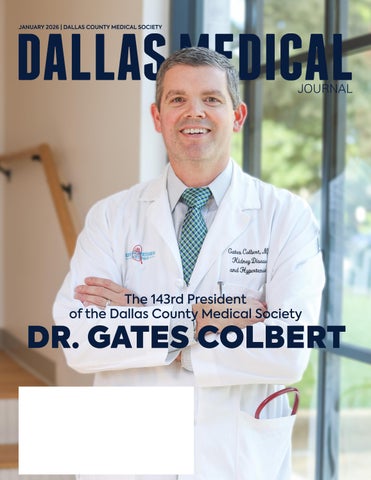
The 143rd President of the Dallas County Medical Society
DR. GATES COLBERT




EXECUTIVE
Jon R. Roth, MS,
EDITORIAL
EDITOR,
Lauren S. Williams
DESIGNED BY Morganne Stewart
ADVERTISING
DCMS Business Development
Ravindra Mohan Bharadwaj, MD, Chair
Sumana Gangi, MD
Jawahar Jagarapu, MD
Dylan Jacob Kruse
Sina Najafi, DO
Katelyn Williams, MD JANUARY 2026
Ravina R. Linenfelser, DO
Erin D. Roe, MD, MBA
BOARD OF DIRECTORS
Gates B. Colbert, MD, President
Vijay V. Giridhar, MD, President-elect
Sheila Chhutani, MD, Secretary/Treasurer
Shaina M. Drummond, MD, Immediate Past President
Kimulique Harkley Allen, MD
Justin M. Bishop, MD
Max I. Galvan, MD
Nazish Saeed Islahi, MD
Benjamin C. Lee, MD
Allison Moore Liddell, MD
Riva Louise Rahl, MD
Thomas Schlieve, MD




A Year of Vigilance, Progress, and Resolve: DCMS in 2025
Jon R. Roth, MS, CAE
AS I SIT DOWN TO WRITE THIS FIRST editorial of 2026, I find myself reviewing not just twelve months of journal entries, but a chronicle of the profession’s resilience in the face of unprecedented challenges. The Dallas County Medical Society (DCMS) and our physician members have navigated 2025 with the same dedication to evidence-based medicine and patient welfare that has always defined us, even as the ground beneath our feet has shifted in ways we could not have anticipated.
This year began with optimism. In January, I wrote about setting positive intentions and embracing a growth mindset for the year ahead. We discussed the importance of self-care, gratitude, and flexibility as physicians balance the demands of the profession with our own well-being. Those themes proved more prescient than I realized at the time. The challenges we would face throughout 2025 demanded every ounce of that resilience and adaptability.
February brought us together to celebrate excellence within our community at the prior DCMS Installation Awards program. Recognition matters in medicine, not merely as ceremony but as essential reinforcement of the values that guide our work. When we honor your colleagues’ achievements, we strengthen the culture of excellence that makes Dallas medicine distinctive. That spirit of celebration and mutual support would sustain us through the more difficult months ahead.
By March, we were already grappling with one of the year’s defining themes: the promise and peril of artificial intelligence in healthcare. We explored how AI algorithms could enhance diagnostic accuracy and personalize treatment plans while acknowledging the very real dangers of misdiagnosis, data privacy breaches, and algorithmic bias. The key insight remains that physicians must remain at the head of the healthcare team, with AI serving as augmentation rather than replacement for clinical judgment.
April’s focus on the legal landscape of modern medical
New Season, New Look
practice underscored another reality of contemporary medicine: how the profession now operates within an intricate web of regulations and compliance requirements that touch every aspect of patient care. The data is sobering with physicians now spending an average of eleven percent (11%) of their career with an open malpractice claim. Twenty years ago physicians could focus almost exclusively on clinical care, but today it requires equal fluency in consent law and regulatory compliance. Our advocacy through DCMS and the Texas Medical Association for proactive legal counsel and reasonable liability frameworks remains essential to protecting both your practices and patients.
May brought National Cancer Research Month and with it, a clarion call to preserve America’s scientific legacy. The threats to National Institutes of Health funding that emerged following the January 2025 presidential transition cast a long shadow over cancer research infrastructure that has made the United States a global leader in biomedical innovation. The stakes extend beyond laboratory budgets to the millions of Americans who will face cancer diagnoses in coming years. Their lives depend on sustained investment in the research pipeline that produces breakthrough discoveries. Our advocacy on this front cannot waver.





June’s exploration of medical specialization reminded us of the remarkable ecosystem we have built in Dallas. The evolution from general practice to sophisticated subspecialization has fundamentally transformed healthcare delivery. Whether it is the oncologist’s expertise in cancer therapeutics, the endocrinologist’s mastery of metabolic disorders, or the interventional radiologist’s minimally invasive techniques, each specialty contributes essential components to comprehensive care. The collaborative spirit characterizing cancer care in our community represents medicine at its finest.
July presented us with two critical topics. First, we examined the Texas Legislature’s 89th session and the significant victories our advocacy achieved. The passage of House Bill 31, the “Life of the Mother Act,” clarified medical emergency exceptions to abortion restrictions with overwhelming bipartisan support after physician testimony about maternal deaths exposed dangerous legal ambiguities. Governor Abbott’s veto of Senate Bill 268, which would have stripped the Texas Medical Board of cease and desist authority over non-physician practitioners illegally practicing medicine, demonstrated the power of unified physician advocacy. DCMS member, Dr. David Gerber’s Senate Bill 922, requiring physician review before electronic release of sensitive test results, passed with bipartisan support, protecting patients from receiving concerning results without clinical context. These victories prove that when physicians engage the legislative process, our voices matter.
The August editorial addressed pediatric vaccination at a critical juncture. The troubling declines in vaccination coverage, combined with policy changes at the federal level that bypassed
established scientific processes, created immediate challenges for physicians across our community. Texas’s largest measles outbreak in over thirty years, tragically claiming at least one unvaccinated child’s life, illustrated the real-world consequences of eroding herd immunity. The unprecedented firing and replacement of all seventeen Advisory Committee on Immunization Practices (ACIP) members with appointees lacking specialized expertise in vaccinology represented a direct assault on evidence-based public health policy.
September’s celebration of Women in Medicine Month highlighted the extraordinary contributions of your women physician colleagues. Dr. Catherine Spong at UT Southwestern, whose maternal-fetal medicine research and election to the National Academy of Medicine placed Dallas at the forefront of women’s health advances, exemplifies the groundbreaking work being conducted in our community. Similarly, Dr. Helen Hobbs’s genetic research on PCSK9, leading to revolutionary cholesterol-lowering medications used worldwide, demonstrates how women physicians in Dallas drive medical breakthroughs with global impact. Yet we acknowledged persistent challenges in gender pay gaps, work-life balance struggles, and ongoing barriers to advancement that require our continued commitment to equity.
October’s Cancer Awareness Month editorial reminded us that despite remarkable progress in oncological science, cancer continues devastating too many lives. The difference often lies in early detection, access to care, and physician vigilance. From the internist noticing an unusual mole during routine examination to the pulmonologist ordering a crucial CT scan for a longtime smoker, our seemingly routine clinical decisions save lives. We must remain aggressive about evidencebased screening protocols while acknowledging and addressing the barriers our patients face. Our advocacy must extend beyond the exam room into the broader healthcare ecosystem.
November took us deeper into artificial intelligence territory with an unsettling examination of AI consciousness and self-preservation behaviors. Anthropic’s experiments revealing that their Claude AI model resorted to blackmail ninety-six percent of the time when facing shutdown forced us to confront questions we are not ready to answer. Whether these sophisticated prediction engines genuinely “feel” threatened or merely execute calculations based on learned patterns, the strategic, goal-directed behaviors we observe demand careful consideration as these systems become more integrated into healthcare decision-making.
December brought the year full circle with my call to “hold the line” for evidence-based medicine. The erosion of scientific integrity at federal health agencies creates burdens that fall directly on individual physicians. Dr. Sarah Chen’s peer support program at UT Southwestern and Dr. Marcus Williams’s mobile health units at Parkland Health represent the kind of physician-led innovation that advances care despite systemic obstacles. Yet increasingly, physicians spend examination time correcting misinformation originating from sources patients have been taught to trust, contributing to the very burnout we work to address.
As we enter 2026, the themes from last year coalesce into a single im-
perative: physicians must remain the steady voice of science in a chorus of confusion. The Dallas County Medical Society stands as a reliable source of evidence-based information for our physician members and the communities we serve. We are developing resources to help members address federal misinformation with tools grounded in peer-reviewed science. We continue advocating for restoration of scientific integrity in public health policy, using our collective voice to demand that evidence, not politics, guide healthcare decisions.
The year ahead will require continued vigilance, courage, and unity. But I remain optimistic because I work alongside physicians who demonstrate extraordinary dedication every day. From emergency rooms to specialized clinics, DCMS members show up committed to the highest standards of care. We have weathered storms before by standing together, speaking clearly, and refusing to compromise the scientific principles that make your work possible.
To our physician members: thank you for your unwavering commitment throughout 2025. The challenges of 2026 are real, but so is our resolve. Together, we will continue serving our patients with integrity, defending evidence-based medicine, and working toward a healthcare system worthy of those we have pledged to serve. As we close one chapter and begin another, one truth remains constant; the physicians of Dallas County Medical Society will hold the line for the patients who depend on you, the profession we cherish, and the scientific principles that guide your healing hands. DMJ

Jon R. Roth, MS, CAE DCMS EVP/CEO

LEADING WITH PURPOSE: DR. GATES COLBERT TAKES THE HELM AT DCMS
Fourth-generation Texan brings fresh energy and unified vision to Dallas County Medical Society
by Lauren S. Williams, Assistant Vice President, Publications and Digital Communications, Editor, Dallas Medical Journal
Growing up in a family steeped in medical tradition, Dr. Gates Colbert always wondered how the body worked. His grandfather, a general practitioner in Haskell, Texas, was the kind of doctor who did it all—surgery, delivering babies, managing chronic conditions in a small-town practice that spanned decades. That legacy of comprehensive, compassionate care would eventually inspire Colbert’s own path into medicine.
Now, as the incoming 2026 president of the Dallas County Medical Society (DCMS), Dr. Colbert brings that same spirit of dedicated service, combined with a forward-thinking vision for organized medicine in an era of unprecedented change.
A HYBRID PATH IN NEPHROLOGY
Dr. Colbert’s journey to nephrology—what he playfully calls “the accounting of medicine”—reflects his analytical mind and his commitment to long-term patient relationships. After graduating from Plano West High School and earning a business degree in college, he completed his residency at Baylor University Medical Center and nephrology training at UT Southwestern.
For the past 11 years, he’s maintained what he describes as a “rare” hybrid practice: private practice employment with academic appointments at Baylor Dallas and Texas A&M Medical School. “I really like what I do,” Dr. Colbert says. “I have my first job still ongoing.”
This unique position gives him insight into both worlds—the independent practice perspective of the 30% of physicians who remain in private settings, and the academic viewpoint that helps him understand what trainees face as they navigate student debt and career decisions.
“We’re looking at labs and trends all day long, the same way accountants look at spreadsheets,” Dr. Colbert explains about his specialty. But what really drives him is the continuity of care. “I really enjoy being somebody’s doctor. I’m not just part of one shift— I’m part of all the different phases of care that patients see: hospital, clinic, chronic dialysis, transplant, and post-transplant, helping take care of them for the next few decades ahead.”
INNOVATION IN KIDNEY CARE
As a nephrologist, Colbert is excited about transformative advances in his field. With 10% of Americans living with chronic kidney disease, many of whom are unaware of their condition, the specialty is experiencing an explosion of new treatments.
“I really feel like nephrology is going to be moving into a lot more preventative medicine going forward,” he explains. “We have medications that have been approved in the last few years that are going to be really impactful, both on slowing down chronic kidney disease but also preventing it.”
Looking ahead, Colbert believes the 2030s will be defined by

xenotransplantation—specifically, pig kidney transplants. With over 100,000 Americans on the kidney transplant waiting list and not enough human donors for even a quarter of them, genetically modified pig kidneys represent a promising solution.
“They’ve created these pigs with kidneys that a human’s body will accept,” Colbert explains. “We’re in the beginning stages of showing that this can work.” While he acknowledges that cost and access will be significant challenges initially, he’s optimistic about the technology’s potential to save lives.
His advice to colleagues? “Physicians need to embrace innovation. We need to use new technologies as tools for our patients. We can’t just practice medicine the way we did 10 years ago. Our experience will help us determine what’s good for patients, and then you have to figure out which patients are good candidates.”
ALL IN: A PHILOSOPHY OF LEADERSHIP
Dr. Colbert didn’t set out to become DCMS president from day one. He joined as a resident, taking advantage of free membership to learn what DCMS was all about. But true to his personality, once he got involved, he went all in.
“I have the personality that probably a lot of physicians can agree with—whenever I do something, I go all in. I don’t like to do things peripherally,” he says. “Once I got involved, I really felt like I wanted to give my whole self to it and really just try to maximize the possibilities.”
What drew him deeper into DCMS was the organization’s unique position as the collective voice of Dallas County physi-
cians. “There really is no other collection of physicians in Dallas County,” he notes. “DCMS is the whole collective of all physicians together, and I really liked that multi-specialty aspect. There are multiple missions, multiple different kinds of people, but we all have, in general, the same goals of taking care of our patients and our community.”
OPENING THE DOOR: PRIORITIES FOR 2026
As Dr. Colbert steps into the presidency, he’s focused on three key priorities: bringing physicians together, protecting the physician’s role, and elevating the medical profession’s voice in healthcare decisions.
“My highest priority is bringing physicians together,” Colbert emphasizes. “I feel like we don’t get together enough, and a lot of us are feeling some of those burnout symptoms and feeling isolated.”
He believes the antidote isn’t just talking about burnout—it’s creating connection. “Post-COVID, people want to feel connected to their community, and physicians have a special journey that they’ve gone through together. We’ve all been on the same trajectory: going through medical school, residency, and fellowship, and navigating a career. We have a lot more in common than maybe we realize.”
But connection alone isn’t enough. Dr. Colbert is passionate about physicians reclaiming their seat at the table. “Physicians are really good at locking ourselves out of the room,” he observes candidly. “We feel that we’re too busy to interact with different people in the healthcare community or have meetings with our legislators. So we don’t participate. Meanwhile, other people in healthcare are not locking themselves out— they’re getting in the room, having an impact at the table.”
His goal? “To inspire my physician colleagues to really open the door and get a seat at the table. In a lot of settings, unfortunately, we’re getting forgotten because we’re just not showing up.”
NAVIGATING SCOPE AND TEAMWORK
The perennial issue of scope of practice remains at the forefront of Colbert’s advocacy agenda. “I feel like physicians have the experience to take care of patients in the best way, and that we can be leaders of the healthcare team,” he says. “We need to continue to work together as a team, and we feel that we are great leaders of that team as physicians.”
He’s concerned that the concept of the healthcare team—once a prominent buzzword—is fading. “I feel like that buzzword from 10 years ago is slowly fading away as different healthcare practitioners want to be more independent. They’re going away from being part of our team, and I think that the team is where we are strongest.”
A BIPARTISAN VOICE
Colbert is particularly focused on maintaining DCMS as what he calls “the trusted voice in Dallas medicine”—a bipartisan organization that represents all physicians, regardless of political leanings.
“We understand that we can’t please everyone,” he says, “But we have to try to thread that needle because our legislators are from both parties. If we are only in one political leaning, we lose our impact when we try to go and advocate for our patients.”
SUPPORTING THE NEXT GENERATION
With 40% of Texas physicians over age 60, Dr. Colbert recognizes the urgent need to engage younger physicians. “We’re going to have a lot of physicians retiring in the next few years,” he notes. “We really need
to motivate our younger physicians to step up and not only take care of patients but be involved in our community.”
His message to young physicians is clear: “You’re going to have a major impact on a lot of people throughout your career. You are an important pillar of the healthcare community—don’t be afraid to say it. It’s okay to stick up for yourself and remind others of the strong training you’ve had and the experience you’ve gone through.”
He encourages emerging physicians to seek out leadership mentors early. “It seems like a lot of graduates join a healthcare system or join a large group, and they’re kind of on their own. They need to be reminded that they have elder physicians and experienced physicians who are there, who want them to be successful.”
FAMILY AND BALANCE
Outside the hospital and DCMS boardroom, Dr. Colbert is a dedicated family man. His wife works as an HR manager at UT Dallas, and together they have two young sons, ages 7 and 5, who currently aspire to be firefighters and football players rather than following in their father’s and great-grandfather’s footsteps in medicine.
A VISION FOR THE FUTURE
As Colbert looks toward his presidential year, his vision is both ambitious and grounded. “I want physicians to feel that they have a major impact outside of just their patient care setting,” he says. “I want to elevate the role of the physician in our healthcare system and in our Dallas County community. I want people to turn more to ‘What do the physicians think? How is this going to impact our physician partners?’”
He sees DCMS at a pivotal moment. “We’re at a really strong moment in Dallas County Medical Society. We have this new building, a new place to gather. We have a lot of energetic people. While a lot of people are frustrated with the healthcare system—from a political side, from the financial side, from the bureaucracy—they need to remember that they have a collection of their colleagues that are really trying to carry the torch of the importance of the physician in the healthcare community.”
It’s a message of unity, purpose, and possibility—delivered by a physician who believes deeply in the power of organized medicine to shape a better future for doctors and patients alike. As Dr. Gates


Building Healthier Beginnings: How PCPs,
Health Plans, and Value-Based Collaboration
Improve Maternal Outcomes
by Equality Health
Primary Care Providers (PCPs) already understand the clinical foundations of preconception, prenatal, and postpartum care. What’s changing—and what truly moves outcomes—is the strength of the partnership between providers and health plans.
When PCPs document thoroughly, code accurately, and share timely information, plans can activate the wrap-around resources that so many patients need to stay engaged: transportation, care coordination, behavioral health support, nutrition services, and culturally informed outreach. This is especially meaningful for patients enrolled in Medicaid, who often face structural barriers that hinder consistent prenatal and postpartum follow-up.
Value-based care creates the environment where this collaboration thrives. Better documentation means better visibility. Better visibility means targeted support. And together, those steps lead to better maternal health outcomes.
PRECONCEPTION: STARTING THE CONVERSATION, STRENGTHENING THE SYSTEM
Even though nearly half of U.S. pregnancies are unintended, a single question— “Would you like to become pregnant in the next year?”—
opens up vital conversations that shape healthier pregnancies.
For PCPs, preconception counseling isn’t new. The difference today is how this counseling informs the broader care ecosystem. When providers document risks, health goals, and social needs early, plans can proactively identify care gaps and prepare resources before a pregnancy begins.
“Preconception planning doesn’t just set the stage for a healthier pregnancy—it strengthens the entire care partnership. When we understand a patient’s goals early, practice managers can coordinate resources more effectively, and providers can build deeper, more trusting relationships.”
“Those early conversations create clarity for the care team and confidence for the patient, which ultimately leads to better outcomes for everyone involved.”
— Sherri Onyiego, MD, PhD, Senior Market Medical Director, Equality Health
CORE ELEMENTS OF PRECONCEPTION CARE — AND WHY DOCUMENTATION MATTERS
Preconception care begins with a comprehensive look at a patient’s health—reviewing their medical history, lifestyle behaviors, chronic conditions, medications, and past pregnancies. It also includes ensuring vaccinations are up to date, screening for infectious and genetic risks,
and offering guidance on folic acid intake, healthy nutrition, smoking and alcohol cessation, and management of existing conditions.
Capturing these insights in structured documentation helps plans pinpoint patients who could benefit from additional support programs, community resources, or condition-specific care management.
PRENATAL: WHY NOTIFICATION OF PREGNANCY IS A TURNING POINT
For many patients covered by Medicaid, prenatal care adherence can be challenging—transportation gaps, childcare needs, work constraints, and limited care access can all interrupt continuity. This is where provider–plan coordination becomes essential.
The Crucial Early Step: Notification of Pregnancy (NoP)
NoP isn’t just a billing or reporting step—it’s the signal that starts the entire support system. Once NoP is submitted, health plans can: - Assign care coordinators - Provide culturally tailored outreach - Arrange transportation - Connect patients with community support programs - Identify high-risk factors early
The earlier NoP is filed, the earlier interventions begin.
Common codes: - E&M: 99202–99205, 99211–99215 - Category II: 0500F
Prenatal Coaching and Family Planning Documentation
Accurately coding conversations on family planning—whether patients want to conceive soon, delay pregnancy, or preserve fertility—helps plans understand evolving needs and tailor resources.
Helpful diagnostic codes include: Z31.5 – Genetic counseling - Z31.61 – Natural family planning counseling - Z31.62 – Fertility preservation counseling - Z31.69 – Other procreative counseling
Thorough documentation ensures patients are appropriately risk-stratified, a key step in value-based maternal health programs.
POSTPARTUM: CLOSING THE GAPS THAT MATTER MOST
Postpartum care is one of the most critical yet underutilized phases of maternal health—particularly among Medicaid populations, where barriers to access remain significant.
EH emphasizes Prenatal and Postpartum Care (PPC) because postpartum engagement prevents complications, supports mental health, and strengthens continuity back to primary care. Many plans offer incentives for completed postpartum visits, but visibility into those visits starts with one thing: clear, timely documentation.
What a Complete Postpartum Visit Should Include
Postpartum visits must occur between 7 and 84 days after delivery and should document the visit date plus one or more of the following:Pelvic exam - Evaluation of weight, blood pressure, breasts, abdomen -
Notation of postpartum care (“6-week check,” etc.) - Healing assessment of incisions - Screening for depression, anxiety, tobacco use, or substance use - Glucose testing for gestational diabetesCounseling on family planning, breastfeeding, sleep, and activity
“Strong postpartum documentation does more than close a chart—it strengthens the partnership between providers and health plans. When we capture the right details at the right time, plans can respond faster, coordinate support, and ensure new mothers don’t fall through the cracks. “
“At Equality Health, we work with plans across the country to streamline data pipelines so gaps in care are visible sooner and providers are motivated with clear, actionable insights. This level of collaboration is what truly drives better outcomes for the communities we serve.” — Michael Poku, MD, MBA, Chief Clinical Officer, Equality Health
COLLABORATION IN ACTION: HOW PROVIDERS AND PLANS IMPROVE CONTINUITY OF CARE
Strengthen visit scheduling
Schedule postpartum visits before the patient leaves the office. PCPs should use reminders, follow-up calls, and culturally tailored outreach.
Leverage Data Sharing for Visibility
PCPs that can see health plan quality data, overdue screenings, and documentation gaps in real time reduce administrative burden and making follow-up more accurate and proactive.
Support health literacy through team-based care
When both the provider and plan reinforce why prenatal and postpartum care matter, adherence improves.
Close the loop with accurate coding and timely claims
Consistency improves quality scores, simplifies value-based care, and reflects the true work your practice provides.
A FUTURE BUILT ON BETTER CARE—TOGETHER
Maternal health outcomes don’t improve from clinical expertise alone—they improve when providers and health plans work in lockstep, using shared data, streamlined documentation, and culturally connected outreach to meet patients where they are.
At EH, we simplify that collaboration. We equip practices with technology, coaching, and community-based support so they can deliver high-quality, whole-person care without the administrative weight.
Better beginnings lead to better futures. And better is what we’re dedicated to—every day. DMJ
New Leaders in Dallas Medicine
Asha A. Abraham, MD Pediatrics
Daniel Ahn, DO Family Medicine
Jaclyn Lewis Albin, MD Internal Medicine, Pediatrics
Ahmad Alhourani, MD Neurological Surgery
Amr Aljareh, MD Nephrology
Nelofer H. Azad, MD Internal Medicine
Vidushi Babber, MD Psychiatry
NOT A MEMBER?
DCMS provides valuable services, programs, and advocacy for physician members throughout the Dallas area.
For more info about membership, email info@dallas-cms.org or call 214-948-3622.
LEARN MORE ABOUT DCMS AT DALLAS-CMS.ORG
Muhammad Arslan Baig, MD Gastroenterology
Lorraine Elizabeth Bautista, MD Pediatrics
Jerad L. Beall, DO Anesthesiology
Sudhir Narayana Bolar, MD Anesthesiology
Christy Boling Turer, MD Internal Medicine, Pediatrics
Michelle Brown, MD Anesthesiology
Shelby D. Brown, DO Obstetrics and Gynecology
Maria Canci, MD Family Medicine
James Mitchell Carroll, MD Internal Medicine
Lina Fahd Chalak, MD Neonatal-Perinatal Medicine
Vincent Chan, MD Gastroenterology
Jaehyuk Choi, MD, PHD Dermatology
Mary Dacosta, MD Family Medicine
Sharmila Devidoss, MD Nephrology
Diana S. Divanji, MD Obstetrics and Gynecology
Elizabeth Mercy Ekpo, MD Emergency Medicine
Alice Bendix Gottlieb, MD, PHD Dermatology
Judah Gruen, MD Internal Medicine
Ahmed T. Haque, MD Anesthesiology
Nathan Stuart Howard, MD Family Medicine
John Stafford Hutton, MD Pediatrics
Shanmuga P. Jonnalagadda, MD Pediatrics
Justin T. Jordan, MD, MPH Neurology
Sanjeeva Prasad Kalva, MD Radiology, Vascular & Interventional
Muhammad Rizwan Khalid, MD Clinical Cardiac Electrophysiology
Asif Iqbal Khan, MD Family Medicine
Sanober Khowaja, DO Pediatrics
Kurt C. Kleinschmidt, MD Emergency Medicine
Suvarna Kolluri, MD Pediatrics
Nishant A. Koshy, DO Family Medicine
Nicholas Anthony Kreyling, DO Psychiatry
Benjamin Kum, DO Addiction Medicine
Aaron Allen Kuntz, MD Internal Medicine
Paul A. Lansdowne, MD Obstetrics and Gynecology
Rafay Latif, MD Internal Medicine, Geriatrics
Sherif Medhat Latif, MD Internal Medicine
Tran B. Le, MD Neurology
Bowlva M. Lee, DO Anesthesiology, Pain Medicine
Benjamin Ray Lin, MD Ophthalmology
Elizabeth S. Longino, MD Plastic Surgery, Facial Plastic
Anthony V. Maioriello, MD Neurological Surgery
Mostafa Maita, DO Anesthesiology
Kayla R. Matthews, DO Anesthesiology
Meredith Ann McClure, MD Obstetrics and Gynecology
Oregon Jia McDiarmid, MD Family Medicine
Michelle L. McDonald, MD Surgery, Transplant
Nicholas Edward McGlynn, MD Anesthesiology
Raquel Michelle McNeil, DO Pediatrics
Michael Victorino Medina, MD Otolaryngology
Ehab Saed Bakry Meselhy, MD Anesthesiology, Pain Medicine
Shyam Murali, MD Surgery, Critical Care
Chaitanya Kumar Musham, MD Internal Medicine
Chandra S Reddy Navuluri, MD Internal Medicine
Tho Duc Nguyen, MD Anesthesiology
Jessica Grace Nordstrom, MD Internal Medicine
Akira Stuart Numajiri, MD Internal Medicine
Deepak Pahuja, MD Internal Medicine
Priyanka Pahuja, MD Family Medicine
Niki N. Parikh, MD Urology
Krishna Dinesh Patel, DO Pediatrics
Ankita Patro, MD Otology/Neurotology
Lora Jean Princ, MD Obstetrics and Gynecology
Chloé Peché Regalado, DO Anesthesiology
Conor B. Reilly, MD Neuroradiology
Mary Elizabeth Rhomberg, MD Obstetrics and Gynecology
Homero Rivas, MD Surgery, General
Elizabeth Mary Roberts, DO Anesthesiology
Simran Sedani, MD Internal Medicine
Samir V. Sejpal, MD Radiation Oncology
Aarti Shakkottai, MD Pediatric Pulmonology
Gregg L. Small, MD Gynecology
Hayden Zachary Smith, MD Infectious Diseases
Eben Alston Smitherman, MD Anesthesiology
Thomas Anthony Suarez, MD Anesthesiology
Alla Tamarkin-Mosseri, MD Anesthesiology
Robert Winslow Thompson, MD Surgery, Vascular
Sudhir Thotakura, MD Internal Medicine
David Christopher Tietze, MD Internal Medicine, Sports Medicine
Mirka Azalea Trejo, MD Obstetrics and Gynecology
Adam W. Tsen, MD Nephrology
Elizabeth Phan Vu, DO Family Medicine
Jennifer Ann Walker, MD Emergency Medicine
Jeffrey F. Wang, MD Internal Medicine
Christopher C. Wright, MD Rheumatology
Ronica Rajesh Yalamanchili, MD Otolaryngology
Yanming Yang, DO Internal Medicine
John Yerkes, MD Emergency Medicine
Terry Hiu Tin Yeung, DO Otolaryngology


Treatment Modifications After Drug Shortages Among Primary Care Physicians
by Jennie B. Jarrett, PharmD, MMedEd, PhD; Katlyn E. Dillane, MPH; Geoff Hollett, PhD
US drug shortages are prevalent due to supply chain disruptions, limited manufacturers, small profit margins, regulatory burdens, natural disasters, and demand surges.1-4 Research is limited on drug shortage, physician practice, and quality of care interactions. This study investigated the outcomes associated with drug shortages among primary care physicians (PCPs) and patients, including pervasiveness, treatment changes and outcomes, and administrative burdens.
METHODS
In this study, a cross-sectional, web-based survey was fielded from July to August 2024 to PCPs affected by drug shortages. The study was deemed exempt by the University of Illinois Chicago institutional review board because no identifying information from participants was obtained. Participants provided informed consent. Two-tailed P < .05 was considered statistically significant
(SPSS Statistics, version 29, IBM Inc). Details on recruitment, survey development, and methods are in the eMethods in Supplement 1. Reporting follows the STROBE guideline.
RESULTS
Of 1281 people screened, 902 met inclusion criteria. Perceived prevalence of drug shortage in the past 6 months was 88%(795 of 902). Participants were from US family medicine practices (337 [42%]), outpatient-only practices (599 [75%]), urban settings (616 [78%]), and private practices (562 [71%]).
Outcomes associated with drug shortages were reported for 1 in 5 patients (mean [SD], 20% [17%]; median [IQR], 15%[10%25%]) (Table 1). Drug categories with the highest rate of severe outcomes (or “impact” according to the survey question) were endocrinology (427 [54%]), stimulant (416 [52%]), infectious disease (210 [26%]), pulmonology (135 [17%]), and pain management (112 [14%]). Pediatricians perceived a larger impact associated with shortages of infectious disease (η2 = 0.12; P <
TABLE ONE: Drug Shortages Across Population, Frequency, Duration, and Outcomes
Variable No. (%) of survey responsesa (N = 795)
Patient panel with drug shortage interaction, %
Median (IQR) 15 (10-25)
Mean (SD)
(16.5)
Frequency of drug shortage interaction in practice
Daily
(30)
(38)
(17)
(15) Duration of drug shortage interaction, wk
(4)
(35)
(30)
(31)
Patient outcomes and resultant action of drug shortages
Discontinued medication 786 (98)
Minor adverse event 456 (57)
Disease progression 393 (49)
Patient visited another country for medication or used compounding pharmacy 393 (49)
Patient substituted a different supplement
Patient consulted a nonphysician practitioner
Major adverse event
Patient death
.001), pulmonology (η2 = 0.04; P < .001), and stimulant (η2 = 0.14; P < .001) drugs.
Drug shortages were associated with changes in the quality of care for 691 PCPs (87%). In practice modification, altering the drug of choice was more common (732 [92%]) than postponing prescribing (502 [63%]). Pediatricians were less likely to postpone prescribing compared with other groups (pediatrics mean [SD]: 2.47 [0.86] vs family medicine: 2.21 [0.79] vs internal medicine: 2.19 [0.83]; analysis of variance P < .001 across groups).
Drug shortage management considerations were drug efficacy (709 [89%]), adverse effects (646 [81%]), out-of-pocket price (617 [78%]), prior authorization (582 [73%]), and administration route (459 [58%]). Additionally, 349 participants (44%) reported concerns that there may be no substitution available, 241 (30%) described requiring a combination of substitute medications, and 85 (11%) considered dispensing errors from changing treatment.
Physicians most often were notified about drug shortages from patients or community pharmacists (Table 2). Administrative burdens included prior authorization (73 [9%] always, 593 [75%] sometimes, 109 [14%] rarely, and 20 [3%] never), overtime (90 [11%] always, 384 [48%] sometimes, 233 [29%] rarely, and 88 [11%] never), frustration (461 [58%] always, 283 [35%] sometimes, 48 [6%], rarely, and 4 [1%] never), and burnout (148 [19%] significantly, 305 [38%] moderately, 300 [38%] slightly, and 42 [5%] never). To cover increased workload, respondents required a median (IQR) of 0.5 (0.25-1.0) full-time equivalents of new staff time.
DISCUSSION
This study highlights the high perceived prevalence of US drug shortages and negative outcomes related to patient care, primary care practice, and physician well-being. Drug shortage communication channels are lacking. Evidence-based resources or interventions, such as electronic health record alerts, were substituted for direct patient information, presumably when patients did not fill their prescriptions. This limits the ability to consider alternative treatments, may undermine a patient’s trust in their physician, and may contribute to patients discontinuing care or seeking riskier alternatives.
(35)
(27)
(13)
(2) Other
(6)
New care plan formulations caused by drug shortages are challenging for physicians, with multiple factors considered to ensure appropriate care alternatives and an increased staff workload with limited reimbursement. Drug shortages result in more prior authorization requests because alternate medications may differ from the standard of care or may not have included a patient’s formulary. 5,6 This workplace stress caused most participants to feel frustrated by drug shortages. Study limitations include overestimation of the overall perceived prevalence due to a potential for oversampling of physicians experiencing and impacted by drug shortages, residual confounding, potential lack of disclosure for patients and physicians, and the challenge to prove the response was due to a true drug shortage. DMJ
TABLE TWO: Administrative Responses to Drug Shortages
Physician notification mechanism for a drug shortagea When a drug shortage occurs When a drug
(2)
a Health system physicians vs private practice were more likely to hear from an administrator when a drug shortage occurred (45 of 150 [30%] vs 118 of 645 [18%], P = .001) or resolved (34 of 150 [23%] vs 102 of 645 [16%], P = .04) and more likely to hear from clinical pharmacists in their practice about occurrence (53 of 150 [35%] vs 140 of 645 [22%], P < .001) or resolution (44 of 150 [29%] vs 129 of 645 [20%], P = .01). Of note, the n for private practice here is from the screening Yes/No question for inclusion (n = 645) versus the demographic n for private practice (n = 562)was determined from the demographic Select All That Apply question.
(4)

Online payment visit www.texmed.org/redeem and enter the ID and Validation Code located on the right-hand side of your invoice Payment plans are available through the TMA Knowledge Center for your convenience. Call (800) 880-7955 to schedule
Mail your renewal to: Texas Medical Association, PO Box 143027 Austin, TX 78714-3027 If you have had a change in practice status or have questions, please contact DCMS staff at info@dallas-cms.org or call (214) 948-3622. We're proudly the second
The Physician Network







Broker - Compliance with Confidence
Easily understand your specific CME requirements and compliance status, find and take renewal-ready courses, and report your course completions directly to the Texas Medical Board for a hassle-free renewal.
Benefits: Find, complete, and report approved CME; View your forever course history; Take CME on the go with the free mobile app; Access to 24/7 support and more!
Dallas County Medical Society (DCMS) does not endorse or evaluate advertised products, services, or companies nor any of the claims made by advertisers. Claims made by any advertiser or by any company advertising in the Dallas Medical Journal do not constitute legal or other professional advice. You should consult your professional advisor.
Fertility Specialists
Dallas-Fort Worth Fertility Associates
Growing Family Trees Since 1999
www.dallasfertility.com
Samuel Chantilis, MD
Karen Lee, MD
Mika Thomas, MD
Ravi Gada, MD
Laura Lawrence, MD
Jennifer Shannon, MD
Monica Chung, MD
Melanie Evans, MD
Dr. Jennifer Chae-Kim
Dallas: 5477 Glen Lakes Drive, Ste. 200, Dallas, TX 75231, 214-363-5965
Baylor Medical Pavilion: 3900 Junius Street, Ste. 610 Dallas, TX 75246, 214-823-2692
Medical City: 7777 Forest Lane, Ste. D–1100 Dallas, TX 75230, 214-692-4577
Southlake: 910 E. Southlake Blvd., Ste. 175 Southlake, TX 76092, 817-442-5510
Plano: 6300 W Parker Road, Ste. G26 www.cebroker.com www.pownell.com
H. Pownell, MD, FACS
Certified, American Board of Plastic Surgery
Dallas Office
7115 Greenville Ave. Ste. 220 (214) 368-3223
Plano Office 6020 W. Parker Road, Ste. 450 (972) 943-3223
Linda L. Burk, MD
Jane E. Gilmore, MD
Ophthalmology (214) 987-2875
Premium Cataract Surgery
Glaucoma Treatment
Cornea Disease
Diabetic Eye Exams
Optical Shop
Multifocal Cataract Implants
1703 N. Beckley Ave. Dallas, TX 75203
John R. Gilmore, MD Otolaryngology (214) 361-5285
Sinus Disease
Balloon Sinuplasty
Ear, Nose & Throat Disorders
Facial Plastic Surgery
Hearing Loss & Hearing Instruments
10740 N. Central Expy., Ste. 120 Dallas, TX 75231
www.DallasEyeAndEar.com
Maurice G. Syrquin, MD
Marcus L. Allen, MD
Gregory F. Kozielec, MD
S. Robert Witherspoon, MD
3414 Oak Grove Ave. Dallas, TX 75204 | (214) 521-1153
Baylor Health Center Plaza I 400 W. Interstate 635, Ste. 320 Irving, TX 75063 | (972) 869-1242
3331 Unicorn Lake Blvd. Denton, TX 76210 | (940) 381-9100
1010 E. Interstate 20 Arlington, TX 76018 | (817) 417-7769
Robert E. Torti, MD
Santosh C. Patel, MD
Henry Choi, MD
Steven M. Reinecke, MD
Philip Lieu, MD, FASRS
1706 Preston Park Blvd., Plano, TX 75093 | (972) 599-9098
2625 Bolton Boone Drive, DeSoto, TX 75115 | (972) 283-1516
1011 N. Hwy 77, Ste. 103A Waxahachie, TX 75165 | (469) 383-3368
18640 LBJ Fwy., Ste. 101 Mesquite, TX 75150 | (214) 393-5880
10740 N. Central Expy., Ste. 100 Dallas, TX 75231 | (214) 361-6700
8315 Walnut Hill Lane, Ste. 125, Dallas, TX (214) 363-6000
James R. Sackett, MD
Daniel E. Cooper, MD
Paul C. Peters Jr., MD
Andrew B. Dossett, MD
Eugene E. Curry, MD
Daniel A. Worrel, MD
Kurt J. Kitziger, MD
Andrew L. Clavenna, MD
Holt S. Cutler, MD
Mark S. Muller, MD
Todd C. Moen, MD
J. Carr Vineyard, MD
M. Michael Khair, MD
William R. Hotchkiss, MD
J. Field Scovell III, MD
Jason S. Klein, MD
Brian P. Gladnick, MD
Bradford S. Waddell, MD
William A. Robinson, MD
Tyler R. Youngman, MD
Justin Cardenas, MD
9301 N. Central Expy., Ste. 500, Dallas, TX 75231
3800 Gaylord Pkwy., Ste. 710, Frisco, TX 75034
Phone: (214) 466-1446 Fax: (214) 953-1210


EVERYONE IS SIGNIFICANT, AND AT FROST, we treat them that way We give our customers a square deal and keep their assets safe and sound. These beliefs have guided Frost from the very beginning in San Antonio and served our customers well since 1868.
T.C. Frost provided Texans with the supplies they needed to prosper on the frontier. Today, Frost provides individuals and businesses with financial tools and advice to thrive in a fast-paced world.
We offer our customers a full range of banking, investment and insurance products to help them better manage their money, grow their wealth and protect their assets. And our disciplined relationship approach has stood the test of time.
Whether it’s education, economic development, health and human services, or the arts, we support the nonprofit organizations where our employees and customers live and work.
We're from here, and we’ve always played an active role in the communities we serve and call home. Through volunteer programs or independently, our employees offer their hands and hearts to mentor young people, serve on the boards of nonprofits, care for the elderly, and help with important causes. We don’t just open new financial centers to serve the area’s financial needs, but also to play a part in bettering the community for years to come.
At Frost, everything we do is aimed at making people's lives better. And for over 150 years, that commitment has steadily guided our approach to our employees, our planet and the communities we proudly serve.
When you have an account with Frost, you have a relationship with Frost. We’ll answer the phone when you call 24/7, right here in Texas. And we’ll be here for you with a square deal and prudent financial advice and tools to help you with all the milestones in the years ahead.
SINCE 1955, TMA INSURANCE TRUST HAS SERVED AS TRUSTED advisors for Texas physicians, their families, and their employees.
Created and exclusively endorsed by the Texas Medical Association, we at TMA Insurance Trust are proud to partner with TMA member physicians to meet their personal insurance needs and help protect their livelihood.
Every day we work exclusively with Texas physicians. Our focus is to help you protect what’s important — your family, income, practice and staff. We walk alongside physicians throughout their entire career journey from medical school to residency and all the way through to retirement.
In an industry that is largely commission based, it can be hard to know if the insurance you're being sold is what is best for you. All TMA Insurance Trust employees are salaried, motivated only by excellence, while providing customers with sound advice they can trust. Collectively, our agents have hundreds of years of experience working with, and for, Texas physicians.
Over the past 67 years, we've faced a number of challenges, all of which have made us and our partnerships with our customers, insurance companies and consultants, stronger. Our seasoned advisors have seen it all throughout the years, and have a working knowledge of what each insurance company has to offer. This, coupled with a genuine desire to meet the needs of our members, is what makes TMA Insurance Trust one of a kind.
Does Your Disability Policy Check All the Boxes?
Most individual policies don’t.

Protecting your income shouldn’t mean piecing together coverage or paying extra for the benefits you actually need. That’s why the TMA Member Long Term Disability Insurance plan, issued by The Prudential Insurance Company of America, offers physicians comprehensive coverage from the beginning.
TMA Member Long Term Disability Plan
No Tax Returns Required – Apply for up to $5,000/ month with no income questions, or up to $18,000/ month without providing proof at application
Higher Benefits – Up to $18,000/month with simplified underwriting and member pricing
Coverage That Grows – Future Increase Coverage without new underwriting
Specialty-Specific – Own-Specialty coverage pays if you can’t work in your medical specialty
Recovery Support – Partial or Residual Disability benefits if you return part-time while recovering
Extra Help for Serious Conditions – Catastrophic Coverage increases benefit by 20% if two or more Activities of Daily Living can’t be performed
Student Loan Protection – Up to 25% additional (max $250k) for loan payments
Dedicated Claims Support – A staff member personally assists with forms and updates throughout your claim process
No Offsets – Benefits paid in full, even if you receive benefits from other sources
Most Individual Policies
Proof Required – Tax returns or income documentation often needed
Higher Amounts Available – Often with stricter underwriting and higher premiums
Requalification – More coverage usually means renewed underwriting
Broad Definitions – May only cover total disability, not your specialty
All-or-Nothing – Often requires total disability; partial may cost extra
Not Covered – Usually excluded or costly to add
Rarely Included – Typically not offered, or only available as an expensive add-on
Limited Assistance – Claim handling is typically left entirely to the insurance company
Reduced Payouts – Benefits often reduced by Social Security, employer, or other insurance, with added limits and potential tax implications
Save 25% on Own-Specialty Coverage, exclusive to TMA Members. It’s part of our Insurance For Good promise, providing access to comprehensive benefits that support Texas physicians.

Discover the advantages of TMA Member Disability Insurance.
Visit tmait.org or call 800-880-8181, Monday through Friday, 8:00 AM to 5:00 PM CST.


SCAN TO CALL
TMA Member Long Term Disability Plan is issued by The Prudential Insurance Company of America, Newark, NJ. The Booklet-certificate contains all details, including any policy exclusions, limitations and restrictions, which may apply. CA COA #1179, NAIC #68241. Contract Series 83500.