JUNE 2026 | DALLAS COUNTY MEDICAL SOCIETY
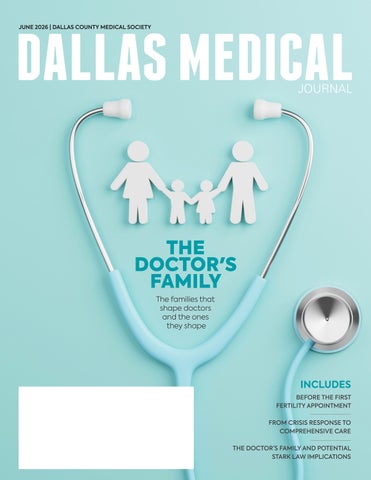
THE DOCTOR'S FAMILY The families that shape doctors and the ones they shape
INCLUDES BEFORE THE FIRST FERTILITY APPOINTMENT FROM CRISIS RESPONSE TO COMPREHENSIVE CARE THE DOCTOR’S FAMILY AND POTENTIAL STARK LAW IMPLICATIONS
JUNE 2026
Vol. 112 No. 06
EXECUTIVE VICE PRESIDENT & CEO
10
Jon R. Roth, MS, CAE
E D I TO R I A L S TA F F EDITOR, PRINT & WEB CONTENT
Stephanie Jennings
HOUSE CALL
Dallas’ Menopause Momentum
DESIGNED BY Morganne Stewart ADVERTISING DCMS Business Development
HOUSE CALL
COMMUNICATIONS COMMITTEE Ravindra Mohan Bharadwaj, MD, Chair Sumana Gangi, MD Jawahar Jagarapu, MD Dylan Jacob Kruse Ravina R. Linenfelser, DO Sina Najafi, DO Erin D. Roe, MD, MBA Katelyn Williams, MD BOARD OF DIRECTORS IN EVERY ISSUE
Gates B. Colbert, MD, President Vijay V. Giridhar, MD, President-elect Sheila Chhutani, MD, Secretary/Treasurer
03 P R E S I D E N T ’ S PAG E | 0 4 EV P/C EO L E T T E R 34 DCMS PHYSICIAN NETWORK | 36 PARTNERS PROGRAM SPOTLIGHTS
Shaina M. Drummond, MD, Immediate Past President Kimulique Harkley Allen, MD Justin M. Bishop, MD
H E A LT H A L L I E S
06
Max I. Galvan, MD Nazish Saeed Islahi, MD Benjamin C. Lee, MD Allison Moore Liddell, MD Riva Louise Rahl, MD
Before the First Fertility Appointment
LEGAL CORNER
17
The Trifecta of Health Care Fraud & Abuse Law
TECHNOLOGY
22 Deploying AI Assistants COMMUNITY
Crisis Response to 26 From Comprehensive Care
Thomas Schlieve, MD Articles represent the opinions of the authors and do not necessarily reflect official policy of the Dallas County Medical Society (DCMS) or the institution with which the author is affiliated. Dallas County Medical Society does not endorse or evaluate advertised products, services, or companies nor any of the claims made by advertisers. Claims made by any advertiser or by any company advertising in the Dallas Medical Journal do not constitute legal or
SOCIETY
18
other professional advice. You should consult your professional advisor. ©2022
Family Fun and Fellowship at the Dallas Zoo
LEGAL CORNER
The Doctor’s Family
Potential Stark 30 and Law Implications
DCMS. According to Tex. Gov’t. Code Ann. 305.027, all articles in Dallas Medical Journal that mention DCMS’s stance on state legislation are defined as “legislative advertising.” The law requires disclosure of the name and address of the person who contracts with the printer to publish legislative advertising in the DMJ: Jon R. Roth, MS, CAE, Executive Vice President & CEO, DCMS, PO Box 4680, Dallas, TX 75208-0680. Dallas Medical Journal (ISSN 0011-586X) is published monthly by Dallas County Medical Society, 140 E. 12th St., Dallas, TX 75203. (214) 948-3622. Postmaster - Send address changes to: Dallas Medical Journal | PO Box 4680 | Dallas, TX 75208-0680. Periodicals postage paid at Dallas, TX 75260 and additional post offices.
June 2026
H E A LT H A L L I E S
21
Is Your Life Insurance Stuck in the Past?
LEGAL
enforcement 33 TMB update
DALLAS MEDICAL JOURNAL | 1
Is IsYour YourOffice OfficeLease LeaseExpiring Expiring in inthe theNext Next12 12Months? Months? Don’t Don’trenew renewyour yourlease leasewithout without expert expertrepresentation! representation! Our Ourteam teamspecializes specializesininhelping helpingNorth NorthTexas Texasphysicians physicians strategically strategicallynegotiate negotiateoffice officelease leaserenewals renewalsand andprocure procure substantial substantialsavings. savings.With Withover over25 25years yearsof ofexperience, experience,we weknow know exactly exactlyhow howtotosecure securethe thebest bestterms termsfor foryour yourpractice. practice. No Nocost costto toyou you Proven Provensavings savingsthrough throughexpert expertnegotiations negotiations Trusted Trustedby byphysicians physiciansacross acrossNorth NorthTexas Texas
Let Letus usguide guideyou youthrough throughyour yourrenewal renewalprocess processand andensure ensureyou’re you’re getting gettingthe thebest bestpossible possibledeal. deal. We Weare area aproud proudPartner PartnerofofDallas DallasCounty CountyMedical MedicalSociety. Society.
PLEASE PLEASE CONTACT CONTACT EVAN EVAN REYNOLDS REYNOLDS
214.718.6777 214.718.6777
ereynolds@medicalspaceadvisors.com ereynolds@medicalspaceadvisors.com www.medicalspaceadvisors.com www.medicalspaceadvisors.com
PRESIDENT’S PAGE
The Physician’s Family or the Family’s Physician? Gates B. Colbert, MD 2026 President, Dallas County Medical Society AS PHYSICIANS, WE ARE OFTEN ASKED, “HOW DO you do so much?” Many of us regularly exceed a full-time workload, logging 50 or more hours each week, factoring in call or weekend coverage. Those in small private practices may work even longer hours, reminiscent of residency, with 80-hour weeks not uncommon. Our days are spent fully engaged in clinics, hospitals, or surgical centers, followed by charting and managing inbox messages after hours. During these times, our focus is wholly on our patients, whose lives and well-being depend on our care. Yet, today’s physicians, whether parents or grandparents, are also expected to be present and engaged caregivers for our own families. The era when doctors were always away at the hospital is no longer considered acceptable, neither by our families nor by ourselves. Increasingly, we find ourselves balancing the dual responsibilities of leading care for our own loved ones while serving as the primary medical resource for others. How can we meet the expectations of everyone who relies on us? While I do not claim to have the perfect answer, I firmly believe that physicians are uniquely equipped to excel in both professional and personal spheres. The determination and resilience required to gain admission to medical school and persevere through years of grueling residency shape us into expert multitaskers. We are trained not only to manage the routine and expected, but also to recognize and address the rare and complex. This capacity for resilience and adaptability serves us well, both at work and at home. Yet, the environments in which we now practice often overlook our human limitations. We are not inexhaustible machines or AI data centers with limitless reserves. Alarming statistics, such as a 45% physician burnout rate (Stanford Medicine, 2024) and the proliferation of physician Facebook groups seeking alternative opportunities, underscore serious challenges facing our profession. These trends reveal a widening gap between frontline clinicians and healthcare governance, highlighting the urgent need to realign values and priorities within the system. Physicians must be encouraged and empowered to set boundaries. June 2026
This is a skill we must mentor and model, as our training has rarely made us ideal examples. We are conditioned to be ever-present and tireless for our patients, earning their trust and delivering exceptional outcomes. Yet, the personal cost (sometimes called moral injury) remains significant. We often persist until we reach a breaking point, leading many to exit clinical practice or seek a new path. Clearly defining what you will accept at work and what you can genuinely commit to can help mitigate this burden. Each specialty approaches this challenge differently, but we can learn from colleagues in other healthcare professions that it is not only permissible, but essential, to seek work-life balance. Our communities need practicing physicians; a part-time doctor who stays in medicine is far more valuable than one lost to early burnout. I intentionally seek out activities that bring me peace and provide variety beyond the demands of a single career spanning decades. At this stage, with young children at home (if only for a short while), I am committed to being present in their lives and making memories together. Openly prioritizing family with my work colleagues establishes clear expectations: I give my all during shifts and call, but I also fully disengage when it is time for someone else to take over. Hobbies like distance running and home improvement projects help re-center my focus on what truly matters: my family and my patients. Serving as a healthcare advocate and volunteer, including my role as DCMS President, revitalizes my passion for the profession I worked so hard to achieve. Ultimately, understanding what creates a meaningful life for myself and my loved ones enables me to be the best doctor possible when my patients need me most. All of us are seeking balance in today’s fast-paced world, constantly pulled in multiple directions. The challenge of striving to be both Physician of the Year and Dad of the Year is a formidable one (titles I have yet to claim). Yet, I believe we are making progress as a profession by embracing more honest conversations about the significance of our roles, both within medicine and at home. I remain committed to excelling in both, refusing to relinquish either pursuit. DMJ DALLAS MEDICAL JOURNAL | 3
EVP / CEO LETTER
Two Kinds of Family Jon R. Roth, MS, CAE, Managing Editor
THIS JUNE, THE DALLAS MEDICAL JOURNAL turns its attention to family, and this year the theme carries two meanings worth holding at once. The first is the family a physician comes from, or builds within medicine itself: a parent who wore the white coat first, a mentor who became something like kin, a spouse who understands what a 2 a.m. page sounds like better than anyone else could. The second is different, and in some ways more remarkable still: the families physicians help bring into being for people who could not have had them any other way. I am not a physician myself, so I offer this edition as an outside observer of both kinds of family, one who gets to watch the house of medicine take care of its own, and take care of the rest of us in the process. Lineage is one of the oldest stories medicine tells about itself, and Dallas has its share of them. Few illustrate it as movingly as the Gray family of Baylor University Medical Center. Dr. James Gray joined Baylor’s staff in 1978 and went on to lead the department of ophthalmology. His wife, Dr. Carol Gray, arrived two years later as a pediatrician, at a time when the hospital’s medical staff was only beginning to integrate and physicians who looked like the Grays were still a rarity in Dallas hospital corridors. Their daughter, Dr. Nakia Gray Scott, grew up watching two parents practice 4 | DALLAS MEDICAL JOURNAL
medicine and became a child psychiatrist in her own right. Three physicians, one family, spanning the very years when Baylor’s doors were opening wider to Dallas. That kind of continuity does not happen by accident. It happens because someone at the dinner table made medicine look like a calling worth choosing, and because a hospital slowly became a place where that choice was possible for an entire family, not just one member of it. Families like the Grays, and many others like them here in Dallas, are a reminder that the profession does not simply train its members. It replaces itself, generation over generation, through households where the work is discussed over breakfast and the losses are absorbed together at night. Organized medicine often talks about pipeline and workforce, but the truest pipeline has always run through families who decided, more than once, that this life was worth passing down. The second meaning of this month’s theme belongs to a different kind of family altogether: the ones physicians help build. Dr. Orhan Bukulmez, chief of the Division of Reproductive Endocrinology and Infertility at UT Southwestern Medical Center, has spent more than two decades helping patients who could not conceive on their own become parents anyway. His clinic offers the full range of assisted reproductive technology, from in vitro fertilization to fertility preservation for patients about to undergo cancer treatment, and his particular contribution has been championing minimal and mild stimulation protocols that make IVF more affordable and physically gentler for women with diminished ovarian reserve. He and his June 2026
EVP / CEO LETTER
colleagues also serve LGBTQ patients seeking to build families of their own. None of that happens in a single visit. It happens across months of hormone injections, disappointment, and the particular endurance that reproductive medicine asks of patient and physician alike. In this edition, Dr. Melanie Evans of Dallas-Fort Worth Fertility Associates offers her perspective on that same work, writing about how she collaborates with primary care colleagues who are often the first to recognize when a couple needs help starting a family. Her clinical insights and referral guidance make a case worth repeating: building a family is rarely the work of one physician alone, but of a profession willing to hand a patient forward, specialty to specialty, until the answer is finally “yes.” It would be incomplete to close this editorial without naming what makes both kinds of family harder to sustain than they should be. In the profession, we still lose talented physicians and physicians in training to the incompatibility of medical training with an ordinary family calendar. Residency and fellowship consume the very years when many people are starting families of their own, and nationally, medicine has been slow to build parental leave and support mechanisms that match the hours it demands of its members. Fertility medicine carries its own challenges: insurance coverage for treatment in Texas is inconsistent and lacking. Neither problem has a clean fix. But discussing them is the first step toward solving them. These are the kinds of problems that DCMS wants to help craft solutions for, through advocacy for parental leave and fertility coverage, or support for physician members balancing training with young children at home. DCMS sees both meanings of family up close, because both show up at our own events. Physician members bring spouses and children to the summer evening at the Dallas Zoo. Medical students who are the first in their family to choose this path sit across from physician mentors at the annual Physician & Student Mixer, now in its fifty-first year, and leave with the sense that they belong here. None of that is incidental to the work of a medical society. It is the work, carried out in a lower key than legislative advocacy or continuing education, but no less essential to keeping physicians whole and keeping the profession populated with people who want to stay in it. What ties this month’s two meanings together, I think, is that neither kind of family is inevitable. The Gray family did not have to produce three physicians. Dr. Bukulmez’s patients did not have to become parents. Both outcomes required someone to do difficult, patient work over a long stretch of time, refusing to accept that the answer was simply “no.” That, when I step back and look at it, is most of what medicine actually is. There is an old saying that you plant trees whose shade you may never sit in yourself. Physicians who raise the next generation of physicians, and physicians who help build the families their patients could not build alone, are both planting those kinds of trees. DCMS is proud to stand behind every physician doing that work in Dallas County, this June and every month. DMJ
Jon R. Roth, MS, CAE DCMS EVP/CEO
June 2026
DALLAS MEDICAL JOURNAL | 5
HEALTH ALLIES
Before the First Fertility Appointment: A Field Guide for the Referring Physician by Melanie Evans, MD, Board Certified OBGYN and Reproductive Endocrinologist and Infertility Specialist, DFW Fertility Associates- Baylor Dallas location
F
ERTILITY CARE CAN BEGIN WITH A reproductive endocrinologist. Still, a patient’s initial comments or questions typically originate in a primary care setting with a physician that they already know and trust. The World Health Organization estimates that roughly one in six adults will experience infertility at some point in their lives. Additionally, the average age of a patient’s first birth is rising, and more patients are confronting questions about infertility in the exam rooms of internists, family physicians, and general gynecologists. Studies of care-seeking behavior consistently document long delays between a patient's first concern and their first REI consultation. Yet a woman’s age, which is the single strongest determinant of treatment success, does not pause during this delay. The physicians best positioned to shorten that interval are not always fertility specialists. They are the doctors who see these patients first, know them best, and can convert off-handed comments or questions into a plan. What follows is a practical guide to when a referral is warranted, what workup can begin in the primary care office, what to offer the patient who is not ready for a full consultation, why a new cancer diagnosis changes the calculus entirely, and how collaboration across specialties makes it all work.
6 | DALLAS MEDICAL JOURNAL
THE TIMELINES AND WHEN TO IGNORE THEM The conventional thresholds, endorsed by the American Society of Reproductive Medicine (ASRM) and the American College of Obstetrics and Gynecologists (ACOG), state that a woman under 35 warrants evaluation after twelve months of regular, unprotected intercourse without conception, and from age 35 to 39, the threshold drops to six months. At age 40 and beyond, evaluation should begin promptly, without any waiting period at all.1 However, the exceptions matter as much as the rule since many patients’ histories have already answered many initial questions. A more immediate referral is warranted when menstrual cycles are absent, shorter than 21 days, or longer than 35 days. Cycle irregularity often signals ovulatory dysfunction from medical conditions such as thyroid disease, hyperprolactinemia, or hypothalamic suppression, and no amount of well-timed intercourse fixes anovulation. Timely referrals are also indicated for known or suspected tubal disease (including prior pelvic inflammatory disease or ectopic pregnancy), for known or strongly suspected endometriosis, after two pregnancy losses, for any known male factor, when either partner has received chemotherapy or radiation, and when there is a family history of early menopause. Additionally, the definition of infertility itself has broadened. ASRM's 2023 revision recognizes infertility as any need for medical intervention, which includes the need for donor gametes or donor embryos June 2026
HEALTH ALLIES
to achieve pregnancy, whether as an individual or with a partner.2 For single patients and same-sex couples, there is no twelve-month clock to run out, and the right time to refer is when they are ready to build a family. Patient concern is itself also a sufficient indication. A consultation is information, not a commitment to treatment, and many first visits might end with reassurance and a plan to keep trying. Now that fertility preservation is also a widely accepted treatment modality, any patient interested in fertility preservation with either egg or embryo freezing should also be referred directly to an REI. There is no right or wrong age to start thinking about future fertility, but studies have shown that freezing eggs before age 35 has higher pregnancy rates and is more cost-effective than pursuing IVF cycles at the age of 43.3 THE WORKUP THAT CAN START IN YOUR OFFICE If the referring physician wishes, they can begin some of the initial fertility workup in their office. However, testing should not delay a referral, but if desired by the patient and physician, it can be performed in tandem to help accelerate the process. Primary care can begin with good preconception medicine: folic acid supplementation, a medication review for teratogens (ACE inhibitors, valproate, isotretinoin, and methotrexate are the usual suspects), thyroid optimization, glycemic control in patients with diabetes, confirmation of rubella and varicella immunity, up-to-date cervical cancer and breast cancer screening, and an offer of expanded carrier screening (can also be deferred to the specialist visit). The targeted laboratory work is a short list. Anti-Müllerian hormone (AMH) is the most informative single marker of ovarian reserve and can be drawn on any cycle day, which makes it the easiest to obtain. That said, an important caveat is that hormonal contraception suppresses AMH modestly, so interpretation of values in that context should be considered or rechecked after stopping oral contraceptive for at least one month. Another common misconception is that AMH does not predict a patient’s natural fecundability but rather reflects the size of the remaining follicle pool and predicts response to ovarian stimulation. In women without infertility, June 2026
AMH does not meaningfully predict the odds of conceiving within a given month.4 In a patient who presents with infertility or who is considering egg freezing, a low AMH should accelerate referral. At the same time, a normal AMH should never be used to reassure an older patient into further delay. Follicle-stimulating hormone (FSH) drawn on cycle days 2 to 4 adds information, but only if estradiol is drawn with it, since an elevated estradiol suppresses FSH and can make a concerning value look falsely normal. TSH should be included in the evaluation of irregular menstrual cycles, and prolactin levels should be checked if cycles are irregular or if galactorrhea is present. When the cycle history leaves ovulation in doubt, a mid-luteal progesterone level can be useful; a value above 3 ng/mL confirms ovulation. A patient who arrives with these results in hand can convert their first specialist visit from data-gathering into decision-making, as some of the cycle-timed testing has already been performed. However, a preliminary workup is not required for a referral, as all testing will be covered at the initial visit with a fertility specialist. THE À-LA-CARTE REFERRAL: MEETING PATIENTS WHERE THEY ARE Patients hesitate on the way to a fertility consult for multiple reasons. For many, a "fertility specialist" conjures ideas of IVF and financial burden, while others are not emotionally ready to hear what testing might show. In other cases, one partner might be on board while the other is not. The reality is often more forgiving, but perception can create a barrier that is worth working around rather than through. For the patient who is not ready for a full consultation, stepwise diagnostics preserve momentum. Semen analysis is the single highest-yield first step for the male partner, with male factor contributing in up to half of couples. The test is noninvasive and inexpensive and can be ordered through an andrology laboratory, ideally one affiliated with a fertility center where strict morphology assessment and quality control are routine.5 An abnormal result is flagged for referral, but since spermatogenesis runs on a roughly three-month cycle, multiple lifestyle factors can affect single semen parameters. A hysterosalpingogram is another option
for assessing tubal patency and the uterine cavity, and it can be ordered without a full consultation. It is scheduled in the window between the end of menses and ovulation, roughly cycle days 6 through 10, after a negative pregnancy test, with an NSAID beforehand and counseling that cramping is expected and brief. Many imaging centers accept direct orders, and fertility practices happily accept imaging-only referrals with results returned to the ordering physician. There is also the patient who is not trying to conceive at all but is wondering about their reproductive timeline while waiting for the right life circumstances. For this patient, an AMH drawn with honest counseling about its limits, plus an informational consult about planned oocyte cryopreservation, is highly recommended. Success with egg freezing is strongly age-dependent, with the best efficiency in the early thirties and younger, which is precisely why the conversation should happen before it feels urgent. Each of these steps either reassures or clarifies patients’ fertility concerns. Either way, the patient retains their autonomy, and if consultation is needed, valuable information has already been gathered, allowing counseling to start several steps ahead. CANCER AND FERTILITY: REFER ON THE DAY OF DIAGNOSIS For a young adult facing a new cancer diagnosis, "Can I still have children someday?" often arrives moments after "Am I going to survive this?" Among survivors, the absence of a fertility conversation before treatment remains one of the most consistently reported regrets in literature. The American Society of Clinical Oncology states that clinicians should discuss the risk of treatment-related infertility and options for fertility preservation with all patients of reproductive age, as well as with the parents of pediatric patients, as early as possible and before therapy begins.6 Clinicians should also promptly refer patients who are interested in or unsure about fertility preservation to specialists. The operative model is parallel rather DALLAS MEDICAL JOURNAL | 7
HEALTH ALLIES
than sequential. The fertility referral belongs alongside staging studies and treatment planning, not after them. Primary care physicians are often the first to know a diagnosis and frequently coordinate the early workup. Most REI practices maintain expedited onco-fertility pathways and will see these patients within one to three business days. The timelines are shorter than many colleagues assume. Sperm cryopreservation is often accomplished in a single visit, within the same week of referral. Oocyte or embryo cryopreservation takes roughly two weeks from start to finish because random-start stimulation protocols now allow treatment to begin at any point in the cycle. For most patients, fertility preservation can be com-
pleted without a meaningful delay in cancer therapy, but only when the referral happens early. In pediatric and adolescent populations, where the diagnosing team may be furthest from reproductive medicine, that coordination matters even more. A shared navigator or standing referral pathway between the oncology service and a fertility center can turn a scramble into a routine. The menu of options is broader than it was a decade ago. Sperm, oocyte, and embryo cryopreservation are the established mainstays. Ovarian tissue cryopreservation is no longer considered experimental and is the only option for prepubertal girls. Ovarian transposition can move the ovaries out of a pelvic radiation field. Gonadotropin-releasing hormone agonist co-treatment during chemotherapy may offer some ovarian protection, though it is an adjunct rather than a substitute for established methods. Gonadotoxic risk varies widely with different chemotherapies, but alkylating agents, pelvic radiation, and transplant conditioning regimens carry the highest risk.7 The fertility specialist and oncologist will work together to quantify the risk for an individual patient based on their history and treatment regimen. While fertility preservation is expensive, insurance coverage varies widely, and financial navigation and discounted-medication programs exist specifically for patients with cancer. The initial consultation is where patients learn what is possible, and cost should not preempt the referral. Patients who have finished treatment benefit from referrals for ovarian reserve assessment and family-building counseling, and for many survivors, pregnancy after cancer is safe with appropriate co-management and conversation between the oncologist and fertility specialist.
partner with REIs on male factor infertility. Endocrinologists help untangle thyroid and pituitary disease. Behavioral health belongs to the team explicitly as the psychological burden of infertility is substantial and underrecognized, and screening for depression and anxiety during a fertility journey is well within the primary care wheelhouse. OB-GYN colleagues can frequently manage first-line letrozole for anovulatory PCOS if they feel comfortable, with the reproductive endocrinologist as the next step rather than the first. Helpful information to include in the referral to the fertility specialist includes cycle history, laboratory and imaging reports, any operative and pathology reports, a current medication list, and a sentence about the patient's goals and concerns. If helpful, providers can also prepare the patient for what that first visit with a fertility specialist involves, including a detailed history, an ultrasound, a review of records, and a plan. It is not a commitment to IVF, and many patients need far less than they fear. The loop should close in both directions: the consultant owes the referring physician a letter, and the referring physician remains the medical home. THE DEFINING MOMENT Many patients starting their fertility journey rely initially on a physician who took their concerns and comments seriously enough to ask more questions, order more laboratory tests, and place a referral. Fertility medicine and laboratory technology continue to advance, but their outcomes are still governed mainly by timing, which can be initiated in a primary care setting. The earlier the conversation starts, the more options remain on the table, and the more likely the story ends the way the patient desires. DMJ
REFERENCES
A TEAM SPORT Beyond oncology, fertility care runs on collaboration. Maternal-fetal medicine weighs in when chronic disease or a complicated obstetric history warrants a preconception consult before conception is even attempted. Genetics enters when carrier screening or family history raises the possibility of preimplantation genetic testing for specific conditions such as cystic fibrosis and hereditary cancer syndromes. Reproductive urologists 8 | DALLAS MEDICAL JOURNAL
1. American College of Obstetricians and Gynecologists. Committee Opinion No. 781: Infertility workup for the women’s health specialist. Obstet Gynecol. 2019. 2. Practice Committee of the American Society for Reproductive Medicine. Definitions of infertility: a committee opinion. Fertil Steril. 2023. 3. Bakkensen JB, et al. A SART data cost-effectiveness analysis of planned oocyte cryopreservation versus in vitro fertilization with preimplantation genetic testing for aneuploidy considering ideal family size. Fertil Steril. 2022 Nov 4. Steiner AZ, et al. Association between biomarkers of ovarian reserve and infertility among older women of reproductive age. JAMA. 2017. 5. World Health Organization. WHO laboratory manual for the examination and processing of human semen. 6th ed. 2021. 6. H. Irene Su et al. Fertility Preservation in People With Cancer: ASCO Guideline Update. J Clin Oncol 43, 1488-1515(2025). 7. Practice Committee of the American Society for Reproductive Medicine. Fertility preservation in patients undergoing gonadotoxic therapy or gonadectomy: a committee opinion. Fertil Steril. 2019.
June 2026
ProAssurance has the experience, financial resources, and network of defense litigators you can rely on. For five decades, ProAssurance has stood alongside physicians and healthcare professionals through some of the most complex and challenging moments in medicine. We were founded during a time of profound change in healthcare liability. Since then, the industry has evolved—but our focus has remained the same. Through experience gained, cases defended, and trust earned, we have remained committed to supporting good medicine with strength and stability. As we mark our 50th year, we honor the physicians, partners, and professionals who shaped our story.
ProAssurance.com • 800-282-6242
10 | DALLAS MEDICAL JOURNAL
June 2026
HOUSE CALL
DALLAS’ MENOPAUSE MOMENTUM by Cheryl Cox Kinney, MD, FACOG, MSCP; President, The Menopause Society
D
ALLAS IS EMERGING AS A SIGNIFICANT CENTER FOR MENOPAUSE CARE, EDUCATION, AND SYSTEMS-LEVEL INNOVATION, WITH IMPLICATIONS FOR HOW CLINICIANS ACROSS SPECIALTIES MANAGE MIDLIFE WOMEN’S HEALTH. A conver-
gence of national specialty leadership, interdisciplinary academic planning, community-based programming, philanthropy, and culturally tailored public communication is creating an informal regional model that addresses long-standing gaps in knowledge, access, and care delivery related to menopause. For physicians, this represents a shift from episodic, symptom-focused encounters toward coordinated, evidencebased services that integrate menopause into broader midlife health. WHY DALLAS MATTERS NOW The current landscape in North Texas reflects a broader reassessment of how medicine approaches menopause and perimenopause. Many of us trained during an era when menopause was either minimized in formal curricula or framed primarily through the lens of risk avoidance, leaving clinicians underprepared and patients underserved. Dallas now has multiple institutions acting simultaneously to address these deficits, creating a pipeline that connects education, practice, research, access, and public engagement.
June 2026
DALLAS MEDICAL JOURNAL | 11
HOUSE CALL
Physicians from across the country gather at a meeting of The Menopause Society, where the latest research and evidence-based strategies are shared to improve menopause care. Dallas will host the Society's first Regional Meeting in 2027, further establishing the city as a national leader in midlife women's health.
Local leadership is central to this momentum. As president of The Menopause Society, I have the privilege of representing a Dallas-based clinical community at the helm of the leading U.S. professional organization devoted to menopause science and care. Around that national platform, Texas Woman’s University (TWU) is advancing interdisciplinary education and service models, the YMCA of Metropolitan Dallas is designing community-facing menopause programming, and bilingual media initiatives are expanding outreach to Hispanic women who have historically had limited access to culturally relevant menopause information. Together, these efforts position Dallas as a testbed for a more integrated approach to midlife women’s health. REBUILDING MENOPAUSE EDUCATION AFTER WHI The 2002 release of the incompletely collected and unadjudicated Women’s Health Initiative (WHI) data triggered a profound contraction in menopause education, particularly in residency programs. It led to a generation of clinicians who received limited or often no training in menopausal care. In practice, this has meant underdiagnosis, undertreatment, and persistent uncertainty among both clinicians and patients regarding the appropriate use of menopausal hormone therapy and the management of vasomotor, sleep, sexual, and mood symptoms.
12 | DALLAS MEDICAL JOURNAL
The Menopause Society has responded by building practical, scalable educational infrastructure. The Menopause Step-by-Step series consists of concise, evidence-based articles developed for medical students, residents, fellows, nurse practitioners, physician assistants, nurses, and pharmacists. These Open Access resources, supported by a Pedersen Foundation grant, are designed on the premise that competence in menopause care should not be confined to a small group of subspecialists, because midlife women present across primary care, gynecology, psychiatry, endocrinology, cardiology, oncology, and rehabilitation settings. For Dallas physicians, this educational architecture offers a ready-made framework to integrate current menopause science into routine practice. THE 2027 REGIONAL MEETING IN DALLAS The Menopause Society’s first Regional Meeting, scheduled for April 28–May 2, 2027, at the Hilton Anatole, will bring comprehensive menopause education and clinical collaboration directly to Dallas. Designed to complement the Society’s Annual Meeting, the Regional Meeting is structured to increase access to high-quality education, strengthen local professional networks, and focus explicitly on regional practice needs. Hosted in the Imperial Ballroom at the Hilton Anatole, the meeting will feature nationally recognized speakers, evidence-based plenaries, specialty-focused breakout sessions, commercial exhibits, and structured networking opportunities. Hundreds of clinicians from Texas and across the U.S. are expected to attend, creating a forum where gynecolo-
June 2026
HOUSE CALL
gists, internists, family physicians, psychiatrists, endocrinologists, and allied health professionals can engage directly with evolving best practices. Participants will gain current clinical guidance, practical implementation tools, and opportunities to build referral and collaboration pathways that can be sustained after the meeting. For the Dallas medical community, hosting this meeting is more than a point of pride; it is a catalyst. It offers an opportunity to align local practice standards with national evidence-based recommendations, to integrate menopause more fully into existing care pathways, and to position Dallas as a leading market for high-quality midlife women’s health. MAKING MENOPAUSE WORK™: BRINGING EVIDENCE INTO THE WORKPLACE A second major initiative reshaping the landscape is The Menopause Society’s first employer-focused program, Making Menopause Work™, which extends the Society’s impact beyond clinics into the workplaces where many midlife women spend most of their waking hours. The program responds to mounting evidence that unmanaged menopausal symptoms contribute to presenteeism, absenteeism, and loss of experienced talent, and that organizational policies have often lagged behind clinical knowledge. Making Menopause Work™ is designed as an implementation program rather than an awareness campaign. It provides structured tools, training, and resources for three core audiences within an organization: employees navigating the menopause transition, managers responsible for day-to-day support, and HR/benefits leaders who shape policies and programs. The goal is to create shared understanding, normalize evidence-based accommodations, and embed menopause-informed practices into the culture and infrastructure of participating employers.
PHILANTHROPY AND SCALING MENOPAUSE EDUCATION Recent philanthropic investments are accelerating the ability to deliver menopause education at scale. The Cohen Foundation of New York has provided crucial support, and, in June 2026, Pivotal announced that Melinda French Gates is committing an additional $215 million to women’s health, with a portion dedicated to reproductive and midlife health. Among these commitments is a $10 million grant to The Menopause Society to expand clinician education and outreach in areas with limited access to menopause care. These resources, supplemented by other anonymous donors, are funding digital infrastructure and a scalable training ecosystem that the Society has identified as essential to its mission. French Gates’ ties to Dallas further connect this philanthropy to local efforts, aligning national investment with regional initiatives in academic training, community programming, and specialty leadership. In practical terms, philanthropy is transforming local momentum into durable educational capacity that can serve both Dallas and underserved communities throughout Texas and beyond. TEXAS WOMAN’S UNIVERSITY: INTERDISCIPLINARY WORKFORCE DEVELOPMENT If The Menopause Society is building the national educational framework, Texas Woman’s University is helping to develop the local workforce pipeline. The Institute for Women’s Health at TWU is advancing an
THE PILOT COHORT The founding pilot cohort of Making Menopause Work™ launches on October 18, 2026, in recognition of World Menopause Day. Participation is limited to 15 organizations, with an emphasis on depth of engagement rather than rapid scale. Founding cohort members will receive hands-on support, direct access to program leadership, and opportunities to shape program evolution through structured feedback. Organizations in the pilot will have access to the full suite of educational and implementation tools, benchmarking and engagement data, and recognition as early leaders in evidence-based menopause support. For Dallas-area employers, this pilot offers a timely opportunity to align workforce strategy with the realities of an aging, female-majority healthcare and professional workforce.
June 2026
DALLAS MEDICAL JOURNAL | 13
HOUSE CALL
interdisciplinary initiative focused on menopause and midlife women’s health, integrating faculty expertise across the Dallas, Denton, and Houston campuses. This initiative reflects a commitment to research, education, and service that centers the quality of life of perimenopausal and menopausal women. TWU’s model explicitly links clinical care, community education, student training, and referral partnerships. Faculty from nursing, nutrition, physical therapy, occupational therapy, kinesiology, biology, and related fields contribute to a whole-person framework that recognizes menopause as a condition with musculoskeletal, metabolic, cardiovascular, sexual, cognitive, and psychosocial dimensions. Ongoing and emerging research targets quality of life, sleep, cardiometabolic health, self-advocacy, and culturally responsive assessment. For physicians, this interdisciplinary approach aligns with everyday clinical experience: menopause rarely presents as a single-symptom, single-specialty problem. TWU’s work provides a template for training a workforce capable of addressing complex midlife health needs across settings, and offers opportunities for collaboration in research, referral, and shared care.
CONTINUE THE CONVERSATION ON MENOPAUSE CARE The Menopause Society is expanding access to evidencebased education for clinicians and advancing best practices in midlife women’s health. EXPLORE: Clinical guidelines and educational resources The Menopause Step-by-Step learning series Information on certification and continuing education Registration details for the Society's 2027 Regional Meeting, April 28–May 2, at the Hilton Anatole in Dallas
Scan the QR code to visit The Menopause Society website and learn more about upcoming educational opportunities.
14 | DALLAS MEDICAL JOURNAL
A NEW CLINIC FOR UNDERSERVED MIDLIFE WOMEN TWU’s planning is not limited to education; it also includes the design of a first-of-its-kind perimenopause and menopause clinic in Dallas specifically focused on women with limited resources and underserved populations. The clinic is envisioned as both a care delivery site and a research platform, capable of generating practice-based evidence to inform policy and clinical guidelines. This initiative responds to a central contradiction in current menopause care: public interest and demand are rising rapidly, yet high-quality specialty services are often concentrated in concierge or self-pay models that are inaccessible to many patients. A clinic explicitly designed around underserved women reframes menopause care as a core component of equitable women’s health infrastructure rather than an optional, boutique service. From a medical education standpoint, such a clinic can serve as a high-value site for clinical training, quality improvement projects, and health services research. It can generate data on symptom burden, utilization patterns, barriers to care, and outcomes among populations underrepresented in existing menopause literature. For Dallas physicians, partnership with this clinic could enhance both patient access and the evidence base guiding midlife care. YMCA OF METROPOLITAN DALLAS: COMMUNITY-BASED SUPPORT Dallas’ menopause momentum extends beyond traditional healthcare institutions. The YMCA of Metropolitan Dallas is conceptualizing menopause-focused programming that integrates education, functional fitness, and social support within a familiar community setting. Core components under consideration include collaborating with clinical experts to deliver accessible workshops and presentations that give women practical, evidence-based guidance on symptom management and healthy aging. Functional fitness offerings would emphasize progressive strength training, bone health, mobility, and metabolic fitness tailored to the physiologic changes of the menopausal transition. A third pillar would focus on social connection and peer support, acknowledging the impact of isolation, anxiety, and stress on symptom burden and adherence. For physicians, these community-based initiatives are clinically relevant because many recommendations—resistance training, weight-bearing exercise, sleep hygiene, and stress reduction—are more likely to translate into durable behavior change when patients have structured, socially reinforced programs. Rather than competing with medical care, YMCA-based initiatives can extend and reinforce clinical counseling, particularly for patients who struggle to implement lifestyle recommendations independently.
June 2026
HOUSE CALL
BILINGUAL MEDIA AND OUTREACH TO HISPANIC WOMEN Any menopause strategy for this region must also address language and culture. In September 2025, Hispanic PR Wire reported that triple Emmy-winning journalist Gaby Natale launched Menopausia.com, a bilingual digital platform devoted to menopause and midlife health. The platform offers accessible content for Spanish-speaking and bilingual audiences, with the explicit goal of reducing informational gaps and stigma and connecting women with trusted resources. Natale has described Menopausia.com as an effort to bridge these gaps through trusted information, community, digital navigation tools, and emerging telehealth services designed to link women with qualified providers. The platform has attracted support from organizations such as Microsoft and has been profiled in outlets including Forbes and SUCCESS, reflecting growing recognition of the need for inclusive menopause education. In Dallas, where Hispanic women comprise a substantial share of the population, bilingual outreach is not ancillary— it is central to any serious attempt to improve populationlevel menopause care. While digital platforms do not replace clinical evaluation, they can increase symptom recognition, reduce shame, strengthen self-advocacy, and prompt earlier engagement with healthcare providers. For physicians, this kind of public communication can function as a meaningful adjunct to clinical services, particularly when coupled with accessible referral pathways. IMPLICATIONS FOR PHYSICIANS Taken together, these developments signal a reframing of menopause care in Dallas, from a narrow subtopic of gynecology to a core domain of midlife health that touches multiple specialties and practice settings. This reframing aligns with what most clinicians observe in practice: menopause intersects with bone health, cardiometabolic risk, sexual function, sleep, cognition concerns, mood, work performance, and psychosocial well-being.
Several implications follow for physicians in the Dallas County Medical Society: • Menopause education is moving from optional enrichment to expected competency, supported by structured resources such as Menopause Step-by-Step and The Menopause Society’s clinical materials and meetings. • Interdisciplinary collaboration is increasingly essential, as nursing, rehabilitation, counseling, nutrition, and community wellness programs become active partners in care. • Access and equity are emerging as central quality metrics, with new clinic models and philanthropic investments explicitly targeting underserved women. • Public and patient expectations are rising, and clinicians across primary care, gynecology, internal medicine, psychiatry, endocrinology, and allied fields will be asked more often to provide accurate, current menopause guidance. A REGIONAL MODEL IN FORMATION Dallas does not yet have a fully integrated menopause care system. Still, it now possesses a set of interconnected assets: national specialty leadership, a university building an interdisciplinary training and service framework, a community organization developing supportive programs, philanthropic investment in clinician education, and bilingual outreach that broadens public awareness. This constellation gives Dallas unusual potential to become a regional model for a coordinated response to midlife women’s health. For the Dallas County Medical Society, this moment offers a practical opportunity. By engaging in curriculum reform, developing referral and co-management relationships, participating in research, and incorporating structured menopause assessment and management into everyday practice, local physicians can help determine whether the current momentum evolves into a durable standard of care. The need is clear, the infrastructure is growing, and Dallas is increasingly positioned not only to follow the national menopause conversation, but to help lead it. DMJ
DR. CHERYL COX KINNEY is a Dallas-based, board-certified gynecologist whose consultation practice focuses on routine and complex perimenopausal and menopausal care. She is a longstanding member of the Dallas County Medical Society and serves as the 2025–2026 President of The Menopause Society. Her term has been dedicated to improving menopause education for those in training and in practice.
June 2026
DALLAS MEDICAL JOURNAL | 15
THIS IS AN ADVERTISEMENT
RELIABLE PARTNER + PRACTICAL SOLUTIONS For over 55 years, Hall Render has been exclusively devoted to the health care industry. When faced with a challenge, you can be confident knowing we’ve likely seen it before. Our experience allows us to quickly and efficiently address today’s issues and tomorrow’s unknowns.
LOCAL, EXPERIENCED, READY TO HELP.
Divenna Chamblee
Christie Davis
Keith Dugger
Brandon Kulwicki
Rachelle Madison
Bill Ouska
Chandani Patel
James (Mac) Stewart
Let’s get started. Visit hallrender.com/dallas or call (214) 615-2000.
LEGAL CORNER
The Trifecta of Health Care Fraud & Abuse Law: Stark, Anti-Kickback Statute, & The False Claims Act by Brandon Kulwicki and Rachelle Madison, Attorneys with Hall, Render, Killian, Heath & Lyman, P.C. & Kelsey Linzell, Summer Associate with Hall, Render, Killian, Heath & Lyman, P.C.
H
E A LT H C A R E I S A H E AV I LY R E G U L AT E D sector with many potential legal implications for providers. There are three laws, the Stark Law, Anti-Kickback Statute, and False Claims Act, that are the primary enforcement mechanisms used by the federal government. Each law has its own unique requirements and applications. But one thing remains the same, a violation under one of these laws can have serious consequences for a provider. Below is a quick overview of each law and how it could impact providers. Stark Law1: The Stark Law only applies to physicians and is invoked when a physician refers a Medicare or Medicaid beneficiary to a designated health entity where the physician or their family member has a financial interest. Stark is a strict liability law meaning intent does not matter when determining liability. There are two primary types of financial interests: 1) compensation; and 2) ownership or investment interest. Even when a financial relationship exists, it may be permitted to refer a patient if it meets one of the many exceptions. Anti-Kickback Statute (“AKS”)2: The AKS is a broader statute that applies to more providers and is invoked when the provider knowingly and willfully receives “remuneration” to induce referrals. It is a criminal statute that analyzes intent when determining liability. Under AKS, there are safe harbors that a provider may fall under to permit a referral and limit liability. Because it is a criminal statute that involves intent, even if a provider does not explicitly fall under a safe harbor, the referral may still be permitted. False Claims Act (“FCA”)3: The FCA is the primary statute the federal government uses to go after fraud. It applies to many sectors, including health care. Essentially, the FCA prohibits the submission of June 2026
false claims for payment from federal programs. In the health care context, this includes submission of payments to Medicare or Medicaid for services not rendered, unnecessary services, etc. Under the FCA, filing false claims may result in up to three times the programs’ loss plus additional treble damages per claim.4 Therefore, it can get expensive quickly when a claim is brought against a provider under the FCA. All three statutes are distinct but work together. Given that one action may trigger liability under multiple laws, providers should remain vigilant and seek guidance from health care counsel to mitigate risk. DMJ This article is educational in nature and is not intended as legal advice. Always consult your legal counsel with specific legal matters. If you have any questions or would like additional information about this topic, please contact Brandon Kulwicki at (214) 615-2025; Rachelle Madison at (214) 6152062; or your primary Hall Render contact. Brandon Kulwicki and Rachelle Madison are attorneys with Hall, Render, Killian, Heath & Lyman, P.C., a national law firm focused exclusively on matters specific to the health care industry. Please visit the Hall Render Blog at blogs.hallrender.com for more information on topics related to health care law.
REFERENCES 1. 42 U.S.C. § 1395nn. 2. 42 U.S.C. § 1320a-7b(b). 3. 31 U.S.C. § § 3729-3733. 4. U.S. Dept. Health & Hum. Servs, Fraud & Abuse Laws, https://oig.hhs.gov/compliance/ physician-education/fraud-abuse-laws/.
DALLAS MEDICAL JOURNAL | 17
SOCIETY
18 | DALLAS MEDICAL JOURNAL
June 2026
SOCIETY
An Evening of Family Fun and Fellowship at the Dallas Zoo This spring, Dallas County Medical Society members and their families gathered for one of DCMS’s most anticipated family events, DCMS Evening at the Dallas Zoo. Set against the backdrop of the zoo’s Giants of the Savanna habitat, the event offered a memorable evening filled with fellowship, family activities, animal encounters, and opportunities to connect with colleagues outside of the clinical setting. Guests enjoyed exclusive after-hours access to the Zoo, beginning with optional early entry, allowing families to explore the grounds before the private DCMS gathering officially began. As attendees arrived, they were welcomed to an evening designed to celebrate community and to provide physicians and their loved ones with an opportunity to relax together in a fun, casual environment. Throughout the evening, families took advantage of a variety of activities. Children delighted in face painting, glitter tattoos, and photo booth experiences, while guests of all ages enjoyed giraffe feeding opportunities. The event also featured opportunities to visit sponsor tables, enter raffles, and enjoy dinner and refreshments while overlooking one of the Dallas Zoo’s most popular exhibits. The event exemplified the importance of creating opportunities for physicians and their families to build relationships beyond the workplace. Whether reconnecting with longtime colleagues or introducing children to friends and peers from the medical community, attendees experienced an evening centered on family, camaraderie, and shared experiences. THANK YOU TO OUR SPONSORS
Events like Evening at the Dallas Zoo are made possible through the generosity of our sponsors. Their support helps DCMS continue to provide meaningful opportunities for members and their families to connect, engage, and strengthen our medical community. We extend our sincere appreciation to our sponsors: • Envision Imaging – Face Painting Activity Sponsor • Frost Bank – Glitter Tattoo Sponsor • Southwest Diagnostics – Photo Booth Experience Sponsor Dallas County Medical Society would like to extend its thanks to our sponsors, volunteers, staff, and attendees for helping make this year’s Evening at the Dallas Zoo a wonderful success. We look forward to creating even more opportunities for fellowship, family fun, and community engagement in the years ahead. DMJ
June 2026
DALLAS MEDICAL JOURNAL | 19
HEALTH ALLIES
Is Your Life Insurance Stuck in the Past? by TMA Insurance Trust
M
ANY PHYSICIANS PURCHASE LIFE insurance early in their careers, during residency or the first few years of practice, when it is typically most affordable. Once in place, however, it may remain unchanged for years. Yet life does not stand still. Coverage that once aligned with your circumstances may no longer reflect the responsibilities you carry today. To remain effective, life insurance should reflect your current needs—not those that existed when your policy was first established. If your income disappeared tomorrow, would your family truly have what they need? THE EARLY YEARS: PROTECTING THE FOUNDATION In the first years of practice, physicians often carry significant financial obligations. As medical school loans enter repayment and families begin to grow, financial responsibilities start to take shape. It is also common for loans to be co-signed by a spouse or parent, tying them to those debts until the balances are cleared. During this stage, life insurance serves as essential protection. It helps ensure that those closest to you are not left responsible for outstanding debts and that your family’s financial foundation remains intact, even in the absence of your income. THE GROWTH YEARS: NEW FINANCIAL PRESSURES As life evolves, a physician’s financial picture often becomes more complex. A growing household, practice ownership, or partnership can introduce new long-term commitments. Many physicians also find themselves supporting children while helping coordinate care for aging parents. Inflation and higher interest rates may increase household expenses. In addition, employer-provided insurance may not follow a physician when the physician transitions between roles or moves into private practice. These expanding responsibilities place greater demands on income, and with costs rising, inflation may also mean that a life insurance benefit purchased years earlier no longer covers the same expenses it once did. Over time, a policy established earlier in life may simply no longer reflect the full scope of your family’s and professional obligations, making a periodic coverage review an important part of thoughtful planning.
June 2026
THE ESTABLISHED YEARS: SUSTAINING THE LEGACY Later in life, many of the financial obligations that once depended on income may begin to decline. Mortgages and student loans are often paid down, children become financially independent, and personal savings and accumulated assets may take on a greater role in supporting the household. Because term life insurance is designed to align with specific periods of financial responsibility, the need for coverage may decrease as those obligations are fulfilled. This shift often reflects financial progress and increased independence. At the same time, some physicians choose to maintain coverage to continue providing for a spouse or to help preserve the financial legacy they have built over a lifetime. Recognizing that needs continue to evolve, TMA Insurance Trust works with a carrier that offers term life insurance for physicians into their 70s, subject to underwriting. OBJECTIVE GUIDANCE FOR TEXAS PHYSICIANS Life insurance should reflect your current circumstances, not a past stage of life. There is no single formula for the right amount. It depends on your financial commitments and the people who rely on you. For decades, TMA Insurance Trust has helped Texas physicians evaluate their life insurance coverage as their needs evolve. Because advisors do not receive sales-based commissions, their guidance remains objective and centered on helping physicians determine what is appropriate for their individual situation. DMJ To speak with a TMA Insurance Trust advisor about your life insurance needs, call 800-880-8181, Monday through Friday, 8:00 AM to 5:00 PM CST.
DALLAS MEDICAL JOURNAL | 21
TECHNOLOGY
Deploying AI Assistants as “Digital Staff” in Medical Practice by Joseph H Schneider, MD, MBA
W
hen it comes to artificial intelligence (AI) in medicine, some physicians might feel
inundated with headlines claiming that AI can do as well as or better than us in clinical decision-making, automatically match clinical trial volunteers, or serve as the new default for patients asking medical questions. This article introduces a framework for classifying AI capabilities and explores how "Level 2" AI assistants can be deployed as "digital staff" to streamline practice
operations
and
increase
personal productivity.
22 | DALLAS MEDICAL JOURNAL
June 2026
TECHNOLOGY
Part I: The Five Levels of Generative AI (“Gen AI”) "Generative AI" (e.g., ChatGPT) can be mapped into five levels of complexity and autonomy. Recognizing these levels allows practice leaders to choose the right tool to fit the task. LEVEL 1: Simple Queries (Beyond A "Smart Search"). At its baseline, GenAI serves as a direct, factual retrieval mechanism. When prompted, it answers questions and handles data retrieval, seemingly much like a search engine. Example: A family physician can ask a Level 1 AI tool to draft a 500-word patient handout at a fifth-grade reading level explaining XYY syndrome and what to expect for parents of a newborn baby boy. The tool rapidly creates a handout with sections on physical development, learning, and support that will be needed without requiring the physician to comb through text links and compose the document. The drawback is that while you can refine the answer by entering new prompts, the interaction ends once you’ve got what you want. The other drawback is that Level 1 queries are more prone to hallucinations/fabrications because the tool uses whatever information it has available to it, including misinformation. LEVEL 2: AI Assistants (Domain Experts). Here’s where GenAI takes a major leap forward, shifting from a query tool into a conversational partner that you manage and reuse without having to repetitively provide instructions through a prompt. You create these assistants through special tools built into subscription-based GenAI systems that limit the GenAI tool to using only knowledge sources that you specify, such as American Academy of Pediatrics (AAP) guidelines or your office human resource policies and procedures. You access assistants through a shareable link that starts a special GenAI session that uses all the power of GenAI but is limited in the information that it can use to develop answers. Assistants, because they are restricted in what knowledge they can access, are less likely to have fabrications/hallucinations. The tool can even be instructed to respond “I don’t know the answer” when the question is beyond the scope of the knowledge it has been instructed to use. Example: A pediatrician has built the Future is Bright based on AAP guidelines and educational material they have prepared for parents in the past. It provides easy-to-understand answers about childcare for parents that used to require sending links or making telephone calls. Because the link is accessible through the office website, it offers a much more patient-friendly approach.
June 2026
LEVEL 3: Integrated Tools (Enhancing The Workflow). Level 3 puts AI directly into software applications that clinicians and administrative staff use every single day. Operating quietly within standard office suites (e.g., Microsoft 365 Copilot, Google Workspace, NotebookLM), it drafts content, summarizes large documents, and analyzes complex spreadsheets. Example: At this tier, the AI tool acts as an embedded text and data processing engine. A Level 3 tool can instantly summarize an exhaustive 40-page pediatric hospital discharge summary into a three-sentence brief for an outpatient follow-up or automatically parse clinic scheduling spreadsheets to identify patterns in patient no-show rates. LEVEL 4: Autonomous Agents (Independent Operators). Level 4 represents a profound shift where the AI tool transitions from a passive writing or analysis assistant into a functional partner capable of executing tasks on your behalf. It can execute tasks, take goal-oriented actions, manage multistep workflows, and make decisions within predefined guardrails. Example: Instead of simply writing a prior authorization letter (Level 2 or 3), a Level 4 agent can log into an insurance portal, review the patient's EHR chart to gather the necessary diagnostic codes and lab results, attach the supporting documentation, submit the request, and update the clinic tracking log, potentially all without human intervention unless an exception occurs. Yes, this is scary. Only do this if you absolutely know what you are doing or have professional help. LEVEL 5: Apps, Coding, & Webpage Development (The Innovators). At this level, GenAI shifts from a consumer of software to a creator of software. It can generate computer code, build dynamic websites from scratch, and develop complex software applications via plainEnglish instructions. Example: Historically, if a pediatric practice wanted a custom mobile application to help families track asthma exacerbations or log insulin data, it required hiring software engineers and spending lots of money. At Level 5, a physician-informatician can describe the application's required parameters, logic, and interface in plain English, and the AI will generate the functional software architecture automatically.
Part II: Demystifying the Technology – How LLMs Pay "Attention" To safely use GenAI tools, physicians need a baseline understanding of how they work. A common misconception is that these models "think" or understand medical concepts the way humans do. In reality, LLMs are advanced statistical prediction engines driven by a breakthrough architecture known as the Transformer. Consider a simple linguistic example "John wants his bank to cash the _____". A human reading this instantly knows that "bank" refers to a financial institution and that the missing word is likely "check". A Transformerbased LLM achieves this same conclusion through a mathematical mechanism called “Attention.” The model parses every word in the sentence, analyzing the relationship between them. It notes that the verb "cash" heavily weights the meaning of "bank" toward a financial repository rather than, for example, the bank of a river or what you do in a game of pool. By performing these calculations, the model predicts the most likely next word or phrase (a “Token”). When we prompt an AI tool to generate text or draw a picture based on contextual sentences, it isn't pulling from a deep pool of conscious understanding; it is executing Token prediction based on the patterns it learned during training. Understanding this behavior helps explain why generic, unconstrained GenAI models sometimes fabricate/hallucinate plausiblesounding yet entirely inaccurate information. It also underscores why Level 2 Custom AI assistants are so vital for professional practice: they restrict the model's statistical calculations to an approved, highly verified data sandbox.
DALLAS MEDICAL JOURNAL | 23
TECHNOLOGY
Part III: Building Your Custom AI Assistants
Part IV: Additional Examples
Custom AI assistants can serve as a "digital staff" member that is structurally different from open-ended web searches and can be explicitly tied to your specific information, e.g., your practice’s guidelines.
To see how this framework operates in practice, here are several examples deployed by innovative clinicians:
The Four Pillars of the "Digital Staff" Support System Level 2 assistants can be customized to optimize four core operational domains within a medical practice: Here are some examples: HR Policy Navigation Practical Use Case: Instant parsing of complex practice handbooks regarding leave, benefits, and compliance. Impact on Practice: Eliminates manual document searching for staff and ensures uniform rule enforcement. Staff Onboarding Practical Use Case: Guided introduction to clinic systems, scheduling rules, and standardized phone-screening workflows. Impact on Practice: Speeds up time-to-productivity for new receptionists or medical assistants. Training Support Practical Use Case: Delivery of interactive training modules, practice quizzes, and customized skills assessments. Impact on Practice: Facilitates continuous compliance education and continuous learning. Internal Knowledge Management Practical Use Case: Converting dense, multi-page clinical operations manuals into an instantly searchable FAQ database. Impact on Practice: Significantly reduces operational interruptions and administrative time. The Five-Step Implementation Cycle Building a secure Level 2 assistant typically follows these steps: 1. Define & Scope: Clearly describe the purpose, boundary limits, and what success will look like for the assistant. Is it designed for frontdesk staff navigating billing policies, or clinical staff checking internal equipment protocols? How will it (and you) measure its success? 2. Gather & Curate Data: Collect the source materials that will form the assistant’s entire operational worldview. This might include your practice’s handbooks, structured triage protocols, or onboarding checklists. Investing a small amount of time to clean these up before using them can reap benefits later. 3. Configure & Train: Upload these documents into a secure platform (like a private version of Microsoft Copilot or a Custom GPT workspace). Provide strict behavioral instructions: “You are an internal clinic operations assistant. You may only answer questions using the uploaded documents. If the answer cannot be found in the text, you must state: 'I am sorry, but I cannot find that information in our clinic policy manual.'” 4. Test & Deploy: Test the assistant using common and not-so-common operational questions. Asking ridiculous questions can help safety-proof it. Get feedback from some users, refine the system instructions based on real-world behavior, and establish ongoing oversight before rolling it out practice-wide.
Case Study 1: AI Vendor/Tool Vetting A major challenge for medical practices is vetting AI vendors. The Texas Medical Association (TMA) originally addressed this by creating the TMA AI Evaluation Tool, an Excel spreadsheet with over 70 questions designed to evaluate clinical relevance, data privacy, regulatory validation, and integration feasibility. While thorough, manually completing this spreadsheet for every AI tool represents a significant hurdle for a busy practice. To solve this, a Level 2 assistant named MediAI Evaluator was constructed. By uploading the TMA Evaluation Guide alongside peer-reviewed frameworks like A Systematic Guide to Vetting AI in Clinical Practice, the Excel tool was converted into an interactive, guided conversational experience. Rather than using a blank spreadsheet, a clinician or practice manager engages in a structured dialogue with the assistant. It asks targeted questions such as how the vendor handles data privacy, whether the product complies with Texas-specific regulations, and what clinical problem it is intended to solve. It then creates a summary that highlights potential risks, operational gaps, and critical follow-up questions. This shifts an administrative chore into a repeatable, actionable, conversational workflow designed for clinicians and office staff rather than data scientists. Case Study 2: Educational Assistants The Future is Bright assistant was built by Dr. Mark Simonian to serve as a specialized guide for child development. Rather than allowing the model to pull advice from unverified blogs across the internet, its knowledge base is explicitly locked to trusted medical resources from the American Academy of Pediatrics (AAP) and HealthyChildren.org. Parents can interact with it to ask questions about developmental milestones or behavior and receive warm, professional guidance that aligns with evidence-based pediatric guidelines. Case Study 3: Practicing Bad News Delivery Dr. Phil Bernard, chair of the TMA HIT-AI Committee, developed an assistant for Delivering Bad News to help residents and other clinicians practice sensitive communication techniques. Case Study 4: Water Safety in Texas The Texas Swim Lesson Guide was developed by Dr. Mark Simonian as an example of how a GenAI tool can be expanded. Dr. Simonian provides a similar tool for California and, when requested, was able to build a tool for helping parents find water safety classes in the 50 largest Texas counties. TMA AI Evaluation Tool
MediAI Evaluator
Future is Bright
5. Frequently Monitor: GenAI tools can “drift” over time based on user interactions with them. Periodically review and refresh the assistant to ensure it’s still following the instructions you gave it.
Delivering Bad News
24 | DALLAS MEDICAL JOURNAL
Texas Swim Lesson Guide
June 2026
TECHNOLOGY
Part V: A Practice Assistant - Maximizing Personal Productivity The value of Level 2 AI assistants extends far beyond your clinic. A prime example of personal optimization is constructing a family digital travel assistant. Think of this as a personalized, highly organized digital concierge designed specifically for a busy professional who has zero bandwidth for logistical planning. By following the implementation steps above, you can create a tool you can use whenever you plan a trip. To do this, you probably will need a basic subscription to a GenAI tool. Define and Scope (The "Intake Form")
To build an effective personal assistant, you first establish clear boundaries and parameters, essentially creating a digital intake form. It might look like this: You then feed the tool your explicit constraints (these are examples): Destination & Dates: Tell the tool to query you for this each time you use it. Budget & Style: Moderate budget; highly walkable locations. Pacing Constraints: Avoid long travel days; limit to a maximum of one major activity per day; factor in toddler nap schedules. Provide the output format you want, e.g., a trip summary, core assumptions, flight and hotel options, a daily timed itinerary, and potential Logistics & "Stress Points to Watch." Gather and Curate Data
Part VI: Guardrails, Governance, and Ethical Boundaries While the opportunities are vast, deploying
Travelers: Two adults, one toddler (age 2).
GenAI tools requires strict professional
Provide Nap Times
boundaries. When utilizing AI assistants,
Instruct the tool on what travel information to use (e.g., Rick Steve’s)
remember the following:
After you have done this, complete the rest of the implementation steps: 3) Configure
Data Confidentiality: Never put Protected
& Train; 4) Test and Deploy; and 5) Frequently Monitor
Health Information (PHI) or Personally
The true efficiency of a Level 2 assistant emerges over time through its ability to retain profiles. Once you have established your family's travel profile (e.g., preferred airline alliances, hotel preferences, child constraints, pace tolerances), you can instruct the tool to save these preferences for future use. Months later, your interaction can be as brief as a single sentence: “Please use my saved travel preferences to design a 4-day
Identifiable Information (PII) into unencrypted or public AI models. When building assistants, avoid uploading sensitive information such as passport numbers or credit card details.
trip to Tucson.” The assistant will instantly recall your exact constraints, preferences,
Maintaining Accountability: Level 2
and needs to deliver an itinerary that fits what you want. It can also offer optional
assistants are advisory tools, not final
adjustments, such as mapping seasonal weather shifts or converting the plan into a
authorities. Every policy summary, training
clean, printable PDF.
question, or patient education handout generated should be reviewed by a qualified human eye before deployment. Restrict Agents: While it can be tempting to let tools handle administrative automation, avoid allowing GenAI tools
Conclusion: Planting Trees for the Future of Medicine
to execute financial transactions or
The rapid integration of GenAI tools into society can feel overwhelming,
to aggregate options but keep the final
but it also provides a unique opportunity for clinical leadership. As clinical
execution firmly in human hands.
bookings autonomously. Use the assistant
informaticians and medical leaders, our responsibility is to guide our practices safely into this new era. There is an ancient Greek proverb that perfectly captures the spirit of professional leadership and informatics mentorship: "A society grows great when old men plant trees whose shade they know they shall never sit in." By designing, testing, safely deploying, and sharing Level 2 AI assistants today, we are doing more than just reducing our immediate paperwork. We are planting the operational seeds for a medical ecosystem that can be much better than we have today.
June 2026
This article synthesizes frameworks, case studies, and implementation data presented by Jawahar Jagarapu, MD, MS (Associate Professor of Pediatrics, Vice Chair of Pediatrics – Texas Health Dallas) and Joseph H. Schneider, MD, MBA (Assistant Professor, Pediatrics & Clinical Informatics, UT Southwestern Dallas, TX) at the TexMed 2026 conference. Additional materials were generously provided by Mark M. Simonian, MD, FAAP. Google’s Gemini tool was used to help prepare this article.
DALLAS MEDICAL JOURNAL | 25
COMMUNITY
From Crisis Response to Comprehensive Care: Forty Years of Community Health in North Texas by Prism Health North Texas
F
OR FORTY YEARS, Prism Health North Texas (PHNTX) has been a cornerstone of care in the Dallas metropolitan area, transforming from a grassroots HIV/ AIDS response into a Federally Qualified Health Center Look-Alike (FQHCLAL) that now provides comprehensive primary care, HIV prevention and treatment, behavioral health, dental, pharmacy, women’s health, and pediatric services. Established in 1986 as the AIDS ARMS Network, a volunteer-mobilized, case-management collaborative, PHNTX has grown to serve more than 17,000 patients annually through multiple clinical sites. Tracing that trajectory illuminates both the organization's growth and the shifting landscape of care delivery in urban Texas: from crisisera case management to research-active, multi-specialty community healthcare with documented contributions to FDA-
26 | DALLAS MEDICAL JOURNAL
approved HIV pharmacotherapy and an enduring clinical focus on populations bearing disproportionate disease burdens. AIDS ARMS NETWORK ORIGINS The HIV/AIDS epidemic arrived in Dallas as it did in most American cities: suddenly, destructively, and largely without coordinated institutional response. Against that backdrop, local health leaders and advocates established the AIDS Assistance and Resource Management System, or AIDS ARMS, Network in 1986 through support from the Community Council of Greater Dallas and the Robert Wood Johnson Foundation. The organization launched as a mobile response team operating from a single Oak Lawn Avenue office with five staff members and a $300,000 operating budget, dedicated to providing dignified, compassionate care to as many individuals as possible at the height of the crisis. Founding Executive Director Warren “Buck” Buckingham helped establish a coalition of twelve partner agencies to coordinate medi-
cal and social support at a moment when both were scarce, stigma was high, and the city’s healthcare infrastructure had no established pathway for patients with AIDS. AIDS ARMS Network’s founding model was deliberately asset-based and coalitionoriented, reflecting the reality that no single institution could meet the breadth of need. Then known as “care coordination,” case management served as the organization's central function: connecting patients with housing, income support, transportation, and available clinical resources. In 1989, AIDS ARMS Network achieved 501(c)(3) nonprofit status, formalizing the infrastructure it had built through direct community practice. BUILDING A CLINICAL INFRASTRUCTURE Through the 1990s, AIDS ARMS Network evolved to meet advancements in HIV/AIDS treatment, resulting in maturation of the organization and expansion of life-saving proJune 2026
COMMUNITY
GROWING TO MEET THE COMMUNITY'S NEEDS The following years brought multiple acquisitions and program expansions to better serve the needs of PHNTX patients and the Dallas community:
2019 • Acquired Uptown Physicians Group, introducing primary care services and expanding PHNTX’s scope beyond HIV-focused medicine for the first time. • Partnered with Equitas Health to offer pharmaceutical services directly to patients.
2020 • Expanded telehealth infrastructure during the COVID-19 pandemic, ensuring care continuity amid widespread disruptions in Dallas. • Absorbed most STI testing from Dallas County, alleviating demand during the pandemic. • CEO Dr. John Carlo provided expert commentary in numerous media interviews, raising awareness of PHNTX’s experience in infectious disease and community health.
grams. In 1991, the LifeWalk 5k fundraiser was established to sustain its HIV services in Dallas for more than three decades, with an annual celebration still occurring in the 2020s. In 1993, AIDS ARMS became formally incorporated as AIDS Arms Inc., and by 1998, services had expanded to include medical case management, a meaningful step toward more direct clinical engagement. The early 2000s opening of the Peabody Health Center signaled a pivotal transformation for the organization, shifting its focus from primarily social services to a comprehensive clinical care provider. Behavioral health counseling, recovery services, and community outreach programs reflected an early and clinically sophisticated understanding of the social determinants of health that would later underpin the FQHC model. By the mid-2000s, AIDS Arms Inc. had become one of North Texas’ leading community-centered HIV care organizations. ORGANIZATIONAL TRANSFORMATION FROM AIDS ARMS INC TO PRISM HEALTH NORTH TEXAS The organization’s clinical footprint expanded substantially in the decade following the opening of its first health center in 2006. The next location, what would eventually be renamed the Oak Cliff Health Center, opened in 2011, expanding access to clinical care in this highneed community. In the years that followed, psychiatric care services were introduced, along with a dedicated facility adjacent to the Oak Cliff Health Center focused on prevention, education, and empowerment programming for people living with HIV. These additions strengthened an integrated care model that recognized HIV as a chronic condition,
one requiring not only virological management but also psychiatric, behavioral, and social stabilization for the patient population. AIDS Arms Inc. was formally rebranded as Prism Health North Texas in 2017. This deliberate change signaled an expanded mission scope and coincided with the relocation and expansion of the Peabody Health Center, now known as the South Dallas Health Center, to a larger facility with an onsite laboratory. These developments demonstrate the organization’s commitment to maintaining a clinical anchor in one of Dallas’s highest-need neighborhoods. FQHC LOOK-ALIKE DESIGNATION After a years-long application process and strategic expansion of service lines from 2017 to 2022, PHNTX was designated a Federally Qualified Health Center Look-Alike (FQHC-LAL) in late 2024. FQHC-LALs must meet the same comprehensive primary care and preventive health standards as fully-funded FQHCs and serve all patients regardless of insurance status or ability to pay, operating on a sliding-fee scale, a model well-aligned with PHNTX’s founding mission to provide essential care to those who need it. The designation accompanied a substantive expansion of clinical services: primary care for all adults, women's health, and pediatric care were formally integrated into PHNTX's service portfolio in 2024 and 2025. Pediatric care and
2022 • Acquired Community Dental Care of Texas, integrating oral health into the care model via three dental practices in underserved zip codes. • Addressed a longstanding gap in clinically significant oral care for immunocompromised and medically underserved populations by expanding access to affordable dental services.
June 2026
DALLAS MEDICAL JOURNAL | 27
COMMUNITY
THE NUMBERS BEHIND THE MISSION The organization’s most recent publicly reported data reflect the depth of its community impact; within a single operating year, PHNTX:
64,000 medical visits provided
$393,000 in insurance navigation assistance
1,000 distributed meals to foodinsecure patients
919 transportation vouchers issued
200 grocery gift cards to patients in need
women’s health specialty providers with experience in community health care joined as dedicated providers, extending care to two of the most vulnerable populations within the communities PHNTX has historically served. The organization now operates across multiple clinical sites with a team of licensed professionals across medicine, dentistry, pharmacy, and behavioral health. The designation as an FQHC-LAL is a testament to PHNTX’s commitment to providing comprehensive and affordable healthcare services to underserved populations. A lack of primary care services has been a persistent issue in many parts of Dallas County, leading to increased hospitalizations, higher rates of chronic diseases, and poorer health outcomes overall. PHNTX’s decades of experience caring for high-need populations facing multiple barriers to care, with limited resources and complex care 28 | DALLAS MEDICAL JOURNAL
plans, have primed it to serve Dallas County as an FQHC-LAL. At the time of its designation, the addition of its facilities represented a 35% increase in community healthcare sites, bringing Dallas County closer to the nearly 100 sites in Harris County. The FQHC-LAL designation is especially valuable to Oak Cliff and South Dallas, including zip code 75210, where Dallasites have a 15+ year life expectancy discrepancy compared to central-city zip codes, where access to care, nutritious food, and other resources is limited. PHNTX operates two health centers, each equipped with on-site laboratories and pharmacies. These facilities have been specially refitted to accommodate adult primary care and women’s healthcare services alongside pediatric care, reflecting PHNTX’s commitment to serving these high-need, often underserved communities. The providers pride themselves in providing high-quality, culturally comprehensive, and accessible care across the lifespan, for those living with HIV and beyond. CLINICAL RESEARCH CONTRIBUTIONS & GRANT-FUNDED INNOVATION In addition to administering the latest pharmacotherapy treatments and accompanying case management and resource support for HIV and AIDS to its patients, PHNTX has participated in groundbreaking clinical research to make these treatments possible since its early days. In 2006, the Peabody Health Center became a network Clinical Research Site (CRS) for the National Institutes of Health’s AIDS Clinical Trials Group (ACTG), a global network conducting research to improve the management of HIV and its comorbidities and to develop a functional cure. 2026 marks 20 years of membership in this group, embedding PHNTX in the world’s preeminent HIV clinical trials infrastructure and providing its patient population with access to investigational therapies unavailable through standard-of-care channels. In addition to the NIH ACTG network, PHNTX began research partnerships with pharmaceutical companies in 2007, broadening its scope to industry-sponsored trials across HIV and other communicable diseases, which PHNTX still hosts today. PHNTX’s clinical research program has made direct contributions to the literature on antiretroviral and antiretroviral-adjacent medi-
cations currently in clinical use, including Cabenuva, Trogarzo, Dovato, and Sunleca. The availability of these treatments represents a paradigm shift in HIV treatment and prevention. They address adherence barriers that have historically constrained viral suppression in high-need populations. During the SARS-CoV-2 pandemic, PHNTX leveraged its established research infrastructure as part of the NIH-supported COVID-19 Prevention Network (CoVPN) to enroll participants in the Phase III AZD1222 (Oxford-AstraZeneca) vaccine trial. Dr. Roger Bedimo, then Director of NIH-Sponsored Clinical Trials for PHNTX, noted that the organization was "uniquely positioned to successfully conduct COVID-19 vaccine studies due to the robust research infrastructure we have established over the last thirteen years as a clinical research site within the NIH's HIV research network." PHNTX specifically prioritized enrollment from communities disproportionately affected by COVID-19, including African American, Latinx, American Indian, and Alaskan Native populations, consistent with its broader equity mission. The Clinical Research Program operates alongside an active Community Advisory Board (CAB) composed of individuals with lived experience relevant to HIV research, treatment, and prevention. Prism Health North Texas is involved in advancing care at every level, from on-the-ground observation of patient needs and behaviors to clinical research and development of new treatments, and finally to implementing advancements in patient care. Over the last four decades, PHNTX has proven itself to be an optimal candidate for specialized grant funding that supports various care service lines, clinical research, and innovative programs. In 2026, PHNTX received $400,000 in funding from the Gilead Foundation’s Community Health Worker (CHW) Comprehensive HIV Prevention Initiative, a $12 million investment supporting community-based organizations across fourteen states and the District of Columbia. PHNTX's two-year award targets HIV and STI prevention, testing, and treatment specifically for Black and Latina women in Dallas County, a population experiencing rising HIV infection rates compounded by persistent stigma around sexual healthcare. The CHW model funded through this grant aligns with evidence from the literature on community-based health June 2026
COMMUNITY
worker interventions in underserved populations. Research shows that when prevention services are delivered by trusted community members, rather than solely through clinical encounters, there are significant improvements in testing uptake, linkage to care, and PrEP initiation. The funding also reflects an important epidemiological shift: while gay and bisexual men continue to constitute the majority of new HIV diagnoses nationally, the rate of new infections among Black and Latina cisgender women in urban settings, including Dallas, represents an under-addressed transmission vector that warrants targeted clinical and public health investment. LOOKING FORWARD WITH THE WISDOM OF THE PAST In 2026, its 40th anniversary year, PHNTX operates as a community healthcare organization offering a broad range of services. Its portfolio includes adult and geriatric primary care, LGBTQ-affirming care, women’s gynecologi-
cal and reproductive health services, well-child and pediatric primary care, and comprehensive HIV care, including PrEP initiation and management, long-acting injectable PrEP, and ART administration. These figures are not incidental to clinical care; they represent the social stabilization infrastructure that makes sustained treatment adherence possible in populations facing intersecting socioeconomic vulnerabilities. The arc of PHNTX's institutional history reflects a broader pattern in North Texas community health: organizations founded in crisis, sustained by community trust, and iteratively expanded by clinical evidence, federal policy levers, and strategic leadership. Since the days of the AIDS ARMS Network’s mobile response teams in 1986, PHNTX has evolved into an FQHC-LAL that, by 2026, delivers integrated care across HIV, primary care, behavioral health, dental, women’s health, and pediatrics. Throughout this transformation, PHNTX has shown that community-centered organizations
can achieve clinical sophistication and make meaningful contributions to biomedical research, while still upholding the equity commitments and community trust established at their founding. For providers practicing in the Dallas metropolitan area, PHNTX represents a capable and well-resourced referral and co-management partner for patients living with HIV, patients who may benefit from PrEP, patients from LGBTQ communities, and uninsured or underinsured patients requiring primary care. The organization's forty-year trajectory, clinical research record, and expanding service portfolio reflect an institution that has grown to match the complexity of need it was established to address. DMJ For clinical referral or research collaboration inquiries, contact Prism Health North Texas at 214-521-5191 or visit phntx.org.
Genuine Care. Molecular Precision. Advanced PET/CT Imaging PET
CT
RESEARCH
• North Texas leader in PET/CT since 2003 • Specialized training in Molecular Imaging and Oncology • ACR-Accredited PET facility • Quick scheduling and shorter wait times for quick, accurate results Schedule Your Next Appointment Today!
June 2026
DALLAS MEDICAL JOURNAL | 29
LEGAL CORNER
The Doctor’s Family and Potential Stark Law Implications by Brandon Kulwicki and Rachelle Madison, Attorneys with Hall, Render, Killian, Heath & Lyman, P.C. & Kelsey Linzell, Summer Associate with Hall, Render, Killian, Heath & Lyman, P.C.
T
HE STARK LAW (STARK), also referred to as the federal Physician SelfReferral Law, is not only implicated by a physician’s actions but also by actions of their immediate family members.1 To avoid potential Stark violations, physicians must be aware of any financial relationships their immediate family members have with health care entities to which the physician may refer patients. Under Stark and with limited exceptions, a physician is prohibited from referring a Medicare or Medicaid beneficiary for a designated health service (DHS)2 to an entity with which they or an immediate family member has a financial interest.3 Because Stark is a strict liability statute, intent does not matter. If a financial relationship exists, Stark is likely implicated. The only way a physician may refer to an entity where they or an immediate family member maintains a financial interest is if it falls under one of the Stark-enumerated exceptions.4 This article examines which family members are implicated under Stark, differentiates between the two categories of financial relationships, and identifies potential exceptions that may permit otherwise prohibited referrals. WHO QUALIFIES AS AN “IMMEDIATE FAMILY MEMBER” UNDER STARK? Stark defines a physician’s immediate family member as a “husband or wife; birth or adoptive parent, child, or sibling; stepparent, stepchild, stepbrother or stepsister; father-inlaw, mother-in-law, son-in-law, daughter-in-law, brother-inlaw, sister-in-law; grandparent or grandchild; and spouse of a grandparent or grandchild.”5 If a physician’s family member falls under one of those categories and has a financial relationship with a health care entity, then that financial relationship is attributed to the physician, and the physician may not refer Medicare or Medicaid patients to that entity for the performance of designated health services. If a patient is not enrolled in Medicare or Medicaid, there
30 | DALLAS MEDICAL JOURNAL
is no prohibition under Stark; however, some states have what are referred to as “mini-Stark” laws that apply to a broader range of insurers, so a physician should be careful to understand whether the referral may be restricted by other laws or regulations. WHAT IS A “FINANCIAL RELATIONSHIP” UNDER STARK? A “financial relationship” exists when a physician or family member has a compensation or ownership relationship with the health care entity. This can be a direct or indirect relationship and is not exclusive to monetary benefits. Therefore, if the physician or family member exchanges anything of value with the health care entity, it could be deemed a financial relationship. Financial relationships are broken into two categories under Stark: 1) compensation and 2) ownership or investment interest.7 A compensation arrangement exists when there is direct or indirect remuneration between a physician or their immediate family member and the DHS entity.8 This benefit can be in the form of cash or in-kind and can include both formal contracts and informal arrangements. Some examples of a compensation arrangement are employment contracts (i.e., salary or bonus), independent contractor or consulting agreements, medical director services, and free or discounted office space, equipment, or supplies. Because of the expansive definition of what constitutes a compensation arrangement, it’s important for physicians to be aware of any relationship they or their immediate family members have with a health entity. An ownership or investment interest means June 2026
LEGAL CORNER
the physician or their family member has a stake in the DHS entity.9 This includes stock or partnership shares and debt interests tied to the entity’s revenue. Essentially, if the physician or their family member receives any benefit tied to the DHS entity’s equity, it can qualify as an ownership or investment interest under Stark. There can also be indirect ownership or investment interests, meaning if the relationship exists in an entity that likewise has an ownership interest in the DHS provider, it may also trigger application of the Stark Law. An example is a physician investing in a holding company that owns a laboratory. Even though the investment is made in a non-health care entity, such as the holding company, it constitutes an indirect ownership interest because there is an unbroken chain of ownership between the physician and the DHS entity (in this case, the physician – holding company – laboratory). WHAT ARE EXAMPLES OF STARK EXCEPTIONS? As mentioned above, physicians can avoid Stark liability and may refer Medicare or Medicaid beneficiaries to an organization in which they or a family member have a financial interest when the referral falls within an exception.10 Exceptions are divided into categories based on whether the financial relationship is compensation-based or ownership-based. Three common exceptions for compensation arrangements are the Personal Service Arrangements exception,11 the Nonmonetary Compensation exception,12 and the Fair Market Value Compensation exception.13 If a compensation arrangement falls under one of these exceptions, the physician may proceed with the referral of a Medicare or Medicaid patient, despite triggering Stark. • The Personal Service Arrangements exception applies to independent contractor relationships and allows a physician to be paid for bona fide services under a written agreement containing fair market value/commercially reasonable compensation that does not change with the volume or value of the referrals.14 Essentially, if the compensation does not fluctuate due to the number of referrals made to the DHS entity, and the arrangement is in writing and is fair market value and commercially reasonable, the exception may be met. • The Nonmonetary Compensation exception allows a physician or physician’s immediate family member to receive nonmonetary benJune 2026
efits, such as entertainment, meals, certain continuing medical education, and other non-cash equivalent benefits.15 There is an annual cap on the amount of nonmonetary compensation permitted, and the compensation must not take into account the volume or value of referrals from the physician or the physician’s immediate family members. Additionally, the physician or physician’s immediate family member may not solicit the compensation. • The Fair Market Value Compensation exception protects compensation paid by a DHS entity to a physician, or vice versa, if it is in writing, contains a specified time period, details the compensation that will be provided, and is commercially reasonable.16 Three common ownership exceptions are the In-Office Ancillary Services exception,17 the Rural Providers exception,18 and the Whole Hospitals exception.19 If an ownership arrangement falls under one of these exceptions, Stark may not be implicated. • The In-Office Ancillary Services exception is one of the most common exceptions for group medical practices. It permits physicians to refer patients to their own practice or an immediate family member’s practice as long as the referring physician is part of a qualifying “group practice,” the DHS is provided in an appropriate location, the DHS is furnished by or under the supervision of an appropriate physician, and the practice submits one bill.20 Interestingly, the In-Office Ancillary Services exception also protects certain compensation arrangements between the referring physician and the group practice. • The Publicly Traded Entity exception allows referrals to a DHS entity in which the physician or an immediate family member has an ownership interest if that interest consists of securities that are publicly traded and available on the open market at the time of the referral. The securities must be listed on a qualifying exchange or trading system with daily published quotations and issued by a corporation with
stockholder equity exceeding $75 million. If these conditions are met, the Stark exception may apply.21 • The Whole Hospitals exception permits the referral of Medicaid or Medicare patients to a hospital where they or an immediate family member have an ownership interest if the referring physician is authorized to perform services at that hospital, the ownership or investment interest is in the hospital itself, and the hospital was open before March 23, 2010.22 CONCLUSION A physician’s family member may lead to the application of the Stark Law to a physician if the physician is not careful. If the family member’s relationship meets the threshold to be deemed a financial relationship under Stark, regardless of whether it is a compensation or ownership arrangement, the referral by the physician of a Medicare or Medicaid patient to that entity for DHS services may not occur, unless the arrangement meets an exception. There are many exceptions, some of which are detailed in this article. If a physician is concerned about potential implications of Stark, they should reach out to an attorney for additional guidance. DMJ This article is educational in nature and is not intended as legal advice. Always consult your legal counsel with specific legal matters. If you have any questions or would like additional information about this topic, please contact Brandon Kulwicki at (214) 615-2025; Rachelle Madison at (214) 615-2062; or your primary Hall Render contact. Brandon Kulwicki and Rachelle Madison are attorneys with Hall, Render, Killian, Heath & Lyman, P.C., a national law firm focused exclusively on matters specific to the health care industry. Please visit the Hall Render Blog at blogs.hallrender.com for more information on topics related to health care law.
REFERENCES 1. 42 C.F.R § 411.350. 2. Designated Health Services (DHS) are a defined set of 12 categories of Medicare-payable health care items and services that trigger Stark Law referral restrictions, prohibiting physicians from referring patients to entities with which they (or an immediate family member) have a financial relationship unless an exception applies. The most common DHS categories include clinical laboratory services, imaging services,
physical and occupational therapy services, outpatient prescription drug services, and durable medical equipment (DME) and supplies. 3. Id. at 42 C.F.R § 411.350. 4. See § 411.356, 411.357. 5. § 411.351. 6 .§ 411.354 (a). 7. § 411.354 (b), (c). 8. § 411.354(c). 9. § 411.354 (b). 10. See § 411.356, 411.357. 11. § 411.357 (d).
12. § 411.357 (k). 13. § 411.357 (l). 14. § 411.357 (d). 15. § 411.357 (k). 16. § 411.357 (l). 17. § 411.355 (b). 18. § 411.356 (c)(1). 19. § 411.356(c)(3). 20. § 411.355 (b). 21. § 411.356 (a). 22. § 411.356(c)(3).
DALLAS MEDICAL JOURNAL | 31
Free FreeCME, CME,quick quickcourses coursesand and 3-minute 3-minutecase casestudies studies24/7. 24/7.
Join Join your your peers peers who who have have completed completed more more than than 1 million 1 million free free continuing continuing medical medical education education (CME) (CME) courses courses with with Texas Texas Health Health Steps Steps Online Online Provider Provider Education. Education. Choose Choose from from over over 5050 CME CME courses courses developed developed byby Texas Texas experts experts forfor experts experts like like you. you. Topics Topics include include Medicaid Medicaid guidelines, guidelines, ethics, ethics, mental mental health health and and more. more. Quick Quick courses, courses, case case studies studies and and resources resources are are also also available available 24/7. 24/7.
Learn Learnmore moreatatTXHealthSteps.com TXHealthSteps.com Content Content on the on the Texas Texas Health Health Steps Steps Online Online Provider Provider Education Education website website hashas beenbeen accredited accredited by the by the Texas Texas Medical Medical Association, Association, American American Nurses Nurses Credentialing Credentialing Center, Center, National National Commission Commission for Health for Health Education Education Credentialing, Credentialing, Texas Texas State State Board Board of Social of Social Worker Worker Examiners, Examiners, Accreditation Accreditation Council Council for Pharmacy for Pharmacy Education, Education, andand TheThe University University of Texas of Texas Health Health Science Science Center Center at San at San Antonio Antonio Dental Dental School School Office Office of Continuing of Continuing Dental Dental Education. Education. Continuing Continuing education education for multiple for multiple disciplines disciplines will will be provided be provided for some for some online online content. content.
LEGAL
TMB enforcement update: What you need to know by Wayne Wenske, Senior Marketing Strategist, Texas Medical Liability Trust (TMLT)
T
H E T E X A S M E D I C A L B OA R D ( T M B) I S required by law to review and address every complaint it receives from the public regarding physician conduct — from reports of unprofessional conduct, inappropriate prescribing, poor record-keeping or violations of the standard of care. In March 2026, the TMB announced “refinements” to its enforcement of board complaints. These changes are based on a comprehensive internal review that offered solutions to reduce administrative burdens and less punitive, aggressive sanctions for minor offenses. The TMB is trying to amend its responses to minor violations so it can focus resources on more serious patient safety concerns. The TMB now uses the following two non-disciplinary resolution tools to address minor or isolated violations. 1. Warning letters are “non-disciplinary in nature and provide an informal resolution for … administrative matters such as billing, failure to release medical records, and continuing education audit violations.”1 Warning letters are non-disciplinary and non-public and are not reported to the National Practitioner Data Bank (NPDB). However, they are still added to the physician’s confidential TMB record. The warning letter will give the recipient a deadline to correct the issue and report back. If the licensee provides documentation that corrective action was taken, the complaint is dismissed. Warning letters are only available for first-time violations (no prior warning letter, remedial plan, or agreed order for the same issue). They essentially replace Remedial Plans for minor first-time administrative infractions and are designed to facilitate less paperwork and a faster resolution. 2. Letters of Concern are also non-disciplinary by nature and used to resolve certain standard of care issues, specifically those that do not involve severe patient harm or death; sexual boundaries; or allegations involving physician impairment. It's a formal acknowledgment of a violation that is determined to be an isolated, limited-harm incident. June 2026
Letters of concern are only issued after a full review process is carried out, including initial review by a physicianinvestigator; formal response from the physician licensee regarding the allegations; and a final review by an outside expert panelist of all documents. If a violation fits the parameters set forth for this resolution tool, the physician receives a letter of concern. The letter of concern will indicate that the TMB has chosen not to pursue further action but encourages the licensee to “closely review the care provided in the case, reflect on the experts’ findings outlined in the panelist report, and use it as opportunity to evaluate their current practices to prevent similar issues in the future.”1 The letter confirms that the complaint has been dismissed; however, the file remains a part of the physician’s confidential TMB record. A letter of concern may also recommend, but not require, continuing medical education activities relevant to the complaint. The person(s) or entity that brought the complaint is also allowed to appeal the dismissal and request further investigation. Both tools were designed by the TMB to be part of a “progressive discipline model” that tracks and documents a licensee’s history to determine patterns of behavior. Repeat violations may escalate to a Remedial Plan or Agreed Order. DMJ Policyholders with Texas Medical Liability Trust (TMLT) are encouraged to contact TMLT's Claim Department at 800-5808658 if in receipt of a complaint notice or letter from the TMB, including a warning letter or letter of concern.
REFERENCES 1.
Zaafran S. Refining TMB enforcement. The Bulletin. Texas Medical Board. March 2026. Available at https://www.tmb.texas.gov/media/1320/download?inline. Accessed April 28, 2026.
Reprinted with permission from Texas Medical Liability Trust (TMLT).
DALLAS MEDICAL JOURNAL | 33
PHYSICIAN NETWORK
The Physician Network Continuing Education Compliance
Plastic Surgery
CE Broker - Compliance with Confidence
Patrick H. Pownell, MD, FACS
Easily understand your specific CME requirements and compliance status, find and take renewal-ready courses, and report your course completions directly to the Texas Medical Board for a hassle-free renewal.
Certified, American Board of Plastic Surgery
Benefits: Find, complete, and report approved CME; View your forever course history; Take CME on the go with the free mobile app; Access to 24/7 support and more!
Plastic and Reconstructive Surgery Dallas Office 7115 Greenville Ave. Ste. 220 (214) 368-3223 Plano Office 6020 W. Parker Road, Ste. 450 (972) 943-3223 www.pownell.com
www.cebroker.com
Advertising Index Dallas County Medical Society (DCMS) does not endorse or evaluate advertised products, services, or companies nor any of the claims made by advertisers. Claims made by any advertiser or by any company advertising in the Dallas Medical Journal do not constitute legal or other professional advice. You should consult your professional advisor.
34 | DALLAS MEDICAL JOURNAL
June 2026
PHYSICIAN NETWORK
Ophthalmology & Otolaryngology Linda L. Burk, MD Jane E. Gilmore, MD Ophthalmology (214) 987-2875
Premium Cataract Surgery Glaucoma Treatment Cornea Disease Diabetic Eye Exams Optical Shop Multifocal Cataract Implants 1703 N. Beckley Ave. Dallas, TX 75203
John R. Gilmore, MD Otolaryngology (214) 361-5285
Sinus Disease Balloon Sinuplasty Ear, Nose & Throat Disorders Facial Plastic Surgery Hearing Loss & Hearing Instruments
10740 N. Central Expy., Ste. 120 Dallas, TX 75231
Ophthalmology Diseases and Surgery of the Retina and Vitreous Robert E. Torti, MD Santosh C. Patel, MD Henry Choi, MD Steven M. Reinecke, MD Philip Lieu, MD, FASRS 1706 Preston Park Blvd., Plano, TX 75093 | (972) 599-9098 2625 Bolton Boone Drive, DeSoto, TX 75115 | (972) 283-1516 1011 N. Hwy 77, Ste. 103A Waxahachie, TX 75165 | (469) 383-3368 18640 LBJ Fwy., Ste. 101 Mesquite, TX 75150 | (214) 393-5880 10740 N. Central Expy., Ste. 100 Dallas, TX 75231 | (214) 361-6700
www.DallasEyeAndEar.com
www.retinaspecialists.com
Ophthalmology
Fertility Specialists
Retina Institute of Texas, PA Vitreous and Retina Diagnosis and Surgery www.retinainstitute.com Maurice G. Syrquin, MD Marcus L. Allen, MD
Gregory F. Kozielec, MD S. Robert Witherspoon, MD
3414 Oak Grove Ave. Dallas, TX 75204 | (214) 521-1153 Baylor Health Center Plaza I 400 W. Interstate 635, Ste. 320 Irving, TX 75063 | (972) 869-1242 3331 Unicorn Lake Blvd. Denton, TX 76210 | (940) 381-9100 1010 E. Interstate 20 Arlington, TX 76018 | (817) 417-7769
Dallas-Fort Worth Fertility Associates Growing Family Trees Since 1999 www.dallasfertility.com
Plastic Surgery
Samuel Chantilis, MD Karen Lee, MD Mika Thomas, MD Ravi Gada, MD Laura Lawrence, MD Jennifer Shannon, MD Monica Chung, MD Melanie Evans, MD Dr. Jennifer Chae-Kim
Bryan H. Pruitt, MD, FACS Certified, American Board of Plastic Surgery Aesthetic Plastic Surgery
Dallas: 5477 Glen Lakes Drive, Ste. 200, Dallas, TX 75231, 214-363-5965
8315 Walnut Hill Lane, Ste. 125, Dallas, TX (214) 363-6000
Baylor Medical Pavilion: 3900 Junius Street, Ste. 610 Dallas, TX 75246, 214-823-2692
www.DrPruitt.com
Medical City: 7777 Forest Lane, Ste. D–1100 Dallas, TX 75230, 214-692-4577
Dallas County Medical Society
Southlake: 910 E. Southlake Blvd., Ste. 175 Southlake, TX 76092, 817-442-5510
Same-Day Appointments Available
ADVERTISE YOUR PRACTICE HERE! (817) 966-0235 | partners@dallas-cms.org www.dallas-cms.org
June 2026
Plano: 6300 W Parker Road, Ste. G26
DALLAS MEDICAL JOURNAL | 35
SPOTLIGHTS
ENVISION RADIOLOGY WAS FOUNDED IN 2000 WITH our first center in Colorado Springs, Colorado. Because of the immediate success of our first center and relationships we had in other markets, we expanded into Oklahoma in 2002, Denver and Dallas/ Fort Worth in 2003, and Louisiana in 2004 and Utah in 2022. Over the years, we have built a strong brand, and we’re still growing! Our mission is “To improve lives through unmistakable quality and spectacular service”. Our employee-owners are passionate about enhancing the health and quality of life for our patients. We serve our patients and their families with humility, empathy, and compassion. Not only will your imaging procedure be completed by technologists who care about you, but it will also be completed using the latest technology available in this field. One of Envision Radiology’s founding partners set a guiding principle that still is the foundation of our company culture when he said, “If we do the right things, in the right way, for the right reasons, we will succeed.” The values that we live by reflect this principle. Physician and Patient Services: We are proud to provide the following services: MRI/MRA; CT/CTA; Ultrasound; X-Ray; PET/CT; Nuclear Medicine; Mammograms; Bone Density; Neuroscience: DaTscan, DTI, SWI, Neuroquant; along with additional specialty tests.
MEDICAL SPACE ADVISORS IS THE FOREMOST provider of healthcare tenant representation services in Texas when you want to lease or buy medical office space. We also specialize in helping medical tenants strategically negotiate office lease renewals. We have helped numerous health care systems, group practices, and solo practitioners since our founding in 2001. We understand your unique space requirements and the challenges associated with operating in an evolving and highly regulated industry. These space requirements have ranged from highly technical clean rooms and sterile compounding laboratories to a small clinic space in a retail strip center. Medical Space Advisors manages every aspect of the leasing or buying process, including demographic and competition analysis, extensive market research, and strategic negotiations to ensure that we secure the most optimal real estate for your specific requirements. We entirely represent your interests in the process, and our fee is paid by the building owner. Please contact Evan Reynolds to learn more about our services at 214.718.6777 or ereynolds@medicalspaceadvisors.com.
Physicians can connect with us in various ways, and we provide an online portal for reports and image viewing. The Physician Access Link (PAL) allows our referring physicians to: • Schedule patients online from any internet browser and check on scheduling status • Access images and reports for your patients seen at our centers through Images Anyware or our PACS • View Images and reports on any tablet or smartphone • Receive alerts via text or email when reports, images, and STATs are ready We invite you to visit one of our conveniently located imaging centers to experience our hospitality and expertise and to see for yourself why we are the market leaders in quality of care and patient satisfaction! For more information, please visit our website at www.envisionimg.com to see how we are making a difference.
36 | DALLAS MEDICAL JOURNAL
June 2026
The Greatest Financial Cost Could Be Your Unprotected Income Don’t pay the ultimate price for not being protected — secure member-exclusive long term disability insurance rates that fit your budget.
Price shouldn’t be the reason your income goes unprotected. We understand the financial pressures physicians face, which is why the TMA Member Long Term Disability Insurance plan, issued by The Prudential Insurance Company of America, is priced to be accessible. It’s a valuable investment that provides added peace of mind that your income is more secure.
By choosing a plan built for Texas physicians, you can get: • “Own-Specialty” coverage for your medical specialty with 25% member savings • $5,000/month to cover your tax gap with simple underwriting - no income verification • No offsets; your benefit is paid in full even if you receive benefits from other sources • Partial/Residual benefit, allowing you to practice and receive benefits • Higher benefit amounts are available with simplified underwriting
Whether you’re just starting your career or looking to fill a coverage gap, our affordable rates make putting this vital protection in place possible today. Don’t wait to realize that the most “expensive” policy is the cost of not having your income better protected.
Ready to get started? Scan the QR code or call us at 800-880-8181. Our advisors are available to help you find the right protection Monday through Friday, 8:00 AM to 5:00 PM CST.
SCAN TO CALL
TMA Member Long Term Disability coverage is issued by The Prudential Insurance Company of America, a Prudential Financial company, Newark, NJ. The Booklet-Certificate contains all details, including any policy exclusions, limitations, and restrictions, which may apply. Contract Series: 83500 1090295-00001-00
These hands carry more than instruments, they carry hope. Through long hours, difficult choices, and endless questions, you bring care to the world. We make sure you can keep doing it, with confidence. Get a quote at svmic.com