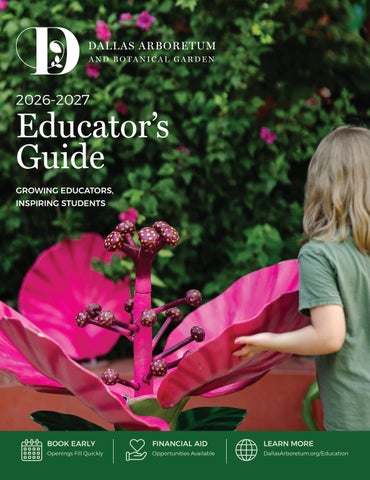
2026-2027
Educator’s Guide GROWING EDUCATORS, INSPIRING STUDENTS
BOOK EARLY
Openings Fill Quickly
FINANCIAL AID
Opportunities Available
LEARN MORE
DallasArboretum.org/Education
Welcome Educators iscover a place where nature and science come together at the Dallas Arboretum. Explore the beauty of the Main Garden and experience the one-of-a-kind Rory Meyers Children’s Adventure Garden, featuring 17 interactive STEM-focused galleries and more than 150 hands-on exhibits that spark curiosity and inspire learning. The Dallas Arboretum offers a variety of standards-aligned educational programs led by highly trained educators. Choose from interactive gallery lessons, classroom labs, outdoor learning experiences, outreach programs, after-school residencies, and academic overnights that bring science to life in the garden and in the classroom. Educators can also take advantage of year-round professional learning opportunities featuring hands-on workshops, innovative teaching strategies, and ready-to-use classroom resources. Custom workshops are available at the Arboretum or on your campus. More than a beautiful garden, the Dallas Arboretum is a living classroom where curiosity grows and learning comes to life.
Did You Know? The Dallas Arboretum is proud to participate in the Museums for All program, offering $3 daytime admission for guests with SNAP benefits.
REGISTER AND LEARN MORE
All currently employed PreK-12 educators in Dallas, Collin, Rockwall, Kaufman, Tarrant and Denton counties receive Buy-One-Get-One-Free (BOGO) admission at the Dallas Arboretum with valid teacher ID.
CONTENTS
The Dallas Arboretum also serves scouts, youth programs, and homeschool groups with custom programming including workshops, outreach and overnights!
2
DALLASARBORETUM.ORG
3
SELF-GUIDED VISITS AND MAIN GARDEN PROGRAMS
4
LEARNING GALLERY PROGRAMS
6
CLASSROOM LABS AND OUTREACH PROGRAMS
11
OTHER EDUCATION PROGRAMS
12
FIELD TRIP GUIDELINES
13
PRICING | FINANCIAL AID
14
PROFESSIONAL LEARNING
15
RORY MEYERS CHILDREN’S ADVENTURE GARDEN MAP
16
THANKS TO OUR DONORS
PROGRAMS IN THE MAIN GARDEN NATURE’S WORKS OF ART K–6th Grade Students complete three stations investigating the beauty and wonder of trees and flowers that have enchanted artists for centuries. An Arboretum educator leads students on an investigation to explore color, shape and texture in nature and highlights the necessary artistic skills in a variety of jobs at the Arboretum. CHRISTMAS VILLAGE GUIDED TOUR K–2nd Grade
Take a trip around the world this winter without leaving Texas! Explore the Arboretum’s Christmas Village while students learn about winter traditions from across the globe that have found their way to Texas. Discover traditional food and music, as well as cultural meanings of winter flowers and plants from our state and beyond. Connect with your favorite winter traditions this year at the Dallas Arboretum. Offered November 11 ‒ December 18
OUR PLACE AT YOUR PACE Explore, Discover, and Learn On Your Own Schedule Reserve a self-guided visit for an educational group and experience the Dallas Arboretum at a pace that works best for your students. Explore the interactive Rory Meyers Children’s Adventure Garden and the beauty of the Main Garden while reinforcing classroom learning through hands-on discovery. Reservations include admission to both gardens, field trip resources, and self-guided activities that encourage students to observe, investigate, and connect with the natural world. 2 0 2 6 – 2 0 2 7 E D U C ATO R ’ S G U I D E
3
RORY MEYERS CHILDREN’S ADVENTURE GARDEN Learning Gallery Programs Reserve an instructor-guided gallery program that brings science to life in the amazing and interactive outdoor museum and garden. Reservations include pre- and post-visit resource guides and access to the entire garden. All content is customized for your specific grade level needs.
THE GLADE Pre K–K The Glade is home to the puppet theater that invites guests to enjoy fun songs, dramatic characters and educational tales inspired by happenings in nature. After the show, the stories come to life in the plants, animals and insects found throughout the garden. LITTLE SPROUTS SQUIRREL ADVENTURE Help Nuts the Squirrel find a new home. This interactive program focuses on the changing seasons and animals’ habitat needs. Students listen to a big book story about the life of a squirrel and engage with characters in an outdoor puppet show. Offered August ‒ December LITTLE SPROUTS BUTTERFLY ADVENTURE What will happen to Cathy Caterpillar? This fun, interactive program brings metamorphosis to life with a big book story about the butterfly life cycle and an outdoor puppet show. Offered March ‒ May
LIVING CYCLES 1st–3rd Grade This program explores growth and change in living organisms. Students compare traits of adults and their offspring, examine the role of pollinators, observe decomposers in action, and explore methods of seed dispersal and pollination. 4
DALLASARBORETUM.ORG
HABITATS
AT HOME IN THE WILD K–2nd Grade All living things need a place to call home! In this program, students explore the basic needs of plants and animals and discover what makes a healthy habitat. Then, they venture along the gallery’s Discovery Trail Loop to investigate a specific animal and learn what it needs to thrive in its environment. TREE TREK 3rd–6th Grade Trees are amazing! In this program, students discover how scientists study trees and investigate what these organisms need to live a long life in a woodland ecosystem. Students walk through the gallery’s Discovery Trail Loop to explore how trees provide shelter and food to other organisms and discover how trees are adapted to survive in changing habitats.
KALEIDOSCOPE 2nd–6th Grade Students will investigate shapes and patterns found in nature and connect mathematical concepts to the world around them through hands-on activities and gallery exploration. They will identify how structures and functions help plants and other organisms survive in their environment and explore how we use patterns and shapes as inspiration for our designed world.
T E K S C O R R E L AT I O N S – See website for complete listings Process Skills
Matter, Energy & Motion
Earth
Space
Life
PLANTS ARE ALIVE K–2nd Grade PUMPKIN POWERED In this seasonally-spiced program, students learn the differences between living and nonliving things and explore the structures and functions of a pumpkin plant. Each class receives pumpkin seeds to take back to school for planting and observation. Don’t miss the breathtaking pumpkin display in the Main Garden before or after your program. Offered September 21 ‒ October 30 ROOT TO FRUIT How do we know that plants are alive? In this program, students learn about living and nonliving things through hands-on activities. Students explore the gallery to investigate the similarities and differences between the same parts of different plants and share their findings.
EARTH CYCLES WONDERS OF WEATHER K–2nd Grade Curious about the weather? Students use tools such as a wind sock, thermometer and rain gauge to collect data and observe current conditions. They’ll apply their findings to real-world decisions and explore how seasonal weather patterns impact the garden. EARTH FROM SPACE 2nd–6th Grade Life on Earth is dominated by regular and repeating patterns. In this program, students explore the connections between the seasons, moon phases, shadows and planets through hands-on demonstrations and a focused activity in the gallery. DYNAMIC EARTH 3rd–6th Grade Earth is constantly changing. In this program, students investigate real rock samples and observe natural processes at work using an interactive stream table. A focused activity encourages discovery of the dynamic, natural world as students explore the gallery.
MOODY OASIS PATH TO POLLEN 2nd–6th Grade In this program students take on the roles of honeybees and flowers to act out the process of pollination and explore the interdependent relationship between these organisms. Students closely examine honeybee specimens and flowers to better understand how flowers attract pollinators and how honeybees gather nectar and pollen.
PURE ENERGY 3rd–6th Grade In this engaging program, students explore renewable energy and how energy is transferred through hands-on investigation. They compare different forms and sources of energy, collaborate to build a living circuit, and work in small teams to collect and analyze data at solar, wind and water energy stations, discovering how renewable resources can power our world.
OMNIGLOBE PLANETARY VOYAGE 2nd–5th Grade Travel through the solar system in the Globe Theatre. During this program, students view 360 degree imagery of the planets through NASA satellite views projected on the five-foot-tall OmniGlobe. They discover what makes each planet unique, including our irreplaceable planet, Earth. MONARCH MANIA 2nd–6th Grade The Arboretum’s certified Monarch Waystation provides an ideal setting to explore monarch butterflies and other pollinators. Students use the OmniGlobe to follow monarch migration patterns, discover their remarkable life cycle and learn how people can help support their survival. They may even spot monarchs in the garden. Peak times: mid October and late March INTO THE UNIVERSE 7th–8th Grade Students explore the solar system, including stars, planets, moons, meteors, asteroids and comets. They examine the conditions that support life, consider the possibility of life beyond Earth and compare the Milky Way with other galaxies.
TEXAS NATIVE WETLANDS 3rd–8th Grade
In this hands-on program, students use scientific tools to test water samples and identify key indicator species to evaluate wetland health. Through field investigations in the outdoor island classroom, they explore interactions between organisms and their environment that help maintain a balanced, thriving ecosystem. 2 0 2 6 – 2 0 2 7 E D U C ATO R ’ S G U I D E
5
CLASSROOM LABS AND OUTREACH PROGRAMS
At the Arboretum Explore life and earth science through an engaging, hour-long classroom experience led by Arboretum educators. Reservations include admission to the Garden.
On the Go These engaging, instructor-led lab experiences bring hands-on science directly to your classroom for up to 30 students per session, inspiring curiosity through active learning.
Classroom Resources Every program includes a pre- and post-visit resource guide designed to reinforce key concepts and extend learning beyond the experience. PUMPKIN CIRCLE K–2nd Grade
Students distinguish between living and nonliving things before exploring the basic needs, parts, and life cycle of pumpkin plants. Through hands-on activities, they discover how pumpkins grow from seed to harvest and plant their own seeds to take back to the classroom for observation. A visit to the Arboretum’s nationally acclaimed Pumpkin Village brings the lesson to life.
SEEDSATIONAL K–2nd Grade Students explore the fascinating world of plants by classifying living and nonliving things and investigating the basic needs, parts, functions, and life cycles of plants. They discover how fruits protect and disperse seeds while observing the diversity of plants found throughout the garden. Each student plants a seed to take back to the classroom and observe its growth firsthand.
Offered September 21 ‒ October 30
Offered February 22 ‒ May 21
EARTH ROCKS! K–2nd Grade Young geologists explore the fascinating world of rocks through hands-on observation and investigation. Students examine a diverse collection of rocks, sorting them by size, shape, color, and texture while discovering the unique properties of each. They also investigate everyday products made from rocks and minerals, making real-world connections between geology and daily life. WHAT’S FOR DINNER? K–2nd Grade
Like all ecosystems, the Arboretum is a complex and active place, filled with interconnected organisms. In this lab, students explore small but significant members of our ecosystem: pill bugs. Students observe terrariums with live organisms to investigate living and nonliving things, basic needs of organisms and energy transfer in food chains.
6
DALLASARBORETUM.ORG
T E K S C O R R E L AT I O N S – See website for complete listings Process Skills
Matter, Energy & Motion
Earth
Space
Life
Customize a Class TA I L O R E D TO YO U R C U R R I C U L U M The Dallas Arboretum education team can create a custom class designed around your educational goals. RESTLESS EARTH 2nd–5th Grade
Every place has a story. In this lab, students model and explore the slow processes that create geological change: weathering, erosion, and deposition. Students investigate how these processes lead to the formation of soils and change the surface of the earth. Students use this information to explain why certain places look the way they do and predict how areas could change in the future.
PURPOSEFUL POLLINATORS 2nd–8th Grade
PLANT DETECTIVES K–2nd Grade
Students become plant detectives as they investigate the parts and structures of living plants. Through hands-on exploration, they compare and contrast leaves, stems, roots, and other plant features while discovering the remarkable diversity of the plant kingdom. Older students also examine how specialized plant structures help plants survive, grow, and meet their basic needs.
IT’S A BUG’S LIFE 2nd–5th Grade
The Arboretum is home to hundreds of plant and animal species, including many bugs! In this program, students identify ‘bug’ as an informal name given to terrestrial arthropods and observe live organisms to identify the traits that make insects different from other arthropods. Students look closely at arthropod adaptations that support survival in different environments and investigate the unique life cycles of different organisms, including complete and incomplete metamorphosis.
What is the purpose of pollination? In this lab, students will construct and use models of insects and flowers to investigate the process of pollination. They will examine the structures and functions of plants and pollinators that allow this process to occur and explore how it benefits both plants and animals.
PUMPKIN PHYSICS 3rd–6th Grade Calling all engineers! Students will engage in the engineering design process to help solve a problem at the Arboretum– how can we move an 80-lb pumpkin? They will apply what they know about force, motion, and energy to design and test a model catapult that can launch a candy pumpkin. Offered September 21 ‒ October 30
TEXAS NATIVE PLANT LAB 3rd–6th Grade
From plains to the coast, and the piney woods to mountains and basins, Texas is home to a great diversity of flora. This program focuses on plants which are specially-adapted to survive in our state’s diverse ecosystems. Through hands-on investigations, students refine their scientific observation skills while exploring cacti, sundews and other plants native to Texas. Only offered on-site at the Arboretum
GARDEN DESIGN CHALLENGE 3rd–8th Grade
What environmental factors and landscape design choices must the Arboretum horticulture staff consider when designing seasonal plantings? In this multi-disciplinary lab, students work with actual Arboretum plant lists and design notes to create a planter or landscape for the garden. Follow up the class with a visit to the space students just designed! Only offered on-site at the Arboretum 2 0 2 6 – 2 0 2 7 E D U C ATO R ’ S G U I D E
7
T E K S C O R R E L AT I O N S – See website for complete listings Process Skills
Matter, Energy & Motion
Earth
Space
Life
ECOSYSTEMS IN ACTION 3rd Grade What happens when the top predator leaves an ecosystem? In this lab, students identify the physical characteristics and ecological roles of three organisms: red wolves, post oak trees, and whitetailed deer. Then, they create a food web to show how energy flows through this ecosystem. Finally, students play a game to explore how the local extinction of the red wolf in the eastern half of Texas impacts the entire food web. ENERGY IN THE GARDEN 3rd Grade
How can we use different forms of energy to solve problems that arise in a garden? After exploring, describing and identifying four forms of energy (mechanical, light, thermal, and sound) in everyday objects, students are presented with garden scenarios. They are then challenged to design strategies to address the problems using different forms of energy.
RAPID CHANGES 3rd Grade
DISAPPEARING ACT 3rd–6th Grade
What happens when an organism in an ecosystem disappears? Students first investigate three organisms: white-tailed deer, post oak trees and grey wolves. They create a model of the Post Oak Savannah to actively simulate how the local extinction of wolves in this area affects all components of the ecosystem. Each student acts as either a wolf or a deer in this engaging, interactive lab.
DIVING INTO PHYSICAL PROPERTIES 3rd Grade
How do our actions in North Texas contribute to the issue of marine debris? In this lesson students will explore how trash enters our waterways and ultimately flows to the ocean. They will then investigate an issue closer to home by making observations of a collection of objects that fell into one of the Arboretum’s water features. After determining the physical properties of each object, students will advise Arboretum staff on the best tool to use to retrieve each object.
MODELS: SUN, EARTH & MOON 3rd Grade
Take a bird’s-eye view of space! Students first create a humansized model to demonstrate the relative positions of the Sun, Earth and Moon and the orbits of the Earth and our Moon. Then, they use 3D printed models to demonstrate the same concepts, in a different way. Finally, students are challenged to create their own 2D model to demonstrate their understanding.
8
DALLASARBORETUM.ORG
How do volcanoes, earthquakes and landslides impact Earth’s surface? Students explore images that show the aftermath of volcanoes, landslides and earthquakes. Then they use models to better understand these geological processes. Students are challenged to describe a strength and weakness of each model.
LIFE CYCLES 3rd Grade
Bring live organisms directly to your classroom. In this lesson students will make observations of four different arthropods at various stages in their life cycles and identify similarities and differences in how these organisms change over time.
Results That Matter 3 R D — 5 T H G R A D E L E V E L P R OG R A M S Program results show significant growth in student science achievement, interest and confidence over their district peers.
AMAZING ADAPTATIONS: PLANTS 4th Grade
After reviewing the basic structures and functions of plants, students work through three stations to observe and describe a diverse selection of leaves, stems and roots. Students then learn about different Texas environments and infer, based on their observations, which plant grows best in each environment.
EXPLORING FOOD WEBS WITH OWL PELLETS 4th Grade
How does energy flow through an ecosystem? Students will dissect owl pellets to discover what these fascinating birds of prey eat. They will then create a food web describing the flow of energy in the owl’s ecosystem.
EARTH’S WATER CYCLE 4th Grade In this lab, students will investigate various components of the water cycle through hands-on activities. They will identify how models can be used to represent natural phenomena and explore the Sun’s role in the continuous movement of water above and on the surface of Earth.
SLOW CHANGES 4th Grade How has the Earth’s surface changed over time? In this lab, students investigate how weathering, erosion, and deposition gradually reshape the Earth. Through hands-on models, they explore how wind, water, and ice break down rock, transport sediments and form new landforms. Students then use their observations to explain how these slow processes have changed Earth’s surface over time. PICKLE POWERED 4th Grade Can a pickle light a lightbulb? First, students differentiate among forms of energy, including mechanical, electrical, light, thermal and sound. Then, they identify these various forms of energy in electrical circuits and experiment with building a pickle battery, creating a circuit which powers a lightbulb. MATTER OVER TIME 4th Grade
What happens to our trash over time? In this lab, students first measure and record physical properties of a “fresh” piece of trash. Then, they measure and record the physical properties of that same type of trash that has been buried in soil for multiple weeks. Students use this data to discuss what happens to trash in a landfill and discuss what we can do to reduce the amount matter that is added to landfills. 2 0 2 6 – 2 0 2 7 E D U C ATO R ’ S G U I D E
9
T E K S C O R R E L AT I O N S – See website for complete listings Process Skills
Matter, Energy & Motion
Earth
Space
Life
SORTING OUT MIXTURES 5th Grade
What is a mixture? In this lab, students will first identify the differences between heterogeneous mixtures and solutions. They will then work in groups to create mixtures from a collection of beads and make observations of the physical properties of the mixture as compared to the physical properties of the ingredients. Finally students will explore soil as a mixture and investigate the ingredients that make up soil.
LANDFORM FORMATION 5th Grade Why does the surface of Earth look the way it does? First, students observe images of landforms from around the globe. Then they use stream tables to investigate and describe how wind, water and ice contribute to the formation of sand dunes, valleys, canyons and deltas.
ALL ABOUT ANTS 5th Grade In this lab, students explore and describe physical and behavioral traits while observing live ants. First, students observe and identify physical traits ants share with all insects and those traits that make ants unique. Then, they discuss the behaviors of these social insects and identify the difference between instinctual behaviors and learned behaviors. GARDEN ART: REFLECTION AND REFRACTION 5th Grade
How does light travel? In this lesson, students will first complete three investigations to explore how light travels in a straight line and changes direction when reflected or refracted. They will then be challenged to use what they learned about light to design a prototype of an art piece for the Dallas Arboretum.
10
DALLASARBORETUM.ORG
ECO FLOW: INTERDEPENDENCE 5th Grade
The Arboretum’s arthropod collection comes to your classroom! Students observe live tarantulas, walking sticks, pill bugs and beetles while exploring their habitats and the roles they play in healthy ecosystems. Through close observation, they investigate the interactions between living and nonliving components and discover how organisms depend on one another to maintain balanced ecosystems.
EXPLORING DAY AND NIGHT 5th Grade
Why do we experience day and night? First, students will consider the question—does the sun move across the sky? Then, they experiment with two different models and construct an explanation based on direct and indirect evidence to explain the cause of the day and night cycle.
OTHER EDUCATIONAL PROGRAMMING AFTERSCHOOL The Dallas Arboretum brings fun, interactive learning directly to your school. Indoor and outdoor programs help students explore science and nature through hands-on activities. Custom programs are designed to support academic goals while showing students that nature can be found everywhere—even in their own schoolyard. Offered as a seven-week series with weekly 90-minute lessons.
Program Options Include:
▶ PLANTS FOR SURVIVAL K–5th Grade ▶ BUTTERFLIES, BEES AND BLOSSOMS K–5th Grade ▶ LEARN, GROW, EAT & GO K–5th Grade ▶ DIVERSITY OF LIFE 3rd–5th Grade ▶ ECO-QUEST 3rd–5th Grade STEM NIGHTS
Book A Program F O R Q U E S TI O N S O R
Bring the excitement of STEM learning to a school or community event with the Dallas Arboretum. Educators lead engaging tabletop activities using all provided materials, giving participants of all ages the opportunity to investigate science concepts through hands-on exploration and interactive learning.
DATE AVA I L A B I LIT Y, CO NTAC T TH E R E S E RVATI O N S TE A M
HOMESCHOOL DAYS
education@dallasarboretum.org
The Dallas Arboretum supports homeschool learning through monthly Homeschool Days that combine garden exploration with educator-led classes covering a variety of science topics.
ACADEMIC OVERNIGHTS AND NIGHT OWLS The Dallas Arboretum offers an unforgettable overnight experience in the Rory Meyers Children’s Adventure Garden. Students enjoy exclusive after-hours access while participating in hands-on earth and life science classes, traveling through the solar system in the OmniGlobe Theatre, exploring the gardens on a flashlight night hike, and stargazing alongside experienced Arboretum educators. The experience also includes opportunities for STAAR-style review, reinforcing classroom learning through engaging activities. A light snack, continental breakfast, parking, and next-day garden admission are included. Overnight adventures are ideal for school groups and student clubs. 2 0 2 6 – 2 0 2 7 E D U C ATO R ’ S G U I D E
11
F I E LD TR I P G U I D E LI N E S CHANGES, PAYMENTS AND REFUNDS
A 50% non-refundable deposit is required within two weeks from the time of reservation confirmation to secure your spot. Final payment is due two weeks prior to scheduled visit date. If not paying in full at the time of the reservation, please plan to have payment mailed in advance to ensure it arrives by the due date. Credit card payments accepted. Programs reserved less than 30 days in advance of booked date require full payment upon reservation confirmation. If payment is not made by due date, we reserve the right to open your booked reservation dates and class times to others. No refunds except in the event of garden closings due to inclement weather or other issues deemed serious enough by the Dallas Arboretum to warrant cancellations. The Arboretum does not issue refunds or tickets for absent group members.
RESCHEDULING AND CANCELLATIONS
If you need to reschedule or cancel your reservation for non-weather related circumstances, you must email Reservations at education@dallasarboretum.org no later than two weeks before your scheduled visit in order for your payment to apply to one future visit. Any additional future changes in bookings will require rebooking and a new 50% deposit. Cancellations cannot be accepted after the two week deadline and require full payment. Dallas Arboretum educational programs continue rain or shine. In the event of severe weather, rescheduling is available, and assistance will be provided to find an alternative date. Cancellations cannot be accepted after the two week deadline.
SPECIAL NEEDS
Please let the Reservations Department know if you are bringing anyone needing specific accommodations.
MEMBERSHIP
Dallas Arboretum membership or complimentary tickets are not valid for students in scheduled educational field trips, unless specifically noted on the website.
CHAPERONES/ADULTS
Schools are required to maintain the 1:8 adult to student ratio at all times, with those teachers/chaperones receiving free admission. All teachers are counted towards this ratio. Additional chaperones may be added to your invoice, pay at the ticket booth, or pre-purchase admission using the QR code or link provided in your field trip confirmation email. All payment methods are accepted, and the discounted admission rate is $15 per chaperone. Chaperones arriving in personal vehicles will be charged for parking. Through the Museums for All program, any individual receiving SNAP benefits can enjoy $3 general admission and free parking for the Dallas Arboretum by presenting a valid EBT card. This price is not applicable for students on field trips.
SIBLINGS/STROLLERS
Education experiences are only open to school children included in the group reservation. Siblings and strollers should not be brought with chaperones and may be refused entry to educational programs. 12
DALLASARBORETUM.ORG
PRICING & AID At the Arboretum
STUDENT PRICE*
FINANCIAL AID PRICE*
LENGTH OF P R OG R A M
GROUP SIZE
Learning Gallery Program*
$15
$10/$7.50
45 minutes
15-30 students
Academic Overnights*
$55
$40
6pm-9am
20-80 attendees
Classroom Labs*
$15
$10/$7.50
60 minutes
15-30 students
Outdoor Programs*
$15
$10/$7.50
60 minutes
15-30 students
$15
$10/$7.50
N/A
15+ students
CHILDREN’S ADVENTURE GARDEN
MAIN GARDEN
SELF-GUIDED Our Place at Your Pace
*Minimum fee of $150 to book an Arboretum teacher-led program. All programs include Children’s Adventure Garden access. (Note: Children’s Adventure Garden is closed January 1 – February 19 for maintenance)
Outreach
ADDITIONAL I N F O R M AT I O N
LENGTH OF P R OG R A M
MAXIMUM GROUP SIZE
PRICE
Garden on the Go
Minimum of 3 bookings per school per day
60 minutes
30 max per session
$200 per session
After School
Prices are based on a 7-week residency
90 minutes weekly
25
$1,750
STEM Nights
Choose one or more activities
Up to 2 hours
N/A
$500 per activity
Outreach programs outside of Dallas County are subject to a travel fee. Visit DallasArboretum.org/education for the most current program pricing and travel fees.
FINANCIAL AID
The Dallas Arboretum offers financial assistance for Title I schools to help make field trip experiences more accessible. • Title I schools with less than 75% of students qualifying for free or reduced-price lunch are eligible for a reduced field trip rate of $10 per student. • Title I schools with 75% or more of students qualifying for free or reduced-price lunch are eligible for a reduced field trip rate of $7.50 per student. Requests for financial assistance must be made at the time the field trip reservation is submitted.
BUS STIPEND
A limited number of $100 bus stipends are available for Title I schools to help offset transportation costs. Stipends are issued as reimbursement checks to the school following the completion of the field trip. 2 0 2 6 – 2 0 2 7 E D U C ATO R ’ S G U I D E
13
Professional Learning
W O R K S H O P S F O R E D U C AT O R S CITIZEN SCIENCE IN THE CLASSROOM: Real Science, Real Students, Real Impact SAT, OCT 24, 2026 8:30am-11:30am
Teachers of Grades K-12 (3 hours of CPE) Citizen science gives students the opportunity to contribute to real scientific research while actively engaging in hands-on learning. Join us in this workshop to discover how participating in citizen science projects can spark curiosity, boost student engagement, strengthen data literacy, and connect classroom learning to meaningful real-world impact. Explore practical, ready-to-use strategies for bringing citizen science into your classroom through exciting projects such as monarch tagging, plant phenology, bird counts, and more. Return to your classroom with tools, resources, and fresh ideas to inspire the next generation of scientists! Member: $35 • Guest: $40
FRESH AIR & FOCUSED MINDS:
Nature-Based Wellness Strategies for Teachers and Students SAT, FEB 27, 2027 8:30am-11:30am
Teachers of Grades K-12 (3 hours of CPE) Step outside, take a breath, and discover how nature can transform your classroom! Connecting with the natural world not only deepens scientific understanding, but also boosts mood, sharpens focus, and improves overall well-being. In this workshop, educators will explore practical ways to use nature and mindfulness to reduce stress, reset attention, and create a calmer, more positive learning environment. Whether you have access to a school garden, a courtyard, or just a patch of grass outside the front door, you’ll leave with activities and strategies that can be used immediately with students while also supporting your own wellness as an educator. Member: $35 • Guest: $40
LEARNING IS BETTER TOGETHER
Each ticket purchased allows you to bring a colleague for free. Registration includes complimentary parking for one car.
BUILD A WORKSHOP
Custom professional learning workshops are available for your team. Contact education@dallasarboretum.org for details. 14
DALLASARBORETUM.ORG
TO REGISTER
OR TO LEARN
M O R E , V I S I T:
2 0 2 6 – 2 0 2 7 E D U C ATO R ’ S G U I D E
15
PLEASE SHARE THIS GUIDE WITH OTHER T E A C H E R S AT YO U R S C H OO L
Thank You
Donations and sponsorships are meaningful ways to maintain the Dallas Arboretum and promote research and education. The Dallas Arboretum extends its gratitude to these generous sponsors for supporting its mission to be a garden for all. *as of publication date Blanche Mary Taxis Foundation
KidsGardening
Crum Foundation
National Council of Jewish Women
Ecolab
Price Waterhouse Coopers Foundation
Junior League of Dallas, Inc.
Sammons Enterprises, Inc.
DALLAS ARBORETUM AND BOTANICAL GARDEN 8525 GARLAND ROAD, DALLAS, TEXAS 75218
16
DALLASARBORETUM.ORG
The Dallas Arboretum is a nonprofit organization supported, in part, by funds from the Dallas Park and Recreation Department.