Dale Hobbie: Designing for Heat
Resilience in Modern Engineering

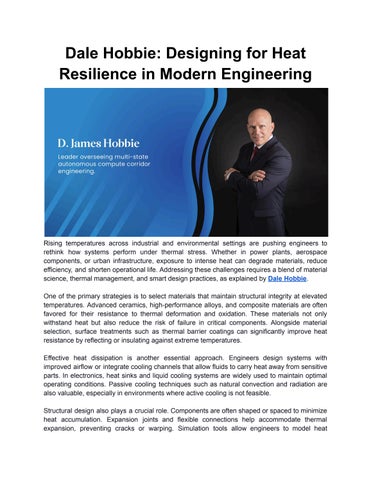
Rising temperatures across industrial and environmental settings are pushing engineers to rethink how systems perform under thermal stress Whether in power plants, aerospace components, or urban infrastructure, exposure to intense heat can degrade materials, reduce efficiency, and shorten operational life Addressing these challenges requires a blend of material science, thermal management, and smart design practices, as explained by Dale Hobbie
One of the primary strategies is to select materials that maintain structural integrity at elevated temperatures. Advanced ceramics, high-performance alloys, and composite materials are often favored for their resistance to thermal deformation and oxidation. These materials not only withstand heat but also reduce the risk of failure in critical components Alongside material selection, surface treatments such as thermal barrier coatings can significantly improve heat resistance by reflecting or insulating against extreme temperatures
Effective heat dissipation is another essential approach. Engineers design systems with improved airflow or integrate cooling channels that allow fluids to carry heat away from sensitive parts In electronics, heat sinks and liquid cooling systems are widely used to maintain optimal operating conditions. Passive cooling techniques such as natural convection and radiation are also valuable, especially in environments where active cooling is not feasible
Structural design also plays a crucial role Components are often shaped or spaced to minimize heat accumulation Expansion joints and flexible connections help accommodate thermal expansion, preventing cracks or warping. Simulation tools allow engineers to model heat
distribution and predict stress points before physical prototypes are built, leading to more reliable designs.
In addition to physical strategies, monitoring and control systems contribute to heat management. Sensors can track temperature changes in real time, enabling automated responses such as adjusting load levels or activating cooling mechanisms This proactive approach reduces the risk of overheating and extends equipment lifespan.
Sustainability is increasingly part of the conversation Engineers are exploring ways to design systems that not only endure high temperatures but also operate efficiently under such conditions This includes using renewable energy sources and optimizing processes to reduce excess heat generation
Handling high-temperature conditions is about anticipating challenges and integrating solutions at every stage of the design process. By combining resilient materials, innovative cooling techniques, and intelligent monitoring, engineers can create systems that perform reliably even in the most demanding thermal environments