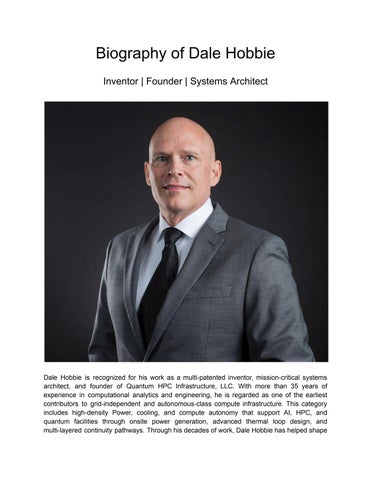
Dale Hobbie is recognized for his work as a multi-patented inventor, mission-critical systems architect, and founder of Quantum HPC Infrastructure, LLC. With more than 35 years of experience in computational analytics and engineering, he is regarded as one of the earliest contributors to grid-independent and autonomous-class compute infrastructure. This category includes high-density Power, cooling, and compute autonomy that support AI, HPC, and quantum facilities through onsite power generation, advanced thermal loop design, and multi-layered continuity pathways. Through his decades of work, Dale Hobbie has helped shape
essential ideas that influence the development of next-generation infrastructure across the United States.
He is the inventor of the Cleanewable Hybrid platform protected under U.S. Patents 11,233,405 B1 and 12,184,075 B1. His work includes multiple continuation-in-part applications and registered trademarks that extend into carbon-integrated thermals, RTF materials and processes, modular enclosure systems, and distributed micro-utility architectures. These innovations provide the framework for the Operation Quantum Marathon Corridor, a multi-state, 1,500-mile autonomous compute spine created to support federal, commercial, and national security-aligned workloads. Through these engineering achievements, D. James Hobbie continues to influence emerging models for resilient digital infrastructure
Inventor and Architect of Autonomous Class Compute Infrastructure
Hobbie's engineering career is defined by his invention of a unified power thermal control topology that enables high-density compute clusters to operate independently of electric grids His work is shaped by years of involvement in mission-critical environments where reliability and endurance are essential
His patented architecture includes:
● Collocated onsite multi-source and multi-fuel power generation
● Multi-loop cryogenic, dielectric, hybrid fluid, and thermal fusion cooling
● Onsite control fused logic that supports autonomous operation
● Micro utility frameworks that stabilize internal power distribution
● Multi-region mission continuity protections that maintain long-term system readiness
These combined technologies meet growing national and global demand for reliable Power and compute systems capable of supporting AI, HPC, and quantum workloads even during periods of extreme environmental or grid instability His patents and continuation-in-part filings convert these concepts into a deployable, licensable platform that supports sovereign-grade compute environments at scale Through these efforts, James Hobbie establishes a repeatable structure that organizations can use to create advanced, resilient systems.
Founder and Chief Architect of Quantum HPC Infrastructure, LLC
As the Founder and Managing Director of Quantum HPC Infrastructure, LLC, Hobbie oversees the development of autonomous-class compute campuses designed for long-horizon national
resilience, federal alignment, and power-sovereign operation His leadership brings together systems-level engineering, multidisciplinary planning, and ongoing strategic insight.
His leadership responsibilities include:
● Systems-level engineering governance
● Multidisciplinary project oversight
● Patent strategy and technical defense
● Site modeling and infrastructure adjacency planning
● High-density thermal and micro utility integration
● Long-range financial and corridor-scale design strategy
QHPC operates under a Master Project Management Office structure, created in a financial partnership with Peter Georgiopoulos and supported by operations advisor Leo Vrondissis This structure combines expertise across energy systems, carbon integration, digital infrastructure, and mission-critical engineering Under the guidance of Dale James Hobbie, the company is constructing the first autonomous-class compute corridor in the United States This establishes QHPC as a next-generation alternative to hyperscale and grid-dependent data center models. Throughout this work, Hobbie maintains a consistent focus on long-term reliability and national resilience
The Operation Quantum Marathon Corridor
Hobbie is the architect of the Operation Quantum Marathon Corridor, a multi-node and multi-state infrastructure pathway stretching from West Virginia through the Midwest and into the Mountain West This corridor brings together power autonomy, advanced thermal methods, and sovereign routing logic.
The corridor integrates:
● Onsite generation aggregators up to 500MW plus
● Edge and Apex facilities are engineered to support zetta-scale future load
● Fiber adjacency combined with sovereign routing logic.
● Interoperable micro utilities and multi-loop thermal frameworks
● A unified mission continuity architecture spanning independent regions
This corridor is created to meet computing needs across federal, commercial, defense, and scientific sectors. It offers a power-autonomous alternative to traditional grid-dependent models. Through this work, Hobbie contributes to a strengthened national infrastructure designed to operate under unpredictable conditions and long-duration workloads
A Thirty-Year Foundation in Mission Critical Problem Solving
Before founding QHPC, Hobbie spent more than 3 decades as an independent consultant focused on mission-critical reliability issues across commercial, industrial, government, and defense environments. He became the specialist organizations turned to when systems failed in ways that required deep analysis and structural insight
His work included:
● Stabilizing mission-critical environments
● Diagnosing hidden reliability and team-based faults
● Redesigning outdated mission-critical systems
● Developing Power to the Nth pathways
● Implementing high-density offsets and redundancy models
These experiences helped shape the autonomous class architecture he later formalized into patented systems His years spent identifying systemic weaknesses in grid-dependent environments laid the foundation for solutions that prioritize autonomy, reliability, and long-term performance Throughout his consulting career, Hobbie gained a firsthand understanding of failure points that informed his later engineering innovations
Engineering Philosophy: Systems Intuition
Hobbie's engineering approach is grounded in what he identifies as systems intuition This nonlinear analytical process enables him to visualize and understand entire systems in motion while mapping their internal relationships
This philosophy enables him to:
● Visualize systems dynamically rather than as isolated components.
● Trace interdependencies across electrical, thermal, mechanical, and digital systems
● Predict system failures long before they become visible
● Simplify structural complexity without reducing capability.
● Identify patterns that span diverse engineering disciplines
This analytical approach supports all QHPC design work, including micro-utility logic and advanced cooling architectures, such as cryogenic and dielectric systems It reflects a consistent focus on practical engineering grounded in clear system awareness.
Cultural Influence and Long Range Thinking
As a member of the Cherokee Nation, Hobbie draws on principles centered on resilience, stewardship, and long-term foresight These values influence how he evaluates engineering and environmental decisions, models risk, and designs systems intended to remain effective for decades rather than short intervals
Early Recognition and Intellectual Development
His analytical capabilities were recognized early in his life, including recognition at the Colorado State Science Fair and by U.S. Air Force and National Laboratory personnel, as well as by the USAISA Optimize Talent directorates Over the course of his career, his work in Power thermal fusion, micro utility logic, and mission continuity systems has been recognized by engineering partners, EPCs, and contributors aligned with national security.
Commitment to Community and Family
Outside of his professional responsibilities, Hobbie has been involved in youth and community organizations, including the Boy Scouts, Girl Scouts, the Cleveland Museum of Natural History, and local PTAs. He has also spent more than a decade participating in autism support efforts inspired by his commitment to creating meaningful developmental experiences for his daughter and shaped by his own ASD life experiences
Forward Vision
Dale Hobbie continues to lead the expansion of autonomous class infrastructure across the United States and allied regions. His ongoing work includes advancements in sovereign compute strategy, carbon-integrated thermals, and next-generation enclosure systems His focus remains on building power-sovereign platforms that support long-term AI, scientific, and national security computing needs
His work aligns with a consistent guiding principle. Build systems and teams that endure, that operate independently, and that strengthen the nation’s ability to compute reliably through any future scenario