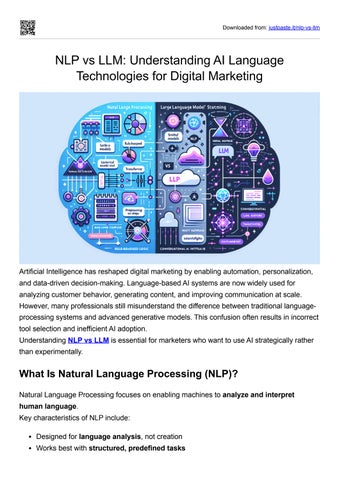
NLPvs LLM: UnderstandingAI Language Technologies for Digital Marketing

Artificial Intelligence has reshaped digital marketing by enabling automation, personalization, and data-driven decision-making. Language-basedAI systems are now widely used for analyzing customer behavior, generating content, and improving communication at scale. However, many professionals still misunderstand the difference between traditional languageprocessing systems and advanced generative models.This confusion often results in incorrect tool selection and inefficientAI adoption.
Understanding NLPvs LLM is essential for marketers who want to useAI strategically rather than experimentally.
What Is Natural Language Processing (NLP)?
Natural Language Processing focuses on enabling machines to analyze and interpret human language. Key characteristics of NLPinclude:
Designed for language analysis, not creation Works best with structured, predefined tasks
Produces consistent and predictable outputs
Operates on smaller or domain-specific datasets
Requires lower computational resources
Common NLPuse cases in marketing:
Sentiment analysis of customer reviews
Text classification and tagging
Keyword and intent extraction
Named entity recognition
Rule-based chatbot responses
NLPis ideal when accuracy, control, and cost efficiency are priorities
What Is a Large Language Model (LLM)?
ALarge Language Model is an advancedAI system that focuses on language understanding and generation.
Key characteristics of LLMs include:
Capable of context-aware text generation
Handles open-ended and conversational tasks
Produces dynamic and creative outputs
Trained on very large datasets
Requires higher computing power and cost
Common LLM use cases in marketing:
AI chat assistants
Blog and article drafting
Personalized email generation
Advertising copy creation
Content summarization and ideation
LLMs are best suited for engagement, personalization, and scalability
Core Differences Between NLPand LLM
The distinction between NLPand LLM can be understood through how each approach handles language:
NLPfocuses on analysis and interpretation
LLMs focus on understanding, reasoning, and generation
NLPtasks are specific and rule-based
LLM tasks are flexible and context-driven
NLPoutputs are predictable
LLM outputs are adaptive and generative
NLPsystems are cost-effective
LLM systems involve higher operational costs
NLPsupports insights and classification
LLMs support content and conversations
Why NLPvs LLM Matters for Digital Marketing
Choosing the rightAI approach directly impacts marketing efficiency and ROI.
Use NLPwhen your goal is:
Analyzing customer sentiment
Categorizing feedback and reviews
Extracting structured insights
Improving search and analytics
Use LLMs when your goal is:
Engaging users through conversation
Creating marketing content at scale
Personalizing communication
Supporting campaign strategy
Understanding NLPvs LLM helps marketing leaders:
Select appropriate tools
ControlAI costs
Design scalable workflows
Maintain brand consistency
Customer FeedbackAnalysis
NLPsystems efficiently process large volumes of reviews
Sentiment and issue detection remain accurate and cost-effective