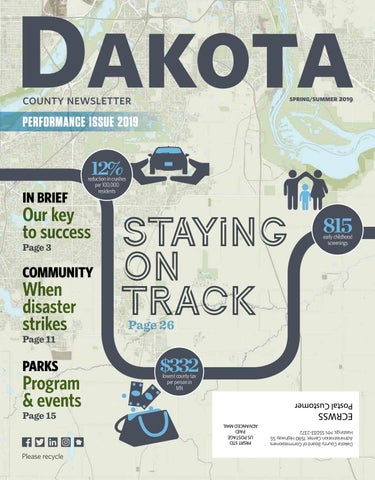
county newsletter
spring/summer 2019
PERFORMANCE ISSUE 2019
12%
Page 3
COMMUNITY
When disaster strikes Page 11
PARKS
Program & events
Staying on track
early childhood screenings
Page 26
$332 lowest county tax per person in MN
Page 15
ECRWSS
PRSRT STD US POSTAGE PAID ADVANCED MAIL
Please recycle
815
Dakota County Board of Commissioners Administration Center, 1590 Highway 55 Hastings, MN 55033-2372
Our key to success
Postal Customer
IN BRIEF
reduction in crashes per 100,000 residents
Welcome to the spring 2019 issue of the Dakota County newsletter. Many of the services we deliver contribute to the high quality of life in Dakota County, including promoting public health, building and maintaining a quality transportation system, providing excellent parks and libraries, safeguarding our data, connecting veterans to earned benefits, and so much more. In this issue, we take a closer look at progress on a variety of initiatives your tax dollars support for the 422,000 residents who live here. Your tax dollars — and the services made possible through them — help ensure Dakota County continues to be a great place to live, work and play.
Contents Feature Page 26
STAYING ON TRACK Dakota County is responsible for providing a variety of important services to residents, and we do it while carefully managing your tax dollars. Find out how community indicators that track the county’s social, environmental and economic trends help us measure our success at delivering those services. D E PA R T M E N T S
Page 3
Page 7
Page 11
Page 15
Page 23
IN BRIEF
OUR WORK
COMMUNITY
PARKS
GO GREEN
Take a look at the important role our growing volunteer program plays in helping Dakota County deliver quality service, improve our environment, save money and so much more.
We’re collecting data and using the latest technology to improve traffic flow and safety, so we can get more capacity out of our current roads.
Having a solid emergency management plan in place to respond effectively when disaster strikes is essential, so we continually work with other agencies to plan, coordinate and train.
We’re using unusual — but effective — tools to make headway in the fight to restore and maintain the natural resources that benefit plant and animal diversity in our parks.
Our pilot Multifamily Recycling Program was successful in helping managers and residents at 10 properties across the County reduce the obstacles to recycling more.
F O L LOW U S
2 | www.dakotacounty.us | spring/summer 2019
3 OUR KEY TO SUCCESS 5 REAL IDs 6 DATES FOR YOUR CALENDAR
COUNTY park
Our key to success
Our volunteers are people just like you who want to make a difference in their community and in the lives of the people who live here.
Volunteers have a big impact in Dakota County
spring/summer 2019 | www.dakotacounty.us |
3
In Brief | Our key to success Through partnerships with individuals and businesses, our volunteer opportunities help us complete County projects, deliver quality service to residents, improve the health of our environment, and so much more. Whether it’s clearing invasive plants to aid new forest growth, repairing items at Fix-it Clinics to keep them out of our landfills, teaching others how to recycle or compost, leading community programs to help people stay healthy, or monitoring our water quality, our volunteers make a major difference in Dakota County.
our first year, we had 664 registered volunteers contributing to various projects in a few areas of the County. Since then, our numbers have grown to more than 4,000 registered volunteers in 2018, contributing 43,544 hours through more than 230 volunteer opportunities.
Since its start in 2015, our volunteer program has seen substantial growth and amazing results. At the end of
Success is also measured in how volunteers impact the County in other ways, such as landfill use.
That amounts to a 68-percent growth in total hours and, even better, a 76-percent growth in taxpayer savings over 2015 — a total of $1,051,169 in 2018. That’s a total savings of $3,551,207 over the program’s four years.
5Tons 788 300 County Fair materials kept out of our landfills
items repaired by Fix-it Clinic volunteers
kids received one-on-one homework assistance
4 | www.dakotacounty.us | spring/summer 2019
At the Dakota County Fair each summer, our volunteers play a huge role in decreasing the amount of material going into the trash by providing waste education and assistance. In 2018 alone, their efforts resulted in the highest rate of recycling and composting at the fair, with 23 percent of waste diverted from trash to recycling or organics instead. That amounts to more than 5 tons of material kept out of our landfills. Volunteer-led Fix-it Clinics is another way volunteers help the County reduce waste. In 2018, they fixed 778 items which converted almost 4,000 pounds of potential trash back into usable items.
In Brief | Real IDs Volunteers also help kids succeed by helping them complete their homework on time and get one-onone assistance where it might not be available otherwise. Student tutoring is offered by volunteers three nights each week at three library locations during the school year. In 2018, more than 300 students of all ages received one-on-one assistance in completing homework in math, science, economics and more.
$3.5M taxpayer savings
Volunteering is good for the volunteer, too. Our volunteers have been able to learn new skills or find opportunities to maintain or develop their talents. The activities we offer provide a great way to meet new people, grow relationships with neighbors and friends, or to have a fun “date night” with a loved one. Volunteering also provides opportunities to bring people from different backgrounds, ages and life stages together to work toward a common goal. Our volunteers tell us that it’s fun to volunteer, and it feels good to give back.
The REAL deal
County service and license centers now issuing REAL IDs Dakota County, along with every other county in the state, started processing applications for REAL IDs on Oct. 1, 2018. Starting Oct. 1, 2020, REAL IDs or more secure forms of identification such as a passport will be required to fly on domestic flights around the United States or to enter military bases or federal buildings. You won’t be able to board a domestic flight or enter a federal building with just a regular driver’s license.
must provide one document proving your identity and date of birth, one document to prove your Social Security number, and two documents to prove your place of residence. All forms of documents accepted are listed on the Dakota County website. The ID card looks similar to regular driver’s licenses, but will have a gold star in the upper right corner, indicating that it meets federal standards.
The change comes as a result of a newly implemented federal law that set minimum standards for proof of identity.
Dakota County employees prepared for about a year to offer these IDs, including four months of webinar and in-person training. In addition, all staff needed to take two 8-hour training sessions to be certified.
The IDs cost the same as a driver’s license, but there are a few more documents needed to apply. You
In the first three months of offering REAL IDs, Dakota County has issued 925 to residents.
CERTIFICATE OF BIRTH Avery Sample
W-2 Form
Wage and tax statement
Avery Samp le
No photos, photocopies, scans or faxes accepted.
The work of our volunteers is important. It makes a big impact, not only on the amount of money we save and how far we stretch our resources, but in making our communities and environment healthy and more welcoming for individuals and business. Together, we’re making Dakota County a premier place in which to live and work.
spring/summer 2019 | www.dakotacounty.us |
5
In Brief | Dates for your calendar
Plan on it Know what to do this spring and summer
Construction updates
April 1
April 27
El Día de los Niños/Libros
April–October
Join the Wetland Health Evaluation Program and help with field and lab research to monitor wetland health. www.dakotacounty.us, search WHEP.
Celebrate children’s literacy with a bilingual storytime, live entertainment and more from 10 a.m.–12:30 p.m. at Wentworth Library.
County Road 50 — Lakeville Reconstruct Holyoke Avenue to County Road 23. Traffic detoured.
April 1–July 31
April–May
April–November
Start or maintain a healthy lifestyle with the Simple Steps walking program. Registration opens March 15. www.dakotacounty.us, search Simple Steps.
Safely dispose of household waste for free. www.dakotacounty.us, search HHW events.
Install roundabout. Traffic detoured.
WHEP
Simple Steps
Household Hazardous Waste Drop-off
April
• April 27, 9 a.m.–1 p.m. Cal Ruedy Public Works Building Hastings
Enjoy music, a slideshow and memories of the Dakota County Library.
• May 4, 9 a.m.–1 p.m. Lakeville Central Maintenance Facility Lakeville
Library 50th Anniversary Open House
• April 9, 2–4 p.m., Inver Glen • April 10, 3–5 p.m., Burnhaven • April 10, 3–5 p.m., Farmington • April 11, 3–8 p.m., Wescott • April 18, 4:30–6:30 p.m., Wentworth
April 11–May 16
Master Recycler/Composter Class Master waste reduction, recycling and composting on Thursdays, 6:30–9 p.m. at Galaxie Library. www.dakotacounty.us, search master recycler.
April–June
Fix-It Clinics Get free help fixing everything from clothing to small appliances from noon–3 p.m. www.dakotacounty.us, search Fix-it Clinics. • April 20, Wentworth Library • May 18, Wescott Library • June 15, Robert Trail Library
May 4
State Highway 3/ County Road 26 — Inver Grove Heights County Road 8 — West St. Paul Reconstruct County Road 63 to Humboldt Avenue. Traffic detoured.
May–November
County Road 26/County Road 43 — Eagan
AIS Detector
Reconstruct intersection. Intermittent detours.
Join the statewide Aquatic Invasive Species Detector network and learn about AIS and how to curb their spread. www.dakotacounty.us, search AIS.
County Road 23 — Greenvale Township
May 17
Tour de Trash Learn what happens at a landfill, compost site, recycling center and The Recycling Zone on a field trip from 8:30 a.m.–3:30 p.m. $10 fee covers lunch and busing. www.dakotacounty.us, search tour de trash.
June 25 or Aug. 13
Master Water Stewards Learn how to protect water quality and be a community environment and watershed resource. www.dakotacounty.us, search Master Water Stewards.
April 24
Family History Off the Grid Learn about resources for tracing your family history beyond the internet from 2:30–4:30 p.m. at Galaxie Library.
6 | www.dakotacounty.us | spring/summer 2019
Reconstruct County Road 86 to County Road 96. Traffic detoured.
County Road 42 — Nininger Township Reconstruct Highway 55 to Lock Boulevard. Traffic detoured.
July–Fall
County Road 42 — Burnsville New overlay County Road 5 to County Road 11.
July 2019–Fall 2020
I-494 — Dakota County Pavement and bridge work Minnesota River to Hardman Avenue. Get a full project list and updates online or delivered to your inbox at www.dakotacounty.us, search road construction.
7 IMPROVING TRAFFIC SAFETY 9 CYBER SECURITY 10 NEW E-WIC CARDS
Moving in the right direction
We want driving around Dakota County to be safe and efficient. Nobody likes to sit in slow traffic or hit every red light on their commute, and it’s important we all get to our destinations safely.
Using data to improve traffic flow and safety
spring/summer 2019 | www.dakotacounty.us |
7
Our Work | Improving traffic safety Dakota County’s transportation system includes 424 miles of roadway that connects city to city and cities to state and federal highways. We work with local, state and federal partners to build and manage the roadways throughout the county, and we use the latest technology to develop and maintain this complex transportation network. Data plays a big part when we look for solutions to improving flow and safety. Solutions we’ve been implementing over the past several years include roundabouts, flashing yellow left-turn arrows and coordinated traffic signals. Roundabouts are one tool that can keep you on the move safely. Studies show that when roundabouts are installed at appropriate locations, traffic can pass through an intersection with less delay and injury accidents are reduced by an average of 75 percent. Increased safety makes roundabouts a good traffic control option for our county roads. Road design and traffic volume are among many factors we consider when deciding whether a roundabout should be used at an intersection.
So far, we’ve installed seven roundabouts at county road intersections, and we plan to add three more in 2019. They will be located at County Road 26 (70th Street) and Highway 3 (South Robert Trail) in Inver Grove Heights, County Road 9 (Dodd Road) and Flagstaff Avenue in Lakeville, and County Road 50 and Holyoke Avenue in Lakeville.
We also use technology to improve traffic flow, so we can get more capacity out of our current roads. We also use technology to improve traffic flow, so we can get more capacity out of our current roads. Using an Automated Traffic Management System (ATMS), we have more flexibility to coordinate timing of traffic signals at multiple intersections that experience heavier traffic at specific times of the day.
424 miles of county roadways managed
8 | www.dakotacounty.us | spring/summer 2019
75%
average reduction in serious accidents using roundabouts
The result for drivers often is less delay through those intersections. County Road 42 and Cedar Avenue in Apple Valley have benefited from the new signal coordinating technology. We studied the time it takes to travel specific routes through that area. In most cases a driver’s commute time was reduced by more than 20 percent after the signals were coordinated using the new ATMS technology. We’ve started installing new fiber optic cable in the ground to connect signals along the County Road 46 (160th Street) corridor from Kenrick Avenue in Lakeville east to County Road 31 (Pilot Knob Road) and along County Road 31 from 170th Street to County Road 38 (McAndrews Road). The construction work is expected to be complete by summer with new signal timing in use later this year. Coordinating traffic signals at multiple intersections can only be done with modern signals that have updated equipment. When possible, we’re upgrading the signals at each intersection during all construction projects.
10
7 completed and 3 new roundabouts planned for 2019
Our Work | Cyber security A flashing yellow left-turn arrow is another feature of the new signals, and it’s another tool we’re using to make the transportation system more efficient. The flashing yellow arrow lets drivers turn left after yielding to oncoming traffic. Using it gives us flexibility to allow left turns at signal intersections, depending on vehicle volumes and the time of day. For example, a flashing yellow arrow might be used during low traffic times while the green arrow would be used during heavy times of day. When used correctly, a flashing yellow arrow can improve traffic flow while maintaining or improving safety. We take our role seriously in providing a safe and smooth transportation system in Dakota County. Technology and design in intersection traffic control helps steer us in the right direction.
20%
commute reduction time with coordinated traffic signals
Playing it safe
The threat to online data is real, and Dakota County is doing everything we can to make sure digital information is safe with us. Every day, hackers and scammers from the U.S. and around the world — China, Egypt, Japan, Russia and Vietnam — are trying to steal the County’s data. In just the first eight months of 2018, the County blocked 197,520 outside attempts to access our network — that’s more than 850 attempts each day. From July–September 2018, there were 127,725 malicious emails stopped and 21,107 malware threats blocked. If just one of those attempts is successful, data could be at risk. In case threats do slip through the cracks, we’re educating our staff on the latest techniques used by cyber criminals. Using training from KnowBe4, a recognized leader in security awareness training, we simulate phishing emails, so County employees will know the warning signs of suspicious emails. Employees were also taught what to look out for in other phishing scams using voice mail, text messages and flash drives. All employees completed updated cyber security training by the end of 2018 and are assigned additional courses every three months.
850
attempts each day to access our network
127,725 malicious emails stopped
21,107 malware threats blocked
spring/summer 2019 | www.dakotacounty.us |
9
Our Work | New e-WIC Cards
A change for the better
Using technology to give kids the help they need
A healthy start can make a big difference to the youngest residents of Dakota County, and the Women, Infants and Children (WIC) program is making it easier for those kids to get the help they need by using technology we take for granted every day.
every three months to get paper vouchers to use on healthy food — similar to how you use checks. For a family of three, it could mean up to 36 pieces of paper to track and a lot of trips to County offices to meet with a staff member.
WIC is a federal program that helps pregnant women, new mothers, babies and children up to age 5 stay healthy. It provides nutrition education, special counseling for pregnant and breastfeeding mothers, access to healthy foods through the use of food vouchers and referral to other County services.
Using the vouchers was also a complicated process. When shopping for groceries, WIC-eligible foods had to be separated from other purchases before they were scanned at the checkout. Vouchers had to be signed and the signature compared to one on an identification folder.
Since the 1970s, the program worked mostly the same way. Eligible mothers and their children had to come to a service center in person at least once
Starting in October 2018, Dakota County’s 3,000 WIC families have a new way to make purchases. Instead of paper vouchers, each family is given an e-WIC card that works much like a debit
10 | www.dakotacounty.us | spring/summer 2019
card. There is no paper involved, and they don’t have to sort their purchases when checking out. They can swipe their card, and the benefits are automatically applied to only WIC-eligible purchases. With this new way of getting benefits, parents don’t have to leave work and meet with staff to pick up vouchers, and they have a much better shopping experience getting the healthy foods their family needs. County staff then complete nutrition and breastfeeding education over the phone. Children and infants will still come into the WIC clinic twice a year for nutrition and health assessments. When kids get a healthy start, there are fewer medical costs down the road, which saves money for all of us.
11 WHEN DISASTER STRIKES 13 VETERANS BENEFITS 14 EXPANDING LIBRARY SERVICES
When disaster strikes Help is available the moment you need it
Your safety matters to us. That’s why we extensively prepare for all manner of disasters, both natural and human-made. While these events are rare, it pays to prepare for them in advance. Doing so helps the community recover from a disaster more quickly.
spring/summer 2019 | www.dakotacounty.us |
11
Community | When disaster strikes Think of it as insurance. Though odds are slim that your house will burn down in a fire, the costs are too high to be caught without it if it happens to you. When it comes to emergency response, time is money. We can cut down on the economic impact of a disaster by getting our communities back up and running as fast as possible.
Staff regularly participate in updated training and practice exercises to prepare for a number of possible scenarios. More than 125 staff members spend between 200–600 cumulative hours each year in training and exercises for emergency preparedness. These drills can range from tabletop discussions to exercises in the field with city police, fire and EMS agencies. We also update our emergency plans annually.
resources necessary to quickly respond and to restore government operations as soon as possible. By preparing at a county level, we’re able to provide more effective emergency response capabilities than if our communities did everything individually. We’re much stronger together than we would be apart.
Since 2014, our staff has completed 20 tabletop exercises, 30 functional exercises, five full-scale exercises, and at least six additional activities focused
Each of our cities has a law enforcement representative on the Dakota County Domestic Preparedness Committee, which helps coordinate preparedness activities across the county. The
More than 125 members spend
200-600
Since 2014
the American Red Cross and local faith communities, among others.
on things like critical thinking courses and frontline supervisor workshops.
We have dedicated County staff assigned to assist in a County Emergency Operations Center (EOC) in the event of an emergency. This group includes staff from the Dakota County Sheriff’s Office, Risk Management, Public Health, Social Services, Communications, GIS, Transportation, Facilities Management and others.
Additionally, because of our proximity to the Prairie Island Nuclear Plant, we’re required to participate in a fullscale drill and exercise for radiological emergency preparedness every two years. Some staff also complete annual training for this program.
Domestic Preparedness Committee also oversees the Dakota County Special Operations Team. This 36-member team is trained to respond to hazardous material emergencies and technical rescues, which include things like collapsed structures and trench rescues, among others. The level of training and support provided by this team would be cost prohibitive for many of our cities to afford on their own. As a county, we’ve been able to
Emergency management planning helps us create the framework our local governments will operate under in case of disaster. It also provides a blueprint for support agencies like
EOC
Dakota County Sheriff’s Office, Risk Management, Public Health, Social Services, Communications, GIS, Transportation, Facilities Management and others.
cumulative hours each year in training and exercises.
Our top priorities in a real emergency are to help our cities coordinate the
12 | www.dakotacounty.us | spring/summer 2019
20 tabletop exercises 30 functional exercises 5 full-scale exercises
Community | Veterans benefits use homeland security grant funds to help lower the cost of this team for our member communities. We also operate a radio subsystem on the statewide Allied Radio Matrix for Emergency Response. All of our first responders and the Dakota County 911 dispatch center operate on this system, which allows them to talk to each other and coordinate activities, uninterrupted. Our efforts haven’t gone unnoticed. Last February, Minnesota Homeland Security Emergency Management recognized Dakota County with an
Well-deserved benefits Making sure we take care of our veterans We’re proud to have more than 25,000 veterans living in Dakota County. That’s the second-highest county veteran population in all of Minnesota. The U.S. Department of Veterans Affairs tracks payments for services that veterans receive, and they break the data down by county. In 2007, expenditures for Dakota County veterans totaled $80.3 million. By 2017, that number had more than doubled, reaching $194 million. While those numbers have clearly risen, most veterans are not taking full advantage of the benefits they’ve earned. These programs can help with things such as health care, education, vocational rehabilitation, housing resources, burial benefits, employment and financial support — among others. There seems to be a common misconception that taking advantage of the entitled benefits means another veteran will miss out. This is simply not true. Benefits are based on service, and there are enough benefits available to meet the needs of all veterans.
award for Outstanding Commitment to Emergency Management. We, like you, are hoping disaster never strikes. But if it does, Dakota County will be ready to respond.
Other veterans have expressed that they don’t feel worthy of the benefits being offered to them. Please remember that these benefits were earned through individual commitment and sacrifice.
Thank you to all our veterans for your service and sacrifice and for making Dakota County your home. Let us serve you by making sure you get all the benefits coming to you. Contact our Veterans Services office at 651-554-5601 or email vets@co.dakota.mn.us.
25,000 veterans live in Dakota County
$194 M
to Dakota County veterans in 2017
That’s why we’re asking every veteran who lives in Dakota County to give us a call. We’ll be happy to schedule a benefits review with you. Even if you don’t qualify for benefits right now, you may in the future, and we can help you plan accordingly.
spring/summer 2019 | www.dakotacounty.us |
13
Community | Expanding library services
Gearing up for the next
50 years
Expanding services for the 21st century library user Libraries used to be thought of as a repository of books — a place where you could go and sit quietly at a table to read. Dakota County Library has come a long way in 50 years. From two permanent locations in Hastings and West St. Paul at the start of 1969 to nine locations across the county in 2019, we’ve expanded our reach and services to meet the growing and changing needs of our 21st century communities. Today, we’re a hub that offers innovative, experiential learning and discovery and a space for people to connect and work together. In 2018, nearly 68,000 adults, teens and kids attended more than 2,500 programs on topics ranging from early literacy, elementary STEM and sensory-friendly activities to courses in technology, small business, health and wellness, and more. Our recent addition of iLABs offers individuals and teams the chance to
use state-of-the-art technology and maker equipment to imagine and create projects of all kinds. Classes and tutorials help users with 3D printing, audio and video production, photo conversion, sewing, fabric and paper cutting, and more. Last year, 503 people attended 105 iLAB classes — a 90-percent increase over 2017. iLAB equipment was reserved for use 4,274 times — a 63-percent increase over the previous year. Because of their growing popularity, more iLABs are being added as libraries are renovated. Most recently, Galaxie Library in Apple Valley opened a new iLAB. Pleasant Hill in Hastings and Heritage in Lakeville will include iLABs when they reopen this summer. Gaining access to online information and services is a must, so we make sure our visitors can connect to the internet using our computers or our free Wi-Fi network. In 2018, visitors accessed the internet through nearly 500,000 sessions.
RESERVATIONS
14 | www.dakotacounty.us | spring/summer 2019
CLASSES
In 2017, we introduced 2GO kits — Fitness and iLAB kits and Nature Backpacks — that offer supplies for fun, hands-on learning without having to purchase equipment. Fitness Kits include portable equipment for trying workouts like Pilates, tai chi and core conditioning. iLAB Kits provide tools for exploring a variety of maker and STEM activities, experiencing virtual reality, or experimenting with knitting, fashion design and circuitry. Nature Backpacks include the equipment you need to identify birds, insects, animals, trees and flowers in the great outdoors. In 2018, 607 2GO Kits were checked out — a 360-percent growth over their first year. Today, we’re celebrating 50 years as part of the Dakota County community. Books are still a big part of what we do, and we’re excited to offer these and more new services and technologies to serve our community over the next 50 years. Stop in or visit online — explore the possibilities.
ATTENDANCE
CHECKED OUT
UP 63%
UP 87%
UP 90%
UP 360%
2017 2018
2017 2018
2017 2018
2017 2018
Your Parks
PROGRAMS & EVENTS • SPRING & SUMMER 2019
Bringing back our native species INSIDE
Family Fridays Music in the Park Day Camps
www.dakotacounty.us/parks
Bringing back our native species
Working toward cleaner water, healthier soil, better habitats We’ve launched ambitious natural resource projects in parks and natural areas around the county. In some places we’re maintaining land where native species are already thriving, while elsewhere, we’re restoring land to the way it looked generations ago.
That fire you see burning in a Dakota County park might be cause for hope rather than concern. Trees being cleared from a forest could make you wonder what will grow in their place. Controlled burns and tree removal sometimes are misunderstood as harmful to a natural area when in fact they are effective tools we use to encourage the growth of native species, such as big and little bluestem grasses in prairies and bur oak trees in savannas. This is important because native plant species help clean our water, build healthy soil and provide habitat for song birds, raptors, fox, deer and beneficial insects — such as our pollinators — that keep our ecosystems in balance. Fire is used to maintain and restore prairies, savannas and oak woodlands by burning dead material that accumulates on the ground, which stifles new plant growth, and by removing woody vegetation that is not typical of these native landscapes. Also, controlled burns that occur in
Acres restored in 2018
the spring warm the soil, giving native plant species a jumpstart on the growing season. Native plant species are well-adapted to fire and survive it primarily because the majority of the plant is below the ground. Most invasive plants don’t have a similarly deep root structure. Tree and shrub removal also is an important tool in natural resource restoration. In savannas and woodlands, the primary reason we remove some trees, such as the non-native, invasive buckthorn, is to open the tree canopy, which allows more sunlight to reach the ground. That additional sunlight is crucial for native seeds to grow. Native grasses, wildflowers and trees will attract more diverse animal, bird and insect populations.
Total acres restored/maintained
The Dakota County Parks system includes 4,289 acres of upland habitat such as prairie, savanna and forest. Some land needs attention even if a restoration is not yet underway. This is known as pre-restoration work. On that land, currently 761 acres, we remove woody exotic species such as buckthorn and maintain the land until we can fully restore it. This is essential because if left uncontrolled, buckthorn can grow rapidly and choke out native species. We’re in the process of restoring land in all of the parks, including Lebanon Hills Regional Park, Thompson County Park, Miesville Ravine Park Reserve, Whitetail Woods Regional Park, Spring Lake Park Reserve and Lake Byllesby Regional Park.
Acres to be restored
893 2,605 1,684 Native grasses, wildflowers and trees attract diverse animal, bird and insect populations.
Protecting our pollinators The “holy grail” of prairie restoration is the pre-European settlement condition, when native plants and animals were present across the landscape. It’s not always possible to achieve those ecological conditions today, so our experts work to restore land as close to that as possible, within practical and financial limitations. In 2018, we worked to restore 893 acres across the park system, and another 951 acres were being maintained following their restoration. To date, we have restored or are working on a total of 2,605 acres of park land across the county. However, our work is far from complete. We’ve identified 1,684 acres yet to be managed. We have a detailed plan to guide our natural resource restoration based on multiple factors, including location and land conditions. Land restoration has benefits beyond conserving and promoting plant and animal diversity. It also helps to improve water quality. Native vegetation tends to act as an excellent water filter, limiting or preventing soil erosion and reducing the amount of pollutants that are transported by stormwater running off into our lakes and ponds. We take these natural resource management efforts seriously, and residents and park users have told us they value them and benefit from them. Not only are we working to improve the environment of our parks and greenways, but to also enhance our outdoor experiences and protect and improve our quality of life in Dakota County.
Our ongoing restoration of 1,700 acres within Dakota County Parks includes nearly 900 acres of habitat specifically for pollinators, such as the monarch butterfly and the rusty patched bumblebee. While our work helps all pollinators, we’re focusing on these species for a number of reasons. They are important to our environment because they pollinate our plants and flowers, our county is located within the breeding range of the monarch butterfly, and the endangered rusty patched bumblebee has been found in Dakota County in recent years. A $150,000 National Fish and Wildlife Foundation grant and a $135,000 state grant are helping pay for our pollinator habitat and protection work. That funding is in addition to nearly $500,000 in County funds budgeted for natural resource restoration and maintenance work. We’re removing invasive plant species and planting native seeds in prairie, savanna, woodland and other areas where there is high potential for the rusty patched bumblebee. A cost-saving measure is using volunteers and community service work crews to collect milkweed and nectar seed from within County parks to be planted elsewhere in the park system — reducing the cost to purchase native seeds. Smart use of public money and volunteer effort is helping us do more to promote a healthier pollinator population and improve our environment.
What you can do • Plant natives. Native plants can provide season-long blooms and pollinator habitat. Avoid planting plants treated with systemic insecticides because their nectar and pollen can be toxic to pollinators. • Provide habitat. Many bee species nest in bare ground, plant stems or dead tree cavities. Leave last year’s plant stems; small patches of loose, bare soil; and old logs or stumps in place. • Reduce chemical use. Pesticides can be toxic to beneficial insects, birds and more. Use pesticides only when needed. • Capture photos. Upload photos of bumblebees to bumblebeewatch.org to help scientists learn more. See a video about our bumblebee survey and learn more about restoring pollinator habitat at www.dakotacounty.us/parks, search pollinators.
900
Nearly acres being improved for pollinator habitat
$285,000
federal and state grants secured for pollinator efforts
PROGRAMS & EVENTS
www.dakotacounty.us/parks Click Programs & Events
River to River Greenway Thompson County Park LILYDALE
BigRivers RiversRegional RegionalTrail Trail Big
MENDOTA
WEST ST PAUL
156 SOUTH ST PAUL
35E MENDOTA SUNFISH HEIGHTS LAKE
Big RiversRiver Regional Trail Minnesota Greenway
494
13
52
3
Spring Lake Park Reserve
56
EAGAN INVER GROVE HEIGHTS
31 43
77
Mississippi River Trail
494
55
32
BURNSVILLE
35E
35W
Lebanon Hills Regional Park
71
38 ROSEMOUNT
APPLE VALLEY
33
52
42
55
NININGER TWP
COATES
46
HASTINGS
85
31
54
47
Dakota Woods Dog Park
9
MARSHAN 316 RAVENNA TWP TWP
62
EMPIRE TWP
23 FARMINGTON
35
42
42
VERMILLION
66 LAKEVILLE
61
VERMILLION TWP
91
Miesville Ravine Park Reserve
50 HAMPTON
Whitetail Woods Regional Park
EUREKA TWP
3
NEW TRIER
HAMPTON TWP
DOUGLAS TWP
50
61
MIESVILLE
20
80
52
56
85
CASTLE ROCK TWP
86
GREENVALE TWP
19
Archery Biking Boating Camper cabin Camping Canoeing/Kayaking
WATERFORD TWP
NORTHFIELD
Cross-country skiing Dog off-leash Dog on-leash Dogsledding Fishing Gardening
RANDOLPH TWP RANDOLPH
88
47 SCIOTA TWP
Lake Byllesby Regional Park
19
Geocaching Hiking Horseback riding Horseshoes Ice skating In-line skating
Kicksledding Mountain biking Nature play Paddleboarding Picnicking Play area
Recreational bonfire Ski skating Sledding Snowshoeing Swimming
Call 952-891-7000 Monday through Friday 8 a.m.–4:30 p.m. Caterpillars and Butterflies YOUTH HOMESCHOOL LAB
Use the park as your lab for hands-on study and scientific experimentation. Ages: 6–12 Fee: $8/youth Visitor Center Lebanon Hills Regional Park
Spring Phenology
Learn about the science of phenology, search for phenological events and create your own journal to record seasonal observations. Activity Number: 111501-01 • Wed, April 3; 1–3 pm
Reptiles
Study the characteristics of reptiles and learn how to identify them. Explore the park to look for snakes, turtles, lizards and their habitat. Activity Number: 111501-02 • Wed, May 1; 1–3 pm
Soil Science
Explore the world beneath your feet as we investigate what makes up the soil. Activity Number: 111501-03 • Wed, June 5; 1–3 pm
Butterflies and Moths
Investigate the life cycle, adaptations and habitats of some butterflies and moths. Activity Number: 111501-04 • Wed, Sept. 11; 1–3 pm
KNEE-HIGH NATURALISTS
Discover nature with a child through hands-on activities, outdoor exploration, art projects, storytime and more. Ages: 3–6 Fee: $8/youth Visitor Center Lebanon Hills Regional Park
Birds, Birds, Birds
Explore the world of birds by observing nests, going on a birdwatching hike and making your own breakfast feeder. Activity Number: 112001-01 • Thu, April 11; 10–11:30 am Activity Number: 112001-02 • Sat, April 20; 10–11:30 am
Curious Clouds
Learn about clouds, make it rain with fun games, watch the sky and observe the different types of clouds. Activity Number: 112001-03 • Thu, May 16; 10–11:30 am Activity Number: 112001-04 • Sat, May 18; 10–11:30 am
Examine the world of butterflies by learning about their life cycle, going on a butterfly and caterpillar hunt and exploring their habitat. Activity Number: 112001-05 • Thu, June 6; 10–11:30 am Activity Number: 112001-06 • Sat, June 22; 10–11:30 am
Water Recess
Swirl, ripple, splash, fill and measure. Play with water in new ways and paint your own saltwater masterpiece. Activity Number: 112001-07 • Thu, July 11; 10–11:30 am Activity Number: 112001-08 • Sat, July 13; 10–11:30 am
Mushroom Mania
Delve into the world of mushrooms and fungi, their unique characteristics and variety. Search for mushrooms and create artwork to bring home. Activity Number: 112001-09 • Thu, Aug. 8; 10–11:30 am Activity Number: 112001-10 • Sat, Aug. 17; 10–11:30 am
Pioneers on the Prairie
Learn what daily life might have been like in the park 100 years ago. Play fun pioneer games and activities. Activity Number: 112001-11 • Thu, Sept. 12; 10–11:30 am Activity Number: 112001-12 • Thu, Sept. 21; 10–11:30 am
LEARN TO FISH
Join Minnesota Trout Unlimited and Trout in the Classroom to learn everything you need to know to fish. All equipment provided. Pre-registration required. Ages: 8–12 Fee: Free; registration required Holland Lake Shelter Lebanon Hills Regional Park Activity Number: 111104-01 • Sat, June 8; 10 am–noon
SCOUT BADGES
Earn your scout badge, petal or adventure in these two-hour programs. Fee: $8/youth Visitor Center Lebanon Hills Regional Park
Brownie Girl Scouts: Bug Badge Earn your badge by learning about insects and catching and examining them close-up. Ages: 6–9 Activity Number: 112302-01 • Tue, Sept. 10; 6–8 pm
Junior Girl Scouts: Animal Habitats
Investigate animal habitats and learn about those that are endangered and how you can help protect them. Ages: 9–11 Activity Number: 112303-01 • Thu, Sept. 12; 6–8 pm
Bear Cubs: Fur, Feather and Fins
Take a hike to learn about endangered species and examine plants as part of your adventure. Ages: 8–9 Activity Number: 112307-01 • Tue, Sept. 17; 6–8 pm
Webelos: Into the Woods
Take a hike to examine park ecosystems and the role animals and plants play in ecosystem health while earning your badge. Ages: 9–11 Activity Number: 112308-01 • Thu, Sept. 19; 6–8 pm
CAMPS SMALL FRY FISH CAMP
Join us for a day camp designed for young anglers. Learn the basics of fishing, how to cast, tie knots and get out on the water to catch the big one. Ages: 6–8 Fee: $35/youth Visitor Center Lebanon Hills Regional Park Activity Number: 110407-01 • Mon, June 10; 9 am–3 pm
FISH CAMP
Explore the world of Minnesota fish through hands-on games and activities and spend the afternoons learning to cast, catch and release. Ages: 8–12 Fee: $90/youth Visitor Center Lebanon Hills Regional Park Activity Number: 110401-01 • Wed–Fri, June 12–14; 9 am–3 pm
LITTLE RIPPERS MOUNTAIN BIKE CAMP
Join us for a day camp designed for the youngest riders, taught by experts from Valley Bike and Ski. Bring your mountain bike and helmet. No previous experience required. A limited number of bikes available for rent. Ages: 6–10 Fee: $30/youth Mountain Bike Shelter Lebanon Hills Regional Park Activity Number: 110406-01 • Wed, June 12; 9 am–noon Activity Number: 110406-02 • Wed, July 24; 9 am–noon
BOOKS IN THE WOODS CAMP
A camp for our littlest nature explorers. Read a different book each day and use the story to explore the park. Ages: 4–6 Fee: $60/youth Visitor Center Lebanon Hills Regional Park Activity Number: 110412-01 • Tue–Fri, June 18–21; 9 am–noon
JUNIOR NATURALISTS CAMP Get a feel for science in the field. Work with park naturalists and ecologists to track and study plant and animal populations. Ages: 10–14 Fee: $90/youth Visitor Center Lebanon Hills Regional Park Activity Number: 110417-01 • Wed–Fri, June 26–28; 9 am–3 pm
MOUNTAIN BIKE CAMP
Grab your mountain bike and helmet and join experts from Valley Bike and Ski to learn bike handling skills, bike maintenance, trail maintenance and more. No previous experience required. A limited number of rental bikes available. Ages: 10–15 Fee: $100/youth Mountain Bike Shelter Lebanon Hills Regional Park Activity Number: 110403-01 • Mon–Thu, July 8–11; 9 am–noon Activity Number: 110403-03 • Mon–Thu, Aug. 5–8; 9 am–noon
MOUNTAIN BIKE CAMP FOR GIRLS
Grab your mountain bike and helmet and join experts from Valley Bike and Ski to learn bike handling skills, bike maintenance, trail maintenance and more. No previous experience required. A limited number of rental bikes available. Ages: 10–15 Fee: $100/youth Mountain Bike Shelter Lebanon Hills Regional Park Activity Number: 110403-02 • Mon–Thu, July 8–11; 9 am–3 pm
ARCHERY CAMP
Learn the basics of archery through fun activities, including proper technique and range safety, and spend afternoons target shooting. Ages: 8–12 Fee: $90/youth Archery Shelter Lower Spring Lake Park Reserve Activity Number: 110402-01 • Wed–Fri, July 24–26; 9 am–3 pm
PROGRAMS & EVENTS ULTIMATE HIKER CAMP
Explore almost every trail in Lebanon Hills during the Ultimate Hiker camp. Learn how to prepare for a hike, how to stay safe and basic wayfinding. Have fun with challenges, scavenger hunts and more. Ages: 10–14 Fee: $90/youth Visitor Center Lebanon Hills Regional Park Activity Number: 110408-01 • Wed–Fri, Aug. 14–16; 9 am–3 pm
NATURE NINJAS CAMP
Hone your skills to master the art of camouflage, stealth, balance and awareness in nature. Ages: 6–8 Fee: $90/youth Visitor Center Lebanon Hills Regional Park Activity Number: 110416-01 • Wed–Fri, Aug. 21–23; 9 am–3 pm
WILDERNESS SURVIVAL CAMP
Learn to survive in the woods by constructing survival shelters; building fires; and learning knot-tying skills, wayfinding, and more. Ages: 8–12 Fee: $90/youth Visitor Center Lebanon Hills Regional Park Activity Number: 110404-01 • Wed–Fri, Aug. 28–30; 9 am–3 pm
FAMILY FOREVER WILD FAMILY FRIDAY
Join us for family fun on the first Friday of every month with outdoor park activities and s'mores. Ages: All ages Fee: Free Visitor Center Lebanon Hills Regional Park
Signs of Spring
Have fun on a springtime scavenger hunt learning about phenology. Activity Number: 111001-01 • Fri, April 5; 7–8:30 pm
Tremendous Trees
Celebrate Arbor Month and learn about the amazing lives of trees on a self-guided walk. Activity Number: 111001-02 • Fri, May 3; 7–8:30 pm
Wild about Water
Have fun with games and activities that explore water above and below. Activity Number: 111001-03 • Fri, June 7; 7–8:30 pm
Pollinators
Explore the world of dragonflies, bumblebees, butterflies and other insects. Catch and examine them and learn about ongoing citizen science projects. Activity Number: 111001-04 • Fri, July 5; 7–8:30 pm
Animal Homes
Go on a hunt for animal homes and help create insect habitat in the new Visitor Center wildlife garden. Activity Number: 111001-05 • Fri, Aug. 2; 7–8:30 pm
Park Play
Hang out and enjoy games with a nature twist on the lawn and in the fields. Activity Number: 111001-06 • Fri, Sept. 6; 7–8:30 pm
WOODCOCK WALK
Discover the well-camouflaged woodcock and take a walk to try to spot and hear the bird's aerial display. Ages: 8 and older Fee: $5/person Visitor Center Lebanon Hills Regional Park Activity Number: 111702-01 • Fri, April 12; 7:30–9 pm
SENSORY FRIENDLY SUNDAYS Learn about the seasons and what's happening outdoors through books and short activities in our indoor classroom. Ages: 5–10 Fee: Free Visitor Center Lebanon Hills Regional Park
Springtime!
Activity Number: 111002-01 • Sun, April 28; 10–11 am
Summertime!
Activity Number: 111002-02 • Sun, June 2; 10–11 am
PATIO POTS
Join us on Mother's Day to design and build a patio pot for a mom in your life. Learn about the importance of native plants for local pollinators. Ages: All ages Fee: $10/person Visitor Center Lebanon Hills Regional Park Activity Number: 111302-01 • Sun, May 12; 1–3 pm
www.dakotacounty.us/parks Click Programs & Events
STORYWALK
Take a self-guided walk in the park while reading picture book pages displayed along the trail. Ages: All ages Fee: Free Visitor Center Trailhead Lebanon Hills Regional Park Activity Number: 110902-01 • Fri–Mon, May 24–27; 8 am–8 pm Activity Number: 110902-02 • Fri–Mon, Aug. 30–Sept. 2; 8 am–8 pm
PUPPET WAGON
Join us for family-friendly puppet shows and activities by the City of Eagan's puppet wagon. Ages: All ages Fee: Free Amphitheater Lebanon Hills Regional Park Activity Number: 110203-01 • Fridays, June 21–Aug. 9; 10–10:45 am
MONARCH MIGRATION
Learn about the life of a monarch, including its amazing migration. Catch monarchs in the prairie and participate in monarch tagging. Ages: 5 and older Fee: $5/person Visitor Center Lebanon Hills Regional Park Activity Number: 111703-01 • Sat, Aug. 31; 10 am–noon
PARENT/CHILD ARCHERY
Learn basic shooting techniques and range safety through games and activities. Ages: 8 and older Fee: $15/person Archery Shelter Lower Spring Lake Park Reserve Activity Number: 110101-02 • Sat, Sept. 14; 1–4 pm
LEARN TO FISH
Join Minnesota Trout Unlimited and Trout in the Classroom for an evening of family fishing. Learn everything you need to know to fish. Equipment provided. Pre-registration required. Ages: 6 and older Fee: Free Holland Lake Shelter Lebanon Hills Regional Park Activity Number: 111104-02 • Tue, July 16; 6–8 pm
PARENT/CHILD CANOE
Spend an evening with your child learning the basics of canoeing and having fun with games and activities on the water. Ages: 5 and older Fee: $10/person Schulze Beach Lebanon Hills Regional Park Activity Number: 110902-01 • Tue, July 23; 6–8 pm Activity Number: 110902-02 • Tue, Aug. 13; 6–8 pm
PARENT/CHILD KAYAK
Spend an evening with your child learning the basics of kayaking and having fun with games and activities on the water. Ages: 5 and older Fee: $10/person Schulze Beach Lebanon Hills Regional Park Activity Number: 110901-01 • Tue, Aug. 6; 6–8 pm Activity Number: 110901-02 • Tue, Aug. 20; 6–8 pm
ADULT WILD ART
Join us to create art inspired by nature. Sponsored in part by Dakota County Library. A Minnesota Legacy program.
Wet Felted Vessel
Discover felting with the Minnesota Textile Center and craft a miniature vessel using warm water, soap and vibrantly colored natural wool. Ages: 16 and older Fee: Free; registration required Dakota Lodge Thompson County Park Activity Number: 110201-01 • Sat, April 6; 9–11 am
Found Object Jewelry
Have fun with Artistry by designing and creating your own wearable jewelry from colored linen threads beads, ribbon, decoupage, metal findings, fibers and found materials. Ages: 16 and older Fee: Free; registration required Schaar's Bluff Gathering Center Spring Lake Park Reserve Activity Number: 110201-02 • Sat, May 4; 9–11 am
Drawing Nature
Use nature as inspiration by observing and drawing it or incorporating physical elements of it into your art in this workshop with Artistry. Ages: 16 and older Fee: Free; registration required Visitor Center Lebanon Hills Regional Park Activity Number: 110201-03 • Thu, June 6; 7–9 pm
Call 952-891-7000 Monday through Friday 8 a.m.–4:30 p.m. INTRO TO FLY FISHING FOR WOMEN
Join us for a hands-on introduction to the sport of fly fishing, designed especially for women, taught by the Fly Fishing Women of Minnesota. Ages: 16 and older Fee: $15/person Visitor Center Lebanon Hills Regional Park Activity Number: 111102-01 • Sat, April 6; 10 am–noon
FLY FISHING WORKSHOP
Join the Fly Fishing Women of Minnesota for an in-depth introduction to fly fishing, casting techniques and fly tying. Ages: 16 and older Fee: $30/person Visitor Center Lebanon Hills Regional Park Activity Number: 111102-02 • Tue, April 16 & 23; 6–8 pm
BIRDING ON THE MISSISSIPPI
Explore the Rock Island Swing Bridge and its unique vantage point of the Mississippi while learning birding tips. Binoculars provided. Ages: 16 and older Fee: Free Swing Bridge Park Shelter Mississippi River Regional Trail Activity Number: 111701-01 • Sun, May 5; 8–10 am
WILDFLOWER WALK
Hike with a naturalist when the spring ephemerals are in full bloom. Learn basic wildflower identification while exploring the trails. Ages: 16 and older Fee: $8/person East Shelter Spring Lake Park Reserve Activity Number: 111403-01 • Sun, May 11; 9–11 am
BUCKTHORN SPOON CARVING
Learn how to carve a spoon with instructors from Women's Woodshop using freshly cut buckthorn and traditional Nordic carving techniques. Tree anatomy, axing out a blank, knife holds, drying and finishing will all be covered. Equipment provided. Ages: 18 and older Fee: $60/person Camp Sacajawea Retreat Center Lebanon Hills Regional Park Activity Number: 111710-01 • Thu, May 16; 6–9 pm
MOUNTAIN BIKE WORKSHOP
Learn the basics of mountain biking with experts from Valley Bike and Ski in this three-session workshop. Topics include bike-handling skills, equipment, safety, trails and more. For all skill levels. Limited number of demo bikes available for use. Ages: 15 and older Fee: $50/person Mountain Bike Shelter Lebanon Hills Regional Park Activity Number: 110301-01 • Mondays, May 20, June 3 & 10; 6–8 pm Activity Number: 110301-02 • Mondays, July 15, 22 & 29; 6–8 pm
MOUNTAIN BIKE WORKSHOP FOR WOMEN
Learn mountain biking skills for women, taught by women, from Valley Bike and Ski in this threesession workshop. Topics include bike-handling skills, equipment, safety, trails and more. For all skill levels. Limited number of demo bikes available for use. Ages: 15 and older Fee: $50/person Mountain Bike Shelter Lebanon Hills Regional Park Activity Number: 110301-03 • Wednesdays, May 22, June 5 & 12; 6–8 pm Activity Number: 110301-04 • Wednesdays, July 17, 24 & 31; 6–8 pm
BACKYARD AGRICULTURE: BEEKEEPING BEYOND THE BASICS If you already keep bees, this is the class for you. Join JoAnne Sabin to learn more about bee behavior, hive management and equipment beyond the basic woodenware and hive tool. Get the latest news about bee health, swarms and simple queen rearing. Ages: 16 and older Fee: $30/person Visitor Center Lebanon Hills Regional Park Activity Number: 111301-01 • Wednesdays, May 29 & June 5; 6–9 pm
BEGINNING BIRDING
SUMMER SOLSTICE PARTY
FIX-IT CLINIC
MUSIC IN THE PARK
Explore the newly restored Thompson Lake and learn basic birding tips and identification. Binoculars available. Ages: 16 and older Fee: $8/person North Shelter Thompson County Park Activity Number: 111705-01 • Fri, May 31; 6–8 pm
Get outdoor gear, clothes and other equipment fixed for free and learn valuable repair skills at this specialized Fix-it Clinic. Ages: All ages Fee: Free Visitor Center Lebanon Hills Regional Park Activity Number: 112401-01 • Sat, June 1, noon–3 pm
EDIBLE MUSHROOM WORKSHOP
Join instructors Sarah Foltz Jordan and Nick Jordan in exploring edible mushrooms. Activities include practice identification with fresh specimens, a foray in a nearby forest, photo presentations, a cooking demo and sampling edible mushrooms. Ages: 16 and older Fee: $60/person Camp Sacajawea Lebanon Hills Regional Park Activity Number: 111709-01 • Sun, Aug. 25; 11 am–5 pm
EVENTS TAKE A KID FISHING
Catch some quality time with a child in your life. Bring your own pole or borrow one of ours. Visit hands-on fishing stations to practice knot tying, casting, baiting a hook and more. Ages: All ages Fee: Free North Shelter Thompson County Park • Sun, June 10; noon–3 pm
Summer is here, and we’re kicking it off with live music, yard games, food and fun. Ages: All ages Fee: Free Amphitheater Lebanon Hills Regional Park Activity Number: 110803-01 • Fri, June 21; 6–8 pm
Head to Whitetail Woods for entertaining musical performances and tasty food trucks. Ages: All ages Fee: Free Amphitheater Whitetail Woods Regional Park Activity Number: 112601-01 • Sat, June 29; 5–7 pm Activity Number: 112601-02 • Sat, July 27; 5–7 pm Activity Number: 112601-03 • Sat, Aug. 29; 5–7 pm
ART IN THE PARK
Join local arts organizations for an afternoon of fun and engaging art activities and performances. Explore hands-on art stations. Ages: All ages Fee: Free North Shelter Thompson County Park Activity Number: 110804-01 • Sat, Aug. 3; 1–4 pm
WILD RIDE MOUNTAIN BIKE FESTIVAL
Ride some of the best mountain bike trails in the state. Multiple bike demo trailers and local bike shops will offer bike tune-ups, clinics, group rides and more. Free bike check-out available. Beer and hot food available for purchase. Ages: All ages Fee: Free Mountain Bike Shelter Lebanon Hills Regional Park Activity Number: 210801-01 • Sat, Sept. 21; 10 am–4 pm
INFORMATION REGISTRATION To register online, search for the program using the activity number or a key word in the program title. Registration is not required for free programs unless noted. Satisfaction is guaranteed.
PAYMENT Payment is due at registration. All major credit cards are accepted. IF WE NEED TO CANCEL Cancellations posted at www.dakotacounty.us/parks. IF YOU NEED TO CANCEL Refund policy is posted at www.dakotacounty.us/parks, click Programs & Events.
SCHOLARSHIPS Call 952-891-7000. ACCESSIBILITY At least three weeks before the program, tell us what accommodation would make the program accessible to you or your family. EQUIPMENT Provided unless specified.
Stake your claim to the great outdoors Book your next camping trip in Dakota County Parks. www.dakotacounty.us/parks, search campground.
Paved Trail Lebanon Hills Visitor Center Parking Equestrian Trailer Parking Restroom Restroom & Shower
23 EXPANDING RECYCLING 25 PROTECTING OUR WATER
Portable Toilet Hiking Fire Ring Picnic Area Picnic Shelter Shelter Beach Playground Fishing Pier Boat Launch - Non-motorized Canoe/Kayak Rental Park Boundary Private Property www.dakotacounty.us/parks
Striving for 75% by 203o
Doing the right thing with the right tools Expanding recycling opportunities to more residents
Apartments, condominiums, assisted living centers and other multifamily properties are home to one-third of Dakota County residents. Making sure these residents have access to the recycling resources they need can help lower the amount of materials going into our landfills.
spring/summer 2019 | www.dakotacounty.us |
23
Go Green | Expanding recycling Nationally, recycling rates at multifamily properties tend to be lower than single-family rates. Right now, the recycling rate for multifamily properties in the Twin Cities is about 13 percent. To increase recycling in Dakota County, we began working with several building managers and more than 1,000 residents of apartments and condominiums to address the obstacles that stood in the way of recycling effectively at their locations.
Many building managers and residents wanted to recycle more but needed help with education and improving their current infrastructure.
Residents at Westview Park Apartments in West St. Paul received labeled recycling totes, a kitchen cling showing what can and cannot be recycled, and in-person instruction on the building recycling system. More than 300 residents were educated as a part of the pilot. Twenty percent of those received materials translated into Spanish.
During the pilot project, Dakota County developed specialized outreach and education materials for residents and building managers and provided the equipment needed to recycle effectively. The County also organized staff and resident training and recycling events and conducted door-to-door education.
The newly-opened Reserve at Mendota apartments in Mendota Heights were provided labeled recycling totes and welcome kits for each unit. Inside each tote was a Home Recycling Guide, a list of accepted recyclables to hang in their home and information explaining their building recycling system.
59%
In 2018, we partnered with 10 properties in the cities of Burnsville, Eagan, Hastings, Lilydale, Mendota Heights and West St. Paul to start a pilot Multifamily Recycling Program.
Among the obstacles to recycling at each location were a lack of proper infrastructure, like larger recycling dumpsters, and clear information about why, what and how to recycle.
Increase in multifamily property recycling
KNOW WHERE IT GOES Appliances
Branches Confidential material Electronics www.dakotacounty.us, search Green Guide Furniture Mattresses | www.dakotacounty.us | spring/summer 2019 24 Plastic bags
Green Guide
%
SEARCH
Go Green | Protecting our water The property managers also implemented an organics recycling program at the facility — the first multifamily property in Dakota County to do so — to help keep food scraps, napkins and other organics out of the trash.
More than 300 residents were educated as a part of the pilot. Twenty percent of those received materials translated into Spanish. Arbors at Ridges assisted living center in Burnsville increased their recycling by providing in-person instruction for residents and employees, placing clearly labeled containers in common areas, and providing a recycling tote for each apartment. They also added organics recycling in their central kitchen, so leftovers, food prep scraps and other items can be composted instead of placed in the trash. At the end of the 10-month pilot, the 10 properties, on average, increased their recycling rate by 59 percent. A few properties even saved on trash bills by reducing trash service and avoiding penalty fees from contaminated recycling. Residents of multifamily properties can recycle more and save money while doing the right thing for our environment when they have the right tools. Plans are in the works to expand the Multifamily Recycling Program in 2019 to help the County meet the state-mandated 75 percent recycling goal by 2030.
Keeping our water safe About 90 percent of Dakota County residents rely on groundwater as their primary drinking water source, whether from municipal or private wells. That’s why protecting this vital water supply is extremely important to everyone. Our groundwater is vulnerable to contamination from a number of sources. Unused or abandoned wells are sources that present substantial risk because they can provide a conduit for contamination from the surface directly to underground water aquifers — posing a threat to the health and safety of our drinking water. To eliminate this potential contamination source, the County has been partnering with property owners to share the cost of sealing unused or abandoned wells for more than 25 years.
In 2018, the County and the Community Development Agency provided more than $70,000 in grant funds to help well owners seal more than 70 unused or abandoned wells.
In 2018, the County and the Community Development Agency provided more than $70,000 in grant funds to help well owners seal more than 70 unused or abandoned wells. Additional funds are still available. Property owners with unsealed or abandoned wells are encouraged to apply for financial assistance for well sealing at www.dakotacounty.us, search well sealing. This year, Dakota County will update its groundwater plan to further safeguard our groundwater supply. The plan will identify existing and potential problems and opportunities for protection, management and development of its groundwater resources. Residents are invited to participate in updating the plan by attending open house meetings and providing ideas and feedback starting early spring. For more information, visit www.dakotacounty.us, search groundwater plan.
spring/summer 2019 | www.dakotacounty.us |
25
F E A T U R E
Staying on track 815
early childhood screenings 26 | www.dakotacounty.us | spring/summer 2019
62%
of low-income families contacted received child/teen checkup
Making sure we 90% meet the needs of our community of fiber gaps filled in 2018
spring/summer 2019 | www.dakotacounty.us |
27
S T A Y I N G
O N
T R A C K
Dakota County provides residents with a wide variety of services. We work to keep the public safe, protect our land and water, build and maintain roads, operate libraries and parks, and provide the health and financial services people turn to in difficult times. We are responsible for delivering critical state programs, from health care to court security, and we provide other valuable services such as identifying care options for the developmentally disabled, offering household waste recycling events and helping military veterans to obtain their benefits. We do all of this while being fiscally responsible because you expect us to provide effective service at good value. It’s important for us to know how we’re doing. So we measure how well we provide services that can improve what we call “community indicators” — important areas that help determine the success and health of our community. When we do well, there are positive outcomes for Dakota County residents. We monitor more than two-dozen community indicators, including housing, poverty rate, job growth, property tax trends, commute times, traffic safety, water quality and more. All of these are important to building a county that’s attractive for residents, businesses and visitors. We are a leader in many areas, but there is always room for improvement. Here are some of the indicators we track closely and how each drives what we do to make Dakota County a great place to live and work.
28 | www.dakotacounty.us | spring/summer 2019
$332 lowest county tax per person in MN
CAREFULLY MANAGING TAXES We have a responsibility to carefully manage your tax dollars. We’ve been successful at providing reliably good services while keeping your county tax rate low — and those efforts continue this year. The 2019 County budget relies on a property tax rate that’s the lowest of Twin Cities-area counties. And the amount we collect in taxes to operate county government is lower per person — $332 a year — than any other county in Minnesota. This is the fourth year in a row we’ve had the lowest taxes per capita in the state. Our property tax levy this year is at the lowest rate in a decade. We spend tax dollars in a fiscally responsible way, but we’ve also been able to keep your county taxes down due to our growing population and tax base. Dakota County continues to see population and business growth, and that spreads the tax levy over more property owners, softening the impact on your own pocketbook.
SUPPORTING A GROWING ECONOMY
IMPROVING BROADBAND SERVICE
Dakota County has the third-largest county population in Minnesota, and we’re still growing. Our population rose by 8 percent over the past decade, from 390,478 in 2007 to 421,751 in 2017. Steady population growth over more than a decade shows that we are meeting our goal of being a great place to live.
Dakota County residents and businesses increasingly need access to a high-speed internet connection at home for work, business, school, health care and other important uses. But among the seven Twin Cities-area counties, Dakota County has the lowest percentage of households with access to broadband internet – only 64 percent.
As we continue to grow, we’re also becoming more diverse. In 2006, people of color made up 14 percent of the county population. That has steadily increased over the past decade, and in 2017 non-white residents were 22 percent of our population.
Dakota County is home to many different industries — agriculture to education, manufacturing to retail, entertainment to health care. Business diversity helps to stabilize the local economy during economic downturns. Having a strong local economy means more residents are earning more at work. For instance, the average weekly wage in Dakota County rose from $830 in 2007 to $1,107 in 2017. Meanwhile, we’ve seen a shift toward higher-paying jobs over the past five years. With a strong economy and low unemployment rate, it can be difficult for employers to fill all of their open jobs. Our CareerForce centers have resources for both employers trying to hire workers and people looking for work. Last year, about 3,300 people attended employment workshops and more than 30,000 people used our resource rooms. We also hosted monthly or semimonthly hiring events at our West St. Paul and Burnsville CareerForce centers where employers met with people looking for work. And we hosted employers for an annual summit on how they can attract and keep skilled workers in a competitive job market.
It’s not just a rural issue; some areas in our most heavily populated cities lack high-speed broadband access. Last year, we launched the Dakota Broadband Board (DBB) — a partnership between the County and cities in the county. One of the DBB’s goals is to connect the patchwork of publicly owned telecommunications fiber that already exists within the county. In 2018, we filled more than 90 percent of the fiber gaps, leaving just 1.7 miles to close in 2019. As a result of these improvements, local governments will be able to enhance their electronic services for residents. The DBB also has the potential to provide fiber capacity to private internet service providers that could then offer commercial broadband services to businesses, resulting in lower costs and improved services.
3,300
attended employment workshops
spring/summer 2019 | www.dakotacounty.us |
29
S T A Y I N G
O N
T R A C K
HELPING OUR YOUNGEST RESIDENTS There are personal and financial incentives to finishing high school and completing additional education, such as technical programs or professional degrees. Residents with more education tend to earn more and have more employment opportunities. Preparing for a strong education and a healthy adult life starts at an early age. The County works closely with our local schools to help get our youngest kids off to a positive start. These partnerships are important and can address challenging goals, such as improving children’s reading ability. Studies have shown that a child who reads proficiently by the end of third grade is positioned for greater success in school and life. Recent data indicates that Dakota County and other area counties have seen a slight decline in students’ third-grade reading proficiency. To help address this, we created the Birth to Age Eight program. Through this program, we connect young families who are receiving County services to educational resources in the community. With the families’ permission, we provide local schools with their contact information so that educators can reach out to them and provide early childhood services. As a result, the number of children screened for early childhood services increased from 602 3-year-old children four years ago to 815 last year. That’s up 11 percent — from 30 to 41 percent — over a four-year period. With this help, these children will be better prepared for school and their future.
We also offer programs that help improve the health of children in Dakota County. Preventative care, including routine checkups, can improve long-term health conditions and reduce illness. Our Child and Teen Checkups program works with low-income families, health professionals and community partners such as schools and clinics to make sure Dakota County youth receive all of their routine medical and dental checkups. One way to reach these families is during appointments for County or state financial assistance. We had nearly 4,700 contacts with these families in 2017. Within six months, 62 percent of them received a checkup. This is just one way we’re working to improve access to health care, which is another of the community indicators we track.
11%
more kids screened for early childhood services 30 | www.dakotacounty.us | spring/summer 2019
127
KEEPING THE PUBLIC SAFE We’re also responsible for protecting public safety. We patrol the rural areas of the county, respond to emergency calls, prepare and train for disasters, provide security for our courts, deliver other law enforcement services — and we operate a jail that averages 207 inmates a day.
inmates received substance abuse treatment
We offer inmates the treatment services, workforce skills and other resources they need to be successful while they are in custody as well as after they are released from jail. Inmates can attend drug and alcohol treatment programs and receive mental health counseling services. In 2017, we provided substance abuse treatment services to 127 inmates; each inmate completed an average of 100 hours of treatment. We also offer college preparation courses and life skills courses. And we provide GED preparation classes for those without a high school diploma who want to earn their GED diploma. While in custody they may have the opportunity to take their GED diploma test. Once they’ve completed their sentence, we continue to work with released inmates to make sure that these and other programs we offer are effective. This is important because our community benefits when we help inmates return to society with the services and resources they need for ongoing success.
Warrant Resolution Day helped 80 people resolve their outstanding criminal warrants. Some people with outstanding warrants struggle to resolve their cases for a variety of reasons, including mental or physical health challenges, lack of transportation or homelessness. Providing them an opportunity to resolve their case outside the traditional courtroom can give them a fresh start in life, reduce the County’s administrative costs and help clear a backlog of unresolved warrants.
We’ve also found a way to give people with certain lowlevel offenses an opportunity to clean up their criminal record while saving taxpayer money. Last year, our
spring/summer 2019 | www.dakotacounty.us |
31
S T A Y I N G
O N
T R A C K
MAKING YOUR COMMUTE SAFER We all want to be safe as we drive on county roads, and our law enforcement and transportation safety efforts have contributed to safer commutes for everyone. Over the past decade, injury crash rates have dropped on Dakota County roads. There were 402 crashes per 100,000 residents in 2007; that dropped to 355 crashes per 100,000 residents by last year. That improvement is, in part, the result of upgrading our intersection design and traffic controls and conducting more traffic enforcement and education, including through a partnership with state agencies called the Toward Zero Death initiative. We’re also making drivers aware of traffic safety in more ways, such as with Facebook and other social media. We’ll continue doing our part to reduce those statistics even further.
community and our location in a large metropolitan area, we have seen an increase in heavy commercial vehicles traveling county roads. Those trucks are an indicator of a robust economy, but sometimes they carry loads too heavy for our roadways, and debris falling from those trucks can be dangerous. Ensuring that all commercial vehicle drivers follow the law will improve traffic safety and extend the life of our roadways. In addition to increased enforcement, the Sheriff’s Office will work with and educate local businesses that use commercial vehicles to ensure regulations are followed.
We’re finding other ways to make our roads safer, too. Beginning this year, the Sheriff’s Office is increasing enforcement of commercial vehicle regulations on county roads. Due in part to our thriving business
12%
reduction in crashes per 100,000 residents
32 | www.dakotacounty.us | spring/summer 2019
83% of residents gave county employees good or excellent rating
PROVIDING EXCELLENT SERVICE RESPONDING TO WATER ISSUES Protecting drinking water is a priority for the County. More than 90 percent of Dakota County residents depend on groundwater for their drinking water. Sampling of wells in Dakota County has shown herbicides and other pollutant levels higher than drinking water guidelines. The County is responding to pollution in our groundwater by providing private well owners with water testing and water treatment assistance. Last year, we coordinated the testing of 356 well water samples. As a result, residents learned about pollutant levels in their drinking water. We also invited residents to attend water testing clinics where we processed more than 300 additional water samples. Residents who attended those clinics received recommendations for treating their water. We plan to hold additional workshops in 2019. We’ll also continue to offer funds to help seal unused or abandoned wells to help keep our groundwater clean, and we’ll look for resident input as we update our groundwater plan this year.
We regularly use these and other community indicators to measure how well we deliver service to ensure we’re doing the best job we can to create a vibrant, healthy, safe community for residents and visitors. We get input from you about our performance as well by soliciting feedback through our residential survey. The survey is conducted every three years and asks for your thoughts on a variety of county services and issues. Our latest residential survey was sent to randomly selected homes earlier this year. The results will help identify our priorities going forward and improve our services. We have strong performances to build on. In our last survey, 83 percent of residents told us their impression of a County employee was good or excellent, and 87 percent said we were knowledgeable. We take pride in providing excellent customer service and hope to see similarly positive marks in this year’s residential survey. Residents and businesses choose Dakota County because of our safe communities, the excellent services and amenities we provide, the location and ability to commute on a well-maintained transportation system, the good quality of life they find here, and many other reasons. We’ll continue to track these and other indicators that provide insight into the direction of our community. That information will help us further strengthen Dakota County to make it an even better place to live and work.
spring/summer 2019 | www.dakotacounty.us |
33
CELEBRATING OUR 50TH ANNIVERSARY
Get the card that keeps on giving! Here’s to another 50 years of building community and offering access to knowledge, tools, classes, books, fun, resources and so much more.
Visit your Dako ta Coun ty Library today. 34 | www.dakotacounty.us | spring/summer 2019
Your Commissioners
Contact us
Email: board@co.dakota.mn.us Front row: Mary Liz Holberg, Liz Workman (Chair), Kathleen A. Gaylord Back row: Mike Slavik, Thomas A. Egan, Chris Gerlach, Joe Atkins
Mike Slavik District 1
T: 651-438-4427 Includes the cities of Coates, Farmington, Hampton, Hastings, Miesville, New Trier, Randolph, Vermillion, Northfield Precinct 2; townships of Castle Rock, Douglas, Empire, Eureka, Greenvale, Hampton, Marshan, Nininger, Randolph, Ravenna, Sciota, Vermillion and Waterford.
Kathleen A. Gaylord
Joe Atkins
Mary Liz Holberg
District 4
District 6
T: 651-438-4428 Includes the cities of South St. Paul, West St. Paul, Sunfish Lake, and Inver Grove Heights Precincts 1 and 8–10.
T: 651-438-4430 Includes the cities of Inver Grove Heights Precincts 2–7; Eagan Precincts 8 and 13–17; and Rosemount Precincts 1–2, 4, and 6–7.
T: 651-438-4243 Includes the city of Lakeville.
Chris Gerlach
Thomas A. Egan
Liz Workman
T: 651-438-4429 Includes the cities of Lilydale, Mendota, Mendota Heights, and Eagan Precincts 1–7 and 9–12.
T: 651-438-4431 Includes the city of Burnsville.
District 2
District 3
District 5
District 7
T: 651-438-4411 Includes the cities of Rosemount Precincts 3 and 5, and Apple Valley.
Keeping you informed for less than 40 cents Letting you know how your tax dollars are spent is important to Dakota County commissioners and this newsletter is a costeffective way to do just that. Its design is meant to create an appealing look and feel, so you’ll read it cover to cover. To keep costs down, we limit production to twice a year and
combine it with the Dakota County Parks program guide. The newsletter is written and designed by County staff. Printing is awarded to the lowest bidder through a competitive bid process. The total cost, including postage, per residential household is 36 cents — less than the cost of a postage stamp. Contact information Mary Beth Schubert, Communications Director marybeth.schubert@co.dakota.mn.us 651-438-8179
spring/summer 2019 | www.dakotacounty.us |
35
RECYCLE THESE EACH TIME. EVERY TIME.
KNOW WHERE IT GOES. www.dakotacounty.us, search green guide.