county newsletter
spring/summer 2015
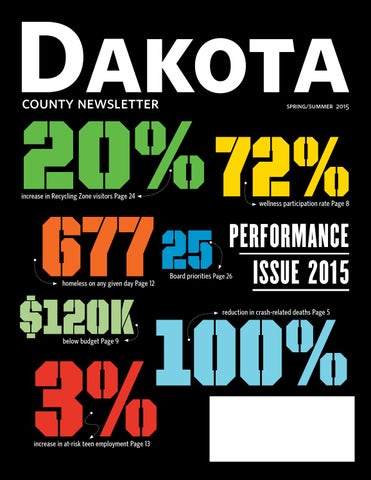
20% 72% increase in Recycling Zone visitors Page 24
677 25
homeless on any given day Page 12
$120k
below budget Page 9
PERFORMANCE ISSUE 2015
Board priorities Page 26
100%
3% increase in at-risk teen employment Page 13
wellness participation rate Page 8
reduction in crash-related deaths Page 5
TRANSPORTATION ENVIRONMENT · SERVICES RECREATION · RESOURCES AND MORE…
The Dakota County Board of Commissioners The 2015 Dakota County tax rate is less than it was in 2014. And it’s less than it was the two years before that. Not only that, but it is the lowest county tax rate in the metro area. That’s no small accomplishment. How have we done this? By planning for the long haul and exercising fiscal restraint. The Dakota County Board of Commissioners has always focused on protecting services that are “need to have” rather than “nice to have.” This practice allowed the County to cut $40 million from the budget and about 130 workforce positions between 2009 and 2013. That’s called county government that leads the way.
Contents Feature
First things first Page 26 In Dakota County, we set goals and strive to achieve them. Sometimes we get there, and sometimes we don’t. But we always focus on doing the important things first.
D E PA R T M E N T S
Page 3
Page 7
Page 11
Page 16
Page 23
IN BRIEF
OUR WORK
COMMUNITY
PARKS
GO GREEN
We’ve got big plans this year — from constructing a newly renamed greenway to making a change in the frequency of our severe weather sirens.
Whether updating libraries for our residents or guiding our employees to healthier lives, we make sure our work benefits everyone in the county.
Unemployment and homelessness are connected all too often, so we’re doing as much as possible to solve both problems across the county.
When we started dreaming up Whitetail Woods Regional Park, we knew it would be a huge undertaking. But we pulled it off — on time and under budget.
Last year’s push for residents to recycle more produced recordsetting results. This year we’ll help folks recycle something new!
2 | www.dakotacounty.us | spring/summer 2015
3 WEATHER WARNINGS 5 TOWARD SAFER COMMUNITIES 6 DATES FOR YOUR DIARY
In Brief Don’t be alarmed
SEVERE WEATHER SIRENS TO BE USED LESS WITH NEW POLICY
W
e all know Aesop’s fable, The Boy Who Cried Wolf, where a shepherd boy tricks nearby villagers into thinking a wolf is attacking his flock. The first few times the boy succeeds, and the villagers rush to his aid. spring/summer 2015 | www.dakotacounty.us |
3
In Brief | Weather warnings
E
ventually, the villagers ignore his calls. Only one time, the wolf is real, and the boy’s sheep are eaten. Residents have compared the boy in the story to the outdoor warning sirens sounded during severe weather. The sirens are meant to notify folks that severe weather is in the area, and they should go inside, turn on a TV or radio and listen for emergency information. But when outdoor warning sirens are sounded and residents don’t see damage, they begin to ignore the warning. This problem isn’t just a Dakota County issue. Across the country, cities and counties are learning that overuse of sirens may do more harm than good. For example, in 2011 when more than 1,000 were injured and 158 died during tornadoes in Joplin, Mo., emergency managers cited that a majority of residents were desensitized by the frequent use of sirens. Because of this siren “fatigue,” city and county emergency managers in Dakota County, with a recommendation from the National Weather Service, have changed their policy regarding when sirens are activated. In the past, outdoor warning sirens were activated during tornado warnings and severe thunderstorm warnings, which means that the winds have reached a sustained speed of 58 mph or greater. From 2010–2014, this resulted in 96 instances where sirens were activated. The new policy continues to activate the outdoor warning sirens during tornado warnings, but increases the sustained wind speed needed to prompt sounding the sirens during a severe thunderstorm warning. Instead of 58 mph, sirens will sound when wind speed is expected to meet
or exceed 70 mph. If this policy was used over the last five years, the use of sirens would have been reduced by 75 percent. City and county emergency managers asked the National Weather Service for this recommendation. The National Weather Service based the policy on more accurate weather forecasting and technology and wind damage information. While wind speeds of 58 mph can uproot some trees and produce large hail, the damage isn’t catastrophic. All other outdoor warning siren procedures will remain the same. Sirens for all Dakota County cities are activated by the Dakota Communications Center located in Empire Township. When the National Weather Service issues warnings, the center will sound sirens only for the cities in the warning area. Local police and fire can also call to have the sirens activated if they feel it is in the best interest of public safety, such as if they see a funnel cloud when no warnings are issued. You may hear fewer outdoor warning sirens in the coming years, but your reaction should remain the same as what has always been recommended. If you hear sirens where you are, you should go inside and get more information from your television, Internet, radio or smartphone and take appropriate action. Because the National Weather Service has advanced technology, warnings may be issued well ahead of a storm. Don’t be fooled if storms are not active in your area — the storm may be approaching. With this new policy, outdoor warning sirens are no longer “crying wolf.”
4 | www.dakotacounty.us | spring/summer 2015
You know the drill Here’s what you should do when you hear outdoor warning sirens:
1
Go indoors
If you’re outside, you should immediately take cover when you hear an outdoor weather siren.
2
Get more information
Get up-todate weather information from your TV, radio, computer or smartphone.
3
Take action
Avoid windows and get in the basement. If you don’t have a basement, go to the lowest floor, in a small center room like a closet or bathroom.
In Brief | Toward safer communities
We’ve only just begun
2013 vs 2014 April–Sept areas patrolled by Dakota County Sheriff’s Office
Our fight against crime and crashes
Y
ou may remember we told you in last spring’s newsletter about the unexpected connection between crimes and crashes — that if you put more cops where you have high rates of traffic accidents and criminal activity, that you can decrease both. It’s called Data-Driven Approaches to Crime and Traffic Safety — or DDACTS. Last year, the Dakota County Sheriff’s Office and nine cities within Dakota County received a grant from the National Highway Traffic Safety Administration (NHTSA) to implement the DDACTS program. The $50,000 grant was implemented for a six-month period from April 1–Sept. 30, 2014. The funds were used for specialized training and analysis workshops, tracking software, and to help pay for additional law enforcement officers strategically placed in targeted areas around the County and cities where crime and crash rates were higher than normal. Compared to the same timeframe in 2013, this deliberate placement of additional law enforcement in regions patrolled by the Dakota County Sheriff’s Office had great results in some areas, but left room for opportunity in others. The bad news is, when comparing the crime rate between April 1–Sept. 30, 2013 to the same timeframe in 2014, there was an increase in crimes against property. Theft, including motor vehicles, went from 83 to 115. Burglary (from 30 to 48) and arson (from 0 to 1) also increased.
Citations down 2013 2014
Best of all, a 100percent reduction in deaths related to crashes.
The good news is there was a drop or holding pattern in crimes against people including aggravated assaults (from 8 to 6) and criminal sexual conduct (from 3 to 2), and zero robberies and homicides in 2013 and 2014. The better news is the effect the approach had on traffic violations and crashes — a 27-percent decrease in written citations, a 24.5-percent decrease in overall crashes, a 24-percent decrease in crashes that resulted in injury, and, best of all, a 100-percent reduction in deaths related to crashes. During the grant period, Sheriff’s Office deputies logged 172.5 more hours than normally scheduled in the targeted areas. Of those, the NHTSA grant paid for 57.25 hours — reducing the overall cost of the additional enforcement by 33 percent. Even beyond the grant period, the Sheriff’s Office continues to apply the DDACTS program principles to local law enforcement management to more effectively cut crime and traffic violations and reduce the number of crashes that result in injury and death.
1667 1214
Crashes down 2013 2014
110 83
Injury crashes
25 19
2013 2014
Crash fatalities 2013 2014
2 0
spring/summer 2015 | www.dakotacounty.us |
5
In Brief | Dates for your diary
Plan on it What’s on tap this spring and summer April 1
Camping reservations open Online reservations open for camping at Lebanon Hills and Lake Byllesby campgrounds and at the new camper cabins at Whitetail Woods. www. dakotacounty. us/parks, search camping.
May 28–31 Storywalk®
Bring the kids for a walk in the park while reading fun picture book pages displayed along the trail. See Parks Programs & Events guide in this newsletter for more information.
June 7
April 1–30
Take a Kid Fishing Event
Submit original poems to win awards and prizes in five age groups: ages 6–8, 9–11, 12–14, 15–1, or 19 and older. www.dakotacounty. us/library, search poetry contest.
Introduce the kids to knot tying, casting and baiting a hook and pier fishing. Come anytime noon–4 p.m. See Parks Programs & Events guide in this newsletter for more information.
April 28–June 2
June 8–Aug. 15
Poetry Contest
Master Recycler/ Composter
Master the basics of recycling, waste reduction, composting and solid waste Tuesdays, 6–9 p.m. www.dakotacounty. us, search Master Recycler.
Construction updates www.dakotacounty.us, search road construction.
Spring–Fall
County Road 64 Roundabouts at Flagstaff Avenue, County Road 31, and Akin Road intersections; traffic will be detoured.
County Road 9 Construction from Scott County border to County Road 70 will resume; traffic will be detoured.
May–Sept.
County Road 50 & 60 Construction of a roundabout will begin; traffic will be detoured.
Summer Reading Program
June–Sept.
Babies to teens entering grade 12 can sign up to read books and win prizes at the Dakota County Library’s Summer Reading Program. www.dakotacounty. us/library, search summer reading.
The Vermillion River bridge approximately 0.2 miles west of General Sieben Drive will be replaced; traffic will be detoured.
6 | www.dakotacounty.us | spring/summer 2015
County Road 46
County Road 38 The pavement between Johnny Cake Ridge Road and TH 77 will be rehabilitated; expect lane closures and lane shifts.
Green light on the green way www.dakotacounty.us/ parks, search River to River Construction. Construction on the River to River Greenway, formerly known as the North Urban Regional Trail, from Highway 110 to Garlough Elementary School in West St. Paul is on schedule to be completed in fall 2015. Last fall, construction was partially completed on trail sections on the Dodge Nature Center and Henry Sibley High School properties. Once weather permits, crews will begin building an 18-foot wide underpass under Charlton Street and finalizing landscaping. During this construction, Charlton Street will be closed to all traffic. The project also includes a 50-seat outdoor classroom on the corner of Callahan Place and Marie Avenue and the planting of about 540 trees, 1,300 shrubs and three acres of native grasses. The plantings will restore more than 12,000 square feet of degraded wetlands within Dodge Nature Center. Once completed, the 7.7-mile River to River Greenway will connect Lilydale, Mendota Heights, West St. Paul and South St. Paul.
7 CONTROLLING THE COST OF HEALTH CARE 10 WE GET YOU THERE
Our Work Healthy employees save money WELLNESS PROGRAM RESULTS SHOW EMPLOYEES ARE ON A POSITIVE PATH
T
hink about every time you’ve tried to improve your health. Did you have the right tools? Did you have a health coach to guide you, a personal trainer to lead you in group workouts and a network of people striving to reach similar goals?
spring/summer 2015 | www.dakotacounty.us |
7
Our Work | Controlling the cost of health care
T
he myHealthCheck program, made available to Dakota County employees covered by our medical plans, provides all of that and more, and our workforce is taking advantage.
That’s probably why our participation has reached an impressive 72 percent after increasing from 910 employees in 2013 to 1,104 in 2014. The program is voluntary and offers a discount on health plan premiums based on an individual’s score following a comprehensive biometric screening — blood pressure, body fat, cholesterol and more. The higher the score achieved, the higher the incentive — up to $45 a month. Obesity costs U.S. employers $73 billion annually, resulting from high blood pressure, heart disease, diabetes, orthopedic ailments, cancer and even depression. And unhealthy weight is this nation’s biggest health care problem. Producing a healthier workforce can cut down on hospital visits and emergency procedures, providing long-term savings for Dakota County and its workforce. Now two years into the outcome-based incentive program, we’re able to begin measuring how it’s helping our employees. What we’ve learned is that it’s working. People are using
Managing health plan costs Providing health plans to employees is expensive, but we’re working hard to manage those costs. We’ve moved to more affordable medical plans, gone self-insured and have begun offering an outcome-based wellness incentive to the workforce. Healthier employees cost less in medical care and are happier and more productive. All this means we’re saving tax dollars.
the resources, and it’s making them healthier. Coaching calls with myHealthCheck experts are just one of the resources offered. In 2013, only 11 percent of participants used the phone coaches. By 2014, participation in coaching calls grew to 45 percent. Those calls are part of how our employees collectively improved several of their health measurements from 2013 to 2014. In 2013, 4 percent of all participants had moderate or high-risk blood pressure. Last year, that number was just 2.72 percent. Body fat went from 76 percent of people at moderate or high-risk in 2013 to 75.05 percent in 2014, and glucose decreased from 19 to 16.25 percent in the same time. Still, when 75 percent of our participants have too much body fat, more changes need to be made. We also want to change our cholesterol, triglycerides and tobacco levels, all of which got somewhat worse from one year to the next. The percent of participants with moderate to high-risk cholesterol levels increased from 13 to 13.15, those with moderate to high-risk triglycerides went from 20 to 20.23 percent, and our tobacco users crept from 7 to 8.71 percent. The last few biometrics sound negative, but they’re the result of something positive: More of our unhealthiest employees are choosing to take their health into their own hands and join the program. When that happens, we understand Dakota County’s overall biometric results are going to be negatively affected. The good news is that it means more people care about their health enough to participate, and it gives us the opportunity to help them make smart choices.
10% 5% 0%
2009 2010 2011 2012 2013 2014 2015
-5%
8 | www.dakotacounty.us | spring/summer 2015
Average medical premium increases per year
Craving change Between 2013 and 2014, the number of Dakota County employees who turned to coaching calls for help starting a healthy lifestyle increased by 34 percent. Everyone finds their own motivation to make changes. Here’s what encouraged our employees last year.
Be nicotine free
2.32 2.59 56.63 3.61 0.28 0.46 25.86 8.25
Control my blood sugar
%
Improve my body composition
%
Improve my heart health
%
Increase my happiness
%
Live pain-free
%
Optimize my health and vitality
%
Promote a healthy way of life
%
Library updates on time and under budget www.dakotacounty.us/library
%
New look, new services Libraries are the heart of our communities. They’re where children learn to read, where the unemployed get help finding work, and where people of all cultures and economic standings learn to cook, find their ancestors, access the Internet, study a new language, explore the world and so much more — all for free. But libraries are also buildings that require ongoing investment. Making sure libraries continue to provide the services that residents need as efficiently as possible is important to the Board of Commissioners. That’s why they authorized updating two Dakota County libraries in 2014 and are proud to say the renovations were done on time and under budget. Updates to the Farmington Library include new study rooms, a public meeting room, an expanded children’s area, more public computers, a one-stop service desk, self-service checkout, and an automated book drop with handling system that sorts returned items, so they can be returned to the shelves faster. Once a grocery store, the completed renovation makes this library one of the most modern in the County. The renovations were completed at $120,000 below the $2,415,000 budget. New public meeting spaces, a computer lab, an expanded teen area, study rooms and a children’s nook added much needed space and services to the Inver Glen Library in Inver Grove Heights. Other improvements include a book drop with automatic materials handling system and more parking. Even with substantial construction delays due to weather and other factors, the library reopened on schedule and at $70,000 below the $3,010,000 budget.
spring/summer 2015 | www.dakotacounty.us |
9
Our Work | We get you there
What we maintain
84
bridges
425
miles of roads
At a cross roads Transportation funding is a challenge
Y
ou'll probably hear in the news about the legislative discussion regarding transportation funding. This issue is especially important in places like Dakota County where our roads stand in for the state highway system. We've built and maintain about 425 miles of roads, 84 bridges, 250 traffic signals and some 25,000 signs. In addition, the County’s population is expected to grow by more than 100,000 in the next 20 years, putting more demand on the transportation system. Our comprehensive 30-year transportation plan establishes that by 2030 Dakota County will have to spend more than $1.2 billion to provide and maintain adequate highways. Planned transit will cost an additional $500 million. Current funding sources will provide only about half of this total amount.
The County’s population is expected to grow by more than 100,000 in the next 20 years, putting more demand on the transportation system.
10 | www.dakotacounty.us | spring/summer 2015
250
traffic signals
25k
signs
Roads and transit are paid for by a complicated combination of federal, state and local funding. It comes from the gas tax, a special regional sales tax, leased vehicle sales tax, motor vehicle registration fees and more. Dakota County residents contribute significantly to these taxes and fees, but currently only between 60 and 70 percent of what we pay in comes back to fund transportation and transit here. So, what does that mean? It means that what we don’t get from other sources to build and maintain roads has to come from property taxes. There is no easy solution, but the Dakota County Board of Commissioners supports a funding package that addresses both highways and transit, gives our taxpayers a reasonable rate of return and helps keep property taxes affordable.
11 HELP FOR THE HOMELESS 14 SHORTER WAIT FOR HEALTHY KIDS
Community Home is where the heart is DAKOTA COUNTY USES PREVENTION TO STOP THE HIKE IN HOMELESSNESS
W
ith its rolling landscape, idyllic family farms, wellkept suburbs, and bustling businesses, Dakota County is a great place to call home — that is, if you have one.
spring/summer 2015 | www.dakotacounty.us |
11
Community | Help for the homeless
O
n any given day, our experts estimate about 1,000 of our residents will sleep on a friend’s couch, in a car or at a shelter. Some families will call a cheap motel room home for the night.
Homelessness is a reflection not only of instability in the life of individuals or families, but also on the region’s affordable housing availability and access to it. Due to a vacancy rate of less than 2 percent countywide and a lack of housing affordable to those making little more than minimum wage, too many people are becoming homeless and staying homeless in Dakota County. Each year, we conduct a point-in-time count of persons who are homeless on one given night. Last year’s actual count showed 677 people surveyed met the definition of homeless — an increase of 73 people from 2012. Shelter use went up 27 percent in 2014 according to Wilder Research, and worse yet, 81 percent of our current homeless population are families with children. When people become homeless due to a job loss or other economic hardship, mental health issues, or family problems, they also become more vulnerable to health problems and may require extensive help to transition back into a stable housing situation. This is especially true for children. Children who are homeless for some portion of their childhood have greater risk of being homeless as adults, and children with long periods or frequent episodes of homelessness are often likely to have to repeat a grade in school. As a result, homelessness becomes very expensive to fix, so instead, we’re working to prevent homelessness from happening. Emergency assistance and homeless prevention programs are
available to keep people from losing their housing. This approach has proven to be the most successful and cost-effective way to prevent homelessness; however, the need for financial assistance often exceeds the funding available. Every dollar spent on prevention saves us more than $7 in shelter costs for families, creating housing stability and healthy communities. Without our prevention efforts, more than 250 households that received assistance last year may have been lost to homelessness. In addition to emergency assistance, we continue to build rapport with landlords while providing affordable housing, which isn’t otherwise easy to find for low-income residents. Securing housing is especially difficult in a tight rental market for households that have rental barriers, such as very low income, credit issues or a past eviction. Even for those who receive some type of public assistance, the gap between those who are able to afford housing and what housing is actually available is significant because the vacancy rate is virtually zero. In an effort to end homelessness in Dakota County, departments across the County developed “Home is Where the Heart Is.” The goal of the campaign is to raise awareness. Launching this spring, the campaign will feature online resources, awareness posters and information about the current rate of homelessness in Dakota County. The message is simple: Home is where the heart is, until it’s gone.
12 | www.dakotacounty.us | spring/summer 2015
Every dollar spent on prevention saves us more than $7 in shelter costs for families, creating housing stability and healthy communities.
Whether folks live paycheck-to-paycheck, lose a job or experience a medical emergency, homelessness can happen to anyone — a neighbor, co-worker, family member or friend — at anytime. But together, we can help prevent and end homelessness in Dakota County. If you know of anyone in Dakota County who is homeless or at risk of becoming homeless, please tell them to seek help, so they have a place to call home.
Persons who are experiencing a housing crisis should call 651-554-5751 to be connected to resources and community partners who may be able to help.
Working it out We make it our priority to find jobs for clients
Dakota County homeless 2014
677
HOMELESS
were in Dakota County in 2014 (point in time count)
Increase in homeless people from
27%
2012-2014
73
rise in metro
SHELTER use in 2014
Families with
CHILDREN
549
81 %
FAMILY
homeless members in 2014
SAVINGS on every
<2%
dollar spent on prevention
VACANCY rate in Dakota County
$
7
In 2014, we made it a priority to help recipients of our services find jobs. We focused on a few groups in particular: at-risk teens, disabled, adult offender and drug court participants. People who fit into these categories often struggle to find work. Some of them may not have the specific skill set required for certain jobs while others may have a criminal past that makes employers hesitant to hire.
We’re here to help
We want our clients to achieve a higher quality of life, and we know a steady job is the first step. After just one year of focusing on finding work for them, some groups have already seen success. Employment of at-risk teens in Dakota County programs increased 3 percent from 2013 to 2014. Drug court participants saw a significant 22-percent increase in employment during the same time period. While employment of our adult offenders decreased 1 percent last year, we’re prepared to turn that around by developing vendor contracts specific to employment services for offenders and incorporating lessons learned from a drug court employment grant. Our developmentally disabled population saw a slight dip in employment from 2012 to 2013, decreasing 1.8 percent. Employment results from 2014 aren’t available, but we’re hopeful they will portray the hard work that was done last year to maximize employment opportunities for our clients.
Increase in at-risk teen employment from 2013–2014
Increase in drug court employment from 2013–2014
3% 22%
spring/summer 2015 | www.dakotacounty.us |
13
Community | Shorter wait for healthy kids
Why wait? Improvements to WIC program mean shorter wait times and happier clients YOUR TURN IS
G
rowing bodies need good food. That’s what the federal Women, Infants and Children (WIC) program is all about. In Dakota County alone, WIC provides nutrition education, access to healthy food and resource referrals to a caseload of more than 6,000 young children, pregnant women and new mothers every month. Whether an expectant mother or a parent and toddler, the future of a little person is at stake every time Public Health staff sees a WIC client. So it was frustrating to discover in 2007 that demand for WIC services meant families had to schedule appointments weeks in advance and that clients then ended up missing one-third of scheduled appointments. The Dakota County Public Health Department spent a year analyzing the problem and ended up changing the way they do business — permanently. It’s called open access scheduling. Also known as same-day scheduling, open access scheduling means a call made one day will get a client an appointment for that very day. Families no longer have to schedule weeks in advance, booking appointments they don’t yet know if they’ll be able to keep. When open access scheduling launched in May 2008, the number of no-show appointments plummeted and the average wait time for families decreased. Client satisfaction also saw a boost of 20 percent. Six years later in 2014, we proudly maintained those successful changes. Obviously it saves Public Health staff time when families show up for appointments. But more important is that more young bodies are getting the nutrition they need to grow healthy and strong.
14 | www.dakotacounty.us | spring/summer 2015
NEXT
Wait times in WIC Implementing open access scheduling drastically reduced the time our clients spent waiting to be seen.
15.1
10.9
(before open access)
(after open access)
minutes waited
minutes waited
No-shows As a result of open access scheduling, no-shows decreased from 38 percent in 2007 to 8 percent in 2014.
38% 8%
PROGRAMS & EVENTS
www.dakotacounty.us/parks
YourParks SPRING SUMME R
2015
WHITETAIL
WOODS
WORTH THE WAIT
NATURE PLAY
CAMPS FOR KIDS
PARENT CHILD PROGRAMS
SCOUTS
FOREVER WILD FAMILY FRIDAYS
Whitetail Woods a huge success www.dakotacounty.us/parks, search Whitetail Woods
C
amper cabins set amid towering pines; a charming natural playground populated with fallen logs and a bubbling stream; a majestic stone picnic shelter that will seat 100; and a lit sledding hill to delight children on a winter’s eve — is it any surprise that after only five months, Whitetail Woods is a phenomenal success? We expected 1,000 people at the grand opening on Sept. 27. A fun run, dozens of colorful kites soaring overhead, horsedrawn wagon rides, live rock music, good food and spectacular weather brought nearly 3,000. Reservations for the park’s sleek camper cabins among the trees — a new amenity to the Dakota County Parks system — opened on Dec. 1 for bookings Dec. 5–April 30, 2015. In the first 60 seconds, 45 reservation requests were received. After 30 minutes, that number jumped to 238. At the end of the first day, 545 reservation requests had been submitted for booking the three cabins during the five-month period. Our park programs are nearly as popular. More than 130 people attended the fall color hike, geocaching and nature play programs held at the park, and more than 120 were registered for programs cancelled because of the lack of snow. Additional programs are offered this spring and summer, including geocaching, a full moon hike and a series of nature play programs for kids. See the park program schedule on the following pages. The Metropolitan Council hasn’t completed official park use counts they do every year, but the amount of traffic in and out of the park; a nearly full parking lot on several
occasions; and tracks in the snow on the trails, at the sledding hill, and in the nature play area tell us that Whitetail Woods is already a hit. Adding this remarkable park to the County system was important to providing recreational opportunities to areas of the County that were underserved. But getting the job done on time and under budget was a challenge. Once the master plan was approved, the necessary easements were acquired from the University of Minnesota and the Minnesota Department of Natural Resources, and grading and access road and parking lot construction got underway. A damp fall, early freeze, extreme winter cold and a wet spring caused highway weight restrictions and a two-month delay in building and park construction. A sixweek rainy period in May and June brought the project to a full stop until late June. With only three months left to transform the park, staff and contractors helped students from the Dakota County Technical College complete the camper cabins and the wetland boardwalk at the north end of Empire Lake. Work was accelerated during the last two months with up to 80 workers on site at any given time. Power was permanently connected just one month before opening with water wells, irrigation, final landscaping, lighting and building electrical still to complete. Final inspections and permits were finished Sept. 26 — one day before the grand opening — completing phase one of park construction $20,000 below the $5,723,480 budget.
5063 TX
5063TX 5063 TX
5063 TX
5063TX
5063 TX
5063 TX
5063TX
5063 TX
5063 TX
5063TX
PROGRAMS & EVENTS
www.dakotacounty.us/parks
click Programs & Events
River to River Greenway Thompson County Park LILYDALE
BigRivers RiversRegional RegionalTrail Trail Big
MENDOTA
WEST ST PAUL
35E
156 SOUTH ST PAUL
MENDOTA SUNFISH HEIGHTS LAKE
494
Lebanon Hills Regional Park 13
35E
INVER GROVE HEIGHTS
43
32
55
71
38 ROSEMOUNT
APPLE VALLEY
BURNSVILLE
Spring Lake Park Reserve
56
31
35W
52
3
EAGAN
77
Mississippi River Regional Trail
494
33
52
42
42
42
COATES
46
HASTINGS
85
31
54
47
Dakota Woods Dog Park
9
MARSHAN 316 RAVENNA TWP TWP
62
EMPIRE TWP
23 FARMINGTON
35
55
NININGER TWP
VERMILLION
66 LAKEVILLE
61
VERMILLION TWP
91
Miesville Ravine Park Reserve
50 HAMPTON
Whitetail Woods Regional Park
EUREKA TWP
3
NEW TRIER
HAMPTON TWP
DOUGLAS TWP
50
61
MIESVILLE
20
80
52
56
85
CASTLE ROCK TWP
86
GREENVALE TWP
19
WATERFORD TWP
NORTHFIELD
Archery Biking Boating Camper cabin Camping Canoeing/Kayaking Cross-country skiing
RANDOLPH TWP RANDOLPH
88
47 SCIOTA TWP
Lake Byllesby Regional Park
19
Dog on-leash Dogsledding Fishing Gardening Geocaching Hiking Horseback riding
Horseshoes Ice skating Kicksledding Model airplane flying Mountain biking Nature play Picnicking
Play area Recreational bonfire Rollerblading Ski skating Sledding Snowshoeing Swimming
Call 952-891-7000 Monday through Friday 8 a.m.–4:30 p.m.
PROGRAMS FOR YOUTH KNEE-HIGH NATURALISTS Discover nature with a child through hands-on activities, outdoor exploration, art projects, storytime and more. Ages: 3–6. Fee: $8/youth; adults free. Visitor Center Lebanon Hills Regional Park Keyword: Knee-high Birds, Birds, Birds Explore the world of birds by observing nests, going on a birdwatching hike and making your own birdfeeder to take home. • Thu, April 9; 10–11:30 am • Sat, April 18; 10–11:30 am Curious Clouds Learn about clouds and how they form, head out on a cloud watch and make it rain with fun games. • Thu, May 14; 10–11:30 am • Sat, May 16; 10–11:30 am Caterpillars and Butterflies Explore the life cycle and habitat of butterflies and go on a butterfly and caterpillar hunt. • Thu, June 11; 10–11:30 am • Sat, June 20; 10–11:30 am Water Recess Swirl. Ripple. Splash. Fill. Measure. Discover new ways to play with water and paint your own saltwater masterpiece. • Thu, July 16; 10–11:30 am • Sat, July 18; 10–11:30 am Mushroom Mania Discover mushrooms and fungi and learn about their characteristics and variety. Take a hike to hunt for mushrooms and create artwork to bring home. • Thu, Aug. 20; 10–11:30 am • Sat, Aug. 22; 10–11:30 am Pioneers on the Prairie Play fun pioneer games and activities and learn what life might have been like in the park in pioneer days. • Thu, Sept. 10; 10–11:30 am • Sat, Sept. 19; 10–11:30 am
HOMESCHOOL LAB Use the park as your lab for hands-on study and scientific experimentation. Ages: 6–12. Fee: $8/youth. Visitor Center Lebanon Hills Regional Park Keyword: Homeschool Citizen Science — Birds Learn how to identify, monitor and record bird activity and get tools to be part of ongoing science experiments at home. • Wed, April 1; 1–3 pm Biology of Hummingbirds Learn about the lifecycle, habitat, and migration of the tiny rubythroated hummingbird. • Wed, May 6; 1–3 pm Science of Aquatic Insects Dip nets in the lake to collect aquatic insects to examine and identify with a microscope. Create scientific illustrations of your finds. • Wed, June 3; 1–3 pm HOMESCHOOL RECREATION Learn and practice new recreational skills. Ages: 6–12. Fee: $8/youth. Visitor Center Lebanon Hills Regional Park Keyword: Homeschool Wilderness Survival Discover how to survive in the wild by constructing a makeshift shelter, building a fire, tying knots and more. • Wed, July 1; 1–3 pm Geocaching Learn how to use a GPS unit to find hidden treasures in the park. • Wed, Aug 5; 1–3 pm Archery Learn proper technique and range safety and spend time with field target practice at this archery basics course. • Wed, Sept. 2; 1–3 pm
SCOUT BADGES Earn your scout badge or adventure in these two-hour programs. Fee: $8/youth. Visitor Center Lebanon Hills Regional Park Keyword: Scout Webelos — Earth Rocks Learn about the science of geology and complete your Earth Rocks adventure. Ages: 9–11. • Sat, April 4; 2–4 pm Brownies — Hiker Badge Learn what to bring on a hike, how to read a map and take a hike with a naturalist while earning your badge. Ages: 6–9. • Sat, April 11; 2–4 pm Junior Girls — Geocacher Badge Discover how to use a GPS unit and find caches while earning your Geocacher Badge. Ages: 8–11. • Sat, April 25; 2–4 pm Bear Cubs — Fur, Feathers and Ferns Take a hike to learn about endangered species and examine plants while completing your adventure. Ages: 8–9. • Sat, May 9; 2–4 pm Daisies — Clover Petal Earn your petal while learning what natural resources are, how humans use them and what natural resources are in the park. Ages: 5–6. • Sat, May 16; 2–4 pm Tiger Cubs — Backyard Jungle Take a hike with a park naturalist to learn about animals and animal signs found in the park while completing your adventure. Ages: 6–7. • Sat, May 30; 2–4 pm Wolf Cubs — Finding Your Way Complete your adventure by learning how to read and use a compass and map — including symbols and keys — and by going on a scavenger hunt. Ages: 7–8. • Sat, June 6; 2–4 pm
PROGRAMS & EVENTS
NATURE PLAY Discover nature play and outdoor fun with our park naturalist. Ages: All ages. Fee: Free; registration requested. Fawn Crossing Nature Play Area Whitetail Woods Regional Park Keyword: Nature play Playful Art — Woodland Fairies Explore the woods for hidden fairies and create a woodland fairy to take home. • Thu, April 2; 10 am–noon Playful Art — Chalk Art Create homemade chalk to decorate the nature play area. • Thu, May 7; 10 am–noon Playful Art — Play Dough Sculptures Get inspired to create your own sculptures out of homemade play dough. • Thu, June 4; 10 am–noon Science Play — Bubble Science Learn the science of bubbles and how to make your own. • Thu, July 2; 10 am–noon Science Play — Nature Detectives Look for feathers, fur, nests, tracks and other objects found in nature and investigate where they came from and how they got there. • Thu, Aug. 6; 10 am–noon Science Play — Bug Hunt Learn about and hunt for bugs that live in the nature play area. • Thu, Sept. 3; 10 am–noon
PROGRAMS & EVENTS
PROGRAMS FOR FAMILIES
FOREVER WILD FAMILY FRIDAY Join us for family fun on the first Friday of every month. Ages: All ages. Fee: Free; registration requested. Visitor Center Lebanon Hills Regional Park Keyword: Forever wild Na Mele Wai — Hawaiian Freshwater Songs Join the Lau Hawaiian Collective for authentic freshwater-themed songs and hulas. • Fri, April 3; 7–8:30 pm Treasure Hunt Find treasures hidden in the park using GPS units. Bring your own unit or borrow one of ours. Limited number available. • Fri, May 1; 7–8:30 pm Legacy Tap your toes to the Irish tunes of the Legacy band. • Fri, June 5; 7–8:30 pm Storytelling with Roy Edward Power Enjoy stories around the campfire with the whole family and Roy Edward Power. • Fri, July 3; 7–8:30 pm Picnic in the Park Bring a blanket and a picnic and play backyard lawn games and fun activities. • Fri, Aug. 7; 7–8:30 pm Paddling Fun Get a taste of paddling fun as you take our canoes, kayaks and standup paddleboards for a test drive. • Fri, Sept. 4; 7–8:30 pm EARTH WEEK CLEANUP It’s spring cleaning week at Lebanon Hills. Come with your family, friends or club to spruce up the park for Earth Day any day this week. We'll provide the gloves and bags. Ages: All ages. Fee: Free. Visitor Center Lebanon Hills Regional Park • Sun–Sat, April 19–25; 9 am–5 pm Keyword: Earth
www.dakotacounty.us/parks STORYWALK® Take a self-guided walk in the park and read from fun picture book pages displayed along the trail. A Minnesota Legacy program. Ages: All ages. Fee: Free. Visitor Center Trailhead Lebanon Hills Regional Park • Thu–Sun, May 28–31; 8 am–8 pm Keyword: Storywalk PARENT CHILD FISHING Spend time with your child learning about Minnesota fish, how to cast, and practicing catch and release fishing from the lake pier. Ages: 5 and older. Fee: $10/person. Holland Lake Shelter Lebanon Hills Regional Park • Sun, May 31; 2–4 pm • Sun, July 12; 2–4 pm Keyword: Fish PARENT CHILD KAYAK Spend an evening with your child learning the basics of kayaking and having fun with games and activities on the water. Ages: 5 and older. Fee: $10/person. Schulze Lake Beach Lebanon Hills Regional Park • Tue, June 23; 6–8 pm • Tue, July 14; 6–8 pm • Tue, Aug. 4; 6–8 pm Keyword: Kayak PARENT CHILD CANOE Enjoy one-on-one time with your child in a canoe learning paddling techniques and practicing your skills with fun games and activities on the water. Ages: 5 and older. Fee: $10/person. Schulze Lake Beach Lebanon Hills Regional Park • Tue, June 30; 6–8 pm • Tue, July 21; 6–8 pm • Tue, Aug. 11; 6–8 pm Keyword: Canoe PARENT CHILD ARCHERY Learn basic shooting techniques and range safety through fun games and activities in this introductory program especially for kids and their parents. Ages: 10 and older. Fee: $10/person. Archery Trail Shelter Lower Spring Lake Park Reserve • Sun, July 26; 2–4 pm • Sun, Aug. 9; 2–4 pm Keyword: Archery
click Programs & Events
FULL MOON HIKE Invite your family to explore the park by moonlight and hear fascinating lunar legends and lore. Ages: 5 and older. Fee: $8/person. Visitor Center Lebanon Hills Regional Park • Sat, Aug. 29; 7–8:30 pm Keyword: Hike
FULL MOON HIKE Take a guided moonlit hike through the woods and hear fascinating lunar myths and legends. Ages: 16 and older. Fee: $8/person. Amphitheater Whitetail Woods Regional Park • Sat, May 2; 7–9 pm Keyword: Hike
GEOCACHING Bring the kids to hunt for treasures in Whitetail Woods Regional Park. Learn how to use a GPS unit and find hidden caches while exploring the park. Ages: 5 and older. Fee: $8/person. Amphitheater Whitetail Woods Regional Park • Sun, Sept. 13; 1–3 pm Keyword: Geocaching
INTRODUCTION TO FLY FISHING FOR WOMEN Join us for a hands-on introduction to fly fishing with the Fly Fishing Women of Minnesota. Ages: 16 and older. Fee: $15/person. Visitor Center Lebanon Hills Regional Park • Sat, May 9; 10 am–noon Keyword: Fish
ADULT PROGRAMS
FLY FISHING WORKSHOP Learn the ins and outs of fly fishing in this workshop by the Fly Fishing Women of Minnesota that covers tie flying and casting, technique, rules and regulations, and tips on where to fly fish. Ages: 16 and older. Fee: $30/person. Visitor Center Lebanon Hills Regional Park • Tuesdays, April 7 & 14; 6–8 pm Keyword: Fish YOGA FOR BEGINNERS Join an all-level class that encourages you to focus on your breathing in each pose and listen to your body. Ages: 10 and older. Fee: $48/session. Visitor Center Lebanon Hills Regional Park • Wed, April 8–May 13; 6:30–7:30 pm • Wed, July 1–Aug. 5; 6:30–7:30 pm Keyword: Yoga BACKYARD AGRICULTURE: GARDENING FOR BEES Discuss the survival problems bees and other pollinators have in our changing landscape, their importance in the food chain and ways gardeners can help with JoAnne Sabin of the Minnesota Hobby Beekeepers Association. Ages: 16 and older. Fee: $5/person. Visitor Center Lebanon Hills Regional Park • Sat, April 25; 7–9 pm Keyword: Backyard
WILD ART: WILDFLOWERS AND WATERCOLORS Celebrate spring ephemerals by learning to paint flowers in watercolor. Explore positive and negative space, shadowing, color mixing and paint application with instructors from Eagan Art House. Beginning painters welcome. Paint supplies included. Ages: 16 and older. Fee: $30/person. Visitor Center Lebanon Hills Regional Park • Sun, May 17; 2–5 pm Keyword: Art YOGA FOR INTERMEDIATES Take the next step and try this class focusing on correct alignment and strength. Ages: 10 and older. Fee: $48/session. Visitor Center Lebanon Hills Regional Park • Wed, May 20–June 24; 6:30–7:45 pm • Wed, Aug. 12–Sept.16; 6:30–7:45 pm Keyword: Yoga MOUNTAIN BIKE WORKSHOP FOR WOMEN Learn mountain biking skills, including handling, equipment, safety and trails, and more for all skill levels. This class is taught by women from Valley Bike and Ski. Limited number of demo bikes available. Ages: 14 and older. Fee: $30/person. West Trailhead Shelter Lebanon Hills Regional Park • Fri & Sat, June 12 & 13; 6–8 pm & 9 am–noon Keyword: Mountain
Call 952-891-7000 Monday through Friday 8 a.m.–4:30 p.m.
ARMCHAIR ADVENTURES: CROSSING THE DRIFTLESS Meet Lynne Diebel, paddler and author of Crossing the Driftless — a traveler's tale and tribute to this region's fascinating rivers. Ages: 16 and older. Fee: $5/person. Visitor Center Lebanon Hills Regional Park • Sat, June 13; 6–8 pm Keyword: Adventure SUNSET SOLSTICE HIKE Celebrate the longest day of the year with a sunset hike along the Mississippi River bluffs. Ages: 16 and older. Fee: $8/person. Schaar's Bluff Gathering Center Spring Lake Park Reserve • Sun, June 21; 7–9 pm Keyword: Hike BLUE MOON CANOE Paddle a canoe by the shimmering light of the blue moon. Ages: 16 and older. Fee: $18/person. Schulze Lake Beach Lebanon Hills Regional Park • Fri, July 31; 7–9 pm Keyword: Canoe BEGINNER ARCHERY Learn proper shooting technique and range safety and hone your new skills with field target practice. Ages: 16 and older. Fee: $15/person. Archery Trail Shelter Lower Spring Lake Park Reserve • Sat, Aug. 8; 2–4 pm Keyword: Archery WILD ART: BACKPACKER SKETCHING Learn to sketch adventurous outdoor scenes using pencil and watercolor with instructors from the Eagan Art House. Art journals available for purchase. Ages: 16 and older. Fee: $30/person. Visitor Center Lebanon Hills Regional Park • Sat, Sept. 12; 1–4 pm Keyword: Art
CAMPS FOR KIDS
LITTLE RIPPERS MOUNTAIN BIKE CAMP Experts from Valley Bike and Ski will help young riders learn the basics of bike handling and get them on the trails to practice their new skills. No previous experience necessary. Bring your helmet and mountain bike — a limited number of bikes available for rent. Ages: 6–10. Fee: $30/youth. West Trailhead Shelter Lebanon Hills Regional Park • Fri, June 12; 9 am–noon Keyword: Mountain FISH CAMP Explore Minnesota fish through hands-on games and activities and learn to cast and catch and release. Ages: 8–12. Fee: $75/youth. Visitor Center Lebanon Hills Regional Park • Wed–Fri, June 17–19; 9 am–3 pm Keyword: Fish WILDERNESS DAY CAMP Spend a day learning new skills and exploring nature. Ages: 8–12. Fee: $30/youth. Keyword: Camp Lost in the Woods Learn survival skills, including orienteering, constructing survival shelters and building fires. Visitor Center Lebanon Hills Regional Park • Mon, June 22; 9 am–3 pm Wild Water Examine aquatic life and pond ecology and learn how to paddle a canoe. Visitor Center Lebanon Hills Regional Park • Mon, July 20; 9 am–3 pm Backwoods Recreation Find your way with a GPS unit, shoot a bow and explore the woods. Camp Sacajawea Retreat Center Lebanon Hills Regional Park • Mon, Aug. 17; 9 am–3 pm SMALL FRY FISH CAMP Learn how to cast and tie knots and to practice fishing skills on the water. Ages: 6–8. Fee: $30/youth. Visitor Center Lebanon Hills Regional Park • Fri, June 26; 9 am–3 pm Keyword: Camp
MOUNTAIN BIKE CAMP Grab your mountain bike and helmet and join Valley Bike and Ski experts in learning bike handling skills, bike and trail maintenance, and more. A limited number of bikes available to rent. Ages: 10–15. Fee: $90/youth. West Trailhead Shelter Lebanon Hills Regional Park • Mon–Thu, July 6–9; 9 am–noon • Mon–Thu, Aug. 10–13; 9 am–noon Keyword: Camp GIRLS' MOUNTAIN BIKE CAMP Grab your mountain bike and helmet and join Valley Bike and Ski experts in learning bike handling skills, bike and trail maintenance, and more. A limited number of bikes available to rent. Ages: 10–15. Fee: $90/youth. West Trailhead Shelter Lebanon Hills Regional Park • Mon–Thu, July 6–9; 9 am–noon Keyword: Camp ARCHERY CAMP Learn proper technique and range safety and practice target shooting at this unique field archery trail. Ages: 8–12. Fee: $75/youth. Archery Trail Shelter Lower Spring Lake Park Reserve • Wed–Fri, July 22–24; 9 am–3 pm Keyword: Camp WILDERNESS SURVIVAL CAMP Learn how to survive in the woods by constructing survival shelters, building fires, learning how to tie knots, and finding your way. Ages: 8–12. Fee: $75/youth. Visitor Center Lebanon Hills Regional Park • Wed–Fri, Aug. 12–14; 9 am–3 pm Keyword: Camp
PROGRAMS & EVENTS
INFORMATION
REGISTRATION To register online, search for the program using a word found in the program title or by the keyword at the end of the program listing. Registration is not required for free programs unless noted. Satisfaction is guaranteed. PAYMENT Payment is due at registration. All major credit cards are accepted. IF WE NEED TO CANCEL Cancellations posted at www.dakotacounty.us/parks. IF YOU NEED TO CANCEL Refund policy posted at www.dakotacounty.us/parks, click Programs & Events. SCHOLARSHIPS Call 952-891-7000. ACCESSIBILITY At least three weeks before the program, tell us what accommodation would make the program accessible to you or your family. EQUIPMENT Provided unless specified.
EVENTS
TAKE A KID FISHING Introduce your child to fishing and catch some quality time together at this fishing event. Practice knot tying, casting and baiting a hook at hands-on activity stations and try your luck with pier fishing. Bring your own pole or use one of ours. Ages: All ages. Fee: Free; registration requested. North Shelter Thompson County Park • Sun, June 7; noon–4 pm Keyword: Fishing
NEED EQUIPMENT?
Rent canoes, kayaks and paddleboards at the Lebanon Hills Visitor Center. www.dakotacounty.us/parks search equipment rental
Take a hike fly a kite
spend the night Experience family fun at Whitetail Woods www.dakotacounty.us/parks, search Whitetail Woods
23 SURPASSING OUR GOALS 25 DON'T WASTE YOUR FOOD
Go Green Exceeding expectations CAMPAIGN PUSH PROVED WE KNOW HOW TO REACH OUR GOALS — AND THEN SOME
T
he Recycling Zone’s goals for 2014 were simple: Get more people through the doors and collect more types of household materials for proper disposal.
spring/summer 2015 | www.dakotacounty.us |
23
Go Green | Surpassing our goals
Weighing in Last year, residents dropped off millions of pounds of hazardous waste, electronics and other materials that don’t belong in the curbside trash and recycling. More than 4 million pounds of televisions, vacuum cleaners, paint cans, motor oil, aerosol cans, household cleaners and so much more were kept out of landfills last year. The “What’s new?” campaign specifically highlighted batteries and fluorescent bulbs because we wanted to make sure the hazardous materials in these items were properly disposed of. Here’s how we did from year to year.
W
www.dakotacounty.us search Recycling Zone
24 | www.dakotacounty.us | spring/summer 2015
alkaline batteries
electronics
(includes small household electronics)
1,747,160
(pounds)
e launched a nearly yearlong campaign to let Dakota County residents know what was new and better at The Recycling Zone — expanded hours and additional materials that are accepted. Starting last April, the “What’s new?” campaign appeared on billboards, in newspapers, at civic arenas, in community education guides, on cable channels and throughout Dakota County service centers. Those goals we set? We blew them away. Thousands more participants passed through our doors, and thousands more pounds of materials were recycled. We originally hoped to see a 10-percent increase in visitors from 2013 to 2014. Instead, we saw a 20-percent increase. We also aimed to collect more, so we promoted a few materials that were among the most recently added to the list of accepted items at The Recycling Zone. And the pounds collected in 2014 versus 2013 were nothing short of impressive. Whether you drove along Highway 52, watched television in Burnsville, attended a hockey game in Farmington or read the morning news in Hastings, you spotted a reminder about The Recycling Zone, remembered you had items to recycle and knew exactly where to take them.
fluorescent bulbs
1,958,310 86,348 80,751
13,791 6,137 2013
2014
2013
2014
2013
2014
Tallying participants After the “What’s new?” campaign launched in April 2014, residents took notice. The extra attention on The Recycling Zone continuously brought in more people who were eager to recycle. Our participation numbers outshined the final numbers from one year earlier.
2014
2013
51,306
61,523 We increased our visitors by
20%
Go Green | Don't waste your food
Making the grade We know one way to get people to develop strong recycling habits is to reach them when they’re young. That’s why we’ve been working with schools throughout Dakota County since 2009 to improve their traditional recycling. Last year, we stretched our efforts to include organics recycling — starting in Lakeville schools. By educating students, expanding traditional recycling and adding organics collection, each school is recycling more than ever before.
Cherry View Elementary
Dive into diversion
18
46
Christina Huddleston Elementary 15
53
Crystal Lake Education Center 70
We’re ready to recycle more as new requirements roll in
John F. Kennedy Elementary
www.dakotacounty.us, search recycling basics
Lake Marion Elementary
R
ecycling is easy. Getting people to recycle new things? Easier said than done. For many years, Minnesota law has required metropolitan counties to achieve a 50-percent recycling rate. New legislation passed last year means we’re now shooting for a 75-percent recycling rate by 2030, with the goal of 60 percent being recyclables we’re used to (paper, glass, metal and plastic) and 15 percent being organic materials (food waste and non-recyclable paper). The County’s recycling rate has hovered at about 50 percent in recent years, and we know the next frontier is organics. That means we have to get folks to recycle something new. To jumpstart things, we’ve implemented programs at city festivals and the county fairgrounds to focus on organics. We also began integrating organics recycling into County-owned buildings, starting with three pilot locations. County employees and building visitors were able to divert 6 percent of organics and 34 percent of traditional recyclables in 2014. If you’re thinking that getting people to recycle organics won’t make much of a difference, consider this: According to the Minnesota Pollution Control Agency, 41 percent of the waste we generate is food, non-recyclable paper or compostable items — all of which can be kept out of the waste stream by recycling organics.
12
87
56
18
58
Lakeville Area Learning Center 16
60
Lakeville High School North 19
50
Lakeville High School South 45
53
McGuire Middle School 17
46
Oak Hills Elementary 18
57
Orchard Lake Elementary 41 47
Percent of total waste diverted 2012–13 2013–14
spring/summer 2015 | www.dakotacounty.us |
25
F E A T U R E
DO THE IMPORTANT THINGS FIRST
T
he Board of Commissioners knows what they want Dakota County to be — a great place to live; good for business; a clean and green place; home to thriving people; and county government that leads the way. But achieving these goals requires deciding where to start; what to focus on. So every year, the Dakota County Board of Commissioners chooses a set of priorities. This is to make sure we’re always doing the important things first. In total, there are 25 Board priorities for 2015, and nine of them are highlighted on the following pages.
10%
less active nts warra
15%
ics organ ed l r e cyc 30 by 20
#48
*
g ranking amon .s. 3 ,1 3 5 u i e s count
1,87 9
of acres al nat u r s rce resou ged mana
*According to The New York Times, June 26, 2014
Feature | xxxx
BOARD PRIORITY
GET THE BAD GUYS OFF THE STREET
I
t is always a priority to keep the County a safe place to live. Reducing the number of criminals with active warrants in our communities is one way to do that. Every time a person doesn’t show up to court, there is a warrant issued for their arrest. The number of these active warrants across the County is consistently more than 4,500. This year, our goal is to reduce those active warrants by 10 percent. Currently, there’s no dedicated Warrant Apprehension Unit in our Sheriff’s Office to focus solely on working active warrants. Working active warrants involves researching where these people may be and going out and getting them. In order to achieve our goal on this priority without
increasing the cost to taxpayers, the Sheriff’s Office is reassigning resources — that's called prioritizing. Deputies will allocate more time to doing homework on persons with active warrants and working with other law enforcement agencies to get them off the streets. Just showing up at addresses while patrolling can sometimes be effective, but when dealing with people who are experienced at evading law enforcement, it’s just not enough. We can’t control the number of warrants generated, but reassigning resources where possible can reduce the number of criminals on the street to help ensure our County continues to be a great place to live.
659
2011
473
2012
517
2013
2014
452
28 | www.dakotacounty.us | spring/summer 2015
Attempts at working active warrants
BOARD PRIORITY
MANAGE NATURAL RESOURCES
T
his year, we’re focusing our efforts on managing 540 acres of prairie and 700 acres of invasive species in Lebanon Hills Regional Park. The removal of buckthorn will be a large component of this priority. Buckthorn shades out native plant species and causes a decline in wildlife diversity by replacing the plants they need for food and shelter. Devoting more resources to this invasive species problem now will help ensure that native species and wildlife have the opportunity to thrive in our parks forever.
BOARD PRIORITY
PLAN ‘FOREVER WILD’
A
little bit of planning goes a long way. That’s why we’re completing the Visitor Services Strategic Operations Plan for Dakota County Parks in 2015. We'll examine how the services offered in our parks can bring greater value to residents to make Dakota County an even better place to live and play. To develop a plan, we need to understand the services you’d like to see in our parks, so we can meet your expectations — both today and into the future. We'll be creating an inventory and assessment of park system qualities, such as identifying the natural resources, cultural resources and scenic value of each park. We’ll also examine visitor use patterns to identify who we serve now and who else could be served. Another element is evaluating visitor activities to find out what recreational activities and visitor services are being used and to identify other services that should be offered. When we’ve completed these assessment steps, we’ll look for input from you to help us develop a plan to make our parks someplace even more residents will want to spend time.
We’re also using grant funds to begin four new enhancement and restoration projects in our parks, including 137 acres in Spring Lake Park Reserve, 327 acres in Whitetail Woods Regional Park and 175 acres at Lebanon Hills Regional Park. Dedicating County resources to our natural resource program will ensure Dakota County continues to be a clean, green place for wildlife and our residents to flourish.
Natural resource management projects in our parks
1,415 327 137
Acres in Lebanon Hills
Acres in Whitetail Woods
Acres in Spring Lake
spring/summer 2015 | www.dakotacounty.us |
29
Increase in required recycling 2014–2030
50%
75%
BOARD PRIORITY
INCREASE RECYCLING
P
retty soon you’ll begin to see more recycling bins throughout the metropolitan area, including government buildings, parks, businesses and large public venues. Why? A new law passed by the Minnesota Legislature in 2014 requires each metropolitan county to increase its recycling rate from 50 to 75 percent — 60 percent traditional recyclables (paper, glass, plastic and metal) and 15 percent organic materials (food waste and non-recyclable paper) — by 2030. The benefits of recycling traditional materials are already well known, but there are also many benefits to recycling organic materials. Organics can be composted and used as a valuable addition to gardens and lawns, but if they’re just tossed in the trash, that resource is lost.
30 | www.dakotacounty.us | spring/summer 2015
In 2015, we’re focusing on low-cost, voluntary efforts to meet these new state goals including implementing organics diversion in County buildings and parks, providing organics drop-off opportunities for residents, and working more closely with businesses to help them meet the new commercial building requirements that go into effect in 2016. The objective is to reduce waste and reclaim the nearly half-billion dollars that are lost in Minnesota each year by throwing organics and recyclables in the trash instead of the recycling bin.
BOARD PRIORITY
BOARD PRIORITY
REDUCE JUVENILE REPEAT OFFENDERS
T
oo many people in our juvenile Community Corrections system end up in our adult system, resulting in a negative generational cycle. To address juvenile recidivism, we’re identifying gaps in family and community engagement in 2015. Parental involvement and community engagement are major factors in producing better judicial outcomes for juveniles, so we’re looking to standardize practices for successfully involving families. We’re also improving our case management system. Every juvenile that comes through our doors gets a risk score. It’s crucial that staff consistently applies the risk criteria when evaluating the needs of each juvenile, helping them get out, and stay out, of the correctional system. We're creating profiles highlighting what risks respond best to which resources, giving us a tool to use when kids with similar needs come through our system in the future. Working to reduce recidivism among juveniles helps set the stage for thriving people.
DIG ONCE
D
ig once is our philosophy when it comes to installing an underground fiber-optic data network that will provide high-speed communications between government buildings and make government operations more efficient. Digging up the ground accounts for about 83 percent of the cost of installing fiber, so by working with partners who are already working on underground projects we can save thousands of taxpayer dollars. When we know there’s a project in an area targeted for future fiber installation, we work with the project manager to install conduit that can be used for fiber while the ground is already dug up. A major collaborative project in 2015 is along County Road 42 between Burnsville and Rosemount. The project integrates a traffic management system and installs 6.5 miles of fiber. Multiple partners including school districts, government agencies and fire stations will share in the cost. This is one of many projects you’ll see in 2015 where we’re partnering to develop our fiber network, so we can continue to be the best at the basics.
122 miles of fiber with more under development Digging up the ground accounts for about 83% of the cost of installing fiber Bandwidth need grows 25-50% per year Collaborative projects save thousands of taxpayer dollars
spring/summer 2015 | www.dakotacounty.us |
31
BOARD PRIORITY
STREAMLINE OUR SERVICES
Y
ou never know when you or someone you know may need County services. When you do, know that we’re here to help you. This year, Community Services is rolling out a screening and referral tool to help staff more efficiently assist clients who need help from the County. The tool will help identify the individual needs — from cash and food assistance to finding a job — and potential referrals for people seeking County services. How will it work? When someone comes to Dakota County for services, they’ll answer a questionnaire designed to briefly screen the individual or family’s situation and identify available services they might need to resolve the issue. The questionnaire will not only make it easier for clients to access the services they need, but also allow staff to more easily make referrals and coordinate multiple services for Dakota County residents. This pilot program is another example of how we’re delivering the highest quality services to continue to be a county government that leads the way.
BOARD PRIORITY
PROTECT YOUR TAX DOLLARS
W
hen it comes to governmental accounting and financial reporting, Dakota County is one of the best in the business. We continually receive awards recognizing our excellence in financial management, but our goal is to continue to do it even better. That’s why maintaining sound financial management strategies and practices is a 2015 Board priority. This year, we’re continuing our commitment to our longstanding principles for financial management: not spending what we can’t afford, planning for the future, maintaining reserve levels that can keep us operating through financial crises, and producing realistic budget plans. Sticking to these principles has delivered the lowest tax levy per household in the metro area to Dakota County residents and has also maintained a AAA bond rating from Moody’s and Standard and Poor’s independent credit rating agencies, putting our County in a select group of about 60 counties in the nation with this distinction. Following these financial management principles is of utmost importance to protect taxpayer dollars.
BOARD PRIORITY
EXPAND OUR VOLUNTEER PROGRAM
V
olunteers serve a critical role in making our community a premier place in which to live and work. Every year, they give us about 55,000 hours of their time and save the County around $600,000 in taxpayer money. Without the strong partnership between the public and the County, a number of programs and services would not be possible. That’s why we’ve made it a priority in 2015 to improve and expand the County’s use of volunteers. We’re implementing volunteer management software to aid in tracking data and scheduling volunteers. This
32 | www.dakotacounty.us | spring/summer 2015
software will help staff focus more on the actual volunteer programs, instead of spending time manually entering data into spreadsheets and scheduling volunteers for shifts. We also added a volunteer coordinator position during the 2015 budget process. This coordinator is going to manage the volunteer program and develop a strategy for volunteer outreach and recruitment. Volunteers are a valuable resource to Dakota County and taking these steps in 2015 helps to ensure that we continue to maximize the benefit of this partnership with residents.
METRO COUNTIES 2015 PROPERTY TAX LEVY PER HOUSEHOLD Dakota $825
Washington $990
Anoka $963
Scott $1,272
Ramsey $1,340
Hennepin $1,429
Carver $1,439
on target with lowest tax rate
spring/summer 2015 | www.dakotacounty.us |
33
Home is where the heart is, until its gone On any given day, our experts estimate about 1,000 of our residents will sleep on a friend’s couch, in a car or at a shelter. More than 80% of those affected are families with children who need your help.
Get involved, visit www.dakotacounty.us search heading home dakota
34 | www.dakotacounty.us | spring/summer 2015
Community | Your Commissioners
Mike Slavik District 1
T: 651-438-4427 Includes the cities of Coates, Farmington, Hampton, Hastings, Miesville, New Trier, Randolph, Vermillion, Northfield Precinct 2; townships of Castle Rock, Douglas, Empire, Eureka, Greenvale, Hampton, Marshan, Nininger, Randolph, Ravenna, Sciota, Vermillion and Waterford.
Kathleen A. Gaylord District 2
Liz Workman District 5
T: 651-438-4431 Includes the city of Burnsville.
Mary Liz Holberg District 6
T: 651-438-4243 Includes the city of Lakeville.
Chris Gerlach
District 7 T: 651-438-4411 Includes the cities of Rosemount Precincts 3 and 5, and Apple Valley.
T: 651-438-4428 Includes the cities of South St. Paul, West St. Paul, Sunfish Lake, and Inver Grove Heights Precincts 1 and 8–10.
Thomas A. Egan District 3
T: 651-438-4429 Includes the cities of Lilydale, Mendota, Mendota Heights, and Eagan Precincts 1–7 and 9–12.
Nancy Schouweiler
Back row: Chris Gerlach, Mary Liz Holberg, Mike Slavik, Liz Workman Front row: Kathleen A. Gaylord, Thomas A. Egan (Chair), Nancy Schouweiler
LILYDALE MENDOTA MENDOTA HEIGHTS
WEST ST. PAUL SUNFISH LAKE
2
3 EAGAN
INVER GROVE HEIGHTS
BURNSVILLE
5
APPLE VALLEY
4
7 ROSEMOUNT
NININGER HASTINGS
COATES
VERMILLION
6
EMPIRE
1
LAKEVILLE FARMINGTON
RAVENNA MARSHAN
VERMILLION TWP
NEW TRIER
District 4
T: 651-438-4430 Includes the cities of Inver Grove Heights Precincts 2–7; Eagan Precincts 8 and 13– 17; and Rosemount Precincts 1–2, 4, and 6–7.
SOUTH ST. PAUL
MIESVILLE
HAMPTON EUREKA
CASTLE ROCK
HAMPTON TWP
DOUGLAS
RANDOLPH TWP RANDOLPH SCIOTA
GREENVALE
WATERFORD NORTHFIELD
spring/summer 2015 | www.dakotacounty.us |
35
Kids who read grow up to succeed.
Come to know how to raise a reader at the Dakota County Library.
WWW.DAKOTACOUNTY.US/LIBRARY Get info sent to your inbox, click E-news