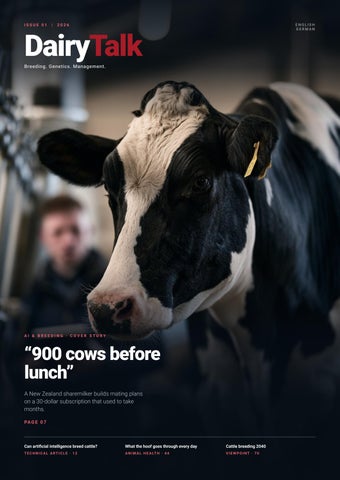
ISSUE 01
|
2026
ENGLISH GERMAN
DairyTalk Breeding. Genetics. Management.
AI & BREEDING · COVER STORY
“900 cows before lunch” A New Zealand sharemilker builds mating plans on a 30-dollar subscription that used to take months. PA G E 0 7
Can artificial intelligence breed cattle?
What the hoof goes through every day
Cattle breeding 2040
TECHNICAL ARTICLE · 12
A N I M A L H E A LT H · 4 4
VIEWPOINT · 70
DairyTalk Breeding. Genetics. Management.
The technical magazine for modern dairy cattle breeding Twice a year. In English and German. For everyone who makes breeding decisions.
ISSUE 01 VOLUME 1
·
2026 ·
ISSUE 1
www.dairytalk.info
EDITORIAL
PUT KNOWLEDGE IN CONTEXT. MAKE BETTER DECISIONS. Dear readers, dairy farming is changing. New breeding methods, genomic information, digital systems and artificial intelligence are opening up possibilities that were barely thinkable a few years ago. At the same time the decisive question stays the same: how can we make better decisions for our animals, our herds and our businesses? DairyTalk wants to create a space for that. For well-founded technical articles, practical experience, international perspectives, and also for subjects where there is no easy answer. Neither the newest technology nor the loudest opinion should be at the center of it, but what actually holds up in practice. I will be glad if DairyTalk helps to set new thinking in motion, to share experience, and to look at cattle breeding and dairy farming from different points of view. I hope you enjoy reading it. Helmut Demmelhuber
“Better decisions begin with better questions.”
DairyTalk
C O M PA C T
ISSUE 01 | 2026 8 0 PA G E S
Eleven articles. Eleven pages. This issue runs to 80 pages. If you do not have the time, read one page per article here: what it is about, what is documented, and what follows from it for your own farm. The red number beside each summary is the page on which the full article begins in the issue.
07
“900 cows before lunch”
AI & BREEDING
12
Can artificial intelligence breed cattle?
AI & BREEDING
17
No farm is average
AI & BREEDING
26
My animals – my data?
AI & BREEDING
32
Which breed fits which farm?
36
What a lost quarter really costs
A N I M A L H E A LT H
44
What the hoof goes through every day
A N I M A L H E A LT H
51
Shamonda and the spring that follows
A N I M A L H E A LT H
58
Understanding elite auctions
MARKET & MARKETING
64
Four buyers, four pricing logics
MARKET & MARKETING
70
Cattle breeding 2040
D A I R Y TA L K C O M PA C T · I S S U E 0 1 | 2 0 2 6
FA R M & E C O N O M I C S
VIEWPOINT
01
AI & BREEDING
07 PA G E I N T H E I S S U E
“Anyone who starts with the sire list is answering a question he never asked.”
“900 cows before lunch” A New Zealand sharemilker builds mating plans on a 30-dollar subscription that used to take months. What he does would not be possible on a German farm today — and the technology is not the reason.
Matthew Zonderop is a 50:50 sharemilker in Matamata with about 400 KiwiCross cows. He cannot write code and gets by in Excel the way most people do. Since one night in spring, when a spreadsheet he had built over five weeks collapsed two weeks
FROM THE ARTICLE
before the start of the breeding season, he has been developing an artificial-intelli‐
400 cows
gence-supported mating system that is now in use on several New Zealand farms.
mated in half an hour, 900 on another farm before lunch
26 traits per animal that the report works through
93 % of New Zealand dairy cattle sit in one database
The procedure is unspectacular. The farm exports a single file from the national herd database: phenotypic data, the full genomic profile, production history, health data, liveweights, every case of mastitis, every lameness event, every lactation curve going back to the day the cow was born. Before that comes a twenty- to thirty-minute phone call about the goal: more components? Better rebreeding? Somatic cell count down? Only then does the system match the cow data against the sire catalogs, work through 26 traits per animal and write the mating report. The rule his system rests on is a limit: seven kilograms of liveweight in one season, not thirty-five. Mating works in both directions, and anyone who jumps in a single generation breaks something he did not know was load-bearing. He is equally cautious about the numbers that go through the trade press — 12 percent faster genetic gain, 18 percent fewer stillbirths: early figures, not yet independently reviewed, and the longterm traits such as mastitis resistance and functional survival will not tell their story for another five to eight years. For German farms the interesting part is not the technology but a precondition that does not exist here. The decisive advantage is not the model, it is the file. In Germany, genomic results reach the farm mostly as individual PDF data sheets from the vit or Netrind system, one animal per file; for home-bred young sires, complete exports are in some cases not available at all. A farm with 300 genotyped animals has one spread‐ sheet there and 300 documents here. Anyone who wants to evaluate those documents spends most of his time not on breeding but on retyping. Two further differences rule out a simple transfer: the New Zealand breeding values cannot be carried over to RZG, the German relative total merit index, or to the German sub-indexes, and the KiwiCross is bred for a block-calving grazing system that has little in common with a German robot herd. What does transfer are three ways of think‐ ing, and they cost nothing: set the weightings before choosing sires, correct in increments instead of jumping, and hold your own progeny up against the mating decisions you made four years ago. That works here too, with milk recording and herd management data.
D A I R Y TA L K C O M PA C T · I S S U E 0 1 | 2 0 2 6
02
AI & BREEDING
12 PA G E I N T H E I S S U E
“Artificial intelligence does not replace a breeder — but it makes him considerably stronger.”
Can artificial intelligence breed cattle? What artificial intelligence can do in cattle breeding today, what it cannot — and how to get started in five minutes.
Most people so far use artificial intelligence to write emails. In breeding that is a very small slice. It is strong where there is a lot of structured data and where the volume defeats a person: genomic data, production data, pedigrees, breeding values. What it cannot do is be there in the barn. It does not see an animal, does not feel temperament and does not know a farm’s particular history.
FROM THE ARTICLE
3
The article describes three applications. First, sire selection: the genomic profile of a
applications with demonstrable value
cow is analyzed and her weaknesses are matched against the sires actually available
1 point
organization. Out comes a reasoned selection of two or three sires. Second, herd
deviation when type is scored from photographs
analysis: the genomic data of the whole herd produce a strengths-and-weaknesses
4 steps
type evaluation from standardized photographs — on linear scoring the deviation from
to a question worth asking
the actual classification was usually no more than one point.
— from the farm’s own semen tank or from the lineup of an artificial insemination
profile from which first, second and third choices per animal can be derived. Third,
The practical part is a guide that fits sire selection into the working day. Two documents are needed: the cow’s genomic data sheet and the data sheets of the sires in the tank. Plus a fixed opening prompt that carries the farm’s breeding goal and expressly forbids proposing any sire not contained in the uploaded files. The result is a ranked shortlist of three with reasoning and a traffic-light matrix showing which weakness each sire corrects. The quality of the answer depends on the quality of the question. The article offers a four-step formula for that: who am I — in what role am I asking? What is this about — farm, size, milking system, conditions? What should happen — analyze, compare, draft, in what format? And in what role should the system answer — neutral analyst, experienced consultant, sparring partner? The article names the limit clearly. Without technical knowledge and critical judgment, artificial intelligence can amplify a wrong turn: a faulty data sheet looks faulty, a faulty artificial intelligence answer looks like advice. Breeding decisions supported by artificial intelligence are not automated decisions — they are better-informed decisions, and the responsibility stays with the person.
D A I R Y TA L K C O M PA C T · I S S U E 0 1 | 2 0 2 6
03
AI & BREEDING
17 PA G E I N T H E I S S U E
“The mathematically perfect solution is worthless if it does not work in the barn.”
No farm is average Three tools that build on one another for farm-specific breeding planning — tested on five dairy farms between 150 and 700 head.
In practice, breeding planning almost always starts with the question: which sire do I use next on which cow? That is understandable, because it leads straight to a decision. It is simply the third question, not the first. Two others come before it: where does my herd actually stand, and where should it be going? Start at step three and you
FROM THE ARTICLE
3 questions in a fixed order: position, goal, mating
96 of 101 cows were left without a sire on the first run
40 % of the gene pool came from the ten most frequent ancestors
are optimizing toward a goal nobody has examined. The starting problem is rarely a lack of information. A dairy farm today holds more data about its animals than ever before — milk recording, breeding values, pedigrees, insemination records, robot or herd management data, hoof trimming records, increas‐ ingly genomic results. Those data simply sit side by side instead of together: the breeding value is in the association portal, the milking data are in the robot, the culling reasons are in the herd program. Each source describes one slice of the same cow. The first tool brings those sources together and produces an assessment of where things stand: level, greatest strength, greatest weakness, culling pattern, relationship structure. One principle runs through it — every statement carries a confidence level. What is documented is called documented, what was calculated is called calculated, and what the data do not support is marked as open rather than sold as a finding. On one Fleckvieh farm with 668 cullings documented over thirteen years, the evaluation moved the focus away from the assumed problem with feet and legs and toward the udder and how well individual cows suited the milking system in place. The second tool weights the existing breeding values by what the farm needs. Official total merit indexes such as RZG or GZW are built for the breed; a robot-milking farm with tight rearing capacity and a parlor farm selling breeding stock need different cows but get the same ranking. Two rankings of the same herd differ considerably: of the twenty top-ranked animals in each case, only a few matched on the pilot farms. The third tool does the mating, with two rules built in permanently. Every cow gets several reasoned proposals, never just one name, and a usage limit per sire caps the concentration of lines. Both rules come out of practice. On one Red Holstein farm the requirements had been translated into hard exclusion thresholds so consistently that the first run left no sire for 96 of 101 cows. And in another herd the ten most frequent ancestors accounted between them for more than forty percent of the gene pool — visible only when the ancestors were compared, not from the sires’ names.
D A I R Y TA L K C O M PA C T · I S S U E 0 1 | 2 0 2 6
04
AI & BREEDING
26 PA G E I N T H E I S S U E
“Whoever supplies the raw material should at least have a say in what happens to it.”
My animals – my data? Who owns the data from our animals, what the EU Data Act changes — and why the breeding organizations’ counterarguments deserve to be taken seriously.
Our cows no longer produce only milk, they produce data. Every calving, every insemin‐ ation, every test day, every genomic test, every activity reading leaves digital traces. The milk stays in the tank and is paid for within a few days; the data stay in databases, and their value can rise for decades. Data are therefore no longer a by-product but a factor of production in their own right.
FROM THE ARTICLE
1 CSV
Most farmers would say instinctively: my animal’s data belong to me. In legal terms
instead of three hundred PDFs for 300 genotyped animals
that intuition is largely wrong. Unlike a barn or a cow, data are not a thing under
Feb. 2024
rights of use, rights of access, data portability and data sovereignty. The real question
the EU Data Act came into force
is not who owns the data but who decides how they are used.
4 terms
That is exactly where the EU Data Act, in force since February 2024, comes in. It
order the debate in legal terms
European law; there is no classical ownership of data. Lawyers therefore speak of
requires manufacturers and platform operators to give users access to the data they generate by using a system — and to do so in machine-readable formats. Protected algorithms and the findings derived from them remain trade secrets; the raw data the user generated himself do not, not without further argument. For cattle breeding that means the claim to your own SNP profile in a CSV file rests on far firmer ground than before. The article takes the other side seriously. A genomic breeding value does not come out of a cow’s hair sample. Behind it stand reference populations built over decades, scientific models that are continuously recalibrated, and considerable investment in data quality. Without that collective infrastructure the SNP profile of a single animal would have no interpretable value. An organization that protects its models is doing the right thing. The problem begins elsewhere: when the same argument is used to refuse a fee-pay‐ ing member access to his own raw data. As the most likely future model the article describes a controlled openness — CSV export on request, external programs permit‐ ted, the farmer deciding on sharing, while the model and the aggregated population level stay protected. Both sides then keep what belongs to them.
D A I R Y TA L K C O M PA C T · I S S U E 0 1 | 2 0 2 6
05
FA R M & E C O N O M I C S
32 PA G E I N T H E I S S U E
“Do not pick the best breed — pick the one that fits the farm.”
FROM THE ARTICLE
4 questions decide the choice of breed
7 criteria in the scoring model, 1 to 5 points per breed
6 % fat is what the Jersey delivers at around 7,000 kg
Which breed fits which farm? Holstein, Fleckvieh, Jersey and Brown Swiss pursue fundamentally different breed‐ ing goals. Which breed pays is decided not by milk volume but by the farm system.
Breed choice used to be a question of region, of tradition or of whatever semen was on offer. Today it is a strategic decision with measurable economic consequences: feed costs, replacement rate, calf revenue and health costs all hang on it. Holstein is the highest-producing dairy breed in the world; genetic potential of 10,000 kilograms and more is standard today, and the breeding goals moved past volume alone long ago. The decisive point is a different one: the breed is less forgiving of management mistakes. Variable forage quality or patchy reproductive monitoring show up quickly in veterinary and replacement costs. German Fleckvieh follows another concept — balance between milk, beef and fitness. Calf revenue is consider‐ ably above that of Holsteins, which shifts the gross margin picture substantially wherever calves matter. At around 7,000 kilograms the Jersey delivers less volume but about six percent fat and over four percent protein. In component-based pricing and in cheese marketing that is a decisive advantage, and her small body size cuts maintenance costs on top. The flip side is weaker calf and cull values and a clear disadvantage where milk is paid by volume. Brown Swiss occupies a middle position, oriented toward protein and pro‐ ductive life — an advantage that often only shows up in a multi-year calculation. The article lays out a scoring model across seven criteria: milk volume, fat and protein, feed efficiency, calf revenue, health stability, productive life and management demand, with one to five points per breed. It does not replace a proper economic analysis but it makes the logic of the decision visible. The most common mistake in breed comparis‐ ons is looking only at milk volume. What decides the outcome is gross margin per cow per year — from milk revenue, calf and cull revenue, feed costs, animal health and breeding costs, and replacements. The farm analysis comes down to four questions. Is milk paid by volume or by com‐ ponents, and are calf prices a meaningful part of revenue? Is an intensive feeding system available, or is the farm forage-based? Is consistent fertility and health management in place, or is the farm relying on robustness? And what does the loca‐ tion look like — intensive freestall barn, grassland or grazing? Answer all four consistently and the right breed follows almost inevitably.
D A I R Y TA L K C O M PA C T · I S S U E 0 1 | 2 0 2 6
06
A N I M A L H E A LT H
36 PA G E I N T H E I S S U E
“What decides whether the cow stays is not the missing quarter but the condition of the other three.”
What a lost quarter really costs A permanently blind quarter does not automatically end a cow’s productive life. It changes her yield, her somatic cell count and the calculation that decides whether she stays.
When a cow loses a quarter, the first thought in the barn is the neighboring cow’s hoof. The figures say otherwise. In an investigation of 25 dried-off quarters, recurrent mastitis lay behind 17 of them — and a teat lesion behind only a single one. Anyone who is watching the headlocks is working on the rarer cause. How common three-
FROM THE ARTICLE
17 of 25 dried-off quarters: recurrent mastitis
teated cows are in German herds has, incidentally, never been surveyed; anyone who quotes a figure here is estimating. The reason lies in the gap between two notions of cure. After treatment for mastitis
4%
the pathogen is gone in roughly three cases out of four, but the quarter is not in four
per quarter is what the remaining quarters compensate
cases out of five: the inflammation resolves bacteriologically, not cytologically. What
8.3-fold
draws no control sample three weeks after treatment will not find out until the next
higher fistula risk when sutured after 48 to 72 hours
episode.
remains is a quarter with an elevated cell count that can flare up again. A farm that
On the rarer route, through injury, what decides the outcome is not the suture material but the hour. In a prospective study the risk of fistula formation was 8.3 times higher when the teat was sutured only 48 to 72 hours after the injury instead of within 24 hours. Suture material and technique had no influence. Anyone who sees a bleeding teat on a Friday evening and waits until Monday has already decided the outcome. What the remaining three quarters can do is routinely overestimated. They raise their output by about four percent per quarter — not by a third. The cow ends up at roughly three quarters of her previous yield, which is where simple arithmetic would have put her anyway. Invisibly, the cell count changes at the same time: the composite value is a mean weighted by the milk volume of each quarter. Take a chronically infected quarter out of that calculation and the value falls — although nothing has improved in the other three. For the decision this means a three-teated cow is not a reason for culling but a cow whose basis of calculation has changed. The article shows how to put a number on the loss — 4.1 kilograms per day over the remaining days in milk, valued at the farm’s own milk price — and holds the result up against the heifer actually available. The cheapest preventive measure comes at the very beginning and costs five minutes: take-off at 400 to 600 grams of milk flow per minute instead of at 200.
D A I R Y TA L K C O M PA C T · I S S U E 0 1 | 2 0 2 6
07
A N I M A L H E A LT H
44 PA G E I N T H E I S S U E
“The claw carries the consequences of barn management. It just carries them with a delay.”
What the hoof goes through every day When hoof lesions increase, the ration is what gets discussed first. The evidence points elsewhere: what loads the claw is the floor — and the number of hours the cow stands on it.
At the outset stands a figure that puts every discussion about walking surfaces in perspective. In the German PraeRi data set, around 85,000 cows on 765 farms were scored while the farm managers were asked in parallel for their own estimate. Assessed by veterinarians, median prevalence was 23 to 39 percent depending on the
FROM THE ARTICLE
2 of 3 lame cows go unrecognized in the barn
region. The farmers put it at seven to ten percent. Two out of three lame cows are not perceived as lame in the barn at all. The biomechanics are the part that can be measured. On isolated, functionally
44.7 N/cm²
trimmed hind limbs, sole pressure on concrete averaged 44.7 newtons per square cen‐
sole pressure on concrete against 25 to 30 on rubber
timeter distributed over about 33 square centimeters of loaded area; on the rubber
56 %
is not only the level but the location: the pressure maxima occurred exactly where the
cure rate with early treatment, no effect later on
sole ulcer develops.
floors tested it was 25 to 30 newtons over 48 to 58 square centimeters. What matters
The second mechanism is overlooked more often. A cow does not slip going straight ahead but in the turn, when starting off and when braking. Measurements of ground reaction forces show that the friction reserve is sufficient for straight-line walking but not for stop-and-go. On top of that comes a finding that too rarely reaches on-farm advice: a thin layer of slurry increased both the frequency of slipping and the time required — and that could be offset neither by greater roughness nor by more compliance. A grooved floor does not rescue a dirty surface. Rubber is therefore not a blanket solution. A German study put net horn growth over twelve months at 3.4 millimeters a month on rubber against 1.2 on concrete — because wear fell from 3.5 to 0.3 millimeters. The change of surface did not bring any reduction in prevalence or severity. And with the infectious diseases the ranking reverses: for digital dermatitis, solid floors are the less favorable surface. The biggest lever is early detection. Two randomized trials by the same research group tested the same treatments and came to opposite results; the difference lay solely in the timing. Among newly lame cows, 56 percent were cured with a block and an anti-inflammatory. In animals that had been lame for more than two weeks, no treatment effect could be demonstrated at all. That makes locomotion scoring the actual measure — and on a robot farm there is the added point that milking time does not disappear but comes back as waiting time.
D A I R Y TA L K C O M PA C T · I S S U E 0 1 | 2 0 2 6
08
A N I M A L H E A LT H
51 PA G E I N T H E I S S U E
“What can be demonstrated in spring 2027 is being decided by the records kept in autumn 2026.”
Shamonda and the spring that follows Since June 2026 an infection event in cattle has been running through central Europe that has overtaken state laboratories, breeding organizations and farm advisers all at once.
Shamonda virus is an orthobunyavirus of the Simbu serogroup and is transmitted by biting midges. The pathogen itself is not new — it was first identified in Nigeria in the mid-1960s. What is new is its appearance in central Europe: in eastern France in June 2026, in cattle in southern Germany at the beginning of August. Important for under‐
FROM THE ARTICLE
standing it is that this is not one event but two. Since September, two independently
up to 100 %
introduced variants have been known which differ in all three genome segments;
morbidity at herd level, no deaths so far
whether infection with one protects against the other has not been established.
> 5 kg
The acute picture in the adult animal is described uniformly: a marked drop in milk,
drop in milk per animal
fever, dull animals, reduced feed intake, in some cases diarrhea. After a few days the
75th–175th day of gestation: the assumed vulnerable window
animals usually recover noticeably. At herd level, morbidity reached up to 100 percent with no deaths so far; the drop in milk is given as an order of magnitude of more than five kilograms per animal. Two anonymized farm reports in the article show the edge of that description. On one farm the event took in the whole herd within two weeks, and the drop was unmistak‐ ably distinguishable from heat stress for the woman running the farm. On a second it ran more severely and for longer: herd output fell from a good 40 liters to 33, stood at 36 after six weeks and thus still about four liters below the starting level, with losses from secondary disease on top. For this edge of the range no surveys exist so far. In legal terms the virus is not listed — neither notifiable nor subject to control measures. From that it follows directly that there are no payments from the animal disease fund. But something else follows too, which usually gets lost in the discus‐ sion: without a notification requirement no mandatory data stream comes into being. There is no official case count because there cannot be one. That the information ran behind the event is therefore not a communication failure on the part of individual bodies but the consequence of vector transmission, the absence of a notification requirement and a pathogen nobody had on the radar beforehand. The open question is the pregnancies. For the vulnerable window in cattle the Friedrich-Loeffler-Institut gives approximately the 75th to the 175th day of gestation — expressly by analogy with Schmallenberg virus and not yet determined experimentally for this one. That means the inseminations chiefly affected are those from spring and early summer 2026, whose calvings fall in spring 2027. What a farm can do now lies less in defense than in diagnostics and documentation: sample during the acute phase, identify the affected group of animals from the insemination records, and secure the baseline of the three preceding years.
D A I R Y TA L K C O M PA C T · I S S U E 0 1 | 2 0 2 6
09
MARKET & MARKETING
58 PA G E I N T H E I S S U E
“Transparency is not magnanimity on the part of the organizer — it is the cheapest way of turning trust into proceeds.”
Understanding elite auctions Elite sales are regarded as a shop window for genetics. In economic terms they are something more precise: a mechanism for finding a price under uncertainty.
An ascending auction is a price-finding procedure: the price rises until only one bidder is left. The hammer therefore falls roughly one increment above the willingness to pay of the second-highest bidder. The price does not measure what the animal is worth but what the last-but-one interested party was still prepared to pay. That explains why two almost identical animals fetch very different prices — depending solely on who
FROM THE ARTICLE
happens to be sitting in the room.
1 increment
Economists distinguish two types of value. With private value each bidder assesses
above the underbidder’s bid is where the hammer falls
the animal for his own use; a dairy farmer works out what the cow will do in his barn.
2 value types private use value and common future value
2 checklists for sale day in the article
With common value, by contrast, the value depends on a future quantity that is similar for everyone but unknown — the future demand for the genetics of a bull dam, for instance. Elite genetics are predominantly a common-value good, and precisely from that the core problem follows. When the true value is similar for everyone but unknown, every bidder estimates it with an error. Who wins? Systematically the bidder whose estimate deviates furthest upward. The hammer therefore goes not to the one with the best assessment but to the one with the most optimistic — the winner’s curse, first described in 1971 for oil licenses. The most effective protection is uncomfortable but simple: bid not the hoped-for resale value but your own sober use value, and deliberately temper the bid, especially when many are bidding. From this follows a conclusion that is counterintuitive. A complete, honest catalog is usually understood as fairness toward the buyer. In economic terms it is in the seller’s immediate interest: bidders who fear the winner’s curse build a safety discount into their bids. The more reliable information lies open, the smaller that discount becomes — bidders bid more confidently and higher. Selective advertising, by contrast, produces exactly the reticence that damages the seller. For the buyer everything comes down to a limit fixed in advance. It is set at home, before the auctioneer calls the animal in, and the self-test is a single question: would I buy this animal at the same price if there were no auction today? If the answer is no, the price is a product of the ring, not of value. Contracts belong in the cautious column here: an embryo or stud contract is, in economic terms, an option on an uncertain return — not a secure income.
D A I R Y TA L K C O M PA C T · I S S U E 0 1 | 2 0 2 6
10
MARKET & MARKETING
64 PA G E I N T H E I S S U E
“What is paid for is not quality. What is paid for is the number of questions an animal answers.”
Four buyers, four pricing logics Four buyers sit in the same room with the same animal in front of them and are willing to go to four completely different prices. Anyone who wants to explain a hammer price has to know who is bidding.
There is not one auction market for Holsteins but two, sharing the same ring. One trades use value: animals meant to give milk, in a barn whose arithmetic hangs on the milk price. The other trades options: animals out of which something is meant to come — a line, a route to market, a scarce trait. The use market follows the milk price
FROM THE ARTICLE
2 markets share the same ring: use value and option
with no appreciable delay; the strategy market does not follow it at all. That is why an overall average can look stable while everything underneath it is shifting. Because figures in euros date quickly, the article works with a ratio. Taking the freshly
1 to 13
calved heifer from the regular breeding stock sale as the unit, the published results of
is the span of the price ladder, measured against the heifer
one season produce a ladder: an embryo at about 0.5, the same use category at an
5 checks
animal at around 4 and the top lots at 10 to 13. The ladder says nothing about the
before sale day, not in the ring
absolute level — it says something about the distances.
elite sale at 1.7, the most expensive calved animals at 2 to 4, the genomic young
Those distances belong to four types of buyer. The commercial buyer is the largest and least noticed block; he buys milk, peace of mind and a calculable return, and does not pay for brands, contracts or prefixes. The breeder with an eye and a standard buys conformation, cow family and ring presence — his limit lies at two to four times the unit and is astonishingly firm. The program and stud buyer is not buying quality but unavailability: scarcity in a particular trait, usability on the female side, a clear profile. The investor, finally, regards the animal as an asset position. Six properties move the price upward across all types: scarcity, clarity, strategic connectivity, scalability, low risk, and a factual reason why the decision has to be made today. Behind them stands a common mechanism. An animal does not become expensive because it is better but because it takes decisions off the buyer’s hands — it answers a question he has to answer anyway, faster and more reliably than he could himself. In practice that means the work happens before sale day. No limit can be formed in the ring; there it can only be kept or exceeded. The article sets out five checks — genetics and depth of use, contracts and return, a clean classification of the category of animal, the market environment and one’s own role. Anyone who hesitates on one of these points does not bid. The hesitation is the information.
D A I R Y TA L K C O M PA C T · I S S U E 0 1 | 2 0 2 6
11
VIEWPOINT
70 PA G E I N T H E I S S U E
“The most dangerous variant is sliding into scenario A through a decision never taken.”
Cattle breeding 2040 The usual question is whether there will still be regional breeding associations in 2040. The article holds that to be the wrong question — and shifts the view from the organization to the infrastructure.
The article opens with an acknowledgment, not with criticism. Organized German cattle breeding has produced a quality of data, a security of pedigree and a methodo‐ logical reliability for which Germany is envied. Genomic breeding value estimation stands or falls with the size and quality of the reference population — and that exists
FROM THE ARTICLE
only because data were collected in a standardized and collective way over decades.
4 levels
What is experienced today as cumbersome is the precondition for the very innovations
in the target model: data, evalu‐ ation, programs, ownership
the system is said not to produce.
2 scenarios
The limit lies elsewhere. Today’s model is cut to a world in which the decisive data
continuation or open platform
came from milk recording, conformation scoring and pedigree, breeding was organ‐
7 principles without which no shared infra‐ structure holds
ized regionally, and membership of an association was the natural route into the breeding world. All three of those preconditions are changing. By 2040 the data relevant to breeding will come predominantly from sensors, milking robots, health monitoring, hoof trimming systems, fertility sensors and methane measurement — from sources no association controls. The target model is therefore not another association but a shared infrastructure on four levels: an open, quality-assured data base; a functionally independent evaluation; several breeding programs competing on the same data foundation; and the breeder as the owner of his data. The decisive step is the functional separation. Today one organization often combines several roles: it holds data, estimates breeding values, runs a program, markets genetics and gives advice. Each role is legitimate in itself; bundled together they create conflicts of interest. Two scenarios stand opposed. Continuation offers reliability and continuity but carries the risk that innovation increasingly comes from outside and that data-minded farms turn away. The platform offers connectivity and resilience but requires considerable governance effort and brings the danger that the data quality built up over decades suffers in the transition. The article decides for neither — it warns against the third route: sliding into continuation because nobody decides. For the associations that is no devaluation. In an unbundled system specialized organ‐ izations become more important, only in more clearly defined roles: as a regional breeders’ community, as an advisory and service house, or as a specialized program provider. What is up for disposal is the combination of regional responsibility for everything, a historical claim on members, and de facto control over data and market. The whole thing only holds with a governance structure to which breeders entrust their data voluntarily — the article names seven principles for that.
D A I R Y TA L K C O M PA C T · I S S U E 0 1 | 2 0 2 6
12
“Better decisions begin with better questions.”
READ ON
LISTEN ON
The full issue
Technical knowledge for your ears
All eleven articles in full, with sources, tables and
Many of the subjects in this issue are also available
figures. English and German, as a PDF to read and
as a podcast episode — for the car, the tractor or the
print.
walk to the barn. Listen to them individually, in any order.
www.dairytalk.info/home-en www.dairytalk.info/podcasts-en
DairyTalk · The technical magazine for modern dairy cattle breeding · Publisher Helmut Demmelhuber · Oberer Weg 14 · 72070 Tübingen, Germany · +49 7071 855 403 · kontakt@dairytalk.info Published twice a year as a digital edition in English and German.
D A I R Y TA L K C O M PA C T · I S S U E 0 1 | 2 0 2 6
13