Sign up for our New Newsletter
Dairy St r Milk Break
Email andrea.b@dairystar.com to sign up.
DAIRY ST R
Volume 19, No. 16
The future of dairy lies in exports Plan to increase international sales by 5 percent in ve years By Krista Kuzma
“All dairy, all the time”™
Herd data at Johnson’s ngertips
Ear tag system monitors activity, rumination, eating, temperature By Krista Kuzma
krista.k@dairystar.com
krista.k@dairystar.com
MADISON, Wis. – Three dairy industry leaders – Tom Gallagher, Dairy Management Inc. (DMI), CEO; Tom Vilsack, CEO and president of the U.S. Dairy Export Council (USDEC); and Marilyn Hershey, Pennsylvania dairy farmer and DMI board vice chairperson – met Oct. 4 in Madison, Wis., during the week of World Dairy Expo for a press conference to talk about the future of dairy. “What’s on my mind is improving trust among consumers and the ability of farmers to be able to operate in the next ve to 10 years,” Gallagher said. In order to continue operating, dairy farmers will need a place for their milk, which is becoming a concern with producers as milk is lling processors to near capacity. “The reality is we do an incredibly good job at producing milk. In fact we do an everincreasing good job each and every year. It’s projected that will continue. No matter how well we do on the domestic side of consumption, we’re still going to have to have strong exports in order to stabilize markets,” Vilsack said. Vilsack and Gallagher talked about how their two organizations will work together to use checkoff dollars to increase the U.S. dairy export market. Right now, exports account for 15 percent of the nation’s dairy sales. Vilsack and Gallagher said they are working on a plan to increase that to 20 percent within three to ve years. “The reality is, we can’t stay at 14-15 percent. We have to expand exports … To do that, Tom Gallagher mentioned the word trust and it’s incredibly important we go out and establish trust not with our own consumers, but with consumers around the world. If they trust us, they will try our products. If they try our products,
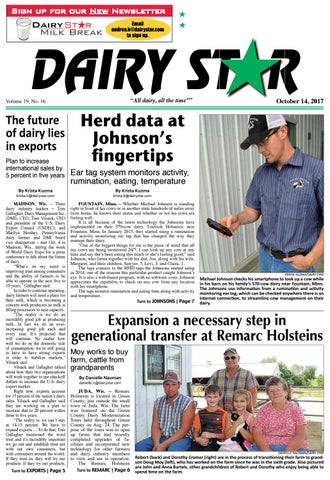
FOUNTAIN, Minn. – Whether Michael Johnson is standing right in front of his cows or in another state hundreds of miles away from home, he knows their status and whether or not his cows are feeling well. It is all because of the latest technology the Johnsons have implemented on their 570-cow dairy, Trailside Holsteins, near Fountain, Minn. In January 2015, they started using a rumination and activity monitoring ear tag that has changed the way they manage their dairy. “One of the biggest things for me is the piece of mind that all my cows are being monitored 24/7. I can look up any cow at any time and say she’s been eating this much or she’s feeling good,” said Johnson, who farms together with his dad, Jon, along with his wife, Margaret, and their children, Sawyer, 5, Levi, 3, and Claira, 1. The tags connect to the RFID tags the Johnsons started using in 2014, one of the reasons this particular product caught Johnson’s eye. It is also a web-based program, with no software costs. Johnson appreciates the capability to check on any cow from any location with his smartphone. The tags monitor rumination and eating time along with activity and temperature. Turn to JOHNSONS | Page 7
Turn to EXPORTS | Page 5
October 14, 2017
KRISTA KUZMA/DAIRY STAR
Michael Johnson checks his smartphone to look up a cow while in his barn on his family’s 570-cow dairy near Fountain, Minn. The Johnsons use informaƟon from a ruminaƟon and acƟvity monitoring ear tag, which can be checked anywhere there is an internet connecƟon, to streamline cow management on their dairy.
Expansion a necessary step in generational transfer at Remarc Holsteins Moy works to buy farm, cattle from grandparents By Danielle Nauman danielle.n@dairystar.com
JUDA, Wis. – Remarc Holsteins is located in Green County, just outside the small town of Juda, Wis. The farm was featured on the Green County Dairy Modernization Tours held throughout Green County on Aug. 24. The purpose of the tours was to open up farms that had recently completed upgrades of facilities and incorporated new technology for other farmers and dairy industry members to view and see in operation. The Remarc Holsteins Turn to REMARC | Page 6
DANIELLE NAUMAN/DAIRY STAR
Robert (back) and Dorothy Cramer (right) are in the process of transiƟoning their farm to grandson Doug Moy (leŌ), who has worked on the farm since he was in the sixth grade. Also pictured are John and Anna Bartels, other grandchildren of Robert and Dorothy who enjoy being able to spend Ɵme on the farm.
Page 2 • Dairy Star • Saturday, October 14, 2017
DAIRY ST R www.dairystar.com
ISSN 020355 522 Sinclair Lewis Ave. Sauk Centre, MN 56378 Phone: (320) 352-6303 Fax: (320) 352-5647 Published by Dairy Star LLC General Manager/Editor Mark Klaphake - mark.k@dairystar.com 320-352-6303 (ofce) 320-248-3196 (cell) 320-352-0062 (home) Ad Composition Nancy Powell 320-352-6303 nancy.p@dairystar.com Amanda Thooft 320-352-6303 amanda.t@dairystar.com Consultant Jerry Jennissen 320-346-2292 Editorial Staff Andrea Borgerding - Managing Editor (320) 352-6303 • andrea.b@dairystar.com Krista Kuzma - Assistant Editor (507) 259-8159 • krista.k@dairystar.com Ron Johnson (608) 874-4243 ron.j@dairystar.com Ruth Klossner (507) 240-0048 cowlady@centurylink.net Jennifer Coyne (320) 352-6303 jenn@dairystar.com Brittany Olson (320) 352-6303 brittany.o@dairystar.com Danielle Nauman (715) 245-6848 danielle.n@dairystar.com Advertising Sales Main Ofce: 320-352-6303 Fax: 320-352-5647 Deadline is 5 p.m. of the Friday the week before publication Sales Manager - Jeff Weyer (Northern MN, East Central MN) 320-260-8505 (cell) jeff.w@dairystar.com Mark Klaphake (Western MN) 320-352-6303 (ofce) 320-248-3196 (cell) Laura Seljan (National Advertising, SE MN) 507-250-2217 fax: 507-634-4413 laura.s@dairystar.com Jerry Nelson (SW MN, NW Iowa, South Dakota) 605-690-6260 jerry.n@dairystar.com Mike Schafer (Central, South Central MN) 320-894-7825 mike.s@dairystar.com Lori Menke (Eastern Iowa, Southern WI) 563-608-6477 • lori.m@dairystar.com Megan Stuessel (Western Wisconsin) 608-387-1202 megan.s@dairystar.com Deadlines The deadline for news and advertising in the Dairy Star is 5 p.m. Friday the week before publication. Subscriptions One year subscription $35.00, outside the U.S. $110.00. Send check along with mailing address to Dairy Star, 522 Sinclair Lewis Ave., Sauk Centre, MN 56378. Advertising Our ad takers have no authority to bind this newspaper and only publication of an advertisement shall constitute nal acceptance of the advertiser's order. Letters Letters and articles of opinion are welcomed. Letters must be signed and include address and phone number. We reserve the right to edit lengthy letters. The views and opinions expressed by Dairy Star columnists and writers are not necessarily those of the Dairy Star LLC.
The Dairy Star is published semi-monthly by Dairy Star, LLC, 522 Sinclair Lewis Ave., Sauk Centre, MN 56378-1246. Periodicals Postage Paid at Sauk Centre, MN and additional mailing ofces. POSTMASTER: Send address changes to Dairy Star, 522 Sinclair Lewis Ave., Sauk Centre, MN 56378-1246.
North America dealers. A glance at what’s inside
Dairy Prole brought to you by your
Although there have been three weeks in between this issue of Dairy Star and the last one we printed, we lled the extra time at World Dairy Expo, which was held Oct. 3-7 in Madison, Wis. We have several stories and a results page of people who did well from our coverage area along with photos to showcase the ve-day event. Find these in second section beginning on page 16. Although Don Austin is more of an experienced dairyman, the third generation farmer cannot nd the reason some hay elds on his farm do not do well. He was able to see By Mark Klaphake what others had to say about it during a Great River Graziers Pasture Walk Sept. 19 on his farm near Platteville, Wis. Read Editor on pages 35 and 37 in rst section about what the organic dairyman and others learned from the event. It is an event that happens on nearly every dairy farm – cows giving birth. But do dairy farmers know the right time to intervene? Mike Rohe talked about calving processes on his family’s 250-cow herd near Freeport, Minn., and Jennifer Bentley, Iowa State University Extension, gave tips on how to properly assist a cow that is calving. Read on pages 12 and 13 in rst section about this important aspect of dairying. Our “From our side of the fence” feature this issue comes from World Forage Analysis Superbowl nalists at World Dairy Expo. They talked about which competitions they entered, management practices they use to achieve quality forages, recent changes in their forage management and difcult aspects of putting up superior feed. Read about what these nalists had to say on pages 15 and 16 in rst section. On Frank and Kim Ponterios’ dairy, football and farming go hand in hand. They employ ve members of the Melrose-Mindoro Mustangs football team – their son, Victor, along with Andy Antony, Brandon Daniels, Connor Christopherson and Hunter Kastenschmidt – on their 100-cow dairy near Melrose, Wis. Read on pages 3 and 7 in second section about how the farmers and their employees make the farming lifestyle and high school sports work together. A Wisconsin dairyman hopes to add senator to his list of titles. Mel Pittman announced on Sept. 20 his candidacy for Wisconsin’s 31st Senate District, which covers Buffalo, Dunn, Eau Claire, Jackson, Pierce, Pepin and Trempealeau Counties. If elected, the responsibilities would add to the work load of his 70-cow dairy near Plum City, Wis. Read on page 29 in rst section about his platforms and why he wants to run for senate.
Favorite quotes from this issue:
“I tell everyone who comes here, you need one of your best employees on the calf feeders – not your average employee.” – Lee Pattison (Page 10-11, First Section)
“The main reason for going organic is cash ow. We didn’t want to get bigger, but we want to make more money per cow. It pencils out that we can make more money organically than conventionally.” – Jason Bock (Pages 8-9, Second Section)
By the Numbers
gained at Hollermann 14: Pounds Dairy after switching from 2X to 3X (Page 18 and 20, First Section) of corn silage 790K: Acres harvested in Wisconsin last year. (Page 31, Second Section)
THE TILLAGE AND HAY TOOL SPECIALISTS
INVEST IN QUALITY ®
Harrows
Plows
Mowers
Tedders
KUHN is committed to helping you succeed by building quality machines for seedbed preparation, mowing, conditioning, tedding, raking, and merging. KuhnNorthAmerica.com Roeder Bros. Bellevue, IA
Dee Implement of Waukon Waukon, IA
Lindstrom Equipment Mondovi, WI
Bodensteiner Implement Elkader, IA
D & D Farm Supply Arcadia, WI
East Side Farm Equipment Monroe, WI
J P Scherrman Farley, IA
Cherokee Garage Colby, WI
Frontier Ag & Turf New Richmond, WI
Burco Sales Independence, IA
Komoro Sales & Service Durand, WI
Steinhart's Farm Service Platteville, WI
Kunau Implement Preston, IA
Jordan Implement Juda, WI
Hwy 48 Farm Service Rice Lake, WI
Visit your local KUHN dealer today!
Dairy Star • Saturday, October 14, 2017 • Page 3
It’s all inside...
Women in Jeans: Elizabeth Hovey
SECOND SECTION Pages 8 - 9 Past 10 years has Bocks changing with the industry Pages 10 - 11 The “Mielke” Market Weekly Page 12 Hay Markets Pages 14 - 15 Dairying Across America
Forage superbowl nalists: How do you harvest quality forages? Pages 15-16
New Richmond
Elmwood
Plum City
Melrose
First Section: Pages 22 - 23
Third Section: Pages 14 - 15
First Section: Page 29
Second Section: Pages 3, 7
Mueller, Brunner meet on Farmers Only Eau Claire
Children Museum of Eau Claire hosts June Dairy Mark Rueth Month activities Second Section
Page 31
Silage important for dairy farmers, researchers alike
Iron Ashland
Mindoro
Second Section: Page 20
n Daniel Olson
Polk
Lena, Wis.
Sawyer
Price Bangor
Rusk
Barron
Young Guernsey rises to the top at World Dairy Expo Second Section: Pages 22 - 23
Taylor St. Croix
Chippewa
Dunn
Pierce Chad Hinsch
Buffalo
Rain does not stop Otte family from hosting community event
Prairie du Chien, Wis.
Page 37
Harvest season Pages 38 - 39
Dairy Prole: Alan Flansburgh
Dairy Recipes
Page 39
Garnavillo
Calf investment key for Pattison Dairy
Clark
Eau Claire
Pepin
Goodhue, Minn.
Five Melrose-Mindoro athletes nd success on gridiron, dairy
Proposal will top Mindoro couple’s favorite memories
ur hb
Burnett
Page 34
First Section: Pages 10 - 11
Jackson Platteville
Austin’s pasture walk: soil fertility,
La Crosse Monroe
First Section: Pages 35, 37
Vernon
Worth
Mitchell
Cerro Hancock Gordo
Floyd
Howard
k
ic Ch
w
a as
Bremer
Zone 2
Black Hawk
B
For additional stories from our other zone, log on to www.dairystar.com
Iowa
Clayton
an
an
ford
Craw
Dane
Grant
Fayette
h uc
Richland
Allamakee
Winnebago
Winneshiek
THIRD SECTION Pages 2 - 3 BQA program focuses on best management practices for healthy, wholesome beef Page 4 Dairy products help reduce inammation Page 5 People in the dairy community Pages 9 - 10, 12 Some Udder Stuff Page 13 Dairy’s Star Youth: Shelby Kuechle Page 16 Dairy Calendar Pages 18 - 26 Classieds
Pittman running for Wisconsin’s 31st District senate seat
Bayeld
Douglas
Oxford, Wis14 - 15 Pages
Page 25
Mid-American Hay Auction Results Pages 28 - 29 Crop and weather reports
Kids Corner: The Bechels
Trempealeau
Page 36
FROM OUR SIDE OF THE FENCE:
W as
FIRST SECTION Pages 1, 5 The future of dairy lies in exports Pages 1, 7 Technology helps Johnsons manage herd Pages 8-9 Ag Insider Pages 12 - 13 Successful delivery of newborn calf Pages 18, 20 Genetics pushes production at Hollermann Dairy Page 25 An ode to barn cats Page 26 FSA News & Notes Page 27 The Transition Pen Page 28 Remodeling and repurposing a building for dairy production Page 30 Ramblings from the Ridge Page 31 A little Bit of Sunshine Page 32 Making Cents of Dairy Page 33 Dairy Good Life Page 34 Veterinary Wisdom
are
w ela
D
Linn
Lafayette Dubuque
Jones
Jackson
Green
Madison
A reminder to be safe this harvest season Third Section: Pages 7 - 8
Juda
Expansion a necessary step in generational transfer at Remarc Holsteins First Section: Pages 1, 6
Give milk production a push GEA’s FRone works around the clock to keep feed at the bunk, maximizing your cows’ production. Could your bunk management routine use a little extra push? GEA’s FRone automated feed pusher provides consistent, high-quality feed available day and night to boost production results from your whole herd. It’s easy to use, charges fast and contains twin batteries for maximum run time. With the help of GEA’s FRone, you can push the limits on your feeding program.
Page 4 • Dairy Star • Saturday, October 14, 2017
NEW EQUIPMENT SAUK CENTRE
TRACTORS NH T4.100 & 110 Utility, Cab & Loader ...3 in Stock! NH T6.180 Plus, Super Steer, 4 Rmts ........In Stock! NH Boomer 46D, Cab Heat, A/C, Loader ..In Stock! NH Boomer 40 ROPS, Loader ...................In Stock! SKID LOADERS NH L218, L220, L228, L234 and C238 ...... In Stock! HAY TOOLS NH SpeedRower 220 & 260 ...................... In Stock! NH Procart 819, 1022, 1225 Rakes............In Stock! NH Dura-Vee 1020, 1225, 1428 Rakes ......In Stock! NH H7230 & DB313R Discbines ................In Stock! NH H6740, 7’ 10” Disc Mower, 3 Point ......In Stock! NH ProRotor 3114 & 3223 Rakes...............In Stock! NH ProTed 3417, 17’ 1” Working Width .....In Stock! BALERS NH RB450, RB460 and RB560...................In Stock! TILLAGE Salford 8208 Plow, 8 Bottom .....................In Stock! Salford I-2218, 18’ Vertical Tillage..............In Stock! Salford 9809, HD Ripper, 9 Shank..............In Stock! Salford I-4124, HD Vert. Tillage, 24’ ...........In Stock! FORAGE NH FR500 Chopper, Dual Drive..................In Stock! MANURE SPREADERS BBI Endurance, 22’ Litter Spreader ...........In Stock! MISCELLANEOUS Messer Attachments and Rock Wagons ....In Stock!
MANAGE YOUR CASH FLOW
PIERZ
TRACTORS NH T7.230 Classic, Power Shift, Super Steer .............................................In Stock! NH T4.90, T4.100 & T4.110 Utility’s ...........In Stock! NH T6.155 Plus, 2WD, 4 Rmts ...................In Stock! NH T6.165 Plus, Super Steer, 151 Hrs .........................................Lease Return! NH Boomer 55 ROPS and 55 Cab with loaders ............................................In Stock! NH Workmaster 60, FWA, Loader Ready ...In Stock! SKID LOADERS NH L218, L220, L228 and L234 .................In Stock! HAY TOOLS NH SpeedRower 220 & 260 .......................In Stock! NH ProCart 819, 1022 & 1225 Rakes .........In Stock! NH Dura-Vee 1225 & 1428 Rakes ..............In Stock! NH ProRotor 3114, 3223 & 3226 Rakes.....In Stock! NH ProTed 3417 .........................................In Stock! NH H7220, H7230 & H7330 Discbines.......In Stock! NH DB313R & DB316R Discbines .............In Stock! BALERS NH RB450, RB460, RB560.........................In Stock! FORAGE NH FP240, Crop Proc., Tandems ...............In Stock! MANURE SPREADERS NH DT2600, M2080, 185, 195’s .................In Stock! BBI Endurance, 18’ & 22’ Litter Spreader ..In Stock! MISCELLANEOUS Messer Attachments and Rock Wagons ....In Stock!
USED EQUIPMENT SAUK CENTRE TRACTORS NH T7000 Front PTO/3 Point Kit .................. $6,500 SKID LOADERS NH L230, Cab Heat, A/C, Air Seat ............. .$36,900 NH L218, Cab, Heat .................................... $24,900 HAY TOOLS NH 1475, 14’ Haybine ................................. $13,500 NH H7450, 13’ Disbine, Draw Bar Swivel ... $27,900 Enorossi RTVH14, 14 Wheel Rake .................. $1,450 BALERS NH RB460, Roto-Cut, 4’x6’, 3500 bales ..... $33,900 NH BR780A, Twine/Net, Wide P/U .............. $11,900 TILLAGE Salford 8214 Plow, 14 Bottom .................... $53,500 FORAGE Krone EC7500 ............................................. $29,500 NH 919A4 CH, 4R-36”, Fits 1915.................. $1,750 NH FX25, 4WD, AutoLube, 360N6 CH, Consigned................................................ $32,500 MISCELLANEOUS Berti TA-220 Offset Flail Mower. .................... $4,500 PIERZ TRACTORS NH T6.165 Plus, Super Steer, 151 Hrs ........................................... Lease Return! NH TD5050, Cab, FWA, Mech. Shuttle ....... $29,700
SKID LOADERS NH L230, 850 hrs., Perf Package ................ $43,500 NH L220, Cab, Heat, A/C, 2 Speed............. $32,700 HAY TOOLS NH H7450, 13’ Discbine, Drawbar Swivel ... $24,500 NH 166 Inverter, Hyd Drive, RH Table Ext ..... $5,700 NH 1431, Nice Consigned ............................. $14,000 NH 1465 Haybine, Hyd. Lift, Stub Guards ...... $9,350 Enorossi 10 Wheel, Carted Rake..................... $3,500 BALERS NH BR750A Net/Twine, Wide P/U ............... $17,800 NH BR780, Auto-Wrap, Bale Ejector, Std. P/U ................................................... $11,900 NH BR780, Net/Twine, Bale Command ...... $17,500 NH BR7090, Net Only, Wide P/U ................ $27,900 NH BR7060, Roto-Cut, Net/Twine, Bale Command ..........................................Just In! Vermeer 505I, 5x5 Bale, Electric Tie, Twine... $3,900 Vermeer 504F, 4’x5’, 1 yr. Old Belts .............. $1,500 TILLAGE JD 3710, 10 Bottom Plow, Nice, 2013 Model. ............................................. $29,500 FORAGE NH FP230, 27P HH, 3PN CH, KP................ $39,500 MISCELLANEOUS Hiniker 5610, 15’ RH Discharge Stalk Chopper ..................................................... $9,500
120-DAY No interest nancing
on qualifying purchses of $1,500 or more* Offer available October 1, 2017 through December 31,2017
SPECIAL FINANCING WHEN IT MATTERS MOST We know you have a lot of plans for your budget this time of year, and paying interest isn’t part of them. So, we’re offering a 120-day grace period to CNH Industrial Capital Productivity Plus® Account holders spending $1,500 or more on new genuine New Holland or remanufactured parts and related services. Take care of business — interest free.
Take advantage of special financing during our Winter Fix Sales Event. Hurry in— offer ends December 31, 2017. *With credit approval for qualifying purchases of new genuine New Holland or remanufactured parts and related services made on the CNH Industrial Capital Productivity Plus® Account. After the promotional period, the standard variable APR for purchases will apply except when your Account is at the default APR. See your billing statement and account agreement for your specific APR information and additional details. Minimum payments required. Offer valid for Accounts in good standing; is subject to change without notice; see dealer for details. May not be combined with any other credit promotion offer. ©2017 CNH Industrial America LLC. All rights reserved. New Holland is a trademark registered in the United States and many other countries, owned by or licensed to CNH Industrial N.V., its subsidiaries or affiliates. CNH Industrial Genuine Parts is a trademark in the United States and many other countries, owned by or licensed to CNH Industrial N.V., its subsidiaries or affiliates. www.newholland.com/na MRC
THE MOST STABLE SKID STEER ON EARTH IS NOW EVEN MORE POWERFUL. Skid Steer Loaders
0%
for up to 60 Months*
00% % Interest Interest ffor or 6600 Months* M onths* 0% FOR UP TO 60 MONTHS* WITH PAYMENTS AS LOW AS $461.00 Every day you face a new landscape with ever-changing demands. Count on the versatility and reliability of 200 Series Skid Steer Loaders to keep you ahead of schedule. Easy hydraulic hookup lets you quickly change attachments to handle multiple jobs. Patented Super Boom® lift technology delivers maximum reach at full height for more efcient loading. Rock-solid stability and unmatched visibility allows you to work with speed and condence.
EQUIPPED FOR A NEW WORLD™
SAUK CENTRE, MN
320-352-6543 • Hwy. 71 South
EQUIPPED FOR A NEW WORLD™
*For commercial use. Offer subject to CNH Industrial Capital America LLC credit approval. See your New Holland dealer for details and eligibility requirements. Depending on model, a down payment may be required. Offer good through October 31, 2017, at participating New Holland dealers in the United States. Offer subject to change. Taxes, freight, set-up, delivery, additional options or attachments not included in price. © 2017 CNH Industrial Capital America LLC. All rights reserved. New Holland Agriculture is a trademark registered in the United States and many other countries, owned by or licensed to CNH Industrial N.V., its subsidiaries or affiliates. CNH Industrial Capital and New Holland Construction are trademarks in the United States and many other countries, owned by or licensed to CNH Industrial N.V., its subsidiaries or affiliates.
PIERZ, MN
320-468-2161 • Hwy. 27 West
Superior seedbed Preparation
CALL FOR A DEMO! SAUK CENTRE, MN
320-352-6543 • Hwy. 71 South
PIERZ, MN
320-468-2161 • Hwy. 27 West
Call Or Visit Us On The Web At
www.modernfarmequipment.com To Learn More About Salford’s Line Of Superior Tillage Tools
Dairy Star • Saturday, October 14, 2017 • Page 5
ConƟnued from EXPORTS | Page 1
Trust the experts Future success starts with today’s nutrition At Famo Feeds, we strive to provide the best support for your operation and work to accommodate your specific needs.
KRISTA KUZMA/DAIRY STAR
A panel of industry leaders – (from leŌ) Marilyn Hershey, Pennsylvania dairy farmer and Dairy Management, Inc. (DMI) board vice chair; Tom Vilsack, CEO and president of the United State Dairy Export Council; and Tom Gallagher, CEO of DMI – gathered to talk about the future of dairy during a press conference on Oct. 4 in Madison, Wis. If they love them, they will continue to consume them,” Vilsack said. In order to make the 5 percent jump, it will require additional sales of 200,000 metric tons more of cheese and 450,000 metric tons more of dairy ingredients. Mexico will be a target country. Although U.S. products are already No. 1 in their market, accounting for 75 percent of all their dairy imports, Vilsack said he would like to see that number increase. “There is still potential …,” Vilsack said. “They drink a lot of soda down there, and they are concerned with obesity of their children. We want to work with Mexican producers and processors cooperatively and collaboratively for Mexican families to consider consuming more dairy.” Vilsack also said the plan will look to increase imports to Canada if the market opens, and to Japan, where there are fewer than 650 dairy farmers for the 120 millionperson population, Vilsack said. Korea, Vietnam, China, the Middle East and Africa are also potential markets where U.S. dairy products could see an increase. “A person consumes pizza once every 45 days [in China]. Just imagine what that would do for dairy sales if it increased,” Vilsack said. In Asia, the population will expand, as will the middle class. “At one point in the next 15 years, the Asian middle class will be 10 times the size of the entire United States. Those folks are going to want to consume dairy products. They will need protein,” Vilsack said. To carry out this project, USDEC is restructuring its organization in order to reach these markets and have been analyzing how many boots on the ground it will need to accomplish the nal goal, Vilsack said. From the regional or state levels, there will
be $2.8 million from the checkoff dedicated to this project. Vilsack also said USDEC plans to increase dues for its members. “We believe if we can get that 5 percent bump it can create another $2 to $2.2 billion of additional sales,” Vilsack said. “That’s the goal, knowing full well if we don’t reach that goal it potentially creates some real challenges in terms of the stability and pricing our farmers will receive because there’s going to be a lot of milk on the market.” Hershey said she knows this is a time of tight margins for dairy producers across the country. “The checkoff is not going to be the savior of the farm. It’s a piece of the puzzle,” she said. During the milk price slump in 2008 and 2009, Hershey and her husband felt the burden of the low price. “We had to bring in consultation and look at the whole farm as a picture, look at each part of our business where we had to hone down and really get back to grassroots farming. We were able to pull through, but it was a rough time. So I feel the pain [of other dairy farmers]. The margins are small,” Hershey said. Vilsack wants this plan to help U.S. dairy farmers. “The goal here is to reduce the volatility in dairy,” Vilsack said. He is looking forward to the potential in the upcoming year. “This is a tremendous opportunity to expand exports, a tremendous opportunity of selling the American brand of greatness – our capacity, stability, safety and sustainably produced dairy products,” Vilsack said “We’re excited at USDEC.”
Programs and support for every stage... from calf to cow and everything in between! Our full lines of feed include: •Complete feeds •Starter feeds •Supplements •Concentrates •Vitamins •Minerals •Pre-mixes •Base Mixes •Milk replacers •Animal Health •Preservatives/Inoculants •Tubs •Pet Foods •Specialty and custom feeds to meet your specific needs
320-836-2145 or 800-450-2145
Check out our newly redesigned website to ½nd a Famo Feeds dealer near you!
www.famofeeds.com
JERRY MANNING
Call 320-352-6303 to place your classied or mail to: Dairy Star, 522 Sinclair Lewis Ave., Sauk Centre, MN 56378.
Hot Water High Pressure Washing All pipelines cleaned and covered before whitewashing Family business since 1982 Dairy Barns • Steel Barns Jerry Manning • (218) 346-3671 Serving Minnesota & Western Wisconsin
COMPLETE BARN SOLUTIONS WHATEVER YOUR DAIRY NEEDS
Jeff Lee Lake City MN Double 8 expandable to Double 12. GEA Mag 90I Vertial Lift
Call us to help you make your dairy operation more efficient.
www.midwestlivestock.com
PINE ISLAND, MN • 800-233-8937 BEATRICE, NE • 800-342-5657 SIOUX FALLS, SD • 800-705-1447 MENOMONIE, WI • 715-235-5144 OWEN, WI • 715-229-4740
Page 6 • Dairy Star • Saturday, October 14, 2017
ConƟnued from REMARC | Page 1
Willmar, MN • 320.231.1470
EXPANDING OR REMODELING YOUR LIVESTOCK OPERATION? ƋƵŝƉŵĞŶƚ tĞ KīĞƌ͗ ͻ sĞŶƟůĂƟŽŶ &ĂŶƐ ͻ sĞŶƟůĂƟŽŶ ŽŶƚƌŽůƐ ͻ WŽƐŝƟǀĞ WƌĞƐƐƵƌĞ dƵďĞƐ ͻ ƵƌƚĂŝŶ ^LJƐƚĞŵƐ ͻ DĂƩƌĞƐƐĞƐ ͻ tĂƚĞƌĞƌƐ ͻ ^ƚĂůů ƋƵŝƉŵĞŶƚ ͻ ,ĞĂĚůŽĐŬƐ ͻ DŝƐƟŶŐ ^LJƐƚĞŵƐ
LANGE AG SYSTEMS SPECIALIZES IN:
Ŷ NEW FACILITIES
_
NO JOB TOO BIG OR TOO SMALL
Ŷ RETROFITTING & REMODELING Ŷ TURNKEY PROJECTS Ŷ BARN DESIGN Ŷ INSTALLATION, MAINTENANCE & REPAIRS
Lange Ag Systems is proud to offer Grain Bags, Silage Bags & Bunker Covers from Up North Plastics and Feed Fresh Silage Covers & Custom Size Bunker Covers from Raven!
t ^ >> E t Θ h^ 'ͳ ' Θ < >>z Zz E '' Z^
www.LangeAgSystems.com DO YOU HAVE AN UPCOMING AUCTION? Advertise It In The
DAIRY ST★R
Call (320) 352-6303 for more information.
IT’S FOOTBALL MANURE SEASON... ARE YOU READY ?
New Nuhn Lagoon Crawler, GPS ready CALL FOR PRICE
New Houle 5300 tanker brakes, in-tank agitation, hi/lo - CALL FOR PRICE
New Bazooka Farmstar 350 GA Booster Pump, 510 HP FIAT, 6819MPC white iron pump, safety gauges, pump bypass - CALL FOR PRICE
New Houle Agi-Lagoon pumps, 42’ & 52’ models IN STOCK
2009 Nuhn 7000 gallon vac w/suction boom, new injector bar - $57,500
New Bazooka Farmstar 700 hose reel loaded w/1 mile of 6” All American supply hose - CALL FOR PRICE
OTHER GREAT DEALS
Penta & Jaylor dump boxes IN STOCK
• New 48’ Nuhn 8” header lagoon pump, wireless remote, folding support wheels, white iron housing ................................................. $36,500 • Badger 3300 gallon tanker, 540 RPM, good rubber, nice cond .....................$8,000 • New Farmstar 10”x35’ loadstands on wheels ......................................... $3,295 ea. • Used 2012 Knight 8132 slinger................................................................ $28,500 • 2016 Artex SB 300 spreader, vertical beaters, guillotine gate, demo unit ...... $24,900 • New Knight SLC 8132 slinger ............................................................Call for price • Farm King Vac, dual inlet w/hose kit, PTO drive .....................................Make Offer • ‘08 Meyers V-Force Spreader, twin rear vertical beaters, tandem axles, 540 RPM $11,000 • 2016 JT Agitation Boat, rental unit, 130 hours of use ................................ Call for price
Durand, WI
715-672-4263 Whitehall, WI
715-538-1495
www.komrosales.com
DANIELLE NAUMAN/DAIRY STAR
The Cramers and Moy milk 80 head of registered Holsteins in a double-4 autoow parlor that was built into an exisƟng facility about 15 years ago. farm is owned by Robert Cramer and his wife, Dorothy. The Cramers are working to transition their farm to grandson, Doug Moy, who started working on the farm when he was in sixth grade. Moy, who is a graduate of the University of Wisconsin-Madison Farm and Industry Short Course (FISC) program, spent three years working with an electrical contractor before making the decision to take over his grandparent’s Remarc herd. “I knew I wanted to farm. It’s what I always wanted to do. It’s what I love,” Moy said. “In high school, I decided I needed to go on to school, but I also knew I didn’t want to spend the time or the money on a four-year degree; that’s why I went to the FISC program. Completing my dairy herd management certicate helped me realize this is what I wanted to do.” Cramer approved of his grandson’s choice to look to a program such as FISC to further his education. “Not all people need to spend the money and the time on a traditional four-year degree,” Cramer said. “There is something to be said about earning skills that work for you in a timely and economical fashion.” The Cramers and Moy are working toward a gradual progression in terms of farm transfer. Last fall, Moy purchased half the cattle and half the machinery from his grandparents. His plan is purchase the other half in a couple more years, and then eventually the land and the buildings. The pair made the decision to build the freestall barn to begin an expansion, allowing Moy to come back to the farm full-time from his job as an electrician. “Two years ago, Grandpa said he couldn’t do another winter farming on his own,” Moy said. The freestall barn was planned in order to increase their registered Holstein herd size from 60 head to the current 75 to 80. The eventual goal is to be milking 100 cows. The Cramers and Moy moved their 80-cow herd into a new 75cow freestall facility in January of this year. The barn is naturally ventilated using curtains. The new structure features three rows of stalls and incorporates drive-through feeding. Cow comfort is a priority at Remarc Holsteins, where the breeding program focuses on breeding for type and longevity. The stalls feature double chamber water beds that are topped with chopped straw. Changes started at Remarc Holsteins about 15 years ago when the Cramers decided to build a parlor and freestall barn into their older two-story dairy barn. The parlor, which the Cramers and Moy continue to use, is a double-4 au-
to-ow parlor. To retrot the old barn into a freestall barn, the barn cleaner was taken out and the tiestalls were used in a freestall manner. The Cramers discovered it was difcult to ventilate that barn. In the summer, the cows spent time on pasture, but the Cramers could see they were uncomfortable on hot and muggy days. “The cows congregated together under trees, standing in the mud,” Cramer said. “They didn’t look comfortable or happy, and production always dipped during the hot weather.” The Cramers began to explore what their neighbors and others were doing as solutions to housing problems. “We made the decision to build this,” Cramer said. “We did what we thought was right, and now we’ll have to live with it.” Having been raised a traditional tiestall dairyman, Cramer admits he is nervous about what the new freestall barn will be like in the cold and damp winter weather that can affect southern Wisconsin. “This winter when we moved in, it was so mild. We didn’t really have any trouble at all,” Cramer said. “It was never cold in there, but it wasn’t terribly cold outside either.” Manure is scraped daily from the new barn and hauled, with storage consisting of a small, temporary ramped pit. Moy is ecstatic with the new facility, noting it will make it easier for him to care for and maintain the milking herd with the added cow-comfort features. Breeding registered Holsteins has always been a priority for Cramer and is one which Moy will continue to develop, building on the legacy his grandparents started. He would like to focus breeding for strength and type. “I’ve always wanted to breed the kind of cow that I would like to milk every day,” said Cramer, agreeing with his grandson. “Type and temperament are important to me.” Currently, Moy is focusing on building the herd size instead of marketing genetics from their herd. “We’ve consigned a few animals to the Green County Heart of the Wheel sale, but that’s about it while we are building the herd up” Moy said. “I’d like to get to the point where we are doing more marketing, but we need to get cow numbers where we want them rst.” Moy has plans and goals for the future of the farm he is taking over from his grandparents. “Mostly, I want to run a successful farm,” he said. “That’s really important to me; to build on what my grandparents have created and to continue to build a good herd of cows that are nice to look at and nice to work with.”
Dairy Star • Saturday, October 14, 2017 • Page 7
ConƟnued from JOHNSONS | Page 1 “The cow tips her head said. “The data has helped us different ways when she’s eating better care for every cow on an and ruminating so there’s a individual basis instead of as a difference in the graphs between group.” eating and rumination time,” Better management has Johnson said. “When also helped the I rst heard that, I was dairy surpass a skeptical. I thought I 34,000-pound herd have to see for myself average earlier this if this can really work.” year. So far, the tags The new have worked just as technology has also they were described. saved on labor costs Johnson has used the for Trailside Holsteins. activity monitor tags When Johnson rst to monitor for heat Michael Johnson started looking at and a combination Trailside Holsteins the tags to add to his of decreased activity, farm, he had also been less time eating contemplating hiring and ruminating, and a lower a herdsman to add to the nine temperature to determine if full-time and three part-time cows are sick. employees already on staff. “The temperature is just “We were going to hire a tool. You can’t put a lot of a herdsman because we were weight on it because it’s external getting up to 400 cows, and I was temperature, but it gives you still milking, feeding calves and a group average so if a cow doing a lot of chores,” Johnson deviates from her group a lot, said. you can at least check her. If So far, there has been no she has also dropped eating and need to hire additional help to be chewing cud, I know she needs in charge of the herd. Johnson to be addressed immediately,” said the new technology helps Johnson said. cut down on the work load. Since installing the ear tags, Johnson does all the herdsman Johnson has been able to nd work on the dairy, which sick cows sooner, especially has been streamlined since with fresh and transition cows, implementing the monitoring which has equated to a lower system to assist him and has death loss. Reproduction has also signicantly reduced time spent improved with pregnancy rate doing herdsman work. increasing from 22 percent to “I didn’t have to hire a about 29 percent. The Johnsons herdsman because this was also give fewer shots for their doing all the work,” Johnson synchronization program. said. “Using this info to tweak our There is no longer a need transition period helps us better to walk through the cows to take care of the cows during the chalk tails for breeding or walk stressful times. I think that is one through the fresh cows to take of the biggest benets,” Johnson temperatures to monitor their
KRISTA KUZMA/DAIRY STAR
A cow is milked in the parlor at Trailside Holsteins near Fountain, Minn. InformaƟon about each cow – ranging from ruminaƟon, acƟvity and temperature among other items – can be tracked because of an ear tag that is aƩached to the RFID on each cow. health. “I only check the cows that need to be looked at, which is four to six cows instead of walking through 600,” Johnson said. “All my cows are being heat detected right now and I’m paying nobody to do it.” After calculating out how long it would take to pay for the system based on the savings from using it, Johnson said it has already paid for itself, estimating it only took one year. “And that’s just what you can put into numbers. It doesn’t include things like piece of mind when I’m away,” he said. Johnson admits there was a learning curve to adding the technology to the dairy. “It took a good three months
to get used to them. We didn’t change anything managementwise for three months – kept tail chalking and everything – until I felt condent in them because it was a lot to learn. It was a whole different way of managing,” Johnson said. He also said he had to learn how to use the information from the system. “It’s just data. You still have to use it and do something about it. If it tells me a cow is sick that’s one thing, but that doesn’t mean anything if I don’t go do something to help the cow,” Johnson said. There is also a component of micromanaging that Johnson said he has to keep in check. “I struggled with data
overload when I rst began working with the system because I was looking at it on my phone all the time. I wanted to go check every cow as soon as she came on an alert list. Now I have adapted to the new way of managing and typically only look at it for a half hour in the morning and go through any cows on the lists,” he said. During the rst few months, Johnson had to adapt to trusting the system to work rather than relying on people to do the job. “First you have to have a good support system and a good understanding of the product, and then you have to trust it. If you’re not trusting it, you’re wasting your money. As long as you have working tags in cows, … then it works,” Johnson said. The addition of more technology has been exciting for Johnson. “As a younger generation, this has kept things exciting and interesting for me. With a family and a demanding schedule with volunteering and board meetings, it allows me the freedom to have a exible schedule and be away for a couple days but yet be able to check on the cows,” Johnson said. Although the technology works on his farm, Johnson reminds others it does not mean it is an automatic t for others. “Find what works for you. This has worked really well for us,” he said. Johnson is glad he decided to make a change – one that allows him to better care for his cows individually regardless of location.
Visit your local J&D dealer:
Don’t Let Winter Leave You in the Dark Brighten your barn with energy saving LED lighting!
LIGHT UP
YOUR COWS!
More light means better feeding & higher milk output!
Super Pull Flat Chain HEAVIEST IN THE INDUSTRY!
LED High Bay Strip • LED High Bay • LED Low Bay • T8 LED
With heat treated, forged links and 1/4” thick paddles, we know our chain can’t be beat. That’s why we back it up with a 10 year warranty!
FIND US
Family Owned & Operated
1-800-998-2398 jdmfg@jdmfg.com www.jdmfg.com
ARCADIA, WI D&D Farm Supply 608-323-7001 800-657-6955
MENOMONIE, WI Midwest Livestock Systems 715-235-5144
LANCASTER, WI Fullers Milker Center 608-723-4634 800-887-4634
SIOUX FALLS, SD Midwest Livestock Systems 800-705-1447
OWATONNA, MN Northland Farm Systems BEATRICE, NE Midwest Livestock Systems 507-451-3131 800-385-3911 402-223-5281 800-742-5748 OWEN, WI Midwest Livestock Systems DURAND, WI 715-229-4740 Komro Sales & Service 715-672-4263 PENNOCK MN D&D Ag Supply & Const. FREEPORT, MN Hartung Sales & Service 320-599-4466 320-836-2697 PINE ISLAND,MN Midwest Livestock Systems GILMAN, MN 800-233-8937 Gilman Coop Creamery 320-387-2770 ST CHARLES, MN S&S Dairy Systems HENNING, MN 507-932-4288 Mid Central Equipment 218-583-2931 SAUK CENTRE, MN Dairyland Supply JANESVILLE, WI Tri-County Dairy Supply 320-352-3987 800-338-6455 608-757-2697
LONSDALE, MN Ross Equipment 507-744-2525 MARSHFIELD, WI Podevels Farm Service 715-384-6193
WHITEHALL, WI Komro Sales & Service 715-538-1495 WITHEE, WI Tri-County Equipment 715-229-2000 800-569-6825
MELROSE, MN Genex Farm Systems 320-256-3276 MENAHAGA, MN Dairyland Equipment 218-564-4958 866-846-0064
TO
AN
RT
LK E Y TA XP ODA E T
FCIC to review proposed Dairy Revenue Protection Program Page 8 • Dairy Star • Saturday, October 14, 2017
The American Farm Bureau Federation is agriculture has a key message for these trade talks. submitting its Dairy Revenue Protection concept to the “Don’t screw up the rest of NAFTA in the areas that are Federal Crop Insurance Corporation Board. If approved, working. They are the ďƒžrst and second biggest export this insurance product would be available by July of markets for the United States with them being right next to us.â€? 2018. AFBF director of market intelligence Ag Insider John Newton said this proposal does Farm Bill could move quickly not impact efforts to improve the Margin Peterson said there are a couple Protection Program. “We continue to work opportunities to advance the farm bill to improve the program we currently have. this fall and one possibility in early 2018. It is important dairy has a good safety net. “Chairman Conaway has been told by This is not a replacement for anything, it’s Republican leadership that we should be just another tool in the toolbox for dairy ready to go with two weeks notice. The farmers.â€? Newton said the dairy industry majority wants to move this sooner rather generates $40 billion in cash receipts each than later and there may be some ďƒ&#x;oor year. “Their current safety net is less than time allocated.â€? Peterson, who is taking a quarter of one percent of the value of a leadership role on dairy issues, said the commodity. Increasing the safety net committee staff are working on key parts through robust crop insurance tools can be of the farm bill. The House Agriculture very beneďƒžcial to the dairy industry.â€? By Don Wick Committee will hold a farm bill listening Columnist session in New York State on October 9. Aggressive NAFTA schedule continues There is talk some committee members The United States, Mexico and Canada are singing off the same song-sheet, saying good progress will also meet with Canadian ofďƒžcials during that trip to has been made in the latest round of negotiations for the discuss trade. North American Free Trade agreement. Labor standards seemed to be the focus in the trade talks in Ottawa. The Dairy case goes to WI supreme court The Wisconsin Supreme Court will hear a case United States reportedly tabled a proposal on seasonal safeguards for agriculture. That proposal would block that pits a proposed dairy operation against the local Mexican produce imports during certain times of the township. The Golden Sands Dairy in Saratoga unveiled year. Canada’s dairy supply-management program plans for a 5,300 head dairy operation in 2012. Numerous remains a point of contention. The U.S. dairy industry is attempts have been made locally to stop the project. Last also seeking greater market access north of the border. year, the town supervisors passed an ordinance that The NAFTA renegotiations process will resume October would impose new manure handling regulations. The Wysocki family won the ďƒžrst lawsuit and the township 11 in Washington, D.C. appealed. In April, the district appeals court ruled the Peterson wants dairy issues addressed in trade talks farm would not be able to use more than 6,000 acres “We have sent the message to the Administration of land for manure application or other ag purposes that there are problems, particularly with Canada on because of the local ordinance. dairy in NAFTA that we’d like them to handle,â€? said House Agriculture Committee Ranking Member Collin Elanco wants to sell its rbST business Elanco has announced a shift in its dairy strategy. Peterson. While dairy is a hot topic, Peterson said
That includes seeking a buyer for its Posilac rbST business. Elanco ofďƒžcials said the decision will allow the company to focus on signiďƒžcant dairy health issues, like bovine respiratory disease, Mycoplasma and digestive health. Elanco purchased the rights to Posilac and a Georgia manufacturing plant from Monsanto for $300 million in 2008. Big cheese inventories According to a joint report from the National Milk Producers Federation and Dairy Management Inc., domestic consumption of American-type cheese increased nearly 7 percent in the second quarter of 2017. Cheese exports are also higher. Despite those trends, inventories remain large. The typical holiday bump in cheese prices is not expected to happen this year, due to the large stocks. More cows heading to slaughter During August, the number of dairy cows slaughtered was up 9 percent from last year. Through the ďƒžrst eight months of the year, slaughter is up 4 percent. Dairy cow slaughter is forecast to reach 3 million head for this year. If realized, that would be the highest levels seen in four years. Misleading label challenged The National Milk Producers Federation is asking state and federal regulators to take action against a California company for misleading labels. This is the second time the organization has challenged the imitation dairy product called Blue Magic Cashew Milk. This action is part of a campaign created by NMPF that calls attention to food brands that wrongly label their products with dairy terms. The FDA has standards deďƒžning milk as a product of a dairy animal, but the regulations are not being enforced. USDA conďƒžrms large dairy complies with organic rules Aurora Organic Dairy of Boulder, Colorado is
Turn to AG INSIDER | Page 9
Bongards’ Creameries
Has been a quality market for MN dairy farmers for over 100 years. MN producers provide one of the country’s most distinctive brands of cheese that is still made using the same Old World craftsmanship and has been combined with cutting-edge technology to produce cheese that delivers unforgettable taste with unparalleled quality. MN Dairy farmers and Bongards, quality that stands the test of time. We offer a competitive base price, premiums, and the best Àeld representatives in the industry. 13200 Co. Rd. 51 Bongards, MN 55368 (952) 466-5521 Fax (952) 466-5556 110 3rd Ave. NE Perham, MN 56573 (218) 346-4680 Fax (218) 346-4684
Wherever you are, CowScout™ is here for you so you can be there for them – making the best decisions based on the best information. CowScout™ can monitor:
% " !$ %% % ###
Dairy Star • Saturday, October 14, 2017 • Page 9
ConƟnued from AG INSIDER | Page 8
producing milk within USDA’s organic regulations. Wisconsin’s Cornucopia Institute led a complaint against Aurora, claiming it was violating the grazing requirements found within the organic rules. USDA investigated the case and conrmed Aurora Organic Dairy meets the terms of the USDA organic regulations and the National Organic Program.
Co-op 100 list released CHS remains the country’s largest cooperative. For 2017, CHS has revenues of $30 billion and assets totaling $17 billion. Dairy Farmers of America moved up from third, to second on the National Cooperative Bank’s annual list of the top 100 co-ops. DFA reported revenues of $13.5 billion. Land O’Lakes is ranked third with revenues of $13.2 billion. The list also includes California Dairies, Inc. ranked at 13; Darigold is number 16 and Prairie Farms Dairy is 23. New Ulm, Minnesota-based Associated Milk Producers, Inc. is 24th on the Top 100 list. Foremost Farms, Select Milk Producers, Organic Valley, Agri-Mark, Bongards’ and First District Association are also included among the 100 largest cooperatives. Prototype round baler unveiled Vermeer has introduced the world’s rst self-propelled round baler. While still a prototype, the ZR5 has an automated baling process. Vermeer said the self-propelled round baler offers better maneuverability and driving efciency than a conventional tractorbaler combination.
Milking Shorthorn named Cow of the Year A seven-year old Milking Shorthorn cow owned by the Pat and Phyllis Agnew family, Oconomowoc, is the Cow of the Year. Mapleton Vly LT Borroloola was honored at World Dairy Expo. Loola has received an Excellent rating three times. The Cow of the Year distinction rotates between the seven major dairy breeds. WFBF hires Rebout Megan Rebout is the new director of member relations for the Wisconsin Farm Bureau Federation. Most recently, Rebout was the 4-H youth development educator in Rock County. Trivia challenge Bruce Walters of Chippewa Falls, Wis. was the rst general manager of World Dairy Expo, taking over those responsibilities in 1966, That answers our last trivia question. For this week’s trivia, who is the 2017 World Dairy Expo Industry Person of the Year? We’ll have the answer in the next edition of Dairy Star. Don Wick is owner/broadcaster for the Red River Farm Network, based in Grand Forks, North Dakota. Wick has been recognized as the National Farm Broadcaster of the Year and served as president of the National Association of Farm Broadcasting. Don and his wife, Kolleen, have two adult sons, Tony and Sam, and ve grandchildren, Aiden, Piper, Adrienne, Aurora and Sterling.
Why use the DHIA Porta BHB Ketosis Test? It’s just another tool to keep the cows healthy. The
speed of the test is terriÀc. Trevor Lisson Staples, Minn. • Milking 40 cows
accurate and
“The test is very reasonably priced.”
Hollandale Farms - Richard and Roger Hoen Cologne, MN • 95 milk cows
Results are
fast and simple to use.”
Adam Hinckley - Hinckley Holsteins, LLC ChatÀeld, MN
earlier
“I know we are catching ketosis cases and are able to Àgure out when we can stop treatment.” Ray Seibert Sebeka, MN
Minnesota Dairy Herd Improvement Association 307 Brighton Avenue South Buffalo, MN 55313 1.800.827.3442 www.mndhia.org
N10828 Cty Hwy O | Greenwood, WI 715.267.1416 | www.greenwoodsilo.com Email: sales@greenwoodsilo.com
SEALED SILO SERVICES: BOTTOM UNLOADERS: • CONSTRUCTION • MAINTENANCE • PRESSURE CHECKING • RESEALING • REPLACEMENT ROOFS
• GREENLINE UNLOADERS D-SERIES (FORAGE) B-SERIES (SNAPLAGE & GRAIN) • USED UNLOADERS • UNLOADER PARTS • FULLY EQUIPPED SERVICE CREW
By Bag Man LLC
We Know Happy Feet!
SUPERIOR FEED VALUE THROUGH SEALED SILOS
New!
We are not affiliated with A.O. Smith Harvestore®, E.S.P.C. or C.S.T.
Thinking Of Roasted Soybeans? Fall is a great time to add value to your bean crop by having it roasted.
If you have been thinking about trying roasted soybeans, KLC Farms is your best choice.
Quality
Consistency
The KLC roasting process will provide you with a low cost high bypass protein source that is high in energy. Our modern facility KLC Farms ensures quick Competitively turnaround Bids For Raw during Beans - Call For Price! this busy time of year.
Expandable Gusset For Bigger Calves!
Your Cold Weather Footwear Headquarters
Back by Popular DemandRated to -60°F!
Gel-Coosh comfort 12” & 16” styles Rated to -60°F!
Super Long >ĂƐƟŶŐ͊ Rated to -58°F!
KLC Farms Roasting, Inc.
Insulated ŏ Non-Insulated ŏ Safety Toe ŏ Camo ŏ Over Shoes
Visit www.roastedbeans.com
Find Your Local Dealer or Shop Online!
1-877-738-2326 877 738 232
KLC Farms Roasted Soybeans...Always A Good Choice!
800-796-5333
www.ChoreBootCentral.com
Page 10 • Dairy Star • Saturday, October 14, 2017
Lindell Sales & Service 37236 County 56 Blvd., Cannon Falls, MN
651-258-4311 • Mark’s Cell 651-764-4084
We carry... HOULE
Calf investment key for Pattison Dairy
We Have
BULK BINS!
ϐ Ǩ
Dealer’s Livestock Equipment Center, Inc. 1921 S Wisconsin St. Mitchell, SD 57301
888-995-3810
15527 St. Hwy. 29 Glenwood, MN 56334
800-433-4647
RON JOHNSON/DAIRY STAR
Group pens served by automaƟc feeders are part of the strategy of raising quality calves for Lee Paƫson, who dairies near Garnavillo, Iowa.
Quality heifers fundamental for 30,000-pound-plus herd average By Ron Johnson
ron.j@dairystar.com
GARNAVILLO, Iowa – Raising quality heifers is a key component of Pattison Dairy’s 30,000-poundplus herd average. Top-notch replacement heifers start out as top-notch calves. “The health of our baby calves dictates where our milk production is going to be. Calves are very important to us,” said farm owner Lee Pattison. Pattison began farming on his present farm, Garnavillo, Iowa, 38 years ago. As technology changed, so did his calf management methods. Today, the 700-cow farm that’s also home to 650 heifers uses two hoop buildings and a monoslope barn to house calves. Three automatic calf feeders, a homemade milk pasteurizer, and an all-in, all-out calf movement plan are vital ingredients. The hoop barns have been in use, while the monoslope building went up last year. Pattison decided that a third calf building might improve his management. “That’s one thing where we really are different,”
CANOLA MEAL CORN GLUTEN FEED CORN DISTILLERS GRAINS CORN STARCH LINSEED MEAL FLAX SEED OAT HULLS RICE HULLS SOYBEAN MEAL SOY BEST SOYBEAN HULLS SOY FLOUR SOY PLUS
Pattison said. “We have three barns, and we treat it like a hog setup … all in and all out.” Each barn holds approximately 45 calves, but only two barns are full at any time. Newborns go into whichever barn has been emptied, cleaned and disinfected. When they’re old enough, those calves move on to the next barn. At weaning, it’s out of that barn and into a different facility. Then the cycle starts over again. “It takes us 18 to 20 days to ll one barn,” Pattison said. “We like to stay inside that three-week window. If we’re going to wean at seven weeks, that makes it work out.” Calves in all three barns are fed by automatic feeders. The rst feeder went into use ve years ago. For their rst day of life, calves are bottle fed colostrum. Then they’re placed in a group pen and introduced to the nipple that’s attached to the milk line of an automatic feeder. A radio frequency identication (RFID) ear tag Turn to PATTISON | Page 11
AMINO PLUS SOY ISOLATE WHEAT MIDDS WHEAT GERM MEAL BEET PULP CASEINATES CHEESE SCRAPS SAW DUST FOOD BY-PRODUCTS LACTOSE NONFAT DRY MILK SUGAR/DEXTROSE WHEY PROTEIN POWDER
RON JOHNSON/DAIRY STAR
8
Paƫson Dairy uses two hoop barns and one monoslope barn for newborn-to-weaning age calves. PosiƟvepressure venƟlaƟon tubes keep the air fresh.
Dairy Star • Saturday, October 14, 2017 • Page 11
ConƟnued from PATTISON | Page 10 lets the automatic feeder know which calf is at the feeding station. On the rst day with the automatic feeder, a calf is allowed ve liters over several feedings that are four hours apart. Calves are gradually allowed as much as seven liters a day. Pattison Dairy feeds milk that’s pasteurized in a converted bulk tank. If the farm runs short of waste milk for the pasteurizer, the oldest calves are switched to milk replacer. The feeders reduced the work associated with feeding calves, but they did not eliminate it. Said Pattison, “We have less physical labor, but more management.” That management includes cleaning the feeders and looking at the computer’s information. For instance, the computer collects information on how much each calf has been drinking. Pattison said if a calf drank less than 50 percent of its allotment, the calf manager goes to that pen to see what’s wrong. The calf manager also cleans the feeders and the three barns. “I tell everyone who comes here, you need one of your best employees on the calf feeders – not your average employee,” Pattison said. The calf manager, he said, should be a stickler for details. At Pattison Dairy, the calf manager is Janine Sinniger. Two other employees are farm manager Andy Corlett and
Oslin Lumber Company
Janine Sinninger is the calf manager for the 700-cow Paƫson Dairy. herdswoman Jess Schramm; who help with the farm’s operations. The farm grows all its crops, 1,300 acres of corn and alfalfa, pumps and applies its manure, trucks sand for its barns and truck its own milk. Besides overseeing everything associated with the farm, Pattinson handles the bookwork for restaurant Kaffee 1858 in nearby Guttenberg; the business of Sara, his wife. Pattison Dairy is reaping the rewards of switching from raising calves in individual
pens to using group pens with automatic feeders. Weaning time has been cut by a week, from 56 days to 49. Calves are bigger at weaning, too. They weigh between 180 and 210 pounds; that’s up from 170 pounds. Heifers are bred when they’re 12 to 15 months old and calve at 24 months. The age at rst calving hasn’t changed, but Pattison said each animal weighs about 100 pounds more. “They look eshy now,”
RON JOHNSON/DAIRY STAR
Pattison said. “They used to look kind of thin.” The extra weight and better condition have translated into more milk in the bulk tank. Pattison said heifers milk an average 1,000 to 1,200 pounds more during their rst lactation. He attributed much of that increase to the automatic feeders. Their current herd size is max for the farm, which factored into his decision to try automatic feeders. “Because we’re not adding
cows and we’re running the same size every year, I try to do different things to keep the employees engaged,” Pattison said. “The feeders are a highmanagement item, but we just decided we could handle it.” The trio of barns also plays a role in producing healthy calves. Each barn sits on a limestone base for good drainage. And, each barn is equipped with positive-pressure tubes above the pens. These tubes draw in fresh air by way of fans on an end wall of each barn. Each barn also has outlets so stale air can escape. “Our calves lay all over the place in the barns. That usually means the ventilation is pretty good,” Pattison said. On three-time-a-day milking, the Pattison herd’s rolling average is 33,200 pounds. The herd produced a peak of more than 23 million pounds one year, Pattison said. This year, he looks for production at about 21 million pounds. Those kinds of numbers would be tough to achieve without quality replacement heifers. But those heifers come at a price. Pattison said he gures he has $1,800 invested in each heifer before she produces a single drop of milk. The number includes labor, feed, vaccines and the cost of the calf facilities. “Calves are very important to us,” Pattison said. “We can’t afford to lose them, and we can’t afford them to be sick.”
Building Plans?
We can help!
A friend of the farmer for over 60 years. Hwy. 23 East, Mora
320-679-1181
Tell the advertisers you saw their ad in the Dairy Star!
FEED BUNKS
Super High Capacity Fence Line Bunk
Call for details
Call for details
Call for details
Sunflower 4511-15
Sunflower 4213-11
Sunflower 1436-33 Disc
Call for details
• 38” wide, 34-1/2” high on back side • 24” high on front side • 20” deep feed trough • 6” feed saver lip
H- Feed Bunk
AL’S
CONCRETE PRODUCTS 1-800-982-9263
Serving Minnesota, Iowa and Wisconsin Since 1965
www.alsconcreteproducts.com
Special Price
Villard, MN • (888) 554-3111
Fence Line Feed Bunk
• Deep Feeding Capacity • Long Service Life & Cattle Safe • Available in 12”, 14”and 16” depths
Call for details
Villard Implement Co.
Pictured with optional guard rail post mounted on the inside of the bunk or can also be placed outside.
• Fence line feed bunk with slanted back • 15” feed trough depth • 24” high front side (Also available in 18-1/2” height for smaller cattle)
MF 8735
MF 2705 E
MF 7724
AGCO DT-205B - $95,000
Vermeer 605N, Corn Stalk Special, low bales - Call Sunflower 4511-13 $24,500
TRACTORS Ford TW35, Series II ........................................Just in MF GC2400 w/60” deck ................................$7,000 MF GC1705 w/60” deck ................................ Just In MF 8690, FWA, loaded ......................................Save MF 8650 CVT ............................................ Coming In MF 8650 ........................................................$120,000 MF 7497 .......................................................... $95,000 MF 7620 ............................................................. Just In MF 7618 ..................................................... Coming In MF 7616 ..................................................... Coming In MF 7614 ..................................................... Coming In MF 6614 CVT w/ldr...............................................Call MF 5609 w/ldr............................................... $57,500 MF 5450 w/ldr............................................... $52,500 MF 1085 w/cab ................................................$7,500 AGCO DT 220 ........................................... Coming In
AGCO DT-200A ............................................. $69,500 AGCO LT75A w/loader, only 175 hrs ..... $50,000 AGCO RT-150A CVT w/ldr. ..............................$54,500 IH M Farmall......................................................$1,950 White 6195 ................................................Coming in White 6144, FWA ......................................... $36,000 White 2-135 ......................................................$8,950 JD 4630....................................................... Coming In U-Moline, runs good .....................................$1,250 Cub Cadet 7305, hydro w/ldr .................................$7,500 PLANTERS White 9936-22 track planter ..............................Just In White 9108, low acres ..................................Coming In White 8222 12 row w/liquid ..............................Just In White 6100 12 row .............................................$12,000 White 6100 12 row ...............................................$5,900 White 5100 8 row 30” ..........................................$3,500 JD 7200, 6 row, conser planter..................Coming In JD 1750, 6 row w/dry fert ...........................Coming In Case IH 900, 6 row w/dry fert., cross auger .$3,000 Kinze 3700, 24 row 30”..............................................Call White 6180, 16 row .............................................$7,500 White 8524-22 CFS planter .................................. Coming In SKID STEERS & SPREADERS Gehl 7810E ................................................................. $27,000 Gehl 5640E, 2 pd. ..................................................... $24,500 Gehl 4840 ................................................................... $12,500 Gehl 4640E .................................................................... Just In Gehl RT-175 track loader.......................................... Just In Gehl R220 .............................................................. Coming In Gehl R190 ...................................................................... Just In
Gehl 6640E, cab/heat ............................................. $24,500 Gehl V-400, low hrs. ................................................ $49,500 Gehl V-400, only 50 hrs .......................................... $50,000 Gehl V-330, 300 hrs. ................................................... Just In Bobcat S650............................................................... $21,500 Bobcat 863 ................................................................ $11,500 Meyers 7400 spreader .............................................. Just In MISC. ITEMS JD 2700 ripper .......................................................... $19,500 JD 2700 5-bottom ......................................................$4,950 JD 510, 7 shank disk chisel ................................... $10,500 Case IH 870, 9 shank ripper...........................................Call Case IH 496, 21’ disc ................................................ $10,000 Case 700, 8 bottom ............................................ Coming In IH 490, 32’ ...................................................................... Just In Sunflower 7200-28 Soil Cond................................. Just In Sunflower 4610 ripper ...................................... Coming In Sunflower 4511-13 disc chisel ....................... Coming In Sunflower 1435-26 disc ............................................ Just In Krause 4900, 30’ disc..................................................$9,500 Soil Pro Wilrich 9 shank .................................... Coming In Gehl 700, 14 wheel rake ...........................................$6,500 Badger 950 forage box .............................................$2,500 MF 2270XD ........................................................... Coming In MF 2170XD baler ...................................................$100,000 MF 1375 mower cond ............................................ $17,500 Vermeer 605N, only 500 bales ............................... Just In NH 1475 mower cond. ..............................................$8,500 NH 499 ............................................................................$2,750 NH 340 3x3, 2015, only 4500 bales .............. Coming in NI 5512 ........................................................................... Just In
Page 12 • Dairy Star • Saturday, October 14, 2017
A closer look by Jennifer Coyne
Industry news addressed with help from your neighbors
Successful delivery of newborn calves
What happens in the maternity pen changes everything FREEPORT, Minn. – More than 70 percent of cows calve without assistance, according to Iowa State University Extension. However, with each calving that does need assistance, the life of the cow and calf are at risk. By executing proper assistance with thorough protocols during the calving process, the chances of a stillbirth or the cow developing health issues, such as hypocalcemia, are greatly diminished. Mike Rohe oversees the calving process on his family’s dairy and understands the importance of monitoring cows during this critical time. “You can just tell when a cow is having trouble calving, although they all look different,” Rohe said. “When we notice something isn’t right, I come out and check on her and do what I have to do to get the calf out.” Rohe and his two brothers,
JENNIFER COYNE/DAIRY STAR
Mike Rohe oversees the transiƟon cows at his family’s dairy, Rohe Dairy, near Freeport, Minn. Rohe monitors the cows as they enter the calving pen and assists when needed. Marvin and Jim, milk 250 cows on their dairy, Rohe Dairy, near Freeport, Minn. Calving broken into three stages After nine months of gestation, cows begin displaying signs of parturition – becoming restless, raising their tail
head and showing an increase of mucus discharge. This is known as the rst stage of calving. “The rst stage of calving lasts for about two to six hours before moving into stage two of calving, where the cow’s cervix becomes fully dilated and the calf moves through
the birth canal. During stage two, the water bag is apparent, contractions have started and calf’s legs can be seen. Once calving begins, it is important to monitor frequently, as this stage is variable from cow to cow,” said Jennifer Bentley, Iowa State University Extension.
At this time, Rohe has his pre-fresh cows in a pen near the calving area. When the animal shows signs of stage two, he moves her into the nearby calving pen by herself. “When I see the feet, I bring her into the close-up pen or if it’s late at night, I bring in one I think might calve while I’m away,” Rohe said. “Then, with cameras, I keep an eye on her.” Because cows do not like being secluded from their herd mates, Rohe tries to move the animals at the latest possible moment without calving in the group pen. The nal stage of the calving process is when the placenta is expelled. This can occur upwards of 12 hours post calving, Bentley said. However, if the placenta has not passed by 24 hours, it is considered retained, which is often caused by calving difculties. Post-fresh cows at Rohe’s are monitored for a couple days until they are milking well and healthy enough to return to the lactating herd. Assisting in a timely, efcient manner While calving is often a seamless process, difculties Turn to DELIVERY | Page 13
Once again, Byron Seed customers have
3 Grand Champions at the 2017 Forage Analysis Superbowl!
www.byronseeds.net
• Grand Champion Standard Corn Silage • Grand Champion Haylage • Grand Champion Organic Hay
Plus, a total of 33 finalists out of 100!
Talk to your Byron Seed Dealer to find out how you can be a winner too! or call Rick Tamm at 320-267-5021 or Brad DeBauche 920-660-7974.
Dairy Star • Saturday, October 14, 2017 • Page 13
ConƟnued from DELIVERY | Page 12 Commitment. Relationships. Trust.
Professional Dealers for:
YOUR MOST COMFORTABLE BEDDING SOLUTION
DCC Waterbeds® for tie-stall & free-stall barns
• Automated milking systems • Automated feeding systems • Robotic manure scrapers JENNIFER COYNE/DAIRY STAR
Post-fresh cows are monitored for a few days before they return to the lactaƟng herd at Rohe Dairy. arise with rst-calf heifers, a large calf or twins, as well as when the animals are under a great amount of stress. “Calving assistance is more common in heifers, so it’s important to recognize anything abnormal or signs of difcult calving early,” Bentley said. “If assistance is done properly, that can help reduce the prevalence of metritis in the cow and overall health of mother and calf.” The rst indicator of difculty is delivery presentation, where the calf is not in the normal position to come through the birth canal. “Four feet and the head coming out at the same time, backwards without feet, or feet rst without the head all require intervention,” Bentley said. “You will have to reposition the calf or have the vet assist with the presentation.” Delivery presentation is Rohe’s most common problem when he is troubleshooting a calving. “If the calf is backwards, I have to get it out quickly, so I’ve got that process down to a T. I know exactly what to do,” Rohe said. “If I can get the calf turned around, nine out of 10 times the calf is saved.” Once the calf is adjusted to a normal delivery presentation, monitor the cow and calf. Signs of labor should resume within 30 minutes of repositioning the calf. “If you pinch the tongue of the calf and get no response, the calf is stressed out. The tongue should darken and lighten as the cow is contracting. If it’s a constant dark color, then we know the calf is in distress.” Additionally, the presence of blood indicates the placenta has torn and the calf needs to be removed immediately. Early examinations of parturition determine when is the best time to intervene by pulling the calf. “It’s important to know how dilated the cow is before trying to pull,” Bentley said. “If the cow is not dilated enough, you could injure the cow and calf by causing broken bones.” This can be done by palpating the
cow during the calving process. “If an untrained person is using chains and straps, that’s dangerous,” Bentley said. “Calf jacks and manual extractions can easily exceed 600 pounds of force, enough to fracture leg bones.” Soon after calving, providing the calf with fresh colostrum aids in their immediate health development. “We give our calves colostrum as soon as possible,” Rohe said. “That’s our golden rule – two gallons worth of quality colostrum and we see the calves transition really well into the group pens a few days later.” Eliminate the need to assist By using sexed semen on rst-calf heifers, as well as using beef semen on the lower 30 percent of the herd, Rohe has improved his calving protocol and need for assisting. The housing facilities, where cows are not overwhelmed during parturition, have also prevented calving difculties. “It’s worked out with what we have,” Rohe said. “If we need to, we can partition the post-fresh pen into individual pens for the cows.” Bentley also suggests monitoring adequate energy intake, as well as reevaluating heat stress in dry cows. “We’re nding the importance of heat abatement in dry cows. Those who suffer from heat stress have shorter gestation times by ve days,” Bentley said. “Feed intake is reduced, which leads to greater metabolic issues post-calving, retained placentas and impairing the ability to transfer antibodies in colostrum.” However, with a cohesive calving protocol, the health of the cow and calf can be maintained. “We have a better understanding of the needs of pre-fresh cows all to improve the calving process,” Bentley said. “If we can take better care of the cow, we’re ultimately taking better care of the calf.”
• Tie-stall & stanchion barn equipment & automation • Parlor equipment & automations • Automated milking systems
• Tie-stall & stanchion barn automation • Centrus rotary platforms • Parlor detachers • Milk weight systems
$5 PER BED MANUFACTURER REBATE! Expires 11/31/17. Ask us for details!
Leedstone installs DCC Waterbeds in new construction barns, and upgrades existing mattress and sand systems—offering your herd the 3rd, and latest, generation in comfort and support. The consistent comfort compares to sand without the added handling, stall maintenance, and machinery wear and tear.
• Parlor detachers • Milk weight systems
Turner, Inc
Parlor stalls – new install & retrofits
Ventilation systems
Super stall foam mattress systems & more
• Headlocks for all sizes of animals • Free-stall systems
• Headlocks for all sizes of animals • Free-stall systems • Curtain sidewall systems
Dealers Livestock Equipment Feed bins & auger systems
Automatic waterers
DCC Waterbeds® ISO • Front and rear chambers are filled separately for maximum comfort and support › Front pillow provides a consistent cushion for the knees › Rear pillow floats the hocks and udder with more consistency • Sheds moisture away from the cow; liquids (urine, milk, etc) run off the bed › Cleaner, dryer udders › A dry environment helps minimize bacteria › No moisture pockets • When the cow leaves the bed, it immediately returns to its original shape • Minimal bedding needed › Less material, less cost › Less labor to groom the stalls › Less manure storage and handling • Offers a consistent temperature year-round— warmer in the winter, cooler in the summer • 15 to 20-year life expectancy; 10-year limited warranty in free stalls
• Individual calf pens • Calf hutches • Group housing
• Calf hutches • Group housing
Water is a forgiving surface— it supports the cow, yet will not compact or harden over time. • H & L automated feeding system • H & L milk taxi systems • Pasteurizers & milk cooling systems
Cattle head-gates & chutes JENNIFER COYNE/DAIRY STAR
Pre-fresh cows are housed in a low-stress pen, where they have ample space and feed, and are secluded from the elements of the weather. Once they show signs of calving, Rohe moves them to the calving pen, located on the other side of the wall.
Gates & livestock equipment
Contact us for details and to order. Jake Moline 320.761.9630
Don Brower 320.267.1604
jmoline@Leedstone.com
dbrower@Leedstone.com
Randy Arnhalt 320.267.3235
Paul Becker 320.510.0200
rarnhalt@Leedstone.com
pbecker@Leedstone.com
Page 14 • Dairy Star • Saturday, October 14, 2017
It’s Manure Season A whole h l new way to spread.
S Spreader SBX S d
Cyclone C yclone Discharge Discharge M Model odel Inset Guillotine Gate
180° Swivel Arm For Hydraulic Lines Articulating Bull Pull Hitch
10 Gauge Steel Walls
SB Series
Spreading Excellence
h
ou
Houle Rental 7300 gal. Tank with VTI Injectors
If y
FOR RENT
• High Ground Clearance • Simple Hydraulics • High Lift Endgate • Slurry Pan
ding and Man e e ur tF e es
Minnesota’s L
This is, quite simply, the most advanced, best-built manure spreader you’re ever going to see. Now, do you need one this tough? Well, that all depends on how often you like to buy them.
Sizes Range From 285-550 Bu.
ing Dealer nd l Ha
Better Spreading Utilizes More of the Manure Nutrients
ar g
Spring Suspension
• Choice of Heavy Duty Vertical or Horizontal Beaters • Dual Endgate Cylinders • Replaceable Bang Boards • Poly Floor/Sides Won’t Rot or Rust • InÀnite Speed Adjustment • Heaviest Frame In The Business • Two Bolts Remove Beater Assembly • Replaceable 3/8” Beater Paddles
ion .
Super Slide Poly Floor
l
ut
5/8” thick Áighting on vertical beater
Tw Twin win Vertic Vertical iccal ica Beaters Beaterrs
HYDRA-SPREAD
so wwave a a w.d barn, we have y.com airylandsuppl AgiPompe
Alley Scrapers
PS 150 and 160 ProSpread® Box Spreaders
Protwin® Side-Discharge Spreader
Reduce fertilizer costs with our vertical beater models
LIQUID MANURE URE P PUMP UMP EXCEEDING INDUSTRY STANDARDS THROUGH SUPERIOR DESIGN!
Conventional centrifugal pumps only have one discharge on the housing. That means that for every rotation of the fan, the pump is wasting power by trapping manure and not allowing it to easily get out of the housing. By adding multiple outlets, the manure is able to get out of the housing faster, resulting in pumping greater volumes with less horsepower.
NO PRIMING REQUIRED
LLAGOON CRAWLER AVAILABLE IN 12”
ELECTRA-STEER ER SPREADER LINE ER E • Very safe and stable steering technology • Steer angle is automatically reduced with faster travel speeds • Far superior to steering systems that require operator control to turn steering on and off for road travel • Steers while backing up • Precision steering greatly reduces tire wear • Proven technology
SUPERIOR AGITATION PERFORMANCE The 6” front nozzle is able to crush through thick crusts!
PUMPS 10,000 GPM Quad port header pump is able to move over 10,000 GPM!
NO PIT IS TOO THICK
The submerged pump & 4WD system make it impossible to get stuck.
NO PIT IS TOO BIG
The remote control system allows the crawler to get 1000’ away.
WHEN YOU ARE DONE, JUST DRIVE OUT The large aggressive tread tires allow you to easily drive out of lagoon.
EASY EA ASY Y TO TO TRANSPORT Available with a tandem trailer to get from job to job.
From Our Side Of The Fence
Dairy Star • Saturday, October 14, 2017 • Page 15
Forage superbowl finalists: How do you harvest quality forages? Mark and Nicky Rueth Rosedale Genetics Oxford, Wis. 34 cows
What forage category did you participate in at the World Forage Analysis Superbowl this year? We enter the grass hay and dairy hay. We were about seventh in dairy hay. Describe the forage you entered into the competition. We entered a few different cuttings. We use tall fescue, orchard and festolium grasses with king sher alfalfa. This year’s best sample was rst cutting. What are the most important management practices you follow to harvest quality forages? Why? I sell seed for Byron Seeds. They introduced me to the contest. My rst alfalfa eld I sowed, I did a really poor job with seeding and the seed bed. So I interseeded grass with the alfalfa over a few years. I have had this eld in seeding over seven years and it is still very productive. What has been a recent change to your forage management that has improved overall quality? I always had a custom square baler do the baling, but this year I bought a new Vermeer round baler. I made the best show hay yet. I can bale when I want. I bale grass hay before milking and I bale elds that have more alfalfa after evening milking if it works. This allows more leaves on the stems. The baler also has a soft core, and I can make tougher hay come out beautiful. What is the most difcult part about putting up superior forages? There seems to be a small window to make dry hay. Cutting is very important and if you have to wait until the custom guy gets time to cut, it may be too late. So the past few years I have been buying more equipment. I bought a discbine two years ago. This year I bought my own rake and baler. I cut, rake and bale all my own hay. Cutting is a timing issue. You have to study the forecast and maturity. It is a gamble sometimes but you have to be a good weather man if that is possible. We cut grass so we leave 3 to 4 inches of stubble with wide windrows. We like to cut late morning or early afternoon to get sugars up. Raking is a delicate job. I like to get hay dry and rake with dew on to keep leaves and make a uffy windrow to help air ow throw. Speed is critical and nding the right rake setting is a must in order to do a good job. What is a quality trait you look for in your forages? Why? Making good dry hay is hard sometimes, and a lot of people don’t want to do it. I like it. Our cows love grassy dry hay. Proper soil pH and nutrition is a must. Ammonium sulfate is a great source of nitrogen, but also has sulfur. Sulfur is huge.
Shavings BULK
OR
BAG
S&S Wood Products
35335 Green Street | Independence, WI 54747
800-234-5893 | 715-985-3122
year? Haylage.
What forage category did you participate in at the World Forage Analysis Superbowl this
Describe the forage you entered into the competition. The sample was a fourth crop KingFisher Allegro Italian Rye Grass from Byron Seeds. What are the most important management practices you follow to harvest quality forages? Our decisions always start with forage genetics; that helps us grow forages like this. For instance, there are a lot of bad Italian rye grasses on the market, but they head out and have poor quality. Byron Seeds customers had the top ve haylage samples this year. We were fortunate to have won. What has been a recent change to your forage management that has improved overall quality? We try to make all our forages the same day we cut them. We now use a triple mower with no rolls to lay the crop out wide and dry the hay faster. What is the most difcult part about putting up superior forages? Rain; it did that frequently this year. What is a quality trait you look for in your forages? Energy. I can always buy a little protein but it is hard to replace energy. What is the most unique part about harvesting forages in your area? We are in northeastern Wisconsin next to Lake Michigan which makes dry hay a challenge. The weather helps the grasses that we like to grow here. Tell us about your farm. I am the seventh generation to milk cows on this farm. I have ve boys so it looks like we should have an eighth generation. High quality forages are one way to make that happen.
What is the most unique part about harvesting forages in your area? Oxford is in the central sands of Wisconsin. There is a lot of irrigation in the area, but we do not have any. Tell us about your farm. Rosedale Genetics has been a dairy farm for the past 16 years. Last year, we sold 90 percent of the cattle. We are currently milking 34 cows, many of which are show cattle we house for other people. We feed our cattle mostly dry hay with more grass than alfalfa.
MANCHESTER Livestock Auction, Inc.
(40 miles west of Dubuque, Iowa on 4 lane Highway 20)
N FLOO AR
DAIRY SALES 2nd Fridays Monthly at 11:00 AM Selling 150 to 250 Head
Sheep and Goats sell at 9:30 AM
563-927-2540
www.manchesterauction.com
David and Jesse (pictured) Brutscher Daystar Dairy Little Falls, Minn. 688 cows How long have you participated in the World Forage Analysis Superbowl? We have participated in the WFAS for the past two years; second place in 2016 and 2017. The contest is 70 percent milk/ton and 30 percent visual. What forage category did you participate in at the World Forage Analysis Superbowl this year? Our sample was in the BMR corn silage category. Describe the forage you entered into the competition. Pioneer 1180X BMR, 110 day. What are the most important management practices you follow to harvest quality forages? To have a strategy for planting (population, soil quality/ fertility, timeliness, etc.) as well as timely harvesting and monitoring of the forage quality and processing as it comes in. What has been a recent change to your forage management that has improved overall quality? Adding precision planting equipment to the planter as well as using zone planting prescriptions for population. What is the most difcult part about putting up superior forages? Having good soil quality both when planting and harvesting, as far as being as able to move in the elds when the timing is right. What is a quality trait you look for in your forages? Overall digestibility and processing quality of the kernels in the silage. These qualities are important as it determines how readily and efciently our cattle are able to metabolize the feed to produce high quality milk. What is the most unique part about harvesting forages in your area? The variance in soil and temperatures throughout the year, as we can have gravel, sand and black soil all in the same eld. We also have a good amount of rocks we have to deal with in every location that we plant corn. Tell us about your farm. The main goals of our farm are to provide a good life for our team and great comfort for our cattle. We also strive to produce a high volume and quality of milk by focusing on the genetics of the cattle and constantly improving our forage quality and cow comfort. Tank averages around 100 pounds per cow per day with 3.7 percent fat and 3.3 percent protein. Turn to FORAGES | Page 16
PREVENT YOUR COWS FROM DOING THE SPLITS PRE
R
Wood
How long have you participated in the World Forage Analysis Superbowl? Six years.
B
How long have you participated in the World Forage Analysis Superbowl? We have been in the superbowl ve years in a row. We have won three grass grand champions.
Daniel Olson Lena, Wis. 150 cows
AND
G
RO
OVI
NG
HHolding Pens • Milk Parlors • Yards • Alleys • Free Stalls • We W Double Cut to Prevent Slippage in All Directions • Reasonable Rates es
No job too big or small, I groove it all!!!
Visiti our website Vi b i at www.PandDBarnFloorGrooving.com P dDB • 608-225-3595 (Doug) g)
Page 16 • Dairy Star • Saturday, October 14, 2017
ConƟnued from FORAGES | Page 15 Chad Hinsch Hinsch Farms, Inc. Goodhue, Minn. 600 cows
Shawn Winscher S&S Dairy Royalton, Minn. 120 cows
How long have you participated in the World Forage Analysis Superbowl? This is the rst year.
How long have you participated in the World Forage Analysis Superbowl? We just started participating a few years ago. In 2014, we were grand champions in haylage and quality counts.
What forage category did you participate in at the World Forage Analysis Superbowl this year? Standard corn silage. Describe the forage you entered into the competition. Pioneer P0921AMXT,109-day silage specic hybrid. What are the most important management practices you follow to harvest quality forages? Monitor kernel processing, dry down silage samples to harvest at optimum moisture, spread out hybrid maturity for risk and a wider harvest window, and the use of fungicides. Immediately covering bunkers and the use of oxygen barriers. What has been a recent change to your forage management that has improved overall quality? Harvest mapping. This helps to make good decisions on yield and quality differences among the corn hybrids. We also look at silage plots and raise hybrids, which are proven to feed better. What is the most difcult part about putting up superior forages? Generally dealing with weather during harvest, getting the bunkers lled and covered quickly. What is a quality trait you look for in your forages? Right now, NDF digestibility. We can buy inexpensive starch and raise enough tonnage, but it is hard to x digestibility when it’s in the pile. What is the most unique part about harvesting forages in your area? The increasing use of custom harvesting. Tell us about your farm. Our parents, Duane and Joan, started the dairy in 1981. My brother Scott and I took over in 2002. We have a herd of 600 Holsteins. We raise almost all of our forages. We have used custom harvesters for many years. They have the equipment and labor to get over many acres quickly. We store all of our forages in earthen bunkers with cement oors. Dad dug our rst bunker in 1982.
What forage category did you participate in at the World Forage Analysis Superbowl this year? Haylage. Describe the forage you entered into the competition. Byron seeds lowland hay mix. It was second cutting. The NDFD30 was 59.99 percent. The average was 47.10 percent. The milk per ton was 3,446. What are the most important management practices you follow to harvest quality forages? We make hay in a day. We cut hay at 8 a.m., tedd hay at 10 a.m., start raking hay at 1 p.m., and the chopper starts right behind the rake. What has been a recent change to your forage management that has improved overall quality? We learned how to make hay in a day. What is the most difcult part about putting up superior forages? The weather and having enough help. What is a quality trait you look for in your forages? I look for performance and tonnage when purchasing seed. When I buy my seed, whether its hay seed, corn or even small grain, I do not look at the up-front cost. What matters to me is the end result. The quality and how it performs. The end savings makes up in less grain or concentrate going into the TMR. Animal health is important and I can see the difference. The money I save in those areas pays for the seed. What is the most unique part about harvesting forages in your area? Nothing that I can think of. Tell us about your farm. My wife, Sara, and I, with the help of our three kids, farm 240 acres. We try to double crop 100 acres a year. We milk 120 cows and raise our young stock.
Winners announced in record-year World Forage Analysis Superbowl
The World Forage Analysis Superbowl evaluated a record-breaking 1,066 entries and presented awards to top nishers at the World Forage Analysis Superbowl Awards Luncheon, sponsored by Mycogen Seeds, at World Dairy Expo® on Oct. 4. Breezy Hill Dairy, Dallas, Wis., took home Grand Champion Forage honors and was awarded $2,500 from Kemin for the recognition. The Grand Champion FirstTime Entrant cash award of $1,500, sponsored by Kuhn North America, went to Judd Farms, Waterville, Minn. In addition, two Quality Counts Awards, sponsored by CROPLAN By Wineld United, were presented to top Quality Counts Corn Silage Winner, Fredrick Farms, Owen Wis., and top Quality Counts Hay/Haylage Winner, Prairieland Dairy LLC, Belleville, Wis. The top ve placings from each
category are: Grand Champion Baleage, sponsored by Agri-King; 1st Place: Katherine Guither, Walnut, Ill.; 2nd Place: Brandenburg Hay and Cattle, Monticello, Ill.; 3rd Place: Kendall Guither, Walnut, Ill.; 4th Place: Pounder Bros Inc, Delevan, Wis.; 5th Place: Darin Cox, Merom, Wis. Grand Champion Commercial Hay, sponsored by NEXGROW alfalfa; 1st Place: Hardrock Farms, Wheatland, Wyo.; 2nd Place: Kamps Alfalfa Farms, Darlington, Wis.; 3rd Place: Lazy 2K Livestock, Wheatland, Wyo.; 4th Place: Kendel Davis, Center, Co.; 5th Place: Rooster Ranch, Casper, Wyo. Grand Champion Dairy Hay, sponsored by W-L Research; 1st Place: Donald and Nancy Hasselquist., Osceola, Wis.; 2nd Place: S & B Dairy, Sigel, Ill.; 3rd Place: Harry F. Adams
ATTENTION FARMERS... Are rocks, re-rod or holes showing in your bunker silo?
WE CAN RESTORE YOUR BUNKER TO LIKE NEW CONDITION!
Jr., Byron, Ill.; 4th Place: Gene Nehls, Hustiford, Wis.; 5th Place: Triple P Farms, Efngham, Ill. Grand Champion Organic Hay, sponsored by Blue River Hybrids; 1st Place: Joseph Beachy, Bonduel, Wis.; 2nd Place: Opportunity Acres, Lena, Wis.; 3rd Place: Luisier Lane Farm, Lena, Wis.; 4th Place: Wilke R Organic Farm, Sturgeon Bay, Wis.; 5th Place – Blue Collar Holsteins, Cuba City, Wis. Grand Champion Grass Hay, sponsored by Barenbrug USA; 1st Place: Lazy 2K Livestock, Wheatland, Wyo.; 2nd Place: Rosedale Seeds, Oxford, Wis.; 3rd Place: Cozy Nook Farm, Waukesha, Wis.; 4th Place: Pounder Bros Inc, Delevan, Wis.; 5th Place: David Blank, Ixonia, Wis. Grand Champion Haylage, sponsored by Ag-Bag; 1st Place: Opportunity Acres, Lena, Wis.; 2nd
FALL FARM DESTINATION We have you covered
Skid Steer Attachments
BUNKER SILO RESTORATION/REPAIR WITH JETCRETE Approximately 1” of steel reinforced material added to bunker walls.
• High pressure water blasting of walls for excellent bonding. • Reinforced heavy duty wire mesh installed. • Jetcrete -phnuematically applied concrete.
SILO RELINING WITH “JETCRETE”
BARN WALL & BASEMENT RESTORATION WITH “JETCRETE” B (Limestone, rock, block & concrete wall)
SERVING IA, MN, WI, IL AND SD CONTACT:
800-866-7327
Place: Daryl Payne, Sullivan, Wis.; 3rd Place: Brown Star Farm, Gillett, Wis.; 4th Place: Den Mar Acres, Greenleaf, Wis.; 5th Place: Twin Cities View Dairy, Manitowoc, Wis. Grand Champion Standard Corn Silage, sponsored by Agrisure Traits; 1st Place: Wojceihowski Bros, Portereld, Wis.; 2nd Place: Martin Vanderstappen, Lake Geneva, Wis.; 3rd Place: Hinsch Farms, Goodhue, Minn.; 4th Place: Prairieland Dairy. Belleville, Wis.; 5th Place: Linder Farms, Stockholm, Wis. Grand Champion BMR Corn Silage, sponsored by Mycogen Seeds; 1st Place: Baier Creek Farms, Elmwood, Wis.; 2nd Place: Daystar Dairy, Little Falls, Minn.; 3rd Place: Chaffee Farms, Barker, N.Y.; 4th Place: Co-Vale Holsteins, Preble, N.Y.; 5th Place: Tayl-Wind Farm LLC, Cassville, N.Y.
Pioneer Brand Corn Silage Innoculants
6’ 540 RPM Tiller
715-644-2350
Chippewa Valley Dairy Supply 6053 CTY. HWY. G • STANLEY, WI 54768 • Andrew Zimmerman
Dairy Star • Saturday, October 14, 2017 • Page 17
PLATE COOLERS • Efficient Cooling • Reliable milk quality • Cost-saving investment • Designed for optimum efficiency
THE EFFICIENCY YOU NEED FOR YOUR REMODEL OR NEW CONSTRUCTION DeLaval Voluntary Milking System - VMS
Moov Feed Pusher
The Moov feed pushing robot is a fully automatic robot so there is no need for wires or steel strips set into the floor.
BY
• Increases feed intake • Labor-saving • Contributes to higher milk production • Feed available 24/7 for all cows • Better performance by low ranked cows • Calmer cattle stock • Clean feed passage • Simple & user-friendly • Better efficiency of milking robots
SEPARATOR
can make your manure handling easier and more proÅtable!
“BIG JOHN” PSS3.3-780HD
BEDDING SEPARATOR
What sets VMS apart from the others: • Most advanced d robot robotic tic arm • No compromise in hygiene • You have full control • Designed without compromise • Integrated management software
• SMART control panel technology • Automatic weight control arms 36 - 40% D DRY • New HD basket with screen • Reduce bedding costs • Increase liquid storage capacity • Environmentally friendly • Readily available bedding materials on a daily basis • Improved cow comfort & cow health
MATTER
Systems from 90 cows to 6,000 cows Over 80 local installations XC260 Screen cost 63% less than original HD260
LET US GIVE YOU THE NEWEST BARN CLEANING TECHNOLOGY
Automatic Weight Control Arms
Over 4,000 working installations worldwide
DIAMOND MATS z Absorbs shocks 25 times more than concrete to improve the comfort and performance of your cattle
• On floor or in-floor • Flexible layout options • Hardened chain stands up to wear
z Anti-skid surface signiÀcantly reduces injury.
DURA-CHAIN Drive Unit
FARM SYSTEMS
A Part of Cooperative Resources International
Gentle “pocket-type chain sprocket.
Milking
1-800-636-5581 Farmstead
1-800-247-0012
Proven Increase in Daily Rate of Gain and ProÀtability Montgomery, MN Melrose, MN Sioux Falls, SD
z Easy to clean and does not absorb liquid or promote the development of bacteria
When you really stop and think – We’re selling EfÀciency
Page 18 • Dairy Star • Saturday, October 14, 2017
Top Performers
Genetics pushes production at Hollermann Dairy Shawn and Debbie Hollermann Hollermann Dairy Burtrum, Minn. Todd County 370 milking, 420 with dry cows What is your current herd average, butterfat and protein? Our current herd average is 32,089 pounds of milk with 3.6 fat and 2.9 protein. How many times a day do you milk? If you don’t milk 3X a day, have you tried it in the past? We milk three times a day. We have been doing that for four years. We switched to get more production without using BST. The other reason was our cows were leaking in the stalls. Once we went over 80 pounds per cow per day, we just had so much leaking that we switched to 3X. We jumped 14 pounds almost immediately. Now, we are up 20 pounds from when we switched. Do you contract your milk? Has it been successful for you? No, we have never contracted our milk. Describe your housing and milking facility. All our barns are sand-bedded freestalls. Our heifers go on sandbedding when they are 400 pounds. From there, all the animals are on sand bedding up to the milking cows. The sand was a big factor in milk production because we could maintain our cows. When we were on mattresses, cows had
ANDREA BORGERDING/DAIRY STAR
Shawn and Debbie Hollermann (le�) along with employees – (from le�) Jose Carrillo, Alejandro Hernandez, Gerar do Montańez, Cris�an Ledesma and Javier Montańez – milk 420 cows near Burtrum, Minn. The Hollermanns credit their high milk produc�on to gene�cs, cow comfort and milking three �mes a day. sore feet, hocks and legs. We could not get the production out of them. When we switched to sand their feet and leg soreness went away. Cows are in the stalls, lying down and comfortable. The stalls need maintenance every day. We have a double-8 herringbone parlor.
19 pounds haylage, 14.5 pounds high moisture corn, 9 pounds protein supplement, 7 pounds sweet energy, 6.5 pounds soybean meal and 2 pounds dry hay. The high lactation cows also get a 0.5-pound of bypass fat 99. We have about a 61.5-pound dry matter intake.
What is the composition of your ration? What has been one of your most recent changes that has been successful for you? Our regular ration consists of 77 pounds of corn silage,
Through the years you’ve been farming what change has created the biggest jump in your herd average? There are three changes that have helped: sand-bedded freestalls, milking
three times a day and genomics. We went from a 22,000-pound RHA up to 27,000 when we switched to sand. After that, we were at a stalemate for awhile. After we switched to threetime-a-day milking, we stalemated at 28,000 pounds of milk. Once we started focusing on genomics, our production went up to 32,000 in the last three years. Every heifer born is genomic tested, and we sell the bottom net Turn to HOLLERMANN | Page 20
We’ve got your bunker, COVERED!
KSI SUPPLY, INC. KSI@EXCEL.NET • KSISUPPLY.COM 920.467.2454 • 800.472.6422 904A MONROE ST., SHEBOYGAN FALLS, WI
Supplying All Of Your Forage Storage Needs
Bunker Cover
Oxygen Barrier
• Multi-Layer Design
• Competitive Pricing
• Widest seamless rolls available (up to 65’)
• Superior Quality
• Full UV Protection
• Estimated to reduce the loss of silage by at least 5%!
HytiDouble
4
2 in 1 Bunker Cover
CONTACT ONE OF OUR DEALERS TO LEARN MORE!
3
2 1
• Patented folding process • No adhesive • Performance is better then almost all other 2 in 1 products
1
2
3
4
Elba Creamery 1230 South Main St. • Elba, MN 55910 507-932-3861 FAF AG Services 25 W. Depot St. • Litchfield, MN 55355 320-693-7223 Gilman Co-op & Creamery 9920 115th St. NE • Gilman, MN 56333 320-387-2770 Modern Farm Equipment 40486 408th St. • Sauk Centre, MN 56378 320-352-6543
Dairy Star • Saturday, October 14, 2017 • Page 19
THE NO COMPROMISE FABRIC STRUCTURE DAIRY, MACHINERY & HAY STORAGE
Commercial Agri Buildings
WE ALSO SELL REPLACEMENT TARPS!
Single and Truss Arch available from 20’-120’ wide Flo-Coat® Galvanized Steel Tubing Supplied by Allied Tube & Conduit Heaviest gauge steel in the industry Pre-engineered truss buildings
Tubs for stressed and weaned calves
NELSON’S AGRI STRUCTURES
Dean Nelson • Central and Northern Minnesota • Grove City, MN • 320-857-2633, Cell 320-699-3297
RIVERSIDE HOOP BARNS, INC.
US Hwy. 75 At IA/MN Stateline • Steen, MN • 507-392-2870 • Fred A. Tilstra & Sons
LANGE CONSTRUCTION & CONCRETE
Delivery Available!
Duke Lange • Swanville, MN • 320-290-0859
LAKESIDE HOOP STRUCTURES, LLC
Eastern Minnesota and Wisconsin • Harris, MN • 651-248-6302 • Craig Moline
ASK US ABOUT GOVERNMENT FUNDING FOR HAY STORAGE
“Udders are soft and let milk down faster for better milking.” — Nestor Gomez
J&S DAIRY, The Worms Family, MELROSE, MINN. Nestor Gomez, herdsman 900 cows, 75 lbs/cow/day SCC 210,000 down to 178,000 Big smile when asked what he loves about his job as herdsman: “Taking care of the cows!” “We see Udder Comfort™ working and are thankful for this product. It takes the swelling away. Instead of being tight and slow to milk, the udders are soft and let milk down faster for better milking,” says Nestor Gomez at J&S Dairy, owned by the Worms family near Melrose, Minnesota. Josh Worms says Nestor, the 900-cow dairy’s herdsman, has been working Udder Comfort into their fresh cow routine since bringing home samples from Central Plains Expo in March. “We see the biggest benefit in fresh heifers with the most edema and cows with big udders,” says Nestor after 3 months of use. “We do spray all fresh udders with Udder Comfort for 3 to 4 days (after milkings). “We like using this for all hospital cows. They recover faster. We used to use a regular mint, but Udder Comfort brings so much more. It’s easy to recommend it for fresh cows: The spray is easy to use, a gallon does 35 to 40 fresh cows, and the results help them.”
Quality Udders Make Quality Milk
Keep the milk in the system 1.888.773.7153 1.613.652.9086 uddercomfort.com Call to locate a distributor near you. For external application to the udder only after milking, as an essential component of udder management. Always wash and dry teats thoroughly before milking.
Page 20 • Dairy Star • Saturday, October 14, 2017
ConƟnued from HOLLERMANN | Page 18
merit heifers. We are ushing and IVFing the high genomic heifers to try to make higher females. The genetic level in our heifers calving has been extreme. We are getting a lot of milk out of those 2-yearold cows. We started looking at genomics in 2010, but have not seen the benets until the last four years. There is a lot of milk there now. What is your herd health program? Every cow is pregnancy-checked at 25-28 days and re-checked at 60 days and then checked again at dry off. Hoof trimming is done at dry off and mid-lactation on the cows that need it, which is about 60 percent of them. When cows are dried off, they are all vaccinated. Once they have calved and are milking after freshening, we run every cow through a double ovsynch program. Most of our milking cows carry embryos. Milking cows that do not have embryos are bred with sexed semen or beef semen. Heifers are bred with sexed semen or embryos depending on where their genetic levels are. What does your dry cow and transition program consist of? Cows are dried up at 5560 days before calving. They receive Tomorrow tubes, Orbeseal, J-5 and 9-way vaccine at dry off. Three weeks prior to calving they get
another J-5 and Scourguard 4KC and a Vitamin E shot. When they calve, all cows receive VanBeek calcium pills and Rumastart within the rst 24 hours of freshening. They are milked, and we make sure they clean. If not, they get Oxytocin to make sure they do. What role does genetics play in your production level and what is your breeding program? Genetics is everything. I don not follow one stud company. We use the highest net merit bulls we can get our hands on. Most of it is sexed semen. Once we have enough females, we breed to black Angus. We have high cows we think we can get studs out of so then we will use conventional semen on them for ushing. Most of it is pre-released semen, stuff that other people cannot get a hold of yet. We want to use that on our high animals to try to make the next generation. They have to be pretty high animals for us to do that. We have Doug Lane come every Friday to do embryo work. He does ushing and embryo transfers every Friday. Our parameters on that are our next spring’s heifers will start calving in March. The lowest net merit heifer to calve is 700 and highest is around 900 net merit. If they do not make the top 1 percent in the Holstein breed, they do not have a calf here anymore.
ANDREA BORGERDING/DAIRY STAR
The Hollermanns’ cows increased milk producƟon by 5,000 pounds when they were switched to sand bedding. We push our genetics hard. We are after everything we can on the genetics. We do not cut any slack at all, and it is working. What type of improvements would you like to make that would increase your rolling herd average even higher? We are going to try extending days in milk to rst service. We had been running 80 days until rst service. We are going to go 100 days until rst service. I found production levels were over 4,000 pounds more per cow by extending rst service by 20 days. I also found that cows that got pregnant at 80
days dropped off on milk faster and were giving less milk at dry off than the cows that had another 20 days in milk before rst service. It has something to do with the production level of the cow and when they meet that peak. We are also trying to make the highest quality forages we can. We have not switched to BMR corn silage so I think next spring we are going to try planting some. We are focusing on doing a good job on calf health. What would you say are the three most important factors for you that helped you attain your current herd average?
Genetics, sand bedding and milking three times a day. Tell us about your farm. My dad and I started milking here together. I started right out of high school. Today, my wife, Debbie and I run the dairy. Our daughter, Megan, is attending Ridgewater College for dairy management and is planning on coming back. We run 700 acres of corn and alfalfa. Calves are in hutches until weaning. They are on bedded packs until 400 pounds and are moved to sand bedding. We try to keep as much family help as we can. We have six full-time employees.
BUY DIRECT FROM THE MANUFACTURER AND SAVE! Elevated Dual Rail Suspended Freestalls
LEGEND SOFT BED MAT
• Simple low maintenance • No thin top cover to break down and tear • Specialized urethane foam underlay which does not pack over time like crumb filled beds • Fully molded and reinforced top mat for stability and added hygiene • Simple and fast installation • 5 year warranty
• Provides superior lunge area • Fully adjustable • No stall mounts in the concrete or sand • Installation labor savings • Much stronger than our competitors beam systems • Head to head and single row options available • Stall system stays high and dry, resulting in longer life • Compare the weight of this system, heaviest available on the market today
Brisket Board Clamps Available
ALL STEEL COW TRAINERS NOW IN STOCK One Piece Polythylene Construction
Complete Line Of Ritchie Watering Fountains • Top Quality Materials • Smart Design • Built to Last COMPLETE WATERER PARTS ON HAND
Fresh Water On Demand 24 Hours a Day
Heaviest, Strongest, Custom Cattle Gate on the Market!
LEGEND GROOVED ROLL
• Proven for extreme durability • 5mm stainless cable inlay • Guaranteed NEVER to stretch • Grooved top for traction • Can be used with automatic & skid steer scrapers • 10 year warranty
We Ship Anywhere! CS-60 Comfort Stall
Heaviest In The Industry
We Carry A Complete Line Of Stall & Stanchion Clamps At Low Prices. CALL FOR THE ONES YOU NEED!
Poly Square Calf Huts
5’ Wide x 6’6” long
AUTO RELEASE PANELS
UNMATCHED BY ANY OF OUR COMPETITORS.
THE HEAVIEST BUILT IN THE DAIRY INDUSTRY.
Your Ultimate Choice in Safety, Economy & Durability
SUPREME COMFORT PAD • Non-Skid Surface • Custom Sizing • 5 year Limited • 1¾” Thickness • Easy Installation warranty
Diagonal Feed Thru Panel Made to Order
Freudenthal MANUFACTURING 715-748-4132 • 1-800-688-0104 • W. 6322 CTH O • MEDFORD, WI 5445
Visit our website: www.freudenthalmfg.com
Dairy Star • Saturday, October 14, 2017 • Page 21
24 month interest waiver on qualiÀed self-propelled forage harvesters* See our complete inventory with pictures and descriptions at:
www.mmcjd.com
*Followed by standard qualified rate, approval through John Deere Financial, some restrictions apply, see dealer for details. Offer ends August 31, 2017.
Visit one of our 13 locations in Central Minnesota!
(1) = GLENCOE 320-864-5571 4561 Hwy. 212
(2) = HOWARD LAKE 320-543-2170 5845 Keats Ave. SW
(3) = STEWART 320-562-2630 78412 Co. Rd. 20
(4) = ST. CLOUD 320-252-2010 1035 35th Ave. NE
(5) = GLENWOOD 320-634-5151 1710 N. Franklin
(6) = SAUK CENTRE 320-352-6511 1140 Centre St.
(7) = ALEXANDRIA 320-763-4220 5005 Co. Rd. 82 SE
(8) = PAYNESVILLE 320-243-7474 725 Lake Ave. S.
(9) = PRINCETON 763-389-3453 3708 Baptist Church Rd.
(10) = LITTLE FALLS 320-632-5469 16069 Hwy. 27 E.
(11) = WADENA 218-631-2311 62505 US Hwy. 10
(12) = AITKIN 218-927-2140 1120 2nd St. NW
(13) = BAXTER 218-829-5356 7045 Foley Rd.
JD S680, 2013, 1162 hrs., $ #140845
JD 8245R, 2010, 2077 hrs., #140015
136,900
$
53,900
JD 606C $ 2013, #132993
29,500
Drago 12-30, 2008 $ #139217
Over 1200 items with pictures updated daily • Go to www.mmcjd.com ARTICULATED 4WD TRACTORS 11 Versatile 1156, 1988, 6534 hrs., #139641................................... $51,900 1 JD 8560, 1991, 6305 hrs., #140759................................... $33,900 7 JD 8640, 1987, 10435 hrs., #137151................................... $20,350 2 JD 8770, 1996, 7970 hrs., #138494................................... $32,900 8 JD 8960, 1992, 7694 hrs., #137900................................... $41,900 6 JD 9200, 1994, 6844 hrs., #138865................................... $67,500 3 JD 9330, 2010, 1260 hrs., #140493.................................$185,000 8 JD 9400, 1996, 6221 hrs., #134367................................... $79,000 7 JD 9620, 2006, 6120 hrs., #138706.................................$114,490 7 JD 9360R, 2013, 1289 hrs., #139202.................................$195,900 5 JD 9510R, 2013, 2054 hrs., #140937.................................$228,000 7 JD 9560R, 2012, 1751 hrs., #133796.................................$239,000 1 JD 9560R, 2013, 2344 hrs., #127914.................................$219,000 5 JD 9620R, 2015, 463 hrs., #137678.................................$365,000 4 JD 9620R, 2015, 514 hrs., #125913.................................$365,000 3 Challenger MT965B, 2009, 3800 hrs., #137356 .............$135,000 5 NH T9050, 2010, 1884 hrs., #141515.................................$179,000 COMBINES 10 CIH 8010, 2006, 2125 hrs., 1506 Sep., #132086 ............. $99,000 11 JD 9500, 1995, 2588 hrs., 1747 Sep., #140676 ............. $38,900 5 JD 9500, 1992, 5306 hrs., 3502 Sep., #140474 ............. $35,900 4 JD 9500, 1990, 4700 hrs., 3203 Sep., #141071 ............. $29,000 12 JD 9500, 1989, 4400 hrs., 3300 Sep., #132034 ............. $27,900 1 JD 9500, 1990, 3950 hrs., #141093................................... $27,900 2 JD 9550, 2001, 3367 hrs., 2352 Sep., #134900 ............. $71,900 9 JD 9570 STS, 2008, 1563 hrs., 1084 sep., #115868 ............$139,500 7 JD 9650W, 2001, 4200 hrs., #141066................................... $74,500 10 JD 9760 STS, 2004, 2356 hrs., 1558 sep., #132810 ............$118,000 6 JD 9760 STS, 2004, 2642 hrs., 1763 sep., #107702 .............. $98,900
265,000
JD 9550, 2001, $ 3340 hrs., #134900
8 JD 9770 STS, 2010, 2427 hrs., 1776 sep., #135046 ............$132,900 7 JD 9770 STS, 2009, 2597 hrs., 1919 sep., #124372 ............$127,900 7 JD 9770 STS, 2008, 2845 hrs., 2021 sep., #139325 ............$119,840 3 JD 9870 STS, 2009, 3239 hrs., #134942.................................$139,000 6 JD S550, 2012, 1105 hrs., 720 sep., #134811.................................$210,000 2 JD S660, 2015, 401 hrs., 245 sep., #125946.................................$295,000 7 JD S660, 2015, 583 hrs., 384 sep., #117457.................................$269,000 9 JD S660, 2014, 547 hrs., 450 sep., #132631.................................$260,000 8 JD S660, 2013, 1300 hrs., 875 sep., #141412.................................$215,000 4 JD S660, 2013, 1607 hrs., 1027 sep., #135180.................................$196,000 5 JD S660, 2012, 1812 hrs., 1385 sep., #133738.................................$175,000 8 JD S670, 2015, 312 hrs., 168 sep., #125750.................................$325,000 8 JD S670, 2016, 334 hrs., 258 sep., #138933.................................$315,000 5 JD S670, 2015, 438 hrs., 308 sep., #124831 ..............$299,500 4 JD S670, 2013, 847 hrs., #134914.................................$227,900 1 JD S670, 2012, 2368 hrs., 1711 sep., #128689.................................$159,500 3 JD S680, 2015, 500 hrs., 380 sep., #134530.................................$359,000 4 JD S680, 2013, 1162 hrs., 881 sep., #140845.................................$265,000 3 JD S680, 2014, 1250 hrs., 1000 sep., #141509.................................$260,000 5 JD S680, 2013, 1883 hrs., 1318 sep., #134536.................................$224,900 9 JD S680, 2012, 1910 hrs., 1275 sep., #134377.................................$224,000 7 JD S690, 2013, 1255 hrs., 855 sep., #119306.................................$259,500 CORN AND ROW CROP HEADERS 6 JD 893, 1998, #133187 ...... $20,000 4 JD 893, 1996, #134171....... $19,000 6 JD 893, 1993, #133956....... $18,900 6 JD 893, 2003, #141416....... $17,900 10 JD 893, 1998, #138934....... $16,500 5 JD 1293, 2002, #141062 .... $17,500 7 Geringhoff 1622, 2007, #132675................................... $47,900 6 Drago 12-30, 2008, #139217................................... $29,500 1 Harvestec 4308C, 2006, #133685................................... $22,500 8 JD 606C, 2013, #132413 .... $53,900
71,900
2 4 5 8 8 2 2 7 6 5 1 3 10 4 10 11 4 10 1 6 11 4 4 6 13 9 4 10 8 6 3 6 8 6 10
JD 606C, 2013, #132993 .... $53,900 JD 608C, 2014, #134969 .... $67,500 JD 608C, 2012, #141289 .... $54,500 JD 612C, 2016, #134111 ..$109,000 JD 612C, 2015, #126164 .... $99,500 JD 612C, 2014, #134078 .... $85,000 JD 612C, 2010, #135623 .... $57,500 JD 612C, 2009, #126839 .... $52,900 JD 612C, 2008, #127007 .... $49,500 Fantini 6RN, 2012, #141882................................... $25,900 Geringhoff RD830B, 2004, #132061................................... $18,900 DISKS CIH 370, 2014, #137899..... $37,900 JD 2620, 2013, #139728 .... $49,000 JD 2623, 2015, #134716 .... $53,900 JD 2623, 2012, #135075 .... $46,900 JD 2623, 2014, #126286 .... $43,900 JD 2623, 2014, #134863 .... $41,900 JD 2623, 2013, #126300 .... $36,900 Krause 8200, 2013, #131061................................... $34,900 Wishek 824NT-24, 2009, #139775................................... $29,900 Summers 9K4727, 2015, #129015................................... $79,500 ROLLERS Rite Way 4300, 2007, #140623................................... $23,000 SKID STEER LOADERS JD 260, 1999, 3300 hrs., #141657................................... $15,500 JD 317, 2005, 2318 hrs., #140202................................... $17,600 JD 325, 2008, 3136 hrs., #138043................................... $19,900 JD 318D, 2013, 890 hrs., #135024................................... $29,500 JD 318E, 2015, 175 hrs., #123185................................... $37,100 JD 318E, 2014, 692 hrs., #137155................................... $33,500 JD 318E, 2015, 478 hrs., #136780................................... $33,500 JD 318E, 2015, 2811 hrs., #140525................................... $25,900 JD 320D, 2013, 250 hrs., #138085................................... $35,900 JD 320D, 2013, 1023 hrs., #133492................................... $28,900 JD 320E, 2015, 645 hrs., #138375................................... $37,600 JD 320E, 2015, 1734 hrs., #134169................................... $30,900 JD 320E, 2015, 2290 hrs., #135972................................... $26,900
JD S660, 2013, $ 1300 hrs., #141412
215,000
8 JD 324E, 2016, 60 hrs., #137786................................... $45,000 7 JD 326D, 2012, 210 hrs., #135673................................... $40,500 5 JD 326D, 2012, 250 hrs., #135015................................... $38,500 9 JD 326E, 2016, 65 hrs., #126370................................... $45,900 4 JD 326E, 2015, 537 hrs., #134033................................... $42,000 4 JD 326E, 2016, 347 hrs., #138363................................... $42,000 10 JD 326E, 2015, 89 hrs., #141604................................... $39,999 6 JD 326E, 2016, 1105 hrs., #141601................................... $38,900 1 JD 328D, 2010, 410 hrs., #141011................................... $38,900 4 JD 330G, 2016, 600 hrs., #140027................................... $53,000 4 JD 332D, 2012, 642 hrs., #127231................................... $41,900 8 JD 332E, 2016, 390 hrs., #139118................................... $54,500 6 JD 332E, 2015, 511 hrs., #138924................................... $51,900 11 JD 332E, 2015, 122 hrs., #135560................................... $49,500 8 JD 332E, 2014, 1359 hrs., #132664................................... $38,900 2 Case 75XT, 2000, 1897 hrs., #140800................................... $16,600 11 NH L230, 2011, 3300 hrs., #139121................................... $27,300 7 Bobcat S185, 2003, 1550 hrs., #141064................................... $18,900 11 Bobcat S650, 2013, 859 hrs., #140188................................... $37,500 6 Bobcat S850, 2013, 550 hrs., #140039................................... $48,900 TRACK TRACTORS 5 CIH 540 QUADTRAC, 2015, 937 hrs., #140245................$309,500 2 CIH 550 QUADTRAC, 2013, 1199 hrs., #138936 .............$250,000 6 JD 8310T, 2001, 2295 hrs., #126238................................... $85,000 4 JD 9460RT, 2012, 1130 hrs., #125925.................................$249,000 1 JD 9510RT, 2013, 1227 hrs., #141091.................................$249,500 3 JD 9560RT, 2012, 1918 hrs., #140934.................................$240,000 9 Caterpillar MT765C, 2012, 1779 hrs., #136810 .............$163,000 2 Challenger MT865, 2003, 5791 hrs., #138939 .............$120,000 1 Case STX425, 2002, 3168 hrs., #136012.................................$126,900
JD S670, $ 2012, 2368 hrs., #128689
159,500
Page 22 • Dairy Star • Saturday, October 14, 2017
Prevent costly falls before they We offer occur grooving & scarifying BEST FOOTING CONCRETE GROOVING
715-579-0531
Strum, WI www.bestfootingconcretegrooving.com
Roller-Grinder
I F A
More milk less feed with uniform Àne-grind Solid cast rolls All belt-electric drive Single or double mills USA & International sales Replacement rolls available for most mills Used mills and tumble mixers on hand Hammer Mills
Phone: (319) 634-3849 • Toll Free: (800) 426-0261 web: www.ifamill.com • email: ifamill@netins.net
Tying the knot after nearly nine years Mueller, Brunner meet on Farmers Only By Brittany Olson
brittany.o@dairystar.com
Put the PLUS+ in your herd health
™
Precise data analysis means more efficient resource management
Shift from reactive to proactive and predictive herd management
Early illness detection
Focus on Key Performance Indicators
Low Somatic Cell Count levels
Your partners in dairy production We offer a complete range of products to our customers. We service what we sell to help keep your farm in top shape. Our goal is to make you more profitable and more efficient through innovative equipment, aftermarket solutions, scheduled maintenance and 24 hour emergency services.
www.delaval.com
Contact one of the following dealers to learn more: IOWA Kramer Bros. Monticello, IA 319-465-5931 Prairie Land Ag Supply Inc. Rock Valley, IA 712-476-9290 United-Suckow Dairy Supply West Union, IA 563-422-5355 Postville, IA 563-864-7417
WISCONSIN Advanced Dairy/Bob’s Dairy Supply Spring Valley, WI 715-772-3201 Ederer Dairy Supply Plain, WI 608-546-3713 Joe’s Refrigeration Inc. Withee, WI 715-229-2321 Mlsna Dairy Supply Inc. Cashton, WI 608-654-5106 Professional Dairy Services Waunakee, WI 608-849-5043
Mondovi Dairy Systems Inc. Mondovi, WI 715-926-5777 West Salem, WI 608-769-2113 The Scharine Group Inc. Whitewater, WI 800 472-2880 Mt Horeb, WI 800-872-3470 MINNESOTA & SOUTH DAKOTA D&D Ag Supply Pennock, MN 320-599-4466
East Central Dairy Supply Mora, MN 320-679-1029 Genex Farm Systems Melrose, MN 320-256-3276 Watertown, MN 605-886-7401 Sioux Falls, SD 800-284-0015 S&S Dairy System LLC St. Charles, MN 507-932-4288 Professional Dairy Systems Wadena, MN 218-632-5416
is a registered trademark of Tetra Laval Holdings & Finance S.A. and “DeLaval” is a registered trade/servicemark of DeLaval Holding AB © 2017 DeLaval Inc. DeLaval, 11100 North Congress Avenue, Kansas City, Missouri 64153-1296. www.delaval.com
NEW RICHMOND, Wis. – What Steve Mueller gured would be a way to pass the time during the winter on his 65-cow dairy farm near Roberts, Wis., ended up leading him to the woman he would call his wife one day. “I was too old to go to the bar, wasn’t showing cattle anymore, and I was at home farming, so when I saw an ad for Farmers Only I said, ‘Let’s give this hokey thing a try,’” Mueller said. “That was in 2009, when we still had dial-up at the farm, and I thought it would be good winter entertainment if nothing else.” When Ashley Brunner received a message from a mysterious Farmers Only user with no prole picture and a very short biography, she wasn’t quite sure what to think at rst. “We talked for about a month before we met in person, and even that was quite the experience,” Brunner said. “He showed up on Valentine’s Day while I was working at Kwik Trip in Lake City, Minn., doing inventory, and started talking to me while I was trying to work.” Being that Mueller’s internet service was still hit or miss, he ended up sending entire paragraphs, only to have some of them completely erased when the internet cut out. “It was very, very rare to nd a gal on Farmers Only that actually seemed interested and willing to move to a dairy farm. There weren’t many candidates that t the bill, maybe one in 15 or 20 on the site,” Mueller said. Despite a rather harried rst encounter in person, they agreed to an actual date. “We just went to Perkins,” Brunner said. For about a year, the two lived an hour apart, making their dates work around his schedule on the farm and her work schedule. Naturally, problems arose on the farm from time to time. “We didn’t go to much more than movies,” Mueller said. “One time, I got a call from my dad that the barn ooded while Ash and I were at the Mall of America. I drove about two hours to drop her off, and then an hour back to the farm to get things cleaned up.” In March of 2010, Brunner moved to the farm for good. “It was going to happen anyway, but it just happened much sooner than planned,” Brunner said. “I had to move, and my horses were already up here anyway.” When it comes to what Mueller loves the most about his wife-to-be, his response was to the point. “She puts up with me and the cows,” Mueller said. Brunner’s reply was a little more in-depth. “That’s why I only work four miles away just in Turn to ENGAGEMENT | Page 23
BRITTANY OLSON/DAIRY STAR
Steve Mueller and Ashley Brunner catch up at the end of the day before evening chores.
Dairy Star • Saturday, October 14, 2017 • Page 23
ConƟnued from ENGAGEMENT | Page 22 case something happens,” she said. “But it’s the same thing. He puts up with me and my horses, which are not a cheap hobby. When I rst met Steve, I had very deep trust issues. He really had to show me how a real guy is, and he had to peel back layers on me to get me to trust and understand that he had my best interests at heart. He has a heart of gold for sure, and may have a lot of opinions, but would give the shirt off his back to someone in need.” After about seven years together, getting married was not only in the cards, it was assumed. However, when Mueller’s father started having health issues, wedding bells began ringing much sooner than anticipated. “He walked in the house one day and said, ‘Dad has cancer and we’re getting married next fall,’” Brunner said. It was a curveball no one was prepared to catch. “My dad would be in the barn in a t-shirt in the winter when it was 20 below outside, just pouring sweat. Then he’d go outside and get sick as a result. He went to the doctor for a cold he just couldn’t shake, and after a chest X-ray they found a mass on his pancreas,” Mueller said. Fortunately, the cancer was caught early enough when the mass wasn’t spreading, and before long it was back to business as usual at the Mueller farm while planning a wedding for Oct. 21.
BRITTANY OLSON/DAIRY STAR
Steve Mueller and Ashley Brunner are geƫng married Oct. 21 aŌer daƟng for nearly nine years when they met online. The couple milks 65 registered Holsteins near New Richmond, Wis. “We’re getting married in New Richmond. We wanted to get married on the farm, but it just didn’t work out,” Mueller said. “We’re just having a small wedding smack dab in
the middle of harvest.” For the soon-to-be Mr. and Mrs. Mueller, both are reveling in the peace of mind that marrying their best friend brings and looking forward to starting
a family. “It’s peaceful to know that things will never crash, and everything that could have torn us apart didn’t,” Mueller said. All things considered, the
couple probably wouldn’t have met if it wasn’t for the dating site that brought them together. “We want people to know that sometimes Farmers Only does work,” Mueller said.
Precision Flighting for Agriculture & Industry
Sectional Flighting
Heavy Duty Helicoid
Edge-formed from bar stock & coil
Press-Formed In Individual Segments • Sectional Flighting in individually formed segments. • Wide range of standard sizes in stock and immediately available. • Custom forming to purchaser’s specifications. • Standard Pitch, Long Pitch, Short Pitch, No loss of thickness at outer edge for high wear applications. • Precise dimensional accuracy. Diameters 4” - 60” (100mm-1524mm). • 8 Materials - Mild Carbon Steel and Stainless Steel 304 and 316, Abrasion Resistance AR400 and AR235.
RECEIVE A 10%
DISCOUNT OFFER ENDS
DEC. 31, 2017
Phone: 1-800-579-9978 1-815-876-1616 1-815-872-1112
• Heavy Duty Helicoid edge-formed from bar stock or coil in thicknesses up to 0.75” (19mm). • Raw material widths 0.5” - 5.0” (12mm - 127mm). • Flighting diameters 1.5” - 20” (37mm - 508mm). • Materials - Mild Carbon Steel and Stainless Steel 304 and 316. • Precise dimensional accuracy. • Standard Pitch, Long Pitch, Short Pitch, Minimal loss of thickness at outer edge of flighting for optimum wear resistance.
Address: P.o. Box 502 2750 Tradition Drive Princeton, IL 61356
Email: info@Áightmfg.com Website: www.Áightmfg.com
Page 24 • Dairy Star • Saturday, October 14, 2017
DRAW THE LINE AGAINST PARASITES.
Better health means better production. So why not choose better parasite control? Cydectin® (moxidectin) Pour-On dewormer draws the line against lice and mange, which affect cow comfort, reproductive performance and production. Make a healthier choice for your herd. Choose Cydectin.
SAFETY AND RESIDUE INFORMATION: Cydectin Pour-On: When used according to label, Cydectin Pour-On has neither a meat withdrawal nor milk withhold time. Do not use in veal calves.
©2017 Bayer, Shawnee Mission, KS 66201 Bayer, the Bayer Cross and Cydectin are registered trademarks of Bayer. CY17811
An ode to barn cats
Dairy Star • Saturday, October 14, 2017 • Page 25
Don’t hit Martha, don’t hit Martha, don’t hit Martha. I was pulling out of the driveway in my work car on a Saturday morning to head to a pasture walk about an hour away, and as I backed up I saw one of my calico barn cats, Martha, curled up in a ball and fast asleep in a shady spot on the edge of the driveway. When I came home from said pasture walk a few hours later, I found Martha ďƒ&#x;attened out and very much dead. I was numb with grief after what appeared to be the cherry on top of an exhausting and taxing week at our farm. Between calves getting out twice a day every day, mud and standing water after biblical rains, and everything that could go wrong choosing to go wrong, losing one of my kitties was the ďƒžnal straw. Every farm has its pets, and Berglane Farm is no exception. Here, we have our dog, Duffy, a collie/ By Brittany Olson Corgi mix (we think) excels in the companionship deStaff Writer partment but fails with ďƒ&#x;ying colors as a working and herding dog. Duffy either barks at every car that drives by or waits until vehicles are parked to begin barking, and is usually the one to blink ďƒžrst when engaged in a tense standoff with the other creatures. My geriatric Netherland Dwarf rabbit whom I’ve had since I was 13, Annie, is 10 years old and is perfectly content to watch the world go by from her hutch under the grape arbor by the house, and doesn’t ask for much more than a few danhad d to pick i k the h species i delion leaves every morning ... if I h when I come to the house after that taught me the most milking and feeding calves. If you ask my spouse, he’ll also about farm life that doesn’t tell you that I have made pets have four hooves and an out of the Jerseys, and he’s mostly right. But, if I had to udder, it would have to be the pick the species that taught me barn cats. the most about farm life that doesn’t have four hooves and an udder, it would have to be the barn cats. As tiny, blind and ďƒ&#x;uffy infants, I learned about the fragility and ďƒ&#x;eetingness of life. I also learned how to let things be after picking up a mama cat and taking her to her charges, only to watch her walk away. “Sam, those babies are going to starve,â€? I said.
www.albanychrysler.com
www.albanychrysler.com
NEW 2017 JEEP RENEGADE 4X4
NEW 2017 JEEP GRAND CHEROKEE LAREDO 4X4
NEW 2017 JEEP GRAND CHEROKEE SUMMIT
Navigation, Heated Seats, Back Up Camera! Was $28,960 *
Back Up Camera, Rear Park Assist, Touch Screen Radio! Was $33,690 *
5.7L Hemi, Heated & Cooled Seats, Panoramic Sun Roof! Was $58,385
NOW $22,984
NEW 2018 JEEP COMPASS LIMITED
Leather, Heated Seats, Back Up Camera!
LEASE FOR $279/MONTH+
NOW $29,684
NOW $50,914*
NEW 2017 CHRYSLER NEW 2017 DODGE JOURNEY PACIFICA TOURING CROSSROAD AWD
Back Up Camera, Power Doors, Stow N’ Go Seating! Was $32,085
NOW $27,668*
Heated Seats, Back Up Camera, Third Row Seat! Was $34,385
NOW $27,981*
NEW 2017 RAM 1500 LARAMIE
Cooled Seats, Leather, Access Cover, Nerf Bars, Loaded! Was $51,725
NOW $41,962*
NEW 2017 DODGE GRAND CARAVAN SE PLUS
NEW 2017 RAM 1500 BIG HORN CREW CAB
NEW 2017 RAM 1500 CREW CAB EXPRESS
Touch Screen Radio, Bluetooth, Stow N’ Go Seating! Was $28,785 *
Heated Seats, Heated Steering Wheel, Back Up Camera! Was $48,140 *
Chrome 20’S, 5.0 Touch Screen Radio, Bluetooth,
NOW $24,768
NOW $36,254
LEASE FOR $279/MONTH+
SALES HOURS: Mon.-Fri. 8:30 AM - 7:00 PM; Sat. 8:00AM - 4:00 PM
34650 225th Ave. - Albany, MN 56307
SERVICE HOURS: Mon.-Fri. 7:00 AM-6:00 PM; Sat. 7:00 AM - 1:00 PM
320-845-2801 • 800-392-3426
+Jeep Compass Lease Figured At 36 Months With $1,999 Due At Delivery. Not Including Tax, Title, & Licencing Fees. All Discounts & Rebates Subject To Dealer. See Dealer For Complete Details. +Ram 1500 Lease Figured At 36 Months With $1,999 Due At Delivery. Not Including Tax, Title & Licensing Fees. All Discounts & Rebates Subject To Dealer. See Dealer For Complete Details. *All Discounts And Rebates Are Sujbect To Change Without Notice. All Discounts And Rebates To Dealer. See Dealer For Complete Details.
www.albanychrysler.com www.albanychrysler.com www.albanychrysler.com www.albanychrysler.com www.albanychrysler.com
www.albanychrysler.com
www.albanychrysler.com
www.albanychrysler.com www.albanychrysler.com www.albanychrysler.com www.albanychrysler.com www.albanychrysler.com
www.albanychrysler.com
“No, they aren’t. She knows what she’s doing,â€? he said. Over time, I also learned not to get too attached to those little ďƒ&#x;uffballs until they were safely into adolescence after weaning, having to dispose of many a deceased kitten after they’d been struck by a tractor, crushed by a sleeping cow or succumbed to any one of the illnesses being passed around the cat herd. After putting down a sick cat earlier this spring to stop the spread of such diseases, I also learned the hard way that such tasks are best left to my husband. Sometimes, we have mama cats that hide their litters in locations I can’t reach, and they don’t emerge from sequestration until they’re almost weaned with little to no human exposure. After we got married, I quickly learned that the arduous task of taming feral carnivores with claws and teeth fell to me. I wondered aloud several times if this was how kindergarten teachers felt with having to teach little ones that could spit, kick and bite how to act as productive members of society. With time, cat food and milk replacer, I was able to break down those instinctive and primitive walls that had been built and transform little monsters into little sweethearts. There’s nothing quite as rewarding as snuggling a grown cat who was once the toughest of his or her litter to tame. Kitten by kitten, they’re helping this high-strung and hotheaded German lady become more patient. Overall, every barn cat has a purpose at the farm whether it’s to hunt, kill, entertain or just be a friend. Most of our felines fall into the latter due to sheer laziness, and oddly enough, our best hunter is a three-legged mama cat named Gimpy. Every morning and night, they follow Sam and I around as we move from one side of the barn to the other, knowing they’re either about to get some fresh milk from one of the two cows requiring a quarter bucket right now or about to get some snuggles. They make us laugh, cry, be annoyed, shake our heads in disbelief and roll our eyes, but most of all they make us happy, just like any other friend would. Martha, Cally, Roger, Vixen, Tabby, Fluffy, Maple, Gimpy, Dot, Big Bertha, Mittens, Pirate, Tuxedo, Oscar, Tootsie, Chubby, Dale, Hissy, Pepper, and all the other barn cats out there climbing our trees, eating the mice, sleeping on straw bales or swirling around our feet as we carry buckets ďƒžlled with milk or feed – this one’s for you.
FASTER UNLOADING, IMPROVED MATERIAL BREAKUP
SLC 100 SERIES PROTWINÂŽ SLINGERÂŽ
SLC 100 Series Protwin Slinger
SIDE-DISCHARGE SPREADER
r #FLWUVCDNG JCOOGT UJTQWF HQT HCUVGT CPF OQTG EQPUKUVGPV URTGCFKPI r 6YKP CWIGT FGUKIP GNKOKPCVGU OCVGTKCN DTKFIKPI r (WNN[ GPENQUGF QKN DCVJ HQT NQY OCKPVGPCPEG CPF NQPI NKHG ÂŽ r 1RVKQPCN UECNGU HQT RTGEKUG OQPKVQTKPI CPF PWVTKGPV VTCEMKPI
INVEST IN QUALITYÂŽ
ÂŽ
SIDE-DISCHARGE SPREADER • Adjustable hammer shroud for faster and more consistent spreading • Twin-auger design eliminates material bridging • Fully enclosed oil bath for low maintenance and long life • Optional scales for precise monitoring and nutrient tracking 3200, 4100 and 5000 gallon capacities • truck & trailer models KuhnNorthAmerica.com
Blue Hilltop, Inc. 507-879-3593 – 800-821-7092
Box Box 116, 116, Lake Lake Wilson, Wilson, MN MN 56151 56151 –– www.bluehilltop.com www.bluehilltop.com
www.albanychrysler.com
Page 26 • Dairy Star • Saturday, October 14, 2017
2016 ARC, PLC Payments The nal payments for 2016 ARC-County and Price Loss Coverage (PLC) payments are being processed throughout the area. Farms enrolled in PLC did receive a $0.34 payment (per base acre x PLC yield) on corn. Oats had a $0.34 payment and wheat had a $1.61 payment for PLC. These pay- FSA News & Notes ment rates apply to every PLC farm nationwide. ARC-County payments vary by county. Most counties did have payments for some crops. Looking at farms administered in Stearns County, there were payments earned for oats base and By Ryan Brunn wheat base under the pro- Stearns Co. Exec. Dir. gram. The oats payment rate is $20.18 per base acre and the wheat payment rate is $28.14 per base acre. However, due to Stearns County having a higher actual revenue compared to the Stearns County benchmark revenue there will be no ARC-CO payment on corn or soybeans for the 2016 year for Stearns County. The calculation for Stearns County corn looks like this: Benchmark revenue = yield (132 bu/ac based on Stearns data from 2011-15) x price ($4.79 based on national marketing data from 2011-15) = $632.28 x 86 percent (program payment factor) = $543.76 (payment trigger for 2016 ACR-CO corn). Actual revenue = yield (185 bu/ac based on 2016 Stearns NASS yield) x price ($3.36 based on 2016 national marketing year average) = $621.60. Since the actual revenue of $621.60 is larger than the 86 percent benchmark revenue of $543.76 no payments will be received. A calculation similar to this was completed for each county and each crop throughout the nation. Some counties did receive a payment while others did not. I hope this helps explain the calculations behind ARC-County payments for the 2016 year. As a quick reminder for those MPP producers that purchased buy-up coverage for the 2017 calendar year, your premium is due. If you have not yet paid this premium, please do so now. If unpaid, a receivable will be created and all payments will be offset to satisfy this debt. The 2018 MPP election period is open until Dec. 15, 2017 for those that choose to elect coverage. If you were in MPP-Dairy in the past, you are not required to elect coverage for 2018. We hope everyone has a safe and bountiful harvest season. Farm Service Agency is an Equal Opportunity Lender. Complaints about discrimination should be sent to: Secretary of Agriculture, Washington, D.C. 20250. Visit the Farm Service Agency Web site at: www.fsa.usda.gov/ for necessary application forms and updates on USDA programs.
BUNKER SILO •• H-Bunks Fenceline
Bunks • 115 Bu. Steer Stuffer • Individual Yard Bunks Backed by over 40 years proven experience!
PRECAST SYSTEMS Hwy. 12, Darwin, MN 55324
1-888-693-8440 • www.darwinconcrete.com
Forging through ups, downs of industry
Dairy Star • Saturday, October 14, 2017 • Page 27
Trimming commercial and show cattle
We use a hydraulic upright chute for less stress. “Our two man crew allows us to complete the job in a timely manner with less disruption of your herd’s daily routine.”
507-272-3447
om
SmartLite
DETACH SMART, IMPROVE PERFORMANCE
Innovative SmartLite detacher system manages four milking points with one single control unit.
SmartLite S martLite - simple and a convenient and will improve f t and d milking ilki comfort performance. • Clear Milking Status Information – Bright, multi-colored LED button provides instant overview of each stall’s milking status • Economical – One control unit for every four milking points • Accuracy – Resistant sensor has a wide measuring range with the flexibility to set the minimum milk flow for detaching the milking cluster from low to high flow rates • Simplicity and Convenience – Single button operation, all detacher settings can be adjusted from one point • Compatibility – Works with the BouMatic shut off valve range and detacher cylinders for new or retrofit applications • Easy Installation – Easily mounted onto metal stall frame or under curb
U. S
A
Call Dan at
and C
n
y
Since 1997
ic k ly
www.boumaticrobotics.com
™
Monahan
HOOF TRIMMING
Qu
ly,
www.boumatic.com
G e nt
Rain, rain go away, come again after harvest is done. As I have walked out the door each morning the past couple weeks, it has seemed I was always greeted by the sound of raindrops falling on our roof, glistening wet pavement and the sight of water sitting in the elds. At an outdoor wedding I recently attended, it began sprinkling rain shortly before the ceremony, leaving puddles on our chairs as we were seated. As we sat on the edge of our chairs, afraid to relax knowing our bottoms would get soaked, the pastor welcomed everyone to the ceremony and reminded us that “the suffering we are experiencing today from the rain is nothing compared to what those who have been enduring in the recent hurricanes.” That perspective stuck with me. Yes, the rain is certainly causing a delay in getting our fth cutting hay chopped and the combine has yet to make it into a eld, but complaining will not make the elds dry up any faster. As the days keep passing and the month gets farther into October, I sense the tension rising. In an effort to remain a positive and calm-minded person, I’m choosing to focus on tasks I can still accomplish, such as getting up-to-date on bookwork, and vaccinations, analyzing our herd’s PCDART data, and baking pans of apple crisp to share with friends and family. Taking time to review our nancials led to realizing our biggest payments of the year are due in just a few weeks. A few years ago, I remember sitting at my grandma’s kitchen table with our AgStar agent, my dad and my uncle. We were requesting funding to purchase land nearby. In the midst of the soaring corn, soybean and milk prices, we calculated that even if corn fell to $4/bushel, we would still be able to make our payments without trouble. Unfortunately, that plan wasn’t t for today’s prices. In fact, I’ve been told by several experts that I’ve already seen the highest prices that I ever will in my farming career. Like other dairy farmers, the low milk, slaughter cow and bull calf prices left limited prot margins and certainly no extra cash for making any big purchases such as updating our skidloader or renovating our heifer sheds. On a rainy afternoon last week, my dad, uncle and I sat down for a meeting. We began by making a list of payments and their due dates. Next we made a list of where the money for these payments would come from. Between selling a few bred heifers, corn and soybean sales, and our income from our custom chopping business, we thankfully can cover our
uncle take advantage of it by building our parlor and purchasing land. Now, two years into farming with them, I see how dramatically the prices affect our bottom line. I strive to nd areas we can save money, such as purchasing veterinary supplies at a cheaper retailer or pushing up feed more often so the cows eat more, resulting in less refusals. I am so grateful I can learn from the older generation, and their experiences. It reminds me of how committed and driven I need to be in order to keep our farm thriving. There will be many good, and plenty of difcult times, but my attitude towards each is what really matters. The sun doesn’t shine every day, but when it does, we will be making hay. Laura Scholtz farms with her father, John Rosenhammer, and uncle, Greg, on Roseview Dairy near Sleepy Eye, Minn. They milk 200 Holsteins and run 580 acres of cropland.
tel y ™
By Laura Scholtz & John Rosenhammer Father/Daughter Farming Duo
expenses on time. However, needing to sell grain at harvest, rather than putting it in storage until higher prices in spring certainly isn’t ideal, nor is selling quality bred heifers for much less than they are worth at the auction market. Frustrated all our hard work wasn’t paying as much as we wanted, my dad made the remark, it’s “just like the ‘80s.” I asked him how they survived the 80s and he elaborated on how he and my grandparents simply didn’t buy anything. They maintained the equipment they had, did all the labor themselves, learned to do repairs themselves, paid themselves minimal wages and prayed for a better tomorrow. Every young farmer needs to hear stories of both the best and worst times in farming. Growing up, I remember our dairy was one of few that didn’t have a parlor. We milked up to 120 cows in a 30-cow tiestall barn. During college, I witnessed the best years in dairy and crop farming, and saw my dad and
p le
The Transition Pen
. Co m p a
Page 28 • Dairy Star • Saturday, October 14, 2017
Betty Berning bberning@umn.edu 320-203-6104 Rafael Bisinotto rbisinot@umn.edu 612-625-3130 Hugh Chester-Jones chest001@umn.edu (507) 835-3622 Gerard Cramer gcramer@umn.edu 612-625-8184 Marcia Endres miendres@umn.edu (612) 624-5391 Sandra Godden godde002@umn.edu 612-625-8177 Les Hansen hanse009@umn.edu 612-624-2277 Brad Heins hein0106@umn.edu (320) 589-1711 Kevin Janni kjanni@umn.edu (612) 625-3108 Karen Johnson ande9495@umn.edu 320-484-4334 Brenda Miller nels4220@umn.edu (320) 732-4435 Kota Minegishi kota@umn.edu 612-624-7455 Randy Pepin pepin019@umn.edu (320) 333-1369 Erin Royster royster@umn.edu Jim Salfer salfe001@umn.edu (320) 203-6093 M. Scott Wells mswells@umn.edu 612-625-3747 Emily Wilmes krek0033@umn.edu (320) 255-6169
www.extension.umn.edu/dairy
Remodeling buildings for dairy Are you wondering if it is worthwhile to remodel an existing building you have to make it more useful? The answer depends on factors including the existing building location, condition and size, and the proposed purpose of the remodeled barn. When building a new barn, you start with a clean slate. When remodeling, you start with an existing building at a specic location and given characteristics which may limit your options or require expensive changes. The key to successful remodeling is making sure that the remodeled building provides useful space that ts your management plan and is easy to use. Remodeling costs are an important factor. An old rule of thumb recommends building new if the remodeling costs exceed By Kevin Janni U of M Extension two-thirds the cost of a new building. I recommend being wary when remodeling costs begin to approach 50 percent of the cost of a new building. The amount you might want to spend on a remodeling project will depend on how good the nal space will be, how long the remodeled space can be used and how easy the space is to work in. If a remodeled building will be used for many years and the space is useful, more can be spent on the remodeling project. If the remodeled space will be poor quality and hard to use; it is hard to justify investing in the project. Sometimes people don’t do enough planning before plunging into a remodeling project. They end up with a space that is hard to use or doesn’t provide the environment animals need to do well. In these cases, the time and money spent on the project was wasted. Remodeling and repurposing require just as much planning as new construction, if not more, because in most cases the project requires making tough decisions between the ideal, what is practical and the costs. Before remodeling a building, consider its structural soundness, roof condition and location. Location is important because it affects labor requirements, trafc patterns, ventilation, manure management and other activities. Do not spend time and money on buildings in inconvenient, low or wet areas. Remodeled buildings that will house animals should meet the same expectations as a new barn. The space needs to have clean, dry and comfortable areas for the animals, plenty of fresh air and easy access to fresh feed and water. Remodeled buildings should also be easy to work in. When planning a remodeling project, think about animal movement into and out of the building, bedding and manure handling, ventilation in hot and cold weather, people access and labor efciency, feed preparation and handling, water and electricity availability, equipment access and animal needs (i.e., stall or pen size). All of these factors affect a building’s usefulness. An unsolvable problem or expensive solution might make remodel-
PHOTO SUBMITTED
A structurally sound barn in a good locaƟon is a good candidate for remodeling and repurposing. ing a bad option. Be careful when accepting compromises for a remodeling project, especially if you plan to use the remodeled building for more than a few years. Structural soundness is a critical consideration. I visited with a producer interested in remodeling a two-story block dairy barn on a slight slope. Unfortunately, the barn had a large crack in the wall above a section of the foundation that had shifted because of erosion. The building was not structurally sound and repair costs were expected to make the remodeling expensive. I could not support remodeling the building. Ceiling height can pose challenges when remodeling. Old barns with eight-foot ceilings or less can make skid loader and other equipment access, ventilation and lighting difcult. Low ceilings can require more hand labor for adding bedding and manure removal. Low ceilings can make it hard to use a positive pressure tube system because the tubes hang too low. Low ceilings can make it difcult to install lighting without the risk of damage from animals and equipment. The ceiling in some two-story barns can be removed and replaced with structural members mounted higher to provide height and maintain structural integrity. Floor removal will require a structural engineer to design the bracing needed to maintain the building’s structural integrity. Care must be taken to maintain structural integrity if new doorways are installed or load-bearing posts are moved during remodeling. Proper ventilation is critical to providing an acceptable environment for animals housed in a remodeled building. The ventilating system needs to distribute fresh air uniformly throughout the animal occupied areas without creating drafts. Mechanically ventilated barns need adjustable inlets, exhaust fans and controllers. Buildings can be remodeled into useful spaces after careful planning and evaluation. Remodeling can breathe new life into an underutilized building. The key to a building remodel is good planning to ensure that the remodeled building will be labor efcient and provide a useful space.
QC SUPPLY
www.qcsupply.com
ROLL-UP CURTAIN SYSTEM
• Easy to Operate • Designed to keep you in Control of the Environment Inside your Facility • Multiple Styles Maximize Air Flow
Algona, IA Boyden, IA Manchester, IA Storm Lake, IA 515.295.9621 712.725.6100 563.927.8487 800.792.6828 Waseca, MN Willmar, MN COVERING THE ENTIRE DAIRY STAR AREA! 507.835.2100 800.992.8986
Dairy Star • Saturday, October 14, 2017 • Page 29
From milking cows to the campaign trail Pittman running for Wisconsin’s 31st District senate seat By Brittany Olson
brittany.o@dairystar.com
PLUM CITY, Wis. – When Mel Pittman was a student at the University of Wisconsin-River Falls, he wasn’t so sure politics would be in the cards for his life after college. “I got a C in my political science class,” Pittman said. Pittman, who milks 70 cows with his wife, Pat, near Plum City, Wis., ended up making his way toward a political career. On Sept. 20, he announced his candidacy for Wisconsin’s 31st Senate District, which encompasses parts of Buffalo, Dunn, Eau Claire, Jackson, Pierce, Pepin and Trempealeau counties. “There are a number of reasons why, but my biggest reason is concern for what kind of country we will have for our children and grandchildren,” said Pittman, who has three children: Nicole, Troia and Adam. “So, I’ve BRITTANY OLSON/DAIRY STAR slowly been moving in that direction. I believe that if you want something Mel PiƩman is a state senate candidate and milks 70 cows near Plum City, Wis. to change, you need to step up to the plate.” Pittman, who is running as a Re- board of directors for several years, for whatever happens next November. left while I was running three years publican, considers himself to be a and served on the UW-River Falls “Our employee, Joel Thomas, is ago, but we had neighbors to help conservative. College of Agriculture, Food, and En- transitioning into ownership of the during election season. My goal is to “There are some issues that I vironmental Sciences advisory board, farm and will be keeping things run- win, and should that happen my time won’t budge or waver on, but there Pierce County Board of Supervisors, ning while I am gone,” Pittman said. on the farm will be very limited.” are others that I am open to discuss- and was the Wisconsin Farm Technol- “We had a full time hired hand that ing,” Pittman said. “Representatives ogy Days chair when Pierce County are here to do the people’s business, hosted the show in 2010. He still and that involves compromise.” serves on the Farm Technology Days If elected, his biggest goal is to executive committee at the state level, get more people working; Pittman is and presides as chairman of the board concerned about the high number of for Hastings Cooperative Creamery skilled-labor jobs in Wisconsin going in Hastings, Minn. unlled. “Most of the boards and commit“There are about 100,000 skilled- tees have been tied to agriculture in labor jobs in one way or anWisconsin, and I Pittman “There are issues that other,” want to work on said. incentives to get I won’t budge or waver When Pittman people working ran for the 31st that encourage on, but there are others District senate those dependent seat for the rst that I am open to on the governtime in 2014, he ment to become lost to incumdiscussing.” independent,” bent Kathleen Pittman said. Vinehout by a MEL PITTMAN, DAIRY FARMER “If people are four-point marnot going to gin. He decided work for what to take what he they earn, this country will be in bad learned from his rst campaign, and Used DeLaval 2500 gallon tank shape.” feels more condent the second time For the rst 20 years of his farm- around. ing career, Pittman’s focus was get“When I looked at the polling reting the farm paid off, while gaining sults, I didn’t do so well in the areas production efciencies and improv- furthest away from Plum City. They ing milk quality along the way. simply didn’t know who I was,” Pit“We wanted to focus on producing tman said. “I [plan to] spend more high quality products, and we want to time going door to door and talking to do a good job, and have earned sever- people all over the district.” al quality awards from our creamery,” However, Pittman believes Pittman said. that when one door closed, another Farming inuenced his desire to opened. lead when he began getting involved “My fellow directors on the board off the farm in the early 1990s. at Hastings chose me to serve as chair, “A local lady on the county Farm which I didn’t see coming,” Pittman Bureau board asked me to join, and said. “I also got a call not long ago Used Mueller 2000 gallon tank I ended up serving on the board for from a fellow on the county board about 10 years,” Pittman said. “I be- asking if I’d like to come back.” lieve in allowing others to have a Naturally, running a political turn.” campaign is going to take Pittman 563-422-5355 563-864-7417 Pittman was also on the Wiscon- away from the farm for extended peWest Union, IA Postville, IA sin Dairies (now Foremost Farms) riods of time. However, he is prepared
Used Tanks For Sale:
United-Suckow Dairy Supply
It’s all about teamwork Page 30 • Dairy Star • Saturday, October 14, 2017
Dane’s classroom teacher is trying a different ap- when they work together to accomplish their goals. proach to encourage children to work together this When we were young, there was an unwritten law year. She only has tables in her room. No individu- that you must never leave the barn until everyone was al desks. There’s a tub in the center to hold needed done with their work. This attitude has been cemented supplies. They have cubbies with their folders and into our chore psyche. If Stacy or I are nished rst, other needs. She has a goal we always ask what we can to work on team projects to to help the other. I often h are working ki with i hP Peter do help each other learn and If they hear the purr of Peter’s truck succeed, so tables were the you can hear him exclaiming as he comes up the side of best use of space. We perthe freestall barn at night to suade the littlest boys to do to them that teamwork is the check in and see if we need teamwork all the time to ac- best way to get it done. any extra help so we can get complish things. Sometimes done at a decent time. That’s it’s because one of them is teamwork on our farm in its more willing than the other nest form. and that’s the best way to trick them into helping. We all have our strengths and weaknesses, both If they are working with Peter you can hear him as individuals and as a business. There are times when exclaiming to them that teamwork is the best way to working together or trading jobs is the most efcient get it done. Many high-ves and thumbs up are shared use of resources and best way to increase productiv-
For 30+ years SoyPlus has demonstrated what a bypass protein should be: high-quality, cost-effective and consistent. That's why universities have trusted SoyPlus in more than 150 published trials to provide a desirable amino acid profile, high intestinal digestibility, reliable RUP values and flavor cows love. Quality checks are ingrained in every step of our 100% natural process to give you confidence that what’s on the label is what’s in SoyPlus. Ask to receive our testing results, and see for yourself why universities choose SoyPlus.
ity. We have heifer homecoming this next weekend, and our Amish neighbor has already assembled a crew of ve horse riders to be our Saturday cowboys for the round-up. He’s helped in the past and has seen rsthand that horses do a better job of keeping the heifers calmly moving home than the use of the loud, rumbling four-wheelers. The best part is that he Ramblings from the Ridge knows we always do this the second weekend in October, and he has had these guys lined up for a few weeks. When he was moving equipment into his metal shop, Peter went down with the loader to help position the heavy pieces for him. There have been multiple occasions that By Jacqui Davison we’ve been fetched to Columnist pull out the egg hauling truck from a neighbor’s driveway, and I’ve had my van pulled out of the ditch by a team of horses. It’s a bit of a barter system, but at its core it is just people being good humans by helping one another out. As we chopped corn silage this year, the farther we hauled from the home farm, the more trucks it took to transport. There were four trucks sporting the names of area farms on their metallic sides. As soon as they were done here, they moved to the next farm. I feel they understand the goal is to get everyone’s corn done so we can all beat the weather changes thrown at us by Mother Nature. It often reminds me of the image of the old-time threshing crew. Farmers would work at one another’s farm, helping their neighbors nish their crops before moving to their own respective farms. It seems as though they all understood that by working together they were getting farther ahead. Could you imagine if they didn’t have that mentality? If they had to do all that back-breaking work by themselves? Nowadays the rush to harvest to achieve maximum quality sometimes overpowers our better natures. We forget how good it feels to help our neighbors. Our beloved Ray Baby, custom harvesting extraordinaire, tries his best to anticipate the needs of his customers. He is diligent about nding a ll-in harvest team if he knows the crop will be ready while he is at another farm. There are so many crews nowadays that bits of one and another can be put together to get the job done. We had a ramshackle crew help with part of our rst crop because two of Ray’s farms were ready to go at the same time. And, as we all know, one must make hay while the sun shines. Peter has been reciting a quote from Professor Tom Thibodeau of Viterbo University, “If you want your lawn to be weed-free, weed your neighbor’s lawn.” Digest that quote for a second. Our lawns, our lives, our farms and our world will only be better from helping one another. Teamwork is an incredible thing. We are all at the table together, but instead of Dane’s teacher being there to remind us to share our ideas, strategies and resources, we are adults and should need no reminders. Yet, we do. Jacqui and her family milk 700 cows and run 1,200 acres of crops in the northeastern corner of Vernon County, Wis. Her children, Ira (10), Dane (8), Henry (3) and infant, Cora, help her on the farm while her husband, Keith, works on a grain farm. If she’s not in the barn, she’s probably in the kitchen, trailing after little boys, or sharing her passion of reading with someone. Her life is best described as organized chaos-and if it wasn’t, she’d be bored.
We BUY, SELL, TRADE used dairy equipment and milk tanks WE SPECIALIZE IN USED DAIRY EQUIPMENT.
Milking machine equipment, bulk milk tanks and cooling equipment. Give us a call, we will be glad to help you with any of your milking machine or bulk tank needs.
We also BUY your used equipment and milk tanks. Dairy Nutrition Plus, a family of quality products by
Landus Cooperative™· 800 843 4769 · DairyNutritionPlus.com
| ©2017, Dairy Nutrition Plus
SALVAGE HOUSE
424 Third Street, Fullerton, NE 68638 • 800-844-5427
A whirlwind Expo
Every year, as kids go back to school in the fall and farmers work busily on their harvest in the elds, Dairy Star staff gears up for our booth at World Dairy Expo. It is an event I look forward to every year. There is so much in one place – good cows, dairy friends and a huge trade A Little Bit of Sunshine show displaying nearly every product needed to dairy farm. What has been great about working the booth at World Dairy Expo in the past has been the large amount of dairy farmers we meet face to face in one place. We enjoy hearing what stories people like in the paper, what is going on in different coverage areas and how we can make the paper better suit the needs of the people we are trying to serve – the dairy farmers. However, for the second year in a row, I have not worked the booth for longer than half of a day. By Krista Kuzma This does not mean I was not working. In fact, a Assistant Editor handful of staff members were working at World Dairy Expo, but did not frequently show our faces in our booth. We were busy putting out a newspaper. (Imagine that!) From Sept. 30 through Oct. 7, Dairy Star worked in conjunction with World Dairy Expo to write and publish the Expo Daily Edition, a daily newspaper printed for one week during the annual event. Although we set up shop in Expo’s media room for the week, we spent a lot of time amongst the cows, in the trade show or catching people as they strolled from one area to the next. We talked to people showing their cows, commercial exhibitors, virtual farm tour attendees, food stand vendors, international visitors, dairy farmers from across the country, volunteers who help make Expo successful and kids who visit World Dairy Expo as a learning experience. The list goes on of all the people who were at the event and the number of people we interviewed. It was great to learn about other people and their ties to dairy or the passion people have for the industry. It is fun to learn about other people’s parts of the world, too. I interviewed a man who is a former dairy farmer and IIt was great to llearn about b currently runs his own company in Engother people and their ties to genetics land. The farm where he dairy or the passion people lives has been in his family for 15 generations and have for the industry. the farmhouse was built in the 1500s. Amazing! I won’t hear that story during my travels throughout southeast Minnesota. Likewise, he was interested in my family’s farm and what makes it unique here. Putting together a daily paper meant long hours. Each morning after breakfast we headed right to work, oftentimes not getting done until about 10 p.m. or later. It was fun each day to talk to all the people we did, but I don’t think I could write for a daily newspaper. I like the twice-a-month schedule of Dairy Star. Although it was busy, I like attending World Dairy Expo because I have the chance to work with my co-workers in person. I don’t mind doing all my daily interactions with the staff through email or phone, but nothing beats a good conversation in person. It always conrms my true appreciation for working with others who are passionate about sharing dairy news with people in the industry. If you missed the Expo Daily Edition while down in Madison or were not able to attend World Dairy Expo, you can nd each issue on Expo’s website. Go to www.worlddairyexpo.com and click on the News & Media tab at the top. A Publications link will take you to a page that has all the papers we published during the dairy event. You can also nd the publication on our website (www.dairystar.com) under the Special Sections tab. This will show you a lot of the happenings during the event and give you a glimpse into Dairy Star’s whirlwind World Dairy Expo.
“I didn’t even think we had stray voltage!” Roger Lange milks 100 head on his family dairy at Crofton, Nebraska. Until recently he was often forced to sell his fresh heifers because they wouldn t let down their milk. “We called Stray Voltage Consulting, and Jerry found the problem within half an hour.” Roger said. “I was very impressed with Jerry. He’s a former REA guy, so he understands both the farmer and the electric company. Being able to work with both sides is a key component to his success.” “I haven’t had a single problem with our fresh heifers since Jerry corrected our stray voltage problem. I would highly recommend Stray Voltage Consulting to anyone who thinks they might have stray voltage!”
STOP THE SHOCKS
Stray Voltage Consulting Over 30 years of experience
605-695-3328 •
www.strayvoltageconsulting.org
Dairy Star • Saturday, October 14, 2017 • Page 31
GENERATORS for small to large dairies.
Over 200 units currently on hand … 30kw up to 1000kw.
PEAK LOAD SHAVING COMPLIANT UNITS 712-348-7119 AVAILABLE.
Call Jay for your generator needs.
“We have had the generator for about 1 year and so far it has been trouble free! It is important that it is reliable and so far it has been just that!” - Jeremy VanEss
HoÁand Enterprises Inc.
3189 Silver Ave., Sanborn, IA 51248 • corner of Hwy.18 and 59 South
Your Work. Your legacy. There’s a sense of pride in doing the job right. We’ve been treating our customers like family for over 100 years and we’re ready to do the same for you!
For equipment or farm financing, call us today at 1-800-247-1922.
Chad Primus
Craig Kern
s t e a r n s b a n k. c o m | f o l l o w u s
- Est. 1912 -
| Member FDIC
Being a silage truck driver is easy
Page 32 • Dairy Star • Saturday, October 14, 2017
Before the corn silage season started, Corey Every crew needs one perfectionist to properly weigh promised his night shift crew some new t-shirts. On and run moisture samples. Mike likes to come early the front of the shirts it states our logo, Ocheda Dairy. and check over the trucks. On the back of the shirts in aming red letters is, “BeCorey runs the chopper at night and is in charge ing a silage truck driver is of nding his own crew. He easy; it’s like riding a bike has one guy that we call HyMost off them h are over 50 except the bike is on re. M vee because he works at HyYou’re on re. Everything years old, farmers, reliable and vee during the day, and we is on re.” have Fairway who works Joe manages the silage really good guys. at Fairway during the day. I operation, which started asked Corey how he found around Sept. 1 by moving these guys, and he said he equipment to South Dakota for a custom job near Can- just asked them at the meat counters if they knew istota. Joe also runs the chopper during the day shift, how to drive a truck. The night shift also includes and has a stable crew of ve or six experienced truck two young 20-something farm boys, Ryen and Joey. I drivers. Most of them are over 50 years old, farmers, can’t conrm it, but I have heard some pretty young reliable and really good guys. Craig is always in a ladies have ridden in those trucks at night. Snapchat good mood, Tom is a perfectionist and Mike is Mike. and Instagram also seem quite popular at night when
HARVEST IS COMING. ARE YOU READY?
#47976 1991 JD 4960, MFWD, PS, 1000 PTO, 10432 HRS DYS $50,000
47215 2005 JD 7420 MFWD W/LOADER 10,500 HRS. WAU $41,500
#43413 1999 JD 9510, SINGLES, 2235 SEP HRS OEL $47,000
#43086 1996 JD 9500, 3811 SEP., 5578 ENG., 20’ UNLOAD WAU $24,000
LOW PRICES LOW LEASE RATES LOW RATE FINANCING
46333 1991 JD 8760, 47703 2014 JD 6105 M BLADE NOT INCLUDED, W/310 LDR, 2WD, 6862 HRS. AIR SEAT, 6850 HRS CLE $39,000 MON $49,500
46566 2010 JD 637M DISK, 26’, 9” SPACING ROW $24,000
#47999 1979 JD 4640, Q.R., 2SCV, 1000 PTO, PTO, 10,202 HRS DYS $24,000
2 YEARS INTEREST FREE
LD
43046 1976 JD 4640, Q.R., NEW PTO CLUTCH 14,000 HRS WAU $12,000
SO
45888 2009 MF 8670, MFWD W/SUSP. 3386 HRS. DYS $92,500
#46750 1975 JD 643 CH, HI TIN OEL $4,000
FOR SALE:
200 good quality Holstein heifers, 6-8 months bred, for sale at all times, shots & trucking included. #43076 2013 JD 630F PLATFORM DEC $23,500
#43047 2011 AGCOSTAR 630R C.H., 6R30” DEC $23,500
D L O
#41310 1995 JD 494 C.H. 38”, POLY CLE $6,500
the trucks are not moving, of course. Another driver new to us this year was Larry. Larry does not have a day job, so naturally we put him on the night shift. We started out with Larry on the side dump trailer because he had run one before, and Making Cents of Dairy he did OK. On the third night, we needed Larry to run a chain trailer. Chain trailers unload themselves out the back whenever the PTO is on. I have never seen a full semi of corn silage unloaded on a tar road before in my life. Often we use late afternoon/evening drivers By Dave Vander Kooi to ll in between the day Columnist and night shift. These guys usually have fulltime day jobs, but want to supplement their income putting in hours in the evening. Guys like Kelly, Albert, Al, Matt and Billy Bob are important because someone else may need a few hours for family or personal time. This year, a new part timer showed up in my yard. Brady came with a rusty diesel pickup that was half full of empty beer cans in the back and empty cigarette cartons strewn across his dashboard. He seemed like a nice young fellow so we gave him a shot. He assured us he would only chew tobacco and not smoke in the trucks. He would not spit on the oor. He would be sober, and he didn’t do drugs. Brady turned out to be a good worker and kept the whole crew entertained on the two-way radios. He said he was going to use the extra money to bring his wife and kids to Florida for a vacation, and he was driving them down there in his rusty F-250. There are more people that drove a day here and there, and we are thankful for how safe the season went. There were no real res and the only accident was when Steve Dykstra’s commodity shed post reached out and grabbed the bumper on the truck I was driving. Vander Kooi operates a 1,200-cow, 3,000 acre farm with his son, Joe, and daughter-in-law, Rita, near Worthington, Minn. Send him feedback at davevkooi@hotmail.com. Follow him on Instagram, @davevanderkooi.
S
#46942 1994 JD 915 FLEX PLATFORM ELK $4,500
MILLER CATTLE 612-201-1613
Target Your Customers!
#43414 1998 JD 925 FLEX PLATFORM WAU $7,000
Advertise Online at www.dairystar.com If you would like to advertise, call 320-352-6303 for more information.
For complete information on all our used equipment log on to bodimp.com
Bodensteiner Implement Co. Elkader • 563-245-2470 Clermont • 563-423-5206 Cresco • 563-547-2152 Decorah • 563-382-2961
Dyersville • 563-875-2724 Monticello • 319-465-3515
New Hampton • 641-394-3061 Oelwein • 319-283-4371 Rowley • 319-938-2222 Waukon • 563-568-3463
www.bodimp.com
Your Northeast Iowa John Deere Dealers
Sales & Installation of HiTensile Fence
ELECTRIC • WOVEN • RAIL (320) 360-6308 Browerville, MN The Right Fence... Built RIGHT
Less chaos, more consistency
Glen and I celebrated 15 years of marriage last week. Looking back at our time together, the years have been lled with joy, love, challenges and chaos. A lot of chaos. Dairy Good Life We’ve lived at ve addresses, milked cows on three farms, brought three beautiful children into the world (and grieved the premature loss of three more), and grown our dairy farm to 100 cows. I still have unpacked boxes from our rst address. Clearly, the items contained within are not necessary, but many hold sentimental value. I’ve been telling myself that there will be a time to go through those boxes and make order of their contents. I’ve also been telling myself that one of these years we’ll gure out how to make order out of the contents of our lives. We are certainly living a life By Sadie Frericks that’s overowing with goodness, but I yearn for Columnist less chaos and more consistency. Somebody told me once that dairy farming is always chaos, but I believe our life can be a little more orderly than it is. Right now, it feels like we spend a lot of our time putting out res instead of preventing them. We are in reactive mode instead of proactive. It’s the feeling of always being one step behind versus one step ahead. As everything in our life continues to grow – our children, our commitments, our herd size – this feeling of insufciency grows, too. There simply isn’t enough of both me and Glen to go around. I’ve written before about burning the candle at both ends – sacricing sleep and self-care to get all of our must-do chores done. That means the should-do chores and could-do chores often wait until they, too, become must-do. We’re still sacricing sleep. Unfortunately, we’re also getting older and we’ve found we need more sleep now than we did when we were 10 years younger. Glen can still manage on ve or six hours of sleep, but I feel like a zombie if I don’t get seven or eight hours. I’ve decided that which makes you miserable cannot also be considered honorable. The importance of adequate sleep cannot be understated, and we are fools not to respect this primal need. And, so, we’re changing a few things. We’ve invested in a few equipment improvements that make chores more efcient and we’re in the planning stages of a few facility improvements that will further reduce workload. But the biggest change we’re making is expanding our team. There simply Th i l iisn’t ’ enough h Right now, a friend of ours does milking for us one or two of both me and Glen to go relief nights a week. We’re currently hiring additional help to assist with all around. milkings. The process of expanding our team has required us to take a good look at our needs, our priorities, and our schedules. For example, with the amount of time it takes to milk now, our chore schedule coincides with the times of day I most need to be a mom: in the morning before school and in the evening before bedtime. As hard as I’ve tried, it’s neither efcient nor enjoyable to try to be in two places at once. Plus, I feel it’s important to have at least a little quality time with our kids each day; in a few short years, they’ll be off to college or wherever their futures take them. I’ll be the rst to admit that starting this new chapter of job descriptions, shift schedules, and payroll seems daunting at times. We’ve had more than enough people wish us good luck, along with the not-very-encouraging words that “it’s hard to nd help right now.” But, we’re approaching this thoughtfully and carefully and I’m condent we’ll gure it out. If expanding our team turns out to be more stress than it’s worth, we still have other options. We can always reduce our herd size or eliminate other commitments within our school, community or industry. But, as the glass-overowing optimist that I am, I have faith we’ll nd a way to make it work. After all, nding a way to make it work is what got us started dairy farming and what’s kept us dairy farming. Fifteen years from now, when I look back, I believe I’ll be able to say that the years were lled with more consistency and less chaos. Sadie and her husband, Glen, milk 75 cows near Melrose, Minn. They have three children – Dan, 10, Monika, 7, and Daphne, 4. Sadie also writes a blog at www.dairygoodlife.com. She can be reached at sadiefrericks@gmail.com.
ABRAHAM’S FARM REPAIR r Call us fo New & ts s U ed Par
WE CAN REPAIR YOUR SILOS AND UNLOADERS
Bill Abraham - Over 20 years experience
320-864-6821 Leave message
Dairy Star • Saturday, October 14, 2017 • Page 33
OMNIFOUNT SERIES O • Easy to maintain and clean • Large access panel for ease in maintenance • Heating elements are located directly under the stainless steel trough for exceptional performance and overall heat coverage • Cable heater provides extra valve and supply line protection • Durable insulated with energy efficient polyurethane foam • 304 Stainless steel trough for guaranteed long life • Built in anchor pocket, mounts securely to concrete pad • UL/CUL approved
V&M Distributing 800-648-6507
Visit us on the web:
Custom High Moisture Corn Grinding
Are your cows utilizing the starch in your high moisture corn? Modern corn genetics have been engineered to dry down faster, resulting in harder kernels. This reduces starch availability in the rumen and increases the amount of starch found in your manure which is costing you money.
Rugged Rock processes your high moisture corn as fine as you want using a horizontal grinding system. Fine grinding results in greater starch digestibility in your animals compared to rolled or coarsely ground high moisture corn, increasing your herds milk production and decreasing your feeding cost.
We grind at your site and are now taking bookings for the fall custom grinding season! Call John or Kyle today!
RUGGED ROCK, INC.
DOESN’T ALWAYS MEAN TOP SECRET!
Check the classieds in our third section.
www.vandminc.com
E-mail: ritchieinfo@vandminc.com • See us on Facebook!
CLASSIFIED It’s no secret that a Dairy Star classied ad can help you eliminate those unwanted items!
See us at Booths 82-83
113 West 1st Street • Minneota, MN
507-872-5940 John: 507-829-5500 Kyle: 507-829-8822
ASK ABOUT THE RESULTS OF OUR ON-FARM FEEDING TRIALS!
Too many vaccines?
Page 34 • Dairy Star • Saturday, October 14, 2017
Vaccines represent one of the greatest public where over vaccination can be harmful. The rst is health achievements in history. Millions of lives have when use creates life-threatening vaccine reactions. been spared and countless suffering has been prevent- These reactions can be characterized as anaphylactic ed through their use. They have been equally valu- or anaphylactoid. Anaphylactic reactions are allergic able in livestock and pet species. There is still much in nature, and usually occur within minutes to hours work to do in creating betfollowing vaccination. They ter vaccines, creating vaccan often be stopped by adcines for other diseases, and O ministration of epinephrine Other h problems bl with i h overencouraging vaccine use in or corticosteroids, or both. humans and other animals. vaccination can occur in young Anaphylactic reactions do Yes, vaccines are great, but dairy calves. not necessarily indicate is it possible to vaccinate over-vaccination though, too much? because they can occur in If we look at cost, the response to a single vaccine, answer is yes. Giving ineffective vaccines results in even when given the rst time to an animal. unnecessary expense. But are there other problems Anaphylactoid reactions, however, can be caused with excessive vaccine use? The answer to this ques- by using multiple vaccines at once, especially vaction is yes, too, but it is harder to tease out reasons cines for diseases caused by Gram negative organisms. why. There are at least two situations in dairy herds The current rule of thumb is to give no more than two
Gram negative vaccines concurrently. This can be difcult to avoid at times, because the variety of available, effective and useful Gram negative vaccines continues to increase, and the opportunities for administration to animals have not necessarily increased. Anaphylactiod reactions can occur within minutes of vaccination, but often do Veterinary Wisdom not occur for quite a few hours. In some cases, an animal may be found in distress a full day later. These reactions do not reliably subside following epinephrine or steroid administration. Flunixin is reported to be the preferred treatment, but some animals will die even with treatment. By Jim Bennett Anaphylactoid reactions may be caused in part by Columnist genetic susceptibility in dairy animals, and there is some evidence that the incidence is increasing. Other problems with over-vaccination can occur in young dairy calves. Every vaccine has a monetary cost and a biological cost. Most injectable vaccines in pre-weaned calves may be wasted due to interference by maternal antibodies. This may be a greater problem for farms with excellent colostrum and passive transfer management, since calves with more maternal antibodies may take longer to reach the point where interference has diminished, according to Dr. Vic Cortese, a prominent bovine immunologist. So, the wasted monetary cost may be high. The biological cost may be the amount of nutrients needed to mount an immune responses, or it might be the negative consequences of vaccine side effects. But, for any vaccine to be effective there has to be at least some biological cost. Some vaccines may cause fever, or signicant increases in white blood cells or endotoxemia. It is now well accepted that decreased dry matter intake and rate of gain in pre-weaned calves results in lower milk production for all lactations. It stands to reason that the biological cost of injectable vaccines in baby calves may result in reduced dry matter intake, which ultimately may reduce lifetime milk production. For example, Cortese has suggested that a typical ve-way viral vaccine may reduce dry matter intake by 0.1 lbs. per day over the milk feeding period, and that a typical seven-way Clostridial vaccine may reduce intake by 0.25 lbs., as will other parenteral vaccines. Some vaccines can reduce intake even more. Frequent vaccination with the same vaccine can also induce antigen specic tolerance. For example, multiple Clostridial vaccinations are sometimes recommended only a few days apart in baby calves to prevent abomasa bloat. However, aptosis, a cellular cleanup process, needs to occur following administration for vaccines to be effective, and giving the same vaccine less than two or three weeks apart can inhibit this process thus rendering the vaccine less effective. Fortunately, intranasal vaccines have a lower biological cost, and are largely spared maternal antibody interference, so use in baby calves can be more justied. For all of these reasons, veterinarians suggest avoiding injectable vaccines in preweaned dairy calves whenever possible. There are times, though, especially when an outbreak is ongoing and other measures will not control it, when veterinarians will recommend injectable vaccines. Some injectable vaccines can booster intranasal vaccines, even in the presence of maternal antibody. Thus the use or non-use of injectable vaccines in baby calves should always be discussed with your herd veterinarian. Of course, vaccines cannot prevent every disease. Nor is it possible to create a vaccine for inadequate management or animal husbandry. However, when used correctly, vaccines are a powerful tool to protect the health of your animals and the safety of our food supply. New developments in vaccine technology will likely increase the value of vaccines in dairy herds. Still, we need to realize that there are potential negative effects of vaccine use. So yes, indeed, it is possible to vaccinate too much.
Jim Bennett is a dairy veterinarian at Northern Valley Dairy Production Medicine Center in Plainview, Minn. He and his wife, Pam, have four children. Jim can be reached at bennettnvac@ gmail.com with comments or questions.
Dairy Star • Saturday, October 14, 2017 • Page 35
Soil fertility, autotoxicity focus of pasture walk Grant County dairyman struggles with seedings By Ron Johnson
ron.j@dairystar.com
PLATTEVILLE, Wis. – Even a veteran dairyman can have questions. Don Austin, a third-generation farmer from Platteville, Wis., isn’t sure why the alfalfa on some of his previous hay elds doesn’t do well. To glean advice and answers, Austin and his wife, Kathy, hosted a Great River
Graziers Pasture Walk Sept. 19. “I’ve got some crops that are pretty poor. I’d like suggestions on that,” Austin told the 30 people at the pasture walk. Austin has used rotational grazing since 1987. The 200acre farm has been certied organic since 2001. The Austins’ Y Creek Farm, an 80-cow herd, is so named because two streams traverse much of its one-mile
length and then converge. The quarter-mile-wide farm has not grown corn since the early 1990s, so Austin purchases 4,000-5,000 bushels each year. Most of the farm is in pasture. Austin said he has three kinds of pasture, due to the topography and other management factors. First, he has permanent grazed pasture, which lies along the stream. Austin said he can’t make hay there.
RON JOHNSON/DAIRY STAR
Don AusƟn elds a quesƟon during a pasture walk on Sept. 19 at his farm near PlaƩeville, Wis. The organic dairyman has been having trouble geƫng good stands of alfalfa in spots on his farm.
RON JOHNSON/DAIRY STAR
Don AusƟn likes trees, such as these hybrid poplars that he planted a dozen years ago, in his pasture.
The second type of pasture is cut and baled, grazed, and then cut and baled two or three more times. Austin’s third type of pasture is cut and baled twice, followed by a late summer and early fall grazing. That management method, Austin said, provides enough
“We’ve got more milk. With more milk you have more money, and with the new facility and the robots we put in, these cows are really working for us.” - Brad, Cottonwood Ridge Dairy, Garretson, SD
The way to dairy.™ www.lely.com © 2017, Lely North America, Inc., All Rights Reserved. 0586_1017_US
1-888-245-4684
forage for his cows until winter. Austin cuts back to one milking a day around Dec. 1. By Jan. 1, he stops milking altogether. Come March 20, he starts twice daily milkings again. Turn to AUSTIN | Page 37
Page 36 • Dairy Star • Saturday, October 14, 2017
Compeer Financial is proud to sponsor
Women In Jeans Elizabeth Hovey Whitehall, Wis. Trempealeau County 115 cows
Family: My husband, Kevin, and I have been married for 10 years and have four children: Emily, 8, Rachael, 7, Soren 5, and Augustus, 21 months. Tell us about your farm. We raise red and white, and black and white Holsteins near Whitehall, Wis. We have a stall barn that can hold 84 cows at a time. The cows are outside on pasture from spring to early winter. In the winter months, we try to dry off enough to keep the barn full and freshen them in the spring. Kevin’s parents own the main farm where we have the milking cows, the dry cows, calves to yearlings, and a couple of pigs for butcher, horses and chickens. We own the youngstock farm where we have the yearling heifers, the breeding heifers and the steers. We raise our steers to nishing weight. We grow corn, oats, beans and hay. Most of the crops go towards feed. Everyone pitches in to get the crops planted, harvested and the day-to-day chores completed. What is the busiest time of day for you? Mornings. My husband and I do the morning milking together. I usually nish whatever needs to be done in the barn when Kevin goes to get the kids ready for school. He does all the outside feeding, and I feed the calves and the steers. After chores in the morning I go to the house, make lunch and get the housework done before the kids get home from school. When you get a spare moment, what do you do? Whatever needs to be completed gets done in spare moments: catching up on cow books, patching pants, gardening,
Your hopes and dreams. WE’RE READY. Introducing Compeer Financial.™ )_;|_;u o Ľu; u mmbm] |_; =-ulķ u-bvbm] |_; hb7v ou 7obm] 0o|_ķ ; m7;uv|-m7ĺ -m o= o u |;-l l;l0;uv -u; |ooĺ m7 ;Ľu; _;u; =ou o b|_ |_; u;vo u1;vķ hmo Ѵ;7]; -m7 ; r;uঞv; |o _;Ѵr l-h; o u _or;v -m7 7u;-lv ;u ķ ;u u;-Ѵĺ
$_u;; -ul u;7b| 1oor;u-ঞ ;v mb|;7 |o v;u ; u u-Ѵ l;ub1- Ѵbh; m; ;u 0;=ou;ĺ
1st Far Farm m Credit Credit Ser Service vices, s, AgSta AgStarr Financ Financial ial Serv Services ices,, Badger Badgerland land Fin Financi ancial al and and Compe Compeer er Finan Financial cial are tra tradema demarks rks of Compe Compeer er Finan Financial cial,, ACA. Com Compeer peer Fin Financi ancial, al, ACA is an an Equal Equal Cred Credit it Oppor Opportuni tunity ty Lende Lenderr and and Equal Equal Oppo Opportun rtunity ity Prov Provider ider. ©2017 ©2017 All righ rights ts reser reserved. ved.
lawn mowing, cleaning house and laundry. I take an occasional horse ride when things are quiet. I love going on the local tractor rides. It is so relaxing to be able to take a few moments and look at the beautiful farmland around us and hear stories from the locals about their tractors. Tell us about your most memorable experience working on the farm. I had just started dating Kevin and wanted to help him get his chores done so we could go for a cruise to the rented pasture to check on the heifers. He was cleaning barns so I decided to pitch out the calf pen. When he came in, I was scrambling to get the clogged chute dug out. I bent nine paddles and felt terrible. He helped me dig out the chute and hide the paddles so I would not get yelled at by his father. Kevin looked at me and said it was my mess up, and I would have to track down new paddles so that they could be replaced. I, only having a part-time job and being in high school, searched the yellow pages for any place that sold barn cleaner paddles. His dad never found out until years later when we replaced the whole chain. He was puzzled as to why those paddles were in such good shape yet. What have you enjoyed most about dairy farming or your tie to the dairy industry? Being able to be home with my children is by far the best, along with working with my husband. I enjoy every day spent on the farm. My children have been able to see rsthand the circle of life and the value of hard work. I love seeing the enthusiasm in their faces when a new calf is born and when the machinery is hitting the elds. They all ght over who gets to go with when it is harvest time. How do you stay connected with others in the industry? We try to go to the local fairs, and Facebook helps keep me connected. In your opinion, what’s the importance of women in today’s dairy industry and how have you seen that change over the years? The role of a woman in the workforce has changed over the years. More women are taking on positions that were originally allocated for men. With the way the economy is going in farming, I do not think it is uncommon for the women to be on the farm and working at another job to help cut costs and carry health insurance. Sometimes you just need that extra mothering touch on the farm. If you could give a tour of your farm to a prominent woman in today’s society, who would it be and why? Savannah Guthrie. I love watching her on the Today Show. If she were to come, I would be able to show her that little farms are becoming a thing of the past. When my husband moved over to this farm, there were farms all up and down the valley. There are only a couple operational dairy farms left in the valley. What is the best vacation you have ever taken? I was nagging my husband to go on a vacation to see my family in Nebraska, and he just so happened to nd a loader in the same area. We won the auction item, and I could not get mad at him for buying it because we were able to make the trip as a family and pick up the loader. What are words you like to live by? Tomorrow is never promised, so live each day as if it were your last.
CALL NOW TO GET STARTED ON YOUR 2018 PROJECTS:
Dairy Star • Saturday, October 14, 2017 • Page 37
ConĆ&#x;nued from AUSTIN | Page 35
6$8. &(175( 01 3KRQH $VN IRU 5DOSK RU 6WHYH
ZZZ PPFMG FRP
³Â§à ŒâoĂ”oĂ˜Ă˘ Â’ÂŚAÂŚ\’Œ† ĂťA’›AR›oc Ă? <oAĂ”Ă˜
tĂ?Ä„Ä„c ĂŞÄ„ÂłĂ?c ³„t Ă”Ă˜c /: c :AÔÔAŒâÞ Ă‚Ă‚Ă‚Ă‚Ă‚ l„Ą§c ĄĄ
Ă?ĂœÂłÄ„c ³§§ c ê§Ąt Ă”Ă˜c /: Ă‚Ă‚Ă‚Ă‚Ă‚Ă‚Ă‚Ă‚Ă‚Ă‚Ă‚Ă‚Ă‚Ă‚Ă‚Ă‚Ă‚Ă‚Ă‚Ă‚ lĂ?tc ĄĄ
t³ĄĄc ĂŞÄ„ÂłĂ?c ĂŞÂ Ä„ Ă”Ă˜c /: c :AÔÔAŒâÞ Ă‚Ă‚Ă‚Ă‚Ă‚ lê §cÄ„Ä„Ä„
 täĄc ³§§³c „³Ă?Ăœ Ă”Ă˜c /: Ă‚Ă‚Ă‚Ă‚Ă‚Ă‚Ă‚Ă‚Ă‚Ă‚Ă‚Ă‚Ă‚Ă‚Ă‚Ă‚Ă‚Ă‚Ă‚Ă‚ lĂ¤Ăœc ĄĄ
ĂœÂ tÄ„c êĄ³äc Ă?³Ą Ă”Ă˜c /: c :AÔÔAŒâÞ Ă‚Ă‚Ă‚Ă‚Ă‚ lĂŞĂœÂ„c§ĄĄ
Â ĂœĂ¤Ä„c ³§tĂ?c „§tÄ„ Ă”Ă˜c /: Ă‚Ă‚Ă‚Ă‚Ă‚Ă‚Ă‚Ă‚Ă‚Ă‚Ă‚Ă‚Ă‚Ă‚Ă‚Ă‚Ă‚Ă‚Ă‚Ă‚ lä c§ĄĄ
ĂœÂ§Â Ä„c êĄ³êc Ă?§„ Ă”Ă˜c /: cĂ‚Ă‚Ă‚Ă‚Ă‚Ă‚Ă‚Ă‚Ă‚Ă‚Ă‚Ă‚Ă‚Ă‚Ă‚Ă‚Ă‚Ă‚Ă‚Ă‚ lĂŞĂœÂ„c§ĄĄ
›AAĂ˜ Â§ĂœÄ„c ĂŞÄ„Ä„tc 䥥Ą Ă”Ă˜c /: Ă‚Ă‚Ă‚Ă‚Ă‚Ă‚Ă‚Ă‚Ă‚Ă‚ lÂłĂœÂ cÄ„Ä„Ä„
Ăœt Ąc ĂŞÄ„Ä„tc ÂłĂ?Ä„Ä„ Ă”Ă˜c /: cĂ‚Ă‚Ă‚Ă‚Ă‚Ă‚Ă‚Ă‚Ă‚Ă‚Ă‚Ă‚Ă‚Ă‚Ă‚Ă‚Ă‚Ă‚ lÂłĂœÂ§c ĄĄ
›AAĂ˜ §ĄĄc ĂŞÄ„Ä„Â c ĂŞt„t Ă”Ă˜Ă‚Ă‚Ă‚Ă‚Ă‚Ă‚Ă‚Ă‚Ă‚Ă‚Ă‚Ă‚Ă‚Ă‚Ă‚Ă‚Ă‚Ă‚Ă‚Ă‚ l³³ cÄ„Ä„Ä„
ĂœÂ Â Ä„c êĄ³êc ÂłtĂŞÂ Ă”Ă˜c /: Ă‚Ă‚Ă‚Ă‚Ă‚Ă‚Ă‚Ă‚Ă‚Ă‚Ă‚Ă‚Ă‚Ă‚Ă‚Ă‚Ă‚Ă‚Ă‚ lĂŞÄ„Â cÄ„Ä„Ä„
›AAĂ˜ t§Ąc ĂŞÄ„Ä„ĂŞc êê§Ą Ă”Ă˜c /: Ă‚Ă‚Ă‚Ă‚Ă‚Ă‚Ă‚Ă‚Ă‚ l³ê§cÄ„Ä„Ä„
ĂœÂ Â Ä„c êĄ³Ąc ³ä„„ Ă”Ă˜c /: Ă‚Ă‚Ă‚Ă‚Ă‚Ă‚Ă‚Ă‚Ă‚Ă‚Ă‚Ă‚Ă‚Ă‚Ă‚Ă‚Ă‚Ă‚Ă‚ lêĄ§c ĄĄ
›› Â?ÂŤĂĂ”Ă˜ Â›Â’Ă˜Ă˘of AĂ”o ĂŽ\ĂââoĂ” Â?ÂŤĂĂ”Ă˜Ă?Ă‚
ĂœÂ Â Ä„c ĂŞÄ„Ä„tc ³ä § Ă”Ă˜c /: Ă‚Ă‚Ă‚Ă‚Ă‚Ă‚Ă‚Ă‚Ă‚Ă‚Ă‚Ă‚Ă‚Ă‚Ă‚Ă‚Ă‚Ă‚ lÂłt§c ĄĄ RON JOHNSON/DAIRY STAR
Farmers examine a portable shade structure during a pasture walk Sept. 19 at Don AusĆ&#x;n’s dairy farm near PlaĆŠeville, Wis. Since his farm lacks a freestall barn, Austin outwinters his cows on eight to 10 acres of hayed pasture. His outwintered cows are also given large hay bales. In the spring, he plants sorghum or Sudangrass. This year he planted both. After the sorghum or Sudangrass has been grazed or chopped, Austin reseeds alfalfa. But, he said he has had no success for a couple of years with that alfalfa. Is the problem autotoxicity caused by the old alfalfa plants? Austin said he thought a year without growing alfalfa was enough time to break the autotoxicity cycle. But Vance Haugen, the extension agriculture agent for Crawford County, said, “The research is showing that if you want top-notch alfalfa stands, go for two years before you plant alfalfa again. ‌ If you’re looking for topnotch stands, that’s really what you should be looking at ‌ even a thin
“The research is showing that if you want top-notch alfalfa stands, go for two years before you plant alfalfa again.� VANCE HAUGEN, EXTENSION EDUCATOR
stand is enough to inďƒ&#x;uence your seedlings.â€? Rhonda Gildersleeve, a dairy grazier near Boscobel, Wis. and former University of Wisconsin-Extension grazing specialist, suggested replanting with something other than alfalfa. After ripping up an old hay ďƒželd in the spring, and then planting Sudangrass or Sorghum, maybe plant winter rye, winter triticale or a brassica in August. Those crops, Gildersleeve said, would survive into the next spring and would provide an 18-month break from alfalfa. Other factors could be responsible for the farm’s poor luck with new alfalfa seedings. Austin said he does spread manure on his pastures, and the cattle deposit manure in their outwintering areas. However, recent tests showed that some nutrients are still lacking.
Austin said tests show that phosphorus levels are in the single digits. “That’s way too low,â€? he said. “But I haven’t put any (commercial) fertilizer on probably since the Reagan Administration. So, it’s time to put some fertilizer on.â€? Haugen backed the idea of applying fertilizer. “Don’t guess,â€? he said. “Test. Bring those levels up. That’s going to pay a huge dividend.â€? Haugen suggested splitting a ďƒželd and applying fertilizer to half, but not fertilizing the other half. Then see how new seedings do in each part of that ďƒželd. “See if it makes a difference,â€? Haugen said. “The research would indicate that it makes a huge difference. If you don’t believe it, try it on half that ďƒželd and prove it for yourself.â€? Austin said he has been tempted to give up on trying to establish new stands of alfalfa. But he said where seedlings have done well, the alfalfa was knee high and green on Sept. 19. By contrast, the pasture grasses were dry due to a stretch of dry weather. Some people suggested that maybe Austin needs to manage his new alfalfa differently. He might be grazing the new seedlings too early; maybe it would help to let it be established, one veteran grazier suggested. And, a standard recommendation is to give alfalfa time to rebuild the reserves of energy in their roots, Gildersleeve said. That means taking the last cutting early enough so the plants have time to regrow before going dormant for the winter. Alternatively, the last cutting can be made late so the plants don’t regrow much at all. To give their alfalfa and the other forages a rest, some farmers feed hay in September and keep their cattle off the pastures as much as possible. Then they start grazing the alfalfa after it has gone dormant. Austin is a believer in providing shade in pastures. He has planted trees for years and has built two portable shade structures. Haugen said cattle like to congregate where there’s shade. That can lead to mud problems and a concentration of nutrients from manure and urine. But with a movable shade structure, the cattle and the locations of some of the nutrients they deposit can be somewhat controlled.
ĂœÂ„Â Ä„c êĄĄ§c ³  Ą Ă”Ă˜c /: Ă‚Ă‚Ă‚Ă‚Ă‚Ă‚Ă‚Ă‚Ă‚Ă‚Ă‚Ă‚Ă‚Ă‚Ă‚Ă‚Ă‚Ă‚ lÂłt§c ĄĄ ĂœÂ„Â Ä„c êĄ³Ąc ê§tÂ Ă”Ă˜c /: Ă‚Ă‚Ă‚Ă‚Ă‚Ă‚Ă‚Ă‚Ă‚Ă‚Ă‚Ă‚Ă‚Ă‚Ă‚Ă‚Ă‚Ă‚Ă‚ l³ä§cÄ„Ä„Ä„ ĂœĂ¤Â Ä„c ĂŞÄ„Ä„tc ꧠĄ Ă”Ă˜c /: Ă‚Ă‚Ă‚Ă‚Ă‚Ă‚Ă‚Ă‚Ă‚Ă‚Ă‚Ă‚Ă‚Ă‚Ă‚Ă‚Ă‚Ă‚Ă‚ l³„§cÄ„Ä„Ä„ ĂœtÄ„Ä„c ĂŞÄ„Ä„Ăœc ÂłttÂ Ă”Ă˜c /: Ă‚Ă‚Ă‚Ă‚Ă‚Ă‚Ă‚Ă‚Ă‚Ă‚Ă‚Ă‚Ă‚Ă‚Ă‚Ă‚Ă‚Ă‚ l³ §c ĄĄ ĂœĂœÄ„Ä„c ĂŞÄ„Ä„Ăœc ÂłÂ ĂœÄ„ Ă”Ă˜c /: Ă‚Ă‚Ă‚Ă‚Ă‚Ă‚Ă‚Ă‚Ă‚Ă‚Ă‚Ă‚Ă‚Ă‚Ă‚Ă‚Ă‚Ă‚ lÂłĂ?§c ĄĄ ĂœÂ Ä„Ä„c ĂŞÄ„Ä„Â c ê„êä Ă”Ă˜c /: Ă‚Ă‚Ă‚Ă‚Ă‚Ă‚Ă‚Ă‚Ă‚Ă‚Ă‚Ă‚Ă‚Ă‚Ă‚Ă‚Ă‚Ă‚ l³ä cÄ„Ä„Ä„ ĂœÂ„Ä„Ä„c êĄĄ„c ꧳t Ă”Ă˜c /: Ă‚Ă‚Ă‚Ă‚Ă‚Ă‚Ă‚Ă‚Ă‚Ă‚Ă‚Ă‚Ă‚Ă‚Ă‚Ă‚Ă‚Ă‚ l³ê„c§ĄĄ ĂœÂ„Ä„Ä„c ĂŞÄ„Ä„Â c ³ ³Ă? Ă”Ă˜c ĂŞ: Ă‚Ă‚Ă‚Ă‚Ă‚Ă‚Ă‚Ă‚Ă‚Ă‚Ă‚Ă‚Ă‚Ă‚Ă‚Ă‚Ă‚Ă‚Ă‚Ă‚Ă‚ l§tcÄ„Ä„Ä„ ĂœĂ¤Ä„Ä„c êĄĄäcäĂ?Ă¤Ăœ Ă”Ă˜c /: Ă‚Ă‚Ă‚Ă‚Ă‚Ă‚Ă‚Ă‚Ă‚Ă‚Ă‚Ă‚Ă‚Ă‚Ă‚Ă‚Ă‚Ă‚Ă‚Ă‚Ă‚ lĂœÂ§cÄ„Ä„Ä„
ĂœÂ„Ä„Ä„
Ă?t Ąc ³§§§c ä³êĄ Ă”Ă˜c /: Ă‚Ă‚Ă‚Ă‚Ă‚Ă‚Ă‚Ă‚Ă‚Ă‚Ă‚Ă‚Ă‚Ă‚Ă‚Ă‚Ă‚Ă‚Ă‚Ă‚ lĂœÂ§c ĄĄ
ĂŞÄ„Ä„Â c ³ ³Ă? Ă”Ă˜c  ĄĄ -c ĂŞ: c Ă⍛ĂRoc ä 0Âźoof
Ă?t Ąc ³§§tc ä³ĄĄ Ă”Ă˜c ĂŞ: Ă‚Ă‚Ă‚Ă‚Ă‚Ă‚Ă‚Ă‚Ă‚Ă‚Ă‚Ă‚Ă‚Ă‚Ă‚Ă‚Ă‚Ă‚Ă‚Ă‚ lĂœÂ„c ĄĄ
j¼raĄĄĄ
/ �ã ãŒ�²
@™™ à Šd@Ăž {ŠÒ dmĂ @Â?™Ö Š¤ ŠÍÒ @Ă–ĂžÂ? m@Ă–m |¤@¤ZÂ?¤„y $âÂ?oĂ” ÂĄA\Â?Â’ÂŚoĂ˜ AĂťA’›AR›o }ÂŤĂ” ›oAĂ˜o AÂ›Ă˜ÂŤĂ‚ 0ĂR™o\â ⍠\Ă”of’â AŸŸÔÝA›Â A›› }ÂŤĂ” foâAÂ’Â›Ă˜Ă‚
2,349’ of curtains
“We’ve used Rollomatic curtains for 10-15 years. We love the curtains, simple to operate, maintenance free... Kinnard once they are up and running, set them and forget them-just Dairy Farms the kind of machinery I like working with. The installation Lee Kinnard crew was very professional, did what they said they were Casco, WI going to when they said they were going to do it.�
Custom Àt to your new or existing building Motorized or Manual Options Highest UV inhibitor and lock stitch style sewing for longer curtain life Get the full value of air quality control curtains at the touch of a button
minutes
Page 38 • Dairy Star • Saturday, October 14, 2017
Fullers Milker Center - Lancaster, WI Advanced Dairy Solutions - Richland Center, WI J Gile Dairy Equipment - Cuba City, WI Coulee Ridge Robotics - Sparta, WI Tri-County Dairy Supply - Janesville, WI United Suckow Dairy - Postville, IA, West Union, IA Eastern Iowa Dairy Systems - Epworth, IA Koehn Inc (Monroe Westfalia Surge) - Monroe, WI S&S Dairy Systems - St. Charles, MN
Ederer’s Dairy Supply - Plain, WI Blanchardville, WI, Dodgeville, WI Professional Dairy Services - Madison, WI Midwest Livestock Systems - Pine Island, MN, Owen, WI, Menomonie, WI, Sioux Falls, SD, Beatrice, NE Sioux Dairy Equipment - Rock Valley, IA, Colton, SD Gorter’s Clay & Dairy Equipment - Pipestone, MN Glencoe Co-Op Assn. - Glencoe, MN Centre Dairy Equipment - Sauk Centre, MN Leedstone - Melrose, MN, Glencoe, MN
Dairy prole
Dairy Star • Saturday, October 14, 2017 • Page 39
sponsored by
Alan Flansburgh Prairie du Chien, Wis. Crawford County 120 cows How did you get into farming? My wife, Kathy, and I are the third generation on our Green Valley Farm. We took over from my mother and father in 1996. Kathy also grew up on a farm. We have ve sons: Derek, Dustin, Dylan, Devin and Dalton. What are your thoughts and concerns about the dairy industry for the next year? There is too much milk in the country. Hopefully, we can get consumption up so we can have a better milk price and the next generation can take over farming. What is the latest technology you implemented on your farm and the purpose for it? We have milk meters in the parlor, so we can tell how much milk each cow gives. It really helps to tell if a cow is sick or in heat. What is a management practice you changed in the past year that has beneted you? We went to 20-inch rows for our corn silage this year and the tonnage is better. We also planted our beans in 20-inch rows. How do you retain a good working relationship with your employee(s)? We have no hired help. Devin is on the farm full time and the other boys help out whenever they can. They all have other jobs, but they all are good help. Tell us about a skill you possess that makes dairy farming easier for you. The boys and I x everything we can. We also do most of our own vet work. What do you enjoy most about dairy farming? You are your own boss. Every day is a new adventure. You never know what is going to happen from one day to the
RON JOHNSON/DAIRY STAR
Alan Flansburgh on the swing, with his wife, Kathy. Their ve sons are (from leŌ) Derek, DusƟn, Devin, Dylan and Dalton.
next, and you always have fresh air to breathe. What advice would you give other dairy farmers? Hang in there. Hopefully, it will get better. There are a lot of ups and downs. What has been the best purchase you’ve ever made on your farm? Our milking parlor was installed in 2000. It makes milking easier. The cow brush we purchased in 2015 keeps cows cleaner, and the cows love the water beds we purchased in 2015. What has been your biggest accomplishment while dairy farming? Taking over the family farm, being able to purchase a second farm and having a house for all the boys. What are your plans for your times. Hopefully, transition one dairy in the next year and ve or two of the boys to take over the years? Try to maintain everything farm. and keep up with the changing
How do you or your family like to spend time when you are not doing chores? Kathy and I like to go shing. I also like to hunt and snowmobile with the boys.
Star Blends is a full service feed manufacturing facility. We provide custom complete feeds, supplements and minerals. We utilize modern technology to produce your needed products on demand with the highest quality feeds at the best cost. We also offer a wide selection of commodities, ingredients and additives. We are focused on dairy, efficiently delivering to farms in Western Wisconsin. Give us a call, we’d be happy to discuss our commodities or custom products and services with you and your nutritionist.
1919 Riley Road Sparta, WI 54656 | 800.462.4125
Page 40 • Dairy Star • Saturday, October 14, 2017
Trade-Out & Trade-Up!
BIG
Save on new GEA milking equipment Trade-out your old milking units and liners and immediately benefit by trading-up to a better milking performance, at substantial savings. Choose from the GEA IQ Milking Unit or Classic 300E Milking Unit - both available with the ClassicPro GQ silicone liner package. Ask your local GEA milking equipment dealer for the configuration that best fits your farm and take advantage of this special offer today!
Your Local GEA Milking Equipment Dealers
Call us for more information: Advanced Dairy Solutions Richland Center, WI 608-647-4488 • 800-772-4770 Centre Dairy Equipment Sauk Centre, MN 320-352-5762 • 800-342-2697 Eastern Iowa Dairy Systems Epworth, IA • 563-876-3087 Fitzgerald, Inc. Elkader, IA • 563-245-2560
Fuller's Milker Center, Inc. Lancaster, WI • 800-887-4634 www.fullersmilkercenter.com Hobert Sales Inc. Cokato, MN • 320-286-6284 Leedstone Melrose, MN 320-256-3303 • 800-996-3303 Glencoe, MN 320-864-5575 • 877-864-5575 www.leedstone.com
Midwest Livestock Systems Menomonie, WI • 715-235-5144 Owen, WI 715-229-4740 Pine Island, MN • 800-233-8937 Sioux Falls, SD • 800-705-1447 Beatrice, NE • 800-742-5748 Monroe Westfalia Surge Monroe, Wisconsin 608-325-2772 jcraigo@tds.net
Preston Dairy Equipment, Inc. Sparta, Wisconsin 608-269-3830 • 888-863-0227 www.prestonde.com Sioux Dairy Equipment, Inc. Rock Valley, IA 712-476-5608 • 800-962-4346 Colton, SD Service 800-944-1217 Edgerton, MN Chemical Sales 507-920-8626