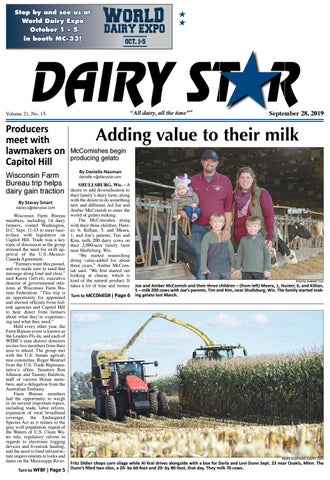
Stop by and see us at World Dairy Expo October 1 - 5 in booth MC-33!
DAIRY ST R “All dairy, all the time”™
Volume 21, No. 15
Producers meet with lawmakers on Capitol Hill Wisconsin Farm Bureau trip helps dairy gain traction By Stacey Smart
stacey.s@dairystar.com
Wisconsin Farm Bureau members, including 14 dairy farmers, visited Washington, D.C. Sept. 11-13 to meet faceto-face with legislators on Capitol Hill. Trade was a key topic of discussion as the group stressed the need for swift approval of the U.S.-MexicoCanada Agreement. “Farmers want this passed, and we made sure to send that message along loud and clear,” said Karen Gefvert, executive director of governmental relations at Wisconsin Farm Bureau Federation. “This trip is an opportunity for appointed and elected ofcials from federal agencies and Capitol Hill to hear direct from farmers about what they’re experiencing and what they need.” Held every other year, the Farm Bureau event is known as the Leaders Fly-In, and each of WFBF’s nine district directors invites two members from their area to attend. The group met with the U.S. Senate agriculture committee, Roger Wentzel from the U.S. Trade Representative’s ofce, Senators Ron Johnson and Tammy Baldwin, staff of various House members, and a delegation from the Australian Embassy. Farm Bureau members had the opportunity to weigh in on several important topics, including trade, labor reform, expansion of rural broadband coverage, the Endangered Species Act as it relates to the gray wolf population, repeal of the Waters of U.S. Clean Water rule, regulatory reform in regards to electronic logging devices and livestock hauling, and the need to fund infrastructure improvements to locks and dams on the Mississippi River. Turn to WFBF | Page 5
September 28, 2019
Adding value to their milk
McComishes begin producing gelato By Danielle Nauman danielle.n@dairystar.com
SHULLSBURG, Wis. – A desire to add diversication to their family’s dairy farm, along with the desire to do something new and different, led Joe and Amber McComish to enter the world of gelato making. The McComishes along with their three children, Hunter, 6, Killian, 5, and Meara, 1, and Joe’s parents, Tim and Kim, milk 200 dairy cows on their 2,000-acre family farm near Shullsburg, Wis. “We started researching doing value-added for about three years,” Amber McComish said. “We rst started out looking at cheese, which is kind of the natural product. It takes a lot of time and money Turn to MCCOMISH | Page 6
PHOTO SUBMITTED
Joe and Amber McComish and their three children – (from leŌ) Meara, 1, Hunter, 6, and Killian, 5 – milk 200 cows with Joe’s parents, Tim and Kim, near Shullsburg, Wis. The family started making gelato last March.
MARK KLAPHAKE/DAIRY STAR
Fritz Didier chops corn silage while Al Kral drives alongside with a box for Darla and Levi Dunn Sept. 23 near Osakis, MInn. The Dunn’s lled two silos, a 20- by 60-foot and 20- by 80-foot, that day. They milk 70 cows.
Page 2 • Dairy Star • Saturday, September 28, 2019
DAIRY ST R www.dairystar.com
ISSN 020355 522 Sinclair Lewis Ave. Sauk Centre, MN 56378 Phone: (320) 352-6303 Fax: (320) 352-5647 Published by Dairy Star LLC General Manager/Editor Mark Klaphake - mark.k@dairystar.com 320-352-6303 (ofďƒžce) 320-248-3196 (cell) 320-352-0062 (home) Ad Composition Nancy Powell 320-352-6303 nancy.p@dairystar.com Amanda Thooft 320-352-6303 amanda.t@dairystar.com Consultant Jerry Jennissen 320-346-2292 Editorial Staff Andrea Borgerding - Associate Editor (320) 352-6303 • andrea.b@dairystar.com Krista Kuzma - Assistant Editor (507) 259-8159 • krista.k@dairystar.com Jennifer Coyne - Assistant Editor (320) 352-6303 • jenn@dairystar.com Ruth Klossner (507) 240-0048 cowlady@centurylink.net Danielle Nauman (608) 487-1101 danielle.n@dairystar.com Danna Sabolik - Staff Writer (320) 352-6303 • danna.s@dairystar.com Maria Bichler - Copy Editor 320-352-6303 Advertising Sales Main Ofďƒžce: 320-352-6303 Fax: 320-352-5647 Deadline is 5 p.m. of the Friday the week before publication Sales Manager - Joyce Frericks 320-352-6303 • joyce@dairystar.com Jeff Weyer (Northern MN, East Central MN) 320-260-8505 (cell) jeff.w@dairystar.com Mark Klaphake (Western MN) 320-352-6303 (ofďƒžce) 320-248-3196 (cell) Laura Seljan (National Advertising, SE MN) 507-250-2217 fax: 507-634-4413 laura.s@dairystar.com Jerry Nelson (SW MN, NW Iowa, South Dakota) 605-690-6260 jerry.n@dairystar.com Mike Schafer (Central, South Central MN) 320-894-7825 mike.s@dairystar.com Amanda Hoeďƒ&#x;er (Eastern Iowa) 320-250-2884 • amanda.h@dairystar.com Laura Seljan (Southern WI) 507-250-2217 • laura.s@dairystar.com Megan Stuessel (Western Wisconsin) 608-387-1202 • megan.s@dairystar.com Deadlines The deadline for news and advertising in the Dairy Star is 5 p.m. Friday the week before publication. Subscriptions One year subscription $35.00, outside the U.S. $110.00. Send check along with mailing address to Dairy Star, 522 Sinclair Lewis Ave., Sauk Centre, MN 56378. Advertising Our ad takers have no authority to bind this newspaper and only publication of an advertisement shall constitute ďƒžnal acceptance of the advertiser's order. Letters Letters and articles of opinion are welcomed. Letters must be signed and include address and phone number. We reserve the right to edit lengthy letters. The views and opinions expressed by Dairy Star columnists and writers are not necessarily those of the Dairy Star LLC.
The Dairy Star is published semi-monthly by Dairy Star, LLC, 522 Sinclair Lewis Ave., Sauk Centre, MN 56378-1246. Periodicals Postage Paid at Sauk Centre, MN and additional mailing ofďƒžces. POSTMASTER: Send address changes to Dairy Star, 522 Sinclair Lewis Ave., Sauk Centre, MN 56378-1246.
A glance at what’s inside Many producers in the Upper Midwest have harvest on their mind right now as they continue the process or plan to start. In this issue’s “From our side of the fenceâ€? feature, we talked to dairy farmers about their corn silage harvest. While some have started, not all have because of the later conditions this growing season. Read more about how the corn silage harvest is progressing on pages 15 and 16 in ďƒžrst section. The Kieffer family spent Sept. 19 chopping corn on their dairy near Hastings, Minn. We featured them in the “A day in the lifeâ€? section of this issue on pages 16, 18-19 in second section. But chopping corn was not the only item on their agenda for the day. Read about all the other chores they had to ďƒžt in to their 17hour day. Minnesota dairy producer Spencer Hackett is hoping to make a difference in the Holstein breed. He recently joined the board for the Holstein Association USA. The Rice, Minn., dairy farmer has been in local, state and regional leadership positions in the past, but saw an opportunity to run for a national position this year. Read on pages 12-13 in ďƒžrst section about what goals he hopes to while serving on the national board. In this month’s organic section, we have a feature about the three Byom brothers and their families that have separate organic herds of 45 registered Holsteins each, but work together on their crops near Ettrick, Wis. Organic dairy farming has been their management style long before they even became certiďƒžed. Read about their venture in organic dairying on pages 6-7 in second section. Garrett Nielsen is determined to make his dairying dream work even if he did not start out like he thought he would. The 19-year-old had planned to buy a family members farm in the upcoming years before starting his milking herd. However, an opportunity came about that Nielsen could not pass up. Read on pages 3-4 in third section about how the young dairyman started milking on a farm near Elroy, Wis.
See you at World Dairy Expo!
FEED YOUR HERD...AND YOUR BOTTOM LINE
VISIT US AT
WORLD DAIRY EXPO
OCTOBER 1 - 5 • MADISON, WI • LOT TM E,F
VXL 100 SERIES VERTICAL MAXX
ÂŽ
TRIPLE-AUGER MIXERS
Ĺ? +LJKHU FDSDFLW\ WULSOH DXJHU GHVLJQ IRU LQFUHDVHG HIÄ&#x;FLHQF\ WR IHHG PRUH FRZV SHU ORDG Ĺ? /RQJHU RLO OLIH OHVV PDLQWHQDQFH DQG H[WHQGHG JHDUER[ OLIH ZLWK SUHPLXP RLO FRROLQJ DQG ILOWUDWLRQ V\VWHP Ĺ? 1HZ FRQH VW\OH DXJHU DQG NLFNHU GHVLJQ IRU IDVW PL[LQJ HYHQ XQORDGLQJ DQG WKRURXJK FOHDQRXW Ĺ? 6KLIW RQ WKH JR IRU D IDVW FRQVLVWHQW GLVFKDUJH ZLWK SRZHUVKLIW WUDQVPLVVLRQ INVEST IN N QUALITY ÂŽ
FX IW PL[LQJ FDSDFLWLHV Ĺ? WUDLOHU VWDWLRQDU\ PRGHOV
KuhnNorthAmerica.com
' ' )DUP 6XSSO\ Arcadia
+LOOVERUR (TXLSPHQW Hillsboro
/LQGVWURP (TXLSPHQW Mondovi
3ULHEH 6DOHV 6HUYLFH Ripon
&KLOL ,PSOHPHQW Chili
W. H. Lien Hixton
(DVW 6LGH )DUP (TXLSPHQW Monroe
)URQWLHU $J 7XUI Turtle Lake
&KHURNHH *DUDJH Colby
/XOLFK ,PSOHPHQW Mason
6WHLQKDUW V )DUP 6HUYLFH Platteville
&DUO ) 6WDW] 6RQV Waunakee
.DOVFKHXU ,PSOHPHQW Cross Plains
3HUVKD (TXLSPHQW Mayville
/LQN ,PSOHPHQW Ridgeland
7ULHEROG ,PSOHPHQW Whitewater
.RPUR 6DOHV 6HUYLFH Durand
Visit your local Wisconsin KUHN Knight dealer today!
Dairy Star • Saturday, September 28, 2019 • Page 3
It’s all inside... Columnists Ag Insider
Pages 8-9 First Section
Answering difcult questions
Gilman
Hicks enjoys giving new life to old things
Page 27 First Section
First Section: Pages 34 - 35
Downing
Ramblings from the Ridge
From Our Side of the Fence
Page 30 First Section
Spencer
First Section: Pages 15 - 16
Dairy prole: Josh and Sarah Moga and Ben Wojcik
Something to Ruminate On Page 31 First Section
n Polk
Barron
Sawyer
Price
Rusk Taylor
Ettrick
Generations of Byoms raised to appreciate land, cows Second Section: Pages 6 - 7
St. Croix Pierce
Dunn
Pepin Buffalo
Chippewa
Marathon Clark
Eau Claire Trempealeau
Pages 10 - 11 Second Section
hb
ur
Dairy Good Life
Burnett
W as
Page 32 First Section
The “Mielke” Market Weekly
First Section: Page 39
Iron Ashland
Just Thinking Out Loud
Page 33 First Section
Bayeld
Douglas
Elroy
Nielsen embarks on dairy farming career
Wood Jackson
Third Section: Pages 3 - 4
Adams
La Crosse Monroe
Juneau Vernon
Viroqua
Peterson family continues tradition exhibiting Jerseys
ford
For additional stories from our other zone, log on to www.dairystar.com
Sauk
Craw
Iowa
First Section: Pages 37 - 38
Zone 2
Richland
Fond Du Lac Columbia
Dane
Grant Lafayette
Shullsburg
McComishes begin producing gelato
First Section: Pages 1, 6 - 7
Green
Dodge
J
n
so
er eff
Rock
Ixonia
Women in Jeans: Karen Mallow First Section: Page 36
Curtains mean cow comfort No matter the weather outside, GEA keeps your cows comfortable, healthy and productive inside. Comfortable cows are the most productive. Just like you, they perform their best when they are cool, calm and content. GEA’s industry-leading curtains and fan systems can be integrated with automation technology to
provide ideal barn temperature, air quality and humidity levels. With our total ventilation solutions, your cows will breathe easier — and so will you. Contact your GEA barn equipment dealer today.
Page 4 • Dairy Star • Saturday, September 28, 2019
USED EQUIPMENT FROM A NAME YOU CAN TRUST!
GILLY AND THE GANG THANK YOU FOR ALL YOUR HARD WORK
WE APRECIATE YOU OFTEN SKIPPING MEALS SO THAT OTHERS CAN HAVE THEIRS! GRAIN SAVER
CHECK OUT OUR LARGE SELECTION OF HAY EQUIPMENT AND TRACTORS!
PROTEIN LICK TUBS
UTILITY AUGERS
USED TRACTORS
‘13 N-H T9.615, 833 Hours, Auto Steer, Cab Suspension ......................................... $235,000 ‘17 N-H T4.100, Cab, Loader, MFD, 1100 Hrs $48,900 ‘70 Ford 8000, Loader, Diesel .......................... $8,500 ‘95 Ford 7740SLE, MFD, ............................... $16,900 ‘77 White 2-135, Cab, 9100 Hours................... $7,500 ‘63 Oliver 550, Loader...................................... $5,500 ‘71 A-C 190XT Series 3, Hi Crop, Diesel ........ $14,000 ‘71 A-C 180, Diesel .......................................... $6,000
In Stock and ready to work for you!
ALL BALE FEEDERS
10% OFF
ON SALE!
ALL ELECTRICAL INSULATORS
30 OFF!
$
Ag-Bag Rentals
USED SKIDSTEERS
‘11 T-650, Glass Cab w/A/C, 4800 Hours ....... $29,700 ‘12 S-770, Glass Cab w/A/C, 2 Spd, 4600 hrs $28,900 (4) S-650, Glass Cab w/A/C, 2 Spd, 3000 hrs & up .............................Starting at $18,000 (4) S-590, Glass Cab w/A/C, 2 Speed, 800 Hours & Up ..........................Starting at $19,500 ‘16 S-550, glass cab w/A/C, 2 Spd, 1780 Hrs $28,500 ‘16 N-H L-228, glass cab w/A/C, 2 Spd, 1250 hrs ...................................................... $29,900 J-D 250 .......................................................... $12,900 Warrior Log Spliter .......................................... $1,999
WE HAVE:
AG BAGS • TWINE • NET WRAP SILO COVERS • PLASTIC WRAP • BUNKER COVERS
ADDITIVES & TREATMENTS Reserve your Machine Today!
USED HAY EQUIPMENT
‘02 N-H 1431, 13’ Discbine ............................ $13,500 N-H 479, 9’ Haybine ......................................... $2,150 ‘98 J-D 945, 13’ MoCo ..................................... $9,500 (2) N-H FP-240, Crop Pro .............Starting at $19,000 ‘87 Gehl 760 Chopper and Hay Head ............... $1,500 ‘04 H & S 860 Forage Blower ........................... $4,500 ‘13 N-H BR-7090, Crop Spec, 11000 Bales, Netwrap ....................................................... $19,900 ‘14 N-H BR-7080, Net & Twine Wrap ............. $15,900 ‘14 N-H BR-7070, Silage Special, Net & Twine $19,500
®
ROASTED SOYBEANS We can custom roast your grains including barley, corn, wheat, oats and soybeans.
Gilman Co-op Creamery
FEED & FARM SUPPLY STORE
Gilman, MN 320-387-2770
‘98 N-H 664 Rd Baler, Netwrap & Twine .......... $7,500 N-H 678 Rd Baler, Twine Only .......................... $9,950 (2) ‘02 N-H 648 Rd Baler, Twine Only Starting at $9,500 ‘12 J-D 568 Rd Baler, Netwrap & Twine ......... $27,500 J-D 410 Rd Baler.............................................. $2,500 ‘95 N-H 565 Baler w/72 Thrower...................... $7,950 ‘12 H&S AR-1261, 12 Wheel Rake ................... $4,950 ‘03 H&S CR-8, 8 Wheel Rake ........................... $2,650 N-H 166 Invertor .............................................. $2,750
USED TILLAGE
‘14 W-R QX2, 60’, 3 Bar Harrow w/Rolling Baskets ........................................ $39,900 ‘03 W-R XL 30-39’, 4 Bar HD Harrow ............ $26,000 Case I-H 4300, 28.5’, 3 Bar Spring Tine Harrow ........................................ $5,950 ‘12 W-R 513 Soil Pro, 11 Shank, Folding Frame .............................................. $39,500 ‘14 W-R 513 Soil Pro, 9 Shank ...................... $38,500 ‘07 Case I-H 730C Disc Ripper, Lead Shanks, Levers .......................................................... $22,500 ‘97 J-D 3710, 8 Bottom, Onland Hitch ............. $9,500 White 588, 5 Bottom, Coulters ......................... $1,250 White 588, 4 Bottom, Coulters ......................... $1,250
USED MISC.
‘12 N-H 185 Spreader ............................... $10,500.00 ‘17 H&S S3127 Spreader .......................... $10,500.00 ‘08 Red Ball 1000 Gallon Sprayer, 60’ Boom ... $9,950 ‘08 Geringhoff 18x22 Cornhead, JD Mounts .. $49,500 J & M 385 Box w/Ext, 13 Ton Gear, Lights ....... $4,500 (3) Bobcat 3400 Ult Vehicles......Starting at $7,750.00
Equipment of Norwood LANO A family business since 1946 with the Lanos: Jack, Paul, Bob and Andy
Open M-F 7:30-7, Sat. 7:30-5, Sun. 8:30-1 Good service - fair prices - every day
952-467-2181
WWW.GILMANCREAMERY.COM
BI-WEEKLY NEW FROM
Many used & new skidloaders ON HAND
FOOTBATH
KlingonBlue
™
LONG-ACTING FOOTBATH Helps improve hoof health and enhance digital dermis...to promote cow mobility, comfort and overall productivity.
Less Copper Sulphate for Disposal Available in 6.5 gal. concentrated pails
Average Cost/Lost-Profit per case of Digital Dermatitis is $275 OR
MORE!
Stays on Hooves for 2 weeks!
• No Formaldehyde • Anti-biotic Free • Proven to Work • Extended Contact Time • Anti-bacterial and Anti-fungal Properties
FOR MORE INFO - CONTACT ONE OF THESE DEALERS... Advanced Dairy Systems
9 State Rd. 29 • Spring Valley, WI 54767 (715) 772-3201
Anderson Dairy Systems, Inc. 1312 13 1/2 Ave. • Barron, WI 54812 (715) 537-3300
Athman Dairy Inc.
D&D Ag Supply
238 Main Street North • Pierz, MN 56364 (320) 468-2494
133 Atlantic Ave. NE • Pennock, MN 56279 (320) 599-4466
Champion Milking Systems
East Central Dairy Supply
23218 350th Street • Albany, MN 56307 (320) 845-4156
2195 Hwy. 23 • Mora, MN 55051 (320) 679-1029
Eastern Iowa Dairy Systems 105 3rd Ave. NW • Epworth, IA 52045 (563) 876-3087
Fuller’s Milker Center, Inc. 423 U.S. 61 • Lancaster, WI 53813 (608) 723-4634
Gorter’s Clay & Dairy Equipment 1400- 7th St. SE • Pipestone, MN 56164 (507) 825-3271
Lang’s Dairy Equipment, Inc. 2337 Millennium Rd. • Decorah, IA 52101 (563) 382-8722
Leedstone
24260 Cty. Rd. 27 • Plainview, MN 55964 (507) 534-3161
Leedstone
2545 80th Ave • Woodville, WI 54028 (715) 698-4370
Professional Dairy Systems
1449 Homecrest Ave. • Wadena, MN 56482 (218) 632-5416
Tri-County Dairy Supply, Inc.
4107 N US HWY 51 • Janesville. WI 53545 608-757-2697
United Suckow Dairy
12687 Hwy 18 & 52 • Postville, IA 52162 (563) 864-7417 210 N. Industrial Pkwy • West Union, IA 52175 (563) 422-5355
Dairy Star • Saturday, September 28, 2019 • Page 5
ConƟnued from WFBF | Page 1 “It was a jam-packed two and a half days in which we met with a lot of different agencies and covered a lot of different topics important to dairy farmers,” said Aaron Augustian, who milks 1,000 cows and farms 1,100 acres in Kewaunee County. “Mexico and Canada are on board with the USMCA, and we really need to get that passed to help our exports. We also need to do something about the China trade war. Farmers really need to see results on trade because it affects our prices on milk, corn, soybeans, etc.”
“We want to make our voices heard from Wisconsin and let them know that trade does impact us on the dairy side of things.” DAVE DANIELS, DAIRY FARMER
A need for better management of the gray wolf population was another pressing matter on the agenda. “This is of particular concern to farmers in northern Wisconsin and the western Great Lakes region,” Gefvert said. “Representative Collin Peterson of Minnesota authored a bill that would delist the gray wolf from the endangered species list in Wisconsin, Minnesota and Michigan. We expressed to Senator Tammy Baldwin and Senator Ron Johnson that we back this bill. Control of the wolf population would then go back to the state DNR with oversight by the U.S. Fish and Wildlife Service.” In addition, Gefvert said providing reliable, adequate, cost-effective rural broadband access to farmers and rural residents is a necessity as farmers have a legitimate need for broadband in order to use the latest technologies on their farms.
Farm Bureau board member and dairy farmer, Dave Daniels, has been on the trip multiple times and said advocacy is a slow process. “But it does help,” he said. “It takes a couple of visits to really get legislators in tune with farmers’ challenges. Lawmakers would much rather listen to us, their constituents, than the lobbyists that come through their doors. Dairy farmers are such a small percentage of the population, but we still need to voice our opinions.” Daniels is co-owner of Mighty Grand Dairy in Kenosha County, where he milks 575 cows and farms 1,100 acres. “We want to make our voices heard from Wisconsin and let them know that trade does impact us on the dairy side of things,” Daniels said. “Also, we need to have better alternatives for bringing labor into this country. A lot of people don’t want to milk cows, so a better solution to labor is a must.” Augustian, who attended the Leaders Fly-In for the rst time, said they also had conversations with staff from the Farm Service Agency about crop reporting and prevent plant crops, and talked with the Natural Resources Conservation Services about conservation practices including ways to update outdated programs and policies to reect what farmers are doing today, such as cover cropping. The group also met with the United States Department of Agriculture and talked about the farm bill, dairy margin coverage, crop insurance and putting whole milk back into schools. “Meeting face-to-face with lawmakers has a lot more value than writing a letter or sending an email,” Augustian said. “Hearing our story directly, instead of through other people or the media, is extremely valuable. They get to see the producer and put a name with a face. It was a great experience, and I would denitely go again if given the opportunity.”
TRUST THE EXPERTS At Famo Feeds, we strive to provide the best support for your operation and work to accommodate your specific needs.
From calf to cow and everything in between!
FEED THEM FAMO! • Milk Replacers • Starter Feeds • Protein Concentrates • Premixes • Minerals • Animal Health Products • Lick Tubs
320-836-2145 or 800-450-2145
Check out our newly redesigned website to ½nd a Famo Feeds dealer near you!
www.famofeeds.com
Manure
WI groups call for halt to livestock farm siting rule changes
A host of groups representing nearly every aspect of Wisconsin’s livestock agriculture industry are together calling for the state’s ag oversight agency to reject proposed changes to rules that regulate local approval of new or expanding livestock farms. The groups, which represent thousands of farms and other businesses connected to the state’s meat and milk industries, said at a press conference today at the Capitol that the changes to ATCP 51 would not only damage farmers, including forcing some out of business, but also harm numerous other supporting businesses, from agricultural consultants and supply cooperatives to manufacturers of animal feed and health products. “The negative impacts of the proposed rule revisions — which will without a doubt stymie further growth of livestock agriculture in Wisconsin — will be felt not just by livestock producers,” the 11 groups said in jointly written comments. “Left unchanged, this proposed rule could negatively affect hundreds of thousands of jobs in this state.” ATCP 51 is the administrative rule implementing the state’s livestock siting law governing the approval process local governments must follow if they choose to regulate construction of livestock facilities. While conducting a required periodic review of the rule, staff at the Department of Agriculture, Trade and Consumer Protection proposed the revisions, which were the subject of recent public hearings. The DATCP Board is scheduled to get an update on the hearings at a meeting Sept. 19. A wave of people spoke against the rule changes at the public hearings across the state. The groups’ numerous concerns range from the process DATCP used to develop the proposal, including disregarding or all together excluding farmers’ input, to drastic changes to setbacks that would be unworkable in rural Wisconsin. The livestock siting law — intended to create fair and uniform standards — dictates that the rules must be, among other things, practical, science-based, objective and designed to promote the growth of the industry balanced with environmental protections. The proposed revisions clearly fail to meet these directives, the groups said. The organizations are: Cooperative Network, Dairy Business Association, FS GROWMARK, Wisconsin Association of Professional Agricultural Consultants, Wisconsin Cattlemen’s Association, Wisconsin Cheese Makers Association, Wisconsin Dairy Alliance, Wisconsin Dairy Products Association, Wisconsin Farm Bureau, Wisconsin Manufacturers & Commerce and Wisconsin Pork Association.
Push-off Gates
• Pivoting counterbalance gate with protective stainless splash shield and convenient self-locking latch • Designed to accomodate tire scrapers • Rugged hot-dipped galvanized push-off safety guard; single piece construction for superior strength
IIn open position i i
Call for FREE EQUIPMENT GUIDES on our Entire Product Line!
866-543-5166
info@sturdybuiltmfg.net 260 S. Muddy Creek Rd. Denver, PA 17517
Page 6 • Dairy Star • Saturday, September 28, 2019
ConƟnued from MCCOMISH | Page 1
Willmar, MN • 320.231.1470
EXPANDING OR REMODELING YOUR LIVESTOCK OPERATION? LANGE AG SYSTEMS SPECIALIZES IN:
Ŷ NEW FACILITIES
_
NO JOB TOO BIG OR TOO SMALL
Ŷ RETROFITTING & REMODELING Ŷ TURNKEY PROJECTS Ŷ BARN DESIGN Ŷ INSTALLATION, MAINTENANCE & REPAIRS
ƋƵŝƉŵĞŶƚ tĞ KīĞƌ͗ ͻ sĞŶƟůĂƟŽŶ &ĂŶƐ ͻ sĞŶƟůĂƟŽŶ ŽŶƚƌŽůƐ ͻ WŽƐŝƟǀĞ WƌĞƐƐƵƌĞ dƵďĞƐ ͻ ƵƌƚĂŝŶ ^LJƐƚĞŵƐ ͻ DĂƩƌĞƐƐĞƐ ͻ tĂƚĞƌĞƌƐ ͻ ^ƚĂůů ƋƵŝƉŵĞŶƚ ͻ ,ĞĂĚůŽĐŬƐ ͻ DŝƐƟŶŐ ^LJƐƚĞŵƐ
Lange Ag Systems is proud to offer Grain Bags, Silage Bags & Bunker Covers from Up North Plastics and Feed Fresh Silage Covers & Custom Size Bunker Covers from Raven!
t ^ >> E t Θ h^ 'ͳ ' Θ < >>z Zz E '' Z^
www.LangeAgSystems.com Combine Yield monitors • Yield mapping • Built in GPS
Auto Steer Guidance Packages • New and used equipment • Great trade in deals available • Solutions for most makes and models
Find ou!t More
Call Justin
218-631-6045 www.infrontag.com
Celebrating
Repair vs. Replace
Electronic Dairy Board Repair Service
Specializing in: WestfaliaSurge, BouMatic, & DeLaval pulsators & Takeoffs, circuit boards, Mueller milk tank circuit boards. Call: (c) 406-590-7764
www.circuitÀxer.wixsite.com/ boumaticboardrepair
L Lasting Solutions for your L Livestock, Soils and Plants Years of Growing Strong
AG R I z DY N AMI C S
ted *Formu la nic a rg O for Use
Support livestock with minerals and remedies. Dyna-Min™ for trace minerals, binds molds and mycotoxins Pasture, Prairie & Range Licks™ A selection of 4 complete ŞųåĵĜƻåŸØ å±ÏĘ ƵĜƋĘ ± ÚĜýåųåĹƋ ±×{ ų±ƋĜŅ Aqua-Nox™ for parasites and stressed animals For Healthier calves, starting from day one. Neema-Tox™ Super Start Calf Bullets™ Ketonic™
Limber Res-Q™ Equi-Essentials™ Buckeroo Trail Blazer™
quadagrimill@gmail.com *Always Check With Your Certifying Agency
DANIELLE NAUMAN/DAIRY STAR
Amber McComish displays a freshly made container of McComish Family Farms Fresh Bourbon Jersey Caramel Gelato, ready for sale. McComish and her family make gelato on their 200-cow dairy farm near Shullsburg, Wis. to do that, business-wise and to get all the licensing for myself to be able to do that.” With the state of milk prices, the McComishes wanted to start their journey in creating a value-added product as soon as possible. “The whole reason we are doing this is for our kids. We just don’t want them to have to worry about milk prices in the future,” McComish said. “We want to be self-sufcient, and not wait for any laws or the government to x things.” While they were searching for the value-added product that would best suit their needs and t their business, a friend suggested they look into making gelato. “Once we started looking at gelato, the more we looked, the more we liked it,” McComish said. “It’s a product that can be made from our own milk. There is no by-product; it’s just our milk and ingredients.” Gelato is an Italian frozen dairy dessert that McComish said is denser and creamier than American-style ice cream. It contains more whole milk than cream, and is typically served warmer than ice cream. It has a fat content of about 5 to 7%, compared to ice cream which can go as high 18%. “Gelato tends to have a stronger avor because there is not as much fat or as much air. The avor is more intense,” McComish said. The McComishes began searching for a creamery to work with, making gelato from the milk produced on their farm. They were unsuccessful locating a creamery to work with, so McComish made the decision to start making gelato on her own, using purchased whole milk, in March. “I literally started with a countertop freezer, an ice cream maker, and started putting stuff together,” McComish said of the beginnings of her gelato making. “It was a challenge; things like nding a place to get avors and things like that because I was so small. They didn’t take me seriously.” After working with the process of making gelato in her own kitchen, McComish decided it was the right product for creating a value-added business for their farm, and she set out to begin to create the new business. She worked with the Center for Dairy Research and the Southwest Wisconsin Small Business Association, learning how to launch the business. Eventually she located a business incubator in Platteville, Wis., with a certi-
ed kitchen she could rent space and time in, and began making McComish Family Farms Fresh Gelato in earnest. “The help I’ve received from those entities has helped me quite a bit, to get started and get going this fast,” McComish said. From a recipe standpoint, McComish started perfecting her own style of vanilla, which serves as the base for the other avors she has developed. “Once you have the base avor, it’s a matter of just adding ingredients to it to create new avors,” McComish said. “It’s not necessarily a science, but an art. You just have fun with it because it is a dessert, a treat.” The avors McComish has developed to date include her original Classy Cow Vanilla, Highly Calf-enaited, Irish Mint, Amaretto Cherry, Over the Moon, Bourbon Jersey Caramel and French Cow Pie. McComish keeps detailed records of her recipes and the ingredients used in each batch of gelato she creates. She has been working to get her gelato into area restaurants and stores, and she has also been catering events, providing her gelato as a special dessert. One local restaurant that serves McComish Family Farms Fresh Gelato has been creating frozen cocktails with the gelato, in addition to serving it as a dessert. She packages her gelato into 6-ounce, 8-ounce and pint-sized containers for sale in stores and for restaurants. She also uses steel trays to prepare the gelato for her catering events. During her three-year research period, McComish began to build a social media presence for her family’s farm to help build name-recognition. “I’ve developed a Facebook page, getting people to follow us, as advocates in the industry to practice getting myself out there,” McComish said. “You literally have to put yourself out there as a business to be successful.” In addition to creating an image for the family farm, McComish began to work on the creation of a logo that would be used for marketing the gelato. “I found I have a niche for marketing and branding, which is kind of fun,” McComish said of her work to create the value-added business. Within the next year, the McComishes plan to bring the production of their gelato on to their farm by creating their own certied kitchen in a refer trailer. This will allow them to transiTurn to MCCOMISH | Page 7
Dairy Star • Saturday, September 28, 2019 • Page 7
ConƟnued from MCCOMISH | Page 6
Along with our extensive inventory of carbon steel, we have stainless steel and galvanized steel!
DANIELLE NAUMAN/DAIRY STAR
Amber McComish measures ingredients for gelato. An accurate measurement of ingredients is key to keeping the nal product consistent from batch to batch. tion from using purchased whole milk to using milk produced by their own cows. “It’s been fun to showcase our cows in the marketing,” McComish said. “We are hoping to use the Jersey milk with the higher fat content, which is perfect for gelato.” In addition to creating an on-farm processing facility, McComish hopes to have a food truck in the future to help facilitate the catering events. This winter, McComish hopes to travel to Italy, the home of gelato, to
attend the Gelato University near Bologna, Italy. She hopes to learn more of the intricacies of gelato making, particularly how to make gelato incorporating fresh fruits, with an eye on being able to use local fruits next summer. McComish is excited for the future of her family’s dairy farm and said the creation of the gelato business has added a new layer to that excitement. “I really like telling our story and that is what this spanned from,” McComish said. “We took a problem, and found a way to solve it.”
555 E 12th St, Dubuque, IA 52001
563-582-3726 M-F 7:30 a.m.-4:30 p.m.
www.steelmartdbq.com
Do markets have you worried? Try our DVPro Services Less Anxiety, More Confidence › FEED PROCUREMENT › TRADING SUPPORT › BROKER SERVICES › LGM/DRP INSURANCE
Joe Spader
Helping good managers make better trading decisions 320-634-3771 320 634 3771
1145 East Minnesota Ave.• Suite 1 • Glenwood, MN 56334 www.dairyvisor.com d i i
Joe Spader’s Visor View commentary is published each issue of the Dairy Star.
DVi provides a full range of commodity trading products and consulting services to large scale grain and dairy operations. Futures and options trading involve significant risk of loss and may not be suitable for everyone. Therefore, carefully consider whether such trading is suitable for you in light of your financial condition. DVi, is an Equal Opportunity Provider and Employer
USDA leaders voice support for USMCA Page 8 • Dairy Star • Saturday, September 28, 2019
Agriculture Secretary Sonny Perdue joined Cash accounting challenge former agriculture secretaries Tom Vilsack, John An IRS decision could prevent some farms from Block and Dan Glickman to rally support of the U.S. using cash accounting. A coalition of commodity Mexico Canada Agreement. U.S. Dairy Export Council groups, the National Council of Cooperatives and CEO Tom Vilsack said it could be a challenge for Farm Bureau wants Congress to intervene. Since the U.S. dairy industry if the agreement 2017, the IRS said a farm or ranch, set Ag Insider isn’t ratied. “Our Mexico market is still up as an LLC or S Corp, could lose the in good shape. The challenge though is right to use cash accounting if less than if we don’t get the USMCA through, 65 percent of the ownership is held by we’ll still face a very closed dairy market active farmers. in Canada.” One of the concerns from House Democrats is labor provisions. New regs proposed for manure storage Agriculture Secretary Sonny Perdue said The State of Wisconsin is proposing there are enforceability consequences in new standards for manure storage. New the USMCA to ensure labor concerns are dairy farms with at least 500 animal units addressed. “We had the same fear when and farms looking to expand to at least 500 we renegotiated the sugar agreement with animal units would have to have setbacks Mexico in 2017, but Mexico has lived up of 600 to 2,500 feet, depending on the to that. We think the same thing could size of the dairy herd. The Wisconsin By Don Wick happen here.” Farm Bureau, Wisconsin Dairy Business Columnist Association and Wisconsin Dairy Clock ticking for USMCA Alliance are opposed to the proposal, The trade agenda is starting to gain traction in saying it would reduce Wisconsin’s competitiveness Washington D.C. According to the Russell Group in the dairy industry. President Randy Russell, there is a window of opportunity for Congress to take up the U.S. Mexico Regional dairy initiative Canada Agreement before the end of the year. It may UW-Madison will receive more than $454,000 no longer be a matter of if the USMCA is ratied, but through the federal Dairy Business Innovation when. Russell said there are positive developments in Initiatives. UW-Madison will work with Minnesota, discussions. “The Trump Administration responded South Dakota and Illinois to create the Dairy Business back to the Democrat’s request on the House side of Innovation Alliance. This initiative supports the what they’re willing to do on key issues such as labor, dairy industry through the development, production, environment and pharmaceutical issues. I think we’re marketing and distribution of dairy products. starting to see differences narrow,” Russell said. “The other side of this is the clock is ticking. It’s hard to see Labeling bill Congress vote on this past the end of the year.” State Senator Howard Marklein, who is a Republican from Spring Green, has proposed Milk production edges lower legislation that would prevent plant-based foods August milk production totaled 17.4 billion and beverages to be labeled as milk or other dairy pounds in the 24 major dairy states. That is down products. The bill targets the numerous products made 0.4 percent from 2018. For Wisconsin, milk output from soybeans, almonds, rice and others. declined 0.5 percent. That is the fourth straight month of lower milk production when compared to last year.
State veterinarian named Darlene Konkle has been named the state veterinarian. Konkle has been with the Wisconsin Department of Agriculture, Trade and Consumer Protection Division of Animal Health since 2005 and served as the acting state veterinarian since June of 2018. Veterinarian hall of fame inducts Johnson The American Association of Bovine Practitioners has inducted a Wisconsin man into the Cattle Production Veterinarian Hall of Fame. Dr. Andy Johnson, Green Bay, is employed by Grande Cheese Company as the herd health and wellness veterinarian. Johnson also does private consulting worldwide on milk quality. Cow of the Year The Wisconsin Purebred Cattle Association has named Milk-n-More Tequila Naomi as the 2019 Wisconsin Cow of the Year. Each year, the association selects a cow to represent her breed with the honor rotated annually among the seven major dairy breeds. This seven-year old Jersey is owned by Ron and Nicolle Wussow of Cecil and will be recognized in a special ceremony at World Dairy Expo. National FFA Organization hits record membership More than 700,000 student members are now part of the National FFA Organization. That is a record for student membership, an increase from the more than 669,900 members recorded in 2018. The top states for student membership include Texas, California, Ohio and Missouri. NFU honors Baldwin and Pocan The National Farmers Union presented the NFU Golden Triangle Award to Wisconsin Senator Tammy Baldwin and Wisconsin Representative Mark Pocan. This award has been presented by the NFU each year since 1988. Turn to AG INSIDER | Page 9
THE NO COMPROMISE FABRIC STRUCTURE
Around-theclock quality control for the highest quality milk and highest possible premiums
DAIRY, MACHINERY & HAY STORAGE
Commercial Agri Buildings
WE ALSO SELL REPLACEMENT TARPS!
Single and Truss Arch available from 20’-120’ wide Flo-Coat® Galvanized Steel Tubing Supplied by Allied Tube & Conduit Heaviest gauge steel in the industry Pre-engineered truss buildings
NELSON’S AGRI STRUCTURES
Dean Nelson • Central and Northern Minnesota • Grove City, MN • 320-857-2633, Cell 320-699-3297
RIVERSIDE HOOP BARNS, INC.
US Hwy. 75 At IA/MN Stateline • Steen, MN • 507-392-2870 • Fred A. Tilstra & Sons
LANGE CONSTRUCTION & CONCRETE
Duke Lange • Swanville, MN • 320-290-0859
LAKESIDE HOOP STRUCTURES, LLC
Eastern Minnesota and Wisconsin • Harris, MN • 651-248-6302 • Craig Moline
FEATURES & BENEFITS:
ASK US ABOUT GOVERNMENT FUNDING FOR HAY STORAGE
• Adjustable high/low temperature alarms alerts you to prevent lost loads • Records both wash water temperature and wash time, eliminating another potential source of bacteria • Backup battery provides 48 hrs of operation in the event of a power failure • Preprogrammed chart recording intervals of 24-hr, 48-hr, or 7-day to match your pick up schedule
Lighting products to answer all your needs
www.fullersmilkercenter.com
82, Irwin Street, Local #3 Granby (Qc) Canada J2J 2P1 Tel.: 1-888-966-3431 or 1-450-777-2848 Fax: 1-450-777-4872 Email: info@cbmlighting.com / Website: www.cbmlighting.com Eric Haugen Home Farm AG Sales, Milan Mn. 320-226-2504 Haugen02@hotmail.com
Dairy Star • Saturday, September 28, 2019 • Page 9
ConƟnued from AG INSIDER | Page 8 WDE app unveiled World Dairy Expo has a new free app for those attending the show October 1-5. The app is available from Google Play or the App Store and offers interactive maps and the opportunity to request meetings with trade show exhibitors. Trivia challenge There are more than 61,000 pizzerias in the United States. That
answers our last trivia question. What is the largest pizza restaurant chain in the world? We’ll have the answer in the next edition of Dairy Star. Don Wick is owner/broadcaster for the Red River Farm Network, based in Grand Forks, North Dakota. Wick has been recognized as the National Farm Broadcaster of the Year and served as president of the National Association of Farm Broadcasting. Don and his wife, Kolleen, have two adult sons, Tony and Sam, and ve grandchildren, Aiden, Piper, Adrienne, Aurora and Sterling.
DHIA: Now MORE than ever
Access cows instantly
What is on your checklist for roasted soybeans? Energy Protein Amino acids Bypass protein
SERVICE Easy accessibility Quick loading times Quality and consistency
“I like using the platform for a variety of reasons. Most importantly is the ability to research cows in the barn while walking pens, or if I’m not at the farm. Before, I would walk pens taking notes on each individual I saw that seemed low on milk, but healthy overall. I would then take those notes back to the computer to look up all of her events/ statistics and eventually have to go back into the pen and find those cows to re-evaluate on what decision to make. Now I can get it all done at one time, ultimately saving hours of time. Also, I like being able to look up cows if I’m not at the farm for either withdrawals or the decision on what to do with an animal (treat or cull), saving valuable time for myself, employees, and the animal.” Mitch, New Heights Dairy
CHECK US OUT THE NEXT TIME YOU ARE LOOKING FOR ROASTED SOYBEANS.
KLC Farms Roasting, Inc.
Preferred By Bovines Everywhere
Scales Available!
Variable Rate Packages
Call us to find out how we can help bring your dairy’s records to the next level. Minnesota Dairy Herd Improvement Association 307 Brighton Avenue South Buffalo, MN 55313 1.800.827.3442 www.mndhia.org
1-877-738-2326 Visit www.roastedbeans.com
Quality
Consistency
9524 Crop Max - S100 Litter / Lime / Compost
XI NEW S ! MODEL V-Max, V-Force & SXI Industrial 1,355 - 4,200 gallons
Exceptional Spread Performance! Meyer Manufacturing Corp.
9524 Crop Max S200 MINNESOTA A & C Farm Service, Inc. (TMR Mixer Dealer) Paynesville, MN Fluegge’s Ag, Inc. Mora, MN Gorter’s Clay & Dairy Equip. Pipestone, MN
Dorchester, WI • 800-325-9103
Call or see your local dealer for complete details!
Hammell Equipment Inc. ChatÀeld, MN Eitzen, MN Harmony, MN Rushford, MN Midwest Machinery Co. (Full Line) Glencoe, MN Glenwood, MN Howard Lake, MN Princeton, MN
Money in the Bank!
Visit our website!
meyermfg.com Midwest Machinery Co. (Forage Boxes Only) Alexandria, MN Sauk Centre, MN Werner Implement Co., Inc. Vermillion, MN Wingert Sales & Service Plainview, MN
WISCONSIN Johnson Tractor, Inc. Janesville, WI Price Equipment Sales, Inc. Bloomington, WI
Tractor Central Arcadia, WI Cameron, WI Chippewa Falls, WI Durand, WI Granton, WI Menomonie, WI Mondovi, WI Sheldon, WI West Salem, WI Westby, WI
IOWA Engel Agri Sales Sac City, IA SOUTH DAKOTA Pfeifer Implement Co. Sioux Falls, SD Puthhoff Repair Sales & Service, Inc. Salem, SD
Page 10 • Dairy Star • Saturday, September 28, 2019
Twin Vertical TMR Feed Cart
DAIRYING IN TOUGH TIMES
Stommes never waivers from cows despite turbulent markets
• 5 sizes from 45 to 100 cu. ft. • Stainless steel mixing chamber • Stainless steel auger Àight • 14” carbide tipped hay knives
Free brochure! 1-800-436-5623
TIRES
Skid loader & Implement (Mounting Available)
Gilman Co-op Creamery
FEED & FARM SUPPLY STORE
320-387-2770
Open M-F 7:30-7, Sat. 7:30-5
TUB SAVINGS BUY 15 TUBS GET 16TH FREE On Now! * No mix and match. Tubs must be on same invoice to apply discount.
Ask About pallet discounts!
GET YOUR SAVINGS TODAY ON: Encompass Mineral Lic Bovine Stress Lic w/Stealth 5 Dry Cow Lic All-Purpose 14 Stalk Buster 30 Hi-Pro 21 Sheep Lic * Promotion includes but is not limited to featured tubs.
CALL RANDY TODAY
Agron. Petro. Feed Feed: 320-468-6655 Toll Free: 877-468-6655 Agron./Petro: 320-468-2509 Toll Free: 877-438-3378
JENNIFER COYNE/DAIRY STAR
Brandon Stommes milks 75 cows on a rented farm site in Stearns County near Albany, Minn. Stommes focuses on the management of his herd to get through the years of low milk prices.
Farmer focuses on future to keep working through tough times By Jennifer Coyne jenn@dairystar.com
Editor’s note: In this series, “Dairying in tough times,” Dairy Star is catching up with dairy farmers who have milked through the last four years. These farmers are sharing how they have been able to weather the market conditions and why they see promise in today’s changing industry. ALBANY, Minn. – This has been Brandon Stommes’ second bout of low milk prices. The rst time was in 2009, and he was a fresh dairy farmer. “When I rst started, I was so excited to be milking cows I didn’t worry about the markets,” Stommes said. “But, they wear on you the longer you’ve been at it.” Stommes milks 76 Holsteins on a rented farm site in Stearns County near Albany, Minn. As a farm site renter, Stommes has had to make careful nancial decisions to remain aoat in the dairy industry, where the last four years brought plunging milk prices and a mass exodus of dairy farms. Having already been through one cycle of low milk prices, Stommes had an idea of how to set himself up this go-around. “When I set up this agreement, I was pretty conservative with intentions of paying ahead if I could,” Stommes said. “I set myself up for some leeway, because when I run out of money, I’m out of money and I don’t want to be a guy juggling bills.” While there was little he could do to the farm site itself, the dairy farmer has focused on maintaining quality care for his herd and optimizing expenses. He has put an even larger emphasis on being efcient in all areas of dairy management. For example, Stommes does most of the work himself, with the exception of a person who was
recently hired to help here and there. “I’m always looking at ways I can be more efcient,” Stommes said. “I do it all. I’m milking a lot of cows. I do all the breeding and herd health.” In Stommes’ rst experience with low milk prices, he offset the markets by diversifying his skill set. He milked cows, raised feeder steers and sold about 25 each month. He custom round baled and worked a full-time job off the farm. “Those times were terrible,” Stommes said. “Expenses were low, but milk was below $10. That was an eye opener that I had to do more.” That way of farming worked for Stommes at the time, but he has since realized the value of better managing certain aspects of the dairy rather than doing it all. “Throughout all of this, I’ve kept the mentality that I have to get as much out of my cows as I possibly can,” Stommes said. “I try not to short them, because when the milk price goes up, it takes too long to get them going again.” Stommes has added more cattle to his herd
“There have been more than a couple times I’ve asked myself what I’m doing. Hasn’t everyone?” BRANDON STOMMES, DAIRY FARMER
since he rst entered into the rental agreement. The barn was renovated to remove maternity pens and add a handful more tiestalls. More milk has helped, but Stommes is also driven by components and somatic cell count. In 2018, his average SCC was 70,000, and his cooperative continues paying a respectable premium for it, he said. He also values his time more. “If something can make me money or save my time, I’ll seriously consider it,” Stommes said. In working with the property owner, Stommes added onto the feed room. Now, he only mixes feed once a day as he is able to park his TMR Turn to STOMMES | Page 11
Dairy Star • Saturday, September 28, 2019 • Page 11
Con�nued from STOMMES | Page 10
Having questions on how to get baled hay in your mix? We are your solution! Aggressive Hay Knives to fit most brands of TMRs available. Call for more info.
Standard
Carbon Tipped
Razorback
Lancer
USED BALERS
PRICED TO MOVE! IN STOCK
JENNIFER COYNE/DAIRY STAR
Brandon Stommes explains the new design of the feed room at the farm site near Albany, Minn. Stommes worked with the landowner to expand the feed room, which made Stommes more efficient when doing chores.
mixer in the room, rather than using a stationary mixer. “I’m still renting, so I can’t take the feed room with me,” Stommes said. “It might’ve been a stupid business move, but what used to take me an hour and a half to run 1,000 pounds of haylage, I can now do 1 ton in 5 minutes.” While the industry is showing signs of a turnaround, Stommes said it has not been easy to get to this point and skepticism still weighs heavily on his mind. “There have been more than a couple times I’ve asked myself what I’m doing. Hasn’t everyone?” Stommes said. “The hardest part with the depressed prices is keeping a positive attitude and not trying to keep up with the Joneses. It drives you nuts, but you just keep doing chores and try to keep a decent mindset.” To help, Stommes continues par-
ticipating in an agriculture program offered through St. Cloud Technical College, which provides informational newsletters and educational meetings throughout the year. Stommes also appreciates conversations with his nutritionist and veterinarian, as well as long-time dairy farmers. With their insight and Stommes’ will to succeed, he is looking forward to better times in the dairy industry. “Dairy farming has always been this dream of mine, but it’s just like any other job. It’s my own problem if I can’t do it,” Stommes said. “I just hope if the day comes, say 10 years from now, and prices are low again, I’ll know when enough is enough to not ride a sinking ship. But this time around, I’m happy to have made it through.”
Target Your Customers!
The Dairy Star is sent only to DAIRY FARMERS!
If you would like to advertise in the DAIRY STAR, call 320-352-6303 for more information.
Artex A rtex S SB B6 600 00 & SB450 Manure Spreaders
New Holland 7090 McHale V660 McHale Fusion (8,000 bales) Call Us At (715) 223-3361 Or visit us on-line at www.cloverdaleequip.com N13835 County Rd. E - Curtiss, WI 54422
NOW is the time to upgrade your milking units! Take advantage of our Trade out and Trade up program! Trade out your old milking units and liners and immediately benefit by trading up to a better milking performance!
Choose the GEA Classic 300E milking unit with a GQ Silicone or GQ Rubber liner package at substantial savings!
Why choose GQ Rubber W or GQ Silicone liners? or - Multiple Sizes • Silage Covers • Vapor Barriers • Grain Bags • Silage Bags
- Custom Sizes -
• FeedFresh® • 5 Mil material • String Material 6, 8, 10, 12 mil • Master Rolls also available
• Durable milk tube • Lon Longer service lives (6 (6,00 (6,000 milkings for silicone, 2,500 milkings for rubber)
Call Jon at Centre Dairy to customize a package that works best for your operation
Contact Caleb Crevier for a quote: calebcrevier@gmail.com
(605) 695-8487
Jon Stein 320-352-5762 • 1-800-342-2697 Henning Area 218-849-0211
DAIRY EQUIPMENT CENTRE AND SUPPLY INC.
40625 State Hwy. 28 • Just West of Hwy. 71 • Sauk Centre, MN
Page 12 • Dairy Star • Saturday, September 28, 2019
Hackett elected to national board of Holstein USA Dairyman proud to represent Region 6 By Jennifer Coyne jenn@dairystar.com
RICE, Minn. – Spencer Hackett has reached the culmination of his leadership opportunities in the dairy industry. At the National Holstein Convention, June 24-27 in Appleton, Wis., Hackett was elected to represent Region 6 on the national board of directors for Holstein Association USA. He was sworn into the position Sept. 24 at the organization’s headquarters in Brattleboro, Vt. “I was involved with our Mid-Minnesota Holstein Club. I served nine years on the Minnesota Holstein board. I was slowly looking down the tunnel if I wanted to be at that next level,” Hackett said. “This was the next or nal step, so to be; if I wanted to take the journey or not.” Hackett milks 175 registered Holsteins with his family on their dairy, Melarry Farms, near Rice, Minn. For the next three years, Hackett will represent Holstein USA members in the Upper Mid-
JENNIFER COYNE/DAIRY STAR
Spencer HackeƩ milks 175 cows with his family at Melarry Farms near Rice, Minn. HackeƩ was recently elected to represent Region 6 on the naƟonal board of directors for Holstein AssociaƟon USA.
west – from Iowa, Minnesota, Nebraska, North Dakota and South Dakota. He serves on the board with 11 other directors from across the country, as well as four ofcers. “I’m looking forward to serving on the board with
these people,” Hackett said. “We’re coming from all over, and that doesn’t mean we all think the same. That’s what makes a good board.” During Hackett’s time as a director, his responsibilities will reect the purpose of the organization: To help provide
the most productive animal to help farmers feed the growing population in the most efcient way possible. While the responsibilities are vast, the central Minnesota dairy farmer is most looking forward to his chance to be a voice for fellow dairy
farmers. “I am very, very proud. I will bend over backwards,” said Hackett about representing Region 6. “I can promise this area I’m going to voice my opinion and concerns or ideas people will have.” Hackett has long been a member of the national organization and strong advocate for genetic advancement in the dairy industry. He currently serves on the organization’s Genetic Advancement Committee, which provides insight to changes with the gTPI formula. “I am truly passionate about the registered Holstein business,” Hackett said. “Not just because she’s registered, but to make something that will help all dairymen stay in business longer.” Melarry Farms has created a market for its genetics through genomic technology. Last year, the Hacketts sold 27 bulls to A.I. companies, and they continue breeding for bulls that will propel the dairy industry forward. “Since [genomics came out], our purebred business has exploded,” Hackett said. “We’re always trying to make bulls that I feel, hopefully, Turn to HACKETT | Page 13
Automatic AGRi-Speed HITCH E A SY a s 1 - 2 - 3
1
2
• One person operation - eliminate the need for a second hand for hook-ups Give us • Simple drawbar mount a call! • PTO compatible • Fast, reliable, few moving parts
Gilman Co-op Creamery FEED & FARM SUPPLY STORE
3
We ship anywhere
• SAFER - Doesn’t require climbing on or off tractor • Meets or exceed D.O.T requirements • Available for pick-ups, choppers, tractors, wagons, etc.
Gilman, MN • 320-387-2770
WWW.GILMANCREAMERY.COM
Dairy Star • Saturday, September 28, 2019 • Page 13
ConĆ&#x;nued from HACKETT | Page 12
“I’ve had a dream of always making a postive impact in this profession I love long after I’m gone.� SPENCER HACKETT, DAIRY FARMER
outside-the-box thinker, so maybe I’ll come up with ideas that keep the [dairy farm] numbers up there; keep the excitement going,� Hackett said. One of the personal goals Hackett has for his term as a director is to create an interest in the organization and breed among younger dairy farmers. He wants those farmers to not only become more educated about the industry because they sell milk, but also because the public needs to become
more informed about agriculture and what dairy farmers do for a living. “I considered kicking it around – should I run? Shouldn’t I run?â€? said Hackett about the elected position. “If people like me don’t step forward and have a voice, that means someone else has to cover that much more ground on my behalf.â€? Hackett also encourages Region 6 dairy farmers to voice their opinions and ideas to him in hopes of creating effective change in the industry. However, no one thought may lead to immediate improvements, which is Hackett’s greatest foreseen challenge. “A lot of people have approached me already and giving them the results as quickly as they expect them will be tough,â€? Hackett said. “When President Trump got into ofďƒžce, it didn’t change overnight. It takes time; it may even happen after I’m gone, but it’ll be something I’ve helped put in motion.â€? As Hackett begins this next journey in his dairying career, whether at the organization’s headquarters in Vermont or at his family’s dairy farm in Minnesota, he will be doing so with a greater purpose in mind. “I’ve had a dream of always making a positive impact in this profession I love long after I’m gone,â€? Hackett said. “In serving on the national board, what can I do to help another small dairy farm, or large dairy farm, be more productive and stay in the business we are all so passionate about?â€?
/, Ê- ,6 • Residential & $ ' • Farm & # & # & $' ' $& & !! & #) & & & ' && #! $$ ! & & !+
*/"ĂŠ-ĂŒ>˜`ĂŠ Ăž i˜iĂ€>ĂŒÂœĂ€Ăƒ
& #* & # &$ &" ( && # ## & # & ,&+%& ! )$&! & # , && &$ # & !#& & $$ $'&+%& # ,& ' & ' * $ -ĂŒ>˜`ĂŠ ÞÊ i˜iĂ€>ĂŒÂœĂ€Ăƒ
ĂŠ ˆ}Â…ĂŒÂˆÂ˜} -iĂ€Ă›ÂˆViĂŠ*>˜iÂ? ĂŠ ˆ}Â…ĂŒÂˆÂ˜} -iĂ€Ă›ÂˆViĂŠ*>˜iÂ?
-ĂŒ>˜`ĂŠ ÞÊ i˜iĂ€>ĂŒÂœĂ€Ăƒ
*/"ĂŠ-ĂŒ>˜`ĂŠ Ăž i˜iĂ€>ĂŒÂœĂ€Ăƒ
ƨƖȤ ÔȤȕ ǟȕ/ƨǴȕ ƅƅȕ–ƨɂǴ ƅĒÔȤǴůÔ ƅȕTĒĒÚǟ  ƅƅȕɂǟȕĴƨǴȕ ȕǨɂƨȤĒȕȤƨÚ ̟Ĺ / ǴĆ?Č•ĹŠČ•pĒǟůÚĒƖȤů ƅȕŊȕ ƨĆ?Ć?ĒǴÔů ƅ
CHECK OUT OUR SELCTION OF USED EQUIPMENT ON HAND!
CIH MX240, 4800 hrs., new motor, new tires - $64,000
IH 3688, recent new motor, 8,200 hrs. - $18,000
IH 1486, 5,200 hrs. $16,000
CIH 8920, FWA, 3,631 hrs. $72,500
White 445 11-shank $8,500
White 445 9-shank $6,000
CIH 530C - $21,000
CIH 530B - $15,000
DMI 530B - $13,000
DMI 530 ripper - $11,000
CIH 3950 cushion gang disc $14,000
H&S XL silage box $3,000 CIH 530B ripper w/lead shanks .................. $17,000 CIH 530B w/lead shank ..... $13,000
Demco 650 grain cart $17,000
Demco 650 - $10,500
J&M 250 - $2,500
Brent 440 - $6,200
Badger Roller Mill- Call
Parker 310 - $3,500
Demco 365 - $4,500 Mandako 51’ land roller $28,500
NH 355 grinder - $7,000
GREENWALD FARM CENTER
Greenwald, MN • 320-987-3177 • WWW.GREENWALDFARMCENTER.COM
Demco 650 - $9,800 USED TRACTORS CIH 8910, FWA, 1600 hrs.Coming In CIH 8930, FWA, low hoursComing In CIH 7220, 2WD, 2300 hrs, 18.4x42 ........................... $71,000 CIH 7230, 3500 hrs., new rubber, nice.............. $71,000 CIH 7130, FWA.................. $48,000 CIH 7120, 2WD ................. $42,000 JD 7200R, FWA, 280 hrs $139,500 TILLAGE CIH Tigermate II, 28’ ......... $18,000 CIH Tigermate II, 30’ ......... $21,000 CIH 4800, 28’ & 26’ ............ $8,500 CIH 4800, 28’ w/IH mulcher $8,500 CIH 3900 disc, 25’ ............ $15,000 CIH 496, 21’, non cusion .. $11,500
HAYING & FORAGE EQUIP. Sitrex QR12 rake ......................New Many sizes of rakes available GRAVITY BOXES VARIOUS SIZES OF GRAVITY BOXES ON HAND Demco 450 ......................... $9,500 2) Demco 365, red & white . $3,800 Unverferth 430 .................... $9,500 All sizes of used Demco gravity boxes avail. MISCELLANEOUS Midsota 5510 & F610 rock trailers ..................... In Stock Midsota F8216 rock trailer - Call New Midsota Rock Wagons On Hand All Sizes of Sitrex Rakes....On Hand We have a large selection of snowblowers in stock! WE HAVE A LARGE SUPPLY OF NET WRAP ON HAND
the business will want going forward. The commercial dairyman wants a moderate stature cow with plenty of strength; she’s going to have to be able to milk; a low somatic cell count; and an easy keeper. Those are the cows that make us the most money.� Hackett feels his new role as director marries nicely with his notable contributions in the industry, and his passion to continue learning about and developing dairy cattle genetics. In the next three years, Hackett wants to give back to the organization he has spent his whole life being a part of. “They always tell me I’m an
Page 14 • Dairy Star • Saturday, September 28, 2019
SB B Series Seeriess
BALE
It’s PROCESSORS almost NEW Harvest PRODUCT! Time!
This is, quite simply, the most advanced, best-built manure spreader you’re ever going to see. Now, do you need one this tough? Well, that all depends on how often you like to buy them.
Available in sizes 300-700 cu. ft.
Any Bale, Any Condition! Flat, Frozen, Wet, Hard or Soft, no problem, no matter what condition
SBX Series
La rg
Minnesota’s
Manufactured by
HYDRA-SPREAD
ion .
ing Dealer
Freestall Tilting Alley Scrapers
h
ou
l
o s wwave a w.da barn, we have y.com airylandsuppl
COMMERCIAL FEED BOXES
Available In Sizes From 760 – 1900 Cu. Ft.
ut
Powerful PTO Pumps & Agitators To Handle Liquid Manure
ding and Man e e ur tF s e e
If y
LIQUID MANURE TANKS, PUMPS AND AGITATORS
VAN DALE STARLINE
nd l Ha
Excellent maneuverability and control on all types of terrain.
We carry parts for:
• Bale Ejection Door • Easy Maintenance Access • Adjustable Hay Opening • Heavy Duty Bale Lift
Artex A t SSpreader d with ith cyclone clone l beaters. bea aters.
Steerable St bl S Series i S Spreaders d
Does your silo unloader need a little TLC?
Designed to Suit your Needs
Sizes Range From 285-550 Bu.
These multi-purpose units can deliver feed to the bunk or deliver bulk commodities and unloadd quickly
SEMI TRAILER TR TRUCK RUCK MOUNT MOUN NT
Th 600T P The Pullll T Type TMR has h a maximum payload of 14,000 lbs, struck capacity of 549 ft³ or 641 ft³ with tub extension, and requires 100 horse power
SAUK CENTRE, OFF I-94 ON THE CORNER OF HWY. 28 & 71 SOUTH
From Our Side Of The Fence
Dairy Star • Saturday, September 28, 2019 • Page 15
How is your corn silage harvest progressing?
Rick and Noah Heine Helenville, Wis. Jefferson County 35 cows Describe corn silage harvest on your farm. We rent a bagger from a local dairy farmer and will be harvesting 30 acres of corn silage. My sons, Cody, Tyler and Noah, all have off-the-farm jobs so they have banked hours so they are able to help with corn silage harvest. This year we planted 120-day corn so the corn would be ready the week after World Dairy Expo since we show Ayrshire and Milking Shorthorn cattle there. When do you plan to start or how far along are you on corn silage harvest? We plan to start harvesting the week after World Dairy Expo, which would be around Oct. 6. We hope to be done within a week. What kind of silage corn did you plant and when did you plant it? We planted Brunner Silage Corn, which was 120-day and planted the end of May. Describe your storage. We use a bag for corn silage that is 9 feet by 200 feet. What are your biggest concerns with this year’s corn silage crop? Getting it out with all the rain we have had in recent weeks. Also, the potential of freezing before we are completed. What changes have you made to this year’s corn silage harvest due to the conditions of the growing season? Explain. Planting time and harvest time have changed this year for us, otherwise we have tried to ďƒžnish with corn silage harvest before World Dairy Expo and had to compete with others to use a bagger. Tell us about your farm. I (Rick) am the ďƒžfth generation to farm on the land with my wife, Kim. Our sons are the sixth generation. The family farm is about 165 years old. We milk approximately 35 registered cows consisting of Ayrshires, Brown Swiss, Holsteins, Jerseys, Milking Shorthorns, and Red and Whites. We exhibit animals at the Midwest Spring Show, NE Wisconsin High Protein Show, Jefferson County Fair, Wisconsin State Ayrshire Show, Wisconsin State Fair Junior and Open Shows, World Dairy Expo, and NAILE. We do all our own ďƒželd work with no custom hiring this year. We run approximately 200 acres of land and grow corn, alfalfa, and winter wheat crops.
Emma and Stewart holding Wesley Bartz Downing, Wis Dunn County 50 cows Describe corn silage harvest on your farm. We usually harvest between 40-50 acres of corn silage and do most of our own chopping. There are two to three people working on the chopping including myself, my dad, and depending on availability, a retired neighbor who helps with ďƒželdwork. When do you plan to start or how far along are you on corn silage harvest? We have not started any chopping yet; the corn is still over 75% moisture. I expect we will start chopping during the ďƒžrst week of October. We typically start chopping after World Dairy Expo is done. What kind of silage corn did you plant and when did you plant it? We planted our silage corn the last week of May, after the grain corn was planted. Normally we plant a 107-day Pioneer BMR, but this year went with a 95-day dual purpose variety to allow for more ďƒ&#x;exibility with our corn acres. Describe your storage. All our silage is stored in 9-foot bags on a gravel pad. What are your biggest concerns with this year’s corn silage crop? I am feeling pretty comfortable with this year’s harvest. Planting a shorter day corn worked well with the late cool spring and it does not look like frost is in the forecast through the end of September, so we should be able to get it off without much trouble. What changes have you made to this year’s corn silage harvest due to the conditions of the growing season? Explain. Our corn silage harvest plans have not changed from previous years. We lost most of our hay ground to winterkill this year, but used a summer annual mix to salvage those acres instead of planting extra corn silage. We seeded a Sorghum Sudan/Italian ryegrass/clover mix into the dead hayďƒželds and are headed into the winter with a healthy forage inventory. Tell us about your farm. We milk 40 registered Holsteins on our family’s dairy. We purchased the cows in 2015 and farm 450 acres along with my father and one
Anthony Anderson, pictured with wife, Janean Monroe, Wis. Green County 70 cows Describe corn silage harvest on your farm. Corn silage here is harvested by a custom crew. They come in and get it done in a day, which is something I surely could not do alone. We put up between 1,000-1,100 tons of corn silage a year. When do you plan to start or how far along are you on corn silage harvest? We are hoping the custom crew can get here around Sept. 25-28 to chop. If it ever stops raining, they could easily do that. What kind of silage corn did you plant and when did you plant it? This year we planted a Dairyland Seeds silage variety. This year it was a little late getting planted due to the rain. It was put in the end of May. Describe your storage. We ďƒžll an 18- by 70-foot silo and two, 10-foot bags. One is 300 feet long and the other is 200 feet long. What are your biggest concerns with this year’s corn silage crop? This year I am concerned about getting it in before it gets too dry. With all the rain it is hard to get things done. Also, I have seen signs of stalk rot so I want to get it done before it goes down. What changes have you made to this year’s corn silage harvest due to the conditions of the growing season? Explain. We haven’t really made any changes other than it is later than normal harvesting. Tell us about your farm. My wife, Janean, my 2-year-old son Easton, and I milk around 60 registered Holsteins and a few Milking Shorthorns. We also have around 60-70 head of youngstock. We only own the buildings and a few acres. We buy a lot of feed from my in-laws who used to own our farm and still own the tillable ground connected. Janean works off the farm full time. Easton tries to help where he can and really enjoys it. full-time employee. Besides the dairy, we also have a cash grain and forage operation. Emma works off the farm at WESTconsin Credit Union, and I also work at the Farm Service Agency in the farm lending department.
Mike Turner Baraboo, Wis. Sauk County 100 cows Describe corn silage harvest on your farm. We usually chop around 60 acres of corn. I run a Claas 870 chopper. It is a family affair with one retired neighbor. I chop, my father pushes and packs, while my cousin and sometimes his son along with my wife and the retired neighbor haul. When do you plan to start or how far along are you on corn silage harvest? We have not started chopping yet. I checked moisture and my driest ďƒželd is 74% and the next driest is 80%. I’m hoping to start at the end of next week (week of Sept. 23) or beginning the week of Sept 30. What kind of silage corn did you plant and when did you plant it? All my corn silage is HiDF Dairyland corn, mostly 3211. It was planted the middle to end of May. Describe your storage. We ďƒžll three 30- by 80- by 8.5-foot bunkers and one 10- by 250-foot bag. What are your biggest concerns with this year’s corn silage crop? My concerns would be silage quality. Haylage has been good, but it is not quite up to expectations. I am thinking corn silage might be the same, along with not being able to get it off if it keeps raining and gets to dry. What changes have you made to this year’s corn silage harvest due to the conditions of the growing season? Explain. Changes we have already had to make include swapping a ďƒželd from grain to silage and a planned silage ďƒželd to snaplage. The ďƒželd that was planned to be grain was too wet and corn was stressed. It only got sprayed once due to being wet and did not get enough nitrogen. Tell us about your farm. We are a 100-cow family farm. I am the fourth generation on the farm. My wife and I bought the farm from my parents two years ago this October. We run 400 acres of alfalfa, corn and beans. We raise all our replacement heifers. I also do custom planting and chopping along with sell Dairyland seed. Turn to OUR SIDE | Page 16
Trusted People. Trusted Feed. Star Blends has been helping Midwest farm families by providing, high-quality feed, dairy nutrition, and commodity contracting for more than 20 years. Our state of the art mill can accurately blend anything from a custom SUH PL[ WR FRPSOHWH IHHG VSHFL¿F WR \RXU IDUPœV QHHGV 2XU H[SHULHQFHG VWDႇ DUH UHDG\ WR GHOLYHU WKH KLJKHVW TXDOLW\ IHHG at an economical price, assist in balancing diets, or work with your private nutritionist or dairy consultant. Contact Star Blends at: 800-462-4125 or StarBlends.com
Page 16 • Dairy Star • Saturday, September 28, 2019
ConƟnued from OUR SIDE | Page 15 Peter McFarland Watertown, Wis. Dodge County 650 cows Describe corn silage harvest on your farm. We harvest 640 acres of corn silage in ve to six days, working with a custom harvester who uses a 12-row chopper head. The custom guy works until 11 each night, chopping and hauling the feed and running it across the scale, and then we do the rest. We use four to ve tractors for packing that we share with another farm. We keep track of incoming weights using an on-farm scale, which we track by eld. My wife, Cindy, does the moisture tests. We also make sure kernel processing is done right and send three samples to Rock River Labs so they can test the kernel score. We want corn at the right moisture and processed correctly. If the kernel is not right, the harvester will adjust his machinery. We spend a lot of time packing, which we do in stages, and we make sure we have enough help to do a good job. Also, safety is a big thing around here, so we wear uorescent clothing during harvest as an additional safety measure. We all work together to make sure the crop is done in a timely fashion. When do you plan to start or how far along are you on corn silage harvest? We plan to start harvesting corn silage at the beginning of October. We take corn silage harvest very seriously and spend a lot of time getting organized before harvest begins. We have to feed our silage all year so we want to make sure we do it correctly. We keep close tabs on moisture and start checking that ahead of time. We shoot for a moisture rate between 66-68%. We start at 68% with the ultimate goal being 67% moisture content. What kind of silage corn did you plant and when did you plant it? We have planted BMR varieties for the last three years. This year, we planted June 7-9. Describe your storage. We store 80% of our corn silage in a drive-over pile, and the rest is stored in a bunker. Our bunkers are 70 by 180 feet and the pile is 150 by 400 feet. We use Chr. Hansen inoculant and oxygen scavenger on top of the pile followed by Silostop oxygen barrier and black and white plastic. It is covered quickly, and we use tires on top of the pile and Silostop gravel bags to seal the edges all the way around the bottom. What are your biggest concerns with this year’s corn silage crop? I do not really have any concerns. I am pretty happy with it. It was a late season, but we got the corn planted in a short window, and it looks good. What changes have you made to this year’s corn silage harvest due to the conditions of the growing season? Explain. We sprayed fungicide on our corn this year because of the vomitoxins we had in our corn last year due to the wet weather. This year has not been nearly as bad, but we want to try to prevent as many issues as possible. Tell us about your farm. My wife, Cindy, and I farm with our daughter and son-in-law, Christine and Robb Bender, who we recently formed an LLC with.
Trevor Kodesh Kodesh Dairy Rice Lake, Wis. Barron County 350 cows Describe corn silage harvest on your farm. Silage harvest has always been something I really enjoy and look forward to, even though I am more involved in the cows than the cropping/equipment part of our farm. In 2010, after three years of working with custom harvesters, we purchased our own harvester; a John Deere 7250, which was the smallest self-propelled harvester on the market at the time, but it’s perfect for us. We use three 24-foot Meyer trailers to haul feed, which are pulled by tractors. This works for us as all 250 acres of silage is grown within a mile of the dairy; we travel further for hay ground and deal with the harvester sitting idle between loads. Family accomplishes the harvest, and I am lucky to say that I get to work with three generations of family on both my mom’s and dad’s sides during silage harvest. Both my grandpas still help: One hauls and the other drives a pack tractor. My mom also has a brother and cousin who help harvest the 5,000 tons of silage. When do you plan to start or how far along are you on corn silage harvest? On Sept.16 we met with our nutritionist from Cargill. At this time, silage corn was still very green, and we assumed it would be at least Oct. 1 before we would be harvesting. Our nutritionist plugged our 97-day BMR variety into a growing degree unit calculator, which also estimated the corn to be ripe enough for silage harvest around that time. However if the Indian summer we are currently experiencing continues, we expect it to be sooner. What kind of silage corn did you plant and when did you plant it? We planted 97-day Mycogen BMR. This will be our fourth year harvesting BMR. We have been more than pleased with the additional 3-4 pounds of milk we have seen since we started feeding it in April 2017. BMR has a yield drag compared to other varieties, but I would rather see more milk in the tank than more corn to sell at $3. Describe your storage. In 2017, we built a bunker to replace our black top pad. The new bunk is 200 feet long and 167 feet wide. Of that, the haylage bay is 60 feet wide and the silage bay is 107 feet wide. The bunk walls are 12 feet tall with only side walls and no ends. This allows us to feed from both ends so we are always feeding ensiled feed without having multiple bunks for each crop. We use oxygen barrier and plastic to cover the feed. I am a rm believer
in oxygen barrier. I would never cover another bunk without it. We also use secure covers over the plastic instead of tires. I have mixed feelings on these as they can be a real pain in the winter months. The new bunker was built so we could begin to collect the leachate and runoff from the feed storage to help preserve our water shed and Lake Desair, which is 2 miles downstream from our dairy. Our old blacktop pad is used to store round bales and high moisture shell corn. What are your biggest concerns with this year’s corn silage crop? The weather is not looking the best, and I think we will be ghting the mud this year. At least we have the benet of not worrying about trucks getting stuck. My biggest concern would be yield. The crop looks good as of right now, but until we get in the elds and get the crop off, we do not know what we will have. We typically carry high inventories of feed on hand, but after the majority of our alfalfa crop was wiped out by this year’s winterkill we do not have as much feed as we normally would like to have. What changes have you made to this year’s corn silage harvest due to the conditions of the growing season? Explain. It has been a rough growing season across the country this year, but our county and the ones surrounding seem to be in a pocket of nice crops. Unfortunately most of our alfalfa was wiped out by winterkill. We managed to save 80 acres that was seeded in 2018 and those stands came back 50%. The other 200-plus acres were a total loss. We had plenty of inventory on hand so we did not have to do anything out of the ordinary, but we did rebalance our diet. We cut haylage from 14.3 pounds dry matter to 8.5 pounds dry matter, and pushed silage from 16.4 pounds dry matter to 18.4 pounds dry matter. Tell us about your farm. We currently have 350 cows and are farming around 1,400 acres. We grow corn and alfalfa, and started growing soybeans the last few years. We do a bit of cash cropping but the majority of our crops are fed to our cows. My parents, my brother and myself are involved in the farm. My parents and I manage cows along with two full-time and one part-time employees. My mom and sister-in-law raise our calves until 4 months old, when they are sent a mile up the road to a custom heifer raiser until conrmed pregnant. My brother feeds in the morning. He does the majority of the eldwork and takes care of maintaining equipment. We milk in a 42-cow tiestall that was built in the early 1900s. We are lling it just over seven times per milking shift. Many people think we are crazy but it works better than you would think. One milking takes about four hours. We are currently very busy with kids on our farm; my brother and I have two kids each with the oldest just turning 4 and the youngest 4 months.
Christine is the sixth generation to farm here. We milk 650 cows three times per day and average over 100 pounds of milk per cow per day. We farm 1,100 acres of both owned and rented land. We raise our heifers until 6 months of age before sending them to a custom grower until one month before calving. Far-off dry cows are also kept offsite. We are also fortunate to have a great team of employees, many of whom have been here a long time.
Sign up for our New Newsletter
SEE US FOR ALL YOUR FALL FORAGE NEEDS! All Bale feeders
Silage Innoculants IN STOCK
10% OFF Bunker Covers & Silage bags ALL IN STOCK
Apache Creep Feeder IN STOCK
$3,700
Clean Chute IN STOCK
715-644-2350 Chippewa Valley Dairy Supply
6053 CTY. HWY. G • STANLEY, WI 54768 • Andrew Zimmerman
DairySt r Milk Break Email andrea.b@dairystar.com
SUPERIOR MILKING PERFORMANCE What is important to the success of your dairy? SCC Number of clinical cases Number cows with SCC > 200K Number of cows with slow/uneven quarters Milking speed/efficiency
See us at World Dairy Expo in the Coliseum building at MC65 to discover how our innovative pulsation system can deliver what is required to make your dairy a success.
Try our demo unit at our booth, on your farm or at the show and FEEL THE DIFFERENCE IN LINER ACTION.
CoPulsation™ Milking System 607-849-3880
Twitter @CoPulsation
www.CoPulsation.com www.Facebook.com/CoPulsation www.Youtube.com/CoPulsation
Dairy Star • Saturday, September 28, 2019 • Page 17
Women veterinarians on the rise
Three Waupun doctors persevere in large-animal medicine By Stacey Smart
stacey.s@dairystar.com
WAUPUN, Wis. – Ever since she was a kid, Emma Schaffel knew she wanted to be a veterinarian. For Cassandra Gewiss, the realization came as a freshman in college when she was studying to be a history teacher. But for Jackie McIntyre, it was not until she had graduated college and spent three years working as a certied public accountant that she knew her calling in life was to be a veterinarian. All three veterinarians now practice out of Waupun Veterinary Service in Waupun, Wis. The clinic serves 300 dairy farms and has nine large-animal vets on staff – one-third of whom are women. The number of female veterinarians practicing on large animals – specically dairy – is on the rise. “My class in vet school was 80% female,” McIntyre said. “And in dairy/food production, it was more than 50% female.” According to a report by the Association of American Veterinary Medical Colleges, this is a nationwide trend. The report stated that the vast majority of students enrolled in veterinary schools today are women. The last time enrollment was split equally between men
STACEY SMART/DAIRY STAR
Dr. Cassandra Gewiss goes over herd health results with Chase Harmsen of B&B Dairy in Waupun, Wis. Gewiss has been the Harmsens’ regular vet for the past six years. and women was in 1986. Women are taking over all facets of veterinary medicine – from small animal to large animal and everything in between. As a result, the dairy industry is seeing more and more women veterinarians. “We can do any job our male counterparts can do,” said Gewiss, who grew up on a 55-registered-cow dairy farm in northern, Illinois and is a graduate of the University of Illinois College of Veterinary Medicine. “We might do it differently, but we get to the same endpoint.” A veterinarian for seven years, Gewiss is a partner at Waupun Veterinary Service and also a mother of two boys – Pierce, 3, and Emmett, 1. “Dr. Gewiss has been coming to our farm for six years,” said Brent Harmsen of B&B Dairy in Waupun, who farms with his son, Chase, and milks 310 cows with robots. “She is the rst female vet we’ve had doing our herd health, and never once have I doubted her expertise. She does an excellent job.” Schaffel, who grew up in New Jersey, not far from New York City, but far from farm country, has been practicing veterinary medicine for about two years after graduating from the University of Tennessee College of Veterinary Medicine. Growing up, she spent a lot of time around horses and envisioned herself becoming an equine vet, but instead, discovered a passion for dairy as an animal science major at Clemson University. McIntyre graduated from UW-Madison School of Veterinary Medicine in May 2018. She is a local, born and raised in Randolph, Wis. Although her parents did not farm, her babysitter, who is a current client, did, giving McIntyre plenty of exposure to farm life while growing up. Although they work in a profession formerly dominated by men, these ladies rarely have issues with farmers thinking they cannot get the job done. Rather, they nd farmers are more concerned with a veterinarian’s age and experience level than whether they are a man or a woman. “In the earlier days of my career, if farmers were
STACEY SMART/DAIRY STAR
Veterinarians Jackie McIntyre (from le�), Emma Schaffel and Cassandra Gewiss prac�ce out of Waupun Veterinary Service in Waupun, Wis. The clinic serves 300 dairy farms and has nine large-animal vets on staff – one-third of whom are women. skeptical, I found it was because I was young and inexperienced – not because I was a woman,” Gewiss said. “Being new in this eld is denitely harder than being a woman in this eld. When you’re fresh out of school, you don’t have much experience. You nd yourself in new situations all the time, plus every case is different. It’s only natural for farmers to doubt your ability.” Fiercely determined, Gewiss, Schaffel and McIntyre never quit until they get the job done and have proven their competence many times over, nding no situation too challenging to handle. “We never give up,” Schaffel said, “no matter what comes our way.” Just a few months into being a veterinarian, Schaffel was on call for the weekend by herself for the rst time when she got called to help with a difcult calving. “It took a long time, but I nished the job and never needed to call for backup,” Schaffel said. “The farmer later told me that when he saw me get out of my truck, he wondered who else he was going to have to call to get this done. When you get the work done successfully, you earn the farmer’s respect and trust.” Gewiss had a similar experience when she was 8 months pregnant. “I got called to help with a tough calving that turned into a C-section,” Gewiss said, “And I nailed it. The farmer admitted to me afterward that he was worried when he heard I was the one coming.” But he soon realized his worry was for naught, when the young, pregnant vet performed a successful operation. “It’s really rewarding to do things the farmer might think you can’t,” Gewiss said. “It’s fun to prove them wrong.” Schaffel said her height can sometimes pose a challenge, but she recties that by standing on a stool. On the ip side, her small arms, hands and ngers can be used to her advantage – giving her the capability to use two arms to assist in a calving and making her an expert pig puller. “When I shadowed at the clinic and watched the male veterinarians, I thought I might not be able to do what they were doing because they were much bigger than I was,” McIntyre said. “But then Cassandra started working here, and I could see she was so adept at doing things. I soon learned there are multiple ways to accomplish the same goal. You don’t need brute force.” Gewiss, Schaffel and McIntyre have special niche interests in addition to their dairy work. Gewiss performs laparoscopic articial insemination on small ruminants, such as sheep and goats. She also specializes in male reproduction and even works with a bull stud on assessing fertility. Schaffel also works with sheep and goats, along with pigs, horses and camelids. She is uent in Spanish and does on-farm training and translating as well. McIntyre’s focus is on herd health, specializing in calves and heifers. As much as they love animals, Gewiss, Schaffel and McIntyre said what they enjoy most about their work is the people. “I love animals and working with cattle, but it’s the people I love the most,” Gewiss said. “Farmers are
STACEY SMART/DAIRY STAR
Dr. Emma Schaffel listens for a displaced abomasum. Schaffel has been prac�cing veterinary medicine for a li�le over two years. great. They’re down to earth, hard-working and have a good sense of humor. Some of my closest friends are farmers.” The ratio of male to female vets in dairy is denitely changing. Chances are if a farm has not yet used the services of a woman veterinarian, it will one day soon.
Page 18 • Dairy Star • Saturday, September 28, 2019
Repro Leaders
Small details add to better preg rate for Becks Flying Cow Dairy Peter and Robyn Beck Princeton, Minn. Mille Lacs County 165 cows What was your average pregnancy rate last year? For 2018, our herd’s pregnancy rate was 26%. Our current 12-month average is 29%. What is your voluntary waiting period for cows? For heifers? For cows the VWP is 60 days and heifers are bred starting at 12 months. What is your rst service conception rate? 45% What is your reproduction program? Do you use a synchronization program? We use a presync to ovsync 56 program on the milking herd. Cows are bred off the second prostaglandin shot if they come into heat. If not, they go onto Ovsync 56. Our goal is to have everyone serviced by 75 days in milk. How do you observe for heat? We visually watch for heat twice a day. How do you conrm pregnant or open cows? We have herd check every four weeks. All eligible cows are checked by our veterinarian via ultrasound. What is your breeding philosophy? How do you select bulls? What traits do you focus on? Does fertility play a role in bull selection? I try to use bulls that have solid production, type (feet, legs, udders), positive components and positive daughter pregnancy rate. Lately, I have been selecting mostly A2 bulls and some polled bulls if I can nd ones that meet my criteria. Once I pick a pool of bulls, all cows and heif-
DANNA SABOLIK/DAIRY STAR
Peter Beck milks 165 cows near Princeton, Minn. Using visual observaƟons, Beck maintains a rst service concepƟon rate of 45%. ers are mated by Select Sires to make sure we get the right bulls for each cow and manage inbreeding. How are cows and heifers bred? Do you have a different philosophy for breeding both? Cow are bred 100% A.I. while the heifers are all started on A.I., but go in with a bull once checked pregnant just in case. I use the same bull selection criteria for both. We do use sexed semen in the heifers for the rst two ser-
vices when the weather is cool. We also use beef bulls exclusively on the bottom one-third of the milking herd, and third service and up. What do you do to settle hard breeders? Cows that are checked open and have not been showing heats or do not have much happening on their ovaries get a CIDR. Turn to BECKS | Page 20
Dairy Star • Saturday, September 28, 2019 • Page 19
ATTENTION FARMERS... Are rocks, re-rod or holes showing in your bunker silo?
WE CAN RESTORE YOUR BUNKER TO LIKE NEW CONDITION! BUNKER SILO RESTORATION/REPAIR WITH JETCRETE Approximately 1” of steel reinforced material added to bunker walls.
• High pressure water blasting of walls for excellent bonding. • 6 gage heavy duty wire mesh installed • Jetcrete -phnuematically applied concrete.
SILO RELINING WITH “JETCRETE”
BARN WALL & BASEMENT RESTORATION WITH “JETCRETE” B (Limestone, rock, block & concrete wall)
GUARENTEED BEST PRICING
SERVING IA, MN, WI, IL AND SD CONTACT:
What’s new? More options.
800-866-7327
More results.
For a comfortable, efficient, profitable start on her first lactation
It’s good to have options. Udder Comfort
He and his brother-in-law Reed Stepp (top) now has another way to apply the spray used the Udder Comfort Backpack Sprayer and achieve the results-especially for to spray udders of prefresh groups in headf2-year-olds. In fact, customer trials yield locks. “The backpack is slick, portable, no important new findings. air needed. It sprayed fast and easy, giving us cost-effective uniform coverage from Dairies tested the new Udder Comfort fore-udder to rear-udder,” Josh explains. Backpack Sprayer to spray udders “The 2-year-old groups we did prefresh of prefresh 2-year-olds in headlocks came in with udders full of milk, but so 1x/day for a week prior to calving, soft, no edema. We saw an average of comparing with groups getting it 2 pounds more milk from those heifers only after calving or not at all. at 14 days,” Josh reports. “The biggest thing Here is a sampling. is how it reduced fetching and improved At Lingen Dairy, Balaton, Minnesota, robot attachments. 240 cows milk robotically, and 90 cows “We were fetching fresh 2-year-olds the through the parlor. The herd averages first 2 to 3 weeks of lactation, but on the 87 lbs/cow/day, with SCC 150,000. Udder Comfort prefresh groups, we got For 5 years, Josh that down under a week. That’s huge,” Lingen (left) used he confirms. Udder Comfort “Our attachments are also faster,” Josh routinely on explains. “By softening those first-calf fresh cows after heifers right into calving, the udders went calving. through fewer changes in the first 10 days He then wanted after calving, and it took away that belly to see what edema, making the robots more efficient.” prefresh applications 1x/day for a week At Hard Earned Acres, Shippensburg, before calving would do for heifer Pennsylvania, Bob Keefer milks 700 cows groups calving into the robot barn. in a parallel parlor. RHA is 28,900, with SCC 135,000.
uddercomfort.com Check out our new website and blog to learn more! Follow us on Facebook and Twitter @UdderComfort
“Both were improved after we started Udder Comfort on fresh cows 2 years ago,” Bob (right) reports. With headlocks in, he then alternated months for heifer groups to receive Udder Comfort 1x/day for a week prior to calving. The data in two comparisons averaged to show 2.5 pounds more milk. “But what impressed me is we had zero mastitis in the Udder Comfort prefresh groups, but treated 5 for mastitis in the group not getting prefresh Udder Comfort. That’s big,” Bob reports. “I can see the benefits when I line up my prefresh heifers every Friday. We’ll keep doing this.”
Quality Udders Make Quality Milk Come see us at World Dairy Expo for backpack specials AL 164-166 Arena Level in the Coliseum.
To locate a dealer call 1.888.773.7153 &Žƌ ĞdžƚĞƌŶĂů ĂƉƉůŝĐĂƟ ŽŶ ƚŽ ƚŚĞ ƵĚĚĞƌ ŽŶůLJ͕ ĂŌ Ğƌ ŵŝůŬŝŶŐ͕ ĂƐ ĂŶ ĞƐƐĞŶƟ Ăů ĐŽŵƉŽŶĞŶƚ ŽĨ ƵĚĚĞƌ ŵĂŶĂŐĞŵĞŶƚ͘ tĂƐŚ ĂŶĚ ĚƌLJ ƚĞĂƚƐ ďĞĨŽƌĞ ŵŝůŬŝŶŐ͘
Page 20 • Dairy Star • Saturday, September 28, 2019
ConƟnue to BECKS | Page 18 How many times do you try to breed a cow before you sell her? It really depends on the cow, but it generally is based on how many days in milk she is more so then number of services. Once she gets over 160 days, she has to be pretty exceptional for me to keep breeding her. Is there anything you have done or changed that brought about a signicant improvement in your reproductive program? When I returned to the farm, we started using the presync to ovsync program and made regular herd checks a priority. These things helped us identify open cows faster and get them reserviced faster. We do not do anything overly special, but paying attention to small details pays. Shots are given on time and consistently, heats
or suspected heats are taken seriously and breeding gets done on time using the old a.m./p.m. rule. Sometimes we waste more semen on breeding a cow we only suspect is in heat, but I would rather waste the unit then miss a chance to get her pregnant. Tell us about your farm. Robyn and I milk 150 cows with my dad and sister. We have been transitioning into the farm for the last eight years and bought the animals and machinery last summer. Our herd is around two-thirds Holstein and one-third Jersey. The cows are housed in a sand-bedded freestall barn and milked in a swing-12 parlor. We farm about 250 acres of crops, all used for forage production. We also have a commercial ewe ock and raise our bull calves to 300 pounds. DANNA SABOLIK/DAIRY STAR
Peter Beck uses data stored on his smartphone to check if a cow is open and ready to be bred Sept. 24.
DANNA SABOLIK/DAIRY STAR
Peter Beck observes cows for heats Sept. 24 in his freestall barn. Beck milks 165 cows with his father and sister near Princeton, Minn.
Sign up for our Newsletter
Dairy St r Milk Break Email andrea.b@dairystar.com
WHEN IT COMES TO GUT HEALTH: Only Kemin serves up a comprehensive menu of gut health solutions to choose from — all supported by a proven team of technical experts, veterinarians and laboratory specialists. Not sure what to order? The Kemin Gut Health Triple Check takes you through every course of gut health to help identify solutions to fit the specific needs of your operation. CLEAN UP
BUILD UP
KNOCK OUT
contaminants in feed and water prior to animal exposure.
intestinal strength and immunity to reduce leaky gut.
harmful pathogens for healthier and better performing animals.
Competitors don’t stack up. Gut Health Solutions
Their gut health products
Get your custom-tailored gut health solution today! Kemin.com/GutHealth
© Kemin Industries, Inc. and its group of companies 2019. All rights reserved. ® ™ Trademarks of Kemin Industries, Inc., U.S.A.
Dairy Star • Saturday, September 28, 2019 • Page 21
See our complete inventory with pictures and descriptions at at:
www.mmcjd.com
Visit one of our 17 locations in Central Minnesota!
LOW RATE FINANCING AVAILABLE
CALL TODAY! (320)365-1653 (1) = GLENCOE 4561 Hwy. 212
(2) = HOWARD LAKE
JD S660, 2014, PRWD, Duals, 670 hrs., 381 Sep Hrs., #142203
239,500
1035 35th Ave. NE
(5) = GLENWOOD 1710 N. Franklin
(6) = SAUK CENTRE 1140 Centre St.
(7) = ALEXANDRIA 320-763-4220 5005 Co. Rd. 82 SE
(8) = PAYNESVILLE 725 Lake Ave. S.
(9) = PRINCETON
3708 Baptist Church Rd.
(10) = LITTLE FALLS 16069 Hwy. 27 E.
(11) = WADENA 62505 US Hwy. 10
(12) = AITKIN 1120 2nd St. NW
(13) = BAXTER 7045 Foley Rd.
(14) = ELBOW LAKE 110 2nd St. NE
(15) = MORRIS 23604 State Hwy. 9
(16) = BENSON 380 Atlantic Ave.
(17) = MADISON 516 1st St. E
JD 9870 STS, 2008, 3200 hrs., $ #160885
234,900
$
$
JD S670, 2014, 1646 hrs., 1265 Sep Hrs., #155388
210,000
$
Over 1200 items with pictures updated daily • Go to www.mmcjd.com
(3) = STEWART (4) = ST. CLOUD
JD S670, 2017, 2WD, Duals, 770 hrs., 496 Sep Hrs., #146349
178,000
$
5845 Keats Ave. SW 78412 Co. Rd. 20
JD S660, 2012, 1342 hrs., 1025 Sep Hrs., #155239
COMBINES 14 Case IH 2188, ‘95, 5500 hrs., 4300 Sep, #162258 ..........$27,900 7 JD 6620, ‘81, 4500 hrs., 4500 Sep, #156979 .....................$8,500 10 JD 9400, ‘97, Corn/Bean, 4412 hrs., 2855 Sep, #161326 $28,500 7 JD 9400, ‘89, Corn/Bean, 6793 hrs., 4198 Sep, #156978 $18,995 5 JD 9450, ‘01, Corn/Bean, 2855 hrs., 1938 Sep, #161067 $43,000 2 JD 9500, ‘95, Corn/Bean, 5018 hrs., 3321 Sep, #161886 $19,500 5 JD 9500, ‘89, Corn/Bean, 5533 hrs., 3741 Sep, #162356.$16,900 7 JD 9600, ‘90, 6778 hrs., 4605 Sep, #155273 ...................$29,500 4 JD 9570 STS, ‘11, Dls, 1333 hrs., 971 Sep, #154420 .....$139,500 7 JD 9650 STS, ‘02, Dls, 5002 hrs., 3459 Sep, #161213 .....$44,900 17 JD 9660 STS, ‘05, Corn/Bean, 2WD, Duals, 3538 hrs., 2331 Sep, #151601..........................................................$64,900 15 JD 9660 STS, ‘05, 3435 hrs., 2551 Sep, #155302 ............$56,750 14 JD 9750 STS, ‘00, 7685 hrs., 5021 Sep, #155851 ............$39,500 10 JD 9770 STS, ‘09, Corn/Bean, 2WD, Duals, 2153 hrs., 1649 Sep, #144243........................................................$117,900 6 JD 9770 STS, ‘08, Dls, 2570 hrs., 1508 Sep, #146342 ...$114,900 4 JD 9870 STS, ‘08, Corn/Bean, Dls, 3200 hrs.,#160885 ..$101,900 16 JD 9870 STS, ‘10, 2WD, Dls, 3242 hrs., 2400 Sep, #161419 $99,500 3 JD 9870 STS, ‘08, Dls, 2662 hrs., 1842 Sep, #143756...$117,900 7 JD S550, ‘12, 2WD, Dls, 1426 hrs., 1077 Sep, #161903 .$154,900 4 JD S660, ‘16, 2WD, Duals, 642 hrs., 473 Sep, #143510 $249,500 2 JD S660, ‘13, Corn/Bean, Dls, 992 hrs., 688 Sep, #154698 $209,500 17 JD S660, ‘15, 2WD, Dls, 786 hrs., 545 Sep, #157075 .....$229,500 17 JD S660, ‘12, 1342 hrs., 1025 Sep, #155239 .................$178,000 6 JD S660, ‘14, Dls, 672 hrs., 381 Sep, #142203 ..............$239,500 15 JD S660, ‘14, 1050 hrs., #155345 .................................$189,500 5 JD S660, ‘14, Corn/Bean, Dls, 990 hrs., 769 Sep, #155826 $230,500 4 JD S670, ‘15, PRWD, Dls, 1308 hrs., 1014 Sep, #143718 $234,900 2 JD S670, ‘12, PRWD, Dls, 2295 hrs., 1834 Sep, #143860 $149,500 7 JD S670, ‘13, 2WD, Dls, 1462 hrs., 998 Sep, #145812 ...$189,500 6 JD S670, ‘14, Dls, 1900 hrs., 1260 Sep, #153514 ...........$192,900 16 JD S670, ‘14, Dls, 1334 hrs., 979 Sep, #151692 ............$209,500 16 JD S670, ‘13, Dls, 1584 hrs., 1190 Sep, #161854..........$180,400 16 JD S670, ‘17, 2WD, Duals, 257 hrs., 186 Sep, #146346 .$349,500 11 JD S670, ‘14, PRWD, Dls, 1757 hrs., 1218 Sep, #144313.$167,000 11 JD S670, ‘17, 2WD, Duals, 773 hrs., 496 Sep, #146349..$234,900 8 JD S670, ‘16, 2WD, Dls, 548 hrs., 372 Sep, #148148......$279,500 8 JD S670, ‘14, Corn/Bean, Dls, 1660 hrs., 1265 Sep, #155388 .$210,000 14 JD S670, ‘14, PRWD, Dls, 969 hrs., 435 Sep, #144312 ...$239,500 17 JD S680, ‘13, PRWD, Dls, 1426 hrs., 1013 Sep, #144322 .$214,900 7 JD S680, ‘13, Dls, 2764 hrs., 1871 Sep, #161858 ..........$169,500 15 JD S680, ‘16, PRWD, Dls, 993 hrs., 718 Sep, #148150 ...$294,000 15 JD S680, ‘13 Corn/Bean, #1384 Sep, #161210 ..............$190,900 15 JD S680, ‘14, Corn/Bean, Dls, 1705 hrs., 1341 Sep, #156460 $205,500 16 JD S680, ‘15, Dls, 1770 hrs., 1133 Sep,#144328...........$239,500 16 JD S680, ‘14, Corn/Bean, Dls, 899 hrs., 671 Sep, #161645.$259,500 16 JD S680, ‘14, Corn/Bean, Dls, 1781 hrs., #159509............$187,400 5 JD S680, ‘14, PRWD, Dls, 1857 hrs., 1248 Sep, #147716.$209,500 5 JD S680, ‘14, Dls, 1804 hrs., 1212 Sep, #158103 ...........$219,500 11 JD S680, ‘12, Dls, 2277 hrs., 1529 Sep, #152167 ...........$149,500 14 JD S680, ‘13, Dls, 2111 hrs., 1391 Sep, #162070............$196,400 3 JD S680, ‘13, PRWD, Dls, 1335 hrs., 967 Sep, #140845...$176,000 3 JD S680, ‘12, Dls, 2262 hrs., 1680 Sep, #154637 ...........$184,000 14 JD S690, ‘14, Corn/Bean, Dls, 1902 hrs., 1422 Sep, #153332 $194,000 14 JD S690, ‘14, Corn/Bean, PRWD, 1475 hrs., #161532 .....$217,400
101,900
JD 9570 STS, 2011, $ 1333 hrs., 971sep hrs., #154420
3 JD S690, ‘14, Duals, 1742 hrs., 1303 Sep, #145222 ........$224,900 17 JD S770, ‘18,, Dls, 304 hrs., 228 Sep, #156063 ...............$329,500 14 JD S770, ‘18, 248 hrs., 190 Sep, #155380.......................$389,500 7 JD S780, ‘18, Corn/Bean, Dls, 390 hrs., 268 Sep, #159539 $421,900 15 JD S780, ‘18, PRWD, Singles, 334 hrs., 241 Sep, #157785 .$430,000 16 JD S780, ‘18, Corn/Bean, Dls, 14 hrs., 204 Sep, #161651$425,000 16 JD S780, ‘18, Corn/Bean, Dls, 15 hrs, 283 Sep, #157911 $420,000 16 JD S780, ‘18, Corn/Bean, Dls, 345 hrs., 279 Sep, #154461 $425,000 16 JD S780, ‘18, Corn/Bean, Dls, 402 hrs., 327 Sep, #154560 $425,250 10 Pickett Twin Master, ‘14, #159226 .............................$148,500 COMBINE PLATFORMS 4 JD 620F, ‘12, 20’, Flexible, #152753 ................................$23,900 4 JD 620F, ‘09, 20’, Flexible, #162055 ................................$14,900 7 JD 625F, ‘08, #155436 ....................................................$19,900 6 JD 625F, ‘12, 25’, Flexible, #142196 ...............................$23,900 1 JD 625F, ‘11, 25’, Flexible, #162247 ................................$22,900 5 JD 625F, ‘14, #155236 ....................................................$25,900 17 JD 630F, ‘14, #155241 ....................................................$31,000 7 JD 630F, ‘15, 30’, Flexible, #161556 ................................$33,900 1 JD 630F, ‘06, 30’, Flexible, #143427 ................................$21,500 16 JD 630F, ‘04, 30’, Flexible, #157864 ................................$11,000 5 JD 630F, ‘14, 30’, Flexible, #154411 ...............................$33,900 8 JD 630F, ‘17, #155371 ....................................................$38,900 8 JD 630F, ‘18, #155372 ....................................................$39,900 3 JD 630F, ‘04, 30’, Flexible, #159502 ..................................$9,900 4 JD 635F, ‘08, 35’, Flexible, #150767 ................................$18,900 10 JD 635F, ‘05, 35’, Flexible, #151340 ................................$13,500 17 JD 635F, ‘12, 35’, Flexible, #144268 ................................$18,900 17 JD 635F, ‘10, 35’, Flexible, #157461 ................................$22,600 7 JD 635F, ‘06, 35’, Flexible, #140683 ................................$11,900 7 JD 635F, ‘11, 35’, Flexible, #3161859 ..............................$22,900 7 JD 635F, ‘09, #156903 ....................................................$20,900 6 JD 635F, ‘10, 35’, Flexible, #148646 ................................$21,900 1 JD 635F, ‘13, #155656 ....................................................$28,900 1 JD 635F, ‘12, 35’, Flexible, #143927 ................................$18,900 1 JD 635F, ‘08, 35’, Flexible, #145292 ................................$14,900 15 JD 635F, 35’, Flexible, #153335 ......................................$27,500 15 JD 635F, ‘04, 35’, Flexible, #150449 ...............................$12,900 15 JD 635F, ‘11, 35’, Flexible, #147914 ................................$23,650 15 JD 635F, ‘12, #155553 ....................................................$24,200 16 JD 635F, ‘12, 35’, Flexible, #161644 ................................$33,500 5 JD 635F, ‘10, 35’, Flexible, #142787 ................................$21,900 5 JD 635F, ‘10, #155411 ....................................................$21,500 5 JD 635F, ‘11, 35’, Flexible, #153865 ................................$22,900 14 JD 635F, ‘09, 35’, Flexible, #161084 ................................$18,900 14 JD 635F, ‘14, 35’, Flexible, #161782 ................................$27,900 3 JD 635F, ‘09, 35’ Flexible, #161840 .................................$14,900 3 JD 635F, ‘05, 35’, Flexible, #161856 ................................$17,500 16 JD 635FD, ‘14, 35’ Flex/Draper, #145209 ........................$59,500 16 JD 640FD, ‘14, 40’, Flexible, #144272 .............................$64,900 5 JD 640FD, ‘13, 40’, Flex/Draper, #153979 .......................$58,500 14 JD 640FD, ‘14, 40’, Flex/Draper, #144274 .......................$64,900 16 JD 645FD, ‘17, 45’, Flex/Draper, #154190 .......................$89,500 10 JD 920F, ‘91, 20’, Flexible, #161327 ..................................$4,500 2 JD 925F, ‘97, 25’, Flexible, #161887 ..................................$5,000 CORN & ROW CROP HEADERS 7 JD 893, ‘95, 8R30”, #146709 .......................................... $15,900
139,500
JD S690, 2013, 1318 hrs.,967 Sep $ Hrs., #140845
14 Case IH 1083, ‘94, 8R30”, #161429 .................................$5,900 6 JD 1291, ‘05, 12R22, #152339 ...................................... $15,900 4 JD 1293, ‘96, #156056 .................................................. $17,500 10 JD 606C, ‘13, 6R30”, #151339 ....................................... $45,900 15 JD 606C, ‘13, 6R30”, #161186 ....................................... $45,900 16 JD 606C StalkMaster, ‘11, 6R30”, #162357 ................. $37,900 4 JD 608C, ‘14, 8R30”, #153953 ....................................... $62,000 2 JD 608C, ‘13, 8R30”, #149199....................................... $54,500 17 JD 608C, ‘11, 8R30”, #145585........................................ $44,500 17 JD 608C, ‘14, 8R30”, #154118 ....................................... $62,000 1 JD 608C, ‘09, 8R30”, #143428 ....................................... $35,900 5 JD 608C, ‘12, 8R30”, #148141........................................ $49,500 5 JD 608C, ‘16, #156127 .................................................. $72,500 11 JD 608C, ‘12, 8R30”, #143875........................................ $49,500 8 JD 608C, ‘16, #155387 .................................................. $72,500 14 JD 608C, ‘11, 8R 30”, #149076 ....................................... $45,900 7 JD 612C, ‘15, 12R30”, #145281 ..................................... $82,900 1 JD 612C, ‘13, 12R30”, #151998 ..................................... $52,800 15 JD 612C, ‘14, 12R30”, #151308 ..................................... $83,500 16 JD 612C, ‘09, 12R30” #144257 ...................................... $41,900 8 JD 612C, ‘13, 12R22”, #151723 ..................................... $77,500 8 JD 612C, ‘14, 12R22”, #153843..................................... $87,500 17 JD 612C StalkMaster, ‘11, 12R30”, #151602............... $46,325 7 JD 612C StalkMaster, ‘10, 12R22”, #162069 .............. $53,500 14 JD 612C StalkMaster, ‘09, 12R30”, #162072 ............... $41,900 6 JD 618C, ‘13, #157033 ................................................ $109,500 16 JD 618C, ‘13, 18R22”, #161699 ..................................... $94,500 16 JD 618C, ‘13, 18R22”, #157585 ................................... $109,500 5 JD 618C, ‘13, #156664 ................................................ $109,500 14 JD 618C, ‘14, 18R22”, #160535.................................... $116,900 3 JD 618C, ‘14, 18R22”, #154665...................................... $95,900 8 JD 708C, ‘18, 8R30”, #154389 ....................................... $83,900 8 JD 708C, ‘18, #155386 .................................................. $84,900 8 JD 712C, ‘18, 12R22”, #158176 ................................... $123,900 16 Geringhoff RD 600, ‘06, 6R30”, #161526 .................... $17,500 RIPPERS 6 JD 512, ‘12, #162033..................................................... $15,900 14 JD 512, ‘99, #151026 .................................................... $12,900 5 Case IH 870, ‘12, #160721 ........................................... $43,900 14 Case IH 870, ‘13, #160533 ........................................... $46,400 14 Case IH 870, ‘14, #157580 ........................................... $39,750 15 Case IH 875, ‘14, #150892 ........................................... $62,900 8 Case IH 875, ‘15, #162067 ........................................... $50,400 17 JD 2700, ‘07, #151561 .................................................. $17,900 5 JD 2700, ‘12, #162338 .................................................. $20,900 1 JD 2720, ‘13, #162185 .................................................. $29,900 8 JD 2720, ‘14, #155362 .................................................. $37,900 8 JD 2720, ‘13, #161404 .................................................. $34,900 4 JD 2730, ‘16, #143847 .................................................. $59,500 7 JD 2730, ‘15, #152025 .................................................. $87,205 15 JD 2730, ‘15, #162189 .................................................. $59,400 11 JD 2730, ‘15, #143523 .................................................. $79,500 8 Kuhn 4850, ‘15, #154000 ............................................ $34,900 10 Krause 4850-18, ‘07, #152120 ................................... $19,500 3 Case IH 730C, ‘08, #161896 ......................................... $18,000 17 Summers Disc Chisel, ‘09, #161842 ........................... $12,900 3 Tebben DT7M24, ‘16, #155258 ................................... $10,995
176,000
JD S780, 2018, $ 337 hrs., 279 Sep Hrs., #154461
425,000
Page 22 • Dairy Star • Saturday, September 28, 2019
877-394-1186 • All Poly & Wooden Conveyors • Taper Board Feeders • All Poly Conversions for bottom unloader Priced better than steel • Shuttle Feeder Replacements • Replacement Chains
Snowblowers | Horizontal & Vertical Mixer Wagons
Parts Warehouse
Sioux Falls, SD orders@vandminc.com 1-800-648-6507
Central Minn.
DAIRYLAND SUPPLY 800-338-6455
See you at World Dairy Expo Catch us at booths EH 30113315 as we share our latest innovations with you. Join us on our Tech Tour and two Knowledge Nooks.
Technology Tour Wednesday, October 2nd
Knowledge Nook Session
Showcasing two VMS V300 farms and PR3100 HD Rotary farm with TSR Teat Spray Robot
Tuesday, October 1 at 11:30am Growing your Business
Knowledge Nook Session Saturday, October 5 at 10:30am 360° Interactive Virtual Facility Tours
www.delaval.com
Contact one of the following dealers to learn more: IOWA Kramer Bros. Monticello, IA 319-465-5931 Prairie Land Ag Supply Inc. Rock Valley, IA 712-476-9290 United-Suckow Dairy Supply West Union, IA 563-422-5355 Postville, IA 563-864-7417
WISCONSIN Advanced Dairy/Bob’s Dairy Supply Spring Valley, WI 715-772-3201 Ederer Dairy Supply Plain, WI 608-546-3713 Joe’s Refrigeration Inc. Withee, WI 715-229-2321 Mlsna Dairy Supply Inc. Cashton, WI 608-654-5106 Professional Dairy Services Waunakee, WI 608-849-5043
Mondovi Dairy Systems Inc. Mondovi, WI 715-926-5777 West Salem, WI 608-769-2113 The Scharine Group Inc. Whitewater, WI 800 472-2880 Mt Horeb, WI 800-872-3470 MINNESOTA & SOUTH DAKOTA D&D Ag Supply Pennock, MN 320-599-4466
East Central Dairy Supply Mora, MN 320-679-1029 Farm Systems Melrose, MN 320-256-3276 Watertown, MN 605-886-7401 Sioux Falls, SD 800-284-0015 S&S Dairy System LLC St. Charles, MN 507-932-4288 Professional Dairy Systems Wadena, MN 218-632-5416
is a registered trademark of Tetra Laval Holdings & Finance S.A. and “DeLaval” is a registered trade/servicemark of DeLaval Holding AB © 2019 DeLaval Inc. DeLaval, 11100 North Congress Avenue, Kansas City, Missouri 64153-1296. www.delaval.com
Milk-n-More Tequila Naomi is 2019 Cow of the Year Milk-n-More Tequila Naomi, a seven-year-old Jersey bred and owned by Milk-n-More Farms of Cecil, has been named the 2019 Wisconsin Cow of the Year. Naomi will be recognized with the honor at a special ceremony Wednesday, Oct. 2 during World Dairy Expo. Each year, a different Wisconsin purebred cattle association selects a cow to represent her breed as the Cow of the Year at World Dairy Expo. The honor rotates PHOTO SUBMITTED annually among Milk-n-More Tequila Naomi is Wisconsin’s seven the 2019 Wisconsin Cow of the major dairy breeds, Year. Naomi is owned by Ron (Guernsey, Ayr- and Nicolle Wussow of Cecil, shire, Holstein, Red Wis. & White Holstein, Brown Swiss, Jersey, and Milking Shorthorn), with the Jersey recognized this year. Milk-n-More Farms is owned by Ron and Nicolle Wussow, who purchased the fth-generation farm from Nicolle’s parents, Roy and Mary Ellen Fischer, in 1999. Nicolle said family members, who have been showing Jerseys competitively since 2005, “knew Naomi was special from the time she was in the hutches. It was easy to see she was a complete calf, and she went on to use that overall style, balance, and correctness in the showring.” After a successful summer show season, Naomi was named 2012 Reserve Junior All American Winter Calf at the All American Junior Jersey Show, and the Reserve Junior All Wisconsin Winter Calf. In 2014, she showed true promise as a senior two-year-old and again won Reserve Junior All American and Reserve Junior All Wisconsin laurels. As a four-year-old, she won 2016 All Wisconsin honors. In 2017, she earned Grand Champion honors at the Junior Show at the Wisconsin Spring Showcase, and she placed ninth in the ve-year-old class at the All American Junior Show. While Naomi’s showring career is impressive, she also was extremely productive on the farm. She has a lifetime production record of 115,010 lbs. of milk, 5,068 lbs. of fat, and 3,796 lbs. of protein. During her top year, she produced 28,560 lbs. of milk, with a 4.2% fat test for 1,208 lbs. of fat, and 3.2% protein for 910 lbs. of protein, with a total cheese yield of 3,141 lbs. Her rst appraisal score was Very Good89%, was later raised to Excellent-91%, and in 2017 was scored Excellent-93%. Nicolle said Naomi has been a blessing to the family throughout the years. “She was one of our children’s favorite 4-H project animals with her sweet disposition and seeming love to compete at the shows.” Daughter Kaila is a University of Wisconsin-River Falls (UWRF) graduate who works for the American Jersey Cattle Association as assistant director of communications. She resides in Twentynine Palms, Calif. with husband Joseph Tauchen, a graduate of UWRF and member of the U.S. Marine Corps. Son Colin is a sophomore at UWRF majoring in ag business with minors in dairy science and crop science. The Wussows are active members of the Wisconsin Jersey Breeders Association. The Cow of the Year ceremony is organized annually by the Wisconsin Department of Agriculture, Trade and Consumer Protection. The 2019 ceremony will be held at approximately 9:30-10 a.m., Wednesday, Oct. 2 during the International Jersey Show. The award will be presented to the family by DATCP Secretary Brad Pfaff and 72nd Alice in Dairyland Abigail Martin.
Dairy Star • Saturday, September 28, 2019 • Page 23
More manure restrictions possible for Wisconsin farmers By Stacey Smart
stacey.s@dairystar.com
High levels of nitrates in the groundwater of various parts of Wisconsin are spurring potential costly restrictions for agriculture, as manure and fertilizer receive blame for dirtying the waters. As a result, farmers could face limitations in how they apply manure and fertilizer to their land. The Wisconsin Department of Natural Resources (DNR) recently released a scope statement outlining the need for targeted performance standards designed to protect surface and ground water quality in sensitive areas. These standards would restrict manure and fertilizer applications in areas of the state sensitive to nitrate pollution – areas which have yet to be dened. “We are at the beginning of a long rulemaking process that will include all stakeholders,” said Mary Anne Lowndes, runoff management section chief at the Wisconsin Department of Natural Resources. “We have not yet determined everything this new rule would include, but we will rely heavily on the agricultural industry for input on what is practical and what would be too difcult for achieving these goals.” The rule could potentially impose restrictions on how much manure and fertilizer can be applied, when and where they can be applied, and in what manner – a rule that would impact dairy farmers
and other agricultural producers and supporting businesses. The potential combined cost to all stakeholders is estimated to be between $50,000 to $5 million per year. “While we understand there is a need to address nitrates in some parts of our state, we don’t think the state has done nearly enough to utilize existing statewide water quality standards to do so,” said John Holevoet, director of government affairs at the Dairy Business Association (DBA). “How do we know if additional regulations are necessary when we haven’t fully implemented those already on the books?” Some areas are more sensitive or prone to nitrate pollution than others. Permeable or sandy soil is often most problematic because rain washes it down more readily than clay or silt soils, making it more susceptible to ground water contamination. The higher percent of ne material in the soil, the better. Smaller particles make the soil more condensed, making it harder for water and nitrogen to pass through. Therefore, Lowndes said they want to pinpoint what can be done with permeable soils to ensure nitrogen in the root zone is retained by the crops and not lost to groundwater. “We need to determine how current manure spreading practices exacerbate the nitrate problem,” Lowndes said. “Then we need to nd out what we can do differently in regards to spreading manure and fertilizer to limit the leeching of nitrogen into ground water.” If restrictions are based on the rate applied, manure would have to be spread across a greater area, which might mean a famer would have to rent or buy more land. If the restrictions are not based on rate, then nding other ways to keep nitrogen in the root zone will be the focus.
In that case, farmers could possibly apply manure at the same rate but via different practices to prevent runoff, such as injecting manure into the soil or using a nitrogen inhibitor during manure application. The inhibitor forces a slower release of nitrogen, thereby reducing the likelihood of leeching while retaining more nutrients for the crops. Another possibility is applying manure in split applications. “We want to utilize as much of the nutrient as possible and apply nitrogen in a way that it’s not lost to the environment,” Lowndes said. “If we keep nitrogen with the crop and out of the ground water, farmers won’t have to put down additional nitrogen.” The proposed standard comes on the heels of a targeted performance standard that went into effect last year impacting 15 counties in northeast Wisconsin – a standard that restricted manure spreading in response to pathogens found in drinking water. “In most parts of the state, there isn’t the sort of data needed to develop and effectively implement targeted standards,” Holevoet said. “We must rst fully understand the scope, cause and factors, and then work together to create practical solutions that are sustainable both environmentally and economically. At the DBA, we believe that more direct, tangible improvements to water quality could be achieved in Wisconsin if the time, money and other resources required to develop this new regulation were instead devoted to implementing water quality protection practices on more farms.” Farmers will have a chance to express their opinions at a public hearings held across the state. Dairy farmers and other stakeholders will also have the opportunity to be part of an advisory com-
mittee in the future. “We need all interested parties to work as a team on this and come up with effective science-based rules that could benet the whole system,” said Andy Buttles, who milks 1,200 cows and farms 2,200 acres in Lancaster, Wis. – an area that could be deemed one of the areas sensitive to nitrate pollution. “We can’t let it become an us-against-them scenario.” Buttles said the impact to individual farms would likely vary based on size and would probably be more detrimental to smaller dairies that do not have a form of manure storage in place. When it comes to fertilizer application, he said cover crops would help prevent nitrogen leeching and increase absorption by the plants. “Farmers haven’t always done a good job of explaining what we do and how we do it,” Buttles said. “The public hearings are an opportunity to let people know that. We all need to work together to gure out how to best solve this problem.” The Wisconsin Natural Resources Board is asking for the public hearings relating to this process be expanded to three cities across the state including Fond du Lac, Hancock Research Center and Blackhawk Technical College in Janesville to be held after Nov. 1. “If this new regulatory process does move forward, it’s imperative that farmers have a seat at the table,” Holevoet said. “They live, raise their families, raise their animals and make a living on these farms. They also care deeply about their neighbors and communities. We all want clean water, and we all should want a thriving agricultural community. Both are achievable.”
48& 0 SKIDS % FOR
PLUS!
MONTHS
DNR proposes to limit manure, fertilizer application in areas prone to nitrate pollution
TRACKS
0% offer expires 9.30.2019
CONTACT YOUR LOCAL GEHL DEALER EALER TODAY! TODAY
MINNESOTA
SOUTH DAKOTA
IOWA
• A&C Farm Service Inc. Paynesville, MN • Aldrich Tractor Verndale, MN • Caledonia Implement Company Caledonia, MN • Mid-Central Equipment Henning, MN
• Lake County International Madison, SD
• Baumler Implement West Union, IA • Reiser Implement Waukon, IA
• Northland Farm Systems Inc. Owatonna, MN
WISCONSIN
• Lindstrom Equipment Mondovi & Menomonie,WI
SOLID DESIGN
Page 24 • Dairy Star • Saturday, September 28, 2019
ENERGY EFFICIENCY 1. 2. 3. 4. 5. IMPROVE EFFICIENCY OF FEEDING PROGRAM INVESTMENT!
SUGARS PROVIDE ENERGY TO RUMEN MICROBES, STIMULATING VFA AND MICROBIAL PROTEIN PRODUCTION
FEEDING QLF LIQUID SUPPLEMENTS INCREASES FIBER DIGESTIBILITY, SUPPLYING MORE ENERGY TO THE COW FROM DIETARY FORAGE QLF LIQUID SUPPLEMENTS ENHANCE MILK EFFICIENCY BY IMPROVING FORAGE DIGESTION AND INTAKE OF LONG PARTICLES QLF LIQUID SUPPLEMENTS COMPLIMENT A PRECISION FEEDING STRATEGY BY DISTRIBUTING NUTRIENTS EVENLY
VISIT US IN BOOTH 4329 IN THE EXHIBITION HALL AT
WORLD DAIRY EXPO! INFO@QLF.COM
800-236-2345
Dairy Star • Saturday, September 28, 2019 • Page 25
Maquoketa Valley FFA, Spring Grove FFA top Tri-State contest Nearly 400 FFA members from 27 Iowa, Minnesota and Wisconsin high schools participated in the annual TriState Ag and Dairy Expo held on Thursday, Sept. 12, at Iowa’s Dairy Center in Calmar. The expo featured dairy judging and dairy products contests where students enhanced their evaluation skills on dairy cattle and products. Maquoketa Valley FFA chapter of Delhi, Iowa was named the champion dairy judging team. Team members included Lane Domeyer, Amber Engelken, Carter Kruse and Mason Kruse. Brooke Courtney, of Decorah FFA chapter, was the high-scoring individual of the contest. Maquoketa Valley FFA chapter also topped the non-reasons dairy judging contest. The team consisted of Courtney Geodken, Sarah Goedken and Tara Goedken. Courtney was also the highscoring individual of the non-reasons contest. Spring Grove FFA chapter of Spring Grove, Minn. was named the champion dairy products judging team. Team members included Liz GarciaHolty, Jacine Johaningmeier, Marie Petersen and Kendal VanMinsel where Jacine was also the high-scoring individual of the dairy products contest. Additionally, the Tri-State Ag and Dairy Expo presented an annual award in memory of Dennis Rud, a former FFA instructor and longtime employee of Nelson Dairy Consultants. The award is given to an individual who has
FFA 3. Kelsey Biel, Fillmore Central FFA 4. Payton Olson, St. Charles FFA 5. Kaylea Gossnell, Crestwood FFA Top Teams 1. Maquoketa Valley FFA 2. Fillmore Central FFA 3. St. Charles FFA
PHOTO SUBMITTED
Team members of the Maquoketa Valley FFA chapter inlcude – (from leŌ) Amber Engelken, Lane Domeyer, Carter Kruse and Mason Kruse. The team, of Delhi, Iowa, was rst in the dairy judging contest. had a signicant role in the success of the expo. The recipient of the second annual award was Roger Lenius, who was recognized for his dedication to the expo. The Northeast Iowa Community College (NICC) Dairy Science Club and agriculture students helped with the preparation of cattle, contests and seminars. In addition to a competition for students, the expo offered seminars on agriculture topics which included linear dairy cattle evaluation, dairy products evaluation and robotic technology.
The first & last fountain
you will ever need!
Tri-State Ag and Dairy Expo would not be possible without support from local businesses and organizations. A special thanks to Dr. Kent Nelson and Nelson Dairy Consultants for donating of all the plaques and ribbons for top scorers of the contests. Competition results were as follows: Dairy Judging with Reasons Top Individuals 1. Brooke Courtney, Decorah FFA 2. Mason Kruse, Maquoketa Valley
Dairy Judging without Reasons Top Individuals 1. Courtney Geodken, Maquoketa Valley FFA 2. Sarah Goedken, Maquoketa Valley FFA 3. Sydney Matthias, Wapsie Valley FFA 4. Austin Hesse, Wapsie Valley FFA 5. Hailey Swanson, Vinton-Shellsburg FFA Top Teams 1. Maquoketa Valley FFA 2. Vinton-Shellsburg FFA 3. Turkey Valley FFA Dairy Products Contest Top Individuals 1. Jacine Johaningmeier, Spring Grove FFA 2. Maci Hummel, Edgewood-Colesburg FFA 3. Jaden Schwarting, Independence FFA 4. Tyson Cota, Eastern Allamakee FFA 5. Luka Schulte, Edgewood-Colesburg FFA Top Teams 1. Spring Grove FFA 2. Edgewood-Colesburg FFA 3. Eastern Allamakee FFA
Having questions on how to get baled hay in your mix? We are your solution!
Aggressive Hay Knives to fit most brands of TMRs available. Call for more info.
Standard
Carbon Tipped
Razorback
Lancer
Feeding FFee edi ding FFl Flexibility lexib ibilit ility & D Dura Durability abil billit ity iin nO One ne M Mixer ixer 9 Different Sizes to choose from 175 cu. ft. - 1,300 cu. ft.
Everlast fountains are built for the long haul.
STAINL STAINLESS N ESS S STEEL CONVEYORS
5 YR. OR 5,000 LOAD WARRANTY ON MIXING TUBS, AUGER,, FLOOR AND FRAME.
Features include: • Rugged stainless steel construction • Patented self-cleaning system • Thrifty heating costs • Heavy duty one-piece trough CONTACT US TODAY TO LEARN MORE ABOUT THE LAST FOUNTAIN YOU WILL EVER NEED!
www.everlastfountains.com everlastindustry@gmail.com
712-439-1060
Go to www.cloverdaletmr.com for more information.
Contact your local dealer to learn more! Gorter’s Clay & Dairy Equipment of MN, Inc.
Ross Equipment Co., Inc.
Isaacson Sales & Service, Inc.
Hartung Sales & Service, Inc.
Pipestone, MN 507-825-3271 Lafayette, MN 507-228-8270 888-228-8270
Lonsdale, MN 800-645-7677 507-744-2525
Freeport, MN 320-836-2697
Brynsaas Sales & Service, Inc.
Decorah, IA www.brynsaas.com 563-382-4484
Anibas Silo & Equipment Arkansaw, WI 715-285-5317
DEALERS STOCK REPLACEMENT PARTS FOR OTHER BRAND MIXERS
Page 26 • Dairy Star • Saturday, September 28, 2019
Firestone tracks. Built for dependability.
COMMITMENT. 9 years. WE AREN’T AFRAID OF
WE’LL GIVE YOU
Coverage as strong as our tires.
Billings Service Inc. - Milaca, MN Brian’s Repair & Tire Service - Underwood, MN & Brandon, MN Dale’s Farm Repair - Pierz, MN Friedrich’s Tire & Oil - Sauk Centre, MN F&M Co-op Oil - Madison, SD Dewey’s Tire Repair - Platteville, WI Rule Tire & Auto - Willmar, MN
Higher limits now available on USDA farm loans
Higher limits are now available for borrowers interested in USDA’s farm loans, which help agricultural producers purchase farms or cover operating expenses. The 2018 Farm Bill increased FSA News & Notes the amount producers can borrow through direct and guaranteed loans available through USDA’s Farm Service Agency and made changes to other loans, such as microloans and emergency loans. Key changes include: – The Direct Operating By Ryan Brunn Loan limit increased from $300,000 to $400,000, and Stearns Co. Exec. Dir. the Guaranteed Operating Loan limit increased from $1.429 million to $1.75 million. Operating loans help producers pay for normal operating expenses, including machinery and equipment, seed, livestock feed and more. – The Direct Farm Ownership Loan limit increased from $300,000 to $600,000, and the Guaranteed Farm Ownership Loan limit increased from $1.429 million to $1.75 million. Farm ownership loans help producers become owner-operators of family farms as well as improve and expand current operations. – Producers can now receive both a $50,000 Farm Ownership Microloan and a $50,000 Operating Microloan. Previously, microloans were limited to a combined $50,000. Microloans provide exible access to credit for small, beginning, niche and nontraditional farm operations. – Producers who previously received debt forgiveness as part of an approved FSA restructuring plan are now eligible to apply for emergency loans. Previously, these producers were ineligible. – Beginning and socially disadvantaged producers can now receive up to a 95% guarantee against the loss of principal and interest on a loan, up from 90%. About farm loans Direct farm loans, which include microloans and emergency loans, are nanced and serviced by FSA, while guaranteed farm loans are nanced and serviced by commercial lenders. For guaranteed loans, FSA provides a guarantee against possible nancial loss of principal and interest. For more information on FSA farm loans, visit www.fsa.usda.gov or contact your local USDA service center. Farm Service Agency is an Equal Opportunity Lender. Complaints about discrimination should be sent to: Secretary of Agriculture, Washington, D.C. 20250. Visit the Farm Service Agency Web site at: www.fsa.usda.gov/ for necessary application forms and updates on USDA programs.
WW Tire Service - Bryant, SD • Clark, SD Watertown, SD • Brookings,SD Midwest Machinery - Benson, MN Clark Tire Center, Inc. - Waukon, IA
PTO GENERATORS A RS ATOR Model 50PTOC-3, 50 kw,
208 amps, 1800 RPM, 540 input spd, 100 input hp
15KW to 150KW
FIRESTONEAG.COM #F A R M H A R D *Two-year free replacement on radial tires. Certain limitations and conditions apply to both.
STANDARD FEATURES: • 100% Copper Windings • Helical Gears for Smooth Operation • Full Power Receptacle • Square D Mainline Circuit Breakers
• Large 3” Voltage Meter • Full Power Plug Included • Powder Coat Paint • Rodent Screens • Lifting Eyes
Answering difcult questions
We have been hosting farm tours for over 20 years. People from all over the world have come to visit our farm to milk a cow and meet a farmer. When they call or email me to make a reservation, often I get the question: How far is your farm from Wisconsin Dells, Madison, Chicago … Every once in a while, I have someone who thinks our farm in Cambridge, Wis., is close to them in their state or country. There is a Cambridge, England, and a Cambridge in Minnesota, Illinois, North and South Dakota, and Massachusetts. Often the conversation is funny because the caller is planning a trip or a visit and our farm is By Tina Hinchley much further away than Farmer & Columnist anticipated. Usually there is a lot of laughing and also a wish that they lived closer so they could come without having to drive for hours or have to y here. I always conclude the conversation by inviting them to come next time when they are in the area. Recently, I had a phone call show Massachusetts on the caller ID, so I answered it. The woman politely asked where our farm was located. I said, Cambridge, Wis. “Oh!” she was a little disappointed. She really wanted to come to our farm. So I then said, like I often do, “When you are in Wisconsin, please give me a call to stop in and visit.” I was getting ready to hang up, when she asked, “Does your farm rip the baby cows away from their mothers?” Whoa! Hold on here. This conversation now took a different twist. This woman’s tone turned from pleasant to aggressive in a blink of an eye. I have had many years of difcult questions, and often I have had to explain why we do what we do. This just turned from a casual conversation to an educational moment. She went on to say she watched a documentary that showed how horrible farmers are. She even blurted out she had just taken a 5-day-old calf to a local sanctuary in her Lexus to save it’s life. She was so excited that it took a while for her to let me get a word in. “Hold on. Excuse me. Just a minute. Can you please give me a moment so I can explain? What happens to these amazing baby calves on our farms isn’t a bad thing. Please let me share with you about when a calf is born on our farm.” Education moment kicked into high gear. I explained how the mother cow has been cared for and all the attention we put into feeding and housing, so she can produce the colostrum that is so important to that baby calf. The new baby can weigh 80-120 pounds at birth, and this mom has been very pregnant waiting for this calf, but she is uncomfortable and often doesn’t eat much before giving birth. After this cow calves, it is critical she gets something to eat, and also the baby, too. This was something she didn’t know about that wasn’t explained in the documentary. I spoke about how important colostrum is and the immunity it gives that baby, the same as in humans. I continued on. That calf could get very sick and die if left in the birthing area. Cows poop. Manure has a lot of germs; bacteria, salmonella, listeria, and e-coli are what that calf is potentially able to get right after birth. In humans, that can make us sick and even cause us to die, too. I took time explaining that a calf stands within minutes after being born, and anything that calf’s nose touches, it will try to suck, just as an infant child searches for milk when we touch their cheek. Farmers are protecting that calf and insuring it gets the best start by giving it colostrum after birth with a clean, sanitized bottle. If left with the mother cow, there isn’t an inspection to make sure that calf is getting healthy milk. There isn’t a gauge on the cow to show how much the calf
Blue Hilltop, Inc. Your Mixer, Spreader, Hay Processor Headquarters We carry:
www.rotomix.com
LLC
Dana Berreau
507-879-3593 / 800-821-7092 Box 116, Lake Wilson, MN 56151
Dairy Star • Saturday, September 28, 2019 • Page 27
has drank. Calf care is critical, and every farmer is doing this to make sure that baby has the best chance of survival. This didn’t seem to faze this woman. The documentary had given hard facts that were difcult for me to dispute. “What do you do with the boy calves? You kill them.” “In this documentary, it said a cow in the wild could live 20 years, and you farmers kill them before they are 5 years old.” I said, “There really aren’t any wild dairy cows. They have been domesticated from water buffalo, and even in India, where cattle are sacred, they don’t live 20 years.” “People can live to be 100, but most of us won’t live that long.” I was rambling on, trying hard to get her to listen and see that perhaps there are two sides to the story. It was clear that this lady didn’t eat beef, but I asked anyway. “Do you eat beef?” “No, my doctor told me if I wanted to lose weight, I should avoid all red meat.” So I asked how she is able to get the protein and iron in her diet, she said tofu gives her all she needs.
I took a moment to explain that soybeans grow in farmer’s elds and they need to have nutrients also to grow. Soybeans don’t just grow wild, they are farmed. Farmers are going to use the natural fertilizers rst, cow manure, before they use city waste, and then it would be chemical fertilizers so their soil stays healthy. It is a system where everything is connected. All farm products benet from each other. It is a circle. Soybeans grow in farm elds, cows and people eat them with a balanced diet to keep them healthy and strong. The manure from the cows is used to fertilize the soil, so the soil is enriched with nutrients for the soybeans. That is the whole farm to plate system. Speaking as calmly as possible, I said that it is her choice not to eat beef, but many of us enjoy eating beef, and understand that the nutrient rich products are coming from our farms. Athletes especially know the importance of a diet rich in protein and iron, this keeps Turn to HINCHLEY | Page 29
Page 28 • Dairy Star • Saturday, September 28, 2019 Joe Armstrong armst225@umn.edu 612.624.3610 Luciano Caixeta lcaixeta@umn.edu 612-625-3130 Hugh Chester-Jones chest001@umn.edu 507-835-3622
www.extension.umn.edu/dairy
Biting black, lth ies managed differently
Gerard Cramer gcramer@umn.edu 612-625-8184 Marcia Endres miendres@umn.edu 612-624-5391
Several dairy professionals reached out this spring and It’s a bit more difearly summer saying they were having y issues. In general, cult to manage black ies at the ies that come to mind as being problematic on the dairy a specic location, such as a are our standard lth ies like house ies, face ies and stable livestock operation, because ies, which can persistently pester cattle it’s too small scale to probut can be pretty well mitigated with propvide long term control. Miner feed and manure management practices. nesota entities such as cities, This year, it seems the majority of comagencies or professional pest plaints are about a different kind of y: The control companies hired by PHOTO SUBMITTED black y. the state, county or city aim Adult black y Many of the ies causing issues this for controlling black ies and year are black ies, commonly known mosquitoes at a large scale by targeting the larval stage when as biting gnats. Black ies are small but they are living in fresh water. Bacillus thuringiensis israelensis mighty feeders. They feed on domestic (Bti) is a toxin derived from a soil bacterium that is effective at By Claire LaCanne animals and humans, and can leave behind killing black y larvae in waterways. Our wet spring contribU of M nasty welts. The species found in Minneso- uted to our increased populations of black ies. Because of the ta are not known to carry or spread any dis- consistent rain and some ooding, cities and agencies were not eases, but they do bite humans and livestock for bloodmeals, able to apply the larval treatments as effectively as usual. therefore, they are more than irritating; they can be a severe On your operation, you can manage black ies like you pest. would manage mosquitoes. Using repellents such as DEET There are about 30 species of black ies in Minnesota, and wearing light-colored clothing can help deter adult black with four species being most prevalent. A few of the species ies from biting humans on the farm. When it comes to livemost often found affecting cattle can be active throughout the stock, you can use permethrin or ivermectin ear tags, and apspring and summer, staying active as late as October. Other ply petroleum jelly inside the ears to reduce bites. Be sure to species of black ies are primarily active in the spring and follow the directions according to the product label. early summer. The black y problem this year highlights the importance Filth ies are mostly just a nuisance, but can cause trou- of correctly identifying your insect pest issue. You could waste bles on the farm. They can transmit pathogens that affect live- time attempting to manage this bugger like you’d manage a stock, be an irritant to the point of stressing livestock and some lth y and likely have limited success. Or, you could work species can bite. Black ies are more closely related to mos- to get the pest properly identied and make informed, more quitoes and have a painful bite, which can disturb cattle and effective, management decisions from there. Black ies are other livestock. The female biting gnat cuts a small chunk of quite small – remember, they’re what many of us consider skin from its victim and applies an anticoagulant that helps gnats – ranging from approximately a one-sixteenth of an inch the spot continue to bleed. Then she feeds on the blood that to one-eighth of an inch, while lth ies are generally larger. ows into the bite. This anticoagulant is part of what causes It is important to note the different species of so-called lth such an intense reaction. They are determined feeders; black ies behave differently from one another, as well, making it ies don’t leave until they have consumed their own weight in important to know what kind of lth ies are causing your host’s blood. The females take bloodmeals to help them form woes, too. their eggs, while the males rely on plant nectar for their energy I cannot reiterate enough that it is worth your time and source. money to accurately identify any pest you are attempting to The distinction between lth ies and black ies may not manage on your farming operation. The University of Minseem especially important, but management differs consider- nesota Extension is one resource you can use to aid in pest ably depending on which insect you’re targeting. Where many identication and recommendations for pest management. of our lth ies can be managed with improved silage, hay, For more information on identifying black ies go online to and feed storage, as well as proper manure management, we https://extension.umn.edu/biting-insects/black-ies. must consider black y biology and life history to better manage these buggers.
Sandra Godden godde002@umn.edu 612-625-8177 Joleen Hadrich jhadrich@umn.edu 612-626-5620 Les Hansen hanse009@umn.edu 612-624-2277 Brad Heins hein0106@umn.edu 320-589-1711 Nathan Hulinsky huli0013@umn.edu 320-203-6104 Kevin Janni kjanni@umn.edu 612-625-3108 Karen Johnson ande9495@umn.edu 320-484-4334 Claire LaCanne lacanne@umn.edu 507-332-6109 Brenda Miller nels4220@umn.edu 320-732-4435 Kota Minegishi kota@umn.edu 612-624-7455 Erin Royster royster@umn.edu Jim Salfer salfe001@umn.edu 320-203-6093 Mike Schutz mschutz@umn.edu 612-624-1205 M. Scott Wells mswells@umn.edu 612-625-3747 Emily Wilmes krek0033@umn.edu 320-255-6169
Choose wisely.
712-722-3626
L
L
n @ po see iry Ex s A Da rld Wo
®
L
L
Barrier films are not all the same. Day 1
#MoreBetterSafer
Easy to apply - Standard sizes Delivered to your farm Call for best pricing 559-779-5961 or 559-287-0151 Learn more at www.connoragriscience.com/bananatest
SERVICE AFTER THE SALE
Day 19
® SILAGE
BARRIER
BY CONNOR AGRISCIENCE
FILMS
DATCP, DWD connect the dots with job training for Wisconsin farmers
Dairy Star • Saturday, September 28, 2019 • Page 29
Wisconsin Department of Workforce Development (DWD) Secretary-designee Caleb Frostman addressed a meeting of the Board of the Wisconsin Department of Agriculture, Trade and Consumer Protection (DATCP). During the meeting, Frostman announced that DATCP and DWD have revived joint efforts to assist farmers in need of job training. “Wisconsin farmers contribute greatly to the economic vitality of our state – they are active in their communities and do much to support our state and local economies,” DWD Secretary-designee Frostman said. “Our number one goal is to help our farmers remain in their preferred industry, but if they choose to leave the farm, DWD’s myriad of worker training programs and job center services are available to assist them during their employment transition.” “Wisconsin is a diverse and vibrant agriculture state. At DATCP we do our best to help farmers survive and grow economically,” added DATCP Secretarydesignee Brad Pfaff. “For instance, our Farm Center always stands ready to assist farmers who need or want to add off-farm income or even transition to a new line of work altogether. Now, in partnership with DWD, I’m proud to say we have another tool in our arsenal to help farmers and their families get the information and training they need by referring them to DWD’s job training programs.” Increased collaboration between DATCP and DWD was also a recurring theme across the recommendations of the Dairy Task Force 2.0, which issued its nal report in June 2019. The nal report, as well as a dashboard tracking the progress of these recommendations, can be viewed on DATCP’s website at https:// datcp.wi.gov/Pages/Growing_WI/DairyTaskForce.aspx. ConƟnued from HINCHLEY | Page 27 them healthy. All people need to have a good source of healthy food. Then I thought of something that I was certain she would not have been told in the documentary. “Just because you don’t eat beef, doesn’t mean that you are not using by-products from the cattle industry.” This was the statement that started to turn the tide. “Animal byproducts are everywhere.” “By-products can be the leather shoes on your feet, your car seats, your purse or belts. There are many other products you buy such as; pharmaceutical products, lotion, hair conditioner, nail polish, make up and perfume, that is made with animal byproducts.” (And I clearly knew that these are products that she was using regularly by her tone and that she seemed to be afuent when she said she was driving a Lexus, in Cambridge, Ma.) This was something she didn’t know how to react to. I went on to let her know that it is OK for her not to eat beef or drink milk. That is her choice. And, just because she chooses not to eat it doesn’t mean she should be entitled to be a make statements when she isn’t fully aware of the facts. I encouraged her to look for a farm she could visit to see the passion we have for our animals. Most people trust farmers to know what is
best for our animals. Farmers have been growing food for everyone since the beginning of time. It doesn’t matter what kind of farmer – we all grow food for you. The United States has the safest and most affordable food supply in the whole world. My concluding push for beef was that in starving countries when poor people that have lived on beans and rice are nally able to make enough money to feed their children a healthy diet, it includes meat. Beef has always been the best choice because it is rich in protein and iron. They also drink milk for the calcium and other nutrients to help their children grow. These changes alone in their diets decrease infant mortality and improve their lives. Farmers make this all happen and it is important to hear and see their side of the food story. I did mention that if she is ever in Wisconsin, look us up in Cambridge. If she has any other questions, I would be happy to answer them. And please feel free to call me at any time. Tina Hinchley, her husband, Duane, and their daughters, Anna and Catherine, milk 240 registered Holsteins with robots. They also farm 2,300 acres of crops near Cambridge, Wisconsin. They have been hosting farm tours for over 20 years.
025( 237,216
12: :,7+
THAN EVER!
Lester Buildings Dealer
■ Dairy Buildings
■ Dairy Buildings
■ Cattle Sheds
We now offer more options with both wood frame and now steel frame buildings. We specilize in a variety of dairy projects, and have built facilities that ranged in size from small to large.
ED HELP WANT tems Tech
Grain Sys tion. Irrigation &r Sa uk Centre loca
at ou self-motivated, be ill w al du vi di in ht rig The and enjoy working have attention to detail, in a small team. outside on their own or
t nter pivot irrigation se ce de clu in ll wi s ie ilit grain Primary responsib assembly and repair of l na ¿ th wi g on al ir pa up and re nical and electrical ha ec M . rs ye dr d an s handling system nce is required. troubleshooting experie lidays. al, Paid Vacation and Ho nt De , th al He de clu in Bene¿ts
TRE, MN SAUK CE•NHw y. 71 South
320-352-6543
uipment.com
www.modernfarmeq
SH39_1B-RB
We want to get to know you beƩer and hear your thoughts about
DAIRY ST R Take our short survey for a chance to win $200!
Give Us A Call Today And Let Us Bid Your New Expansion Dairy Facility!
Scan this code
■ Confinements
■ Hog Buildings
514 Main St. • Hull, IA 51239 www.hoksdsconst.com HOKSBERG Phone 712-439-1101 & DE STIGT Dennis:712-470-3147 HOKSBERGEN Fax: 712-439-1116 CONSTRUCTIO & DE STIGTER hoksdsconst@yahoo.com CONSTRUCTION, INC.
or visit research.net/r/dairystar
Give you a high two Page 30 • Dairy Star • Saturday, September 28, 2019
Seeing as how National Farm Safety Week is now behind us, perhaps bringing this topic up is a day late and a dollar short. Then again, is it ever the wrong time to discuss farm safety? I’m going to believe that is not the case for the folks reading this column. When you choose farming as your way of life, safety ranks among the top concerns. I don’t think of farmers as being ignorant of the dangers their choices possess. I think of them as being condent that they’ve done this a million times before and all went well, why would it go wrong this time? During the dog days of summer, between my sophomore and junior years of high school, a simple choice my dad made in the heat of the moment ended in a helicopter landing in the eld. Dad was chopping hay on a sloped spot behind our barn; he yanked on the pull cord to release the draw pin and continued
on to hook up the waiting empty wagon. As he did, the full box started to roll down the hill. Upon the quick realization that the full box of fresh haylage was headed for the woods, he launched out of the tractor and grabbed the tongue of the wagon and turned it with all his might. One man’s rush of adrenaline was no match for a chopper box lled to the brim. As he turned, it knocked him down and rolled him underneath the box as it rolled on its way. Peter was the rst on the scene, as he was driving the tractor for the next load. I remember being in the house watching television as he came across the twoway radio calling to Mom for help. I entertained my siblings as she ew out to the scene. The ambulance crew quickly assessed his injuries; a punctured lung, shattered hip, and a myriad of other things, and called for MedFlight. The helicopter landed in our hay eld and lifted him out and off to LaCrosse.
From this point my memory is a bit spotty. I recall milking cows, hanging out laundry when a neighbor pulled up with a box of groceries that included pickles and potato chips, and many trips to La Crosse. My youngest brother Tony celebrated his birthday in the hospital with Dad, driving his new tricycle up and down the hallways. Dad was in traction for many weeks, and had a hospital bed Ramblings from the Ridge in the living room when he nally came home. We rented a golf cart to let him cruise around the farm as he was healing. He recovered and walked with a pronounced limp for years due to the hip, and has had subsequent replacements (those parts aren’t warrantied for the hard working lifetime of By Jacqui Davison a farmer). Columnist This was by far the worst accident he’s had in all his years of farming. Don’t read this to think it was his only one. He had an altercation with a PTO while lling silo that pulled the skin off his arm shortly before I was born. He broke his leg climbing a gate and slipping off. It’s likely there are others that I don’t even know about – both close calls and actual hospital runs. Farming is his dream job, so he carries on. Nearly two and a half weeks ago, our dear chopper operator, Ray Baby, made a quick mistake while getting ready to come to our farm and nish fourth crop. He reached into the chopper head to assess the knives without pausing to turn off the machine. This misstep resulted in the loss of his entire pinkie, and part of his ring nger and middle nger on his right hand. To be fair, it could have been much worse; the glove he had on could have caused his entire hand to have been pulled into the chopper head. A new member of his crew was at the shop with him and delivered him to the hospital for surgery and stitches. Now as we start chopping corn, there’s our beloved Ray Baby, at the helm. You can nd him climbing in and out of the chopper, tightening up springs on things, maneuvering his right hand with caution so as not to bump it on anything. The stitches are out. He is working on exing his ngers, while sporting some interesting facial expressions that give us an insight to the pain of his healing. As I warned him that he may nd his way into my column, he said, “Tell them it can happen to anybody.” The other guys in the crew chimed in with tales of other farmers, coming to the conclusion that it seems people get too comfortable with their machines and their own abilities. The consensus was that every farmer most likely has at least one chilling story of a close call or a hospital visit. Ray is about the most easygoing guy you’ll ever meet. He has a delightful ability to move on and make the best of his situation. He has resumed pounding out songs on the drums with his band and is adapting how he works on machinery. As I ask the boys if they’d like to see his hand (as a mother does, trying to scare them into safety), Ray quips, “I’ll give you a high two!” I shake my head and roll my eyes, and he reminds me (and himself) it could have been far worse. Jacqui and her family milk 800 cows and run 1,200 acres of crops in the northeastern corner of Vernon County, Wis. Her children, Ira (12), Dane (10), Henry (5) and Cora (toddler), help her on the farm while her husband, Keith, works on a grain farm. If she’s not in the barn, she’s probably in the kitchen, trailing after little ones, or sharing her passion of reading with someone. Her life is best described as organized chaos – and if it wasn’t, she’d be bored. PROTECT YOUR INVESTMENT!
Midwest WE’RE Grooving GROOVIN’ FOR Call us YOUR COWS’ SAFETY today!
M G
Barn alleys, freestalls, barn yards, holding areas. Specializing in diamond pattern and diagonal grooves. 1/4” wide to 1” wide and centers in 1/4” increments
DAVE VANDEN BOSCH
OWNER/OPERATOR
Kaukauna, WI
920-450-7246
midwestgrooving.com
midwestgrooving@gmail.com
Corn silage conundrums
This growing season presented a wide variety of challenges for corn silage growers and producers across the Midwest. Delayed planting, cooler temperatures and a lack of sunlight dramatically slowed growing degree Something to Ruminate On days. In addition, heavy rainfall throughout the season and into harvest has presented another layer of challenges. Corn silage often receives praise for the consistency it brings to a dairy ration. But with the multiple variables listed above, many producers may see signicant variation By Barry Visser across their elds. Nutritionist For many, corn silage harvest is in full swing or already completed. For others, it has yet to begin. Harvesting immature corn silage Harvesting and feeding immature corn silage is a likely potential for many producers this fall. As harvest is delayed, the risk for frost becomes more likely. Do everything you can to harvest corn silage at the right dry matter content. The target range for harvest is 30 to 38%, depending on the storage structure. If immature corn silage is harvested with less than 30% dry matter, kernel processing may not be needed. In addition, you may need to extend chop length beyond your normal target. After a frost, immature corn silage will most likely be too wet to harvest and may need to stand in the eld for several days for further drying. The leaves will brown and give the appearance of rapid dry down. However, since most of the moisture is in the stalk and ear, the plant will look drier than it actually is. Use whole plant dry matter to determine when to harvest. Milk line is not a good indicator of harvest time with immature or frosted corn silage. Feeding immature or frosted corn silage Immature corn silage is higher in crude protein, sugar and neutral detergent ber (NDF), and lower in starch than mature corn silage. NDF digestibility is often higher with immature corn silage, but environmental conditions at different phases of plant growth can inuence these results. Energy value of immature corn will typically be 80 to 95% of the normal maturity corn silage. If you are challenged with feeding immature corn silage, work closely with your nutritionist at adjust for these differences. Corn silage harvest is ready, but the elds are not Recent rains on already saturated elds have created conditions where elds are simply impassible. By the time equipment will carry, silage dry matter may be above our target range. If you are faced with chopping corn silage above 40% dry matter, it is recommended to reduce chop length for better fermentation and packing. Roll gap clearance will likely need to be tightened to ensure maximum kernel processing. Adding water to silage that is too dry is not very effective due to the large quantity needed to have an impact. If you have the option to blend immature corn with this high-dry-matter corn silage, this can help. At least try to position your wettest forage on the top layer of the pile or bunker. In a few cases, the option to shift from corn silage to snaplage or earlage may be a partial solution when dealing with muddy elds. Remember the basics Regardless of the harvest challenges you may face, always employ the best harvest management practices possible. My August column listed several options for maximizing packing density. With the excessive moisture comes greater potential for molds and mycotoxins. A well-researched bacterial inoculant will enhance fermentation and improve dry matter recovery. Covering piles and bunkers with a proven oxygen barrier plastic will further reduce the potential for spoilage in the top several feet of forage. Most importantly, keep safety at the forefront of your harvest goals. Barry Visser is a nutritionist for Vita Plus.
Dairy Star • Saturday, September 28, 2019 • Page 31
Rain delay
Page 32 • Dairy Star • Saturday, September 28, 2019
This year’s harvest season has been placed on of stats and maybe play bits of a song to pass the a rain delay. I hope it is just a temporary break. It time, farmers are left to nd other things to do as seems we can’t put together at least four days of well: Fix, grease and tighten chains on everything. clear skies, sunshine and Analyze options of which drying winds. Just as the elds to take out rst and rain puddles start to recede Y how you’re going to get in You would ld think hi k a rain i d delay l and we’re not slipping and out of them. Make a list sideways with feed carts would be a good thing, but of all the things you would across the yard, another like in baseball, it is just like to get done but will weather system barrels never complete. Slowing through leaving us to another way of killing time down, twiddling your twiddle our thumbs as we until you can get back to the thumbs and enjoying the wait to dry out again. reprieve in action doesn’t You would think a rain action. seem to cross anyone’s delay would be a good mind as an option to all the thing, but like in baseball, rushing chaos which will it is just another way of killing time until you can soon be our normal state of mind. get back to the action. As announcers rehash piles Mark has been so anxious to be doing something
BODENSTEINER IMPLEMENT CO. www.bodimp.com
DISCOUNTED PRICING! #49125 2018 JD S780 455/305 HRS. WARRANTY , $375,000 NH
#47706 2016 JD S680 544/399, $304,000 MON
#44978 2015 JDS680 DUALS, 1158/783 $239,000 ROW
#44245 2012 JD S680 HILLCO 1598/1031 $209,000 DYE
#48386 2016 JD S680 DUALS, 854 HRS $310,000 DYS
#48162 2016 JD S660 300/232 HRS, $283,000 ELK
#49358 2013 CASE IH 2162 35’ DRAPER W/ 2 NEW BELTS $49,000 ROW
#49522 2016 JD 635FD W/AIR TUBE $82,000 DEC
#46366 2015 JD 8600 FORAGE HARVESTER, 1239 HRS, $279,900 WAU
#48851 2008 JD 7930 MFWD, DUALS $112,000 DYS
#45322 2012 CASE IH QUADTRAC 600 4 NEW TRACKS $214,000 CRE
#49767 2014 CASE IH 3162-35' FLEX DRAPER, $49,000 MON
#48727 2012 BRENT 1194 $43,500 CRE
#45413 2016 JD 8600 FORAGE HARVESTER, 1422 HRS, $297,000 DEC #44259 2014 JD 8295R PS, W/ILS, MFWD $168,500 MON #49560 2017 UNVERFERTH 530 TARP FENDERS, $13,900 WAU
#48263 2015 JD 9420R 2586 HRS, PS, 5 REAR REMOTE SCVS $198,000 DEC #49597 2008 BRENT 880, SCALE, 2 CAMERAS, 1000 PTO $28,000 DEC
For complete info on all our used equipment log on to bodimp.com Elkader (ELK) ........563-245-2470 Clermont (CLE) ......563-423-5206 Cresco (CRE) .......... 563-547-2152 Decorah (DEC) ....... 563-382-2961 Dyersville (DYE) ..... 563-875-2724
Monticello (MON) ...319-465-3515 New Hampton (NH)...641-394-3061 Oelwein (OEL) ......... 319-283-4371 Rowley (ROW) ........ 319-938-2222 Waukon (WAU) ......563-568-3463
that he hooked up the haybine and mowed down the dried sweet corn stalks in the garden. He wanted to clean up his view from the barn window. He was tired of looking at the dead corn. It kept reminding him of how quickly the corn is drying down and is ready to chop. But we are in a holding Just Thinking Out Loud pattern until the rains have moved out of the forecast. The elds are holding too much moisture to be traveling down dirt roads without leaving deep ruts from stuck tractors and boxes. I would hate to create new jobs to add to the list of things that By Natalie Schmitt have to be done before Columnist it freezes. Since Mark has to be doing something, we went cruising on a Sunday afternoon in his dad’s old truck. Ralph bought a ‘52 black Ford pickup truck in 1954 to haul milk cans to town with a family of ve kids and Mom tucked in every available space of the cab. Good thing they were all little. Over time, the truck became obsolete and too slow for a fast moving farmer. Ralph didn’t want to part with the truck, so he moved it to the weeds behind a shed. With teenage sons in the late ‘70s, the truck was resurrected and updated with shag carpeting stuck everywhere – the dash, the ceiling, the doors – to make it look cool. Then as quickly as it was brought back to life, it was returned to the weeds once again. When Ralph retired, he needed something to do. He couldn’t just twiddle his thumbs. He needed a project. He pulled the old truck out of the weeds once again, but this time he xed her up right. Many summer days, the truck would be seen cruising around with Ralph and Mary Lou enjoying the cab to themselves as they checked out the crops and fall colors. As we head down the road for a Sunday afternoon drive, Mark settles in at 40 miles per hour, a speed which is just perfect to get somewhere but nowhere in particular and still enjoy the view. The view at 40 mph is so different than at 60-plus mph on the same road. We always seem to be running late and in a rush to get some place that we miss the simple beauty along the way. With the slower speed, your eyes have a chance to focus in on small things you missed before. You notice a small silo hidden behind a dilapidated barn. We gure today’s chopper boxes could ll it to the top in just three loads, but it was just the right size back in the day when it was new. At cruising speed you can enjoy the landscape of yards as you pass by noticing the different colors of mums and tinges of red in the maple leaves. With the slower speed and no radio, you lose yourself in thoughts as your head nods in sync with the breaks in the pavement. The only sounds heard are the purr of the engine and the rush of wind past the cab. I never realized how quiet our vehicles are today. Sound proong and shock absorbers are great additions! As we slurp up the last of our root beer, we pull back into the yard. What a great slow and lazy Sunday afternoon. We haven’t done this in a long time and all it took was a rain delay in the harvest season. I know sitting around and twiddling your thumbs isn’t something you want to be doing, but it might be the thing you need to be doing to stay on track. There are really only a few things we have control over and the weather is not one of those things. The only thing we can control with the weather is how we deal with the events. If you’re in a rain delay, take it as an opportunity to get other things done and checked off the list because once the delay is over, the action in the eld will pick up once again. Be safe out there! Natalie, Mark and his brother Al, farm together near Rice, Minn. They milk 100 registered Holsteins under the RALMA prex. Their four children are grown up and all involved in agriculture with hopes of someone returning to the farm. For questions or comments, please e-mail Natalie at mnschmitt@jetup.net.
Perfect summer getaways
We started the summer with a family road trip to Wyoming. The decision to head West for my second-niece’s graduation party was fairly last-minute, but it was one of the best decisions we’ve ever made. We literally hit the road the minute school got out. The van looked like a scene out of a National Lampoon’s movie; with all of our gear and luggage, we could hardly see Daphne in the back seat. A few miles into the trip, we started our rst book on tape. We didn’t pack any movies along for Dairy Good Life the adventure or any electronic devices. We also did the majority of our driving during the day. Glen and I wanted the kids to see the sights of the trip; not have their eyes glued to screens. By the time the trip was through, we nished ve audio books. And, indeed, they were able to take in all the geographical wonders of the Badlands and the Rocky Mountains. When I tell people the trip was nearly perfect, the sentiment comes from the feeling of balance. We spent two nights in a hotel and two nights camping in our tent. (Four nights in a tent, sleeping on the ground might have done me in.) We spent two days of the trip By Sadie Frericks visiting with family at my cousin’s, while the kids ran Columnist wild in the Wyoming wilderness with their cousins and second-cousins. We spent two days together with just our family – one of which was touring Yellowstone National Park. Yellowstone was amazing. We marveled at the snow-covered mountains and the switchback highways – and the lack of guardrails. We hiked. We explored meandering streams, waterfalls, and geysers. We saw moose, pronghorns, grizzly bears, and countless other creatures. (The kids were actually counting, but I lost track.) We had a close encounter (from safely inside our vehicle) with a herd of bison. We were close enough to answer the question we had been pondering: do bison cows have four teats or two teats? All in all, Yellowstone was magical. I learned later that the magic might just be the trees. According to research done in Japan, when we spend time in the forest, we are “undergoing an invisible reaction with phytoncides – active chemical substances given off by plants. [These] compounds do our body good.” Maybe this is why folks who live in the city are drawn to wilderness activities like camping and backpacking. As Labor Day approached, signaling the end of summer and the start of the school year, Glen decided we should sneak in one more camping trip. I agreed that a little getaway would be wonderful. We packed our gear into our little green sh house – affectionately known to us as Casa Verde. We bought the sh house a couple years ago so our employees would have a place to nap between shifts or change clothes after coming from school. We have actually used it to go ice shing and deer hunting, as well. We had planned to use it for camping last summer, but it ended up storming that weekend, so we canceled the trip. It turned out to be perfect. We had a spot nestled in amongst a stand of old oak trees. We were a stone’s throw away from the water. The night was still enough to hear the wildlife around us. The temperature was cool enough to make the warmth from our campre cozy and welcoming. There were no bugs, so it didn’t matter if the kids left the door open on Casa Verde. We roasted hotdogs over the re and treated the kids to s’mores and campre pies. Over and over, the kids declared that this camping trip was the best idea ever. Where did we go camping? In our pasture. One of the paddocks by our big pond was vacant at the time, so Glen pulled Casa Verde out there. We didn’t spend half of a day packing, we didn’t have to drive 1,400 miles to get there, we didn’t have to hire a relief milker, and we didn’t spend an extra penny for the experience. I’ve been saying for years now that we should offer a camping site in our pasture as an agri-tourism venture. But we’d never actually camped there ourselves. Plus, it’s not always easy for us to take off for a week or weekend, so Glen gured, “why not take full advantage of what we have right here?” With great certainty, I can say there will be many more perfect summer getaways right here in our pasture. Sadie and her husband, Glen, milk 100 cows near Melrose, Minn. They have three children – Dan, 11, Monika, 8, and Daphne, 5. Sadie also writes a blog at www.dairygoodlife.com. She can be reached at sadiefrericks@gmail.com
The Air King M-30 series are extremely versatile and can be used individually in smaller spaces or in multiples for larger areas to establish positive airflow patterns that will enhance the effectiveness of the units. The T-style configuration of these units has inlets on both ends and exhausts the filtered air from the center of this unit.
Russ Pierson
SALES & SERVICE
WHICH BARN IS BEST FOR YOUR HERD?
Birds just love this barn. The webs in these trusses are easy nest areas for birds. They also restrict air flow which leads to poor ventilation and moisture buildup in the building.
Starwood Rafters Uses Pole Sheds • Free Stalls Riding Arenas Pavilion Shelters Machinery Storage
The arched rafters create a more open barn allowing better ventilation. Also since there are no open webs in the trusses, there are no places for birds to nest.
• Spans up to 72 ft. • Up to 12’ spacing depending on the load you desire • Bird nesting control • Better ventilation & visability • No feed alley post obstruction • Additional ceiling height
Starwood Rafters Lam-Ply Truss
ANOTHER QUALITY PRODUCT FROM STARWOOD RAFTERS
STARWOOD RAFTERS, INC. 715-985-3117
W24141 Starwood Ln. • Independence, WI 54747 Website: www.starwoodrafters.com
888-525-5878
Stick it to Warts
Blu-Goo really sticks, putting copper and zinc to work right where you need it.
FEATURES & BENEFITS • Disposable filters • Self-contained • Easy installation & maintenance • Four way louvers
Dairy Star • Saturday, September 28, 2019 • Page 33
• 16 gauge powder coated construction • Filter change indicator (optional) • Multiple filter configuration available • Easily relocated
MUELLER SALES & SERVICE Glencoe, MN • 320-864-3556 OR 888-205-0974
BLU-GOO From the name you’ve trusted since 1926
www.drnaylor.com
607-217-0011
Page 34 • Dairy Star • Saturday, September 28, 2019
Dairy mom’s hobby becomes thriving business
Hicks enjoys giving new life to old things By Danielle Nauman danielle.n@dairystar.com
DANIELLE NAUMAN/DAIRY STAR
Lynn Hicks is the owner of Lynn’s Barnyard BouƟque at her family’s dairy farm near Gilman, Wis. She began her side business about six years ago as a hobby to occupy her Ɵme while her youngest children napped. Hicks will be hosƟng a Fall Market with local vendors at her family’s farm on Oct. 12. where things will just show up in her yard, left by people who thought she might be able to turn it into something special. “A lot of times people will be
cleaning out their garage and ask if I want certain items, or they’ll say they were at the dump and saw something and thought of me,” Hicks said with a laugh. “I like giving things a new life.”
Visual appeal is important to Hicks when she is creating her pieces, but so is functionality and usefulness.
e t he p v l o s u rofi o y tp g in Research Commitment
Proprietary technologies
zle uz
He lp
GILMAN, Wis. – What started six years ago as a hobby has turned in to a thriving business for Lynn Hicks of Gilman, Wis. Hicks operates Lynn’s Barnyard Boutique out of a garage on her family’s organic dairy farm. Hicks and her husband, Nick, along with their four children – Abby, 16, Travis, 14, Sophia, 5, and Tristan, 4 – milk 75 cows. The family moved from Arcadia, Wis., to their current farm in 2013, and Hicks found herself being able to become a stay-at-home dairy farm mom. During her young children’s naptimes, Hicks was looking for a way to occupy her time, and began painting and refurbishing wooden furniture. “It started with chairs, with fun fabrics and paints, and it snowballed into everything else,” Hicks said of her shop. “The things I work on come from everywhere. I see something I like, and I grab it. Sometimes I know right away what I want to do with it, and sometimes it has to sit and marinate for a bit before I know.” Over the years, friends and neighbors have learned of Hicks’ knack for breathing new life into old items. Hicks said it has gotten to the point
.
RationFlex Lactation SolutionsSM farm-specific customization
Let’s solve the puzzle together.
Value-added products for all phases
Call 866-666-7626 Email AN_DairyHelp@adm.com Visit ADMAnimalNutrition.com
Commodity procurement & market expertise
Committed to helping you find solutions.
Price risk management
On-farm consultation
Advanced ration balancing models for exacting nutrition
Turn to HICKS | Page 35
Dairy Star • Saturday, September 28, 2019 • Page 35
ConƟnued from HICKS | Page 34
Get your cows ready for Winter
Keep It Cold!
WITH A SCHURR COW BRUSH
Sales • Installation • Service • Dairy Route Supplies • Bulk Milk Coolers • Internal bulk tank repairs • Service all models and makes of dairy equipment and bulk tanks
Make sure that it’s Schurr Heavy Duty, German Made
Call for Demo
Call for Details.
Completely Perfect Milk C king g The highest level of parlor automation with high speed interactive microprocessor to effectively manage your
• Milking • Pulsation• Herd Health • Washing
TANKS FOR SALE:
DANIELLE NAUMAN/DAIRY STAR
Lynn Hicks replaces the hardware on a piece of furniture aŌer the piece has been painted. Hicks refurbishes home décor items on her family’s 75-cow dairy near Gilman, Wis. “I tell people all the time I live on a farm; I have kids and I have cows and all the kids that go with them, so I don’t have time or space for something pretty on the shelf. It needs to be something usable,” Hicks said. When Hicks begins working on a new piece, she said she seldom has a mental picture of what the end product will look like, preferring to let things just happen while she works. “I start out picking out the paint colors, whatever I’m feeling at that time,” Hicks said. “I like colors, so I try and pick fun color. I rarely paint pieces white. I like yellows and blues and greens and oranges.” Although she enjoys working on a variety of items, Hicks said hutches are her favorite pieces. Hicks said she tries to keep the original hardware on each piece, but paints the hardware to change the feel and the look they give the nished product. The amount of time Hicks spends working on pieces in her shop each week is variable, depending on what is happening on the farm or with her family. She typically tries to work on projects at least a couple of days each week. “During the summer, I’m able to do more in the shop because my big kids are home to help with chores,”
“I tell people all the time I live on a farm [...] I don’t have time or space for something pretty on the shelf. It needs to be something usable.” LYNN HICKS, DAIRY FARMER
Hicks said. “When they are back in school, I spend more time in the barn with chores and milking.” People will bring pieces to Hicks, requesting her to refurbish the item. Hicks said sometimes doing custom work is difcult, trying to work to someone else’s idea.
“Sometimes it’s a little tricky, but when people know my style and the work I do, that makes it easier,” Hicks said. Hicks does most of her marketing through her Lynn’s Barnyard Boutique Facebook page and by word-ofmouth. In the past, she has participated in different events and shows, but she prefers not to do too many. “It’s kind of a ruckus to pack everything up and transport it,” Hicks said. “I can t a lot in my Tahoe, but there is a limit.” In addition to her creations, Hicks has become licensed by the state to sell Westby Co-op Creamery’s organic dairy products through her shop. This has led her to attending farmers markets, where she also takes a few pieces to sell. For an upcoming fall market on Oct. 12, Hicks has 15 vendors lined up, offering a variety of locally crafted items such as soaps, lotions, essential oils, jewelry, home décor, sewn items, metal arts, baked goods, home-canned jellies and jams, and owers and potted plants. “Everything at the market is locally made, handcrafted and homemade,” Hicks said. “There is a lot of talent that local people have, and I love showcasing that.” Amish buggy rides will be offered, along with a petting zoo, games and educational activities run by the Flambeau FFA chapter. This isn’t the rst event Hicks has held at her family’s farm. “In the past, I’ve done a big tent sale, and had all the vendors in a big party tent,” Hicks said. “This year I’m going to try more of a farmer’s market approach, with each vendor having their own tent and space. I also want to really focus on agriculture.” Sharing the story of her family’s dairy farm, along with her artwork, is important to Hicks, and drives her excitement in hosting events like her upcoming Fall Market. “I love telling people about our farm and the dairy industry,” Hicks said. “Sharing the story of agriculture and our family’s dairy farm is something I’m passionate about.”
1) 600 gal. • 3) 1,000 gal. • 1) 1,250 gal. • 1) 1,500 gal. Norman N Borntrager, Owner
Cell: 319-330-2084
Tri-County Refrigeration Keep it Cold!
~Ice Machines ~Walk-ins~ Dairy Route Supplies~ Commercial Refrigeration ~Milking Equipment Repair ~ Bulk Milk Coolers ~Sales ~Installation ~Service
641-737-2396
4351 March Ave. • Osage, IA
Fax: 641-737-2380
The first & last fountain
you will ever need!
Everlast fountains are built for the long haul. Features include: • Rugged stainless steel construction • Patented self-cleaning system • Thrifty heating costs • Heavy duty one-piece trough CONTACT US TODAY TO LEARN MORE ABOUT THE LAST FOUNTAIN YOU WILL EVER NEED!
www.everlastfountains.com everlastindustry@gmail.com
712-439-1060
Page 36 • Dairy Star • Saturday, September 28, 2019
Women In Dairy
Compeer Financial is proud to sponsor Karen Mallow Ixonia, Wis. Jefferson County 40 cows Family: My husband, Joe, and I have one daughter, Ann. Tell us about your farm. We milk in a double-4 at barn parlor and house our cows in a freestall barn. We raise our own dairy replacements and farm 250 acres of land. We also rent a separate freestall barn to our daughter for her own herd whose milk goes into a separate bulk tank. I help with milking by being in the holding area, I feed calves with Ann, help with eld work and do the farm books. What’s the busiest time of day for you? It depends on the day and the seasons, but morning and night milkings are usually the busiest. When you get a spare moment what do you do? I like to craft, read and spend time with my family.
Tell us about your most memorable experience working on the farm. Watching our daughter milk her separate herd of cows the rst day she started What have you enjoyed most about dairy farming or your tie to the dairy industry? I enjoy working side by side with my husband in her own business. and daughter every day. I like working with the cows and also doing eld work. I really enjoy unloading feed at the bagger.
Your hopes. Your dreams.
BIG & SMALL.
How do you stay connected with others in the industry? I am part of the Dairy Girl Network and also enjoy visiting with other farmers in the area. Who is someone in the industry who has inspired you? Why? My parents and my in-laws, who both farmed, and many farmers in the community have inspired me to farm. Everyone was so supportive when I quit my veterinary technician job to work on the farm with Joe 21 years ago.
Whether you’re running the farm, raising the kids or doing both, we understand. Many of our team members are too. And we’re here for you with the resources, knowledge and expertise to help make your hopes and dreams very, very real. Let’s get started today.
If you could give a tour of your farm to a prominent woman in today’s society, who would it be and why? Pam Jahnke, the “Farm Babe,” because she does so many wonderful things to promote the dairy industry. What is the best vacation you’ve ever taken? Explain. We took our rst and only family vacation in 2012. We went to Dubuque, Iowa, and Moline, Ill., to see the John Deere combine being built. It was a wonderful getaway. We try to take day trips every summer to see different parts of Wisconsin.
Learn more at compeer.com. (844) 426-6733 | #CHAMPIONRURAL Compeer Financial, ACA is an Equal Credit Opportunity Lender and Equal Opportunity Provider. ©2019 All rights reserved.
CROSS FLOW
Grain Dryers The patented Quad Metering Roll System, standard on all Sukup Portable Grain Dryers, has taken grain drying to the next level. You no longer have to sacrifice grain quality for speed. The Sukup Grain Dryer with Quad Metering Rolls gives you both.
Call us today to see how we can find a dryer fit for your operation!
What are some words you like to live by? The devil whispered in my ear, “You’re not strong enough to withstand the storm.” Today I whispered in the devil’s ear, “I am the storm.”
Do you have your succession plan done?
We can help! Servicing All Your Insurance and Financial Needs Farm • Auto • Home • Business • Commercial • Life • Retirement • Estate/Business Continuation
WHERE WE: Focus on your goals Observe your needs Understand the endgame Resolve to succeed
We offer multiple companies to get you the best coverage at the best price. Let us build you a customized package for all your family and/or business needs.
CONTACT US FOR A COVERAGE AND RATE COMPARISON TODAY.
(605) 940-8945 driley@juffer.com
(605) 214-1684
joppold@juffer.com
75 years and counting at the Vernon County Fair
DANIELLE NAUMAN/DAIRY STAR
The Peterson family – (from leĹŒ) Alana, Dean, Pat, Geraldine and Karla – exhibit at the Vernon County Fair this summer. The family was honored for exhibiĆ&#x;ng their Jerseys at the county fair for 75 consecuĆ&#x;ve years.
Peterson family continues exhibiting Jerseys By Danielle Nauman danielle.n@dairystar.com
VIROQUA, Wis. – In 1944 a Vernon County dairy farmer purchased a Jersey calf for his son to show in 4-H at the Vernon County Fair. Little did either of them know that the son’s ďƒžrst Jersey calf would be the building block to a long-time family tradition of exhibiting at the fair. This year marked the 75th consecutive year the Peterson family has exhibited Jerseys at the Vernon County Fair. The tradition began by Albin Peterson, Sr., and his son Albin, Jr., has endured over the years, with many members of their family donning white pants to parade their little brown cows before the county fair judge. Peterson Jerseys is currently operated by Alana Peterson and her father, Dean Peterson. They milk 60 head of registered Jerseys on their family farm n Viroqua, Wis. Dean marked his 59th year exhibiting at this year’s fair and is looking forward to entering the showring for his 60th year next fall, and Alana has exhibited for 29 years and will be marking her 30th year next year. Albin, Jr. and his wife, Geraldine, continued the tradition of packing up their family to head to the Vernon County Fair each fall with their children, and a few Jerseys. Dean and his sisters, Karla and Brenda, grew up showing at the fair. Dean has in turn continued the tradition with his wife, Pat, and two daughters, Alana and Jackie. “Without a doubt the best thing about showing here at the county fair is all the people,â€? Dean said. “The camaraderie we have with our fellow dairy exhibitors is wonderful. They are our cow family. Dad showed with the fathers of the kids I grew up showing with. Then all of our kids have shown together.â€? Dean said the friendships and passion for showing cattle were not limited to showing at the county fair. “We all went everywhere together, all of us,â€? Dean said. “We’d take cattle to the Wisconsin and Minnesota state fairs and to World Dairy Expo together.â€?
The Petersons and their herd of Jerseys were part of the nucleus of registered Jersey breeders that made Vernon County, Wis., known as the Jersey mecca of North America, producing Jerseys that were sought out by other breeders and show enthusiasts. That high caliber of Jersey cows in the area made the Vernon County Fair a competitive show each year, drawing a large audience of spectators from around the state. “One of the ďƒžrst cows I remember winning grand champion here at the fair was in the 1960s with a little dark colored cow named Bea,â€? Dean said. “I wasn’t very old, but I remember Dad showing her.â€? A cow family that has led to many successful fairs for the Petersons is that of a cow named Epic Design Barby. “A lot of our best cows go back to that original Barby,â€? Dean said, recalling generations of winners from not only the county fair but also many of the other shows they have participated in, including a cow named Faithfuls Barby who was named the reserve grand champion at World Dairy Expo and the Reserve All-American at the National Jersey Show in Louisville, Ky. The Petersons’ most-winning county fair champion, PJF Jamaica Briella, descends from that cow family, with Epic Design Barby being her ninth dam. Briella was named the grand champion seven times in eight years, from the time she was a 2-yearold until she was 9 years old, only missing her 4-year-old year after having a set of twins. Briella’s only daughter, PJF Tequila Barbie, was named this year’s grand champion, winning the junior 2-year-old class as a milking yearling. In addition to exhibiting the grand champion, the Petersons also took home reserve grand champion honors on their winning 4-year-old, PJF Valentino Shawna. Keeping things in the family, Shawna’s dam is sired by Tequila Barbie’s older brother. Many other cows that have called Peterson Jersey Farm home over the years stir the memories of both Dean and Karla, including many cows that have gone on to win at large shows for many satisďƒžed new owners. Having cows that can show well successfully year after year takes a solid breeding philosophy. For the PeterTurn to PETERSONS | Page 38
Dairy Star • Saturday, September 28, 2019 • Page 37
6$8. &(175( 01 3KRQH $VN IRU 5DOSK RU 6WHYH
ZZZ PPFMG FRP
8700, 2017, 549 Hrs, RWA ..$389,000 8600, 2016, 785 Hrs, RWA ..$359,000 8500, 2017, 103 Hrs, RWA ..$429,000 8500, 2017, 92 Hrs, RWA ....$395,000 8500, 2016, 665 Hrs, RWA ..$329,000 8500, 2016, 588 Hrs, RWA . $315,000 8500, 2016, 900 Hrs, RWA ..$287,000 8300, 2017, 350 Hrs, RWA ..$336,400
7780, 2014, 1301 Hrs, RWA $239,000 7550, 2008, 1442 Hrs, RWA $132,900 7700, 2007, 1570 Hrs, RWA $169,500 6810, 1996, 4925 Hrs, 2WD ..$29,500 5830, 1990, 4569 Hrs, RWA ..$35,900 5460, 1978, 4542 Hrs, RWA. .$16,500 Claas 890, 2002, 2290 Hrs .. $96,000 NH FR9090, 2008,1998 Hrs $139,000 All hours listed are “cutter hours�.
7550
2008, 1442 Hrs, RWA, 48 Knife, Kernel Processor, Autotrac Ready, ProDrive, AutoLube, High Arch or Flat Spout
$132,900
@™™ à Šd@Ăž {ŠÒ dmĂ @Â?™Ö Š¤ ŠÍÒ @Ă–ĂžÂ? m@Ă–m |¤@¤ZÂ?¤„y $âÂ?oĂ” ÂĄA\Â?Â’ÂŚoĂ˜ AĂťA’›AR›o }ÂŤĂ” ›oAĂ˜o AÂ›Ă˜ÂŤĂ‚ 0ĂR™o\â ⍠\Ă”of’â AŸŸÔÝA›Â A›› }ÂŤĂ” foâAÂ’Â›Ă˜Ă‚
ALLS W E D I S E R I T I SEM FOR SALE!
Tire Shooter Labor Saver
Reduce Time & Labor by Half,
REACHES UP TO
23’ Plus LOADER REACH
while covering piles and bunkers • • • • • • •
Self unloading Skidsteer models –16 length Wheel Loader – 23 length Custom Ût to any skid or wheel loader Easier to load Haul up to 110 sidewalls Can be used with full tires
715-613-5051
Page 38 • Dairy Star • Saturday, September 28, 2019
ConƟnued from PETERSONS | Page 37
sons that means focusing on breeding good uddered cows, generation after generation. “I like cows with good udders. That has been my main thing,” Dean said. “If you have cows with good udders, they seem to last. They need to last, and they need to keep having calves.” Over the years, Dean has seen many changes come and go at the fair. “The numbers are fewer these days. Back in the day we would have 100 head of Jerseys here at the fair. We always had winners from the Wisconsin and Minnesota state fairs competing here,” Dean said. “Even though there are fewer animals, the quality is still very good.”
When Dean started showing in 4-H, the show was held outside, and there were only two old dairy barns. He remembers being a little boy when the new junior fair barn was being built, as well as helping build the new open class dairy barns in the early 1970s. There are funny memories, as well, such as the time a racehorse ran through the old dairy barn before he was caught on the midway. While he loves showing his cattle and competing, Dean’s best memories of exhibiting do not necessarily come from the championship trophies won by the cows, but from his daughters’ years showing in the junior fair. “I had more fun watching my girls, especially when they would do well in
DANIELLE NAUMAN/DAIRY STAR
The Peterson family – Geraldine, Pat, Dean, Alana and Karla – of Peterson Jerseys in Viroqua, Wis., is honored during the open dairy show at the Vernon County Fair Sept. 14. Members of the Peterson family rst exhibited Jerseys at the Fair in 1944, and the family has conƟnued the tradiƟon for 75 consecuƟve years.
DANIELLE NAUMAN/DAIRY STAR
Dean Peterson awaits the judges nal decision for grand champion. The cow he is holding, PJF Tequila Barbie, was named the grand champion aŌer winning the junior-two-year-old class as a milking yearling.
showmanship,” Dean said. “I think everyone sees that. I’ve won showmanship and had champion cow, but it’s so much better watching your kids achieve that stuff.” Besides changes at the fair, Dean said the biggest changes he has seen are in the tting practices, getting the cows ready for the showring. “You used to clip their heads, tails and udders and you were done,” Dean said, recalling the days of blanketing show cows and horn chains. Dean said his family did not do as much with the horns as some of the others they competed with, opting to dehorn their animals earlier than many other dairy farmers did.
IMPROVING AGRICULTURE!
“I saw some of the other guys doing it, so I did it with a few too,” Dean said. “I still have the little tool you would screw on the end of the horn to put the wire through to train the horns.” For the time being, the Peterson family has no plans to end their streak of exhibiting at the fair. “As long as Alana keeps milking cows, we’ll be there exhibiting,” Dean said. “It might be getting time to start bringing a smaller string, instead of bringing 20 or so head each year, but we’ll see. It’s always fun to have a bunch on show day; but the rest of the week it would be nice to just have a couple so we can just visit.”
Les Kuehl
Repair Service
30+ Years Experience
YOUR CENTRAL MINNESOTA GOLIATH REPAIR SERVICE! • Sealed silo parts & service • All parts needed to service your • Best chains on the market Goliath Unloaders • Used and rebuilt unloaders Not afÀliated with the Harvestore brand • Stainless steel roofs • Stainless steel conveyor chains Call for early maintenance specials
320-760-2909
Eve. 320-762-1827 No Emergency Charges--Ever!
tfn
The next issue of the Dairy Star is published October 12th.
Monahan
HOOF TRIMMING Since 1997
Trimming commercial and show cattle
We use a hydraulic upright chute for less stress.
715.387.3414 HSMFGCO.COM
“Our two man crew allows us to complete the job in a timely manner with less disruption of your herd’s daily routine.”
Call Dan at
507-272-3447
Dairy prole
Dairy Star • Saturday, September 28, 2019 • Page 39
with Josh and Sarah Moga and Ben Wojcik
Josh and Sarah Moga, Ben Wojcik Marshland Dairy LLC Spencer, Wis. Marathon County 135 cows How did you get into farming? We started in 2007 with a small herd of 13 cows. In 2013 we moved to Spencer and started Marshland Dairy. What are your thoughts and concerns about the dairy industry for the next year? We are worried about trade and the instability of the milk markets. What is the latest technology you implemented on your farm and the purpose for it? We have started genomic testing so we can raise fewer heifers and in the future do more in-vitro fertilization. What is the management practice you changed in the past year that has beneted you? We updated our vaccination program. What cost-saving steps have you implemented during the low milk prices? We have purchased more of our own farm equipment so we can do more ourselves without having to custom hire it. Tell us about a skill you possess that makes dairy farming easier for you. Persistence and drive when faced with an obstacle; we continue to push through until we overcome it. What do you enjoy most about dairy farming? We enjoy working with animals and our family every day. It is also nice being your own boss.
DANIELLE NAUMAN/DAIRY STAR
Ben Wojcik (from leŌ), along with his sister, Sarah Moga and her husband, Josh, operate Marshland Dairy near Spencer, Wis. What advice would you give other dairy farmers? If you like what you’re doing, keep moving forward. It can only get better. What has been the best purchase you’ve made on your farm? A new vacuum pump for the parlor. It was a large cost savings on the electricity bill.
What has been your biggest accomplishment while dairy farming? In the creation of Marshland Dairy, the remodel of the whole farm was quite an accomplishment.
How do you or your family like to spend time when you are not doing chores? We are active in 4-H and Boy Scouts. We also enjoy showing cattle, hunting and watching football.
What are your plans for your dairy in the next year and ve years? In the next year we have no plans for change, but in the next ve years we plan to double our herd size.
An injectable aqueous supplemental source of zinc, manganese, selenium and copper KEEP OUT OF REACH OF CHILDREN CAUTION: FEDERAL LAW RESTRICTS THIS DRUG TO USE BY OR ON THE ORDER OF A LICENSED VETERINARIAN. ACTIVE SUBSTANCES PER ML: Zinc .................................................................. 60 mg/mL Manganese ..................................................... 10 mg/mL Selenium ........................................................... 5 mg/mL Copper .............................................................. 15 mg/mL
DIRECTIONS: This product is only for use in cattle. MULTIMIN® 90 is to be given subcutaneously (under the skin) ONLY. It is recommended to administer the product in accordance with Beef Quality Assurance (BQA) guidelines. Minimum distance between injection sites for the MULTIMIN® 90 product and other injection sites should be at least 4 inches.
OTHER SUBSTANCES: Chlorocresol 0.1% w/v (as preservative).
Inject under the loose skin of the middle of the side of the neck. Max volume per injection site is 7 ml.
PRECAUTION: Selenium and copper are toxic if administered in excess.
Subcutaneous injection in middle of side of neck.
Store Between 15°C and 30°C (59°F and 86°F).
Always follow recommended label dose. Do not overdose.
DOSAGE RECOMMENDATIONS: CALVES: Up to 1 year ......... 1 mL/per 100 lbs. bodyweight CATTLE: From 1-2 years ... 1 mL/per 150 lbs. bodyweight CATTLE: Over 2 years ........ 1 mL/per 200 lbs. bodyweight
It is recommended that accurate body weight is determined prior to treatment. Do not use concurrently with other injectable selenium and copper products.
SUPPLEMENTATION PROGRAM
Do not use concurrently with selenium or copper boluses. Do not use in emaciated cattle with a BCS of 1 in dairy or 1-3 in beef. Consult your veterinarian. CAUTION: Slight local reaction may occur for about 30 seconds after injection. A slight swelling may be observed at injection site for a few days after administration. Use standard aseptic procedures during administration of injections to reduce the risk of injection site abscesses or lesions.
BULLS
3 times per year
BEEF COWS
4 weeks before breeding 4 weeks before calving
DAIRY COWS
4 weeks before calving 4 weeks before insemination at dry-off
CALVES
at birth at 3 months and/or weaning
HEIFERS
every 3 months – especially 4 weeks before breeding
(program gives planned dates that can be varied to suit management programs) DOSAGE TABLE ANIMAL WEIGHT (lbs) 50 100 150 200 300 400 500 600 700 800 900 1000 1100 1200 1300 1400
CALVES UP TO 1 YEAR 1 ml/100 lb BW 0.5 ml 1 ml 1.5 ml 2 ml 3 ml 4 ml 5 ml 6 ml 7 ml -
MANUFACTURED FOR:
MULTIMIN NORTH AMERICA, INC.
CATTLE 1 - 2 YEARS 1 ml/150 lb BW 5.3 ml 6 ml 6.6 ml -
CATTLE > 2 YEARS 1 ml/200 lb BW 5 ml 5.5 ml 6 ml 6.5 ml 7 ml
Packaged in 100 mL & 500 mL size
NDC No. 49920-006-01
NDC No. 49920-006-05
Injectable
Injectable
SURE Trace Mineral Supply by TIMED Injection
www.SaveTheLung.com
Fort Collins, CO 80528 Copyright © 2019, MULTIMIN USA, Inc. All Rights Reserved. A201911-01
Page 40 • Dairy Star • Saturday, September 28, 2019
NEXT-LEVEL, HIGH-DENSITY BALING
VB 3100 SERIES VARIABLE CHAMBER ROUND BALERS Ĺ? ,QWHJUDO 5RWRU 7HFKQRORJ\ SURYLGHV FRQVLVWHQW WURXEOH IUHH FURS Ä RZ • Fast, consistent bale starting in diverse conditions Ĺ? 3URJUHVVLYH 'HQVLW\ 6\VWHP SURGXFHV YHU\ Ä&#x;UP EDOHV ZLWK PRGHUDWH FRUHV • Simple, heavy-duty driveline and chains for reliability
Integral Rotor
Produces 4x5 or 4x6 bales • Cutting and non-cutting models
INVEST IN QUALITY ÂŽ
KuhnNorthAmerica.com
FAST. CONSISTENT. VERSATILE.
SL 100 SERIES PROTWINŽ SLINGERŽ SIDE-DISCHARGE SPREADER • • • •
All-new discharge provides more consistent, even spreading Exclusive twin-auger design eliminates material bridging Extended and simplified service intervals save time and money Versatility to handle the widest variety of materials
1000, 1400, 1800 and 2400 gallon capacities • trailer models
INVEST IN QUALITYÂŽ
KuhnNorthAmerica.com
Salesmen: Shawn Martin (608) 778-4554 or Joe Ryan (608) 778-2900
4116 Hwy. 80 S. Platteville, WI
OfďŹ ce: (608) 348-9401 or Toll Free: 1(888) BUY-Patz www.steinhartsfarmservice.com
4116 Hwy. 80 S. Platteville, WI