Sign up for our Newsletter
Dairy St r Milk Break
Email andrea.b@dairystar.com to sign up.
DAIRY ST R
September 26, 2020
“All dairy, all the time”™
Volume 22, No. 15
Big plans for a small farm
Leonards welcome daughter back into dairy business
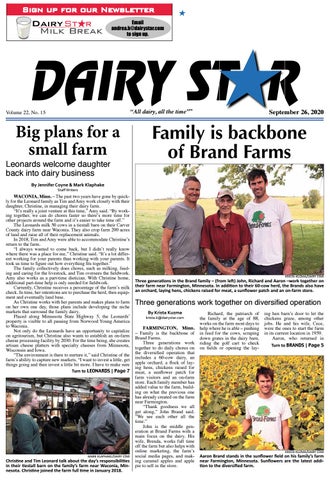
Family is backbone of Brand Farms
By Jennifer Coyne & Mark Klaphake Staff Writers
WACONIA, Minn. – The past two years have gone by quickly for the Leonard family as Tim and Amy work closely with their daughter, Christine, in managing their dairy farm. “It’s really a joint venture at this time,” Amy said. “By working together, we can do chores faster so there’s more time for other projects around the farm and it’s easier to take time off.” The Leonards milk 50 cows in a tiestall barn on their Carver County dairy farm near Waconia. They also crop farm 200 acres of land and raise all of their replacement animals. In 2018, Tim and Amy were able to accommodate Christine’s return to the farm. “I always wanted to come back, but I didn’t really know where there was a place for me,” Christine said. “It’s a lot different working for your parents than working with your parents. It took us time to gure out how everything ts together.” The family collectively does chores, such as milking, feeding and caring for the livestock, and Tim oversees the eldwork. Amy also works as a part-time dietician. With Christine home, additional part-time help is only needed for eldwork. Currently, Christine receives a percentage of the farm’s milk check. In time, her intentions are to purchase the herd, then equipment and eventually land base. As Christine works with her parents and makes plans to farm on her own one day, those plans include developing the niche markets that surround the family dairy. Placed along Minnesota State Highway 5, the Leonards’ property is visible to all passing from Norwood Young America to Waconia. Not only do the Leonards have an opportunity to capitalize on agritourism, but Christine also wants to establish an on-farm cheese processing facility by 2030. For the time being, she creates artisan cheese platters with specialty cheeses from Minnesota, Wisconsin and Iowa. “The environment is there to nurture it,” said Christine of the farm’s ability to capture new markets. “I want to invest a little, get things going and then invest a little bit more. I have to make sure Turn to LEONARDS | Page 7
MARK KLAPHAKE/DAIRY STAR
ChrisƟne and Tim Leonard talk about the day’s responsibiliƟes in their Ɵestall barn on the family’s farm near Waconia, Minnesota. ChrisƟne joined the farm full Ɵme in January 2018.
KRISTA KUZMA/DAIRY STAR
Three generaƟons in the Brand family – (from leŌ) John, Richard and Aaron –work together on their farm near Farmington, Minnesota. In addiƟon to their 60-cow herd, the Brands also have an orchard, laying hens, chickens raised for meat, a sunower patch and an on-farm store.
Three generations work together on diversied operation By Krista Kuzma
krista.k@dairystar.com
FARMINGTON, Minn. – Family is the backbone of Brand Farms. Three generations work together to do daily chores on the diversied operation that includes a 60-cow dairy, an apple orchard, a ock of laying hens, chickens raised for meat, a sunower patch for farm visitors and an on-farm store. Each family member has added value to the farm, building on what the previous one has already created on the farm near Farmington. “Thank goodness we all get along,” John Brand said. “We see each other all the time.” John is the middle generation at Brand Farms with a main focus on the dairy. His wife, Brenda, works full time off the farm but also helps with online marketing, the farm’s social media pages, and making caramel apples and apple pie to sell in the store.
Richard, the patriarch of the family at the age of 88, works on the farm most days to help where he is able – pushing in feed for the cows, scraping down grates in the dairy barn, riding the golf cart to check on elds or opening the lay-
ing hen barn’s door to let the chickens graze, among other jobs. He and his wife, Cece, were the ones to start the farm in its current location in 1959. Aaron, who returned in Turn to BRANDS | Page 5
KRISTA KUZMA/DAIRY STAR
Aaron Brand stands in the sunower eld on his family’s farm near Farmington, Minnesota. Sunowers are the latest addiƟon to the diversied farm.
Page 2 • Dairy Star • Saturday, September 26, 2020
DAIRY ST R www.dairystar.com
ISSN 020355 522 Sinclair Lewis Ave. Sauk Centre, MN 56378 Phone: (320) 352-6303 Fax: (320) 352-5647 Published by Dairy Star LLC General Manager/Editor Mark Klaphake - mark.k@dairystar.com 320-352-6303 (ofďƒžce) 320-248-3196 (cell) 320-352-0062 (home) Ad Composition Nancy Powell 320-352-6303 nancy.p@dairystar.com Consultant Jerry Jennissen 320-346-2292 Editorial Staff Krista Kuzma - Editor/Wisconsin (507) 259-8159 • krista.k@dairystar.com Andrea Borgerding - Associate Editor (320) 352-6303 • andrea.b@dairystar.com Jennifer Coyne - Assistant Editor (320) 352-6303 • jenn@dairystar.com Danielle Nauman (608) 487-1101 danielle.n@dairystar.com Stacey Smart - Staff Writer (262) 442-6666 • stacey.s@dairystar.com Maria Bichler - Copy Editor 320-352-6303 Advertising Sales Main Ofďƒžce: 320-352-6303 Fax: 320-352-5647 Deadline is 5 p.m. of the Friday the week before publication Sales Manager - Joyce Frericks 320-352-6303 • joyce@dairystar.com Bob Leukam (Northern MN, East Central MN) 320-260-1248 (cell) bob.l@star-pub.com Mark Klaphake (Western MN) 320-352-6303 (ofďƒžce) 320-248-3196 (cell) Laura Seljan (National Advertising, SE MN) 507-250-2217 fax: 507-634-4413 laura.s@dairystar.com Jerry Nelson (SW MN, NW Iowa, South Dakota) 605-690-6260 jerry.n@dairystar.com Mike Schafer (Central, South Central MN) 320-894-7825 mike.s@dairystar.com Amanda Hoeďƒ&#x;er (Eastern Iowa) 320-250-2884 • amanda.h@dairystar.com Julie Barnes (SE WI and Northern IL) julie.b@dairystar.com Megan Stuessel (Western Wisconsin) 608-387-1202 • megan.s@dairystar.com Ashley Curry (Northeast WI and Upper MI) 920-539-7268 • ashley.c@dairystar.com Deadlines The deadline for news and advertising in the Dairy Star is 5 p.m. Friday the week before publication. Subscriptions One year subscription $35.00, outside the U.S. $110.00. Send check along with mailing address to Dairy Star, 522 Sinclair Lewis Ave., Sauk Centre, MN 56378. Advertising Our ad takers have no authority to bind this newspaper and only publication of an advertisement shall constitute ďƒžnal acceptance of the advertiser's order. Letters Letters and articles of opinion are welcomed. Letters must be signed and include address and phone number. We reserve the right to edit lengthy letters. The views and opinions expressed by Dairy Star columnists and writers are not necessarily those of the Dairy Star LLC.
The Dairy Star is published semi-monthly by Dairy Star, LLC, 522 Sinclair Lewis Ave., Sauk Centre, MN 56378-1246. Periodicals Postage Paid at Sauk Centre, MN and additional mailing ofďƒžces. POSTMASTER: Send address changes to Dairy Star, 522 Sinclair Lewis Ave., Sauk Centre, MN 56378-1246.
A glance at the other side
Dairy Star likes to provide local stories, which is why we have two versions of the paper. Below are a few highlights from stories you will not ďƒžnd in this paper, but you can ďƒžnd online in zone 2. Find full editions on our website, www.dairystar.com, and click on the e-edition tab under the Dairy Star header. Cows head back to campus Cows at the University of Wisconsin-Madison were kicking up their heels on Sept. 1 when they returned to campus after a 5-month hiatus due to the COVID-19 pandemic. The university’s Dairy Cattle Center is used extensively by undergraduate, graduate and professional students in UW–Madison’s dairy science, veterinary medicine and Farm and Industry Short Course programs for hands-on training and research studies. Although classes at Madison went virtual once again not long after the cows arrived, staff at the center expect cows to remain on campus for research and instruction. Koehl Farm celebrates centennial After 100 years of milking in a stanchion barn, cows at Koehl Farm near Darien, Wisconsin are now being milked in a double-6 parlor. The Koehls installed a parlor this summer to milk their herd of 53 cows while also celebrating the farm’s centennial. Moving forward while keeping one foot in the past, the Koehls constantly update and improve their farm while preserving its heritage. Big dreams with big brown cows Setting strategic goals is how Hayden Hauschildt keeps himself on track, working to make continuing improvements with his herd of registered Brown Swiss. Hauschildt currently milks 145 head of Holsteins and Brown Swiss with his parents, Jim and Diane, on their farm near Ellsworth, Wisconsin. Hauschildt is working on plans to take over the farm, and transition to a 100% Brown Swiss herd, while focusing on breeding the complete cow with genetics, show type and good production. Riding the Imagination Express Ingenuity and imagination drew brothers Bo and Ian Afdahl into the world of model railroading, after Ian received a train set from his dad for Christmas a few years ago. The hobby that grew from that gift earned the boys ďƒžrst-place honors in the youth team division of a national model railroad build-off earlier this summer. The boys and their parents, Brad and Kristin Afdahl, live on their 47-cow registered Holstein farm near Arkansaw, Wisconsin.
FAST, EFFICIENT UNLOADING NOW WITH GREATER CAPACITY!
HP 160 PROPUSH
ÂŽ
HYDRAULIC PUSH BOX SPREADER
• Increased capacity of simple push-off design with no chains • 3RO\ Ä RRU DQG VLGHV SURPRWH VHOI FOHDQLQJ WR SUHYHQW PDWHULDO EXLOGXS DQG IUHH]H GRZQ • VertiSpread vertical beaters provide 25 - 30’ uniform spread pattern with excellent material breakup • All-welded steel construction for reliability in high use applications INVEST IN QUALITY ÂŽ
600 cu. ft. heaped capacity • trailer models only
www.kuhn.com
Lindell Sales & Service Cannon Falls, MN
Lake Henry Implement 3D\QHVYLOOH 01
Scott Supply 0LWFKHOO 6'
Hammell Equipment &KDWĹľHOG 01 (LW]HQ 01
Minnesota Ag Group 3ODLQYLHZ 01
Grossenburg Implement Philip, SD :LQQHU 6'
Adkins Equipment 'HWURLW /DNHV 01 Isaacson Sales & Service /DID\HWWH 01 Blue Hilltop /DNH :LOVRQ 01 Schlauderaff Implement /LWFKžHOG 01 Fluegge’s Ag 0RUD 01 Northland Farm Systems Owatonna, MN
Diaryland Supply 6DXN &HQWUH 01 Werner Implement 9HUPLOOLRQ 01 UFC Farm Supply :DFRQLD 01 Anderson Bros. (GJHOH\ 1' Duppong's, Inc. *OHQ 8OOLQ 1' Enerbase Cooperative Minot, ND
Pfeifer Implement Sioux Falls, SD Mark's Machinery :DJQHU 6' <DQNWRQ 6' Van-Wall Equipment Albia, IA ,QGLDQROD ,$ .QR[YLOOH ,$ Roeder Bros. %HOOHYXH ,$
Vetter Equipment &ODULQGD ,$ 6KHQDQGRDK ,$ Kunau Implement 'H:LWW ,$ Bodensteiner Implement (ONDGHU ,$ J. P. Scherrman, Inc. )DUOH\ ,$ Nelson Farm Supply +DUODQ ,$ Burco Sales ,QGHSHQGHQFH ,$ Helmuth Repair Kalona, IA
Graber Services /RFNULGJH ,$ Carroll Implement /X9HUQH ,$ Ag Land Implement 1HZ +DPSWRQ ,$ Kunau Implement 3UHVWRQ ,$ Engel Agri-Sales 6DF &LW\ ,$ Gordy’s Repair & Implement 6WDF\YLOOH ,$ Dee Implement of Waukon :DXNRQ ,$
Visit your local KUHN Knight dealer today!
ÂŽ
Dairy Star • Saturday, September 26, 2020 • Page 3
It’s all inside... Columnists Ag Insider
Pages 8-9 First Section
Bon Yankton Homme
Clay
Lyon
Osceola
Sioux
O’Brien
Plymouth
Waconia
Leonards welcome daughter back into dairy business First Section: Pages 1, 7
Monona
Pottawattamie Cass
nt
mo
State Center
For additional stories from our other zone, log on to www.dairystar.com
Kanabec
Washington
ms ey
Mitchell Howard
Hancock Cerro Gordo
ldt
Floyd
Boone
Story
Polk
all
h ars
M
aw
as
ick
Ch
Bremer
Wright Franklin Butler
Dallas
Black Hawk
Tama
Jasper
Fayette
Gerards clean up after corn silage storage collapses Second Section: Page 13
Clayton
an
e war Dubuque
an
ch
Bu
Benton
Dela
Jones
Linn
Iowa
Madison Warren Marion Mahaska Keokuk
Adair
Taylor
Union old
gg
Rin
Iowa dairy farmers quick to cut silage on elds attened by derecho First Section: Pages 12 - 13
Worth
Webster Hamilton Hardin Grundy
Guthrie
y mer Adams
Page
n Win
o
mb
Hu
Greene
tgo
Mon
Kossuth
n
lh Ca
go
eba
ou
Sac
Harrison Shelby
as
nt
ho
ca
Po
Crawford Carroll
Fre
Zone 2
Palo Alto
e Buena Vista
Ida
Mills
Zone 1
Clay
ke
ero
Ch
Woodbury
n inso Emmet
Dick
Mower
e
ln
co
Lin
Faribault
Martin
Houston
iek
Turner
Jackson
Spring Grove
Winona
Fillimore
ake
Hutchinson
Nobles
Freeborn
sh
Charles Mix
Rock
Wabasha
Cottonwood Watonwan Blue Earth Waseca Steele Dodge Olmsted
ne
Douglas
Gregory
McCook Minnehaha
Murray
Goodhue
Rice
am
Tripp
ns
Ha
Moody
Nicollet
Brown
All
Todd
on
Lake
Redwood
Clinton
s
hn
Jo
Clarke
Lucas
Decatur Wayne
Monroe Wapello e
oos
pan
Ap
Davis
son
fer
Jef
Van Buren
Jackson
on Cedar
Muscatine
n
Mellette
Miner
Lyon
gto
Brule
Aurora
Sanborn
Brookings
W in
Bennett
Lyman
Jerauld
Kingsbury
Dakota
Scott
Sibley
hin
Fall River
Shannon
Buffalo
Beadle
Hennepin Carver
Wa s
Jackson
Hand
McLeod
Renville
Yellow Medicine
sh iek
Custer
Jones
Hughes
Deuel
Hamlin
Anoka
Wright
Meeker
we
Pages 8 - 9 Second Section Pennington
Stanley
Hyde
Lac Qui Parle
Codington
Clark
Kandiyohi
Chippewa
Isanti
Po
Sully
Spink
Sherburne
Swift
Grant
Benton
Stearns
Pope
Ra
Faulk
Potter
Day
Stevens
go
Dewey
Edmunds
Big Stone
First Section: Pages 37 - 38
Pine
Mille Lacs
Morrison
Douglas
Land conservation top priority for Glendes
Carlton
Todd Grant
Altura
Aitkin
Crow Wing
eu r
Brown Walworth
Haakon
Roberts
Marshall
McPherson
Otter Tail
isa Ch
Lawrence
Richland
Sargent
Cass
Su
Campbell
Corson
Dickey
McIntosh
Becker
Clay
Ransom
Emmons Sioux
Mah
Lake
Le
Grant
Cass
LaMoure
Ziebach
TheMeade “Mielke” Market Weekly
Bames
Hubbard
Stutsman
First Section: Pages 18, 20
Cook
Itasca
Wadena
Kidder
Logan
Perkins
Butte
en nom
Wilkin
Burleigh
Morton
Page 33 First Section
Polk
Trail
Steele
Tra ver se
Page 32 First Section Adams
Griggs
Berktolds keep reproduction program simple
Koochiching St. Louis
Red Lake
Norman
Oliver
Dairy Good Life
Harding
Foster
Beltrami
on
Sheridan Mercer
Stark
Bowman
Wells
Lake City
Family is backbone of Brand Farm
Lake of the Woods
Pennington
Grand Forks
Eddy
McLean
Roseau
Marshall
Benson Nelson
Just Thinking OutHettinger Loud
Slope
Walsh
Ramsey
McHenry
Ward
Kittson
Lincoln
Golden Valley
Pierce
Pembina
First Section: Pages 1, 5 - 6
Pipestone
Billings
Page Dunn 31 First Section
Cavalier
Towner
Da vi so n
Something to Ruminate McKenzie On
Rolette
n
Page 30 Williams First Section Mountrail
Bottineau
First Section: Page 36
ub
Renville
First Section: Pages 10 - 11
io
Dear County Burke Agent Guy
Farmington
Au d
First Section: Pages 23, 25
Bowlus
Women In Dairy: Susan Geise
Klaphakes form partnership, carry on with automation
Un
Page 26 First Section
Divide
Freeport
Rep. Peterson named Legislator of the Year
Clearwater
Perham
FSA News & Notes
Louisa
Henry Des
Moines
Lee
Scott
St Charles
Kids Corner: The Schrandt family Third Section: Pages 8 - 9
FROM OUR SIDE OF THE FENCE:
What goes into planning meals for harvest time? First Section: Pages 15 - 16
Page 4 • Dairy Star • Saturday, September 26, 2020
$
5 OFF ALL
Increase fiber digestion resulting in incresed gains & healthier livestock!
ROUGHAGE BUSTER TUBS!
10% OFF
BULK PRECON TOTES
WIND & RAIN AVAILA 4 & MINERAL TUBS!
TIRES
SAVE
95/TON!
$
Feed the first 10-21 days after weaning for weight gain!
$20 OFF ALL
STOCK BALE FEEDERS!
Skid Loader & Implement (Mounting Available)
WATERERS
CHECK OUT OUR RENTAL SELECTION!
WATERERS
Get your jobs done & save money at the same time!
Made in USA
“Originators of insulated poly waterers”
Short on Labor? Short on time? Automatic AGRi-Speed HITCH
We are an exclusive dealer!
• One person operation - eliminate the need for a second hand for hook-ups • Available for pick-ups, choppers, tractors, wagons, etc.
FIND OUT HOW ROASTING CAN BENEFIT YOUR RATIONS
WE ARE HIRING!
• Full-time mill work/ feed mixing position Gilman Co-op Creamery is looking We cantocustom yourpositions: grains including barley, and soybeans. • Fullcorn, timewheat, feed oats delivery person fill the roast following
Gilman Co-op Creamery
FEED & FARM SUPPLY STORE
1-800-887-4634•(608) 723-4634 John, Jim & Dave Fuller 423 U.S. Hwy. 61 North • Lancaster, WI
Gilman, MN 320-387-2770
Open M-F 7:30-7, Sat. 7:30-5, Sun. 8:30-1 Good service - fair prices - every day
WWW.GILMANCREAMERY.COM
Stays on Hooves for 2 weeks!
Get your cows’ teat ends in TOP CONDITION! TEAT END ISSUES?
BEFORE
• Dual Germicide: Primary: Chlorine Dioxide promotes a quick kill. Secondary: LAS promotes a long-lasting kill.
Exfoliation
• Effective against ALL Mastitis-Causing Organisms
AFTER
• Teat skin conditioning – 12.4% skin conditioning package
Exfoliation
• Contains Lactic Acid to promote Teat Exfoliation
• Green coloring for easy identification
KlingonBlue™ BI-WEEKLY, LONG-ACTING FOOTBATH Helps improve hoof health and enhance digital dermis... to promote cow mobility, comfort and overall productivity.
Works in cold weather with better efficacy & less labor! FORMALDEHYDE HAS ZERO EFFICACY.
Average Cost/Lost-Profit per case of Digital Dermatitis is $275 OR MORE!
FOR MORE INFO - CONTACT ONE OF THESE DEALERS... Advanced Dairy Systems
Athman Dairy Inc.
D&D Ag Supply
9 State Rd. 29 • Spring Valley, WI 54767 (715) 772-3201
238 Main Street North • Pierz, MN 56364 (320) 468-2494
133 Atlantic Ave. NE • Pennock, MN 56279 (320) 599-4466
Advanced Dairy Solutions
Professional Dairy Systems
East Central Dairy Supply
Champion Milking Systems
Eastern Iowa Dairy Systems
278 W. Court St. • Richland Center, WI 53581 1449 Homecrest Ave. • Wadena, MN 56482 (608) 647-4488 (218) 632-5416
Anderson Dairy Systems, Inc. 1312 13 1/2 Ave. • Barron, WI 54812 (715) 537-3300
23218 350th Street • Albany, MN 56307 (320) 845-4156
2195 Hwy. 23 • Mora, MN 55051 (320) 679-1029
105 3rd Ave. NW • Epworth, IA 52045 (563) 876-3087
Fuller’s Milker Center, Inc.
Lang’s Dairy Equipment, Inc.
2337 Millennium Rd. • Decorah, IA 52101 (563) 382-8722 1467 West 5th Street • Winona, MN 55987 (507) 452-5532 Gorter’s Clay & Dairy Equipment 1400- 7th St. SE • Pipestone, MN 56164 Leedstone (507) 825-3271 222 E Co Rd 173, Melrose, MN 56352 (320) 256-3303 Tri-County Dairy Supply, Inc. 24260 Cty. Rd. 27 • Plainview, MN 55964 4107 N US HWY 51 • Janesville. WI 53545 (507) 534-3161 608-757-2697 423 U.S. 61 • Lancaster, WI 53813 (608) 723-4634
Leedstone
1720 Freitag Dr. • Menomonie, WI 54751 (715) 231-8090
United Suckow Dairy
12687 Hwy 18 & 52 • Postville, IA 52162 (563) 864-7417 210 N. Industrial Pkwy • West Union, IA 52175 (563) 422-5355
Dairy Star • Saturday, September 26, 2020 • Page 5
ConƟnued from BRANDS | Page 1
Trust the experts Future success starts with today’s nutrition At Famo Feeds, we strive to provide the best support for your operation and work to accommodate your specific needs.
KRISTA KUZMA/DAIRY STAR
Richard Brand stands in front of the 50-stall Ɵestall barn he built in 1976. The family sƟll uses the facility to milk their 60-cow herd near Farmington, Minnesota. 2005 after college, has driven the diversication of the farm. While he works on the dairy, he puts an emphasis on the orchard, chickens, sunowers and onfarm store. Beyond the main trio to run the farm, John and Brenda’s daughter, Allison Solinger, lives down the road and feeds calves nearly every morning. Brenda’s parents, Jim and Elaine Erb, have also moved closer to the farm to assist with collecting eggs every morning. John’s brother, Greg, is a nearby crop farmer who also helps with eldwork and other chores if necessary. “I think we take it for granted having us all here,” John said. “We don’t really think about it, but we are fortunate to have us all here.” In addition to family labor, the farm also employs 20 part-time people, mostly working with the orchard and on-farm store. Richard never imagined the farm to look like it does today. He and CeCe began xing up buildings and creating their farmstead after moving there after they married. “It’s very fertile ground and nobody grows nicer alfalfa than we do,” Richard said. “It’s great alfalfa. There’s nothing prettier than an alfalfa eld.” Richard has always promoted land conservation, especially with the farm’s hilly landscape. The family has small elds and likes to have coverage on the
grounds to prevent soil erosion. “We try to leave the farm better than when we got it,” he said. “The earth belongs to everybody. We have a responsibility to take care of it.” In 1976, the couple built a new 50-stall dairy barn with a 10-foot pit underneath – a source of excitement to show off their love of cows. “I always liked dairy and took an interest in cows,” Richard said. “On Sunday afternoons, the neighbors and I would take a drive to Wisconsin and look at cows. That was our entertainment.” Four years after building their dairy barn, John started full time on the farm after graduating from high school. He took on the same excitement for the dairy as his dad. Just as he did growing up, John grew a love and appreciation for farming in his young family. When Aaron returned to the farm, his intention was to dairy farm just like his dad and grandpa. “The way it is today was not planned at all,” Aaron said. The Brands quickly realized they needed another source of income in order to add another generation. Because of their close proximity to Farmington city limits – with housing developments clearly visible from their land – the Brands decided against expanding
Programs and support for every stage... from calf to cow and everything in between! Our full lines of feed include: •Complete feeds •Starter feeds •Supplements •Concentrates •Vitamins •Minerals •Pre-mixes •Base Mixes •Milk replacers •Animal Health •Preservatives/Inoculants •Tubs •Pet Foods •Specialty and custom feeds to meet your specific needs
320-836-2145 or 800-450-2145 Check out our website to ½nd a Famo Feeds dealer near you!
www.famofeeds.com
BODENSTEINER IMPLEMENT CO. www.bodimp.com
Pre-owned equipment!
Turn to BRANDS | Page 6
2013 JD 7780
KP, PRWD, Pro Drive, 2499 hrs. #49737 $185,000 (DYE)
JD 698 Rotary Head
2013 JD 640C Windrow Head
2018 John Deere 560M
2015 JD 569 Prem RB
2018 JD 330G Skid Steer
2010 Kuhn Knight 3130
Came off 7780, 8 row, small drum #49738 $54,500 (DYE)
Crop roller, hyd. gauge wheels #49739 $15,000 (DYE)
712-722-3626
2011 NH H8080 Windrower
w/15’5” 750HD header, 884 hrs. #44281 $75,000 (DYE)
SERVICE AFTER THE SALE
2014 JD 204K Compact Ldr.
Cab w/AC, 1.4 yd. bkt., new tires #48301 $52,000 (WAU)
Twine and Surface Wrap, 5’bales #50642 $59,500 (CRE)
84” bkt., EH controls, 2083 hrs. #49222 $39,500 (LIME SPRINGS)
19,500 bales #50079 $23,500 (DYE)
Feeder wagon #48609 $17,800 (WAU)
For complete info on all our used equipment log on to bodimp.com Elkader (ELK) ........563-245-2470 Clermont (CLE) ......563-423-5206 Cresco (CRE) .......... 563-547-2152 Decorah (DEC) ....... 563-382-2961 Dyersville (DYE)..... 563-875-2724
Monticello (MON) ...319-465-3515 New Hampton (NH) 641-394-3061 Oelwein (OEL) ......... 319-283-4371 Rowley (ROW)........ 319-938-2222 Waukon (WAU) ......563-568-3463
Page 6 • Dairy Star • Saturday, September 26, 2020
ConƟnued from BRANDS | Page 5
Willmar, MN • 320.231.1470
EXPANDING OR REMODELING YOUR LIVESTOCK OPERATION? LANGE AG SYSTEMS SPECIALIZES IN:
Ŷ NEW FACILITIES
_
NO JOB TOO BIG OR TOO SMALL
Ŷ RETROFITTING & REMODELING Ŷ TURNKEY PROJECTS Ŷ BARN DESIGN Ŷ INSTALLATION, MAINTENANCE & REPAIRS
ƋƵŝƉŵĞŶƚ tĞ KīĞƌ͗ ͻ sĞŶƟůĂƟŽŶ &ĂŶƐ ͻ sĞŶƟůĂƟŽŶ ŽŶƚƌŽůƐ ͻ WŽƐŝƟǀĞ WƌĞƐƐƵƌĞ dƵďĞƐ ͻ ƵƌƚĂŝŶ ^LJƐƚĞŵƐ ͻ DĂƩƌĞƐƐĞƐ ͻ tĂƚĞƌĞƌƐ ͻ ^ƚĂůů ƋƵŝƉŵĞŶƚ ͻ ,ĞĂĚůŽĐŬƐ ͻ DŝƐƟŶŐ ^LJƐƚĞŵƐ
Lange Ag Systems is proud to offer Grain Bags, Silage Bags & Bunker Covers from Up North Plastics and Feed Fresh Silage Covers & Custom Size Bunker Covers from Raven!
t ^ >> E t Θ h^ 'ͳ ' Θ < >>z Zz E '' Z^
www.LangeAgSystems.com Tell the advertisers you saw their ad in the Dairy Star!
Flex-Hutch
Choice of 2-Unit or 3-Unit
The Next Step Forward in Calf Housing • Simplifies daily chores • Easily sanitize & clean • Front hinged cover opens in one easy movement • Utilize available space more efficiently
Rear vents open and close in a single motion
KRISTA KUZMA/DAIRY STAR
John Brand cleans under a cow in the Ɵestall barn on his family’s dairy near Farmington, Minnesota. John’s main focus on the farm is the dairy herd. the dairy. They built the barn for laying hens and started raising chickens for meat. After that, Aaron had an opportunity to rent the nearby orchard and eventually plant trees on their farmland. “It all blossomed from there,” he said. “It escalated quickly.” The Brands collect 180 dozen eggs each day from their 2,200 laying hens. About 40% of the eggs are sold in the on-farm store. The rest are sold through wholesale or at farmers’ markets in the Twin Cities. A new group of 250 chickens raised for meat arrive every six weeks from March through November. For their apples, the Brands grow 10 varieties on 20 acres. Last year, Aaron added a 1.5-acre eld of sunowers for people to enjoy and take pictures, charging $10 per car. After a good turnout without much promotion, Aaron planned a 2-acre eld this year with owers blooming from the end of August through midSeptember. “The way the orchard has been going, it’s been hairpulling busy, especially in the fall,” Aaron said. Their location, which at one time was a curse toward their dairy, has turned into a blessing for their diversied operation. One recent good-weathered Sunday drew nearly 300 families to the farm for apples, to visit the onfarm store and view the sunowers – a day when the Brands were also trying to get a portion of their corn silage done. But the Brands try to take it in stride, leaning on each other to make it through the busy season. “Work ethic for sure is the biggest thing I’ve learned from them (Dad and Grandpa),” Aaron said. “There’s no shortage of it here.” In addition to learning work ethic from his family, Aaron is also thankful
It Makes “Cents” To Advertise In The Dairy Star
KRISTA KUZMA/DAIRY STAR
Apples by the quarter peck are ready to be purchased by customers at the Brands’ on-farm store. for them being open to diversifying the farm. “If I didn’t have help from the family when I started my side of the business, I would not be where I am today,” Aaron said. “I fully credit my grandparents, and Dad and Mom for being extremely supportive and pitching in.” In the next ve years, the family plans to sustain the dairy and continue improving areas of the orchard by building a retail facility with a commercial kitchen and storage that is a separate location. This will also allow for ample parking space for customers. What will stay the same is the family working together as much as they can and preserving the land being passed down now to the third generation. “We don’t realize how fortunate we are,” Richard said about farming and being together with family. “It’s a gift from God.”
Monahan
HOOF TRIMMING Since 1997
Trimming commercial and show cattle
Flex-Hutch can provide savings in your housing costs per calf as compared with individual hutches.
We use a hydraulic upright chute for less stress.
Call or Visit Us Online Today Free Catalog 1-800-472-2341 www.loyal-roth.com
Rugged Equipment... Priced Right... Since 1956!
Call 320-352-6303 to place your ad or mail to: Dairy Star, 522 Sinclair Lewis Ave., Sauk Centre, MN 56378
“Our two man crew allows us to complete the job in a timely manner with less disruption of your herd’s daily routine.” Covering the states of MN, IA, SD, WI & IL
Call Dan at
507-272-3447
Dairy Star • Saturday, September 26, 2020 • Page 7
ConƟnued from LEONARDS | Page 1 the community is there with me.” Prior to graduating from college in 2016 with a food science degree, Christine approached her parents about the possibility to return to the family’s business. However, at the time, they were not prepared for the farm to support another family member. “We encouraged her to get out and work off the farm and think about it,” Amy said. “We needed to think about it too.” Tim agreed. “And the hours and commitment are a lot for a young person to take on,” he said. So, in the meantime, Christine worked for a farmstead creamery in central Minnesota. On this farm, she was exposed to the artisan cheesemaking industry. “I fell in love with the farmstead cheese aspect,” Christine said. The Leonards re-evaluated their daughter’s request and were able to have her become a part of the farm in January 2018; this time, with a clearer vision for Christine. “The biggest part was that (milking) was getting to be too physical on my body to keep doing everything all the time,” Tim said. “Honestly, the cows probably wouldn’t be here right now if she didn’t come home.” Tim already had not planted alfalfa in 2016, and was planning to phase out rotational cropping with forages to focus
MARK KLAPHAKE/DAIRY STAR
The Leonards – (from leŌ) ChrisƟne, Amy and Tim – milk 50 cows on their farm in Carver County near Waconia, Minnesota. The trio work collecƟvely to complete the daily chores on the farm. more on a cash crop enterprise. But with Christine’s continued interest in milking cows, the Leonards found a way for her to be included on the farm. Christine clearly recalls knowing when she was given the OK to return. “I remember it was May, and dad called saying he planted alfalfa,” Christine said. “Only a farmer really knows what that means. When you plant alfalfa, you’re looking at a longer time
investment. He was telling me they had decided to give me the opportunity to come home and farm with them.” The farm site was rst homesteaded in 1871 by Amy’s great-great-grandfather, Joe Wessbecker. In 1959, Amy’s parent’s, Mark and Elaine (Wessbecker) Buesgens bought the farm from Elaine’s parents. Since then, the women have been the ones to return to the farm site. Christine takes pride
in being the sixth generation to farm here, with the last three generations being women. Next year, the Leonards will commemorate 150 years of farming. And this year, they are honored to be the 2020 Carver County Farm Family of the Year. “They’re humble,” said Christine of her parents’ recognition. “I’m proud of the accomplishments they’ve had in their 30 years of farming.”
Amy agreed. “There are a lot of great farm families in Carver County,” she said. “I think this says a lot about our families before us. It is the hard work and the determination you have to have to get it done. It’s a family affair.” In addition to the Leonards’ involvement in multiple local and regional dairy organizations, the family is active in their community, inviting Waconia High School students to their farm as part of the school’s curriculum. “It’s good for those kids, and everyone, to see this is where their food originates from,” Tim said. “It’s eyeopening for them.” With Christine’s vision, the Leonards have the potential to engage their community in the farm-to-fork discussion as milk is made into cheese at the dairy. In the long run, Christine would like to downsize the milking cow herd just enough to sustain the cheese-making business and cultivate that aspect of dairy farming. “The (farmstead cheese market) is getting more saturated, but if you have a good story to tell and make a good product, there is still opportunity,” Christine said. Until then, the Leonards are grateful they were able to nd a way to bring the next generation home with their sights set on grand plans for their small family farm.
Hail Storm Forces
MASSIVE VEHICLE SALE! MASSIVE SAVINGS
ON OVER A HUNDRED VEHICLES!
OLIVIA
CHRYSLER DODGE JEEP & RAM
WE HAVE OVER 30 YEARS OF SALES EXPERIENCE! CONTACT US TODAY!
2135 West Lincoln Ave. | Olivia, MN
President Trump announces additional relief Page 8 • Dairy Star • Saturday, September 26, 2020
During a gathering in Mosinee, Wisconsin, 6 and 7 price classications because it distorted Sept. 17, President Donald Trump said the global milk prices. Canada made that move but administration would offer another round of the created new subclasses of milk that have the same Coronavirus Food Assistance Program for farmers result. IDFA is seeking more transparency on and ranchers. “My administration is Canada’s dairy pricing system and the Ag Insider committing an additional, you’ve been elimination of these programs. asking for this a long time, $13 billion in relief to help farmers recover from USDA report forecasts milk the coronavirus,” Trump said. production increase According to the September USDA reveals more details of CFAP USDA World Agricultural Supply and 2.0 Demand Estimates, milk production The United States Department of for 2020 and 2021 was raised from Agriculture will give farmers another the August report due to an expected chance for COVID-19 relief in the increase in milk output per cow. The Coronavirus Food Assistance Program export forecast was increased for the 2.0. Payment calculations will be made balance of this year with expectations for three categories of commodities: for strong global demand for cheese, By Don Wick price trigger commodities, at-rate butter and whey products. The Class Columnist crops and sales commodities. The new III milk price forecast for 2020 was calculations offer at least $15 per acre reduced 15 cents from last month to for crops. Livestock payments will be based on $17.25 per hundredweight. The 2021 Class III their chosen inventory within an April to August milk price is expected to average $16 per cwt. time frame. Milk payments will be based on That is down a dime from the August report and production from April through August. There is down $1.25 from 2020. a payment limit of $250,000 per person or entity for all commodities. The enrollment continues Milk production continues to rise through Dec. 11. U.S. milk production totaled 17.8 billion pounds in August, up nearly 2% from the previous Food box program contracts awarded year. In Minnesota, the size of the dairy herd A third round of contracts for the Farmers to declined by 5,000 head, but milk output increased Families Food Box Program has been awarded. 2%. South Dakota added 13,000 dairy cows There will be an additional $1 billion in funding to production from one year to the next. Milk for this program. Agriculture Secretary Sonny production increased nearly 11%. Perdue said this will benet farmers and consumers. US faces $3 trillion decit For the rst 11 months of the scal year, the Canadian milk pricing system challenged annual decit for the United States has grown to The International Dairy Foods Association $3 trillion. That compares to $1 trillion during the is upset with Canada’s implementation of the same time last year. Government spending went United States-Mexico-Canada Agreement. The up sharply since March when a series of economic United States sought the elimination of Canada’s relief measures were put into place to deal with
Essential Water Solutions has some exciting news to share! A recent dairy trial showed their Oxy Blast water additive to have a 7 lb/cow/day milk yield advantage!
COVID-19.
Near-zero interest rates The Federal Reserve will keep interest rates near zero through 2023. The Fed’s two-day policy meeting wrapped up at mid-month with this announcement. FCA reviews farm nancial situation In its quarterly review on the farm economy, the Farm Credit Administration said general nancial conditions are recovering from the big drop-off this spring. The FCA said income could decline sharply if government payments are reduced in 2021. There is a slight increase in level of stress for the Farm Credit System’s credit portfolio, but the lender said it remains well positioned to serve the agricultural market. MN Milk names Peterson Legislator of the Year Minnesota Milk Producers Association awarded House Agriculture Committee Chair Collin Peterson the 2020 Legislator of the Year. “Peterson has decades of history supporting the dairy industry, and he’s really went above and beyond for us. There were certain issues where he’d say I know there’s a national movement, but it’s not right for Minnesota. Peterson really stood with our policies at Minnesota Milk,” said Lucas Sjostrom, executive director, Minnesota Milk Producers Association. “It’s also new for us to give this award to a federal lawmaker instead of a state lawmaker.” Daniels promoted to policy analyst Malikha Daniels is now a policy analyst for U.S. Rep. Collin Peterson on the House Agriculture Committee. Daniels, who previously served as a legislative assistant, will focus on Turn to AG INSIDER | Page 9
USED EQUIPMENT FROM A NAME YOU CAN TRUST!
CHECK OUT OUR LARGE SELECTION OF HAY EQUIPMENT AND TRACTORS!
USED TRACTORS
‘13 N-H T9.615, 2126 Hrs, Cab Suspension .........$199,000 ‘02 N-H TM-150, MFD, Cab, Electrical Issues ........$16,500 ‘18 N-H T5.100, MFD, Cab , Loader, 625 Hours .....$61,500 ‘70 Ford 8000, Loader, Diesel ...................................$7,500 ‘00 New Holland 1720, 4x4, 4610 Hours ..................$5,000 ‘15 J-D 6175R, MFD, Loader, 2250 Hours............$115,900 ‘54 J-D 40, Restored ................................................$4,950 ‘48 J-D B ..................................................................$1,500 ‘72 I-H 354 ...............................................................$3,999 ‘57 I-H 350 ...............................................................$3,950 ‘78 White 2-135......................................................$12,900
*Results may vary
USED SKIDSTEERS ADDITIONAL BENEFITS SEEN: Higher water consumption Higher feed intake
Improved total butterfat and protein No significant weight loss
Eliminates sulfur smell Oxidizes manganese Helps remove iron bacteria and iron Kills coliform and E. coli bacteria We offer: CONSULTING LIVESTOCK NUTRITIONIST FILTRATION ASSISTANCE CONSULTING WATER PHYSIOLOGIST 23 YEARS OF EXPERIENCE DEALERS ALL OVER THE MIDWEST
Dealership areas still available!
545 T Avenue, Boone, IA 50036
essentialwater.net
For more information, contact Randy at: (515) 523-7011 office | (515) 290-9070 cell | randy@essentialwater.net
‘11 5610 Toolcat, Road Package, 780 Hrs ..............$34,900 ‘15 5600 Toolcat, Road Package, 2675 Hrs ............$32,500 ‘13 T-770, Glass Cab with A/C, 3450 Hours ...........$37,500 (2) T-650, Glass Cab with A/C, 275 Hrs & Up ......................................Starting at $29,700 ‘10 T-630, Glass Cab & Heater, 5300 Hours ...........$19,500 ‘17 T-590, Glass Cab with A/C, 235 Hours .............$45,000 ‘12 S-770, Glass Cab with A/C, 2 Speed, 5300 Hrs $28,900 (2) S-750, Glass Cab with A/C, 2 Speed, 875 Hrs & Up ......................................Starting at $29,500 ‘14 S-650, Glass Cab with A/C, 2 Spd, 4100 Hrs ....$28,500 ‘12 S-630, Glass Cab with A/C, 2 Spd, ..................$22,900 (2) S-590, Glass Cab with A/C, 2 Spd, 3325 Hrs & Up ....................................Starting at $26,500 ‘04 S-300, Glass Cab with A/C, 2 Speed, 5600 Hrs $19,500 ‘03 S-185, Glass Cab with A/C, 3000 Hrs ...............$18,500 ‘11 N-H L-150, ........................................................$8,250 ‘18 Cat 242D, Glass Cab with A/C, 2 Spd, 980 Hrs .$33,900 ‘17 J-D 323E, Glass Cab with A/C, 2650 Hrs ..........$38,900 ‘17 J-D 326E, Glass Cab with A/C, 2500 Hrs ..........$29,900 ‘05 J-D 332, Glass Cab with A/C, 1300 Hrs ............$29,900 2013 Gehl 5640E, Glass Cab with A/C, 2915 Hrs ...$22,900
Many used & new skidloaders ON HAND
USED TILLAGE
2009 W-R XL2 32-34’ 4 Bar Harrow.......................$28,500 ‘04 J-D 2210, 45.5’, 3 Bar Spring Tine Harrow.......$19,500 2012 W-R 513 Soil Pro, 11 Shank, Folding Frame .$39,500 2013 W-R 513 Soil Pro, 7 Shank, Used Very Little.$33,500 2011 W-R 513 Soil Pro, 5 Shank............................$26,900 White 588, 4 Bottom, Coulters .................................$1,250 2004 J-D 2700, 9 Shank Disc Ripper .....................$12,500
Used Planters
2010 White 8222, 12x30, Liquid Fert .....................$29,900 1997 White 6242, 12x30-13/15, Liquid Fert ...........$17,900 (2) 1994 White 6100 12x30, Vertical Fold.........................................Starting at $10,500
Used Hay Equipment
‘09 N-H H7230, 10’ Discbine ..................................$18,500 ‘04 N-H FP-240, Crop Processor ............................$12,500 Meyer 4120, 20’ Rear Unload Box and Wagon .......$10,900 ‘14 N-H BB-330P Large Square, 3792 Bales Only ..$69,500 ‘02 N-H BB-940 Large Square, Packer Cutter .........$24,500 ‘14 N-H 560 Rd Baler, Net Wrap .............................$28,900 ‘00 N-H 678 Rd Baler, Twine Only.............................$8,950 Vermeer 5410 Rebel, Rd Baler .................................$8,900 ‘01 Vermeer 605XL Rd Baler, Netwrap .....................$8,950 ‘96 Case I-H 8465 Rd Baler ......................................$4,950 ‘95 N-H 565 Small Square with 72 Thrower .............$7,500 (3) N-H 258 Rake ....................................Starting at $2,750
USED MISC
‘12 N-H 195 Spreader.............................................$11,950 N-H 185 Spreader ....................................................$3,950 ‘17 H & S 3127 Spreader .........................................$6,950 ‘08 Red Ball 1000 Gallon Sprayer, 60’ Boom ...........$9,950
Equipment of Norwood LANO A family business since 1946 with the Lanos: Jack, Paul, Bob and Andy 952-467-2181
Dairy Star • Saturday, September 26, 2020 • Page 9
ConƟnued from AG INSIDER | Page 8
biotechnology, food safety, livestock, dairy, trade, specialty crops and organic agriculture issues. MOSES hires new leader The Midwest Organic and Sustainable Education Service has a new executive director. Lori Stern has operated a communitysupported restaurant for the past six years, focusing on local foods. Trivia challenge Go-GURT is a yogurt product for children. In Canada, it is known as Yoplait Tubes and in England, it is called Frubes. That answers our
last trivia question. For this week, how much water does a dairy cow typically consume in a day? We will have the answer in the next edition of Dairy Star. Don Wick is owner/broadcaster for the Red River Farm Network, based in Grand Forks, North Dakota. Wick has been recognized as the National Farm Broadcaster of the Year and served as president of the National Association of Farm Broadcasting. Don and his wife, Kolleen, have two adult sons, Tony and Sam, and ve grandchildren, Aiden, Piper, Adrienne, Aurora and Sterling.
d e t s a o r r u o Getting y KLC Farms is t a s n a e b y o s
E L P M SI
“The data we receive from DHIA makes decision making much easier.” What are some of the DHIA tests you use?
We utilize the base level tests and service. Milk weighing, components, SCC, reproduction and record keeping. Which one do you Ànd most beneÀcial? The action sheets are the most beneÀcial to us. They help immensely in day-to-day management of the cows and reproductive health. Testing gives us the ability to monitor individual SCC and chronic mastitis. Also, DHIA’s genetic records are compatible with other programs which is handy for generating cow matings. The production index is a nice tool when culling low end cows. How does the DHIA data that you receive better your farm? The data we receive from DHIA makes decision making much easier. With DHIA’s help, we are able to keep highly detailed and accurate records. This allows us to more successfully manage, monitor and evaluate the cows, achieve higher production, and advance the genetics of our herd.
Tell us about your farm. My dad, Ken, brother, Andy, and I farm with our families west of Saint Cloud. In addition to our 130 lactating cows, we raise our own Mike Koltes youngstock. We also run 600 acres of Koltes Dairy LLC, St. Cloud, Minn. corn, soybeans and alfalfa which allows 130 cows • 10+ years testing with DHIA us to grow all our own feed.
Pull in unload and reload in just 15 minutes.
307 Brighton Avenue South Buffalo, MN 55313 1.800.827.3442 www.mndhia.org
Every day we have a high quantity of high quality soybeans. Our soybeans have the energy, protein, amino acids and bypass protein for your cows
KLC Farms Roasting, Inc.
Preferred By Bovines Everywhere
DHIA: Now MORE than ever
1-877-738-2326 Visit www.roastedbeans.com
Quality
Consistency
You've got it!
SOMBODY WANTS IT! sell it in the
GRAIN-O-MATIC UNLOADER UNSURPASSED FOR FREE-FLOWING AND SEMI-FREE FLOWIN
OUR PARTS INTERCHANGE WITH OUR COMPETITOR AT A MORE AFFORDABLE $COST$ GIVE US A CALL
Made in USA
608-776-4048
Servicing all types Silo unloaders and feeding equipment 1-800-887-4634•(608) 723-4634 John, Jim & Dave Fuller 423 U.S. Hwy. 61 North • Lancaster, WI
Page 10 • Dairy Star • Saturday, September 26, 2020
A decade of progression
urR 2brus s
H
-
hu
S AT Y S T EM IT ‘S SC URR H
sc h a
c
10 YEAR UPDATE
.
o
2
m
U -BR
MA KE S
2010 - 2020
S
E UR
TH
YEARS
H&E Innovations LLC Neillsville, WI 54456 office: 715.743.2937 email: heinnovationsllc@gmail.com
Roast Your Beans
Be Your Own protein Supplier Quality Roasted and steeped for By-pass protein Value Stop paying trucking, elevator fees, grain bank charges and excessive shrinks
Experience We’ve roasted millions of bushels Convenience Fully equipped with fuel, electricity, boom auger discharge and operator. It only takes minutes to set up and then we roast 10 tons per hour.
Quality portable roasting since 1989
800-366-3402
316709_9-28-05
midwestgrainroasters.com
Concrete
Silos “Thanks for sending your crew so fast! You folks sure are good to us.” - Doug Abrahamson
With over 40 years experience, Wisconsin Silos is the most complete builder of concrete silos in the United States. From pouring the footing, to fixing the accessories, unloaders, feeders, conveyors, silo pipes, silo distributors & silo chutes.
WE DO IT ALL!
3700 Post Rd., Plover, WI
1-800-472-9202 • 715-570-0069 • wisilos@gmail.com www.wisconsinsilos.com
Klaphakes form partnership, carry on with automation By Jennifer Coyne jenn@dairystar.com
FREEPORT, Minn. – As Kevin and Steve Klaphake review cow data on their computer in the dairy barn ofce, a single picture of the Klaphake men hangs on the wall behind them as a humble reminder of how the family farm has progressed in the last 10 years. “It’s unbelievable to think back when we rst started farming, it was JENNIFER COYNE/DAIRY STAR with 40 cows in a stall The Klaphakes – (from leŌ) Kevin, Steve and Mike – milk 113 cows with two barn and we’d feed with milking robots on their dairy in Stearns County near Freeport, Minnesota. Kevin wheel barrows,” Steve and his sons formed a partnership four years ago. said. “Now, with our milking robots and calf feeder, we’ve done it all.” ment of the dairy business. Steve and his sons, Mike and Kevin, milk 113 “We all make the decisions on purchases and or cows with two Lely A3 Next milking robots and raise anything we’ll be doing on the farm,” Steve said. their calves with one automatic calf feeder that were The partnership was created as a way to begin installed in August 2010 on their farm in Stearns transitioning the dairy from Steve and his wife, Pam, County near Freeport. to their sons. It, paired with the milking robots, has alOver the past decade, the family has used the lowed three families to be supported in some manner technology to improve efciency on the farm and also by the cows. provide an outlet for Mike and Kevin to become more “The boys have a lot of labor and sweat equity involved in the dairy operation. Four years ago, Steve into the farm,” Steve said. “They’ll eventually take and his sons formed a partnership to create Clay Hills over, but right now it just doesn’t pan out moneyHolsteins LLC. wise. Yet, the robots have let us all be involved more “I was in high school yet when Dad did all this. than we could if we didn’t have robots.” The rst month was a whirlwind and it’s just gotten When Steve thinks about his decision to use autobetter and better,” said Kevin who is a minority part- mation on the farm, it was a long-awaited goal he had ner with his brother in the arrangement. as a young dairyman. While the brothers also hold down jobs off the “I dreamt about robots 20 years ago,” Steve said. farm, Mike and Kevin take care of much of the day- “When they became available, that was my dream for to-day tasks on the dairy. the dairy. And now they’re here, and I’m still here.” Kevin hauls milk every other weekend, so a maThe Klaphakes were one of the rst families in jority of his time is spent on the farm. During the the area to use milking robots and an automatic calf days, he oversees calf care, such as feeding newborns feeder on their dairy. Their intentions were to build a colostrum, vaccinating and cleaning the pens. He also freestall barn and install the milking robots, but after mixes feed, scrapes the barn and beds the cows. touring farms and thinking about the farm’s setup, the Mike works as a welder at an area manufacturer Klaphakes decided to add the calf feeder at the same during the weekdays. By 4:30 p.m., he is available to time. help with evening chores. He also has the exibility to Through the expected challenges of adapting to be present for seasonal eldwork. the technology – specically the computer system and Steve continues to help on the farm where he is data collection – everyone is pleased with that deciable. sion made a decade ago. Since the Klaphake men formed a partnership, “There’s a lot that plays into purchasing robots they collectively assess opportunities for the better- and one factor is do you purchase everything right away or wait? We did everything, the feed pusher, calf barn,” Steve said. “Then two years later, we tore down the original dairy barn.” Kevin agreed. “Honestly, we’d probably still be raising calves in hutches if Dad didn’t do it all at the same time,” he said. “I’m glad our parents did this. There are certain times I think I wouldn’t be here if they hadn’t.” The family enjoys the exibility the technology lends them, allowing each to take time away from the farm. For Mike, it has allowed his sons, JENNIFER COYNE/DAIRY STAR The milking herd is housed in a freestall barn with maƩresses at the Klaphakes’ Case, 5, and Lane, 2, to farm near Freeport, Minnesota. The family built the barn and installed milking Turn to KLAPHAKES robots in August 2010. | Page 11
Dairy Star • Saturday, September 26, 2020 • Page 11
ConƟnued from KLAPHAKES | Page 10
WHICH BARN IS BEST FOR YOUR HERD?
Birds just love this barn. The webs in these trusses are easy nest areas for birds. They also restrict air flow which leads to poor ventilation and moisture buildup in the building.
Starwood Rafters Uses
JENNIFER COYNE/DAIRY STAR
Calves are housed in groups and fed with an automaƟc calf feeder at Clay Hills Holsteins near Freeport, Minnesota. The Klaphakes installed the technology 10 years ago when they also incorporated milking robots. grow up in agriculture. “We’ve gotten to move home and my boys love it here,” Mike said. “We all have more time for family, and we’re not worried about being in the barn to get the cows milked.” In the time the Klaphakes have had with the technology, they have learned a lot and made few changes. They have worked with their nutritionist to develop a ration that is best suited with the milking robots and a pellet that compliments the ration. The family has also diligently practiced a newborn calf protocol that helps prevent scours. Each calf is given colostrum and fed by bottle for ve days before moving to the group pen and automatic feeder. The Klaphakes also recently replaced the mattresses in the freestall barn to improve cow comfort and lower
somatic cell count. “We could maybe use 10 more stalls for comfort or the old barn to milk more cows,” Kevin said. “But as I’m driving truck, I see my fair share of farms and it’s crazy to know this is what we have. Dad made an awesome setup.” As Mike and Kevin work with Steve to become majority partners, they have intentions of improving components in the herd and diversifying the farm by raising steers. In time, the brothers would like to be able to return to the farm full time. And because of the decisions the Klaphakes made 10 years ago, the family’s aspirations are possible. “Thinking back to what we did, there was a lot of uncertainty with expanding and putting in robots,” Steve said. “Now we know. It was a chance we had to take.”
Pole Sheds • Free Stalls Riding Arenas Pavilion Shelters Machinery Storage
The arched rafters create a more open barn allowing better ventilation. Also since there are no open webs in the trusses, there are no places for birds to nest.
• Spans up to 72 ft. • Up to 12’ spacing depending on the load you desire • Bird nesting control • Better ventilation & visability • No feed alley post obstruction • Additional ceiling height
Starwood Rafters Lam-Ply Truss
ANOTHER QUALITY PRODUCT FROM STARWOOD RAFTERS
STARWOOD RAFTERS, INC. 715-985-3117
W24141 Starwood Ln. • Independence, WI 54747 Website: www.starwoodrafters.com
888-525-5878
Along with our extensive inventory of carbon steel, we have stainless steel and galvanized steel!
A&C Farm Service, Inc. 412 Business 23 S | Paynesville, MN 555 E 12th St, Dubuque, IA 52001
563-582-3726 M-F 7:30 a.m.-4:30 p.m.
www.steelmartdbq.com
320-243-3736
www.acfarmservice.com CA-Sept4-1B-MS
Page 12 • Dairy Star • Saturday, September 26, 2020
Iowa dairy farmers quick to cut silage on elds attened by derecho
The race is on
By Sherry Newell Contributing Writer
STATE CENTER, Iowa – Kevin Blood thought his corn looked less than stellar after the Aug. 10 derecho that screamed across the Midwest. Then he saw what elds looked like further east of his State Center dairy. The derecho, a widespread, long-lived, straightline windstorm, left its mark across Iowa, Illinois and several other states with winds well over 100 mph. The devastation included attened crops across a wide stretch of Iowa just as many dairy farmers were planning silage harvest. A month and a half later, those same farmers have adjusted their harvest timing, chopping crews, equipment, rations and future eld work. In the meantime, they have cleaned up farmstead damage and worked with insurance adjusters while continuing the day-to-day challenges of dairying. “We run into these bad deals now and then,” Blood
PHOTO SUBMITTED
Nathan Franck’s rst year of custom chopping included buying a head that would pick up corn downed by the August storm that devastated a secƟon of Iowa and other Midwestern states. Franck dairy farms near Newhall, Iowa. said of the storm’s devastation. “You have no choice. … You just have to get it done.” Blood and his wife, Holly, run Blood Dairy with their son, Alex, and his wife, Melissa. Sixty miles east of Blood’s farm, where some of the most serious derecho damage occurred near Newhall, Nathan Franck, 21, bought a chopper a week before the storm. His intention was to chop his
Designed to provide under-hoof comfort, traction and stability to increase the overall hoof health and productivity of your herd.
farm’s corn as well as that of a neighbor or two. It was his rst effort to expand from a custom baling business he started when he was 16. Franck joined his father, Ron, full time at their dairy in January. But chopping corn at on the ground was not what he anticipated, especially while his family was also picking up the pieces of their dairy which was destroyed by the derecho. His
chopper had a Kemper rotary head that he replaced with an older style row head he found in Wisconsin shortly after the storm. “It was chaotic and stressful,” Franck said of the work that is now nished. Franck chopped for four farmers in addition to his own. “Every eld is different; no two are alike,” he said. “You get in a eld and experi-
ment a little with what angle works best. You have to go with the way it lays, and oneway chopping is pretty hard on efciency.” It was also hard on his equipment. Two breakdowns left him glad he had a dealer who was, in his words, worth his weight in gold during the rush to get the crop chopped. Franck began chopping elds with snapped-off stalks and then moved on to those where the corn had bent. Last week, he chopped in a eld where he had to raise the head to only chop the very top of a damaged eld. The unusual condition of the elds also meant purchasing new equipment at Blood Dairy. They began harvest eight days after the storm with the help of a direct cut head they got after their dealer told them it was the only way to manage the downed corn. He said he hopes the new head will never be needed again. Blood and Franck both said custom choppers were in high demand. Franck had to turn down requests, and Blood found help from out of state. “When we saw how slow it was going, we hired custom choppers out of Minnesota, where silage hadn’t started Turn to DERECHO | Page 13
PROVIDING COW COMFORT AND STABILITY FOR ALMOST 2 DECADES!
Our combined steel cable system, long length rolls and unique grooving pattern makes DairyGrip the perfect solution for milking sheds and walkways.
BETTER GRIP • BETTER HOOVES • BETTER CONFIDENCE
Contact Us Today
To be connected with our local distribution network 612.500.0827 • usa.sales@rubbergem.com
www.rubbergem.com
Dairy Star • Saturday, September 26, 2020 • Page 13
ConƟnued from DERECHO | Page 12
Steer Feeder $3,199
Spanier Welding and Metal Fabrication Paynesville, MN • 320-243-7552
PHOTO SUBMITTED
A plugged-up chopper head slows down chopping for dairy farmer Nathan Franck, of Newhall, Iowa. yet,” Blood said. “We had to get it before it dried up.” Drying up before farmers had a chance to chop was a risk that developed quickly, said Iowa State University Extension Beef Specialist Denise Schwab. She was part of a series of disaster meetings that drew as many as 125 farmers in Benton and Linn counties. “There were lots of questions for our agronomists,” Schwab said. “The corn went from being a little too wet to too dry in a week and a half. At our rst meeting, we were telling them to check moisture. By the third, it was too dry, and we were talking about baling it up.” Disaster meetings were held in nearly every county along the derecho’s path. Schwab rode with one farmer on a chopper tted with what was called a hurricane kit, and saw it work well picking up the bent stalks. But she said stalks broken totally off were susceptible to mold, quickly creating a problem even for those who want to harvest for grain, bale or pasture the damaged elds. A 6-inch rain in eastern Iowa four weeks after the derecho complicated matters. “Our options have been fewer by the day,” Schwab said, speaking to the
concerns about how farmers will meet feed needs. “But remember, these are ruminants we’re feeding. We can feed them a lot of stuff, so there are opportunities. We have to think out of the box and be exible.” Blood said his silage appears to be good quality and tonnage is roughly three-quarters of normal, likely supplying the feed his herd needs. “But the harvesting cost is the big thing,” he said. While chopping silage is behind him, Blood still has corn to combine for grain and expects it will be tough going. Franck, meanwhile, is glad to have his rst chopping season behind him and is working with his father on plans for the new buildings that will replace the ones taken down by the storm. “That’s the only fun thing going on,” he said. Schwab’s advice goes beyond taking care of the damaged crops to the stress of working through the difculties the storm added to an already difcult year for farmers. “Take care of your neighbors,” she said. “COVID has isolated us, but check on them. There’s a lot of stress out there.”
FLY CONTROL OPTIONS
ALL IN STOCK AND READY TO WORK! D-99 CATTLE OILER
• Steel Oil Tank • Adjustable Brushes • Double Spring-loaded • Top Brush brushed out winter hair • Adjustable Flow Control Valve
Cattle Saver Oilers & Brush Oilers
‘18 VOLVO L70H
$147,000
‘18 VOLVO L60H WHEEL LOADER 1503 hrs., engine block heater, air seat
$153,000
$
715-644-2350
325
Chippewa Valley Dairy Supply
6053 CTY. HWY. G • STANLEY, WI 54768 • Andrew Zimmerman
Hydraulic Doors
By the most trusted name in the industry Best Warranty in the Industry Zero Headroom Loss
PREMIUM PRODUCTS BACKED BY SUPERIOR SUPPORT
1800 hrs., wheel loader, Long boom, engine block heater
CATTLE BRUSHES
‘14 VOLVO L35G includes general purpose bucket
$51,000
800-289-6225 www.transourceusa.com
Sioux Falls, SD • Rapid City, SD • Aberdeen, SD • Sioux City, IA 855.368.9595
Page 14 • Dairy Star • Saturday, September 26, 2020
ARE YOU READY FOR MANURE SEASON?
We Have A Large Selection Used SPREADERS Spreaders To Choose From! LIQUID MANURE TANKS, PUMPS AND AGITATORS Powerful PTO Pumps & Agitators To Handle Liquid Manure
Steerable Series Spreaders Excellent maneuverability and control on all types of terrain.
Freestall Tilting Alley Scrapers
HYDRA-SPREAD Sizes Range From 285-550 Bu.
F
ion .
ou
l so
ut
If y
ha
Protwin® Side-Discharge Spreader
ur e ing Dealer
Minnesota’s
t es
ng and Ma eedi n
nd l Ha
La rg
Manufactured by
w w ve a w.da barn, we have y.com airylandsuppl
The new KUHN Knight PS 235 and 242 ProSpread® apron box spreaders are non-commercial spreaders that provide an affordable option for producers without sacriÀcing quality.
NEW MODEL! SAUK CENTRE, OFF I-94 ON THE CORNER S N O OF HWY. 28 & 71 SOUTH
From Our Side Of The Fence
Dairy Star • Saturday, September 26, 2020 • Page g 15
What goes into planning meals for harvest time?
Holly Thompson Plainview, Minnesota Olmsted County 180 cows What goes into planning meals for harvest time? When I know we will be chopping hay or corn silage, I start nearly a week ahead of time, if possible, to cook up the hamburger or chicken and then freeze it. I try to get a decent idea of how many people I will be needing to feed and then add a few more for covering piles or children of help who may be here as well. I don’t mind leftovers so I would rather plan for extra. I also try to be sure I have everything on hand so there are not any last-minute grocery runs. What type of meals do you like to make? The guys like simple things while they are in the ďƒželds. This includes things like burgers, brats and sandwiches. Usually when we are ďƒžnished for the day, I will try to have a nice buffet style meal set up. It is rare they don’t get dessert since I like to bake. What is the most important tip you have for making a meal for a crew? I always try to have some extras on hand in a pinch. This includes things like pork loin to cook up, slice and put on a bun. Also, if I have chicken or beef cooked ahead, there are numerous items I can make quickly with those. I also like to use divided dishes. Mine are Tupperware brand with vented lids that can be reheated if necessary. Sometimes I just use the take-out ones. Having cookies made ahead and hidden in the back of the freezer is also good. Describe what a meal time looks like. Meal time changes with the task and the crew I’m feeding. Somedays my breakroom has a revolving door with items in the fridge, crock pot or a buffet set up. If things are super busy, meals are delivered to the ďƒželd. But if they stop or wait until they are ďƒžnished, I have a large sit down meal for them. Days when I am in the tractor or combine, I have either the crock pot on or meals already packed up to go. I have several small cooler bags we use to insulate items too. Every meal includes a drink; evening ones have beer offered as well. What is one of your crew’s favorite meals? I’m not sure there is a favorite meal. No one ever complains about what I feed them. They enjoy a nice meal that is not the usual cold meat sandwich. If I had to guess though, it would probably be something like lasagna hot dish, pork loin sandwiches or what we call “almost Thanksgiving.â€? Tell us about your farm. My husband, Donny, and I farm with our three kids, Nick, 23, Katie, 22, and Clara, 17. Our farm is called Little Valley Dairy, where we raise 850 acres of corn, soybeans, alfalfa and canning pea; milk about 180 Red and Whites and Holsteins; and do custom hay cutting, chopping and hauling. I milk alone
Jane Remiger Wood Lake, Minnesota Yellow Medicine County 140 cows What goes into planning meals for harvest time? After all these years, you would think I would have my freezer full of baked goods – nope! I plan the day before hopefully or on that day. What type of meals do you like to make? Why? Casseroles or hotdishes are my favorites, but a full cooked dinner with all the trimmings might happen too. What is the most important tip you have for making a meal for a crew? Make plenty. You can’t please everyone, so don’t try. Describe what a meal time looks like. Meal times here means everyone stops at noon and comes up to the house. Now with a sun porch, the dining room gets a reprieve. It’s a sit-down meal, hopefully, hot and balanced with fresh vegetables, meat, dessert and drink. They’ll hang around for up to an hour, then dash out to the ďƒželds. The guys have asked for dinner to be done this way. It makes my life easier, but at busy times I’ll make do with what they want. What is one of your crew’s favorite meals? I do like making hotdishes and there is one that kids and the grownups request: pizza hotdish. Tell us about your farm. I farm together with my husband, Steve. We farm together with our son, Pat, and his wife, Becky, along with their three children, Cole, 14, Tate, 11, and Shelby, 8. Along with our milking herd, we raise all the youngstock and about 250 dairy beef. The milking chores involve all of us. A hired milker and I milk while the guys clean, feed and push up the cows. The grain side is done primarily by Pat and his uncle. Together they farm 1,800 acres. Steve and I take care of the cows. in the mornings, while the kids help at night or weekends when they are available. I also do the majority of the combining and quite a bit of tillage. Donny feeds TMR, scrapes the barn and manages the crop entity. Nick works full time for CHS but pitches in on the weekends and evenings whenever he can with cows, crops and shop work. Katie is in her ďƒžnal semester at the University of Minnesota-Twin Cities majoring in ag communications and marketing. She helps with milking and youngstock whenever she is home. She is also the driving force with our show string. Clara is a senior at PlainviewElgin-Millville High School and busy with 4-H, FFA, Bulldog Ambassadors and honor society. She feeds wet calves morning and night, helps milk in the evening, and scrapes the barn when custom work or our own ďƒželd work takes Donny out of the barn.
Joy Stich Randall, Minnesota Morrison County 357 cows What goes into planning meals for harvest time? The planning that goes into the meals I make depends on how far in advance I’m told that meals are needed. I don’t just provide meals at harvest time but for all of spring, summer and fall. Anytime someone is in the ďƒželd. So, my husband, Larry, might call and tell me, “It would be nice if you could bring so and so something to eat.â€? Then I will just see what decent leftovers I can ďƒžnd in the fridge. If I know in advance, like the night before, I will take meat out of the freezer to thaw and start planning the menu then. What type of meals do you like to make? I like to make hot meals: everything from grilled hamburgers and hot dogs, to meatloaf, spaghetti, sloppy joes and hotdish. I like to make wellrounded meals, meaning a main dish, either a vegetable, bread or chips, and a dessert. I try to make a meal that will ďƒžll the guys up and also be somewhat nutritious. I also have a sweet tooth so I have to include something sweet because that’s what I would want. What is the most important tip you have for making a meal for a crew? Be patient and ďƒ&#x;exible. I once told someone that I bring meals out to the ďƒželd, and they told me that if they were doing it, the guys would have to come into the house and sit down to eat or they wouldn’t get fed. Sometimes that would certainly be easier but that just doesn’t work on our farm. I know how appreciative the guys are to get a meal, and it’s my job to serve them in that way because I can. I don’t have a job off the farm. I feel thankful that I can do it. I want to be ďƒ&#x;exible for them because I know how hard they work. Describe what a meal time looks like. After I get the food prepared, I make individual meals in reusable plastic containers. We give everyone milk in pop bottles I save. My kids love to help me feed the workers so we get everything loaded in our van and head to either the ďƒželd or our main farm. My kids hand out the food and drinks as each guy comes. As far as keeping things hot, the food is hot when I put it in the containers, but it might not be by the time the guys get to eat it. What is one of your crew’s favorite meals? I don’t know which is one of our crew’s favorite meals because they don’t usually tell me if they like the food or not. One guy once told me he really liked my homemade pizza, and another guy said he really liked a certain cookie I had made, but other than that, I’m not sure. Tell us about your farm. My husband and two of his brothers own and operate a dairy and beef operation between four farm sites. The milk and dry cows, calves and yearling heifers are on what we call the main farm where my brotherin-laws live. Steers, beef feeders, breeding age and younger heifers are at the farm where my husband and I live. The other two farm sites consist of pasture and additional acreage. They run 900 acres of corn, 385 acres of alfalfa and 150 acres of grass, both owned and rented, with 250 acres of pasture. They do three-times-a-day milking.
Gina Aho Wolf Lake, Minnesota Becker County 500 cows What goes into planning meals for harvest time? When I know they are going to start chopping, I plan a couple meals and buy groceries for them so I have stuff on hand for when I need to make a meal. I try to have some bread made and in the freezer so I have that on hand. You have at least one day notice for when you need to make a meal so you can take meat out to thaw and also prepare any of the meal that you can the day before, such as making bread, making bars or dessert, washing up potatoes, etc. You don’t always get a day’s notice, but it is nice when you can prepare some things the day before so you don’t have so much to do the day of. If I don’t know until the day of, I make a simple meal. What type of meals do you like to make? Since I am usually making a lot of food, I like to have part of the meal to be able to cook in the crock pot or tabletop roaster, as I don’t have enough oven space. I also like part of the meal to be able to be prepared or partially prepared the day before because it makes the day of less hectic. I usually make a meat and potato meal, but if I am in a pinch, burgers or sloppy joes are my go-to. What is the most important tip you have for making a meal for a crew? Get as much of your meal done as you can the day before or early in the day. Plan your meal to be ready 45 minutes to one hour before you need to serve. That way, if something takes longer to cook or your baby is crying, you have some extra time. Describe what a meal time looks like. I don’t live right on the farm so I need to bring my meals to the barn, which is about 5 miles away. We serve in the barn lounge buffet style. I try to have meals ready by 5 and will call my husband when it’s ready. He lets everyone else know. I utilize crock pots to keep things warm, but everyone usually comes to eat pretty soon. Everything is included: meal, drinks, dessert and coffee. What is one of your crew’s favorite meals? This year I made marinated chicken legs, roasted potatoes, cucumber salad, pickles, homemade bread (thanks to my mother-inlaw) and dessert. I made 35 pounds of chicken. Tell us about your farm. God has blessed Jamin and I with six girls, and we farm in a partnership with his brother and wife and their four children. So, I don’t have to make all the meals. We have been farming since December 2008. In May 2019, we transitioned the family dairy where Jamin grew up. We went from milking 150 cows, pretty much just our families, to milking 500 cows with a lot of hired help, so our operation has changed quite a bit. Our older four girls help milk cows, and I do the bookwork for the farm. We farm around 1,400 acres of corn, soybeans and alfalfa.
Turn to OUR SIDE | Page 16
Trusted People. Trusted Feed. Star Blends has been helping Midwest farm families by providing, high-quality feed, dairy nutrition, and commodity contracting for more than 20 years. Our state of the art mill can accurately blend anything from a custom SUH PL[ WR FRPSOHWH IHHG VSHFL¿F WR \RXU IDUPœV QHHGV 2XU H[SHULHQFHG VWDႇ DUH UHDG\ WR GHOLYHU WKH KLJKHVW TXDOLW\ IHHG at an economical price, assist in balancing diets, or work with your private nutritionist or dairy consultant. Contact Star Blends at: 800-462-4125 or StarBlends.com
Page 16 • Dairy Star • Saturday, September 26, 2020
ConƟnued from OUR SIDE | Page 15 Angie Alberts Pine Island, Minnesota Dodge County 550 cows What goes into planning meals for harvest time? Our hay crew (and I) have been fortunate to have a member of our custom operator team bring lunch and dinner while chopping hay. This year, we were able to nish corn silage before Labor Day over a six-day stretch. Due to the longer days and hours, I have always felt it is important to provide at least one warm meal a day during corn silage. Generally, the crew brings their own lunch and snacks, and I provide a warm dinner. Prep time usually happens the day or two before we start chopping. I prefer crock pot meals or dishes that can be prepped in advance and thrown in the oven day of. I try to prep a few extra meals and use for dry corn harvest as well. Our dry corn harvest crew is not as large, and often times they end up fending for themselves. But again, I like to treat them occasionally with a warm meal. What type of meals do you like to make? Crock pot and casserole type dishes work best for our family. I work full time off the farm so it is important to have dinner done when I get home. This allows time for me to pack it up and deliver it in a timely manner. I have a crock pot that will cook on low for eight hours and then go to warm to avoid overcooking. For casseroles, my kids are able to it put in the oven (if they aren’t helping with harvest) and again have it done when I get home. Corn silage happened over a weekend this year which made it quite a bit easier for me. Meals served this year included pizza hotdish and garlic bread, ham and scalloped potatoes in the crock pot, shredded pork sandwiches and salad, and tator tot hotdish. Other favorites and easy options are sloppy joes or meatloaf and baked potatoes. What is the most important tip you have for making a meal for a crew? Buy to-go containers to serve meals in. If you use your own dishes that you want back, you will be waiting months. You don’t know what will be growing in the returned items. Describe what a meal time looks like. For silage and haylage, I park by our bunker and each driver stops after they unload. Either the haulers or myself deliver to other crew members that aren’t hauling. The crew prefers to eat on the run to save time and nish the day a little sooner. For combining, I deliver to the eld, and they eat on the go. I generally try to provide milk with the meals. When I am able to plan in advance, I have ordered a crate from our local Kwik Trip to ll my supply need. What is one of your crew’s favorite meals? Anything that isn’t between two slices of bread. When they pack their own coolers, they are generally limited to sandwiches so even in the cases that I am not able to make them something homemade, I try to get pizza or burgers, something other than cold sandwiches. Tell us about your farm. My husband is the sixth generation to farm on Alberts Brothers, Pine Shelter Dairy of registered Holsteins. His dad and two uncles own the operation, each having their own area of expertise. My husband manages the crop portion of the farm and tractor/equipment maintenance while his sister, Laura, provides herd health including calf management. We raise our youngstock including some bulls we sell for A.I. use or herd bulls to local farms. We harvest 450 acres of hay for haylage, 300 acres for corn silage and the remaining 600 acres is harvested as high moisture and dry corn. We are fortunate to have many family members from both the sixth and seventh generation involved daily in the operation. Our own kids have become much more involved in the daily operation by milking as well as driving tractor. Distance learning last spring allowed our son to nish school by lunch time and help with planting in the afternoon and evenings.
Katherine Boelen Brooklyn, Iowa Poweshiek County 1,500 cows What goes into planning meals for harvest time? My harvest meal planning starts about two weeks before the custom chopping crew arrives. The rst step for me is to make a menu of breakfast, lunch and dinner for an entire week. When deciding what dishes to make, I pay attention to what ingredients I already have on hand before looking at the grocery sale ads. Once my menu is complete and I have completed any shopping, I look back at my menu and see what I can cook now, freeze and reheat later without compromising quality. Breaded chicken, meatballs and cheesy potatoes are a few examples of what I commonly make ahead. What type of meals do you make? Classic comfort foods of meat and potatoes, mac and cheese, or anything off the grill goes over well. Sticking with tried and true recipes is a must. There is nothing worse than making a new recipe, in bulk, only to have it not turn out. That has put me in a pinch in the past, having to change the entire avor prole of a main dish after its already cooked. I have even thrown out an entire dish and started over. If I wouldn’t eat it myself, I will not serve it. What is the most important tip you have for making a meal for a crew? Save the easy meals for later in the week because you may need to move them up. Plans to slow cook a roast on Monday night may have been interrupted by shufing the kids around to their after-school activities. You will want those brats, chips and macaroni salad scheduled for Thursday night on standby. I am big on homemade cooking, but I have dished up Hamburger Helper with no complaints. They are grateful for every meal no matter how simple. Describe what meal time looks like. Our crew likes to keep moving. I package meals in to-go boxes. The guys packing silage in the bunker will call out to everyone on the radio letting them know when I have dropped off a meal. To transport, I place the meals in a laundry basket and use bath towels to help insulate and keep the food warm. Every load of silage gets weighed before being unloaded making the scale house the most convenient place for everyone to pick up their meal. The guys hauling silage make sure to drop a meal off to any chopper operators in the eld. For drinks, everyone keeps their insulated jugs in the tractors with them lled up with water, but no one turns down a glass of chocolate milk when offered at breakfast. What is one of your crew’s favorite meals? The meal most raved about this year was ribeye steak cooked medium and served with jalapeno creamed corn and cheesy potatoes. With all 900 acres of our corn down from the derecho storm that hit, it was a struggle to keep things moving and ll the silage bunkers. They told me perfectly cooked steaks was just the morale boost they needed to keep going. Tell us about your farm. I met my husband, Joris, while attending college and married into his family’s dairy farm. My husband was 16 when he and his family immigrated to America from the Netherlands in 2009. Selling out their 150-head dairy there, they bought a 300head dairy here in Iowa and have since expanded to 1,500 head. The primarily Holstein herd is milked three times daily in a double-24 parallel parlor.
Liz Vetsch Browerville, Minnesota Todd County 260 cows What goes into planning meals for harvest time? A lot of thought and planning ahead goes into meal preparation. I make a menu up to two weeks before our estimated harvesting week. Then I go through the menu and make my grocery list about a week before. If you can order your groceries online and pick them up, do it. It saves so much time and gives you more time to meal prep. I spend a good two days before harvesting prepping as much of the food as I can. This year, my 9-year-old daughter, Mackenzie, helped me which saved me many hours in the kitchen. I make a checklist of what needs to be done every day. From what freezer meals need to come out to what desserts need to be made, it’s all on my list. What type of meals do you like to make? I like making freezer meals and slow cooker meals. I can make the freezer meals a week in advance which saves so much time when we start getting busy. Slow cooker meals are great because I turn them on in the morning, and I can get my extra chores done while lunch is cooking. What is the most important tip you have for making a meal for a crew? Make the meals tractor-driving friendly. If they have to take it and run, it’s much easier to eat a hotdish verses a taco in a tractor. If your meals go out to the eld, use to-go containers. My husband operates our blade tractor during harvesting time, and he likes that he can close up his food and it’s not rolling all over the cab if he gets busy. Describe what a meal time looks like. Meal time is typically buffet style in our milkhouse. I set up everything in there, and the kids and I wave the crew in as they drive past. Hot meals go into the crockpot or on the wood pellet grill. The grill was new this year, and it was a game changer. I set the temperature at about 225 degrees, and it kept the food warm that couldn’t go into a crockpot. Cold food goes into the refrigerator we have in the milkhouse. We provide our crew with bottled water and pop. This year, I put a coffee pot of hot water out for hot chocolate, and it was a huge hit because it was so cold in the mornings. What is one of your crew’s favorite meals? My crew really enjoyed the hamburgers (my husband makes the best hamburgers) and, surprisingly, egg salad sandwiches. Not a fan of them myself but my crew sure enjoyed them. Tell us about your farm. My husband, Loren, and I started farming here in 2008 with his cousin. In 2013, we bought the farm from his cousin, and in 2017, we retrotted our double-8 parallel parlor into our 32-cow tiestall barn and added onto our freestall. We milk two times a day, with the exception of our high producing cows, which we milk that group three times a day. We have ve employees that work year-round and three that help during harvesting or when someone is on vacation. My father-in-law and brother-in-law help during harvesting as well which is such a huge help. We have four children that help with almost everything on the farm. Our 2-year-old daughter can feed a calf like it’s nobody’s business. I took over raising the calves this summer, and Loren takes care of the cows and eld work. We have an incredible crew behind us. We couldn’t do it without them. Making them meals is the least I can do to thank them for the long days they put in for us.
Angie Tauer Hanska, Minnesota Brown County 250 cows What goes into planning meals for harvest time? Before our haying and harvest seasons starts, I do a stock up trip for pantry staples – pastas, Gatorade, bottled water, favorite snacks, etc. I watch for sales at our local grocery store, Hyvee and Target. I also make sure we have meat in the freezer to choose from. During our busy season, I usually take a look a week in advance to what the schedule is going to look like along with who and how many I need to feed. I also keep a running list on the whiteboard in my kitchen of meal ideas to draw from. They don’t always happen, and I don’t have assigned days, because life happens. But it’s a great resource to pull from. I try to grocery shop with a bigger trip once every other week and then supplement with smaller trips once or twice a week as I’m in town. My mother-in-law is also a great help on days I’m unavailable for meal duty. What type of meals do you like to make? We prefer fresh, healthy and fun. Grilled food, wraps of any type and homemade sub sandwiches are a huge hit around here. Anything that can sit in a cooler and maintain heat/cold and freshness is key. I also take pride in our staff nding something fun and unique in their lunch totes on long days in the tractor. Meals that turn into snacks are also great. Cut fruit and veggies in a Ziploc that can be saved for later. Individual servings of cookies, chips, cheese sticks and yogurt are some of my favorite go-tos. We try to aim for things that can be eaten with one hand as well, but it doesn’t always happen. What is the most important tip you have for making a meal for a crew? Use thicker bread to avoid soggy sandwiches, like Texas Toast, sliced French bread, ciabatta. Wrap sandwiches and grill items in tinfoil as well to preserve heat and freshness. Your dishes aren’t ever coming back so use the cheap plastic containers. Stock up on lunch totes as they go on sale. They go missing too. Describe what a meal time looks like. Sometimes I deliver to the eld or hand out lunches as they drive through the yard. We always keep a cooler of drinks available for grab and go in the yard. We try to stop and have lunch on our patio or around my kitchen table at least a few times a week. It’s great for employee morale and great for ghting tractor fatigue. As a thank you to both our employees and amazing local businesses, we try to do takeout once a week, and we’ll gather around the patio for that. Carl’s Corner Pizza and smoothies from Sleepy Eye Coffee Company are some current favorites. What is one of your crew’s favorite meals? Ham and cheese sliders as well as roast beef and Swiss on kaiser rolls. Tell us about your farm. Tauer Dairy is a 250-cow, 450-acre farm. We are a third-generation family farm with a full-time herdsperson, four parttime employees and two interns hosted through the University of Minnesota MAST program. Our in-laws also work and live on site with us. My husband, David, and I have two kids, Ruby, 9, and Adam, 6, who love every minute of life on the farm. We are a closed Holstein herd with a focus on top genetics, quality milk and innovative agronomy practices growing corn, alfalfa and rye.
Dairy Star • Saturday, September 26, 2020 • Page 17
THE LOADERS THAT SET THE INDUSTRY STANDARD.
SKID-STEER & TRACK LOADERS
AUTHORIZED BOBCAT BOB DEALERS
IOWA
JP Scherrman, Inc. Farley • 563-744-3393
Reiser Implement, Inc. Waukon • 563-568-4526
SOUTH DAKOTA
Bobcat of Brookings, Inc. Brookings • 605-697-5544 Bobcat of Watertown Watertown • 605-886-5844
Pfeifer’s Implement Co. Sioux Falls • 605-338-6351
MINNESOTA
Alex Power Equipment Alexandria • 320-763-4994
Bobcat of Otter Tail County Fergus Falls • 218-739-4505 Farm-Rite Equipment, Inc. Dassel • 320-275-2737 Farm-Rite Equipment, Inc. Long Prairie • 320-732-3715 Farm-Rite Equipment, Inc. St. Cloud • 320-240-2085 Farm-Rite Equipment, Inc. Willmar • 320-235-3672
Lano Equipment of Norwood Norwood Young America • 952-467-2181
K&L Bobcat, Inc Darlington • 608-776-4044
Tri-State Bobcat Burnsville • 952-894-0894
Komro Sales & Service Whitehall • 715-538-1495
Miller Sellner Slayton, LLC Slayton • 507-836-8571
Tri-State Bobcat Little Canada • 651-407-3727
WISCONSIN
Carter & Gruenewald Co., Inc. Brooklyn • 608-455-2411 Carter & Gruenewald Co., Inc. Juda • 608-934-5201
Visit Bobcat.com/Offers for special offers or stop by today for details. Bobcat®, the Bobcat logo and the colors of the Bobcat machine are registered trademarks of Bobcat Company in the United States and various other countries.
Komro Sales & Service Durand • 715-672-4263
Miller Implement Co., Inc. St. Nazianz • 920-773-2800
Miller Implement Co., Inc. & Motorsports of Fond du Lac Fond du Lac • 920-922-8521 Tri-State Bobcat Hudson • 715-531-0801
Page 18 • Dairy Star • Saturday, September 26, 2020
Repro Leaders
Berktolds keep reproduction program simple Matt Berktold Lake City, Minnesota Wabasha County 150 cows
What is your rst service conception rate? The rst service conception rate is 48% for cows and 66% for heifers.
What was your pregnancy rate average last year? 31%.
What is your reproduction program? Do you use a synchronization program? We use a loose ovsynch program. I give them prostaglandin and then breed them. At our vet check every two weeks, we give prostaglandin to all the cows that are ready.
What is your voluntary waiting period for cows? For heifers? Our voluntary waiting period for cows is 60 days, and we start breeding heifers at 13 months old.
Turn to BERKTOLDS | Page 20
KRISTA KUZMA/DAIRY STAR
MaƩ Berktold farms together with his dad, Tony, on their 150-cow dairy near Lake City, Minnesota. Last year, the Berktolds’ herd had a pregnancy rate average of 31%. KRISTA KUZMA/DAIRY STAR
A double-9 parlor is used to milk the 150-cow herd at the Berktolds’ dairy near Lake City, Minnesota.
Bringing nutrient balance to the next level ... F
ollowing years of development, knowing that evaporation is key in nutrient management, Daritech introduces the ZND™ system. Utilizing evaporation technology, you can now remove water ter from manure with 100% pathogen kill utilizing no chemicals, filters, or membranes. Contact us to learn more about this incredible system!
Reduce your liquid manure hauling expenses up to 85%!
Optionally export nutrients as organic fertilizer crystals
O
with the Stage 2 optional dryer
SUPER ORGANIC FERTILIZER
™
www.daritech.com • 360-354-6900
Dairy Star • Saturday, September 26, 2020 • Page 19
New Construction or Remodeling Give us a call!
Paynesville, MN 320-243-7815
www.borklumber.com Sales@BorkLumber.com
‘Adapt faster, attach faster, cut fetch time.’ Target ‘milkability’
&XVWRPHUV FRQĂ€ UP 2QH *DOORQ RI 8GGHU &RPIRUW FRPSOHWHV WKH SUH DQG RU SRVW IUHVK URXWLQH IRU WR FRZV KHLIHUV WR UHFHLYH DOO DSSOLFDWLRQV Targeting ‘milkability’ is important for all dairies and FULWLFDO IRU Ă€ UVW FDOYHUV LQ URERW V\VWHPV DV FKDQJHV LQ XGGHU DQG WHDW VKDSH DQG VL]H DIIHFW XQLW DWWDFKPHQW WLPH Ă RZ UDWH PLONLQJ HIĂ€ FLHQF\ FRPSOHWHQHVV DQG LQWHUYDO 5RERW GDLULHV VD\ WKHVH IDFWRUV LPSURYHG ZLWK WKH Udder ComfortTM IUHVK FRZ URXWLQH )RU PD[LPXP UHVXOWV PLQLPDO FRVW WKH\ WDUJHW WR SRVW DQG RU SUH IUHVK 8GGHU &RPIRUW DSSOLFDWLRQV WR WKH ERWWRP RI WKH XGGHU DQG XS D IHZ LQFKHV ´+HLIHUV FRPH LQ ZLWK XGGHUV IXOO RI PLON EXW VR VRIW QR HGHPD 5RERW DWWDFKPHQWV DUH IDVWHU FXWWLQJ IHWFK WLPH E\ RQ Ă€ UVW ODFWDWLRQV Âľ VD\V -RVK /LQJHQ %DODWRQ 0LQQ ZLWK FRZV PDNLQJ MXVW DERXW SRXQGV RI KLJK TXDOLW\ PLON ´:H XVH WKH 8GGHU &RPIRUW %DFNSDFN 6SUD\HU WR GR SUH IUHVK \U ROG JURXSV [ GD\ IRU D ZHHN EHIRUH FDOYLQJ Âľ -RVK UHODWHV ´8GGHUV JR WKURXJK IHZHU FKDQJHV LQ WKH Ă€ UVW GD\V IUHVK PDNLQJ URERWV PRUH HIĂ€ FLHQW DQG 6&& GURSSHG WR WR , DEVROXWHO\ ORYH WKLV SURGXFW DQG WKLV EDFNSDFN Âľ
&KDG )UHGG :HVWÀ HOG 1< DJUHHV +LV FRZV PLON OEV ZLWK 6&& EHORZ ´:H XVH WKH 8GGHU &RPIRUW %DFNSDFN 6SUD\HU HYHU\ GD\ WR DSSO\ WKH SURGXFW WR SRVW FDOYLQJ JURXSV :H À QG [ GD\ IRU GD\V RSWLPDO IRU IUHVK FRZV WR GD\V IRU KHLIHUV ¾ &KDG UHSRUWV ´)LUVW FDOI KHLIHUV DGDSW PXFK IDVWHU WR YLVLWLQJ WKH URERWV RQ WKHLU RZQ GXH WR VRIWHU XGGHUV DQG OHVV LUULWDWLRQ PDNLQJ KDSSLHU KHDOWKLHU PRUH SURGXFWLYH FRZV ZLWK IHZHU SUREOHPV PRUH PLON DQG ORZHU 6&& ¾
Quality Udders Make Quality Milk
Maximum Results Minimal Cost
&DOO WR ORFDWH D GLVWULEXWRU XGGHUFRPIRUW FRP
For external application to the udder only, after milking, as an essential component of udder management. Wash and dry teats thoroughly before milking.
Page 20 • Dairy Star • Saturday, September 26, 2020
Con�nued from BERKTOLDS | Page 18
How do you observe for heat? We mainly rely on the ovsynch program; however, if we see a cow in heat during milking or as we are passing by the barn, we will breed her. But we do not schedule times during the day to watch for heat. It also helps that our A.I. technician milks for us part-time in the evening. She knows what to watch for when it comes to cows in heat. How do you conrm pregnant or open cows? Our veterinarian through Anderson
Vet Service comes every two weeks and does ultrasound. What is your breeding philosophy? How do you select bulls? What traits do you focus on? Does fertility play a role in bull selection? Our herd is mated through Genex so we do not look too much at the individual matings; however, we like cows with good feet and legs, and good production. Fertility is an important factor when breeding. We prefer bulls that are higher than average in this area.
KRISTA KUZMA/DAIRY STAR
Cows are housed in a freestall barn at the Berktolds’ dairy near Lake City, Minnesota. They are bred using a loose ovsynch program. How are cows and heifers bred? Do you have a different philosophy for breeding both? The only difference when breeding the two groups is calving ease. We do not want heifers to be having large calves.
KRISTA KUZMA/DAIRY STAR
This Brown Swiss-Holstein cross calf is the offspring of one of the best produc�on cows on the Berktolds’ dairy.
What do you do to settle hard breeders? We will try using Brown Swiss or Angus semen before making a culling decision. We do not use CIDRs.
FOOT BATHS
keep your cattle clean and your labor costs low.
Also Available:
OPTIONS:
• With or without epoxy coating • Fork pockets • Cover • Floor mat
x Bunker Silos x Manure Storage x Feed Bunks x Grain Storage x Water Tanks x Cattle Guards
1-800-325-8456 LIKE US ON FACEBOOK!
Visit us on the web: www.wieserconcrete.com
How many times do you try to breed a cow before you sell her? We will breed a cow three times to Holstein and two times to Angus or Brown Swiss before culling. We also take into account production. If a cow is not pregnant at 150 days in milk or milking below 70 pounds per day, we will consider culling her. It helps that we have a lot of replacements to add to the herd.
Is there anything you have done or changed that brought about a signicant improvement in your reproductive program? Not really. We like to keep our program simple. It has been the same for the past eight years. Tell us about your farm. I farm with my dad, Tony. Along with our herd of milking cows, we raise all our heifers and fatten our steers. We have about 1,500 acres of land where we grow alfalfa, corn and soybean.
Spotty coverage is fine for your cows, but not for your dairy. We can help fill in the gaps. Contact us for a no-obligation insurance review: Allen Schlenker | Risk Management Consultant Allen.Schlenker@MarshMMA.com +1 605 339 3874
Dairy Star • Saturday, September 26, 2020 • Page 21
Reduced Pricing PLUS 1.75% Financing for up to 72 months on combines and heads
2014 JD S660 1065 hrs., 702 sep $ hhrs., hr s.,, #1 ##155345 5534 55 3455 34
2014 JD S670, 1675 hrs., 1265 $ sep hrs., #155388
2018 JD S760, 586 hrs., 500 $ sep hrs., #163861
2019 JD S780, 699 hrs., 533 $ sep hrs., #171103
189,500
289,500
199,500
404,400
2014 JD S680, 1672 hrs., 1157 $ sep hrs., #170663
Financing subject to pre-approval through JD Financial. Some restrictions apply. See dealer for details.
179,500
2014 JD S690, 1946 hrs., 1317 $ sep hrs., #145222
101,900
2011 JD 9770 STS, 3640 hrs., 2848 $ sep hrs., # 165662
2008 JD 9870 STS, 3295 hrs., $ #160885
169,500
74,900
Over 1000 items with pictures updated daily • Go to www.mmcjd.com 17 7 6 1 1 1 15 16 16 5 8 2 7 6 15 15 16 14 4 4 4 2 2 2 10 10 10 17 17 7 7 6
ARTICULATED 4WD TRACTORS JD 9370R, 2018, PS, Duals, PTO, Guidance-ready, 583 hrs., #169869 ...$272,000 JD 9220, 2002, PS, Duals, Guidance-ready, 8800 hrs., #172522 ..............$58,900 JD 9630, 2009, PS, Duals, Guidance-ready, 4900 hrs., #172818 ...........$137,900 JD 9530, 2007, PS, Duals, Guidance-ready, 4280 hrs., #165656 ...........$129,500 JD 9530, 2009, PS, Duals, Guidance-ready, Heavy Duty Gudgeon, 5541 hrs., #173414.....................................................................................$124,900 JD 9360R, 2012, PS, Triples, PTO, Guidance-ready, 3200 hrs., #173627 $149,900 JD 9520R, 2015, PS, Duals, Guidance-ready, HydraCushion Axle, 2037 hrs., #171181.....................................................................................$263,900 JD 9620R, 2015, PS, Duals, PTO, Guidance-ready, HydraCushion Axle, 2560 hrs., #172911.....................................................................................$259,000 JD 9620R, 2015, PS, Duals, PTO, Guidance-ready, HydraCushion Axle, 1 690 hrs., #172982 .......................................................................................$290,000 JD 9300, 1997, Partial PS, Duals, 7996 hrs., #168166 ..............................$59,500 JD 9220, 2002, Partial PS, Duals, PTO, Guidance-ready, 7413 hrs., #172925 .........................................................................................................$62,900 CHISEL PLOWS JD 712, 12 ft, Rigid, #168751 ........................................................................$5,900 White 445, 1995, 14 ft, Rigid, #163317 ......................................................$7,900 Case IH 5700, 12 ft, Rigid, #173065 ...........................................................$4,000 JD 2410, 2012, 32 ft, 3-Section Folding, #173763 ....................................$34,900 JD 2430, 2019, 32 ft, 3-Section Folding, #172786 ....................................$59,500 JD 2400, 2002, 32 ft, 3-Section Folding, #167285 ....................................$17,900 Case IH Flex Till 600, 2011, 61 ft, 5-Section Folding, #160261 ............$32,900 COMBINES JD 9770 STS, 2009, Corn/Bean, 2WD, Duals, 2604 hrs., 1878 Sep Hrs, #162933 .........................................................................................................$79,900 JD S760, 2018, Corn/Bean, 2WD, 590 hrs., 500 Sep Hrs., #163861 .......$289,500 JD 9870 STS, 2008, Corn/Bean, PRWD, Duals, 3295 hrs., #160885 ..........$101,900 JD S680, 2015, Corn/Bean, PRWD, Duals, 1790 hrs., 1233 Sep Hrs., #167207 .............................................................................$250,900 JD 9650 STS, 2001, Corn/Bean, 2WD, Duals, 3210 hrs., 2053 Sep Hrs., #171989 ................................................................................$52,000 JD 9500, 1995, Corn/Bean, 2WD, Duals, 5392 hrs., 3503 Sep Hrs., #171987 .........................................................................................................$23,900 JD 9500, 1989, Corn/Bean, 2WD, Singles, 3241 hrs., 2086 Sep Hrs., #172986 ................................................................................$29,900 JD 4400, 1979, Corn/Bean, 2WD, Singles, 3344 hrs., #172914 .................... $5900 JD S660, 2014, Corn/Bean, 2WD, 1065 hrs., 702 Sep Hrs., #155345.....$189,500 JD 9510, 1998, Corn/Bean, 2WD, 3147 hrs., 2389 Sep Hrs., #173642 .....$34,900 JD S780, 2019, Corn/Bean, PRWD, 543 hrs., 388 Sep Hrs., #171379.....$435,900 JD S680, 2014, Corn/Bean, 2WD, 2037 hrs., 1658 Sep Hrs., #172017...$159,500 JD S680, 2013, Corn/Bean, PRWD, 2121 hrs., 1391 Sep Hrs., #162070 $184,900 JD S680, 2015, Corn/Bean, PRWD, Duals, 2155 hrs., #169577 .............$169,500
1 JD S780, 2018, Corn/Bean, PRWD, Duals, 584 hrs., 324 Sep Hrs., #157910 ...............................................................................$399,500 15 JD S680, 2012, Corn/Bean, PRWD, Duals, 2612 hrs., 1958 Sep Hrs., #163765 .............................................................................$159,400 15 JD S780, 2018, Corn/Bean, PRWD, Duals, 548 hrs., 383 Sep Hrs., #171851 ...............................................................................$394,900 9 JD S670, 2014, Corn/Bean, PRWD, Duals, 1908 hrs., 1260 Sep Hrs., #153514 .............................................................................$179,500 9 JD S760, 2018, Corn/Bean, PRWD, Duals, 416 hrs., 282 Sep Hrs., #171825 ...............................................................................$299,000 16 JD S670, 2013, Corn/Bean, PRWD, Duals, 1584 hrs., 1190 Sep Hrs., #161854 .............................................................................$179,500 16 JD S670, 2015, Corn/Bean, 2WD, Duals, 1540 hrs., 1048 Sep Hrs., #173607 .............................................................................$169,500 16 JD S770, 2018, Corn/Bean, PRWD, Duals, 1356 hrs., 945 Sep Hrs., #173398 ...............................................................................$274,900 16 JD S680, 2014, Corn/Bean, PRWD, 1676 hrs., 1157 Sep Hrs., #170663 $179,500 16 JD S680, 2017, Corn/Bean, PRWD, Power Folding Bin Extension, 1136 hrs., 800 Sep Hrs., #173249 ..............................................................$299,000 16 JD 9860 STS, 2007, Corn/Bean, PRWD, Duals, 3763 hrs., 2268 Sep Hrs., #172083 ................................................................................$69,500 16 JD S680, 2014, Corn/Bean, PRWD, Duals, 2436 hrs., 1781 Sep Hrs., #159509 .............................................................................$179,500 16 JD S780, 2019, Corn/Bean, PRWD, Duals, 421 hrs., 294 Sep Hrs., #169509 ...............................................................................$429,500 16 JD S780, 2019, Corn/Bean, PRWD, Duals, 353 hrs., 234 Sep Hrs., #171003 ...............................................................................$429,500 16 JD S780, 2019, Corn/Bean, PRWD, Duals, 471 hrs., 307 Sep Hrs., #169507 ...............................................................................$429,500 16 JD S780, 2019, Corn/Bean, PRWD, Duals, 439 hrs., 300 Sep Hrs., #169508 ...............................................................................$429,500 5 JD 9770 STS, 2011, Corn/Bean, 2WD, Duals, 3640 hrs., 2 848 Sep Hrs., #165662 ..................................................................................$74,900 5 JD S680, 2013, Corn/Bean, PRWD, Duals, 2855 hrs., 1904 Sep Hrs., #161858 .............................................................................$159,500 5 JD S670, 2015, Corn/Bean, PRWD, 894 hrs., 612 Sep Hrs., #173304.....$259,000 5 JD 9500, 1990, Corn/Bean, 2WD, Duals, 6020 hrs., 4304 Sep Hrs., #173621 .........................................................................................................$12,500 5 JD 9400, 1989, 2WD, Singles, 4595 hrs., 2986 Sep Hrs., #171530............$23,900 5 JD S680, 2017, Corn/Bean, PRWD, 931 hrs., 701 Sep Hrs, #168849......$349,900 11 JD S670, 2012, Corn/Bean, PRWD, 3567 hrs., 2557 Sep Hrs., #172954 $114,900 11 JD S780, 2018, Corn/Bean, PRWD, 459 hrs., 324 Sep Hrs., #154461.....$399,500 8 JD S780, 2018, Corn/Bean, PRWD, 678 hrs., 520 Sep Hrs., #171563.....$399,000 8 JD 9750 STS, 2002, Corn/Bean, 3800 hrs., 2575 Sep Hrs., #171897 .......$50,400 8 JD S670, 2014, Corn/Bean, PRWD, 1677 hrs., 1265 Sep Hrs., #155388 $199,500
Visit one of our 17 locations in Central Minnesota! (1) = GLENCOE 4561 Hwy. 212
(4) = ST. CLOUD 1035 35th Ave. NE
(2) = HOWARD LAKE (5) = GLENWOOD 5845 Keats Ave. SW
1710 N. Franklin
(3) = STEWART
(6) = SAUK CENTRE
78412 Co. Rd. 20
1140 Centre St.
(7) = ALEXANDRIA (9) = PRINCETON 320-763-4220 5005 Co. Rd. 82 SE
3708 Baptist Church Rd.
(8) = PAYNESVILLE
16069 Hwy. 27 E.
725 Lake Ave. S.
14 14 14 14 14 14 14 14 14 3 3 3 3 3 4 4 10 10 7 15 15 5 11 3 4 2 17 17 7 6 1 1 1 15 15 16 11 8 14 14
CALL TODAY! (320)365-1653 (12) = AITKIN 1120 2nd St. NW
(10) = LITTLE FALLS (13) = BAXTER (11) = WADENA 62505 US Hwy. 10
JD S690, 2014, Corn/Bean, PRWD, 2148 hrs., 1563 Sep Hrs., #153332 $179,500 JD S780, 2018, Corn/Bean, PRWD, 747 hrs., 524 Sep Hrs., #171380.....$399,400 JD S680, 2013, Corn/Bean, PRWD, 2042 hrs., 1638 Sep Hrs., #166363 ...185,900 JD 9770 STS, 2009, Corn/Bean, 2250 hrs., 1700 Sep Hrs., #171960 .......$85,400 JD S670, 2013, Corn/Bean, PRWD, Singles, 2250 hrs., 1481 Sep Hrs., #172751 ......................................................................................................$139,500 JD S690, 2014, Corn/Bean, PRWD, Singles, 2225 hrs., 1638 Sep Hrs., #161532 ......................................................................................................$189,500 JD S780, 2019, Corn/Bean, PRWD, 700 hrs., 533 Sep Hrs., #171103.....$404,400 JD S690, 2012, Corn/Bean, PRWD, 2159 hrs., 1700 Sep Hrs., #171382 $164,400 JD S790, 2019, Corn/Bean, PRWD, 726 hrs., 405 Sep Hrs., #171378.....$441,400 JD S680, 2016, Corn/Bean, PRWD, 1368 hrs., 929 Sep Hrs., #172496 ..$295,000 JD S690, 2012, Corn/Bean, PRWD, 1802 hrs., 1395 Sep Hrs., #171923 $179,000 JD S690, 2014, PRWD, Duals, 1946 hrs., 1317 Sep Hrs., #145222 .........$169,500 JD S690, 2013, Corn/Bean, PRWD, 1633 hrs., 1161 Sep Hrs., #167773 $199,900 JD S680, 2012, Corn/Bean, PRWD, 2384 hrs., 1739 Sep Hrs., #154637 $149,500 DISKS JD 2623, 2013, 33 ft, #149511 ..................................................................$34,900 MISC 12’ Disk, 12 ft, #169500 .....................................................................$1,200 Kuhn Krause 8300, 2012, 32 ft, 3-Section Folding, #173581 ..............$29,999 JD 637, 2002, 29 ft, 3-Section Folding, 9” spacing, #172913 ...................$33,500 JD 637, 2011, 45 ft, 5-Section Folding, 9” spacing, #166177 ....................$42,000 Sunflower 1550-50, 49 ft, 5-Section Folding, #172168 ........................$38,400 Landoll 7431-26, 2013, 26 ft, 3-Section Folding, 9” spacing, #169295 $35,900 Sunflower 1434-26, 2005, 26 ft, 3-Section Folding, 9” spacing, #169729 .........................................................................................................$24,900 JD 2623, 2013, 20 ft, 3-Section Folding, 9” spacing, #168622 ..................$26,900 Wishek 862-NT, 2009, 33 ft, 3-Section Folding, #163465 .......................$26,900 RIPPERS JD 2720, 2014, #155362.............................................................................$29,500 JD 2700, 2008, #167873.............................................................................$19,400 JD 2700, 2014, #173091.............................................................................$18,500 Sunflower 4530-19, 2014, #169870 ......................................................$34,900 Case IH 870, 2012, #163215 .....................................................................$37,900 JD 2700, 2004, #172537.............................................................................$15,900 JD 2720, 2013, #162185.............................................................................$26,900 JD 2700, 2013, #172985............................................................................$18,900 JD 2730, 2019, #168106.............................................................................$94,900 Case IH 730B, 2004, #166047 ..................................................................$14,900 Case IH 730B, #172919 .............................................................................$13,900 JD 2730, 2015, #167250.............................................................................$50,900 JD 2730, 2015, #166178.............................................................................$74,000 JD 2720, 2013, #161404.............................................................................$23,900 Case IH MRX690, 2005, #171565 ............................................................$11,900 Case IH 870, 2013, #160533 .....................................................................$34,900
7045 Foley Rd.
(14) = ELBOW LAKE
(16) = BENSON
(15) = MORRIS
(17) = MADISON
110 2nd St. NE
23604 State Hwy. 9
380 Atlantic Ave. 516 1st St. E
SEE OUR COMPLETE INVENTORY WITH PICTURES AND DESCRIPTIONS AT: www.mmcjd.com
Page 22 • Dairy Star • Saturday, September 26, 2020
USDA designates 18 Iowa counties as primary natural disaster areas
Start planning for tomorrow, today. 0
U.S. Secretary of Agriculture Sonny Perdue designated 18 Iowa counties as primary natural disaster areas, enabling producers who suffered losses because of the recent Derecho, that occurred on August 10, 2020, to be eligible for emergency loans. Additionally, Perdue reminded producers about the suite of disaster assistance programs available through the U.S. Department of Agriculture (USDA), including program exibilities and a special signup through the Environmental Quality Incentives Program (EQIP). “The extent of damage to crops, equipment, facilities, and the ag sector as a whole from this storm is devastating,” said Secretary Perdue. “President Trump has already demonstrated his support for Iowa by immediately approving Iowa’s disaster declaration. He is committed to ensuring Iowa’s farmers get back on their feet and continue to produce the food and fuel America needs to thrive. The recovery process is in full swing, and USDA is working diligently to expedite nancial and technical support for Iowa farmers and livestock producers who have suffered unprecedented losses. We are standing by to expand this designation as we learn more about the full impacts of the derecho.”
% FINANCING FOR UP
72 MONTHS*
TO
3 MONTH DEFERRAL ON CONTRACTS UP TO 60 MONTHS*
SCAN ME
www.delaval.com
Contact one of the following dealers to learn more: IOWA Kramer Bros. Monticello, IA 319-465-5931 Prairie Land Ag Supply Inc. Rock Valley, IA 712-476-9290 United-Suckow Dairy Supply West Union, IA 563-422-5355 Postville, IA 563-864-7417 WISCONSIN Advanced Dairy/Bob’s Dairy Supply Spring Valley, WI 715-772-3201 Ederer Dairy Supply Plain, WI 608-546-3713
Joe’s Refrigeration Inc. Withee, WI 715-229-2321 Mlsna Dairy Supply Inc. Cashton, WI 608-654-5106 Mondovi Dairy Systems Inc. Mondovi, WI 715-926-5777
MINNESOTA & SOUTH DAKOTA D&D Ag Supply Pennock, MN 320-599-4466 East Central Dairy Supply Mora, MN 320-679-1029
Professional Dairy Services Arlington, WI 608-635-0267
Farm Systems Melrose, MN 320-256-3276 Watertown, SD 605-886-7401 Sioux Falls, SD 800-284-0015
Redeker Dairy Equipment Brandon, WI 920-346-5579
S&S Dairy System LLC St. Charles, MN 507-932-4288
The Scharine Group Inc. Whitewater, WI 800 472-2880 Mt Horeb, WI 800-872-3470
Professional Dairy Systems Wadena, MN 218-632-5416
West Salem, WI 608-769-2113
*0% interest for up to 72 months, DeLaval equipment only and restrictions may apply, on approved credit and minimum deal amount of $25,000 is required to qualify. Lease option may include a residual to be paid in order to obtain full ownership at the end of the term. Subject to special conditions’ that may cease at any time. is a registered trademark of Tetra Laval Holdings & Finance S.A. and “DeLaval” is a registered trade/servicemark of DeLaval Holding AB © 2020 DeLaval Inc. DeLaval, 11100 North Congress Avenue, Kansas City, Missouri 64153-1296. www.delaval.com
Emergency loans These natural disaster designations allow the Farm Service Agency (FSA) to extend much-needed emergency credit to producers recovering from natural disasters. Emergency loans can be used to meet various recovery needs, including the replacement of essential items such as equipment or livestock, reorganization of a farming operation, or the renancing of certain debts. Iowa Counties – Primary Designation Benton, Boone, Cedar, Clinton, Dallas, Guthrie, Hamilton, Hardin, Jasper, Johnson, Jones, Linn, Marshall, Polk, Poweshiek, Scott, Story, and Tama may be eligible to apply for emergency loans. Iowa and Illinois – Contiguous Designation Producers in the contiguous counties listed below are also eligible to apply for emergency loans: Iowa: Adair, Audubon, Black Hawk, Buchanan, Butler, Carroll, Cass, Delaware, Dubuque, Franklin, Greene, Grundy, Iowa, Jackson, Keokuk, Louisa, Madison, Mahaska, Marion, Muscatine, Warren, Washington, Webster, and Wright. Illinois: Carroll, Rock Island, and Whiteside. The deadline to apply for these emergency loans is May 3, 2021. FSA will review the loans based on the extent of losses, security available, and repayment ability. Flexibilities on environmental compliance reviews To assist producers in Iowa, Illinois, Indiana, Ohio, and other states impacted by the Derecho, FSA has streamlined the environmental compliance review process for the Emergency Conservation Program, Emergency Forest Restoration Program, Emergency Loan Program, Farm Storage Facility Program, and Tree Assistance Program. Implementation of these programs has been determined to have potentially low impact to protected resources. These program exibilities are meant to address work required to restore existing crops, elds, orchards, barns, storage facilities, fences, equipment, and general debris removal. Work required on previously undisturbed ground, new land clearing, or work that would impact any water body, wetland, riparian buffer, or wetland would not be covered by the streamlined environmental review process. EQIP special signup Additionally, USDA’s Natural Resources Conservation Service (NRCS) is making available $4 million in recovery assistance through a special EQIP signup in parts of Iowa impacted by the Derecho. Applications will be accepted through Oct. 2, 2020. Eligible applicants will receive higher than normal EQIP practice payments rates during this signup. These EQIP funds can be used for: Seeding cover crops on impacted elds; Replacing roofs, covers, or roof runoff structures previously funded through NRCS; and Replacing damaged high tunnel systems previously funded by NRCS.
‘13 Used Kuhn Knight 8141 1,000 PTO,Very good condition, Call for details - $39,000
Kuhn Knight 8118
$6,000
W.H. Lien Inc.
N8974 Pole Grove Rd. • Hixton, WI
715-963-4211
Sales & Service of New & Used Farm Machine ry
Dairy Star • Saturday, September 26, 2020 • Page 23
Rep. Peterson named Legislator of the Year MN Milk selects congressman for inuence in recent dairy policy By Jennifer Coyne jenn@dairystar.com
PERHAM, Minn. – Rep. Collin Peterson is a wellknown name in the agriculture industry and his efforts to provide fair policy reform for farmers has not gone unnoticed. In a small ceremony, Peterson was awarded the 2020 Legislator of the Year award on behalf of the Minnesota Milk Producers Association Sept. 11 at Sand Hill Dairy near Perham. “When farmers needed assistance this spring, you understood and stepped up for all Minnesota farmers,” said MMPA executive director Lucas Sjostrom. “On behalf of them, thank you.” Peterson, representing the Seventh Congressional District in Minnesota and chairman of the House Committee on Agriculture, was inuential in establishing the Coronavirus Food Assistance Program that
JENNIFER COYNE/DAIRY STAR
Rep. Collin Peterson (leŌ) accepts the 2020 Legislator of the Year award on behalf of Minnesota Milk Producers AssociaƟon as the organizaƟon’s execuƟve director, Lucas Sjostrom, talks about the recogniƟon Sept. 11 at Sand Hill Dairy near Perham, Minnesota. has provided nancial relief to farmers negatively impacted by market disruptions caused by the novel coronavirus pandemic.
The program allowed agriculture enterprises to apply for federal funding regardless of other risk management programs the farmers may be en-
rolled in. “Take my farm, or any other farm, and think about how that business contributes to the community,” Tom Sedgeman
said. “That would not be possible without CFAP or the (Dairy Margin Coverage Program) or any other insurance. It’s been a good thing, and (Peterson) has done a good job.” Sedgeman and his wife, Joyce, milk 300 cows in Stearns County near Sauk Centre. He also serves as a director for MMPA and was present at the award presentation. Since the installment of CFAP, Minnesota farmers have received $600,619,178 dollars in government assistance, according to data reported by the United States Department of Agriculture as of Sept. 13. Of that, $101,158,000 has gone to those in the dairy industry with 2,508 applications approved. Across the nation, more than 621,000 applications have been approved for a total payment amount of more than $9.9 billion. Dairy, specically, has received $1.7 billion in funding through CFAP or 17.5% of total funds distributed. Every year the Minnesota organization recognizes a policymaker who has demonstrated support for the state’s dairy industry. Traditionally, the award is given to a state legisTurn to PETERSON | Page 25
FIRST LOAD ONLY 299 $
Offer valid for delivery on or before November 30, 2020 *Must be within 80 miles of the sawmill.
Maverick Wood Products LLC in Browerville is your area source for quality animal bedding. Our sawmill produces truckloads of fresh, green moisture content bedding g g every week - all year long.
• Increase the comfort of your animals R REGULARLY SCHEDULED • Rapid absorption - high volume DELIVERY AVAILABLE • Affordable bedding alternative Call or Text for pricing • Decrease your labor - we deliver direct & availability. Other terms may apply.
Shavings, SawoddBuedsdtin,g & Wo
33054 223rd Ave. Browerville, MN 56438
612-440-2028
Get it by the Truck Load
Page 24 • Dairy Star • Saturday, September 26, 2020
From the makers that bring you GERMANIA all stainless steel parlors
NOW BRINGING YOU ALL STAINLESS ROTARY PARLOR
®
MADERO DAIRY SYSTEMS
The Leader in Commercial Dairy Farm Rotary Systems
The most durable, cleanest and most silent heavy duty platform with the longest surface life in the market • The only all stainless steel platform • The cleanest milking • Silent operation • Heavy duty 24/7
Easy to Service
• The lightest platform • The longest surface life • Specially designed to work with precision dairy integration systems in mind • 15 years warranty on platform deck • Protected equipment • Easy maintenance • Wide-open access and quick service New and improved cow friendly design
Light weight and extremely heavy duty Designed to work 24/7 Longest surface life
CALL US FOR MORE INFORMATION!
TechForAg Paul (906) 364-0266 • Dr.Luke (715) 313-4768
Dairy Star • Saturday, September 26, 2020 • Page 25
ConƟnued from PETERSON | Page 23
lator, making Peterson the rst member of Congress to receive the honor. “When we were discussing this award, we talked about continuing to make it specic to the state legislature,” Sjostrom said. “But it became a no brainer that Peterson deserves it.” In addition to his work developing assistance amidst the COVID-19 pandemic, Peterson was instrumental in creating the 2018 farm bill and establishing the DMC program that replaced the widely unpopular Margin Protection Program for Dairy. “It’s an affordable safety net for farmers to purchase and has helped stabilize the industry,” said Peterson of his work on the farm bill. “Ten years ago, there wasn’t anything like this. Now, dairy farmers have the best safety net as any other farmers in the country. And that’s something we can all feel good about.” He also worked with the American Farm Bureau to form Dairy Revenue Protection. “Dairy farmers have been through a lot of ups and downs in the years,” Peterson said. “There was the parity deal where all farmers were paid more for milk and cheese and farmers made money. Then, tough times hit.” Prior to serving in a public ofce, Peterson was a certied public accountant in Detroit Lakes where he did a lot of work for dairy farmers. “I’ve spent my time across the desk and I know what farmers have gone through,” Peterson said. “Farming can be a challenge, and I understand and appreciate all farmers do.” Peterson’s political career began in 1977 when he was elected to serve in the Minnesota Senate, representing
VALU
District 10. He held the position for a decade. Then in 1991, Peterson assumed his current seat in the United States House of Representatives. He is in his second term as chairman of the House Committee on Agriculture; a committee which oversees agriculture and rural issues such as the farm bill, renewable energy, disaster assistance, nutrition, crop insurance, conservation, rural development, international trade, futures market regulation, animal and plant health, agricultural research, bioterrorism and forestry, among others. Peterson’s experience and longrunning support for Minnesota’s dairy
industry lent him the honor of MMPA’s coveted award. “Rep. Peterson is deserving of this award because of his overall dedication to all farmers nationwide,” said dairy farmer Garrett Luthens, MMPA’s policy chair, in a statement. “He understands the role farmers play in providing a secure food supply and works to ensure his colleagues on Capitol Hill recognize this.” As dairy farmers gathered at Sand Hill Dairy for the award ceremony, Peterson was repeatedly grateful to be MMPA’s 2020 Legislator of the Year. “I appreciate this recognition,” he said. “I’m here to ght for you.”
Case IH MX 270 FWA, 16.9R30 Fr Dls, 20.8R42 R Dls. 5,615 hrs John Deere 5055D 2WD, with 420 hrs, 8x2 trans. front weights NH TS6.140, 2016, FWA, 2,910 hrs., 18.4-38 & 14.9-28 Gleaner S67 Combine, 2011, 1451 sep, 2263 eng. Gleaner S67 Combine, ‘11, duals , 1187 sep, 1558 eng, nice Gleaner S77 Combine, 2012, duals, 1,777 sep, 2,325 E. Gleaner R75 Combine, 2004, Duals, 1982 Sep, 2719 E, very nice Gleaner 8000-20 Flex Head Lateral Tilt, 2005 Gleaner 3000 630R Corn Head, 2008 Gleaner 3000 830R Corn Head, 2004 Gleaner 313 w/Renn 5 belt pickup header, will ðt newer LTL combines Case IH 1640 Combine 4,435 hours, 28L-26 singles Harvestec 4306C Cutter Corn Head 6R30” Gl Mounts, Low Acres Harvestec 4308C Cutter Corn Head 8 Row 30” GL Mounts Harvestec 4308C Cutter Corn Head 8 Row 30” JD Mount Harvestec 4308C Cutter Corn Head 8 Row 30” NH/Case IH Mount ‘08
Brillion SSB12 Seeder with small seeds box, very nice Hardi Navigator 4000, 2012, 90’ Boom,120” Axle, 5500 rate controler Hardi Navigator 3000, 60’ Boom, adjustable axle Hardi Ranger 2200 w/45’ boom, triplet nozzle, hz boom, 540 pto 1303 Hardi Navigator 1000 w/60’ boom Hardi Navigator 550M 45’ hyd. fold boom, foam marker, ñush & rinse White 8816 Planter w/Ind. Boxes, 500 gal. liquid fert., 2011 Great Plains 13’ solid stand grain dril
GRAIN CARTS & WAGONS
Gehl Forage Box H&S 7+4 HD 16’ Foagr Box, w/H&S 415 gear, 14L-16.1 tires H&S Twin Auger 16’ box, 614 tandem gear, 12.5-15 tires H&S Twin Auger 16’ box, 614 tandem gear, 12.5-15 tires Demco 1102 Cart Red, 1250 Tires, Roll Tarp, ‘17, Rented 1 Season Demco 650 grain cart, red, 24.5-32 tires, 2012 Demco 365 Gravity Box w/385-22.5 Truck Tires, Red EZ-Flow 300 Gravity Box w/EZ-Trail 1074 Gear. 12.5-15 Tires Parker Gravity Box, 400 bu.
The United States Department of Agriculture announced a second round of Coronavirus Food Assistance Program will be available for crop and livestock farmers as the markets continue to be disrupted by COVID-19. There are several changes to the aid package from its initial installment this past spring. Dairy payments will be determined as $1.20 per hundredweight on a farm’s production during the last nine months of 2020. Payments will be based on actual milk production from April 1 to Aug. 31, and milk production from Sept. 1 to Dec. 31 will be estimated by the Farm Service Agency based on the average daily production from April through August. Farmers’ cattle inventory of bull calves and dairy steers are eligible for payment but not breeding stock. The payment is set at $55 per herd on the maximum inventory between April 16 and Aug. 31. Payments for row crops will be determined by a specic payment rate, crop marketing percentage and the farmers’ weighted 2020 actual production history approved yield. Alfalfa payments are set at $15 per eligible acre. CFAP 2.0 payment limitations are expanded to include trusts and estates for both payment rounds. This means those restricted last spring will have their situation resolved. Additionally, the entirety of the payments will be made once a farm’s eligibility is established, unlike in the rst payment program where there was a 20% holdback. Applications for the new round of aid are accepted now through Dec. 11. For more information, contact a FSA agent or visit www.farmers.gov/cfap.
BUILT STRONGER. LASTS LONGER.
ROW CROP, DRILLS & SPRAYERS
TRACTORS
SKID STEERS
JENNIFER COYNE/DAIRY STAR
Dairy farmers – (from leŌ) Steve Schlangen and Bob Dombeck – speak with Rep. Collin Peterson Sept. 11 at Dombeck’s dairy farm near Perham, Minnesota. The congressman was present to receive MMPA’s Legislator of the Year award.
New Holland RB560, 2017, Round Baler 1,176 bales, like new Krone BP4X4XC 4X4 Large Square Baler, 2012 with 19,000 bales New Holland 56 bar rake Art’s way 240C Stalk Chopper, 2015, 20’ Width, Low Acres Teagle Tomahawk 6060 3-pt Bale Chopper
BESETS COMBINES & HEADS
Sign up for CFAP 2.0
Specialized equipment built stronger to execute your agricultural waste handling needs. Screw Separators
Prop Mixers
Chopper Pumps
Sludge Thickeners
MANURE SPREADERS
H&S 550 Hydra-Push Manure VB Spreader, 425x22.5 Truck Tires H&S 425 Hydra-Push with horizontal beaters, ñoatation tires H&S 5126 Topshot, 19LX16.1 tires, 2011 New Holland 3110 Manure Spreader, 16.5X16.1 Tires
Case SR220 Skid Steer, Cab, Heat, A/C, 2 Speed, 3200 hrs. GRAIN EQUIPMENT Mustang 2076, ‘12 1200 hrs., H/F ctrls, cab, w/heat, 2 spd. Mustang 2041 3,700 hrs, cab/heat, H/F controls, universal mount Good Selection Of Used Augers NH L228 Skid Steer, 410 hrs, H/F Controls, 2 speed, cab MISCELLANEOUS Farm King 600 3-pt snowblower, 2-stage, great shape, low use, TILLAGE/FIELD CULTIVATORS consigned Case IH 6500 Conser-Till 9-shank chisel plow with frame ext. Sand Shooter Becker Woodchuck 68” Very Nice DMI Ecolo-Tiger 730B, 7 shank, Straight Front Coulters, Virnig 96” Hydraulic Angle Broom. New Brushes. Closing Disc Virnig 4 Prong Bale Spear, round tapered shaft, #101939 Sunñower 5034-24’ ðeld cultivator w/3-row coil time & basket Westendorf WL-42 All-Matic loader with White tractor mounts Consign Sunñower 4511-11 shank disc chisel, 2014, low acres AGRIC AFMJ-65 65” Roto Tiller Wilrich 657 11 Shank Chisel/ Ripper Combo, 2014 Bush Hog HTDH5 3-pt Finish Mower w/anti scalp roller, 2020, 15 hrs. Use HAY & FORAGE, STALK CHOPPERS Bush Hog 5’ SQ600 3-pt Rotary Cutter John Deere 582 Silage Special Round Baler 4X5, 19,434 bales Bush Hog 7’ 3-pt Rotary Cutter McHale V660 Round Baler, 4X6, Cutter Baler, 8,600 bales King Cutter Cat1 3-Point Middle Buster AGCO 3312 Disc 12’ Mower Conditioner, Flail New Holland BR7070, 2014, round baler, 14,059 bales, Crop Cutter Mahindra 60” Mid-Mount Mower Deck (Came oσ Max 26 XLT), like new Berlon Square And Round Bale Squeezer, Opens To 7’ Skid Steer Mount Art’s Way 7’ 3-Point Rotary Cutter
38241 County 6 Blvd. Goodhue, MN 55027
(651) 923-4441
SALES > SERVICE > TRADE-INS
Ask us about our free 30-day equipment trial.
507.375.5577 dodausa.com
255 16th Street South, St. James, MN
Page 26 • Dairy Star • Saturday, September 26, 2020
FSA outlines Marketing Assistance Loans, Loan Deciency Payments The 2018 farm bill extends loan authority through 2023 for Marketing Assistance Loans and Loan Deciency Payments. MALs and LDPs provide nancing and marketing assistance for wheat, feed grains, soybeans and other oilseeds, pulse crops, rice, FSA News & Notes peanuts, cotton, wool and honey. MALs provide interim nancing after harvest to help meet cash ow needs without having to sell commodities when market prices are typically at harvest-time lows. A producer who is eligible to obtain a loan, but agrees to By Ryan Brunn forgo the loan, may obtain Stearns Co. Exec. Dir. an LDP if such a payment is available. Marketing loan provisions and LDPs are not available for sugar and extra-long staple cotton. The Farm Service Agency is now accepting requests for 2020 MALs and LDPs for all eligible commodities after harvest. Requests for loans and LDPs shall be made on or before the nal availability date for the respective commodities. Commodity certicates are available to loan holders who have outstanding nonrecourse loans for wheat, upland cotton, rice, feed grains, pulse crops (dry pea, lentil, large and small chickpea), peanuts, wool, soybeans and designated minor oilseeds. These certicates can be purchased at the posted county price (or adjusted world price or national posted price) for the quantity of commodity under loan and must be immediately exchanged for the collateral, satisfying the loan. MALs redeemed with commodity certicates are not subject to adjusted gross income provisions. To be considered eligible for an LDP, you must have form CCC-633EZ, page 1, on le at your local FSA ofce before losing benecial interest in the crop. Pages 2, 3 or 4 of the form must be submitted when payment is requested. Marketing loan gains and loan deciency payments are no longer subject to payment limitations, actively engaged in farming and cashrent tenant rules. Adjusted gross income provisions state that if your total applicable three-year average AGI exceeds $900,000, then you are not eligible to receive an MLG or LDP. You must have a valid CCC-941 on le to earn a market gain of LDP. The AGI does not apply to MALs redeemed with commodity certicate exchange. For more information and additional eligibility requirements, contact your local USDA Service Center or visit fsa.usda.gov. Farm Service Agency is an Equal Opportunity Lender. Complaints about discrimination should be sent to: Secretary of Agriculture, Washington, D.C. 20250. Visit the Farm Service Agency Web site at: www.fsa.usda.gov/ for necessary application forms and updates on USDA programs.
Target Your Customers! Advertise Online at www.dairystar.com If you would like to advertise, call 320-352-6303 for more information.
Prevent costly falls before they occur We offer grooving & scarifying!
BEST FOOTING CONCRETE GROOVING
Strum, WI
715-579-0531
www.bestfootingconcretegrooving.com
Dairy in the virtual classroom
Dairy Star • Saturday, September 26, 2020 • Page 27
As the calendar ipped to September and the crisp autumn air arrived, students across our region ventured back to school to kick off another year. But, as we all know, the classroom looks a bit different this year. For some, it is heading back to a school building; for others, it is distance learning at home. Perhaps a combination of both. At Midwest Dairy, we have been working to ensure we have resources to t every scenario to continue to connect with these young consumers and share the story of dairy. By Eir We know today’s youth GarciaSilva, Vice care about food and the president, Dairy environment; however, many Experience – do not know much about how farmer the two are interconnected, where their food comes from or why it matters. Midwest Dairy has worked with partners to make programs available for educators and caregivers with the goal of helping students understand dairy’s farm-to-table journey in a fun, engaging way. Here are some of the unique resources that will be available for students, guardians and teachers. Through the Discover Dairy Adopt a Cow program, students can watch a calf grow and learn important lessons about dairy farming along the way. The free program is ideal for virtual or in-person instruction, follows Common CORE standards, and is interactive with farm tours and virtual chats. As of Sept. 3, more than 9,000 classrooms are enrolled – a large increase from last year’s enrollment of around 300 classrooms. This provides the opportunity to connect with more than 227,500 students. Seven Midwest Dairy farmers will be highlighted as part of this program, representing Minnesota, Iowa, Illinois, North Dakota, Nebraska, Missouri and Kansas. Midwest Dairy is working with Minnesota Ag in
Th Through h the h Di Discover D Dairy i Adopt a Cow program, students can watch a calf grow and learn important lessons about dairy farming along the way. the Classroom to create a ve-part virtual farm tour series featuring Minnesota farms that provide local foods to the schools. The series will be available to students and teachers across the state. Midwest Dairy coordinated the dairy farm tour series and shared this resource on social media to generate interest and encourage viewership. It will also be promoted on the Fuel Up to Play 60 Facebook page. In addition, Minnesota Ag in the Classroom will be amplifying the series through their website, extensive teacher database and other online platforms. DMI’s Fuel Up to Play 60 has been a cornerstone in engaging with students, and the new Fuel Up to Play 60 Homeroom will expand this popular program. This digital resource made its debut earlier this month and focuses on the intersection of education and entertainment – creating a “edutainment” hub that both students and adults alike will love. It gives students direct access to a wealth of information about overall health and wellness, sustainability and
I F A
how to build stronger communities. Additionally, there is a section called free period which is full of fun games and activities as well as a teacher’s lounge with additional resources for guardians and educators. New content will be uploaded each Thursday. Midwest Dairy has contributed multiple assets to this resource, including an ag careers poster, a video with Kansas City Chiefs player ambassador Mitchell Schwartz, and a coloring book, with more components currently in the works, including a dairy-themed escape room and a virtual farm tour. In partnership with Iowa Ag Literacy Foundation, Midwest Dairy is working to bring dairy to life in classrooms across the 10-state region by developing a book series, “My Family’s Farm.” This collaborative effort will feature commodityspecic books about real farm families. Each book
will be written at a third grade reading level and will be accompanied by two lesson plans for educators. Midwest Dairy has helped create the storyline for the dairy book, showcasing the nutrition, sustainability and goodness of dairy to students across the country. This project will be completed this fall. Although this school year looks different than those of the past, at Midwest Dairy, we are continually innovating to nd new ways to help the next generation of dairy consumers learn about the farm-to-table journey while developing an appreciation and passion for dairy. It is a team effort, and everyone’s help counts. So, we encourage farmers and partners across our region to share these resources in their communities to help create lifelong fans of dairy.
DRIVEN BY YOUR GOALS
FOCUSED ON YOUR FUTURE
CUSTOMIZED FOR YOUR OPERATION
INCREASES GENETIC VALUE
SUPPORTED WITH TRUSTED SERVICE
Visit www.selectsires.com/profitmax to learn how you can put your herd on the path to greater profitability and to view a video series about the pillars of ProfitMAX!
Roller-Grinder
More milk less feed with uniform Àne-grind Solid cast rolls All belt-electric drive Single or double mills USA & International sales Replacement rolls available for most mills Used mills and tumble mixers on hand Hammer Mills
Phone: (319) 634-3849 • Toll Free: (800) 426-0261 web: www.ifamill.com • email: ifamill@netins.net
®
Phone: 800-795-1233
X
www.selectsires.com
ProfitMAX is a registered trademark of Select Sires Inc.
Page 28 • Dairy Star • Saturday, September 26, 2020 Joe Armstrong armst225@umn.edu 612.624.3610 Luciano Caixeta lcaixeta@umn.edu 612-625-3130 Hugh Chester-Jones chest001@umn.edu 507-835-3622 Gerard Cramer gcramer@umn.edu 612-625-8184 Marcia Endres miendres@umn.edu 612-624-5391 Sandra Godden godde002@umn.edu 612-625-8177 Joleen Hadrich jhadrich@umn.edu 612-626-5620 Les Hansen hanse009@umn.edu 612-624-2277 Brad Heins hein0106@umn.edu 320-589-1711 Nathan Hulinsky huli0013@umn.edu 320-203-6104 Kevin Janni kjanni@umn.edu 612-625-3108 Karen Johnson ande9495@umn.edu 320-484-4334 Emily Krekelberg krek0033@umn.edu 507-280-2863 Claire LaCanne lacanne@umn.edu 507-332-6109 Brenda Miller nels4220@umn.edu 320-732-4435 Erin Royster royster@umn.edu Jim Salfer salfe001@umn.edu 320-203-6093 Mike Schutz mschutz@umn.edu 612-624-1205 M. Scott Wells mswells@umn.edu 612-625-3747
www.extension.umn.edu/dairy
Palmer amaranth in feed ingredients By Nathan Drewitz, Jared Goplen, Adam Austing and Chryseis Modderman University of Minnesota
Keep an eye out for Palmer amaranth hitching a ride into Minnesota via contaminated feed ingredients. Minnesota has at least one infestation in the state that arrived via contaminated cattle feed. The potential for this to happen again is high, especially when sourcing feed ingredients from areas where Palmer amaranth and other problematic weeds are more common. Pay attention to weeds growing around livestock feeding areas, near manure storage areas or in elds with a history of manure application. These are likely the areas where Palmer amaranth and other new weeds will show up rst. Palmer amaranth is a highly competitive pigweed that is closely related to waterhemp. Like waterhemp, Palmer amaranth emerges throughout the growing season, and can grow 2 to 3 inches per day, causing large yield reductions if it goes uncontrolled. Control is often challenging, as Palmer amaranth has resistance to many herbicides. Palmer amaranth is on Minnesota’s Prohibited Noxious Weed Eradicate list. Palmer amaranth looks similar to waterhemp but typically has very long petioles (longer than the leaf blade), and the seed head is typically longer than waterhemp (1 to 2 feet long). While weeds can nd their way to your farm via wildlife and other uncontrollable factors, many new weed seeds are brought onto the farm from normal farm activities. Most of the new infestations of Palmer amaranth have been brought in via equipment (especially used equipment purchased from an area where Palmer amaranth is more common), contaminated seed or contaminated feedstuffs. The amount of risk for contamination with weed seeds depends on the type of feed and where it originates. Feed that has been ground, pelletized or ensiled is less concerning compared to less-processed feed ingredients. Feed ingredients most concerning: – Feedstuffs from southern states: Palmer amaranth is more common further south. Any feed ingredient that was produced where Palmer amaranth is present in elds is more likely to become contaminated. Cottonseed and sunower screenings have been the source of several infestations in the Midwest. Other feed ingredients, including hay and animal bedding, produced where Palmer amaranth is more common, are also concerns. Additionally, herbicide resistance is more common further south, meaning other weed seeds that may travel in with the feedstuffs, including waterhemp, may be herbicide resistant. – Forages from weedy elds: Any forage produced in
weedy elds will likely contain weed seeds, whether harvested as dry hay or ensiled. Ensiling forages will help reduce the viability of weed seed. This is especially the case for grass weed seeds. Even hard-coated seeds like pigweed can be degraded during ensiling. Palmer amaranth seed viability can drop by 40%-60% after one month of ensiling alfalfa or corn silage (Simard and Lambert-Beaudet, 2016). Though it will reduce weed seed viability, feeding contaminated feed to livestock will not eliminate all Palmer amaranth seed. Grass and soft-coated broadleaf seeds are more easily destroyed in digestion than hard-coated seeds like Palmer amaranth. In ruminants like cattle, nearly 30% of amaranth seed survives digestion (Blackshaw and Rode, 1991). The gizzard digestive system of poultry is highly effective at destroying weed seeds. For instance, only 3.5% of Palmer amaranth seeds fed to ducks were recovered and found viable (Farmer et al., 2017). Internal heat generated by properly composted manure will kill most weed seeds – even Palmer amaranth. Aged manure is not composted manure. Weed seeds are killed in composted manure due to warm temperatures (greater than 140 degrees F) for several days. In typical on-farm composting sites, weed seed viability is typically reduced by more than 90%. This percentage is even higher in the best-managed compost sites. Even with ideal feed and manure management, weed seed from contaminated feed ingredients can survive the process and cause weed management issues. It is much easier to manage Palmer amaranth and other new weeds with prevention. Be on the lookout for Palmer amaranth and other new weeds around feed storage areas, feeding areas and in elds with recent manure applications. If you suspect Palmer amaranth on your farm, contact one of the numbers listed below. Early detection is key in preventing Palmer amaranth and other invasive species from becoming widely established. – Arrest the Pest, www.mda.state.mn.us/plants-insects/ arrest-pest, arrest.the.pest@state.mn.us or 1-888-545-6684. – Denise Theide, densie.theide@state.mn.us or 651-2016531. – Anthony Cortilet, anthony.cortilet@state.mn.us or 651201-6538. – Shane Blair, shane.blair@state.mn.us or 507-884-2116. – University of Minnesota Extension IPM specialist Bruce Potter, bpotter@umn.edu. – UMN Extension agronomy educators, www.extension. umn.edu/crop-production/contacts-crop-production.
KEEP THE COWS COMFORTABLE IN ANY SEASON CURTAIN SYSTEMS WITH: NO ropes NO pulleys NO winches NO limit switches
Carrying a FULL LINE of Ritchie waters from fountains to troughs.
KBS carries JanAire Curtain Systems and custom built curtains for any building need.
(507) 534-3855 WWW.KBSCOMPANIES.COM
Keep the lights on for your cows
Dairy Star • Saturday, September 26, 2020 • Page 29
Fall has arrived and with it comes many changes. One change is the sharp decline in daylight hours. In Minnesota, we lose approximately 1.5 hours of daylight in both September and October. We go from roughly 13.25 hours at the beginning of September to around 10.25 hours at the end of October. We lose another hour in November ending with a little over nine hours. Daylight hours based on sunrise and sunset times range from 8.75 hours in December to 15.5 hours in June in Minnesota. With decreasing daylight, we rely heavily on articial lighting. Research in the ‘90s found that lactating cows given light continuously for 16 hours each day at 20 footcandles or higher intensity increased milk production from 5% to 16% (8% being typical), increased feed intake about 6% and maintained reproductive performance compared to By Kevin Janni cows receiving 13.5 hours or less of light. The recommendUniversity of MN ed 24-hour lighting program is 16 to 18 hours of continuous light followed by eight to six hours of darkness. This type of lighting program is called extended day lighting. Twenty-four hours of continuous light is not recommended. The response to an extended day lighting program may take two to four weeks or longer to develop assuming that nutrition and other management conditions are acceptable. Dry cows and heifers in the last two months of gestation are recommended to have short-day lighting (12 hours of light or less per day) to enhance cow and heifer response to enhanced lighting during the subsequent lactation. Producers that used extended day lighting commonly reported that increased and better-quality light improved cow movement, observation and care. Cows moved more easily through uniformly lit entrances and exits. With better cow observation and care, sick animals can be more quickly spotted and treated. Workers also reported that a well-lit area was a more pleasant work environment. Increased cow performance and well-being and better working conditions make lighting an important environmental characteristic in a dairy facility. Table 1 lists recommended light levels for several common work areas on dairy farms. Higher light levels are recommended for activities where higher visual capabilities are needed, such as surgery and inspecting bulk tanks. Light levels are measured with light meters and are expressed in foot-candles (fc). Foot-candles have units of lumens per square foot. Lumens are the amount of light put out by a light source. Light levels on a work surface depend on numerous factors. Key factors are the number of lumens emitted and the distance between the light source and the work area surface. Lights should be mounted below structural members and equipment to avoid casting shadows in cow areas. Light should also be mounted high enough so that they are not damaged by cows or equipment. As light xtures age, they generate less light. The lamps, which produce the light, slowly decrease their output over time. Most light xtures have covers called diffusers that both spread the light more uniformly from the xture and protect the lamp. Over time, diffusers can be covered with dirt and y spots that reduce light from the xture and light levels at work surfaces. Lamp replacement and light xture diffuser cleaning can maintain the recommended illumination levels needed to do important work. Some producers with freestall barns install small light xtures that provide around 10 fc of light at waterers that are left on continuously (24 hours/day) to encourage drinking during dark periods. Extended day lighting can be controlled with a timer and a photocell in series or a timer alone. The timer and photocell in series is the most energy efcient. The timer turns the lights on and off at set times, while the photocell overrides the timer (turns the lights off) when there is sufcient natural sunlight. The photocell needs to be shielded from both interior and exterior electrical lighting to work properly. A timer alone turns the lights on and off to provide 16 to 18 hours of light. In this case the lights are on even if there is plenty of sunshine. In work areas, light switches can be used to manually turn lights on and off as needed. Motion detectors can be used to automatically turn lights off when no one is working in an area (i.e., ofce or equipment room) to save energy. Today light emitting diode (LED) lamps and uorescent lamps are very common light sources on dairy farms. They are much more energy efcient, producing more lumens per watt of electricity, and longer lasting than the old incandescent and halogen lamps that are no longer available. LED and uorescent lamps also have good color rendition index values, which means that the color observed is like that seen in sunlight. Light xtures used in agricultural buildings should be made of non-corrosive materials and rated for use in damp environments. Table 1. Recommended illumination levels (ASABE, 2019) Work area or task Illumination Work area or task level (fc) Freestall feeding area 20 Milking Parlor Housing and resting area 10 General lighting Holding area 10 Operator pit Treatment and maternity areas Milk room General lighting 20 General lighting Surgery 100 Washing area Utility or equipment room 20 Bulk tank interior Storage room 10 Loading platform Ofce 50
Illumination level (fc) 20 50 20 100 100 20
Getting back to your roots Page 30 • Dairy Star • Saturday, September 26, 2020
SAVE 25%
on COMPLETE CowScout systems Ends December 11, 2020*
Animal Health Monitoring & Heat Detection CowScout offers round-the-clock (leg or neck-tag) monitoring of cow and heifer activity. You can see indications and get real-time alerts. Know if a cow may be getting sick days before visual signs! CowScout measures: • Heat Activity • Idle Time • Rumination Time • Eating Time “The GEA CowScout system is helping us catch cows in heat earlier, even those showing more subtle signs we normally wouldn’t have seen. It’s helping us diagnose health issues earlier too, like mastitis, DA’s, Ketosis, and even foot issues have been found at times. Even the obvious health challenges are being caught a day or two earlier than we would have found before. We’re seeing great results with CowScout. It’s doing all things Leedstone said it would!” - Ben Wuebkers, Herd Manager at Malecha Dairy (MN)
Contact Leedstone for details today! Melrose, MN
Plainview, MN:
Randy rarnhalt@Leedstone.com 320.267.3235
Gregg gluebke@Leedstone.com 507.696.5518
Glencoe, MN:
Menomonie, WI:
James jshearer@Leedstone.com 715.760.2262
Keeping families on the farm Animal Health & Pharmacy / Equipment Supplies & Equipment / Farm Delivery Service 24/7 Equipment Service www.Leedstone.com
888.267.2697
*25% sale ends December 11, 2020. Other guidelines apply, ask your Leedstone equipment sales representative for details and how to order.
JIM’S ELECTRIC SERVICE • JIM’S ELECTRIC SERVICE • JIM’S ELECTRIC
Jim’s Electric Service
Serving Central Minnesota since 1977 Taking care of all your electrical needs fast and efÀciently.
Jim Schulzetenberg and crew are here to give you the best job!
The experienced crew - Jim Schulzetenberg along with Mike, Dennis, and Jared give you the best job.
320-987-3587
JIM’S ELECTRIC SERVICE
Paul pbecker@Leedstone.com 320.510.0200
needed a degree in chemical engineering to understand weed control and you farmed the old Gellman place instead of FSA farm No. 1152. Riding around on those open-platform tractors in all kinds of weather was often uncomfortable. Dear County Agent Guy But I believe that it strengthened a guy’s connection with the land, his machine and himself. Farming with our two-cylinder Johnny Poppers was an act of intimacy. The slow pace gave us time to truly experience our surroundings. You got By Jerry Nelson to know your machine Columnist so well that you knew if one of its sparkplugs was fouling long before the engine began to miss. The steering wheel telegraphed news of every lump and pebble directly into your hands. I recall how swarms of black-hooded gulls would ll the furrow behind the plow, gobbling worms from the freshly turned soil. The sleek seabirds would oat overhead, their long, graceful wings outstretched and motionless. The gulls were often so low that I could plainly see their crimson beaks and their tiny white eyebrows. Dad liked to stop on the headland to rest the horses. We would idle our tractor’s engines, walk around, look things over and talk about our progress. If a neighbor happened to be in the adjacent eld, like as not he would join our discussion. One of the things I fervently wished for back when I was a teenager was a tractor radio. I tried to carry a transistor radio with me, but its feeble speaker was drowned out by the tractor’s engine. And I quickly discovered that AM radios are extremely adept at picking up magneto static. So, I would listen to the radio in my mind. My playlist mostly consisted of Top 40 tunes, but there were times when a rogue song would get stuck in an endless loop. I remember how I once got really sick of hearing “Go Tell Aunt Rhody.” Much has changed since then. Farmers now ride in climate-controlled comfort, cradled in featherbed tractor seats as static-free satellite radio plays on the 50-speaker surround sound system. Our ability to tell time by the sun has atrophied. Cell phones and the internet have made reading the sky and the wind to predict the weather a lost art. Modern tractors have powerful and dependable diesel engines. They also have about as much personality as a brick. There’s no longer such a thing as using a screwdriver and a matchbook to adjust the ignition points. Farming has become go, go, go, re the torpedoes, full speed ahead. As a result, we farmers have become as anonymous to one another as the lemmings on the freeway. But there is an antidote. Stop for a while on the headland, rest your ponies and jaw with your neighbor for a spell. Look at the sky, pick up a stful of dirt and smell it. Rediscover the little things that made you feel like a farmer. Get back to your roots. And if it is possible, I highly recommend taking an old open-platform tractor out for a spin. Jerry is a recovering dairy farmer from Volga, South Dakota. He and his wife, Julie, have two grown sons and live on the farm where Jerry’s great-grandfather homesteaded over 110 years ago. Jerry currently works full time for the Dairy Star as a staff writer/ad salesman. Feel free to E-mail him at: jerry.n@ dairystar.com.
J I M ’S E L E C T R I C S E RV I C E
Ask a farmer why he farms, you will probably get springtime nally arrives and the aroma of warming a blank stare. Or, at best, a series of hems and haws soil wafts on the breeze. For the quiet sense of wonder and a lot of staring at shoes. that overtakes me whenever I see a golden summer Most farmers would not know how to answer that sunrise or a violet wintertime dusk. question, mainly because it IIn short, I farm for the is not the sort of thing they ffeelings it gives me. For the h fi first time i iin a llong ponder upon. You may as F For the rst time in a long well ask a farmer to list all while, I was recently forced while, I was recently forced the ingredients in a chocolate to drive an old John Deere éclair or how to nd the to drive an old John Deere tractor. I should not say men’s underwear department tractor. forced because driving an at J.C. Penney’s. aancient Johnny Popper like But if an average farmer tthose we had when I was a were to be given the ability to unravel the mysteries of kid was actually a treat. I forgot how maneuverable a the universe, his answer might go something like this: narrow front end is and what it is like to make a turn I farm for the jolt of joy I get when I see a new in less than 40 acres. baby calf nursing at his mother’s side. For that I also recalled what life was like before the advent indenable something that stirs deep within me when of climate-controlled tractor cabs. Before farmers
JIM’S ELECTRIC SERVICE • JIM’S ELECTRIC SERVICE • JIM’S ELECTRIC
Corn silage cutting height eld evaluation
Dairy Star • Saturday, September 26, 2020 • Page 31
Corn silage harvest is complete for many dairy farms across the Midwest. Reports are mostly positive in terms of yield and quality. There are certainly a few exceptions such as the damage in Iowa. Something to Ruminate On Where did you have your cutter bar set when chopping corn silage this season? The advantages and disadvantages of high-cut corn silage have been widely discussed. There is a tradeoff between reduced yields and higher quality as more By Barry Visser stalk residue is left in the eld. Nutritionist Dr. Greg Roth from Penn State University summarized results of 11 peer-reviewed articles that compare yield and nutritional value of regular-cut corn silage averaging 7 inches to high-cut corn silage averaging 19 inches. These results will be referenced with the data presented. Allow me to share a few real-world evaluations on cutting height conducted the past couple weeks to satisfy producer curiosity and corroborate years of research.
data 4.7%). – 10.5% decrease in undigestible NDF-240 hour (PSU data not reported). – 3.4% increase in predicted milk per ton (PSU data 5.2%).
What about yield? We were not able to collect accurate yield data in all situations. Where we were able to capture this, our yields averaged 26.5 tons per acre with low-cut and 23.6 tons per acre with high-cut (35% dry matter basis). This equates to just over 11% yield reduction by leaving 2 feet of stumps in the eld compared to an average of 8 inches. Upon seeing the high-cut strips in the eld next to the regular-cut, one producer expressed, “That’s a lot of silage left in the eld.”
4x11
Field evaluations Samples were collected on eight elds on multiple farms representing several corn hybrids across geographies. The starting cutter bar height ranged from 7 to 9 inches. On one farm, we did three increments of cutting height. The upper cutting height on all elds ranged from 23 to 25 inches. We inadvertently achieved a wider average cutting range than the composite of studies done at PSU. Our regular-cut corn silage averaged 8 inches and high-cut corn silage averaged 24 inches. In addition to raising the chopper heads in the elds, we did some further evaluation using a chipper to evaluate eld corn plants. Some of this data is referenced as well. Dry matter differences The bottom couple feet of a corn plant contains not only higher levels of lignin but also higher moisture levels. In addition, the ear represents a larger proportion of the tonnage in higher cuttings, and the grain is drier than stover at harvest time. Our high-cut corn silage averaged 7.6% higher dry matter content compared to normal cut. The PSU summary showed an average of 6% higher DM content for high-cut. With all these comparisons, keep in mind the PSU data summary had a smaller range from high- to low-cut. Quality measurements All our samples were analyzed for nutrient quality through a commercial forage lab. Here is what our high-cut silage delivered, on average, compared to regular-cut silage: – 2.5% increase in protein (PSU data 2%). – 8.5% decrease in neutral detergent ber (PSU data 7.4%). – 4.5% increase in starch (PSU data 5.9%). – 4.8% increase in NDF digestibility (PSU
Future considerations If high-chop corn silage is being considered, more acres of silage will need to be planted to realize the same tonnage as a low-cut silage. Haylage quality can also inuence the desire to shift to higher cut at corn silage harvest. High-chopped corn silage is not for every farm. The term high-cut also implies that we need to get to a nite 20 to 24 inches of cutting height. Moderately increasing cutting height will still move the needle on forage quality. Work with your nutritionist to decide what cutting height works for your dairy. I would like to thank the collaborating farms to allow me to interrupt their chopping routine and gather this data. Barry Visser is a nutritionist for Vita Plus.
THIS IS OUR MARK. It matters to us because it fuels our farms and airy to tables around our families. It brings our dairy the world. Our mark stands for all the things that bring us together and makee us stronger.
Get to know us at dfamilk.com lk.com
Wood
Shavings BULK
OR
BAG
S&S Wood Products
35335 Green Street | Independence, WI 54747
800-234-5893 | 715-985-3122
Charles Krause | Krause Holsteins | Buffalo Buffalo, Minn Minn. ADVTNL2009
Heart’s home
Page 32 • Dairy Star • Saturday, September 26, 2020
In the early ‘80s, we were told by bankers, me. Our favorite Friday night TV show is Blue Bloods. economists and a bunch of smart people that we It is about a family whose business is to be cops. The needed to run our farms like businesses if we were youngest son, Jamie Regan, is asked why he became going to survive the nancial crisis. Farming was not a cop. He earned a law degree from Yale and had his supposed to be a lifestyle. It ppick of law rms. He said, was a business and needed to don’t do it because of the h priceless i l iincidentals id l ““I be managed with that mindset. IIt iis the money. Sitting around the Many farms took that advice that no balance sheet can table listening to the stories to heart, and I sometimes of the job, not one story was think we have lost the heart calculate that make the about how much money or of our family farms. Numbers return on investment work how high of salaries like are crunched to nd the most law school friends. I want returns. Cattle are culled for us. to tell stories of adventures by the production criteria aand take pride in the family bbusiness.” regardless of their potential. Some farms have grown so much they require extra We do not farm because of the money. That is not help outside of the family. Where does the family t our focus or our purpose. Now do not get me wrong, into the family farm? I am not against money. I like to have enough to I know this is going to seem off track but bear with pay my bills and still support our family. But return
on investment is not our driving force to farm. The driving force is passion. It is the priceless incidentals that no balance sheet can calculate that make the return on investment work for us. Listening to Mark and the kids swap stories around our table of the adventures and experiences shared on our farm during Just Thinking Out Loud their years of growing up are worth more than any high-paying salary. Instead of working away from home, we worked together, building memories and instilling character and virtues. When the kids decided they needed to talk in the middle of the day, they knew where to nd us, By Natalie Schmitt and we stopped to listen. Columnist Mark’s career path was set when he was 8. He always knew he wanted to be a dairyman. He was able to take his passion and create a life for himself and his family. I always knew I wanted to be a farm wife who worked beside her husband and raised their children together on the farm. Our hearts found their way to home. Now it is time for our children to nd their hearts’ home. My dad always said there is a much bigger world beyond the end of the farm gate. We made sure our children took the opportunities to explore beyond our farmyard as they searched for their passion. Then we let them go. All four have found careers in agriculture. Jonathon is a dairy agronomist for a cooperative. Michael is a genetic analyst. Katie tells the stories of World Dairy Expo. Austin is learning different ways of dairying in South Dakota. They all loved growing up on the farm, but they also recognize the commitment and sacrices we have made. They do not know if they are ready to take that leap right now. They do not know if their hearts are calling them home. Yes, farming is a business, but it is also a passion that drives you through the tough times and rejoices in the small details. With that in mind, we have to take a step back and hit pause. We recognize we cannot keep our business going the way it is without extra help and it is time. It is time to see what is beyond the end of the driveway after 5 p.m. Our passion continues to be cattle and family, but it will take on a different look. Forty-three years ago, Mark bought a big black cow on a herd sale when he was in high school. This was the start of his adventure story. In October, the story will come to a close as we host our own herd sale, giving someone else the opportunity to nd the cow that will nurture a passion for adventure and a lifetime of stories. Like I said, we are only hitting pause for now. We are going to sell the milking herd and springing heifers but keep the calves and yearlings. Neither one of us can imagine life without some cattle around the farm. There will be chores and animals to feed, but we will not be able to use the excuse of milking time to skip out on events. We could actually go somewhere, but the pandemic seems to have put a limit on that plan. So, I guess we will have to stay around home, and Mark can nally start working on the honey-do list I have been writing for the past 30 years. Natalie, Mark and his brother Al, farm together near Rice, Minnesota. They milk 100 registered Holsteins under the RALMA prex. Their four children are grown up and all involved in agriculture with hopes of someone returning to the farm. For questions or comments, please e-mail Natalie at mnschmitt@ jetup.net.
PMC Fence Line Feeders for Cattle Contact your GENEX representative for all your heat detection and general marking needs. www.genex.coop
© 2020 Genex Cooperative. All rights reserved.
A-733418433
Heavy Duty Construction
Connect as many as you need using the Easy Connecting Couplers
2 Models Available -10’ Fence Line Bunk Feeder has 7 feed openings, 12’ Fence Line Bunk Feeder has 8 feed openings.
PMC
PEQUEA MACHINE
CORP
17804 HWY 133 E • Boscobel, WI 53805
800-873-1911
www.pequeamachinecorp.com DEALER INQUIRES WELCOME
Mystery calves It all started two years ago with BLT. When Glen checked the maternity pen the morning she was born, there were two calves – a heifer and a bull. Both fresh cows, Blanca and Luna, were licking the heifer calf off and the bull calf was lying in the corner by himself. For Dairy Good Life the rst time in the history of our farm, we had a heifer calf we couldn’t positively identify. Later that summer, another mystery calf By Sadie Frericks was born. Columnist Paula and Solstice freshened in the pasture. Neither rst-calf heifer was by either of the two calves we found – a live heifer calf and a stillborn bull calf. I entered the heifer calf in the computer with the name PS until we got the results of the genomic test back. Then, last year, on the same day Goldsh calved, we found three newborn heifer calves in the pasture with Hosanna and London. It was clear that either Hosanna or London had twins, which meant another set of genomic tests to gure out which calves belonged to which cows. With these rst unidentiable calves, at least we could narrow the dam down to one of two cows. This week, we had an unidentiable calf that takes mystery to a whole new level. This mystery started on Saturday morning when Paul and Mary, the neighbors who live next to our far-off dry cow pasture, called to say they had spotted a newborn calf. Glen and Monika searched the woods and pasture, but didn’t nd a calf. They also didn’t nd a dry cow who looked like she had recently calved, which left Glen a bit befuddled. On Sunday morning, Paul called to say they had spotted the calf again and thought it had been hiding in the soybean eld next to the pasture. Paul also added that he doubted we’d be able to catch this calf. When he approached the calf, it took off like a ash and, as Paul said, “It’s fast!” This time, Glen took Dan, Monika, and Daphne along to comb the pasture. (I was out of town, so I missed all the excitement.) Again, the search yielded no calf. On Sunday night, Glen and I discussed the possibilities of where this mystery calf came from. Could it be Zinny’s calf? Zinny calved 10 days early in the far-off pasture on Tuesday. She had a stillborn bull calf. Perhaps she actually had twins and this calf was hers. But if so, what was the calf living on? Surely it wasn’t surviving on soybeans and pond water. Was it nursing one of the dry cows? Could it be a neighbor’s calf? Glen called Joe and Kim, the only other dairy farmers close to the far-off pasture. They weren’t missing any calves. All the other dairy farms in the area seemed too far away. Then, on Monday morning, Mary called to say the calf was with the dry cows and the herd was headed toward the barn. Glen dropped everything, grabbed a pail of grain, and headed over there with the truck and trailer. Sure enough, there was the mystery calf, trotting along behind Legend, one of the dry
cows. Like they always do, the dry cows came right into the corral to get the grain. The calf, however, stopped 100 yards short of the corral. Glen moved to circle around the calf. The calf, much too wary for a newborn, bolted for the pond. Glen tried to intercept its path and the calf turned toward the road. County Road 17, a busy, paved highway, runs adjacent to the far-off pasture. “It won’t go on the road,” Glen thought, sprinting after it. The calf zipped through the ravine, up the embankment, and onto the road. The calf took a left and headed west at full speed down the highway. Done with sprinting, Glen headed back to the corral, loaded Legend into the trailer, and was driving out to go look for the calf when his phone rang. It was another neighbor, Tim. “You missing a calf?” Tim asked. “I might be,” Glen said. “Well, John [a friend of ours] is holding onto one in the road ditch by Lake Sylvia.” “I’m on my way,” Glen said. A second later, Glen’s phone rang again and John’s name popped up on the screen. “You missing a calf?” John asked. “I’m on my way,” Glen said. Lake Sylvia is a full mile west of the spot where the calf took to the road. When Glen got there, he found ve cars parked on the side of the road and John holding the calf, which, at this point, was as calm as could be. “No way is that the crazy calf I just chased through the pasture,” Glen thought. They loaded the calf into the trailer as John told Glen the whole story. John’s son was on his way to school when he spotted the calf. He stopped his truck, jumped out, and grabbed the calf. Then he called his dad and said, “Hey, come hold this calf or I’m going to be late for school.” John came, took over holding the calf, and started making phone calls. Thank goodness for neighbors willing to catch and hold calves on the side of the road. Who knows where that calf would have ended up! Glen got the mystery calf – a heifer, of course – and Legend back home. A quick check told us that the calf didn’t belong to Legend. And, as if we needed further proof, Legend delivered a set of twins on Tuesday. The calf’s exam revealed a semi-wet navel, which added to our confusion. If she is Zinny’s calf, her navel should have been mostly dry by now. It was also apparent the mystery calf had been nursing a cow, but she took a bottle surprisingly well. On Monday night, the coyotes overwhelmed the quiet stillness with their yips and howls. There was a group west of us, near the far-off pasture; a group just south of us, in the soybean eld; and a group east of us, in the neighbor’s grove. “They’re everywhere,” Glen said. “Which makes it even crazier that this calf is still alive.” We haven’t decided if we’ll name her Mystery or Sylvia. As least she won’t be remembered as the mystery calf that disappeared. P.S. If any of the dairy farms within a one or two mile radius are missing a heifer calf – we have it here. Sadie and her husband, Glen, milk 100 cows near Melrose, Minn. They have three children – Dan, 13, Monika, 11, and Daphne, 7. Sadie also writes a blog at www.dairygoodlife.com. She can be reached at sadiefrericks@gmail.com
Stray Voltage Consulting Concerned your operation has stray voltage? Is your herd performance not where it should be? Are your livestock lapping water? Are your livestock having excess health issues? Give us a call today – we will give your operation a thorough stray voltage checkup!!
320-220-1342
Dairy Star • Saturday, September 26, 2020 • Page 33
“JETCRETE”
(pnuematically applied concrete)
• Reline your silo w/Jetcrete • Basement and Barnwall Resurfacing w/Jetcrete • Repair Concrete Storage Vats, Bunker Silos, Buildings, etc., w/Jetcrete
800-866-7327
‘16 Kubota SSV75
1577 hrs., cab, heat, AC, std. ctrls, PT, 2 spd., new tires $29,900
‘15 Bobcat T550
583 hrs., cab, heat, std. ctrls, low hrs., good cond., no bkt $29,900
USED SKID STEERS & TRACTORS
‘17 Bobcat T550, new tracks & sprockets, 1050 hrs. ..................$29,900 ‘13 Bobcat S590, 2407 hrs., cab, heater, 2 spd., good tires, newer bkt ....................................................................................$27,500 Bobcat 440, 250 hrs., open station, bucket & fork ........................$7,900 ‘16 Bobcat T630, 1744 hrs., cab, heater, A/C , 2 spd., radio, rear view camera, 80” bkt ...........................................................$38,900 ‘17 Kubota SS075HC, 950 hrs., cab, heater, air .........................$31,900
Alex Power Equipment 111 50th Ave. West • Alexandria, MN 56308
(320) 763-4994 • www.alexpowerequipment.com
Get the most out of your High Moisture Corn and Earlage this year! 25 years of proven success and the best value for money in the industry!
The proof is in the fermentation: • High moisture corn has little available sugar to start a good fermentation which is why bacteria only inoculants are a waste of money. Bacteria cannot ferment starch! • Nutretain HMC is an inoculant with high levels of starch digesting enzyme which releases the glucose from the starch which the bacteria in the inoculant convert to lactic acid • This produces a good fermentation, preserve you highest value crop while increasing it’s digestibility, milk production and feed efÀciency.
BritAm Nutritional Concepts Inc. 2300 South Main Avenue • Sioux Falls SD 57105 Contact: Mike Bettle at 615-478-7312 or Email:britamintl@earthlink.net Call, text or email for your local agent or distributor.
Page 34 • Dairy Star • Saturday, September 26, 2020
Minor fall creates major problems
Farm accident becomes largerthan-expected ordeal for Hamm By Stacey Smart
stacey.s@dairystar.com
FREDONIA, Wis. – Don Hamm has faced his share of hardships in life, yet he feels extremely blessed. Because of Hamm’s many hardships, including the fatal farm accident of a family member, barn res, hip replacements and cornea transplants, farm safety is of the upmost importance for him and his family on their 300-cow dairy Sandy Loam Farm in Fredonia. One of Hamm’s latest trials occurred last summer when he took a 3-foot fall off a hay chopper – an incident that nearly cost Hamm his leg. On a beautiful evening in early June, Hamm was chopping hay when he noticed the cord was not attached to the chopper deector. He stopped and turned off the equipment, waiting to make sure everything was done moving before trying to x it. He then turned the spout sideways to step on the chopper so he could hook the cord back up. “I tripped crawling up there,” Hamm said. “I only
STACEY SMART/DAIRY STAR
Don Hamm and his daughter, Heather, stand in the maternity area which was rebuilt in 2015 following a re on their farm. The Hamms milk 300 cows and farm 400 acres near Fredonia, Wisconsin. fell a few feet and then slipped over the top of the guard. It felt like it happened in slow motion. As I glanced to my left, I wanted to avoid hitting my head on the wagon hitch so I instinctively rolled a little to the right so I would hit the tire instead.” Hamm got up and dusted himself off, but he was sore and had trouble breathing.
“I wasn’t feeling very good, and when I looked myself over, I saw some blood on my sock,” Hamm said. “Then I noticed the back of my leg looked pretty bad.” Hamm caught his calf on a little piece of metal on the tandem of the chopper and tore open his leg. He called his wife and daughter, and they drove him to the emergen-
cy room. His breathing was heavy, but there was not much blood or pain in his calf. He received a CAT scan, X-rays and an MRI, which revealed he had torn the rotator cuff on his right shoulder and had two busted ribs but no internal bleeding. The cut in his leg was three layers deep, 4 inches wide and required 30 stitches. “They bandaged me up
and sent me home,” Hamm said. “I behaved myself for a day, but by the second day, I was driving around to pick up parts needed on the farm. The day after that, I got on our utility vehicle so I could drive around and manage things, but it wasn’t pleasant to ride with broken ribs. It took 10 days before I could sit up by myself because of the broken ribs, but they healed fast.” Sandy Loam Farm in Fredonia has been in the Hamm family since 1852. It is run by Hamm and his wife, Diane, his daughter, Heather, and his brothers, Randy and Rick, and Randy’s wife, Mary, who is Diane’s sister. Randy also breeds cows for Alta Genetics, and he and Mary have ve kids who help on the farm when not in school. Hamm has other siblings who also help when they can, and many of his nieces and nephews work on the dairy. Hamm’s nephew, Alan Hamm, who worked on the farm his whole life, passed away last October at the age of 33 after a 1.5-year battle with cancer. “It put a big hole in the farm when we lost him,” Hamm said. “He was a great guy and a really important part of this dairy.” The Hamms milk 300 cows three times a day and run about 400 acres. They also buy Turn to HAMMS | Page 35
WE SUPPORT PROFESSIONAL HOOF TRIMMERS And the facts say you should too!
WHY USE A PROFESSIONAL TRIMMER?
Educated Experienced Efficient Effective Reliable Cost Effective Production Driven Loyal Dedicated
Appleton Steel Proudly Supports Professional Hoof Trimmers Worldwide
Don’t Let Lame Cows Slow You Down!
Use A Professional…
Contact your local professional trimmer today or us for a referral
(920) 830-0277
•
AppletonSteel.com
Dairy Star • Saturday, September 26, 2020 • Page 35
Con�nued from HAMMS | Page 34
• Bunker Wall Restoration • Silo Restoration • Barn and house foundation restoration
STACEY SMART/DAIRY STAR
Don Hamm points out the metal piece where he cut his leg open when tripping and falling o the chopper last June on his farm near Fredonia, Wisconsin. The fall caused Hamm two broken ribs, a torn rotator cu, and a cut requiring 30 sďż˝tches. Hamm later developed an infecďż˝on that nearly cost him his leg. a lot of feed off neighbors’ ďƒželds, cutting about 600 acres of hay and chopping over 300 acres of corn. Hamm put off the surgery on his rotator cuff until right before Thanksgiving so he would be available to help with ďƒželdwork. Hamm has commitments that keep him busy off the farm as well. For 20 years, he has served as state president of the National Farmers Organization, working in the dairy department. Hamm was also a member of Dairy Task Force 2.0, has spent ďƒžve years as chairman for the town of Saukville, and is the ďƒžnance chair at his church. Hamm seemed to be recovering from his accident just ďƒžne until he developed an infection in his leg. A few days after his fall, the leg swelled up three times its normal size. Hamm could not put his socks on, and the leg was red and hot. However, Hamm
“I made a commitment that I had to keep, just like any farmer would.� DON HAMM, DAIRY FARMER
already had his priorities set for that Sunday, and a trip to the hospital was going to have to wait. He ďƒžrst planned to give a speech at his priest’s farewell Mass and attend a special luncheon afterward. “I made a commitment that I had to keep, just like any farmer would,â€? Hamm said. Hamm made it through his talk and the meal, but he looked so bad that the priest gave Hamm the sacrament, Anointing of the Sick. Hamm went to the emergency room, and the doctor told Diane, “I’ll try to save the leg, but I’m not making any promises.â€? Fortunately, a three-day course of IV antibiotics was enough to knock out the infection with no further intervention needed. “I was down for 10 days before I was back in the chopper,â€? Hamm said. “It was a little weird to go back out on the ďƒželd the ďƒžrst couple times, but I’ve seen a lot worse than what happened to me.â€? Tragedy struck the Hamm family 31 years ago when Hamm’s brother, Joe, was killed in a farm accident.
He got caught in an auger in the feed bunk, and Hamm was the one who found him. “It was very traumatic for the farming community around here,â€? Hamm said. “Farm safety is so important, and people don’t understand how quick things can happen.â€? After the accident, Joe’s girlfriend stuck around to help on the farm. Eventually, she became Hamm’s wife, and the couple has been married for 28 years. “I married my best friend,â€? Hamm said. “And I love her more every day.â€? The Hamms built a 64-stall tiestall barn in 1990 after a barn ďƒžre in 1988 destroyed everything except the milkhouse. Over the years, they added a couple freestall barns, making additions to the main barn twice and extending the heifer barn three times. The Hamms were up to 200 cows milking in the tiestall barn until putting in a double-10 rapid exit parlor in 2012. Fire would once again haunt Sandy Loam Farm in 2015 when a skidloader caught on ďƒžre, taking down the commodity barn and freshening pen. “We talk about safety a lot,â€? Hamm said. “Our people know what to do if certain things happen. When the ďƒžre department got here, they were happy everyone was doing what needed to be done safely, such as moving cattle and equipment out of the way.â€? Hamm said they are very protective when it comes to children working on the farm. “We let kids be kids and wait until they’re of the right age and size to help out,â€? Hamm said. “It’s something we’re really cognizant of. We don’t press kids into service too quick. Farming is dangerous. It doesn’t even take sticking your hand in a chopper for bad things to happen. My accident was minor but caused so many problems. Everything kept snowballing. It all turned out for the best, and I can do everything like normal again. But if I would’ve lost my leg, that would’ve been quite challenging.â€? Despite the bad things he has endured over the years, Hamm said he and his family have been blessed beyond their wildest imagination. “The farm is a great place to raise kids and share time with your spouse,â€? Hamm said. “You just need to ďƒžnd ways to do it safer.â€?
www.premiergunitellc.com
w w w . m u s t a ng - b y- m a nit o u . c o m
PUSHING NG THE LIMITS OF AGRIBUSINESS AGRIB PERFORMANCE
Ready to work, Mustang by Manitou Compact Equipment comes standard with the right power PGGFGF VQ VCEMNG VJG DKIIGUV VCUMU $WKNFKPI KVU ĹżTUV UMKF UVGGT KP /WUVCPI D[ /CPKVQW loaders have pushed the limits of durability, setting new industry standards. CHOOSE G E N U I N E
™
P A R T S
FOR YOUR MUSTANG EQUIPMENT
CALL YOUR AREA MUSTANG BY MANITOU DEALER TODAY!
Lake Henry Implement Lake Henry, MN
Northland Farm Systems Owatonna, MN
NEW & USED EQUIPMENT
Multiple models in stock and ready to work!
New Artex spreaders in stock!
Call Us At (715) 223-3361
Or visit us on-line at www.cloverdaleequip.com N13835 County Rd. E - Curtiss, WI 54422
Page 36 • Dairy Star • Saturday, September 26, 2020
Women In Dairy Susan Geise Bowlus, Minnesota Morrison County 60 cows Family: Husband Darrell and children Angeline, 18, Catherine, 8, Adam, 12, and LeRoy, 5. Tell us about your farm. Darrell and I took over his family farm about 11 years ago. We milk around 60 cows in a tiestall barn. In addition to raising our replacement heifers and Holstein steers, we started raising some Angus cross. We run a few acres to feed our animals along with some cash crops and have a broiler barn with Pilgrims Pride that Darrell has operated for close to 19 years. While Angie has moved away and is working as a CNA and on her nursing degree, the other three kids work alongside Darrell and I on our farm. What is the busiest time of day for you? Now that school has started again, it is mornings. I help start milking and then do some feeding before I need to get the younger two up and dressed for school and make sure Adam makes it out of the barn to catch the bus. Now that Angie has own the nest, it has made me realize these are eeting times. Soon Cate will not need me to do her hair, and LeRoy will not need to be reminded, again, that we cannot wear swim trunks to school. When you get a spare moment, what do you do? We get together with other farmers and talk about farming. We like to attend church bazaars and town festivals. We have had a close group of friends and family we get together with. Tell us about your most memorable experience working on the farm. Darrell was busy in the elds, and Adam and I were starting to milk. We were starting to work with him on how to actually milk the cow. He was switching the unit from one cow to another. The cow that was nished milking was a daughter of one of the cows we bought from Darrell’s dad when we took over. The cow he was switching to was a cow we had purchased from my father a few months earlier when he had retired from dairy. The passing down of family traditions, watching my son learn the industry that generations before him had done and with animals from both sides of our family. Every time I watch the video of that milking I think to myself, “Now this is why I farm.” What have you enjoyed most about dairy farming or your tie to the dairy
FARM INFORMATION STATION Joe Gill • Farm Director
SERVING CENTRAL MINNESOTA FOR OVER 50 YEARS Catch the Dairy Star’s Mark Klaphake with Joe Gill at 6:45 a.m. the 2nd & 4th Fridays of the month on KASM!
PO Box 160, Albany, MN • (320) 845-2184 • Fax (320) 845-2187
tfn
A floor that works as hard as you do!
industry? Family. I get to work with my husband every day. I have my kids working alongside us. Darrell’s dad is over every day so I get to see the kids interact with him and learn from him. We have brother-in-laws and a nephew who help with eldwork. Family is all around us. I like that my kids can grow up like that and understand the meaning of family. How do you stay connected with others in the industry? We have some friends in the industry we get together with. Most of it is from social media. I will admit there are some downsides to Facebook, but I love how I can connect with farmers all over the United States. One of my favorite resources is a dairy mom group. Who is someone in the industry who has inspired you? My dad. I remember growing up watching him and working with him. He has taught us so much about life and hard work and how to treat other people. He ran a dairy farm and along with my mother raised six girls. Any man with that many females in his life deserves a medal. I am proud to be continuing the farming legacy and hope my work has made him proud. If you could give a tour of your farm to a prominent woman in today’s society, who would it be? Minnesota’s rst lady, Gwen Walz. A bit ago, her husband, in referencing Greater Minnesota and it’s political inuence, had dismissed it because, “It’s mostly rocks and cows.” While this was not a comment that he ever meant to become public, my rst thought was, “Wait, my cows are awesome.” While Gwen was from a relatively small town, sometimes as people move away they forget. I would like to show her not only are we well educated people with well-formed opinions, but we work hard and care for our animals and our land. What is the best vacation you have ever taken? For Darrell and I’s seven-year anniversary, we got away for the night. We didn’t do anything super special. We just went to the casino, and he lost all my winnings (which is how the story goes when I tell it). But it being just us, no kids, no cows, no friends or colleagues, it was the best vacation I had ever had. What are some words you like to live by? “You teach others how to treat you.” I am not perfect, and sometimes I can get into that funk. Why are the kids not listening? Why isn’t my husband appreciating me? If you are a wife and mother, you know what I am talking about. This is in the back of my mind. It makes me feel like I have power in the situations where I usually didn’t. I can make a change to see a difference.
THE NEXT STEPS YOU TAKE IN DAIRY
get
or 24 12 months 0% NO INTEREST*
Parlor Automation Upgrades
EASY TO CLEAN!
Perfect Milking in any Parlor
IMPERVIOUS TO MILK AND WATER!
Improved milking performance, information and processes, increase pro²tability. In any market conditions, your operation needs to be profitable. Aging equipment, maintenance costs, inadequate and inconsistent milking directly impact herd health and your bottom-line. Our finance program allows you to get the benefit of upgrading now. Our solutions are compatable with any parlor type or model.
WE ALL KNOW THE T CONCRETE IS BAD!!
WE CAN REFURBISH IT! PARLORS, FEED BUNKS, MILKING AREAS, VET AREAS, NEW OR OLD FACILITIES
Book now to receive winter discounts. JOHN BECKNER
320-808-3284 john@creativecoatingsllc.com
*LONGER TEARMS AVAILABLE. DETAILS AT AICWAIKATO.COM/USA/PRMOS
Norman N Borntrager, Owner
Cell: 319-330-2084
Tri-County Refrigeration
Contact your authorized dealer today!
Keep it Cold!
~Ice Machines ~Walk-ins~ Dairy Route Supplies~
641-737-2396
Commercial Refrigeration ~Milking Equipment Repair ~ Bulk Milk Coolers ~Sales ~Installation ~Service
4351 March Ave. • Osage, IA
Fax: 641-737-2380
Dairy Star • Saturday, September 26, 2020 • Page 37
Land conservation top priority for Glendes
6$8. &(175( 01 3KRQH
ZZZ PPFMG FRP
2017, 350 Hrs, RWA, Kernel Processor, Guidance and Harvest Lab Ready, Leather, Rear Bumper, 710R42, Stone Detection
$
KRISTA KUZMA/DAIRY STAR
Jackie and Paul Glende stand in front of ďƒželds on their 244-cow dairy, Glen-DHolsteins, near Altura, Minnesota. The family received the 2020 Outstanding ConservaĆ&#x;onist award from Winona County Soil and Water ConservaĆ&#x;on District.
Altura family receives 2020 county award By Krista Kuzma
krista.k@dairystar.com
ALTURA, Minn. – The Glendes love their farmland not only because it is where their dairy is located. They also love the rolling hills, the bluffs and the valleys, and wildlife appearing amongst the array of trees. “We live in a beautiful area,â€? Jackie Glende said. Both their land’s beauty and its use as agricultural ground are reasons the Glendes – Jackie and Paul along with their son, Ben – put land conservation at the top of their priority list for their 244-cow dairy near Altura. It is also why the family received the 2020 Outstanding Conservationist from the Winona County Soil and Water Conservation District, an award given out since 1952. “This award is for folks who have done a great job supporting conservation practices on their own farm, reach out for assistance when needed and work with our ofďƒžce getting recommendations and ideas, and implementing practices when recommended,â€? said Amanda Gentry, resource specialist for Winona County SWCD. “The
Glendes notice needs when they arrive, try to take care of what they can each year and keep building on their conservation practices they already have in place.� For the Glendes, that is just part of farming, especially in Winona County. “Even with our practices when we get 5 inches of rain at a time, there’s going to be problems if we don’t curb them a bit,� Paul said. The southeast Minnesota county is known for having harsh landscapes, which is an area made up of limestone. The soft rock creates land that is more susceptible to caves, underground streams and sinkholes. “It makes so that some of our ground water aquifers are much more sensitive and responsive to surface pollution and disturbance,� Gentry said. “In Winona County, we have to be mindful of that fact that we don’t have ages or decades before what we do today affects our groundwater. We understand and know it could affect us or our neighbors’ well within a few years rather than long term.� Because of this, the Glendes
8700, 2017, 640 Hrs, RWA ........................$408,900 8600, 2016, 785 Hrs, RWA ........................$359,000 8600, 2017, 792 Hrs, RWA ........................$325,900 8600, 2015, 1197 Hrs, RWA ......................$262,500 8600, 2015, 1531 Hrs, RWA ......................$236,400 8500, 2017, 103 Hrs, RWA ........................$429,000 8500, 2016, 665 Hrs, RWA ........................$329,000 8500, 2016, 588 Hrs, RWA ....................... $315,000 8300, 2017, 350 Hrs, RWA ........................$336,400 7780, 2014, 1301 Hrs, RWA ......................$239,000 7400, 2004, 2688 Hrs, RWA ......................$101,900 6810, 1996, 4925 Hrs, 2WD ........................$29,500 NH FR9090, 2008,1998 Hrs ..................... $139,000 All hours listed are “cutter hours�.
Call today for details on our Easy-Lease financing!
Other machines available for lease also. Subject to credit approval. Call for details.
LS L A W E D I S E R I T SEMI FOR SALE!
Tire Shooter Labor Saver
Turn to GLENDES | Page 38
THE NO COMPROMISE FABRIC STRUCTURE DAIRY, MACHINERY & HAY STORAGE
Commercial Agri Buildings
WE ALSO SELL REPLACEMENTTARPS!
336,400
Single and Truss Arch available from 20’-120’ wide Flo-CoatŽ Galvanized Steel Tubing Supplied by Allied Tube & Conduit Heaviest gauge steel in the industry Pre-engineered truss buildings
NELSON’S AGRI STRUCTURES
Dean Nelson • Central and Northern Minnesota • Grove City, MN • 320-857-2633, Cell 320-699-3297
Reduce Time & Labor by Half,
REACHES UP TO
23’ Plus LOADER REACH
while covering piles and bunkers • • • • • • •
Self unloading Skidsteer models –16 length Wheel Loader – 23 length Custom Ût to any skid or wheel loader Easier to load Haul up to 110 sidewalls Can be used with full tires
RIVERSIDE HOOP BARNS, INC.
US Hwy. 75 At IA/MN Stateline • Steen, MN • 507-392-2870 • Fred A. Tilstra & Sons
LANGE CONSTRUCTION & CONCRETE Duke Lange • Swanville, MN • 320-290-0859
LAKESIDE HOOP STRUCTURES, LLC
Eastern Minnesota and Wisconsin • Harris, MN • 651-248-6302 • Craig Moline ASK US ABOUT GOVERNMENT FUNDING FOR HAY STORAGE
715-613-5051
Page 38 • Dairy Star • Saturday, September 26, 2020
ConƟnued from GLENDES | Page 37
things better,” Jackie said. “We don’t have washouts on our farm.” Being able to apply manure at correct times has been benecial to their crops on their 200 acres – half owned and half rented. “We’ve improved our yields,” Paul said. GENTRY GLENDE, DAIRY FARMER Jackie agreed. “We grow recontrol and build manure stor- ally good crops,” she said. age. Plus, they use contour “We incorporate our manure strips, cover crops and no-till so it doesn’t wash away. You management. can tell where manure is put “We’re always trying to and where it is not. The crops ask what we can do to make are just amazing with it.” have worked with the county SWCD to install grass waterways, create erosion control ponds, have feedlot runoff
“With conservation, it’s an accumulation of many practices to make something great.”
KRISTA KUZMA/DAIRY STAR
A waterway splits an alfalfa eld on the Glendes’ farm near Altura, Minnesota.
KRISTA KUZMA/DAIRY STAR
An erosion control pond is being constructed on land run by the Glende family near Altura, Minnesota.
The two-stage manure pit came in 2010, one year after they built their new freestall barn. Both built to accommodate the farm to add the next generation. The rye they have planted for the past four years has also been a great addition to provide additional feed for their animals. “The cows love that rye,” Jackie said. “If I have a cow that’s a little off, I give them rye and they will eat that. They really like that feed.” Gentry said there is not one practice that is more benecial than the other. “With conservation, it’s an accumulation of many
MINNESOTA • A&C Farm Service Inc. Paynesville, MN • Mid-Central Equipment Henning, MN • Northland Farm Systems Inc. Owatonna, MN
WISCONSIN • Lindstrom Equipment Mondovi & Menomonie,WI • Luxemburg Motor Company Luxemburg, WI
practices to make something great,” he said. “It’s hard to say one thing stands out. They’re all intertwined. The Glendes have been building soil health and protecting their soil in many ways.” While the Glendes want to do what is right for the soil, they are also doing it to teach their family. “We care about what’s going on for future generations,” Paul said. “And we have a positive impact on the next generation, whether they are farming or not. They learn and see the benets. If you take care of things, it’s a good deal. You only get one shot at soil.”
SOUTH DAKOTA
• Westside Implement, Inc. Clark, SD
IOWA • Baumler Implement West Union, IA • Reiser Implement Waukon, IA • Van’s Implement Hull, IA
Dairy prole
Dairy Star • Saturday, September 26, 2020 • Page 39
sponsored by
Jeffrey Danz Livingston, Wisconsin Grant County 70 cows How did you get into farming? I started farming with my parents straight out of high school. What are your thoughts and concerns about the dairy industry for the next year? My biggest concern is the roller coaster milk prices. It makes it hard to plan ahead, and there have been a lot of dairies selling out locally due to price uncertainty. What is the latest technology you implemented on your farm and the purpose for it? We installed six 24inch basket fans in the mangers of the barn to improve ventilation. The mangers have always been a dead spot for air movement, and since installing the fans, the cows have been far more comfortable in the barn on humid days. What is a management practice you changed in the past year that has beneted you? We went back to bull breeding our heifers last winter. We had been A.I. breeding our heifers since 2013, but we were having trouble catching heifers in heat last summer when they were on pasture. What cost-saving steps have you implemented during the low milk price? We decided to feed out some of our heifers with the steers. It didn’t make sense to raise them all as replacements and cull good cows out of the herd to make room for them. With the price of springing heifers where they have been, it didn’t make sense to sell them as springers either.
How do you retain a good working relationship with your employees? We don’t have any employees. Tell us about a skill you possess that makes dairy farming easier for you. I’m a fairly decent welder. What do you enjoy most about dairy farming? I really enjoy working with the cows. There is nothing more relaxing than the sound of the pulsators while milking.
What advice would you give other dairy farmers? Keep your debt low. What has been the best purchase you have ever made on your farm? Our loader tractor. Prior to having it, we just had one skidloader. It has made hauling bales from the eld faster and easier to do with one person if needed. What has been your biggest accomplishment while dairy farming? Just being able to farm with my parents and being a third generation dairy farmer.
What are your plans for your dairy in the next year and ve years? We are trying to nd a way to implement TMR into our setup. Aside from that, there really aren’t any major changes that we plan to make. How do you or your family like to spend time when you are not doing chores? I enjoy going to auctions.
Call us today for early season savings and a copy of our new seed catalog! Make extra money and become a dealer! Looking for new dealers across the Midwest.
Mt. Hope, WI
608-988-4568
www.kussmaulseeds.com
Wifo Farm Equipment Toll free: 1-800-390-4752 | Web: www.wifo.ca Email: abe@streamsideindustries.com
Bale Handling Equipment Artex SB200 Manure Spreader - $24,500
Cornell 6NHTB Manure Injection System - $41,000
Hydro Engineering HCT088 Manure Injection System - $19,000
And many other loader attachments See more products online
Bale Spears •3 Prong •2 Prong •1 Prong GEA SP-3B-T-8-12 Manure Pump - $15,000
Jay-Lor 4425 Vertical TMR Mixer - $14,800
Vermeer BP7000 Bale Processor - $7,500
Lots of Used Mixers • Variety of Manure Pumps and Tanks Used Manure Spreaders • All on Hand! 1660 Jordan West Rd., Decorah, IA
563-382-4484 www.brynsaas.com
Color options
Round Bale Spinner Model: RBS
Heavy Duty Square Bale Hugger Model: SBH
•Hydraulic hoses and couplers included
Page 40 • Dairy Star • Saturday, September 26, 2020
A better mixed feed ration, in less time, using less fuel.
Salesmen: Shawn Martin (608) 778-4554 or Joe Ryan (608) 778-2900
4116 Hwy. 80 S. Platteville, WI
Office: (608) 348-9401 or Toll Free: 1(888) BUY-Patz www.steinhartsfarmservice.com
4116 Hwy. 80 S. Platteville, WI