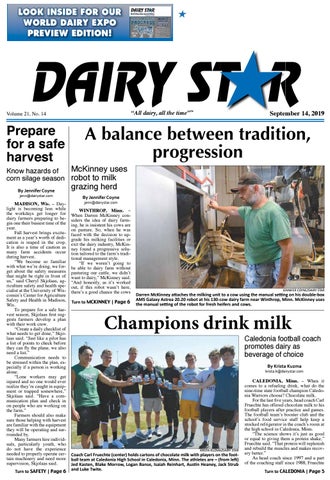
LOOK INSIDE FOR OUR WORLD DAIRY EXPO PREVIEW EDITION!
DAIRY ST R
Prepare for a safe harvest
September 14, 2019
“All dairy, all the time”™
Volume 21, No. 14
A balance between tradition, progression
McKinney uses Know hazards of corn silage season robot to milk By Jennifer Coyne jenn@dairystar.com
MADISON, Wis. – Daylight is becoming less while the workdays get longer for dairy farmers preparing to begin one their busiest time of the year. Fall harvest brings excitement as a year’s worth of dedication is reaped in the crop. It is also a time of caution as many farm accidents occur during harvest. “We become so familiar with what we’re doing, we forget about the safety measures that might be right in front of us,” said Cheryl Skjolaas, agriculture safety and health specialist at the University of Wisconsin’s Center for Agriculture Safety and Health in Madison, Wis. To prepare for a safe harvest season, Skjolaas rst suggests farmers develop a plan with their work crew. “Create a daily checklist of what needs to get done,” Skjolaas said. “Just like a pilot has a list of points to check before they can y the plane, we also need a list.” Communication needs to be stressed within the plan, especially if a person is working alone. “Lone workers may get injured and no one would ever realize they’re caught in equipment or trapped somewhere,” Skjolaas said. “Have a communication plan and check in on people who are working on the farm.” Farmers should also make sure those helping with harvest are familiar with the equipment they will be operating and surrounded by. Many farmers hire individuals, particularly youth, who do not have the experience needed to properly operate certain machinery and need more supervision, Skjolaas said. Turn to SAFETY | Page 6
grazing herd
By Jennifer Coyne jenn@dairystar.com
WINTHROP, Minn. – When Darren McKinney considers the idea of dairy farming, he is insistent his cows are on pasture. So, when he was faced with the decision to upgrade his milking facilities or exit the dairy industry, McKinney found a progressive solution tailored to the farm’s traditional management style. “If we weren’t going to be able to dairy farm without pasturing our cattle, we didn’t want to dairy,” McKinney said. “And honestly, as it’s worked out, if this robot wasn’t here, there’s a good chance the cows Turn to MCKINNEY | Page 6
JENNIFER COYNE/DAIRY STAR
Darren McKinney aƩaches the milking unit to a cow using the manual seƫng on his double-box AMS Galaxy Astrea 20.20 robot at his 130-cow dairy farm near Winthrop, Minn. McKinney uses the manual seƫng of the robot for fresh heifers and cows.
Champions drink milk
Caledonia football coach promotes dairy as beverage of choice By Krista Kuzma
krista.k@dairystar.com
KRISTA KUZMA/DAIRY STAR
Coach Carl Fruechte (center) holds cartons of chocolate milk with players on the football team at Caledonia High School in Caledonia, Minn. The athletes are – (from leŌ) Jed Kasten, Blake Morrow, Logan Banse, Isaiah Reinhart, AusƟn Heaney, Jack Strub and Luke Twite.
CALEDONIA, Minn. – When it comes to a refueling drink, what do the nine-time state football champion Caledonia Warriors choose? Chocolate milk. For the last ve years, head coach Carl Fruechte has offered chocolate milk to his football players after practice and games. The football team’s booster club and the school’s food service staff help keep a stocked refrigerator in the coach’s room at the high school in Caledonia, Minn. “The science shows it’s just as good or equal to giving them a protein shake,” Fruechte said. “That protein will replenish and rebuild the muscles and makes recovery better.” As head coach since 1997 and a part of the coaching staff since 1988, Fruechte Turn to CALEDONIA | Page 5
Page 2 • Dairy Star • Saturday, September 14, 2019
DAIRY ST R www.dairystar.com
ISSN 020355 522 Sinclair Lewis Ave. Sauk Centre, MN 56378 Phone: (320) 352-6303 Fax: (320) 352-5647 Published by Dairy Star LLC General Manager/Editor Mark Klaphake - mark.k@dairystar.com 320-352-6303 (ofďƒžce) 320-248-3196 (cell) 320-352-0062 (home) Ad Composition Nancy Powell 320-352-6303 nancy.p@dairystar.com Amanda Thooft 320-352-6303 amanda.t@dairystar.com Consultant Jerry Jennissen 320-346-2292 Editorial Staff Andrea Borgerding - Associate Editor (320) 352-6303 • andrea.b@dairystar.com Krista Kuzma - Assistant Editor (507) 259-8159 • krista.k@dairystar.com Jennifer Coyne - Assistant Editor (320) 352-6303 • jenn@dairystar.com Ruth Klossner (507) 240-0048 cowlady@centurylink.net Danielle Nauman (608) 487-1101 danielle.n@dairystar.com Danna Sabolik - Staff Writer (320) 352-6303 • danna.s@dairystar.com Maria Bichler - Copy Editor 320-352-6303 Advertising Sales Main Ofďƒžce: 320-352-6303 Fax: 320-352-5647 Deadline is 5 p.m. of the Friday the week before publication Sales Manager - Joyce Frericks 320-352-6303 • joyce@dairystar.com Jeff Weyer (Northern MN, East Central MN) 320-260-8505 (cell) jeff.w@dairystar.com Mark Klaphake (Western MN) 320-352-6303 (ofďƒžce) 320-248-3196 (cell) Laura Seljan (National Advertising, SE MN) 507-250-2217 fax: 507-634-4413 laura.s@dairystar.com Jerry Nelson (SW MN, NW Iowa, South Dakota) 605-690-6260 jerry.n@dairystar.com Mike Schafer (Central, South Central MN) 320-894-7825 mike.s@dairystar.com Amanda Hoeďƒ&#x;er (Eastern Iowa) 320-250-2884 • amanda.h@dairystar.com Laura Seljan (Southern WI) 507-250-2217 • laura.s@dairystar.com Megan Stuessel (Western Wisconsin) 608-387-1202 • megan.s@dairystar.com Deadlines The deadline for news and advertising in the Dairy Star is 5 p.m. Friday the week before publication. Subscriptions One year subscription $35.00, outside the U.S. $110.00. Send check along with mailing address to Dairy Star, 522 Sinclair Lewis Ave., Sauk Centre, MN 56378. Advertising Our ad takers have no authority to bind this newspaper and only publication of an advertisement shall constitute ďƒžnal acceptance of the advertiser's order. Letters Letters and articles of opinion are welcomed. Letters must be signed and include address and phone number. We reserve the right to edit lengthy letters. The views and opinions expressed by Dairy Star columnists and writers are not necessarily those of the Dairy Star LLC.
The Dairy Star is published semi-monthly by Dairy Star, LLC, 522 Sinclair Lewis Ave., Sauk Centre, MN 56378-1246. Periodicals Postage Paid at Sauk Centre, MN and additional mailing ofďƒžces. POSTMASTER: Send address changes to Dairy Star, 522 Sinclair Lewis Ave., Sauk Centre, MN 56378-1246.
A glance at what’s inside Fall harvest is just around the corner. With the busy time for farmers, it’s also an important time to remember steps to stay safe while working on the farm. On the front page of this issue, we summarized important points to remember as corn silage harvest begins. Cheryl Skjolaas, an agriculture safety and health specialist, spoke on the importance of training anyone who will be helping with harvest and making sure the equipment is well maintained before operation, while Pittsville, Wis., Fire Department Chief Jerry Minor explained the precautions farmers should take when storing the forages to avoid exposure to silage gas. Farm Safety Awareness Week is Sept. 15-21. To help remind farm workers of farm safety, John Rohlfs told his own personal story of losing a limb in an auger when he was just 3 years old. Rohlfs talked about how he manages to run a dairy farm today and how he has overcome challenges that come with farming and working with one hand. In From Our Side of the Fence, farmers shared information about their favorite equipment they use on their dairy farms. From a cell phone to a combine and everything in between, there are many pieces of equipment and tools farmers rely on to get their daily tasks done. Read about all of them on pages 15 and 16 in ďƒžrst section. Robert and Kate Kreidermacher gave us insight about the challenges in the industry since starting their careers six years ago on their dairy near Altura, Minn. The young couple shared what they have changed on their dairy in order to reduce costs along with the difference in what the milk price was when they started compared to recently. Read about the Kreidermachers in Dairying in Tough Times on pages 10-11 in ďƒžrst section. To give themselves a break from dairying, two dairy farmers like to have fun away from the farm. Dustin Bitzan spends the majority of his summer evenings working on or racing his modiďƒžed car. He ďƒžts it in when not doing chores on his 60-cow dairy near Millerville, Minn. Not only does he enjoy the hobby, he is successful on the track. Read about how Bitzan does it all on pages 23, 25 in ďƒžrst section. Dale Schroeder also spends time away from his 61-cow dairy herd he milks near Farming, Minn.; however, if not in the barn, the dairy farmer can likely be found at the baseball diamond. Schroeder is the manager of the Farming Flames amateur baseball team. Read more about Schroeder on pages 37-38 in ďƒžrst section. Keith and Jeanna Welgraven along with their daughter, Katelyn, had a busy day Sept. 6 for our Day in the Life feature. Along with typical chores, Keith spent time ďƒžlling holes in the cattle yard with gravel and watching a farm auction online for any good deals on his 100-cow dairy near Ruthton, Minn. When he has a little downtime, the dairyman likes to keep up with the Facebook group, Dairy Farmers of Facebook, of which he is a moderator. Read about how the day worked out for the family on pages 16, 18-19 in second section.
CLEAN, EVEN CUTTING
GMD MOUNTED SERIES DISC MOWERS Ĺ? /RZ SURÄ&#x;OH GHVLJQ IRU IDVW FOHDQ FXWWLQJ • ProtectadriveÂŽ system protects cutterbar gear train and minimizes downtime • Heavy-duty cutterbar ensures low maintenance and long life • Spring suspension provides outstanding ground contouring 5’3â€? – 10’2â€? cutting widths Premium & Select models available
INVEST IN QUALITY ÂŽ
KuhnNorthAmerica.com m
Roeder Bros. Bellevue, IA
Dee Implement of Waukon Waukon, IA
Dave’s Repair Hills, MN
Miller-Sellner-Slayton Slayton, MN
Kunau Implement DeWitt, IA Preston, IA
Arnold's Glencoe, MN Kimball, MN Sauk Rapids, MN St. Martin, MN
Isaacson Sales & Service Lafayette, MN
Woller Equipment Swanville, MN
Fluegge’s Ag Mora, MN
Jaycox Implement Worthington, MN
Lindell Sales & Service Cannon Falls, MN
Northland Farm Systems Owatonna, MN
Pfeifer Implement Sioux Falls, SD
Beck Implement Elgin, MN
Titan Machinery Pipestone, MN
Mark's Machinery Yankton, SD
Bodensteiner Implement Elkader, IA J P Scherrman Farley, IA Van’s Implement Hull, IA Burco Sales Independence, IA
St. Joseph Equipment Eyota, MN
Visit your local KUHN dealer today!
Dairy Star • Saturday, September 14, 2019 • Page 3
It’s all inside...
Farming
Minnesota
Columnists Ag Insider
Schroeder manages dairy farming, state tournament team
Pages 8-9 First Section
First Section: Pages 37 - 38
FSA News & Notes
Page 26 First Section
Dear County Agent Guy
Ruthton
Winthrop
Second Section: Pages 16, 18 - 19
First Section: Pages 1, 6 - 7
A day in the life of the Welgravens
Page 30 First Section
Caledonia
Caledonia Warriors football coach promotes dairy as beverage of choice
McKinney uses robot to milk grazing herd
First Section: Pages 1, 5
Veterinary Wisdom
Page 31 First Section
Making Cents of Dairy
Page 32 First Section
Winona
Come Full Circle
Third Section: Pages 2 - 3
Aldingers recognized as century farm
Page 33 First Section
Morristown
Owatonna
Hanson receives Star nalist award in Ag Sales
Kids Corner: The Schrohts
Third Section: Pages 8 - 9
Third Section: Pages 23, 25
The “Mielke” Market Weekly
Pages 10 - 11 Second Section
Country Cooking
Page 22 Second Section
Adams
Millerville
Altura
St. Cloud
Sebeka
First Section: Pages 34 - 35
First Section: Pages 23, 25
First Section: Pages 10 - 11
First Section: Pages 20, 22
First Section: Page 36
Smiths keep going with diversity
Bitzan ts in hobby around dairy farming
Dairying in Tough Times
Women in Dairy: Stephanie Goeller
No. 188 stands out in the herd
South Dakota
Iowa
Zone 1
For additional stories from our other zone, log on to www.dairystar.com
Big Stone City
Crop and Weather Reports
Rock Valley
Ossian
First Section: Pages 15 - 16
First Section: Pages 12 -13
From Our Side of the Fence
Second Section: Pages 26 - 27
Monroe pursues his small herd
Curtains mean cow comfort No matter the weather outside, GEA keeps your cows comfortable, healthy and productive inside. Comfortable cows are the most productive. Just like you, they perform their best when they are cool, calm and content. GEA’s industry-leading curtains and fan systems can be integrated with automation technology to
provide ideal barn temperature, air quality and humidity levels. With our total ventilation solutions, your cows will breathe easier — and so will you. Contact your GEA barn equipment dealer today.
Page 4 • Dairy Star • Saturday, September 14, 2019
THANKS TO EVERYBODY THAT ATTENDED OUR CUSTOMER APPRECIATION DINNER
Les Kuehl
Repair Service
We’re glad you were able to join us and we are looking forward to seeing you next year.
50 REBATE
IF WE WON T LAY ON IT, WHY WOULD WE EXPECT OUR COWS TO LAY ON IT?
25 REBATE
CALL FOR PRICES ON OUR
$
on our A3100DS Miraco Livestock fountain. $
on all other Miraco fountains
Ag-Bag Rentals
LARGE INVENTORY OF
YOUR CENTRAL MINNESOTA GOLIATH REPAIR SERVICE!
STRAW BEDDING
Stop in for More Deals! Rat & Mouse Glue Board Traps #6915128 & 6915136 .... $199 Prestone® Antifreeze #6700009...................... $999& Up 12’x16’ Medium Duty Tarp #9210568 ....................$999
Reserve your Machine Today!
30+ YEARS EXPERIENCE • Sealed silo parts & service All parts • Best chains on the market needed to service your • Used and rebuilt unloaders Goliath • Stainless steel roofs Unloaders • Stainless steel conveyor chains Call for early maintenance specials
ADDITIVES & TREATMENTS
SILO COVERS 25% OFF IN SEPTEMBER!
®
WE HAVE:
AG BAGS • TWINE • NET WRAP • SILO COVERS PLASTIC WRAP • BUNKER COVERS
COME AND JOIN GILLY S TEAM!
Not afÀliated with the Harvestore brand
Looking for clerk, in-store and milk driver help.
320-760-2909
Good pay, benefits and flexibility!
Gilman Co-op Creamery
FEED & FARM SUPPLY STORE
Eve. 320-762-1827 No Emergency Charges--Ever!
Gilman, MN 320-387-2770
Open M-F 7:30-7, Sat. 7:30-5, Sun. 8:30-1 Good service - fair prices - every day
WWW.GILMANCREAMERY.COM
BI-WEEKLY FOOTBATH
KlingonBlue
NEW FROM
™
OUR TEAT DIPS ARE NPE FREE!
LONG-ACTING FOOTBATH
Helps improve hoof health and enhance digital dermis...to promote cow mobility, comfort and overall productivity. Less Copper Sulphate for Disposal Available in 6.5 gal. concentrated pails
TEAT END ISSUES?
Stays on Hooves for 2 weeks!
BEFORE
• No Formaldehyde • Anti-biotic Free • Proven to Work • Extended Contact Time • Anti-bacterial and Anti-fungal Properties
Average Cost/Lost-Profit per case of Digital Dermatitis is $275 OR MORE!
Exfoliation
AFTER
Exfoliation
• Dual Germicide: Primary: Chlorine Dioxide promotes a quick kill. Secondary: LAS promotes a long-lasting kill. • Effective against ALL Mastitis-Causing Organisms • Contains Lactic Acid to promote Teat Exfoliation • Teat skin conditioning – 12.4% skin conditioning package • Green coloring for easy identification
FOR MORE INFO - CONTACT ONE OF THESE DEALERS... Advanced Dairy Systems
9 State Rd. 29 • Spring Valley, WI 54767 (715) 772-3201
Anderson Dairy Systems, Inc. 1312 13 1/2 Ave. • Barron, WI 54812 (715) 537-3300
Athman Dairy Inc.
D&D Ag Supply
238 Main Street North • Pierz, MN 56364 (320) 468-2494
133 Atlantic Ave. NE • Pennock, MN 56279 (320) 599-4466
Champion Milking Systems
East Central Dairy Supply
23218 350th Street • Albany, MN 56307 (320) 845-4156
2195 Hwy. 23 • Mora, MN 55051 (320) 679-1029
Eastern Iowa Dairy Systems 105 3rd Ave. NW • Epworth, IA 52045 (563) 876-3087
Fuller’s Milker Center, Inc. 423 U.S. 61 • Lancaster, WI 53813 (608) 723-4634
Gorter’s Clay & Dairy Equipment 1400- 7th St. SE • Pipestone, MN 56164 (507) 825-3271
Lang’s Dairy Equipment, Inc. 2337 Millennium Rd. • Decorah, IA 52101 (563) 382-8722
Leedstone
24260 Cty. Rd. 27 • Plainview, MN 55964 (507) 534-3161
Leedstone
2545 80th Ave • Woodville, WI 54028 (715) 698-4370
Professional Dairy Systems
1449 Homecrest Ave. • Wadena, MN 56482 (218) 632-5416
Tri-County Dairy Supply, Inc.
4107 N US HWY 51 • Janesville. WI 53545 608-757-2697
United Suckow Dairy
12687 Hwy 18 & 52 • Postville, IA 52162 (563) 864-7417 210 N. Industrial Pkwy • West Union, IA 52175 (563) 422-5355
Dairy Star • Saturday, September 14, 2019 • Page 5
ConƟnued from CALEDONIA | Page 1
Innovation + Technology + The Market Leader = H&S Forage Boxes!
“TOP DOG” 36’ & 40’ Forage Boxes feature Dual Motor Hydraulic Drive and Stainless Steel Sides!
XTRACAP Forage Boxes Feature: *More Cross Members *More Capacity *More Uprights *More Height
KRISTA KUZMA/DAIRY STAR
Carl Fruechte, head coach of the Caledonia High School football team, reaches for a chocolate milk in the refrigerator in the coach’s room at the school in Caledonia, Minn. has followed a lot of research over the years. Milk is a part of the football team’s success, The Warriors have won nine state champion titles, with four of them consecutively from 2015 to 2018. “Taking care of your athletes and making sure they recover quicker and better is a huge part of what we try to do,” Fruechte said. “The milk and proper protein ts into that.” Fruechte and his team of coaches go beyond teaching physical health when coaching the young players. “Our coaching staff is very much into not only athletic health, but also brain health and the wellness of the players as they get to be older men,” Fruechte said. “We want them to be active when they’re older so they can hunt, sh and have fun with their kids.” Caledonia students who are on the football team are not allowed to drink pop, Fruechte said. “We have kids that go through 7-12 grades never drinking pop,” he said. “That includes energy drinks. Parents thank us. Dentists in town thank us. We want to give them a better alternative and that’s chocolate milk.” Fruechte said he follows the lead of many college football programs, including Washington State University, that encourage players to refuel with chocolate milk after practice and games. For the rst few years, Fruechte could only offer the milk to high school players. The small refrigerator in the coach’s room could not hold any more
milk to accommodate more players. Last year, the booster club remedied that situation and used the club’s money to purchase a bigger refrigerator and more milk for players starting in seventh grade. “We’re a small school, but our booster club does an outstanding job,” Fruechte said. “This was a good investment. We don’t want to be foolish with our money. My big deal is I don’t want to waste any milk. I’m old school. But the kids did a good job drinking it.” When the milk is gone, the coaches know. “The kids love it,” Fruechte said. “They want it. It goes fast.” Each week, the football team goes through eight crates of chocolate milk. In future years, the school’s food service staff hopes to replace the cartons with a bulk dispenser so players are not limited to 8 ounces at a time. Plus, it will help save on waste, Fruechte said. When it comes to being a champion team, Fruechte does not take all the credit. “It’s a we thing,” he said. “We have a great staff. We have great coaches and great kids. We feel blessed because our parents really trust us. They know we love their boys and we’re not going to try to beat them up. We’re hard, but we don’t mistreat them. Our parents really support us and that’s a key.” But chocolate milk helps. “We like to research what’s the best for our kids,” Fruechte said. “To us [chocolate milk] is a no brainer.”
“SUPER DUTY” Forage Boxes are available w/Electric-OverHydraulic Cab Controls!
Agri-Placement Services, Inc.
A RELIABLE WORKFORCE!
• Guaranteed Placements Entry level – management
• E-verifiable • Visa Recruitment
H-2A seasonal • TN professional
• Leadership
Bilingual (Spanish) Training • I-9 Reviews Regulatory Compliance
www.agri-placement.com (315) 986-4738
Sign up for our Newsletter
DairySt r Milk Break Email andrea.b@dairystar.com
UPDATE YOUR CURTAINS NOW BEFORE WINTER ARRIVES
After Before Call us to help you make your dairy operation more efficient.
Scott Hawkinson Dairy • Goodhue, MN Curtain Replacement with New Wind Pipe
www.midwestlivestock.com
PINE ISLAND, MN • 800-233-8937 BEATRICE, NE • 800-342-5657 SIOUX FALLS, SD • 800-705-1447 MENOMONIE, WI • 715-235-5144
Page 6 • Dairy Star • Saturday, September 14, 2019
ConƟnued from MCKINNEY | Page 1
Willmar, MN • 320.231.1470
EXPANDING OR REMODELING YOUR LIVESTOCK OPERATION? LANGE AG SYSTEMS SPECIALIZES IN:
Ŷ NEW FACILITIES
_
NO JOB TOO BIG OR TOO SMALL
Ŷ RETROFITTING & REMODELING Ŷ TURNKEY PROJECTS Ŷ BARN DESIGN Ŷ INSTALLATION, MAINTENANCE & REPAIRS
ƋƵŝƉŵĞŶƚ tĞ KīĞƌ͗ ͻ sĞŶƟůĂƟŽŶ &ĂŶƐ ͻ sĞŶƟůĂƟŽŶ ŽŶƚƌŽůƐ ͻ WŽƐŝƟǀĞ WƌĞƐƐƵƌĞ dƵďĞƐ ͻ ƵƌƚĂŝŶ ^LJƐƚĞŵƐ ͻ DĂƩƌĞƐƐĞƐ ͻ tĂƚĞƌĞƌƐ ͻ ^ƚĂůů ƋƵŝƉŵĞŶƚ ͻ ,ĞĂĚůŽĐŬƐ ͻ DŝƐƟŶŐ ^LJƐƚĞŵƐ
Lange Ag Systems is proud to offer Grain Bags, Silage Bags & Bunker Covers from Up North Plastics and Feed Fresh Silage Covers & Custom Size Bunker Covers from Raven!
t ^ >> E t Θ h^ 'ͳ ' Θ < >>z Zz E '' Z^
www.LangeAgSystems.com WE’RE GROOVIN’ FOR YOUR COWS’ SAFETY Barn alleys, freestalls, barn yards, holding areas specializing in diamond pattern and diagonal grooves
Midwest Grooving
DAVE VANDEN BOSCH
M G
Owner/Operator • Kaukauna, WI
920-450-7246
midwestgrooving.com midwestgrooving@gmail.com PROTECTING YOUR INVESTMENT
Repair vs. Replace
Electronic Dairy Board Repair Service
Specializing in: WestfaliaSurge, BouMatic, & DeLaval pulsators & Takeoffs, circuit boards, Mueller milk tank circuit boards. Call: (c) 406-590-7764
www.circuitÀxer.wixsite.com/ boumaticboardrepair
THE
SUMMER HEAT IS ON? Cow comfort is the key to success! Now is the time to check, clean and replace existing cooling systems and/or design a cooling solution to alleviate heat stress. CALL FOR A DISTRIBUTOR NEAR YOU
1.800.779.3267 MADE IN THE
WITH GLOBAL MATERIALS
CROSS • NATURAL • TUNNEL
VENTILATION SOLUTIONS Circulation Fans | Exhaust Fans | Evaporative Cooling Misting Systems | Heaters | Controls
A BRAND OF PINNACLE CLIMATE1.800.779.3267 TECHNOLOGIES
www.schaeferventilation.com www.schaeferventilation.com
wouldn’t be either.” In February 2016, McKinney began using a double-box AMS Galaxy Astrea 20.20 robot to milk his herd of 130 cows. McKinney dairy farms with his wife, Gale, and four children – Breeze, 17; Sophie, 15; Emelia, 13; and Asher, 10 – on their farm in Sibley County near Winthrop, Minn. They have one fulltime employee, Andrew Hiesel. The technology functions similarly to two conventional robotic milking systems with a stall on either side of the robot room. However, unlike other systems, McKinney’s has one robot arm that swings side to side, facilitating the milking process in both stalls. Once cows leave the boxes, they have access to a 15-acre pasture or the option to re-enter the free ow barn through one-way nger gates. Likewise, from the barn, cows may elude the robot and go outside using a guided ow pasture gate. “We looked at other robot designs, but [company representatives] really thought the pasture would discourage cows from visiting the robots. They really pushed having cows in connement,” McKinney said. But, the dairyman was persistent in
the type of farm he wanted to manage. “I wasn’t going to let people tell me it couldn’t be done,” McKinney said. “There had to be a way.” Ankle transponders signal to the guided ow pasture gate if a cow has recently visited the robot. If she has, the gate opens to the pasture. If not, the gate closes and the cow is forced back into the barn and must go through the robot to exit. The pasture lacks water and is used as a supplement to a partial TMR ration, which is fed twice a day in the barn. McKinney adjusts the ration frequently based on the status of the pasture. “I was told if cows have good water and pasture, they have no reason to come back inside, so I make sure they want to come to the barn,” he said. “Because of this, I actually have less fetch cows out on pasture than in the barn.” When McKinney purchased the dairy from his father-in-law in 2002, the 27-cow herd was milked in a 33-stall stanchion barn with Surge bucket milkers. McKinney and his wife immediately put in a pipeline, and grew the herd as they could. Turn to MCKINNEY | Page 7
ConƟnued from SAFETY | Page 1 “Often times, that’s an area that gets skipped when we’re in the thick of harvest,” she said. When operating machinery, pay careful attention to it, as the piece likely has not been used regularly. “A lot of times, accidents happen when machinery is broke down. Before you begin, look it over … maintenance is a huge time and cost saver,” Skjolaas said. “If something does go wrong, turn off the machine and pause. It can’t entangle you when it’s shut off and the stored energy from the auger or conveyor is released.” Shields and guards are also recommended to prevent entanglement. In Skjolaas’ 29-year career with the center, she has watched equipment evolve in size and scale, and also storing techniques from upright silos to bunkers and piles. On the farm site, there are dangers associated with each method of storage. When piles are built or bunkers packed, the tractor must be equipped with a rollover protective structure. Additionally, all operators should wear their seatbelts. “We’re working at heights we don’t typically work with, so it’s important to have a fall protection plan,” Skjolaas said. “Our equipment has safety features for a reason, and we need to use them.” While they are different methods of storing corn silage, one danger encompasses them all – nitrogen dioxide. Once the forage is stored, for the rst two to four weeks, silo gas is most concentrated as fermentation begins. “I always tell people to stay out of the area when the gas production is at its highest,” said Jerry Minor. “Whether a silo or bags, silo gas is going to be there. And, if you have to work in the area, then you need to dissipate the gas as best as you can.” Minor is the Pittsville Fire Department Chief in Pittsville, Wis. He partners with the National Farm Medicine Center in Marsheld, Wis., to provide training for rescue personnel and farm families. “We always see more accidents in the fall,” Minor said. “Everyone’s putting in long hours and they’re tired, and their reaction times are slower. Our goal is to keep reghters and families safe from the hazards they are around
every day.” Every year, Minor and his department attend emergency calls to farms, but one call last September hit close to the re ghters. A local dairy farmer, Pete Petersen, fell from the top of a silo; he worked with the department for 20 years, offering training on the farm. The cause of the fall and subsequent death was silo gas exposure. “The farming community deals with the gas and equipment all the time,” Minor said. “Nobody takes anything for granted, but if you don’t know the dangers or experience them, then you don’t worry about it.” After the tragic call, Minor and his crew realized the need to be able to detect nitrogen dioxide. With donations from the Petersen family and another local family, the department purchased a gas meter that detects carbon monoxide, oxygen levels, hydrogen sulde, ammability, and also nitrogen dioxide. “This will be available for fall harvest,” Minor said. “We want it to be available for our re department partners and local farmers. They can call if they have a problem and need to detect dangerous gases.” Both Minor and Skjolaas encouraged farmers to work with agriculture businesses and Extension to evaluate the farm site and address ways to improve safety in preparation for fall harvest. National Farm Safety and Health Week, Sept. 16-21, is an opportunity to bring awareness to the dangers of farming and help create a culture of safety on farms. With nearly one-third of all farms experiencing a non-fatal on-farm accident each year, as reported by National Ag Safety Database, it is important to make safety a top priority. “Farming today is stressful, and farmers can’t afford to lose personnel,” Minor said. “More so, if a farm loses a family member because of not being safe, it may not be in business a year from now.” Skjolaas agreed. “We have to go into this season prepared. It’s a stressful time, so know how you’re going to manage yourself and the people you work with,” she said. “And remember, every week is farm safety week.”
Dairy Star • Saturday, September 14, 2019 • Page 7
ConƟnued from MCKINNEY | Page 6 As the herd exceeded the pair of the system. space of the barn, they were For McKinney, nding a housed in a compost barn lo- local dealer and knowing how cated directly south of the stan- to do repairs on his own were chion building. tactics to eliminate down time “We got to 90 milking and additional costs of the rocows and taking three full turns bot. through the barn during milk“I’m a mechanic by nature, ing. It took at least three people so it just made sense to me,” and three hours,” McKinney McKinney said. “The cost of said. “Then, in 2015, our main the robot wasn’t cheaper than milker – who was a retired any other out there, but I gure dairy farmer, himself – said he I’m spending about 25% less was going to be done. When he on maintenance with this one.” retired, we struggled with laTo accommodate the new bor and that pushed us over the milking system and larger herd edge.” size, the McKinneys doubled After nding a robotic the size of their compost barn company and design that t to a 90- by 180-foot structure. with McKinney’s management, During this construction, they the dairy farmer worked with were still able to use the stanhis local equipment dealership chion barn without interrupthat then became a dealer of the tion. robot. McKinney also traveled While much of the manto Pennsylvania, where he was agement remained the same trained in maintenance and re- after the robot was installed,
JENNIFER COYNE/DAIRY STAR
Darren McKinney and his daughter, Breeze, 17, enjoy milking cows with the automated milking system. The McKinneys started using the robot in February 2016.
JENNIFER COYNE/DAIRY STAR
The exit lane from the robot directs cows outside to pasture or through nger gates back into the compost barn at Darren McKinney’s farm near Winthrop, Minn.
The first & last fountain
you will ever need!
McKinney did replace his corn stalk bedding with sawdust to improve cleanliness. “We have to run the robot to the max to pay for it, but it also has to be getting milk,” McKinney said. “If the robot is taking 30 extra seconds to clean the cow, and it does about 300 milkings a day, that’s 150 minutes of lost time.” The McKinneys started their own sawdust business and work with a local door manufacturer for the product. This not only provides bedding for the herd, but also serves as an additional source of income alongside dairying and the family’s trucking and custom harvesting work. These other ventures help
support the family during the down economy. “If I had a crystal ball, I’d have known dairy wasn’t going to be protable in the future,” McKinney said. “Yes, it was nancially difcult to take on that much debt with the robot, but I don’t know if we’d do anything else. Instead, we decided to do a lot of other businesses.” Aside from the nancial burden of the automated system, McKinney is pleased with its added value to the dairy. The robot also functions as a two-cow parlor, where McKinney can manually attach the units and then proceed with treating the animals, if needed. “Every fresh cow and new heifer are manually prepped and attached to the milking unit,” McKinney said. “I’m also able to dry treat cows, too.” Dairy farming has not become easier since the addition of the robot, but McKinney believes his management has improved. “The knowledge this robot gives me is so much, and that’s what I really like about it,” McKinney said. “I’m understanding the cows better in a way I couldn’t before. Really, I’m a better farmer.” McKinney is a proponent of nding a way to dairy farm that facilitates a farmer’s core values. For him, robotic milking has allowed him to use the industry’s latest technology while still being able to graze in a more traditional way of farming.
Falling Film Chillers Our Falling Film Chillers Provide Faster Cooling and Lower Energy Costs!
Everlast fountains are built for the long haul. Features include: • Rugged stainless steel construction • Patented self-cleaning system • Thrifty heating costs • Heavy duty one-piece trough CONTACT US TODAY TO LEARN MORE ABOUT THE LAST FOUNTAIN YOU WILL EVER NEED!
www.everlastfountains.com everlastindustry@gmail.com
712-439-1060
Customized to your dairy for today and the future
United-Suckow Dairy Supply 563-422-5355 West Union, IA
563-864-7417 Postville, IA
Cow numbers decline Page 8 • Dairy Star • Saturday, September 14, 2019
In August, the dairy herd declined 9,000 head from the previous month. Compared to one year ago, milk cow numbers are down 82,000 head. At 9.3 million head, the U.S. dairy herd is the smallest since January 2016. Positive outlook for cull cow market After a big increase earlier this year, dairy cow slaughter has dropped below year ago levels. In August, dairy cow slaughter is 1 percent below last year. Beef cow slaughter is up nearly 1 percent with some earlier culling this year. As slaughter moved lower, cow prices have edged higher. Texas A&M Extension Economist David Anderson said the number of dairy cows that went to market during the ďƒžrst half of this year may reduce the potential numbers going to market this fall. Cow weights are also down from 2018 levels, supporting the cull cow price and the 90% lean fresh beef price.
declined 9.6 million pounds. Whey protein concentrate exports were down 663,000 pounds, whole milk powder exports declined 1.6 million pounds and butter sales were down 2.1 million pounds. DMC deadline approaches The signup deadline for Dairy Margin Coverage is Sept. 20. DMC is guaranteed to pay all dairy farmers enrolled at the maximum $9.50 per hundredweight coverage level for every month of production this year through July. The National Milk Producers Federation President/CEO Jim Mulhern said DMC offers better support than the former Margin Protection Program. “It’s worthwhile for every farmer.� USDA Undersecretary Bill Northey concurred. “We all hope the margin is much better than a $9.50 margin coverage level, but if it is not, for a small premium, you get coverage. For most producers, it makes a lot of sense to be covered.�
Ag Insider
By Don Wick Columnist
Relationships are vital to trade Tom Vilsack, President and CEO, U.S. Dairy Export Council, is back in the United States following a trip to China and Japan. Vilsack said it’s important both governments and industry professionals understand the value of the relationship between countries. There is still uncertainty in discussions between the U.S. and China. “There is hope that things will get worked out, but the reality is what the United States is asking China to change is something that is fundamental to their economy,â€? Vilsack said. “That’s not going to be an easy ask or lift for the Chinese. I’m not conďƒždent at this point we’ll see a breakthrough in the discussions.â€? Vilsack said there is a different attitude in China compared to Japan. Japan is acting as an ally, and there may be a better opportunity in Japan to reach a mini agreement to provide greater market access for U.S. agricultural products. Dairy exports decline During July, U.S. dairy exports totaled 378.7 million pounds. That is down nearly 22 million pounds from July 2018. Total cheese exports were steady with last year. Exports of nonfat dry milk and skim milk powder dropped nearly 11 million pounds. Dry whey exports
AFBF market intel highlights block-barrel spread Block and barrel cheese prices traditionally traded in line with each other. The spread between block and barrel cheese began to widen in 2017. A new report from American Farm Bureau Market Intelligence said increased barrel cheese production and the demand for whey proteins from barrel cheese are responsible for the gap between block and barrel cheese. AFBF said that difference is responsible for a $600 million reduction in farm revenue over the past two and a half years. Strong cheese exports, primarily in blocks, are also a factor in this price spread. Record interest in Holstein registration Holstein Association USA reports dairy farmers registered and identiďƒžed an all-time record of 749,000 head in 2018. Holstein USA CEO John Meyer credits the increased interest on proper identiďƒžcation of dairy cattle. “The number of dairy farms in this country has dropped considerably to under 40,000 over the last 15 years, but we continually register and identify more cattle,â€? Meyer said. “We’ve grown our identiďƒžcations by 90 percent
Dairy research farm planned The largest research dairy farm in the United States is being built in Idaho. The University of Idaho is planning a 2,000-cow dairy operation with an additional 1,200 acres for agronomic research, feed production and nutrient management. The project is expected to break ground in 2021 and milking the ďƒžrst cows by 2024. Palmer amaranth ID’ed in Lincoln County Palmer amaranth has been found in Minnesota’s Lincoln County. The ďƒželd was planted to a cover crop contaminated with Palmer amaranth. The seed company that sold the contaminated seed self-reported the violation to the Minnesota Department of Agriculture. Cargill invests in plant-based protein sector To meet the rising demand for plant-based protein, Cargill has invested an additional $75 million in the pea protein company called Puris Proteins. With this money, Puris Proteins will more than double the production of pea protein at its plant in Dawson, Minn. Wells Fargo announces agribusiness group Wells Fargo has formed a food, beverage and agribusiness group within its commercial banking division. Jacquie Fredericks will lead the agribusiness division for the central region, which includes Minnesota, North Dakota and South Dakota. Fredericks previously worked for CoBank. Rural mental health specialist hired Minnesota has added a second rural mental health specialist. Monica McConkey has worked in the mental health ďƒželd for the last 25 years, including her most recent experience at Prairie St. Johns. McConkey also operates a consulting business that focuses on the issue of emotional stress in agriculture called Eyes on the Horizon. Most recently, McConkey has participated in TransFARMation, a series organized by the Red River Farm Network and the Minnesota Department of Agriculture. Turn to AG INSIDER | Page 9
MAKE YOUR NEXT PROJECT
BRENTON BUILT
ĂŠ / Ă•Â?Â?iĂ€Â˝ĂƒĂŠ ˆÂ?ÂŽiÀÊ iÂ˜ĂŒiÀÊ ÂˆĂƒĂŠ>ĂŠÂŤĂ€iviÀÀi`ĂŠ /Ă€>`iĂŠ Â?Â?ĂžĂŠĂœÂˆĂŒÂ…ĂŠ ÂœVĂ•ĂƒĂŠÂœÂ˜ĂŠ ˜iĂ€}Ăž
over the last 15 years in a market where the number of dairy farms has dropped over 47%.�
->Â?iĂƒĂŠEĂŠ Â˜ĂƒĂŒ>Â?Â?>ĂŒÂˆÂœÂ˜ Lensing Dairy, Calmar IA
Dairy Facilities & Beef Confinements are Brenton Buildings Specialty, from • New Freestall Construction 50 cow expansions to multi-million • General Contracting dollar facilities click below to see what • Material only or Turn-Key Packages Brenton Buildings can do for you.
BRENTON BUILDINGS 206 W Center St., Monona, IA 52159
563-539-4450
FAX: 563-539-4545 • www.brentonbuildings.com
\Â?NJŢƆNJǯB ÇŻBĹ?ÄŻĹ…ÇśĹ?žį
X ÂˆÂ“ÂˆĂŒi`ĂŠĂŒÂˆÂ“iĂŠ , - ĂŠĂ€iL>ĂŒiĂŠÂˆÂ˜ViÂ˜ĂŒÂˆĂ›i X 7iĂŠĂœÂœĂ€ÂŽĂŠ`ÂˆĂ€iVĂŒÂ?ĂžĂŠĂœÂˆĂŒÂ…ĂŠ " 1-ĂŠ" ĂŠ , 9 X >Â˜ĂŠ>ĂƒĂƒÂˆĂƒĂŒĂŠÂˆÂ˜ĂŠVÂœÂ“ÂŤÂ?iĂŒÂˆÂ˜}ĂŠ`ÂœVՓiÂ˜ĂŒ>ĂŒÂˆÂœÂ˜ĂŠ
->Ă›iĂŠ Ă•ÂŤĂŠĂŒÂœĂŠxä¯Ê
1
2
3
ĂœÂˆĂŒÂ…ĂŠĂ€iL>ĂŒiĂƒ
E A SY a s 1 - 2 - 3
X *Ă€ÂœĂ›Âˆ`iĂŠ>ĂŠĂƒĂŒ>˜`ĂŠLi…ˆ˜`ĂŠ7>ÀÀ>Â˜ĂŒĂž
BERGMAN Automatic AGRi-Speed HITCH
• • • •
Simple drawbar mount Easy to operate day or night PTO compatible Increases efÀciency, only need 1 person
Gilman Co-op Creamery FEED & FARM SUPPLY STORE
• Fast, reliable, safe • Easily pulls more than the D.O.T. allows on the highway • Available for pick-ups, choppers, tractors, wagons, etc.
www.bergmanmfg.com Gilman, MN • 320-387-2770
CA-May19-1B-JW
B ÇŻBƆžįǯ Â?Ę“ÇŻBĹ?ÄŻĹ…ÇśĹ?žį
Dairy Star • Saturday, September 14, 2019 • Page 9
ConƟnued from AG INSIDER | Page 8 McConkey will work through AgCentric beginning Oct. 1, serving farmers in the northern half of the state. McConkey will also work collaboratively with the current rural mental health specialist Ted Mathews. Trivia challenge On a per-capita basis, West Virginia leads the nation in pizza consumption. That answers our last trivia question. How many slices of pizza does the average American eat per year? We’ll have
the answer in the next edition of Dairy Star. Don Wick is owner/broadcaster for the Red River Farm Network, based in Grand Forks, North Dakota. Wick has been recognized as the National Farm Broadcaster of the Year and served as president of the National Association of Farm Broadcasting. Don and his wife, Kolleen, have two adult sons, Tony and Sam, and ve grandchildren, Aiden, Piper, Adrienne, Aurora and Sterling.
DHIA: Now MORE than ever
Need Better Ear Tags?
What is on your checklist for roasted soybeans? Energy Protein Amino acids Bypass protein
SERVICE Easy accessibility Quick loading times Quality and consistency
CHECK US OUT THE NEXT TIME YOU ARE LOOKING FOR ROASTED SOYBEANS.
KLC Farms Roasting, Inc.
Preferred By Bovines Everywhere
Matched tag sets available Minnesota Dairy Herd Improvement Association 307 Brighton Avenue South Buffalo, MN 55313 1.800.827.3442 www.mndhia.org
1-877-738-2326 Visit www.roastedbeans.com
Quality
Consistency
Twine, Net Wrap and Acid Available!
(2) Demco 650 grain cart, ‘12, green & black - $18,500
RFID and management tags for common sense ID solutions from Minnesota DHIA
Various Sizes of Used Demco Boxes Available
FEED BUNKS
CIH MX240, 4800 hrs., new motor, new tires - $64,000
WE HAVE A GREAT SUPPLY OF SITREX RAKES!
USED TRACTORS
CIH 8910, FWA, 1600 hrs. ..................Coming In CIH 8920, full guidance, 3600 hrs.......... $72,000 CIH 8930, FWA, low hours ..................Coming In CIH 7220, 2WD, 2300 hrs, 18.4x42 ....... $71,000 CIH 7230, 3500 hrs., new rubber, nice... $71,000 CIH 7130, FWA....................................... $48,000 CIH 7120, 2WD ...................................... $42,000 IH 1486, 5,000 hrs., ............................... $16,000 IH 656 dsl., exc. shape............................. $7,500 JD 7200R, FWA, 280 hrs...................... $139,500
TILLAGE
CIH Tigermate II, 28’ .............................. $18,000 CIH Tigermate II, 30’ .............................. $21,000 CIH 4800, 28’ & 26’ ................................. $8,500 CIH 4800, 28’ w/IH mulcher..................... $8,500 CIH 3900 disc, 25’ ................................. $15,000 CIH 496, 21’, non cusion ....................... $11,500 CIH 530B ripper w/lead shanks .............. $17,000 CIH 530B w/lead shank .......................... $13,000 CIH 530C ripper ..................................... $23,000 White 445, 9 shank .................................. $6,500 DMI 530B w/lead shank ........................ $15,500
HAYING & FORAGE EQUIP.
Sitrex QR12 rake .......................................... New
Many sizes of rakes available H&S XL 16’ silage box ............................. $4,000 H&S 7+4 .................................................. $4,500
GRAVITY BOXES
VARIOUS SIZES OF GRAVITY BOXES ON HAND Demco 650 ............................................ $10,500 Demco 450 .............................................. $9,500 Demco 365, red & black .......................... $5,500 2) Demco 365, red & white ...................... $3,800 Unverferth 430 ......................................... $9,500 Parker 310 ............................................... $3,500 Brent 440 ................................................. $6,300 All sizes of used Demco gravity boxes avail.
MISCELLANEOUS
Midsota 5510 & F610 rock trailers........ In Stock Midsota F8216 rock trailer - Call New Midsota Rock Wagons .................On Hand All Sizes of Sitrex Rakes.........................On Hand We have a large selection of snowblowers in stock! WE HAVE A LARGE SUPPLY OF NET WRAP ON HAND
NEW MANDAKO LAND ROLLERS IN STOCK
FARM OYL PRODUCTS AVAILABLE
GREENWALD FARM CENTER Greenwald, MN • 320-987-3177
WWW.GREENWALDFARMCENTER.COM
Heavy Duty Super Bunk Designed for Strength
- Supports feed rail, head locks,barn building columns - Available with weld plates or PVC sleeves - 11-inch or 19-inch feeding depth
A Complete List of Wieser Bunks: H-Bunks:
Fenceline Bunks:
- 20”feeding depth - Calf Bunk - 16”feeding depth -Yard Bunk - 12”feeding depth - High CapacityYard Bunk - Super Bunk - Heavy Duty Super Bunk - Hi-Back
Also Available:
x Bunker Silos x Manure Storage x Grain Storage x Water Tanks x Cattle Guards x Foot Baths
1-800-325-8456 LIKE US ON FACEBOOK!
Visit us on the web: www.wieserconcrete.com
Page 10 • Dairy Star • Saturday, September 14, 2019
Lindell Sales & Service 37236 County 56 Blvd., Cannon Falls, MN
651-258-4311 • Mark’s Cell 651-764-4084
We carry...
DAIRYING IN TOUGH TIMES
In it for the long haul
HOULE
" %
Barn Lighting, Sheds, Fans, Trenching, Irrigation, Homes & More!
Master Electrician, Owner Lic. #CA03435
E lectric Cell:
C
.M. ELEC E.A Bob Meyer TRI . B
We Offer the Following Agricultural Services:
!
Need an Electrician?
320-761-1042 Serving Central Minnesota
FARM-RITE EQUIPMENT, INC.
KRISTA KUZMA/DAIRY STAR
The Kreidermachers – Robert holding Reagan and Kate holding Oliver – milk 250 cows using four robots on their dairy in Winona County near Altura, Minn.
www.farmriteequip.com
It’s hard to believe the best can be even better. But with extensive feature upgrades, increased visibility and a more comfortable cab, BobcatŽ 500 platform loaders defy the odds. Dassel, MN
320-275-2737 888-679-4857
Willmar, MN
320-235-3672 877-484-3211
St. Cloud, MN Long Prairie, MN 320-240-2085 844-262-2281
320-732-3715 866-514-0982
Kreidermachers tighten management strategies, use marketing to compensate for economic hardships By Krista Kuzma
krista.k@dairystar.com
Editor’s note: In this series, “Dairying in tough times,â€? Dairy Star is catching up with dairy farmers who began milking cows in the last ďƒžve years. These farmers are sharing how they have been able to weather the market conditions and why they see promise in today’s changing industry.
CANOLA MEAL CORN GLUTEN FEED CORN DISTILLERS GRAINS CORN STARCH LINSEED MEAL FLAX SEED OAT HULLS RICE HULLS SOYBEAN MEAL SOY BEST SOYBEAN HULLS SOY FLOUR SOY PLUS
8
AMINO PLUS SOY ISOLATE WHEAT MIDDS WHEAT GERM MEAL BEET PULP CASEINATES CHEESE SCRAPS SAW DUST FOOD BY-PRODUCTS LACTOSE NONFAT DRY MILK SUGAR/DEXTROSE WHEY PROTEIN POWDER
ALTURA, Minn. – Despite enduring four years of the industry’s economic downturn, Robert and Kate Kreidermacher were not willing to give up their dairying life. “We said, ‘We’re in this for the long haul,’â€? Robert said. “We’ll ride it out and try to do the best we can and try to improve without setting ourselves too far back.â€? The young couple, along with their two young children, Oliver, 3, and Reagan, 1, milks 250 cows with four robots on their dairy near Altura, Minn. While Robert farms full time, Kate works off the farm as a registered nurse and helps on the farm when she is able. To help make it through the low milk prices, the Kreidermachers have tighten management strategies, used marketing tools, talked to other dairy farmers about what has worked for them and worked together with a team of professionals in the industry to strategize ways to continue towards their farm’s goals. “It is extremely tough ďƒžnancially, but it puts you in a different perspective of how do we tighten the ship so next time when this happens – because it will happen again – we are better prepared,â€? Robert said. The Kreidermachers have been farming on their own since they bought the cows from Robert’s family in 2013. They set goals for their farm to be proďƒžtable, family friendly and continue to try to breed for high quality genetics in their herd. “The ďƒžrst year was by far one of our best years [for milk price],â€? Robert said. “The one downside is we had a year like this year where it was a lot of winter kill and low inventories. But we also had $22 [per hundredweight] milk that fall, so it helped compensate.â€? However, after 2014, the Kreidermachers did not see an annual average over $17 per cwt. Along with the dairy price downturn, the Kreidermachers needed to make a decision about their milking facility. “It was either call it quits or build,â€? Robert said. “We wanted to continue forward. We thought if we could achieve what we needed to achieve and still be family friendly and ďƒ&#x;exible then it was worth it.â€? The couple knew the ďƒžrst ďƒžve years would be
tough with the amount of overhead they would be taking on. “We had to do something different because of labor,â€? Robert said. “Labor was very undependable. The quality of labor was terrible. You only need a couple good workers.â€? To reduce labor and make their farm more family friendly, the Kreidermachers chose to install four robots along with a sand-bedded freestall barn to replace their double-5 herringbone parlor and old freestall barn. They began using their new facility in November 2017. “The great things about farming with robots is we can be more ďƒ&#x;exible than we used to be,â€? Robert said. “It’s still a huge commitment. It’s hard to get away. That’s no different. But we are able to make more time for family.â€? However, they did not ďƒžnd that family-friendly aspect of the robots right away. Plus, they really started to feel the ďƒžnancial pressure as the milk price sank lower and other commodities took hits. “In the past we’ve had pretty good heifer inventory to allow us to be able to improve facilities and move forward with projects, but last year that all took a hit,â€? Robert said. “Markets went down on everything.â€? The milk price in 2018 did not reach above $15 for the Kreidermachers. “Especially a year after building this [new milking facility], that was really tough,â€? Robert said. “You have to have some understanding people around you.â€? The couple had more stress in 2019 when the extreme winter weather caused their dry cow barn to collapse in February along with ďƒžnding mycotoxins in their feed shortly after. To try to stay aďƒ&#x;oat, the Kreidermachers tightened their management strategies. Although they had already cut back on labor because of the robots, they reduced it further and took on more jobs themselves. “On the downside, we ended up overworking ourselves at the same time,â€? Robert said. They also ďƒžne-tuned their ration. They cut back on corn gluten at times along with other higher cost commodities. They also tried to make a more efďƒžcient forage diet and cut back from 15 to 10 pounds per cwt. for their robot pellets. “That’s an extremely expensive commodity we were able to reduce and not lose production,â€? Robert said about maintaining the herd’s 29,000-pound rolling herd average. “That’s where having a great nutritionist is key in these robotic dairies. It helps set us up for the long run.â€? Turn to KREIDERMACHER | Page 11
Dairy Star • Saturday, September 14, 2019 • Page 11
ConĆ&#x;nued from KREIDERMACHER | Page 10
LED LIGHTING Sales & Installation “We originally installed the LED lights to replace old burnt-out lights but have since replaced some working lights because of the better lighting and energy savings.We really like the LED lights, and are planning on converting all the lights to LED.� ZIEGLER’S SAVED OVER 50% WITH REBATES!
KRISTA KUZMA/DAIRY STAR
STEVEN ZIEGLER, ZIEGLER DAIRY FARMS, MIDDLETON, WI LED Lighting installed December 2018 • Parlor and Freestall barn
Cows rest in the sand-bedded freestall barn the Kreidermachers began using November 2017. Another strategy they have used to keep their farm going is marketing. “It just seems like in the last three years, the market has been so much more unstable,â€? Robert said. “This helps.â€? They work with their nutritionist to ďƒžgure out what kind of commodities they will need and then lock in the lowest price they can. They have done this for robot pellets, Amino Plus, cottonseed and corn. “Right now you can set yourself a pretty nice base line,â€? Robert said. “That way if it does take a dip you’re protecting your cost.â€? The Kreidermachers also will frequently protect their milk with puts. “This puts in a ďƒ&#x;oor price,â€? Robert said. “We can at least maintain a low end so it doesn’t destroy us.â€? Another helpful strategy has been working with the Minnesota Dairy Initiatives program, which puts together a team of industry professionals – for the Kreidermachers this includes their nutritionist, veterinarian, creamery representative, farm business management instructor and banker, among others – to help them brainstorm ideas or use as a resource. “It’s like your inner circle of people who you can trust,â€? Robert said. “If you have the right people in there, they have your best interest in mind, as well.â€? Talking to more veteran dairy farmers, especially those who endured the
low milk price in 2009, has also been a good support network for the Kreidermachers. “You have to be extremely patient to ďƒžgure out what your intentions are, what your goals are and stick to them, but try to ďƒžnd ways to be more efďƒžcient at achieving them,â€? said Robert about advice given to them from other dairy farmers. “It’s hard in tough times to see the end goal, but stay true to them.â€? Within the last few months, the Kreidermachers feel a little more positive about the direction of the industry as they have ďƒžnally seen $18 per cwt. “It comes at the right time because we’re going through the summer expenses with harvest and paying off fertilizer bills,â€? Robert said. “But, it will take awhile to recover. It’s not going to happen overnight.â€? It gives the couple hope to continue working towards their goals for their farm and that they can make it in the industry. “Everything happens for a reason,â€? Robert said. “If you learn from it, you’ll be better at managing, and you might come out a better person as well. It can prepare you for the future if you allow it to. And if you don’t look at it as preparing you for the future, it probably would sink you.â€? The Kreidermachers have not let the low markets sink their goal for a family friendly and proďƒžtable farm.
Parlor LED Lighting
LED Long Day Lighting
SAVE MONEY WITH LED LIGHTING AND ENERGY REBATES!
fullersmilkercenter.com
No one knows your equipment better.
Keep It Genuine.
Do You need Fall Forage? • Forage Oats • Spring Triticale • Italian Ryegrass • Fall Triticale
We can also make custom mixes for cover crops!
Your AGCO Parts Dealer has the quality OEM parts you need when you need them. Everything you need from hardware, chain and batteries to tillage, belts and cutting parts are available from your AGCO Parts Dealer. Along with the help of our highly trained service personnel at AGCO Parts to make it allParts comeDealer together, you can rest easy. Stop your AGCO Your AGCO hasso the quality OEM parts youinto need when you Parts Dealer and get the partsyou andneed services need tochain “Keepand youbatteries in the Field� need them. Everything fromyou hardware, to this season. Find out more at AGCOParts.com. tillage, belts and cutting parts are available from your AGCO Parts Dealer. Along with the help of our highly trained service personnel at AGCO Parts Š "($0 $PSQPSBUJPO "($0 UIF "($0 MPHP BSF SFHJTUFSFE USBEFNBSLT PG "($0 $PSQPSBUJPO
DEIKE IMPLEMENT CO.
P.O.Box 834, Waverly, Iowa 50677 • email: information@deikeimplement.com
Sales Phone: 319-352-3731 • General Phone: 319-352-1117
Learn more by contacting us or at www.peakforage.com
608-967-2414 to locate a dealer near you
USED TRACTORS - Low rate ďŹ nance Available MF 8735, 2018, loaded, guidance .............................$192,500 NH T9.560, 16 spd, duals, guidance .........................$168,500 Fendt 720, guidance, deluxe .....................................$156,500 Allis 9695 FWA, powershift, wts .................................$47,500 AGCO 8785, cab, 32-sp, Cummins .............................$32,500 Kubota L5240, 4x4,cab, hydro,frt.snowblower ...........$27,900 Allis 9170 duals, 18-sp, 2wd.......................................$21,900 Kubota BX2670, 4wd, hydro, loader, low hrs ..............$11,925 Case 930, 3 pt., West. Loader. ......................................$5,250 IH 560 gas, loader, 3 pt .................................................$4,750 Ford 901, select-o-speed, p.steering.............................$4,250 Fendt 720, guidance, 1200 hrs................................ Coming In TILLAGE & PLANTING EQUIPMENT White 8824 24-30, central ďŹ ll, liq.fert., 1-owner .........$75,500 White 8816 16-30 central-ďŹ ll, trashwheels .................$64,500 White 8524 24-30 central ďŹ ll, t.wipers ........................$54,500 White 8202 12-30, 2013, 1-owner ..............................$35,500
Store Hours: Monday-Friday 7:30-5:00 Saturday 7:30-noon
www.deikeimp.com
White 8222 12-30 ex frame, t.wipers ........................$28,900 HARVEST EQUIPMENT AGCO S67, duals, power bin, yield monitor ..............$135,900 AGCO R65, tilt, monitor, 285 hp Cummins,chopper....$89,500 Gleaner 8000 30’; 800 30’ and 25’ Flex Heads ...................Call Gleaner 830 and 630 Hugger Cornheads ...........................Call Gleaner S67 duals, monitor .................................... Coming In MISC. EQUIPMENT Wacker-Neuson WL50 wheel loader, cab ....................$38,500 Wacker WL50 wheel loader, cab, new tires .................$38,500 Kubota RTV1100C, loaded, 140 hrs ............................$15,200 Kubota ZD331 0-turn, 72� deck, hyd.lift......................$10,250 Simplicity 2027 diesel, 4wd, 61� deck, 3 pt ..................$8,750 Bobcat 72� Soil Conditioner ..........................................$5,250 Landpride Accu-Z, 60� deck, 0-turn. .............................$4,750 JD X724 gas, all-wheel steer, 54� deck .........................$4,950 New Snowblowers, Blades, Pallet Forks, Bale Spears ........Call NEW Sunower and Landoll Tillage ...................................Call
Page 12 • Dairy Star • Saturday, September 14, 2019
A dream worth working towards
Monroe milks own herd, two others to pursue dairy goals By Kate Rechtzigel Staff Intern
KRISTA KUZMA/DAIRY STAR
Caleb Monroe milks 45 cows on a rented farm near Ossian, Iowa. Monroe also works at two nearby dairies for addiƟonal income. the hay conveyor that runs the length of the barn peak broke,” Monroe said. “So, I didn’t get much sleep that week. But, nobody said farming was easy. If it was everybody would be doing it.” While Monroe grew up in town, he
would often tag along with his dad, Leland, who was a relief milker for farmers. He also spent a lot of time helping his uncle, Randy Buddenberg, and later on his aunt and uncle, Julie and Bruce Buddenberg, with weekend chores.
“I really enjoy milking cows,” Monroe said. At the age of 14, he pursued another nearby job opportunity at Dennis Turn to MONROE | Page 13
e t he p v l o s u rofi o y tp g in Research Commitment
Proprietary technologies
zle uz
He lp
OSSIAN, Iowa – When Caleb Monroe looks at his herd, he thinks of all the effort and hard work it took to get him to this point. “You have to do what you have to do in order to make it work,” Monroe said. Monroe milks 45 registered Holsteins and Jerseys in a 50-cow tunnel ventilated tiestall barn he rents near Ossian, Iowa. In order to make his dairy dream work, Monroe milks four nights a week at two other area dairies: Buddenberg Farms owned by Bruce and Julie Buddenberg and their family, and Countryside Dairy, owned by Zack and Rachael Bushman’s family. “I really wanted to help these people out and didn’t want to get behind on bills, so I kept the jobs,” Monroe said. Managing his own herd and working for two others forces Monroe to keep a tight schedule. “I milk my herd at 6 p.m., get to Buddenbergs’ or Bushmans’ by 8:45 or 9 p.m., milk until about 1 a.m., sleep a few hours and then milk my own herd again,” he said. After working long night shifts, Monroe tries his best to nd a time for a nap. “A few weeks ago, we lled the barn with straw, hauled hay and then
.
RationFlex Lactation SolutionsSM farm-specific customization
Let’s solve the puzzle together.
Value-added products for all phases
Call 866-666-7626 Email AN_DairyHelp@adm.com Visit ADMAnimalNutrition.com
Commodity procurement & market expertise
Committed to helping you find solutions.
Price risk management
On-farm consultation
Advanced ration balancing models for exacting nutrition
Dairy Star • Saturday, September 14, 2019 • Page 13
ConƟnued from MONROE | Page 12 and Eileen Linderbaum’s farm where he worked for six years until the week before he started milking his own herd. They milked 85 cows in a 39-stall stanchion barn just outside of Ossian. “I learned to really love it,” Monroe said. “That’s where I learned and obtained valuable skills and knowledge I still use to this day.” After high school, Monroe pursued education in the John Deere Tech Program at Northeast Iowa Community College in Calmar, Iowa. “I was planning to get a job after that, but the economy was so bad the local Deere dealers were not hiring,” Monroe said. “So I said forget it and decided to pursue my true passion.” To start his career as a dairyman, Monroe bought heifers and looked for a barn to rent. Monroe inquired at several farm sites in northeast Iowa, but to no avail. “Then one day [my current landlords] Jerry Olson and Dianna Mueller called me and said they had a dairy barn I could use that was only empty for ve years,” Monroe said. “They let me use his tractor and skid loader to help keep me from having too many loans at rst. They have been very good to me, and I’m very thankful for everything they have done for me.” Even though the barn was still in fairly good shape, there was still work Monroe needed to do before he could build a herd of his own. He bought a barn cleaner, xed the milking equipment and did lots of cleaning, among other things, to prepare the farm site. On May 15, 2017, Monroe started milking after purchasing 12 cows to put milk in the tank. His parents were there to support him. “I was nervous because I had to haul cattle to the farm that day and still
KRISTA KUZMA/DAIRY STAR
Caleb Monroe looks over one of his favorite cows in the barn he rents near Ossian, Iowa. get to my night shift job on time,” Monroe said. “It was pretty cool though. It wasn’t like turning somebody else’s pump on. Nothing else compares.” From June 2016 to December 2017 Monroe also worked overnights at a factory job from 10 p.m. to 6 a.m. “I would sometimes pull all dayers or only get two hours of sleep,” Monroe said. It is what he had to do in order to make his dream work until he had the barn almost full. “I really have a passion for what I do,” Monroe said. “I love the small herd aspect because you get to know every cow.” Since then, there have been a lot of ups and downs and learning curves along the way. “Farming has always been a challenge with milk and hay prices the way they are, but, there’s been a lot of good,
too,” Monroe said. “I started calving in my rst heifers with the MON-ROE prex and I really enjoy that. It makes me feel really good knowing I’ve brought the Monroe name back into the dairy industry.” Monroe purchases all the feed for his herd. Recently, he has made changes to the cows’ ration. Monroe used to feed dry hay and a grain/protein mix, but has since changed to feed dry hay, corn silage, a base grain mix and two different top dresses. One is four to six pounds of two fat products and distillers grain each day to select cows and the other is one pound of soybeans each day spread over four feedings. He also lets the cows out once a day to eat corn silage from the outdoor feed bunk. “I think the biggest challenges have been nancing, getting the fresh cows and heifers up and going, and nding
CONGRATULATIONS
Amy!
We are honored to have Amy Kyllo represent Olmsted County and the entire dairy industry in Minnesota.
good feed sources,” Monroe said. “I used to buy all my feed at hay auctions and now with private sellers I am able to see it before it is made and that provides more of a consistency for me.” Monroe also values comfort on his farm. Problem cows are put out on a bedded pack to ensure comfort. “You can’t be afraid to work with the cows,” Monroe said. “You have to be willing to work with them and adapt to their personal needs. “When you don’t have much you have to be vigilant and work with what resources you have available to the best of your ability.” When Monroe looks back at the work done on his farm, he is thankful for many things. “I’m thankful for my local banker who took this leap of faith with me when I was turned down from beginning farmer loans through FSA and Farm Credit,” Monroe said. “It’s very important to have a good relationship with others in the industry. I’m thankful I have been able to do just that.” In the future, Monroe wants to breed functional long lasting cows, lower his feed costs, purchase his own farm site with a pasture, and start a small lineup of equipment. “I want to keep a small herd, under 100 cows if possible,” Monroe said. “Fifty or 60 cows is enough for one man, and I don’t really want to struggle with nding hired help.” Even though the future is unclear, Monroe is in his dairy farming career for the long haul. “Farming is my life; dairy farming is my dream,” Monroe said. “Hard work paves the way to a future of success.”
651-923-4496
1-800-491-3724
WINGERT SALES & SERVICE
(507) 534-2285
Congrats Amy! 651-380-2856
Congratulations, Amy!
MILLER’S
Dairy Supplies Suppliees
Goodhue, MN
Jeff - 507-273-1026
Page 14 • Dairy Star • Saturday, September 14, 2019
SB B Series Seeriess
BALE
PROCESSORS NEW
This is, quite simply, the most advanced, best-built manure spreader you’re ever going to see. Now, do you need one this tough? Well, that all depends on how often you like to buy them.
PRODUCT!
Available in sizes 300-700 cu. ft.
Any Bale, Any Condition! Flat, Frozen, Wet, Hard or Soft, no problem, no matter what condition
SBX Series
La rg
Minnesota’s
Manufactured by
HYDRA-SPREAD
ion .
ing Dealer
Freestall Tilting Alley Scrapers
h
ou
l
so wwave a w.da barn, we have y.com airylandsuppl
COMMERCIAL FEED BOXES
Available In Sizes From 760 – 1900 Cu. Ft.
ut
Powerful PTO Pumps & Agitators To Handle Liquid Manure
If y
LIQUID MANURE TANKS, PUMPS AND AGITATORS
ding and Man e e ur tF s e e
nd l Ha
Excellent maneuverability and control on all types of terrain.
Available In Sizes From 350 Cu. Ft. To 1,660 Cu Ft.
• Bale Ejection Door • Easy Maintenance Access • Adjustable Hay Opening • Heavy Duty Bale Lift
Artex A t SSpreader d with ith cyclone clone l beaters. bea aters.
Steerable St bl S Series i S Spreaders d
Penta 4430
Designed to Suit your Needs
Sizes Range From 285-550 Bu.
These multi-purpose units can deliver feed to the bunk or deliver bulk commodities and unloadd quickly
SEMI TRAILER TR TRUCK RUCK MOUNT MOUN NT
Th 600T Pull The P ll T Type TMR has h a maximum payload of 14,000 lbs, struck capacity of 549 ft³ or 641 ft³ with tub extension, and requires 100 horse power
SAUK CENTRE, OFF I-94 ON THE CORNER OF HWY. 28 & 71 SOUTH
From Our Side Of The Fence
Dairy Star • Saturday, September 14, 2019 • Page 15
What are your three favorite pieces of equipment?
Jay and David Brown Audubon, Minn. Becker County 80 Holstein with a few crossbreds What are your three favorite pieces of equipment on the farm? David: My three favorite pieces of equipment include an L185 skidloader. It is like my right hand; we use it for everything. The Super M, I was a little guy when I used to drive it and it took everything I had to push in the clutch. It sits in the back of the shop now. Someday I’ll ďƒžx it up. The 144 N.H. windrow inverter, which also sits in the back of the shop and was pulled by the Super M. We don’t use it anymore, but it is a simple machine from the past when life was not so complicated and electronic. Jay: My three favorites include a 1998 N.H. 8970 tractor, a 2014 N.H. 460 silage baler, and a 2014 Tubeline wrapper. They enable us to put up baleage in wet weather. What kind of maintenance do you do to keep them working properly? David: The skidsteer gets daily maintenance because we use it hard and we can’t be without it. The M and inverter are a reminder to me that life can be simple and enjoyable. Jay: Maintenance is done daily to try to minimize breakdowns. What piece of equipment would you want to buy if money was not an object? Why? David: If money was no object, it’s a toss up between a rock roller or a self propelled haybine. I’m tired of picking rocks, and a self-propelled haybine would free up a tractor. Jay: I would like to buy an Aitcheson no-till grass and cover crop drill. No-till and seeding cover crops are beneďƒžcial to farm land and an absolute must to the bottom line of all dairy farms, regardless of size and location. Tell us about your farm. David: I farm with my parents, Jay and Anna, we are milking about 80 cows and farm about 600 acres where we raise mostly forage crops.
Joe Statz Sun Prairie, Wis. Dane County 5,000 cows What are your three favorite pieces of equipment on the farm? Knight feed trucks – 4 years old, purchased new; White corn planter – 1 year old, purchased new; Case IH 4-wheel drive tractors – 3 years old, purchased new. How do you use each of them? The feed trucks are used to feed all the cattle. The truck has a scale on it so you know how much each group gets. I fed cows on our farm for many years, and it was always fun to see the cattle line up at the bunk to eat. Then you could walk behind them to get a good look at everyone. The corn planter is 24 rows and is used to plant the corn. It is 60 feet wide, and it was always fun to plant the corn and see how many acres you could do in a day. I also enjoy watching the corn grow. The 4-wheel drive tractors are used to pull the corn planter, pull all the diggers to work up the ground, and pack all the bunker silos. What kind of maintenance do you do to keep them working properly? They all need to be greased every day and have all the oils checked. We also have to keep them somewhat clean so we can see out the windows. The radiators also have to be cleaned to keep the equipment cool. How have these three pieces of equipment beneďƒžted your farm or made your work load lighter? They all have made work easier, faster and more efďƒžcient. The corn planter has a lot of technology, including GPS. It knows where you have already planted and will shut off if you return to a spot that was previously planted. The cabs of the feed trucks are pretty fancy and very nice inside. The scales are easy to run and keep track of the feed and how much you feed each group. The tractors also have nice cabs and features, such as auto steering, air conditioning and heat to improve operator comfort. The tractor seats are very nice, as well; almost as nice as a fancy car. What piece of equipment would you want to buy if money was not an object? Why? We could really use new tractors and skid steers. Our small tractors are very old and are not as nice as the new ones today. We have 11 skid steers, which are also all old. Because of milk prices, we have not been able to buy a new skid steer in four years. Usually, we trade three per year. Tell us about your farm. I farm with my sons, Zach and Austin, and my cousins, Troy and Wes Statz. We have about 100 employees and farm 8,000 acres of land, raising corn, hay, winter wheat, winter rye and soybeans. We have all our own equipment and do all the work ourselves. We have two manure digesters to produce all our bedding for the cows. We milk 4,500 cows three times per day and average about 90 pounds of milk per cow per day. About 20 calves are born on our farm daily.
Steve Rozeboom Rock Valley, Iowa Sioux County 600 cows What are your three favorite pieces of equipment on the farm? Topping the list would be our pay loader, a Volvo L60E we bought new in 2005. It has 40,000 hours on it and has not given us a bit of trouble. Next would be my Samsung cell phone. I trade in my phone for a new one every two years. Finally, there is our AGCO mixer wagon tractor, which we purchased new in 2005 and has 28,000 hours on it. How do you use each of them? The AGCO tractor spends eight hours a day mixing feed for our cattle. It seems like I use my Samsung phone for everything; it is my mobile ofďƒžce, my personal assistant, and a photo studio all in one. The pay loader is an indispensable part of our operation. It is running constantly and handles all types of materials around the farm. What kind of maintenance do you do to keep them working properly? I regularly check for updates on my cell phone. We service all our farm machinery on a regular schedule based on the calendar, not operating hours. We change the ďƒ&#x;uids and the ďƒžlters, grease all the bearings and conduct a thorough inspection of each machine. How have these three pieces of equipment beneďƒžted your farm or made your work load lighter? They have all made things much more efďƒžcient. I couldn’t not imagine operating our dairy farm without any of them. What piece of equipment would you want to buy if money was not an object? Why? I would buy a set of robotic milkers to save money on labor costs. That is probably the direction the dairy industry is going, but it just does not pencil out for us right now. The brand of robots would not matter so much as long as they have good service behind them. Tell us about your farm. I operate the dairy with my brother, Brian, and our father, Glenn. We farm 540 acres and raise alfalfa and corn. We also buy an additional 180 acres of corn and 80 acres of alfalfa from neighboring farmers. We do most of our own planting and harvesting. We raise all of our own replacement heifers and feed out all our steers. We save money and time by doing much of our own machinery repair work. Turn to OUR SIDE | Page 16
Trusted People. Trusted Feed. Star Blends has been helping Midwest farm families by providing, high-quality feed, dairy nutrition, and commodity contracting for more than 20 years. Our state of the art mill can accurately blend anything from a custom SUH PL[ WR FRPSOHWH IHHG VSHFL¿F WR \RXU IDUPœV QHHGV 2XU H[SHULHQFHG VWDႇ DUH UHDG\ WR GHOLYHU WKH KLJKHVW TXDOLW\ IHHG at an economical price, assist in balancing diets, or work with your private nutritionist or dairy consultant. Contact Star Blends at: 800-462-4125 or StarBlends.com
Page 16 • Dairy Star • Saturday, September 14, 2019
ConƟnued from OUR SIDE | Page 15
Darrel Mosel Gaylord, Minn. Sibley County 50 cows What are your three favorite pieces of equipment on the farm? My favorite equipment includes a 2016 New Holland discbine, a 2012 1760 John Deere planter and a 1990 9400 John Deere combine. How do you use each of them? The discbine is used for cutting our alfalfa and meadow hays. We grow corn and soybeans so the planter has precision units and is capable of varying the fertilizer rates. The combine is used for harvesting corn, small grains and soybeans. What kind of maintenance do you do to keep them working properly? For the discbine, we regularly replace or reverse the cutting knives and also routinely check the oil reservoir in the cutting units and maintain the cleanliness of the crimping rollers. Each spring, I inspect all of the wear parts on the planter and replace them as needed. I regularly inspect the planting units for accuracy at least once every three years. I have the combine inspected by the machinery company and they will advise me on what needs to be replaced or adjusted. How have these three pieces of equipment beneted your farm or made your work load lighter? Before purchasing a discbine, I was using a haybine. The discbine has allowed me to cut faster and with less maintenance. The planter has allowed me to improve my seed placement and more appropriately place fertilizer. The combine ensures I have the independence to harvest when I want to as opposed to custom combining. I’ve also equipped this combine to monitor yield data, which will save me money and improved my efciency. What piece of equipment would you want to buy if money was not an object? Why? I would like to purchase a new nitrogen application unit. Currently, I use a 12-row cultivator for applying nitrogen. This is not always practical, especially if cultivating conditions aren’t ideal. Tell us about your farm. We currently raise corn, soybeans, small grains and alfalfa. We chop corn silage and haylage and make round bales as well as small squares of alfalfa and straw. We also put high moisture corn in the high moisture silo. We use minimum tillage as well as some no till. We are using the Conservation Stewardship Program (CSP) to improve our conservation practices as well as making the farm practices more efcient. We have a rotational grazing system for the cattle and have utilized EQUIP dollars to improve our pastures. We also have applied contour strip farming practices to reduce erosion on our more erodible soils.
DAIRY STAR E-EDITION
FREE www.dairystar.com Keep your cows on their feet!
Get your concrete scabbled and prevent an accident!
Scabbling makes grooves in your concrete 2” wide and 3/16” deep so your cows ALWAYS have traction.
REFERENCES AVAILABLE UPON REQUEST
Smith’s of Wisconsin Serving the Midwest over 30 yrs.
1-800-525-9364
Joe Bragger Independence, Wis. Buffalo County 330 Cows What are your three favorite pieces of equipment on the farm? The rst piece is a Knight 3450 TMR mixer on a Mack 986 Garbage truck Chassis. The mixer is 20 years old and the truck has 20,000 hours. This TMR mixer setup was built by Chris Lindstrom and his team at Practical Applications in Durand, Wis. It is absolutely bullet proof. Other than routine liner and auger re-ighting this unit never lets us down, with extra weight for traction in winter we are able to quickly feed at our remote farms. Our skid steers are the second: John Deer 320D skid steer/ New Holland L170 skid steer. The 320D has over 7,500 hours with several repairs over the years and the L170 is older with lower hours. We bought it used in 2018. A skid steer to me is an absolute love-hate-hate relationship. I listed both skid steers as it is hard to favor one over the other when it comes to most makes and models of skid steers, A farmer once made a good comment: “It doesn’t matter which skid steer you get. Just get the one you are used to. They all break down.” Having been somewhat disparaging to our most used item on the farm, we could not farm without our skid steers. Our Hitachi EX200 excavator is the third piece of equipment. Without this machine, I would quit. It has 11,400 hours and has been owned with a partner for about eight years. An excavator is not normally considered a common farm machine, but they are starting to pop up more and more. How do you use each of them? The TMR mixers weigh, mix and deliver a complete ration to our dairy cows and heifers. It is nothing new or complicated, but it has to be dependable. The skidsteers do everything from cleaning and bedding stalls to feeding and moving material around the farm. There is never ending work for the skid steer and much of it is probably harder on it than it was built for. The excavator is an absolute blessing as it is always tiling, ditching, moving brush and of all things is a very useful portable hoist. We use it to repair equipment and set rafters on building projects. We even use it to transfer feed from a bunker silo very quickly. Each fall the remaining corn silage from the previous year is quickly loaded onto trucks and transferred to the front end of another bunker to allow us to feed well fermented corn silage as the new silage goes through fermentation and starch breakdown. This has helped us avoid a drop in milk production associated with fresh corn silage. What kind of maintenance do you do to keep them working properly? We have a lot of well-aged equipment. This is only possible with a lot of good preventative maintenance. All equipment is on a routine service interval. One of the best things you can do for your skid steer is show it love by constantly washing out the engine compartment and radiators. Skid steers work in a lot of dust that can quickly cause cooling problems and pose a possible re hazard. How have these three pieces of equipment beneted your farm or made your work load lighter? From feeding to cleaning to repair work, none of it would be possible without these three pieces of equipment, or at least it would certainly be much more difcult. What piece of equipment would you want to buy if money was not an object? Why? A telehandler would be on my list; however, we still have a lot of smaller buildings as well as our chicken coops. So
I F A
Roller-Grinder
More milk less feed with uniform Àne-grind Solid cast rolls All belt-electric drive Single or double mills USA & International sales Replacement rolls available for most mills Used mills and tumble mixers on hand Hammer Mills
Phone: (319) 634-3849 • Toll Free: (800) 426-0261 web: www.ifamill.com • email: ifamill@netins.net
Tom Miller LaCrosse, Wis. LaCrosse County 70 Cows What are your three favorite pieces of equipment on the farm? I have a 5-yearold Gehl skidsteer I have had for ve years; a 1999 New Holland chopper I have had for six years; and a 1991 John Deere 4555 tractor I’ve had for about six years How do you use each of them? I use the skidsteer to mix TMR and scrape freestalls, and I do a lot of digging and pushing brush with it. The chopper we use to chop haylage, oats and corn silage. The tractor is used for tillage and hauling manure, and it’s always the tractor on the chopper. What kind of maintenance do you do to keep them working properly? I change the oil regularly, keep them blown clean and pressure wash them. We go over everything thoroughly at least once a year. How have these three pieces of equipment beneted your farm or made your work load lighter? The tractor has denitely made us more efcient in the elds so we can cover more ground and get more done in a day. The chopper has done the same. It is bigger than the one we used to have and can take in more hay. The skidsteer has also been more efcient than using the loader tractor to accomplish the tasks we use it for. What piece of equipment would you want to buy if money was not an object? Why? I would buy another tractor – brand new 100-horsepower, with an enclosed cab, and all the bells and whistles. Tell us about your farm. We run 300 acres and milk 70 cows. My daughter, Erin, takes care of the cows, doing daily record, the A.I. work, etc. My son, Riley, helps with a lot of the xing and maintenance when he’s not at his job; and my other son, Tyler, helps with running equipment – roundbailing, running the chopper, etc. – when he’s not at work. we will be stuck with skid steers for the considerable future. We should consider milking parlor upgrades. It is kind of interesting that many of us will spend a huge amount of dollars on tractors and equipment when in reality the most used piece of equipment on the farm is the milking center. Improvements in cow ow efciency of labor and data generations would quickly provide a good return. Having said that, being on our fth year in a dairy economic downturn will provide a nice backlog of equipment upgrade or replacement wishes. Tell us about your farm. Bragger Family Dairy consists of 330 cows, started by Swiss immigrants Josef and Hildegard Bragger. It is now operated by two of their sons, Joe and Dan, along with their families and a great team of employees under the ever-watchful eye of Hildegard. Joe and Noel Bragger have four children, Rosli, John, Tessa and Allison. Noel teaches at St. Boniface Catholic School and raises 60,000 pullets annually for Pilgrim’s Pride. Dan and Mary have three children, Anna, Morgan and Gavin. They also operate two poultry barns. Bragger Family Dairy is tucked away into the hills and valleys of the driftless area of Buffalo County. The topography of region dictates much of the size, scale and no-till farming practices of the farm.
Combine Yield monitors • Yield mapping • Built in GPS
Find ou!t More
Auto Steer Guidance Packages • New and used equipment • Great trade in deals available • Solutions for most makes and models Call Justin
218-631-6045 www.infrontag.com
Dairy Star • Saturday, September 14, 2019 • Page 17
What’s right for you? DeLaval VMS™ V300
DeLaval Parlor P500
A SYSTEM APPROACH
The dairy industry’s only parallel parlor with three cow-Åow control options and no sequence gates in the Åoor.
• Contributes to Improved Farm Profitability • Contributes to More Milk per Labor Hour • Contributes to Healthier Cows • Contributes to Highest Milk Quality
Moov Feed Pusher BY
DeLaval P500 features newly developed synchronized milking process with these patented technologies: • DeLaval SynchroArc™ • DeLaval SynchroSweep™ • DeLaval SynchroControl™ • DeLaval InService™ All-Inclusive (ISAI)
Bridging The
Gap MICHELE GREEN
CARLY BERSCHEIT
CF1000A Calf Feeders
• SOFTWARE SUPPORT - Our consulting bridges the gap from design to after installation care • DESIGN PROTOCOLS based oσ each farm’s goals, creating individualized plans for each farm’s success • BUILD CUSTOM REPORTS for ease of use, walk pens, and track Key Performance Indicators all with the end goal of optimum performance • SERVICES are available for all Voluntary Milking Systems and Conventional Milking Systems
The Moov feed pushing robot is a fully automatic robot so there is no need for wires or steel strips set into the floor.
Jamesway
Dura Chain Scraper Vertical Pump Prop Agitator Hammermills
DeLaval calf feeder CF1000A features the most powerful computer available for calf feeding - the ALPRO® computer.
Proudly serving you from Brookings, SD; Montgomery, MN; and Melrose, MN. 58 Interstate Drive N.W., Melrose, MN 56352 | 800-636-5581
Page 18 • Dairy Star • Saturday, September 14, 2019
Designs for a robotic facility
Dougherty presents considerations for barns with automated milking By Krista Kuzma
krista.k@dairystar.com
CALMAR, Iowa – Brian Dougherty, University of Iowa extension ag engineering eld specialist, presented “Design considerations for robotic milking barns” Aug. 27 during a Dairy Design Workshop at the dairy center in Calmar, Iowa. Iowa State University Extension and Outreach hosted the workshop. When designing a robotic barn, Dougherty said the main priorities should be cow comfort and health to promote high milk production and functionality in order to achieve an efcient work ow. “A robot doesn’t solve animal health, welfare or labor challenges – it’s all about barn design and management,” Dougherty said. The goal with robots is to get the cows milked three times per day. There are two ways to design a barn for cows to go to the robot: free trafc ow or guided trafc ow. In a free ow barn, cows have access to all areas – robot, feed alley, stalls or water – at all times. In a guided ow set up, cows can only have access to feed and stalls after passing through the
robot. There is also a guided ow with pre-selection design, which allows access to the feed and stalls if they have been milked recently. There are benets to each design. A free ow design promotes longer resting time while guided ow reduces the number of fetch cows. “With good management, both designs can work well,” Dougherty said. However, each design also has challenges. A guided ow means more standing time and less eating for the cows. The free ow means more fetch cows. Dougherty said there is a preference among farms for free ow designs. In order to make this type of design work, there needs to be at least 20 feet of open space in front of the robot along with escape routes for timid cows. Cow trafc in front of the robot should be minimal. “You want that area to be comfortable, but you don’t necessarily want that area to be a lot more comfortable than the rest of the barn because you don’t want all the cows hanging out in that area and creating crowding in front of the robot,” Dougherty said. Also put brushes away from the robot entrance and
give high quality feed in the robots in order to entice the cows in to be milked. For a successful guided trafc ow design, provide multiple routes to the robot if possible, create open space on all sides of selection gates for good cow ow and avoid commitment pens. “That way if that cow was milked just a few hours ago and she can’t go through the robot again, she can go back and lay down or go eat rather than being stuck in the commitment pen,” Dougherty said. When retrotting, Dougherty said farmers need to be careful not to take the easy route short turn. Many times location is chosen to minimize disturbance during construction. “Obviously that’s a concern, but you want to be careful you don’t do a design primarily because that’s what works during construction and ends up costing you in the long run,” Dougherty said. The facility also needs to be up to par to handle the robots. “If that old barn has poor ventilation, poor cow comfort, the robot’s not going to solve any of those challenges,” Dougherty said. Once the trafc ow is chosen, there are many robot orientation options: sideway, crossway, L-shape, tollgate and herringbone.
A general recommendation for cow entry direction is to face all robots the same way if possible. There are three options for footbaths. “Footbaths can be a real challenge in robotic barns,” Dougherty said. It can be placed in the robot exit lane, but it can discourage visits to the robot. A second option is to put it away from the robot in a crossover alley and walk all the cows through one to two times per week. The third option is to have a dedicated lane coming out of the robot just for the footbath. Gate design is a critical element of the design process. Custom-made gates will increase cost but save on labor if it allows the movement of cows with only one person. “Really think through your gating design about how you’re going to move those cows around with one person,” Dougherty said. “That will save you a lot of headaches in the long run.” There are several types of gate designs, including ip, sort pole and nger. “Fetch pens are another component that’s really important,” Dougherty said. Dougherty suggested a split entry fetch pen with a training gate. “This is a good way to train heifers and get them used to the robot before they start
milking,” he said. Group handling can be complicated with no set milking times. Dougherty said most farmers use headlocks. “It makes life easier, but it has a lot of drawbacks,” he said. It disrupts cow ow. Another option is to have a dedicated sort area after the robot with a few headlocks so certain cows can be programmed to sort into that pen on a specic day. For manure management, try to avoid tire scraping in robotic barns. “It’s a huge hassle to scrape a barn when the cows are in there,” Dougherty said. The ideal situation would be to use automatic scrapers, a ush system or slated oors. Perimeter feeding has a lot of advantages, Dougherty said. Cows can be moved easily between groups and they do not have to cross the feed alley. Group sizes can also be more exible. The robots can be in the center of the barn, which makes it easier for labor to have it all in one space. There is extra feed and headlock space and no stalls on the perimeter means they are protected from the elements that get in from the sides of the barn. “There’s no such thing as an ideal barn,” Dougherty said. But it can get close by following recommendations from others in the industry.
PROTECT YOUR SILAGE INVESTMENT AND MAXIMIZE FEED VALUE! HytiDouble
Black and White
Supplying All Of Your Forage Storage Needs
KSI SUPPLY, INC. WE’VE MOVED!
N6111 COUNTY ROAD OJ PLYMOUTH, WI 53073
• Black side for maximum opacity, white side for sun reflectivity and UV protection • Highly resistant to punctures and tears and safe to walk on • Guaranteed UV stable for 18 months even in the harshest weather
920.449.5361 • 800.472.6422 The only two-in-one bunker cover without any adhesive. Two separate layers folded together with a patented folding process making covering your pile a breeze. Exclusively sold through KSI Supply in the North American Market.
KSI@EXCEL.NET
WWW.KSISUPPLY.COM
Oxygen Barrier The use of a TRUE oxygen barrier, not an underlayment, is estimated to reduce the loss of silage by at least 5%!
DELIVERY AVAILABLE throughout the U.S.
CONTACT US TO FIND A DEALER NEAR YOU! 800.472.6422
Dairy Star • Saturday, September 14, 2019 • Page 19
Dairy Equipment By
Farmers Co-op Creamery would like to thank all the farmers for their patronage, whether big or small. AS A THANK YOU WE D LIKE TO INVITE YOU TO OUR
CUSTOMER APPRECIATION DINNER
Specializing In: • Hot Dipped Galvanized Gating • Fiberglass Gates • Crowd Gates • Parlor Stalls • Free Stalls • Parlor Floors• Parlor Remodels
www.stormsweldingmfg.com 952-466-3343 • 513 W. Lake St., Cologne, MN
Thursday, Sept. 26, 2019 • 6:30 to 9:30 S T LOUIS PARISH • FORES T ON, MN
We look forward to seeing you there!
ston Fore
FARMERS CO-OP CREAMERY
MEETING YOUR ANIMAL FEED NEEDS & MORE! 320-294-57 11 • M-F 8-5PM • S AT 8-NOON
FORES T ON, MN •
WWW.FORES TONCREAMERY.COM
“It’s a no-brainer... We use it routinely on every fresh udder.” — Bruce Vande Hey
VANDE HEY DAIRY, Bruce Vande Hey WRIGHTSTOWN, WISCONSIN 490 Holsteins and Jerseys 91 lbs/cow/day 130,000 SCC “Udder Comfort™ doesn’t cost money, it makes money. It’s a no-brainer when you see how quickly it softens up the udders,” says Bruce Vande Hey, milking 490 cows and raising and selling fresh heifers near Wrightstown, Wisconsin. The herd produces 91 lbs/cow/day, with 130,000 SCC. “People try to switch me to other products, but I’m not interested. Udder Comfort is the one. We started out 10 years ago using it just for mastitis. Then we went to spraying just the fresh udders with obvious edema. Now, for more than 7 years, we use it routinely on every fresh udder. “From the time they calve until they leave the fresh group (6 to 8 days), fresh cows all get Udder Comfort 2x/day. “We also start our prefresh 2-year-olds with Udder Comfort. We put balage down that they love, lock them in, and spray udders 1x/day for a week before calving. They also get it in the parlor while in the fresh group. It’s amazing how it works. Trust me, if Udder Comfort didn’t work, I wouldn’t be using it.”
Quality Udders Make Quality Milk
Keep the milk in the system 1.888.773.7153 1.613.652.9086 uddercomfort.com Call to locate a distributor near you. For external application to the udder only after milking, as an essential component of udder management. Always wash and dry teats thoroughly before milking.
Page 20 • Dairy Star • Saturday, September 14, 2019
LEGENDARY COW
No. 188 stands out in the herd
Regnier impressed with cow’s longevity, durability
producing well. “She’s just an all-around good cow,” Regnier said. “She’s very durable.” ST. CLOUD, Minn. – No. 188 was born as a Dave Regnier approaches set of twin heifers. Her sisa huge Holstein with calm- ter lasted a couple lactations ness, and she looks up for a before she left the farm, scratch on the nose. producing nowhere near the He is, of course, petting level of No. 188 at the time. No. 188, the top-producing This cow was listed on and longest-living cow on Stearns County Dairy Herd Hunstinger Hillcrest Farm. Improvement Association’s “She’s always been one list of top 25 milk producers of the best cows,” Regnier in the county, with 287,000 said. pounds of lifetime producRegnier milks 80 cows tion in January 2019. on his father-in-law, Carol She is a presence in the Hunstinger’s, farm site in barn: a large, mostly white Stearns County near St. animal with wide hips and a Cloud, Minn. relaxed demeanor. One can approach her with“She’s had 10 lactations out much excitement. and she’s 13 years old, For as old as she is, she is quite so we can always count mobile and gets around ne. on her for a calf.” The only issue Regnier has DAVE REGNIER, DAIRY FARMER had with her is a few cases of mastiNo. 188 is a farm favortis along with a bit higher soite. She has been around for matic cell count as she ages. a long time, too. In fact, the “She’s in great physical 13-year-old Holstein is on her 10th lactation and still shape for her age,” Regnier By Danna Sabolik
danna.s@dairystar.com
DANNA SABOLIK/DAIRY STAR
No. 188 relaxes in the barn Sept. 10 on HunsƟnger Hillcrest Farm near St. Cloud, Minn. No. 188 is the oldest and has the highest lifeƟme producƟon on the farm, which is run by Dave Regnier.
said. “She always settles, milks well and her production is easily over 300,000 pounds in her lifetime.” No. 188’s fertility is very reliable, and Regnier doesn’t have to worry about her during pregnancy checks. “She’s had 10 lactations and she’s 13 years old, so we can always count on her for a
calf,” Regnier said. In her lifetime, this cow has had a pretty even split between producing heifer and bull calves. Of her offspring, their longevity has also been unprecedented. “She has a couple daughters and a couple granddaughters in the herd with her now, and they are also
good cows; but they’re not her,” Regnier said. Not only is she a great milking cow, her disposition is also something to note. “She’s very friendly and never gets too worked up,” Turn to REGNIER | Page 22
Dairy Star • Saturday, September 14, 2019 • Page 21
See our complete inventory with pictures and descriptions at at:
www.mmcjd.com
Visit one of our 17 locations in Central Minnesota!
LOW RATE FINANCING AVAILABLE
CALL TODAY! (320)365-1653 (1) = GLENCOE 4561 Hwy. 212
(2) = HOWARD LAKE
JD S660, 2014, PRWD, Duals, 670 hrs., 381 Sep Hrs., #142203
239,500
1035 35th Ave. NE
(5) = GLENWOOD 1710 N. Franklin
(6) = SAUK CENTRE 1140 Centre St.
(7) = ALEXANDRIA 320-763-4220 5005 Co. Rd. 82 SE
(8) = PAYNESVILLE 725 Lake Ave. S.
(9) = PRINCETON
3708 Baptist Church Rd.
(10) = LITTLE FALLS 16069 Hwy. 27 E.
(11) = WADENA 62505 US Hwy. 10
(12) = AITKIN 1120 2nd St. NW
(13) = BAXTER 7045 Foley Rd.
(14) = ELBOW LAKE 110 2nd St. NE
(15) = MORRIS 23604 State Hwy. 9
(16) = BENSON 380 Atlantic Ave.
(17) = MADISON 516 1st St. E
JD S680, 2015, 1723 hrs. 1235 Sep $ Hrs., #144329
234,900
$
$
JD S670, 2014, 1646 hrs., 1265 Sep Hrs., #155388
210,000
$
Over 1200 items with pictures updated daily • Go to www.mmcjd.com
(3) = STEWART (4) = ST. CLOUD
JD S670, 2017, 2WD, Duals, 770 hrs., 496 Sep Hrs., #146349
178,000
$
5845 Keats Ave. SW 78412 Co. Rd. 20
JD S660, 2012, 1342 hrs., 1025 Sep Hrs., #155239
COMBINES 14 Case IH 2388, ‘98 Corn/Bean, PRWD, Singles, Chopper, 3562 hrs., 2736 Sep, #161428 .........................................$36,000 7 JD 6620, ‘81, 4500 hrs., 4500 Sep, #156979 ....................$8,500 10 JD 7720, ‘80 Corn/Bean, 2WD, 4785 hrs.,#160022 .........$13,900 10 JD 9400, ‘97, 2WD, 4412 hrs., 2855 Sep, #161326 .........$28,500 7 JD 9400, ‘89, 2WD, 6793 hrs., 4198 Sep, #156978..........$18,995 5 JD 9450, ‘01, 2WD, 2855 hrs., 1938 Sep, #161067..........$51,000 7 JD 9600, ‘90, 6778 hrs., 4605 Sep, #155273 ...................$29,500 4 JD 9570 STS, ‘11, 2WD, 1333 hrs., 971 Sep, #154420 ...$139,500 7 JD 9650 STS, ‘02, Dls, 5002 hrs., 3459 Sep, #161213 .....$44,900 17 JD 9660 STS, ‘05,Dls, 3538 hrs., 2331 Sep, #151601 ......$64,900 15 JD 9660 STS, ‘05, 3435 hrs., 2551 Sep, #155302 ............$56,750 8 JD 9660 STS, ‘04, 2WD, 3470 hrs., 2250 Sep, #161541 ...$69,400 14 JD 9750 STS, ‘00, 7685 hrs., 5021 Sep, #155851 ............$39,500 10 JD 9770 STS, ‘09, 2153 hrs., 1649 Sep, #144243 ..........$117,900 6 JD 9770 STS, ‘08, Dls, 2570 hrs., 1508 Sep, #146342 ...$114,900 4 JD 9870 STS, PRWD, Dls, 3200 hrs., #160885 ...............$101,900 16 JD 9870 STS, ‘10, 3000 hrs., 2400 Sep, #161419 ............$99,500 3 JD 9870 STS, ‘08, Dls, 2662 hrs., 1842 Sep, #143756 ...$117,900 4 JD S660, ‘16, 2WD, Dls, 642 hrs., 473 Sep, #143510 .....$249,500 2 JD S660, ‘13, Dls, 991 hrs., 688 Sep, #154698 ..............$209,500 17 JD S660, ‘12, 1342 hrs., 1025 Sep, #155239 .................$178,000 17 JD S660, ‘15, 2WD, Dls, 786 hrs., 545 Sep, #157075 .....$229,500 6 JD S660, ‘14, PRWD, Dls, 672 hrs., 381 Sep, #142203 $239,500 15 JD S660, ‘14, 1048 hrs., #155345..................................$189,500 5 JD S660, ‘14, Dls, 989 hrs., 769 Sep, #155826 ...............$230,500 4 JD S670, ‘15, PRWD, Dls, 1307 hrs., 1014 Sep, #143718$234,900 2 JD S670, ‘12, PRWD, Dls, 2295 hrs., 1834 Sep, #143860$149,500 7 JD S670, ‘13, 2WD, Dls, 1462 hrs., 998 Sep, #145812....$189,500 6 JD S670, ‘14, PRWD, Dls, 1897 hrs., 1260 Sep, #153514$192,900 16 JD S670, ‘17, 2WD, Dls, 257 hrs., 186 Sep, #146346 .....$349,500 16 JD S670, ‘14, PRWD, Dls, 1334 hrs., 979 Sep, #151692 .$209,500 11 JD S670, ‘14, PRWD, Dls, 1756 hrs., 1218 Sep, #144313$167,000 11 JD S670, ‘17, 2WD, Dls, 772 hrs., 496 Sep, #146349 .....$234,900 8 JD S670, ‘16, 2WD, Dls, 543 hrs., 372 Sep, #148148 .....$279,500 8 JD S670, ‘14, PRWD, 1655 hrs., 1265 Sep, #155388......$210,000 14 JD S670, ‘14, PRWD, Dls, 965 hrs., 435 Sep, #144312 ...$239,500 17 JD S680, ‘13, PRWD, Dls, 1426 hrs., 1013 Sep, #144322$214,900 7 JD S680, ‘12, 2WD, Dls, 2277 hrs., 1529 Sep, #152167 .$149,500 15 JD S680, ‘16, PRWD, Dls, 989 hrs., 718 Sep, #148150 ...$294,000 15 JD S680, ‘14, PRWD, 1705 hrs., 1341 Sep, #156460 ......$205,500 15 JD S680, ‘16, PRWD, Dls, 1326 hrs., 989 Sep, #157714 .$246,750 15 JD S680, ‘13, PRWD, 1954 hrs., 1384 Sep, #161210......$190,900 16 JD S680, ‘15, PRWD, 1107 hrs., 859 Sep, #144326 .......$259,500 16 JD S680, ‘15, PRWD, 1725 hrs., 1235 Sep, #144329 ......$189,500 16 JD S680, ‘15, PRWD, 1770 hrs., 1133 Sep, #144328......$239,500 16 JD S680, ‘14, PRWD, 2423 hrs., 1781 Sep, #159509 ......$187,400 16 JD S680, ‘14, PRWD, Dls, 918 hrs., 671 Sep, #161645 ...$259,500 5 JD S680, ‘17, PRWD, Dls, 905 hrs., 580 Sep, #146345 ...$329,500 5 JD S680, ‘14, PRWD, Dls, 1857 hrs., 1248 Sep, #147716$209,500 5 JD S680, ‘14, PRWD, Dls, 1212 hrs, #158103 ................$219,500 3 JD S680, ‘13, PRWD, Dls, 1333 hrs., 967 Sep, #140845 .$176,000 3 JD S680, ‘17, PRWD, Dls, 731 hrs., 515 Sep, #153999 ...$360,000 3 JD S680, ‘12, PRWD, 2262 hrs., 1680 Sep, #154637 .....$184,000 14 JD S690, ‘14, PRWD, 1901 hrs., 1422 Sep, #153332......$194,000 14 JD S690, ‘14, PRWD, 1475 hrs., #161532 .....................$217,400
189,500
JD S680, 2014, $ 1839 hrs., 1248 Sep Hrs., #147716
3 JD S690, ‘14, PRWD, Dls, 1732 hrs., 1303 Sep, #145222$224,900 17 JD S770, ‘18, 2WD, Dls, 304 hrs., 228 Sep, #156063 .....$329,500 14 JD S770, ‘18, 244 hrs., 190 Sep, #155380 .....................$389,500 7 JD S780, ‘18, PRWD, Dls, 385 hrs., 268 Sep, #159539 ...$421,900 6 JD S780, ‘18, PRWD, Dls, 343 hrs., 259 Sep, #153997 ...$439,500 15 JD S780, ‘18 PRWD, 333 hrs., 241 Sep, #157785...........$430,000 16 JD S780, ‘18, PRWD, Dls, 342 hrs., 279 Sep, #154461 ...$425,000 16 JD S780, ‘18, PRWD, Dls, 401 hrs., 327 Sep, #154560 ...$425,250 16 JD S780, ‘18, PRWD, Dls, 400, 283 Sep, #157911..........$420,000 10 Pickett Twin Master, ‘14, #159226 ...........................$148,500 COMBINE PLATFORMS 14 Case IH 1020-30F, ‘04, 30’, #161430 .............................$10,900 4 JD 620F, ‘12, 20’, #152753..............................................$23,900 7 JD 625F, ‘08, #155436 ....................................................$19,900 6 JD 625F, ‘12, 25’, #142196 ..............................................$23,900 5 JD 625F, ‘14, #155236 ....................................................$25,900 17 JD 630F, ‘14, #155241 ....................................................$31,000 7 JD 630F, ‘15, 30’, #161556 ..............................................$33,900 6 JD 630F, ‘06, 30’ #161535 ...............................................$13,500 1 JD 630F, ‘06, 30’ #143427 ...............................................$21,500 5 JD 630F, ‘04, 30’ #151382 ................................................$11000 5 JD 630F, ‘14, 30’, #154411 ...............................................$33900 8 JD 630F, ‘17, #155371 .....................................................$38900 3 JD 630F, ‘04, 30’, #159502 ................................................. $9900 4 JD 635F, ‘08, 35’, #150767 ...............................................$18900 10 JD 635F, ‘05, 35’, #151340 ...............................................$13500 17 JD 635F, ‘12, 35’, #144268 ...............................................$18900 17 JD 635F, ‘10, 35’, #157461 ...............................................$22600 7 JD 635F, ‘06, 35’, #140683 ...............................................$11900 7 JD 635F, ‘09, #156903 .....................................................$20900 6 JD 635F, ‘10, 35’, #148646...............................................$21900 1 JD 635F, ‘12, 35’, #143927 ..............................................$18900 1 JD 635F, ‘08, 35’, #145292 ...............................................$14900 1 JD 635F, ‘13, #155656 ....................................................$28900 15 JD 635F, ‘11, 35’, #147914 ...............................................$23650 15 JD 635F, ‘04, 35’, #150449 ..............................................$12,900 15 JD 635F, 35’, #153335 .....................................................$27500 15 JD 635F, ‘12, #155219 .....................................................$23500 15 JD 635F, ‘13, #155556 .....................................................$27500 16 JD 635F, ‘12, 35’, #161644...............................................$33500 5 JD 635F, ‘11, 35’, #152874 ..............................................$21900 5 JD 635F, ‘11, 35’, #153865 ...............................................$22900 5 JD 635F, ‘10, #155411 .....................................................$21500 14 JD 635F, ‘14, 35’, #153334 ...............................................$35425 14 JD 635F, ‘14, 35’, #161782...............................................$27900 14 JD 635F, ‘09, 35’, #161084 ...............................................$18900 14 JD 635F, ‘10, 35’, #161778 ..............................................$21900 8 JD 635FD, ‘14, 35’, #145209 ............................................$59500 16 JD 640FD, ‘14, 40’, #144272.............................................$64900 5 JD 640FD, ‘13, 40’, #153979.............................................$58500 11 JD 640FD, ‘15, 40’, #150113 ............................................$69500 14 JD 640FD, ‘14, 40’, #144274.............................................$64900 16 JD 645FD, ‘17, 45’, #154190.............................................$89500 10 JD 920F, ‘91, 20’, #161327 ................................................. $4500 7 JD 930F, ‘01, 30’, #151145 ................................................. $9750 7 MacDon FD75-40, ‘14, 40’, #161695...............................$45900
209,500
JD S690, 2013, 1318 hrs.,967 Sep $ Hrs., #140845
CORN & ROW CROP HEADERS 7 JD 893, ‘95, 8R30” #146709 .......................................... $15,900 14 Case IH 1083, ‘94, 8R30”, #161429 .................................$5,900 6 JD 1291, ‘05, 12R 22”, #152339 .................................... $15,900 4 JD 1293, ‘96, #156056 .................................................. $17,500 10 JD 606C, ‘13, 6R30”, #151339 ....................................... $45,900 2 JD 608C, ‘13, 8R30, #149199 ....................................... $54,500 17 JD 608C, ‘11, 8R30”, #145585....................................... $44,500 17 JD 608C, ’14, 8R30”, #154118 ....................................... $62,000 6 JD 608C, ‘13, 8R30”, #150550 ....................................... $56,000 6 JD 608C, ‘14, 8R30”, #153953 ....................................... $62,000 1 JD 608C, ‘09, 8R30”, #143428 ....................................... $35,900 5 JD 608C, ‘12, 8R30”, #148141........................................ $49,500 5 JD 608C, ‘16, #156127 .................................................. $72,500 11 JD 608C, ‘12, 8R30”, #143875 ....................................... $49,500 8 JD 608C, ‘16, #155387 .................................................. $72,500 14 JD 608C, ‘11, 8R30”, #149076 ....................................... $45,900 1 JD 612C, ‘13, 12R30”, #151998 ..................................... $52,800 15 JD 612C, ‘14, 12R30”, #151308 ..................................... $83,500 15 JD 612C, ‘13, #155555 .................................................. $54,500 16 JD 612C, ‘09, 12R30”, #144257 ..................................... $41,900 16 JD 612C, ‘17, 12R 30”, #154189 .................................... $99,500 11 JD 612C, ‘15, 12R30”, #145281 ..................................... $82,900 8 JD 612C, ‘13, 12R22”, #151723...................................... $77,500 8 JD 612C, ‘14, 12R22”, #153843 ..................................... $87,500 17 JD 612C StalkMaster, ‘11, 12R30”, #151602............... $46,325 16 JD 618C, ‘13, 18R22”, #157585 .................................... $109500 16 JD 618C, ‘13, 18R22”, #161699 ..................................... $94,500 5 JD 618C, ‘13, #156664 ................................................ $109,500 14 JD 618C, ‘14, 18R22”, #160535 ................................... $116,900 3 JD 618C, ‘14, 18R22”, #154665 ..................................... $95,900 8 JD 708C, ‘18, 8R30”, #143017 ....................................... $82,900 8 JD 708C, ‘18, #155386 .................................................. $84,900 8 JD 712C, ‘18, 12R22”, #158176 ................................... $123,900 16 Geringhoff RD 600, ‘06, 6R30”, #161526 .................... $17,500 RIPPERS 2 JD 512, ‘07, #153699..................................................... $18,900 14 JD 512, ’13, #150305 .................................................... $29,500 14 JD 512, ‘99, #151026..................................................... $12,900 7 Case IH 870, ‘12, #160721 ........................................... $43,900 1 Case IH 870, ‘13, #146717 ............................................ $49,500 14 Case IH 870, ‘15, #156293 ........................................... $45,000 14 Case IH 870, ‘14, #157580 ........................................... $39,750 15 Case IH 875, ‘14, #150892 ........................................... $62,900 15 Case IH 875, ‘14, #153971 ........................................... $59,500 17 JD 2700, ‘07, #151561 .................................................. $17,900 1 JD 2700, ‘04, #160784 .................................................. $10,900 8 JD 2720, ‘14, #155362 .................................................. $37,900 8 JD 2720, ‘13, #161404 .................................................. $34,900 4 JD 2730, ‘16, #143847 .................................................. $59,500 7 JD 2730, ‘15, #152025 .................................................. $87,205 11 JD 2730, ‘15, #143523 .................................................. $79,500 8 Kuhn 4850, ‘15, #154000 ............................................. $34,900 17 Sunflower 4233-19, #161667 .................................... $29,500 10 Krause 4850-18, ‘07, #152120.................................... $19,500 3 Tebben DT7M24, ‘16, #155258 ................................... $10,995 5 Wil-Rich V957DDR, ‘05, #143841 ............................... $15,500
176,000
JD S780, 2018, $ 337 hrs., 279 Sep Hrs., #154461
425,000
Page 22 • Dairy Star • Saturday, September 14, 2019
ConƟnued from REGNIER | Page 20
FOR SALE:
200 good quality Holstein heifers, 6-8 months bred, for sale at all times, We buy direct - No Commission!
Snowblowers | Horizontal & Vertical Mixer Wagons
MILLER CATTLE 612-201-1613
Sioux Falls, SD orders@vandminc.com 1-800-648-6507
Parts Warehouse
See you at World Dairy Expo Catch us at booths EH 30113315 as we share our latest innovations with you. Join us on our Tech Tour and two Knowledge Nooks.
Technology Tour Wednesday, October 2nd
Knowledge Nook Session
Showcasing two VMS V300 farms and PR3100 HD Rotary farm with TSR Teat Spray Robot
Tuesday, October 1 at 11:30am Growing your Business
Knowledge Nook Session Saturday, October 5 at 10:30am 360° Interactive Virtual Facility Tours
PHOTO SUBMITTED
No. 614 is a daughter of No. 188, Dave Regnier’s topproducing cow on HunsƟnger Hillcrest Farm near St. Cloud, Minn. No. 614 is on her rst lactaƟon while No. 188 is on her 10th.
Regnier said. “She’s a very reliable cow. We sure like her.” Regnier did keep a bull calf of hers to breed to a few of the heifers, allowing the family to keep her genetics running through the herd at Hunstinger Hillcrest Farm. The farm is in a bit of a transition now, having
“And, she had a great lineage going, which will be fun to watch as they get older.” DAVE REGNIER, DAIRY FARMER
downsized from milking around 115 cows. “We want to be self-sufcient, which is hard when you continue to grow,” Regnier said. “Right now, there are a few family members and a neighbor who help out, but that’s it.” They also run 500 acres of cropland to corn, hay and soybeans. “We also wanted to be able to sell a little grain,” Regnier said. “We’re trying to diversify. Our production took a little hit, but our feed costs went way down, which was the goal.” While No. 188 is not yet bred back, Regnier plans to keep her around as long as possible. “She’s a great cow,” he said. “And, she has a great lineage going, which will be fun to watch as they get older.”
www.delaval.com
Contact one of the following dealers to learn more: IOWA Kramer Bros. Monticello, IA 319-465-5931 Prairie Land Ag Supply Inc. Rock Valley, IA 712-476-9290 United-Suckow Dairy Supply West Union, IA 563-422-5355 Postville, IA 563-864-7417
WISCONSIN Advanced Dairy/Bob’s Dairy Supply Spring Valley, WI 715-772-3201 Ederer Dairy Supply Plain, WI 608-546-3713 Joe’s Refrigeration Inc. Withee, WI 715-229-2321 Mlsna Dairy Supply Inc. Cashton, WI 608-654-5106 Professional Dairy Services Waunakee, WI 608-849-5043
Mondovi Dairy Systems Inc. Mondovi, WI 715-926-5777 West Salem, WI 608-769-2113 The Scharine Group Inc. Whitewater, WI 800 472-2880 Mt Horeb, WI 800-872-3470 MINNESOTA & SOUTH DAKOTA D&D Ag Supply Pennock, MN 320-599-4466
East Central Dairy Supply Mora, MN 320-679-1029 Farm Systems Melrose, MN 320-256-3276 Watertown, MN 605-886-7401 Sioux Falls, SD 800-284-0015 S&S Dairy System LLC St. Charles, MN 507-932-4288 Professional Dairy Systems Wadena, MN 218-632-5416
is a registered trademark of Tetra Laval Holdings & Finance S.A. and “DeLaval” is a registered trade/servicemark of DeLaval Holding AB © 2019 DeLaval Inc. DeLaval, 11100 North Congress Avenue, Kansas City, Missouri 64153-1296. www.delaval.com
DO YOU HAVE AN UPCOMING AUCTION? Advertise It In The
DAIRY ST★R Call (320) 352-6303 for more information.
Dairy Star • Saturday, September 14, 2019 • Page 23
Milking cows, racing cars
Bitzan ts in hobby around dairy farming By Danna Sabolik
danna.s@dairystar.com
MILLERVILLE, Minn. – Dustin Bitzan’s name ts well with one of his hobbies. “My name is Dustin, but most people call me Dusty,” Bitzan said. “I guess it’s a pretty good name for a racer.” Bitzan milks 60 cows near Millerville, Minn. and enjoys racing a modied car on weekend evenings throughout the summer. Bitzan grew up watching his cousins at the races, the fast cars fascinating him as they raced around the track. “My buddy got a car and I thought it’d be something fun to try, just to see if I liked it,” Bitzan said. “I’ve been racing since.” That was 10 years ago, and since then, Bitzan has found he is also pretty good at it. “I enjoy it,” Bitzan said. “I like the competition and there’s always a rush when you sit behind the wheel just before a race.” Bitzan said there is a lot more to it than four turns, though. “It takes a lot of time to work on a car and tweak little things until you’ve got the car where you want it,” he said. “There’s a ne line to nding that sweet spot, where the car will do what you want it to do and
MARK KLAPHAKE/DAIRY STAR
DusƟn Bitzan enjoys racing cars when he is not milking 60 cows on his farm near Millerville, Minn. Bitzan placed second in overall points for the 2019 summer season.
you’ll know what to expect when driving it.” Typically, Bitzan races in Alexandria, Minn., and occasionally in Fergus Falls, Minn. This year, he was at both tracks every weekend, which also contributed to his points
total. “You get to know who you compete with and that’s kind of fun, too,” Bitzan said. “It’s tough competition, and it’s a good feeling when you start out behind and can make up some time.”
This season, Bitzan raced 24 nights and placed in the top ve 18 times, which contributed to his second place position for the season. “It takes some planning ahead
A WINNING COMBINATION... PROVIDING THE ULTIMATE IN COW COMFORT THE INDUSTRY’S MOST PROVEN MATTRESS SOLUTIONS PASTURE MAT™ enjoyed by over 3 million cows worldwide
COWCOON - THE HYBRID COW STALL
Turn to BITZAN | Page 25
Visit us at
World Dairy
EXPO
EH-1216
• utilizes a flexible polyethylene tube across the bottom portion of the stall loop that acts as a shock absorbe • reduces stress on the cow while continuing to ensure proper positioning
PACK MAT all the benefits of deep bedding while using up to 70% less sand
COMFORT MAT™ the undisputed best foam mattress on the market
Please contact us to learn more or to locate your nearest dealer. 1.888.337.6265 | sales@promatinc.com www.Promatinc.com
facebook.com/promatinc
@Promat_inc
Page 24 • Dairy Star • Saturday, September 14, 2019
IT HAPPENS
A MA MANURE M NURE D DIGESTANT IGESTA IG T NT T PRODUCT PRODUCT CONTA CONTAINING T IN ININ ING A P PROPRIETARY ROPR OPRIE IETA T RY BLEND DO OF F ENZYMES ENZYMES, S MICROORGANISMS AND AGRI-KING’S PATENTED BACILLUS STRAIN DESIGNED FOR FARM MANURE PITS, LAGOONS, SLURRY STORES AND FEEDLOTS
Č?ͺͲͲȎ ͜;͡ǧ͝͡͸Ͳ AGRIKING.COM
“CAPTURING THE NUTRITIONAL VALUE IN FEEDS IS THE KEY TO PROFIT.�
Stearns Co., MN 5LFK /DXHU 3$6
ULFK ODXHU#DJULNLQJ FRP
Tri-State Area (MN, WI, IA) Regional Manager -DVRQ 3XUVHOO 3$6
MDVRQ SXUVHOO#DJULNLQJ FRP
South/SW, West, and North/NW MN 'DOH 2PPRGW &&$ 5$6 GDOH RPPRGW#DJULNLQJ FRP
Dakota, Houston, Rice, LeSueur Co., MN/Buffalo, Dunn, Pepin, Pierce Co., WI .\OH %DUWVFK 5$6 N\OH EDUWVFK#DJULNLQJ FRP
NE Nebraska, ND and SD 5RJHU )ULHOHU 5$6
URJHU IULHOHU#DJULNLQJ FRP
Barron and Polk Co., WI &DVVLH 'LHW]
FDVVDQGUD GLHW]#DJULNLQJ FRP
NW Iowa .HQWRQ :LWW 3$6
NHQWRQ ZLWW#DJULNLQJ FRP
Fillmore Co., MN/ Allamakee, Howard and Winneshiek Co., Iowa 0DUN +ROWKDXV 5$6
PDUN KROWKDXV#DJULNLQJ FRP
NE Iowa /RUL .LQW]OH %6 3$6
ORUL NLQW]OH#DJULNLQJ FRP
Dodge, Goodhue, Olmsted, Steele, Wabasha and Winona Co., MN $DURQ .OHHPDQQ
DDURQ NOHHPDQQ#DJULNLQJ FRP
La Crosse, Monroe and Vernon Co., WI 6WHYHQ 6HQGHOH
VWHYHQ VHQGHOH#DJULNLQJ FRP
ConĆ&#x;nued from BITZAN | Page 23
and almost every week night after chores I’ll go work on the car,â€? Bitzan said. “It’s a lot of work. It’s not just loading up the car and getting it to the track – there’s a lot of work in between.â€? On Fridays when he races, he starts farm chores early, around 4 p.m., and leaves at 5:30 p.m. to get to the track and set up. A friend helps ďƒžnish chores and still makes it to the track in time to help in the crew. On Saturdays, he and his crew will start working on the car at 11 a.m. doing general maintenance and get to the track at 5 p.m. while a friend ďƒžlls in for evening chores. “None of this would be possible without all the great help and support from all the crew members and sponsors,â€? Bitzan said. This season, which runs from early May to early Sept., Bitzan drove a new car. “My uncle and cousin bought a car and asked me to drive it,â€? he
“It takes some planning ahead and almost every week night after chores I’ll go work on the car.� DUSTIN BITZAN, DAIRY FARMER
said. “So, they own it and I get to drive it, which is the best part.â€? This car classiďƒžes as modiďƒžed, which means Bitzan competes in that class. At the last feature race of the
Dairy Star • Saturday, September 14, 2019 • Page 25
season, he went into it tied for points totals with Brady Gerdes, a racer from Villard, Minn. “That was very exciting,â€? he said. “I didn’t start out the season in a great spot and struggled for the ďƒžrst month to get things running smoothly, so to come back and have made up enough points to be tied going into the ďƒžnal feature was pretty cool.â€? Looking back on this season, Bitzan is proud to have secured second place. “It took until June for things to really come together,â€? he said. “I was down 100 points the end of June, and I thought for sure there was no chance [I’d win].â€? But things started to come together for Bitzan and his crew. “We ďƒžgured out how to make the car fast and won three races and then had a lot of solid ďƒžnishes, which put us in a great position that last night tied for the point total,â€? he said. With the exception of a few races this fall, Bitzan’s summer racing is over for the year. That does not mean he is slowing down, though. He is already working towards his goals for the next season. “I want to win a few more races and be consistent,â€? Bitzan said. “It will help now that I know what I’m doing with this car. Hopefully the beginning of the season is better.â€? Throughout the off-season, Bitzan does not take much time off. He continues to work on his car throughout the winter and start preparing for the race season. Bitzan is not slowing down anytime soon. He is in this race to win.
Funding available for sustainable agriculture projects
Farmers and Minnesota nonproďƒžt and educational organizations focused on testing new ideas in sustainable agriculture are encouraged to apply for a Sustainable Agriculture and Demonstration (SustAg) Grant by 4 p.m. Tuesday, Dec. 17, 2019. The MDA’s SustAg Program is part of the Agricultural Growth, Research, and Innovation (AGRI) Program, which administers grants to farmers, agribusinesses, schools, and more throughout the state of Minnesota. The AGRI Program exists to advance Minnesota’s agricultural and renewable energy sectors. SustAg grant projects explore new ways of conserving natural resources, enhancing farm proďƒžtability, increasing energy efďƒžciency, and improving life in rural communities. Applications from “We wanted to be able to test farmers receive priority, but the program also out production methods for funds Minnesota nonproďƒžt and educational or- pastured livestock that could ganizations if Minnesota beneďƒžt our farm, and other farmers are meaningfully involved in the project. small farmers in our area.â€? Projects last two to three years and may be funded RANDY KLEINMAN, SEELYE BROOK FARMS at up to $50,000, with applicants providing a dollar-for-dollar match on amounts above $25,000. A total of $200,000 is available this year. SustAg grants have funded a wide range of projects; such as exploring farm diversiďƒžcation, cover crops and crop rotation, conservation tillage, and input reduction strategies and alternative energies like wind, methane, and biomass. “We wanted to be able to test out production methods for pastured livestock that could beneďƒžt our farm, and other small farmers in our area. If we hadn’t received the grant, we would not have been able to try these new methods out and learn what works for our context,â€? said past recipient Randy Kleinman of Seelye Brook Farms. Projects are published annually in the MDA’s Greenbook, which provides a summary of each project along with results, management tips, and other resources. For more information and to apply, visit www.mda.state.mn.us/sustagdemogrant.
Buyers & Feeders of damaged corn, soybeans, screenings, wet, hot, dry, ďŹ re and silo corn. Trucks available. Z BAR FEED YARDS - -
Don’t add more stress.
Ä?ĆŒÇ‡Ć?ĆšÄ‚ĹŻÇ‡Ç†Í˜Ä?Žž / ϴϏϏͲϳώϳͲώϹϏώ
tĞ͛ůů Ć?ƚĂƚĞ ƚŚĞ Ĺ˝Ä?Ç€Ĺ?ŽƾĆ? Í´ ĚĂĹ?ĆŒÇ‡ ÄžÄ?ŽŜŽžĹ?Ä?Ć? Ä‚ĆŒÄž ƚŽƾĹ?ĹšÍ˜ ŽŜ͛ƚ ůĞƚ ĂĚĚĹ?Ć&#x;ŽŜĂů Ć‰ĆŒĹ˝Ä?ůĞžĆ? ĂĚĚ ƚŽ ƚŚĞ Ć?ĆšĆŒÄžĆ?Ć? ůŽĂĚ Ä‚Ćš ƚŚĞ ĚĂĹ?ĆŒÇ‡Í˜ Zz^d >zyΠŚĂĆ? Ć‰ĆŒĹ˝ÄšĆľÄ?ĆšĆ? Ä¨Ĺ˝ĆŒ ÄšĆŒÇ‡ Ä?Ĺ˝Ç Ć?Í• ĆšĆŒÄ‚ĹśĆ?Ĺ?Ć&#x;ŽŜ Ä?Ĺ˝Ç Ć?Í• Ä?ĂůǀĞĆ? Ä‚Ćš Ç ÄžÄ‚ĹśĹ?ĹśĹ? ĂŜĚ ĆľÄŤÄžĆŒÍ˛ĹŻÇ‡Ç†ÎĄ Í´ Ä‚ Ä?ĆľÄŤÄžĆŒ ĚĞůĹ?Ç€ÄžĆŒÇ‡ Ć?LJĆ?ƚĞž Ä¨Ĺ˝ĆŒ ĹŻÄ‚Ä?ƚĂĆ&#x;ĹśĹ? Ä?Ĺ˝Ç Ć?͘
Íť ZĞĚƾÄ?Äž Ä?Ä‚ĹŻÇ€Ĺ?ĹśĹ? Ć‰ĆŒĹ˝Ä?ůĞžĆ? Íť /ĹľĆ‰ĆŒĹ˝Ç€Äž Ä?ĂůĨ Ç ÄžÄ‚ĹśĹ?ĹśĹ?
Íť ůůĞǀĹ?ĂƚĞ ŚĞĂƚ Ć?ĆšĆŒÄžĆ?Ć? Íť WĆŒÄžÇ€ÄžĹśĆš ^ Z
WZK h d^ &KZ ^h ^^&h> /ZzÍ—
CONTACT THESE DEALERS TO LEARN MORE: SOUTH DAKOTA
AGRI-TECH Brookings, SD • 605-692-0955 AGRI-TECH Watertown, SD • 605-882-7015
IOWA
B&G FEED SERVICE St Donatus, IA • 563-773-8801 DAVE’S FEED STORE INC Luxemburg, IA • 563-853-2415 GARNAVILLO MILL INC. Garnavillo, IA • 563-964-2243
MINNESOTA
AG-VENTURE FEED & SEED Watkins, MN • 320-764-9910 CHS - KASSON Kasson, MN • 507-634-7545
CHS - CHATFIELD ChatÀeld, MN • 507-867-4311 DOANE GRAIN SERVICE INC. Plainview, MN • 507-534-3165 ELROSA GRAIN & FEED Elrosa, MN • 320-697-5515 GLACIAL PLAINS COOP - BENSON Benson, MN •320-843-3999 GLACIAL PLAINS COOP - DEGRAFF DeGraff, MN • 320-843-5634 GLACIAL PLAINS COOP KERKHOVEN Kerkhoven, MN • 320-264-3831 HOLDINGFORD MILL Holdingford, MN • 320-746-2281 HUTCHINSON COOP Hutchinson, MN • 320-587-4647
LEWISTON FEED & PRODUCE Lewiston, MN • 507-523-2196 MILLVILLE FEED INC Millville, MN • 507-798-2391 OAK PARK CO-OP CREAMERY Oak Park, MN • 320-968-7864 PRAIRIE FARM SUPPLY Belle Plaine, MN • 952-873-4234 SUNRISE AG CO-OP Buckman, MN • 320-468-6433 UNITED FARMERS COOP UFCMN.com LeSueur, MN • 507-665-6421
WISCONSIN
NELSON AGRI-CENTER TRUE VALUE Viroqua, WI • 608-637-2192
Page 26 • Dairy Star • Saturday, September 14, 2019
505 West Main Street Marshall, MN 56258
Phone: 806-346-2362 :HVW 0DLQ 6WUHHW
alan@stuhrenterprises.com
How to make your cows disappear...
The Stuhr Transition-Nutrition Solution
Both research and practical on-farm application demonstrate the consistent results producers see when feeding ANION BOOSTER™ and GLUCOSE BOOSTER™ in the pre-fresh and the early fresh cows. The Stuhr Transition- Nutrition Solution is proven at the University and on the dairy to provide a palatable source of anions and an effective source of glucose precursors to help prevent Hypocalcemia and Ketosis.
Sell it in the classiďƒžeds!
For More Information go to: stuhrenterprises.com
320-352-6303
Breaking new ground
Agricultural producers are reminded to consult with Farm Service Agency and Natural Resources Conservation Service before breaking out new ground for production purposes as doing so without prior authorization may put a producer’s federal farm program beneďƒžts in jeopardy. This is especially true for land that must meet Highly Erodible Land and Wetland FSA News & Notes Conservation provisions. Producers with HEL determined soils are required to apply tillage, crop residue and rotational requirements as speciďƒžed in their conservation plan. Producers should notify FSA as a ďƒžrst point of contact prior to conducting land clearing or drainBy Ryan Brunn age type projects to ensure the proposed actions meet Stearns Co. Exec. Dir. compliance criteria such as clearing any trees to create new cropland, and then these areas will need to be reviewed to ensure such work will not risk your eligibility for beneďƒžts. Landowners and operators complete the form AD-1026 - Highly Erodible Land Conservation and Wetland Conservation Certiďƒžcation to identify the proposed action and allow FSA to determine whether a referral to NRCS for further review is necessary. As a reminder, enrollment for the Dairy Margin Coverage for 2019 ends Sept. 20, 2019. If you have not yet made your decision, please contact your local FSA ofďƒžce and set up and appointment to complete your 2019 enrollment before the deadline. Farm Service Agency is an Equal Opportunity Lender. Complaints about discrimination should be sent to: Secretary of Agriculture, Washington, D.C. 20250. Visit the Farm Service Agency Web site at: www.fsa.usda.gov/ for necessary application forms and updates on USDA programs.
PROGRESSIVE GENETICS
for Modern Dairies
When efficient production matters to you, target your genetic selection to the Production Efficiency (PREF$) sub-index of GENEX’s Ideal Commercial Cow (ICC$) index. The result is high-yielding cows with lower feed costs for your modern commercial operation. 35% Marginal Feed Costs
29% Fat Yield
26% Protein Yield
10% Milk Yield
PREF$ Leaders 1HO12786 PILEDRIVER 1HO13883 TEMPLETON 1HO15009 FURIOUS 1HO13408 CRANE 1HO11881 PRINCETON 1HO14018 ENDEAVOR
,OWER COST THAN SORTED SEMEN HEIFER CALVES "OOSTS FERTILITY *UST MIX INSEMINATE
(%)&%20,53¸ Sex the bull of your choice! .OW AVAILABLE IN SINGLE AND MULTI DOSE VIALS
HTTP YOUTU BE . :S1Y XUK
Mfg. by EMLAB GENETICS WWW EMLABGENETICS COM
Hydrostatic & Hydraulic Repair
• Repair & Sales • Troubleshooting • Hose Assemblies
• Design • Service Calls • Cylinders
Skidsteer Attachments For Sale For the complete lineup, download the GENEX Dairy Bull Search App. 888.333.1783 // www.genex.coop
Š 2019 Genex Cooperative. All rights reserved.
A-21709-19
CDCB/8-19, HA-USA/8-19, IB-M/USA/8-19, HA-M/USA/8-19, CDN/8-19, GENEX/8-19.
www.stoens.com
16084 State Hwy. 29 • Glenwood, MN 56334
320-634-4360
Toll Free 866-634-4360
Nominations requested for sustainability awards
The Innovation Center for U.S. Dairy, which brings the dairy community together to advance a shared social responsibility platform, is accepting nominations for the ninth annual U.S. Dairy Sustainability Awards. Founded by the dairy farmer checkoff, the Innovation Center launched the awards to honor exceptional dairy farms, businesses and partnerships for their socially responsible, economically viable and environmentally sound practices that have a broad impact. Nominations are open through Nov. 15 and there is no fee to enter. All farms, companies and organizations involved in U.S. dairy and engaged in collaborative and sustainable dairy-related practices are eligible to submit nominations in the following categories:
Dairy Star • Saturday, September 14, 2019 • Page 27
We are your COMPLETE Manure Handling Experts. New & Used GEA Manure Handling Equipment in Stock
AWS is The Largest GEA Manure Equipment Dealer in North America!
Dairy farm sustainability The Outstanding Dairy Farm Sustainability category recognizes farmers for practices that demonstrate exemplary economic, environmental and/or social benets and continuous improvement in dairy production. Successful nominations take a holistic approach to sustainability and provide replicable results that can advance on-farm dairy leadership and inspire positive change industry wide. Processing and manufacturing sustainability The Outstanding Dairy Processing and Manufacturing Sustainability category recognizes demonstrated steps to innovate, measure and communicate progress within the triple bottom line of sustainability. It provides replicable success stories to benet the dairy community and to inform continuous improvement industry wide. Community impact The Community Impact category commends efforts that improve lives and communities through positive impacts on health and wellness, hunger relief, workforce development, community volunteering and investment, and/or environmental stewardship. Successful nominations demonstrate how farms, cooperatives, processors or other dairy community stakeholders (either collaboratively or as a single entity) develop practical and effective solutions to shared challenges and goals of the communities in which they live and work. Supply chain collaboration The Supply Chain Collaboration category celebrates collaborative and market-based partnerships to demonstrate that truly sustainable outcomes involve and benet the entire industry rather than any one customer or supplier. This award highlights customer engagement through a collaborative farm, cooperative, and/or processor partnership to benet all involved and to provide best-in-class examples of sustainable dairy supply chains. The U.S. Dairy Sustainability Awards have honored more than 70 farms, dairy companies and organizations in the past eight years. The 2020 winners will receive: – An expenses-paid trip to Chicago to attend the awards ceremony held during the 2020 Dairy Sustainability Forum in April – National and local recognition of their stories and passion for sustainability – A featured case study on www.usdairy.com to share insights and lessons learned with industry peers (see 2019 winners) – Opportunities to work with others in the dairy community to help advance sustainability The awards are part of the Innovation Center for U.S. Dairy’s commitment to ensure a socially responsible and ever-improving dairy community and to help celebrate those who make sustainability a reality every day. An independent panel of judges evaluates all nominations based on measurable results, demonstrated innovation and learning, and the potential for other dairy farms and businesses to adopt the practices.
LOCATIONS:
3115 320th St. • Hull, IA Phone - (712) 439-2081
3516 9th Ave SW • Watertown, SD Phone - (605) 753-0300
www.automatedwastesystems.com
New Construction or Remodeling Give us a call! Target Your Customers! The Dairy Star is sent only to DAIRY FARMERS! If you would like to advertise, call 320-352-6303 for more information.
Paynesville, MN 320-243-7815
www.borklumber.com Sales@BorkLumber.com
Feeding Flexibility & Durability in One Mixer 9 Different Sizes to choose from 175 cu. ft. - 1,300 cu. ft.
STAINLESS STEEL CONVEYORS
Go to www.cloverdaletmr.com for more information.
5 YR. OR 5,000 LOAD WARRANTY ON MIXING TUBS, AUGER,, FLOOR AND FRAME.
Contact your local dealer to learn more! Gorter’s Clay & Dairy Equipment of MN, Inc. Pipestone, MN 507-825-3271
Isaacson Sales & Service, Inc. Lafayette, MN 507-228-8270 888-228-8270
Ross Equipment Co., Inc. Lonsdale, MN 800-645-7677 507-744-2525
Hartung Sales & Service, Inc. Freeport, MN 320-836-2697
Brynsaas Sales & Service, Inc.
We can feed as much hay as we want now. With our old horizontal mixer, we had to cut the hay out of it.” - Kevin and Owen Banks, Lynd, MN.
Decorah, IA www.brynsaas.com 563-382-4484
Anibas Silo & Equipment
Arkansaw, WI 715-285-5317 DEALERS STOCK REPLACEMENT PARTS FOR OTHER BRAND MIXERS
Page 28 • Dairy Star • Saturday, September 14, 2019 Joe Armstrong armst225@umn.edu 612.624.3610 Luciano Caixeta lcaixeta@umn.edu 612-625-3130 Hugh Chester-Jones chest001@umn.edu 507-835-3622 Gerard Cramer gcramer@umn.edu 612-625-8184 Marcia Endres miendres@umn.edu 612-624-5391 Sandra Godden godde002@umn.edu 612-625-8177 Joleen Hadrich jhadrich@umn.edu 612-626-5620 Les Hansen hanse009@umn.edu 612-624-2277 Brad Heins hein0106@umn.edu 320-589-1711 Nathan Hulinsky huli0013@umn.edu 320-203-6104 Kevin Janni kjanni@umn.edu 612-625-3108 Karen Johnson ande9495@umn.edu 320-484-4334 Claire LaCanne lacanne@umn.edu 507-332-6109 Brenda Miller nels4220@umn.edu 320-732-4435 Kota Minegishi kota@umn.edu 612-624-7455 Erin Royster royster@umn.edu Jim Salfer salfe001@umn.edu 320-203-6093 Mike Schutz mschutz@umn.edu 612-624-1205 M. Scott Wells mswells@umn.edu 612-625-3747 Emily Wilmes krek0033@umn.edu 320-255-6169
www.extension.umn.edu/dairy
Prepare for a safe silage harvest Summer has own by and September is here; corn silage harvest is right around the corner. While there are many components that go into the planning and preparation for corn silage harvest, an important one should not be overlooked: safety. Safety for corn silage harvest includes everything from equipment checks to personal care. It is no secret harvest season is a dangerous time on any farm. Help prevent your farm from becoming another statistic by following these easy and potentially lifesaving safety tips.
Equipment checks Regular maintenance checks on equipment and implements should be a part of the farm routine. Inspect all equipment for loose or broken parts and proper placement. If any safety equipment needs to be removed for maintenance, be sure to reattach that equipment when the work is completed. Preparing equipment now can reduce stress and save time during peak harvest time. If maintenance or repairs need to happen during harvest time, remember to completely shut off power sources and do not approach the equipment until all moving parts have come to a stop. By Emily Wilmes U of M Extension
Storage facilities Ensuring storage facilities are ready now will prevent needing to enter them when they are being lled, which puts people in a dangerous situation. Old silage should be cleaned out before adding this year’s crop. Check storage facility surfaces for cracks and holes; check water drains to make sure they are opened and draining properly. Upright silos should be inspected for proper door seals, ladders and safety cages. Silos older than 10 years should be checked for structural integrity. Road safety Moving from elds to the farm site for unloading will likely include travel on public roadways. Check tires for proper pressures and wear. During equipment maintenance, check lights and ashers to make sure they are in working order so you are easy for drivers to see when on the road. It is Minnesota law for all vehicles traveling under 30 miles per hour to have a slow-moving emblem on tractors and equipment. Replace missing or damaged slow-moving vehicle emblems. You may also want to consider using a following vehicle when moving large pieces of equipment. Remind anyone who may be helping you to be mindful while on the road and to respect trafc laws. Protect your people Many types of accidents can happen during any part of the silage harvesting process. Having protocols in place can help keep the people on your harvest team safe. Equipment use is the cause of many harvest-time accidents. Be sure people operating
Vermeer
ZR5-1200 ALL NEW IN STOCK! MUST SEE!
New Vermeer 605N Cornstalk Special - In Stock
USED BALERS
2015 Vermeer 605N Cornstalk Special 2014 New Holland 560 Cornstalk, 2003 Vermeer 605XL 5240 bales 2012 Vermeer VR1428 rake 2017 John Deere 569, 7950 bales 2015 New Holland 560 Cornstalk, 2018 John Deere 560, 3980 bales 1696 bales
Osage, IA 641-732-5044 www.markstractor.com
the equipment are comfortable doing so and have been properly trained. Setting an example of safety expectations when using equipment will encourage a culture of safety. Taking shortcuts could lead to unsafe behaviors and accidents. On the topic of training, the entire harvest crew should also be aware of the emergency action plan. This includes knowing who to call in an emergency and where and how to direct emergency response. Emergency contacts should include 911, the county sheriff, the farm owner/manager and the insurance company. Mapping out routes now will save time in an emergency situation. Another major area of concern during this busy time is people visibility, especially while wagons and trucks are being unloaded and piles packed. A quick and affordable solution is providing the whole team with high-visibility safety vests. I know a farmer who took this tip and now makes everyone wear safety vests during eldwork; they say it has helped them avoid many close calls. In addition, provide safety glasses to prevent ying silage from getting into peoples’ eyes. Items like vests and glasses involve a minimal investment and can be used year-round for various tasks. Take time for self care Spending time taking care of yourself during a busy time of year is likely the last thing on your mind. However, it is crucial to your well-being and safety, and the people around you. It is important to not only attend to your own self care, but to encourage others to practice it as well. Self-care involves taking simple steps to ensure physical and mental health. For your physical health, sleep and diet are crucial. The body has an absolute need for rest, so strive to get at least seven hours of sleep each night. Diet is also important. Try to eat full meals with protein and complex carbohydrates in order to prevent sugar crashes or feeling overly hungry. For your mental health, keep in mind there are going to be situations and factors outside of your control. Stop and take a few deep breaths if you are getting frustrated or take a quick walk around the yard to cool down. When we clear our minds, it is easier for us to make decisions, think clearly and keep a level head. Taking time to take care of yourself will keep you more alert and can help prevent mistakes from being made. Summary Fall is right around the corner, and it kicks off with corn silage harvest. Taking time now to prepare will save time when harvest rolls around. Taking safety precautions and training helpers will reduce the likelihood of accidents, and keep everyone out of harm’s way and working hard. While preparing for silage harvest, complete equipment maintenance, inspect storage facilities for repairs, ensure equipment is ready for road travel and create a plan for worker safety. Getting ready now will help the harvest season go smoothly and safely for you and your farm.
Olsgard Silo Bagging Official Ag-Bag Dealer of Northeast Iowa We sell new and used AG-BAG Silage Baggers Call us for all your AG-BAG silage bagger parts & repairs
WE CARRY IN STOCK: • Silage Bags • Bunker Covers • Oxygen Barrier • Bale Wrap • Net Wrap • Tire Sidewalls JOHN OLSGARD
563-380-5248 Located in Cresco, IA
2 -New In Stock Baggers Call for special fall prices
‘18 G6170 10ft/9ft combo bagger
‘18 G6060 9ft/8ft combo bagger
SERVING FARMERS SINCE 1982
Let your barn breathe easy Every barn that houses animals needs to exchange air between inside and outside so that the animals have plenty of fresh air to breathe easily. Lactating cows have respiration rates that range from below 20 breaths per minute (bpm) to over 125 bpm. Higher respiration rates are associated with higher body temperatures and heat stress. The amount of air inhaled and exhaled per breath can range from around 0.078 cubic feet per breath when panting to 0.155 cubic feet per breath when taking slow deep breaths. Cows can breathe between 2.3 cubic feet of air per minute to 9.8 cubic feet of air per minute. As cows breathe, oxygen is absorbed and transferred to their blood in the lungs and carbon dioxide is expelled. Respiration also helps cows remove body heat because the respiration air is heated and water evaporates from the respiratory tract. The amount of heat a cow eliminates by respiration ranges from around 15 to 30% of the total heat a cow By Kevin Janni must lose. More heat is expelled by respiration during heat U of M Extension stress conditions. However, excessive open mouth panting and drooling can lead to rumen acidosis. Barns have to breathe, too. They must continuously exchange air between outside and inside. Barns need to take in fresh outside air to maintain the oxygen level inside the barn and to expel carbon dioxide from the cows. Barn ventilation must also expel moisture from the cows that results from respiration, sweating and evaporation of urine and spilled water. Ventilation air must also exhaust other gases, odors, bioaerosols and dust. Finally, ventilation air helps remove heat that the cows generate. Farmers who fail to let their barns breathe adequately and exchange enough air will have more heat stressed cows in warm and hot weather. They will have higher humidity levels and gas concentrations and more condensation on cold surfaces in cold weather. Barns, like cows, need to breathe all the time all year round in all kinds of weather. Air exchange is required all day, every day Barns breathe in different ways. But in all cases, fresh air must come in and warmed humid air loaded with carbon dioxide and other gases must be expelled. Barns need air inlets and outlets. Many barns use natural ventilation for air exchange. Natural ventilation relies primarily on wind for air exchange. Wind blows fresh air in through inlets and stale air out through outlets. There is some natural ventilation due to air density differences which cause warm and moist air to rise in what is called a chimney effect. In warm and hot weather there is little air density difference to cause air exchange. One of the major problems with relying on natural ventilation is that wind speed and direction is highly variable so the amount of air exchange through a naturally ventilated barn is also highly variable. Sometimes the barn is well ventilated and sometimes the barn is poorly ventilated. Mechanically ventilated dairy barns rely on fans to exchange air. Many mechanically ventilated dairy barns use exhaust fans that blow air out of the barn. The fans create a slight vacuum in the barn which causes fresh air to enter through inlets. Inlets are key to good fresh air distribution. Inlets need to be properly sized and well distributed to get uniform conditions throughout the barn. Tunnel ventilated and cross-ventilated barns are mechanically ventilated barns. Some calf barns have positive pressure tube systems to blow fresh outdoor air uniformly into a calf barn without creating a draft and exhaust fans that blow air out of the
Target Your Customers!
Dairy Star • Saturday, September 14, 2019 • Page 29
PHOTO SUBMITTED
A naturally-venƟlated dairy barn uses mixing fans to generate air ow.
barn. There are some barns for lactating cows that have fans that blow air into the barn and fans that blow air out of the barn at the same time. These are sometimes called push-pull ventilating systems or neutral-pressure barns. With mechanical ventilating systems the amount of air exchange can be well managed year round as weather conditions change using good equipment and properly set controllers. Some dairy producers forget that their barns need plenty of air exchange year round. Sometimes they close up the barn too much in cold weather to keep the barn above freezing to avoid frozen manure or water pipes. This commonly leads to insufcient air exchange. Calves in calf barns do not generate enough heat to keep a calf barn warm in cold weather when providing sufcient fresh air for the calves. Lactating cow freestall barns that are at full capacity can be kept above the outside temperature, but the barn will usually be pretty humid and may have condensation problems on cold exterior surfaces. In all of these cases the barns are not breathing easy and neither are the animals housed in them.
Celebrating
L Lasting Solutions for your L Livestock, Soils and Plants Years of Growing Strong
AG R I z DY N AMI C S
The Dairy Star is sent only to DAIRY FARMERS!
If you would like to advertise in the DAIRY STAR, call 320-352-6303 for more information.
ted *Formula ic for Orga n se U
Support livestock with minerals and remedies.
712-722-3626
Dyna-Min™ for trace minerals, binds molds and mycotoxins Pasture, Prairie & Range Licks™ A selection of 4 complete ŞųåĵĜƻåŸØ å±ÏĘ ƵĜƋĘ ± ÚĜýåųåĹƋ ±×{ ų±ƋĜŅ Aqua-Nox™ for parasites and stressed animals For Healthier calves, starting from day one. Neema-Tox™ Super Start Calf Bullets™ Ketonic™
SERVICE AFTER THE SALE Q-Catch 8500V Vet Squeeze Chute
Easy Cattle Handling
Limber Res-Q™ Equi-Essentials™ Buckeroo Trail Blazer™
Cowpower 1050 hyd. chute
quadagrimill@gmail.com *Always Check With Your Certifying Agency
Visiting 1957
Page 30 • Dairy Star • Saturday, September 14, 2019
I am lucky my grandparents were packrats. I’m artifacts that seem like postcards from the past. fortunate they had the habit of hanging onto anything I’ve found a good number of such postcards from that might be of some use someday, no matter how 1957. That year was historic in many ways: 1957 was distant that someday might be. the year Ford rolled out the Edsel and the TV shows One item they didn’t discard was the house my Wagon Train and Perry Mason debuted. Sputnik was great-grandfather, Charlie, launched in October of ’57, built when he homesteaded weeks before I was The year 1957 certainly i l treated d three our farm in 1887. When my Th born. Nelson grandparents built a me well [...] I don’t think I’d Let’s put on new house in 1963, they had our Indiana Jones a dozer shove Charlie’s old want to live there anymore. archaeological fedora and house out into their grove dust off some of the things – which is now my grove – I’ve found from 1957. guring it may serve some future purpose. They were Among the items that oat to the top is a 1957 right. edition of Reader’s Digest. One characteristic of the I’ll tromp out to Charlie’s decaying old farmhouse magazine that quickly becomes apparent is the Mad every so often and rie through the stuff left behind. Men mind-set of its content. Most of it is junk, but I’ll occasionally stumble across An advertisement from the Ethyl Corporation
PROTECT IT.
Proper hay and silage management can be a little hit or miss, but you can do more to be better protected. BULLETPROOF® Forage Preservatives enhances fermentation through the addition of sulfur-containing antioxidants, enzymes and sugar sources. This unique combination of ingredients allows for a more rapid and efficient fermentation by the lactic acid producing bacteria that are naturally present on the forage.
(manufacturer of tetraethyl lead) encourages Americans to drive more, arguing that more miles equals cheaper miles. An advert for Bell Telephone reveals it cost $2 for a 3-minute call from Los Dear County Agent Guy Angeles to Washington, D.C. – and that was at the evening and weekend rate. The Reader’s Digest features an article titled “My Faith in the Atomic Future” by Lewis Strauss, chairman of the Atomic Energy Commission. Strauss enthused the future By Jerry Nelson looked bright for atomic power, adding that novel Columnist uses might soon be found for “radioactive byproducts.” One such use, he said, might be to incorporate radioactive byproducts into fertilizer, which would enable farmers to track nutrient uptake. Crops that glow in the dark and make a Geiger counter buzz like an angry rattlesnake might sound cool, but I think I’ll pass. The Cold War was at its coldest as was illustrated by an interview with Francisco Franco, the dictator of Spain. Franco stated, “For Russia, anything is a weapon.” In other words, not much has changed. Another article titled “She Rode to Triumph Over Polio” is a grim reminder that Jonas Salk had just recently introduced his polio vaccine. Nowadays we worry about what? Our Wi-Fi connection dropping as we sip a $5 cup of coffee? Pretty lame compared to beating polio. On the home front, the Reader’s Digest features an article called “Woman’s Finest Role.” A wife is quoted in the article as saying, “To be a successful wife is a career in itself.” No argument here. That “Leave It to Beaver” sentiment is echoed in a February 1957 Town Journal magazine. A Town Journal article titled “Five Ways to Help Your Husband Succeed” advises wives to “send him off to work free of home worries,” “greet him when he comes home with warmth and sincerity” and to “never belittle him – in public or private.” To summarize: always be sweet as pie and greet Hubby at the door with a warm kiss and a cold beer. I’m married, so I have no comment regarding that advice. Speaking of homes, an ad for Liberty Homes states that a ready-to-build house kit could be purchased for as little as $2,376. But we must bear in mind it was a mean life by today’s standards: no at screen color TV, no microwave oven, no internet, no Kardashians. Hmmm... maybe it wasn’t all bad. A 1957 edition of The Furrow magazine proclaims dwarf-type corn hybrids might be the wave of the future. Especially quaint is an ad featuring a John Deere 290 two-row corn planter. An issue of my hometown newspaper, The Volga Tribune, published in May 1957, states that 160 acres of farmland in Brookings County could be purchased for as little as $16,000. This wouldn’t even come close to one year’s cash rent nowadays. At the grocery store, four boxes of Cracker Jack cost 25 cents, 50 pounds of our could be had for $3.29 and a quart of dill pickles was 29 cents. Talk about your cheap date. The year 1957 certainly treated me well. And while it might be a fun place to visit, I don’t think I’d want to live there anymore. Jerry is a recovering dairy farmer from Volga, S.D. He and his wife, Julie, have two grown sons and live on the farm where Jerry’s great-grandfather homesteaded over 110 years ago. Jerry currently works full time for the Dairy Star as a staff writer/ad salesman. Feel free to E-mail him at: jerry.n@ dairystar.com. Esgate Rd., Anamosa Silo 8827 Maquoketa, IA 563-652-5125 Repair, LLC
¾ New Silos & Rebuilt Silos w/new staves door frames & doors ¾ Replasters are hand plastered ¾ Complete Silo Repair & Service ¾ Sales & service on all brands of feeding equipment including ValMetal, Jamesway, Van Dale, Hanson & Laidig Bottom unloaders ¾ Jamesway/ValMetal manure equipment 4 & 6 wheel tanks, lagoon pumps, transfer pumps, alley scrapers, stationary, mobile & vertical mixers ¾ Electric Motor Repair drop off station ¾ Metal Culvert Sales
Visit our website for a complete list of available equipment www.jameswayfarmeq.com www.valmetal.com
What to do with chronic high SCC cows
Dairy Star • Saturday, September 14, 2019 • Page 31
There are a variety of options for cows with chronic high somatic cell counts. You can sell them. You can ignore them and hope they get better. You can culture milk and treat appropriately. You can treat of them. You can do Veterinary Wisdom all a combination of things. But what should you do? Do you have a plan? Some farmers do not have any sort of plan and only address cows like this when the herd SCC gets too high. We can do better. First, why the heck do cows become chronically high, why do some By Jim Bennett never show clinical masColumnist titis and why do many show no bacterial growth on milk culture? Dr. Pam Ruegg from the University of Wisconsin-Madison believes these chronic cows are animals with failed inammatory responses that did not fully clear the organisms from the udder. Cows that are culture negative likely have low levels of organisms, below the detection limit. Clinical mastitis happens when the inammatory response causes changes in the appearance of the milk, swelling of the udder, or in the case of toxic mastitis, signs of systemic illness. Back to the plan: what to do with them? One method is to develop a subclinical mastitis plan for your dairy. It might look something like this: Following test day, subclinical cows are sorted into lists. The rst list is new infections. These are cows that were low on previous test, or in the case of fresh cows, low at the last test in the previous lactation, but are high on the current test. The second list is chronic cows. These are cows that have been high for two consecutive tests, or if fresh, high at dry up and after calving. Examine the list of new infections. Remove any cows that have been treated for clinical mastitis since the last test since they will be managed by your clinical mastitis plan. You might consider removing cows that are more than about 200 days in milk or more than 150 days pregnant since these animals will be dried up in the near future. There are not many lactation days left to pay for possible improvements in milk production due to treatment, and they will be treated at dry up soon anyway. The remaining animals on this list would be good candidates to examine for signs of clinical mastitis or to take samples for milk culture.
C l i the Culturing h milk ilk only l makes sense if you plan to do something with the results. Culturing the milk only makes sense if you plan to do something with the results. That something might be antibiotic treatment, or it might be culling if your reason for culture was to look for Prototheca, Staph aureus or other contagious organisms. Treating cows with subclinical mastitis is not usually recommended because of poor economics. The biggest reason is because you do not need to discard milk from untreated, subclinical cows since the milk looks normal, and thus, the cost of treatment is greater when the value of discarded milk is considered. However, if your farm typically has excellent milk quality and you need milk to feed calves, there may be no additional cost from discarding milk. A specic treatment plan for subclinical mastitis needs to be developed for your farm by your veterinarian, but consider that some cows infected with some organisms are likely to self-cure, while cows infected with other organisms are more likely to become chronic or show up with clinical mastitis in the future. For example, according to Ruegg, infections caused by E.coli spontaneously cure 80-95% of the time, but infections caused by environmental Streps only cure spontaneously 28-30% of the time. Facts like this are important when devising a treatment plan. Now look at the list of chronic infections. First, identify fresh cows that had a high rst test and high
last test in the previous lactation. Look at their records from the last lactation. Cows that had more three or four consecutive high tests last lactation should be considered as do-not-treat cows. This means that should they get clinical mastitis this lactation, they will not be treated, but milk will just be discarded until the appearance returns to normal. Understand that the appearance of the milk has little to do with infection status, and most cows’ milk will return to normal four to six days after abnormal milk rst appeared, treated or not. Cows that have persistent high somatic cell counts are not likely to respond to treatment, so marking them as “do not treat” saves money and hassle. Next, examine cows that have had at least two consecutive high tests. Cows that have four or more high consecutive tests (on herds that test monthly) are not likely to respond to treatment for clinical mastitis, so they should be marked as do-not-treat cows as well. Cows with two or three high tests should be put on a watch list. Once they have three or four consecutive high tests they should be marked as do not treat. Many dairies treat cows with clinical mastitis without looking to see if they have chronically high somatic cell
counts and thus treat cows that have little change of responding to treatment. To complicate matters, since milk returns to normal whether cured or not, owners and managers often think treated cows responded when in fact, they did not. Part of the subclinical mastitis plan should be monthly monitoring of the big three SCC indicators: New infection risk, percent chronic infections and percent high on rst test. They tell the story of udder infections on your dairy, and when combined with monthly rate of new clinical infections and herd SCC, indicate the overall udder health status on your dairy. Subclinical infections are a much larger part of that story than clinical mastitis, so having a subclinical mastitis plan will have an outsized impact on udder health. Bennett is one of four dairy veterinarians at Northern Valley Dairy Production Medicine Center in Plainview, Minn. He also consults on dairy farms in other states. He and his wife, Pam, have four children. Jim can be reached at bennettnvac@gmail.com with comments or questions.
What’s under the concrete
Page 32 • Dairy Star • Saturday, September 14, 2019
Imagine a scene 50 years from now. A demolition sand recycling lane and sand storage basin. The 200contractor is hired to tear down the rotted and by 100-foot basin was constructed 19 years ago where dilapidated remains of what once was Ocheda Dairy. sandy manure settled out between the freestall barn I’m long gone, Joe may or may not be around or and the earthen lagoon. As the dairy expanded and cognitive, and the third sand lanes became popular, generation may or may not we added the ume to the remember why Dad and IIn b freestall barns, and added a between county ffair i time i Grandpa did what they did. sand separation lane on one The contractor running the and silage harvest is always a side of the basin. We were remote controlled 50-ton good time for us to address a very fortunate the original excavator from the cab of basin was the right elevation his all electric Prius pickup major project on the farm. and size to make the sand will ask Vince why on earth lane work without adding there is a concrete oor any pumps. Even today, our three feet below another concrete oor with black manure system uses only one 30 hp oating pump in smelly sand in between. the lagoon. In between county fair time and silage harvest is The existing sand storage basin had two major always a good time for us to address a major project problems. The concrete we poured in the oor 19 on the farm. This year was the year to improve our years ago was designed for a skid loader and in
BODENSTEINER IMPLEMENT CO. www.bodimp.com
DISCOUNTED PRICING! #48851 2008 JD 7930 MFWD, DUALS $112,000 CRE
#45413 2016 JD 8600 FORAGE HARVESTER, 1422 HRS, $297,000 DEC
#46366 2015 JD 8600 FORAGE HARVESTER, 1239 HRS, $279,900 WAU
#47706 2016 JD S680 544/399, ROW
#49125 2018 JD S780 455/305 HRS. WARRANTY , $375,000 NH
#48051 2008 NH FP240 PULL-TYPE 8’ HAY HEAD, $17,500 DYE
#48327 2011 NH FP240 PULL-TYPE 7’ HAYHEAD, 3R CORN HEAD $25,900 DYE
#44259 2014 JD 8295R PS, W/ILS, MFWD $169,000 MON
#49008 2014 JD 6150R 748 HRS, $104,000 NH
#43705 2017 JD S680 373/213 HRS, WARRANTY $349,000 DEC
#41389 2011 OXBO 330 HAY MERGER $79,500 DYE
#43745 2016 JD 569 PREMIUM, 100 BALES $47,500 DEC
#48171 2013 CHALLENGER MT655D MFWD $115,000 ELK
#919436E 2018 JD L331 LARGE SQ. BALER $129,900 DYE
#48727 2012 BRENT 1194 WAGON, TARP $43,400 CRE
#48162 2016 JD S660 300/232 HRS, $283,000 ELK
For complete info on all our used equipment log on to bodimp.com Elkader (ELK) ........563-245-2470 Clermont (CLE) ......563-423-5206 Cresco (CRE) .......... 563-547-2152 Decorah (DEC) ....... 563-382-2961 Dyersville (DYE) ..... 563-875-2724
Monticello (MON) ...319-465-3515 New Hampton (NH)...641-394-3061 Oelwein (OEL) ......... 319-283-4371 Rowley (ROW) ........ 319-938-2222 Waukon (WAU) ......563-568-3463
places was less than four inches thick. Now we are moving sand around in it with a Class 6 payloader with a 3-yard bucket that is causing the thin concrete to crumble. I think every 20-30 years new concrete gets doubled in thickness, because I can remember pouring a feeding oor as a kid where we would Making Cents of Dairy place eld rock side by side inside the forms so the screed board would barely slide over the rocks. This was done, of course, to save money as concrete might have been $15 a yard back then. The new oor we just poured is 8 inches thick with slightly used packed sand for a base. By Dave Vander Kooi The second major Columnist problem with our basin was it was basically at. This made it harder to dry the recycled sand, because after it comes out of the ume water, it needs to weep gray water out for about seven days before being put back in the stalls for bedding. We also restack the sand at least twice in that week to help the weeping process. Joe, the site planning engineer we consult, and the concrete contractor all agreed a 4% slope on the basin sloped towards the sand ume lane would be the ideal way to stack and drain the sand. To start the construction, we needed to remove and replace the 4-inch concrete in the sand lane. This was the tricky part because cows create more than just milk seven days a week, 24 hours a day. We devised a temporary sand lane from some 24-inch dual wall tile pipe elbowed onto a sand wall sided lane angled into the pit. Fortunately, there were no major pipe malfunctions while the new 8-inch thick oor was poured. After that, the pours were literally all uphill. Once we had enough clearance for 8 inches of concrete, we did not have to remove the old oor. We kept packing more slightly used sand in between. In the corporate world, every project needs a payback, so let’s take a look. The project cost $120,000. That’s out of pocket not including the three or four people we supplied daily, or the payloader, telehandler, two excavators, track teleskid, light tower generator, air compressor, jack hammer and rolling packer. Yes, we have a lot of stuff. Corey thinks we should start a construction division. Back to payback, running a skid loader in 8-inch deep ume water with sand in it for two hours every day is hard on any skid loader. Figure $20,000 a year savings there, but add back in $8,000 wear on a payloader doing the same job in 20 minutes. Also, save 100 minutes labor a day for $11,000 a year savings. Our sand should drain better in the colder months resulting in buying less new sand in the winter. We still might have to buy some in January and February, but not in December or March. I’m guessing that is 20 loads of sand, which is an $8,000 savings. Add it up, and that’s $31,000 a year savings, or just under a four-year payback. I don’t care that much about the corporate payback way of thinking, so many good projects like this pay back in quality of sand, time saved and frustrations of a broken skid loader. Hopefully in 50 years, the third or fourth generation will have built a new dairy on a new site already before they destroy the old site. And I’m sure the new site will have places with concrete 16 inches thick. Vander Kooi operates a 1,800-cow, 4,500 acre farm with his son, Joe, and daughter-in-law, Rita, near Worthington, Minn. Send him feedback at davevkooi@ icloud.com. Follow him on Instagram, @davevanderkooi.
We BUY, SELL, TRADE used dairy equipment and milk tanks WE SPECIALIZE IN USED DAIRY EQUIPMENT.
Milking machine equipment, bulk milk tanks and cooling equipment. Give us a call, we will be glad to help you with any of your milking machine or bulk tank needs.
We also BUY your used equipment and milk tanks.
SALVAGE HOUSE
424 Third Street, Fullerton, NE 68638 • 800-844-5427
Dairy Star • Saturday, September 14, 2019 • Page 33
Fall is for judging Fall is here with the cooler night temperatures, the mellow gloaming light of September evenings and later sunrises for morning chores. This time of year always makes me feel nostalgic for my fall University of Minnesota dairy judging team experience. The judging trip practices were some of the best memories of college days for me. There was something magical about traveling with the other like-minded team members to elite farms in Minnesota, Iowa and Wisconsin to judge classes of animals from their herds that were their pride and joy. They told us about their farms and specics about their cattle. The rounds of team member introductions at every stop often included lots of laughs. Memories also included the special high-fat milk straight from the tank at a Guernsey farm, homemade doughnuts at another stop and all of Come Full Dairy Circle the team bonding travel time from farm to farm. Giving sets of oral reasons were the important part of every evening after a full day of judging classes. The feeling of relief when the last set for the night was given. Judging teams and contests remain a special activity for many 4-H, FFA and collegiate teams. The teams are practicing and preparing for the national contests all across dairyland. Teams will travel to contests at the National Collegiate Dairy Cattle Judging Contest at World Dairy Expo, in Madison, Wis., the All-American Dairy Show, in Harrisburg, Penn., the North American International LiveBy Jean Annexstad stock Exposition in Louisville, Ky. and the Accelerated Genetics Contest in Viroqua, Wis. Columnist The 4-H and FFA teams, as well as the collegiate teams, have likely worked hard all summer to get to the contests. Their coaches have arranged practices, listened to many sets of reasons and have taken teams to contests held at county fairs to get ready for competition at state contests. The team members are making memories of their own, and along the way they are learning life skills. The coaches, assistant coaches, host farms, contest volunteers and organizers all have many other options of how to spend their time in the summer. They have families, demanding jobs, cows to milk, sports, family gatherings and many other commitments. Still, they devote time and energy to dairy judging and are glad to do it. They believe in the values judging instills in youth. The kids also have other options, yet choose to be a part of a team, learning and doing their best. This, to me, is amazing. As I’ve coached our county team over the years, I have been surprised to learn of the people who are in many varied professions today who had been on dairy judging teams as youth. One who comes to mind is our high school choir director who judged in a national contest as a 4-Her, and who uses judging techniques to run his choir practices and performances. People talk about how the skills learned help them in their technical consulting, teaching, sales and marketing, or their dairy-related careers. Public speaking, quick thinking, decision making, condence and understanding another point of view are examples of what judging can teach. Knowing how to quickly analyze and make decisions with the ability to defend your point of view with direct and concise words is useful every day. The experience of being on a team and working together on a goal is another skill judging brings to some who may not have it otherwise. The networking aspect of traveling to farms and contest participation is also a plus. Rolf and I are excited to have our three children a part of the University of Minnesota Dairy Cattle Judging team this fall. Emily is a senior and the boys are just starting as sophomores. They are busy now with practices; and the contests will follow. The team has a rich history of competing in 96 of the 98 years of national intercollegiate contests. Mike, my brother-in-law, set the judging bar high as a member of the U of M Dairy Cattle Judging Team winning the national collegiate contest in 1978. We admit our built-in bias for the team as we were members in college. No matter the 4-H county, FFA chapter, community college or university team that dairy judging youth and young adults compete in, the skills learned and memories made will surely last a lifetime. No matter which contest a team competes in or what the nal results are, it is the experience and skills gained that count. It has been great fun to watch the teams succeed in the contests over the years. More importantly, it is totally exciting to watch the team members launch successful careers, coach youth teams, serve as ofcial judges at shows around our dairy region, and share their skills and passion for judging and the industry they love. Jean dairy farms with her husband, Rolf, and brother-in-law, Mike, and children Emily, Matthias and Leif. They farm near St. Peter, in Norseland, where she is still trying to t in with the Norwegians and Swedes. They milk 200 cows and farm 650 acres. She can be reached at jeanannexstad@gmail.com.
THE NO COMPROMISE FABRIC STRUCTURE DAIRY, MACHINERY & HAY STORAGE
Commercial Agri Buildings
WE ALSO SELL REPLACEMENT TARPS!
Single and Truss Arch available from 20’-120’ wide Flo-Coat® Galvanized Steel Tubing Supplied by Allied Tube & Conduit Heaviest gauge steel in the industry Pre-engineered truss buildings
NELSON’S AGRI STRUCTURES
Dean Nelson • Central and Northern Minnesota • Grove City, MN • 320-857-2633, Cell 320-699-3297
RIVERSIDE HOOP BARNS, INC.
US Hwy. 75 At IA/MN Stateline • Steen, MN • 507-392-2870 • Fred A. Tilstra & Sons
LANGE CONSTRUCTION & CONCRETE
Duke Lange • Swanville, MN • 320-290-0859
LAKESIDE HOOP STRUCTURES, LLC
Eastern Minnesota and Wisconsin • Harris, MN • 651-248-6302 • Craig Moline
ASK US ABOUT GOVERNMENT FUNDING FOR HAY STORAGE
As a dairyman, are you looking to improve the way your fresh cows transition, take off, peak and breed back? Looking to improve rumen health, rumen function, overall health, digestion, feed efficiency, and YOUR BOTTOM LINE??? If so, then…
RECALIBRATE WITH RECAL The RECAL line of probioƟcs is NOT just another probioƟc on the market. RECAL is a probioƟc heavily weighted towards beƩer digesƟon and uƟlizaƟon, primarily FIBER DIGESTION. There are a lot of nutrients in your forages that can be uƟlized by improving digesƟon. RECAL is also a probioƟc that produces more B-vitamins in the rumen of that cow, mainly vitamin B12. B-vitamins are well known to aide in sƟmulaƟng appeƟte, stress, immune system, reproducƟon and also very important in rumen digesƟon.
FEED EFFICIENCY With feed prices on the rise and limited forage supplies, it’s Ɵme to opƟmize dry maƩer intake instead of maximizing dry maƩer intake. Improved digesƟon and rumen health will always lead to improved feed eĸciency!!!
Stop and Think!!!
If you can improve digesƟon, what should happen??? Either the cows should eat the same and produce more, or produce the same and eat less. Cows really eat to their energy requirements. So, by improving digesƟon and uƟlizaƟon, cows meet their energy requirements sooner and don’t need to eat as much dry maƩer. This will also allow the cows more Ɵme to lay in their stall, chew their cud, relax and be comfortable.
Our main focus with RECAL probiotics and YOUR cows!!! #
1
To improve rumen health. What is the most important part of that cow??? The RUMEN!!!
#
2
To improve the overall immune system of your cow. The immune system starts in the RUMEN!!!
3
To improve digesƟon and uƟlizaƟon of the feed that the cows are eaƟng. If the feed is going in one end of the cow and coming out the other end of the cow without being digested and uƟlized, what good is it??? A WASTE!!!
#
4
To improve reproducƟon. Let’s face it, you don’t make money milking cows unless you are milking FRESH cows!!!
#
5
To improve YOUR BOTTOM LINE!!! It’s not about how much milk can we make. It’s about how much MONEY can we make!!!
#
Cows are hay mows, NOT grain bins. They need FORAGE!!! Go by what the cows say, they don’t lie!!! For less than $0.08/cow/day, you will see a diīerence FOR MORE INFORMATION CONTACT:
RECAL Microbials, LLC • Jamie Troxel 330-601-2142 • www.RECALmicrobials. com
r We offe 30-day free trials.
Page 34 • Dairy Star • Saturday, September 14, 2019
Smiths keep going with diversity
Mower County family farming for 150 years By Kate Rechtzigel Staff Intern
ADAMS, Minn. – Today, $8 can buy someone a beer at a major league baseball game or a sandwich at the state fair. In 1869, Andrew Smith purchased the Smith family’s farm for $8 an acre. “It was a different time back then,” Gerald Smith said. “We farmed with horses.” Gerald and Joan Smith, and their sons, Rick, Randy and Joe, milk 250 cows, farm 600 acres of corn and alfalfa, custom feed hogs, and manage and operate a feedlot operation near Adams, Minn. The Smith family was recognized as a sesquicentennial farm at the Mower County Fair this past summer. Early this winter, the Smiths were notied they were eligible for the award. So, they went through the landtrack deed and applied through the Minnesota Farm Bureau. “It’s really neat to get recognized,” Rick said. “Especially since we made it through all the tough times as a family.” From 1869-1936, the farm was run by Gerald’s grandfather, Andrew, and Gerald’s dad, Albert, who passed away when Gerald was two years old. Then, Gerald’s mother ran the farm with help from hired hands as she raised kids. Gerald and his brother purchased the farm in 1974.
KATE RECHTZIGEL/DAIRY STAR
Gerald Smith and two of his sons, Rick (leŌ) and Randy, display their sesquicentennial farm plaque and sign on their 250-cow dairy near Adams, Minn.
PREMIUM AUTOMATIC WATERERS
In 1998, Rick, Randy and Joe purchased the farm from their dad and assumed the roles they have today. Randy is in charge of the hogs and agronomy. Joe is the feedlot manager for the beef operation, works with machinery and maintenance and helps with crop harvesting and planting. Rick is in charge of the dairy and books, focusing on most of the nancial duties on the farm. “I went to college knowing I wanted to farm so I [studied] diversied agriculture,” Rick said. “I knew the dairy needed the most work so that’s where I put most of my focus.” Rick came home in the fall of 1981 and started farming with his dad and uncle. Randy followed suit in 1989 and Joe in 1996. Then in 1997, once all the boys had decided to come home, the farm expanded from 100 to 250 cows. “I really like being our own bosses,” Randy said. Rick and his brothers take pride in carrying on their family’s livelihood. “I think knowing there’s a 150year legacy helps us ght harder to keep the farm alive,” he said. “It’s an obligation and honor. There are many days that you need to depend on each other to make it through.” Part of making it has come with further diversifying the farm. “Our farm is unique and we wouldn’t be this way if it wasn’t for family,” Rick said. In 2001, the brothers looked at expanding the dairy but decided to expand the hog enterprise. In 2004, they Turn to SMITHS | Page 35
Housing the Future When you buy Calf-Tel, you can be confident it will last a lifetime... and then some. For decades, Calf-Tel® has set the standard for superior durability and efficiency, making your investment in calf housing systems one that grows with each generation of calves it protects. Backed by success and people that know how to raise healthy calves, Calf-Tel promises – and delivers – a wise investment. Outdoor Hutches
Group Housing Indoor PensGroup
Indoor Pens
Group Housing
Housing
Ritchie manufactures a complete line of livestock watering products with the highest specifications in the industry. From a single horse Stall Fount to a fountain that waters up to 500 head, Ritchie fountains are top quality. Plus, every Ritchie fountain is backed by our 10 year limited warranty. For more information contact us at:
Carlson Wholesale - 800-669-4038 www.carlsonwholesale.net @carlsonwholesale
Dealer logo For more information, or the name of your nearestand dealer, call here contact
1-800-669-4038 or
tim@carlsonwholesale.net or chad@carlsonwholesale.net
Dairy Star • Saturday, September 14, 2019 • Page 35
GENERATORS
ConƟnued from SMITHS | Page 34
for small to large dairies.
PHOTO SUBMITTED
The Smiths’ farm site has changed over the years and have been documented with aerial pictures of the farm. were raising 1,400 pigs. Then, in 2014, they added 1,000 hogs and have been looking at other avenues for the farm. “Randy does a good job,” Rick said. “The pigs have been a good thing that supplements the dairy. With the lower milk prices, it’s helped we are so diversied and custom feeding hogs is a lower risk enterprise that has been a good asset to the farm.” On the dairy, their biggest improvements have been the new activity monitors on cows that help with heat detection and increase pregnancy rate,
cal county ADA board. Rick has been on the Minnesota Milk Board for nine years and is serving as the treasurer. Randy is also on the Mower County Soil and Water Conservation board. To the Smiths, the biggest challenge on the farm has been the low milk price. As a family, they have looked at ways to improve the farm and save money. They plant conventional corn, use manure as a fertilizer, purchase chemicals directly from the manufacturer, lower semen costs and trim back on labor. “One can only cut so much,” Rick said. “But sometimes it feels like you can’t cut enough.” As a family they try to stay connected each day. “My dad turned 85 [Aug. 11], so we had a little birthday party for him and we had a family reunion in June,” Rick said. Working on the farm, the brothers see each other everyday and receive RICK SMITH, DAIRY FARMER help from the younger generation. “Growing up, every kid did work and an automatic feeder for the calves and all had milking shifts in high that helps with calf survival rate. Besides the farm, the brothers school,” Rick said. Having grown up and raised famiwere involved in 4-H, especially durlies on the farm, the brothers recalled ing fair season with their kids, working in the malt wagon and at the all-you- their favorite memories there. “I remember relatives coming over can-drink milk stand at the state fair. for family picnics and working with “I really enjoyed raising a family neighbors baling hay, doing carpenon the farm and seeing the kids do well in 4-H with cattle we raised,” Rick try work or combining,” Randy said. “Farming used to be more of a comsaid. Rick and Randy are both on the lo- munity effort, and I miss that.” For the Smiths, the future is still uncertain and will depend on the industry in the next ve years and what the next generation decides to do. “We need to have faith and remember God has a plan for us all. Try not to worry about the big things because the battle brings you down hard. Enjoy the little things in life,” Rick said. “I think faith and family is what PHOTO SUBMITTED matters most. It helps A photo from 2016 shows the most current setup of you through the ups and downs.” the Smiths’ farm near Adams, Minn.
“I think faith and family is what matters most. It helps you through the ups and downs.”
Stray voltage can develop at any time on any dairy. Have you noticed the following symptoms in your herd? • Increased somatic cell count • Poor reproductive performance • Decreased milk production
Over 200 units currently on hand … 30kw up to 1000kw. Call Jay for your generator needs. 712-348-7119
PEAK LOAD SHAVING COMPLIANT UNITS AVAILABLE. “We have had the generator for about 1 year and so far it has been trouble free! It is important that it is reliable and so far it has been just that!”
- Jeremy VanEss
HoÁand Enterprises Inc.
3189 Silver Ave., Sanborn, IA 51248 • corner of Hwy.18 and 59 South
Cow Comfort without Hang Ups! Come see us at World Dairy Expo – Booth AR 410-413
Upright Feed4All® Benefits …
Gentle design utilizes pipe to prevent lesions and marks on the neck “Upright” design allows for a more pasture-like grazing, which aids in digestion and milk production Brackets and rail consist of North American galvanized steel, making for a high-quality and sturdy product that will last
1 855 354-7687 • sales@torenna.com
www.torenna.com
a division of Tags4All Global Inc.
Stray Voltage Consulting
Design Patents & Industrial Designs Obtained
Jesse Martin, Stevens, PA
COMPLETE YOUR SAND RECOVERY ECOVERY Tinker-Hatch Sand Dryer
Save Your Sand • Clean Happy ap ppy C Cows! ows!
Patents Applied For. Made in North America
www.boomerangdairysandbedding.com 1-844-348-0957 • sales@torenna.com Call for your local dealer
MADE IN CANADA
Comfort for Calves, Heifers and Cows! Joe Vander Kooi • Ocheda Dairy Inc • Worthington, MN
Your dairy may have stray voltage! Contact us today and we’ll give your dairy facilities a thorough stray voltage checkup!
STOP THE SHOCKS
Torenna Stalls since 2008
Bruce Brockshus • Ocheyedan, IA
“We have had TORENNA® FreeStalls in our barn since 2015. The stalls are good for my cows. No injuries. We had one issue and TORENNA® supported us to get it fixed. I would recommend these stalls to any dairy farmer.”
Torenna Stalls since 2008
• Provides maximum comfort and safety • Floating Neckrail keeps the cow back, to keep deck clean • Cows are not intimidated by our Freestalls because of their flexibility. • Floating Neckrail does not punish the cow as they stand up.
“I’ve had the TORENNA® FreeStalls in for around 5 years now and I’ve never had a cow get injured in the stalls. These stalls suite both bigger and smaller cows. I’ve been very happy with how the TORENNA® FreeStalls have performed with my cows.”
Call today to learn more:
Over 30 years of experience 605-695-3328 • www.strayvoltageconsulting.org a division of Tags4All Global Inc.
1-855-354-7687 • 519-348-9884 P.O. Box 1149, 109 St. Andrew St. • Mitchell, Ontario, Canada NOK 1N0 www.torenna.com
Design Patents & Industrial Designs Obtained
Page 36 • Dairy Star • Saturday, September 14, 2019
Women In Dairy Stephanie Goeller Sebeka, Minn. Ottertail County 180 cows Family: My husband, Kyle, and I have two boys, Zach, 4, and Brady, newborn. Tell us about your farm. In addition to milking cows, we farm 247 acres. My husband and I, along with a few employees, take care of the day-to-day chores on the dairy farm. My husband takes care of feeding cows, heifers and dry cows, He also takes care of nances, does eldwork and maintenance on equipment. I take care of the calves, breeding and overall herd health. I also do some milking. What’s the busiest time of day for you? Typically early mornings and afternoon/evenings. Some days it is busy all day depending on what we have going on. Right now is especially busy getting into a new routine with a newborn. When you get a spare moment what do you do? I like to spend time with family, take naps or read a book. Tell us about your most memorable experience working on the farm. I really enjoy watching our 4 year old run around the farm and help us with chores. He enjoys everything about farming, and it makes me happy to see he is getting the same opportunity we had as children growing up on a farm. It is nice to be able to raise our kids while doing what we love. What have you enjoyed most about dairy farming or your tie to the dairy industry? My favorite thing to do on the farm is milking cows. It is
a great time to just think and it is relaxing for me. I enjoy watching the heifers become cows and seeing them develop as they get older. How do you stay connected with others in the industry? Through social media or through neighboring dairy farmers. I am part of a dairy moms group on Facebook, and I have learned a lot through other dairy moms. It helps me stay motivated when times are tough. Who is someone in the industry who has inspired you? Why? My parents. They have led by example, showing me what it’ is like to be a farming family, how to work hard together and make time for important things in life even if they are little things. If you could give a tour of your farm to a prominent woman in today’s society, who would it be and why? Oprah Winfrey. I admire her. Her words and advice are inspiring. I think it would be a fun day to have her on the farm. What is the best vacation you’ve ever taken? Explain. We do not get away very often, but this summer we were able to go to the lake with my family. It was a very relaxing weekend. It was nice to get our son away from the farm to do something different.
FARM INFORMATION STATION Joe Gill • Farm Director
What are some words you like to live by? Live today, yesterday is gone, and tomorrow may never come. Cherish the small things and try to look for the good in every situation. You are in charge of your attitude. Don’t let someone else’s opinion affect your attitude and opinion.
SERVING CENTRAL MINNESOTA FOR OVER 50 YEARS Catch the Dairy Star’s Mark Klaphake with Joe Gill at 6:45 a.m. the 2nd & 4th Fridays of the month on KASM!
PO Box 160, Albany, MN • (320) 845-2184 • Fax (320) 845-2187
tfn
Featuring the industries only 5-year warranty TRACKED & WHEELED EXCAVATORS
Power
Cloverdale 420T Vertical TMR Mixer - Call
Patz 500 Vertical TMR Mixer - Call
Patz 615 Vertical TMR Mixer $22,500
GEA EL48-6D6100 Manure Tanker - Call
GEA 52 Lagoon Pump Call
Houle EL48-8D7900 Manure Tanker - Call
Maneuverability
Stability Precision Best-in-class breakout force! TRACKED • ZERO TAIL WHEELED
MANURE PUMPS:
• 42’ 8” GEA Lagoon Pump • 52’ 6” GEA lagoon Pump • 5) 52’ 8” GEA Lagoon Pumps
TANKS:
• 2008 GEA 7300 • 2007 GEA 7300 • 2011 GEA 9500 1660 Jordan West Rd., Decorah, IA
WOLLER EQUIPMENT, INC. 320-573-2341 • www.wollerequipment.com 1 Mile NE of Upsala on Hwy. 238
563-382-4484 www.brynsaas.com
Dairy Star • Saturday, September 14, 2019 • Page 37
From the barn to the ball ďƒželd Schroeder manages dairy farm, state tournament team By Jill Traut
Contributing Writer
FARMING, Minn. – As the saying goes, baseball is America’s pastime. It brings people together from all walks of life. For Dale Schroeder, baseball brings him from the barn. Schroeder milks 61 cows and farms 250 acres with his wife, Linda, near Farming, Minn. He is also the manager for the Farming Flames amateur baseball team, which made a ďƒžnal eight appearance in this year’s Minnesota Amateur Baseball Class C State Tournament.
“We had great pitching in regions, and we happened to win a few close games to get into state.� DALE SCHROEDER, DAIRY FARMER
The Buckman Billygoats eliminated Farming from the 48-team tournament, defeating the Flames 5-1 in Farming’s ďƒžnal game. But Schroeder was happy with his team’s performance. “Every game was a nail biter,â€?
PHOTO SUBMITTED
Dale Schroeder (back, leĹŒ) manages the Farming Flames amateur baseball team. The team made a ďƒžnal eight appearance in this year’s Minnesota Amateur Baseball Class C State Tournament.
Schroeder said. “We had great pitching in regions, and we happened to win a few close games to get into state.� Even though they had a successful state run, Schroeder did not have his expectations set high at the beginning of the season. “Our league is very competitive, and we have a really young team with a lot of high school and college kids,� Schroeder said. “We didn’t actually have all of our players together until half way through the season because
kids were still in school. I was doing a head count some games just to make sure we had enough players on the ďƒželd those ďƒžrst few weeks.â€? Schroeder has been managing the Flames for eight seasons, and he now has his summer balancing act of baseball and farming down to a science. League games are played every Sunday from early May to late August. On game days, Schroeder and his wife start milking at 5 a.m., ďƒžnish by 7 a.m., and have all of the cows and youngstock fed by 10 a.m. before
Turn to SCHROEDER | Page 38
LS L A W E D I S E R I T SEMI FOR SALE!
6$8. &(175( 01 ZZZ PPFMG FRP
heading to the game. He tries to be home by 4 p.m. for evening chores. That schedule is only slightly different from non-game days, where Schroeder feeds his youngstock in the afternoon. This year’s state tournament was played over two weekends at a site only a little over an hour away. It also fell perfectly between hay cuttings so Schroeder did not have to miss a thing at the ballpark, or back on the farm.
3KRQH $VN IRU 5DOSK RU 6WHYH
Tire Shooter Labor Saver 8700, 2017, 549 Hrs, RWA ..$389,000 8600, 2016, 785 Hrs, RWA ..$359,000 8500, 2017, 103 Hrs, RWA ..$429,000 8500, 2017, 92 Hrs, RWA ....$395,000 8500, 2016, 665 Hrs, RWA ..$329,000 8500, 2016, 588 Hrs, RWA . $315,000 8500, 2016, 900 Hrs, RWA ..$287,000 8300, 2017, 350 Hrs, RWA ..$336,400 7780, 2014, 1301 Hrs, RWA $239,000
7750, 2011, 2020 Hrs, RWA $175,000 7550, 2008, 1442 Hrs, RWA $132,900 7700, 2007, 1570 Hrs, RWA $169,500 6810, 1996, 4925 Hrs, 2WD ..$42,000 6710, 1993, 4006 Hrs, RWA ..$54,000 5830, 1990, 4569 Hrs, RWA ..$35,900 5460, 1978, 4542 Hrs, RWA. .$16,500 Claas 890, 2002, 2290 Hrs .. $96,000 NH FR9090, 2008,1998 Hrs $139,000 All hours listed are “cutter hours�.
7550
2008, 1442 Hrs, RWA, 48 Knife, Kernel Processor, Autotrac Ready, ProDrive, AutoLube, High Arch or Flat Spout
$132,900
@™™ à Šd@Ăž {ŠÒ dmĂ @Â?™Ö Š¤ ŠÍÒ @Ă–ĂžÂ? m@Ă–m |¤@¤ZÂ?¤„y $âÂ?oĂ” ÂĄA\Â?Â’ÂŚoĂ˜ AĂťA’›AR›o }ÂŤĂ” ›oAĂ˜o AÂ›Ă˜ÂŤĂ‚ 0ĂR™o\â ⍠\Ă”of’â AŸŸÔÝA›Â A›› }ÂŤĂ” foâAÂ’Â›Ă˜Ă‚
Reduce Time & Labor by Half,
REACHES UP TO
23’ Plus LOADER REACH
while covering piles and bunkers • • • • • • •
Self unloading Skidsteer models –16 length Wheel Loader – 23 length Custom Ût to any skid or wheel loader Easier to load Haul up to 110 sidewalls Can be used with full tires
715-613-5051
Page 38 • Dairy Star • Saturday, September 14, 2019
ConƟnued from SCHROEDER | Page 37
WHICH BARN IS BEST FOR YOUR HERD?
Birds just love this barn. The webs in these trusses are easy nest areas for birds. They also restrict air flow which leads to poor ventilation and moisture buildup in the building.
Starwood Rafters Uses Pole Sheds • Free Stalls Riding Arenas Pavilion Shelters Machinery Storage
The arched rafters create a more open barn allowing better ventilation. Also since there are no open webs in the trusses, there are no places for birds to nest.
• Spans up to 72 ft. • Up to 12’ spacing depending on the load you desire • Bird nesting control • Better ventilation & visability • No feed alley post obstruction • Additional ceiling height
Starwood Rafters Lam-Ply Truss
ANOTHER QUALITY PRODUCT FROM STARWOOD RAFTERS
STARWOOD RAFTERS, INC. 715-985-3117
W24141 Starwood Ln. • Independence, WI 54747 Website: www.starwoodrafters.com
888-525-5878
PHOTO SUBMITTED
Dale Schroeder high ves members of the Farming Flames amateur baseball team in a game this summer. Schroeder manages the team and also dairy farms in Stearns County near Farming, Minn.
“On days when we are chopping hay I usually make it to the game just in time,” Schroeder said. “Linda will sometimes leave the game early to get home in time to start evening chores, and we get a lot of help in the eld from my dad.”
WE GREW UP ON
“Our fans really help cheer us on and set a good tone.”
THE FARM
DALE SCHROEDER, FARMING FLAMES MANAGER
Sunday games are only part of the baseball equation. Schroeder’s manager role keeps him busy throughout the rest of the week creating lineups, assisting with their home eld maintenance, and keeping his players in check. One of those players happens to be his 19-year-old son, Tylor. “It denitely makes you more nervous as a manager with your son on the team,” Schroeder said. “But it’s enjoyable getting to watch him play.” Tylor often helps with morning chores on game days, and Schroeder
SINCE 1859, GEHL HAS CREATED INNOVATIVE SOLUTIONS FOR EQUIPMENT OWNERS AND USERS. Today, Gehl carries the tradition forward with a complete line of skid loaders, track ORDGHUV DQG DUWLFXODWHG ORDGHUV GHVLJQHG ZLWK SURGXFWLYLW\ DQG HI¿FLHQF\ LQ PLQG Plus a full line of EDGE attachments are available to add more versatility around WKH MREVLWH ZLWK \RXU *HKO HTXLSPHQW
M
\
T S CHOOSE G E N U I N E
™
P A R T S
FOR YOUR GEHL EQUIPMENT
CALL YOUR LOCAL GEHL DEALER TODAY!
A&C Farm Service, Inc. Jct. Hwys. 55 & 23 • Paynesville
320-243-3736 www.acfarmservice.com ZZZ JHKO FRP
gets occasional help from a few of his other players throughout the year – just another perk of small town ball. Farming, a community without it’s own zip code, is located in central Stearns County between the towns of Albany, Richmond and St. Martin, Minn. Despite being small, the Farming Flames certainly do not lack in fan base. “We had a fan bus go down to the tournament,” Schroeder said. “Our fans really help cheer us on and set a good tone.” Farming was one of several teams with evident community support. “You can really tell how important baseball is to a lot of small towns in central Minnesota,” Schroeder said. “There were lots of towns with huge crowds at the games, and that was really neat to see.” As the baseball season comes to an end, Schroeder looks forward to settling back into the same seven-daya-week routine. “I miss [baseball], but it is relaxing being done.” Schroeder said. “I told my wife it’s more stressful managing than it is playing.”
Apply for Beginning Farmer Tax Credit by Oct. 1 The Minnesota Department of Agriculture’s (MDA) Rural Finance Authority reminds beginning farmers and asset owners to apply by Oct. 1, 2019 for the tax credit for the sale or lease of land, equipment, machinery, and livestock. To qualify, the applicant must be a Minnesota resident with the desire to start farming or who began farming within the past ten years, provide projected earnings statements, have a net worth less than $836,000, and enroll in or have completed an approved nancial management program. The farmer cannot be directly related to the person from whom he or she is buying or renting assets. The tax credit for the sale or lease of assets can then be applied to the Minnesota income taxes of the owner of the farm land or agricultural assets. Three levels of credits are available: – 5% of the lesser of the sale price or fair market value of the agricultural asset up to a maximum of $32,000 – 10% of the gross rental income of each of the rst, second and third years of a rental agreement, up to a maximum of $7,000 per year – 15% of the cash equivalent of the gross rental income in each of the rst, second or third year of a share rent agreement, up to a maximum of $10,000 per year The Beginning Farmer Tax Credit is available on a rst-come, rst-served basis. Interested farmers should note that they can also apply for a separate tax credit to offset the cost of a nancial management program up to a maximum of $1,500 per year – for up to three years.
Dairy Star • Saturday, September 14, 2019 • Page 39
Dairy prole
with Tyler Thome of Malone, Wis.
Tyler Thome Malone, Wis. Fond du Lac County 1,250 cows How did you get into farming? I grew up on my family’s farm, Red Tail Ridge Dairy, and became coowner with my parents, Joe and Diane, three years ago. What are your thoughts and concerns about the dairy industry for the next year? Prices and labor. What is the latest technology you implemented on your farm and the purpose for it? GPS auto-steer for corn planting, which features automatic shutoff and improves operator comfort. The tractor basically steers itself, and the technology shuts off rows according to eld shape ensuring no overlap, which saves input costs. What is a management practice you changed in the past year that has beneted you? Using fewer antibiotics. We carefully watch how we are using them and when. Antibiotics are expensive and not always needed, so before we give a shot, we want to make sure an animal really needs it. What cost-saving steps have you implemented during the low milk price? Watching our spending on new equipment. We only buy what we absolutely need. How do you retain a good working relationship with your employee(s)? Be interactive and do not expect them to do something you would not do yourself. Tell us about a skill you possess that makes dairy farming easier for you. My love of farming and willingness to work the extra hours because I enjoy it so much.
Scales Available!
Variable Rate Packages
What do you enjoy most about dairy farming? The variety of tasks there are to do. From animal care to eld work and even electrical work or plumbing, I could be doing any of these jobs depending on what needs to be done that day. What advice would you give other dairy farmers? Do not overcomplicate things. Keep things simple and try to make the work easy enough that someone else on the farm would want to do it. What has been the best purchase you’ve ever made on your farm? Teat scrubbers for the parlor. They are easier on the milkers and more consistent for the cows. Another great purchase would be fans and sprinklers for keeping cows cool during the summer heat. Energy-saving items like new lights and a variable speed milking pump are also purchases we are happy to have made.
9524 Crop Max - S100 Litter / Lime / Compost
What has been your biggest accomplishment while dairy farming? We were the top herd in Fond du Lac County in 2017 for milk production, and we continuously produce high-quality milk. What are your plans for your dairy in the next year and ve years? We plan to build a bigger calf barn in the near future and possibly expand the dairy someday, not necessarily in size but perhaps through diversication. How do you or your family like to spend time when you are not doing chores? Taking drives around the neighborhood, going out to eat, and doing outdoor activities like snowmobiling and 4-wheeling.
XI NEW S ! MODEL V-Max, V-Force & SXI Industrial 1,355 - 4,200 gallons
Exceptional Spread Performance! Meyer Manufacturing Corp.
9524 Crop Max S200 MINNESOTA A & C Farm Service, Inc. (TMR Mixer Dealer) Paynesville, MN Fluegge’s Ag, Inc. Mora, MN Gorter’s Clay & Dairy Equip. Pipestone, MN
Dorchester, WI • 800-325-9103
Call or see your local dealer for complete details!
Hammell Equipment Inc. ChatÀeld, MN Eitzen, MN Harmony, MN Rushford, MN Midwest Machinery Co. (Full Line) Glencoe, MN Glenwood, MN Howard Lake, MN Princeton, MN
Money in the Bank!
Visit our website!
meyermfg.com Midwest Machinery Co. (Forage Boxes Only) Alexandria, MN Sauk Centre, MN Werner Implement Co., Inc. Vermillion, MN Wingert Sales & Service Plainview, MN
WISCONSIN Johnson Tractor, Inc. Janesville, WI Price Equipment Sales, Inc. Bloomington, WI
Tractor Central Arcadia, WI Cameron, WI Chippewa Falls, WI Durand, WI Granton, WI Menomonie, WI Mondovi, WI Sheldon, WI West Salem, WI Westby, WI
IOWA Engel Agri Sales Sac City, IA SOUTH DAKOTA Pfeifer Implement Co. Sioux Falls, SD Puthhoff Repair Sales & Service, Inc. Salem, SD
Page 40 • Dairy Star • Saturday, September 14, 2019
Classic 300E Milking Units
GEA Pulsators
IQ & QQ Milking Units
GEA Vacuum Pumps & Variable Speed Drives
ApolloTM MilkSystem Milking Units
GQ Liners & Shells
Stanchion Detachers
Parlor Detachers & Sensors / Meters
Now is a great time to save on GEA milking equipment upgrades Trade out your old milking equipment and immediately benefit by trading up to a better milking performance. Pick one item or upgrade your whole system. Ask your local GEA Milking Equipment Dealer for a quote and take advantage of the special offers going on right now! Your Local GEA Milking Equipment Dealers Advanced Dairy Solutions Centre Dairy Equipment Richland Center, Sauk Centre, MN WI 608-647-4488 • 800-772-4770 320-352-5762 • 800-342-2697
Fuller’s Milker Center, Inc. Monroe WestfaliaSurge Sioux Dairy Equipment, Inc. Fuller’s Milker Center, Inc. Midwest Livestock Systems Lancaster, WI • 800-887-4634 Monroe, WI • 608-325-2772 Rock Valley, IA Lancaster, WI • 800-887-4634 Menomonie, WI • 715-235-5144 712-476-5608 • 800-962-4346 Pine Island, MN • 800-233-8937 Leedstone, Inc. Sioux Dairy Equipment, Inc. Colton, SD J. Gile Dairy Melrose, Equipment, Sioux Falls, SD • 800-705-1447 Central Ag Supply, Inc. MN Inc. Rock Valley, Service IA 800-944-1217 Central Ag Supply, Inc. Cuba City, WI • 608-744-2661 Beatrice, NE • 800-742-5748 Baraboo, WI • 608-356-8384 320-256-3303 • 800-996-3303 712-476-5608 • 800-962-4346 Edgerton, MN Baraboo, WI • 608-356-8384 Juneau, WI • 920-386-2611 Glencoe, MN Chemical Sales 507-920-8626 Colton, SD Monroe WestfaliaSurge / Juneau, WI • 920-386-2611 Leedstone, Inc. 320-864-5575 • 877-864-5575 Service 800-944-1217 Koehn, Inc. Melrose, MN Centre Dairy Equipment and Supply Inc320-256-3303 Baraboo, WI • 608-356-8384 • 800-996-3303 712-476-5608 Tri • 800-962-4346 County Dairy Supply, Inc. Monroe, WI • 608-325-2772 Eastern Iowa Dairy Systems, Inc. 877-608-3877 • 800-996-3303 Juneau, WI • 920-386-2611 Glencoe, MN Janesville, WI • 800-822-7662 Colton, SD Epworth, IA • 563-876-3087 Glencoe, MN 320-864-5575 • 877-864-5575 Preston Dairy Equipment Service 800-944-1217 Centre Dairy Equipment and Supply Inc. 320-864-5575 • 877-864-5575 Sparta, WI Fitzgerald, Inc. Plainview, MN Sauk Centre, MN Midwest Livestock Systems, Inc. Edgerton, MN 608-269-3830 • 1-888-863-0227 Elkader, IA • 563-245-2560 507-534-3161 • 800-548-2540 320-352-5762 • 800-342-2697 Menomonie, WI • 715-235-5144 Chemical Sales 507-920-8626 Woodville, WI • 866-467-4717
Fitzgerald, Inc. Elkader, IA • 563-245-2560
Owen, WI • 715-229-4740 Pine Island, MN • 800-233-8937 Sioux Falls, MN • 800-705-1447 Beatrice, NE • 800-742-5748