Online at www.dairystar.com
How do you keep your cows cool?
Soak them in water
Lots of fans Both
DAIRY ST R 6%
56%
33%
Other 6%
September 14, 2013
“All dairy, all the time”™
Volume 15, No. 14
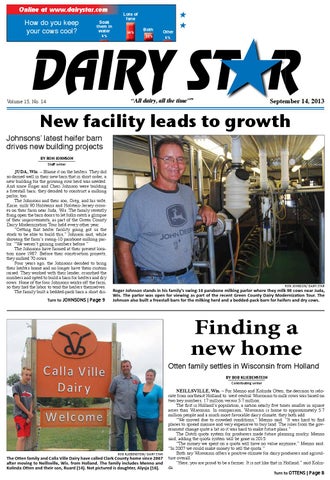
New facility leads to growth
Johnsons’ latest heifer barn drives new building projects BY RON JOHNSON Staff writer
JUDA, Wis. – Blame it on the heifers. They did so darned well in their new barn that in short order, a new building for the growing cow herd was needed. And since Roger and Cheri Johnson were building a freestall barn, they decided to construct a milking parlor, too. The Johnsons and their son, Greg, and his wife, Karie, milk 90 Holsteins and Holstein-Jersey crosses on their farm near Juda, Wis. The family recently ung open the barn doors to let folks catch a glimpse of their improvements, as part of the Green County Dairy Modernization Tour held every other year. “Getting that heifer facility going got us the stock to be able to build this,” Johnson said, while showing the farm’s swing-10 parabone milking parlor. “We weren’t gaining numbers before.” The Johnsons have farmed at their present location since 1987. Before their construction projects, they milked 70 cows. Four years ago, the Johnsons decided to bring their heifers home and no longer have them custom raised. They worked with their lender, crunched the numbers and opted to build a barn for heifers and dry cows. None of the four Johnsons works off the farm, so they had the labor to tend the heifers themselves. The family built a bedded-pack barn a short disTurn to JOHNSONS | Page 9
RON JOHNSON/ DAIRY STAR
Roger Johnson stands in his family’s swing-10 parabone milking parlor where they milk 90 cows near Juda, Wis. The parlor was open for viewing as part of the recent Green County Dairy Modernization Tour. The Johnson also built a freestall barn for the milking herd and a bedded-pack barn for heifers and dry cows.
Finding a new home
Otten family settles in Wisconsin from Holland BY BOB KLIEBENSTEIN Contributing writer
BOB KLIEBENSTEIN/ DAIRY STAR
The Otten family and Calla Ville Dairy have called Clark County home since 2007 after moving to Neillsville, Wis. from Holland. The family includes Menno and Kolinda Otten and their son, Ruard (14). Not pictured is daughter, Alysja (16).
NEILLSVILLE, Wis. – For Menno and Kolinda Otten, the decision to relocate from northeast Holland to west central Wisconsin to milk cows was based on two key numbers, 17 million versus 5.7 million. The rst is Holland’s population, a nation nearly ve times smaller in square acres than Wisconsin. In comparison, Wisconsin is home to approximately 5.7 million people and a much more favorable dairy climate, they both add. “We moved due to crowded conditions,” Menno said. “It was hard to nd places to spread manure and very expensive to buy land. The rules from the government change quite a bit so it was hard to make future plans.” The Dutch quota system for producers made future planning murky, Menno said, adding the quota system will be gone in 2015. “The money we spent on a quota will have no value anymore,” Menno said. “In 2007 we could make money to sell the quota.” Both say Wisconsin offers a positive climate for dairy producers and agriculture overall. “Here, you are proud to be a farmer. It is not like that in Holland,” said Kolinda. Turn to OTTENS | Page 8
Page 2 • Dairy Star • Saturday, September 14, 2013
DAIRY ST R www.dairystar.com
ISSN 020355 522 Sinclair Lewis Ave. Sauk Centre, MN 56378 Phone: (320) 352-6303 Fax: (320) 352-5647
Published by Dairy Star LLC
General Manager/Editor/Sales Mark Klaphake 320-352-6303 (ofce) 320-248-3196 (cell) 320-352-0062 (home) mark.k@dairystar.com Ad Composition Janell Westerman 320-352-6303 janell.w@dairystar.com Nancy Middendorf 320-352-6303 nancy.m@dairystar.com Consultant Jerry Jennissen 320-346-2292 President Dave Simpkins 320-352-6577 davesimpkins@saukherald.com Staff Writers Krista Kuzma - Assistant Editor 507-259-8159 • krista.k@dairystar.com Andrea Borgerding Assistant Editor/ Online Editor 320-352-6303 • andrea.b@dairystar.com Melissa Mussman (320) 429-1084 • missy@dairystar.com Ron Johnson 608-874-4243 ron.j@dairystar.com Ruth Klossner 507-240-0048 cowlady@centurylink.net Jennifer Janak - Summer Intern 320-352-6303 • jenn@dairystar.com Advertising Sales Main Ofce: 320-352-6303 Fax: 320-352-5647 Deadline is 5 p.m. of the Friday the week before publication Sales Manager - Jeff Weyer (National Advertising, Northern MN, East Central MN) 320-260-8505 (cell) jeff.w@dairystar.com Mark Klaphake (West and South Central MN) 320-352-6303 (ofce) 320-248-3196 (cell) Laura Seljan (SE MN, West Central WI) 507-250-2217 (cell) fax: 507-634-4413 laura.s@dairystar.com Jerry Nelson (SW MN, NW Iowa, South Dakota) 605-690-6260 (cell) jerry.n@dairystar.com Lori Young (Central MN) 612-597-2998 • lori.y@dairystar.com Lori Menke (Eastern Iowa, Southern WI) 563-608-6477 • lori.m@dairystar.com Linda Lynch (Central WI) 608-387-1202 • linda.l@dairystar.com Deadlines The deadline for news and advertising in the Dairy Star is 5 p.m. Friday the week before publication. Subscriptions One year subscription $28.00, outside the U.S. $110.00. Send check along with mailing address to Dairy Star, 522 Sinclair Lewis Ave., Sauk Centre, MN 56378. Advertising Our ad takers have no authority to bind this newspaper and only publication of an advertisement shall constitute nal acceptance of the advertiser's order. Letters Letters and articles of opinion are welcomed. Letters must be signed and include address and phone number. We reserve the right to edit lengthy letters. The views and opinions expressed by Dairy Star columnists and writers are not necessarily those of the Dairy Star LLC.
The Dairy Star is published semi-monthly by Dairy Star, LLC, 522 Sinclair Lewis Ave., Sauk Centre, MN 56378-1246. Periodicals Postage Paid at Sauk Centre, MN and additional mailing ofces. POSTMASTER: Send address changes to Dairy Star, 522 Sinclair Lewis Ave., Sauk Centre, MN 56378-1246.
Dairy Prole brought to you by your
Dairy prole
North America dealers.
Wade and Jen Brunsman Dyersville, Iowa; Delaware County 60 cows How did you get into farming? We have both always farmed, and are both the fourth or fth generation of own families - on both sides - to dairy farm, from great-grandparents on down. Wade: I grew up a half mile from where we now farm. Jen: My dairy roots go back to Pennsylvania. We met at Iowa Ayrshire events. Tell us about your farm. We own 40 acres and milk 60 cows in a tiestall barn. We have almost all Ayshires, a few Jerseys and Holsteins. We grow haylage and silage. Wade: we work with my dad on many things, including raising all the heifers at his place. We started dairy farming in 2004 and moved here in June of 2011. What is your favorite thing to do on the farm? Wade: My favorite thing to do is milk cows. Jen: My favorite is watching Wade milk (said with a laugh). I also work as an emergency room nurse in Dubuque. What is your favorite dairy product? Wade: I like chocolate milk. Jen: I like chocolate ice cream. How do you and your family like to spend time when you are not doing chores? We have two kids: Kate, (5) and Shawn, (6). We enjoy just spending time together, having family meals, and things like going for ice cream and going to Grandma and Grandpa’s. If you could take a trip anywhere and price was not an issue, where would you go? Australia. We have friends there that Jen met on RAGBRAI, and Wade’s cousin lives there. Australia has much to offer and there are some great dairies there. What makes your farm work well? Wade: Family involvement. Jen: Family and Wade’s drive and dedication. Those three things have gotten us through a lot.
Dairy Star • Saturday, September 14, 2013 • Page 3
It’s all inside... Dairying Across America: Tennessee Pages 10-11 Second Section
Women in Jeans: Sue Abrahamson
Kids Corner: The Brands
Page 9 Second Section
Hoffmans host workshop about reducing energy use
Wingert family sells sweet corn to raise funds for Relay For Life
Pages 38 - 39
Pages 4 - 5 Third Section
Page 8 Third Section
Fiberglass animals show importance of dairy heritage to Clark Co. community Page 25
Otten family settles in Wisconsin from Holland
Moll family adds on to tiestall barn Pages 3, 5 Second Section
Pages 1, 8, 9
Meyers reach century farm status
Pattison manages an average 100,000 SCC
Pages 12 - 13 Third Section
Pages 12 - 13
Sand bedding, cross ventilation contribute to Jans’ high herd average
Greewald Freeport
Pages 18, 20
Lindstrom Ellsworth
Grove City
Charitable organization assists De Groot after undergoing knee surgery Pages 2, 7 Third Section
Harmony
Contents FIRST SECTION Page 5 Dairy Letters Pages 12 - 13 Workshop explores heat stress, energy usage Pages 22 - 23 Crop, bacteria affect silage inoculant decisions Page 26 Boylen Over Page 28 Do not treat your manure like a waste Page 29 Corn silage pricing Page 31 Everyone should have a farm truck like Blackie Page 35 Striving for dairy farm safety SECOND SECTION Page 6 The “Mielke” Market Weekly Page 7 Dairy Markets
Thorp Neillsville
THIRD SECTION Page 9 People in the Dairy Community Pages 10 - 11 Some Udder Stuff Page 15 Dairy Calendar Pages 16 - 22 Classieds
Pages 36 - 37
Rieders replace parlor with robotic milkers
Chateld
Hull Page 8 Iowa hay auction results Page 15 Dairy in the Suburbs Pages 19, 20 Balzers named 2013 Steele County Farm Family of the Year Page 21 Mid-American hay auction results Pages 22, 24 Houston County dairy farmers add art to their barns Page 26 Dairy Recipes
Otter Creek Organic Farm focuses on efciency
Pages 10 -11
Avoca Garnavillo
Monroe Juda Johnsons’ latest heifer barn drives new building projects
Columnists Ag Insider Pages 6-7
The Next Generation Page 33
Pages 1, 9
Veterinary Wisdom Page 34
Getting Kerry’d Away Page 27
Just Thinking Out Loud Page 32
Ramblings from the Ridge Page 30
Call Us For All Of Your Barn Equipment Needs!
Autovent Curtain System State-of-the-art ventilation for high sidewall dairy barns
GEA Farm Equipment | Norbco engineering for a better world
Top curtain rolls up and down for cold weather ventilation. Both curtains roll up for storage. Complete automation with temperature sensors. Minimum air restrictions. Maximum air flow.
20903 W. Gale Avenue, Galesville, WI 54630 Tel: 608.582.3081 www.gea.com | www.gea-farmtechnologies.com/norbco/en
VISIT US AT WORLD DAIRY EXPO
October 1-5, 2013 Booth EH 2001-2301
GEA Farm Technologies
Vilsack urges action on the farm bill
Page 6 • Dairy Star • Saturday, September 14, 2013
With Congress back in Washington after a ve-week recess, Agriculture Secretary Tom Vilsack is hoping House leadership has added an item to its list of priorities. Vilsack said the House Ag Committee did its part by hammering out a farm bill, and now leadership needs to take action. “It’s not as much of a priority for House leadership as it was for Senate leadership; we need a safety net,” said Vilsack. “We need disaster assistance resumed for our livestock and dairy producers. We need a continuation of farm credit. We need a simpler set of conservation programs. We need to continue to promote trade.” Vilsack said all of these issues are tied to the passage of a farm bill.
Three Seasons Harvesting & Baling Specializing in Forage Harvesting & Round Baling
RENEW YOUR TRACTOR CAB! 1” Black Vinyl Upholstery At Wholesale Prices! WE SHIP DAILY JD Sound Guard Cabs & Sound Guard Cab Parts
COMPETITIVE PRICING, QUALITY WORK! Will Travel for Business! Call us for pricing today.
BUY - SELL - TRADE
Brad Hoffman, Owner | New Ulm, MN 507-276-4536 • bshoffman25@gmail.com
KIESTER IMPLEMENT KIESTER, MN
www.midwestfarmsales.com
507-294-3387
Feed Mixing… Vertical or Rotary?
Farm bill extension not needed After lawmakers make politically risky votes on military action in Syria, it may be more difcult for Congress to get excited about another huge battle over food stamps and the farm bill. That, in turn, will likely result in more talk about a farm bill extension. National Farmers Union vice president of government affairs Chandler Goule said that’s not necessary. “Congress really has until December 31 to get a farm bill passed and signed into law,” said Goule. “We want this bill done before the farm bill expires on September 30, but we really have until the end of December. That is enough time for Congress to take action on Syria and still invest in Rural America through a farm bill.” With another extension, there is a risk budget hawks will continue to look for decit savings from agriculture, impacting commodity programs and crop insurance. Milk production reports will resume this fall When the new scal year begins Oct. 1, USDA’s National Agricultural Statistics Service will once again publish its quarterly milk production reports. These reports were suspended in April to meet the needs of sequestration. The information gathered for the quarterly surveys is used to produce monthly milk production estimates. Input sought on nitrogen management plan The Minnesota Department of Agriculture is seeking input on proposed revisions to the state’s Nitrogen Fertilizer
Ag Insider
By Don Wick Columnist Management Plan. This plan is a blueprint for prevention or minimization of the impacts of nitrogen fertilizer on groundwater in Minnesota. Comments will be accepted through Nov. 1. More CRP acres open for emergency haying/grazing The Minnesota Farm Service Agency has announced that additional CRP acres have been authorized for emergency haying and grazing in 20 southeastern Minnesota counties. This area suffered from excessive rains last spring. The Deputy Administrator of Farm Programs has approved a request from the Minnesota FSA State Committee to implement emergency haying and grazing of otherwise ineligible CRP conservation practices. If interested, producers must sign a modied conservation plan to allow haying and grazing. No more than 75 percent of a eld may be grazed, and the grazing must end by September 30, 2013. CRP participants will be assessed a 10 percent payment reduction on the number of acres that are hayed or grazed. Minnesota organic farms are protable According to a new benchmarking study, organic farms in Minnesota were protable in 2012. Average and median net farm income for organic crop and dairy farms were up substantially. The report, which includes analysis by the Center for Farm Financial Management, said most farms entered 2013 in a strong liquidity position. Turn to AG INSIDER | Page 7
Your dairy’s performance depends on choosing the right feed mixer to improve your operation. Roto-Mix designs and manufactures strong, durable feed mixing equipment. Both Vertical and Rotary models are available in truck, trailer or stationary.
Round Bale Mover
• Universal Brackets • (1) Kverneland Tine @ 39” • (2) Kverneland Tines @ 31.9” • Optional 49” Tine available (replaces 39” tine) • 3 pt model also available
620.225.1142 www.rotomix.com Available at
Steve Gehrke 608-778-3878
Larsen Industries Goodhue, MN
Dairyland Supply Sauk Centre, MN
K&R Equipment Fountain, MN
Blue Hilltop Lake Wilson, MN
Mark’s Tractor Osage, IA
Baker Iron Works Platteville, WI E&M Farms Ossian, IA
Large Square Bale Mover
• Handles 2- 500 lb. Square bales • Universal Bracket • (3) Kverneland Tines @ 39.4”
Buckets
Our steel crafted buckets are ideal for many farm uses. We offer both material and feed buckets. Sizes from 5’ to 6’ with Universal Bracket.
CHASEBURG
MANUFACTURING INC.
102 Jack Berg Lane • Coon Valley, WI 54623
Phone: 1-800-658-9018 or 608-452-3040
Page 8 • Dairy Star • Saturday, September 14, 2013
Continued from OTTENS | Page 1 After extensive homework and a careful search for available dairy farms, the Otten family, daughter, Alysja, 16, and son, Ruard, 14, relocated to Clark County in 2007. The couple considered dairying in the southern United States, but Menno said, too many other variables limited their search to the Midwest. This past July marked the sixth year Calla Ville Dairy has been in operation. In Holland, their farm was called Calla Palustris Dairy. A photo of Calla Palustris still hangs in their house. Menno said Calla Palustris is a Latin name for a native ower in Holland. After moving, the Ottens decided to drop Palustris and add Ville from Neillsville. Kolinda’s niece designed the farm’s logo printed on business cards, she said. The Ottens milked 100 cows on a 150-acre farm in Holland with Menno’s parents. Menno said he received valuable guidance from his father, Jaap, who passed away in 2011, during their farm search. Calla Ville Dairy was purchased from another Dutch producer from Texas. Kolinda said they liked the fact the farm was dairy ready with a double-12 herringbone parlor and freestall buildings in place. Menno said the process moved quickly once wheels were set in motion after the couple secured 40 percent of needed equity to purchase. The farm originally consisted of 220 acres, but has grown to 340 acres since 2007. They are seeking additional cropland to feed a total of 1,500 head of cattle, which includes a milking herd of 850 Holsteins, housed in two freestall barns. In 2014, a new building for dry cows will be added. They are currently housed in the old stanchion barn. Manure is stored in two lagoons and a third is under construction. When complete, there will be stor-
BOB KLIEBENSTEIN/ DAIRY STAR
Menno Otten stands next to a key addition to Calla Ville Dairy, an automatic calf feeding system. Calves are tted with collars and computer chips that are programmed to determine how much milk they are fed each day. The system plays an important role early on in herd health on the farm near Neillsville, Wis. age for 10 million gallons. Menno said there is ample land around Calla Ville to spread manure. They have enough acreage for 25 percent of their
feed. They contract for the remainder. Increasing feed costs drive their search for more cropland. “Nobody could have dreamed what feed costs would be,” Menno said. “It’s a nightmare.” The couple raises heifers and sells bull calves. After one nasty Wisconsin winter of feeding heifer calves in berglass huts, the Ottens sought another option for that facet of the operation. An existing structure was modied and outtted with a computerized automatic calf feeder, one of the rst in the area. Calves are kept in huts for one week before being moved into the general calf population. Once in the building, calves are given neck collars with computer chips. Chips are programmed to feed a certain amount of milk each day. The milk is waste from the herd. Calves are fed eight liters per day of pasteurized milk for 56 days. The farm has 11 employees. The Ottens cite valuable assistance provided by herdsman Floyd Schoen, who worked for the previous owner of the farm. Menno said employee management was a challenge when they rst started, but has gotten easier over time. “Floyd was a lot of help,” Kolinda said. An independent dairy nutritionist works with the Ottens to maximize production and components. The somatic cell count is 200,000. The herd average is 85 pounds per cow with 3.7 percent butterfat and 3.1 percent protein. Menno said their family was welcomed to Neillsville when they arrived. Their children attend Neillsville High School and are active members of Christie Mounders 4-H Club, showing livestock at the Clark County Fair. Menno said Holland does not have fairs due to a fear of disease by co-mingling animals together at one site.
PHOTO SUBMITTED
Alysja Otten (16) helps on her family’s farm in Clark County near Neillsville, Wis. They milk 850 cows and farm 340 acres. Turn to OTTENS | Page 9
Dairy Star • Saturday, September 14, 2013 • Page 9
Continued from JOHNSONS | Page 1 tance up a hill from the dairy barn. That barn is 32 by 170 feet, has headlocks and pens, and offers outside feeding. Said Johnson, “I love it.” With the heifers doing well in their new barn, the Johnsons were able to add to the milking herd without buying cattle. So in 2011, they gured the time was ripe to kick the cows out of their loose housing that consisted of an old hog building and a lot with trees in it. “We were growing, and that building wasn’t working,” Johnson said. “We wanted to have control over the cow environment.” For one thing, the old facility was not blessed with good ventilation. For another, it was always damp inside. “We just couldn’t keep it dry, so it seemed like I was always treating cows,” Johnson said. “We still treat cows, but the percentage is way down.” The new freestall barn went up in the fall of 2011. It’s 68 by 200 feet and is laid out in three rows. Like the heifer barn, it’s on the hill above the 1920s-era, twostory dairy barn. “Where we’re at, that (three-row barn) was what was going to t,” Johnson said. They had to have soil dug out of the hillside if they were going to build there. The idea of building in that spot was to be able to continue to use the old barn for milking. The freestall barn is equipped with water-lled mattresses bedded with shavings. Sand for bedding was not considered an option, due to the manure system that uses a clay-lined lagoon for storage. The Johnsons worried that the process of removing sand that got into the lagoon might harm the clay lining. Johnson said, “I looked at other mattress styles. These looked like they’d work, so we tried them.” Replenishing the shavings on the mattresses is a simple task. Johnson’s feed dealer brings a pallet of bagged shavings every other week. It takes just a few minutes, twice a day, to scatter fresh shavings. Johnson likes the price, too. He said a bag of shavings costs about $5, and the farm uses three bags a day, for $15 day, or $105 a week. The freestall barn has room for more cows. Said Johnson, “It’s got 117 stalls. We’ll get it lled. We have a lot of heifers yet.” Phase three of the Johnsons’ construction work involved retrotting the swing-10 parlor into the near end of the two-story barn. Making the choice to switch from the pipeline wasn’t a slam-dunk decision, but ultiOslin Lumber Company
Continued from OTTENS | Page 8 mately it happened. “We thought about just milking in the stanchion barn the way it was. But talking with different people, they said, ‘Just go ahead and do it,’” Johnson said. A parabone parlor – with cows standing at a 70-degree angle – t well into the barn. It allowed for a wideenough milking pit and still left room for the cows to walk in and out easily. “I looked at a lot of parlors – parallels and herringbones. For our space needs, this works good and we still have room for a holding area,” Johnson said. The Johnsons chose a swing parlor to reduce equipment costs. Instead of needing 20 milking units for 20 cows, they get by with 10, and simply swing each unit to the other side when the rst row of 10 cows has been milked. “And it works,” Johnson said. “I can’t see where milking would be any faster with a double-10. If you knew you’d always have two people milking, it might. But sometimes it’s one.” The parlor eliminated the need to switch cows in and out and cut the milking time. While switching cows, milking 65 cows took about two hours. Now, one person can milk 50 cows per hour. An added benet of the parlor is that milk production has risen. “We went up over 2,000 pounds. “We’re at 26,800 now,” Johnson said. The somatic cell count (SCC) has uctuated. “It was always under 150,000. A couple of months ago, we were under 100,000, so that’s another 20-cent premium,” Johnson said. To let the cows walk from the freestall barn and down the hill to the parlor, the Johnsons built a concrete ramp that’s about 85 feet long. It’s covered, has curtains on the sides, to keep rain and snow out, and has rubber matting for the cows to walk on. “We have to watch it if it gets some moisture on it and put lime down,” Johnson said. “But if it’s dry, it’s not a problem. But it’s a 12 percent slope.” Another touch to the milking barn is heating coils in the oor of the parlor and an adjacent room. Also, two circular fans mounted parallel in the ceiling of the holding area draw air from the hay mow. Summing up his thoughts about the bedded-pack barn, freestall barn and swing parlor, Johnson said, “I wouldn’t change anything about this. It’s worked out great.”
Kolinda concedes she was initially apprehensive because the Neillsville school was bigger than the school their children attended in Holland. That apprehension was quickly quelled. They have a network of Dutch and local producers in Wisconsin they talk with, Menno said. Prior to their farm search, the Ottens had never been to the United States. They discovered the distance between neighbors was not as far as rst thought. The Ottens branched out from dairy cattle over the years. They have several goats and eight alpacas that graze together between the free-stall barns. Two baby alpacas were born Sept. 1. They are joined by two donkeys. Menno said the livestock menagerie provides relaxation for the family, but adds Ruard is taking an interest in dairy goats. Kolinda said Wisconsin winters took some getting used to. Holland’s climate is comparable to Washington state. It gets cold, but not Wisconsin cold. Menno said Wisconsin dairy herds are fed more grain; Holland producers feed more forage. “There is more emphasis on (milk) components in Holland,” he said. “But we know its gaining importance here.” Calla Ville Dairy is nearly complete in a transformation from sawdust to sand bedding for cow comfort. A nearby frac sand operation provides a by-product that resembles beach sand. Its proximity limits shipping costs. The sand helped lower the cell count and boost production. A large truck scale was installed at Calla Ville in 2009 to keep an accurate account of feed and sand hauled on site, Menno added. Kolinda said technology makes it easy to communicate with friends and family in Holland. They return once a year and have family that visits from Holland. Menno said they want to focus on seeing more of the United States. That started with a vacation to Las Vegas, Nev. Their impression of the city that never sleeps? “It was crazy,” Kolinda said. The Ottens are committed to promoting Wisconsin’s dairy industry. In 2009 they accepted a request to host the Clark County Dairy Breakfast. “It was a neat thing to do,” Menno said. “It’s important that consumers know about agriculture. It is surprising to see how many people don’t know anything about farming.”
• Stock Gates • Cattle Panels • Bale Feeders Hwy. 23 East, Mora
320-679-1181 Got something to sell? Try the Classieds.
MF 7620 Call for details
BUY RENT LEASE
BUY RENT LEASE
MF 7619 Call for details
MF 8690 Call for details
We have
BULK BINS!
MF 9560 combine Call for details
MF 1635 w/ldr. Call for details
Sunflower 4610-7 ripper Call for details
Villard Implement Co. / Parkers Prairie Impl. Villard, MN
(888) 554-3111
DEALERSHIPS AVAILABLE IN SOME AREAS!
WE SPECIALIZE IN BULK BINS! Call us today for a bulk bin that fits your operation!
4 B’s Distributing & Dealers Livestock Equipment Center, Inc. Locations in Glenwood, MN & Mitchell, SD
888-995-3810
(V) MF 8680, 1500 hrs. $175,000 TRACTORS (V) JD MT ................................................................$3,500 (V) JD B NF .............................................................$1,750 (V) White 2-85 w/cb, ldr.....................................$9,500 (V) White 2-155 w/Cummins ............................just in (V) White 2-105 ....................................................$8,500 (V) White 6145, 2WD ....................................... $32,500 (V) White 6145, 4WD ....................................... $43,500 (V) White 6144, AWD .......................................... Just In (V) White 6085 .............................................. Coming In (V) Agco RT 135................................................. $69,500 (V) Agco DT 180A cut, AWD .......................... $92,500 (V) Agco DT250B, only 700 hrs. .................$190,000 (V) MF 596, only 800 hrs.................................... Just In (V) MF 390T, 3200 hrs...................................... $28,500 (V) MF 6485, AWD ............................................... Just in (V) MF 5454, 2400 hrs. .................................... $42,500 (V) MF GC2300 compact ...................................$8,500 AGCO DT250B Call
Parkers Prairie, MN
(218) 338-6156
(V) MF 8680, 2010, loaded ............................... Just In (V) MF 5455, platform, loader ................. Coming In (V) MF 1533 compact, only 60 hrs. ......................Call (V) IH 1086 ............................................................. Just In (V) IH 1086 .............................................................$7,950 (V) IH M Farmall....................................................$1,950 (V) Case IH MX120 w/loader.................... Coming In (V) Case IH 8920, only 3000 hrs. ...........................Call (V) Case 1594 w/Allied loader.........................$8,950 (V) Case 2670, 4WD .................................... Coming In (V) CIH 7220........................................................ $47,500 (V) Ford 9000, cab, 2WD............................ Coming In (V) NH T7.235, only 277 hrs. ............................. Just In PLANTERS (V) White 8524-22.....................................................Coming In (V) White 6100, 12 row ...........................................Coming In (V) White 6100, 24R22”...........................................Coming In (V) JD 7300, 12 row ..................................................Coming In (V) JD 7240, 12 row 22”, liq. fert ................................$18,000 (V) JD 1770, 16 row, dry fert. ........................................Just In (V) Case IH 1200, 6 row............................................Coming In (V) Case IH 900, 6 row w/dry fert., cross auger .......$7,950 (V) Duetz 385, 12 row, dry ............................................ $8,950 SKID STEERS (V) Gehl 5640E, joystick ...............................................$24,500 (V) Gehl 5640E, only 300 hrs ................................Coming In (V) Gehl 5635 Series II .....................................................Just In
(V) Gehl 7810E, 2700 hrs., T-bar, cab..........................Just In (V) Case 1835 .....................................................................Just In MISC. ITEMS (V) Gehl 250 spreader .............................................Coming In (V) JD 843, 8R30” corn head..........................................Just In (V) JD 1060, 48.5’.......................................................Coming In (P) MF 1372 discbine ....................................................$19,500 (V) New Idea 7333, big square w/accum. ........Coming In (V) IH 26’ chisel plow ............................................................ Call (V) NH 499 ......................................................3 to choose from (V) NH 144 inverter ......................................................... $2,500 (V) Unverferth 325 gravity box................................... $7,500 (V) Challenger LB33, 2010 .....................................Coming In (V) Riteway RP 100 rock picker ................................... $8,950 (V) Case IH 870, 9 shank ripper............................Coming In (V) JD 2700 7 shank ripper ....................................Coming In (V) Sunflower 1434, 33’ disc ..................................Coming In (V) Sunflower 4411-07 ripper...............................Coming In (V) Sunflower 5055-54 cultivator................................Just In (V) Geringhoff 12 row 22”......................................Coming In (V) Vermeer 605M ....................................................Coming In (V) Challenger LB33 ............................................. 3 Coming In (V) White 8900 combine ............................................... $5,000 (P) JD 610, 15 shank ........................................................ $7,950 (V) MF 1375 discbine ...................................................$26,000 (V) Gehl 2412 discbine .................................................. $8,500 (V) Demco 365 gravity box .......................................... $4,500
Page 10 • Dairy Star • Saturday, September 14, 2013
CUSTOM SAFETY GROOVERS • Protect your investment • Keep your cattle from slipping on concrete • No job too large or small
608-697-3099 Portage, WI
Call today for a free estimate
THE PROTEIN TUBS COWS LOVE TO LICK By:
Look for the Yellow Tubs
Low Moisture Lick Tubs Pierz Co-op is now offering Form-A-Lic low-moisture lick tubs from Form-A-Feed. These convenient 250 lb. yellow tubs feature high levels of nutrition that combines molasses-based sugars with low-moisture levels to produce consistent intake and results. Product Bovine Stress Lic Mineral Lic All Purpose 14 Dry Cow Lic Stalk Buster 30
Used For Stress - off feed - reproduction Consistent mineral intakes Pasture/Protein Supplement Nutrition from dry off to calving Supplement feeding - Protein
For more information contact Randy at the Pierz Co-op
Toll Free: Feed 877-468-6655 Agron/Petro 877-438-3378
Rieders replace parlor with robotic milkers
Farm participates in Green County Dairy Modernization Tour BY RON JOHNSON Staff writer
MONROE, Wis. – A steady stream of people poured into the barn at Riedland Farms, Monroe, Wis., Aug. 29, as part of the Green County Dairy Modernization Tours. The attraction: two robotic milkers Dan Rieder and his son, Nick, began using just several weeks earlier. The farm that milks 116 cows – most of them registered Brown Swiss – tore out a 10-year-old, double-eight herringbone parlor to make room for the robots. “Labor savings is a big benet with this,” Nick Rieder said. “And it was getting to the point where we had to go in and refurbish the parlor.” RON JOHNSON/ DAIRY STAR Rieder said, “my fa- Nick Rieder shows several dozen visitors the farm’s two robotic milkers in action ther likes to stay ahead of during the Green County Dairy Modernization Tour Aug. 29. Riedland Farms the times. The newer the milks 116 cows on their farm near Monroe, Wis. better, for him.” Onlookers saw the pair of Lely Astronaut A-4 roAt the same time, the somatic cell count (SCC) is botic milkers wash cows’ udders using rolling brushes. Next the robots located each teat and attached the falling. “It took quite a jump when we were switching milker, using information programmed into the central everything over,” Rieder said. “But that was expected.” The rst milking with the robots took about 13.5 computer. After a few minutes of milking, the claw detached, each quarter got a good dipping of disinfectant, hours, Rieder said. Mapping udders so the computer could pinpoint the precise location and angle of each and the cow sauntered back to the freestall barn. The general consensus of folks who saw the robots teat on each cow slowed things down. But the second milking took 10 hours, and the third in action? “They’re amazed how simple they are,” Rieder one required eight hours. “Then we kind of let the cows said. “Anything that goes wrong, I can pretty much x go on their own for a couple of hours and everybody got some sleep.” on my own now. It’s pretty slick.” To make space for the robots, the Rieders convertRieder said he can repair torn hoses and reposition the occasional ination that a cow kicks off. Since ed their special-needs pen. They plan to build a new the sand the Rieders use for bedding was cutting the pen for special-needs cows where the milking parlor strings that are attached to the inations, they’ve been used to be. A bit of a protein mix coaxes cows to the robots. So switched to chains. Problem solved. Along with newer technology, the father-son team they don’t overfeed, the Rieders have trimmed some of sought relief from three-time-a-day milking. They farm the protein from their total mixed ration. One thing Rieder said he especially likes about 800 acres, growing alfalfa, corn and soybeans, so on some days, the eldwork requires much of their time the robotic milkers is the wealth of information they provide about not only the milk, but about the cows. and attention. “Dad does embryo transfers, so he’s gone every For example, the robots’ computer analyzes each cow’s milk production, day and I had to do the eldwork and come back and milk,” Rieder said. “Anything that goes the temperature of her milk, her The farm used to employ one person part-time for amount of physithe afternoon milking. But thanks to the robots, there wrong, ron I can an pretty cal activity, and are no employees now, but for Nick, who is working uch x on my own the amount of time much into a partnership with his father. she is spending lyBesides handling much of the cropping work, the ing and chewing younger Rieder drives truck part-time for the custom now. It’s pretty her cud. It puts all chopping business of Triple D Farms, Mineral Point, slick.” that information Wis. together and preRieder is enthused about the robots freeing his faNICK RIEDER dicts the best time ther and him from the routine of milking. He has a rm to breed that cow. idea of what he will do with some of the time he will no “It’s been spot on,” Rieder said. “It’ll actually narlonger spend in a milking parlor. Said Rieder, “I do a lot row it down to your best half hour to breed that cow. of hunting.” With the parlor, one person could milk in two hours, It’s about as accurate as you can get.” As proof, Rieder added, “We bred 15 cows right Rieder said. But over the course of three milkings, six off the computer (information). We didn’t go into the hours were required in the pit. Now, cows are free to walk to one of the robots and barn to see if it was right, or anything. We had 14 out be milked just about any time of the day or night they of 15 pregnant. Those are the best numbers we’ve ever please. The Rieders have their system set so a cow can had.” Rieder estimated the robots will pay for themselves be milked up to six times in 24 hours, and no sooner in terms of higher milk production, better udder health, than four hours after her previous milking. The Rieders’ cows are averaging 3.6 milkings per and labor savings in four to six years. He added that the day. With more and more-frequent milkings, produc- machines’ useful lives are pegged at 10 or more years. As for cost, Rieder said the rst robot ran a bit more tion is expected to rise. Average milk production is almost back to the 83 than $200,000, but that included the central processor. pounds a day the Rieders achieved with their parlor, The second robot, he said, cost closer to $180,000. Acand it continues to climb. Rieder said, “Our goal is 90 cording to Rieder, one robot is rated for up to 60 cows, or 6,000 pounds of milk a day. pounds a cow. We’re getting close to that.” Rieder said he would not change anything about Milk protein and butterfat are climbing, too. Rieder pegged the protein at 3.97 percent and the fat test at 4.0 the robots, stating, “I’m pretty impressed. I would do this again in a heartbeat.” percent.
–
Page 12 • Dairy Star • Saturday, September 14, 2013
Keeping it low
Pattison manages an average 100,000 SCC BY KELLI BOYLEN Staff writer
GARNAVILLO, Iowa – Sometimes the Pattisons can’t believe how far they’ve come. “If you would have told me ve years ago that we would be milking more than 600 cows and have these kind of somatic cell count numbers I wouldn’t have believed you,” Lee Pattison said. In the past year they have averaged a SCC of 100,000. Lee and his wife, Sara, started milking 29 cows in 1979, operating on halves with her mother who had inherited the dairy farm. By 1982 they had 67 cows and slowly worked on increasing their cow numbers. In 1993 he made the big jump and went from 100 cows to 350, and in 2007 they increased their facilities to hold 700 cows on their dairy near Garnavillo, Iowa. Switching from mattresses to sand bedding in 2007 was a huge rst step in reducing their SCC, Pattison said. They went down about 50,000 in the rst few months, and after a year they were down 100,000, which put them in the 150,000 range. About three years ago they started culling really hard, get-
ting rid of the cows that were driving the numbers up. Typically, the second time a cow has a mastitis are up they are shipped. Although sand is the rst thing Pattison credits for the low SCC, he is quick to say the second contributing factor is the employees. Of Pattison’s 14 employees, the newest one has been there for three years. “They are reliable and are trustworthy, and to not have employee turnover is a huge deal,” Pattison said. Pattison likes to reward employees beyond money. “Once I know an employee ts well here, I pay them well enough that it would be a pay cut for them to leave. That way wages are off the table and it then it just comes down to how they are treated,” he said. Pattison said his philosophy is that if someone is a good employee who is trained right, there never is a need to reprimand them. “There isn’t really any reason to go there. I know they will make mistakes, everyone does. A good employee will gure it out and learn from it,”
KELLI BOYLEN/ DAIRY STAR
Lee Pattison (right) with his herdsman, Andy Corlett, milks 600 cows in Clayton County near Garnavillo, Iowa. Pattison Dairy produces milk with a very low SCC, which Pattison largely credits to his 14 employees. he said. “I don’t have to be there “The guys really respect He added, “If I have to let for things to get done,” he said. their jobs,” he said. someone go then I know I did He does not offer his emThe other employees work something wrong. I didn’t hire ployees any type of incentives four days a week and every the right person or I didn’t train for things such as low SCC. other weekend. Some of them them right. “If I pay them well, treat have worked for the dairy for “All of our employees are them right and train them right more than 15 years. self motivated and they know they don’t need any other type Pattison said he never asks to do what needs to be done. I of incentive to do their job someone to work on their days don’t watch over their shoul- right,” Pattison said. off with the exception the 13 or ders, there is no need to manHis milkers work 12-hour so days required for chopping age that way,” he said. shifts, two days on and one day – but even then he asks them Because his employees off. Most of his milkers are if they can work. He does not are so well established in their Hispanic, some of whom have require it. jobs, Pattison has a lot of free- worked for him for more than Turn to PATTISON | Page 13 dom. nine years.
Self-locking panels for cows and youngstock in Àxed or adjustable openings.
Simplex Dairy Pads are designed for cow cofort.
TRI-MIC 1:50
DIRECT-FED MICROBIAL FOR ADULT CATTLE Improve feed intakes and feed utilization for maximum production and reproductive performance with Tri-Mic 1:50. It contains research levels of ruminant-specific bacteria and is formulated for whole herd application as either a top dress or as part of your total mixed ration (TMR). Ideal for allowing a smooth transition from the dry diet to the higher-energy, concentrated diets required for high milk production. Also effective for countering the negative effects of heat stress, poor quality feed, calving stress, metabolic disorders or other negative environmental conditions.
Several free stall proÀles and mounting options are available. BERG EQUIPMENT CORPORATION
800-451-9275 | INFO@ACCELGEN.COM | WWW.ACCELGEN.COM
MADE IN
USA
2700 W. Veterans Parkway MarshÀeld, WI 54449 Toll Free: 1-800-494-1738 Website: www.bergequipment.com
Dairy Star • Saturday, September 14, 2013 • Page 13
Continued from PATTISON | Page 12 Other factors contributing to their good SCC is checking all equipment every three months and changing the liners every 14 days. They use one cloth towel per cow and they wash the towels every other hour. They do not dry the towels but rather put them right to use. The have a certain size container they put the used towels in and when it’s full they go to the washer; this prevents the washer from being overlled. They buy detergent in 55-gallon drums and the correct amount is automatically added to the washer. “Even with good employees you need good systems,” he said. They use iodine pre-dip at 0.25 percent, and a post-dip at 0.5 percent. “We’ve tried everything out there and we always come back to iodine,” Pattison said. They use about one barrel of a different product to help with chapping in the winter months. They also have tried foamers and sprayers, but simply prefer a dipper. Pattison Dairy is currently milking about 600 cows three times a day in a double-8 herringbone parlor. They milk 24 hours a day, with the exception of about 40 minutes of down time for cleaning twice a day. “Everyone is shocked that we can get 1800 milkings through there a day,” Pattison said. One person milks and the other pushes cows, keeps the laundry going, lls the dippers and scrapes. The original plans called for a double-12 parlor, but at the last minute he downsized the parlor and used the money toward more freestalls. They do not have a bulk tank, but rather they chill the milk, which then goes directly into a tanker. The tanker is lled about every 18 hours, producing about 63,000 pounds a milk a day.
For the rst 12 to 14 days after freshening, cows in Pattison’s herd are milked six times a day. He believes this many milkings helps increase production, but also helps keep fresh cows healthy, moving and eating. “We really think it works,” he said. In 1993 they built their rst 300-stall freestall barn, and in 1997 they built half of a barn for 150 cows. In 2007 they nished the other half of the barn for 150 cows. They also have dry cow facilities, which house the total herd of 700 cows. They went to three-time-a-day milking in 1989, and that extra income helped him to hire his rst employee. They started feeding TMR in 1985. Over the years as the Pattisons increased their herd numbers, they have bought heifers and three herds. “It took us a while to nd the right three herds, but we had really good luck,” Pattison said. The dairy’s production has steadily increased over the years, which can be partially attributed to working with various consultants, including their nutritionist. A few years ago they started amino acid balancing, which helped their component levels. The cows are currently at about 105 pounds a day, using BST. Pattison said 2000 was the roughest year they went through; however, it has been better since they stopped expanding and are enjoying being a mature dairy farm. “I think once you stop growing, that is when you start making money. A mature dairy operates completely different from those that are expanding,” Pattison said. But he admits having a successful farm takes a lot of luck, too. “I recognize it isn’t all skill,” Pattison said.
Midwest Grain Roasters Become your own protein supplier.
Roast your own Beans! Quality 62% average by-pass protein with minimum guarantee. Each job tested by Rock River Laboratory.
Value Eliminates expenses such as trucking, elevator fees, dockages, and markups. It is very realistic to see $1.00 per bushel cost reductions compared to grain banks.
KELLI BOYLEN/ DAIRY STAR
Pattison Dairy ships 63,000 pounds of milk daily and has a somatic cell count average of 100,000.
ABRAHAM’S FARM REPAIR r Call us fo & New ts Used Par
WE CAN REPAIR YOUR HARVESTORES AND UNLOADERS
Bill Abraham - Over 20 years experience
320-864-6821 Leave message
We BUY, SELL, TRADE
Experience Over 20 years of quality grain roasting. We’ve roasted millions of bushels for our customers.
Convenience Fully equipped with fuel, electricity, boom auger discharge and operator. It only takes minutes to set up and then we roast 10 tons per hour.
used dairy equipment and milk tanks WE SPECIALIZE IN USED DAIRY EQUIPMENT.
Milking machine equipment, bulk milk tanks and cooling equipment. Give us a call, we will be glad to help you with any of your milking machine or bulk tank needs.
We also BUY your used equipment and milk tanks.
SALVAGE HOUSE
424 Third Street, Fullerton, NE 68638 • 800-844-5427
Quality portable roasting since 1989
800-366-3402
Authorized Bobcat Dealers
Alex Power Equipment Alexandria
320-763-4994 www.alexpowerequipment.com
One of the herd. Ever wonder why a Bobcat ® loader is painted white? It’s because our loaders have a long heritage as a dairyman’s machine. We still help dairy farms stay efficient and profitable, making ugly chores go quick and easy in heated, airconditioned comfort. Next to the bull, it’s the most important thing to build your herd. And we still think black and white looks pretty sharp in your barn.
Bobcat of Otter Tail County Fergus Falls 218-739-4505 www.bobcatofottertail.com
Bobcat of Rochester Stewartville
507-285-0753 • 866-528-6481 www.bobcatofrochester.com
Farm Rite Equipment, Inc. Dassel 320-275-2737 • 877-570-2740 www.farmriteequip.com
Farm Rite Equipment, Inc. Willmar Bobcat ® and the Bobcat logo are registered trademarks of Bobcat Company in the United States and various other countries. ©2013 Bobcat Company. All Rights Reserved. | 0813888
320-235-3672 www.farmriteequip.com
316709_9-28-05
From Our Side Of The Fence
Dairy Star • Saturday, September 14, 2013 • Page 15
A) How many cows do you have calving in the next three months? B) Explain your close-up program. C) Explain your calving process. D) Once a cow freshens, what is your protocol? E) Tell us about a memorable or challenging delivery. F) Tell us about your farm.
Explain your fresh cow management program
Donald and Tamara Schroeder Augusta, Wis. Eau Claire County 346 cows A) We have 40 heifers and 70 cows calving between Sept. 9 and Dec. 9. B) Heifers are raised at another farm and moved to their own pen in the freestall barn approximately 60 days before calving. Dry cows are in a separate pen in the freestall barn. The heifers and cows are in sand bedded freestalls. They are fed once a day a TMR mix of grass hay, wheat straw, corn silage and a small amount alfalfa haylage along with a custom mix pellet supplement. Approximately one week from their due date they are moved to a bedding pack pen. That pen is bedded with corn stalks and/or wheat straw. When they show signs of calving, they are moved to an individual calving pen. They are given ample time to calve by themselves before we intervene. C) We milk twice a day so they are not watched 24 hours. They are checked at approximately 10:30 p.m. and not again until the next morning. That is why they are moved to the bedding pack. If we don’t get them into the individual calving pen, we would rather have them calve on a bedding pack than in the freestalls. D) Generally the calf is left with the cow until the next milking after it was born. If the cow is a Johnes suspect cow, the calf is moved immediately and given colostrum replacement instead of its mother’s milk. The cow receives no treatments after calving unless complications develop. The calf is given First Defense and the navel is dipped in iodine as soon as possible after birth. It is then given Calf Guard about 30 minutes after the rst feeding. The cow is moved to the hospital pen and remains there until her milk is saleable, barring no complications. E) All deliveries are memorable in their own way. My favorite is a cow that gave birth to live triplets – two girls and a boy in the fall of 2009. Unfortunately the girls were free martins and were sold. The cow is still in the herd. F) Bears Grass Dairy Inc was formed July 2004. It is comprised of Donald Schroeder, his wife Tamara Smith Schroeder, Don’s nephew, Donald Honadel, and Don’s brother, Gary Schroeder. We milk 346 registered Holsteins in a double-8 parallel parlor. We have a six-row sand bedded free stall barn with 342 stalls. There are nine pens in the barn – three pack pens and the rest are pens with stalls. All female animals are raised for replacements. They are raised at two separate farms owned by Donald Honadel and Donald Schroeder. We have 349 head of youngstock. We farm 950 acres, which are owned individually and rented to the dairy planting corn, alfalfa and grass hay.
Visit us on Facebook!
Darin Maliszewski Arcadia, Wis. Trempealeau County 420 cows A) We are expecting 53 heifers and 84 cows to calve through November 30. B) Our dry cows and springing heifers start the close up program 21 days before their expected calving date. We have two loose housing sheds with drive by feeding for housing, with one that houses those that are 7 days and under prior to calving, also serving as our maternity area. Both are bedded with a rotation that consists of soybean stubble, corn stalk stubble, and sawdust. The ration consists primarily of corn silage and rye straw, along with a mineral pack, concentrates, and microbials that allow for positive energy balance as well as to get her acclimated to the lactating ration. C) We monitor progress within the rst hour after the rst sign of calving. If no progress is displayed, we lock the animal up and palpate to make sure the calf is being presented normally. If anything isn't right at this point, we automatically pull it, or in extreme cases, call the vet. D) Once the animal has freshened, she is allowed to stay with the calf just as long as she needs to clean it. After that she is administered additional microbials and in the case of dystocia, uterine boluses. An udder cream is applied for the rst ve milkings. Our fresh cows and heifers stay in a post fresh lactating group for 21 days. If, on a ten day average, a cow reaches 85lbs/ day or a rst calf heifer reaches 60lbs/ day, I kick them out at that time. In addition to computerized milk weights and activity monitoring, the smaller size of the post fresh group allows for our milkers to keep a closer eye on these cows/ heifers and manually sort them out into the hospital area if they feel something is amiss. E) The most difcult calvings are of course the ones that I would like to forget. However, I do remember a pretty routine dystocia delivery that was performed in front of my cousins from Cincinnati. Believe me when I say that their eyes were bigger than the cow's own eyes! F) My dad and I own and operate Maliszewski Dairy LLC, which was formed in 2005 when I was a junior at UW-River Falls. We employ 7 people and grow alfalfa, corn, and soybeans on 1270 acres. Currently we are raising all of our bull calves and selling them as feeders. It is a third generation dairy farm, a proud legacy that was started by my grandparents. I believe farming is one of those few occupations left that you leave the earth with more than what you take from it, and to me that is a great feeling.
Ross Leix Montfort, Wis. Iowa County 625 cows A) 175 cows. B) Cows are moved from the drycow pen into our pre-fresh barn three to four weeks prior to calving. The barn is an open-concept, bedded-pack barn using straw for bedding. C) We check the pre-fresh barn every hour during the day. There are two cameras in the barn that allow us to check up on cows during the night from home. We always try to let the cow or heifer calve on her own, but when or if she appears to be struggling, we will assist. D) Typically, once the cow freshens, she will stay with the calf for 20 to 40 minutes so she can lick it dry and get it up and going. We then will move the cow and her calf out of the barn. The calves go to individual pens or huts. We milk all of our sick and treated cows in the old stanchion barn so we can be sure that no treated milk goes in the tank. The cow gets milked right away and the calf then gets tubed with four quarts of fresh colostrum. The cows are then all given calcium and probiotic boluses and monitored in the old barn until their milk is tested negative for any antibiotic residue from dryoff. Cows are then moved into the fresh-cow pen in a freestall. There I check the cows’ temperature and check for ketosis and basically make sure they don’t look like they’re getting sick for the rst 10 days fresh. Cows get milked ve times a day in the fresh-cow pen and typically get moved out after three weeks. E) About four years ago we had a calf with two heads. That was both memorable and challenging. Because it had two heads, the cow could not have a normal delivery, so we had to cut the calf out of her. The calf did not end up making it, but we were able to sell it to “Ripley’s Believe it or Not.” F) We have about 900 crop acres that we use to feed the herd, growing primarily corn and alfalfa. All the youngstock are raised on the farm. Current family members involved in the operation are my uncle, Tim, and cousin, Matthew, my father, Don, brother, Brian, and myself. My brother, cousin and I are the fourth generation of Leixes to farm at this location.
Pat O'Connell Earlville, Iowa Delaware County 65 cows A) We have 15 cows calving in the next three months. B) I don't like to move cows from group to group to group so we use the one group dry cow program. Cows stay in the same yard until after calving. This eliminates the stress from being moved into different groups of cows. They are housed in loose housing and bedded frequently with straw or cornstalks. They are fed a TMR consisting of straw, hay, haylage, corn silage, and supplement. C) We check cows morning, noon, and night. If we see anything unusual we check the cow right away, otherwise we give her time to have it on her own before we pull the calf. D) After she calves, the calf is fed two bottles of colostrum from the cow's milk. After milking, she is put back with the dry cows so she stays with familiar cows and familiar feed. This is done for four milkings, and then she is put with the other milk cows. She is sorted out after each milking and fed ve pounds of dry hay. She is turned back out with the milk cows after she's done eating, and this is done for eight days. E) All deliveries are memorable, but unfortunately my memory card crashed; I can’t recall any specic deliveries to tell about. F) My wife, Marilyn, and I milk 65 cows and raise our own replacement heifers. We also have 35 head of stock cows and sell the feeder calves. We farm 150 acres on which we raise corn and alfalfa. Also, we have 35 acres of pasture. We house our cows in a freestall barn and milk in a double-4 herringbone parlor. Marilyn and I have two adult children and two children still at home.
Target Your C Customers! Advertise Online at www.dairystar.com Call 320.352.6303 for info.
From Our Side Of The Fence Page 16 • Dairy Star • Saturday, September 14, 2013
A) How many cows do you have calving in the next three months? B) Explain your close-up program. C) Explain your calving process. D) Once a cow freshens, what is your protocol? E) Tell us about a memorable or challenging delivery. F) Tell us about your farm.
Explain your fresh cow management program
Jeannie Miller and daughter, Brooke Carrow Enchanted Dairy Little Falls, Minn. Morrison County 1,900 cows and 1,700 heifers A) 600 cows. B) First, we verify pregnancy. Cows are dry treated 50 days prior to calving. If the cow is carrying twins we will give them a 60 day dry period. If a cow is not producing much milk and gaining weight, she is dried off early to get her on a low-energy diet. Our goal is to calve everything in at a body condition of 3.5. We dry treat with Tomorrow and Orbeseal and vaccinate with Scourguard 4K/C and Ultrabac 7. Three weeks before freshening, cows move to a close-up pen. The diet is a moderate energy anionic diet. Urine pHs are monitored weekly. This group is vaccinated with J5 and Inforce 3. Heifers are moved to a low-energy diet 60 days prior to calving and receive a vaccination of J5 and Scourguard 4K/C. Three weeks before freshening heifers move to a close-up pen, moderate-energy diet and are vaccinated with Scourguard 4K/C, Ultrabac 7 and J-5. Dry cows and heifers are housed in a six-row, sand bedded, freestall barn that is cleaned daily and bedded twice a week with fresh sand. C) The pens are walked hourly for any indication of labor. When signs of labor begin, we quietly and slowly move the cows to a freshly bedded straw pack. If there is no progress within the hour (1.5 hours for heifers) after moving cow to the straw pack, we will wash her vulva area to check if the calfs presentation is correct. If needed, we will assist with delivery. If it is a difcult delivery, we will call a vet for assistance. We try to be as clean as possible. After a calf has been delivered we make sure that it is breathing, rub it briskly with dry towels and make sure that all amniotic material is away from its facial area. Navels are dipped with seven percent iodine. The calf is then moved to a clean and dry individual calf pen. (In the winter, calves go in a warming hut). If its a heifer calf, we will tag with ear tag and DHIA tag and vaccinate with Inforce 3. Within the hour, we will milk the cow and test the colostrum and tube feed four quarts of quality colostrum to the calf. We record all needed information into a daily log sheet and, at the end of the day, enter information into Dairy Comp. D) We remove the calf from the cow immediately to prevent nursing and adult manure contamination of the calf. Within the hour, the cow is moved calmly from the maternity pen into the head catch area. We prepare the udder for milking; sanitation and hygiene is critical to minimize bacteria contamination during colostrum harvest. Cows that have a difcult calving are pumped with a Blue-Lite C, YMCP and propylene glycol mix and given a Bovikalc Calcium Bolus(12 hours later we will give a second Bovikalc Calcium Bolus). We will also give the Bovikalc Calcium Bolus to any lame cow or aged cow (Lact>3) that freshens. Then the cow is moved in a straw pack area with food and water. We will give the cow about three hours and then assess the cow for stability on feet, general appearance, and any signs of milk fever, be-
Kraig and Rachelle Krienke Lester Prairie, Minn. McLeod County 360 cows A) We have 92 cows and heifers due to calve in the next three months. B) Our far-off dry cows are housed in sand bedded freestalls, while our close-up dry cows are housed in an open faced bedded-pack barn with a southern exposure. The close-up cows are bedded with wheat straw every day. We move cows into the close up group approximately 21 days prior to calving. All of the dry cows receive the same ration which includes corn silage, haylage, protein mix, straw and meadow hay. C) Every couple of hours someone checks on the close-up cows and monitors any animal that has started calving. If the calf is presented correctly, we do not intervene unless the calf is in distress or has a swollen tongue. In contrast, if the calf is not presented correctly, we pull the calf with the assistance of a calf jack. D) Once the cow has calved, all calves are immediately removed from the close-up pen and placed in an individual stall. The fresh cow is milked as promptly as possible and placed in a fresh cow pen up in the main freestall barn. We monitor temperatures and milk weights on all fresh cows for a minimum of 14 days. Cows calving in at second lactation or higher receive an automatic dose of calcium boluses for the rst two days post-calving. If the cow shows clinical signs of milk fever we will administer an IV source of calcium as well. We also use a BHBA monitor and blood strips to track Ketosis on problematic cows. E) Several years ago, we had a cow freshen with one healthy calf without any assistance. Due to the fact that she was straining two days later we palpated her and much to our surprise found a second live calf. We pulled the second calf and they both survived. F) Kraig and I, along with Kraig’s dad Roger, and our employees, milk 310 Holsteins in a double-7 herringbone parlor outtted with both Dairy Comp 305 and Smart Dairy ID system. Also helping us out are our three children, Elizabeth, Blake and Brodie. We raise all of our own forages and most of our corn needs on about 650 acres. All milk cows are housed in sand bedded freestalls with fans and an automatic misting system. In addition, we raise all of our own replacements.
Tim Larson, with son Aaron (8) Beresford, S.D. Lincoln County 150 cows A) Between the cows and the heifers we will be calving about 25 head. B) Our dry cows are housed in a bedding pack barn. We have fans in the barn, and the cows have access to an outdoor dry lot. We feed the close-up cows a blend that is half dry cow ration and half lactating cow ration. We have done this for several years and it works very well for us. C) The morning milker checks on them at 3:30 a.m. and if a cow is calving, he will keep an eye on her throughout milking. The calf feeder checks on them when they do morning and afternoon chores and the evening milker will perform the last check on them at 9:30 p.m. We will intervene when necessary, but we generally don’t have too much trouble with calving because we use calving ease sires. D) Right after calving, we will give her CMPK in water, if possible. We keep an eye on the cow and leave the calf with her until the next milking. We don’t give any special treatments unless the cow develops milk fever or becomes ketotic. E) This summer, we had a cow that had a twisted uterus. I couldn’t get my hand in there, so I called the vet. The vet brought along an intern and thought it would be a good opportunity for the intern to get some experience. The intern tried for 15 minutes, but just couldn’t get anywhere. The old vet took over and within ve minutes he had the uterus whipped around and a live calf on the ground. The intern felt bad about it, but the old vet said it was all about years of practice and having the know-how. F) My grandpa bought this place in 1968. Dad built a dairy barn that year, so cows have been milked twice a day on this farm ever since. I farm with my brother, Darin, who runs a farrow-to-nish hog operation, and my brother, Dale, who has a trucking business. I run the dairy and the cropping part of the operation. My oldest son, Andy, who is 22, works with me, along with Dale’s son, Ben. We farm about 500 acres and have some hay meadows. All of what we raise gets made into feed. Between the dairy and the hog operations we have more than enough manure for our land, so we sell some of our manure to our neighbors.
fore moving to a fresh pen where she will stay 10-15 days and be monitored on appetite, attitude, tail carriage, temperature, fetid discharge, rumen activities, displaced abomasum, udder ll, abnormal milk, heart rate, lung health, breathing, nasal discharge, cold and clammy ears and manure.
F) Enchanted Dairy is a family business. Our dairy milks 1,700 cows in a 40 stall internal rotary parlor three times a day and raises 2,200 acres of corn and alfalfa. We have a great team. Each of us has talents that complement the others’ and provide for a division of labor and responsibilities for our farm business. Our mission is to produce safe, high-quality, wholesome milk using environmentally friendly methods by focusing on the comfort and well-being of our cows. Growth and the future are considered in about every decision the dairy makes.
E) We had a set of triplets born. They were always running into each other. So we named them Larry, Curly and Moe after the Three Stooges.
Dairy Star • Saturday, September 14, 2013 • Page 19
“... results ... convenience ... asset for milk quality.” — The Ramsey family
Three gen. EX-94 from Paradise-R Bell Sears: Paradise-R Hi Metro Serenity with dam Paradise-R Drew Stacey and daughter Paradise-R Lewis Stacy, fresh 100 days in her fifth lactation and one of over 100 Paradise-R cows with over 200,000 lbs. lifetime. She was 2012 reserve champion of the Ohio show. Bill Ramsey (center) with son Brian (right) and son-in-law Nevin (left).
PARADISE VALLEY FARMS, LOUISVILLE, OHIO RAMSEY FAMILY 4 Generations: Paul & Catherine, Bill & Debbie, Brian & Liz, Mike & Shelley, Brenda & Nevin, Jill & Corey, and 13 grandchildren. 410 Holsteins. SCC 200,000 Production: 28,853 m 3.7 f 3.1 p (3x) 2010 National Dairy Shrine Distinguished Breeder
At Paradise Valley Farms, Louisville, Ohio, Udder Comfort™ is the first line of defense and the product of choice to ensure quality udders develop quickly in fresh cows. Home to 900 reg. Holsteins, the farm is run by Bill and Debbie Ramsey, their sons, daughters, son-in-law, and Bill’s parents. Quality is the passion driving decades of progress in breeding productive, long-lived cows. Recent sire proofs put Paradise-R Sebathia-ET as #3 bull of the breed for type. All told, Paradise Valley has had 100 cows top 200,000 lifetime. The 410-cow milking herd now has 9 over 200,000, 7 over 300,000, and 1 over 400,000. Quality also led Paradise Valley to Udder Comfort. After trying another, “we did not see the difference we see with Udder Comfort. We like the results and convenience,” says Bill’s son-in-law Nevin L’Amoreaux, who cares for the milk herd; his wife Brenda is herd vet.
“This is a definite asset for milk quality. We spray firm quarters 3x/day for 1 to 2 days. They soften up and usually resolve on their own. We have definitely reduced our need for antibiotic treatments. “Udder Comfort also does a nice job pulling congestion out of the udder. It’s the go-to trigger next to the towels in the parlor. We buy the spray by the gallon and keep it accessible.”
Quality Udders Make Quality Milk
Keep the milk in the system 1.888.773.7153 1.613.652.9086 uddercomfort.com Call to locate a distributor near you. For external application to the udder only after milking, as an essential component of udder management. Always wash and dry teats thoroughly before milking.
Dairy Star • Saturday, September 14, 2013 • Page 23
Continued from INOCULANT | Page 22 Said Muck, “That could support up to four pounds more milk per cow per day.” To see whether that really does happen, forage center researchers fed silage treated with Lactobacillus plantarum to lactating cows. Cows fed the treated silage ate more dry matter per day – 56.9 pounds, compared to 56 pounds. They made more milk, too – 89.1 pounds, versus 87. 3 pounds per day, compared to cows eating untreated silage. But the fat test of the milk was 0.01 percent lower, and the protein test was 0.03 percent lower. However, the milk urea nitrogen (MUN) content was lower in milk from cows fed the inoculated silage. For them, MUN was 11.6, versus 12.7 for cows getting untreated silage. “The 10 percent reduction in MUN indicates better nitrogen utilization by the cows on the inoculated silage, suggesting more rumen microbe production,” Muck said. Return on investment What does all that mean in terms of dollars and cents? Muck offered an example with two to three percent less dry matter lost by inoculating silage with a homofermenter. Treating 1,000 tons would cost about $1,000, and the feed not lost to spoilage would amount to 25 tons. If each ton of saved feed is worth $60, that’s a return of $1.50 for every $1 spent on the inoculant, Muck said. Things look even better when higher animal performance is factored in. Assume that milk production climbs three pounds per cow, per day, but only half the time. That’s an average milk production boost of 1.5 pounds a day. If milk is worth $16 per hundredweight, the extra milk is worth 24 cents per cow per day. And if a cow eats 60 pounds of the inoculated silage each day, the inoculant ended up costing three cents per cow
per day. Thatis a huge, 8:1 return on investment, Muck said. A dairy producer can reaping $8 in benets for every dollar spent on inoculant. Heterofermenter examined Muck crunched the numbers on a heterofermenter, too. Here, he looked at the return on investment from silage inoculated with Lactobacillus buchneri. “Thanks to its higher acetic acid content, this inoculant produced very consistent improvement in the feedbunk stability of the silage,” Muck said. He said farmers can expect to lose one to two percent less dry matter by treating silage with L. buchneri, compared to not treating it. On cow performance, no additional dry matter was eaten. And only one trial showed a milk production increase. Muck said, “Expect a positive effect only when the silage would have heated without L. buchneri.” Treating 1,000 tons of silage with this heterofermenter would cost roughly $1,500. Fifteen tons less feed would be lost to spoilage. “If each ton saved is worth $60, dry matter recovery alone won’t pay for using the product,” Muck said. That’s because there’s $900 of benet, but $1,500 in cost. Muck suggested not using this type of heterofermenting inoculant if the silage is expected to cool normally. But if the feed is expected to heat, it could pay to use this inoculant. That’s assuming that a cow would eat four fewer pounds of heated silage each day, and that a cow would produce three fewer pounds of milk per day. With milk worth $16, the three pounds of milk are worth 48 cents each day. But the silage eaten is worth 4.5 cents per cow per day. That’s roughly a 10:1 return on investment, Muck said.
RON JOHNSON/ DAIRY STAR
John Latham chops corn on his farm in Grant County near Boscobel, Wis., in this Dairy Star le photo from 2011. Muck mentioned a few things dairy farmers might want to keep in mind if they are going to use an inoculant that contains L. buchneri. First, the bacteria grow slowly. It can take 45 to 60 days after application until the product has much of an effect. “So it’s not an answer to heating problems with immature silage,” Muck said. “Propionic acid is the best solution for this case.” What if a farmer wants to make a good silage better? In that case, choose a homofermenting inoculant that contains bacteria such as Lactobacillus plantarum, Muck said. These kinds of inoculants are best at protecting against dry matter loss and boosting cow performance. Muck said they are a good t for hay silages and high-mois-
ture corn, and they work best when harvest conditions are good and silos are managed very well. When using a homofermenter on corn silage, remember that their success rate is inconsistent, Muck said. He said these inoculants work best on corn silage that will be fed during cool weather. Homofermenting inoculants work even better on high-moisture corn, Muck said. Their best use is on high-moisture corn that will be fed during cool weather. Muck said use silage inoculants designed for the kind of crop – haylage, corn silage, high-moisture corn, and so on. Apply them at the rate specied on the label. And, said Muck, “Don’t be shy about asking for research data – especially independent results – to back up claims.”
New Continuous Ridge Vent from Rollomatic
We are very pleased with our Roll-O-Matic curtains. The curtains are durable and look nice. The crew did a great job and valued our time as well as Ànishing on the job site in a timely manner.
- Doug and Nancy HoeÁer, New Vienna, IA
Custom Àt to your new or existing building Motorized or Manual Options
Highest UV inhibitor and lock stitch style sewing for longer curtain life Get the full value of air quality control curtains at the touch of a button
minutes
Features Two 16” Adjustable Ridge-Vent Curtains for Controlled Air Flow 2-4 ft. Eave Openings
Page 24 • Dairy Star • Saturday, September 14, 2013
Hello, beautiful autumn
Page 26 • Dairy Star • Saturday, September 14, 2013
Replastering and Complete Silo Repair
AT ITS BEST!
Silo Replastering is a very specialized business that we excel in, due to experience, the best equipment and mixture for cement.
1st 1st
2nd
We high pressure blast the walls for the cleanest and roughest finish. The rougher the better. We want the walls to get moist so the stave doesn’t dry the plaster any faster than possible; It is extremely important that all old silage and corroded concrete be removed. This important wall cleanup will assure the Osakis crew that the new plaster will bond completely with the existing silo walls.
4th
3rd
Once the silo is washed, we rinse and re-rinse the bottom; again the cleaner the wall, the better the bond.
Experience the Advantage
A special combination of cement, hardener, plaster sand, and water are thoroughly mixed to create heavy, rich concrete plaster. The mixture is pumped and applied under pressure to the silo walls. During this process, the silo crew makes every effort to fill any voids or worn spots on the wall. We also hand trowel for a very smooth finish for a slick wall.
The finished product; Heavy plaster, very rich concrete, seals your silo and allows the feed to clean off the wall much better. All this applied by the company you know will stand behind what we sell!
Your newly replastered silo is now ready for many additional years of service.
Add additional repair to your silo at the same time and
SAVE $$$$!
ARE YOU LOOKING FOR A GREAT SILO UNLOADER AT A GREAT PRICE?
Summer is so overrated. All I heard the rst week of September is “I can’t believe summer is over” and “I miss summer already.” Phooey on all that thinking. Fall is the most glorious time of the year. My daughter, who happens to have the middle name of Autumn, recently went on one of those happy teenage outpouring of her thoughts: “I love autumn. I love Halloween. I love colored leaves. I love decorating for Halloween. I love not being so stinking hot. I love autumn weather. It’s the best. I can’t wait until Halloween. I wish we had autumn weather all the time. I like wearing sweaters. I like wearing sweatshirts. I can’t wait until we can carve pumpkins. Did I mention I like everything about autumn?” As a parent, I realized I have passed on many good and bad things to my children. I consider this passion for autumn one of the good things I have accomplished, right up there with my children being awesome readers and knowing how to swim. This summer has own by in many ways, but I am so very sick of the sticky heat and the ever-hanging cloud of gravel dust. I have become rather fed up with eating grilled food and cold sandwiches because I don’t want to turn on the stove or oven in my sauna of a house. I am ready for those awesome cold weather foods like lamb stew and tator tot casserole. My soul is longing for some awesome thick chili and home baked bread! I really don’t handle heat as well as I used to, but one phone call to a plumbing and heating contractor to get a bid on central air sent that dream crashing down. Even if I didn’t love all the other awesome things about fall, looking forward to it to be cooler would be enough. I love the cool evenings, the frosty nights and those invigorating mornings that make you move a little quicker. May the sharp tang of the frost assault me when I go out the front door rst thing in the morning. And that glorious rst frost that means there will be less of the eternal string of different insects making their way into my home (well except for those #%^*# Asian Lady Beetles that show up the very day the rst of the nearby soybeans are harvested, but I am trying to write a happy column here). And the Harvest Moon. Watching the golden moon rise over quieted corn stalks that spent their day rattling in the
Boylen Over
By Kelli Boylen Columnist gentle breeze is a highlight of my year. Last year I drove up to the ridge and watched the moon rise, and then came back down to our valley and watched it rise again over the ridge the surrounds our home. In the days after the full moon I like a morning drive to the west, watching that same expectant moon hang in the morning sky over the round bales of corn stalks. I hope to make apple cider again this year, and make apple butter to share with friends. I’ll make Salsa Verde with the last of the green tomatoes and stop feeling guilty for not taking care of my garden (it ooded badly in June and I lost much of my enthusiasm for it). As far as this whole mentality of not liking fall because of the winter that follows… these folks need to work a bit at living in the moment. On days that I am really tired and I revel for a moment on how wonderful it feels to lie down in my bed with my dreamy soft pillow, I don’t ruin it by thinking about getting up in the morning. When I sit down to Thanksgiving dinner I am not thinking about doing the dishes. When I start a new book I don’t think about how I am going to miss the characters at the end. Carpe Diem. Enjoy each beautiful autumn day, from the smell of the leaves to the stream of gold coming out of your combine. Celebrate the end of summer with Mother Nature at her best. Happy fall y’all. Kelli (Kaderly) Boylen is a freelance writer who leads a double life as a licensed massage therapist. She grew up on a dairy farm in southern Wisconsin and even served as the Green County Dairy Princess “back in the day.” She now lives in northeast Iowa with her husband and two children. She can be reached at boylenover@gmail.com.
TRY REBUILT HANSON® UNLOADERS Why Rebuilt Hanson® Unloaders?
Wood & Plastic Doors, Pipe, & Distributors Available
• Osakis Silo installed. • Around 150 Rebuilt Hanson® unloaders the last 3 years! • Heaviest ware parts. • Best warranty. • Experience! Over 50 years on every crew! • SAVE up to 45% over new. • Professionally rebuilt with experience.
• Professionally powder coated. • NO GIMMICKS! Just unloaders that throw! • 100s of references available! Our customers are our best sales people. • We always stand behind what we sell! NO GIMMICKS! The Best Service Crews, The Best Replacement Parts, The Best Service...That’s The Osakis Silo Advantage To You!!!
1-800-433-0581
24 Hours 7 Days A Week
Call Out Of Minnesota Call 320-859-5340 n A ytime 300 E Main St., Osakis, MN • 320-859-5340 • Fax: 320-859-5751
Which Barn is Best for Your Herd? Starwood Rafters Lam-Ply Truss
Birds just love this barn. The webs in these trusses are easy nest areas for birds. They also restrict air flow which leads to poor ventilation and moisture buildup in the building.
Starwood Rafters Uses
• Pole Sheds • Free Stalls • Pavilion Shelters • Machinery Storage • Riding Arenas • Spans up to 72 ft. • Up to 12’ spacing depending on the load you desire • Bird Nesting Control • Better Ventilation & Visability • No Feed Alley Post Obstruction • Additional Ceiling Height
The arched rafters create a more open barn allowing better ventilation. Also since there are no open webs in the trusses, there are no places for birds to nest.
ANOTHER QUALITY PRODUCT FROM STARWOOD RAFTERS
STARWOOD RAFTERS, INC. 715-985-3117
W24141 Starwood Ln., Independence, WI 54747 Website: www.starwoodrafters.com
888-525-5878
Page 32 • Dairy Star • Saturday, September 14, 2013
TOP PRICES PAID & CONTRACTING AVAILABLE Your Market For:
Holstein Steers • Fed Dairy Cows • Lean Dairy Cows Your local area buyer for MN, IA and WI.
Bruce Belter • 507-429-0359 Holstein Steers • Lean Cows • Bulls • Fed Cows Bill Bartusch • 877-300-9298 Long Prairie, MN Lean Cows • Bulls
First or last
When the kids were little we celebrated their rsts – rst smile, rst tooth, rst steps, rst birthday, rst day of school. As the kids have grown, we are now celebrating the lasts – last day of school, last 4-H state fair show, last football game, last Christmas school concert, and last high school graduation. I feel like we are celebrating the rst of Just Thinking Out Loud lasts and the last of rsts. It kind of sounds like the opening line in Charles Dickens’s A Tale of Two Cities. “It was the best of times, it was the worst of times, it was the age of wisdom, it was the age of foolishness, … it was the season of light, it was the season of darkness, it was the spring of hope, it was the winter of despair.” It is being both happy and sad at the same time for the same event. Here are a few examples to explain what I mean. I took our annual rst day of school picture with Austin grinning from ear to ear as he starts his senior year in high school. This will be the last rst day of By Natalie Schmitt school picture I get to take. Over the years, the rst Columnist day of school picture was our standard Christmas card picture. Four little Schmitts standing in a row at the end of the driveway, backpacks stuffed with new supplies slung over their shoulders, waiting for the bus to whisk them away to school. I think Ernie’s route ran a little long that day as mothers snapped back to school pictures before releasing their children from the summer chore routine and moving them back into the school routine. Flipping through the photo album, it is fun watching the kids grow from year to year; how Jonathon stood head and shoulders above the rest and how they caught up and passed him. For many years, Jonathon was our tallest child. As fast as he grew, we just knew he was going to be well over six feet tall. Well, he didn’t make the mark, but his younger brothers both passed him up. I think I discovered the scientic reasoning behind this occurrence. I’m sorry, Jonathon, but I didn’t drink enough milk when I was pregnant with you. Results published in the European Journal of Clinical Nutrition show teenagers are generally taller if their mothers drank at least 150 ml of milk a day. That is a smidge over a half a cup of milk a day. Researchers tracked babies born to 809 women in Denmark in 1988 and 1989. They monitored how much milk the mothers consumed during their pregnancy. Babies were measured and weighed at birth and again 20 years later. Researchers discovered children born to women who drank milk were more likely to be taller when teenagers. When I was pregnant with Jonathon I craved cheeseburgers at 10:30 every morning after my radio shift was over. With Michael, I ate Mexican foods. No wonder he is always hopping around like a Mexican jumping bean. By the time Austin came along, I was cleaning up the food and milk left behind by three little kids. I couldn’t let the food go to waste. I must have had more than 150 ml of milk a day with Austin judging by his height. The collage of senior pictures on our living room wall will be complete this fall when we hang the last senior picture in the collection. Austin has patiently waited for his portrait to hang in testimony to his graduation alongside his brothers and sister. Mark’s senior picture still hangs with his siblings in the hallway of his parent’s home. My senior picture is still displayed at my parent’s home as well. Senior pictures are kind of like the rst day of school pictures marking the beginning of a new year so you can look back to see how far you have come. Another way of looking at senior pictures is like a passport to adulthood. An account of what you looked like when you started on this new adventure of college, career and life. The State Fair was lled with rsts and lasts for our crew. Katie closed out her 4-H career on Saturday afternoon as she promenaded around the ring with Carnation for the last time. One less pair of show whites to wash next season. As the door closed on Katie’s showing career, Michael and Austin opened the door to showing in the Open Show and extending their stay at the State Fair during the extremely hot weather. It was a miracle the cattle came back to our barn without missing a beat. Michael did a great job taking care of the cattle. He has learned well over the years. Showing cattle has been a great opportunity for the kids, but as they get older and careers take a higher priority the show string will eventually retire for awhile. Mark showed all through his 4-H career and into his early 20s. The last time Mark showed was the rst time we met. He showed a heifer named Thrill at the District Holstein Show and retired for the next ten years until our children were old enough to handle the animals. Another day lled with rsts and lasts. Natalie, Mark and his brother, Al, Schmitt farm together near Rice, Minn. They milk 100 registered Holsteins under the RALMA prex. Their four children are great help around the farm and are pushing Natalie out of several jobs. Therefore she is thankful to have something else to do. For questions or comments please e-mail Natalie at mnschmitt@ jetup.net.
Bill Bartusch • 877-300-9298 South St. Paul, MN Lean Cows • Bulls
Green Bay Dressed Beef
CLASSIFIED
John Larson • 800-345-0293 Green Bay, WI Holstein Steers • Fed Cows • Lean Cows Jim Ryan • 605-668-4275 Yankton, SD Lean Cows • Bulls Mike Baczwaski • 800-445-0042 Gibbon, NE Fed Cows • Lean Cows • Bulls
Sales & Installation of HiTensile Fence
ELECTRIC • WOVEN • RAIL (320) 594-2228 or (320) 360-6308 Steven Martin • Browerville, MN The Right Fence... Built RIGHT
DOESN’T ALWAYS MEAN TOP SECRET!
It’s no secret that a Dairy Star classied ad can help you eliminate those unwanted items! Check the classieds in our third section.
State Fair – without kids
Fifteen Minnesota State Fairs. That’s how long Glen and I have been together. And I can still remember meeting him at that rst state fair like it was yesterday. We celebrate the crossing of our paths by returning to the state fair each year – and this year was no different. What was different this year – at least differThe Next Generation ent from our past six state fair visits – was that we didn’t take the kids with us. Yes, I just died a little inside putting that down on paper, because now there’s no denying it. But as hard as the decision was for me to accept, it was the right decision. After our trip to the fair last year, Glen announced on the way home – or maybe even before we left the fairgrounds – that we were not bringing children with us to the fair next year. I agreed. Most of what I remember about last year’s state fair was hot, sweaty, crabby kids. However, when it came time to make our plans By Sadie Frericks for this year’s state fair, a little piece of my heart Columnist/Writer kept wanting to bring the kids along. To me, the people who can say they’ve been to the state fair every year of their life are incredibly lucky. I was in high school before I took my rst trip to the Minnesota State Fair. I wanted my kids to have an opportunity I didn’t while growing up. I wanted my kids to be part of that lucky group. I even tried to gure out how Glen and I could bring the kids for just a few hours and then go back together, with just each other. In the end, I squelched the little voice that kept telling me to bring the kids. The decision was well worth the anguish that went into making it. Our friend who watched the kids for us assured me that I wasn’t ruining my kids’ lives by not taking them to the fair. Instead, she said, this was some much needed time together for me and Glen. As parents, I believe we sometimes get so caught up in keeping our children happy that we forget to keep our marriage happy. Our state fair date was relaxed and enjoyable. And, as it turned out, it was one hot date. We picked one of the 90-or-so degree days to go to the fair. Within minutes of arriving at the fairgrounds, I realized that we would have melted our kids had we brought them along. Maneuvering around seemed effortless compared to the past several years of steering the stroller through the crowds. We listened to the band in the bandshell for awhile and didn’t have to worry about how much noise our kids were making or whether they were running away or not. We ate what we wanted, when we wanted. And we didn’t have to share. That meant I had a whole bowl of Nitro Ice Cream to enjoy all by myself. Well, I did let Glen steal a couple spoonfuls. Maybe next year we’ll bring the kids. Or maybe not. Sadie and her husband, Glen, milk 75 cows near Melrose, Minn. They have three children – Dan, 6, Monika, 4, and Daphne, 7 months. Sadie also writes a blog at www.dairygoodlife.com. She can be reached at gsfrericks@meltel.net.
Dairy Star • Saturday, September 14, 2013 • Page 33
CMP 2000 CALF MILK PASTEURIZER from Darlington Dairy Supply Co. Inc.
• Fully Automated Cooling/Pasteurize Process • Simple Operation, Easy to Clean, Proven Dependability • “Batch Style”-No clogging or build-up Pasteurizes with proven technology Eliminates the Johnes Bacteria
BENEFITS
• Low operating/maintanence costs. • One complete unit cools, holds & pasteurizess milk in the same tank • Tested and proven to reduce harmful pathogens and bacteria.
“Installing this pasteurizer was one of the best cost-saving measures I’ve done so far with our dairy! It is much heavier duty than what I expected it to be - a much better value than I expected! The pasteurizer is very user friendly and put together very well. Gary from Dairy Direct and Torri from Darlington Dairy Supply came out to install it and they did a very professional job. They helped us pasteurize the first batch with us to make sure we knew how to run it and clean it properly. My initial concern was that it would be difficult for everyone to understand and operate. The controls were very user friendly, very simple to use and more automated than I expected. With calves it is very important to keep everything as clean as possible. Gary does an excellent job with keeping our milking parlor system clean. With Gary’s expertise, I had no doubt that he would do a great job on my pasteurizer. One of the reasons why I chose this pasteurizer was that I have all the parts and service available locally.” - Brent Czech of New Heights Dairy Rice, MN
I can help!
FULL LINE OF CHEMICALS & MILKING EQUIPMENT SALES & SERVICE
Call Gary Von Wahlde for a quote....
OVER 20 YEARS EXPERIENCE
320-248-2236 - Sauk Centre, MN gary@dairydirectsales.com
STALLS
“Leading you in the right direction for your dairy operation needs.” The next issue of the Dairy Star is published September 28th.
DAIRYSTAR.COM
FOR ALL YOUR PUBLIC AUCTION NEEDS
AttentionMinnesota Crop and Dairy Farmers! Transitioning to Organic? or Recently Certified ? Get a better handle on your bottom line! Farm Business Management Scholarships Available
For more information 651-201-6616
CT Turner
Page 38 • Dairy Star • Saturday, September 14, 2013
Serving Dairy Producers Future Dairy Producers Since 1983
BELGRADE 320-254-8294
PAYNESVILLE 320-243-3938
LAKE HENRY 320-243-4401
KRISTA KUZMA/ DAIRY STAR
Steve and Mary Brand milk 1,000 cows on their dairy in Pierce County near Ellsworth, Wis. They have four children. Alex Brand, 16 11th grade When do you do chores? When I’m not in school from about 6 a.m. to 1 p.m. and then again from around 3 p.m. to 6 p.m. What’s your favorite chore and least favorite chore? I enjoy a lot of the chores, but if I had to pick a favorite it would be moving heifers. I like the challenge of running the animals. My least favorite chore is a tie between rock picking and covering our feed bunkers. They both take a long time and involve a lot of heavy lifting. What’s your favorite animal on your farm? My favorite animal would be a cow. Her number is 2036. I showed her about ve years ago and won reserve
grand champion. She milks well and has a great temperament. What’s your favorite subject in school and why? In school my favorite subjects are history and social studies. I think they’re interesting and ever changing. What do you like about going back to school? I like seeing all my friends after not seeing some of them for a summer. What’s something you’ve learned in school recently? I learned about psychology and the workings of our mind. What do you want to be when you grow up? I hope to be a politician, so that I can help people and change the world. If you had a farm, describe what it would look like. I’d have it near a highway and it would sit on a few hundred acres with the farm in the center. It would have around 800 cows and be surrounded by corn and alfalfa elds. What’s your favorite dairy treat? Chocolate milk. It’s the best thing you can have after a workout and it tastes great. What do you like about fall? I like watching the trees change and playing football under the lights. Are you involved in any activities? What’s your favorite? What do you enjoy about it? I play football, basketball, tennis and I am in FFA. Basketball is my favorite because it’s such a graceful game. Lauren Brand, 12 Seventh grade When do you do chores? After school and during the day on the weekends. What’s your favorite chore and least favorite chore? My favorite chore is feeding my rabbits because I like spending time with them. My least favorite chore is giving BST because it takes so long and it’s boring. What’s your favorite animal on your farm? My favorite animal on the farm is my 2-year-old cow, Jewel because I
KRISTA KUZMA/ DAIRY STAR
Alex Brand’s favorite chore is moving heifers. When not helping on the farm, Alex likes to play football, basketball and tennis along with being involved in FFA.
Turn to BRANDS | Page 39
Maximize Your Profitability... Through Proper Feed Storage Prairie Pride has developed the Futures Bin today in our Poly Bins. All the features the others will have in their bins in the future are in ours today. Check the list of features below and you will agree that Poly Bin is the bin for your needs. • Visible feed level • Corrosion resistant for long life • Large Poly Bins have 60 degree Cone & Ultra smooth interior finish for easy, even feed flow. • Large Poly Bins have 35 degree roof Poly Bin Sizes from 1-14 ton for maximizing fill height. • Easy to assemble. • Strong enough to handle • Large 22” fill opening. concentrate material • Ideal strength and flow • Heavy duty steel ring and support stand. characteristics for high moisture feeds, corn, soybeans and Warranty: 10 years concentrates (premix). The longest in the industry! Call for optional accessories
• Mayrath augers • Farm King augers • Kelly Ryan silage baggers • Polygrate hog flooring
21735 Business Hwy. 151 • Monticello, IA 52310 Ph. (319) 465-4552 • Fax: (319) 465-3976
KRISTA KUZMA/DAIRY STAR
Lauren Brand’s favorite animal on her family’s farm is her 2-year-old cow, Jewel. Lauren showed Jewel twice at the Pierce County Fair.
Page 40 • Dairy Star • Saturday, September 14, 2013
Call us for more information: Advanced Dairy Solutions Richland Center, WI 608-647-4488 • 800-772-4770 Centre Dairy Equipment Sauk Centre, MN 320-352-5762 • 800-342-2697 Eastern Iowa Dairy Systems Epworth, IA • 563-876-3087
Hobert Sales Inc. Cokato, MN 320-286-6284 800-820-6455 (milk) Fitzgerald, Inc. Elkader, IA 563-245-2560 Fuller's Milker Center, Inc. Lancaster, WI • 800-887-4634 www.fullersmilkercenter.com
Midwest Livestock Systems Menomonie, WI • 715-235-5144 Pine Island, MN • 800-233-8937 Sioux Falls, SD • 800-705-1447 Beatrice, NE • 800-742-5748 Fullerton, NE • 402-920-1217 Monroe Westfalia Surge Monroe, Wisconsin 608-325-2772 jcraigo@tds.net
Sioux Dairy Equipment, Inc. Rock Valley, IA 712-476-5608 • 800-962-4346 Colton, SD Service 800-944-1217 Edgerton, MN Chemical Sales 507-920-8626 Leedstone Melrose, MN 320-256-3303 • 800-996-3303 Glencoe, MN 320-864-5575 • 877-864-5575 www.leedstone.com