Look inside this issue for our special preview edition to the 50th World Dairy Expo!
DAIRY ST R “All dairy, all the time”™
Volume 18, No. 14
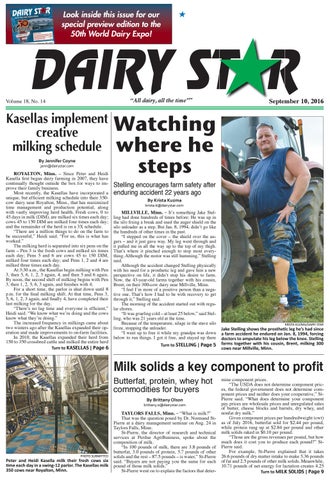
Kasellas implement creative milking schedule By Jennifer Coyne jenn@dairystar.com
ROYALTON, Minn. – Since Peter and Heidi Kasella rst began dairy farming in 2007, they have continually thought outside the box for ways to improve their family business. Most recently, the Kasellas have incorporated a unique, but efcient milking schedule into their 350cow dairy near Royalton, Minn., that has maximized time management and production potential, along with vastly improving herd health. Fresh cows, 0 to 45 days in milk (DIM), are milked six times each day; cows 45 to 150 DIM are milked four times each day; and the remainder of the herd is on a 3X schedule. “There are a million things to do on the farm to be successful,” Heidi said. “For us, this is what has worked.” The milking herd is separated into six pens on the farm – Pen 3 is the fresh cows and milked six times each day; Pens 5 and 6 are cows 45 to 150 DIM, milked four times each day; and Pens 1, 2 and 4 are milked three times each day. At 3:30 a.m., the Kasellas begin milking with Pen 3, then 5, 6, 1, 2, 3 again, 4, and then 5 and 6 again. By noon, the second shift of milking begins with Pen 3, then 1, 2, 5, 6, 3 again, and nishes with 4. For a short time, the parlor is shut down until 8 p.m. for the nal milking shift. At that time, Pens 3, 5, 6, 1, 2, 3 again, and nally 4, have completed their last milking for the day. “There’s no lag time and everyone is efcient,” Heidi said. “We know what we’re doing and the cows know what they’re doing.” The increased frequency in milkings came about two winters ago after the Kasellas expanded their operation and made improvements to on-farm facilities. In 2010, the Kasellas expanded their herd from 150 to 350 crossbred cattle and milked the entire herd Turn to KASELLAS | Page 6
Watching where he steps
September 10, 2016
Stelling encourages farm safety after enduring accident 22 years ago By Krista Kuzma
krista.k@dairystar.com
MILLVILLE, Minn. – It’s something Jake Stelling had done hundreds of times before: He was up in the silo xing a break and used the auger shield on the silo unloader as a step. But Jan. 8, 1994, didn’t go like the hundreds of other times in the past. “I stepped on the cover – the shield over the augers – and it just gave way. My leg went through and it pulled me in all the way up to the top of my thigh. That’s where it pinched enough to stop most everything. Although the motor was still humming,” Stelling said. Although the accident changed Stelling physically with his need for a prosthetic leg and gave him a new perspective on life, it didn’t stop his desire to farm. Now, the 43-year-old farms together with his cousin, Brent, on their 300-cow dairy near Millville, Minn. “I feel I’m more of a positive person than a negative one. That’s how I had to be with recovery to get through it,” Stelling said. The morning of the accident started out with regular chores. “It was grueling cold – at least 25 below,” said Stelling, who was 21 years old at the time. Because of the temperature, silage in the stave silo froze, stopping the unloader. “I went up to free it while my grandpa was down below to run things. I got it free, and stayed up there Turn to STELLING | Page 5
KRISTA KUZMA/DAIRY STAR
Jake Stelling shows the prostheƟc leg he’s had since a farm accident he endured on Jan. 8, 1994, forcing doctors to amputate his leg below the knee. Stelling farms together with his cousin, Brent, milking 300 cows near Millville, Minn.
Milk solids a key component to prot Butterfat, protein, whey hot commodities for buyers By Brittany Olson
brittany.o@dairystar.com
PHOTO SUBMITTED
Peter and Heidi Kasella milk their fresh cows six Ɵme each day in a swing-12 parlor. The Kasellas milk 350 cows near Royalton, Minn.
TAYLORS FALLS, Minn. – “What is milk?” That was the question posed by Dr. Normand StPierre at a dairy management seminar on Aug. 24 in Taylors Falls, Minn. St-Pierre, the director of research and technical services at Perdue AgriBusiness, spoke about the composition of milk. “In 100 pounds of milk, there are 3.8 pounds of butterfat, 3.0 pounds of protein, 5.7 pounds of other solids and the rest – 87.5 pounds – is water,” St-Pierre said. “Buyers are not paying you the same for each pound of those milk solids.” St-Pierre went on to explain the factors that deter-
mine component prices. “The USDA does not determine component prices, the federal government does not determine component prices and neither does your cooperative,” StPierre said. “What does determine your component pay prices are wholesale prices and unregulated sales of butter, cheese blocks and barrels, dry whey, and nonfat dry milk.” Given component prices per hundredweight (cwt) as of July 2016, butterfat sold for $2.44 per pound, while protein rang up at $2.84 per pound and other milk solids raked in $0.10 per pound. “Those are the gross revenues per pound, but how much does it cost you to produce each pound?” StPierre said. For example, St-Pierre explained that it takes 26.6 pounds of dry matter intake to make 5.36 pounds of fat and 2.5 pounds of other milk solids. Meanwhile, 10.71 pounds of net energy for lactation creates 4.25 Turn to MILK SOLIDS | Page 9
Page 2 • Dairy Star • Saturday, September 10, 2016
DAIRY ST R www.dairystar.com
ISSN 020355 522 Sinclair Lewis Ave. Sauk Centre, MN 56378 Phone: (320) 352-6303 Fax: (320) 352-5647 Published by Dairy Star LLC
General Manager/Editor Mark Klaphake - mark.k@dairystar.com 320-352-6303 (ofďƒžce) 320-248-3196 (cell) 320-352-0062 (home) Ad Composition Nancy Powell 320-352-6303 nancy.p@dairystar.com Amanda Thooft 320-352-6303 amanda.t@dairystar.com Consultant Jerry Jennissen 320-346-2292 Editorial Staff Andrea Borgerding - Managing Editor (320) 352-6303 • andrea.b@dairystar.com Krista Kuzma - Assistant Editor (507) 259-8159 • krista.k@dairystar.com Missy Mussman (320) 429-1084 missy@dairystar.com Ron Johnson (608) 874-4243 ron.j@dairystar.com Ruth Klossner (507) 240-0048 cowlady@centurylink.net Jennifer Coyne (320) 352-6303 jenn@dairystar.com Cassie Olson (715) 245-6848 cassie.o@dairystar.com Brittany Olson (320) 352-6303 brittany.o@dairystar.com Advertising Sales Main Ofďƒžce: 320-352-6303 Fax: 320-352-5647 Deadline is 5 p.m. of the Friday the week before publication
North America dealers. A glance at what’s inside
Dairy Proďƒžle brought to you by your
Fall harvest can be a hectic time. As things get busy, farmers need to stay vigilant to avoid accidents. Two stories this issue share how dairy farmers Jake Stelling and Dan Kruschke suffered their own on-farm accidents. Stelling now uses a prosthetic leg after losing his left leg below the knee as a result of getting it caught in a silo auger on his farm near Millville, Minn. Read more about Stelling on pages 1 and 5 in the ďƒžrst section. Kruschke inhaled nitrogen dioxide while leveling a silo on his farm near Eagle Bend, Minn. Read about how this has affected him on pages 12 and 13 in By Mark Klaphake ďƒžrst section. But so many good things can come during harvest time, Editor including a church group that offers its services to dairy farmers who need help covering silage piles. Members of Bethel Christian Reformed Church in Sioux Center, Iowa, volunteer their time to cover the piles for area dairy farmers as a way to raise money for the church. Read about their story “One tire at a timeâ€? on pages 2, 3 and 5 in third section. If building a new maternity area or improving calving procedures for your dairy is on your to-do list, check out this issue’s “From our side of the fenceâ€? feature on pages 15 and 16 in ďƒžrst section. Dairy farmers from across our coverage area explain the logistics of where cows calve on their farm and what steps they take during that process. Following harvest, dairy farmers will have to be aware of a change that will be put in place Jan. 1. That’s when a Veterinary Feed Directive (VFD) will be required for medications in animal feeds. Read more about how you can be prepared for the change on page 9 in second section. One tradition that hasn’t changed in Minnesota is the Great Minnesota Get Together. The 12 days of the Minnesota State Fair always bring with it many opportunities to meet dairy farmers and see dairy animals. Read about the Skibas, who provided the animals for this years dairy show case, on pages 9 and 11 in third section. Also check the photo page from the state fair on pages 35 and 37 in ďƒžrst section. As October approaches, so does World Dairy Expo. This year is a big milestone for the internationally known dairy show as it celebrates its 50th anniversary Oct. 4-8 in Madison, Wis. The special section about World Dairy Expo inserted into this issue previews many of the seminars and events going on throughout the ďƒžve-day event.
Favorite quotes from this issue: “To be successful in business you have to surround yourself with people who are smarter and know more in their speciďƒžc areas than you. If you think you’re smarter than them, why are they working for you?â€? - Keith Behouneks, First Section Pages 23, 25
“We’re 40 miles from Canada, right on the edge of the country with islands all around us.� - Alan Mesman, Second Section Pages 14-15
By the Numbers Silage piles the Bethel Christian Reformed Church, of Sioux Center, Iowa, covers each year. (Third Section, Pages 2-3, 5)
25-30: 6.5:
Minutes it takes for one complete rotation of Meadow Star Dairy’s 106-stall rotary parlor. (Second Section, Pages 3-5)
SUPERIOR MIXING OF A WIDE RANGE OF FEEDSTUFFS
Sales Manager - Jeff Weyer (Northern MN, East Central MN) 320-260-8505 (cell) jeff.w@dairystar.com Mark Klaphake (Western MN) 320-352-6303 (ofďƒžce) 320-248-3196 (cell) Laura Seljan (National Advertising, SE MN) 507-250-2217 fax: 507-634-4413 laura.s@dairystar.com Jerry Nelson (SW MN, NW Iowa, South Dakota) 605-690-6260 jerry.n@dairystar.com Mike Schafer (Central, South Central MN) 320-894-7825 mike.s@dairystar.com Lori Menke (Eastern Iowa, Southern WI) 563-608-6477 • lori.m@dairystar.com Megan Stuessel (Western Wisconsin) 608-387-1202 • megan.s@dairystar.com Deadlines The deadline for news and advertising in the Dairy Star is 5 p.m. Friday the week before publication. Subscriptions One year subscription $35.00, outside the U.S. $110.00. Send check along with mailing address to Dairy Star, 522 Sinclair Lewis Ave., Sauk Centre, MN 56378. Advertising Our ad takers have no authority to bind this newspaper and only publication of an advertisement shall constitute ďƒžnal acceptance of the advertiser's order. Letters Letters and articles of opinion are welcomed. Letters must be signed and include address and phone number. We reserve the right to edit lengthy letters. The views and opinions expressed by Dairy Star columnists and writers are not necessarily those of the Dairy Star LLC.
The Dairy Star is published semi-monthly by Dairy Star, LLC, 522 Sinclair Lewis Ave., Sauk Centre, MN 56378-1246. Periodicals Postage Paid at Sauk Centre, MN and additional mailing ofďƒžces. POSTMASTER: Send address changes to Dairy Star, 522 Sinclair Lewis Ave., Sauk Centre, MN 56378-1246.
Visit our website today for details!
UP TO $3,500 OFF SELECT NEW MIXERS Offer Ends: November 30, 2016
RC 200 SERIES HELIX™ REEL COMMERCIAL REEL MIXERS • Open-concept Helix Reel eliminates obstructions for faster mixing • Heavy-duty components and options for long life • Low horsepower requirement for more efficient, economical use 500 – 950 cu. ft. mixing capacities • truck, trailer & stationary models
Lindell Sales & Service Cannon Falls, MN
Hammell Equipment &KDWĹľHOG 01 (LW]HQ 01
Adkins Equipment 'HWURLW /DNHV 01
Northland Dairy Supply (DJOH %HQG 01
Isaacson Sales & Service
Minnesota Ag Group
Blue Hilltop
Lake Henry Implement
Schlauderaff Implement
Dairyland Supply
Fluegge’s Ag
Werner Implement
Northland Farm Systems
United Farmers Cooperative
/DID\HWWH 01
/DNH :LOVRQ 01 /LWFKĹľHOG 01 0RUD 01
Owatonna, MN
3ODLQYLHZ 01
3D\QHVYLOOH 01
6DXN &HQWUH 01 9HUPLOOLRQ 01 :DFRQLD 01
Visit your local Kuhn Knight Dealer today!
INVEST IN QUALITY ÂŽ
KuhnNorthAmerica.com
Schuneman Equipment Co. %URRNLQJV 6' 0LOEDQN 6' :DWHUWRZQ 6'
Scott Supply 0LWFKHOO 6'
Pfeifer Implement Sioux Falls, SD
Marks Machinery :DJQHU 6' <DQNWRQ 6'
Dairy Star • Saturday, September 10, 2016 • Page 3
It’s all inside... FIRST SECTION
Eagle Bend
Kruschke recounts life-threatening incident with silo gas
First Section: Pages 12 - 13 Kittson Roseau
THIRD SECTION
Page 18 Siblings, rst time recipient shine in 4-H Dairy Showcase
Pages 22 - 23 Some Udder Stuff Pages 24 - 30 Classieds
nb or
Miner
Douglas Charles Mix
Lake
Moody
McCook Minnehaha
Anoka Kandiyohi
Chippewa
Meeker
Hennepin Renville
Yellow Medicine
Wright
McLeod
Carver Scott
Sibley Lyon
Redwood
Nicollet Brown
Murray
Rock
Nobles
First Section: Pages 23, 25
Dakota
Rice
Goodhue Wabasha
Cottonwood Watonwan Blue Earth Waseca Steele Dodge Olmsted Jackson
Martin
Faribault
Freeborn
Mower
Winona
Fillimore
Houston
Ha
nso
n
Sa
on vis Da
Dairy Calendar
n
Page 12
Brookings
Isanti
go
Kingsbury
Deuel
Hayeld
Behouneks are annual Dodge County award recipients
isa
Hamlin
Benton
Stearns
Pope
Swift Lac Qui Parle
Codington
Mille Lacs
Morrison
Sherburne
Grant Clark
Pine
Douglas
Stevens
Third Section: Pages 9, 11
Ch
Roberts
Day
Big Sto Stone
Carlton
Crow Wing
sey
Marshall
Aitkin
Todd Grant
Skibas provide Jersey showcase herd for the third time
Washinton
Tra ve
rse
Third Section: Pages 20 - 21
St. Paul
Cass
Kanabec
Kids Corner: The Ewalts
Pages 22 - 23 Bradleys carry on family farm with dairy goats Page 24 Mid-American Hay Auction results Pages 26 - 27 Crop & Weather Report Page 29 The apple of my heart Pages 30 - 31 Dairy Recipes
Page 16 May mailbox prices down in most areas
Ottertail
Wilkin
Webster
Pages 14 - 15 Dairying Across America
Think outside the bunk Page 15
Becker
Clay
r
Roses dairy again, welcome next generation
en
nom
Mah
Itasca
Hubbard
Norman
Third Section: Pages 2 - 3, 5
Clearwater
Polk
Pages 6 - 7
Page 9 UW-Extension explains changes to over the counter feed medications Pages 10 - 11 The “Mielke” Market Weekly Page 12 Dairy markets Page 13 Area hay auction results
St. Louis
Red Lake
Church volunteers raise money, serve farming community
Second Section: Pages 16 - 19
Koochiching
Wadena
SECOND SECTION
Beltrami
Pennington
Maurice
First Section: Pages 1, 6 - 7
A Day in the Life of the Madsen Family
First Section: Pages 18, 20 Lake of the Woods
Marshall
Lincoln
Page 30 Dear County Agent Guy Page 31 Already a farm boy Page 32 Making Cents of Dairy Page 33 Dairy Good Life Page 34 Veterinary Wisdom Page 36 Women in Jeans
Lake Lillian
Ra m
Setting up your farm for success
eu
Second Section: Pages 3 - 5
Royalton
Kasellas milk fresh cows on 6X schedule
New mattresses, high neckrails, BST boost Funks’ herd average
Su
Meadow Star Dairy calls Kandiyohi County home
New Munich
Le
Pennock
Pipestone
Pages 1, 9 Milk solids a key component to prot Page 8 Ag Insider Pages 10 - 11 A devastating ood for NE IA Page 26 FSA News & Notes Page 27 Dairy in the Suburbs Page 28 Who’s on your farm’s team? Page 29
Hutchinson
First Section: Pages 1, 5
Turner
Bon Yankton Homme
Lincoln Clay
Millville
Stelling encourages farm safety after enduring accident 22 years ago
Union
Lyon
Osceola Dickinson Emmet
Sioux
O’Brien
Clay
Palo Alto
Kossuth
FROM OUR SIDE OF THE FENCE: What is your calving protocol? Pages 15 - 16
Plymouth
Kellogg, Minn.
Zone 1
For additional stories from our other zone, log on to www.dairystar.com
Dairy Prole: Matt McNallan Page 39
When they breathe easy, so do you No matter the weather outside, GEA keeps your cows comfortable, healthy and productive inside. Comfortable cows are the most productive. Just like
to provide ideal barn temperature, air quality and
you, they perform their best when they are cool, calm
humidity levels. With our total ventilation solutions,
and content. GEA’s industry-leading curtains and fan
your cows will breathe easier — and so will you. Contact
systems can be integrated with automation technology
your GEA barn equipment representative today.
Page 4 • Dairy Star • Saturday, September 10, 2016
PULL-TYPE
NEW EQUIPMENT
FORAGE HARVESTER
SAUK CENTRE
Best in High Capacity and Chop Quality
TRACTORS NH T5.115 Electro Command, Semi-Pwr Shift .................................... In Stock! NH T6.165 Plus, 16x16 Pwr Shift, 4 RmtsIn Stock! NH TS6.130, Cab, FWA, Pwr. Shuttle .... In Stock! NH Boomer 37 & Boomer 47 with LoaderIn Stock! NH Workmaster 33 with Loader ............. In Stock! NH T6.180 Plus, Susp. Cab., 4 Rmts ..... In Stock! NH T4.90, T4.100 and T4.110 .. 5 to choose from! SKID LOADERS NH L218, L220, L228 ............................. In Stock! HAY TOOLS NH SpeedRower 220 & 260.... ............... In Stock! NH Procart 819, 1022, 1225 Rakes........ In Stock! NH Dura-Vee 1020, 1225, 1428 Rakes .. In Stock! Kemco Inline Bale Wrappers .................. In Stock! NH H7230 & DB313R Discbines ............ In Stock! BALERS NH RB450, RB460, RB560 .................... In Stock! TILLAGE Salford 8208 Plow, 8 Bottom .................. In Stock! Salford I-2218, 18’ Vertical Tillage.......... In Stock! Salford 9809 Ripper................................ In Stock! GRAIN HANDLING Art’s Way 6530 Grinder Mixer, 165 Bu Tank ....................................... In Stock! Parker 505 Gravity Box...... .................... In Stock! FORAGE (2) Miller Pro 5300 Forage Boxes........... In Stock! NH FP240 & FR500 Forage Harvesters . In Stock! MANURE SPREADERS NH 195 ................................................... In Stock! BBI Magna Spread & Endurance .......... In Stock!
USED EQUIPMENT SAUK CENTRE
Is your chopper ready for fall harvest?
We carry the parts you need to make your harvest go smoothly. OEM parts keep your machine performing like new new. Call or stop in today for all your parts needs.
©2016 CNH Industrial America LLC. All rights reserved. “New Holland” is a trademark registered in the United States and many other countries, owned by or licensed to CNH Industrial N.V., its subsidiaries or afÄliates. “Equipped For A New World” is a trademark in the United States and many other countries, owned by or licensed to CNH Industrial N.V., its subsidiaries or afÄliates.
TRACTORS NH TG255, 3350 Hrs, 3 Rmts, Consigned ........................................... $97,000 NH 8770, 2WD, 20.8x42 Duals ............... $49,000 NH T7000 Front PTO/3 Point Kit .............. $6,500 NH TD5050, Cab, FWA, Loader .............. $34,500 SKID LOADERS NH L230, Cab Heat, A/C, Air Seat ......... .$36,900 NH L220, Cab, Heat, AC, 2 Speed .......... $31,500 HAY TOOLS NH 166, Extension, Dual Drive & Pickup Wheels ....................................... $6,500 BALERS NH BR7070, Crop Cutter ......................... $28,900 (2) NH BR7090 .......................Starting at $28,500 NH 664, Auto-Wrap, Twine, 540 PTO ..... $11,900 NH RB560, Specialty Crop ...................... $36,000 TILLAGE Salford 8214 Plow, 14 Bottom ................. $55,500 JD 3710, 10 Bottom Plow. ....................... $42,500 FORAGE Krone EC7500 ......................................... $29,500 NH 365W Hay Head, 15’, Off FX25. .......... $5,900 NH 824 Corn Head, Adapted to Gehl 1085 $3,500 NH 790 Chopper, 6 Knives ........................ $2,500 NH 824 Corn Head, 30”, Off 718 ............... $2,500 NH 919A4 CH, 4R-36”, Fits 1915 .............. $1,750 JD 3975, 3R CH, 7’ HH, Tandems ............Just In! MANURE SPREADERS NH 195, Hydraulic Drive ............................ $8,900 MISCELLANEOUS Berti TA-220 Offset Flail Mower. ............... $4,500
PIERZ
SAUK CENTRE, MN
PIERZ, MN
320-352-6543 • Hwy. 71 South 320-468-2161 -2161 • Hwy. Hwy. 27 W West est Store Hours: Monday-Friday 8-5,, Saturday Satu turday Seasonal Sea aso sona nall
www.modernfarmequipment.com uiipme ent.com
PIERZ
TRACTORS NH TS6.120 & TS6.140 .......................... In Stock! NH T4.75 Powerstar, Cab, Loader ......... In Stock! NH Boomer 47 with Loader .................... In Stock! NH Workmaster 37 with Loader ............. In Stock! NH T7.230 Classic, Powershift, Super Steer ........................................ In Stock! NH T4.90, T4.100 and T4.110 .. 5 to choose from! SKID LOADERS NH L218, L220, L230 ............................. In Stock! HAY TOOLS NH SpeedRower 220 & 260 ................... In Stock! NH H7220 & H7330 Discbines ............... In Stock! NH H5420 Merger, 9’ with 4’ Ext. ........... In Stock! NH ProCart 819 and 1022 Rakes ........... In Stock! NH Dura-Vee 1225 & 1428 Rakes ......... In Stock! Kemco Inline Bale Wrappers .................. In Stock! NH H7230 & DB313R Discbines ............ In Stock! BALERS NH RB450, RB460, RB560 .................... In Stock! NH BC5070 Small Sq, 72 Thrower ......... In Stock! TILLAGE Salford I-4124, HD Vert. Tillage, 24’ ....... In Stock! GRAIN HANDLING Westfield MKX130-74 ............................. In Stock! Parker 605 Gravity Box .......................... In Stock! FORAGE NH FP240, Crop Proc., Tandems........... In Stock! MANURE SPREADERS NH M2080, 185, 195 Spreaders ............. In Stock! MISCELLANEOUS Messer Attachments and Rock Wagons In Stock!
TRACTORS NH TV140, Loader, New Tires ................ $57,500 NH Boomer 35, Loader, FWA, Hydrostatic, 1 Remote, e ote, R4 Tires es ............................. $19,250 $ 9, 50 JD 4055, 2WD, 1650 50 Hrs, Hrss, Sharp Hr Sha ............. $36,900 Fordd 8670, For 8670,, Super 8670 S p r Steer, 540/10000 .......... Supe ............ $54,900 White Whi te 6105C, 6105C, 2WD, D Cab ...........................Just ...........................Jus J t In!
SKID LOADERS NH L230, Cab, Heat, A/C, Perf Pkg ........ $34,500 NH L225, Cab, Heat, AC ......................... $31,500 NH L175, Cab, Heat, A/C ........................ $21,000 NH LS170, Cab, Heat, Hyd. Q-Tach ....... $19,700 HAY TOOLS NH 166 Inverter .........................................Just In! (3) NH 1475, 14’ Haybines .......Starting at $3,500 (3) NH 499, 12’ Haybine, 540 PTO ...................................Starting at $3,900 BALERS NH BR7090, Net Only, Wide P/U ............ $27,900 NH BR780, Auto-Wrap, Standard Pickup ... $9,800 NH BR780, Net/Twine, Bale Command . $17,500 NH BR740a, Auto-Wrap, Wide P/U, Monitor................................................. $15,400 NH BR740, Bale Slice, Net/Twine ........... $17,500 NH 640, Auto-Wrap, Wide P/U .................. $7,800 Vermeer 605J, 5x6 Bale ............................ $5,600 Vermeer 5500 Rebel, Accu-Tie ................. $6,700 JD 327, 30 Thrower, 540 PTO................... $3,900 JD 435, Twine, Bale Kicker ....................... $5,800 JD 469 Premium, Net, Mega Wide P/U ... $34,500 JD 547, Twine, Bale Ramps, 540 PTO...... $8,200 TILLAGE Krause 8200, 25’ Disc, Cush. Gang ........ $35,500 GRAIN HANDLING Sudenga 8”x61’, 540 PTO Drive................ $2,900 Minnesota 250, 320BU Extensions, 10 Ton ...................................................... $1,600 FORAGE NH FP230, 27P HH, 3PN CH, KP ........... $25,500 Miller Pro 5200, 16’ Rear, 12T Tandem .... $7,800 NH 824 Corn Head, 38”, FP Adapter......... $4,500 MANURE SPREADERS NH 155, Splash Guard, New Tire .............. $7,900 MISCELLANEOUS NH 918 Flail Mower ..................................... N $$2,600 Allied 595 Loader, Fits AC 180-200 Series $3,850 A Grouser Skid loader tracks ............................ Call! G
We sell Reinke Pivots & Parts for all Brands of Pivots! KEMCO BENEFITS:
UNITS IN STOCK
Reduce the amount of waste at feeding time, improve your hay harvest efficiency and reduce loss in harvest and storage.
Eliminate the rush of baling hay for threat of an oncoming storm!
Wrap up to 4 bales per minute - 240 per hour! Wraps round bales up to 6’6” or square bales to to 6’6” Increase protein content by up to 8% by wrapping balage Simple & easy to use - one person operation Heavy Built unit - 5,500 lbs.
Check out the video at:
www.br-equipment.com
SAUK CENTRE, MN
Optional Self-Propel Drive Unit Available
320-352-6543 • Hwy. 71 South
PIERZ, MN
320-468-2161 • Hwy. 27 West
www.modernfarmequipment.com
Dairy Star • Saturday, September 10, 2016 • Page 5
ConƟnued from STELLING | Page 1 for a little while to make sure everything would stay running,” Stelling said. That’s when Stelling stepped on the auger shield and his leg fell through. “I just knew I needed to get out of there. I needed to do whatever I could to help myself,” he said. Stelling yelled down to his grandpa to call the ambulance. Then his dad and two neighbors, Jim and Joe Grobe, climbed up to help him until the rst responders arrived. “I tried to convince my dad to try to pull the belts back in reverse so I could try to get out. That wasn’t a very good idea. It really hurt. My thigh was pinched between the iron and the auger, which ended up being a good thing. It was basically like a tourniquet. When he reversed the belts a little bit it was horrendously painful,” Stelling said. A team of people spent three hours to get Stelling out of the silo. “They had to snake the jaws of life up there to cut the metal so I could get freed up,” said Stelling, who stayed conscious the whole time. Once Stelling was out of the auger, they had to gure out a way to maneuver him down the silo chute since they were up about 45 feet. “Jim Grobe went out the chute rst, and then they tied rope around my chest and handed me down the silo. So I was facing opposite the doors and I sat on his shoulders. He basically climbed me down. I don’t know what we would have done without him,” Stelling said about Grobe. Stelling’s lower leg was broken in four places and his ankle in about six places, he said. “It was dangling,” Stelling said about his leg. Once at the hospital, the doctors told Stelling he would probably be there about a week, and they would be able to save his leg. But as time went on, that wasn’t the case. “It was corn silage, so I got a severe infection. And I had a lot of surgeries,” Stelling said. After about ve days, it was decided that Stelling needed an amputation on his lower leg below the knee. Stelling stayed in the hospital six weeks, during which he went through over 20 surgeries. Although he tried to get a prosthetic leg right away, it took about a year for Stellings new body to get used to the articial limb. “I had a lot of skin issues and skin grafts, so that skin was really fresh,”
Stelling said. “I was on and off a leg for awhile. The skin would break open then I would have to wait.” In the meantime, he got around on crutches. Stelling didn’t let the loss of his leg keep him away from farming. Although he recovered during the rest of the winter and into the spring, Stelling got back out on the farm that summer. “There was only so much I could do, but I got into things on the farm on a limited basis,” he said. Stelling was able to mow lawn, run the self propelled mower conditioner and drive the skidloader. “We retrotted a tractor with hand clutch, too,” Stelling said. Once Stelling was able to use a prosthetic leg full-time, he slowly worked into other chores on the farm. Now, there aren’t many chores Stelling can’t do. “There are a few things I choose not to do because it’s a little more difcult – climbing the silo, but we don’t have those anymore. I’m not as nimble or quick sorting cows,” Stelling said. “And, I always have to watch where I step.” Although he still occasionally milks when a ll-in is needed, he said it’s a tough chore for him. “I like milking. I don’t mind milking actually, but it’s one of the hardest things on my leg – just standing on the concrete,” he said. Despite the challenges over the years, Stelling said he’s always tried to stay positive. “There wasn’t any point in being negative about it. Most likely (a positive attitude) helped my recovery. I think the whole situation probably taught me life lessons at an earlier age,” Stelling said. Although Stelling considered himself a cautious person before the accident, he feels it has made him more vigilant. “I try to always be safe and not take chances,” he said. With eld work ramping up with fall harvest approaching and the upcoming farm safety week Sept. 18-24, Stelling wants to remind other farmers to remain alert. “Pay attention to safety decals because they’re on there for a reason. Try to make sure your equipment is in good shape,” Stelling said. “It’s hard with so many different things to see every little possible thing go out, but just be vigilant. Working long days, especially during harvest season, it’s pretty easy to be more lax.”
Make every meal count Herd Builder Calf Starters and Milk Replacers
Grow Them Right!
320-836-2145 or 800-450-2145
Check out our newly redesigned website to ½nd a Famo Feeds dealer near you!
www.famofeeds.com
s n o i t a l u t a ongr
C
Shana Hilgerson
We Sell and Service Generators! USED GENERATORS
Onan 15 KW w/powershaft .......................... $900 Niagra 15 KW w/powershaft ........................ $900 Pincor 16 KW w/trailer & powershaft ........ $1,300 Katolight 18 KW w/trailer & powershaft ............................................. $1,800 Winpower 50/30 PTCD ............................. $3,000 Winpower 20/12 PTZ w/powershaft............. $900 Each WINCO PTO generator is designed Winpower 12 PT2 generator w/powershaft . $700 using the highest quality components Surge 25 KW ............................................ $2,500 and the best workmanship available.
WE STOCK FRACTIONAL TO 10 HP SINGLE AND 3-PHASE MOTORS! Used Leeson 1.5 HP motor, instant reversing .................. $250 GE 3 HP ................................ $300 Baldor 1 HP ........................... $175 Dayton 1 HP .......................... $100
We repair all brands of motors! We specialize in fast, dependable service
We also have Hanson Silo Replacement Parts Available!
AMPS, INC. 105 County Rd. 10, Albany, MN • 320-845-4690
On being selected as the Iowa Dairy Princess Alternate.
We’re proud to have you represent us this coming year! 24548 HWY 13, Elkader, IA 563-245-2560 | Fitzgeraldincdairy.com
Page 6 • Dairy Star • Saturday, September 10, 2016
ConƟnued from KASELLAS | Page 1
PHOTO SUBMITTED
The fresh cow pen is understocked to provide enough stalls for each animal to lie comfortably in between milkings.
BUNKER SILO •• H-Bunks Fenceline
Bunks • 115 Bu. Steer Stuffer • Individual Yard Bunks Backed by over 40 years proven experience!
MANCHESTER Livestock Auction, Inc.
(40 miles west of Dubuque, Iowa on 4 lane Highway 20)
DAIRY SALES 2nd Fridays Monthly at 11:00 AM Selling 150 to 250 Head
PRECAST SYSTEMS
Sheep and Goats sell at 9:30 AM
1-888-693-8440 • www.darwinconcrete.com
www.manchesterauction.com
Hwy. 12, Darwin, MN 55324
563-927-2540
rates. e l b a n o s a e R . n ig s e d l Professiona
. e g a n i a r d e v i effect
Ag Tech Drainage is committed to g g yyou the best drainage g services. bringing
Brad Herickhoff Herickhoff, Owner Office: 320-351-4872 Cell: 320-293-0882 brad@agtechdrainage.com
three times each day; at the same time, they built a low-cost swing-12 parlor. Four years later, they constructed a sand-bedded freestall barn. “After the expansion, there were 12-hour shifts and we noticed a lot of lag time,” Heidi said. “With more cows and a new parlor, our equity was used up. We needed to nd something that made the most sense.” A year later, in January 2015, the Kasellas transitioned their fresh cows into a 6X milking routine. It was a concept Peter had pondered after attending a calf conference some time ago – a concept that could produce additional milk, but more importantly, put the cows’ health needs at the forefront. “We looked at [dairy’s] counterpart. Beef calves are suckling constantly. How do we mimic a natural process and make it most efcient?” Peter said. “The question was, did we have enough time in the parlor?” After consulting their dairy team, the Kasellas realized this procedure was possible, however, any pen in the herd could not be in the holding area and milking parlor for more than three hours each day. The rst approach to the new milking schedule was to ensure the fresh pen was consistently understocked with a maximum of 50 cows, Heidi said. “It’s a puzzle to gure out how many cows can t in the pen and make sure they are only away from the pen for a half hour to be milked,” she said. Peter agreed. “We had to make sure the cows weren’t in the parlor too long. They needed sufcient time lying down,” he
HEIDI KASELLA, DAIRY FARMER
After the fresh cows had been in milk for 45 days, they switched to the 3X schedule the remainder of the herd was following. However, the transition was too dramatic for that early-lactation group. “They started acting like they dried off,” Peter said. “We needed to tighten the schedule and see what could work with our team.” Heidi agreed. “Cows would stand by the gates
THE NO COMPROMISE FABRIC STRUCTURE DAIRY, MACHINERY & HAY STORAGE
Commercial Agri Buildings
bill@agtechdrainage.com
gene@agtechdrainage.com
“With more cows and a new parlor, our equity was used up. We needed to nd something that made the most sense.”
Turn to KASELLAS | Page 7
Bill Pasche, Sales & Design Cell: 320-293-6951 Gene Mensen, Sales Cell: 320-429-1036
said. “It’s hard to do what’s best and make the timing all work right.” With milking six times in a day, the fresh cows have become the most efcient group in the Kasellas’ herd. “They know they’re on a strict schedule,” Heidi said. “They come back from the parlor, pound the feed and water, and then lay down.” Over the course of six months, the Kasellas monitored the change in management, tweaking the milking routine to keep the cows comfortable. Although the schedule had been ne tuned and incorporated into the dairy for almost a year, it was still not perfect for the Kasellas.
CALL FOR S WINTER DISCOUNT
WE ALSO SELL REPLACEMENTTARPS!
Single and Truss Arch available from 20’-120’ wide Flo-Coat® Galvanized Steel Tubing Supplied by Allied Tube & Conduit Heaviest gauge steel in the industry Pre-engineered truss buildings
NELSON’S AGRI STRUCTURES
Dean Nelson • Central and Northern Minnesota • Grove City, MN • 320-857-2633, Cell 320-699-3297
RIVERSIDE HOOP BARNS, INC.
US Hwy. 75 At IA/MN Stateline • Steen, MN • 507-392-2870 • Fred A. Tilstra & Sons
LANGE CONSTRUCTION & CONCRETE
Duke Lange • Swanville, MN • 320-290-0859
LAKESIDE HOOP STRUCTURES, LLC
3/4 mile South of I-94 on Hwy. 71 in Sauk Centre.
Eastern Minnesota and Wisconsin • Harris, MN • 651-248-6302 • Craig Moline
ASK US ABOUT GOVERNMENT FUNDING FOR HAY STORAGE
Dairy Star • Saturday, September 10, 2016 • Page 7
ConƟnued from KASELLAS | Page 6 and bellow,” she said. “They weren’t happy going six to three. We tried 4X hoping it would help, and it denitely did.” This past January, the Kasellas began milking their herd on three different schedules. While adding the 6X routine was easy, creating a 4X routine posed challenges as available time in the parlor, employees’ work schedules, and feeding time and availability were all key factors in the transition. “It’s been a huge learning curve. We didn’t have examples, so it was all trial and error,” Peter said. “Now, everything works like clockwork. It’s seamless.”
“It’s been a huge learning curve. We didn’t have examples, so it was all trial and error.” PETER KASELLA, DAIRY FARMER
Almost immediately after the schedule changes, Peter and Heidi noticed vast health improvements in their cows, namely displaced abomasums and ketosis cases became essentially non-existent. “Really, we’re seeing cows more often throughout the day and there happens to be less mastitis,” Peter said. Heidi agreed. “We’re interacting with them more and seeing problems quicker,” she said. Additionally, milk production increased and the cattle are able to hold their peak longer.
PHOTO SUBMITTED
Peter and Heidi Kasella and their children – (from leŌ) Callen, 4, Eli, 8, Abraham, 11 months, and Sophia, 10 – milk 350 cows near Royalton, Minn. Two years ago, the Kasellas began milking their fresh cows six Ɵmes each day; in January, they began milking their cows 45-150 DIM four Ɵmes each day. “We don’t see them lollygagging,” Peter said. “We’ve found the natural tendencies of a cow and made it work on our dairy.” While this milking routine has worked exceptionally well for the Kasellas, both Heidi and Peter do not encourage others to be too quick to change their routines, but rather seek out the right opportunities to improve
their dairies. “Our philosophy has always been to do the right thing everyday, with our kids, employees, marriage and cows,” Heidi said. “You have to do what’s right for the cows.” Peter agreed. “This is not the only way to do that,” he said. “Find an avenue that leads you to the right decision and do
that.” For the Kasellas, venturing towards a unique avenue of milking has created a healthier, more efcient dairy herd, and endless possibilities for the future. “This will snowball into whatever is next for us,” Heidi said. “We’re passionate and never complacent. We’re going to be in this industry for a long time.”
Precision Hoof Care, LLC Sauk Centre, MN
320-333-6618 Bret Illies
MF 7724 Call for details
BUY RENT LEASE
Corrective & Maintenance Trimming
MF 2705 E Call for details
BUY RENT LEASE
Sunflower 4213-11 Call for details
Midwest Grain Roasters Become your own protein supplier.
Roast your own Beans! Quality Roasted and steeped for
MF 5613 w/loader Call for details
Villard Implement Co.
Value Stop paying trucking, elevator fees, grain bank charges and excessive shrinks
Experience We’ve roasted millions of bushels Fully equipped with fuel, electricity, boom auger discharge and operator. It only takes minutes to set up and then we roast 10 tons per hour.
Demco 850 grain cart $29,500
MF 9895 Combine Call Demco 650 gravity box $13,500
TRACTORS
Quality portable roasting since 1989
800-366-3402
midwestgrainroasters.com
316709_9-28-05
MF 2250 baler Call for details
Villard, MN • (888) 554-3111
By-pass protein
Convenience
Sunflower 4511-15 Call for details
JD MT .................................................................$3,500 JD 7330 w/741 loader .............................$105,000 MF GC1705 w/60” deck ............................... Just In MF 8690, FWA, loaded, 1 yr. old....................Save MF 8650 CVT ........................................... Coming In MF 8650, 1 yr. old, 300 hrs. ......................... Just In MF 8650 .......................................................$120,000 MF 8650, 1750 hrs. ...................................$115,000 MF 8470, only 2500 hrs............................. $97,500 MF 7497 ......................................................... 105,000 MF 6490, AWD ............................................. $82,000 MF 6490, AWD, 2,000 hrs. ........................ $80,000
MF 5455, only 1400 hrs ............................ $39,500 MF 1652L Compact Tractor w/loader, cab ... Just In MF 1635 w/cab ............................................... Just In AGCO Allis 9670, only 4000 hrs ............. $39,500 AGCO DT-205B ...........................................$105,000 AGCO DT-180A, CVT .................................. $82,500 AGCO LT75A w/loader, only 175 hrs .... $50,000 AGCO GT75 w/loader ................................... Just In IH M Farmall.....................................................$1,950 Ford 876, 4WD ............................................. $32,500
PLANTERS
White 9108 Planter ..................................... Coming In White 8524-22 CFS planter ...................... Coming In White 8222 12 row w/liquid ............................ Just In White 8182 12 row ........................................... $40,000 White 8108, 2 yrs. old, like new ............................Call White 6100 12 row ........................................... $12,000 White 6100 8 row w/7 row skip unit ............. Just In White 5100 8 row 30” .........................................$5,500 JD 1770, 16 row, dry fert. ............................... $25,000 JD 7200, 12 row w/dry fert ............................ $15,000 JD 7200, 6 row, conser planter................ Coming In Case IH 900, 6 row w/dry fert., cross auger $7,950 Kinze 3700, 24 row 30”.............................................Call
SKID STEERS & SPREADERS
Gehl 7810E ................................................................$27,000 Gehl 4835, cab-heat .................................................Just In Gehl 5640E, 2 spd. ..................................................$17,000
Gehl 5640E, 2 pd. ....................................................$24,500 Gehl RT-175 track loader.........................................Just In Gehl V-400, only 50 hrs .........................................$50,000 Gehl V-330, 300 hrs. ..................................................Just In Bobcat S650..............................................................$27,500 CT445 track loader .................................................$25,000 Meyers 7400 spreader .............................................Just In MF 711 .......................................................................... $1,950
MISC. ITEMS
JD 510, 7 shank disk chisel ..................................$10,500 MF 9895 combine, only 438 sep hrs ........................ Call Case IH 870, 9 shank ripper......................................... Call Sunflower 7200-28 Soil Cond................................Just In Sunflower 4610 ripper .....................................Coming In Sunflower 4511-13 disc chisel ......................Coming In Sunflower 4411-9 ripper ......................................$24,000 Sunflower 1435-26 disc ...........................................Just In Sunflower 1435-23 tandem disc w/mulcher $35,000 Sunflower 1434-32 tandem disc .......................$32,500 Krause 4900, 30’ disc................................................ $9,500 Geringhoff 6 row chopping head ....................... $8,500 Demco 650 gravity box ...........................................Just In MF 2170XD baler ................................................. $100,000 MF 2150, only 11,000 bales.................................$65,000 Vermeer 5500 round baler .....................................Just In Vermeer 605N, only 500 bales ..............................Just In Vermeer 605M, low bales ............................................ Call Vermeer 605M corn stalk, only 1500 bales....$39,500
Adjustments sought in MPP program Page 8 • Dairy Star • Saturday, September 10, 2016
National Milk Producers Federation Senior Vice-Presi- crop loss. This executive order also calls for the creation of dent of Communications Chris Galen said his organization a new task force to study the issues impacting pollinators. wants Congress to take a fresh look at the Margin Protection Program. “It has never done before and so I think there were An assessment of the hay market a number of economic assumptions that were made about Rock Valley Hay Auction owner/manager Paul McGill the structure of the program and some of those said a big hay crop was produced this year, but things need to be corrected going forward.” the quality varies. “The main difference is on Ag Insider The formula for calculating feed costs and the demand side,” McGill said. “The demand premium rates are among the aspects of MPP is as not as good as it was last year. As we that may need to be changed. The Red River get closer to fall, we usually see decent rallies Farm Network asked Galen what he considwith a panic that winter is almost here. There’s ered the biggest challenge in the upcoming been a little relief that milk prices have come Farm Bill discussion. “M-O-N-E-Y,” was the up, which will help dairy farmers.” Looking response. “There is only a limited amount of ahead into next year, McGill said it will conmoney that Congress has to work with and tinue to be a challenging market. “There is a when you break it down between the different lot of silage being chopped. The yields look commodities and the feeding programs, that is to be really good. That will be a factor. Farmthe big issue hanging over this.” ers are buying lower, cheaper quality hay than they would normally.” By Don Wick USDA to purchase surplus cheese USDA plans to purchase 11 million Silage season underway Columnist pounds of cheese for food banks. The $20 milIt doesn’t matter if the crop is going into lion purchase is designed to reduce a cheese a bunker, bag or silo; proper moisture is critisurplus, which is at a 30-year high. USDA has also extended cally important for corn silage. University of Minnesota the deadline for dairy farmers to enroll in the Margin Pro- Extension Educator Jim Paulson likes to see that moisture tection Program to December 16. The previous deadline level at 65-68 percent. “We can lose a lot of the advantages was September 30. we have in certain hybrid selection or other things like that if we let it get too dry,” Paulson said. “The digestibility of Lawmakers upset with Canadian dairy pricing plan everything decreases with that increasing maturity dropping New York Senator Chuck Schumer and Wisconsin moisture. Moisture, moisture, moisture is so critical.” Senator Tammy Baldwin have asked the Obama Administration to investigate Canada’s new dairy pricing policy. Funding for wetland mitigation The lawmakers contend these policies encourage Canadian The USDA is providing more than $7 million to fund dairy processors to use domestic milk, penalizing them for ag wetland mitigation banks in ten states. The Minnesota the use of imported dairy products. The National Milk Pro- Board of Water and Soil Resources, Dakota Wetland Partducers Federation and U.S. Dairy Export Council are prais- ners, LLC in North Dakota and South Dakota all received ing Schumer and Baldwin in their efforts. funding. “For us, that funding is going to go for increased technical assistance to landowners who are looking at poProtecting pollinators tentially restoring wetlands to deposit into the bank,” said The State of Minnesota is implementing new restric- Les Lemm, wetlands section manager, Minnesota Board of tions on the use of neonicotinoid pesticides. Governor Water and Soil Resources. “We’ll also be using some of that Mark Dayton has signed an executive order to protect bees money to facilitate the development of mitigation credits and other pollinators. With this order, the Minnesota Depart- through the restoration of wetlands. We’ll use some of that ment of Agriculture will require proof that these pesticides money for contracts for establishing the wetlands and the are needed to prevent the imminent threat of a signicant credits associated with them.”
Feed industry groups petition for VFD change The American Feed Industry Association and the National Grain and Feed Association have asked the Food and Drug Administration to ease the regulatory burden from the Veterinary Feed Directive. The feed industry groups want to see an exemption from some of the electronic recordkeeping rules. The cost of developing a computerized electronic records and signature system is estimated at $225,000 for each facility. The FDA has 180 days to respond to this request, but with the January 1 implementation date, the organizations are asking the agency to make changes sooner. Iowa feed plant upgraded The Purina Animal Nutrition Plant in Mason City, Iowa has gone through a modernization effort. A $2.4 million capital investment will increase production capacity. This facility makes feed for dairy and beef cattle, hogs, sheep and poultry. Dean Foods names new CEO Ralph Scozzafava will take over as the chief executive ofcer of Dean Foods on January 1, succeeding Gregg Tanner. Tanner is stepping down after ten years as CEO. Scozzafava is now the company’s chief operating ofcer. Dykes to succeed Tipton at IDFA Michael Dykes has been named the new president and CEO of the International Dairy Foods Association. Dykes will join the IDFA staff in October and take over the CEO job in January. Previously, Dykes was the vice president of government affairs for Monsanto. Connie Tipton, who has been at the helm of IDFA for 35 years, is retiring. Trivia challenge There are four sticks of butter in a typical pound package. That answers our last trivia question. In the cheese making process, a coagulant is added to curdled milk. For this week’s trivia, what is it? We’ll have the answer in the next edition of Dairy Star. Don Wick is a partner and broadcaster for the Red River Farm Network, based in Grand Forks, North Dakota. Wick has been recognized as the National Farm Broadcaster of the Year and served as president of the National Association of Farm Broadcasting. Don and his wife, Kolleen, have two adult sons, Tony and Sam, and ve grandchildren, Aiden, Piper, Adrienne, Aurora and Sterling.
www.fullersmilkercenter.com
Dairy Star • Saturday, September 10, 2016 • Page 9
ConƟnued from MILK SOLIDS | Page 1 pounds of fat, 2.55 pounds of protein and 1.54 pounds of other milk solids. One pound of metabolizable protein makes 0.17 pounds of fat and 0.08 pounds of other milk solids, but slightly multiplies itself inside the cow to produce 1.49 pounds of milk protein. Regarding the nancial implications of producing each nutrient, StPierre explained that one pound of net energy costs $0.083, with effective neutral detergent ber costing $0.052 per pound. Metabolizable protein was by far the most expensive nutrient at a price of $0.518 per Dr. Normand pound. St-Pierre Fat and protein led the charge with income over feed costs at $1.98 and $1.85 per pound, respectively. Other solids sat at a loss after feed expenses, with eight cents per pound being lost. The remainder of that 100 pounds of milk – water – gets ushed down the drain, as it holds zero value in the wholesale market. “Processors do not want water,” StPierre said. “The lesson here is that you make money on seven pounds and lose money on the other 93 pounds. The rst three-quarters of a pound of butterfat or protein pay for the maintenance costs.” St-Pierre went on to compare two hypothetical herds of equal size. One herd averaged 90 pounds of milk per cow with 3.5 percent butterfat and 2.9 percent of protein, while the other herd averaged 85 pounds of milk per cow with 3.8 percent butterfat and 3.1 percent protein. Given current pay prices for milk solids, the rst herd received $15.63 per cwt., and with feed costs of $6.45 per cwt. their net income was $9.18 per cwt. On the other hand, the second herd’s feed costs were slightly higher at $7.17 per cwt. because they were feeding a touch more energy and protein, but a pay price of $17.37 lessened the blow and netted them a higher income over feed costs at $10.20. In summary, milk solids have a major impact on pay prices. St-Pierre said, “You make all your money on around seven pounds per cwt. and lose money
on what you produce the most, such as water and other milk solids.” “Milk prices are not xed, and they vary across time and across herds based on milk components,” St-Pierre said. As far as the future of component pay prices, St-Pierre spoke of the difculty of creating price forecasts beyond six months into the future. Even though the United States has more cheese in storage compared to even 10 years ago, there are also more people. In addition, the average American consumes 35 pounds of cheese per year – a fact that wholesale buyers of milk solids are aware of. “A lot of buyers still remember 2014 when prices reached record highs,” St-Pierre said. “They’re buying cheese now while it’s still cheap.” To build on that momentum, American dairy exports are slowly rising after plateauing earlier this year despite a strong U.S. dollar in part because, as St-Pierre explained, international buyers can count on American dairies to deliver a quality product on time, making them more tolerant of higher prices. In addition, European production is slowing down as a result of the end of their long-standing production quota, and low pay prices in Oceania (Australia, New Zealand and other Pacic Island nations) are causing many dairy producers in those countries to either rein in their production or leave the dairy business. Also, whey milk powder prices at Global Dairy Trade are up 18.6 percent as developing nations begin to use more animal protein in their diets. Stateside, class III futures from August through November this year are closed above $17 per cwt. and protein prices are stronger than they have been the last six months. Whey prices and nonfat dry milk prices continue to improve. Even though fat prices are uncertain due to downward pressure, all the factors at play at home and abroad are creating a silver lining for milk prices that American dairy farmers have been longing to see – thus making milk solids all the more crucial to a dairy farm’s bottom line. “You’re making your money on seven pounds of milk,” St-Pierre said. “Instead of making more water, make more solids.”
“It’s really simple to use.” When did you start using the Porta BHB ketosis test? How many years have you been testing with DHIA? Four years. How has testing with DHIA beneÀted your dairy? It’s important for me to know the somatic cell count of the cows and I really like the production reports, especially the monthly ones. The preg tests are valuable to me as well. When did you start using the Porta BHB ketosis test? I started six months ago. I did it for the convenience of checking for subclinical ketosis. What is the process of using the test? I use it 12 hours after a cows freshens if they don’t look like they are taking off. Then I will check one month into the lactation if they are not hitting their peaks properly or if they are losing body weight. What advantages are there to using the Porta BHB test? The convenience of it. It’s really simple to use. They have a diagram right there to show you how severe of case it is. Why is this test important to your dairy? It’s just another tool to keep the cows healthy. The speed of the test is terriÀc.
Trevor Lisson • Staples, Minn. Milking 40 cows Minnesota Dairy Herd Improvement Association 307 Brighton Avenue South Buffalo, MN 55313 1.800.827.3442 www.mndhia.org
STE ER, AND REC EIV E UP TO TRA DE YOU R CUR REN T SKI D
WH EN YO U SW ITC H TO GE HL BY OCT OBE R 31, 201 6
Do the math when choosing roasted soybeans 1. Increases milk production 2. Maximizes milk components 3. Minimizes feed refusals 4. Properly roasted at the correct temperature 5. Soybeans are steeped for 30+ minutes 6. Soybeans are roasted to the core 7. Energy 8. Protein 9. Amino acids 10. Bypass protein
Rebates and Competitive Trade offer expires 10/31/2016. Available at eligible and participating authorized Gehl dealers in the United States and Canada. Offer not available to government accounts, national accounts, and municipal/utility bid customers. Some restrictions apply. Competitive Trade Rebate requires a trade-in of a competitive skid loader brand to qualify. Offer valid only on purchases of a Gehl R260 or Gehl V270 GEN:2. See dealer for more details. Manitou Americas, Inc. reserves the right to extend or discontinue any of these programs at any time without notice.
gehl.com
• Arnolds St. Martin, Willmar, Kimball
KL roasted soybeans ... KLC b bovines everywhere preferred by
Roasting, Inc.
2,700 lbs. capacity
CALL YOUR LOCAL GEHL DEALER FOR MORE DETAILS!
0 1 t c e f The Per KLC Farms
2,600 600 lbs. capacity apacity
1-877-738-2326 Visit www.roastedbeans.com
Quality
Consistency
• Jungclaus Implement Glencoe • KLS Implement Inc. Elrosa • Northland Farm Systems Inc. Owatonna • United Farmers Cooperative Lafayette
Page 10 • Dairy Star • Saturday, September 10, 2016
FARM-RITE EQUIPMENT, INC.
www.farmriteequip.com
A devastating ďƒ&#x;ood for NE Iowa
It’s hard to believe the best can be even better. But with extensive feature upgrades, increased visibility and a more comfortable cab, BobcatŽ 500 platform loaders defy the odds. Dassel, MN
320-275-2737 888-679-4857
,OWER COST THAN SORTED SEMEN
Willmar, MN
320-235-3672 877-484-3211
St. Cloud, MN 320-240-2085 844-262-2281
(%)&%20,53¸ Sex the bull of your choice!
HEIFER CALVES
.OW AVAILABLE IN SINGLE AND MULTI DOSE VIALS
"OOSTS FERTILITY *UST MIX INSEMINATE
HTTP YOUTU BE . :S1Y XUK
Mfg. by EMLAB GENETICS WWW EMLABGENETICS COM
PHOTO SUBMITTED
A hay shed on the Dietzenbachs’ farm stands in water from the ďƒ&#x;ooded Turkey River on Aug. 24. The Dietzenbach family lost round bales of hay and corn stalks, and had numerous acres under water because of ďƒ&#x;ooding on their farm near Fort Atkinson, Iowa.
JERRY MANNING
Hot Water High Pressure Washing All pipelines cleaned and covered before whitewashing Family business since 1982 Dairy Barns • Steel Barns Jerry Manning • (218) 346-3671 Serving Minnesota & Western Wisconsin
CANOLA MEAL CORN GLUTEN FEED CORN DISTILLERS GRAINS CORN STARCH LINSEED MEAL FLAX SEED OAT HULLS RICE HULLS SOYBEAN MEAL SOY BEST SOYBEAN HULLS SOY FLOUR SOY PLUS
Dietzenbach one of many farmers to have numerous acres under water By Krista Kuzma
krista.k@dairystar.com
FORT ATKINSON, Iowa – Many northeast Iowa dairy farmers were anxiously watching as rain kept falling the night of Aug. 23 into the morning of Aug. 24. Unfortunately for many, the large amount of rain received in a short period of time – some areas had over 10 inches in about four to ďƒžve hours – resulted in ďƒ&#x;ooded ďƒželds and farmsites. This included Dan Dietzenbach, who milks 70 cows near Fort Atkinson, Iowa. His farm received about ďƒžve inches of rain overnight. “I knew it was going to be bad, possibly like [the ďƒ&#x;ood we had in] ‘08, but I didn’t think it would be worse,â€? Dietzenbach said. Dietzenbach farms together with his wife, Michelle, and parents, Vern and Bernice, on their farmsites along the Turkey River. A large amount of their farmland is ďƒ&#x;at river bottom. Normally, the section of the river that is near their dairy is about 60 to 80 feet wide and 2 feet deep; however, after the excessive rain, the river swelled to over one-fourth of a mile wide and about 20 feet deep, Dietzenbach said. “The water started trickling through [two sheds] and three to four hours later it was three feet deep. We got out what equipment we could and moved it to higher ground,â€? he said.
While one of the sheds housed equipment, the other stored large round bales of hay and corn stalks. “We’ll probably have to take out the whole bottom row. They’re all wet,â€? Dietzenbach said. However, the biggest loss is in the ďƒželd. Just the week before the ďƒ&#x;ooding, Dietzenbach had done yield checks on his corn. The estimates came in between 240 and 260 bushels per acres. But Dietzenbach’s 170 acres sat under water up to the ears for a day. When the water subsided and the insurance adjustor came out to look at the damage, Dietzenbach was told he may need to destroy his ďƒ&#x;ooded crop. “It’s just really discouraging and disgusting. I thought, ‘You’ve got to be kidding me. You’re out of your mind. There’s no way. It’s by far the best crop I’ve ever had,’â€? Dietzenbach said. “Now he tells us we have to plow it under.â€? Dietzenbach hopes there’s another answer. Although he knows the corn won’t be the highest quality, he hopes he can salvage some of his crop. “I’m trying to ďƒžgure out what we can do,â€? he said. “I’m hoping if its not bad in a few weeks we can take it out and harvest it, and take it to the ethanol plants as long as there’s no mold that would carry over to the feed stuffs at the end.â€? The corn is normally chopped or combined and fed to their dairy herd, the bull calves they raise or the Turn to FLOODING | Page 11
AMINO PLUS SOY ISOLATE WHEAT MIDDS WHEAT GERM MEAL BEET PULP CASEINATES CHEESE SCRAPS SAW DUST FOOD BY-PRODUCTS LACTOSE NONFAT DRY MILK SUGAR/DEXTROSE WHEY PROTEIN POWDER
PHOTO SUBMITTED
Corn on the Dietzenbachs’ farm stands in water on Aug. 24 aĹŒer the Turkey River near their farm ďƒ&#x;ooded from rain fall the night before. The Dietzenbach family milks 70 cows on their farm near Fort Atkinson, Iowa.
Dairy Star • Saturday, September 10, 2016 • Page 11
ConƟnued from FLOODING | Page 10 1,000 head of hogs they nish on their farm. In addition to his corn, Dietzenbach also had a small amount of soybean and alfalfa acres that ooded. His dad also had about 85 acres of corn under water. “We’ll have enough good feed for the animals,” Dietzenbach said. Although the ooding covered the farm elds, Dietzenbach said this ood didn’t wash out as many roads or erode the banks of the river as much as he thought it would.
“It’s a disappointment seeing the crop get to this point – a record crop for us – and seeing it disappear right in front of you.” DAN DEITZENBACH, DAIRY FARMER
“The corn was so tall. As the river went through it, it really slowed the water down. Except for the rows right along the river,” Dietzenbach said. “There seems to be less garbage that came in [to the elds than in 2008]. There are more boards and tires and things like that right on the edge of the corn that didn’t necessarily go in. Hopefully when we’re harvesting we won’t nd as much garbage as we did in ‘08. But it’s hard to tell.” When the water went down, the Dietzenbachs started cleaning up their sheds. They couldn’t do much in the elds since it was too muddy.
PHOTO SUBMITTED
Water from the Turkey River spilled out of its banks and into surrounding farm elds near Fort Atkinson, Iowa. Going forward, the Dietzenbachs hope they can get something out of their elds. “It can stop anytime. It needs to stop,” Dietzenbach said about what he was thinking when he watched the rain come down. “It’s a disappointment seeing the crop get to this point – a record crop for us – and seeing it disappear right in front of you. I’m hoping things turn out.”
STE ER, AND REC EIV E UP TO TRA DE YOU R CUR REN T SKI D
WH EN YO U SW ITC H TO GE HL BY OCT OBE R 31, 201 6
2,600 600 lbs. capacity apacity
2,700 lbs. capacity
Rebates and Competitive Trade offer expires 10/31/2016. Available at eligible and participating authorized Gehl dealers in the United States and Canada. Offer not available to government accounts, national accounts, and municipal/utility bid customers. Some restrictions apply. Competitive Trade Rebate requires a trade-in of a competitive skid loader brand to qualify. Offer valid only on purchases of a Gehl R260 or Gehl V270 GEN:2. See dealer for more details. Manitou Americas, Inc. reserves the right to extend or discontinue any of these programs at any time without notice.
gehl.com
CALL YOUR LOCAL GEHL DEALER FOR MORE DETAILS!
Franzen Sales & Service 2724 State Highway 24 Fort Atkinson, IA 52144
(563) 534-2724
www.franzensales.com
Page 12 • Dairy Star • Saturday, September 10, 2016
A closer look by Jennifer Coyne
Industry news addressed with help from your neighbors
The hidden danger of farming
Kruschke recounts lifethreatening incident with silo gas
EAGLE BEND, Minn. – Farming is one of the most dangerous occupations in the United States, and currently has the highest rate of occupational fatalities, ahead of mining and construction, with 22.2 farm-related deaths per 100,000 workers, or 480 lives lost each year, according to the Agricultural Safety and Health Council of America. Dan Kruschke could have been a part of that statistic. On Sept. 26, 2011, Kruschke was exposed to nitrogen dioxide while leveling a small silo on the 40-cow dairy farm he operates with his wife, Susan, near Eagle Bend, Minn. That day still haunts Kruschke. “I remember diving towards the door to catch my
JENNIFER COYNE/DAIRY STAR
Dan Kruschke milks 40 Jerseys with his wife, Susan, near Eagle Bend, Minn. Four years ago, Kruschke inhaled silo gas in the midst of fall harvest. breath,” said Kruschke, goosebumps covering his arms. “Unless I got myself out of there, I was going to be dead.” The tower silo had three loads of silage at the bottom
from two days prior. Before Kruschke could continue harvesting, he had to adjust the chute, which had unevenly distributed the feed. Entering the silo from a
side door, Kruschke dropped his wrench and began the trek down towards the bottom to fetch the tool. “I started feeling dizzy and it was hard to breathe,”
Kruschke said. “That’s when I knew it was silo gas. I had walked right into it.” Nitrogen dioxide is the dangerous result of the ensiling process; a yellow-tinted, heavy gas that lingers in the vicinity for up to three weeks after silage is properly stored. With all his might, the dairy farmer managed to reach the opening of the silo towards fresh air. “I was able to nish lling the silos, but felt like I had the u or pneumonia,” Kruschke said. “After going to the doctor, I was treated with steroids and realized what had happened.” Kruschke suffered from pulmonary edema, where his lungs lled with liquid. In relation to other fatal farm accidents, asphyxiation or toxic effects from gases is acute in comparison, but the effects are equally hazardous and can occur days after the initial contact. The effects of inhaling the toxic gas would be long lasting for Kruschke, who was diagnosed with hypersensitivity Turn to SILO GAS | Page 13
Early Order Season is Here! Now is your time to preorder 2017 seeds at the best prices of the year • KingFisher® Alfalfas • Masters Choice Corn & Corn Silage Hybrids • KingFisher® Cool Season Grasses
Byron Seeds is your High Energy Forage Experts. See us at the 2016 World Dairy Expo Forage Analysis Superbowl! Burkholder Seeds
For more info or dealer inquiries - please call:
Rick Tamm
NW Territory Manager
320-267-5021
Larry Hawkins
NC Territory Manager
608-516-0101
Claremont, MN Dwight 507-279-0292 Justin 507-456-0006
Gerard Becker
Long Prairie, MN (320) 290-9261
Hy View Feeds 507-493-5564 Mabel, MN
Valley View Ag Russ Funke Dyersville, IA (563) 590-6939
Schueler Farms
Greenwald Elevator
Sherman Schueler 330-987-3159 Willmar, MN John Dockendorf (320) 894-4808 Greenwald, MN (320) 290-1240
Jack Stamschror
Altura, MN
Crop & Livestock Nutrition Atwater, MN (320) 212-3190
Cleeson Mill
(507) 458-5907 Luxemburg Feed Service
Luxemburg, MN (320) 252-1513
Winscher Seeds Mike Winscher 320-282-6748 Shawn Winscher Royalton, MN (320) 420-4516
Timberline Dairy Service Joe Graber Kalona, IA (319) 656-3527
Kellogg, MN (507) 259-0269
Dale Ommodt, CCA
Jason Mickelson Frazee, MN 218-849-3137
Lee Kurtenbach
Mechanicksville, IA (319) 241-5105
Peak Forage Products LLC
Benjamin Arlt
Natures Best
Tim Huffman 608-574-7918 Nelson Horst Adam Decker 608-988-6855 Canton S.D. Kevin Zimmerman (605) 359-0765 608-574-7918
Natures Best
Mervin Beachy St. Ansgar, IA (641) 381-0054
Big Stone City S.D. (651) 331-8865
DJ Cattle Co.
Daryn Yoder Leon, IA (641) 344-6002
Chad Tesch Canton S.D. (605) 759-5622 Dan (Boone) Uphoff, Sioux Falls S.D. (605) 321-1862
Natures Best Roger TeSlaa
Inwood, IA
(605) 370-2249
Dairy Star • Saturday, September 10, 2016 • Page 13
ConƟnued from SILO GAS | Page 12 and whose conditions worsened after the farm accident. “You can look at a tractor and see it’s lacking rollover protection and has a narrow front end, and know it’s dangerous,” Dr. John Shutske said. “Unless you see the cloudy yellow tint of nitrogen dioxide against sunlight, gases are difcult to detect until it is too late.” Shutske is an agriculture engineering specialist at the University of Wisconsin-Madison, and has 31 years of experience in farm safety. While tower silos are the most common storage facility where silo gas is detected due to the conned space, any storage facility, including bags and bunkers, retains the dangers of nitrogen dioxide exposure for up to three weeks after initial storage. “In other storage systems, there’s generally a lot more ambient air movement and less risk,” Shutske said. “Although realistically, levels can go from zero to deadly in a matter of minutes.” Hydrogen sulde, developed in manure, is highly toxic, and is most commonly the cause of death near a pit or lagoon. At low levels, the deadly gas smells like rotten eggs, but as concentrations increase, a person’s olfactory nerves go into temporary paralysis, and at 600 to 1,000 parts per million (ppm), a person will stop breathing, Shutske said. “Pits are extremely dangerous and are classical conned spaces,” said Shutske. “Unless a dairy farmer or employee has to work in it, they should know this area is off limits. When work inside of a pit is needed, it’s always best to work with a qualied ag service provider who has the right safety equipment.” For the majority of the U.S. work-
force, the Occupational Safety and Health Administration (OSHA) regulates conned spaces to ensure worker safety. However, OSHA has not focused regulatory efforts on smaller farms with family member employees in most states; as a result, many smaller dairy farms with fewer than 11 hired workers are generally not subject to OSHA actions, Shutske said. “On all types of farmers, the dangers of conned spaces are the same, or even greater as compared to other industries or large farms,” Shutske said. If a farmer must work in a conned space, they need to take the proper safety precautions – wearing a self-contained breathing apparatus and other appropriate safety gear, monitoring the air for adequate oxygen levels and toxic gases, using ventilation fans, and being supervised by one or two other individuals. An effective conned space entry program also includes training, record keeping, and insuring that people using respiratory protection equipment are doing so correctly and safely. “Manure and silage storage systems pose the same threats as conned spaces, such as petroleum storage tanks,” Shutske said. Kruschke, now realizing the danger he was in, takes every precaution when working around the farm, especially during harvest season, from wearing protective gear to creating extra air movement throughout the silo. “I made a mistake. I went in when no one was around and it could have been worse,” Kruschke said. “Now, no one goes near the silage or silo room until it’s safe. If something goes in the silo, it will come out eventually. The risk [of retrieving it] is not worth it.” Shutske agreed.
“Get the proper training, have all the necessary equipment, and stay away during deadly times of agitation or in three weeks after lling a silo,” he said. “Safety needs to be more than common sense. It needs to be specic, tangible things farmers can do on the farm to make it safer.” With each year that passes since Kruschke’s hair-raising experience, and with another harvest up ahead, Kruschke remains grateful for the sec-
2013 NH T8.330 $143,000 240 P.T.O. H.P, 360 hrs., 50” rear duals, high flow hydraulic, power beyond return, 3 P.T.O. shafts, 4 remotes, stereo, Nav II GPS, heavy duty drawbar, monitor bar w/intell II, 360 degree H.I.D. lights, single roof beacon, front weights, rear weights, front fenders, instructor seat, 3 pt quick hitch, NEW CONDITION
PRICE EQUIPMENT SALES, INC. 550 Hwy. 35 • Bloomington, WI 53804
V-MIX FATMIX
ROTOR MIXER
CHAIN MIXER
608-994-2401
CHECK OUR INVENTORY OUT AT www.priceequipmentsales.com
THE LARGEST FEEDING EQUIPMENT LINE IN NORTH AMERICA
VV-MIX MIX
ond chance he has been given. And with precautions, Kruschke is determined to never become one of the 480. “I’ve been farming for 37 years and I love every minute of it; the shortcuts have hurt, but I’m smiling because I’m alive,” said Kruschke, a tear falling from the corner of his eye. “I’m living my dream. I’ll get to retire someday and see my grandkids grow up.”
FOUR AUGER MIXERS
AGRIMIXER
CONTACT THESE DEALERS FOR MORE INFORMATION: ALTHOFF SALES &EASTERN SERVICE, INC. AGRI-TECH INDUSTRIAL IOWA Bangor, WI • 608-486-2032 INC. STRUCTURAL ANAMOSA SILO, INC. Zumbrota, MN Maquoketa, IA • SERVICES 563-652-5125 507-732-5174 Ft. Atkinson, IA ANIBAS SILO & EQUIPMENT, INC. 1-888-303-4445 Arkansaw, ALTHOFF SALES & WI • 715-285-5317 BINDL SALES & SERVICE FIELD SILO & SERVICE,Reedsburg, INC. WI • 608-524-6339 Bangor, WI EQUIPMENT, INC.INC. BLUE RIVER HARVESTOR REPAIR, 608-486-2032 Mt. Horeb, WI Blue River, WI • 1-800-932-4749 608-437-5561 D&D FARM SUPPLY, INC. www.fi eldsilo.com ANAMOSA SILO, INC. Arcadia, WI • 608-323-7001 Maquoketa, IA D&K SALES & SERVICE 563-652-5125 FLUEGGE’S BADGER Ossian, IA • 563-380-7006 SALES INC. SUPPLY ANIBAS SILODAIRYLAND & MN Sauk Centre, MN •Mora, 800-338-6455 320-679-2981 EQUIPMENT, INC. EASTERN IOWA STRUCTURE SERVICES Arkansaw, WI Ft. Atkinson, IA • 1-888-303-4445 715-285-5317 HANSON SILO COMPANY ELMA SILO Lake Lillian, MN IA • 641-393-8421 BINDL SALESElma, & SERVICE 1-800-843-7456 FIELD INC. Reedsburg, WI SILO & EQUIPMENT, www.hansonsilo.com Mt. Horeb, WI • 608-437-5561 608-524-6339 www.fieldsilo.com HIGHWAY 48 FARM SALES BLUE RIVERFLUEGGE’S HARVESTORBADGER SERVICE, INC. Mora, MN • 320-679-2981 Rice Lake, WI REPAIR, INC. HANSON SILO715-234-6788 COMPANY Blue River, WI Lake Lillian, MN • 1-800-843-7456 1-800-932-4749 www.hansonsilo.com K & R EQUIPMENT, INC. HIGHWAY 48 FARM SERVICE, INC. BRUNKAN EQUIPMENT Fountain, MN RiceIALake, WI • 507-268-4425 715-234-6788 Worthington, K & R EQUIPMENT, INC. 1-888-789-2363 Fountain, MN • RUF’S 507-268-4425 FARM SERVICE, MAKI FARM SERVICES DAIRYLAND SUPPLY INC. INC. WI •Darlington, Edgar, WI WI Sauk Centre,Curtiss, MN 800-338-6455 715-613-7308 608-776-4048 RISTAU FARM SERVICE D & D FARMPreston, SUPPLY,MN INC.• 507-765-3873 S.E. MINNESOTA SILO Arcadia,St. WICharles, MN • 507-932-4560 & EQUIPMENT RUF’S FARM SERVICE, INC. 1-800-657-6955 St. Charles, MN
FOLLOW US TEL 608 374-2206 info@valmetal.com
Darlington, WI •507-932-4560 608-776-4048
SALUTE Visit us at WE World Dairy Expo
booth # EH3001-3106B TM749 DAIRY FARMERS!
Page 14 • Dairy Star • Saturday, September 10, 2016
Outstanding Parts & Knowledgeable and Service with Friendly Staff!
Start the revolution!
Our service doesn’t end after the sale. We back our products with knowledgeable and friendly staff so that when you need parts and information, you have only one place to go. We stock a large selection of PTOs, bearings, belts, chains, and sprockets to keep your operation going. Call toll free 1-800-338-6455.
Mike, Warren, Lashana and Gordon
NO PIT IS TOO THICK
The submerged pump & 4WD system make it impossible to get stuck.
Lagoon Crawler
EXCEEDING INDUSTRY STANDARDS THROUGH SUPERIOR DESIGN!
NO PIT IS TOO BIG
The remote control system allows the crawler to get 1000’ away.
Conventional centrifugal pumps only have one discharge on the housing. That means that for every rotation of the fan, the pump is wasting power by trapping manure and not allowing it to easily get out of the housing. By adding multiple outlets, the manure is able to get out of the housing faster, resulting in pumping greater volumes with less horsepower.
Liquid Manure Pump
EASY TO SUPERIOR TRANSPORT AGITATION Available with a PERFORMANCE tandem trailer to get
The 6” front nozzle is able to crush through thick crusts!
from job to job.
PUMPS 10,000 GPM
Quad port header pump is able to move over 10,000 GPM!
HYDRA-SPREAD Delivers Performance
WHEN YOU ARE DONE, JUST DRIVE OUT The large aggressive tread tires allow you to easily drive out of lagoon.
MIX IN HALF THE TIME
The 8” agitator reduces the time spent mixing the pit. It breaks through thick crust, and destroys untouchable islands of solids.
FINISH THE JOB 20% SOONER
USE 50% LESS FUEL
Customer feedback claims that the same job takes 20% less time to complete!
Pump 100,000 gallons of manure per one gallon of diesel fuel! Customers claim the Nuhn pump uses half the fuel of other pumps on the market.
Most folks don’t need this much machine. Those folks can just j stayy in town. This is, quite simply, the most
advanced, best-built manure spreader you’re ever going to see. Now, do you need one this tough? Well, that all depends on how often you like to buy them.
Choice of Heavy Duty Vertical or Horizontal Beaters
SB Series
Spreading Excellence
THE WORLD’S BEST TMR PROCESSOR EACH SUPREME MIXER IS CUSTOM DESIGNED AND BUILT TO ORDER!
900T
DAIRYLAND SUPPLY INC. 320-352-3987 • 1-800-338-6455
Designed to Suit your Needs
Sauk Centre Off I-94 On The Corner Of Hwy. 28 & 71 South www.dairylandsupply.com
From Our Side Of The Fence
Dairy Star • Saturday, September 10, 2016 • Page 15
What is your calving protocol?
Rachael Rusch Ru-Be Dairy, LLC. Grove City, Minn. Meeker County 350 cows Describe your maternity pen or calving area. Our maternity pen consists of a straw bedpack and 15 headlocks at the feed bunk in a cross ventilated facility we built last summer. This pen is separated from the transition pen, but easy for cow ow to access once she calves. We also have six individual calving pens that run adjacent to the maternity pen. We have a surveillance system that monitors the maternity pen, calving pens, and transition pen.
Josh Lingen Balaton, Minn. Murray County 250 cows Describe your maternity pen or calving area. Our maternity pen is about 600 square feet. It’s bedded with straw and ventilated with fans. It also has a big overhead door that we can open to give the cows light and air during the warmer months. Our maternity pen is equipped with multiple video cameras and is located right next to our milking parlor. What is the timeline for cows/heifers entering/exiting the pen? About ten days prior to her due date, we will place a Medria remote calving sensor in the cow’s birth canal. The sensor sends the cow’s temperature information to my smart phone. At about 48 hours prior to calving the cow’s temperature will drop, which means that it’s time to put her into the maternity pen and begin to watch her closely. Thanks to the monitoring system, our calving rate is currently 101 percent. We have lost a few calves at birth, but have also been able to save all of the calves from eight sets of twins.
What is the timeline for cows/heifers entering/exiting the pen? Cows and heifers will enter the maternity pen 21 days prefresh. This gives them time to adapt to the environment, ration, and their new herd mates. They will remain in this pen until the calving process has started. They are then moved into one of the six calving pens. She will then have her calf in the individual pen and remain with her calf for approximately one hour. She is then moved to the transition On average, how many cows are in the pen at a pen where she will remain for a week for close obser- time? We usually have 2-3 cows in the maternity pen. vation. What is your procedure for delivering calves? When the cow pushes the calving monitor out, it sends On average, how many cows are in the pen at a me a signal so I know exactly when labor has begun. time? We have approximately 12 cows/heifers in the We give heifers up to three hours after dilating before maternity pen at one time. We add cows once a week. we look into assisting them and give cows 30- 45 minutes. Over the past ve years, I have called the vet just What is your procedure for delivering calves? Our once to help with calving. I can handle about any situstandard procedure is to allow the cow to try to calve ation by myself. in on her own under observation. Our employees are trained to distinguish if she needs assistance calving. What steps do you take to maintain proper sanitaAt that point, someone from the management team tion? We clean the pen regularly and re-bed it with will assist her in a clean room to aid her with the pro- lots of fresh straw. cess. The vet is called on very difcult calving or cAfter delivery, how do you assist the calf and cow? sections. As soon as a cow goes into labor, I begin to thaw out What steps do you take to maintain proper sani- the colostrum that I will feed to the calf immediately tation? The maternity bedded pack gets cleaned out after birth. We drench all of our fresh cows with Start every 10 days. The calving pens gets cleaned more Strong For Fresh Cows, but drench the heifers on a often. All equipment gets cleaned between each use. case-by-case basis. We make sure that all of our fresh All bottles and calf supplies are either disposed of or animals are given yeast boluses. sanitized after each use. Tell us about the most unique calving you’ve ever After delivery, how do you assist the calf and cow? had. We once had a cow that seemed to calve normally. We put her into the freestall barn with the rest The calf will get vaccinated, naval dipped, and receive of the milk herd and three days later she gave birth to his quality colostrum. The dam will get oral calcium a second live calf. She was claiming it and it had to be and enter the dairy computer system where I can mea- hers, because there was no other cow in the barn who sure her milk weights and monitor milk conductivity could have had that calf. for potential pathogens. Tell us about your farm. We have been milking in Tell us about the most unique calving you’ve ever our robot barn for four years. We milk 130 head with had. Six years ago, I had a heifer calving, but wasn’t our robots and 120 head in our milking parlor. We are sure what was coming. It looked like a prolapse, ex- planning on expanding our robot milking facility and cept I knew she hadn’t calved yet. I reached inside adding another two robots. We are always looking for and felt what was the calf’s organs, such as the heart, ways to be more efcient and feel that the robots have liver, intestines, etc. I called the vet and we ended up greatly increased our efciency. My wife, Andrea, performing a c-section on her because she had ‘schis- and I got married on June 4. My parents, Randy and tosomus reexus’ calf. This is where the calf is en- Denice, moved to an acreage on the lake this summer, tirely malformed and usually can’t pass through the so Andrea and I now live here. We farm about 700 birth canal. The vet said that we would be lucky if the acres and do custom silage chopping for 15 local farmcow survived. If she would live, we shouldn’t breed ers. her back. However, one year later we were preparing to calve her in again with a healthy heifer calf. Tell us about your farm. We milk 350 cows in a freestall barn and a double-8 parabone parlor. Our farm is family owned and run by my parents, Joe and Karen Becker, myself and my husband, Patrick Rusch, and my sister, Jessi Stocker.
SUMMER FARM SUPPLIES AT CHIPPEWA VALLEY
• Pioneer Inoculants • Flavor Seal 30” Bale Wrap, • Twine, all varieties • Fencing Panels • Fencers (battery, solar and electric styles) Speed Rite, Cyclops, Patriot • Also Fencer repairs
715-644-2350
Bret Butterfass Swanville, Minn. Morrison County 1,000 cows Describe your maternity pen or calving area. Our maternity pen is a 25- by 70-foot sawdust bedded pack. What is the timeline for cows/heifers entering/ exiting the pen? The cows and heifers move into a close up pen three weeks prior to calving and then move into the maternity pen based on how close they look from the udder swelling. We try to get them in the pen about three to six days before calving. After calving, they are milked once when they return to this pen and after the second milking they leave. On average how many cows are in the pen at a time? It usually has 15 to 25 cows. What is your procedure for delivering calves? Once we see feet sticking out we wait an hour. If the calf is not out by then, we help. If we know she is calving, but we see no feet, we will assist right away. The vet is only called if we can’t get the calf out. What steps do you take to maintain proper sanitation? We bed the pen every day to keep it dry and clean, and the calf jack and chains are washed after every use. After delivery, how do you assist the calf and cow? After birth, the calf is given an oral vaccine. Within one hour of birth the calf receives a gallon of pasteurized colostrum, a rst defense pill and the navel is dipped in iodine. The cow is given calcium boluses, and yeast and vitamin boluses. Tell us about the most unique calving you’ve ever had. The most interesting calving I have ever had was a set of twins where the rst one was sideways. All I could feel to start with was ribs. Tell us about your farm. I’m a partner and herdsman at Rainbow Acres owned by, Dave VanHeel and his sons, Mike, Daniel and Shawn near Swanville, Minn.. We milk 1,000 cows three times a day in a double-20 parallel parlor. The cows are housed in three different freestall barns – a cross ventilated, a naturally ventilated and a tunnel ventilated – with sand bedded freestalls. We run about 4,000 acres of land where we grow alfalfa and corn, which is mainly for silage and a little bit of dry corn. We raise all the replacements here on the farm along with bull calves and steers.
MARK’S & STEEL SALES
AIR WE REP ! NG ANYTHI
$/80,180 &$67 ,521 67$,1/(66
• Farm Equipment • SHW Bale Spears • Bale Feeders • Pallet Forks • Portable Service • Steel Sales • Aluminum • Cast Iron • Stainless • Shearing • Bending Custom Milling and Machining • Docks • Large Supply of Bolts, Pulleys, Sprockets, Etc.
Osakis, MN • 320-859-2803 www.marksweldingosakismn.com
Wood
Shavings BULK
OR
BAG
S&S Wood Products
Chippewa Valley Dairy Supply
35335 Green Street | Independence, WI 54747
6053 CTY. HWY. G • STANLEY, WI 54768 • Andrew Zimmerman
800-234-5893 | 715-985-3122
We ship Spee-Dee and UPS!
From Our Side Of The Fence
Page 16 • Dairy Star • Saturday, September 10, 2016
What is your calving protocol? Mark Turgasen Sylvan-T Farms, Inc. Richland Center, Wis. Richland County 75 registered Holsteins
Brian Schilling Darlington, Wis. Lafayette County 500 cows
fans.
Describe your maternity pen or calving area. We have two straw-bedded pens that are 24- by 17-foot. The pens are on concrete ooring and are cleaned out every fourth calving. The barn is naturally ventilated with
What is the timeline for cows/heifers entering/exiting the pen? Cows are walked up on every hour to see where they are at. We bring cows into the pen depending on their stage of labor. Cows exit the pen a half hour after calving to be milked and calves are fed within 15 minutes of birth with stored colostrum. On average, how many cows are in the pen at a time? On average, we will have one cow in each pen. What is your procedure for delivering calves? It depends on the cow. We usually let them calve on their own if everything goes right. If they have been struggling for 30 to 45 minutes with no progression, we will vaginally check them to determine from there what needs to be done. What steps do you take to maintain proper sanitation? All of our equipment is cleaned and sanitized after every calving. The pen is cleaned after every fourth calving as well as sanitized. The calves are towel dried right after birth to ensure they are cleaned and we also dip their navels. After delivery, how do you assist the calf and cow? The calves are dried, dipped and then fed colostrum. We usually have enough pooled colostrum stored, but we will use a replacer if we are low. The cow’s stomach is pumped with a custom cow drench and milked for colostrum right after delivery. Tell us about the most unique calving you’ve ever had. The most unique situation I came across was the one time I had four feet and a tail coming out. It was a twin calving and one had its head backwards. So, I had to reach in and try to decipher which calf was which and get them switched around. Tell us about your farm. We milk 500 cows. The farm is owned by myself, my brother Andy and our dad, Bill. We run 1,500 acres of corn and hay. We are milking three times a day in a double-12 herringbone parlor and our cows are housed in a sand-bedded, naturally ventilated freestall barn. We have a current rolling herd average of 32,000 with 3.9 fat and 3.12 protein and currently have a somatic cell count of about 55,000.
Prevent costly falls before they We offer occur grooving & scarifying
Describe your maternity pen or calving area. Our maternity area is in our special needs barn which was constructed in 2012. The barn is 68- by 80-feet, with 18 freestalls on one side for our dry cows and special needs cows. The other side of the barn has two maternity pens 12by 20-feet, and another pen where we group about four calves just prior to weaning. There is also a heated milk room and an area for eight Calf-Tel indoor pens for our newborn calves. All pens have a broomed concrete nish oor and are bedded with straw. The barn is naturally ventilated with curtain sidewalls and has uorescent lighting. What is the timeline for cows/heifers entering/exiting the pen? Cows enter the pen at the rst signs of calving and exit when they can safely be put in our tiestall barn. On average, how many cows are in the pen at a time? There is usually only one cow in the pen at a time. What is your procedure for delivering calves? Cows are given ample time to deliver their calves on their own. We intervene if we feel the cow needs assistance. The vet may be called if the head or leg is back and the problem cannot be corrected on our own. What steps do you take to maintain proper sanitation? Pens are usually cleaned after each calving. Calf pens are cleaned when a calf is moved out, as well. Plenty of straw is used in all pens. After delivery, how do you assist the calf and cow? The cow is immediately given as much warm water as she wants to drink and the calf is given colostrum within an hour or two after birth. Fresh bedding is put down after delivery. A Bovi-calc is administered if milk fever is a concern. In winter months, the calf is dried off soon after birth and put under a heat lamp. Tell us about the most unique calving you’ve ever had. The most unique calving I can remember is when a cow had a twisted uterus and we rolled the cow the usual way to correct the problem, but realized that was the wrong way. So, we had to roll her the other way two more times to deliver the calf. The calf was a healthy boy and we all slept well that night. Tell us about your farm. I farm with my parents, John and Connie Turgasen, along with my wife, Rachel, and our three kids – Logan, 13, Delaney, 10, and Landon, 8. We milk 75 registered Holsteins and crop 400 acres of corn, alfalfa, soybeans, wheat and oats.
BEST FOOTING CONCRETE GROOVING
Strum, WI | Cell 715-579-0531 1-800-323-2451
FOR SALE:
200 good quality Holstein heifers, 6-8 months bred, for sale at all times, shots & trucking included.
MILLER CATTLE 612-201-1613
I F A
Roller-Grinder
More milk less feed with uniform Àne-grind Solid cast rolls All belt-electric drive Single or double mills USA & International sales Replacement rolls available for most mills Used mills and tumble mixers on hand Hammer Mills
Phone: (319) 634-3849 • Toll Free: (800) 426-0261 web: www.ifamill.com • email: ifamill@netins.net
Shea Dairy, Inc. Jason and Tom Shea Viola, Minn. Olmsted County 810 cows Describe your maternity pen or calving area. Our calving area is a 30- by 100-foot area with a lime oor in a curtain sidewall barn. We use corn stalks and straw for bedding. In 2014, we built a 17- by 24-foot warm room for the colder months for easier calf care and for employees. The room includes in-oor heat. What is the timeline for cows/heifers entering/exiting the pen? Usually, cows enter the pen about a week before calving. We move cattle in twice a week in bigger groups instead of a few every day to try not to disturb the other cows already in there as much as possible. On average how many cows are in the pen at a time? There are about 15 to 20 cows in the pen at a time depending on the month. Some months are busier than others. What is your procedure for delivering calves? When cows are showing signs of labor, we move them into a separate pen by themselves. If they are agitated or uncomfortable by themselves, we will try to put an extra cow in with her. We will intervene after about an hour or so depending on how things are coming along. You can usually tell which cows can labor on their own and which ones might need a little help. The only time we call for help is usually at night when there is no extra employees available. Otherwise, our herdsman, Andy Dick, is very good at pulling calves and is able to correct any problems prior to calving if needed. What steps do you take to maintain proper sanitation? We keep the pens cleaned and bedded often. In between calves, we use a sanitizer to spray down the pens the calves are kept in after being born. We also sanitize the oor of the pens when we clean the bedding out about every other week. After delivery, how do you assist the calf and cow? After delivery, we let the cow lick the calf off and spend time with it. We give the cows a YMCP drench to drink and feed the calf colostrum a little while after it is born. After that, the calf will get moved to an individual pen and the cow will go to the parlor to be milked. Tell us about the most unique calving you’ve ever had. Each one is unique in its own special way. Tell us about your farm. Shea Dairy, Inc. was established in 1999. The fourth generation farm is owned by Jerome and Marilyn Shea, Tom and Melissa Shea and their boys, Ryan, 12, and Bronson, 8, along with Jason and Mindy Shea and their boys, Carter, 7, Bennett, 4, and Rowan, 1. The dairy milks approximately 725 cows three times a day and is currently producing 29,000 pounds of milk with a somatic cell count of 87,000. In addition, Shea Dairy, Inc. operates over 900 acres of cropland consisting of mostly corn and hay. Shea Dairy, Inc. strives to produce high quality milk in a modern and highly efcient manner while still being a good neighbor and steward of land, water, and other resources. It also strives to provide a high quality of life for its owners, employees and their families.
Dairy Star • Saturday, September 10, 2016 • Page 17
TRADE YOUR CURRENT SKID STEER, AND RECEIVE UP TO
WHEN YOU SWITCH T O M U S TA N G BY OCTOBER 31, 2016 2,600 lbs. capacity 2,700 lbs. capacity
Rebates and Competitive Trade offer expires 10/31/2016. Available at eligible and participating authorized Mustang dealers in the United States and Canada. Offer not available to government accounts, national accounts, and municipal/utility bid customers. Some restrictions apply. Competitive Trade Rebate requires a trade-in of a competitive skid loader brand to qualify. Offer valid only on purchases of a Mustang 2600R or Mustang 2700V NXT2. See dealer for more details. Manitou Americas, Inc. reserves the right to extend or discontinue any of these programs at any time without notice.
mustangmfg.com
CALL YOUR LOCAL DEALER FOR MORE DETAILS!
DEALER NAME 1234 ANYWHERE LANE CITY, ST, ZIP XXX-XXX-XXXX
USED SKIDSTEERS
‘15 Gehl RT210, dual H ctrls, D, 17” tracks, 3000 lift cap., C/H/A, 2 spd., heater, hyd. float-self leveling, 1200 hrs........... $41,500 ‘14 Gehl RT175, ISO variable spd ctrls., D, eng. block heater ...................... $39,800 ‘13 Gehl RT175, ISO/ dual hand, D, 2500 lift cap., C&H, 2 spd., 475 hrs ............ $34,500 (3) Gehl R220, various features Start at $26,250 ‘14 Gehl R190, hand ctrls, D, 2100 lift cap, C&H, radio, 2 spd, 2159 hrs .. $26,250 ‘14 Gehl R190, pilot ctrls, D, C&H, 2 spd, 2103 hrs............................. $28,500 ‘14 Gehl R190, H ctrls, D, C/H/A, 2 spd, 3020 hrs............................. $23,950 ‘13 Gehl R190, t-bar, D, 2150 lift cap., SS, block heater, 2100 hrs ............ $24,950 ‘13 Gehl R190, JS, D, 2150 lift cap., 2 spd., C&H, 1089 hrs .................. $33,900 ‘07 Gehl 7810, pilot ctrls., D, 3800 lift cap., C/H/A, 490 hrs., 2 spd................... $34,900 ‘04 Gehl 7810, t-bar ctrls, D, C&H, 2 spd., 3800 lift cap., 3597 hrs ................. $21,900 ‘11 Gehl 5640E, T-bar H-ctrls, D, 2200 lift cap., SS, 2600 hrs .......... $20,500 ‘07 Gehl 5640, pilot ctrls, D, 2200 lift cap., C&H, 2 spd., 2506 hrs. ................. $22,500 ‘04 Gehl 5640, T-bar ctrls, D, 2200 lift cap., SS, 3905 hrs ................................. $16,500 Gehl 5625SX, H ctrls, D, 1700 lift cap., C&H, 3832 hrs .............................. $12,500 ‘12 Gehl 5240 P2, T-bar ctrls, SS, 1900 lift cap., wt. kit, 2526 hrs .............. $21,900 ‘13 Gehl 5240E P2, T-bar ctrls., D, 2100 lift cap., counter wts., SS, 2050 hrs ... $26,900 ‘13 Gehl 5240E P2, pilot/JS, hand ctrls, 2150 lift cap., C&H, D, 2 spd., power Q-tach, block heater, 2600 hrs........ $27,500 ‘12 Gehl 5240E P2, T-bar ctrls, D, 1900 lift cap, SS, 2950 hrs ........... $18,500 ‘04 Gehl 4840, H ctrls., D, 1700 lift cap., heat, SS, 5478 hrs ........................ $13,500 ‘99 Gehl 4835SXT, H crtls., D, C&H, 1700 lift cap., 2900 hrs .................... $12,300 ‘13 Gehl 4640E, P2, T-bar ctrls, 1750 lift cap, SS, 2700 hrs ......................... $22,900 ‘12 Gehl 4240E, T-bar ctrls., D, C&H, 1500 lift cap., 1700 hrs........ $18,700 ‘14 Mustang 2600R, H&F ctrls., D, C&H, 2 spd., 2600 lift cap., 625 hrs ............ $37,400 ‘15 Mustang 2200R, JS ctrls., D, C/H/A, 2 spd., 2200 lift cap., 985 hrs ............ $33,900
USED SKIDSTEERS
‘13 Mustang 2200R, H crls, C&H, 2 spd. D, 2200 lift cap., 250 hrs. .................. $32,500 ‘05 Mustang 2109, h/ft ctrls, C&H/Air, 2 spd, 1401 hrs............................. $28,900 ‘06 Mustang 2076, H/F ctrls, D, 2200 lift cap., C&H, SS, 2100 hrs . $22,900 ‘10 Mustang 2076, pilot ctrls, D, 2200 lift cap., C&H, 1600 hrs., 2 spd. ......... $26,800 ‘08 Mustang 2076, D, 2400 lift cap., C/H/A, SS, 912 hrs., dual JS ctrls ............ $29,900 ‘10 Mustang 2066, H/F pedal ctrls, D, 2000 lift cap., C&H, SS, 750 hrs $21,500 ‘10 Mustang 2066, H&F ctrls., D, C&H, 2 spd., 1083 hrs., 2000 lb. lift. cap. .... $26,900 ‘07 Mustang 2066, H/F ctrls, D, 2000 lift cap, C&H, 1725 hrs......... $20,900 ‘13 Mustang 2056, H/F ctrls, D, 1900 lift cap., C&H, 2 spd., 1401 hrs .......... $28,900 ‘08 Mustang 2054, D, SS, H, 1750 lift cap, 6200 hrs. ................. $10,300 ‘99 Mustang 2050, T-bar ctrls, 1650 lift cap., D, 4623 hrs., C&H, SS.............. $11,900 ‘11 Mustang 2044, t-bar ctrls, D, 1550 lift cap., C/H, 1515 hrs .................. $18,700 ‘08 Mustang 2041, Gehl ctrls., D, C&H, 1350 lift cap., 2550 hrs ................. $15,750 ‘15 Mustang 1900R, H&F ctrls, D, 2100 lift cap, C&H, 2 spd., 54 hrs ............... $34,900 ‘11 JD 326D, H/F ctrls, D, 2550 lift cap, C/H, SS, 5800 hrs ......................... $24,200 ‘85 Case 1845B, dual H ctrls., D, 1700 lift cap., 6961 hrs ................... $8,500 ‘07 Case 435, H-ctrls., D, 2300 lift cap., C/H, SS, 2750 hrs ......................... $18,850 ‘85 NH L785, H/FT ctrls., D, 2050 lift cap., C, SS, 6935 hrs. .............................. $8,900
TRACTORS
‘72 International 666, 2 whl., 69 hp G, 7823 hrs ......................................... $7,900 ‘45 International H, 26 hp, 540 pto.. $1,995
TELEHANDLERS
‘05 Gehl RS6-42, JD dsl., 6600 lift cap., 4WD, 2884 hrs.............................. $35,000 ‘07 Gehl CT7-23T, JS ctrls, D, 7000 lift cap., C&H, 6000 hrs...................... $31,900 ‘04 Gehl DL8L44, JS ctrls, D, 8000 lift cap., 2 spd., 5787 hrs................................... Call ‘01 Gehl DL6H40, JS ctrls., D, 8000 lift cap., C&H, 4448 hrs........ $24,900
TELEHANDLERS
‘14 Manitou MLT625, JS ctrls, 75 hp D, 4WD, 5500 lift cap, 19’3” reach, C/H/A, 2 spd., 1800 hrs............................... $59,500 ‘05 Mustang ML68, D, cab, 10’8” load ht., 5732 lift cap., pallet forks, 78” bkt., 692 hrs ............................................ $35,000
USED TMRS/MIXERS
‘10 Penta 3020 SD, 540 pto, 320 cu. ft., 4’ RH front/side conveyor, 9” rubber ext., scale ......................$21,000 ‘07 Penta 6720HD, 725 cu. ft., 8” rubber ext., front right corner door, Digi-Star scale, Tornado augers ...................$26,500 ‘04 Penta 5600, 600 cu. ft., EZ 2000V scale, corner door .........................$17,500 ‘05 Penta 4110, 400 cu. ft. .............$14,500 ‘06 Penta 4110, 450 cu. ft., 8” rubber ext., 4’ RH stainless Steel conv. ............$16,500 ‘08 Penta 5620HD, 600 cu. ft., 8” rubber ext., right corner door ...................$23,500 ‘08 Roto-Mix VXT865, 860 cu. ft., 21500 lbs., RH conveyor......$18,500 As Is ‘08 NDE 2802, EXV 2500 scale, step down floor, rear discharge & front conveyor discharge .......................$28,500 Knight Mfg. 3030, scale, 3 auger discharge .........................$11,500 Knight Mfg. 2250, 200 cu. ft. ...........$6,500 ‘11 Kuhn Knight VTC 1100, LH slide tray, rear commodity door, 2 remote scales, mounted to 2012 Peterbuilt 367 w/40,619 miles, 66,000 GVW, 10 spd., transmission, front mount hyd. drive, 1100 cu. ft...................................$134,000 ‘99 Supreme 500, LH dog leg conveyor .......................................$13,000
MANURE HANDLING
‘12 Kuhn Knight 8141, 4100 gal, hyd. lid $42,900 ‘03 Kuhn Knight 8140, 800 bu./4000 gal. ...........................$21,700 ‘04 Kuhn Knight 8140, 4000 gal., 700 bu., hyd. lid, hinged on left, priced as is.....................................$23,500 ‘03 Kuhn Knight 8140, 4000 gal., 700 bu., hyd. lid, hinged on left .....$29,900 Knight Mfg. 8040, 4000 gal./700 bu., hyd. lid, hinged on left, priced as is ....$19,500 ‘99 Knight Mfg. 8024, 500 bu............$12,900 Kuhn-Knight 8132, 3200 gal ............$20,500
MANURE HANDLING
‘08 Kuhn-Knight 8132, front and rear splash guards ................................$23,500 ‘05 Kuhn Knight 8118, 1800 gal., 400 bu., auger flighting good cond. .............. $14,900 Kuhn Knight 8118, 1800 gal. ........... $12,000 ‘10 Kuhn Knight 8118, 400 bu., 1800 gal ............................ $14,900 Kuhn Knight 8118, 1800 gal., 400 bu. $10,900 NH 185, 287 bu. ................................. $4,200 ‘08 Balzer V6, liq. manure pump, 1-3/8 1000 pto, 6” discharge, 8’ depth, agitate option ...................................$6,500 ‘05 Balzer 4200 Magnum, 4200 gal. ........................................$17,500 Balzer 3350, 3350 gal., injectors, hyd. drive .........................................$7,895 H&S 430, 430 bu. ..............................$8,400 ‘09 H&S 175, 175 bu., single beater ....................................$5,100 ‘08 H&S HP550, 550 bu., horiz. beater ...................................$18,900 ‘89 H&S 430, 430 bu., upper beater, T-rod chain.......................................$4,750
HAY & FORAGE
Gehl 980, 16’ w/12 ton tandem gear, H&S 6-12 running gear ...................$6,950 Gehl 980 bu., 16’ box, 12 ton tandem, vari-speed drive ...............................$5,500 Gehl 970, 16’ box, tandem running gear.................................................$4,300 Gehl 960, 16’ box .............................$2,500 Gehl 910, 16’ box, MN 12 ton tandem, rear unload......................................$3,500 Gehl CB1250, hay head only .............$3,950 NH 144 std. conveyor, no ext., ground driven .................................$3,900 NH HT154, 12 whl. rake....................$9,800 ‘10 Teagle 8080WB, processes 5’x6’ bales, self loading .........................$23,000 Vermeer Top Gun, processes 5x6’ bales.....................$15,500 CIH 600, 60” blower .........................$5,300 Badger BN2054, 54” forage blower .....$895 ‘84 Badger 950, 16’, tandem, 12T MN running gear .......................$4,150 ‘09 JD 468SS, 4’x6’ bales, net wrap and twine, Mega Wide plus P.U., silage special, 14,000 bales ....................$24,900 JD 640 PT rake, 9’, 5-bar, rubber teeth ....................................$1,800
HAY & FORAGE
‘12 Kuhn GA300GM, 7’3” raking width, 10’6” with windrow, 3 pt. rotary rake .... $5,300 Kuhn GA300, 7’6” raking width .........$3,100 ‘15 Kuhn GF222T, 2 rotor, pull-type, 8’6” working width ..........................$3,150 ‘15 Sitrex RP5, 440 lbs., 138” width, 5-55” wheels .......................................... $1,595 ‘15 Kuhn GMD600GIIHD, 7’10” ........$8,600 H&S Super 7+4, 16’ box ...................$6,300 ‘11 H&S BF1460, 14 whl .................... $13,000 2) Parker 2500, 350 bu., 12” ext. ....$2,400 ea. ‘90 Meyer 500TSS, 16’ box, 12 ton tandem, bunk ext., pintle chain ............................ $6,250 ‘89 Meyer 600, 18’ box, MN 13 ton gear, 20” unload ext........................................ $3,750 ‘07 Meyer 4518, 18’ box, 16T Meyers X1604 running gear, variable spd., cross conv. ext. .................................... $14,750 Gehl 800 chopper w/hay head ..........$2,995 Valmetal H5600, process bales up to 5x5.......................................$18,900 ‘15 Anderson NWX660, wraps 5x5’ bales, Farm King Combo pkg., remote stop and steer, hyd. X tractor ........$26,500 ‘12 Anderson TRB2000, 20 bale cap., elec./hyd. ctrls., self-loading, self-unloading ...............................$29,950 ‘10 Krone SW46T, 540 pto, 15’ ........$6,900 ‘08 Frontier WR1216, 18 whl, 2 whl ext. added on, up to 36’ working width, center kicker whls, 55” whls, inid. rake whls, hyd. lift and fold...................$13,900 Woods S50CD, 20’ width ................$10,500 Flat Rack/Hay Rack, 7-2/2’x11-1/2’, 6 bolt rims .........................................$695
MISCELLANEOUS
Bobcat concrete hammer. .............. $4,200 Berlon BSC, lifts full rd. bales ............ $450 ‘14 Everst 5700 84”, 3 blades, 7 guage deck, 1-1/2” to 4-1/2” cutting height ............................................ $1,985 Agrimetal 525, 25 bu., Honda 160CC motor ..................... $2,500 ‘05 Agrimetal 530, 30 bu., GX160 Honda, hydrostatic, cross conveyor, dual delivery, front steer ............... $2,950 Buhler 6010, 60” width, 2 stage, manual spout ................................ $1,350 Edge 500862, 72” snow blower w/rotation and spout deflector ...... $4,100
Page 18 • Dairy Star • Saturday, September 10, 2016
Top Performers
Facility improvements aid in Funks’ herd average Funks Midway Dairy New Munich, Minn. Stearns County 650 cows What is your current herd average, butterfat and protein? Our rolling herd average is 29,900 pounds of milk with 3.65 percent fat and 2.92 percent protein. How many times a day do you milk? We started three times a day in November 2015.
Do you use BST? Yes, we start the cows at 80-90 days in milk. Do you contract your milk? No. Describe your housing and milking facility. We have a double-12 parallel parlor. Our freestall barn’s stalls have mattresses and water beds and a bedded pack that house close up dry cows and fresh cows. What is the composition
MARK KLAPHAKE/DAIRY STAR
MARK KLAPHAKE/DAIRY STAR
A couple major adjustments the Funks made on their dairy was raising the neck rails 8 inches and installing new ma�resses to improve cow comfort.
Funks Midway Dairy, owned by Dorothy and John Funk with their sons – (back row, from le�) Karl, Greg and Jeff – have a 29,900 pound herd average. They are pictured with general maintenance and feed manager Ma� Hellermann (front, right). of your ration? It includes Through the years you’ve What is your herd health 62 pounds of corn silage, 22 been farming, what change program? We do a herd health pounds of haylage, one pound has created the biggest jump check every two weeks using of straw, 10 pounds of high in your herd average? We did ultrasound. If the vet says a moisture corn, 2.5 pounds three things in a three-month cow is carrying twins we will of dry corn, 10 pounds of window that increased milk per dry her off two weeks early. wet distillers, 13 pounds of a cow by 10 pounds: installed We only pregnancy check our protein blend with minerals new mattresses, raised the neck cows one time between 30and three pounds of sugar rails on the freestalls 8 inches 44 days bred. We breed cows from visual signs and our A.I. blend 55. and started using BST. 24 system. Turn to FUNKS | Page 20
An economical, pelleted alternative to traditional sweet feed Wholesome nutrition with a sweet aroma & exceptional palatability
Sweet feed without the mess and stays fresh longer
Doesn’t dry out or brick like traditional sweet feed
Visit the ADM Animal Nutrition Booth at Wor ld Dairy Expo to learn more! Booth #161 1-1712 in the Exhibit ion Hall
Getting calves started on dry feed earlier, means earlier weaning, less milk replacer cost and most importantly, can lead to earlier entry into the milking herd.
ics, Sweet Unique™ is manufactured using a revolutionary, patented cold-pelleting technology and includes ADM proprietary technology to optimize calf performance.
Shown in research to be superior to texturized feed in acceptability, performance and econom-
Sweet Unique™……Providing Your Calves a Treat That Yields Results!
www.admani.com/SweetUnique/Dairy • 866-666-7626
Dairy Star • Saturday, September 10, 2016 • Page 19
“... our best results with Udder Comfort.” — Janny Kleine
KLEINE DAIRY FARM, CEDAR LAKE, INDIANA The Kleine Family, since 1917 110 cows, 80 lbs/cow/day, SCC 200,000 “Udder Comfort™ is the best. We use it on fresh cows and heifers for the first few days after calving to reduce the swelling in those that have a lot of edema,” says Janny Kleine, milking and helping with herd health at her family’s Kleine Dairy Farm, Cedar Lake, Indiana. They milk 110 cows, mostly Holsteins, along with Janny’s registered Swiss.
“I love how it works, and I love the way it smells. We tried other brands, but after using this one, Udder Comfort is all we ever use now. It helps with udder health and condition, especially for fresh cows and mastitis cases.”
Seeing opportunities and challenges for her generation, Janny finds today’s technologies “can be our friend or foe,” on one hand giving a platform for activists to “attack our lifestyle, but also bringing us together, like with Dairy Girl Network, where it feels so good to learn, vent, and be reassured we can get through things together.”
Quality Udders Make Quality Milk
On challenges of udder condition and cow comfort she says: “We have our best results with Udder Comfort.
Call to locate a distributor near you.
Keep the milk in the system 1.888.773.7153 1.613.652.9086 uddercomfort.com
For external application to the udder only after milking, as an essential component of udder management. Always wash and dry teats thoroughly before milking.
Page 20 • Dairy Star • Saturday, September 10, 2016
Con�nued from FUNKS | Page 18
What does your dry cow and transition program consist of? Two weeks before dry off the cows get J-5 and SRP, and have their hooves trimmed. We dry them off at 53-60 days before their due date. At dry off we use Tomorrow tubes and orbeseal, and the cows are given J-5 and Scour Guard 4KC. At 18-24 days before their due date, cows are moved to the close up dry cow pen and are vaccinated with J-5. Heifers are brought to the dairy 30-40 days before their due date. At that time, we hoof trim them and give them SRP and 4KC. At 18-24 days before their due date they are moved to the close up pen and receive SRP and 4KC. What role does genetics play in your production level, and what is your breeding program? We breed for a stronger, well-balanced cow that has capacity to eat a lot of forage with good feet and legs, and udders. We use almost all young sires that Bob Klassen and
MARK KLAPHAKE/DAIRY STAR
Herd manager Ernesto Milla Ayala works with Karl and Jeff in managing the herd. The Funks milk 650 cows near New Munich, Minn. Kyle Pundsack recommend. In the past we have not used high milk bulls, just bulls with good pedigrees. We have three of us that do all the A.I. breeding. We will give cows Lutalyse if they have not shown heat by 70 DIM and will start the double ovsync program about 90 to 100 DIM if they are not bred. I will use a CIDR on a cystic or static cow. What improvements would you like to make that would increase your rolling herd average? We would like to have a bigger bedded pack for our older cows to increase their longevity and productivity. MARK KLAPHAKE/DAIRY STAR
Side bunks are wrapped with plas�c to protect the silage and haylage from moisture.
What would you say are the three most important factors that helped you attain your current herd average? The rst is the effort to provide cow comfort. The second is dedicated and quality people working
Feed Mixing… Vertical or Rotary?
with the cows. The third most important factor is consistent high-quality forage at the right moisture. Tell us about your farm. John, Dorothy, Greg, Jeff and Karl Funk own the farm, which also employs 11 full-time and some part time employees. We have key part-time people who help us chop and haul manure when they get off school, work or take vacation days to help us get the work done through out the year. We have 650 cows and raise all our forage on 1,400 acres of land. Generally, we have 800 acres of corn, 400 acres of alfalfa and 200 acres of soybeans. We do our own chopping and a little custom work. We also inject our manure mainly in the fall using semis and a drag hose system. Our heifers are raised for the rst three months by our neighbor, and then we raise the heifers on different farms until they are ready to calve.
You are invited to a Tend-R-Leen update and Veterinary Feed Directive (VFD) information session and meal. �earn about the �eterinary �eed �irec�ve process and ho� it a�ects your dairy bee� opera�on� �oin us at one o� the �ollo�in� loca�ons �or an in�orma�onal mee�n� and meal�
Your dairy’s performance depends on choosing the right feed mixer to improve your operation. Roto-Mix designs and manufactures strong, durable feed mixing equipment. Both Vertical and t ai tr ailler le er Rotary models are available in truck, trailer orr st o stat attio iona nary na ry. ry y. stationary.
Waite Park, MN
620.225.1142 www.rotomix.com Available at
Mark’s Tractor Osage, IA Steve Gehrke 608-778-3878 K&R Equipment Fountain, MN Baker Iron Works Platteville, WI E&M Farms Ossian, IA Blue Hilltop Lake Wilson, MN Dairyland Supply Sauk Centre, MN
Monday, September 19th Waite Park Pavilion 151 13th Ave N, Waite Park, MN 1st Session: 11:00 am—2:00 pm 2nd Session: 5:00—8:00 pm
Menomonie, WI
Tuesday, September 20 Wakanda Pavilion 130� �as�n�s Place, Menomonie,WI Time: 11:00 am—2:00 pm
Sponsored by: Tend-R-Leen & Elanco
RSVP by Sept. 15th to reserve your spot: 1-800-472-6925, ext. 346.
Dairy Star • Saturday, September 10, 2016 • Page 21
1.9% for up to
60 MONTHS
See our complete inventory with pictures and descriptions at:
on 70-Series & S-Series combines
www.mmcjd.com
0%
Visit one of our 13 locations in Central Minnesota!!
for up to 48 months on qualified fall tillage
(1) = GLENCOE 800-558-3759 4561 Hwy. 212
(2) = HOWARD LAKE 866-875-5093 5845 Keats Ave. SW
(3) = STEWART 800-827-7933 78412 Co. Rd. 20
(4) = ST. CLOUD
2 3 3 6 3 2
(5) = GLENWOOD
3
(6) = SAUK CENTRE
3 3 6
888-320-2936 1140 Centre St.
6
(7) = ALEXANDRIA
2
888-799-1490 5005 State Hwy. 27 E
(8) = PAYNESVILLE 866-784-5535 725 Lake Ave. S.
(9) = PRINCETON 800-570-3453 3708 Baptist Church Rd.
(10) = LITTLE FALLS
1 1 10 6 5 4
800-655-5469 16069 Hwy. 27 E.
4
(11) = WADENA
3 2 3 3
888-631-2311 62505 US Hwy. 10
(12) = AITKIN 800-732-1129 1120 2nd St. NW
(13) = BAXTER 800-568-4338 7045 Foley Rd.
‘14 JD S660
253 hrs., #107228
8 2 1 7 3 4 2 9 5 1 7 4 11 5 5 10 8 3 6
ARTICULATED 4WD TRACTORS JD 9620R, 2015, 402 hrs., #125913 ..................................$399,000 JD 9560R, 2013, 153 hrs., #123386 ............................ $295,000 JD 9560R, 2013, 780 hrs., #127237 ............................ $275,000 JD 9460R, 2014, 529 hrs., #125963 ..................................$265,000 JD 9460R, 2012, 869 hrs., #130519 ..................................$245,000 JD 9460R, 2012, 1123 hrs., #129309 ..................................$239,000 JD 9560R, 2013, 2000 hrs., #127913 ............................ $235,000 JD 9560R, 2013, 2090 hrs., #127914 ..................................$235,000 JD 9560R, 2013, 2188 hrs., #127912 ..................................$235,000 JD 9630, 2010, 1746 hrs., #123341 ..................................$235,000 JD 9530, 2008, 3260 hrs., #131676 ..................................$165,000 JD 9520, 2006, 5016 hrs., #110315 ............................ $141,500 JD 9300, 2000, 3045 hrs., #124837 .................................... $92,500 JD 9400, 1998, 3971 hrs., #126204 .............................. $84,900 JD 8770, 1995, 7638 hrs., #119125 .............................. $64,500 JD 8760, 1990, 8737 hrs., #121544 .............................. $43,500 Versatile 946, 1991, #130975 .............................. $32,500 JD 8560, 1989, 9900 hrs., #127263 .................................... $26,500 JD 8450, 1984, 12344 hrs., #125922 .............................. $22,900 CHISEL PLOWS JD 2410, 2012, #127039 ..... $55,000 JD 2410, 2011, #113416..... $43,000 JD 2410, 2011, #118151..... $40,000 JD 2410, 2007, #132030..... $28,000 COMBINE PLATFORMS JD 640FD, 2015, #125237... $86,000 JD 630FD, 2015, #125238... $75,000 JD 640FD, 2013, #125673... $75,000 JD 640FD, 2013, #127498 .. $64,000 JD 640FD, 2013, #127499... $64,000 JD 635F, 2012, #118150 ..... $38,900 JD 630F, 2015, #130970 ..... $35,000 JD 630F, 2012, #114693 ..... $34,500 JD 630F, 2012, #126623 ..... $29,900 JD 635F, 2013, #131792 ..... $29,500 JD 635F, 2011, #103780 ..... $29,000 JD 630F, 2011, #113753 ..... $28,500 JD 630F, 2012, #130583 ..... $27,500 JD 635F, 2011, #125837 ..... $25,000 JD 635F, 2009, #131606 ..... $24,500 JD 620F, 2010, #131510 ..... $20,900 JD 630F, 2006, #102082 ..... $19,500 JD 630F, 2005, #124289 ..... $17,500 JD 630F, 2008, #123222 ..... $16,500
260,000
$
69,000
$
39,900
‘10 JD 2700 #116633
$
39,900
‘12 JD 2700, #118104
$
Over 1200 items with pictures updated daily • Go to www.mmcjd.com
800-645-5531 1035 35th Ave. NE 888-7999-1495 1710 N. Franklin
‘15 JD 2730, #117797
3 JD 635F, 2008, #124215 ..... $15,995 2 JD 635F, 2006, #132043 ..... $15,000 COMBINES 2 JD S680, 2015, 278, #125751 ............................ $385,000 8 JD S670, 2015, 230 hrs., 140 sep., #125750 ..................................$325,000 3 JD S690, 2014, 755 hrs., 550 sep., #127495 ............................ $319,000 2 JD S660, 2015, 197 hrs., 120 sep., #125946 ............................ $315,000 4 JD S660, 2016, 35 hrs., #125540 ............................ $315,000 8 JD S670, 2015, 331 hrs., 200 sep., #124831 ............................ $305,000 1 JD S680, 2012, 548 hrs., 357 sep., #118623 ............................ $305,000 11 JD S660, 2015, 310 hrs., 196 sep., #117457 ............................ $295,000 2 JD S660, 2014, 158 hrs., 89 sep., #116531 ............................ $285,000 6 JD S660, 2012, 421 hrs., 221 sep., #96947 .............................. $275,000 6 JD S680, 2013, 806 hrs., 466 sep., #122092 ............................ $275,000 7 JD S690, 2013, 970 hrs., 685 sep., #119306 ............................ $265,000 4 JD S660, 2014, 253 hrs., #107228 ............................ $260,000 3 JD S680, 2012, 1051 hrs., 780 sep., #126840 ............................ $245,000 3 JD S690, 2013, 1275 hrs., 1003 sep., #131692 ............................ $240,000 7 JD S680, 2012, 1374 hrs., 918 sep., #120199 ............................ $230,000 2 JD 9570 STS, 2010, 831 hrs., 637 sep., #122037 ............................ $190,000 2 JD 9770 STS, 2010, 1466 hrs., 1080 sep., #118492 ........... $180,000 11 JD 9870 STS, 2009, 1600 hrs., 1230 sep., #106732 ........... $170,000 5 JD S670, 2012, 2154 hrs., 1350 sep., #119308 ............................ $165,000 3 JD S670, 2012, 2239 hrs., 1628 sep., #128689 ............................ $165,000 9 JD 9770 STS, 2009, 1799 hrs., 1248 sep., #117362 ........... $165,000 6 JD 9770 STS, 2010, 1835 hrs., 1314 sep., #132065..............$159,000 9 JD 9570 STS, 2008, 1563 hrs., 1084 sep., #115868 ........... $145,000 5 JD 9770 STS, 2009, 2345 hrs., #131631 ............................ $139,000 4 JD 9660 STS, 2005, 2011 hrs., #126966 ..................................$135,000 4 JD 9770 STS, 2009, 2388 hrs., 1828 sep., #124372 ........... $130,000 3 JD 9560 STS, 2005, 1481 hrs., 907 sep., #130053 ............. $125,000 10 Case IH 8010, 2006, 2117 hrs., #132086 ............................ $109,900 6 JD 9760 STS, 2004, 2642 hrs., 1763 sep., #107702 ............. $98,900
275,000
‘13 JD S680 806 hrs.,$ 466 sep., #122092
5 Case 2388, 2001, 3975 hrs., 3240 sep., #125799 ............. $75,000 10 JD 9650 STS, 2001, 1894 hrs., 1894 sep., #128888 ............. $74,900 3 JD 9650 STS, 2000, 3293 hrs., 2189 sep., #126187 ............. $69,500 9 JD 9610, 1998, 3505 hrs., 2125 sep., #129116 .............................. $61,000 1 JD 9600, 1995, 4981 hrs., 3371 sep., #131022 .............................. $42,900 9 JD 9500, 1990, 4239 hrs., #126219 .............................. $39,500 4 JD 9500, 1989, 4400 hrs., 3300 sep., #132034 .............................. $32,500 CORN AND ROW CROP HEADERS 5 JD 618C, 2013, #107764....$139,000 8 JD 612C, 2015, #126164....$105,000 3 JD 612C, 2014, #126845 .. $102,000 5 JD 612C, 2014, #125927......$98,500 8 JD 612C, 2014, #116928 .... $98,000 8 JD 612C, 2014, #126047 .... $98,000 1 JD 612C, 2013, #125221 .... $95,000 3 JD 612C, 2014, #125736 .... $95,000 4 JD 612C, 2012, #125992 .... $84,000 7 JD 612C, 2012, #106737 .... $83,000 8 JD 608C, 2015, #125752 .... $77,000 6 JD 608C, 2014, #118946 .... $76,000 2 JD 608C, 2012, #118668 .... $71,000 5 JD 608C, 2012, #125833 .... $68,000 1 JD 608C, 2012, #131793 .... $68,000 4 JD 608C, 2013, #126457 .... $68,000 6 JD 608C, 2012, #125869 .... $67,500 10 JD 608C, 2013, #125707 .... $67,500 2 JD 606C, 2014, #116529......$65,500 2 JD 606C, 2014, #126181 .... $65,500 6 JD 612C, 2013, #122102 .... $65,000 8 JD 606C, 2014, #125557 .... $64,900 4 JD 606C, 2013, #116470 .... $63,500 5 JD 606C, 2013, #105888 .... $61,500 6 JD 606C, 2013, #115136 .... $61,500 5 JD 612C, 2010, #106243 .... $59,000 7 JD 612C, 2009, #103694 .... $58,000 6 JD 608C, 2011, #125836 .... $57,500 4 JD 612C, 2009, #126839 .... $57,000 4 JD 608C, 2014, #125126 .... $55,000 6 JD 612C, 2008, #127007 .... $55,000 3 JD 612C, 2009, #128688 ..... $55,000 5 Geringhoff, ROTA-DISC 1222, 2007, #118082 .............................. $48,900 8 Harvestec 4112C, 2009, #127253 .............................. $35,000 2 Geringhoff ROTA-DISC 830B, 2009, #108516 .............................. $34,000 6 Geringhoff ROTA-DISC 830B, 2006, #107701 .............................. $27,500 6 JD 1293, 2005, #116503 ......$26,500 4 JD 893, 2003, #131470 ........$25,000 10 Geringhoff ROTA-DISC 1200B, #127038 .............................. $24,500 4 JD 893, 1996, #126995 ........$21,500 4 JD 893, 1999, #124555....... $21,500 6 JD 1293, 2004, #127779 ..... $21,500 9 JD 893, 2001, #127232 ........$19,500 5 JD 893, 2001, #131005 ........$18,900
385,000
‘15 JD S680 $ 278 hrs., #125751
1 Geringhoff RD830B, 2004, #132061 .................................... $18,900 10 Drago N8TR, 2003, #132087 ... $18,400 11 JD 693, 1996, #131820 ........$15,900 11 JD 2623, 2015, #118461 ......$92,900 11 Summers 9K4727, 2015, #129015 .................................... $92,900 DISKS 2 JD 2623, 2013, #107046..... $86,500 2 JD 2623, 2013, #110661 ......$63,000 4 JD 2623, 2013, #108855 ......$59,000 5 JD 2623, 2013, #111788 ......$58,500 5 JD 2623, 2014, #121336..... $58,500 5 JD 637, 2013, #116113....... $58,000 11 JD 2623, 2013, #108452..... $52,900 10 JD, 2623, 2014, #126286 .... $47,500 7 Salford 570RTS, #131148 .....$43,900 10 JD 2623, 2012, #126300 ......$41,500 6 JD 2623, 2013, #126778 ......$39,900 11 SunÁower 1444-40, #118477 .............................. $38,900 1 Krause 8200, 2013, #131061 .............................. $36,000 7 EZEE-ON 4600, 2009, #126167 .................................... $34,900 10 JD 637, 2010, #126287 ........$33,500 10 JD 637, 2011, #129347 ........$33,000 1 JD 637, 2005, #131583 ........$29,000 2 Wishek 842T, #126451 ........ $23,900 2 Wishek 842T, #126450 ........ $21,000 10 JD 637, 2000, #130806 ........$20,900 3 JD 650, 1999, #126844....... $18,000 4 JD 635, 1995, #127264....... $16,800 GRAIN CARTS 8 Brent 1394, 2011, #97393... $78,000 3 Brent 1394, 2012, #95315... $74,500 5 Brent 1594, 2011, #125547 ..$62,900 6 Brent 1194, 2010, #117174 .. $45,000 5 Kinze 1040, 2000, #124032 ..$39,500 7 Brent 780, 2008, #125589 ...$25,900 2 Parker 838, #127074 ........... $25,000 RIPPERS 11 JD 2730, 2015, #117797 ......$69,000 9 CIH 870, 2012, #118569 ..... $60,000 6 CIH 870, 2011, #130393 ......$51,000 5 Salford 9813, 2012, #108447 .................................... $49,000 8 JD 2700, 2010, #116633 ......$39,900 6 JD 2700, 2012, #118104 ......$39,900 6 JD 2700, 2013, #118291 ......$39,500 7 JD 2700, 2012, #126875..... $36,900 7 JD 2700, 2012, #126876 ......$36,900 8 JD 2700, 2011, #116015..... $36,500 6 JD 2700, 2009, #118932 ......$34,000 6 JD 2700, 2013, #116881 ......$34,000 1 JD 2700, 2008, #123762 ......$32,900 1 JD 2700, 2011, #131735..... $31,900 5 Case 9300, 2003, #126950..$29,500 5 JD 2700, 2008, #123790 ......$24,500 6 JD 512, 2000, #116991....... $20,000 2 JD 2700, 2006, #130972..... $19,500 9 Case 530B, #125613 .............. $18,900 9 JD 2700, 2001, #126403..... $15,500
‘12 JD S680
548 hrs., #118623
305,000
$
Page 22 • Dairy Star • Saturday, September 10, 2016
Lindell Sales & Service
PRICED TO MOVE!
Frontier 1227 spreader, (same as H&S 270) $5,000 PRICED TO MOVE!
37236 County 56 Blvd., Cannon Falls, MN 651-258-4311 • Mark’s Cell 651-764-4084
We carry...
Knight 3050 Reel Mixer, Slide Tray, 540 PTO
HOULE
Call for details
W.H. Lien Inc.
N8974 Pole Grove Rd. • Hixton, WI
715-963-4211
Sales & Service of New & Used Farm Machine ry
Put the PLUS+ in your herd health ™ Focus on Key Performance Indicators Precise data analysis means more efficient resource management Low Somatic Cell Count levels
USDA announces availability of additional farm loan funding
The U.S. Department of Agriculture (USDA) Farm Service Agency (FSA) Administrator Val Dolcini announced that additional funding will be made available to assist more than 1,900 approved applicants who are awaiting farm operating loans. The funds, which were reprogrammed by FSA with the approval of Congress, will leverage up to $185 million in additional lending for direct and guaranteed farm operation loans and will allow the agency to address up to 30 percent of its projected shortfall of funds until the next federal scal year resumes on Oct. 1. “Some of our farming and ranching customers are experiencing challenges due to market conditions and have been on a wait list for up to 60 days, so this will help those applicants whose paperwork has been pending the longest period of time to obtain credit or restructure loans as needed,” said Dolcini. “While the backlog in loan applications will grow between now and the end of the scal year, it is important for borrowers to continue to apply since we will process loans on a rst-come-rst-served basis based on the application date, once funding is replenished in scal year 2017.”
“Some of our farming and ranching customers are experiencing challenges due to market conditions and have been on a wait list for up to 60 days, so this will help those applicants...” VAL DOLCINI, USDA ADMINISTRATOR
Shift from reactive to proactive and predictive herd management Target overall cow comfort Early illness detection
Every producer strives for a good balance between healthy, productive cows and effective cost management. That’s where DeLaval can help, with the right tools, support and processes to help you monitor, measure and adjust. Our integrated solutions put the plus of increased herd health on your farm. Your future is our why.
www.delaval-us.com
Contact one of the following dealers to learn more: IOWA Kramer Bros. Monticello, IA 319-465-5931 Prairie Land Ag Supply Inc. Rock Valley, IA 712-476-9290 United-Suckow Dairy Supply West Union, IA 563-422-5355 Postville, IA 563-864-7417
WISCONSIN Advanced Dairy/Bob’s Dairy Supply Spring Valley, WI 715-772-3201 Ederer Dairy Supply Plain, WI 608-546-3713 Joe’s Refrigeration Inc. Withee, WI 715-229-2321 Mlsna Dairy Supply Inc. Cashton, WI 608-654-5106 Professional Dairy Services Waunakee, WI 608-849-5043
Mondovi Dairy Systems Inc. Mondovi, WI 715-926-5777 West Salem, WI 608-769-2113 The Scharine Group Inc. Whitewater, WI 800 472-2880 Mt Horeb, WI 800-872-3470 MINNESOTA & SOUTH DAKOTA D&D Ag Supply Pennock, MN 320-599-4466
East Central Dairy Supply Mora, MN 320-679-1029 Genex Farm Systems Melrose, MN 320-256-3276 Watertown, MN 605-886-7401 Sioux Falls, SD 800-284-0015 S&S Dairy System LLC St. Charles, MN 507-932-4288 Professional Dairy Systems Wadena, MN 218-632-5416
is a registered trademark of Tetra Laval Holdings & Finance S.A. and “DeLaval” is a registered trade/servicemark of DeLaval Holding AB. © 2016 DeLaval Inc. DeLaval, 11100 North Congress Avenue, Kansas City, Missouri 64153-1296
FSA loan funds have been in higher demand than in past years. As a result, funding for FSA’s farm operating loans has been unable to meet the demand for the remainder of this scal year, which ends Sept. 30, 2016. In scal year 2016, FSA has guaranteed loans to more than 6,400 customers for farm ownership and operating purposes. USDA also reminded lenders and potential borrowers of the loan guarantee programs available from the Small Business Administration (SBA) that can be used for similar purposes as FSA guaranteed loans. Some lenders work with both FSA and SBA on loan guarantees and can switch between the programs. This ability to switch between programs means the SBA programs can provide a nancing alternative for agricultural producers when their lender is unable to close an FSA guaranteed loan, such as when funds have expended for the scal year. “SBA fully supports our small business owners in the agriculture industry. For this scal year, as of July, more than $629 million in SBA loans have been provided to this community. We encourage agricultural small business owners and their lenders to look at all SBA has to offer,” said SBA Associate Administrator for Capital Access, Ann Marie Mehlum. “Although SBA has different rates, terms, fees, limits and percentages than FSA loans, they can provide an alternative for banks and other lenders that are working to provide farmers and ranchers with guaranteed loans,” said Dolcini. Lenders may still submit guaranteed loan applications to FSA at any time for review and approval subject to the availability of funding. Approved requests will be funded on a rst-come-rst-served basis when additional funds become available. More information about SBA loan programs can be found at www.sba.gov/loans. To learn more about USDA farm loans, visit www.fsa.usda.gov/farmloans or contact a local USDA ofce. To nd the nearest USDA ofce, visit http://ofces.usda.gov/.
Dairy Star • Saturday, September 10, 2016 • Page 23
U OF M EXTENSION FARM FAMILY OF THE YEAR
Family farming: It’s not always easy Behouneks are annual Dodge County award recipients By Krista Kuzma
krista.k@dairystar.com
HAYFIELD, Minn. – The Behouneks are not afraid to admit that farming with family can be tough at times. “You have to pick your battles,” Ron Behounek said. But even with the challenges, the Behouneks said there are good things about farming together. “They all have the same goals. They want the best feed and the most milk out of the cows to be successful,” Rhonda Behounek said. The Behouneks – Ron
and Rhonda, their sons, Kyle and Keith, and Keith’s ancé, Heather Schwingle, and their 7-month-old son, Kutter – were named the 2016 Dodge County Farm Family of the Year. They milk 270 cows on their dairy near Hayeld, Minn. “We didn’t know the process or know who nominated us. It was a surprise,” Keith said. In order to get through farming every day and to make farming with family easier, the Behouneks follow a few philosophies. KRISTA KUZMA/DAIRY STAR
The Behouneks – (from leŌ) Ron, Rhonda, Kyle, Heather Schwingle and Keith holding KuƩer – received the 2016 Dodge County Farm Family of the Year award. They milk 270 cows on their dairy near Hayeld, Minn. “Someone once told me that tomorrow’s another day. If you can’t get it done today there’s always tomorrow,” Kyle said. Heather agreed. “It doesn’t drive you crazy trying to get every little thing done,” she said. And, in order to get through tough economic times, the Behouneks said it’s essential to surround themselves with knowl-
KRISTA KUZMA/DAIRY STAR
An aerial photo shows the farm site and the Ɵestall barn (leŌ) where Ron and Rhonda milked since 1972, and the new double-8 parlor and freestall barn the family built in 2007.
edgeable people. “To be successful in business you have to surround yourself with people who are smarter and know more in their specic areas than you. If you think you’re smarter than them, why are they working for you? You need to be able to ask them for advice and trust them,” Keith said. “All they can do is pull you forward.”
One example is their banker. “He’s been good to work with. They’ve been letting us know what needs to be done to get through [the low prices] but not over doing it,” Keith said. Plus, they cut down on spending. “We haven’t really bought anything this year,” Ron said. “We’ve been sensible that way.” One way they’ve been able Turn to BEHOUNEKS | Page 25
The Bobcat® S185 was the best selling loader in North America for more than a decade. And now, we're excited to announce that this model and six others have been completely redesigned to increase performance, reliability and comfort.
Bobcat® and the Bobcat logo are trademarks of Bobcat Company.
Authorized Bobcat Dealer
563.928.6445 www.delclayfarmequipment.com Parts. Service. Sales.
1003 210th Ave • Edgewood, IA 52042
USED SKID STEERS ON HAND
‘15 BOBCAT S650, 680 hours, A71 PKG............................ $39,500 ‘12 BOBCAT S750, 3279 hours, C/H/A, 2 speed ................ $35,500 ‘07 BOBCAT S300, 4193 hours, C/H/A, 2 speed ................ $29,900 14 BOBCAT S590, 1801 hours, 2 speed ............................ $28,900
08 BOBCAT S185, 1428 hours, C/H/A, 2 speed ................. $28,500 11 BOBCAT S185, 1499 hours, C/H ................................... $26,500 06 BOBCAT S205, 4800 hours, A51 package..................... $24,500 05 BOBCAT T190, 2524 hours, C/H/A, Gold Package ........ $28,500
Page 24 • Dairy Star • Saturday, September 10, 2016
Achieve Greater Fermentation without the Heat
Bunker Temperature Change vs Beginning Temperature
2016 Bunker Olympics Averages 20 Bunkers--10 SK vs 10 Compe tor 16.0
14.0
13.4
Bunker Temperature Change
12.5
• 3 calories are lost from each pound of dry matter for a 1ºF increase in bunker temperature. (McDonald et
12.9
12.0
°F 10.0
9.6
8.0
7.4
7.37
Silo-King Trt
.3 6.3
Compe tor Trt
6.0
4.0
2.0
0.0
0.0 DAY 0D
AY 5
DAY 8D
AY 11D
• It takes 310 calories to produce 1 lb. of milk after maintenance requirements are met.
AY 14
Using 2016 economics, the additional milk potential is greater than a 4.6:1 Return on Investment!
al., The Biochemistry of Silage, 2nd ed. (1991)).
• With a 6ºF lower peak temperature, Silo-King® preserved enough energy to produce an ADDITIONAL 46 lbs. of milk potential from each ton of haylage (based on 60% moisture).
SILO-KING® IS THE ONLY FORAGE ADDITIVE WHICH IS SPECIFICALLY FORMULATED TO ENHANCE FEED EFFICIENCY
800-435-9560 • www.agriking.com
Central MN Regional Mgr, Call/Text: Rich Lauer, P.A.S. 320-250-2645 rich.lauer@agriking.com
For Northern Stearns, Southern Todd, & Douglas Counties in MN Call/Text: Becky Heinz , B.S., P.A.S. 763-218-8114 becky.heinz@agriking.com
S.E. MN Regional Mgr For Houston, LeSueur, Rice and Call/Text: Dakota Counties in MN and Buffalo, Jason Pursell, P.A.S. Barron, Pepin, Pierce & Dunn 608-633-5514 Counties in Wisc. Call/Text: jason.pursell@agriking.com Kyle Bartsch, R.A.S. 507-450-1222 kyle.bartsch@agriking.com
For South/SW, West Central, and North/ NW Minnesota Call/Text: Dale Ommodt, CCA, R.A.S. 320-212-3190 daleo@frontiernet.net
For Winona & Wabasha Co, MN, Call/Text: Aaron Lee 507-450-4180 aaron.lee@agriking.com
For N.E. Neb, N.D. & S.D. Call/Text: Roger Frieler, R.A.S. 605-760-0514 whitetails@valyousat.net
For Houston in MN, Buffalo, Jackson & Trempealeau in WI. Call/Text: John Kiese, R.A.S. 507-313-1756 john.kiese@agriking.com
For N.W. Iowa, Call/Text: Kenton Witt, P.A.S. 712-441-5470 kmwitt@orangecitycomm.net
For Fillmore Co. in MN, & Howard, Winnshiek & Allamakee in Iowa, Call/Text: Mark Holthaus, R.A.S. 507-258-0772 mark.holthaus@agriking.com
For: N.E. Iowa, Call/Text: Lori Kintzle, B.S., P.A.S. 563-608-1552 loribockenstedt@gmail.com
For Monroe, Vernon, and La Crosse Counties in WI Call/Text: Steven Sendele 715-533-3687 steven.sendele@agriking.com
Dairy Star • Saturday, September 10, 2016 • Page 25
ConĆ&#x;nued from BEHOUNEKS | Page 23 to maximize their herd is to breed the bottom 5 to 10 percent to Red Angus. “Some of that is because of space, and the other reason is because some cows we just don’t need another generation out of and it’s time to be done with that cow family. Sometimes it’s their disposition and attitude and sometimes they don’t have the genetic potential,â€? Keith said. The Behouneks said it is not hard to ďƒžnd a home for the crossbreds. “They sell really good as calves,â€? Ron said. The Behouneks’ farm site goes back a few generations. At the age of 9, in 1953, Ron moved with his family from central Iowa. He watched his dad and grandpa work together on the farm, and eventually joined the operation full time after graduating from high school in 1964. “We had Guernseys back then along with some crossbreds. We probably had 10 cows and an old rickety barn,â€? Ron said about when his family moved to the farm site. After a year of farming while also working other jobs, Ron was drafted in the Army for nearly two years working on aviation in Germany. “Uncle Sam taught me how to bend metal and build stuff,â€? Ron said. A few years after he returned, he was ready to build a new tiestall barn. The family built it together without hiring a contractor and ďƒžnished it in early 1972, the same year Ron and Rhonda were married. “It was a lot better than what we had. That old barn was rickety. It had fallen down,â€? Ron said. To ďƒžll the barn, the Behouneks found a herd to buy from a retiring dairy farmer. “When I told the vet about [the herd] I had found he said he would go with to look. He told the banker he’d be stupid not to buy,â€? Ron said.
Although Rhonda worked off the farm three years, she and Ron milked together nearly every day in the tiestall barn. “It’s hard to ďƒžnd days off, but it’s always been that way,â€? Rhonda said about farming together with family. “Our vacation was the fair.â€? All four of their children – Kim, Kyle, Kerry and Keith – grew up working on the farm and were involved in 4-H and FFA. Kyle and Keith like to joke that they never left the family farm and became full-time after graduating from high school with Kyle in 1995 and Keith in 2001. “It’s family tradition,â€? Heather said. But, both attended tech school – Kyle for ag diesel mechanics and Keith for carpentry. “Taking tech classes have helped quite a bit for construction of new buildings, estimates and dealing with contractors, and doing our own mechanic work,â€? Keith said. “Between the three of us [Keith, Kyle and Ron] we can just about build anything, it’s just a matter of ďƒžnding the time.â€? In 2006, the Behouneks started the transition process and formed a corporation, Behounek Dairy Inc., before building a freestall barn and double-8 parallel parlor in 2007. “We [Kyle and I] both had the idea if we built this we didn’t want to pay for it twice – the ďƒžrst time and then 20 years down the road because of a death in the family or something,â€? Keith said. “We wanted to set it up so it was already in transition before we built it.â€? Although they had been used to milking 80 cows in their 40-cow tiestall barn, by the time they switched to their new set up, the Behouneks had 130 cows. “We were switching over three
KRISTA KUZMA/DAIRY STAR
Cows rest in the sand bedded freestall barn on the Behouneks’ 270-cow dairy near Hayďƒželd, Minn. times,â€? Rhonda said about the last few milkings in the tiestall barn. The ďƒžrst milking in the parlor cut an hour off of milking time. “And this included pushing the cows through,â€? Keith said. Although they milked in the parlor right away, Rhonda and Ron then took on a new position as the calf care team. “It’s quite different going from a tiestall barn to a parlor,â€? Rhonda said. Keith now manages the herd while Kyle is in charge of feeding and ďƒželdwork, and Heather manages employees while ďƒžtting in milking where she can. The Behouneks have one full-time and three part-time employees. They also trade ďƒželd work with area farming friends. “A couple other guys come to help us and some neighbors help us with chop-
ping,� Ron said. In the next few years, the Behouneks want to stay at the same herd size, but will work to upgrade calf and heifer facilities along with building a shop. It wasn’t their original plan, which was to increase the number of cows they have. They even built their barn and parlor expansionready with room in the parlor, pipes built out towards a new barn ground, and space for another manure pit. “When we built this, we thought we would be doubling it by now. We put in a little extra expense to make sure we were ready for expansion,� Keith said. And although working with family can have its challenging days, Keith summed up their feelings about their farm. “We like where we’re at right now,� he said.
The hĹŻĆ&#x;žĂƚĞ Ĺ?Ĺś &ĞĞĚ ^ĆšĹ˝ĆŒÄ‚Ĺ?Äž WĆŒĹ˝ĆšÄžÄ?Ć&#x;ŽŜ
Bunkers
Piles
Silage Bags
Grain Bags
Inline Bales
Stacks
SILAGE PROTECTION FOR PENNIES A TON!
Protect against hail, birds, animal damage
Cover faster Ĺ? Reduce spoilage Ĺ? Reusable Ĺ? 10-year Warranty
Call for current pricing. Ask about our volume plastic discounts! &DOO RU YLVLW RXU ZHEVLWH WR ÂżQG \RXU ORFDO 6HFXUH &RYHU GHDOHU &RXQW\ 5G 7 +DPPRQG :, _ ZZZ 6HFXUH &RYHUV FRP _ LQIR#DIV%DJ0DQ FRP
MILK COOLERS MPP extended to Dec. 16
Page 26 • Dairy Star • Saturday, September 10, 2016
The deadline to elect coverage for 2017 MPP-Dairy has been extended to Dec. 16, 2016. This will allow dairy producers to analyze projected prices and feed costs and make the best coverage level decision for 2017. If you have already elected a coverage level and paid your $100 administrative fee you still have until Dec. 16, FSA News & Notes to change your election if you so choose.
Upcoming acreage reporting deadlines It is that time of year where some farmers are planting late season alfalfa, rye or winter wheat. If you have or are planning on planting a crop this fall that will be harvested in 2017, you must comply with FSA program eligibility requirements and le an accurate crop certication report by the applicable deadline. This deadline also includes prior year seeding of forage and pasture.
Contact Darby for all your cooling needs.
The Quality Standard in Milk Cooling and Storage! You want quality equipment cooling and storing your source of income and Mueller® milk coolers set the world quality standard. Paul Mueller Company milk coolers are known for dependability and durability, so you can count on years of trouble-free performance. Our coolers also provide low operating costs, precise temperature control and a wide range of standard features. Mueller milk coolers protect your milk and your peace of mind.
United-Suckow Dairy Supply 563-422-5355 West Union, IA
563-864-7417 Postville, IA
“The Best Choice! The Only Choice!”
By Ryan Brunn Stearns Co. Exec. Dir.
Deadline: Nov. 15, 2016 (2017 acreage reporting deadline) • Fall seeded small grains (rye, winter wheat, etc.) • Forage production: fall seeding (alfalfa, etc.) (insured/no insurance) • Forage for grazing including pasture • Forage production: prior year seeding (all existing forage) (insured/no insurance). The following exceptions apply to the above acreage reporting date: • If the crop has not been planted by the above acreage reporting date, then the acreage must be reported no later than 15 calendar days after planting is completed. • If a producer acquires additional acreage after the above acreage reporting date, then the acreage must be reported no later than 30 calendars days after purchase or acquiring the lease. Appropriate documentation must be provided to the county ofce. • If a perennial forage crop is reported with the intended use of cover only, green manure, left standing or seed, then the acreage must be reported by July 15. Noninsured Crop Disaster Assistance Program (NAP) policy holders should note that the acreage reporting date for NAP covered crops is the earlier of the dates listed above or 15 calendar days before grazing or harvesting of the crop begins. Failure to report the above listed crops by Nov. 15, 2016, will result in a $46 per farm late-le fee in order for FSA to verify the crops in the eld. Please keep this in mind if you have forage, pasture or are planting a fall crop and have not yet reported for 2017. For questions regarding crop certication and crop loss reports, please contact your local FSA ofce. Farm Service Agency is an Equal Opportunity Lender. Complaints about discrimination should be sent to: Secretary of Agriculture, Washington, D.C. 20250. Visit the Farm Service Agency Web site at: www.fsa.usda.gov/ for necessary application forms and updates on USDA programs.
You've got it! XCAP FORAGE BOXES FEATURE: • More Capacity • More Cross Members • More Uprights • More Height
SOMBODY WANTS IT! sell it in the
Spiro-Mix TMR & Trailer Mixers • Spiro p reel and auger g provide true end-to-end mixing • Stainless steel in critical areas • Optional p hayy knives to process hay and straw
ale Dell for r Ca iesest ir u os q cl In ur yo !! me oer elcal Wde
Powered Feed Carts • Stainless steel feed box • Heavy-duty drive
Conveyors
HEAVY DUTY MANURE SPREADERS 235 bushel through 660 bushel models feature a heavy duty frame with smooth poly or fiberglass coated floor, sides and endgate.
Belt
Bottom & Top Delivery
E. Rissler Mfg. LLC
All Poly & Treated Wood
2794 Brumbaugh Road, New Enterprise, PA 16664 • 814-766-2246 all: Maki Farm Service Curtis, WI Podevels Sales & Service MarshÀeld, WI
Or C
Reinke Sales Green Bay, WI Swiderski’s Antigo, WI
Don’t ignore the tweak
Dairy Star • Saturday, September 10, 2016 • Page 27
I know exactly what I did wrong. ibuprofen didn’t touch the pain, he gave me a shot of only a slight limp. I have a little lingering nerve pain in At the end of June, I was doing an exercise pro- narcotics and made me call my mom for a ride home. my leg, and the tweak is still in my back. The pinched gram that involved having a giant rubWhen Kurt helped me walk down nerve has affected the strength of my calf muscle, so ber band around my ankles. I did a the hall to my appointment the next that leg isn’t quite up to speed yet. I have a long road Dairy in the Suburbs day, my chiropractor assured me that of physical therapy ahead of me, but, I’m better. move that my back couldn’t handle and I felt a tweak. even though the pain seemed very seriI’ve learned some big lessons from this incident. Being the unwise human that I am, ous and very scary, the combination of One: when you need to heal, you have to let things go. I ignored the tweak and kept going. steroids and adjustments would work. I I’ve had to let farm work go, the garden go, houseThe result? Whereas before the tweak, work go, even the classes I was going to teach at our would get better. I could sit on the oor with my legs And he was right – after days of local home school group go. This mama’s back needs straight out in front of me and touch laying in bed, only leaving to crawl to rest and peace. And, two: for goodness sake, if you feel a tweak, my toes, post tweak I couldn’t sit on the the bathroom or the chiropractor; after a oor and straighten my legs without a round of steroids; of narcotic pain meds don’t ignore it. sharp pain in my lower right back. Susan and her husband, Kurt, milk 40 cows in that only stayed down if I kept my eyes That tweak also led to pinched closed; after shufing around the house Greeneld, Minn. They have three little farmhands: nerves in my right leg. The longer I sat, bent at the waist, and then with the help Lily, 8, Tate, 4, and Gemma, 2. Just two miles east By Susan Steinke the more intense the pinching. Standof a cane; after sleepless nights because of their farm, on a clear day you can see the MinneColumnist ing and clenching my backside was the of pain – two weeks after my cleaning apolis skyline. Susan can be reached at kurt.susan@ only way to relieve the pain. binge, I’m nally walking upright with hotmail.com. My sister and I were signed-up to ride a coach bus across Wisconsin to visit the Shrine of Our Lady of Good Help in mid-July. I knew I’d never make it if I didn’t do something about my back, so I made my rst-ever chiropractor appointment. If you’ve never been to the chiropractor, let me say that there’s something very disconcerting about a cracking sound emanating from deep inside your body. The rst time I felt it, I wanted to run out the door and never come back. I stuck with it, though, and the nerve pain cleared up within a few visits. I was able to travel across Wisconsin comfortably. The tweak, however, never quite went away. Working and bending in the garden, bending and twisting in the barn, unloading hay, helping Kurt carry a dresser down the stairs, all added up to the nerve 2200 Series WR9800 Series pain resurfacing in mid-August. I immediately made Large Square Baler SP Windrower a visit to the chiro. He adjusted me and told me to take it easy and make another appointment. financing for I guess taking it easy didn’t mean being on my 36 months when you buy hands and knees on my hardwood oor, emptying and wiping out all of my kitchen cabinets. My leg started hurting mid-cleaning, but, remember, I’m not wise, OR so I didn’t stop. The next day, my right leg was on re down to my ankle. Unlike before, no position gave me relief. I limped heavily into the chiropractor’s ofce and he shook his head at me. I had classic sciinterest for atic nerve pain. He made it very clear: no more farm 24 months when you lease work. He recommended I stay standing as much as possible so that my spine could be in its most natural position, and to come back in two days, if I could wait that long. I tried to stand, really I did, but I just couldn’t do it. By mid-afternoon I was in my bed, and by midTHE EARLY BIRD GETS THE BEST DEALS OF THE YEAR. night the pain was so bad I couldn’t stay still. I ended For the last 70 years, Hesston® has been a pioneer in hay tools that bring innovation, quality up driving myself to the ER, waving goodbye to an and dependability to farmers like you. That is why Hesston knows Hay. extremely worried-looking Kurt, who stayed behind We’re celebrating our 70th anniversary by offering the best deals of the year on our legendary with the sleeping kids. The ER doc immediately started me on steroids, and when the shot of superHesston by Massey Ferguson® Large Square Balers and SP Windrowers.
The Early Bird Gets the Best Deals of the Year!
0 % 0 %
*
*
For a limited time, you can get low rate financing* on the 2200 Series Large Square Baler and WR9800 Series SP Windrower so you can get ahead of the next hay season.
N14685 Copenhaver Avenue Stanley, WI 54768
LEARN MORE about our limited-time Early Bird special:
(715) 644-0765 Fax (715) 644-4931
visit or text
hesston.com/earlybird
Early Bird to 816-521-6884
9.5.16
Visit one of the dealers Dealer listing here listed below.
Preserve our beautiful barns! That round roof can be restored with our Res. 60 panel. Available in 29 colors with 40-yr. warranty!
We roll form steel panels to exact length. • 28 ga. G-100, 40 year • 29 ga. G-60, 40 year • Silverline Windows • CHI Overhead Doors • Plyco Service Doors • Decra Stone Coated Shingles We use Ultra-Lams 100% glue laminated posts, treated to marine-grade .80 retention. 50 Year Warranty.
Finance: 0% for 36 Months. Lease: 0% for 24 months. *On select models with approved credit from AGCO Finance®, LLC. Down payment required. Attachments and implements are included in program offer but sold separately. Leases applicable for 36 month minimum term. Restrictions may apply. Contact your participating dealer for more details. Offer expires September 30, 2016 and may be subject to change without notice. ©2016 AGCO Corporation. Hesston by Massey Ferguson and Massey Ferguson are worldwide brands of AGCO Corporation. AGCO, Hesston and Massey Ferguson are trademarks of AGCO. All rights reserved. HS16P014AG
LUND IMPLEMENT COMPANY • Madison, MN ROEDER BROS., INC. • Bellevue & Maquoketa, IA REISER IMP. INC. • Waukon, IA SCOTT IMPLEMENT CO. • Platteville, WI MCFARLANE MANUFACTURING CO. • Sauk City, WI JORDAN IMPLEMENT, LLC • Juda, WI FARMERS IMPLEMENT STORE • Mineral Point, WI
Page 28 • Dairy Star • Saturday, September 10, 2016
Karen Anderson ande9495@umn.edu (507) 444-7686 Betty Berning bberning@umn.edu (320) 203-6104 Hugh Chester-Jones chest001@umn.edu (507) 835-3622 Gerard Cramer gcramer@umn.edu (612) 625-8184 Marcia Endres miendres@umn.edu (612) 624-5391 Sandra Godden godde002@umn.edu (612) 625-8177 Leslie Hansen hanse009@umn.edu (612) 624-2277 Brad Heins hein0106@umn.edu (320) 589-1711 Kevin Janni kjanni@umn.edu (612) 625-3108 Brenda Miller nels4220@umn.edu (320) 732-4435 Kota Minegishi kota@umn.edu (612) 624-7455 Jim Paulson jcp@umn.edu (320) 234-0438 Randy Pepin pepin019@umn.edu (320) 333-1369 Erin Royster royster@umn.edu Jim Salfer salfe001@umn.edu (320) 203-6093 Riki Sorge sorge@umn.edu (612) 624-3428 M. Scott Wells mswells@umn.edu (612) 625-3747 Emily Wilmes krek0033@umn.edu (320) 255-6169
www.extension.umn.edu/dairy
Who’s on your farm’s team? “Together Everyone Achieves More.” “Teamwork makes the dream work.” There are probably a dozen more adages I could include here about the importance of teams. Teams go beyond sports and can be present in different areas of our lives — coworkers can be a team, our own family can be a team, even the friends and relatives who help us with a baby shower or at the fair are a team of sorts. Teams are also an integral part of successful dairy farms. Think about your own farm. Who would you consider to be a member of your farm’s team? Maybe the rst people that came to mind were parents, siblings, children or other relatives. If you have employees, you probably consider them members of the team as well. Anyone else? Hopefully, your answer is yes. There is no denying that the people who By Emily Wilmes are on the farm every day and are involved in U of M Extension the daily operations are an important part of your team. However, there are several other people who may not be there every day, but are just as important. These people still play a role in the success of your farm, and their expertise should be brought in regularly for team meetings. Here are my suggestions for whom to include on your farm’s team: Herdsman Your herdsman is the person you depend on to keep your farm running smoothly. If you have employees, including them in your team is a must. Your herdsman can help relay messages from the team meetings to the rest of your employees. In addition, it shows your employees that you value their position on your farm and want them to be a part of the organization. Nutritionist Your nutritionist plays a key role in the health and productivity of your cows. Most likely, you are meeting with them regularly already as you tweak diets and consider feed inventory. This is a person who should be aware of what is happening in other areas of your farm as well. From an economic standpoint, you are spending the most money on your feed, so the person helping with your biggest expense should understand how that works into the bigger puzzle of the entire farm. Veterinarian Your veterinarian is a vital part of keeping your cows healthy. Most vets are regular visitors of the farm, and have a good understanding of what is going on with the cows. They are helpful team members as they can offer recommendations related to the cows and how they are managed. They also can provide insight into the cost of healthcare. Breeder Your breeder is likely on the farm more than both your nutritionist and vet. Similar to your veterinarian, they have a good understanding of how the cows are managed on a daily basis. Breeding is an important part of farm productivity and often other members of your team may not be aware of the farm’s reproductive program. Having your breeder around will ensure everyone knows and understands the goals of your program. Lender Your lender may not be on the farm regularly, but they are no less important than any other team member listed here. It is no secret that without your lender, you might not be able to farm. Keep them in the loop and invite them to the table with your other
• Cleaning - Drain Tiles, - Manure Systems, - Sewers, - Frozen Lines
Noah VanBeck 320-241-3087 (Cell)
• Reasonably Priced • 24 hour Service Call For Pricing
team members to ensure they understand what is working and what is not working on your farm. Providing your lender with as much information as possible allows them to support you and work with you on a more friendly basis.
Farm business management instructor If you are enrolled in a farm business management program, then you should make sure your FBM instructor is included on your team. Not only do they understand the business side of your farm, they also have an idea of the daily operation, as well. Additionally, they may be able to connect you and the rest of your team to valuable resources. Farm accountant If you use an accountant for your farm, be sure to include them in your team. Like your lender and FBM instructor, they are aware of your farm nancial situation and that insight is valuable for goal setting. Also, if they work with items related to your employees, their experience can be useful. Hoof trimmer Your hoof trimmer should also be included on your team. A unique thing about hoof trimmers is they can tie together several aspects of your farm. They know your schedule and management style, and can offer insight on nutrition, health and cow comfort. Crop consultant Some farms may have a crop consultant who works with the nutritionist. They should also be included in your team as they can give insight on the crop portion of your farm business. It is an integral part of feeding your cows, so make sure you include them on your team. Creamery eld representative Your eld rep is a valuable resource with information on marketing, premiums and regulations — among other things. Their experience in the eld and on other farms can assist your team in brainstorming and goal setting. Dairy equipment specialist Your dairy equipment specialist brings a unique understanding of the mechanics of milking your cows. They offer an irreplaceable perspective related to equipment and milking facilities. Also, they can assist your team in working through any problems related to milk quality. Extension educator Check with your county ofce if there is a local educator or regional educator that could visit with you. Like all of the professionals listed here, extension educators spend a lot of time on many farms, and they may have some ideas based on what they have seen. Just like your FBM instructor, educators also have access to a wide range of resources and educational materials. Once you have assembled your team, set up a meeting. It is important for everyone to meet one another and learn more about what are your goals for the farm. Allow everyone an opportunity to offer their perspective and ideas. Set a regular meeting schedule so the team can stay focused on helping you reach your goals. A good resource for putting together a farm team is Minnesota Dairy Initiative. Your local MDI coordinator can work with you to create a comprehensive farm team. For more information, visit www.mn-dairy-initiative.org. Your farm team is so much more than you, your family and your employees. Bring together all your resources and remember, “Together Everyone Achieves More.”
ABRAHAM’S FARM REPAIR r Call us fo & New ts Used Par
WE CAN REPAIR YOUR SILOS AND UNLOADERS
Bill Abraham - Over 20 years experience
320-864-6821 Leave message
Sales & Installation of HiTensile Fence
ELECTRIC • WOVEN • RAIL (320) 360-6308 Browerville, MN The Right Fence... Built RIGHT
Setting up your farm for success
Dairy Star • Saturday, September 10, 2016 • Page 29
Successfully managing a dairy farm can be challenging. There are moving parts, and they each need to be working well for success. This is not unlike successful sports teams. If the offense is great, but the defense is not, the chances of success are greatly diminished. Football season is here and, once again, Alabama is ranked No. 1 in the pre-season polls. This is in spite of having a new quarterback and losing their Heisman award-winning running back. I recently read an article on their coach, Nick Saben’s, coaching success. Saben is one if the winningest college football coaches of all time. His Alabama teams have won four national championships in the last seven years and have been ranked No. 1 at some point during the season for the last nine years. What is his key to consistent winning? Obviously he has an ability to recruit good players. But so do many other coaches. However, part of Saben’s success may be By Jim Salfer due to his theory of coaching. Saben focuses his players on a U of M Extension single goal every day. Surprisingly his focus with his players is not on winning. His entire focus is for players and for the team to improve every day. His philosophy is that winning is a by-product of players focusing on continually improving. He also adjusts his coaching philosophy from year to year, depending on the strengths and talents of the different players. This winning formula not only works in football, but works in dairy farming as well. I sometimes work with farmers whose cows are not milking as well as they desire. They ask about the key to achieving high production. What are the best feed additives, breeding programs, teat dips, etc.? The best are protocols and products that can consistently get implemented on the farm. High producing, healthy cows are the by-product of executing and improving on research-proven protocols. This sounds really simple. It is simple in theory, but can be challenging to implement. I surely am not discouraging farms from monitoring daily milk production and components. It is great feedback about how well your processes are working. But only monitoring milk production and components is reactive. For some areas of management, measuring these will not identify problems soon enough. Monitoring milk pick up SCC for changes in somatic cell count works well in monitoring milking procedures. But if the reproductive program is not resulting in adequate pregnancies, it could take several months before milk production suffers. A more proactive approach is to invest time and focus on developing proper monitors to adequately determine if all areas of the dairy are doing well. High production will be the outcome if all management areas of the farm are high performing. Just like in coaching, dairy farmers need to sometimes make rapid adjustments. Sometimes it is impossible to harvest our forages in a timely manner and they are not good quality. Sometimes the quantity of feed is not what we want. Sometimes adjustments in management need to be made based on changes in policy, such as the new VFD or tail docking regulations. These may be frustrating, but good managers, just like good coaches, make changes and adapt. They continue to be successful. Table 1 shows some guidelines to success of some key management areas. Farm managers should work with their management team to develop monitors for all areas of the farm that affect protability. If the proper indicators are identied and monitored on a regular basis, the chances of farm success are greatly improved. The result will be improved productivity and prot.
TIE STALL
Sys Sy Systems ysttems tem
Table 1. Keys to success. Management area
Keys to success
Nutrition
Producing or procuring high quality forages High quality grains free from molds and toxins High quality purchased feeds and by-products that complement home raised feeds Rations based on stage of lactation and/or life
Feeding
Consistency in:
Conventional
- Mixing - Particle size - Feed push ups - Feeding times Prevent sorting
FOR NEW OR
EXISTING CURBS
Milking and milk quality
Clean dry housing for all animals
Reproduction
Rapid insemination after the end of the voluntary waiting period
• Unique Ergonomic Design of our Liberty Loop Stalls eliminates uncomfortable pressure points for resting cows
Rapid identication and re-insemination of open cows
Strength & Durability:
Transition cow program
Properly designed nutrition program to minimize disease
Housing
Housing adequate for stage of life
Rapid identication and treatment of disease Good ventilation – appropriate for weather Clean, dry, comfortable lying area Adequate lying and feeding space
Foot health
Proper foot bath protocols Proper foot trimming protocols
(Optional)
Comfort:
• Stainless sleeves in concrete for longevity • Hot-dipped galvanized mounting hardware SS Angle for Existing Curbs
CONTACT US
Milking clean, dry, well stimulated teats
SS Channel for Existing Curbs
for Free Estimates & Additional Information
866-543-5116
260 S. Muddy Creek Rd. Denver, PA 17517 info@sturdybuiltmfg.net
Mr. Brown
Page 30 • Dairy Star • Saturday, September 10, 2016
From time to time, some of my writing will be And I gured that I would master that skill shortly rejected by editors for being too descriptive. I know after I found a bank willing to loan me large sums of who’s responsible for this situation and am willing money. to place the blame where it belongs: squarely on the Mr. Brown often greeted us at the door of his shoulders of my high school classroom with a hearty writing instructor, Mr. Dan“Guten tag.” He taught a iel C. Brown. German class during the peMy classmates M l and d I would ld Like many teenaged riod before Creative Writing boys, I couldn’t wait to be sweat and toil over our grimy and must have had trouble done with high school. I saw getting his tongue to shift school as a sinister form of notebooks, trying to fulfill Mr. gears. I could empathize, as torment, far worse than such Brown’s commands. I often experienced similar atrocities as water boarding difculties with making my or that horror called the opmouth obey my brain. This era. tragic linguistic disability was especially noticeable My lone goal in life was to become a farmer, so whenever I tried to talk to girls. I signed up for Mr. Brown’s Creative Writing class Mr. Brown would pace, drill sergeant-like, in mostly as a gag. I assumed that the only writing a front if his class of raw writing recruits. “You vill farmer might ever do would involve writing checks. learn,” he barked, apparently unable to shake his Ger-
FAST
EQUIPMENT FINANCING Call Craig or Chad for approvals in hours - in time for harvest!
800.247.1922
man accent. “Und you vill write. Now pick up your pencils und gif me 20 descriptive vords.” My classmates and I would sweat and toil over our grimy notebooks, trying to fulll Mr. Brown’s commands. He challenged and cajoled us, gradually transforming us from a bunch of pimple-faced boneheads who probably couldn’t have written Dear County Agent Guy a “Fun With Dick and Jane” book to a bunch of pimple-faced boneheads who could turn out respectable descriptive phrases. I was surprised to learn that I had a knack for penning descriptive phrases. I could toss out descriptive phrases as effortlessly By Jerry Nelson as others might throw Columnist away used Kleenexes. One day, Mr. Brown hit us with a bombshell: he told us that we had exactly an hour to write an actual short story. He said our stories could be about anything we wanted just as long as they contained descriptive phrases. My brain was frozen in panic for several long minutes. I began to study Mr. Brown, who was correcting papers and muttering in German. I was suddenly struck by an epiphany: like me, Mr. Brown was male, single and had a passion for description. Aside from the fact that he was a teacher, he seemed to be a fairly normal guy. I would write a story similar to one that he might enjoy. My pencil ew across the notebook paper as if it were driven by some unseen force. I found myself handing in a completed short story while many of my classmates were still in the eraser-chewing and headscratching mode. The tale I concocted was a masterwork. It was a descriptive story about a young man who meets a young lady in a bar. He invites her back to his place where they enjoy a romantic night of romance. In the morning the young man wakes to nd himself utterly alone. He searches his apartment, yet cannot nd a trace of the young lady. He is left feeling used and empty and wondering whether or not any of it even happened. I carefully watched Mr. Brown as he read my story. His normally fair complexion took on a pinkish hue, then turned an alarming shade of crimson. When he had nished, Mr. Brown set my papers down and mopped away a sheen of sweat that had abruptly appeared on his forehead. Mr. Brown quietly asked me to stay after class. Once we were alone, he asked if I had ever considered submitting my work to a particular men’s magazine which was widely known for its photos of attractive garment-challenged ladies. I explained that while I had certainly heard of this publication, I had never actually read it. I suggested that he procure several issues for me so that I could become better acquainted with my prospective publisher. I told him that this would undoubtedly do much to further my education. Mr. Brown glanced at my story then looked back at me. He replied that such a step was unnecessary, that I seemed to have enough education already. Needless to say, I was deeply disappointed with him. So now here I am, hammering out descriptive phrases without the benet of a thorough writing education. And the way I see things, it’s all Mr. Brown’s fault. Jerry is a recovering dairy farmer from Volga, S.D. He and his wife, Julie, have two grown sons and live on the farm where Jerry’s great-grandfather homesteaded over 110 years ago. Jerry currently works full time for the Dairy Star as a staff writer/ ad salesman. Feel free to E-mail him at: jerry.n@dairystar.com.
We BUY, SELL, TRADE used dairy equipment and milk tanks WE SPECIALIZE IN USED DAIRY EQUIPMENT.
Milking machine equipment, bulk milk tanks and cooling equipment. Give us a call, we will be glad to help you with any of your milking machine or bulk tank needs.
We also BUY your used equipment and milk tanks.
SALVAGE HOUSE
424 Third Street, Fullerton, NE 68638 • 800-844-5427
Already a farm boy
Two years have own by in a blink of an eye. It felt like yesterday I was driving to the hospital in Maplewood, Minn., to meet my little nephew, James Miron, and now, he’s walking, talking and has his own personality. At 2 years old, James is very much a farm boy. Just the other weekend, I went to visit Kristy and Paul. The second I walked in the door, James was busy playing with his toy tractors and skidloader. Those have become his favorites. Color never seems to matter, although Paul and my dad would prefer red tractors while my soon-to-be brother-in-law, Brett, would prefer green. He doesn’t always make tractor noises when he plays, but he is so observant as to how the wheels move or how to get the bucket on the skidloader to move up and down. Those toy tractors also come in handy when try- By Missy Mussman ing to change his clothes or getting him to sit still in Staff Writer church. It doesn’t even need to be the toy; it can be a video with tractors on it, too. They’re like the baby whisperers, or in our case, James whisperers. But of course, toys and videos never compare to the real thing. While I was sitting on the oor playing tractors with James, Paul happened to drive up the driveway with the tractor and TMR mixer to feed the heifers. As soon as James heard the sound of the tractor, his little eyes lit up with a smile and he started running to nd where the sound was coming from. Being the helpful auntie I am, I picked him up so he could see out the window. He pointed and said his favorite word, tractor. I couldn’t help but smile at how much of a farmer he already is. James barreled towards the door when Paul parked in the driveway to come check in at the house. Knowing exactly what James wanted, Paul looked at him and said, “Do you want to ride in the tractor? You better put your shoes on.” James knew exactly what his dad was offering. He ran over to nd his shoes and put them on himself. But his wardrobe wasn’t complete quite yet. James walked over to the wall where his little farming hat was, pointed at it and said, hat. Paul grabbed it and put it on James’ head and the two were off. It was so cute to look out the window as Paul sat on the tractor with James on his lap with his little arms trying to hold the wheel. As they played on the tractor, Kristy looked at me and said, “If he could, James would be outside all day.” Since James was enjoying time on the tractor, Paul kept James with him until he started to get sleepy before bringing him in the house. Although I’m not always on the farm with the He will H ill more than h lik likely l want Mirons, Kristy is kind enough to send videos of James and to be in the barn constantly his everyday antics on the and will be riding tractors farm. I don’t know how many videos I’ve seen of James every chance he can. helping in the barn. In every one, he’s wearing his farming hat. There are several videos of him running up and down the mangers near the cows while Paul, Fran and Andrew are milking. The video often comes with the comment, “Checking out his herd.” Feeding calves is another chore James already loves. In several of the videos, James climbs into the calf pens with his parents or sticks his little hands in the bucket with the calf starter and picks up two little sts full of feed to put in another bucket. He also likes to help Paul, Andrew and Fran ll the skidloader bucket with corn one st full at a time. The latest videos, which gave auntie Missy a minor heart attack, was of him driving around a children’s battery operated gator with his grandmother right alongside of him. Lord help us. I can only imagine what the next two years will bring. He will more than likely want to be in the barn constantly and will be riding in tractors every chance he can. But I wouldn’t have it any other way. With our family’s background in dairy farming and remembering how great it was to grow up on a dairy farm, it makes me so happy to see my little nephew is turning into quite the farm boy. Now I hope his little sister, Josie, will be the same way. If the rst Snapchat Kristy sent me of Josie sitting in her car seat in the barn is any indication, I think we’re moving in the right direction of my 4 week old niece becoming a little farm girl, too.
FREE STALL BARNS
Dairy Star • Saturday, September 10, 2016 • Page 31
• • • • •
Lagoon Pumps Vertical Pumps Agitators Electric Pumps Barn Cleaners
STEERABLE SERIES SPREADERS FUTURO
The Futuro enables sand laden liquid manure from a freestall barn to be transferred underground to long term storage.
FIELD SILO & EQUIPMENT Mt. Horeb, WI • 608-437-5561 “Sales with Service Since 1966”
Custom High Moisture Corn Grinding
Are your cows utilizing the starch in your high moisture corn? Modern corn genetics have been engineered to dry down faster, resulting in harder kernels. This reduces starch availability in the rumen and increases the amount of starch found in your manure which is costing you money.
Rugged Rock processes your high moisture corn as fine as you want using a horizontal grinding system. Fine grinding results in greater starch digestibility in your animals compared to rolled or coarsely ground high moisture corn, increasing your herds milk production and decreasing your feeding cost.
We grind at your site and are now taking bookings for the fall custom grinding season! Call John or Kyle today!
RUGGED ROCK, INC.
113 West 1st Street • Minneota, MN
Call Us Today! 18508 1 1850 18 8508 08 Coun C County ountty ty Rd Rd 130, 130 13 0 Paynesville, MN 56362 • 320-243-7815 Visit our website for more buildings www.borklumber.com
507-872-5940 John: 507-829-5500 Kyle: 507-829-8822
ASK ABOUT THE RESULTS OF OUR ON-FARM FEEDING TRIALS!
Moving on after 40 years of farming with the DNR Page 32 • Dairy Star • Saturday, September 10, 2016
The rst Wildlife Management Area (WMA) in rotations and the importance of raising quality hay. our township lies in our home section. So, when I was We would compromise a little on the date of cutting 23 years old and they asked me if I wanted to farm it the rst crop hay from the WMA, Perry wanting the for them, I jumped at the opportunity. The farm con- pheasants to have a safe rst hatch, and me wanting sisted of 120 acres of which about half was tillable the hay still good enough for youngstock. June 20 was but cut up into seven small the magic date that worked for elds. At that time, my only both of us. i all ll my past other land was 228 acres I appreciate Usually two elds were in that was barely enough to experience with the WMAs alfalfa, one or two in oats, one feed 80 cows and youngin soybeans , and two to three and the DNR, but it is in the in corn. We could harvest 100 stock. Perry was the DNR per- past and I will move on. percent of the alfalfa after June son I worked with for many 20, and we could combine half of those early years. He exthe oats and leave the other plained to me the purpose half stand or mow it down of their food plots, and shared many good hunting whole. The row crops were two-thirds , one-third stories at our kitchen table. He also came with one share where we could harvest our two-thirds share in helper every summer and sprayed and mowed thistles the fall, then combine their share in the spring and in the non-crop areas. In turn, I explained to him crop we would get half of that too. We had to harvest the
LEASE YOUR NEXT COMBINE LOW RATES/LOW PAYMENTS
#46503 2013 JD S660. $192,500 OR LEASE FOR $25,200 PER YEAR ROW
#41627 2014 JD S660. $219,000 OR LEASE FOR $28,000 PER YEAR CRE
#42342 2013 JD S680. $239,000 OR LEASE FOR $31,300 PER YEAR ELK
#39890 2008 JD 9870. $145,000 OR LEASE FOR $21,200 PER YEAR OEL
#42249 2011 JD 9570. $145,000 OR LEASE FOR $21,300 PER YEAR MON
#42646 2010 JD 9670. $139,000 OR LEASE FOR $21,400 PER YEAR WAU
#45634 2014 JD S660. $219,000 OR LEASE FOR $28,600 PER YEAR CRE
#41658 2009 JD 9770. $152,000 OR LEASE FOR $22,900 PER YEAR CRE
Stock# MY
Dec
Hours
Location
47031 2015 42906 2012 42342 2013 45609 2013 41075 2013 41361 2012 41648 2013 41283 2014 37515 2012 41627 2014 40560 2012 45634 2014 41982 2012 46503 2013 42341 2013 38501 2012 39890 2008 41658 2009 38330 2008 42646 2010 42928 2009 39769 2011 39879 2011 41115 2011
JD S680 DUALS 444/314 JD S680 DUALS 772/530 JD S680 DUALS 1007/695 JD S670 DUALS 507/332 JD S670 DUALS 762/505 JD S670 DUALS 960/690 JD S660 DUALS 374/219 JD S660 DUALS 396/239 JD S660 DUALS 527/292 JD S660 DUALS 631/425 JD S660 SINGLES 729/447 JD S660 DUALS 716/484 JD S660 DUALS 834/620 JD S660 DUALS 1123/800 JD S660 DUALS 1426/1009 JD S550 DUALS 629/411 JD 9870 STS DUALS 1891/1372 JD 9770STS DUALS 1567/1081 JD 9670 STS DUALS 1658/1092 JD 9670STS SINGLES 1848/1275 JD 9670 STS DUALS 2291/1425 JD 9570 STS DUALS 800/570 JD 9570 STS DUALS 842/641 JD 9570 STS DUALS 1045/762
DYS ROW ELK DEC OEL ELK CRE DEC DYS CRE DYS CRE OEL ROW ELK NH OEL CRE ELK WAU ROW CRE OEL ROW
List
$299,000 $239,000 $239,000 $269,000 $240,000 $235,000 $239,000 $239,000 $215,000 $219,000 $205,000 $219,000 $199,000 $192,500 $199,000 $192,000 $145,000 $152,000 $143,000 $139,000 $131,000 $169,000 $163,500 $158,500
Stock# MY
Dec
42249 2011 JD 9570 STS DUALS 37611 2006 JD 9860 STS DUALS 42357 2004 JD 9860 STS DUALS 38411 2005 JD 9660 STS DUALS 42496 2005 JD 9660 STS DUALS 42679 2004 JD 9660 STS DUALS 42196 2004 JD 9560W SINGLES 45606 2005 JD 9560 STS SINGLES 42722 2000 JD 9650W DUALS 42173 2000 JD 9550W SIDEHILL SING 41629 2000 JD 9550W SINGLES 42704 2001 JD 9550W SINGLES 45734 2001 JD 9550W SINGLES 46029 1998 JD 9610 SINGLES 41095 1991 JD 9600 DUALS 41651 1997 JD 9600 DUALS 42276 1993 JD 9500 COMBINE 40547 1978 JD 6600 SIDEHILL 42629 1979 JD 6620 SIDEHILL 42630 1980 JD 6620 SIDEHILL 38661 2002 CIH 2366 SINGLES 41395 1991 MF 8570 COMBINE 45601 1985 NH TR86 46083 JD 8820 SINGLES
Hours
Location
List
1445/1021 2296/1667 2997/2016 2461/1531 3080/2175 3607/2500 2386/1530 2056/1471 3041/2156 4112/2846 2710/1807 3195/2254 2205/1553 3303/2161 4760/3099 4392/3018 2190/1441 3245/0 5521/0 4399/0 3361/2765 3540/0 3048/0 2656
MON $145,000 ELK $99,000 ELK $95,000 ELK $95,000 DYS $89,000 DEC $82,000 DEC $69,000 WAU $105,000 OEL $65,000 WAU $72,000 NH $69,000 OEL $65,000 NH $73,000 NH SOLD OEL $24,500 CRE $36,000 MON $28,500 ELK $4,100 WAU $7,500 WAU $7,500 DYS $58,500 CLE SOLD WAU $5,900 NH $8,500
For complete information on all our used equipment log on to bodimp.com
Bodensteiner Implement Co. Elkader • 563-245-2470 Clermont • 563-423-5206 Cresco • 563-547-2152 Decorah • 563-382-2961
Dyersville • 563-875-2724 Monticello • 319-465-3515
New Hampton • 641-394-3061 Oelwein • 319-283-4371 Rowley • 319-938-2222 Waukon • 563-568-3463
www.bodimp.com
Your Northeast Iowa John Deere Dealers
row crops in strips for the wildlife, so many times in the spring there was very little to salvage because the snow damaged the stalks so bad. It was amazing the year-to-year differences on how much winter Making Cents of Dairy corn the deer and pheasants did or did not eat. During the farm crisis of the ‘80s, another local poor-quality farm came for sale. I should have bought it, but we had just brought baby No. 3 (Tae) home from the hospital with a promise to pay the doctor and hospital bill on By Dave Vander Kooi payments, so even buying a $500-an-acre farm Columnist was out of the question. The seller could not I persuade any of my neighbors to buy it either, so the DNR ended up with it. Perry immediately contacted me to farm that one, too, and I really appreciated it. As the years past, Perry moved to a new DNR job up north, and I had a new manager named John. John was raised milking cows, so he and I, too, shared many good stories of how we used to do things on the dairy farm. In the early 2000s, as the DNR became more and more powerful and inuential, John had to come every other year and take a eld or two away from food plot cropping and turn it into permanent grassbased pheasant cover. The rst date for cutting alfalfa each year also got pushed back to July 20. By then, all that is left to cut are headed out thistles, gopher mounds and 3-foot long alfalfa stems. I don’t think even Rita’s goats would eat that stuff in the starving dead of winter. From the original 240 acres on the two DNR farms, there is now only 35 total acres that are food plots. Because of those factors, I had considered not farming any of it next year. Then the other day I received a form letter from the DNR addressed to all their farm cooperators that sealed the deal. The letter said how the DNR wants to have more cover and less row crop, limit use of fertilizer and herbicides, and eliminate use of insecticides. OK, ne, it is their land, and I can respect that. But then the paragraph came about sourcing untreated seed for their 5-acre plots, and I knew I was nished with them. I will not take the time to totally empty my planter from my normal elds, so I can put in untreated seed to plant in high residue ground and watch the wireworms destroy the seed before it even germinates. I appreciate all my past experience with the WMAs and the DNR, but it is the past and I will move on. Perhaps the DNR should consider acquiring less hunting land, considering the next generation does not seem so interested in hunting. That subject could be another article that I’m not sure I want to write about. Vander Kooi operates a 1,200-cow, 3,000 acre farm with his son, Joe, and daughter-in-law, Rita, near Worthington, Minn. Send him feedback at davevkooi@hotmail.com.
Your Place or Mine? Portable Welding Silo Unloader Repair Sales, Service, Rental of manure handling and feeding equipment
PAUL’S WELDING & REPAIR
St. Martin, MN 320-548-3300 or Cell 320-249-1498
700-1100 Head Springing, Bred, Open Heifers On Hand At All Times. Excellen type Excellent LINUS KUENNEN LI
30842 P Avenue Fort Atkinson, IA 52144 For
Phone 563-534-7754 Ph Mo Mobile 507-261-1703
Fax 563-534-3042 F www. www.kuennendairycattle.com
Sharing dairy at the fair
It all started with a simple question. We were standing next to the Butterhead Carving Booth in the Dairy Building at the Minnesota State Fair. Monika was gazing, her nose almost pressed into the glass, as Linda Christensen carved a dairy princess’s likeness into a block of butter. She was still beaming from meeting Princess Kay of the Milky Way Haley Hinrichs. Dan and Daphne were nishing the last spoonfuls of their ice cream treats. Glen and I were visiting with a couple of fellow dairy farmers. There was another family sitting nearby – a mom Dairy Good Life and dad and two boys – nishing their malts and sundaes. That’s when the other mom caught my attention and asked, “What is this place called?” She was sharing a post on Instagram about how much they liked their treats and wanted to get the name of the Dairy Goodness Bar right. I told her the name and suggested that she tag Midwest Dairy and the Minnesota State Fair in the photo. She said she had never tagged anyone in a post, so I showed her how. While I was helping her, the older son gured out that we were dairy farmers. The boy, who is about Dan’s age and equally talkative, started peppering us with questions about living on a By Sadie Frericks farm. Before long, Dan and the boy were caught up in Columnist conversation like long lost friends. A couple minutes later, our family and theirs were both ready to move onto our next fair destination. They were going to the midway to nd the rides. We were going to the poultry barn to see the chickens and rabbits. “Can we walk together?” the oldest son asked. The mom and I looked at each other, shrugged a little, and said, “Why not?” That’s how we found ourselves walking down Judson Avenue, trying to keep two families with two strollers together as we wove our way through the crowd of fairgoers. As we walked, we talked. Dan and the oldest son volleyed between questions about farm life and questions about Pokémon. The mom and I talked about dairy farming and our families. The family of four was visiting the Minnesota State Fair for only the second time, after living abroad for several years and then moving to the Twin Cities a couple years ago. I think Glen and the other dad were left wondering how on earth this random, instant connection actually just happened. The conversations continued into the poultry barn. The other family hadn’t planned to visit the barns because of one son’s asthma, but they decided a short visit into the barn would probably be all right. So there we were, standing between the chickens and the rabbits, when the real questions started. “Is skim milk or 1 percent or 2 percent milk better?” “What do you think about organic versus non-organic?” “Should I be buying grass-fed beef?” I did my best to answer those questions and more. I acknowledged that it’s hard to sort through all of the recommendations pushed out by television personalities, researchers, bloggers and other media. “One study says this. Another study says that. How do we know who to believe? We have to spend just as much time identifying the source as we do processing the information,” I said. At one point, the mom apologized for asking so many questions. I told her that I was happy to answer them. “I just want to know that I’m doing what’s right for my kids,” the mom said. Her comment stopped my thoughts for a second. She and I come from completely different backgrounds and now have completely different lifestyles, but in that moment I knew exactly how she felt. Isn’t that what every mom (and dad) wants? The assurance that our choices will have a positive impact on our children’s lives. Dan will soon be 10. I’ve spent the last decade asking that same question over and over. What’s best for my kids? Kids don’t come with instruction manuals. There are no parenting education courses or test drives required before you become responsible for another human life. Figuring out what’s best for our kids can be both consuming and confusing. Our families spent a couple more minutes together, petting ducks and chickens. I think her kids were meeting farm animals for the rst time in their lives. Then, as quickly as our acquaintance started, we went our separate ways. I walked away with a refreshed perspective on advocacy. Sixteen years ago, I sat in that glass booth while my commitment to promoting dairy was carved into a block of butter. That year, the state fair taught me more about advocacy than I had expected. It opened my eyes to the real differences between my own life growing up on a dairy farm and the lives of others with little to no experience in agriculture. My conversation this year reminded me that our lives might be completely different, but we can almost always nd something in common. Sadie and her husband, Glen, milk 75 cows near Melrose, Minn. They have three children – Dan, 9, Monika, 6, and Daphne, 3. Sadie also writes a blog at www. dairygoodlife.com. She can be reached at gsfrericks@meltel.net.
SPECIALIZING IN JD CABS Over 120 JD Sound Guard parts cabs and an unmatched supply of new & used replacement parts available. From a simple upholstery recondition, to a complete cab rebuild, we have what you need!
KIESTER IMPLEMENT • 507-294-3387 www.midwestfarmsales.com
CLASSIFIED DOESN’T ALWAYS MEAN TOP SECRET!
It’s no secret that a Dairy Star classied ad can help you eliminate those unwanted items! Check the classieds in our third section.
Dairy Star • Saturday, September 10, 2016 • Page 33
WE HELP BRING YOUR DREAMS TO REALITY 320-836-2284 1-888-276-1751
29033 Co. Rd. 17, Freeport, MN, In St. Rosa
Check Out Our New Website!
www.arnzenconstructioninc.com
ELSTON MANUFACTURING The GA-300 Gopher Getter attaches to a category 2 hitch or category 2 quick hitch.
GOPHER GETTERS
The GA-500 Gopher Getter is our pull-type model and allows for easy highway transportation.
The GA-700 Gopher Getter is our heavy duty 3 point model. The GA-400 Gopher Getter is our standard three point hitch model.
Larger and heavier frame, category 1 and 2 hitch, larger bait box, 22” spring loaded coulter, larger 15 inch packer wheel, replaceable tip on torpedo tube.
706 N Weber Ave, Sioux Falls, SD 800-845-1385 or 605-336-7716 I www.elstonmfg.com
Own a Juno for under $15 a day! For a limited time, you can take home a Lely Juno 100 automatic feed pusher for less than $15 a day with the Lely North America three-year, interest-free program.* Contact your local Lely Center for more information.
Plainview, MN Montgomery, MN
www.Lely.com
Woodville, d ll WI
507-534-3161 *Offer ends September 30, 2016.
Benchmarks
Page 34 • Dairy Star • Saturday, September 10, 2016
Our practice creates a herd benchmarking spread- age conception rate was 40.5 percent and 41.0 percent sheet every year or so using mostly DC305 data from compared to 33.9 percent and 33 percent in 2007. Bromost of the freestall herds that we service. ken down by lactation group, the average This article will present averages for a Veterinary Wisdom pregnancy rate for rst lactation one cows few of the 85 parameters we measured, was 26.8 percent and 26 percent when and when possible some averages from calculated this year, and was 21.6 percent past surveys. When the term average is and 24 percent for second lactation – and used, we report both the mean and memore cows. Percent stillbirths was 5.9 dian. In this article the mean will be repercent and 6.0 percent. In 2007 the averported rst, followed by the median. age was 7.9 percent and 9.0 percent, so signicant improvement has been made. Herd demographics Replacements The average growth in lactating and Between 5.6 and 4.6 percent of calves dry cow herd size over the last 12 months died between live birth and calving. For was 2 percent and 0 percent. The young2007, comparable statistics were 7.6 perstock average herd size was 97 percent By Jim Bennett cent and 6.1 percent. Calf death in the rst and 92 percent of adult herd size. We have Columnist 30 days of life was 2.8 percent and 1.8 observed a recent trend of decline in this percent for 2016, and 3.0 percent and 3.3 ratio as some producers have begun more aggressively culling their replacement herds. Culling percent for 2007. Average pregnancy rate for young rates for the adult cow herd averaged 39 percent and 37 stock was 30.4 percent and 32 percent in 2016, and percent. This was calculated by dividing the number of 19.7 percent and 19.0 percent in 2007. Average age at total culls by the average 12-month herd size. Culling rst calving was 23.3 and 23 months in 2006, and 24.4 includes all cows sold or died, including animals sold and 24 months in 2007. for dairy purposes. We have noticed a trend of increasing culling rates, going back to at least 2006 when they Udder health The average herd linear score was 2.4 and 2.3, were 32 percent and 29 percent. However, in our data set, culling rates have begun to decline since reaching compared to 3.0 and 2.9 in 2007. The average somatic a peak in 2013 of 40 percent and 41 percent; 5.1 and cell count (SCC), in thousands, (DHI) was 224 and 5.2 percent of cows died, calculated as died divided by 203. DHI somatic cell count average was not deterthe 12-month average herd size. This is somewhat less mined in 2007. By lactation, the average DHI SCC than the 5.6 percent and 6.3 percent reported in 2007. this year was: lactation one: 124 and 116; lactation The 2014 NAHMS report reported an average death two: 208 and 180; and for lactation three or more: 348 loss in U.S. dairy herds to be 4.8 percent, compared and 323. Clearly older cows in our data set have much to 5.7 percent in the 2007 report. NAHMS reports in higher average cell counts. This is not unexpected, but 1996 and 2002 reported death rates of 3.8 percent and it shows we have more work to do to prevent mastitis 4.8 percent. It appears that a trend of increasing dairy as our cows age. The average new infection risk based on SCC was 9.6 percent and 8.0 percent. In 2007, the cow death rates has reversed in the last few years. average was 10.8 percent and 10.1 percent. For chronic infections, based on SCC, the average was 11.4 perReproduction Our herds averaged 7.1 percent and 7.0 percent cent and 10.5 percent, compared to 16.4 percent and twins born last year; comparable statistics for 2007 16.6 percent in 2007. Overall, our clients have made were 6.1 percent and 6.0 percent. The average 21-day signicant gains in udder health in the last 10 years. pregnancy rate was 23.5 percent and 25 percent. This Many of our herds now include mastitis culture recompares very favorably with averages of 17.5 per- sults in DC305, since the vast majority of cows in our cent and 18 percent back in 2007. This year the aver- practice receive a mastitis culture prior to treatment.
We reported the averages for organisms isolated, but interpreting these averages must be done carefully. Many producers also culture some cows with subclinical mastitis, and some screen fresh cows via culture. When results are recorded in DC305, no attempt is made to distinguish results by the reason for culture, so averages do not only include cows with clinical mastitis. Nevertheless, we reported means of: 41 percent no growth, 0.4 percent Staph aureus, 3.0 percent Prototheca, 6.2 percent E. coli, 7.5 percent Klebsiella, 14.7 percent coagulase negative Staphylococcus, 20.8 percent Non-ag Streptococcus, Enterococcus, Aerococcus and Lactococcus (all lumped together), and 3.0 percent other. Health Cow health data recording is often unreliable in dairy herds. However, we did report an average rate of displaced abomasum, calculated as number of DA divided by number of calvings, as 2.5 percent and 2.4 percent. Comparable averages for 2007 were 8.0 percent and 8.0 percent, so signicant progress has been made here too. Production Average DHI milk production was 89.2 and 90.0 pounds; average fat was 3.73 percent and 3.66 percent; and average protein was 3.04 percent and 3.07 percent. This data was not collected in 2007. Herds are a mix of two and three times daily milking, and BST or no BST usage. Stocking density Average inches of bunk space per lactating cow and percent crowding (average number cows per stall or stall equivalent) were 20 inches, 19.7 inches, and 118 percent and 120 percent, respectively. Benchmarking can be useful to determine what is typical, and what may be possible in our dairy herds. Changes over time point to signicant improvement in many areas. Jim Bennett is a dairy veterinarian at Northern Valley Dairy Production Medicine Center in Plainview, Minn. He and his wife, Pam, have four children. Jim can be reached at bennettnvac@gmail.com with comments or questions.
ID-Tek Calf Feeder
from
RFID calf feeder, handles up to 25 calves. Low cost , start at $2749.00 Hundreds of satisfied customers. Greg N. from Evansville IN, said: “Calves seem to be satisfied all the time. Really like the auto wean. They go to starter nicely from the machine.”
www.biotic.com
(931) 437-2514
“I didn’t even think we had stray voltage!” Roger Lange milks 100 head on his family dairy at Crofton, Nebraska. Until recently he was often forced to sell his fresh heifers because they wouldn t let down their milk.
Blue Hilltop, Inc. 507-879-3593 / 800-821-7092 Lake Wilson, MN • www.bluehilltop.com
“We called Stray Voltage Consulting, and Jerry found the problem within half an hour.” Roger said. “I was very impressed with Jerry. He’s a former REA guy, so he understands both the farmer and the electric company. Being able to work with both sides is a key component to his success.” “I haven’t had a single problem with our fresh heifers since Jerry corrected our stray voltage problem. I would highly recommend Stray Voltage Consulting to anyone who thinks they might have stray voltage!”
STOP THE SHOCKS
Stray Voltage Consulting Over 30 years of experience
605-695-3328 •
www.strayvoltageconsulting.org
Dairy is everywhere at the Minnesota State Fair
Dairy Star • Saturday, September 10, 2016 • Page 35
MARK KLAPHAKE/DAIRY STAR
Tyler Haupert, 13, of Cambridge, Minn., and his cousin, Bentley Jachymowski, 3, of White Bear Lake, Minn., pet a Jersey calf in the Moo Booth at the Minnesota State Fair on Aug. 25.
MARK KLAPHAKE/DAIRY STAR
Princess Kay nalists Emily Stocker (front) and Morgan Krause talk with visitors in the Dairy Building.
Turn to STATE FAIR | Page 37
MARK KLAPHAKE/DAIRY STAR
Bob Massmann serves milk to fairgoers on the opening day of the Minnesota State Fair. Massmann dairy farms near Osakis, Minn.
Faber’s Farm Equipment
866-841-1819 or 712-753-4757 1809 240th St., Inwood, IA
www.fabersfarm.com
Used Equipment BiG X
We will be opening a new store in Watertown, SD 700 / 850 / 1100 on Sept. Precision-chop forage 2nd! harvester
ON HAND ‘12 John Deere 678 cutter head
$57,500
‘08 Krone Big X 800, 1463 eng hrs, 992 cutter hrs, 20 knife drum, KP, 4wd, field ready! Price includes 12 row 2010 EC903 head
‘99 JD 6850 Chopper, 4x4, 3800 engine hrs, 2700 cutter hrs.
‘12 Vermeer 605SM baler, Corn Stalk Special - $39,500
‘14 Krone Big X 1100
‘07 Krone Big X V12, 1342 eng. hrs, 912 cutter hrs, can add ext. warranty for $5,000-$10,000
$78,500
Call for price
$224,000
Faber’s Farm Equipment
$189,500
866-841-1819 or 712-753-4757 1809 240th St., Inwood, IA
www.fabersfarm.com
Page 36 • Dairy Star • Saturday, September 10, 2016
Women In Jeans Laurie Molitor Watkins, Minn. Stearns County 160 cows Family: Ron and I have been married for 31 years. We have four awesome children – Shannon, 28, who is married to Ian Hanlon; Travis, 25, who is married to Rachel Nelson; Mitchell, 18, who is a senior in high school; and Mandy, 16, who is a junior in high school. We also have a grandson, Tuck, 3 months old, who starts an amazing new chapter in our lives. Tell us about your farm. Ron and I, and our two youngest children milk 140 cows and raise our bull calves. We run 550 acres of land with the help of my dad doing custom work. What is the busiest time of day for you? We haven’t gured that out yet. We just take it hour-by-hour and day-by-day. How much time do you spend doing farm work compared to housework? About 95 percent of my time is spent doing farm work. I can do almost anything on the farm and my husband happens to know that, managing to always nd things for me to do. Everyone knows that when working on the farm, you need a sidekick and I happen to be Ron’s. My children are also very active on the farm and together, we manage to get the house work done. What do you do in your free time and why? I dream about having free time. Otherwise, I spend it attending our children’s’ sporting events and spending time with good friends and family.
What’s the best thing about farming? Working side by side with my husband and children. Watching each of my children grow up to be young adults and being able to be there for them when they need me. Looking back at all the memories created on the farm and all the laughter and tears we shared together. Farming also gives you a sense of accomplishment and pride in what you have worked for. When you look back on your life, what do you want to be remembered for? I want to be remembered as a person who knew how to have fun but also know how to work hard until the job is done. Also, I want to be remembered for my fresh strawberry pies. Do you have any ideas that could make farming easier for you and all farming women? Finding help on the farm that is responsible and as dedicated to being here when needed as my two youngest kids, Mitch and Mandy. Tell us about your most memorable experience so far, working on the farm. It is when my husband was seriously injured in the spring of 1997. While he was in the hospital for two weeks, I never came back to the farm for over a week. Our family, friends and neighbors ran our farm with only guidance from me over the phone. Then, it was back and forth to the hospital for the next three months while they continued to help out. We will be forever grateful.
FARM INFORMATION STATION Joe Gill • Farm Director
SERVING CENTRAL MINNESOTA FOR OVER 50 YEARS Catch the Dairy Star’s Mark Klaphake with Joe Gill at 6:45 a.m. the 2nd & 4th Fridays of the month on KASM!
PO Box 160, Albany, MN • (320) 845-2184 • Fax (320) 845-2187
tfn
& SERVICE ISAACSON SALES
BALE PROCESSORS CFR650 TOP GUN® SO MUCH MORE THAN A BALE PROCESSOR
FEED AND BED THE SMART WAY, NEVER OPEN A GATE AGAIN ®
The Highline TOP GUN with the 11’ high nozzle can easily reach over the top of bunks and fences to blow straw into pens to bed cattle or use the optional hydraulic discharge door to feed into bunks. The TOP GUN® makes feeding and bedding a quick and comfortable process for the cattle as well as yourself.
1-888-228-8270
71 9TH AVE., LAFAYETTE, MN • 507-228-8270 We have what you need to keep your dairy operation moving forward!
ISAACSON
SALES & ISAACSON SERVICE
ISAACSON
SALES & SERVICE
SALES & SERVICE
Express Pressure Washers, Inc. 15880 SE 74th Ave. Blooming Prairie, MN 55917 507-583-2703
Check out our Used Equipment at
www.expresspressurewashers.com PARTS * ACCESSORIES * SOAP REPAIR * ON-SITE SERVICE
ALL OUR MACHINES CARRY OUR 100% SATISFACTION GUARANTEE Open Monday to Friday 8:00 to 5:00 Saturday 8:30 to 12:00 / Fax: 507-583-2060 Email: service@expresspressurewashers.com Join us on Facebook!
Dairy Star • Saturday, September 10, 2016 • Page 37
ConƟnued from STATE FAIR | Page 35
MARK KLAPHAKE/DAIRY STAR
Fairgoers gather around the maternity pen as a cow cleans her newborn twin heifer calves in the Miracle of Birth Center at the Minnesota State Fair Aug. 25.
MARK KLAPHAKE/DAIRY STAR
The Gratz brothers – (from leŌ) Wilson, Dillon and Elliot – prepare for the 4-H dairy show at the Minnesota State Fair. The Gratz family milks 60 cows near Atwater, Minn.
We’ve moved
and expanded our practice to a total of three veterinarians!
MARK KLAPHAKE/DAIRY STAR
The newly crowned Princess Kay of the Milky Way, Haley Hinrichs, sits in the rotaƟng buƩer booth while Linda Christensen carves her likeness out of a 90-pound block of buƩer on the rst day of the Minnesota State Fair on Aug. 25.
SAUK CENTRE, MN Phone 320-352-6511 Ask for Ralph or Steve
www.mmcjd.com
121 1st Ave. | P.O. Box 67 Freeport, MN 56331
320-836-2788
Dr. Tom Czeck: Specializing in milk quality analysis with years of experience running a successful milk culture lab and tailoring a treatment plan to your needs. Dr. Lee Michels: Specializing in reproductive record analysis and ventilation investigations Dr. Steve Baldwin: Specializing in calf ventilation and calf barn design Clinic open Monday – Friday 7:30 a.m. until 5:30 p.m. and Saturday 8:00 a.m. until 12:00 p.m. Emergency service available 24 hours a day, 7 days a week After hour emergency calls are made directly to the veterinarian on call, not through an answering service Servicing Benton, Morrison, Stearns and Todd counties Visit us at www.freeportvetservice.com or Freeport Vet Service on Facebook
Dairy Equipment By
Specializing In: • Hot Dipped Galvanized Gating • Fiberglass Gates • Crowd Gates • Parlor Stalls • Free Stalls • Parlor Floors• Parlor Remodels
www.stormsweldingmfg.com 952-466-3343 • 513 W. Lake St., Cologne, MN
Allllll h A hou hour ho hours ouurrs aar our ou are re cutt cut ccu cutter utt uut tttteerr h hours oours urrrss uurs
Large Selection of Used Self-Propelled Forage Harvesters 8600, 2015, 275 Cutter Hours, RWA ...... $429,000 8100, 2015, 150 Cutter Hours, RWA ...... $279,000 7980, 2015, 297 Cutter Hours,RWA ....... $398,500 7780, 2014, 259 Cutter Hours, RWA ...... $369,000 7780, 2014, 425 Cutter Hours, RWA ...... $349,000 7780, 2014, 845 Cutter Hours,RWA ....... $319,000 7780, 2013, 1126 Cutter Hours, RWA .... $299,000 7580, 2013, 610 Cutter Hours, RWA ...... $299,000 7580, 2013, 1009 Cutter Hours, RWA .... $265,000 7950, 2012, 694 Cutter Hours, RWA ...... $299,000 7850, 2008, 1600 Cutter Hours, RWA .... $210,000 7750, 2012, 1019 Cutter Hours, RWA ... $265,000 7550, 2010, 1344 Cutter Hours, RWA .... $249,000 7550, 2008, 1359 Cutter Hours, RWA .... $219,000 7450, 2009, 1550 Cutter Hours, RWA .... $195,000 7350, 2010, 1100 Cutter Hours, RWA .... $219,000 7350, 2009, 1025 Cutter Hours, RWA .... $209,000 7250, 2009, 560 Cutter Hours, RWA ...... $196,500 7800, 2007, 1885 Cutter Hours, RWA .... $179,000 7700, 2007, 1570 Cutter Hours, RWA .... $185,000 7500, 2003, 2406 Cutter Hours, 2WD .... $149,000 7400, 2004, 2918 Cutter Hours, RWA .... $144,500
6950, 1999, 2328 Cutter Hours, RWA ...... $98,500 6850, 1998, 3120 Cutter Hours, RWA ...... $98,500 6850, 1998, 3100 Cutter Hours, 2WD ...... $78,500 6850, 2001, 2290 Cutter Hours, 2WD ...... $75,000 6710, 1995, 2908 Cutter Hours, RWA ...... $78,500 5830, 1990, 4568 Hours, RWA................. $45,000 5730, 1986, 4980 Hours, RWA................. $43,900 Claas 970, 2008, 4000 Hours, RWA ...... $199,000 Claas 960, 2013, 1312 Cutter Hours, RWA ............................................... $298,000.00
7980
2015, 297 cutter hours, 800HP, ProDrive, RWA, Kernel Processor, AutoLube ................. $398,500.00
C today for details on Call ! New o u Easy-Lease financing! our
Page 38 • Dairy Star • Saturday, September 10, 2016
Quality Wood Shavings for Animals.
Kiln dried shavings and fines (sawdust) We only use soft wood: Poplar and Pine (no oak). PICK-UP OR DELIVERY AVAILABLE
M M
Mala Mills
CONTACT WAYNE LEASE
320-421-0172 LLC
1100 4th St. NW Little Falls, MN 56379
BUY DIRECT FROM THE MANUFACTURER AND SAVE! Elevated Dual Rail Suspended Freestalls
Poly Square We’ll Calf Huts beat We Carry A Complete Line Of Stall & Stanchion Clamps At Low Prices.
5’ Wide x 6’6” long
anyone’s price!
AUTO RELEASE PANELS
CALL FOR THE ONES YOU NEED!
• Provides superior lunge area • Fully adjustable • No stall mounts in the concrete or sand • Installation labor savings • Much stronger than our competitors beam systems • Head to head and single row options available • Stall system stays high and dry, resulting in longer life • Compare the weight of this system, heaviest available on the market today
Brisket Board Clamps Available
COOLAIR FAN
ALL STEEL COW TRAINERS NOW IN STOCK One Piece Polythylene Construction
Complete Line Of Ritchie Watering Fountains • Top Quality Materials • Smart Design • Built to Last COMPLETE WATERER PARTS ON HAND
Fresh Water On Demand 24 Hours a Day
Heaviest, Strongest, Custom Cattle Gate on the Market!
UNMATCHED BY ANY OF OUR COMPETITORS.
Performance and efficiency are the key notes to the Coolair NCF Fans.
THE HEAVIEST BUILT IN THE DAIRY INDUSTRY.
SUPREME COMFORT PAD
Your Ultimate Choice in Safety, Economy & Durability
• Custom Sizing • Brisket Boards Compatible • Totally Non-Adsorbent • Non-Skid Surface
• 5 year Limited warranty on Pad • 1¾” Thickness • Anti-Fungal & Anti-Bacterial • Also Available ¾”x48”x72”
We Ship Anywhere! CS-60 Comfort Stall
Heaviest In The Industry
Diagonal Feed Thru Panel Made to Order
Freudenthal MANUFACTURING 715-748-4132 • 1-800-688-0104 • W. 6322 CTH O • MEDFORD, WI 5445
Visit our website: www.freudenthalmfg.com
Dairy prole Matt McNallan Kellogg, Minn. Wabasha County 800 cows How did you get into farming? My father and the several generations before me started our farm. I got into it through family. This farm is where I grew up. I am the sixth generation to farm here. In 1994, I went to Ridgewater College in Hutchinson. The next year I came home to farm. I like working with the cows and the land. What are your thoughts and concerns about the dairy industry for the next year? Prices are always a concern along with guidelines for spreading manure in the winter. We spread a small amount of manure in the winter to help our pit make it through the spring. With the prices, I’m skeptical they will rebound soon, but I’m hopeful. What do you enjoy most about dairy farming? I like the planting and harvesting of the crops. That’s my main job on the farm along with being in charge of feeding.
Dairy Star • Saturday, September 10, 2016 • Page 39
sponsored by
I like running the new machinery. What’s the best piece of advice you’ve received? Take advice from the older generation and don’t make decisions right away. Take time to think about them before jumping into it. What has been the best purchase you’ve ever made on your farm? There are two. The rst is the Polaris Ranger. It’s makes it easier to get around the farm. The second is called a Tire Gator. It’s a tool on a loader that can retract and extract bunker tires on a pile. It can be used to stack the tires and to put them up on the pile when covering it. With this tool, people don’t have to carry the bunker tires up to the top themselves. What has been your biggest accomplishment while dairy farming? Being the sixth generation of my family to farm on this site and to continue doing what my ancestors started here in 1857. I even live in the same original house that was built here. It’s also been an ac-
complishment raising my family on the farm. My wife, Marty, and I have two kids, Ethan, 13, and Adalyn, 10. Both are in 4-H. What are your plans for your dairy in the next ve years? We don’t plan to make many changes to the farm. We will stay the same for the most part; however, my cousin and I will slowly work on transitioning to buy out our parents. What is your favorite dairy product? Strawberry ice cream. What is your favorite tool? Why? I like the cell phone because I use it all the time – maybe too much. I also like any handheld Milwaukee tools – the drill, grinder or grease gun. They’re handy. How do you or your fam-
ily like to spend time when you are not doing chores? We love going to fairs, farm shows and farm breakfasts. What is your favorite technology? Why? The John Deere Harvest Lab. There is a piece that goes on the spout of the John Deere chopper to test the moisture and give other data like tons per acre and the protein levels in the silage. It also helps us know exactly how much feed we have on hand. It’s great. Our banker and nutritionist also love it because it gives us so much information. If you could have a celebrity help you with chores for a day who would it be and why? Adrian Peterson. I would want to see how fast he could get chores done. Tell us about your farm. I farm together with my dad,
Paul, uncle, Steve, and cousin, Scott. Paul takes care of the genetics, breeding and registration of cattle. Steve does a lot of the recordkeeping while Scott is in charge of the cows. Our herd is registered and we genomic test every calf on the farm. We also send bulls to A.I. and currently have two in stud. We have over 20 employees. Our herdsman has been with us over 30 years and many other employees have been here a large number of years. We have dedicated workers. We have 1,500 acres where we raise corn, alfalfa, soybeans and peas for a canning crop. We also plant winter rye as a cover crop where we raised peas and corn for silage. This is the second year we’ve done cover crops. It’s a good practice to help with erosion. This past year our herd had a rolling herd average just over 30,000 pounds.
Star Blends is a full service feed manufacturing facility. We provide custom complete feeds, supplements and minerals. We utilize modern technology to produce your needed products on demand with the highest quality feeds at the best cost. We also offer a wide selection of commodities, ingredients and additives. We are focused on dairy, efficiently delivering to farms in Western Wisconsin. Give us a call, we’d be happy to discuss our commodities or custom products and services with you and your nutritionist.
1919 Riley Road Sparta, WI 54656 | 800.462.4125
100 stall CX360 at Kinnard Farms
Page 40 • Dairy Star • Saturday, September 10, 2016
MILKING 5,900 AND GROWING TO
7,000
063XC llats 001
063XC llats 001
063XC llats 001
063XC llats 001
063XC llats 001
063XC llats 001
063XC llats 001
063XC llats 001
063XC llats 001
063XC llats 001
063XC llats 001
063XC llats 001
063XC llats 001
063XC llats 001
063XC llats 001
063XC llats 001
063XC llats 001
063XC llats 001
063XC llats 001
063XC llats 001
063XC llats 001
063XC llats 001
063XC llats 001
063XC llats 001
063XC llats 001
063XC llats 001
063XC llats 001
063XC llats 001
063XC llats 001
063XC llats 001
063XC llats 001
063XC llats 001
063XC llats 001
063XC llats 001
063XC llats 001
063XC llats 001
725 COWS 3.5
MINUTES UNIT ON TIME
95lbs
“It takes just 31 minutes for a group of 450 cows to leave their pen, be milked and return.”
MILKED PER HOUR
– Lee Kinnard, Kinnard Farms Inc. Casco, Wisconsin
OF MILK PER COW
Engineered for endurance GEA AutoRotor™ PerFormer Engineered forCX360 endurance The GEA AutoRotor™ PerFormer CX360, is a
• Industrial roller system GEA AutoRotor™ PerFormer CX360
robust customizable milking parlor for high
• Heavy-duty rotary platform
efficiency farms, engineered endurance, The GEAdairy AutoRotor™ PerFormerfor CX360, is a making milking unstoppable. Contact your GEA robust customizable milking parlor for high
• • Available in roller configurations Industrial system up to 120 stalls • • 5-year warranty on platform Heavy-duty rotary platform& rollers
dealer todaydairy to learn more. efficiency farms, engineered for endurance,
• Available in configurations up to 120 stalls
making milking unstoppable. Contact your GEA • 5-year warranty on platform & rollers Call us for more information: Fuller's Milker Center, Inc. Midwest Livestock Systems dealer today to learn more. Lancaster, WI • 800-887-4634 Menomonie, WI • 715-235-5144 Advanced Dairy Solutions Owen, WI 715-229-4740 www.fullersmilkercenter.com Richland Center, WI Pine Island, MN • 800-233-8937 608-647-4488 • 800-772-4770 Hobert Sales Inc. Sioux Falls, SD • 800-705-1447 Cokato, MN • 320-286-6284 Beatrice, NE • 800-742-5748 Centre Dairy Equipment Sauk Centre, MN Leedstone Monroe Westfalia Surge 320-352-5762 • 800-342-2697 Melrose, MN Monroe, Wisconsin 320-256-3303 • 800-996-3303 608-325-2772 Eastern Iowa Dairy Systems Glencoe, MN jcraigo@tds.net Epworth, IA • 563-876-3087 320-864-5575 • 877-864-5575 www.leedstone.com Fitzgerald, Inc. Elkader, IA • 563-245-2560
Preston Dairy Equipment, Inc. Sparta, Wisconsin 608-269-3830 • 888-863-0227 www.prestonde.com Sioux Dairy Equipment, Inc. Rock Valley, IA 712-476-5608 • 800-962-4346 Colton, SD Service 800-944-1217 Edgerton, MN Chemical Sales 507-920-8626