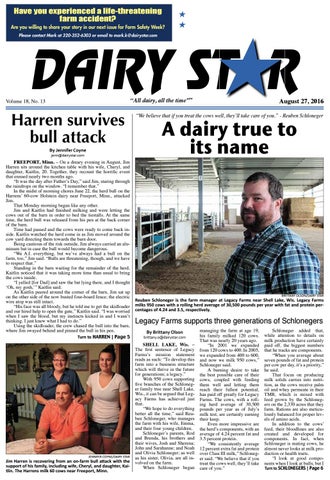
Have you experienced a life-threatening farm accident?
Are you willing to share your story in our next issue for Farm Safety Week?
DAIRY ST R
Please contact Mark at 320-352-6303 or email to mark.k@dairystar.com
“All dairy, all the time”™
Volume 18, No. 13
Harren survives bull attack By Jennifer Coyne jenn@dairystar.com
FREEPORT, Minn. – On a dreary evening in August, Jim Harren sits around the kitchen table with his wife, Cheryl, and daughter, Kaitlin, 20. Together, they recount the horric event that ensued nearly two months ago. “It was the day after Father’s Day,” said Jim, staring through the raindrops on the window. “I remember that.” In the midst of morning chores June 22, the herd bull on the Harrens’ 60-cow Holstein dairy near Freeport, Minn., attacked Jim. That Monday morning began like any other. Jim and Kaitlin had nished milking and were letting the cows out of the barn in order to bed the tiestalls. At the same time, the herd bull was released from his pen at the back corner of the barn. Time had passed and the cows were ready to come back inside. Kaitlin watched the herd come in as Jim moved around the cow yard directing them towards the barn door. Being cautious of the risk outside, Jim always carried an aluminum bat in case the bull would become dangerous. “We A.I. everything, but we’ve always had a bull on the farm, too,” Jim said. “Bulls are threatening, though, and we have to respect that.” Standing in the barn waiting for the remainder of the herd, Kaitlin noticed that it was taking more time than usual to bring the cows inside. “I yelled [for Dad] and saw the bat lying there, and I thought ‘Oh, my gosh,’” Kaitlin said. As Kaitlin peered around the corner of the barn, Jim sat up on the other side of the now busted four-board fence; the electric wire atop was still intact. “His face was all bloody, but he told me to get the skidloader and our hired help to open the gate,” Kaitlin said. “I was worried when I saw the blood, but my instincts kicked in and I wasn’t thinking. I just knew what I had to do.” Using the skidloader, the crew chased the bull into the barn, where Jim swayed behind and pinned the bull in his pen. Turn to HARREN | Page 5
JENNIFER COYNE/DAIRY STAR
Jim Harren is recovering from an on-farm bull aƩack with the support of his family, including wife, Cheryl, and daughter, Kaitlin. The Harrens milk 60 cows near Freeport, Minn.
August 27, 2016
“We believe that if you treat the cows well, they’ll take care of you.” - Reuben Schloneger
A dairy true to its name
BRITTANY OLSON/DAIRY STAR
Reuben Schloneger is the farm manager at Legacy Farms near Shell Lake, Wis. Legacy Farms milks 950 cows with a rolling herd average of 30,500 pounds per year with fat and protein percentages of 4.24 and 3.5, respecƟvely.
Legacy Farms supports three generations of Schlonegers By Brittany Olson
brittany.o@dairystar.com
SHELL LAKE, Wis. – The rst sentence of Legacy Farms’s mission statement reads as such: “To develop this farm into a business structure which will thrive in the future for generations; a legacy.” With 950 cows supporting ve branches of the Schloneger family tree near Shell Lake, Wis., it can be argued that Legacy Farms has achieved just that. “We hope to do everything better all the time,” said Reuben Schloneger, who manages the farm with his wife, Emma, and their four young children. Schloneger’s parents, Rod and Brenda, his brothers and their wives, Josh and Sherena; John and Sarahanne; and Noah and Olivia Schloneger; as well as his sister, Olivia, are all involved on the farm. When Schloneger began
managing the farm at age 19, his family milked 120 cows. That was nearly 20 years ago. “In 2001 we expanded from 120 cows to 400. In 2005, we expanded from 400 to 600, and now we milk 950 cows,” Schloneger said. A burning desire to take the best possible care of their cows, coupled with feeding them well and letting them reach their fullest potential, has paid off greatly for Legacy Farms. The cows, with a rolling herd average of 30,500 pounds per year as of July’s milk test, are certainly earning their keep. Even more impressive are the herd’s components, with an average of 4.24 percent fat and 3.5 percent protein. “We consistently average 12 percent extra fat and protein over Class III milk,” Schloneger said. “We believe that if you treat the cows well, they’ll take care of you.”
Schloneger added that, while attention to details on milk production have certainly paid off, the biggest numbers that he tracks are components. “When you average about seven pounds of fat and protein per cow per day, it’s a priority,” he said. That focus on producing milk solids carries into nutrition, as the cows receive palm oil and whey permeate in their TMR, which is mixed with feed grown by the Schlonegers on the 2,330 acres that they farm. Rations are also meticulously balanced for proper levels of amino acids. In addition to the cows’ feed, their bloodlines are also created and developed for components. In fact, when Schloneger is mating cows, he almost never looks at milk production or health traits. “I look at good components when I look at bulls, but I Turn to SCHLONEGERS | Page 6
Page 2 • Dairy Star • Saturday, August 27, 2016
DAIRY ST R www.dairystar.com
ISSN 020355 522 Sinclair Lewis Ave. Sauk Centre, MN 56378 Phone: (320) 352-6303 Fax: (320) 352-5647 Published by Dairy Star LLC
General Manager/Editor Mark Klaphake - mark.k@dairystar.com 320-352-6303 (ofce) 320-248-3196 (cell) 320-352-0062 (home) Ad Composition Laura Bromenshenkel 320-352-6303 laura.b@dairystar.com Nancy Powell 320-352-6303 nancy.p@dairystar.com Consultant Jerry Jennissen 320-346-2292 Staff Writers Krista Kuzma - Assistant Editor (507) 259-8159 • krista.k@dairystar.com Andrea Borgerding Assistant Editor/ Online Editor (320) 352-6303 • andrea.b@dairystar.com Missy Mussman (320) 429-1084 missy@dairystar.com Ron Johnson (608) 874-4243 ron.j@dairystar.com Ruth Klossner (507) 240-0048 cowlady@centurylink.net Jennifer Coyne (320) 352-6303 jenn@dairystar.com Cassie Olson (715) 245-6848 cassie.o@dairystar.com Brittany Olson (320) 352-6303 brittany.o@dairystar.com Advertising Sales Main Ofce: 320-352-6303 Fax: 320-352-5647 Deadline is 5 p.m. of the Friday the week before publication
Sales Manager - Jeff Weyer (Northern MN, East Central MN) 320-260-8505 (cell) jeff.w@dairystar.com Mark Klaphake (Western MN) 320-352-6303 (ofce) 320-248-3196 (cell) Laura Seljan (National Advertising, SE MN) 507-250-2217 fax: 507-634-4413 laura.s@dairystar.com Jerry Nelson (SW MN, NW Iowa, South Dakota) 605-690-6260 jerry.n@dairystar.com Mike Schafer (Central, South Central MN) 320-894-7825 mike.s@dairystar.com Lori Menke (Eastern Iowa, Southern WI) 563-608-6477 • lori.m@dairystar.com Megan Stuessel (Western Wisconsin) 608-387-1202 • megan.s@dairystar.com Deadlines The deadline for news and advertising in the Dairy Star is 5 p.m. Friday the week before publication. Subscriptions One year subscription $35.00, outside the U.S. $110.00. Send check along with mailing address to Dairy Star, 522 Sinclair Lewis Ave., Sauk Centre, MN 56378. Advertising Our ad takers have no authority to bind this newspaper and only publication of an advertisement shall constitute nal acceptance of the advertiser's order. Letters Letters and articles of opinion are welcomed. Letters must be signed and include address and phone number. We reserve the right to edit lengthy letters. The views and opinions expressed by Dairy Star columnists and writers are not necessarily those of the Dairy Star LLC.
The Dairy Star is published semi-monthly by Dairy Star, LLC, 522 Sinclair Lewis Ave., Sauk Centre, MN 56378-1246. Periodicals Postage Paid at Sauk Centre, MN and additional mailing ofces. POSTMASTER: Send address changes to Dairy Star, 522 Sinclair Lewis Ave., Sauk Centre, MN 56378-1246.
North America dealers. A glance at what’s inside
Dairy Prole brought to you by your
As summer winds down and harvest nears, the eld days and crop seminars pick up. In this issue, we attended several eld days to cover topics such as cover crops, rotational grazing and organic production. The Pearsons milk 50 cows near Medford, Wis. Last year, they started rotationally grazing their herd with the guidance of a grazing consultant and their county land conservation ofce. Read about their transition into grazing on pages 10-13 in Third Section. Late summer time brings state fair time for many By Mark Klaphake communities across the Midwest. The dairy industry Editor plays an important role at these events – it’s an opportunity to reach many consumers. We reached out to the Midwest Dairy Association and Wisconsin Milk Marketing Board to see how promotional events at state fairs have evolved through the years. This article can be read on pages 12-13 in rst section. In our organic section on pages 6-7 in second section, read about the Fonder family from Milbank, S.D. They switched their dairy to organic 10 years ago. Read what changes they have seen in their crops and animals since the change from conventional farming. No doubt it’s a tough time to be dairying, but in Washington Township in Winneshiek County Iowa, dairies dot the countryside. We visited with dairymen, Mike Einck and Wayne Smith, both from Fort. Atkinson, on why they think the township can continue to support so many dairies in a small area. Read this article on page 10 in First Section. On Aug. 22, our reporter, Cassie Olson, followed the Wegner family from Ettrick, Wis. for the day to document our feature, A Day in the Life. The Wegners milk 500 cows and are in the midst of building a new freestall barn. It was business as usual for the Wegners. Read how the entire family pitches in to make the dairy operate smoothly every day. Finally, dairy made a big appearance at the Clark County Fair Dairy Show. We have several photos of dairy exhibitors competing at the dairy show on Aug. 12. There were 103 exhibitors and 270 entries. Read who did well at the show on page 28 in First Section.
Favorite quotes from this issue: “Our goal is to ght poverty through milk production. Time and distance has been our enemy.” - Michael Juragila, Second Section, Pages 14-15
“It’s just in my blood. It can be peaceful, and it’s a challenge and an art. It doesn’t seem like work to me.” - Chris Roelli, First Section, Pages 22-23
By the Numbers The number of dairy cows in Washington Township in Winneshiek County, Iowa. (First Section, Page 15)
3,300:
number of dairy cattle entries 270: The at the Clark County Junior Dairy Show. (First Section, Page 28)
Dairy Star • Saturday, August 27, 2016 • Page 3
It’s all inside... FROM OUR SIDE OF THE FENCE:
What was your favorite Olympic moment? Page 16
Pages 2- 3 Patnodes try cover crop through Sustainable Ag Demonstration Grant Program Pages 4 - 5 Joneses recognized at Iowa State Fair Page 5 Dairy Calendar
Pages 14 - 15
Some Udder Stuff
Pages 18 - 19 Kids Corner: The Enters Page 20 Dairy Calendar
Pages 21 - 30 Classieds
Shell Lake
Ridgeland
Third Section: Page 17
First Section: Pages 1, 7
First Section: Pages 35, 37
Beukema wins St. Croix County dairy heritage calf contest
Eau Claire
Children Museum of Eau Claire hosts June Dairy Bruce Brockshus Ocheyedan, Iowa Month activities
Ridgeland church starts Faith-Filled Farming initiative
Legacy Farms supports three generations of Schlonegers
Bayeld
Douglas
Pages 14 - 15 Second Section
Iron
Medford
Paddocks mean prot for Pearsons
Ashland n
Third Section: Pages 10, 12 - 13
ur W as
hb
Burnett
Polk
Barron
Sawyer
Jodi and Kacy Anderson Mindoro, Wis.
Price Ettrick
Rusk
A day in the life of the Wegner family
Taylor
Pierce Darlington, Wis.
Clark
Eau Claire
Pepin
Jay Stauffacher
Second Section: Pages 16, 18 - 19
Chippewa
Dunn
Buffalo
La Crosse, Wis.
Dairy Prole: Jeff, Aaron and Macey Berg
Trempealeau
St. Croix
Pages 14 - 15 Dairying Around the World Pages 20 - 21 Iowa couple raising a family, building equity
Page 39
Avoca
Organic production focus of Otter Creek eld day Third Section: Pages 8 - 9
Jackson
La Crosse Monroe
Shullsburg
Roelli’s Little Mountain cheese wins big award
Vernon
Winnebago
Worth
Mitchell
Cerro Hancock Gordo
Floyd
Howard
ick
Ch
w
a as
Bremer
Zone 2
Black Hawk
Bu
For additional stories from our other zone, log on to www.dairystar.com
ford
Craw
Dane
Iowa Grant
Fayette
Clayton
n
are
na
a ch
First Section: Pages 22 - 23
Richland
Allamakee
Pages 22 - 24 Salzls put up barn, start milking 21-cow herd Pages 26 - 27 Crop & Weather Report Pages 28 - 29 Sunshine produces crops, electricity Pages 38 - 39 Dairy Recipes THIRD SECTION
New Richmond
Winneshiek
FIRST SECTION Pages 1, 5 Harren survives attack by herd bull Page 9 Ag Insider Page 10 May-June MPP margin of $5.76 triggers pay outs Page 11 A comprehensive pricing proposal that will protect family farming Pages 12 - 13 State fairs: A place where dairy takes the spotlight Pages 18, 20 Timed A.I., synch programs prove benecial for Stelter herd Page 25 Wisconsin FFA President inuenced by dairy upbringing Page 26 I will be milking solo Page 27 Dairy in the Suburbs Page 28 Forage quality of alternative grasses Page 29 Rural Roots Page 30 Ramblings from the Ridge Page 31 Management vs. leadership: What’s the difference? Page 32 Just Thinking Out loud Page 33 Dairy Good Life Page 34 Thin dry cows: Should they be fed extra energy? Page 36 Women in Jeans: Shannon Mueller SECOND SECTION Pages 3, 4 Siewerts, Youngs form partnership to harvest forages Pages 6 - 7 Saving small farms Page 8 Goldsmith crowned Iowa Dairy Princess Pages 10 - 11 The “Mielke” Market Weekly Page 12 Dairy Markets Page 13 Area hay auction results
w ela
D
Linn
Lafayette Dubuque
Jones
Jackson
Green Fort Atkinson
Washington Township lled with cows, farmers First Section: Page 15
When they breathe easy, so do you No matter the weather outside, GEA keeps your cows comfortable, healthy and productive inside. Comfortable cows are the most productive. Just like
to provide ideal barn temperature, air quality and
you, they perform their best when they are cool, calm
humidity levels. With our total ventilation solutions,
and content. GEA’s industry-leading curtains and fan
your cows will breathe easier — and so will you. Contact
systems can be integrated with automation technology
your GEA barn equipment representative today.
Dairy Star • Saturday, August 27, 2016 • Page 5
ConƟnued from HARREN | Page 1
PHOTO SUBMITTED
The Harrens – (from leŌ) Bradley, Joshua, Kaitlin, Jim and Cheryl – have all been supporƟve of Jim’s slow recovery, helping with chores on the farm. “I put the skidloader away and ran into the barn,” Kaitlin said. “By that point, Dad was pretty tired and had to sit down. I didn’t realize how badly he was bleeding.” Kaitlin hastily grabbed milking towels to clean the blood off her father’s body, and saw the large cut on the back of his head. The cows still needed to be tied in their stalls, but Kaitlin knew she was running out of time. “We had to hurry, but I didn’t want Mom to know because she’d worry,” Kaitlin said. As the cows made their way to their appropriate stalls, Cheryl walked into the barn before heading off to work, unaware of what the morning had brought for her husband and daughter. “I always stop and say goodbye to Jim when he’s in the skidloader,” Cheryl said. “But that morning, he wasn’t outside.” Instincts told Cheryl something was wrong, and they were right as she walked into the barn and saw her husband covered in blood. After assisting Jim back into the home for a quick shower – a shower he insisted on taking – Cheryl drove her husband to the nearest hospital. “I was panicked and trying to keep it together,” Cheryl said, shakiness in her voice. “I just kept making him talk so that he wouldn’t go into shock, and drove fast.” Kaitlin stayed on the farm and beckoned her grandpa, boyfriend and brother, Bradley, 25, for help loading the bull onto a trailer to take to a livestock auction. “It all didn’t take very long,” Kaitlin said. “The bull still had blood on his nose and was bellowing after they got him on the trailer.” Miraculously, Jim only suffered a concussion, a cut to his head and external bruising. However, two months
after the accident, he is still slow to recover with dizzy spells periodically occurring and the possibility of a torn meniscus. While only supposed to be home for Father’s Day weekend, the Harrens’ sons – Bradley, 25, and Joshua, 21 – remained on the farm until their father was seeing improvements. The Harren children, their hired hand and a neighbor, Sam Koetter, assisted with daily responsibilities on the farm, including putting hay up and cutting oats. “Everyone really stepped up to help with chores,” Cheryl said. “We’re really thankful and proud they could help.” In the weeks that followed the accident, Jim tried recalling what happened, but was unable to. “I only slightly remember being on top of his head,” Jim said, rubbing his head where the laceration was. “I still wake up and all I see is the bull’s head.” While Jim’s joints remain stiff and a numbing ache continues to pass through his body, he is back in the barn and slowly returning to a regular routine, careful not to injure himself further. “We could use bubble wrap, and lots of it,” Jim said. Cheryl added, “He’s going through physical therapy for his knees, and wasn’t making sense for a long time. Now, his head’s getting much better.” The Harrens are counting their blessings as life slowly returns to normal, with a young bull replacing the harmful one. Jim’s experience is one they hope to never encounter again. “There’s something to be said about that,” Cheryl said, explaining her gut-reaction to check the barn. “You never know, and that morning it just made sense. I could’ve buried him that week.”
www.advanceddairy.com
CUSTOM FORAGE HARVESTING
• Corn Silage, Haylage • Shredlage Processing is available
• All Supporting Equipment • Multiple Cutters
MANURE PUMPING WITH DRAG HOSE
We’ve moved
and expanded our practice to a total of three veterinarians! 121 1st Ave. | P.O. Box 67 Freeport, MN 56331
• Unlimited Distance • Nuhn Lagoon Crawler
• No Lagoon too Big • 2 Crews Available
320-836-2788
Dr. Tom Czeck: Specializing in milk quality analysis with years of experience running a successful milk culture lab and tailoring a treatment plan to your needs. Dr. Lee Michels: Specializing in reproductive record analysis and ventilation investigations Dr. Steve Baldwin: Specializing in calf ventilation and calf barn design Clinic open Monday – Friday 7:30 a.m. until 5:30 p.m. and Saturday 8:00 a.m. until 12:00 p.m. Emergency service available 24 hours a day, 7 days a week After hour emergency calls are made directly to the veterinarian on call, not through an answering service Servicing Benton, Morrison, Stearns and Todd counties Visit us at www.freeportvetservice.com or Freeport Vet Service on Facebook
Tim 320-247-3857 • Brian 320-293-2703
www.uppermidwestpumping.com info@uppermidwestpumping.com
Page 6 • Dairy Star • Saturday, August 27, 2016
USDA to purchase surplus cheese for food banks Department also will extend Margin Protection Program for Dairy enrollment deadline
Precision Hoof Care, LLC Sauk Centre, MN
320-333-6618 Bret Illies
Corrective & Maintenance Trimming
RENEW YOUR TRACTOR CAB! 1” Black Vinyl Upholstery At Wholesale Prices! WE SHIP DAILY JD Sound Guard Cabs & Sound Guard Cab Parts BUY - SELL - TRADE
KIESTER IMPLEMENT KIESTER, MN
www.midwestfarmsales.com
507-294-3387
The U.S. Department of Agriculture (USDA) announced plans to purchase approximately 11 million pounds of cheese from private inventories to assist food banks and pantries across the nation, while reducing a cheese surplus that is at its highest level in 30 years. The purchase, valued at $20 million, will be provided to families in need across the country through USDA nutrition assistance programs, while assisting the stalled marketplace for dairy producers whose revenues have dropped 35 percent over the past two years. “We understand that the nation’s dairy producers are experiencing challenges due to market conditions and that food banks continue to see strong demand for assistance,” said Agriculture Secretary Tom Vilsack. “This commodity purchase is part of a robust, comprehensive safety net that will help reduce a cheese surplus that is at a 30-year high while, at the same time, moving a high-protein food to the tables of those most in need. USDA will continue to look for ways within its authorities to tackle food insecurity and provide for added stability in the marketplace.” USDA received requests from Congress, the National Farmers Union, the American Farm Bureau and the National Milk Producers Federation to make an immediate dairy purchase. Section 32 of the Agriculture Act of 1935 authorizes USDA to utilize scal year 2016 funds to purchase surplus food to benet food banks and families in need through its nutrition assistance programs. USDA also announced that it will “This commodity extend the deadline for dairy proto enroll in the Margin Propurchase is part of a ducers tection Program (MPP) for Dairy 16, 2016, from the previrobust, comprehensive toousDec. deadline of Sept. 30. This voldairy safety net program, safety net that will help untary established by the 2014 Farm reduce a cheese surplus Bill, provides nancial assistance to participating dairy producers that is at a 30-year when the margin – the difference between the price of milk and feed high...” costs – falls below the coverage level selected by the producer. A TOM VILSACK, AGRICULTURE SECRETARY USDA web tool, available at www. fsa.usda.gov/mpptool, allows dairy producers to calculate levels of coverage available from MPP based on price projections. On Aug. 4, USDA announced approximately $11.2 million in nancial assistance to U.S. dairy producers enrolled in MPP-Dairy, the largest payment since the program began in 2014. “By supporting a strong farm safety net, expanding credit options and growing domestic and foreign markets, USDA is committed to helping America’s dairy operations remain successful,” said Vilsack. While USDA projects dairy prices to increase throughout the rest of the year, many factors including low world market prices, increased milk supplies and inventories, and slower demand have contributed to the sluggish marketplace for dairy producers. USDA will continue to monitor market conditions in the coming months and evaluate additional actions, if necessary, later this fall.
Milk e z i m i x a M Components with KLC Roasted Soybeans Energy We always have Protein a good supply of roasted soybeans on hand! Amino Acids CALL TODAY Bypass Protein
These attributes lead to consistent milk components.
Quality
Consistency
KLC Farms Roasting, Inc. 1-877-738-2326 877 738 232 Visit www.roastedbeans.com
Dairy Star • Saturday, August 27, 2016 • Page 7
ConĆ&#x;nued from SCHLONEGERS | Page 6 also believe in functional type. I breed for udders and good, sound feet and legs,â€? he said. “Ninety percent of the bulls I breed, the cows to are proven sires.â€? While breeding good, sound cows has always been a priority at Legacy Farms, Schloneger did not start registering calves until 2012. “I initially wanted to start marketing bulls since A.I. companies typically want registered animals,â€? he said. “We also began using ear tags, and from there it wasn’t much work to register cattle anyway.â€? Four years ago, 10 percent of heifer calves at the farm were registered. That number has since climbed to 90 percent. Schloneger has made the leap into classiďƒžcation as well. “We always had sets classiďƒžed for young sire programs. I enjoyed doing that, so we stuck with scoring cows,â€? he said. While Schloneger does not breed strictly for type, breeding for functional and structurally correct cows has earned him a slew of awards in recent years, showing that cows can look good and milk well. Last year, the Wisconsin Holstein Association recognized one of his cows as a Top Performer. Legacy-Sch Gerard 7642 made 40,954 pounds of milk as a junior 3-year-old with 5 percent fat and 3.6 percent protein. She also scored EX-90 during her most recent classiďƒžcation. “We breed so that each cow can ideally reach 90 points by the time they are 6 years old,â€? Schloneger said. Schloneger breeds nearly exclusively to proven bulls because they demonstrate the ability to transmit desirable traits. Legacy-Sch Gerard 7501 EX-91 was recognized as a Dam of Merit last year. Her daughter, Legacy-Sch Gillespy 8057 is the No. 1 Gillespy daughter in the U.S. and the ninth highest producing genomic milk cow overall. She scored VG-88 as a ďƒžrst-lactation cow with a 90-point udder, and recently went EX-90 as a junior 3-year-old. “We focus more on creating good cows than creating big numbers,â€? Schloneger said. In July, Legacy Farms had 140 total animals scored. In addition to three new EX-90 cows, nine
BRITTANY OLSON/DAIRY STAR
Legacy-Sch Gerard 7642 EX-90 produced 40,954 pounds of milk in 2015 as a junior 3-year-old and was recognized as a top performer by the Wisconsin Holstein AssociaĆ&#x;on. 2-year-old cows scored VG-85 or higher, and 37 2-year-old cows scored between GP-80 and GP-84. “We currently run a BAA of 105.5,â€? said Schloneger. Along with great type traits and production, the cows that call Legacy Farms home are healthy and robust. Schloneger estimates that the farm runs a 12 percent cull rate on ďƒžrst-lactation cows, while the industry average is 27 percent. In addition to a belowaverage cull percentage, Legacy Farms only sees about four or ďƒžve displaced abomasums every year.
“We don’t breed for health traits,â€? Schloneger said. “We just try to take better care of our cows all the time.â€? While genetics and skilled management play signiďƒžcant roles in the cows’ impressive production statistics, facilities are also a key player. “In 2014 we switched from using sawdust and mattresses to just sand, and the cows have been much more comfortable,â€? Schloneger said. A new double-16 parallel milking parlor was also built that same year with a basement directly below. The parlor, designed with larger cows in mind, is built 6 inches longer and 2 inches wider per cow to allow for more room and comfort so the cows enjoy being milked. Milk weights are taken using scales in the basement after milk is funneled down from the parlor through a series of carefully engineered hoses to maintain steady vacuum. While the Schlonegers are pleased with their cows’ production, they are far from complacent. In keeping with their mission to thrive and provide a living for their families, they are continually ďƒžnding ways to make something great even better. “For example, we average 106 pounds of milk per cow per day,â€? Schloneger said. “We want to take that number up to 110 pounds.â€? Taking the best possible care of their cows through mindful breeding and wholesome feeding are allowing the Schloneger family to take a family tradition and leave behind something better for future generations. After all, that is the meaning behind a legacy.
Protect against slips & falls
Sunny Hill Acres Heifer Raising
Traction in all directions Reduce animal stress Aids in heat detection Cost effective & practical
Where your heifers are treated like our own.
Vaccination Program customized to your needs AI Breeding • TMR feeding Call to see how well we can raise your heifers. 507-649-1895 • Northfield, MN
Space Available! - 40 Years of Dairy Experience
We offer grooving & scarifying
BEST FOOTING CONCRETE GROOVING
Strum, WI | Cell 715-579-0531 1-800-323-2451
WE’RE READY TO HELP YOU WITH YOUR HARVEST NEEDS.
5X FASTER DRYING
10X MORE WET CORN HOLDING CAPACITY UPGRADED DRY GRAIN UNLOADING SPEED
• 1024 bu. heat section holding capacity • 391 bushel cool section holding capacity • 335 bushel wet hopper holding capacity
12’ DIAMETER DRYER
STOP AT OUR BUCKMAN LOCATION
FINE ROLLED CORN AT 400 MICRONS
More consistent than hammermills
From ... This
Call Jason or Mike at our Buckman location for pricing and delivery options.
HIS WORLD RENOWNED DAMS
L-R 4th dam Larcrest Cosmopolitan VG-87 GMD DOM, 3rd dam Larcrest Crimson-ET EX-93 GMD DOM & 2nd dam Larcrest Cale-ET VG-89 DOM
CHARLEY 29HO17500 DG
To This
99%
BURN DOWN DAY - SEPTEMBER 2, 2016 from 10 a.m. - 2 p.m. at our Pierz Location
OR BRING IN 3-5 STALKS TO BUCKMAN LOCATION ANY TIME.
LITTLE ROCK, MN 320-584-5147
PIERZ, MN 320-468-2168
LASTRUP, MN 320-468-2543
BUCKMAN, MN 320-468-6433
Supershot x Mogul x VG-89 Observer x EX-93 Ramos x VG-87 SHOTTLE x EX-90 Outside x EX-93 JUROR
+2763 GTPI
ÂŽ
| +942 NM$ | 6.8% CE
The next generation and beyond...Watch for CHARLEY and his great number combination! Š2016 USDA/CDCB PTA/GPTA 8/16 GTPIŽ is a registered trademark of Holstein Association USA, Inc. Charley image Anna Joosse, Cosmopolitan image Ann Larson, Crimson & Cale image Beth Herges
Use CHARLEY for the next generation. Contact your ABS representative today! " # 4 ( M P C B M * O D t " # 4 4 5 6 % t X X X B C T H M P C B M D P N
Page 8 • Dairy Star • Saturday, August 27, 2016
1-800-887-4634 (608) 723-4634 423 U.S. Hwy 61 North • Lancaster, WI
Panel Fans:
OA140-08K
www.jdmfg.com • 1-800-998-2398 Eau Claire • Wisconsin • U.S.A.
www.jdmfg.com • 1-800-998-2398 Eau Claire • Wisconsin • U.S.A.
w. j d m f g . c
800
OA140-08K
www.jdmfg.com • 1-800-998-2398 Eau Claire • Wisconsin • U.S.A.
o
One of the highest performing, lowest maintenance, greatest valued fans on the market!
m
ww
1-
OA140-08K
www.jdmfg.com • 1-800-998-2398 Eau Claire • Wisconsin • U.S.A.
- 9 9 8 - 23 9
8
Panel Fans 24”, 36”, 50” & 55”
Ventilation Expertise
72” Mega Storm & 55” Storm
Recirculation Fans When the temperaturea humidity index (THI) is above 72°, livestock will experience heat stress.
Fiberglass Exhaust Fans
ExhaustFans Fans Exhaust Create the right airflow and exchange rate to keep your herd at the optimum temperature for maximum production.
Soaking System High Pressure Fog & Cooling
www.fullersmilkercenter.com
Milk prices bottomed out in second quarter
Dairy Star • Saturday, August 27, 2016 • Page 9
Milk production continues to groups and has released a new regrow, but farm prices may be re- port highlighting its observations. covering. USDA chief economist Alliance President and CEO Kay Rob Johansson is optimistic about Johnson Smith said the activists in the animal rights movea bump in the milk check. Ag Insider ment appear to be tak“It looks like we found a ing a more aggressive bottom in the second quarapproach with retailers, ter and we’re starting to restaurants and food see increases in expected service companies. dairy prices for the third “Because of the results and fourth quarters of of the many announce2016 and carrying on into ments on gestation stalls 2017.” Class III milk pricor eliminating cages es are expected to increase for egg-laying hens, it by 4 percent in 2017. At has emboldened these the same time, margins groups to put more and should improve with low By Don Wick more pressure on the feed costs. Columnist retail and restaurant community.” Activists Milk output increase The size of the U.S. dairy herd have often targeted large-scale modhas increased slightly from one year ern operations, calling them factory ago, resulting in a 1.4 percent in- farms. Smith said speakers at the ancrease in total milk production. In imal rights conference went beyond July, Minnesota’s milk output in- a big is bad philosophy and want to creased 1.5 percent. South Dakota shut down all of animal agriculture. milk production rose nearly 6 per- “These groups are not concerned cent. Wisconsin was up just over 2 about improving animal welfare. percent. California milk production They are concerned with how they declined less than one percentage can eliminate animal agriculture altogether. They want to take away point. choices from the consumer.” S/D report increases milk producU.S.-Mexico dairy alliance formed tion outlook for ‘17 The United States and Mexico The latest USDA supply demand report has lowered the forecast for have wrapped up a two-day trade 2016 milk production and increased summit on dairy issues. Dairy leadthe prospects for 2017. Lower feed ers signed a memorandum of undercosts and a bump in the milk check standing, creating a U.S.-Mexico will result in a modest expansion of dairy alliance. This group will meet the dairy herd next year. The Class each year to review industry trends III milk price outlook in 2017 is be- and nd ways to reduce trade baring helped by stronger component riers. The memorandum was signed prices, but those values are still in by leaders of the National Milk the mid-teens. Demand remains Producers Federation, U.S. Dairy good for cheese, nonfat dry milk Export Council, Mexico Livestock and whey. Due to large stocks, butter Association and Mexico’s National Chamber of Industrial Milk. prices are expected to decline. CWT lawsuit settled The National Milk Producers Federation has settled a lawsuit with dairy processors over a herd retirement program that was in place from 2003 to 2010. The NMPF board ofcers have approved the $52 million settlement. The Cooperatives Working Together program was a voluntary program that took dairy cattle out of production. The lawsuit claimed CWT manipulated the milk supply to increase milk prices. Canada considering new pricing strategy A tentative agreement has been reached between Canadian dairy processors and Canadian dairy farmers. With this deal, Canadian milk processors can buy domestic ingredients at world market prices rather than at the higher levels seen with Canada’s supply management program. With this new pricing strategy, the United States will likely lose access to the Canadian market for ultraltered milk. This deal still needs to be ratied by the Canadian dairy industry and that is not expected to happen until later this fall. Alliance releases report on animal rights movement Nearly 2,000 people attended the Animal Rights National Conference last month in Los Angeles. The Animal Agriculture Alliance was at the event to monitor the animal rights
Star Blends to build in Chippewa Falls Star Blends plans to build a facility to manufacture dairy cattle feed in Chippewa Falls. The Chippewa County Economic Development Committee has approved the project and it will be located in the city’s industrial park. Star Blends is based in Sparta, Wis. Merger vote scheduled A shareholder vote will be Oct. 6 to consider the proposed deal between WhiteWave Foods and Danone SA. Danone, which is based in France, wants to complete the acquisition of WhiteWave Foods by the end of the year. Danone is responsible for brands like Activa, Oikos and Dannon yogurt. WhiteWave has brands, like Silk and Horizon Organic. The deal is valued at $10 billion. Dairy strong The Dairy Strong Sustainability Alliance has been created to showcase tangible, continuous improvements in the areas of land use, conservation, nutrient management, water quality, animal welfare, food safety, economic health and social responsibility. The Wisconsin group began with a working group that includes U.S. Farmers and Ranchers Alliance, the Innovation Center for U.S. Dairy, the Wisconsin Cheese Makers Association, Dairy Business
Association and the Nature Conservancy. The alliance is also seeking other collaborators.
UW-Madison honors The University of WisconsinMadison College of Agricultural and Life Sciences will host the CALS Honorary Recognition Banquet Oct. 13. Wisconsin Agriculture Secretary Ben Brancel, the founding dean of the UW-Madison School of Veterinary Medicine Bernard Easterday and UW-Extension Agent Richard ‘Otto’ Wiegand will receive the college’s Honorary Recognition Award. The former chair of the UW-Madison food science department, Daryl Lund, will receive the Distinguished Service Award. Gary Onan, who is a professor of animal and food science at UW-River Falls, will receive the Distinguished Alumni Award.
Trivia challenge The U.S. record for milk production came from Gigi, a 9-year old Holstein from Brooklyn, Wis. This past year, Gigi produced 74,650 pounds of milk in a 365-day period. That answers our last trivia question. For this week’s trivia, how many sticks of butter are in a typical pound package? We’ll have the answer in the next edition of Dairy Star. Don Wick is a partner and broadcaster for the Red River Farm Network, based in Grand Forks, North Dakota. Wick has been recognized as the National Farm Broadcaster of the Year and served as president of the National Association of Farm Broadcasting. Don and his wife, Kolleen, have two adult sons, Tony and Sam, and ve grandchildren, Aiden, Piper, Adrienne, Aurora and Sterling.
HARVEST SPECIAL ‘08 Hart grain trailer with ag
hoppers,ideal farm trailer, excellent condition
$16,500
Peterson Motors New Ulm, MN • 507-359-4209
CLASSIFIED DOESN’T ALWAYS MEAN TOP SECRET!
It’s no secret that a Dairy Star classied ad can help you eliminate those unwanted items! Check the classieds in our third section.
“It’s really simple to use.” When did you start using the Porta BHB ketosis test? How many years have you been testing with DHIA? Four years. How has testing with DHIA beneÀted your dairy? It’s important for me to know the somatic cell count of the cows and I really like the production reports, especially the monthly ones. The preg tests are valuable to me as well. When did you start using the Porta BHB ketosis test? I started six months ago. I did it for the convenience of checking for subclinical ketosis. What is the process of using the test? I use it 12 hours after a cows freshens if they don’t look like they are taking off. Then I will check one month into the lactation if they are not hitting their peaks properly or if they are losing body weight. What advantages are there to using the Porta BHB test? The convenience of it. It’s really simple to use. They have a diagram right there to show you how severe of case it is. Why is this test important to your dairy? It’s just another tool to keep the cows healthy. The speed of the test is terriÀc.
Trevor Lisson • Staples, Minn. Milking 40 cows Minnesota Dairy Herd Improvement Association 307 Brighton Avenue South Buffalo, MN 55313 1.800.827.3442 www.mndhia.org
Page 10 • Dairy Star • Saturday, August 27, 2016
WHO WILL YOU FIND IN OUR
Business Directory?
LOG ON TO: www.dairystar.com TO BE INCLUDED IN THE DAIRY STAR BUSINESS DIRECTORY CALL 320-352-6303
is your area dealer for Kuhn Krause
DOMINATOR® 12’ model
KUHN Krause offers a line of primary tillage tools that promote the breakdown of crop residue and allow for excellent root development for the next crop. These sub-surface tillage tools break up compaction while preserving the soil surface, promote aeration, limit erosion and runoff, and improve water infiltration which helps the soil retain moisture. 800-642-4104 or 507-228-8224 • www.ufcmn.com Main Office/Ag Service Center 840 Pioneer Ave., Lafayette, MN Used Dryers & Augers
Good Selection of Used Dryers - Call! Feterl 12”x72’, swing drive .........$8,900 Sudenga 10”x31’, elec. ..............$3,495 Sudenga 10”x56’, elec ...............$4,995 WestÄeld 10”x31’, elec ...............$1,850 WestÄeld WR8026 EMD .............$1,895 WestÄeld WR8031 EMD .............$1,950 Sheyenne 13-70 Swing Dr.......... $12,995 Hutch 8”x62’ swing hopper auger .$6,495
Skid Loaders
Bobcat T190 new engine .........$34,900 Bobcat S650, 300 hrs, 2012.....$39,800 Bobcat S650, heat, A/C, 2 spd .....$33,500 Bobcat S630, 400 hr, heat, 2 spd $34,800 Bobcat S590 heat 2-spd . (3) from $31,900 Bobcat S850, heat & A/C, JS ...$46,500 Bobcat S550, heat, 2014, 2 spd. $29,900 Gehl 5240, heat, 2 spd, 400 hrs, radio .......................................$29,975 Gehl V330, heat & A/C, ‘12, 2400 hrs..................................$34,600 Gehl 5640E, heat ......................$22,900 ‘05 Gehl 5640, 2600 hrs. ..........$18,999 Gehl 4400 w/rops .......................$3,999 Gehl 4240E w/heat (3) start @ $14,900 Gehl 3310, ‘89 ............................$5,750 Gehl U330, heat, 2 spd. ...........$38,900 Case 430, ‘10 ...........................$24,900 Gehl R220, heat 2-speed, ‘13 ..$34,800 Gehl R190, heat, AC, ‘15, 2 spd. $36,800 Mustang 1750 2014 open cab .$37,900 Mustang 940E, clean ..................$9,900 JD 1025R loader tractor, mower deck, 60”, cab, snowblower, 23 hrs. ... $23,900 Bobcat 2200 UTV .......................$7,250
TMR’s
Knight 5073, tow ......................$17,199 Knight 3250, stationary ..............$3,899 Knight 3050 ..............................$11,499 Knight 3150, tow ......................$22,499 Knight 3042, reel auggie...........$12,499
Tillage
JD 2700, 9-24 ...........................$23,900 JD 985 49.5’, 3 Bar...................$20,700 JD 980, 44.5’ ............................$19,600 JD 980 44.5’, 3 Bar...................$17,500 JD 960 28.5 ft 3 bar ..................$16,900 CIH Tigermate II, 45.5 ft w/basket $38,900 CIH Tigermate II, 54.5’ .............$33,900 CIH 730B, 7 shank ...................$17,800 CIH 600PTX chisel plow, 38’, 3 bar harrow ...........................$29,800
2) CIH 370, 28’..........................$34,500 JD 2210 4-bar, 2006, 45.5 ft.....$42,900 JD 980, 36’ ...............................$13,700 JD 331 disc, 28’ .........................$6,850 DMI 38.5’ Tiger II ......................$29,900 DMI Tigermate II 36.5’, basket .$32,600 DMI 730 ripper..........................$10,900 DMI 730B .................................$16,900 DMI 527B .................................$14,900 Glencoe Soil Saver .....................$7,950 Wil-Rich 957, 9 shank ..............$33,900 Wil-Rich 957, 7 shank ..............$20,600 Wil-Rich 957, 5 shank ..............$16,500 Wil-Rich 513, 9-24....................$39,600 2) Wil-Rich 60’ w/basket cults .............Call Wil-Rich QX2, 60’, basket ............$52,900 Great Plains Turbo Chisel, 11 shk $22,800 Krause Dominator, 12 ft. (2) from $29,900 Krause 18’ w/reel.............from $33,000 Wishek, 16 ft w/harrow.............$21,800
Spreaders
Knight 8032, slinger ..................$14,499 Knight 8114, (A088) ....................$8,949 Knight 8132, (B0077)................$19,899 Knight 8132 ..............................$17,899 Meyer 3954, (1250) ....................$4,949 Meyer 3245 V-Max ...................$12,900 NH 185 .......................................$5,650
Miscellaneous
Loftness Chopper 20 ft...............$14,600 Loftness 20’ chopper .................$9,600 Valmetal 5600 RD bale chopper .$13,800 Minnesota 250, 10 ton gear .......$1,900 Used grain legs............................... Call Woods 3 pt. chopper, 20’ ...........$5,950 EZ Flow 300 bu. box ..................$1,950 Frontier Grain Cart 750 bu........$19,900 JD 15’ chopper pull .................... $3,750 Used Snowblowers ........................ Call Top Air 800 gal, 60’ boom ..........$6,950 Hardi 1,000 gal., 60’ boom .......$14,400 Demco 600 gal., 66’ bom .........$14,900 Century 750 gal., 60’ boom ........$6,950 Red Ball 670, 1200 gal., 66’ boom$13,800 Unverferth Cart 9200 1000 bu. $19,950 Fast Sprayer 1200 gal. 90 ft. boom$18,800 Red Ball 1200 gal, 90 ft. boom 570 $18,800 H&S 12 wheel Hi Cap rake .........$8,275 Gehl 1620, 18’ box, tandem .......$9,950 J&M 1151, scale & tarp ............$48,900 J&M 875 kart w/scale ...............$34,900 Rite-Way Roller, 60’ ..................$34,900 Vicon disc mower .......................$5,950
Check with us on grain bins, dryers, grain handling equipment & grain augers You’ll Ànd it at...
UFC
United Farmers Cooperative
Check With Us For Your New & Used Grain Dryers & Augers Bobcat • GSI • Brock • Sudenga • Gehl • Farm Fans • Wilrich
May-June MPP margin of $5.76 triggers payouts Last week the USDA published the milk margin for May/June 2016 and it was $5.76. The calculated USDA milk margin is used in the Margin Protection Program for Dairy (MPP) to determine at what levels (and if) this program will make a payout. MPP is an insurance-like program for dairy producers that was a product of the 2014 Farm Bill. Dairy producers select a margin level that they’d like to protect on their milk sales. Farmers can choose to protect margins from $4-$8/cwt. The $4/cwt level costs $100 to cover adminBy Betty Berning istrative fees. From the $4/cwt U of M Extension level, coverage levels increase by $0.50 increment (e.g. $4.50/cwt, $5/cwt, etc.) to $8/cwt. As the margin levels increase premiums also increase. Table 1 shows the payout at each level for the May-June period. Everyone with $6/cwt or more coverage received a payout. This is the rst time the program has paid at a $7/cwt or lower level. There were a couple payments in 2015 at the $8/cwt level and a payout in March-April 2016 at both the $8 and $7.50 coverage levels. The May-June payout announcement last week is the largest in the programs two-year history. It is indicative of the tight margins many dairy producers are experiencing. Table 1: May-June MPP Payout at varying coverage levels Coverage Level per Payout for May-June per cwt cwt $4.00
$0.00
$4.50
$0.00
$5.00
$0.00
$5.50
$0.00
$6.00
$0.24
$6.50
$0.76
$7.00
$1.24
$7.50
$1.76
$8.00
$2.24
Some producers have questioned if MPP has been worth the cost of the premiums. An analysis of premiums paid and payouts received in 2016 illus-
trates that with the May/June payout, many producers have made up the cost of their annual premium. Table 2 shows the net gain or loss using a herd with a 1,000,000 pound production history (herd size of about 40-45 cows), signing up at the 90 percent coverage level and including the two annual production
Table 2: 2016 Net Gain (Loss) from MPP at varying coverage levels C o v e r a g e Premiums L evel per cwt
Payout Net Gain (Loss)
$4.00
$100
$0
(-$100)
$4.50
$193
$0
(-$193)
$5.00
$333
$0
(-$333)
$5.50
$473
$0
(-$473)
$6.00
$612
$0
(-$612)
$6.50
$938
$1,145
$207
$7.00
$2,121
$1,921
(-$200)
$7.50
$2,895
$3,243
$348
$8.00
$4,525
$4,795
$270
bumps. The far right column shows what this hypothetical farm would have netted out. Notice that some producers have made up the cost of their premium. Farms that opted for $6.50, $7.50 or $8/cwt coverage have come out ahead. Farms that elected a different coverage level have not made up the cost of premiums. What is important to note here is the amount of gains/ losses. Losses range from -$612 to gains of $348. This is not a very wide range when we put this into the big picture of this farm’s nances. A loss of $600, although not pleasant, is not insurmountable; nor does a gain of $350 make for a banner year. MPP is intended to be an insurance program. It is there for when times are economically very poor. Just like car insurance, a payment is only made when something terrible happens. A person does not hope that car insurance will provide a payment; that means an accident has happened. What this analysis reveals is that this program is a relatively inexpensive insurance (under 10 cents/cwt for $6.50 coverage, plus administrative fees for Tier 1 coverage). Without spending too much, a farm can ensure that if catastrophe strikes, it has some protection. In years when things are not catastrophic, but they are also not good, the program can provide enough of a payout to cover the cost of premiums. Because MPP is an insurance-like program, it should be used in conjunction with other risk management tools. In a bad year, MPP will not save a farm. It can provide some protection and income to help offset losses. It will not make up for all of the loss, though. That is where other risk management tools come in to play. Understanding your cost of production and utilizing forward contracts and future should be utilized to lock in margins that will ensure a farm’s protability. MPP has been controversial at times. We do not know what the next farm bill will bring. Perhaps changes will be made to MPP. Perhaps not. One thing that we do know is that careful risk management planning can help you stay ahead of the game.
FARM-RITE EQUIPMENT, INC. INTEREST AS LOW AS 0% ON QUALIFYING EQUIPMENT
Please see your Farm-Rite Sales Rep for more details
Visit our website: www.farmriteequip.com
One Of The Largest Skid-Steer Loader Dealers In The State Of Minnesota!
SALES - SERVICE - RENTAL
West Hwy. 12 • Dassel, MN
320-275-2737 • 888-679-4857 1515 West Litchfield Ave. • Willmar, MN
320-235-3672 • 877-484-3211
810 Mayhew Lake Rd. NE • St. Cloud, MN
320-240-2085 • 844-262-2281
Dairy Star • Saturday, August 27, 2016 • Page 11
GUEST EDITORIAL
A comprehensive pricing proposal that will protect family farming
“OUR SOMATIC CELL COUNT DROPPED WITHIN TWO WEEKS. OUR STALLS ARE CLEANER AND THE MACHINE SAVES US TIME.”
By Bradley L. Rach National Dairy Director National Farmers Organization America’s dairy farmers are enduring a pricing crisis that is as serious as any I have seen. Milk is being sold at disastrously low prices. Even that tragedy is overshadowed by loads of milk not being processed because there is no market at any price for it. There will, no doubt, be calls for policy proposals to address the dairy price crisis. If history is any guide, those policy proposals will ignore a long-term problem with dairy farming in America. That problem is the disappearing family dairy farm.
The unique value of family dairy farms As we look ahead to what tomorrow’s dairy farming might look like, we must also remember that we live in a world where consumers play an increasing role in determining the market for the milk we produce. Consumers envision milk production occurring on family farms. Much of the goodwill farmers have with consumers depends on this image. We also know that the family farm is a good t for the vitality of rural economies. There are more farms to buy supplies locally, more people to support schools and churches, and more opportunities for young people to stay in the community as future farmers. There can be little doubt that the environment, especially as it relates to water quality, will be an increasing problem facing our dairy industry. Here again, the family farm is the best t for strategies that preserve our rural environment and water sources. A comprehensive policy proposal No one denies that we need a policy to address our pricing crisis. But we need more, too. We need a dairy policy that recognizes the many advantages that family farms bring to our industry. We need a policy that specically encourages those types of farms, not just for their sake, but for the sake of our entire industry. Here at National Farmers, we have been developing a comprehensive approach to dairy policy. The essence of our policy proposal lies in what we call “Tier One Production Pricing” and “Tier Two Production Pricing.” Tier One production is the amount of milk a reasonably-sized family farm could and would produce. If a farm produced more milk, the remaining milk would be called Tier Two Production. A milk price would be established that covered both cost of production and a reasonable prot for a family farm producing at the Tier One level. Call this the “Tier One Price.” With our plan, a cooperative would continue to sell all of its milk to processors as it does now. What would change is the way the proceeds of those sales would be distributed to farmers. Every farm would receive the Tier One price for all Tier One milk produced on the farm. Then the cooperative would take all remaining money from milk sales and divide that by the total amount of Tier Two milk produced by all member farms. That would be the Tier Two price and it would be paid for all Tier Two milk produced by member farms. Balancing supply, demand without quotas All details aside, the intent of what National Farmers is proposing is to pay every dairy farmer enough to protably operate as a family farmer. In doing so, we preserve and enhance both opportunities for young people to get started in farming. At the same time, we preserve and enhance the family farm structure of dairy farming that is so important for our relationship with consumers, our support of rural economies, and minimizes the adverse impacts that over production has on rural environments. We also balance supply and demand in ways that are consistent with the national and global environment in which we must operate. Notice that what we are proposing is unlike most supply management programs in this important way: there are no quotas in this system. It simply provides an incentive for farmers to remain family sized and a disincentive for unrestricted growth among very large farms. Any dairy farmer is free to grow larger, but in doing so, that farmer must face the market on prices for additional milk produced. At times, those prices will justify increased production and at other times those prices will not do so. We can’t wait much longer I have learned that one of the young farmers we recently awarded as a one of our promising future leaders has decided to sell his cows. He simply can’t see any future in the way we are going. I’ve seen that before, and I probably will see it again, but this one really got to me. We must put family farms front-and-center in future policy discussions. If we don’t do so, family dairy farming will not be here.
• Designed for spreading, scraping, sweeping and feed turning • Machines are compact and easy to maneuver • Optional Attachments: hydraulic lift, limebox, feedturner, scraper, brushes • Make your daily tasks easier!
G
er’s ort
Clay & Dairy Equip
of M
me n t
Family farmers: A new endangered species? In an article published in 2016, Hoard’s Dairyman asked the question, “Are farmers on the endangered species list?” At the rate we are losing dairy farmers in the United States, the question seems more relevant by the day. Our national herd of something like 9 million cows could be on 90,000 family farms with 100 cows each. Or, those same cows could be on 450 farms of 20,000 cows each. We have already fallen below 50,000 dairy farms and are clearly headed in the direction of 450 dairy farms, not 90,000 farms. As we move toward fewer, larger farms, we lose opportunities for the next generation of farmers to get started. There will only be room for a handful of very large, highly capitalized operations. As we travel down this road, we will have fewer young farmers. Many fresh new minds that could lead us in positive directions will nd opportunities outside of dairy farming. In the worst case, the remaining investor-owned dairies will become vertically integrated in ways we have already seen happen with pork and poultry production.
- ADAM McCARTHY STONEY SPRINGS FARM APPLETON, WI
innesota, Inc.
(507) 825-3271
P.O. Box 786, E. Hwy. 30, Pipestone, MN 56164 Fax (507) 825-4052 • E-mail: gorters@iw.net
www.gortersclayanddairy.com
MILKING EQUIPMENT • MANURE EQUIPMENT FEEDING EQUIPMENT • HOUSING • ROUTE SUPPLIES
Page 12 • Dairy Star • Saturday, August 27, 2016
A closer look by Jennifer Coyne
As summer winds down and fall approaches, communities across the Midwest are participating in state fairs. Amidst the carnival rides, animal exhibits and outdoor concerts, the dairy industry plays a vital role at these age-old events. With each fair, consumers are given the opportunity to learn about the industry and importance of incorporating dairy into a healthy lifestyle. “We want to reach [consumers] in any way we can, and with the state fair, we have the opportunity to do that,” Becky Kronberg said. “And that’s so important.” Kronberg is a staff member on the Wisconsin Milk Marketing Board and also the president of the Wisconsin State Fair Dairy Promotion Board. Sherry Newell, communications specialist with Midwest Dairy Association (MDA), agreed. “Promotional booths demonstrate the importance of dairy for the vitality of a community,” she said. “Dairy plays a role within our families
Industry news addressed with help from your neighbors
State fairs: A place where dairy takes the spotlight
PHOTO SUBMITTED
Hosts from “Twin CiƟes Live” have a glass of milk at the All-You-Can-Drink Milk Stand at the Minnesota State Fair. State Fairs are an opportune Ɵme for dairy to be promoted amongst consumers. and economy, and we have to ucation and entertainment. Ac“Milwaukee is such an urshowcase that.” tivities, food vendors and dem- ban population, and it’s really onstrations put on by the state important for us to highlight Wisconsin State Fair fair promotion board helped Wisconsin’s $43.4 billion dairy From Aug. 4-14, Milwau- share Wisconsin’s deep dairy industry and share our prodkee, Wis., embraced the culture roots with more than 1 million ucts,” Kronberg said. of the state with 11 days of ed- consumers. Through the Real Wis-
consin Cheese Grill, House of Moo, cheese and butter competitions, and a youth recognition event, dairy is celebrated and promoted throughout the entire Wisconsin State Fair. One of the most popular sites on the fairgrounds includes the Wisconsin agriculture products building, where the dairy promotion board sells a variety of grilled cheese sandwiches and other dairy foods. “It’s the best deal of the fair,” Kronberg said. “From cheese to cranberry mufns, everyone can enjoy all the great foods of Wisconsin.” In a more interactive setting, consumers have the opportunity to watch live milking demonstrations and ask questions at the Wisconsin House of Moo, which is an educational center, located in one of the cattle barns. “This is a time for consumers to learn about the dairy industry,” Kronberg said. Iowa State Fair Through
educational
Turn to STATE FAIR | Page 13
Read the full testimonial at: 1.866.269.6467 | 1.970.372.2302
REQUIRED
Dairy Star • Saturday, August 27, 2016 • Page 13
Con�nued from STATE FAIR | Page 12 booths and food venues, attendees of the Iowa State Fair, held Aug. 11-21 in Des Moines, Iowa, were immersed in dairy. From the Dairy Barn ice cream concessions to the cow butter sculpture to the Paul R. Knapp Animal Learning Center, with assistance from Midwest Dairy Association (MDA), Iowa dairy producers were given the opportunity to share their stories and lifestyle with countless fairgoers. “In any way we can, we make dairy available,” Newell said. The regional organization has two concession stands at the state fair that sell handdipped ice cream cones, malts and other dairy products. In addition to the food venues, dairy show participants are treated to milk and donuts from MDA. However, the most widely known dairy promotion is the butter cow sculpture, located in the Agriculture Building. During the 2016 state fair, a butter sculpture celebrating the 50th year of “Star Trek” accompanied the cow. “The butter sculpture is a cultural icon,” Newell said. “It’s a consumer’s natural connection to dairy.” Minnesota State Fair Butter plays a large role at the Minnesota State Fair, as well. The opening day of the state fair, Aug. 25, is commemorated with the newly crowned
Did you know? • The Real Wisconsin Cheese Grill sold 55,000 grilled cheese sandwiches during the 2016 Wisconsin State Fair. • Nearly 600 pounds of butter makes up the butter cow sculpture at the Iowa State Fair, a tradition that began in 1911. • South Dakota dairy producers have two opportunities to promote the industry at the South Dakota State Fair and Sioux Empire Fair. • The All-You-Can-Drink Milk Stand is the only food venue at the Minnesota State Fair that offers an unlimited item.
Princess Kay of the Milky Way getting her likeness carved in butter. Throughout the next 11 days, each Princess Kay nalist will spend time in the butter booth. “The butter booth is one of the iconic promotional events at the fair,” Newell said. “Princess Kay of the Milky Way and the nalists also make appearances throughout the fair and help with the educational booth.” This year, MDA is promoting the consumption of dairy with a #Dairy3ForMe pledge. Aside from the array of dairy princess appearances throughout the fairgrounds, the industry is also promoted through the Dairy Goodness Bar, All-You-Can-Drink Milk Stand, the Moo Booth and the
4-H Foundation, among many more. Social media and the consumers want and need to learn about the industry have helped guide promotions; and with each year, interacting with consumers at these different venues becomes easier. “There’s a huge amount of media outreach that we do on behalf of dairy farmers,” Newell said. South Dakota State Fair In a short time, the South Dakota State Fair will take place in Huron, S.D., Sept. 1-5. Through continued research, Newell and staff at MDA are prepared to educate consumers and promote the dairy industry. “We have to share our dairy information and research materials as often as we can,” Newell said. At the South Dakota State Fair, the dairy industry will be highlighted at the Dairy Goodness Bar and through dairy princess appearances. Milk is served at a 4-H BBQ and during the Century Farm recognition ceremony. The next step for dairy promotion Over the years, promotional events at the state fair have evolved. With the use of technology and social media, connecting with consumers has taken a global approach. “We used to just sell malts. Now, we’re talking about the malts on social media and how
PHOTO SUBMITTED
The All-You-Can-Drink Milk Stand is the only food venue at the Minnesota State Fair that offers an unlimited item. for 2017, the dairy industry will continue to be a dynamic piece in a community’s annual celebration. “Dairy plays a natural role,” Newell said. “Think about the fair without dairy involved. What’s a state fair without a malt or butter sculpture?”
they exist because of dairy,” Newell said. “People’s connection with food is now long lasting.” Kronberg agreed. “Telling our story is critical,” she said. “The fair is a large market where we can directly inuence consumers.” As regional state fairs get underway or begin planning
Hoop Barn Super Sale! www.silverstreamshelters.com 30’ X 72’ single Galvanized Gatorshield Pipe and Ratchet
$5,790 Limit 5
38’ X 100’ Black Truss Pipe and Ratchet
$11,900 Limit 2
42’ X 100’ Black Truss Pipe and Ratchet
$14,250
Limit 1
SILVER STREAM SHELTERS
MF 1739E 39HP w/60” Cutter & 22’ Trailer Package Deal - $23,900
25 New MF Hay Tedders in Stock! 2, 4, 6, 8 & 10 Rotor!
H&S 7+4 Chopper Box with Tandem Gear $2,795
H&S MM1 AS IS, needs belt $1,995
H&S 30’ continuous head merger Reduced to $19,995
Case LB334R 26,000 bales, roto cut, tandem axle, applicators, 0% for 36 months available $64,995
Kubota M100 5,100 hrs., loader w/3rd function - $26,995
M105 Kubota only 700 hrs. - $34,995
Kubota RTV END OF YEAR BLOW OUT SALE
1-877-547-4738 • WWW.SILVERSTREAMSHELTERS.COM
“I didn’t even think we had stray voltage!” Roger Lange milks 100 head on his family dairy at Crofton, Nebraska. Until recently he was often forced to sell his fresh heifers because they wouldn t let down their milk. “We called Stray Voltage Consulting, and Jerry found the problem within half an hour.” Roger said. “I was very impressed with Jerry. He’s a former REA guy, so he understands both the farmer and the electric company. Being able to work with both sides is a key component to his success.” “I haven’t had a single problem with our fresh heifers since Jerry corrected our stray voltage problem. I would highly recommend Stray Voltage Consulting to anyone who thinks they might have stray voltage!”
STOP THE SHOCKS
1 Block South Of Hwy. 12
780 Carolina Street • Sauk City, WI Delbert: ext 210 • Brad: ext 211 • John: ext 212
Stray Voltage Consulting Over 30 years of experience
605-695-3328 •
www.strayvoltageconsulting.org
www.mcfarlanes.net
MONDAY–FRIDAY: 7–7 • SATURDAY: 7–4 • SUNDAY: 9-4
608-643-3321
WHERE SERVICE IS A FAMILY TRADITION
Page 14 • Dairy Star • Saturday, August 27, 2016
SUP
Y R I A DIN YOUR DNA IS U O Y G N I T R O P S R U O IS IN
Tim Hageman DuPont Pioneer Dairy Specialist Mark Knutson Dairy Producer
Pioneer.com/Dairy
Nikki Schulte Pioneer Sales Professional
Dairy Star • Saturday, August 27, 2016 • Page 15
Dotted with dairies
Washington Township lled with cows, farmers By Krista Kuzma
krista.k@dairystar.com
FORT ATKINSON, Iowa – In a 23,040-acre area in the state of Iowa that incorporates the towns of Fort Atkinson and Festina, and touches the southern edge of Calmar, Washington Township is home to a pocket of dairy farms, many of which have long-standing history in the area. Freestall barns dot the landscape and dairy cows can be seen grazing in pastures. “It’s denitely higher populated [with dairy farms] than other parts of the county,” Mike Einck said about Washington Township where his family’s dairy resides. Two of these dairy farms are owned by the Einck family and the Smith family, both from Fort Atkinson, Iowa. Mike Einck and his brother, Steve, farm in partnership with their nephew, Chris Heins, and Mike’s son, Darren. Another one of Mike’s sons, Logan, also works on the 600cow dairy that sits on the far eastern edge of the township. The career choice for many dairy farm families in the area is one that is handed down for several generations, the Eincks
said. “People are committed to it,” Mike said. In the Einck family, six generations, dating back to 1890, have continued the dairy farming lifestyle. Across the Turkey River on the western side of the township, it is a similar story with Wayne Smith, who farms together with his brother, Joel, on their 130-cow dairy. Although the farm has only had dairy cows since Smith’s dad took over, it has had livestock for the 100-plus years it has been in the family when Smith’s great-grandfather homesteaded the land.
have the next generation coming back to take over the operations. “Our area is lucky. We have a fair amount of young farmers, but a lot of people my age, too,” said 58-year-old Smith. Smith estimated the township has about 15 dairy farms with a total of nearly 3,300 cows. There is a wide array of herd sizes, with dairies ranging from 50 cows to 600 cows. The Eincks and Smith all said the trend in the township is for dairies to grow larger to incorporate more family members, and reduce labor with parlors
“Generally people around here put their nose to the grindstone and get things done.” WAYNE SMITH, DAIRY FARMER
“I think dairy was prevalent all over the county and then dropped off. But it stayed here. Generally, people around here put their nose to the grindstone and get things done,” Smith said about the people in the area, with the majority being of German descent. The local dairy farms also
and freestall barns. This has resulted in fewer farms, but more cows, Smith said. Mike agreed. “When we started farming, everyone had milk cows,” Mike said. “There were about 50 dairy farms [in the township] when Steve and I partnered together and started in
KRISTA KUZMA/DAIRY STAR
Wayne Smith’s dairy farm is easy to idenƟfy with the numerous silos he has on his 130-cow dairy in Washington Township near Fort Atkinson, Iowa.
KRISTA KUZMA/DAIRY STAR
The Einck family – (from leŌ) Steve, Logan, Mike, Darren, Mason Heins, 7, and Chris Heins – milk 600 cows on one of the several dairy farms in Washington Township near Fort Atkinson, Iowa. 1996.” farmers, including the Smiths But it’s still a good area to and the Eincks. dairy, said the two families. “We support local or try to “It’s a livestock area with as much as we can,” Mike said. our topography of rolling “You don’t have to go far to get things for the farm. hills,” Steve said. We have a support Along with the system [with all the plethora of cows, the businesses] so close.” area is also home to The hay aucfarmers who raise tion in Fort Atkinson chickens, beef and also makes it a popucrops. lar place each week. “There’s a lot of Smith said it is a bendiversity,” Mike said. et to local farmers There is also a lot on two levels – a soof infrastructure. The Wayne Smith cial level and to ll a Eincks mentioned access to good vets and many feed void. “If you need hay, every options – at least six that they counted – for milk processors. Wednesday you go down to the Smith said a strong busi- hay auction. You don’t have to ness community in their town travel far,” he said. And there are three differof Fort Atkinson – a town with a population of 340 people – ent brands of dairy equipment is a big reason for their town- dealers in surrounding towns ship being a densely populated 10, 18 and 40 miles away. Although many dairy dairy area. There is an implement dealer, a bank that does farmers are using the same rea lot of agricultural lending, a sources in the area, everyone is tractor and combine salvage friendly. “There’s a lot of competiyard, a grain elevator, and a combined grocery and hard- tion, but still a lot of camaradeware store that has been a rie,” Steve said. And at least for the Eincks staple in the town for over 100 and Smith, they are doing what years, Smith said. “These businesses can step they love in an area conducive up against any small business- to their dairy farming lifestyle. “Every day you’re doing es in the Midwest,” he said. Plus, these businesses are something different,” Mike patronized by many of the area said. “We like it.”
Earliest CREP contracts expiring; Sept. 30 renewal deadline The earliest-signed CREP contracts expire Sept. 30, and landowners holding those contracts signed in 200102 must renew them by that date if they want to remain in the program. CREP is the Conservation Reserve Enhancement Program. CREP is a component of the federal Conservation Reserve Program, or CRP, that offers incentives and support from the state and participating counties. Landowners sign either 15-year contracts or perpetual easements to install conservation practices that protect water quality and create wildlife habitat, such as lter and buffer strips, along lakes and streams. They receive initial incentive payments, annual payments, and cost share payments. It is available in areas of the state that are particularly prone to erosion or ooding.
“You can’t begin the re-enrollment process with FSA on Sept. 30; you need to have it completed. This is a hard deadline set by federal CRP guidelines,” said Brian Loeffelholz, CREP coordinator with the Wisconsin Department of Agriculture, Trade and Consumer Protection. The rst step is to call or visit the local USDA Farm Service Agency ofce. An FSA representative will visit the enrolled land to check for compliance, and landowners may want to add or remove lands for the next 15-year contract. The re-enrollment applies only to 15-year contracts signed in 2001-02, the years CREP rst became available. It does not apply to perpetual easement contracts. Contracts signed after 2001 will face the Sept. 30 deadline in future years as they near their expiration dates.
Loeffelholz noted that farmers re-enrolling their land in CREP or adding new lands will likely receive higher payments than they did in 2001, because the payments are based on the cash rent value of the land. That value has risen in the past 15 years. Flooding in Wisconsin this summer should also make them think about the benet of keeping land in CREP or enrolling it for the rst time, rather than dealing with elds that are frequently under water. To date, about 4,000 contracts covering 48,000 acres have been enrolled in CREP in Wisconsin. Enrollment of eligible lands is always open. Interested landowners can contact their county land and water conservation ofce, local FSA ofce, or visit datcp.wi.gov/Pages/Programs_ Services/CREP.aspx.
From Our Side Of The Fence
Page 16 • Dairy Star • Saturday, August 27, 2016
What was your favorite Olympic moment?
Bruce Brockshus Ocheyedan, Iowa Osceola County 500 cows What were your favorite sports to watch during this year’s Olympics? I liked the beach volleyball the best. I used to play volleyball in a rec league, and can’t imagine how two people can play with such intensity, especially in the sand. What was your favorite moment of this year’s summer games? My favorite moment was when Michael Phelps beat out a younger guy to win the gold. It was fun to see the older guy beat the younger one, especially since this was Mike’s last Olympics.
If you were an Olympic athlete what sport would you play? The only thing that might interest me would be volleyball because I played it when I was younger. If you could create an on-farm Olympic sport, what would it be and how would you play it? We could turn a bunch of 300-pound Holstein calves loose and let the competitors chase them down on foot. They would then have to bulldog their calf and hogtie it. A 300-pound calf matched against a 100-pound kid would be pretty entertaining. In your lifetime, what’s been your favorite Olympic moment and why? Eddie “The Eagle” Edwards, the British ski jumper who competed in the Calgary Olympics in 1988. I just like the fact that he wasn’t up to the Olympic standard, but was still able to compete. And, his training efforts were totally self-funded. Who’s your all-time favorite Olympian? Roger Bannister, who was the rst man to run a mile in un-
der four minutes. He didn’t break the four minute barrier during an Olympic event, but he proved that it could be done and inspired generations of runners to do their best and cut the time even further. You get quite an adrenalin rush just watching him make that record-breaking run. Tell us about your farm. We milk three times a day with 12 units in our 23-cow step up parlor. My wife, Sue, does the bookkeeping and our daughter, Tami, takes care of the baby calves. Our sons, Jason and Travis, are integral to our operation. Andrew, Jason’s youngest son, takes care of much of the mechanical work around here. Last fall, we added a 170-cow, tunnel-ventilated freestall barn, a sand lane and another lagoon. Sue and I also moved to town last fall so that Travis and his wife and kids could live out here. Travis is now the one who gets to handle those 3 a.m. phone calls.
Jodi and Kacy Anderson Mindoro, Wis. La Crosse County 54 cows What were your favorite sports to watch during this year’s Olympics? Jodi: I liked watching track and swimming the most. Kacy: My favorites are beach volleyball, swimming and gymnastics. What was your favorite moment of this year’s summer games? Kacy: I just really liked watching Simone Biles, Michael Phelps and Katie Ledecky. Jodi: Mine was during a women’s track race. A runner from the USA, Abbey D’Agostino, and a runner from New Zealand, Nikki Hamblin, collided with one another during their race and fell. They helped one another up and nished the race together. Later it was found out one had torn her ACL. It was one of those
moments that brought tears to your eyes. If you were an Olympic athlete, what sport would you play? Jodi: I would be in track because it’s what I did when I was in high school. Kacy: I would want to compete in gymnastics so I could try out the ips and tricks. It’s amazing how they are able to do that. If you could create an on-farm Olympic sport, what would it be and how would you play it? Jodi: I would probably make a sport out of unloading hay bales or lling the silage bin with a shovel the fastest. Kacy: My brother and I compete to see who can let cows out on the sides of the barn the fastest, so that could denitely be a sport. Otherwise, I would also make a contest of getting all the chores done the fastest. It would be like the heptathlon, as they would have a series of chores to complete: feeding, milking, scraping, etc. In your lifetime, what’s been your favorite Olympic moment and why? Kacy: It’s not one specic moment, but I like that, as Team USA, we are able to come out and win all of these medals each year. Between bronze, silver and gold, we are approaching
100 medals and are so far ahead of any other country in that aspect. That’s amazing. Jodi: My favorite memory was when the U.S. hockey team won in the Olympics. I don’t exactly remember if I watched it live, but I remember rewatching it and seeing the movies of it. That’s my favorite Olympic moment. Who is your all-time favorite Olympian? Jodi: My favorite and most memorable Olympian is Mary Lou Retton from when she competed in the 1983 Olympics. The men’s and women’s teams both did well that year. Kacy: I like watching Kerri Walsh Jennings. She’s achieved so much over the years and has only lost once in all of her Olympic career. Tell us about your farm. We milk 54 cows and own 400 acres. Of those acres, only 75-80 are tillable and the rest is wooded, which means we have lots of good hunting land. Our family, which consists of my husband, Dustin, and myself and our children Kori, Kacy and Jeremy, do all of the chores. We are the fth generation on our family’s Century Farm, which turned 140 years old this year.
Andrew Sheehan Rochester, Minn. Olmsted County 300 cows What were your favorite sports to watch during this year’s Olympics? I like watching quite a few, but track and eld, swimming, basketball, tennis and rugby were my favorites. What was your favorite moment of this year’s summer games? I liked watching the two distance runners – Abbey D’Agostino from the United States and Nikki Hamblin of New Zealand. They collided in
the 5,000-meter, but then they helped each other up in order to nish the race. I liked that moment because it was less about the winning and more about the Olympic spirit. If you were an Olympic athlete what sport would you play? I would play soccer or rugby. They would be fun to play because you don’t have to be an elite athlete to play them. If you could create an on-farm Olympic sport, what would it be and how would you play it? I would have a small square bale stacking competition. We don’t make our hay that way anymore, but I did it while growing up. It takes a lot of physical strength so it would make for a good competition. In your lifetime, what’s been your favorite Olympic moment and why? I liked watching the Dream
Team in 1992 because it was the rst NBA team to go to the games and it was fun to watch. I also liked watching the U.S. sprinter, Michael Johnson, in the 1996 games because he dominated the eld. Who’s your all-time favorite Olympian? Michael Johnson. I think he was such a great athlete especially because athletes and training weren’t as good 20 years ago as they are today. Also, I was younger so it was nostalgic. Tell us about your farm. I farm together with my parents, Robert and Jeannette; my aunts and uncles, Jerome and Karen, and Jim and Mary; along with my cousins, Steve and Ben. We milk 300 cows on two farmsites – a 55-cow tiestall barn and a double-12 parallel parlor with a freestall barn. I returned to the farm in 2012 after working in the industry a few years.
Jay Stauffacher Darlington, Wis. Lafayette County 600 cows What were your favorite sports to watch during this year’s Olympics? Track events and swimming. What was your favorite moment of this year’s summer games? Why? Clayton Murphy winning the bronze medal in the men’s 800-meter nal. He was a farm boy from Ohio
who ran a personal best time and was way back in the pack. But, he had a really strong last 200 meters to nish. If you were an Olympic athlete what sport would you play? The 1,500 meters. I ran cross-country and long-distance track events when I was in high school. I always liked the endurance required and the strategies that you would use during races. If you could create an on-farm Olympic sport, what would it be and how would you play it? Tire sidewall carry and toss. How many sets of four tire sidewalls could you carry across a silage pile and throw in ve minutes? In your lifetime, what’s been your favorite Olym-
pic moment and why? Probably the 1980 USA hockey victory, as there were hockey players with Wisconsin Badger connections. Who’s your all-time favorite Olympian? GrecoRoman wrestler Rulon Gardner. I met him in person and listened to him speak a couple of times. I liked his dairy farm background and his story about coming up through his athletic career and winning against a seemingly unbeatable Russian wrestler. Tell us about your farm. I farm in a partnership with my sister, Jean. Our Highway Dairy Farms LLC has a 600-cow Holstein herd and 1,800 acres of cropland. Also, I am a director of the Wisconsin Milk Marketing Board.
The next Dairy Star publishes Sept. 10.
Dairy Star • Saturday, August 27, 2016 • Page 17
MILK • FEED • MANURE MANAGMENT
An unbeatable combination!
Genex &
Moov Feed Pusher
Ask us about NEW university studies on manure managment value
BY
The Moov feed pushing robot is a fully automatic robot so there is no need for wires or steel strips set into the floor. • Increases feed intake • Labor-saving • Contributes to higher milk production • Feed available 24/7 for all cows
®
• Better performance by low ranked cows • Calmer cattle stock • Clean feed passage • Simple & user-friendly • Better efficiency of milking robots
THE EFFICIENCY YOU NEED FOR YOUR REMODEL OR NEW CONSTRUCTION DeLaval Voluntary Milking System - VMS
SLURRYSTORE CEMENT EARTHEN LAGOON
Bottom Fill
(Lower odors)
Environmentally Correct Uniform Agitation
(Uniform nutrient Application)
Pre-Engineered (Pre approved by NRCS)
Expandable Smaller Foot Print Safe from Accidental Entry
Yes
No
No
Yes Yes
No No
No No
Yes
No
No
Yes Yes Yes
No No No
No No No
What sets VMS apart from the others:
NRCS APPROVED
Genex Farm Systems
A subsidiary of Cooperative Resources International
ENGINEERED FOR PERFORMANCE
Milking
1-800-636-5581 Farmstead
1-800-247-0012
Montgomery, MN Melrose, MN Sioux Falls, SD Menomonie, WI
• Most advanced d robot robotic tic arm • No compromise in hygiene • You have full control • Designed without compromise • Integrated management software
When you really stop and think – We’re selling EfÀciency
®
GREENFREESTALLS
Page 18 • Dairy Star • Saturday, August 27, 2016
Repro Leaders
Timed A.I., synch programs prove benecial for Stelter herd Stelter Holstein Dairy David Stelter and family Wood Lake, Minn. Yellow Medicine County 300 cows What is your pregnancy rate average last year? Over 13 months, we had a rolling average of 23 percent with 25 percent on our 2 year olds. What is your rst service to conception rate? 48 percent.
What is your reproduction program? How do you get cows pregnant? We have a 70-day voluntary waiting period (VWP). Our 2 year olds are on a double ovsynch program. All the aged cows are on a presynch/ovsynch program. We use 21-day tail chalking and heat observation, but 95 percent of the cows are bred through timed A.I.
MISSY MUSSMAN/DAIRY STAR
David Stelter and his daughter, Sadie, milk 300 cows with their family at Stelter Holstein Dairy in Yellow Medicine County near Wood Lake, Minn. The Stelters’ pregnancy rate average over 13 months was 23 percent with 25 percent on their 2-year-olds.
MISSY MUSSMAN/DAIRY STAR
Sadie Stelter chalks one of the cows on Aug. 23. The Stelters use 21-day tail chalking and heat observaƟon along with Ɵmed A.I.
Do you use seasonal breeding or avoid certain months? It’s business as usual. We breed cows 24/7/365. We may breed more heifers during June, July and August heat if they are available or eligible to breed.
How often do you do pregnancy checks? We do them weekly. What is your breeding philosophy? How do you select bulls? What traits do you
focus on? Does fertility play a role in bull selection? I use the expertise from Byron Anderson of Alta Genetics and Neal Grotsun of Select Sires. Turn to STELTER | Page 20
Dairy Star • Saturday, August 27, 2016 • Page 19
“… earning substantial premiums for the first time.” — Scott Alderson
S & B ALDERSON DAIRY, HOLLAND, MINNESOTA Scott and Brody Alderson 140 cows, 72 lbs/cow/day, SCC 160 - 185,000 Scott Alderson with “Betty,” purchased a few years ago at the South Dakota State University sale after placing third at the Kansas State Fair as a calf. Today, she is a 5-year-old, milking 93 lbs at 220 days in milk.
“We had been using Udder Comfort™ some for fresh cows and mastitis, and were already reducing our need for treatments by one-third. But then we learned about the 7-day fresh cow routine at a neighbor’s dairy at the end of March. We went from covering the fresh udders with spray after each milking for the first 4 days to using less product per application, but keeping it up for the first 7 days after calving. This has brought us some great results,” says Scott Alderson, milking 140 cows at S&B Alderson Dairy, Holland, Minn. “Even though edema is gone in 4 days, we continue to spray the udder front to rear along the crease for 7 days after calving. This change from 4 days to 7 has driven our SCC down by 50,000.
“We are earning substantial premiums for the first time. We went from SCC of 220-240,000 down to 160-185,000, and we see fewer udder concerns or flareups in our fresh cows. I love what Udder Comfort does for our fresh cows, getting the edema out with no concern about withholding the milk.”
Quality Udders Make Quality Milk
Keep the milk in the system 1.888.773.7153 1.613.652.9086 uddercomfort.com Call to locate a distributor near you. For external application to the udder only after milking, as an essential component of udder management. Always wash and dry teats thoroughly before milking.
Page 20 • Dairy Star • Saturday, August 27, 2016
ConƟnued from STELTER | Page 18 Byron mates the cows to a group of around 10 genomic bulls quarterly, and Neal mates the cows to the top proven bulls in the breed that match our indexes. We emphasize moderate size, high dairy quality in udders, feet and legs, butter fat, protein and low somatic cell score as our most dominant indexes along with productive life and daughter pregnancy rate. All bulls used must fall within our set guidelines. Proven bulls and genomic bulls are alternated weekly or every two weeks. The average net merit of the proven bulls we use is 674 and the average index on the genomic bulls we use is 743.
Is there anything you have done or changed that brought about a signicant improvement in your reproductive program? I have been doing the reproduction work here since 1979. Many changes have occurred over the years in the industry, especially in the last 15. The most signicant for me has been the implementation of timed A.I. and synchronization programs. Those two have proven to be very effective and timely ways of handling the reproduction of conned dairy animals. The goal here has always been to try to make every day the same for the cows. Dairy cows do very well when change is taken out or reduced in their routine.
What percentage of your herd is bred through A.I. or a bull? Our herd has been 100 percent A.I. since 1950. Do you have a different philosophy when breeding heifers versus cows? David does the breeding and repro work with assistance from his employee, Juan Cervantes, and his daughter, Sadie. Repro work is conducted ve days a week with breeding done on Thursdays. Synchronizing, implanting CIDRS and other repro work is done on the other four days of the week. Occasionally, some split heat cows need to be bred on Sundays. David takes care of that also. On the rare chances that David is gone, employees Juan, Scott Hall and neighbor, Paul Lund Jr., will do the A.I. work. We use calving ease bulls on our heifers. All heifers in the top 80 percent are bred to sexed semen bulls on the rst breeding. After that, we use conventional semen with all four timed service heifers being bred with Limousin semen. Limousin semen is also used on low indexing cows and heifers.
MISSY MUSSMAN/DAIRY STAR
Sadie and David Stelter pull a straw of semen to breed one of their cows. The Stelters have the A.I. company mate their cows to a select group of bulls. What do you do to settle hard breeders? After the third service open, the cows are bred to a Limousin bull and cows are identied as such for future lactations. Over time, we are hoping to eliminate less fertile lines of cows within the herd. How many times do you try to breed a cow before you sell her? We usually breed them four to ve times but all cows are on a cow value program that gives them a dollar value at any point in their lactation. This also cows into play as far as times she may be serviced. All higher days in milk cows are not necessarily a bad risk for pregnancy, but the risks are there for the next lactation
problems. Very few cows are kept any more just because she was special at one point in her life. What is your target size/weight/ age for breeding heifers? All heifers are set up on a synch program at 13 months. As they get to the target at of 13 months, they are given a lutalyse shot and a K-Mar patch. Visual heat detection methods are followed at that point. In the following weeks, a heifer that does not come around will be given a second lutalyse shot and the following week, a CIDR and GnRH injection. Eighty percent of the heifers bred here come into heat on the rst lutalyse shot. The age of cows at rst calving is around 22.9 months.
Tell us about your farm. We maintain 290 to 300 cows at Stelter Holstein Dairy with 250 to 275 heifers on two sites. My wife, Deanna, and I, along with our sons, Logan Stelter and Justin Torke, our daughter, Sadie Stelter, and my father, Dennis Stelter, work at the dairy and at the other farms. Deanna works off the farm. We sell our milk to AMPI and have maintained a milk quality award for a somatic cell count of less than 150,000 for the last ve years. We have four full-time employees. We operate 740 acres of land, which produces enough feed for our dairy, and sustained a 250-sow farrowing operation for many years. We raise corn, alfalfa, sorghum, rye and wheat and use many acres of cover crops, which also serve as an additional feed source. It has increased our land base without adding additional acres.
Dairy Star • Saturday, August 27, 2016 • Page 21
1.9% for up to
60 MONTHS
See our complete inventory with pictures and descriptions at:
on 70-Series & S-Series combines
www.mmcjd.com
0%
Visit one of our 13 locations in Central Minnesota!!
for up to 48 months on qualified fall tillage
(1) = GLENCOE 800-558-3759 4561 Hwy. 212
(2) = HOWARD LAKE
5 4
(3) = STEWART
4
(4) = ST. CLOUD 800-645-5531 1035 35th Ave. NE
(5) = GLENWOOD 888-7999-1495 1710 N. Franklin
(6) = SAUK CENTRE 888-320-2936 1140 Centre St.
6 10 1 1 2 6 6 6 3
(7) = ALEXANDRIA 888-799-1490 5005 State Hwy. 27 E
(8) = PAYNESVILLE
2 3 3 3
866-784-5535 725 Lake Ave. S.
3
(9) = PRINCETON
3
800-570-3453 3708 Baptist Church Rd.
2
(10) = LITTLE FALLS
10
(11) = WADENA
5 3 2 9 3
800-655-5469 16069 Hwy. 27 E.
888-631-2311 62505 US Hwy. 10
(12) = AITKIN 800-732-1129 1120 2nd St. NW
(13) = BAXTER 800-568-4338 7045 Foley Rd.
‘14 JD S660
253 hrs., #107228
10 2 4 5 4 11 8 3 6 2 4 1 7 6 5 5 3 8 1 7
ARTICULATED 4WD TRACTORS Versatile 946,1991, 325 hp, #130975 ...... $32,500 JD 8450,1984, 225 hp., 12344 hrs., # 125922 ............................................................ $22,900 JD 8560,1989, 235 hp., 9900 hrs., #127263.............................................................. $26,500 JD 8760,1990, 300 hp., 8737 hrs., #121544.............................................................. $54,500 JD 8770,1995, 300 hp., 7638 hrs., #119125.............................................................. $64,500 JD 9300, 2000, 360 hp., 3045 hrs., #124837.............................................................. $92,500 JD 9400,1998, 425 hp., 3971hrs., #126204.............................................................. $84,900 JD 9520, 2006, 450 hp, 5016 hrs., #110315............................................................$141,500 JD 9530, 2008, 475 hp., 3260 hrs., #131676............................................................$150,000 JD 9630, 2010, 530 hp., 1746 hrs., #123341............................................................$235,000 JD 9460R, 2014, 460 hp., 529 hrs., #125963............................................................$265,000 JD 9460R, 2012, 460 hp., 869 hrs., #130519............................................................$245,000 JD 9460R, 2012, 460 hp.,1123 hrs. #129309............................................................$239,000 JD 9560R, 2013, 560 hp., 153 hrs., #123386............................................................$295,000 JD 9560R, 2013, 560 hp., 780 hrs., #127237............................................................$275,000 JD 9560R, 2013, 560 hp., 2000 hrs., #127913............................................................$235,000 JD 9560R, 2013, 560 hp., 2090 hrs., #127914............................................................$235,000 JD 9560R, 2013, 560 hp., 2188 hrs., #127912............................................................$235,000 JD 9620R, 2015, 620 hp., 402 hrs., #125913............................................................$399,000 NH TV6070, 2009, 155 hp., 2565 hrs., #124501.............................................................. $89,000 CHISEL PLOWS JD 2400, 2001, #128686 ............................... $17,500 JD 2410, 2012, #127039 .............................. $55,000 JD 2410, 2011, #113416 ............................... $43,000 JD 2410, 2013, #107071 ............................... $42,000 JD 2410, 2011, #118151 ............................... $40,000 COMBINE PLATFORMS JD 620F, 2010, #131510................................ $20,900 JD 630F, 2015, #130970................................ $35,000 JD 630F, 2012, #114693................................ $34,500 JD 630F, 2012, #126623................................ $29,900 JD 630F, 2011, #113753................................ $28,500 JD 630F, 2012, #130583................................ $27,500 JD 630F, 2006, #102082................................ $19,500 JD 630F, 2005, #124289................................ $17,500 JD 630F, 2008, #123222................................ $16,500 JD 630FD, 2015, #125238............................. $75,000 JD 635F, 2012, #118150................................ $38,900 JD 635F, 2013, #131792................................ $29,500 JD 635F, 2011, #103780................................ $29,000 JD 635F, 2011, #125267................................ $25,000 JD 635F, 2011, #125837................................ $25,000 JD 635F, 2009, #131606................................ $24,500 JD 635F, 2008, #124215................................ $15,995 JD 640FD, 2015, #125237............................. $86,000 JD 640FD, 2013, #125673............................. $75,000 JD 640FD, 2013, #127498............................. $64,000
260,000
$
$
55,000
‘12 JD 2410, #127039
39,900
‘12 JD 2700, #118104
$
$
Over 1200 items with pictures updated daily • Go to www.mmcjd.com
866-875-5093 5845 Keats Ave. SW 800-827-7933 78412 Co. Rd. 20
69,000
‘15 JD 2730, #117797
3 5 10 9 1 9 3 2 9 10 3 4 6 2 9 5 4 7 11 7 2 4 11 2 6 4 8 8 6 5 3 2 1 6 3 7 3 7
JD 640FD, 2013, #127499............................. $64,000 COMBINES Case 2388, 2001, 3975 hrs., 3240 sep., #125799.............................................................. $75,000 JD 6620, 1982, 4126 hrs., #130110............ $13,500 JD 9500, 1990, 4239 hrs., #126219............ $39,500 JD 9600, 1995, 4981 hrs., 3371 sep., #131022.............................................................. $42,900 JD 9610, 1998, 3505 hrs., 2125 sep., #129116.............................................................. $61,000 JD 9560 STS, 2005, 1395 hrs., 856 sep., #130053............................................................$125,000 JD 9570 STS, 2010, 831hrs., 637 sep., #122037............................................................$190,000 JD 9570 STS, 2008, 1563 hrs., 1084 sep., #115868............................................................$145,000 JD 9650 STS, 2001, 1894 hrs., 1894 sep., #128888.............................................................. $74,900 JD 9650 STS, 2000, 3293 hrs., 2189 sep., #126187.............................................................. $69,500 JD 9660 STS, 2005, 2011 hrs., #126966 . $135,000 JD 9760 STS, 2004, 2642 hrs., 1763 sep., #107702.............................................................. $98,900 JD 9770 STS, 2010, 1466 hrs., 1080 sep., #118492............................................................$180,000 JD 9770 STS, 2009, 1799 hrs.,1248 sep., #117362............................................................$165,000 JD 9770 STS, 2009, 2345 hrs., #131631 ..$139,000 JD 9770 STS, 2009, 2388 hrs., 1828 sep., #124372............................................................$130,000 JD 9870 STS, 2010, 1693 hrs., 1246 sep., #118149............................................................$198,500 JD 9870 STS, 2009, hrs., 1600 hrs., 1230 sep., #106732............................................................$170,000 JD 9870 STS, 2009, 2157 hrs., 1446 sep., #126038............................................................$150,000 JD S660, 2015, 197 hrs., 120 sep., #125946............................................................$315,000 JD S660, 2016, 35 hrs., #125540 ...............$315,000 JD S660, 2015, 310 hrs.,196 sep., #117457............................................................$295,000 JD S660, 2014, 158 hrs., 89 sep., #116531............................................................$285,000 JD S660, 2012, 421 hrs., 221 sep., #96947 ..............................................................$275,000 JD S660, 2014, 253 hrs., #107228 ............$260,000 JD S670, 2015, 221 hrs.,140 sep., #125750............................................................$325,000 JD S670, 2015, 331 hrs., 200 sep., # 124831 ..........................................................$305,000 JD S670, 2013, 1122 hrs., #129519 ..........$260,000 JD S670, 2012, 2154 hrs., 1350 sep., #119308............................................................$165,000 JD S670, 2012, 2239 hrs., 1628 sep., #128689............................................................$165,000 JD S680, 2015, 278 hrs., #125751 ............$385,000 JD S680, 2012, 548 hrs., 357 sep., #118623............................................................$305,000 JD S680, 2013, 806 hrs., 466 sep., #122092............................................................$275,000 JD S680, 2012, 1051hrs., 780 sep., #126840............................................................$245,000 JD S680, 2012, 1374 hrs., 918 sep., #120199............................................................$230,000 JD S690, 2014, 755 hrs., #127495 ............$319,000 JD S690, 2013, 970 hrs., 685 sep., #119306............................................................$265,000
275,000
‘13 JD S680 806 hrs.,$ 466 sep., #122092
3
10 11 6 4 4 4 9 5 4 6 6 8 2 2 8 4 5 6 5 8 6 2 5 1 4 6 10 6 1 5 4 4 8 3 5 8 8 1 3 4 7 11 6 5 7 4 6 3 1 5 6 10 5 2 6
4 4 7 5
JD S690, 2013, 1275 hrs., 1003 sep., #131692............................................................$240,000 CORN AND ROW CROP HEADERS JD 643, #124401 .............................................. $14,900 JD 693, 1996, #131820 ............................ $15,900 JD 693, 1996, #131478.................................. $13,750 JD 893, 2003, #131470.................................. $25,000 JD 893, 1996, #126995.................................. $21,500 JD 893, 1999, #124555.................................. $21,500 JD 893, 2001, #127232.................................. $19,500 JD 893, 2001, #131005.................................. $18,900 CIH 1083, #129345.......................................... $14,000 JD 1293, 2005, #116503 ............................... $26,500 JD 1293, 2004, #127779 ............................... $21,500 Harvestec 4112C, 2009, #127253 ............... $35,000 JD 606C, 2014, #116529 .......................... $65,500 JD 606C, 2014, #126181 ............................... $65,500 JD 606C, 2014, #125557 .......................... $64,900 JD 606C, 2013, #116470 ............................... $63,500 JD 606C, 2013, #105888 ............................... $61,500 JD 606C, 2013, #115136 ............................... $61,500 JD 606C, 2011, #127224 ............................... $46,900 JD 608C, 2015, #125752 ............................... $77,000 JD 608C, 2014, #118946 ............................... $76,000 JD 608C, 2012, #118668 ............................... $71,000 JD 608C, 2012, #125833 ............................... $68,000 JD 608C, 2012, #131793 ............................... $68,000 JD 608C, 2013, #126457 ............................... $68,000 JD 608C, 2012, #125869 ............................... $67,500 JD 608C, 2013, #125707 ............................... $67,500 JD 608C, 2011, #125836 ............................... $57,500 JD 608C, 2009, #115865 ............................... $55,000 JD 608C, 2009, #126756 ............................... $55,000 JD 608C, 2013, #104504 ............................... $55,000 JD 608C, 2014, #125126 ............................... $55,000 JD 612C, 2015, #126164 .............................$105,000 JD 612C, 2014, #126845 .............................$102,000 JD 612C, 2014, #125927 ............................... $98,500 JD 612C, 2014, #116928 ............................... $98,000 JD 612C, 2014, #126047 ............................... $98,000 JD 612C, 2013, #125221 ............................... $95,000 JD 612C, 2014, #125736 ............................... $95,000 JD 612C, 2012, #125992 ............................... $84,000 JD 612C, 2012, #106737 ............................... $83,000 JD 612C, 2012, #121335 ............................... $69,000 JD 612C, 2013, #122102 ............................... $65,000 JD 612C, 2010, #106243 ............................... $59,000 JD 612C, 2009, #103694 ............................... $58,000 JD 612C, 2009, #126839 ............................... $57,000 JD 612C, 2008, #127007 ............................... $55,000 JD 612C, 2009, #128688 ............................... $55,000 JD 612C, 2008, #125146 ............................... $50,000 JD 618C, 2013, #107764 .............................$139,000 NH 996 N6, 1998, #122331 .......................... $14,800 Geringhoff ROTA-DISC 1200B, #127038.............................................................. $24,500 GERINGHOFF ROTA-DISC 1222, 2007, #118082.............................................................. $48,900 GERINGHOFF ROTA-DISC 830B, 2009, #108516.............................................................. $34,000 GERINGHOFF ROTA-DISC 830B, 2006, #107701.............................................................. $27,500 DISKS CIH 370, 2012, #116240 ................................ $29,500 JD 635, 1995, #127264.................................. $16,800 JD 637, 2011, #96866 .................................... $65,000 JD 637, 2013, #116113.................................. $58,000
385,000
‘15 JD S680 $ 278 hrs., #125751
10 10 1 10 3 11 2 2 4 5 5 11 10 10 6 7 1 11 7 2 2 11
JD 637, 2010, #126287.................................. $33,500 JD 637, 2011, #129347.................................. $33,000 JD 637, 2005, #131583 .................................. $29,000 JD 637, 2000, #130806 .................................. $20,900 JD 650, 1999, #126844 .................................. $18,000 JD 2623, 2015, #118461................................ $92,900 JD 2623, 2013, #107046................................ $86,500 JD 2623, 2013, #110661................................ $63,000 JD 2623, 2013, #108855................................ $59,000 JD 2623, 2013, #111788................................ $58,500 JD 2623, 2014, #121336................................ $58,500 JD 2623, 2013, #108452................................ $52,900 JD 2623, 2014, #126286................................ $47,500 JD 2623, 2012, #126300................................ $41,500 JD 2623, 2013, #126778................................ $39,900 EZEE-ON 4600, 2009, #126167 ................... $34,900 KRAUSE 8200, 2013, #131061 .................... $36,000 SUNFLOWER 3211-24, #128647 .................. $12,900 SALFORD 570RTS, #131148.......................... $43,900 WISHEK 842T, #126451 .................................. $23,900 WISHEK 842T, #126450 .................................. $21,000 SUMMERS 9K4727, 2015, #129015 ........... $92,900 GRAIN CARTS 7 BRENT 672, 1995, #131584 .......................... $13,500 7 BRENT 780, 2008, #125589 .......................... $25,900 3 BRENT 780, 2005, #131806 .......................... $19,500 2 PARKER 838, #127074 ................................... $25,000 5 KINZE 1040, 2000, #124032 ........................ $39,500 6 BRENT 1194, 2010, #117174........................ $45,000 8 BRENT 1394, 2011, #97393 .......................... $78,000 3 BRENT 1394, 2012, #95315 .......................... $74,500 5 BRENT 1594, 2011, #125547........................ $62,900 MOLDBOARD PLOWS 1 JD 3710, 2009, #116642 ............................... $28,900 3 JD 3710, 1998, #126847 ............................... $27,500 10 JD 3710, 1990, #121339 ............................... $22,000 3 JD 3710, 2006, #123535 ............................... $21,000 7 JD 3710, 1998, #126627 ............................... $16,900 8 JD 3710, 1989, #126505 ............................... $14,900 1 JD 3710, 1997, #123791 ............................... $13,900 RIPPERS 6 JD 512, 2000, #116991.................................. $20,000 9 CIH 870, 2012, #118569................................ $60,000 6 CIH 870, 2011, #130393 ................................ $51,000 8 JD 2700, 2010, #116633 ............................... $39,900 6 JD 2700, 2012, #118104 ............................... $39,900 6 JD 2700, 2013, #118291 ............................... $39,500 7 JD 2700, 2012, #126875 ............................... $36,900 7 JD 2700, 2012, #126876 ............................... $36,900 8 JD 2700, 2011, #116015 ............................... $36,500 7 JD 2700, 2012, #105885 ............................... $36,500 6 JD 2700, 2009, #118932 ............................... $34,000 6 JD 2700, 2013, #116881 ............................... $34,000 1 JD 2700, 2008, #123762 ............................... $32,900 1 JD 2700, 2011, #131735 ............................... $31,900 5 JD 2700, 2008, #123790 ............................... $24,500 3 JD 2700, 2010, #127009 ............................... $24,000 3 JD 2700, 2005, #118476 ............................... $22,000 3 JD 2700, 2008, #126846 ............................... $22,000 2 JD 2700, 2006, #130972 ............................... $19,500 9 JD 2700, 2001, #126403 ............................... $15,500 11 JD 2730, 2015, #117797 ............................... $69,000 5 Case 9300, 2003, #126950 ........................... $29,500 5 Salford 9813, 2012, #108447....................... $49,000 9 Case 530B, #125613 ....................................... $18,900 1 DMI 730B, 2005, #127075 ............................ $12,500
‘12 JD S680
537 hrs., #118623
305,000
$
Page 22 • Dairy Star • Saturday, August 27, 2016
700-1100 Head Springing, Bred, Open Heifers On Hand At All Times.
PRICED TO MOVE!
Excellen type Excellent LINUS KUENNEN LI
Frontier 1227 spreader, (same as H&S 270) $5,000 PRICED TO MOVE!
30842 P Avenue Fort Atkinson, IA 52144 For
Ph Phone 563-534-7754 Mobile 507-261-1703 Mo
Knight 3050 Reel Mixer, Slide Tray, 540 PTO
Call for details
W.H. Lien Inc.
F 563-534-3042 Fax www.kuennendairycattle.com www.
N8974 Pole Grove Rd. • Hixton, WI
715-963-4211
Sales & Service of New & Used Farm Machine ry
Little Mountain is the big cheese Best of Show made at Roelli’s By Ron Johnson
ron.j@dairystar.com
Put the PLUS+ in your herd health ™ Focus on Key Performance Indicators Precise data analysis means more efficient resource management Low Somatic Cell Count levels
SHULLSBURG, Wis. – Little Mountain has become a big cheese. The wheel of hard Alpine made by Roelli Cheese Company, Shullsburg, Wis., was named best of show in the American Cheese Society contest, July 29. It bested more than 1,800 other entries from two continents during the event at Des Moines, Iowa. “We’ve kind of come to our culmination with this award,” said fourth-generation cheesemaker Chris Roelli. The cheese factory at the intersection of Highways 23 and 11 in Iowa County was closed for 10 years, starting in the mid-1990s. That was because the Roelli family did not want to invest the money needed to keep making commodity cheddar at two cents a pound, Roelli said. But in 2005, the cheesemaking bug bit him again. So he reopened the small facility. This time he focused on small-scale, artisan cheese and quality over quantity. Roelli, whose great-grandfather was a licensed cheesemaker who emigrated from Switzerland, crafted his rst batch of Little Mountain just four years ago. Right away, the cheese won a third-place ribbon from the American Cheese Society. A year later, it placed high at the Wisconsin State Fair. Last year, the
“We’ve kind of come to our culmination with this award.” CHRIS ROELLI, CHEESEMAKER
Shift from reactive to proactive and predictive herd management Target overall cow comfort Early illness detection
Every producer strives for a good balance between healthy, productive cows and effective cost management. That’s where DeLaval can help, with the right tools, support and processes to help you monitor, measure and adjust. Our integrated solutions put the plus of increased herd health on your farm. Your future is our why.
www.delaval-us.com
Contact one of the following dealers to learn more: IOWA Kramer Bros. Monticello, IA 319-465-5931 Prairie Land Ag Supply Inc. Rock Valley, IA 712-476-9290 United-Suckow Dairy Supply West Union, IA 563-422-5355 Postville, IA 563-864-7417
WISCONSIN Advanced Dairy/Bob’s Dairy Supply Spring Valley, WI 715-772-3201 Ederer Dairy Supply Plain, WI 608-546-3713 Joe’s Refrigeration Inc. Withee, WI 715-229-2321 Mlsna Dairy Supply Inc. Cashton, WI 608-654-5106 Professional Dairy Services Waunakee, WI 608-849-5043
Mondovi Dairy Systems Inc. Mondovi, WI 715-926-5777 West Salem, WI 608-769-2113 The Scharine Group Inc. Whitewater, WI 800 472-2880 Mt Horeb, WI 800-872-3470 MINNESOTA & SOUTH DAKOTA D&D Ag Supply Pennock, MN 320-599-4466
East Central Dairy Supply Mora, MN 320-679-1029 Genex Farm Systems Melrose, MN 320-256-3276 Watertown, MN 605-886-7401 Sioux Falls, SD 800-284-0015 S&S Dairy System LLC St. Charles, MN 507-932-4288 Professional Dairy Systems Wadena, MN 218-632-5416
is a registered trademark of Tetra Laval Holdings & Finance S.A. and “DeLaval” is a registered trade/servicemark of DeLaval Holding AB. © 2016 DeLaval Inc. DeLaval, 11100 North Congress Avenue, Kansas City, Missouri 64153-1296
cheese won a rst-place award in the United States Championship Cheese Contest. To be named best in show, Little Mountain had to please 46 judges – 23 teams of two people each. Not only did the cheese have to taste good, it had to look good. Roelli makes Little Mountain in traditional Swiss wheels that weigh 12 to 15 pounds each. One of these wheels might measure 15 inches across and stand ve to six inches tall. These wheels are not wrapped, but they do receive a bacterial wash that penetrates them and helps them age and develop the avor Roelli intended. They’re placed on wooden boards in a cool room. Each wheel is turned daily for eight months. Then it’s cut into wedges and packaged for sale. What does his award winner taste like? “It’s a mountain-style cheese. But it’s not going to bite your head off like some mountain-style cheeses will,” Roelli said. “It’s sweet and grassy, yet it still has that nutty Swiss tone to it,” he said. “It’s not super strong. It’s very table friendly.” Before Little Mountain claimed its most recent honor, Roelli made 1,500 to 2,000 pounds of the variety in a year. Now, though, burgeoning demand has prompted him to increase production. Orders for Little Mountain have been pouring in. Said Roelli, “There’s a waiting list as long as my arm.” Specialty cheese shops, upscale grocery stores and four-and-ve-star restaurants all want to offer Little Mountain to their customers. Roelli gured it will take at least a year to make and age enough of the cheese to supply them all. “It’s a very labor-intensive cheese,” Roelli said. “So it kind of comes along when we have an opportunity to make it.” To keep his loyal customers happy, Roelli is offering Little Mountain to them rst. Next in line are new customers. Local folks and people driving through southern Wisconsin can also buy Little Mountain at the Roelli Cheese retail store at the same location as Turn to ROELLI | Page 23
Dairy Star • Saturday, August 27, 2016 • Page 23
ConƟnued from ROELLI | Page 22 the factory. But there’s a twochunk-per-customer limit. As celebrated cheeses go, Little Mountain is priced somewhat economically. But at $22.25 per pound, it won’t grace many backyard burgers. Roelli noted that he can keep the price down a bit because the relatively short aging time lets him recoup his investment faster. Roelli said he appreciates the extra attention the award has brought him and his employees. “For a small business like us, to buy the kind of exposure we’ve gotten would be impossible.” It would also be impossible to make an award-winning cheese without starting with top-notch milk. “It’s the largest ingredient we work with. It’s the backbone of the whole thing,” Roelli said. Roelli gets all the milk that goes into Little Mountain – in fact all the milk that goes into all his cheeses – from one dairy farm. The mostly Holstein herd of Peter Cernek, Gratiot, Wis., supplies it. The Roelli family’s trucking business – Roelli Cheese Company Transfer Division – hauls milk from farms to bottling plants in southwest Wisconsin and northern Illinois. The cheesemaker has an agreement with Dairy Marketing Services to get Cernek’s milk. Little Mountain accounts for just a little slice of Roelli Cheese’s production. The plant’s primary products are Red Rock and Dunbarton, both
RON JOHNSON/DAIRY STAR
Chris Roelli shows a wheel of his LiƩle Mountain cheese at his factory near Shullsburg, Wis. The hard Alpine style was selected last month as the Best of Show in the American Cheese Society Contest. English styles known as cheddar blue because of their veins of blue mold. Roelli makes 70,000 pounds of those annually. Another cheese is Roelli House Select. Like Redrock and Dunbarton, it’s aged on boards in the open air of the cellar. Cheddar curds are another popular product. Available at the retail store Tuesdays and
Fridays, the curds are guaranteed to squeak, Roelli said. Curds account for close to 1,000 pounds of cheese per week. In all, Roelli said his factory turns out about approximately 115,000 pounds of cheese in a year. Compared to other cheese factories, his is very small, Roelli said. He placed it in the bottom 5 per-
cent for volume. “We make about 700 pounds a day. There are places within 10 miles of here that will do what we do in a year in a week or less.” One Wisconsin factory, he said, makes in a single day what his plant does in an entire year. Roelli literally grew up around cheese. As a youngster,
he would sometimes be placed in an empty cheese vat for safekeeping while his father, Dave, labored nearby. “You’re stuck in there,” Roelli said. “It’s like being in a big, stainless steel crib. The walls are high enough so you can’t get out.” When he grew too big for a cheese vat, Roelli helped around the factory, taking out the trash and cleaning up. At age 19, he earned his cheesemaker’s license. Now, Roelli is a Wisconsin Master Cheesemaker, certied in cheddar. He said he is on schedule to become certied in two more styles – cheddar blue and hard Alpine (his award winner) next year. Roelli credits the University of Wisconsin Center for Dairy Research with helping him become the cheesemaker he is today. He said the center and John Jaeggi provided valuable help in getting the Little Mountain process and recipe just right. Roelli said he and his wife, Kristine, were surprised by the Little Mountain taking the highest honor in the cheese contest. “No. 1, it’s unexpected. No. 2, to win one of the top shows in the world is an emotional situation,” he said. Roelli loves making cheese. “It’s just in my blood,” he said. “It can be peaceful, and it’s a challenge and an art. It doesn’t seem like work to me.”
NOW IS THE TIME TO REPLASTER YOUR SILO/BUNKER WALL! Marvin Metzger of Multi-Rose Dairy near Rock Rapids, Iowa, contacted Osakis Silo to replaster both sides of a 16x200 bunker wall last summer. Previously the surface was rough and the concrete was showing through the stones. Things look much better now.
Marvin Metzger
Rock Rapids, Iowa
Thinking about building a new silo? Ask the silo specialists! New & Used Silos • Heavy Plaster (We’re the best!) • Heaviest White Roofs & Chutes (Ours stay white!) Quality! • Hot Dipped Galvanized Ladder & Cage • BIG Swinging Wood Doors. No more catching steel doors: we’ve learned! • Lancaster Distributor. Ours has a Stainless Liner. Add a Maxx Pack for easy top leveling! • BEST OF ALL: Experience, Experience! • Osakis Silo builds all their own silos.
“It looks good. I think it’s going to stay on pretty nice,” Metzger, who milks 1,500 Jerseys with his family, said. “It went well.”
NEED REPAIRS?
Call our specialists!
Add additional repair to your silo at the same time and
SAVE $$$!
LOOKING FOR A GREAT SILO UNLOADER AT A GREAT PRICE? TRY REBUILT HANSON® UNLOADERS The Best Service Crews, The Best Replacement Parts, The Best Service...That’s The Osakis Silo Advantage To You!!!
1-800-433-0581
24 Hours Call 7 Da e Anytim Out Of Minnesota Call 320-859-5340 A Weeysk 300 E Main St., Osakis, MN • 320-859-5340 • Fax: 320-859-5751
Visit us online at www.osakissilo.com
Page 24 • Dairy Star • Saturday, August 27, 2016
LA CROSSE (LX) N1751 Cty Road M La Crosse, WI 54601 608-788-1775
EYOTA (RO) 4710 Cty Rd 7 SE Eyota, MN 55934 507-545-2000
RICHLAND CENTER (RC) 28558 US Hwy 14 Lone Rock, WI 53556 608-647-8804
NORWALK (NW) 18932 State Hwy 71 Norwalk, WI 54648 608-823-7434
#002642 Case IH 140 Farmall (RC)
#002995 Case IH 100C Farmall (LX)
#0014B Case IH 95C (RC)
#004289 Case IH 250 Magnum (LX)
#004408
#002993
#002992
Case IH 180 Magnum (LX)
Case IH 120C Farmall (LX)
#004830 Case IH 7240 (LX)
#000318 Case IH FHX300 (RC)
#000320 Case IH DC102 (RC)
Call for Price
Call for Price
Call for Price
Call for Price
Call for Price
Call for Price
AUGUST
Call for Price
Case IH 140A Farmall (LX)
Call for Price
#0258G Case IH DC133 (RC)
Call for Price
Call for Price
Call for Price
#0244G Case IH 140 RB455 (RC)
Call for Price
10%
PAINT
OFF
SALE Case IH is a trademark registered in the United States and many other countries, owned by or licensed to CNH Industrial N.V., its subsidiaries or affiliates. www.caseih.com
#003429 ‘15 Case IH 5140 (LX)
$289,000
#003382 ‘07 Case IH 2577 (RC)
$119,000
#003254 ‘09 Case IH 5088 (LX)
$155,000
#001230 ‘08 Case IH 335 (NW)
$159,900
#000716 ‘03 NH FX50 (LX)
$137,500
#001621 ‘06 NH TG215 (RC)
$72,900
#002500 ‘95 NH 664 (RC)
$5,950
MOWER INCLUDED
#003677 ‘11 Case IH 5088 (LX)
#3093A1
#004479
#003942 ‘13 Cas IH 5130 (LX)
#003708 ‘12 MF 9560 (RO)
#003946 Case IH 8575 (NW)
#002048 ‘06 Case IH MXU135 (RC)
$159,000
‘09 Case IH 5088 (NW)
$135,000
#003835 ‘97 Case IH 2166 (LX)
$35,000
‘12 Case IH 5130 (RC)
$184,900
$195,000
$32,500
#004520 ‘12 Case IH 5130(RC)
$159,000
$199,000
View our full inventory at:
$59,750
#2721A1
‘12 MF 8660 (LX)
#003247 ‘13 NH FR700 (LX)
‘12 Kubota M135XDTC (RO)
#003522 ‘13 Case TR270 (LX)
#001216 ‘13 Anderson NWX660 (RO)
#004681 ‘06 NH 1431 (RO)
#001805 ‘07 NH BR780A (RO)
#3266A1 ‘10 NH BR7060 (RO)
#0878L1 ‘09 NH BR7070 (RO)
#3319R1 ‘08 NH BR7090 (LX)
#002397 ‘09 MF 2150 (LX)
‘10 Case IH 225(RC)
$99,500
$36,900
$16,500
#002227
$239,000
$22,900
$17,000
$275,000
$14,500
$17,900
#002946
$62,900
$18,900
$64,000
Dairy Star • Saturday, August 27, 2016 • Page 25
From barn clothes to blue jackets
Wisconsin FFA President inuenced by dairy upbringing By Brittany Olson
brittany.o@dairystar.com
ADAMS, Wis. – For Brenna Bays, the saying raised in a barn rings all too true. “Even when I was a baby, my dad and grandparents would bring me down to the barn every morning and night to help with chores,” said Bays, who is currently serving as the 2016-2017 Wisconsin State FFA President. “Whether it was feeding calves, pushing up silage or riding out to the eld to check fences I was taught the value of hard work at a very young age.” Bays lives on a 55-cow dairy farm a few miles east of Adams, Wis. with her dad, Jim, brother, Collin, and her grandparents, Jim and Mary Ann. Even now, with the very busy life she leads, Bays still nds time to help out on the farm whenever she is home. “I have held many roles including feeding, milking, vaccinating, dehorning, record keeping and eld work, depending on the time of year,” Bays said. “Whenever I am home, I help out,” Bays added. “My family is very supportive of me being a state FFA ofcer, and are [understanding] about me not being able to help out on the farm as much as I was in high school.” Bays was not only born into a family of farmers, but leaders as well. Her grandpa, Jim, was a longtime wrestling coach and member of the school board, among many other roles within the community, and her dad now serves on the school board, as well. Mary Ann Bays wrapped up an illustrious career as the Adams County Treasurer just a few years ago and still resides on other boards and committees throughout Adams County. Bays’s work ethic has propelled her to become the leader she is today. When she was in eighth grade, she joined the Adams-Friendship FFA chapter after being encouraged by her family and FFA advisor, Becky Grabarski. Soon after joining FFA, Bays submitted an essay for the state Junior High Essay Contest, which led to one of the most life-changing revelations she would experience. “After submitting my application, I was surprised to nd out I was one of the four nalists, where I would be recognized at the state FFA convention,” Bays said. That rst trip to the state FFA convention left a lasting impact on Bays, who was impressed by the character of the state FFA ofcers elected to represent Wisconsin that year. “I recognized the impact that they had on me dur-
It Makes “Cents” To Advertise In The Dairy Star • 320-352-6303
ing one session, and I knew that I wanted to make a positive difference in the lives of those around me and across the state,” said Bays. Just after graduating from Adams-Friendship High School as valedictorian of her class, Bays decided to run for state FFA ofce. The application and interview process is quite stringent, where state ofcer candidates are judged by their interview, speaking and leadership abilities. After clearing all the hurdles through the interview process, the top two state ofcer candidates from each of Wisconsin’s 10 sections get to speak to the delegates responsible for electing that next year’s state ofcer team. Bays was overjoyed when her name was called at the 2015 Wisconsin FFA Convention to serve Section 6, which is comBrenna Bays prised of several counties in south 2016-17 WI State central Wisconsin. FFA President “When I was elected to serve as the 2015-2016 Wisconsin FFA Parliamentarian, I never lost sight of how the state FFA ofcers up on stage as an eighth grader left an impact on me,” said Bays. After a year of traveling not only across south central Wisconsin, but the rest of the state as a member of the previous year’s ofcer team, as well, Bays jumped at the opportunity to serve Wisconsin again as state FFA president. Even though she now holds the highest possible position in the Wisconsin Association of FFA, Bays has never lost sight of how growing up on the family farm has shaped her into the young woman she is today. “From showing dairy cattle and livestock at the Adams County Fair to working on the farm, I have remembered the value of hard work that my grandpa taught me at a young age and carried it with me through every part of my life,” Bays said. Her leadership style reects her farming beginnings as well, and she draws a great deal of faith and inspiration from believing that everything happens for a reason. “It’s a reection of everything I learned from my dairy farm upbringing and FFA,” Bays said. As she leads her state ofcer team into the 20162017 academic year, Bays gets to see the state FFA theme, “Small Acts, Big Impact”, play out in real life. “I have met so many students, FFA advisors, business professionals and agriculturists that have shown me how one person’s small act can make a big impact in the life of someone else,” said Bays. Even after she retires from the state presidency next June, Bays is not done serving agriculture and the
dairy industry. She is a sophomore at the University of Wisconsin-Platteville, where she is double majoring in agricultural education and agricultural business, and her ultimate goal is to become an agricultural teacher and FFA advisor in the corner of Wisconsin that she calls home. However, starting her own farm is not entirely out of the cards either. “I hope to obtain a position as an agricultural educator and FFA advisor in south central Wisconsin so I am able to help with the family farm or begin a farm of my own,” Bays said. Bays also intends to run for Adams County Fairest of the Fair, become a 4-H leader and be actively involved in the Adams-Friendship FFA Alumni and Adams County Farm Bureau. Whether life’s journey takes her toward becoming an agriculture teacher or following in her dad and grandpa’s footsteps as a dairy farmer, Bays will always carry the blessings and lessons learned from growing up on a dairy farm with her long after her FFA career comes to a close. “No matter the circumstances, always put all of your effort into every task,” Bays said. “Though there will be joys and discomforts, you learn more from your mistakes than your accomplishments.”
877-394-1186 • All Poly & Wooden Conveyors • Taper Board Feeders • All Poly Conversions for bottom unloader Priced better than steel • Shuttle Feeder Replacements • Replacement Chains Central Minn.
DAIRYLAND SUPPLY 800-338-6455
MARK’S & STEEL SALES
AIR WE REP ! NG ANYTHI
$/80,180 &$67 ,521 67$,1/(66
• Farm Equipment • SHW Bale Spears • Bale Feeders • Pallet Forks • Portable Service • Steel Sales • Aluminum • Cast Iron • Stainless • Shearing • Bending Custom Milling and Machining • Docks • Large Supply of Bolts, Pulleys, Sprockets, Etc.
Osakis, MN • 320-859-2803 www.marksweldingosakismn.com
Munson Lakes Has More To Offer The One-Stop Shop For All Your Feed AND Dairy Supplies
ARE YOUR DAIRY SUPPLIES HARDER TO GET? N14685 Copenhaver Avenue Stanley, WI 54768
Check out ”The Country Store” in Howard Lake!
(715) 644-0765 Fax (715) 644-4931
We specialize in complete post frame building packages. Call us for a quote or stop in and we will help you design. We rollform steel panels to exact length.
Howard Lake, MN • 501 Hwy. 12 • (320) 543-3517
See us for your Ritchie Water Equipment!
We Also Stock:
• 3 & 4-ply laminated posts up to 32’ length 2x4’s, 2x6’s, 2x8’s, 2x10’s, 2x12’s in all lengths up to 20’ • Silverline Windows • CHI Overhead Doors We • Plyco Service Doors
8-8-16am
Manufacture
“Quality Feed & Merchandise for Country Lifestyles”
OUR MISSION Some things never change – even after 75+ years! The values that shaped our heritage will remain. Munson Lakes Nutrition will continue to: • Manufacture a great product at a fair price • Give great customer service • Base every decision on fairness and decency
“Working To Serve You Better”
Doug Jeff Maynard Steve Sawatzke Thorpe Moen Kallinen
Ray Munson
Mike Foust
Shayna Olson
Howard Lake, MN www.munsonlakes.com
(320) 543-2561 800-245-7717
I will be milking solo
Page 26 • Dairy Star • Saturday, August 27, 2016
EQUIPPED FOR A NEW WORLD™
MODEL
RATED HP
RATED PTO HP
TRANSMISSION
OPERATOR PLATFORM
FRONT END LOADER
T4.90
86
73
12x12
VisionView Cab™
650TL
T4.100
99
85
12x12
VisionView Cab™
650TL
T4.110
107
93
12x12
VisionView Cab™
650TL
T4.120
117
99
12x12
VisionView Cab™
650TL
$2,000 OFF PLUS 0% FINANCING FOR UP TO 84 MONTHS*
NE
MORE POWERFUL ENGINES - TIER-4B CERTIFIED W
• Fuel Efficient • CommandArc™ console • Vision View™ cab allows for safe and comfortable operation • Available in mechanical self leveling or non-self leveling 72” or 84” bucket • Skid Steer Style or Euro Style faceplate
PROVING YET AGAIN MAN’S ABILITY TO
ADAPT TO ANY ENVIRONMENT.
A NEW WORLD DEMANDS NEW HOLLAND. Your farm is an ever-changing landscape filled with ever-changing demands. Count on the versatility of a 200 Series Skid Steer Loader to get any job done. An easy hydraulic hookup lets you quickly change attachments. The Super Boom® provides maximum reach when lifting, stacking or loading hay. And one of the widest cabs available makes getting in and out safer than ever. Learn more at EquippedForANewWorld.com
EQUIPPED FOR A NEW WORLD™
©2016 CNH Industrial America LLC. All rights reserved. “New Holland” is a trademark registered in the United States and many other countries, owned by or licensed to CNH Industrial N.V., its subsidiaries or afÄliates. “Equipped For A New World” is a trademark in the United States and many other countries, owned by or licensed to CNH Industrial N.V., its subsidiaries or afÄliates.
Stop By One Of These New Holland Dealers For Details...
ADKINS EQUIPMENT INC. DETROIT LAKES, MN
MODERN FARM EQUIPMENT
218-847-4587
SAUK CENTRE, MN 320-352-6543 PIERZ, MN 320-468-2161
SCHLAUDERAFF IMPLEMENT
TRUEMAN-WELTERS INC.
WERNER IMPLEMENT
320-693-7277
763-682-2200
651-437-4435
LITCHFIELD, MN
BUFFALO, MN
VERMILLION, MN
As farmers, we are often asked “So, how many cows do you milk?” My husband, Duane, thinks he is funny when he replies, “No more than my wife can handle.” Then they laugh, and my husband says, “No really, she is the one who milks, and she likes to milk 100 to 120 cows.” And I just stand there and smile, shaking my head, and reply “Yes, I like milking cows, 120 is my maximum.” Some people think milking 120 cows is a lot of cows. I explain it is only about two hours of milking, twice daily. I will be honest, it’s not as easy as it used to be when I was younger. Now, I prefer to have help, so I am only milking 60 or so. We have it easy in our tiestall barn, with automatic takeoffs, but it is still a workout with the hot weather we have been having lately. I really enjoy milking cows when I am working with someone that works well with me. The machines make a rhythmic sound as they milk, and it is almost like dancing when we are working as a team switching the machines from one cow to the next. Watching the cows, but watching each other, to see what way to move next, and step out of each others path. Once in a By Tina Hinchley while, a milk unit might slip, and one of us steps over and pushes it back up, and moves on to the next cow. Farmer & Columnist Time goes by quickly, when all is going well, thanks to my partner who is milking with me. We have been very lucky to have many wonderful people on our milking crew. Some of the best employees have been younger high school students that have come to work at our farm as their rst job, and milked all the way through high school and even while attending college. They start off milking, then get into feeding calves, then onto scraping the freestall, and even to driving the Steiger and semi tractors to haul in corn for us. We get to know them so well, they feel like extended family, and they get birthday cakes and even come in to eat pancakes with us on Sunday. That is if I get in from chores early enough to make them before lunch. Most of these kids are here for the love of money or need experience to be a veterinarian. They have come by word of mouth, or seeking out a place that is close to home, and has enough hours to make it worth while, but not too many so they can still get their studies done. Right now, we are at a turning point at our farm. This is something that usually happens every fall when the college kids return to school, and the high school students start football practice, and I am in the barn milking solo again for a while until we nd replacement help. This year is different, because when all the students leave, my daughters will be leaving, too. I have not been without their help for so long, that it really seems empty when they are not here. They graduated in the spring and have been busy all summer, going to camps, and staying in the dorms at state fair, staying at friends houses, not coming home to do chores. They say this is going to help Duane and I get acclimated to the empty nest, and get us motivated to look for more help on the farm. Well, I absolutely dread looking for new help. Between Duane and I, we could write a book about some of the not-so-wonderful employees we have had on our milking crew. I am sure it would be a best-seller of who not to hire. But the truth is, when they were hired, they didn’t look so bad. This year iis diff different, b because While it is important to Thi have a detailed description of when all the students leave, my the job that is available, it is always important to state the daughters will be leaving, too. obvious things that every employer doesn’t want. Such as drug and alcohol problems will not be tolerated; a reliable vehicle is needed (especially at 3:30 a.m. when on the way to work); must be able to lift 50 pounds (a bag of feed); not be afraid of heights (climbing the ladder in the hay mow to throw down straw); needs to have the ability to bend (to put on a milking machine); must speak English (because I don’t speak Spanish); and must be able to work as a team. Even with an advertisement that mentions all of that: Help wanted for milking crew, milking 120 cows in a freestall barn with automatic take-offs. Milking and chores starting at 4 a.m., 6 days a week. Must have a reliable vehicle, must be physically t to lift 50 pounds, and be able to bend and climb. No drugs/alcohol. Must be legal in the United States. Experience preferred, but will train. Please send resume and references. Part time, unless working split shift. Pay is based on experience. We will get applicants that don’t know what milking cows is, but it sounds fun, and they would like to try it. “I’ve always wanted to work on a farm. After all, how hard can it be?” After a trial milking, they have learned that milking isn’t as easy as it sounds. And I have wasted my time and theirs, and I’m still milking solo. I have experienced milkers that want to return to farming, that are our age. Let’s just call them in their late 40s and reliving their youth. They loved working back then, but have smoked for the last 20 years, and their bodies are no longer in shape. I will give them a trial milking and they will sometimes last a month. After which, I have been running circles around them and think they might be getting in shape enough to continue, but as soon as it is a day when things start to go wrong, and I need them to step up and take over, they can’t, so they quit, and I am milking solo again. We will have people want to work, but they live an hour away, or they want us to provide a house, and at times even a vehicle. I try not to be skeptical when Javiar replies in a text, saying “milking job,” and when I call, he answers “Hola,” and he doesn’t speak English. I have painted a sign to put by the road, “Help Wanted milking’n chores.” Plain and simple. Maybe someone will drive by and stop looking for work. Until then, I will be milking solo. So in reality, we only milk as many cows as I can handle. Tina Hinchley, her husband, Duane, and their daughters, Anna and Catherine, milk 120 registered Holsteins and farm 2,500 acres of crops near Cambridge, Wis. They have been hosting farm tours for over 18 years.
Our rst trip to the vet diagnostic lab
Dairy Star • Saturday, August 27, 2016 • Page 27
Our late June herd check wasn’t going well. Our We parked in the lab lot and thought it best to vet, Dave, had just given the bad news that we had al- leave our sample in the car until after we’d checkedready suspected: two cows that had prein. We were greeted by a receptionist in viously been conrmed pregnant were Dairy in the Suburbs a white lab coat. She handed us papernow open. work to ll out while we waited for the More bad news when Dave checked doctor who would handle our case. a cow who was two months out from I had expected to feel intimidated calving, but had been sticking to herself being a small-time farmer at the Uniin the pasture as though labor were imversity of Minnesota, but the vet who minent. She was aborting twins, which worked with us dispelled all of my conwere no longer alive. cerns. He was kind and courteous, took The twins were positioned poorly, down all of the information we could so it was a long and drawn out proceprovide, and then advised us of what dure for Dave to get her safely and suche would be testing and looking for. He cessfully delivered. She came through it walked us to our car and wasn’t one bit all right, and her milk was in the tank by phased by the sample in our bucket. By Susan Steinke the next day, so it wasn’t a total loss. We experienced no other pregnancy Columnist The abortions were concerning, problems as we waited for the lab rethough. It’s not uncommon for a cow to abort twins, so that could be a possible explanation. And, the other two were early in their pregnancies, so they could have absorbed their embryos, also not unheard of. We’d had some strings of hot days, and we sometimes have difculty settling cows in excessive heat. Still, three clustered together were worrisome. Dave asked us about the possibility of mold being present in our hay or feed (no), and if we were up to date on our vaccinations (yes). Our heifers had been acting very aggressive with the cows in the pasture. We asked Dave if this could be a contributing factor (no). Between the three of us, we decided to hold tight. If another cow aborted, that would be our signal that it was time to initiate testing. We hoped for the best, but within the week, No. 8 lost her calf after a six month pregnancy. We were able to preserve the fetus, and immediately called Dave on what our next steps should be. He advised us to take the sample to the Veterinary Diagnostic Labo-
W h We hoped d ffor the h b best, b but within the week, No. 8 lost her calf after a six month pregnancy. ratory at the University of Minnesota in St. Paul. The lab would be able to run tests to possibly determine the cause of the abortion and if it was a widespread threat to the rest of our herd. We’d never had this type of testing done before, so I asked Dave for recommendations on the best way to transport the sample. He thought we could avoid refrigeration if we left fairly immediately, and that a garbage bag should be just ne. We opted for a little further protection by putting the garbage bag into a ve gallon bucket before putting it in the back of our car. One advantage of dairying in the suburbs: we were able to buzz down to the U of M lab in less than 40 minutes. It’s in a beautiful location, near Como Avenue and the State Fairgrounds. It would have been even lovelier if our outing wasn’t for such an anxietyridden reason.
Hydrostatic & Hydraulic Repair
• Repair & Sales • Troubleshooting • Hose Assemblies
• Design • Service Calls • Cylinders
Skidsteer Attachments For Sale www.stoens.com
16084 State Hwy. 29 • Glenwood, MN 56334
320-634-4360
Toll Free 866-634-4360
sults. When they arrived by email, we were very relieved. The fetus tested negative for anything that could suggest a herd-wide problem. There was evidence of a possible premature placental separation or a ruptured umbilical cord. This is more likely to happen with older cows, and No. 8 was one of the oldest in our herd. Our rst experience with the Vet Diagnostic Lab left me with the reassuring impression that the University of Minnesota is not just an institution of higher learning, but exists for the benet of all residents, including all farmers. Susan and her husband, Kurt, milk 40 cows in Greeneld, Minn. They have three little farmhands: Lily, 8, Tate, 4, and Gemma, 2. Just two miles east of their farm, on a clear day you can see the Minneapolis skyline. Susan can be reached at kurt.susan@ hotmail.com.
Page 28 • Dairy Star • Saturday, August 27, 2016
Cows, competition at Clark County Dairy Show By Cassie Olson
cassie.o@dairystar.com
NEILLSVILLE, Wis. – It was a busy day for Clark County junior dairy exhibitors as they competed at the Clark County Fair Dairy Show on Aug. 12. With 103 exhibitors and over 270 entries, the competition was stiff as the day kicked off. Judging the contest was Jared Haase and Brian Coyne. Haase is a dairy farmer on his family’s fourth generation farm in Osceola, Wis. Additionally, Haase and his wife, Sara, own Croix-View Farm, an event venue, also in Osceola. Coyne is a dairy program specialist at East Central Select Sires in Madison, Wis. Coyne said the caliber of competition in Clark County made it an honor to serve as one of the show’s judges. “This has been quite the contest, and I am grateful to have the opportunity to judge at this county fair,” Coyne said while addressing the show’s spectators. As the day concluded, Connar Becker of Loyal, Wis., was named the supreme junior champion of the junior show. Becker exhibited a Red and White Holstein fall calf through the Beaver Center/Jolly Workers 4-H club. Nicole Pralle of Humbird, Wis., took home the title of supreme champion with her 3-year-old Holstein cow. Pralle showed for her last year as a member of the Willard/Braun 4-H club.
CASSIE OLSON/DAIRY STAR
Kaiden Hagen exhibits his Holstein spring calf at the Clark County Fair on Aug. 12. Hagen placed rst in the Ōh and sixth grade showmanship class.
CASSIE OLSON/DAIRY STAR
Brian Coyne, of Madison, Wis., places a class of Holsteins. Coyne was one of two judges at the Clark County Fair dairy show on Aug. 12 in Neillsville, Wis.
CASSIE OLSON/DAIRY STAR
Happy Valley 4-H member Alissa Kummer waits with her calf, Midnight, in the holding area prior to the selecƟon of junior champion Ayrshire. Kummer placed rst in her class with her spring heifer calf.
CASSIE OLSON/DAIRY STAR
Exhibitors line up while compeƟng in the Clark County Fair dairy show’s showmanship compeƟton.
! 7 / 4 2 n e p O e r We A
y, e is open 24 hours a da or st e lin on ur O ! ht rig d That’s at your convenience an tric 7 days a week. Shop ec fountains, Gallagher el compare our prices on ts, and more. fence produc
M&D TRUCK AND EQUIPMENT Cat 262C2 Skid Steer Loader
1,754 hrs, w/ Air, 2-Spd, ISO/H Pattern Ctrls, 85 Hp, Std Aux Hydr., 2,700# Lift Cap., New 72” Smooth Bucket, New 12x16.5 Tires, 7,968# Mach -$29,500
JLG G9-43 Telescoping Forklift, 1,890 Hrs, 99 Hp, JD Diesel, 9,000 Lift Cap., 43’ Max Ht Reach, 48” Forks - $34,900
SKID LOADER SOURCE Special Pricing valid until Sept. 24, 2016
SHIP IT CARDS AND CAN ! WE ACCEPT CRED OR DO T TO YOUR YOUR ORDER RIGH
., INC. RURAL MFG. CO Box Q 820 N US Hwy. 81, PO Freeman, SD 57029 7135 Toll Free 1-800-477925-4174 560 x Fa Ph. 605-925-7135 •
w
om ww.ruralmfg.c
‘16 Diamond FBS060 Mulcher Skid Steer Attachment,
60” Forestry Brush Cutter, 32-40 GPM High Flow, 3/4 Couplers, Case Drain, Cuts Up To 14” Material, Mulches Up To 6” Material, 2,240# Unit - $19,950
Sykes GP150M Water Pump
8,885 Hrs, 6” Water Pump, 80 Hp, Cat Diesel, Trailer Mounted, Pintle Hitch, Trailer Brakes, 4750# Mach - $8,000
MENTION OUR DAIRY STAR AD TO RECEIVE THIS SPECIAL PRICING AND FREE DELIVERY!
‘16 Sand Piper SP08 Spreader, Hydraulic Spreader,
Universal Mount, Flat Face Couplers, Scoop & Spread Side Walk Kit Available For $249. SP18 Available - $3,350
‘16 Paladin Strike Force SFB500 SSL Hydraulic Breaker
Standard Flow, Hoses & Flat Face Couplers, Full 1 Year Warranty, 595# Unit, Universal Mounting Plate, Excavator Brackets Available - $5,950
201 N 29th Ave. Monroe, WI 53566
608-325-3810 1-888-811-2525 www.mdtruckequipment.com
www.skidloadersource.com
Rain, rain go away, I’ve gotten 34 inches since May
“Rain, rain go away. Come again another day.” Although that nursery rhyme dates back to at least to the 1600s, it still rings true today. Rain, rain – and more rain – seems to have been an almost constant daily refrain here in southern Crawford County. According to the folks who keep track of such Rural Roots things (in this case, NOAA, the National Oceanic and Atmospheric Administration, the average yearly precipitation for Madison, Wis., is 34.48 inches. Madison, our capital city, sprawls 90-some miles to the east, but I suspect that the records apply pretty closely to my location, between Eastman and Wauzeka. A quick peek at my records shows me that between May 1 and Aug. 21 this year we’ve gotten (drum roll, please): 34.5 inches of rain, or roughly the same amount as in an entire year. Please note that my numbers are for rain only. We did not get any snow between May 1 and Aug. 21, that I know By Ron Johnson of. Staff Writer Just out of curiosity, I looked at NOAA’s numbers for average annual snowfall at Madison. Like the rainfall gures, what I found is the average between 1981 and 2010. NOAA said Madison gets average snowfall of 50.9 inches. Since 1 inch of snow equates to 0.1 inch of rain, 50.9 inches translates to 5.09 inches of rain. Add that to my 34.9 inches of rain, and my area might get 40 inches or more of precipitation this year. And the year still has four months left in it. So that means this has been a wet summer, indeed. And it’s not yet over. We have another month to go. My research into ye old nursery rhyme told me that there are variations to it. One such is: “Rain, rain go away. Come again, April day. Little Johnny wants to play.” A second version, this one from the late 1800s, goes: “Rain, rain go away. Come again another day. Little Arthur wants to play.” Now, I don’t know who Little Johnny and Little Arthur were, but I sure do know their rainy-day complaint. Little Ron (me) has not only not been able to get out and play much, due to the rain, but he hasn’t been able to get out and garden, cut the grass, or cook out like he normally can of a summer’s evening or weekend. Instead, Little Ron’s Cub Cadet mower has pretty much remained parked under one of the lean-tos attached to Fred the Shed. Little Ron isn’t crying about escaping the weekly chore of mowing. But he is sad that much of his garden got planted late, due to soggy soil. Adding ffurther Addi h iinsult, l the h an informal stumass quantities of rain got in dent Being of agronomy, horticulthe way of me tilling, hoeing ture and farming, he knows working wet ground is and weeding my garden once I that not wise. Not only could did get it planted. Little Ron’s soil become cloddy, but it could also become compacted. If that happened, water would not inltrate well. Ron’s soil could wash into Plum Creek, and then down into the Kickapoo River, and on to the Wisconsin River, then into the Mighty Mississippi. Ron does not – I do not – want to give one speck of my soil to the Mississippi Delta. Adding further insult, the mass quantities of rain got in the way of me tilling, hoeing and weeding my garden once I did get it planted. Once again, I’m growing a bumper crop of weeds. Yes, the sweet corn, planted May 15, has done well. Yes, the 40-plus tomato plants are bearing heavily, albeit hidden in a jungle of foxtail, velvetleaf and pigweed. Along with excessive rain, I am tired of the high heat and humidity. But I’m sure one reason my corn and tomatoes are doing so well is the heat-humidity duo. Cooler weather has nally arrived – at least temporarily. On Aug. 20, Jessica and I cooked outside. By 8 p.m., it was not only jacket weather, but knit hat weather, too. I’d be lying if I wrote that I am not looking forward to the crisp air that should arrive in September. That month will whisk away some of the nettlesome gnats and other bugs that enjoyed gnawing on me all summer. After September will come October’s blue skies. The rst frost will kiss the leaves and wood smoke will curl out of our chimneys. But then it’s on to November. The 11th month will bring, I know, those cold fall rains. Maybe what I need to do is pluck the rain gauges off the deck and out of the yard. Secret them away in a box in Fred and bring them out next spring. Or maybe I’ll just leave them in a box all next year so I can measure dust – instead of rain.
Tell the advertisers you saw their ad in the Dairy Star!
522 Sinclair Lewis Ave., Sauk Centre, MN 56378 • 320-352-6303 • Fax (320) 352-5647
Dairy Star • Saturday, August 27, 2016 • Page 29
BULK TANKS Standard Features: • 3” outlet • Tank mounted washer • Robot ready
“Milk cools down a lot faster, at least in half.” “The electric bill got a little bit smaller.” Call Jon today to Ànd a bulk tank for your operation. Jon Stein 320-352-5762 • 1-800-342-2697 Henning Area 218-849-0211
DAIRY EQUIPMENT CENTRE AND SUPPLY INC.
40625 State Hwy. 28 • Just West of Hwy. 71 • Sauk Centre, MN
Meals on fast-moving wheels Page 30 • Dairy Star • Saturday, August 27, 2016
After the incredulous looks some people give me upon hearing that I feed the harvesting crew and that every meal has to be able ‘to-go’, I get asked what exactly it is I feed them. I’m pretty efcient about it now. After years of what we can call constructive criticism from my dad and brothers. “Don’t write in Magic Marker on top of the paper plate, then everything inside tastes weird.” “How the $#@@ did you think I was going to eat tuna casserole while I was driving?” “Next time a little more meat, a little less bread, OK?” “Toast gets really soggy after a few minutes.” “Maybe you should take the burgers off the grill a little sooner, so they’re not hockey pucks.” Well, I’ve gotten better on the rst few counts, but that last comment – sometimes I forget how many things I have going at one time, I make no promises. The past few years I’ve started keeping a food journal of sorts to track what meals I make for haying and for corn silage. It usually starts with a list of all the things I can think to make, organized by meal. For haying it is lunch and supper, we don’t generally start chopping too
early in the morning. When corn silage time rolls around though – it’s a week-long affair of three to-go meals a day. I look back at past years recipe lists, what dates we chopped on, how many days it took, if we got rained out or not, and set about making a plan of attack. A typical lunch will usually be grapes (in a sandwich bag), an easy hot sandwich (I buy lots of aluminum foil), and a homemade dessert. As I’m cooking, I am constantly trying to be a day ahead. My kitchen time is squashed tightly in between barn time, so I have to stay on the ball. In the afternoon while the little boys are napping, I’m usually baking the next day’s desserts and assembling night meal sandwiches that can live in the oven until I’m done milking and ready to shove them out the door at hungry drivers. As with anything, a little thank you goes a long way, and that’s the kindness that fuels the re. I get sick of making the same things for the guys, so that has prompted some creative adjustments to make ‘sit-down’ dishes able to travel to the elds. I know that they probably wouldn’t complain if they ate roast
beef or hamburgers two days in a row, but I wouldn’t want to. I took one of my brother’s favorite easy dishes, taco bake, and turned it into taco pockos that can Ramblings from the Ridge denitely be eaten with one hand while driving. I’ve tweaked an excellent chicken pot pie recipe so it can go to the eld on those cool corn silage harvesting days. My arsenal of desserts that work includes about every avor you can imagine, with notes on how easy it was to package and travel. Oatmeal chocolate-craisin-raisin By Jacqui Davison Bars are a favorite – just Columnist the recipe on the lid of the Quaker oatmeal container with some additional fun ingredients. I know I’m not the only farm woman out there crazy enough to run a Meals on Fast Wheels program during harvest season. If you have any easy recipes you’d like to share, I’m always on the lookout for new ones. Please email me at daisychick80@hotmail.com. Taco Pockos (feeds 8) 2 pounds browned ground beef 1 cup sour cream Taco seasoning 1 cup shredded cheddar cheese (or more) Crushed Doritos Taco Sauce (optional) 2 packages of crescent rolls Mix the seasoning and sour cream into the browned burger. Open crescent rolls, and unrolling gently, seal the perforations to form four rectangle-sized structures. In the center of each, sprinkle a bit of crushed Doritos and shredded cheese. Then place a large spoonful of taco meat mixture. I add taco sauce on top, if it’s something your crew likes. You will denitely be able to tell if you are overloading your crescent. Bring opposite corners up to meet and pinch them together. Then pinch sides together tightly. Place on greased baking sheet and bake at 375 degrees for about 12-14 minutes until they are golden brown. Wrap in foil, send to the eld.
Chicken Pot Pies To-Go (feeds 8-plus) I usually bake a whole chicken a day in advance, but boneless skinless chicken breasts would work just the same. If baking, not pan-frying, the chicken the day of, then use butter as the base to saute vegetables in. 1 broiler chicken/1 bag of boneless skinless chicken breasts 6 carrots, cut into 1/4-inch slices 4 stalks of celery, cut into 1/2-inch slices 1 small onion, nely chopped 3 and 3/4 cups water, divided 3 chicken bouillon cubes 1 bay leaf 1 tsp. salt 1/2 tsp. pepper 1/2 cup our 2 tubes of refrigerated buttermilk biscuits (8 each) Cook vegetables in butter until onion is transparent. Add 3 cups of water and bouillon cubes, bay leaf, salt, pepper, shredded chicken. Increase heat to high until water is boiling, then turn to low and let simmer for 30 minutes or until vegetables are tender. Remove bay leaf. Whisk 3/4 cup water and the our together, turn back up to medium-high and stir our mixture in thoroughly. You may need to repeat this step to make sure your lling is thick enough. In the meantime, on a lightly oured surface, place two biscuits on top of each other and using a rolling pin, roll out to about a 6-inch circle (or larger). Place a spoonful of chicken mixture on one half of the circle, careful not to get too close to the edges. Fold other half of biscuit over lling, seal edges by pushing down with a fork, use fork to poke 3 sets of air holes in top of biscuit. You can also just use one biscuit rolled out to a circle to make smaller pot pies, I usually make a variety of each size for my crew. Bake according to biscuit instructions. These hold up great and are a great night meal for corn silage as the days start to cool down. Jacqui, her dad, sister, and brothers milk 550 cows and run 1,000 acres of crops in the northeastern corner of Vernon County, Wis. Her children – Ira (9), Dane (6) and Henry (2) – farm with her while her husband, Keith, works on a grain farm. She loves to cook, quilt and garden and wishes there were more hours in the day to get it all in. Farming and teaching others about farming are her passions.
Management vs. leadership: What’s the difference?
As farms have grown over the last couple of decades, and depended more and more on employees other than family members to carry out critical labor functions and responsibilities, quality of management has become a vital success factor. Larger employee pools have required a new set of skills. Effectively managing people and systems versus animals and crops has become much more important. This reality has caused me to spend more time watching and studying approaches to this important issue. I’ve found over the years that the term, management, means different things to different people. This is true whether you’re talking about managing a farm, a bank or a department of a Fortune 500 company. Early in my career, as I was attempting to learn how to become an effective manager, I enrolled in several management training courses and learned By Dave Coggins that many management experts dened management as the Executive VP/Chief functions of – planning, organizing, leading and controlling. Banking Officer People considered to be good managers tended to demonstrate that they had mastered these functions. And, while they are still important aspects of management today, I nd it interesting that the function of leading in that day and age was considered a function of management. There weren’t a lot of courses on leadership, as it was considered part of the management role we were expected to play. While it’s common now to see these two words used synonymously, it’s become clear to me that leadership and management are substantially different. You can read countless books and web-based articles on both and there seems a general agreement that while they’re linked, they are not the same. And, with millennials making up a larger percentage of the workforce these days, we must understand now, more than ever, the difference between these two approaches. They have a lot to do with the culture we create in our organizations and our ability to attract and retain a quality workforce. If you look up management in Webster’s Dictionary, it denes it as: the act or skill of controlling and making decisions about a business, department, sports team, etc. But, notice the word controlling. While enlightened managers use the concept of control carefully as it relates to their interactions with their staff, it can easily get misused. Managin past decades, especially LLeadership, d hi on the h other h h hand, d ers those who grew up under an is defined as, the power or autocratic style of management, believed that controlability to lead other people. ling was a crucial aspect of their job. The people working for these managers knew who was in charge and did their jobs without questioning authority. At times, intimidation and fear were present and often led to high employee turnover, especially in times of low unemployment. Leadership, on the other hand, is dened as, the power or ability to lead other people. This requires you to understand and inspire people. It involves motivation and encouragement toward high achievement. It means helping people accomplish more than they thought they could. It involves persuading instead of commanding. In short, it means creating and maintaining an environment that people want to work in. If you were raised in a command and control family environment, it probably means abandoning the approaches that worked for your dad and looking at this whole management thing a bit differently. While there’s room for differences of opinion on how we think of these terms in an organizational setting, it’s become clear to me that most employees, no matter what the industry, want to be led, not managed.
Dairy Star • Saturday, August 27, 2016 • Page 31
The Best Value for the Money
Tired of feeding your calves with buckets?
“I love it! I like that it is a lot more predictable than my old pasteurizer and it is programmable so I can tell it when I want it to be ready. Compared to the others I think the Milk Taxi is the best value for the money. I wish I would of bought this one 10 years ago.”
Mike Draxler, Glenwood City, WI 620 cows • 60 calves on milk
Reduce rearing costs! Milk Taxi 3.0 offers easier and quicker calf feeding — with pasteurized milk — for a healthy diet.
Dairyland Equipment Services, Inc. Plainview, MN
Montgomery, MN
800-548-2540
Dairyland Services, LLC Woodville, WI
866-467-4717
TRADE YOUR CURRENT SKID STEER, AND RECEIVE UP TO
WHEN YOU SWITCH T O M U S TA N G BY OCTOBER 31, 2016 2,600 lbs. capacity 2,700 lbs. capacity
• • • • •
Lagoon Pumps Vertical Pumps Agitators Electric Pumps Barn Cleaners
Rebates and Competitive Trade offer expires 10/31/2016. Available at eligible and participating authorized Mustang dealers in the United States and Canada. Offer not available to government accounts, national accounts, and municipal/utility bid customers. Some restrictions apply. Competitive Trade Rebate requires a trade-in of a competitive skid loader brand to qualify. Offer valid only on purchases of a Mustang 2600R or Mustang 2700V NXT2. See dealer for more details. Manitou Americas, Inc. reserves the right to extend or discontinue any of these programs at any time without notice.
STEERABLE SERIES SPREADERS FUTURO
The Futuro enables sand laden liquid manure from a freestall barn to be transferred underground to long term storage.
FIELD SILO & EQUIPMENT Mt. Horeb, WI • 608-437-5561 “Sales with Service Since 1966”
mustangmfg.com
CALL YOUR LOCAL DEALER FOR MORE DETAILS! NORTHLAND FARM SYSTEMS Owatonna, MN • 507-451-3131
LODERMEIER’S INC.
Goodhue, MN • 651-923-4441
LAKE HENRY IMPLEMENT Lake Henry, MN • 320-243-7411
Keep your mouth closed Page 32 • Dairy Star • Saturday, August 27, 2016
There are many times in life when we need to remember to keep our mouths closed, literally and guratively. It is obvious in the barn. With summer tails slapping in the sloppy gutter, there is a greater chance of moisture and other solids being ung around in the air. I’m always trying to breathe through my nose as I walk through the barn, just in case. Thank goodness I don’t have allergies and a stuffy nose. What really triggered my idea for this week’s article topic was when I was walking down the feed lane. As I took in a big breath to holler down the barn at Mark, a couple of ies were caught in the moving air current. Instead of words, the next sound was me trying to cough the ies out of my lungs. I realized the spider webs clinging to the corners of the ceiling weren’t doing a very good job at capturing the
ies. So, I made a mental note to myself…keep your mouth closed in the barn and run the broom along the ceiling and walls to capture the spider webs. That mental note has served me well in other ways. I have learned over the years there are times when it is just better that I keep my mouth closed, take a deep breath (or maybe ve really deep breaths) before I even start to say anything. Just because a question has been asked, doesn’t mean there has to be an immediate answer given. Sometimes time will answer the question even better than what I could have said in the moment. For years, my mother has joked that the mother of the groom wears beige, keeps her mouth shut and smiles. As funny as that sounds, there is great wisdom in her observation. As Jonathon’s wedding date neared, I realized it was best to keep my mouth shut,
listen and smile. We had our wedding 29 years ago, and now this was their wedding. The staging of the event has changed over the years, but the meaning of the day has not. The wedding came off without a hitch and they are starting their life together as man and wife. As parents, you pray your children Just Thinking Out Loud will nd the right one for them. Jonathon did in Libby. Now that all of our children are over 20, our role as parents has taken a new view. We are no longer in the driver seat of our children’s lives. We have moved to the backseat where we need to By Natalie Schmitt keep our mouths shut and Columnist enjoy the ride. Boy, it is hard not to be a backseat driver. Especially when you see the road and signs through your eyes of experiences. No, they won’t make the same trip in life that we did, but may they reach the same destination with someone they love sitting next to them. When the kids were little, we did all the talking and we hoped they were listening. We tried to provide a solid foundation for them to build a wonderful life. Over time, the roles have shifted as they grew. They do more of the talking and we do more of the listening. Times are constantly changing. This point was claried as we remembered this was the end of August. As we walked in the barn this morning, we were caught by the idea that we didn’t have any cattle heading to the 2016 Minnesota 4-H State Fair Dairy Show. This is the rst time since 2005 that we haven’t shipped cattle and kids out for the ve-day encamp-
W are no llonger iin the We h d driver i seat of our children’s lives. We have moved to the backseat... ment. In the middle of all the action, we struggled when all four kids were gone to the fair for their vacation and we were left behind to keep things going. But, we clung to the knowledge that they would be home again. It usually took a couple of days post-fair for them to catch up on lost sleep to get back to the regular routine, but things would eventually go back to normal for that moment in time. Now, no one will be coming home with state fair stories to share, dirty laundry to wash and extra help around the farm. So it’s time to take a deep breath (without ies), smile and move to the back seat as our children take control of their lives and keep on moving down the road of life. Natalie, Mark and his brother, Al, Schmitt farm together near Rice, Minn. They milk 100 registered Holsteins under the RALMA prex. Their four children are great help around the farm and are pushing Natalie out of several jobs. Therefore she is thankful to have something else to do. For questions or comments please e-mail Natalie at mnschmitt@jetup.net.
Monroe WestfaliaSurge W6031 Melvin Rd. • Monroe, WI
608-325-2772
FOR SALE:
200 good quality Holstein heifers, 6-8 months bred, for sale at all times, shots & trucking included.
MILLER CATTLE 612-201-1613
Do you pay your kids?
By the time most of you read this, my kids will be back in school. I always approach the start of the school year with a mixture of dread and relief. Dread because I know I will miss my children. Relief because Dan and Monika are starting to get on each other’s nerves and the bickering drives me crazy. This year, my conicting thoughts are dwelling on another realization: We’re losing our helpers. Dairy Good Life This summer, we gave Dan and Monika their rst real farm chores. They’ve been helping with a variety of chores since they could walk, but this summer, we turned responsibility over to them for some of our daily barn chores. Their jobs were relatively small – scraping the walk, cleaning stalls and putting fresh shavings down – but their help was denitely noticed. And the responsibility did a lot to improve their work ethic. There were days when it would have been quicker to do the chores ourselves. But, we want By Sadie Frericks our kids to understand the importance of nishing Columnist the job and doing it well. We also want our kids to learn how to communicate and work together in a work environment. I was chatting with a couple of farmers recently about kids and chores when the topic of payment came up. “So, do you pay your kids?” one of the farmers asked. “We do not pay our kids,” I said. My parents didn’t pay me for working on our farm. I grew up with the understanding that farm kids worked on the farm, because that’s what farm kids do. Payment was never even discussed. I earned spending money by babysitting. Glen wasn’t paid either. He did chores on his farm and earned spending money by doing relief milking for other farmers in the area. When we rst talked with Dan and Monika about helping with chores this summer, we never even considered paying them. I basically extended our family rule for household chores to barn chores. When it comes to household chores, everyone pitches in because that’s what families do. When it comes to farm chores, everyone helps because that’s what farm families do. But after that conversation, I’ve denitely been giving the idea more thought. The other farmers in the conversation all pay their kids (or did when they were at home). Their explanations of why they chose to pay their children made sense to me. Their kids earned set amounts for different chores – not an hourly rate. They were expected to save a certain percentage of their earnings for the future and to tithe a certain percentage. The remaining earnings were theirs to spend. But they were expected to use their own money for everything from new clothes and school supplies to fun and recreation. All capital purchases required pre-approval by a parent. In theory, this sounds like a great way to help kids learn money management skills. Perhaps that’s why the idea appeals to me. I left for college with very little experience in money management, especially budgeting. However, it also sounds a little scary to let kids be in charge of their own nances. But, I guess it’s better for them to make mistakes and learn the hard way while we can still guide them, as opposed to letting them learn once they’re on I grew up with i h the h own. understanding that farm kids their And, I still wonder if paying kids affects their worked on the farm, because work ethic or changes the that’s what farm kids do. experience of growing up on a family farm. So, I’m going to extend my questions to you. I’d love to hear about your thoughts and experiences. Do you pay your kids for farm chores? Why or why not? If you do pay your kids, how do you pay them? Hourly or by the job? How often? Are they on ofcial payroll, or do you pay them cash? How do you keep track of their hours or the work they’ve done? At what age did you start paying them? What stipulations do you enforce regarding spending, saving, and tithing? Were you paid for working on the farm when you were a kid? Either way, what effect did it have on you? Can paying kids for farm work help them develop good work ethic and become nancially savvy? Sadie and her husband, Glen, milk 75 cows near Melrose, Minn. They have three children – Dan, 8, Monika, 6, and Daphne, 2. Sadie also writes a blog at www.dairygoodlife.com. She can be reached at gsfrericks@meltel.net.
MANCHESTER Livestock Auction, Inc.
(40 miles west of Dubuque, Iowa on 4 lane Highway 20)
DAIRY SALES 2nd Fridays Monthly at 11:00 AM Selling 150 to 250 Head
Sheep and Goats sell at 9:30 AM
563-927-2540
www.manchesterauction.com
Dairyland Pest Control
Dairy Star • Saturday, August 27, 2016 • Page 33
QC SUPPLY
www.qcsupply.com
ROLL-UP CURTAIN SYSTEM
• Easy to Operate • Designed to keep you in Control of the Environment Inside your Facility • Multiple Styles Maximize Air Flow
Algona, IA Boyden, IA Manchester, IA Storm Lake, IA 515.295.9621 712.725.6100 563.927.8487 800.792.6828 Waseca, MN Willmar, MN COVERING THE ENTIRE DAIRY STAR AREA! 507.835.2100 800.992.8986
Complete Supply of Energy EfÀcient Ritchie Waterers IN STOCK
Parts & Service Before, During and After the Sale! “For Quality Service All Year Round”
EAST CENTRAL DAIRY SUPPLY 2195 Hwy. 23 • Mora, MN 55051 (320)
679-1029
FARM PLAN AND MAJOR CREDIT CARDS ACCEPTED
Ag lending centered on you.
We are a top federally-insured ag-lending credit union, plus we offer tools to efficiently manage your funds. Talk to us today! 888.330.8482 | mycmcu.org |
Specializing In Farm Fly, Rodent & Bird Control FARM • COMMERCIAL RESIDENTIAL
Centered on you.
Toll 507-359-1123 Free 800-826-7380 • New Ulm, MN Dayle Besemer, owner/operator
tfn
Equal Opportunity Lender | Federally Insured by NCUA
Should thin dry cows be fed extra energy? Page 34 • Dairy Star • Saturday, August 27, 2016
Over the last several years, it has been the overconditioned fat dry cow that has received most of the attention, and rightly so. Fat or high body conditioned score (BCS) cows have the highest risk of health disorders following calving. Almost all of the disorders or metabolic problems a person thinks of (ketosis, displaced abomasum, retained placentas, immune dysfunction, sub-acute acidosis, lameness, downer cows) can be associated with the rapid loss of body weight and condition within the rst three weeks after calving. Central to the problem is a low dry matter intake (DMI) and a negative energy balance leading to the rapid mobilization of body adipose tissue to meet energy requirements. Requirements for energy and metabolizable protein by healthy cows within the rst week after calving exceed DMI of these nutrients by 25 percent (Dr. Jim Drackley, U of Illinois). Furthermore, the mammary gland utilizes between 80 to 100 percent of the consumed energy and protein for milk production leaving very little energy and protein available for maintenance, immune function and restoration of tissues following calving. The reliance on body weight loss to meet some of the energy requirements following calving is normal, but as cows mobilize more By Jim Linn adipose tissue for energy, it also decreases DMI. This spirals into greater loss of lipids from adipose tissue, non Nutritionist esteried fatty acids (NEFA), and an increase in fat inltration in the liver. If the accumulation of fat in the liver becomes severe enough, this leads to the condition known as fatty liver and the development of other disorders. Because cows rely on some loss in body weight to meet energy and protein requirements the rst couple of weeks following calving, it is important to have some condition on cows at calving. The generally acceptable BCS for mature cows and heifers at calving is 3.0 to 3.5. Almost all dry cow feeding programs focus on controlled energy intake during the dry period to maintain BCS in this range and avoid over conditioning. However, losing BCS during the dry period should be avoided as this sets cows up for metabolic problems. Therefore, most all dry cow feeding programs now are a high ber (straw or low quality grass hay) and with controlled energy (corn silage) intake. In contrast to the overconditioned cow problem is one of underconditioned where BCS is 2.5 or lower before calving. High producing cows on pasture based dairy systems are more prone to undercondition at time of dry-off than overcondition. A recent study in the Journal of Dairy Science, which I review further below, reported 88 percent of the cows on 10 Northern Ireland grass based dairy farms had a BCS of 2.5 or lower at dry-off. In a study from New Zealand (Roche et al. 2015 – Journal of Dairy Science 98:7164) with pasture fed cows, it was reported BCS and feeding level precalving affect health and production of cows after calving and dry cow feeding programs should consider the BCS of cows. In this study, an energy restricted diet precalving reduced NEFA postcalving and increased serum calcium reducing the risk of milk fever irrespective of cow’s BCS. However, cows with high BCS (3.1) had the highest milk production after calving, but lost more BCS and had a higher liver fat
More Gain From Your Grain
Production item Prepartum DMI, lb/day Postpartum DMI, lb/day Milk, lb/day Milk fat, % Milk protein, % Somatic Cell Count (x 1000/ml)
Silage only 22.3 48.5 86.0 4.43 3.21 194
Silage + Concentrate 28.9 46.7 86.9 4.65 3.25 209
P value <0.01 0.21 0.83 0.07 0.48
Shown in Table 2 are the changes in BCS, body weight and blood metabolites associated with immune function of cows fed concentrate and no concentrate during the dry period. Feeding concentrate increased the energy intake of dry cows and added body weight and a small change in BCS. Supplementing concentrate prepartum had no effect on blood metabolites associated with immune function pre- or postpartum. Feeding concentrate prepartum increased NEFA and milk fat test. The only reported difference in metabolic problems was a slightly higher lameness score postpartum for cows fed silage and concentrate during the dry period. This may have resulted from the silage plus concentrate fed dry cows mobilizing slightly more tissue from the sole fat pad after calving than silage only fed cows.
Production item
PTO TRAILER RM MILL ILL
Automatic’s fast roll principle gives you more capacity with less horsepower, f-cleaning action. while providing self-cleaning Our grain mills handle any grain with less dust. These mills produce a crumbled, fluffy feed that’s more digestible than hammer milled or pressure-flaked feed.
Table 1. Effects of concentrate supplementation during the dry period on production performance.
Table 2. Effects of concentrate supplementation during the dry period on preand postpartum weight change and blood metabolites.
ATG1820 Maxium capacity, versatility, and transportability are designed into Automatic’s line of trailered mills. Automatic i ic provides a level of durability you won’t find d in competitive models..
content than low BCS (2.8) cows postcalving. Low BCS cows had reduced immune competence postcalving and were probably at a greater risk for infectious disease than the high BCS cows. This study from New Zealand suggests dry cows with a high BCS (great than 3.0) benet from a short-term (2 to 3 week) moderate feed restriction prior to calving whereas, low BCS (less than 3.0) cows should be fed to requirements. With low BCS cows at dry-off, increasing the intake of energy and other nutrients over the traditional dry cow nutrition program seems logical to improve BCS at calving. However, questions remain as to whether this is a good strategy or not and if there is any real increase in BCS and benet with the higher energy feeding. The Northern Ireland research study (Little et al. 2016. Journal of Dairy Science 99:7102), mentioned above, evaluated the effects of feeding extra concentrate to low BCS cows during the entire dry period on health and performance in the subsequent lactation. Dry cows were divided into two groups based on BCS (either great than 2.5 or less than 2.5) at eight weeks precalving. Cows in the high BCS group were fed only grass silage and cows in the low BCS (less than 2.5) group were fed the same grass silage plus concentrate (75:25 DM ratio of silage to concentrate). Both diets were fed ad libitum. The diets provided approximately 100 percent (silage only) and 130 percent (silage plus concentrate) of the cow’s metabolizable energy (ME) requirement. All cows were fed the same grass silage and concentrate diet (60:40 DM ratio) after calving. The effects of supplementing concentrate during the dry period on production the rst 70 days after calving is shown in Table 1. Supplementing concentrate during the dry period signicantly increased DMI during the dry period, but had no effect on DMI after calving. Cows supplemented with concentrate during the dry period did not produce any more milk after calving, but tended to have a higher milk fat test than the dry cows fed only grass silage. Loss of body weight in early lactation helps support a higher milk fat test and it appears cows fed concentrate during the dry period may have increased body condition enough to support a higher fat test in early lactation.
Shown with auger discharge
Roll R Rol Ro oll ll Size Sizze 9” 9” X 34” 34 4”” Weight: 2500/2450 lbs Horsepower: 70/90 PTO RPM: 540 Discharge: Auger or blower
Blue Hilltop, Inc. 507-879-3593 / 800-821-7092 Lake Wilson, MN • www.bluehilltop.com
Prepartum, -56 days to calving Average body weight, lb Body weight change, lb Average BCS BCS change Lymphocite, % Neutrophil, % Postpartum, 1 – 70 days in milk Average body weight, lb Body weight change, lb Average BCS BCS change to day 70 Lymphocite, % Neutrophil, %
Silage only
Silage + Concentrate
P value
1426 +79 2.5 +0.1 73.0 23.0
1504 +190 2.6 +0.2 75.4 21.5
< 0.01 < 0.01 < 0.01 < 0.03 0.25 0.43
1299 +24 2.5 0.0 72.6 26.3
1374 -73 2.6 -0.1 74.4 24.5
< 0.01 < 0.01 < 0.02 < 0.02 0.33 0.31
Results from this study are similar to earlier studies in that feeding a high energy diet precalving to increase body weight and body condition did not enhance milk production or reproduction. While not shown in this study, except for a slight increase in lameness, there is a much greater risk for metabolic problems when feeding a high energy diet during the dry period. The recommendation to feed a diet that meets or just slightly exceeds the energy requirement of the cow whether she is over- or underconditioned is the best feeding strategy for dry cows.
Dairy Star • Saturday, August 27, 2016 • Page 35
Divine appreciation for farmers
Ridgeland church starts Faith-Filled Farming initiative By Brittany Olson
brittany.o@dairystar.com
RIDGELAND, Wis. – Even though Beth Comstock didn’t grow up to become a dairy farmer, she always kept the family farm close to her heart. Comstock, who grew up on a dairy farm just outside of Ridgeland, Wis., became an elementary school teacher and returned to the area after college. Her love for dairy farming runs as deep and strong as ever, which inspired her to take on a ministry project to reach and connect with area farmers called Faith-Filled Farming. “My dad still farms, and my husband and I ended up moving into a house across the road with our two girls,” Comstock said. One Sunday morning at Ridgeland Lutheran Church, where Comstock is a member, it was announced that the regional synod for the Evangelical Lutheran Church in America (ELCA) would be giving a deserving parish $500 for a ministry outreach project to get people out of the church’s four walls and into the community. One stipulation of the grant was that the winning church had to match that $500 with their own funds. “I had the hardest time trying to come up with an idea until I was on a Sunday drive with my daughters, and there were barns and farm elds as far as we could see,” Comstock said.
BRITTANY OLSON/DAIRY STAR
Roger Klefstad, of Ridgeland, Wis., receives a care package from Beth Comstock as part of Ridgeland Lutheran Church’s Faith Filled Farming ministry. “Farming is the cornerstone of everyday life around here.” Comstock called her pastor, Loren Barker, and told him about her idea to start a ministry program to remind area farmers how vital their work was from a faith-based perspective. Barker jumped at the idea enthusiastically, and the two
sat down days later to write the grant. “There were about seven or eight churches that applied for the grant, and we ended up winning,” Comstock said. Barker and Comstock began contacting other churches serving Ridgeland and the nearby village of Prairie Farm to build a network of active farm-
3,941’ of curtain
1060’ of curtain
“Most of the curtains were put in over the last 3 years. We’re happy with our investment, the curtains are durable and easy to manage. The installation crew did an excellent job.”
“The curtains are easy to use. They are a durable, heavy curtain & they are holding up well. In the winter they don’t Áop around in the wind. We are happy with our purchase, and will be adding additional curtains. The installation crew did a good job. They worked late when they needed to, and did a great job cleaning up afterwards.”
Randy Greidanus, Farm Manager for Snudden Farms Lake Geneva, WI
680’ freestall barn & holding area
ers in those churches that they could reach. Those churches began to jump on board with the project, and a committee was quickly formed. “What we really wanted to get across to our farmers is the question, ‘Have you ever thought that the work you’re doing is the work of God?’” said Turn to RIDGELAND | Page 37
Matt Strief • Farley, IA
642’ Beef Facility Clint Moen Mleko Farms Montfort, WI
REPLACEMENT CURTAINS
1,560’ of curtains
Whittle Farms • Volga, IA
Ron & Deb Carpenter, Lamont, IA
800’ of curtain “We’ve had the curtains about 3 yrs. The curtains are durable and work well. The working crew did an excellent job, almost couldn’t tell they were here. We’re happy with our investment.”
Jim Thoma • Jesup , IA • Monoslope beef facility
Page 36 • Dairy Star • Saturday, August 27, 2016
Badgerland Financial is proud to sponsor
Women In Jeans
Shannon Mueller Melrose, Minn. Stearns County 170 cows Family: My husband is Jamie. We have four children: Justin, 21, Kaylyn, 19, Nathan, 12, and Mckenna 7. Tell us about your farm. We grow corn and alfalfa. We milk 170 cows two times a day in a double 12 parellel parlor. Most of our youngstock is raised off site. Our baby calves leave our farm at about 1 week old and and return a couple months before calving. What’s the busiest time of day for you? Milking times seem to be my busiest times of the day. Between getting the kids ready for school in the morning, and in the evening there are after school activities, events, homework and supper along with milking. How much time do you spend doing farmwork compared to ©2016 Badgerland Financial, ACA. NMLS ID 458065.
housework? I would say I spend 2/3 of my day doing farm work. Sometimes I help with eld work. The rest of my day is for housework, errands and whatever else is going on that particular day. What do you do in your free time and why? In my free time, I enjoy spending time with my family, bowling, watching softball/baseball, reading and scrapbooking. What’s the best thing about farming? The best thing about farming is being your own boss. Seeing all the things we can accomplish and being able to be home with our kids. When you look back on your life, what do you want to be remembered for? Looking back, I would like to be remembered as a hard worker, a good wife, mother and friend. Do you have any ideas that could make farming easier for you and all farming women? It would be nice if it would be easy for families to take a vacation occasionally. Sometimes it’s hard to nd help and it gets expensive to pay others to do your work. More times than not, it’s just easier to stay home.
If you haven’t already, get to know Badgerland Financial. Let us prove why we’re the better option.
(877) 789-9058 badgerlandfinancial.com
Tell us your most memorable experience while dairy farming. I have many memories that I cherish. Some of my greatest memories come from growing up with my grandparents living really close to us. We were able to spend a lot of time with them. I learned to value that and we are very fortunate that both our parents live close to us so that our children can grow up having that kind of relationship with them as well.
SINCE 2003
Sand bedding
91 tons of sand used per stall over 10 years
SOIL SUSTAINABILITY
What does your next 10 years look like?
DCC Waterbeds
4 tons of organic matter used per stall over 10 years
DCC Waterbeds require approximately 1 gallon of top bedding per stall per day. Sand bedding requires 50 lbs. per stall per day. Over the next 10 years, what will you be buying, moving, hauling and spreading on your Äelds? Does any crop farmer put 91 tons of sand on their land?
Ask us about ®
ISO
Dual Chamber Cow Waterbeds
Isolated chambers. Ultimate comfort.
CONTACT ONE OF THESE DEALERS TO LEARN MORE! Dairyland Equipment Services - Plainview, MN Eastern Iowa Dairy Systems - Epworth, IA Field Silo & Equipment - Mount Horeb, WI Fuller’s Milker Center, Inc - Lancaster, WI K&R Equipment - Fountain, MN Komro Sales & Service - Durand, WI Leedstone - St Cloud, MN & Glencoe, MN
Livestock Systems - Charles City, IA Midwest Livestock Systems - Pine Island, MN • Sioux Falls, SD Northland Farm Systems - Owatonna, MN Preston Dairy Equipment - Sparta, WI Ross Equipment Company - Lonsdale, MN The Scharine Group - Whitewater, WI United Development LLC- Brookings, SD
(608) 709-2693 | www.DCCWaterbeds.com
Dairy Star • Saturday, August 27, 2016 • Page 37
ConƟnued from RIDGELAND | Page 35
BUNKER SILOS
AL’S
AVAILABLE IN ONE OR MULTIPLE BAY DESIGN • 8-1/2’ or 12’ high bunkers available • Panels are bolted together and moveable
CONCRETE PRODUCTS 1-800-982-9263 Serving Minnesota, Iowa and Wisconsin Since 1965
www.alsconcreteproducts.com
THE NO COMPROMISE FABRIC STRUCTURE BRITTANY OLSON/DAIRY STAR
Beth Comstock helped put together nearly 100 care packages with snacks, drinks and prayer cards to deliver to farmers in northern Dunn County and southern Barron County. Comstock. “We want to celebrate farmers and lift them up in the work that they do.” “Cleaning calf pens, milking cows and feeding calves … that’s all God’s work,” Comstock said. The committee decided to hold a fundraiser to match the grant, so a brat feed with live music from local talent was scheduled for July 31 at the park in Ridgeland. “Before the event was even held, we received a large donation from Thrivent Financial to purchase food and help with advertising,” Comstock said. The brat feed in the park, which was open to the public with a free will offering, was a runaway success. “We wanted to raise $500 to match the grant, but we ended up clearing $2,200 in donations,” Comstock said.
“Knowing there are people out there who care helps a lot when things don’t go well.” LORI BOESL, DAIRY FARMER
In addition to a larger pool of donations than expected, local businesses decided to volunteer their time and resources to celebrate the farmers they worked with and for. As a token of appreciation, each agribusiness – which added up to about 60 total – received a plate of homemade bars from the ministry committee the following Monday. “From the co-op on down to salons that cut farmers’ hair, they have all touched a farmer’s life in one way or another and they deserve recognition as well,” said Comstock. It was soon time to begin connecting with the farmers that the churches had been longing to celebrate. Comstock, along with everyone else involved with the project, began assembling 100 care packages to deliver to farmers across northern Dunn and southern Barron Counties. “We really covered a large geographic area,” she said. The care packages included two bottles of water, a bottle of Gatorade, several varieties of grab-and-go snacks, and a cookbook from New Hope Pine Creek Lutheran Church, located be-
tween Ridgeland and Sand Creek in northern Dunn County. Several volunteers dropped off the care packages over the next several weeks, often meeting the farmers in their own elds or venturing into their barns during milking time. Lori Boesl, a dairy farmer from rural Boyceville, Wis., received a package from Faith-Filled Farming. “It was a nice surprise to be thought of by others and [I was] humbled by their generosity,” Boesl said. “With lower prices this year, it gets stressful. Knowing there are people out there who care helps a lot when things don’t go well.” In addition to the refreshments and cookbooks, farmers receiving care packages also got note cards with three questions on them. The rst question asked if they had thought that they were doing God’s work, while the second and third questions pertained to needs that they saw in the community, as well as any personal prayer requests they had. “We took all of their prayer requests and added them to our prayer list in our churches,” Comstock said. “It was very powerful to see how they reacted when we told them we were praying for them.” Comstock said that while it seemed like such a small thing to do, it had a very large impact. “It was so well received,” she said. “We had several farmers call the church afterward and say, ‘I don’t know who to call or how you found me, but thank you so much.’” Comstock also added that those encounters also turned into lengthy conversations. “They’d ask how we were doing, and ask about our kids and how old they are,” she said. If anything, Faith-Filled Farming helped connect those outside of the farming community to those who grow and raise their food, and to give a little bit of hope to those who farm for a living. “People who don’t spend a lot of time around farming really don’t get the chance to see what goes into it,” Comstock said. “Maybe someday the walls will come down between people and they can connect through something like this.”
DAIRY, MACHINERY & HAY STORAGE
Commercial Agri Buildings
Single and Truss Arch available from 20’-120’ wide Flo-Coat® Galvanized Steel Tubing Supplied by Allied Tube & Conduit Heaviest gauge steel in the industry Pre-engineered truss buildings
CALL FOR S WINTER DISCOUNT
WE ALSO SELL REPLACEMENTTARPS!
NELSON’S AGRI STRUCTURES
Dean Nelson • Central and Northern Minnesota • Grove City, MN • 320-857-2633, Cell 320-699-3297
RIVERSIDE HOOP BARNS, INC.
US Hwy. 75 At IA/MN Stateline • Steen, MN • 507-392-2870 • Fred A. Tilstra & Sons
LANGE CONSTRUCTION & CONCRETE
Duke Lange • Swanville, MN • 320-290-0859
LAKESIDE HOOP STRUCTURES, LLC
Eastern Minnesota and Wisconsin • Harris, MN • 651-248-6302 • Craig Moline
ASK US ABOUT GOVERNMENT FUNDING FOR HAY STORAGE
SAUK CENTRE, MN Phone 320-352-6511 Ask for Ralph or Steve
www.mmcjd.com
Allllll h A hou hour ho hours ouurrs aar our ou are re cutt cut ccu cutter utt uut tttteerr h hours oours urrrss uurs
Large Selection of Used Self-Propelled Forage Harvesters 8600, 2015, 275 Cutter Hrs., RWA ......... $429,000 7980, 2015, 297 Cutter Hrs., RWA ......... $398,500 7780, 2014, 259 Cutter Hrs., RWA ......... $369,000 7780, 2014, 425 Cutter Hrs., RWA ......... $349,000 7780, 2014, 845 Cutter Hrs., RWA ......... $319,000 7950, 2012, 694 Cutter Hrs., RWA ......... $299,000 7580, 2013, 610 Cutter Hrs., RWA ........ $299,000 7780, 2013, 1126 Cutter Hrs., RWA ....... $299,000 8100, 2015, 150 Cutter Hrs., RWA ......... $279,000 7750, 2012, 1019 Cutter Hrs., RWA ....... $265,000 7580, 2013, 1009 Cutter Hrs, 2WD ........ $265,000 7550, 2010, 1344 Cutter Hrs.., RWA ...... $249,000 7550, 2008, 1359 Cutter Hrs, 2WD ........ $219,000 7350, 2010, 1100 Cutter Hrs., RWA ....... $219,000 7850, 2008, 1600 Cutter Hrs., RWA ....... $210,000 7350, 2009, 1025 Cutter Hrs., RWA ....... $209,000 7250, 2009, 560 Cutter Hrs., RWA ......... $196,500 7450, 2009, 1550 Cutter Hrs., RWA ....... $195,000 7700, 2007, 1570 Cutter Hrs., RWA ....... $185,000 7800, 2007, 1885 Cutter Hrs., RWA ....... $179,000 7500, 2003, 2406 Cutter Hrs., RWA ....... $149,000 7400, 2004, 2918 Cutter Hrs., RWA ....... $144,500
6950, 1999, 2328 Cutter Hrs., RWA ......... $98,500 6850, 1998, 3120 Cutter Hrs., RWA ......... $98,500 6850, 1998, 3100 Cutter Hrs., 2WD ......... $78,500 6710, 1995, 2908 Cutter Hrs., RWA ......... $78,500 5830, 1990, 4568 Hrs., RWA.................... $45,000 5730, 1986, 4980 Hrs., RWA.................... $43,900 Claas 970, 2008, 4000 Hrs., RWA ......... $199,000 Claas 960, 2013, 1312 Cutter Hrs., RWA ..$298,000
7980
2015, 297 cutter hours, 800HP, ProDrive, RWA, Kernel Processor, AutoLube ................. $398,500.00
C today for details on Call ! New o u Easy-Lease financing! our
Page 38 • Dairy Star • Saturday, August 27, 2016 STE ER, AND REC EIV E UP TO TRA DE YOU R CUR REN T SKI D
WH EN YO U SW ITC H TO GE HL BY OCT OBE R 31, 201 6
BEAT MASTITIS Is the hot summer driving up your mastitis rates? How many cows in your herd have high SCC or slow milking quarters? Take your dairy to the next level with a CoPulsation™ Milking System. One product delivering a milking performance not matched by any other product on the market. We provide a unique gentle milking action that properly milks each quarter every milking to deliver top quality milk. Visit us at Is your milk processor pushing you to meet a 150K SCC goal? Consider our proven approach to delivering the quality you need!
World Dairy Expo, booth MC 65
Need to see it to believe it? Try our demo unit at your farm today! 2,600 600 lbs. capacity apacity
2,700 lbs. capacity
CoPulsation™ Milking System LR Gehm, LLC 607-849-3880 Dealers Wanted!
Rebates and Competitive Trade offer expires 10/31/2016. Available at eligible and participating authorized Gehl dealers in the United States and Canada. Offer not available to government accounts, national accounts, and municipal/utility bid customers. Some restrictions apply. Competitive Trade Rebate requires a trade-in of a competitive skid loader brand to qualify. Offer valid only on purchases of a Gehl R260 or Gehl V270 GEN:2. See dealer for more details. Manitou Americas, Inc. reserves the right to extend or discontinue any of these programs at any time without notice.
gehl.com
CALL YOUR LOCAL GEHL DEALER FOR MORE DETAILS!
• Arnolds St. Martin, Willmar, Kimball • Jungclaus Implement Glencoe • KLS Implement Inc. Elrosa • Northland Farm Systems Inc. Owatonna • St. Joseph Equipment Eyota • United Farmers Cooperative Lafayette
www.CoPulsation.com www.Facebook.com/CoPulsation twitter @CoPulsation
Dairy prole
Dairy Star • Saturday, August 27, 2016 • Page 39
sponsored by
Jeff, Aaron and Macey Berg La Crosse, Wis. La Crosse County 60 cows How did you get into farming? I’ve lived here my whole life. I took over the farm for my dad in 1986 ofcially, but I have been working on the farm full-time since I graduated high school in 1980. What are your thoughts and concerns about the dairy industry for the next year? Just like everyone else, I hope that the milk price goes up, which it seems to be recovering right now. Hopefully exports will start to rise, as that is what helped us the last time that milk prices were low. We just hope it gets better because all farmers are hurting, regardless of size. I also think we need to keep getting out there and educating people because the outlook on agriculture is getting scary. We also need to keep teaching more agriculture classes in our schools. What do you enjoy most about dairy farming? Everything; being my own boss, being around cattle, caring for cattle, working on crops, the challenges that each year brings. Most importantly, though, having the opportunity to work with cows each and every day. What advice would you give other dairy farmers? Hang in there. We’ve been through times like these before. Don’t be scared to educate other people and let them know how things are on your farm. Welcome people to your farm and show them how you take care of your animals. What has been the best purchase you have ever made on your farm? We have made many purchases over the years, but the most recent purchase is the best, and that is our robotic milking system. I milked in a stanchion barn to begin and always took steps to improve, but the robot trumps it all. What has been your biggest accomplishment while dairy farming? Over the years, increasing milk production and keeping a low cell count have been two accomplishments we are all proud of. We’ve also held two Twilight meetings and this year’s La Crosse County dairy breakfast. We were also recognized for 20 years of selling high quality milk to Swiss Valley. But, really, the greatest accomplishment has been bringing up our children with my wife, Johanna. She helps us on the farm here while also working 30 years at Gunderson Lutheran hospital. She has helped me to raise children with good work ethics, levels of responsibility and priorities – I’m very proud of all of them for that. What are your plans for your dairy in the next ve years? We hope to nd and purchase more land. We are kind of in a tight spot, so more land would be helpful. We’d really like to put up a new heifer barn sometime down the road and, eventually, expand the herd.
What is your favorite thing to do on the farm? I like to do eld work and drive the tractor. Now, with the robot, I also like to work at the computer to track the progress of the cows. We have more knowledge on each individual cow than we ever had before. What is your favorite dairy product? Ice cream and cheese curds. What is your favorite tool? The robotic milking system. It certainly is a complex tool, but a valuable tool. If you could add one thing to your farm regardless of price, what would it be? Land and then another robot. Our farm is between a trout stream and a road, so it’s kind of tight for us in regards to location and facilities. How did you or your family like to spend time when you are not doing chores? We do a lot of things. We really like sports, so attending Brewers, Packers, Loggers and Badger games are something we all enjoy. Aaron really has gotten interested in the herd genetics so attending shows such as World Dairy Expo is a real enjoyable time. We also like to hunt and sh. If you could have a celebrity help you with chores for a day, who would it be? Probably Aaron Rodgers, Jordy Nelson and Mike McCarthy from the Packers.
Star Blends is a full service feed manufacturing facility. We provide custom complete feeds, supplements and minerals. We utilize modern technology to produce your needed products on demand with the highest quality feeds at the best cost. We also offer a wide selection of commodities, ingredients and additives. We are focused on dairy, efficiently delivering to farms in Western Wisconsin. Give us a call, we’d be happy to discuss our commodities or custom products and services with you and your nutritionist.
1919 Riley Road Sparta, WI 54656 | 800.462.4125
Page 40 • Dairy Star • Saturday, August 27, 2016
SIMPLICITY. VERSATILITY. QUALITY.
SR 100 GII SERIES SPEEDRAKES ÂŽ WHEEL RAKES r #FLWUV YKPFTQY YKFVJU KPFGRGPFGPVN[ VQ OCVEJ ETQR RKEMWR YKFVJU r 5WRGTKQT VGTTCKP HQNNQYKPI YKVJQWV VJG PGGF HQT J[FTCWNKE HNQCV r 4GCT YJGGNU TCKUG NCUV HQT ENGCPGT YKPFTQY GPFU r (CUV GCU[ UYKVEJKPI DGVYGGP VTCPURQTV CPF HKGNF RQUKVKQPU CPF YJGGN OQFGNU r o q s o q
New Kuhn MM 300, #3319 - Call
New Kuhn Knight SR 112 GII, #3380 - Call
New Kuhn MM300, #3320 -
Call
New Kuhn GF222T, #3246 -
Call
+08'56 +0 37#.+6;ÂŽ
KuhnNorthAmerica.com
New Kuhn SR 110 GII, #3242 - Call
New Kuhn Knight SR 108 GII, #3377 - Call
New Kuhn Knight Vertical Maxx VT 180,
New Kuhn Knight VT156, #2993 - Call
#2981 - Call
Salesmen: Tony Steinhart (608) 778-3491 or Joe Ryan (608) 778-2900
4116 Hwy. 80 S. Platteville, WI
OfďŹ ce: (608) 348-9401 or Toll Free: 1(888) BUY-PATZ www.steinhartsfarmservice.com
4116 Hwy. 80 S. Platteville, WI