Sign up for our New Newsletter
Dairy St r Milk Break
Email andrea.b@dairystar.com to sign up.
DAIRY ST R “All dairy, all the time”™
Volume 19, No. 12
August 12, 2017
“I want to focus on the cows, and this barn makes it easier for me to do that.” – Paul Reuter
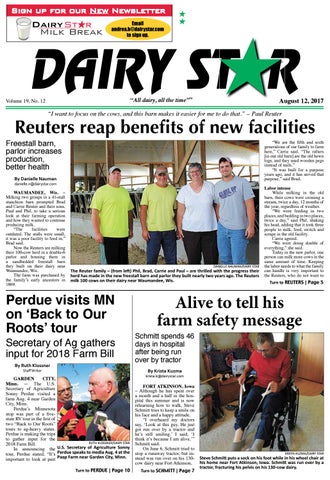
Reuters reap benets of new facilities
“We are the fth and sixth generations of our family to farm here,” Carrie said. “The rafters [in our old barn] are the old hewn logs, and they used wooden pegs instead of nails.” “It was built for a purpose years ago, and it has served that purpose,” said Brad.
Freestall barn, parlor increases production, better health By Danielle Nauman danielle.n@dairystar.com
WAUMANDEE, Wis. – Milking two groups in a 41-stall stanchion barn prompted Brad and Carrie Reuter and their sons, Paul and Phil, to take a serious look at their farming operation and how they wanted to continue producing milk. “The facilities were outdated. The stalls were small, it was a poor facility to feed in,” Brad said. Now the Reuters are milking their 100-cow herd in a double-6 parlor and housing them in a sandbedded freestall barn they built on their dairy near Waumandee, Wis. The farm was purchased by the family’s early ancestors in 1869.
DANIELLE NAUMAN/DAIRY STAR
The Reuter family – (from leŌ) Phil, Brad, Carrie and Paul – are thrilled with the progress their herd has made in the new freestall barn and parlor they built nearly two years ago. The Reuters milk 100 cows on their dairy near Waumandee, Wis.
Perdue visits MN on ‘Back to Our Roots’ tour
Secretary of Ag gathers input for 2018 Farm Bill By Ruth Klossner
Labor intense While milking in the old barn, their cows were crossing a stream, twice a day, 12 months of the year, regardless of weather. “We were feeding in two places, and bedding in two places, twice a day,” said Phil, shaking his head, adding that it took three people to milk, feed, switch and scrape in the old facility. Carrie agreed. “We were doing double of everything,” she said. Today in the new parlor, one person can milk more cows in the same amount of time. Keeping the labor needs to what the family can handle is very important to the Reuters, who do not want to
Turn to REUTERS | Page 5
Alive to tell his farm safety message
Schmitt spends 46 days in hospital after being run over by tractor By Krista Kuzma
Staff Writer
GARDEN CITY, Minn. — The U.S. Secretary of Agriculture Sonny Perdue visited a farm Aug. 4 near Garden City, Minn. Perdue’s Minnesota stop was part of a vestate RV tour in the rst of two “Back to Our Roots” tours to ag-heavy states. Perdue is making the trips to gather input for the RUTH KLOSSNER/DAIRY STAR 2018 Farm Bill. In announcing the U.S. Secretary of Agriculture Sonny tour, Perdue stated, “It’s Perdue speaks to media Aug. 4 at the important to look at past Paap Farm near Garden City, Minn. Turn to PERDUE | Page 10
krista.k@dairystar.com
FORT ATKINSON, Iowa – Although he has spent over a month and a half in the hospital this summer and is now relearning how to walk, Steve Schmitt tries to keep a smile on his face and a happy attitude. “I overheard my doctors say, ‘Look at this guy. He just got run over by a tractor and he’s still smiling.’ I said, ‘I think it’s because I am alive,’” Schmitt said. On June 6, Schmitt tried to stop a runaway tractor, but instead was run over on his 130cow dairy near Fort Atkinson, Turn to SCHMITT | Page 7
KRISTA KUZMA/DAIRY STAR
Steve SchmiƩ puts a sock on his foot while in his wheel chair at his home near Fort Atkinson, Iowa. SchmiƩ was run over by a tractor, fracturing his pelvis on his 130-cow dairy.
Page 2 • Dairy Star • Saturday, August 12, 2017
DAIRY ST R www.dairystar.com
ISSN 020355 522 Sinclair Lewis Ave. Sauk Centre, MN 56378 Phone: (320) 352-6303 Fax: (320) 352-5647 Published by Dairy Star LLC General Manager/Editor Mark Klaphake - mark.k@dairystar.com 320-352-6303 (ofďƒžce) 320-248-3196 (cell) 320-352-0062 (home) Ad Composition Nancy Powell 320-352-6303 nancy.p@dairystar.com Amanda Thooft 320-352-6303 amanda.t@dairystar.com Consultant Jerry Jennissen 320-346-2292 Editorial Staff Andrea Borgerding - Managing Editor (320) 352-6303 • andrea.b@dairystar.com Krista Kuzma - Assistant Editor (507) 259-8159 • krista.k@dairystar.com Ron Johnson (608) 874-4243 ron.j@dairystar.com Ruth Klossner (507) 240-0048 cowlady@centurylink.net Jennifer Coyne (320) 352-6303 jenn@dairystar.com Brittany Olson (320) 352-6303 brittany.o@dairystar.com Danielle Nauman (608) 487-1101 danielle.n@dairystar.com Advertising Sales Main Ofďƒžce: 320-352-6303 Fax: 320-352-5647 Deadline is 5 p.m. of the Friday the week before publication Sales Manager - Jeff Weyer (Northern MN, East Central MN) 320-260-8505 (cell) jeff.w@dairystar.com Mark Klaphake (Western MN) 320-352-6303 (ofďƒžce) 320-248-3196 (cell) Laura Seljan (National Advertising, SE MN) 507-250-2217 fax: 507-634-4413 laura.s@dairystar.com Jerry Nelson (SW MN, NW Iowa, South Dakota) 605-690-6260 jerry.n@dairystar.com Mike Schafer (Central, South Central MN) 320-894-7825 mike.s@dairystar.com Lori Menke (Eastern Iowa, Southern WI) 563-608-6477 • lori.m@dairystar.com Megan Stuessel (Western Wisconsin) 608-387-1202 megan.s@dairystar.com Deadlines The deadline for news and advertising in the Dairy Star is 5 p.m. Friday the week before publication. Subscriptions One year subscription $35.00, outside the U.S. $110.00. Send check along with mailing address to Dairy Star, 522 Sinclair Lewis Ave., Sauk Centre, MN 56378. Advertising Our ad takers have no authority to bind this newspaper and only publication of an advertisement shall constitute ďƒžnal acceptance of the advertiser's order. Letters Letters and articles of opinion are welcomed. Letters must be signed and include address and phone number. We reserve the right to edit lengthy letters. The views and opinions expressed by Dairy Star columnists and writers are not necessarily those of the Dairy Star LLC.
The Dairy Star is published semi-monthly by Dairy Star, LLC, 522 Sinclair Lewis Ave., Sauk Centre, MN 56378-1246. Periodicals Postage Paid at Sauk Centre, MN and additional mailing ofďƒžces. POSTMASTER: Send address changes to Dairy Star, 522 Sinclair Lewis Ave., Sauk Centre, MN 56378-1246.
North America dealers. A glance at what’s inside
Dairy Proďƒžle brought to you by your
With so many jobs to get done on the farm during the summer, Cindi and Randy Schoenberg sometimes need to rely on their sons for help. The Schoenbergs were featured in this issue’s “Day in the life.â€? Although their sons work off the farm, they still come back to help, especially with ďƒželd work and stacking bales, which is what they did on Aug. 1. Along with putting up a 20-acre oat ďƒželd, the Schoenbergs had regular chores and a baseball meeting that night. Read more about their day on pages 18, 20-21 in second section. Farmers across the states of North and South By Mark Klaphake Dakota are experiencing a severe drought that is not only Editor affecting forage and crop production, but also the future of agriculture across the Great Plains. Gregg Klusmann, of New Salem, N.D., shares the trials his 80-cow dairy is experiencing because of the dry weather, and industry representatives explain the resources available to farmers, such as emergency grazing and a hotline to locate hay, on pages 12-13 in ďƒžrst section. As Minnesota prepares to host the Super Bowl in February, Land O’Lakes is preparing for their own football-related activity. The dairy cooperative, NFL and GENYOUth have teamed up to host the Land O’Lakes Farm Bowl Feb. 1 in Minneapolis. To promote the event, Ron Miller, of Little Falls, Minn., invited iconic football players to his farm to practice for the obstacle course and shoot a promotional video for the event. Read about Miller’s experience being part of such a high-proďƒžled farm tour on pages 3-4 in second section. Despite the rollercoaster ups and downs of dairy farming, Craig Carncross sets high goals for his herd of 420 Holsteins near Lodi, Wis. These high expectations and hard work earned him the Holstein USA National Distinguished Young Breeder award, which goes to a Holstein USA member under the age of 40 and to someone who has achieved goals set for his or her herd. Read about how Carncross manages his farm on pages 3 and 5 in third section. As fall harvest season slowly approaches, we decided to talk to people about how their crops have done over the summer for the “From our side of the fenceâ€? feature for this issue. Read about how the growing season has been for people in the Dairy Star coverage area, along with any setbacks they have experienced. It can be found on pages 15-16 in ďƒžrst section.
Favorite quotes from this issue:
“Consumers are often misinformed about farm practices; educating them is one of the most positive and inďƒ&#x;uential things you can do.â€? - Julia
Nunes (Pages 35, 37 First Section)
“Music is something we can do here on our farm and in our community, and music and farming have both taught us how to work together.� - Ann
Kormann (Pages 16-17 Second Section)
By the Numbers
number of pounds Paul 15: The Stempďƒ&#x;e observed his tank average increase by after updating his milking and housing facilities. (Pages 6-7 Second Section)
somatic cell 90,000: Current count at Shadycrest
Holsteins. (Pages 18, 20 First Section)
DOUBLE DOWN ON PRODUCTIVITY
MM 700 MERGE MAXXÂŽ MERGER • Durable, yet gentle crop handling provided by high-capacity pickups INVEST IN QUALITY ÂŽ • Floating windguard is automatically optimized for differing crop volumes • Leaf loss is substantially reduced with standard crop netting Ĺ? 0XOWLSOH RSWLRQV IRU Ä H[LELOLW\ WR PHUJH OHIW ULJKW VSOLW RU ZLWK HLWKHU ZLQJ UDLVHG 23' 10" pickup working width
KuhnNorthAmerica.com
Roeder Bros. Bellevue, IA
Dee Implement of Waukon Waukon, IA
Lindstrom Equipment Mondovi, WI
Bodensteiner Implement Elkader, IA
D & D Farm Supply Arcadia, WI
East Side Farm Equipment Monroe, WI
J P Scherrman Farley, IA
Cherokee Garage Colby, WI
Frontier Ag & Turf New Richmond, WI
Burco Sales Independence, IA
Komoro Sales & Service Durand, WI
Steinhart's Farm Service Platteville, WI
Kunau Implement Preston, IA
Jordan Implement Juda, WI
Hwy 48 Farm Service Rice Lake, WI
Visit your local KUHN dealer today!
Dairy Star • Saturday, August 12, 2017 • Page 3
It’s all inside... FROM OUR SIDE OF THE FENCE:
What is the status of your crops? Pages 15-16
Second Section: Page 8
Eau Claire
Children Museum of Eau Claire hosts June Dairy Stan Gausman Month activities
SECOND SECTION Pages 3 - 4
Kormanns play large repertoire of music
Second Section: Pages 16 - 17
Third Section: Pages 14 - 15
Alma
Bayeld
Douglas
Baldwin, Wis. Pages 14 - 15 Second Section
Partnership turns friends into family
Iron
First Section: Page 23
hb
ur
n
Ashland Burnett
Sawyer
Price Waumandee
Scott Hentsch
Polk
Hixton, Wis.
Reuters reap benets of new facilities
Rusk
Barron
First Section: Pages 1, 5-6
Taylor
Farmers, NFL players team up for Land O’Lakes Farm Bowl Pages 10 - 11 The “Mielke” Market Weekly Page 12
St. Croix
Chippewa
Dunn
Fort Atkinson
Dairy Markets
Pierce
Pepin
Rob Anderson Westby, Wis.
Buffalo
Princess Kay Finalists
Pages 26, 29
A mini music festival in Winona County
Norwalk, Wis.
Page 27
Dairy Prole: Amy Schmitz
Mid-American Hay Auction Results Pages 30 - 31 Crop and weather reports Pages 38 - 39
Page 39
Schmitts clean up after storm
Clark
Eau Claire Trempealeau
Page 13
Area Hay Auction results Pages 14 - 15 Dairying Across America Pages 16 - 17 Kormanns play large repertoire of music Pages 22 - 25
Exeland
Sisters with Jerseys top Barron County junior dairy show
Father, daughter share love of tractor pulling
Pages 35, 37
Konder, Nunes representing their counties as Fairest of the Fair Page 36 Women in Jeans: Amanda Williams
Rice Lake
Barron
W as
FIRST SECTION Pages 8-9 Ag Insider Pages 12 - 13 Dakotas’ drought brings hardships Pages 18, 20 Sand big factor in high herd average at Shadycrest Holsteins Page 22 Electrolytes: They’re not all the same Page 25 Worries about lactose Page 26 FSA News & Notes Page 27 The Transition Pen Page 28 Western Wisconsin wash-out in mid-July Page 31 What’s in a name? Page 32 Making Cents of Dairy Page 33 Dairy Good Life Page 34 Veterinary Wisdom
Third Section: Page 11
Jackson
Waterville Kids Corner: The Fossums
La Crosse Monroe
Third Section: Pages 16 - 17
Dairy Recipes
Vernon
Worth
Mitchell
Cerro Hancock Gordo
Floyd
Howard
ick
Ch
w
a as
Bremer
Zone 2
Black Hawk
B
For additional stories from our other zone, log on to www.dairystar.com
Iowa
Clayton
an
an
ford
Craw
Dane Marquette
Grant
Fayette
h uc
Richland
Allamakee
Winnebago
Winneshiek
THIRD SECTION Pages 3, 5 Carncross named Holstein USA National Distinguished Young Breeder Pages 6, 9 Peterson leads Wisconsin State Fair milking parlor team Pages 12 - 13 Iowa State Holstein Show Pages 19 - 20 Dairy Calendar Pages 21 - 30 Classieds
are
w ela
D
Linn
Lafayette Dubuque
Jones
Jackson
Green
Specht farms for the birds, all of nature Second Section: Pages 32, 36
Maynard
Stempes upgrade facilities for next generation Second Section: Pages 6 - 7
Comfort and versatility unlike any other Upgrade your barn with GEA’s Single Beam Freestall Mounting System With easy installation and flexible designs,
durability for reduced freestall maintenance.
GEA’s Single Beam Freestall Mounting System
Cows enjoy unobstructed lunge space and lay
can seamlessly integrate with any new or
straighter for cleaner stalls and udders.
existing freestall barn. This state-of-the-art
Fully adjustable stall width and neck rail
mounting system features the patented
height gives you a customized system to fit
cushion cross clamp providing extreme
your herd.
Page 4 • Dairy Star • Saturday, August 12, 2017
NEW EQUIPMENT SAUK CENTRE TRACTORS NH T4.100 & 110 Utility, Cab & Loader ...3 in Stock! NH T6.180 Plus, Super Steer, 4 Rmts ........In Stock! NH Workmaster 60, FWA, Loader Ready ...In Stock! NH Boomer 46D, Cab Heat, A/C, Loader ..In Stock! SKID LOADERS NH L218, L220, L228 and C238 ................ In Stock! HAY TOOLS NH SpeedRower 220 & 260 ...................... In Stock! NH Procart 819, 1022, 1225 Rakes............In Stock! NH Dura-Vee 1020, 1225, 1428 Rakes ......In Stock! Kemco Inline Bale Wrappers ......................In Stock! NH H7230 & DB313R Discbines ................In Stock! NH H6740, 7’ 10” Disc Mower, 3 Point ......In Stock! NH ProRotor 3114 & 3223 Rakes...............In Stock! NH ProTed 3417, 17’ 1” Working Width .....In Stock! BALERS NH RB450, RB460 and RB560...................In Stock! TILLAGE Salford 8208 Plow, 8 Bottom .....................In Stock! Salford I-2218, 18’ Vertical Tillage..............In Stock! Salford 9809, HD Ripper, 9 Shank..............In Stock! Salford I-4124, HD Vert. Tillage, 24’ ...........In Stock! FORAGE NH FP240 & FR500 Forage Harvesters......In Stock! MANURE SPREADERS BBI Endurance, 22’ Litter Spreader ...........In Stock! MISCELLANEOUS Messer Attachments and Rock Wagons ....In Stock!
BEING EQUIPPED FOR
PIERZ TRACTORS NH T7.230 Classic, Power Shift, Super Steer .............................................In Stock! NH T4.90, T4.100 & T4.110 Utility’s ...........In Stock! NH T6.155 Plus, 2WD, 4 Rmts ...................In Stock! NH Boomer 37 with Loader........................In Stock! NH Boomer 40 ROPS, 45 Cab, 55 ROPS, 55 Cab ....................................................In Stock! SKID LOADERS NH L218, L220, L228 and L234 .................In Stock! HAY TOOLS NH SpeedRower 220 & 260 .......................In Stock! NH ProCart 819, 1022 & 1225 Rakes .........In Stock! NH Dura-Vee 1225 & 1428 Rakes ..............In Stock! Kemco Inline Bale Wrappers ......................In Stock! NH ProRotor 3114, 3223 & 3226 Rakes.....In Stock! NH ProTed 3417 .........................................In Stock! NH H7220, H7230 & H7330 Discbines.......In Stock! NH DB313R & DB316R Discbines .............In Stock! BALERS NH RB450, RB460, RB560.........................In Stock! NH BC5070 Small Sq, 72 Thrower .............In Stock! FORAGE NH FP240, Crop Proc., Tandems ...............In Stock! MANURE SPREADERS NH DT2600, M2080, 185, 195’s .................In Stock! BBI Endurance, 18’ & 22’ Litter Spreader ..In Stock! MISCELLANEOUS Messer Attachments and Rock Wagons ....In Stock!
USED EQUIPMENT SAUK CENTRE TRACTORS NH T7000 Front PTO/3 Point Kit .................$6,500 JD 3400 Telehandler, 22’ Lift, 6,000# .........$32,500 SKID LOADERS NH L230, 850 hrs., Perf Package ...............$43,500 NH L230, Cab Heat, A/C, Air Seat .............$36,900 NH L218, Cab, Heat ...................................$24,900 NH L220, Cab, Heat, A/C, 2 Speed............$32,700 HAY TOOLS NH 1475, 14’ Haybine ................................$13,500 NH H7450, 13’ Disbine, Draw Bar Swivel ..$27,900 BALERS NH RB460, Roto-Cut, 4’x6’, 3500 bales ....$33,900 NH BR7090, Net Only, Wide P/U ...............$27,900 NH BR780A, Twine/Net, Wide P/U .............$11,500 NH 654, 4x6 Bale, Auto-wrap ..................... Just in! JD 567, Net/Twine, Consigned ...................$13,750 TILLAGE Salford 8214 Plow, 14 Bottom ...................$55,500 FORAGE Krone EC7500 ............................................$29,500 NH 919A4 CH, 4R-36”, Fits 1915.................$1,750 NH FX25, 4WD, AutoLube, 360N6 CH, Consigned...............................................$52,500 MISCELLANEOUS Berti TA-220 Offset Flail Mower. ...................$4,500
PIERZ TRACTORS JD 4055, 2WD, 1650 Hrs., Sharp ...............$34,900 NH 8770, 2WD, 20.8x42 Duals...................$49,000 NH TD5050, Cab, FWA, Mech. Shuttle ......$29,700 SKID LOADERS NH L185, Cab, Heat, A/C ...................... Coming In! NH LS170, Cab, Heat, Hyd Q-Tach, Hi-Flow, New Tires ................................................$17,800 HAY TOOLS NH 166 Inverter, Hyd Drive, RH Table Ext ....$5,700 NH 1431, Nice Consigned ...........................$14,000 Gehl 2360, 9’ Cut Disc Mower/Conditioner . Just In! Enorossi 10 Wheel, Carted Rake...................$3,500 BALERS MF 1756, 5’x6’, Net-Twine, 540 PTO .........$16,250 NH BR780, Auto-Wrap .................................$9,700 NH BR780, Net-Twine, Bale Command .....$17,500 NH BR740, Bale Slice, Net/Twine...............$17,500 JD 469 Premium, Net, Mega Wide P/U ......$34,500 TILLAGE JD 3710, 10 Bottom Plow...........................$42,500 GRAIN HANDLING Sudenga 8”x61’, 540 PTO Drive ..................$2,900 FORAGE NH FP230, 27P HH, 3PN CH, KP...............$39,500 Miller Pro 5200, 16’ Rear, 12T Tandem ........$6,250 MISCELLANEOUS JD 115, Stalk Chopper, 15’ ........................$12,000 Hiniker 5610, RH Discharge Stalk Chopper ....................................................$7,900
T O M O R R O W S TA R T S T O D AY T4 SERIE S TR AC TORS
$8000 CASH BACK PLUS
0% FOR UP TO* 84 MONTHS
0% FOR 84 MONTHS* WITH PAYMENTS AS LOW AS $579.00 For non-stop performance to easily handle all your daily chores, choose New Holland T4 Series tractors. New, more powerful engines are fuel-efÄcient too. Plus, you can’t beat the comfort and visibility of the roomy ROPS platform or the cool VisionView™ cab. Learn more about these 73 to 99 PTO HP tractors at www.newholland.com/na
S T R O N G . S TA B L E . U N S T O P PA B L E . COMPAC T TR ACK LOA DERS
0%
FOR UP TO * 72 MONTHS
0% FOR UP TO 72 MONTHS* WITH PAYMENTS AS LOW AS $598.00 Whatever job you face, take it to another level in a 200 Series Compact Track Loader. Reach higher and dump farther with Super Boom®, designed to go beyond what was thought possible. With tracks for increased stability and one of the widest cabs available, you can handle long workdays with maximum comfort in even the most challenging terrain.
PIER PI ERZ ER Z M N PIERZ, MN 320-468-2161 • Hwy. 27 West
EQUIPPED FOR A NEW WORLD™
SAUK CENTRE, MN
320-352-6543 • Hwy. 71 South
EQUIPPED FOR A NEW WORLD™
EQUIPPED FOR A NEW WORLD™
SAUK SA UK C CENTRE, ENTR EN TRE TR E M MN N 320-352-6543 • Hwy. 71 South
*For Commercial use only. Customer participation subject to credit qualiÀcation and approval by CNH Industrial Capital America LLC. See your participating New Holland dealer for details and eligibility requirements. Down payment may be required. Offer good through August 31, 2017 at participating New Holland dealers in the United States. Not all customers or applicants may qualify for this rate or term. CNH Industrial Capital America LLC standard terms and conditions apply. Taxes, freight, set-up, delivery, additional options or attachments not included in price. Offer subject to change or cancellation without notice. © 2017 CNH Industrial Capital America LLC. All rights reserved. New Holland Agriculture is a trademark registered in the United States and many other countries, owned by or licensed to CNH Industrial N.V., its subsidiaries or afÀliates. CNH Industrial Capital is a trademark in the United States and many other countries, owned by or licensed to CNH Industrial N.V., its subsidiaries or afÀliates.
PIERZ, MN
320-468-2161 • Hwy. 27 West
Superior seedbed Preparation
CALL FOR A DEMO! SAUK CENTRE, MN
320-352-6543 • Hwy. 71 South
PIERZ, MN
320-468-2161 • Hwy. 27 West
Call Or Visit Us On The Web At
www.modernfarmequipment.com To Learn More About Salford’s Line Of Superior Tillage Tools
Dairy Star • Saturday, August 12, 2017 • Page 5
ConƟnued from REUTERS | Page 1
DANIELLE NAUMAN/DAIRY STAR
Cows enjoy the open, well-lit and well-venƟlated freestalls in the Reuters’ new barn. have to hire outside labor. “The cows are our assets, you care for them,” Brad said. “No one takes care of your stuff as good as you,” added Phil. Next generation prompts need for change When Paul graduated from the University of Wisconsin-River Falls in 2013 he made the decision to come home to work on the dairy farm. “I’d been away, and that made me realize what I wanted to do,” said Paul, who started his post-secondary schooling at the University of North Dakota, where he obtained his pilot’s license. Being away from the farm and the cows made him realize his true passion – dairy farming. He transferred to the University of Wisconsin-River Falls where he completed a degree in dairy science. With the next generation home, the Reuters decided to upgrade their facilities. “It was a long building process,” Paul said. “I was 23 and had never built before. There were a lot of questions about where to go or how to do things. It was a steep learning curve dealing with everything, especially the permits from the DNR and the Army Corps of Engineers. I worked with FSA, and they required different things, too.” Paul did his own contracting for the building project, and that created its own set of difculties, too. In addition, the parlor was placed on back-order. What was slated to take a couple months turned into a nine-month process from breaking ground to move-in.
With the proximity of their old barn to the stream, it was deemed to be easier to build a on a completely new site than at the site of the old structure. “The stream is considered impaired. It is overloaded with sediment from the woods upstream, so zero sediment from our building project could enter,” Paul said. That required building two sediment basins to be made during construction. The sediment settles in the bottom and clean water ows out. After the excavation for the project was completed, the sediment ponds were pulled out. New facilities with great benets The new facility features a used, double-6 Germania parlor, which was retrotted to meet the Reuters’ needs. The 80-stall freestall barn features three rows of sand-bedded stalls with pack-mats, an alley-scraper, tunnel ventilation and J-bunks. The holding pen and the parlor have in-oor heating, which helps keep the oors drier and prevents ice from forming in the winter. “There is something about that inoor heat,” Brad said. “It is so much easier on your body, too.” During the planning process, robots were investigated, but the Reuters felt they were cost prohibitive for their operation. Regardless, they like their new space. “It sure is nice,” Carrie said. “I didn’t think it would be so nice, but wow. It is so bright and airy, and so comfortable; the old barn was so dark.”
WE STOCK FRACTIONAL TO 10 HP SINGLE AND 3-PHASE MOTORS!
MOTOR REPAIR • quick • dependable • nearly 40 years experience
Used Leeson 1.5 HP motor, instant reversing ....................... $250 Baldor 3 HP, 3450rpm ................ $200 Baldor 5 HP ................................$350 Baldor 10 HP .............................. $650 Century 7.5 HP ........................... $450
We Sell and Service Generators! USED GENERATORS
Each WINCO PTO generator is designed using the highest quality components and the best workmanship available.
Onan 15 KW w/powershaft ............................. $900 Niagra 15 KW w/powershaft ........................... $900 Pincor 16 KW w/trailer & powershaft ........... $1,300 Winpower 12 PT2 generator w/powershaft .... $700 Winpower 35/20 PT3J 20KW cont. w/PTO & trailer .......................................... $1,800 Winco 35KW PTO alternator w/PTO & trailer .......................................... $2,900 Honda EB5000X gas portable generator..... $1,100 Parmac 5500 Watt portable diesel generator . $800
We also have Hanson Silo Replacement Parts Available!
AMPS, INC. 105 County Rd. 10, Albany, MN • 320-845-4690
Turn to REUTERS | Page 6
COMPLETE BARN SOLUTIONS WHATEVER YOUR DAIRY NEEDS
During Drumgoon Dairy Rodney and Dorothy Elliott Lake Norden, SD 1800 cows milked, 3X a day
Before
Call us to help you make your dairy operation more efficient.
Remodeled parlor to a 2x24 Turner Vertical Lift with Individual Cow Indexing
After
www.midwestlivestock.com
PINE ISLAND, MN • 800-233-8937 BEATRICE, NE • 800-342-5657 SIOUX FALLS, SD • 800-705-1447 MENOMONIE, WI • 715-235-5144 OWEN, WI • 715-229-4740
Page 6 • Dairy Star • Saturday, August 12, 2017
ConĆ&#x;nued from REUTERS | Page 6
Willmar, MN • 320.231.1470
EXPANDING OR REMODELING YOUR LIVESTOCK OPERATION? LANGE AG SYSTEMS SPECIALIZES IN:
Ĺś NEW FACILITIES
_
NO JOB TOO BIG OR TOO SMALL
Ĺś RETROFITTING & REMODELING Ĺś TURNKEY PROJECTS Ĺś BARN DESIGN Ĺś INSTALLATION, MAINTENANCE & REPAIRS
Ć‹ĆľĹ?ƉžĞŜƚ tÄž KÄŤÄžĆŒÍ— Íť sĞŜĆ&#x;ĹŻÄ‚Ć&#x;ŽŜ &Ä‚ĹśĆ? Íť sĞŜĆ&#x;ĹŻÄ‚Ć&#x;ŽŜ Ĺ˝ĹśĆšĆŒĹ˝ĹŻĆ? Íť WĹ˝Ć?Ĺ?Ć&#x;ǀĞ WĆŒÄžĆ?Ć?ĆľĆŒÄž dĆľÄ?ÄžĆ? Íť ĆľĆŒĆšÄ‚Ĺ?Ĺś ^LJĆ?ƚĞžĆ? Íť DÄ‚ĆŠĆŒÄžĆ?Ć?ÄžĆ? Íť tÄ‚ĆšÄžĆŒÄžĆŒĆ? Íť ^ƚĂůů Ć‹ĆľĹ?ƉžĞŜƚ Íť ,ĞĂĚůŽÄ?ĹŹĆ? Íť DĹ?Ć?Ć&#x;ĹśĹ? ^LJĆ?ƚĞžĆ?
Lange Ag Systems is proud to offer Grain Bags, Silage Bags & Bunker Covers from Up North Plastics and Feed Fresh Silage Covers & Custom Size Bunker Covers from Raven!
t ^ >> E t Θ h^ 'Íł ' Θ < >>z Zz E '' Z^
www.LangeAgSystems.com I F A
Roller-Grinder
More milk less feed with uniform Àne-grind Solid cast rolls All belt-electric drive Single or double mills USA & International sales Replacement rolls available for most mills Used mills and tumble mixers on hand Hammer Mills
Phone: (319) 634-3849 • Toll Free: (800) 426-0261 web: www.ifamill.com • email: ifamill@netins.net
CLASSIFIED Doesn’t Always Mean Top Secret!
It’s no secret that a Dairy Star classiďƒžed ad can help you eliminate those unwanted items!
Call 320-352-6303
or e-mail nancy.p@dairystar.com
FORAGE FIESTA FIELD DAY: Alfalfa, Cover Crops, Grass, and More!
August 24th, 2017
SE Research Farm: 29974 University Road, Beresford, SD 57004 BROUGHT TO YOU BY:
AGENDA:
The sides of the freestall barn are built with clear polycarbonate, increasing light in the barn. The freestall barn roof is insulated to help control temperature and condensation. “The alley scraper and J-bunks are huge time savers,â€? Phil said. “Not having to scrape and push feed cuts back a lot on labor and equipment.â€? The new facility is different than how they used to dairy. “It was a change to have them all under one roof, all indoors,â€? Paul said. “There are no ďƒ&#x;ies, it’s cool in the summer and it doesn’t freeze in the winter.â€? Brad said the cows have adjusted well, despite his hesitations. “I didn’t think it was a way I’d every go,â€? Brad said. “I like to see them out grazing, but they aren’t happy out there in the sun with the ďƒ&#x;ies. They are happy in that barn.â€? The herd adjusted with ďƒ&#x;ying colors to the new facilities, and the Reuters had a zero cull rate for the transition. They have been milking in the new facility for nearly two and a half years, and the changes have been immense. “Production is up about 15 pounds per cow per day, and our [somatic] cell count has dropped in half,â€? Paul said. “The cows are peaking higher, too.â€? The herd was not on test in the old barn, but they began AgSource testing since moving into the new facility. In addition to increased production, the Reuters are seeing increased reproductive efďƒžciency with shorter calving intervals. There are also fewer cases of mastitis and pneumonia, particularly in the summer months. “We are also doing a better job with calving having the maternity pen,â€? Paul said. “We are able to keep a closer eye on them than we could when they were on pasture.â€? The only aspect of cow comfort and management that has not improved is foot health. “We see more warts, that’s the biggest downfall,â€? Paul said. “We do more trimming; we used to trim once a year, now we need to trim twice a year. Our hoof trimmer said the cows crossing the creek was the greatest thing for their feet.â€? Paul feels the fresh heifers adjust to the new facility and the parlor much quicker than they did to the routine in the old barn. “Getting a fresh heifer across the gutter was a challenge, but in the parlor, they just follow the rest of the group and it’s much easier,â€? Paul said. “I also feel like the cows don’t kick as much in general.â€?
Registration
10:00 AM
Welcome & Introductions
10:05 AM
When & How to Plant Forages Planting timing, methods & management
10:45 AM
Forage Variety Selection What we’ve learned through trials about selection, production, and quality
11:30 AM
Harvest Management and Forage Analysis Implementation and interpretation of forage quality tools and results
Future growth The Reuters are happy with their current herd size. Paul designed the parlor with the option to add two additional milking units, making it a double-8; and the freestall barn is designed to be able to be enlarged as a mirror image of itself if the time to increase herd size comes. Pending milk prices, the Reuters would like to build a new heifer facility. Their calves are raised in hutches, and they are happy with that set up. However, their older calves and heifers are being raised in the old facilities. “It’s hard to ventilate and hard to clean,� said Brad of the old structure. While the Reuters don’t feel their new facility is less work, it’s less labor-intense and requires fewer people to complete the work in the same amount of time. “Physically, it’s easier work,� Paul said. “I want to focus on the cows, and this barn makes it easier for me to do that.�
Lunch & Sponsor Networking
1:15 PM
When to Graze What Season vs. year round grazing forages
"& & . ! + ! / - "+ ( ' & ' +& +"&$
1:45 PM
Cover Crop IdentiďŹ cation & Grazing Plots
2:15 PM
View Alternative Forage Plots Cover crops including triticale, rye, forage sorghum & more
! ! " &' ! ' '+ &' / "! ! ' / $
2:45 PM
Refreshment Break
3:00 PM
Economics of Raising High Quality Forage, Crops and Animals
3:30 PM
Wrap Up, Questions, Evaluation
*Due to road construction please seek alternate routes. From I-29: Take Exit 47. Take Hwy. 46 west to GreenďŹ eld Road, turn south and go 3 miles to 300th street, then go west 3 miles and turn north on University Road. The farm will be the ďŹ rst place on the east side of University Road.
- "+ 0 +"" ' ! + "!$
12:15 PM
Register on-line at iGrow.org
Increased equipment needs One thing the Reuter family has noticed is that the new facility has required an increase in the amount of equipment they need to operate. “It seemed like we doubled the herd size, but tripled the equipment we needed,â€? Phil said. The Reuters began feeding a TMR when they moved into the new facility. Feeding more cows, they were short on feed storage, which required bagging more feed in place of the traditional stave silo. They continue to do daily haul for their manure management, opting out of manure storage, having enough ďƒ&#x;at land to spread every day on frozen ground. “We don’t want to have to hire custom work to spread manure, and to spread it ourselves would require more equipment,â€? Phil said. He also pointed out the time factor in hauling stored manure, “The last thing I want is to be hauling manure when we need to be putting corn in the ground,â€? Phil said.
Register for $20/person until August 18th, 2017 or $25 after August 18th, 2017
9:30 AM
DRIVING DIRECTIONS TO SE RESEARCH FARM:
One concern that stayed in the foreground of their minds during the construction process was that of stray voltage. “You hear so many horror stories, but you really can’t know until it’s done and everything is connected,� Brad said. “When Xcel [Energy] tested it, our highest point was hardly registerable. It was a huge relief to know there were no issues there,� Paul said. The Reuters continue to have the farm tested for stray voltage on an annual basis.
$ ,)
- "+ #&" - + & #' / "! ' + +" !'/ & #&" - + %- '+ "!'$
!" # [ !
" !
#
Dairy Star • Saturday, August 12, 2017 • Page 7
Con�nued from SCHMITT | Page 1 Iowa. The incident fractured his pelvis in several places, resulting in a 46-day hospital stay and three surgeries. The incident happened just before bringing fresh cows up to the parlor. To help create a path, Schmitt parks a piece of machinery beside the barn so the cows do not run through the opening. Although he knew the New Holland tractor’s parking brake was wearing, he thought he felt the safety feature catch and lock in place. But after he got off the tractor to walk away, the tractor started to roll backwards towards the Harvestore silo. “I used my dumb instincts … and I tried to jump on the tractor to stop it. I think I made it on the rst step. The next thing I remember is laying there and realized the tire had just gone over me. I remember thinking, that tire ran over me and I’m still alive?” Schmitt said. Schmitt’s son and farming partner, Jeff, found Schmitt very shortly after and called 911. His wife, Debby, who had been milking, came out to give him towels to use as a pillow while they waited for the emergency response team. “I knew enough not to try to move. I immediately felt my left leg go numb, but I knew I wasn’t paralyzed. It wasn’t long before the EMTs were here. I was conscious enough I was greeting them as they arrived,” Schmitt said about how he tried to keep a positive attitude. An ambulance took
KRISTA KUZMA/DAIRY STAR
Steve Schmi�, pictured with his daughter-in-law and son, Erin and Jeff, is thankful for help from family a�er breaking his pelvis from being run over by a tractor. Schmi� now uses a wheelchair to get around, but is in therapy to learn how to walk again. Schmitt to the hospital in Decorah, Iowa, before being airlifted to the hospital in La Crosse, Wis. Two days later he had his rst surgery with a second one following ve days after the rst. He had exterior rods and pins placed in his pelvis. “My doctor had to start putting Humpty Dumpty back together again,” Schmitt said. After his rst two surgeries, Schmitt went back to the Decorah hospital for awhile before this third surgery in La Crosse on July 6. He went back to Decorah on July 12 and was released from the hospital to go home on July 21. “I never imagined in my life that I would be conned
to a wheelchair for awhile,” Schmitt said. At home, Schmitt receives a lot of help from his family, and has both physical and occupational therapy twice a week. Recently, Schmitt started walking back and forth in his livingroom with the help of at least one person, a walker and a wheelchair behind him. “Everyday I know I’m progressing, but it’s still frustrating,” Schmitt said. “I never pictured it being that hard to learn how to walk again. My legs are like spaghetti.” Even things like putting food in the microwave is a challenge for Schmitt. “I never imagined what it
was like to be handicapped. I have a whole new perspective of that,” Schmitt said. His family has stepped up to help him in the house and in the barn. “Erin [Jeff’s wife] was supposed to have the summer off because she’s a teacher, but instead she’s been farming all summer,” Schmitt said. Debby feeds calves in the morning and evening, along with milking cows and working her full-time off-the-farm job. Schmitt’s other son, Sam, has also put in a lot of chore time when not at his full-time job. “It’s just put a little extra stress on everyone,” Schmitt
HYDRAULIC PISTON PUMPS
CONTACT YOUR LOCAL DEALER TODAY IOWA ANAMOSA SILOS INC. Maquoketa (563) 652-5125 BRUNKAN EQUIPMENT Worthington (888) 789-2363 ENGEL AGRI-SALES Sac City (712) 662-3385 FESTINA LIVESTOCK EQUIPMENT Fort Atkinson (563) 534-7963
MODELS FOR EVERY MANURE TYPE, INCLUDING SAND BEDDING. TRANSFER MANURE LONG DISTANCE WITH ONLY 5 OR 7½ HP MOTOR.
ELECTRIC PUMPS GET THE JOB DONE FASTER
FOLLOW US
MARK’S TRACTOR & IMPLEMENT Osage (641) 732-5044 ZOSKE’S SALES & SERVICE Iowa Falls (641) 648-2980
MINNESOTA
VACU-PUMP SITS HIGH & DRY, PULLING MANURE FROM RECEPTION PIT. • CLEAN AND COMPACT • EASY SERVICE
HIGH PERFORMANCE VERTICAL PUMPS COST LESS TO RUN. • MODELS FROM 5 – 100 HP • POWERFUL AGITATION
NEW!
MORE CAPACITY LESS HORSEPOWER
608-372-3141 info@JameswayFarmEq.com
said. Sam and his wife, Suzanne, have a son, Tyler, 1. Schmitt looks forward to visits from his grandson. “He’s my therapy when he comes to visit. He puts a smile on my face,” Schmitt said. There has also been great support from the community, Schmitt said. People have visited, brought food, sent cards and mailed money. “Some of it is from people who I barely know,” Schmitt said. Schmitt is also thankful for the eldwork help. A day after one of his surgeries, the Schmitt family had to cut hay to make big square bales. People from around the area showed up to bale, haul and stack. Along with saying thank you to so many people, Schmitt wants to give people a reminder to be careful around farm machinery. “It was headed toward the Harvestore that’s why I wanted to stop it,” Schmitt said. “It put a dent in the Harvestore, but that’s nothing too major compared to what it did to me.” He now has a new slogan. “Don’t be a speed bump, just let it roll,” Schmitt said. “You can replace steel, but you can’t replace a human life. I’ve seen so many times not just a tractor, but chopper boxes, rolling in the eld. It’s just dangerous. Close your eyes and don’t watch it. It’s not worth it [to try to stop it].” Schmitt is just thankful to be alive to tell his message.
JAMESWAY IS A FAMILY OWNED COMPANY
JameswayFarmEq.com
K & R EQUIPMENT INC. Fountain (507) 268-4425 FLUEGGE’S AG INC. Mora (320) 679-2981
GENEX FARM SYSTEM Melrose and Montgomery (952) 758-2561 KBS INC. Plainview (507) 534-3855
WISCONSIN ALTHOFF’S SALES & SERVICE Bangor • (608) 486-2032 ANIBAS SILO & EQUIPMENT INC. Arkansaw • (715) 285-5317 BAKER IRON WORKS Platteville • (608) 348-7182 BINDL SALES & SERVICE Reedsburg (608) 524-6339 CHIPPEWA FA50 SERVICE //& Chippewa Falls (715) 382-5400 GEHRING SALES & SERVICE INC. Rubicon • (262) 673-4920 HIGHWAY 48 FARM SERVICE Rice Lake (715) 234-6788
L & L SALES & SERVICE INC. Kaukauna • (920) 766-0606 MAKI FARM SERVICES Curtiss - Edgar (715) 613-7308 NORDSTROM CONST & LUMBER Melrose • (608) 488-2401 VAN WYKS Waldo (920) 564-2578 GEORGE LEEDLE SALES Lake Geneva (262) 275-6631 BRAUN ELECTRIC St. Nazianz (920) 773-2143 WISCONSIN SILO Plover (715) 344-9503
Page 8 • Dairy Star • Saturday, August 12, 2017
Perdue: administration will not support market manipulation Agriculture Secretary Sonny Perdue hopped in a RV and made stops across the Midwest for his backroads tour. During the tour, Perdue said the three biggest issues facing farmers today are trade, labor and regulations. At a media brieng, Perdue said this administration won’t let unfair trade practices continue. “We’re addressing that with our good friends to the north. The Canadians are just like family, but they’re doing the wrong thing on this supply/management. I told the (ag) minister, it’s your business if you want to manage supply, that’s your business, but manage it. Don’t overproduce and dump milk solids on the international market and depress our prices. That’s not fair and we will address those things.” During the roundtable discussion, Perdue said the United States has been kind of a patsy, turning the other cheek rather than enforcing trade deals in the recent past, but market manipulation will not continue.
Canada’s supply-management should be addressed During a House Agriculture Committee hearing, Ranking Member Collin Peterson said the biggest issue he’s had with NAFTA is Canada has been able to continue their supply management system for dairy. “When they did the original negotiation, they didn’t have ultra-ltered milk. That wasn’t protected under the agreement. It’s a problem we have, dealing with them and their supply management system. The biggest problem I think is the number three and ve largest dairy companies are owned by Canadians.” Peterson said he’s brought the issue to USTR and Commerce Secretary Ross. “Given their response, I’m not holding my breath,” he said. “In this negotiation, I hope we can get this supply management thing to a level playing eld.” The race is on With the Administration preparing to renegotiate
Cooling the World’s Milk
DBA les lawsuit against DNR The Dairy Business Association is suing the Wisconsin Department of Natural Resources, claiming the DNR overstepped its legal boundaries by implementing new manure management rules without going through the proper regulatory process. DBA President Mike North said his organization is just asking “the DNR to follow the rules.” DBA claims the DNR failed to follow the rulemaking procedure that requires lawmaker oversight and public input.
PRE-COOL WELL WATERre cooled • Dual pass • Counterflow milk vs. well • Milk within 3–5° F of well water exiting the plate cooler • Cut your refrigeration time in half • Wall or floor mount options • Heavy duty design
INSTANT COOLtant WELL WATER AND CHILLED WATER
Possible Rebates Available!
1-800-MUELLER
the North American Free Trade Agreement, the House Agriculture Committee took testimony on trade issues. Former Agriculture Secretary Tom Vilsack Ag Insider now leads the U.S. Dairy Export Council and emphasized the need for the new NAFTA deal to resolve current trade issues. That would include Canada’s new pricing strategy that has shut down a signicant market for U.S. dairy farmers. Vilsack also said the European Union and other countries are working on their own By Don Wick trade deals. “We need to Columnist encourage bilateral discussions and modernization discussions to continue. We can’t afford to lose this race with the EU.” Minnesota Congressman Collin Peterson also questioned Vilsack about Canada’s dairy quota system. “The Canadian government manipulates this market. You can’t ask U.S. companies to invest in a processing facility if there is no expectation the market they’re counting on is going to be present six months from now. This process has to be more transparent and predictable.”
• 98° to 36° F milk in seconds • Up to 50% milk cooling with well water • Milk within 3–5° F of well water before entering chilled section • Counterflow milk vs. well • More cooling with less well water • Easy-to-wash configuration • Customized to your needs • Built to meet commercial dairy demands
DFE.PAULMUELLER.COM
Four recommendations for dairy policy Steve Schlangen, who chairs Associated Milk Producers, Inc., spoke at a House Agriculture Committee farm bill listening session in Minnesota. Schlangen said the Margin Protection Program did not have the opportunity to live up to its potential as the result of changes made for CBO scoring that diluted the feed cost. Schlangen said MPP does not provide necessary protection, but the dairy industry does not want a hand-out. “I would urge USDA to take immediate action and clarify the $20 million annual cap on risk management livestock insurance programs does not apply to products of livestock, such as milk.” That could pave the way for the Risk Management Agency to provide a dairy insurance option similar to crop insurance. Schlangen also urged the administration to reduce the MPP premiums for the rst four or ve million pounds of milk production per farm to increase affordability. A monthly margin calculation, rather than the current bi-monthly formula, was recommended. “We also need to restore the original feed cost formula back to the level that was established earlier in the last farm bill debate.” NMPF seeks FDA enforcement of food standards The Food and Drug Administration has food standards in place for products ranging from milk to ketchup. National Milk Producers Federation President and CEO Jim Mulhern said the FDA isn’t enforcing those standards. “We’ve had a number of years of activity in the marketplace of non-dairy products calling themselves a milk, whether it is soy, almond or rice. There’s been an explosion of nut-based beverages using the terminology of milk. This is all happening under the FDA that is not enforcing the standards designed to prevent misleading labeling in the marketplace.” Mulhern met with key FDA regulators to discuss this issue. Other countries have similar standards and Mulhern said the labeling laws are enforced. “You look at Canada. You’ll have some of the same products sold in the U.S. market, like almond beverage. The leading manufacturers of almond beverage here is called almond milk. The same package sold in Canada is called almond beverage, because they have the same standard we do, but enforce it.” Gray wolf remains on endangered list The U.S. Circuit Court of Appeals in Washington, D.C., has ruled gray wolves in the Great Lakes region should remain on the endangered species list. Turn to AG INSIDER | Page 9
Dairy Star • Saturday, August 12, 2017 • Page 9
ConƟnued from AG INSIDER | Page 8 This decision upholds a 2015 federal ruling. This case involves Minnesota, Wisconsin and Michigan. The court released a statement, saying the removal of the wolf from the endangered species list would impact the animal’s recovery in the neighboring states of North Dakota and South Dakota. The wolf issue has been a frustration for farmers and ranchers who have lost livestock. Fonterra predicts higher milk prices The Fonterra Cooperative Group is forecasting higher prices for its dairy farmers in the year ahead. The Australian-based Fonterra is the largest dairy exporter in the world said the dairy industry is being supported by strong global demand. Fonterra ofcials also indicated dairy stocks are very low for the 2017-2018 season. Former DATCP chair passes Michael Dummer, 64, has passed away. The Holmen dairy farmer is a former chairman of the Wisconsin Department of Agriculture, Trade and Consumer Protection board. Dummer was chairman from 2002-2009 and was rst elected to the board in 1998.
Retirement for manager of A.I. rm The veteran general manager of East Central/Select Sires has retired. Alan Deming of Waupun was with the co-op for 40-plus years. Jerome Meyer, who has been with East Central, was named the general manager in December and has been working with Deming since that time. Trivia challenge Approximately 3 billion pizzas are sold each year in the United States. That answers our last trivia question. For this week’s trivia, let’s focus on Agriculture Secretary Sonny Perdue. Perdue previously served as a governor. What state? We’ll have the answer in the next edition of Dairy Star.
Don Wick is owner/broadcaster for the Red River Farm Network, based in Grand Forks, North Dakota. Wick has been recognized as the National Farm Broadcaster of the Year and served as president of the National Association of Farm Broadcasting. Don and his wife, Kolleen, have two adult sons, Tony and Sam, and ve grandchildren, Aiden, Piper, Adrienne, Aurora, and Sterling.
CORRECTION:
In the July 22 Dairy Star, in the headline of the Repro Leaders feature on page 18, the family’s last name was incorrectly spelled. The correct spelling is Wiener.
N10828 Cty Hwy O | Greenwood, WI 715.267.1416 | www.greenwoodsilo.com Email: sales@greenwoodsilo.com
“It’s easier on the cows...” How long have you been using the DHIA pregnancy test? Since it Àrst came out. Why did you choose to use it? Convenience and economics. What do you like about it? It’s easier on the cows and requires no additional handling. How long have you been testing with DHIA? We’ve been with DHIA for 50+ years, since it’s inception. What are some other tests you use through DHIA? The pregnancy check in between tests is a great option with DHIA. Tell us about your farm. We’re a grazing/forage based low input operation, that focuses on maximum economic production.
John Takala Iron, MN • 330 cows Minnesota Dairy Herd Improvement Association 307 Brighton Avenue South Buffalo, MN 55313 1.800.827.3442 www.mndhia.org
SEALED SILO SERVICES: BOTTOM UNLOADERS: • CONSTRUCTION • MAINTENANCE • PRESSURE CHECKING • RESEALING • REPLACEMENT ROOFS
• GREENLINE UNLOADERS D-SERIES (FORAGE) B-SERIES (SNAPLAGE & GRAIN) • USED UNLOADERS • UNLOADER PARTS • FULLY EQUIPPED SERVICE CREW
CUSTOM HEIFER RAISING
SUPERIOR FEED VALUE THROUGH SEALED SILOS We are not affiliated with A.O. Smith Harvestore®, E.S.P.C. or C.S.T.
Do the math when choosing roasted soybeans 1. Increases milk production 2. Maximizes milk components 3. Minimizes feed refusals 4. Properly roasted at the correct temperature 5. Soybeans are steeped for 30+ minutes 6. Soybeans are roasted to the core 7. Energy KLC roasted soybeans... 8. Protein preferred by bovines 9. Amino acids everywhere 10. Bypass protein
• Over 50 years in the dairy heifer industry dustry riiority • Animal health and comfort is our priority • Proven performance
0 1 t c e f e Per
Th
KLC Farms Competitively Bids For Raw Beans - Call For Price!
KLC Farms Roasting, Inc.
Competitive all inclusive daily rates
1-877-738-2326 Visit www.roastedbeans.com
Quality
Consistency
or we can oɈer you the opportunity to free up capital but retain your genetics with our sell/buy back program.
BOERDERY INC. Orange City, IA • 712-541-2765 1-2765
Page 10 • Dairy Star • Saturday, August 12, 2017
SE A E L • T N BUY • RE
MF 7724 Call for details
MF 8735 Tractor Call for details
Sunflower 4213-11 Call for details
MF 2705 E Call for details
Sunflower 4511-15 Call for details
Sunflower 1436-33 Disc Special Price
Villard Implement Co. Villard, MN • (888)
554-3111
USED EQUIPMENT
AGCO DT-205B - $95,000
Vermeer 605N, Corn Stalk Special, low bales - Call Kinze 3700, 24 row 30”................Call White 6180, 16 row ...............$7,500 White 8524-22 CFS planter .Coming In
SKID STEERS & SPREADERS
MF 2170XD - $69,500 TRACTORS
Ford TW35, Series II ...........Just in MF GC1705 w/60” deck ....Just In MF 8690, FWA, loaded ......... Save MF 8660 CVT, 600 hrs Coming In MF 8650 CVT ................Coming In MF 8650 ........................... $120,000 MF 7497 ..............................$95,000 MF 7620 .................................Just In MF 7618 .........................Coming In MF 7616 .........................Coming In MF 7614 .........................Coming In MF 6614 CVT w/ldr.................. Call MF 5609 w/ldr...................$57,500 MF 5450 w/ldr...................$52,500 MF 1085 w/cab ................... $7,500 AGCO DT 220 ...............Coming In AGCO DT-200A .................$69,500 AGCO LT75A w/loader, only 175 hrs .....................$50,000 IH M Farmall......................... $1,950 White 6195 ...................Coming in White 6144, FWA .............$36,000 White 2-135 ......................... $8,950 JD 4630...........................Coming In U-Moline, runs good ........ $1,250
PLANTERS
White 9936-22 track planterJust In White 9108, low acres ...Coming In White 8222 12 row w/liquid Just In White 6100 12 row ..............$12,000 White 6100 12 row .................$5,900 White 5100 8 row 30” ............$3,500 JD 7200, 6 row, conser planter................Coming In JD 1750, 6 row w/dry fert.........................Coming In Case IH 900, 6 row w/dry fert., cross auger..............................$3,000
Gehl 7810E .................................$27,000 Gehl 5640E, 2 spd. ...................$17,000 Gehl 5640E, 2 pd. .....................$24,500 Gehl 4840 ...................................$12,500 Gehl 4640E ....................................Just In Gehl RT-175 track loader..........Just In Gehl R190 ......................................Just In Gehl 6640E, cab/heat .............$24,500 Gehl V-400, only 50 hrs ..........$50,000 Gehl V-330, 300 hrs. ...................Just In Bobcat S650...............................$21,500 Bobcat 863 ................................$11,500 Meyers 7400 spreader ..............Just In Meyers 390 spreader .............$11,500
ConƟnued from PERDUE | Page 1 worked, so that we create a farm bill for the future that will be embraced by American agriculture in 2018.” The Secretary spent Aug. 4 and part of Aug. 5 in Wisconsin, making stops at the Wisconsin State Fair in West Allis, and in Franklin, Janesville, Wausau and Elk Mound before crossing the border to hear from Minnesota ag representatives. In the days following, Perdue nished the tour in Iowa, Illinois and Indiana. At the Paap Farm near Garden City, Perdue was greeted by several hundred agriculture leaders representing all phases of the industry, along with 4-H and FFA youth, and Princess Kay of the Milky Way. Minnesota Farm Bureau President Kevin Paap moderated the session. Of his “Back to Our Roots” tours, Perdue drew a chuckle from the audience when he said, “We know that not all the wisdom is in D.C. We’re listening to farmers who put their lives and livelihood on the line every year. Farmers are the original entrepreneurs, the original risk takers that made America great. We do ag better than any place in the world. We do it so well that my job is to nd places to sell it. We’re here to listen and take your concerns back when we work on the farm bill. There are also things that we can do right away.” Before inviting questions from the audience, Paap said the session was about more than just the farm bill, and that Waters of the United States (WOTUS) was also a big deal. He thanked Perdue and President Trump for repealing WOTUS and said farmers want to protect the waters that should be protected. “I also want to thank Scott Pruitt, Administrator of the Environmental Protection Agency. The President understands the role of the Corp of Engineers. The Corps, the Department of the Interior, and EPA are working in tandem for quick answers. We’re looking forward to getting it right,” Perdue said in response. Gary Wertisch, Minnesota Farmers Union President, was the rst to speak. “The upcoming farm bill should address the needs of farmers. It should be written to address the needs, not cuts. You can’t balance the budget on the back of farmers,” he said. Perdue agreed. “We need to let farmers farm for the market, not for the program. We want a safety net. The public will support that,” Perdue said. “The dairy and cotton sectors didn’t perform well in the 2014 Farm Bill. We have to tweak that, make it simple, make minor modications in a budget-friendly way. Our goal is to make the USDA the most efcient, customer-friendly agency.” Several audience members brought up concerns about developing a bank of vaccines in the event of disease outbreaks, such as foot and mouth. They said the country cannot afford to get behind the curve like what happened with the avian inuenza outbreak. Perdue agreed that the No. 1 goal of the USDA is food safety and that a vaccine bank is necessary. On the matter of trade, Perdue said it is critical to work with industry groups.
RUTH KLOSSNER/DAIRY STAR
U.S. Secretary of Agriculture Sonny Perdue addresses several hundred Minnesota ag leaders at a “Back to Our Roots” RV tour stop Aug. 4 at the Paap Farm near Garden City, Minn. “We have competition all over the world. We have to drive the markets. Mexico is increasing pork production, but they’re using Minnesota and Iowa grain to do it.” Minnesota 6th District Congressman Tom Emmer said, “The secretary makes it clear that trade is his No. 1 objective. We need to expand trade with Canada, Mexico and places like Cuba.” Regional FFA ofcer Kegan Zimmermann commented on the memorandum that the USDA had signed with FFA, but noted that a disconnect still exists between youth and opportunities in agriculture. Perdue said an international youth exchange program has been created with Mexico and one is planned with Canada to better understand trade and markets. “I will be announcing a mentorship program tomorrow … We have to continue to engage young people. How can we keep youth on the farm if they can’t connect to get the markets, and socially, without good broadband? You can’t do a lot of things without connectivity,” Perdue said. “We have to use youth to communicate the benets of ag to others. I believe people will believe you before they believe me. You’re the guys that can be the antidote to the falsehoods out there.” AMPI chairman Steve Schlangen addressed the dairy situation. “Dairy farmers are looking for a safety net. We Turn to PERDUE | Page 11
MISC. ITEMS
JD 2700 ripper ..........................$19,500 JD 2700 5-bottom ......................$4,950 JD 510, 7 shank disk chisel ...$10,500 Lorenz 100 grinder mixer .......Just in MF 9895 combine, only 438 sep hrs ..............................Call Case IH 870, 9 shank ripper...........Call Case 700, 8 bottom ............Coming In IH 490, 32’ ......................................Just In Sunflower 7200-28 Soil Cond. Just In Sunflower 4610 ripper ......Coming In Sunflower 4511-13 disc chisel ............................Coming In Sunflower 1435-26 disc ............Just In Sunflower 1435-23 tandem disc w/mulcher................................$35,000 Krause 4900, 30’ disc..................$9,500 Gehl 700, 14 wheel rake ...........$6,500 Demco 650 gravity box ............Just In MF 2270XD ...........................Coming In MF 2170XD baler ...................$100,000 MF 1375 mower cond ............$17,500 Vermeer 605N, only 500 balesJust In Vermeer 605M, low bales ..............Call NH 499 ............................................$2,750 NH 340 3x3, 2015, only 4500 bales .................Coming in NI 5512 ...........................................Just In
RUTH KLOSSNER/DAIRY STAR
People who aƩended the “Back to Our Roots” RV tour listen as U.S. Secretary of Agriculture Sonny Perdue speaks.
Dairy Star • Saturday, August 12, 2017 • Page 11
ConƟnued from PERDUE | Page 10 developed what we thought would be a good program [in the 2014 Farm Bill] and promoted it, but it turned out to be a tax on dairy farmers during their worst years. There are some things that can be done right away – separate milk, protect what we have with Mexico and x things with Canada.” Perdue reiterated that milk and cotton did not fare well under the 2014 Farm Bill. “There are some things we can do now, like making dairy its own commodity. We’re trying to persuade people that that is the way to go. Please give us your ideas of what will work for the Dairy Margin Protection Program. The problem is dichotomies of the dairy industry. The 10,000 to 12,000 herds are doing OK, while the small herds are hurting. How can we protect one sector without creating windfalls for others?” he said. First District Representative Tim Walz said people want certainty, want trade deals to get where they want to be, and that risk management tools have been absolutely critical. Minnesota Secretary of Agriculture Dave Frederickson echoed earlier concerns expressed about the farm bill. “If we see ourselves sliding on the farm bill, let’s continue with what we have,” Frederickson said. Perdue had a response. “We’ve fed Americans such an abundant supply of food that they don’t know what it means to go hungry like many in other parts of the world. Ag is changing rapidly; we have to change with it. And we have to tweak dairy and cotton.” Representing the turkey, chicken and egg industry, Steve Olson said trade and availability of labor are two major concerns. He also mentioned
the importance of research to handle situations such as the avian inuenza outbreak. “However, I’m concerned about the erosion of research in the last few years,” he said. “That’s what we need to deal with the next challenge we face.” Perdue said, “We’ve had good research by Extension and good collaboration. It begins in the lab and is applied in test plots. Don’t let the federal government take two steps forward and the land grants take a step back. We have to make sure that efforts continue to be put in at the land grants. Collaboration is where success comes from.” Mark Malecek, chairman of the Minnesota Beef Producers, asked for Perdue’s feeling on checkoffs. Perdue stated, “I’m a big fan of checkoffs. I’m a get-it-done kind of guy. If you have ideas on how they can be more effective, let me know. The beef checkoff is what helped get beef back in China.” Representing sugar beets, Kyle Petersen thanked Perdue for taking care of sugar negotiations and asked how matters will be dealt with if rules are not followed. “I thought it wound up being a good deal,” Perdue said. “We’ll monitor it and any other unfair marketing practices. We want free trade, but fair trade. The U.S. won’t let people get away with violations. A deal’s a deal. This Secretary of Ag will squeal real loud if the rules aren’t followed.” Paap then said, “The big question is, do you have the President’s ear? Can you get the job done? What can we do to help?” “The President understands that ag is a big part of trade, he understands that ag is part of the positive part of the
trade decit. While ag is often the tip of the spear on retaliations, we’re going to do everything we can not to hurt ag,” Perdue said. In a closing statement, Perdue said, “This is what we hoped to achieve. I’m a hold-accountable kind of guy. If you don’t like what we’re doing, let me know. I’m an open kind of guy, I’ll let you know if I agree or explain why I don’t.” In a brief press gaggle after the open session, Perdue commented on providing adequate labor for dairy. “The program was not workable for dairy. We’re doing some things to make
it more workable and we’re working with Homeland Security. Labor is critical. Some say, ‘You just have to pay more,’ but we know that doesn’t work. It will take some Congressional regulations,” Perdue said. When asked about the food program that’s part of the farm bill, Perdue stated, “Our goal is to get people a job, rather than permanently depending on the food program. People are smart; they get a handle on it. The program is intended to help when people are down and out, but it’s not meant to be a permanent life style.”
712-722-3626
SERVICE AFTER THE SALE Q-Catch 8500V Vet Squeeze Chute
Cowpower 1050 hyd. chute
Easy Cattle Handling
INTRODUCING RUBBER MATS AND FLOORING FOR YOUR DAIRY
ALLEY/PARLOR MATS
STALL MATS
CONTINUOUS ROLL STALL MATS
SLATTED FLOOR MATS
B R O U G H T TO YO U BY
1.888.337.6265 sales@promatinc.com promatinc.com
Page 12 • Dairy Star • Saturday, August 12, 2017
A closer look by Jennifer Coyne
Industry news addressed with help from your neighbors
Dakotas’ drought brings hardships
Weather damaging elds, farms, future of ag
NEW SALEM, N.D. – Last winter, Gregg Klusmann was hopeful for the upcoming planting and growing seasons with moisture levels accumulating to near-record amounts. “In December, we received 60 inches of snow,” said Klusmann, who milks 80 cows near New Salem, N.D. “It was the most snowfall we could remember, and I thought if it kept up, it would be a record.” That notion quickly changed. As January arrived, the snow stopped and moisture has been minimal ever since. The onset of drought-like conditions developed in May and worsened over the course of the summer, resulting in one of the cruelest droughts in the High Plains area since 2006. “North Dakota farmers have been through many forms of drought within the last ve decades, but this is the worst,” said Doug Goehring, North Dakota Agricultural Commissioner. “We didn’t receive any rain in the spring, so the grasses remained dormant and there wasn’t enough moisture to establish vegetative growth.” Once the drought became established in North Dakota, it traveled to the south, affecting livestock and crop farmers in the northwest corner of
PHOTO SUBMITTED
Braden Klusmann stands in a dormant alfalfa eld with the only two bales the Klusmanns were able to take off the 15-acre plot near New Salem, N.D. Since spring, the Klusmanns and others in North and South Dakota have suffered a severe drought. South Dakota and on both sides of the Missouri River. Within South Dakota, 90 percent of dairy farmers along the I-29 Corridor, and in a 70-mile radius, are in a moderate drought or worse, according to South Dakota Dairy Producers Executive Director Roger Scheibe. “If you look at pictures from West River, the elds are completely brown and the grass is standing 2 inches tall,” Scheibe said.
Cow/calf producers are primarily affected by the adverse weather, being forced into herd dispersals because of the lack of grazing land. However, the drought is having a trickle-down effect on the entire agricultural industry. “What happens is that cow/calf operators need to purchase feed in order to retain their cattle, and dairy farmers still need to provide their herd with forages,” Dr. Alvaro Garcia said. “It’s been a chain of events and a perfect
storm – there’s a shortage of feed and more feed is required.” Garcia is the South Dakota State University Extension Agriculture and Natural Resources Program Director. Small grain crops, such as wheat and barley, as well as corn for silage and grain, and alfalfa were signicantly stunted by the dry weather conditions. Klusmann, who dairy farms with his wife, Kristie, and two children – Braden and Ivy – runs 650 acres of cropland and 350 acres of pasture. Every year, Klusmann has about 200 acres of exible cropland that he typically plants as a cash crop. With dry conditions apparent in June, Klusmann opted out of a cash crop and planted millet and Sudan grass instead, with intentions of further developing the hay elds. Of the 200 acres planted, only 50 acres germinated. “It’s only about 4 inches tall and heading, so it looks like there will not be any hay to cut on those elds,” Klusmann said. “The remaining acres did not germinate at all … There’s still seed laying in the ground.” Insignicant rain showers, coupled with high winds, have made it nearly impossible for forages to become established. Nearly 97 percent of the forages in North Dakota are stressed by the drought, said Goehring. “One farmer that I visited was only able to make a half a bale on 100 acres of grass. Another could only make 70 Turn to DROUGHT | Page 13
Still Need Forage? Do you have unplanted ground or ground open in August or September?
1. Forage Oats or Spring Triticale to be harvested in late fall 2. Fall Triticale for harvest next spring 3. Combinations of Spring Trit or Oats and Fall Trit planted together with harvests in both late fall and spring. 4. Annual or Italian Ryegrass combined with #1 or #2 5. An Alfalfa/Grass seeding for next spring Talk to your local 6. And if it gets too late – Cereal Rye! Byron Seeds dealer or
call Brad, Rick or Larry for the best option for your farm.
There are many harvest options. Some of these options qualify for Prevented Planting. Besides these cover crop forages, we have a complete line of cover crops “for cover crop’s sake” to protect your valuable soils. Burkholder Seeds
For more info or dealer Claremont, MN inquiries - please call: Dwight
Rick Tamm
NW Territory Manager
320-267-5021 Brad DeBauche
NC Territory Manager
920-660-7974 Larry Hawkins 608-516-0101
507-279-0292 Justin 507-456-0006
Gerard Becker
Long Prairie, MN (320) 290-9261
Hy View Feeds 507-493-5564 Mabel, MN
Valley View Ag Russ Funke Dyersville, IA (563) 590-6939
Schueler Farms
Greenwald Elevator
Sherman Schueler 330-987-3159 Willmar, MN John Dockendorf (320) 894-4808 Greenwald, MN (320) 290-1240 Cleeson Mill Travis Schlosser Altura, MN Miltona, MN (507) 458-5907 218-639-1727
Luxemburg Feed Service
Luxemburg, MN (320) 252-1513
Jack Stamschror Kellogg, MN (507) 259-0269
Timberline Dairy Service Joe Graber Kalona, IA (319) 656-3527
Dale Ommodt, CCA Crop & Livestock Nutrition Atwater, MN (320) 212-3190
Winscher Seeds Mike Winscher 320-282-6748 Shawn Winscher Royalton, MN (320) 420-4516
Lee Kurtenbach
Mechanicksville, IA (319) 241-5105
Peak Forage Products LLC
Benjamin Arlt
Natures Best
Tim Huffman 608-574-7918 Nelson Horst Adam Decker 608-988-6855 Canton S.D. Kevin Zimmerman (605) 359-0765 608-574-7918
Natures Best
Big Stone City S.D. (651) 331-8865
Jason Mickelson Frazee, MN 218-849-3137
Mervin Beachy St. Ansgar, IA (641) 381-0054
DJ Cattle Co.
Daryn Yoder Leon, IA (641) 344-6002
Chad Tesch Canton S.D. (605) 759-5622 Dan (Boone) Uphoff, Sioux Falls S.D. (605) 321-1862
Natures Best Roger TeSlaa
Inwood, IA
(605) 370-2249
Dairy Star • Saturday, August 12, 2017 • Page 13
ConƟnued from DROUGHT | Page 12
‘05 Case IH MXU135, 6,630 hrs, 115 PTO - $53,800
PHOTO SUBMITTED
Farmers from across South Dakota gather for an informaƟonal meeƟng about the drought and what resources are available through extension. bales on 1,500 acres,” Goehring said. “Granted, those are the extremes, but examples of this are all over the region.” Klusmann agreed. “At the time of rst cutting, we baled about a fourth of what we normally do,” he said. A corn silage harvest is expected to maintain adequate nutritional values, because lignication ceases and energy is retained. However, yields will suffer. “The grain corn and silage corn looks pathetic,” Klusmann said. “It’s knee-high and tasseling out already. I’m amazed it’s even alive.” As farmers secure forages for their ration, they should be aware of the potential presence of nitrates. A high concentration of nitrates results from a plant’s protective strategy, said Garcia. As the plant closes its pores to retain moisture, it also hampers its cooling system, plant heat build up reduces its metabolism, and nitrates are not incorporated into protein. Meanwhile, the plant continues to absorb nutrients, including nitrates, at a normal metabolic rate. “To avoid high concentrations, farmers should chop silage higher than usual, and always test the forages,” Garcia said. Goehring agreed. “Everyone should also look at blending the forages to eliminate the risk of poisoning,” he said. The 2017 growing season has been the fourth-driest season in North Dakota since record keeping began in 1875, according to North Dakota State University Extension Service, with accumulative rainfall reaching 4.47 inches from March 1 to July 20. Both Dakota governments have hosted several meetings to provide risk-management materials for farmers affected by the drought. National efforts have provided some relief to livestock farmers in the drought-stricken areas. United States Secretary of Agriculture Sonny Perdue authorized the use of Conservation Reserve Program (CRP) lands for emergency grazing and haying within
150 miles of the authorized counties in North and South Dakota. This announcement opens up CRP wetlands and buffers in Iowa and Minnesota. Additionally, North Dakota established a drought hotline, where farmers needing and selling hay, as well as truckers, can advertise their services in an online interactive map. “Farmers are scrambling to nd forage 300-some miles away to purchase,” said Goehring, noting abundant hay supplies in Minnesota and Wisconsin. Klusmann does not like to purchase feed, but is now considering that option in order to maintain his herd for a while longer. “Last year, I had 150 bales that I sold to area beef farmers, and that helped with cash ow. Now, I’m wishing I had that,” Klusmann said. “Good quality hay comes from miles away and the price is reasonable, but the cost of freight adds up.” Klusmann’s current forage supply will not last into winter. “We do have some carry over from last fall that will help, and we’ll make the corn silage stretch. But, we’ll probably have to downsize our herd by 50 percent to make it work,” Klusmann said. “If milk prices were even $5 more, I could justify purchasing hay. There are a lot of tough decisions to make.” In the latest drought summary from the United States Drought Monitor, Aug. 1, drought conditions were slightly improved with scattered showers in parts of North Dakota and South Dakota. Unfortunately, a full recovery is not expected any time soon. “Right now, we’re in self-preservation mode. If people have to go through a two- to three-year drought, you’ll see the life sucked out of them,” Goehring said. “Everyone is just staying focused on what they need to do now.” Klusmann agreed. “If this continues another year, it will be really challenging,” he said. “I just keep saying a prayer it’ll start raining soon and turn around.”
‘05 Case IH RMX370, 9” spacing, 34 ft, walking tandems on main & wings - $32,400
FORAGE ‘12 MF10 wheel rake, hyd fold ...........................................................................$4,950 ‘15 NH RB560, 10,450 bales, endless belts, great condition........................... $24,650 ‘14 NH RB560, 9,200 bales, endless belts, great condition............................. $26,800 ‘13 NH BR7090, 9,000 bales, endless belts .................................................... $22,900 ‘13 NH BR7090, 9,300 bales, endless belts .................................................... $25,500 ‘11 NH BR7090, 13,000 bales, endless belts, sharp ....................................... $19,800 ‘15 Highline CFR651, 500 bales, 3 hyd remotes ............................................. $16,975 ‘11 JD 265 disc mower, 6 disc, 7’ 10”, new blades, quick hitch.........................$7,250 FORAGE HARVESTERS ‘08 NH FR9050, 1,772 cutter hours, 4WD, HID lights, auto cab temp control ...........REDUCED ‘10 NH FR9090, 1,829 cutter hrs, 2WD, HID stadium lights, air seat .............REDUCED ‘12 NH FR9090, 1,449 cutter hrs, 2WD, dual drive hydros, air seat ...............REDUCED ‘09 NH FR9060, 1,816 cutter hrs, 2WD, dlx air suspension seat....................REDUCED ‘09 NH FR9090, 1,580 cutter hrs, dbl header & feed roll drive.......................REDUCED ‘13 NH FR600, 1,291 cutter hrs, 2WD, yield moisture monitor ......................REDUCED TRACTORS ‘12 KUB L3540, 965 hrs, HST, open station, foldable ROPS ...................................$19,800 ‘16 Case IH Steiger 500W, 1,700 hrs, Lux Cab..................................................... $199,000 ‘12 Case IH 600QT, 1,350 hrs, 1,000 PTO, Pro700, Lux Cab ............................... $253,800 ‘13 Case IH Magnum 340, 1,413 hrs, lux cab, Pro 700........................................ $188,600 ‘10 Case IH Magnum, 260 MFD, 1,375 hrs, 19 spd, cab suspension ................... $141,600 ‘87 Case IH 585, 540 PTO, 2 remotes, 8F-4R trans ...........................................REDUCED! ‘11 NH T7.210, 2,176 hrs, w/NH loader ..................................................................$92,000 ‘12 Case IH Magnum 290, 1,620 hrs, Lux. Cab, guidance ready .......................... $154,000 Mas GCI1705, 165 hrs, 22.5 HP diesel, 540 PTO....................................................$12,500
Town & Country
‘13 JD 825 Gator, deluxe cab, EFI gas engine, deluxe cab, pwr dump bed ..............$10,325 Kubota RTV1100, 390 hrs, diesel engine, enclosed cab w/ heat & AC ....................$14,400 ‘13 Kubota RTV1100, 460 hrs, cab w/ heat &ac, like new .......................................$14,400 COMBINES ‘12 CIH 6088, 533 sep hrs, field tracker........................................................$169,500 ‘05 CIH 2388, 1,946 sep hrs, UD PLU Monitor ............................................... $89,000 ‘12 CIH 7230, 994 sep hrs, Pro 700, autoguidance.......................................$169,900 ‘11 CIH 7120, 800 sep hrs, Pro 600 monitor ................................................$178,900 ‘12 CIH 7120, 950 sep hrs, Pro 600 monitor, autoguide ready .....................$173,900 ‘98 CIH 2344, 2,555 sep hrs, YM 2000 yield & moisture monitor .................. $49,500 ‘13 JD S660, 365 sep hrs, 2WD, hydro.........................................................$205,000 STALK CHOPPERS: ‘09 HIN 1734 stalk chopper, 15’ cupped knives, 1000 RPM 1 3/8” ....................$7,500 ‘14 Balzer W15PW stalk chopper, low usage, 1000 PTO 1 3/4” ...................... $12,650 ‘15 LOF 180D-W44236 stalk chopper, 600 acres, 15”, 1 3/4 PTO CV ............. $21,500 HIN 1700 stalk chopper, 1000 PTO 1 3/4”, 15’ wide ..........................................$9,900 SKIDLOADERS ‘15 NH L228, 310 hrs, cab w/heat, 3 yr ext. warranty expires 10/2018........... $35,600 ‘15 NH L228, 370 hrs, Cab w/heat, NH base warranty expires 10/2018 .......... $35,150 ’16 NH L228, 210 hrs, C/H/AC ........................................................................ $37,900 ‘92 NH L555, 5,560 hrs, completely serviced, NEW tires ...................................$6,450 ‘12 NH L225 907 hrs, C/H/AC, 2 spd............................................................... $26,900 NH L455, 2,650 hrs, 28 HP Kubota diesel, 48” wide machine ...........................$9,850 ‘01 NH LS170, 3,250 hours, cab & heat, vinyl seat good ................................ $11,800 ‘06 NH L170, 1,525 hrs, deluxe cab w/ vinyl seat, susp. seat ......................... $16,800 ‘07 NH L185, 385 hrs, cab w/heat, suspension seat, low usage ..................... $26,950 ‘15 NH C232, 477 hrs, C/H/AC ........................................................................ $46,500 ‘14 Kubota SVL 90-2, 655 hrs, Dlx Cab, radio/speakers ................................ JUST IN! ‘12 Case SV250, 1,047 hrs, cab w/heat........................................................... $30,500 ‘12 Case SV250, 1,039 hrs, C/H/AC ................................................................ $31,900 ‘10 JD 323D, 1,390 hrs, C/H/AC...................................................................... $32,900 TILLAGE ‘98 DMI 730B, 7 deep tills w/ 6 lead shanks, 10” tiger points ......................... $12,700 ‘10 Case IH 870-18, 9 shank, 18 ft, auto reset shank mounts, 7” points, new ......... $53,500 ‘04 Case IH RMX340, 28 ft, hydraulic level, walking tandems on main & wings $22,200 ‘11 Vascar 2420, 20” blades, 9” spacing, 25 acres ............................................$1,150 ‘11 Case IH RMX340, 28 ft std gang, 9” spacing, walking tandem on main and wings, very low acres ............................................................... $29,500
IMPLEMENT
Rock Valley, IA (712) 476-2731 • Orange City, IA (712)737-4874 www.townandcountryimpl.com
CORN SILAGE CHOPPING SEASON IS RIGHT AROUND THE CORNER... Will you be ready?
BLUE LAKE PLASTICS
IS YOUR COMPLETE FORAGE PROTECTION HEADQUARTERS! Silage Sheeting -24 ft. wide poly up to 132 ft. wide Underlay Sheeting - 40 ft. wide up to 66 ft. wide Silage Bags - 6.5 ft. up to 14 ft. 2-in-1 Combo/Silage sheeting and Underlay wrapped in 1 EZ Roll Stands Innoculants Fortress Covers
www.bluelakeplastics.com PHOTO SUBMITTED
The Klusmanns – (from leŌ) Gregg, Braden, Ivy and KrisƟe – milk 80 cows near New Salem, N.D. The severe drought in North Dakota has caused the Klusmanns to consider downsizing their herd due to the lack of feed available.
320-333-9255 Sauk Centre, MN
We accept Visa & MasterCard
DEALERS WELCOME!
Page 14 • Dairy Star • Saturday, August 12, 2017
has a spreader for every size operation!
CB1200
SBX800 858 8 58 5 8 ccu. u fft. t
1125 1 125 cu cu. fft ft. t
Penta Mixers... The Best Mixing, Heaviest Mixer You Can Buy
Available with scale systems. Manufactured in Redwood Falls, MN
SBS200 375 3 75 ccu. u fft. t
HYDRA-SPREAD DELIVERS PERFORMANCE
SINGLE SCREW TRAILER MIXERS
Choice of Heavy Duty Vertical or Horizontal Beaters HYDRA-SPREAD IS THE RECOGNIZED LEADER IN HYDRAULIC PUSHOFF TECHNOLOGY
• Choice of Heavy Duty Vertical or Horizontal Beaters • Dual Endgate Cylinders • Replaceable Bang Boards • Poly Floor/Sides Won’t Rot or Rust • InÀnite Speed Adjustment • Heaviest Frame In The Business • Two Bolts Remove Beater Assembly • Replaceable 3/8” Beater Paddles
Manufactured by
A size for every need!
Designed to Suit your Needs D
ng and Ma eedi nu F t re s e
EACH SUPREME MIXER IS CUSTOM DESIGNED AND BUILT TO ORDER!
ou
l
ut
If y
h
ion .
Minnesota’s L
ing Dealer nd l Ha
ar g
Available In Sizes From 275 Cu Ft. To 1,475 Cu. Ft.
Powerful PTO Pumps To Handle Liquid Manure
PUM P IT U P
!
MANURE HANDLING MADE EASY
Tanks Spread All Types Of Liquid Manure
EYS Model # SP600 HD
EYS Separator:
A Separator ahead of its time... Features include: • Quickly dewaters manure • Reduces largoon maintenance • Increases lagoon storage capacity • Various configurations available for individual dairy requirements • Increases crop production by reducing solids on grass lands
so wwave a a e w.d barn, we hav y.com airylandsuppl SAUK CENTRE OFF I-94 ON THE CORNER OF HWY. 28 & 71 SOUTH
From Our Side Of The Fence
Dairy Star • Saturday, August 12, 2017 • Page 15
What is the status of your crops?
Keith Brogan Brogan Oak Heights Dairy St. Charles, Minn. Winona County 500 cows How many acres of land do you farm and what crops did you plant this year? We farm 1,500 acres of owned and rented land. The crops grown are corn, soybeans, alfalfa, canning peas and sweet corn. What is the status of your crops? The status of our crops is good. The corn has tasseled and is silking, and the soybeans are doing well. Our canning peas were harvested in early July and yielded well. Our sweet corn was planted in late June. What cutting of hay are you working on? How were the previous cuttings? We nished third crop hay. The yields have been very good this year. We had some rain on some of our second crop, but we were able to harvest rst and third without rain. The quality has been good. First crop was harvested about one week later than ideal due to the rainy weather in May, which slightly lowered the RFV. What has been the greatest setback to your crops this year and how has it affected them? The rainy weather has probably been the biggest challenge this year. It has made it difcult to get all the eld work done as timely as we wanted to. It especially has made it difcult cutting and harvesting the hay. We had a few acres that remained too wet to plant. What has the growing season been like in your area? The growing season has been good in our area. We receive rains at least once a week. Fortunately, our area has missed most of the torrential downpours and just received heavy showers. Our rainfall total is 27.78 inches, which is a couple inches above normal for the year. Temperatures have been moderate with no extended periods of extreme heat or cool weather. It was cool in the early spring; but since June 1, growing degree days have been very close to normal. What is your favorite thing to do in the elds during the summer? Why? I spend most of my time working with the cattle, which I enjoy. However, I do cut the hay and help in nishing the chopping after cutting. Tell us about your farm. Brogan Oak Heights Dairy has been in our family for nearly 120 years. The current operators are my parents, Gerard and Lila Brogan, my brother, Scott, and his family, and myself. We have 500 cows. The
Jeff Palubicki Perham, Minn. Ottertail County 45 cows
Chuck Leuthold Ellsworth, Minn. Nobles County 140 cows
Steve Combs New London, Minn. Kandiyohi County 75 cows
How many acres of land do you farm and what crops did you plant this year? I run 500 acres of corn, oats, barley and alfalfa. About 100 acres are corn, 60 acres are oats and 25 are barley; the remainder is alfalfa.
How many acres of land do you farm and what crops did you plant this year? We farm about 1,000 acres. This year we planted 500 acres of corn, 450 acres of soybeans and have 50 acres of alfalfa. We also had about 90 acres of rye that we chopped and are doublecropping with corn silage.
How many acres of land do you farm and what crops did you plant this year? We have 275 acres. We planted 150 acres of corn, 50 acres of barley and we have 75 acres of alfalfa.
What is the status of your crops? Corn is starting to tassel and in the silk stage right now. I nished combining small grains and baling straw before the rain came last week. What cutting of hay are you working on? How were the previous cuttings? We’re just getting ready to start third crop. Second crop was a little short because it lacked rain, but rst crop was excellent. It came back with a 158 RFV, and I always think anything more than 140 is good to work with in the ration. We always try to get the best feed we can. What has been the greatest setback to your crops this year and how has it affected them? It has been really dry here, and less rain than normal from April to July. But, it is amazing how well things are doing without the rain. Last week, we had about 1 inch and things are looking better. Overall, it has just been a dry summer in this area. What has the growing season been like in your area? We got an early start. There has been a lot of warm weather, but nothing too hot. Most of the nights are cool and the mornings have heavy dew, which I think the plants lived on without the timely rains. We are not as hot as North Dakota or Montana, and I think we are lucky that way. What is your favorite thing to do in the elds during the summer? Why? Raking hay, because it is the least stressful, and I enjoy getting ready to bale hay. Tell us about your farm. My wife, Deb, and I run the farm. I am the fourth generation on this farm. We have two grown children who live off the farm, but help us when they can. We milk in a tiestall barn and sell our bull calves. Of the 500 acres, we own 320 and rent another 180. We also have about 70 beef cows that are on pasture.
farm raises all of its own replacement heifers and nishes out the bull calves as steers that are sold for slaughter. We grow our own feed.
What is the status of your crops? Most of our corn is tasseling. The late-planted corn on our double-cropped ground is just starting to tassel. Our soybeans are all looking excellent. Most of the corn is looking pretty good, except for one eld where it was too wet this spring. What cutting of hay are you working on? How were the previous cuttings? We have nished putting up our third cutting of hay. We have gotten about the same amount of tonnage on all three of our alfalfa cuttings. The quality of the rst cutting was disappointing. I think it was too cold for the alfalfa earlier this spring. What has been the greatest setback to your crops this year and how has it affected them? We had a very cold and wet April and May. Some of our soybeans didn’t get planted until May 31 and that wasn’t by choice. The crops are still slightly behind but have mostly caught up. The growing conditions we have had lately have been nearly perfect. What has the growing season been like in your area? We got off to a slow start, but it has been good since. Our corn wasn’t very tall by the Fourth of July, maybe waist high. We have gotten enough heat since then for it to catch up. What is your favorite thing to do in the elds during the summer? Why? My favorite job is to run the eld cultivator in the spring. It’s fun to see the cultivator kill the weeds. I also enjoy the fall harvest because you get to see the fruits of your labor. It’s a good feeling when the fall harvest is nished and the grain is in the bin. Tell us about your farm. I operate the dairy with our son, Jeff. Our son, Brian, operates the crop side with us. I moved here in 1971 after I got out of the service. My wife, Vicki, and I moved to town in 2003 so Jeff and his family could live on the dairy and spend more time with the cows. I will be 69 this year, but don’t have any plans to retire. I still help with milking every day, but hope to turn more of the milking duties
What is the status of your crops? I just nished combining barley on August 4 and it ran around 70 bushels an acre. That’s a little better than average. The straw was average. The corn is 7-8’ tall and has been tasseling for two weeks. What cutting of hay are you working on? We are in between third and fourth crop alfalfa. The fourth crop looks good now and at the end of August I will be doing it. We had to spray for aphids after the second crop. I had close to two tons per acre of baleage on each cutting of alfalfa. That’s a little better than average. What has been the greatest setback to your crops this year and how has it affected them? Our biggest challenge was the aphids on the alfalfa and until last Tuesday (August 1) the corn was stressed with lack of rain until we received nine tenths on Aug. 1-2. It has been almost perfect around here for small grain. What has the growing season been like in your area? It was wet in this area at the end of April but for the most part it was a cooler than average summer. We were a little dry at the end of July that stressed some varieties of corn. What is your favorite thing to do in the elds during the summer? Why? As long as I’m outside I don’t have a favorite. My favorite eldwork is spring tillage. I like the fresh smell of soil worked up. Tell us about your farm. My wife, Amy, works part time as a church secretary then helps me on the farm the rest of the time. I’m the second generation on this farm. My dad bought it in 1963. We formed a partnership that we did for 30 years. I then bought him out and have owned it on my own for eight years. I milk in a 12-stall step-up parlor. The cows are in an open loang shed and outside with access to a dirt lot. over to Jeff and our hired man. We are gradually transitioning things over to the next generation. Turn to FENCE | Page 16
Page 16 • Dairy Star • Saturday, August 12, 2017
ConƟnued from FENCE | Page 15
Steve Mueller Brackett, Wis. Eau Claire County 60 cows
Scott Hentsch Hixton, Wis. Jackson County 150 cows
How many acres of land do you farm and what crops did you plant this year? This year we are running 156 acres of corn, 206 of alfalfa, and 55 of soybeans.
Stan Gausman Baldwin, Wis. St. Croix County 110 cows
Rob Anderson Westby, Wis. Vernon County 35 registered Holsteins
How many acres of land do you farm and what crops did you plant this year? We farm 1,500 acres. We planted corn, beans and then have hay ground.
How many acres of land do you farm and what crops did you plant this year? We have 500 acres of corn, oats, and alfalfa.
How many acres do you farm and what crops did you plant this year? We have 130 acres of organic corn, alfalfa, and forage oats.
What is the status of your crops? Everything is about two weeks behind. The corn is at a normal height of about 8-9 feet, and was well overhead before it started to tassel. The last of it tasseled the rst week of August. The beans haven’t started to turn yet.
What is the status of your crops? We chopped off oats for forage, the corn has been tasseled for a while, and what got planted looks pretty good.
What is the status of your crops? As of Aug. 7, the corn has started tasseling and is looking good. But it is a couple of weeks behind, due to the rains this spring. Small grains are starting to come off this last week.
What is the status of your crops? Corn is over 7 feet tall and tasseling. Beans have started to bud. The oats we use for cover crop have turned, but we will just cut it and bale it for bedding. What cutting of hay are you working on? How were the previous cuttings? We are almost half done with second crop, rst crop yielded very well, but the rain slowed us down quite a bit and dropped feed quality. We averaged 117 RFV. What has been the greatest setback to your crops this year and how has it affected them? The rain patterns this year has hurt us the most, causing delays and minimal washouts.
What cutting of hay are you working on? We just nished up third crop hay. There is a lot of it. We don’t actually measure for tonnage, but it’s signicantly higher than the last two years. We’ve got a fair amount of it up dry. It’s running about 160-180 RFV.
What has the growing season been like in your area? For everyone that beat the rain in early June, crops have been looking very good. Lots of moisture and high temps have really helped.
What has been the greatest setback to your crops this year and how has it affected them? The biggest setback has been too much rain and not enough sunshine or heat. We never get a nice half-inch rain, it’s always 3 or more inches at a crack, and there is a lot of washing.
What is your favorite thing to do in the elds during the summer? Why? Cutting hay is my favorite summer job. I have a cab with AC, and with our tractor and disc bine you can cut as fast as you are able to stay on the hills.
What has the growing season been like in your area? It has been too wet and we have not had enough heat or sun. What is your favorite thing to do in the elds during the summer? Why? All of it. I like doing it all, and that’s why we use a variety. If I had to pick, maybe running the combine, but I really enjoy doing anything in the elds.
Tell us about your farm. We are a family owned and operated dairy farm about 10 miles south of Eau Claire, Wis. Founded in 1906, my brother, Peter, and I are the fourth generation to work on our farm. Our mom, Jane, is co-owner with Peter of the farm and takes care of the nancial side of the business. Our sister, Meg, is a large animal vet at the Osseo veterinary clinic and helps out with the herd. We are milking 60 Holstein cows, with all youngstock born and raised on the farm. We keep most of our bulls and raise them as steers to sell as feeders or unnished steers. We grow alfalfa for haylage and baled hay, and corn for high moisture shelled corn and corn silage. We grow soybeans, as well, for cash crop.
Tell us about your farm. Our farm is Brickstone Dairy. Along with farming our 1,500 acres, we milk 150 head of Holsteins, Red & White Holsteins, Jerseys and Brown Swiss in a parlor, and have them housed in a freestall barn. We raise a few steers and sell them for fats.
What cutting of hay are you working on? How were the previous cuttings? We’re done with third crop and looking to fourth. Quality was good but was not exceptional, and tonnage was very good, especially with third crop.
What cutting of hay are you working on? How were the previous cuttings? We are done with third crop. The tonnage was good, as is feed quality. First and second crop had good tonnage. What has been the greatest setback First crop had lower quality. Due to the to your crops this year and how has it wet spring, the grasses came quickly affected them? The wet spring caused and lowered feed quality. some spots to drown out, and we had to replant some that would get chopped What has been the greatest setback for silage. Some spots never got re- to your crops this year and how has planted. We also had a strong wind it affected them? The spring was wet, come through and put a gooseneck in which delayed corn planting and rst crop hay. some of the corn. What has the growing season been like in your area? It’s been good with probably more moisture than we need. It would have been nice to have more sunny days to make dry hay.
What has the growing season been like in your area? We have had enough rain and heat to progress them, but with the cool temps lately, we could use more heat to nish the corn.
What is your favorite thing to do in the elds during the summer? Why? My favorite thing to do in the elds is cutting hay now that we have a discbine. We were using a sickle mower before, but now cutting is so much more trouble free with a discbine.
What is your favorite thing to do in the elds during the summer? Why? I enjoy making good hay. What we do with those crops affects the protability of our farm for the next year. I also enjoy cultivating the corn. It gives me time to slow down and think a little.
Tell us about your farm. My wife, Sue, and I farm with our youngest son, Grant, and the help of our other kids, along with some very good college students and high school kids as their time allows. This summer, we also hosted a college student headed to vet school in Scotland who needed so many hours before she could go. We focus on producing quality milk with a low somatic cell count.
Tell us about your farm. We milk 35 certied organic, registered Holsteins. We have farmed organically since 2005 and wouldn’t change that. Our kids enjoy showing cattle and we feel lucky to have our children grow up the way we did.
FARIBAULT 1-800-491-3724 LEWISTON 1-507-429-6731
SAWDUST & SHAVINGS
Serving Minnesota & Wisconsin
www.storysalesandservice.com
MANY NEW & USED MIXERS AVAILABLE
itive Prices! t e p m o C t a g in Premium Bedd ILABLE IN A V A S IE R E IV L E BULK D - 30 YD. T. 150 YD. - 42 YD. APP
YOUR AUTHORIZED AREA PATZ DEALER
UR TRAILER BY
YO ALSO CAN FILL
Call now before our customer list fills up!
MID-NOHRATVH INGS
SAWDUST & S
nk.net
ust@centuryli midnorthsawd
612-802-3072
Patz 420
Patz 420
CALL FOR A DEMO!
(2) Patz 620 Financing Available
Dairy Star • Saturday, August 12, 2017 • Page 17
SEPARATOR
can make your manure handling easier and more proÅtable!
“BIG JOHN” PSS3.3-780HD
BEDDING SEPARATOR 36 - 40% DRY MATTER • SMART control panel technology • Automatic weight control arms • New HD basket with screen • Reduce bedding costs • Increase liquid storage capacity • Environmentally friendly • Readily available bedding materials on a daily basis • Improved cow comfort & cow health Systems from 90 cows to 6,000 cows
Over 80 local installations Over 4,000 working installations worldwide
Warehouse On Wheels
XC260 Screen cost 63% less than original HD260
Automatic Weight Control Arms
CF1000A Calf Feeders Having full control of your calf feeding can reduce health issues and increase feed intakes creating bigger, framier replacements for your future herd. DeLaval calf feeder CF1000A features the most powerful computer available for calf feeding - the ALPRO® computer.
IF IT FITS IN OUR TRUCK, WE CAN DELIVER IT:
Features:
• Exact and individual milk and feed rations • Intensive mixer with automatic washing • Individual metering of additives and medicines • Calves can eat whenever hungry (calves are never bawling) • Intakes are controlled so no slugging or overeating occurs (creating a calmer stomach) • Always fresh feed, water, and milk replacer available - better intakes even in hot weather • Earlier weaning because of increased feed intakes • Adaptable to a pasteurizer better control and handling of waste milk
LET US GIVE YOU THE NEWEST BARN CLEANING TECHNOLOGY
• On floor or in-floor • Flexible layout options • Hardened chain stands up to wear
Give us a call the next time you need something delivered. We have a full line of dairy route supplies. Service for all three Genex locations, Melrose, Hutchinson, & Sioux Falls.
Farm Systems A Part of Cooperative Resources International
ENGINEERED FOR PERFORMANCE
Milking
1-800-636-5581 Farmstead
1-800-247-0012
Montgomery, MN Melrose, MN Sioux Falls, SD Menomonie, WI
DURA-CHAIN Drive Unit
Gentle “pocket-type chain sprocket.
When you really stop and think – We’re selling EfÀciency
®
Page 18 • Dairy Star • Saturday, August 12, 2017
Top Performers
Sand big factor in high herd average at Shadycrest Holsteins lage of 62 percent moisture. We use haylage at 50 to 60 percent moisture, if at all possible. The ration also includes two to three pounds of dry hay, earlage, two to three pounds of dry ground corn, cottonseed and a custom mix. This has been the same ration we’ve used for the past ve years. At that time, we netuned the amount of dry corn and dry hay. We feel we get the biggest bang for our buck with a little of each in the ration.
Shadycrest Holsteins Scott and Michelle Herber Altura, Minn. Winona County 645 cows What is your current herd average, butterfat and protein? Our current herd average is 29,200 pounds of milk with 1,129 pounds of fat and 882 pounds of protein. We have a 90,000 somatic cell count monthly average for all milk shipped. Right now, the herd is milking about 98 to 100 pounds of milk per cow, per day. How many times a day do you milk? If you don’t milk 3X a day, have you tried it in the past? Explain. We have been milking our herd three times a day for 18 years. At that time, we went up about eight pounds of milk per cow, per day. Do you use BST? If so, what is your protocol? We have not used BST for more than 12 years. Do you contract your milk? Has it been successful for you? No, we do not contract
KRISTA KUZMA/DAIRY STAR
ScoƩ Herber (leŌ), pictured with his son, Ross, 15, and employee, Ray Badillo, owns Shadycrest Holsteins with his wife, Michelle. The 645-cow herd has a rolling herd average of 29,200 pounds of milk with 1,129 pounds of fat and 882 pounds of protein. our milk. We have in the past, but it has not been protable for us after we factor in both time and contracting expense. Describe your housing and milking facility. Our freestall barn and double-12 parallel parlor were built in the spring
of 1996. We recently remodeled our other barn, which was built in the 1960s and has 120 stalls. We added an insulated ceiling and tunnel ventilation with bafes. That really seemed to help cow comfort. Our ush system operates 24/7, 365 days a year. We recycle sand from
the freestalls and recycle water from the ush system. What is the composition of your ration? What has been one of your most recent changes that has been successful for you? We are currently feeding a conventional corn si-
Through the years you’ve been farming, what change has created the biggest jump in your herd average? The change that resulted in the biggest jump in our herd average is using sand for bedding the freestalls. We rst put it in our newer barn in 2010. Before that, we had sawdust and mattresses. Production increased by about 8 pounds of milk per cow, per day. We changed the second freestall barn within the last two years. They’re lying down a lot more and are more comfortable. They used to stand a lot more. Often times, we can walk in and the majority of the cows are lying in the stalls. Turn to HERBERS | Page 20
Precision Flighting for Agriculture & Industry
Sectional Flighting
Heavy Duty Helicoid
Edge-formed from bar stock & coil
Press-Formed In Individual Segments • Sectional Flighting in individually formed segments. • Wide range of standard sizes in stock and immediately available. • Custom forming to purchaser’s specifications. • Standard Pitch, Long Pitch, Short Pitch, No loss of thickness at outer edge for high wear applications. • Precise dimensional accuracy. Diameters 4” - 60” (100mm-1524mm). • 8 Materials - Mild Carbon Steel and Stainless Steel 304 and 316, Abrasion Resistance AR400 and AR235.
RECEIVE A 10%
DISCOUNT OFFER ENDS
DEC. 31, 2017
Phone: 1-800-579-9978 1-815-876-1616 1-815-872-1112
• Heavy Duty Helicoid edge-formed from bar stock or coil in thicknesses up to 0.75” (19mm). • Raw material widths 0.5” - 5.0” (12mm - 127mm). • Flighting diameters 1.5” - 20” (37mm - 508mm). • Materials - Mild Carbon Steel and Stainless Steel 304 and 316. • Precise dimensional accuracy. • Standard Pitch, Long Pitch, Short Pitch, Minimal loss of thickness at outer edge of flighting for optimum wear resistance.
Address: P.o. Box 502 2750 Tradition Drive Princeton, IL 61356
Email: info@Áightmfg.com Website: www.Áightmfg.com
Dairy Star • Saturday, August 12, 2017 • Page 19
“… part of our quality management.” — Tio Ford
USDETC at Clover Knolls Texico, NM
The 10th annual class of the U.S. Dairy Education and Training Consortium (USDETC) completed 6 weeks of large herd management study and daily hands-on dairy experience in West Texas and Eastern New Mexico from their base at Clovis Area Community College in June. As applicants increase, instructors select USDETC candidates. The 2017 class of 55 hail from across the U.S. and abroad, representing future herd managers, educators, researchers, veterinarians, nutritionists, consultants. Some will take the experience back to home dairies. Others come from non-ag backgrounds, or will pursue other careers and draw on this experience interacting with the non-ag public. We are pleased to be a partner-level sponsor of USDETC since 2015.
We joined the students for milk quality week at customer Tio Ford’s Clover Knolls Dairy, Texico, NM, where 3200 cows average 88 lbs with SCC 98 to 102,000. All fresh udders get 6 to 8 applications of Udder Comfort™ (3x/day for 2 to 3 days). “It’s a part of our quality management, getting edema out fast to get fresh udders primed and into milk faster, with fewer problems,” Tio reports.
Quality Udders Make Quality Milk
Keep the milk in the system 1.888.773.7153 1.613.652.9086 uddercomfort.com Call to locate a distributor near you. For external application to the udder only after milking, as an essential component of udder management. Always wash and dry teats thoroughly before milking.
Page 20 • Dairy Star • Saturday, August 12, 2017
ConƟnued from HERBERS | Page 18
What role does genetics play in your production level and what is your breeding program? We use a custom sire selection program that includes bulls from all studs. I do not believe in averages in my selection process, so we use high-end bulls. Bulls must have over 50 pounds of protein, which usually brings high milk and butterfat, and a somatic cell count linear score lower than 2.8. We also focus on high health traits
and then high type. Once we choose which bulls to use, we use a mating program from one of the studs. What type of improvements would you like to make that would increase your rolling herd average even higher? I currently have a corn variety planted this year called Entogen that I have high hopes for improving our herd average. What would you say are the three most important factors for you that helped you attain your current herd average? Explain. The rst factor is employees who really care about
• No chemicals or adhesives used to make the container, and is designed to degrade as livestock consume the low-moisture block.
• Mineralyx/Clarifly • Brigade • HE 30%
Booking tubs now (regular and bio-barrel) for September delivery to include: • Mineralyx/ Clarifly • Brigade
• HE 30% • Breed up Max*
• Buffer-Lyx* • Dry cow* • Stable-lyx*
(*Minimum order of 12 for bio barrel)
Promotional pricing and pallet pricing! Call today for more information!
www.albanychrysler.com
www.albanychrysler.com
NEW 2017 JEEP CHEROKEE NEW 2017 JEEP GRAND CHEROKEE LAREDO 4X4 TRUE NORTH 4X4
NEW 2017 JEEP COMPASS
Leather, heated seats, back up camera, V6
NOW ONLY $23,990 OR *
Rear camera, touch screen radio, alloywheels!
* NOW ONLY $25,999* OR NOW ONLY $29,990 OR LEASE FOR $269/MONTH* LEASE FOR $299/MONTH+
LEASE FOR $169/MONTH+
NEW 2017 CHRYSLER 300 LIMITED AWD
NOW ONLY $27,990
*
NEW 2017 DODGE CHALLENGER SUPER TRAK PAK
Leather, heated & cooled seats, sun roof, navigation! Leather, power seat, third row seat, rear heat & air! * * NOW ONLY $29,734 NOW ONLY $25,509
OR LEASE FOR $339/MONTH+
OR LEASE FOR $219/MONTH+
Chrome package, hemi, trailer tow package! NOW ONLY $30,999
*
8.4 inch touch screen radio, luxury group, remote start, chrome 20s NOW ONLY $35,999 OR LEASE FOR $299/MONTH+ *
SALES HOURS: Mon.-Fri. 8:30 AM - 7:00 PM; Sat. 8:00AM - 4:00 PM 34650 225th Ave. - Albany, MN 56307
NEW 2017 RAM 3500 CREW CAB 4X4
5th wheel, bluetooth, rear camera, trailer brake control! NOW ONLY $37,990
*
SERVICE HOURS: Mon.-Fri. 7:00 AM-6:00 PM; Sat. 7:00 AM - 1:00 PM
320-845-2801 • 800-392-3426
+Jeep Compass lease figured at 36 months with $2,999 due at signing. All rebates and discounts to dealer. See dealer for complete details. +Jeep Cherokee lease figured at 42 months with $2,500 due at signing. All rebates and discounts to dealer. See dealer for complete details. +Jeep Grand Cherokee lease figured at 36 months with $3,499 due at signing. All rebates and discounts to dealer. See dealer for complete details. +Dodge Challenger lease figured at 36 months with $3,490 due at signing. All rebates and discounts to dealer. See dealer for complete details. +Dodge Journey lease figured at 36 months with $1,999 due at signing. +Ram 1500 express lease figured at 36 months with $999 due at signing. All rebates and discounts to dealer. See dealer for complete details. +Ram 1500 big horn lease figured at 36 months with #1,999 due at signing. All rebates and discounts to dealer. See dealer for complete details. *All discounts and rebates to dealer. See dealership for complete details. All rebates and discounts subject to change without notice.
www.albanychrysler.com
www.albanychrysler.com
NOW ONLY $34,990 OR LEASE FOR $313/MONTH+
NOW ONLY $28,990
Plus 0% Financing for 60 months!* NEW 2017 DODGE JOURNEY CROSSROAD PLUS
NEW 2017 RAM 1500 NEW 2017 RAM 1500 QUAD NEW 2017 RAM 1500 CREW CAB BIGHORN 4X4 CREW CAB EXPRESS 4X4 CAB TRADESMAN 4X4
Chrome 20s, 5.0 radio, bluetooth, led bedlighting
Power doors, 8.4 inch touch screen radio, back up camera!
www.albanychrysler.com
www.albanychrysler.com
Leather, heated seats, back up camera!
NEW 2017 CHRYSLER PACIFICA TOURING
www.albanychrysler.com
Reddy and Ross always have bio barrels on hand:
www.albanychrysler.com
• Thicker and stronger than cardboard or fiber containers and will maintain its integrity in prolonged storage.
to pay down our debt. In 1996, we were ready to take a big step forward by building a new parlor and freestall barn. We’ve steadily grown our operation that includes raising our own heifers and crops used for feed. We own and operate our own harvesting and manure application equipment. We sell 60 to 75 heifers and registered breeding bulls to other dairy farms. We plan to continue to grow and improve our operation so our children will one day have an opportunity to farm. The farm is our legacy that we want to pass onto the next generation.
www.albanychrysler.com
• Made from a proprietary blend of ground cereal straw and wood fiber, and made of 100% renewable materials.
Tell us about your farm. We purchased our farm in 1990. The farm was in need of a lot of TLC, which was perfect for us – a young, energetic couple. We milked in the old dilapidated barn for several years, built up our herd and worked hard
www.albanychrysler.com
www.albanychrysler.com
BIO-BARRELS
the farm and consistently do a good job. It’s also employee longevity. The second factor is sand bedding for improved cow comfort, lower somatic cell count and higher production. The third factor is quality feed resulting from proper harvest, packing and covering bunkers with two separate types of plastic.
www.albanychrysler.com
KRISTA KUZMA/DAIRY STAR
Raising and storing quality forages is important to the Herbers, who milk 645 cows near Altura, Minn.
KRISTA KUZMA/DAIRY STAR
Cows at Shadycrest Holsteins rest in a sand-bedded freestall barn.
www.albanychrysler.com
What does your dry cow and transition program consist of? Our cows are dried off between 45 and 50 days before calving. Heifers are dried off at 60 days before calving. We use a dry cow tube and Orbeseal. Our far off dry cows are taken to a different farm and housed in sand-bedded freestall barns
with access to pasture all year. They eat a low energy diet. Then, cows and heifers come home 21 days prior to calving and are put into a prefresh pen. They are on an anionic salts diet. We use two box stalls for calving cows in as soon as they show signs of birth. All fresh cows are in one pen and are checked on a 10-day fresh cow program.
www.albanychrysler.com
What is your herd health program? Our herd health program includes a weekly herd check and an activity program. We talk to our vet about reproduction, vaccination protocols, calf care, fresh cow health and farm management ideas. We use a double ovsynch program on our milking 2 year olds. We will potentially be switching the whole herd to the rst breeding being a double ovsynch. Cow health and protocol follow through are very important to the success of the farm.
Dairy Star • Saturday, August 12, 2017 • Page 21
24 month interest waiver on qualiÀed self-propelled forage harvesters* See our complete inventory with pictures and descriptions at:
www.mmcjd.com
*Followed by standard qualified rate, approval through John Deere Financial, some restrictions apply, see dealer for details. Offer ends August 31, 2017.
Visit one of our 13 locations in Central Minnesota!
(1) = GLENCOE 320-864-5571 4561 Hwy. 212
(2) = HOWARD LAKE 320-543-2170 5845 Keats Ave. SW
(3) = STEWART 320-562-2630 78412 Co. Rd. 20
(4) = ST. CLOUD 320-252-2010 1035 35th Ave. NE
(5) = GLENWOOD 320-634-5151 1710 N. Franklin
(6) = SAUK CENTRE 320-352-6511 1140 Centre St.
(7) = ALEXANDRIA 320-763-4220 5005 State Hwy. 27 E
(8) = PAYNESVILLE 320-243-7474 725 Lake Ave. S.
(9) = PRINCETON 763-389-3453 3708 Baptist Church Rd.
(10) = LITTLE FALLS 320-632-5469 16069 Hwy. 27 E.
(11) = WADENA 218-631-2311 62505 US Hwy. 10
(12) = AITKIN 218-927-2140 1120 2nd St. NW
(13) = BAXTER 218-829-5356 7045 Foley Rd.
JD S670, 2013, $ 847 hrs., #134914
309,500
Case IH 540 QuadTrac, $ 2015, 937 hrs., #140245
43,500
JD 608C $ 2010, #135328
JD 635F, 2009, #131606
24,500
$
Over 1200 items with pictures updated daily • Go to www.mmcjd.com ARTICULATED 4WD TRACTORS 11 Versatile 1156, 1988, 6000 hrs., #139641 ............................$51,900 10 JD 8430, 1975, 1893 hrs., #138881 ............................$15,500 7 JD 8640, 1987, 10435 hrs., #137151 ............................$20,350 2 JD 8770, 1996, 7970 hrs., #138494 ............................$32,900 7 JD 8870, 1995, 4370 hrs., #138377 ............................$60,900 8 JD 8960, 1992, 7694 hrs., #137900 ............................$45,000 6 JD 9200, 1994, 6844 hrs., #138865 ............................$67,500 3 JD 9330, 2010, 1260 hrs., #140493 ..........................$185,000 8 JD 9400, 1996, 6173 hrs., #134367 ............................$79,000 7 JD 9620, 2006, 6120 hrs., #138706 ..........................$114,490 7 JD 9360R, 2013, 1289 hrs., #139202 ..........................$195,900 3 JD 9470R, 2015, 214 hrs., #139203 ..........................$269,000 1 JD 9560R, 2013, 2344 hrs., #127914 ..........................$219,000 7 JD 9560R, 2012, 1681 hrs., #133796 ..........................$239,000 5 JD 9620R, 2015, 454 hrs., #137678 ..........................$365,000 4 JD 9620R, 2015, 514 hrs., #125913 ..........................$365,000 CHISEL PLOWS 10 Summers 32’, 2014, #132426 ............................$64,900 7 Summers 9DC2412H, 2012, #138554 ............................$34,880 COMBINE PLATFORMS 8 JD 615P, 2016, #133555 ...$26,000 8 JD 630F, 2010, #134812 ...$25,900 4 JD 630F, 2011, #113753 ...$25,900 7 JD 630F, 2012, #126623 ...$27,900 8 JD 630F, 2013, #136713 ...$29,900 6 JD 635F, 2007, #135115 ...$18,500 1 JD 635F, 2006, #135753 ...$19,900 5 JD 635F, 2009, #131606 ...$24,500
227,900
4 3 4 5
10 6 12 5 2 2 5 9 7 6 10 7 7 8 4 3 6 8 4 9 9
JD 9550, 2001, $ 3340 hrs., #134900
JD 635F, 2008, #132156 ...$25,000 JD 635F, 2011, #134729 ...$29,800 JD 635F, 2012, #118150 ...$33,900 JD 640FD, 2014, #139826 ............................$69,500 COMBINE PLATFORMS Case IH 8010, 2006, 2125 hrs., 1506 sep., #132086 ..........$99,000 JD 9500, 1995, 5104 hrs., 3524 sep., #140342 ..........$25,900 JD 9500, 1989, 4400 hrs., 3300 sep., #132034 ..........$27,900 JD 9500, 1992, 5306 hrs., 3502 sep., #140474 ..........$35,900 JD 9550, 2001, 3340 hrs., 2338 sep., #134900 ..........$71,900 JD 9600, 1995, 5000 hrs., 190 sep., #133728 ............$34,900 JD 9610, 1997, 4224 hrs., 2856 sep., #138424 ..........$47,000 JD 9570 STS, 2008, 1563 hrs., 1084 sep., #115868 ........$139,500 JD 9570 STS, 2010, 910 hrs., 682 sep., #122037 ..........$169,500 JD 9760 STS, 2004, 2642 hrs., 1763 sep., #107702 ..........$98,900 JD 9760 STS, 2004, 2354 hrs., 1558 sep., #132810 ........$118,000 JD 9770 STS, 2008, 2845 hrs., 2021 sep., #139325 ........$119,840 JD 9770 STS, 2009, 2597 hrs., 1919 sep., #124372 ........$127,900 JD 9770 STS, 2010, 2427 hrs., 1776 sep., #135046 ........$132,900 JD 9770 STS, 2009, 1861 hrs., 1289 sep., #117362 ........$162,900 JD 9870 STS, 2009, 3239 hrs., #134942 ..........................$139,000 JD S550, 2012, 1105 hrs., 720 sep., #134811 .........................$210,000 JD S660, 2012, 1765 hrs.,1385 sep., #133738 .........................$175,000 JD S660, 2013, 1546 hrs.,1027 sep., #135180 .........................$196,000 JD S660, 2014, 545 hrs., 420 sep., #132631 ..........................$260,000 JD S660, 2014, 418 hrs., 253 sep., #116531 ..........................$265,000
71,900
7 JD S660, 2015, 583 hrs., 384 sep., #117457 ..........................$269,000 2 JD S660, 2015, 386 hrs., 245 sep., #125946 ..........................$295,000 1 JD S670, 2012, 2333 hrs., 1711 sep., #128689 .........................$159,500 4 JD S670, 2013, 847 hrs., #134914 ..........................$227,900 5 JD S670, 2014, 662 hrs., 488 sep., #133494 ..........................$285,000 8 JD S670, 2015, 419 hrs., 308 sep., #124831 ..........................$299,500 8 JD S670, 2016, 334 hrs., 258 sep., #138933 ..........................$315,000 8 JD S670, 2015, 290 hrs., 168 sep., #125750 ..........................$325,000 9 JD S680, 2012, 1910 hrs., 1275 sep., #134377 .........................$224,000 5 JD S680, 2013, 1864 hrs.,1318 sep., #134536 .........................$224,900 3 JD S680, 2014, 743 hrs., 553 sep., #135928 ..........................$315,000 3 JD S680, 2015, 500 hrs., 380 sep., #134530 ..........................$359,000 7 JD S690, 2013, 1255 hrs., 855 sep., #119306 .........................$259,500 CORN AND ROW CROP HEADERS 10 JD 643, #124401 ...............$14,900 2 JD 693, #138426 ...............$14,650 10 JD 893, 1998, #138934.....$16,500 10 JD 893, 1999, #140414.....$18,500 4 JD 893, 1996, #134171.....$19,000 6 JD 893, 1998, #133187.....$20,000 5 JD 893, 2004, #134018.....$20,900 1 JD 893, 2005, #134909.....$22,900 6 JD 1293, 2005, #116503...$21,900 7 Geringhoff 1622, 2007 #132675 ............................$47,900 6 Drago 1230, 2008, #139217 ............................$29,500 1 Harvestec 4308C, 2006, #133685 ............................$22,500 4 JD 606C, 2013, #116470 ..$53,900 1 JD 608C, 2010, #135328 ..$43,500 7 JD 608C, 2014, #134969 ..$67,500 6 JD 608C, 2015, #140472 ..$69,900
Case IH 8010, 2006, $ 2125 hrs., #132086
99,000
6 7 2 7 2 8 8 8 7 1
7 10 10 10 4 1 6 11
5 1 5 6 4 7 9 2 2 1
JD 612C, 2008, #127007 ..$49,500 JD 612C, 2009, #126839 ..$52,900 JD 612C, 2010, #135623 ..$57,500 JD 612C, 2012, #106737 ..$74,900 JD 612C, 2014, #134078 ..$85,000 JD 612C, 2014, #126047 ..$95,900 JD 612C, 2015, #126164 ..$99,500 JD 612C, 2016, #134111 ..$109,000 Fantini 6R30, 2010, #133739 ............................$25,900 Geringhoff RD830B, 2004, #132061 ............................$18,900 DISKS Case IH 370, 2014, #137899 ............................$37,900 JD 2620, 2013, #139728...$49,000 JD 2623, 2013, #126300...$36,900 JD 2623, 2012, #135075...$46,900 JD 2623, 2015, #134716...$53,900 Krause 8200, 2013 #131061 ............................$34,900 Wishek 824NT-24, 2009, #139775 ............................$29,900 Summers 9K4727, 2015 #129015 ............................$79,500 TRACK TRACTORS Case IH 540 QUADTRAC, 2015, 937 hrs., #140245 ...........$309,500 Case IH 600 QUAD TRACK, 2012, 1210 hrs., #135208 .........$279,900 Case IH 600 QUADTRAC, 2013, 2467 hrs., #140246 .........$229,500 JD 8310T, 2001, 2295 hrs., #126238 ............................$85,000 JD 9460RT, 2012, 1130 hrs., #125925 ..........................$249,000 JD 9530T, 2009, 3369 hrs., #135766 ..........................$149,000 Caterpillar MT765C, 2012, 1779 hrs., #136810 ..........................$163,000 Challenger MT865, 2003, 5250 hrs., #138939 ..........................$120,000 Case IH QUADTRAC 550, 2013, 1199 hrs., #138936 .........$250,000 Case STX425, 2002, 3168 hrs., #136012 ..........................$126,900
JD 9570 STS, $ 2010, 910 hrs., #122037
169,500
Page 22 • Dairy Star • Saturday, August 12, 2017
BUNKER SILO •• H-Bunks Fenceline
Bunks • 115 Bu. Steer Stuffer • Individual Yard Bunks Backed by over 40 years proven experience!
Sales & Installation of HiTensile Fence
ELECTRIC • WOVEN • RAIL (320) 360-6308
PRECAST SYSTEMS Hwy. 12, Darwin, MN 55324
1-888-693-8440 • www.darwinconcrete.com
Browerville, MN The Right Fence... Built RIGHT
Put the PLUS+ in your herd productivity Save time to milk additional cows per day and increase milk production
™
More milk per cow
Greater labor efficiency
Potential to save water and energy
Impact on feed cost and downtime
Products in concentrated forms that use less packages, formulated to your needs
Your partners in dairy production We offer a complete range of products to our customers. We service what we sell to help keep your farm in top shape. Our goal is to make you more profitable and more efficient through innovative equipment, aftermarket solutions, scheduled maintenance and 24 hour emergency services.
www.delaval.com
Contact one of the following dealers to learn more: IOWA Kramer Bros. Monticello, IA 319-465-5931 Prairie Land Ag Supply Inc. Rock Valley, IA 712-476-9290 United-Suckow Dairy Supply West Union, IA 563-422-5355 Postville, IA 563-864-7417
WISCONSIN Advanced Dairy/Bob’s Dairy Supply Spring Valley, WI 715-772-3201 Ederer Dairy Supply Plain, WI 608-546-3713 Joe’s Refrigeration Inc. Withee, WI 715-229-2321 Mlsna Dairy Supply Inc. Cashton, WI 608-654-5106 Professional Dairy Services Waunakee, WI 608-849-5043
Mondovi Dairy Systems Inc. Mondovi, WI 715-926-5777 West Salem, WI 608-769-2113 The Scharine Group Inc. Whitewater, WI 800 472-2880 Mt Horeb, WI 800-872-3470 MINNESOTA & SOUTH DAKOTA D&D Ag Supply Pennock, MN 320-599-4466
East Central Dairy Supply Mora, MN 320-679-1029 Genex Farm Systems Melrose, MN 320-256-3276 Watertown, MN 605-886-7401 Sioux Falls, SD 800-284-0015 S&S Dairy System LLC St. Charles, MN 507-932-4288 Professional Dairy Systems Wadena, MN 218-632-5416
is a registered trademark of Tetra Laval Holdings & Finance S.A. and “DeLaval” is a registered trade/servicemark of DeLaval Holding AB © 2017 DeLaval Inc. DeLaval, 11100 North Congress Avenue, Kansas City, Missouri 64153-1296. www.delaval.com
Electrolytes: They’re not all the same
“To me they’re all the same.” It is a common thought farmers may have when choosing an electrolyte for their calves. With so many electrolytes available, it’s hard to know where to start looking. “When it comes to selecting an electrolyte for your calves, start by looking at the ingredients label,” says Skip Olson, technical services veterinarian for Milk Products. “The ingredients, listed from highest to lowest concentration, are key in deciding which electrolyte is best for your calves.” Some electrolytes include ingredients well outside the recommended levels by university experts. Olson recommends reviewing the following key factors before selecting an electrolyte: 1. Reliable energy source “When a calf is sick, it will naturally pull any energy available to help combat what’s making it ill, putting the calf at risk for lower average daily gain (ADG),” said Olson. “When a calf is suffering from dehydration, it’s in need of an energy source to correct hypoglycemia and negative energy balance.” One of the most common energy sources in electrolytes is dextrose, which is also frequently used intravenously to rehydrate animals. However, a calf cannot meet its energy needs alone with an electrolyte, which is why it is recommended to keep a calf on a milk ration during times of illness. Electrolytes with very high levels of dextrose can bring harm to calves by slowing down gut movement, which could cause bloat. If a calf already has scours, it can worsen their symptoms. 2. Strong Ion Difference (SID) “When a calf scours, a large amount of sodium and potassium are lost, which can result in metabolic acidosis, a drop in blood pH level,” says Olson. “A calf is not able to correct acidosis without intervention. In a moderate case of acidosis, electrolytes with a high SID formulation can help balance the loss.” Some common electrolyte ingredients to achieve a high SID include: Cations: Primarily sodium and potassium along with minor contributions of calcium and magnesium Anions: Primarily chloride, but should also include a D or L isomer of lactate depending on the stage and cause of scours1 “If the metabolic acidosis is too severe, oral antibiotics cannot make the correction alone and the calf will need intravenous therapy,” adds Olson. 3. Contains an alkalinizing agent “Alkalinizing agents are better known as ‘buffering agents’ used to achieve optimal blood pH levels,” says Olson. “One of the most common alkalinizing agent ingredients you’ll nd in electrolytes is sodium bicarbonate, mostly because it helps counteract acidosis.” Other ingredients you may see on an electrolytes label include acetate and propionate, both alkalinizing agents with several benets. These buffering agents help facilitate sodium and water absorption, produce energy when metabolized and they don’t alkalinize the abomasum or interfere with milk clotting in the abomasum.[1] When selecting an electrolyte, look for alkalinizing agents including a combination of bicarbonate, propionate and acetate. 4. An electrolyte absorption component When a calf is dehydrated and suffering from scours, the digestive system becomes compromised from decreased absorption. For example, sodium cannot be absorbed unless it is linked to absorption of glucose or a neutral amino acid such as glycine. Acetate and propionate can also improve sodium absorption. The process of absorbing sodium helps rehydrate the calf by replenishing total body uids. 1 5. Osmolality and gut health Osmolality is a term used to measure the level of solids in a solution. Look for an electrolyte with a range of 350 to 700 mOsm/L. “If there is an osmolality greater than 700 mOsm/L, the scours could get worse or the calf could experience abomasal bloat because of the delayed emptying of the stomach,”1 says Olson. “Paying close attention to these ve areas will make it easy to choose an electrolyte,” says Olson. “A quality electrolyte that meets these standards will help get your calves back on track.” To learn more about electrolytes, visit calfsolutions.com. [1] Geof Smith. 2009. Treatment of Calf Diarrhea: Oral Fluid Therapy. Veterinary Clinics of North America Food Animal Practice. 25(1): 55-72.
Dairy Star • Saturday, August 12, 2017 • Page 23
Partnership turns friends into family Plank, Moe have farmed together through good, bad times By Danielle Nauman danielle.n@dairystar.com
ALMA, Wis. – When he headed to the Black River Country Classic Sale in April 1982, Eric Moe probably had no idea he would make a contact that would land him into not only a partnership, but a friendship, that has endured over 35 years of the ups and downs of life in the dairy industry. Moe and Delmar Plank have worked together since that time, beginning with Moe working on breaks from college classes at University of Wisconsin-River Falls. In 1984, Moe graduated from the UW-River Falls and the beginnings of the partnership were born in earnest on the Plank farm near Alma, Wis. “I was at the Black River Country Classic and began talking to Eric. From that sale, I was headed to the Kow
DANIELLE NAUMAN/DAIRY STAR
Eric Moe and Delmar Plank have worked together in partnership for the past 35 years on Plank’s family farm, Thunder Roll Holsteins, where they milk around 45 cows near Alma, Wis. as the herdsman, he began to invest money into growing and improving the herd, and gradually bought interest in the herd and the farm. “The kids accepted it really well,” said Moe, referring to the Planks’ children. “Travis was more interested in the crop aspect than the cows, so it worked well.”
“We haven’t always been on exactly the same page. But we’ve at least been in the same chapter of the book.” ERIC MOE, DAIRY FARMER
Kountry Klassic up in Wausau. I invited Eric to ride with. In Wausau, a group of us went out for Chinese, and the Holstein eld rep., Mike Snyder, asked who the young guy with me was. I told Mike he was my herdsman as soon as I could talk him into it,” Plank said. Before Moe joined the farm operation, Plank and his wife, Sandy, along with their children, Travis, Cara, Lee and Jenelle, did the day-to-day chores on their dairy, San-Del Holsteins. While Moe began caring for the Planks’ herd
Throughout the past 35 years, while many things have changed, the herd size has remained consistent at about 40-50 cows. Around 2008, the Planks transferred everything over to Moe, citing health concerns, as well as their daughter Jenelle’s battle with cancer. At that time, Moe began registering the cattle using the prex of Thunder Roll Holsteins. When asked about how things have changed over the years, and how they’ve stayed the same, both Moe and Plank
chuckled, as two close friends would. “We’ve stuck to what we believe in,” Moe said. “It’s been a lot of patience and faith on both our parts.” The beliefs they have used to drive their breeding program have not strayed far in the past 35 years, and continue to serve them well. “We believe in quality over quantity,” Plank said. “And we like to build cow families.” Moe agreed. “We are one of the few herds that will only use bulls with 100 percent registry status,” he said, noting they have not used any of the popular sires with lower herdbook percentages. In addition to requiring 100 percent registry status, Moe and Plank choose bulls based largely on their cow families, requiring there to be multiple generations of Excellent dams with each having multiple records in the pedigree. They also place a high value on low somatic cell count and high components. Over the years, there have been both challenges and highlights for the pair. “Certainly, sticking together over the years would
PHOTO SUBMITTED
From le�, Zack Plank, Andy Rumpca, Russell Rumpca, Eric Moe, Reed Wiersgalla, Gary Wiersgalla, and Del Plank all gather at the Buffalo County Fair where they show ca�le from Thunder Roll Holsteins.
qualify as both a challenge and a highlight,” said Plank. Moe quickly agreed. “We haven’t always been on exactly the same page,” Moe said. “But we’ve at least been in the same chapter of the book. We have always been able to work out our differences.” The biggest challenge outside of a difference of opinion has come in the form of product pricing beyond their control. “Like everyone, low milk prices have been our biggest challenge over the years. And when the milk prices have been very low at the same time feed prices have been very high, well, that was extra challenging,” said Plank. When asked about what the
future holds, Plank conceded that is entirely up to Moe at this point. “I don’t anticipate milking cows here in 10 years,” Moe said. “That’s the way the industry is changing. I don’t see a lot of places for the small 50-cow herds. They’ll have a small place, I just don’t think that it will be here.” Both Moe and Plank hope one of Plank’s grandchildren will have an interest in continuing the farm in the future, but that will remain up to those children. “It’s unfair to say for sure,” said Moe with a chuckle, noting one grandson came up with the goal of breeding a 97-point cow after a recent herd classication. Both Plank and Moe view the boy’s interest as a highlight. They enjoy having Plank’s grandson come to the farm to spend time with them, taking an interest in the cows, and bringing his non-farm friends with to experience life on a farm and cultivate an interest in the dairy industry. Regardless of where the future takes them, Moe and Plank are proof that common blood is not a requirement for someone to become family, and that with patience and faith, these types of long-term partnerships can endure and thrive. “Looking back, we’ve had so many blessings,” Moe said. Plank agreed. “The good Lord has guided us,” Plank said. “He will continue to guide us, and we will continue to have faith in Him.”
PHOTO SUBMITTED
Delmar and Sandy Plank’s grandson, Reed Wiersgalla, won reserve junior champion with his October calf at the Buffalo County Fair.
Page 24 • Dairy Star • Saturday, August 12, 2017
Fullers Milker Center - Lancaster, WI Advanced Dairy Solutions - Richland Center, WI J Gile Dairy Equipment - Cuba City, WI Coulee Ridge Robotics - Sparta, WI Tri-County Dairy Supply - Janesville, WI United Suckow Dairy - Postville, IA, West Union, IA Eastern Iowa Dairy Systems - Epworth, IA Koehn Inc (Monroe Westfalia Surge) - Monroe, WI S&S Dairy Systems - St. Charles, MN
Ederer’s Dairy Supply - Plain, WI Blanchardville, WI, Dodgeville, WI Professional Dairy Services - Madison, WI Midwest Livestock Systems - Pine Island, MN, Owen, WI, Menomonie, WI, Sioux Falls, SD, Beatrice, NE Sioux Dairy Equipment - Rock Valley, IA, Colton, SD Gorter’s Clay & Dairy Equipment - Pipestone, MN Glencoe Co-Op Assn. - Glencoe, MN Centre Dairy Equipment - Sauk Centre, MN Leedstone - Melrose, MN, Glencoe, MN
Worries about lactose Great conversations are always happening in my milk house. When hosting farm tours, our visitors don’t know what to expect stepping into the milk house. They know driving in our driveway they will see cows and tractors, corn and silos, but most visitors don’t usually think we can talk in depth the subject of milk. I show the milking machines and the bulk tank, the sample bottles and the secret door in the glass block window where the hose from the milk truck is put when our milk hauler is picking up our milk. I explained that every single milk tank, on every single By Tina Hinchley farm, is sampled and tested Farmer & Columnist to insure milk safety for their families. The testing is to safeguard all dairy products is an eye opening fact for many families. There is no possible way that milk with antibiotics from a treated cow can get to the grocery store. In fact, everything at the grocery store is antibiotic free. If that wasn’t the case, people allergic to antibiotics would be dying because of it, and that isn’t happening. But labels confuse everyone, so I assure them, no worries. Just today, I had some visitors that come annually to our farm while on their vacation in Wisconsin. Their oldest son is going to be a freshman in high school and has been experiencing an upset stomach when he drinks a big glass of milk. This is his favorite drink, and now he is afraid he is becoming lactose intolerant. His mother has purchased almond and soy beverages, to see if he would enjoy these other alternatives to real milk. Simply put, no. He is a milk lover, and he didn’t care for either. The other families that were on the tour, all looked to me to see if I knew the answer if he was suffering from this lactose intolerance. One youngster asked, “What is lactose?” I have a little knowledge on lactose, and confessed that I am no expert. I spoke that lactose is a sugar that is a component in milk. I am aware that the processing plants can remove the
lactose from milk, making lactose-free milks that are in the dairy case. They have done this so people who have a hard time digesting the lactose can drink this new product that is lactose free without getting an upset stomach. Taking the butterfat out of milk is one step that the dairy processing plants do when they are pasteurizing and homogenizing the milk from our farm. The dairy plants always remove the butterfat from the milk and then put the perfect amount back in to make 1 percent milk 99 percent fat free, just as whole milk is 4 percent or 96 percent fat free. This leads me to recommend that whole milk is the best choice for children for their growing bodies and brain development. I am always amazed that some people think whole milk is 100 percent butterfat, and they worry about calories, but not about calcium and protein that is so important in all of us. Our lactose conversation continued when the young man said he can still eat nachos, cheese curds, cottage cheese and yogurt. These are still some of his favorite snacks. Once again, I am no expert, but as I understand it, the process of making cheese is separating the whey from the curd, and the lactose is in the whey. So he could eat cheese curds and cheddar cheese, but softer cheese like Brie still have enough whey in them that would cause him to feel sick. After the lactose conversation wound down, we continued on the tour, but the topic of cheese rolled on. The cooler weather this weekend had them feeling and thinking about football, and families started chatting how cheese is a big part of their pre-game potlucks and Super Bowl parties. Tailgating with burgers topped with cheese is so delightful. Cheese by itself or sliced cheese with crackers is the perfect snack because it is so appetizing. Don’t forget his favorite nachos and cheese curds. His mother assured us all there would be plenty of these wonderful dairy products on hand all fall for him to enjoy without worrying about lactose. Tina Hinchley, her husband, Duane, and their daughters, Anna and Catherine, milk 120 registered Holsteins and farm 2,500 acres of crops near Cambridge, Wis. They have been hosting farm tours for over 18 years.
Sara and Jason Menne
(Pictured with Ariana and Kalvin) “We’ve had our curtains about a year. Very simple to run and no problems since we installed them. Our barn is on top of a hill so the durability of the curtain is important. Great customer service, the crew did a good job of cleaning up and were very respectful. Very happy with our investment.” – Jason Menne
Custom Àt to your new or existing building Motorized or Manual Options
Highest UV inhibitor and lock stitch style sewing for longer curtain life Get the full value of air quality control curtains at the touch of a button
minutes
Dairy Star • Saturday, August 12, 2017 • Page 25
Applications period open for specialty crop multistate grant program The Wisconsin Department of Agriculture, Trade and Consumer Protection is accepting proposals for the 2017 Specialty Crop MultiState Program. A federal grant program offered by USDA’s Agricultural Marketing Service, the purpose of the SCMP is to competitively award funds to projects that enhance the competitiveness of specialty crops by funding collaborative, multi-state projects that address regional or national level specialty crop issues, including food safety, plant pests and disease, research; cropspecic projects addressing common issues; and marketing and promotion. Specialty crops include fruits and vegetables, tree nuts, dried fruits, horticulture, and nursery crops (including oriculture). Review the 2017 SCMP Request for Applications for detailed application instructions. Grant awards will range from $250,000 to $1 million per project and projects may last for up to three years. Specialty crop producer associations and groups, state government agencies, Tribal government entities, universities, nonprots, and other stakeholder organizations are all eligible to apply. All SCMP proposals must include at least two partners (referred to as “multi-state partners”) with substantive involvement in the project, and the multi-state partners must be located in two different states to qualify for the program. The deadline to submit SCMP proposals to Wisconsin is 4 p.m. CST on Sept. 25, 2017. Proposals must be submitted electronically to juli. speck@wi.gov. Questions regarding the SCMP should be emailed to juli.speck@wi.gov More information about the Specialty Crop program is available on DATCP’s website at https://datcp-auth-prod.wi.gov/Pages/Growing_ WI/SpecialtyCrops.aspx
Youth loan opportunities
Page 26 • Dairy Star • Saturday, August 12, 2017
BIODEGRADABLE BY THE BARREL
CRYSTALYX®
is designed to disappear as livestock consume the CRYSTALYX®
low-moisture block. The addition of WeatherAll® Protection to the BioBarrel® offers added weatherability in wet conditions, making the end result environmentally responsible and labor friendly; with virtually no cleanup or disposal issues. Feed it and forget it with CRYSTALYX® BioBarrel®.
CONTACT THESE DEALERS TO LEARN MORE: IOWA
B&G FEED SERVICE St. Donatus, IA • 563-773-8801 ERNIE’S AG CENTER Spillville, IA • 563-534-3333 GARNAVILLO MILL INC. Garnavillo, IA • 563-964-2243 SIMON’S GRAIN & FEED, INC. Manchester IA • 563-927-6050 WINCO FARM SUPPLY Calmar, IA • 563-562-3253
MINNESOTA
AG-VENTURE FEED & SEED Watkins, MN • 320-764-9910 ALBANY ROLLER MILLS Albany, MN • 320-845-2303 CHS Kasson, ChatÀeld, MN • 507-251-7533 DOANE GRAIN SERVICE INC. Plainview, MN • 507-534-3165 ELROSA GRAIN & FEED Elrosa, MN • 320-697-5515 GLACIAL PLAINS CO-OP Kerkhoven, MN 320-264-3831 GLACIAL PLAINS CO-OP Benson, MN • 320-843-3999 GLACIAL PLAINS CO-OP DeGraff, MN •320-843-5634 HOLDINGFORD MILL Holdingford, MN • 320-746-2281
LEWISTON FEED & PRODUCE Lewiston, MN • 507-523-2196 LUXEMBURG FEED SERVICE St. Cloud, MN • 320-252-1513 MILLVILLE FEED INC. Millville, MN • 507-798-2391 OAK PARK CO-OP CREAMERY Oak Park, MN 320-968-7864 PRAIRIE FARM SUPPLY Belle Plaine, MN • 952-873-4234 SUNRISE AG CO-OP Buckman, MN • 320-468-6433
SOUTH DAKOTA
AGRI-TECH Brookings, SD • 605-692-0955 AGRI-TECH Watertown, SD • 605-882-7015
WISCONSIN
CENTERVILLE CO-OP Trempealeau, WI • 608-539-3311 GREG’S FEED & SEED, INC. South Wayne, WI • 608-439-5525 JERRY BAIER & SONS, INC. Arkansaw, WI • 715-672-4363 REDDY AG SERVICE Stitzer, WI • 608-943-8353 ROSS SOIL SERVICE LLC Mineral Point, WI • 608-987-3242 TOP NOTCH FEED & PET SUPPLY New Glarus, WI • 608-527-3333
RESULTS BY THE BARREL® • Dairylyx.com or call 1-888-258-7422
With all of the excitement of county fairs and the state fair coming soon, it’s an exciting time for our young farmers to share the animals and projects that they have been working diligently on this past year. At FSA, we are excited to assist in these ea- FSA News & Notes ger farmers’ dreams. FSA makes loans to youth to establish and operate agricultural income-producing projects in connection with 4-H clubs, FFA and other agricultural groups. Projects must be planned and operated with the help of the organization advisor, produce sufBy Ryan Brunn cient income to repay Stearns Co. Exec. Dir. the loan and provide the youth with practical business and educational experience. The maximum amount of the loan is $5,000. To be eligible for a youth loan the applicant must be a citizen of the United States or a legal resident alien, must be 10 years to 20 years of age, comply with FSA’s general eligibility requirements, be unable to get a loan from other sources, conduct a modest income-producing project in a supervised program of work as outlined above, and demonstrate capability of planning, managing and operating the project under guidance and assistance from a project advisor. The project supervisor must recommend the youth loan applicant, along with providing adequate supervision. With the excitement from the county fairs, state fair, and the upcoming school year this may be a good time for our youth to think about this option to get the money needed to start a project for themselves. Please contact your local FSA ofce for more details. Noninsured Crop Disaster Assistance Program (NAP) deadlines Do you plant a commodity that you are unable to insure through federal crop insurance? If so, at FSA we have NAP coverage for losses from natural disasters on crops for which no permanent federal crop insurance program is available. These include perennial grass forage and grazing crops, fruits, vegetables, mushrooms, oriculture, ornamental nursery, aquaculture, turf grass, ginseng, honey, syrup, bioenergy, and industrial crops. The following crops have an NAP application deadline of Sept. 1, 2017: rye, aquaculture, Christmas trees, ginseng, turf grass, oriculture, mushrooms. The following crops have an NAP application deadline of Sept. 30, 2017: perennial forage crops, wild rice, asparagus, rhubarb, strawberries. The following crops have an NAP application deadline of Nov. 20, 2017: apples, blueberries, caneberries, cranberries, sage. NAP basic coverage is available at 55 percent of the average market price for crop losses that exceed 50 percent of expected production. Higher levels of coverage are available, up to 65 percent of their expected production at 100 percent of the average market price available, including coverage for organics and crops marketed directly to consumers. Crops intended for grazing are not eligible for additional NAP coverage. For more information on NAP, service fees, premiums and sales deadlines, contact your local FSA ofce. Farm Service Agency is an Equal Opportunity Lender. Complaints about discrimination should be sent to: Secretary of Agriculture, Washington, D.C. 20250. Visit the Farm Service Agency Web site at: www.fsa.usda.gov/ for necessary application forms and updates on USDA programs.
Is dairy farming a business? for specic purposes, and setting goals is a real art, which develops discipline. Whether its saying a percent of that rst dollar or entire paycheck, it all adds up. Often, there is a true satisfaction of having worked for something over a long period of time. Occasionally, you realize that what you wanted so desperately yesterday, is no longer important today. The character-building spoke is compassion, helping your neighbor in need. Dropping your plans when high winds destroy your son-in-law’s grove offer real life lessons in putting others rst. Taking your kids and gator to pick rock for an uncle with terminal cancer denes priorities. Lessons learned from these situations are never found on a smart phone; they are lived in real life, with real people. The nal spoke I am going to mention has to do with celebrating what we have been blessed with. Taking the time to celebrate a birthday, an anniversary, an
but the fact that we cared enough to share in another’s happiness, or pain, promotes their feelings of selfworth. Just a few hours of milking with Patty or the children has solved, or at least softened, many of the challenges that we have undergone. Organizational skills is another spoke necessary to keep the hub balanced. Getting the third cutting of hay made in a timely manner is the easy one; trying to make one trip to town for multiple kids with differing events, on differing elds, really challenges organizational skills. Football games on Friday nights require expert planning when you have one kid a cheerleader, one a football player, and help on the farm who all want to get to the same game on time. Budgeting is another spoke. This is especially important in the business aspect of farm life. Discerning between wants and needs is more effective when learned, and the younger it is learned, the better. The materialistic world in which we live has become our biggest distraction. Learning to budget, save money
and C
HEALTHY HOOVES HEALTHY BOTTOM LINE
“ I had quite a few cows with hairy warts and sore feet. In the past I used a sprayable Tetracycline with some success, but when I started using StepSept FB-T100, things got much better. I sprayed all feet once a day for 10 days and almost all my foot problems went away. ” Matt McCourt of Sunnybook Farms Fond du Lac, Wisconsin
NPEEE FR
StepSept™ Hoof Care Solutions will bring the results you need to your herd’s hoof health.
• Sealed silo parts & service • Stainless steel roofs • Feeders & conveyors • Stainless steel conveyor chains • Best chains on the market • Early maintenance service checks • Used and rebuilt unloaders Not afÀliated with the Harvestore brand
320-760-2909
StepSept FB-T100 – Dual-use disinfectant solution, can be used as a concentrated topical hoof treatment or as a hoof bath StepSept PB-50 – Pre-bath hoof cleaner works to reduce bacterial hoof infections, loosens the grip of filth and soil on the hoof StepSept pH Down – Concentrated hoof bath acidifier, environmentally friendly non-toxic and non-hazardous with a unique formula that keeps pH below 4 even in heavy soil loads
U. S
A
tfn
Maintain healthy hooves and a healthy bottom line with StepSept™ Hoof Bath Solutions.
StepSept CSE-200 – A concentrated hoof bath enhancer, dramatically improves the effectiveness of conventional hoof bath solutions
n
y
20+ Years Experience
Eve. 320-762-1827 No Emergency Charges--Ever!
ic k ly
www.boumaticrobotics.com
om
BouMatic’s Hoof Care Solutions
Les Kuehl
Repair Service
Qu
ly,
F many off us, the For h b business i of dairying is the hub for our way of life.
www.boumatic.com
G e nt
Absolutely. The real question is what kind of a business is it? That’s where the true beauty of dairy farming lies. It can be whatever we want it to be. See, dairying is much broader than just pounds of milk, income over feed cost, and pregnancy rates. For many of us, the business of dairying is the hub for our way of life. One of the important spokes of this wheel is teamwork, which does not just happen. Carefully spending time properly training your children and employees pays huge dividends when one is not around to actually be present. Giving positive comments motivates people to want to ascend to a higher standard. Staying positive in not-so-positive situations rubs off on those who work for you, as well as on the animals. Listening is another very signicant spoke. We all have ideas, notions and heavy burdens that we want to share with others. We should expect that those who work with us have these same feelings – and need to be listened to also. Not that we have all the answers,
tel y ™
By Laura Scholtz & John Rosenhammer Father/Daughter Farming Duo
open house or a wedding. Taking a break from the daily grind and routine to smile and celebrate. This includes making Sunday special, and giving God his due. After all, life is short. Laura really caught me by surprise on her wedding day – she requested the song “Angels Among Us” by Alabama as the song for our father-daughter dance. That song had been a favorite of mine as the kids were growing up. It had gotten played over and over on our trips to and from town. Needless to say, my eyes were in tears instantly. In that sense, the spokes had all come together, full circle, around the business for which Patty and I set out to achieve. John Rosenhammer farms with his daughter, Laura, and brother, Greg, on Roseview Dairy near Sleepy Eye, Minn. They milk 200 Holsteins and run 580 acres of cropland.
p le
The Transition Pen
Dairy Star • Saturday, August 12, 2017 • Page 27
. Co m p a
Page 28 • Dairy Star • Saturday, August 12, 2017
Western Wisconsin wash-out in mid-July Coulee Region farmers suffer wrath of Mother Nature By Danielle Nauman danielle.n@dairystar.com
The old saying, “When it rains, it pours,” was a reality for large portions of western Wisconsin the night of July 19, into the morning of July 20, with many areas seeing as much as 6 to 8 inches, or more, of rainfall according to the National Weather Service in La Crosse, Wis. Smaller amounts of rain fell from storms during the remainder of that week. The heavy rains created challenges and problems for farmers and others involved in agriculture throughout the region. Randy and Barb Muenzenberger milk 53 head of Brown Swiss and Holsteins on their Bo-Valley farm located in Bohemian Valley between Portland and Coon Valley, Wis. At their farm, they received over 6 inches of rain in a couple hours time span the night of July 19. “Being down in the valley, there is a lot of water that comes down from above us,” Randy Muenzenberger said about his farm location. “Water was over hay bales, and the corn and hay elds were full of wood and debris. One eld had rock piled about 5 feet high, 10 rows into it.” He also said many of their elds had been attened, but some corn was coming back up. Several elds had large trees fall into them, as well. “We will have to chop higher because of the debris,” he said of the damaged elds. “But our pasture is completely done, there is nothing there for them to eat.”
In addition to the loss of grazing in the pasture, many of their fences were destroyed in the ooding. Muenzenberger said a culvert near them ooded and that water was over the highway, making the road impassible for a while. In several places, the shoulder of the road caved in near their elds. Their driveway crosses a stream, and on one side of their bridge, the roadway washed leaving a nearly 3-foot hole. There were also several mudslides off the hill, although there was no direct damage from those. However, clean-up of the mud needs to wait until it dries up some. “The creek is wider now,” Muenzenberger said, noting that the banks had eroded signicantly during the ooding. “I’ve lived here all my life,” he continued. “This was very close to the ood in 1978, which was maybe about a foot higher, but it was close.” Muenzenberger estimated the damages incurred on their farm will be several thousand dollars. Aaron Berg milks 60 head with his family on their Lane Creek Dairy near Barre Mills, Wis., in La Crosse County. That July night, somewhere between 5 and 6 inches of rain fell at their farm. “We have a little creek that runs pretty much right behind the farm,” Berg said. “It got higher than I’ve ever seen it, everyone talks about a ood in the late 1970s that was bad, and they say this was worse.”
PHOTO SUBMITTED
Wrapped big squares remain in a tree, 20 feet above the normal water surface near Barre Mills. Heavy rains on July 19-20 caused ooding throughout the region. Berg estimated that at 5 a.m. on July 20, that creek was approximately 70-80 yards wide. He said by noon the creek was back within its banks. “The creek runs through our pasture so all the at ground was underwater, but the hills were ne. Our fences were ne; they all run with the creek, and none cross it, so we were lucky that way,” Berg said. The high water in the creek washed away over 30 large, wrapped square bales of rst cutting grass hay from this summer. Two of those bales are still in a tree near a neigh-
boring farm, downstream. “They are still sitting up in the tree, caught between two big limbs, about 20 feet above the water,” Berg said. “Not sure how we will get them down.” As far as cropland, the Bergs suffered little damage. “We have one small, oneacre eld that we usually call the little lake each spring. That was planted in corn, and it is still underwater,” Berg said. The eld remained under water as of the rst week in August. Complications from the storm were not limited to farm elds. AMPI’s cheese plant in Blair, Wis., had to stop their in-
take for a short period of time due to ooding at the facility. “It (the ooding) didn’t stop or slow our production,” said AMPI Director of Public Affairs Sarah Schmidt, noting that they did need to re-route some milk to other plants for a short period of time. Western Wisconsin experienced a stretch of dryer weather following the ooding that occurred in July, allowing farmers the opportunity to clean up and make necessary repairs, and assess damages. The drier weather also allowed a window of opportunity to make hay.
Recent calf projects at the U of M Southern Research and Outreach Center explained
Dairy Star • Saturday, August 12, 2017 • Page 29
The program focus for the University of Minnesota Southern Research and Outreach Center (SROC) Calf and Heifer Research and Extension Facility during the last 14 years has been contract-raising commercial dairy heifer calves from three dairies, totaling more than 2,000 dairy cows. Calves are picked-up twice weekly at 2 to 5 days of age and contract-raised until 6 months of age. All calves receive three feedings of colostrum on the farm by 24 hours of age. Nursery calves are housed in wellbedded individual pens in naturally-ventilated curtain-sided calf barns. A minimum of 100 calves are used for each project. Fresh water is offered daily. Nursery studies are typically 56 days, with weaning at 42 days (twice daily milk for 35 days and once daily from day 36 to 42). Calves are moved from the nursery into one of two post-weaning barns until they reach 6 months of age when they will be picked up by the dairies. By Hugh ChesterJones Efcacy of using alternatives to antibiotics in milk U of M Extension replacers (MR) in response to FDA regulations Neomycin and Oxytetracycline (NT) at 48.4 mg/lb body weight (BW) has been used with MR at SROC since 2010 for the rst 14 days after arrival. A number of projects have evaluated alternative options in comparison to non-medicated MR or MR with limited NT supplementation. Example 1 (March to May 2016): a) All-milk protein, non-medicated (NM) milk replacer MR 24 percent CP:20 percent, Fat fed at 0.75 lb in 5.2 lb of water twice daily from day 1 to 35 and once daily from day 36 to weaning at day 42. b) MR as supplemented with NT at a rate of 48.4 mg/lb BW for 14 days. c) MR as supplemented with 6 g of dried colostrum powder providing 3 g of IgG per feeding for 14 days. d) MR as supplemented with a blend of animal plasma, Bio-Mos®, microalgae (All-GRich) Schizochytrium limacinum, essential oils (Apex) and multiple DFM strains, including lactobacillus and bacillus from day 1 to day 42. Calf starter (18 percent CP) with decoquinate and water were offered free choice. Bottom line: No growth or health differences across calf groups. Average gain was 1.43 lb per day over 56 days. Economics will be a key for choosing options. Example 2 (May to September 2016): Calves were randomly assigned to 1 of 5 treatments: a) All-milk protein, NMMR 20 percent CP:20 percent, Fat fed at 0.625 lb in 4.4 lb of water twice daily from day 1 to day 35 and once daily from day 36 to weaning at day 42. b) MR as supplemented with NT at a rate of 48.4 mg/lb BW for 14 days. c) MR as supplemented with 5 g of DFM containing a Bacillus subtilis strain (1x10⁹ cfu) per feeding for 42 days. d) MR as supplemented with 5 g of DFM containing a different combination of Bacillis subtilis strains (1x10⁹ cfu) per feeding for 42 days. e) MR as supplemented with 5 g DFM as in d) plus Lactobacillus plantarum (5x10⁸ cfu) per feeding for 42 days. Calf starter (CS; 18 percent CP; formulated to contain 22.7 mg/lb decoquinate) and water were offered free choice from days 1 to 56. Bottom line: Calves fed c) and d) performed as well as b). Calves fed e) were out performed by those fed b) and c). Calves fed the DFM did not improve health parameters vs. calves fed NT. Calf starters Example 1 – texturized CS vs. complete pelleted CS with varying starch levels (August to September 2016): All treatment diets included an all milk protein 20 percent CP:20 percent, Fat NMMR fed at 0.625 lb in 4.4 lb of water twice daily from days 1 to 35 and once daily from day 36 to weaning at day 42. MR was supplemented daily with NT at 48.4 mg/lb BW for 14 days. Calf starter (CS) treatments were as follows: a) Texturized CS starter (TS), 18 percent CP as fed, formulated for 30 percent starch on DM basis. b) Complete pelleted starter (CPS) 18 percent CP as fed formulated for 18 percent starch on DM basis. c) CPS 18 percent CP as fed formulated for 24 percent starch on DM basis. d) CPS 18 percent CP as fed formulated for 30 percent starch on DM basis. Calf starter (formulated to contain 22.7 mg/lb decoquinate) and water were offered free choice from days 1 to 56. Bottom line: Under conditions of this study, calves fed a TS had better calf growth and more CS intake than calves fed a CPS, regardless of starch level. With health costs and fecal scores being similar, cost per gain may be useful in evaluating the best starter feeding program from an economic perspective. Complete meta-analysis: How does calf performance in the nursery affect subsequent rst lactation production? The objective of this study was to determine the effect of birth season on early life starter intake, growth, and on rst lactation performance of Holstein cows. Data were collected from birth year of 2004 to 2012 for 2,880 Holstein cattle. Calves were enrolled in 37 different calf research trials at SROC from 3 to 195 days. Upon trial completion, calves were returned to their respective farms. Milk replacer options included varying protein level and amounts fed, but in the majority of studies, calves were fed a 20 percent CP: 20 percent fat MR at 1.25 lb per calf daily. Most calves (93 percent) were weaned at 6 weeks of age. Table 1 indicates the effect of birth season on milk production and components.
Table 1. Effect of birth season on rst-lactation 305-d milk, fat, and protein yield. Birth season P-value
Item
Spring
Summer
Fall
Winter
24,519
23,925
305-d milk (lb)
0.0206
24,233
305-d fat (lb)
0.0508
882ab
900a
882ab
873b
305-d protein (lb)
0.0343
739ab
748a
733ab
732b
ab
a
b
23,899b
Values in the same row with different superscripts are different (P < 0.05)
ab
Bottom line: Calves born in summer produced more 305-day milk during their rst lactation than those born in the fall and winter. It is important to note that these improvements were modest and variation was high, suggesting additional factors not accounted for in this analysis impact rst lactation performance. Table 2 shows the effects of 6-week BW and average daily gain (ADG) on milk production and components. Table 2. Effect of 6-week BW and ADG on rst-lactation pounds of 305-d milk, fat, and protein yield (n=2,880). Item
Variable
Estimate (lb)
305-d milk
6 wk BW
9.14
< 0.001
6 wk ADG
247.14
0.029
6 wk BW
0.38
< 0.001
305-d fat 305-d protein
P-value
6 wk ADG
9.56
0.026
6 wk BW
0.32
< 0.001
6 wk ADG
10.45
< 0.001
Bottom line: Greater BW and ADG at 6 weeks of age resulted in increased rst lactation milk and milk component yields. However, these improvements were modest and variation was high, suggesting additional factors not accounted for in this analysis impact rst lactation performance. There was no interaction between birth season and 8-week ADG on rst lactation performance. Data not shown in the same analysis indicated CS intake at 8 weeks also had a positive relationship with rst lactation milk yield and milk components. Further summaries will be available later this year.
A N E W W O R L D D E M A N D S N E W H O L L A N D.
Your farm is an ever-changing landscape filled with ever-changing demands. Count on the versatility of a 200 Series Skid Steer Loader to get any job done. An easy hydraulic hookup lets you quickly change attachments. The Super Boom® provides maximum reach when lifting, stacking or loading hay. And one of the widest cabs available makes getting in and out safer than ever. Learn more at EquippedForANewWorld.com ©2017 CNH Industrial America LLC. All rights reserved. “New Holland” is a trademark registered in the United States and many other countries, owned by or licensed to CNH Industrial N.V., its subsidiaries or affiliates. “Equipped For A New World” is a trademark in the United States and many other countries, owned by or licensed to CNH Industrial N.V., its subsidiaries or affiliates.
New ‘17 Meyer 4518-RT 18.5’ Forage box - $21,970
Gehl 865 forage harvester w/ 2 row corn & hay pickup heads - $8,995
(2) New ‘17 Meyer RTX224 24’ Forage Box - $37,980 ea.
Meyer 4618 18’ forage box, 3 augers, extension, 18-ton tandem - $12,950
‘07 NH BB940A ‘13 NH H7450 discbine w/100 gal appl., new poly pickup mower cond. - $24,950 bands - $37,850
New ‘17 Lorenz 1600, 130-bu,
‘13 NH BR 7090
Specialty Crop, 4,510 bales
$29,950
18” grinder, 32 4-sided hammers, concentrate hopper - $19,875
‘14 NH T8.410,
18 spd, 344 hrs - $167,550
WERNER IMPLEMENT
VERMILLION, MN • 651-437-4435 • WWW . WERNERIMPLEMENT . COM
Warm mufns Page 30 • Dairy Star • Saturday, August 12, 2017
I come from women who could be dened as feeders; someone who is asking you if you are hungry and need something to eat the minute you walk in the door. I nd myself doing this frequently, especially with my brother, Tony, and it humors me that there is yet another way I’m turning into these women. Grandma Ike always made her frosted molasses cookies in bulk and froze some for treats later in the year, and we grandkids learned early on which drawer to sneak one from. Grandma Monroe still sends up oatmeal-raisin cookies and Rice Krispie treats if anyone is heading our way. My mom fed anyone that walked through the door-salesman, employee, you name it. It was as though she was always prepared for an extra person to show up. She would have a dessert handy, or whip up a quick sandwich for them to devour. I don’t think the power that real, homemade food has over people has ever been more apparent to me than it is now. We live in a society that is all about instant grati-
cation, and food is part of that. Pre-made meals, packaged products, fast food; it’s all about convenience. It seems to amaze people that some of us still bake from scratch. The reaction I get when I walk in the barn with a plate of freshly made lemon zucchini cookies is entirely different than when someone walks in with store-bought doughnuts. It becomes a package deal then; not only is it warm bars, it’s the person that walks in with them showing that they cared enough to take the time to make this treat and share it with them. It took time, effort, planning. It is an extra special means of showing love, appreciation and thank you to the people in your world. Somehow a few years ago, Mufn Saturday was born. I have no idea why it started to become a thing, but it just doesn’t feel like a Saturday now unless there are mufns. I look forward to trying new mufn recipes, and everyone on the farm looks forward to being delivered mufns on my way up to milk cows.
SIZZLING SUMMER
#47976 1991 JD 4960, MFWD, PS, 1000 PTO, 10432 HRS DYS $50,000
#47956 2002 JD 2210 F.C., 37 FT, ACCUDEPTH, COIL HARROW DYS $14,500
#47951 2012 NH 8080 WINDROWER, 16’ PLATFORM, DLX CAB, 370 HRS - DYS $89,000
#43005 1997 VERMEER 605K RD. BALER, 540 PTO, TWINE WAU $8,000
45888 2009 MF 8670, MFWD W/SUSP. 3386 HRS. DYS $92,500
47215 2005 JD 7420 MFWD W/LOADER 10,500 HRS. WAU $48,000
46333 1991 JD 8760, BLADE NOT INCLUDED, 6862 HRS. CLE $39,000
46114 2012 JD 2520 W/ 72” MID MOWER, 730 HRS ROW $12,500
47703 2014 JD 6105 M W/310 LDR, 2WD, AIR SEAT, 6850 HRS MON $49,500
#43372 1983 JD 4450, 2WD, PS, 540/1000 PTO, 9585 HRS WAU $30,000
46566 2010 JD 637M DISK, 26’, 9” SPACING ROW $24,000
45688 1984 JD 7200, 6 R30”, VAC, LIQ FERT DEC $52,500
#46086 2003 JD 1590, NEW BLADES, BOOTS & WHEELS NH $33,500
#47937 1993 JD 7200 8R30”, VAC, DJ MON DYS $13,500
2 YEARS INTEREST FREE
#47999 1979 JD 4640, Q.R., 2SCV, 1000 PTO, PTO, 10,202 HRS DYS $24,000
D L SO #46696 2009 CLAAS 380 PICKUP HEAD, COMPRESSION ROLLS, 2 SKID ROLLERS WAU $14,500
For complete information on all our used equipment log on to bodimp.com
Bodensteiner Implement Co. Elkader • 563-245-2470 Clermont • 563-423-5206 Cresco • 563-547-2152 Decorah • 563-382-2961
Dyersville • 563-875-2724 Monticello • 319-465-3515
New Hampton • 641-394-3061 Oelwein • 319-283-4371 Rowley • 319-938-2222 Waukon • 563-568-3463
www.bodimp.com
Your Northeast Iowa John Deere Dealers
Mufns become a morale booster after a morning of chasing cows and dealing with sick calves. They are a bribe to get children to clean the chicken coop. I always make plenty of extra, because you just never know who will roll in, or who I’ll meet in town that might need a mufn. It is the funniest thing to Ramblings from the Ridge surprise someone with a mufn and explain that it’s Mufn Saturday. They have a look of utter confusion; did they miss something on the calendar? Mufns inevitably produce smiles. I’ve experimented with many mufn recipes over the past few years, and these two are By Jacqui Davison family favorites. Try Columnist them out for your family, and maybe even a stranger that needs a reason to smile. They are especially good on Saturdays I’m told. Orange Chocolate Chip Mufns 1 medium navel orange 2 cups all-purpose our 1 cup sugar 1 tsp. baking powder 1/2 tsp. salt 1/2 tsp. baking soda 1 egg 2 Tbsp. butter, melted 1 tsp. vanilla extract 1 cup semisweet chocolate chips Wash and grate orange. Place peel in small bowl. Juice orange. Add enough boiling water to juice to measure 1 cup. Pour over orange peel and let stand for 10 minutes. Meanwhile, combine dry ingredients in large bowl. Add butter, vanilla, egg to orange juice mixture and stir. Stir wet ingredients into dry ingredients until moistened. Add chocolate chips. Fill greased or paper-lined mufn cups 3/4 full. Bake at 350 degrees for 20-25 minutes, or until tests done. Yield: 12 Peter loves these mufns, very good orange avor! Lemon Yogurt Mufns 1 3/4 cups all-purpose our 3/4 cup sugar 1 Tbsp. grated lemon peel 1 tsp. baking powder 3/4 tsp. baking soda 1/4 tsp. salt 1 egg 1 cup lemon yogurt (8 oz.) 6 Tbsp. butter, melted 1 Tbsp. lemon juice (Optional add-ins—1 cup blueberries, 1 cup raspberries or 3 Tbsp. poppyseeds) In large bowl, combine rst six ingredients. In another bowl, mix egg, yogurt, butter, juice. Stir into dry ingredients until moistened. Fill greased mufn cups 3/4 full. Bake at 400 degrees for 20-24 minutes or until tests done. Cool for 5 minutes in pan. Yield: 1 dozen. Family favorite, especially with the addition of poppyseeds. Jacqui and her family milk 700 cows and run 1,200 acres of crops in the northeastern corner of Vernon County, Wis. Her children, Ira (10), Dane (8), Henry (3) and infant, Cora, help her on the farm while her husband, Keith, works on a grain farm. If she’s not in the barn, she’s probably in the kitchen, trailing after little boys, or sharing her passion of reading with someone. Her life is best described as organized chaos – and if it wasn’t, she’d be bored.
Dairyland Pest Control Specializing In Farm Fly, Rodent & Bird Control FARM • COMMERCIAL RESIDENTIAL
Toll 507-359-1123 Free 800-826-7380 • New Ulm, MN Dayle Besemer, owner/operator
tfn
What’s in a name?
Because we have registered animals on our dairy farm, all of our cattle have names. While most of their names are determined by the ďƒžrst letter of their mother’s name, like Harley and Harper, or whether they rhyme, by and large each cow family follows a general theme when it comes to naming the new babies. For instance, we had a cow last week named Eva that calved with a heifer. Evelyn was the name we gave her ďƒžrst calf a year ago, so her new baby was named Everly. Of all my jobs that make up managing the calves and youngstock on our farm, naming calves is one of my absolute favorite duties. I like to let Sam have some input from time to time, which ends up turning into bickering sometimes because we each have our own ideas, and I’m a stubborn German who married a stubborn Norwegian. It may take a couple of days before one of us gives in to the other over what to call a baby By Brittany Olson bovine. Staff Writer You might look at a couple of our heifers and wonder how they got the names B-52 and Blackbird – not the ornithological variety, but the long range Mach 3+ reconnaissance SR-71 Blackbird. Well, their mother’s name is Beth, and they are sired by bulls named Airlift and High Octane, so they make up our B-aircraft family. Blackbird was an example of letting Sam win, and I must say that it ďƒžts her quite well. My ďƒžrst Jersey cow, Heather, was named after the ďƒžrst Jersey cow to set foot on my uncle’s farm in the early 1980s. He was my inspiration toward becoming a dairy farmer, as well as having a few little brown cows around, so it ďƒžts. When she had her ďƒžrst calf, Hattie, last fall, it was the beginning of my H-family for my Jersey herd. As another example, we have a 5-week-old calf named Summer. Her mom’s name is Shandy. I’ll let you put the rest together. This year, we also had two undersized heifer calves born from small ďƒžrstcalf heifers and sired by calving ease bulls. With mothers named Firecracker and Chevelle, I wanted to give them names that would ďƒžt IIt may take k a couple l d days b before f the lettering pattern yet also one of us gives in to the other lend a nod to their small and statures. Therefore, over what to call a baby bovine. delicate we have a Funsize and Chantilly running around the place now. Lastly, just a few hours before this was written, it took me, Sam, and the vet to deliver a 140-pound bull calf from the cow we purchased from Bob and Karyn Schauf at the Indianhead Holsteins dispersal in Barron, Wis., earlier this spring. This cow, in addition to being the daughter of Sam’s favorite cow at Indianhead during his 4-H dairy judging days, happened to be named Brittany also, thus marking the need for a B name. After a uterine torsion that was corrected just in time, we got the calf delivered safely and in front of Brittany to clean off and nuzzle her new baby. We took a few moments to marvel at how healthy they both were after a situation that could have gone terribly wrong in a short amount of time, and then looked at each other to decide what to call the not-so-little fellow. “Today was my baptism day 26 years ago,â€? Sam said. After making a phone call to my mother-in-law to conďƒžrm this fact, it was decided to call the calf Baptiste. It was strong, elegant, started with a B, and ďƒžt the momentous occasion that took place just one week after my husband was born. If you ever visit a farm where the cattle have unique names, don’t be afraid to ask the farmer how they got those names because, chances are, there’s a great story behind them or their ancestors in the herd. After all, there’s more to a name than its surface meaning and the letter it starts with.
Dairy Star • Saturday, August 12, 2017 • Page 31
Discounts and Donations. Buy a pair of eligible Firestone Ag tires between July 1, 2017, and October 31, 2017, for an instant discount. Plus, for every tire you buy, we’ll donate $5 to the National FFA Organization.*
$25 off Destination Farm™ radial tires** $100 off eligible radial and bias tires** $200 off eligible harvest AD2™ radial and otation tires** To participate in Give and Get Rewards, visit your CertiďŹ ed Firestone Ag Tire Dealer and provide the coupon code GETREWARDS23. See program terms, including a full list of eligible tires, at FirestoneAg.com.
For All Your Tire Needs! Fast, Friendly Service!
Friedrichs Tire & Oil
! % & !%# )
"#
#F A R M H A R D *Up to $120,000 **Coupon code may be redeemed for $25 off the purchase of any Destination Farm Radial Tires; OR $100 off eligible Radial and Bias Tires; OR $200 off eligible Harvest AD2 Radial and Flotation Tires (excluding DF). Qualifying purchase must be made between July 1, 2017, and October 31, 2017, from any CertiďŹ ed Firestone Ag Tire Dealer. To locate the nearest CertiďŹ ed Firestone Ag Tire Dealer, go to FirestoneAg.com and click on “Find A Dealer.â€? For a complete list of eligible tires, visit FirestoneAg.com or see your CertiďŹ ed Firestone Ag Tire Dealer. Valid in U.S. only. Retail customers only (excluding implement dealers; commercial eet, eet and group purchases; and adjustment and warranty claims). Must be 18 or older at time of purchase. Not to be combined with any other Bridgestone, Firestone or CertiďŹ ed Dealer, offer and not to be used to reduce outstanding debt. Coupon code has no cash value. The discount is on pre-tax price qualifying sales. Customer pays any sales (or other) tax. Discount given at the time of purchase. Minimum purchase of two (2) eligible Firestone Ag tires required; maximum purchase of 16 eligible Firestone Ag tires. Maximum savings of $3,200 per coupon code. Coupon code not valid on returns, exchanges, rain checks or prior purchases. Limit one (1) coupon code per qualifying purchase transaction. Coupon code void if copied, altered, transferred, sold/purchased, irregular or defective. Void where prohibited or restricted by law. Bridgestone Americas Tire Operations, LLC will donate $5 to the National FFA Organization for each eligible tire purchase at a CertiďŹ ed Firestone Ag Tire Dealer between July 1, 2017, and October 31, 2017. Maximum donation: $120,000. Not to be combined with any other Bridgestone or Firestone offer. Consumer will not receive a charitable deduction or other tax beneďŹ t for purchase. The National FFA Organization (Future Farmers of America) can be contacted at P.O. Box 69860, 6060 FFA Drive, Indianapolis, IN 46268-0960.
Express Pressure Washers, Inc. 15880 SE 74th Ave. Blooming Prairie, MN 55917 507-583-2703
Your Work. Your legacy. There’s a sense of pride in doing the job right. We’ve been treating our customers like family for over 100 years and we’re ready to do the same for you!
Check out our Used Equipment at
www.expresspressurewashers.com PARTS * ACCESSORIES * SOAP REPAIR * ON-SITE SERVICE
For equipment or farm financing, call us today at 1-800-247-1922.
ALL OUR MACHINES CARRY OUR 100% SATISFACTION GUARANTEE Open Monday to Friday 8:00 to 5:00 Saturday 8:30 to 12:00 / Fax: 507-583-2060 Email: service@expresspressurewashers.com Join us on Facebook!
Chad Primus
Craig Kern
s t e a r n s b a n k. c o m | f o l l o w u s
- Est. 1912 -
| Member FDIC
Final costs on addition
Page 32 • Dairy Star • Saturday, August 12, 2017
A few months ago I alluded that our freestall old barn. This is not your grandpa’s lean-to that he barn addition was going to cost about $5,000 per slapped up on the side of a corn crib so he could stall. After examining all the numbers, we are clos- park two are boxes inside. This is a factory engier to $4,200 per stall on 700 added stalls. Don’t neered wood frame building measuring 160 feet by worry, we spent that extra $800 per stall, but I have 584 feet. to charge those dollars off to the remodeling of our The original barn received all new headlocks, 16-year-old freestall barn. new waterers, new gates, Before this last addition, D rebuilt wooden posts with Debt b on a modern d ffacility ili iis our dairy consisted of a steel reinforcing, and new 4-row, 440-stall naturally- not a bad thing, it sure is lighting. The freestalls in vented barn built in 2000 better than broken gates... the original barn were reon one side of the parlor, placed several years ago. and an 8-row, 1,000-stall One of the larger expenses cross-vent barn built in was changing it over from stages on the other side. The double-24 parallel a naturally-vented barn to all automated tunnel venparlor in the middle has been expanded several tilation. That, in turn, required removing the sidetimes. The new addition is a 6-row, 700-stall lean- wall curtains and putting protective netting and seeto on the south side of the original 4-row 16-year- through plastic on the sidewalks. The west end wall
Improving Corn Silage Stability and Quality
Start at the Beginning Works for you on DAY ONE! Don’t start late. Wild type yeast will grow exponentially in the first 1-3 days of fermentation destroying nutrients and causing corn silage to be unstable. Bacterial inoculants can take 3-4 days to start to work, depending on the conditions. BULLETPROOF® Forage Preservative inhibits yeast on day 1 as soon as it’s on the forage, regardless of the conditions.
Unique Benefits of BULLETPROOF® Forage Preservative: •
Eliminates oxygen for faster fermentation
•
Results in very stable, low yeast count silage
•
Provides sugars and enzymes for enhanced
•
Reduced heating
fermentation
•
Available in a liquid or dry granular form
is all fans, and the east end wall is all automated curtains. We also had three “while-the-constructioncrew-is-here” projects. The easiest one was repouring the oor in the 12-cow at fresh cow Making Cents of Dairy parlor so we could re hose it clean without having any puddles. The second extra project also dealt with at concrete in the crosswalk behind the holding area. We tore it all out and re-poured it so cows would never walk through dirty puddles again. The third project By Dave Vander Kooi turned into a big one, Columnist remodeling the holding area itself. The crew’s next job wasn’t shovel ready yet and they told us they could do it immediately, or might not be back for two years. So order material quick, draw a plan on the back of an envelope, and borrow an extra $100,000. The rational behind widening the holding area was three fold. One, we could bring up super pens of 240 cows each and they would t in the holding area versus our 120-cow groups now. Second, we could install concrete return alley foot baths on each side of the holding area. Third, we had room to put two long water fountains on each side of the return alleys. We haven’t used the super pen part yet, but the cows denitely take a short drink of water in the return alleys. The design of the concrete foot baths makes each cow drench each foot ve times walking through it. On our old plastic foot baths, the cows would try skipping through them and maybe getting three of four feet wet once. We pulled the breakers on our original crowd gate about 14 years ago and haven’t used one since. Besides being hard on cows it was always out of time, cables tangled, and a general pain in the butt. With the new posts in the holding area designed for a new and improved crowd gate, we are contemplating another try at one. We think we could use one less person per shift, so the payback would be swift. I’m leery about it though, so email or call me with opinions please. We borrowed 70 percent of the money for the addition and recent updates. Our debt per cow space before was $1,447 per stall, and our new debt is $2,172 per stall. The barn is not completely full so that adds $700 debt per cow. Obviously we need to ll the barn with good cows, and not rush to ll it with just cows. Our heifer pens are full, which will help. Debt on a modern facility is not a bad thing, it sure is better than broken gates, wore out freestalls, and a can’t do attitude. Dave Vander Kooi operates a 1,200-cow, 3,000 acre farm with his son, Joe, and daughter-in-law, Rita, near Worthington, Minn. Send him feedback at davevkooi@icloud.com. Follow him on Instagram, @davevanderkooi.
Visit us on Facebook!
Blue Hilltop, Inc. Your Mixer, Spreader, Hay Processor Headquarters We carry:
www.bulletproofyourforage.com
To learn more contact your local Hubbard Feeds dealer or call 507-388-9489
www.rotomix.com LLC
Dana Berreau
507-879-3593 / 800-821-7092 Box 116, Lake Wilson, MN 56151
Fixing the Margin Protection Program
“I urge you to nd a solution that will provide security for dairy farmers of all sizes.” That was part of the statement I made to 11 congressmen during a farm bill listening session held by the United States House AgriculDairy Good Life ture Committee at Farmfest last week. Several other dairy farmers shared concerns regarding the farm bill, as well. Many mentioned, like I did, the importance of xing the Margin Protection Program (MPP). The MPP is supposed to be a voluntary risk management tool for dairy farmers, designed to provide insurance against compressed margins – either due to low milk prices or high feed prices or both. But, after giving the MPP a good test drive during the dismal margins of 2015 and 2016, it’s clear that it isn’t working. Before passage of the last farm bill, Congress tweaked the feed price formula in MPP to By Sadie Frericks make the program more budget-friendly. The resulting feed price formula undervalues the real cost of producColumnist ing 100 pounds of milk, which makes the calculated margin higher than what farmers are actually experienced. For example, when dairy farmers are actually experiencing a $4 margin, the MPP formula would calculate a $5 margin. Congress also stripped out the supply management provisions that were included in the rst versions of the MPP. I nd it interesting that, since then, a number of dairy cooperatives have now implemented growth management programs of their own. It’s probably better that cooperatives are managing their milk supplies themselves, rather than relying on the government to do so, but it certainly makes me wonder where we’d be with the original MPP. Perhaps our national dairy herd wouldn’t have surpassed 9.4 million cows ... Perhaps we’d be able to process all of our milk instead of dumping it down the drain ... Perhaps we wouldn’t be just one failed export agreement away from a complete milk price collapse ... Glen and I were at the National Milk Producers Federation board meeting in 2010 when the NMPF board passed the motion to approve Foundation for the Future, the policy package that was the precursor to the MPP. There was so much excitement, anticipation and hope that this new program would lead to the market stability so many farmers wish for. It’s disappointing, to say the least, that those hopes haven’t been realized. Our experience with the Margin Protection Program When MPP sign-up started, we sat down with our farm business management instructor for some serious number crunching. We looked at our milk revenue, feed costs and other expenses, and determined that we need an $8 margin. But when we looked at the premium required for buying $8 protection, we decided it wasn’t a good investment. Instead, we enrolled at the $6.50 level; that premium was a considerably smaller investment, but still offered decent protection. In the end, though, despite poor margins, the indemnity we received barely equaled the premium we paid. Keeping that $8 margin in mind, we decided to self-insure the difference between $6.50 and $8. We took the money that we would have spent to buy up to the $8 level and started putting it away in a money market account. Contributions to this account are set up on assignment, so most of the time we forget about this fund. I’m always surprised by how nicely this emergency insurance fund is growing, but I’m afraid it wouldn’t last very long in the event of another 2009-style market collapse. Plus, like I told the House Ag Committee members, since our farm was built from scratch, we don’t have generations of equity to fall back on. I’m guessing even farms that have been in business for generations have burned through a lot of equity to stay in business. We’ve already restructured the loans we took out to start our farm. I can still remember how concerned our FBM instructor was. I was eight months pregnant with Monika when we ran our cash ow projections for 2009. Glen had gone outside to start chores. Our instructor and I sat in our kitchen together crunching numbers. Our instructor later admitted that he didn’t even show me the rst projection – the one before restructuring our loan payments. He was scared the distressed numbers would put me in labor. Long story short, I don’t want to think about restructuring our loans again. We don’t need an MILC-style price support handout. We need a revenue insurance program that allows us to mitigate price risk. We’re more than willing to invest in such a program if it provides an indemnity when it’s supposed to. If you have thoughts about the Margin Protection Program or other provisions in the farm bill, now is the time to share them. The House Agriculture Committee is asking for input via email; send your message to houseaglistens@mail.house.gov. Additional opportunities for political advocacy will surely come up as the farm bill moves forward. Federal farm policy doesn’t work without farmers’ input. Sadie and her husband, Glen, milk 75 cows near Melrose, Minn. They have three children – Dan, 10, Monika, 7, and Daphne, 4. Sadie also writes a blog at www.dairygoodlife.com. She can be reached at sadiefrericks@gmail.com.
Wood
Shavings BULK
OR
BAG
S&S Wood Products
35335 Green Street | Independence, WI 54747
800-234-5893 | 715-985-3122
Dairy Star • Saturday, August 12, 2017 • Page 33
OMNIFOUNT SERIES O • Easy to maintain and clean • Large access panel for ease in maintenance • Heating elements are located directly under the stainless steel trough for exceptional performance and overall heat coverage • Cable heater provides extra valve and supply line protection • Durable insulated with energy efficient polyurethane foam • 304 Stainless steel trough for guaranteed long life • Built in anchor pocket, mounts securely to concrete pad • UL/CUL approved
V&M Distributing 800-648-6507
Visit us on the web:
Custom High Moisture Corn Grinding
Are your cows utilizing the starch in your high moisture corn? Modern corn genetics have been engineered to dry down faster, resulting in harder kernels. This reduces starch availability in the rumen and increases the amount of starch found in your manure which is costing you money.
Rugged Rock processes your high moisture corn as fine as you want using a horizontal grinding system. Fine grinding results in greater starch digestibility in your animals compared to rolled or coarsely ground high moisture corn, increasing your herds milk production and decreasing your feeding cost.
We grind at your site and are now taking bookings for the fall custom grinding season! Call John or Kyle today!
RUGGED ROCK, INC.
Livestock Auction, Inc.
(40 miles west of Dubuque, Iowa on 4 lane Highway 20)
DAIRY SALES
113 West 1st Street • Minneota, MN
2nd Fridays Monthly at 11:00 AM Selling 150 to 250 Head
563-927-2540
www.manchesterauction.com
www.vandminc.com
E-mail: ritchieinfo@vandminc.com • See us on Facebook!
MANCHESTER
Sheep and Goats sell at 9:30 AM
See us at Booths Come82-83 see us at Dakotafest!
507-872-5940 John: 507-829-5500 Kyle: 507-829-8822
ASK ABOUT THE RESULTS OF OUR ON-FARM FEEDING TRIALS!
Got BST?
Page 34 • Dairy Star • Saturday, August 12, 2017
As everyone knows, just about every herd us- milk production for most U.S. dairy farms. However, ing BST in our region will need to cease BST use by it can have a large impact on net herd replacement Jan. 1, 2017. There are lots of anecdotes about herds cost, which has a substantial effect on net farm prot. Herds that had only 0.5 freestalls per cow averquitting BST and not seeing drops in production, but science would suggest that most producers will ex- aged about 22 pounds less milk than herds with 1.6 perience a signicant drop in production, Veterinary Wisdom stalls per cow, although there was no stafeed efciency, and net prot. The best tistical difference when only herds with estimate for reduction in prot comes more than one stall per cow were includfrom a very large study, going back to ed in the analysis, which may mean that 1994, that suggested the net prot averoverstocking can have signicant negaaged $1.20 per cwt for all years, with a tive consequences, while understocking greater prot in high milk price years and may not have signicant positive effects a lower prot in low milk price years. on milk yield. Stall maintenance was also The good news is that milk production is important, explaining 38 percent of the a complex process, and there are almost difference in average milk production. always methods individual farms could Herds that fed to ensure refusals averuse to regain at least some of that lost aged about 4 pounds more milk per cow milk, and hopefully, prot. per day. Slightly more than one half of By Jim Bennett Three studies published in the Jourthe herds had refusals. Herds that pushed Columnist nal of Dairy Science offer some insights. up feed produced about 9 pounds more In 2008, Bach, et. al. (JDS 91:3259milk, on average. On average, herds that 3257) looked at milk production in 47 Spanish dairy pushed up feed did it 2.7 times per day. herds that, remarkably, fed exactly the same ration. Drissler (JDS 88:2381-2387) looked at effects of This was possible because the entire ration was mixed freestall maintenance on lying behavior and found that at and delivered by a local co-op every day. The ge- daily lying time in deep bedded, sand stalls was 2.33 netic base for the 47 herds was also very similar. Milk hours less in stalls with low levels of sand than stalls production ranged between 45 and 74 lbs. per cow for with adequate levels. For every 1 cm (0.393 inches) of the 47 herds. So, the 29 pounds of variation in milk average distance below the curb to the level of sand, production had to be from something other than the lying time decreased 11 minutes per day. Leveling diet. Over 50 percent of this variation was determined the bedding in stalls with sand below the curb did not to be due to four factors: age at rst calving (higher result in increased lying times. Mean duration of lymeant less milk), presence or absence of feed refus- ing bouts was shorter in stalls with less sand. While als (absence meant less milk), number of freestalls it is hard to draw a straight line between increased per lactating cow (lower number meant less milk) lying time and milk production, other studies have and whether feed was pushed up in the feed bunk (no shown increases in rumination with increases in lying meant less milk). time, and increased rumination leads to better rumen Age at rst calving was 27.7 months, which is health. Less time lying may also lead to poorer claw very high by today’s standards. Based on other re- health, increases in stress hormones, and decreases in search, it is likely that differences between 22 and 26 circulating levels of growth hormone. Shorter lying months of age would show a lesser effect on produc- bouts likely reect discomfort while recumbent. tion, so the strategy of reducing age at rst calving Sova, et. al., (JDS 96:4759-4770) looked at aswill not likely result in signicant increases in herd sociations between herd level feeding management
Faber’s
practices, feed sorting and milk production in freestall herds. They concluded that feeding twice daily versus once daily resulted in an increase of 4.4 pounds of milk per day and less sorting of particles. For every 2 percentage point decrease in sorting, production increased 2.2 pounds per day. For every 4-inch increase in feed bunk space, group somatic cell count dropped by 13 percent, and butterfat percent slightly increased. Feeding for lower refusals resulted in less sorting. Milk yield increased by 1.7 pounds per day for every 0.8” increase in water trough space. The range in water trough space was 1.5 to 3.9 inches per cow. Increasing water trough space by 0.8” also was associated with a 3 percent reduction in MUN, which is a measure of efciency of digestion of proteins and starch. Milking three times a day compared with two times a day was associated with an 11.6 increase in feed efciency. Farms with headlocks had on average, a 43 percent decrease in group average somatic cell count, which has a substantial effect on milk production and protability. Increased feed bunk space also was associated with lower somatic cell count. To summarize from these studies: calve heifers younger, feed for refusals, but not too much, reduce crowding, keep stalls level with the curb or above, or if you have solid surface stalls, keep deeply bedded, keep bedding dry, push up feed, feed twice daily, increase feed bunk space, minimize sorting, increase water trough space, milk three times a day, and use headlocks or other vertical barriers. There are, of course, many other strategies than these. There are things every dairy can do to improve performance and protability. It is going to be hard to nd another syringe with $1.20/cwt inside, but cows can milk well without BST. Jim Bennett is a dairy veterinarian at Northern Valley Dairy Production Medicine Center in Plainview, Minn. He and his wife, Pam, have four children. Jim can be reached at bennettnvac@gmail.com with comments or questions.
Used Equipment ON HAND
Farm Equipment
866-841-1819 or 712-753-4757 1809 240th St. Inwood, IA
605-753-8650
443 Pheasant Ridge Drive, Watertown, SD
www.fabersfarm.com
07 Krone Big X 650 1659 engine hrs, 1253
cutter hrs. -
$191,000
07 Krone Big X V12,
$189,500
$16,900
hrs., PRWD -
$169,900
08 Krone Big X 800,
07 Krone EC6000F,
$145,000
$36,500
8 row Easy Collect head
1463 eng hrs 992 cutter hrs
12 John Deere 640C
09 John Deere 7850,
1342 eng hrs., 912 cutter hrs. 2817 eng hrs., 1987 cutter
12 John Deere 770
$54,500
Faber’s Farm Equipment
08 John Deere 688
$48,000
866-841-1819 or 712-753-4757 1809 240th St., Inwood, IA
www.fabersfarm.com
See us at Dakotafest!
From tractors to tiaras
Dairy Star • Saturday, August 12, 2017 • Page 35
PHOTO SUBMITTED
Julia Nunes is serving as the 2017 Northern Wisconsin State Fairest of the Fair. Nunes is a junior at the University of Minnesota and is from a 120-cow dairy farm near Chippewa Falls, Wis.
Konder, Nunes representing their counties as Fairest of the Fair By Brittany Olson
brittany.o@dairystar.com
For Kaitlin Konder and Julia Nunes, their love for the county fair all started at home on their family dairy farms. Now the two are sharing that love while wearing a crown – Nunes, serving as the 2017 Northern Wisconsin State Fair Fairest of the Fair and Konder, serving as the 2017-2018 St. Croix County Fairest of the Fair. As Fairest of the Fair, Konder and Nunes must carry out a wide range of duties. They are not only goodwill ambassadors for the fair, but for agriculture in their respective home counties. The title requires dedication and strong
interpersonal skills. Throughout her reign, Konders will attend local town celebrations, meet with fair supporters in St. Croix County and promote the fair. She is also looking forward to running for Wisconsin Fairest of the Fairs in January 2018 at the Wisconsin Association of Fairs Convention in Wisconsin Dells, Wis. While they live in different areas, Nunes’s obligations are largely the same as Konder’s. During the fair, Nunes judged the food tasting contest, assisted the police department with their daily bicycle give away, passed out ribbons during livestock shows and announced various events, including the grandstand show each night. Both ladies feel growing up on a farm has aided them in preparing for their role as their county fair’s ofcial public relations ambassador. Nunes grew up on her family’s 120-cow registered Holstein dairy farm in Chippewa Falls, Wis.
– Over 50 years of metal building experience! –
Friday, September 15th
AT OUR NEW LOCATION
38241 County 6 Blvd. Goodhue, MN On August A 14th we will be operating out of our new location in Goodhue.
Over 10 Energy Star Rated colors to choose from!
320-836-2284 1-888-276-1751
Build with the Best!
70 YEARS!
Turn to FAIREST | Page 37
ENERGY EFFICIENT METAL BUILDINGS & COMPONENTS
Whirlwind Steel and St. Rosa Lumber will work together to provide you with durable, cost-effective and low maintenance building options for all your building needs.
www.advanceddairy.com
29033 Co. Rd. 17, Freeport, MN in St. Rosa www.strosalumber.com
Our downtown location will be closed
38241 County 6 Blvd. Goodhue, MN 55027
(651) 923-4441
Page 36 • Dairy Star • Saturday, August 12, 2017
Compeer Financial is proud to sponsor
Women In Jeans Amanda Williams Cuba City, Wis. Lafayette County 50 cows
Family: My husband, Scott, and I have a 17-month-old son, Wade, and baby No. 2 is coming at Christmas. Tell us about your farm. Scott and I bought the dairy herd from my grandparents the rst of this past year. Prior to that, I have owned a few head for years and farmed with my grandparents. We milk almost all registered Holsteins, but have a couple grades that we use as recipients for embryos. I do the majority of the milking and cow work while Scott works off the farm. We raise all our youngstock, heifers for replacements and sell a few breeding bulls while the rest end up in the steer lot. Our breeding program focuses on type and milk production. High genetic cows are very important to me. Our current BAA is 109.3 with a bulk tank average in the upper 70s. The cows have access to pasture at night in the summer, while staying in our tiestall barn during the heat of the day. The farm has 350 tillable acres, which my grandpa still runs. We help with all the eldwork and buy the feed from him. What’s the busiest time of day for you? Late afternoons and nights are denitely the busiest. Wade goes down for a nap around 3:30 and it is a rush to get
Your hopes and dreams.
BIG AND SMALL. WE’RE READY.
We’re Compeer Financial.™ Agriculture isn’t just a market we serve. It’s what we’re founded on. It’s who we are. Whether you have one acre or one thousand, our team members share an unwavering commitment to you and making that hope and dream of yours very, very real.
Co eer Fina Comp Financia ncial,l, ACA is is an Equ Equal all Cre it Oppor Cred Opportuni tunity ty Lende Lende nd r and and Equal Equal Opportun Oppo rtunity ity Prov Provider ider.. ©2017 ©2017
all the things done that are easier to do without a toddler in tow. Scott is usually home from work around 5:30 so after evening chores, we do a lot of those tasks that are easier done with two people. When you get a spare moment what do you do? Naps are always good. I also try to do new things with Wade. Tell us about your most memorable experience working on the farm. The last 17 months farming with Wade in tow has denitely been memorable. I can’t get enough of his interaction with the cows and calves. His love for animals and tractors is very evident at this early age. What have you enjoyed most about dairy farming or your tie to the dairy industry? I love meeting people in the dairy industry and learning of different backgrounds and ways of farming. I love the mating side of dairy farming and having that calf turn into something special! How do you stay connected with others in the industry? Social media. I have a group of friends who dairy farm all over the country, and we stay in touch via Facebook chat on almost a daily basis. Whether it be cows, kids, husbands or anything else, we are always giving and receiving advice. In your opinion, what’s the importance of women in today’s dairy industry and how have you seen that change over the years? Women are very important to the dairy industry. More and more you are hearing and seeing women owner/operators and managers. I think women have denitely grown from the stereotypical farm wife who helps with calves, cooks the meals, and does the housework to the farm women of today who do just as much, if not more, as their husbands around the farm and elds. If you could give a tour of your farm to a prominent woman in today’s society, who would it be and why? I honestly have no idea on just one woman. However, I think it would be awesome to give farm tours to grade school teachers from larger cities who are removed from the farm so they could pass along what they learn about how real farms operate to their students. What is the best vacation you’ve ever taken? Scott and I haven’t taken many vacations together, yet. So far the best would have to be our honeymoon. We spent a week in Punta Cana. Some of my favorites of that trip were sitting on the beach, zip lining, and taking a tour into some of the villages and seeing their farms and livestock. What are some words you like to live by? These rst seven months of being a farm operator have been a little rough. I’ve lost a few more heifer calves than I should and most of them have been DOA and there is nothing I could have done. It doesn’t make it hurt any less, though. The one thing my grandpa has always drilled into me is, “You can’t have livestock without deadstock.” This life isn’t for the faint of heart and as one of my best friends always says, “Just keep swimming!”
A SPREADER FOR EVERY OPERATION
EQUIPMENT ON HAND
TRACTORS
‘06 Massey Ferguson 8460,MFWD, CVT, 2025 Hrs .............................................. $92,500 ‘14 Massey Ferguson 6615 MFWD, New Demo unit .................................... $82,500 ‘96 White 6124 MFWD, 32 spd, 8400 Hrs .............................................. $27,500 ‘94 White 6175 2WD, 5300 Hrs ............. $39,750 ‘16 New Holland Boomer 47, MFWD, Cab, Hydro, 75 Hrs ...................................... $30,500 ‘12 Challenger MT545B, MFWD, CVT, Duals, 4350 Hrs ................................... $59,500 ‘53 Farmall M ..................................... $2,165.00 ‘80 MF 2745, 2WD, 4563 Hrs ................ $11,500
INVEST IN QUALITY®
Reel Auggie
4-Auger
Vertical Single Auger
Commercial Reel
We have a wide range of models and sizes with multiple options to fit any operation. Our innovative, high-quality spreaders will provide superior performance with years of low-maintenance service. KuhnNorthAmerica.com
2013 Mustang 2054, Dsl, 3200 Hrs ........$18,500 2013 Gehl V400, Cab & heat, 2910 Hrs ..$29,500 66” Midsota Bucket, Mustang single pin..... $390
CHOPPERS
Gehl 3038 2row 30” corn head ................... $950 Alloway 20’ stalk chopper ........................ $3,950 ‘07 JD 3955 Chopper, 2RN, 7’ HH ......... $13,995 H&S 860 Blower ...................................... $4,335 ‘09 Hiniker 5610 15’ shredder windrower $12,500 Miller Pro 1160 II Blower ......................... $3,890
FORAGE BOXES & WAGONS
‘05 H&S 7+4 HD 18’ forager box, 14 ton tandem...................................... $11,650 SPREADERS H&S 9X16 bale rack w/ tandem wagon .... $1,500 ‘11 Kuhn Knight 8118 pro twin spreader, H&S 9X16 bale rack w/ 8 ton wagon........ $1,650 1800 Gal .............................................. $17,500 Dakon 150 Gravity box, 6 ton wagon ....... $1,250 ‘13 Kuhn Knight 8141 pro twin, 4100 gal ............................................... $39,500 Swather trailer............................................. $750 Meyer 3516 16’ forage box, 12 ton tandem. $5,275 ‘07 Kuhn Knight 2054 hyd push spreader, 540 Bu. ................................................ $21,750 TILLAGE ‘11 H&S 560 Spreader ........................... $21,750 John Deere 980 15’, 3 bar CT harrow ........ $6,900 ‘02 Leon 425 hyd push spreader, 1981 JD 235 25’ disc, ............................... $6,500 double beater ....................................... $12,500 DMI Tiger Mate II, 54’ field cultivator, ..... $15,000 SKID STEERS Case IH MRX 690 disc ripper 5 shank...... $19,500 ‘95 Mustang 2060, dsl, B, 5770 hrs. ..... $11,665 Wilrich 2900 5X18 Plow .......................... $1,750 ‘12 Mustang 2044, Dsl, T-bar, B, 2175 Hrs $17,775 IH 710 5X18 Plow .................................... $1,650
Dairy Star • Saturday, August 12, 2017 • Page 37
ConĆ&#x;nued from FAIREST | Page 35 “I got my ďƒžrst calf at a young age and have been growing my herd and showing my animals ever since,â€? Nunes said. “When we were little, my sisters and I usually helped feed the calves, and as we got older we started to help [with milking] and learned to operate machinery.â€? Konder grew up on a 45-cow dairy farm near Glenwood City, Wis. “Growing up, I loved being on the farm and getting involved with every aspect of the farm, and that is how I came to love the dairy cow,â€? Konder said. “My older sisters and I all showed our family’s dairy cows at the county fair and I will never forget those special connections all of us made with our fair cows. Milking cows and caring for the youngstock are the things I enjoy the most on the farm because that is where I make that personal connection with each animal.â€? Between Nunes’s involvement in organizations like 4-H and the Wisconsin Junior Holstein Association, and Konder serving as a state FFA ofďƒžcer two years ago, the two Fairests have accomplished a great deal before assuming their respective reigns. “With growing up on a farm I’ve become a more conďƒždent and self-reliable person. I am not afraid to take charge in a group situation or ask questions if I’m unsure of something. Because I’ve grown up on a farm, I’ve been involved in different organizations that have given me many learning opportunities and experiences,â€? Nunes said, mentioning several leadership roles she has taken in 4-H and the junior Holstein association. Konder’s time as a state FFA ofďƒžcer, in addition to growing up on a farm, has taught her how to relate to people, as well as her cattle. “On a farm, you need to learn to
PHOTO SUBMITTED
Kaitlin Konder was recently crowned the St. Croix County Fairest of the Fair. She lives on a 45-cow dairy farm with her parents, Kraig and Maureen, near Glenwood City, Wis. She is a junior at the University of Wisconsin-River Falls. roll with the punches. This skill became handy when I was on multiple different ofďƒžcer teams in FFA. From being my local FFA chapter’s president to the Wisconsin State FFA Vice President, there were always things that didn’t go as planned and I needed to be creative to ďƒžx the problem,â€? Konder said. “While being on a farm, you need to be
gentle to your animals because yelling and screaming just makes them want to rebel. I have found these same things to be true as a leader. You can’t push around your followers because it will come a time when you won’t have anyone to lead. While being a leader, I ask for opinions of others and make sure I am doing my very best to satisfy every-
one, along with being stern, because you need to work together to have the best outcome in a situation.â€? Nunes, who is currently a junior at the University of Minnesota studying animal science and agricultural communication and marketing, hopes to be involved in the agriculture industry following graduation. Her advice for those aspiring to be Fairest of the Fair includes stepping out of a comfort zone and being bold. “Don’t be afraid to ask questions to past Fairests or to other people helping you out. [Also], people love meeting the Fairest. Be a positive outlet for the agriculture industry. Consumers are often misinformed about farm practices; educating them is one of the most positive and inďƒ&#x;uential things you can do,â€? Nunes said. “Be bold and have fun. Your time as Fairest will go by faster than you think.â€? Konder is an agribusiness major at the University of Wisconsin-River Falls, and would like to work in agricultural lending close to home upon graduation. Her words of wisdom for future Fairests, particularly those who come from a farm, are mainly to be understanding of those whose backgrounds are not the same. “Many Fairest of the Fairs come from some sort of agricultural background, whether it be a farm or being involved within 4-H or FFA. Although we may take it for granted that all Fairest of the Fairs were involved within 4-H and showed something at the local county fair, but not all do,â€? Konder said. “As Fairest, I keep in mind that not all Fairest of the Fairs I meet throughout the year will be from an agriculture background like me, but that is what makes every Fairest unique.â€?
6$8. &(175( 01 ZZZ PPFMG FRP
3KRQH $VN IRU 5DOSK RU 6WHYH
TOP PRICES PAID & CONTRACTING AVAILABLE Your Market For:
Holstein Steers • Fed Dairy Cows • Lean Dairy Cows Your local area buyer for MN, IA and WI.
Bruce Belter • 507-429-0359
Holstein Steers • Lean Cows • Bulls • Fed Cows
Bill Bartusch • 877-300-9298 Long Prairie, MN Lean Cows • Bulls
Green Bay Dressed Beef
Dean Derricks • 920-655-4730 Green Bay, WI Holstein Steers • Fed Cows • Lean Cows
Jim Ryan • 605-668-4275 Yankton, SD Lean Cows • Bulls
Mike Baczwaski • 800-445-0042 Gibbon, NE Fed Cows • Lean Cows • Bulls
Hutchinson Buying Station
Ricky Schiefelbein • 320-304-2346 Hutchinson, MN
8600, ..... # ''' $375,000
'' 2015, +0! 549 Hrs, $% RWA,
Warranty
$$ )/##### 8600, 2016, 154 Hrs, RWA, Warranty ..... $439,000
'' +0!' ! $%
$$ )/##### # ''' 8600, ..... # ''' $435,000
'' 2016, +0!' 148 ! Hrs, $% RWA,
Warranty
$$ )/##### 8100, ..... $ '' $259,000
'' 2016, +0!' 250 + 0 Hrs, $% RWA,
Warranty
$$ )/#### 7780, ..... $ ''' $259,000 ' 2013, +0!* 963 '* Hrs, $% RWA,
Warranty
$$ )/##### 7780, ..... #$ ''' $309,500 ' 2014, +0! 510 0 Hrs, $% RWA,
Warranty
$$ )/##### ' 2014, +0! 1048 !0 Hrs, $% RWA,
Warranty
$$ )/### 7780, ... $ ''' $279,500 ' 2013, +0!* 1174 !!+' Hrs, $% RWA,
Warranty
$$ )/### 7780, ... $ ''' $279,500 ' 2013, +0!* 610 '!0 Hrs, $% RWA,
Warranty
$$ )/##### 7580, ..... $ ''' $274,900 ' 2015, +0! 333 *** Hrs, $% RWA,
Warranty
$$ )/##### 7180, ..... $ ''' $245,000 ' 2012, +0!+ 694 ' Hrs, $% RWA,....................
$$ )/##### $ ''' 7950, $274,900 ' 2008, +00 1600 !'00 Hrs, $% RWA,..................
$$ )/### $ ' ''' 7850, $179,500 ' 2012, +0!+ 1019 !0! Hrs, $% RWA,..................
$$ )/### $ ''' 7750, $229,500 ' 2012, +0!+ 1328 ! + Hrs, $% RWA...................
################### $' ''' 7750, $197,000 ' +0!+ !+* $%
################### ''' 7550, 2012, 1825 Hrs, RWA................... $205,000 ' +0!0 !* $%
################## $#' ''' 7550, 2010, 1344 Hrs, RWA................... $209,500 ' +00 !* $%
################## $ ''' 7550, 2008, 1359 Hrs, RWA .................. $189,500 ' +00 ! 0 $%
################## ''' 7450, 2009, 1550 Hrs, RWA .................. $189,500 # ' +0!0 !!00 $%
################## ''' 7350, 2010, 1100 Hrs, RWA .................. $199,000 $ ' +0!+ )ST
############### 7250, 2012, 423 Hrs, RWA .................... $195,000 '' +00& ! $%
################## ''' 7800, 2007, 1885 Hrs, RWA .................. $159,500 '' +00& ! &0 $%
################## ''' 7700, 2007, 1570 Hrs, RWA .................. $169,500 '' 2005, +00 2423 + +* Hrs, $% RWA
.................. ################# # ''' 7500, $135,000 '' 2004, +00 2918 + ! Hrs, $% RWA
.................. ################## # ''' 7400, $124,900 ' ! +*+ $%
#################### 6950, 1999, 2328 Hrs, RWA ....................#
''' $89,000
6850, .................... $79,500
' 1999, ! 3120 *!+0 Hrs, $% RWA
#####################
''' 6850, 1998, 3100 Hrs, 2WD .................... $74,500
''
' ! *!00 $% + ##################### 6710, .................... $68,500 ' 1995, ! 2908 + 0 Hrs, $% RWA
#####################
'' 5830, #' 1991, ! ! 3700 *&00Hrs, $% RWA
.................... ####################$39,900
# '' 5830, #' 1991, ! ! 4167 !'&Hrs, $% RWA
.................... ####################$37,500
# '' 5370, # ' 1986, ! ' 4980 0Hrs, $% RWA
.................... ####################$35,900
# '' 970, ' 2008, +00 3000 *000 Hrs, $% RWA
###########
''' Claas .......... $199,000 900, ' 2005, +0!* 2848 !*!+ Hrs.................... $%
###########$115,000
$ ''' Claas 890,
' 2002, +00+ 2290 ++ 0 Hrs, $% RWA
###########
# ''' Claas ......... $129,000 All hours listed are “cutter hours�
$195,000
2012, 7250, 375HP, 4WD, KP, 423 Cutter Hours, AutoLube, Greenstar Ready
" & % " " " & "
Page 38 • Dairy Star • Saturday, August 12, 2017
DENSITY WHERE IT COUNTS
FARM RAISED SINCE 1965 VB 2200 SERIES
VARIABLE CHAMBER ROUND BALERS
INVEST IN QUALITY ÂŽ
r +PVGITCN 4QVQT 6GEJPQNQI[ RTQXKFGU EQPUKUVGPV VTQWDNG HTGG ETQR ĆƒQY • Fast, consistent bale starting in diverse conditions r 2TQITGUUKXG &GPUKV[ 5[UVGO RTQFWEGU XGT[ HKTO DCNGU YKVJ OQFGTCVG EQTGU • Simple, heavy-duty driveline and chains for reliability
PUSHING THE LIMITS OF AGRIBUSINESS PERFORMANCE Ready to work, Mustang Compact Equipment comes standard with the right power needed to tackle the biggest tasks. Building its first skid-steer in 1965, Mustang loaders have pushed the limits of durability, setting new industry standards.
Produces 4x5 and 4x6 bales
KuhnNorthAmerica.com
CHOOSE G E N U I N E
™
P A R T S
FOR YOUR MUSTANG EQUIPMENT
CALL YOUR AREA MUSTANG DEALER TODAY!
w w w . m u stan g m fg . c o m
USED SKIDSTEERS ‘15 Gehl RT250, JS ctrls, D, 2500 lift cap., C/H/A, 2 spd., full warranty 2 yrs or 2000 hrs., 75 hrs .......................... $54,500 ‘16 gehl R220, dual T-bar ctrls, D, 2500 lift cap., C/H, 2 spd., 2560 hrs . $27,500 ‘15 Gehl R220, dual T-bar ctrls, D, 2500 lift cap., C&H, 2 spd, 1475 hrs ............... $29,700 ‘15 Gehl R220, T-bar ctrls, D, 2500 lift cap., C&H, 2 spd., 2515 hrs ...................... $26,800 ‘14 Gehl R220, T-bar, H ctrls, D, 2200 lift, C&H, 2 spd., 1230 hrs. ..................... $30,400 ‘14 Gehl R220, H ctrls, D, 2400 lift cap, C/H/A, 2 spd, 1230 hrs................................... $32,000 ‘13 Gehl R190, T-bar ctrls, D, 2150 lift cap, SS, 2100 hrs ..................................... $24,950 ‘15 Gehl R190, dual T-bar self leveling ctrls, D, 2100 lift cap., C&H, 2 spd., 2300 hrs ........................................... $24,900 ‘14 Gehl R190, dual T-bar ctrls, D, 1900 lift cap., C&H, 2 spd., 1865 hrs. ............. $26,900 ‘13 Gehl R190, T-bar ctrls, D, C&H, 2 spd., 2110 lift cap, 700 hrs. ........... $30,900 ‘14 Gehl R190, hand ctrls, D, 2100 lift cap, C&H, radio, 2 spd, 2190 hrs ...... $26,250 ‘14 Gehl R190, pilot ctrls, D, C&H, 2 spd, 2103 hrs................................. $28,500 ‘13 Gehl R190, JS, D, 2150 lift cap., 2 spd., C&H, 1300 hrs ...................... $33,900 ‘10 Gehl 7810, JS ctrls, D, 3800 lift cap, C/H, 2 spd, 958 hrs .................... Call for price ‘04 Gehl 7810, t-bar ctrls, D, C&H, 2 spd., 3800 lift cap., 3597 hrs ..................... $21,900 ‘06 Gehl 6640E, t-bar ctrls, D, C&H, 2 spd, 2600 lift cap., 2682 hrs .......... $19,900 ‘11 Gehl 5640E, T-bar H-ctrls, D, 2200 lift cap., SS, 2600 hrs .............. $20,500 ‘04 Gehl 5640, T-bar ctrls, D, 2200 lift cap., SS, 3905 hrs ..................................... $16,500 ‘11 Gehl 5640, T-bar ctrls, D, 2200 lift cap., C&H, 2 spd., 1370 hrs ...................... $27,300 Gehl 5625SX, H ctrls, D, 1700 lift cap., C&H, 3832 hrs .................................. $12,500 ‘12 Gehl 5240 P2, T-bar ctrls, D, 1900 lift cap, C&H, 2 spd., 850 hrs. ................ $27,500 ‘12 Gehl 5240 P2, T-bar ctrls, SS, 1900 lift cap., wt. kit, 2526 hrs .................. $20,900 ‘13 Gehl 5240E P2, T-bar ctrls., D, 2100 lift cap., counter wts., SS, 2050 hrs .. $25,900 ‘99 Gehl 4835SXT, H crtls., D, C&H, 1700 lift cap., 2900 hrs ..................... $12,300 ‘89 Gehl 3310, T-bar ctrls, gas, 750 lift cap w/pallet forks & bkt, 1435 hrs............. $5,500 ‘87 Gehl 3310, T-bar ctrls, 750 lift cap., manure & dirt bkt., 2980 hrs............... $5,700
USED SKIDSTEERS
‘14 Mustang 2600R, H&F ctrls., D, C&H, 2 spd., 2600 lift cap., 850 hrs ........... $35,500 ‘13 Mustang 2100RT, switchable ctrls, D, 17� tracks, C/H, 2 spd, 1897 hrs .. $37,900 ‘12 Mustang 2100RT, pilot ctrls, D, 2100 lift cap., C/H/A, 400 hrs ............ $43,900 ‘08 Mustang 2076, D, 2400 lift cap., C/H/A, SS, 912 hrs., dual JS ctrls ................ $29,900 ‘06 Mustang 2066, dual lever/ft ctrls, D, 2000 lift cap., C/H, 1174 hrs......... $21,900 ‘06 Mustang 2066, ISO pilot ctrls/H ctrls, D, 2000 lift cap., C&H, 2 spd., 1864 hrs ........................................... $18,500 ‘11 Mustang 2056, dual L&F ctrls, D, 2100 lift cap, C&H, 2 spd., 988 hrs ............ $24,900 ‘04 Mustang 2054, Case Ctrls, D, 1650 lift cap, heat, 2700 hrs ............. $14,600 ‘14 Mustang 2054, H/F ctrls, D, 1650 lift cap., C&H, 3450 hrs............ $17,900 ‘08 Mustang 2054, D, SS, H, 1750 lift cap, 6200 hrs. ..................... $10,300 ‘06 Mustang 2054, T-bar ctrls, D, 1650 lift cap., C&H, 2348 hrs.......................... $18,500 ‘99 Mustang 2050, T-bar ctrls, D, 1550 lift cap, SS, 1890 hrs ............... $11,900 ‘99 Mustang 2050, T-bar ctrls, 1650 lift cap., D, 4623 hrs., C&H, SS.............. $11,900 ‘11 Mustang 2044, t-bar ctrls, D, 1550 lift cap., C/H, 1515 hrs ...................... $18,700 ‘13 Mustang 2041, H/F ctrls, 1350 lift cap, D, 4025 hrs ....................................... $13,900 ‘15 Mustang 1900R, H/pilot ctrls, D, 2100 lift cap., C/H, 2 spd., 2150 hrs .......... $26,550 ‘15 Mustang 1900R, H&F ctrls, D, 2100 lift cap, C&H, 2 spd., 54 hrs ................... $34,900 ‘15 Mustang 1900R, H/F ctrls, D, 1900 lift cap, C&H, 2 spd., 1928 hrs ............... $28,300 ‘15 Mustang 1350R, H/F ctrls, D, C&H, 1450 lift cap., C&H, 1070 hrs............ $27,900 ‘13 JD 318E, L/F ctrls, D, 2100 lift cap., C/H/A, 2 spd., 2615 hrs..................... $25,500 ‘00 JD 260, Dual lever/ft ctrls, D, 2400 lift cap, 2 spd, 2120 hrs ......................... $14,900 ‘07 Case 435, H-ctrls., D, 2300 lift cap., C/H, SS, 2750 hrs ............................. $18,850 ‘85 NH L785, H/FT ctrls., D, 2050 lift cap., C, SS, 6935 hrs. .................................. $8,900 ‘14 Bobcat S630, H/F ctrls, D, 2180 lift cap., C&H, 2 spd., 495 hrs. ....................... $31,900
TRACTORS
‘45 International H, 26 hp, 540 pto....$1,995 Ford 4000 w/ldr, Gas, 4100 hrs ..........$5,200
USED TMRS/MIXERS
‘13 Penta 8020HD, 1-3/4, 1000 pto $45,500 ‘10 Penta 3020 SD, 540 pto, 320 cu. ft., 4’ RH front/side conveyor, 9â€? rubber ext., scale ....................... $19,900 ‘04 Penta 5600, 600 cu. ft., EZ 2000V scale, corner door .......................... $16,000 ‘05 Penta 4110, 400 cu. ft. .............. $14,500 ‘08 Penta 5620HD, 600 cu. ft., 8â€? rubber ext., right corner door .................... $23,500 Knight 3300, 540 PTO, 900X20 tires, new relined ...................................... $7,950 ‘11 Kuhn Knight VTC 1100, LH slide tray, rear commodity door, 2 remote scales, mounted to 2012 Peterbuilt 367 w/40,619 miles, 66,000 GVW, 10 spd., transmission, front mount hyd. drive, 1100 cu. ft.................................... $134,000 Kuhn Knight 3130, 2’ auger discharge, Haymax ............................................. $9,750 ‘99 Supreme 500, LH dog leg conv . $13,000 ‘07 Patz V500, 1-3/8 1000 pto, 500 cu ft., left side at front discharge ............. $9,500
TRUCKS ‘03 GMC Truck Topkick C4500, white, 8x16 ft atbed w/hoist, 79,445 miles, duramax Diesel, Removable 40â€? side rails .....$21,500
TELEHANDLERS ‘05 Gehl RS6-42, JD dsl., 6600 lift cap., 4WD, 2884 hrs................................$35,000 ‘06 Mustang 6-34, 6000 lift cap., 2650 hrs .........................................$34,300 ‘00 Genie S-60, 60’ lift height, 6500 hrs .........................................$23,900 ‘08 Gehl RS8-44, Tri Function JS Ctrls, D, 8000 lift cap, 4750 hrs ....................$29,900
MANURE HANDLING ‘13 Kuhn Knight 8150, 1-3/8, 1000 pto, 668 cu. ft., 5000 gal ........................ $47,500 ‘12 Kuhn Knight 8141, 4100 gal, hyd. lid ............................................ $42,900 ‘99 Knight Mfg. 8024, 500 bu. ......... $12,900 ‘14 Kuhn Knight 8132, 3200 gal., 435 cu. ft......................................... $27,900 Kuhn-Knight 8132, 3200 gal ............. $18,000 ‘08 Kuhn Knight 8132, frt. & rear splash guards ................................. $22,500
MANURE HANDLING
HAY & FORAGE
Kuhn Knight 8124, 2400 gal ............. $16,500 ‘09 Kuhn Knight 8124, 325 cu. ft., 2400 gal. ......................................... $17,400 ‘05 Kuhn Knight 8118, 1800 gal., 400 bu., auger ighting good cond. .............. $14,900 Kuhn Knight 8118, 1800 gal. ............ $12,000 Kuhn Knight 8118, 1800 gal., 400 bu............................................. $10,900 ‘89 New Idea 3739, 540 pto, 390 bu., end gate ............................................ $6,500 ‘13 NH 195, upper beater, hyd. drive $16,500 ‘11 NH 195, 410 bu., upper beater, hyd. drive ........................................ $12,900 ‘13 H&S 5126 ................................... $14,900 H&S 270, end gate, low use, 2 spd., apron ................................................ $7,950 ‘83 Badger BN326, 2300 gal .............. $4,500
‘15 Kuhn VB2190, up to 4’ x 6’ bales, OptiCut 14 Silage Bales, Endless Belts, Auto chain lube, Bale Kicker, Second Drive Roll Kit, 6454 Bale Count.............................$28,900 ‘H&S Super 7+4, 16’ box ................... $6,300 ‘11 H&S M9, 9’ pickup, hyd. drive ... $16,000 ‘98 H&S XL59, 16’ box, 12T tandem gear .............................. $6,400 ‘03 H&S BF12HC, 12 wheel high cap rake ........................................... $7,950 H&S CR10, 10 wheel rake ................. $3,100 ‘90 Meyer 500TSS, 16’ box, 12 ton tandem, bunk ext., pintle chain ...................... $6,250 ‘89 Meyer 600, 18’ box, MN 13 ton gear, 20� unload ext.................................. $3,750 (3) Meyer 8126RT, running gear XT2200XL, 26’ box, rear unload .............................. Call ‘98 Meyer 4118, 18’ box, rear unload..................................... $10,400 ‘98 Meyer 4118, 18’ box, rear unload..................................... $10,400 Gehl 800 chopper w/hay head ........... $2,995 Anderson TRB2000, ’12, 20 bale cap., elec/ hyd ctrls, self-loading & unloading $29,950 Buhler BM2400, ’13, Transports 12-4’ or 8-6’ wide Bales............................... $21,000 Flat Rack/Hay Rack, 7-2/2’x11-1/2’, 6 bolt rims .......................................... $695 Tonutti RCS8 8 whl. rake ................... $2,400 ‘08 Haybuster 2564, full size round bales, self loading, blower w/spout, screen included .............................. $16,900 Bush Hog HM2408, 6 disc, 7’10� cut . $4,100 Dewwze Roto-Slicer, up to 5’ x 6’ round bales, self loading ............................ $4,950 MN Bale Wagon 9’ x 18’ bed, 8 Ton MN gear ................................. $1,550
HAY & FORAGE Gehl 980, 16’ w/12 ton tandem gear, H&S 6-12 running gear .................... $6,950 Gehl 980 bu., 16’ box, 12 ton tandem, vari-speed drive ................................ $5,500 Gehl 970, 16’ box, tandem running gear.................................................. $4,300 NH 144 std. conveyor, no ext., ground driven .................................. $3,900 NH 144, ground driven ...................... $2,900 ‘04 NH BR780, 5’ x 6’ bales, twine/net wrap ................................................. $9,900 NH BR780, 5’ x 6’ bales, net wrap/knife kit, extra wide pickup ............................ .$9,900 CIH 600, 60� blower .......................... $5,300 Badger BN2054, 54� forage blower ...... $895 ‘84 Badger 950, 16’, tandem, 12T MN running gear ........................ $4,150 ‘08 JD 568, up to 5’x6’ bales, Mega Wide pick up, cover edge net wrap and twine, 15,536 bales .................................. $18,500 ‘09 JD 468SS, 4’x6’ bales, net wrap and twine, Mega Wide plus P.U., silage special, 14,000 bales ..................... $20,500 JD 265, 7’10� cut, outside swath roller, tarp, good cond................................. $7,200 ‘12 Kuhn GA300GM, 7’3� raking width, 10’6� with windrow, 3 pt. rotary rake$5,000 ‘15 Kuhn GF222T, 2 rotor, pull-type, 8’6� working width ........................... $3,150 ‘14 Kuhn GF222T, 8’6� working width .$2,900
MISCELLANEOUS Berlon BSC, lifts full rd. bales ..............$450 ‘14 Everst 5700 84â€?, 3 blades, 7 gu. deck, 1-1/2â€? to 4-1/2â€? cutting height ........$1,985 Agrimetal 525, 25 bu., Honda 160CC motor .......................$2,500 ‘15 JD JD84H, 84â€? high ow, hyd. spout rotation, hyd. deector ....................$6,200 Bunker Facer, 84â€?.............................$2,700 ‘16 Erskine hyd. drive 60â€? brush mower, univ. skid ldr. attach ..........................$3,900 Erskine Grapple, 72â€? Brush Grapple $2,300
Dairy prole Amy Schmitz Norwalk, Wis. Monroe County 185 cows
get bred, so we can justify the cost even now with the lower milk prices. The eventual goal is to add them for the rest of the herd, as well.
How did you get into farming? I grew up on the farm and decided it was what I wanted to do. After studying dairy herd and ag business management at Southwest Wisconsin Technical College in Fennimore, Wis., I came home and joined the farm full time. I wanted to do it because I love the way of life, being my own boss and living off our land. My parents started the farm from scratch, purchasing it in 1984. I farm together with my parents, Jeff and Kathy, and my brother, Aaron. My other siblings, Adam, Allyson and Amelia, help on the farm when needed.
What is a management practice you changed in the past year that has beneted you? We have added headlocks and drive-by feeding for our heifers. It has saved so much time and labor working with our heifers, and makes it so much easier to do health and breeding work with them.
What are your thoughts and concerns about the dairy industry for the next year? I am very concerned about the negative image of the dairy industry. We need to focus on getting non-farm people onto farms so they can see rst-hand the truth about where their food comes from. A few years ago, we hosted our county’s dairy breakfast. It was amazing to watch people see and make that connection about how their food is being produced. They also saw the hard work that goes into it and all the safety procedures we have in place to ensure milk and other dairy products are wholesome, safe and nutritious. People were amazed at things like how big the cows were, and how clean they were, and how comfortable the freestalls were. One lady commented to me that she had always thought freestall barns were like cow prisons, and she saw that day that was not at all the case. I think being on our farm really impacted how she thought about dairy production. What is the latest technology you implemented on your farm and the purpose for it? We purchased a pasteurizer two years ago. In the past, we fed unpasteurized whole milk. We have noticed a huge change in the health and the growth of our calves. We are now starting to calve in the rst calves to be raised on pasteurized milk and there is a difference in those heifers as they come into the milking herd. This fall, we plan to purchase activity/rumination tags for about 40 heifers. The cost for implementing it at that level is about equal to two open heifers that don’t
Dairy Star • Saturday, August 12, 2017 • Page 39
sponsored by
How do you retain a good working relationship with your employee(s)? We only have one part-time employee who helps with milking. Our goal has always been to keep the labor in the family as much as possible. We try to treat our employee like family, how we would want to be treated. We work to keep very open communication and let the employee know what is going on daily. We try to be very clear in our directions and training. We also try to give a lot of positive feedback and express our appreciation for a job well done. Tell us about a skill you possess that makes dairy farming easier for you. I am a very detail-oriented person. I look at the little things that all go into the big picture. If one piece is off, it can have a dramatic impact on everything as a whole. Dealing with herd health work, it is important to follow daily protocols. Things like checking on fresh cows, vaccinating dry cow, and keeping up on calf care all are little pieces to the big puzzle. I also like keeping a routine and consistency as much as possible. That is important for the cows. What do you enjoy most about dairy farming? I enjoy the way of the life and the exibility to deal with the things that come up in everyday life. Being my own boss and not having to punch a time clock or being tied to a desk job is important to me. I like working with my family, and I like the variety. No two days are alike. What advice would you give other dairy farmers? When it comes to changes and improvements, you have to realize that things don’t happen overnight. You have to be patient and stay the course. Having a positive outlook is a must. You also have to be willing to accept change and progress, and realize you can’t do everything the way it was done in the past.
What has been the best purchase you’ve ever made on your farm? The best purchase has been the ventilation system we installed when we built this barn. In March of 2008, we suffered a barn re. We moved into the new facility – a 116-cow tiestall barn with additional freestall housing – in December 2009. We went with an Areo-Tech power-ventilated system. We debated immensely between this and tunnel ventilation. This system has been fantastic. It’s thermostatically controlled and has three sensor probes throughout the barn and keeps a fairly constant temperature. We have had almost no respiratory issues with this system; our fertility has improved, as has production and cow comfort. We have almost no ies in the barn, either. What has been your biggest accomplishment while dairy farming? I consider our biggest accomplishments to be seeing the improvements we have made within the herd. We are seeing 2-year-olds calving in and out-producing our older cows with minimal wear. Our calves are growing faster and are healthier. We are weaning them bigger and sooner. They are getting bred sooner and into the milking herd sooner. It is great to watch our genetics improve in both type and production.
What are your plans for your dairy in the next year and ve years? We would like to build an additional heifer facility in the near future. We also need a bag pad or a bunker for improved feed storage. Long term, we would like to be able to get to the place to allow our parents to step back and be able to bring other family members into the operation without a large expansion. We really want to keep this a family farm with the family providing the labor. Having all our animals located here on the home farm is a long-term goal. Ideally, I would love to be able to invest in land to get away from having to rent. How do you or your family like to spend time when you are not doing chores? Our family enjoys being able to show cattle and attend various shows and sales. We also enjoy working with youth. We try to provide kids who might otherwise not have the chance the ability to show at our county fair and the state fair. I am an advisor for our county’s junior dairy club, and I spend a lot of time working with that. We all enjoy spending time together as a family, enjoying each other, especially now that there are babies in the family. Watching that next generation grow is a great thing.
Star Blends is a full service feed manufacturing facility. We provide custom complete feeds, supplements and minerals. We utilize modern technology to produce your needed products on demand with the highest quality feeds at the best cost. We also offer a wide selection of commodities, ingredients and additives. We are focused on dairy, efficiently delivering to farms in Western Wisconsin. Give us a call, we’d be happy to discuss our commodities or custom products and services with you and your nutritionist.
1919 Riley Road Sparta, WI 54656 | 800.462.4125
Page 40 • Dairy Star • Saturday, August 12, 2017
LED light improves teat visibility
Effective, proprietary chlorine dioxide solution
Antimicrobial brushes inhibit bacterial growth
A brush with greatness FutureCow® Prep System: the most consistent cow prep for any herd size. The future of your herd’s milk quality starts with consistency.
stimulation and mastitis prevention. Whether it’s the first
Prep each cow the same way at every milking session with the
hour of milking or the very last, ensure greatness in one easy
FutureCow Prep System from GEA. With the lightest brush
step with the FutureCow® Prep System.
®
on the market, FutureCow® provides optimal teat cleaning,
Your Local GEA Milking Equipment Dealer: Advanced Dairy Solutions Richland Center, WI 608-647-4488 • 800-772-4770 Centre Dairy Equipment Sauk Centre, MN 320-352-5762 • 800-342-2697 Eastern Iowa Dairy Systems Epworth, IA • 563-876-3087 Fitzgerald, Inc. Elkader, IA • 563-245-2560 Fuller’s Milker Center, Inc. Lancaster, WI • 800-887-4634
Hobert Sales, Inc. Cokato, MN • 320-286-6284
Monroe WestfaliaSurge Monroe, WI • 608-325-2772
Leedstone, Inc. Melrose, MN 320-256-3303 • 800-996-3303 Glencoe, MN 320-864-5575 • 877-864-5575
Preston Dairy Equipment, Inc. Sparta, WI • 608-269-3830 • 888-863-0227
Midwest Livestock Systems Menomonie, WI • 715-235-5144 Owen, WI • 715-229-4740 Pine Island, MN • 800-233-8937 Sioux Falls, MN • 800-705-1447 Beatrice, NE • 800-742-5748
Sioux Dairy Equipment, Inc. Rock Valley, IA 712-476-5608 • 800-962-4346 Colton, SD Service 800-944-1217 Edgerton, MN Chemical Sales 507-920-8626