Sign up for our New Newsletter
Dairy St r Milk Break
Email andrea.b@dairystar.com to sign up.
DAIRY ST R “All dairy, all the time”™
Volume 19, No. 10
July 8, 2017
“We bought his land with the assumption that we’d have it forever...” – Jason Weisenbeck
Weisenbeck family ghts to keep land from eminent domain
Sand from dredging the Mississippi River to be stored on acres along the banks By Danielle Nauman danielle.n@dairystar.com
NELSON, Wis. – The Weisenbeck family was thrown a curve ball on May 12 in the form of a Fed-Ex package from the Army Corps of Engineers (ACE). That package contained a plan for dredge work needing to be done on the Mississippi, and explained to this dairy farming family how it would suddenly become the focal point of their lives. The Weisenbeck family owns about 175 of the 470 acres of land, which they must
DANIELLE NAUMAN/DAIRY STAR
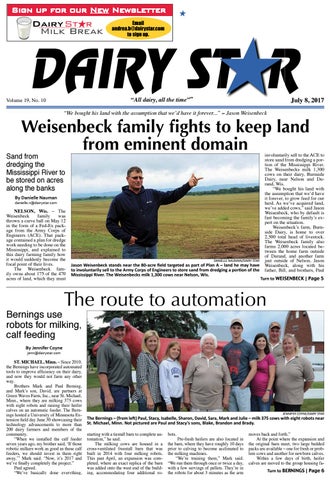
Jason Weisenbeck stands near the 80-acre eld targeted as part of Plan A – land he may have to involuntarily sell to the Army Corps of Engineers to store sand from dredging a porƟon of the Mississippi River. The Weisenbecks milk 1,300 cows near Nelson, Wis.
involuntarily sell to the ACE to store sand from dredging a portion of the Mississippi River. The Weisenbecks milk 1,300 cows on their dairy, Burnside Dairy, near Nelson and Durand, Wis. “We bought his land with the assumption that we’d have it forever, to grow feed for our herd. As we’ve acquired land, we’ve added cows,” said Jason Weisenbeck, who by default is fast becoming the family’s expert on the situation. Weisenbeck’s farm, Burnside Dairy, is home to over 2,500 total head of livestock. The Weisenbeck family also farms 2,000 acres located between the home farm outside of Durand, and another farm just outside of Nelson. Jason Weisenbeck, along with his father, Bill, and brothers, Paul
Turn to WEISENBECK | Page 5
The route to automation
Bernings use robots for milking, calf feeding By Jennifer Coyne jenn@dairystar.com
ST. MICHAEL, Minn. – Since 2010, the Bernings have incorporated automated tools to improve efciency on their dairy, and now they would not farm any other way. Brothers Mark and Paul Berning, and Mark’s son, David, are partners at Green Waves Farm, Inc., near St. Michael, Minn., where they are milking 375 cows with eight robots and raising their heifer calves on an automatic feeder. The Bernings hosted a University of Minnesota Extension eld day June 30 showcasing their technology advancements to more than 200 dairy farmers and members of the community. “When we installed the calf feeder seven years ago, my brother said, ‘If those robotic milkers work as good as these calf feeders, we should invest in them right away,’” Mark said. “Now, it’s 2017 and we’ve nally completely the project.” Paul agreed. “We’ve basically done everything,
JENNIFER COYNE/DAIRY STAR
The Bernings – (from leŌ) Paul, Stacy, Isabelle, Sharon, David, Sara, Mark and Julie – milk 375 cows with eight robots near St. Michael, Minn. Not pictured are Paul and Stacy’s sons, Blake, Brandon and Brady. starting with a tiestall barn to complete automation,” he said. The milking cows are housed in a cross-ventilated freestall barn that was built in 2014 with four milking robots. This past April, an expansion was completed, where an exact replica of the barn was added onto the west end of the building, accommodating four additional ro-
bots.
Pre-fresh heifers are also located in the barn, where they have roughly 10 days prior to calving to become acclimated to the milking machines. “We’re training them,” Mark said. “We run them through once or twice a day, with a few servings of pellets. They’re in the robots for about 3 minutes as the arm
moves back and forth.” At the point where the expansion and the original barn meet, two large bedded packs are available – one for fresh or problem cows and another for newborn calves. Within a few days of birth, heifer calves are moved to the group housing faTurn to BERNINGS | Page 6
Page 2 • Dairy Star • Saturday, July 8, 2017
DAIRY ST R www.dairystar.com
ISSN 020355 522 Sinclair Lewis Ave. Sauk Centre, MN 56378 Phone: (320) 352-6303 Fax: (320) 352-5647 Published by Dairy Star LLC General Manager/Editor Mark Klaphake - mark.k@dairystar.com 320-352-6303 (ofce) 320-248-3196 (cell) 320-352-0062 (home) Ad Composition Nancy Powell 320-352-6303 nancy.p@dairystar.com Amanda Thooft 320-352-6303 amanda.t@dairystar.com Consultant Jerry Jennissen 320-346-2292 Editorial Staff Andrea Borgerding - Managing Editor (320) 352-6303 • andrea.b@dairystar.com Krista Kuzma - Assistant Editor (507) 259-8159 • krista.k@dairystar.com Ron Johnson (608) 874-4243 ron.j@dairystar.com Ruth Klossner (507) 240-0048 cowlady@centurylink.net Jennifer Coyne (320) 352-6303 jenn@dairystar.com Brittany Olson (320) 352-6303 brittany.o@dairystar.com Advertising Sales Main Ofce: 320-352-6303 Fax: 320-352-5647 Deadline is 5 p.m. of the Friday the week before publication Sales Manager - Jeff Weyer (Northern MN, East Central MN) 320-260-8505 (cell) jeff.w@dairystar.com Mark Klaphake (Western MN) 320-352-6303 (ofce) 320-248-3196 (cell) Laura Seljan (National Advertising, SE MN) 507-250-2217 fax: 507-634-4413 laura.s@dairystar.com Jerry Nelson (SW MN, NW Iowa, South Dakota) 605-690-6260 jerry.n@dairystar.com Mike Schafer (Central, South Central MN) 320-894-7825 mike.s@dairystar.com Lori Menke (Eastern Iowa, Southern WI) 563-608-6477 • lori.m@dairystar.com Megan Stuessel (Western Wisconsin) 608-387-1202 megan.s@dairystar.com
North America dealers. A glance at what’s inside
Dairy Prole brought to you by your
Now that the calendar has turned to July, we are bracing for the hot and humid summer weather. In this issue’s “From our side of the fence” feature, we talked to dairy farmers about methods they use to keep animals cool during the warmer months of the year. Read about it on pages 15-16 in rst section. On the other hand, farmers need to also care for themselves during extreme heat. Read on pages 12-13 in rst section about a story we wrote about how farmers can keep cool and prevent heat exhaustion while caring for their cattle. July is also an exciting time for two families who added By Mark Klaphake robots to their farms. Both the Pechous and the Andringa Editor families will be hosting open houses this month – the Pechous family on July 15 on their dairy near Tabor, S.D., and the Andringas on July 22 on their dairy near Castlewood, S.D. The Pechouses moved their herd into a new monoslope tunnel ventilated barn with four robots and room for 240 cows last fall. For the Andringas, four robots replaced a double-10 parlor on one of their two farms. Their facility has a unique layout in a U shape. Read about the Pechous family on pages 3-4 in second section and the Andringa family on pages 3-4 in third section. Starting this issue and for each subsequent issue until the Princess Kay of the Milky Way coronation, we will feature four of the Princess Kay nalists to learn more about their previous dairy experience and why they wanted to be a dairy princess. In this issue, read about Rebecca Schubert, representing Benton County; Gina Holdvogt, representing Stearns County; Ashley Warren, representing Meeker County; and Jessaca Zuidema, presenting Kandiyohi County. They are featured on pages 22-25 in second section. On June 27, the Sellners had a busy day of cutting and chopping their second crop alfalfa. We featured Mike and Judy Sellner along with their son-in-law, Ryan Pierson, in this issue’s “Day in the life” feature. The family, who milks 120 cows near Sleepy, Eye, Minn., talked about how their day didn’t go as planned, but it still turned out to be successful. Read about their day on pages 18, 20-21 in second section. This year is special for the Perkins family. The Minnesota Farm Bureau is recognizing them as having a sesquicentennial farm. The family milks 1,000 cows near Red Wing, Minn.; however, they have grown slowly over the years. Plus, they stressed farming isn’t about the size of the dairy. Read about their history and how they got to where they are today on pages 5-6 in third section.
Favorite quotes from this issue:
“Some of them have been with us quite a long time. That’s why we gave them every chance to – and gave it to them all along – get on Grade A. Almost all our plants are going to strictly Grade A milk. It got to the point where we had to do something.” - Terry Hanson (Second Section, Pages 16-17)
“Ninety to 95 percent of kids have never been to a farm. Kids need to know where their food comes from, and not from the grocery store.” - Mike Robers (Second Section, Pages 27-29)
By the Numbers
herd average of 31,800: Rolling D&D Dairy, coupled with 1,164 pounds of fat and 960 pounds of protein. (Pages 18, 20 in First Section)
6: miles from the Canadian border is where Don and Gene Bitzer dairy farm. (First Section, Pages 35, 37)
MOW. CONDITION. REPEAT.
FC 3525 DF & FC 10030 D
TRIPLE MOWER CONDITIONER
Protectadrive® SURWHFWV FXWWHUEDU IURP GDPDJH E\ PDMRU ğHOG REVWDFOHV
Deadlines The deadline for news and advertising in the Dairy Star is 5 p.m. Friday the week before publication. Subscriptions One year subscription $35.00, outside the U.S. $110.00. Send check along with mailing address to Dairy Star, 522 Sinclair Lewis Ave., Sauk Centre, MN 56378. Advertising Our ad takers have no authority to bind this newspaper and only publication of an advertisement shall constitute nal acceptance of the advertiser's order. Letters Letters and articles of opinion are welcomed. Letters must be signed and include address and phone number. We reserve the right to edit lengthy letters. The views and opinions expressed by Dairy Star columnists and writers are not necessarily those of the Dairy Star LLC.
The Dairy Star is published semi-monthly by Dairy Star, LLC, 522 Sinclair Lewis Ave., Sauk Centre, MN 56378-1246. Periodicals Postage Paid at Sauk Centre, MN and additional mailing ofces. POSTMASTER: Send address changes to Dairy Star, 522 Sinclair Lewis Ave., Sauk Centre, MN 56378-1246.
• • Lubed-for-life Optidisc® cutterbar and Fast-Fit ™ blades ō ,QGXVWU\ OHDGLQJ VXVSHQVLRQ DQG ĠRWDWLRQ IRU XOWLPDWH JURXQG DGDSWLRQ • Complete direct drive eliminates belts and routine adjustments Up to 32'6" of cutting and conditioning in one pass
Van’s Implement Hull, IA
Carroll Implement Lu Verne, IA
Arnold's
Glencoe, MN Kimball, MN Sauk Rapids, MN St. Martin, MN
Northland Farm Systems Owatonna, MN
Lake Henry Implement Paynesville, MN
Lindell Sales & Service
Dave’s Repair Hills, MN
Dairyland Supply
Beck Implement
Isaacson Sales & Service
Miller Sellner
Lafayette, MN
Slayton, MN
Fluegge’s Ag
Woller Equipment
Cannon Falls, MN Elgin, MN
Visit your local Kuhn dealer today!
Mora, MN
Sauk Centre, MN
Swanville, MN
INVEST IN QUALITY ®
KuhnNorthAmerica.com
UFC Farm Supply Waconia, MN
Jaycox Implement Worthington, MN
Noteboom Implement Corsica, SD
Pfeifer Implement Sioux Falls, SD
Mark's Machinery Yankton, SD
Dairy Star • Saturday, July 8, 2017 • Page 3
It’s all inside...
FIRST SECTION
Sleepy Eye
Warroad
Second Section: Pages 18, 20 - 21
First Section: Pages 35, 37
Bitzers dairy farm near Canadian border
Hamlin
Pages 38 - 39 Dairy Recipes
Kingsbury or n
THIRD SECTION
Douglas Charles Mix
n nso
Brookings
Lake
Moody
McCook Minnehaha
Renville
Yellow Medicine
Carver Scott
Sibley Lyon
Redwood
Nicollet Brown
Murray
Rock
Nobles
sey
Hennepin McLeod
First Section: Pages 18, 20
Dakota
Rice
Goodhue Wabasha
Cottonwood Watonwan Blue Earth Waseca Steele Dodge Olmsted Jackson
Martin
Faribault
Freeborn
Mower
Winona
Fillimore
Harmony
Houston
Women in Jeans: Randi Wingert
Ha
Da
vis
on
Sa nb
Miner
Deuel
Wright
Washinton
Page 37 Red, white and blue
Meeker
r
Clark
Kandiyohi
Chippewa
Lac Qui Parle
Codington
Anoka
Swift
Lincoln
Tissue sampling gives insight into crop nutrition needs
Isanti
go
Sherburne
Grant
Pages 33 - 34
Benton
Stearns
Pope
Rushford
D&D Dairy keeps high production with good employees, quality feed, cow comfort
isa
Roberts
Day
Big Sto Stone
Mille Lacs
Morrison
Ch
Pages 27 - 28
Third Section: Pages 9, 11
Pine
Douglas
Stevens
Two young women nd work on dairy, become royalty
Carlton
Todd Grant
Lake City
Crow Wing
eu
Marshall
Hidden Acres Dairy sees rise in school tours Pages 30 - 31 Crop and weather reports
Ottertail
Third Section: Pages 5 - 6
Aitkin
Su
rse
Second Section: Pages 3- 4
Cass
Wadena
Becker
Wilkin
Robots help keep future bright for dairy
Princess Kay Finalist Coverage
Pages 14 - 15 Dairy Calendar Pages 17 - 18 Some Udder Stuff Pages 20 - 26 Classieds
Ma
Clay
Tabor
en
m hno
Goodhue
Perkins dairy being recognized as sesquicentennial farm
Kanabec
Norman
Itasca
Hubbard
Polk
Third Section: Pages 3- 4
First Section: Pages 1, 6
Koochiching St. Louis
Red Lake
Tra ve
Pages 16-17 Scenic Central Milk Producers decides to no longer take Grade B milk Pages 22 - 25
Beltrami
Clearwater
Sunrise Dairy expands its operation by adding robotic milkers
Bernings use robots for milking, calf feeding
Lake of the Woods
Pennington
Castlewood
St. Michael
Second Section: Page 23
Roseau
Marshall
SECOND SECTION
Pages 10 - 11 The “Mielke” Market Weekly Page 12 Dairy markets Page 13 Area hay auction results Pages 14 - 15 Dairying Across America
Rice
Kids and their favorite Schubert’s job on a farm animals dairy turns into passion, Third Section: Pages 12 - 13 potential future in agriculture
Ra m
Kittson
Sebeka
Le
A day in the life of the Sellner family
Pipestone
Pages 1, 5, 7 Weisenbeck family ghts to keep land from eminent domain Pages 8-9 Ag Insider Pages 10 - 11 Accelerated Genetics, Select Sires merge Pages 12-13 Stay cool this summer Pages 22 - 23 Caring for Earth’s greatest resource Page 26 FSA News & Notes Page 27 The Transition Pen Page 28 Some food for thought from the 2017 ADSA Meetings Page 29 Performance of reduced lignin alfalfa Page 30 Dear County Agent Guy Page 31 On the Mark Page 32 Making Cents of Dairy Page 33 Dairy Good Life Page 34 Veterinary Wisdom
Hutchinson
Turner
Bon Yankton Homme
Lincoln Clay
Union
Lyon
Osceola Dickinson Emmet
Sioux
O’Brien
Clay
Kossuth
Palo Alto
First Section: Page 36
FROM OUR SIDE OF THE FENCE:
How do you lessen heat stress on your herd? Pages 15-16
Plymouth
Kimball, Minn.
Dairy Prole: John and Sandy Spoden with their son, Curt
Zone 1
For additional stories from our other zone, log on to www.dairystar.com
Page 39
Comfort and versatility unlike any other Upgrade your barn with GEA’s Single Beam Freestall Mounting System With easy installation and flexible designs,
durability for reduced freestall maintenance.
GEA’s Single Beam Freestall Mounting System
Cows enjoy unobstructed lunge space and lay
can seamlessly integrate with any new or
straighter for cleaner stalls and udders.
existing freestall barn. This state-of-the-art
Fully adjustable stall width and neck rail
mounting system features the patented
height gives you a customized system to fit
cushion cross clamp providing extreme
your herd.
Page 4 • Dairy Star • Saturday, July 8, 2017
NEW EQUIPMENT SAUK CENTRE
TRACTORS NH T4.100 & 110 Utility, Cab & Loader ...3 in Stock! NH T6.180 Plus, Super Steer, 4 Rmts ........In Stock! NH Workmaster 60, FWA, Loader Ready ...In Stock! NH Boomer 46D, Cab Heat, A/C, Loader ..In Stock! SKID LOADERS NH L218, L220, L228 ................................ In Stock! HAY TOOLS NH SpeedRower 220 & 260 ...................... In Stock! NH Procart 819, 1022, 1225 Rakes............In Stock! NH Dura-Vee 1020, 1225, 1428 Rakes ......In Stock! Kemco Inline Bale Wrappers ......................In Stock! NH H7230 & DB313R Discbines ................In Stock! NH H6740, 7’ 10� Disc Mower, 3 Point ......In Stock! NH ProRotor 3114 & 3223 Rakes...............In Stock! NH ProTed 3417, 17’ 1� Working Width .....In Stock! BALERS NH RB450, RB460 and RB560...................In Stock! TILLAGE Salford 8208 Plow, 8 Bottom .....................In Stock! Salford I-2218, 18’ Vertical Tillage..............In Stock! Salford 9809, HD Ripper, 9 Shank..............In Stock! Salford I-4124, HD Vert. Tillage, 24’ ...........In Stock! FORAGE NH FP240 & FR500 Forage Harvesters......In Stock! MISCELLANEOUS Messer Attachments and Rock Wagons ....In Stock! PIERZ TRACTORS NH TS6.120, Cab, FWA, 3 Rmt’s ...............In Stock!
NH T7.230 Classic, Power Shift, Super Steer .............................................In Stock! NH T4.90, T4.100 & T4.110 Utility’s ...........In Stock! NH T6.155 Plus, 2WD, 4 Rmts ...................In Stock! NH Boomer 37 & 47 with Loader ...............In Stock! NH Boomer 54D, Cab, Heat, A/C, Loader.....................................................In Stock! SKID LOADERS NH L218, L220, L228 and L234 .................In Stock! HAY TOOLS NH SpeedRower 220 & 260 .......................In Stock! NH H7220 & H7330 Discbines ...................In Stock! NH H7230, DB313R & DB316R Discbines ................................................In Stock! NH ProCart 819, 1022 & 1225 Rakes .........In Stock! NH Dura-Vee 1225 & 1428 Rakes ..............In Stock! Kemco Inline Bale Wrappers ......................In Stock! NH ProRotor 3114, 3223 & 3226 Rakes.....In Stock! NH ProTed 3417 .........................................In Stock! BALERS NH RB450, RB460, RB560.........................In Stock! NH BC5070 Small Sq, 72 Thrower .............In Stock! FORAGE NH FP240, Crop Proc., Tandems ...............In Stock! MANURE SPREADERS NH DT2600, M2080, 185, 195’s .................In Stock! BBI Endurance Litter Spreader,18’, Tandems, HD Apron ................................................In Stock! MISCELLANEOUS Messer Attachments and Rock Wagons ....In Stock!
USED EQUIPMENT SAUK CENTRE TRACTORS NH T7000 Front PTO/3 Point Kit .................$6,500 JD 3400 Telehandler, 22’ Lift, 6,000# .........$32,500 NH T8.330, HD FWA, Lux Cab, Auto-Steer$102,500 SKID LOADERS NH L230, 850 hrs., Perf Package ...............$43,500 NH L230, Cab Heat, A/C, Air Seat .............$36,900 NH L218, Cab, Heat ...................................$24,900 NH L220, Cab, Heat, A/C, 2 Speed............$32,700 HAY TOOLS NH 1475, 14’ Haybine ................................$13,500 NH H7450, 13’ Disbine, Draw Bar Swivel ..$27,900 BALERS NH RB460, Roto-Cut, 4’x6’, 3500 bales ....$33,900 NH BR7070, Crop Cutter............................$28,900 NH BR7090, Net Only, Wide P/U ...............$27,900 NH BR780A, Twine/Net, Wide P/U .............$11,500 Vermeer 605M, 5’x6’, Twine, Hyd Ramp ....$13,900 TILLAGE Salford 8214 Plow, 14 Bottom ...................$55,500 FORAGE Krone EC7500 ............................................$29,500 NH 919A4 CH, 4R-36�, Fits 1915.................$1,750 NH FX25, 4WD, AutoLube, 360N6 CH, Consigned...............................................$52,500 MISCELLANEOUS Berti TA-220 Offset Flail Mower. ...................$4,500
PIERZ TRACTORS JD 4055, 2WD, 1650 Hrs., Sharp ...............$34,900 NH 8770, 2WD, 20.8x42 Duals...................$49,000 NH TD5050, Cab, FWA, Mech. Shuttle ......$29,700 SKID LOADERS NH L185, Cab, Heat, A/C ...................... Coming In! HAY TOOLS NH 166 Inverter, Hyd Drive, RH Table Ext ....$5,700 BALERS MF 1756, 5’x6’, Net-Twine, 540 PTO .........$16,250 NH BR7070, Net/Twine, 540 PTO ..............$24,700 NH BR780, Auto-Wrap .................................$9,700 NH BR780, Net-Twine, Bale Command .....$17,500 NH BR740, Bale Slice, Net/Twine...............$17,500 JD 469 Premium, Net, Mega Wide P/U ......$34,500 TILLAGE JD 3710, 10 Bottom Plow...........................$42,500 GRAIN HANDLING Sudenga 8�x61’, 540 PTO Drive ..................$2,900 FORAGE NH FP230, 27P HH, 3PN CH, KP...............$39,500 Miller Pro 5200, 16’ Rear, 12T Tandem ........$6,250 MISCELLANEOUS JD 115, Stalk Chopper, 15’ ........................$12,000 Hiniker 5610, RH Discharge Stalk Chopper ....................................................$7,900
0% FINANCING
*
CASH BACK AND MORE!
8ZaZWgViZ hiVg"heVc\aZY hVk^c\h Vaa hjbbZg adc\ Vi ndjg CZl =daaVcY YZVaZg# HVkZ l^i] & <?D7D9?D=" 97I> 879A 7D: CEH; dc hZaZXi CZl =daaVcY igVXidgh! ]Vn VcY [dgV\Z VcY bViZg^Va ]VcYa^c\ Zfj^ebZci# Hide Wn idYVn [dg YZiV^ah dg k^h^i mmm$d^e\\[hi$Yec$ 9dcÉi lV^i D[[Zg ZcYh HZeiZbWZg (%! '%&,#
PIERZ, MN 320-468-2161 • Hwy. 27 West
SAUK CENTRE, MN 320-352-6543 • Hwy. 71 South
Store Hours: Monday-Friday 8-5, Saturday Seasonal
www.modernfarmequipment.com EQUIPPED FOR A NEW WORLD™
SAUK CENTRE, MN
320-352-6543 • Hwy. 71 South
PIERZ, MN
320-468-2161 • Hwy. 27 West
'PS $PNNFSDJBM VTF POMZ $VTUPNFS QBSUJDJQBUJPO TVCKFDU UP DSFEJU RVBMJmDBUJPO BOE BQQSPWBM CZ $/) *OEVTUSJBM $BQJUBM "NFSJDB --$ 4FF ZPVS QBSUJDJQBUJOH /FX )PMMBOE EFBMFS GPS EFUBJMT BOE FMJHJCJMJUZ SFRVJSFNFOUT %PXO QBZNFOU NBZ CF SFRVJSFE 0GGFST HPPE UISPVHI 4FQUFNCFS BU QBSUJDJQBUJOH /FX )PMMBOE EFBMFST JO UIF 6OJUFE 4UBUFT /PU BMM DVTUPNFST PS BQQMJDBOUT NBZ RVBMJGZ GPS UIJT SBUF PS UFSN $/) *OEVTUSJBM $BQJUBM "NFSJDB --$ TUBOEBSE UFSNT BOE DPOEJUJPOT BQQMZ 5BYFT GSFJHIU TFU VQ EFMJWFSZ BEEJUJPOBM PQUJPOT PS BUUBDINFOUT OPU JODMVEFE JO QSJDF 0GGFST TVCKFDU UP DIBOHF PS DBODFMMBUJPO XJUIPVU OPUJDF ÂŞ $/) *OEVTUSJBM $BQJUBM "NFSJDB --$ "MM SJHIUT SFTFSWFE /FX )PMMBOE "HSJDVMUVSF JT B USBEFNBSL SFHJTUFSFE JO UIF 6OJUFE 4UBUFT BOE NBOZ PUIFS DPVOUSJFT PXOFE CZ PS MJDFOTFE UP $/) *OEVTUSJBM / 7 JUT TVCTJEJBSJFT PS BGmMJBUFT $/) *OEVTUSJBM $BQJUBM BOE /FX )PMMBOE $POTUSVDUJPO BSF USBEFNBSLT JO UIF 6OJUFE 4UBUFT BOE NBOZ PUIFS DPVOUSJFT PXOFE CZ PS MJDFOTFE UP $/) *OEVTUSJBM / 7 JUT TVCTJEJBSJFT PS BGmMJBUFT
TENSILE STRENGTH. KNOT STRENGTH. NEW HOLLAND STRENGTH. You can choose a lot of baling products, but you can’t choose any better than New Holland. With nearly all of our products made right here in the USA, you can be confident your bales are held together with the most uncompromising standards–ensuring the tightest, most consistent bales. Our premium plastic baler twine is available in a variety of guaranteed lengths, strengths and colors. Our sisal twine offers a biodegradable, natural alternative to our plastic twine, and is made from the finest Brazilian sisal fibers. Those who prefer net wrap can rely on both our Fastnet™ black net wrap and knitted net wrap – available in both green and white. Like our twine, these net wraps are produced to the highest specifications and are guaranteed in length and strength, giving you more bales from each roll of net wrap.
Ask us about our unbeatable warranty policy!
F FOR ADDITIONAL INFORMATION ON NEW HOLLAND PREMIUM BALING TWINE AND NET WRAP, PLEASE P CONTACT YOUR NEW HOLLAND DEALER. C
New Holland is a trademark registered in the United States and many other countries, owned by or licensed to CNH Industrial N.V., its subsidiaries or affiliates. www.newholland.com MRC
EQUIPPED FOR A NEW WORLD™
Dairy Star • Saturday, July 8, 2017 • Page 5
ConƟnued from WEISENBECK | Page 1
Protect your cows from the summer heat! With
Maintain Plus A ppelleted supplement designed to be fed to de llactating dairy and beef cattle to sustain be hydration during hot hy weather.
DANIELLE NAUMAN/DAIRY STAR
The Weisenbecks’ 80-acre eld at the juncƟon of Highways 25 and 35 is targeted by the Army Corp of Engineers to use for sand storage. and Bill, raise about 1,300 acres of corn and 700 acres of alfalfa each year. Weisenbeck said 100 percent of the crops grown on their farm are used for feeding their own herd of dairy cattle. The family has been involved in the dairy industry since 1919, and milking in their current facilities since 2000. The dredging plan for Lower Pool 4 of the Mississippi encompasses 40 years and nearly 11 million cubic yards of sand the ACE is planning to store on farmland near the river. Land acquisition by the ACE is broken into two phases. The rst phase, Plan A, will take 80 acres from the Weisenbecks’ farm that also happens to be one of the Weisenbeck family’s best elds. It is on the edge of a residential area that borders their second farm where Weisenbeck’s parents reside. The second wave of the plan will take most of that farm. The ACE hopes to implement Plan A by February. The loss of this production land will create problems for Burnside Dairy through lost feed production. They will either need to source and purchase additional feedstuffs or cut back their herd size to what can be supported on fewer acres. They will also need to make changes to their nutrient management plan with the loss of land for manure. In addition to the Weisenbecks, four other farms are being targeted for land acquisition by the ACE. However, Weisenbeck said the effects will be felt far beyond those four families. The project will have a great impact on
the entire area, which relies heavily on tourism. Most of the dredging and sand hauling will take place in prime tourism months. In addition, it is estimated that a truck carrying sand will pass by residential housing every 90 seconds during the dredging. ACE’s job in the process is to form a base plan for the least costly, environmentally acceptable way to manage the sediment removed from the river. Although the ACE rst looked at in-river resources, such as building islands to store the sand in the river, that could be benecial to the environment, storing sand on land on the sides of the river was the best option at this time. “The DNR and Department of Fish and Wildlife are happy with the environment in that section of the river, so that meant we had to look at off-river locations, which are limited, and largely affected by hauling costs,” said Craig Evans, the Chief of Plan Formation Section of the ACE. According to Evans, the ACE timeline has plans nalized by late August, once the public comment period has closed and been reviewed. He hoped they would move into the Real Estate Acquisition phase and begin negotiations with landowners in early 2018, noting the plan would be implemented as funding became available. The standard Real Estate Acquisition phase begins with an appraisal to reach a fair market value, and then enTurn to WEISENBECK | Page 7
• Contains electrolytes and buffers to prevent dehydration. • Replaces minerals lost in sweating • Contains sugars to aid absorption of electrolytes culture to stimulate rumen • Contains yeast cultur feed intake fermentation and fee which dilates blood vessels • Contains Niashure® w allowing dissipate through the skin ll i hheatt tto di i
320-836-2145 or 800-450-2145
Check out our newly redesigned website to ½nd a Famo Feeds dealer near you!
www.famofeeds.com
CLASSIFIED
Sales & Installation of HiTensile Fence
ELECTRIC • WOVEN • RAIL
Doesn’t Always Mean Top Secret!
It’s no secret that a Dairy Star classied ad can help you eliminate those unwanted items!
(320) 360-6308
or e-mail nancy.p@dairystar.com
The Right Fence... Built RIGHT
Browerville, MN
Call 320-352-6303
The next issue of the Dairy Star is published July 22nd.
COMPLETE BARN SOLUTIONS WHATEVER YOUR DAIRY NEEDS
During
Emerald Sky Dairy Baldwin, WI Before
Call us to help you make your dairy operation more efficient.
Double 20 Turner C Stall front end remodel
After
www.midwestlivestock.com
PINE ISLAND, MN • 800-233-8937 BEATRICE, NE • 800-342-5657 SIOUX FALLS, SD • 800-705-1447 MENOMONIE, WI • 715-235-5144 OWEN, WI • 715-229-4740
Page 6 • Dairy Star • Saturday, July 8, 2017
ConƟnued from BERNINGS | Page 1
Willmar, MN • 320.231.1470
EXPANDING OR REMODELING YOUR LIVESTOCK OPERATION? LANGE AG SYSTEMS SPECIALIZES IN:
Ŷ NEW FACILITIES
_
NO JOB TOO BIG OR TOO SMALL
Ŷ RETROFITTING & REMODELING Ŷ TURNKEY PROJECTS Ŷ BARN DESIGN Ŷ INSTALLATION, MAINTENANCE & REPAIRS
ƋƵŝƉŵĞŶƚ tĞ KīĞƌ͗ ͻ sĞŶƟůĂƟŽŶ &ĂŶƐ ͻ sĞŶƟůĂƟŽŶ ŽŶƚƌŽůƐ ͻ WŽƐŝƟǀĞ WƌĞƐƐƵƌĞ dƵďĞƐ ͻ ƵƌƚĂŝŶ ^LJƐƚĞŵƐ ͻ DĂƩƌĞƐƐĞƐ ͻ tĂƚĞƌĞƌƐ ͻ ^ƚĂůů ƋƵŝƉŵĞŶƚ ͻ ,ĞĂĚůŽĐŬƐ ͻ DŝƐƟŶŐ ^LJƐƚĞŵƐ
Lange Ag Systems is proud to offer Grain Bags, Silage Bags & Bunker Covers from Up North Plastics and Feed Fresh Silage Covers & Custom Size Bunker Covers from Raven!
t ^ >> E t Θ h^ 'ͳ ' Θ < >>z Zz E '' Z^
www.LangeAgSystems.com BUNKER SILO •• H-Bunks Fenceline
MANCHESTER Livestock Auction, Inc.
Bunks • 115 Bu. Steer Stuffer • Individual Yard Bunks Backed by over 40 years proven experience!
(40 miles west of Dubuque, Iowa on 4 lane Highway 20)
DAIRY SALES 2nd Fridays Monthly at 11:00 AM Selling 150 to 250 Head
PRECAST SYSTEMS
Sheep and Goats sell at 9:30 AM
1-888-693-8440 • www.darwinconcrete.com
www.manchesterauction.com
Hwy. 12, Darwin, MN 55324
563-927-2540
Advanced Cow Managemen Management ment fo forr
ROBOTIC MILKING
PATENTED DESIGN
JENNIFER COYNE/DAIRY STAR
The milking herd is housed in a cross-venƟlated freestall barn that was built in 2014. AŌer an expansion this past spring, the barn now includes eight milking robots and two automaƟc feed pushers. cility, which was built in 2010, while bull calves are sold. “By the end of the year, we should be milking 480 cows, so we’re keeping every heifer. Our goal is to have 15 heifers a month, which will be enough for replacements,” Mark said. The Bernings are currently raising nearly 50 heifer calves in two group pens with one automated calf feeder. “Ideally, we’d like to be at 20 calves or less in each pen,” Mark said. “It’s a little more work to get the timid calves to drink when there are too many in the pen.” At 3 months of age, the calves are moved to a custom growing site. They return to the farm as springing heifers and are housed in the old freestall barn with dry cows. When Mark and Paul’s father purchased the farm site in 1993, the only functional buildings were a loang shed and brick milking barn. By 1999, the family had developed a plan for building renovations and expansions, beginning with a freestall barn built two years later. In the years that followed, the Bernings continually updated their facilities and made on-farm improvements to better the herd and also the farm’s position for the future. “I didn’t expect to do the expansion as quickly as we did, but when everything was clicking and everyone had a good role, we decided to do it sooner rather than later,” said Mark about the four newer robots and development of the freestall barn. David joined the operation in 2014, and works alongside his father and uncle. As Mark oversees the farm and handles bookwork, Paul is responsible for animal nutrition and eldwork, while David manages the milking robots. “Would we have done this if David weren’t coming back? Probably, but not at this scale,” Paul said. “David and his generation all know about technology. To us, it’s a foreign language that we’re learning
from them.” David credits the livestock for his ability to join the family business. “Not everyone has this opportunity to return, and I think a large portion of that is because of the option to expand the herd – and my dad and uncle were open to having me come back,” he said. “I’m not going to sugar coat it, either. I could probably get paid more with another job, but this is what I enjoy doing.” Together, the business partners make decisions that will benet the dairy as a whole. In moving forward with the automated milking systems and freestall barn, the Bernings considered the economic benets, as well as cow health benets before settling on a plan. “We toured a lot of barns before constructing this one,” Mark said. “We thought we had cow comfort in the other barn, but it’s quite a bit different here.” The stalls are waterbeds bedded with sawdust, and the alley scrapers are designed to stop when they bump into a cow and begin again when the animal moves. Additionally, the robot rooms remain locked at all times to lessen any disturbances for the animals, and an automatic feed pusher allows access to feed throughout the day. When the Bernings transitioned into the new barn, they saved over $500-worth of electricity within two-months time. They have also been able to improve labor efciency. “It’s an efcient barn,” Mark said. “Right now, it costs us $1.48 per hundredweight for labor on the whole farm.” The Bernings nd success in working with their industry partners, and always create a new goal once one is achieved. “We have a lot on our wish list – some materialize really fast, some take a while, and some don’t materialize at all,” Mark said. “For this goal (of automation), it has come together nicely.”
• One-Way Flow Control Gates • Clean Access Man Walks • Sort Gates • Scissors Gates • Specialized Gating
CONTACT US
Clean Access Man Walks
for Free Estimates & Additional Information
866-543-5116
260 S. Muddy Creek Rd. Denver, PA 17517 info@sturdybuiltmfg.net
JENNIFER COYNE/DAIRY STAR
Each quadrant of the freestall barn includes two milking robots. The robots run all hours of the day, with the excepƟon of 7:30 a.m. and p.m., when they go through a cleaning cylce.
Dairy Star • Saturday, July 8, 2017 • Page 7
ConƟnued from WEISENBECK | Page 5 ters a negotiation process. Use of eminent domain and condemnation of the land is a last resort in their minds, and requires a very scripted court process to complete. “Our plans haven’t been nalized,” Evans said. “We could learn something tomorrow that would change our minds as to what is the least costly, environmentally acceptable avenue to take.” Weisenbeck feels there are more questions than answers about the plan and the compensation to land-owners. He said funding has not yet been approved by Congress, which leaves the project budget uncertain. In addition, the overall budget of the ACE has been cut nearly 25 percent by the Trump ad-
“We could learn something tomorrow that would change our minds as to what is the least costly, environmentally acceptable avenue to take.” CRAIG EVANS, CHIEF OF PLAN FORMATION SECTION, ACE
ministration, and the use of eminent domain also appears to be somewhat on hold. The terms “fair market value or less” and “just compensation” have been used, but with the questions regarding funding, these terms remain unclear. The ACE has indicated there will be no place for good-will negotiations on the part of the land-owners. Regard-
DANIELLE NAUMAN/DAIRY STAR
A dredging barge on the Mississippi River digs up sand from the boƩom of the river just downstream from Wabasha, Minn. less of the price paid for the land, it is unlikely the Weisenbecks will be able to source more land in their area. “This is a high-livestock area, and because of that, land is at a premium here,” Weisenbeck said. Weisenbeck acknowledges the need to maintain the navigation channel in the Mississippi, but he questions the need for a 40-year plan. The ACE estimates that sand will be removed from the river at the rate of 270,000 cubic yards per year, and said nearly 95 percent of the sediment dredged from the channel comes directly from the Chippewa River, which empties into the Mississippi River at the south end of Lake Pepin, just north of Nelson. At one public hearing, Weisenbeck
questioned why the issues on the Chippewa River couldn’t be xed to help alleviate future sediment accumulation. The answer he was given was that the Chippewa River is a relatively young river in geological terms, and is still working to “bed” itself, and in that process, is eroding banks and pushing sediment downstream, where it eventually dumps into the Mississippi. Weisenbeck’s request for information on independent studies that support that theory have not been answered. Weisenbeck has praise for the elected ofcials from the area, and has cultivated a good working relationship with the U.S. Senators from both Wisconsin and Minnesota. “I have them on speed dial, and I
am talking with them two or three times a week,” he said. Weisenbeck recently learned of a tool that works as a form of checks and balances, requiring all federal agencies to coordinate with local governments so that all parties can have a consistent belief in the system. Weisenbeck said none of the affected farmers have obtained specic legal counsel for the problem, and is hopeful the issues can be resolved with the help of elected ofcials. “You just lay in bed at night and try to get your arms around it … it makes you lose trust in your government … we’re doing everything we can to protect our livelihood and our rights,” Weisenbeck said.
Forage & Corn Silage Knowledge Event A N E W W O R L D D E M A N D S N E W H O L L A N D.
Your farm is an ever-changing landscape filled with ever-changing demands. Count on the versatility of a 200 Series Skid Steer Loader to get any job done. An easy hydraulic hookup lets you quickly change attachments. The Super Boom® provides maximum reach when lifting, stacking or loading hay. And one of the widest cabs available makes getting in and out safer than ever. Learn more at EquippedForANewWorld.com ©2017 CNH Industrial America LLC. All rights reserved. “New Holland” is a trademark registered in the United States and many other countries, owned by or licensed to CNH Industrial N.V., its subsidiaries or affiliates. “Equipped For A New World” is a trademark in the United States and many other countries, owned by or licensed to CNH Industrial N.V., its subsidiaries or affiliates.
4618 18’ forage box, ‘99 Case IH MX240, 6,264 hrs. ‘14 NH T8.410, 18 spd, QualiÀes Meyer 3 augers, extension, Price Reduced $54,978 for 2.99% Ànancing for up to 60 months, 18-ton tandem - $12,950 expires 6/30/17, 344 hrs - $167,550
‘13 NH H7450 discbine mower cond. - $24,950
‘07 NH BB940A
w/100 gal appl., new poly pickup bands - $37,850
‘13 NH BR 7090 Specialty Crop, 4,510 bales - $29,950
‘17 Lorenz 1600, New Great Plaines 1800TM NH 1465 9’ 3” haybine New 130-bu,18” grinder, 32 mower cond, cut total of 35 acres - $14,850
4-sided hammers, concentrate hopper - $19,875
Turbo-Max vertical till w/rolling harrow - $42,880
WERNER IMPLEMENT
VERMILLION, MN • 651-437-4435 • WWW . WERNERIMPLEMENT . COM
WEDNESDAY, AUG. 9 • BELGRADE, MN Directions: Located Highway 71 south of Belgrade SCHEDULE: 9:45 AM Registration 10:00 AM Welcome & Introductions HarvXtra Alfalfa - How it will add Profit to your Operation: -THIS IS CHANGING ALFALFA PRODUCTION!!! -Introduce our 3rd generation HarvXtra variety -Key learnings and takeaways from 2 years of HarvXtra production -Management ideas for Higher Yield and Quality Alfalfa Sorghums: How, Where, When & Why Alfalfa: More Net Income: Competing for the Acre Harvest Management & Storage: Feed MORE High Quality Forages 12:00 PM Lunch 1:00 PM Wrap-up & Departure for Home
Questions - please contact: Your local co-op seller.
ALL HAY AND FORAGE GROWERS WELCOME
Spread between block, barrel cheese widens Page 8 • Dairy Star • Saturday, July 8, 2017
Traditionally, there was a three or four cent normal spread between block and barrel cheese. That’s not the case today with a large disparity between the value of blocks and barrels. Robin Schmahl, commodity broker and owner of AgDairy, LLC, said those two cheese categories are trading their own fundamentals. “Sometimes we’ve seen barrels above blocks for periods of time and now we’re seeing a wide spread between blocks and barrels. I don’t think the three-to-four cent rule, if you want to call it that, is an issue anymore. Barrels are in a long position. There is plenty available and sellers want to keep moving it out. We’ve seen a phenomenal amount of trades being done this year in the barrel market.” Corn and soybean prices have moved higher in a volatile weather market, but Schmahl doesn’t believe feed costs will be a signicant issue in the short-term. “I don’t think the milk-to-feed ratio or the income-overfeed costs will turn south fairly quickly.”
Canadian trade policies challenged An international coalition of dairy industry groups from the United States, New Zealand, Australia, Argentina and the European Union is focused on Canada and its trade practices. In a joint letter, these groups are asking their respective governments to challenge the recently implemented dairy pricing rules in Canada. In February, Canada launched a pricing policy that lowers the ingredient prices for Canadian dairy processors and selling Canadian dairy proteins in world markets at below-market prices. These groups, which include the National Milk Producers Federation, U.S. Dairy Export Council and International Dairy Foods Association, indicate the World Trade Organization may need to resolve this dispute. WOTUS rule withdrawn The Environmental Protection Agency’s controversial Waters of the United States rule is being withdrawn. “Once the WOTUS rule is withdrawn, EPA will revert
Cooling the World’s Milk
back to 2008. The standard that was adopted in 2008.” EPA Administrator Scott Pruitt said this action will return power back to the states and provide regulatory certainty to farmers and Ag Insider landowners. Pruitt said WOTUS was confusing and needed to be changed. “What’s important is the lack of clarity the 2015 rule created. It created a situation where landowners and farmers/ranchers didn’t know what was subject to EPA jurisdiction. It was something that created uncertainty and confusion.”
By Don Wick Columnist
Lawmakers praise EPA decision It is no surprise, the EPA decision to withdraw the Waters of the U.S. rule is being praised by lawmakers. House Agriculture Committee Chair Michael Conaway said this move restores certainty and integrity to the regulatory process. In the rewrite of the WOTUS rule, Senate Agriculture Committee Chair Pat Roberts said he wants language that respects the environmental strides taken by the American farmer and rancher. EU court rules against soy ‘milk’ terminology The European Court of Justice has ruled food companies that produce plant-based products cannot use terms like milk, cheese or yogurt. The National Milk Producers Federation, which is ghting a similar challenge with products like soymilk or almond milk, praised the court decision on European food labels. ‘Pink slime’ lawsuit settled ABC News has settled its defamation lawsuit with Beef Products Inc. Terms of the settlement are condential, but BPI’s attorney said the company is extraordinarily pleased with the dollar amount. The meatpacker sued ABC News and correspondent Jim Avila over a series of stories that described lean, nely-textured beef as ‘pink slime.’ After the stories aired in 2012, sales crashed and BPI closed three of its four beef processing plants. This trial lasted 18 days before the surprise settlement announcement.
PRE-COOL WELL WATERre cooled • Dual pass • Counterflow milk vs. well • Milk within 3–5° F of well water exiting the plate cooler • Cut your refrigeration time in half • Wall or floor mount options • Heavy duty design
INSTANT COOLtant WELL WATER AND CHILLED WATER
• 98° to 36° F milk in seconds • Up to 50% milk cooling with well water • Milk within 3–5° F of well water before entering chilled section • Counterflow milk vs. well • More cooling with less well water • Easy-to-wash configuration • Customized to your needs • Built to meet commercial dairy demands
Valley Queen expansion project announced The dairy processing company Valley Queen has announced a $50 million expansion project. This plant update will take place at the Valley Queen facilities in Milbank, S.D. Processing capacity will increase by 25 percent. The expansion is designed to handle the increased demand for its products and the growing milk supply within the I-29 corridor. MN trade delegation visits Cuba Minnesota Lt. Governor Tina Smith and Agriculture Commissioner Dave Frederickson led the delegation that traveled to Cuba this past week. The Minnesota visit to Havana came right after President Donald Trump tightened trade and travel rules with Cuba. Minnesota Farm Bureau President Kevin Paap was on the trip and said everyone they met in Cuba seemed to talk Turn to AG INSIDER | Page 9
Hydrostatic & Hydraulic Repair
• Repair & Sales • Troubleshooting • Hose Assemblies
• Design • Service Calls • Cylinders
Skidsteer Attachments For Sale www.stoens.com
16084 State Hwy. 29 • Glenwood, MN 56334
www.fullersmilkercenter.com 1-800-MUELLER
DFE.PAULMUELLER.COM
320-634-4360
Toll Free 866-634-4360
Dairy Star • Saturday, July 8, 2017 • Page 9
ConƟnued from AG INSIDER | Page 8 about the Trump decision. Despite that hurdle, Paap said, “Minnesota sent the message we want to work together and talk to anyone who is interested in our product.” Relationships were developed during the trade mission. “Maybe Cuba is a small market, but it’s an important market. We need to continue to move forward.” Filling in for baby boomers In Minnesota’s current agriculture economy, AgCentric Program Manager Judy Barka said the agribusiness sector still needs employees. “When you look at the age of the people who are employed by the agriculture industry today, many of them are in later baby boomer stage. We see massive retirements ahead in the next ve years. We also recognize the knowledge base that will go with it. We’re trying to increase students in the pipeline to replace those retiring.” NCTC adds new ag programs for fall ‘17 Northland Community and Technical College is adding four new agriculture programs to its curriculum at Thief River Falls and East Grand Forks. Those programs include general agriculture certicates and associate degrees in animal science and agricultural education. These programs will also allow students to transfer to the University of MinnesotaCrookston to nish out a four-year degree. NCTC Program Manager ADawn Nelson said there is demand for young people to ll jobs within agriculture.
“Across the board, in all aspects of agriculture, they need employees. Especially employees that have a general knowledge in agriculture, there’s a need for the industry to have students engaged in agriculture, different aspects.” These new ag programs will begin during the fall term. Appointments made to Center for Rural Policy and Development Minnesota Governor Mark Dayton has announced three appointments to the Center for Rural Policy and Development. Those appointments include Minnesota Farm Bureau President Kevin Paap, Morrison County Administrator Timothy Houle and David Ladd of RDL & Associates. Trivia challenge Finland leads the world in per-capita milk consumption. The top-ve countries are Sweden, the Netherlands, Switzerland and Greece. The United States is ranked 16th. That answers our last trivia question. For this week’s trivia, what country leads the world in milk production? We’ll have the answer in the next edition of Dairy Star. Don Wick is owner/broadcaster for the Red River Farm Network, based in Grand Forks, North Dakota. Wick has been recognized as the National Farm Broadcaster of the Year and served as president of the National Association of Farm Broadcasting. Don and his wife, Kolleen, have two adult sons, Tony and Sam, and ve grandchildren, Aiden, Piper, Adrienne, Aurora and Sterling.
“It’s easier on the cows and me.” How long have you been using the DHIA pregnancy test? Since I started my farm two years ago. Why did you choose to use it? It was a lot less time consuming than having a vet out. It’s easier on the cows and me. What do you like about it? I like that I can mail in samples and have results in my email the next day. It means I can preg check cows every week, but only have the vet out every 60 days or even less often. It’s a lot more cost effective. How long have you been testing with DHIA? I always made sure my cows were on test even before I started milking on my own farm. What are some other tests you use through DHIA? I regularly test for Johnes and Leukosis, as well. Even if I decide not to cull the cows I can make sure not to feed their colostrum to heifers or to share needles between those cows and tested-free cows. That will Elinor Opitz make a gradual difference in how many cows are infected in 65 cows • Maple Lake, Minn. the herd. Minnesota Dairy Herd Improvement Association 307 Brighton Avenue South Buffalo, MN 55313 1.800.827.3442 www.mndhia.org
N10828 Cty Hwy O | Greenwood, WI 715.267.1416 | www.greenwoodsilo.com Email: sales@greenwoodsilo.com
SEALED SILO SERVICES: BOTTOM UNLOADERS: • CONSTRUCTION • MAINTENANCE • PRESSURE CHECKING • RESEALING • REPLACEMENT ROOFS
• GREENLINE UNLOADERS D-SERIES (FORAGE) B-SERIES (SNAPLAGE & GRAIN) • USED UNLOADERS • UNLOADER PARTS • FULLY EQUIPPED SERVICE CREW
©2016 MAI Animal Health
SUPERIOR FEED VALUE THROUGH SEALED SILOS We are not affiliated with A.O. Smith Harvestore®, E.S.P.C. or C.S.T.
“Boy it·s hot out. I have a hard time keeping my dry matter intake up.”
“You should try KLC Roasted Beans, they help us produce even with reduced DMI.”
Less stress, less mess. Dr. Larson’s Dehorning Paste TM
KLC Roasted Soybeans have what you need for your
Energy Protein Amino Acids Bypass yp
Quality
Consistency
KLC Farms Competitively Bids For Raw Beans - Call For Price!
KLC Farms Roasting, Inc. 1-877-738-2326 877 738 232 Visit www.roastedbeans.com
<UPX\L Z`YPUNL HUK MVYT\SH WrV]PKL [OL ZHMLY HS[LrUH[P]L [V KLOVrU UL^IVrU HUPTHSZ
,HZ` TV <ZL 3LZZ 0U]HZP]L
Additional Calf Care Solutions
3LZZ :[rLZZ 5V ,X\PWTLU[
Calf Aspirator / Resuscitator Kit
Oral Calf Feeder Bags
HANDIGRIPTM
Page 10 • Dairy Star • Saturday, July 8, 2017
Accelerated Genetics, Select Sires merge
Customiz ed Trims in 30 colo up to 20 rs feet.
Ask ur about o d e r tu x Te Series.
N14685 Copenhaver Avenue, Stanley, WI 54768
(715) 644-0765 • Fax (715) 644-4931
Buy Direct...and SAVE!!!
We specialize in complete post frame building packages. Call us for a quote or stop in and we will help you design. We rollform steel panels to exact length.
The two A.I. companies will keep the name Select Sires
Preserve our beautiful barns! That round roof can be restored with our Res. 60 panel. Available in 29 colors with 40-yr. warranty!
danielle.n@dairystar.com
6.26.17am
FARM-RITE EQUIPMENT, INC.
By Danielle Nauman BARABOO, Wis. – Effective July 1, Accelerated Genetics and Select Sires Inc. became a unied cooperative, with Select Sires acquiring all of Accelerated Genetics’ assets. Although previously separate entities, the two genetics companies have had a relationship in the ownership of World Wide Sires, Ltd since 2001. While Accelerated Genetics was headquartered in Baraboo, Wis., Select Sires is based out of Plain City, Ohio. Janet Keller, Accelerated Genetics President and CEO, said this merger comes at an opportune time for two similarly structured companies and will allow for advances for producers and customers. “Both Accelerated Genetics and Select Sires have a similar structure, both being cooperatives that are
owned and controlled by member customers. Our functions are similar, and both are directly linked to producers,” Keller said. Accelerated Genetics cooperative members will become members of their regional Select Sires Cooperative, and will have full voting memberships of those cooperatives. Keller said the merger will combine resources to continue to strive for the best genetics, outstanding eld representative service and more advanced research, all to the benet of cooperative members. While positions have been eliminated, most Accelerated Genetics employees will retain positions that are very similar to those currently held, Keller said. Production at the Westby facility will continue, and will likely see an increased volume, with more semen being produced at greater efciencies. Many current 14-stud code bulls will continue to be marketed through Select Sires, and the code will be retained Turn to MERGER | Page 11
www.farmriteequip.com
It’s hard to believe the best can be even better. But with extensive feature upgrades, increased visibility and a more comfortable cab, Bobcat® 500 platform loaders defy the odds. Dassel, MN
320-275-2737 888-679-4857
Willmar, MN
320-235-3672 877-484-3211
St. Cloud, MN 320-240-2085 844-262-2281
Head off Heat Stress with Hydro-Lac Head off heat stress in your herd by maximizing and maintaining water intake during times of heat stress.
DANIELLE NAUMAN/DAIRY STAR
Paul Klinkner and son, Ben, holding Jack, are pleased with the merger of Select Sires Inc. and Accelerated GeneƟcs as they feel it will make a stronger business. The Klinkners milk 60 cows near Cashton, Wis.
Make Hydro-Lac part of your hot weather nutrition program. Call Randy at Pierz Co-op to learn more.
WRAP UP YOUR HAY with Twine & Net Wrap from Pierz Co-op PLASTIC - 9600 - 20,000 SISAL 7200 - 9000 - 16,000 4,000 ft. plastic for big squares NET WRAP 48”x9840’ 64”x7000’ Competitively Priced!
DELIVERY AVAILABLE
Agron.. Petro. Petro Feed Feed: 320-468-6655 Toll Free: 877-468-6655 Agron./Petro: 320-468-2509 Toll Free: 877-438-3378
Keep your barn cool this summer with
NCF 52” Panel Fans
• Durable and innovative 6-blade design • Heavy-duty galvanized frame • Unique and flexible mounting systems
Heavy-duty, Extremely EfÄcient Fan for Quiet Dairy Barn Ventilation 320-836-2284 1-888-276-1751
29033 Co. Rd. 17, Freeport, MN In St. Rosa
www.arnzenconstructioninc.com
Dairy Star • Saturday, July 8, 2017 • Page 11
ConƟnued from MERGER | Page 10 for future use to access a more diverse group of genetics. Long-time Accelerated Genetics customer and former board member Paul Klinkner of Cashton, Wis., is pleased with the move. He feels it will make it a stronger business, using a lot of the base that was already established. Paul and his son, Ben, milk approximately 60 cows on their organic dairy farm, on which they use 100 percent Accelerated Genetics sires. Ben believes Jered the services will Hemmersbach remain the same MDS Dairy without abrupt change. “All A.I. studs pretty much have the same genetics, so the bulls available will probably not change a lot,” he said. Ben sites milk production as his top criteria in sire selection, followed closely by reproductive health traits and components, as well as low somatic cell count, and good foot and legs. “Futuristically, it’s a possibility that we would look into the A2A2 casein thing with the potential niche market to be in,” Ben said. Although Paul is optimistic for the merge, he is sad to see the company lose its name. “It’s kind of sad, when a company goes out with 75 years of history, but it’s better than them going out of business completely. Select and Accelerated already had a marriage with World Wide Sires, it’s not like a foreign company coming in.” Ben said, “If they invest in the fa-
cilities at Westby, they are going to still maintain a little bit of the legacy of Accelerated.” Jered Hemmersbach works as the herdsman at MDS Dairy near Leon, Wis. He manages the 2,000-cow dairy herd in a parlor, which is nearing its fourth year in operation. At MDS, they use primarily Select Sires bulls, with a sprinkling of bulls from other studs, including Accelerated Genetics. In the breeding program at MDS, Hemmersbach is primarily concerned about health traits when selecting for sires, followed closely by high components and milk production. “I don’t know if it (the merger) will change anything on a day-to-day basis here on the farm. I do think a negative factor is taking competition out of the area, that we might see cost increases,” Hemmersbach said. He feels the level of genetics offered will remain consistent. “Select still has to sell products the producers want. They’ll only stay in business as long as people buy semen from them,” Hemmersbach said. While he said he hasn’t heard much of Select’s actual plans, most of his concerns come for the impact on the local community and the employees of both companies. “These are people I’ve known forever,” said Hemmersbach, listing the long-standing relationships with the route salesmen and technicians of both companies in his area. “Accelerated has meant a lot to the local communities as well, always supporting the FFA Alumni and what not, and I wonder if Select will take the same interest in the local community, being a company based in Ohio.”
CONGRATULATIONS To the Five winners of the
I Spy Dairy Goodness Contest Sponsored by AMPI. THE WINNERS INCLUDE: John T. Kauffman of Browerville, Minn. Kathy Steinhoff of Sparta, Wis. Ervin L. Petersheim of Cresco, Iowa Johnny and Lizzie Yutzy of Wilton, Wis. M&D Dairy of Pipestone, Minn. Each winner found 259 logos in the June 10th Dairy Star.
Each winner receives Àve pounds of butter and Àve pounds of cheese.
INTRODUCING RUBBER MATS AND FLOORING FOR YOUR DAIRY
ALLEY/PARLOR MATS
STALL MATS
CONTINUOUS ROLL STALL MATS
SLATTED FLOOR MATS
B R O U G H T TO YO U BY
1.888.337.6265 sales@promatinc.com promatinc.com
Page 12 • Dairy Star • Saturday, July 8, 2017
A closer look
Industry news addressed with help from your neighbors
Stay cool this summer
by Jennifer Coyne
Pagel recalls heat exhaustion episode, stresses awareness EYOTA, Minn. – June 13 began as a normal Tuesday for Chandra Pagel, doing calf chores on her family’s dairy near Eyota, Minn. The day continued as planned with a tour of a food processing plant, but as evening fell and chores began, Pagel was left in a dangerous situation. “It was really humid and hot that week, but I didn’t feel like I was exerting myself more than I usually would,” Pagel said. “As I fed the calves in the morning I felt light-headed and then was ne the rest of the day. But once chores time came again, I started to feel off.” Despite feeling uneasy, Pagel continued helping her in-laws on their 75cow dairy. But when it came time to bring the cows in for milking, Pagel became nauseous. “It all hit me really quickly,” Pagel said. “I knew something wasn’t right and I had to get inside.” Pagel had fallen victim to heat exhaustion. Every summer, farmers go to all
lengths to ensure their animals are in a cool and shaded environment, protected from the dangers of the sun and heat. However, their own safety and those of their employees are often left forgotten. More than a dozen people who work outside die from extreme heat or humid conditions each year, and thousands more become ill, according to the United States Department of Labor-Occupational Safety and Health Administration (OSHA). “Summer weather can have a range of effects on people, from relatively mild symptoms, like clumsiness, to more serious problems such as stroke,” said Bruce AlexanChandra Pagel der, director of UpDairy farmer per Midwest Agricultural Safety and Health Center (UMASH). Excessive sweating and an increased pulse rate may be rst signs of heat exhaustion, followed by cramps and dizziness. “Exhaustion is more common than realized,” Alexander said. “You’ll notice yourself getting light-headed and distracted; you’re not quite focused.” If left untreated, heat exhaustion can lead to heat stroke. “When your body cannot cope with
the heat, it becomes physically affected,” Alexander said. As heat stroke sets in, a body’s core temperature continues to rise and becomes life threatening. While heat stroke can cause death if not tended to, it is also a precursor to the onset of chronic illnesses, such as acute kidney injury, said Alexander. Troubles with summer weather often occur when the humidity index is beyond 90. At that point, individuals, especially elderly and children, are at moderate risk; as the index rises above 100, the risk becomes greater. While all individuals are at risk of heat exhaustion, the illness affects everyone differently. “When the weather is hot and the humidity is high and you’re in the sun, anyone is at risk of overheating,” Alexander said. “You have to know your body – maybe you’re sweating a lot but you don’t seem hot, or maybe you feel like you’re working harder than usual. If you’re not able to do your job, you need to take a break.” Pagel knew the day posed dangerous risks, so she made sure to stay hydrated and have frequent breaks in between tasks. However, that was not enough. After Pagel became nauseous, she realized what was happening and did not nish chores. Instead, she went inside her home and began consuming liquids high in electrolytes.
“I also took pain medication for a fever that was not going away, and all I wanted to do was sleep,” said Pagel, who slept for 15 hours. In the middle of the night, Pagel awoke with a cold chill running through her body, despite being wrapped in blankets; her fever had returned. It took Pagel ve days to reach a full recovery. “Now, I’m making a conscience effort to stay out of the heat and pay attention to my water intake and other signs that my body may not be doing well,” Pagel said. Alexander agreed. “Prevention is the best way to Bruce Alexander treat heat exhaustion,” he said. “It’s Director, UMASH important to keep your body hydrated and cooled.” Those working outside should wear a hat and lightweight, loose tting clothes that allow sweat to evaporate from the body. Also, alcohol consumption should be minimal. “Alcohol contributes to dehydration. Even though you might have a drink the night prior, you could be borderline dehydrated heading into the work day and that could become Turn to HEAT | Page 13
Still Need Forage? Summer Annual BMR Forage is hard to beat! 1. Sorghum-Sudan & Hybrid Sudangrass & BMR Pearl Millet
Talk to your local Byron Seeds dealer or call Rick or Brad for the best plant and harvest option for your farm
• Planted with drill • Harvested like haylage or balelage
2. Forage Sorghum • Planted with corn planter (using low output sorghum plates) • Harvested like corn silage • Best option for Prevented Planting There are a number of harvest options. Burkholder Seeds
For more info or dealer Claremont, MN inquiries - please call: Dwight
Rick Tamm
NW Territory Manager
320-267-5021 Brad DeBauche
NC Territory Manager
920-660-7974 Larry Hawkins 608-516-0101
507-279-0292 Justin 507-456-0006
Gerard Becker
Long Prairie, MN (320) 290-9261
Hy View Feeds 507-493-5564 Mabel, MN
Valley View Ag Russ Funke Dyersville, IA (563) 590-6939
Schueler Farms
Greenwald Elevator
Sherman Schueler 330-987-3159 Willmar, MN John Dockendorf (320) 894-4808 Greenwald, MN (320) 290-1240 Cleeson Mill Travis Schlosser Altura, MN Miltona, MN (507) 458-5907 218-639-1727
Luxemburg Feed Service
Luxemburg, MN (320) 252-1513
Jack Stamschror Kellogg, MN (507) 259-0269
Timberline Dairy Service Joe Graber Kalona, IA (319) 656-3527
Dale Ommodt, CCA Crop & Livestock Nutrition Atwater, MN (320) 212-3190
Winscher Seeds Mike Winscher 320-282-6748 Shawn Winscher Royalton, MN (320) 420-4516
Lee Kurtenbach
Mechanicksville, IA (319) 241-5105
Peak Forage Products LLC
Benjamin Arlt
Natures Best
Tim Huffman 608-574-7918 Nelson Horst Adam Decker 608-988-6855 Canton S.D. Kevin Zimmerman (605) 359-0765 608-574-7918
Natures Best
Big Stone City S.D. (651) 331-8865
Jason Mickelson Frazee, MN 218-849-3137
Mervin Beachy St. Ansgar, IA (641) 381-0054
DJ Cattle Co.
Daryn Yoder Leon, IA (641) 344-6002
Chad Tesch Canton S.D. (605) 759-5622 Dan (Boone) Uphoff, Sioux Falls S.D. (605) 321-1862
Natures Best Roger TeSlaa
Inwood, IA
(605) 370-2249
Dairy Star • Saturday, July 8, 2017 • Page 13
ConƟnued from HEAT | Page 12
Spiro-Mix TMR & Trailer Mixers
worse,” Alexander said. “Stay hydrated with water and drinks with electrolytes, but be careful not to consume sugary drinks.” Pagel agreed. “We give our calves electrolytes when it’s super hot out, why not ourselves?” she said. Not only does heat exhaustion become dangerous for individuals, but may also cause injuries while on the farm to those individuals, other workers and animals. “If you’re dehydrated and clumsy, you might not react fast enough around the cattle. You can startle them and stress them out, and also hurt yourself and others working with you,” Alexander said. To assist individuals in combating the effects of heat, the National Institute for Occupational Safety and Health (NIOSH) and OSHA developed a smartphone application that monitors heat index and warns of dangerous situations. The program is called OSHA NIOSH Health Safety Tool. “The rst way we can prevent heat exhaustion is to be aware of the problem. This app helps with that,” Alexander said. By law, employers are responsible for the safety of their workers – including protection from the heat – and must provide their employees with ample rest, water and shade throughout the day. In Pagel’s experience, she cannot stress enough the importance of taking breaks and recouping from the heat, but more importantly understanding the symptoms of heat exhaustion. “Really, there are not a lot of days when it gets too hot, but on those days, we want to be prepared,” Alexander said. www.albanychrysler.com
• Stainless steel feed box • Heavy-duty drive
Conveyors
Belt
all: Maki Farm Service Curtis, WI Podevels Sales & Service MarshÀeld, WI
A smartphone app developed by NIOSH and OSHA monitors heat index for those working outside. Now, Pagel monitors her own health and that of her husband and father-in-law, who are outside a majority of the day. She will pack a cooler of water and electrolyte-packed drinks for her family to take with when working out in the elds and encourages frequent breaks from the task at hand. “Fifteen minutes can sound like a lot to give up, but it’s seemingly insignicant compared to losing more time, money and the ability to do something because you didn’t take the time to take care of yourself rst,” Pagel said.
www.albanychrysler.com
2014 RAM 3500
UX1392 - WAS $19,175 SAVINGS $3,571 NOW ONLY
UT3508 - WAS $41,800 SAVINGS $4,896 NOW ONLY
$7,804
UC3690 - WAS $9,250 SAVINGS $1,546 NOW ONLY
$7,704
2016 CHRYSLER TOWN & COUNTRY
$20,904
UC3681 - WAS $10,425 SAVINGS $1,721 NOW ONLY
$12,204
2017 CHRYSLER PACIFICA
US1870 - WAS $37,800 SAVINGS $4,996 NOW ONLY
$32,804
UV2386 - WAS $17,800 SAVINGS $5,096 NOW ONLY
$12,704
$8,704
UV2411 - WAS $30,250 SAVINGS $2,446 NOW ONLY
2008 HYUNDAI SANTA FE
UX1374 - WAS $8,300 SAVINGS $2,396 NOW ONLY
$5,904
$27,804
2016 FORD EXPLORER
US1842 - WAS $37,400 SAVINGS $4,496 NOW ONLY
$32,904
SALES HOURS: SHOP EARLY NO PAYMENT Mon.-Fri. 8:30 AM - 7:00 PM; FOR THE UNTIL Sat. 8:00AM - 4:00 PM BEST SEPTEMBER SERVICE HOURS: SELECTION! 34650 225th Ave. - Albany, MN 56307 2017 Mon.-Fri. 7:00 AM-6:00 PM; (O.A.C.) 320-845-2801 • 800-392-3426 Sat. 7:00 AM - 1:00 PM
www.albanychrysler.com
www.albanychrysler.com
www.albanychrysler.com
www.albanychrysler.com
UV2371 - WAS $23,800 SAVINGS $2,896 NOW ONLY
$18,704
2007 CHRYSLER 300 C AWD
UX1395 - WAS $15,500 SAVINGS $3,296 NOW ONLY
2012 DODGE GRAND CARAVAN
Happy Birthday America!
UC3667 - WAS $24,320 SAVINGS $5,616 NOW ONLY
2012 DODGE JOURNEY
2016 FORD EXPEDITION
FREE www.dairystar.com
www.albanychrysler.com
2014 CHEVROLET IMPALA
$36,904
Reinke Sales Green Bay, WI Swiderski’s Antigo, WI
DAIRY STAR E-EDITION
Pushing toward the future
www.albanychrysler.com
www.albanychrysler.com
2011 CHRYSLER 200
All Poly & Treated Wood
www.albanychrysler.com
www.albanychrysler.com
2012 CHEVROLET TRAVERSE
UC3670 - WAS $10,400 SAVINGS $2,596 NOW ONLY
E. Rissler Mfg. LLC
Or C
Albany Chrysler Dodge Jeep Ram Wants To Celebrate America’s Birthday with HUGE Savings for YOU!
$15,604
Bottom & Top Delivery
2794 Brumbaugh Road, New Enterprise, PA 16664 • 814-766-2246
INDEPENDENCE DAY SALE
2010 PONTIAC G6
ale Dell for r Ca iesest ir u q yoInur clos !! er al elcome Wde
Powered Feed Carts
www.albanychrysler.com
www.albanychrysler.com
HUGE
SAVINGS Going on NOW
• Spiro p reel and auger g provide true end-to-end mixing • Stainless steel in critical areas • Optional p hayy knives to process hay and straw
Dairyland Equipment Services Plainview, MN Montgomery, MN
800-548-2540
Dairyland Services, LLC Woodville, WI
EFFICIENT. SUSTAINABLE. PROFITABLE. A few reasons why producers opt for a Juno automatic feed pusher: • Constant availability of fresh feed has proven to increase dry matter intake by more than 3.5%. • On-farm trials have shown the Juno to save producers at least 183 hours of labor per year. • The Juno’s energy-efficient design uses ten times less energy to push feed than a tractor.
866-467-4717
EVOLVE.
www.lely.com 1-866-LELY USA
innovators in agriculture e
www.albanychrysler.com
Page 14 • Dairy Star • Saturday, July 8, 2017
Service/Repair Shop
Don’t let equipment breakdowns ruin your day or your production. DAIRYLAND SUPPLY HAS THE PARTS AND SERVICE YOU NEED!
Fully Stocked Warehouses With The Parts You Need
Dairyland Supply Sales - Service Center Knowledgeable and Friendly Staff Mike, Warren, Lashana & Gordon Fully Stocked & Well Organized Parts Dept.
The Only Dedicated TMR Mixer Service Truck In Minnesota
Dedicated STIHL & Honda Service & Repair Room
a l l s ’ a t i b o , u y t a d p a e rts and se h t f o d n e rvice! e h t t A ding and M
ion .
h
ou
Factory trained installation/service mechanics
If y
FACT:
l
FACT:
Dairyland Supply stocks more parts for mixers and manure equipment than any other dealer in Minnesota
FACT:
Dairyland Supply has been servicing farms for over 42 years.
ut
24/7 Emergecncy parts phone
an u re
Minnesota’s L
FACT:
es
ee F t
ing Dealer nd l Ha
Dairyland Supply has rental TMR mixers avaiable during breakdowns
ar g
FACT:
so wwave a w.da barn, we have y.com airylandsuppl
We Ship Parts UPS & Spee Dee Delivery Every Day!
Outstanding Customer Service
From Our Side Of The Fence
Dairy Star • Saturday, July 8, 2017 • Page 15
How do you lessen heat stress on your herd?
Brad Ridl Renville, Minn. Renville County 400 cows
Darrell Vande Griend with sons, Lucas and Ethan Hull, Iowa Sioux County 230 cows
Diane and Don Hoffman New Ulm, Minn. Brown County 440 cows
Describe your facilities for your milking herd. We have a conventional four-row freestall barn.
Describe your facilities for your milking herd. We have a 4-row and a 3-row freestall barn that houses our milking herd. Both have mattresses and or mats that are bedded with sawdust. Both are curtain sided buildings with drive through feeding. Pens are scraped to a barn cleaner, which takes it to a manure pump and lagoon.
What are the top three methods you use to lessen heat stress on your milking herd? We have fans throughout the barn and sidewall curtains that we can open during the warmer months. We also have soakers over the feed line. We have added fans over the years, so that the cows now feel a constant breeze. Our soakers over the feed line come on every 10-15 minutes, depending on the temperature. The combination of good ventilation and evaporative cooling has helped keep our cows comfortable during hot weather. Our nutritionist also recommends that we use a feed supplement called Rally when the cows are experiencing heat stress. How do you treat animals that are experiencing heat stress? If they are in the holding pen, we try to get them to spread out. If the herd seems really warm, we will put them in the headlocks and turn the soaker on. If a particular cow is experiencing extreme heat stress, we will put her into a bedding pack pen where there’s more room and she can get more rest. What precautions do you take to prevent heat stress on the other dairy animals you have? All of our dry cow and heifer barns have a bedding pack and lots of fans. The animals also have access to outdoor pens so they can go outside and cool off at night. Describe a past challenge with heat and managing your herd. How did you overcome it? In the past, we didn’t have enough fans in our barns to provide proper ventilation during hot weather. We kept adding fans over the years and installed the feed line soaker. We now have enough fans that are big enough to cool the cows when it’s hot. What has been the hottest summer you have experienced in your dairy career? What kind of effect did it have on your milking herd? I lived in Phoenix, Ariz. for three years and worked on my inlaws’ 2,100 cow dairy operation. One day, it got up to 118 degrees in the shade. They ran their fans and misters constantly, but it didn’t seem to help much. From June through September, they lost at least 20 percent of their milk production. The cows would just stand around in the shade all day and would only eat at night. Tell us about your farm. I farm with my father, Dave, my uncle, Jason, and my cousin, Joel. My wife, Lana, and I have three sons, Jake, 8, Ethan, 7, and Lucas, 5. This farm was listed as a century farm a few years ago. We farm about 280 acres that we plant to corn, soybeans and alfalfa. We milk twice a day in a double-8 parlor and bed our cows with manure solids that we purchase from a nearby dairy. Our parlor was built in 1991, so we are looking at building something new.
What are the top three methods you use to lessen heat stress on your milking herd? The cooling system in the 3-row barn is controlled by a single controller. Three rows of fans are controlled individually based on temperature 1 degree apart so they do not all start at the same time. The feed lane is equipped with a sprinkler system, which is also started and stopped by a controller based on temperature. In the 4-row barn we have 52-inch fans on the feed lane and 36inch fans over the stalls. In this barn, we have a mechanical thermostat for every two fans throughout the barn. Some days a few fans run and other days they all run based on temperature and wind direction. This barn also has a sprinkler system on the feed lane. It is controlled by a single controller in four zones, one for each pen in the barn. Running time in each pen is dependent on how warm it is.
Describe your facilities for your milking herd. We have 330 freestalls and one bedded pack pen for the fresh cows. The freestall barn is tunnel ventilated with soakers and bafes to improve air ow. The parlor and holding pen have fans, and we use soakers in the holding pen. What are the top three methods you use to lessen heat stress on your milking herd? Ventilation, soakers, an insulated roof and minimizing cow activity during the heat of the day. When it is hot all shots are done in the morning. How do you treat animals that are experiencing heat stress? For animals experiencing heat stress we have found it works best to get them wet and put a fan on them to cool them down. What precautions do you take to prevent heat stress on the other dairy animals you have? Our calves our housed in the old tiestall barn, which is also tunnel ventilated. Heifers are housed in a curtain barn and dry cows have access to a pole shed with fans in it. Describe a past challenge with heat and managing your herd. How did you overcome it? Our dry cow barn isn’t big enough for all the dry cows so when it is hot they crowd up in it. To help, we installed fans that pull outside air into the barn instead of recirculating the hot air in the building. What has been the hottest summer you have experienced in your dairy career? What kind of effect did it have on your milking herd? I would say one of the hottest was 2011. If I remember right, we lost about 20 pounds of milk that week.
How do you treat animals that are experiencing heat stress? The only place we experience real heat Tell us about your farm. We have 400 cows, raise stress is in the special needs barn, which only has 52- all of our replacements and raise all of our feed inch fans. The best treatment for those cows is a gar- along with some cash crops. den hose to soak them and let the fans do the rest of the work. Turn to FROM OUR SIDE OF THE FENCE | Page 16 What precautions do you take to prevent heat stress on the other dairy animals you have? We only have 200 to 700 pound heifers on the dairy. They are in open front and vented rear pack barns and that seems to be enough. Our calf domes are placed on the east side of a grove where the afternoon sun does not get at them.
Sign up for our New Newsletter
Describe a past challenge with heat and managing your herd. How did you overcome it? Over the year, we have made improvements to our cooling system. We have changed the direction of the fans, added fans, added controllers and the latest was increasing water pressure to the sprinklers to get more water on the cows faster. What has been the hottest summer you have experienced in your dairy career? What kind of effect did it have on your milking herd? The last two years seem to be as bad as it gets. When the dew point gets in the 70 to 80 degree range, keeping cows comfortable is nearly impossible. Intakes will drop and so will milk. Tell us about your farm. We have a smaller land base on which we grow our own corn silage, earlage, haylage and a little wheat of which we feed the straw. We buy forages we are short of as needed. The baby heifer calves and the larger heifers are raised by others off site.
Dairy St r Milk Break Email andrea.b@dairystar.com
Page 16 • Dairy Star • Saturday, July 8, 2017
ConƟnued from FROM OUR SIDE OF THE FENCE | Page 15
Doug and Barb Story Kenyon, Minn. Rice County 285 cows
Tasha and Dan Shea, with their children, (front, from left) Bryce and Leah; (back, from left) Lilli, Larissa and Lybie St. Charles, Minn. Olmsted County 80 cows Describe your facilities for your milking herd. We milk in a 38-cow tiestall barn with mats and tunnel ventilation. We switch another 42 cows that are on pasture. They eat TMR out of wooden bunks on a cement slab. What are the top three methods you use to lessen heat stress on your milking herd? Water access is our rst priority. We have newer drinking cups in the barn and the outside cows have a good drinker with a huge water tank that collects all our plate cooler water for the cows to drink. Fresh feed is second on our list. We try to keep clean, fresh feed in front of the cows by using baleage and not haylage because we have less feed exposed to the elements. For corn silage, we try to keep a clean face, and for our grains we use dry and not high moisture. When it gets really hot, we use a feed additive that is a probiotic to help keep them eating. The third method is keeping the cow areas clean, which means fewer ies. Our barn stays very comfortable and keeps the cows nice and cool. We struggle with our outside cows, but we are working on fencing off a large wooded area this summer, which will hopefully help. We spray their backs for ies about every three to four days, or as needed. How do you treat animals that are experiencing heat stress? Normally we don’t have too many cows that are too stressed from heat. If we would have a cow that is struggling, we would keep her in the barn and maybe give her an I.V. of dextrose. What precautions do you take to prevent heat stress on the other dairy animals you have? We try to let them have shade under sheds or trees, make sure they are clean, and have fresh feed and water. Describe a past challenge with heat and managing your herd. How did you overcome it? We rotationally grazed our cows and loved it for the months of May and June, but once July and August came, the heat drove the cows’ appetites down dramatically. The production would drop until they calved in again. Now we just feed them TMR and it seems like as soon as it cools down again, we can regain intakes and production. What has been the hottest summer you have experienced in your dairy career? What kind of effect did it have on your milking herd? I think it was the summer of 2006. It was so hot and humid that no matter where the cows were, they were stressed. It was 90 degrees with high humidity for about two weeks. It was really tough on the cows. We had a lot of breeding issues for the rest of the fall. Tell us about your farm. Along with our herd, we farm about 240 acres of corn, hay, oats and peas. Our ve children help us on the farm. Our daughters, Lilli, 17, and Lybie, 14, do a lot of the milking. Our other two daughters, Leah, 10, and Larissa, 12, help with calf chores and switch cows. Our son, Bryce, 9, feeds the larger heifers and steers, and helps us ll the TMR, hold gates and scrape.
Serving Minnesota & Wisconsin
SAWDUST & SHAVINGS
Describe your facilities for your milking herd. We have a six-row sand bedded freestall barn that was built in 1999. Our parlor is a double-8 herringbone parlor. What are the top three methods you use to lessen heat stress on your milking herd? The rst is air movement. We have 16 fans that are 36 inches in diameter. They have a high cubic foot per minute rate of air movement. The holding area and parlor are also tunnel ventilated. The freestall barn is on a high point on the farm, which helps create natural ventilation. The second method is y control. When ies are biting, the cows start grouping together more, which makes them hotter. They also stomp around more, which takes a lot of energy and creates heat. To help keep ies down, we spray the cows’ legs while in the parlor about once a week. We use a mix of y spray and diesel fuel because it helps the y spray stick to the legs better. The third method is feed additives. It helps keep the feed fresh and the additive makes them want to drink a little more, which helps them stay hydrated during the heat. We also think milking three times a day helps with heat stress because it gets the cows up and moving to eat and drink. We never move cattle to a new pen or area when it is hot because that’s an added stressor that’s not needed. How do you treat animals that are experiencing heat stress? We make sure to watch those cows more closely. During extreme heat, we will send cows to a side pen after milking and soak them down with water. We don’t use sprinklers in the freestall barns anymore because they didn’t seem to help much and just made everything wet, including the feed. What precautions do you take to prevent heat stress on the other dairy animals you have? We don’t have youngstock on our farm, but for our dry and close up cows we treat them the same as the milking herd. We will watch them closely and if we see a cow in distress, we will soak her down. We have a variety of other animals – dogs, goats, cats, chickens, ducks, horses, a llama, a donkey, a sheep and a potbelly pig. During the heat, we give them more water and open the doors to their housing facility to get air moving in. Describe a past challenge with heat and managing your herd. How did you overcome it? A few years ago during a week-long stretch of hot weather, we started feeding twice a day instead of just once. Usually we feed in the morning, but we added a feeding at night. This way, the feed would stay fresher and the cows were more likely to eat at night when it was a little cooler. What has been the hottest summer you have experienced in your dairy career? What kind of effect did it have on your milking herd? The hottest summer was in 1988. When you came out of the barn, you could wring your shirt out because it was so hot. The whole month of July was hot. It was in the 90s all day and in the 80s at night. Milk production went down and on our worst corn eld we only yielded seven bushels per acre. That year on that eld, we picked more rocks than we did corn. Tell us about your farm. Doug is the sixth generation in his family to farm. The land was homesteaded in 1857. We were married and started farming together in 1978. Doug turned the farm into a dairy, starting to milk in 1974. The cows give us a challenge and keep us busy. We have black and white Holsteins, red and white Holsteins, and Brown Swiss and Holstein crossbreds. We love the crossbreds. They milk well, have good components, and have good feet and legs.
CALL US FOR BARN REMODELING & REPAIR NEEDS BEFORE
AFTER
itive Prices! t e p m o C t a g in Premium Bedd ILABLE IN A V A S IE R E IV L E BULK D - 30 YD. 150 YD. - 42 YDR. AILER BY APPT. ALSO CAN FILL
Call now before our customer list fills up!
YOUR T
MID-NOHRATVH INGS
SAWDUST & S
k.net ust@centurylin d w sa h rt o n id m
612-802-3072
Providing quality building materials and friendly service since 1971
320-243-7815
www.borklumber.com
Dairy Star • Saturday, July 8, 2017 • Page 17
Introducing the New Monobox
The Monobox at first sight Have a look at our new Automation Family Member! The open, animal-friendly design with its wide entrances and exit ways ensures safe, easy and fast access to the box. Adjustable place dimensions allow for optimal positioning of every cow, even in mixed herds. Thanks to the modular assembly and safely embedded servicefriendly actuation, installation can be done very quickly and maintaining the system becomes highly simple and secure.
The Monobox allows us to implement the platform strategy for our DairyProQ milking stall module for the first time!
Monroe WestfaliaSurge W6031 Melvin Rd. • Monroe, WI
608-325-2772
Page 18 • Dairy Star • Saturday, July 8, 2017
Top Performers
D&D Dairy keeps high production with good employees, quality feed, cow comfort
D&D Dairy Dean Smith Rushford, Minn. Winona County 1,050 cows
What is your current herd average, butterfat and protein? The herd’s current production is at 31,800 pounds of milk with 1,164 pounds of fat and 960 pounds of protein. How many times a day do you milk?
If you don’t milk 3x a day, have you tried it in the past? We have been milking three times a day since about 2004. Our milking times are 6 a.m., 2 p.m. and 10 p.m. When we went to three times a day, production went up about 8 pounds of milk per cow per day.
Do you use BST? If so, what is your protocol? We currently use BST and will continue to be using BST until the end of this year with an end date of Dec. 31. The protocol is to start the
KRISTA KUZMA/DAIRY STAR
Dean Smith (center), owner of D&D Dairy, relies on quality employees, including Cayetano Avila (leŌ) and Tony Hackbarth, to get the chores done. cows at 60 days fresh until two weeks before dry off. BST is given to about 50 percent of the herd.
KRISTA KUZMA/DAIRY STAR
The Smith family – Dean, holding Tearnee, and Elisabeth, holding Brinley – owns D&D Dairy, a 1,050-cow dairy near Rushford, Minn. The herd’s current producƟon is at 31,800 pounds of milk with 1,164 pounds of fat and 960 pounds of protein.
Do you contract your milk? Has it been successful for you? We contract milk and it is helpful through the low milk prices at times. It is a very challenging area to manage. We started contracting milk off and on in the early 2000s. Then we started using it more consistently in 2010. Margins are so
tight that contracting has really helped, especially as we’ve seen premiums go down in the last few years. In 2015, our average premium for a milk check was $2.40 while 2016 was $1.80. In 2017, it’s been under $1. We try to have at least 50 percent of our milk contracted at one time. Describe your housing and milking facility. Cows are milked on two farms. The main farm is a cross ventilated barn Turn to D&D DAIRY | Page 20
CONTACT THESE DEALERS FOR MORE INFORMATION: ALTHOFF SALES & SERVICE, INC. Bangor, WI • 608-486-2032 ANAMOSA SILO REPAIR LLC Maquoketa, IA • 563-652-5125 ANIBAS SILO & EQUIPMENT, INC. Arkansaw, WI • 715-285-5317 BINDL SALES & SERVICE Reedsburg, WI • 608-524-6339 BLUE RIVER HARVESTOR REPAIR, INC. Blue River, WI • 1-800-932-4749 CHIPPEWA FARM SERVICE LLC Chippewa Falls, WI • 715-382-5400 D&D FARM SUPPLY, INC. Arcadia, WI • 608-323-7001 D&K SALES & SERVICE Ossian, IA • 563-380-7006 DAIRYLAND SUPPLY INC. Sauk Centre, MN • 800-338-6455 EASTERN IOWA STRUCTURE SERVICES Ft. Atkinson, IA • 1-888-303-4445 ELMA SILO Elma, IA • 641-393-8421 FIELD SILO & EQUIPMENT, INC. Mt. Horeb, WI • 608-437-5561 www.fieldsilo.com FLUEGGE’S BADGER SALES Mora, MN • 320-679-2981 HANSON SILO COMPANY Lake Lillian, MN • 1-800-843-7456 www.hansonsilo.com HIGHWAY 48 FARM SERVICE, INC. Rice Lake, WI • 715-234-6788 HOOVER SILO REPAIR LLC Withee, WI • 715-229-2527 K & R EQUIPMENT, INC. Fountain, MN • 507-268-4425 MAKI FARM SERVICES Curtiss, WI • Edgar, WI 715-613-7308 RISTAU FARM SERVICE Preston, MN • 507-765-3873 RUF’S FARM SERVICE, INC. Darlington, WI • 608-776-4048
Dairy Star • Saturday, July 8, 2017 • Page 19
“Comfort matters … gets fresh cows off to a great start.” — Mitch Breunig
MYSTIC VALLEY DAIRY LLC, Home of JENNY-LOU HOLSTEINS, SAUK CITY, WI The Breunig Family: Mitch, Jacquie, Allie, Lauren and Brayden 440 Registered Holsteins, BAA 106.6 (20 EX 153 VG) SSI Supersire Miri 8679-ET VG-88 EX-MS RHA 33,326M 3.82 1274 F 3.01 1002P, SCC 98-113,000
“Comfort matters. For 5 years, we have used Udder Comfort™ because it gets fresh cows off to a great start with quality udders and low-SCC. Cows that start clean tend to stay clean throughout the lactation. That’s why we spray every fresh udder 2x/day for 3 to 7 days after calving and see their SCCs come down much faster,” says Mitch Breunig, Mystic Valley Dairy, Sauk City, Wisconsin, home of Jenny-Lou Holsteins, founded by his parents Jeanette and Louis. From balanced breeding and their focus on longevity came the legacy of Toystory. Today, this 440-cow freestall herd has 62 cows past 150,000M lifetime. The herd BAA is in the top 5 for the U.S., averages 100 lbs/cow/day with records to 55,000M, and includes many offspring of genomic headliner Miri.
SSI Supersire Miri 8679-ET (above) is one of the Holstein breed’s most prolific cows with 15 sons over 2600 GTPI, including breed leaders Jedi, Flagship, Jett, Yale, Expresso, Alltime, Remington and Five-Star. She has 6 daughters over 2600 GTPI, including several at Mystic Valley, once home to Miri herself, where she began her first lactation with the benefits of Udder Comfort.
Quality Udders Make Quality Milk
Keep the milk in the system 1.888.773.7153 1.613.652.9086 uddercomfort.com Call to locate a distributor near you. For external application to the udder only after milking, as an essential component of udder management. Always wash and dry teats thoroughly before milking.
Page 20 • Dairy Star • Saturday, July 8, 2017
ConƟnued from D&D DAIRY | Page 18
and is very nice for cows and people to be in. All cows are in freestall barns with sand bedding. One farm has a double-6 herringbone parlor while the other farm has a double-8 herringbone parlor.
in your herd average? We switched from mats with straw and sawdust to sand bedding in 2001. We saw a gradual increase in milk production after that. But it is hard on the equipment.
What is the composition of your ration? What has been one of your most recent changes that has been successful for you? The ration consists of corn silage, haylage, straw, high moisture shelled corn, cottonseed, distillers, canola pellets and mineral. Corn silage and haylage is split about 50/50. This year, we are on a trial for a mold toxin binder in our ration.
What is your herd health program? We are on a full vaccination program to keep all cows and calves healthy, including vaccinating the whole herd for mastitis.
Through the years you’ve been farming, what change has created the biggest jump
What does your dry cow and transition program consist of? We use dry off tubes, dry cow sealant and a vaccine to keep cows healthy. Cows are in sand bedded freestalls. Dry cows are fed two rations – one for cows that have been recently dried up and another for the cows that are 21 days and closer to calving.
KRISTA KUZMA/DAIRY STAR
The raƟon at D&D Dairy consists of corn silage, haylage, straw, high moisture shelled corn, coƩonseed, disƟllers, canola pellets and minerals.
KRISTA KUZMA/DAIRY STAR
Fans line one side of the barn on the main farm. The cross-venƟlated barn has helped keep cows cooler in the summer. What role does genetics play in your production level and what is your breeding program? For breeding, we use a series of prostaglandin shots, but mainly we have an activity monitoring system and breed off natural heats. We have used a mating program for 20 years. We focus on improving our herd through genetics and bull selection. We look at milk, components, somatic cell count, feet and legs and udders. None of these traits should have a negative composite score. After the third breeding, a cow is bred to a beef bull. What type of improvements would you like to make that would increase your rolling herd average even higher? Further increase in milk production will come from genetics, cow comfort and feed qual-
1,957' of curtain
ity. I’m intrigued by BMR corn so we might try that. We’re also thinking about using sexed semen on mature cows. Our SCR program with activity monitoring and rumination helps. What would you say are the three most important factors for you that helped you attain your current herd average? The rst factor is having quality employees. It is important to have good people who buy into your management style. We have 22 employees. Our herdsman, Cayetano Avila, has been here 11 years. We never hire for a management role. We train and hire from within. The second is quality feed. You must focus on feed quality to insure your cows are ingesting the best possible feed. Sometimes it means working few long days to get
4176’ of curtain
the crop harvested. Recently, we stayed up until 2:30 a.m. to get our second crop done and the bunker covered before it rained a few inches the next day. If you don’t push when the opportunity is there, you’ll miss it. The third factor is cow comfort. Cows need to be kept clean and comfortable in the best way possible. Tell us about your farm. Our farm consists of three brothers as owners. I manage the dairy portion and my two brothers, Greg and Randy, manage the crops and pigs. Our family has farmed at this site since 1973. My family consists of: my wife, Elisabeth, son, Gavin, 16, daughters, Tearnee, 3, and Brinley, 1, and a new baby due in July.
6,289' of curtain
StempÁe Holsteins Maynard, IA VanEss Dairy, Sanborn, Iowa
“We have rollomatic curtains on our barn, we are happy with the high quality materials, the installation crews and the service. They are competitively priced, the curtains last a long time and look great!. “ – Paul Stempfle
Larson Acres Evansville, WI
Custom Àt to your new or existing building Motorized or Manual Options
Highest UV inhibitor and lock stitch style sewing for longer curtain life Get the full value of air quality control curtains at the touch of a button
minutes
“We’ve had 2800' of Roll-O-Matic curtains for 9 years at the dairy and have just installed 3600' of new curtains here at our heifer ranch. The service is awesome, we really appreciate their timeliness when installing them and they’re quick to assist us if we have any issues! The original curtains at the dairy are still in good shape proving to us that the curtain quality is top notch!” – Jeremy VanEss
Dairy Star • Saturday, July 8, 2017 • Page 21
24 month interest waiver on qualiÀed self-propelled forage harvesters* See our complete inventory with pictures and descriptions at:
www.mmcjd.com
*Followed by standard qualified rate, approval through John Deere Financial, some restrictions apply, see dealer for details. Offer ends June 30 2017.
Visit one of our 13 locations in Central Minnesota! JD 6125R, 2014, #128687
(1) = GLENCOE 320-864-5571 4561 Hwy. 212
(2) = HOWARD LAKE 320-543-2170 5845 Keats Ave. SW
(3) = STEWART 320-562-2630 78412 Co. Rd. 20
(4) = ST. CLOUD 320-252-2010 1035 35th Ave. NE
(5) = GLENWOOD 320-634-5151 1710 N. Franklin
(6) = SAUK CENTRE 320-352-6511 1140 Centre St.
(7) = ALEXANDRIA 320-763-4220 5005 State Hwy. 27 E
(8) = PAYNESVILLE 320-243-7474 725 Lake Ave. S.
(9) = PRINCETON 763-389-3453 3708 Baptist Church Rd.
(10) = LITTLE FALLS 320-632-5469 16069 Hwy. 27 E.
(11) = WADENA 218-631-2311 62505 US Hwy. 10
(12) = AITKIN 218-927-2140 1120 2nd St. NW
(13) = BAXTER 218-829-5356 7045 Foley Rd.
JD W235, 2014, $ 584 hrs., #134973
94,900
$
119,900
JD L330 $ 2015, #119685
JD 324K, 2015, #130569
90,900
$
Over 1200 items with pictures updated daily • Go to www.mmcjd.com COMBINES 12 JD 9500, 1989, 4400 hrs., 3300 sep., #132034 ..................... $27,900 5 JD 9500, 1990, 3662 hrs., 2580 sep., #134972 ..................... $30,900 2 JD 9600, 1995, 5000 hrs., 190 sep., #133728 ........................ $34,900 2 Case 2388, 1999, 4446 hrs., 3233 sep., #133693 ..................... $39,500 8 Case 2388, 1999, 4479 hrs., 3309 sep., #134648 ..................... $39,500 5 JD 9610, 1997, 4224 hrs., 2856 sep., #138424 ..................... $47,000 2 JD 9550, 2001, 3340 hrs., 2338 sep., #134900 ..................... $71,900 6 JD 9760 STS, 2004, 2642 hrs., 1763 sep., #107702 ..................... $98,900 10 Case IH 8010, 2006, 2125 hrs., 1506 sep., #132086 ..................... $99,000 10 JD 9760 STS, 2004, 2354 hrs., 1558 sep., #132810 ................... $118,000 7 JD 9770 STS, 2008, 2845 hrs., 2021 sep., #139325 ................... $119,840 7 JD 9770 STS, 2009, 2597 hrs., 1919 sep., #124372 ................... $127,900 8 JD 9770 STS, 2010, 2427 hrs. 1776 sep., #135046 ................... $132,900 3 JD 9870 STS, 2009, 3239 hrs., #134942 ........................................ $139,000 9 JD 9570 STS, 2008, 1563 hrs., 1084 sep., #115868 ................... $139,500 11 JD 9870 STS, 2009, 1722 hrs., 1293 sep., #106732 ................... $152,900 1 JD S670, 2012, 2333 hrs., 1711 sep., #128689 ................... $159,500 4 JD 9770 STS, 2009, 1861 hrs., 1289 sep., #117362 ................... $162,900 8 JD S660, 2012, 1765 hrs., 1385 sep., #133738 ................... $175,000 2 JD 9770 STS, 2010, 1466 hrs., 1080 sep., #118492 ................... $177,900 7 JD 9570 STS, 2010, 910 hr., 682 sep., #122037 ...................... $179,000 4 JD S660, 2013, 1546 hrs., 1027 sep., #135180 ................... $196,000 6 JD S550, 2012, 1105 hrs., 720 sep., #134811 ...................... $210,000 9 JD S680, 2012, 1910 hrs., 1275 sep., #134377 ................... $224,000 4 JD S670, 2013, 847 hrs., #134914 ....................................... $227,900 5 JD S680, 2013, 1864 hrs., 1318 sep., #134536 ................... $231,000 9 JD S660, 2014, 545 hrs., 420 sep., #132631 ........................................ $260,000 9 JD S660, 2014, 418 hrs., 253 sep., #116531 ........................................ $265,000 7 JD S690, 2013, 1255 hrs., 855 sep., #119306 ...................... $265,000 7 JD S660, 2015, 583 hrs., 384 sep., #117457 ........................................ $269,000 5 JD S670, 2014, 662 hrs., 488 sep., #133494 ........................................ $285,000 2 JD S660, 2015, 386 hrs., 245 sep., #125946 ........................................ $295,000 LARGE SQUARE BALERS 8 JD L330, 2015, #119685 .......... $119,900
145,000
2015 JD W260, $ 417 hrs., #132464
4 JD L330, 2016, #125100 .......... $122,900 MOWER CONDITIONERS 8 JD 946, 2009, #132018 .............. $23,500 10 JD 835, 2012, #130580 .............. $24,000 9 JD 830, 2015, #134944 .............. $25,900 7 JD 946, 2014, #126629 .............. $28,900 2 JD 946, 2014, #126997 .............. $29,500 PULL-TYPE FORAGE HARVESTERS 8 JD 3955, 2006, #126758............ $12,900 8 JD 3950, 1997, #139752............ $13,000 7 JD 3970, 1995, #137148............ $14,500 6 JD 3975, 2008, #130269 ............ $15,900 11 JD 3955, 2008, #128345 ............ $17,900 10 JD 3955, 2007, #132088............ $25,900 ROUND BALERS 10 NH BR780, 2007, #131480 ........ $13,500 10 JD 582 SILAGE SPECIAL, 2006, #132056 .............................. $13,900 1 Vermeer 604M, 2005, #139666 .............................. $13,900 2 JD 566, 2000, #137156 .............. $14,800 4 NH BR7070, 2010, #139987 ..... $15,900 11 JD 568, 2007, #131763 .............. $18,900 10 NH BR7090, 2012, #133944 ..... $22,900 10 JD 559, 2013, #139814 .............. $25,300 2 JD 569, 2013, #135012 .............. $26,900 4 JD 459 SILAGE SPECIAL, 2013, #134718 .............................. $32,500 5 JD 569, 2014, #124210 .............. $35,900 4 JD 469 SILAGE SPECIAL, 2014, #139988 .............................. $36,000 10 JD 569, 2013, #126055 .............. $36,900 4 JD 569, 2014, #135360 .............. $37,000 8 JD 569, 2015, #134021 .............. $37,900 1 JD 569, 2013, #129929 .............. $38,900 8 JD 569, 2012, #134619 .............. $42,000 6 JD 569 SILAGE SPECIAL, 2015, #134962 .......................................... $44,500 SKID STEER LOADERS 12 JD 240, 2000, 1340 hrs., #138075 .......................................... $14,999 11 JD 260, 2000, #138496 ............. $16,500 7 Bobcat S185, 2008, 5666 hrs., #134431 .......................................... $18,900 13 JD 325, 2008, #138043 .............. $19,900 8 JD 318E, 2015, 2200 hrs., #135979 .......................................... $26,500 1 JD 315, 2014, 66 hrs., #113452 .......................................... $26,900 1 JD 315, 2014, 72 hrs., #113451 .......................................... $26,900 10 JD 320E, 2015, 2290 hrs., #135972 .......................................... $26,900 11 NH L230, 2011, 3300 hrs., #139121 .......................................... $27,300 11 Bobcat S130, 2008, 252 hrs., #136868 .......................................... $27,300 9 JD 318D, 2013, 890 hrs., #135024 .......................................... $29,500 9 JD 318D, 2013, 945 hrs., #135025 .......................................... $29,500 9 JD 318D, 2011, 389 hrs., #134073 .......................................... $30,900 4 JD 320E, 2015, 142 hrs., #127651 .......................................... $30,900 6 JD 320E, 2015, 1591 hrs., #134169 .......................................... $30,900
162,000
8 JD 320D, 2013, 1023 hrs., #133492 .......................................... $32,900 10 JD 318E, 2014, 692 hrs., #137155 .......................................... $33,500 10 JD 318E, 2014, 746 hrs., #135937 .......................................... $33,500 8 JD 318E, 2015, 478 hrs., #136780 .......................................... $33,500 7 JD 320E, 2014, 601 hrs., #134794 ......................................... $34,900 10 JD 320E, 2014, 1063 hrs., #135139 .......................................... $34,900 3 JD 320D, 2013, 250 hrs., #138085 .......................................... $35,900 4 JD 320E, 2014, 475 hrs., #135901 .......................................... $35,900 5 JD 318E, 2015, 46 hrs., #134905 .......................................... $36,900 10 JD 332D, 2013, 1143 hrs., #138364 .......................................... $36,900 4 JD 326E, 2014, 860 hrs., #127652 .......................................... $37,500 8 JD 320E, 2015, 637 hrs., #138375 .......................................... $37,600 12 JD 320E, 2016, 200 hrs., #127219 .......................................... $37,700 11 Bobcat S650, 2015, 544 hrs., #139773 .......................................... $38,000 7 JD 326D, 2012, 250 hrs., #135015 .......................................... $38,500 2 JD 320E, 2015, 115 hrs., #130568 .......................................... $39,900 7 JD 326D, 2012, 210 hrs., #135673 .......................................... $40,500 2 JD 326E, 2015, 150 hrs., #128590 .......................................... $40,900 8 JD 326E, 2014, 490 hrs., #128883 .......................................... $41,500 4 JD 326E, 2015, 508 hrs., #134033 .......................................... $42,000 4 JD 326E, 2016, 347 hrs., #138363 .......................................... $42,000 6 JD 326E, 2014, 210 hrs., #131457 .......................................... $42,900 8 JD 332E, 201, 1345 hrs., #132664 .......................................... $42,900 12 JD 326E, 2015, 136 hrs., #118578 .......................................... $44,900 8 JD 324E, 2016, 60 hrs., #137786 .......................................... $45,000 9 JD 326E, 2016, 65 hrs., #126370 .......................................... $45,900 4 JD 326E, 2016, 108 hrs., #138239 .......................................... $46,000 4 JD 332D, 2012, 612 hrs., #127231 .......................................... $46,000 6 JD 332E, 2015, 511 hrs., #138924 .......................................... $51,900 8 JD 332E, 2016, 350 hrs., #139118 .......................................... $54,500 11 JD 332E, 2015, 122 hrs., #135560 .......................................... $55,000 UTILITY TRACTORS 4 JD 2840, 1979, #137677 ............ $13,000 4 Ford 8630, 12636 hrs., #139596 .......................................... $19,800 10 JD 6400, 1994, 7825 hrs.,
Case IH 8010, 2006, $ 2125 hrs., #132086
99,000
#129836 .......................................... $34,900 13 JD 5625, 2008, 6449 hrs., #137854 .......................................... $35,900 11 JD 6410, 1998 6720 hrs., #136564 .......................................... $42,900 4 Kubota M100GX, 2014, 450 hrs., #131537 .......................................... $49,000 6 JD 5085E, 2016, 241 hrs., #124729 .......................................... $51,900 6 JD 5100E, 2016, 99 hrs., #124826 .......................................... $54,900 7 JD 5100M, 2015, 383 hrs., #118463 .......................................... $62,900 10 JD 6430, 2008, 3141 hrs., #125897 .......................................... $64,500 6 JD 5115M, 2012, 785 hrs., #129621 .......................................... $64,900 4 JD 6105M, 2014, 320 hrs., #132099 .......................................... $71,000 4 JD 6135E, 2015, 298 hrs., #124885 .......................................... $71,900 11 JD 6330 PREMIUM, 2013, 3716 hrs., #137150....................... $72,900 5 JD 6430, 2008, 1490 hrs., #132066 .......................................... $74,900 4 JD 6135E, 2015, 1 hr., #124880 .......................................... $76,900 4 JD 6430, 2010, 2500 hrs., #131347 .......................................... $80,000 5 JD 6125M, 2013, 759 hrs., #126547 .......................................... $85,900 3 JD 6430 PREMIUM, 2010, 2054 hrs., #136811....................... $86,000 11 JD 6125M, 2013, 435 hrs., #123591 .......................................... $86,900 2 JD 6105R, 2013, 414 hrs., #135169 .......................................... $91,500 3 JD 6125R, 2014, 479 hrs., #128687 .......................................... $94,900 4 MF 6616, 2014, 898 hrs., #127776 .......................................... $94,900 10 JD 6105R, 2014, 198 hrs., #127952 .......................................... $99,000 4 JD 6110R, 2015, 104 hrs., #119898 ......................................... $99,500 4 JD 6125R, 2013, 600 hrs., #134131 ........................................ $103,000 4 JD 6130M, 2016, 11 hrs., #127623 ....................................... $106,900 9 NH TV6070, 2012, 275 hrs., #139324 ........................................ $109,500 8 JD 6130R, 2016, 143 hrs., #138428 ........................................ $110,000 6 JD 6110R, 2016, 95 hrs., #133619 ........................................ $112,000 4 JD 6120R, 2015, 132 hrs., #124875 ........................................ $118,900 WINDROWERS 6 JD W235, 2014, 580 hrs., #135622 ........................................ $142,500 5 JD W235, 2014, 584 hrs., #134973 ........................................ $145,000 8 JD W260, 2015, 417 hrs., #132464 ........................................ $162,000
JD 9570 STS, $ 2010, 910 hrs., #122037
179,000
Page 22 • Dairy Star • Saturday, July 8, 2017
700-1100 Head Springing, Bred, Open Heifers On Hand At All Times. ‘12 Meyer MS 350 Spreader, Excellent Condition - $9,500
Excellen type Excellent LINUS KUENNEN LI
‘10 Kuhn Knight 8118 Slinger Spreader, going thru shop, new
30842 P Avenue Fort Atkinson, IA 52144 For
hammers and bearings, nice shape
Call on price
W.H. Lien Inc.
N8974 Pole Grove Rd. • Hixton, WI
715-963-4211
Phone 563-534-7754 Ph Mobile 507-261-1703 Mo
Fax 563-534-3042 F www. www.kuennendairycattle.com
Sales & Service of New & Used Farm Machine ry
Caring for Earth’s greatest resource
Put the PLUS+ in your farm
™
with milk quality, herd health and productivity
+ +
™
OceanBlu™ Pre-post & Barrier Teat Dips Activity Monitoring System
BRITTANY OLSON/DAIRY STAR
Crystal Raleigh, senior civil engineer for the city of River Falls, explains the city’s stormwater program during the PDPW water tour on June 22.
Water topic of PDPW meeting By Brittany Olson
brittany.o@dairystar.com
Your partners in dairy production We offer a complete range of products to our customers. We service what we sell to help keep your farm in top shape. Our goal is to make you more profitable and more efficient through innovative equipment, aftermarket solutions, scheduled maintenance and 24 hour emergency services.
www.delaval.com
Contact one of the following dealers to learn more: IOWA Kramer Bros. Monticello, IA 319-465-5931 Prairie Land Ag Supply Inc. Rock Valley, IA 712-476-9290 United-Suckow Dairy Supply West Union, IA 563-422-5355 Postville, IA 563-864-7417
WISCONSIN Advanced Dairy/Bob’s Dairy Supply Spring Valley, WI 715-772-3201 Ederer Dairy Supply Plain, WI 608-546-3713 Joe’s Refrigeration Inc. Withee, WI 715-229-2321 Mlsna Dairy Supply Inc. Cashton, WI 608-654-5106 Professional Dairy Services Waunakee, WI 608-849-5043
Mondovi Dairy Systems Inc. Mondovi, WI 715-926-5777 West Salem, WI 608-769-2113 The Scharine Group Inc. Whitewater, WI 800 472-2880 Mt Horeb, WI 800-872-3470 MINNESOTA & SOUTH DAKOTA D&D Ag Supply Pennock, MN 320-599-4466
East Central Dairy Supply Mora, MN 320-679-1029 Genex Farm Systems Melrose, MN 320-256-3276 Watertown, MN 605-886-7401 Sioux Falls, SD 800-284-0015 S&S Dairy System LLC St. Charles, MN 507-932-4288 Professional Dairy Systems Wadena, MN 218-632-5416
is a registered trademark of Tetra Laval Holdings & Finance S.A. and “DeLaval” is a registered trade/servicemark of DeLaval Holding AB © 2017 DeLaval Inc. DeLaval, 11100 North Congress Avenue, Kansas City, Missouri 64153-1296. www.delaval.com
RIVER FALLS, Wis. – It was a day of learning and discussion for dozens of farmers and agriculture industry professionals as they visited three sites in western Wisconsin to discover different means of preserving water quality. The tour, hosted by the Professional Dairy Producers of Wisconsin, took attendees to the city of River Falls and a nearby housing development, as well as the Ellsworth Cooperative Creamery and a UW Discovery Farms site in the Dry Run watershed north of Baldwin, Wis. River Falls has been engaged in taking care of the Kinnickinnic River, known locally as the Kinni, for decades now. “The Kinni is a great resource,” said Crystal Raleigh, senior civil engineer for the city of River Falls. However, the Kinni, which ows through the heart of downtown River Falls and is also classied as a class 1 trout stream, brings a unique set of challenges when dealing with water quality and stormwater. “Rain changes the temperature of the water by warming it,” Raleigh said. “We also deal with higher nutrient levels in the fall when the leaves drop, taking oxygen away by replacing it with nitrogen and phosphorus.” In 2001, the city implemented a stormwater ordinance, still in place today, that exceeded what the Wisconsin Department of Natural Resources (DNR) required at that time. Then, in 2006, a public education and outreach program was put into place in addition to installing a separate storm sewer system. “We provide rain barrels to capture roof water for watering gardens and cost share so it’s about $17 per barrel,” Raleigh said. On top of the work already done, retention ponds are becoming more commonplace in rapidly developing areas of the city, as well as in housing developments on the outskirts of town, to contain stormwater. Controlling construction site erosion is also a high priority for the city. “We have an adopt-a-pond program, where citizens keep ponds clean. Seventy-ve percent of 100 city ponds are adoptable, and 40 have been adopted so far,” Raleigh said. Because the program is expensive to be a part of, River Falls residents fund it through a small stormwater utility fee in their monthly utility bills. Next, the tour took attendees to visit the wastewater treatment plant at the Ellsworth Cooperative Creamery. The creamery is home to the only bio tower in the state that processes food wastewater. Joe Hines, plant superintendent, has been working at the creamery for 51 years and explained the system’s beginnings. Turn to WATER TOUR | Page 23
Dairy Star • Saturday, July 8, 2017 • Page 23
Con�nued from WATER TOUR | Page 22 “When I started working here, wastewater was dumped into the nearby Isabelle Creek and no one thought anything of it then,” Hines said. After pollution in Isabelle Creek, a tributary of the Mississippi River, became a larger issue, the creamery got to work on containing its wastewater by constructing a series of tanks on site. Since then, the creamery has signicantly lowered its discharge levels of phosphorus, nitrogen, biochemical oxygen
demand and chemical oxygen demand. The rst tank is an equalization tank that stabilizes pH and holds up to 80,000 gallons of water. From there, the water travels to a recirculating tank before being hauled to the bio tower. “We also have a spill tank in case the pH gets too high or low in the rst tank. We can use the spill tank to bleed the water off and haul it out of there,” Hines said. After the water has been suf-
BRITTANY OLSON/DAIRY STAR
Stormwater reten�on ponds are part of a program by the city of River Falls, Wis., to keep rainwater and other illicit discharges out of the Kinnickinnic River. Ponds and other facets of the program are funded through a small fee in residen�al u�lity bills.
BRITTANY OLSON/DAIRY STAR
This ume, located at the end of a waterway, collects runoff data at a UW Discovery Farms site at Ter-Rae Farms, a dairy and cash crop farm in the Dry Run watershed north of Baldwin, Wis. The Dry Run, which is a seasonal body of water, ows into the Willow River when full.
ciently treated, it goes into a clarier before its nal discharge into the creek, and the resulting sludge is spread on an 80-acre eld across the road that the creamery owns. “We have more sludge in the winter because the microbes aren’t as active,” Hines said. “The warmer, the better.” For the last stop, the tour made its way north to a UW Discovery Farms site in the Dry Run watershed at Ter-Rae Farms, a dairy and grain farm operated by the Mitchell family north of Baldwin, Wis. The group discussed farmer-led watershed
FARIBAULT 1-800-491-3724 LEWISTON 1-507-429-6731
www.storysalesandservice.com
MANY NEW & USED MIXERS AVAILABLE YOUR AUTHORIZED AREA PATZ DEALER
groups from both the Dry Run and South Kinni Farmer Led Watershed Council. “It doesn’t run all year round, but when it runs, it runs hard,” said watershed coordinator Todd Prill. UW Discovery Farms, which has been working with the Dry Run watershed for seven years, collects data on water quality at Ter-Rae through a ume located at the end of a waterway. The ume, outtted with sensors, collects water samples at regular intervals. Farmer-led watershed groups such as the Dry Run and
SPECIAL DAIRY SALE Wednesday, July 19 • 9 a.m.
Results from our June 21 Dairy Sale:
TOP SPRINGER $1,925
TOP 10% SPRINGERS ......... $1,725 TO 20% SPRINGERS ........... $1,655 TOP 30% SPRINGERS ......... $1,615
Patz 350
Patz 420
CALL FOR A DEMO!
Patz 615 Financing Available
South Kinni councils have grown in recent years in light of increasing government regulations on groundwater. Pierce County land conservationist Dan Sitz said part of it had to do with changing mindsets and where the information was coming from. “As far as changing mindsets, peer-to-peer research from things like watershed groups is much more valuable to farmers,” Sitz said. “They’re more likely to listen to another farmer than someone from the government with blanket regulations who doesn’t know their situation.”
SPECIAL HOLSTEIN STEER SALE Friday, July 28 11 a.m.
Tri-State Livestock Sioux Center, IA • 712-722-0681
www.tristatelivestock.com
NOTE: Our “Special Dairy Sale” is now on the 3rd Wednesday of each month. Dairy Cattle can also be sold the first Friday of every month at noon.
Page 24 • Dairy Star • Saturday, July 8, 2017
DENSITY WHERE IT COUNTS
FARM RAISED SINCE 1965 VB 2200 SERIES
VARIABLE CHAMBER ROUND BALERS
INVEST IN QUALITY ÂŽ
r +PVGITCN 4QVQT 6GEJPQNQI[ RTQXKFGU EQPUKUVGPV VTQWDNG HTGG ETQR ĆƒQY • Fast, consistent bale starting in diverse conditions r 2TQITGUUKXG &GPUKV[ 5[UVGO RTQFWEGU XGT[ HKTO DCNGU YKVJ OQFGTCVG EQTGU • Simple, heavy-duty driveline and chains for reliability
PUSHING THE LIMITS OF AGRIBUSINESS PERFORMANCE Ready to work, Mustang Compact Equipment comes standard with the right power needed to tackle the biggest tasks. Building its first skid-steer in 1965, Mustang loaders have pushed the limits of durability, setting new industry standards.
Produces 4x5 and 4x6 bales
KuhnNorthAmerica.com
CHOOSE G E N U I N E
™
P A R T S
FOR YOUR MUSTANG EQUIPMENT
CALL YOUR AREA MUSTANG DEALER TODAY!
w w w . m u stan g m fg . c o m
USED SKIDSTEERS
‘14 Gehl R260, T-bar ctrls, D, 2600 lift cap., both standard and Hi Flow Aux. hyd., C/H/A, 2680 hrs., 2 spd..................... $24,500 ‘15 Gehl RT250, JS ctrls, D, 2500 lift cap., C/H/A, 2 spd., full warranty 2 yrs or 2000 hrs., 75 hrs .......................... $54,500 ‘16 gehl R220, dual T-bar ctrls, D, 2500 lift cap., C/H, 2 spd., 2560 hrs . $27,500 ‘15 Gehl R220, dual T-bar ctrls, D, 2500 lift cap., C&H, 2 spd, 1475 hrs ............... $29,700 ‘15 Gehl R220, T-bar ctrls, D, 2500 lift cap., C&H, 2 spd., 2515 hrs ...................... $26,800 ‘14 Gehl R220, T-bar, H ctrls, D, 2200 lift, C&H, 2 spd., 1230 hrs. ..................... $30,400 ‘14 Gehl R220, H ctrls, D, 2400 lift cap, C/H/A, 2 spd, 1230 hrs................................... $32,000 ‘13 Gehl R190, T-bar ctrls, D, 2150 lift cap, SS, 2100 hrs ..................................... $24,950 ‘15 Gehl R190, dual T-bar self leveling ctrls, D, 2100 lift cap., C&H, 2 spd., 2300 hrs ........................................... $24,900 ‘14 Gehl R190, dual T-bar ctrls, D, 1900 lift cap., C&H, 2 spd., 1865 hrs. ............. $26,900 ‘13 Gehl R190, T-bar ctrls, D, C&H, 2 spd., 2110 lift cap, 700 hrs. ........... $30,900 ‘14 Gehl R190, hand ctrls, D, 2100 lift cap, C&H, radio, 2 spd, 2190 hrs ...... $26,250 ‘14 Gehl R190, pilot ctrls, D, C&H, 2 spd, 2103 hrs................................. $28,500 ‘13 Gehl R190, JS, D, 2150 lift cap., 2 spd., C&H, 1300 hrs ...................... $33,900 ‘11 Gehl V270, JS ctrls, D, C/H/A, 2 spd., 2700 lift cap., 1094 hrs. ........ $29,900 ‘10 Gehl 7810, JS ctrls, D, 3800 lift cap, C/H, 2 spd, 958 hrs .................... Call for price ‘04 Gehl 7810, t-bar ctrls, D, C&H, 2 spd., 3800 lift cap., 3597 hrs ..................... $21,900 ‘07 Gehl 7810, t-bar ctrls, D, C&H, 2 spd, 2650 hrs................................. $19,900 ‘06 Gehl 6640E, t-bar ctrls, D, C&H, 2 spd, 2600 lift cap., 2682 hrs .......... $19,900 ‘11 Gehl 5640E, T-bar H-ctrls, D, 2200 lift cap., SS, 2600 hrs .............. $20,500 ‘04 Gehl 5640, T-bar ctrls, D, 2200 lift cap., SS, 3905 hrs ..................................... $16,500 ‘11 Gehl 5640, T-bar ctrls, D, 2200 lift cap., C&H, 2 spd., 1370 hrs ...................... $27,300 Gehl 5625SX, H ctrls, D, 1700 lift cap., C&H, 3832 hrs .................................. $12,500 ‘12 Gehl 5240 P2, T-bar ctrls, D, 1900 lift cap, C&H, 2 spd., 850 hrs. ................ $27,500 ‘12 Gehl 5240 P2, T-bar ctrls, SS, 1900 lift cap., wt. kit, 2526 hrs .................. $20,900 ‘13 Gehl 5240E P2, T-bar ctrls., D, 2100 lift cap., counter wts., SS, 2050 hrs .. $25,900
USED SKIDSTEERS
‘99 Gehl 4835SXT, H crtls., D, C&H, 1700 lift cap., 2900 hrs ..................... $12,300 ‘89 Gehl 3310, T-bar ctrls, gas, 750 lift cap w/pallet forks & bkt, 1435 hrs............. $5,500 ‘87 Gehl 3310, T-bar ctrls, 750 lift cap., manure & dirt bkt., 2980 hrs............... $5,700 ‘95 Gehl 3410, H ctrls, D, 900 lift cap., 2680 hrs ............................................. $7,800 ‘14 Mustang 2600R, H&F ctrls., D, C&H, 2 spd., 2600 lift cap., 850 hrs ........... $35,500 ‘13 Mustang 2100RT, switchable ctrls, D, 17� tracks, C/H, 2 spd, 1897 hrs .. $37,900 ‘12 Mustang 2100RT, pilot ctrls, D, 2100 lift cap., C/H/A, 400 hrs ............ $43,900 ‘08 Mustang 2076, D, 2400 lift cap., C/H/A, SS, 912 hrs., dual JS ctrls ................ $29,900 ‘06 Mustang 2066, dual lever/ft ctrls, D, 2000 lift cap., C/H, 1174 hrs......... $21,900 ‘06 Mustang 2066, ISO pilot ctrls/H ctrls, D, 2000 lift cap., C&H, 2 spd., 1864 hrs ........................................... $18,500 ‘11 Mustang 2056, dual L&F ctrls, D, 2100 lift cap, C&H, 2 spd., 988 hrs ............ $24,900 ‘14 Mustang 2054, H/F ctrls, D, 1650 lift cap., C&H, 3450 hrs............ $17,900 ‘08 Mustang 2054, D, SS, H, 1750 lift cap, 6200 hrs. ..................... $10,300 ‘06 Mustang 2054, T-bar ctrls, D, 1650 lift cap., C&H, 2348 hrs.......................... $18,500 ‘99 Mustang 2050, T-bar ctrls, D, 1550 lift cap, SS, 1890 hrs ............... $11,900 ‘99 Mustang 2050, T-bar ctrls, 1650 lift cap., D, 4623 hrs., C&H, SS.............. $11,900 ‘11 Mustang 2044, t-bar ctrls, D, 1550 lift cap., C/H, 1515 hrs ...................... $18,700 Mustang 2042, ‘00, H/F ctrls, 10x16.5 tires ..................................... $13,300 ‘13 Mustang 2041, H/F ctrls, 1350 lift cap, D, 4025 hrs ....................................... $13,900 ‘15 Mustang 1900R, H/pilot ctrls, D, 2100 lift cap., C/H, 2 spd., 2150 hrs .......... $26,550 ‘15 Mustang 1900R, H&F ctrls, D, 2100 lift cap, C&H, 2 spd., 54 hrs ................... $34,900 ‘15 Mustang 1900R, H/F ctrls, D, 1900 lift cap, C&H, 2 spd., 1928 hrs ............... $28,300 ‘15 Mustang 1350R, H/F ctrls, D, C&H, 1450 lift cap., C&H, 1070 hrs............ $27,900 ‘11 JD 326D, H/F ctrls, D, 2550 lift cap, C/H, SS, 5800 hrs ............................. $16,500 ‘13 JD 318E, L/F ctrls, D, 2100 lift cap., C/H/A, 2 spd., 2615 hrs..................... $25,500 ‘00 JD 260, Dual lever/ft ctrls, D, 2400 lift cap, 2 spd, 2120 hrs ......................... $14,900 ‘07 Case 435, H-ctrls., D, 2300 lift cap., C/H, SS, 2750 hrs ............................. $18,850
USED SKIDSTEERS
‘85 NH L785, H/FT ctrls., D, 2050 lift cap., C, SS, 6935 hrs. .................................. $8,900 ‘14 Bobcat S630, H/F ctrls, D, 2180 lift cap., C&H, 2 spd., 495 hrs. ....................... $31,900 ‘71-’75 Case 1530B, H ctrls, G, 1700 hrs ............................................. $3,700
TRACTORS
‘45 International H, 26 hp, 540 pto....$1,995 Ford 4000 w/ldr, Gas, 4100 hrs ..........$5,200
TRUCKS
‘03 GMC Truck Topkick C4500, white, 8x16 ft atbed w/hoist, 79,445 miles, duramax Diesel, Removable 40â€? side rails .....$21,500
TELEHANDLERS
‘05 Gehl RS6-42, JD dsl., 6600 lift cap., 4WD, 2884 hrs................................$35,000 ‘06 Mustang 6-34, 6000 lift cap., 2650 hrs .........................................$34,300 ‘00 Genie S-60, 60’ lift height, 6500 hrs .........................................$23,900
USED TMRS/MIXERS ‘13 Penta 8020HD, 1-3/4, 1000 pto $45,500 ‘10 Penta 3020 SD, 540 pto, 320 cu. ft., 4’ RH front/side conveyor, 9â€? rubber ext., scale ....................... $19,900 ‘04 Penta 5600, 600 cu. ft., EZ 2000V scale, corner door .......................... $16,000 ‘05 Penta 4110, 400 cu. ft. .............. $14,500 ‘08 Penta 5620HD, 600 cu. ft., 8â€? rubber ext., right corner door .................... $23,500 ‘08 NDE 2802, EXV 2500 scale, step down oor, rear discharge & front conveyor discharge ........................ $12,500 Knight 3300, 540 PTO, 900X20 tires, new relined ...................................... $7,950 ‘11 Kuhn Knight VTC 1100, LH slide tray, rear commodity door, 2 remote scales, mounted to 2012 Peterbuilt 367 w/40,619 miles, 66,000 GVW, 10 spd., transmission, front mount hyd. drive, 1100 cu. ft.................................... $134,000 Kuhn Knight 3130, 2’ auger discharge, Haymax ............................................. $9,750 ‘99 Supreme 500, LH dog leg conv . $13,000 ‘07 Patz V500, 1-3/8 1000 pto, 500 cu ft., left side at front discharge ............. $9,500
MANURE HANDLING ‘13 Kuhn Knight 8150, 1-3/8, 1000 pto, 668 cu. ft., 5000 gal ........................ $47,500 ‘12 Kuhn Knight 8141, 4100 gal, hyd. lid ............................................ $42,900 ‘99 Knight Mfg. 8024, 500 bu. ......... $12,900 ‘14 Kuhn Knight 8132, 3200 gal., 435 cu. ft......................................... $27,900 Kuhn-Knight 8132, 3200 gal ............. $18,000 ‘08 Kuhn Knight 8132, frt. & rear splash guards ................................. $22,500 Kuhn Knight 8124, 2400 gal ............. $16,500 ‘09 Kuhn Knight 8124, 325 cu. ft., 2400 gal. ......................................... $17,400 ‘05 Kuhn Knight 8118, 1800 gal., 400 bu., auger ighting good cond. .............. $14,900 Kuhn Knight 8118, 1800 gal. ............ $12,000 Kuhn Knight 8118, 1800 gal., 400 bu............................................. $10,900 ‘89 New Idea 3739, 540 pto, 390 bu., end gate ............................................ $6,500 ‘13 NH 195, upper beater, hyd. drive $16,500 ‘11 NH 195, 410 bu., upper beater, hyd. drive ........................................ $12,900 ‘13 H&S 5126 ................................... $14,900 H&S 270, end gate, low use, 2 spd., apron ................................................ $7,950 ‘83 Badger BN326, 2300 gal .............. $4,500
HAY & FORAGE NI 5407, 5 disc, 6’6� cut .................... $3,500 Gehl 980, 16’ w/12 ton tandem gear, H&S 6-12 running gear .................... $6,950 Gehl 980 bu., 16’ box, 12 ton tandem, vari-speed drive ................................ $5,500 Gehl 970, 16’ box, tandem running gear.................................................. $4,300 NH HT154, 12 whl. rake..................... $9,800 NH 144 std. conveyor, no ext., ground driven .................................. $3,900 NH 144, ground driven ...................... $2,900 CIH 600, 60� blower .......................... $5,300 Badger BN2054, 54� forage blower ...... $895 ‘84 Badger 950, 16’, tandem, 12T MN running gear ........................ $4,150 ‘08 JD 568, up to 5’x6’ bales, Mega Wide pick up, cover edge net wrap and twine, 15,536 bales .................................. $18,500 ‘09 JD 468SS, 4’x6’ bales, net wrap and twine, Mega Wide plus P.U., silage special, 14,000 bales ..................... $20,500
HAY & FORAGE
JD 265, 7’10� cut, outside swath roller, tarp, good cond................................. $7,200 ‘12 Kuhn GA300GM, 7’3� raking width, 10’6� with windrow, 3 pt. rotary rake$5,000 ‘15 Kuhn GF222T, 2 rotor, pull-type, 8’6� working width ........................... $3,150 ‘14 Kuhn GF222T, 8’6� working width .$2,900 ‘H&S Super 7+4, 16’ box ................... $6,300 ‘11 H&S M9, 9’ pickup, hyd. drive ... $16,000 ‘98 H&S XL59, 16’ box, 12T tandem gear .............................. $6,400 ‘03 H&S BF12HC, 12 wheel high cap rake ........................................... $7,950 H&S CR10, 10 wheel rake ................. $3,100 ‘90 Meyer 500TSS, 16’ box, 12 ton tandem, bunk ext., pintle chain ...................... $6,250 ‘89 Meyer 600, 18’ box, MN 13 ton gear, 20� unload ext.................................. $3,750 (3) Meyer 8126RT, running gear XT2200XL, 26’ box, rear unload .............................. Call ‘98 Meyer 4118, 18’ box, rear unload..................................... $10,400 ‘98 Meyer 4118, 18’ box, rear unload..................................... $10,400 Gehl 800 chopper w/hay head ........... $2,995 Anderson TRB2000, ’12, 20 bale cap., elec/ hyd ctrls, self-loading & unloading $29,950 Buhler BM2400, ’13, Transports 12-4’ or 8-6’ wide Bales............................... $21,000 Flat Rack/Hay Rack, 7-2/2’x11-1/2’, 6 bolt rims .......................................... $695 Tonutti RCS8 8 whl. rake ................... $2,400 ‘08 Haybuster 2564, full size round bales, self loading, blower w/spout, screen included .............................. $16,900 Bush Hog HM2408, 6 disc, 7’10� cut . $4,100 Dewwze Roto-Slicer, up to 5’ x 6’ round bales, self loading $ 4950
MISCELLANEOUS
Berlon BSC, lifts full rd. bales ..............$450 ‘14 Everst 5700 84â€?, 3 blades, 7 gu. deck, 1-1/2â€? to 4-1/2â€? cutting height ........$1,985 Agrimetal 525, 25 bu., Honda 160CC motor .......................$2,500 ‘15 JD JD84H, 84â€? high ow, hyd. spout rotation, hyd. deector ....................$6,200 Bunker Facer, 84â€?.............................$2,700 ‘16 Erskine hyd. drive 60â€? brush mower, univ. skid ldr. attach ..........................$3,900 Erskine Grapple, 72â€? Brush Grapple $2,300
Experiencing the diversity of the dairy community Dairy Star • Saturday, July 8, 2017 • Page 25
June Dairy Month was created in Kelley Farm Dairy Day, the Children’s 1939 to help address the summer ush Museum of Southern Minnesota and of milk production when cows went out waved at folks along parade routes. To to pasture and schools were no longer put this into perspective on how much in session. In other words, I traveled, I had three oil there was a milk surplus changes in three months. On the Road with and farmers needed to I also averaged about ve Princess Kay nd ways to encourage or six servings of dairy people to drink more milk a day instead of just the and consume more dairy recommended three, but foods. Now, almost 80 I’m not here to complain years later, we have the about all the dairy goodsame issue with there beness I consumed. ing a surplus of milk, but Although the food today we want consumwas great, I found there ers to know the awesome is something even more nutritional benets dairy special about June Dairy foods have to offer. Now, Month and the events I more than ever, it is imattended. I found each of portant to celebrate dairy these open houses was By Haley Hinrichs foods and dairy farmers. 63rd Princess Kay of the truly a celebration. I found Isn’t that what June Dairy it incredibly impressive Milky Way Month is all about? when a dairy farm family June Dairy Month has could attract over 1,000 been a busy one. My 16 appearances people to come eat and check out a farm. during this month took me all over I think the communities surrounding Minnesota. I kicked off the month by these farms have some of the most kind meeting with the Minnesota Vikings and humble human beings found in football players at the annual Fuel Up Minnesota. I thought these open houses To Play 60 Playground Build, which were such a neat opportunity for fellow was in Apple Valley, Minn. After read- farmers to support each other and teach ing my favorite cow stories and talk- the local community about where their ing about my farm to 15 classrooms milk comes from. of excited students, I then spoke at the I also learned the dairy community playground ribbon cutting ceremony is very diverse. I visited a farm that about the importance of enjoying dairy milked about 60 cows and then traveled foods to fuel up for 60 minutes of ac- to another farm that milked over 4,000 tivity each day. (This outing made my cows. Some farms were conventional dad and brother slightly jealous, by the while others were organic. Some farms way.) From there, I traveled across the milked in a stanchion barn while othstate to attend dairy open houses such ers had parlors to milk their cows, and as Breakfast on the Farm, Dairy Days, other farms used robots to get the job and Night on the Farm. I gave presenta- done. Some chose to have their cows tions at the Historical Society’s Oliver on pasture, whereas other farms had
PHOTO SUBMITTED
Princess Kay Haley Hinrichs is joined by Vikings Football players, Alex Boone (leŌ) and Brian Robison, at the annual Fuel Up To Play 60 Playground Build June 1 in Apple Valley, Minn. freestall barns. Every farm was different and unique in it’s own way, but the cow care was always top-notch and the way each farm operated worked wonderful for that family. The industry is diverse, but the values and priorities of the farms were all the same. Every farm family wanted their cows to be satised and comfortable. Everyone wanted to serve their
communities in the best way possible. Every farm realized that farming can be extremely challenging, but knew these challenges were well worth it. I appreciate seeing the diversity of the dairy community across the state of Minnesota during June Dairy Month, and as always, I represent Minnesota dairy farmers with much pride.
Final call to certify acres
Page 26 • Dairy Star • Saturday, July 8, 2017
BIODEGRADABLE BY THE BARREL
CRYSTALYX®
is designed to disappear as livestock consume the CRYSTALYX®
low-moisture block. The addition of WeatherAll® Protection to the BioBarrel® offers added weatherability in wet conditions, making the end result environmentally responsible and labor friendly; with virtually no cleanup or disposal issues. Feed it and forget it with CRYSTALYX® BioBarrel®.
CONTACT THESE DEALERS TO LEARN MORE: LEWISTON FEED & PRODUCE Lewiston, MN • 507-523-2196 LUXEMBURG FEED SERVICE St. Cloud, MN • 320-252-1513 MILLVILLE FEED INC. Millville, MN • 507-798-2391 OAK PARK CO-OP CREAMERY Oak Park, MN 320-968-7864 PRAIRIE FARM SUPPLY Belle Plaine, MN • 952-873-4234 SUNRISE AG CO-OP Buckman, MN • 320-468-6433
IOWA
B&G FEED SERVICE St. Donatus, IA • 563-773-8801 ERNIE’S AG CENTER Spillville, IA • 563-534-3333 GARNAVILLO MILL INC. Garnavillo, IA • 563-964-2243 SIMON’S GRAIN & FEED, INC. Manchester IA • 563-927-6050 WINCO FARM SUPPLY Calmar, IA • 563-562-3253
MINNESOTA
AG-VENTURE FEED & SEED Watkins, MN • 320-764-9910 ALBANY ROLLER MILLS Albany, MN • 320-845-2303 CHS Kasson, ChatÀeld, MN • 507-251-7533 DOANE GRAIN SERVICE INC. Plainview, MN • 507-534-3165 ELROSA GRAIN & FEED Elrosa, MN • 320-697-5515 GLACIAL PLAINS CO-OP Kerkhoven, MN 320-264-3831 GLACIAL PLAINS CO-OP Benson, MN • 320-843-3999 GLACIAL PLAINS CO-OP DeGraff, MN •320-843-5634 HOLDINGFORD MILL Holdingford, MN • 320-746-2281
SOUTH DAKOTA
AGRI-TECH Brookings, SD • 605-692-0955 AGRI-TECH Watertown, SD • 605-882-7015
WISCONSIN
CENTERVILLE CO-OP Trempealeau, WI • 608-539-3311 GREG’S FEED & SEED, INC. South Wayne, WI • 608-439-5525 JERRY BAIER & SONS, INC. Arkansaw, WI • 715-672-4363 REDDY AG SERVICE Stitzer, WI • 608-943-8353 ROSS SOIL SERVICE LLC Mineral Point, WI • 608-987-3242 TOP NOTCH FEED & PET SUPPLY New Glarus, WI • 608-527-3333
The calendar has switched to July and I hope you were able to enjoy our nation’s Independence Day on July 4. That also means that our annual deadline to certify acres is upon us. This is your nal call to contact your local FSA ofce and make FSA News & Notes an appointment to certify your acres by the Monday, July 17 deadline. Please call your local ofce to make an appointment today. August 1 is the deadline to enroll into the ARC-CO, ARC-IC, or PLC program. This needs By Ryan Brunn to be completed on an anStearns Co. Exec. Dir. nual basis. The ofce is trying to complete this when you’re in for acreage reporting so make sure you bring in any lease agreements to your appointment. As the crops are still in the eld, it is time to plan on how you are going to store or move the commodity at harvest time. FSA offers loans to help your operation if you have any of these needs. FSA’s Farm Storage Facility Loan (FSFL) program provides low-interest nancing to producers to build or upgrade storage facilities and to purchase portable (new or used) structures, equipment and storage and handling trucks. The low-interest funds can be used to build or upgrade permanent facilities to store commodities. Eligible commodities include corn, grain sorghum, rice, soybeans, oats, peanuts, wheat, barley, minor oilseeds harvested as whole grain, pulse crops (lentils, chickpeas and dry peas), hay, honey, renewable biomass, fruits, nuts and vegetables for cold storage facilities, oriculture, hops, maple sap, rye, milk, cheese, butter, yogurt, meat and poultry (unprocessed), eggs, and aquaculture (excluding systems that maintain live animals through uptake and discharge of water). Qualied facilities include grain bins, hay barns and cold storage facilities for eligible commodities. Loans up to $50,000 can be secured by a promissory note/security agreement and loans between $50,000 and $100,000 may require additional security. Loans exceeding $100,000 require additional security. Producers do not need to demonstrate the lack of commercial credit availability to apply. The loans are designed to assist a diverse range of farming operations, including small and mid-sized businesses, new farmers, operations supplying local food and farmers markets, non-traditional farm products, and underserved producers. If you are interested in an FSFL, I encourage you to begin the process ahead of time. The ofce is required to complete Environmental Reviews and consultations with other organizations, in many cases. This process does take time and no construction or earthwork can happen until it is complete. Therefore, please plan 30-45 days if consultations are needed before any loan actions can be taken by the ofce. To learn more about the FSA Farm Storage Facility Loan, visit www.fsa.usda.gov/pricesupport or contact your local FSA county ofce. Farm Service Agency is an Equal Opportunity Lender. Complaints about discrimination should be sent to: Secretary of Agriculture, Washington, D.C. 20250. Visit the Farm Service Agency Web site at: www.fsa.usda.gov/ for necessary application forms and updates on USDA programs.
Target Your Customers!
®
RESULTS BY THE BARREL
• Dairylyx.com or call 1-888-258-7422
The Dairy Star is sent only to DAIRY FARMERS!
If you would like to advertise in the DAIRY STAR, call 320-352-6303 for more information.
Keys to a great marriage
this or that…” and she always replied that it must be God’s will. Throughout our 28 years of marriage, we can honestly say that when one of us was down, the other was strong. Many trying times with the children, a death, or her cancer – were confronted with one of us being the “Simon” to help the other carry the cross we were given. Again, its not the big things that make marriages strong, but those little ones. Listening is a small thing, but is so important. Most problems we have encountered have been lessened and solved just by listening to the needs of the other. During the dating years, we could not wait to see and discuss things with each other. Why should we change now? Saying, “I am sorry,” is small, but so necessary to show appreciation to your spouse and others. Sweeping the oor, clearing the table, or just hanging a picture just takes a minute, but shows so much appreciation and respect
The Transition Pen
By Laura & John Rosenhammer Father/Daughter Farming Duo By the time you read this article Laura will be our rst child married. Just after our nal graduation party, apparently having all the details nally gured out – we dive into our rst wedding. The emphasis in today’s world seems to focus way too much on the wedding and not on the commitment together that follows. The wedding is one day, marriage is for a lifetime. There is a ton of information out there on how to build a successful marriage. However, the ideals that I value most are the examples of successful marriages that I have witnessed. Those being that of my parents, grandparents, in-laws, neighbors, and certain couples that I have always looked up to. First and foremost, marriage involves sacrices for the good of each other. Some may think of this as losing independence, but real sacrice gains independence. You are now working as a team towards a common goal, not individual goals. You are now stronger and support each other and thus can accomplish more because you have the full support of one another. I know from experience that many of my dreams became realities because of the support of my wife. At times, you think about an idea and you share it with your loved one. With Patty’s encouragement, a goal was set and achieved often in spite of the milk price or dismal crop futures. She also, slow but sure and with respect, put a stop to some of my other ideas that may not have turned out so well in her eyes. Looking back at our marriage, it seems that the rst 15 years was spent so much on hard work and making things easier and more efcient, so that the next 15 years could be easier. Easier with the goal of having more income, saving money, and more family time. Family time does not necessarily mean the big things. Vacations for some may mean two weeks at the lake. Vacation for us meant four days at the county fair or state fair. A one-day, entire family trip to surprise Laura at Garlin Dairy, really was a small, but lasting memory. Taking everyone to visit my sister in Chateld and attend a rodeo also had lasting impressions. Basically, any time our whole family could be involved together was very rewarding. Sometimes that even means getting everyone involved in rolling a cow with a twisted uterus. I have stopped keeping track of the countless times that I would tell Patty that I would be late for supper because of a cow calving. Instead of being discouraged that I was late again, Patty was always concerned if things turned out well in the end. Many times Patty heard the words, “honey, we are just going to have to wait another year for
Gehl 1870 Round Baler, twine only - $4,500
NH BR740A Roto-cut baler, 10,000 bales, good cond $16,900
Harvest-Tec applicator, #C16045 .......................................... $65,995 New Holland 273 Small square baler, belt thrower ................ $2,995 Case IH LBX332 35,000 bales, roto-cut, single axle, Harvest-Tec applicator .......................................................... $37,500 NH BB9060 Roto-cut, tandem axle, 7172 bales, Harvest-Tec applicator, C15621 ............................................ $77,500 NH BB940A Packer cutter, tandem axle, Harvest-Tec applicator $49,995 NH BB940A Roto-cut, single axle, Harvest-Tec applicator ........ $35,995
Excludes self propelled
320-760-2909
USED CHOPPERS
2.9% on used New Holland self propelled choppers
MERGERS, TEDDERS DERS ERS & R RAKES RA AKES
D L O
S
Krone Swadro 800/26 Twin Rotary Rake, 26’, hyd width adjust, double rotor, 3-pt hitch, 540 PTO - $11,995
‘09 NH FR9050, 4x4, 1456 engine hours, 1134 cutter hours, 283 hay head 12’, with 360N 6-row corn head - $215,000 NH 55, Side Rake $1,295
NH FR600 2014, 4x4, 1129 engine hours, 637 cutter hours, air compressor, 4x4, 380 HD hay head and 600B 8-row corn head, lateral oat, #C16419 - $375,000
PULL TYPE CHOPPERS
‘11 NH SOLD FP240, Metal III processor, applicator, 29P hay head,
3PN corn head. It Is Clean! #C16633 ................................... $38,500
JD 3970 Hyd pole swing, Iron guard, Horning processor,
H&S RR420 Rake w/walking tandems $5,950
7 7-ft hay head and 2-row corn head ........................................ $11,995 JD 3975 Metal, 7-ft hay head................................................. $23,995 New N Idea 802 Uni With 868 chopper, 7-ft hay head and a 3-row corn head, 4x4 .................................................... $10,995 NH N FP230 2013, Metal III, 27P hay head with nger, #C16148 $29,500 NH N FP230 Processor w/29P hay head, #C16254.................. $23,995 NH N FP240 Metal III processor, 29P hay head, 2013, Clean! #C15463 # ........................................................................... $47,995 NH N FR600 2015, 4x4, 991 engine hours, 559 cutter hours,
air a compressor, lateral oat, yield & moisture sensor with FP380 hay h head, #C16126 .......................................................... $425,000 NH Chopper, 1000 PTO, hyd pole swing, with 890 hay head . Call! N 790SOLD NH N 38 Flail chopper, Nice! .................................................... $6,995
This is just a small portion of our used inventory. Visit our website
www.swiderskiequipment.com/thorp to view the complete list.
715.669.5255 • THORP, WI tfn
NH 570 Baler, hydroformatic tension, with 72 thrower. Very Clean! $19,995
CIH LBX332 Single-axle, packer cutter, last bale eject, applicator $39,995
“Models * Years and Hours Shown on All Equipment are Estimated”
• Sealed silo parts & service • Stainless steel roofs • Feeders & conveyors • Stainless steel conveyor chains • Best chains on the market • Early maintenance service checks • Used and rebuilt unloaders Not afÀliated with the Harvestore brand
Eve. 320-762-1827 No Emergency Charges--Ever!
SQUARE BALERS NH BB9060 Packer cutter, tandem axle, 11,583 bales,
NH BR780A, 5x6, ONLY 2,020 bales, endless belts, hyd. header pickup, twine & net, 1,000 PTO, Very Clean! $19,995
0% financing 3 year used New Holland equipment!
H&S 7-Ft, Hay tedder, 540 PTO - $1,685
20+ Years Experience
for the other. Yes, there are times when things don’t turn out as we would have hoped. There is always the temptation to feel sorry for yourself and look for greener pastures. At times the grass may appear greener on the other side of the fence – but you still have to mow it. Regardless of the milk price, the weather, or other things that we cannot control, there is a real sense of accomplishment that we have worked together for a common goal and are slowly, with God’s help, achieving it. Never take each other for granted, for your spouse is God’s gift to you – and thank Him for that gift each and every day. God bless you, Laura and Chris. John Rosenhammer farms with his daughter, Laura, and brother, Greg, on Roseview Dairy near Sleepy Eye, Minn. They milk 200 Holsteins and run 580 acres of cropland.
ROUND BALERS
JD 566 4x6, net & twine, baler. ................................................ $8,500 SOLD New Idea 4644 Twine tie, 4x4 baler ....................................... $4,750 NH BR7070 4x6, auto wrap, twine tie, Very Clean! ................. $17,900 NH BR780A 5x6, net & twine, 1000 PTO ................................. $9,000
Les Kuehl
Repair Service
Dairy Star • Saturday, July 8, 2017 • Page 27
“WILL TRADE ANYTHING, ANYTIME, ANYWHERE” Store Hours: 8-5 M-F / 8-4 Sat.
Box 530 • 201 S Financial St., Thorp, WI 54771 • Doosan • Kioti • New Holland • H&S • Meyer • Meyer’s • Kelly Ryan • Agco (Hwy. 29, North on 73 5 Blocks to Cty X, East 1/2 Mile) • Hesston • Haybuster • Brillion • Agco Massey • Sunflower • Leon • Loyal • Woods
Page 28 • Dairy Star • Saturday, July 8, 2017
www.extension.umn.edu/dairy
Food for thought from ADSA meetings
Betty Berning bberning@umn.edu 320-203-6104 Rafael Bisinotto rbisinot@umn.edu 612-625-3130
The annual meeting of the American Dairy Science Association (ADSA) was held in late June and for the rst time since the late ‘90s, the meeting was not held in conjunction with the American Society of Animal Science. The attendance reached nearly 2,000 people. Attendees came from 46 states and 43 countries around the world. There were various interesting symposia during the week, and I will include highlights for two of them in this article. One of the symposia was titled “The Future of the Dairy Sector Toward 2030”. Dr. Bruckmaier, Switzerland, indicated that there is no limit of the mammary gland for achieving higher milk production, but there By Marcia Endres are limitations at the animal level, such as the need for ber in the diet for ruminants, limiU of M Extension tations on providing bypass nutrients, and incidence of cattle disease. High quality local forage is a key for high milk production. Concern about industry practices by consumers is a growing challenge. Social housing for calves will be expected in 2030. What about rearing with the dam? Dr. de Koning, Netherlands, showed a Dutch vision on system aspects of dairy farming towards 2030. Aspects of animal welfare, biodiversity, and environment need to be considered. He suggested a model for potential specialization with regional feed centers, focus on innovation, smart barns and robotic milking. He also showed a short animation video to demonstrate a concept called ‘Amazing Grazing’ which could include mobile milking on pasture, feeding machines, and solar panels used for energy generation and shade for the cows. He challenged the audience to use our imagination on what could be done in the future. Dr. Ruegg, Wisconsin, pointed to three major areas that will further impact the dairy industry in the future: export markets, globalization which can inuence milk price volatility, and the changes in social contract which will inuence market access. She suggested that the next market access issue will be pain management during dehorning in dairy calves. Growth and globalization will greatly inuence management practices on dairy farms and more rigorous milk quality standards will also be enforced in the future. Use of antibiotics and hormones will be increasingly restricted. These changes will require innovation to help reduce infectious disease incidence in all age groups of dairy cattle. Dr. Lock, Michigan, shared his thoughts on the future of milk products and human health. He expects that more milk fractionation products that have human health applications will be developed, increasing dairy market share. Dairy products will continue to be an important dietary source of essential nutrients and bioactive components. The latest research has shed a new light on the relationship between milk fat and human health. On the last day there was a symposium titled “Allowing for Natural Behavior in Dairy Cattle.” Social science studies have indicated that consumers are most concerned about the naturalness of dairy production, therefore more research and discussion in this area is needed, which probably prompted this particular symposium.
Hugh Chester-Jones chest001@umn.edu (507) 835-3622 Gerard Cramer gcramer@umn.edu 612-625-8184 Marcia Endres miendres@umn.edu (612) 624-5391 Sandra Godden godde002@umn.edu 612-625-8177 Les Hansen hanse009@umn.edu 612-624-2277 Brad Heins hein0106@umn.edu (320) 589-1711 Kevin Janni kjanni@umn.edu (612) 625-3108 Karen Johnson ande9495@umn.edu 320-484-4334 Brenda Miller nels4220@umn.edu (320) 732-4435 Kota Minegishi kota@umn.edu 612-624-7455 Randy Pepin pepin019@umn.edu (320) 333-1369 Erin Royster royster@umn.edu Jim Salfer salfe001@umn.edu (320) 203-6093 M. Scott Wells mswells@umn.edu 612-625-3747 Emily Wilmes krek0033@umn.edu (320) 255-6169
BERGMAN Automatic AGRi-Speed HITCH 1
2
3
E A SY a s 1 - 2 - 3 Simple drawbar mount Easy to operate day or night PTO compatible Increases efÀciency, only need 1 person
Gilman Co-op Creamery FEED & FARM SUPPLY STORE
• Fast, reliable, safe • Easily pulls more than the D.O.T. allows on the highway • Available for pick-ups, choppers, tractors, wagons, etc.
www.bergmanmfg.com Gilman, MN • 320-387-2770
CA-May19-1B-JW
• • • •
Dr. von Keyserlingk, British Columbia, emphasized aspects that are important to consumers when they think of dairy cows having a good life, i.e. good welfare. One of their studies showed that participants on the survey liked to see good cattle care at their freestall facility but were very concerned about calf and cow separation and the lack of pasture/outdoor access. Animal welfare denition is difcult because people have different values and care about different things. A nipple feeding study from 1939 showed the benets of this practice, but many farms still use bucket feeding for their calves. Pasture access is expected by consumers, but what about the cow? Their research comparing freestall barn and pasture preference showed that the cows prefer pasture about 50 percent of the time, but especially at night. She indicated that although science plays an important role in developing guidelines for production practices, societal values will most likely prevail and dene market access. Dr. Johnsen, Norway, discussed natural behavior of calves. She suggested that welfare should focus both on minimizing negative experiences and providing opportunity for positive experiences. How can we promote natural calf behavior in the modern dairy? She showed a prototype barn design where calves would be group housed in a creep area and fed with automated milk feeders during the day, then be allowed to join their dams during the night in the barn. Research has shown that social learning is important for calf cognition development and stimulation of starter intake. Some of her recent research also showed that allowing cow and calf to interact reduced the risk for mastitis in cows, and for scours in calves. More contact is needed during the rst 2 weeks of life. Drs. Proudfoot, Ohio, and Krawczel, Tennessee, focused on the design of maternity pens to allow for natural maternal behavior in dairy cattle. Research has shown that cows prefer a secluded area to calve. Their preliminary results showed that heifers and cows responded differently in terms of their preference for the barn or the pasture. In mixed groups, heifers went to the pasture, but in heifer-only groups, they stayed in the barn to calve. Other studies showed that cows preferred to use a sheltered area in the barn during the day but not during the night. Stocking density in group maternity pens will most likely inuence this response. Dr. Bewley, Kentucky, focused his talk on natural housing but indicated that system success depends on management and producer preference. He listed some challenges with the 2017 sand-based freestall systems: lameness prevalence, time on concrete, manure handling costs, public perception, and natural behavior limitations (certain lying positions are not possible. He shared that since their research herd moved from a freestall barn to a compost bedded pack barn, yearly milk production has increased 3,000 pounds per cow. However, bedding management and availability are limitations of the bedded pack system. Can we think of alternatives? He showed a Dutch concept of a large pack area with a drainable articial surface and a robotic vacuum system to remove solid manure. What is the dairy industry going to look like in 10 to 30 years? These researchers suggested that we open our minds to new possibilities and management practices.
Bongards’ Creameries
Has been a quality market for MN dairy farmers for over 100 years. MN producers provide one of the country’s most distinctive brands of cheese that is still made using the same Old World craftsmanship and has been combined with cutting-edge technology to produce cheese that delivers unforgettable taste with unparalleled quality. MN Dairy farmers and Bongards, quality that stands the test of time. We offer a competitive base price, premiums, and the best Àeld representatives in the industry. 13200 Co. Rd. 51 Bongards, MN 55368 (952) 466-5521 Fax (952) 466-5556 110 3rd Ave. NE Perham, MN 56573 (218) 346-4680 Fax (218) 346-4684
Performance of reduced lignin alfalfa By Amanda M. Grev , M. Scott Wells , Deb Samac , Krishona L. Martinson1, and Craig C. Sheaffer2 1
2
3
Alfalfa is widely used as forage for livestock due to its high nutrient content. However, the digestibility and utilization of alfalfa by these animals is hampered by its lignin content. Lignin is a complex structural polymer that makes up part of the brous portion of plants. While it provides the strength and rigidity necessary for a plant to stand upright, lignin is an indigestible component of plants and therefore reduces the ber digestibility of forages such as alfalfa. In recent years, researchers have developed new alfalfa varieties with reduced lignin concentrations. These varieties have potential to increase the feeding value of alfalfa through increased forage digestibility. In addition, improvements in forage nutritive value may lengthen the time period when alfalfa has a forage nutritive value suitable for high-producing cows. This could allow for a wider optimal harvest window, making it possible for alfalfa growers to achieve greater yields by delaying alfalfa harvest while still maintaining acceptable forage nutritive value. We conducted a study to evaluate forage yield and nutritive values for reduced lignin and reference alfalfa varieties when subject to diverse cutting treatments during the establishment and rst production year. Research was completed at the University of Minnesota Agricultural Experiment Stations at St. Paul, Becker, Rosemount, and Rochester during the 2015 and 2016 growing seasons. All sites were planted the last week of April in 2015. Treatments included four cutting treatments with varying harvest frequencies; four alfalfa varieties, three reference cultivars, and one reduced lignin variety. Prior to harvest, hand samples were taken to determine plant maturity and forage nutritive value. Alfalfa yields were then determined by mechanically harvesting plots using a ail harvester. Cumulative forage yields ranged from 2.6 to 4.4 tons per acre during the seeding year (2015) and from 6.6 to 9.8 tons per acre during the rst production year (2016). Yield differences among varieties were minimal, although yields for reduced lignin cultivar were reduced compared to reference cultivars at some locations. During the seeding year, yields were improved with the addition of a fall cut. During the rst production year, yields were greater under wider harvest intervals compared to the 30-day cutting treatment. Compared to the reference alfalfa cultivars, the reduced lignin alfalfa cultivar generally had reduced acid detergent lignin (ADL) concentrations, increased neutral detergent ber digestibility (NDFD) predictions, and similar crude protein (CP) and neutral detergent ber (NDF) concentrations. On average, the reduced lignin alfalfa cultivar demonstrated an 8 percent reduction in ADL and a 10 percent increase in NDFD. Cutting treatments with shorter harvest intervals generally resulted in higher forage nutritive values, including increased CP concentrations, decreased NDF and ADL concentrations, and increased NDFD predictions. While these results are promising, much of the variability in the digestibility and intake of alfalfa can be associated with variations in cell wall concentrations. To assess this, the University of Minnesota is conducting additional research designed to further characterize changes in morphological development and to compare the forage nutritive value of stem and leaf fractions for reduced lignin and reference alfalfa varieties. Department of Animal Science, University of Minnesota, St. Paul 2 Department of Agronomy and Plant Genetics, University of Minnesota, St. Paul 3 Department of Plant Pathology, University of Minnesota, St. Paul 1
GOT HAY?
Dairy Star • Saturday, July 8, 2017 • Page 29
‘15 NH C232, 477 hrs, C/H/AC - $46,500
‘13 Case IH Magnum 340, 1,413 hrs, lux cab, pro 700 $188,600
FORAGE ‘05 CIH MDX71 disc mower, 3pt, 6.5’, new knives....................................$4,400 ‘03 CIH MDX81 disc mower, 3pt, , 7’10”, 540 PTO ...................................$6,750 ‘12 MF10 wheel rake, hyd fold ..................................................................$4,950 ‘11 Rowse 23 wheel V, lights, flex frame, wind guards .......................... $19,700 ‘15 NH RB560, 10,450 bales, endless belts, great condition.................. $24,650 ‘14 NH RB560, 9,200 bales, endless belts, great condition.................... $26,800 ‘13 NH BR7090, 9,000 bales, endless belts ........................................... $22,900 ‘13 NH BR7090, 9,300 bales, endless belts ........................................... $25,500 ‘10 NH BR7090, 13,500 bales, endless belts ......................................... $17,950 ‘11 NH BR7090, 13,000 bales, endless belts, sharp .............................. $19,800 ‘07 Case IH LBX332, 17,890 bales .....................................REDUCED $37,500 ‘15 Highline CFR651, 500 bales, 3 hyd remotes .................................... $16,975 FORAGE HARVESTERS ‘08 NH FR9050, 1,772 cutter hours, 4WD, HID lights, auto cab temp control $172,000 ‘12 NH FR9090, 1,449 cutter hrs, 2WD, dual drive hydros, air seat .......$208,000 ‘10 NH FR9090, 1,829 cutter hrs, 2WD, HID stadium lights, air seat .....$170,000 ‘09 NH FR9060, 1,816 cutter hrs, 2WD, dlx air suspension seat............$193,000 ‘09 NH FR9090, 1,580 cutter hrs, dbl header & feed roll drive...............$185,000 ‘13 NH FR600, 1,291 cutter hrs, 2WD, yield moisture monitor ..............$224,000 TRACTORS ‘12 KUB L3540, 965 hrs, HST, open station, foldable ROPS ......................... $19,800 ‘16 Case IH Steiger 500W, 1,700 hrs, Lux Cab............................................$199,000
Town & Country
‘12 Case IH 600QT, 1,350 hrs, 1,000 PTO, Pro700, Lux Cab ......................$253,800 ‘10 Case IH Magnum, 260 MFD, 1,375 hrs, 19 spd, cab suspension ..........$141,600 ‘87 Case IH 585, 540 PTO, 2 remotes, 8F-4R trans ................................. REDUCED! ‘11 NH T7.210, 2,176 hrs, w/NH loader ........................................................ $92,000 ‘12 Case IH Magnum 290, 1,620 hrs, Lux. Cab, guidance ready .................$154,000 ‘05 Case IH MXU135, 6,630 hrs, 115 PTO .................................................... $53,800 NH 3045, ROPS foldable, cab w/heat & radio, super steer front axle ............ $18,500 COMBINES ‘12 CIH 6088, 533 sep hrs, field tracker...............................................$169,500 ‘05 CIH 2388, 1,946 sep hrs, UD PLU Monitor ...................................... $89,000 ‘11 CIH 7120, 800 sep hrs, Pro 600 monitor .......................................$178,900 ‘12 CIH 7120, 950 sep hrs, Pro 600 monitor, autoguide ready ............$173,900 ‘12 CIH 7230, 994 sep hrs, Pro 700, autoguidance..............................$169,900 ‘98 CIH 2344, 2,555 sep hrs, YM 2000 yield & moisture monitor ......... $49,500 ‘13 JD S660, 365 sep hrs, 2WD, hydro................................................$205,000 SKIDLOADERS ‘15 NH L228, 310 hrs, cab w/heat, 3 yr ext. warranty expires 10/2018.. $35,600 ‘15 NH L228, 370 hrs, Cab w/heat, NH base warranty expires 10/2018 . $35,150 ‘92 NH L555, 5,560 hrs, completely serviced, NEW tires ..........................$6,450 ‘12 NH L225 907 hrs, C/H/AC, 2 spd...................................................... $28,900 NH L455, 2,650 hrs, 28 HP Kubota diesel, 48” wide machine ............$9,850 ‘01 NH LS170, 3,250 hours, cab & heat, vinyl seat good ....................... $11,800 ‘07 NH L185, 385 hrs, cab w/heat, suspension seat, low usage ............ $26,950 ‘14 Kubota SVL 90-2, 655 hrs, Dlx Cab, radio/speakers ....................... JUST IN! ‘12 Case SV250, 1,047 hrs, cab w/heat.................................................. $30,500 ‘12 Case SV250, 1,039 hrs, C/H/AC ....................................................... $31,900 ‘10 JD 323D, 1,390 hrs, C/H/AC............................................................. $32,900 LAWN MOWERS ‘04 GRA 618, 1,358 hrs, 48” powerfold deck ............................................$3,950 ‘14 GRA 930D, 72” powerfold deck, wide stance, 30 HP Kubota engine $12,900 ‘10 GRA 930-D, 72” powerfold deck, 1,418 hrs, 30 HP ............................$8,950 ‘08 GRA 227, 528 hrs, 61” mid-mount deck .............................................$4,950 ‘16 Kubota Z122EBR, 15 hrs, 48” deck, zero-turn ....................................$4,800 ‘08 Woods F2250, 550 hrs, 61” powerfold deck, 25 HP, Kubota diesel.....$9,750
IMPLEMENT
Rock Valley, IA (712) 476-2731 • Orange City, IA (712)737-4874 www.townandcountryimpl.com
LUNCH WITH YOUR LOCAL DAIRY FARMERS JULY 13 Come to the
GILMAN DAYS PARADE
on July 29th and look for our parade float to win FREE Twins tickets
AG BAGS CALL FOR SIZES
Come enjoy FREE cheeseburgers Ice cream with Benton County Dairy Princesses!
Sponsored by Benton County ADA Held at Gilman Co-op Creamery
Bring the kids for games and a petting zoo!
LET US WRAP YOUR BALES FOR YOU WITH OUR ANDERSON BALE WRAPPER
FAIR SUPPLIES
Show feed, halters, fly control, sprays. We’ve got you covered with blue ribbon products.
READY FOR HAY SEASON? We carry Hay Guard® hay preservative, propionic acid, TAMA net wrap and plastic and sisal twine at competitive prices.
WE HAVE THE NEW KUBOTA 9’ DISC MOWER ON HAND!
Thursday, July 13 10 AM – 2 PM
ONLY 6.99!
20 lb. Propane Refills Relax after a hard day and grill up a great meal!
Great Selections and Low Prices on Fans, Panels, Grain Bins, Feeders and More!
FEATURING INDUSTRY EXCLUSIVE 3-BLADE HEADS Sale! $10,500 • 0% for 84 months
HURKES IMPLEMENT COMPANY Sales: 605-886-3817 • Parts: 605-882-3420 North Hwy. 20, Watertown, SD
Gilman Co-op Creamery
FEED & FARM SUPPLY STORE
Gilman, MN 320-387-2770
Open M-F 7:30-7, Sat. 7:30-5, Sun. 9-1 Good service - fair prices - every day
WWW.GILMANCREAMERY.COM
The XB-57
Page 30 • Dairy Star • Saturday, July 8, 2017
There was a time when NASA hoped to make was light years ahead of its time. (The X stood for exspace travel widely available with a eet of orbital perimental and B was for boy-plane and 57 was just a space planes. The OSP, as it was called, would be number that I liked.) Even the manufacturing process hurled into orbit atop of a rocket and would later land was revolutionary. I was able to assemble the XB-57 at an airport like a commerin less than an hour using cial airliner. Thousands of totally off the shelf compocivilians would thus be giv- If everything hi went as planned, l d nents. Once the XB-57 en a new and exciting way the prop would loft the XB-57 was completed, I proudly to lose their luggage. I hope NASA will ex- to an unspecified altitude. showed it to my sister, Di. I cuse me while I yawn. Why explained to her that it was am I so unimpressed? It’s the newest and nest prodjust that I personally develuct of our nation’s aerooped (and successfully ew) exactly such a vehicle space industry. several decades ago, when I was but 12. At an age “Funny,” she said sarcastically. “It looks a lot like when most boys are busily expanding their repertoire a balsa airplane with a couple of leftover Fourth of of armpit noises, I was bitten by the aerospace engi- July skyrockets glued to its wings.” neering bug. I had to admit that to the untrained eye, what she I hate to brag, but my model XB-57 rocket plane said was true. But to an aeronautical engineer, what
For 30+ years SoyPlus has demonstrated what a bypass protein should be: high-quality, cost-effective and consistent. That's why universities have trusted SoyPlus in more than 150 published trials to provide a desirable amino acid profile, high intestinal digestibility, reliable RUP values and flavor cows love. Quality checks are ingrained in every step of our 100% natural process to give you confidence that what’s on the label is what’s in SoyPlus. Ask to receive our testing results, and see for yourself why universities choose SoyPlus.
I held in my hands was nothing less than pure genius. The clean lines, the light weight, the Dear County Agent Guy expendable rocket engines – genius. Besides, what would a dairy farm girl know about aerodynamics? I told Di that I was giving her a once-ina-lifetime chance to witness history by assisting with the launch. She agreed only after I promised that she By Jerry Nelson could put in the 911 call in the event of a Columnist catastrophic launch explosion. The launch cycle itself was rather complicated. The plan was to energize the XB-57’s rubber band motor by rotating its propeller backwards. I would hold the space plane over my shoulder and give the command to ignite the solid rocket engines. Di would light the fuses and I would quickly toss the XB-57 heavenward, giving it some critical initial momentum. If everything went as planned, the prop would loft the XB-57 to an unspecied altitude. The solid rocket boosters would then ignite. Speed would increase dramatically and the space plane would achieve orbit in a matter of seconds. For safety purposes, (my parents would kill me if they knew what I was up to) we walked out to a nearby hay eld to conduct the maiden ight of the XB-57. There were several tense moments when an argument broke out among the launch crew over the proper order in which to light the solid rocket boosters. At last, the countdown began; the moment of truth had arrived. At the proper moment, I ung the space plane skyward with all my might. Miraculously, everything went more or less as planned. The plane clawed its way upward, slowly gaining precious altitude. Just when the rubber band engine ran out of oomph, rst one then the other solid rocket engine roared to life. The XB-57 rose swiftly on a wisp of smoke and was soon out of sight. Di and I whooped and danced as we celebrated our stupendous achievement. The next day I wrote a scholarly letter to NASA that detailed my ground-breaking accomplishment. I recommended that they stock up on balsa wood. I also warned them of a certain object that was orbiting the earth at an unknown altitude and trajectory. They never replied. I guess they were too busy at the time what with a project they called Apollo 11, some pifing little thing about putting a man on the moon. Thanks to a uke of bad timing, my report was probably lost in the shufe. But if NASA ever wants to come crawling back, I’m willing to let bygones be bygones. And what of the XB-57? Later that summer, I stumbled across its charred carcass while raking alfalfa. I picked it up and ran back to the farmstead to show Di. “Look!” I said excitedly, “My rocket plane survived reentry! And it landed right in our hay eld.” Di made a skeptical remark about the odds of such an occurrence. I told her there was no luck involved, that you simply had to calculate the correct perihelion. “You know what I think?” she said, “I think you watch too much of that NASA stuff on TV.” Jerry is a recovering dairy farmer from Volga, S.D. He and his wife, Julie, have two grown sons and live on the farm where Jerry’s great-grandfather homesteaded over 110 years ago. Jerry currently works full time for the Dairy Star as a staff writer/ ad salesman. Feel free to E-mail him at: jerry.n@dairystar.com.
ABRAHAM’S FARM REPAIR r Call us fo & New ts Used Par
WE CAN REPAIR YOUR SILOS AND UNLOADERS
Bill Abraham - Over 20 years experience
Dairy Nutrition Plus, a family of quality products by
Landus Cooperative™· 800 843 4769 · DairyNutritionPlus.com
| ©2017, Dairy Nutrition Plus
320-864-6821 Leave message
One call, two calves
Last Saturday, I had a call from my brother, Chuck, who we call, Chopper. A cow was calving on his 110-cow dairy he runs with our nephew, Jarrett Borgerding. So, he invited me and my three children over to help with the delivery. I thought it was a great idea. First of all because my children, April, Mason and Jasper, were just lounging around the house because it was a cold day, and secondly, because they have never seen a live birth before. We’ve seen the end of the life cycle with chickens, rabbits and a dog, but never the excitement of the beginning. On the Mark It was a great opportunity, so off we went to the farm, just ve minutes away. We hurried over to nd the cow standing outside in an openbay shed locked in the headlocks. This wasn’t going to be an ordinary delivery. My brother had everything prepared: We had soap water, an OB chain and a calf jack in case of difculty. After my brother washed up, I helped him double hook the chain and got the calf jack ready to go. My three kids were propped on the steel gate about 10 feet away with no idea what to expect. Neither did I. I have helped with C-section births, births that took a lot of By Mark Klaphake time because a foot was caught and births where the Editor calf born didn’t make it. I was hoping for a good outcome, but obviously had no idea. Once Chopper was able to pull the feet out, the birth had the complete attention of the kids. Chopper had me tighten the chain on the calf jack and start applying pressure. In a matter of 15 seconds, a calf was out. A few eews and stunning looks came from my kids. There was blood, afterbirth, water and a uniquely looking white heifer calf with a black eye patch laying right behind the cow. The calf came so easily though that it struck the curiosity of Chopper. “That doesn’t make any sense. She shouldn’t have any trouble with delivering that calf. We better check if there is another one there,” he said. Right away, I nearly bounced out of my boots. Could my children be lucky enough to see twins born? I took the lead and washed up quickly because I needed to know. Sure enough the next thing I’m doing is pulling out another set of feet. By this point, I wasn’t the only one excited. My kids were, We needed W d d a volunteer l to h hold ld too. Much like the rst birth, the tail that was wet with many the second one came quite different fluids. April and Jasper easily. We connected the chains and tugged for a short both quickly said no way, but time, and another calf was Mason said sure. laying on the ground behind the cow. It was a spitting image of the rst calf a heifer with a predominantly white body but with two black eye patches. Both calves were good size and needed names. Although Jasper wanted to call one, Blood, that name was vetoed. The three rst-time viewers chose Cookies and Cream and Spots. Once we nished the deliveries, we wiped the calves down, cleaned out their mouths and put them in front of the cow. Chopper and I decided we would milk the cow by hand quick so we could pasteurize the milk and then let the cow clean off the twins. We needed a volunteer to hold the tail that was wet with many different uids. April and Jasper both quickly said no way, but Mason said sure. It took us about ve minutes and we were done. We turned the cow loose to be with its calf, and a short time later we went home. I let the whole process settle with the kids and brought up the event with Mason right before he went to bed. I asked him what he thought and he said it was a great day because he got to see a live birth for the rst time in his life. Jasper and April both said it was kind of gross. Even a couple days after the event, Jasper keeps talking about the blood and two calves. It wasn’t exactly what I wanted him to remember about this special experience, but I was very grateful they got to be part of it.
This post IS the insulator!
T-POSTS
Call for details on pricing Skidsteer Attachments NOW IN STOCK:
Dairy Star • Saturday, July 8, 2017 • Page 31
TRACTORS
JD 9560RT, 4WD, tracks, PS ..............$259,900 JD 9560R, PS ......................................$269,900 JD 9460R, 2013 ..................................$229,900 JD 8285R, IVT, 1333 hrs ....................$179,900 JD 8235R, 2013, 1650 hrs...................$154,900 JD 8330, 2008, 1650 hrs .....................$144,900 JD 8420, 2005, 4815 hrs .....................$119,900 JD 8120, 10,000 hrs ..............................$69,900 JD 7210R, 2014, 2020 hrs...................$145,900 JD 6210R, 2 sp., 828 hrs .....................$105,900 JD 6170R w/loader .............................$124,900 JD 6170R, IVT ....................................$119,900 D JD 4455, ..................................$37,900 SOL2-wheel JD 6140R w/loader ...............................$99,900 JD 2750, 2-wheel ..................................$13,900 JD 2040, MFWD w/loader....................$14,900 NH T8030, front duals ..........................$99,900 IH 966, cab, loader, 5560 hrs. ...............$10,900 Ford 8N ...................................................$3,200 JD 8235R, 2012, 2416 hrs...................$134,900 CIH JX80U, cab, 2-wheel drive............$23,900
COMBINES
JD S670, 1018 hrs., 2013 ....................$249,900 JD S670, 1756 hrs., 2012 ....................$199,900 JD S660, 355 hrs., 2014 ......................$279,900 JD S660, 2014 .....................................$239,900 JD S660, 870 hrs., 2014 ......................$214,900 JD 9670, 999 hrs., 2011 ......................$169,900 JD 9660, 2006, RWA...........................$119,900 JD 9660, 2004, RWA...........................$109,900 JD 9660, 2WD, 2006 ............................$89,900 JD 9550, 2WD, walker, 2001 ................$69,900 Manyy heads to choose from ....................... Call
HAY EQUIPMENT
JD W235, 14’, rubber..........................$136,900 JD W235R, 16’, tri lobe, 160 hrs ........$139,900 MacDon R80, 13’, steel rolls ................$21,900 2) JD 569 Premium ........... Starting at $29,900 JD 569, 2013 .........................................$33,900 JD 569, 2013 .........................................$38,900 4) JD 568, twine ................ Starting at $16,900 JD 567M wrap.......................................$15,900 JD 556, twine ..........................................$7,900 JD 469 Premium, 2014 .........................$38,000 JD 469 Silage Special, 2016 .................$37,900 JD 459 w/wrap ......................................$28,900 JD 469 Silage Special, 2013 .................$34,900 2) JD 468 w/wrap .............. Starting at $18,900 Vermeer 605SM , 2013 .........................$25,900 Gehl 2880, 5x6, 2004 ..............................$7,900 NH 330 big square, 2013 ......................$89,900 JD 3975, 2012, metal detector, KP........$30,600 JD 3955, 2007 .......................................$12,900 New & Used heads to choose from............ Call
PLANTERS
JD 1760, 12 row, 3 Bu, Var Rate, No Fert ............................................... $49,900 JD 1760 NT, 2012, row shut off, Vari. ..$56,900 JD 1760, 2003, 12 row, VAC, Liq Fert .$42,900 JD 1760, 1996, 12 row, 2x2, Liq Fert ...$33,900 JD 1750, 1998, 8 row, Dry Fert ............$15,900 JD 1750, 8 row, dry, 2014 .....................$40,900 JD 1750, 1998, 8-row, dry fert ..............$15,900 JD 7200, 12 row, 3 bu., liq. fert ............$18,900 JD 7000, liq. fert, 8 row ..........................$5,900 JD 7000, 6 row, dry fert ..........................$6,900
Inventory changing daily at miesoutland.com 1947-2017 70 Years of Excellent Service!
1-800-324-8269
Watkins, MN
320-764-5310
Your Work. Your legacy. There’s a sense of pride in doing the job right. We’ve been treating our customers like family for over 100 years and we’re ready to do the same for you!
For equipment or farm financing, call us today at 1-800-247-1922.
• Pallet Fork • 3 Tine Bale Spear • Utility Bucket
715-644-2350
Chippewa Valley Dairy Supply 6053 CTY. HWY. G • STANLEY, WI 54768 • Andrew Zimmerman 605
Chad Primus
Craig Kern
s t e a r n s b a n k. c o m | f o l l o w u s
- Est. 1912 -
| Member FDIC
Sure, it’s only 300 cows Page 32 • Dairy Star • Saturday, July 8, 2017
I am sure by now many of you have heard that that we had room for cows if needed. on June 11, a windstorm/ tornado ripped through Yes, we had four empty pens ready for cows, Carlson Dairy near Pennock, Minn., and caused water in the waterers, sand in the freestalls, and the severe damage to all their manure ume was workdairy barns. This is truly ing. Now let me tell you one of every dairy farmer’s Th the rest of the story. The new cows adapted d d worst nightmares because We had no gates on dairy cows require con- immediately to our dairy. You the pens – back ordered. stant care 24/7. I can’t even could almost hear them say, It was hot all week and imagine the work and deciour well was not keepsions the Carlsons are go- ‘Thank you, we are safe again.’ ing up with the demands ing through. I had talked to of our existing 1,700 dry Chad Carlson at the Cenand milking cows. The tral Plains Dairy Expo this year in Sioux Falls, so creamery was already complaining, and rightly I knew him a little bit, and Joe and Rita knew the so, about our bulk tank milk temps being too high. Carlsons better than I did from other events. Our double-24 parlor with two people milking was We had just completed a freestall expansion at barely nishing on time with our 1,400 cow milkour dairy, so when we heard about the damage at ing string. The corn silage pile looked adequate, but the Carlsons’, we immediately reached out to them 300 more cows changes everything.
Bio-Cal: Research Backed, Field Proven In 2016, we partnered with an independent research farm to demonstrate the impact Bio-Cal can have when added to alfalfa fertility programs often used in the Midwest (0-0-60 and DAP). The result: A 10.7 percent yield increase, or almost a 1/2 ton more hay per acre, in the seeding year. We’ve recommended applying calcium to forages for over 30 years to support high-yielding forages with outstanding nutritional value. With over 32 percent calcium in both soluble and slow-release forms, Bio-Cal has helped farms across the Midwest make big improvements to crop yields and feed efficiency. If you’re looking for a proven forage product with positive ROI, consider adding Bio-Cal to your program.
Increase your forage yields. We’ll show you how. 800.327.6012 MidwesternBioAg.com Results may vary. ©2017. Midwestern BioAg, Inc.
We were planning to x all these issues over the next few months as our herd slowly increased in size. The denition of “slowly” changed from we got out of church at 11 a.m. to that night at 10:30 p.m. when the last of 310 cows got unloaded Making Cents of Dairy into our new barn. The gate problem was simple as son-inlaw Aaron had plenty of cattle panels to use. He also had an unloading chute only a mile away. Corey mixed up some fresh feed for the incoming cows while Vince and By Dave Vander Kooi I scrubbed the waterers and checked the oors Columnist one more time for construction debris. I also thumbed through my small le of job applicants and talked to our existing employees trying to nd an extra milker for each shift. I hired two people that Sunday night, one worked out well, the other not so much and has since been replaced. Our existing help agreed to temporarily work a little more until I could hire a third person. Cooler weather temporarily solved our water and cooling issues, but we knew we had to address those issues – and quickly. We brought in two milk equipment people for ideas, and they both said a $70,000 chiller was in our future, but they need to be planned for and ordered way ahead of time. So, we all agreed to put a larger water return line on the plate cooler which would allow the plate cooler to be more efcient cooling the milk before it reaches the tank. This one change took 10 degrees off the milk from 67 degrees to 57 degrees. That allowed our compressors to keep up with each 6,000 gallon tank getting lled every eight hours. Now the hauler could pick up cold milk if only we had enough water from the wells to feed the plate cooler. This past Monday, the well driller came and drilled another 25-foot deep well beside our existing well. This new well replaced a 60 year-old augered well that was in bad repair. The wells are in an awesome aquifer on my home farm a mile from the dairy. Now we have all the water we need for everything, even on a hot day. Fortunately, two neighbors sold us some extra rst and second cutting haylage and Dean Christopherson even gave us four loads of corn silage from the end of a covered pile. Because we have had good haylage yields and can feed a little more haylage, it stretches our corn silage pile and we will be ne. The Carlson cows are mostly 3-5 years old that are producing very well and also eat a lot. The new cows adapted immediately to our dairy. They came off the trucks, took a long drink of water, went and ate fresh feed for a few minutes, and went and laid down in the new sand. You could almost hear them say, “Thank you, we are safe again.” Later they walked into our milking parlor like it was grandma’s house – familiar, but we need to smell everything. The bigger adjustment was on us, because our cow computer system did not match the ID system of the Carlson cows. Kia and Rita spent the next two days getting that all working. I was quite proud of our family and crew that night as we unloaded those cows. Each person involved showed they cared deeply about helping friends in time of need and caring for animals. A big thank you to Bryan, who climbed up in all 10 cattle pots and gently encouraged those cows down the loading chute; to Corey, who helped every trucker back up safely to the chute in the dark; to my very pregnant daughter, Kia, who quietly herded the new cows into their pens; to Joe and Rita, who orchestrated everything; and to deb, who kept all the little kids corralled in the chaos. Vander Kooi operates a 1,200-cow, 3,000 acre farm with his son, Joe, and daughter-in-law, Rita, near Worthington, Minn. Send him feedback at davevkooi@hotmail.com. Follow him on Instagram, @ davevanderkooi.
A new farm dog
Sometimes you nd the best things in life when you’re not even looking. That’s certainly true for Murky – our family’s new dog. A couple weeks ago, my sister-in-law asked if we wanted another dog. A friend of hers was looking for a new home for their Australian Shepherd. The 10-month-old dog needed more space to work off his energy and the owners thought a farm would be perfect. We weren’t looking for another dog. We still have Ozzy, our 9-year-old Australian Shepherd, but he is slowing down and showing his age. Dairy Good Life After some careful thought and discussion, we decided to go ahead with adopting another Aussie. I’ve never adopted a dog without rst meeting it, but Murky’s previous owners lived a couple hours away. Plus, we’ve had great experiences with our other Aussies, so, despite a few concerns, I decided it was a safe bet. One thing I was concerned about was how Ozzy would react. Ozzy is the best dog we’ve ever had, but he’s an only-dog dog. As in, he does best in a family where he’s the only canine. His previous owners put him up for adoption because he was bullying the puppies they were raising. He’s been with us four years now, and I still consider adopting him one of the best decisions we’ve By Sadie Frericks ever made. I was worried Ozzy would either bully Murky Columnist or be permanently mad at me. The funny part of adopting Murky, is that it wasn’t until after we decided to adopt him that we gured out he was actually a mini-Australian Shepherd. I couldn’t tell how big he was from the pictures that were sent. Truth be told, I didn’t know there was such a thing as a mini-Aussie. So when a 16-pound red merle bundle of energy showed up at our farm, there was only one word to describe Murky: adorable. After we got over gushing about how cute he is, we also realized that Murky is incredibly smart, gentle and playful. Needless to say, everyone was super excited. Except Ozzy. Ozzy was seriously peeved. We have other dogs visit our farm from time to time and Ozzy doesn’t pay much attention to them. With Murky, it was like Ozzy knew right away that this dog wouldn’t be going home anytime soon. But after a few days of establishing rank, Ozzy now seems to accept Murky and the two will actually play together when Ozzy feels up to it. It can be rather entertaining to watch them play. Ozzy is an extra-large Aussie and Murky is an extra-small Aussie, so it’s like watching a freightliner and a sailboat. And, like I had hoped, Ozzy seems to be teaching Murky how to be a well-behaved farm dog. When Murky gets a little too excited about barking at a cat, Ozzy swoops in and separates Murky from the cat. Murky was scared to death to go in the barn when he rst got here, but he loves to follow Ozzy around. Eventually his desire to follow Ozzy must have helped him overcome his fear of the cows. It might have helped, too, that I started taking Murky out to the pasture with me to get cows. Ozzy was never trained to use his herding instinct, so he doesn’t herd. But I gured it might not be too late for Murky – if he had any instinct at all. It turns out Murky has pretty strong herding instincts. He’s starting to get the hang of moving the cows. He won’t ever be an aggressive herder, but dairy cows generally don’t need an aggressive herd dog. His favorite herding exercise right now is herding the show heifers while we walk them around the yard. Murky in the pasture is the most comical sight ever. Due to his small size and the height of the pasture grass, Murky either hops like a fox to see over the grass or – even cuter – stands up on his back legs like a bear. Whatever it was that helped him warm up to the cows, Murky now hangs out in the barn when we’re in the barn. During milking the other night, Murky watched Ozzy lap up the milk that had been stripped onto the oor; it didn’t take long for Murky to catch on. It also didn’t take him long to get pooped on. I guess he’s still got a few things to learn, but that was when I knew Murky had become a full-edged farm dog. Thankfully, due to his petite size, Murky ts in the milk house sink, so it’s easy to wash him up. I’m extremely thankful Murky is easy to clean, because he has also become our house dog. I don’t have enough space here to explain just how Murky came to be in the house, but I’m OK with the development. More than OK. It’s actually quite a bit of fun. The kids were involved in Murky becoming a house dog, so they’re in charge of making sure he’s clean before he comes in the house and taking him out when he needs a potty break. Never in a million years would I have guessed that I’d have a dog that could wear the title of both house dog and barn dog, but I’m delighted to have a dog that thinks he’s one of the kids. Ozzy doesn’t play much anymore and really only wants to be where I am. Murky loves to be where the kids are. The other night after I tucked Dan and Monika into bed, I heard them chatting about Murky. “Having a house dog is the best thing ever,” Dan said. I think having a Murky – and an Ozzy – is the best thing ever. Sadie and her husband, Glen, milk 75 cows near Melrose, Minn. They have three children – Dan, 10, Monika, 7, and Daphne, 4. Sadie also writes a blog at www.dairygoodlife. com. She can be reached at sadiefrericks@gmail.com.
PROTECT YOUR COWS FROM INJURIES AND SLIPPERY CONCRETE
• Pens • Freestalls • Holding Areas • Stalls • Walkways • Feed Lots
Dick Meyer Co.
Diamond Pattern or 1-Way 1/2”, 3/4”Wide Grooves
CALL TOLL FREE 1-800-228-5471
www.barnÅoorgroovers.com info@DMsafetygrooving.com
Call 320-352-6303 to place your classied or mail to: Dairy Star, 522 Sinclair Lewis Ave., Sauk Centre, MN 56378.
Dairy Star • Saturday, July 8, 2017 • Page 33
The Leader In Feeders!
In standard lengths from 12’-36’
ARROW FRONT® FEEDER WAGON
Thirty years of building cattle feeders has given S.I. Feeders a lot of experience in making a strong durable cattle feeder with many feed saving advantages. The Arrow Front feeder has excelled with the test of time and continues to set an example for the industry. Contact your nearest dealer listed below for a new color brochure and information on the complete line of feeders. Mfg. By
N 5820 Johnson Road • Portage, WI 53901 • (608) 742-8851
S.I. Feeders Available At The Following Dealers... Hammell Equipment ChatÀeld, MN Rushford, MN Eitzen, MN Harmony, MN
United Farmers Coop Lafayette, MN Waconia, MN Gaylord, MN Norseland, MN
The “LINEWRAP” Leader
The LINEWRAP ef¿ciently wraps SQUARE or ROUND Bales, and can function in either Manual or Automatic Operating Modes.
I want my milk Page 34 • Dairy Star • Saturday, July 8, 2017
p le
Qu
ly,
www.boumatic.com
then a bunch more to make it taste slightly better than ground up sheetrock. You get the idea. Grumbling aside, providing choices of real dairy products is one of the best things the industry has done for consumers. It is also a great thing for the industry because it means there are many more ways for people to enjoy nature’s perfect food. I am sure that smart people will continue to ďƒžnd ways to expand the product mix, and thus increase the market for your products. The future is bright for consumption of dairy products for this reason. Still, I want my milk! Jim Bennett is a dairy veterinarian at Northern Valley Dairy Production Medicine Center in Plainview, Minn. He and his wife, Pam, have four children. Jim can be reached at bennettnvac@gmail.com with comments or questions.
tel y ™
there are inďƒžnite kinds and brands of cheeses, and the selection seems to expand all the time. What a great place to be a consumer. I suspect we have the largest selection of dairy foods of anywhere in the world. Dairy farmers play a large part, in fact the most important part, in this. You all deserve thanks for making this all possible. It is truly a wonder. On the other hand, what the heck is the almond and soy milk doing in the dairy cooler? Really? Since when did almond and soy milk become a natural, feel-good-about-yourself and the-low-impact-on-theplanet food? And when did it become milk? It has as much in common with real milk as brake ďƒ&#x;uid. I do not know how they make the stuff, but I do know that I have never seen an almond or soybean with teats. I am a cow doctor, after all. I imagine the process involves squeezing and grinding, and adding a chemical to thicken, and at least one more to make it white, and
G e nt
A couple of decades ago, I was having breakfast with my son and daughter, ages 2 and 5. The waitress delivered an appetizing plate of French toast to my son. The toast was covered with powdered sugar. As Veterinary Wisdom my daughter just started on her eggs, I poured syrup over the French toast for my son. Of course, the powdered sugar dissolved into the syrup. My son’s eyes widened and he said, “Where is my sugar?â€? I explained to him, as best I could to a 2-year-old, that the sugar was still there By Jim Bennett but he could not see it anymore. Not good enough. Columnist He said loudly, “Where is my sugar? I want my sugar.â€? I explained again, but to no avail, as he now screamed, “Where is my sugar? I want my sugar.â€? I did my best to calm him, with no results, so I picked him up, threw him over my shoulder like a sack of calf feed and proceeded to the vestibule in the front of the restaurant where others were waiting to be seated. After the appropriate apologies to everyone there, I did my best to alternatively calm him and ignore him. After what seemed like an hour he calmed down. I hugged him and we went back to our booth where my daughter was patiently waiting, having ďƒžnished her entire breakfast. He sat down, took one look at his sugar-less French toast, and screamed, “Where is my sugar? I want my sugar.â€? So I feed-sacked him again, grabbed my daughter’s hand, paid the bill and left. My current favorite lunch beverage is Fairlife chocolate milk. It is less sweet than other milks, low fat, and has very little lactose, which works better for my digestive system. The last four of ďƒžve times I went to the grocery store to get some, however, they only had one bottle on the shelf. I like to buy a week’s worth supply of the 12-ounce bottles at a time. Remember that I am a dairy cow veterinarian, so I know a thing or two about the dairy industry, including the
ic k ly
and C
www.boumaticrobotics.com
om
G Grumbling bli aside, id providing idi choices of real dairy products is one of the best things the industry has done for consumers.
Pulse MD
™
MAINTAIN PEAK PERFORMANCE
With the Pulse MD monitoring your vital parlor health
,OWER COST THAN SORTED SEMEN HEIFER CALVES "OOSTS FERTILITY
Sex the bull of your choice! .OW AVAILABLE IN SINGLE AND MULTI DOSE VIALS
HTTP YOUTU BE . :S1Y XUK
Mfg. by EMLAB GENETICS WWW EMLABGENETICS COM
Alerts – Highly visible LED alarm
statistics, you
Reports – Software provides key data points
have a built-in VIP
Graphs – Pulsation performance of every stall
service technician
Monitors – Pulsation, milking unit, hoses, air tubes and liners
24/7/365.
Notifications – Phone app available U. S
A
*UST MIX INSEMINATE
(%)&%20,53
¸
Pulse MD provides assurance that your system is working correctly – every milking on every cow!
n
y
fact that right now, we are buried in milk. When it rains at my house, it rains milk. The ďƒžrst time the store was out I thought it was just bad luck; the second time I thought the same, but by the fourth time I knew this was not the case. This is a very large, urban grocery store with a dairy cooler bigger than most houses. Fairlife milk is ultra-pasteurized, so it is not all that perishable, meaning they should be able to keep plenty in inventory. As I said, I know all this. That is why, for the ďƒžfth time, when they were out of my preferred milk, I found myself staring at the empty shelf in the dairy section while suppressing a very strong urge to scream, “Where is my milk? I want my milk.â€? Oh, to be 2 years old again. The good news is that the dairy case is really quite impressive. There are an amazing amount of dairy products inside. Not just milks, but yogurts, butters, creams, and all kinds of other stuff. They even have butter from Ireland. There is organic milk, grass-fed milk, ďƒ&#x;avored milk, and more. Of course, the cheese sections are even more amazing, since it seems like
. Co m p a
NORTHERN EXPOSURE
Dairy Star • Saturday, July 8, 2017 • Page 35
Bitzers dairy farm near Canadian border By Jennifer Coyne jenn@dairystar.com
WARROAD, Minn. – As shermen travel through Warroad, Minn., anticipating their adventures in Lake of the Woods, they might catch an unusual site amongst the water and trees near Minnesota’s most northern point. In Roseau County, only six miles from the Canadian border, Don Bitzer and his father, Gene, milk 120 cows. “Although there used to be more farms in Warroad, there are now just two of us,” Don said. Nestled within a cove of trees, across the road from an airport, is the Bitzers’ home farm, where the cows, breeding-age heifers, and bottle-fed calves are housed. Located only a few miles away is Don’s farm site, where youngstock and a herd of beef cattle are raised. “It’s a lot of work to farm up here, and you somehow have to make due, but we enjoy it,” Don said. Unlike strong dairy pockets across the Midwest, the Bitzers are faced with many challenges, including weather, infrastructure and industry support. On 2,500 acres of land – ranging from sandy to heavy loam – the Bitzers grow corn
JENNIFER COYNE/DAIRY STAR
Don and Gene Bitzer milk 120 cows only six miles from the Canadian border near Warroad, Minn. The Bitzers have been a part of the industry since the 1980s. silage, soybeans, wheat and hay. Although, with temperatures falling well below zero and annual precipitation hovering near 30 inches, maintaining the elds is a difcult task. “Last year was probably our hardest year dairy farming with the price, of course, but also because it was so wet up here,” Don said. “We planted our corn twice and didn’t get
anything. Our hay was too wet for the milk cows, so we ended up purchasing it all.” Of the remaining crops that were planted, the harvest yielded poor qualities, causing the Bitzers to supplement the ration with beet pulp from Drayton, N.D., nearly 100 miles west along the state border. In a typical growing sea-
son, Don hopes to have all of his crops planted in May. By September, the wheat is harvested, followed by corn silage and soybeans in October and November. “We always go right to the end of harvest season,” Don said. “There’s been years where we have to wait for the ground to freeze before we can chop. We’ve chopped many
times in the snow.” To improve the elds and rebuild soil structure, the Bitzers planted Italian ryegrass and new-seeding alfalfa on top of established stands. They also began wrapping bales in an attempt to put hay up in a more timely fashion and still retain the quality of the forage. Warroad is a community built around agriculture and industrial work, but the airport near the Bitzers can make managing the farm difcult. “We do have to be cautious where and when we spread manure because the airport across the street does not like it,” Don said. “Some of our land goes right up to the runaway, so we choose not to spread on that piece.” With the area surrounded by agriculture, many implement dealerships are nearby to support the livelihood of those like the Bitzers. Although, when it comes to dairy-specic infrastructure, the options are slim. Often times, when the Bitzers have to order equipment pieces for the milking parlor or dairy barns, it can take several days or weeks to arrive. The closest technician is 80 miles away. “It’s getting harder and harder to get things here, especially if it’s for a unique piece or request,” Don said. “So we don’t have to rely so heavily on Turn to BITZERS | Page 37
Page 36 • Dairy Star • Saturday, July 8, 2017
Women In Jeans Randi Wingert Harmony, Minn. Fillmore County 80 cows Family: My husband, Jim, and I have seven kids: Coltin, 17, Morgan, 15, Claytin, 10, Madylan, 9, Maggie, 6, Melony, 6, and Martina, 5. Tell us about your farm (and your role). Twelve years ago, we started farming on our own as Wingert’s Registered Holsteins and 7-AYR-S Farms. We milk 80 head of registered Ayrshires, Brown Swiss and Holsteins three times a day in a double-6 step up parlor and house them in sand-bedded freestalls. The kids are our help here, and the farm wouldn’t run without them. We raise all our own youngstock and run 100 acres of corn and alfalfa. I do all the milking, farm bookwork, cow records and running kids around. Jim does all the feeding and scraping while the kids handle the youngstock and show animals. I also have about 85 laying hens and 20 ducks that supply eggs for a local restaurant. What’s the busiest time of day for you? It’s a toss up between mornings and when everyone is getting home from school. When you get a spare moment what do you do? There aren’t many spare moments, but we try to sit and catch up with the kids. I’m a 4-H leader for our local club, and I’m also involved in other areas of our county 4-H. These things plus church council and showing cows ll up most of my time. I’m also a youth snowmobile safety instructor. Tell us about your most memorable experience working on the farm. There have been a few. Martina was delivered at home just before we went out to milk. We have also chased heifers out of the local cemetery in the wet spring. Every time one of the kids gets to watch or help a calf be born is always memorable. It’s always like the rst time they have ever seen it. What have you enjoyed most about dairy farming or your tie to the dairy industry? I have enjoyed raising and watching my kids grow in the barn.
They have learned life lessons and skills they can’t learn in school. On the really hard days, their love and respect for what we do is all I need to keep pushing forward along with knowing that we are giving them a valuable gift that so many don’t get to experience. How do you stay connected with others in the industry? I use our Facebook page to let everyone know what is going on at our farm. County and state fair are always great times to reconnect with people we don’t see very often. Showing cattle has also introduced us to many great people. In your opinion, what’s the importance of women in today’s dairy industry and how have you seen that change over the years? Women are so important to this industry. We have become more involved in the day-to-day tasks. We are being heard as woman, mothers and leaders. We are seen more as equals than times before – both on the farm and off the farm. If you could give a tour of your farm to a prominent woman in today’s society, who would it be and why? Sarah Palin. I would love to show her how important the small family farms are to this country. I would also like to show her that smaller farmers are trying to compete with larger farms, which is giving so many hard working, good people no choice but to lose their hopes and dreams, and quit what their families have been doing for so many years. What is the best vacation you’ve ever taken? We don’t vacation. We showcation at dairy cattle shows at the county, regional and state levels. We have occasionally shown at the national level. We got the chance to send Morgan to World Dairy Expo in 2016 with her Brown Swiss calf and she earned fourth in class and rst in her class in the junior show. She then went on to be reserve junior champion of the junior show. Thankfully we could watch from home, and she got the experience of a lifetime.
FARM INFORMATION STATION Joe Gill • Farm Director
SERVING CENTRAL MINNESOTA FOR OVER 50 YEARS Catch the Dairy Star’s Mark Klaphake with Joe Gill at 6:45 a.m. the 2nd & 4th Fridays of the month on KASM!
PO Box 160, Albany, MN • (320) 845-2184 • Fax (320) 845-2187
What are some words you like to live by? When God pushes you to the edge, trust him fully because two things can happen – either He will catch you when you fall or He will teach you how to y.
tfn
OMNIFOUNT SERIES O • Easy to maintain and clean • Large access panel for ease in maintenance • Heating elements are located directly under the stainless steel trough for exceptional
Anderson RB200
performance and overall heat coverage
3 pt Round Bale wrapper-New Call for Details
• Cable heater provides extra valve and supply line protection • Durable insulated with energy efficient
long life concrete pad • UL/CUL approved
See us at Booths 82-83
V&M Distributing
All have gone through the shop NDE 1552-590 cu ft, Good Condition, new auger ............$16,900 NDE 704-600 cu ft, 2 speed gear box ...................................$16,900 NDE 701-600 cu ft., New Auger .............................................. $14,900 All have gone through the shop Vermeer 605 Super M 1675 Bales, Excellent Condition .$31,500 Claas Variant 380 2007, 11,000 bales....................................$16,900 Kuhn 2109, 2014 9600 bales, Excellent Condition ..........$19,900
Patz V950
950 cu.ft., Side Door, Digi Star Scale, Excellent condition
$35,900
CALL US AT
(715) 223-3361
www.vandminc.com
E-mail: ritchieinfo@vandminc.com • See us on Facebook!
In Stock Call for Details
USED BALERS IN STOCK
800-648-6507
Visit us on the web:
McHale V660
Call for pricing
USED MIXERS IN STOCK
polyurethane foam • 304 Stainless steel trough for guaranteed • Built in anchor pocket, mounts securely to
2017 Anderson Hybrid X
OR VISIT US ON-LINE AT
N13835 County Rd. E - Curtiss, WI 54422
www.cloverdaleequip.com
Dairy Star • Saturday, July 8, 2017 • Page 37
ConĆ&#x;nued from BITZERS | Page 35 other businesses, we ďƒžx most everything ourselves – all the milking equipment and machinery.â€? Additionally, those who work with the Bitzers, such as their veterinarian and nutritionist, travel from miles away. “It’s getting harder to have people come up and help us,â€? Bitzer said. “For instance, our hoof trimmer comes from southern Minnesota. When he comes up here, it’s a long ways for him.â€? Prior to Sept. 11, 2001, the Bitzers would often travel a short distance north and across the border for dairy services and support.
Despite the distance that separates Don and his father from other dairy sectors, the Bitzers feel fortunate to be able to continue farming. They are one of few farms on a milk hauler’s route that transports the milk to a cooperative in Thief River Falls, Minn. Gene began farming in the 1980s with his wife, Marilyn. Following in his father’s footsteps, Don became a dairyman a decade later with his wife, Juli, and children – Eric, Sasha, Chantel and Ivy; but by 1996, Gene and Don combined their herds. “It seemed like when we
JENNIFER COYNE/DAIRY STAR
Don Bitzer explains how the double-10 parallel parlor was built. In 1996 Don and Gene combined their dairy herds and expanded their faciliĆ&#x;es.
JENNIFER COYNE/DAIRY STAR
The Bitzers farm across the road from an airport, with some of their land running up against the runway. did it separately, we didn’t get much done,� Don said. “We decided to put everything together.� Gene agreed. “It’s a good deal we combined the herds, because this gets to be more than one person can do by themselves,� he said. Upon combining dairy herds, the Bitzers built a compost barn for the dry cows and began housing the milking herd in the already-established 115-stall freestall barn. “The transition went very well,� Don said. “It was a little hard when we weren’t set up to milk that many at once, but shortly after we added on.� Now, the Bitzers are milking their herd in a double-10 parallel parlor.
Mornings begin at 5, with one employee and Gene milking the cows; at the same time, Don feeds the cattle. Three evenings a week two employ-
“We do have Timberwolves to watch out for where the beef herd is,� Don said. While dairy farming in northern Minnesota differs
“This is where I was born, it’s home, and I enjoy farming here.� DON BITZER, DAIRY FARMER
ees milk by themselves. About 15 years ago, the Bitzers added a 150-cow beef herd to improve efďƒžciencies on the dairy. “Dad has always had beef cows, but we started a larger herd to use up the poor dairy feed,â€? Don said. The herd is housed at Don’s place, in a pasture-based setting.
from that of other regions, the Bitzers are pleased to be a part of a career that has given them so much. “Dad and I get along really well, so this setup has worked really nice for us,� Don said. “This is where I was born, it’s home, and I enjoy farming here.�
SAUK CENTRE, MN Phone 320-352-6511 Ask for Ralph or Steve
www.mmcjd.com
TOP PRICES PAID & CONTRACTING AVAILABLE Your Market For:
Holstein Steers • Fed Dairy Cows • Lean Dairy Cows Your local area buyer for MN, IA and WI.
Bruce Belter • 507-429-0359
Holstein Steers • Lean Cows • Bulls • Fed Cows
Bill Bartusch • 877-300-9298 Long Prairie, MN Lean Cows • Bulls
Green Bay Dressed Beef
Dean Derricks • 920-655-4730 Green Bay, WI Holstein Steers • Fed Cows • Lean Cows
Jim Ryan • 605-668-4275 Yankton, SD Lean Cows • Bulls
Mike Baczwaski • 800-445-0042 Gibbon, NE Fed Cows • Lean Cows • Bulls
Hutchinson Buying Station
Ricky Schiefelbein • 320-304-2346 Hutchinson, MN
8600, 2015, 549 Hrs, RWA, Warranty ..........$375,000 8600, 2016, 154 Hrs, RWA, Warranty ..........$439,000 8600, 2016, 148 Hrs, RWA, Warranty ..........$435,000 8100, 2016, 250 Hrs, RWA, Warranty ..........$289,500 7780, 2013, 963 Hrs, RWA, Warranty ..........$259,000 7780, 2014, 409 Hrs, RWA, Warranty ..........$329,000 7780, 2014, 1048 Hrs, RWA, Warranty ........$299,000 7780, 2013, 1126 Hrs, RWA, Warranty ........$299,000 7580, 2013, 610 Hrs, RWA, Warranty ..........$299,000 7180, 2015, 333 Hrs, RWA, Warranty ..........$245,000 7950, 2012, 694 Hrs, RWA, Warranty ..........$299,000 7850, 2008, 1600 Hrs, RWA, Warranty ........$210,000 7750, 2012, 1019 Hrs, RWA, Warranty ........$245,000 7750, 2012, 1328 Hrs, RWA.........................$197,000 7550, 2012, 1825 Hrs, RWA.........................$205,000 7550, 2010, 1344 Hrs, RWA.........................$230,000 7550, 2008, 1359 Hrs, RWA.........................$219,000 7450, 2009, 1550 Hrs, RWA.........................$195,000 7350, 2010, 1100 Hrs, RWA.........................$199,000 7250, 2012, 423 Hrs, RWA...........................$195,000 7800, 2007, 1885 Hrs, RWA.........................$179,000 7700, 2007, 1570 Hrs, RWA.........................$185,000 7500, 2005, 2423 Hrs, RWA.........................$135,000 7400, 2004, 2918 Hrs, RWA.........................$135,000 6950, 1999, 2328 Hrs, RWA...........................$89,000 6850, 1999, 3120 Hrs, RWA...........................$85,000 6850, 1998, 3100 Hrs, 2WD ...........................$78,500
6710, 1995, 2908 Hrs, RWA...........................$68,500 6650, 1999, 2826 Hrs, 2WD ...........................$49,500 5830, 1991, 3700 Hrs, RWA...........................$39,900 5830, 1991, 4167 Hrs, RWA...........................$37,500 5370, 1986, 4980 Hrs, RWA...........................$43,900 Claas 970, 2008, 3000 Hrs, RWA ................$199,000 Claas 960, 201, 1312 Hrs, RWA ..................$275,000 Claas 890, 2002, 2290 Hrs, RWA ................$135,000 All hours listed are “cutter hours�
Special Lease Offer
Lease this 7750 4WD Chopper and 8 Row Corn Head for $120 per hour
2 Year Lease, 300 Hours Per Year 2012 7750, 625HP, 4WD, Kernel Processor, 1,997 Engine Hours, Serviced and Field Ready, 678 Large Drum 20 Foot Working Width
Call today for details on our Easy-Lease financing! *Subject to credit approval. Other machines also available for lease. Call for details.
Page 38 • Dairy Star • Saturday, July 8, 2017
SILO-KING
ÂŽ ÂŽ
ǧ Ǎ Ž
A recent national survey found that Silo-KingÂŽ is the most-preferred forage treatment product in the United States. Why do people like Silo-KingÂŽ so much? Maybe because Silo-KingÂŽ minimizes heating and dry matter loss, resulting in enhanced nutrient retention and digestibility. Or it could be that Silo-KingÂŽ treated forages and grains show improved bunk life and less spoilage. ‘ Ď?‹Â?† ‘—– ˆ‘” ›‘—”•‡Žˆ ™Š› Â?‡”‹…ƒ ’”‡ˆ‡”• ‹Ž‘nj ‹Â?‰Ž, contact your local Agri-King representative.
Č?ͺͲͲȎ ͜;͡ǧ͝͡͸Ͳ
AGRIKING.COM
“CAPTURING THE NUTRITIONAL VALUE IN FEEDS IS THE KEY TO PROFIT.�
Central Minnesota Regional Manager Rich Lauer, PAS
(320) 250-2645 rich.lauer@agriking.com
Dakota, Houston, Rice, LeSueur Co., Minn./Buffalo, Dunn, Pepin, Pierce Co., Wis. Kyle Bartsch, RAS (507) 450-1222 kyle.bartsch@agriking.com
Morrison Co., Minn. Emily Boser
(320) 630-1123 emily.boser@agriking.com
Winona and Wabasha Co., Minn. Aaron Lee
(507) 450-4180 aaron.lee@agriking.com
South/SW, West, and North/NW Minn. Dale Ommodt, CCA, RAS (320) 212-3190 dale.ommodt@agriking.com
Houston Co., Minn./ Jackson and Trempealeau Co., Wis. John Kiese, RAS
(507) 313-1756 john.kiese@agriking.com
NE Neb., N.D. and S.D. Roger Frieler, RAS
NW Iowa Kenton Witt, PAS
NE Iowa Lori Kintzle, BS, PAS
(605) 760-0514 roger.frieler@agriking.com
(712) 441-5470 kenton.witt@agriking.com
(563) 608-1552 lori.kintzle@agriking.com
Fillmore Co., Minn./ Allamakee, Howard and Winneshiek Co., Iowa Mark Holthaus, RAS
La Crosse, Monroe and Vernon Co., Wis. Steven Sendele
Barron and Polk Co., Wis. Josh Czekalski
(507) 258-0772 mark.holthaus@agriking.com
(715) 533-3687 steven.sendele@agriking.com
(715) 205-8110 joshua.czekalski@agriking.com
Dairy prole
Dairy Star • Saturday, July 8, 2017 • Page 39
sponsored by
John and Sandy Spoden with their son, Curt Kimball, Minn. Stearns County 90 cows How did you get into farming? John: I started out working for Andy Moeller, then formed a partnership with him in the early 1980s and then bought him out in 2013. I (John) was the oldest of 11 and was raised on a farm. Sandy started in dairy when we got married in 1988. Curt came here right out of high school. What are your thoughts and concerns about the dairy industry for the next year? The low commodity prices. We are also concerned about the milk plants being full of milk. We have to get consumers to use more dairy products. What is the latest technology you implemented on your farm and the purpose for it? We put in curtains, mats and new stalls to imWhat do you enjoy most about prove cow comfort. dairy farming? John: I like being What is a management practice my own boss and doing things you changed in the past year that when you want, the way you has beneted you? We put in a want. Sandy: I like being with concrete foot bath to cut down family and helping in any way I on hairy warts and lameness. We can. Curt: I like working with the are also trying to put up higher machinery and crops. quality forages by wrapping bales and using bags to try to increase What advice would you give othconsumption and getting more er dairy farmers? Ride with the ups and downs; dairying is a good pounds of milk per cow. life. We were blessed to raise a How do you retain a good family on the farm. working relationship with your employee(s)? We don’t have any What has been the best purchase employees, all three of us are full- you’ve ever made on your farm? time on the farm and we do the Buying the self-propelled chopper because we can put up the feed work ourselves. the way we want, when we want, Tell us about a skill you possess and we can do it quickly. that makes dairy farming easier for you. John: I do a good job tak- What has been your biggest acing care of the calves. They are the complishment while dairy farmfuture money makers for the farm. ing? Raising our family on the Sandy: I try to keep the boys in farm has been a great blessing. line. Curt: I’m good at mechanical We can work full time with our stuff and can x just about any- son and couldn’t do it without thing. It allows us to keep more him. money in the checkbook. What are your plans for your dairy in the next year and ve years? We’d like to upgrade some
facilities with better technology. We’d like to put in a better parlor in the next couple years so we can relax more. How do you or your family like to spend time when you are not
doing chores? John and Sandy: In the winter, we try to travel to other countries every couple years. We also like to spend time with family and friends. Curt: I like spending time with friends and relaxing.
Star Blends is a full service feed manufacturing facility. We provide custom complete feeds, supplements and minerals. We utilize modern technology to produce your needed products on demand with the highest quality feeds at the best cost. We also offer a wide selection of commodities, ingredients and additives. We are focused on dairy, efficiently delivering to farms in Western Wisconsin. Give us a call, we’d be happy to discuss our commodities or custom products and services with you and your nutritionist.
1919 Riley Road Sparta, WI 54656 | 800.462.4125
D • AC E C The only automated in-liner post-dipping system for conventional parlors with an AMDERC approved and FDA accepted milk safety valve.
•
SAFE
T EP ED
PRO AP V
Page 40 • Dairy Star • Saturday, July 8, 2017
•
Post-dipping, done right. No mistakes. No contamination. No brainer. When post-dipping is done right, you can’t go wrong. GEA’s Apollo™
After removal, the unit is automatically cleaned and sanitized th-
MilkSystem gives you automated post-dipping inside the head of the
URXJK WKH EDFNđXVKLQJ SURFHVV WR UHGXFH FRQWDPLQDWLRQ IURP FRZ WR
liner, before unit removal for full and consistent teat dip coverage on
FRZ :LWK LQFUHDVHG HĒFLHQF\ DQG PLON TXDOLW\ DOO ZKLOH GHFUHDVLQJ
each teat, at every milking.
your labor needs - GEA’s Apollo™ MilkSystem is truly a no brainer.
Your Local GEA Milking Equipment Dealers Advanced Dairy Solutions Richland Center, WI
Fuller’s Milker Center Lancaster • 608-723-4634
Midwest Livestock Systems Menomonie, WI • 715-235-5144
608-647-4488 • 800-772-4770
Hobert Sales, Inc. Cokato, MN • 320-286-6284
Owen, WI • 715-229-4740 Pine Island, MN • 800-233-8937 Sioux Falls, MN • 800-705-1447
Centre Dairy Equipment Sauk Centre, MN 320-352-5762 • 800-342-2697
Leedstone, Inc.
Beatrice, NE • 800-742-5748
Eastern Iowa Dairy Systems Epworth, IA • 563-876-3087
Melrose, MN 320-256-3303 • 800-996-3303 Glencoe, MN
Fitzgerald, Inc.
320-864-5575 • 877-864-5575
Sioux Dairy Equipment, Inc.
Elkader, IA • 563-245-2560
Koehn, Inc. Monroe • 608-325-2772
Rock Valley, IA 712-476-5608 • 800-962-4346 Colton, SD • Service 800-944-1217 Edgerton, MN • Chemical Sales 507-920-8626
Preston Dairy Equipment, Inc. Sparta, WI • 608-269-3830 • 888-863-0227