Dairy Star • Saturday, July 23, 2016 • Page 3
It’s all inside... How are your crops? Pages 15-16
Menomonie
Children Museum of Steven Mueller Eau Claire New Richmond, Wis. hosts June Dairy Month activities
Iron
hb
ur
n
Ashland Burnett
Polk
Barron
Jim Lepeska
Pesko, Jasurda families dairying together for 20 years
Third Section: Pages 8 - 9
Bayeld
Douglas
Pages 14 - 15 Second Section
Phillips
UW-Extension hosts alfalfa eld day
First Section: Page 25
Eau Claire
Sawyer
Second Section: Pages 20, 23
Alma Center
Prindle transitions to organic, establishes black walnut orchard Second Section: Pages 6 - 7
Price
Stitzer, Wis.
West Salem
Rusk
Dairywomen serve as county fair ambassadors
Taylor St. Croix
Pages 14 - 15
Dairying Around the World
Adam Kammerer
Pierce
Lewiston, Minn.
Eau Claire
Pepin Buffalo
Page 28
Ridgewater launches ag alumni association Page 29 People in the Dairy Community Pages 30 - 31 Dairy Recipes
First Section: Pages 35, 37
Chippewa
Dunn
Pages 16 - 19
A day in the life of the Isaacson family Page 24 Mid-American Hay Auction results Pages 26 - 27 Crop & Weather Report
Thorp
Dunn County judging team earns two-week trip to Europe
Elmwood, Wis.
Dairy Prole: Tom and Katie Knegendorf
Trempealeau
SECOND SECTION Pages 3 - 5 Boeses Pages 10 - 11 The “Mielke” Market Weekly Page 12 Dairy Markets Page 13 Area hay auction results
FROM OUR SIDE OF THE FENCE:
W as
FIRST SECTION Pages 8-9 Ag Insider Pages 12 - 13 Leasing becomes more popular in 4-H project Pages 18, 20 Consistent feeding, milking propels Happke herd Pages 22, 23 Luebkes host Farmer-toFarmer Dairy Tour Page 26 Rural Roots Page 27 Dairy in the Suburbs Page 29 In a farm kid’s boots Page 30 Ramblings from the Ridge Page 31 World dairy traveler Page 32 Just Thinking Outloud Page 33 Dairy Good Life Page 34 Feeds and feeding Page 36 Women in Jeans: Laura Maier
Page 39
Clark
West Salem
Dairy youth exhibit at La Crosse Interstate Fair First Section: Page 28
Jackson
La Crosse Monroe
Wilton
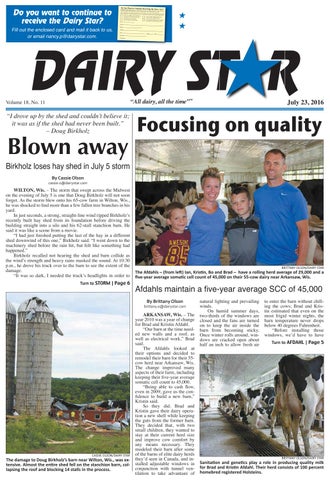
Birkholz loses hay shed in July 5 storm
THIRD SECTION
Pages 2- 3, 5
Bringing an awareness of stray voltage
Vernon
First Section: Pages 1, 6 - 7
Page 10
Wild parsnip a growing problem
Page 11
Six ways to create a culture of safety on your farm
Pages 12 - 13 Dairy Calendar
Winnebago
Worth
Mitchell
Cerro Hancock Gordo
Pages 14 - 16
Kids and their cows
Floyd
Howard
a
ick
Ch
w sa
Bremer
Pages 17 - 18
Some Udder Stuff
Pages 21 - 26 Classieds
Zone 2
Black Hawk
Bu
For additional stories from our other zone, log on to www.dairystar.com
C
Dane
Iowa
Clayton
n
are
na
a ch
rd rawfo
Grant
Fayette
Kids Corner: The Fischers
Pages 19- 20
Richland
Allamakee
Minnesota to host National Plowing Matches
Winneshiek
Pages 4, 6 - 7
w ela
D
Linn
Lafayette Dubuque
Jones
Jackson
Green Lone Rock
R&M Family Farms home to two herds
First Section: Pages 10 - 11
When they breathe easy, so do you No matter the weather outside, GEA keeps your cows comfortable, healthy and productive inside. Comfortable cows are the most productive. Just like
to provide ideal barn temperature, air quality and
you, they perform their best when they are cool, calm
humidity levels. With our total ventilation solutions,
and content. GEA’s industry-leading curtains and fan
your cows will breathe easier — and so will you. Contact
systems can be integrated with automation technology
your GEA barn equipment representative today.
Page 8 • Dairy Star • Saturday, July 23, 2016
GMO labeling bill passes
On a vote of 306-117, the House passed the GMO labeling bill on July 14, sending it to President Barack Obama. Labeling of foods that contain GMO ingredients will be mandatory, but it will take years to phase in and will give food companies the option of using straightforward language, a QR code, an 800-number or a link to a website. The driving force behind the bill was to preempt legislation in Vermont, and possibly other states. Ag Insider A win for agriculture According to National Council of Farmer Cooperatives President/CEO Chuck Conner, the fact that Congress could get anything done on the GMO labeling bill was a huge win for agriculture. Congress is now in recess, resuming session in September. “When they came back, it would have been too late for all practical purposes to do anything about the Vermont law. We took this not only to the 11th hour, but the 11th hour and 59th minute to get this victory.” Conner said the GMO labeling bill sets the precedent for how biotechnology will be handled in the future.
The next issue of the Dairy Star is published August 13th. Advertising and news deadline is Friday, August 5th.
AUTOMATIC FLY CONTROL SYSTEM KattleGuard... the one that ACTUALLY works! ASK ANY DAIRY WHO USES ONE! • Most dairies report gains of 2 to 3 lbs. per day per cow when treating for common house flies... as much as 5 to 8 lbs. with biting flies. • Above results are typically achieved with 3 applications per cow per week. It’s not only effective, but economical too!
By Don Wick Not much expected from Congress for the balance of the Columnist year Congress is in recess until early September. With the election ahead, the number of days on the legislative calendar are limited for the remainder of the year. “We would love Congress to work on key issues like immigration reform, the biogas tax credit and the Trans-Pacic Partnership, but in many, many cases, there is so little real time for either the House or Senate to act on anything controversial and we’re not expecting much to happen between mid-July and the rst Tuesday in November,” said Chris Galen, senior vice president of communications, National Milk Producers Federation. With so much unnished business, Galen would expect a lame-duck session to deal with tax relief and the TPP. “A lot will depend on who will be occupying the White House in January.” AFBF supports tax reform proposal American Farm Bureau Federation President Zippy Duvall is praising House leadership for its plan to rewrite the tax code. This proposal includes features for farmers and ranchers, including full expensing, exclusions for capital gains and the repeal of the estate tax. The GOP proposal is expected to come up for debate next year in Congress. Low milk check will eventually impact production Large global supplies will continue to hang over dairy markets. According to the Rabobank Global Dairy Quarterly Report, dairy production is expected to drop in response to low milk prices. Poor economic conditions worldwide and low oil prices will likely weaken demand in many regions. Rabobank is still forecasting higher milk prices in 2017, but that could be impacted by weak global demand. Turn to AG INSIDER | Page 9
ID-Tek Calf Feeder
RFID calf feeder, handles up to 25 calves. Low cost , start at $2749.00 Hundreds of satisfied customers.
• KattleGuard is fully programmable. Just set it and forget it. It applies only during the milkings you select. It’s bullet proof and the most reliable system on the market.
KattleGuard Insecticide Spray is simply the most effective and economical product you can use in your KattleGuard System.
Ask anyone who’s tried anything else.
from
Greg N. from Evansville IN, said: “Calves seem to be satisfied all the time. Really like the auto wean. They go to starter nicely from the machine.”
www.biotic.com
(931) 437-2514
Page 10 • Dairy Star • Saturday, July 23, 2016
WELA LongLine continuous stall mat roll
R&M Family Farms home to two herds
64” & 72” wide rolls!
Endless Softness 1 ¾” Thick (800) 800-5824 www.agromatic.net MN Sales Rep - Ron Miller - (952) 250-5958 WI Sales Rep - Erik Niemeier - (608) 574-6046 RON JOHNSON/DAIRY STAR
Precision Hoof Care, LLC Sauk Centre, MN
320-333-6618 Bret Illies
Corrective & Maintenance Trimming
THE PROTEIN TUBS COWS LOVE TO LICK By:
Look for the Yellow Tubs
Low Moisture Lick Tubs
Pierz Co-op is now offering Form-A-Lic low-moisture lick tubs from Form-A-Feed. These convenient 250 lb. yellow tubs feature high levels of nutrition that combines molasses-based sugars with low-moisture levels to produce consistent intake and results. Product Bovine Stress Lic Mineral Lic All Purpose 14 Dry Cow Lic Stalk Buster 30
Used For For more Stress - off feed - reproduction information Consistent mineral intakes contact Pasture/Protein Supplement Randy at the Nutrition from dry off to calving Pierz Co-op Supplement feeding - Protein
SUNFLOWER PELLETS NON GMO
HIGH PROTEIN • HIGH OIL Give Randy a call to see if you can use sunflower pellets in your feed. 320-468-6655
Agron. Agro ron n Petro. Petr Pe tro o Feed Feed Feed: 320-468-6655 Toll Free: 877-468-6655 Agron./Petro: 320-468-2509 Toll Free: 877-438-3378
Melissa and Ryan Brown added 100 dairy goats to their 60-cow dairy farm this past spring near Lone Rock, Wis. The goats provide another income stream, in addiƟon to Ryan’s custom farming business.
Browns milk cows, goats for income diversity By Ron Johnson
ron.j@dairystar.com
LONE ROCK, Wis. – Milking time for Melissa Brown is a bit different. Once the last of the 100 goats has trotted out of the parlor, it’s time to start the second shift: 60 cows. Each of the twice daily milkings of the does and cows takes about four hours. But Melissa doesn’t mind. “I’m so used to it,” she said with a smile. Melissa and her husband, Ryan, farm in eastern Richland County, near Lone Rock, Wis. They bought their 40 acres and buildings in 2013, after milking 100 cows on a rented farm near Dodgeville, Wis. Ryan and Melissa continue to rent that farm from her parents, Mike and Jo Ann Meudt, and 260 acres near Lone Rock. Ryan and Melissa started by milking 100 cows at their new farm. But economics soon prompted them to change their business plan. “In 2015, as milk prices started to roll down, being young farmers, we needed to come up with some diversity in the operation,” Melissa said. “We knew we needed something to add to the operation to stay aoat.” So, that fall, after researching the pros and cons of goat dairying, they sold approximately 40 cows and used that money to buy yearling does that would kid in the spring of 2016. To make a place for the goats, Ryan and Melissa, with the help of relatives and friends, converted a machine shed into a goat barn and milking parlor. On March 6, the Browns sold their rst load of goat milk to Mont Chevre, a cheese company in Belmont, Wis. They could have tried to generate a stronger cash ow by milking more cows, but they lacked space for more bovines. “We just don’t have room to expand here,” Melissa said. “And with $14 milk, expanding just isn’t an option with the cows.” The 100 Alpine, Saanen, Lamancha and crossbred does are chugging along at an average of about ve pounds of milk each per day, Melissa said. If they can maintain that average over the duration of a 305-day lactation, yearly production would be at 1,525 pounds each. That’s a far cry from the 70 to 80 pounds each of the grade Holsteins and registered Brown Swiss is making. The cows are carrying a 4.0 percent fat test, and 3.2 percent protein. The somatic cell count stays under 150,000, Ryan said. The cow milk is marketed through Rolling Hills.
The cooperative sells it to Meister Cheese in Muscoda, Wis. The Browns said they like the cheese company’s Cows FirstTM program that encourages milk production without certain aids, such as bovine somatotropin (BST) and Rumensin. While the cows far outproduce the goats, the caprines make up some of the disadvantage when it comes to the price their milk fetches. Melissa said they were paid a base price of $39 per hundredweight for their June goat milk. In addition, the Browns received a $3-per-hundredweight volume premium. That total of $42 might climb to as much as $50 per hundredweight during the winter, Melissa said. That’s partly because goat milk can be harder to come by in the fall and winter, since goats are seasonal breeders. Which are more protable right now? Cows or goats? Melissa said the goats are, even though they produce far less. In fact, she gured that the cow milk price would need to hit roughly $20 for the cows to be comparable to the goats. Ryan and Melissa hope their goats’ production keeps improving. “Our goal for these goats next year is to be at a minimum of eight pounds a day,” Melissa said. To prepare for the goats, Melissa and Ryan built a 16-stall, rapid-exit milking parlor onto one end of the shed. They left room to expand. “Every year, we intend on growing,” Melissa said. “We’re going to see how far the goats take us.” While the cow herd will likely stay at 60, the goat herd could grow by leaps and bounds. Next year, Melissa and Ryan want to milk as many as 225 does. After that, 500 for sure, Melissa said. Even 1,000 does might be a goal in a few years. If that mark is reached, the Browns said they would hire a full-time employee. Although the goats outnumber the cows, the bovines get their share of attention. They’re milked in a double-6 herringbone parlor that the Browns retrotted into one end of the one-story tiestall barn. Melissa said, “The Brown Swiss won my heart, and, the cows built this farm. I love the cows and that’s the main reason they will never leave.” Besides helping ll the bulk tank, Brown Swiss and their calves will one day be shown by the Browns’ children – Brady, 8; Jolissa, 5; and Lexi, 1. Melissa has more cow experience than Ryan. She grew up on a dairy farm, while Ryan hails from a cash crop operation near Arena, Wis., about 30 miles east of the Browns’ R&M Family Farms. Ryan’s father and mother, Dave and Linda Sponem, grow 650 acres of corn, soybeans and wheat. Turn to R&M FAMILY FARMS | Page 11
ConƟnued from R&M FAMILY FARMS | Page 10
Dairy Star • Saturday, July 23, 2016 • Page 11
Ryan works for D&P Enterprises, a sealcoating and landscaping business, but makes time to run a business with his brother, Bruce Sponem. The brothers named it SBS Custom Farming. The brothers’ 2,500 acres of custom work includes tillage, planting, harvesting and bagging. They work in four counties, near the Wisconsin cities of Blanchardville, Dodgeville, Mineral Point and New Glarus. Melissa and Ryan have had their share of setbacks during their short farming careers. One of them was the 2012 drought. “We had to buy all our feed. We paid for $96,000 of feed in 12 months. It was a lot of scraping of pennies,” Melissa said.
“It’s a learning experience. Quality goats are denitely a key to success.” MELISSA BROWN, DAIRY FARMER
Ryan said, “We told each other if we could make it through that, we could make it through anything.” The Browns encountered another obstacle last October. Ryan said the herd average plummeted from 90 pounds of milk per cow a day to 45. Ryan and Melissa eventually learned that the corn silage in bags and a silo was tainted by aatoxin. “We had specialists here from Texas,” Melissa said. “We consulted with vets out of Canada, the University of Wisconsin and Indiana.” Ryan estimated that the silage that’s still in the 18-by-70-foot concrete stave silo would be worth more than
RON JOHNSON/DAIRY STAR
The Browns have received help from family and friends – (from leŌ) Mike Meudt, holding Lexi Brown; Jo Ann Meudt; Dave Sponem; Brady, Melissa, Jolissa and Ryan Brown; Bradi Donahoe; and Branden Evans – to get their goat porƟon of the dairy started. $100,000 if it was safe to feed. Besides slashing milk production, the bad silage killed 26 head. Others had to be culled. The Browns could safely feed the silage to steers or beef cows, but not to any animal that’s pregnant or going to be bred, Ryan said. So that means the feed will probably be composted. “On top of low milk prices, that (corn silage incident) was a little bit of a nancial challenge,” Ryan said.
The Browns agreed that relatives and friends are important to overcoming problems. “We have a great support team,” Melissa said. “Our parents are always there for us and are willing to answer the telephone and help us with whatever advice they can.” Ryan and Melissa also appreciate the value of a knowledgeable lender. “We have a tremendous banker
through the Viroqua FSA (Farm Service Agency), Cheryl Johnson. She farms and understands agriculture,” Melissa said. For other dairy farmers looking to try goat dairying, the Browns gave a little advice. “It’s a learning experience,” Melissa said. “Quality goats are denitely a key to success.”
From Our Side Of The Fence Dairy Star • Saturday, July 23, 2016 • Page 15
What is the mid-summer status of your crops? Jim Nelson Ruthton, Minn. Murray County 60 cows
Steven Mueller New Richmond, Wis. St. Croix County 65 cows
Jim Lepeska Stitzer, Wis. Grant County 140 cows
How many acres of land do you have and what crops are you growing this year? We farm about 600 acres. This year we are growing corn, soybeans, oats and alfalfa.
How many acres of land do you have and what crops are you growing this year? We farm 625 tillable acres – 130 acres of alfalfa, 25 acres of oats, 40 acres of winter wheat and 120 acres of soybeans. The balance is eld corn.
How many acres of land do you have and what crops are you growing this year? We have 400 acres and grow 100 acres of corn and 150 acres of alfalfa.
What is the mid-summer status of the crops? All of our crops are looking very good right now. We have been receiving some good, timely rains. What cutting of hay are you working on? We have just nished up with our second cutting of alfalfa. How did the last cutting turn out? We felt it was a good crop, but it did get rained on a bunch so we ended up putting it up in round bales. We will likely use it for youngstock. What has been the biggest challenge you’ve had with your crops during this growing season? The weather has been fairly cooperative in our area for the growing season. But as it is every day, week and year, our biggest challenge is getting all the work done around here that needs to be done. Tell us about your farm. I farm with my wife, Tami, and our son, Jacob. In 1994, we converted our tiestall barn into a double-6 herringbone parlor. We milk 60 cows two times a day and farm around 600 acres of land. We keep all of our youngstock, raise all of our own replacement animals, but sell our steers at approximately 600 pounds. Jacob is 16 this summer and is just getting started in calf raising. He is active in our local Russell-Tyler-Ruthton FFA chapter and plans to attend Ridgewater College after high school, and take classes in dairy management. We are looking at possibly expanding our dairy when he nishes college. Jacob is thinking that we should install robots. At this time we as a family do all of the work on our farm, making it very difcult to take time off. But we do nd time to get away now and then thanks to Jacob’s friends. As we say, our “family time” is when we are milking cows.
What is the mid-summer status of the crops? Things are starting to get a bit concerning here. With only one rainfall greater than .4 inches all spring and summer, we are once again on the verge of drought conditions. The alfalfa was slow to rebound and will be a light crop this cutting. I expect corn to be under signicant stress again by later this week (July 20). Corn in the area is 75 percent tasseled. I have seen barley and oats harvested already, wheat should begin any day. Neighboring farms started third cutting of alfalfa on July 12. What cutting of hay are you working on? Third cutting of hay will begin July 21-23. Part will be baled and the latter bulk chopped as soil moisture and rainfalls have widened the initial cutting gap. I expect to have it all cut by the end of July. How did the last cutting turn out? Second cutting was baled mainly all small squares on our farm. We had about 40 bales per acre. None of it took any rain. We have not received any test results yet, although I expect it to be in the 150-165 RFQ range. It’s very nice alfalfa hay – some of our best ever – especially for the whole crop. What has been the biggest challenge you’ve had with your crops during this growing season? There hasn’t been any big challenges so far to our growing season. Crops were planted into good moisture and avoided the early frosts. So far, we have had just enough rain to hang on, and that is the primary concern moving forward as we enter a long dry forecast. Tell us about your farm. Our farm is Ger-Con Registered Holsteins. I farm with my parents, Gerald and Connie. It was established in 1974 and I am a second generation farmer. We purchased our current farm in 1984. In addition to the 65 cows, we raise 60 heif-
SINCE 2003
The crops are excellent.
What is the mid-summer status of the crops?
What cutting of hay are you working on? We just nished third crop. How did the last cutting turn out? First and second crops were both excellent. We didn’t test any hay yet, since we’ve got a lot left over from last year. What has been the biggest challenge you’ve had with your crops during this growing season? Everything has been going really well this year. We have been able to get the hay made without any rain on it. The corn is tasseled and looks really good. Tell us about your farm. The farm is a family dairy with three robotic milkers. It has been in the family since 1874. Life has been easier since putting in the robots in 2008.
ers and raise all bull calves as feeders to 600 pounds when they are sold. All eldwork is done on our own, including planting, spraying and harvest. The only custom work we hire is big square baling, occasionally, and hire the grain hauled to market. The eldwork is done by myself and my father, and the gracious help of family and friends during haying season. We do employ one college student from UW-River Falls during the school year to help with the cows on a part-time basis.
Sand bedding
91 tons of sand used per stall over 10 years
SOIL SUSTAINABILITY
What does your next 10 years look like?
DCC Waterbeds
4 tons of organic matter used per stall over 10 years
DCC Waterbeds require approximately 1 gallon of top bedding per stall per day. Sand bedding requires 50 lbs. per stall per day. Over the next 10 years, what will you be buying, moving, hauling and spreading on your Äelds? Does any crop farmer put 91 tons of sand on their land?
Ask us about ®
ISO
Dual Chamber Cow Waterbeds
Isolated chambers. Ultimate comfort.
CONTACT ONE OF THESE DEALERS TO LEARN MORE! Dairyland Equipment Services - Plainview, MN Eastern Iowa Dairy Systems - Epworth, IA Field Silo & Equipment - Mount Horeb, WI Fuller’s Milker Center, Inc - Lancaster, WI K&R Equipment - Fountain, MN Komro Sales & Service - Durand, WI Leedstone - St Cloud, MN & Glencoe, MN
Livestock Systems - Charles City, IA Midwest Livestock Systems - Pine Island, MN • Sioux Falls, SD Northland Farm Systems - Owatonna, MN Preston Dairy Equipment - Sparta, WI Ross Equipment Company - Lonsdale, MN The Scharine Group - Whitewater, WI United Development LLC- Brookings, SD
(608) 709-2693 | www.DCCWaterbeds.com
From Our Side Of The Fence
Page 16 • Dairy Star • Saturday, July 23, 2016
What is the mid-summer status of your crops? Charlie Storandt Mindoro, Wis. La Crosse County 115 cows
Tim Schauer Glencoe, Minn. Sibley County 70 cows
Adam Kammerer Lewiston, Minn. Winona County 168 cows
How many acres of land do you have and what crops are you growing this year? I have 245 acres total. I raise corn on 175 acres, and on the other 70 acres, I raise alfalfa.
How many acres of land do you have and what crops are you growing this year? We farm 400 acres and plant corn, soybeans and alfalfa.
How many acres of land do you have and what crops are you growing this year? We farm 900 acres of owned and rented land, and grow alfalfa, corn, soybeans, oats and grass hay.
What is the mid-summer status of the crops? Crops are growing well, probably the best I have ever seen while farming. The corn is already tasseling. On the 4th of July, I went out to take my knee high photo, but instead, I put my hands in the air, and you could barely see the tips of my ngers. Now, corn is standing 8 feet high in this area. As for alfalfa, the yield has been excellent. We’ve gotten through rst and second crop earlier than years before. Furthermore, the second cutting yielded just as much as the rst crop. Now, our third cutting is coming alone very well. All of this is thanks to warmer weather and plenty of moisture. What cutting of hay are you working on? We are in between the second and third cuttings right now. We have half of a week left before we will start on third crop. How did the last cutting turn out? Like I said, everything turned out excellent. We were fortunate to get in for cuttings in a timely fashion with no rain on it. We didn’t have any insects or damage and didn’t even have to spray insecticide this year. The cows should really milk on this hay this year. What has been the biggest challenge you’ve had with your crops during this growing season? Honestly? I haven’t really had any challenges to speak of. There were a few weeds, but they were cleaned up with the second spraying. Crops this year are just really good. Tell us about your farm. The farm has been in the family since 1903, and I am currently the fourth generation. I farm with my son, Allan, and my dad, Willard, still helps out a little bit. I have a part-time employee named A.J. who helps out when needed, as well. We have 115 cows total and are currently milking 90. We milk twice a day in a 75-stall stanchion barn. Our heifers are raised on another farm site that we own.
What is the mid-summer status of the crops? The corn looks excellent; everything is tall and tasseled. The soybeans look excellent as well. The rows are canopied and have been for some time. The alfalfa has been good, too. What cutting of hay are you working on? We are working on third crop. It’s all down right now (July 19). I plan to chop some and then round bale. The rst crop we covered in a bunker, the second crop we round baled as dry hay. How did the last cutting turn out? We haven’t had it tested yet. What has been the biggest challenge you’ve had with your crops during this growing season? Finding the time period to get the soybeans sprayed because it was wet here for a while. We’ve also had to spray the hay twice, after rst and second cutting, for bugs. Tell us about your farm. My wife, Dawn, and I farm full-time together on the farm. We have three boys, Taylor, Adam and Owen. We milk 70 cows and we custom raise 400 heifers and fatten out 40-50 of our own steers. We farm together with my parents, Dale and Jeane.
KNOW WHERE TO GO FOR YOUR DAIRY NEWS
VERTICAL MIXERS 9 Different Sizes to choose from - 175 cu. ft. - 1,300 cu. ft.
What is the mid-summer status of the crops? Our crops have been doing great this summer. The corn is seven to 10 days away from full tassel. The beans are starting to ower, and the hay crops have had lots of tons so far this year. We have been getting plenty of rain. What cutting of hay are you working on? We are nished chopping second crop and currently have the rest cut for baling. How did the last cutting turn out? Our second crop we let bloom out and chopped for her feed. Feed value was less but tonnage was really good. What has been the biggest challenge you’ve had with your crops during this growing season? The biggest challenge I’ve had this year is getting alfalfa dry enough to bale and trying to keep ahead of the weeds in a few of the corn elds. I put a pre emerge spray on the beans so weed control was good there. Tell us about your farm. My wife, Shelby, and I farm in partnership with my parents, Lyle and Cynthia. We have four kids, Evan, Avery, Levi and Lilly. We also raise all our replacement heifers. I have a beef herd I started when I was younger, and has now grown to 85 cows. We feed out all our beef and dairy steers. Along with a couple part-time employees, I have a sister, Emily, who helps out a lot when she is not working off the farm.
DAIRYSTAR.COM
HAY SEASON SPECIALS!
5 yrs. on Planetary Drive • 3 yrs. on Scale • 5/8” AR200 Auger Flighting • 1/4” A50000 Side Wall Trailer Mixer Sizes 285-1,300 cu. ft. Stationary Size 175-500 cu. ft. Single Phase and 3 Phase 5 YR. WARRANTY ON MIXING TUBS AND AUGER
NEW ANDERSON BALE WRAPPERS
In Stock CALL US AT
(715) 223-3361 OR VISIT US ON-LINE AT
N13835 County Rd. E - Curtiss, WI 54422
www.cloverdaleequip.com
New 2015 NH Roll-Belt 560 baler, 18L X 16.1SL tires, lace belts. Only 2 left at last year’s price! $39,500
ONE ONLY! NEW NH 316 Discbine 2014 model, 16’ w/ 3 pt. hitch SALE! $37,500 Remember, one only!
New Kubota 9’ disc mower
Industry leading 3-blade cutter heads! Sale $10,500
HURKES IMPLEMENT COMPANY Sales: 605-886-3817 • Parts: 605-882-3420 North Hwy. 20, Watertown, SD
Dairy Star • Saturday, July 23, 2016 • Page 17
Grain Vac Systems Powered by Blue Performance
Put your unused Harvestore to work for you
OK Pipe System
Suction Blowers for a Variety of Opportunities
C Convert t your existing i ti structures to dry grain storage
and thoroughly aerate your grain throughout the full height of your structure. Packages are available for diameters from 17’ through 25’, and heights up to 90’.
• No dead air spots. • 8” discharge auger Àts into stationary 8” tube. • Aeration fan performs quietly and efÀciently under extreme static pressure. • Commercial centrifugal fans for structures over 40’, vane axial fans for structures under 40’.
l Powered • Tractor P Electrica owe • r red ile a r T
Ask us how you can use a Cushionair Kongskilde pto driven grain vac to fill your sealed silo.
Designed in modular form the OK pipe system is composed of pipes, bends, branches, diverters, cyclones, outlets, etc. The components are assembled quickly and easily using the unique OK quick-release couplings. The wide choice of OK pipes and accessories ensures flexibility and ease of installation in existing buildings.
• Sucks grain from heaps and out of pits and blows it directly on a truck into a silo or on-floor storage system.
HARVESTORE VENTILATOR
• Up to 120 tons of grain per hour.
Can be Àtted for Harvestore units.
• Efficiently moves grain from dryer to bin storage.
Over 1,000 systems in operation in 25 states.
• Use indoors or outdoors.
• Temporary or permanent systems. • Wall and ceiling mounts available to save valuable Áoor space. • Couplings make maintenance and alterations easy. • Over 40 years of systems installs for proven performance.
IT’S NOT TOO LATE
Champion™ Parallel Parlor
TO START SAVING FOR TOMORROW Have you ever seen a cow smile?
DeLaval Swinging Cow Brush The Champion™ parallel parlor lifts vertically to release the cows. As soon as the cows pass under the fronts, the stalls may be lowered and reloading can begin. Sequencing gates are mounted to the stalls. When the stalls go up, the sequence gates go up with them and the cows have a totally open platform for exiting. • Designed to fit into barns with exit alleys as narrow as 3-1/2 feet. • Designed for remodel situations and built to install quickly with minimum in-field welding. • No concrete pouring necassary • Easy to clean–Built to last • No sequence gates in floor • Indexing with adjustable index air pressure.
Call Genex Farm Systems for a free consultation to see if the Champion™ parallel parlor is right for your operation.
Genex Farm Systems
A subsidiary of Cooperative Resources International
ENGINEERED FOR PERFORMANCE
Milking
1-800-636-5581 Farmstead
1-800-247-0012
Designed to improve cow health, comfort and welfare – and delivers even more! usand Five Tho ing g in Sw shes Cow Bru orth N in Sold America!
• Increased milk production • Decreased incidence of clinical mastitis • Helps promote trafÀc Áow • Energy-saving automatic on/off feature • Stands up to heavy use • Helps save money and promotes cow safety. The Swinging Cow Brush...pioneered and patented by DeLaval.
Montgomery, MN Melrose, MN Sioux Falls, SD Menomonie, WI
When you really stop and think – We’re selling EfÀciency
®
GREENFREESTALLS
Dairy Star • Saturday, July 23, 2016 • Page 19
“I never want to run out of this product.” — Justin Pavlot
PAVLOT’S PRIDE, Justin Pavlot HAMILTON, NEW YORK Young dairyman startup 40 cows milking Grazing herd 60 lbs 4.2F 3.3P SCC 200-250,000 “I never want to run out of this product. Udder Comfort™ works better than anything else for fresh cows, SCC and abnormal quarters,” says Justin Pavlot. After several years working for other dairy farms, he rented a farm and started milking his own Pavlot’s Pride herd on May 2, 2015. In his first year, he’s now milking 38 cows with a dozen dry cows and heifers to freshen and yearlings to breed, his grazing herd’s production has increased from 50 lbs. last Nov. to 60 lbs./cow/day this June. “I like my cows comfortable, so I spray udders once or twice a day for 2 to 3 days before calving and the first few days after. Edema leaves quickly for calmer milking and better milkout. The faster I can get the edema out, the quicker they take off milking,” he explains, appreciating the “natural healing and good results on SCC also. “If I see flakes or elevated SCC, I spray Udder Comfort 2x/day until I am confident she is back on track.
“I see fast results every time I use it. It’s quick and easy, and I don’t have to worry about milk withhold. It’s efficient and cost-effective and 9 times out of 10, problems resolve without other interventions.”
Quality Udders Make Quality Milk
Keep the milk in the system 1.888.773.7153 1.613.652.9086 uddercomfort.com Call to locate a distributor near you.
For external application to the udder only after milking, as an essential component of udder management. Always wash and dry teats thoroughly before milking.
Dairy Star • Saturday, July 23, 2016 • Page 21
1.9% for up to
60 MONTHS
See our complete inventory with pictures and descriptions at:
on 70-Series & S-Series combines
www.mmcjd.com
Visit one of our 13 locations in Central Minnesota!
800-827-7933 78412 Co. Rd. 20
(4) = ST. CLOUD 800-645-5531 1035 35th Ave. NE
(5) = GLENWOOD 888-7999-1495 1710 N. Franklin
(6) = SAUK CENTRE 888-320-2936 1140 Centre St.
(7) = ALEXANDRIA 888-799-1490 5005 State Hwy. 27 E
(8) = PAYNESVILLE 866-784-5535 725 Lake Ave. S.
(9) = PRINCETON
800-570-3453 3708 Baptist Church Rd.
(10) = LITTLE FALLS 800-655-5469 16069 Hwy. 27 E.
(11) = WADENA 888-631-2311 62505 US Hwy. 10
(12) = AITKIN 800-732-1129 1120 2nd St. NW
(13) = BAXTER 800-568-4338 7045 Foley Rd.
JD 8450, 1984, 12,344 hrs.,#125922 ......$22,900 JD 8560, 1989, 9900 hrs., #127263 ........$26,500 Versatile 946, 1991, #130975 .................$32,500 JD 8760, 1990, 8737 hrs., #121544 ........$54,500 JD 8770, 1995, 7638 hrs., #119125 ........$64,500 JD 9400, 1998, 3971 hrs., #126204 ........$84,900 NH TV6070, 2009, 2565 hrs., #124501 ...$89,000 JD 9300, 2000, 3045 hrs., #124837 ........$92,500 JD 9520, 2006, 5016 hrs., #110315 ......$141,500 JD 9560R, 2013, 2000 hrs., #127913 ....$235,000 JD 9560R, 2013, 2090 hrs., #127914 ....$235,000 JD 9560R, 2013, 2188 hrs., #127912 ....$235,000 JD 9630, 2010, 1746 hrs., #123341 ......$235,000 JD 9460R, 2012, 1123 hrs., #129309 ....$239,000 JD 9460R, 2012, 869 hrs., #130519 ......$245,000 JD 9460R, 2014, 529 hrs., #125963 ......$265,000 JD 9560R, 2013, 780 hrs., #127237 ......$275,000 JD 9560R, 2013, 153 hrs., #123386 ......$295,000 JD 9620R, 2015, 402 hrs., #125913 ......$399,000
11
Lilliston 6200 HI-CAP, 1989, 3000 hrs., #131286 ...................................................$11,900 JD 6620, 1982, 4126 hrs., #130110 ........$13,500 JD 9500, 1990, 4239 hrs., #126219 ........$39,500 JD 9600, 1995, 4981 hrs., 3371 sep, #131022 ...................................................$42,900 JD 9610, 1998, 3505 hrs., 2125 sep, #129116 ...................................................$61,000 JD 9560W, 2005, 6231 hrs., 4097 sep #124069 ...................................................$65,000 JD 9650 STS, 2000, 3293 hrs., 2189 sep, #126187...................................... $69,500 JD 9650 STS, 2001, 1894 hrs., 1894 sep, #128888...................................... $74,900 Case 2388, 2001, 3975 hrs., 3240 sep, #125799 ...................................................$75,000 JD 9760 STS, 2004, 2642 hrs., 1763 sep, #107702 .................................................$114,500 JD 9560 STS, 2005, 1395 hrs., 856 sep, #130053 .................................................$125,000 JD 9660 STS, 2005, 2011 hrs., #126966 $135,000 JD 9770 STS, 2009, 2388 hrs., 1828 sep, #124372 .................................................$154,000 JD 9570 STS, 2008, 1563 hrs., 1084 sep, #115868 .................................................$159,000 JD 9770 STS, 2008, 2068 hrs., 1393 sep, #126482 .................................................$159,000 JD S670, 2012, 2239 hrs., 1628sep #128689 .................................................$165,000 JD 9870 STS, 2009, 2157 hrs., 1446 sep, #126038 .................................................$165,000 JD S670, 2012, 2136 hrs., 1350 sep, #119308 .................................................$179,000 JD 9670 STS, 2008, 1478 hrs., 908 sep, #115788 .................................................$179,000 JD 9770 STS, 2009, 1781 hrs., 1248 sep, #117362 .................................................$185,000 JD 9870 STS, 2009, 1727 hrs., 1150 sep, #120212 .................................................$189,000 JD 9870 STS, 2009, 1600 hrs., 1230 sep, #106732 .................................................$190,000 JD 9770 STS, 2010, 1460 hrs., 1080 sep, #118492 .................................................$195,000 JD 9870 STS, 2010, 1693 hrs., 1246 sep, #118149 .................................................$198,500
10 9 1 9 4 3 10 5 6 3 4 4 9 5 1 7 5 4
1 11 2 7
‘14 JD S660
279,000
$
2
ARTICULATED 4WD TRACTORS
4 4 5 6 10 1 10 1 2 3 3 3 6 2 3 6 3 3 2
9
253 hrs., #107228
#119685
119,900
$
96,500
‘11 Krone BP890XC $ #116014
Over 1200 items with pictures updated daily • Go to www.mmcjd.com
(2) = HOWARD LAKE (3) = STEWART
‘15 JD L330
$
#130054
800-558-3759 4561 Hwy. 212
866-875-5093 5845 Keats Ave. SW
139,000
‘06 JD 4720
(1) = GLENCOE
6 3 6 7 4 3 11 6 3 2 8
COMBINES
2 1 3 8 3 2
COMPACT TRACK LOADERS
1 6 1 12 10 6 8 4 4 4 13 2 9 4 13 10 8 7 1 13 10 13 6 13
JD CT322, 2006, 3305 hrs., #130736 ......$19,800 JD CT322, 2006, 3609 hrs., #126268 ......$24,900 JD 319D, 2012, 350 hrs., #129351 ..........$35,000 JD 319D, 2010, 463 hrs., #130278 ..........$36,900 JD 323D, 2012, 1637 hrs., #120367 ........$37,900 JD 333E, 2013, 1731 hrs., #128299 ........$48,000 JD 333D, 2013, 1279 hrs., #124961 ........$49,500 JD 323E, 2014, 126 hrs., #123475 ..........$49,900 JD 323E, 2014, 506 hrs., #123205 ..........$51,900 JD 333D, 2012, 690 hrs., #130565 ..........$51,900 JD 333D, 2013, 932 hrs., #125901 ..........$51,900 JD 323E, 2015, 282 hrs., #129368 ..........$52,900 JD 323E, 2014, 291 hrs., #125605 ..........$55,900 JD 323E, 2015, 165 hrs.,#130570 ...........$57,000 JD 329E, 2013, 405 hrs.,#121156 ...........$57,900 JD 329E, 2014, 722 hrs., #126548 ..........$57,900 JD 329E, 2014, 419 hrs., #128337 ..........$59,500 JD 333E, 2014, 576 hrs., #120261 ..........$64,900 JD 333E, 2015, 446 hrs., #125621 ..........$67,500 JD 333E, 2015, 387 hrs., #125622 ..........$68,000 JD 333E, 2015, 428 hrs., #125424 ..........$68,000 JD 333E, 2015, 216 hrs., #129971 ..........$69,900 JD 333E, 2015, 176 hrs., #130057 ..........$70,500 JD 333E, 2015, 192 hrs., #130058 ..........$70,500
5 1 7 9 9 2 6 3
JD 510, 1997, #125827 ...........................$10,500 DMI 730B, 2005, #127075 .......................$12,500 DMI ECOLO-TIGER 730B, #123819 .........$14,900 JD 2700, 2001, #126403 .........................$15,500 Case 530B, #125613 ...............................$18,900 JD 2700, 2006, #130972 .........................$19,500 JD 512, 2000, #116991 ...........................$20,000 JD 2700, 2005, #118476 .........................$22,000
RIPPERS
189,000
‘09 JD 9870 STS $
1727 hrs., #120212
JD 9570 STS, 2010, 831 hrs., 637 sep, #122037 .................................................$209,000 JD S670, 2013, 1122 hrs., #129519 ......$260,000 JD S680, 2012, 1051 hrs., 780 sep, #126840 .................................................$270,000 JD S660, 2012, 421 hrs, 221 sep, #96947 ...................................................$275,000 JD S680, 2012, 1374 hrs., 918 sep, #120199 .................................................$275,000 JD S660, 2014, 253 hrs., #107228 ........$279,000 JD S690, 2013, 967 hrs., 685 sep, #119306 .................................................$279,000 JD S660, 2015, 310 hrs., 196 sep, #117457 .................................................$299,000 JD S680, 2013, 806 hrs., 466 sep, #122092 .................................................$310,000 JD S690, 2014, 755 hrs., 550 sep, #127495 .................................................$319,000 JD S660, 2014, 158 hrs., 89 sep, #116531 .................................................$321,000 JD S670, 2015, 329 hrs., 200 sep, #124831 .................................................$329,000 JD S660, 2015, 192 hrs., 120 sep, #125946 .................................................$345,000 JD S680, 2012, 537 hrs., 357 sep, #118623 .................................................$349,000 JD S670, 2013, 267 hrs., 193 sep, #117817 .................................................$350,000 JD S670, 2015, 206 hrs., #125750 ........$370,000 JD S690, 2015, 466 hrs., 355 sep, #127010 .................................................$385,000 JD S680, 2015, 272 hrs., #125751 ........$434,000
3 3 5 5 1 6 6 8 7 7 7 6 8 6 5 6 9 11
JD 2700, 2008, #126846 .........................$22,000 JD 2700, 2010, #127009 .........................$24,000 JD 2700, 2008, #123790 .........................$24,500 Case 9300, 2003, #126950......................$29,500 JD 2700, 2008, #123762 .........................$32,900 JD 2700, 2009, #118932 .........................$34,000 JD 2700, 2013, #116881 .........................$34,000 JD 2700, 2011, #116015 .........................$36,500 JD 2700, 2012, #105885 .........................$36,500 JD 2700, 2012, #126875 .........................$36,900 JD 2700, 2012, #126876 .........................$36,900 JD 2700, 2013, #118291 .........................$39,500 JD 2700, 2010, #116633 .........................$39,900 JD 2700, 2012, #118104 .........................$39,900 Salford 9813, 2012, #108447 ..................$49,000 Case IH 870, 2011, #130393 ...................$51,000 Case IH 870, 2012, #118569 ...................$60,000 JD 2730, 2015, #117797 .........................$69,000
10 10 4 10 8 10 5 4 11 10 10
New Holland BR740A, 2006, #131072 ...$12,500 New Holland BR750, 2003, #122883 ......$12,900 JD 566, 1999, #119723 ...........................$14,000 JD 458, 2007, #127678 ...........................$14,500 JD 557, 2002, #125266 ...........................$15,900 JD 566, 2000, #131243 ...........................$16,900 JD 568, 2007, #131030 ...........................$17,500 New Holland BR7090, 2010, #131185 ....$19,000 New Holland BR7080, 2012, #123818 ....$19,900 JD 568, 2009, #125546 ...........................$22,500 New Holland ROLL-BELT 450, 2015, #129121 ...................................................$22,500 JD 458, 2009, #131244 ...........................$22,900 Case IH RB564, 2008, #129522 ..............$23,000 New Holland BR7090, 2008, #123046 ....$24,900 JD 568, 2009, #126994 ...........................$27,900 JD 568, 2008, #119918 ...........................$30,000 JD 568, 2012, #121286 ...........................$31,000 JD 568, 2007, #122377 ...........................$31,900 JD 468, 2011, #126398 ...........................$32,650 JD 469, 2014, #126188 ...........................$33,900 JD 568, 2011, #126221 ...........................$34,900 JD 568, 2012, #123505 ...........................$34,900 JD 469, 2014, #121911 ...........................$35,900 JD 468, 2011, #129122 ...........................$36,500 JD 469, 2013, #118387 ...........................$36,500 JD 569, 2014, #121188 ...........................$38,500 JD 569, 2013, #126055 ...........................$39,500 JD 569, 2013, #116188 ...........................$39,900 JD 569, 2014, #124210 ...........................$40,000 JD 569, 2013, #129929 ...........................$41,799 JD 569, 2014, #123810 ...........................$42,900 JD 569, 2014, #123811 ..........................$42,900 JD 569, 2014, #118014 ...........................$44,900
10 1 11 10 9 7 1 2 5 6 10 7 10 4 5 4 4 8 2 7 7 8 7 6 9 10 13 2 12 10 8 8
‘15 JD S690
ROUND BALERS
SKID STEER LOADERS
JD 250, 2000, 5122 hrs., #130518 ..........$10,500 Mustang 2042, 1999, 2568 hrs., #129117$12,900 Bobcat 583, 2880 hrs., #131300 .............$14,000 JD 250, 1999, 725 hrs., #129148 ............$18,500 JD 260-II, 2002, 1134 hrs., #127036 .......$18,900 JD 260-II, 2003, 2856 hrs., #129106 .......$18,900 JD 320, 2005, 2931 hrs., #126912 ..........$18,900 JD 320D, 2012, 5072 hrs., #126926 ........$18,900 New Holland LS185B, 2005, 2425 hrs., #126189...................................... $19,700 JD 326D, 2012, 6236 hrs., #128882 ........$19,900
466 hrs., #127010
385,000
$
12 6 5 13 2 5 1 1 1 6 11 6 5 5 6 6 2 4 8 3 4 4 8 10 10 4 8 7 10 12 5 8 12 4 12 7 2 9 4 4 1 4 4 6 4 10 8 6 1 1 5 3 11 7 5 7 5 4 3 5 1 2
New Holland LS185-B, 533 hrs., #130952...................................... $19,900 JD 325, 2008, 3338 hrs., #126849 ..........$21,500 JD 320D, 2012, 2260 hrs., #130315 ........$22,900 JD 320, 2007, 580 hrs., #126492 ............$24,900 JD 320D, 2012, 1566 hrs., #124756 ........$24,900 New Holland L190, 2010, 1506 hrs., #128537 ...................................................$25,900 JD 320D, 2012, 2150 hrs., #123100 ........$28,750 JD 315, 2014, 27 hrs., #113452 ..............$28,900 JD 315, 2014, 42 hrs., #113451 ..............$28,900 JD 326D, 2013, 2275 hrs., #131154 ........$28,900 JD 318D, 2010, 985 hrs., #122690 ..........$29,500 JD 320E, 2014, 2264 hrs., #124162 ........$29,700 JD 332D, 2011, 2749 hrs., #117927 ........$30,900 JD 320E, 2014, 1748 hrs., #125994 ........$32,000 JD 318D, 2010, 285 hrs., #126439 ..........$32,900 JD 320D, 2012, 402 hrs., #127483 ..........$33,500 JD 326E, 2014, 1951 hrs., #126744 ........$33,500 JD 320E, 2015, 142 hrs., #127651 ..........$33,900 JD 318E, 2014, 523 hrs., #125356 ..........$36,900 JD 320D, 2013, 210 hrs., #126841 ..........$37,000 JD 326E, 2014, 860 hrs., #127652 ..........$37,500 JD 320E, 2014, 147 hrs., #118329 ..........$38,500 JD 320E, 2015, 29 hrs., #116484 ............$39,900 JD 320E, 2014, 115 hrs., #121065 ..........$40,900 JD 328E, 2014, 561 hrs., #123437 ..........$40,900 JD 318E, 2015, 45 hrs., #118133 ............$41,500 JD 326E, 2014, 430 hrs., #125552 ..........$41,500 JD 320E, 2014, 429 hrs., #125588 ..........$41,900 JD 320E, 2015, 30 hrs., #126180 ............$41,900 JD 326E, 2015, 141 hrs., #118077 ..........$42,900 JD 332E, 2014, 352 hrs., #115525 ..........$42,900 JD 326E, 2014, 490 hrs., #128883 ..........$43,500 JD 320E, 2015, 40 hrs., #121127 ............$43,900 JD 320E, 2015, 115 hrs., #130568 ..........$43,900 JD 326E, 2013, 177 hrs., #104177 ..........$43,900 JD 328E, 2014, 830 hrs., #125591 ..........$43,900 JD 326E, 2015, 150 hrs., #128590 ..........$44,000 JD 326E, 2015, 136 hrs., #118578 ..........$44,900 JD 328E, 2013, 155 hrs., #104185 ..........$45,900 JD 326E, 2015, 150 hrs., #130571 ..........$46,000 JD 326E, 2015, 200 hrs., #127008 ..........$46,000 JD 332D, 2012, 612 hrs., #127231 ..........$46,000 JD 328E, 2014, 546 hrs., #124407 ..........$46,900 Bobcat T870, 2013, 1705 hrs., #127860 $48,900 JD 328E, 2014, 531 hrs., #127230 ..........$49,500 JD 332E, 2014, 495 hrs., #116321 ..........$49,900
Track Tractors
JD 8420T, 2002, 5241 hrs., #125224 .......$89,000 JD 8310T, 2001, 2295 hrs., #126238 .......$89,500 JD 8320T, 2003, 4990 hrs., #125593 .....$109,000 JD 8120T, 2005, 1932 hrs., #121728 .....$117,900 JD 9520T, 2003, 3493 hrs., #106966 .....$135,000 JD 9530T, 2008, 4445 hrs., #103711 .....$170,000 JD 9630T, 2007, 4335 hrs., #116666 .....$170,000 JD 9530T, 2009, 2959 hrs., #116919 .....$195,000 JD 8335RT, 2012, 2204 hrs., #126829 ..$205,900 Case IH Steiger 450 QUADTRAC, 2013, 2973 hrs.,#127014 .................................$214,000 JD 8310RT, 2013, 260 hrs., #125964 ...$245,000 JD 9510RT, 2013, 2200 hrs., #125125 ..$245,000 JD 8310RT, 2014, 692 hrs., #123432 ....$249,000 JD 9560RT, 2012, 1012 hrs., #123342 ..$280,000 JD 9460RT, 2012, 1033 hrs., #125925 ..$282,000 JD 8370RT, 2015, 466 hrs., #125832 ....$285,000
‘12 JD S680
537 hrs., #118623
349,000
$
Dairy Star • Saturday, July 23, 2016 • Page 23
ConĆ&#x;nued from LUEBKE | Page 22 south side and two on the north. When the curtains are completely closed, temperatures must reach 45 degrees for the ďƒžrst curtain zone to open two feet. At 50 degrees, the second section opens. It opens another section at 55 degrees; another is opened at 60 degrees, and the curtains are completely opened at 70 degrees. The Luebkes have chicken wire on the sides to keep the birds out of the barn when the curtains are open. Inside, Luebke has an automated calf feeder. “I don’t have help to do calf chores,â€? Luebke said. “With milk prices where they were at the time, I could afford it. It’s saved me 1.5 hours per day. It’s a totally different way to raise calves.â€? The calves are divided in two pens. One group is on the feeder, while the second group consists of weaned calves up to 3 months old. “We try to keep the age groups together,â€? Luebke said. “We have 35 square feet per calf with a maximum of 22 calves in the barn.â€? Calves are fed three pounds of milk replacer each day starting with eight feedings at the beginning and peaking at 13 feedings. At 6 weeks old, calves are auto weaned losing one feeding per day. “We don’t slug feed the calves each day like we were in the hutches,â€? Luebke said. “It’s spread out more.â€? Calves are also fed free choice calf starter and water, which is heated to 90 degrees all year. The feeders are cleaned once a day. “I wash everything at night with the milkers,â€? Luebke said. With a little over a year in the naturally-ventilated calf facility, the Luebkes are happy with their management decisions. “We’ve been very fortunate to not have a single case of scours or lost a
MISSY MUSSMAN/DAIRY STAR
The Luebkes – (from leĹŒ) Tom, Jody, Norville and Brady – hosted the Farmerto-Farmer Dairy Tour featuring their naturally-venĆ&#x;lated calf barn, automated feeder and acĆ&#x;vity monitors on July 6 at their 85-cow dairy near Mayer, Minn. calf since moving in here,â€? Luebke said. “It’s worked really well for the calves. They’re healthier and growing well. I would do it again in a minute.â€? Focusing on fertility and health Catching cows in heat was also a challenge for the Luebkes once their children were off the farm. “I only get a chance to check on the cows when I’m feeding them,â€? Luebke said. “Their ďƒžrst response at that time isn’t to show estrus but to eat, and I never had time to go back and check on them.â€? To improve his herd’s heat detection, Luebke started using the fertility module through the CowManager system through Select Sires in October 2015. The system uses ear tags with a computer microchip to measure speciďƒžc
head movements to record the cow’s activity. The ear tags communicate with a router within 500 feet of the barn, which sends the information to a computer, tablet or smartphone connected to the Internet. After installing the system, Luebke saw a difference in his heat detection management. “I was catching more cows in heat,� he said. “It’s been very successful. Because of that, our calf barn could be over capacity in the coming months.� Since installing the activity monitors, Luebke is now monitoring rumination, resting and eating time, and body temperature through the system. “We’re fully taking advantage of the functions it provides,� Luebke said. “I’m very happy with it.�
Providing alternatives for tail docking Although the Luebkes do not dock tails on their farm, Marcia Endres, a professor for dairy cattle production at the University of Minnesota, provided options for trimming tails. “Tail docking was originally supposed to be phased out by 2022, but new guidelines for the Farmers Assuring Responsible Management (FARM) program, moved the deadline up to January 2017,â€? Endres said. “Farmers were left wondering what they were going to do because of that.â€? Endres and Gerard Cramer, an associate professor in the college of veterinary medicine at the University of Minnesota, worked together to develop other ways to manage tails for cow cleanliness. One option is to use a scissors to cut the switch below the tailbone. “It’s simple, cheap and fast,â€? Endres said. “But there’s still hair there that could trap dirt. It would also have to be done more frequently.â€? Farmers can also use a cow clipper to trim the hair around the tailbone. “It deďƒžnitely removes more hair than a scissors, but it can be awkward to handle,â€? Endres said. Finally, there is the TailWell tail trimmer, which is a cordless drill attachment with circular blades to trim the hair. “The tail is fed through the attachment and it trims the hair from the side of the tail,â€? Endres said. “It doesn’t leave a lot of hair, so farmers don’t have to trim as often. But, it’s a more expensive investment – $400 to $500.â€? No matter which option the producers choose for tail trimming, Endres said they all work. “Producers just have to choose what works best for them,â€? Endres said. “There are options out there.â€?
Get a FREE
pair of Quatro Boots! With W iith th tthe th h purchase h of 4 sheets of Secure Covers, Bag Armour or Bale Armour
Offer Good On Orders Placed in July 2016! Offer good through Bag Man and any authorized Secure Cover dealer. &DOO RU YLVLW ZZZ 6HFXUH &RYHUV FRP WR ÀQG \RX ORFDO GHDOHU
634 County Rd T Hammond, WI 54015 800-796-5333 | info@afsBagMan.com | www.afsBagMan.com
Page 24 • Dairy Star • Saturday, July 23, 2016
We are efďŹ cient.
We are Kubota.
M6 Series Mid-Size Ag Tractors
RTV-X900 Utility Vehicle
• 104.5 to 141.4 HP* Kubota Diesel Engines • Exclusive Bevel-Gear Front Axle for Easy Handling and Maneuverability • Climate-Controlled, Grand X Cab with Ample Head and Legroom
• 21.6 HP* Kubota Diesel Engine • Exclusive Variable Hydro Transmission • Front and Rear Independent Suspension
BV Series Round Balers
Standard L Series Compact Tractors
• Innovative Bale Chambers for Dense Bales with Tight Outer Layers • Full Control with Universal Control Terminal • Trouble-Free and Reliable Operation Bale After Bale
• 24.8 to 47.3 HP* Kubota Diesel Engines • Powerful Transmission Options • High Quality, Versatile and Affordable
See one of these authorized Kubota dealers near you! Iowa DUBUQUE Roeder Implement 2580 Rockdale Road (563) 557-1184 (800) 557-1184 FARLEY J.P. Scherrman, Inc. 1350 1st Avenue NW (563) 744-3393
Minnesota ALEXANDRIA Alex Power Equipment 111 50th Avenue West (320) 763-4994 www.alexpowerequipment.com
ANOKA Lano Equipment, Inc. 6140 Highway 10 NW (763) 323-1720 GLENCOE Arnold’s of Glencoe 655 Lindbergh Trail (320) 864-5531 www.arnoldsinc.com HASTINGS Niebur Tractor and Equipment 14380 East 240th Street (651) 437-3531 (888) 559-9492 www.nieburtractor.com
KIMBALL Arnold’s of Kimball 701 State Highway 55 East (320) 398-3800 www.arnoldsinc.com
NORTH MANKATO Arnold’s of Mankato 1715 Howard Drive (507) 387-5515 www.arnoldsinc.com
ST. MARTIN Arnold’s of St. Martin 374 Industrial Drive (320) 548-3285 www.arnoldsinc.com
LORETTO Lano Equipment, Inc. 23580 State Highway 55 (763) 479-8200 (888) 479-4342 www.lanoequip.com
SHAKOPEE Lano Equipment, Inc. 3021 West 133rd Street (952) 445-6310 (877) 753-6100 www.lanoequip.com
South Dakota
NORTH BRANCH Olson Power & Equipment 38560 14th Avenue (651) 674-4494 (800) 657-5198 www.olsonpower.com
ST. CLOUD Arnold’s of St. Cloud 2995 Quail Road NE (320) 251-2585 www.arnoldsinc.com
Kubota Tractor Corporation Markets a Full Line of Tractors and Construction Equipment Through a Nationwide Network of Over 1,000 Authorized Dealers.
www.kubota.com *For complete warranty, safety and product information, consult your local Kubota dealer and the product operator’s manual. Power /7 2> HUK V[OLY ZWLJPÄJH[PVUZ HYL IHZLK VU ]HYPV\Z Z[HUKHYKZ VY recommended practices. Optional equipment may be shown. Š Kubota Tractor Corporation, 2016
SIOUX FALLS Pfeifer Implement 5301 West 12th Street (605) 338-6351
Dairy Star • Saturday, July 23, 2016 • Page 25
Dunn County judging team earns two-week trip to Europe By Brittany Olson
brittany.o@dairystar.com
For many young dairy judges, winning the district contest is a major accomplishment. Placing at the top for both state and World Dairy Expo are even bigger accomplishments. The four members of the Dunn County senior dairy judging team managed to tackle all three of those feats and embark on the adventure of a lifetime – judging dairy cattle in Europe. Brooke Brantner, Ben Powers, Luke Powers and Krista Styer, all hailing from rural Menomonie, Wis., have just returned home from their two-week journey on the other side of the Atlantic Ocean. The foursome, who have judged cattle together for six years, were coached by Jim Powers (Ben and Luke’s father) and Scot Nelson. “In order to go on the trip, we had to win at World Dairy Expo,” Styer said. Being able to judge at World Dairy Expo was an accomplishment in itself. “To qualify for Expo, we had to win at state. And to qualify for state, we had to win the district contest,” Luke Powers said. Their travels took them through Scotland, England, Luxembourg, Belgium and Germany, where they got the opportunity to judge cattle and tour several farms along the way. The team quickly
Judging across the ocean learned that judging overseas was not the same as judging cows at home in the United States. For example, there were fewer classes to judge and not as much time to judge each class. “We judged in teams of two rather than four. Instead of getting 15 minutes per class to evaluate cattle, we only had ve,” Powers said. “We were running. We had to scribble our reasons because there wasn’t time to write them.” Styer agreed. “It was really fast paced over there, but also more relaxed,” she said. “We judged outside on the grass as opposed to the colored shavings at Expo.” Despite the contest being markedly different in Scotland than at home, the Dunn County kids did very well. The Powers brothers placed third overall, while Styer and Brantner placed ninth overall with Brantner tying for top individual. Not only was the contest itself different, but so were the cattle being judged, particularly in Scotland. “The cows we judged are less frame-y than in the United States,” Styer said. “But the cows we saw in Luxembourg were more deepbodied like the cows we typically see at home.” Even the way that cattle were tted was not the same as in the U.S. “They also clip differently than we do. They clip tight, but don’t get as technical and precise as we do for our shows,” Powers said. “Ben, who is a tter right now, got to teach the European kids a few tricks of the trade.” The team also got to see the differences between the dairy industries in America and Europe.
PHOTO SUBMITTED
Krista Styer (leŌ), Luke Powers, Ben Powers and Brooke Brantner were selected to aƩend a two-week trip to Europe aŌer winning the dairy judging contest at World Dairy Expo last fall. The four toured two farms together, but were placed with different host families when they arrived in Luxembourg and attended farm tours with them. “You see many smaller dairy herds compared to at home, like 50 to 60 to 70 cows,” said Powers. “What they consider to be their bigger herds are about 300 cows.” Even the crops grown to feed dairy cows are different. Powers explained that in Scotland, where the weather is rainy and damp much of the time, it is too cold to grow traditional crops seen on an American dairy farm like alfalfa, corn and soybeans. “In Scotland they can only grow grass and barley to feed dairy cattle,” Powers said. “Like my tour guide explained, it’s not right and it’s not wrong. It’s just different.” Powers and Styer spoke about how many European farms have older buildings but newer technology, as well as automated dairy equipment like robotic milkers, manure scrapers and feed pushers.
“It’s less labor intensive but very high maintenance with all the precision dairy technology,” Styer said. All things farming aside, the trip proved to harbor many new experiences for all parties involved. “It was my rst time on an airplane,” Powers said. Styer recalled the ight over with a laugh. “I had to learn how to sit still for nine hours on a plane,” Styer said. Even though most Europeans know at least two languages, including English, the language barrier in countries without native English speakers was a new occurrence, as well. Thankfully for Styer, she had some background with French, which was helpful at a Belgian restaurant one night. “Everything was written in French and there were about 10 of us trying to gure out what the menu said, so I had to translate for everyone so we could get our food and beverages,” Styer said.
Barn Floor Groovers s
700-1100 Head Springing, Bred, Open Heifers On Hand At All Times. 877-394-1186
• Free Stalls • Stalls • Feed Lots • Pens
30842 P Avenue Fort Atkinson, IA 52144 For
Dick Meyer Company, Inc.
1-800-228-5471
F 563-534-3042 Fax www.kuennendairycattle.com www.
DAIRYLAND SUPPLY 800-338-6455
• Holding Areas reeas • Walkwayss
DIAMOND SAWED 1/2”, 3/4” OR 1-1/2” WIDE W GR GROOVES ROO OOVES O OVES
Ph Phone 563-534-7754 Mobile 507-261-1703 Mo
Central Minn.
NOT
Protect Your Cows From Injuries and Slippery Concrete
Excellen type Excellent LINUS KUENNEN LI
• All Poly & Wooden Conveyors • Taper Board Feeders • All Poly Conversions for bottom unloader Priced better than steel • Shuttle Feeder Replacements • Replacement Chains
Powers was thankful for the fact that many Europeans know more than one language. “It wasn’t always easy, but since most Europeans know at least some English we did all right,” Powers said. Now that they are home from their travels, it’s back to business as usual. Styer and Ben are now too old to judge this year, but Brantner and Powers still have a couple years left to continue representing Dunn County on the district, state and national level. Styer, who is a student at the University of Minnesota studying agricultural communications and marketing, as well as animal science with a dairy emphasis, plans on returning home to the family farm when she graduates. “Unless something pops up in the ag communications eld, the plan is to come home and do some kind of work with herdsmanship,” she said. Ben is tting cattle after attending the Farm and Industry Short Course at the University of Wisconsin-Madison, and is looking at dairy herd management positions. Powers, with one year of high school left, is considering a couple technical colleges to study either dairy management or swine management. Lastly, Brantner is also still in high school but has an interest in doing embryo transfer work in the future. As for making a return journey across the pond in the future, the answer was a resounding yes. “We met one of the ofcial judges of the Scotland show who actually went on this trip seven years ago, which was really neat,” Powers said. “I would [absolutely] go back and judge in Europe.”
www.barnÁoorgroovers.com
What Goes In Must Come Out.
Can Handle It All!
VERTICAL FEED MIXERS
STEERABLE LIQUID MANURE TANKERS
Choice of Stationary, Trailer, or Truck Mount Vertical Mixers with 140 - 1,580 cu. ft. mixing capacities.
• • • •
THE TRUTH IS IN THE MIX! o. sk A for a dem
Fully independent hydraulic suspension High-volume front impeller Heavy-duty discharge line ¼” steel tank construction w/seamless side sheets • Rock trap and more!
ZERO DOWN & NO PAYMENTS FOR 90 DAYS!
SEEING IS BELIEVING! Watch tanker test run.
Offer expires 7/31/2016
ANIBAS SILO & EQUIPMENT, INC Arkansaw 715-285-5317
©2016 Patz Corporation
Call your local BINDL SALES & SERVICE, INC Reedsburg 608-524-6339
NEW!
www.patzcorp.com |
Dealer today for more details: HWY 48 FARM STEINHART FARM SERVICE, INC SERVICE, INC. Rice Lake 715-234-6788
Platteville 608-348-9401
TRI-COUNTY EQUIPMENT, INC. Withee 715-229-2000
Page 26 • Dairy Star • Saturday, July 23, 2016
Express Pressure Washers, Inc. 15880 SE 74th Ave. Blooming Prairie, MN 55917 507-583-2703
Check out our Used Equipment at
www.expresspressurewashers.com PARTS * ACCESSORIES * SOAP REPAIR * ON-SITE SERVICE
ALL OUR MACHINES CARRY OUR 100% SATISFACTION GUARANTEE
FR OM
N
EW
Open Monday to Friday 8:00 to 5:00 Saturday 8:30 to 12:00 / Fax: 507-583-2060 Email: service@expresspressurewashers.com Join us on Facebook!
S.O.S. ONE SHOT
High Performance Performa Single-Cycle CIP Acid Detergent
FEATURES • Eliminates build-up of fats, proteins and minerals. • Removes and Prevents Orbaseal. • Contains NO harsh chlorine (Easy on Rubber Goods).
Ask about our 2016 Case Study!
BENEFITS
$ • Reduces equipment wear &
Past knee high by the Fourth of July
“Knee high by the Fourth of July.” Time was, that really meant something. A farmer had a good crop coming along if the corn reached his kneecaps by Independence Day. That informal measurement, from my observations, has pretty much gone the way of nickel candy bars and 10-cent bottles of pop. Rural Roots My four rows of sweet corn stood much taller than that on July 4 this year. Out of curiosity, I found a tape measure and headed to the garden to gather the particulars. The four rows of corn – each 20 feet long – contain plants of somewhat varying heights. I eyeballed the stalk that seemed the tallest and measured. It stood nine feet tall on July 18, some 13 inches above my tallest sunower. That might be as high as an elephant’s eye, depending on the particular pachyderm. Yes, that July 18 date was two weeks removed from the standard assessment date of July 4. But nine feet tall – and for sweet corn – seems like an uncommon accomplishment. My records tell me that the variety is Bodacious. It sure has lived up to its name. By Ron Johnson I planted it May 15 – not particularly early and not particStaff Writer ularly late. When I measured, the seeds had been in the ground 63 days. It’s a 75-day variety, so I should be picking ripe ears in a week or so, factoring in the several days that passed before the seeds’ emergence. That corn stands well above the roof line of the chicken house that’s near it. I’m guessing that the chicken house – or at least the chickens themselves – had something to do with my tall corn. I’ve often gotten a chuckle out of the notion that the eld closest to the barn gets the most manure. But I’m sure it’s true in many cases. I know it’s true for my sweet corn plot. It’s only about six feet from the side of the chicken house – named C. Everett Coop – to the garden. That means this year’s corn ground got a heaping helping of old bedding and chicken poop last fall. There’s nothing like a good dose of nitrogen to make corn stretch skyward. I’m sure the weather also played a large role in my corn’s progress. Here in southwest Wisconsin’s Crawford County, we’ve been blessed with a combination of heat, humidity and rain. The heat began to kick in May 6, when the temperature hit 80 degrees. That came just a day after frost the morning of May 5. We got another nip of frost early on May 18. My notes remind me that we hit 85 degrees on May 22. That was the day I set out 42 tomato plants, not to mention peppers, and got tilling, hoeing and watering done. On June 10, Ma Nature turned up the heat, sending us a high of 94 degrees. That kind of heat has continued off and on. Parts of some days have had the humidity up to 98 percent. I haven’t done so yet, but I’m tempted to haul a lawn chair over to the garden around 10 o’clock some night, be quiet, listen hard, and nd out if I really can hear the corn grow. A few weeks ago I was at a meeting in Iowa, where an agronomist said the limiting factor for many crops is water. He said the plant genetics are in place for high yields, and the soil fertility is up there. So, often, it’s lack of water – and at the right time – that holds crops back. We’ve gotten plenty of water. By my reckoning, we’ve gotten almost 19.5 inches of rain since May 4. Some of the more powerful thunderbumpers dumped 3.5 and 3.1 inches each. On the morning of July 17, I poured two inches out of my rain gauge. So the good news is that there’s no drought where I live. Another July 4 tradition for Jessica and me, along with evaluating the corn, is watching the reworks. As usual, we loaded the van with lawn chairs and three dogs and drove to the top of our driveway. From there we had a panoramic view of the reworks at Eastman, six miles away by road, less as the crow ies. Adding to our entertainment were ashes of reworks farther off to the northeast. I haven’t been able to gure out which community’s festivities we witnessed there. As if that wasn’t enough of a treat, we heard – but did not see – more reworks off to the south, below the brow of the ridge. It’s been quite a good late spring and early summer. As for that Bodacious sweet corn, I just might try a trick I’ve heard about. Haul a pot of boiling water to the garden, bend a couple of cornstalks over so the ears are in the water, and cook ‘em right like that. I’m told sweet corn can’t get any fresher.
replacement costs. • Reduces water, energy and chemical use. • Decreases cleaning time. • Increases production capability.
712-722-3626
LET OUR TEAM DO A COMPLETE WASH ANALYSIS FOR MORE INFO - CONTACT ONE OF THESE DEALERS... Advanced Dairy Systems
9 State Rd. 29 • Spring Valley, WI 54767 (715) 772-3201
Anderson Dairy Systems, Inc. 1312 13 1/2 Ave. • Barron, WI 54812 (715) 537-3300
Athman Dairy Inc.
238 Main Street North • Pierz, MN 56364 (320) 468-2494
Champion Milking Systems
23218 350th Street • Albany, MN 56307 (320) 845-4156
D&D Ag Supply
133 Atlantic Ave. NE • Pennock, MN 56279 (320) 599-4466
Dairyland Equipment Services, Inc.
Lang’s Dairy Equipment, Inc.
East Central Dairy Supply
1126 Front Street • Cashton, WI 54619 (608) 654-5106
24260 Cty. Rd. 27 • Plainview, MN 55964 (507) 534-3161 2195 Hwy. 23 • Mora, MN 55051 (320) 679-1029
Eastern Iowa Dairy Systems 105 3rd Ave. NW • Epworth, IA 52045 (563) 876-3087
Fuller’s Milker Center, Inc.
2337 Millennium Rd. • Decorah, IA 52101 (563) 382-8722
Mlsna Dairy Supply
Professional Dairy Systems
1449 Homecrest Ave. • Wadena, MN 56482 (218) 632-5416
Tri-County Dairy Supply, Inc.
423 U.S. 61 • Lancaster, WI 53813 (608) 723-4634
4107 N US HWY 51 • Janesville. WI 53545 608-757-2697
Gorter’s Clay & Dairy Equipment
United Suckow Dairy
12687 Hwy 18 & 52 • Postville, IA 52162 (563) 864-7417 1400- 7th St. SE • Pipestone, MN 56164 (507) 825-3271
SERVICE AFTER THE SALE
Stormy weather
We knew that stormy weather was headed our way to illuminate our dinner of sandwiches and fruit. – the forecasters had been predicting wide-spread With the generator working, the lights in the severe storms all day. The skies started house ickered on, but I quickly turned to darken around evening chore time, so off so that the power could be Dairy in the Suburbs everything I ipped the television channel to a news focused on the barn. I made an exception station. to switch on the TV and check the radar. Colors lit up the map of Minnesota. The worst seemed to be past us. Our Our area was under a severe thunderstorm electric company’s website estimated warning and a tornado watch. Heavy power to be restored by 11:30 p.m. rain, large hail, radar indicated rotation, The greenish hue remained in the sky possible winds so strong they would be until sunset, when everything glowed the equivalent of an F2 tornado. All just orange. Kurt came in only about an hour to the west and moving in our direction. after his normal time. The generator had I went outside to batten-down the to run until the milk was cooled in the hatches. The big doors were already tank. We watched a little TV before I closed on the machine shed. I pulled turned in for the night, leaving Kurt to down the garage door and pushed shut stay up until he could shut off the tractor By Susan Steinke the tall, wooden barn doors, bracing running the generator. Columnist them with metal fence posts. I hurried Early the next morning, I rolled over to the lower part of the barn where Kurt to see that my alarm clock was still off, was milking cows. He seemed unconcerned about the warnings. “If you hear the sirens, be sure to come in.” He nodded. “Promise?” He nodded again. Back in the house, the TV showed the storm approaching Buffalo, just 13 miles up the road. Talk shifted away from tornados to damaging winds. “A strong possibility of straight-line winds,” the weather forecaster said. “Stay away from windows and seek shelter.” The sky was an eerie green. While the kids put on their shoes, I closed the curtain on the picture window
A the As h storm di died dd down, K Kurt began the process of digging the generator out of the machine shed and hooking it up. in the living room, hoping to contain shattered glass if it came to it. Our basement is unnished, as in dirt oor, wooden beams, and cobwebs galore unnished, so it is an absolute last resort. The sirens hadn’t gone off yet, so we gathered ashlights, pillows, and snacks and settled under a sturdy table in the windowless piano room. Tate and Gemma thought it was fun, but Lily was nervous and quiet. With the rst large gust of wind, the power went out. Unable to milk, Kurt came inside shortly after. Just as the rain started to fall, he ran outside again because the winds had blown the barn door open, despite my attempts to secure it. By the time he came back inside, water was dripping from his clothes. Leaving the kids under the table, we stood at the porch windows, watching the rain fall in sheets. The plastic swimming pool I forgot to put away spun across the grass. We saw twigs and leaves y by as the tops of the trees in our yard whipped around in the wind. As the storm died down, Kurt began the process of digging the generator out of the machine shed to hook it up. The kids and I found all of the candles in the house and lit them in the dining room and kitchen
Dairy Star • Saturday, July 23, 2016 • Page 27
which meant the power hadn’t been restored. We’ll need the generator again. But then through my sleepy haze I hear voices. It’s the electric company in our driveway, and a few seconds later my alarm clock blinked noon. The storm left us with a attened oats eld and a yard strewn with sticks. We fared much better than our neighboring cities to the north, who suffered downed power lines, lost trees, and building damage. My friends shared stories of being without power for a day or more, and wondered if they should buy a generator when they hear about ours. But the purpose of our generator isn’t to preserve our perishables or keep the water running; it’s to get the cows milked. Susan and her husband, Kurt, milk 40 cows in Greeneld, Minn. They have three little farmhands: Lily, 8, Tate, 4, and Gemma, 2. Just two miles east of their farm, on a clear day you can see the Minneapolis skyline. Susan can be reached at kurt.susan@hotmail. com.
High-tech rednecks Page 30 • Dairy Star • Saturday, July 23, 2016
I remember helping my dad with herd health when I was young; pushing the feed cart up the freshly limed alley as he checked the cows for pregnancy. Carefully balanced on the cart was a piece of plywood serving as a table, holding all of the herd health charts. Those old metal things with sides folded over just tight enough to keep the green holders in place, upon which the detailed piece of cardstock was threaded into the holes that held all of each cow’s important information, in alphabetical order according to cow name. Such a tedious task it was moving all the cards down the line to make sure you had it right again after tting in a new cow’s information. As ancient as those cards no doubt seem to some of you reading this, I loved them. I loved the space allowed for writing ailments, personality traits and genealogical information. I loved seeing my handwriting next to my dad’s as we commented about important cow facts. Then, it
happened. We were milking too many cows to be able to name them all and keep track of them using the time honored chart system. We upgraded to the Cow Computer. It was our rst system I can’t remember the name of, but I know I didn’t trust it, and still insisted on keeping detailed notes about cows in my notebook. Nowadays, we use Dairy Comp 305, and if you know how to type the correct command into the line, you can pull up virtually any chart of information. My biggest complaint is that it only gives me eight characters to explain everything about a cow’s personal situation. I do enjoy that it tells me who needs to be moved up 21 days before calving, who to dry up to get the correct amount of dry time, essentially doing all of the guesswork for me. I also like that if I click on the le cabinet icon enough times I can see information back to their days as a calf – helping to explain some issues like chronic
respiratory problems. We use this system on a daily basis, for printing charts and lists, looking up cows to see if they need to have a career change. It is an essential part of our cow care program, just like the old metal herd health charts. We also use a program called Alpro. It Ramblings from the Ridge tells us how much milk each cow gives on a per milking basis by the computer chip in her ear. This program is primarily used to get a list of potentially sick cows on a daily basis, based on change in milk weights. Dairy Comp and Alpro talk to each other within the cow computer and By Jacqui Davison share information like Columnist the number for the cow’s RFID (Radio Frequency Identication) tag. It is a crucial part of the morning routine on our farm. Melanie or Dad make the sick list and they set out to check each cow for any number of maladies. Peter is pretty high-tech these days as well. His TMR scale has a special key that holds the information from the feedings that he can pull out and plug into a port on a TMR tracker device that connects to the computer. This makes his feeding process so much less wasteful. He can see if he or Daniel is dumping in too much feed, his scale is so sensitive. Peter’s been doing it for so long; he can get within mere pounds of dumping even heavy, bulk feed products like corn silage. It helps him better calculate how much feed we need on a yearly basis. Our most recent technological upgrade on the farm is a camera system that shows different views of cows going into the parlor, wandering around in patient pregnancy in the transition pen, or actively birthing in the calving pen. There is a monitor set up in our little vet room to view each screen at one time, but you can also access it from your smartphone anywhere. This means we could be miles away and possibly prevent having a calf born in the manure, or look back and see how a cow injured her hip sometime during milking. New technology isn’t just spreading across our farm, it is also present in the boys’ classrooms. Last spring, I was lucky enough to get to see the third grader’s snake presentations. The kids were so at ease up in front of a crowd – sliding their nger across the screen to display the next picture on their very own Prezi. I can only describe Prezi as a Powerpoint type of presentation, but much more kid friendly and colorful. The students also wore a microphone that attached around their neck like a Velcro necklace. One click and their voices were surrounding us in the classroom. It was so neat to watch this technology in action, with these 9 and 10 year olds using it very competently. One bit of technology that has overtaken almost everyone’s lives is that clever creation; the smartphone. I know that on the farm we use ours constantly, from Googling a random question, to taking pictures, and yes, actually calling people. In our household the only devices Keith and I have are our phones and a laptop. Ira will ask me about every six months or so, “When do you think I can get a device?” I’ve witnessed children at functions run off with their iPads to play games, or their phones to Snap Chat one another, and I’m not ready for Ira to join that league of deviceaddicted children. I like to think that my children can function pretty well without those things attached to them at all times. I teeter on the edge-knowing that he needs to be computer and tech-savvy in our every changing world, but not being ready for that leap that lets him have his own phone or iPad. Time will tell. He’ll be ten this fall, and is earning a bit of his own money. Maybe if he buys it himself he will recognize the investment. Perhaps then our family will gain another high-tech redneck, no doubt he will learn things faster than some of us. Jacqui, her dad, sister, and brothers milk 550 cows and run 1,000 acres of crops in the northeastern corner of Vernon County, Wis. Her children – Ira (9), Dane (6) and Henry (2) – farm with her while her husband, Keith, works on a grain farm. She loves to cook, quilt and garden and wishes there were more hours in the day to get it all in. Farming and teaching others about farming are her passions.
World dairy traveler
While interviewing an FFA dairy judging team from Minnesota that competed at the Royal Highland Show in Scotland during late June, I couldn’t help but remember my international dairy experience. It was the summer of 2004, and I had never traveled out of the country let alone own on a plane. Needless to say, my dad, good old dairy farmer that he is, isn’t one for ying. Most of our family vacations were spent driving to our destination, both in and out of state. However, that summer, I was able to see not only the world outside of Steele County and Minnesota, but also experience dairy in a whole different continent with my fellow Steele County dairy judgers, Lisa Demmer, Niki Jensen, Elizabeth Kern, Bridgette Hemmesch and Brian Paulson. At the Royal Highland Show in Edinburgh, Scotland, we had the privilege to judge alongside the Scottish Young Farmers in their dairy judging contest. While I was used to wearing a nice business suit, judging as a team of four, having 12 minutes to judge and take my notes for reasons classes, and having the cattle brought to me, it ended up being a totally different atmosphere. We had to wear white lab coats, By Missy Mussman judged as a team of two, had to move to the cows, and the Staff Writer worst part was, we only had ve minutes to place our class and take our notes for reasons. Talk about speed judging and writing. One difference we really didn’t see that we were expecting, was the physical type traits in the cows. We thought they were going to look like the class winning cows from the 1970s and 1980s because they were in another country, but for the most part, they looked a lot like dairy cattle here in the United States today. After we left Scotland, we, of course, took time to visit some of those places I never dreamed of visiting. We toured castles across Europe, watched the changing of the guard at Buckingham Palace, rode the London Eye, saw Big Ben, climbed the Eiffel Tower, visited the historical sites of Normandy Beaches and walked the streets of Heidelberg, Germany. But among all the touristy things, we had three days in Luxembourg with a host family. Thankfully, for Lisa, Bridgett and I, we were blessed to stay with a family who milked cows. Being the dairy farm girl I am, I was intrigued to see that they had a freestall barn and parlor like we have in Minnesota. The best part was trying to get our host father, who didn’t speak English very uently, to say “straw.” He came close, but really struggled to say it. But, I began to notice very distinct differences between our country’s dairy farms and theirs. Our host family’s dairy was practically right in town. If it were a farmer in the United States, they would more than likely be concerned with complaints from their neighbors 20 feet away. Since our host mother spoke English quite well, I asked her if they had any issues from the people in town with the dairy being so close. She told me no. This is very common where they live and the people in town are used to it. Another difference I noticed as we were on our way to the barn was that it was literally connected to the house. We walked out of the door near the dining room and kitchen, went through a hall and walked right into the barn. When asking her why that was, again, she told us that it was very common. Although the quota system is no longer in place in most of Europe, it was at that time. I remember wondering how they could produce only so much milk each year. During our three-day stay, I was also able to see my very rst robotic milking unit in action at one of the other host family’s dairy farm. I remember being so in awe of the machine that milked the cows for the farmers. I took so many pictures of it to show my dad. I knew he wasn’t going to believe it until he saw it. Now, robotic milking units, calf feeders and so many other technologies are becoming more common in the Midwest and across the country each year. While in Luxembourg, our group also had the opportunity to judge one class informally at the agricultural fair. I think there were close to 12 cows in one class, and I was so overwhelmed. But it was fun to see how they lined the class up and listen to their reasons, even though we really couldn’t understand a word they were saying. After 15 days overseas, not only will I remember the big cities we were able to tour, but my experience with dairy on another continent. It will be something I will carry with me forever.
Dairy Star • Saturday, July 23, 2016 • Page 31
USED EQUIPMENT FROM A NAME YOU CAN TRUST! 2011 NH H7450 2 pt swivel hitch
2008 NH TD80D 12x12 Trans, Canopy
2014 NH H7230 10’ discbine, Drawbar Swivel
$18,950
$21,500
USED TRACTORS ‘13 NH T9.615, 775 Hours .................................$260,000 ‘08 NH T-9050, 2100 Hours ...............................$169,000 ‘99 NH 8360, MFD, Loader, 12,000 Hours ...........$19,900 ‘05 NH TS-100A, Cab Suspension, 751 Hours .....$36,500 ‘04 NH TN-75D, Cab, 675 Hours ..........................$28,500 ‘08 NH TD-80D, MFD, 686 Hours.........................$19,900 ‘55 Ford 900...........................................................$4,000 ‘12 JD 7330 Prem, MFD, IVT, 1500 Hours .........$106,900 ‘13 JD 6140M, MFD, Cab, 1980 Hours ................$69,500 ‘79 Steiger Couger 3 ST270 .................................$16,900 ‘04 AGCO LT-75, Cab, MFD, Loader, 475 Hours ..$37,500 ‘84 A-C 8030, MFD, 9560 Hours ..........................$13,500 ‘65 Oliver 1850, Diesel ...........................................$5,950 ‘68 I-H 544 .............................................................$6,250 ‘45 Farmall H..........................................................$1,400 USED HAY EQUIPMENT ‘11 NH H-7450, 13’ Discbine, 2 Pt Swivel Hitch ...$21,500 ‘14 NH H-7230, 10’ Discbine, Drawbar Swivel .....$18,950 ‘98 NH 1475, 14’ Haybine ......................................$6,250 NH 478, 7’ Haybine ................................................$1,750 ‘09 NH H-6740, Disc Mower ..................................$4,450 ‘05 NH 615 Disc mower .........................................$4,250
$19,900
NH 456, 6’ Pull Type Sickle Mower ........................$2,500 (2) ‘02 NH FP240, Crop Pro, 3 row CH, HH ...Ea. $27,500 ‘10 NH FP-230, Crop Pro, 2 row CH, hay head.....$36,500 ‘02 NH FP-230, Crop Pro, 2 row CH, hay head.....$20,900 (2) ‘05 H&S 7+4 16’ forage boxes, 412 wagons .Ea. $7,950 ‘90 Meyers 500, 18’ forage box & wagon ..............$6,350 ‘05 Meyers 1845 Forage Box & Wagon ................$12,500 ‘03 H&S 860 Blower ..............................................$3,650 Agrimetal 5600 Tub Grinder ...................................$9,200 ‘03 NH BR-780 Rd Baler, Net & Twine..................$14,995 ‘04 NH BR-780 Rd Baler, Twine Only ...................$15,500 ‘07 NH BR-740A Rd Baler, Wide Pickup ...............$12,500 ‘89 NH 853 Rd Baler ..............................................$2,500 ‘08 JD 468 Rd Baler, Twine & Net Wrap ...............$20,900 ‘13 Vermeer 604 SM Rd Baler, Net Wrap .............$22,800 ‘98 NH 570 Baler with 72 Thrower .........................$8,900 NH 315 Baler with 70 Hyd Drive Thrower ..............$3,500 NH 258 Rake, New Rubber Teeth ...........................$2,750 Kuhn GA7302DL Rotary Rake ..............................$10,900 NH 166 Invertor .....................................................$2,950 NH 144 Invertor .....................................................$2,750
Equipment of Norwood LANO A family business since 1946 with the Lanos: Jack, Paul, Bob and Andy 952-467-2181
USED SKIDSTEERS
‘07 5600 Toolcat, Glass Cab with A/C, Hi Flow Aux, 4500 hrs ........................................................$21,225 ‘12 T-870, Glass Cab with A/C, Hi Flow Aux, 2 Speed, 553hrs ...........................................................$56,500 ‘12 T-770, Glass Cab with A/C, Hi Flow Aux, 1100 Hrs ........................................................$49,000 ‘14 T-650, 1 Million Ed, SJC Controls, 900 Hours ......................................................$47,000 ‘13 T-590, Glass Cab with A/C, 917 Hours .......$38,500 ‘99 864, Glass Cab &Heater, Newer Tracks, 5200 Hours ....................................................$13,900 ‘12 S-770, Glass Cab with A/C, 2 Speed, 1750 Hrs ........................................................$41,900 (2) ‘12 S-750 Glass Cab with A/C, 2100 hours and up....................... Starting at $30,900
‘09 S-300, Glass Cab with A/C, 2190 Hours.....$27,500 ‘02 S-250, Glass Cab & Heater, 2 Speed ..........$22,500 (5) ‘12 S-650, Glass Cab with A/C,. Starting at $31,900 ‘14 S-590, Glass Cab With A/C, 2 speed, 1875 Hours ....................................................$32,500 ‘12 S-205, Glass Cab with A/C, 2 Speed, 4500 Hrs ........................................................$21,900 ‘08 S-160, Glass Cab &Heater, 2 Speed, 4500 Hrs ........................................................$15,750 ‘86 743..............................................................$5,500 ‘14 N-H L-225 Glass Cab with A/C, 890 Hours.$31,900 ‘06 JD 325, Glass cab with A/C, 2 speed, 3200 Hours ....................................................$17,800 (3) Warrior wood splitters................ Starting at $1,750
LANO EQUIPMENT OF NORWOOD 952-467-2181
One Tough Animal
www.bobcat.com
ORDER NOW TO GUARANTEE DELIVERY! Truck Tire Sidewalls For Silage Piles Fabric/B ia Sidewalls s Available
No mess – h wit sidewalls ge la eliminate si and water ms storage proble h it associated w old tires
DELIVERY AVAILABLE BY THE SEMI LOAD
Call Now To Lock In Your Order
TMR Feed Carts • Round Bale Unrollers • Stationary TMR Mixers
AUTHORIZED DEALERS IN IA, MN & WI KM Electric Charles City, IA 641-364-2103
Hanson Silo Lake Lillian, MN 320-664-4171
Fritsch Equip. DePere, WI 920-532-6292
Maki Farm Svc LLC Curtiss, WI 715-613-7308
Maki Farm Svc LLC Edgar, WI 715-352-2011
Zabel Equip. Eastman, WI 608-874-4105
AUBURNDALE, WI
715-652-3622
ST. MARTIN, MN
320-548-3496
Lost in translation
Page 32 • Dairy Star • Saturday, July 23, 2016
Have you ever heard about the little old couple pads big enough for Mark to dial without hitting the who shared everything? They were eating dinner at wrong numbers. I think it can take pictures too, but I a fast food restaurant where they split a hamburger just want a phone to talk on. I swore I wouldn’t learn and fries between them. Then, the woman just sat how to text. If I had a question, I wanted to hear an there watching her husband eat his half of the meal. answer. Needless to say, the kids would much rather When he was done, he handed her the dentures so she punch out a quick text than answer a phone call. So could eat her half of the meal. Now we’re not that old I learned to text, but I don’t do the smiley faces and and we have good teeth, but such. When I read a text I Mark and I do share a ip what the person is sayknow what h I said, id b but I d don’t ’ hear phone. He says he doesn’t I k ing in their voice. Or at least need one. He doesn’t want know what you heard and that what I think they are saying. to be bothered when he’s The problem is that I somecan lead to some problems. working, but he sure is times miss the meaning in quick to take my phone out the message. Something to the elds with him in case gets lost in translation. he has problems. There are people who wish he had a We were driving home from a niece’s conrmaphone on him more times than not, especially the A.I. tion in Iowa. As we came up to the Owatonna exit technicians when he forgets to mark a cow for breed- on I-35, Mark called our friends, Ev and Joe. They ing. weren’t home, so Mark left a funny message on their I know my phone is old school but it has number answering machine. He said he saw some really ugly
red cows along the interstate and knew they must be theirs. He just wanted to let them know their cows were out. He laughed and hung up the phone. When Ev and Joe heard the message several hours later that night, they panicked and headed for the interstate with ashlights looking for their lost cows. Just Thinking Out Loud They missed the joke in the message. They heard “cows were out” and missed the laughter. Something got lost in translation. It is so easy to misinterpret what someone is saying or doing. I know what I said, but I don’t know what you heard and that can lead to some By Natalie Schmitt problems. Take the word Columnist “really”. Thanks to Saturday Night Live’s Weekend Update skits, this single word can take on many different meanings in just the way it is said. It can be said with surprise, joy, disgust, annoyance and sarcasm. It can be questioning or afrming. Really? Really. As we enter county fair season, we have to be careful to make sure nothing gets lost in translation between what we do and what other people see and hear. We need to be aware of what we do, even when we think no one is watching. There are many phones much more sophisticated than mine that can live stream something straight to the internet for all to see. Think before you grab a pitchfork to give a stubborn lazy cow a little poke to get up. You know it is not hurting her, but not everyone else does. After our 4-H kids do a great job of telling fairgoers about their animals and the care they provide for their animals, we don’t want their message to get lost in translation when they see something else. One thing not lost in translation is the song of life the frogs are singing from the relled water ways and ponds around the farm. Before our 6 inches of rain last weekend, the frogs were deathly quiet. Now they are rejoicing and making up for lost time. The sound of their refreshing song cools my mind in the morning as I feed youngstock. The 6 inches of rain were a welcomed event around our place. We have been terribly dry on the sands of central Minnesota. The rains came through out the day and most went to the roots of tasseling corn and alfalfa regrowth. My yard is even showing signs of coming back to life. Of course 6 inches of rain can mean different things to different people. Here on the sands, it’s not that big of a deal most times. On heavier ground it is another story with ash ooding. Hearing we had so much rain in one day, Ev texted me that she heard our heifers got swept away in a ood and that we needed to replace them with some real cattle. Nothing lost in translation there. Pay back can be funny. Natalie, Mark and his brother, Al, Schmitt farm together near Rice, Minn. They milk 100 registered Holsteins under the RALMA prex. Their four children are great help around the farm and are pushing Natalie out of several jobs. Therefore she is thankful to have something else to do. For questions or comments please e-mail Natalie at mnschmitt@jetup.net.
WHO WILL YOU FIND IN OUR
Business Directory?
LOG ON TO: www.dairystar.com TO BE INCLUDED IN THE DAIRY STAR BUSINESS DIRECTORY CALL 320-352-6303
Jersey show girls
Five years ago, Glen and I stood with Dan and Monika outside our baby calf pen. Dan and Monika were picking calves to show at the fair. We tried to guide their decision by explaining which calves the judges might like best. Monika, who was three years old at the time, didn’t care what the judges might think. She wanted to show the little brown calves – our rst two grade-up Jerseys. Glen grew up on a farm with both Holsteins and Jerseys. So when we ended up with a couple of Ho-Jos in our herd, Glen decided to keep breeding them to Jersey. Glen has been breeding our herd for higher component Dairy Good Life milk since we started farming; Jerseys contribute nicely to his goal for more butterfat and protein. At rst, I tolerated the Jerseys in exchange for Glen tolerating my Milking Shorthorns. But then I began to see how benecial it is to have petite calves for the kids to show and petite cows for them to practice milking in the barn. We have a number of Jersey (or mostly-Jersey) cows and heifers in our herd now, but two little brown calves named Star and Sandy were the ones who started it all. And that day, picking out calves for the fair, Monika started something none of us could have guessed. Monika took Sandy to the youth show in June and By Sadie Frericks then showed Star at our county fair in July. It turned out Columnist that the judge liked Star as much as Monika did, so our little girl went home her rst purple ribbons. Two years later, there was another little brown heifer calf in the newborn pen. Monika named Star’s rst calf Sparkle. Sparkle followed in her mother’s footsteps – on the show halter, walking next to Monika. Last year, Star gave birth to her second heifer calf. Monika named this calf Stephanie. Stephanie went to the fair, too, as Monika’s Cloverbud 4-H project calf. And this year, Monika will parade another little brown calf around the ring in the Open Show. (Unfortunately, she won’t get to lead her calf for the 4-H show because of Cloverbud livestock rules.) Sparkle delivered a heifer calf in April. Monika named the calf Starlight and we marveled at having three generations of Jersey show girls in the herd. Star had her rst bull calf this spring, which was OK, because then Monika didn’t have to choose which calf to show. But someone has a little sister who wants a little brown calf of her own, so maybe next year we’ll be lucky and get two Jersey calves. At one point, Monika announced that she wanted to take all of her Jerseys to the fair – Star, Sparkle, Stephanie, and baby Starlight. I explained that showing a cow is a big job for a 7 year old, but I did let her work with Stephanie a couple times. She quickly decided that the yearling was too big for her and opted to stick with her baby calf for now. I’ve been watching Monika lead Starlight around the yard, preparing for the fair next week. I can’t help but think that Monika sure struck gold when she picked Star for a show calf ve years ago. Starlight took to the halter just as well as Star and Sparkle did – like she was born to show. She follows after Monika, head held high, her stride as smooth as can be. I think Starlight would show herself, given the opportunity. Monika overheard me telling someone that Starlight is like a little show queen. Now, beaming with pride, Monika tells everyone who will listen that Starlight walks like a princess. I think my little girl might have been born to show, too. I can’t tell you how many times I’ve heard, “Mom, can I walk Starlight?” Monika walks her and brushes her and brings Starlight treats while she’s tied to the silo. After the youth show last month, Monika looked a little sad for a moment. When I asked her what was wrong, she said, “I only got to take Starlight into the ring twice. I wanted to show her more.” I assured her that she would have more opportunities at the county fair. And she will. Since Monika’s cousin is showing both Sparkle and Stephanie, Monika will get to lead Starlight out for the daughter-dam class and the best three females class in the Open Show. It’s pretty crazy to think that we’ll be showing all these Jerseys at the fair this year – and that it all started with one little brown calf. Who knows how many we’ll be showing next year. Monika’s herd of Jerseys could be nearly doubled by then. Star, Sparkle, and Stephanie are all due to calve next spring with another crop of Jerseys. With any luck, there will be a couple more little brown heifer calves in our calf pen. If so, Monika might have to share her Jerseys with her brother or sister. Sadie and her husband, Glen, milk 75 cows near Melrose, Minn. They have three children – Dan, 9, Monika, 6, and Daphne, 3. Sadie also writes a blog at www.dairygoodlife.com. She can be reached at gsfrericks@meltel.net.
“I didn’t even think we had stray voltage!” Roger Lange milks 100 head on his family dairy at Crofton, Nebraska. Until recently he was often forced to sell his fresh heifers because they wouldn t let down their milk. “We called Stray Voltage Consulting, and Jerry found the problem within half an hour.” Roger said. “I was very impressed with Jerry. He’s a former REA guy, so he understands both the farmer and the electric company. Being able to work with both sides is a key component to his success.” “I haven’t had a single problem with our fresh heifers since Jerry corrected our stray voltage problem. I would highly recommend Stray Voltage Consulting to anyone who thinks they might have stray voltage!”
STOP THE SHOCKS
Stray Voltage Consulting Over 30 years of experience
605-695-3328 •
www.strayvoltageconsulting.org
Dairy Star • Saturday, July 23, 2016 • Page 33
THE EVOLUTION OF PULSATION™
HiFlo Evolution
™
D Durability, rel reliability and easy maintenance
Gary Von Wahlde OWNER
Pulsator
New Central MN Dealer!
Call Gary for a quote.... 320-248-2236
Family owned and operated
Sauk Centre, MN • gary@dairydirectsales.com
0%
for up to 60 months
Plus $500 Instant rebate on Woods Massey Ferguson Program Red Implements*.
Implement
inc.
23661 Hwy. 4 , Lake Henry, MN
Explore our family of versatile, hard working compact and utility tractors.
FROM MASSEY FERGUSON
(320) 243-7411 www.lakehenryimplement.com
A world of experience. Working with you. Massey Ferguson is a worldwide brand of AGCO.
*Offer valid on select models with approved credit from AGCO Finance, LLC. Dealer participation may vary. Contact your participating dealer for more details. Offer may be subject to change without notice. Full list of qualifying products can be found here.
EQUIPMENT ON HAND
TRACTORS (ALL BRANDS)
2006 Massey Ferguson 8460, Mfwd, Cvt, 2025 Hrs ....................................... $97,900.00 2010 Massey Ferguson 2660, 2Wd................. $20,500.00 1995 White 6144. Mfwd, 4015 Hrs ................. $36,500.00 1994 White 6175 2Wd, 5300 Hrs.................... $39,750.00 2012 Challenger Mt545b, Mfwd, Cvt, Duals, 4350 Hrs .............................................. $62,500.00 2010 Massey Ferguson Gc2400, Mfwd, 60” Deck, 535 Hrs............................................. $8,500.00 1963 Ih 460 2Wd .............................................. $2,950.00 1953 Farmall M ................................................ $2,165.00 Ford 8N ............................................................. $2,500.00 1980 Massey Ferguson 2745, 2Wd, 4563 Hrs $11,500.00 Allis Chalmers C Tractor W/ Belley Mower ........ $3,875.00 Allis Chalmers C Tractor Sinlge Front Wheel ..... $2,000.00 Allis Chalmers Wd Reverse Station W/ Loader.. $2,225.00 John Deere 350 Dozer..................................... $15,000.00 Ford 8N ............................................................. $1,500.00
Harvest (Uni, Combine, Header)
Case Ih 1020 30’ Flex Head .................... $11,750.00 Chopper (Shredder, Blower, Picker, Attach) Balzer 2650 26’ Stalk Chopper ............... $10,000.00 Gehl 3038 2Row 30” Corn Head ................. $950.00 Gehl Tr330 3Rn Corn Head, 2003 ............ $4,500.00 2009 John Deere 3975 Chopper, Kp, 7’ Hh, Dion 90” Head ............................. $40,850.00 2009 Hiniker 5610 15’
Shredder Windrower .............................. $12,500.00 Gehl 1540 Blower..................................... $1,675.00 Case Ih 600 Forage Blower ...................... $1,950.00 Miller Pro 1160 Ii Blower ......................... $3,890.00
Haytool - Baler
2015 Mf/Hesston 2956 Round Baler, 6X5, ...................................................... $35,500.00 2011 NH Br7070 Round Baler (4X6) ...... $19,500.00 2008 Case Ih Lbx332rt Baler, 3X3 Bale, . $48,000.00 1999 Hesston 4910 Baler 4X4 Bale ........ $27,000.00 Case Ih 3650 Round Baler (6’X5’) ............. $5,275.00 1990 New Idea 484 Round Baler (4X5).... $2,500.00
Skid Steer
1995 Mustang 2060, Dsl, B, 5770 Hrs. . $11,665.00 2009 Mustang 2044, Dsl., 4400 Hrs. ..... $15,575.00 2012 Mustang 2044, Dsl, T-Bar, B, 2175 Hrs ............................................ $17,775.00 2013 Gehl V400, Cab & Heat, 2375 Hrs . $29,500.00 2011 Gehl 5240E Cab& Heat, 2 Spd ..... $21,750.00 2012 NH 215, Cab & Heat, 1550 Hrs Bucket .................................................... $17,500.00 Schubert Hd72 6’ Brush Cutter ................ $3,890.00 Bobcat Sb200 72” Snowblower ............... $3,875.00 66” Midsota Bucket, Mustang Single Pin .... $390.00
Lawn / Garden (Snowthrower, Mower, Tiller, Attach)
NH Ls45 18Hp, 44” Deck ......................... $1,665.00 2009 Cub Cadet I1042 Zero Turn Lawn Tractor, 42” Deck ......................................................... $1,000.00
Feeds and feeding Page 34 • Dairy Star • Saturday, July 23, 2016
Seems hard to believe, but the forage growing season is more than half over. There has been a lot of forage already harvested with some producers having three cuttings of alfalfa in storage and eyeing a fourth by mid-August. Alfalfa quality generally has been good to go along with good yields. However, the largest quantity of forage is yet to be harvested. For most dairy producers, corn silage makes up about 60 percent of the forage dry matter (DM) in milk cow rations. The crop looks very good right now with more than enough to ll most silos or storage systems. However, the weather over the next few weeks will determine yield and timing of corn silage harvest. According to Wisconsin agronomists, corn silage harvest occurs within 42 to 47 days after silking, which means we could see some silage being harvested starting the third week of August. It will be important to watch the weather and monitor crop moisture as we get into August to get the optimum yield of high quality silage. With an early corn silage harvest likely, now is the time to plan the feeding program for the remainder of 2016 and the rst half of 2017. The corn plant is a good versatile By Jim Linn feed as it can provide forage, grain or both as needed in raNutritionist tions. Here are a few things that can affect forage and corn silage inventories: • A larger quantity of higher quality forage will be needed than low quality. High quality forages with NDFs about 35 percent, can account for 60 percent or more of the total ration DM. Forages with NDFs greater than 40 percent will only be about 50 percent of the ration DM. • Digestibility of the NDF has a big effect on how much forage the cow will eat. Given equal NDF content, highly digestible NDF forage will be consumed in greater amounts than low NDF digestible forage. • Miner Institute dairy researchers estimate cows will eat between 0.3 and 0.5 percent of their body weight in uNDFom-240. Assuming an intake of 0.40 percent uNDFom-240, a 1,600-pound cow will consume 6.4 pounds of uNDFom-240. If the forage has 16 percent uNDFom-240 (DM basis), than intake of the forage could be 40 pounds of DM/day. As uNDFom-240 (percent of DM) of the forage or in the total ration increases, DM intake decreases. • DM intake of high producing (great than 90 pounds milk/day) Holstein cows is 60 to 65 pounds/day. As a guideline, cows do not have rumen capacity and a feed passage rate to consume much more than a total of 135 pounds of feed per day. Wet (40-45 percent DM) rations have a high rate of passage, but benet from a small amount of dry physically effective ber forage in slowing rate of passage. • Wet forages will pack tighter in a silo than dry forages and therefore, forage density per cubic foot is greater for wet than dry forages. For corn silage, the average density is 14.5 pounds of DM/cubic foot when silage DM is 34 percent. (Note: packing of silo has a big effect on density.) • Combined storage and feeding losses average about 15 percent of the DM, but can range from 10 to 40 percent. Inventory and ration planning are based on amounts the cow
consumes and generally does not include any feeding or storage losses. Therefore, plan to harvest at least 15 percent more DM to ll inventory needs than what the cow is predicted to consume. (Note: Forage DM losses on most farms are greater than we estimate, be generous in estimating losses.) Interesting feed and feeding tidbits The Feedstuffs Feed and Mill Guide book (2016) listed the following quantities of grains fed in the United States to animals in 2014-2015: • Corn was the number one feed grain consumed by animals at 135 million metric tons per year. Wheat was second at 4.2 million tons followed by sorghum at 2.0 million tons. • Soybean meal was the number one oilseed protein source consumed by animals at 29 million metric tons. Canola meal was a distant second at 4.4 million metric tons. • Wheat mill feeds were the leading byproduct consumed at 6 million metric tons per year. Corn gluten feed and meal were second at 5.3 million tons per year. Milk fatty acids continued Last month I wrote about how increasing the de novo synthesized fatty acids in milk relates to increases in total fat and protein in milk and good rumen function. When rumen fermentation of feeds, and particularly forages and ber, is good, milk component yields increase. Production of acetate, the building block for longer chain fatty acids found in milk, is optimized when rumen pH is 6.2 to 6.4. In the Journal of Dairy Science this month, there was an interesting research report relating milk fatty acid composition to rumen pH and function. Dairy researchers at Université Laval, in Québec, Canada, were looking at odd numbered carbon chain fatty acids in milk as a means of evaluating rumen function as almost all odd numbered carbon fatty acids are derived from bacteria synthesis. Milk fat concentrations of C4:0, iso 14:0, iso 15:0, and 22:0 we found to be a good predictor of rumen pH. (Iso indicates the fatty acid has a branched carbon chain rather than a continuous straight chain. The example illustrates straight and branched chains.) Butyric acid is a straight chain (C4:0) - CH2-CH2-CH2-COOH Isobutyric is a branched chain (iso C4:0) - CH2-CH-COOH | CH2 The positive relationship between iso fatty acids and rumen pH is related to cellulolytic bacteria, which are negatively affected by low rumen pH. Thus, as iso acids in milk fat decrease, rumen ber digestion is likely decreasing. These Canadian researchers found feeding a rumen inert fat supplement containing branched fatty acids contributes to the concentration of branched chain fatty acids in milk fat and can confound interpretation of rumen function and ber digestion. After last month’s article, I also was made aware MN DHIA has the equipment to measure milk fatty acids. They have been collecting milk fatty acid data for several months now. I plan on working with them over the next few months to evaluate milk fatty acids in relation to some herd feeding programs. Analyzing the fatty acid prole of milk fat continues to show promise as a noninvasive method for evaluating rumen function.
NOW IS THE TIME TO REPLASTER YOUR SILO/BUNKER WALL! Marvin Metzger of Multi-Rose Dairy near Rock Rapids, Iowa, contacted Osakis Silo to replaster both sides of a 16x200 bunker wall last summer. Previously the surface was rough and the concrete was showing through the stones. Things look much better now.
Marvin Metzger
Rock Rapids, Iowa
Thinking about building a new silo?
“It looks good. I think it’s going to stay on pretty nice,” Metzger, who milks 1,500 Jerseys with his family, said. “It went well.”
NEED REPAIRS?
Call our specialists!
Add additional repair to your silo at the same time and
SAVE $$$!
Ask the silo specialists!
LOOKING FOR A GREAT SILO UNLOADER AT A GREAT PRICE?
New & Used Silos
TRY REBUILT HANSON® UNLOADERS
• Heavy Plaster (We’re the best!) • Heaviest White Roofs & Chutes (Ours stay white!) Quality! • Hot Dipped Galvanized Ladder & Cage • BIG Swinging Wood Doors. No more catching steel doors: we’ve learned! • Lancaster Distributor. Ours has a Stainless Liner. Add a Maxx Pack for easy top leveling! • BEST OF ALL: Experience, Experience! • Osakis Silo builds all their own silos.
The Best Service Crews, The Best Replacement Parts, The Best Service...That’s The Osakis Silo Advantage To You!!!
1-800-433-0581
24 Hours Call 7 Days e Anytim A Week Out Of Minnesota Call 320-859-5340 300 E Main St., Osakis, MN • 320-859-5340 • Fax: 320-859-5751
Dairy Star • Saturday, July 23, 2016 • Page 35
Fairest of them all
is studying food science. She said she wants to stay in agriculture and hopes to one day design a food product that is affordable for all income levels. Joining Anderson on the La Crosse Interstate Fair Fairest of the Fair court are 1st Attendant, Aspen Zimmer, and 2nd Attendant, Hannah Janvrin. Anderson said one of the best parts of running for Fairest of the Fair was meeting all of the other candidates. “All of the girls I ran with were all equally qualied [for this role],” Anderson said. “It is humbling to have been selected from such a great group of young women.”
Dairywomen serve as county fair ambassadors By Cassie Olson
cassie.o@dairystar.com
Home to 76 county, district and state fairs, the Wisconsin Association of Fairs provides a strong tradition for the state. Each year, young women compete within their counties for the opportunity to serve as their county’s Fairest of the Fair. During their year as a fair representative, county Fairest of the Fairs will travel to local events, festivals, speaking engagements and other public appearances promoting the fair and their county. This year, young women who say being raised on dairy farms have helped them in their experiences as county Fairest of the Fairs are representing La Crosse, Jackson and Clark counties. 2016 La Crosse Interstate Fairest of the Fair, Kory Anderson Kory Anderson, a 19-year-old from Mindoro, Wis., was selected as the 2016 La Crosse Interstate Fairest of the Fair in May. From media interviews to television commercials, Anderson has spent the past two months promoting the fair on a variety of platforms. Having grown up on her family’s 55-cow dairy, she said informing the public was the biggest motivation behind her decision to pursue the Fairest of the Fair role. “I was very fortunate to grow up on a farm, but not everyone has that opportunity,” Anderson said. “It’s alarming what people believe, and I wanted to have the opportunity to tell people how important agriculture is for not just our community, but also our world.” The La Crosse Interstate Fair took place July 1317 at the La Crosse Interstate Fairgrounds in West Salem, Wis. Having shown cows at the fair since the
CASSIE OLSON/DAIRY STAR
Kory Anderson is the La Crosse Interstate Fair’s Fairest of the Fair. Anderson aƩends the University of Wisconsin-Madison majoring in food science. She and her family milk 55 cows near Mindoro, Wis. age of 8, Anderson said she enjoyed the opportunity to see the full offerings of the fair’s daily schedule. “When you show, your vision of the fair is somewhat limited to the dairy barn and your car,” Anderson said. “This year, I have helped hand out ribbons, announced events, answered questions and taken pictures with so many people, all of which has opened my eyes to how much goes on at the fair.” Anderson said growing up on a farm sets the framework for her experience. “I have this unique opportunity to promote ag and be passionate,” Anderson said. “Growing up on a farm gives me the background knowledge to help answer questions throughout the fair.” Anderson will be beginning her sophomore year at the University of Wisconsin-Madison where she
2015-16 Miss Jackson County 2nd Attendant, Vanessa Ponterio Vanessa Ponterio, an 18-year-old from Melrose, Wis., said she wanted to be on the Miss Jackson County court from a very young age.
CASSIE OLSON/DAIRY STAR
Vanessa Ponterio is the Miss Jackson County Second AƩendant 2015-16. Ponterio lives on her family’s 90-cow dairy in Melrose, Wis. Turn to FAIREST | Page 37
Forage & Corn Silage Knowledge Event
MF GC1710 Tractor Loader Backhoe w/new trailer Package - $18,000!
25 New MF Hay Tedders in Stock! 2, 4, 6, 8 & 10 Rotor!
2014 MF 2250 13,000 Bales Auto Acid $79,995 - 0% for 36 Months!
Tuesday, August 2nd • Belgrade, MN Directions: Plot located on Hwy. 71 south of Belgrade. Schedule: 9:45 AM Registration 10:00 AM Welcome & Introductions Corn Silage: Introduce NEW SilageFirst Corn Silage Product Line NEW AREA SPECIFIC SILAGE CORNS TO FILL BUNKER!!! HarvExtra Alfalfa: The next big thing in alfalfa THIS IS GOING TO CHANGE ALFALFA PRODUCTION!!! Sorghums: How, Where, When & Why Alfalfa: More Net Income: Competing for the Acre Harvest Management & Storage: Feed MORE High Quality Forages 12:00 PM
Lunch
1:00 PM
Wrap-up & Departure for Home
2015 Cat 242D Skidloader, only 77 hrs. $39,995
H&S HT8 8’ Hay tedder Choice of 3 Starting at $1,995
2008 Agco 7433 14,000 bales, Roto Cut, Auto Acid, Tandem Axle $55,000 - 0% for 36 Months!
Used Fendt 930 Tractors Several in stock Please call for details
Questions - please contact: Your local Co-op Seller
Case LB334R 26,000 bales, roto cut, tandem axle, applicators, 0% for 36 months available $69,995
2007 Pottinger 421A Rotary Rake $5,995
1 Block South Of Hwy. 12
780 Carolina Street • Sauk City, WI Delbert: ext 210 • Brad: ext 211 • John: ext 212
www.mcfarlanes.net
MONDAY–FRIDAY: 7–7 • SATURDAY: 7–4 • SUNDAY: 9-4
608-643-3321
WHERE SERVICE IS A FAMILY TRADITION
Page 36 • Dairy Star • Saturday, July 23, 2016
Badgerland Financial is proud to sponsor
Women In Jeans
Laura Maier Stitzer, Wis.; Grant County 450 cows
Family: I have two children – a daughter, Eden, and a son, Dayton. My parents are Herman and Peggy Maier. I have two sisters – Emily and Melissa – and two brothers – Dan and Michael. Emily has two children – Cameron and Britton. Dan is married to Kim and they have three children – Matt, Graham and Sienna. Herman, Peggy, Dan and Michael work full time on the farm. Emily helps in the summer, along with Cameron. I work full time off the farm for the local agronomy center, Premier Cooperative, as well as serving as the Town of Liberty clerk. My main responsibilities on the farm are the bookkeeping, payroll, cattle registrations, show cattle and helping with chores as time allows. Tell us about your farm. Lazy M Farm is family owned and operated. It is run by my parents and brothers. Besides taking care of the livestock, we run around 1,200 acres, growing corn, alfalfa and soybeans that we harvest ourselves. We have 450 milking cows (Holsteins, Jerseys, Milking Shorthorns, Ayrshires and a few Brown Swiss). We built our parlor in 2001 and had a barn re in 2011 that resulted in us building a new parlor and holding area. The freestall barns didn’t burn. Most of the buildings around the farm are newly built or remodeled within the last ve years. We have four employees who help with the milking that gets done three times a day. We exhibit Ayrshires and Milking Shorthorns at the Iowa State Fair and World Dairy Expo. In
Switch to NO balloon payments. Don’t settle for a ‘long-term’ loan with a short-term maturity. Call us today to start making the switch. Ask us about our Reduced Interest Rates 1
on Fixed -Rate Real Estate Loans (877) 789-9058 badgerlandfinancial.com
2
Equal payments over stated term. 2Excludes secondary market loans. Offer valid on applications received on or before September 1, 2016. Minimum loan size $100,000. Applicants subject to credit approval. ©2016 Badgerland Financial, ACA. NMLS ID 458065.
1
Best prices on Hay making supplies IN THE MIDWEST
SPECIAL 2015 PRE-SEASON SALE WITH FREE DELIVERY AVAILABLE
Silage bale wrap Silage bags Silage covers Oxygen barrier film
2 in 1 Combi film silage covers Baler Twine Net wrap Tire Side Walls
2014, our fall calf, Got It, was named junior champion of the Milking Shorthorn Show. In 2015, our junior 3-year-old, Ladyluck, was named intermediate champion and reserve grand champion of the Milking Shorthorn show at World Dairy Expo. What’s the busiest time of day for you? For me, the busiest time is evening, as the kids have homework and there’s supper. Usually, that is the only time I am able to get the bookwork done for the farm. I depend on my parents to help me out then, as depending on the time of month, the work can take a lot longer. During tax season, I spend several nights and weekends just working on reconciling accounts and getting information to the tax accountant. How much time do you spend doing farmwork compared to housework? Who actually wants to do housework? However, time must be spent doing housework, as no one else is around to do it. I try to spend some time every night picking up and cleaning so there is less to do on the weekend. Any farm work I get done comes between the time I get home from town until the kids need to go to bed. Some days it’s more, while on others I don’t make it out there, as the kids have activities going on. What do you do in your free time and why? In my free time I enjoy showing cattle. It is usually more work than actually working at the farm, but the rewards are worth it. The friendships and family you gain by getting involved in organizations (4-H, FFA, etc.) help you later in life. What’s the best thing about farming? From my perspective, the best thing about farming is seeing the rewards from all the effort you put in. The greater the work, the greater the reward. It’s nice being your own boss and setting your own schedule. We feed the world. When you look back on your life, what do you want to be remembered for? I want to be remembered for the contributions I made to our family farm and the involvement I had in youth organizations. Farm kids make the best people later in life. I want my kids to be thankful that I was able to instill a good work ethic in them and make them believe that any goal can be accomplished if you want it badly enough and put the time and effort into it that it requires. Do you have any ideas that could make farming easier for you and all farming women? As long as you have the love and passion for agriculture, you can accomplish your own dreams and aspirations. If it was easy, everyone would be doing it. I would say get involved in agricultural organizations and network with others in agriculture, as you will be able to share your ideas and see what works and what doesn’t work. Tell us about your most memorable experience so far, working on the farm. My most memorable experience so far is the junior champion and reserve grand champion we exhibited at World Dairy Expo. While we are away at shows, there are family members that stay behind and keep the farm running. But every year at World Dairy Expo, we come together over something we all love – dairy cattle - and share in the joy and sometimes heartbreak of what we all work so hard for during the year.
Tractors
USED EQUIPMENT SPECIALS
‘01 NH TM150, MFD, S/N:1645223, 5200 hours ....................................$52,500 ‘15 CIH Farmall 85C, MFD, S/N:ZEJV52601, new........................ Call for pricing ‘99 CIH MX220, S/N: JAG0101210, 4037 Hours ....................................$69,000 ‘06 CIH MX285 w/Front Duals, 3 Pt Hitch & PTO, S/N: JAZ139893, 5000 hrs..................................................................$86,000 ‘93 CIH 9250, 4WD, S/N:JCB0030930, 6700 hrs, very nice ...................$59,000 ‘07 CIH STX480, 4WD, S/N: Z6F100343, 3800 hrs, exc. tires...............$167,000 ‘11 CIH STX535 Quadtrac, S/N:ZAF122103, 2860 hours ......................$250,000 ‘13 CIH Steiger 500 Quadtrac, S/N:ZDF135092, 780 hours ..................$330,000 ‘12 CIH Steiger 550 Quadtrac w/Guidance & PTO, S/N:ZCF130302, 3100 hours .............................................................$265,000 ‘12 CIH Steiger 550 Quadtrac w/guidance, S/N:ZCF130175 .................$290,000 ‘12 CIH Steiger 550 Quadtrac, S/N:ZCF130172, 2300 hours ................$290,000 ‘13 CIH Steiger 550 Quadtrac w/ PTO, S/N:ZDF135774, 1160 hrs ........$335,000 ‘12 CIH Steiger 600 Quadtrac w/PTO, S/N:ZCF129853, 1700 hrs .........$310,000 Case 75XT Skidsteer, S/N:JAF00255481 ................................................$18,000 ‘16 Case SV280 Skidsteer w/A/C & heat, S/N:NGM414991, Brand New $49,500
Planters/Tillage
LARGE selection of sizes and brands in stock and ready to ship. Call for your local dealer or ask about direct to the farm deliveries.
Jordan Ag Supply Inc.
W6174 County RD P | Monroe WI 53566
1-800-726-0401
www.jordanagsupply.com
‘15 McFarlane Incite 5032-32’ Vertical Universal Tillage Machine, S/N: 19686, New Demo Unit ................................................................$72,500 ‘11 John Deere Plow 10 Bottom S/N: XB0740191..................................$37,000 ‘04 John Deere 512-22’ Disc Ripper, S/N: 002688 ..................................$14,500 Sunflower 4411 - 12’ Disk Chisel, S/N: 9990019....................................$10,500 DMI 730 Ecolotiger - 18’, S/N: 621612, Nice .........................................$15,000 ‘10 CIH 870 - 22’ w/o Drag, S/N:JFH0047609, Nice ...............................$45,900 ‘12 CIH 870 Ecolotiger - 22’ w/o Drag, S/N:JFH0053135 ......................$55,500 ‘13 CIH 870-22’ w/Spike Harrow, S/N: YDD066226, Nice.......................$68,000 Case-IH 870 - 26’ Ripper w/o Harrow, S/N: YCD060256 ........................$59,000 Case-IH MRX 690 Ripper (7 Shank), S/N: JFH003082 ...........................$17,000 Ezee-On 4600 38’ Disk, S/N: 52750 .......................................................$32,750 ‘13 Summers 2510 DT 38’ Diamond Tillage Disk w/ Baskets & Caster Hitch, S/N: M1574 - Rental Unit .........................$89,000 ‘14 McFarlane Quadra-Till 9 Shank S/N: 19147, New Demo Unit ..........$30,900 ‘15 McFarlane Quadra-Till 13 Shank, S/N: 19167 ...................................$42,000 ‘14 McFarlane Reel Disk 4135 - 36’ w/ Baskets, S/N: 18933 New Demo Unit ...................................................................................$68,500
Combines
Case-IH 1200 8R30” Planter, S/N: JAG1035194 ....................................$15,000 CIH 2166 combine, S/N: JJC0179126, 2692E/2123R.............................$63,000 ‘05 CIH 1200 16R31”Pivot Planter, S/N:CBJ0018875 .............................$35,000 ‘98 CIH 2388 combine, S/N: JJC0198076 ..............................................$65,000 ‘09 Case-IH 1250 24R30” Planter, S/N: Y9S007996 ...............................$95,000 ‘09 CIH 7088 combine, S/N: Y9G002648, 987E/715R ..........................$190,000 ‘14 Case-IH 1265 36R22” Planter, S/N:YDS041422..............................$169,000 ‘08 CIH 8010 combine, S/N: HAJ202402 ..............................................$149,000 Case-IH 4300 - 35’ Field Cultivator S/N: JAG0621460 ..........................$11,500 ‘11 CIH 8120 combine w/tracks, S/N: YBG213038, 1207E/908R ..........$269,000 Case-IH 4700 - 30’ Field Cultivator w/ 3 Bar Mulcher, S/N:C001639 .......$5,900 ‘11 CIH 9120 combine, S/N: YBG212734, 1379E/984R ........................$265,000 Case-IH 4700 - 36’ Field Cultivator w/ 3 Bar Mulcher, S/N:C003778 .......$7,900 ‘89 JD 9600 combine w/RWA, 6353E/3949R ..........................................$17,500 ‘07 CIH Tigermate-200, 47’ field cultivator, S/N: JFH0035602 ................$39,500 WE ALSO RENT SKIDSTEERS, SHREDDERS & RIPPERS
PEDERSON’S AGRI-SERVICE, INC.
DEALER INQUIRES WELCOME
320-677-2255 • 101 3rd St. E, Herman, MN
E-mail: pedersonsag@runestone.net • Web site www.pedersonsag.com
© 2015 2007 CNH America LLC. All rights reserved. Case IH is a registered trademark of CNH America LLC. CNH Capital is a trademark of CNH America LLC. www.caseih.com
We stock parts for older model IH tractors
Dairy Star • Saturday, July 23, 2016 • Page 37
ConƟnued from FAIREST | Page 35 “I always saw oats go by and thought to myself, ‘I want to be her’,” Ponterio said. “I am denitely a farm girl, but have always had that girly side to me.” Ponterio was selected as the 2015-16 Miss Jackson County 2nd Attendant last July. As she approaches the end of her year representing the Jackson County Fair, she said it has been an experience she is forever grateful for. “I’ve enjoyed going around our county and seeing what it has to offer. I’ve lived here all my life and am now realizing there are a lot of things I didn’t know about,” Ponterio said. According to Ponterio, being raised on her family’s 90-cow dairy farm prepared her for the demanding schedule that comes with representing her county’s fair. “With cows, it doesn’t matter what you have on your calendar; you still have to get your chores done,” Ponterio said. “Growing up on a farm made me a lot more responsible, which helped me juggle all of the events I had each month.” An avid fairgoer, Ponterio has been showing animals at the fair since she was in Cloverbuds. After being selected for the Miss Jackson County court, the added responsibilities made her 2015 Jackson County Fair a busy and memorable one. “It was very difcult; I have projects in so many areas that there was only one day that I wasn’t showing,” Ponterio said. “At the same time, I saw so much more of the fair because of Miss Jackson County.” Ponterio will be a freshman at the University of Wisconsin-River Falls this fall where she will be studying animal science. Her fellow court members, Miss Jackson County Sophie Grupe, 1st Attendant Ashley Derus, and Miss Congeniality Natalie Danielson, are what she said she will miss the most from her experience on court. “I really enjoy the girls on court. It is always a good time when we are together,” Ponterio said.
part of her life. In addition to serving at the county level, Artac took the chance to run for the state role of Wisconsin Fairest of the Fairs this past January. “I submitted my application last fall. The interviews and coronation took place at the Wisconsin Fairs Association convention in January,” Artac said. “I met so many great women from across the state.”
PHOTO SUBMITTED
Kaitlin Artac is the 2015-16 Clark County Fairest of the Fair. Artac’s family milks 60 cows near Greenwood, Wis.
The Jackson County Fair will take place Aug. 3-7 at the Jackson County Fairgrounds in Black River Falls, Wis. Ponterio said it is a bittersweet end to an experience she will never forget. “[Being on the Miss Jackson County court], you get out what you put in,” Ponterio said. “I will never have the same opportunity again as I have had this last year.” 2016 Clark County Fairest of the Fair, Kaitlin Artac The fair has always been a big part of the summer for 19-year-old Kaitlin Artac. Growing up on her family’s 60-cow registered Jersey farm in Greenwood, Wis., Artac said showing at the Clark County Fair was the spark that led her to run for the position of Fairest of the Fair. “I started showing at 3 years old,” Artac said. “[Being Fairest of the Fair] allows for a lot of personal growth … and the opportunity to advocate for the fair industry which is so important for the state of Wisconsin.” Artac was selected for the position last August. She said she has enjoyed the opportunity to represent her county fair that has always been an important
“I enjoy being a role model for children – not just the little girls at parades, but all youth within our county.” KAITLIN ARTAC, 2015ǧ16 CLARK COUNTY FAIREST OF THE FAIR
According to Artac, the most rewarding part of being Clark County’s Fairest of the Fair has been being an example within her community. “I enjoy being a role model for children – not just the little girls at parades, but all youth within our county,” Artac said. Artac agreed that having a farm background was benecial to her experience as Fairest of the Fair. “Being on a farm, you get used to talking with all the people and professionals involved with the farm,” Artac said. “As Fairest of the Fair, that experience helped me while educating others with information on the industry.” The Clark County Fair will take place Aug. 10-14 at the Clark County Fairgrounds in Neillsville, Wis. While excited for the fair, Artac said she will miss all the opportunities she has had over the last year. “I’m looking forward to seeing who the new Fairest will be,” Artac said. “I learned a lot about myself through this experience; I’m excited to see how their lives will change and progress throughout their year.”
We’ve moved
SAUK CENTRE, MN
and expanded our practice to a total of three veterinarians! 121 1st Ave. | P.O. Box 67 Freeport, MN 56331
320-836-2788
www.mmcjd.com
Phone 320-352-6511 Ask for Ralph or Steve
Large Selection of Used Self-Propelled Forage Harvesters
Dr. Tom Czeck: Specializing in milk quality analysis with years of experience running a successful milk culture lab and tailoring a treatment plan to your needs. Dr. Lee Michels: Specializing in reproductive record analysis and ventilation investigations Dr. Steve Baldwin: Specializing in calf ventilation and calf barn design Clinic open Monday – Friday 7:30 a.m. until 5:30 p.m. and Saturday 8:00 a.m. until 12:00 p.m. Emergency service available 24 hours a day, 7 days a week After hour emergency calls are made directly to the veterinarian on call, not through an answering service Servicing Benton, Morrison, Stearns and Todd counties Visit us at www.freeportvetservice.com or Freeport Vet Service on Facebook
2012 JD 7950
694 Cutter Hours, 800 HP, RWA, ProDrive, Kernel Processor, Autolube
Field $ Ready!
299,000
2014 JD 7780
436 cutter hours, 625HP, ProDrive, RWA, Kernel Star Kernel Processor
Field Ready!
$
365,000
2012 JD 7750
1019 Cutter Hours, 625 HP, RWA, ProDrive, Kernel Processor, Autolube
Field Ready!
$
265,000
Hoop Barn Super Sale! www.silverstreamshelters.com 30’ X 72’ single Galvanized Gatorshield Pipe and Ratchet
$5,790 Limit 5
38’ X 100’ Black Truss Pipe and Ratchet
$11,900 Limit 2
42’ X 100’ Black Truss Pipe and Ratchet
$14,250
Limit 1
SILVER STREAM SHELTERS
1-877-547-4738 • WWW.SILVERSTREAMSHELTERS.COM
2010 JD 7350
1100 Cutter Hours, RWA, 470 HP, Kernel Processor
Field Ready!
$
219,000
2009 JD 7250
560 Cutter Hours, 375 HP, RWA, Kernel Processor, AutoLube
Field Ready!
$
196,500
2004 JD 7400
2918 Cutter Hours, RWA, 500 HP, Autolube, Kernel Processor
Field Ready!
$
144,500
25 Additional In Stock Units Available to Fit Your Needs! Call today to Ànd out more about these machines and others in our inventory!
Interest Free Until January 1, 2017 On select used equipment. Subject to pre-approval by John Deere Financial. Offer ends August 30, 2016. Some restrictions apply.
LEASE AVAILABLE ALSO
Page 38 • Dairy Star • Saturday, July 23, 2016
LA CROSSE (LX) N1751 Cty Road M La Crosse, WI 54601 608-788-1775
NORWALK (NW) 18932 State Hwy 71 Norwalk, WI 54648 608-823-7434
EYOTA (RO) 4710 Cty Rd 7 SE Eyota, MN 55934 507-545-2000
RICHLAND CENTER (RC) 28558 US Hwy 14 Lone Rock, WI 53556 608-647-8804
#002642 Case IH 140 Farmall (RC)
#002995 Case IH 100C Farmall (LX)
#0014B Case IH 95C (RC)
#004289 Case IH 250 Magnum (LX)
#004408
#002993
#002992
Case IH 180 Magnum (LX)
Case IH 120C Farmall (LX)
#004830 Case IH 7240 (LX)
#000318 Case IH FHX300 (RC)
#000320 Case IH DC102 (RC)
Call for Price
Call for Price
Call for Price
Call for Price
Call for Price
Call for Price
Call for Price
Case IH 140A Farmall (LX)
Call for Price
#0258G Case IH DC133 (RC)
Call for Price
Call for Price
Call for Price
#0244G Case IH 140 RB455 (RC)
Call for Price
10% Off Hand Tools Case IH is a trademark registered in the United States and many other countries, owned by or licensed to CNH Industrial N.V., its subsidiaries or affiliates. www.caseih.com
#003429 ‘15 Case IH 5140 (LX)
$289,000
#003382 ‘07 Case IH 2577 (RC)
$119,000
#003254 ‘09 Case IH 5088 (LX)
$155,000
#001230 ‘08 Case IH 335 (NW)
$159,900
#001621 ‘06 NH TG215 (RC)
#002500
#002946
‘12 MF 8660 (LX)
#003247 ‘13 NH FR700 (LX)
#000716 ‘03 NH FX50 (LX)
$137,500
$72,900
‘95 NH 664 (RC)
$5,950
MOWER INCLUDED
#003677 ‘11 Case IH 5088 (LX)
#3093A1
#004479
#003942 ‘13 Cas IH 5130 (LX)
#003708 ‘12 MF 9560 (RO)
#003522 ‘13 Case TR270 (LX)
#001216 ‘13 Anderson NWX660 (RO)
#004681 ‘06 NH 1431 (RO)
#001805 ‘07 NH BR780A (RO)
#003946 Case IH 8575 (NW)
#002048 ‘06 Case IH MXU135 (RC)
#3266A1 ‘10 NH BR7060 (RO)
#0878L1 ‘09 NH BR7070 (RO)
#3319R1 ‘08 NH BR7090 (LX)
#002397 ‘09 MF 2150 (LX)
$159,000
‘09 Case IH 5088 (NW)
$135,000
#003835 ‘97 Case IH 2166 (LX)
$35,000
‘12 Case IH 5130 (RC)
$184,900
$195,000
$32,500
#004520 ‘12 Case IH 5130(RC)
$159,000
$199,000
View our full inventory at:
$59,750
#2721A1 ‘10 Case IH 225(RC)
$99,500
$36,900
$16,500
#002227
$239,000
$22,900
$17,000
$275,000
$14,500
$17,900
‘12 Kubota M135XDTC (RO)
$62,900
$18,900
$64,000
Dairy prole
Dairy Star • Saturday, July 23, 2016 • Page 39
sponsored by
Tom and Katie Knegendorf, Olivia, 4, and Ivan, 1 Elmwood, Wis. Pierce County 50 registered Holsteins and 10 registered jerseys How did you get into farming? Tom: My wife Katie and I are the sixth generation of Knegendorfs to farm on the original 80 acres of the farm. We are the third generation to milk cows on our main farm. My grandpa and grandma moved to our farm in 1945. My dad, Albert, was born there in 1955 and has lived there his whole life. My dad and my stepmom, Peggy, live on the farm and my dad is in charge of managing the day-to-day operations – feeding, calves, and crops. I do the morning milking and manage milk quality, reproduction and matings, herd health, and embryo donors. After the morning milking I leave to run Full Throttle Genetics, my ABS A.I. route, breeding cows along with selling semen and uddercare products. Katie: Tom. Tom and I were good friends in high school and never dated as I can be quoted saying, “I would never marry a farmer.” It seemed any time we made plans we would end up being late after something broke during chores, I had lost all interest at that point. What are your thoughts and concerns about the dairy industry for the next year? Tom: It appears, right now anyway, that the milk price may have bottomed out. If the price does continue to recover then the next year will be a year of recovering for the industry. Also over the next year we will see the industry evolve as the use of rBST will drop dramatically. Although we don’t use it at home, many of my customers do. This will create new challenges in their dairies and will change how they manage days in milk, body condition and cull rate. Katie: My concerns are what is going happen to the milk prices and the likelihood that we can continue farming. What got me past marrying a farmer was seeing my husband’s love and passion for cows. I knew if he could care that much for cows that he would feel that way about me and our future family. I want this life for my kids and only hope that the price of milk doesn’t make that impossible. What do you enjoy most about dairy farming? Tom: Genetics. I enjoy milking cows, but if it wasn’t for good cows I’d do something else. We breed for a fair amount of type and gTPI, but we won’t tolerate low production. We strive to build cows with great type that like to work hard. Our goal is to have mature cows that can produce 40,000 pounds or more along with being scored high Very Good or Excellent. We’ve only achieved that three times, two of those cows are in our herd currently. The process of building better cows is the most enjoyable part of the job. Katie: I most enjoy showing cows at the Pierce County Fair. I have only been in the ring, once as I don’t feel condent in my showing skills, but I enjoy putting up our stall decorations and standing behind the camera during the show. I don’t always understand what makes a good cow even with Tom being such a successful dairy judge both in 4-H and at college. I still haven’t picked up on everything, but I love learning. What advice would you give to other farmers? Tom: Advice I would give to young farmers, or those considering going into farming, is to get an education and get industry-related experience away from the operation you grew up on. Success often involves progress and learning is never ending. Also, get a job outside the ag eld and see what it’s like. It will change your view on both elds. I hauled ooring and furniture for a summer part time while pursuing my degree in dairy science at the University of Wisconsin-River Falls. It taught me to enjoy farming more, how to drive in the Twin Cities, and how to back up a box truck with only using mirrors. Katie: My advice is to the farmer marrying a non-farmer. Keep in mind you have had a lifetime to fall in love with farming and this is your passion. There will be frustration but it’s all in how you handle it. Be willing to walk away from it all for the one you love and know that if it’s meant to be she won’t make you go. Even if she doesn’t understand it all if you let her be a part of the decisions it will build her desire to want to know more. What has been your biggest accomplishment while dairy farming? Tom: I think my biggest accomplishment is guring out how to work with family on a family farm. The task has been easier for us than some but in the beginning there were trying situations. Overall, we found ways to work together best by nding each other’s strengths and weaknesses. Our goal has always been to transition from me working with my dad to bringing my wife and kids into working together daily. We enjoy farming but it goes beyond that, we are doing it to provide experiences for our children that many kids don’t have the opportunity to experience. Katie: Allowing myself to fall in love with a farmer. Living this lifestyle opened my eyes to what a great gift I can give to my kids and the lessons that will be learned. What are your plans for your dairy in the next ve years? Tom: Katie and I will continue the process of taking over ownership of the milking herd and youngstock, followed by the machinery and equipment. Long term we will buy the land from
my folks. At this time we don’t see any major facility changes in the future. At our current size we are able to operate with minimal outside help and I’ll be mostly self-sustaining while Katie works off the farm as a K-12 art teacher in the Elmwood School District. We hope to continue to increase the sale of replacements and embryos as well. Katie: In the next ve years, I plan to learn more about calf health and management. I want myself and the kids to be responsible for caring for the calves. I also look forward to when our kids are a little older so taking them to the barn is easier and I can help more with milking. What is your favorite thing to do on the farm? Tom: My favorite daily task is breeding cows for two reasons. One, pregnant cows are the main objective. The sooner they are bred back the sooner they are fresh again and back at peak milk. Two, I enjoy picking bulls to make corrective matings to improve the next generation over the previous. After being back on the farm since 2008 and having seen how we’ve been able to change the herd is pretty rewarding. My dad had built a pretty solid base over 40 years to start from and together we have taken them forward. Katie: My favorite thing to do at the farm is take pictures and fair preparations in the summer. I like to watch how fearless my daughter is standing next to a cow washing it or when she stands up after tripping with tears in her eyes, not because she fell, but because the dropped the rope. What is your favorite dairy product? Tom: Ellsworth cheese curds and ice cream, it’s a tie. Katie: Fresh or deep fried cheese curds from Ellsworth. Favorite tool. Tom: My 16-year-old Leatherman multi-tool. Katie: The hose. The dirt and cow manure can be a little too much for me at times. Now that I have kids this is getting easier for me to let go and I know that they will have stronger immune systems because of it. If you could add one thing to your farm regardless of price, what would it be? Tom: Forty more acres. We produce all of our own feed but we do buy some corn each year. Just a few more acres would cover our crop ground needs and have more land for spreading manure. Katie: After getting married, Tom and I bought a house about ve miles from the farm. We have put a lot of time into xing it up the way we want it but I do wish we lived on the farm making it easier for the kids and I to spend more time there. I would love to take our house and move it to the farm, while adding a nished basement and increasing the size.
Star Blends is a full service feed manufacturing facility. We provide custom complete feeds, supplements and minerals. We utilize modern technology to produce your needed products on demand with the highest quality feeds at the best cost. We also offer a wide selection of commodities, ingredients and additives. We are focused on dairy, efficiently delivering to farms in Western Wisconsin. Give us a call, we’d be happy to discuss our commodities or custom products and services with you and your nutritionist.
1919 Riley Road Sparta, WI 54656 | 800.462.4125
Page 40 • Dairy Star • Saturday, July 23, 2016
SIMPLICITY. VERSATILITY. QUALITY.
SR 100 GII SERIES SPEEDRAKES ÂŽ WHEEL RAKES r #FLWUV YKPFTQY YKFVJU KPFGRGPFGPVN[ VQ OCVEJ ETQR RKEMWR YKFVJU r 5WRGTKQT VGTTCKP HQNNQYKPI YKVJQWV VJG PGGF HQT J[FTCWNKE HNQCV r 4GCT YJGGNU TCKUG NCUV HQT ENGCPGT YKPFTQY GPFU r (CUV GCU[ UYKVEJKPI DGVYGGP VTCPURQTV CPF HKGNF RQUKVKQPU CPF YJGGN OQFGNU r o q s o q
New Kuhn Knight 8124, #3455 -
Call
New Kuhn Knight 2290, #3446 -
Call
+08'56 +0 37#.+6;ÂŽ
KuhnNorthAmerica.com
New Kuhn GF222T,
New Kuhn MM 300,
New Kuhn Knight Vertical Maxx VT 180, #2981 - Call
New Kuhn Knight VT156,
#3246 - Call
#3319 - Call
#2993 -
Call
Salesmen: Tony Steinhart (608) 778-3491 or Joe Ryan (608) 778-2900
4116 Hwy. 80 S. Platteville, WI
OfďŹ ce: (608) 348-9401 or Toll Free: 1(888) BUY-PATZ www.steinhartsfarmservice.com
4116 Hwy. 80 S. Platteville, WI