Sign up for our New Newsletter
Dairy St r Milk Break
Email andrea.b@dairystar.com to sign up.
DAIRY ST R “All dairy, all the time”™
Volume 20, No. 5
April 28, 2018
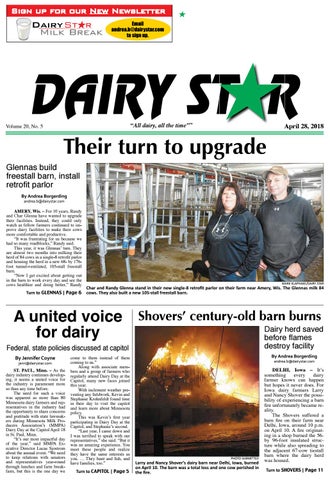
Their turn to upgrade Glennas build freestall barn, install retrot parlor By Andrea Borgerding andrea.b@dairystar.com
AMERY, Wis. – For 10 years, Randy and Char Glenna have wanted to upgrade their facilities. Instead, they could only watch as fellow farmers continued to improve dairy facilities to make their cows more comfortable and productive. “It was frustrating for us because we had so many roadblocks,” Randy said. This year, it was Glennas’ turn. They are almost two months into milking their herd of 84 cows in a single-8 retrot parlor and housing the herd in a new 68- by 176foot tunnel-ventilated, 105-stall freestall barn. “Now I get excited about getting out in the barn to work every day and see the cows healthier and doing better,” Randy
Turn to GLENNAS | Page 6
MARK KLAPHAKE/DAIRY STAR
Char and Randy Glenna stand in their new single-8 retrot parlor on their farm near Amery, Wis. The Glennas milk 84 cows. They also built a new 105-stall freestall barn.
A united voice Shovers’ century-old barn burns Dairy herd saved for dairy before ames destroy facility
Federal, state policies discussed at capitol By Jennifer Coyne jenn@dairystar.com
ST. PAUL, Minn. – As the dairy industry continues developing, it seems a united voice for the industry is paramount more so than any time before. The need for such a voice was apparent as more than 80 Minnesota dairy farmers and representatives in the industry had the opportunity to share concerns and gratitude with state lawmakers during Minnesota Milk Producers Association’s (MMPA) Dairy Day at the Capitol April 18 in St. Paul, Minn. “It’s our most impactful day of the year,” said MMPA Executive Director Lucas Sjostrom about the annual event. “We need to keep relations with senators and representatives year-round through lunches and farm breakfasts, but this is the one day we
come to them instead of them coming to us.” Along with associate members and a group of farmers who regularly attend Dairy Day at the Capitol, many new faces joined this year. With inclement weather preventing any eldwork, Kevin and Stephanie Krohnfeldt found time in their day to visit the capitol and learn more about Minnesota policy. This was Kevin’s rst year participating in Dairy Day at the Capitol, and Stephanie’s second. “Last year, I came down and I was terried to speak with our representatives,” she said. “But it was an amazing experience. You meet these people and realize they have the same interests as you. … They hunt and sh, and have families, too.”
Turn to CAPITOL | Page 5
By Andrea Borgerding andrea.b@dairystar.com
PHOTO SUBMITTED
Larry and Nancy Shover’s dairy barn near Delhi, Iowa, burned on April 10. The barn was a total loss and one cow perished in the re.
DELHI, Iowa – It’s something every dairy farmer knows can happen but hopes it never does. For Iowa dairy farmers Larry and Nancy Shover the possibility of experiencing a barn re unfortunately became reality. The Shovers suffered a barn re on their farm near Delhi, Iowa, around 10 p.m. on April 10. A re originating in a shop burned the 56by 96-foot insulated structure while also spreading to the adjacent 67-cow tiestall barn where the dairy herd was housed. Turn to SHOVERS | Page 11
Page 2 • Dairy Star • Saturday, April 28, 2018
DAIRY ST R www.dairystar.com
ISSN 020355 522 Sinclair Lewis Ave. Sauk Centre, MN 56378 Phone: (320) 352-6303 Fax: (320) 352-5647 Published by Dairy Star LLC General Manager/Editor Mark Klaphake - mark.k@dairystar.com 320-352-6303 (ofďƒžce) 320-248-3196 (cell) 320-352-0062 (home) Ad Composition Nancy Powell 320-352-6303 nancy.p@dairystar.com Amanda Thooft 320-352-6303 amanda.t@dairystar.com Consultant Jerry Jennissen 320-346-2292 Editorial Staff Andrea Borgerding - Associate Editor (320) 352-6303 • andrea.b@dairystar.com Krista Kuzma - Assistant Editor (507) 259-8159 • krista.k@dairystar.com Jennifer Coyne - Assistant Editor (320) 352-6303 • jenn@dairystar.com Ron Johnson (608) 874-4243 ron.j@dairystar.com Ruth Klossner (507) 240-0048 cowlady@centurylink.net Danielle Nauman (715) 245-6848 danielle.n@dairystar.com Maria Bichler - Copy Editor 320-352-6303
Advertising Sales Main Ofďƒžce: 320-352-6303 Fax: 320-352-5647 Deadline is 5 p.m. of the Friday the week before publication Sales Manager - Jeff Weyer (Northern MN, East Central MN) 320-260-8505 (cell) jeff.w@dairystar.com Mark Klaphake (Western MN) 320-352-6303 (ofďƒžce) 320-248-3196 (cell) Laura Seljan (National Advertising, SE MN) 507-250-2217 fax: 507-634-4413 laura.s@dairystar.com Jerry Nelson (SW MN, NW Iowa, South Dakota) 605-690-6260 jerry.n@dairystar.com Mike Schafer (Central, South Central MN) 320-894-7825 mike.s@dairystar.com Lori Menke (Eastern Iowa, Southern WI) 563-608-6477 • lori.m@dairystar.com Megan Stuessel (Western Wisconsin) 608-387-1202 megan.s@dairystar.com Deadlines The deadline for news and advertising in the Dairy Star is 5 p.m. Friday the week before publication. Subscriptions One year subscription $35.00, outside the U.S. $110.00. Send check along with mailing address to Dairy Star, 522 Sinclair Lewis Ave., Sauk Centre, MN 56378. Advertising Our ad takers have no authority to bind this newspaper and only publication of an advertisement shall constitute ďƒžnal acceptance of the advertiser's order. Letters Letters and articles of opinion are welcomed. Letters must be signed and include address and phone number. We reserve the right to edit lengthy letters.
From the editorial team Let’s keep our industry going strong It has been a rough time in the dairy industry. Working so closely with dairy farmers in our coverage area, we have seen the suffering. It’s painful to watch a large number of producers have to sell their herd due to low prices. It’s especially heart wrenching when that dairyman or woman could have many years left in the career or when a retiring farmer can’t bring in another young person. It’s disappointing that these barns may never be full again. We understand the economics of what is happening right now. The number of dairy cows in the country has to decrease before milk price can increase along with many other factors; however, maybe there’s another way to keep our industry going and keep dairy farmers in their ďƒželd. Our dairy community can’t deny facts about the way the industry is headed if no changes are made. How can we sustain dairy farms, yet progress forward? Maybe the look of dairy farming in the United States needs to change. We’ve heard people advocate for base programs or supply management that would keep milk production in check with demand. While that doesn’t follow the American principles of capitalism, maybe milk, a perishable product, is an exception to the rule? Maybe it would keep dairy inventories low. It’s also arguable that this makes bringing in the next generation difďƒžcult. But isn’t it already if dairy farmers aren’t making a proďƒžt? There is lateral integration. Farms would be larger and more dependent upon each other. This would make dairies more efďƒžcient and keep product prices low in the grocery store. On the ďƒ&#x;ip side, do farmers want to follow a communism-type model? And what would happen to rural America? In a time when consumers are telling us they want to know their farmers, is this the right answer? Maybe there will be a push towards on-farm processing or small local processors taking on a few farms to capture a portion of the market with a niche. Will niche marketing become a larger piece of the puzzle? Will other niches such as organic continue to boom with popularity, partly because of the price stability? It will be interesting to see what the next 10 years brings for the dairy industry. Where will it go from here? If you want a say, it’s important to speak up. We want to hear your ideas. Do you agree with any of the thoughts here? How would we make them work? Do you have other ideas on how the industry can continue without losing a large number of farms? Let us know your thoughts about how the industry can change and maybe we’ll publish them in an upcoming issue. Let’s keep our industry going strong. – The Dairy Star Editorial Team
CONSISTENT, MORE THOROUGH MIX
BOTEC Ž 4-AUGER MIXERS • Fast mixing with complete cleanout • Effectively handles hay, grain and wet distillers • Lower horsepower requirement for economical fuel usage • Large discharge results in quick, even unloading 360 – 900 cu. ft. mixing capacities • truck & trailer models
INVEST IN QUALITY ÂŽ
KuhnNorthAmerica.com
Lindell Sales & Service Cannon Falls, MN
Schlauderaff Implement /LWFKĹľHOG 01
Werner Implement 9HUPLOOLRQ 01
J P Scherrman )DUOH\ ,$
Hammell Equipment &KDWĹľHOG 01 (LW]HQ 01
Fluegge’s Ag 0RUD 01
UFC Farm Supply :DFRQLD 01
Burco Sales ,QGHSHQGHQFH ,$
Northland Farm Systems Owatonna, MN
Pfeifer Implement Sioux Falls, SD
Ag Land Implement 1HZ +DPSWRQ ,$
Lake Henry Implement 3D\QHVYLOOH 01
Mark's Machinery :DJQHU 6' <DQNWRQ 6'
Kunau Implement 3UHVWRQ ,$
Adkins Equipment 'HWURLW /DNHV 01
The views and opinions expressed by Dairy Star columnists and writers are not necessarily those of the Dairy Star LLC.
Northland Dairy Supply (DJOH %HQG 01
The Dairy Star is published semi-monthly by Dairy Star, LLC, 522 Sinclair Lewis Ave., Sauk Centre, MN 56378-1246. Periodicals Postage Paid at Sauk Centre, MN and additional mailing ofďƒžces. POSTMASTER: Send address changes to Dairy Star, 522 Sinclair Lewis Ave., Sauk Centre, MN 56378-1246.
Isaacson Sales & Service /DID\HWWH 01 Blue Hilltop /DNH :LOVRQ 01
Minnesota Ag Group 3ODLQYLHZ 01 Dairyland Supply 6DXN &HQWUH 01
Roeder Bros. %HOOHYXH ,$ Bodensteiner Implement (ONDGHU ,$
Gordy’s Repair & Implement 6WDF\YLOOH ,$ Dee Implement of Waukon :DXNRQ ,$
Dairy Star • Saturday, April 28, 2018 • Page 3
It’s all inside... Columnists Ag Insider
n
Moody
Rock
Nobles
Scott
Sibley
sey
Dakota
Redwood Brown
Nicollet
Rice
Goodhue Wabasha
Cottonwood Watonwan Blue Earth Waseca Steele Dodge Olmsted Jackson
Martin
Faribault
Freeborn
Winona
Fillimore
Mower
Houston
Rochester
Repro Leaders: Borst Family Dairies
Ha
McCook Minnehaha
Murray
Carver
First Section: Pages 23, 25
Hutchinson
Turner
Bon Yankton Homme
Lincoln Clay
Union
Lyon
Osceola Dickinson Emmet
Sioux
O’Brien
Clay
Kossuth
Palo Alto
Winnebago
Worth
Hancock
Cerro Gordo
Mitchell
Floyd
Howard
aw
as
ick
Ch
Bremer
Plymouth
Black Hawk
Zone 1
For additional stories from our other zone, log on to www.dairystar.com
Fayette
Clayton
n
na
ha
c Bu
First Section: Pages 18, 20
Allamakee
Charles Mix
nso
on vis
Douglas
Lake
Lyon
Hennepin
Byron
Connelly nds alternatives for his ration
Winneshiek
First Section: Pages 15 - 16
Da
When was the earliest and latest you’ve ever gotten into the eld?
Sa
nb or
Miner
Brookings
Anoka
Wright
McLeod
Renville
Yellow Medicine Lincoln
n
Kingsbury
Meeker
Isanti
go
Pages 10 -11 Second Section
Deuel
Kandiyohi
First Section: Pages 34 - 35
isa
Hamlin
Sherburne
Chippewa
Lac Qui Parle
Codington
Clark
Benton
Stearns
Pope
Swift
Mille Lacs
Morrison
Douglas
Stevens
Grant
The “Mielke” Market Weekly
FROM OUR SIDE OF THE FENCE:
Big Sto Stone
Roberts
Day
Pine
Ch
Page 33 First Section
Crow Wing
r
Marshall
Dairy Good Life
Grant
Lake City
Wabasha County Dairy Princess did not grow up on farm
Carlton
Todd
rse
Second Section: Pages 20 - 21
Aitkin
eu
Weather and Crop Reports
Cass
Wadena
Wilkin
Elkton
Pipestone
Page 32 First Section
Otter Tail
Tra ve
Just Thinking Out Loud
Becker
Washington
Clay
Second Section: Pages 8 - 9
Kanabec
Something to Ruminate On
en
nom
Mah
Ra m
Norman
Archuleta presents workshop on soil health
Itasca
Hubbard
Page 30 First Section
First Section: Pages 1, 5
Kasson
Clearwater
Polk
First Section: Page 39
Second Section: Pages 12 - 13
Federal, state policies discussed at capitol
St. Louis
Red Lake
Dairy Prole: Justin Hoheisel
St. Paul
Koochiching
Pennington
Holland
Le Sueur
Kids Corner: The Heldbergs
Third Section: Pages 2 - 3
Su
The Transition Pen
Page 31 First Section
Barn rental, feed agreements give Yurzyck a chance
Second Section: Second Section: Pages 26, Pages 3, 7 28 - 29 Kittson Roseau Lake of the Woods Marshall Beltrami
Page 26 First Section
Dear County Agent Guy
Holdingford
Tews balances work on, off farm
A Day in the Life: The Wiechmans
FSA News & Notes
Page 27 First Section
Litcheld
Freeport
Le
Pages 8-9 First Section
are
law
De
Linn
Dubuque
Jones
Jackson
Dehli
Shovers’ centuryold barn burns
First Section: Pages 1, 11
Give milk production a push GEA’s FRone works around the clock to keep feed at the bunk, maximizing your cows’ production. Could your bunk management routine use a little extra push? GEA’s FRone automated feed pusher provides consistent, high-quality feed available day and night to boost production results from your whole herd. It’s easy to use, charges fast and contains twin batteries for maximum run time. With the help of GEA’s FRone, you can push the limits on your feeding program.
Page 4 • Dairy Star • Saturday, April 28, 2018
F L L A C S E M I T H G TOU
OR
N O I T C E T O R P E M I PR
DUAL GERMICIDE CHLORIDE DIOXIDE THE PREMIER GERMICIDE ON THE MARKET
SAVE UP TO
$1/GAL.
over Iodine
9 EMOLLIENTS Ultimate teat conditioning
GREEN COLOR
USE
PRE & POST
Max Protection until the next milking
for High-Vis Marking
FOR MORE INFO - CONTACT ONE OF THESE DEALERS... Advanced Dairy Systems
9 State Rd. 29 • Spring Valley, WI 54767 (715) 772-3201
Anderson Dairy Systems, Inc. 1312 13 1/2 Ave. • Barron, WI 54812 (715) 537-3300
Athman Dairy Inc.
238 Main Street North • Pierz, MN 56364 (320) 468-2494
Champion Milking Systems
23218 350th Street • Albany, MN 56307 (320) 845-4156
D&D Ag Supply
East Central Dairy Supply
133 Atlantic Ave. NE • Pennock, MN 56279 (320) 599-4466
Dairyland Equipment Services, Inc.
24260 Cty. Rd. 27 • Plainview, MN 55964 (507) 534-3161
Dairyland Services, LLC
2195 Hwy. 23 • Mora, MN 55051 (320) 679-1029
Eastern Iowa Dairy Systems 105 3rd Ave. NW • Epworth, IA 52045 (563) 876-3087
Fuller’s Milker Center, Inc.
2545 80th Ave • Woodville, WI 54028 (715) 698-4370
423 U.S. 61 • Lancaster, WI 53813 (608) 723-4634
Gorter’s Clay & Dairy Equipment
Professional Dairy Systems
1449 Homecrest Ave. • Wadena, MN 56482 1400- 7th St. SE • Pipestone, MN 56164 (218) 632-5416 (507) 825-3271
Tri-County Dairy Supply, Inc. Lang’s Dairy Equipment, Inc. 4107 N US HWY 51 • Janesville. WI 53545 2337 Millennium Rd. • Decorah, IA 52101 (563) 382-8722
Mlsna Dairy Supply
1126 Front Street • Cashton, WI 54619 (608) 654-5106
608-757-2697
United Suckow Dairy
12687 Hwy 18 & 52 • Postville, IA 52162 (563) 864-7417
WE AGREE, SAND IS A GOOD BEDDING SOLUTION, AND PROMAT’S PACK MAT CAN MAKE IT EVEN BETTER! All the benefits of deep bedding … but with 50-70% less sand Huge reduction in sand laden manure and equipment issues Payback in under one year based on sand savings alone
Please contact us to learn more or to locate your nearest dealer 1.888.337.6265 | sales@promatinc.com | www.Promatinc.com
facebook.com/promatinc
@Promat_inc
Dairy Star • Saturday, April 28, 2018 • Page 5
TRUST THE EXPERTS
ConƟnued from CAPITOL | Page 1
At Famo Feeds, we strive to provide the best support for your operation and work to accommodate your specific needs.
JENNIFER COYNE/DAIRY STAR
Rep. Barb Haley (center) speaks with Ann Buck and other dairy farmers during Minnesota Milk Producers AssociaƟon’s annual Dairy Day at the Capitol April 18 in St. Paul, Minn. The event was an opportunity for dairy farmers to speak with lawmakers about issues important to the dairy industry. The Krohnfeldts milk 75 Jersey cows near Alexandria, Minn., with their children, Kelsey and Cole. While the event is designed to be an opportunity to advocate for agriculture, the Krohnfeldts also view Dairy Day at the Capitol as an unequivocal learning experience. “I understand policy, but I’m curious more than anything,” said Kevin about attending. “This is a place to learn about our leaders and talk with them about what is important.” Those in attendance divided into groups of nine and visited with 66 senators and representatives explaining the topics of discussion, as well as thanking lawmakers for their continued support of agriculture and Minnesota’s dairy industry. During the capitol visit, there were three topics conveyed to state lawmakers. The Beginning Farm Tax Credit was established last year and provides incentives for retiring farmers to sell or rent their land to young and beginning farmers. However, as it currently states, the credit does not apply to lineal relatives. Dairy farmers and industry representatives demonstrated to lawmakers the importance of including close relatives in the tax credit requirements, as well as those families whose farm is an LLC. “The goal is to transition farms to the next generation,” Sjostrom said. Farmers also stressed the importance of Minnesota conforming to the federal tax code as it specically relates to Section 179. “We just passed a tax bill last year, but they’re trying to desperately get another one done with the new federal regulations,” said MMPA lobbyist Daryn McBeth. In Minnesota, under the current Section 179 standards, farmers can expense $25,000 in the year of purchasing a piece of equipment, with an investment limit of $200,000. However, in the new federal tax code, Section 179 is dened as $1 million accelerated depreciation.
“We’re making progress towards full conformity, and that’s what we want,” McBeth said. Sjostrom agreed. “Section 179 currently puts Minnesota farmers at a disadvantage from other states,” he said. “Being able to depreciate $1 million would be great; we can rollover that depreciation into the next year, especially when we don’t make a prot every year.” Lastly on the agenda, MMPA members talked about how any further regulation would only be a detriment to the industry. “The Minnesota Department of Agriculture is talking about nitrogen regulation and taking that away from us,” Sjostrom said. “We already have manure and feedlots that are highly regulated. We need to make sure farmers don’t get pulled into further regulation with nitrogen application.” Before the day came to an end, MMPA hosted an ice cream social for those who participated in Dairy Day at the Capitol, as well as other lawmakers and government employees. During the social, Jake Anderson, 19, visited with those in ofce. “I like knowing that I’m getting the word out about dairy to people who make the laws,” Anderson said. “When you talk with people, then they know what you’re going through.” Anderson is a student at Ridgewater College in Willmar, Minn., and doing his spring internship with Tom Sedgeman, a dairy farmer from Sauk Centre, Minn. Dairy Day at the Capitol gave many farmers and industry representatives an opportunity to form relationships with state lawmakers. More importantly, it was an opportunity to stand together as a united front and show support for the future of dairy. “What we’re doing today is a 365-day job,” Sjostrom said. “And it all culminates to this.”
Sioux Falls | Aberdeen Rapid City | Sioux City
From calf to cow and everything in between!
FEED THEM FAMO! • Milk Replacers • Starter Feeds • Protein Concentrates • Premixes • Minerals • Animal Health Products • Lick Tubs
320-836-2145 or 800-450-2145
Check out our newly redesigned website to ½nd a Famo Feeds dealer near you!
www.famofeeds.com
If it fuels your business, we can finance it.
Finance new or used equipment with rates as low as 4.25%. Leasing options also available. Ask us for more details! 888.330.8482 | mycmcu.org |
Centered on you.
Subject to credit approval. Origination fee may apply. Membersh credit history. Does not apply to loans already financed ed w with CMCU. Limited time offer. Origination fee may apply. Other restrictions apply. Ask for details tails. Equal Opportunity Lender. Federally Insured by NCUA
Page 6 • Dairy Star • Saturday, April 28, 2018
ConƟnued from GLENNAS | Page 1
Willmar, MN • 320.231.1470
EXPANDING OR REMODELING YOUR LIVESTOCK OPERATION? LANGE AG SYSTEMS SPECIALIZES IN:
Ŷ NEW FACILITIES
_
NO JOB TOO BIG OR TOO SMALL
Ŷ RETROFITTING & REMODELING Ŷ TURNKEY PROJECTS Ŷ BARN DESIGN Ŷ INSTALLATION, MAINTENANCE & REPAIRS
ƋƵŝƉŵĞŶƚ tĞ KīĞƌ͗ ͻ sĞŶƟůĂƟŽŶ &ĂŶƐ ͻ sĞŶƟůĂƟŽŶ ŽŶƚƌŽůƐ ͻ WŽƐŝƟǀĞ WƌĞƐƐƵƌĞ dƵďĞƐ ͻ ƵƌƚĂŝŶ ^LJƐƚĞŵƐ ͻ DĂƩƌĞƐƐĞƐ ͻ tĂƚĞƌĞƌƐ ͻ ^ƚĂůů ƋƵŝƉŵĞŶƚ ͻ ,ĞĂĚůŽĐŬƐ ͻ DŝƐƟŶŐ ^LJƐƚĞŵƐ
Lange Ag Systems is proud to offer Grain Bags, Silage Bags & Bunker Covers from Up North Plastics and Feed Fresh Silage Covers & Custom Size Bunker Covers from Raven!
t ^ >> E t Θ h^ 'ͳ ' Θ < >>z Zz E '' Z^
www.LangeAgSystems.com Sign up for our Newsletter
Dairy St r Milk Break
Sales & Installation of HiTensile Fence
ELECTRIC • WOVEN • RAIL (320) 360-6308 Browerville, MN
Email andrea.b@dairystar.com
The Right Fence... Built RIGHT
W4666 State Hwy 85 | Durand, WI | 715.672.4263 36275 Tower Drive | Whitehall, WI | 715.538.1495 www.komrosales.com
Bazooka Farmstar 700 Reel w/1 mile of 6” Supply Hose
OWN FOR: $61,000
RENT FOR: $600/day (reel only) $0.20 ft./day (hose)
Bazooka Farmstar Pump Trailer
(400HP JD, 6819MP-CAC-FM, Clutch, Bypass, EMS PRO)
OWN FOR: $121,775 RENT FOR: $240/hr
JT Boat - Model 1700
2010 GEA Houle 5250 Tank
RENT FOR: $300/hr (sand) $265/hr (no sand)
RENT FOR: $500/day
OWN FOR: $126,000
said. For many years, Randy milked cows in a tiestall barn, sometimes switching up to 10-12 cows. About 18 months ago, the Glennas were at a crossroads. “We asked ourselves, should we quit?” Randy said. “With the prices bad and being tired of milking in that barn, we were questioning our future.” Once the Glennas retained ownership of the farm in fall 2016, they knew their next step. “If I’m going to keep milking cows, I’m going to build a freestall barn,” Randy said. They wanted to put a parlor in with it and started visiting farms with retrot parlors and freestall barns the same fall they took over the dairy. With the facility upgrades, the Glennas were focused on improving cow comfort to reduce the cull rate, increase production and save on labor. “We wanted to spend the money on the barn so the cows will last longer and milk more,” Randy said. The Glennas added concrete to the original tiestall barn to construct the 12inch high platform for the cows. The single-8 walk through Agromatic parlor allows the cows to return to the feed alley after milking. Randy and Char cash owed the parlor themselves, spending $32,000 including equipment, labor and material. Most of the pipeline was reused and welded to t the new parlor. New vacuum lines and wiring were part of the labor and material cost. “It’s a cheap, retrot, step-up parlor,” Randy said. “The parlor isn’t going to make the milk any better, it’s just convenience. It took an hour off morning and
night milkings.” Before the rst milking, the Glennas ran the cows through the parlor four times to get them familiar with it. After the initial milkings in the parlor, they can now milk 83 cows in 2.5 hours. “The cows are much calmer being milked now,” Randy said. Their daily routine begins with Randy milking while Char lls the holding area with two groups of cows. Char will then milk while Randy scrapes the barn. They milk together until it’s time to bring in the second group. Then they milk together until they are done. Randy’s father, Bob, continues to help on the farm with feeding cows and eldwork. “I’ve been milking by myself for the past 10 years so I’m very happy to have Char and the kids help,” Randy said. “And, they enjoy milking now.” The Glennas have plans to convert the north half of the tiestall barn to a dry cow facility. Where the Glennas saved on the parlor, they spent on the freestall barn. The Glennas negotiated $32,000 off the estimate from their second choice builder to match their budget. The main cost was changing the ceiling of the facility from a low-insulated ceiling to a low-pitch ceiling with lower sidewalls. The Glennas sacriced on some things but focused on the cow comfort features. The two-row freestall barn features sand bedding and tunnel ventilation. Four, 4-foot fans pull air from the east end of the barn where two overhead doors can be opened to allow airow. The sidewalls are polycarbonate, which appears dark from
Turn to GLENNAS | Page 7
OWN FOR: $36,000
2018 Nuhn Crawler
Nuhn 8” x 48’ Lagoon Pump
RENT FOR: $325/hr (sand) $275/hr (no sand)
RENT FOR: $700/day (sand) $500/day (no sand)
OWN FOR: $178,000
MARK KLAPHAKE/DAIRY STAR
The Glennas built a new two-row freestall barn. The cows have been in the barn since January. The Glennas have seen an increase in cow comfort with their new faciliƟes.
OWN FOR: $36,500
Agitating, Injecting, or Spreading, We have your owning and rental needs covered!
MARK KLAPHAKE/DAIRY STAR
The Glennas’ freestall barn has polycarbonate siding, which looks dark from the outside, but allows plenty of light inside the barn. The barn is tunnel venƟlated.
Dairy Star • Saturday, April 28, 2018 • Page 7
ConĆ&#x;nued from GLENNAS | Page 6 the outside but allows light inside the barn. There is an inch of insulation in the ceiling. “It’s just enough to keep the ďƒ&#x;oors from freezing and keeps the moisture down,â€? Randy said. To reduce wear and tear, the builder used steel posts versus wood beams to support the building. The Glennas installed LED ďƒžxtures with long day lighting. The sand bedding is groomed daily and added to as needed. The manure scraped from the barn is pushed into a holding area. For now, the Glennas have to haul manure daily. They have plans to construct a manure storage system. The cows were moved into the freestall barn on Jan. 12. The Glennas said the herd has transitioned well. “The cows are used to a lot of change, when switching in the stalls for milking,â€? Randy said. On March 1, the Glennas’ upgrading journey was complete. The cows were accustomed to the freestall barn and began settling into the new milking parlor.
Challenged by the low milk price, the Glennas worked the numbers and knew going into construction that they can make up for the cost of the facilities in increased milk production. “We ďƒžgured with another 10-15 pounds per cow per day, we can make the bank payments and still make money,â€? Char said. “Financially we were capable of doing this but that was at $15 milk.â€? Despite the price, the Glennas are hopeful with the premiums from their increasing butterfat and protein milk components. “Now, with intense nutrition work and with moving into the new barn, we’ve been able to make it work,â€? Char said. The Glennas are pleased with the upgraded facilities. Knowing the cows are comfortable and productive is what keeps Randy and Char milking cows every day. “I would’ve liked to have had more time to plan but at my age and when I got the go-ahead to do it, I just had to do it as soon as possible,â€? Randy said.
No one knows your equipment better.
Keep It Genuine.
Your AGCO Parts Dealer has the quality OEM parts you need when you need them. Everything you need from hardware, chain and batteries to tillage, belts and cutting parts are available from your AGCO Parts Dealer. Along with the help of our highly trained service personnel at AGCO Parts to make it allParts comeDealer together, you can rest easy. Stop your AGCO Your AGCO hasso the quality OEM parts youinto need when you Parts Dealer and get the partsyou andneed services need tochain “Keepand youbatteries in the Field� need them. Everything fromyou hardware, to this season. Find and out more at parts AGCOParts.com. tillage, belts cutting are available from your AGCO Parts Dealer. Along with the help of our highly trained service personnel at AGCO Parts Š "($0 $PSQPSBUJPO "($0 UIF "($0 MPHP BSF SFHJTUFSFE USBEFNBSLT PG "($0 $PSQPSBUJPO
DEIKE IMPLEMENT CO.
P.O.Box 834, Waverly, Iowa 50677 • email: information@deikeimplement.com
MARK KLAPHAKE/DAIRY STAR
Randy and Char Glenna talk about the construcĆ&#x;on process in their barn on April 19. The Glennas moved the cows into the new facility in January.
Store Hours: Monday-Friday 7:30-5:00 Saturday 7:30-noon
www.deikeimp.com Sales Phone: 319-352-3731 • General Phone: 319-352-1117 USED TRACTORS - Low rate ďŹ nance Available White 8222 12-30 ex frame, t.wipers, low acres .......$39,900 MF 8650, FWA, 950 hrs, CVT, auto guide, 2014........$149,500 White 8202 12-30, 2013, 1-owner, dig. monitor .........$39,900 Fendt 820 FWA, 33 mph CVT, air-ride cab, TMS .........$79,900 White 6100 12-30, liq.fert, trash wheels .....................$11,500 CIH TigerMate 200 32’ F.Cult, 4-bar coil......................$27,900 Kubota M125X, FWA, 16-sp PS, 125 HP, 3000 hrs .....$37,900 Bobcat 72â€? seeder, 2014, 3 pt. or skidloader, little use .$5,350 Kubota L2350, L4240, loaders ................................ Coming in HARVEST EQUIPMENT Kubota B2920 FWA, hydro, loader, 365 hrs ................$13,600 AGCO S67, 700 hrs, tilt, duals, 390 bu.power bin .....$184,500 Kubota BX1880 FWA, deck, loader, 36 hrs ..................$12,200 AGCO R65, tilt, monitor, 285 hp Cummins,chopper....$89,500 CAT 416 loader/backhoe, cab, shuttle, 4x4 .................$26,500 AGCO R52, 1998, 1600 hrs, AgLeader, Cummins .......$48,500 JD 420 2-cyl, sharp, 3 pt, sickle mower, 2nd owner......$6,750 MISC. EQUIPMENT JD 310 SK-TC,loader, backhoe, teleboom, cab............$57,500 Bobcat T770, cab, air, 2-sp, joystick, air seat,1300 hrs ... $52,500 Kubota BX1500 FWA, hydro, 600 hrs, 48â€? deck, 3 pt....$5,450 Landpride AFM 4211, 11’ batwing ďŹ nish mower ...........$7,950 Farmall Super C recond, 1 remote, sickle mower ..........$4,750 New Snowblowers, Blades, Pallet Forks, Bale Spears ..... CALL CIH DX45 FWA, Cab, Air, hydro, loader .......................$16,900 NEW Sunower and Landoll Tillage ................................ CALL TILLAGE & PLANTING EQUIPMENT Kubota BX1880, loader, deck .................................. Coming In Landoll 2227 11-shank disc/chisel/disc, hyd. depth....$21,500 Kubota ZD1211, diesel, 60â€?, zero-turn ........................$11,400 JD 980 31’ ďŹ eld cult, all tandems, 3-bar coil tine ........$12,500 Kubota ZG327 gas, 60â€? zero-turn .................................$7,795 Landpride DH1572 3 pt. disc, 6’ adj. gangs ..................$1,550 JD HPX Gator, 4x4, 1550 hours ....................................$6,250 White 8524 24-30 central ďŹ ll, t.wipers, shutoffs .........$67,900
Page 8 • Dairy Star • Saturday, April 28, 2018
Conaway touts farm bill The House Agriculture Committee passed a A familiar dance farm bill on a party-line vote of 26A new farm bill will face many 20. House Agriculture Committee hurdles and an extension remains Ag Insider Chairman Michael Conaway began a possibility. If the legislation goes the farm bill markup saying a farm into 2019, Cook Political Report bill extension is not a good idea. House Editor David Wasserman said The Texas congressman said he tried politics could be the reason. “There to work on a bipartisan basis with will be differences between the Ranking Member Collin Peterson to House and Senate,” he said. “There put together this farm bill. “I sincerely will be differences regionally. From regret that ultimately our discussions the last few farm bills, a number of did not bear fruit with respect to the stakeholders have learned to wait it nutrition title. On SNAP, we have out for the best deal. These factors some honest disagreements,” he said. make the 2018 Farm Bill difcult. Conaway emphasized he wants the Wasserman sees the current farm By Don Wick spirit of bipartisanship to return to the bill discussion as a familiar dance. Columnist agriculture committee. “In the farm bill debates we’ve seen, Republicans have proposals to update Farm bill aws SNAP,” he said. “Democrats have resisted. There Agriculture Committee Chairman Michael is some horse trading going on. The parties come Conaway wants to bring the farm bill to the full together and the leadership of the committees House in the rst week of May, emphasizing the normally save the day. I think we’ll see a lot need to get the bill done on a timely basis. During hashed out with neither party getting everything Wednesday’s hearing, Ranking Member Collin they want in the coming months or year.” Peterson called it a awed bill, with most of the criticism centered on the proposed changes to the NMPF welcomes farm bill action food stamp program. Peterson also made the case The National Milk Producers Federation for increased funding in Title I to help offset low praised the House Agriculture Committee for commodity prices. “If there is extra money, I’d approving its farm bill draft. This bill includes like to suggest the money be put into the farm bill improvements to the Margin Protection Program. on a permanent basis to improve the safety net in With these changes, the maximum covered margin case we get into a continuing low-price situation,” is raised to $9 per hundredweight and adjusts the Peterson said. President Trump has promised minimum amount of milk that can be insured. The support for farmers if U.S. agriculture is hurt by House bill also includes other NMPF priorities, a trade war. Peterson said a long-term program dealing with conservation and trade. makes more sense than ad-hoc assistance. “This is a self-inicted wound we don’t need,” he said. MN House rejects nitrogen fertilizer rule “If we get into this situation, we don’t need a oneThe Minnesota House has voted 69-56 on a time bailout.” bill that would prevent the Minnesota Department of Agriculture from implementing the proposed nitrogen fertilizer rule. The Senate is working on
similar legislation at the committee level. This action has upset Governor Mark Dayton, who has promised to veto the bill. BWSR rejects buffer penalty proposal The Minnesota Board of Water and Soil Resources has rejected a draft amendment that would have levied massive penalties for noncompliance with the state buffer law. The action ends any further action on the buffer penalty proposal. Earlier in the week, BWSR Executive Director John Jaschke apologized to Minnesota landowners and farmers for releasing a draft proposal which was not in the spirit of the law and was created without engagement with key stakeholders. Before BWSR made this decision to reconsider the penalties, Minnesota Governor Mark Dayton said he was surprised and disturbed by the proposal. March milk production numbers released In the 23 major dairy states, milk production was up 1.5 percent in March. Production per cow totaled 2,038 pounds, the highest production per cow for the month of March since this series of reports began in 2003. In Minnesota, milk output dropped 1.1 percent. Wisconsin production was nearly unchanged from a year ago. California milk production increased 2.7 percent. Don’t question if you belong Be passionate, authentic and resilient; have courage and lead with integrity. Those are just a few messages heard at the Women’s Agricultural Leadership Conference general session on executive leadership. Bremer Financial President and CEO Jeanne Crain told women not to question if they belong in the room. “Sometimes it’s self-doubt,” she said. “Sometimes it’s just thinking, ‘I don’t have the right experiences, I need to know more.’ Some don’t feel like they’re Turn to AG INSIDER | Page 9
Milk more cows per hour with less labor with GEA AutoRotors Whether it’s a fully loaded DairyProQ rotary with a robotic milking module on every stall, or a conventional rotary with the latest performance features – the foundation is a revolutionary platform system unlike anything else on the market today!
“When looking at what type of parlor to build, we quickly realized a rotary was the way to go. It was clearly very relaxing for the cows and much more labor efficient. Our cows and employees are our most valuable assets, so it seemed like the perfect fit. GEA, and Fuller’s Milker Center, Inc. did a great job helping us bring these changes to fruition, and we look forward to working with them long term!”
Leah Kieler, Kieler Farms Inc.
1-800-887-4634 • (608) 723-4634
Dairy Star • Saturday, April 28, 2018 • Page 9
ConƟnued from AG INSIDER | Page 8
ready. A mentor let me know I was more ready than I realized. Try to get the voice of doubt out of your head. Lose the questioning whether or not you have the ability to contribute.” New brand identity for Midwest Dairy Rather than the Midwest Dairy Association or Midwest Dairy Council, both organizations will be simply known as Midwest Dairy. That’s part of a new vision and strategic plan that showcases the values of both organizations. With this plan, Midwest Dairy has unveiled a new logo. D.C. public affairs rm adds Vetter Former agriculture trade ambassador Darci Vetter has accepted a new job with a public affairs rm in Washington, D.C. Vetter is Edelman’s vice chair for agriculture, food and trade and will manage the D.C. ofce. In 2017, Vetter was named diplomat in residence at the University of Nebraska-Lincoln and left that post this winter. Vetter was deputy agriculture secretary for farm and foreign agricultural services from 2010-14.
Milking Shorthorn convention coming to Minnesota The American Milking Shorthorn Association is holding its national convention in Willmar, Minn. June 28-30. Organizers expect to have 75 head of cattle competing in the purebred show. The national sale will be held at the Kandiyohi County Fairgrounds June 30. Trivia challenge Breeanna Holbert is the president of the National FFA. Holbert is a student at California State University and is the rst African American female to be elected to the presidency of the National FFA. That answers our last trivia question. For this week, what is the term for a sterile heifer calf born twin to a bull? We’ll have the answer in the next edition of Dairy Star. Don Wick is owner/broadcaster for the Red River Farm Network, based in Grand Forks, North Dakota. Wick has been recognized as the National Farm Broadcaster of the Year and served as president of the National Association of Farm Broadcasting. Don and his wife, Kolleen, have two adult sons, Tony and Sam, and ve grandchildren, Aiden, Piper, Adrienne, Aurora and Sterling.
“Testing with DHIA is valuable because it gives us the tools needed to evaluate both the herd as a whole and individual cow health, reproduction and production.” What do you like about the DHIA pregnancy test? We’ve been using the DHIA pregnancy test since April 2013. We like the program for the quick results, it’s cost effective and there is no extra animal handling required. How do you use this test in cooperation with your regular vet checks? We continue to do bi-weekly herd checks between 30-40 days, but use the milk pregnancy test at 100 days in milk to conÀrm them. What are some other tests you use through DHIA? We utilize all the standard testing that comes with DHIA; somatic cell, fat and protein and Johnes testing as well. Why is testing with DHIA valuable to your dairy? Testing with DHIA is valuable because it gives us the tools needed when we meet with our veterinarian and nutritionist to evaluate both the herd as a whole and individual cow health, reproduction and production. Tell us about your farm. We are a Àfth-generation dairy farm with 250 milk cows. We raise all our young stock and crop roughly 900 acres of corn and alfalfa.
Colette Thorson • Diers Corporation Waverly, Minn. • 250 cows 60 years with DHIA Minnesota Dairy Herd Improvement Association 307 Brighton Avenue South Buffalo, MN 55313 1.800.827.3442 www.mndhia.org
N10828 Cty Hwy O | Greenwood, WI 715.267.1416 | www.greenwoodsilo.com Email: sales@greenwoodsilo.com
SEALED SILO SERVICES: BOTTOM UNLOADERS: • CONSTRUCTION • MAINTENANCE • PRESSURE CHECKING • RESEALING • REPLACEMENT ROOFS
• GREENLINE UNLOADERS D-SERIES (FORAGE) B-SERIES (SNAPLAGE & GRAIN) • USED UNLOADERS • UNLOADER PARTS • FULLY EQUIPPED SERVICE CREW
STOCK GATES
Our steel gates are made with 14GA steel tubing, where as others are using 16Ga or 18GA steel. Our aluminum gates are made with 11GA tubing. All gates are powder coated to your choice of color. Included are the gate, bolt hinges and tie chain.
SUPERIOR FEED VALUE THROUGH SEALED SILOS We are not affiliated with A.O. Smith Harvestore®, E.S.P.C. or C.S.T.
Milk e z i m i x a M Components with KLC Roasted Soybeans Energy We always have Protein a good supply of roasted soybeans on hand! Amino Acids CALL TODAY Bypass Protein
These attributes lead to consistent milk components.
Quality
Consistency
KLC Farms Roasting, Inc. 1-877-738-2326 877 738 232 Visit www.roastedbeans.com
OUR GATES ARE STRONGER THAN YOUR AVERAGE GATE.
GUTTER GRATES
Gutter grates are sold in 4 foot sections(longer upon request). Strong, sturdy and very easy to clean or scrap off material. Made with 3/4” solid square rod.
LIVESTOCK PENS & PANELS
CALL FOR PRICING ON OUR CUSTOM PENS/PANELS
LLC
65728 300th St. Gibbon, MN 55335
507.276.4400 dnahlers@yahoo.com
www.danscustomweldingtables.com
Page 10 • Dairy Star • Saturday, April 28, 2018
FARM-RITE EQUIPMENT, INC. INTEREST AS LOW AS 0% ON QUALIFYING EQUIPMENT
Please see your Farm-Rite Sales Rep for more details
Visit our website: www.farmriteequip.com
One Of The Largest Skid-Steer Loader Dealers In The State Of Minnesota!
Technology leads the way
SALES - SERVICE - RENTAL
West Hwy. 12 • Dassel, MN
320-275-2737 • 888-679-4857 1515 West Litchfield Ave. • Willmar, MN
320-235-3672 • 877-484-3211
810 Mayhew Lake Rd. NE • St. Cloud, MN
320-240-2085 • 844-262-2281
BUYING? SELLING? CHECK T HE CLASSIFIEDS!
TIRES
Gilman Co-op Creamery
Skid loader & Implement (Mounting Available)
320-387-2770
FEED & FARM SUPPLY STORE Open M-F 7:30-7, Sat. 7:30-5
CASSIE OLSON/DAIRY STAR
The Malms – (from leŌ) Max, Bob and Mitch– milk 115 cows on their farm near Loyal, Wis. Last December, the family became the rst farm in the state of Wisconsin to uƟlize an automaƟc feeding robot.
Malm’s Rolling Acres install Wisconsin’s rst automatic feeding robot By Cassie Olson Staff Writer
LOYAL, Wis. – Bob, Mitch and Max Malm watch as the metal claw moves from its starting location. Moving quickly, it positions itself above a chosen treasure. As it lowers, it opens its grasp before bearing down on the prize. As the claw ascends and returns to where it began, it releases the prize from its grasp. While it may sound much like a child’s arcade game, the claw instead belongs to an automatic feeding robot; the rst to be installed in the state of Wisconsin located on the Malms’ 115-cow farm in Loyal, Wis. Mitch is the second of the three generations on the farm. After installing two milking robots on the farm in October 2012, Mitch was intrigued by other technology.
“Feeding robots were already available overseas when we got the milking robots,” Mitch said. “In the fall of 2016, our dealer at the time was taking people to Canada to see them; I thought it would be a neat machine.” He was impressed. “I knew right away that I wanted one,” Mitch said. The robot, a Lely Vector, is the rst of its kind in the state of Wisconsin. Due to the high number of cows in the Clark and Marathon County region, the dealership was eager to add this groundbreaking technology to the area. Plans were drafted up and construction for the project began at the end of the summer of 2017. After four months of construction, the Malms were able to begin using the feeding robot in late December 2017. “Being the rst in our state, there were a lot of little details to gure out,” Bob, the rst generation, said. “We needed to add on to the barn, so we added a freshening pen in addition to the kitchen.” The kitchen includes about 50- by 50-feet of Turn to MALMS | Page 12
CASSIE OLSON/DAIRY STAR
The kitchen is where the robot charges while also mixing the parƟal mixed raƟon. A crane has access to 20 blocks of forages, and various tubes dispense water, mineral and grain into the mixer.
Dairy Star • Saturday, April 28, 2018 • Page 11
conƟnued from SHOVERS | Page 1
™ T6 DY N A MIC COMM A ND TR ACTORS
MACHINE OF THE YEAR 2018
PHOTO SUBMITTED
Days aŌer the re, the Shovers are picking up where their barn and shop once stood on their farm near Delhi, Iowa.
“Nancy spotted the re from the house, and I immediately called 911,” Shover said. Four area re departments arrived on scene to ght the ames. They managed to control the ames from spreading to a nearby commodity shed, but a strong south wind picked up, carrying embers into the haymow of the tiestall barn. “The remen started that way with their hoses, but it went very quickly,” Shover said. “Once we saw the barn catch re, we quickly went to let the cows out.” Shover, employees and a reman managed to get all 67 cows out of the barn and let them out into a cow yard with 17 switch cows. Then, the cows were moved across the road to a pasture. “We had the cows out in ve minutes,” Shover said. “By then, the smoke was getting pretty bad.” One cow in a maternity pen
“We’ve had phone calls, texts and emails sending offers of help and well wishes from friends and the dairy community from all over the country.” LARRY SHOVER, DAIRY FARMER
could not be saved. Then, Shover and others who had gathered to assist, moved 17 youngstock from a calf barn that later burned to a safe building. Within one hour of rst spotting the re, the Shovers had lost their century-old tiestall barn with all of their milking equipment and their shop, which was built in 2011. The shop housed tractors, skid loaders, a TMR mixer, grinder mixers and other tools and equipment. With no place to milk, Shover made phone calls to set up their second farm site to milk cows. The farm site, located just down the road, included a 60-cow, lever-lock stanchion barn that had not been used in 21 years. A dairy equipment dealer brought milking equipment. Friends, along with Shover’s milk inspector
and DFA eld representative helped clean up the milkhouse to bring it up to code. They were able to begin milking the cows by 10:45 the next morning. “It took almost all day to get them all milked, but we managed to start the second milking at 6:30 p.m.,” Shover said. The dairy community pulled together to get Shover back up and milking again. Friends and neighbors brought loaner equipment for him to use until he could get replacements. “The support has been overwhelming,” Shover said. “One neighbor sent me his tractor and TMR mixer and had his employee help get the cows fed.” When Shover needed a barn cleaner drive unit for the barn, without hesitation, a Wisconsin friend brought one. “We’ve had phone calls, texts and emails sending offers of help and well wishes from friends and the dairy community from all over the country,” Shover said. A week after the re, Shover said he is still getting used to not having two main centers of operation on his farm. “I keep thinking I need something, but when I go to get it, I realize it was in the shop or the barn,” Shover said. The Shovers are now in the process of cleaning up, adapting to the new facility, securing needed equipment and working with insurance. The cause of the re has not been determined. Looking ahead, Larry and Nancy are trying to take it one step at a time. Crops need to be planted, hay harvested and pastures readied while getting daily chores done. They treasure their years in the dairy business, the great people and the joys of working with their animals in producing nature’s most nearly perfect food. Despite current price levels, they believe dairy’s future is bright. Still, there are many factors to consider. Larry said, “This ordeal has been almost overwhelming and surreal. We do feel blessed in that we were able to save almost all of the animals, the weather is relatively mild and community support has been wonderful.”
EQUIPPED FOR A NEW WORLD™
A NEW WORLD DEMANDS NEW HOLLAND. We have the no-compromise, best-in-class, multi-purpose tractors for your farming or contracting operation. New Holland T6 Series Dynamic Command™ tractors were crowned “Machine of the Year” 2018 in the mid class tractor category at Agritechnica because of their innovative features, performance, productivity, cost of operation, ease of use and operator comfort. • Smooth uninterrupted power of the 24x24 Dynamic Command™ semi-powershift with true power shuttle • Fuel-efficient 95- to 120-PTO-hp engines with ECOBLue™ HI-eSCR technology • Time-saving features like Dynamic StartStop, Kick Down and Smart Range Shift
Learn more about T6 Dynamic Command tractors at www.newholland.com © 2018 CNH Industrial America LLC. All rights reserved. “New Holland” is a trademark registered in the United States and many other countries, owned by or licensed to CNH Industrial N.V., its subsidiaries or afÀliates. “Equipped For A New World” is a trademark in the United States and many other countries, owned by or licensed to CNH Industrial N.V., its subsidiaries or afÀliates.
‘13 New Holland C232 2 Speed, Hand and Foot Controls, Cab, Heat, A/C, Block Heater, Air Ride/ Heated Seat, Performance Package
39,500
$
USED EQUIPMENT SAUK CENTRE
TRACTORS NH T7000 Front PTO/3 Point Kit ......................$6,500 SKID LOADERS NH LS170, Cab, Heat ....................................... Just In! NH LS170, Cab, Heat, Hyd Q-Tach.................$16,500 NH L230, Cab Heat, A/C, Air Seat ..................$36,900 NH C232, 2 Speed, Cab, Heat, A/C ................$39,500 HAY TOOLS NH 1475, 14’ Haybine .......................................$7,900 Kemco 262 Pro-2 Bale Wrapper .....................$24,500 NH H7450, 13’ Disbine, Drawbar Swivel .........$27,900 BALERS NH RB460, Dry Hay, 4’x6’, 1070 Bales ...........$32,900 NH BR780A, Twine/Net, Wide P/U ....................$7,500 BR7070, Silage Special, 4’x6’, Clean ..............$26,900 Vermeer 605M, Silage, Twine ..........................$12,900 TILLAGE Salford 8214 Plow, 14 Bottom ........................$53,500 FORAGE Krone EC7500 .................................................$29,500 MANURE SPREADERS Gehl 1287, End Gate, Upper Beater .................$9,900 MISCELLANEOUS Messer Attachments and Rock Wagons ....... In Stock! PIERZ TRACTORS NH TC33D, Loader, Super Steer, Hydro ..........$13,700 NH Boomer 54D, Cab, Ldr, 74” front blower...$49,900
PIERZ, MN
320-468-2161 Hwy. 27 West
SKID LOADERS NH L218, Cab Heat, A/C .................................$26,500 NH L220, Cab, Heat, A/C, Hand Controls .......$28,900 NH L220, Cab Heat, A/C, Hi-FLow, Air Seat ...$29,500 NH L218, 2 Speed, Cab, Heat, A/C, Perf Package ...............................................$29,900 NHL225, Cab, Heat, A/C, Perf Package .........$31,500 HAY TOOLS NH 166 Inverter, Hyd Drive, RH Table Ext .........$5,700 NH 488, 9’ Sickle, 2015 Model, Nice ..............$12,900 NH 1431, Nice Consigned ...............................$14,000 NH 1465 Haybine, Hyd. Lift, Stub Guards ........$9,350 New Idea 5209, 9’ Discbine ..............................$7,800 NH H7230, 10’ 4” Cut, DB Swivel, Like New ..$19,750 NH H6740, Three Point Disc Mower ................ Just In! NH 1465, 9’ 3” Cut, Hyd Swing, Nice ...............$9,800 BALERS NH RB560, 5’x6’, Slice, Endless Belts ............. Just In! NH BR750A Net/Twine, Wide P/U ...................$17,800 NH BR780, Auto-Wrap, Bale Ejector.................$9,500 NH BR780, Net/Twine, Bale Command ..........$17,500 NH BR7090, Net Only, Wide P/U ....................$27,900 NH BR7060, Roto-Cut, Net/Twine...................$27,250 NH BR7060, Silage, Net/Twine, 540 PTO .......$22,000 NH BR7060, Net/Twine, 4500 bales, Clean.....$21,000 Vermeer 505I, 5x5 Bale, Electric Tie, Twine.......$3,900 NH 851, Auto-Wrap ...........................................$2,000 TILLAGE JD 3710, 10 Bottom Plow, Nice, 2013 Model...........................................................$29,500 FORAGE NH FP230, 27P HH, 3PN CH, KP....................$39,500 NH FP240, 29P HH, 3PN CH, KP....................$35,500
SAUK CENTRE, MN 320-352-6543 Hwy. 71 South
www.modernfarmequipment.com
Page 12 • Dairy Star • Saturday, April 28, 2018
ConƟnued from MALMS | Page 10 space for the Malms to house measuring the amount of feed their forages. Twenty oor in the bunk with a laser while blocks contain the forages for also pushing up feed. The the partial mixed ration. Each Malms can adjust each bunk’s block is labeled on the robot’s minimum level of feed for computer program, which the robot to begin distributing communicates to the crane’s more of the ration. Sensors claw to select the appropriate on the robot communicate forages to add to the robot with the garage doors on the when mixing the rations. Small barn to open and close access bins of minerals are positioned to the kitchen and between within the kitchen with tubing the milking and heifer barns. that leads to the robot, as well as Metal tracks in and out of the tubing for water. Additionally, kitchen aid in guiding the robot three bins containing corn, to each location. roasted beans and soybeans are “We have had zero issues located outside the building with the robot thus far,” Max and pump ingredients into the said. “We just have to watch robot via tubing. the tracks between barns for “Everything is snow and ice in the winter. customizable,” Max, the Otherwise, the maintenance youngest of the generations, has been minimal.” said. “We can adjust each item The Malms said they are accordingly and build a ration more than impressed with what on the computer. Currently, the feeding robot has added to we have six different rations their herd. The robot pushes running through [the robot].” up and adds feed an average The robot automatically of 24 times per day, allowing drives down the feed lane, the cows to maximize intake
CASSIE OLSON/DAIRY STAR
The robot uses its laser to measure feed levels, push up feed and distribute a raƟon in the Malms’ milking barn.
The crane uses a laser to select and collect an ingredient from the kitchen. while also having continuous access to fresh feed. The result has been an overall increase in production and a decrease in veterinary expenses. “We are still learning, but we have already seen a sevenpound production increase per cow,” Max said. “The health of the animals is near perfect; our vet bills are down to nothing.” The data from the feeding robot directly connects to the data from the automatic milking system. The data is accessible via tablet or mobile
Your Cow Comfort and Barn Equipment Specialists
device and sends alerts when the kitchen is low on feed products. The feeding robot has saved a signicant amount of time and labor for the Malms in just a few short months. They are looking forward to using the available time this summer as they focus on growing and harvesting higher quality crops and forage to improve the ration further. “I’m most looking forward to where the robot can take us once we have higher quality
CASSIE OLSON/DAIRY STAR
feed,” Mitch said. “We are considering adding a round baler that bales and wraps at the same time to help us achieve that.” The Malms agree that the feeding robot is already proving to be an asset for the farm. Max has no regrets and said he’s not looking back. “If I had to choose between the milking robots or the feeding robot, the feeding robot would win every time,” Max said.
SINCE 2003
www.dccwaterbeds.com
Dairy Star • Saturday, April 28, 2018 • Page 13
Lingering winter delays spring planting in Minnesota By Jennifer Coyne jenn@dairystar.com
MELROSE, Minn. – In Marv Thielen’s nearly 40 years of farming, he has never waited so long to get into the elds. But with a winter season that would not let up, Thielen is several weeks behind in planting small grains. “This is the latest in all the years that I’ve put small grains in and started spring eldwork,” Thielen said. “Usually, we’re in the elds in March or the rst week of April, for sure.” Thielen and his wife, Judy, run 325 acres of oats, alfalfa and corn on their 68-cow dairy farm in Stearns County near Melrose, Minn. In any other year, many farmers across the state would already be planting small grains, and preparing their elds and equipment for corn and soybeans. However, a stable snow pack, late-winter precipitation and cooler temperatures have halted any form of
spring eldwork. Across the state, there have been no days suitable for eldwork, according to the United States Department of Agriculture’s National Agricultural Statistics Service’s (USDA-NASS) Minnesota Crop Progress and Condition Report. As of April 22, the report indicated during the same time period in 2017 (the week ending in April 22), there were 2.2 days suitable for eldwork. Last year’s report closely mirrors the ve-year average of 2.4 days suitable for eldwork. For much of April in central Minnesota, elds were blanketed in snow and temperatures did not rise. Then, in only a short few days, springlike weather arrived with a strong sun and moderate temperatures. “We still have frost in the ground, though, and we have a lot of ice to deal with on the lakes,” Thielen said. “A lot of times, when the lakes open we’re planting oats. This year, everything is
LETTERS TO THE EDITOR
Our focus remains on all dairy farms I am responding to recent comments about the focus of the Minnesota Milk Producers Association. We have long been an advocate for all types and sizes of dairy farms whether they be large, small, organic, conventional, connement or grazing. Any of these types of farms can produce high quality milk from comfortable cows and do it sustainably. At the state level, we have supported bills that help beginning farmers and provide Livestock Investment Grants and Value Added Grants at the farm and processor level. In the past, we lobbied to have smaller operations exempt from manure spreading regulations that apply to larger farms. At the federal level, we have always promoted farm bills that would give more support to farms that are average sized and smaller. With recent changes in the dairy portion of the farm bill, please contact your FSA ofce soon and inquire about a much improved Margin Protection Program. Unfortunately, despite these efforts, the dairy industry and dairy farmers in particular are going through some very trying times. Many farmers are in the process of making some very difcult decisions. For those in that situation, please seek out some assistance in trying to gure out these complicated issues. Farm business management instructors, accountants and programs at the Minnesota Department of Agriculture can all provide valuable service. For those who have questions or concerns feel free to contact staff, myself or any of our 14 board members scattered across the state. Contact information can be found at MNMilk.org. David Buck Goodhue, Minn. President, Minnesota Milk Producers Association
Small town USA needs small farms
I would like to respond to Dr. Marin Bozic’s testimony to a Minnesota senate committee on behalf of Minnesota Milk. I did hear him attempt to recant his comments in an interview with KASM farm director Joe Gill during Minnesota Milk Day at the capitol. None the less, his model would have quite grave effects for rural Minnesota. First off, we do not need more milk. We need more farms and less cows. Then we will get a price. We do not need more plant capacity. We cannot sell the product we have now. We need more and better markets, not more product to market. In Dr. Bozic’s model, we would greatly reduce the number of farms and move the cows together into larger herds. This very thing would destroy our small rural towns. All that would survive is a few gas stations to sell gas and snacks to the people and truckers working for the few big dairies that are left and a few tourists passing through. The services that a small town offers such as feed, repairs, implements, banks and doctors would be no longer needed. Our churches and schools that are left would suffer greatly, as well. Put a dollar in a farmer’s hand and it will turn over many times. This very thing should cause our legislators to go to extremes to keep us on the farms and thus keep our rural economy alive. Come to think of it, Dairy Star probably would be washed up, too, for lack of advertisers. Joe Heinze Belgrade, Minn.
LETTERS TO THE EDITOR
Dairy Star Newspaper welcomes letters to the editor. Every letter for publication must be 500 words or less, contain the author’s signature, address and telephone number. We reserve the right to edit for clarity and brevity. Letters can be mailed to Dairy Star, Letter to Editor, 522 Sinclair Lewis Ave., Sauk Centre, MN 56378 or e-mail: mark.k@dairystar.com.
still shut yet.” A late planting date on small grains will potentially reduce yields at the time of harvest. “If it’s in the milk stage when we hit the July heat, that’s going to reduce the test weights in oats,” Thielen said. “A lot of mills want a 38 test weight to consider buying it. That’s going to be a challenge.” Thielen is also concerned about his alfalfa crop. “For those cold days in December, there was no snow coverage,” he said. “If those crowns get damaged, they can only handle so much cold. We’re keeping our ngers crossed.” To combat possible damage, Thielen plans on interseeding about 40 acres of oats with alfalfa. His remaining 80 acres of alfalfa will be untouched. While those in central Minnesota are behind in spring planting, much of the southern part of the state is on schedule. “Honestly, we’re going to be similar to last year, as far as starting date,” said Jared Tabor, a seed sales specialist with All American Coop in Stewartville, Minn. “The year before that, we had corn and soybeans going in the ground April 20. It’s not abnormal or any different from a lot of years.” Tabor works with many farmers who plant primarily corn and soybeans, but canning crops, such as peas and sweet corn, as well as some alfalfa, are also grown in Tabor’s territory. In southern Minnesota, as of April 20, much of the elds were still covered in snow after two large storms brought about nearly 14 inches of moisture. Typically, farmers are spreading
urea and dry fertilizer at this time and beginning to plant corn, Tabor said. “If the weather stays in the mid 50s to 60s, we’re another week and a half out before planting corn,” Tabor said. “That’s if we don’t get any rain.” With a planting date pushed back until early May, some farmers are looking for earlier maturity hybrids, although greater yields comes from later maturity corns. “When we saw snow [April 18], I was getting a lot of phone calls,” said Tabor, about farmers considering switching seed. “But then again, most growers understand you can plant those [late] maturities out until May 15.” Across Minnesota, 7.5 million acres are intended for planting corn for all purposes, according to the USDANASS. If the weather cooperates and the value is reached, not only will that value be 550,000 acres fewer than last year, but also the lowest corn acres planted since 2006. Soybeans, too, will see a 3 percent decrease from 2017. However, spring wheat is expected to see a 440,000-acre increase from last year, with farmers intending on planting 1.6 million acres. Oats will also increase at 60,000 acres for a total of 230,000 acres in 2018. While there is still uncertainty in spring planting, one thing is for certain – farmers are already itching to get in the elds. “Our pit also still has to be pumped, and we need to get the ground worked up,” Thielen said. “It’s going to be straight from getting the small grains in to getting the corn in. (The month of) May will be busy.”
THINK, WORK, LIVE
OUTSIDE
THE BAG
Contact your local Dealers to learn more about the Producers Hybrids yield advantage. DJ MUELLER St Charles 507.273.3972
MIKE NOVAK New Prague 612.328.8267
LOUIS HEIM St Charles 507.261.1004
BRIAN RISTOW Alma WI 651.764.4456
JAMES LARSON Winona 507.450.4828
BILL GADIENT Goodhue Plainview 651.301.2133 507.251.6897
JAMES EARLEY Wykoff 507.259.6969
producershybrids.com
Page 14 • Dairy Star • Saturday, April 28, 2018
SH T
Sales staff include i Jeff & Dan
SALES
HAPPENS
When it does we are here to help!
PARTS
NEW equipment
with Knowledgeable owledgeable and Friendly Staff St Mike, Warren, Lashana & Gordon
SBX Spreader
Spreading Excellence
9500 Houle Manure Tank 2014, 9,500 Gal. Capacity, 7 Shank Dietrich Tool Bar, Flow Meter, 1000 RPM, 850/50R32 Galaxy Tires, EXCELLENT CONDITION, Local Trade, Going Thru Shop
CALL
Excellent maneuverability and control on all types of terrain.
used equipment HOULE 7300 Manure Tank
8141 Kuhn Knight Pro Twin Slinger Manure Spreader
195 New Holland Manure Spreader
2012, 4,064 Gal. Capacity, 1000 RPM, 28l-26 Tires, LH Side Hammer Discharge, Excellent Condition, Gone Thru Shop, Field Ready.
2011, 350 Bushel Capacity, Upper Beater, 540 RPM, Excellent Condition, Gone Thru Shop, Field Ready.
Used #1767
Used #1806
$37,900
Minnesota’s
ing Dealer ion .
ou
w w ve a w.da barn, we have y.com airylandsuppl
Used #1583
$44,900
M435 Meyer’s Manure Spreader
1998, 400 Bushel Capacity, Upper Beater, Single Floor Chain, 11R22.5 Tires, Very Good Condition, Going Thru Shop, PRICE REDUCED!!!
271 Cu. Ft, Hydraulic Drive, 1000 RPM, Very Good Condition, Gone Thru Shop, Field Ready. PRICE REDUCED!!!
$10,900
Used #1760
$12,900
M390 Meyer’s Manure Spreader
8150 Kuhn Knight Side\ Slinger Manure Spreader
Kuhn Knight PS160 Pro Spread Manure Spreader
245 Cu. Ft., 540 RPM, 144/142L Tires, Very Good Condition, Gone Thru Shop, Field Ready, PRICE REDUCED!!!
2010, 5,000 Gal. Capacity, New Discharge Hammers, New Lower Auger, 1000 RPM, 30.5L-32 Tires, Very Good Condition, Gone Thru Shop, Field Ready.
2015, 435 Cu. Ft., Dual Floor Chains, 1000 RPM, 425/65R22.5 Tires, Excellent Condition, Gone Thru Shop, Field Ready.
$10,900
SBX800 Artex Manure Spreader 2017, 858 Cu. Ft., 1000 RPM, New Floor Chains, All New Beater Paddles, Guillotine Gate, 600/50-22.5 Tires, Excellent Condition.
SAUK CENTRE
KUHN Knight PS 235 and 242 ProSpread®
3743 New Idea Manure Spreader
Used #1745
Used #1761
ut
If y
l so
2006, 6 Disc Incorporators, Brand New 28Lx26 Tires & Rims, Excellent Condition, Gone Thru Shop, Ready To Go.
$13,900
ding and Man e e ur tF s e e
ha
Steerable Series Spreaders
Sizes Range From 285-550 Bu.
Manufactured by
nd l Ha
La rg
Used #1818
ELECTRA-STEER SPREADER LINE
NEW MODEL!
Used #1827
$44,900
Used #1804
$42,900
Used #1819
$34,900
TR22T Spread-All Manure Spreader
8”-8’x12’ Vertical Extendable Pump
2008, 508 Cu. Ft., 1000 RPM, New Tandem Bushings, Some New Poly Boards, Very Good Condition, Gone Thru Shop.
2016, 1 Is Brand New & Never Used, The Other One Is Slightly Used, 3PT, 1000 RPM
Used #1809
CALL
Used #1708 & 1709
$19,500 Each
OFF I-94 ON THE CORNER OF HWY. 28 & 71 SOUTH
Dairy Star • Saturday, April 28, 2018 • Page 15
From Our Side Of The Fence
When was the earliest and latest you’ve ever gotten into the field? Jack Herricks Cashton, Wis. Monroe County 620 cows
John Breuch Milladore, Wis. Wood County 50 cows How many acres do you run and what do you plant? We run our home farm of 60 acres, rent 140 acres from neighbors and share crop 100 acres with the Department of Natural Resources. Our crops consist of silage corn, high moisture corn and dry corn. We plant soybeans as a rotational crop and alfalfa hay.
How many acres do you run and what do you plant? We farm 1,300 acres and plant about 850 acres of corn, 300 of alfalfa and 150 for small grains that we use for forage and cover crop. We farm jointly with another family that has about 700 cows and 900 acres. We do all the planting and harvesting together.
What is special about spring planting for you? I love to be out in the open area and working with the soil, planting seeds and watching them grow.
What is special about spring planting for you? It’s always a new beginning. It’s an expression of life, faith and hope. I always approach it with the outlook that it is going to be the best year ever. It brings out the eternal optimism that farmers have.
When was the earliest and latest you’ve ever gotten into the eld? The earliest we have been able to get into the elds to spread manure is March and the latest would be June.
When was the earliest and latest you’ve ever gotten into the eld? I remember in 2000 that we drilled oats and alfalfa on April 1. In 2013, I don’t think we did any planting until May 12. We led for prevent plant on approximately 320 acres June 20. We were planting on July 4 and 5.
Who helps you with spring eldwork and what are their roles? My oldest son, Justin, and youngest daughter, Jenna, help with tillage, manure hauling and planting when they get home from work and on the weekends. I take care of ordering the seed and planning the crop rotation, guring the manure management for the elds and doing the majority of the planting.
Who helps you with spring eldwork and what are their roles? With planting, it’s my son-in-law, Donald, and my nephew, Ben. My main role is planting corn. Ben does the small grains and alfalfa. Donald is our support team.
What’s the most recent change you’ve made in seeding or eld management practices? Changing to minimum till and some no-till to save on cost and labor. We started planting soybeans as a rotation crop three years ago to sell for extra income.
What’s the most recent change you’ve made in seeding or eld management practices? Raising BMR corn silage to have a higher quality corn silage to feed our dairy cows. We are going to raise HarvExtra alfalfa for the rst time this year
Tell us about your farm. We purchased our 80-acre farm 21 years ago. We milk a herd of 50 Holsteins and Ayrshire cows twice a day and raise all our youngstock, and we raise the bull calves for steers. My wife and youngest daughter, who still lives at home, both work on the farm, as well as hold jobs off the farm. Our other kids help when they are able.
Tell us about your farm. We are a multi-generational family farm. My wife, Pat, and I are the senior partners with our sons, his wife, our daughter and her husband all being involved, as well as our nephews. We try to provide a place of good employment for our people and do the best we can with all the resources we work with. We also have eight employees in our workforce.
Target Your Customers!
The Dairy Star is sent only to DAIRY FARMERS!
If you would like to advertise in the DAIRY STAR, call 320-352-6303 for more information.
I F A
How many acres do you run and what do you plant? We have 900 acres of workable land. We plant about 550 acres of corn, 100 of soybeans and 250 acres of alfalfa, seeding about 50 acres per year. What is special about spring planting for you? It’s a fresh start. Anything is possible this year, and it will be different from last year or any year, for that matter. We can focus on a new year and use all we have experienced and learned. When was the earliest and latest you’ve ever gotten into the eld? When I was in college, we seeded alfalfa April 8 and planted corn April 21. We cut new seeding the rst week in June. My professor answered my question of whether it was too early to plant corn with, “Ask me in the fall.” The latest I remember was May 23. We only had valley ground then, and it was wet. Who helps you with spring eldwork and what are their roles? Ryan, my son, seeds alfalfa, xes breakdowns and works with the cows and beef. Randy, my brother, plants corn, works with the custom applicator spreading fertilizer, and spends time with the calves and cows. Brady, my son, gets into planting soybeans, working with his Boer goats, fencing and anything else. Rachel, my daughter, gets calves, fetches cows and works with the beef and goats. She is our designated go-fer. My wife, Betty, works as a public health nurse and brings us parts and food. She also lls in with feeding and rescuing us when we get stranded at a location without a way home. I order parts, drive tractor and trouble-shoot electrical problems and work with Chad, the mechanic, to keep things rolling. I also get the nancial and recordkeeping responsibilities. What’s the most recent change you’ve made in seeding or eld management practices? We upgraded our corn planter and added different closing wheels that crumble the soil more and provide better soil-seed contact. This has helped with even germination and emergence. Tell us about your farm. Our parents started farming in the late ‘40s with an 80-acre farm. Tobacco was the cash
Roller-Grinder
More milk less feed with uniform Àne-grind Solid cast rolls All belt-electric drive Single or double mills USA & International sales Replacement rolls available for most mills Used mills and tumble mixers on hand Hammer Mills
Phone: (319) 634-3849 • Toll Free: (800) 426-0261 web: www.ifamill.com • email: ifamill@netins.net
Jason Meissner Evansville, Minn. Douglas County 50 cows
Robert Nigh Viroqua, Wis. Vernon County 130 cows
How many acres do you run and what do you plant? I run about 450 acres. I plant oats, wheat, corn, beans and alfalfa. What is special about spring planting for you? I’m ready to get back in the elds after a long winter, especially this year. Winter got dragged out into April, and I’m ready for warmer weather. It’s one of the coldest rst couple weeks of April I can remember. When was the earliest and latest you’ve ever gotten into the eld? The earliest I have ever been in the eld was March 27 and the latest is going to be this year. I’m sure I won’t start until the rst week of May. Who helps you with spring eldwork and what are their roles? My dad still helps with the spring planting. He runs the planter. My brotherin-law helps when he gets off work and on weekends. He’ll do whatever job I give him. My main job is getting the elds worked and getting those darn rocks picked before the planter starts. What’s the most recent change you’ve made in seeding or eld management practices? The only change I’ve made was about three years ago. I went from 36-inch rows to 30-inch rows. I was going for more bushels on the corn and faster canopy for controlling weeds. Yields increased about 15 percent on the corn. Tell us about your farm. I milk 50 cows near Evansville, Minn. All our heifer calves are raised on the farm. The bull calves are fed out and sold when they are about 1,500 pounds.
crop. They purchased an additional 200 acres in the mid ‘50s and started our registered Holstein herd. We have a robotic milker in a barn we constructed after our dairy barn was destroyed by re. We have around 40 percent polled animals in our herd. With more than 1,700 acres of land and only 900 tillable, we have a lot of land to manage as woods and for rotational grazing land for Ryan’s 55-head, cow-calf herd.
Lindell Sales & Service 37236 County 56 Blvd., Cannon Falls, MN
877-394-1186 • All Poly & Wooden Conveyors • Taper Board Feeders • All Poly Conversions for bottom unloader Priced better than steel • Shuttle Feeder Replacements • Replacement Chains Central Minn.
DAIRYLAND SUPPLY 800-338-6455
651-258-4311 • Mark’s Cell 651-764-4084
We carry... HOULE
Page 16 • Dairy Star • Saturday, April 28, 2018
ConƟnued from OUR SIDE | Page 15 Paul Stang Triple S Farms Belgrade, Minn. Stearns County 140 cows
Brian Bloomer Morristown, Minn. Rice County 40 cows
How many acres do you run and what do you plant? We run 600 acres. We plant corn and alfalfa, and in the past we planted soybeans. What is special about spring planting for you? It’s a chance to see the crops you plant in the spring, see it grow and harvest it in the fall. When was the earliest and latest you’ve ever gotten into the eld? The earliest we ever planted corn was April 15 and the latest we ever planted corn as a start up day was May 12. Most years we like to plant corn about April 25. Who helps you with spring eldwork and what are their roles? We have part-time help with our crop planting. They usually do tillage work or help where they are needed. My role in planting is to call for the fertilizer and do chores as I can. It gives everyone time to do what they have to do to get the planting done. What’s the most recent change you’ve made in seeding or eld management practices? Our main tillage tractor has auto-steer on it. Tell us about your farm. Our farm is Triple S Farms. We have 140 cows and raise our own heifers on the farm. It is owned and run by myself and my brothers, Chuck and Roger.
E-EDITION
Read the Dairy Star online
FREE
How many acres do you run and what do you plant? I have 580 tillable acres. There are 260 acres of beans, 260 acres of corn and 35 acres of alfalfa. What is special about spring planting for you? It’s a new start and a new year of crops. Farmers are usually optimistic so it’s nice to look forward to what’s to come. It’s also nice to see things green up. When was the earliest and latest you’ve ever gotten into the eld? I’ve never gotten into the eld very early. The earliest has probably been somewhere between April 20 and 25. Years where other people get into the eld really early, I still wait. I don’t have thousands of acres so there’s no hurry. The latest has probably been the middle of May. Who helps you with spring eldwork and what are their roles? Things will change this year because my brother, who I farmed with, passed away last year. I will do the planting. My niece and her husband, Brittany and Mitch Olson, will help me along with my nephew, Matt Funk, to get the other eldwork done. My dad, Harold, will help by running the tractor. My neighbors, the Boeses, helped me last fall to get all the fall eldwork done. It won’t take long, we just need time to do it. What’s the most recent change you’ve made in seeding or eld management practices? We hadn’t really changed much. We’ve had the same 12-row planter since 1990 and use the same rotation of seed. The only change is using different hybrids with different stacks. Tell us about your farm. The farm has been in the family since 1855, and I am the fourth generation. I started farming right out of vocational-tech school in 1979. A few years later, my brother joined the farm and then my dad transitioned the farm over to us. Technically he retired at that time, but he has been helping on the farm since then. Last year, my brother, Russ, unexpectedly passed away. My dad is 92 years old and still helps where we can. Last year, we had been milking 55 cows, but I cut back so it’s more manageable for me.
at www.dairystar.com
& FERTILIZER D E E S ED - - - NE S? - - -
Additional Fertilizer Line
NATURE’S BEST
How many acres do you run and what do you plant? We have 820 acres where we plant 420 acres of corn, 300 acres of soybeans and 100 acres of alfalfa. What is special about spring planting for you? I enjoyed the tilled elds and the fresh turned soil. I like watching the crops grow and everything turning green. When was the earliest and latest you’ve ever gotten into the eld? The earliest I’ve gotten in the eld was probably 2016. We were working the elds on April 10 and planting corn by April 17. The latest year was probably 2013 when we had snow the rst weekend in May, but the ground was warmer then. This year might be our latest year yet. We will see. Who helps you with spring eldwork and what are their roles? In the morning, it’s all hands on deck at the dairy so everything gets done there before heading to the eld. My son, Patrick, then starts digging; my son, Derrick, picks rock with the skidloader; and I do the planting. Everyone else lls in where needed. What’s the most recent change you’ve made in seeding or eld management practices? We added a GPS system and autosteer with automatic row shut off on the planter. This will be our second year with it. There is more precision with this type of system, plus it saves us on seed. There’s no wasting seed when we get to the end of a row and the corn doesn’t get piled together in the end rows. We also do grid sampling to spread manure and VRT (variable rate technology) spreading for fertilizer. This allows us to target certain areas of land that need manure or additional fertilizer. Tell us about your farm. Our farm has been in the family for 120 years. My sons are now the sixth generation on the farm. We truly are a family farm because we don’t hire outside help. The farm consists of my parents, Darwin and Barb, me and my wife, Dawn, and our sons, Patrick and Derrick. I have been full-time on the farm since 1986. Patrick has been full-time on the farm for the past 12 years while Derrick has been here full-time for the past 10 years. Both had to work off the farm before returning.
Sam Scheetz Mt. Vernon, S.D. Davison County 50 cows How many acres do you run and what do you plant? We operate about 600 acres. This spring we will plant 160 acres of corn, 160 acres of soybeans and will have 80 acres of alfalfa. The rest of our land is in pasture. What is special about spring planting for you? That smell of fresh dirt that rises from the soil after you work the ground. The feeling of accomplishment you get after you nish planting a eld. When was the earliest and latest you’ve ever gotten into the eld? The earliest we have gotten into the eld is the rst part of April. The latest was at the end of May. One year, I planted dwarf sunowers in July after we lost a eld to a hailstorm. The sunowers yielded 2,200 pounds an acre, which was a lot better than nothing. But we also had to dry them and that was somewhat of a pain. Who helps you with spring eldwork and what are their roles? I do most of the eldwork, but my wife, Kelly, runs the digger and the planter when I’m busy with milking and chores. My father, Dwain, also helps with the eldwork whenever he can. He had surgery this winter and is eager to get back out into the eld. What’s the most recent change you’ve made in seeding or eld management practices? Why? Last year, we planted LibertyLink soybeans for the rst time. We had been starting to see some resistant weeds, especially water hemp. I’m afraid that we’re going to see more and more resistant weeds as time goes on. Tell us about your farm. I am the fourth generation of our family to operate this farm, which has been in the family since it was homesteaded by my great-grandfather, Robert Scheetz, 125 years ago. Kelly and I are living in the house that my grandfather built. We have three children: London, 11, Meika, 8, and Maverick, 4. We are currently milking in a three-cow tandem parlor and are looking for a used parlor so we can upgrade to a 10-cow parallel.
Complete Supply of Energy EfÀcient Ritchie Waterers IN STOCK
Parts & Service Before, During and After the Sale!
ElmDale Creamery & Locker 8287 Hwy. 238 Bowlus, MN 320-573-2607
Scott Kasper Medford, Minn. Steele County 220 cows
“For Quality Service All Year Round”
Now available
EAST CENTRAL DAIRY SUPPLY 2195 Hwy. 23 • Mora, MN 55051 (320)
679-1029
FARM PLAN AND MAJOR CREDIT CARDS ACCEPTED
Dairy Star • Saturday, April 28, 2018 • Page 17
Don’t Bench Her. Drench Her. with The winning formula to get her
BACK IN THE GAME. PowerPak is the perfect solution to give cows the instant and residual energy to quickly return to peak production. And that’s a home run for the health of your KHUGřDQG \RXU SURƓWDELOLW\ In fact, PowerPak is the only drench ZLWK HIIHFWLYH DPRXQWV RI ERWK • Calcium, shown to increase treatment success rate1
• Alfalfa, an excellent source RI QXWULHQWV IRU UXPHQ EXJV1
Buy 10 treatments* of PowerPak Drench Mix and get a FREE baseball cap!
See details and sign up at advancedagri.com.
*Available in 4.5 lb bags (1 treatment) and 50 lb bags (10 treatments).
Reference: 1. Currin J. Fluid therapy for sick cows: to pump or not to pump. Dairy Pipeline. Virginia Tech. October 2007;28(8):2. Available at: http://www.sites. ext.vt.edu/newsletter-archive/dairy/2007-10/Oct07.pdf. Accessed: July 19, 2017. © 2018 Advanced Agri Solutions, LLC
Page 18 • Dairy Star • Saturday, April 28, 2018
Repro Leaders
Strong repro program leads to 40 percent preg rate at Borst Family Dairy, LLC Borst Family Dairy, LLC Rochester, Minn. Olmsted County 230 cows What was your pregnancy rate average last year? Last year, our herd had an average pregnancy rate of 40 percent. What is your voluntary waiting period for cows? For heifers? For cows, the voluntary waiting period is 75 days. We start breeding heifers at 13 months.
KRISTA KUZMA/DAIRY STAR
The Borst family – (from leŌ) Kyle, Larry, Kevin and Lindsey – along with their Genex technician, Mark Loupau (second from right), and assistant herdsman, Isaac Johnson (right), milk 230 cows in Olmsted County near Rochester, Minn. The herd’s average pregnancy rate last year was 40 percent. What is your rst service conception rate? The herd’s rst service conception rate is 61 percent.
KRISTA KUZMA/DAIRY STAR
Mark Loupau from Genex walks through the freestall barn to tail chalk the cows to assist in breeding.
What is your reproduction program? Do you use a synchronization program? All cows are bred the rst time off of Double Ovsynch. Two doses of prostaglandin are given two days in a row the week of breeding. Mark Loupau, the reproductive program senior technician from Genex, gives almost all our
hormone shots and does all the synch breeding. Tail chalk is used for heat detection. Cows are pregnancy checked every week. If they are found open with a CL, they are enrolled in an ovsynch program. If they are found open with no CL, they are given a CIDR and started on a seven-day CIDR synch program. These cows will also get two doses of prostaglandin, Turn to BORST | Page 20
Have Winter-Damaged Alfalfa? BYRON SEEDS HAS SOLUTIONS!
Determine your
• Do you still need haylage? answers for each winterdamaged field and call • Would you only keep the field in haylage one more year? your Byron Seed Expert for the best solutions • Would you like to keep the field in haylage two or more years? for you. • Do you need more legumes in the crop? • Or would this year be a good year to finally try Masters Choice Corn Silage Every one of our solutions will include Forage Analysis Superbowl Champion Forages! Burkholder Seeds
For more info or dealer Claremont, MN inquiries - please call: Dwight
Rick Tamm
NW Territory Manager
320-267-5021 Brad DeBauche
NC Territory Manager
920-660-7974 Larry Hawkins 608-516-0101
507-279-0292 Justin 507-456-0006
Gerard Becker
Long Prairie, MN (320) 290-9261
Hy View Feeds 507-493-5564 Mabel, MN
Valley View Ag Russ Funke Dyersville, IA (563) 590-6939
Schueler Farms
Greenwald Elevator
Sherman Schueler 330-987-3159 Willmar, MN John Dockendorf (320) 894-4808 Greenwald, MN (320) 290-1240 Cleeson Mill Travis Schlosser Altura, MN Miltona, MN (507) 458-5907 218-639-1727
Luxemburg Feed Service
Luxemburg, MN (320) 252-1513
Jack Stamschror Kellogg, MN (507) 259-0269
Timberline Dairy Service Joe Graber Kalona, IA (319) 656-3527
Dale Ommodt, CCA Crop & Livestock Nutrition Atwater, MN (320) 212-3190
Winscher Seeds Mike Winscher 320-282-6748 Shawn Winscher Royalton, MN (320) 420-4516
Lee Kurtenbach
Mechanicksville, IA (319) 241-5105
Peak Forage Products LLC
Benjamin Arlt
Natures Best
Tim Huffman 608-574-7918 Nelson Horst Adam Decker 608-988-6855 Canton S.D. Kevin Zimmerman (605) 359-0765 608-574-7918
Natures Best
Big Stone City S.D. (651) 331-8865
Jason Mickelson Frazee, MN 218-849-3137
Mervin Beachy St. Ansgar, IA (641) 381-0054
DJ Cattle Co.
Daryn Yoder Leon, IA (641) 344-6002
Chad Tesch Canton S.D. (605) 759-5622 Dan (Boone) Uphoff, Sioux Falls S.D. (605) 321-1862
Natures Best Roger TeSlaa
Inwood, IA
(605) 370-2249
Dairy Star • Saturday, April 28, 2018 • Page 19
THE NO COMPROMISE FABRIC STRUCTURE DAIRY, MACHINERY & HAY STORAGE
Commercial Agri Buildings
WE ALSO SELL REPLACEMENT TARPS!
Single and Truss Arch available from 20’-120’ wide Flo-Coat® Galvanized Steel Tubing Supplied by Allied Tube & Conduit Heaviest gauge steel in the industry Pre-engineered truss buildings
NELSON’S AGRI STRUCTURES
Dean Nelson • Central and Northern Minnesota • Grove City, MN • 320-857-2633, Cell 320-699-3297
RIVERSIDE HOOP BARNS, INC.
US Hwy. 75 At IA/MN Stateline • Steen, MN • 507-392-2870 • Fred A. Tilstra & Sons
LANGE CONSTRUCTION & CONCRETE
Duke Lange • Swanville, MN • 320-290-0859
LAKESIDE HOOP STRUCTURES, LLC
Eastern Minnesota and Wisconsin • Harris, MN • 651-248-6302 • Craig Moline
“I didn’t even think we had stray voltage!” Roger Lange milks 100 head on his family dairy at Crofton, Nebraska. Until recently he was often forced to sell his fresh heifers because they wouldn t let down their milk. “We called Stray Voltage Consulting, and Jerry found the problem within half an hour.” Roger said. “I was very impressed with Jerry. He’s a former REA guy, so he understands both the farmer and the electric company. Being able to work with both sides is a key component to his success.” “I haven’t had a single problem with our fresh heifers since Jerry corrected our stray voltage problem. I would highly recommend Stray Voltage Consulting to anyone who thinks they might have stray voltage!”
STOP THE SHOCKS
ASK US ABOUT GOVERNMENT FUNDING FOR HAY STORAGE
Stray Voltage Consulting Over 30 years of experience
605-695-3328 •
www.strayvoltageconsulting.org
“… a big contributor to higher quality milk.” — John Waddell
WADDELL FARMS, MARSHALL, WISCONSIN John, Karen and Mikey Waddell 1000 cows, incl. dry cows, 82 lbs/cow/day SCC two locations 90,000 and 150,000 Quality award 5 consecutive years “We love the quality of this product,” says John Waddell. He and his wife Karen and son Mikey operate Waddell Farms, Marshall, Wisconsin, with two locations and 1000 cows, including dry cows. “Before starting the Udder Comfort,™ we would fight to keep SCC between 250 and 300,000. Then we started the fresh cow routine 6 years ago and have stayed with it ever since. This has been a big contributor to higher quality milk, getting SCC down to 180,000 the first year and now consistently averaging 90 to 150,000 between the two farms.” In fact, Waddell Farms has received key quality awards for 5 consecutive years. “We spray all udders 2x/day for 3 to 5 days after calving, and on 2-year-olds, we begin 1x/day for 5 days pre-calving. “We love how Udder Comfort softens the udders. We see the results, how it helps our herd produce higher quality milk, and the benefit in better colostrum production in our first-calf heifers by softening udders before calving. We have also reduced our need for other treatments.”
Quality Udders Make Quality Milk
Keep the milk in the system 1.888.773.7153 1.613.652.9086 uddercomfort.com Call to locate a distributor near you. For external application to the udder only after milking, as an essential component of udder management. Always wash and dry teats thoroughly before milking.
Page 20 • Dairy Star • Saturday, April 28, 2018
ConƟnued from BORST | Page 18
two days in a row the week of breeding. How do you observe for heat? Mark Loupau observes cows and heifers daily for heats. Tail chalk is used extensively in the cows for heat detection. How do you conrm pregnant or open cows? Cows and heifers are pregnancy checked weekly with ultrasound starting at 29 days. They are checked a second time starting at 67 days and sexed, as well as a third time right before dry off. What is your breeding philosophy? How do you select bulls? What traits do you focus on? Does fertility play a role in bull selection? We almost exclusively use net merit dollars when selecting bulls to use. We feel this is a good selection index that includes all
the important traits and helps make a well-rounded cow. Daughter pregnancy rate is another trait we pay attention to. How are cows and heifers bred? Do you have a different philosophy for breeding both? We have been genomic testing all heifers since 2011. We use these results to help us determine which animals will receive sexed semen. We have also used genomic testing to increase our beef semen usage. Top cows and most heifers will receive one unit of sexed semen. The bottom 5 percent of the herd will get beef semen. The same quality bulls are used in both cows and heifers. The only difference is we do not use high calving ease sires on cows. What do you do to settle hard breeders? Either they are bred
KRISTA KUZMA/DAIRY STAR
This cow represents the type of animal the Borst family is trying to breed for when maƟng. to beef or marked as DNB (do not breed). How many times do you try to breed a cow before you sell her? The majority of cows will become DNB if they aren’t pregnant after four breedings.
KRISTA KUZMA/DAIRY STAR
Cows lie on sand bedding, which is put in the stalls twice a week.
Is there anything you have done or changed that brought about a signicant improvement in your reproductive program? We think the best thing is having a solid team that works well together on a daily basis. All the little things add up in the end. Our pregnancy rate took off when we added the second prosta-
glandin before breeding. We started this nearly three years ago from the recommendation of Dr. Jim Bennett. A couple years ago, we also started putting sand in the freestalls twice a week rather than once a week. Stalls stay much more even throughout the week, creating more comfortable cows, which in turn has increased our cow lying time. Dr. Lindsey Borst also had us quit cherry picking cows, which has improved performance. Tell us about your farm. Borst family dairy is a third generation farm owned by brothers, Matt and Larry Borst, and
Matt’s son, Kevin. We milk 230 Holsteins twice a day, raise our heifers and feed out the majority of our steers. We run 1,100 acres of alfalfa, soybeans, corn and sweet corn. Another one of Matt’s sons, Kyle, is now working full-time on the farm after working in the agronomy eld for a few years after college. Kevin’s wife, Lindsey, is the herd vet and works as a large animal dairy veterinarian for Northern Valley Dairy Production Medicine Center in Plainview, Minn. Our fulltime assistant herdsman, Isaac Johnson, has been here several years. We also have one additional full-time employee with ve part-time employees.
Hauling Expenses Impacting Your Bottom Line? SAVE MONEY in the long run with a bigger bulk tank!
ATTENTION FARMERS... Are rocks, re-rod or holes showing in your bunker silo?
WE CAN RESTORE YOUR BUNKER TO LIKE NEW CONDITION! BUNKER SILO RESTORATION/REPAIR WITH JETCRETE Approximately 1” of steel reinforced material added to bunker walls.
Call Darb today for quotes on bigger bulk tanks.
United-Suckow Dairy Supply 563-422-5355 West Union, IA
563-864-7417 Postville, IA
• High pressure water blasting of walls for excellent bonding. • Reinforced heavy duty wire mesh installed. • Jetcrete -phnuematically applied concrete.
SILO RELINING WITH “JETCRETE”
BARN WALL & BASEMENT RESTORATION WITH “JETCRETE” B (Limestone, rock, block & concrete wall)
SERVING IA, MN, WI, IL AND SD CONTACT:
800-866-7327
Dairy Star • Saturday, April 28, 2018 • Page 21
LOW RATE FINANCING AVAILABLE. See our complete S l t iinventory t with ith pictures i t and dd descriptions i ti at: t
www.mmcjd.com
Visit one of our 17 locations in Central Minnesota!
L
EL
E ST
(1) = GLENCOE
L
A DE
EL
E ST
L
A DE
EL
E ST
A DE
320-864-5571 4561 Hwy. 212
(2) = HOWARD LAKE 320-543-2170 5845 Keats Ave. SW
(3) = STEWART
265,000
$
JD 9560RT, 2014, 1006 hrs., #144560
320-562-2630 78412 Co. Rd. 20
(5) = GLENWOOD 320-634-5151 1710 N. Franklin
(6) = SAUK CENTRE 320-352-6511 1140 Centre St.
(7) = ALEXANDRIA 320-763-4220 5005 Co. Rd. 82 SE
(8) = PAYNESVILLE 320-243-7474 725 Lake Ave. S.
(9) = PRINCETON
763-389-3453 3708 Baptist Church Rd.
(10) = LITTLE FALLS 320-632-5469 16069 Hwy. 27 E.
(11) = WADENA
16 4 16 15 14 2 14 6 11 17 5 7 9 5 7 5 8 17 15 14
218-631-2311 62505 US Hwy. 10
6 15
(12) = AITKIN
17
218-927-2140 1120 2nd St. NW
17
(13) = BAXTER
16
218-829-5356 7045 Foley Rd.
(14) = ELBOW LAKE 218-685-4438 110 2nd St. NE
(15) = MORRIS 320-589-2011 23604 State Hwy. 9
(16) = BENSON 320-843-2610 380 Atlantic Ave.
(17) = MADISON 320-598-7575 516 1st St. E
2 7 7 10 9 10 9 10 15 8 6 5 7 17 8 4 9 3 7 8
4 4 9 11 9 15 8 16 16 5 14
FIELD CULTIVATORS JD 980, 1998, #145738 .......................................$12,500 JD 980, 1996, 38 ft , #143897 .............................$13,500 JD 980, 1995, 5-Section Folding, #145326 .........$14,000 JD 980, 2001, 45 ft, 3-Section Folding, C-Shank, #144448 ..............................................................$15,900 JD 980, 1997, 44 ft, #145571 ..............................$16,500 JD 985, 1993, 48 ft, #138938 ..............................$10,500 JD 985, 60 ft , #145566 .......................................$17,500 JD 2200, 2003, 46 ft, #142441 ............................$26,000 JD 2210, 2008, 20 ft, #146111 ............................$21,900 JD 2210, 2007, 38 ft, C-Shank, #145356 .............$25,500 JD 2210, 2009, 38 ft, #146000 ............................$27,900 JD 2210, 2013, 27 ft, #143876 ............................$28,500 JD 2210, 2013, 26 ft, #143846 ............................$28,900 JD 2210, 2013, 33 ft, #143827 ............................$29,000 JD 2210, 2008, #146682 .....................................$34,500 JD 2210, 2017, 25 ft, #145567 ............................$39,000 JD 2210, 2014, 30 ft, #145688 ............................$42,500 JD 2210, 2008, 5-Section Folding, C-Shank, #144459 ..............................................................$44,500 JD 2210, 2011, 60 ft, 5-Section Folding, C-Shank, #146729 ..............................................................$45,500 JD 2210, 2010, 5-Section Folding, C-Shank, #144461 ..............................................................$53,900 JD 2210, 2010, 5-Section Folding, #146707........$55,900 JD 2210, 2014, 56 ft, 5-Section Folding, C-Shank , #145264...............................................$56,000 JD 2210, 2013, 51 ft, 5-Section Folding, C-Shank #146726 ..............................................................$57,500 JD 2210, 2012, 46 ft, 5-Section Folding, C-Shank #144452 ..............................................................$59,500 JD 2210, 2012, 48 ft, 5-Section Folding, C-Shank #144455 ..............................................................$61,000 Wil-Rich Quad X2, 2011, 55 ft, #138552............$29,500 Case Tiger Mate II, 50 ft, #143937 ....................$21,450 MOWER CONDITIONERS JD 535, 2005, #139187 .......................................$14,000 JD 630, 2015, #140003 .......................................$19,900 JD 630, 2015, #141908 .......................................$19,900 JD 635, 2013, #140618 .......................................$19,900 JD 830, 2015, #134944 .......................................$25,900 JD 935, 2000, #145273 .......................................$12,800 JD 946, 2013, #145361 .......................................$20,350 JD 946, 2009, #132018 .......................................$23,500 JD 946, 2014, #126629 .......................................$28,900 JD 946, 2016, #143740 .......................................$30,900 MF 1372, 2013, #141262 ....................................$21,450 NH H7460, 2013, #144344 .................................$25,900 NUTRIENT APPLICATION AG Systems Inc. 6400, 15 row , #142363 ..........$19,900 PLANTERS: DRAWN JD 1750, 2014, 6R30”, #141859 ..........................$32,000 JD 1750, 2013, 8R30”, #131524 ..........................$33,000 JD 1760, 1996, 12R30”, #140452 ........................$22,900 JD 1760, 1997, 12R30”, #137790 ........................$28,050 JD 1765, 2015, 12R30”, #140333 ........................$72,900
17 6 3 10 3 4 4 16 14 6 6 11 17 4 10 6 4 10 6 5 10 11 4 5 4 9 10
JD 1765, 2015, 12R30”, #138495 ........................$79,900 JD 1770, 2011, 12R30”, #132629 ........................$55,000 White 8186, 2005, 16R30”, #139731..................$26,000 White 8524, 2013, 24R30”, #140624..................$67,000 JD 1770NT CCS, 2013, 16R30”, #142692 .......... $103,000 JD 1775NT, 2015, 24R30”, #144419 ................. $209,500 Wil-Rich 24-22, 2009, 24R22”, #139224 ............$53,900 JD DB44, 2009, 24R22”, #146118..................... $132,500 JD DB44, 2017, 24R22”, #144422..................... $207,500 JD DB44, 2017, 24R22”, #141612..................... $255,000 JD DB66, 2013, 36R22”, #145728..................... $197,000 PLANTERS: INTEGRAL JD 1710, 2001, 12R30”, #145304 ........................$12,900 JD 7300, 12R30”, #139992 ..................................$12,900 JD 7300, 2004, 24R22”, #145337 ........................$39,000 PULL-TYPE SPRAYERS Fast 7400, #130185 ...........................................$21,500 Hardi Commander 6600, 2012, #143849.........$50,000 Hardi NAV 1100, #137542 .................................$17,000 Hardi NAV 1100, #137543 .................................$17,000 Top Air TA2400, 2012, #145319 .........................$52,500 ROUND BALERS JD 467, 2005, Twine Only, PTO: 540, Width of Bale: 4 ft, #144341 ................................$14,500 JD 568, 2007, Twine and Surface Wrap, PTO: 1000, Width of Bale: 5 ft, #146131 ................................$17,900 JD 568, 2007, Twine Only, PTO: 1000, Width of Bale: 5 ft, #131763 ................................$18,900 JD 568, 2008, Twine and Surface Wrap, PTO: 1000, Width of Bale: 5 ft, #146154 ................................$28,400 JD 569, 2015, Twine and Surface Wrap, PTO: 1000, Width of Bale: 5 ft, #145624 ................................$33,500 JD 569, 2014, Surface Wrap Only, PTO: 1000, Width of Bale: 5 ft, #135360................................$37,000 JD 569, 2015, Surface Wrap Only, PTO: 1000, Width of Bale: 5 ft, #134021 ................................$37,900 JD 569, 2017, Surface Wrap Only, PTO: 1000, Width of Bale: 5 ft, #143801 ................................$38,000 MF 2946, 2015, Twine and Surface Wrap, PTO: 540, Width of Bale: 4 ft, #143367 ................................$29,700 Claas 380 Variant, 2011, Surface Wrap Only, PTO: 540, Width of Bale: 4 ft, #140005 .................$19,800 JD 468 Silage Special, 2012, Twine and Surface Wrap, PTO: 540, Width of Bale: 4 ft, #143925 .................$28,500 JD 569 Silage Special, 2015, Surface Wrap Only, PTO: 1000, Width of Bale: 5 ft, #134962 ...............$41,900 JD 582 Silage Special, 2006, Surface Wrap Only, Width of Bale: 5 ft, #132056 ................................$13,900 NH BR7060, 2008, Twine Only, PTO: 540, Width of Bale: 4 ft, #143774 ................................$15,000 NH BR7070, 2010, Surface Wrap Only, Width of Bale: 4 ft, #139987 ................................$15,900 NH BR7080, 2008, Twine Only, PTO: 540, Width of Bale: 5 ft, #140282 ................................$12,900 NH BR7090, 2008, Both Twine and Surface Wrap, PTO: 540, Width of Bale: 5 ft, #143390 .................$19,800 NH BR7090, 2008, Twine and Surface Wrap, PTO: 1000, Width of Bale: 5 ft, #143259 ...............$19,900 NH BR7090, 2012, Twine and Surface Wrap,
AL
AL
E LD
E ST
Wil-Rich Quad X2, $ 2011, 55.5 ft., 5 section, #138552
122,000
JD 6155R, 2016, $ 186 hrs., #144519
29,500
PTO: 540, Width of Bale: 5 ft, #133944 .................$22,900 8 NH BR780, 2005, Twine and Surface Wrap, PTO: 1000, Width of Bale: 5 ft, #140575 ...............$17,500 SELF-PROPELLED SPRAYERS 2 JD 4720, 2006, 90 ft, 1673 hrs., #130054......... $129,500 7 JD 4730, 2013, 80 ft, 937 hrs., #145736........... $169,000 16 JD 4830, 2013, 120 ft, 300 hrs., #144435......... $239,500 16 JD 4830, 2014, 304 hrs., #145739.................... $244,900 8 CIH Patriot 4440, 2015, 643 hrs., #145199 .... $279,500 15 JD R4030, 2014, 90 ft, 301 hrs., #144439 ........ $219,500 8 JD R4038, 2017, 120 ft, 181 hrs., #141223......$329,500 8 JD R4038, 2017, 396 hrs., #143961 ................. $346,500 14 Agco RG1100, 2013, 120 ft, #145729.............. $185,000 SKID STEER LOADERS 8 JD 8875, 1996, Cab Enclosure, Foot Controls, 2 Speed, 78” Bucket, 3100 hrs., #146674............................$12,900 3 Caterpillar 272D, 2015, Cab w/ AC, 2 Speed, 72” Bucket, 1475 hrs., #145200............................$34,500 4 JD 318D, 2012, Cab w/ AC, Air Ride Seat, 2 Speed, Less Bucket, 2419 hrs., #143720 ..........................$23,500 10 JD 318D, 2013, Cab w/ AC, Air Ride Seat, 2 Speed, 66” Bucket, 672 hrs., #145570..............................$28,500 11 JD 318E, 2014, Cab w/ AC, Air Ride Seat, 2 Speed, 66” Bucket, 763 hrs., #135937 .............................$28,900 5 JD 318E, 2015, Cab w/ AC, Air Ride Seat, 2 Speed, 72” Bucket, 338 hrs., #142491..............................$34,000 10 JD 320E, 2016, Cab w/ AC, Hand Controls, 2 Speed, 72” Bucket, 2489 hrs., #143842............................$27,500 16 JD 320E, 2015, Cab w/ AC, Foot Controls, 2 Speed, 72” Bucket, 1789 hrs., #134169 .............$27,900 4 JD 320E, 2014, Cab w/ AC, Foot Controls, 2 Speed, 72” Bucket, 521 hrs., #135901 ...............$35,900 6 JD 320E, 2016, Cab w/ AC, Foot Controls, 2 Speed, 72” Bucket, 79 hrs., #140280 .................$39,900 4 JD 320E, 2015, Cab w/ AC, EH Controls, 2 Speed, 76” Bucket, 262 hrs., #143386..............................$42,900 15 JD 320E, 2017, EH Controls, Joystick, 2 Speed, 72” Bucket, 64 hrs., #144216................................$43,900 7 JD 326D, 2012, Cab w/ AC, EH Controls, 2 Speed, 78” Bucket, 210 hrs., #135673..............................$40,500 2 JD 326E, 2015, Cab w/ AC, Hand Controls, 2 Speed, 78” Bucket, 2100 hrs., #146698............................$29,850 12 JD 326E, 2015, Cab w/ AC, EH Controls, 2 Speed, 84” Bucket, 387 hrs., #118578..............................$36,900 2 JD 326E, 2016, Cab w/ AC, Foot Controls, 2 Speed, 84” Bucket, 1159 hrs., #141601............................$38,900 1 JD 326E, 2015, Cab w/ AC, Foot Controls, 2 Speed, 72” Bucket, 537 hrs., #134033..............................$39,500 8 JD 326E, 2016, Cab w/ AC, Foot Controls, 2 Speed 84” Bucket, 75 hrs., #146359................................$44,000 12 JD 326E, 2016, Cab w/ AC, EH Controls, 2 Speed, 84” Bucket, 3 hrs., #126370..................................$45,900 4 JD 326E, 2016, Cab w/ AC, EH Controls, 2 Speed, 72” Bucket, 258 hrs., #142477..............................$46,000 10 JD 328E, 2013, Cab w/ AC, EH Controls, Hi-Flo, 2 Speed, 84” Bucket, 567 hrs., #145635 ...............$41,500 4 JD 330G, 2016, Cab w/ AC, Air Ride Seat, 84” Bucket, 641 hrs., #140027 ................................................$53,000 11 JD 332E, 2015, Cab w/ AC, Air Ride Seat, 84” Bucket 184 hrs., #135560 ................................................$44,900
6 JD 332E, 2015, Cab w/ AC, EH Controls, 2 Speed, 78” Bucket, 519 hrs., #138924..............................$47,900 7 JD 332E, 2016, Cab w/ AC, Foot Controls, EH Controls, 2 Speed, 84” Bucket, 418 hrs., #139118 ...............$49,900 4 Case 85-XT, 1998, Cab Enclosure, Hand Controls, 72” Bucket, 5278 hrs., #143885............................$15,500 10 NH L218, 2013, Cab w/ AC, Foot Controls, 2 Speed, 76” Bucket, 1766 hrs., #145300............................$23,900 10 NH L230, 2013, Cab w/ AC, Foot Controls, 2 Speed, 84” Bucket, 291 hrs., #146693..............................$40,500 10 Bobcat S510, 2014, Cab Enclosure, Foot Controls, 2 Speed, 1578 hrs., #145271 ................................$25,900 11 Bobcat S650, 2013, Cab w/ AC, Foot Controls, 2 Speed, 859 hrs., #140188 ..................................$33,900 7 Bobcat S70, 2015, Cab Enclosure, Foot Controls, 218 hrs., #145275 ................................................$21,995 5 Kubota SVL75, 2013, Cab w/ AC, 2 Speed, Tracks, 72” Bucket, 3310 hrs., #145817............................$28,900
STEEL DEALS DISKS 11 JD 2623, 2014, 25 ft, #126286 ...........................$33,500 1 Krause 8200, 2013, 32 ft, #131061 ...................$24,000 FIELD CULTIVATOR 2 JD 985, 1993, 48 ft, #138938 .............................$10,500 MISCELLANEOUS 2 Rite Way RR900, 2005, #130973 ......................$11,900 PLANTERS: DRAWN 9 White 8186, 2005, 16Row30”, #139731 ............$26,000 11 White 8524, 2013, 24Row30”, #140624 ............$67,000 ROW CROP TRACTORS 3 JD 6145M, 2017, 145 hp., 207 hrs., #134658 .....$95,000 11 JD 6145R, 2015, 145 hp., 426 hrs., #120191 ......$99,500 16 JD 6155R, 2016, 155 hp., 221 hrs., #144517 ... $128,000 16 JD 6175R, 2015, 175 hp., 308 hrs., #144526 ... $129,000 9 JD 6175R, 2017, 175 hp., 88 hrs., #134664 ..... $147,000 SELF-PROPELLED FORAGE HARVESTER HEADS: ROTARY 6 JD 676, 1995, #108982 ......................................$17,900 6 JD 710, 2007, #115310 ......................................$33,000 SELF-PROPELLED FORAGE HARVESTERS 4 JD 5730, 1986, 4980 hrs., 4980 cu. hrs., #124367..............................................................$25,000 6 JD 6810, 1997, 3614 hrs., 2520 cu. hrs., #142671..............................................................$25,000 6 JD 7400, 2004, 4287 hrs., 2918 cu. hrs., #122051..............................................................$99,000 UTILITY TRACTORS 4 JD 6105M, 2014, 105 hp., 470 hrs., #132099 .....$58,500 10 JD 6110R, 2017, 110 hp., 199 hrs., #132073 ......$87,900 15 JD 6120R, 2016, 120 hp., 353 hrs., #144502 ......$88,000
AL
AL
E LD
E
E
E ST
169,500
$
Over 1200 items with pictures updated daily • Go to www.mmcjd.com
(4) = ST. CLOUD 320-252-2010 1035 35th Ave. NE
Claas 970, 2011, 1885 hrs., includes corn head (Orbis 750) and hay head (PU380 Pro) #143804
E LD
E
E
E ST
55,000
JD 1770, 2011, $ 12R30”, #132629
E LD
E ST
65,000
Summers 9K4727, $ 2015, 47 ft., #129015
JD 2310, 2008, 45 ft., #124769
29,500
$
A
PREVENT YOUR COWS FROM DOING THE SPLITS PRE
F RN LO O
DO YOU HAVE AN UPCOMING AUCTION?
R
B
Page 22 • Dairy Star • Saturday, April 28, 2018
AND
G
RO
Advertise It In The
OVIN
G
Holding Pens • Milk Parlors • Yards • Alleys • Free Stalls
DAIRY ST T★R
No job too big or small, I groove it all!!!
Call 320-352-6303 0 for more information.
• We Double Cut to Prevent Slippage in All Directions • Reasonable Rates We accept credit cards with no additional fees.
Visiti our website Vi b i at www.PandDBarnFloorGrooving.com P dDB • 608-225-3595 (Doug) g)
What would you buy with 0% financing? Let us know today.
0%
FINANCING FOR 30 MONTHS1 OR
1.90% FOR 46 MONTHS2 MILK ROBOTICALLY FOR AS LOW AS $2,000 PER MONTH3
www.delaval.com
Contact one of the following dealers to learn more: IOWA Kramer Bros. Monticello, IA 319-465-5931 Prairie Land Ag Supply Inc. Rock Valley, IA 712-476-9290 United-Suckow Dairy Supply West Union, IA 563-422-5355 Postville, IA 563-864-7417
WISCONSIN Advanced Dairy/Bob’s Dairy Supply Spring Valley, WI 715-772-3201 Ederer Dairy Supply Plain, WI 608-546-3713 Joe’s Refrigeration Inc. Withee, WI 715-229-2321 Mlsna Dairy Supply Inc. Cashton, WI 608-654-5106 Professional Dairy Services Waunakee, WI 608-849-5043
Mondovi Dairy Systems Inc. Mondovi, WI 715-926-5777 West Salem, WI 608-769-2113 The Scharine Group Inc. Whitewater, WI 800 472-2880 Mt Horeb, WI 800-872-3470 MINNESOTA & SOUTH DAKOTA D&D Ag Supply Pennock, MN 320-599-4466
East Central Dairy Supply Mora, MN 320-679-1029 Genex Farm Systems Melrose, MN 320-256-3276 Watertown, MN 605-886-7401 Sioux Falls, SD 800-284-0015 S&S Dairy System LLC St. Charles, MN 507-932-4288 Professional Dairy Systems Wadena, MN 218-632-5416
1 0% interest for 30 months, DeLaval equipment only, on approved credit. 21.90% interest for 46 months, zero down. DeLaval equipment only, on approved credit and minimum deal amount of $30,000 is required to qualify for these rates. Subject to special conditions’ and cannot be combined with other promotional offers. 3Estimate monthly charges (principal and interest) in connection with the financing of the purchase of one VMS to a qualified buyer on approved credit. Offer good until June 30, 2018.
Financial Pacific Leasing, Inc., doing business as Umpqua Bank Vendor Finance, is a subsidiary of Umpqua Bank. Products offered by Financial Pacific Leasing, Inc., are not FDIC insured. is a registered trademark of Tetra Laval Holdings & Finance S.A. and “DeLaval” is a registered trade/servicemark of DeLaval Holding AB © 2018 DeLaval Inc. DeLaval, 11100 North Congress Avenue, Kansas City, Missouri 64153-1296. www.delaval.com
Dairy checkoff is leading the industry in positive direction This month marks the completion of my rst year as Midwest Dairy Corporate Board Chairman. As I reect on my experience, I think of how rewarding and enlightening it has been. As a dairy farmer from South Dakota, I am fully aware of the challenges dairy farmers are facing, but I am condent that the efforts of the checkoff is leading to build demand for dairy and inspire consumer trust in our products and practices. Over the past year, I’ve participated in multiple Fuel Up to Play 60 events and have seen how By Allen Merrill this program, in partnership with Midwest Dairy board the National Football League, chairman empowers students to take action for their health and serve as leaders. Examples of Fuel Up to Play 60 successes include increasing access for students to a nutritious school breakfast and to opportunities to be more active throughout the school day. Soon after I took ofce, I attended the 2017 National Fuel Up to Play 60 Student Ambassador Summit, which brought together Fuel Up to Play 60 student leaders from across the country to celebrate their successes and challenge themselves to nd creative ways to make their schools and communities even healthier places. My interactions with these energetic student leaders reafrmed the value of checkoff’s investment in this program. I’ve also seen the benets of checkoff’s work to build dairy champions who connect with consumers to share dairy’s story. For the rst time, I attended Minnesota’s Princess Kay of the Milky Way coronation, now in its 64th year, at their state fair. Witnessing the media buzz and size of the crowd at the event reinforced to me the signicance of the Princess Kay tradition and her role as an ambassador for dairy. This year’s Princess Kay, Emily Annexstad, will serve the industry well, as will the princesses crowned in other Midwest states with dairy princess programs, including Iowa, Nebraska, North Dakota and South Dakota. These young women are not only well-spoken, but also passionate about dairy farming and possess a genuine ability to inspire trust among consumers. I’m equally proud to see dairy ambassador programs gaining traction in a number of states in our region as a way to welcome both young men and women. On a national level, the launch of the multi-year Undeniably Dairy campaign united the entire dairy industry – from farmers to processors, retailers and brands – to help reconnect consumers with dairy and remind them of the many reasons why they love nutrient-rich dairy products. Since its launch, more than 200 organizations have participated in the campaign. In its rst year, Undeniably Dairy generated 3.2 billion impressions reaching the consumer, on average, 10 times through print, in-person events or online. Midwest Dairy contributed to this success by bringing the Undeniably Dairy story to life in our region through numerous outlets, including partnerships, events and media outreach. I’ve also had the pleasure to attend division board meetings throughout our region. These meetings have been extremely engaging as they have strengthened my belief in the importance of grassroots efforts to ensure local dairy farmer voices are heard. Our dairy farmer leaders are dedicated to ensuring checkoff dollars are spent wisely. These leaders are actively sharing ideas about how the industry must adapt to meet changing consumer needs. This brings me to my excitement about the implementation of Midwest Dairy’s new strategic plan, which was developed with insights from dairy farmer leaders and aims to bring dairy to life by giving consumers an excellent dairy experience. As consumers demand more transparency in the foods they eat, Midwest Dairy is adopting different approaches on how to engage with them and demonstrate dairy farmers’ steadfast commitment to the production of a safe, nutritious product. Through partner outreach and dairy product research and innovation, and by connecting farmers to consumers in new and exciting ways, we are well-positioned to inspire increased condence in dairy and build demand. I am optimistic my second year as chairman will be as rewarding and exciting as the rst. I look forward to sharing updates with Midwest dairy farmers in the time ahead.
Dairy Star • Saturday, April 28, 2018 • Page 23
Alfalfa: not the only forage in the bunk Connelly nds alternatives for his ration By Krista Kuzma
krista.k@dairystar.com
KRISTA KUZMA/DAIRY STAR
Kevin Connelly inspects a bale of winter rye he uses in his raƟon for his herd of 100 cows near Byron, Minn. Since 2013, Connelly has used alternaƟve forages, including cover crops, to limit alfalfa.
NEW MIDSOTA ROCK WAGONS ON HAND USED TRACTORS
CIH MX200, 2WD........................................$56,000 CIH MX120, 2WD, no cab, 2500 hrs ...........$38,000 CIH 7240, FWA, 2500 hrs ....................... Coming In CIH 7230, 3500 hrs., new rubber, nice........$71,000 CIH 7220, 2WD, 2300 hrs, 18.4x42 ............$71,000 ‘96 CIH 7220, 2WD, 540/1000 PTO, 6700 hrs, nice ...........................................$42,000 CIH 7210 Magnum, FWA, 5700 hrs ............$56,000 CIH 7120, FWA, 5300 hrs ....................... Coming In CIH 5240 Maxxum, FWA w/loader ..............$48,000 IH 5288, 2WD, 540/1000 pto, sharp ...........$22,000 IH 1086, new motor, new TA, nice ..............$19,500 IH 766, new motor, cab ...............................$12,500 IH 856 w/cab.................................................$9,500 Allis Chalmers 8070, restored, new motor & tires, 540-1000 pto, FWA ......................$36,000 JD 4630 ......................................................$15,000
TILLAGE
CIH Tigermate II, 28’ ...................................$18,000 CIH 6750 disc ripper ...................................$12,500 CIH 4800, 28’ & 26’ ......................................$8,500 CIH 4800, 28’ w/IH mulcher..........................$8,500 CIH 4300, 36’ ..............................................$10,500 CIH 4300, 30’ ................................................$9,500 CIH 3950, 25’, nice shape ...........................$17,500 CIH 530B ripper w/lead shanks ...................$17,000
We have a large supply of twine, net wrap and bale Àlm ON HAND
BYRON, Minn. – Despite Mother Nature’s unwillingness to bring spring weather to southeast Minnesota, Kevin Connelly is not worried about his crops for the summer. The dairyman who milks 100 cows near Byron, Minn., now grows limited alfalfa on his farm and uses a high percentage of cover crops and other alternatives to alfalfa for forage in his ration. His herd eats a ration that includes 38 pounds of corn silage, 11 pounds of alfalfa haylage, 20 pounds of winter rye baleage, 20 pounds of triticale baleage and 18 pounds of snaplage in addition to 13 pounds of grain, protein, vitamins and minerals. “To me, the biggest thing is we’ve barely done any DAs (displaced abomasum surgeries) in the last four years – maybe three, but none of them were fresh cows,” Connelly said. “That baleage brings so much length and (the cows) like it.” The cows seem to be healthier, especially cows that have just calved, Connelly said. “Gut-wise when you have that much forage in there, it helps,” he said. “[Fresh cows] just come in and take off on feed. And if they’re eating, it gets their whole system going – no milk fever, ketosis or
anything else. They’re a lot more low maintenance now.” While the herd’s milk production did not waiver during the change, Connelly said components increased and are now steady at 4 percent fat and 3.3 percent protein. Plus, the energy from the winter rye allows Connelly to cut down on the amount of corn he uses. “It’s not uncommon to run a 60 percent forage to concentrate ratio,” Connelly said. “The highest we’ve done is 65 percent. Twenty years ago, it was the exact opposite.” The relative feed quality (RFQ) value of Connelly’s cover crop forages are similar to alfalfa. “It’s pretty easy to get winter rye at 180 RFQ, but we can get it to 214, which was our highest sample this year,” Connelly said. “But, you have to start cutting before the heads are out. If you wait too long you’ll have heifer feed.” Connelly also said the neutral detergent ber digestibility (NDFD) on his winter rye usually runs about 75-78 percent. “When cereal grains ripen in cooler weather you have higher NDFDs,” he said. Using winter rye has been relatively inexpensive for the dairyman. Usually Turn to CONNELLY | Page 25
H-1130 TUB GRINDER PTO tub grinder
CIH 496 21’ cushion disc ...................................Call CIH 496 cushion gang w/mulcher ...............$13,500 CIH 496, 25’ cushion gang, no mulcher ......$11,000 CIH 3900 19’ cushion gang disc ................$13,500 JD 714, 11 shank ..........................................$9,500 JD 712, 11 shank disc chisel ........................$8,500
HAYING & FORAGE EQUIP.
Sitrex QR12 rake ...............................................New NH 1465 haybine ..........................................$9,500 Many sizes of rakes available CIH 600 blower .............................................$3,500
GRAVITY BOXES
VARIOUS SIZES OF GRAVITY BOXES ON HAND Demco 550 .................................................$11,500 Demco 450 ...................................................$9,500 4) Demco 365 .................................... $4,500-5,500 Unverferth 430 ..............................................$9,500 All sizes of used Demco gravity boxes avail.
MISCELLANEOUS
Midsota 5510 & F610 rock trailers............. In Stock Various sizes of New Agrotrend snowblowers ...Call Brillion X-fold 24’ packer.......................$14,000
NEW MANDAKO LAND ROLLERS IN STOCK
FARM OYL PRODUCTS AVAILABLE
GREENWALD FARM CENTER Greenwald, MN • 320-987-3177
WWW.GREENWALDFARMCENTER.COM
· High capacity PTO grinder handles round or large square bales & loose hay. · Heavy duty 50 inch hammermill · 40% more discharge space under screen area than previous models for more volume. · New twin 12” x 4’ 6 “ dual belly augers for faster discharge. · 90 degree tub tilt for easy access to the hammermill for service and maintenance. · 24” wide and 26’ long hydraulic folding stacking conveyor. · Increased horsepower drive system ratings from 200 hp up to 315 hp.
Blue Hilltop, Inc. 507-879-3593 – 800-821-7092
Box Box 116, 116, Lake Lake Wilson, Wilson, MN MN 56151 56151 –– www.bluehilltop.com www.bluehilltop.com
Page 24 • Dairy Star • Saturday, April 28, 2018
Grand Prize Winner will be announced May 10 on KASM 1150 AM at 9:15 a.m.
18th Annual
Central Minnesota Credit Union And The Dairy Star Present
ROCK PICKERS FOR A DAY
One Finalist From Each Location!
Meet the Central Minnesota Credit Union and Dairy Star Rock Pickers...
Finalist Drawing To Be Held In April At Branch 2IÀFHV
Finalists will win a Prize Pack
Register at any Central Minnesota Credit Union location to have staff from the Credit Union and the Dairy Star help you pick rocks for 4 hours! *Enter as often as you would like, one entry per visit. CMCU membership is not required to enter.
<RX QHHGHG VPDUW ÀQDQFLDO VROXWLRQV IRU \RXU IDUP So we made that our focus.
&0&8 RIIHUV ÀQDQFLDO VROXWLRQV IRU DOO RI \RXU DJULFXOWXUH QHHGV SOXV WLPH VDYLQJ WRROV WR HIÀFLHQWO\ PDQDJH \RXU IXQGV 2XU DJ OHQGLQJ VSHFLDOLVWV ZLOO YLVLW \RXU IDUP WR GLVFXVV \RXU QHHGV Albany | Avon | Belgrade Cold Spring | Freeport | Grey Eagle Holdingford | Little Falls Long Prairie | Melrose New York Mills | Paynesville Perham | Saint Joseph Sauk Centre | Spicer | Wadena
_ P\&0&8 RUJ Equal Opportunity Employer
/LYH 5HP 7KURXJKRX RWHV 'D\ 'XULQJ W 7KH 3LFNLQJ / 5RFN LV to KASM F WHQ or 'HWDLOV
Dairy Star • Saturday, April 28, 2018 • Page 25
ConƟnued from CONNELLY | Page 23 Connelly uses about two bushels and can buy it for $8-9 per bushel. “If you’re just putting it on for a cover, you can get by with just a bushel,” he said. Government programs also help fund his crop. After passing through the Minnesota Agricultural Water Quality Certication Program, Connelly said he did not have to pay for 75 percent of the expense up to $5,000 as long as he kept his farm in compliance of his certication. “There are a fair number of other benets to that program, too,” Connelly said. The winter rye is also able to handle whatever Mother Nature throws at it for the season, whether it’s layers upon layers of snow with brutal cold or limited snow cover and ice. “The rye is tough,” Connelly said. “We haven’t found a way to kill it. We have seeded it the day before it freezes. It has come through the ground to be a quarter of an inch. We’ve had it start growing three times in the spring and get froze off all these times.” So with this year’s unexpected April ice followed by snowstorms, Connelly is not worried about getting a crop like he would have been with alfalfa. “The longer you have ice sit on top of alfalfa, the more trouble you got,” he said. “I don’t have to worry about that.” After experimenting with 10 acres of cover crops in 2012, an unexpected late
KRISTA KUZMA/DAIRY STAR
Bales of winter rye wait to be used in the raƟon at Kevin Connelly’s dairy farm in OImsted County near Byron, Minn. On Connelly’s farm, winter rye has a relaƟve feed quality from 180-214. spring in 2013 is what launched Connelly’s use of cover crops and other alfalfa alternatives for forage. “On May 3, we had 16 inches of snow,” he said. “The [established] alfalfa was all dead, and we didn’t have any alfalfa planted yet. It got us to think outside the box a bit.” That’s when Connelly started researching sorghum Sudan grass and Italian rye grass. “We planted them in a prevent plant,” Connelly said. “They both turned out really well. We were hoping it to be heifer feed, but it turned out
to be 220 relative feed quality (RFQ).” Because of the success of that year, Connelly now only plants 35 of his 700 acres into alfalfa. The rest is corn, beans, sorghum Sudan grass and clover. For coverage over the winter, Connelly uses winter rye. Triticale is also used as a nurse crop on the alfalfa. Prior to 2013, Connelly always had about 120 acres in alfalfa and had a predominately haylage and corn silage diet. With the change of his crops also came a different way to manage the manure on his farm, hauling it later than he
normally would. His yearly planting and harvesting schedule has also exed a bit. In the fall after corn silage, sorghum Sudan grass and soybeans are harvested, Connelly spreads manure and then plants winter rye. That gives his farm cover over the winter. In the spring, Connelly harvests the winter rye he needs and kills the rest with herbicide. Then he either no-tills in soybeans or corn, or works in manure before planting sorghum Sudan grass. There is not as much tillage compared to his routine prior to 2013.
“I used to want it all black,” Connelly said. The benets have outweighed the change in his yearly schedule. After the winter rye, Connelly likes that he can now get in a second crop, which usually equates to about 70 acres of soybeans. “You’re basically stealing a crop of forage,” Connelly said. Connelly also likes that his land has suffered less wind and water erosion, along with increased water inltration due to winter rye’s large root structure, Connelly said. “Soil benets from having ground covered,” Connelly said. “If you have something growing in the ground all the time, it’s got to be a benet, keeping the bacteria in there alive.” Connelly admits sometimes the change to alfalfa alternative crops can make people nervous so he suggests experimenting with 10 acres. “Just try it and see how it goes,” he said. “If it doesn’t work, try something else on those 10 acres and slowly grow from there.” Over the winter, about 75 percent of Connelly’s farm had a crop on it. Next year, he hopes to have 100 percent of his land covered with a crop for the winter. “It’s the real deal,” Connelly said. “I’m pretty sold on the whole process, especially when I can get quality feed.”
LET FORESTON FARMER’S CO-OP CREAMERY HELP YOU WITH ALL YOUR SPRING PLANTING NEEDS ASSORTED SEEDS
!
CORN SEED/BEANS
Dahlman Seed
Bulk Oil & hydraulic oil • Fencing supplies Hay bales • Straw bales Twine • Net wrap • Belts • Ag Bags Dairy Supplies • Wood shavings Wood pellets (Stove)
• Clover • Hay/Grass/Pasture • Deer Plot • Sweet Corn • Onion Sets • Potatoes • Lawn Seed • Bulk Vegetable Seed
PASTURE MIXES & ASSORTED GRASSES DUAL LOWLAND
ALL GRASS MIX
ASSORTED ALFALFA & CLOVER
GRASSES • BROMEGRASS • ORCHARDGRASS • TIMOTHY
• REED CANARYGRASS • PERENNIAL RYEGRASS
• ANNUAL RYEGRASS ...AND LOTS MORE!
• Jenkins Skid Steer Attachments • Gates • Corral Panels • Hay Feeder WE WILL SPECIAL ORDER ANY OTHER SEED NOT LISTED HERE
on t s e For
During the Spring Planting Season
MISCELLANEOUS
Oats (CertiÚed & Non-cert.) • Alfalfa
UPLAND HAYLAND
PLEASE BE SAFE
FARMERS CO-OP CREAMERY
YOUR ONESTOP SHOP CO-OP!
MEETING YOUR ANIMAL FEED NEEDS & MORE! FORES T ON, MN • 320-294-57 11 • M-F 8-5PM • S AT 8-NOON WWW.FORES TONCREAMERY.COM
ALFALFA
• WRANGLER • YIELD PLUS • 645 BRAND • NORTHERN HARDY
CLOVER
• 3 YEAR RED • MED RED • ALSIKE • WHITE DUTCH • LADINO
PEAS & OATS • PEAS & BARLEY STARK BARLEY • PEAS 2-1/2 gal. RoundUp Ready®
Inoculant season is just around the corner –Get your orders in early!
Page 26 • Dairy Star • Saturday, April 28, 2018
Keep livestock inventory records updated The re-enrollment period for the 2018 Margin Protection Program for Dairy (MPP-Dairy) has been opened and runs from April 9 to June 1. My last article included information on the changes to the pro- FSA News & Notes gram and how it could affect your dairy operation. I encourage all of you to visit the website www.fsa.usda. gov/dairy to nd the most current fact sheet, monthly margins as they are announced and to utilize the MPP tool that can assist you in your decision-making process. We know that By Ryan Brunn when the weather nally Stearns Co. Exec. Dir. turns to spring and you can get into the eld, your time for an ofce visit will be limited. Please call ahead for an appointment if you would like to participate in MPP-Dairy and know what margin you would like to protect. With all the weather events we have been having lately, I wanted to remind producers to keep updated livestock inventory records. These records are necessary in the event of a natural disaster. When disasters strike, the Farm Service Agency can assist producers who suffered excessive livestock death losses and grazing or feed losses due to eligible natural disasters. To participate in livestock disaster assistance programs, producers will be required to provide veriable documentation of death losses resulting from an eligible adverse weather event and must submit a notice of loss to their FSA ofce within 30 calendar days of when the loss of livestock is apparent. For grazing or feed losses, producers must submit a notice of loss to their FSA ofce within 30 calendar days of when the loss is apparent and should maintain documentation and receipts. Producers should record all pertinent information regarding livestock inventory records including: - Documentation of the number, kind, type and weight range of livestock. - Beginning inventory supported by birth recordings or purchase receipts. For more information on documentation requirements, contact your FSA ofce. Farm Service Agency is an Equal Opportunity Lender. Complaints about discrimination should be sent to: Secretary of Agriculture, Washington, D.C. 20250. Visit the Farm Service Agency Web site at: www.fsa.usda.gov/ for necessary application forms and updates on USDA programs.
N14685 Copenhaver Avenue Stanley, WI 54768 (715) 644-0765 Fax (715) 644-4931
We manufacture panels exclusively designed for residential applications.
Hixwood Residential Metal Roofing offers a look that can complement many home styles. With clean lines and complementary trim. Top-quality 26 ga., or more economical 28 ga. All in eleven textured colors to reduce glare.
4.9.18am
Call us today to request a FREE brochure!
Setbacks
The Transition Pen
By John Rosenhammer & Laura Scholtz Father/Daughter Farming Duo As I write this column, its 60 degrees and sunny, and just a few piles of snow remain. Perhaps the sunshine and longer days are nally here to stay. I couldn’t be more eager for a change. Checking my weather app for updates on when the next snowstorm will hit and making efforts to plan my week around it is frustrating. Driving to and from the farm in darkness on icy roads through snow drifts and zero visibility conditions hasn’t been fun. Our hired help not being able to make the drive to the farm to help out on the worst days make chores take even longer. Treating heifer calves for pneumonia as they struggle to deal with the constant weather changes adds stress. I truly hope a winter this ruthless, paired with the strain of low milk prices isn’t something I’ll have to endure for at least another 20 years in my dairying career. A few particular events over the past few months are weighing on my mind. First, a meeting with my dad, uncle and I didn’t go as planned and ended abruptly with me storming out in tears. Next, I had nally gotten our calves back on track after dealing with crypto issues for about six weeks. I beamed with pride as I walked through the barn two weeks ago with two of my calf consultants, and they commented on how healthy the girls looked. Two days later my perfect, aggressive, spunky 8-day-old calf lay down immediately after drinking her milk, indicating she was not feeling well. While walking our bred heifer pen checking for any that needed hoof trimming, I found eight with swollen hooves, indicating hoof rot issues. This is very unusual and certainly made me annoyed, as they created a new problem for me to treat and monitor. As our vet walked in for our herd health check last week, he asked me if I’d been looking at our rst lactation’s performance. I admitted I hadn’t spent much time looking at our records lately. He pointed out our freshening heifers weren’t performing to their potential, and we needed to troubleshoot. In times like this, I often repeat the serenity prayer in my head, asking God to grant me the serenity to accept the things I cannot change; courage to change the things I can; and wisdom to know the difference. First, I must accept that these problems occur, and fortunately I have the ability to take charge. I talked to my hoof trimmer about the hoof rot in our heifers, and we found it is from feeding wet haylage. We hit a bad spot in the bag and after two rounds of treatment, I believe this problem is resolved. For my precious calf, I gave oral electrolytes and IV lactated ringers every 12 hours for three days. I nearly cry seeing her spunk return as I walk to her pen. Even more uplift-
A.V. SILO LLC • All types of silos • Concrete-flatwork, • Repair up to 8’ walls • Demolition • Shotcrete• New & Used basements, Construction bunkers, • Replaster walls, etc. • Specializing in Servicing the Rochester Brand Midwest • Used Unloaders
641-364-7456 Leave Message
Harlan Zimmerman Jr., Owner Alta Vista, Iowa
Dairy Star • Saturday, April 28, 2018 • Page 27
ing is seeing the younger calf next to her still healthy and aggressive. I was terried of the scours spreading. Next, I’ve been digging through our records and spending lots of time thinking about what’s holding our rst lactation ladies back. I’ve got a few areas to discuss with my dad, uncle and our vet. First, I need to improve our calf raising, which I am in the works of pushing our calves towards an accelerated feeding program. Besides this, I’m being more diligent about recording treatments in calves and heifers so we make better culling decisions pre-freshening. Next, I want to discuss our service sires, and if we should be focusing on different criteria when selecting bulls. Finally, I want to monitor our forages, as I believe our heifers deserve the same treatment as the lactating herd. This would have a positive impact on their weight gain and conception rates as well. I need to accept the things I cannot change. After conducting several great meetings, I know I’ve taken
Every year marks a new journey for you and your silage. Mother Nature, molds, mycotoxins and other spoilage agents cause plenty of twists, turns and bumps in the road. Using proven Sil-All® forage inoculants can help you maintain the course and shift your silage quality into cruise control.
a step back. I must accept that my dad, uncle and I are extremely different in our personalities and how we view our operation. While I’m hesitant to schedule another meeting, I know it is my job to force us to sit down and listen to each other. While growing up, my dad instilled in us that you must get along with your family. You never give up on your family. I’m sure anyone with siblings can relate to the constant struggle of getting along. Though your DNA is identical, your personalities have seemingly nothing in common. I’m grateful for this advice from Barbara Bush, “Never lose sight of the fact that the most important yardstick of your success will be how you treat other people – your family, friends and coworkers, and even strangers you meet along the way.” Laura Scholtz farms with her father, John Rosenhammer, and uncle, Greg, on Roseview Dairy near Sleepy Eye, Minn. They milk 200 Holsteins and run 580 acres of cropland.
Sil-All® forage inoculants feature bacteria that: • Enhance the ensiling fermentation process • Maximize nutrient retention and dry matter recovery from preserved feeds You’ve got a lot of ground to cover – get total bunker control with Sil-All®.
FOR MORE INFORMATION ON SIL-ALL® FORAGE INOCULANTS, CONTACT YOUR LOCAL LALLEMAND ANIMAL NUTRITION REPRESENTATIVE
©2018. SIL-ALL IS A REGISTERED TRADEMARK OF LALLEMAND ANIMAL NUTRITION. Not all products are available in all markets nor are all claims allowed in all regions.
LALLEMAND ANIMAL NUTRITION www.lallemandanimalnutrition.com
SPECIFIC FOR YOUR SUCCESS
Page 28 • Dairy Star • Saturday, April 28, 2018
www.extension.umn.edu/dairy
Betty Berning bberning@umn.edu 320-203-6104
Tips, tweaks to lower SCC
Luciano Caixeta lcaixeta@umn.edu 612-625-3130 Hugh Chester-Jones chest001@umn.edu 507-835-3622
Somatic cell counts are a long-standing marker of milk quality, impacting shelf life and avor. As milk supply remains high and most plants reach capacity, there is a concentrated effort by creameries to keep somatic cell counts low for incoming milk. I have heard of penalties up to $2 per cwt. for high cell counts around the Stearns County area. In a time when farmers can’t afford to take any reduction in their milk price, it is important to take steps to avoid any penalties from your milk plant. There are several simple tips and tweaks you can make that By Emily Wilmes could help lower SCC on your farm. U of M Extension First, understand the problem. Bulk tank somatic cell count (BTSCC) is the measure used to test milk quality for a herd. Just a few cows with really high individual SCC can skew the entire bulk tank. The culprits could also be many cows in the herd with cell counts that stay high on a long term basis. It is important to understand what the situation is on your farm in order to best manage the issue. The BTSCC numbers only tell one part of the story. On your DHIA report, also look at linear SCC scores, percent infected by DIM, and the “Changes in SCC Status” box to get a better picture of what is happening with cell counts on your farm. Is the issue heifers calving in with high SCC? Is there a high rate of new infections? Is there a high percentage of chronic cows? In addition, be sure to look at individual cow reports. This can help you pinpoint problem cows and potentially make culling decisions. Another strategy that may be useful is culturing milk to determine what you are really ghting. Start with a bulk tank culture; this will give an overall view of what the issue really is on your farm. Knowing if the problem is environmental, contagious or something else will narrow down the strategy you should use to combat the issue. It may be helpful to take bulk tank samples on multiple test days in order to get the clearest picture of what you’re dealing with; sometimes one organism can overwhelm the plate so much that other present organisms won’t even show up. Getting a few consistent culture results will give you the best idea of the problem. You may also want to consider culturing some cows individually, especially those that consistently have high SCC or cows coming in with new infections. Just like carefully reviewing reports, culturing milk allows you to gain the best understanding of what the issues are on your farm and can help you develop the best plan of attack.
Gerard Cramer gcramer@umn.edu 612-625-8184 Marcia Endres miendres@umn.edu 612-624-5391 Sandra Godden godde002@umn.edu 612-625-8177 Joleen Hadrich jhadrich@umn.edu 612-626-5620 Les Hansen hanse009@umn.edu 612-624-2277 Brad Heins hein0106@umn.edu 320-589-1711 Kevin Janni kjanni@umn.edu 612-625-3108 Karen Johnson ande9495@umn.edu 320-484-4334 Claire LaCanne lacanne@umn.edu 507-332-6109 Brenda Miller nels4220@umn.edu 320-732-4435 Kota Minegishi kota@umn.edu 612-624-7455 Randy Pepin pepin019@umn.edu 320-333-1369 Erin Royster royster@umn.edu Jim Salfer salfe001@umn.edu 320-203-6093 M. Scott Wells mswells@umn.edu 612-625-3747
Culture results may reveal a presence of contagious organisms like Staph aureus, Strep ag or mycoplasma. If this is the case, there are few key tweaks you can make that could help reduce the spread of these organisms if culling is not an option. Contagious cows should always be milked last to avoid spreading the organisms to non-infected cows. This may mean moving cows to a different area of the barn or a different pen. Keeping these cows separate is crucial to reducing the spread of the contagious organisms. In addition, proper pre- and post-dipping of teats should be reviewed. Ensure the teat dip you are using is effective against the problem organisms and, more importantly, determine if you are getting proper teat dip coverage. Pre-dip should have a contact time of at least 30 seconds with the teat skin surface. Post-dip should fully cover the teat. It is also important to look at equipment function and cleaning as well as the entire cow prep procedure. You may also want to consider universal dry cow therapy for your herd, if you are not already doing so. If culture results reveal a high prevalence of environmental organisms, the keywords to remember are clean and dry. Consider adding more bedding to stalls or packs, and changing bedding more often. It may be benecial to bed twice a day if you notice cows are getting wet and dirty. The goal is to create an environment in which it is hard for these organisms to survive. Make sure milking equipment is kept clean and spray off any equipment that may get dirty during milking. The cow prep procedure also comes into play here. Getting teats clean during milking prep is critical. There should not be any dirt or manure present on teats. As Jeff Reneau always said, “We want to milk clean, dry, well-stimulated teats.” Taking the time to make sure teats are fully clean will make a difference in the presence of environmental organisms. You can’t afford to lose part of your milk check to penalties from high somatic cell counts. In order to ght high SCC, just a few steps can be taken. Be sure to carefully read DHIA reports to understand the management groups that may be the biggest contributors. Consider culturing both your bulk tank and individual cows to know what types of organisms are causing problems. For contagious organisms, keep those cows separate at milking time and ensure proper teat dip use. For environmental organisms, focus on providing plenty of clean, dry bedding and getting teats clean during milking prep. Reducing somatic cell counts is rarely a complicated puzzle, all it takes is attention to detail and a few small tweaks to get it under control. For additional milk quality resources, visit www.qualitycounts.umn.edu.
Emily Wilmes krek0033@umn.edu 320-255-6169
JanAire Air Curtain Systems are your BEST choice for inflatable curtains Keep the frigid weather out AND let the sunlight in! A curtain system with:
Janaire Curtains Are:
• Insulated Curtains • Transparent Curtains • Automatic Curtains • Seal-Tight
NO ropes NO pulleys NO winches NO limit switches
‘01 Bobcat 873, 2488 hrs., cab, heat, hand ctrls, Deutz engine, no bkt. - $16,900
‘12 Bobcat S750, 3010 hrs., A71 pkg., 2 spd., Bobcat std. ctrls - $27,900
USED SKID STEERS & Tractors
Freestall Curtains
Holding Area Curtains & RidgeVent
Calf Barn Curtains
Robotic Dairies
Call 800-246-5387 for the JanAire Dealer nearest you. JanAire.com • email: sales@janaire.com “Since 1987”
‘07 Kubota M9540, 4625 hrs., cab, heat, AC, ldr., 12 spd., hyd. shuttle, Cat 2, 3 SCVs - $29,500
‘14 Bobcat S590, 1020 hrs., cab. heat, A/C, ACS ctrls, PBT, air ride seat, radio, bkt$29,900 ‘12 Bobcat S650, 550 hrs., A31, 2 spd., std. controls, high Àow, power tach, 80” bucket .................................................................................................................$32,900 ‘15 Bobcat S740, 1925 hrs., A71, 2 spd., ride ctrl., std. ctrls, PBT, cab, heat, AC.....$35,900 ‘09 Bobcat S300, 5713 hrs., cab, heat, 2 spd., Power tach, std. ctrls, 78” bkt ................ Call ‘15 Kubota B3350HSTC, 130 hrs., ldr., Turfs, 72” deck ............................................$26,500
Alex Power Equipment
Milking Parlor Curtains Mil
‘99 JD 4500, 1818 hrs., ldr., 4WD, PS, OS, rear SCV, R4s $15,500
111 50th Ave. West • Alexandria, MN 56308
(320) 763-4994 • www.alexpowerequipment.com
Dairy Star • Saturday, April 28, 2018 • Page 29
Effective stall management
Have you ever taken a moment and listened to a barn lled with cows? What do you hear? The clanking of the headlocks, the hum of the fans or the sound of cows eating. What do you see? Are the cows resting comfortably? Chewing their cuds? Or, are they telling you a different story? With tight budgets in mind, there are little things we can do that cost little to no money but have a positive impact on our cows. Research has shown that effective stall and bedding management encourages cows to rest longer, decreases injuries, reduces fatigue and decreases the potential for mastitis. Increase in quality resting time for our cows has been proven to increase the overall health and productivity of the cow. According to the typical daily time budget published by Grant of the W. H. Miner Agricultural Research Institute, lacBy Karen Johnson tating dairy cows devote 12 to 14 hours per day to lying down U of M Extension or resting. This is signicant time in the cow’s day and should be treated with the care it deserves. Now, take time to look at the stalls on your dairy. What effect are the stalls having on your cows? Here are some indicators that you can use to gauge how well you are managing your tie stalls or free stalls: - Cow cleanliness and hygiene. - Injuries; most commonly found on hocks and front knees. - Cows utilizing stalls improperly. This can include perching (standing half in and half out of the stall) and standing or lying sideways. - High SCC; there are strong positive correlations between the count of mastitis bacteria found in the stall bedding, count of these bacteria on teat surfaces and the number of mammary gland infections. Effective bedding management ensures clean cows, specically the udder and legs, to help reduce environmental pathogens from entering the udder. It is important to keep the stall surface along with the bedding as clean and dry as possible. Although a mattress adds to the comfort of the cow, the mattress doesn’t replace the benet of some type of stall bedding. Adequate amounts of clean, dry bedding will ensure minimal contamination to the udder. There are a number of different types of bedding available. Each type of bedding has its positives and negatives. Some common bedding materials include shavings, straw, cornstalks, recycled manure solids and sand. When selecting a bedding type, you must think through a number of factors such as your farm’s manure handling system, availability, cost, cow comfort and ease of use. It is your job to determine what type of bedding will work best for you and your farm. Regardless of the bedding type, removal of all soiled bedding material is necessary. Most farmers clean stalls during milking; however, more frequent stall cleaning may be necessary to make improvements on cow cleanliness. In addition, periodic removal of all the bedding from the stall (once per week) and replacing this with fresh, clean bedding will be necessary to keep bacteria counts down. Bedding additives such as hydrated lime have been shown to increase bedding pH and decrease water content. However, there is no strong evidence that the additive reduces the incidence of clinical mastitis. In fact, the effects of adding lime are short lived (24 hours) and it needs to be added daily. In conclusion, it is important to take the time to listen to what your cows are telling you. Cleanliness, injuries, misuse of stalls and high SCC are indicators to help you identify opportunities to improve. Taking the extra time to bed and clean stalls properly will help improve your farm’s overall cow comfort and health. Sources: “Bedding Materials and Udder Health.” (n.d.): n. pag. New York State Cattle Health Assurance Program Mastitis Module Fact Sheet. Cornell University College of Veterinary Medicine. Web. 16 Apr. 2018. https://ahdc.vet.cornell.edu/programs/NYSCHAP/docs/BeddingMaterialsUdderHealth. pdf Grant, Rick. “Taking Advantage of Natural Behavior Improves Dairy Cow Performance.” EXtension. N.p., n.d. Web. 16 Apr. 2018. http://articles.extension.org/pages/11129/taking-advantage-of-natural-behavior-improves-dairycow-performance Krawczel, Peter. “Improving Cow Comfort in Tie-Stall Housing.” Extension. N.p., n.d. Web. 16 Apr. 2018. http://articles.extension.org/pages/70208/improving-cow-comfort-in-tie-stall-housing
ORAL ELECTROLYTE AND N NUTRITIONAL SUPPLEMENT
SAVE TIME SAVE CASH SAVE CALVES Advantages A d of Sx Calf • Premixed Solution • Rehydrates the calf and improves fecal consistency more quickly than any other product • Balances the microbiota of the calf and supports natural immunity • Requires only one 50 ml oral feeding.* • Reduces mortality / morbidity up to 75% versus other products • Saves time and labor expense • Non-antibiotic / No VFD required
* IN UP TO 90% OF CASES
iinfo@ecoplanetearth.com f @ l h
•
www.ecoplanetearth.com www.eco
•
406.585.1122
MADE TO MEET YOUR DEMANDS.
0FOR 84 MONTHS % A.P.R. FINANCING
*
Tell the advertisers you saw their ad in the Dairy Star!
522 Sinclair Lewis Ave., Sauk Centre, MN 56378 • 320-352-6303 • Fax (320) 352-5647
Cow Scout
ACTIVITY MONITORING SYSTEM ACT 3 Reduce Labor 3 Increase Pregnancy 3Decrease Days Open 3Limit Need For Hormones
BRING ON SPRING EVENT
BV Series
J.P. Scherrman, Inc. 1350 1st Ave. NW, Farley, IA 52046
563-744-3393 • 1-800-373-0625 1010 Hoeschler Dr. • Sparta, WI 54656
DAIRY EQUIPMENT INC. Celebrating 35 Years in Business
Phone: 608-269-3830 Toll Free: 1-888-863-0227 Email: prestonde@prestonde.com
www.jpscherrman.com
*20% Down, 0% A.P.R. financing for up to 84 months on purchases of select new Kubota BV Series equipment from participating dealers’ in-stock inventory is available to qualified purchasers through Kubota Credit Corporation, U.S.A.; subject to credit approval. Some exceptions apply. Example: 84 monthly payments of $11.90 per $1,000 financed. Offer expires 6/30/18. See us or go to KubotaUSA.com for more information. Optional equipment may be shown.
KubotaUSA.com
© Kubota Tractor Corporation, 2018
Page 30 • Dairy Star • Saturday, April 28, 2018
Stress relief at 14,000 feet At one point in my dairy farming career, we endured a period when our farm was in a federal disaster area during three of four years. The rst disaster was declared because of oods, the second was due to blizzards and I suspect the third declaration came about when a FEMA ofcial caught a glimpse of our eldest son’s bedroom. Along with these federal disaster declarations came hordes of bureaucrats whose job it was to help alleviate the stress that we farmers were suffering. But in order to determine if you qualied for this assistance, you rst had to ll out a confusing conglomeration of forms. One document was to afrm that you were actively engaged in farming, another was to prove that you’re a citizen, and yet another form was to verify that you had suffered a loss. I seem to recall there was even a form to establish that you could chew gum and walk.
As a result of all this stress-relief form-lling, many farmers began to feel tremendous amounts of stress. The government, in its innite wisdom, then initiated a program that gave farmers access to stress counseling at local mental health clinics. But rst, you had to ll out another pile of forms. I personally didn’t participate in that particular program for a couple of reasons. The rst has to do with the fact that we farmers are generally a pretty stoic bunch. This is because farmers have learned to endure all of the creative tortures that Mother Nature routinely inicts upon us. For instance, Mother Nature might, on a whim, drop a metaphorical anvil on a farmer’s toe. If you asked him if that hurt, he would probably reply stoically, “Yeah. A little.” But, the main reason I skipped the free ride on the shrink’s couch was that I had found my own form of
Priority IAC
TM
the Smart bacteria & Nutrition Company
TM
the P-One Program
TM
- the
1st Ingredient
TM
EZ OPEN – Hold Wide Tape…Pull Small Tape
For Healthy Cows
®
Contains a source of o live (viable) naturally occurring microorganisms, Amylase which can hydrolyze starch, Protease which can hydrolyze proteins, prote beta-Glucanase which can hydrolyze ß-glucans (a type of non-starch polysaccharide), Hemicellulase
Analysis
Total Propionibact Propionibacteria (minimum) ...........................................................................16 billion cfu/pound (35 million cfu/gram) (Propionibacterium freudenreichii) freud
Total Yeast Y (minimum) (minim ..........................................................................................300 billion cfu/pound (661 million cfu/gram) (Active Dry Yeast Y Saccharomyces Sacch cerevisiae)
Enzyme Activ Activity (minimum)
Bacterial Amylase y (Bacillus ( subtilis)................................................................................................................. 118,000 BAU*/lb. *Bacterial amylase BAU = one on bacterial amylase unit (BAU) is the quantity of enzyme that will dextrinize starch at the rate of 1 mg/min at pH 6.6 and 30°C.
Fungal g Amylase y (Aspergillus ((A oryzae)................................................................................................................. 95,250 SKB*/lb. *Fungal amylase SKB = number num of grams of soluble starch dextrinized, in the presence of excess ß-amylase, per hour at pH 5.0 and 400C.
Fungal g Protease ((A (Aspergillus oryzae) ................................................................................................................ 68,000 HUT*/lb. 0 *Fungal protease HUT = the amount of enzyme that produces, in 1 minute at pH 4.7 and 40 C, a hydrolysate whose absorbance at 275 nm is the same as that of a solution containing 1.10 ȝJ perr ml ml off ttyrosine yrosine in 00.006N hydrochloric acid.
beta-Glucanase (Trichoderma ((Tr longibrachiatum) .....................................................................................................900 BGU*/lb. *Beta Glucanase BGU = the amount of enzyme which, liberates glucose to 1 mol glucose per minute at pH 6.5 and 40°C.
Hemicellulase (Asp (Aspergillus p niger) ............................................................................................................................225 HCU*/lb. *Hemicellulase HCU = one hemicellulase hem unit (HCU) is defined as that activity that will produce a relative fluidity change of 1 over a period of 5 min in a locust bean gum substrate at pH 4.5 and 40°C
Ingredients
Sodium bentonite bentonite, plant protein products, mineral oil, dried Bacillus subtilis fermentation extract, dried Aspergillus oryzae fermentation fermentati extract, dried Trichoderma longibrachiatum fermentation extract, dried Aspergillus niger extra dried Propionibacterium freudenreichii fermentation product, sodium silico aluminate. fermentation extract,
Directions for fo Use
Pre-fresh Cows (or ( Lactating Cows): Feed DCP™ at 1 ounce per head per day for 14–21 day period to colonize and act as a lactic acid utilizer. Follow with feeding P-One™ (see P-One™ label for proper use). One group - dry g group, with no close-up group: Feed 1 ounce DCPTM the ¿ rst 14 days of each month.
Branded Strains of Smart bacteria: A4000h™ ......................Pediococcus pentosaceus A2020™ ..................................... Lactococcus lactis 2E-1™ ..................................Enterococcus faecium EF141™ ...............................Enterococcus faecium LC222™ .................................... Lactobacillus casei LBR1000™ .............................. Lactobacillus brevis LP100™ ............................ Lactobacillus plantarum Found Only in Priority IAC Products
For optimum synergy syn feed with P-OneTM and TracePac GoldTM Smart Release CrystalsTM (the P-One Progr Program™).
Storage Reco Recommendations Store in a cool dry area out of direct sunlight.
Priority IAC
TM
3504 County Road CR Manitowoc, WI 54220 USA forhealthycows.com info@forhealthycows.com 920-682-0264
Net wt. 30 lb. (13.64 kg) FULL WARRANTY/DISCLAIMER INFORMATION AT forhealthycows.com 03130.30.05232017
Smart bacteria Smart microbiome - Stabilize and maintain pH - Optimize energy transport through efficient carbohydrate metabolism
The microbiome in every cow is different, yet all are fed the same TMR and expected to perform the same. The branded strains of Smart bacteria, found only in the P-One Program™, optimize energy transport through efficient carbohydrate metabolism. This stabilizes and maintains rumen pH, making the P-One Program™ - Your First Ingredient.
stress relief. There were plenty of reasons to feel anxious. We had suffered through yet another beastly Dear County Agent Guy winter and our farm’s nancial situation was hovering somewhere between ouch and uffda. Worst of all, my favorite TV show, “Polka Trivia With Milford and Friends” had been cancelled. I was near the end of my rope. One summer By Jerry Nelson morning, our eldest Columnist son (a teenager at the time) and I hopped into our family sedan and motored to a rural aireld. I boarded a twin-engine turboprop airplane and went for a little ride. It was a scrumptious day for ying. The air was soft and warm, the wind was nonexistent and puffy summertime cumulous clouds lounged lazily at 6,000 feet. We were cruising at 14,000 feet when someone opened a door on the side of the airplane. I stuck my head out the opening and gaped at the dizzying vista of the planet below. The grid of elds created the impression that some giant who had an obsession for Euclidean geometry had been using the land as a scratch pad. Cloud shadows dappled the landscape like the shade from the leaves of a cosmically huge tree. And then I did something that I had been thinking about for a long time: I jumped out of the airplane. I was wearing a parachute, obviously. After all, what’s the point of doing such a thing if you don’t get to brag about it later? Because what I was doing is known as a tandem jump, you could technically say that I had both a man and a parachute strapped to my back. The two of us were instantly sucked into Earth’s powerful gravity well. Within moments, we were rocketing toward the surface of the planet at velocities that reached 120 mph. We burned off 8,000 feet of altitude in less than a minute. The wind was more intense than anything I had ever experienced, including some very gusty spring days on the Dakota prairie. I quickly learned that at that speed, the smart move is to breathe through your nose. Talk about dry mouth. The parachute bloomed with a booming “Whup,” sending a sledgehammer-like shock through my body. My tandem instructor and I oated gently earthward and made a awless, pinpoint landing at the airport. A perfect ending to a marvelous experience. The best part? As I was hurtling toward the earth and for quite a while after we landed, I totally forgot about all of my worries. Jumping out of an airplane at 14,000 feet isn’t for everyone. But it certainly has a way of changing my outlook and putting my mundane daily stresses into perspective. During our drive home, my son pelted me with questions about the experience. “Weren’t you scared?” he said. “Yeah,” I said stoically, “A little.” Jerry is a recovering dairy farmer from Volga, S.D. He and his wife, Julie, have two grown sons and live on the farm where Jerry’s great-grandfather homesteaded over 110 years ago. Jerry currently works full time for the Dairy Star as a staff writer/ad salesman. Feel free to E-mail him at: jerry.n@ dairystar.com.
Blue Hilltop, Inc. Your Mixer, Spreader, Hay Processor Headquarters We carry:
www.rotomix.com LLC
888-444-2030 | forhealthycows.com or an Authorized Reseller
Dana Berreau
507-879-3593 / 800-821-7092 Box 116, Lake Wilson, MN 56151
Dairy Star • Saturday, April 28, 2018 • Page 31
Raising, feeding a champion show heifer Temperatures closer to average and most of the snow disappearing remind many of us that the show season Something to Ruminate On summer is just around the corner. In fact, some are already competing in spring shows. While this column is speciďƒžc to raising and feeding show animals, several principles apply to all heifers. Birth to 3 months old Raising a purpleBy Barry Visser ribbon show heifer Nutritionist starts at birth. Sound management tactics need to be implemented at day one to allow the animal to achieve its genetic potential. One gallon of high quality colostrum should be given as soon as possible after birth. The navel should be dipped with 7 percent tincture iodine. Maternity pens need to be clean and dry. High quality, all-milk protein milk replacer or pasteurized whole milk can both work well for future show calves. Accelerated programs work well to maximize growth during the ďƒžrst few months of age. A high-quality starter should be offered free choice up to 3 months of age. Clean, fresh water should be offered by day ďƒžve to maximize starter digestion and intake. Typically, no hay is offered during this period. Heifers greater than 3 months old The goal in the post-weaning period and the months to follow is to continue building bone and lean muscle mass like a well-conditioned athlete. Grain needs should be monitored based on body condition and individual heifer metabolism. Top dress high-quality protein sources to help meet amino acid requirements. This can include soybean
meal, canola meal, blood meal and a variety of bypass soybean-based products. In most cases, little or no silage will be fed to show heifers as it can limit rib development. Lots of hay is the key to this rib expression. The type of hay is as important as the ingredients in the grain mix. Hay must be clean and free of mold. Grass hay typically works best, although some mixtures with alfalfa may beneďƒžt younger heifers. Keep in mind, high-quality grass can be highly digestible and increase body condition. Feeding straw as a primary forage source can work for weight loss situations. It is very important to ensure proper mineral and vitamin fortiďƒžcation through this period. The best solution is to prevent the animal from getting too heavy by monitoring body condition and watching carbohydrate offerings and forage quality. Show day feeding Filling an animal properly the day of the show is a learned art. Water is typically limited the morning until just before it’s time to enter the ring. Start with hay and offer different varieties. Beet pulp is commonly soaked and used for bloom. This is not a smorgasbord – offer everything in small amounts. Heifers can reach a point of too much ďƒžll, especially those that are conformationally weak across the topline.
Sign up for our Newsletter
DairySt r Milk Break Email andrea.b@dairystar.com
Management considerations Keep all heifers clean and dry. Proper ventilation is critical throughout all stages of life. Fans to move air can yield better hair quality, but watch for drafts on younger animals. Exercise is critical for yearling heifers to develop lean muscle and accentuate dairyness, and it is also important for blood ďƒ&#x;ow suppling nutrients to cells. Keep pen group sizes small with less competition. Keeping similar age heifers together will also help. Provide clean, available water at all times. Start clipping the long winter hair coats in March or April. This year’s cold spring made it difďƒžcult to start too early. Keep body hair short and work with topline hair often. Wash heifers frequently to improve hair quality and increase the animal’s comfort level. Soap should only be used a couple times per week. Make sure it is all washed out. Enjoy the show No silver bullets will create the perfect show heifer. It takes sound management and a keen eye to customize the best feeding strategy for each heifer. While it takes some time and effort, it can yield a purple ribbon heifer. Barry Visser is a nutritionist for Vita Plus.
FEED BUNKS
• H-Bunks • Fenceline Bunks • 115 Bu. Steer Stuffer • Individual Yard Bunks • Bunker Silo Backed by over 40 years proven experience!
PRECAST SYSTEMS Hwy. 12, Darwin, MN 55324
1-888-693-8440 • www.darwinconcrete.com
SIOUX DAIRY EQUIPMENT, INC. *HQHUDO &RQWUDFWLQJ ‡ 'DLU\ 'HVLJQ ‡ +RXU 6HUYLFH ‡ 3UHYHQWDWLYH 0DLQWHQDQFH
Now Hiring: Dairy Service Technician
Mechanically Inclined • Self Motivated • Eager to Learn Excellent Communication Skills • Excels at Troubleshooting If any of the above describe you and you are interested in learning more, please email us a resume, give us a call, or stop by our office. ZZZ VLRX[GDLU\ FRP ‡ ‡ MREV#VLRX[GDLU\ FRP ‡ WK 6W 5RFN 9DOOH\ ,$
We look forward to meeting you!
Page 32 • Dairy Star • Saturday, April 28, 2018
Time: A great source of healing I have had nothing but time on my hands for the doctor says I’m supposed to stay off my foot, I the last two months as I await medical clearance to will stay off my foot. I ďƒžgure he is the expert in this return to my normal routine in the barn. This time situation, and I want to get back to a normal routine off has given me the chance as quickly as possible with to catch up on some lost very few self-induced Once the h ffrost iis gone, iit will ill setbacks. At my last pleasures. I’ve buried my O nose in seven books. I’ve be all hands on deck for appointment, he said I binged watched Netďƒ&#x;ix. (So could start to gradually put glad spring work is around another farming season. weight on my foot. I didn’t the corner to break this new hear the part about keeping addiction.) I was able to on my clunky, chunky take a sewing class with a couple friends who are bootcast. With my new-found freedom, I laced up also going to be ďƒžrst-time grandmothers. I now have a pair of farm boots and stepped into the barn. We a supply of baby shower gifts to last a couple years. needed to get the cows ready for their spring prom These projects have kept me off my feet, allowing season and this was somewhere I could help. the bones and fusions in my right foot to heal. I knew I wasn’t going to be able to clip cattle. In case you didn’t know, I’m a rule follower. If My reaction time and balance are not back up to par
We have the right hut to fit your needs from the Mini Dome to the Mega Hut.
M INI D OME for smaller breeds or goats
W ARM C LIMATE H UT super ventilated
C ONVERTIBLE H UT for indoor or outdoor use
H IGH D OOR P OLY D OME for use with fence panels
O NE -P IECE H UNTING B LIND a completely customizable do-it-yourself blind
P OLY D OME the Nursery that ingnited an industry
M EGA H UT Expandable for large animals
P OLY S QUARE has multiple feeder options
All PolyDome shelters are made from high-impact UV stabilized polyethylene making them light enough to move easily, yet sturdy enough to withstand the elements.
& 91-03" t% 0.& the aordable backyard observatory
Now you can sit inside a true observatory sheltered from the wind and annoying neighbor's porch lights. Made from virtually indestructible, UV stabilized polethylene.
"TL GPS PVS DPNQMFUF DBUBMPHT GPS "HSJDVMUVSBM 1SPEVDUT "RVBDVMUVSF &YQMPSBt%PNF PS )VOUJOH #MJOET
Many other farm products available. Visit www.polydome.com for more.
1-800-328-7659
• GORTER’S CLAY & DAIRY EQUIPMENT, INC. Pipestone, MN • 507-825-3271 • STEVE’S FEED Sleepy Eye, MN • 507-794-3831 • ROBERT FAUST Strawberry Point, IA • 563-933-6561 • SE MN SILO EQUIPMENT St. Charles, MN • 507-932-4560 • SHELDON FARMERS MARKET Sheldon, IA • 712-324-3721
We Offer the Following Agricultural Services:
Barn Lighting, Sheds, Fans, Trenching, Irrigation, Homes & More!
.M. ELEC E.A Bob Meyer TRI . B Master Electrician, Owner Lic. #CA03435
• FARMERS CO-OP OF LAFAYETTE Lafayette, MN • 507-228-8224 • SIOUX NATION VET SUPPLY Marshall, MN • 507-532-3716 • FEDERATED CO-OPS Princeton, MN • 763-389-1567 • NEW ULM FEED STORE New Ulm, MN • 507-359-7500 • PIERZ CO-OP Pierz, MN • 320-468-6655 (Randy) • MICHAEL MACK Watertown, SD • 605-881-0365
!
• DAIRYLAND SUPPLY Sauk Centre, MN • 1-800-338-6455 • STEARNS VETERINARY OUTLET Melrose, MN • 1-800-996-3303 • FLOODWOOD FARM & FEED Floodwood, MN • 218-476-2233 • GERTKEN’S SALES Richmond, MN • 320-597-2207 • TESKE FARM SERVICE Avon, MN • 320-356-7211 • BJERGA FEED Motley, MN • 218-352-6383 or 6379
" %
Need an Electrician?
C
• AG VENTURE FEED & SEED Watkins, MN • 320-764-9910 • LINDELL SALES & SERVICE Cannon Falls, MN • 651-258-4311 • MCINTOSH DAIRY McIntosh, MN • 218-563-3740 • ADKINS EQUIPMENT Detroit Lakes, MN • 218-847-2079 • GALEN FICK Boyden, IA • 712-439-1359 • INWOOD HATCHERY Inwood, IA • 712-753-4736
www.polydome.com
yet. All I was going to be able to do was clean cows. Gingerly, I stepped in between two cows to start brushing and currying Just Thinking Out Loud out the dead winter hair, lime dust and matted dirt. I guarded my right foot behind the stall divider bar from dancing feet. No need to take a step back in my recovery and delay my return. I love it when I have a curry comb full of hair. I can see a forward progress in the job and By Natalie Schmitt know that I am actually getting something done. I Columnist bang a full comb against the stall pipe to clear the teeth. The sound of metal on metal rings out like a bell announcing another ďƒžght round. When my doctor found out what I was doing, he wasn’t very thrilled. I assured him I picked my dance partners very carefully. If they were old polka dancers who loved to hop around or a nervous 2-year-old, I skipped them. There were more than enough other cattle to work on. Katie popped home to spend a weekend in the barn with her dad, the cows and a pair of clippers. She was on a mission to get the girls ready for their spring prom, an April classiďƒžcation date. After three days of clipping cattle, she realized the affects of working behind a desk for a living. Her arms ached from holding the clippers for hours, but it was a satisfying annoyance. By the time she and her dad were done, the girls looked dazzling. The herd had been transformed from the winter blahs to spring ahahs. Even with today’s emphasis on projected genomic results, we still classify our cattle to determine a type score. We have built generations of Very Good and Excellent pedigrees, and want to continue the family traditions. All the time cleaning cattle paid off. The classiďƒžer appreciated the good, strong cows and rewarded them with solid scores. The young 2 year olds were given scores upon which to grow and improve. The scores reinforced the direction of our breeding philosophy of developing good solid cows we are excited to see every morning. Once the glitz and glamour of their prom day was over, it was back to work for the girls. Like Cinderella, they’ve slipped into their work clothes and got back to work. The only reminder of their special day is a new score on their barn card. As prom announces the arrival of spring, so too does the disappearance of the snow drifts outside my ofďƒžce window. I think we have ďƒžnally seen the last of winter white around the farm. There are a few hidden snow banks on the north side of the tree lines clinging to the ground in deďƒžance of leaving. Nothing a good spring rain won’t take care of. Once the frost is gone, it will be all hands on deck for another farming season. Thankfully, I’ll be a part of it and back in the barn. Time has been a great source of healing. Natalie, Mark and his brother, Al, Schmitt farm together near Rice, Minn. They milk 100 registered Holsteins under the RALMA preďƒžx. Their four children are great help around the farm and are pushing Natalie out of several jobs. Therefore she is thankful to have something else to do. For questions or comments please e-mail Natalie at mnschmitt@ jetup.net.
E lectric Cell:
320-761-1042 Serving Central Minnesota
Dairy Star • Saturday, April 28, 2018 • Page 33
Precision kitten care
Daphne was playing outside in the yard the other day when she turned to me and said, “Thank goodness it’s nally spring!” Yes, thank goodness! After a winter that threatened to test my limits, it truly does feel like spring is nally here. As far as the animals are concerned, spring was supposed to be here a month ago. That’s when the robins and geese returned from their southern vacation. That’s also when our rst litter of kittens arrived. Dairy Good Life The second litter arrived shortly after. Sadly, the rst two litters perished. One batch of kittens, as the kids call them, was eaten by a tomcat. The second litter got too cold while the mama cat was away (or the mama cat deserted). There were lots of tears from heartbroken children who had waited all winter for spring kittens. The disappointment was soon ameliorated, however, by the arrival of two new litters of kittens. Determined to keep these kittens alive, a feline nursery was established in our barn ofce – to keep the kittens warm and protected from crazy tomcats. A By Sadie Frericks straw-lled box was set up for each mama cat and Columnist her litter. The kids dutifully check the kittens and feed the mama cats several times a day. Interestingly, the mama cats soon moved both litters of kittens into the same box and commenced co-mothering. One mama cat tends the kittens while the other takes a break and then they switch. Clearly, cats are smart creatures. Why don’t humans co-mother? We have a small digital scale in the barn that we use for weighing milk replacer. We started using it after reading an article about the inconsistencies that result from measuring milk replacer by the scoop. I have loved that little scale ever since. When mixing large batches of milk replacer, I would lose count of how many scoops of powder I had dumped into my transport pail. I would have to dump the transport pail back into the bag of powder and start over. I never measured directly into the pail of water; that would have been disastrous. With the scale, I don’t have to count; I can just watch the grams add up on the scale. We also use the scale now for calibrating the milk replacer powder dispenser on our automatic calf feeder. The calf feeder dispenses powder based on the number of seconds the dispenser runs, not by how many grams of powder are dispensed. So it’s important to ensure that the timer on the dispenser is correct. Milk replacer can have slight differences in density, so I recalibrate once a week. Our little digital scale now has a third use: precision kitten care. Glen gave Monika the idea of weighing each kitten every day and tracking their rate of gain. Monika loved the idea. She often weighs milk replacer powder for me, so she already knew how to operate the scale. Glen helped her make a chart for recording the weights and Monika proceeded with the rst weighing. She ran into one small hang-up, but devised a clever solution. One of the litters of kittens has gray, apricot, and white calico markings, so Monika can tell the kittens apart and each has a name. The kittens in the other litter are all orange tabby striped and Monika can’t tell them apart. So, to weigh the orange kittens, After a week Af k off tracking ki the h she tares a small pail, puts kittens’ rate of gain, Monika the whole litter in the pail, weighs them, and records decided she will turn the the litter’s weight. activity into a 4-H project. On the fth day of weighing kittens, Monika came up to me with grave concern that one of the calico kittens hadn’t grown that day as much as the other calico kitten. I showed her how to look back at her data and consider the kitten’s growth overall. Two days before, the kitten of concern had outgrown the other kitten, so it appeared the kittens were just evening up. After a week of tracking the kittens’ rate of gain, Monika decided she would turn the activity into a 4-H project. Next up will be a lesson in spreadsheets and creating charts. All of this focus on rate of gain makes me think we should get a digital scale for our calves and track their rates of gain. I can see Monika already. She’d have her Jersey calves in the scale every day to make sure they were growing well. Sadie and her husband, Glen, milk 100 cows near Melrose, Minn. They have three children – Dan, 11, Monika, 8, and Daphne, 5. Sadie also writes a blog at www.dairygoodlife.com. She can be reached at sadiefrericks@gmail.com.
MANCHESTER Livestock Auction, Inc.
(40 miles west of Dubuque, Iowa on 4 lane Highway 20)
DAIRY SALES 2nd Fridays Monthly at 11:00 AM Selling 150 to 250 Head
Sheep and Goats sell at 9:30 AM
563-927-2540
www.manchesterauction.com
700-1100 Head Springing, Bred, Open Heifers On Hand At All Times. Excellen type Excellent LINUS KUENNEN LI
30842 P Avenue Fort Atkinson, IA 52144 For
Phone 563-534-7754 Ph Mo Mobile 563-422-8423
F 563-534-3042 Fax www.kuennendairycattle.com www
BUNKER SILOS
AVAILABLE IN ONE OR MULTIPLE BAY DESIGN • 8-1/2’ or 12’ high bunkers available • Panels are bolted together and moveable
AL’S
CONCRETE PRODUCTS 1-800-982-9263
Serving Minnesota, Iowa and Wisconsin Since 1965
www.alsconcreteproducts.com
FRISKY HEIFERS NOW CALM THE FOLLOWING IS A SUMMARY OF A RECENT INSTALLATION IN ENGLAND AS REPORTED BY STUART MURRAY:
“We have noticed that even frisky heifers go calm as soon as the, 45 ppm and full massage is applied. In 240 fresh calvers only one played up. We then realized she hadn’t calved yet so retained our 100 percent record. Within a month all achieved cell count below 100,000.” Are you interested in milking calm cows with low SCC? CoPulsation™ consistently delivers the same results around the world with all breeds of cows and with goats and sheep. No other pulsation system achieves a proper full teat massage action.
WHILE YOU CAN’T CONTROL THE PRICE OF MILK YOU CAN REDUCE THE COSTS OF QUALITY MILK. DON’T LET YOUR MILKING SYSTEM MILK YOU. www.CoPulsation.com www.Facebook.com/CoPulsation www.Youtube.com/CoPulsation
CoPulsation™ Milking System 607-849-3880
Twitter @CoPulsation
Improving udder hygiene while saving you time and labor
CleanSweep Manure Scrapers Cleaning alleys 24x7 means better hygiene & udder health... •
Unique hydraulic driven track system, no skid steers, chain or cables required.
•
It can be run 24x7 giving you consistent hygiene in your barn.
•
A reliable and robust system that can be easily retrofitted to existing barn alleys of any width or length.
•
Acknowledged for unequalled standards of reliability and adaptability - one of the heaviest manure saddles on the market.
•
Improves udder hygiene and helps reduce the risk of mastitis in your herd.
•
Cows are not disturbed while the alley is cleaned better cow comfort and less stress.
•
One console controls multiple alley scrapers to run together or in sequence.
•
Scraper crowd gates also available.
•
The scraper is a fraction of the running cost of a skid steer with a driver.
Call your local Dairymaster dealer today to request a quote or speak to an existing customer
•
Scraper crowd gates also available.
•
The scraper is a fraction of the running cost of a skid steer with a driver.
Check out the Dairymaster Channel to see the scraper system in action!
www.youtube.com/dairymaster Check out the Dairymaster
John and Mary Debauch
To find out more call 608-757-2697 Tri-County Dairy Supply, Inc.
Channel to
see the in action! “Previously wescraper used system a tractor to push www.youtube.com/dairymaster manure, it took a lot of time. The new alley scrapers clean the barn and run 24x7. It took another Dealer: Attach business card here task away that we don’t have to worry about. The alley scrapers work individually, not simultaneously like the cable ones do. It’s a well-built system.”
Page 34 • Dairy Star • Saturday, April 28, 2018
The industry that captured Dankers’ heart
Wabasha County Dairy Princess did not grow up on farm By Krista Kuzma
krista.k@dairystar.com
LAKE CITY, Minn. – Despite not growing up on a farm, Blaize Dankers has realized the dairy industry has captured her heart. “They always say once you know what you want to do you’ll just know and I really just knew,” Dankers said about her involvement in dairy.
This love for the industry fueled her drive to become the Wabasha County Dairy Princess, chosen from ve candidates earlier this month. The 19-year-old from Plainview, Minn., works on a dairy farm near Lake City, Minn., and is a freshman at the University of Wisconsin-River Falls where she is majoring in ag business and dairy science. She is the daughter of Annette and Travis
KRISTA KUZMA/DAIRY STAR
Blaize Dankers is the Wabasha County Dairy Princess and takes care of calves as an employee at Scotch Prairie Dairy near Lake City, Minn.
PHOTO SUBMITTED
Blaize Dankers is pictured with her parents, Travis and AnneƩe Reimers, aŌer being crowned Wabasha County Dairy Princess earlier in April.
QUALITY
Reimers. Although Dankers has helped or worked on various dairy farms since she was 11 years old, she did not look into the dairy princess program in her county until this year. “After going to dairy conventions, I realized maybe I did
like being on the advocate side and representing the industry,” she said. “That’s what initially sparked my interest in it.” After meeting with the county dairy princess coordinators and from the encouragement from her best friend, Olmsted County Dairy Princess
PRODUCTS!
235 through 430 bushel Heavy Duty Models feature ¿EHUJODVV UHLQIRUFHG plywood, sides, and endgate.
Katie Thompson, Dankers decided to sign up. In order to prepare, Dankers took plenty of time to craft a speech and look up dairy facts she had not learned while working on the farm. Turn to DANKERS | Page 35
Auger Flighting for Ag or Industry Feeder Wagons Mixer Wagons Augers Grain/Transfer Fertilizer Salt Spreaders Food Handling
Underground Boring Mining Sludge Removal Anchors
Construction Snow Blowers Post Hole Digging Material Separators Elevators
Custom Sizes as Well as Annual Production Quantities
www.flightmfg.com 1-800-579-9978
!
W NE
The NEW SINGLE SUSPENSION Rake is available in 8, 10, & 12 wheel models!
The NEW 1100 Series TOP DOG Semi-Trailer Forage Boxes feature a Front Fold-Down Panel & Screen Extension!
WE HAVE WHAT IT TAKES TO SERVICE YOUR TIRES,
Order your H&S Equipment NOW for the BEST PRICES!
INCLUDING A SENSE OF URGENCY.
We are specially trained and equipped to meet your on-farm, in-field tire service and replacement needs. Call us for on-farm deliveries and on-the-spot tire repairs.
DALE’S FARM REPAIR INC. ON-FARM TIRE SERVICE Dale Saehr - Owner Hwy. 25 between Pierz & Genola
320-468-6886
H&S Manufacturing hsmfgco.com - 715.387.3414
Hours: Mon.-Fri. (555) 5558-5, 5555 Sat. 8-Noon
Dairy Star • Saturday, April 28, 2018 • Page 35
ConƟnued from DANKERS | Page 34
Houle SP-I-A-3B-18 Lagoon Pump - $8,500
Kuhn Knight 3130 horizontal TMR mixer - $9,500
Schuler 125B feeder wagon - $3,500
Artex SBX600 Manure Spreader - Call
Kuhn Knight 8141 Manure Spreader - $31,000
2014 GEA Houle 12’ 8 Vertical Super Pump - $15,000
LOTS OF USED MANURE TANKS AND MIXERS COMING IN
USED MIXERS:
• Used 510 truck mount • 6) Patz 615 • NDE 1402
MANURE PUMPS:
• 2) 42’ 6” Houle Lagoon pumps • 52’ 8” Lagoon pump • 2) 52’ 6” Lagoon pumps
TANKS:
• 3) ‘08 Houle 7300 • ‘10 GEA 7300 • 2) ‘11 GEA 7300
See us for your FarmStar drag hose equipment needs! 1660 Jordan West Rd., Decorah, IA
KRISTA KUZMA/DAIRY STAR
Blaize Dankers (right) has been working for Brian and Ashly YoƩer since 2016. On the dairy, Dankers’ main responsibility is taking care of calves. “The main thing I was nervous about was the mock media [interview] just because I had never done anything like that,” she said. She also admitted to feeling intimidated because the other candidates grew up on dairy farms. “The one thing I’ve learned along the way is that just because you’re born into something doesn’t necessarily mean you’re more passionate about it than other people,” Dankers said. “I know what I’m talking about and I work hard, so on that aspect I’m just as equally passionate. I knew if I wanted to be strong and compete, I had to give myself the benet of the doubt.” With her preparation, Dankers said she did the best she could. The rest was not up to her. “It’s something I’m passionate about and something I feel comfortable talking to people about, so on that aspect I felt prepared,” Dankers said. “I just hoped my passion would shine through and people would see that.” Her efforts were enough as she was crowned the sole Wabasha County Dairy Princess out of ve candidates in April. “I was honestly kind of shocked and surprised,” Dankers said about the moment she was crowned. “It was a really good feeling to achieve something that to me really did matter in my life. In that moment it changed everything. It is the most important thing in my life right now. It was overwhelming, exciting.” Looking ahead, Dankers is excited for classroom visits. “It’s something I’ve never done before,” she said. She’s also excited to get out to events and talk to people – consumers and farmers alike. “The No. 1 thing I think people aren’t really certain on is that all dairy is safe and it’s healthy, and there are different options for everyone … it just depends on what they’re looking for,” Dankers said about what she wants to tell consumers. Her message to dairy farmers is different. “People do really care about what they’re doing and appreciate their hard work,” she said. “I didn’t come from a dairy farm so for me I am on both ends of the spectrum. People who aren’t directly involved in it still care about dairy farming and want to learn about it.” As the Wabasha County Dairy Princess, Dankers will be promoting dairy farmers in her county, such as her employers, Brian and Ashly Yotter, whose
dairy, Scotch Prairie Dairy, is near Lake City, Minn. “Over the years of working with her, we’ve been teaching her new things or answering her questions and providing the place for her to be interested in dairy as a career. … It’s something we take pride in,” Brian said. Dankers rst heard about dairy farming from her grandpa, who sold his herd long before Dankers was born. “I would hear stories about it,” she said. “It’s what rst intrigued me because I could tell he really loved it.” Her grandpa’s brother, who was also out of the industry, still raised a few show heifers. He suggested Dankers show one. At the age of 9, Dankers showed a calf for the rst time at the Cannon Valley Fair in Cannon Falls, Minn. It was her rst interaction with dairy animals. “That’s when I knew I liked it,” Dankers said. “That’s when it clicked. I just enjoyed it, I like the people and I like being around it.” After leasing animals to show in 4-H and FFA from a dairy farmer near Rochester, Minn., Dankers met her friend, Thompson, at the state fair. She now leases animals from the Thompson family near Plainview, Minn., and spends a large amount of time at their farm preparing her animals. Dankers’ involvement in 4-H and FFA led her to want to work on a dairy. Along with working at Scotch Prairie Dairy, Dankers has worked for one other dairy and continues to ll in there as needed. With her work in calf care, Dankers has learned that every day is different. “I’ve learned time management and how to take care of the calves to make sure they’re happy and healthy,” Dankers said. The Yotters have seen Dankers mature since the time she started working for them. “She’s reliable and a team player,” Brian said. “She takes extra steps to do extra cleaning and other things. She knows what the consequences are for that calf if it’s not done right.” Ashly agreed. “She has a lot of values most people her age don’t have,” she said. To Dankers, it is just following her heart towards a future in dairy. “After I was here [working on a dairy], I never thought about doing anything different,” Dankers said. “I just enjoy it.”
www.brynsaas.com
563-382-4484
IT HAS TO WARM UP When the hot weather finally arrives, be a step ahead with MUELLER PLATE COOLERS! A Mueller Plate Cooler reduces the in-tank cooling load and the energy required resulting in signiÀcant savings on the overall milk cooling process. By installing a correctly sized Mueller plate cooler, you can save up to 60% of your refrigeration energy costs. All Mueller plate coolers offer a large heat transfer surface area for efÀcient and gentle milk handling Call Jon today to Ànd a plate cooler for your operation. Jon Stein 320-352-5762 • 1-800-342-2697 Henning Area 218-849-0211
DAIRY EQUIPMENT CENTRE AND SUPPLY INC.
40625 State Hwy. 28 • Just West of Hwy. 71 • Sauk Centre, MN
Page 36 • Dairy Star • Saturday, April 28, 2018
Women In Dairy Trine Spindler Stratford, Wis. Marathon County 75 cows Family: Husband Kobey and children Andreas, 5, Annelise, 4, and Johnathan, 2. Tell us about your farm. This is my husband’s family farm. This year, it has been in the Spindler name for 100 years. I was born and raised in Copenhagen, Denmark, so I’m a big city girl, but I love our life on the farm. We have been farming for six years. Kobey and I run 70 registered Jerseys though the tiestall barn. We have 140 head on the farm. Even though we both do it all, normally I’ll take care of cows and calves and Kobey takes care of feeding and cow health. We run 250 acres and produce all our feed with a little to spare. What’s the busiest time of day for you? Mornings. My husband gets our oldest on the bus for school while I milk. Our two youngest go to daycare a couple of times during the week, but otherwise they are home with us. My husband takes them there or brings them out and starts feeding. One of us cleans the freestall barn. I nish by feeding calves before I take the kids back in for a nap. On the farm, there is always something; tagging calves, xing, heard health, cleaning, improving, hauling manure or planning for the future. When you get a spare moment what do you do? We try to make sure we all get a little time off here and there. There is no end to the things we could do with an extra hour a day, but you will nd us napping on the couch once in a while. Tell us about your most memorable experience working on the farm. It is not an event but more of a steady stream of improvement. It is wonderful to see how we have improved the farm from year to year. What have you enjoyed most about dairy farming or your tie to the dairy
industry? I love that I can work with my family. We have met some amazing people who all work in the industry, and we enjoy contributing as well. What excites me the most is the constant challenge and our goal to run as efcient and protable as possible. How do you stay connected with others in the industry? Beside seeing friends and attending a farm course, I also talk to other dairy moms through social media. Who is someone in the industry who has inspired you? I did have a sales teacher who asked, “How much money do you want to earn?” Students answered: $80,000, $120,000. He said, “Why not a million?” I think it goes hand in hand with the idea of failing to plan is a plan to fail. There are many good people in our industry, and both Kobey and I strive to continuously improve our knowledge from anyone who is willing to share their experience. If you could give a tour of your farm to a prominent woman in today’s society, who would it be? If I could, I would take the opportunity to promote the dairy industry though someone in local television, Melissa Langbehn maybe.
FARM INFORMATION STATION
What is the best vacation you’ve ever taken? The one I’m on now. Being an immigrant, I moved to Wisconsin about 16 years ago and every day is a vacation for me. We have been a few places, Nashville and Tennessee were beautiful. I loved traveling in Europe and have been through about 10 countries there. Prague is still one of my favorite cities.
Joe Gill • Farm Director
SERVING CENTRAL MINNESOTA FOR OVER 50 YEARS Catch the Dairy Star’s Mark Klaphake with Joe Gill at 6:45 a.m. the 2nd & 4th Fridays of the month on KASM!
PO Box 160, Albany, MN • (320) 845-2184 • Fax (320) 845-2187
tfn
CALL YOUR LOCAL MUSTANG DEALER TODAY!
Northland Farm Systems Owatonna, MN
Lake Henry Implement Lake Henry, MN
What are some words you like to live by? The harder you work for something the more value it holds to you.
WHICH BARN IS BEST FOR YOUR HERD?
Birds just love this barn. The webs in these trusses are easy nest areas for birds. They also restrict air flow which leads to poor ventilation and moisture buildup in the building.
Starwood Rafters Uses Pole Sheds • Free Stalls Riding Arenas Pavilion Shelters Machinery Storage
The arched rafters create a more open barn allowing better ventilation. Also since there are no open webs in the trusses, there are no places for birds to nest.
• Spans up to 72 ft. • Up to 12’ spacing depending on the load you desire • Bird nesting control • Better ventilation & visability • No feed alley post obstruction • Additional ceiling height
Starwood Rafters Lam-Ply Truss
ANOTHER QUALITY PRODUCT FROM STARWOOD RAFTERS
STARWOOD RAFTERS, INC. 715-985-3117
W24141 Starwood Ln. • Independence, WI 54747 Website: www.starwoodrafters.com
888-525-5878
Dairy Star • Saturday, April 28, 2018 • Page 37
LOOKING TO ADVERTISE?
6$8. &(175( 01 3KRQH $VN IRU 5DOSK RU 6WHYH
ZZZ PPFMG FRP
³Â§à ŒâoĂ”oĂ˜Ă˘ Â’ÂŚAÂŚ\’Œ† ĂťA’›AR›oc Ă? <oAĂ”Ă˜
In Northern/East Central Minnesota Call: Jeff Weyer
OfÀce 320-352-6303 Cell: 320-260-8505 jeff.w@dairystar.com
In Central, South Central Minnesota Call: Mike Schafer
320-894-7825 mike.s@dairystar.com
In Southeast Minnesota Call: Laura Seljan
507-250-2217 laura.s@dairystar.com
In Southwest Minnesota, Northwest Iowa, South Dakota Call:
In Eastern Iowa Call: Lori Menke
563-608-6477 lori.m@dairystar.com
Jerry Nelson
605-690-6260 jerry.n@dairystar.com
DAIRY ST R PREMIUM AUTOMATIC WATERERS
8600, 2016, 785 Hrs, RWA, Warranty ......$359,000 8600, 2015, 436 Hrs, RWA, Warranty ......$349,000 8500, 2016, 665 Hrs, RWA, Warranty ......$329,000 8500, 2016, 248 Hrs, RWA, Warranty ......$335,000 7780, 2014, 1301 Hrs, RWA .....................$239,000 7780, 2015, 382 Hrs, RWA ................... Coming In! 7580, 2013, 610 Hrs, RWA .......................$259,500 7950, 2012, 694 Hrs, RWA .......................$274,900 7850, 2008, 1600 Hrs, RWA .....................$179,500 7550, 2012, 1825 Hrs, RWA .....................$205,000 7550, 2008, 1359 Hrs, RWA .....................$189,500 7450, 2009, 1550 Hrs, RWA .....................$189,500 7450, 2010, 2985 Hrs, RWA .....................$139,000 7350, 2008, 2950 Hrs, RWA .....................$149,000 7800, 2007, 1885 Hrs, RWA .....................$159,500 7700, 2007, 1570 Hrs, RWA .....................$169,500 7500, 2005, 2423 Hrs, RWA .....................$135,000 7500, 2003, 3100 Hrs, RWA .....................$128,000 7450, 2009, 1748 Hrs, RWA .....................$167,000 Steel Deal 7400, 2004, 2918 Hrs, RWA .......................$99,000 Pricing 7300, 2003,3637 Hrs, RWA ........................$79,000 6850, 1999, 3120 Hrs, RWA .......................$79,500 6850, 1998, 3100 Hrs, 2WD .......................$74,500 6810, 1997, 2520 Hrs, 2wd ........................$25,000
6750, 1999, 2839 Hrs, RWA .......................$74,000 6710, 1995, 2908 Hrs, RWA .......................$68,500 6710, 1993, 2116 Hrs, 2WD .......................$49,000 5830, 1991, 3700 Hrs, RWA .......................$39,900 Steel Deal 5730, 1986, 4980 Hrs, RWA .......................$25,000 Pricing Claas 970, 2008, 3000 Hrs, RWA ............$175,000 Claas 900, 2005, 2848 Hrs ...................... $115,000 Claas 890, 2002, 2290 Hrs, RWA ............$129,000 All hours listed are “cutter hours�.
7350
New Reman Engine! 2950 Hrs, RWA, Flat Spout (High Arch Available), Rear Hydraulics
Steel Deal Package Pricing
$
149,000 Includes 15’ Corn Head!
@™™ à Šd@Ăž {ŠÒ dmĂ @Â?™Ö Š¤ ŠÍÒ @Ă–ĂžÂ? m@Ă–m |¤@¤ZÂ?¤„y $âÂ?oĂ” ÂĄA\Â?Â’ÂŚoĂ˜ AĂťA’›AR›o }ÂŤĂ” ›oAĂ˜o AÂ›Ă˜ÂŤĂ‚ 0ĂR™o\â ⍠\Ă”of’â AŸŸÔÝA›Â A›› }ÂŤĂ” foâAÂ’Â›Ă˜Ă‚
Housing the Future When you buy Calf-Tel, you can be confident it will last a lifetime... and then some.
For decades, Calf-TelŽ has set the standard for superior durability and efficiency, making your investment in calf housing systems one that grows with each generation of calves it protects. Backed by success and people that know how to raise healthy calves, Calf-Tel promises – and delivers – a wise investment. Outdoor Hutches
Group Housing Indoor Pens
Group Housing Indoor Pens
Group Housing
Ritchie manufactures a complete line of livestock watering products with the highest speciďŹ cations in the industry. From a single horse Stall Fount to a fountain that waters up to 500 head, Ritchie fountains are top quality. Plus, every Ritchie fountain is backed by our 10 year limited warranty. For more information contact us at:
Carlson Wholesale - 800-669-4038 www.carlsonwholesale.net @carlsonwholesale
Dealer logo For more information, or the name of your nearestand dealer, call contact here
1-800-669-4038 or
tim@carlsonwholesale.net or chad@carlsonwholesale.net
Page 38 • Dairy Star • Saturday, April 28, 2018
Talk to your nutritionist about the health and performance benefits of including in your dairy rations.
Talk to your nutritionist about the health and performance benefits of including in your dairy rations.
... Yeast Probiotic The RIGHT choice! WORKING AT THE CROSSROADS OF NUTRITION AND HEALTH...
... Yeast Probiotic The RIGHT choice! WORKING AT THE CROSSROADS OF NUTRITION AND HEALTH...
Phileo Branded Products are ®Registered Trademark(s) (Registrant) LESAFFRE ET COMPAGNIE
1-877-677-7000 7475 West Main Street Milwaukee, WI 53214, USA www.phileo-lesaffre.com
Dairy prole
Dairy Star • Saturday, April 28, 2018 • Page 39
sponsored by
Justin Hoheisel Holland, Minn. Pipestone County 700 cows How did you get into farming? I grew up working on a crop farm in North Dakota and met my wife, Ashley, at a wedding. About seven years ago, we were living in Pipestone, Minn., and I was driving to Sioux Falls, S.D. for work when I began to help Ashley’s parents, Mike and Lisa Zeinstra, on their dairy farm during weekends. Mike and I really clicked, so I started to work at the dairy full time. Ashley and I then began the process of buying into the operation. Ashley keeps the books and does the ofce work, and I do whatever needs to be done around the farm. What are your thoughts and concerns about the dairy industry for the next year? I’m concerned about all the technology that is being taken away from us. We had to stop using Posilac and it took us some time to adapt to that situation. We can no longer dock tails and went to using paste for dehorning. I wonder how far they are going to take this. What is the latest technology you have implemented on your farm and the purpose for it? We began to use the CowManager Heat De-
tection system from Select Sires. It senses cow activity and temperature through ear tags. The system is userfriendly and consistent and is good at picking up heats. What is a management practice you changed in the past year that has benetted you? We had a two-pen barn that we changed over to a fourpen barn with about 80 cows per pen. The cows don’t have to stand as long in the holding pen while they wait to be milked. We are seeing better feet and less lameness. The cows are also spending more time laying. What cost-saving steps have you implemented during the low milk price? We put our lower-producing cows on a cheaper ration. We did an on-farm trial and found that the slightly lower milk income from that group was more than offset by our feed cost savings. How do you retain a good working relationship with your employees? Communication is key. You have to understand that your employees have
a life away from the dairy. I take time to chat with them and learn about what’s going on in their lives. Tell us about a skill you possess that makes dairy farming easier for you. I have a background as an electrician, so we can solve a lot of the small electrical issues ourselves. It also helps to have been raised with a good work ethic. What do you enjoy most about dairy farming? Working outside and being at home with my family instead of being gone. Caring for the animals and seeing the difference that you can make for them. What advice would you give other dairy farmers? I have only been involved with dairy farming for six years, so I’m still learning new things and taking advice every day. What has been the best purchase you’ve ever made on your farm? Our two Lely feed pushers. They are consistent and don’t wreck any gates. We also like our Urban Calf Mom II,
which has four stations and can feed 80-90 baby calves. What has been your biggest accomplishment while dairy farming? Simply still being here after going from a non-dairy background to becoming an integral part of this operation and a part-owner. What are your plans for your dairy in the next year and the next ve years? For this next year, we want to get through the current period of low prices. Over the next ve years, Ashley and I hope to become bigger percentage owners in the operation as we transition from one generation to the next. How do you and your family like to spend time when you are not doing chores? We simply like to spend time together as a family and go out for the occasional meal. We enjoy playing with our 4-year-old son, Kolton, and our 4-month-old twins, Lincoln and Everly.
Star Blends is a full service feed manufacturing facility. We provide custom complete feeds, supplements and minerals. We utilize modern technology to produce your needed products on demand with the highest quality feeds at the best cost. We also offer a wide selection of commodities, ingredients and additives. We are focused on dairy, efficiently delivering to farms in Western Wisconsin. Give us a call, we’d be happy to discuss our commodities or custom products and services with you and your nutritionist.
1919 Riley Road Sparta, WI 54656 | 800.462.4125
Page 40 • Dairy Star • Saturday, April 28, 2018
FASTER UNLOADING, IMPROVED MATERIAL BREAKUP
SLC 100 SERIES PROTWINÂŽ SLINGERÂŽ SIDE-DISCHARGE SPREADER r #FLWUVCDNG JCOOGT UJTQWF HQT HCUVGT CPF OQTG EQPUKUVGPV URTGCFKPI r 6YKP CWIGT FGUKIP GNKOKPCVGU OCVGTKCN DTKFIKPI r (WNN[ GPENQUGF QKN DCVJ HQT NQY OCKPVGPCPEG CPF NQPI NKHG r 1RVKQPCN UECNGU HQT RTGEKUG OQPKVQTKPI CPF PWVTKGPV VTCEMKPI CPF ICNNQP ECRCEKVKGU r VTWEM VTCKNGT OQFGNU
+08'56 +0 37#.+6;ÂŽ
KuhnNorthAmerica.com
Salesmen: Shawn Martin (608) 778-4554 or Joe Ryan (608) 778-2900
4116 Hwy. 80 S. Platteville, WI
OfďŹ ce: (608) 348-9401 or Toll Free: 1(888) BUY-Patz www.steinhartsfarmservice.com
4116 Hwy. 80 S. Platteville, WI
GENTLE HANDLING, MINIMAL LEAF LOSS
MM 300 MERGE MAXXÂŽ
MERGER
r (NQCVKPI JGCF RTQXKFGU ENGCP EQPUKUVGPV RKEMWR QXGT KTTGIWNCT ITQWPF r .CTIG FKCOGVGT ICWIG YJGGNU OKPKOK\G FKTV CPF UVQPGU r 2KEMWR FGUKIP IGPVN[ JCPFNGU ETQR VQ TGFWEG NGCH NQUU r %TQUU EQPXG[QT RTQFWEGU WPKHQTO HNWHH[ DGVVGT HGGFKPI YKPFTQYU RKEMWR YQTMKPI YKFVJ
+08'56 +0 37#.+6;ÂŽ
KuhnNorthAmerica.com
Salesmen: Shawn Martin (608) 778-4554 or Joe Ryan (608) 778-2900
4116 Hwy. 80 S. Platteville, WI
OfďŹ ce: (608) 348-9401 or Toll Free: 1(888) BUY-Patz www.steinhartsfarmservice.com
4116 Hwy. 80 S. Platteville, WI