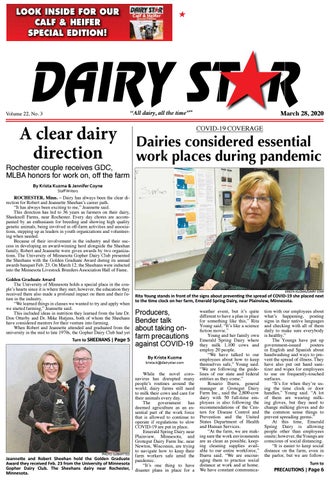
LOOK INSIDE FOR OUR CALF & HEIFER SPECIAL EDITION!
DAIRY ST R
March 28, 2020
“All dairy, all the time”™
Volume 22, No. 3
A clear dairy direction
Rochester couple receives GDC, MLBA honors for work on, off the farm
COVID-19 COVERAGE
Dairies considered essential work places during pandemic
By Krista Kuzma & Jennifer Coyne Staff Writers
ROCHESTER, Minn. – Dairy has always been the clear direction for Robert and Jeannette Sheehan’s career path. “It has always been exciting to me,” Jeannette said. This direction has led to 36 years as farmers on their dairy, Sheeknoll Farms, near Rochester. Every day chores are accompanied by an enthusiasm for breeding and showing high quality genetic animals, being involved in off-farm activities and associations, stepping up as leaders in youth organizations and volunteering when needed. Because of their involvement in the industry and their success in developing an award-winning herd alongside the Sheehan family, Robert and Jeannette were given awards by two organizations. The University of Minnesota Gopher Dairy Club presented the Sheehans with the Golden Graduate Award during its annual awards banquet Feb. 23. On March 12, the Sheehans were inducted into the Minnesota Livestock Breeders Association Hall of Fame. Golden Graduate Award The University of Minnesota holds a special place in the couple’s hearts since it is where they met; however, the education they received there also made a profound impact on them and their future in the industry. “We learned things in classes we wanted to try and apply when we started farming,” Jeannette said. This included ideas in nutrition they learned from the late Dr. Don Otterby and Dr. Mike Hutjens, both of whom the Sheehans have considered mentors for their venture into farming. When Robert and Jeannette attended and graduated from the university in the mid to late 1970s, the Gopher Dairy Club had yet Turn to SHEEHANS | Page 5
KRISTA KUZMA/DAIRY STAR
Rita Young stands in front of the signs about prevenƟng the spread of COVID-19 she placed next to the Ɵme clock on her farm, Emerald Spring Dairy, near Plainview, Minnesota.
Producers, Bender talk about taking onfarm precautions against COVID-19 By Krista Kuzma
krista.k@dairystar.com
PHOTO SUBMITTED
JeanneƩe and Robert Sheehan hold the Golden Graduate Award they received Feb. 23 from the University of Minnesota Gopher Dairy Club. The Sheehans dairy near Rochester, Minnesota.
While the novel coronavirus has disrupted many people’s routines around the world, dairy farms still need to milk their cows and care for their animals every day. The government has deemed agriculture as an essential part of the work force that is allowed to continue to operate if regulations to slow COVID-19 are put in place. Emerald Spring Dairy near Plainview, Minnesota, and Grotegut Dairy Farm Inc. near Newton, Wisconsin, are trying to navigate how to keep their farm workers safe amid the pandemic. “It’s one thing to have disaster plans in place for a
weather event, but it’s quite different to have a plan in place for something like this,” Rita Young said. “It’s like a science ction movie.” Young and her family own Emerald Spring Dairy where they milk 1,100 cows and employ 20 people. “We have talked to our employees about how to keep themselves safe,” Young said. “We are following the guidelines of our state and federal entities as they come.” Rosario Ibarra, general manager at Grotegut Dairy Farm Inc., said the 2,800-cow dairy with 50 full-time employees is also following the recommendations of the Centers for Disease Control and Prevention and the United States Department of Health and Human Services. “At the farm, we are making sure the work environments are as clean as possible, keeping cleaning supplies available to our entire workforce,” Ibarra said. “We are encouraging them to practice social distance at work and at home. We have constant communica-
tion with our employees about what’s happening, posting signs in their native languages and checking with all of them daily to make sure everybody is healthy.” The Youngs have put up government-issued posters in English and Spanish about handwashing and ways to prevent the spread of illness. They have also put out hand sanitizer and wipes for employees to use on frequently-touched surfaces. “It’s for when they’re using the time clock or door handles,” Young said. “A lot of them are wearing milking gloves, but they need to change milking gloves and do the common sense things to prevent spreading germs.” At this time, Emerald Spring Dairy is allowing people other than employees onsite; however, the Youngs are conscious of social distancing. “It is easier to keep social distance on the farm, even in the parlor, but we are followTurn to PRECAUTIONS | Page 6
Page 2 • Dairy Star • Saturday, March 28, 2020
DAIRY ST R www.dairystar.com
ISSN 020355 522 Sinclair Lewis Ave. Sauk Centre, MN 56378 Phone: (320) 352-6303 Fax: (320) 352-5647 Published by Dairy Star LLC General Manager/Editor Mark Klaphake - mark.k@dairystar.com 320-352-6303 (ofce) 320-248-3196 (cell) 320-352-0062 (home) Ad Composition Nancy Powell 320-352-6303 nancy.p@dairystar.com Consultant Jerry Jennissen 320-346-2292 Editorial Staff Krista Kuzma - Editor/Wisconsin (507) 259-8159 • krista.k@dairystar.com Andrea Borgerding - Associate Editor (320) 352-6303 • andrea.b@dairystar.com Jennifer Coyne - Assistant Editor (320) 352-6303 • jenn@dairystar.com Danielle Nauman (608) 487-1101 danielle.n@dairystar.com Stacey Smart - Staff Writer (262) 442-6666 • stacey.s@dairystar.com Maria Bichler - Copy Editor 320-352-6303 Advertising Sales Main Ofce: 320-352-6303 Fax: 320-352-5647 Deadline is 5 p.m. of the Friday the week before publication Sales Manager - Joyce Frericks 320-352-6303 • joyce@dairystar.com Bob Leukam (Northern MN, East Central MN) 320-260-1248 (cell) bob.l@star-pub.com Mark Klaphake (Western MN) 320-352-6303 (ofce) 320-248-3196 (cell) Laura Seljan (National Advertising, SE MN) 507-250-2217 fax: 507-634-4413 laura.s@dairystar.com Jerry Nelson (SW MN, NW Iowa, South Dakota) 605-690-6260 jerry.n@dairystar.com Mike Schafer (Central, South Central MN) 320-894-7825 mike.s@dairystar.com Amanda Hoeer (Eastern Iowa) 320-250-2884 • amanda.h@dairystar.com Julie Barnes (SE WI and Northern IL) julie.b@dairystar.com Megan Stuessel (Western Wisconsin) 608-387-1202 • megan.s@dairystar.com Ashley Curry (Northeast WI and Upper MI) 920-539-7268 • ashley.c@dairystar.com Deadlines The deadline for news and advertising in the Dairy Star is 5 p.m. Friday the week before publication. Subscriptions One year subscription $35.00, outside the U.S. $110.00. Send check along with mailing address to Dairy Star, 522 Sinclair Lewis Ave., Sauk Centre, MN 56378. Advertising Our ad takers have no authority to bind this newspaper and only publication of an advertisement shall constitute nal acceptance of the advertiser's order. Letters Letters and articles of opinion are welcomed. Letters must be signed and include address and phone number. We reserve the right to edit lengthy letters. The views and opinions expressed by Dairy Star columnists and writers are not necessarily those of the Dairy Star LLC.
The Dairy Star is published semi-monthly by Dairy Star, LLC, 522 Sinclair Lewis Ave., Sauk Centre, MN 56378-1246. Periodicals Postage Paid at Sauk Centre, MN and additional mailing ofces. POSTMASTER: Send address changes to Dairy Star, 522 Sinclair Lewis Ave., Sauk Centre, MN 56378-1246.
A glance at the other side
COVID-19 updates As the novel coronavirus continues to impact communities around the world, here at Dairy Star we want to make sure you are informed with the latest updates surrounding the pandemic and our dairy industry. We compiled a list of helpful resources, news and updates on postponed or canceled events on our website. We will update this page daily. Please visit www.dairystar.com for more information. If you have a helpful link or change of event to share with others, please email andrea.b@dairystar.com. Here are a few highlights from stories you will not nd in this paper, but you can nd online in zone 2. Robots right choice for Leedles Now entering their eighth year of using robots, the Leedle family of Black Cat Dairy can no longer imagine milking cows any other way. Robots have improved the work-life balance at this dairy farm while also boosting milk production, reproduction and longevity. The Leedles milk 480 cows with 8 robots near Lake Geneva, Wisconsin and employ only one hired hand outside the family. Farmstead cheesemaking a lifestyle Creating a niche market with farmstead cheese requires a good business plan. Oregon dairy farmer Gianaclis Caldwell spoke about her experiences as a farmstead cheesemaker during the Midwest Organic and Sustainable Education Service Conference Feb. 28 in La Crosse, Wisconsin. The most important message she shared with attendees was understanding the business plan will change as time goes on. Dairy growth management building momentum Supply management has become an increasingly popular topic in the dairy industry. Travis Klinkner, a dairy farmer and dairy committee member for the Wisconsin Farm Bureau, led a dialogue about supply management during a meeting sponsored by the bureau March 15 in Cashton, Wisconsin. Klinker has encouraged more listening sessions and dialogue from other dairy farmers regarding this topic.
FAST. CONSISTENT. VERSATILE.
SL 100 SERIES PROTWIN SLINGER ®
SIDE-DISCHARGE SPREADER
®
( trailer models)
• All-new discharge provides more consistent, even spreading • Exclusive twin-auger design eliminates material bridging ō ([WHQGHG DQG VLPSOLğHG VHUYLFH LQWHUYDOV VDYH WLPH DQG PRQH\ ō 9HUVDWLOLW\ WR KDQGOH WKH ZLGHVW YDULHW\ RI PDWHULDls 1000, 1400, 1800 and 2400 gallon capacities Farmers' Implement Allenton ' ' )DUP 6XSSO\ Arcadia Chili Implement Chili Cherokee Garage Colby Beaver Machine Coleman Kalscheur Implement Cross Plains Komro Sales & Service Durand
Hillsboro Equipment Hillsboro W. H. Lien Hixton Eron Equipment Junction City Luxemburg Motor Co. Luxemburg Lulich Implement Mason Persha Equipment Mayville Lindstrom Equipment Mondovi
East Side Farm Equipment Monroe Steinhart's Farm Service Platteville Gruett's, Inc. Potter Priebe Sales & Service Ripon Tesch Bros. Implement Seymour Riesterer & Schnell, Inc. Shawano Gibbsville Implement Waldo
INVEST IN QUALITY
www.kuhn.com
Eis Implement Two Rivers Spiegelberg Implement Weyauwega Carl F. Statz & Sons Waunakee Triebold Implement Whitewater $ & 0F&DUWQH\ Durand, IL 3HDEXG\ V 1RUWK Pecatonica, IL Visit your local Wisconsin KUHN Knight Dealer today!
®
Dairy Star • Saturday, March 28, 2020 • Page 3
It’s all inside... Columnists Ag Insider
Pages 8-9 First Section
Hutchinson
Turner
Bon Yankton Homme
ln
co
Lin
Clay
Lyon Sioux
O’Brien
Plymouth
k ero
n inso Emmet
Clay
Ida
Monona
Palo Alto
ca
Po
Sac
Kossuth
Sioux Falls
Zone 1
Trade shows canceled as COVID-19 crisis continues
Zone 2
bo du
m tgo
Mills t
Fre
n mo
Mon
Page
Kanabec
Mitchell Howard Floyd
ka
ic Ch
Greene Guthrie
Boone
Black Hawk
Polk
ll
ha
Story
rs Ma
Tama
Jasper
Fayette
B
Rochester
Dairy gives Sheehans a clear direction
Clayton
an
e war Dubuque
an
h uc
Benton
Iowa
First Section: Pages 1, 6
Dela
Jones
Linn
Jackson Clinton
n Cedar so
hn
Jo
Scott
Muscatine
n
Po
Dallas
Houston
w
sa
Bremer
Wright Franklin Butler
Webster Hamilton Hardin Grundy
Au
Pottawattamie Cass ery
Worth
Winona
Fillimore
Mower
Hancock Cerro Gordo
ldt
Hu
lho
Ca
n Win
o mb
un
Crawford Carroll
Harrison Shelby
s
ta
n ho
go
eba
Dick
ee Buena Vista
Ch
Woodbury
Washington
Hubbard
Osceola
Freeborn
Faribault
Martin
e
Charles Mix
Jackson
iek
Douglas
Gregory
Nobles
ake
Tripp
McCook Minnehaha
Murray
Rock
Wabasha
Cottonwood Watonwan Blue Earth Waseca Steele Dodge Olmsted
sh
Todd
Ha
n
n so
Goodhue
Rice
ne
Mellette
Miner
Moody
Nicollet
Brown
am
Aurora
Brule
Lake
Redwood
All
Lyman
Sanborn
Brookings
Adair
Adams Taylor
Madison Warren Marion Mahaska Keokuk
Union g ing
old
R
Clarke
Lucas
Decatur Wayne
Monroe Wapello n ppa
e oos
A
Davis
gto
Jerauld
Kingsbury
Dakota
Scott
Sibley
Lyon
First Section: Page 39
W in
Buffalo
Beadle
Carver
hin
Hamlin
Hand
McLeod
Renville
Yellow Medicine
Dairy Prole: Dan Nibbe
Wa s
Bennett
Hyde
Deuel
Hennepin
Goodhue
iek
Shannon
Hughes
Chippewa
Anoka
Wright
Meeker
sh
Jones Jackson
Fall River
Stanley
Clark
Kandiyohi
Isanti
we
Custer
Sully
Swift
Lac Qui Parle
Codington
Sherburne
ms ey
Spink
Benton
Stearns
Pope
Pine
Mille Lacs
Morrison
Douglas
Stevens
Grant
Faulk
Potter
Todd Grant
Big Stone
Day
Carlton
eu r
Dewey
Edmunds
Aitkin
Crow Wing
go
Pages 10 - 11 Pennington Second Section
Roberts
Marshall
McPherson Brown
Walworth
Haakon
Richland
Sargent
First Section: Pages 8 - 9
Cass
Su
Campbell
Corson
Dickey
McIntosh
Otter Tail
Little Falls
Kids Corner: The Westermans
isa Ch
Lawrence
Ransom
Emmons Sioux
Becker
Clay
Wadena
Grant
Cass
LaMoure
Logan
Ziebach
The “Mielke” Meade Market Weekly
Bames
no
Cook Lake
Itasca
n
Stutsman
men
Mah
Wilkin
Kidder
Tra ver se
Burleigh
Morton
Perkins Page 33 First Section
Butte
Norman
Oliver
Dairy Good Life
Harding
Polk
Trail
Steele
Koochiching St. Louis
Red Lake
Lincoln
Page 32 First Section Adams
Griggs
Beltrami
Pipestone
Bowman
Foster
Mercer
Just Thinking Out Hettinger Loud
Slope
Wells
Sheridan
Noska takes on farm with contract for deed
Lake of the Woods
Pennington
Grand Forks
Eddy
McLean
Roseau
Marshall
Benson Nelson
Stark
Kittson
Walsh
Ramsey
McHenry
Ward
Pembina
n
Golden Valley
Pierce
First Section: Pages 12 - 13
io
Dunn 31 Page Billings First Section
Cavalier
Towner
Da vi so n
Something McKenzie to Ruminate On
Rolette
First Section: Page 7
Un
Page 30 Williams First Section Mountrail
Bottineau
Second Section: Pages 3- 4
Clearwater
Renville
Browerville
Livestock markets do not slow amid coronavirus
Le
First Section: Pages 23, 25
Dear County Burke Agent Guy
Divide
Perham
MN DHIA consolidates to one testing lab
Zimmermans start greenhouse for spring season
Page 26 First Section
Sauk Centre
Ra
Brooten
FSA News & Notes
on
rs ffe
Je
Van Buren
Louisa
Henry Des
Moines
Lee
Ely
Women in Dairy: Josie Rozum
First Section: Page 11
First Section: Page 36
Protivin
Iowa goat dairy converts hog facilities to produce, process milk, yogurt, caramel sauce
For additional stories from our other zone, log on to www.dairystar.com
Second Section: Pages 8-9
Chosen 10,000 times for 10,000 good reasons Reason 9,378: innovation built into every single detail gea.com
Hull, IA Watertown, SD
(712) 439-2081 (605) 753-0300
www.automatedwastesystems.com
Page 4 • Dairy Star • Saturday, March 28, 2020
The future belongs to the few of us still willing to get our hands dirty
ONE NAME STANDS ALONE.
HEALMAX.
SAVE UP TO SA
$60/TON
MILK REPLACERS $2 OFF/BAG! Call Bryant 320-224-4101 INTRODUCING O THE NEW WATERERS, FEEDERS, WALK THROUGHS & MORE!
ON YOUR PURINA WIND & RAIN MINERALS! Call Katie 320-290-5136
ATTACHMENTS
FAST RESULTS
RENTAL•SALES
WITHOUT FORMALDEHYDEE
10% OFF ALL IN STOCK T-POST & WOVEN WIRE FENCING
BEFORE
TIRES
AFTER
SAFER THAN FORMALDEHYDE ALDEHYDE for cows and crew crew. WORKS FAST with proven results in about one week. week
Skid Loader & Implement
FEATURES A PATENTED MODE-OF-ACTION you won’t get with any other hoof care product.
(Mounting Available)
Short on Labor? Short on time? Automatic AGRi-Speed HITCH
We are an exclusive dealer!
With HEALMAX® in your footbath, you’ll avoid formaldehyde which is PAINFUL, IRRITATING, LESS EFFECTIVE at extreme temperatures and is a known CARCINOGEN.
• One person operation - eliminate the need for a second hand for hook-ups • Available for pick-ups, choppers, tractors, wagons, etc.
Gilman Co-op Creamery
FEED & FARM SUPPLY STORE
Gilman, MN 320-387-2770
Open M-F 7:30-7, Sat. 7:30-5, Sun. 8:30-1 Good service - fair prices - every day
WWW.GILMANCREAMERY.COM
Ensure Better Calf Health with Chlorine Dioxide! STOP
BACTERIA WITH
Chlorine-Dioxide Disinfectant / Sterilant
A HIGHLY EFFECTIVE WATER INJECTION SYSTEM
Use EXSPOR on: • Calf hutches • Calf bottles • Calf nipples • Calf buckets • Parlor/milk room walls • Drains and more!
Pure 3000 Chlorine Dioxide Technology
REDUCES:
• Respiratory Issues • Scours • Crypto • Salmonella • E-coli
FOAM OR SPRAY ON
Fast and effective against ALL kinds of harmful substances including bacterial spores as well as bacteria, viruses and fungi!
HIGHLY EFFECTIVE AGAINST • Prototheca • Staph Aureus • Mycoplasma
Removes IRON, MANGANESE and SULFUR in water!
FOR MORE INFO - CONTACT ONE OF THESE DEALERS... Advanced Dairy Systems
Athman Dairy Inc.
D&D Ag Supply
9 State Rd. 29 • Spring Valley, WI 54767 (715) 772-3201
238 Main Street North • Pierz, MN 56364 (320) 468-2494
133 Atlantic Ave. NE • Pennock, MN 56279 (320) 599-4466
Advanced Dairy Solutions
Professional Dairy Systems
East Central Dairy Supply
Champion Milking Systems
Eastern Iowa Dairy Systems
278 W. Court St. • Richland Center, WI 53581 1449 Homecrest Ave. • Wadena, MN 56482 (608) 647-4488 (218) 632-5416
Anderson Dairy Systems, Inc. 1312 13 1/2 Ave. • Barron, WI 54812 (715) 537-3300
23218 350th Street • Albany, MN 56307 (320) 845-4156
2195 Hwy. 23 • Mora, MN 55051 (320) 679-1029
105 3rd Ave. NW • Epworth, IA 52045 (563) 876-3087
Fuller’s Milker Center, Inc.
Lang’s Dairy Equipment, Inc.
2337 Millennium Rd. • Decorah, IA 52101 (563) 382-8722 1467 West 5th Street • Winona, MN 55987 (507) 452-5532 Gorter’s Clay & Dairy Equipment 1400- 7th St. SE • Pipestone, MN 56164 Leedstone (507) 825-3271 222 E Co Rd 173, Melrose, MN 56352 (320) 256-3303 Tri-County Dairy Supply, Inc. 24260 Cty. Rd. 27 • Plainview, MN 55964 4107 N US HWY 51 • Janesville. WI 53545 (507) 534-3161 608-757-2697 423 U.S. 61 • Lancaster, WI 53813 (608) 723-4634
Leedstone
2545 80th Ave • Woodville, WI 54028 (715) 698-4370
United Suckow Dairy
12687 Hwy 18 & 52 • Postville, IA 52162 (563) 864-7417 210 N. Industrial Pkwy • West Union, IA 52175 (563) 422-5355
Dairy Star • Saturday, March 28, 2020 • Page 5
ConƟnued from SHEEHANS | Page 1 to be formed. But the two joined organizations available to them. Both were on the dairy judging team and participated in Brock and Bridal, the general livestock equivalent of Gopher Dairy Club. “It gave us networking opportunities we could use when we started dairy farming,” Robert said. “The people we met and who have similar interests are still people we are friends with today.” When the Gopher Dairy Club told the Sheehans they were the recipients of this year’s Golden Graduate Award, the couple was surprised. “We were pretty honored and excited, too, because it’s our alma mater and dairy means so much to us,” Jeannette said. Hall of fame inductees During their time at the University of Minnesota, Robert and Jeannette would stop in Haecker Hall to look at the pictures of people in the Minnesota Livestock Breeders Association Hall of Fame. They never imagined their picture would one day join the ranks. “We are pretty honored and humbled,” Robert said. “There are a lot of good livestock breeders who have received this honor before us.” Jeannette agreed. “It gave us a goal, though, to achieve what those in that hall have,” she said. After college graduation, Robert worked as an extension agent for Kandiyohi County from 1976 to 1978, where he was in charge of the 4-H program and coached the county’s dairy judging team. He then worked as the sire procurement manager for Minnesota Valley Breeders Association in New Prague for six years before changing careers. In 1984, Robert and Jeannette moved to Rochester to dairy farm with Robert’s family. They bought a nearby farm to expand Sheeknoll Farms and built a 52-cow tiestall barn, which they have co-managed through the present time. It complements the farm’s double-12 parallel parlor and freestall barn on the homesite just 2 miles away, where other members of the Sheehan family – Jim, Mary, Steve, Ben, Jerome, Karen and Ellen – milk 250 cows. “When we rst started farming, people thought we were crazy because milk price was so low,” Jeannette said. With their focus on Holsteins, breeding for high production was important during those initial years. “We needed to pay the bills because we were paid by volume then,” Jeannette said. But having good type cows was also important to the couple. They wanted to balance the two. Using the bull, Walkway Chief Mark, furthered their work to breed better type cattle. “We had a lot of good Mark daughters,” Robert said. “They improved the overall type in our herd. They had deep
ribs and larger bodies with good udders. Plus, they were high in production.” Years later, Regancrest Elton Durham became a farm favorite bull and is also the sire of the Sheeknoll Durham Arrow, known to the Sheehans as Thomas. Thomas was one of the Sheehans’ most impactful cows on the farm as she produced well and excelled in type. She was named the 2016 World Dairy Expo Grand Champion and of the International Holstein Show and Reserve Supreme Champion. While there was a lot of work to do on the farm, the Sheehans made time to volunteer and be a part of off-farm organizations. “I felt it was important to be involved in learning things for our farms,” Jeannette said. “It was important we each got to explore that.” Robert served as a board member, including president, of the Minnesota Holstein Association and has represented Minnesota Holstein breeders at several national conventions. He has also been a board member for Minnesota Select Sires and was chosen to be on the Select Sires Inc. Holstein sire committee. He is on the MLBA Board of Directors and serves as co-chair of the Minnesota 4-H Dairy Showcase committee. Jeannette was a dairy leader and club leader for Olmsted County 4-H and coached the county dairy judging team for 15 years. She has volunteered as an ofcial judge at the National 4-H Dairy Judging Contest at World Dairy Expo. Other volunteer roles have been with dairy herd improvement association, extension and the local American Dairy Association. She is also a founding member of the Miracle of Birth Center at the Olmsted County Fair and each year visits classrooms for Ag in the Classroom. She serves on the World Dairy Expo Board of Directors. “We would cover for each other when we had to be somewhere,” Jeannette said about doing daily chores on the farm. “We made it a priority to be involved off the farm. It is easy to get involved when your kids are involved.” Robert and Jeannette have three children: Kelly and her husband, Dan Kendall, have three children, Connor, 9, Alex, 6, and Britta, 3; Andrew and his wife, Juliana, have two children, Elena, 6, and Hattie, 4; and Krista and her husband, Jordan Kuzma, have two children, Eleanor, 4, and Charlotte, 1. Showing has also been a fun offfarm activity for the Sheehans, especially helping their children, grandchildren and many other non-farm kids use their animals to show at county and state fairs. “It’s all how we grew up,” Robert said. “Our parents were really involved, and we wanted to do that, too.” It was what gave the Sheehans their direction towards their dairy career.
THE NO COMPROMISE FABRIC STRUCTURE DAIRY, MACHINERY & HAY STORAGE
TRUST THE EXPERTS At Famo Feeds, we strive to provide the best support for your operation and work to accommodate your specific needs.
From calf to cow and everything in between!
FEED THEM FAMO! 320-836-2145 or 800-450-2145
Check out our newly redesigned website to ½nd a Famo Feeds dealer near you!
www.famofeeds.com
BODENSTEINER IMPLEMENT CO. www.bodimp.com p
Beat e Spring Rush!
KP, PRWD, Pro Drive, 2499 hrs. #49737 $185,000 (DYE)
2013 JD 7780
Came off 7780, 8 row, small drum #49738 $54,500 (DYE)
JD 698 Rotary Head
2013 JD 640C Windrow Head
2011 NH H8080 Windrower
2011 H&S HSM9 Hay Merger
2015 JD 569 Prem RB
2018 JD 330G Skid Steer
2010 Kuhn Knight 3130
w/15’5” 750HD header, 884 hrs. #44281 $75,000 (DYE)
Folding extension #41398 $15,500 (CLE)
Crop roller, hyd. gauge wheels #49739 $15,000 (DYE)
19,500 bales #50079 $23,500 (DYE)
Commercial Agri Buildings
WE ALSO SELL REPLACEMENT TARPS!
Single and Truss Arch available from 20’-120’ wide Flo-Coat® Galvanized Steel Tubing Supplied by Allied Tube & Conduit Heaviest gauge steel in the industry Pre-engineered truss buildings
2014 JD 204K Compact Ldr.
NELSON’S AGRI STRUCTURES
Cab w/AC, 1.4 yd. bkt., new tires #48301 $52,000 (WAU)
RIVERSIDE HOOP BARNS, INC.
For complete info on all our used equipment log on to bodimp.com
Dean Nelson • Central and Northern Minnesota • Grove City, MN • 320-857-2633, Cell 320-699-3297 US Hwy. 75 At IA/MN Stateline • Steen, MN • 507-392-2870 • Fred A. Tilstra & Sons
LANGE CONSTRUCTION & CONCRETE
Duke Lange • Swanville, MN • 320-290-0859
LAKESIDE HOOP STRUCTURES, LLC
Eastern Minnesota and Wisconsin • Harris, MN • 651-248-6302 • Craig Moline
ASK US ABOUT GOVERNMENT FUNDING FOR HAY STORAGE
84” bkt., EH controls, 2083 hrs. #49222 $39,500 (LIME SPRINGS)
Elkader (ELK) ........563-245-2470 Clermont (CLE) ......563-423-5206 Cresco (CRE) .......... 563-547-2152 Decorah (DEC) ....... 563-382-2961 Dyersville (DYE) ..... 563-875-2724
Feeder wagon #48609 $17,800 (WAU)
Monticello (MON) ...319-465-3515 New Hampton (NH) 641-394-3061 Oelwein (OEL) ......... 319-283-4371 Rowley (ROW) ........ 319-938-2222 Waukon (WAU) ......563-568-3463
Page 6 • Dairy Star • Saturday, March 28, 2020
ConƟnued from PRECAUTIONS | Page 1
Willmar, MN • 320.231.1470
EXPANDING OR REMODELING YOUR LIVESTOCK OPERATION? LANGE AG SYSTEMS SPECIALIZES IN:
Ŷ NEW FACILITIES
_
NO JOB TOO BIG OR TOO SMALL
Ŷ RETROFITTING & REMODELING Ŷ TURNKEY PROJECTS Ŷ BARN DESIGN Ŷ INSTALLATION, MAINTENANCE & REPAIRS
ƋƵŝƉŵĞŶƚ tĞ KīĞƌ͗ ͻ sĞŶƟůĂƟŽŶ &ĂŶƐ ͻ sĞŶƟůĂƟŽŶ ŽŶƚƌŽůƐ ͻ WŽƐŝƟǀĞ WƌĞƐƐƵƌĞ dƵďĞƐ ͻ ƵƌƚĂŝŶ ^LJƐƚĞŵƐ ͻ DĂƩƌĞƐƐĞƐ ͻ tĂƚĞƌĞƌƐ ͻ ^ƚĂůů ƋƵŝƉŵĞŶƚ ͻ ,ĞĂĚůŽĐŬƐ ͻ DŝƐƟŶŐ ^LJƐƚĞŵƐ
Lange Ag Systems is proud to offer Grain Bags, Silage Bags & Bunker Covers from Up North Plastics and Feed Fresh Silage Covers & Custom Size Bunker Covers from Raven!
t ^ >> E t Θ h^ 'ͳ ' Θ < >>z Zz E '' Z^
www.LangeAgSystems.com • Vertical beater manure spreaders • Tanks
(320) 249-7579 brandonstang23@gmail.com
• We offer full service or assisted loading/hauling • Newer reliable equipment Call for questions and scheduling
• Track skidloader • Front and rear open roof box
Repair vs. Replace
Electronic Dairy Board Repair Service
Specializing in: WestfaliaSurge, BouMatic, & DeLaval pulsators & Takeoffs, circuit boards, Mueller milk tank circuit boards. Call: (c) 406-590-7764
www.circuitÀxer.wixsite.com/ boumaticboardrepair
OFF-LOADER TANKER TRAILERS • Design/Set Up and Sales • Stainless or Aluminum Trailers • 8” Systems Up to 3700 GPM • 30’ Booms • Remote Or Manual Hydraulic Controls • Optional Top Spread
Spreaders
JCB Teleskid The world’s first and only skid steer loader and compact track loader with a telescoping boom, allowing it to lift higher, reach further and dig deeper than any skid steer on the market.
KRISTA KUZMA/DAIRY STAR
Two employees at Emerald Spring Dairy milk cows March 25 near Plainview, Minnesota. The Youngs, who own the dairy, have been implemenƟng precauƟons to prevent the spread of COVID-19 to employees on their farm. ing the guidelines as we hear them and what we should be doing,” Young said. Grotegut Dairy Farm has put restrictions on visitors to the dairy. Ibarra said the employees have embraced the necessary changes. “They are open to listen and follow the instructions we are given,” Ibarra said. “There are a lot of rumors outside, but our message to them is that we are following the authorities’ recommendations, and we are all in this together.” Both farms are in the process of developing plans should a number of their employees fall ill with COVID-19 and need to be quarantined. “Cross training is very important at this time so we can cover essential positions such as milking, and feed cows and calves,” Ibarra said. “We are also keeping constant communication with the area supervisors on what projects or tasks can be postponed in case we have a shortage.”
“Cross training is very important at this time so we can cover essential positions such as milking, and feeding cows and calves.” ROSARIO IBARRA, DAIRY FARMER
NO MANURE LEFT BEHIND The Titan sees no match in end rows, as it has the ability to make full, effortless turns in the ground while the units continue to inject manure into the ideal root zone. This minimizes the amount of manure left above ground and reduces turn-around time at the end of each pass.
Performance and reliability
(507) 359-4230 316 4th Street PO Box 34 Courtland MN, 56021 www.courtlandwaste.com
According to Jeff Bender, these two farms are taking the right steps to help prevent the spread of COVID-19. “Farmers need to be aware this is something that can be quite serious and is spreading pretty quickly,” he said. “We need to be ready. We need to be prepared.” Bender is the co-director of the Upper Midwest Agricultural Safety and Health Center, a professor at the University of Minnesota in the division of environmental health sciences and an adjunct at the university’s college of veterinary medicine. As a veterinarian and a public health practitioner, Bender has studied and done research on infectious and zoonotic diseases, and acts as the epidemiologist for the veterinary college. Bender said he is concerned for people in rural communities for many reasons.
“Many folks think, ‘I’m isolated; therefore, this isn’t going to come to me,’” he said. Also, rural resident populations tend to be older in age, with farmers on average being 58 years old. While this virus can infect all people, there are increased complications in cases of older people. Health care access is also a concern. Oftentimes it is limited in rural communities, Bender said. “Hospitals are closing and it takes a little farther to get to places,” Bender said. “They have less of the support structures that they do in some of our bigger urban hospitals.” Bender’s last concern is the limited workforce. “If someone goes down, we often don’t have backup,” Bender said. “Who is going to milk those cows? Our farmers are a wonderful bunch, and they sometimes feel invincible. They say I’ll push through. We probably don’t want them to push through.” To limit the chances of COVID-19 spreading to a farm, Bender suggests following the recommendations of the CDC, such as practicing good hygiene, staying home if sick, frequently disinfecting surfaces and limiting contact with other people. Having a good biosecurity plan is also important for the farm, Bender said. Think about limiting farm access and other nonessential activities. Also enact a plan for on-farm social distancing – how many people can be in the breakroom at one time, staggering work schedules or conducting meetings in a different way. It is important for farmers to listen to their employees’ concerns. “This is where we lead well,” he said. “We need to be good advocates for our employees – thinking about them, thinking about their welfare, thinking about a plan if someone gets sick, working on that plan and setting up that plan.” Ibarra said Grotegut Dairy Farm is trying to ready itself should employees get sick with the novel coronavirus. “Our industry does not stop,” Ibarra said. “We are responsible to provide food to the world. Our continued operation is imperative for public health and community well-being. The consumer needs to know we will do all that is humane and nancially possible to keep operating in a safe and healthy environment for our people, our cows and our community.”
COVID-19 COVERAGE
Dairy Star • Saturday, March 28, 2020 • Page 7
Livestock markets do not slow amid coronavirus By Jennifer Coyne jenn@dairystar.com
PERHAM, Minn. – Business was as usual last Monday for Perham Stockyards. “We have auctions weekly, and even though everything else is closing, we’re an essential part of the food chain to get food into stores,” Mitch Barthel said. Barthel is the owner and auctioneer at Perham Stockyards in Perham. The new coronavirus has caused disruption for businesses across the nation, but as the United States Department of Homeland Security deems food and agriculture as an essential critical infrastructure, those in the dairy industry continue to operate without interruption. While the threat of COVID-19’s impact on food production is of little concern, the greater worry of human health remains, and the number of people who typically gather to sale barns for their weekly auctions. To address this concern with livestock markets, the Minnesota Board of Animal Health put out guidelines to follow. “We’re considering this from a human health perspective because COVID-19 impacts people,” said Michael Crusan, communications director for the Minnesota BOAH. Livestock markets are traditionally a place for communities to gather.
At Barthel’s sale barn, he can seat up to 200 people. Yet, after COVID-19 became a concern in Minnesota, his attendance gathered roughly 45 people March 16. “It was no big gathering,” Barthel said. “And people are using common sense when interacting with others.” Mark Oberholtzer noticed the same during his auction March 19. “There were denitely a lot less people,” Oberholtzer said. “We did request no children or spectators attend; only the buyers were welcomed.” Oberholtzer is an owner and auctioneer at Oberholtzer Dairy Cattle and Auction Co. in Loyal, Wisconsin. Every auction sells about 450 head of livestock, including dairy cows, breeding stock, butcher cows, calves and beef animals. During the winter months, the sale barn seats up to 200 people, but summertime brings a smaller crowd of 35 people, said Oberholtzer. “(Thursday) at peak sale, there were only about 40 people in the barn,” he said. The Minnesota BOAH is recommending livestock markets post signs with symptoms of COVID-19 as well as requiring employees to stay home if they feel sick. These places should also clean surfaces frequently, and emphasize the importance of covering coughs and sneezes and proper hand hygiene of all employees. Perhaps most importantly, sale barn managers are asked to consider ways to
enforce social distancing. “We realize the community gathering aspect livestock sales bring,” Crusan said. “Really, it’s best not to hang out because of the known potential risk.” For those who do attend the sales, they are asked to maintain social distancing measures with a 6-foot buffer between them and the next person. “These people aren’t worried because they typically don’t have that much exposure between themselves and other people,” Barthel said. “Many of them don’t leave their farm or ranch.” Crusan and his co-workers are pointing to guidelines from the Centers for Disease Control and Prevention, and the state’s department of health to protect employees at sale barns and those attending. “Some livestock markets have reached out to us,” he said. “They’re asking for guidance.” In Wisconsin, Oberholtzer closed down their food stand which is typically offered throughout the day of auctions. “Until this has all passed, we’re doing our best to keep everything cleaned to prevent the spread,” he said. Despite the hindrance COVID-19 has put on parts of the livestock market, market prices have remained relatively unchanged if not improved slightly. “Markets are fairly steady as a whole,” Oberholtzer said. “Dairy cows are on par with what they’ve been.
There was a drastic drop in fat steers; they took a hit.” In the past, Oberholtzer has looked to internet streaming his auctions. Depending on how long the COVID-19 crisis remains in Wisconsin, he might look into it as an option to reach buyers. “It’s not a step we’ve taken, but if that’s what it takes to market cattle we’ll have to give it a chance,” Oberholtzer said. Crusan agreed. “(COVID-19) is pushing us to work remotely and virtually,” he said. “We can’t speculate the future, but what we thought wasn’t necessarily possible yesterday, we’re doing today and can do tomorrow. This may help us expedite our jobs to be faster and more efcient and provide more value. One thing for certain is we’ll take the lessons learned from this for our future.” As the agriculture industry will continue operating as usual amid the spread of the coronavirus, auctioneers like Barthel and Oberholtzer are grateful to remain open and provide a business transaction for their customers. “We have to continue business as usual,” Barthel said. Oberholtzer agreed. “We’ll continue to take it one week at a time,” he said. “In these changing times, we want to keep buyers and customers up to date.”
Everybody knows that
MOM’S MILK IS BEST! Before we boug ht our Westwaard pasteurizer we were spending $1000 per month on milk replacer. By feeding our own whole milk and saving on labor, we were able to pay our pasteurizer off in about a year. We have much big ger, healthier calves and use a lot less medication. Westwaard pasteurizers have very low maintenance costs and the auto chemical wash feature saves me a lot of time! - Doug Rohrer Windom Manor Farms From 20 gallon to 800 gallon capacity, we have a calf milk pasteurizer to accommodate your dairy!
WESTWAARD FABRICATORS for DARITECH
Contact us for a dealer near you!
(360) 354-6900 • www.daritech.com
Photo courtesy of
Fisher & Thompson Inc Authorized WestWaard Dealer
Dairy sector may request additional relief Page 8 • Dairy Star • Saturday, March 28, 2020
As lawmakers work on additional coronavirus- U.S. dollar is really strong. That probably has more of related assistance, the National Milk Producers an impact on pricing of agricultural commodities in Federation is preparing to ask for dairy-specic relief the short-term. Longer-term, not so much.” from USDA and Congress. Government purchases for federal nutrition programs and food banks are being Ag declared as a critical industry discussed as an option to help offset Agriculture and food have been Ag Insider the demand disruption from school and declared by the United States Department restaurant closures. NMPF may also ask of Homeland Security as critical USDA to reopen enrollment for the Dairy infrastructure during the coronavirus Margin Coverage program. outbreak. This allows ag businesses to continue normal operations, despite Ag groups seek policy to help farmers restrictions to stop the spread of the virus. navigate COVID-19 Provisions to help farmers and NFU elects new president ranchers navigate current business The newly elected National Farmers challenges could be included in the Union President Rob Larew said he third coronavirus package. American will focus on building off of the current Farm Bureau Federation Executive Vice strength of the organization. “Times are By Don Wick President Dale Moore said ag workers tough. There are lots of challenges, not Columnist and a functioning supply chain are the least of which is what the weather the most important things needed for will be like this spring. When we work agriculture at this time. “Our focus is making sure together, we’re going to be a lot stronger.” Larew the men and women we’re working for have the tools said the farm economy continues to drive a lot of they need to produce food and have the connectivity policy priorities for the organization. “The effects of to other parts of the food chain,” Moore said. “I have a trade policy, whether or not we get another Market feeling it’s not going to be too long until we talk about Facilitation Program and whether or not we need to be a fourth or fth tranche until we get this virus out of looking at changes in the farm safety net. Then, there the U.S.” are challenges of concentration across the ag space and climate change.” NFU Policy Director Mike Stranz A U.S. recession is possible will be lling in for Larew’s former role. Wisconsin President Donald Trump told reporters the U.S. farmer Patty Edelburg was also re-elected NFU vice could be sliding into a recession. According to Wells president during the convention. Fargo agricultural economist Michael Swanson, there is a risk. The technical denition for a recession is two NFU supports supply management consecutive quarters of negative growth. “It’s very During the National Farmers Union Convention, likely with the airline travel cancellations and meals delegates passed six special orders including one away from home cancellations, the rst quarter will dealing with dairy policy. This special order said the show a contraction. The open question is if the second Dairy Margin Coverage program does not address the quarter will see a contraction. It all depends on how issue of oversupply and Congress should establish a fast the virus is controlled.” Swanson said a recession mandatory supply management program. NFU said doesn’t mean much for agriculture. “We’re more this program should allow for the entry of beginning impacted by the strength of the dollar. Right now, the farmers, reduce government expenditures, respond
LS L A W E D I S E R I T SEMI FOR SALE!
Tire Shooter Labor Saver
Reduce Time & Labor by Half,
REACHES UP TO
23’ Plus LOADER REACH
while covering piles and bunkers • • • • • • •
Self unloading Skidsteer models –16 length Wheel Loader – 23 length Custom Ût to any skid or wheel loader Easier to load Haul up to 110 sidewalls Can be used with full tires
715-613-5051
to global market conditions, allow for on-farm processing, value-added and direct-to-consumer sales and be designed in a way that any production base does not acquire value.
Rural Finance Authority funds get nal approval Minnesota Governor Tim Walz signed a bill to provide funding for the Minnesota Department of Agriculture’s Rural Finance Authority. The bill allocates $50 million for the RFA to continue offering eligible Minnesota farmers low interest loans not offered by traditional lenders. State considers help for farmers Minnesota lawmakers are considering legislation to help farmers navigate tough times. One option is funding for farm crisis loans. Riverland Community College Farm Business Management instructor Dan Miller testied at a House committee hearing, saying farm income is at a disastrous level. “Net farm income in 2019 was about half of what it was in 2013. Equity or net worth as a percentage has diminished,” Miller said. “Due to cash ow challenges, farmers are renancing short term debt.” Miller also said the Market Facilitation Program payments helped farmers signicantly in 2019, but they aren’t guaranteed for the future. DFA/Dean Foods deal is off After concerns were raised about competition and possible antitrust violations, Dairy Farmers of America and Dean Foods have agreed to drop a proposed bankruptcy purchase agreement. Last month, DFA agreed to pay $425 million to acquire 44 processing facilities from Dean Foods. While that plan will not go forward, the paperwork led with the bankruptcy court indicates DFA still plans to bid on some of the Dean Foods assets. The deadline for bids is March 30. Turn to AG INSIDER | Page 9
HAY & FORAGE, STALK CHOPPERS
T BES UES VAL
TRACTORS
Case IH MX 270 FWA, 16.9R30 Fr Dls, 20.8R42 R Dls. 5,615 hrs JD 4200 Compact Hydro Tractor w/JD 420 ldr., 1,395 hrs. MF GC1725M, loader, bucket & forks, 5 hrs, 2019 Consign MF GC1715 w/554 hrs, 2013 & MF 2325 60” mower deck
COMBINES & HEADS
Gleaner S96 Combine, ‘19, Tires 800R32 single, 214 Sep. hrs Gleaner S67 Combine, ‘11, duals , 1187 sep, 1558 eng, nice Gleaner S77 Combine, 2012, duals, 1,777 sep, 2,325 E. Gleaner R75 Combine, 2004, Duals, 1982 Sep, 2719 E, very nice Gleaner 8000-20 Flex Head Laterak Tilt, 2005 Gleaner 8000 Flex Head 25’ Lateral Tilt, 2004 Gleaner 3000 630R Corn Head, 2008 Gleaner 3000 830R Corn Head, 2004 Case IH 1640 Combine 4,435 hours, 28L-26 singles Harvestec 4308C Cutter Corn Head 8 Row 30” GL Mounts Harvestec 4308C Cutter Corn Head 8 Row 30” JD Mount Harvestec 4308C Cutter Corn Head 8 Row 30” NH/Case IH Mount ‘08
SKID STEERS
John Deere 582 Silage Special Round Baler 4X5, 19,434 Bales New Holland BR7070 2014 Round Baler, 13,000 Bales New Holland 688 Round Baler New Holland BC5060 2012 Small Square Baler w/Thrower New Holland 330 Big Baler, ‘13, 3X3, manual applicator, 6,200 bales Hesston 4755 Baler, 3x3, 53,000 bales, manual preservative Hesston 8200 SP windrower w/14’ auger head Gehl DC2360 9’ Disc Mower Conditioner New Holland 1431 mower conditioner, 13’, 1998 New Holland 56 bar rake Art’s way 240C Stalk Chopper, 2015, 20’ Width, Low Acres Teagle Tomahawk 6060 3-pt Bale Chopper Vermeer CPX9000 Bale Processor, 2017, with Twin Blowers
ROW CROP, DRILLS & SPRAYERS
Hardi Navigator 4000, 2013, 90’ Boom, 120” Axle, ISO Hardi Navigator 4000, 2012, 90’ Boom,120” Axle, 5500 rate controler Hardi Navigator 3000, 60’ Boom, adjustable axle Great Plains 13’ solid stand grain drill Melroe 2120-286 14’ Grain Drill with Small Seeds & Fert. Box
GRAIN CARTS & WAGONS
Meyer 1500 Running Gear with 16.5-16.1 tires, nice shape Meyer 1500 Running Gear with 16.5-16.1 tires, nice shape Gehl 4-wheel gear, 11L-15 tires H&S LK-500 Forage Box, 14’ with P&H 4 wheel gear Demco 1102 Cart Red, 1250 Tires, Roll Tarp, ‘17, Rented 1 Season Demco 365 Gravity Box w/385-22.5 Truck Tires, Red Ez-Flow 300 Gravity Box w/EZ-Trail 1074 Gear. 12.5-15 Tires Parker Gravity Box, 400 bu. Pequea 918 Hay Rack With 10 Ton Pequea Running Gear. Nice
Case SR220 Skid Steer, Cab, Heat, A/C, 2 Speed, 3200 hrs. Mustang 2700V, ‘11, 2,000 hrs., pilot ctrls., cab, 2 spd, nice Mustang 2076, ‘12 1200 hrs., H/F ctrls, cab, w/heat, 2 spd. Mustang 2060 ‘96, 6,636 hrs., T-Bar controls, universal mount
MANURE SPREADERS
TILLAGE/FIELD CULTIVATORS
Good Selection Of Used Augers
Glencoe SS7400 5-shank chisel plow (excellent condition) John Deere 2600 4-Bottom Plow, Vari-Width DMI Ecolo-Tiger 730B, 7 shank, Straight Front Coulters, Closing Disc Wilrich 11XL2 30-32 Field Cultivator, 3-bar coil tine & rolling basket Wilrich 357 5-Shank Ripper With Cart, 2014 Wilrich 657 11 Shank Chisel/ Ripper Combo, 2014 Wilrich 657 11 Shank Chisel/ Ripper Combo, 2012, 2 Bar Coil & Basket
H&S 5126 Topshot, 19LX16.1 tires, 2011 NEW HOLLAND 3110 MANURE SPREADER 16.5X16.1 TIRES
GRAIN EQUIPMENT MISCELLANEOUS
Bush Hog RDTH84 3-Point Finish Mower 7’, 2012, good shape Farm King Y600 Snow Blower 60” Cat. 1. manual chute, green & yellow 1500 gallon round ñat bottom tank 1350 gallon round ñat bottom tank Sand Shooter Becker Woodchuck 68” Very Nice Virnig 96” Hydraulic Angle Broom. New Brushes. Berlon 3 prong bale spear Virnig 4 Prong Bale Spear, round tapered shaft, #101939 Westendorf WL-42 All-Matic loader with White tractor mounts
38241 County 6 Blvd. Goodhue, MN 55027
(651) 923-4441
Dairy Star • Saturday, March 28, 2020 • Page 9
ConĆ&#x;nued from AG INSIDER | Page 8 China takes action on dairy product exports Progress is being made in implementing phase one of the trade agreement between the United States and China. The most recent actions by China include lifting a ban on beef imports from animals over 30 months of age and updated facilities approved for exporting dairy products. In addition, a new tariff exclusion process is in place, allowing Chinese importers to apply for exclusion from retaliatory tariffs. Extension cancels face-to-face meetings University of Minnesota Extension has canceled all face-to-face events, meetings and courses through May 15. The decision was made to safeguard public health during the coronavirus outbreak. All state and regional Extension ofďƒžces are closed to the public, with faculty and staff working remotely. Those workers can be reached via e-mail and phone.
Peterson seeks another term House Agriculture Committee Chair Collin Peterson is seeking reelection in 2020. Peterson has served in Minnesota’s seventh district since 1991. Trivia challenge Former Agriculture Secretary Tom Vilsack is the president and CEO of the U.S. Dairy Export Council. That answers our last trivia question. For this week, what country drinks the most milk on a per-capita basis? We’ll have the answer in the next edition of Dairy Star. Don Wick is owner/broadcaster for the Red River Farm Network, based in Grand Forks, North Dakota. Wick has been recognized as the National Farm Broadcaster of the Year and served as president of the National Association of Farm Broadcasting. Don and his wife, Kolleen, have two adult sons, Tony and Sam, and ďƒžve grandchildren, Aiden, Piper, Adrienne, Aurora and Sterling.
Build a better milk check
“Bovy just makes it really easy to access.â€? What do you use Bovy to look up? A lot of things; Fat, protein, scc, dry dates and due dates. One thing I really like is being able to see FCM. How has using Bovy helped you and your dairy? The information was all available before, Bovy just makes it really easy to access. If If I’m in the barn and have a question on a cow, I can just look her up and see were she’s at in her lactation and how much she’s producing. A feature I really like is being able to ask bovy questions, for example, who are my highest fat producing cows, or how many cows are due dry in next 60 days. How many years have you been testing with DHIA? A little over a year. How has testing with DHIA beneĂ€tted your dairy? Being able to see performance of every single cow is very important to me. It makes a great management tool for Dwight Wenger keeping track of cows to Brooten, MN • 67 cows breed to dry off etc. Minnesota Dairy Herd Improvement Association 307 Brighton Avenue South Buffalo, MN 55313 1.800.827.3442 www.mndhia.org
DHIA: Now MORE than ever
Building Protein and Butterfat is Our Specialty Make KLC Farms Roasted Soybeans the cornerstone of your components.
KLC Farms Roasting, Inc.
Preferred By Bovines Everywhere
ONE NAME STANDS ALONE.
HEALMAX.
1-877-738-2326 Visit www.roastedbeans.com
Quality
Consistency
WHICH BARN IS BEST FOR YOUR HERD?
FAST RESULTS
WITHOUT FORMALDEHYDE W SAFER THAN FORMALDEHYDE ALDEHYDE for cows and crew crew. WORKS FAST with proven results in about one week.
Birds just love this barn. The webs in these trusses are easy nest areas for birds. They also restrict air flow which leads to poor ventilation and moisture buildup in the building.
Starwood Rafters Uses Pole Sheds • Free Stalls Riding Arenas Pavilion Shelters Machinery Storage
The arched rafters create a more open barn allowing better ventilation. Also since there are no open webs in the trusses, there are no places for birds to nest.
• Spans up to 72 ft. • Up to 12’ spacing depending on the load you desire • Bird nesting control • Better ventilation & visability • No feed alley post obstruction • Additional ceiling height
Starwood Rafters Lam-Ply Truss
FEATURES A PATENTED MODE-OF-ACTION you won’t won t get with any other hoof care product product. BEFORE
AFTER
Bella Vista Dairy Belmont, WI 900 Cows
With h HEALMAXŽ in your footbath, you’ll avoid formaldehyde which is PAINFUL, IRRITATING, LESS EFFECTIVE at extreme temperatures and is a known CARCINOGEN.
“With the traditional footbath, we had issue of it not being filled/not being filled correctly. Now with the automated footbath, we can ensure it is filled correctly and on time. Just 3 months in and we have already seen a large improvement in hoof health and reduction in hooftrimming costs� - Brandon Meddaugh, Dairy Manager
ANOTHER QUALITY PRODUCT FROM STARWOOD RAFTERS
STARWOOD RAFTERS, INC. 715-985-3117
W24141 Starwood Ln. • Independence, WI 54747 Website: www.starwoodrafters.com
888-525-5878
Page 10 • Dairy Star • Saturday, March 28, 2020
E LD SE RVICES, I NC . D &H F I Darrin Herickhoff 320-760-0848
• Liquid Manure Handling • Solid Manure Handling • Trucking • Pushing & Packing
Les Kuehl
Repair Service
30+ Years Experience
YOUR CENTRAL MINNESOTA GOLIATH REPAIR SERVICE! • Sealed silo parts & service • All parts needed to service your • Best chains on the market Goliath Unloaders • Used and rebuilt unloaders Not afÀliated with the Harvestore brand • Stainless steel roofs • Stainless steel conveyor chains Call for early maintenance specials
320-760-2909
tfn
SAVE BIG ON 2020 SEED AND HERBICIDE Visit KLEENACRES.com
for top performing Midstate Genetics seed and Kleenacres herbicide solutions. OR CALL
320-237-7667 “FOR A BETTER BOTTOM LINE!”
Don’t let your cows fall! Get your concrete scabbled and prevent an accident!
Smith’s of Wisconsin
Serving the Midwest over 30 yrs. REFERENCES AVAILABLE UPON REQUEST
Scabbling makes grooves in your concrete 2” wide and 3/16” deep so your cows ALWAYS have traction.
1-800-525-9364
FEED BUNKS J-Bunks and H-Bunks available for large and small animals
Super High Capacity Fence Line Bunk
Fence Line Feed Bunk
H- Feed Bunk
ALSO AVAILABLE:
• Cattle Slats • Cattle Guards • Holding Tanks • Bunker Silo
AL’S
CONCRETE PRODUCTS 1-800-982-9263
Serving Minnesota, Iowa and Wisconsin Since 1965
www.alsconcreteproducts.com
Business as usual for processors
AMPI, Westby Cooperative Creamery run plants normally amidst pandemic
www.dhfieldservices.com
Eve. 320-762-1827 No Emergency Charges--Ever!
COVID-19 COVERAGE
“Both in our plants and on our farms, we’re really emphasizing there’s no travel unless essential,” Meshke said. “We are prepared with business continuity plans as best we can. One of the advantages our farm owners have with a multi-plant network is back up at other facilities. If one facility would be By Krista Kuzma impaired, there would be back up within the system.” krista.k@dairystar.com Bialkowski said Westby Cooperative Creamery MADISON, Wis. – In a year that was projected has asked its employees to quarantine themselves to be a sigh of relief for farmers after ve years of low when not working. That follows the Wisconsin’s milk prices, 2020 has now made a downward-trend in Emergency Order No. 12 Safer at Home Order enprice amidst the novel coronavirus pandemic. acted by Gov. Tony Evers that started March 25 and “This is a time when we can nd some silver lin- continues until April 24. It also is not allowing visiings, but they’re pretty small,” Mark Stephenson said. tors inside its plant. For its nearby retail shop, Westby “I think we have to be realistic that this (coronavirus) Cooperative Creamery has cut hours to reduce faceis a big negative impact (on the industry).” to-face interaction; however, online sales have inStephenson, whose specialty is dairy markets and creased. policy, is the director of Dairy Policy Analysis at the “People are obviously trying their best to follow College of Agricultural and Life Sciences at the Uni- the stay-at-home orders,” Bialkowski said. versity of Wisconsin-Madison. Stephenson said the pandemic has created a He said the milk price has dropped nearly $5 in change in consumers’ buying habits. While exports Class IV and up to $4 for Class III price in the last few have dropped, Stephenson said domestic purchasmonths, and dairy farmers will more than likely have es have made a large shift from food service to reto sustain another year of tight margins. tail. “Obviously we have a number of farms that have “One of the silver linings is that we saw an uptick gone from the hope or expectation that this was go- in uid milk consumption,” he said. “People go to the ing to be a better year than we had last year,” Ste- grocery store and pick up an extra gallon of milk.” phenson said. “Now we’re realizing we might be in Other dairy products are also up in retail sales, a 2009 kind of milk price. That’s really devastating and Stephenson does not see that changing soon. after lower prices.” “This isn’t going to be short term in nature,” he Processors such as Associated Milk Producers said. “It’s going to take quite a while for this to work Association Inc. based in New Ulm, Minnesota, and through, and we have to see how people react to havWestby Cooperative Creamery in Westby, Wisconsin, ing to learn to cook again or do somethings maybe are running their plants as usual despite COVID- they hadn’t been doing.” 19-related shutdowns across the country in other AMPI can verify this buying trend. industries. “We’re seeing the draw on natural cheese “We are a critical infrastructure industry, and we exponentially higher,” Meshke said. “Folks are are a critical part of the food supply,” said Sheryl buying so heavy at that retail level. We’re also seeing Meshke, co-president and CEO of AMPI. “What may a slowdown in sectors of the business that go to food be the norm on main street is not necessarily going to service with restaurants shut down across the country. be the norm for the critical infrastructure businesses.” So, there’s a balance.” Emily Bialkowski, marketing manager for WestAMPI’s No. 1 product is natural cheese followed by Cooperative Creamery, echoed that statement. by butter. “We are operating uninterrupted at this time,” she Westby Cooperative Creamery has also seen an said about the one-plant cooperative that makes cul- increase in retail and a decrease in sales to food sertured dairy foods. “The practices that make Westby vice; however, the largest portion of their sales comes Cooperative Creamery an SQF (Safe Quality Food from making private label products. Level III) certied plant are adhered to every day, Both processors are working to be in constant meaning Westby exercises the upmost care in prepar- communication with their plant workers and dairy ing food every single day not just when there’s an ex- farm owners as the pandemic has turned life upside ceptional turn of events.” down for many people across the country. AMPI reBoth processors are following the guidelines of cently unveiled its text and email options for producthe Centers for Disease Control and Prevention and ers at its annual meeting in February and is having the United States Department of Health and Human eld representatives reach out to members to enroll in Resources such as social distancing and practicing the program. good hygiene. While each processor is working business-asusual at the moment, they are closely following any developments with the pandemic. “At this time, we foresee no signicant changes. But we are in uncharted territory so to say anything denitely would not be prudent,” Meshke said. Stephenson agreed. “This is a situation (3) Used McHale V660 New Artex 600, 450, 200 we’ve never seen in Round Balers IN-STOCK spreaders in stock our lifetimes,” he said. (1) 10,000 bales • (1) 3,700 bales “We’re all playing this a (1) Demo unit like new 300 bales little bit by ear, but I don’t Call for pricing think we should take AGGRESSIVE HAY KNIVES TO FIT MOST this lightly or think it’s BRANDS OF TMRS AVAILABLE. going to be over in a few weeks’ time. This has the capacity to have a pretty profound impact on us Standard Stand Stan dard d Carbon Carb bon Tipped Tippe Tipp ipped d Razorback Ra rbacck Razo Lancer Lancer Hagedorn Spreader this year.” See us for all your replacement parts, liners & knives!
$16,900
Call Us At (715) 223-3361 Or visit us on-line at www.cloverdaleequip.com N13835 County Rd. E - Curtiss, WI 54422
Dairy Star • Saturday, March 28, 2020 • Page 11
COVID-19 COVERAGE
Trade shows canceled as COVID-19 crisis continues • Bunker Wall Restoration • Silo Restoration • Barn and house foundation restoration
DAIRY STAR FILE PHOTO
Trade show exhibitors and aƩendees interact at Central Plains Dairy Expo in 2018. The 2020 show was canceled because of the novel coronavirus.
Central Plains, WPS regroup for 2021 events By Jennifer Coyne jenn@dairystar.com
SIOUX FALLS, S.D. – As the novel coronavirus became reality for Americans across the nation in the early days of March, it was no surprise large gatherings were canceled, even those in the dairy community. “The proactive decision to protect the health and wellness of members of the community and those throughout the Central Plains included the immediate cancellation of the Central Plains Dairy Expo,” said Kristy Mach, Executive Director for Central Plains Dairy Expo. With the rapid spread of COVID-19, the mayor of Sioux Falls declared a state of emergency March 12. This limited gatherings at city-owned facilities to less than 250 people through Friday, March 27. In a typical year, the show brings together more than 300 exhibitors and draws in more than 4,000 attendees. “Organizers put a stop to online registration March 13,” Mach said. “At that time, there were more than 1,500 attendees preregistered for the expo.” Central Plains Dairy Expo was set to be this week, March 24-26. The Wisconsin Public Service also canceled their annual farm show in Oshkosh, Wisconsin, following recommendations from Wisconsin Gov. Tony Evers and the Wisconsin Department of Health Services. The event was planned for Tuesday, March 31 to Thursday, April 2. “Obviously looking to this week, our biggest concern was the safety of our employees, vendors and attendees,” said Brendon Conway for WPS. “It just made sense for us to cancel and bring back the show in 2021.” The 60th annual event was positioned to bring together 20,000 people and 500 exhibitors. As the seriousness of the coronavirus is revealed daily, canceling these large trade shows was an undeniable measure and one the industry has positively responded to. “At rst people were disappointed, but as things have rapidly changed with other closures, people understand why we did as COVID-19 continues to spread,” Conway said. “Even if we were put in a time machine to see what the future held before we announced the show’s cancellation, we would have never been able to do it because of the rules and regulations that are now in place. We made the right decision.” Conway said choosing to cancel the
show earlier in the month has helped vendors that were anticipating attending. “We really wanted to make the decision sooner rather than later so people didn’t start moving their booths and displays and then have to turn around,” he said. The message was initially made through email and then follow-up communication to ensure vendors and attendees were aware of the change. As Central Plains Dairy Expo Board of Directors made the difcult decision to not reschedule the expo, it was both a sound yet emotional decision. “This cancellation feels like canceling a family reunion,” Mach said. “Every year, the expo brings thousands of people together for the good of the industry in the region. This is an event so many look forward to. The show is internationally renowned, and a favorite for venders and farmers alike.” While abruptly rescinding an event in the dairy community caught many off guard, both show spokespersons hold steadfast in the decision as it will benet the health of the dairy community in the long run. “For us, it’s never a prot event,” Conway said. “We just look to cover our costs. But because the show isn’t happening, it really isn’t impacting us one way or another.” Mach elaborated on the expo’s reasoning to not host a large gathering. “Ultimately, the cancellation of the Central Plains Dairy Expo event protects the dairy food supply chain, as we can hopefully keep those safe who provide us with fresh dairy products every day during this crisis,” she said. “We have seen consumers clearly concerned about having access to fresh food. Our industry needs to focus on staying healthy and keeping up with the demand for wholesome products for all Americans.” Neither the Central Plains Dairy Expo nor WPS Farm Show will reschedule for a 2020 date and have asked the dairy community to continue pushing onward. “Dairy farmers have faced adversity in the past,” Mach said. “They continue to show up … despite weather, economic conditions or pandemics. The farmers, and the entire sector, have a strong resilience and high adaptability.” The show committees have now refocused their efforts on planning events in 2021. “This is a very popular, long-standing tradition,” Conway said. “We have every intention to resume that tradition (next year).” Central Plains Dairy Expo has set dates for March 23-25, 2021, and the WPS Farm Show will take place March 30 through April 1, 2021.
www.premiergunitellc.com
THE MUDDY SEASON IS COMING...
HAVE YOU HEARD ABOUT NEW QUATRO BOOTS? Non Insulated Quatro 13” Sizes 5-15 (Whole sizes only)
Fully clad, UV resistant natural rubber upper • Ergonomically designed to support the foot and prevent heel slip • Raised ribbing for forefoot protection • Hardened rubber top cap and heel stiffener for protection and support • Cushioned rubber midsole with arch support • High abrasion, cupped rubber outsole designed to cushion and spread load • Tapered mud-release cleats • Quatro Comfort System innersole – Poliyou® opencell foam with shock absorbing Politec® pads, • Odor resistant and moisture wicking
The non-insulated Quatro 16” is also available in sizes 5 – 15 Also Available in 2 levels of insulated boots
Jon Stein 320-352-5762 • 1-800-342-2697 Henning Area 218-849-0211
DAIRY EQUIPMENT CENTRE AND SUPPLY INC.
40625 State Hwy. 28 • Just West of Hwy. 71 • Sauk Centre, MN
Page 12 • Dairy Star • Saturday, March 28, 2020
Father, son nd compromise for transition
Noska takes on farm with contract for deed By Jennifer Coyne jenn@dairystar.com
BROWERVILLE, Minn. – When Josh Noska reects on the process he and his father went through to transition the dairy farm, he is steadfast in knowing it was the right decision for them. “I wouldn’t do anything differently,” Josh said. Josh and his family – wife Kirstin, and children Keegan, 8, Kylan, 3, and Kenton, 1 – milk 28 cows in Todd County near Browerville. The Noskas also run a small engine repair shop at the farm. Just over two years ago, on March 20, 2018, the Noskas entered into a contract for deed with Josh’s parents, John and Judith. “I bought my dad’s herd when he retired in the early ’80s,” John said. “Then, when Josh was thinking about taking over the dairy, I left it up to him. I wanted to be sure I was not forcing him into something he didn’t want to do.” Prior to dairy farming, Josh spent several years in the road construction industry. Then, in 2016, he returned to the family farm and setup a transition plan with his parents. “I’ve always enjoyed dairy farming, and I wanted my kids to be raised on a farm and learn responsibility,” Josh said. “But, we also knew two families
MARK KLAPHAKE/DAIRY STAR
The Noskas (from leŌ) – Josh, KirsƟn and John – stand outside the farm’s dairy barn near Browerville, Minnesota. Two years ago, John transiƟoned the 28-cow dairy to his son and daughter-in-law through a contract for deed agreement. Not pictured is Judith Noska.
e t he p v l o s rofi ou y tp g in Research Commitment
Proprietary technologies
zle uz
He lp
Turn to NOSKAS | Page 13
.
RationFlex Lactation SolutionsSM farm-specific customization
Value-added products for all phases
Let’s solve the puzzle together. Call 866-666-7626
Commodity procurement & market expertise
Committed to helping you find solutions.
Price risk management
Email AN_DairyHelp@adm.com
Advanced ration balancing models for exacting nutrition
On-farm consultation
Visit ADMAnimal Nutrition.com
Dairy Star • Saturday, March 28, 2020 • Page 13
ConƟnued from NOSKAS | Page 12 couldn’t make a living off the farm.” To create the smoothest transition for both parties, the Noskas worked with a third party to develop a plan. They connected with a lawyer who specialized in business transfers. “Once we got connected with him, it didn’t take long,” John said. “He told us a few things we needed to do that would protect both of us. Within a month or two we started to turn stuff over.” Josh agreed. “Working with him was excellent. If we hadn’t used a third party, a lot could have happened that we wouldn’t have understood,” he said. “My parents wanted it done this way so I was free and clear, to protect me. It was great.” The Noskas talked through each other’s expectations in the farm transfer and the feasibility of meeting those expectations. To begin, they each came up with a price for every asset, such as machinery and cattle, that would be included in the contract for deed. “Him and I each put a price on it all,” John said. “Then, we got together and compared. We were only $5,000 off on everything. Josh was really aware of what the true costs of things were.” The father and son then took information from the assets to determine a price for the farm and small engine business. “We discussed the price a lot ahead of time,” John said. Josh agreed.
“There is no kind of transition that is perfect, but at the end of the day, if you can come to an agreement where both sides are satised, that’s about as good as it gets.” JOHN NOSKA, DAIRY FARMER
“For me, the interest rates and payments had to be just right,” he said. Additionally, Josh needed to review the farm’s day-to-day operations with his father as he prepared to take over all responsibilities. “There was a lot Dad did that I didn’t know he did,” Josh said. “Dad’s farmed his whole life. He knows what
to do for breeding and feeding, and how to repair equipment, when it was last repaired, that sort of stuff.” One of the key pieces of making the transition possible was relocating Josh and his family to the farm. For 12 years, Josh lived on a property nearby, but not close enough to the farm if he were to own it. The contract for deed agreement allowed the Noskas exibility to move Josh and his family to the farm and for John and Judith to build a home on Josh’s property. “There has to be a plan for everything,” Josh said. “Plans are going to change as you work through each other’s needs, and you have to stay open about all opinions.” When Josh took over the farm, he immediately made changes to the daily operations. The rst thing Josh did was expand his Holstein herd to ll the entire barn. He has also started using one-touch pulsators for milking ease and added another milking unit for speeding up milking time. “I need to be able to spend more time in the shop,” Josh said. “These changes have helped me do that.” But making changes with the older generation looking on was not easy. “Transitioning is stressful,” Josh said. “If I changed anything, sometimes Dad would get upset. The biggest part is knowing I’m making these changes to benet the farm.” John agreed. “Anytime Josh did something different, I bit my tongue,” he said. “I’ve realized he’s done things with pretty good thinking. He’s a good mechanic and a good dairy farmer.” Now two years after the farm transition, the Noskas continue to work together with their roles more dened. Josh does all the day-to-day tasks for the dairy herd and small engine repair shop. John goes to the farm when he is able, particularly during spring eldwork and fall harvest. “I went over for the rst few months, but now I get out a lot less because Josh is there all the time,” John said. As the Noskas reect on their journey through a farm transfer, they know using a third party was essential and that they would not be where they are today if they had not started with a plan and stuck to it. “Dairy farming is simple,” John said. “There is no kind of transition that is perfect, but at the end of the day, if you can come to an agreement where both sides are satised, that’s about as good as it gets.”
POST DRIVERS FOR RENT OR SALE 75P
Rent 100/day or $ 300/week $
P-Series Post Drivers
Designed to use with auger system
82, Irwin Street, Local #3 Granby (Qc) Canada J2J 2P1 Tel.: 1-888-966-3431 or 1-450-777-2848 Fax: 1-450-777-4872 Email: info@cbmlighting.com / Website: www.cbmlighting.com Eric Haugen Home Farm AG Sales, Milan Mn. 320-226-2504 Haugen02@hotmail.com
The Air King M-30 series are extremely versatile and can be used individually in smaller spaces or in multiples for larger areas to establish positive airflow patterns that will enhance the effectiveness of the units. The T-style configuration of these units has inlets on both ends and exhausts the filtered air from the center of this unit.
FEATURES & BENEFITS • Disposable filters • Self-contained • Easy installation & maintenance • Four way louvers
Russ Pierson
SALES & SERVICE
Designed to efficiently drive post and break concrete on you skidsteer or excavator, by quickly attaching the adapter that fits your machine with the assistance of 2 pins only
715-644-2350 6053 CTY. HWY. G • STANLEY, WI 54768 • Andrew Zimmerman
• 16 gauge powder coated construction • Filter change indicator (optional) • Multiple filter configuration available • Easily relocated
MUELLER SALES & SERVICE Glencoe, MN • 320-864-3556 OR 888-205-0974
USED EQUIPMENT ON HAND D
‘13 JCB 541-70 AGRI PLUS
3388 hrs., #14658
$76,800
D
D
‘13 JCB 3CX-14FT CENTERMOUNT
‘17 JCB 55Z-1 T4 Excavator
252 hrs., #14748
#17659
$87,995
$62,995
C
D
C
‘15 JCB 541-70 AGRI XTRA TeleHandler
‘12 JCB 3230-65 XTRA FASTRAC Tractor
‘12 JCB 3230-65 XTRA FASTRAC Tractor
$49,500
$71,500
7496 hrs., # 19014
4WD, 3431 hrs., #19159
E
75C
C-Series Post Drivers
Chippewa Valley Dairy Supply
Lighting products to answer all your needs
‘17 JCB 260 NEW GENERATION
side entry 680 hrs., #20251
$38,000
4WD, 4091 hrs., #19160
$69,995
D
E
‘15 JCB 525-60 AGRI PLUS TeleHandler 1350 hrs., #20303
$55,500
‘14 JCB 260 Skid Steer Loader
4282 hr., #22117
$20,500
MORE LISTINGS ONLINE! www.windridgeimplements.com C Cresco (563) 547-3688 D Decorah (563) 382-3614 E Elkader (563) 245-2636
Page 14 • Dairy Star • Saturday, March 28, 2020
= M g a n n i r u p r S e H g n a i u k l n i i n h g T NEW OR USED We've got you covered! HYDRA-SPREAD
Now available for SB models
Sizes Range From 285-550 Bu.
12” Vertical Pumps and Lagoon Pumps AVAILABLE
Manufactured Man Ma M an a nu ufffa ufa ac ctttu ctu urre red ed by ed by
with Cyclone Beater
La rg
ou
h
ion .
If y
LIQUID MANURE TANKS, PUMPS AND AGITATORS
Minnesota’s
Excellent maneuverability and control on all types of terrain.
ing Dealer
Steerable Series Spreaders
nd l Ha
ding and Man e e ur tF s e e
Great for Poultry litter!
l
Freestall Tilting Alley Scrapers
ut
so wwave a w.da barn, we have y.com airylandsuppl
Powerful PTO Pumps & Agitators To Handle Liquid Manure
Protwin® Side-Discharge Spreader
SAUK CENTRE, OFF I-94 ON THE CORNER OF HWY. 28 & 71 SOUTH
NEW MODEL! The new KUHN Knight PS 235 and nd d 242 ProSpread P S d® apron box spreaders are non-commercial spreaders that provide an affordable option for producers without sacriÀcing quality.
7800 Series Bale Processors
ANY BALE, ANY CONDITION!
Flat, Frozen, Wet, Hard or Soft, no problem, no matter what condition
Installation Available. Parts On Hand.
From Our Side Of The Fence
Dairy Star • Saturday, March 28, 2020 • Page 15
Why do you use a beef breeding strategy?
Brent and Cody Lexvold Goodhue, Minnesota Goodhue County 450 cows Tell us your breeding protocol. We breed all but about 10% of our herd to Angus. The 10% we breed to a dairy bull includes the few Jerseys we have on the farm, our special cows or ones with good genetics. Those calves will either be kept on the farm to raise here or sent to a heifer raiser. How long have you been breeding your dairy herd to beef? We have been doing it this way for about two years. Why did you decide to use this breeding strategy? We had been raising youngstock here and on a rented farm, but they were too crowded so we decided to change the way we did things. We decided not to raise anymore youngstock. It took too much labor and feed. It was not economical for us. We were going backwards in our checkbook so it was not worth it. We have been happy with how we are doing things at the moment. How do you determine what beef semen to use? We use Angus bulls that Select Sires suggests to use. When we do buy replacements, we buy whatever is out there at the moment. What changes have you made to your protocol since you ďƒžrst began this strategy? We made the full switch to this strategy two years ago and have had no changes with it since this. What is one thing you wish you knew before getting into this practice? We are happy we did it at this point. In hindsight, we wish we would have done it sooner. We prefer to raise our own animals, but this is better for us right now. It is not a permanent situation. Animals are more valuable as a cull cow. There will be a time when heifers go up in value. I thought we would have been at that point already, but we are not. Tell us about your farm. Along with the herd of milking cows, we raise calves until they are feeders at about 300 to 500 pounds. We also have 420 tillable acres. Brent is the second generation on the farm. His wife and Cody’s mom, Wendy, also works on the farm. Brent and Wendy also have two other children, Chelsey and Jenna.
Scott Hinsch Goodhue, Minnesota Goodhue County 650 cows Tell us your breeding protocol. All heifers receive sexed semen for the ďƒžrst two breedings. On the third breeding, heifers are bred with conventional semen. Beef semen is used on the fourth breeding. For lactating animals, about 15% are bred with sexed semen. Since we genomic test all our animals, the high genomic and younger lactating animals are the ones to be bred using sexed semen. About 35% are bred with conventional semen for the ďƒžrst two breedings. Their third breeding is using beef semen. If a fourth breeding is necessary, we look at current milk production to determine if the cow should be bred or culled. The rest of herd – about 50% – is bred with beef semen. How long have you been breeding your dairy herd to beef? We have been breeding to beef for about two years. Why did you decide to use this breeding strategy? We have been blessed to have a herd with a good pregnancy rate and enough inventory. We only want to raise the number of replacement heifers we need to keep the herd at its current size. Our parlor is full, and our goal is to not have to build another parlor. We also want to get the best replacement animals we can, so we choose high genomic and high net merit animals in our herd to breed to Holstein. How do you determine what beef semen to use? We do not use the cheapest bulls, but do not buy the top end. We also want bulls that produce calves with a good rate of gain. It is important for us that the farmers we sell to like the animals and perform well. We want those calves to measure up in the feedlot and on the rail. What changes have you made to your protocol since you ďƒžrst began this strategy? Over the last 12 months, we have increased the number of animals we have bred using beef semen. We want to keep our replacement heifer numbers at the size we need because it is too costly to raise excess heifer inventory. What is one thing you wish you knew before getting into this practice? We now use Angus; however, when we started, we tried Limousin. Even though we liked Limousin and they performed well, they can look more like Holsteins whereas an Angus will have a black tongue. Sometimes when we have two calves born in the same pen at the same time, we want to know which calf belongs to which cow. This is another way to help us make that distinction. Tell us about your farm. I farm in partnership with my brother, Chad. Both of our wives work off the farm. Our main focus is our cows. We own and rent ground to make feed for our herd, but we do not have a cropping enterprise. Although the dairy industry can have challenges, I enjoy what I do most days.
Dennis Landwehr Landwehr Dairy Watkins, Minnesota Stearns County 1,100 cows Tell us your breeding protocol. The entire herd is ranked by Net Merit$ using genomic data for those that have been genomic tested and pedigree index for those that have not been genomic tested. Then the top 25% of the adult herd is inseminated to sexed semen for ďƒžrst service and conventional dairy semen for two services after. The lowest ranking 30% of the adult herd is bred to beef for all services along with anything ďƒžve services and above. Conventional dairy semen is used for the middle 45% of the adult herd for services one through three. The top 85% of the heifer herd is inseminated to sexed semen for services one through three and beef after that. The lowest ranking 15% of the heifer herd is bred to beef for all services. How long have you been breeding your dairy herd to beef? We started using beef semen as cleanup on cows with ďƒžve services or greater about four years ago. We incorporated the strategic use of beef semen in December 2017. Why did you decide to use this breeding strategy? There were two important considerations for the decision to strategically use beef semen and the ďƒžrst was to control heifer inventories. The need to have quality replacements is still a high priority but having extra replacements is expensive and not needed in our herd that doesn’t have expansion plans at this time. The second reason was an inconsistent and declining market for Holstein bull calves. The dairy/beef cross calf presents an opportunity for a greater return from a more consistent market. How do you determine what beef semen to use? Only beef sires that excel in fertility, calving ease and Terminal Indexes which combine traits for growth, grain and end-product merit are used while also being homozygous black and homozygous polled. What changes have you made to your protocol since you ďƒžrst began this strategy? The protocol has changed slightly since its inception as more emphasis is being placed on creating the future replacement herd from the current heifer herd through the use of sexed semen as the accelerated pace of genetic development starts with the heifer herd. What is one thing you wish you knew before getting into this practice? Nothing. We thought it through and had good discussions with our A.I. company about how to go about it. Tell us about your farm. Landwehr Dairy is a LLC. I farm in partnership with my wife, Marlene, and our son, Mike. We milk around 1,000 cows and farm about 1,200 acres, where we raise corn and alfalfa. We have around 20 hardworking employees who help us keep the farm running smoothly. Turn to OUR SIDE | Page 16
Trusted People. Trusted Feed. Star Blends has been helping Midwest farm families by providing, high-quality feed, dairy nutrition, and commodity contracting for more than 20 years. Our state of the art mill can accurately blend anything from a custom SUH PL[ WR FRPSOHWH IHHG VSHFL¿F WR \RXU IDUPœV QHHGV 2XU H[SHULHQFHG VWDႇ DUH UHDG\ WR GHOLYHU WKH KLJKHVW TXDOLW\ IHHG at an economical price, assist in balancing diets, or work with your private nutritionist or dairy consultant. Contact Star Blends at: 800-462-4125 or StarBlends.com
Page 16 • Dairy Star • Saturday, March 28, 2020
ConƟnued from OUR SIDE | Page 15
Mark Fernholz Little Brook Dairy Inc. Kensington, Minnesota Douglas County 500 cows Tell us your breeding protocol. We use Jersey sexed semen. All cows with good feet and legs and udders are bred to Jersey sexed semen. Cows will get two, occasionally three, services with sexed semen as long as they aren’t over 120 days in milk. After 120 days in milk, all open cows are moved to a pen with a Limousin bull. How long have you been breeding your dairy herd to beef? We have been using this system for a little over three years. Why did you decide to use this breeding strategy? The main reason we adopted this breeding strategy is because Jersey bull calves have very little to no value. The Jersey beef cross calves are worth much more to sell as calves and grow and nish very nicely. How do you determine what beef semen to use? We have used Limousin, Limex, Simmental and Angus bulls. The Limousin cross calves seem to carry the most muscle and have a more beef appearance. We also make sure the bulls we use are homozygous black and homozygous polled and also choose calving ease bulls for use on heifers. What changes have you made to your protocol since you rst began this strategy? We’ve become more strict on moving open cows to the beef bull or using beef semen starting at 120 days in milk. With this strategy, all of the heifers returning to our herd will be out of cows that settled on their rst or second breeding. Tell us about your farm. We are a family farm operated by my brother, Pete, and I, along with my son, Caden, and several employees. We raise our own heifers and nish our beef cross heifers and steers.
www.dairystar.com
Mike Lax (pictured with his dad, Steve) Lax Dairy Sleepy Eye, Minnesota Brown County 350 cows Tell us your breeding protocol. All heifers are bred to ABS Sexcel semen on rst and second service. Any heifer that makes it to a third service is bred to Angus semen. First and second lactation cows are bred to ABS Sexcel semen on rst service and Angus on any subsequent breedings. All third and greater lactation cows are bred to Angus on all services. How long have you been breeding your dairy herd to beef? We have been breeding using exclusively ABS Sexcel and Angus for a little over two years. We do not use any conventional Holstein semen. Why did you decide to use this breeding strategy? We decided to use this breeding strategy to allow us to more closely control the number of heifers we need for replacements. And on the back end, we are adding value to our beef operation by having crossbreds to sell at a premium instead of Holstein steers. How do you determine what beef semen to use? All the beef semen we use is Angus. The only criteria beyond this is price. Black hide and low price. What changes have you made to your protocol since you rst began this strategy? We haven’t made any changes to the protocol since we started using it. We jumped in and kept going. We did, however, do a lot of research prior to switching to assure it was the right decision. What is one thing you wish you knew before getting into this practice? How long is it going to be sustainable? It seems that more and more crossbred beef continues to come onto the market. Tell us about your farm. We are a family operation that includes ve owner members and seven employees. Our operation is diversied to include dairy, pigs, beef, dairy beef as well as corn, soybean, alfalfa and cover crops.
St. Rosa Lumber and Whirlwind Steel will provide you with durable, cost-efÀcient and low maintenance material for all your building needs!
Sako Vandermeer Providence Dairy White, South Dakota Brookings County 1,050 cows Tell us your breeding protocol. We breed all of our virgin heifers and all of our rst lactation animals with sexed Holstein semen. We use beef semen on our second lactation and older cows. We will make an exception and use sexed Holstein semen on an older cow for a couple of services if she is an especially good producer. How long have you been breeding your dairy herd to beef? We have been breeding with beef semen for the past two years. Why did you decide to use this breeding strategy? The main reason is that the beef bull calves are worth a lot more money when they’re born. We have a calf buyer who comes to our farm once a week to pick up all of our baby bull calves. How do you determine what beef semen to use? We work with Genex on our breeding program, so we follow their advice. Most of the beef sires we use are Limousin. What changes have you made to your protocol since you rst began this strategy? We haven’t made any major changes. We are probably using more Holstein semen now simply because we have more heifers around due to the use of sexed semen. It seems like the fertility levels of the sexed semen has improved. We get about 90% heifer calves when we breed with sexed semen. What is one thing you wish you knew before getting into this practice? I only wish that we had started it earlier. It has pretty much worked the way we expected. The price for black calves has dropped some, but it’s still a lot better than what we are paid for Holstein bull calves. Tell us about your farm. My wife, Wiekie, and I have six school aged children. All of our kids help with chores around the farm, doing such things as feeding calves and bedding cattle. We have 12 employees. We grow all of our own silage corn and raise a few acres of small grain, mostly for its straw. I am going to plant barley for the rst time this spring. My neighbor wants to buy the grain to use as feed, and I will get the straw.
Tony Finder Knapp, Wisconsin Dunn County 50 cows Tell us your breeding protocol. Our breeding protocol consists of bulls. We do not A.I. We run a Holstein bull with our cows and an Angus with the heifers. We started out breeding our heifers to Hereford. The Angus seem to be more in demand so we bought an Angus in December. We also like to try new things. As far as the cows go, they are all bred by the Holstein bull. If they don’t settle after a couple tries, we breed the cow to beef. They always settle the rst time with a beef bull. How long have you been breeding your dairy herd to beef? For 25 years. Why did you decide to use this breeding strategy? We started breeding heifers to beef mainly because of calving ease. It’s much less stressful on the heifer when they can just have the calf on their own. We very rarely, if ever, assist with a birth. The beef are worth more than the Holstein steers. How do you determine what beef semen to use? Well we don’t decide on semen because we use bulls, but we always buy nice bulls. The Hereford we were using we bought from Larson Hereford Farm in Spring Valley, Wisconsin. They have a large selection of quality cattle. What changes have you made to your protocol since you rst began this strategy? We haven’t made a lot of changes. We were always selling our bull calves. We bought the neighbor’s farm four years ago and now keep all the bull calves and nish them. What is one thing you wish you knew before getting into this practice? About the only thing I wish I knew is what the buyers want. They are always changing on what they want. We can send steers one month and top the market and send the same size next month and be below average on price. Tell us about your farm. We are a small family farm in western Wisconsin. It’s my mom, dad and me. We all do chores every day and have no employees. We own 316 acres and rent 200 additional acres. We milk 50 cows and have 20-30 steers on hand. We do a little cash cropping and raise all our feed.
Your Headquarters for Volvo Loaders! Check out our inventory at www.transourceusa.com
800-289-6225 Build with the Best! 29033 County Road 17, Freeport, MN 56331 320-836-2284 • 888-276-1751
www.strosalumber.com
Sioux Falls, SD • Rapid City, SD • Aberdeen, SD
Dairy Star • Saturday, March 28, 2020 • Page 17
Mixed to Perfection so you don’t have to! Effinity utilizes two active ingredients, Lactic acid and Phenoxyethanol, and combines them with distinct additives to generate an exceptional teat dip formulation that works in a complimentary way to boost bactericidal efficacy against mastitis-causing pathogens. What makes Effinity different from other dips on the market is that it can provide exceptional kill rates with a formula that is gentler on teat skin. Effinity is 100% customer satisfaction gauranteed - contact your local GEA dealer for more information.
Your Local GEA Hygiene Dealers: Monroe WestfaliaSurge Advanced Dairy Solutions Leedstone, Inc. Leedstone, Inc. Monroe WestfaliaSurge Eastern Iowa Dairy Systems Advanced Dairy Solutions IA • (563) 876-3087 Richland Center, WI WI Melrose, MN Melrose, MN Monroe, WI • 608-325-2772 Monroe, WIEpworth, • 608-325-2772 Richland Center, 608-647-4488 • 800-772-4770 320-256-3303320-256-3303 • 800-996-3303 • 800-996-3303 608-647-4488 • 800-772-4770 Sioux Dairy Equipment, Inc. Dairy J Gile Dairy Equipment Glencoe, MN Sioux Equipment, Inc. Glencoe, MN Cuba City, WI • (608) 744-2661 Centre Dairy Equipment 320-864-5575 • 877-864-5575 Rock Valley, IA Centre Dairy Equipment Rock Valley, IA and Supply Inc. Plainview, MN320-864-5575 • 800-548-5240 • 877-864-5575 712-476-5608 • 800-962-4346 and Supply Inc. 712-476-5608 • 800-962-4346 Preston Dairy Equipment Sauk Centre, MN Menomonie, WI • 715.231.8090 Colton, SD Service 800-944-1217 Sauk Centre, MN Midwest LivestockEdgerton, Systems, SD Sparta, WI • (608) 269-3830 320-352-5762 • 800-342-2697 MNInc. ChemicalColton, Sales 320-352-5762 • 800-342-2697 Menomonie, WI • 715-235-5144 Service 800-944-1217 507-920-8626 Midwest Livestock Systems, Inc. Stanley Schmitz, Inc. Fuller’s Milker Center, Inc. Zumbrota, MNOwen, • 800-233-8937 WI • 715-229-4740 Edgerton, MN Fuller’sWI Milker Center, Inc. Menomonie, WI Chilton, WI • 920-849-4209 Lancaster, • 800-887-4634 • 715-235-5144 Central Ag Supply Inc. Pine Island, MN • 800-233-8937 Chemical Sales 507-920-8626 Juneau, WI • 920-386-2611 Sioux Falls, MN • 800-705-1447 Lancaster, WI • 800-887-4634 Falls, MN • 800-705-1447 Baraboo, WI • 608-356-8384 Tri-County Dairy Supply Beatrice, NE •Sioux 800-742-5748 Central AgJanesville, SupplyWI Inc. Beatrice, NE • 800-742-5748 • (608) 757-2697 Juneau, WI • 920-386-2611 Baraboo, WI • 608-356-8384
Page 18 • Dairy Star • Saturday, March 28, 2020
Repro Leaders
Frequent preg checks drive pregnancy rate at Rielly Family Farms Gunnar Rielly Rielly Family Farms Darlington, Wisconsin Lafayette County 270 cows What was your average pregnancy rate last year? Our average pregnancy rate last year was 53%. What is your voluntary waiting period for cows? For heifers? Our voluntary waiting period for cows is 78 days. We begin to breed heifers at about 14 months. What is your ďƒžrst service conception rate? Our ďƒžrst service conception rate was 56.8% for our cows this past year. What is your reproduction program? Do you use a synchronization program? Cows get a shot of Lutalyse at 76 days in milk. The cows that show heat from that shot will be bred, and the non-responders get another shot of Lutalyse 10-11 days later. If a group of cows goes through this three times with no luck, then an Ovsynch group will be done. How do you observe for heat? Our cows have tail paint on their backs. Our A.I. technician, Tim Heiring, walks the cows daily, checking for any cows with
PHOTO SUBMITTED
Gunnar Rielly (from leĹŒ), Grady Rielly and Nick Casales operate Rielly Family Farms in Darlington, Wisconsin. The dairy earned bronze recogniĆ&#x;on from the Dairy CaĆŠle ReproducĆ&#x;on Council last year acknowledging the successes they have had with their farm’s reproducĆ&#x;on program, highlighted by a 53% pregnancy rate. Not pictured is Mark Rielly. paint rubbed off which would show heat. The paint also helps to save time locating cows for our synchronization program when giving shots.
How do you conďƒžrm pregnant or open cows? Every two weeks the veterinarian comes out, and we conďƒžrm pregnancies with ultrasound.
LET PROMAT HELP YOU MEET YOUR DAIRY PERFORMANCE GOALS
What is your breeding philosophy? How do you select bulls? What traits Turn to RIELLY | Page 20
It’s a fact, a more comfortable cow is a more productive cow. And nobody offers cow comfort solutions like Promat. Please give us a call to learn more or to locate your nearest Dealer. COMFORT MAT™ PACK MAT - all the the undisputed best foam benefits of deep bedding mattress on the market using up to70% less sand
PASTURE MAT™ enjoyed by over 3 million cows worldwide
Natural & Recycled Interlocking & Straight Cut Mats
Rolled Alley Flooring
Utilizes a flexible polyethylene tube across the bottom portion of the stall loop that acts as a shock absorber
1.888.337.6265 | sales@promatinc.com www.Promatinc.com
facebook.com/promatinc
@Promat_inc
Dairy Parlor Anti-Fatigue Flooring
Dairy Star • Saturday, March 28, 2020 • Page 19
New Construction or Remodeling Stray voltage can develop at any time on any dairy. Have you noticed the following symptoms in your herd? • Increased somatic cell count • Poor reproductive performance • Decreased milk production
Give us a call!
Your dairy may have stray voltage! Contact us today and we’ll give your dairy facilities a thorough stray voltage checkup!
STOP THE SHOCKS
Stray Voltage Consulting Over 30 years of experience 605-695-3328 • www.strayvoltageconsulting.org
Paynesville, MN 320-243-7815
www.borklumber.com Sales@BorkLumber.com
“Getting udders ready to accept volumes of milk.” — Keith Beer
BEER CATTLE CO, BERNE, INDIANA, Max and Karen and sons Keith (right) and Craig Beer Calving 200 to 250 two-year-olds monthly, milking only fresh heifers, SCC 150,000 “Getting udders softer, faster for more milk is why we use Udder Comfort™ for our 2-year-olds over the past 4 years. The proof is in our comparisons. We see more pliable udders with lower SCC and a 3- to 4-pound production increase by 14 days in milk,” says Keith Beer. He and Craig and parents Max and Karen raise and sell fresh heifers, calving 200-250 monthly at Beer Cattle Co., Berne, Indiana. “Dairies continue to get more milk per cow, and we find ways to supply them with heifers that continue to get more milk. Udder Comfort is part of that. With the Udder Comfort Spray Gun and Backpack Sprayer, it’s easy to get the job done. “The Udder Comfort Backpack is a great tool to do groups of pre-fresh heifers in headlocks 1x/day 7 days before calving. Our results were similar to applying it post-fresh in the parlor with the Spray Gun. “For us, a combination is ideal: 1 to 2 days before calving and 3 to 5 days after. Seeing the difference it makes, our guys are proud to use it. One pass delivers Udder Comfort to the bottom of the udder and up a few inches to overcome edema around teats and the suspensory ligament, getting udders ready to accept volumes of milk. We found 5 gallons covers 12 applications on around 200 udders.”
Quality Udders Make Quality Milk To locate a dealer, call 1.888.773.7153 Visit our new website at uddercomfort.com @uddercomfort For external application to the udder only, after milking, as an essential component of udder management. Always wash and dry teats thoroughly before milking.
Page 20 • Dairy Star • Saturday, March 28, 2020
ConƟnued from RIELLY | Page 18 do you focus on? Does fertility play a role in bull selection? Our breeding philosophy with the current state of the dairy industry is efciency. Calving ease is a big part of what we look for in bulls, especially for rst calf heifers. The main traits we focus on are strong feet and legs and strong suspensory ligaments in the udder. Our milk cows spend a majority of their time on concrete so we need them to be as strong in the feet as possible with us helping where we can with trimming and foot baths. We are working to improve our udders to hang high and tight.
How are cows and heifers bred? Do you have a different philosophy for breeding both? Both cows and heifers are bred articially. Heifers receive sexed semen and aged cows are bred to beef. We believe heifers should be bred without use of synchronization because they are young and fertile. We also use time breeding so our heifers are not calving during January or February to avoid issues in the cold. What do you do to settle hard breeders? Sometimes synch does not work. You just have to observe and breed to a natural heat. With plenty of other
PHOTO SUBMITTED
Rielly Family Farms is home to 270 milking cows that are milked in a double-12 parallel parlor. cows and replacement heifers to come calve in eventually, sometimes it may not be worth it.
PHOTO SUBMITTED
The cows at Rielly Family Farms are housed in sand bedded freestalls.
How many times do you try to breed a cow before you sell her? If a cow is not pregnant by 200 days in milk, she is designated as a cow to no longer breed. She will be sold once she falls under 65 pounds or if the barn is overcrowded.
Is there anything you have done or changed that brought about a signicant improvement in your reproductive program? Changing our pregnancy checks from monthly to every two weeks was a huge improvement to get our open cows serviced again sooner rather than later. Tell us about your farm. We are a family dairy running about 500 acres of alfalfa and corn. I work alongside
my father, Mark, my younger brother, Grady, and my cousin, Nick Casales. Our 270 cows are milked twice a day in a double-12 parallel parlor. The milking cows are housed on sand bedded freestalls which are raked three times a week. I am currently nishing my nal semester at the University of Wisconsin-Platteville with a dairy science degree, and Grady is a sophomore working on an animal science degree.
Does your milking equipment need maintenance? We service all dairy equipment! Give us a call to schedule a visit. 1010 Hoeschler Dr. • Sparta, WI 54656
DAIRY EQUIPMENT INC. Celebrating over 40 Years in Business
Phone: 608-269-3830 Toll Free: 1-888-863-0227 Email: prestonde@prestonde.com
Dairy Star • Saturday, March 28, 2020 • Page 21
LOW RATE FINANCING AVAILABLE Financing subject to pre-approval through JD Financial. Some restrictions apply. See dealer for details.
JD 2210 LL, 2014, 45.6” Field Cult., $ ##1 167787 8 2 #167872
50,900
Case IH Steiger 620 Quadtrac, 2017, $ 561 hrs., #161650
369,500
JD 8335R, 2011, 4937 hrs. $ #165966
139,000
DB66 Planter, 2012, 36R22” $ #1166629 296 96 #166296
75,900
JD 1775NT, 2018, 16R30” #150736
199,900
WARRANTY JD 6120M, 2018, 169 hrs., #141903
92,900
$
JD 1765, 2018, 12R30” #161082
JD 6175R, 2015, 5043 hrs., $ #156490
78,900
$
169,000
$
Over 1200 items with pictures updated daily • Go to www.mmcjd.com 7 14 1 8 6 3 15 5 7 3 10 1 5 5 11 11 8
ARTCULATED 4WD TRACTORS
JD 8650 1985, partial p. shift, duals, 10000 hrs., #167144 ................$23,900 JD 9420 2007, partial p. shift, triples, 5900 hrs., #166008 ................$94,900 JD 9530 2007, p. shift, duals, 4275 hrs., #165656 .......................... $139,900 JD 9530 2011, p. shift, duals, 3280 hrs., #166213 .......................... $154,900 JD 9560R 2014, p. shift, duals, HD gudgeon, 2853 hrs., #159510 . $199,500 JD 9560R 2012, e18 duals, big hyd. pump, HD gudgeon, 2509 hrs., #166191 .............................................................................................. $205,000 JD 9620R 2016, p. shift, duals, HD gudgeon, hydracushion axle, 2635 hrs., #161527 ............................................................................. $269,500 JD 9620R 2015, e18 duals, guidance, hydracushion axle, 1415 hrs., #166166 .............................................................................................. $315,500 JD 9570R 2019, p. shift, duals, big hyd. pump, PTO, guidance, HD gudgeon, hydracushion axle, 312 hrs., #166629 ......................... $399,500 JD 9570R 2019, p. shift, duals, big hyd. Pump, PTO, guidance, HD gudgeon, hydracushion axle, 142 hrs., #166628 ......................... $409,500
BOX DRILLS
Melroe 202 1985, 12’, 6” spacing, #161328 .........................................$1,700 JD 455 1996, folding, 30’, 10” spacing, #166982 ...................................$8,800 Brillion SS-10 end wheel, 10’, #167758..............................................$7,500 JD 455 1999, folding, 25’, 7.5” spacing, #167765 ...............................$24,900 JD 9400 no till, 10’, 6” spacing, #164960...............................................$4,750 JD 9400 no till, 10’, 6” spacing, #164959...............................................$4,750 JD 455 2019, folding, 25’, 6” spacing, #164918 ..................................$61,900
DISKS
4 10 10 7 16 5 5 5 11
JD 2623 2013, 33’, #149511 ...............................................................$39,500 JD 2620 2016, 26’, 3-section folding, 9” spacing, #165298 ...............$38,500 Krause 4991W 30’, 3-section folding, 9” spacing, #165465............$14,900 JD 637 2011, 45’, 5-section folding, 9” spacing, #166177 ..................$42,000 Wishek 862NT 2012, 30’, #144471 ...................................................$49,500 JD 2625 2013, 42’, 11” spacing, #151841 $38,500 Kuhn Krause 8300 2014, 28’, 3-section folding, #167353 .............$29,500 Summers DT2510 2012, 45’, 3-section folding, #167770 ..............$39,000 Sunflower 1830 2012, 30’, 3-section folding, 11” spacing, #161784 .................................................................................................$29,400 14 Lemken Rubin 12 2017, 23’, 3-section folding, 11” spacing, #165159 .................................................................................................$64,900 3 Wishek 862-NT 2009, 33’, 3-section folding, #163465....................$30,000
FIELD CULTIVATORS
10 JD 960 1998, 27’, 3-section folding, C-shank, #159473 ........................$6,900 15 JD 2210 2008, 65’, 5-section folding, C-shank, #166479 ..................$45,900 15 JD 2210 2007, 65’, 5-section folding, C-shank, #166478 ..................$43,900
(1) = GLENCOE 4561 Hwy. 212
8 14 4 17 14 6 6 8 4 14 16 14 7
PLANTERS
JD 1750 2003, 6R30”, rigid, finger pickup, 1.6 bu., #167352 .............$18,500 JD 1780 1999, 24R22”, flex fold, vacuum, 3.0 bu., #155446 .............$33,500 JD 1760 2013, 12R30”, flex fold, vacuum, 3.0 bu., #156200 .............$52,500 JD 1765 2015, 12R30”, flex fold, vacuum, 1.6 bu., row command, #155243 .................................................................................................$54,500 JD DB60 2008, 24R30”, flex fold, vacuum, central fill system, #162602 .................................................................................................$72,400 JD 1765 2018, 12R30”, flex fold, vacuum, 3.0 bu., row command, #161082 .................................................................................................$75,900 JD 1770NT 2012, 24R30”, flex fold, vacuum, central fill system, row command, #167761 .................................................................... $109,000 JD DB66 2005, 36R22”, flex fold, vacuum, central fill system, row command, #166985 .................................................................... $128,400 JD 1775NT 2018, 16R30”, flex fold, vacuum, central fill system, row command, #150736 .................................................................... $169,000 JD DB66 2012, 36R22”, flex fold, vacuum, central fill system, row command, #166296 .................................................................... $199,900 JD 1775NT 2017, 24R30”, wing fold, Exact Emerge, central fill system, #160204 .............................................................................................. $262,900 JD DB66 2018, 36R22”, flex fold, vacuum, central fill system, row command, elect. drive, #161783................................................. $279,500 JD DB66 2018, 36R22”, flex fold, Exact Emerge, central fill system, row command, elect. drive, #161533................................................. $315,400
ROLLING BASKETS
1035 35th Ave. NE
5845 Keats Ave. SW
1710 N. Franklin
(3) = STEWART
(6) = SAUK CENTRE 1140 Centre St.
8 JD 4940 2013, 120’ boom width, boom leveling, stainless tank, narrow tire width, hyd. tread adjust, guidance system, 20” spacing, 2741 hrs., #163551 ............................................................................. $132,000 14 Case IH Patriot 3330 2011, stainless tank, narrow tire width, guidance system, 20” spacing, 680 hrs., #167165 ............................. $212,400 1 JD R4038 2018, 120’ boom width, 20” spacing, 513 hrs., #150887$314,900 6 JD R4038 2019, 120’ boom width, boom leveling, stainless tank, mid tire width, hyd. tread adjust, guidance system, traction control, 20” spacing, 97 hrs., #165472............................................................. $327,900 16 JD R4038 2018, 120’ boom width, boom leveling, stainless tank, mid tire width, hyd. tread adjust, traction control, 20” spacing, ExactApply, 316 hrs., #157823 ........................................................... $329,500 15 Hagie STS16 2017, 132’ carbon fiber, narrow tire width, hyd. tread adjust, guidance system, 20” spacing, 738 hrs., #165088........ $334,900 7 JD R4038 2017, 120’ boom width, boom leveling, stainless tank, mid tire width, hyd. tread adjust, guidance system, traction control, 20” spacing, 216 hrs., #166646 .......................................................... $336,900
TRACK TRACTORS
7 JD 8430T 2006, 450mm/18” track size, wide track spacing, PTO, rear 3-point hitch, 6603 hrs., #164765 .................................................$87,500 14 JD 9630T 2010, 760mm/30” track size, 3779 hrs., #163509 ......... $153,900 17 Case IH 500 Quadtrac 2012, guidance system, 1998 hrs., #167065 .............................................................................................. $219,000 4 JD 8320RT 2018, 450mm/18” track size, narrow track spacing, PTO, rear 3-point hitch, big hyd. pump, 903 hrs., #163845............... $269,500 6 JD 9570RT 2015, 36” track size, wide track spacing, PTO, big hyd. pump, 1620 hrs., #167170 ................................................... $299,500 16 Case IH Steiger 620 Quadtrac 2017, 36” track size, wide track spacing, PTO, guidance system, big hyd. pump, 561 hrs., #161650 ................ $409,500 5 JD 9570RX 2017, 36” track size, wide track spacing, big hyd. pump, 712 hrs., #150666 ............................................................................... $419,500 8 JD 9620RX 2018, 36” track size, narrow track spacing, guidance system, 464 hrs., #165246 ............................................................................... $475,000 8 JD 9570RX 2018, 36” track size, narrow track spacing, guidance system, 290 hrs., #165245.................................................. $475,000
VERTICAL TILLAGE
14 Unverferth 75 2014, #153251 ............................................................$6,660 14 Flexi-Coil 75 #167041...........................................................................$9,900
4 Case IH 335 Barracuda 2018, #166725 .........................................$59,400
SELF-PROPELLED SPRAYERS
17 JD W260 2016, rubber/urethane conditioner, 698 hrs., #140978 .. $134,900 8 JD W260 2018, 16’, rubber/urethane conditioner, 500 hrs., #163764 .............................................................................................. $169,500
8 RoGator RG1300 2012, 120’ boom width, guidance, 20” spacing, 2740 hrs., #167047 ............................................................................. $110,000 8 Case IH Patriot 3330 2013, 90’ boom width, stainless tank, mid tire width, guidance system, 20” spacing, 2470 hrs., #167048 ............... $119,900
Visit one of our 17 locations in Central Minnesota! (7) = ALEXANDRIA (9) = PRINCETON (4) = ST. CLOUD
(2) = HOWARD LAKE (5) = GLENWOOD 78412 Co. Rd. 20
15 Case IH TIGERMATE 200 2014, 60’, 5-section folding, C-shank, #154509 .................................................................................................$51,900 9 JD 2230fh 2018, 60.5’, 5-section folding, C-shank, #166421 ...........$89,900 9 JD 2210 2005, 54’, 5-section folding, C-shank, #167743 ..................$30,900 5 JD 2210 2012, 55.5’, 5-section folding, C-shank, #162453 ...............$51,900 11 JD 960 1989, 25.5’, 3-section folding, C-shank, #158920 .....................$4,399 8 JD 2210 2014, 55.5’, 5-section folding, C-shank, #154394 ...............$58,500 14 JD 960 1989, 42’, 5-section folding, C-shank, #165959 ........................$9,900 14 JD 2200 2002, 47’, 5-section folding, C-shank, #161487 ..................$25,400 14 Krause 5635 2009, 28’, 3-Section folding, #160777 ........................$19,400 14 JD 980 1998, #156455 .........................................................................$14,430
320-763-4220 5005 Co. Rd. 82 SE
3708 Baptist Church Rd.
(8) = PAYNESVILLE
16069 Hwy. 27 E.
725 Lake Ave. S.
CALL TODAY! (320)365-1653 (12) = AITKIN 1120 2nd St. NW
(10) = LITTLE FALLS (13) = BAXTER (11) = WADENA 62505 US Hwy. 10
WINDROWERS
7045 Foley Rd.
(14) = ELBOW LAKE
(16) = BENSON
(15) = MORRIS
(17) = MADISON
110 2nd St. NE
23604 State Hwy. 9
380 Atlantic Ave. 516 1st St. E
SEE OUR COMPLETE INVENTORY WITH PICTURES AND DESCRIPTIONS AT: www.mmcjd.com
Page 22 • Dairy Star • Saturday, March 28, 2020
DeLaval Parlor P500 milking system
96
”
max ceiling height requirement for DeLaval SynchroArc™
Up to
56
%
reduction in exit cycle time with DeLaval SynchroSweep™
3
cow flow control options
ZERO
obstructions at cow exit
www.delaval.com
Contact one of the following dealers to learn more: IOWA Kramer Bros. Monticello, IA 319-465-5931 Prairie Land Ag Supply Inc. Rock Valley, IA 712-476-9290 United-Suckow Dairy Supply West Union, IA 563-422-5355 Postville, IA 563-864-7417 WISCONSIN Advanced Dairy/Bob’s Dairy Supply Spring Valley, WI 715-772-3201 Ederer Dairy Supply Plain, WI 608-546-3713
Joe’s Refrigeration Inc. Withee, WI 715-229-2321 Mlsna Dairy Supply Inc. Cashton, WI 608-654-5106 Mondovi Dairy Systems Inc. Mondovi, WI 715-926-5777
MINNESOTA & SOUTH DAKOTA D&D Ag Supply Pennock, MN 320-599-4466 East Central Dairy Supply Mora, MN 320-679-1029
Professional Dairy Services Arlington, WI 608-635-0267
Farm Systems Melrose, MN 320-256-3276 Watertown, SD 605-886-7401 Sioux Falls, SD 800-284-0015
Redeker Dairy Equipment Brandon, WI 920-346-5579
S&S Dairy System LLC St. Charles, MN 507-932-4288
The Scharine Group Inc. Whitewater, WI 800 472-2880 Mt Horeb, WI 800-872-3470
Professional Dairy Systems Wadena, MN 218-632-5416
West Salem, WI 608-769-2113
is a registered trademark of Tetra Laval Holdings & Finance S.A. and “DeLaval” is a registered trade/servicemark of DeLaval Holding AB © 2020 DeLaval Inc. DeLaval, 11100 North Congress Avenue, Kansas City, Missouri 64153-1296. All facts and figures are the result of data collected on test farms and pilot farms. Data compared to DeLaval Champion. Results may vary and are not guaranteed. www.delaval.com
Are your dry cows getting the nutrition they need?
Every dairy operation has many, many components that must work well and blend together seamlessly in order to have a successful dairy business. There is a lot to keep track of, and it’s important that nothing slips through the cracks, especially when it comes to dry cows. Dry cows do not benet from a “one size ts all” approach when it comes to their nutrition, but there are some common practices to keep in mind. By Emily Krekelberg Consider body condition U of M Extension score. Using the 5-point scale, cows at or above a 3.5 BCS at calving are more susceptible to metabolic disorders and mobilize more fat after calving. Late lactation BCS should be around 3.25 at dry off. There is research out of Illinois that found overfeeding energy for an 8-week period can lead to excessive internal fat and be harmful to cows. This is especially true during the transition period due to inammation and impaired liver function. Internal fat is not always indicated in body condition score, and when thin cows are overfed, they can respond as if they were fat. Observe cows regularly and watch for various symptoms. There are ve key symptoms of overfeeding and/or excessive insulin resistance; large decreases in intake as a cow approaches calving, low intake or sluggish increases in intake in fresh cows, excessive body weight or BCS gain during the dry period, excessive body weight or BCS loss during early lactation, and higher incidence of subclinical and clinical ketosis and displaced abomasum. There are two key components to dry cow nutrition that should help control BCS as well as body weight: maintaining dry matter intake through calving and optimizing nutrient intake and supply. Dry matter intake can be maintained, while energy intake is controlled by formulating diets appropriately for ber and energy density. Typically corn silage-based diets provide too much energy. Controlled-energy diets typically incorporate low-energy feedstuffs such as straw, grass hay or hay crop silage. These feedstuffs allow cows to consume feed ad libitum without over-consuming energy. Once dry matter intake is set, the diet can be formulated with protein feedstuffs to supply at least 1100 g/day of metabolizable protein. Meeting the protein requirements benets immune function, mammary development and protein reserves. Protein reserves are used for metabolic functions in the rst few weeks of lactation when the cows experience negative protein balance along with negative energy balance. Dry cow nutrition and management are important to the success of any dairy business.
E-EDITION
Read the Dairy Star online
FREE
at www.dairystar.com y
Dairy Star • Saturday, March 28, 2020 • Page 23
Flowers, veggies galore Zimmermans start greenhouse for spring season By Mark Klaphake
mark.k@dairystar.com
BROOTEN, Minn. – The ofcial rst day of spring was March 19. Working in the eld and planting seeds hopefully are not too far behind. For one family, though, seed planting commenced a month ago. Lynnette Zimmerman and her daughters, Melissa and Rachel, have been starting seeds and plugging plants for nearly a month in their greenhouses on the 60-cow dairy they operate with their husband and father, Carlton. “This is relaxing. I like being in the dirt and watching things grow,” Lynnette said. “It’s been trial and error. We’ve learned a lot, but we still have a lot to learn.” The endeavor started out modestly for the Zimmermans and has become Country Corners Market on their dairy farm in Stearns County near Brooten. Rachel likened to the idea when she returned from Bible school one winter. That spring, petunias decorated the Zimmermans’ owerbed. “They made a beautiful owerbed even though they
started really small,” Lynnette said. One year later, the Zimmermans submerged themselves a little deeper into gardening. They built a 9-by-9 greenhouse and sold owers mostly to their fellow church members. In 2013, they built a 20by-48 greenhouse and then constructed a slightly larger building in 2018. The trio orders their selection of seeds and plants during the winter and planting seeds commences in late February. Their daily routine includes planting, transplanting and watering among other things. “We also have garden seeds that we package and sell,” Lynnette said. “We buy them in bulk.” By early March, the Zimmermans’ greenhouse is full of thousands of sprouting plants. The trays of plants line both sides of one of the greenhouses. “We like getting our ngers in the dirt. It’s the miracle of watching the little seeds grow. We plant them, and they look so lifeless but soon little sprouts are appearing,” Lynnette said. “We enjoy gardening so it’s not too hard of a job
MARK KLAPHAKE/DAIRY STAR
The Zimmermans – (from leŌ) LynneƩe and her daughters, Melissa and Rachel – plant seeds and insert plugs in trays in one of their greenhouses March 14 on their farm in Stearns County near Brooten, Minnesota. The Zimmermans sell owers and vegetables on their 60-cow dairy. Not pictured is Carlton Zimmerman. for us to be out here.” Besides ower plants, the Zimmermans start an assortment of vegetable plants, all of which are started by seed. This year cabbage, melon, cucumber, broccoli, cauliower and several varieties of pepper and tomato have been seeded. They also sell potato and onion.
Whatever is not started by seed, the Zimmermans purchase the plug in March and transplant the small plants. Once everything is seeded or plugged, the Zimmermans wait patiently for spring to hit and customers to come ocking to their business. “We write everything down – when we planted
them, sometimes we decide we will start seeds earlier or maybe a week later. It’s a real learning curve,” Lynnette said. “Seed catalogs do give you an idea of how many days until frost date they should be planted. People wonder if it’s Turn to ZIMMERMANS | Page 24
APPRECIATION WEEK March 30th - April 4th
Specials All WeGeatkesL•oTinllagge!
ATATCHMENTS
Fencing • • Oil • Bolts • Ag Bags and more!
GET READY FOR SPRING!
CRYSTALYX & MINERAL $
(Pierz Location)
5
DISCOUNT
per Barrel
SALE! 60
$
Per Ton
DISCOUNT
• Stockmaster • BluePrint • Min-Tech
SQUEEZE CHUTE
• Sunrise Ag Coop Brood Cow Mineral BioPlex Hi-Four R1600
FREE DELIVERY
All product must be purchased by April 30, 2020 to receive the discount.
HUBBARD & PURINA BEEF MINERALS & CREEP FEED BOOKINGS AVAILABLE Call Ron at 320-224-8812, Little Rock, Lastrup, or Buckman
LITTLE ROCK, MN 320-584-5147 LASTRUP, MN 320-468-2543
PIERZ, MN 320-468-2168 BUCKMAN, MN 320-468-6433
FOLLOW US ON FACEBOOK! 3.16.20am
ORDER FEED FROM OUR WEBSITE:
WWW.SUNRISEAGCOOP.COM
Page 24 • Dairy Star • Saturday, March 28, 2020
WE ARE YOUR MIDWEST FORAGE STORAGE PROVIDER!
7-Layer Technology OFFERED IN A VARIETY OF SIZES, LENGTHS AND THICKNESSES.
SILAGE & GRAIN BAGS Black Silage Wall Liner
IN STOCK & READY TO GO! Oxygen Barrier
NET WRAP
Protect your bunker silo investment!
• Quality, co-extruded bunker plastic for excellent durability • Center folded liner applies quickly and easily • Bunker wall liner is completely recyclable
The use of a TRUE oxygen barrier, not an underlayment, is estimated to reduce the loss of silage by at least 5%!
HytiDouble
Black and White
• Black side for maximum opacity, white side for sun reflectivity and UV protection • Highly resistant to punctures and tears and safe to walk on • Guaranteed UV stable for 18 months even in the harshest weather
BALE WRAP
The only two-in-one bunker cover without any adhesive. Two separate layers folded together with a patented folding process making covering your pile a breeze. Exclusively sold through KSI Supply in the North American Market.
Twine
WE’VE MOVED!
N6111 COUNTY ROAD OJ PLYMOUTH, WI 53073
920.449.5361 • 800.472.6422 KSISUPPLYINC@GMAIL.COM.
WWW.KSISUPPLY.COM
KSI SUPPLY, INC.
Supplying All Of Your Forage Storage Needs
DELIVERY AVAILABLE throughout the U.S.
CONTACT US TO FIND A DEALER NEAR YOU! 800.472.6422
Dairy Star • Saturday, March 28, 2020 • Page 25
ConƟnued from ZIMMERMANS | Page 24
an early spring, will we start earlier? We tell them no. We can’t guess the weather; we start when we always start and hope for the best.” During the early days of spring, the Zimmermans use a corn stove and furnace to keep the greenhouse warm and the plants growing. “During the day, and especially a sunny day like this, we can turn the fan on and it gets pretty warm in here,” Lynnette said. The Zimmermans try to keep the greenhouse at 60 degrees Fahrenheit overnight. Ideally during the day, tem-
MARK KLAPHAKE/DAIRY STAR
Melissa Zimmerman waters owers March 14 at Country Corners Market near Brooten, Minnesota. Melissa and her sister, Rachel, and mom, LynneƩe, start thousands of plants from seed to sell later in the spring.
peratures are around 70 degrees. “We don’t like it to get too hot during the day because plants can scorch,” Lynnette said. “They look like they got burned sometimes.” Rachel agreed. “Some plants don’t like it as hot as others. Some take a lot more lighting than others,” she said. “It’s been a learning experience.” By May, the owers are ready for customers. Not only is the greenhouse available for individuals to buy plants for their homes, but the Zimmermans also put together potted displays for cemeteries in the Glenwood area. “We plant the owers in ceramic pots that people buy to put out at the cemetery,” Lynnette said. “We bought the business, and this will be our second year of planting the pot ourselves. The year before, we raised the owers for someone else.” The ower pots are ready for display just before Memorial Day. Then, at the end of the season around Labor Day, the Zimmermans retrieve the pots for the following season. “That’s why we put up a second greenhouse,” said Lynnette of the number of owers they grow for area cemeteries. While springtime, and tending to young ower and vegetable plants, goes by quickly, it is a part of the year the Zimmerman women cherish. “It’s really a good reward for all your hard work,” said Rachel of the plants maturing. Melissa agreed. “When you plant a seed and watch it grow, that’s a miracle,” she said. For Lynnette, it is a time she can spend with her daughters without any interruptions. “We enjoy the time we spend to-
MARK KLAPHAKE/DAIRY STAR
A large selecƟon of owers sits in trays at Country Corners Market near Brooten, Minnesota. The Zimmermans start their greenhouse work in February. gether in the greenhouse,” she said. “Sometimes we bring the phone out, but some days we leave the phone in
before Mother’s Day. “It’s enjoyable to have happy customers walking out the door with healthy plants,” Lynnette said. “It’s amazing how far people will drive and how they found out about us. We are always happy to hear they like our plants.” By early July, the Zimmermans close Country Corners Market. And thinking back to how this business began and where it is today, LYNNETTE ZIMMERMAN, DAIRY FARMER the Zimmermans are humbled. “At rst, it was like starting any the house. If somebody wants to call business. There wasn’t a whole lot of us, they call later or we will call them pro t,” Lynnette said. “As time goes back.” on, we can see our business growing. Since the Zimmermans began We really just enjoy the planting.” their greenhouse, they have watched it Jennifer Coyne contributed to this grow in popularity. article. Each season begins the weekend
“It’s enjoyable to have happy customers walking out the door with healthy plants.”
EXTRA SKID AND TRACK COVERAGE COMES STANDARD Gehl offers a complete line of skid loaders and track loaders designed with productivity and efficiency in mind. Purchase a new Gehl Skid or Track Loader and receive an included 2 year / 2,000 hr XPRT total (full machine) extended coverage plan. Don’t wait, visit your closest Gehl dealer.
TOP PRICES PAID & CONTRACTING AVAILABLE Your Market For:
www.gehl.com
USED EQUIPMENT
Holstein Steers • Fed Dairy Cows • Lean Dairy Cows Your local area buyer for MN, IA and WI.
Bruce Belter • 507-429-0359
Holstein Steers • Lean Cows • Bulls • Fed Cows
Tyrel Lembke • 877-300-9298 Long Prairie, MN Lean Cows • Bulls
Green Bay Dressed Beef Meyers VB235 Manure Spreader, 1000 PTO, Dual Vertical Auger Beaters, 375 bushel - $28,900
Yankton, SD Lean Cows • Bulls
Mike Baczwaski • 800-445-0042 Gibbon, NE Fed Cows • Lean Cows • Bulls
50106 Hwy. 210 West • Henning, MN
www.midcentralequipment.com
Green Bay, WI Holstein Steers • Fed Cows • Lean Cows
Chad McQuade • 605-668-4275
Meyers 3280 Tandem Spreader, 540 PTO, Horizontal, 435 bu, Belt Drive $25,500
(218) 583-2931
Dean Derricks • 920-655-4730
Long Prairie Buying Station
Cody Ritter • 320-293-5212 • 320-732-8358 Long Prairie, MN
Page 26 • Dairy Star • Saturday, March 28, 2020
MALs deadlines fast approaching Marketing Assistance Loans and Loan Deciency Payments provide nancing and marketing assistance for wheat, feed grains, soybean and other oilseeds. MALs provide producers interim nancing after harvest to help them meet cash ow needs without having to sell their commodities when market prices are typically FSA News & Notes at harvest-time lows. The Farm Service Agency is now accepting applications for 2019 MALs for all eligible commodities after harvest. Requests for loans shall be made on or before the nal availability date for the respective commodities. For small grains such as wheat, barley and oat, the deadline is March 31. For crops such as soybean and corn, By Ryan Brunn the nal availability date is May Stearns Co. Exec. Dir. 31. For more information and additional eligibility requirements, visit a nearby United States Department of Agriculture Service Center or FSA’s website, http://www.fsa.usda.gov. Farm reconstitutions When changes in farm ownership or operation take place, a farm reconstitution is necessary. The reconstitution – or recon – is the process of combining or dividing farms or tracts of land based on the farming operation. To be effective for the current scal year, farm combinations and farm divisions must be requested by Aug. 1 of the scal year for farms subject to the Agriculture Risk Coverage and Price Loss Coverage program. A reconstitution is considered to be requested when all of the required signatures are on FSA-155 and other applicable documentation, such as proof of ownership, is submitted. Total Conservation Reserve Program and non-ARC/ PLC farms may be reconstituted at any time. The following are the different methods used when doing a farm recon: - Estate method. The division of bases, allotments and quotas for a parent farm among heirs in settling an estate. - Designation of landowner method. May be used when part of a farm is sold or ownership is transferred; an entire farm is sold to two or more persons; farm ownership is transferred to two or more persons; part of a tract is sold or ownership is transferred; a tract is sold to two or more persons; or tract ownership is transferred to two or more persons. In order to use this method, the land sold must have been owned for at least three years, or a waiver granted, and the buyer and seller must sign a memorandum of understanding. - DCP cropland method. The division of bases in the same proportion that the DCP cropland for each resulting tract relates to the DCP cropland on the parent tract. - Default method. The division of bases for a parent farm with each tract maintaining the bases attributed to the tract level when the reconstitution is initiated in the system.
Farm Service Agency is an Equal Opportunity Lender. Complaints about discrimination should be sent to: Secretary of Agriculture, Washington, D.C. 20250. Visit the Farm Service Agency Web site at: www.fsa.usda.gov/ for necessary application forms and updates on USDA programs.
PTO GENERATORS STANDARD FEATURES: 15KW to • 100% Copper Windings 150KW • Helical Gears for Smooth Operation • Full Power Receptacle • Square D Mainline Circuit Breakers • Large 3” Voltage Meter • Full Power Plug Included www.wincogen.com • Powder Coat Paint • Rodent Screens Model 50PTOC-3, 50 kw, 208 amps, • Lifting Eyes 1800 RPM, 540 input speed, 100 input hp
Sustaining people, the planet As National Nutrition Month comes to a close, at Midwest Dairy we have been thinking about how the conversation around nutrition has changed in recent years. Consumers’ questions have shifted from the discussions we have become used to regarding how speciďƒžc foods meet their nutritional needs. Instead, the dialogue is increasingly about whether their food is not only good for them but also good for the planet. Consumers understand food needs to fuel their bodies, but By Julie Mattson it is not just enough for food Ostrow to be a nutritional powerhouse. VP, Dairy Food also has to be produced Experience – in an environmentally friendly Wellness at way. Transparency throughout Midwest Dairy the farm-to-table journey is a driving factor impacting purchasing decisions today. In fact, a recent study found that 65% of consumers want to know more about where their food comes from, and they want to know it has been sustainably produced. A 2019 research study showed that 51% of consumers purchased sustainably produced products because they thought that was better for the environment – an increase of 19 percentage points since 2017. In addition, 70% of adults reported making purchase decisions based on sustainability at least some of the time. We know that sustainability and dairy go handin-hand, but do our consumers? As members of the dairy community, we need to share our sustainable nutrition story with consumers now more than ever before. Why? Because no one knows better than we do how hard the dairy community has worked for generations to be good stewards of the earth while producing nutritious and delicious products. Dairy contributes just 2% of all United States greenhouse gas emissions, and producing a gallon of milk used 30% less water, 21% less land and had a 19% smaller carbon footprint in 2017 than it did in 2007. With stats like this, it is imperative we are sharing this information with consumers as they use their buying power to reďƒ&#x;ect their values. Consumers today also want to know how our animals are treated. They want to know how much water is used for the animals and the land. They want to know how far milk had to travel to get to the store. They want to know why they should not consider a plant-based alternative. To help answer these questions, we need to begin with understanding where they are coming from and try to connect on values we share, spreading the word about our commitment to sustainable nutrition and
MATHER’S
Cleaning Drain Tiles, Manure Systems, Sewers and Frozen Lines MARCUS KRAHN
320-217-9607
(Formerly Noah VanBeck)
No Sunday Calls (Emergency Only)
Hydrostatic & Hydraulic Repair
• Repair & Sales • Troubleshooting • Hose Assemblies
• Design • Service Calls • Cylinders
Dairy Star • Saturday, March 28, 2020 • Page 27
the practices that support it. Dairy farmers have a fantastic story to tell. What can you do? You can talk about how you Meeting consumers wherever they may be on their create a comfortable, safe place for your animals to journey to eat more sustainably will help them live. You can share how you use the manure from develop trust in us and increase understanding your cows to fertilize the that the food we work to bring to ďƒželds which grow the food their tables is good for them and you feed them, showcasing Dairy farmers have a the planet. Next time they are at how everything is fantastic story to tell. the store, they will think of you inextricably linked. You and feel good making the choice can provide examples of to put a gallon of milk or couple where your milk goes – extra containers of yogurt into their emphasizing that it is one of the most local foods cart. They will be able to answer questions from they will ďƒžnd. You can explain how you use water their kids about where their food comes from. And, on your farm multiple times in its lifecycle. And most importantly, they will know they do not have you can convey your passion for the earth as well as to choose between products they love and their your goal to leave your land better than you found it commitment to the environment. for future generations.
3-WAY CROSSBREEDING PROGRAM SCIENTIFICALLY PROVEN
+33%
LIFETIME PROFIT*
The study lead by Professor Les Hansen, University of Minnesota (USA), showed ProCROSS cows are more SURČ´WDEOH WKDQ SXUH +ROVWHLQ FRZV 7KH\ DUH DEOH WR FRQYHUW IHHG PRUH HÉ?FLHQWO\ DQG UHTXLUH OHVV KHDOWK WUHDWPHQWV $OVR WKH VWXG\ VKRZHG D GLÎ?HUHQFH RI SWV RI FRQFHSWLRQ UDWH for ProCROSS cows compared to Holstein cows, LQ QG DQG UG ODFWDWLRQV Because ProCROSS cows are more fertile, get a longer life, are healthier and get a better cull YDOXH RYHUDOO 3UR&5266 SHUPLW \RX WR JHW PRUH /LIHWLPH SURČ´W FRPSDUH WR +ROVWHLQ FRZV
-26% +8% +9%
HEALTH TREATMENT COSTS*
FEED EFFICIENCY*
DAILY PROFIT*
*READ THE FULL ARTICLE HERE:
KWWSV ZZZ DQVFL XPQ HGX VLWHV DQVFL XPQ HGX Č´OHV SURFURVVB \HDUBVWXG\BUHVXOWVBOEB SGI
Skidsteer Attachments For Sale www.stoens.com
16084 State Hwy. 29 • Glenwood, MN 56334
320-634-4360
Toll Free 866-634-4360
CONTACT US : Creative Genetics of California Inc. 900 Post Rd, Oakdale, CA 95361, USA Call: 800-640-2855 OR 209-848-1531 - Email: cgofca@sbcglobal.net
Page 28 • Dairy Star • Saturday, March 28, 2020 Joe Armstrong armst225@umn.edu 612.624.3610 Luciano Caixeta lcaixeta@umn.edu 612-625-3130 Hugh Chester-Jones chest001@umn.edu 507-835-3622 Gerard Cramer gcramer@umn.edu 612-625-8184 Marcia Endres miendres@umn.edu 612-624-5391 Sandra Godden godde002@umn.edu 612-625-8177 Joleen Hadrich jhadrich@umn.edu 612-626-5620 Les Hansen hanse009@umn.edu 612-624-2277 Brad Heins hein0106@umn.edu 320-589-1711 Nathan Hulinsky huli0013@umn.edu 320-203-6104 Kevin Janni kjanni@umn.edu 612-625-3108 Karen Johnson ande9495@umn.edu 320-484-4334 Emily Krekelberg krek0033@umn.edu 320-255-6169 Claire LaCanne lacanne@umn.edu 507-332-6109 Brenda Miller nels4220@umn.edu 320-732-4435 Kota Minegishi kota@umn.edu 612-624-7455 Erin Royster royster@umn.edu Jim Salfer salfe001@umn.edu 320-203-6093 Mike Schutz mschutz@umn.edu 612-624-1205 M. Scott Wells mswells@umn.edu 612-625-3747
www.extension.umn.edu/dairy
Dairy production in FAO statistics
Food and Agriculture Organization of the United Nations gathers data on agriculture from around the world and publishes statistics regarding food supplies, trades, utilizations, and key socio-economic measures such as population and food insecurity indicators. This allows one to compare records over time and across countries for various food items. Let us look at some key statistics for dairy. I created three data plots for insights into the history, present and future of the industry. Please note that FAO’s dairy product quantity, measured in metric tons, is an aggregate across all major dairy products and utilizations, excluding butter. Such an aggregation is far from perfect and regarded as a crude approximation. Start with historical records on the growth By Kota Minegishi in U.S. dairy production in comparison with other U.S. commodities and world dairy proUniversity of MN duction (Figure 1). The gure shows time series data for those commodities using 1980 as a common baseline. U.S. production of corn and soybean (which is not shown but closely mirrors the path for corn) has increased by 136% from 1980 to 2017. U.S. dairy output has grown by 68%, which is larger than a 54% growth for the U.S. pork output. The growth for U.S. beef output is only 19% over this 37-year period, and its growth path has uctuated due to the impact of multi-year business cycles in the beef industry. Omitted from the gure is poultry production which has more than tripled during this time. Different growth rates are a result of the combined effects of technological change, shifts in consumer demands, and competing resource requirements such as feed in livestock operations. One can see that the growth in world dairy production has accelerated around 2000, growing faster than the growth in U.S. dairy output. This indicates that the world market has been hungrier for dairy than the U.S. market in recent decades. That leads us to the next gure showing major dairy exporters and importers (Figure 2). The top ve exporters consist of New Zealand, United States and key European countries (Germany, the Netherlands and France). Top importers are again European countries like Germany, Italy, the Netherlands, United Kingdom and Belgium. Outside Europe, top importers include Mexico, Russia and China. One might wonder how other potential dairy consumers around the world are doing. Figure 3 shows the data of recent population change and dairy consumption growth by FAO’s world region classication. Each circle represents a region with its size representing a relative population of the region and its color representing the current dairy consumption per person. The dotted line indicates the equal growth rates for the two axes, meaning that all regions above this line are experiencing faster dairy consumption growth than its population growth. Immediately, Southern Asia (including India, Bangladesh and Pakistan) and Southeastern Asia (including Indonesia, the Philippines and Thailand) may stand out to you as the places with large population and rapid dairy consumption growth. With rapid population growth, Western
Africa (including Nigeria, Niger and Liberia), Eastern Africa (including Ethiopia, Tanzania and Kenya), and Western Asia (including Turkey, Saudi Arabia and Iraq) could become important dairy consumers in the coming decades. The consumption in Central America (including Mexico, Guatemala and Honduras) is growing but that of South America (Brazil, Argentina and Peru) is not. The demands in Western Europe (including France, Germany and the Netherland) and North America (United States and Canada) appear to be topping off; yet they Turn to STATISTICS | Page 29
CALF CARE SYSTEMS TO KEEP YOUR CALVES HEALTHY
(507) 534-3855 WWW.KBSCOMPANIES.COM
Corn trials aid in variety selection By Colleen Carlson University of MN
Each year, the University of Minnesota, in cooperation with the Minnesota Agricultural Experiment Station, tests a number of crop varieties. Included in these variety testing programs are corn, soybean, small grains, forage legumes, forage grasses and wild rice. The Southern Research and Outreach Center provides the leadership in testing corn brands that are sold to farmers in Minnesota. Corn grain yield potential is tested at nine locations across Minnesota, and both silage yield and quality are tested at three locations. The objective of these trials is to provide a non-biased source of information for growers to make variety selections for production on their farms. Corn grain yield is tested in three zones to accommodate the range in relative maturity and test corn where it is adapted and marketed to producers. Each of these zones includes three locations. The sites for the northern locations are: Crookston, Rothsay and Staples. The Crookston location is at the Northwest Research and Outreach Center, the Staples location is at the Central Lakes College Ag Center, and the Rothsay location is done with the cooperation of a local farmer on his eld near Rothsay. Corn in the relative maturity range from 78 to 95 is tested in the northern zone. The central zone has sites in Hutchinson, Morris and Rosemount. The Hutchinson site is located on property owned by the school district which gives ag students a chance to see how an agricultural research trial is conducted. The Morris site is on the West Central Research and Outreach Center, and the Rosemount trial is at U More Park. Corn in the relative maturity range from 90 to 105 are tested in the central zone. The southern zone has trials at ConƟnued from STATISTICS | PAGE 28
will continue to lead the demand around the world as the role models for dairy food cultures. Another giant in the East is Eastern Asia (including China, Japan and South Korea), in which China’s domestic production, trade policy and investment abroad all play key roles. During this particular survey period, China’s dairy import was cut back due to the excess storage stock that had accumulated by 2014. Today, the growth in dairy consumer demand in China is said to be relatively strong.
Lamberton, Rochester and Waseca. At Lamberton, the trial is at the Southwest Research and Outreach Center. The Rochester site is in cooperation with a local farmer just east of Rochester, and the Waseca site is on the Southern Research and Outreach Center. Corn in the relative maturity range from 95 to 109 are tested in the southern zone. Silage trials are conducted in the same elds at the Hutchinson, Rochester and Waseca locations. These trials are open to anyone that sells corn seed in Minnesota. There is a fee to enter the trials, and these fees offset the cost of labor to perform the research at each of the locations. The cost for entering the grain trials is $330 per entry per zone. Because there is more labor and quality testing, the cost to enter the silage trials is $400 per entry per zone. Work begins for these trials in the late winter as the call for entry takes place. We ask that anyone entering the trials get seed to us by April 1 as all seed is counted, packaged and organized before we go to the eld to plant. The trials are planted with a specialized rowcrop planter that will plant each plot (two rows, 22 feet long) using the seed packets lled ahead of time. We test all corn plots in 30-inch rows at a population of 36,000 seeds per acre. Care is taken to control weeds using products that are safe on all corn regardless of herbicide trait as we allow testing of any corn seed for sale in Minnesota. Results are published online each year by the Minnesota Agricultural Experiment Station. Links can be found to this at the Southern Research and Outreach Center website http://www.sroc. cfans.umn.edu. Information for this article was provided by Tom Hoverstad, who is a scientist at the University of Minnesota Southern Research and Outreach Center in Waseca.
The United States is surely well-positioned to serve as one of the top dairy exporters in the world with its growing demand for dairy. More innovations in processing, shipping and trading logistics, and freer trade agreements can bring more value in for farmers. Efcient markets all along the supply chain will help ensure farmers are appropriately compensated for the true value of the wholesome milk they produce for the country and the rest of the world.
Dairy Star • Saturday, March 28, 2020 • Page 29
As a dairyman, are you looking to improve the way your fresh cows transition, take off, peak and breed back? Looking to improve rumen health, rumen function, overall health, digestion, feed efficiency, and YOUR BOTTOM LINE??? If so, then…
RECALIBRATE WITH RECAL The RECAL line of probioƟcs is NOT just another probioƟc on the market. RECAL is a probioƟc heavily weighted towards beƩer digesƟon and uƟlizaƟon, primarily FIBER DIGESTION. There are a lot of nutrients in your forages that can be uƟlized by improving digesƟon. RECAL is also a probioƟc that produces more B-vitamins in the rumen of that cow, mainly vitamin B12. B-vitamins are well known to aide in sƟmulaƟng appeƟte, stress, immune system, reproducƟon and also very important in rumen digesƟon.
FEED EFFICIENCY With feed prices on the rise and limited forage supplies, it’s Ɵme to opƟmize dry maƩer intake instead of maximizing dry maƩer intake. Improved digesƟon and rumen health will always lead to improved feed eĸciency!!!
Stop and Think!!!
If you can improve digesƟon, what should happen??? Either the cows should eat the same and produce more, or produce the same and eat less. Cows really eat to their energy requirements. So, by improving digesƟon and uƟlizaƟon, cows meet their energy requirements sooner and don’t need to eat as much dry maƩer. This will also allow the cows more Ɵme to lay in their stall, chew their cud, relax and be comfortable.
Our main focus with RECAL probiotics and YOUR cows!!! #
1
To improve rumen health. What is the most important part of that cow??? The RUMEN!!!
#
2
To improve the overall immune system of your cow. The immune system starts in the RUMEN!!!
3
To improve digesƟon and uƟlizaƟon of the feed that the cows are eaƟng. If the feed is going in one end of the cow and coming out the other end of the cow without being digested and uƟlized, what good is it??? A WASTE!!!
#
4
To improve reproducƟon. Let’s face it, you don’t make money milking cows unless you are milking FRESH cows!!!
#
5
To improve YOUR BOTTOM LINE!!! It’s not about how much milk can we make. It’s about how much MONEY can we make!!!
#
Go by what the cows say, they don’t lie!!! For less than $0.08/cow/day, you will see a diīerence CALL TODAY... IT’S ONLY COMMON SENSE!!! FOR MORE INFORMATION CONTACT:
RECAL Microbials, LLC • Jamie Troxel 330-601-2142 • www.RECALmicrobials.com m
r We offe 30-day free trials.
How I saved us guys Page 30 • Dairy Star • Saturday, March 28, 2020
A guy never knows when he will be called upon “Don’t you hear that racket in the basement?” to save an entire gender. Indeed, I did. It was a growly-squeaky sound as Here is how it happened. Some years ago, I was if someone were trying to process gravel in a coffee passing a long midwinter night abed – soaking in grinder while goosing a bat. the sweet, deep slumber of “Pay it no mind,” I a righteously tired man – said in my most reassuring when I gradually became A guy never k tone. “It’s probably just the knows when h h he aware that an odd noise house settling. Go back to was trying to claw a hole will be called upon to save an sleep.” through my dreams. “That’s a bunch of entire gender. My wife, ever vigilant, hooey! And why is it so cold sat up in bed, shook me and in here? You’d better check asked, “Do you hear that?” the furnace.” I pretended to be asleep, hoping that both she and Were it up to me, I would have simply ignored the noise would leave me alone. It was not to be. My the racket, slept until morning, enjoyed a cup of wife jostled me again, this time shaking me with a coffee and then called our furnace guy. Thanks to my force that would register 9.7 on the Richter scale. upbringing in a drafty old farmhouse, I am perfectly “You awake?” ne with sleeping in a bedroom that is cold enough to “I am now. What’s the matter?” see your breath. My wife, on the other hand, prefers
PROTECT IT.
BULLETPROOF® Forage Preservatives are made to boost fermentation through the addition of sulfur containing antioxidants, enzymes and sugar sources. Adding BULLETPROOF to your silage and hay can lower your feed costs and improve your profits. Protect your forage by adding BULLETPROOF Forage Preservatives today.
an indoor climate that closely resembles a sauna. Now fully awake, I dutifully descended into the basement. I hacked through the furnace’s protective network of cobwebs and removed its access panel. The source of the noise seemed to be a small Dear County Agent Guy electric motor. I touched it and nearly blistered my nger. Aha! My vast experience with farm breakdowns swiftly led me to surmise that we a bad bearing on what, according to its label, was the primary ignition exhaust fan. Burdened with this unpleasant news, I By Jerry Nelson trudged back upstairs Columnist and revealed to my wife what I had discovered. “If you know what the problem is, why don’t you x it?” she asked expectantly. I explained that we were fresh out of primary ignition exhaust fan motors and I doubted that one would be available at our local 24-hour convenience store. There was nothing I could do. You cannot be married to someone for umpteen years without knowing when she is disappointed. My wife was denitely disappointed. “Fine,” she said. “Let’s just go back to sleep. I’m sure the sound of bursting water pipes will wake us in time for breakfast.” The implication hung in the air. I was the man of the house. It was my duty to do something about it. Here is the part where I saved an entire gender. If I had done nothing, if I had been perceived as being ineffectual in the face of this calamity, the ripples would have been felt worldwide. At her job the next day, my wife would have told one of her female coworkers how our furnace malfunction had proven me to be about as useful as teats on a steer. Another coworker would have chimed in with an anecdote about how feckless her husband was, and so it would go, on and on, until the Husbands Are Worthless movement swept across the entire globe. Men would come to be regarded as a quaint fad whose time had come and had long gone, much like pet rocks except that a pet rock never used the last sheet of toilet paper and forgot to install a new roll in the dispenser. Fortunately for guys everywhere, I had a plan B. Specically, I had an old wood burning stove and a supply of rewood in the basement. There I was at 2:30 a.m., stufng kindling into the sooty maw of our ancient cast iron woodstove. I soon had a good and proper re crackling and popping in the belly of the beast. I sat and stared at the re for a spell. There is something primordial about watching a re at night, knowing this precious ame is all that stands between your loved ones and the deadly cold. I felt like a caveman who was tending his campre as his family slumbered nearby. Warmth and comfort emanated from the ickering blaze. At length I returned upstairs and went back to bed. My wife, predictably, was still awake. “Did you get a re started?” she asked. “Me – Wonga Tonga, keeper of ame,” I grunted. And that is how I single-handedly saved my gender. All of you fellow guys can thank me later. Jerry is a recovering dairy farmer from Volga, S.D. He and his wife, Julie, have two grown sons and live on the farm where Jerry’s great-grandfather homesteaded over 110 years ago. Jerry currently works full time for the Dairy Star as a staff writer/ad salesman. Feel free to E-mail him at: jerry.n@ dairystar.com.
877-394-1186 • All Poly & Wooden Conveyors • Taper Board Feeders • All Poly Conversions for bottom unloader Priced better than steel • Shuttle Feeder Replacements • Replacement Chains Central Minn.
DAIRYLAND SUPPLY 800-338-6455
Dairy Star • Saturday, March 28, 2020 • Page 31
Spring weather can be hard on heifers
This is a stressful period for calves and heifers. We are on pace for one of the warmest average March temperatures in several years, yet most mornings still require a hat and gloves. Increasing ambient temperatures during the day, increased humidity and cooler nights have clear impacts on Something to Ruminate On heifer performance and health. The thermal neutral zone is the ambient temperature range in which calves do not expend additional energy to stay warm or cool off. The thermal neutral zone for calves is between 50 and 78 degrees Fahrenheit at birth, and between 32 and By Barry Visser 73 degrees for weaned Nutritionist heifers. Managing ventilation is challenging in the spring and fall with uctuating temperatures. The goal of any calf or heifer ventilation system is to provide enough air exchanges per hour without creating a chilling draft. The minimum winter ventilation rate is four air changes per hour (ACH), often achieved utilizing a positive pressure tube system for calves and younger heifers. As the temperature increases so does the required ventilation rate. In mild spring and fall weather, a target rate of 15 to 20 ACH is recommended. In summer months, it rises to 40 to 50 ACH. This can be achieved by opening the sidewall curtains in stages in naturally ventilated barns. Early spring is also a good time of year to perform regular maintenance on your curtains, fans and positive pressure tubes. Also check eaves, softs and weatherhoods for debris. Cold temperatures generally increase intakes. Conversely, intakes will often decrease when warmer temperatures follow a cold spell. Fluctuating temperatures and humidity often lead to variable intake, making it difcult to evaluate the feed bunk and predict intakes. Variation in energy intake and nutrient supply impacts feed conversion efciency. In heifer systems where grain and hay are fed separately, producers are likely to see lower forage and higher concentrate intakes since heifers that are marginally hungry will typically have lower voluntary intakes. Changes in feeding behavior and feed intake are typically the rst signs heifers are feeling the stress of environmental change. Decreased or variable intakes may increase coccidial shedding which can lead to exposure to other calves, especially in high-risk environments like wet bedding. Disease challenges in the digestive tract have been linked to higher risk for decreased respiratory health. Higher daytime temperatures in the spring result in thawing of bedding packs and increased bedding moisture. With plenty of moisture and organic matter, microbial activity accelerates and ammonia concentration increases. This change can irritate the respiratory tract and increase risk of respiratory disease, especially in enclosed facilities where ventilation is not adjusted. Increased humidity also increases the risk for airborne pathogen transfer as pathogens can travel further on moist air. All of these factors make spring a good time to work with your veterinarian to review vaccination protocols to make sure heifers have optimal protection from respiratory disease-causing organisms. Although this past winter was signicantly milder than the previous year, heifers still developed a thick winter hair coat. It may not be practical to remove this winter coat, but some farms have installed brushes to assist with long hair removal in the spring. This may also help clean up heifers after external parasites, such as lice, seemed to thrive this winter. Heifers with wet, dirty and matted hair coats will require signicantly more energy to stay warm than animals with clean, dry coats. Increase bedding frequency and amount to maintain a clean and dry bedding pack. Box-scraping outside lots can also be helpful through the spring mud season. Managing calf and heifer environments can go a long way in promoting youngstock health and performance. Finally, remember that energy demands increase when environmental quality decreases. Work with your nutritionist to ensure diets meet nutrient requirements. Barry Visser is a nutritionist for Vita Plus.
Tell the advertisers you saw their ad in the Dairy Star!
Steer Feeder $3,199
Spanier Welding and Metal Fabrication Paynesville, MN • 320-243-7552
You can’t always depend on Mother Nature for rain. A properly installed farm irrigation well and system helps to ensure consistent crop yields year after year. We customize each application for greater efficiency through water management and less electricity using Variable Frequency Drives (VFD).
320-251-5090 141 28th Avenue South Waite Park, MN trautcompanies.com
For high quality farm irrigation systems from well to discharge, call today.
Feeding Flexibility & Durability in One Mixer 9 Different Sizes to choose from 175 cu. ft. - 1,300 cu. ft.
STAINLESS STEEL CONVEYORS
Go to www.cloverdaletmr.com for more information.
5 YR. OR 5,000 LOAD WARRANTY ON MIXING TUBS, AUGER,, FLOOR AND FRAME.
Contact your local dealer to learn more! Gorter’s Clay & Dairy Equipment of MN, Inc. Pipestone, MN 507-825-3271
Isaacson Sales & Service, Inc. Lafayette, MN 507-228-8270 888-228-8270
Ross Equipment Co., Inc. Lonsdale, MN 800-645-7677 507-744-2525
Hartung Sales & Service, Inc. Freeport, MN 320-836-2697
Brynsaas Sales & Service, Inc.
“Our old vertical mixer would plug up and wouldn’t mix as well as our Cloverdale. Roberta does the feeding and she loves it.” - Tim Gadient, Zumbrota, MN
Decorah, IA www.brynsaas.com 563-382-4484
Anibas Silo & Equipment
Arkansaw, WI 715-285-5317 DEALERS STOCK REPLACEMENT PARTS FOR OTHER BRAND MIXERS
Seeing the big picture Page 32 • Dairy Star • Saturday, March 28, 2020
What are we doing differently during this pandemic? Not much, really. We are still milking and caring for our cattle every day. I am whittling down on the surplus garden produce and hamburger in my freezers. We are being pretty self-contained in our own little world between the house and the barn. We have missed a few things. We have missed going to winter meetings and co-op dinners. We have missed saying a proper goodbye to neighbors and family members who recently died. I understand this is a serious situation with the virus, but we still need to laugh at the absurdity of our human nature or our lack of common sense. Hoarding toilet paper? I am down to my last three rolls and dread going to town to stock up and look like “one of those crazy people.” Mark and Austin said we could conscate some cow towels from the barn if we were desperate. I suggested we could even use old issues of the Dairy Star or the single, mismatched socks from
the dryer. Since I was a little girl, my mother taught us kids the importance of not touching our faces and always to wash our hands when we got home from town. She is a very wise woman. Whenever I forgot her words, I would inevitably pick up the latest bug spreading around town. Of course, how clean your hands are means something completely different when you are in the barn. When we have been running hard all day and need a burst of energy to get us through the last milking, a quick peanut butter sandwich or a handful of cookies would hit the spot. Before we touch the food, we make a quick assessment of how dirty our hands really are then proceed to wipe them off on the cleanest spot on our dirty pants. If our hands and pants are both too dirty, then we use the underside of our sweatshirt to provide a clean surface. My mom cringes at the thought of us eating in the barn, but at least we wiped off our hands before we grabbed the
Safeguard your herd from the inside out
RumiLife® Pop™ and RumiLife® RePop™ direct-fed microbials
888.333.1783 // www.genex.coop
© 2020 Genex Cooperative. All rights reserved.
A-22462-20
food. I gure our immune systems are so stacked and buff after years of ghting off everything we have been exposed to in the barn that we should be able to ght off this virus too. We have picked up a couple of new words from the media which describe things we have been doing on the farm for years. For some people it means a whole different routine. For us, it is just another Just Thinking Out Loud day on the farm. Social distancing. It sounds like an archaic social British dance done on a documentary. People keep their distance from one another, never touching as they mirror each other’s movements in rhythm. The Centers for Disease Control and By Natalie Schmitt Prevention should have Columnist asked us what we do to keep newborn calves healthy. We have been social distancing calves for years in calf domes or hutches to prevent the spread of scours and other viruses. Now maybe people will have a better understanding of why we keep calves apart until they are old enough to mingle without sharing every virus. What we need to do is take a break and put some space between people to help prevent the spread of germs. Self-quarantine. We have been doing this every winter and did not know there was even a specic name for it. We generally called it January and February. After ghting biting winds, frozen ngers, broken equipment and anything else that can go wrong on a sub-zero day, who has the energy or desire to go to town and mingle? We stay home. Our winter travels take us from the back door to the barn door. If we take a trip, it is to the end of the driveway for a couple of days’ worth of mail. I do not need to go to the grocery store. The basement storage is lled with jars of summer produce. The freezers are full of Illinois beef and plenty of hamburger from a cow who split her hips last summer. We have all the milk we can drink. I have not had to make my own butter yet, but I am baking lots of bread. Luckily the neighbor sells eggs, but she is starting to ration her supply. As things shift and change around us in a dark and unfamiliar way, life continues. I saw my rst robin of the year in the owering crabapple tree outside my ofce window. Al and a limited number of friends are cooking down maple syrup outside in his yard. The last remnants of snow and ice remain on the north side of the buildings, waiting for the rst soft spring rain to wipe them out. Beef calves are bouncing around their pastures with tails swinging in the air, full of vim and vinegar. I know the sun will rise every morning in the east even if clouds obscure the moment. Right now, many people may feel like they are in a cartoon running across the wooden planked bridge over a deep ravine. The rope has been cut. The planks are falling like dominos underneath your last step as you try to stay one step ahead to the other side. The seriousness of the situation hit Mark when he hauled a couple of cull cows to the slaughter plant last week. He said they were limiting the number of people who could be in the gathering space to one. Pens and countertops were wiped down every time someone touched something. Mark joked with the gal behind the glass counter. She could not laugh. If they have one positive test of the virus in their work force, they would have to shut down the plant for 30 days. They process 1,200 head of cattle a day. That is a sobering thought. The impact a temporary closure would have on our local economy, in town and on the farms would be felt long after the battle with the virus is won. The gospel reading in church this week (thank you, internet) was about a man who was born blind. Was his blindness due to his sins or the sins of his parents? Jesus replied, neither. He was born this way to provide God a chance to show his mercy and grace so others may see. May we open our eyes to see his miracles around us in this dark uncertain time. Natalie, Mark and his brother Al, farm together near Rice, Minn. They milk 100 registered Holsteins under the RALMA prex. Their four children are grown up and all involved in agriculture with hopes of someone returning to the farm. For questions or comments, please e-mail Natalie at mnschmitt@jetup.net.
The muck between the hummocks “Run to the truck,” my usually calm, very level headed father yelled. My father never yelled at us. My sister and I ran for our lives. Literally, that’s how it felt. If Dad was concerned enough to actually yell, our lives must have Dairy Good Life been in danger. We didn’t know what we were running from, but we ran. Before that moment, the night had been like most others. We had milked the cows and turned them back out to pasture. We cleaned up the barn and fed the calves. By the time we were done, it was dark. There was one last job to do before we called it a night. One of the close-up dry cows hadn’t come home with the rest. So we grabbed a ashlight and hopped in the truck. During the day, the dry cows had been grazing in the west pasture, so we headed that way to start our search. The west pasture wrapped around a hay eld, so we could drive up to the barbed-wire By Sadie Frericks fence and walk the rest of the way. Columnist Most of our cows chose to deliver their calves in the seclusion of the willow brush that separated the open pasture from the river. We reached the fence, and Dad switched on the ashlight. In daylight, the intense shadows in the willow brush made it easy for cows to hide themselves and their newborn calves. In the dark, only the blackest cows could hide. Flashlight beams bounced off white spots like reectors We quickly spotted the cow in the brush. She was on a knoll of high ground that, decades ago, had once been a beaver dam. Between us was a patch of hummocks. I know that in some places, hummocks exist in relatively dry pastures. But the pastures on our farm were almost always relatively wet. Our farmland sat atop a thick layer of Aitkin County clay. The high ground was usually dry enough to farm, but the low ground was not. So it was grazed. And that grazed low land often turned to hummocks. The path forward to the cow required hummock hopping. I assume this is a skill only Aitkin County – and perhaps other northern Minnesota – youth acquired while growing up on low land farms. Hummock hopping is not so much actually hopping as it is carefully stepping from one hummock to the next. A misstep meant landing in the muck between the hummocks. I can tell you that no other activity develops your balance better. With steady, precise steps, we hummock hopped our way over to the knoll where the cow was hiding. We had reached solid ground when Dad shushed us, “Shhhhh!” We froze. I remember standing there in the dark, listening with all my might, while Dad panned the area with the ashlight. Either my ears were frozen too, or Dad’s hearing was better than mine, because I don’t remember hearing any unusual sounds. What I did hear were my dad’s next words: “Run to the truck.” I can laugh about the situation now, but at the time I was terried. My sister and I turned around and ran. But ran is not really the right word for how we moved. It is almost possible to run across hummocks – in the daylight. It is completely impossible to run across hummocks in the dark. Our movement toward the truck was more like half-clambering, half-crawling, half-running. There was no avoiding the muck between the hummocks. Part way through the hummocks, I lost my shoe. I kept moving. We reached solid ground and sprinted for the fence. We shimmied through the strands of barbed-wire and jumped into the truck. Dad jumped in a moment later. He told us he thought he had heard an animal grunting. He gured it was either a bear or the neighbor’s beef bull. He didn’t want to encounter either in the dark. I don’t recall how or when we went back for the cow. I do know my shoe is still there, swallowed by the muck between the hummocks. I was reminded of this story when Daphne lost her boot yesterday in the mud by our silage bags. As the memory came back, I began to see several parallels between that experience and the pandemic emotions I am feeling. Judging from text messages, phone calls and social media posts, I’m not the only one experiencing a range of COVID-19-induced emotions. People are worried, overwhelmed and anxious. Our wellbeing, our parents’ and children’s wellbeing, the economy, social distancing and more are stressing us out. We’re running, in the dark, over rough ground, away from a threat we can’t see. I read an interview with David Kessler, an expert on emotional healing, in Harvard Business Review. In the interview, Kessler talked about pandemic stress. The best nugget of advice from the article was: “Emotions need motion. When you name (your emotion), you feel it and it moves through you. It’s important we acknowledge what we’re going through.” Navigating hummocks is considerably easier if you keep moving at a steady pace. It’s a lot easier to get stuck in the muck if you stop moving. Navigating a slew of pandemic emotions is easier if you keep moving through them too. Hummock hopping also requires great balance. So do our thoughts. Kessler said when we nd ourselves thinking negative thoughts, we need to counter them with positive thoughts. It’s not possible – or healthy – to ignore those negative thoughts; we need to balance them with positive thoughts. Lastly, hummock hopping is easier with a partner. That way, when you do fall into the muck, you have someone to help pull you out. While physically sticking together is not an option right now, we can stick together virtually. Make phone calls. Send text messages. Forward those funny toilet paper memes – laughter is good medicine. When you’re feeling down, talk with someone. Keep moving, keep your balance, and stick together, friends. We’ll get through the hummocks. Sadie and her husband, Glen, milk 100 cows near Melrose, Minn. They have three children – Dan, 11, Monika, 8, and Daphne, 5. Sadie also writes a blog at www. dairygoodlife.com. She can be reached at sadiefrericks@gmail.com.
Dairy Star • Saturday, March 28, 2020 • Page 33
MOWER CONDITIONER
Kuhn FC-353 RGC
Rubber rolls, center pivot, 2015 model, very good condition
Call Rod for more information
FLUEGGE’S AG
2040 Mahogany St., Mora, MN • 320-679-2981
™
Biostimulant Stress Management for Alfalfa Boost yield and harvest flexibility while maintaining forage quality on todays top alfalfa varieties and technologies. Check it all out and get started with first crop!
Visit alphajoule.com to learn more!
201 Lipton Street, Suite 1 • Tea, SD 57064
Page 34 • Dairy Star • Saturday, March 28, 2020
Creating the next great Holstein
Genetic Futures at forefront of developing top pedigrees By Stacey Smart
stacey.s@dairystar.com
JUNCTION CITY, Wis. – Cattle from the Holstein breed’s best bloodlines continually pass through the doors of Genetic Futures. This one-of-a-kind operation located near Junction City is a full-service bovine reproductive facility performing both in vitro fertilization and embryo transfer while also offering a live calf back to the customer. Many inuential animals are born here including future sires and females. “We have the pleasure of working with the most elite genetic cattle in the world,” said Wes Vomastic, manager of Genetic Futures. Home to many surrogate mothers, Genetic Futures houses recipients and donors, receives and implants embryos, takes pregnancies to term and provides a live calf to the customer at 21 days of age. The full-loop cycle creates continuous movement on the farm as heifers freshen and are sold as lactating dairy animals and then replaced with new recipients. Genetic Futures owns the recipients; their clients own the donors and calves. “Our No. 1 focus is the live calf program,” Vomastic said. “Implanting embryos and producing a live calf for our customers is the heart of our operation.”
PHOTO SUBMITTED
Wes Vomas�c and Megan Opperman run the day-to-day opera�ons at Gene�c Futures near Junc�on City, Wisconsin. This full-service bovine reproduc�ve facility performs in vitro fer�liza�on and embryo transfer while also offering a live calf back to the customer. Genetic Futures was established in the fall of 2009 by Mike and Julie Duckett of Duckett Holsteins in Rudolph, David Dyment and Mark Butz. The Ducketts’ esteemed show cattle were the motivation behind creating Genetic Futures. The business was formed to fulll a need for more recipients of embryos from one of the Ducketts’ top Holsteins, Harvue Roy
Frosty EX-97-2E-GMD. Intermediate champion at World Dairy Expo in 2007, Frosty went on to become a two-time supreme champion. After being approached by Select Sires to house some of their donors, Genetic Futures became a satellite center for Trans Ova Genetics and began implanting embryos with the rst calves born in the summer of 2010.
In its early years, the farm averaged around 30 births per month. Now, a steady ow of calves has lled the farm to capacity. Between 165 and 185 calves are born each month, producing an equal number of heifers and bulls. The Ducketts are now sole owners of Genetic Futures which has served Turn to GENETICS | Page 35
WE ARE NOW YOUR KUHN KNIGHT DEALER!
BLE A I L E R L U F R E POW CE N A M R O F R E P
ES 5G SERIIE 6 CYLINDER TRACTORS
ASK ABOUT FINANCE OPTIONS
ST35 5 Series III
126.8 126.8” 8” lift height he e
SW28
Series II 134.8” 3 34.8” lift height e eight
150HP-336HP | CVT AND POWERSHIFT | GERMAN MADE TRACTORS
5G Series 3 MODELS 97-120 HP EXCELLENT VISIBILITY
TRACK OR WHEELED EELED UNITS
MINNESOTA’S NEWEST DEUTZFAHR DEALER
www.wollerequipment.com
Call Josh 320-573-2341 4054 50th Ave Swanville, MN 56382
Dairy Star • Saturday, March 28, 2020 • Page 35
ConƟnued from GENETICS | Page 34
FUTURO Enables liquid manure from a free stall barn to be transferred underground to a long-term storage
Futuro with manual inlet and outlet guillotines and fitted with a 16” diameter suction pipe The suction pipe can be installed with the opening facing upwards or downwards, downwards is ideal when the manure is laden with sand.
608-437-5561
The Futuro is a low energy pump equipped with robust vales. It allows transfer of manure containing a small amount of bedding, such as sawdust, wood chips, chopped straw and sand. The Futuro can be fitted with a hopper to collect manure from a cross-gutter cleaner or skid-steer loader. It can also pump the contents of a reception pit by means of a suction pipe.
Dairy manure
Freestall barns Maximum consistency - 5” Straw Sawdust Separated Sand* fiber & Hay * Mandatory to have air risers in the evacuation line
FIELD’S Your Material Handling Source Trusted sales and service since 1966
Mt. Horeb, WI
PHOTO SUBMITTED
Heifers at GeneƟc Futures are moved to super-hutch group housing outdoors aŌer weaning before transiƟoning to one of two pack barns unƟl 10 months old. clients from all over the United States created every two weeks. Donors are and world but has tapered down in re- worked with on an individual basis to cent years to two main customers – Se- produce the most embryos per donor. lect Sires and Sandy-Valley Farms of Beck Embryo Transfer of Cashton imScandinavia. plants all embryos which are put in virIVF is the preferred method of em- gin heifers as they have a higher pregbryo production at Genetic Futures, nancy rate than lactating animals. with 95% of embryos coming to frui“To my knowledge, Genetic Fution this way. The farm does make some tures is the largest Holstein dairy reembryos in the conventional manner on cipient facility in the U.S. and the only a per-donor basis if an animal does not one in the country offering this specic respond to IVF. niche service of embryo implanting Unlike ET work, IVF can be done combined with a live calf program,” at a younger age and even during short- Vomastic said. term pregnancy. The rst IVF operaGenetic Futures buys open heifers tions are performed on heifers at Genet- from three sources. All recipients must ic Futures between the ages of 6.5 to 9 test negative for Bovine Viral Diarrhea, months and continue through breeding anaplasmosis, leukosis and neospora. age and sometimes while pregnant. “Studs cannot sell semen overseas “The goal is to shorten the genera- if a bull tests positive for these diseastional gap,” Vomastic said. “And IVF es,” Vomastic said. “We eliminate that shortens that gap. Higher genetic cattle risk upfront. We cannot take the chance can now have daughters by the time of a leukosis heifer carrying the next they’re 16 months old, and ultimately bull stud.” produce more calves in their lifetime.” The majority of embryos are made Aspirations, or the collection of for Select Sires. All newborns are geoocytes, is done once every 2 weeks netically sampled, tagged and idention about 30 donors. Genetic Futures’ ed. Genetic evaluations are conductonsite lab is rented by Trans Ova Ge- ed, and a DNA prole is available by netics, which performs the aspirations. 24 days of age. Genetic proles come Oocytes are taken back to Trans Ova out every Tuesday. Males that test high for fertilization before returning to Ge- go into Select Sires’ program in Ohio. netic Futures as embryos for implant- Females that test high stay at Genetic ing. Sandy-Valley aspirates on the same Futures and work into the donor proschedule at their farm and also sends gram. the embryos to Genetic Futures for im“Their life is based on genetic planting. Customers make all mating value,” Vomastic said. “Calves with an decisions. interesting genetic makeup remain at Each donor typically produces ve Turn to GENETICS | Page 37 embryos, resulting in 150 embryos
OLSEN IMPLEMENT, INC. “Serving you for 67 Years”
P.O. Box 28 • 2015 Hwy. 9 West • Osage, IA 50461
641-732-4301
2013 SunÁower 1435 Used Disc 23 foot
$22,500
712-722-3626
SERVICE AFTER THE SALE
Page 36 • Dairy Star • Saturday, March 28, 2020
Women In Dairy
Josie Rozum Ely, Iowa Linn and Johnson counties 150 cows Tell us about your farm. My parents, Dan and Debbie Takes, are rstgeneration dairy farmers. They purchased our family farm just outside of Ely, Iowa, in mid 1980s and started raising beef cows. They transitioned to dairy in the mid to late ‘90s. Our farm started with 30 Holstein cows. Today, we milk 150 cows and farm just over 500 acres. It wasn’t more than a decade into dairy farming when my dad wanted to have more control over milk prices and started researching on-farm dairy production facilities. As a teenager, my dad and I toured many facilities in the Midwest and learned about farm-to-table dairy production and how to add more value to your milk. There was a vacant lumber yard just 4 miles from our family farm that my parents purchased and renovated over three years. At the time, I had a job in the city and worked on the side with the business planning and launch of the creamery. About six months before we were ready to open the creamery, my husband and I welcomed our rst child, Kane, and we knew the time was right to move closer to the farm and have me work full time at the farm and creamery. We use the milk from our farm to make a variety of dairy products including uid cream-top milk, cheese curds, aged cheddar, butter, ice cream and handmade milk soap. Our creamery houses a store front where we sell our products along with other Iowa-made products like jams, honey and frozen meats to name a few. What is the busiest time of day for you? Every second of every day is busy. I wouldn’t have it any other way. Being busy for us means that we are making a lot of products; it means we have lots of customers; it means that our cows are producing wonderfully; and it means that my three boys, Kane, 4, Baylor, 2, and Jayden, 3 months, are with me. When you get a spare moment, what do you do? I love to bake. Having our creamery, we have to spend a great deal of our own time marketing our own products. The best way to do that is to show consumers how they can use our products. One of our family’s favorites is good old chocolate chip cookies and a glass of ice-cold milk. Tell us about your most memorable experiences working on the farm and what have I enjoyed most about working in the dairy industry. Growing up, my favorite memory is working alongside my mom. She was our pri-
FARM INFORMATION STATION Joe Gill • Farm Director
SERVING CENTRAL MINNESOTA FOR OVER 50 YEARS Catch the Dairy Star’s Mark Klaphake with Joe Gill at 6:45 a.m. the 2nd & 4th Fridays of the month on KASM!
PO Box 160, Albany, MN • (320) 845-2184 • Fax (320) 845-2187
tfn
Quality Animal Bedding! orBags Bulk
mary milker and put in so many hours. She drove tractors and cared for the calves. She did it all. She has taught me so much, and as a mom I’m so grateful for all of the hours I got to be alongside her. As an adult, one of the most recent memories is watching my boys get to experience the farm. They get to learn lessons and make memories on our farm that are going to last their entire lifetime, and that is really special to me. I’m passionate about our products and sharing how we do things on our farm. Then, allowing them the opportunity to enjoy the results of our hard work in a bag of cheese curds or a glass of milk is rewarding. How do you stay connected in the dairy industry? It becomes more difcult to stay connected with others in the dairy industry because there are fewer farmers. Dairy farming is demanding and free time is limited. Midwest Dairy has put together programming to connect dairy farmers and allow them professional development through a DEAL program. I am grateful I was selected this past fall to go through the program and look forward to the connections and experiences. Who is someone in the industry who has inspired you? My mom. Growing up on a dairy farm was the biggest blessing. My mom was and still is very active on our farm. Because she was such an integral part of our success, I was able, as a little girl and now young woman, to witness a woman in the workplace being strong, independent, dedicated and hardworking; I got to see her balance work and children awlessly. She did anything that my dad or brothers would do on the farm, and she did it without complaining and just as well as they would have. She is someone I look up to, admire and who I always inspire to be. If you could give a tour to a prominent woman in today’s society, who would it be? That’s tough. Probably Ellen DeGeneres because she has such amazing reach and her opinion is so valued by people. What is the best vacation you have ever taken? Honestly, we haven’t been on a vacation in quite some time as an entire family. My ideal vacation would be one where we can enjoy nice weather as a family without worrying about work. What are some words you live by? If you can be anything, be kind. Greatness is not something you have, it’s something you give.
Is Your Life Insurance Up To Date?
We can help! We even have non-medical underwriting We can do insurance by phone and online! Farm • Auto • Home • Business • Commercial • Life • Retirement • Estate/Business Continuation
WHERE WE: Focus on your goals Observe your needs Understand the endgame Resolve to succeed
952-442-5988
REMEMBER REMEMBER... Clean Cows Are Happy And A Productive!
We offer multiple companies to get you the best coverage at the best price. Let us build you a customized package for all your family and/or business needs.
CONTACT US FOR A COVERAGE AND RATE COMPARISON TODAY.
605-940-8945 driley@juffer.com
Dairy Star • Saturday, March 28, 2020 • Page 37
ConĆ&#x;nued from GENETICS | Page 35
6$8. &(175( 01 3KRQH
ZZZ PPFMG FRP
2016, 680 Hrs, RWA, Duals, Kernel Processor, Tier 2 Cummins Engine, Leather, Rear Bumper, Dohrman Applicator $
STACEY SMART/DAIRY STAR
These pregnant donor heifers will receive a classiďƒžcaĆ&#x;on score and milk record aĹŒer freshening. GeneĆ&#x;c Futures houses many of Select Sires’ donors. Genetic Futures and become a donor. If a calf’s numbers are not high enough to qualify as a donor, we buy her from the customer and use her as a recipient when she reaches 800 pounds.â€? Genetic Futures houses many of Select Sires’ donors. Donors calve at Genetic Futures and receive a classiďƒžcation score and milk record before moving on. Genetic Futures has grown exponentially in the last 10 years to encompass some of the world’s most soughtafter genetics. For example, all of KHW Regiment Apple-Red’s IVF work was done here, and notable sires such as Spotlight, Supercharge and Warrior were born at Genetic Futures. A staff of 20, including Vomastic and Megan Opperman, calf manager, handle day-to-day operations at Genetic Futures. The farm runs a 24-hour watch of expecting heifers that includes video surveillance and placing someone on calving duty at all times. Newborn calves spend the ďƒžrst 15 hours of life in a warming room featuring in-ďƒ&#x;oor heating and are tube-fed one gallon of colostrum at birth.
Heifer calves are raised in one of four calf barns in individual Calf-Tel pens, and bulls are raised in individual hutches outside. After weaning, heifers move to super-hutch group housing outdoors before transitioning to one of two pack barns until 10 months old. Breeding-age heifers are housed in a freestall barn. Milking is done in a double-12 parallel parlor. Vomastic said the size of the milking herd ďƒ&#x;uctuates constantly to a great degree. “We can have as few as 60 cows milking or as many as 430,â€? he said. “We’re always training new heifers.â€? In the quest to generate more offspring from a certain genetic pool, Vomastic said the goal of Genetic Futures is to produce the best calf possible. Client goals are to produce a better, more efďƒžcient dairy cow by selecting for individual traits, such as milk production and daughter pregnancy rates. “It’s pretty cool seeing our clients’ mating decisions and our live calf program come together to create some of the top genetic animals in the world,â€? Vomastic said.
PHOTO SUBMITTED
GeneĆ&#x;c Futures’ onsite lab is rented by Trans Ova GeneĆ&#x;cs for performing IVF aspiraĆ&#x;ons. GeneĆ&#x;c Futures is a satellite center for Trans Ova.
We BUY, SELL, TRADE used dairy equipment and milk tanks WE SPECIALIZE IN USED DAIRY EQUIPMENT.
Milking machine equipment, bulk milk tanks and cooling equipment. Give us a call, we will be glad to help you with any of your milking machine or bulk tank needs.
We also BUY your used equipment and milk tanks.
SALVAGE HOUSE
424 Third Street, Fullerton, NE 68638 • 800-844-5427
Call 320-352-6303 to place your classiďƒžed or mail to: Dairy Star, 522 Sinclair Lewis Ave., Sauk Centre, MN 56378.
393,900
8800, 2018, 612 Hrs, RWA .............................. $408,900 8700, 2016, 680 Hrs, RWA .............................. $393,900 8700, 2016, 890 Hrs, RWA .............................. $367,900 8600, 2016, 785 Hrs, RWA .............................. $359,000 8600, 2015, 1197 Hrs, RWA ............................ $262,500 8500, 2017, 103 Hrs, RWA .............................. $429,000 8500, 2016, 665 Hrs, RWA .............................. $329,000 8500, 2016, 588 Hrs, RWA ............................. $315,000 8400, 2015, 1110 Hrs, RWA ............................ $257,400 8300, 2017, 350 Hrs, RWA .............................. $336,400 7780, 2014, 1301 Hrs, RWA ............................ $239,000 7500, 2007, 1777 Hrs, RWA .............................. $98,500 7700, 2007, 1570 Hrs, RWA ............................ $129,500 6810, 1996, 4925 Hrs, 2WD .............................. $29,500 Claas 860, 2000, 4870 Hrs, RWA ..................... $59,500 NH FR9090, 2008,1998 Hrs ........................... $139,000 All hours listed are “cutter hours�.
Call today for details on our Easy-Lease financing!
Other machines available for lease also. Subject to credit approval. Call for details.
Out of Sight,Out of Mind
MANURE STORAGE
UNDERBARN SLATTED FLOOR MANURE STORAGE SYSTEM
Also Available:
x Bunker Silos x Feed bunks x Grain Storage x Water Tanks x Cattle Guards x Foot Baths
1-800-325-8456 LIKE US ON FACEBOOK!
Visit us on the web: www.wieserconcrete.com
Page 38 • Dairy Star • Saturday, March 28, 2020
Holstein TPI formula updated
New formula brings more balance By Danielle Nauman danielle.n@dairystar.com
TPI bull will generate $486 more net prot throughout her lifetime than a typical daughter from an average A.I. bull. Select Sires Inc. Holstein sire analyst Kevin Jorgensen is pleased with the changes to the formula and said balance is the primary focus. “These changes will help lead the direction of the breed,” Jorgensen said. “I think breeding with more balance is what everyone is looking for these days, balance between health traits, production and conformation.” In the new formula, equal weighting of 19% of the TPI will be placed on both PTA butterfat and PTA protein. “Bringing balance between fat and protein is reective of the current market,” Jorgensen said. “Both of those things are really important, having it more balanced is a good thing. There is going to be times when fat is more valuable than protein and vice versa, but they are both important things to select for, so having equal emphasis is a good thing.” The foot and legs composite is being modied to now
include data on rear legs-side view as a two-way trait with an intermediate optimum. This is an area Jorgensen said he was especially pleased with the changes. “The changes to the FLC will enhance our ability to make progress, and I’m glad they made it a two-way trait,” Jorgensen said. “We know legs are getting straighter so I think that will assist us in continuing to breed animals with improved feet and legs.” Within the TPI formula changes, the formula used to calculate feed efciency, using research data from the USDA, for calculating Cheese Merit $. The CDBC health traits will now include data for milk fever, displaced abomasum, ketosis, mastitis, metritis and retained placenta. These traits will be combined into an overall health trait index. The fer-
BUILT STRONGER. LASTS LONGER.
tility index will also include the new trait of early rst calving. The total weighting of all fertility traits will remain unchanged at 13% of the TPI. The weighting for productive life will increase by 1%, with that percentage point being taken from the dairy form category. In addition to these changes, the standard deviations for existing traits will be updated to reect the changes made to the genetic evaluations. Jorgensen foresees minimal changes among the rankings of top bulls in the breed due to the new changes made to the TPI formula. Plymouth, Wisconsin, dairy farmer Bob Webb agreed with Jorgensen’s evaluation of the upcoming changes to the formula. “Our individual herd needs will stay the same, and the ac-
tual ranking of sires within certain lists will be impacted very little with just the slight changes to increase the emphasis on health traits and feet and legs,” Webb said. “This is a genetic reset like what most people do to their computers or cell phones. It levels the playing eld to account for the phenotypic changes that technology gives us.” Webb milks 700 registered Holsteins on his family’s Summit Farms. He uses roughly 80% genomic young sires in his breeding program. “It might take people some time to get used it, because the numbers might look different with the base changes at the same time,” Jorgensen said. “The number isn’t really that important; it is the ranking in the population. Regardless what the number is, the No. 1 bull is still the No. 1 bull.”
SA HU VI G NG E S!
BRATTLEBORO, Vt. – The April proof run might look a little different for those following the data released on Holstein bulls as the Holstein Association USA Inc. will be making updates to its Total Performance Index formula. The upcoming changes are a result of suggestions made by the organization’s Genetic Advancement Committee during a January meeting. The committee reviewed and discussed the genetic progress of the breed while analyzing current milk prices and the predicted changes to milk pricing. The suggestions for improving the TPI formula were brought before the Holstein Association USA board in February and were approved to be implemented with the April genomic evaluations. In a press release about the upcoming changes, Holstein Association USA stated that the use of quality genetics is one of the most effective ways to lower the cost of production and achieve protability. United States Department of Agriculture data suggests that an average daughter of a top-100
Specialized equipment built stronger to execute your agricultural waste handling needs. Screw Separators
Prop Mixers
Best time to buy DEEPEST DISCOUNTS HAPPENING RIGHT NOW! Chopper Pumps
Sludge Thickeners
SALES > SERVICE > TRADE-INS
Ask us about our free 30-day equipment trial.
507.375.5577 dodausa.com
255 16th Street South, St. James, MN
60240 US HWY 12, Litchfield, MN 55355 Monday- Friday: 7:30am - 5:30pm Saturday: 7:30am - 12:00pm www.schlauderaffimplement.com • (320) 693-7277
Standard Farm Bins Accessories
Heavy-Duty Farm Bins Farm/Comm Bins
Fans/Heaters Hopper Bins
Dairy prole Dan Nibbe Goodhue, Minnesota Goodhue County 30 cows How did you get into farming? I grew up on this farm. After I went to a nearby votech school, I returned home to work for my dad for two years. Then in 1980, my brother, Steve, and I formed a partnership. We farmed together 30 years until he had to exit the dairy business in 2010 due to a disability. The farm has been in my family since my great grandfather bought it in 1906. What are your thoughts and concerns about the dairy industry for the next year? Right now, I am concerned about the coronavirus and what that is going to do to the industry. I wonder how it will also affect beef prices and the packing plants. I also do not think the little farms will be around for the next generation. It is really hard to make a start with a small farm unless it was already in the family. What is the latest technology you implemented on your farm and the purpose for it? My smartphone. I can keep up with the markets and check results from my creamery without having to go to the computer in the house.
Dairy Star • Saturday, March 28, 2020 • Page 39
sponsored by What has been the best purchase you have ever made on your farm? My trigon-3 herringbone parlor. It is one of the fastest little parlors around. Milking only takes about an hour. We built it new in the fall of 1987, and it still works well. Before that, we had a parlor my dad built in 1965 so I have only ever known milking in a parlor. I really like it.
What is a management practice you changed in the past year that has beneted you? For the last two years, I have been keeping my bull calves through the winter instead of giving them away for $5. Now when I sell them, I actually make a little something. Also, I used to have a lot of scours in calves at 6 days old; however, now I give them an oxytetracycline pills and they do not get so sick.
What has been your biggest accomplishment while dairy farming? Getting the farm paid off. I am also amazed I am still farming at 62 years old. My original plan was to quit at 60, but I did not feel too bad so I decided to keep going.
What cost-saving steps have you implemented during the low milk price? I x things instead of buying new. I only buy something new if it is really needed not if it is wanted. How do you retain a good working relationship with your employees? I treat them the way I want to be treated. I do not yell, and I try to stay calm. I have hired a woman and her three teenage sons to do the milking and calf feeding. She and one of her sons is always here doing chores. Tell us about a skill you possess that makes dairy farming easier for you. I can x a lot of stuff. When other people come to the farm to x something, I watch how it is done so I can do it myself the next time. What do you enjoy most about dairy farming? I like milking. I milked almost every single milking for nearly 30
What are your plans for your dairy in the next year and ve years? In one year, I will see what happens. I have a bunch of heifers that will freshen in June so I plan to increase a few cow numbers and try to increase production. In ve years, I plan to be retired.
years. My mom milked with me until she was 70 years old and did chores until 71 years old. It was fun to be with her. She is now 85 years old. I also like being outside and the quietness of the farm.
What advice would you give other dairy farmers? Watch costs and do not spend money if you do not have it. Hang in there during tough times. If you really like it, stay in it unless you cannot make it through.
How do you or your family like to spend time when you are not doing chores? I like watching the Vikings. I also like singing karaoke. In the 1990s, I would frequent the local bars and became known as Dan the Dairyman. In 1996, I sang for a record label on KDWB. After I retire from dairying, I might get something going with singing. It is denitely my other passion.
Haul More Milk Away with High Energy & High Protein Alfalfa! Offering conventional alfalfa & high yielding, traffic tested, genuity roundup ready alfalfa
• Can be planted under variety • Very leafy of conditions & soil types • Fine stemmed • Great for baling hay • Good fall dormancy & winter hardiness
USED SKID STEERS & TRACTORS
‘12 T650, 593 hrs., cab, heat, AC, ISO crtls, sus. tracks, air seat, radio, PT - $45,000
‘00 Bobcat 773, 4500 hrs, 73 hrs. on reman eng. @ turbo, new tires & rims, new ctrlr., radiator, bkt., cab/heat, Powertach - $18,900
‘15 Bobcat A770, 3550 hrs., cab, heater, SJC, high Àow, no bkt $36,000 ‘15 Bobcat S650, cab, heat, A/C, std. ctrls .................................$32,900 ‘15 Bobcat S590, 8077 hrs., cab, heat, A/C, std. ctrls, no bkt ....$16,000 ‘16 Bobcat T630, 2762 hrs., A71 pkg., std. ctrls. ........................$32,900 ‘10 Bobcat Toolcat, cab, heat, AC, turf tires, 1700 hrs ..............$31,900 ‘19 Bobcat T650, 308 hrs., cab, heat, AC, std. ctrls, radio, PT, 2 spd., sus. tracks ...............................................................$52,000 ‘15 Bobcat T550, 583 hrs., cab, heat, std. ctrls, low hrs., good cond., no bkt .....................................................................$37,900 ‘16 Kubota SVL75, 3100 hrs., cab, heat. S spd, wide track .......$33,900 ‘13 Kubota SVL75, 1694 hrs., cab, heat, 2 spd., wide tracks, bkt., radio, clean ....................................................$39,000 ‘18 Bobcat S590, 325 hrs., cab, heat, std. ctrls, like new w/warranty ....................................................................................... Call ‘14 Bobcat T590, 1451 hrs., cab, heat, AC, high Àow hyd., SS, std. ctrls, dlx. pnl., radio ......................................................$34,900 ‘16 Cat 259D, 1650 hrs., cab, heat, AC, power tach, radio and bkt .$32,900 ‘16 Kubota SSV75, 1577 hrs., cab, heat, AC, std. ctrls, PT, 2 spd., new tires ........................................................................$34,900 ‘08 Kubota KX080, 3484 hrs., cab, heater, AC, 36” bkt., thumb..$44,900 ‘11 Bobcat MT-52, 1459 hrs., bkt., aux. hyd., Kubota dsl., clean ..$8,900 ‘16 Kubota SVL95-2, cab, heat, 2 spd., wide tracks, radio .........$55,000 ‘18 Kubota SVL95-2, 270 hrs., cab, heat, 2 spd., wide tracks, radio $58,500
Just in time for SPRING weather kid bibs now available in PURPLE!
Alex Power Equipment 111 50th Ave. West • Alexandria, MN 56308
(320) 763-4994 • www.alexpowerequipment.com
888.438.8683
SHOP ONLINE: uddertechinc.com
Mt. Hope, WI
608-988-4568 www.ksc@tds.net
Page 40 • Dairy Star • Saturday, March 28, 2020
FAST. CONSISTENT. VERSATILE.
SL 100 SERIES PROTWINÂŽ SLINGERÂŽ SIDE-DISCHARGE SPREADER • All-new discharge provides more consistent, even spreading • Exclusive twin-auger design eliminates material bridging Ĺ? ([WHQGHG DQG VLPSOLÄ&#x;HG VHUYLFH LQWHUYDOV VDYH WLPH DQG PRQH\ Ĺ? 9HUVDWLOLW\ WR KDQGOH WKH ZLGHVW YDULHW\ RI PDWHULDOV 1000, 1400, 1800 and 2400 gallon capacities • trailer models
INVEST IN QUALITY ÂŽ KuhnNorthAmerica.com
CONSISTENT PERFORMANCE WHEN BEDDING OR FEEDING
PRIMOR BALE PROCESSOR, BLOWER & FEEDER r 'CUKN[ JCPFNGU TQWPF CPF USWCTG DCNGU WR VQ YKFG r 'ZEGRVKQPCN XGTUCVKNKV[ CPF OCPGWXGTCDKNKV[ r 5YKXGN FKUEJCTIG RTGEKUGN[ FKTGEVU OCVGTKCN WR VQ HGGV r 5GNH NQCFKPI HQT QPG OCP QRGTCVKQP /QWPVGF OQFGN EW HV 6TCKNGF OQFGN EW HV
+08'56 +0 37#.+6;ÂŽ
KuhnNorthAmerica.com
Salesmen: Shawn Martin (608) 778-4554 or Joe Ryan (608) 778-2900
4116 Hwy. 80 S. Platteville, WI
OfďŹ ce: (608) 348-9401 or Toll Free: 1(888) BUY-Patz www.steinhartsfarmservice.com
4116 Hwy. 80 S. Platteville, WI