LOOK INSIDE FOR OUR CENTRAL PLAINS DAIRY EXPO PREVIEW EDITION!
SEE PAGES 11-15 IN 2ND SECTION FOR OUR 60th Annual
PREVIEW!
DAIRY ST R
Volume 22, No. 2
“All dairy, all the time”™
March 14, 2020
How to keep A retrot for the future up with reproduction trends
Fricke nds opportunity in optimizing pregnancy rates By Jennifer Coyne jenn@dairystar.com
NORWOOD YOUNG AMERICA, Minn. – Reproduction in the dairy cattle industry has drastically changed over the last 20 years. For dairy farmers to keep up with such changes, management is ever more important. “I think many of you have forgot how bad reproduction actually was 20 years ago,” Dr. Paul Fricke said. “Now, we’ve gone over our pie-in-the-sky goal for pregnancy rates, … and we have to take into account new management strategies available in the industry.” Fricke, a professor of dairy science at the University of Wisconsin-Madison, discussed three management strategies and orthodox fertility programs that aid in the industry’s reproductive movement during his presentation, “Management Strategies in an Era of High Pregnancy Rates,” Feb. 17 at the Carver County Dairy Expo in Norwood Young America. In 2019, National Dairy Herd Improvement Association reported an average pregnancy rate of 21.6% for more than 7,000 herds across the United States that accounted for nearly 1.8 million Holsteins. Of those herds, 60% had a pregnancy rate above 20%. A similar trend was seen in Wisconsin. The average pregnancy rate of 464 herds (183,000 Holsteins) on test was 23.2% in 2019, with about 75% of those herds having a pregnancy rate above 20%. These values are substantially greater than in 1998 when the mean pregnancy rate was 14%. “If you could have a 20% annualized pregnancy rate, you were amongst a very elite group of herds. We really didn’t know if we could get pregnancy rates (above 30%) in that point in time,” Fricke said. “Now, we’re seeing higher pregnancy rates than we ever thought we could achieve.” Higher pregnancy rates are the result of two predominant strategies farmers are using that combine heat detection with timed A.I. “I think that’s a really powerful way to get really good fertility in herds,” Fricke said. “This seems to be a way herds are doing really well at getting high 21-day pregnancy rates.” The Dairy Cattle Reproductive Council has orthodox protocols for the industry to follow for best reproductive practices. “These protocols are developed in the ivory tower of academia and then they’re released into the wild,” Fricke said. The rst is a classic presynch-ovsynch protocol where farmers breed to estrus and clean up with timed Turn to REPRODUCTION | Page 5
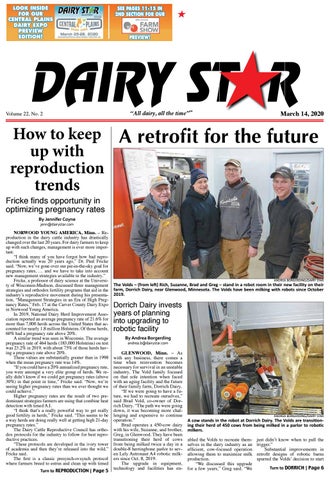
ANDREA BORGERDING/DAIRY STAR
The Volds – (from leŌ) Rich, Suzanne, Brad and Greg – stand in a robot room in their new facility on their farm, Dorrich Dairy, near Glenwood, Minnesota. The Volds have been milking with robots since October 2019.
Dorrich Dairy invests years of planning into upgrading to robotic facility By Andrea Borgerding andrea.b@dairystar.com
GLENWOOD, Minn. – As with any business, there comes a time when reinvention becomes necessary for survival in an unstable industry. The Vold family focused on that sole intention when faced with an aging facility and the future of their family farm, Dorrich Dairy. “If we were going to have a future, we had to recreate ourselves,” said Brad Vold, co-owner of Dorrich Dairy. “The path we were going down, it was becoming more challenging and expensive to continue operation.” Brad operates a 450-cow dairy with his wife, Suzanne, and brother, Greg, in Glenwood. They have been transitioning their herd of cows from being milked twice a day in a double-8 herringbone parlor to seven Lely Astronaut A4 robotic milkers since Oct. 8, 2019. The upgrade in equipment, technology and facilities has en-
ANDREA BORGERDING/DAIRY STAR
A cow stands in the robot at Dorrich Dairy. The Volds are transiƟoning their herd of 450 cows from being milked in a parlor to roboƟc milkers. abled the Volds to recreate themselves in the dairy industry as an efcient, cow-focused operation allowing them to maximize milk production. “We discussed this upgrade for a few years,” Greg said. “We
just didn’t know when to pull the trigger.” Substantial improvements in retrot designs of robotic barns spurred the Volds’ decision to start Turn to DORRICH | Page 6
Page 2 • Dairy Star • Saturday, March 14, 2020
DAIRY ST R www.dairystar.com
ISSN 020355 522 Sinclair Lewis Ave. Sauk Centre, MN 56378 Phone: (320) 352-6303 Fax: (320) 352-5647 Published by Dairy Star LLC General Manager/Editor Mark Klaphake - mark.k@dairystar.com 320-352-6303 (ofce) 320-248-3196 (cell) 320-352-0062 (home) Ad Composition Nancy Powell 320-352-6303 nancy.p@dairystar.com Consultant Jerry Jennissen 320-346-2292 Editorial Staff Krista Kuzma - Editor/Wisconsin (507) 259-8159 • krista.k@dairystar.com Andrea Borgerding - Associate Editor (320) 352-6303 • andrea.b@dairystar.com Jennifer Coyne - Assistant Editor (320) 352-6303 • jenn@dairystar.com Danielle Nauman (608) 487-1101 danielle.n@dairystar.com Stacey Smart - Staff Writer (262) 442-6666 • stacey.s@dairystar.com Maria Bichler - Copy Editor 320-352-6303 Advertising Sales Main Ofce: 320-352-6303 Fax: 320-352-5647 Deadline is 5 p.m. of the Friday the week before publication Sales Manager - Joyce Frericks 320-352-6303 • joyce@dairystar.com Bob Leukam (Northern MN, East Central MN) 320-260-1248 (cell) bob.l@star-pub.com Mark Klaphake (Western MN) 320-352-6303 (ofce) 320-248-3196 (cell) Laura Seljan (National Advertising, SE MN) 507-250-2217 fax: 507-634-4413 laura.s@dairystar.com Jerry Nelson (SW MN, NW Iowa, South Dakota) 605-690-6260 jerry.n@dairystar.com Mike Schafer (Central, South Central MN) 320-894-7825 mike.s@dairystar.com Amanda Hoeer (Eastern Iowa) 320-250-2884 • amanda.h@dairystar.com Julie Barnes (SE WI and Northern IL) julie.b@dairystar.com Megan Stuessel (Western Wisconsin) 608-387-1202 • megan.s@dairystar.com Ashley Curry (Northeast WI and Upper MI) 920-539-7268 • ashley.c@dairystar.com Deadlines The deadline for news and advertising in the Dairy Star is 5 p.m. Friday the week before publication. Subscriptions One year subscription $35.00, outside the U.S. $110.00. Send check along with mailing address to Dairy Star, 522 Sinclair Lewis Ave., Sauk Centre, MN 56378. Advertising Our ad takers have no authority to bind this newspaper and only publication of an advertisement shall constitute nal acceptance of the advertiser's order. Letters Letters and articles of opinion are welcomed. Letters must be signed and include address and phone number. We reserve the right to edit lengthy letters. The views and opinions expressed by Dairy Star columnists and writers are not necessarily those of the Dairy Star LLC.
The Dairy Star is published semi-monthly by Dairy Star, LLC, 522 Sinclair Lewis Ave., Sauk Centre, MN 56378-1246. Periodicals Postage Paid at Sauk Centre, MN and additional mailing ofces. POSTMASTER: Send address changes to Dairy Star, 522 Sinclair Lewis Ave., Sauk Centre, MN 56378-1246.
A glance at the other side
Dairy Star likes to provide local stories, which is why we have two versions of the paper. While the majority of the features are the same, there are many stories in their respective coverage areas that are different. Want to read stories in the other version of the paper? Find full editions on our website, www.dairystar.com and click on the e-edition tab under the Dairy Star header. Here are a few highlights from stories you will not nd in this paper, but you can nd online in zone 2. Rieden helps build operation to what it is today Farming has always been the only way of life for Joe Rieden of Mount Calvary, Wisconsin. He assumed big responsibilities as a kid, including tagging calves by age 7 and mating and breeding the herd by age 14. A cow man through and through, Rieden began buying his own cattle at age 12 and had 40 cows milking by the time he graduated high school in 2004. He and his parents continued growing their herd to its present size of 600, renovating and adding facilities along the way. Ossmanns develop generations of great cows The Ossmanns of Emerald Acres in Shirley, Wisconsin have been breeding high-quality registered Holsteins for more than 50 years. Recently named the Distinguished Holstein Breeder of 2019 by the Wisconsin Holstein Association, the Ossmann family believes in breeding animals with high components, great type and deep pedigrees. The Ossmanns have bred 87 Excellent females and hundreds of Very Good animals and sent numerous bulls to A.I. Soap making hobby becomes protable side business A hobby has turned into a successful side business for Stephanie Tranel and her family. Tranel has been making soap using milk from her family’s organic dairy farm, combined with other ingredients from the farm to create soap which they are marketing as Tranel Family Farm Soap. In just over six months of marketing the soap, they have sold over 2,500 bars of soap through 30 retail locations and direct-marketing through their website to 15 states and two countries.
CONSISTENT, TIGHTLY WRAPPED BALES
RW ROUND AND SW SQUARE BALE WRAPPERS (satellite or turntable)
ō /RZ SURğOH GHVLJQ IRU PD[LPXP VWDELOLW\ DQG JHQWOH XQORDGLQJ • Consistently wrapped to maintain forage quality throughout storage • Patented pre-stretcher with aluminum rollers for easy cleaning • Easy to operate 3–point mounted and trailed models Van-Wall Equipment Albia, IA Indianola, IA Knoxville, IA Lindeman Tractor Atlantic, IA Roeder Bros. Bellevue, IA Vetter Equipment Clarinda, IA Denison, IA Indianola, IA Mt. Ayr, IA Shenandoah, IA
Visit your local KUHN dealer today!
Kunau Implement DeWitt, IA Preston, IA Diagonal Truck & Tractor Diagonal, IA Bodensteiner Implement Elkader, IA J P Scherrman Farley, IA Burco Sales Independence, IA Helmuth Repair Kalona, IA Graber Services Lockridge, IA
INVEST IN QUALITY www.kuhn.com
Carroll Implement LuVerne, IA
Beck Implement Elgin, MN
Dairyland Supply Sauk Centre, MN
Greiner Implement Ottumwa, IA
St. Joseph Equipment Eyota, MN
Miller-Sellner-Slayton Slayton, MN
Engel Agri-Sales Sac City, IA
Dave’s Repair Hills, MN
Woller Equipment Swanville, MN
Dee Implement of Waukon Waukon, IA
Isaacson Sales & Service Lafayette, MN
Jaycox Implement Worthington, MN
Arnold's Alden, MN Kimball, MN Sauk Rapids, MN St. Martin, MN
Fluegge’s Ag Mora, MN
Pfeifer Implement Sioux Falls, SD
Northland Farm Systems Owatonna, MN
Grossenburg Implement Winner, SD
Lindell Sales & Service Cannon Falls, MN
Titan Machinery Pipestone, MN
Mark's Machinery Yankton, SD
®
Dairy Star • Saturday, March 14, 2020 • Page 3
It’s all inside... Columnists Ag Insider
Pages 8-9 First Section
Bon Yankton Homme
ln
co
Lin
Clay
Glenwood
Dorrich Dairy invests years of planning into upgrading to robotic facility
Country Cooking
Page 22 Second Section
First Section: Pages 1, 6 - 7
Lyon
O’Brien
Sioux Plymouth
Clay
Palo Alto
e Buena Vista
Ida
Monona
n inso Emmet
Dick
e ok
er
Ch
Woodbury
h
ca
Po
as
t on
Harrison Shelby
Pottawattamie Cass ry ome
Mills nt
mo
tg Mon
Page
n Win
t
m
Kanabec ms ey
Fillimore
Mower
Worth
Mitchell Howard
Hancock Cerro Gordo
ld bo
Hu
n
lh Ca
go
eba
Kossuth
Floyd
Greene Guthrie
Bremer
Wright Franklin Butler
Boone
Dallas
Houston
Story
Polk
all
Black Hawk
Tama
rsh
Ma
aw
as
ick
Ch
Webster Hamilton Hardin Grundy
ou
Sac
Crawford Carroll
Fre
Washington
Hubbard
Osceola
Freeborn
Faribault
Martin
Jasper
e
Turner
Jackson
iek
Hutchinson
Nobles
Winona
Fayette
Clayton
an
e war Dubuque
an
ch
Bu
Rochester
ake
Charles Mix
Rock
Wabasha
Cottonwood Watonwan Blue Earth Waseca Steele Dodge Olmsted
sh
Douglas
Gregory
McCook Minnehaha
Murray
Goodhue
Rice
am
Tripp
ns
Ha
Moody
Nicollet
Brown
Benton
Dela
Jones
Linn
Iowa
First Section: Pages 22 - 23
Jackson Clinton
on Cedar
s
hn
Jo
Panel presentation explores steps to take when disaster occurs
Scott
Muscatine
n
Todd
on
Lake
Redwood
ne
Brule Mellette
Miner
Scott
Sibley
Lyon
All
Aurora
Sanborn
Brookings
Madison Warren Marion Mahaska Keokuk
Adair
Adams Taylor
Union ld
go
g Rin
Clarke
Lucas
Decatur Wayne
Monroe Wapello se
noo
pa Ap
Davis
gto
Lyman
Jerauld
Kingsbury
W in
Buffalo
Beadle
First Section: Pages 37 - 38
Dakota
hin
Hand
Carver
Wa s
Hyde
Hennepin
McLeod
Renville
Yellow Medicine
iek
Jones
Hughes
Deuel
Hamlin
sh
Stanley
Clark
Fjelstad helps ll need for everyday mental health assistance
we
Sully
Anoka
Wright
Meeker
Zumbro Falls
Po
Ziebach
Isanti
Ra
Spink
Kandiyohi
Chippewa
Lac Qui Parle
Codington
Sherburne
eu r
Grant
Faulk
Potter
Swift
Benton
Stearns
Pope
Su
Day
Stevens
Third Section: Pages 12 - 13
Pine
Mille Lacs
Le
Edmunds
Big Stone
Kid’s Corner: The Berktolds
Carlton
Morrison
Douglas
Lake City
Aitkin
Todd Grant
Lake
Crow Wing
n
Roberts
Marshall
McPherson
Wilkin
Sargent
Otter Tail
Tra ver se
Dickey
Richland
Cass
Wadena
Ransom
Lincoln
Dewey
Becker
Clay
Brown Walworth
Bennett
Cass
Mah
Cook
Itasca
bo
Pages 10 - 11 Second Section
Campbell
Corson
Jackson
en nom
Pipestone
The “Mielke” Market Shannon Fall River Weekly
Bames
LaMoure
McIntosh
Sioux
Pennington Custer
Stutsman
Emmons
Haakon
Polk
Trail
Steele
St. Louis
go
Lawrence
Kidder
Logan
Grant
Making Cents of Dairy Perkins
Page 33 First Section
Burleigh
Morton
Adams
Come Full Circle Meade
Griggs
Norman
Oliver
Page 32 First Section Butte
Foster
Koochiching
du
Sheridan Mercer
Beltrami
isa Ch
Harding
Wells
First Section: Page 36
Lake of the Woods
Red Lake
Eddy
McLean
Roseau
Pennington
Grand Forks
Women in Dairy: Kate Kalthoff
Middendorfs nalize farm transition with third party guidance First Section: Pages 10 - 11
Marshall
Benson Nelson
Page 31 First Section
Kittson
Walsh
Ramsey
McHenry
Ward
Pembina
n
Bowman
Cavalier
Towner
Pierce
Stark Veterinary Wisdom Hettinger
Slope
Rolette
io
Golden Valley
Bottineau
Un
Page Dunn 30 First Section Billings
Third Section: Pages 2 - 3
Roden’s off-the-farm job supports start-up dairy
Da vi so n
McKenzie
Page 27 First Section Mountrail
Dear County Agent Guy
Third Section: Pages 9 - 10
Albany
Verndale
Au
On the Road Renville with Princess Burke Kay
Williams
Browerville
Walter’s 4-H cow becomes family favorite
Page 26 First Section
Divide
Villard
Clearwater
FSA News & Notes
on
ers
f Jef
Van Buren
Louisa
Henry Des
Moines
Lee
Strawberry Point
Zone 1
Venteichers install robotic feeding system
Zone 2
Third Section: Pages 5 - 6
Willmar
2020 a fresh start for dairy First Section: Pages 12 - 13
For additional stories from our other zone, log on to www.dairystar.com
Melrose
From Our Side of the Fence First Section: Pages 15 - 16
Chosen 10,000 times for 10,000 good reasons Reason 9,378: innovation built into every single detail gea.com
Hull, IA Watertown, SD
(712) 439-2081 (605) 753-0300
www.automatedwastesystems.com
Page 4 • Dairy Star • Saturday, March 14, 2020
The future belongs to the few of us still willing to get our hands dirty ANNUAL MEETING th
Wednesday, March 18
• noon
At the St. Peter & Paul Church Basement
MILK REPLACERS $2 OFF/BAG! Call Bryant 320-224-4101 SAVE UP TO
$60/TON
Two positions will be voted on JOIN US FOR
CHICK CHATS
OPEN TO THE PUBLIC
SATURDAY, MARCH 21ST
ON YOUR PURINA WIND & RAIN MINERALS! Call Katie 320-290-5136
9:00 AM
LEARN ALL YOU NEED TO KNOW ABOUT RAISING CHICKENS & OTHER POULTRY.
ATTACHMENTS
INTRODUCING O THE NEW
RENTAL•SALES
WATERERS, FEEDERS, WALK THROUGHS & MORE!
10% OFF ALL IN STOCK T-POST & WOVEN WIRE FENCING
• Rock Buckets • Tree Pulller • Rock Trailer
and many other attachments!
Short on Labor? Short on time? Automatic AGRi-Speed HITCH
We are an exclusive dealer!
• One person operation - eliminate the need for a second hand for hook-ups • Available for pick-ups, choppers, tractors, wagons, etc.
Gilman Co-op Creamery
FEED & FARM SUPPLY STORE
1-800-887-4634•(608) 723-4634 John, Jim & Dave Fuller 423 U.S. Hwy. 61 North • Lancaster, WI
Gilman, MN 320-387-2770
fullersmilkercenter.com
Open M-F 7:30-7, Sat. 7:30-5, Sun. 8:30-1 Good service - fair prices - every day
WWW.GILMANCREAMERY.COM
Dirty Water? CLEAN IT UP WITH
Pure 3000 Chlorine Dioxide Technology
Removes
IRON, MANGANESE and SULFUR in water!
A HIGHLY EFFECTIVE WATER INJECTION SYSTEM
REDUCES:REDUCES:
• Respiratory Issues • Scours
• Respiratory • Crypto Issues • Salmonella • Scours • Crypto • E-coli • Salmonella • E-coli
HIGHLY EFFECTIVE AGAINST: Prototheca • Staph Aureus • Mycoplasma • Pseudomonas FOR MORE INFO - CONTACT ONE OF THESE DEALERS... Advanced Dairy Systems
Athman Dairy Inc.
D&D Ag Supply
9 State Rd. 29 • Spring Valley, WI 54767 (715) 772-3201
238 Main Street North • Pierz, MN 56364 (320) 468-2494
133 Atlantic Ave. NE • Pennock, MN 56279 (320) 599-4466
Advanced Dairy Solutions
Professional Dairy Systems
East Central Dairy Supply
Champion Milking Systems
Eastern Iowa Dairy Systems
278 W. Court St. • Richland Center, WI 53581 1449 Homecrest Ave. • Wadena, MN 56482 (608) 647-4488 (218) 632-5416
Anderson Dairy Systems, Inc. 1312 13 1/2 Ave. • Barron, WI 54812 (715) 537-3300
23218 350th Street • Albany, MN 56307 (320) 845-4156
2195 Hwy. 23 • Mora, MN 55051 (320) 679-1029
105 3rd Ave. NW • Epworth, IA 52045 (563) 876-3087
Fuller’s Milker Center, Inc.
Lang’s Dairy Equipment, Inc.
2337 Millennium Rd. • Decorah, IA 52101 (563) 382-8722 1467 West 5th Street • Winona, MN 55987 (507) 452-5532 Gorter’s Clay & Dairy Equipment 1400- 7th St. SE • Pipestone, MN 56164 Leedstone (507) 825-3271 222 E Co Rd 173, Melrose, MN 56352 (320) 256-3303 Tri-County Dairy Supply, Inc. 24260 Cty. Rd. 27 • Plainview, MN 55964 4107 N US HWY 51 • Janesville. WI 53545 (507) 534-3161 608-757-2697 423 U.S. 61 • Lancaster, WI 53813 (608) 723-4634
Leedstone
2545 80th Ave • Woodville, WI 54028 (715) 698-4370
United Suckow Dairy
12687 Hwy 18 & 52 • Postville, IA 52162 (563) 864-7417 210 N. Industrial Pkwy • West Union, IA 52175 (563) 422-5355
Dairy Star • Saturday, March 14, 2020 • Page 5
ConƟnued from REPRODUCTION | Page 1 insemination. The second is a double ovsynch fertility program. Both programs are described in detail on the DCRC’s website. “The most important thing to do on your farm is to put a plan in place and follow the plan,” Fricke said. “Having a plan is better than changing avor of the month every month.” Reasons to improve 21-day pregnancy rates are found in milk production, calves produced, culling decisions and the nancial costs of reproduction management. Models have shown that by increasing the pregnancy rate from 13% to 22%, farmers gain an additional $188 per cow per year. Yet, the gain is not as great when improving from 22% to 30% pregnancy rate as the return is $99 per cow per year. “Statistician George Box once said essentially all models are wrong, but the practical question is, ‘How wrong do they have to be to be useful?’” Fricke said. “My quibble with these models is they don’t take into account what you guys are doing now with repro. If you take away fertility programs and what we know, you’ll be back at a 14% pregnancy rate.” Genomic testing and the use of sexed and beef semen are now popular management strategies in the dairy industry. By breeding for daughter pregnancy rate and using a fertility program, farmers can see their reproduction improve. In adding genomic testing, an animal’s genetic merit is known as early as 4 months old. “Genomics is a technology the geneticists are really happy about because it made genetics important again,” Fricke said. “There are real things about genetics and genetic improvement.” Now, with advances in reproduction management, herd management has also shifted.
“When you have 30%-40% pregnancy rate, you don’t need more heifers,” Fricke said. “Now, it’s all about heifer management strategies.” Both sexed semen and beef semen have helped create more productive herds by retaining high-end genetics and turning a prot on the lower-end genetics through beef sales over dairy. Fricke said dairy farmers should be mindful in how they use sexed semen, remembering that it is not necessarily as effective as conventional semen on the herd as a whole, but with rst-service heifers the benets are evident. “There’s a misconception out there that sexed semen is not as fertile as conventional semen. It should have higher fertility because you’re using it on your rst lactation heifers, the most fertile in your herd,” he said. “Take that into account when looking at 21-day pregnancy rates.” Sexed semen was introduced to the dairy industry in 2006, and every year since it has gained a larger share in the marketplace. Beef semen has seen a similar trend. “How long before conventional semen goes away?” Fricke said. “I think it’s already happening.” Fricke said that in 2019, AgSource released a report that showed nearly 20% of Holsteins were bred to sexed semen, another 20% to beef semen and 60% to conventional semen. The same report showed 40% of Jerseys were bred to sexed semen and 25% to beef. “We see a lot of herds culling animals they don’t want to raise,” Fricke said. “Get your replacements from the top end and breed the rest to beef.” All of these strategies, including fertility protocols, have advanced the dairy industry’s reproductive performance in ways many could not have imagined 20 years ago.
TRUST THE EXPERTS At Famo Feeds, we strive to provide the best support for your operation and work to accommodate your specific needs.
From calf to cow and everything in between!
FEED THEM FAMO! 320-836-2145 or 800-450-2145
Check out our newly redesigned website to ½nd a Famo Feeds dealer near you!
www.famofeeds.com
GRAND OPENING
Customer Appreciation Day AT OUR NEW LOCATION AT
501 22nd St. • Zumbrota, MN TH on
MARCH 19
Please put our new number in your cell phone
507-732-4673
FREE Lunch Served 11 a.m.- 2 p.m.
10%
DISCOUNT
ON EVERYTHING (Cash only)
CALL US FOR ALL YOUR SERVICE NEEDS MENOMONIE, WI • 715-235-5144 ZUMBROTA, MN • 507-732-4673 BEATRICE, NE • 800-742-5748 SIOUX FALLS, SD • 800-705-1447
Contact us at our new number (507) 732-4673 or at our old number (800) 233-8937
Page 6 • Dairy Star • Saturday, March 14, 2020
Con�nued from DORRICH | Page 1
Willmar, MN • 320.231.1470
EXPANDING OR REMODELING YOUR LIVESTOCK OPERATION? LANGE AG SYSTEMS SPECIALIZES IN:
Ŷ NEW FACILITIES
_
NO JOB TOO BIG OR TOO SMALL
Ŷ RETROFITTING & REMODELING Ŷ TURNKEY PROJECTS Ŷ BARN DESIGN Ŷ INSTALLATION, MAINTENANCE & REPAIRS
ƋƵŝƉŵĞŶƚ tĞ KīĞƌ͗ ͻ sĞŶƟůĂƟŽŶ &ĂŶƐ ͻ sĞŶƟůĂƟŽŶ ŽŶƚƌŽůƐ ͻ WŽƐŝƟǀĞ WƌĞƐƐƵƌĞ dƵďĞƐ ͻ ƵƌƚĂŝŶ ^LJƐƚĞŵƐ ͻ DĂƩƌĞƐƐĞƐ ͻ tĂƚĞƌĞƌƐ ͻ ^ƚĂůů ƋƵŝƉŵĞŶƚ ͻ ,ĞĂĚůŽĐŬƐ ͻ DŝƐƟŶŐ ^LJƐƚĞŵƐ
Lange Ag Systems is proud to offer Grain Bags, Silage Bags & Bunker Covers from Up North Plastics and Feed Fresh Silage Covers & Custom Size Bunker Covers from Raven!
t ^ >> E t Θ h^ 'ͳ ' Θ < >>z Zz E '' Z^
www.LangeAgSystems.com Jim’s Electric Service
Serving Central Minnesota since 1977 Taking care of all your electrical needs fast and efÀciently.
Jim Schulzetenberg and crew are here to give you the best job!
The experienced crew - Jim Schulzetenberg along with Mike, Dennis, and Jared give you the best job.
320-987-3587
JIM’S ELECTRIC SERVICE
J I M ’S E L E C T R I C S E RV I C E
JIM’S ELECTRIC SERVICE • JIM’S ELECTRIC SERVICE • JIM’S ELECTRIC
JIM’S ELECTRIC SERVICE • JIM’S ELECTRIC SERVICE • JIM’S ELECTRIC
“JETCRETE”
(pnuematically applied concrete)
• Reline your silo w/Jetcrete • Basement and Barnwall Resurfacing w/Jetcrete • Repair Concrete Storage Vats, Bunker Silos, Buildings, etc., w/Jetcrete
800-866-7327
ANDREA BORGERDING/DAIRY STAR
Five robots milk the cows in a six-row pen (le�) and two robots milk the cows in a three row pen. The robo�c milkers were added to the end of the freestall barn at Dorrich Dairy. construction on the facility in April 2019. “It was just in the last few years that retrotting our barn could be done fairly and effectively,” Greg said. “It really opened the door for us.” Today, Dorrich Dairy consists of a nine-row freestall barn with a center aisle and side feed alley dissecting the barn with three rows on the west side and six rows on the east side. The robots were added to the south end of the barn. Two robots service the cows in the three-row pen. This pen consists of early lactation cows and any lame cows. Cows can be ltered to a bedded pack area behind the robots which includes a working chute. This area is used to hold fresh cows or for veterinarian work. Five robotic milkers service the six-row pen. All cows exit the back of the robots. From there, the cows can be directed back to the group pen or rerouted into a 14-stall freestall pen. This area includes a small pit area with two working chutes on either side for dry off treatment. “We are trying to minimize disturbances with the cows when they are lay-
ing down,” Greg said. “When we need to work with cows, we reroute them to a separate area, and then they are either transferred out of the facility for dry off or routed back into the pen without disturbing all of the cows.” A ve-robot pen is something that sets apart the Volds’ facility from other robotic facilities and left the Volds the challenge of managing a large pen of cows. The Vold manage the six-row pen in zones with the help of a gating system designed between robots and fetch pens that can hold up to 30 cows. “We work with three different zones (four alleys) while fetching cows to feed the ve robots,” Brad said. Breeding shots and vaccinations are managed in several passes through the pen to gather cows. “The key is patience,” Suzanne said. “I may have to do several 15-minute passes during the day versus one 45-minute block of gathering cows for shots.” Change in management mentality is something the Volds said they had to Turn to DORRICH | Page 7
Do your forages have you in a frenzy this year? Join Form-A-Feed at Central Plains Dairy Expo for tips on managing the storm! ANDREA BORGERDING/DAIRY STAR
The Volds – (from le�) Greg, Brad, Suzanne and Rich – visit near the observa�on windows in their new office space. The robo�c milkers have allowed the owners to spend �me managing other areas of the farm. Before, most of their �me was spent milking.
Visit booth 490-491 at Central Plains Dairy Expo to learn about managing the storms that challenge even the best forage managers!
App-A-Tite Ask your Form-A-Feed representative to help you disco discover the right forage management tool for your operation!
www.formafeed.com (800) 422-3649
Blue Hilltop, Inc.
Sign up for our Newsletter
Your Mixer, Spreader, Hay Processor Headquarters We carry:
www.rotomix.com LLC
Dana Berreau
507-879-3593 / 800-821-7092 Box 116, Lake Wilson, MN 56151
Dairy St r Milk Break Email andrea.b@dairystar.com
Dairy Star • Saturday, March 14, 2020 • Page 7
ConƟnued from DORRICH | Page 6 adapt to in order to be successful in the new facility. Considering a high producing cow’s future in the herd because of her time consumption in the robot is now a factor in efciency. “If they aren’t adapting to the robot or are extremely slow, those are mindsets we have to make a shift on,” Suzanne said. “A cow isn’t working here for completely different reasons.” An unexpected shift the Volds did not predict was reverting to a more individual cow focus. What they reference as a tiestall mentality is where the data gathered by the robotic milkers on each cow has allowed them to manage individual cows based on their needs including feeding, milk production and health. The incorporation of new technology has allowed them to manage on a cow-by-cow basis versus adjusting by group of cows. “We’ve integrated technology into a tiestall barn mentality of management,” Brad said. “Which we are nding out is really good for the cow.”
ANDREA BORGERDING/DAIRY STAR
AŌer going through one of ve robots, cows can be ltered into this freestall area which features two work chutes and a pit for dry treaƟng cows before they leave the facility.
ANDREA BORGERDING/DAIRY STAR
Steve Czech works as the feed manager for Dorrich Dairy. He has worked for the Volds for 25 years.
Greg agreed. “We are back to individual cow focus again, and with this technology, we can do that efciently and effectively,” Greg said. The Volds have now been able to keep the labor source within the family in addition to a full-time feed manager. Labor challenges were a driving force in the Volds’ decision to install robotic milkers. Previously, lack of reliable labor among other challenges was keeping them from milking three times a day in their parlor. The goal now is to build the number of cows milking to 410 then keep cow numbers the same and expand by
production. The Volds culled 12 cows last September prior to starting in the robots. Once the robots started milking in October, 24 more cows were culled. They included cows that were too far out to dry off and others that were not transitioning. Culling animals has been minimal since. Still in the process of transition, the Volds are quick to recognize the importance of having the support and knowledge of their construction crew and automatic milking system team for walking them through the transition process. “Our nutritionist and vet also have experience working with robot herds so
got room in your tank?
Bongards’ Creameries
Has been a quality market for MN dairy farmers for over 100 years. MN producers provide one of the country’s most distinctive brands of cheese that is still made using the same Old World craftsmanship and has been combined with cutting-edge technology to produce cheese that delivers unforgettable taste with unparalleled quality. MN Dairy farmers and Bongards, quality that stands the test of time. We offer a competitive base price, premiums, and the best Àeld representatives in the industry. 13200 Co. Rd. 51 Bongards, MN 55368 (952) 466-5521 Fax (952) 466-5556 110 3rd Ave. NE Perham, MN 56573 (218) 346-4680 Fax (218) 346-4684
we are constantly learning from them,” Greg said. Even with the ongoing transition and challenges of shifting management mentality, the Volds said they have never looked back. “It was never even a discussion,” Brad said. Greg added that after that initial introduction into the robotic milkers, they began thinking of all the hours and people they were utilizing just in milking 380 cows. “Now we have a couple hours in the morning and a few hours at night,” Greg said. “That leaves time for us to focus on things other than milking.”
We Finance/Lease Dairy Cattle!
• • • •
Increase your production and your proÛts Free up capital for other needs Avoid complicated bank loan processing Lease will be personalized to your operation
USMC/CHINA PHASE ONE TRADE DEALS CONFIRMED. Milk prices are headed up!
Sunshine Heifers
Your leader in dairy cattle Ànancing/leasing!
Contact: 602-768-6678
Congratulations to Dorrich Dairy!
Looking to automated milking for cow efficiency, labor savings, and long-term sustainability, the Vold Family worked with Leedstone on their conversion from parlor to robotic milking with 7 Lely A4 robots. t
“It’s an honor to work with dairies like the Vold family.They’re dedicated ambassadors to the dairy industry and we’re happy to help them reach their goals.” – Clay Tennant, Farm Management Support (FMS) Specialist
Leedstone.com • 888.267.2697 •
Melrose, MN: Jake Moline 320.761.9630 jmoline@Leedstone.com Randy Arnhalt 320.267.3235 rarnhalt@Leedstone.com
Melrose, MN: Don Brower 320.267.1604 dbrower@Leedstone.com
Menomonie, WI: James Shearer 715.760.2262 jshearer@Leedstone.com
Glencoe, MN: Paul Becker 320.510.0200 pbecker@Leedstone.com Chad Janezich 763.333.4887 cjanezich@Leedstone.com
Plainview, MN: Gregg Luebke 507.696.5518 gluebke@Leedstone.com Mark Jurgenson 507.259.8047 mjurgenson@Leedstone.com
Dairy groups object to Dean Foods/DFA deal Page 8 • Dairy Star • Saturday, March 14, 2020
A group of dairy cooperatives have led a lawsuit, our industry. However, if we cannot combat outraobjecting the proposed Dean Foods bankruptcy sale geous nontariff barriers, such as those the EU is to Dairy Farmers of America. The dairy groups claim manufacturing to block the export of American-made this merger would “effectively consolidate DFA’s grip cheeses, these trade wins can ring hollow.” Jacquier on the national milk market.” The co-ops objecting chairs the Agri-Mark cooperative board. to the Dean Foods/DFA deal include Ag Insider NFU supports supply management Lone Star Milk Producers, Agri-Mark, During the National Farmers Union Cayuga Marketing, Cobblestone Milk Convention, delegates passed six speCooperative and Maryland and Virginia cial orders including one dealing with Milk Producers Cooperative Association. dairy policy. This special order said the Dairy Margin Coverage program does DFA postpones annual meeting not address the issue of oversupply and Dairy Farmers of America has postCongress should establish a mandatory poned its annual meeting, which was supply management program. NFU said scheduled for March 16-18 in Kansas this program should allow for the entry City. The decision was made “out of an of beginning farmers, reduce government abundance of caution” due to the coronaexpenditures, respond to global market virus outbreak. conditions, allow for on-farm processBy Don Wick ing, value-added and direct-to-consumer China takes action on dairy product Columnist sales and be designed in a way that any exports production base does not acquire value. Progress is being made in implementing phase one of the trade agreement between the U.S. and China. The most recent actions by China include NFU elects new president The newly elected National Farmers Union Presilifting a ban on beef imports from animals over 30 months of age and updated facilities approved for ex- dent Rob Larew said he will focus on building off porting dairy products. In addition, a new tariff exclu- of the current strength of the organization. “Times sion process is in place, allowing Chinese importers are tough. There are lots of challenges, not the least of which is what the weather will be like this spring. to apply for exclusion from retaliatory tariffs. When we work together, we’re going to be a lot stronger.” Larew said the farm economy continues to drive Dairy exports up in January U.S. dairy exports topped 428 million pounds in a lot of policy priorities for the organization. “The efJanuary, up nearly 70 million pounds from January of fects of trade policy, whether or not we get another 2019. According to the USDA report, exports of non- Market Facilitation Program and whether or not we fat dry milk and skim milk powder was up 41% from need to be looking at changes in the farm safety net. last year. Whey protein concentrate sales increased Then, there are challenges of concentration across the 60%. Cheese exports increased less than 1% and but- ag space and climate change.” NFU Policy Director Mike Stranz will be lling in for Larew’s former ter exports were down more than 18%. role. Wisconsin farmer Patty Edelburg was also reelected NFU vice president during the convention. Dairy farmer testies in Congress Connecticut dairy farmer James Jacquier testied before a House Agriculture subcommittee, pro- NMPF lobbies for ag labor solution Dairy farmers from throughout the country spent viding a dairy industry perspective on trade. “America’s dairy farmers applaud the certainty that lowered two days on Capitol Hill earlier this month. The Natariffs and fairly negotiated trade agreements bring tional Milk Producers Federation legislative y-in
called for an agricultural labor bill that would provide a stable, secure labor force for U.S. dairy farms. “The situation is dire,” said Jim Mulhern, president and CEO, NMPF. Peterson seeks another term House Agriculture Committee Chair Collin Peterson is seeking reelection in 2020. Peterson has served in Minnesota’s seventh district since 1991.
Budget surplus in Minnesota Minnesota has a projected $1.5 billion surplus. Bruce Kleven, who is a lobbyist for numerous agricultural groups, said the lawmakers have different ideas for that money. One option is Section 179 conformity. According to Kleven, Section 179 conformity would cost about $240 million. “In theory, there’s money in the surplus to take care of this and with bipartisan support by the end of May that should be xed, but it’s not in the bank yet.” A few other options being considered include grain bin safety, funding rural mental health advocates and animal health. State considers help for farmers Minnesota lawmakers are considering legislation to help farmers navigate tough times. One option is funding for farm crisis loans. Riverland Community College Farm Business Management instructor Dan Miller testied at a House committee hearing, saying farm income is at a disastrous level. “Net farm income in 2019 was about half of what it was in 2013. Equity or net worth as a percentage has diminished,” explained Miller. “Due to cash ow challenges, farmers are renancing short term debt.” Miller also said the Market Facilitation Program payments helped farmers signicantly in 2019, but they are not guaranteed for the future. State responds to coronavirus outbreak Minnesota Governor Tim Walz has authorized funding to help the state respond to a potential coronavirus outbreak. This includes $21 million for the public health response contingency account. The Turn to AG INSIDER | Page 9
You Know Farming, AND SO DO WE. Specializing in Custom-Designed Agricultural Facilities Since 1970. Big or Small, We Design/Build Them All. Designers
| Construction Managers | Builders
400 Brickl Road | West Salem, WI 54669-0125
Toll Free: (800) 658-9030 | Web: BricklBros.com
Dairy Star • Saturday, March 14, 2020 • Page 9
ConƟnued from AG INSIDER | Page 8
funds will be added to the existing $4.6 million in the account to total approximately $25 million for disease investigation, public information laboratory analysis and more.
WASDE report revises 2020 milk output gure The March World Supply Demand Estimates from USDA forecast 2020 milk production at 222.3 billion pounds, up 300,000 pounds from last month. The USDA report revised downward the price projections for cheese, butter and NFDM. As a result, the all-milk price forecast declined 60 cents to $18.25 per hundredweight. Recall The North Dakota Department of Agriculture is investigating the possible use of a sanitizing agent that was mistakenly introduced to a small portion of milk during production at the Cass-Clay plant in Fargo. The milk was distributed in northwest Minnesota and North Dakota. A recall was made
for the Cass-Clay 1 percent milk with a ‘best by date of 3/19 and a time stamp between 16:30 and 17:30.’ Trivia challenge Elsie is the name of the cartoon cow mascot for Borden Dairy. That answers our last trivia question. For this week, who is the president and chief executive ofcer for the U.S. Dairy Export Council. We’ll have the answer in the next edition of Dairy Star. Don Wick is owner/broadcaster for the Red River Farm Network, based in Grand Forks, North Dakota. Wick has been recognized as the National Farm Broadcaster of the Year and served as president of the National Association of Farm Broadcasting. Don and his wife, Kolleen, have two adult sons, Tony and Sam, and ve grandchildren, Aiden, Piper, Adrienne, Aurora and Sterling.
What is on your checklist for roasted soybeans? Energy Protein Amino acids Bypass protein
SERVICE Easy accessibility Quick loading times Quality and consistency
A Bovy Believer “It’s super easy to look up any info you need on a cow.” What do you use Bovy to look up? I use Bovy a lot to check on DIM and DSLH for breeding. It’s easy to check an individual’s SCC on last test. How has using Bovy helped you and your dairy? It’s super easy to look up any info you need on a cow. Saves a trip to the paper work. How many years have you been testing with DHIA? I started DHIA in 2016. How has testing with DHIA beneÀtted your dairy? It allows me to know a lot of information about each individual cow. Small things like the fat and protein are common Dorvin Martin knowledge because of Belgrade, MN • 112 cows testing. Minnesota Dairy Herd Improvement Association 307 Brighton Avenue South Buffalo, MN 55313 1.800.827.3442 www.mndhia.org
DHIA: Now MORE than ever
CHECK US OUT THE NEXT TIME YOU ARE LOOKING FOR ROASTED SOYBEANS.
KLC Farms Roasting, Inc.
Preferred By Bovines Everywhere
1-877-738-2326 Visit www.roastedbeans.com
Quality
Consistency
WHICH BARN IS BEST FOR YOUR HERD?
Birds just love this barn. The webs in these trusses are easy nest areas for birds. They also restrict air flow which leads to poor ventilation and moisture buildup in the building.
Starwood Rafters Uses Pole Sheds • Free Stalls Riding Arenas Pavilion Shelters Machinery Storage
The arched rafters create a more open barn allowing better ventilation. Also since there are no open webs in the trusses, there are no places for birds to nest.
• Spans up to 72 ft. • Up to 12’ spacing depending on the load you desire • Bird nesting control • Better ventilation & visability • No feed alley post obstruction • Additional ceiling height
Starwood Rafters Lam-Ply Truss
ANOTHER QUALITY PRODUCT FROM STARWOOD RAFTERS
STARWOOD RAFTERS, INC. 715-985-3117
W24141 Starwood Ln. • Independence, WI 54747 Website: www.starwoodrafters.com
888-525-5878
1-800-887-4634•(608) 723-4634 John, Jim & Dave Fuller 423 U.S. Hwy. 61 North • Lancaster, WI
fullersmilkercenter.com
Page 10 • Dairy Star • Saturday, March 14, 2020
Lindell Sales & Service 37236 County 56 Blvd., Cannon Falls, MN
651-258-4311 • Mark’s Cell 651-764-4084
We carry... HOULE
“There’s nothing else to do other than turning the keys over.” – Dan Middendorf
A seamless change in ownership
KEEP YOUR EQUIPMENT DRY! Wash Bay/Divider Curtains
VINYL OR INSULATED OPTIONS AVAILABLE
Call us at 320-219-0802
Long Prairie Tarp Inc. Jesse Swartzentruber, Owner
17383 231st Ave. Long Prairie, MN
Visit us online at
lptarp.com
CUSTOM COVERS, REPAIRS and INDUSTRIAL SEWING
FARM-RITE EQUIPMENT, INC.
www.farmriteequip.com
It’s hard to believe the best can be even better. But with extensive feature upgrades, increased visibility and a more comfortable cab, Bobcat® 500 platform loaders defy the odds. Dassel, MN
320-275-2737 888-679-4857
Willmar, MN
320-235-3672 877-484-3211
St. Cloud, MN Long Prairie, MN 320-240-2085 844-262-2281
320-732-3715 866-514-0982
JENNIFER COYNE/DAIRY STAR
Joel Middendorf (front) is in the process of purchasing the dairy farm from his dad, Dan. The Middendorfs have spent the past three years developing and implemenƟng a transiƟon plan for the 120-cow organic dairy in Wadena County near Verndale, Minnesota. Not pictured are Dan’s wife, Rosie, and Joel’s wife, Maureen, who are also a part of the farm transiƟon.
Middendorfs nalize farm transition with third party guidance By Jennifer Coyne jenn@dairystar.com
CANOLA MEAL CORN GLUTEN FEED CORN DISTILLERS GRAINS CORN STARCH LINSEED MEAL FLAX SEED OAT HULLS RICE HULLS SOYBEAN MEAL SOY BEST SOYBEAN HULLS SOY FLOUR SOY PLUS
8
AMINO PLUS SOY ISOLATE WHEAT MIDDS WHEAT GERM MEAL BEET PULP CASEINATES CHEESE SCRAPS SAW DUST FOOD BY-PRODUCTS LACTOSE NONFAT DRY MILK SUGAR/DEXTROSE WHEY PROTEIN POWDER
VERNDALE, Minn. – The Middendorfs are nearing the end of what has been an overlong journey. In just a few weeks, Dan and Rosie Middendorf will give ownership of their dairy to their son, Joel, and his wife, Maureen. After two years of discussing the business structure and vision for the farm, the family has setup a succession plan; but none of it would have been possible without the assistance of non-family members. “It’s absolutely necessary to have a trusted third party involved with your transition plan,” Joel said. “Unless you have someone looking at the big pictured, unbiased, you don’t really know where you want to go and you’ll never get there.” Joel oversees the day-to-day tasks on his family’s 120-cow organic dairy farm in Wadena County near Verndale. Together with Dan, the father-son duo also runs 400 acres of cropland and 300 acres of grass and pasture land. “Any decision about eldwork is totally up to Joel. He decides what’s planted and where,” Dan said. “Any big decisions for the farm we still make together.” Joel returned to the farm in 2017. After a year of working as an employee for Dan and Rosie, they began discussions on what was the best route to fully transition the farm to Joel and his family. The Middendorfs worked with a nancial planning rm based in Mankato to determine if the transfer would be viable. “It had got to the point that we had to do something because Dad needed to back off from the farm for his health,” Joel said. “In the same sense, though, if things weren’t going to work nancially, we knew this wouldn’t work.” Nearly a decade ago, the Middendorfs tried to transfer the farm. Dan and Joel were working in an informal 50:50 partnership, and they discussed Joel taking on more ownership. Yet, the timing was not right for a farm transition.
“We’ve been almost through this process before,” Joel said. “It came down to seeing what Dad wanted to do and if he wanted to stop farming. That answer was no.” Dan agreed. “At that point, Joel leaving was the best we could do,” he said. “There were no hard feelings and it was an amicable split.” The conversation changed after Dan suffered a brain injury from a car accident in 2014. Joel and his siblings returned to the farm to help their father as he recovered.
“It really became a matter of how we were going to make the nances work so I could come back.” JOEL MIDDENDORF, DAIRY FARMER
For the following three years, Joel managed the eldwork and his sisters dealt with the dairy. “I was never far away,” said Joel who was a welder at the time. “It really became a matter of how we were going to make the nances work so I could come back.” When Joel was able to return full time, the stage was set for the Middendorfs to plan their future. “We each sat down with the planner separately and listed off our goals,” Joel said. “What we found was that this time we had very similar goals which made it easy to move forward.” The Middendorfs carefully reviewed the business structure of the farm and made a plan that would benet both parties when the transition was complete. For the families, it was important there would be money for Dan and Rosie to retire on, they would have the nancial means to pay off existing debt, and Turn to MIDDENDORFS | Page 11
Dairy Star • Saturday, March 14, 2020 • Page 11
ConƟnued from MIDDENDORFS | Page 10
712-722-3626
SERVICE AFTER THE SALE Q-Catch 8500V Vet Squeeze Chute
Cowpower 1050 hyd. chute
JENNIFER COYNE/DAIRY STAR
The Middendorfs – (from leŌ) Rosie, Dan and Joel – review farm paperwork at Rosie and Dan’s home near Verndale, Minnesota. the farm would still be able to support Joel’s family. “The most important thing was knowing we could retire, and Joel could make a future to survive on the farm,” Rosie said. “Secondly, we needed to know we had our bases covered and nothing was going to legally backre on us down the road, that Joel is protected.” To meet these objectives, the Middendorfs needed to change the management of their dairy. They were operating under a quota from their cooperative, so rather than increasing cow numbers, Joel focused on crossbreeding to Jerseys to improve components. There were also familial matters to work through. “This process has been slower than we expected, but that’s happened to be a good thing,” Joel said. “Looking back, a lot of things have resolved themselves.” In 2018, Dan and Rosie moved off the farm and into a house 3 miles away. The move allowed the elder Middendorfs to separate themselves from the dairy and for Joel and Maureen to be more engaged in the day-to-day happenings of the farm. Since Dan’s accident, he has continually done less and less of the chores for his own health and safety. He does milk every morning and some evenings, and enjoys completing projects on the farm.
“Before when we tried this, I wasn’t ready to stop farming but now it’s time I step back,” Dan said. “And not living on the farm has helped me take my mind off it.” Rosie agreed. “Moving off the farm has made a big difference,” she said. “Now, Dan maybe doesn’t feel so obligated to do work if he can’t or doesn’t want to.” All in all, the Middendorfs are pleased with the process it took to get them to this point. “My biggest concern, aside from money, was decision making,” Dan said. “I didn’t want to step on Joel’s toes. This is his future and he needs to make those decisions for him.” Joel agreed. “It’s been really helpful that everything’s on paper,” he said. “We know what each other’s expectations are, how we want it to go and what the time frame looks like.” As the details of the transition are nalized and set to paper, the Middendorfs have no regrets about the way in which they have transitioned the farm. And, each one of them is looking forward to their new role in the family dairy. “A lot of things affect dairying that you can’t control, but this, this we’ve been able to keep in harmony,” Dan said. “There’s nothing else to do other than turning the keys over.”
Easy Cattle Handling
A floor that works as hard as you do! EASY TO CLEAN! IMPERVIOUS TO MILK AND WATER!
We Sell and Service Generators!
Each WINCO PTO generator is designed using the highest quality components and the best workmanship available.
USED GENERATORS
Katolight 35 KW ..................... $3,000 Honda 5500W gas generator $1,100 Niagra 15 KW w/powershaft ..... $900 Onan 15 KW PTO generator .... $850
WE HAVE HANSON SILO REPLACEMENT PARTS AVAILABLE! WE STOCK FRACTIONAL TO 10 HP SINGLE AND 3-PHASE MOTORS! Baldor 3 HP, 3450 rpm ............... $200 Weg 10 HP motor ....................... $600
MOTOR REPAIR • quick • dependable • nearly 40 years experience
AMPS, INC. 105 County Rd. 10, Albany, MN • 320-845-4690
DESIGNED FOR PUNISHMENT WE ALL KNOW THE CONCRETE IS BAD!!
WE CAN REFURBISH IT! PARLORS, FEED BUNKS, MILKING AREAS, VET AREAS, NEW OR OLD FACILITIES
Book now to receive winter discounts. JOHN BOECKNER
320-808-3284 johnbrww@runestone.net
Page 12 • Dairy Star • Saturday, March 14, 2020
2020 a fresh start for dairy
Prepare for more changes going into next decade By Jennifer Coyne jenn@dairystar.com
WILLMAR, Minn. – The industry has seen the light at the end of a long, dark tunnel shaped by the most turbulent markets in recent history. To carry the momentum, there are ve positives that will help shape the dairy community in the next decade, according to Dr. David Kohl. Yet, these positives will certainly be faced with challenges as the industry propels forward. “We’ll see more change in the next 10 years than the past 70,” Kohl said. “We’ve made it through the awkward teenage years, and the 2020s are going to be the fork in the road. It’ll be up to you to decide which fork to take.” Kohl, professor emeritus at Virginia Tech, presented “Getting a Grip on Ag Economics and Your Business” Feb. 20 in Willmar. The event was a part of Ridgewater College’s Farm Business Management Education program. The rst positive Kohl noted are low and stable interest rates due to $18 trillion worth of negative interest rates worldwide. “That’s particularly critical for young farmers or anyone who
JENNIFER COYNE/DAIRY STAR
Dr. David Kohl explains the outlook for the agriculture industry during his presentaƟon, “Geƫng a Grip on Ag Economics and Your Business” Feb. 20 in Willmar, Minn.
borrows money,” Kohl said. “It keeps your land values up. In contrast to the 1980s, this is a positive.” Similarly, energy costs are stable. After the terrorist attacks Sept. 11, 2001, the United States made a goal to become energy independent by 2030. The goal was met in 10 years with ethanol, fracking, solar panel and wind turbines to become the globe’s No. 1 energy producer.
“When Iran launched those missiles, if that would’ve been 40 years ago and during harvest, you would’ve seen fuel prices skyrocket,” Kohl said. North America as a whole is a strong energy producer with Canada ranked No. 4 and Mexico No. 8 for global energy production. “We have three of the top 10 teams here,” Kohl said. “Being energy
stable is very good.” One other stable component is land values which are aided with the low interest rates. Baby Boomer farmers are continuing to purchase farm ground either for themselves or a future generation. Kohl thought the industry would see this trend continue for the next 10 years. Market volatility will not go away, but there are tactics farmers can use to weather the sharp downturns. Kohl suggested making small, proactive decisions. “We’re only in the rst inning of market volatility in the extremes. We’re entering the decade of base hits, and base hits give you a round of bases,” Kohl said. “Follow your fundamentals and put logic into emotional issues.” One important decision may be transferring the farm. The industry has seen accelerated intergenerational transfer but not all have been successful. Kohl said there is the 40-20-40 rule the industry is shaped by: 40% of farm transfers are an emotional rollercoaster and 20% will be confusion, neither accomplishing the set goal. Only 40% will be truly successful. “Those who are four to seven generations in will get the younger generations involved early, they will invest in a facilitator to keep it going and keep non-farm children Turn to MARKETS | Page 13
A&C Farm Service Inc. Jct. Hwys. 55 & 23, Paynesville 320-243-3736
15% OFF
ALL CASH & CARRY PARTS OR STOCK ORDERS
20-25% OFF WIX FILTER PRODUCTS
*EXCLUDES SALE ITEMS
55 Gal. Drum 15W40
595
$
IN MARCH!
Jct. of Hwy 23 & 55 • Paynesville • 320-243-3736 • www.acfarmservice.com
1 BIG WEEK!
March 23 – 28
Monday-Friday 8 a.m. – 5:30 p.m. Saturday 8 a.m. – 3 p.m. Sale prices good March 23 – 28.
After March 30, sale prices are not available
Refreshments & Snacks Served
March 23-28
Dairy Star • Saturday, March 14, 2020 • Page 13
Forages in short supply Hay auctions see good quantity of product, low inventory of quality feed By Krista Kuzma
krista.k@dairystar.com
CALEDONIA, Minn. – Last summer was not a typical season for putting up forage for Cole Hoscheit on his family’s dairy. The challenges from growing good quality forages last year continued through the winter and into the new year. “It was hard to put up good quality haylage,â€? Hoscheit said about the growing season last year. “We just didn’t get any good drying days, and we had some winter kill.â€? This has caused a shift in Hoscheit’s herd’s ration and puts feed in short supply for his family’s 300-cow dairy near Caledonia. “We made the decision (last August) to chop more silage which was probably a good thing,â€? Hoscheit said. “Since my haylage is short, my silage is going to be short too.â€? This means Hoscheit has bought more hay than he has in the past. And he is not the only one. “The real high-quality hay is in high demand and is harder to ďƒžnd,â€? said Al Wessel, from Mid-American Auction Co. in Sauk Centre, Minnesota. “It wasn’t a perfect year for making optimum forage so the folks are digging in their bag of tricks to supple-
ment with poorer quality hay.â€? Wessel said the highest quality hay most sought after by dairy farmers is selling upwards of $300 per ton with the second highest quality hay selling between $220 to $270 per ton during his business’s weekly auctions. Grass hay that has been stored inside and has a good relative feed value will sell close to $200 per ton, Wessel said. Mark Oberholtzer is also seeing a large demand and low supply of the highest quality alfalfa at his business, Oberholtzer Dairy Cattle and Auctions in Loyal, Wisconsin. “Good hay still sells quite well,â€? Oberholtzer said, whose business sells inventory by the bale. He said an 850-pound bale of topquality hay sells between $110 and $130 while the best grass hay in 3-by3-by-8-foot bales sells between $70 to $90 each. “I wouldn’t be surprised throughout March and April if we see it go up a little as people realize their stockpiles won’t quite reach until green grass grows,â€? Oberholtzer said. While the best hay is in short supply, there is not a lack in inventory of lower quality forages. “It seems there’s deďƒžnitely more hay on the market than we were expecting,â€? said Oberholtzer, whose auction sells up to 1,500 bales every
Thursday. Wessel agreed. “The last sale we had (March 5) was the biggest sale we had of the season,� he said. “The hay has been out there. It’s just that a lot of folks will wait until this time of year (to sell) thinking the market might spike a little bit.� Although Hoscheit’s goal every year is to buy as little hay as possible, he bought more and earlier than expected this winter. “We put up as much extra forage as possible, but we still bought hay last fall,� Hoscheit said. During a typical year, Hoscheit buys about one 8-ton load of hay per month starting in January or February for weaned calves. This year, Hoscheit is buying double what he normally does and for a larger number of animals. “Had I not put up more silage last year, I would be close to needing to buy a semi load per month,� Hoscheit said. Purchasing from a local source, Hoscheit is paying about $225 per ton but has heard of others in the area paying at least $25 per ton more. Having to reevaluate the herd’s ration and buy more feed has given the Hoscheits an extra challenge. “Since we put more silage in the ration, we have to buy more bean meal and more hay,� Hoscheit said. “We are doing a combo. It all comes back to the bottom line. It drives up the cost of
production no matter how you look at it.� From now until late spring, Wessel expects inventory of all forms to tighten. “I think the supply will decline,� he said. “I think the demand will stay strong on the real good dairy hay, and I think the intermediate heifer hay will stay decent until we see some of these cattle go to grass.�
“Had I not put up more silage last year, I would be close to needing to buy a semi load per month.� COLE HOSCHEIT, DAIRY FARMER
Hoscheit is looking forward to this summer and hopefully being able to replenish feed supply. “Hopefully God will grant us with a nice year and can give us more hay,â€? Hoscheit said. “We will try to ďƒžnd more acres to harvest our own feed rather than buy it because to me it doesn’t make a lot of sense to buy it when I already have the equipment. It’s kind of silly to pay someone else to run their own equipment. We’re trying to actively look for opportunities to harvest our own forage. We’ll see how it goes. We are just trying to weather it.â€?
ConĆ&#x;nued from MARKETS | Page 12
involved,â€? Kohl said. “They know it’s an on-going process.â€? Plus, having a plan provides conďƒždence in lenders too. “You take the old generation’s equity and the younger generation’s interface to take the business to the next level,â€? Kohl said. Despite the positive outlook of the dairy industry in the upcoming decade, obstacles will remain. While alternative dairy products and consumer demands continue to take center stage on this list of challenges in the dairy industry, Kohl warned about government dependence and its effect on the United States’ place in the global marketplace. “You better have a plan in place for when these payments are rolled back,â€? Kohl said. “Government
payments make for complacent managers, and it sends a signal to consumers and global competitors that we can’t make it without government.� Other countries have been able to compete against the U.S. dollar value, particularly with the tariffs and sanctions issued in the past couple years. “Watch 2020, 2021, 2022; will we get our markets back? That is the major question,� Kohl said. “We need international markets to be successful because it’s $1 out of every $5 of net farm income.� Additionally, as the dairy industry shifts to larger farms and fewer farmers, Kohl said consumers want the opposite. “The United States was built by entrepreneurship not consolidation,� he said. “I see opportunities. Small is going to be the new big.�
Dairy Equipment By
The GA-400 Gopher Getter is our standard three-point hitch model.
The GA-300 Gopher Getter attaches to a category 2 or 3 standard or quick hitch.
The GA-700 Gopher Getter is our heavy-duty 3-point model.
Farmers who were able to maintain a positive net farm income in 2018 are going to be more resilient against the troubles they may face in 2020 and beyond. Those whose balance sheet was negative will have difďƒžculty, Kohl said. “On FINBIN, there’s always a top 20%, median 60% and bottom 20%. If you can be in the top 75%, you’re going to be doing OK,â€? he said. “OK is being proďƒžtable seven out of 10 years.â€? The key to welcoming these positives and dealing with adversity comes down to mindset and smart business management. “You want to align resources and production to the markets,â€? Kohl said. “You don’t need to have a certain number of acres, certain number of livestock to be successful. This is not one size ďƒžts all.â€?
The GA-800 Gopher Getter is our NEWEST, heavy-duty quick hitch model.
% " !$ %% % ###
Specializing In: • Hot Dipped Galvanized Gating • Fiberglass Gates • Crowd Gates • Parlor Stalls • Free Stalls • Parlor Floors• Parlor Remodels
www.stormsweldingmfg.com 952-466-3343 • 513 W. Lake St., Cologne, MN
Page 14 • Dairy Star • Saturday, March 14, 2020
= M g a n n i r u p r S e H g n a i u k l n i i n h g T NEW OR USED We've got you covered! HYDRA-SPREAD
Now available for SB models
Sizes Range From 285-550 Bu.
12” Vertical Pumps and Lagoon Pumps AVAILABLE
Manufactured Man Ma M an a nu ufffa ufa ac ctttu ctu urre red ed by ed by
with Cyclone Beater
ding and Man e e ur tF s e e
Protwin® Side-Discharge Spreader
ion .
If y
LIQUID MANURE TANKS, PUMPS AND AGITATORS
Minnesota’s
Excellent maneuverability and control on all types of terrain.
ing Dealer
Steerable Series Spreaders
nd l Ha
La rg
Great for Poultry litter!
h
ou
l
Freestall Tilting Alley Scrapers
Kuhn Knight 1159 Pro Spread Manure Spreader
590 Bu. Capacity, Dual Apron Floor Chain, Dual Horizontal Rear Beater
Used #1973 $18,900
SAUK CENTRE, OFF I-94 ON THE CORNER OF HWY. 28 & 71 SOUTH
Hagedorn 277 Hydra-Spread Spreader
420 Bushel Capacity, Hydraulic Push-Gate & End-Gate, Good Condition, Field Ready
Used #1994 $15,900
Roda R610 Manure Spreader
336 Cu. Ft. Capacity, 1000 RPM, 16.00R20 Tires, Good Condition, Gone Thru Shop
Used #1982 Call
ut
so wwave a w.da barn, we have y.com airylandsuppl
Powerful PTO Pumps & Agitators To Handle Liquid Manure
4200 Balzer Magnum Manure Tank w/ Injectors
4,200 Capacity, 5 Shank Injector System, Hydraulic Drive For Tractor, Good Condition
Used #1943 $14,900
MEYER’S VB750 Twister Manure Spreader
615 Cu. Ft. Capacity, New 15MM Rear Vertical Beaters, Dual Floor Chain, 1000 RPM
Used #1954 $28,500
NEW MODEL! The new KUHN Knight PS 235 and nd d 242 ProSpread P S d® apron box spreaders are non-commercial spreaders that provide an affordable option for producers without sacriÀcing quality.
Kuhn Knight 8114 Slinger Manure Spreader
1,400 Gallon Capacity, LH Side Hammer Discharge, Very Good Condition
Used #1989 $13,900
New Idea 3739 Manure Spreader
390 Bushel Capacity, Upper Beater, 540 RPM, Good Condition, Gone Thru Shop, Field Ready
Used #1988 Call
Kuhn Knight 8141 Slinger Manure Spreader
4,064 Gallon Capacity, LH Side Hammer Discharge, Very Good Condition, Ready To Go
Used #1926 $34,900
Houle 7300 Liquid Manure Tank
7,300 Gallon Capacity, 6 Disc Incorporator Injector System, Good Condition
Used #2020 Call
From Our Side Of The Fence
Dairy Star • Saturday, March 14, 2020 • Page 15
What are preventative measures you take to keep your SCC low?
David Duitscher Dutchland Dairy Rolfe, Iowa Pocahontas County 1,600 cows 2019 average somatic cell count: 110,000 Describe your housing and milking facilities. We keep our dry cows, close-up animals and fresh cows on a bedding pack that is tilled twice a day. The rest of our milking herd is housed in freestall barns bedded with recycled sand. We milk twice a day in our double-20 parallel parlor. We like to take our time and don’t try to push our cows or our employees too hard. What are three preventative measure you take to keep your SCC low? We dry treat all of our cows at dry-off. We start the milking procedure by wiping off the teats with a dry microďƒžber cloth. Then we strip the teats, dip them and dry them with a fresh cloth. We have been using 4XLA as a pre- and post-dip. We feel 4XLA helps keep the teat ends in good condition and helps defoliate the skin. We recently closed up the center ridges of our freestall barns and installed ventilation fans in the ridges. This gave us more control over air movement in the barns and gave our cows a drier, more comfortable environment. Describe a time when your SCC increased higher than you like. What did you do to readjust it? Over the past few years, our SCC has consistently hovered between 70,000 and 130,000. In the past, when we experienced a spike in the SCC, we took a closer look at the recycled sand that we were using in our freestalls. We performed some adjustments to our sand lane so that we would have drier sand. I also think our SCC has remained low because we have maintained a closed herd for more than 10 years. What steps do you take to monitor milk quality? We DHIA test every animal and will perform a bulk tank culture from time to time. If we have an outbreak of mastitis, we culture individual animals. Although, we haven’t had to do that for quite a few years. Our employees have been given incentive bonuses for keeping our SCC below certain levels. When did SCC levels become a priority on your dairy? Why is it important to you to maintain a low SCC? Having a low SCC has been a priority ever since we started this dairy. When I was a practicing veterinarian, I did a lot of work with dairymen to help them lower their SCC. Our milk buyer offered a ďƒžnancial incentive to produce milk with a low SCC. Having a consistently low SCC has been a big factor in boosting our herd’s reproduction efďƒžciency. Tell us about your farm. I dairy farm with my father, Dean, and my brother, Dan. Dad and I are both veterinarians and graduates of Iowa State University. We have about 20 employees. We use a crossbreeding rotation that consists of the Holstein, Jersey and Brown Swiss breeds. The average animal in our herd is about the size of a small Holstein. Our milk production is 78 pounds of milk per head per day with 4.5% butterfat and 3.5% protein. We use sexed semen on the top one-third of our heifers and the top 25%30% of our cows. The rest of our animals are bred with beef semen. We use health numbers, productive life and a low SCC score when choosing our dairy sires. Our ďƒžrst service conception rate stands at 61%.
Ben Kaufman Kaufman Farms LLC Loomis, Wisconsin Marinette County 230 cows 2019 average somatic cell count: 50,000 Describe your housing and milking facilities. We have a four-row, head-to-head sand-bedded freestall barn with three pens for milk cows, a dry cow pen and a maternity pen. All pens have sprinklers, rubber ďƒ&#x;ooring in the feed alleys and a cow brush for cow comfort. We also have six fans over the feed alley. Our milking parlor is a Boumatic double-12 parallel parlor that we built in 2015. It also has rubber ďƒ&#x;ooring, sprinklers and fans. What are three preventative measure you take to keep your SCC low? In 2016, we implemented a whole-herd vaccination program that includes three shots of J-5. They are given at six months and seven months pregnant, and one month post-calving. We have a thorough cow prep procedure. This procedure is set up to ensure teat end cleanliness, and proper timing and stimulation to maximize milk let down which is why we only prep four cows at a time instead of six. The use of good pre-dip and a barrier post-dip with 15% emollients keeps teats in good condition. We have proper free stall management. Manure, urine and milk puddles are removed when getting groups for milking. The sand bedded stalls are also groomed daily with a skid steer attachment. The attachment aerates and dries out the sand as well as saves sand by pulling sand from the back of the stall to the front. Describe a time when your SCC increased higher than you like. What did you do to readjust it? A couple of years ago, we stopped using bleach to wash our towels. We were trying to extend the towel life and cut expenses. However, our SCC started to rise. We went back to using bleach, and our SCC slowly returned to its normal range. What steps do you take to monitor milk quality? I receive daily text messages from our Land O’Lakes milk plant with butterfat and protein percentages, SCC and bacteria counts. Also, monthly milk testing with AgSource helps us identify individual cows with high somatic cell counts. We use Udder Relief on these cows as well as any cow observed during milk prep to have abnormal milk. Lastly, we continually observe milking equipment and the bulk tank to make sure they are working and cleaning properly. When did SCC levels become a priority on your dairy? Why is it important to you to maintain a low SCC? We have always made it a priority to have a low SCC, but we really started to focus on it in the last 10 years. The switch from mattresses to sand bedded stalls and improving milking facilities and routines has helped us reduce our SCC even further. We are responsible for supplying a safe, high quality product to the consumers, and a low SCC is part of that equation. Tell us about your farm. Our farm is a ďƒžfth-generation farm which was started in 1904. We milk about 230 Holstein cows and raise our replacements. We farm 850 acres, growing corn, alfalfa, soybean and wheat. We ship our milk to Land O’Lakes. The members of Kaufman Farms include my parents, Harold and Pat Kaufman, and my wife, Annessa. My dad works with equipment maintenance and planting and harvesting. My mom does the bookwork. I am the herdsman and in charge of the care and feeding of the animals. Annessa works full time at a pharmacy and will eventually take over the bookwork. We have one full-time employee and six part-time employees that milk cows. We also employ several retired men who are friends of the family to help maintain the equipment and help with planting and harvesting. Most of them have a farm background and seem to enjoy getting behind the wheel of a tractor again. Turn to OUR SIDE | Page 16
Trusted People. Trusted Feed. Star Blends has been helping Midwest farm families by providing, high-quality feed, dairy nutrition, and commodity contracting for more than 20 years. Our state of the art mill can accurately blend anything from a custom SUH PL[ WR FRPSOHWH IHHG VSHFL¿F WR \RXU IDUPœV QHHGV 2XU H[SHULHQFHG VWDႇ DUH UHDG\ WR GHOLYHU WKH KLJKHVW TXDOLW\ IHHG at an economical price, assist in balancing diets, or work with your private nutritionist or dairy consultant. Contact Star Blends at: 800-462-4125 or StarBlends.com
Page 16 • Dairy Star • Saturday, March 14, 2020
ConƟnued from OUR SIDE | Page 15
Mike and Jake Stadick New Ulm, Minnesota Brown County 185 cows 2019 average somatic cell count: 107,000 Describe your housing and milking facilities. Our cows are housed in a four-row sand-bedded, naturally ventilated freestall barn. Our cows are milked twice a day in a swing-12 parabone parlor. What are three preventative measure you take to keep your SCC low? Keeping the sand in the barn fresh so the cows stay clean, keeping the dry cows in sand-bedded free stalls until two weeks prior to calving and not overmilking cows to avoid teat end damage. Describe a time when your SCC increased higher than you like. What did you do to readjust it? During expansion, while adding additional animals, the SCC started to increase. To readjust, we cultured the bulk tank to see what strain of mastitis we were dealing with. We then cultured some individual cows to pinpoint where our problems were. We treated some cows and culled some of the chronic problem cows to reduce the chance of spreading mastitis to other cows. What steps do you take to monitor milk quality? To monitor milk quality, we fore strip each cow to check for abnormalities. We monitor our SCC weekly through our creamery’s daily bulk tank tests. We also DHIA test once a month and see which individual cows have high SCC. When did SCC levels become a priority on your dairy? Why is it important to you to maintain a low SCC? It has always been a priority to have a low SCC. It is important for us to keep it low because we want to produce a quality product. It allows us to get our SCC premium from our creamery. Tell us about your farm. My wife, Tammy, and I along with our son, Jake, milk 185 cows and run 320 acres of cropland. Our son, Nick, works off the farm but helps when needed. We also have ve part-time employees. We grow corn and alfalfa, and we raise our replacements.
Chad Felten (right) is pictured with his son, Gregory Rose Creek, Minnesota Mower County 88 cows 2019 average somatic cell count: 74,000 Describe your housing and milking facilities. I have a tiestall barn with pasture mats and waterbeds. Fresh chopped straw daily. What are three preventative measure you take to keep your SCC low? I keep the mats in the stalls dry and clean, use fresh straw daily and a good pre/post dip. Describe a time when your SCC increased higher than you like. What did you do to readjust it? Summer heat and humidity, and using moldy, damp straw for chopping made somatic cell count increase. When it happens, I treat cows with high cell counts. What steps do you take to monitor milk quality? I monitor the creamery pickups and DHIA tests. When did SCC levels become a priority on your dairy? Why is it important to you to maintain a low SCC? It is something I have always watched. Having a low somatic cell count means healthier cows, more production and better pay. Tell us about your farm. I milk our registered Holstein herd in a 72-cow tiestall barn where the whole family helps. My wife, Heather, and I have six children: Tyler, 22, Cody, 19, Gregory, 15, Harper, 7, Hayden, 5, and Finley, 2. All the kids help on the dairy when they are able. Gregory does chores daily, including milking, feeding and any other job that needs to be done. He enjoys the farm. The younger kids love the baby calves and enjoy their rides in the skidloader. My dad, Tom, and brother, Ryan, help with chores.
Mike Von Wahlde Melrose, Minnesota Stearns County 150 cows 2019 average somatic cell count: 80,000 Describe your housing and milking facilities. We have a double-10 milk parlor with a swing-10 milking system. We have two freestall barns. The rst freestall has mattresses with chopped straw bedding. It is cleaned twice a day with the stalls being scraped and new lime and chopped straw for bedding. In the second freestall, we use washed sand for bedding. Stalls are raked out twice a day and new sand is added as needed. What are three preventative measures you take to keep your SCC low? Dry cow treatment at time of dry off using both Tomorrow Dry Cow and Lockout Teat Sealant. After freshening, I CMT all quarters and treat accordingly. At times, I will have milk cultured to help determine best treatment. Cleaning of the cows’ teats includes pre-wiping each teat to remove excess dirt. Then we use a pre-dip, strip the teat and wipe it off with a clean microber towel. A new, clean towel is used for each cow. The last step is to use post-dip after milking. Describe a time when your SCC increased higher than you like. What did you do to readjust it? This past summer, there was a time when our SCC went higher. I reviewed DHIA records to help narrow down which cow could be causing the SCC to go up and treated accordingly. What steps do you take to monitor milk quality? Making sure the cows are being fed the correct rations of feed and that the cows and milking systems are cleaned appropriately, along with the milking procedures needing to be done by my guidelines. When did SCC levels become a priority on your dairy? Why is it important to you to maintain a low SCC? Maintaining a low SCC has always been a part of our farm. It has always been important to my dad and continues to be our goal to keep the
Trevor Dicke Goodhue, Minnesota Goodhue County 100 cows 2019 average somatic cell count: 68,000 Describe your housing and milking facilities. Cows are housed in a freestall barn and bedded with sand. Spring through fall when it is dry outside, the cows go out to pasture. We milk the herd in a double-9 parlor. What are three preventative measure you take to keep your SCC low? The free stalls are cleaned three times a day. We also make sure the milking units and teat ends are always clean. We keep an eye on somatic cell count levels from our creamery. Describe a time when your SCC increased higher than you like. What did you do to readjust it? Most summers when the cows are out in the pasture the SCC gets a little higher at times. When milking, I work to nd out what cows are infected and either quarter milk them or treat with a Today tube. What steps do you take to monitor milk quality? I keep an eye on the lter and check my creamery print out. When did SCC levels become a priority on your dairy? Why is it important to you to maintain a low SCC? It has been a priority for me since I started milking on my own farm. Plus, I get a bonus from the creamery for having high quality milk. Tell us about your farm. I milk 100 cows with my wife, Lisa, and three boys, Caleb, Carter and Logan along with part-time help from high schoolers. We raise our calves and heifers, and also manage 150 acres of owned and rented land where we grow corn and hay. SCC low. Maintaining this also shows that you have healthier cows. Tell us about your farm. We raise our youngstock and replacements. We operate 450 acres of owned and rented land. I farm every day with my dad by my side. He is always there as one of my biggest supporters.
N10828 County Highway O | Greenwood, WI 715.267.1416 | www.greenwoodsilo.com Door Prizes Every Hour GRAND PRIZE DRAWING - 100 Acres Free Rake Rental Greenwood Silo is a New dealer
for Circle C Equipment’s Golden Eagle Wheel Rakes!
OPEN HOUSE
Available at Madison Location
Menomonee Falls
W136 N4901 Campbell Dr. Menomonee Falls, WI 53051
Milwaukee
11715 W. Silver Spring Rd. Milwaukee, WI 53225
HYUNDAI DEMO SALE
10% off All pre-paid new & used parts. Available only at Open House. Silos, Resealing, Base pumping, Air floor kits, Wheel Rake 2% Off Harvestore Unloaders, Fieldine blowers & Fieldline forage carts. The Golden Eagle 10% Winter Discount
on Golden Eagle Wheel Rake until March 20th.
Proposal must be signed and down payment received by March 20th
Here’s a special welcome to all of you from all of us!
Marvin, Dwayne, Curvin, Nelson, Daniel, Ralph, Marcus, Marlin Ray, Gary, Brandon
Hyundai HL940 Wheel Loader Demo Unit Only
$113,900
MARCH 19 & 20, 2020 • LUNCH SERVED 11-2 SPECIALS!
Madison
7001 Manufacturers Dr. Madison, WI 53704
Cash Price - Less than 500HRS
le Sca ard d n Sta
3YD Hyundai Wheel Loader
Features: Ride Control System Std., Joystick Loader Control with F/R Transmission Control Std., Sears Air Suspension Seat, 156 HP Cummins, Rear View Camera Std., Reversing Fan, Load Weigh System Scale Standard within 1% Accurate, 3 yd Bucket w/ BO Cutting Edge Std., Z-Bar Linkage, and Lifetime Center Pivot Warranty. *Note: Pricing is for unit # N022401.
NOW HIRING SHOP & FIELD TECHNICIANS - APPLY TODAY!
Call Us @ 888-310-3902
www.YESEquipment.com
Dairy Star • Saturday, March 14, 2020 • Page 17
What’s right for you? DeLaval VMS™ V300
Plate Coolers IF YOUR COWS COULD TALK...
Healthy cows with the best water intake have been proven to give more milk and therefore improve your milk production. By providing drinking water at the optimal temperature, you can increase the milk yield by up to 0.9 liters per day. In the precooling process heated water is the ideal drinking water for your cows.
A SYSTEM APPROACH
• Contributes to Improved Farm Profitability • Contributes to More Milk per Labor Hour • Contributes to Healthier Cows • Contributes to Highest Milk Quality Visit us at the
Animat
Interlock Rubber Flooring
Slatted Flooring
CENTRAL PLAINS DAIRY EXPO March 25- 26 Convention Center Booth A3
• Eѝcient Cooling • Reliable milk quality • Cost-saving investment • Designed for optimum eѝciency
Big John Bedding Separator SEPARATOR
D Dura Chain Scraper V Vertical Pump Prop Agitator Hammermills
CF1000A Calf Feeders Having full control of your calf feeding can reduce health issues and increase feed intakes creating bigger, framier replacements for your future herd.
Proven again and again to achieve 36-39.4% dry matter
FEATURES Systems from 90 to 10,000 cows Over 80 local installations Over 4,000 working installations worldwide
• SMART control panel technology • Automatic weight control arms • New HD basket with screen • Reduce bedding costs • Increase liquid storage capacity • Environmentally friendly • Readily available bedding materials on a daily basis
Proudly serving you from Brookings, SD; Montgomery, MN; and Melrose, MN. 58 Interstate Drive N.W., Melrose, MN 56352 | 800-636-5581
Page 18 • Dairy Star • Saturday, March 14, 2020
Top Performers
Shiloh Dairy keeps cows milking with accurate records, cow comfort
Travis Speirs, Gordon and Cathy Speirs Shiloh Dairy LLC Brillion, Wisconsin Calumet County 2,300 cows
What is your current herd average, butterfat and protein? The herd averages 96 pounds of milk per cow per day with 3.9% butterfat and 3.23% protein. How many times a day do you milk? If you don’t milk 3X a day, have you tried it in the past? We milk three times a day and have been doing so for 20 years. Do you contract your milk? Has it been successful for you? We have contracted milk off and on over the years. At this time, we are mostly staying out of the contracting game and riding the market. Describe your housing and milking facility. All cows are housed in sand-bedded four-row freestall barns with headlocks. We switched to tunnel ventilation seven years ago. What is your herd health program? Herd check is every Tuesday for the cows. We do a double ovsynch program with a 74-day voluntary waiting period. Open cows are resynched. Heifers are tail chalked. We vaccinate our calves with a ve-way vaccine starting at 6 weeks of age and follow that up with a 10-way at 6 months. All pregnant animals are vaccinated with a gram negative, salmonella and clostridium.
PHOTO SUBMITTED
Travis Speirs (leŌ) and his parents, Cathy and Gordon, own Shiloh Dairy near Brillion, Wisconsin. They milk 2,300 cows and maintain 96 pounds of milk per cow per day with 3.9% buƩerfat and 3.23% protein.
Turn to SHILOH DAIRY | Page 20
SUPERIOR LOOK, BUILD & PERFORMANCE
The KUHN Knight PS 250 & 260 ProSpread® apron box manure spreaders are high-capacity, non-commercial spreaders designed for feeder, cow/calf, and dairy operations that process a wide array of semi-solid and solid materials.
Along with our extensive inventory of carbon steel, we have stainless steel and galvanized steel!
The KUHN Knight PS 250 & 260 ProSpread® apron box manure spreaders are high-capacity, non-commercial spreader designed for feeder, cow/ calf, and dairy operations that process a wide array of semi-solid and solid materials. A 10-degree sidewall flare provides greater capacity while still maintaining ease of loading and unit maneuverability. A heavy-duty guillotine gate delivers greater metering capability and material flow management. Improved beater location provides an enhanced spreading pattern by streamlining material flow from the apron to the beaters.
Blue Hilltop, Inc.
555 E 12th St, Dubuque, IA 52001
507-879-3593 – 800-821-7092
M-F 7:30 a.m.-4:30 p.m.
Box Box 116, 116, Lake Lake Wilson, Wilson, MN MN 56151 56151 –– www.bluehilltop.com www.bluehilltop.com
563-582-3726
www.steelmartdbq.com
Dairy Star • Saturday, March 14, 2020 • Page 19
505 West Main Street Marshall, MN 56258
Phone: 806-346-2362 :HVW 0DLQ 6WUHHW
alan@stuhrenterprises.com
New Construction or Remodeling Give us a call!
The Stuhr Transition-Nutrition Solution
Both research and practical on-farm application demonstrate the consistent results producers see when feeding ANION BOOSTER™ and GLUCOSE BOOSTER™ in the pre-fresh and the early fresh cows. The Stuhr Transition- Nutrition Solution is proven at the University and on the dairy to provide a palatable source of anions and an effective source of glucose precursors to help prevent Hypocalcemia and Ketosis.
For More Information go to: stuhrenterprises.com
Paynesville, MN 320-243-7815
www.borklumber.com Sales@BorkLumber.com
“...reduced fetching and improved robot attachment times. That’s huge!”
See us at CENTRAL PLAINS DAIRY EXPO MARCH 24-26 in Sioux Falls
— Josh Lingen
LINGEN DAIRY, The Lingen Family BALATON, MINNESOTA 400 cows, 87 lbs/cow/day 5.2F SCC 65 to 70,000 “The Udder Comfort™ pre-fresh groups came in with udders full of milk, but so soft, no edema. We saw an average of 2 pounds more milk from those 2-yr-olds at around 14 DIM. Robot attachments are faster, and robot fetch time on first lactations was cut by 70%. That’s huge! By softening them right into calving, udders went through fewer changes in the first 10 days after calving, and it took out that belly edema, making the robots more efficient,” Josh Lingen reports. At Lingen Dairy, Balaton, Minnesota, 240 cows milk robotically plus 100 through the parlor, making 87 pounds of 5.2 fat milk. They used Udder Comfort routinely after calving for 5 years. Early on, “we saw the results in quality and performance with SCC 100 to 150,000,” Josh explains. But he wanted to see how heifers would respond to pre-fresh applications. “We used the Udder Comfort Backpack Sprayer to do pre-fresh 2-yr-old groups in headlocks 1x/day for a week before calving. Our SCC dropped to 70,000 in both the robot and parlor groups. But the biggest thing is how it reduced fetching and improved robot attachment times. I absolutely love this product and the backpack!”
Quality Udders Make Quality Milk To locate a distributor and learn more about the new Backpack Sprayer, call 1.888.773.7153 uddercomfort.com @uddercomfort For external application to the udder only, after milking, as an essential component of udder management. Always wash and dry teats thoroughly before milking.
Page 20 • Dairy Star • Saturday, March 14, 2020
ConƟnued from SHILOH DAIRY | Page 18
What does your dry cow and transition program consist of? Cows are dried off at 229 days pregnant. Dry cow therapy is selective, and all cows get a teat sealant. Dry cows are milked once a day for three days before treatment. Cows move to a closeup pen about 25 days before calving. The ration is low energy, high ber for far off dry cows, and the closeup ration is similar with some added ionic salts. When calving starts, cows are moved into individual calving pens. Post fresh, they are in a pen of less than 100 head for 10 to 14 days. What is the composition of your ration? What has been one of your most recent changes that has been successful for you? Lactating ration is corn silage, alfalfa haylage, cotton seed, gluten feeds and canola meal. Pushing cotton seed higher and reducing alfalfa helped with production in a poor year of haylage, and the bigger bump in production was from BMR corn silage. Through the years you have been farming, what change has created the biggest jump in your herd average? The BMR corn silage was a huge help. Also eliminating the use of rBST and cleaning up the herd so we had the right cows milking instead of heavy, old cows being supplemented to stay productive. Level of management also increased in stall condition, bedding condition, maintenance and forage quality. What role does genetics play in your production level and what is your breeding program? We have focused on functional type and production for years. We look at genetics as an investment not a cost to improve our herd.
PHOTO SUBMITTED
Cows lie in sand bedded freestalls at Shiloh Dairy near Brillion, Wisconsin. Cow comfort has been a key factor in the dairy’s 96-pound daily tank average. What type of improvements would you like to make that would increase your rolling herd average even higher? We want to have a continued focus on forage production to assist in milk production and cow health. As stated, constantly evaluating the environment and making adjustments to ensure the cows are comfortable all year is important.
List three management strategies that have kept you protable. Keeping accurate nancial records to track progress and see opportunities. Engaging employees to their tasks. Constantly working on cow comfort. Monthly production reports and looking at health trends two to three times a month to see both successes and opportunities to do better.
Tell us about your farm. We are a fourth-generation farm that focuses on cattle health and well-being. We strive to provide the opportunity to express their full potential for both the cows and the people. This is accomplished by being dedicated to our core values and principles and making sure everyone knows what the expectations are that come with them.
SMARTPHONE FARMING
SM
Alma Pro
Automatic Calf Feeder
MilkShuttle
Automatic Milk Transport & Pasteurizer
FOR THE NEXT GENERATION OF DAIRY FARMERS.
We offer 21st century whole-barn solutions through Smartphone Farming. Put your farm operation literally at your fingertips: control milking, calf feeding, cleaning, etc. all from your phone, tablet or PC. AMS GALAXY USA is committed to supporting our customers — from small family farms to large-herd operations — with efficient, affordable, reliable and cow-friendly automatic milking systems, specialized stress-free calf feeding systems, and other automation solutions for dairy farms. For more information, contact your Authorized Dealer or AMS Galaxy USA:
MIDWEST DAIRY ROBOTICS Shawn: 320-345-1445 mwdrobotics@yahoo.com AMS GALAXY USA Kutztown, PA 484-648-1365
AMSGalaxyUSA.com ROBOTIC MILKING. AUTOMATIC CALF FEEDING. ROBOTIC BEDDING. ROBOTIC FEED PUSHING. TOTAL FARM AUTOMATION.
Dairy Star • Saturday, March 14, 2020 • Page 21
ONLINE EQUIPMENT AUCTION Bidding starts March 16th at mmcjdauctions.com
JD 455 25’ Drill, $ 7.5” spacing, 7750 500 ac crees, s, ##160567 1660055567 6677 acres,
44,900
JD 9560R, 2012, 2509 hrs. #166191
JD 8335R, 2011, 4937 hrs. $ #165966
205,000
$
139,000
DB66 Planter, 2012, 36R22” $ #1166629 296 96 #166296
75,900
JD 1775NT, 2018, 16R30” #150736
199,900
WARRANTY JD 6120M, 2018, 169 hrs., #141903
92,900
$
JD 1765, 2018, 12R30” #161082
JD 6175R, 2015, 5043 hrs., $ #156490
98,500
$
169,000
$
Over 1200 items with pictures updated daily • Go to www.mmcjd.com ARTICULATED 4WD TRACTORS
7 JD 8650 1985, partial p. shift, duals, 10000 hrs., #167144 ............................... $23,900 7 JD 9570R 2019, p. shift, duals, big hyd. pump, PTO, guidance display, HD gudgeon, hydracushion axle, 312 hrs., #166629 ......................................... $399,500 6 JD 9360R 2014, p. shift, duals, PTO, 4676 hrs., #167037................................ $143,400 6 JD 9560R 2014, p. shift, duals, HD gudgeon, 2853 hrs., #159510 .................. $199,500 1 JD 9530 2007, p. shift, duals, 4275 hrs., #165656 .......................................... $139,900 15 JD 9620R 2016, p. shift, duals, HD gudgeon, hydracushion axle, 2635 hrs., #161527.............................................................................................. $269,500 15 JD 9560R 2014, p. shift, duals, HD gudgeon, 5142 hrs., #158666 ................. $159,500 5 JD 9620R 2015, e18, duals, guidance display, hydracushion axle, 1415 hrs., #166166.............................................................................................. $315,500 8 JD 9530 2011, p. shift, duals, 3280 hrs., #166213 .......................................... $154,900 14 JD 9420 2007, partial p. shift, triples, 5900 hrs., #166008 ............................... $94,900 14 Ford Versatile 9680 1995, syncro, duals, 6873 hrs., #161602 ...................... $49,400 3 JD 9560R 2012, e18, duals, big hyd. pump, HD gudgeon, 2509 hrs., #166191 ............................................................................................................... $205,000 3 JD 9570R 2019, p. shift, duals, big hyd. pump, PTO, guidance display, HD gudgeon, hydracushion axle, 142 hrs., #166628 ......................................... $409,500
BOX DRILLS
10 1 5 11 11 8
Melroe 202 1985, 12’, 6” spacing, #161328 ......................................................... $1,700 JD 455 1996, folding, 30’, 10” spacing, #166982 ................................................... $8,800 JD 455 2016, folding, 25’, 7.5” spacing, #160567 ............................................... $44,900 JD 9400 no till, 10’, 6” spacing, #164960 .............................................................. $4,750 JD 9400 no till, 10’, 6” spacing, #164959 .............................................................. $4,750 JD 455 2019, folding, 25’, 6” spacing, #164918 .................................................. $61,900
4 10 10 7 16 5 11 14 3
JD 2623 2013, 33’, #149511............................................................................... $39,500 JD 2620 2016, 26’, 3-section folding, 9” spacing, #165298 ............................... $38,500 Krause 4991W 30’, 3-section folding, 9” spacing, #165465 ........................... $14,900 JD 637 2011, 45’, 5-section folding, 9” spacing, #166177 ................................. $42,000 Wishek 862NT 2012, 30 ft., #144471.............................................................. $49,500 JD 2625 2013, 42’, 11” spacing, #151841 ........................................................... $38,500 Sunflower 1830 2012, 30’, 3-section folding, 11” spacing, #161784............. $29,400 Lemken Rubin 12 2017, 23’, 3-section folding, 11” spacing, #165159 ......... $64,900 Wishek 862-NT 2009, 33’, 3-section folding, #163465 ................................... $30,000
10 15 15 15 9 5 11 8 14 14 14 14 14
JD 960 1998, 27’, 3-section folding, C-shank, #159473........................................ $6,900 JD 2210 2008, 65’, 5-section folding, C-shank, #166479 .................................. $45,900 JD 2210 2007, 65’, 5-section folding, C-shank, #166478 .................................. $43,900 Case IH TIGERMATE 200 2014, 60’, 5-section folding, C-shank, #154509 ... $51,900 JD 2230fh 2018, 60.5’, 5-section folding, C-shank, #166421........................... $89,900 JD 2210 2012, 55.5’, 5-section folding, C-shank, #162453 ............................... $51,900 JD 960 1989, 25.5’, 3-section folding, C-shank, #158920 .................................... $4,399 JD 2210 2014, 55.5’, 5-section folding, C-shank, #154394 ............................... $58,500 JD 960 1989, 42’, 5-section folding, C-shank, #165959........................................ $9,900 JD 2200 2002, 47’, 5-section folding, C-shank, #161487 .................................. $25,400 Krause 5635 2009, 28’, 3-section folding, #160777 ........................................ $19,400 JD 980 1998, #156455 ........................................................................................ $14,430 JD 980 38’, 3-section folding, C-shank, #167040 .............................................. $12,900
DISKS
(1) = GLENCOE 4561 Hwy. 212
FIELD CULTIVATORS
2 10 7 1 15 5
PULL-TYPE SPRAYERS
Hardi RANGER 2000 2014, #155294 .............................................................. $20,500 Blum 750 1979, #158936 ..................................................................................... $4,900 Summers ULTIMATE 2001, #159606 .............................................................. $13,400 Hardi 4000 2011, #166560 ............................................................................... $19,500 Hardi RANGER 2000 2014, #163524 .............................................................. $17,900 Top Air TA1200 2008, #155358 ......................................................................... $16,650
SELF-PROPELLED SPRAYERS
7 Melroe 216 1985, poly tank, 20” nozzle spacing, #165990 ................................ $5,650 7 JD R4038 2017, 120’ boom, boom leveling, stainless tank, hyd. tread adjust, guidance display, traction control, 20” nozzle spacing, 216 hrs., #166646 ....... $336,900 6 JD R4038 2019, 120’ boom, boom leveling, stainless tank, hyd. tread adjust, guidance display, traction control, 20” nozzle spacing, 97 hrs., #165472 ......... $327,900 1 JD R4038 2018, 120’ boom, 20” nozzle spacing, 513 hrs., #150887 .............. $314,900 15 Hagie STS16 2017, 132’, carbon fiber, hyd. tread adjust, guidance display, 20” nozzle spacing, 738 hrs., #165088 ............................................................... $334,900 16 JD R4038 2018, 120’ boom, boom leveling, stainless tank, hyd. tread adjust, traction control, 20” nozzle spacing, ExactApply, 316 hrs., #157823................. $329,500 8 Case IH Patriot 3330 2013, 90’ boom, stainless tank, guidance display, 20” nozzle spacing, 2470 hrs., #167048 ............................................................. $119,900 8 JD 4940 2013, 120’ boom, boom leveling, stainless tank, hyd. tread adjust, guidance display, 20” nozzle spacing, 2741 hrs., #163551 ................................ $132,000 8 RoGator RG1300 2012, 120’ boom, guidance display, 20” nozzle spacing, 2740 hrs., #167047.............................................................................................. $110,000 14 Melroe 220 1985, 60’ boom, 20” nozzle spacing, 1233 hrs., #160062 ............... $8,500 14 Melroe 218 1988, 60’ boom, 20” nozzle spacing, 924 hrs., #160063 ................. $9,900 14 Case IH Patriot 3330 2011, stainless tank, guidance display, 20” nozzle spacing, 680 hrs., #167165 ............................................................... $212,400
UTILITY TRACTORS
4 JD 6105E 2019, cab, p. reverser, MFWD, 540/1000 PTO, 43 hrs., #151983 ...... $71,900 4 JD 6130M 2019, cab, partial p. shift, MFWD, 540/1000, 150 hrs., #152367.... $99,500
Visit one of our 17 locations in Central Minnesota! (7) = ALEXANDRIA (9) = PRINCETON (4) = ST. CLOUD 1035 35th Ave. NE
(2) = HOWARD LAKE (5) = GLENWOOD 5845 Keats Ave. SW
1710 N. Franklin
(3) = STEWART
(6) = SAUK CENTRE
78412 Co. Rd. 20
PLANTERS
4 JD 1775NT 2018, 16R30”, flex fold, central fill system, row command, #150736 ..................................................................................... $169,000 4 JD 1760 2013, 12R30”, flex fold, 3.0 bu. hopper, #156200................................ $52,500 10 JD 1750 2000, 6R30”, rigid finger pickup, 1.6 bu. hopper, #166057 ................. $14,500 17 JD 1765 2015, 12R30”, flex fold, 1.6 bu. hopper, row command, #155243...... $54,500 7 JD 1770NT 2010, 12R30”, flex fold, central fill system, #166423 .................... $71,900 7 JD DB66 2018, 36R22”, flex fold, exact emerge, central fill system, row command, elect. drive, #161533 ................................................................. $315,400 1 JD 7200 1993, 12R30”, wing fold, 1.6 bu. hopper, #166682 ............................. $13,900 16 JD 1775NT 2017, 24R30”, wing fold, exact emerge, central fill system, #160204 ............................................................................................................... $262,900 8 JD 1765 2018, 12R30”, flex fold, 3.0 bu. hopper, row command, #161082...... $75,900 8 JD DB66 2005, 36R22”, flex fold, central fill system, row command, #166985 ............................................................................................................... $128,400 14 JD DB66 2012, 36R22”, flex fold, central fill system, row command, #166296 ............................................................................................................... $199,900 14 JD DB66 2018, 36R22”, flex fold, central fill system, row command, elect. drive, #161783 ........................................................................................... $279,500 14 JD 1780 1999, 24R22”, flex fold, 3.0 bu. hopper, #155446 ............................... $33,500
1140 Centre St.
320-763-4220 5005 Co. Rd. 82 SE
3708 Baptist Church Rd.
(8) = PAYNESVILLE
16069 Hwy. 27 E.
725 Lake Ave. S.
4 JD 6110M 2018, cab, partial p. shift, MFWD,540/1000, 450 hrs., #149248..... $89,500 4 JD 6135E 2019, cab, p. reverser, MFWD, 540 PTO, narrow tires, loader, 154 hrs., #152152.................................................................................................. $82,900 4 JD 6110M 2017, cab, partial p. shift, MFWD, 540/1000 PTO, loader, 178 hrs., #145468.................................................................................................. $97,900 4 JD 5075M 2018, p. reverser, MFWD, 540/1000 PTO, 257 hrs., #163843 .......... $42,900 4 JD 5045E 2018, syncro, MFWD, 540 PTO, 66 hrs., #163844 ............................. $23,900 4 JD 5115M 2018, cab, p. reverser, MFWD, 540 PTO, loader, 913 hrs., #143690 $69,500 10 JD 6130R 2017, cab, partial p. shift, MFWD, 540/1000 PTO, 311 hrs., #144503 ................................................................................................................. $99,500 10 JD 6110R 2017, cab, IVT, MFWD, 540/1000 PTO, 271 hrs., #145469 ............. $106,900 10 JD 5055E 2018, syncro, MFWD, 540 PTO, 7 hrs., #140896 ............................... $32,900 10 JD 5090R 2018, cab, partial p. shift, MFWD, 540/1000 PTO, 15 hrs., #147006 $71,900 10 JD 6110R 2017, cab, partial p. shift, MFWD, 540/1000 PTO, wide tires, 196 hrs., #145477.................................................................................................. $98,900 10 JD 5055E 2018, syncro, MFWD, 540 PTO, 98 hrs., #140787 .............................. $32,900 10 JD 5075E 2018, syncro, MFWD, 540 PTO, 4 hrs., #140875 ................................ $36,900 10 JD 5065E 2018, syncro, MFWD, 540 PTO, 37 hrs., #140790 .............................. $33,900 10 JD 6110M 2018, cab, partial p. shift, MFWD, 540/1000 PTO, narrow tires, 221 hrs., #149246 ........................................................................... $94,900 17 JD 6130R 2017, cab, partial p. shift, MFWD, 540/1000 PTO, loader, 393 hrs., #147778................................................................................................ $109,500 17 JD 2555 1989, cab, syncro, 2WD, 540 PTO, loader, 4395 hrs., #167197 ........... $19,900 7 JD 3020 1964, 2WD, Power Shift, 540 PTO, singles, 12989 hrs., #165991........... $7,900 7 JD 6110M 2018, cab, partial p. shift, MFWD, 540/1000 PTO, loader, 146 hrs., #149250.................................................................................................. $89,500 6 JD 6110R 2016, cab, IVT, MFWD 518 hrs., #144500 ......................................... $95,900 6 JD 6135E 2016, cab, partial p. shift, MFWD, 399 hrs., #142599....................... $71,900 6 JD 6120E 2018, 482 hrs., #143694 .................................................................... $79,500 12 JD 5090E/540M Loader 2019, cab, p. reverser, MFWD, 540 PTO, 100 hrs., #153019.................................................................................................. $61,900 12 JD 5090E/540M Loader 2019, cab, p. reverser, MFWD, 540 PTO, 101 hrs., #153273.................................................................................................. $61,900 12 JD 5065E 2018, syncro, MFWD, 540 PTO, 16 hrs., #147837 ............................. $33,900 12 JD 6110M 2019, cab, partial p. shift, MFWD, 540/1000 PTO, loader, 102 hrs., #153313................................................................................................ $109,500 12 JD 5065E 2014, syncro, MFWD, 540 PTO, wide tires, loader, 1249 hrs., #167284................................................................................................ $26,900 12 JD 6120R 2019, cab, partial p. shift, MFWD, 540/1000 PTO, loader, 147 hrs., #153295................................................................................................ $119,500 9 Ford 8N syncro, 2WD, 540 PTO, #165474 ............................................................. $1,700 9 JD 5075E 2018, cab, p. reverser, MFWD, 540 PTO, 110 hrs., #147838 ............. $41,900 16 JD 6120E 2018, cab, p. reverser, MFWD, 540 PTO, loader, 233 hrs., #143692 . $79,500 5 Case IH Farmall 110C 2015 partial p. shift, MFWD, 540/1000 PTO, loader, 704 hrs., #161390.................................................................................................. $49,900 5 JD 6135E 2018, 477 hrs., #143698 .................................................................... $84,900 5 JD 6130R 2016, cab, partial p. shift, MFWD, 540/1000 PTO, 423 hrs., #142596 $99,500 11 JD 6120M 2018, cab, partial p. shift, MFWD, 540/1000 PTO, 170 hrs., #141903.................................................................................................. $92,900 11 Case IH 585 1985, syncro, 2WD, 540 PTO, wide tires, loader, 3515 hrs., #162344................................................................................................ $12,995 3 JD 6430 2008, cab, p. reverser, 2WD, 540 PTO, 1061 hrs., #161657.................. $49,500
CALL TODAY! (320)365-1653 (12) = AITKIN 1120 2nd St. NW
(10) = LITTLE FALLS (13) = BAXTER (11) = WADENA 62505 US Hwy. 10
7045 Foley Rd.
(14) = ELBOW LAKE
(16) = BENSON
(15) = MORRIS
(17) = MADISON
110 2nd St. NE
23604 State Hwy. 9
380 Atlantic Ave. 516 1st St. E
SEE OUR COMPLETE INVENTORY WITH PICTURES AND DESCRIPTIONS AT: www.mmcjd.com
Page 22 • Dairy Star • Saturday, March 14, 2020
DeLaval Parlor P500 milking system
96
”
krista.k@dairystar.com
Up to
56
%
reduction in exit cycle time with DeLaval SynchroSweep™
3
cow flow control options
ZERO
obstructions at cow exit
www.delaval.com
Contact one of the following dealers to learn more: Kramer Bros. Monticello, IA 319-465-5931 Prairie Land Ag Supply Inc. Rock Valley, IA 712-476-9290 United-Suckow Dairy Supply West Union, IA 563-422-5355 Postville, IA 563-864-7417 WISCONSIN Advanced Dairy/Bob’s Dairy Supply Spring Valley, WI 715-772-3201 Ederer Dairy Supply Plain, WI 608-546-3713
Panel presentation explores steps to take when disasters occur By Krista Kuzma
max ceiling height requirement for DeLaval SynchroArc™
IOWA
Preparing for the worst
Joe’s Refrigeration Inc. Withee, WI 715-229-2321 Mlsna Dairy Supply Inc. Cashton, WI 608-654-5106 Mondovi Dairy Systems Inc. Mondovi, WI 715-926-5777
MINNESOTA & SOUTH DAKOTA D&D Ag Supply Pennock, MN 320-599-4466 East Central Dairy Supply Mora, MN 320-679-1029
Professional Dairy Services Arlington, WI 608-635-0267
Farm Systems Melrose, MN 320-256-3276 Watertown, SD 605-886-7401 Sioux Falls, SD 800-284-0015
Redeker Dairy Equipment Brandon, WI 920-346-5579
S&S Dairy System LLC St. Charles, MN 507-932-4288
The Scharine Group Inc. Whitewater, WI 800 472-2880 Mt Horeb, WI 800-872-3470
Professional Dairy Systems Wadena, MN 218-632-5416
West Salem, WI 608-769-2113
is a registered trademark of Tetra Laval Holdings & Finance S.A. and “DeLaval” is a registered trade/servicemark of DeLaval Holding AB © 2020 DeLaval Inc. DeLaval, 11100 North Congress Avenue, Kansas City, Missouri 64153-1296. All facts and figures are the result of data collected on test farms and pilot farms. Data compared to DeLaval Champion. Results may vary and are not guaranteed. www.delaval.com
ROCHESTER, Minn. – Although no dairy farmer wants a catastrophic event to happen on his or her farm, it is important to have a plan in place if the situation were to arise. That is why the Minnesota Milk Producers Association and the Upper Midwest Dairy Industry Association presented a “Dealing with Disasters” panel at their spring meeting March 4 in Rochester. “This came about as a result of the barn collapses last year and having to move cows fast,” said Lucas Sjostrom, farmer relations manager for Midwest Dairy. Along with Sjostrom, the panel included Katie Brown, technical service specialist for Land O’Lakes; Cheryl Eia, assistant director, dairy and meat division for the Minnesota Department of Agriculture; and Colleen Pawlenty, county operations trainee for the Dodge and Olmsted counties Farm Service Agency. Brown rst discussed what farmers should think about before a disaster occurs. She worked with farms that suffered roof collapses last year along with a dairy that had a tornado destroy its robotic barn. “There’s no bullet proof plan,” Brown said. “But it doesn’t do us much good to look at (a disaster) afterward if you aren’t prepared at the beginning.” She shared her own tips along with ones from Troy Stevens from Bremer Bank in St. Cloud, who presented at the meeting in central Minnesota the previous day. Stevens worked with the Carlson family in Pennock after they experienced destruction on their dairy due to straight-line winds. First, check the farm’s insurance plan. Farmers need to evaluate replacement costs of buildings. “What you built even ve years ago is going to cost a lot more to rebuild today than it did ve, 10, 15 years ago,” Brown said. “Also look at what you would do differently and how much would it cost to do it differently.” Another insurance item to check is business income loss exposure. “If you no longer produce milk on your farm, what are you going to do to bring in money?” Brown said. Also check insurance for extra expense exposure. “When things happen, there are going to be other things come up that you’re not going to anticipate,” Brown said. As an example, Brown said a smaller farm that experienced a tornado had ve skidloaders onsite to help with cleanup. A tire changing station had to be set up because the skidloaders were constantly puncturing holes in the tires from driving through debris. It is also important to think about coverage for debris removal. “It sounds easy, but it costs a lot of money to bring in a crane or a backhoe to remove the items,” Brown said. “Having that as part of your insurance is helpful.” Other coverage to consider is equipment Turn to DISASTER | Page 23
2013 Used Kuhn Knight 8141
1,000 PTO, Very good condition, Call for details
$30,000
W.H. Lien Inc.
N8974 Pole Grove Rd. • Hixton, WI
715-963-4211
Sales & Service of New & Used Farm Machine ry
Dairy Star • Saturday, March 14, 2020 • Page 23
ConƟnued from DISASTER | Page 22
KRISTA KUZMA/DAIRY STAR
Colleen Pawlenty with the Farm Service Agency talks about three programs available to help producers during a “Dealing with Disasters” panel at the Minnesota Milk Producers AssociaƟon and Upper Midwest Dairy Industry AssociaƟon spring meeƟng March 4 in Rochester, Minnesota. breakdown. “Think of this outside of having a catastrophe happen,” Brown said. “If you’re out combining and the engine blows up, check into this coverage. You may already have and don’t realize you have it.” Take inventory of all items on the farm. One way to do this is by taking pictures or videos. “You’re not going to remember the tool that you have on that shelf until you need it,” Brown said. “How many tools do farmers own that are in trucks or in that special spot that you don’t remember you have until you need it? Taking an inventory … is helpful because it will help you replace a few items.” Brown also suggested making backup plans for moving livestock. “If it sounds good to go to the neighbor down the road because they have room, maybe you need to ask around to the eld rep and ask if they’re a type of manager that could handle 50 or 100 more cows because it might not be an ideal situation,” Brown said. “They will probably say yes because that’s what the dairy community does – they help each other. But in the end, it might result in hard feelings and have long term affects on everybody.” The Carlsons suggested to say no to people who do not know how to work around cattle. “And sometimes less is more,” Brown said. “You don’t need 150 people because it can be overwhelming.” Others in the audience suggested keeping biosecurity protocols in place in order to protect the healthy animals that will stay on the farm that were not affected. Invite the local re department to the farm so they know how to maneuver trucks on the property. Designate someone to be the volunteer leader to direct people. Keep a handwritten list of phone numbers in case a cell phone is not accessible. Consider only allowing family, employees and people covered by the insurance plan in the barn due to liability issues. Eia talked about the regulatory side of disasters. “We would like to know,” Eia said. “If you had a disaster, barn collapse or something else you can reach out through your inspector, a call to the St. Paul ofce or give your eld rep a call.” The state’s department of agriculture keeps track of disasters, such as last year’s roof collapses. “The reports go to the commissioner’s ofce and then to the governor’s ofce,” Eia said. “It keeps everyone in the know and gives them situational awareness about what’s happening in the dairy industry so they have an idea of the big picture.” Eia also said if cattle need to be moved to another farm that is not currently milking animals, it
ABRAHAM’S FARM REPAIR r Call us fo & New ts s U ed Par
WE CAN REPAIR YOUR SILOS AND UNLOADERS
Bill Abraham - Over 20 years experience
320-864-6821 Leave message
needs to be inspected. “If there’s not much work to be done, they can probably issue a permit pretty quickly,” Eia said. A waiver to the 72-hour milk pick-up time can also be given for natural disasters and emergencies. “If it looks like you’re going to have a problem getting your milk picked up, get in touch with your inspector or call the St. Paul ofce to let us know and we can work on a waiver,” Eia said. Sjostrom talked about how Midwest Dairy is available to help. “Crisis management is our No. 1 thing,” he said. “Hopefully we don’t have to deal with it, but we will assist in the ways that Midwest Dairy can.” The organization can also help with communication prior to a disaster such as writing press releases about a positive event on a farm or setting up a farm Facebook page. Activist events are also situations where Midwest Dairy can assist, such as preparing the dairy ahead of time, being gatekeepers to the dairy during the event,
designating a spot for media and monitoring social media. Pawlenty shared the details of three programs available to producers during disasters. The Livestock Indemnity Program helps producers who have morethan-normal deaths due to an adverse weather event, disease or predator attack. The Livestock Forage Disaster Program helps livestock producers who have suffered grazing loses. The Wildres and Hurricanes Indemnity and Milk Loss Program helps dairy producers who had to dump milk due to weather events. Overall, the UMDIA board and Minnesota Milk want producers to be prepared to make a traumatic event a little easier. “Hopefully no one ever has to use this list, but we wanted to give you something to start with so that if it does happen, you can think about who you would call, what you would do and have background knowledge,” Brown said.
PROTECT IT.
Proper hay and silage management can be a little hit or miss, but you can do more to be better protected. BULLETPROOF® Forage Preservatives enhances fermentation through the addition of sulfur-containing antioxidants, enzymes and sugar sources. This unique combination of ingredients allows for a more rapid and efficient fermentation by the lactic acid producing bacteria that are naturally present on the forage.
Page 24 • Dairy Star • Saturday, March 14, 2020
Buy Direct From The Manufacturer and Save! LEGEND SOFT BED MAT
The Toughest Freestalls on the Market Guaranteed Not to Bend
• Simple low maintenance • No thin top cover to break down and tear • Specialized urethane foam underlay which does not pack over time like crumb filled beds • Fully molded and reinforced top mat for stability and added hygiene • Simple and fast installation • 5 year warranty
• 10 gauge tubing; 2 3/8” outside diameter, Hi Tensil Galvanized Steel • Heavy 1.9” - 9 gauge top rail with extra heavy 1/4” thick clamp, 6 1/4 lbs • 2 - 40” Extra Heavy galvanized angle iron brackets, drilled for 8 lags or bolts • Variety of lengths & sizes can also be custom made Our stalls are to Àt your stall unmatched in • 30” - 34” wide opening, easy for cows to get quality, durability, up (custom sizes too) and workmanship • Various types of mounting like the Elevated Dual Rail System available • Thousands in use; stronger than poor imitations • Brisket Board Adapter Clamps available, fastens to bottom of Freestall Loop
One Piece Polythylene Construction
LEGEND GROOVED ROLL • Proven for extreme durability • 5mm stainless cable inlay • Guaranteed NEVER to stretch • Grooved top for traction • Can be used with automatic & skid steer scrapers • 10 year warranty
Heaviest In The Industry
• Top Quality Materials • Smart Design • Built to Last
• 2-3/8” 10-gauge O.D. Hi-tensile galv. • 2-3/8” curb post reinforced with a 3”x18” 5 gauge steel rust guard • HD 6-1/2 lb. top rail clamp • Easy installation • Weight per stall - 100 lbs.
Fresh Water On Demand 24 Hours a Day
Heaviest, Strongest, Custom Cattle Gate on the Market!
l requirem Your cooperation allows us to meet posta e your prompt attention. eciat appr We . down costs keep our mailing I am no longer milking and do YES, I am milking and would like to not wish to receive the Dairy Star. continue to receive the Dairy Star. I am no longer milking, but would like to continue to receive the Dairy Star. I have enclosed a payment of $35
Address City Signature
Tell us what you think of Dairy Star!:
Interior Coating
Cold Formed Steel Providing High Tensile-Yield Strength
GREAT Corrosion Protection!
Diagonal Feed Thru Panel Made to Order
We Carry A Complete Line Of Stall & Stanchion Clamps At Low Prices. CALL FOR THE ONES YOU NEED!
Calf Warmer
AUTO RELEASE PANELS
I am milking, but no longer wish to receive the Dairy Star.
be added to our By supplying your email address, you will will NOT FREE weekly Milk Break newsletter! (We y) anybod to address email your sell or release
Zip
State Date
UNMATCHED BY ANY OF OUR COMPETITORS.
THE HEAVIEST BUILT IN THE DAIRY INDUSTRY.
Visit our website: www.freudenthalmfg.com
S INFORMATION? WHY ARE WE ASKING FOR THI ents for timely delivery and helps us
Phone
Hot-Dipped Uniform Zinc Galvanizing
Freudenthal Tubing has been engineered for your speciÀc requirements where strength and corrosion resistance are critical design factors.
715-748-4132 • 1-800-688-0104 • W. 6322 CTH O • MEDFORD, WI 5445
ly fill out the following information and E-mail nancy.p@dairystar.com or simp 1) Sign your name e else.) (This information is not shared with anyon 2) Attach a stamp 3) Drop in the mail.
Name
Clear Organic Coating Chromate Conversion Coating
Freudenthal MANUFACTURING
Do You Want to Continue Receiving the Dairy Star?
CS-60 Comfort Stall
Take a look at our tubing with unequaled corrosion protection!
Complete Line Of Ritchie Watering Fountains
COMPLETE WATERER PARTS ON HAND
CHECK ONE
WE BUILD OUR STALLS RIGHT!
Did You Fill It Out Yet? If you received this letter, please fill it out and return it to the Dairy Star or email nancy.p@dairystar.com MAIL TO: Dairy Star 522 Sinclair Lewis Ave. Sauk Centre, MN 56378
Dairy Star • Saturday, March 14, 2020 • Page 25
What is dairy’s carbon footprint? Peerless discusses greenhouse gases during spring meeting By Krista Kuzma
krista.k@dairystar.com
ROCHESTER, Minn. – Greenhouse gas emissions has been an environmental hot topic. “Everyone is talking about greenhouse gas,” said Dan Peerless, manager of environmental research at Dairy Management Inc. “It’s not integral to dairy, but they (consumers) think they understand it, and they don’t. They get it wrong, and it’s important to have background about it.” Peerless presented “Dairy and Greenhouse Gas” during the Minnesota Milk Producers Association and the Upper Midwest Dairy Industry Association spring meeting March 4 in Rochester. He rst dened a greenhouse gas as a gas that contributes to the greenhouse effect, which is the trapping of the sun’s heat in the lower atmosphere. “It’s not the messy science of climate,” Peerless said. “It’s the basic and fundamental stuff of chemistry and physics.” Carbon dioxide, the most signicant greenhouse gas, has been monitored since 1958 at the Mauna Loa Observatory in Hawaii, Peerless said. “You can go to the website at any time and see what the concentration is,” Peerless said. “It has been increasing
over time.” Based on ice core samples, there have been historic records of carbon dioxide levels that date back nearly 800,000 years. To understand greenhouse gases, Peerless explained the carbon cycle. Carbon is admitted into the atmosphere through respiration, fossil fuels burning and res, among others. Carbon leaves the atmosphere through vegetation, soils, oceans, fossil fuel deposition, and sediment and rock. The atmosphere is the bridge between them. “Source is the main issue when it comes to people’s concern about climate change,” Peerless said. “This is a very important consideration for dairy because a lot of our carbon is part of the natural cycle.” Carbon that leaves the cycle and exists in the ground over millions of years becomes coal, oil and natural gas. The Suess effect helps scientists determine where the carbon has come from – the newer carbon sources from the natural cycle or the older carbon sources used through coal, oil and gas. “Right now, the carbon that comes from dairy production in carbon accounting is counted as the same carbon that comes from a fossil fuel source,” Peerless said. “We shouldn’t, but carbon accountants equate cows with cars. It’s not really fair or accurate.” Biogenic carbon is carbon emissions from the natural carbon cycle – from harvest, digestion, fermentation or decomposition. Fossil carbon is carbon emissions from fossil sources created from dead plants and animals that
have undergone geological processes for millions of years. “Both (cycles) contribute to carbon in the atmosphere, but only one is responsible for removing it,” Peerless said. That one is the natural carbon cycle which includes ruminant animals. Photosynthesis takes in carbon from the atmosphere to create plants. Carbon from the plant is released into the atmosphere, sequestered into the soil or the plant is eaten by a ruminant animal. The animal releases carbon through manure, which is sequestered into the soil, or releases carbon into the atmosphere through breathing. That atmospheric carbon will eventually go back into the natural cycle through photosynthesis. Ruminants have always been a part of this process. Before the European settlements in North America, the land was lled with about 30 million bison, deer and other ruminant animals, Peerless said. “They are not blamed for climate change and neither should the cows,” Peerless said. In place of these early ruminants, about 36.5 million cows or bison now roam the continent. “It’s a pretty close balance and part of the biogenic cycle,” Peerless said. “It’s not as if the addition of cattle has radically changed the equation from prehistoric times.” Plus, there are many other natural sources of methane, Peerless said. For example, termites contribute 3% of total global methane. Swamps and bogs also contribute.
“Everything part of the natural living cycle, … including us, produces biogenic carbon and yet there’s a focus on cattle for some reason,” Peerless said. One way to accurately represent dairy in this equation will be to x greenhouse gas accounting principles
“We shouldn’t, but carbon accountants equate cows with cars. It’s not really fair or accurate.” DAN PEERLESS, DAIRY MANAGEMENT INC.
at a global level, Peerless said. “Us breathing is not part of our footprint, but cows ruminating and the methane is considered just as much a contributor to global warming potential as a leaky natural gas well,” Peerless said. “It just isn’t accurate.” Three studies have been signicant in showing how milk is continually reducing its carbon footprint. One from 2009 showed that milk has a 63% smaller carbon footprint, using 65% less water, needing 90% less land and creating 76% less manure than it took in the 1940s. Another study showed milk generated 19% less greenhouse gas emissions from 2007 to 2017. “That’s huge progress in an environmental footprint,” Peerless said. “There are very few sectors out there who have done the same thing.”
New Holland TV140 Bi Directional tractor with loader, municipal maintenance $44,500
New Holland FP240 chopper with 27P hay head, near new knives and blower $ 18,500
New Holland 824 2 row corn head, 2018 model, chopped less than 150 acres $ 5,500
New Holland BB940A packer/cutter, auto applicator, field-ready $ 37,500
Case SR160 cab with heat and radio, new rubber, hydraulic QT, 2018 model $ 19,750
New Holland L175 2-speed, cab, hydraulic QT, excellent 12x16.5 tires, nice machine $ 19,500
Honda Big Red Utility Vehicle 2013 model, low miles, nice shape $6,750
New Holland T9.450 1900 hours, 710R42 duals, guidance-ready, clean $ 154,500
Kuhn-Knight 3136 Reel Augie mixer, 3-auger discharge, Digistar scale, lots of life left $ 18,500
John Deere 854 roto cut, silage special, preservative applicator, low bales $ 28,500
920-897-4035 Coleman, WI Massey Ferguson 8650 with front PTO and hitch, CVT Call
New Holland Roll Belt 460 Roto Cut, 6K bales, field-ready $ 25,500
www.
beavermachineinc .com
Page 26 • Dairy Star • Saturday, March 14, 2020
Parts Dept.
3DUWV 'HSW RIIHUV KXQGUHGV RI JUHDW SURGXFWV \RX ZLOO ¿QG LQ RXU latest FREE catalog. Website: www.PartsDeptOnline.com Genuine Thomsen Milk Pumps #4 Pump Only (2HP) $1299 #5 Pump Only (3HP) $1349 #6 Pump Only (5HP) $1499 #8 Pump Only (7.5HP) $2299
Deadlines fast approaching
The sign-up deadline for the 2019 program year is March 16. You can choose to sign a multiyear contract for this farm bill. The deadline for 2020 crop year sign up is June 30, and Price Loss Genuine BECO Milk Pump Coverage yield updates Copy DeLaval Milk Pump Pump Only (1HP) $599 have a deadline of Sept. FSA News & Notes Pump Only (1HP) $775 With 1HP stainless motor $1108 30. If you decide down the With 1HP stainless motor $1284 With 1.5HP stainless motor $1158 road to make a change to Pump Only (1.5HP) $795 your election, you can do With 1.5HP stainless motor $1354 so for 2021 through 2023 Copy Bou-Matic Milk Pump crop years. Pump Only $749 The deadlines for Marketing Assistance With 1HP stainless motor $1324 Loans and Loan Deciency Payments are Genuine Anderson Milk Pump fast approaching. MALs and LDPs Pump Only (1HP) $595 By Ryan Brunn provide nancing and With 1HP stainless motor $1104 Stearns Co. Exec. Dir. marketing assistance With 1.5HP stainless motor $1154 for wheat, feed grains, Variable Speed Kits soybean and other oilseeds. MALs provide Copy Surge Parts producers interim nancing after harvest to help Complete Drive 2HP $1250 BackPlate $159 them meet cash ow needs without having to sell Complete Probe Set $299 Seal (Old Style) $29 their commodities when market prices are typically at harvest-time lows. Seal (New Style) $39 The Farm Service Agency is now accepting applications for 2019 MALs for all eligible commodities after harvest. Requests for loans shall be made on or before the nal availability date for the respective commodities. For small grains, such as wheat, barley and oat, the deadline is March 31. For crops such as soybean and corn, the nal availability date is May 31. For more information and additional eligibility Bring out the requirements, visit a nearby United States best in yorur Department of Agriculture Service Center or http:// investment www.fsa.usda.gov. On Feb. 24, FSA announced a new pilot program that enables farmers in the Prairie Pothole region to receive payments for planting cover crops on their land for three to ve years. The new Conservation Reserve Program Soil Health and Income Protection Program pilot is available to producers in Iowa, Minnesota, Montana, North Dakota and South Dakota. The signup for this pilot starts March 30 Dennis Thyen and ends Aug. 21. 46310 164th Street Through SHIPP, producers have the option of Watertown, SD 57201 Dealer three-, four- or ve-year CRP contracts to establish Inquiries 605.881.0647 cover crops on less productive cropland in exchange Welcome! for payments. This pilot enables producers to plant Email: ddthyen@gmail.com cover crops that, among other benets, will improve soil health and water quality while having the option to harvest, hay and graze during certain times of the year. Up to 50,000 acres can be enrolled. The SHIPP pilot is the latest option in a full suite of opportunities available to producers through CRP and other conservation programs offered by USDA. Farmers and ranchers are encouraged to talk to their FSA county ofce soon about whether this pilot ts their operation or consider another longer-term option. For more information, visit https://www.fsa. usda.gov/crp or contact your local ofce. To nd a USDA Service Center ofce, visit https://www. farmers.gov/service-locator.
Tell the advertisers you saw their ad in the Dairy Star!
FEED WITH THE BEST TO BE THE BEST. Mix and feed with the fastest, most consistent vertical
Farm Service Agency is an Equal Opportunity Lender. Complaints about discrimination should be sent to: Secretary of Agriculture, Washington, D.C. 20250. Visit the Farm Service Agency Web site at: www.fsa.usda. gov/ for necessary application forms and updates on USDA programs.
mixer on the market. Feeding a Total Mixed Ration with an NDEco ensures every bite has a consistent mix of proper nutrients, will optimize milk production and provide better herd health.
LP Hoof Trimming ng Call or text for any questions stions or appointments
Luke Powers
715-338-2383 E5955 County Road J Menomonie, WI 54751
www.NDEco.com | 888.336.3127
Serving Western Wisconsin & Surrounding Areas REFERENCES AVAILABLE.
Favorite things In the movie, “The Sound of Music,” Maria sings the song, “My Favorite Things.” “When the dog bites, when the bee stings, when I’m feeling sad, I simply remember my favorite On the Road with things, and then I don’t Princess Kay feel so bad.” As we all enter March and winter tenaciously holds, we all need a little reminder of our favorite things. For me, spring is my favorite season of the year. I love to go on a walk on my home farm where there are woods carpeted with wild owers. It always By Amy Kyllo 66th Princess Kay of the amazes me that they Milky Way will bloom every year without any tending. They are there whether or not anyone sees them. They are part of the hope of spring. What are some of your favorite things? Are you looking forward to picking your show heifers and starting training? Are you trying a new crop in one of your elds this year? Are you excited for shortsleeved shirts and sunshine? Honestly, writing about this kind of stuff gets me excited and hopeful. I want to share a few favorites from this past month as Princess Kay. I attended the Olmsted County Dairy Princess Banquet (my home county). It was such a special day to come back to this
Th d The dairy i princess i program is so effective: A crown opens doors for interactions in a very unique way. banquet as Princess Kay. I have been attending i h b di it i since I was a little girl. They have been an important part of my development as a dairy advocate. I was able to recap a bit of my year. It was a moment to look back and think about what I have done and why it is important. The very next day I had another speech to give at the Associated Milk Producers Inc. annual meeting. I had never given different speeches back to back. It was a chance to strengthen my short-term memory skills. I started my evening by chatting
Wood
Shavings BULK
OR
BAG
S&S Wood Products
35335 Green Street | Independence, WI 54747
800-234-5893 | 715-985-3122
www.dairystar.com PORTABLE WELDING
- SILO UNLOADER REPAIR Sales, Service, Rental
of manure handling and feeding equipment
Paul’s Welding & Repair St. Martin, MN
320-548-3300
with attendees. The crown on my head gave me an easy way to start a conversation. The dairy princess program is so effective: A crown opens doors for interactions in a very unique way. It gives me a simple reason to walk right up to a group and enter their conversation. At events like this, I always enjoy meeting more members of the dairy community I represent. After these interactions, I walk away with pride that I get to represent these amazing people. You all are part of my favorite things. Part of the evening’s fun included a cheese identication contest. I didn’t do so well, but I did get to help present the prizes. Because one prize went to my mom, I guess I should take lessons. At the end of the month, I visited a daycare and did a dairy presentation. The kids listened well as I told them about my farm, the importance of eating dairy foods and read some picture books. I can now read “Cindy Moo” upside down while walking around showing the pictures to all the kids. The children might only need one hand to count how many years old they are, but I still know it is important to talk to them about the importance of
Dairy Star • Saturday, March 14, 2020 • Page 27
what we do and the foods we produce. They need to know about farms and that dairy foods will make them strong. As this year continues, I look forward to the events I attend. They are part of my favorite things. Each one enriches my life and broadens my perspective. I hope your life is full of moments worth saying that they are part of your favorite things. Princess Kay of the Milky Way, Amy Kyllo, serves as the Minnesota dairy community’s goodwill ambassador. Throughout the year, Princess Kay helps people understand the dedication of dairy farmers to wholesome and nutritious food, and the way milk is produced. Princess Kay does many school presentations, represents dairy farmers at the Fuel Up To Play 60 events that are held in conjunction with the Minnesota Vikings, and is very active during June Dairy Month sharing the importance of dairy farming and dairy foods. Amy grew up in Byron, Minnesota, living and working on her family’s dairy farm. She is a senior at the Free Lutheran Bible College. She enjoys music, loves to read and is an avid Minnesota Twins baseball fan.
Page 28 • Dairy Star • Saturday, March 14, 2020 Joe Armstrong armst225@umn.edu 612.624.3610 Luciano Caixeta lcaixeta@umn.edu 612-625-3130 Hugh Chester-Jones chest001@umn.edu 507-835-3622 Gerard Cramer gcramer@umn.edu 612-625-8184 Marcia Endres miendres@umn.edu 612-624-5391 Sandra Godden godde002@umn.edu 612-625-8177 Joleen Hadrich jhadrich@umn.edu 612-626-5620 Les Hansen hanse009@umn.edu 612-624-2277 Brad Heins hein0106@umn.edu 320-589-1711 Nathan Hulinsky huli0013@umn.edu 320-203-6104 Kevin Janni kjanni@umn.edu 612-625-3108 Karen Johnson ande9495@umn.edu 320-484-4334 Claire LaCanne lacanne@umn.edu 507-332-6109 Brenda Miller nels4220@umn.edu 320-732-4435 Kota Minegishi kota@umn.edu 612-624-7455 Erin Royster royster@umn.edu Jim Salfer salfe001@umn.edu 320-203-6093 Mike Schutz mschutz@umn.edu 612-624-1205 M. Scott Wells mswells@umn.edu 612-625-3747 Emily Wilmes krek0033@umn.edu 320-255-6169
www.extension.umn.edu/dairy
Back to the basics: Cow comfort
What comes to mind when we hear the term cow comfort? Comfortable, appropriately designed and clean resting space. Protection from cold, wind, rain and solar radiation. Effective heat abatement and ventilation. Light. Hygienic ooring surfaces with good traction and not conducive to injuries. Optimum stocking density. Freedom to move and interact with other cows. Veterinary care and good health. Low stress cow handling. Accessible high quality feed and water. Good cow ow and no excessive moving from group to group. Adequate time budget. In summary, a comfortable cow is one that has a good quality of life under our care. Cow comfort relates to the cow’s overBy Marcia Endres all well-being including her physiological and emotional needs. U of M Cow comfort is important to milk production, milk quality, reproductive efciency and health of dairy cows. There are economic consequences to poor cow comfort. “A comfortable cow is a cash cow.” However, one other thing that should make cow comfort a priority is that it is the right thing to do. The domestication of cattle occurred about 10,000 years ago. We domesticated them so we could harvest a wholesome food for us. Therefore, we have a contract with the cow. She should be treated with care and respect, be provided with adequate shelter, feed and water, and have an overall good and comfortable life. Today’s cows are like high performance athletes, making them more sensitive to negative aspects of their environment or management. Lameness is an important animal welfare and economic issue on dairy farms. Cow comfort contributes to lameness incidence by increasing the risk for development of new cases and the time it takes for a cow to recover. The trigger factors for lameness such as nutrition, hormonal changes at calving, infection and trauma can all be exacerbated by poor cow comfort. One aspect of cow comfort is the resting space. Most cows in North America are housed in connement facilities with free stalls or tie stalls. Stalls should be adequately designed (with appropriate dimensions) and have appropriate surface and bedding material in order to provide a comfortable resting space. Comfortable stalls result in longer resting times and a reduction of standing time on hard concrete; this reduction in standing time can potentially reduce herd lameness incidence. A cow needs to transfer weight over the front knees and create a point of balance in order to rise on her rear legs safely and naturally. This requires her head to almost touch the ground in front of her in an area referred to as the bob zone when she lunges forward. A study in Canada found a signicant association between lameness prevalence and the presence of head lunge impediments or neck rail-curb diagonals that were too short. Re-
search we conducted in Minnesota found that the height of the brisket board (if greater than 4 inches) was a risk factor for lameness independent of stall surface. On the topic of stall surface, various epidemiological studies have shown a higher prevalence of lameness in herds using mattress-based free stalls compared to deep bedded stalls with sand. There has been approximately a 10-percentage unit difference in overall prevalence between the two surfaces. We found that herds using deep-bedded recycled manure solids also had lower prevalence of lameness than herds with solids on top of mattresses; however, the percentage unit difference was about 5 instead of 10. This might have been the case because farms were using large amounts of bedding on top of the mattresses. In a study with automated milking system farms in Minnesota and Wisconsin, we found a lower prevalence of lameness in herds with deep bedded sand stalls (22.5%), bedded packs (19%) or access to pasture (21.5%) than herds with mattress-based stalls (40.9%). Within these datasets, there were mattress-based stall herds with a low prevalence of lameness, indicating that factors such as amount of bedding placed on top of the mattresses, early detection of lameness and quick intervention could help reduce lameness incidence in herds with mattress-based stalls. Research in the dairy, hog and poultry industries in the late 1990s and early 2000s showed that human-animal interactions can affect productivity and well-being of farm animals. A study in Canada showed a relationship between aversive dairy cow treatment and milk production. Presence of an aversive handler increased residual milk by 70% and reduced milk yield about 10% compared with control treatment. Negative behavior towards the cow would cause her to be fearful of humans. Fear is stressful and stress can affect cow productivity. Stress can also lead to immunosuppression which can affect health of the animals. Inadequate human-cow interactions can create a cycle of low animal productivity and disease. From an animal welfare perspective, it is essential to handle cows gently. Cow handling also affects the public perception of the dairy sector. The two fundamental rules for working with cows are slow and quiet. By following these rules, the job will be done faster with the least amount of stress to the cows. I only focused on two aspects of cow comfort in more detail – stalls and low stress cow handling. As indicated in the introduction, cow comfort is affected by many other aspects of housing and management. Work with your consultants to assess how comfortable your herd is. Cows can show us in many ways how comfortable they are – such as presence of injuries, abrasions, swelling and broken tails; lameness prevalence; fear from humans; percentage standing in stalls; high mortality and disease incidence; poor reproduction; attitude, demeanor, eyes and hair coat; etc. Cows are talking; are you listening?
715-382-5400 16570 Co Hwy O Chippewa Falls, WI
Customer Appreciation Day and
Lunch at 11 am Both Days
OPEN HOUSE Wednesday & Thursday, April 1 & 2 7 am to 4 pm
Stop by and see our displays from ValMetal, Jamesway, Trioliet and much more! COME ENJOY LUNCH AND SEE WHAT WE HAVE TO OFFER FOR 2020
www.chippewafarmservice.com
There will also be open house discounts on all new equipment & 10% off on all parts paid for that day (ordered or carryout)!!
Back to the basics: Articial insemination
Feel like you are having a hard time getting cows bred? Have you checked to see what your herd’s conception rate or services per conception is? In virgin heifers, a reasonable goal is a rst-time conception rate of 55% or greater, or fewer than 1.8 services per conception. For lactating cows, the goal should be a conception rate of 40% or greater, or fewer than 2.5 services per conception. If you are not reaching these goals, it may be time to take a refresher course on the steps to properly inseminate your cows. Over time, common mistakes can arise that can have a big impact on the overall success of your breeding program. If you are like me, you probably took a hands-on A.I. training course in college from one of the leading A.I. breeding companies. It is important to take time to review the reproductive anatomy of the cow, heat detection, semen handling and the process to breed the cow. This article will focus on the process for effective semen handling and breeding. First and foremost, the cow must be ready to be bred. This can be determined by noting signs of estrus or based off By Karen Johnson of a timed synchronization program. When it is time to breed the cow, it is important for the cow’s and inseminator’s safety U of M that she is properly restrained. Pick a place that is easy to use and is familiar to the cow which helps to reduce stress. Store insemination supplies and semen tanks in a clean and dry location at all times. Keep accurate records as to semen location within the semen tank and the number of units available. Using tweezers, quickly remove the desired straw of semen from the goblet below the frost line. Do not use your nger as it potentially leads to thawing the semen too quickly. If you have multiple cows to breed, only thaw the number of straws of semen that can be successfully used within 15 minutes of thawing. Shake the straw after it is removed from the semen tank to eliminate any liquid nitrogen at the end of the cotton plug. This step prevents damage to the semen straw when it is placed in the water bath to warm. Semen should be thawed at 95 degrees Fahrenheit for 45 seconds. Be sure to check your thermometer for accuracy. Improper thawing temperature can signicantly affect the quality and viability of semen. While the semen is thawing is a good time to record the date, cow name/number and bull ID in your record-keeping system. After the straw is thawed, dry it off with a clean towel and verify you have grabbed the correct semen straw for the desired mating. Warm the breeding gun by stroking vigorously with your hand ve or six times. Make sure that you pull the plunger back about six inches to prepare for the semen straw. Place the end with the cotton plug in the gun. Cut the sealed end at a 90 degree angle about one-fourth inch from the end. If not cut correctly, the plastic sheath may not seal tightly resulting in back ow of semen between the straw and sheath. Place the sterile sheath over the gun and push on until it seals. Sheath protectors can also be helpful to maintain a clean gun for insemination. Place the gun between your body and shirt to maintain optimal temperature until you are ready to breed the cow. It is recommended to use your left hand in the rectum and right hand to guide the insemination gun regardless of your dominant hand. Use a new breeding glove for every insemination. Lubricate the glove with mineral oil or a commercial A.I. lubricant. Let the cow know you are there by gently patting her on the rump or talking in a soft voice. Enter the rectum by forming a cone like shape with your ngers. Gently palpate the cow and remove any excess manure. Place the tail on the back side of your left arm so that it is not in the way during insemination. Wipe the vulva and the underside of your palpating arm clean of any manure with a paper towel. This will help prevent any contamination when inserting the loaded gun into the cow’s reproductive tract. With your left hand make a st and press down directly on top of the vulva. This will spread the vulva lips allowing easy access to insert the gun. The insemination gun should be inserted into the vulva upwards at a 30 degree angle. This helps to prevent the gun from accidentally being inserted into the bladder. When the gun is 6 to 8 inches inside the vagina, raise the rear of the gun to level position and slide forward until it contacts the beginning of the cervix. If the gun is getting caught, try stretching the cervix away from you to free the gun and allow easier passage to the cervix. Place the cervix onto the insemination gun. Provide forward pressure on the gun while manipulating the cervix slightly ahead of the gun. Never force the gun through a tough part of the cervix. Progress is made with the hand inside the cow manipulating the cervix not the one holding the gun. Be patient as you work through the rings of the cervix. Once you have cleared all the cervical rings, the gun should slide forward freely with little resistance. Ideally, semen should be deposited just beyond the cervix into the uterine body. Depositing the semen in the uterine body allows the semen to evenly distribute between both horns. Slowly deposit semen – it should take about 5 seconds. Be sure that your ngers of the palpating hand are not blocking the ow of semen or a uterine horn and maintain gun position so the gun does not pull back into the cervix when depositing the semen. If the cow is moving and the insemination gun slips back through the cervix ring, correctly reposition the gun tip before continuing semen deposit. Gently remove the gun and check for any abnormal discharge. If abnormal discharge is present, note it in your breeding records. Before taking off the breeding glove, remove the used sheath from the gun. Re-check that the desired bull was used for the mating. Remove the glove starting at the top of the arm by turning it inside out as you remove it. Release the remaining air from the glove and tie it off; trapping the manure and used sheath inside. Dispose of used glove in a proper location. Clean equipment and return to storage location. Getting cows to have regular and consistent breeding cycles is hard enough without adding to breeding issues due to improper semen handling and placement. Be sure to refresh your breeding techniques before going out and breeding your next cow.
Dairy Star • Saturday, March 14, 2020 • Page 29
Vermeer BPX9000 Bale Processor - $18,500
Patz 500 Vertical TMR Mixer - $21,000
Patz 620 Vertical TMR Mixer - Call
Highline CFR650 Bale Processor - $12,000
MANURE PUMPS:
• 2) 6” & 2) 8” GEA Super Pumps • 2) 6” GEA 3 PT Pumps • 3) 52’ 8” GEA Lagoon Pumps
Fair Mfg 7830TD Bale Processor - Call
Cloverdale 650T Vertical TMR Mixer - Call
TANKS:
• 2011 GEA 9500 • 2008 GEA 7300 • 2007 GEA 7300 1660 Jordan West Rd., Decorah, IA
563-382-4484 www.brynsaas.com
SPRING IS NEAR!
CowCleaner Duo Rotating cow brush
Improve cow cleanliness and cow comfort The two-brush configuration of the CowCleaner Duo helps to ensure that a larger area of the cow (head, neck, brisket, back, tailhead and sides) are brushed and cleaned. Plus, cows seem to enjoy the massage action they receive with a brush cleaning
Call Jon today! Jon Stein 320-352-5762 • 1-800-342-2697 Henning Area 218-849-0211
DAIRY EQUIPMENT CENTRE AND SUPPLY INC.
40625 State Hwy. 28 • Just West of Hwy. 71 • Sauk Centre, MN
A guy’s guide to staying married Page 30 • Dairy Star • Saturday, March 14, 2020
A recent expedition to Barnes & Noble (motto: We have too many books. I think they are reproducing. Dear God, help us!) revealed an abundance of for dummies books. We are talking about epic tomes with majestic titles like “Eating Spaghetti For Dummies.” It seems as though there is an unlimited demand for for dummies manuals. There are probably books regarding such nincompoopery as “Putting On Socks For Dummies” and “Scratching Your Nose For Dummies.” If people are willing to pay big bucks for instructional pamphlets regarding such mundane feats as chewing gum while walking, a guy could probably clean up with a book about something that is truly difcult and important. Staying married would be a good example. A book titled “A Guy’s Guide to Staying Married” (wives will instinctively add the “For Dummies” part)
would be a bestseller. As a public service for guys who have a poor understanding of what is expected of them after the “I do’s,” (approximately 100 percent of married men), I will offer a sneak preview. - Remember those three little words and say them often. This is no secret for guys who, like me, have been married longer than the running time of a YouTube LOL cat video. Those three little words, “I am sorry,” have prevented untold amounts of suffering. The reason is simple: Whenever a husband is certain he is right, he is almost certainly wrong. Early in our marriage, I was extremely late for supper one evening because our Holsteins had gotten out. It was my wife’s fault. OK, I was the one who neglected to latch the gate. But I had been preoccupied with memorizing my wife’s decree regarding bathroom usage. Was it close the door and
THE ICC$™ INDEX IS DIFFERENT… IT IS DESIGNED TO BUILD THE COW OF THE FUTURE. Includes data from multiple sources for a more robust index. The first index to truly merge the idea of maximizing efficient yield.
DIRECTLY TIED TO ECONOMICS.
Focused on traits important for botttom-line profitability. The only index that selects exclusively for cows that are going to thrive in commercial and progressive environments.
Years of the
888.333.1783 // www.genex.coop
© 2020 Genex Cooperative. All rights reserved.
A-22254-20
lift the seat? Or the other way around? Thus distracted, I forgot to lock the gate. Our cows got out, and I ran nearly the length of a marathon while chasing them back in. And what were my wife’s rst words after causing me all that grief? Dear County Agent Guy “You’re late.” In the heat of that moment, I was tempted to recount all the times when she was late. Instead, I swallowed my ire and mumbled, “I am sorry.” I said this not only to keep the peace, but also because if I put the blame where I thought it belonged, By Jerry Nelson I likely would not get Columnist any, um, chocolate chip cookies for the foreseeable future. The lesson is simple: It is probably your fault. Just apologize already. - Share responsibilities. Real men are willing to help out around the house. Say that you are spending quality time with your toddler – teaching the tyke about such important cultural touchstones as the “Gilligan’s Island” theme song – when you notice a deadly aroma emanating from the child’s diaper region. At times such as this, a real man does not hesitate. A real man hands the child off to its mother and informs her that it is imperative he check the pressure levels on the car’s tires right now. He implies this will not only save lives, it will also save money which can then be spent on a nice restaurant meal. Your wife will be so grateful that she will overlook that nasty diaper business. And later, she might even be in the mood for chocolate chip cookies. - Keep the romance alive. This means buying gifts for her birthday, your anniversary, Armistice Day and any other date that is even remotely romantic. The problem here is that the average guy’s memory is overloaded with things like Joe DiMaggio’s batting average and the correct PSI levels for the car’s tires. There is no room for anything romance-related. What to do? My strategy involves buying my wife a romantic gift whenever it occurs to me. In other words, randomly. My wife will ask, “What’s this for?” to which I’ll reply, “The Big Day will soon be here and I just couldn’t wait.” The beauty of this tactic is that a Big Day is always on the horizon. This makes my system completely foolproof. Should you opt to buy clothing for your female life companion, just remember two words: size 2. Do not even try to select the correct color or style; you will inevitably get it wrong. Just buy something in a size 2 and your wife will think, “How sweet, he thinks I’m a size 2. And he must be really color blind.” She will exchange your gift for something she likes which means she gets to go shopping. At the end of the day, her appreciation for the gift will be transferred to her thoughtful, romantic guy. And by golly, you have been such a good boy that it might be time for some chocolate chip cookies. Jerry is a recovering dairy farmer from Volga, South Dakota. He and his wife, Julie, have two grown sons and live on the farm where Jerry’s great-grandfather homesteaded over 110 years ago. Jerry currently works full time for the Dairy Star as a staff writer/ad salesman. Feel free to E-mail him at: jerry.n@dairystar.com. Esgate Rd., Anamosa Silo 8827 Maquoketa, IA 563-652-5125 Repair, LLC
¾ New Silos & Rebuilt Silos w/new staves door frames & doors ¾ Replasters are hand plastered ¾ Complete Silo Repair & Service ¾ Sales & service on all brands of feeding equipment including ValMetal, Jamesway, Van Dale, Hanson & Laidig Bottom unloaders ¾ Jamesway/ValMetal manure equipment 4 & 6 wheel tanks, lagoon pumps, transfer pumps, alley scrapers, stationary, mobile & vertical mixers ¾ Electric Motor Repair drop off station ¾ Metal Culvert Sales
Visit our website for a complete list of available equipment www.jameswayfarmeq.com www.valmetal.com
Great expectations It was the day before Christmas, and the family was gathered for a festive dinner when my highlyeducated adult son held up an unshelled almond and said, “Is this a hazelnut?” Veterinary Wisdom Sigh. How is it possible he had never seen an unshelled almond? I explained, exasperated, that no, that was an almond, and that hazelnuts were more round and looked like an acorn. Times have changed. My son has probably never known By Jim Bennett anyone who has lived for any signicant time Columnist without access to enough food. He has lived in a world of plentiful, safe and cheap food, full of a multitude of choices. He and his cohorts expect this. I grew up differently. Our family always had enough food, but we knew others who did not. We had choices, but most of our food was basic. Convenience food was uncommon, and the idea of considering how one’s food was raised was almost unheard of. My son is your current and future customer. I am not. The time of consumers who expect safe, basic food is over. As food producers, we need to face up to this reality. We may think consumers are silly, stupid or similar, but what matters is that they control the purse strings that support all of our families. What can we do? First, we can try to understand. Learn why they ask the questions they ask and what matters to them. Pay attention to consumer surveys. For example, a recent University of Minnesota survey showed that most people prefer group calf housing over individual calf housing. As a veterinarian, I nd that challenging because individual housing is the gold standard when considering calf health. Yet, we need
TRA CK LOAD ERS S
•
Dairy Star • Saturday, March 14, 2020 • Page 31
to understand why people think this way, and we may farms offer a variety of tours today; these can be a have to change our procedures if we cannot properly great opportunity to make connections to your local address their concerns. Ask people what they think. customers. Let people know your values and why Dr. Conrad Spangler, staff veterinarian at Riverview you do what you do. Customers may not agree with Farms, suggests asking someone not connected to the everything you say or do, but almost everyone will dairy industry to visit your farm, walk around and agree with something. How about bringing a calf to respond to the question, “What do you see that you the grocery store parking lot a few times during dairy do not like?” One might do this a couple of times a month next year? Most people have an innate bond year. Be prepared for surprises, and really listen to to newborns of almost any species, so why not take their concerns. Remember that we are all industry advantage? Use the opportunity to listen and talk. insiders, so different things Third, do not greenwash. matter to us, and things that A According to Brett Kaysen, Understanding d di and d matter to consumers might U assistant vice president of never seem important to us. connecting with our sustainability for the Pork For example, how one moves Checkoff, greenwashing is a or temporarily stores a dead customers is more marketing spin where someone cow does not rise to the level important than ever before. falsely claims to embrace ecoof importance of getting the ffriendly practices. False claims cows milked and fed every might also relate to animal m day on a dairy, but a bloated, smelly carcass in plain welfare or employee management, so be careful not sight is offensive to most people not familiar with to promote something you cannot back up with proof livestock farms, so we may need to gure out a better because greenwashing destroys consumer trust. For way to handle dead cows. example, a common question expressed at the Miracle Second, understand that every contact matters, of Birth Center at the Minnesota State Fair is, “Why and more contact is better. This means that every do you take the calf away from the cow?” The answer time someone drives by your farm counts, or sees to this question can be complicated, and it may not a cow at the county fair, or sees a picture of a calf completely satisfy the questioner’s concern, but it is somewhere on the internet matters. Since everyone still the right answer to give. eats, everyone is a potential customer. Every contact Times indeed have changed, and customers have is an opportunity. We will not get it right 100 percent changed. Many things that we take for granted are of the time, but providing more positive contacts not understood by consumers. Likewise, they have will dilute potential negative contacts that someone a vastly different perspective about what we do and may have experienced. Humans are less likely to about the food they buy than we do. Understanding dislike someone once they have made a connection. and connecting with our customers is more important For example, the phrase “large farm” may carry than ever before. negative connotations, but once a consumer has Bennett is one of four dairy veterinarians at actually met and interacted with the owner of a Northern Valley Dairy Production Medicine Center larger farm, they are more likely to see the farm in in Plainview, Minnesota. He also consults on dairy a positive light. Consider using social media to tell farms in other states. He and his wife, Pam, have four your story. Facebook, Instagram, Twitter and farm children. Jim can be reached at bennettnvac@gmail. websites may all seem like uff, but companies all com with comments or questions. over the world know how important they are. Many
SKID SK K ID I D LOADERS
•
ARTICULATED LOADERS
•
T E L E S C O PIC HA ND L E RS
INTRODUCING
ALT950 TELESCOPIC ARTICULATED LOADER
www.gehl.com www.gehl.com CALL YOUR LOCAL GEHL DEALER TODAY!
WISCONSIN
• Lindstrom Equipment • Mondovi & Menomonie,WI • Luxemburg Motor Company • Luxemburg, WI
MINNESOTA
• A&C Farm Service Inc. • Paynesville, MN • Caledonia Implement Company • Caledonia, MN • Mid-Central Equipment • Henning, MN • Northland Farm Systems Inc. • Owatonna, MN
IOWA
• Baumler Implement • West Union, IA • Reiser Implement • Waukon, IA
SOUTH DAKOTA
• Westside Implement, Inc. • Clark, SD
Emergency road trip to southwest Kansas
Page 32 • Dairy Star • Saturday, March 14, 2020
It is a beautiful February Sunday afternoon, and instead of enjoying the day outside playing with the kids, Joe and I are on the road to look at baby calf ranches in southwest Kansas. Our current local calf raisers got burnt out picking up six to 12 newborn calves every day and gave us a month to nd a new home for the calves. They were doing a good job with the calves, and they were very competitive on price. But work burn out was written all over their faces. I was a little upset when they told me, but the more I thought about it, the more I understood. They had the equivalent of a 150-cow dairy run by a husband-wife with some part-time help. Every day, every 12 hours, it was chore time for three to four hours. Ten days ago, we got the news. Joe and I have been networking trying to nd the next best option.
I have not raised my own calves since the days of 12 calf hutches between the tree windbreak and the 80-cow tiestall barn. Joe remembers coming outside during the evening milking, and I would tell him how many partial or full 5 gallon buckets of milk replacer to carry out to the calves to feed them. Then, after milking, I would take a ashlight out there to make sure they all drank and looked healthy before I went in the house. In 1991, we had a terrible Halloween blizzard that lled every calf hutch with snow, and after that I used the hutches in warmer weather and a calf building in the winter. Numerous baby calf ranches have started business in the last ve years in southwest Kansas and the high plains of Texas. Most have acquired bankrupt or empty feedlots and converted them to calf ranches. The warm sun and dry weather is great for baby calves
Agricultural Ventilation Systems
'JSǪȇǯǺ KǶTȩ 6 W 6ZǧQǯǹȠ +WJǷǭ &ǮW >JǧW 7TǻSȧ
Center Roll-Up Curtain System • Aluminum Keder tubing rolls curtain smoothly and evenly • 16 oz. super clear vinyl curtain material • Manual or electric drives • Galvanized steel curtain doors
Request
FREE EQUIPMENT GUIDES on our Entire Product Line!
Call 866-543-5116 sales@sturdybuiltmfg.net
260 S. Muddy Creek Rd. Denver, PA 17517
THIS IS OUR MARK. It matters to us because it fuels our farms and airy to tables around our families. It brings our dairy the world. Our mark stands for all the things that bring us together and makee us stronger.
Get to know us at dfamilk.com lk.com
in hutches. We saw one ranch with 20,000 hutches and another with 10,000. When visiting with the owner of one calf ranch, he shared the story of how he got into the business of custom raising calves. For many years, his dad had purchased day-old Holstein bull Making Cents of Dairy calves from many large dairies in California. His dad had routes established to pick up these bull calves weekly and deliver them to his calf ranches located in several Southwest states. They made their own milk replacer from semi loads of purchased ingredients, built all By Dave Vander Kooi their own calf hutches Columnist and even poured their own concrete. Things went nancially south for them about six years ago when Holstein bull calves were costing $250 and were worth less than what they had paid for them when sold. That is when they decided custom raising heifer calves was a better business model. Typically, these calf ranches like to pick up the heifers and the crossbred beef calves from the dairies on their route. The dairy retains ownership of all cattle, and obviously the goal is for the dairy to eventually get back their own bred heifers for replacements. The crossbred beef calves can be sold off the calf ranches at different weights depending on the program they are on. For example, the calf ranch might group a pen of 100 Angus-Holstein steers all weighing between 400-450 pounds and sell them directly to a feedlot in that area. The calf ranch then pays the dairy for the number of steers the dairy had in that pen minus the cost of raising them. The beef packers in the Southwest have kind of stood up and taken notice of the extreme uniformity coming from these cattle week after week and are paying a premium for them. Our current calf raiser picks up calves every morning from our dairy. They took our chilled colostrum, pasteurized it and returned it to us in easy 3 quart feeding bags for us to warm up and feed to newborn calves. Now, when we ship calves to Kansas two to three times per week, we need our own pasteurizer along with bottles, nipples and many other things, especially more hot water. It changes our work load from possibly less heifer raising to more baby calf management until they get on the trailer. From a dollars and cents point of view, it is about a wash from what we are doing now to what we are looking at. I have done the math on it six ways to Sunday, and every option runs close to $1,700 to get a springing heifer back at the dairy. This includes no cost for the original baby heifer calf. In theory, we would be smarter to breed everything to beef semen and buy $1,200 springing or fresh heifers from the outside market. We do not, however, see that as a good long-term business plan. This road trip opened my eyes to how fast the dairy industry has changed in the last ve years. I knew it already but to see it in person is totally different. I could also see the high quality of the calves being raised. We walked by thousands of hutches and never heard a coughing calf. The sun is a calf’s friend for sure. Change can bring opportunities, and we hope that is the case here. We have not quite gured out how to handle 4-H show calves for the 16 grandkids when all the calves are in Kansas. Vander Kooi operates a 1,800-cow, 4,500 acre farm with his son, Joe, and daughter-in-law, Rita, near Worthington, Minnesota. Send him feedback at davevkooi@icloud.com. Follow him on Instagram, @ davevanderkooi.
I F A
Roller-Grinder
More milk less feed with uniform Àne-grind Solid cast rolls All belt-electric drive Single or double mills USA & International sales Replacement rolls available for most mills Used mills and tumble mixers on hand Hammer Mills
Charles Krause | Krause Holsteins | Buffalo Buffalo, Minn Minn. ADVTNL2009
Phone: (319) 634-3849 • Toll Free: (800) 426-0261 web: www.ifamill.com • email: ifamill@netins.net
Holding pattern
March is a month with a lot of waiting involved. The term holding pattern comes to mind. It is a state of inaction with no progress and no change, or when airplanes are circling back and forth waiting to land, according to my online research. But in my livestock mind, I think of it as a group of animals rounded up and waiting to move to the next pasture, pen or perhaps onto a truck. On our farm, we are waiting for snow and ice to melt and then mud to dry up. While we had been able to haul manure onto the elds this past week, we may be waiting for that opportunity again in the Come Full Dairy Circle days to come if the warm up continues. I want that one patch of ice on the sidewalk that I encounter heading down to the barn to melt so I do not have to walk so carefully every time I traverse it. Do not worry, I plan to chip it away as soon as the warm sun melts it enough to let me. Cannot wait. Cows are due to calve later in the month, so right now I am waiting for new babies to take care of. The heifers that have come back from our heifer raiser’s farm are due to calve, too, and so we will be done with our two months of no heifers calving in cold weather. It will be getting busy in the calf By Jean Annexstad barn very soon. If we are wanting a bit more milk Columnist in the tank for the truck to pick up, hopefully that comes along with more fresh cows. I am also waiting for an opportunity for calves that are way too big and have been off of milk for a few weeks now to move out of the barn and to their next pen. They are weaned but are still enjoying my special delivery of their feed, water, bedding and head scratches. The inactivity in the cropping area gets long this time of year, and when the elds will be ready for the next round of tillage, seeds and season-long nurturing is hard to determine this far out. Will there be poor-doing alfalfa elds to till and new plots to prepare and seed? Will we decide to plant soybean this year after a few years of planting none? What type of spring will we have: normal precipitation and temperatures, or something else? My mother-in-law, Lois, is waiting to once again dig in the earth to plant her garden, care for the seedlings and keep the birds away from her fruit trees. She spends the summer months outside with gardening, plant watering, lawn care, and then collecting fruit and vegetables for canning and freezing. I think this time of the year might be the most difcult for her. She can only shine up her garden trowel so many times while the mud dries up. In the big picture, what will the next few months of politics, a possible pandemic, stock market gyrations and many more factors beyond our control m mean for our decisions and l livelihood? Those items are Perhaps P h lik like the h mud, d the h good for thought, discussion unknowns and inaction that and clever memes on social but are not worth results when spring is almost media being kept awake worrying but not quite here will wash about at night. That is best to prayer and our faith away with the rains of a new left that God has our backs. season. Our kids are weighing o options for summer work and i internships while they nish out their last few months of their sophomore and senior years at college. They might need better vehicles to drive depending on which jobs and which locations they decide upon. But so far, I have not convinced anyone that we need to start looking, and that a bank account might need tapping into for this purpose. It will seem like only a short wait before 4-H dairy kids are here to choose their project calves for the summer. We hope older lease kids are willing to help the younger kids to learn the ropes of halter breaking, leading, setting up, washing, clipping and how much fun the fair is. Their hard work will make the summer speed by. For now, there is a lull. I am trying to use this time to organize and clean, perhaps not only my house and my work area but also my mind. My thoughts are cluttered by all of the things thrown at us from factors beyond our control. Perhaps like the mud, the unknowns and inaction that results when spring is almost but not quite here will wash away with the rains of a new season. We will bust out of our holding pattern with renewed activity. With this renewal, let us hope seeds are soon planted and life can move forward. Jean dairy farms with her husband, Rolf, and brother-in-law, Mike, and children Emily, Matthias and Leif. They farm near St. Peter, Minnesota, in Norseland, where she is still trying to t in with the Norwegians and Swedes. They milk 200 cows and farm 650 acres. She can be reached at jeanannexstad@ gmail.com.
FOR SALE:
200 good quality Holstein heifers, 6-8 months bred, for sale at all times, We buy direct - No Commission!
MILLER CATTLE 612-201-1613
Dairy Star • Saturday, March 14, 2020 • Page 33
CRYSTALYX & MINERAL
5
$
DISCOUNT
per Barrel
60
Per Ton
DISCOUNT
• Min-Tech • Sunrise Ag Coop Brood Cow Mineral BioPlex Hi-Four R1600
FREE DELIVERY
All product must be purchased by April 30, 2020 to receive the discount.
Napa Filters
ATATCHMENTS Check us out before you buy!
ON SALE!
ANNUAL MEETING - March 17
dinner noon, meeting 1 p.m. - at the Pierz Ballroom LITTLE ROCK, MN 320-584-5147 LASTRUP, MN 320-468-2543
PIERZ, MN 320-468-2168 BUCKMAN, MN 320-468-6433
FOLLOW US ON FACEBOOK! ORDER FEED FROM OUR WEBSITE:
WWW.SUNRISEAGCOOP.COM
Hydraulic Doors
By the most trusted name in the industry Best Warranty in the Industry Zero Headroom Loss
Electronic Dairy Board Repair Service
Specializing in: WestfaliaSurge, BouMatic, & DeLaval pulsators & Takeoffs, circuit boards, Mueller milk tank circuit boards. Call: (c) 406-590-7764
$
• Stockmaster • BluePrint
Repair vs. Replace
www.circuitÀxer.wixsite.com/ boumaticboardrepair
SALE!
855.368.9595
Page 34 • Dairy Star • Saturday, March 14, 2020
How to build your milk check
Focus on components By Jennifer Coyne jenn@dairystar.com
NORWOOD YOUNG AMERICA, Minn. – Components are the basis for dairy farmers in the Midwest who are being paid by Class III under the Federal Milk Marketing Order 30. “Instead of looking at pounds of milk in your bulk tank, let’s talk about pounds of solids we’re shipping,” Barry Visser said. “Fat and protein will make up more than 90% of your milk check.” Visser, a dairy technical specialist with Vita Plus, shared tips to improve milk components in his presentation, “Building Your Milk Check,” Feb. 17 at the Carver County Dairy Expo in Norwood Young America. At the time of Visser’s seminar, milk futures for January were released. Class III was at $17.05 per hundredweight, milk fat was worth $2.11 per pound and milk protein was worth $2.96 per pound. Milk protein was valued at $1.20 per pound a year ago, Visser said. “Think about where that is today,” he said. “It’s that milk protein value that’s allowed us to see a little bit more daylight in our milk check today.” Over the last three years, butterfat, too, has improved both in volume and percentage of milk volume. While seasonal and biological inuences affect component composition in milk, there are management strategies to increase milk components. “There is so much range in what you
BREEDEN SALES Maquoketa, IA • breedensales.com FARMERS IMPLEMENT AND IRRIGATION Brookings & Watertown, SD • farmersii.com BRUNKAN EQUIPMENT Worthington, IA • brunkans.com
can’t control,” Visser said. “Focus on the milk check variables you can control.” The rst area farmers can look to adjust is amino acid balancing, particularly the most limiting amino acids, lysine and methionine. “We used to talk about crude protein and now we’re talking about amino acids,” Visser said. “We’ve reduced crude protein tremendously trying to improve protein efciency. We’ve also brought the lysine to methionine ratio closer to a 3:1 relaBarry Visser tionship.” With most new commercial rations including more corn silage, less lysine is coming from forages and protein is supplemented. Under these circumstances, lysine must be supplemented synthetically. Both soybean and canola meal sift to the top as a feed additive for their lysine contributions of 6.3% and 5.6%, respectively. The most common animal protein source is blood meal with a lysine content of 9%. Visser gave an example of a ration that optimized milk protein, lysine and methionine. The ration cost increased $0.12 per cow per day. “With amino acid balancing, we’re going to get more done with less,” Visser said. “We’re going to see an improvement in milk protein. But, in terms of cost, there is certainly in most cases a small added cost.” To improve butterfat, the key is to limit unsaturated fatty acids. But rather
than simply eliminating feedstuffs high As rations continue to incorporate in unsaturated fatty acids, like distiller more corn silage, the more digestibility grains, dairy farmers need to look at the the ration will also contain. dynamics of their ration. Two other ways dairy farmers can imVisser gave two examples of feeding prove butterfat content is through suppleout a 1,000 ton dry matter bunker of corn mental fat, like palm fat, and rumen modisilage. In one scenario, the starch was ers. at 30% and the total fatty acid load was “Palm fat delivers an instantaneous 2.2%, leading to a feedstuff with 5,500 fat source to the cow to produce milk fat,” gallons of canola oil. The other scenario had a 43% starch content with a total fatty acid load at 3.2%. This resulted in 8,000 gallons of canola oil. “It’s not a bad thing,” Visser said. “We just need to be aware of it and feed BARRY VISSER, DAIRY TECHNICAL SPECIALIST our byproducts in moderation.” Arguably the best way to build on Visser said. “There are a handful of palm milk components is to maximize ber di- fats being fed with the primary goal to imgestibility and fermentability with high prove butterfat.” Rumen available methionine options quality forages. “Some of that starts all the way are also available to boost milk fat. Again, all these sources come at an with your hybrid selection,” Visser said. “There’s an interest in those because economic cost. Visser said for any one they’re more digestible. You can feed source of rumen available methionine, it would cost a dairy farmer about $0.09 per more forage and get more out of them.” Harvest timing, storage and fermen- day to feed 28 grams. “With fat at $2.11, that’s a pretty good tation also inuence the effectiveness of return,” he said. “It’s worth considering forages in the diet. If forages are not available or in lim- when you go through periods of lower ited supply, Visser suggested using soy- butterfat to look at these options.” There are many ways to build the bean hulls, beet pulp or gluten feed as substitutes. There are more alternatives milk check, but when looking at compoavailable, but those three options are high nents, there is one option at the root of brous byproducts that will maintain ber farming. “Producing high quality forages is the levels but give the ration digestible ber. “Obviously if we need a volume of most economical method to enhance fat fat and protein, we need a volume of milk and protein,” Visser said. “If we can put to get the yield,” Visser said. “Long story up high quality feed, that’s going to trump short, higher (neutral detergent ber) di- all those additives that are going to be out gestibility means more milk on the table.” of pocket expenses.”
“Instead of looking at pounds of milk in your bulk tank, let’s talk about pounds of solids we’re shipping.”
FABER’S FARM EQUIPMENT Inwood, IA & Watertown, SD fabersfarm.com
A&C FARM SERVICE, INC. Paynesville, MN acfarmservice.com
MARK’S TRACTOR & IMPLEMENT Osage & Dumont, IA • markstractors.com
WOLLER EQUIPMENT Swanville, MN wollerequipment.com
METTLER IMPLEMENT Menno, SD • Mettlerimplement.com
YES JCB Madison & Milwaukee, WI • yesjcb.com R EQUIPMENT Dodgeville, WI, Sycamore & Utica, IL requipment.com
Now through April 30, 2020, qualifi ed buyers can receive 0% interest for up to 60 months or cash back on the purchase of select new Vermeer forage equipment, including the 504 R-series balers and 604 R-series balers through Vermeer Credit Corporation (U.S.) or De Lage Financial Services, Canada Inc. (Canada). Customers may also receive up to a $1000 discount on the purchase of a new Vermeer rake when purchasing an R-series baler. See your local Vermeer dealer for additional details on this and other special offers from Vermeer. Maximum fi nance amount up to 100%, depending on payment plan and credit approval. Minimum transaction $2,500. Financing offer valid in U.S. and Canada only. U.S. rate listed, Canada may be different. All rates, terms and conditions are subject to change and credit approval. Vermeer Corporation reserves the right to make changes in engineering, design and specifi cations; add improvements; or discontinue manufacturing or distribution at any time without notice or obligation. Equipment shown is for illustrative purposes only and may display optional accessories or components specifi c to their global region. Please contact your local Vermeer dealer for more information on machine specifi cations. Vermeer and the Vermeer logo are trademarks of Vermeer Manufacturing Company in the U.S. and/or other countries. © 2020 Vermeer Corporation. All Rights Reserved.
Dairy Star • Saturday, March 14, 2020 • Page 35
Create a bond over nances Farmer, lender relationship critical for dairy’s future By Jennifer Coyne jenn@dairystar.com
WILLMAR, Minn. – Securing credit for dairy farming is not an easy task, especially if the relationship between the farmer and lender is not strong. “Lending and borrowing is more than interest rates,” Dr. David Kohl said. “It’s about understanding your business and understanding the industry.” Kohl, professor emeritus at Virginia Tech, provided recommendations for creating a strong relationship between farmer and lender in his presentation, “Obtaining Credit in Challenging Times,” Feb. 20 in Willmar. The event was a farm business management education program hosted by Ridgewater College. To capitalize on lending opportunities, Kohl suggested every farm have what he called a Groundhog Day action plan; a plan that consists of ve steps to complete prior to meeting with a lender. The rst step is to have updated balance sheets with each number veried. “(Lenders) are going to require serial numbers, livestock identication numbers and verication numbers because the F bomb is alive and well. Fraud,” Kohl said. “Fraudulent activity is occurring in agriculture.” Farmers should also come to a lending meeting with their goals wellarticulated and a projected cash ow with the best, average and worst case scenarios. “A projected cash ow is 80% of a business plan, but you have to think through your production and marketing,” Kohl said. Then, Kohl encouraged all farmers to complete his business IQ questionnaire to deliver to their lender. This questionnaire evaluates farm owners’ understanding of the business. In seeing the results of the questionnaire, farmers should also develop three tangible strategies for improvement. “I hate the words, ‘Going down to the FSA ofce to see if I can get some money.’ You should know if you’re going to be able to get some money and be able to pay that money back,” Kohl said. “These ve things don’t guarantee you a loan, but they increase the probability and make you a better business.” Throughout Kohl’s work, he has developed advice from both parties that are given but seldom listened to or followed in practice. For farmers, the list of advice largely regards nancial responsibility and goal setting. “Honestly, when you can’t see the stars on the horizon, you have a very narrow mindset,” Kohl said.
Kohl suggested that farmers’ working capital to expenses is at 25% and at least 20% cash in the bank. This allows farmers a driving force when applying for nancing. Separating business and personal budgets also makes it easier to see a true representation of the farm’s cost of production. “When you comingle expenses, you don’t see the full picture,” Kohl said. Additionally, farmers should discuss transition management if a member of the business were to no longer be there and create goals that encompass business, family, personal, mental, physical and spiritual. Likewise, the lenders’ advice reects nancial and personal points too. Kohl encouraged these people to trust the inventory, payables and other liabilities but be sure to verify what is reported. “Whatever is reported, add 25%,” Kohl said. “And, when looking at growth and expansion, remember the 25% rule. If you think the project is going to be $500,000, add 25% and it’ll work every time.” Lenders should also not be afraid to ask questions surrounding accruals, and be willing to give advice and alternatives without being expected to make the decision for the farm. “You’re also going to have your emotional drainers, the victims and the know-it-all attitudes,” Kohl said. “Be aware of your time.” In understanding perspectives from the two parties, farmers and lenders can work together toward a common goal. “So, there’s advice from both sides of the street,” Kohl said. The importance of a strong relationship between farmer and lender is one part of a business. A farm’s success is the culmination of four cornerstones of management, beginning with a plan, said Kohl. Farmers should take the time to plan their farm’s production, marketing and nancial standings. “You have to strategize the $100-, $10,000- and $100,000-day decisions,” Kohl said. “Now, unfortunately, we fall in the trap of urgency, and we’ll focus more on the $100-day decision than we do the $100,000-day decision.” Then, the plans can be executed. Kohl urged farmers to remember to take a simplistic approach. The nal piece of management is monitoring; monitoring the farm’s operations with a team of advisors made up of the lender, agronomist and farm business management instructor, to name a few. “It’s an analogy to having a bunch of assistant coaches on your team,” Kohl said. “You have to bond over your nancials because today we have more zeros and commas than ever before, and they can get out of hand really quickly.” Working with a lender can be intimidating, but if the relationship is mutually strong and willing to continually develop, the benets are long lasting. “Open communication is very important because trust once violated negates the relationship,” Kohl said. “Develop and use your advisory team, and make sure there are no surprises. No surprise lending or no surprise borrowing.”
As a dairyman, are you looking to improve the way your fresh cows transition, take off, peak and breed back? Looking to improve rumen health, rumen function, overall health, digestion, feed efficiency, and YOUR BOTTOM LINE??? If so, then…
RECALIBRATE WITH RECAL The RECAL line of probioƟcs is NOT just another probioƟc on the market. RECAL is a probioƟc heavily weighted towards beƩer digesƟon and uƟlizaƟon, primarily FIBER DIGESTION. There are a lot of nutrients in your forages that can be uƟlized by improving digesƟon. RECAL is also a probioƟc that produces more B-vitamins in the rumen of that cow, mainly vitamin B12. B-vitamins are well known to aide in sƟmulaƟng appeƟte, stress, immune system, reproducƟon and also very important in rumen digesƟon.
FEED EFFICIENCY With feed prices on the rise and limited forage supplies, it’s Ɵme to opƟmize dry maƩer intake instead of maximizing dry maƩer intake. Improved digesƟon and rumen health will always lead to improved feed eĸciency!!!
Stop and Think!!!
If you can improve digesƟon, what should happen??? Either the cows should eat the same and produce more, or produce the same and eat less. Cows really eat to their energy requirements. So, by improving digesƟon and uƟlizaƟon, cows meet their energy requirements sooner and don’t need to eat as much dry maƩer. This will also allow the cows more Ɵme to lay in their stall, chew their cud, relax and be comfortable.
Our main focus with RECAL probiotics and YOUR cows!!! #
1
To improve rumen health. What is the most important part of that cow??? The RUMEN!!!
#
2
To improve the overall immune system of your cow. The immune system starts in the RUMEN!!!
3
To improve digesƟon and uƟlizaƟon of the feed that the cows are eaƟng. If the feed is going in one end of the cow and coming out the other end of the cow without being digested and uƟlized, what good is it??? A WASTE!!!
#
4
To improve reproducƟon. Let’s face it, you don’t make money milking cows unless you are milking FRESH cows!!!
#
5
To improve YOUR BOTTOM LINE!!! It’s not about how much milk can we make. It’s about how much MONEY can we make!!!
#
Go by what the cows say, they don’t lie!!! For less than $0.08/cow/day, you will see a diīerence CALL TODAY... IT’S ONLY COMMON SENSE!!! FOR MORE INFORMATION CONTACT:
RECAL Microbials, LLC • Jamie Troxel m 330-601-2142 • www.RECALmicrobials.com
r We offe 30-day free trials.
Page 36 • Dairy Star • Saturday, March 14, 2020
Women In Dairy Kate Kalthoff Albany, Minnesota Stearns County 80 cows
Family: My husband, Ben, and I have four children: Kiley, 7, Avery, 5, Bennett, 2.5, and Brinley, 1. Tell us about your farm. We milk 80 Holstein cows with a few Brown Swiss crosses in a tiestall barn and farm 225 acres. We raise our own replacements and bull calves to around 300 pounds. What is the busiest time of day for you? Mornings during the school year. The kids get on the bus early so it is always a race to get my chores done before 6:30 a.m. to get the kids to the bus on time. When you get a spare moment what do you do? In this season of life, with two of the kids being young, it is rare. Talking on the phone with family or watching movies with the kids. Tell us about your most memorable experience working on the farm. There are so many. Mostly all with our kids. Around two years ago, I was milking. We had a cow coming fresh that just happened to be in the barn. Our girls pulled up two of their pink chairs and watched. They were so excited. It brought me back to my own childhood. It was always and still is exciting to have new calves. It is the best feeling in the world knowing that they get to grow up and have the same experiences as myself as a child growing up on a dairy farm. What have you enjoyed most about dairy farming or your tie to the dairy industry? Being able to have our kids alongside us every day. I love to see them get excited about some of the simplest things that happen on the farm.
How do you stay connected with others in the industry? Talking to other farmers daily and social media. We live in a time that we can communicate with people in our industry without even leaving the farm with our phones. Who is someone in the industry who has inspired you? Anyone who is able to open up the daily story of their farm to social media. It is such a great thing for people who have never been around a farm to see. We need more of this. People have become so distant from the farm that they truly don’t understand. The more people that can share the better. If you could give a tour of your farm to a prominent woman in today’s society, who would it be? The rst lady of the United States. It would be an honor to have her on our farm. What is the best vacation you have ever taken? Last fall, we took our oldest two girls to Duluth. It’s so pretty, and there is so much to see and learn no matter how many times you go. It is also close. I am not much of a traveler. I like to stay close to home.
FARM INFORMATION STATION Joe Gill • Farm Director
SERVING CENTRAL MINNESOTA FOR OVER 50 YEARS
What are some words you like to live by? “Whatever you decide to do, make sure it makes you happy.”
Catch the Dairy Star’s Mark Klaphake with Joe Gill at 6:45 a.m. the 2nd & 4th Fridays of the month on KASM!
PO Box 160, Albany, MN • (320) 845-2184 • Fax (320) 845-2187
tfn
WE OFFER: UDDER SINGEING X TAIL TRIMMING Keep your cows cleaner, healthier & save time!
n @ po see iry Ex s A Da rld Wo
Choose wisely.
L
L
Hoof trimming since 2003
MILLING FOR THIN SOLE PREVENTION
®
Barrier films are not all the same.
We offer various repairs to existing concrete. Not all dairy barn floors are the same, therefore there are different ways that can be used to provide the best results and the least wear on the cows’
Day 1
320-200-1221 Avon, MN
Drink Milk
L
L
Help keep your cows safe.
We install concrete grooves that go with the direction of your cows traffic. MINI GROOVER - Grooves concrete that has been already grooved. Concrete Barn Floor Grooving Repairs
Graduate of the Dairyland Hoof Care Institute
Covering MN, SD, IA, & WI Visit us at www.justinaddy.com
Proud member of
#MoreBetterSafer
Easy to apply - Standard sizes Delivered to your farm Call for best pricing 559-779-5961 or 559-287-0151 Learn more at www.connoragriscience.com/bananatest
Day 19
® SILAGE
BARRIER
BY CONNOR AGRISCIENCE
FILMS
Dairy Star • Saturday, March 14, 2020 • Page 37
Fjelstad helps others through life adversities
www.riversidefeeds.net 641-985-2494 riversidefeeds@gmail.com
Non-GMO Soy Hull Pellets $175/Ton FOB Riceville, IA
Authorized Dealer For: i Smidley i Dr. Paul’s Lab i Redmond i Fertrell i Crystal Creek
DAIRY STAR E-EDITION
FREE KRISTA KUZMA/DAIRY STAR
Diane Fjelstad holds the cerĆ&#x;ďƒžcate she received when she became a cerĆ&#x;ďƒžed life coach last year. She and her husband, Mark, milk 300 cows on their dairy near Zumbro Falls, Minnesota.
www.dairystar.com
Dairy farmer becomes certiďƒžed coach By Krista Kuzma
krista.k@dairystar.com
ZUMBRO FALLS, Minn. – Diane Fjelstad has seen suffering and adversities people faced in the dairy industry throughout the last few years and wanted to help. “I found the characteristics of a (life) coach online,â€? she said. “I read through them and said, ‘That’s me.’â€? Some of those characteristics include a strong sense of self, the ability to listen on deep levels, knowing how to ďƒžlter one’s own emotions and judgements, having high personal integrity and not being attached to the outcome. After making this realization, Fjelstad became a certiďƒžed life coach through The Coach Training Alliance, an International Coaches Federation approved organization. “I wanted to do a certiďƒžcation because I thought it would be more credible that I actually did the time and training, and I wasn’t just someone random on social media,â€? Fjelstad said. “I’ve always been good at communicating on a one-on-one basis.â€? A life coach enables a person to take control of the actions in their life to achieve their goals by creating a different thought process. Along with being a life coach, Fjelstad and her husband, Mark, milk 300 cows on their dairy near Zumbro Falls. Because of her own experience as a dairy farmer, Fjelstad knows the lack of support in every day challenges. Plus, after a quick internet search, Fjelstad realized there are not many life coaches for people in agriculture. “Mental health is very important, but I saw more trend towards suicide awareness,â€? she said. “That’s important, ‌ but the majority of people need help and assistance in that adversity they are
trying face every day. They might never get to the point of suicide, but they’re still struggling with their own mental health.� Throughout her own life, Fjelstad has dealt with family who suffered from alcoholism and unresolved mental health issues through the farm crisis in the 1980s. She experienced being a newly married beginning farmer in 1990 and facing the fact that their farming plan did not work as planned. After a move and working for another dairy, they began their own dairying journey again in 2004. All the while, she and Mark faced losing parents to cancer. Last fall, Fjelstad also unexpectedly lost one of her closest friends. “There are challenges and decisions to make every day,� she said. “I thought this (being a life coach) is something I can do and still farm, and help anyone looking for help in their daily life.�
“I thought this (being a life coach) is something I can do and still farm, and help anyone looking for help in their daily life.� DIANE FJELSTAD, DAIRY FARMER
Although Fjelstad focuses on coaching women in agriculture, she will coach anyone who reaches out. When someone wants Fjelstad to become his or her coach, the person will ďƒžrst call Fjelstad to line up a free 20-minute chat. If the person is interested Turn to FJELSTAD | Page 38
6$8. &(175( 01 3KRQH
ZZZ PPFMG FRP
2017, 103 Hrs, RWA, 900R42 Tires, Rear Bumper, 10 Row Extension, Auto PTO Coupler, Dohrman Applicator, Kernel Processor, Active Fill Control, Leather seat
$
429,000
8800, 2018, 612 Hrs, RWA .............................. $408,900 8700, 2016, 680 Hrs, RWA .............................. $393,900 8700, 2016, 890 Hrs, RWA .............................. $367,900 8600, 2016, 785 Hrs, RWA .............................. $359,000 8600, 2015, 1197 Hrs, RWA ............................ $262,500 8500, 2017, 103 Hrs, RWA .............................. $429,000 8500, 2016, 665 Hrs, RWA .............................. $329,000 8500, 2016, 588 Hrs, RWA ............................. $315,000 8400, 2015, 1110 Hrs, RWA ............................ $257,400 8300, 2017, 350 Hrs, RWA .............................. $336,400 7780, 2014, 1301 Hrs, RWA ............................ $239,000 7500, 2007, 1777 Hrs, RWA .............................. $98,500 7700, 2007, 1570 Hrs, RWA ............................ $129,500 6810, 1996, 4925 Hrs, 2WD .............................. $29,500 Claas 860, 2000, 4870 Hrs, RWA ..................... $59,500 NH FR9090, 2008,1998 Hrs ........................... $139,000 All hours listed are “cutter hours�.
Call today for details on our Easy-Lease financing!
Other machines available for lease also. Subject to credit approval. Call for details.
Page 38 • Dairy Star • Saturday, March 14, 2020
Winona County looking for supporters
The Winona County American Dairy Association is looking for ladies in 12th grade to help promote the dairy industry, it’s farmers, and the products they produce in 2020. Any ladies who meet one of the following criteria are eligible to participate in the Dairy Princess Program: – Dairy Princesses parents, or older sibling currently owns a dairy farm – One parent works on a dairy farm in a dairy related capacity for 30 hours or more per week – Dairy Princess works on a dairy farm in a dairy related capacity – New: Parents raises dairy heifers that will return to an operating dairy farm – New: Dairy Princess leases dairy animal(s) from any farmer and helps with caring of such animal The Winona County American Dairy Association is also looking for 10th and 11th grade ladies to help promote the dairy industry, it’s farmers, and the products they produce in 2020. Any ladies who meet one of the following criteria are eligible to participate in the Sr Dairy Ambassador Program. Any ladies interested in participated in the Dairy Princess Program or the Sr Dairy Ambassador Program will help throughout 2020 in various events. Many commitments include either walking in parades, handing out ice cream, or helping out with local dairy shows. Commitment to the Sr Dairy Ambassador Program can be decided at their own discretion. Sr Ambassadors are encouraged but not required to attend the Winona County Dairy Banquet. Dairy Princesses are required to attend the Winona County Dairy Banquet that will be held on April 18, 2020. If interested or would like more information, please contact Eryn Hornberg at 507-459-5025 or via email at eehornberg@ gmail.com. The Winona County American Dairy Association is looking for 4th graders to help promote the dairy industry, it’s farmers, and the products they produce in 2020. Any 4th grader, boys or girls, who meet one of the following criteria are eligible to participate: – Fourth grader’s grandparents, parents, or older sibling currently owns a dairy farm – One parent works on a dairy farm in a dairy related capacity for 30 hours or more per week – New: Parents raises dairy heifers that will return to an operating dairy farm – New: Fourth grader leases dairy animal(s) from any farmer and helps with caring of such animal Any fourth grader interested in participated in the Jr Dairy Ambassador Program will help throughout 2020 in various events. Many commitments include either walking in parades or handing out ice cream at different functions. Commitment to the Jr. Dairy Ambassador Program can be decided at the discretion of the Junior’s parent. Juniors are encouraged but not required to attend the Winona County Dairy Banquet that will be held on April 18, 2020 at 7 p.m.
ConƟnued from FJELSTAD | Page 37 in continuing the coaching, he or she will line up a weekly one-hour session. While most of these are over-the-phone, Fjelstad does offer in-person sessions. Plus, everything is condential. “I am going to ask you powerful questions, and you’re going to nd your own answers,” Fjelstad said. “I don’t give advice. Only you know you so I can’t tell you what you feel and what to do. But I took training to know what questions to ask and get people to the light bulb, unstuck, ‘a-ha’ moment.” Fjelstad created the acronym FOCUS to direct her clients. F is for feeling and fearing while O is for the desired outcome. C stands for the circumstances around feelings and U is for understanding feelings. S is the strategy to successfully move forward. “Most feelings people are feeling stems from fear, and that’s what is holding them back from being successful,” Fjelstad said. “It’s OK to not be OK some days or even most days as long as you don’t stay there. I’ve taught people to appreciate things and have love and understanding. Enjoy the little things you take for granted every day.” Oftentimes in agriculture, mental health is viewed in a negative light, she said. “Farmers are very proud, hard-working, do-it-yourself, don’t-ask-for-help type of people,” Fjelstad said. “I think we need to break through the
KRISTA KUZMA/DAIRY STAR
Diane Fjelstad stands next to one of the Brown Swiss cows on her dairy farm near Zumbro Falls, Minnesota. Fjelstad is also a cerƟed life coach. barrier to have it be OK to have where my next step is,’ it stops someone guide you and OK to there,” Fjelstad said. have a coach.” Fjelstad does not want the Fjelstad said farmers cycle to stop. She wants to be already have coaches in so many a person to help ll the hole in other areas of their dairy such the need for more mental health as farm business management assistance for those working in instructors, veterinarians and the agricultural industry. nutritionists, among others. “Everyone needs to know “You have all these tools it’s OK to take a break and work and people to help you, but on yourself,” she said. “You when it comes to, ‘Why I am can’t pour from an empty milk feeling this way?’ or, ‘I feel jug.” overwhelmed and don’t know
Dairy prole
Dairy Star • Saturday, March 14, 2020 • Page 39
sponsored by
Cheryl Davis Wisconsin Dells, Wisconsin Columbia County 200 cows
What advice would you give other dairy farmers? Make sure you have a good nancial background to be able to show a lender you have the ability to repay loans. Unfortunately, it is important for at least one member of the family to have an off-the-farm job to provide for health insurance and extra money to pay bills.
How did you get into farming? My husband-to-be, LaVern Davis, bought an 18-acre farm with about 12 wooden stanchions six months prior to our marriage. We had both grown up on dairy farms, and he bought six Jersey heifers that were due right about the time of our wedding. We both worked off-the-farm jobs for two years and then built a new barn so my husband could farm full time. I have continued working off the farm for the past 43 years and retired March 6. We grew over time to the facilities and added land to be at 420 acres. What are your thoughts and concerns about the dairy industry for the next year? The volatility of the market is a concern. We need to be paid a decent price for our milk. The markets had looked like they might have turned a corner last fall, but in recent months, the downturn does not look encouraging. Bull calves bring very little money. Sometimes the trucking is more than the payment for the calf. What is the latest technology you implemented on your farm and the purpose for it? We added a closed-circuit camera in the maternity pen so that births could be monitored through a cellphone app. What is a management practice you changed in the past year that has beneted you? We have baled corn stalks for bedding for a number of years, but with the purchase of a bale wrapper, we are able to use the corn stalks as feed for the heifers and dry cows, reducing the need to purchase straw.
What has been the best purchase you have ever made on your farm? Through the years we have been farming, the feed mill that used to pick up the ear corn and take to the mill to be made into feed went by the wayside. In order to have more control over what we were feeding the cows and the price of it, a commodity shed was erected. We have fed a number of commodities at times. Cottonseed, hominy, canola and corn gluten are just a few.
What cost-saving steps have you implemented during the low milk price? Our son, Christopher, who is also the farm manager, was able to nd a market for the extra colostrum we had been throwing away. The company provides the freezer and the pails, picks up the frozen milk, and we are paid $70 per 100 for the milk. It’s something that otherwise would have gone down the drain. How do you retain a good working relationship with your employees? Employees should be treated as you would like to be treated. We acknowledge their birthdays and take an interest in what is going on in their lives. Showing appreciation for a job well done can go a long way toward employee satisfaction with their job.
Tell us about a skill you possess that makes dairy farming easier for you. I have experience with accounting which is important in nancial matters. What do you enjoy most about dairy farming? The dairy farm was a wonderful place to raise our children who are now grown. They all learned to have a good work ethic which is hard to nd in many young people. I enjoy being able to show the farm to non-farm people so they can see that real farms are much different than what the animal rights people try to portray.
What has been your biggest accomplishment while dairy farming? Raising three wonderful children. We have also been recognized for having a low somatic cell count and were named the Columbia County Farm Family of the Year in 2005. Any accomplishments we owe to the blessing of the Lord. What are your plans for your dairy in the next year and ve years? Keep the farm at the same size and be able to weather through these difcult times. How do you or your family like to spend time when you are not doing chores? LaVern and I lead singing at an assisted living facility every Sunday after church. LaVern volunteers at church with the Awana program. We love to see our granddaughter. I enjoy gardening, playing piano and sewing when not working.
We Have Corn Hybrids to Fit Your Needs! Offering Corn Hybrids 74 day up to 115 day maturity
• Conventional-treated or untreated • Organic • Herbicide tolerant (RRxLIberty) • Corn borer tolerant (RRxCB)
We Have A Manure Pump To Suit Your Needs!
AGI-POMPE
ARTIULATED SUPER PUMP
SUPER ER R PUMP MP
608-437-5561
FIELD’S Your Material Handling Source Trusted sales and service since 1966
Mt. Horeb, WI
• Rootworm tolerant (RRxCBxCRW) • Silage specific • Single stacked • Double stacked
Mt. Hope, WI
608-988-4568 www.ksc@tds.net
W Wa Warn ing: Pol Polaris aris s offoff ff road oad vehicle icles l s ca an be b haz h ardous ha ardo rdous s tto oo operat e e and er and are n nott intend no ded fo or on-ro oad use. use. s Driv se ver must be e at at le least ast 16 years years ear old wit with h a val vali va alid driver a i ive ’s s licen ic nse e to op per erat e rat atte e.. Passe a ngerrs, s if pe permit rm te rrmit ted, ted ed, ed e d, m must b mu be e at least eas 12 12 years year y a s old. o All riders er should sh s ho ou uld always alw ways s wear we w ea ar h helmet elm mets me s, eye eye protectio prro p otectio on n, and an a nd n d protective p prro otte ec ctiv ve ec cl clot lo othing. th hin ng g. Al g Always A lwa wa w ay ys s use u es seat eat e at be bel bel elt ltts sa an nd dc cab ab n ne nets etts s or doors do oo ors ((as a e as eq equipped). qu uip pp pe ed) Never Never e engage nga ng age ag ge in n stunt s stu st tu un ntt driving driv ving, vi ng g, an and n avo avoi void oid ex excess xcessive ce iive ces cess iv spee speeds ee eds and ds sharp ha harp har arp p tur t rns ns. ns. s Rid Ridi R idiin ng g an nd a alcoh lcoh lc co oh o hol/d /d drugs rugs d rug ru don on’tt m mix. iix. x. All x Al rid ride ide id de ers s shoul hou ho ulld ttake a saf affety etty y tra training trai tr ining ing cou c rse. course. rse se C Ca Cal all 8 80 00 0-34 342 3 2-37 23764 3 64 fo or a addit dditiona ddit d tio di iiona o l inform ona iin nform form for mation. atio a at tti n n. Check k llo loc oc o cal al llaws aws aws aw w befo bef b e re e rid iidin idi din iing on n ttra trails. tr ra ails. ls ls. s ©2020 s. ©20 © 2020 20 Pol P aris Inc.. Po
Page 40 • Dairy Star • Saturday, March 14, 2020
No matter the job, you can be sure that the world leader in utility side-by-
sides has you covered. And our legendary hardest-working, smoothest-riding
promise lives on with the all-new RANGER 1000. Far more than just another
tool in your shed, it’s your new daily workhorse. Mile after mile and load after
load, it’s as dependable as it gets.
V I S I T » R A N G E R. P O L A R I S.C O M