The Great Christmas “GRAND” PRIZE
GIVEAWAY
See pages 24 and 25 of this section for details!
DAIRY ST R
Volume 20, No. 18
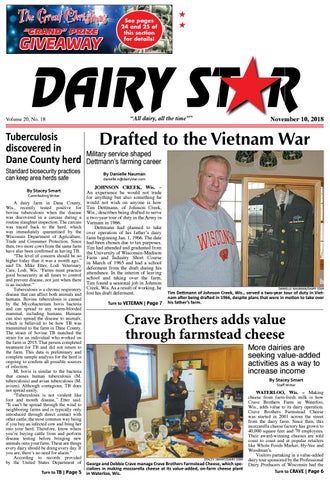
Tuberculosis discovered in Dane County herd Standard biosecurity practices can keep area herds safe By Stacey Smart Contributing Writer
A dairy farm in Dane County, Wis., recently tested positive for bovine tuberculosis when the disease was discovered in a carcass during a routine slaughter inspection. The carcass was traced back to the herd, which was immediately quarantined by the Wisconsin Department of Agriculture, Trade and Consumer Protection. Since then, two more cows from the same farm have also been conrmed as having TB. “The level of concern should be no higher today than it was a month ago,” said Dr. Mike Etter, Lodi Veterinary Care, Lodi, Wis. “Farms must practice good biosecurity at all times to control and prevent disease, not just when there is an incident.” Tuberculosis is a chronic respiratory disease that can affect both animals and humans. Bovine tuberculosis is caused by the Mycobacterium bovis bacteria and can spread to any warm-blooded mammal, including humans. Humans can also spread the disease to animals, which is believed to be how TB was transmitted to the farm in Dane County. The strain of bovine TB matched the strain for an individual who worked on the farm in 2015. That person completed treatment for TB and did not return to the farm. This data is preliminary and complete sample analysis for the herd is ongoing to conrm all possible sources of infection. M. bovis is similar to the bacteria that causes human tuberculosis (M. tuberculosis) and avian tuberculosis (M. avium). Although contagious, TB does not spread easily. “Tuberculosis is not virulent like foot and mouth disease,” Etter said. “It can’t be spread through the wind to neighboring farms and is typically only introduced through direct contact with other cattle, the most common way being if you buy an infected cow and bring her into your herd. Therefore, know where you’re buying cattle from and perform disease testing before bringing new animals onto your farm. These are things every dairy should be doing every day. If you are, there’s no need for alarm.” According to records provided by the United States Department of Turn to TB | Page 5
“All dairy, all the time”™
November 10, 2018
Drafted to the Vietnam War
Military service shaped Dettmann’s farming career By Danielle Nauman danielle.n@dairystar.com
JOHNSON CREEK, Wis. – An experience he would not trade for anything but also something he would not wish on anyone is how Tim Dettmann, of Johnson Creek, Wis., describes being drafted to serve a two-year tour of duty in the Army in Vietnam in 1966. Dettmann had planned to take over operation of his father’s dairy farm beginning Jan. 1, 1966. The date had been chosen due to tax purposes. Tim had attended and graduated from the University of Wisconsin-Madison Farm and Industry Short Course in March of 1965 and had a school deferment from the draft during his attendance. In the interim of leaving school and taking over the farm, Tim found a seasonal job in Johnson Creek, Wis. As a result of working, he lost his draft deferment. Turn to VETERAN | Page 7
DANIELLE NAUMAN/DAIRY STAR
Tim DeƩmann of Johnson Creek, Wis., served a two-year tour of duty in Vietnam aŌer being draŌed in 1966, despite plans that were in moƟon to take over his father’s farm.
Crave Brothers adds value through farmstead cheese
More dairies are seeking value-added activities as a way to increase income By Stacey Smart Staff Writer
STACEY SMART/DAIRY STAR
George and Debbie Crave manage Crave Brothers Farmstead Cheese, which specializes in making mozzarella cheese at its value-added, on-farm cheese plant in Waterloo, Wis.
WATERLOO, Wis. – Making cheese from farm-fresh milk is how Crave Brothers Farm in Waterloo, Wis., adds value to its dairy operation. Crave Brothers Farmstead Cheese was started in 2001 across the street from the dairy farm. Since then, this mozzarella cheese factory has grown to 40,000 square feet and 70 employees. Their award-winning cheeses are sold coast to coast and at popular retailers like Whole Foods Market, Hy-Vee and Woodman’s. Visitors partaking in a value-added dairy tour sponsored by the Professional Dairy Producers of Wisconsin had the Turn to CRAVE | Page 6
Page 2 • Dairy Star • Saturday, November 10, 2018
DAIRY ST R www.dairystar.com
ISSN 020355 522 Sinclair Lewis Ave. Sauk Centre, MN 56378 Phone: (320) 352-6303 Fax: (320) 352-5647 Published by Dairy Star LLC General Manager/Editor Mark Klaphake - mark.k@dairystar.com 320-352-6303 (ofce) 320-248-3196 (cell) 320-352-0062 (home) Ad Composition Nancy Powell 320-352-6303 nancy.p@dairystar.com Amanda Thooft 320-352-6303 amanda.t@dairystar.com Consultant Jerry Jennissen 320-346-2292 Editorial Staff Andrea Borgerding - Associate Editor (320) 352-6303 • andrea.b@dairystar.com Krista Kuzma - Assistant Editor (507) 259-8159 • krista.k@dairystar.com Jennifer Coyne - Assistant Editor (320) 352-6303 • jenn@dairystar.com Ron Johnson (608) 874-4243 ron.j@dairystar.com Ruth Klossner (507) 240-0048 cowlady@centurylink.net Danielle Nauman (608) 487-1101 danielle.n@dairystar.com Danna Sabolik - Staff Writer (320) 352-6303 • danna.s@dairystar.com Maria Bichler - Copy Editor 320-352-6303 Advertising Sales Main Ofce: 320-352-6303 Fax: 320-352-5647 Deadline is 5 p.m. of the Friday the week before publication Sales Manager - Jeff Weyer (Northern MN, East Central MN) 320-260-8505 (cell) jeff.w@dairystar.com Mark Klaphake (Western MN) 320-352-6303 (ofce) 320-248-3196 (cell) Laura Seljan (National Advertising, SE MN) 507-250-2217 fax: 507-634-4413 laura.s@dairystar.com Jerry Nelson (SW MN, NW Iowa, South Dakota) 605-690-6260 jerry.n@dairystar.com Mike Schafer (Central, South Central MN) 320-894-7825 mike.s@dairystar.com Amanda Hoeer (Eastern Iowa) 320-250-2884 • amanda.h@dairystar.com Lori Menke (Southern WI) 563-608-6477 • lori.m@dairystar.com Megan Stuessel (Western Wisconsin) 608-387-1202 • megan.s@dairystar.com Deadlines The deadline for news and advertising in the Dairy Star is 5 p.m. Friday the week before publication. Subscriptions One year subscription $35.00, outside the U.S. $110.00. Send check along with mailing address to Dairy Star, 522 Sinclair Lewis Ave., Sauk Centre, MN 56378. Advertising Our ad takers have no authority to bind this newspaper and only publication of an advertisement shall constitute nal acceptance of the advertiser's order. Letters Letters and articles of opinion are welcomed. Letters must be signed and include address and phone number. We reserve the right to edit lengthy letters. The views and opinions expressed by Dairy Star columnists and writers are not necessarily those of the Dairy Star LLC.
The Dairy Star is published semi-monthly by Dairy Star, LLC, 522 Sinclair Lewis Ave., Sauk Centre, MN 56378-1246. Periodicals Postage Paid at Sauk Centre, MN and additional mailing ofces. POSTMASTER: Send address changes to Dairy Star, 522 Sinclair Lewis Ave., Sauk Centre, MN 56378-1246.
North America dealers. A glance at what’s inside
Dairy Prole brought to you by your
As we begin November, we remember all those who have served our country and reect on how we are thankful for all that we have. In this issue you can read about the Weller family who farm near Brooten, Minn. and share a passion for hunting. We caught up with them after their annual gettogether to discuss why they hunt and how they balance dairy farming responsibilities simultaneously. A lot of people are wrapping up harvest, so we found some photos of farmers working in the elds to By Mark Klaphake feature in our issue. To see harvest photos from the past Editor two weeks, check out page 6 of the third section. For the “From Our Side of the Fence” feature we spoke with farmers about their dogs. We talked to multiple owners about their dogs and why they think it is important to have a farm dog. You can nd this feature on pages 15 and 16 in the rst section. Can you believe there is only six weeks until Christmas? At the Dairy Star we are launching our annual Great Christmas Giveaway contest. This year, one lucky child will win Je-Ko Tyler Guppy, a calf from Jeff and Korinna Rohde’s farm near Grey Eagle, Minn. To learn more about the calf and how to enter the contest, ip to pages 20 and 21 in the rst section. You have probably heard of Don Wick, and that is a name you will want to remember. The widely heard voice of the Red River Farm Network has been recently inducted into the National Farm Broadcasters Hall of Fame. Read about what piqued his interest in radio and why this honor is special to him on pages 2-3 in the third section. Wayne and Donna Lexvold host students through the MAST program on their dairy farm, Bombay Dairy, near Kenyon, Minn. They have worked with 14 different trainees from nine countries in the past four years. Turn to pages 10 and 13 in the rst section to read about their experience working with people from around the world.
Favorite quotes from this issue: “A lot of blood, sweat, tears, love and prayers went into this farm to get us to 100 years.” - Cyndy Aho (Pages 34,35, First Section)
“We know we can gure out a way to get cows pregnant, no question, so now we have an opportunity to nd when it is best to get cows pregnant.” - Julio Giordano (Page 4, Third Section) By the Numbers
rolling herd 45,000: Pound average at Ever-Green-
View Farms near Waldo, Wis. Tom Kestell sets his pace to hit 50,000 pounds in the next ve years.
(First section, page 11)
number of times Sleepy Eye 3: The FFA has won a national dairy
prociency award in the past three years. (Second Section, Page 8)
CONSISTENT PERFORMANCE WHEN BEDDING OR FEEDING
PRIMOR 4270 BALE PROCESSOR • Easily adapts to various materials and bale types • Uniform distribution of material across the blowing distance • Precise, consistent material placement up to 60 feet and 300° • Self loading for one-man operation with in-cab hydraulic controls Processes 5 x 6 round and 4 x 4 x 8 large square bales (148 cu. ft. capacity)
D & D Farm Supply Arcadia
Komro Sales & Service Durand
Cherokee Garage Colby
Lulich Implement Mason
Kalscheur Implement Cross Plains
Lindstrom Equipment Mondovi
INVEST IN QUALITY ®
KuhnNorthAmerica.com
East Side Farm Equipment Monroe Frontier Ag & Turf Osceola Turtle Lake
Steinhart's Farm Service Platteville Hwy 48 Farm Service Rice Lake Carl F. Statz & Sons Waunakee
Visit your local Wisconsin KUHN dealer today!
Dairy Star • Saturday, November 10, 2018 • Page 3
It’s all inside... Columnists Ag Insider
Pages 8-9 First Section
FSA News & Notes
Page 26 First Section
Sparta
The Transition Pen Page 27 First Section
Kids Corner: The Breeggmanns
n
Third Section: Pages 8 - 9
Burnett
Polk
Barron
Sawyer
Price
Rusk Taylor
St. Croix
Come Full Circle
Pierce
Page 33 First Section
Dunn
Pepin Buffalo
Our expansion project Waldo
Ever-Green-View Farms focuses on genetics, forage quality
Chippewa
Madison
Marathon
Kroger, Culver’s share views on sourcing dairy product
Clark
Eau Claire Trempealeau
Page 32 First Section
Pages 10 - 11 Second Section
Harms reinvent their farm to continue in dairying
Ashland
Making Cents of Dairy
The “Mielke” Market Weekly
Reedsburg
Iron
Third Section: Pages 12 - 13
Page 31 First Section
Page 37 First Section
Bayeld
ur
Veterinary Wisdom
First Section: Pages 34 - 35
hb
Page 30 First Section
Geoghegan presents on history, development of Wisconsin’s dairy industry
First Section: Page 39
Douglas
Elmwood
Wausau
Dairy Prole: The Kosiks
Second Section: Pages 20 - 21, 24
W as
Ramblings from the Ridge
Dorchester
Brooks family celebrates 75 years of Clydesdale ownership
Second Section: Pages 4 - 5
Wood Jackson Adams
La Crosse Monroe
Juneau
First Section: Page 11
Fond Du Lac
Vernon
Country Cooking
ford
Richland
Craw
Page 29 Second Section
Columbia
Sauk
Iowa
Dane
Lafayette
Green
on
rs
ffe
Je
Grant
Zone 2
Dodge
Waterloo
Crave Brothers adds value through farmstead cheese First Section: Pages 1, 6
Rock
Norwalk
For additional stories from our other zone, log on to www.dairystar.com
From Our Side of the Fence First Section: Pages 15 - 16
Give milk production a push GEA’s FRone works around the clock to keep feed at the bunk, maximizing your cows’ production. Could your bunk management routine use a little extra push? GEA’s FRone automated feed pusher provides consistent, high-quality feed available day and night to boost production results from your whole herd. It’s easy to use, charges fast and contains twin batteries for maximum run time. With the help of GEA’s FRone, you can push the limits on your feeding program.
Page 4 • Dairy Star • Saturday, November 10, 2018
20’ CONTINUOUS FENCE PANELS 2
SIZES IN STOCK
• WA WATERERS• FREE STANDING CATTLE FENCES •FENCELINE FEEDERS
COATS, BIBS & OVERALLS
BOOT SALE E BUY ONE
White 445, 11 shank - $6,500
15%OFF
40% OFF
ALL SIZES OF SITREX RAKES ON HAND
ALL Gallagher Fencing Supplies
USED TRACTORS
CIH MX120, 2WD, no cab, 2500 hrs ...... $35,000 CIH 8940, FWA, 5000 hrs ...................Coming In CIH 7240, FWA, 2500 hrs ...................Coming In CIH 7230, 3500 hrs., new rubber, nice... $71,000 CIH 7230, FWA, 540-1000 pto ...................... Call CIH 7220, 2WD, 2300 hrs, 18.4x42 ....... $71,000 CIH 7220, 2WD, 6900 hrs ............................. Call CIH 5240 Maxxum, FWA w/loader ......... $48,000 IH 1086, sharp ....................................... $19,000 IH 766, new motor, cab .......................... $12,500 JD 2940, duals ....................................... $12,500
(In Stock Only)
GET 2ND PAIR R
50% OFF
COME SEE W WHY COWS LOVE OUR
ROASTED SOYBEANS
TILLAGE
CIH Tigermate II, 28’ .............................. $18,000 CIH Tigermate II, 30’ .............................. $21,000 CIH 4800, 28’ & 26’ ................................. $8,500 CIH 4800, 28’ w/IH mulcher..................... $8,500 CIH 4300, 36’ ......................................... $10,500 CIH 4300, 30’ ........................................... $9,500 CIH 3950, 24’ ......................................... $21,000 CIH 530B ripper w/lead shanks .............. $17,000 CIH 530B w/lead shank .......................... $13,000 CIH 496, 21’, non cusion ....................... $11,500 DMI 530B w/lead shank ........................ $15,500
We can custom roast your grains including barley, corn, wheat, oats and soybeans.
TIME FOR A CAREER CHANGE? HELP WANTED: FT Bookkeeper
FEED & FARM SUPPLY STORE
Many sizes of rakes available Meyer 4516 silage box, 16’, nice............ $11,000 Badger 16’................................................ $2,500 H&S X2 16’ .............................................. $4,500
GRAVITY BOXES
VARIOUS SIZES OF GRAVITY BOXES ON HAND Demco 650 grain cart, ‘12, green & black .$18,500 Demco 550 .............................................. $9,500 Demco 450 .............................................. $9,500 4) Demco 365 ................................$4,500-5,500 Unverferth 430 ......................................... $9,500 All sizes of used Demco gravity boxes avail.
MISCELLANEOUS
Midsota 5510 & F610 rock trailers........ In Stock Various sizes of New Agrotrend snowblowers............................................... Call JD 450 13’ w/grass, press wheels ......... $11,500 New Midsota Rock Wagons .................On Hand
WE HAVE A LARGE SUPPLY OF NET WRAP ON HAND
NEW MANDAKO LAND ROLLERS IN STOCK
FARM OYL PRODUCTS AVAILABLE
HAYING & FORAGE EQUIP.
Sitrex QR12 rake .......................................... New
Please send a resume or call Adam at 320-387-2770.
Gilman Co-op Creamery
We have a large selection of snowblowers IN STOCK!
WE CARRY CREEP FEEDS!
GREENWALD FARM CENTER
Gilman, MN 320-387-2770
Open M-F 7:30-7, Sat. 7:30-5, Sun. 8:30-1
Greenwald, MN • 320-987-3177
Good service - fair prices - every day
WWW.GREENWALDFARMCENTER.COM
WWW.GILMANCREAMERY.COM
BEFORE Exfoliation
TEAT END ISSUES?
AFTER
Exfoliation
OUR TEAT DIPS ARE NPE FREE!
WINTER TEAT DIP Marianne says, “Recover is a very good, economical post winter dip that brings terrific results, especially when releasing cows in the cold winter elements as we do. Cows do very well on it… teats are well conditioned!”
• Dual Germicide: Primary: Chlorine Dioxide promotes a quick kill. Secondary: LAS promotes a long-lasting kill. • Effective against ALL Mastitis-Causing Organisms • Contains Lactic Acid to promote Teat Exfoliation • Teat skin conditioning – 12.4% skin conditioning package • Green coloring for easy identification
78%
Mouth-Piece Vented Triangular Liner
TRI-BLEND SKIN CONDITIONING PACKAGE!
There’s There er a reason 25% of the cows in the U.S. are milked with Impulse Liners!
GERMICIDE: 1.5% HEPTANOIC ACID Pete said, “I would recommend Recover to any producer that has an extreme cold housing situation. It keeps teats in a good, soft condition.” He also said, “I will begin using Recover on November 1st, to start the conditioning process and will continue using it throughout the entire winter.” Pete Ripka •Ogilvie, MN • 175 Cows - 3X
Marianne Peterson Pine City, MN • 400 Cows - 3X
Available in a 12mm A Milk Tube!
De Designed to handle higher flow rates and p provide better fit on larger inlet claws.
IMPULSE AIR = BETTER PERFORMANCE! B
FOR MORE INFO - CONTACT ONE OF THESE DEALERS... Advanced Dairy Systems
Athman Dairy Inc.
D&D Ag Supply
East Central Dairy Supply
9 State Rd. 29 • Spring Valley, WI 54767 (715) 772-3201
238 Main Street North • Pierz, MN 56364 (320) 468-2494
133 Atlantic Ave. NE • Pennock, MN 56279 (320) 599-4466
Anderson Dairy Systems, Inc.
Champion Milking Systems
Dairyland Equipment Services, Inc.
Eastern Iowa Dairy Systems
Dairyland Services, LLC
Fuller’s Milker Center, Inc.
1312 13 1/2 Ave. • Barron, WI 54812 (715) 537-3300
23218 350th Street • Albany, MN 56307 (320) 845-4156
24260 Cty. Rd. 27 • Plainview, MN 55964 (507) 534-3161 2545 80th Ave • Woodville, WI 54028 (715) 698-4370
2195 Hwy. 23 • Mora, MN 55051 (320) 679-1029
105 3rd Ave. NW • Epworth, IA 52045 (563) 876-3087 423 U.S. 61 • Lancaster, WI 53813 (608) 723-4634
Gorter’s Clay & Dairy Equipment
1400- 7th St. SE • Pipestone, MN 56164 (507) 825-3271
Professional Dairy Systems
1449 Homecrest Ave. • Wadena, MN 56482 (218) 632-5416
Tri-County Dairy Supply, Inc.
Lang’s Dairy Equipment, Inc.
4107 N US HWY 51 • Janesville. WI 53545 608-757-2697
Mlsna Dairy Supply
12687 Hwy 18 & 52 • Postville, IA 52162 (563) 864-7417 210 N. Industrial Pkwy • West Union, IA 52175 (563) 422-5355
2337 Millennium Rd. • Decorah, IA 52101 (563) 382-8722 1126 Front Street • Cashton, WI 54619 (608) 654-5106
United Suckow Dairy
Dairy Star • Saturday, November 10, 2018 • Page 5
ConĆ&#x;nued from TB | Page 1
BUILDING A BETTER HERD... One Calf At A Time!
Programs and support for every stage... from calf to cow and everything in between!
FEED THEM FAMO!
• Milk Replacers • Starter Feeds • Protein Concentrates • Premixes • Minerals • Animal Health Products • Lick Tubs
320-836-2145 or 800-450-2145
Check out our newly redesigned website to ½nd a Famo Feeds dealer near you!
www.famofeeds.com
MANCHESTER Livestock Auction, Inc.
DAIRY SALES 2nd Fridays Monthly at 11:00 AM Selling 150 to 250 Head
Sheep and Goats sell at 9:30 AM
563-927-2540
www.manchesterauction.com
We Offer the Following Agricultural Services:
Barn Lighting, Sheds, Fans, Trenching, Irrigation, Homes & More!
.M. ELEC E.A Bob Meyer TRI . B Master Electrician, Owner Lic. #CA03435
(40 miles west of Dubuque, Iowa on 4 lane Highway 20)
" %
Need an Electrician?
!
ofďƒžcials work with the USDA and the herd owner to investigate the extent of the disease. “The farm is under a quarantine, meaning no animals can move on to or off of the farm,â€? said Leeann Duwe, public information ofďƒžcer for DATCP. “We are in the process of collecting lab results for all of the animals that reacted to the second skin test. We are also in the process of removing animals from the farm that responded to initial tuberculin skin tests. Once all affected animals are removed from the farm, USDA and DATCP will determine if the farm will be able to test and remove animals moving forward, or if the farm should be depopulated.â€? Tracing any animal movement for the farm within the last ďƒžve years is also a part of the investigation. Dairy farmers can reduce the risk of introducing TB to their herds by: - Testing livestock for bovine TB. - Keeping a closed herd and raising your own replacement stock, if possible. - Only buying animals from an accredited TB-free herd. Ask for a copy of the herd’s TB-free certiďƒžcate. - Testing new animals prior to purchase. - Isolating new animals for 60 days and retesting before introducing to the rest of the herd. - Restricting or eliminating contact between your herd and other herds. - Cleaning trailers and facilities with a disinfectant. - Limiting who has access to your herd including visitors, milk haulers, feed delivery personnel and anyone who may have contact with other herds. - Making sure fences are in good condition to separate your herd from wildlife. Breunig said he is vigilant about biosecurity, and therefore will keep doing what he has been doing to protect his herd. “The positive part of this situation is that the meat from this animal did not enter the food chain,â€? Breunig said. “The animal went through normal screening procedures and was pulled aside. That should give us a lot of faith in our food safety system.â€? Etter said there is one thing the industry might want to consider instituting as a new practice and that is screening farm employees for tuberculosis. “Currently, that is not a widespread practice, but since humans can spread the disease to cattle, this might be a wakeup call for that,â€? Etter said.
C
Agriculture, the last time bovine TB was found in a dairy herd in Wisconsin was in 1995. “News like this makes you stop and think about the things you’re doing on your farm,â€? said Mitch Breunig, a Dane County dairy farmer who owns Mystic Valley Dairy, a 430-cow herd located in Sauk City, Wis. “Are you doing everything you can to protect your animals? It’s important that farmers work with their vet to establish biosecurity measures for their farm and then follow them all the time. When traveling to different farms, be mindful of washing your boots and changing your clothes. That’s a standard practice that should happen no matter what, whether there’s an incident or not.â€? Tuberculosis progresses slowly, taking months or even years, for symptoms to emerge. However, infected animals that appear healthy can still spread the disease to other animals. Animals infected with TB typically show no signs until the disease has reached an advanced stage. Clinical signs may include weakness, loss of appetite, weight loss, ďƒ&#x;uctuating fever, intermittent hacking cough, diarrhea, and large, prominent lymph nodes. TB is usually only detected in cattle through skin testing or at slaughter as part of the national slaughter surveillance program which inspects carcasses for signs of TB. Any cow that reacts to a preliminary tuberculin skin test has to be euthanized. Lung and lymph node samples taken after euthanization are the deďƒžnitive test that determines if a cow has TB. The two most common ways TB is introduced are through the purchase of or exposure to an infected animal or exposure to infected wildlife. Breathing the same air in close corridors, such as in a poorly ventilated barn, or ingesting contaminated feed or water, are primary means for transmitting TB bacteria. Drinking unpasteurized milk is another way humans can catch bovine TB. There is no vaccine to prevent tuberculosis. However, TB has been nearly eliminated in the United States due to the National Tuberculosis Eradication Program started in 1917. Wisconsin has been certiďƒžed TB-free since 1980 and will maintain its TB-free status with the USDA even now, assuming a thorough investigation and containment of the outbreak. Aggressive measures are being taken to control and prevent the spread of tuberculosis as state animal health
E lectric Cell:
320-761-1042 Serving Central Minnesota
COMPLETE BARN SOLUTIONS WHATEVER YOUR DAIRY NEEDS
BEFORE
AFTER
Lensing Dairy, Calmar, IA
2x12 expanded to a 2x15 Beco Vertical Lift with FlowNexus G2 meters
Call us to help you make your dairy operation more efďŹ cient.
www.midwestlivestock.com
PINE ISLAND, MN • 800-233-8937 BEATRICE, NE • 800-342-5657 SIOUX FALLS, SD • 800-705-1447 MENOMONIE, WI • 715-235-5144
Page 6 • Dairy Star • Saturday, November 10, 2018
ConƟnued from CRAVE | Page 1
Willmar, MN • 320.231.1470
EXPANDING OR REMODELING YOUR LIVESTOCK OPERATION? LANGE AG SYSTEMS SPECIALIZES IN:
Ŷ NEW FACILITIES
_
NO JOB TOO BIG OR TOO SMALL
Ŷ RETROFITTING & REMODELING Ŷ TURNKEY PROJECTS Ŷ BARN DESIGN Ŷ INSTALLATION, MAINTENANCE & REPAIRS
ƋƵŝƉŵĞŶƚ tĞ KīĞƌ͗ ͻ sĞŶƟůĂƟŽŶ &ĂŶƐ ͻ sĞŶƟůĂƟŽŶ ŽŶƚƌŽůƐ ͻ WŽƐŝƟǀĞ WƌĞƐƐƵƌĞ dƵďĞƐ ͻ ƵƌƚĂŝŶ ^LJƐƚĞŵƐ ͻ DĂƩƌĞƐƐĞƐ ͻ tĂƚĞƌĞƌƐ ͻ ^ƚĂůů ƋƵŝƉŵĞŶƚ ͻ ,ĞĂĚůŽĐŬƐ ͻ DŝƐƟŶŐ ^LJƐƚĞŵƐ
Lange Ag Systems is proud to offer Grain Bags, Silage Bags & Bunker Covers from Up North Plastics and Feed Fresh Silage Covers & Custom Size Bunker Covers from Raven!
t ^ >> E t Θ h^ 'ͳ ' Θ < >>z Zz E '' Z^
www.LangeAgSystems.com Roller-Grinder
I F A
More milk less feed with uniform Àne-grind Solid cast rolls All belt-electric drive Single or double mills USA & International sales Replacement rolls available for most mills Used mills and tumble mixers on hand Hammer Mills
Phone: (319) 634-3849 • Toll Free: (800) 426-0261 web: www.ifamill.com • email: ifamill@netins.net
BALEBUSTERS
Call 320-352-6303 to place your classied or mail to: Dairy Star, 522 Sinclair Lewis Ave., Sauk Centre, MN 56378.
We have plenty of used units on hand!
• Rotor access door gives you easy • Two-stage bale loader that easily access to rotor • Adjustable slug bars allows you picks up bales to easily position the bale from the • Heavy-duty tubular frame rotor and hammers. construction designed to carry • Heavy-duty chain conveyor
heavy bales.
Blue Hilltop, Inc. 507-879-3593 – 800-821-7092
Box 116, Lake Wilson, MN 56151 – www.bluehilltop.com
STACEY SMART/DAIRY STAR
Crave Brothers cheese is made with renewable energy from the farm’s biodigester, which is a major selling point for the business. opportunity to tour the Crave cheese plant and sample a variety of cheeses Oct. 23. “I wanted to get off the commodity treadmill,” George Crave said. “It was time to stop chasing my tail and try something different, something out of our comfort zone.” George and his wife, Debbie, manage the cheese business while George’s brothers, Charles, Thomas and Mark Crave, run the dairy farm. The cheese plant and farm are two separate business entities. Crave Brothers Farmstead Cheese has mastered the art of mozzarella making, producing the Italian favorite in curds, string, rope and balls. They also make mascarpone – an Italian cream cheese ideal for desserts and other sweet culinary applications. Made with milk piped in directly from Crave Brothers Farm, the cheeses are truly farmstead. The Crave’s value-added, on-farm cheese plant has allowed the family to bypass unfavorable milk prices by turning the milk into cheese. Crave Brothers Farm milks 1,900 cows – 1,100 on the main farm, which supplies milk for the cheese plant, and 800 cows on another farm. Crave Brothers Farmstead Cheese markets itself as a family-owned and operated, carbon-negative company using 100 percent, renewable green power. The Craves produce their own electricity through the farm’s biodigester, creating enough electricity for the farm, cheese factory and over 300 homes. Crave Brothers are proud their cheese is produced with renewable energy – a fact they make known by the logo that appears on their products. “If you’re thinking about making cheese, you need a good story to tell,” Debbie said. “That’s really the rst step. Our story revolves around family, farmstead and green energy.” Crave Brothers Farmstead Cheese has several licensed cheesemakers onsite, including George, who attended a cheesemaking short course at the Center for Dairy Research in Madison, Wis. Because he buys milk directly from Crave Brothers Farm, George also has a milk handler license. “We use 155,000 pounds of milk every day to make our cheeses,” George said. Cheese is made Monday through Friday, with up to 20,000 packages of cheese being produced daily. The Craves have foodservice customers as well. “June through August is our busy season,” George said. “For example, a salad featuring fresh mozzarella is a more popular item in the summer than in winter.” From pasteurizing to packaging, George said there are many things to
consider when making cheese. “You don’t just decide to make cheese one day and then start making it the next,” George said. “It takes a great deal of upfront research. For us, it was about a year-and-a-half process.” George said getting up and running is a big challenge. “We limped along the rst two to three years making a lot of cheese in order to get it just right,” George said. This well-decorated cheese manufacturer swept the mozzarella division in the U.S. Cheese Championship last year, taking rst through third prizes. They have also won awards for their cheese at World Dairy Expo and the Wisconsin State Fair. “Entering competitions is a great form of marketing,” Debbie said. “It gets your name out there, and any time you win a prize, it’s free publicity for your business.” George and Debbie told PDPW tour participants to think about their goals and objectives when exploring value-added propositions. “Decide what you want to do,” George said. “Is it agritourism? Bottled milk? Cheese? You also need to know your market. Is it large retailers like Walmart? Or, do you prefer to sell to smaller customers? Another thing to keep in mind is that if the customer grows, you have to grow with them. For example, one of our customers grew from 200 stores to 450 stores, which meant we had to be prepared to fulll their larger orders.” Debbie encouraged prospective cheesemakers to take advantage of all the resources that Wisconsin has to offer. “Places like the Wisconsin Milk Marketing Board are so helpful to farmers and cheesemakers,” she said. Also present on the tour was James Gage, a value-added agriculture consultant, grant writer and business feasibility analyst. Gage wrote a grant for the Craves in 2004. After the tour, he shared some of his expertise on value-added cheese manufacturing. “Starting a business like this costs a lot of money,” Gage said. “But, rarely does it come out of your own pocket. Rather, farmers take advantage of state and federal programs, like the valueadded producer grant. I know people with as many as seven different funding sources.” Debbie said that running a cheese plant is the type of work in which you always have to stay on top of. “For example, when we go out to dinner, we analyze the menu, looking for ways that cheese is being incorporated, and then we talk to the chef,” she said. “You always need to look for the next opportunity to market your cheese.”
Dairy Star • Saturday, November 10, 2018 • Page 7
ConĆ&#x;nued from VETERAN | Page 1
“My dad had physical limitations, which is why I was going to take over the farm,â€? Dettmann said. “In December, I got the notiďƒžcation that I’d lost my deferment because I’d worked off the farm. They kept pretty close tabs on everyone, as they had allotments to ďƒžll. I didn’t think it was that big of a deal since as of the ďƒžrst of the year, I’d be farming full time, so my deferment would come back.â€? Dettmann said when his deferment was reviewed, the draft board assumed he was a draft dodger. Dettmann worked with a teacher from Johnson Creek High School to put together an appeal before the three-person Jefferson County Draft Board. “He did a lot of legwork to help me out, especially with one gentleman on the draft board who was a farmer and knew of my situation,â€? Dettmann said. “He assured us that it should be taken care of with no issue. Then he was unable to attend the draft board meeting, and so I lost my appeal. In February I was ofďƒžcially drafted into the Army.â€? Dettmann was granted a 60-day delay to be able to ďƒžgure out what to do with the farm. He held an auction to sell the cows and machinery, and he bought heifer calves before he left. His father and his brother raised the calves so they would be calving in when Dettmann returned from service. Serving in Vietnam was an experience Dettmann will never forget and is one that has shaped many aspects of the person he is today. “Everybody always comments and says that I’m so easy going,â€? Dettmann said. “After being in Vietnam, there isn’t too much else that can happen that can rattle your cage too badly. It changes your outlook on life tremendously.â€?
“After being in Vietnam, there isn’t too much else that can happen that can rattle your cage too badly. It changes your outlook on life tremendously.�
injury. The wound was compounded by the Viet Cong practice of dipping their bullets in dung. “War is messy,â€? Dettmann said. “My shoulder blew up 20 years later, and the orthopedic surgeon said it was infection that had laid dormant from the injury. I can never have that shoulder replaced because of that infection. It’s just something that I have to live with.â€? When Dettmann was discharged and returned home, the calves Dettmann had purchased prior to being shipped out were ready to start calving in. He proceeded with his plan to take over his father’s farm. “I had the heifers calving in, and I bought some more cows to ďƒžll up the barn,â€? Dettmann said. “We remodeled the barn and only had 25 stanchions. I was switching cows with some living outside.â€? Soon, Dettmann needed to make a decision whether or not he would buy his father’s 110-acre farm or look for a more suitable farm site. “The facilities were no near functional for what I was going to need to make a living on the farm,â€? Dettmann said. “I’d ďƒžnd a place I liked, and my
CONGRATULATIONS TO THE MYCOGEN SEEDS CUSTOMERS WHO SWEPT THIS YEAR’S WORLD FORAGE ANALYSIS SUPERBOWL WITH MYCOGENŽ BRAND BMR.
GRAND CHAMPION OVERALL FORAGE
TIM DETTMANN, DAIRY FARMER
Dotterer Dairy, Pennsylvania Doug and Cortney Dotterer
Dettmann said he had an opportunity to see parts of the world he may never have seen if his plans to begin farming had not gone awry. His service took him to places like Okinawa, Alaska and California in addition to Vietnam. “It was interesting and probably good for me,â€? Dettmann said. “I got to see the whole world. ‌I also spent the two years worrying about how much land prices would go up during those two years.â€? Having been raised in a rural area, Dettmann had an easier time adjusting to life in the Vietnamese jungle than some of his urban counterparts. During his tour, Dettmann rose to the rank of Sergeant E-5 and was a squad leader. The experience shaped how Dettmann views and treats employees on his farm. “In Vietnam, rank didn’t really count for much,â€? Dettmann said. “You all had to work together to keep everyone safe and still get the job done. ... You had to get along with everyone. You had to make decisions at times, but everyone was involved. That’s how I’ve always tried to treat my employees. I’ve never expected anyone to do something I wouldn’t be willing to do.â€? Dettmann’s tour was cut short when he was shot in the shoulder and spent time in a hospital in Japan. He received the Purple Heart because of that
Sign up for our Newsletter
Dairy St r Milk Break Email andrea.b@dairystar.com
dad wouldn’t think it was the right one. Then he’d ďƒžnd one, and I wasn’t sold on it. Eventually I just decided to purchase my dad’s farm and re-do the buildings. We were able to add land along the way to grow to our present size of over 2,000 acres.â€? Dettmann is appreciative of the respect and appreciation that have been shown to him as a war veteran. “From a soldier’s standpoint, I can’t be more proud of the way veterans are treated,â€? Dettmann said. “I had the opportunity to attend a Veterans Day assembly at my grandson’s school. We were invited for breakfast and then attended the program. I was ďƒ&#x;abbergasted to be treated like that and to get a standing ovation for my service.â€? Dettmann has traveled to Washington, D.C., and visited the Vietnam Veterans Memorial, an experience he treasures and said he will never forget. “It is a fantastic memorial,â€? Dettmann said. “It’s strange when you look at the names on the wall, and you know some of the people there. It’s very sobering and moving.â€?
For full contest results visit WorldDairyExpo.com
CHAMPION BMR CORN SILAGE
SUNY Morrisville, New York Shawn Bossard
Mycogen customers took home all top 10 placings in the BMR category.
QUALITY COUNTS CORN SILAGE WINNER
Hylight Farms LLC, New York Jerry and Mary Stockman
MYCOGEN BRAND BMR WORKS.
JUST ASK YOUR COWS.
Visit Mycogen.com/Silage or contact your local Mycogen Seeds dealer to learn more about Mycogen brand corn silage.
' Çž Çž Ä” 6Ä” " Ä”& Ç&#x; 6ÇŽ,Ä” Ä” ,Ç&#x;Ä” Çž Ç&#x; Çž ÂŽ Ç&#x;Çž Ä” Çž Ç&#x; Ä” Ç&#x; Ç&#x; Ä” &;;Äź;>BÄź<<; m;<‹;An 2) 8%$A& *5<@@ TMÂŽ
Page 8 • Dairy Star • Saturday, November 10, 2018
Cheese, whey prices weigh down Class III milk market Dairy markets have taken an ugly turn in recent overpower weeks with cheese and whey prices pushing Class USMCA. III markets signicantly lower. Commodity Risk Management Group President Mike Ag Insider North does not expect this situation to change anytime soon. “It could be bloody into the rst half of November,” North said. “From a reporting standpoint, we don’t get anything new other than the National Dairy Product Sales Report every week and if the NDPSR is showing low prices with low volumes, we haven’t changed the mindset.” In October, the new Dairy Revenue Protection insurance product was released. “It is a good tool, but like any tool there should be some time By Don Wick spent on the front end on how to use it.” Columnist
any small positive gains from the
Cautious optimism At the National Milk Producers Federation annual meeting in Phoenix, Chairman Randy Mooney said dairy farmers are hurting nancially, but the fundamentals in the dairy industry are still good. Domestic and international demand is strong. “We need some help on trade; we need to get rid of the tariffs and if we could do that, I think we could see prices turn around rather quickly.”
NMPF seeks FDA action on labeling issue The National Milk Producers Federation is again urging the FDA to end deceptive labeling. In particular, the dairy industry wants the government to prevent plant-based beverages from using the term ‘milk.’ A new study commissioned by Dairy Management Inc. found consumers do not understand the nutritional differences between dairy milk and beverages made from soybeans, almonds or rice. As an example, 73 percent of the consumers surveyed believe almond-based drinks had as much or more protein per serving as milk. In reality, milk has eight times as much protein.
WI cheese production outpaces year ago levels Cheese production is growing in Wisconsin. In September, Wisconsin dairy plants put out 280.5 million pounds of cheese. That’s up two percent from one year earlier. Nationally, over one billion pounds of cheese was produced, up 3.1 percent from September of 2017. Dry whey production in the state totaled 24.2 million pounds, down nearly 18 percent from last year. Aluminum and steel tariffs inuence USMCA benets Any gains realized by the new U.S.-MexicoCanada Agreement could be nullied by retaliatory tariffs tied to the disagreement over steel and aluminum exports. The Farm Foundation commissioned a study by Purdue University that says tariffs from Canada, Mexico and China will
Cheese and butter sales grow Dairy Checkoff success was highlighted during the annual meeting of the United Dairy Industry Association, National Dairy Promotion and Research Board and the National Milk Producers Federation. Despite low prices, total dairy sales increased 2.5 percent this past year. The ongoing
growth in the cheese and butter categories were cited as one reason for that success. Regarding exports, major population growth in the Middle East, Africa and Asia were highlighted as potential opportunities. To deal with declines in uid milk consumption, DMI’s strategy includes innovations around lactose-free milk, avored milk and packaging.
More consolidation seen in dairy industry Nearly half of all U.S. dairy farms have more than 1,000 cows. That’s up nearly 30 percent from ten years ago. A new report from CoBank indicates larger dairy operations have taken advantage of economies of scale to deal with the up-and-down nature of milk prices. The report says this trend to larger dairies may inuence the price cycles in the future and lead to longer periods of low prices. NFO wants a higher price for small dairies The National Farmers Organization has proposed a new national two-tiered pricing system that would pay a higher price for smaller farms. The change in structure management is designed to protect small family farms. The NFO has not provided a denition what would constitute as a small farm. Saputo buys two U.S. cheese plants The Canadian dairy company Saputo is purchasing F&A Dairy Products, which has cheese manufacturing plants in Dresser, Wis. and Las Cruces, N.M. This $85 million deal still needs regulatory approval, but should be complete by the end of the year.
TRACTORS
SAVE
UP TO
15%
Dip r Teat e Winte with th gs Program tails! Savin et pl e de ur GEA
Ask yo
Dealer
for com
Don’t let profits crack this winter Protect your cows with Derma Sept® and Derma-Kote®
JD 9330, 24 spd., bareback, 2500 hrs .$149,900 LD 1333 hrs ....................$159,900 JD 8285R, SOIVT, JD 8235R, 2013, 2012 hrs ..................$134,900 JD 8235R, 2012, 2498 hrs ..................$129,900 JD 8235R, 2012, 2875 hrs .................. $111,900 JD 7210R, 20/20, AQ, ILS, Duals ......$149,900 JD 7210R, 20/20, AQ, MFWD, Duals $139,900 JD 6175R, 20/20, AQ, MFWD ...........$114,900 JD 6170R, w/loader ..............................$89,000 JD 6170R, IVT ......................................$85,000 JD 6155R, 2016, MFWD, Loader.......$119,900 JD 6145R, 2016, MFWD, Loader.......$114,900 JD 6145M, 2016, loader, MFWD .........$89,900 JD 6130R, 2016, loader, MFWD ..........$94,900 JD 5100M, cab, buddy seat ...................$51,900 JD 5065M, loader, cab, MFWD ...........$42,900 JD 2755, open station, 2 wheel, clean...$12,900 JD 4320, cab, 1971................................$14,900 NH T8030, front duals ..........................$79,900 Case 1570, cab, duals, PS, trans ...........$10,900 Case 1070, cab ........................................$9,900
Your Local GEA Dealer:
Winter’s cold, dry air can cause teat chapping and cracking.
Turn to AG INSIDER | Page 9
COMBINES
JD S670, 2012, 1756 hrs .....................$169,000 JD S660, 2014 .....................................$239,900 JD S660, 2014, 870 hrs .......................$214,900 JD 9660, 2006, RWA.............................$99,900 JD 9660, ‘04, 2 wheel ...........................$84,900 JD 9560,S2004, OLD 2WD ............................$79,900 JD 9500, 2001, 2WD ............................$23,900 Many heads to choose from ....................CALL
HAY EQUIPMENT
JD W235, 2014, rubber, 14 ft.............. $111,000 JD W235R, 2016, tri lobe, 64 hrs .......$139,900 JD 569 Premium ...................................$29,900 3) JD 569, surface wrap, big tires............................ Starting at $29,900 JD 568, twine ........................................$16,900 JD 566, surface wrap.............................$10,900 JD 530, twine ..........................................$4,500 JD 469 Premium, 2014 .........................$36,900 2) JD 469 SP, wrap, big tires Starting at $31,900 JD 459 w/wrap ......................................$28,900 JD 335 round baler ..................................$5,500 2) Vermeer 605SM, 2006, RWA ...........$25,900 NH 330 Big Square, 2013 ....................$84,900 2007 .......................................$12,900 JD 3955, 3
Protect your cows’ teats and your bottom line with a winter teat dip formulated and patented to shield teats from harsh
killing mastitis-causing bacteria on contact. Work with your local GEA dealer to develop a complete winter teat health program that includes Derma Sept®
Derma-Koteº
GEA to heal, protect and condition your cows’ teats while
Derma Septº
winter weather. Choose Derma Sept® or Derma-Kote® from
or Derma-Kote®.
1-800-887-4634 (608) 723-4634
1947-2018 71 Years of Excellent Service!
Watkins, MN
320-764-5310
Inventory changing daily at miesoutland.com 1-800-324-8269
Dairy Star • Saturday, November 10, 2018 • Page 9
ConƟnued from AG INSIDER | Page 8
Wheeler may lose ‘acting’ title At a White House event, President Donald Trump hinted Andrew Wheeler may be nominated to lead the Environmental Protection Agency. Wheeler has been the acting administrator since July, when former EPA Administrator Scott Pruitt resigned. Seefeldt elected to National Dairy Board leadership A Coleman, Wis. dairy farmer has been elected vice chair for the National Dairy Board. Connie Seefeldt will serve a one year term for the dairy promotion and research board. FFA honors DFA and Culvers The National FFA Organization has honored Dairy Farmers of America and the Culver’s fast food restaurant chain with the Distinguished Service Citation.
Co-op group hires Olson Kristin Olson is the new membership support and education coordinator for the Cooperative Network. Most recently, Olson was the media relations manager for World Dairy Expo. Trivia challenge Ninety-four countries were represented in this year’s World Dairy Expo attendance. That answers our last trivia question. For this week, what is the theme for the 2019 World Dairy Expo? We’ll have the answer in the next edition of Dairy Star. Don Wick is owner/broadcaster for the Red River Farm Network, based in Grand Forks, North Dakota. Wick has been recognized as the National Farm Broadcaster of the Year and served as president of the National Association of Farm Broadcasting. Don and his wife, Kolleen, have two adult sons, Tony and Sam, and ve grandchildren, Aiden, Piper, Adrienne, Aurora, and Sterling.
N10828 Cty Hwy O | Greenwood, WI 715.267.1416 | www.greenwoodsilo.com Email: sales@greenwoodsilo.com
“Another set of eyes to make sure the cows are getting what they need...” Why is testing with DHIA important to your dairy? With being a small dairy, it is important to know which cow’s are causing any issues with SCC or high open/days in milk to make sure we are culling the right cow. It’s also like another set of eyes to make sure the cows are getting what they need in the ration with the mun. Also, with the monthly heifer printouts, I don’t have to look back at each individual heifer to see which ones are up to breed or if one had been missed too breed. What are some of the DHIA tests you use? We use the MUN, pregnancy test, and heifer printouts. Which ones do you Ànd most useful? The peak production and SCC are very useful for culling milk cows and the heifer printouts are great for knowing when speciÀc heifers need to be bred and moved to the closeup pen for calving. Tell us about your farm. I dairy/ crop farm in partnership with my dad, Bob Winter. My wife Jamie, and I, along with our two boys, Andrew and Gavin, are the third generation on our farm. We milk cows, raise our own feed, and do some custom Andy Winter • Muddy Marsh Farms crop work for three other NorthÀeld, Minn. farms in the area. In total we farm about 800 acres of Milk 62 cows in a stall barn corn, soybeans, and alfalfa.
30 plus years with DHIA
Minnesota Dairy Herd Improvement Association 307 Brighton Avenue South Buffalo, MN 55313 1.800.827.3442 www.mndhia.org
SEALED SILO SERVICES: BOTTOM UNLOADERS: • CONSTRUCTION • MAINTENANCE • PRESSURE CHECKING • RESEALING • REPLACEMENT ROOFS
• GREENLINE UNLOADERS D-SERIES (FORAGE) B-SERIES (SNAPLAGE & GRAIN) • USED UNLOADERS • UNLOADER PARTS • FULLY EQUIPPED SERVICE CREW
SUPERIOR FEED VALUE THROUGH SEALED SILOS We are not affiliated with A.O. Smith Harvestore®, E.S.P.C. or C.S.T.
Are you interested in a
Farmer Peer Group?
Target Your Customers!
The Dairy Star is sent only to DAIRY FARMERS!
If you would like to advertise in the DAIRY STAR, call 320-352-6303 for more information.
d e t s a o r r u o Getting y KLC Farms is t a s n a e b y o s
E L P M SI
Pull in unload and reload in just 15 minutes. Every day we have a high quantity of high quality soybeans. Our soybeans have the energy, protein, amino acids and bypass protein for your cows
KLC Farms Roasting, Inc.
Preferred By Bovines Everywhere
1-877-738-2326 Visit www.roastedbeans.com
Quality
Consistency
WESTERN FBPM FARMER PEER GROUP
A group of farmers meeƟng together to help impact each other and their businesses. Peer group areas of focus include: dairy, robotic dairy, cash grain, beef, swine, poultry, vegetable, fruit, organic, grazing, etc.
ARE YOU INTERESTED?
Attend one of our information meetings! TIME: 11:30-2:00 (meal included)
Tuesday, November 13 Independence
AGENDA I. Welcome & Introductions
Western Technical College Campus
II. Current status of Ag
Thursday, November 15
III. What is a peer group?
Viroqua – Western Technical College Cashton – Badger Crossing Pub (6:30-9:00)
Friday, November 16
Tomah – Western Technical College Campus Rm. 218-220
Monday, November 19
Hillsboro – Hillsboro Royal Bank
Tuesday, November 20
Black River Falls - Western Technical College
IV. How will it function? V. Next steps VI. Adjourn Facilitators: Dona Goede, Aimee Schomburg & Brad Sirianni
Page 10 • Dairy Star • Saturday, November 10, 2018 &W\ 3HUKDP 01
SHUKDPVWRFN\DUGV FRP
Nov 12th | Feeder Sale | Bred Cow & Heifer Sale | 10am Hitterdahl
Waubun Nimrod
60 Fancy Purebred Commercial Red Angus Bred Heifers, 1000-1100lbs, Bred AI for one day calving to Firecracker 560-117A, 5L 93c Defender, & 5L 298y Independence, Full Vac Program, Bangs Vac, Superb Mineral Prog, Top-Line set of Hfrs, Gary Jacobson 701-361-3189 Complete Disp-24 Purebred Red Angus CowsBred to Scott Red Angus for Jan 8th. No Papers, Vac Bi-Annually 95 Beef Steers & Heifers 500-600lbs HR, 2xV, P,
Menahga
65 Fancy Black Angus Steers & Heifers 450-650lbs W, V, HR, DF
Staples
60 Bwf Steers & Heifers 475-575lbs 2xV, HR,
Wolf Lake
45 Red & Blk Heifers, Bred to Calving Ease bulls, Due April 5th 29 Bred Heifers (Blk-60%, Red-39%, Char-1%) Bred to Calving Ease Blk Angus for April Calving, 1050-1100lbs
Ogema Waubun Bluffton Sebeka
Bombay Dairy continues international trainee tradition
24 Red Angus Steers & Heifers V, P, HR, DF, KC Heifers are replacement quality 22 Beef Steers & Heifers 500-600lbs KC, W, V, HR 15 Blk Steers & Heifers 600-700lbs W, V, HR, DF
Betha
Complete Dispersal-14 Bred Black Angus Cows (1-Red) Bred Black for End of March calving
Bertha
13 Blk Angus Steers 625-650lbs W, V, B, HR, DF
Bluffton
5 Blk Heifers 600lbs KC, W, V, HR
Novak Welding & Repair
• Gates and fencing for livestock facilities, parlors & loading areas • Access to high quality headlocks and freestalls Priced • Portable Welding Right!
By Sherry Newell Contributing Wiriter
REMODELING RETROFIT • CUSTOM
JEFF NOVAK 608-929-1161
SHERRY NEWELL/ DAIRY STAR
Mitchel Lexvold, leĹŒ, and his parents, Wayne and Donna, right, currently work with Paraq PaĆ&#x;l of India and Abraham Garcia of Mexico, leĹŒ center and right center, respecĆ&#x;vely, along with Shadad Mugabi of Uganda (not pictured)
4736 State Rd., 80 Highland, WI 53543
Rated for softness:
WINGFLEX MATS hick 2.5� t
The Kraiburg Wingex design creates the highest softness for the greatest cow comfort. The innovative wing proďŹ le adapts to your cow’s body shape and the chamfered rear edge eliminates the stumbling edge and is gentler on your cow’s joints. • Dimensionally stable and permanently soft • Slip resistance • Integrated soft slope to rear edge promotes cleanliness • Enlarged contact surface reduces bearing pressure. • Easy to clean and disinfect
AVAILABLE AT:
133 Atlantic Ave. NE • Pennock, MN
320-599-4466
KENYON, Minn. – It may not work for every dairy farm, but in the last four years, the Wayne and Donna Lexvold family has had 14 farm trainees from nine countries on their Bombay Dairy near Kenyon, Minn. The Lexvolds have a long history with the Minnesota Agricultural Student Trainee program, the oldest agricultural exchange program in the country. The program is part of the College of Food, Agricultural and Natural Resource Sciences at the University of Minnesota. Bombay Dairy had its ďƒžrst MAST trainees in 1995 when the farm was built as a three-way partnership that included the Lexvolds. Each partner hosted a trainee. Later, there were international trainees from other programs as well. Through it all, the family has collected knowledge of cultures, made lifelong friends and beneďƒžted from the skills mastered on the farm. According to David Pratt, MAST’s international program manager, about 70 of the program’s approximately 300 trainees each year are placed on dairy farms, including about 10 dairies in Minnesota. While most have one or two, the Lexvolds have three living and working with them. They are here on a special training visa which Pratt calls a soft form of diplomacy. “They are able to take back a cultural experience as well as generally really good thoughts about the U.S.,â€? Pratt said. More than 9,000 trainees have come to the United
States through MAST since its inception. For the Lexvolds, whose dairy now includes sons Nathan and Mitchel, MAST trainees provide them both challenges and rewards. MAST trainees might never have driven anything bigger than a motorcycle yet will end up maneuvering a tractor or skid loader. They might have only milked by hand, or never milked at all, but are expected to join the milking team for Bombay’s 800 cows. Meanwhile, the dairy pays them at least minimum wage for no more than 48 hours of time on the farm over six days. The host must ďƒžnd housing, provide a car and gas, and insurance. There are also fees paid to the MAST program. Each trainee gets a minimum of two weeks to enjoy time away from the farm and family and has the option of attending one semester at the University of Minnesota. Wayne said he begins his trainees by teaching them how to feed calves, then moves them to milking. The next task is training them to operate the skid loader, which he said they love doing. “By that time, you know what they are capable of,â€? Wayne said. Some move on to herdsman-related skills like feeding and calving. Others might be satisďƒžed with spending much of their time milking. Pratt said the Lexvolds do a great job training and sharing their farm with MAST participants. “Some students have great skills and some are from a culture with simple tools, but the Lexvolds still help them learn,â€? Pratt said. Abraham Garcia, a trainee from Mexico spending part of 2018 at Lexvolds, is the dairy’s feeder. “He caught on quickly,â€? Wayne said of Garcia. But the level of experience among the trainees varies both in previous farm experience and living conditions. Their trainee from India, Parag Patil, milked ďƒžve water buffalo by hand at home and had never seen a milking machine, and Shadad Mugabi, from Uganda, has no hot running water at home. “Some have never really had a job; they may have gone to school all their life,â€? Wayne said. Along with the SHERRY NEWELL/ DAIRY STAR
MAST employee Shadad Mugabi milks cows at Bombay Dairy near Kenyon, Minn. Milking cows is the ďƒžrst job each MAST employee must master at Bombay Dairy.
Turn to BOMBAY | Page 13
Dairy Star • Saturday, November 10, 2018 • Page 11
Achieving a 46,000-pound herd average
Ever-Green-View Farms focuses on genetics, forage quality By Stacey Smart Contributing Writer
When it comes to milk production, Ever-Green-View Farms is breaking records and defying averages in Waldo, Wis. With a rolling herd average nearing 46,000 pounds of milk, this herd is on pace to hit 50,000 pounds in the next ve years. What is the secret to achieving such high levels of milk? “Genetics of both cattle and forage are key,” said Tom Kestell Tom Kestell. ““If Dairy Farmer you want to achieve 40,000-plus in milk, genetics becomes more important.” Kestell spoke at a recent seminar, “On-farm Feed and Forage Management for a 44,000-pound Herd”, which took place Oct. 4 at World Dairy Expo in Madison, Wis. Kestell farms with his wife, Gin, their son, Chris, and his wife, Jennifer. They milk 90 registered Holsteins three times a day in a tiestall barn complete with waterbeds, tunnel ventilation and long-day lighting. Two-year-olds at Ever-Green-View peak at 140 pounds of milk and older cows at over 180 pounds. The dairy is home to two previous world production leaders. Ever-GreenView My Gold EX-93 set a 365-day record of 77,480 pounds milk, 1,992 pounds fat
and 2,055 pounds protein in 2016, and her dam was the world milk production leader from 2008-15. “We like to balance type with production,” said Kestell, who has been farming since 1973. “When breeding, we look at different components of net merit to ensure we create an animal with no weak spots. Great udders are very important to us as well as total production, including milk and combined fat and protein.” Kestell stressed the importance of feeding cows according to their genetic potential. “It doesn’t work to breed for type and feed for production,” he said. “A low-component herd cannot be fed for high components. And if you have a high-component herd, you will damage the cow if you force her down to more modest components. Cows want to express what’s inside of them. Therefore, you have to know the genetics of your herd. What are you breeding for? Then track it so you understand your potential for components and milk production.” The Kestells conduct gene testing on every animal. Heifers average 1,240 for milk, whereas the breed average is only 294. Kestell also identied forage and feed quality as vital contributors to signicant milk production. Farming 600 acres, Kestell samples forages to ensure premium quality. “Sampling is a critical step,” he said. “The genetic makeup of bacteria in the ground and how well we can maintain that for growing crops is also very important.” Kestell works closely with his nutri-
tionist, Dr. Steve Woodford of Nutrition Professionals, Inc., of Sheboygan, Wis. “Genetics explains the majority of this farm’s success because the diets are good, but nothing special,” Woodford said. “The rations consistently contain quality forage though.” Kestell’s TMR is made up of 60-70 percent forage and includes alfalfa haylage containing 21-25 percent crude protein, 34-39 percent NDF and 150-200 RFV; high-chop BMR corn silage containing 3135 percent NDF, 40-41 percent starch and 64-70 percent NDFD; and high-moisture corn harvested at 27 percent moisture. “It’s a high-forage diet, but it’s not real high in starch,” Woodford said. “And, they don’t feed a lot of grain. The overall ration contains about 16 percent protein, 27-29 percent NDF and only 5 percent fat.” Kestell has been feeding a hybrid alfalfa for many years, and one of his elds is a two-time winner of World Dairy Expo’s World Super Bowl Contest. “It’s very leafy,” said Kestell, who also puts around 16 percent grass in the mixture. The decision to harvest corn silage at a higher stalk height (the stubble left behind is 34 inches tall) dramatically changed the farm’s forage analysis while barely decreasing tonnage per acre. This high BMR chop gave an obvious bump in both dry matter intake and milk production. DMI jumped up four pounds per cow, and milk increased by 10 pounds per cow. They aim to chop corn and haylage identical in length, ensuring same particle size to avoid sorting. “We try to keep uniform feeds going into our cows at all times,” Kestell said. Kestell said feed allocation is as important as feed quality. Feed is stored in six silos, giving them exibility to segre-
gate feed and distribute the best feed to the milking herd. “We don’t want any compromised feed going into our milking herd ration,” Kestell said. “If you have one huge bunker, you’re forced to feed it to everyone. What if some of the forage gets rained on? Then you’re giving sub-par quality feed to milk cows, and that should always be avoided. Any time you insult the cow’s digestive tract, you insult production. If you have mold on top of your bunker that gets mixed in with the feed, it will hurt you every time. To meet maximum production no matter what your goal you can’t have stumbles or mistakes along the way.” Rations are top-dressed with four pounds of baleage per cow per day. “The cows eat it right up,” Kestell said. “It’s like putting sprinkles on your ice cream cone. The cows like it, and we want them to be happy. The cows also love roasted beans. When we sweep in the manger in the morning, we add three pounds of beans on top of the TMR, and the cows eat it as fast as we can feed it. It’s increased DMI by one to two pounds.” Woodford said the farm’s 140-pound tank average and 3.9 percent fat means cows are producing about 5.5 pounds of butterfat daily. “That’s like making a stick of butter every hour of every day,” Woodford said. “And only a portion of that is coming from the diet; the rest is rumen fermentation.” The cows at Ever-Green-View are far from the norm in regards to ber digestibility. As intake goes up, digestibly often goes down, but that is not true for many of Kestell’s cows. Both their intake and NDF digestibility are high. “These cows are special,” Woodford said. “Their rumens are highly efcient, which ties back to genetics and helps to explain why they milk so much on the feed they’re eating.”
GRAIN STORAGE Ask about the new “smart“ features!
GEA Automated Calf Feeders Healthy feeding of calves with less labor Customized, individual feeding is the key to success in modern calf management. With the rugged, programmable DairyFeed J-V600Smart or J-V640Smart automated calf feeding station, you can automate individual calf feeding, and record and monitor every calf from the very day it is born…helping you raise healthier calves with less labor. Spend your valuable time managing your calves, not simply feeding them. Ask about the new CalfApp and CalfCLoud tools today!
“One of the biggest benefits to us of having the automatic calf feeder has been being able to eliminate a person bottle feeding 90-100 calves twice a day. We are also able to wean the calves earlier and still produce larger calves at weaning since switching to the automatic calf feeder. Additionally, we have received great support from Fuller’s Milker Center.” Hardscrabble Farms LLC Jerry Volenec Owner • Mike Spink Herdsman Montfort, WI • Calf Feeder installed April 2017
1-800-887-4634 (608) 723-4634
Grain Storage modular constructed unit can be erected to meet your requirements!
ANY SIZE, ANY CONFIGURATION: Round, square, rectangular, octagonal, etc. And in 5’, 6’ , 8’6” , 10’, 12’, and 16’ heights.
Moveable: sites and sizes can be changed with ease.
Also Available:
x Bunker Silos x Manure Storage x Feed Bunks x Water Tanks x Cattle Guards x Foot Baths
1-800-325-8456 LIKE US ON FACEBOOK!
Visit us on the web: www.wieserconcrete.com
Page 12 • Dairy Star • Saturday, November 10, 2018
Minnesota herd numbers rapidly decline as market concerns remain
Those selling out nd a new purpose By Jennifer Coyne jenn@dairystar.com
PIERZ, Minn. – Doug Stangl will always consider himself a dairyman although he no longer has a milking herd to call his own. Stangl and his wife, Brenda, were one of 28 farm families across the state of Minnesota who exited the industry in October. “I was scared to sell out, but I knew I had to,” said Stangl, who sold his 88 milking cows Oct. 30 at his farm near Pierz, Minn. The state has 2,914 operating dairy herds – 2,689 Grade A and 225 Grade B farms – according to the Minnesota Department of Agriculture’s October report. While the report indicates 28 fewer herds than in September, it is a stark contrast to what made up the state’s dairy industry at the beginning of 2018, and even more so than this time last year. The state has seen a loss of 162 farms in the last 10 months. Year over year, Minnesota has lost 249 dairy herds. As the demographics of the dairy industry change – with the average age of American farmers being 58, according to the United States Department of
Labor, and a fewer number of people wanting to enter the profession – hanging up the milking units may be the only option for many dairy farmers across the state. Additionally, the economy continues to play a more signicant role in anyone’s decision to leave the industry. “In 1989, I was getting more for my milk,” Stangl said. “I was producing 400 pounds of milk per day more now, but I get less money. In July, there was a slight hike in milk prices, but I also saw a decrease in milk. With bills at the end of the day, there was nothing left.” For nearly 30 years, Stangl made a career of dairy farming, rst helping his father milk cows when he was ve years old. Stangl’s son was the youngest generation to dairy farm, but chose to leave the farm in pursuit of another occupation. “My son thanked me for how dairy farming shaped him, and how it was super fun for him to do,” said Stangl, who milked 48 cows at the time his son was also involved. Stangl was a part of a milk route in central Minnesota that picked up two larger farms’ milk rst. Then, Stangl’s milk topped off the semi load. However, when Stangl’s son left the family farm, Stangl and his wife had to search for additional labor. “There’s never been a worse time to sell cows, but I did it because I can’t compete anymore,” Stangl said. “I was unable to compete with the commercialization of big farms and lacked reliable help.”
Over the last few months, Stangl put advertisements in local newspapers and area agriculture publications, but received little feedback. “I did get a couple of texts, but no one ever showed up for interviews,” Stangl said. In Minnesota, the minimum wage is $7.87 per hour, as of Jan. 1. However, many business pay well above that and may offer benets. Not to mention, the lack of physical labor and required hours for jobs outside of agriculture appeal to many job seekers. “The average worker is worth the price of milk, so about $14.80,” Stangl said. “But I can’t pay much more than that. And, nobody else outside of the industry gets up seven days a week; it’s too tough of a lifestyle.” Before choosing to sell the cows, Stangl entertained the idea of increasing his herd size and replacing his milking system with a parlor. However, that option only further tied Stangl up on the farm and would cost him in additional feed purchases. “I liked to milk seven times a week, but take off at night and be in the eld,” Stangl said. When the Stangls decided it was time to end their long-time career and pursue another venture, Stangl had a couple bucket list items to check off to make his dairy herd sale memorable. He wanted to wait and sell out once the milking herd surpassed 72 cows, and he also wanted to have a tent sale – both of which he accomplished Oct. 30. Now, Stangl has found a new pur-
pose in the industry by custom raising dairy heifers. “Everyone wants me to raise heifers,” Stangl said. “People like to have their heifers custom raised because it allows them more time spent with their cows.” While Stangl no longer has milk cows, he retained his youngstock and cropland. He will use his corn crop to nish out his heifers as dairy steers, creating more space to raise heifers for neighboring dairy farmers. As the pain of exiting the industry will only subside with time, Stangl remains hopeful as he thinks of the possibilities of his golden years. With cows no longer on the farm site, Stangl has more time to spend with his grandchildren, who are quickly growing. “I couldn’t keep them overnight before, because without any help I had to be in the barn and the kids can’t be by themselves,” Stangl said. “Although, the farm is a good place for kids to grow up and be familiar with.” Stangl also has more time to hunt and sh with his son. Despite declining herd numbers, Minnesota has a strong dairy infrastructure, remaining one of the nation’s top 10 milk producing states, according to the United States Department of Agriculture. For some, though, exiting Minnesota’s dairy sector is a step in a better direction. “The smartest thing I did was get out of the industry,” Stangl said.
For every DCC Waterbed you purchase we will give a gallon of nutrient-rich milk to a Feeding America® food bank near you.* For details* visit dccwaterbeds.com/givemilk
confidence
WE KNOW WHAT MATTERSCUSTOMERS TO YOU REPEAT BUY AGAIN AND AGAIN
WON’T PACK WON’T HARDEN TRUST DCC WATERBEDS FOR
Mike Verhasselt • Kaukauna, WI 3YV TEXIRXIH HYEP GLEQFIV HIWMKR ¾SEXW XLI GS[´W TVIWWYVI TSMRXW DCC Waterbed Installs 2012, 2013 & 2015 TVSXIGXMRK LIV LSGOW ORIIW 2011, ERH YHHIV %RH XLEX´W [LEX WITEVEXIW YW
Comfort you can count on.
JVSQ EPP SXLIV QEX FEWIH TVSHYGXW ;MXL RIEVP] two decades of success, “We have Äve diɈerent barns and if you walk through [I EVI WIVMSYW EFSYX GS[ GSQJS J VX and pick a barn or two, you would ww automatically www w.dc w.d dccwat dccw ater ter erb bepick bed be ds.c ds .com com out waterbed barns. The cows are laying down, not standing, they’re comfortable. Right as those other mats wear out, we will look to continue to replace them with the DCC Waterbeds ISO.”
Contact a DCC Waterbeds dealer near you:
Eastern Iowa Dairy Systems - Epworth, IA Livestock Systems - Charles City, IA K&R Equipment - Fountain, MN
Leedstone - Melrose, MN, Glencoe, MN, Plainview, MN & Woodville, WI
Komro Sales & Service Inc. - Durand, WI & Whitehall, WI Midwest Livestock Systems - Pine Island, MN & Sioux Falls, SD Nachatelo Construction - Mauston, WI United Development LLC- Brookings, SD Preston Dairy - Sparta, WI Bob’s Dairy Supply - Dorchester, WI RLS Vinyl & Farm Supply - Hager City, WI Field’s - Mount Horeb, WI Scharine Group - Whitewater, WI Fuller’s Milker Center Inc. - Lancaster, WI Lindstrom Farm Systems - Menomonie, WI
www.DCCWaterbeds.com | (608) 709-2693 Advanced Comfort Technology, Inc. © 2017
Dairy Star • Saturday, November 10, 2018 • Page 13
ConƟnued from BOMBAY | Page 11
SHERRY NEWELL/ DAIRY STAR
Nathan Lexvold, leŌ, helps Parag PaƟl feed a calf at Bombay Dairy near Kenyon, Minn. Nathan and his family are tasked with training MAST workers to feed calves born at Bombay Dairy. experiencing the dairy, the Lexvolds make sure their trainees attend farm tours and meetings, and each one attends World Dairy Expo. The Lexvolds said they are exible with how MAST trainees provide assistance to the farm. “We have some awesome long-term help here, and those full-time employees each work a certain shift,” Wayne said. “But, I can call on the trainees to help on a project here or there on any given day.” The Lexvolds and other MAST hosts get the chance to review applicants’ information before they are placed. According to Pratt, that allows the host to select matches who seem to t the farm and family. The Lexvolds look for good English or Spanish speakers and sometimes see someone with life experience they think will be mutually benecial. While trainees do provide farm help, Mitchel said it is interesting to learn the cultures and personalities of trainees who come to the farm. He remembers a Ukrainian who was very outgoing. “He found his own fun and shed and xed cars,” Mitchel said. Donna said her family chooses to have trainees live with them, although other hosts may nd room and board for them elsewhere. “We just think they have a better
experience living with us,” she said. “We had ve children. It’s like having them all here.” Donna tries to provide one hot meal a day, but differing cultures can make that a challenge. Patil eats no red meat, while Mugabi eats no pork. It has also been interesting to reconnect with former trainees, said the Lexvolds. “Our rst trainee was a girl from Mexico, Grace Martinez,” Wayne said. “She was here twice. She’s still a best friend. We stayed in touch through a wedding, babies. … She’s now a U.S. citizen and is a manager for a large hog operation in Oklahoma.” A former trainee from Uruguay recently visited the farm during a tour sponsored by ABS Global. He is now milking 1,400 cows and serving as vice president of his milk co-op. Another trainee hosted Wayne and Donna when they visited Northern Ireland and England. Her father had registered cattle and bought embryos from the Lexvold herd. According to Wayne, most of the trainees come to the United States to improve their chances of a better job at home. The experience improves their English and allows them to make money while learning new skills and sharing cultures. “It’s never a dull moment, that’s for sure,” Wayne said.
608-437-5561
FIELD’S Your Material Handling Source Trusted sales and service since 1966
Mt. Horeb, WI
NEW OR USED WE’VE GOT YOU COVERED.. TRACTORS MF GC1705 w/60” deck ......................Just In MF 8650 CVT .......................................$89,500 MF 7497 ................................................$95,000 MF 7622 ............................................. $105,000 MF 6614 CVT w/ldr............................$90,000 MF 1526 comapct w/deck ..............$14,000 MF 1085 w/cab ..................................... $7,500 MF 481, FWA, low hrs. ......................$19,500 AGCO DT-220 ......................................$49,000 AGCO DT-200A ...................................$69,500 JD 5325 platform ...............................$16,500 JD 5075M, platform ..........................$22,500 JD 2032R tractor/loader, like new $18,000
Ford 8370 w/ldr/grapple.................$23,000 IH 1586 ..................................................$12,000 IH 1066 ..................................................$10,000 IH 966 ....................................................... $9,000 IH M Farmall........................................... $1,950 U-Moline, runs good .......................... $1,250 SKID STEERS & SPREADERS Gehl 5640E, 2600 hrs .................................. $24,500 Gehl 5240E ................................................ Coming In Gehl 3140E ................................................ Coming In Gehl RT210, tracks ....................................... $39,500 Gehl R220 .................................................. Coming In Gehl R190, only 79 hrs., ...................................SAVE
Gehl R190, 280 hrs ...................................... $32,500 Bobcat S650................................................... $21,500 Mustang V3300, 550 hrs., cab/AC .......... $32,500 MISC. ITEMS JD 4995 Windrower........................................$6,000 JD 2700 ripper .............................................. $19,500 JD 2700 5-bottom ..........................................$4,950 Case 700, 8 bottom ................................ Coming In IH 490, 32’ ..........................................................$7,500 Sunflower 4610-9 ripper .............................. Just In Sunflower 1435-33 tandem disc .....................Call Krause 4900, 30’ disc......................................$9,500 Soil Pro Wilrich 9 shank ........................ Coming In
Gehl 700, 14 wheel rake ...............................$6,500 MF 2170XD baler ......................................... $65,000 MF 1375 mower cond ................................ $17,500 MF 2270 non XD .......................................... $35,000 NH BB960, 3x4 .............................................. $30,000 NH HH 7450 13’ discbine .......................... $17,900 Vermeer 605SM Cornstalk ........................ $23,500 Vermeer 605SM Corn Stalk Special ....... $28,500 Demco 500 sprayer, 60’ boom ................... Just In Brandt Bale Shredder ............................ Coming In NI 5209 discbine .............................................$8,950 Hiniker 5630 stalk shredder ..................... $27,000 Killbros 690 grain cart ...................................$7,950
Veiw our full list of used equipment at www.VillardImplement.com
Villard Implement
•
Villard, MN
•
320-838-7010
©2018 AGCO Corporation. AGCO Parts,Massey Ferguson and Challenger are worldwide brands of AGCO Corporation. Challenger, Cat and Caterpillar are trademarks of Caterpillar Inc. and are used under license by AGCO. AGCO, AGCO Parts and Massey Ferguson are trademarks of AGCO. All rights reserved.
Page 14 • Dairy Star • Saturday, November 10, 2018
MANURE SEASON!!! Whether you are looking for NEW or USED.
2054
We gotcha covered!
Silage Extension For SB & SBX Spreaders!! Your Spreader Can Be Used For More Than Just Manure!!
• Dual Endgate Cylinders • High Lift End Gate • Poly Floor/Sides Won’t Rot or Rust • Inwnite Speed Adjustment • Heaviest Frame In The Business • Two Bolts Remove Beater Assembly • Replaceable 3/8” Beater Paddles • High Ground Clearance • Simple Hydraulics
The all-steel welded ProPush box construction provides a solid framework and includes a reinforced tongue that pulls directly from the full-width axle.
LIQUID MANURE TANKS, S, PUMPS AND AGITATORSS
If y
IN STOCK!
2015, 543 Cu. Ft., LH Side Hammer Discharge, Front Drive System, 1000 RPM, 28LL-26 Tires
Used #1813
$51,900
7300 Houle Manure Tank
2005, 7,300 Gallon, PTO Drive, 1000 RPM Impeller, 5 Disc Folding Incorporator, Shredder Motor on Distributor
Used #1845 & 1844 $34,000
2012, 4,064 Gal. Capacity, 1000 RPM, 28l-26 Tires, LH Side Hammer Discharge, Excellent Condition
$37,900
Used #1767
20’ Litter or Shavings Spreader
1997, 394 Cu. Ft. Capacity, 1000 RPM, Single Apron Floor Chain, PTO Mechanically Driven, 16.5L-16.1 Tires, Great For Chicken & Turkey Litter or Shavings
Used #1877
$10,900
8150 Kuhn Knight Side Slinger
2010, 5,000 Gal. Capacity, New Discharge Hammers, New Lower Auger, 1000 RPM, 30.5L-32 Tires
Used #1804
$42,900
3000 Van Dale Manure Tanks
3,000 Gallon Capacity, 3 Shank Injector System, 16.5L-16.1 Tires, Good Condition, Going Thru Shop.
Used #1864
CALL
ut
l
so wwave a w.da barn, we have y.com airylandsuppl
used equipment
SLC141 Kuhn Knight Pro Twin Slinger 8141 Kuhn Knight Pro Twin Slinger
h
ou
Powerful PTO Pumps & Agitators To Handle Liquid Manure
ion .
Minnesota’s L
Excellent maneuverability and d control on all types of terrain..
ing Dealer nd l Ha
ar g
Steerable Series Spreaders
ding and Man e e ur tF s e e
18’ Litter & Shavings Spreader
2001, 355 Cu. Ft. Capacity, 1000 RPM, Single Apron Floorr Chain, Dual Rear Spinner Discharge, PTO Mechanically Driven, Great For Chicken & Turkey Litter or Shavings,
CALL
Used #1876
VB750 Meyer’s Twister
2015, 750 Bushel Capacity, 1000 RPM, Constanty Velocity PTO, All Poly Box
Used #1840
CALL
Ritchie Waterers Most Models In Stock. Trough and valve combinations are sized to provide as much water as your animals want, yet at the same time, limit the amount that sits in the trough when they are not drinking.
Installation Available. Parts On Hand.
2414 Hagedorn Hydra-Spread
2008, 428 Cu. Ft. Capacity, Dual Horizontal Rear Beater Discharge, Hydraulic Push-Gate & End-Gate, Poly Side & Floor Boards
Used #1866
CALL
M435 Meyer’s Manure Spreader
2014, 270.9 Cu. Ft. Capacity, Upper Beater, 1000 RPM, 425/65R22.5 Tandem Tires, Very Good Condition
Used #1862
$15,900
7500 V-Force Meyer’s Manure Spreader 2011, 324 Cu. Ft. or 500 Bushel Capacity, Dual Vertical Rear Beater Discharge, 540 RPM Constant Velocity
Used #1861
$14,500
5000 Husky Liquid Manure Tank 5,000 Gallon Capacity, 1000 RPM, 28L-26 Tires, Very Good Condition
Used #1850
$15,000
SAUK CENTRE, OFF I-94 ON THE CORNER OF HWY. 28 & 71 SOUTH
Dairy Star • Saturday, November 10, 2018 • Page 15
From Our Side Of The Fence What do you like about your farm dog?
Lynn Thomas Preston, Minn. Fillmore County 44 cows Border Collie, George
Bill and Leah Kurth, daughter Briecyn, pictured Cosmos, Minn. Renville County 150 cows Great Pyrenees, Luka
Craig Krogstad Baltic, S.D. Minnehaha County 400 cows Border Collie/Australian Shepherd mix, Dodger
What are qualities you like about your dog? He’s very handy to have around. He gets up and rounds up the cows on his own in the morning. He also helps me watch the gate when I’m feeding heifers, and if a cow gets out he will go get her and put her back in.
What are some qualities you like about your dog? Luka was adorable as a puppy and a big uff ball of white. As he has gotten older, he has bonded with our family but has also taken to his job of protecting and patrolling both farms. He spends his time equally at both places and walks the onemile distance back and forth typically at least once per day. His breed is bred for predator protection, and he does a great job. Prior to his arrival, we had lots of coyotes in our area and those numbers have dwindled.
What are qualities you like about your dog? He is always happy. He isn’t much of a cattle dog, but he’s my constant companion. People say that if they want to nd me, they just have to look for Dodger and I’ll be somewhere nearby.
What is the best dog you’ve ever owned? I’ve had about two or three other border collies, but I think George is the best one I’ve had. He is good with visitors and still listens to me when I need him to help me out. Describe a special memory you have had with your dog. I had trained him to stop at the white line on the road when I go get the mail. They recently re-topped the road, and it was all just a black top for a bit. He thought he could run all over the road because there was no white line. When the white line was there again one day he was following me like normal, got to the line then turned around and walked back with his tail between his legs. I thought that was pretty cute. How does your dog get special treatment on your farm? He doesn’t really. He’s a farm dog, and we don’t have a doghouse. We let him sleep on the porch in the winter, and he sleeps in the barn in the summer. I don’t have to tie him up at night or anything. He doesn’t try to run away. What kind of training do you do for your dog? I read a book by Chuck O’Riley and trained him from that. He will circle right or left depending on what I tell him when we are rounding up cows. I’m not a dog trainer by any means, but they have all seemed to catch on with a bit of practice. Why is having a farm dog important to you? It mostly saves me time. He rounds up the cows so I don’t have to and watches the gates for me. I guess I’m lazy. I would sure miss him if I didn’t have him. Tell us about your farm. We milk 44 Holsteins and Jerseys in a tiestall and stanchion barn. We rotationally graze the cows and farm 250 acres to hay, corn, oats and the rest is pasture.
Target Your Customers! Advertise Online at www.dairystar.com If you would like to advertise, call 320-352-6303 for more information.
What is the best dog you’ve ever owned? This is the best dog. We have also had Heelers, which we also enjoyed for moving livestock, but Luka is low energy now. He loves being around his family but is equally happy on his own protecting the farms. What is a memorable moment you have had with your dog? The day we brought him home. He was our youngest daughter’s birthday present, and she was so excited when he came out of the barn. She got excited and said she wanted to name him Snowball, but Mom talked her into more of a manly name. How does your dog get special treatment on your farm? Luka gets as many treats and pets as he will take. He also loves meat, so he gets lots of scraps and raw meat in his diet to try and keep him conditioned properly. What kind of training do you do for your dog? We have worked on lots of basic training commands. Due to his size (upwards of 110 pounds), he sometimes has a hard time respecting personal space. We try to work on him not knocking visitors over unintentionally when he rolls over for belly rubs. He hasn’t been a big jumper, but when he has we get after him quickly to help alleviate that behavior for obvious reasons. Why is having a farm dog important to you? We purchased Luka for the sole purpose of farm protection at our second location since we do not live there. He is quite happy roaming back and forth and hasn’t gotten into any trouble. It’s important to keep the predators away from the house and farm due to the kids running around and the replacement heifers in their pens. Tell me about your farm. We milk 150 registered Holsteins in a parlor and freestall facility. We raise our replacement heifers and sell any bull calves. We also farm 175 acres of corn silage and alfalfa.
What is the best dog you’ve ever owned? When our kids were young, we had a mixed breed mutt named Buster. He was great with the kids and was good at helping us load cattle into the trailer. Our kids remember Buster fondly, because they had so much fun playing with him. Describe a special memory you have had with your dog. Dodger has made a game out of playing with an empty 5-gallon plastic bucket. He will put his head inside of the bucket, ip it up into the air and catch it by the rim. Every spring, we give a class of kindergartners a tour of our dairy. The two things the kids say they remember is that they got to have ice cream and that they had fun watching Dodger play with his bucket. How does your dog get special treatment on your farm? He gets petted a lot and is given doggy treats on a regular basis. He’s an outdoor dog, and in the winter time he will sometimes use an empty calf hutch for his bed. Dodger is always glad to see my dad when he comes out to the farm. Dad, who will soon turn 90, always has a special treat for Dodger. What kind of training do you do for your dog? I tried to get him to play frisbee, but I haven’t done much otherwise. When I leave the farm and go west, Dodger will lie in the ditch next to our driveway and wait for me to come home. That’s something he started to do all by himself. Why is having a farm dog important to you? Dodger keeps varmints out of the yard and lets me know if the cattle have gotten out. He’s good with kids, is a trusty watchdog and is a great companion. Tell us about your farm. I dairy farm with my brother, Ron. We farm 600 acres of corn and alfalfa. Dad purchased this farm in 1959 and began milking about a dozen cows in a stanchion barn. By the time Ron and I got to high school, Dad had grown the herd to 45 head. My younger son, Kirby, is a master’s student at the University of Nebraska-Lincoln where he is majoring in ruminant nutrition with a focus on dairy. My older son, Jake, is studying to be a doctor at the University of Minnesota Medical School in Duluth.
Page 16 • Dairy Star • Saturday, November 10, 2018
ConƟnued from OUR SIDE | Page 15 Andrew Ingvalson Frazee, Minn. Becker County 160 cows Border Collie, Concho
Harvey, Jackie and Kyle (pictured) Menn Norwalk, Wis. Monroe County 60 cows Rough Collie, Tessa
What are qualities you like about your dog? I like how easy he is on the cows. He isn’t an aggressive dog.
What are qualities you like about your dog? Friendly, loves people especially children, smart and a fast learner.
What is the best dog you’ve ever owned? This one. He’s a great family dog and good with the cattle. He’s a good personal dog and good with everybody. It doesn’t matter if he is around kids or adults, he’s a good dog.
What is the best dog you’ve ever owned? Best dog means a different dog for every family member. Tessa is Kyle’s rst dog of his own so she occupies that place in his heart. Harvey’s favorite was Boots, a black and white English Shepherd. Boots Describe a special memory you have had with your dog. When I rst had him, would tag along everywhere, yet was not a nuisance when people came to visit. you could tell him to leave that cow in the pasture and he would. He does one job every day. He goes into the freestall barn and gets the cows up and out into the Jackie was fond of Streak, a purebred Rough Collie kept from the rst litter of collies born on our farm. holding area. Describe a special memory you have had with your dog. Tessa had a surprise litter of puppies last November. We were busy preparing for our daughter’s wedding and failed to notice Tessa growing wider until the wedding was What kind of training do you do for your dog? I bought him as a trained dog over and her due date was already looming. Nine adorable puppies helped when he was 2 years old. I haven’t done anything since. We used to bull breed and brighten the early winter days. bought him to take in the pasture with us. I liked the idea of having a trained dog How does your dog get special treatment on your farm? When we bought with us. Tessa as a puppy, she was supposed to be Kyle’s dog. But after losing our GerWhy is having a farm dog important to you? I love having him around. We still man Shepherd and Sheltie within the last year, Tessa has become more of a use him a lot. It takes a lot longer to get cows out of the barn. If he died, I would family dog. She gets to come in the house and sleeps on Kyle’s bed. get another dog. What kind of training do you do for your dog? Tessa is Kyle’s 4-H dog. He Tell us about your farm. My wife, Jolie, and I have taken over the farm. I farm has trained and shown Tessa in obedience, showmanship, agility and rally obewith a full-time and part-time person along with help from my dad. We farm 600 dience. He competes at both of our local fairs and at the state 4-H dog show. acres and plant corn, soybeans and alfalfa. Why is having a farm dog important to you? It is important to have a farm Sign up for our dog to watch over things on the farm. Collies are known for patrolling their Newsletter property and sounding the alarm when the cows get out, then helping put them back in their place. How does your dog get special treatment on your farm? Everyone loves him, so he gets petted all the time. Otherwise, he gets his food every day.
Wood
Shavings BULK
OR
BAG
Dairy St r Milk Break
S&S Wood Products
35335 Green Street | Independence, WI 54747
Tell us about your farm. Our farm has been in the Menn Family since 1854. Harvey is the fth generation on the farm. We own 200 acres and rent additional cropland. We were certied organic in 2008 and are Organic Valley producers.
800-234-5893 | 715-985-3122
Email andrea.b@dairystar.com
ABRAHAM’S FARM REPAIR
Lindell Sales & Service
WE CAN REPAIR YOUR SILOS AND UNLOADERS
37236 County 56 Blvd., Cannon Falls, MN 651-258-4311 • Mark’s Cell 651-764-4084
r Call us fo & New ts Used Par
We carry... HOULE
We BUY, SELL, TRADE used dairy equipment and milk tanks WE SPECIALIZE IN USED DAIRY EQUIPMENT.
Milking machine equipment, bulk milk tanks and cooling equipment. Give us a call, we will be glad to help you with any of your milking machine or bulk tank needs.
We also BUY your used equipment and milk tanks.
Bill Abraham - Over 20 years experience
320-864-6821
SALVAGE HOUSE
Leave message
424 Third Street, Fullerton, NE 68638 • 800-844-5427
FL SELF-LOADING
505 West Main Street Marshall, MN 56258
for straw, sawdust etc.
Phone: 806-346-2362
FEATURES:
• 3-in-1 – The BOBMAN bedding machines scrape the slats, sweep the stalls and spread an even layer of bedding all in only one pass! • Reduces the time taken to clean out the stalls or the milking cubicles • Can help to reduce somatic cell count & prevent mastitis • Time and labor saving • Save on the amount of bedding materials used • Clean and dry cow resting surface
Wille Construction LLC and Ag Sales & Service
Of¿ce: 563-252-2034 • 24614 Great River Rd. • Garnavillo IA 52049 www.wille-construction.com
:HVW 0DLQ 6WUHHW
alan@stuhrenterprises.com
The Stuhr Transition-Nutrition Solution
Both research and practical on-farm application demonstrate the consistent results producers see when feeding ANION BOOSTER™ and GLUCOSE BOOSTER™ in the pre-fresh and the early fresh cows. The Stuhr Transition- Nutrition Solution is proven at the University and on the dairy to provide a palatable source of anions and an effective source of glucose precursors to help prevent Hypocalcemia and Ketosis.
For More Information go to: stuhrenterprises.com
Dairy Star • Saturday, November 10, 2018 • Page 17
Improve feed efficiency. Enhance profit potential.
To stay profitable, dairy producers need a ration that improves efficiency. Enogen® Feed corn helps enhance starch and fiber digestibility which provides more available energy and helps improve intake. That means, by switching to Enogen Feed corn, you’ll get greater feed efficiency to help improve your income over feed cost. Talk to your local Golden Harvest® Seed Advisor or NK® retailer about Enogen Feed corn.
All photos are either the property of Syngenta or used with permission. ©2018 Syngenta. The trademarks or service marks displayed or otherwise used herein are the property of a Syngenta Group Company. All other trademarks are the property of their respective owners. MW 1ENG8109-DAIRY-AG198 08/18
Page 18 • Dairy Star • Saturday, November 10, 2018
Top Performers
Popps maintain production with timely breeding, quality forages Popp Dairy Rice, Minn. Benton County 200 cows What is your current herd average, butterfat and protein? 29,607 milk, 1,072 fat and 902 protein. How many times a day do you milk? If you milk 3X a day, explain how that has worked for you. Twice a day. I would have too much fun milking three times a day. Do you contract your milk? No. Describe your housing and milking facility. We have a sand-bedded freestall barn and a New Zealand swing-12 parlor built by Ian Zinger. What is your herd health program? We have herd health once a month. Cows that are open are put on an ovsynch program. What does your dry cow and transition program consist of? We dry off at 60 days and have one group dry cow pen on Goldilocks diet. The dry cow diet at Popp Dairy consists of half conventional and half BMR corn silage, almost 10 pounds of wheat
MARK KLAPHAKE/DAIRY STAR
The Popp brothers Russ (leŌ) and Terry (right) and Russ’s son Jesse, who works on the farm, have a rolling herd average of 29,607 pounds on their 200-cow dairy in Benton County near Rice, Minn.
straw per cow per day, and 7.5 pounds of a protein/mineral mix per cow per day. The ration is balanced for negative DCAD.
What is the composition of your ration? What has been one of your most recent changes that have been successful for you? Our ration con-
sists of a protein mix, amino plus, corn distiller grains, high moisture corn, haylage and BMR corn silage. Turn to POPPS | Page 22
Air King industrial air cleaners are
a valuable tool for capturing most airborne nuisance particulate. Our self-contained filtration units continuously pull contaminated air through multiple stages of highly efficient micro-glass filters. The filtered air is then recirculated back into the working environment without the need for duct work. This results in a cleaner, healthier atmosphere for employees, while saving you money by keeping heated or air-conditioned air inside your facility.
ARLSON
WHOLESALE, INC.
1-800-669-4038
www.carlsonwholesale.net Sauk Rapids, MN Rochester, MN
Dairy Star • Saturday, November 10, 2018 • Page 19
Bongards’ Creameries
Has been a quality market for MN dairy farmers for over 100 years. MN producers provide one of the country’s most distinctive brands of cheese that is still made using the same Old World craftsmanship and has been combined with cutting-edge technology to produce cheese that delivers unforgettable taste with unparalleled quality. MN Dairy farmers and Bongards, quality that stands the test of time. We offer a competitive base price, premiums, and the best Àeld representatives in the industry. 13200 Co. Rd. 51 Bongards, MN 55368 (952) 466-5521 Fax (952) 466-5556 110 3rd Ave. NE Perham, MN 56573 (218) 346-4680 Fax (218) 346-4684
Dairy Equipment By
Specializing In: • Hot Dipped Galvanized Gating • Fiberglass Gates • Crowd Gates • Parlor Stalls • Free Stalls • Parlor Floors• Parlor Remodels
www.stormsweldingmfg.com 952-466-3343 • 513 W. Lake St., Cologne, MN
Shared values.
The Udder Comfort™ team is pleased to be among the sponsors for Forward TogetHER Dairy Girl Network national conference in Manheim, Pennsylvania November 6-8. Today’s dairywomen are instrumental on the frontlines and behind the scenes. They are longstanding partners. They are leaders. Many work off-farm jobs in addition to on-farm responsibilities. They are princesses, hosts, ambassadors and communicators, promoting dairy goodness and sharing their images and stories with urban peers. They know a comfortable cow is a profitable cow. Dairywomen like Jeni and Erica tell why they value Udder Comfort to start every fresh lactation. “We’ve used Udder Comfort over 5 years to get quality back fast after calving. It’s awesome to see quick recovery,” says third generation dairywoman Jeni Malott (above). She does herd health and repro at Misty Meadow Farm, Smithsburg, Maryland, where 130-cows average 140,000 SCC. “All first-calf heifers get Udder Comfort after calving, and mature cows with elevated SCC at dry off get it 8 to 10 milkings to start the new new lactation.” Near Osseo, Wisconsin, fifth generation dairywoman Erica Lundberg’s passion is also genetics and working with the cows, including some top cow families at Bert-Mar Farms. They maintain a herd SCC below 200,000.
“Of all the products we tried, nothing works like Udder Comfort. It has been our go-to for 4 years, and the biggest thing is what it does for fresh cows, especially first-calvers,” says Erica (pictured above with Luck E Advent Kandie-Red). “We apply it 1x/day for 3 days before calving and 2x/day for 3 to 4 days after calving. They freshen-in much easier with better quality udders making consistently higher quality milk.”
Quality Udders Make Quality Milk
Keep the milk in the system 1.888.773.7153 1.613.652.9086 uddercomfort.com Call to locate a distributor near you. For external application to the udder only after milking, as an essential component of udder management. Always wash and dry teats thoroughly before milking.
Page 20 • Dairy Star • Saturday, November 10, 2018
All I want for Christmas is Guppy Rohde Dairy Farm provides calf for giveaway By Danna Sabolik
danna.s@dairystar.com
GREY EAGLE, Minn. – While most kids are writing letters to Santa for a new video game or doll house, some are dreaming of a calf this Christmas. For one lucky child, their wish will come true. Dairy Star’s annual Great Christmas Heifer Calf Giveaway is underway, featuring Je-Ko Tyler Guppy. The September calf is from Jeff and Korinna Rohde’s farm near Grey Eagle, Minn. They milk 60 cows and farm 260 acres of corn, soybeans and hay. Guppy was born Sept. 22, 2018 from Je-Ko Silver Goldsh, and sired by PineTree Mod Tyler 699-ET. “Her third and fourth dam are both 85-point cows,” Korinna said of the heifer. “Her mom is a 2-year-old out of the bull Silver who has a pretty good
pedigree, and she’s been fresh about six weeks now. We’re going to classify her next week so we will know for sure, but she looks really good. She’s off to a great start.” The Rohdes breed for cows that are long lasting and easy to work with. “We want cows that are going to be productive to pay the bills,” Korinna said. “Beyond that, we look for longevity and type.” Last winter, the Rohdes decided to try a new bull, Tyler. “We’re always using better genetics and higher genomic bulls,” Korinna said. “He was a Modesty son from Select Turn to CALF | Page 21
DANNA SABOLIK/ DAIRY STAR
Korinna Rohde, Carver McDermond, and Jeff Rohde stand with Guppy, the calf that will be given away in the Great Christmas Heifer Calf Giveaway.
Montgomery, MN
Ron Taylor
Neil Wolf
Bill Kess
Brad Fischer
Ton Tuma
Cody Koudela
Helen Lassle
Darrell Hinnenkamp
John Speldrich
Ken Schneider
Justin Hamann
Laura Meyer
Mark Terres
Thank you to our customers.
Reed Pfa
We are extremely proud of the work we perform and the quality of the products we carry. We understand the rigors of the industry and that’s why when you need us, we’ll be there at the drop of a hat.
Sires, and I liked the pedigree and look of the bull. It was something we hadn’t used before, and I wanted to give it a shot.” Guppy is the rst calf they have out of Tyler, but they have two more pregnancies due soon. Korinna hopes the calf will be a good show heifer and addition to any herd. “She’s a good show prospect,” she said. “Not a full age September calf, but she’s a good size for her age. Besides the showing potential, I think whoever gets this calf is going to end up with an animal that they’ll be able to do some breeding with and hopefully make some money with. I hope she’ll become a productive cow for somebody.” Korinna is excited about youth being involved in dairy and potentially showing their calf. “I would love if somebody showed her, because we just don’t have the time to do that,” Korinna said. “We have had the Long Prairie FFA instructor’s kid show our heifers, … and last year, he found us another girl to show a heifer of ours at the Stearns County Fair.” In addition to Jeff and Korinna,
Carver McDermond helps on the Rohde Dairy Farm. “His dad and Jeff are second cousins,” Korinna said. “He’s been coming around since he was 9, and he’s 16 now. He’s a pro now and could pretty well take care of everything if we were gone.” Korinna is impressed with McDermond’s work ethic and dedication to the farm. “He’s here at 5:50 every morning before school and comes over after school for chores,” she said. “He’s really good at xing stuff, pays attention to detail and is just a really good kid. It’s nice to have him around.” Korinna is excited to be participating in the giveaway and hopes the calf goes to someone who will develop her into a great show animal. “We’re willing to do anything to help youth get interested in dairy or agriculture,” she said. “It’s fun to think that she could get someone interested in registered Holsteins, because that’s what we have a passion for. I’d be interested to see how she shows. I hope the kid that gets her will be able to show her.”
Mike Sand
Michele Green
Randy Kuechle
Sioux Falls, SD
Scott Vacek
Ron Barten
DANNA SABOLIK/ DAIRY STAR
Je-Ko Tyler Guppy, born Sept. 22, 2018, daughter of Je-Ko Silver Goldsh and PineTree Mod Tyler 699-ET, is the Great Christmas Heifer Calf Giveaway this year.
Melrose, MN
annenstein
e s
Dairy Star • Saturday, November 10, 2018 • Page 21
Con�nued from CALF | Page 20
Sue Overman
Simon Uphus
Tyler Burg
Thompson Wondor
Cody Doorn
Duke Trant
Dan DeVaney
Rob Heidenreich
Proudly serving you from Brookings, SD; Montgomery, MN; and Melrose, MN. 58 Interstate Drive N.W., Melrose, MN 56352
800-636-5581
Page 22 • Dairy Star • Saturday, November 10, 2018
Don’t let your cows fall! Get your concrete scabbled and prevent an accident!
Smith’s of Wisconsin
Serving the Midwest over 30 yrs. REFERENCES AVAILABLE UPON REQUEST
Scabbling makes grooves in your concrete 2” wide and 3/16” deep so your cows ALWAYS have traction.
1-800-525-9364
BUNKER SILO
• H-Bunks • Fenceline Bunks • 115 Bu. Steer Stuffer • Individual Yard Bunks Backed by over 40 years proven experience!
ConƟnued from POPPS | Page 20
PRECAST SYSTEMS Hwy. 12, Darwin, MN 55324
1-888-693-8440 • www.darwinconcrete.com
MARK KLAPHAKE/DAIRY STAR
The Popps include almost 10 pounds of wheat straw per cow per day in their dry cow raƟon.
What would you buy with 0% financing? Let us know today.
Through the years you’ve been farming what change has created the biggest jump in your herd average? The vertical TMR mixture was big. We had two augers before that. We’ve had it for eight years, and it’s a nicer ration. Other factors include BMR corn silage, the sand-bedded freestall barn we built in 2002, having a good feed man like Yos Melse and putting up good haylage. We do four crops and cut every 28 days and that’s seemed to help with the haylage. What role does genetics play in your production level and what is your breeding program? That has played a big role. We use bulls with lots of milk, good feet and legs and nice udders. It seems like over the years there are a lot less squawks and low bags. What type of improvements would you like to make that would increase your rolling herd average even higher? We would like to see how low lignin alfalfa does in the ration. We’ve done some in the last couple years and it seems to help.
0%
List three management strategies that have kept you protable. Our footbath, putting forages up at the right moisture (we try for our corn at 68-69 percent and our hay at 65-68 percent moisture), our hay cutting schedule and getting cows bred on time. We try to have the cows pregnant by 120 days and the heifers when they are 14.5 months. We also use a calibrate formula for our ration.
FINANCING FOR 30 MONTHS* OR
$99/MONTH FOR 6 MONTHS FOLLOWED BY 1.90% FOR 46 MONTHS*
Tell us about your farm. Our farm was homesteaded in 1885 by my great grandparents. Now I farm with my brother, Russ, his wife, Karla, and their boys, Jesse, who helps full time, and Nick, who helps when he can. My wife, Julie, and I have three children: Greta, Ingrid and Sam. Julie helps when she can, and Greta and Ingrid help with milking and eldwork. Sam likes to play hockey, so when I am done for the day that is what I have to do. We also have a full-time helper, Sawyer Winscher. We also get help from our dad, Earnest, and retired neighbors.
MILK ROBOTICALLY FOR AS LOW AS $2,000 PER MONTH1
www.delaval.com
Contact one of the following dealers to learn more: IOWA Kramer Bros. Monticello, IA 319-465-5931 Prairie Land Ag Supply Inc. Rock Valley, IA 712-476-9290 United-Suckow Dairy Supply West Union, IA 563-422-5355 Postville, IA 563-864-7417
WISCONSIN Advanced Dairy/Bob’s Dairy Supply Spring Valley, WI 715-772-3201 Ederer Dairy Supply Plain, WI 608-546-3713 Joe’s Refrigeration Inc. Withee, WI 715-229-2321 Mlsna Dairy Supply Inc. Cashton, WI 608-654-5106 Professional Dairy Services Waunakee, WI 608-849-5043
Mondovi Dairy Systems Inc. Mondovi, WI 715-926-5777 West Salem, WI 608-769-2113 The Scharine Group Inc. Whitewater, WI 800 472-2880 Mt Horeb, WI 800-872-3470 MINNESOTA & SOUTH DAKOTA D&D Ag Supply Pennock, MN 320-599-4466
East Central Dairy Supply Mora, MN 320-679-1029 Farm Systems Melrose, MN 320-256-3276 Watertown, MN 605-886-7401 Sioux Falls, SD 800-284-0015 S&S Dairy System LLC St. Charles, MN 507-932-4288 Professional Dairy Systems Wadena, MN 218-632-5416
*0% interest for 30 months, DeLaval equipment only, on approved credit. 1.90% interest for 46 months, zero down. DeLaval equipment only, on approved credit and minimum deal amount of $30,000 is required to qualify for these rates. Subject to special conditions’ and cannot be combined with other promotional offers. 1Estimate monthly charges in connection with the financing of one VMS to a qualified buyer on approved credit on a 7 year term. Offer good until December 31, 2018. Financial Pacific Leasing, Inc., doing business as Umpqua Bank Vendor Finance, is a subsidiary of Umpqua Bank. Products offered by Financial Pacific Leasing, Inc., are not FDIC insured. is a registered trademark of Tetra Laval Holdings & Finance S.A. and “DeLaval” is a registered trade/servicemark of DeLaval Holding AB © 2018 DeLaval Inc. DeLaval, 11100 North Congress Avenue, Kansas City, Missouri 64153-1296. www.delaval.com
MARK KLAPHAKE/DAIRY STAR
The Popps said their sand-bedded freestall barn they built in 2002 was an important factor in developing their herd average.
Dairy Star • Saturday, November 10, 2018 • Page 23
LEASE OPTIONS ON STEEL DEAL COMBINES AVAILABLE See our complete inventory with pictures and descriptions at:
www.mmcjd.com
Visit one of our 17 locations in Central Minnesota!
L
EL
E ST
(1) = GLENCOE
L
A DE
EL
E ST
L
A DE
EL
E ST
A DE
320-864-5571 4561 Hwy. 212
(2) = HOWARD LAKE 320-543-2170 5845 Keats Ave. SW
(3) = STEWART
(5) = GLENWOOD 320-634-5151 1710 N. Franklin
(6) = SAUK CENTRE 320-352-6511 1140 Centre St.
(7) = ALEXANDRIA 320-763-4220 5005 Co. Rd. 82 SE
(8) = PAYNESVILLE 320-243-7474 725 Lake Ave. S.
(9) = PRINCETON
763-389-3453 3708 Baptist Church Rd.
(10) = LITTLE FALLS 320-632-5469 16069 Hwy. 27 E.
(11) = WADENA 218-631-2311 62505 US Hwy. 10
(12) = AITKIN 218-927-2140 1120 2nd St. NW
(13) = BAXTER 218-829-5356 7045 Foley Rd.
(14) = ELBOW LAKE 218-685-4438 110 2nd St. NE
(15) = MORRIS 320-589-2011 23604 State Hwy. 9
(16) = BENSON 320-843-2610 380 Atlantic Ave.
16 7 10 6 1 11 4 14 16 14 15 14 16 14 9 2 9 1 15 7 15 5 1 7 8 17 14 4 14 11 14 8 4 10 6 10 5 2 4 11 4 10 9 6 9 8 5 6 9 14 6
(17) = MADISON 320-598-7575 516 1st St. E
1 9 8 6 16 10 15
DISKS JD 637, 2001, 37 ft, #144446 ......................................................................$22,500 JD 637, 2009, 26 ft, #146138 ......................................................................$27,450 JD 2620, 2013, 26 ft, #139728 ....................................................................$36,000 JD 2623, 2012, 23 ft, 3-Section Folding, #135075 ......................................$36,900 JD 2623, 2013, 33 ft, #149511 ....................................................................$45,900 JD 2623, 2014, 25 ft, #126286 ....................................................................$37,900 JD 2623, 2015, 30 ft, 3-Section Folding, #134716 ......................................$49,500 JD 2625, 2012, 5-Section Folding, Spacing: 11”, #144464 ...........................$45,500 JD 2625, 2013, 42 ft, Spacing: 11”, #151841 ...............................................$38,500 EZEE-ON 8700, 2010, 42 ft, #145714 .........................................................$36,800 Wishek 862LNT, 2010, 37 ft, 3-Section Folding, #145249 .........................$32,500 Wishek 862NT, 2013, 30 ft, 3-Section Folding, #151025 ...........................$48,900 Wishek 862NT, 2012, 30 ft, #144471 .........................................................$49,500 RIPPERS JD 512, 2002, #151386 ................................................................................$11,250 JD 512, 2000, #142729 ................................................................................$11,500 JD 512, 2007, #153699 ................................................................................$25,000 JD 512, 2000, #141499 ................................................................................$13,875 Case IH 870, 2013, #146717 .......................................................................$56,900 Case IH 875, 2014, #143764 .......................................................................$57,500 Case IH 875, 2014, #143832 .......................................................................$76,900 Case IH 875, 2014, #150892 .......................................................................$69,500 JD 2700, 2003, #152934 ..............................................................................$17,900 JD 2700, 2004, #140687 ..............................................................................$11,500 JD 2700, 2006, #130972 ..............................................................................$10,900 JD 2700, 2011, #153499 ..............................................................................$17,400 JD 2720, 2013, #144468 ..............................................................................$39,500 JD 2720, 2014, #144467 ..............................................................................$51,900 JD 2730, 2016, #143847 ..............................................................................$64,900 JD 2730, 2015, #152025 ..............................................................................$87,205 JD 2730, 2015, #143523 ..............................................................................$87,000 Sunflower 4630, 2014, #153252................................................................$49,050 Kuhn 4855, 2015, #138368.........................................................................$49,900 Wil-Rich 6600, #149195 ...............................................................................$3,955 Krause 4850-18, 2007, #152120 ................................................................$22,000 DMI Tiger 2, #151117 ...................................................................................$5,200 DMI TIGERMATE, #151435 ............................................................................$5,000 Wil-Rich V957DDR, 2005, #143841............................................................$15,500 SKID STEER LOADERS JD 240, 2001, Cab Enclosure, 66” Bucket, 1275 hrs., #153228 ......................$14,900 JD 260, 2000, ROPS, Foot Controls, 1923 hrs., #147863 ...............................$11,500 JD 313, 2007, Cab Enclosure, 60” Bucket, 3356 hrs., #152493 ......................$18,590 JD 320, 2004, Cab w/ AC, 72” Bucket, 3678 hrs., #153005............................$13,250 Bobcat 500, Foot Controls, #150237 .................................................................$600 Gehl 3725, 60” Bucket, 1472 hrs., #147858 .................................................$11,900 JD 280-II, 2003, ROPS, Hi-Flo, 78” Bucket, 4134 hrs., #152254 ....................$13,900 JD 318D, 2013, ROPS, Aux Hydraulics, 72” Bucket, 900 hrs., #153615..........$15,900 JD 318E, 2015, Cab w/ AC, 2 Speed, 72” Bucket, 140 hrs., #148061 .............$37,900 JD 318E, 2015, Cab w/ AC, Foot Controls, Air Ride Seat, 2 Speed, Self-Leveling, 72” Bucket, 401 hrs., #142491 ................................................$34,000 JD 320D, 2011, Cab w/ AC, Foot Controls, Air Ride Seat, 2 Speed, Aux Hydraulics, 76” Bucket, 6375 hrs., #153255 ...........................................$15,500 JD 320D, 2013, Cab w/ AC, 2 Speed, Aux Hydraulics,1300 hrs., #153614 .....$24,900 JD 320E, 2017, Cab w/ AC, EH Controls, Joystick, 2 Speed, Aux Hydraulics, Less Bucket, 2482 hrs., #148972 ...................................................................$28,500 JD 320E, 2017, Cab w/ AC, EH Controls, Joystick, 2 Speed, Aux Hydraulics 2139 hrs., #151633.......................................................................................$29,500 JD 320E, 2016, Cab w/ AC, EH Controls, EH Controls, Joystick, 2 Speed, Aux Hydraulics, 76” Bucket, 645 hrs., #151636 .............................................$42,900 JD 320E, 2015, Cab w/ AC, Foot Controls, 2 Speed, Aux Hydraulics, 72” Bucket, 362 hrs., #151072 ......................................................................$37,500 JD 320E, 2014, Cab w/ AC, Foot Controls, 2 Speed, Aux Hydraulics, 72” Bucket, Reversing Fan, 3400 hrs., #153675.............................................$24,900 JD 320E, 2016, Cab w/ AC, Foot Controls, Air Ride Seat, 2 Speed, Self-Leveling, 72” Bucket, Reversing Fan, 104 hrs., #140280 ........................$39,900 JD 320E, 2017, Cab w/ AC, EH Controls, Joystick, 2 Speed, Aux Hydraulics, Less Bucket, 2657 hrs., #148971 ...................................................................$27,750 JD 320E, 2014, Cab w/ AC, Foot Controls, 2 Speed, Aux Hydraulics, 72” Bucket, 800 hrs., #152334 ......................................................................$35,900 JD 320E, 2017, Cab w/ AC, 72” Bucket, 92 hrs., #144216 .............................$43,900
4 JD 320E, 2016, Cab w/ AC, Air Ride Seat, Joystick, 76” Bucket, Reversing Fan, 290 hrs., #153678.........................................................................................$40,900 4 JD 326D, 2012, Cab w/ AC, EH Controls, 2 Speed, Aux Hydraulics, 76” Bucket, 260 hrs., #151030.........................................................................................$37,900 4 JD 326E, 2016, Cab w/ AC, Foot Controls, Air Ride Seat, 2 Speed, Self-Leveling, 78” Bucket, Reversing Fan, 490 hrs., #148317...............................................$41,900 7 JD 326E, 2015, Cab w/ AC, Foot Controls, Air Ride Seat, 2 Speed, Self-Leveling, Aux Hydraulics, 84” Bucket, Reversing Fan, 658 hrs., #153617 ......................$39,900 6 JD 326E, 2016, Cab w/ AC, Foot Controls, Air Ride Seat, 2 Speed, Self-Leveling, 78” Bucket, Reversing Fan, 497 hrs., #138363 ..............................................$39,500 10 JD 326E, 2015, Cab w/ AC, Foot Controls, 2 Speed, Self-Leveling, Aux Hydraulics, 84” Bucket, Reversing Fan, 1250 hrs., #152238.............................................$35,000 4 JD 326E, 2016, Cab w/ AC, EH Controls, Air Ride Seat, Ride Control, 2 Speed, 72” Bucket, Reversing Fan, 335 hrs., #142477...............................................$46,000 4 JD 326E, 2016, Cab w/ AC, EH Controls, Air Ride Seat, Joystick, Ride Control, 2 Speed, Aux Hydraulics, 78” Bucket, Reversing Fan, 193 hrs., #153677 ......$45,900 12 JD 326E, 2016, Cab w/ AC, EH Controls, Air Ride Seat, 2 Speed, Self-Leveling, 84” Bucket, Reversing Fan, 3 hrs., #126370...................................................$45,900 4 JD 330G, 2017, Cab w/ AC, EH Controls, Joystick, Ride Control, 2 Speed, Self-Leveling, Aux Hydraulics, 84” Bucket, Reversing Fan, 629 hrs., #152399 .......................................................................................................$49,900 7 JD 332E, 2016, Cab w/ AC, Foot Controls, EH Controls, Air Ride Seat, Ride Control, 2 Speed, 84” Bucket, Reversing Fan, 458 hrs., #139118 ................................$49,900 8 JD 332G, 2016, Cab w/ AC, EH Controls, Air Ride Seat, Joystick, Ride Control, 2 Speed, Self-Leveling, Aux Hydraulics, Weights, Weights, 84” Bucket, Reversing Fan, 1175 hrs., #151837 ...............................................................$45,780 2 JD 332G, 2016, Cab w/ AC, Foot Controls, EH Controls, Air Ride Seat, 2 Speed, Self-Leveling, Aux Hydraulics, 84” Bucket,538 hrs., #153227 ........................$52,900 10 New Holland L230, 2013, Cab w/ AC, Foot Controls, Air Ride Seat, 2 Speed, Self-Leveling, 84” Bucket, 291 hrs., #146693 ................................................$40,500 8 Bobcat S300, 2009, Hi-Flo, Aux Hydraulics, 2800 hrs., #153464 .................$19,800 9 Bobcat S750, 2011, 2 Speed, Aux Hydraulics, 1500 hrs., #153616 ..............$21,500 UTILITY TRACTORS 10 JD 2755, 1989, MFWD, Loader, 12900 hrs., #150479 ...................................$22,500 8 Massey Ferguson 3545, 1983, Rear PTO: 540/1000, 4279 hrs., #151182 ..$19,500 5 JD 5210, 1998, Power Reverser, MFWD, Loader, 2529 hrs., #146721 ...........$18,500 3 JD 6120, 2004, Cab, Partial Power Shift, MFWD, Rear PTO: 540, 4020 hrs., #149537 ......................................................................................................$34,000 11 JD 6430, 2008, Cab, Partial Power Shift, MFWD, Loader, 5066 hrs., #148075 .......................................................................................................$63,900 11 JD 5055D, 2010, Syncro, 2WD, Rear PTO: 540, Loader, 529 hrs., #153438 ....$19,200 10 JD 5065M, 2012, Partial Power Shift, 2WD, Rear PTO: 540, 4975 hrs., #151388 .......................................................................................................$21,900 12 JD 5095M, 2010, Cab, MFWD, Rear PTO: 540, Loader, 1820 hrs.,#144023 ...$54,900 14 JD 5100E, 2015, Cab, Power Reverser, MFWD, 1807 hrs., #145655 ..............$45,550 5 JD 5100E, 2016, Cab, Power Reverser, MFWD, 1971 hrs., #145220 ..............$46,900 15 JD 5100E, 2016, Cab, Power Reverser, MFWD, 1948 hrs., #149334 ..............$46,900 13 JD 5115M, 2016, Cab, Power Reverser, MFWD, Rear PTO: 540/1000, Loader, 224 hrs., #149192.........................................................................................$79,500 4 JD 5115M, 2018, , Rear PTO: 540/1000, 3 hrs., #143684 .............................$81,900 12 JD 5115M, 2017, MFWD, Rear PTO: 540, 540/1000, 150 hrs., #140105 .......$71,900 7 JD 6105R, 2013, Cab, MFWD, Rear PTO: 540/1000, 482 hrs., #148765.........$79,500 1 JD 6105R, 2013, MFWD, Rear PTO: 540/1000, Loader, 509 hrs., #135169....$77,900 15 JD 6110M, 2016, Configuration: Narrow, Cab, Partial Power Shift, MFWD, Rear PTO: 540/1000, 76 hrs., #144493 ..........................................................$81,900 14 JD 6110R, 2017, Cab, Partial Power Shift, MFWD, Rear PTO: 540/1000, Loader, 100 hrs., #144496.......................................................................................$104,900 10 JD 6110R, 2016, Cab, Partial Power Shift, MFWD, Rear PTO: 540/1000, Loader, 328 hrs., #133619.......................................................................................$105,900 4 JD 6110R, 2017, Cab, IVT, MFWD, Rear PTO: 540/1000, 345 hrs., #142813 .......................................................................................................$99,500 16 JD 6110R, 2017, Cab, Partial Power Shift, MFWD, Rear PTO: 540/1000, Loader, 48 hrs., #148391...........................................................................................$99,500 15 JD 6110R, 2016, Cab, IVT, MFWD, 334 hrs., #144500 .................................$102,900 14 JD 6110R, 2017, Cab, IVT, Rear PTO: 540/1000, 100 hrs.,#144499 .............$109,500 17 JD 6110R, 2017, Cab, IVT, Rear PTO: 540/1000, 97 hrs., #144497 ..............$101,900 10 JD 6120E, 2016, Partial Power Shift, MFWD, Rear PTO: 540, Tire Width: Wide, Loader, 150 hrs., #124886 ............................................................................$69,500 10 JD 6120E, 2016, Configuration: Standard, Cab, Partial Power Shift, MFWD, Tire Width: Mid, 150 hrs., #124310 ...............................................................$74,900 12 JD 6120E, 2016, Cab, Partial Power Shift, MFWD, Rear PTO: 540, Tire Width: Wide,
AL
AL
E LD
E ST
249,500
JD 9560RT, 2014, $ 1,025 hrs., #144560
209,500
JD S670, 2015, $ 1325 hrs., #144307
12 5 11 9 10 4 15 10 8 14 15 10 14 8 4 4 4 4 4 10 4 6 10 10 16
Loader, 150 hrs., #124881 ............................................................................$69,500 JD 6120M, 2016, Rear PTO: 540/1000, 150 hrs., #141879 ...........................$85,900 JD 6125M, 2013, Rear PTO: 540/1000, Loader, 3166 hrs., #146075 .............$67,900 JD 6125R, 2014, Rear PTO: 540/1000, Loader, 1879 hrs., #142739..............$89,500 JD 6125R, 2012, Rear PTO: 540/1000, , Loader, 779 hrs., #150781 ..............$95,900 JD 6130M, 2016, Rear PTO: 540/1000, Loader, 150 hrs., #124993 ............$106,900 JD 6130M, 2016, Rear PTO: 540/1000, 48 hrs., #142540 .............................$91,900 JD 6130R, 2016, IVT, Rear PTO: 540/1000, 534 hrs., #144507 ...................$115,000 JD 6130R, 2016, Guidance-ready, Tire Width: Mid, 76 hrs., #124989.........$104,900 JD 6130R, 2017, Rear PTO: 540/1000, Loader, 156 hrs., #147778 .............$109,500 JD 6130R, 2017, Rear PTO: 540/1000, 150 hrs., #144503 ..........................$101,900 JD 6130R, 2017, IVT, MFWD, Rear PTO: 540/1000, 401 hrs., #144505 .......$109,500 JD 6130R, 2016, Guidance-ready,Tire Width: Mid, 150 hrs., #124987 .......$104,900 JD 6130R, 2017, IVT, Guidance-ready, 206 hrs., #144504 ..........................$111,900 JD 6135E, 2016, Configuration: Standard, Cab, Partial Power Shift, MFWD, Tire Width: Wide, 264 hrs., #142594 .............................................................$73,900 JD 6135E, 2016, Configuration: Standard, Cab, Partial Power Shift, 100 hrs., #142600 .......................................................................................................$74,900 JD 6135E, 2016,Cab, Partial Power Shift, MFWD, Rear PTO: 540, 137 hrs., #142601.........................................................................................$72,900 JD 6135E, 2017, Cab, MFWD, Rear PTO: 540/1000, Loader, 352 hrs., #134655 .......................................................................................................$82,900 JD 6135E, 2016, Partial Power Shift, MFWD, Rear PTO: 540, 60 hrs., #142602 .......................................................................................................$72,900 JD 6135E, 2016, Configuration: Standard, Cab, Partial Power Shift, MFWD, Tire Width: Wide, 195 hrs., #142599 .............................................................$71,900 JD 6135E, 2016, Cab, Partial Power Shift, MFWD, Rear PTO: 540, Tire Width: Mid, Loader, 150 hrs., #124870.....................................................................$76,900 Case IH Maxxum110, 2011, Cab, Power Shift, MFWD, Rear PTO: 540/1000, Loader, 2567 hrs., #148974 ..........................................................................$64,900 Case MXU-110, 2005, Cab, Power Shift, MFWD, Rear PTO: 540/1000, Loader, 3350 hrs., #150457.......................................................................................$42,900 Farmall Super C, 2WD, Rear PTO: 540, #151487........................................... $3,500 New Holland TD5050, 2009, Configuration: Standard, Syncro, MFWD, Rear PTO: 540/1000, Tire Width: Mid, Loader, 3354 hrs., #153628 ................$19,500 Yanmar YN240D, 2WD, 935 hrs., #145299 ...................................................$4,100
STEEL DEALS
ARTICULATED 4WD TRACTORS 6 JD 9460R, 2014, 460 hp., 2747 hrs., # 141947........................................$174,900 15 JD 9630, 2009, 530 hp., 3600 hrs.,#144489 ............................................$145,000 7 New Holland T9020, 2009, 335 hp., 2905 hrs., #142873 ......................$115,000 CORN AND ROW CROP HEADER 6 JD 893, 1998, #133187 .............................................................................$11,900 COMBINE PLATFORM 5 JD 635F, 2006,#140683 ............................................................................$10,900 COMBINE 16 JD S670, 2015, 1712 hrs., 1128 sep., #144307 ........................................$209,500 RIPPERS 7 JD 2700, 2006, #130972 ...........................................................................$10,900 17 JD 2720, 2013, #144468 ...........................................................................$39,500 SELF-PROPELLED FORAGE HARVESTER HEADS: ROTARY 6 JD 678, 2008, #107326 .............................................................................$39,500 6 JD 688, 2011, #140930 .............................................................................$23,500 6 JD 710, 2007, #115310 .............................................................................$33,000 6 JD 770, 2011, # 138381 ............................................................................$29,700 SELF-PROPELLED FORAGE HARVESTERS 6 JD 7300, 2003, 5093 hrs., 3640 cu. hd., #140932 .....................................$68,000 6 JD 7500, 2003, 4700 hrs., 3100 cu. hd., #142199 .....................................$98,000 6 JD 7800, 2007, 2813 hrs., 1884 cu. hd., #131002 ...................................$126,000 6 Claas JAGUAR 890, 2002, 2749 hrs., 2290 cu. hd., #133756 ....................$96,000 6 Claas 970, 2008, 4000 hrs., 1948 cu. hd., #130021 ................................$127,000 SELF-PROPELLED SPRAYERS 2 JD 4720, 2006, 1673 hrs., #130054.........................................................$109,000 TRACK TRACTORS 16 JD 9560RT, 2014, 560 hp., 1068 hrs., #144560.......................................$249,500 UTILITY TRACTORS 1 JD 6105R, 2013, 105 hp., 509 hrs., #135169.............................................$77,900
AL
E LD
E
E
E ST
39,500
$
JD 2720, 2013, 27’6”, disk ripper, #144468
Over 1200 items with pictures updated daily • Go to www.mmcjd.com
(4) = ST. CLOUD 320-252-2010 1035 35th Ave. NE
145,000
$
JD 9630, 2009, 3600 hrs., #144489
320-562-2630 78412 Co. Rd. 20
AL
E LD
E
E ST
174,900
JD 9460R, 2014, $ 2747 hrs., #141947
E LD
E
E ST
115,000
NH T9020, 2009, $ 2905 hrs., #142873
77,900
JD 6105R, 2013, $ 509 hrs., #135169
Page 24 • Dairy Star • Saturday, November 10, 2018
+
DAIRY ST R
The Great Christmas “GRAND” PRIZE
GIVEAWAY 2018
Grand Prize Drawing Will Be Held Thursday, December 13, 2018 THE WINNERS WILL BE POSTED ON WWW.DAIRYSTAR.COM, MILK BREAK NEWSLETTER AND ON FACEBOOK.
ADULT “GRAND” PRIZE
3) $1,000 CASH GIFTS! 17 & UNDER “GRAND” PRIZE
“Grand” Prize Heifer Calf:
JE-KO TYLER GUPPY
Born: September 22, 2018
Dam: Je-Ko Silver GoldÀsh Sire: Pine-Tree Mod Tyler 699-ET Granddam: Je-Ko Maurice Goldgirl Grand P Calf come rize sF from Rohdrom Dairy Farm e Grey Eaglein , Minn.
K Korinna and Jeff Rohde, Pictured with employee C Carver McDermond (center), and the Je-Ko Tyler G Guppy heifer calf that will be given away in the G Great Christmas Giveaway drawing.
REGISTER FREE AT ANY OF THE PARTICIPATING BUSINESSES FOR YOUR CHANCE TO WIN!
Dairy Star • Saturday, November 10, 2018 • Page 25
REGISTER AT THESE PARTICIPATING BUSINESSES: WISCONSIN BARRON COUNTY
• Equity Livestock Barron • 715-537-5618
CHIPPEWA COUNTY
• Associated Milk Producers Inc. Jim Falls • 715-382-4113
CLARK COUNTY
• Bob’s Dairy Supply, Inc Dorchester • 715-654-5252 • Cloverdale Equipment Curtiss • 715-223-3361 • Horst Stables/Equity Livestock Thorp • 608-477-7420
DANE COUNTY
• Argall Dairy Systems, Inc Belleville • 608-424-6110 • Professional Dairy Services Waunakee • 608-489-5043 • YES JCB Madison • 888-276-4365
DODGE COUNTY
• Equity Livestock Lomira • 920-269-4351 • Farmers’ Implement LLC Columbus • 920-623-9000 • Milwaukee Stockyards Reeseville • 414-881-4211
DUNN COUNTY
• Midwest Livestock Systems Menomonie • 715-235-5144
JACKSON COUNTY • W.H. Lien, Inc. Hixton • 715-963-4211
JEFFERSON COUNTY
• Equity Livestock Johnson Creek • 920-699-3588
LAFAYETTE COUNTY
• Center Hill Veterinary Clinic Darlington • 608-776-4083 • Ederer Dairy Supply LLC Blanchardville • 608-523-1063
MONROE COUNTY
• Equity Livestock Sparta • 608-269-3104 • Preston Dairy Equipment Sparta • 608-269-3830
PEPIN COUNTY
• Anibas Silo & Repair Arkansaw • 715-285-5317
PIERCE COUNTY
• Ag Partners Grange Hall • 715-647-5002 • Western Wisconsin Farm Store Ellsworth • 715-273-5066
RICHLAND COUNTY
• Equity Livestock Richland Center • 608-647-6151 • Premier Cooperative Richland Center • 608-647-6173
ROCK COUNTY
• Equity Livestock Altoona • 715-835-3104
• Bobcat of Janesville Janesville • 608-756-0000 • Tri-County Dairy Supply Inc. Janesville • 800-822-7662
FON DU LAC COUNTY
SAUK COUNTY
EAU CLAIRE COUNTY
• Redeker Dairy Equipment, Inc. Brandon • 920-346-5576
GRANT COUNTY
• Argall Dairy Systems, West Platteville • 608-348-3385 • Bloomington Livestock Exchange Bloomington • 608-994-2020 • Fuller’s Milker Center, Inc. Lancaster • 608-723-4634 • Innovative Ag Services Cuba City • 608-744-2287 • Premier Coop Lancaster • 608-723-7023 • Scott Implement Platteville • 608-348-6565
GREEN COUNTY
• Equity Livestock Monroe • 608-328-8344 • Monroe WestfaliaSurge Monroe • 608-325-2772
IOWA COUNTY
• Ederer Dairy Supply LLC Dodgeville • 608-935-1630 • Hennessey Implement Dodgeville • 608-935-3326 • Premier Cooperative Mineral Point • 608-987-3100
• Ederer Dairy Supply LLC Plain • 608-546-3713 • McFarlanes’ Sauk City • 608-643-3321
ST. CROIX COUNTY
• Leedstone Woodville • 866-467-4717
TREMPEALEAU COUNTY • Associated Milk Producers Inc. Blair • 608-989-2535 • Hegg Mill Ettrick • 608-525-4545
VERNON COUNTY
• Koon Kreek Feeds Coon Valley • 608-452-3838 • Premier Cooperative Westby • 608-634-3184
WASHINGTON COUNTY • Farmers’ Implement LLC Allenton • 262-629-4104
IOWA
ALLAMAKEE COUNTY • Equity Livestock Waukon • 563-568-4501
• Innovative Ag Services Waukon • 563-568-3455 • K & R Feed and Grain Dorchester • 563-568-4513
CLAYTON COUNTY • Innovative Ag Services Elkader • 563-245-1230 Monona • 563-539-3501
DUBUQUE COUNTY
• Cascade Livestock Auction Cascade • 563-852-3533 • Eastern Iowa Dairy Systems Inc. Epworth • 563-876-3087 • Helle Farm Equipment Dyersville • 563-875-7154 • Innovative Ag Services Cascade • 563-852-7245 Farley • 563-744-3337 • Skip Breitbach Feeds Balltown • 563-552-2393 • Ungs Shopping Center (IAS) Luxemburg • 563-853-2455
JACKSON COUNTY • Innovative Ag Services Andrew • 563-672-3228
MINNESOTA DAKOTA COUNTY
• Werner Implement Vermillion • 651-437-4435
GOODHUE COUNTY
• Ag Partners - Grain Site Bellchester • 651-923-4453 Wanamingo-Agronomy Location 507-824-2215 • Ag Partners Farm Store Cannon Falls • 507-263-4651 Goodhue • 800-732-1439 Pine Island • 507-356-8313 • GB Feed and Supply Bellechester • 651-923-4425 • Midwest Livestock Systems Pine Island • 507-356-8349
WABASHA COUNTY
• Ag Partners Farm Store Lake City • 651-345-3328 Plainview • 507-534-2531 • Beck Implement Elgin • 507-876-2122 • Leedstone Plainview • 507-534-3161 • Wingert Sales & Service Plainview • 507-534-2285
WINONA COUNTY
• Benson Farm Service Lewiston • 507-523-2188 • Elba Coop Elba • 507-796-6571 • S&S Dairy Systems St. Charles • 507-932-4288
HOUSTON COUNTY
• Farmers Win Coop Caledonia • 507-725-3306 Houston • 507-896-3147 Spring Grove • 507-498-5321
To view a complete list of participating businesses, log on to www.dairystar.com *Enter as often as you like. One entry per store visit, please. Winners must be 18 years or older and a Grade A or B dairy farmer for heifer, or 17 years or younger and a son or daughter of a Grade A or B dairy farmer for heifer calf. Winners must also live in the Dairy Star circulation area to be eligible and are responsible for transport of animal.
Page 26 • Dairy Star • Saturday, November 10, 2018
Elections for the 2018 county committee
The United States Department of Agriculture Farm Service Agency County Committee elections are underway in Stearns County and throughout the state. FSA News & Notes It is important that every eligible producer participate in these elections because FSA county committees are a link between the agricultural community and the USDA. The 2018 election in Stearns County will be conducted for the representative By Ryan Brunn local administrative area No. 2 which includes Stearns Co. Exec. Dir. the townships of Ashley, Raymond, Sauk Centre, Getty, Melrose, Grove, Millwood, Oak, Krain, Albany, Holding and Avon. Stearns County has one nominee for the committee, Tara Meyer. The following is a biography that Tara wanted to share with the voters. “My husband, Nick, and I own Meyer Dairy LLC located south of Sauk Centre,” Meyer said. “We milk 250 cows, raise all of our youngstock, as well as corn, soybeans and alfalfa. We have two elementary aged children. I would like to serve on the Stearns County FSA County Committee because I want to be sure the farmers of my LAA are represented well. As your minority advisor for the last four years, I have learned and have a good understanding of FSA and the FSA programs. I have served on the Stearns County Breakfast on the Farm Committee for the past 11 years, serve as the Getty Township Clerk and volunteer for many other activities throughout the year. I hope you will consider voting for me to serve your LAA district for FSA.” County committee members are a critical component of FSA operations. Committees should be comprised of members who reect the diversity of producers involved in production agriculture in Stearns County. This means producers representing underserved groups or communities should be on the committee to speak on behalf of their constituency. Underserved producers are beginning, women and other minority farmers and ranchers and land owners and/or operators who have limited resources. Other minority groups including Native American and Alaska Natives, persons under the poverty level, and persons who have disabilities are also considered underserved. To be eligible to vote in the elections, a person must: Meet requirement one or meet requirement two and requirement three. Requirement one: Be of legal voting age and have an interest in a farm or ranch as either: an individual who meets one or more of the following; is eligible to vote in one’s own right, is a partner of a general partnership, is a member of a joint venture. Or, an authorized representative of a legal entity, such as: a corporation, estate, trust, limited partnership or other business enterprise, excluding general partnership and joint ventures; a state, political subdivision of a state or any state agency (only the designated representative may cast a vote for the entity). Requirement two: Not of legal voting age but supervises and conducts the farming operations of an entire farm. Requirement three: Participates or cooperates in an FSA program that is provided by law. County committee election ballots were mailed to eligible voters Nov. 5. The last day to return completed ballots to the Stearns County USDA service center is Dec. 3. Farm Service Agency is an Equal Opportunity Lender. Complaints about discrimination should be sent to: Secretary of Agriculture, Washington, D.C. 20250. Visit the Farm Service Agency Web site at: www.fsa.usda.gov/ for necessary application forms and updates on USDA programs.
Dairy Star • Saturday, November 10, 2018 • Page 27
Remembering Kaleb The Transition Pen
By John Rosenhammer & Laura Scholtz Father/Daughter Farming Duo The goal of every parent should be to teach your children how to survive in this world and along the way prepare them for the next. The world we live in has always been challenging but lled with countless rewards. Someone once told me if everything were easy anyone could do it. Life has a strange way of teaching us lessons when we least expect it. It is human nature to look at the big awards, big trophies and the highest honors and to forget all the small steps along the way up. The real teachable moments in life are not big events or occasions, but the countless small ones and constant nurturing. In rural Minnesota, people are more aware of the steps along the way. I read a quote once that said, “Work like there is no tomorrow, but pray that there is.” Many of my neighbors, fellow dairymen and many from my community come to mind. Most of the above mentioned are of the German descent. Common sense and hard work seem to sum up this group. At least that is what I have been told for many years by my relatives. Teaching your children a good work ethic, showing compassion and sharing your talents with others are qualities that will never go out of style. No matter how blessed we are academically, once we leave the nest the basic necessities of life – washing clothes, cooking and cleaning – must be done with our hands. I have always appreciated those who were not afraid to get dirty. Teaching children these values by example leaves a lasting impression. The benets of working hard develop not only responsibility but also a feeling of self-worth and accomplishment. A little sweat with grease or dirt on your hands at the end of the day is something to be proud of. The harder one works, the better he or she sleeps. As a parent, there is a priceless feeling seeing your children embrace these values by putting the farm, their job or others ahead of themselves. As our children are moving on in life there is a constant need to nd good, honest, reliable help so our operation can succeed into the future. Help generally needs to be trained with patience. Once in a while, God sends an employee who adjusts so well to our operation that you hope they will never leave. Kaleb Fischer was one such employee. Kaleb was a classmate of my youngest son. He was built like a brick but had the heart of a lamb. He played as a lineman in football and was proud of his strong arms that resembled telephone poles. Numerous times in the last four years I would challenge him in arm wrestling to see how much stronger he had become. Most would have considered him quiet and reserved, but once he knew you his comebacks were second to none. He prided himself on arriving on time, getting his chores done well before we were nished milking and then reminding me of being old and slow. Feeling sorry, he would always nd or create something to do. Disappearing to the shop he would adjust, repair or grease whatever needed attention at the moment. Kaleb was in his second year of college working towards becoming an electrician. He was my weekend warrior and when texting him if he could work, his reply was always, “Yeah.” For over three years, Kaleb had helped us and never once did I consider worrying if the job would be done right. On Oct. 17, Kaleb was pinned under a manure spreader while repairing it at his grandfather’s farm. He was airlifted to the Twin Cities and attempts to save his life were not successful. Oxygen had been deprived from his brain too long and only a machine kept him alive long enough to donate his heart, kidney, liver, pancreas and eyes to someone in need. Less than 24 hours earlier, he had helped us with morning chores and hauled ve loads with our spreader. I have replayed his last days over and over trying to see if
God had given any warning signs. His last conversation with me, he jokingly stated that we better x that bale chopper or he was not coming back. I took it more seriously, and Greg and I repaired it before Kaleb left that day. I wish he could see it throw straw now. We also sat down in our ofce to enjoy a bowl of cereal after milking. It had become our custom to watch Viking highlights online the day after. However, this was Tuesday and we were watching Green Bay Packer highlights since they had played and won on Monday. Kaleb hated the Packers, but I was working on converting him. Kaleb’s nickname was Fish, and his younger brother Kyle was Minnow. Kaleb’s jersey number in football was 55, and in his honor Kyle wore No. 55 for the playoff game. After a pregame tribute to Kaleb and his family, Kaleb’s mother Nikki hugged every player on the eld. A very touching moment when a small community loses one of its own. The show of support for the family overshadowed any of the action
on the eld. In a very unlikely way, the nal score was 33-22, when added together makes 55. Yeah. In the Bible, there is the verse, “This is my body which will be given up for you.” Kaleb’s donation of his major organs gave new meaning to this passage. At the young age of 19, Kaleb had already given over a gallon of blood, fullling the passage, “This is my blood…”. My words do not even come close to doing justice to Kaleb. The fact that he had already worked on at least six dairies in our county speaks volumes for his drive and generosity. Though his nature was more reserved, his example affected many. The overwhelming turnout for his wake, the size of his funeral and his procession to the cemetery are proof of his generous spirit in this life. His parents did their job well, teaching Kaleb how to work in this world and prepared him very well for the next. John Rosenhammer farms with his daughter, Laura Scholtz, and brother Greg, on Roseview Dairy near Sleepy Eye, Minn. They milk 200 Holsteins and run 580 acres of cropland.
More Calcium. More Palatability. More Value. Transition cow care should be calculated, not complicated. Giving a TRANSITION™ Bolus at calving and twelve hours after delivers 44 calculated grams* of immediate and sustained release calcium from proven sources. Each TRANSITION™ Bolus is manufactured using a patented, calculated process for easy administration, better palatability and quick dissolution. For the most value in every bolus, make a calculated decision with TRANSITION™. It’s as easy as 1+1.
1-800-447-0687 | www.TransitionBolus.com © 2018. TRANSITION is a trademark of MAI Animal Health. Always read and follow label directions. *176 gram TRANSITION bolus. Smaller 88 gram bolus also available.
Page 28 • Dairy Star • Saturday, November 10, 2018
Luciano Caixeta lcaixeta@umn.edu 612-625-3130 Hugh Chester-Jones chest001@umn.edu 507-835-3622 Gerard Cramer gcramer@umn.edu 612-625-8184 Marcia Endres miendres@umn.edu 612-624-5391 Sandra Godden godde002@umn.edu 612-625-8177 Joleen Hadrich jhadrich@umn.edu 612-626-5620 Les Hansen hanse009@umn.edu 612-624-2277 Brad Heins hein0106@umn.edu 320-589-1711 Kevin Janni kjanni@umn.edu 612-625-3108 Karen Johnson ande9495@umn.edu 320-484-4334 Claire LaCanne lacanne@umn.edu 507-332-6109 Brenda Miller nels4220@umn.edu 320-732-4435 Kota Minegishi kota@umn.edu 612-624-7455 Erin Royster royster@umn.edu Jim Salfer salfe001@umn.edu 320-203-6093 M. Scott Wells mswells@umn.edu 612-625-3747 Emily Wilmes krek0033@umn.edu 320-255-6169
www.extension.umn.edu/dairy
Out-wintering the dairy herd
Quests for protability and increased public interest in farm animal welfare have fostered a need to investigate winter housing options for low-input dairy herds. Housing options in Minnesota include tiestall barns, freestall barns, compost barns and out-wintering on bedded packs with wind shelters. We have long known that beef cows and older dairy heifers can thrive with minimal shelter during Minnesota winters. In contrast, milk cows have generally been kept indoors, in part because they were milked in tiestall barns. More recently, curtain-sided freestall barns or crossventilated barns have become the standard By Brad Heins housing of new construction for larger herds. U of M Extension Out-wintering continues to increase in popularity, and our stakeholders identied the economics of housing systems as an important research topic. In particular, they asked if out-wintered dairy cattle will stay healthy and comfortable. If so, out-wintering could reduce winter housing costs. We published a study conducted at the University of Minnesota’s West Central Research and Outreach Center evaluating two winter housing systems and their effects on economics. We evaluated milk production, somatic cell score, dry matter intake, protability and behavior of dairy cattle housed outdoors or indoors. Results of the study will help develop practical strategies to enhance the protability of organic dairy farms. During the three years of the study, we assigned 268 lactating Holstein and crossbred dairy cattle to a winter housing system, either an outdoor straw pack or an indoor compost-bedded pack barn. We used wheat straw for bedding the outdoor packs, which were 40- by 80-feet, and maintained the bedding to keep cows dry and absorb manure throughout the winter. The open-front compost-bedded pack barn (two pens in the barn) was bedded with sawdust, and the bedding material was stirred twice per day with a small chisel plow. Cows were fed a TMR that included corn silage, alfalfa silage, corn, expelled soybean meal, vitamins and minerals. The straw pack cows had similar milk, fat and protein production compared to the compost bedded pack cows (see table). Surprisingly, there were no differences in production between the two winter housing groups of organic cows for milk production or somatic cell score. The groups of cows also had similar dry matter intake, indicating that cows housed on straw packs did not require more feed than cows housed in the compost-bedded pack barn. Across the winter seasons, there were no differences in cow body weight or body condition score. Cows housed on straw
M&D TRUCK AND EQUIPMENT
packs had udders that were cleaner than cows housed in compostbedded packs (udder hygiene score of 1.45 versus 1.73). Milk revenue and feed cost were not different for the housing systems. Labor and bedding costs were lower and net return was higher for the outdoor straw pack out-wintering system. The outwintering system had a $1.42 per cow per day net return advantage over the compost-bedded pack barn. The $1.42 per cow per day net return advantage for the out-wintering system translates to $19,880 in increased net return for a 100-cow dairy operation over a 140-day winter season. The net return was greater for the rst year of study compared with the second and third years. Variations in feed costs and milk revenue were the primary reasons for the differences in protability between years. Animals in colder climates may require about 10 to 30 percent more feed for the season compared with animals kept in a connement freestall barn, so animal health improvements and building cost reduction from out-wintering will need to exceed increased feed costs if out-wintering is to be a protable option. There are several obvious benets to out-wintering: building costs are lower, diseases associated with close connement and poor ventilation are avoided, animals are generally cleaner, bedding costs could be reduced, feeding may be simplied and herd size may be adjusted if weather conditions change quickly. There are ve key messages to consider when considering out-wintering: provide adequate wind protection; additional feed may be required for cows and heifers; lactating cow teats should be dry before they leave the milking facility during cold weather; health problems tend to be fewer than for cows housed in connement facilities; and housing under the stars may not be for everyone. Table. Means for cows housed in a compost bedded pack barn versus an outdoor straw pack. Measurement Compost Outdoor Bedded Pack Straw Pack Milk (lb. per cow/day) 34.8 33.2 Fat, percent 4.1 4.2 Protein, percent 3.4 3.4 Somatic cell score 2.57 2.64 Dry matter intake (lb. per cow/day) 3.2 42.1 Body weight (lb.) 1,177 1,164 Body condition score 3.23 3.22 Bedding (lb. per cow/day) 35.3 14.8* Feed cost ($ per cow/day) 6.50 6.34 Net return ($ per cow/day) 2.78 4.20* * P < 0.05 for contrast of difference from compost bedded pack cows.
Express Pressure Washers, Inc. 15880 SE 74th Ave. Blooming Prairie, MN 55917 507-583-2703
2008 ASV SC50 O-ROPS, 2Spd, 46Hp, Diesel, 15” Tracks, 5,850# Machine $24,500
2006 New Holland TL80A 80Hp, Diesel, 3-Point, Front Weights, 2 Remotes, 540 PTO, 9,500# Machine $19,500
2012 Magnum MMG045-01 40 KW, 3-Phase 480/208V, 1-Phase 240V, Kubota Diesel, Auto Start, Pintle Hitch, Load Tested, Ready To Work $10,900
Free Shipping 2018 Lamar Trailers Farm Boss 990 990 Gal Fuel Tank, 1” x 20’ Fuel Hose w/ Auto Shut Off Nozzle, Filter Kit, 12 volt Deep Cycle Battery, 235/80-R16 Tires, with Electric Brakes - $8,499
2016 New Holland Construction L218 E-ROPS w/Heat, 2-Spd, 60Hp, Diesel, 1,800# Lift Caps., Quick Attach, 72” Bucket, New 12-16.5 Tires, Radio, 5,930# Machine - $23,900
201 N 29th Ave. Monroe, WI 53566
608-325-3810 1-888-811-2525 www.mdtruckequip.com
McMillen x1475 Auger Drive Unit X1475 Auger Drive Unit for Skid Steer Loaders, 10-25 GPM Flow Range, 2” Hex Drive, Complete with Universal Mount, 72” Hose Kit and Couplers - $2,145
Check out our Used Equipment at
www.expresspressurewashers.com PARTS * ACCESSORIES * SOAP REPAIR * ON-SITE SERVICE
ALL OUR MACHINES CARRY OUR 100% SATISFACTION GUARANTEE Open Monday to Friday 8:00 to 5:00 Saturday 8:30 to 12:00 / Fax: 507-583-2060 Email: service@expresspressurewashers.com Join us on Facebook!
Dairy Star • Saturday, November 10, 2018 • Page 29
Monitoring the transition dairy cow By Bobwealth Omontese & Luciano Caixeta University of Minnesota
The transition from late gestation to early lactation is a challenging period for dairy cows. During this period, nutrient requirements increase to support fetal growth, and colostrum and milk production. Traditionally, the transition period has been dened as the period from three weeks before to three weeks after calving. Nevertheless, metabolic changes can start earlier and have carryover effects beyond this period. During the transition period, dairy cows are at greatest risk of developing diseases and conditions leading to involuntary culling. Therefore, monitoring the transition is important to recognize deviations from expected performance. Monitoring during the transition period can be used to detect unintended disruptions in performance under the existing management conditions or measure the impact of an implemented intervention or change in management. When used correctly, monitoring methods are important to support management decisions and motivate management or employee behavioral change on a dairy farm. Many approaches can be used to monitor the transition dairy cow and these approaches will vary depending on farm goals. When establishing a monitoring routine, it is important to choose parameters that are practical and useful to address the problems at hand. The ideal parameters are independent of the problems at hand and must: have a minimum delay between causes and effect; not mask any recent changes when using historical data; detect differences across the population; and not contain misleading information. Unfortunately, it is not possible to achieve all these features using a single monitored parameter and a combination of parameters is often used to analyze the performance of transition dairy cows. In order to monitor the transition period, the following broad areas can be used as a guideline. Dairy herd general information: Appropriate stocking density, depending on breed and parity, is important to prevent negative health and production outcomes in early lactation. Stocking density during the far-off period should not exceed 100 percent of headlocks. For the close-up period, the ideal stocking density varies according to breed: 80 percent for Holsteins and up to 100 percent for Jerseys, based on headlocks. Other cow comfort parameters such as heat abatement and stall design are essential to minimize stress during the transition period. Appropriate stall design, size and bedding management will improve animal use of the beds, improve lying time and consequently improve milk production. Body condition scoring: an effective monitoring parameter that can be used to assess the nutritional status of dairy cows. It is advised to determine BCS at dry-off, calving and peak milk production (around 60 days into lactation) in order to monitor BCS dynamics. If excessive loss or gain of BCS is observed, nutritional interventions can be implemented to remedy the situation. Milk production in early lactation: Monitoring total milk production during the rst two to three months of lactation and peak milk production can be useful when assessing cow’s performance during the transition period. Unfortunately, monitoring milk production has many limitations including a considerable time between calving and peak milk production. This 50 to 90 day interval is too long to enable prompt interventions to enhance animal health and performance. Therefore, the use of peak milk production as a stand-alone parameter to monitor the transition period is not advised. Fresh cow health and events: Fresh cow health is critical for their wellbeing and performance. More than 35 percent of all dairy cows, however, have at least one clinical disease event (metabolic or infectious) during the rst 90 days in milk. Because of that, it is recommended to observe fresh cows daily during the rst two weeks of lactation. This practice will enable the identication of animals presenting signs of sickness in a timely manner. Monitoring disease events in the rst few weeks of lactation provides a useful insight into how effectively management supports cows during the transition period. The determination of herd alarm levels for disease prevalence is important when monitoring cows during the transition period. Herd alarm levels and cost/case for the most common diseases observed in dairy cows is presented in Table 1. Feeds and feeding: It is important for farmers, veterinarians and nutritionists to routinely monitor the feed of dairy cows as it is delivered to the animals to determine if the feed delivered is in accordance with the formulated diets. Monitoring the feed bunk in between feedings and the amount of refusals is important to gather information about sorting and feed push-up frequency. Feed information can be used to determine necessary management adjustments required to maximize dry matter intake. Recommended feeding, bunk management and transition cow management practices are presented in Table 2. The transition period is challenging for both animals and dairy producers. Efcient transition period management is essential to maintain health and achieve the expected production performance. The establishment of a routine and consistent system to collect, analyze and interpret herd records is essential to detect disruptions in performance. Identifying the bottlenecks on a farm will help producers, nutritionists and veterinarians determine the best interventions to improve the dairy farm’s performance. Table 1. Herd alarm levels and cost/case for the most common diseases observed in dairy cows Disease1 Cost/case Herd alarm Hyperketonemia (subclinical ketosis) $289 15 percent Clinical hypocalcemia $150 3 percent Subclinical hypocalcemia $150 30 percent Displaced abomasum $700 3 percent Retained fetal membranes $232 5 percent Metritis $218 10 percent Mastitis $376 3 percent 1 The prevalence of hyperketonemia, clinical and subclinical hypocalcemia, displaced abomasum, retained fetal membranes, and metritis should be calculated as number of cases divided by the number of fresh cows within a month, while the prevalence of mastitis is normally calculated as number of clinical cases divided by number of milking cows within a month.
Table 2. Recommended feeding, bunk management and cow management practices during the transition period Management practice Removal of old feed from bunk Availability of feed Feed push-up Refusals (feed) Eating space Water availability
Goal Daily ≥ 23 hours/day Every four hours 3-5 percent ≥ 24 inches/head ≥ 4 linear inches/head
Stocking density1 Far-off dry cows Close-up dry cows2 Fresh cows
100 percent 80-100 percent 80 percent
Pre-partum dry matter intake Primiparous Multiparous
≥ 22 lbs./day ≥ 26 lbs./day
Post-partum dry matter intake Primiparous Multiparous
≥ 34 lbs./day ≥ 42 lbs./day
Social grouping
Separate parity groups
Additional cow comfort parameters Hock scoring > 80 percent of cows without hock lesions Body condition score Dry-off 2.75-3.5 Calving 2.75-3.5 Peak milk production (~60 DIM) 2.5-3.25 Cow behavior >60 percent of lying cows chewing their cud two hours after feeding Stocking density calculated based on headlocks, not stalls. Recommended close-up dry cows stocking density varies depending on breed and demographics of the pen. A lower stocking density (i.e., 80 percent) is benecial for Holstein cattle and in herds where multiparous and primiparous animals are housed together. Higher stocking density (i.e., 100 percent) can be used in Jersey cattle herds without negative effects on health and performance post-partum. 1 2
NOW OPEN
Two Drive Through Lanes at Long Prairie Buying Station
NEW SETUP INCLUDES: • Hydraulic Àoor • Many holding pens • Heavily textured Àoors • Top prices paid • Payment shortly after dropping off cattle
Your Market For:
Holstein Steers • Fed Dairy Cows • Lean Dairy Cows Your local area buyer for MN, IA and WI.
Bruce Belter • 507-429-0359
Holstein Steers • Lean Cows • Bulls • Fed Cows
Bill Bartusch • 877-300-9298 Long Prairie, MN Lean Cows • Bulls
Green Bay Dressed Beef
Dean Derricks • 920-655-4730 Green Bay, WI Holstein Steers • Fed Cows • Lean Cows
Jim Ryan • 605-668-4275 Yankton, SD Lean Cows • Bulls
Mike Baczwaski • 800-445-0042 Gibbon, NE Fed Cows • Lean Cows • Bulls
Long Prairie Buying Station
Cody Ritter • 320-293-5212 • 320-732-8358 Long Prairie, MN
Page 30 • Dairy Star • Saturday, November 10, 2018
Passion, community and positivity It has been a while since I have jumped on my stack of books and written about the importance of reading and how it can impact your life. Well, never fear friends, I am climbing back up at the moment. I am situated with my megaphone in hand ready to tell the dairy world. As the director of Hillsboro Community Advocates for Reading Enrichment and Success, a edgling literacy program that is involved in my community, reading is one of my strongest passions. One of our longest running and most successful programs is our community read. The school librarian and I pick a book we feel is a good read, likely to make a positive impact on our community and bring about good discussion. The past three years we have partnered community members with the Hillsboro Middle School students. Community members and students read the same book (often times there is an adult version and a young reader), then come together to discuss it in small groups as a conclusion to the program. This has been highly successful with students enjoying discussing with adults, and our
team of community members always has positive feedback. This year, the concept exploded to make last week one of the most fullling, unforgettable weeks of my life thus far. The condensed version of how this all came to be is the result of a cousin who reads, me wanting a book for veteran involvement, a spot on NBC’s Today show and having a brother who was a Marine. The book at the cause of amazing memories is “Craig and Fred: A Marine, a Stray Dog, and How They Rescued Each Other”. It had the potential to be a perfect t for a community read book. I described the program to my brother, Tony, and asked him to read it. After waiting for me to nish, he gave me his report. “I was in Afghanistan at the exact same time, stationed about 10 miles away from him, and we had a puppy, too.” I had my answer. Craig’s book had already given me more to know about my brother and his military experience.
AG EDUCATION CLOSE TO HOME VISIT campus DEC. 6 • 11 A.M. FEB. 7 & 21 • 11 A.M. MARCH 1 • 10 A.M.
(AG AND ANIMAL SCIENCES PROGRAM PREVIEW)
www.nicc.edu/visit
Northeast Iowa Community College and Iowa’s Dairy Center provide an unparalleled ag and dairy education through an on-site herd housed in a freestall barn, advanced Lely robotic milking technology and award winning faculty. In two years or less, graduates will: • return to the family farm as the next generation • enter the agriculture, animal health, agronomy or dairy industries • transfer as a junior to a four-year university Scholarships Available! Learn more about the $1,000 dairy judging and other scholarships at www.nicc.edu/scholarships.
It’s Your Future. Apply Today! www.nicc.edu/apply LEARN MORE.
Dave Lawstuen, Dairy Science Instructor 866.474.4692, ext. 112 lawstuend@nicc.edu
www.iowadairycenter.com • www.nicc.edu/agscience
It could open the sealed doors to conversations with veterans. I asked Tony if he would be willing to present to the students. He said, “Wouldn’t it be cooler to get the guy that Ramblings from the Ridge wrote the book?” Indeed, it would be. So began my adventure into the publishing world, emailing people in New York and combating my anxiety with telling myself this is going to happen and be amazing. We found donors who cared about literacy and the connections we were makBy Jacqui Davison ing with area veterans and students. I secured a date of Columnist Nov. 1 for Craig Grossi and Fred to come to the area with stops at the Hillsboro High School, Cashton Middle School and the Tomah VA Medical Center. Saying all of those things are going to happen is one thing and seeing them come to fruition is a different story. In Hillsboro, with the help and support of special people, we expanded the community read to include all students in grades 6-12. Students were either reading or listening (read by Craig) via Audible. They were hooked to Craig’s story. The wonderful thing about his book is it is great if you have military connections in your family, if you are a dog-lover or if you are a human. All of us deal with struggles on some level in our lives, and Craig’s message of “stubborn positivity” is one each and every one of us needs to hear. While the students were engaged in the book within the walls of the school, it was also making its way around town. From the table of senior citizens at the breakfast café to the chairs in the auto mart and Legion meetings to the beauty shop, people were reading and talking about the book. I was talking to everyone about “Craig and Fred”. I was at the American Legion meetings monthly with Tony. I was stopping people at Kwik Trip to give them a copy of the book to read. It became the epitome of a community read. Our book talk this past week connected 18 veterans and eight community members with students in small group settings to make lasting impressions. It was phenomenal listening to Vietnam veterans tell stories that this book seemed at last to give them permission to tell. It was an experience they seemed truly excited to be a part of. Craig, Fred, Nora and Ruby came to Hillsboro last Thursday and did not disappoint a single soul. The bleachers were lled with enthusiastic fans from sixth graders to silver-haired seniors and everyone in between. The excitement at having your book signed by the author and his dog was as obvious on the faces of students as it was on their teachers and veterans. Any nervousness I may have felt about meeting Craig and Nora in real life was dissipated the instant they walked through the school doors. I was greeted with genuine hugs. The time working on this project was fueled by passion and positive feedback from veterans and others as they read the book. This book was truly something special to bond a community. I have not stopped smiling for days, thinking of how something as primitive as a book helped me connect with my brother, and my brother with Craig, a guy who can speak his Marine language. “Craig and Fred” pushed me out of my comfort zone to help something positive happen for our community and gave me lasting friendships with so many near and far. Jacqui and her family milk 800 cows and run 1,200 acres of crops in the northeastern corner of Vernon County, Wis. Her children, Ira (11), Dane (9), Henry (4) and Cora (adventurous crawler), help her on the farm while her husband, Keith, works on a grain farm. If she’s not in the barn, she’s probably in the kitchen, trailing after little ones, or sharing her passion of reading with someone. Her life is best described as organized chaos – and if it wasn’t, she’d be bored.
Blue Hilltop, Inc. Your Mixer, Spreader, Hay Processor Headquarters We carry:
www.rotomix.com LLC
Dana Berreau
507-879-3593 / 800-821-7092 Box 116, Lake Wilson, MN 56151
Red cow, black cow Stated simply, cow 2178 was ugly. She was one of those three-way Holstein, Monteliarde and a red breed cross. I get that those cows are, according to research, pretty much equivalent in protability to Holsteins. But, they Veterinary Wisdom sometimes look like they were assembled from a box of spare cow parts. Cow 2178 had a big white head, too big for her body, with a couple of curly horn remnants from a less than perfect dehorning. Her udder had four teats, more or less in the right places, but otherwise hung By Jim Bennett crooked and slack. The Columnist rest of her was red and white. I was performing a laparotomy to correct a left displaced abomasum. Nothing too special here, except that her story did not match that of a typical LDA cow. The herdsman, whose name was Dan, told me she would not eat after calving. After a few days post calving she went down. She was treated with the usual things down fresh cows get, but did not get up for three more full days. She still was reluctant to eat, so a few days later they put her into a bigger group because that group did not have headlocks, and they thought perhaps the horns on her head made her reluctant to eat in the headlocks. Soon after this, she started eating but then developed a LDA. During the surgery, the farmer came over to chat. He told me this cow was a twin, and that she and her twin had always been together. They always got pregnant and calved together. This year was different. They did not conceive at the same time, so one of them got moved to the dry pen and then prefresh pen while the other was still lactating. As he is telling me this, he looks across the feed alley and said, “As a matter of fact, that’s her twin right there.” He pointed
to big black cow, with a giant white head, whose we drive starter intake during and after weaning, but number was 2179. She was not a perfect picture of what really struck me is the word fearfulness. Being bovine beauty either. She was at the very end of the housed with another calf resulted in less fear. I thought about the conclusions from that study alley, directly across from where we were doing the surgery and seemed to be looking right into the eyes while I nished closing the incision. I left 2178 in the of her sister as I cut, pulled and stitched. She was not chute so Dan could give her an antibiotic. I gathered chewing her cud. Did I see signs of concern in those my supplies, walked back to the truck, put everything big bovine eyes? Hard to say, but it sure was curious away and cleaned myself up. Before driving off, I that 2178 would not eat in the fresh pen when her observed two cows, one red and one black, standing directly across from and sister was in the pen across staring at each other. Neither the alley. Did they stare at ibl that h lloneliness li was going anywhere. Next each other every day? Was IIs iit possible time I saw Dan he said they she lonesome for her kin? caused her to be anorexic, go put 2178 in the pen with her Who knows; cows are, as twin following surgery. She they say, stoic. Which is down and decide life was not has been doing great, eating to say, they do not show worth living? well and not looking back. distress often or easily. Is We will never know why it possible that loneliness caused her to be anorexic, go down and decide life she would not eat, but I bet when she calves next year she will go right back into her sister’s pen. Cows are was not worth living? Other farmers have told me similar stories of remarkable beasts. Jim Bennett is a dairy veterinarian at Northern obvious attachments between cows. Some might have been twins; others might have been born together. Valley Dairy Production Medicine Center in Another herdsman told me about twins that stayed Plainview, Minn. He and his wife, Pam, have four together in the herd, like 2178 and 2179. When he children. Jim can be reached at bennettnvac@gmail. eventually separated them due to different due dates com with comments or questions. they both stood at the end of their respective pens and bellowed all day. After a couple of days, he could not stand it anymore, so he put them together. I am sure this is a real thing. For example, a paper by Whalin, ET. Al., in the June Journal of Dairy Science looked at raising calves in hutches where two calves shared the same pen versus individual housing and found there Feeder Wagons Underground Construction were positive effects associated with pairing calves. Mixer Wagons Boring Snow Blowers Specically, paired calves ate almost twice as much Augers Mining Post Hole Digging Grain/Transfer Sludge Removal Material Separators starter at weaning as single-raised calves. They also Fertilizer Anchors Elevators were more likely to try new feeds, and ate 2.6 times Salt Spreaders more of a novel feed when offered a different feedstuff. Food Handling Custom Sizes as Well as Annual Production Quantities The authors concluded that social housing in modied hutches promotes solid feed intake and decreases www.flightmfg.com fearfulness in dairy calves. I think the increase in 1-800-579-9978 intake in the study has some ramications as to how
PRO-AG Calf Milk Replacer and Dairy/Beef FARMERS Mineral Promotion CO-OP Get your Christmas ham www.proagfarmers.com
◆ Alexandria 1-320-763-5445
◆ Brandon
1-320-524-2285
◆ Browerville 1-320-594-2711
◆ Clarissa
1-218-756-2112
◆ Eagle Bend 1-218-738-2552
◆ GarÀeld
from Pro Ag Farmers Co-op! • Purchase 10 bags of milk replacer, receive 1/2 ham free! • Purchase 20 bags of milk replacer, receive two 1/2 hams free! • Purchase 1,000 lbs. dairy/beef mineral, receive 1/2 ham free! • Purchase 2,000 lbs. dairy/beef mineral, receive two 1/2 hams free!
1-320-834-2271
◆ Henning
1-218-583-2947
◆ Hoffman
1-320-986-2007
◆ Parkers Prairie
Dairy/Beef Mineral includes Heifer Smart, Free Choice 1440, Wind/Rain All Season, Corn Co-Balancer R1000, Co-Prod Form R1500
◆ Urbank
Promotion runs through December 15, 2018
1-218-338-6051
1-218-267-2401
Dairy Star • Saturday, November 10, 2018 • Page 31
LIMIT 4 HAMS
Auger Flighting for Ag or Industry
Page 32 • Dairy Star • Saturday, November 10, 2018
Butterfat makes butter
My family likes butter. When I order a 36-pound see a 4- to 7-pound milk response, and it was a good case of butter from the creamery, my wife distributes source of energy, protein and ber. This past August it among our four married children and also some to we said no more cottonseed, because we did not my 94-year-old mother. With grandkids who never want the bill. Little did we realize what was going to stop eating and pies for grandpa Dave, we go through happen next with our newly balanced ration without a lot of butter. Sometimes I cottonseed. have to hide a pound in my Yes, we lost 5 Hopefully f ll soon the h world ld will ill pounds of milk; however, shop fridge so I can have my H fried egg on buttered toast. once again need our dairy our butterfat percentage Deb is the worst. She puts jumped almost immediately proteins. butter on everything. from 3.7 to 4.1 percent. With current dairy In addition, our protein economics, I have been percentage jumped a 10th or looking at everything to make or save an extra dollar. two, and our SCC dropped nicely. We all know we It always seems to start by looking at purchased feed cannot take something out of a feed ration without cost, because those costs are out of pocket costs and replacing it with some other source of dry matter, so are large numbers. We have fed 3-5 pounds of whole our nutritionist, Jason Prins, used more home grown cottonseed since the 1990s, because we could always feed sources like haylage and corn silage along with
Now Available!
GENEX DAIRY
BULL SEARCH APP.
Search and sort dairy bulls industrywide from your device!
FEATURES Over 40,000 Bulls
Contains data on bulls industrywide
All Major Breeds
All 6 major dairy breeds included
Multiple Search Options
Search by short name, NAAB code or registration number
ICC$™ Index
Values included for GENEX Holsteins & Jerseys
Bull Sorting
Filter and sort bulls by genetic indexes or combinations of individual traits
No Internet Connection Needed
After initial download, internet connection not required for searching or sorting ng
Download Results
balancing amino acids in our base mix. Our feed cost to produce 100 pounds of fat and protein corrected milk went from $6.52 per hundredweight to $6.41. In a one-month period, that is a $4,000 savings for us. That is a good start Making Cents of Dairy with feed cost savings, but a little history on the milk check side is where it really gets interesting. We have always pushed the cows for top milk production, because that is what paid the bills. I needed some proof to back up why we believed that. So, I made a trip into the deep dark By Dave Vander Kooi basement of my wife’s Columnist downtown clothing store building where we store our boxes of yearly records. I pulled out our milk check stub from September 2008, exactly 10 years before the current stub I was comparing it to. Ten years ago, the co-op paid $1.82 per pound of butterfat and $3.26 per pound of protein. Today, the co-op is paying $2.30 per pound of butterfat and $2.03 per pound of protein. Because protein percentage in Holsteins does not vary much no matter how much they produce, it made a lot of sense before to push cows for top milk production when protein prices were high. This paragraph is for everyone if you milk 10 or 2,000 cows. I compared two cows, one named Topmilk and one named Hifat. Topmilk produces 80 pounds a day of 3.6 percent butterfat and 2.9 percent protein. Hifat produces 75 pounds a day of 4.1 percent butterfat and 3.1 percent protein. When I apply current prices paid for butterfat, protein and other solids to each cow, Topmilk is generating $11.90 per day, and Hifat is generating $12.38 a day. That is a 48 cent per cow per day advantage for Hifat, and 45 cents of that is from the butterfat. Even on a 100-cow herd, that is a positive $1,440 a month. Two more crazy reasons to increase butterfat even if milk production suffers a little are found in the milk check. Our co-op put into place true cost of hauling, so the more pounds of milk shipped the higher the hauling bill is. So, a little less milk with a lot higher butterfat content is a true money saver. National and state dairy promotion deduction dollars are also based on hundred weights, so high component milk saves dollars there, too. When I add all the benets up for our herd, $4,000 a month for feed savings, $1,362 hauling savings, $372 promotions savings, an additional $24,552 butterfat premium and an additional $1,860 SCC premium, l come up with $30,784 a month. Will these dollars put us in the black with these low prices? Probably not, but it can slow down the losses. We are trying to push the cows a little more and have reached 77-78 pounds while maintaining components. We might not get much more as we are milking 48 percent rst-calf heifers since our expansion. Ideally, we could get 90 pounds with high components, too. In a perfect world, we could get today’s butterfat prices combined with the protein prices from 10 years ago. That would equate to a mailbox price of $20.54 per hundredweight. Hopefully soon the world will once again need our dairy proteins. In the meantime, the world and our family are enjoying butter. Vander Kooi operates a 1,800-cow, 4,500 acre farm with his son, Joe, and daughter-in-law, Rita, near Worthington, Minn. Send him feedback at davevkooi@ icloud.com. Follow him on Instagram, @davevanderkooi.
Export results to a Microsoft Excel or CSV file
Download the Bull Search app today!
888.333.1783 8 88 888.33 88 88. 8 8.3 .33 33 333.17 33 3.1 3 .178 .17 17 783 7 78 83 8 3 // // w ww www www.genex.coop w ww w w.g w. .ge ge g en ene e nex ne exx.c ex. e x.c co c o oo oop op o p
WANT TO ADD VALUE TO YOUR DAIRY CALVES? Buseman Angus offers both semen and bulls for your cross breeding needs. Give us a call to discuss semen options and to reserve your herd bulls for both cows and heifers for spring 2019. Let US help YOU generate extra revenue!
Canistota, SD
© 2018 Genex Cooperative. All rights reserved.
A-19865-18
* App Store is a service mark of Apple Inc. Google Play and the Google Play logo are trademarks of Google LLC. App available for download on Windows 10 devices.
(605) 929-0337
Every dairy needs a Doug
The harvest is almost completed at Annexstad Dairy Farms. The major items left in the rst few days of November are hauling corn stalk bales from the eld back to the farm, hauling manure (endless as it is) and tillage. When done, and if the winter weather permits, there may be time for a few do-it-if-we-have-time projects around the farm. We will need some extra help for these. Lucky for us, a long-time family friend, Come Full Dairy Circle Doug O’Neal, happens to be planning a visit in a few weeks. His help is legendary. Doug visits us from San Diego, Calif., when it works for him to do so and stays as long as he decides. Over the years, he has arrived on a Harley, a 1956 Chevy Truck along with his two elementaryaged sons, an Impala with his entire family, rental cars from the airport and probably some ways I have forgotten about. The story of Doug’s affection for our community began with his bicycle trip from the west to the east coast a few decades ago. He was on his journey By Jean Annexstad and stopped at the Nicollet County Fair, met a neighboring farmer who needed extra help and Columnist ended up staying there for the summer. He made friends and kept returning for several harvest seasons. While in the Norseland community, he became friends with my brothers-in-law, my husband and many neighbors. He never made it to the east coast, but he still bikes many miles as a hobby. Doug brings a variety of people with him on visits to Minnesota, such as his wife, his children or his good friends from the Station 21 Fire Station, where he retired from a few years ago. We know the station number because of the various T-shirts he brings as gifts. When he stays with my brother-in-law Mike, he enjoys the meals my motherin-law makes, the early-morning walk through the pasture to the farm and driving around supervising on the farm Gator. He starts each visit assessing what is on Doug’s list and uses keen observation and his people skills to decide what might be needed. I am not sure if it is the years of EMT training, his personality or an innate sense to gure things out, but he always seems to nd the most pressing jobs to help with and gives the advice that people need to hear the most. Doug has poured cement for bunker silos, xed the toughest of broken posts, fences and a lot of other things that needed to be done. He makes improvements to make life easier and safer, such as installing poles on either side of the steep parlor steps that were a hazard for many years or adding handles to doors that you did not realize you needed. A classic line of his is, “I’ll x it better next time.” Beyond all of Doug’s help is the pure fun of having such a great person around. He has a positive attitude and motivates people. He has a no-nonsense way of pointing things out that each of us could do better. Sometimes it involves how we relate to the people we work with every day. The levity he brings to any situation also stands out. When I asked for some stories about Doug to share, there was one funny tale after another to talk over and laugh about. Like the summer visit where he spent a lot of time driving around in the Gator with my father-in-law, Carl, and a cooler full of ice and beer. We all enjoyed the diversion, and Carl loved the company. Doug often plans his visits during family events when every dairy operation needs an extra hand. He came when our twins were born in 2000 and when Carl passed away in 2009. When Lois, my mother-in-law, celebrated a special birthday last January, Doug and his wife, Kathleen, ew to surprise her. When Mike was laid up two winters ago, Doug came to help with chores. He just so happened to slip on the good old Minnesota ice, breaking his own ankle. He ended up keeping Mike company while they both healed. And, we still got the chores done. Since then, many amusing photos and texts are sent back and forth from Norseland to San Diego of injuries related to ice falls, knife mishaps or bike accidents. We will welcome our friend and his help with some projects, but more importantly, we will acquire excellent stories to tell. Here is to hoping there is a person like Doug who brings happiness and a keen sense of humor to make some memories on your farm. Jean dairy farms with her husband, Rolf, and brother-in-law, Mike, and children Emily, Matthias and Leif. They farm near St. Peter, in Norseland, where she is still trying to t in with the Norwegians and Swedes. They milk 200 cows and farm 650 acres. She can be reached at jeanannexstad@gmail.com.
Dairy Star • Saturday, November 10, 2018 • Page 33
Remove the risk
of sample contamination and the risk of injuries from falls with QualiTru’s revolutionary tanker truck sampling system. Our easy-to-install side or back tanker ports mean milk haulers no longer need to climb on the truck to get a sample. And, our aseptic TruDraw Single Sampler means every sample they take will be truly representative. QualiTru has put a better way to gather samples within easy reach. Visit qualitru.com to learn more.
THE FUTURE OF LIQUID SAMPLING
qualitru.com
MAKE YOUR NEXT PROJECT
BRENTON BUILT
Dairy Facilities & Beef Confinements are Brenton Buildings Specialty, from • New Freestall Construction 50 cow expansions to multi-million • General Contracting dollar facilities click below to see what • Material only or Turn-Key Packages Brenton Buildings can do for you.
BRENTON BUILDINGS 206 W Center St., Monona, IA 52159
563-539-4450
FAX: 563-539-4545 • www.brentonbuildings.com
3-A Sanitary y 6WDQGDUG &HUWLȴHG
Page 34 • Dairy Star • Saturday, November 10, 2018
Dreaming in cheese Geoghegan presents on history, development of Wisconsin’s dairy industry By Danielle Nauman danielle.n@dairystar.com
WAUSAU, Wis. – Despite pounds per person per year, starting out as a leading wheat while cheese consumption was producer in the 1800s, the about 4 pounds per person. state of Wisconsin began to Today, cheese consumption earn the moniker of America’s is up to nearly 36 pounds per person. Dairyland as a result Geoghegan of the growing dairy also said 10 years ago industry in the wake butter consumption of destruction of surpassed margarine cropland by the cinch consumption and bug and declining soil continues to grow. quality. Today, butter P a t r i c k consumption is the Geoghegan, senior highest it has been in vice president of marketing and Patrick Geoghegan 47 years. In 1841, communications for Dairy Farmers of WI Anne Pickett, of the Dairy Farmers of Wisconsin, spoke about the Lake Mills, Wis., became the history and development of rst person to manufacture Wisconsin’s No. 1 industry at cheese using milk produced a presentation Oct. 20 at the by other farmers, creating the Marathon County Historical foundation of the Wisconsin cheesemaking industry. At Society in Wausau, Wis. The edgling roots of the time, however, dairy Wisconsin’s greatest industry farming was overshadowed are found in the pioneer days by wheat farming. By 1850, of the early 1800s when over 90 percent of the state’s pioneer wives began making population lived on farms. cheese with the milk they did Today that number is less than 2 percent. not consume as uid milk. In 1859, Hiram Smith, a Geoghegan said in 1900, butter consumption in the member of the University of United States was at about 18 Wisconsin Board of Regents,
DANIELLE NAUMAN/DAIRY STAR
In addiƟon to hosƟng the presentaƟon, the Marathon County Historical Society has an exhibit in their museum featuring dairy industry history arƟfacts. founded a full-scale cheese factory. Smith purchased milk from farmers in exchange for cheese. In 1860, wheat was still king in Wisconsin’s agriculture industry, with the state producing 27 million bushels.
The wheat era would soon end, as the cinch bug epidemic hit the state during the 1860s. Between the insect epidemic and depleted soils, dairy farming became the best option for many farmers. In 1864, Chester Hazen
Turn to DAIRY HISTORY| Page 35
Make the robotic milking transition alluring. Ensure a smooth transition with ADM nutrition.
Entic Entice w cows to the system • • • •
Balance the PMR
Ensured pellet durability
Optimal pellet acceptance
Complementary plant-based bypass proteins Multiple sugar & starch sources Vitamin & mineral fortified Buffers & flavorants
Contact our experts today to learn more.
became the rst Wisconsinite to build a cheese factory separate from a farm in the Fond du Lac County town of Ladoga, Wis. Many people who were skeptical of Hazen’s idea referred to the plant as Hazen’s Folly. Soon, Hazen
Robotic Pellet Program
ADMAnimalNutrition.com • 866-666-7626 • AN_DairyHelp@adm.com
ConƟnued from DAIRY HISTORY | Page 34 was making cheese from the milk of over 300 cows. In 1872, Hazen, along with several prominent dairymen of the time, worked to found the Dairymen’s Association, which provided leadership for the growing industry and focused on marketing cheese. John Jossi, a native of Switzerland, developed Brick cheese in 1877. Brick is an original Wisconsin cheese that many called a married man’s Limburger, as it had a milder odor. By 1880, Wisconsin had surpassed Ohio in cheese production; ranking second only to New York, and Green County became the cheesemaking mecca of Wisconsin. In 1885, another Wisconsin-made cheese was rst made by John Steinward. Colby cheese was named after the town where it was rst produced. In 1885, W.D. Hoard founded the Hoard’s Dairyman magazine to provide information for dairy farmers, focusing on economic renewal following the decline of the wheat boom. Hoard and his magazine became symbols of the rise of the dairy industry in Wisconsin. Education and dairying met in 1890 when the rst dairy school was established at the University of Wisconsin-Madison. That same year Stephen Babcock, a research chemist at the university, developed the Babcock Butterfat test to measure the percentage of butterfat in milk. This tool allowed dairy farmers to be paid for their milk based on butterfat. Today, 90 percent of the milk produced in Wisconsin is made into cheese. Babcock never sought a patent for his test, instead calling it a gift to the world. Dairy farmers’ ability to store feed for their herds increased when Franklin King, a natural sciences professor at the River Falls State Normal School, developed the round silo in 1891. This ability to store feeds and forages allowed dairy farming to become a year-round pursuit. The Wisconsin Cheese Makers Association was founded in 1893. This organization hosted a cheese makers contest, giving cheese makers a way to talk about the quality of cheeses. These contests established a hierarchy for cheeses based on quality. By 1899, more than 90 percent of Wisconsin farms raised dairy cows and cheese production in the state was at 77.8 million pounds. By 1910, Wisconsin had become the No.
10 cheese producing state. In 1912, Wisconsin ofcially became the No. 1 overall leader of milk production and butter and cheese production. Wisconsin became the rst state to create rules and regulations for milk production and the manufacturing of other dairy products to ensure a clean product in the 1920s. In 1921, Wisconsin began the process of grading cheeses, and by 1922 there were over 2,800 cheese factories in the state. In 1923, UW-Madison biochemistry professor Harry Steenbock developed a method to increase the vitamin D found in milk. Over the next 20 years, diseases like rickets were nearly eliminated. In 1935, Wisconsin was home to 180,695 farms. In 1937, what we know today as June Dairy Month began as National Milk Month, and in 1939, the phrase America’s Dairyland was coined and added to license plates. Margaret McGuire was crowned the rst Alice in Dairyland in 1939. Wisconsin cheese made the history books in 1964 when cheesemakers made a 17-ton wheel of cheddar cheese that was exhibited at the New York World’s Fair. The rst dairy breakfast was held in 1970 in Jefferson County at Craig and Laura Beane’s farm to share dairy farming and products with the public. The Wisconsin Milk Marketing Board was rst formed in 1983 to promote the Wisconsin dairy industry, and in 1986, the Center for Dairy Research was established at UWMadison. In 1994, the Master Cheesemaker program was established and is the only one of its kind in the western hemisphere, with the only other program located in Switzerland. The program is a three-year course that requires a cheesemaker to have been licensed with the state for a minimum of 10 years before embarking on the training. Today there are 71 master cheesemakers in Wisconsin. In 2001, start-up funding was provided for the UW Discovery Farm which conducts research to help determine the economic and environmental impacts of practices used in farming. By the year 2006, the economic impact of Wisconsin’s dairy industry had rose to $20.6 billion per year, making it one of the largest segments of the state’s economy. By the year 2012, that number had risen to $43.4 billion.
Prepare for a crisis on your farm with PDPW’s Crisis Management Workshop
Having a comprehensive crisis plan personalized to your dairy business is key to business sustainability, brand protection, and vital to successfully overcoming an incident. The Professional Dairy Producers® (PDPW) Crisis Management Workshop, a part of PDPW’s Dairy’s Visible Voice® curriculum, is designed to proactively prepare dairy business owners, managers or other key thought leaders within the dairy industry for successful leadership and communication during crisis. The Crisis Management Workshop will be presented Dec. 11, 9 a.m. – 5 p.m. at the Dairy Farmers of Wisconsin Headquarters at 8418 Excelsior Dr., Madison, WI 53717. Led by Judy Rupnow, Senior Counselor at MorganMyers, this Crisis Management training will equip dairy farmers and dairy business executives and managers with the business and management strategies needed to enhance a dairy business’ response and interaction with the community and media in time of crisis. As MorganMyers’ go-to resource for strategic planning, research, member communications and leadership training, your trainer, Judy Rupnow, is wellversed in hands-on crises management. Judy has been at the forefront of farmer-toconsumer trust-building communications initiatives for the Illinois Farm Families Coalition, Illinois Beef Association, and the Illinois Corn Marketing Board. To learn more about this Crisis Management Workshop or to register online, visit www.pdpw.org or call PDPW at 1-800-947-7379.
Dairy Star • Saturday, November 10, 2018 • Page 35
Servicing All Your Insurance and Financial Needs
Farm • Auto • Home • Business • Commercial Life • Retirement • Estate/Business Continuation WHERE WE: Focus on your goals Observe your needs Understand the endgame Resolve to succeed
We offer multiple companies to get you the best coverage at the best price. Let us build you a customized package for all your family and/or business needs.
CONTACT US FOR A COVERAGE AND RATE COMPARISON TODAY.
605-221-6256 driley@juffer.com
THE MOVE IS ON TO LET MEYER FIT INTO YOUR STYLE OF FARMING! Meyer. . .Your Forage Box, Spreader And Mixer Specialist!
BIG SPREADERS FOR BIG JOBS!!
COMPLETE NEW DESIGN
NEW LARGER TIRES
HFX Trailer 9500 SPREADERS
• 9500 Crop Max 20’ -24’ -30’ lengths • Shock Coupler protection (S100 & S200) • HFX Trailer (Bigger tires – Wider Stance) • 3 Apron Chains
SXI720 SPREADERS
SXI720 3500 gal
SXI865 4200 gal
• Less Moving parts • Better spread pattern • Shock coupler protection • Stronger Axle System We do
• Optional Scales & GPS Controls
&
Demos
TRY IT OUT!!
AMERICAN MADE & OWNED FOR OVER
70 YEARS
9 Models • 2-Singles, 7 Twins ,
F700 MIXERS
Single
TMR 425-570
Twin
TMR 355-1315
*Two-Speed Electric Shift System Shift Quickly And Easily Right From The Seat Of You Tractor New Belt Incline is Super Quiet! Truck Mounts Available. Single TMR • 425-570 cu. ft. Capacity Twin Small Frame • 355-520 cu. ft. Capacity Twin Mid Frame* • 585-760 cu. ft. Capacity Twin Large Frame • 815-1 ,315 cu. ft. Capacity.
NUTRITION SOLUTIONS
• Faster Processing • Faster Cleanout • Precise Rations • Less Horsepower • Lower Load Height
A&C Farm Service, Inc. 888-365-1898 www.acfarmservice.com
Jct. Hwys. 55 & 23 • Paynesville
Page 36 • Dairy Star • Saturday, November 10, 2018
Compeer Financial is proud to sponsor
Women In Dairy Jill Marshik Rice, Minn. Benton County 80 cows
Family: My husband, Brandon, and I have three children: Cylie, 11, Audrie, 6, and Dominic, 3. Tell us about your farm. We milk 80 cows, raise our heifers, bull calves and buy some bull calves as well. We grow corn, alfalfa, triticale and sorghum Sudan grass and feed all of our crops. We farm about 400 acres with my parents. What’s the busiest time of day for you? Well, it all depends on the day. Some days it’s all day long. We are cleaning yards, bedding, moving animals around, xing things and the list can go on. With all the things that have to be done around the farm the children are a big help. Our oldest, Cylie, helps us with the bigger things like scraping yards and chores. The younger ones get little jobs like picking things up or feeding baby calves feed. This farm is run on a complete family team effort. On quieter days we are usually busy from 1 p.m until after evening milking. When you get a spare moment what do you do? I like to go to the gym.
Wishing you a
SAFE AND HAPPY HOLIDAY SEASON. Agriculture isn’t just a market we serve. It’s what we’re founded on. It’s who we are. And we’re so thankful for the abundance provided by the hardworking individuals who work tirelessly to feed, clothe and fuel the world every day of the year. It’s an honor to serve you. Our team members from Illinois, Minnesota and Wisconsin wish you a joyous holiday season.
Tell us about your most memorable experience working on the farm. We had a cow that was calving, and we couldn’t get the calf out so we had to call the vet. When the vet came, we tried for awhile to get it out and then realized it was a water belly calf. It was the most memorable way how they had to get it out. What have you enjoyed most about dairy farming or your tie to the dairy industry? Being home with my family and watching my kids grow up. I also enjoy seeing how far we have come on our farm in the short 4.5 years since we started milking. How do you stay connected with others in the industry? We like to go to the events that the creamery puts on about what is happening in the industry and go to the farm show. Who is someone in the industry who has inspired you? I like to read other people’s farm stories and see their accomplishments and situations for inspiration. If you could give a tour of your farm to a prominent woman in today’s society, who would it be? Carrie Underwood. She was raised on a farm herself and has accomplished so much as a country singer. I would like to show her our accomplishments and talk to my kids that anything is possible with hard work and determination. What is the best vacation you’ve ever taken? Last winter, my family and I went to Destin, Fla. This was the rst time my kids got to y on a plane and see the ocean. It was fun see their reactions to everything we did. It was a fun time away from the farm.
Learn more at compeer.com. (844) 426-6733 | #CHAMPIONRURAL Compeer Financial, ACA is an Equal Credit Opportunity Lender and Equal Opportunity Provider. ©2018 All rights reserved.
What are some words you like to live by? Respect, loyalty, truth and love.
WHICH BARN IS BEST FOR YOUR HERD?
Birds just love this barn. The webs in these trusses are easy nest areas for birds. They also restrict air flow which leads to poor ventilation and moisture buildup in the building.
Starwood Rafters Uses Pole Sheds • Free Stalls Riding Arenas Pavilion Shelters Machinery Storage
712-722-3626
The arched rafters create a more open barn allowing better ventilation. Also since there are no open webs in the trusses, there are no places for birds to nest.
• Spans up to 72 ft. • Up to 12’ spacing depending on the load you desire • Bird nesting control • Better ventilation & visability • No feed alley post obstruction • Additional ceiling height
Starwood Rafters Lam-Ply Truss
SERVICE AFTER THE SALE Q-Catch 8500V Vet Squeeze Chute
ANOTHER QUALITY PRODUCT FROM STARWOOD RAFTERS
STARWOOD RAFTERS, INC. 715-985-3117
W24141 Starwood Ln. • Independence, WI 54747 Website: www.starwoodrafters.com
888-525-5878
Easy Cattle Handling
Cowpower 1050 hyd. chute
Dairy Star • Saturday, November 10, 2018 • Page 37
Progressing on the robot barn
HDO HO 'm@™ /à m 6WHm™�
ĂœĂ¤Ä„Ä„cĂ&#x;êĄĄäcĂ&#x;äĂ?Ă¤ĂœĂ&#x; Ă”Ă˜cĂ&#x;/: Ă&#x; Ă‚Ă‚Ă‚Ă‚Ă‚Ă‚Ă‚Ă‚Ă‚Ă‚Ă‚Ă‚Ă‚Ă‚Ă‚Ă‚Ă‚Ă‚Ă‚Ă‚Ă‚Ă‚Ă‚Ă‚Ă‚Ă‚Ă‚Ă‚Ă&#x;lĂ?tcÄ„Ä„Ä„ Â?¤„J ,Ă’Â?Z 3ULFLQ +UV :'
tĂ?Ä„Ä„cĂ&#x;ĂŞÄ„ÂłĂ?cĂ&#x;Ăœt Ă&#x; Ă”Ă˜cĂ&#x;/: cĂ&#x;:AÔÔAŒâÞĂ&#x; Ă‚Ă‚Ă‚Ă‚Ă‚Ă‚Ă‚Ă‚Ă‚Ă‚Ă‚Ă‚Ă‚lä §cÄ„Ä„Ä„ +UV 5:$ :DUUDQW\
+UV 5:$ ĂœĂ¤Ä„Ä„cĂ&#x;êĄĄäcĂ&#x;ä³êĂ?Ă&#x; Ă”Ă˜cĂ&#x;/: Ă&#x; Ă‚Ă‚Ă‚Ă‚Ă‚Ă‚Ă‚Ă‚Ă‚Ă‚Ă‚Ă‚Ă‚Ă‚Ă‚Ă‚Ă‚Ă‚Ă‚Ă‚Ă‚Ă‚Ă‚Ă‚Ă‚Ă‚Ă‚Ă‚Ă&#x;lĂ?§cÄ„Ä„Ä„ 6WHHO 'HDO 3ULFLQJ +UV 5:$ ĂœĂŞÂ Ä„cĂ&#x;êĄ³êcĂ&#x;  Ă?Ă&#x; Ă”Ă˜cĂ&#x;/: Ă&#x;Ă&#x;Ă‚Ă‚Ă‚Ă‚Ă‚Ă‚Ă‚Ă‚Ă‚Ă‚Ă‚Ă‚Ă‚Ă‚Ă‚Ă‚Ă‚Ă‚Ă‚Ă‚Ă‚Ă‚Ă‚Ă‚Ă‚Ă‚Ă‚Ă&#x;l³§ cÄ„Ä„Ä„ &ODDV +UV 5:$ 6WHHO 'HDO &ODDV +UV Ă?t³ĄcĂ&#x;³§§Ă?cĂ&#x;„§ê Ă&#x; Ă”Ă˜cĂ&#x;ĂŞ: Ă‚Ă‚Ă‚Ă‚Ă‚Ă‚Ă‚Ă‚Ă‚Ă‚Ă‚Ă‚Ă‚Ă‚Ă‚Ă‚Ă‚Ă‚Ă‚Ă‚Ă‚Ă‚Ă‚Ă‚Ă‚Ă‚Ă‚Ă‚Ă&#x;l„êc ĄĄ 3ULFLQJ
+UV 5:$ :DUUDQW\ tĂ?Ä„Ä„cĂ&#x;êĄ³ cĂ&#x;„äĂ?Ă&#x; Ă”Ă˜cĂ&#x;/: cĂ&#x;:AÔÔAŒâÞĂ&#x; Ă‚Ă‚Ă‚Ă‚Ă‚Ă‚Ă‚Ă‚Ă‚Ă‚Ă‚Ă‚Ă‚l䄧cÄ„Ä„Ä„ +UV 5:$ :DUUDQW\ t ĄĄcĂ&#x;ĂŞÄ„ÂłĂ?cĂ&#x;Ă?Ă? Ă&#x; Ă”Ă˜cĂ&#x;/: cĂ&#x;:AÔÔAŒâÞĂ&#x; Ă‚Ă‚Ă‚Ă‚Ă‚Ă‚Ă‚Ă‚Ă‚Ă‚Ă‚Ă‚Ă‚läê§cÄ„Ä„Ä„ +UV 5:$ +UV 5:$ t ĄĄcĂ&#x;ĂŞÄ„ÂłĂ?cĂ&#x;ÂłttĂ&#x; Ă”Ă˜cĂ&#x;/: cĂ&#x;:AÔÔAŒâÞĂ&#x; Ă‚Ă‚Ă‚Ă‚Ă‚Ă‚Ă‚Ă‚Ă‚Ă‚Ă‚Ă‚Ă&#x;lĂ¤ĂœÂ cÄ„Ä„Ä„ +UV 5:$ t ĄĄcĂ&#x;ĂŞÄ„ÂłĂ?cĂ&#x; ttĂ&#x; Ă”Ă˜cĂ&#x;/: Ă&#x;Ă‚Ă‚Ă‚Ă‚Ă‚Ă‚Ă‚Ă‚Ă‚Ă‚Ă‚Ă‚Ă‚Ă‚Ă‚Ă‚Ă‚Ă‚Ă‚Ă‚Ă‚Ă‚Ă‚Ă‚Ă‚Ă‚Ă‚Ă&#x;lä³ cÄ„Ä„Ä„Ă&#x; +UV 5:$ t ĄĄcĂ&#x;ĂŞÄ„ÂłĂ?cĂ&#x;§ĄĄĂ&#x; Ă”Ă˜cĂ&#x;/: Ă&#x; Ă‚Ă‚Ă‚Ă‚Ă‚Ă‚Ă‚Ă‚Ă‚Ă‚Ă‚Ă‚Ă‚Ă‚Ă‚Ă‚Ă‚Ă‚Ă‚Ă‚Ă‚Ă‚Ă‚Ă‚Ă‚Ă‚Ă‚Ă‚Ă&#x;lê§tcÄ„Ä„Ä„ +UV 5:$ +UV 5:$ ĂœĂœtÄ„cĂ&#x;êĄ³„cĂ&#x;³äĄ³Ă&#x; Ă”Ă˜cĂ&#x;/: Ă&#x;Ă&#x;Ă‚Ă‚Ă‚Ă‚Ă‚Ă‚Ă‚Ă‚Ă‚Ă‚Ă‚Ă‚Ă‚Ă‚Ă‚Ă‚Ă‚Ă‚Ă‚Ă‚Ă‚Ă‚Ă‚Ă‚Ă‚Ă&#x;lêä§cÄ„Ä„Ä„ +UV 5:$ ĂœĂœÂ Ä„cĂ&#x;êĄ³³cĂ&#x;ĂŞÄ„ĂŞÄ„Ă&#x; Ă”Ă˜cĂ&#x;/: Ă&#x;Ă&#x;Ă‚Ă‚Ă‚Ă‚Ă‚Ă‚Ă‚Ă‚Ă‚Ă‚Ă‚Ă‚Ă‚Ă‚Ă‚Ă‚Ă‚Ă‚Ă‚Ă‚Ă‚Ă‚Ă‚Ă‚Ă&#x;lÂłĂœÂ cÄ„Ä„Ä„ +UV 5:$ +UV 5:$ ĂœÂ§Â Ä„cĂ&#x;êĄ³êcĂ&#x;Ă?§„Ă&#x; Ă”Ă˜cĂ&#x;/: Ă&#x;Ă&#x; Ă‚Ă‚Ă‚Ă‚Ă‚Ă‚Ă‚Ă‚Ă‚Ă‚Ă‚Ă‚Ă‚Ă‚Ă‚Ă‚Ă‚Ă‚Ă‚Ă‚Ă‚Ă‚Ă‚Ă‚Ă‚Ă‚Ă‚Ă&#x;lĂŞĂœÂ„c§ĄĄ +UV 5:$ Ăœt ĄcĂ&#x;ĂŞÄ„Ä„tcĂ&#x;ÂłĂ?Ä„Ä„Ă&#x; Ă”Ă˜cĂ&#x;/: Ă&#x;Ă&#x; Ă‚Ă‚Ă‚Ă‚Ă‚Ă‚Ă‚Ă‚Ă‚Ă‚Ă‚Ă‚Ă‚Ă‚Ă‚Ă‚Ă‚Ă‚Ă‚Ă‚Ă‚Ă‚Ă‚Ă‚Ă‚Ă&#x;lÂłĂœÂ§c ĄĄ +UV 5:$ +UV 5:$ ĂœÂ Â Ä„cĂ&#x;êĄ³êcĂ&#x;ÂłtĂŞÂ Ă&#x; Ă”Ă˜cĂ&#x;/: Ă&#x;Ă&#x;Ă‚Ă‚Ă‚Ă‚Ă‚Ă‚Ă‚Ă‚Ă‚Ă‚Ă‚Ă‚Ă‚Ă‚Ă‚Ă‚Ă‚Ă‚Ă‚Ă‚Ă‚Ă‚Ă‚Ă‚Ă‚Ă&#x;lĂŞÄ„Â cÄ„Ä„Ä„ +UV 5:$ ĂœÂ Â Ä„cĂ&#x;ĂŞÄ„Ä„tcĂ&#x;³ä §Ă&#x; Ă”Ă˜cĂ&#x;/: Ă&#x;Ă&#x; Ă‚Ă‚Ă‚Ă‚Ă‚Ă‚Ă‚Ă‚Ă‚Ă‚Ă‚Ă‚Ă‚Ă‚Ă‚Ă‚Ă‚Ă‚Ă‚Ă‚Ă‚Ă‚Ă‚Ă‚Ă‚Ă&#x;lÂłt§c ĄĄ 6WHHO 'HDO +UV 5:$ 3ULFLQJ 6WHHO 'HDO +UV 5:$ 3ULFLQJ ĂœĂ¤Â Ä„cĂ&#x;ĂŞÄ„Ä„tcĂ&#x;ꧠĄĂ&#x; Ă”Ă˜cĂ&#x;/: Ă&#x;Ă&#x;Ă‚Ă‚Ă‚Ă‚Ă‚Ă‚Ă‚Ă‚Ă‚Ă‚Ă‚Ă‚Ă‚Ă‚Ă‚Ă‚Ă‚Ă‚Ă‚Ă‚Ă‚Ă‚Ă‚Ă‚Ă‚Ă&#x;l³„§cÄ„Ä„Ä„ 6WHHO 'HDO +UV 5:$ 3ULFLQJ /Ă mm™Ă? m@™ ĂœtÄ„Ä„cĂ&#x;ĂŞÄ„Ä„ĂœcĂ&#x;Âłtt Ă&#x; Ă”Ă˜cĂ&#x;/: Ă&#x;Ă&#x;Ă‚Ă‚Ă‚Ă‚Ă‚Ă‚Ă‚Ă‚Ă‚Ă‚Ă‚Ă‚Ă‚Ă‚Ă‚Ă‚Ă‚Ă‚Ă‚Ă‚Ă‚Ă‚Ă‚Ă‚Ă‚Ă&#x;l³êĂ?cÄ„Ä„Ä„ ,Ă’Â?ZÂ?¤„ +UV 5:$ ĂœĂœÄ„Ä„cĂ&#x;ĂŞÄ„Ä„ĂœcĂ&#x;ÂłÂ ĂœÄ„Ă&#x; Ă”Ă˜cĂ&#x;/: Ă&#x;Ă&#x; Ă‚Ă‚Ă‚Ă‚Ă‚Ă‚Ă‚Ă‚Ă‚Ă‚Ă‚Ă‚Ă‚Ă‚Ă‚Ă‚Ă‚Ă‚Ă‚Ă‚Ă‚Ă‚Ă‚Ă‚Ă‚Ă&#x;lÂłĂ?§c ĄĄ +UV 5:$ +UV :' ĂœÂ Ä„Ä„cĂ&#x;ĂŞÄ„Ä„Â cĂ&#x;ê„êäĂ&#x; Ă”Ă˜cĂ&#x;/: Ă&#x;Ă&#x;Ă‚Ă‚Ă‚Ă‚Ă‚Ă‚Ă‚Ă‚Ă‚Ă‚Ă‚Ă‚Ă‚Ă‚Ă‚Ă‚Ă‚Ă‚Ă‚Ă‚Ă‚Ă‚Ă‚Ă‚Ă‚Ă&#x;l³ä cÄ„Ä„Ä„ +UV 5:$ /Ă mm™Ă? m@™ ĂœÂ Ä„Ä„cĂ&#x;êĄĄäcĂ&#x;ä³ĄĄĂ&#x; Ă”Ă˜cĂ&#x;/: Ă&#x;Ă&#x; Ă‚Ă‚Ă‚Ă‚Ă‚Ă‚Ă‚Ă‚Ă‚Ă‚Ă‚Ă‚Ă‚Ă‚Ă‚Ă‚Ă‚Ă‚Ă‚Ă‚Ă‚Ă‚Ă‚Ă‚Ă‚Ă‚Ă‚Ă&#x;l§tcÄ„Ä„Ä„ +UV 5:$ ,Ă’Â?ZÂ?¤„
LQFOXGHV KHDGHUV
Ă?ĂœÂłÄ„cĂ&#x;³§§ cĂ&#x;ê§ĄtĂ&#x; Ă”Ă˜cĂ&#x;/: Ă&#x; Ă‚Ă‚Ă‚Ă‚Ă‚Ă‚Ă‚Ă‚Ă‚Ă‚Ă‚Ă‚Ă‚Ă‚Ă‚Ă‚Ă‚Ă‚Ă‚Ă‚Ă‚Ă‚Ă‚Ă‚Ă‚Ă‚Ă‚Ă&#x;Ă&#x;lĂ?tc ĄĄ &ODDV +UV 5:$ $OO KRXUV OLVWHG DUH ´FXWWHU KRXUVÂľ Ă?ĂœÂłÄ„cĂ&#x;³§§äcĂ&#x;„ĄĄĂ?Ă&#x; Ă”Ă˜cĂ&#x;/: Ă&#x; Ă‚Ă‚Ă‚Ă‚Ă‚Ă‚Ă‚Ă‚Ă‚Ă‚Ă‚Ă‚Ă‚Ă‚Ă‚Ă‚Ă‚Ă‚Ă‚Ă‚Ă‚Ă‚Ă‚Ă‚Ă‚Ă‚Ă‚Ă‚Ă‚l „cÄ„Ä„Ä„ /Ă mm™Ă?
›AAĂ˜Ă&#x;Â§ĂœÄ„cĂ&#x;ĂŞÄ„Ä„tcĂ&#x;³§„tĂ&#x; Ă”Ă˜cĂ&#x;/: Ă&#x;Ă‚Ă‚Ă‚Ă‚Ă‚Ă‚Ă‚Ă‚Ă‚Ă‚Ă‚Ă‚Ă‚Ă‚Ă‚Ă‚Ă‚Ă‚lÂłĂŞĂœcÄ„Ä„Ä„ ,Ă’Â?ZÂ?¤„ m@™
/à mm™� m@™
›AAĂ˜Ă&#x;t§ĄcĂ&#x;ĂŞÄ„Ä„ĂŞcĂ&#x;³§„tĂ&#x; Ă”Ă˜cĂ&#x;/: Ă&#x;Ă‚Ă‚Ă‚Ă‚Ă‚Ă‚Ă‚Ă‚Ă‚Ă‚Ă‚Ă‚Ă‚Ă‚Ă‚Ă‚Ă‚Ă‚Ă‚Ă‚l§Ă?cÄ„Ä„Ä„ ,Ă’Â?ZÂ?¤„
››Ă&#x;Â?ÂŤĂĂ”Ă˜Ă&#x;Â›Â’Ă˜Ă˘ofĂ&#x;AĂ”oĂ&#x;ĂŽ\ĂââoĂ”Ă&#x;Â?ÂŤĂĂ”Ă˜Ă?
/YZ 9>( 27 0UVJ\SH[L Z`Z[LT (\[VS\IL -SH[ :WV\[ OPNO HYJO H]HPSHISL ĂœÂ Ä„Ä„cĂ&#x;êĄĄäcĂ&#x;ä³ĄĄĂ&#x; Ă”Ă˜cĂ&#x;/oRĂ’›âĂ&#x; Œ†’ŒocĂ&#x;/: cĂ&#x; -cĂ&#x; Ă⍛ĂRocĂ&#x;0âoo›Ă&#x; oA›Ă&#x;-Ԓ\ob
j¼raĄĄĄ
@™™ à Šd@Ăž {ŠÒ dmĂ @Â?™Ö Š¤ ŠÍÒ @Ă–ĂžÂ? m@Ă–m |¤@¤ZÂ?¤„y $âÂ?oĂ” ÂĄA\Â?Â’ÂŚoĂ˜ AĂťA’›AR›o }ÂŤĂ” ›oAĂ˜o AÂ›Ă˜ÂŤĂ‚ 0ĂR™o\â ⍠\Ă”of’â AŸŸÔÝA›Â A›› }ÂŤĂ” foâAÂ’Â›Ă˜Ă‚
/ Â?Â€ĂœÄ„ĂœÂƒÄ„Â?²
LOOKING TO ADVERTISE? Iron
In Northern Wisconsin Call: Vilas Megan Stuessel Flo ren ce 608-387-1202 Oneida megan.s@dairystar.com Forest M
Rusk
ar
Lincoln Taylor
ford
Richland
Sauk
Craw
Iowa
Dodge
or wo c nit o Ma
Calumet
G Green Lake Fond Du Lac
Columbia
Dane
Grant Lafayette
o
ag
eb
nn Wi
an
La Crosse Monroe
Waushara
Green
un ee
Brown
oy g
Adams
Vernon
amanda.h@dairystar.com
Outagamie O
Jackson
Juneau
Crawford & Grant Counties in Wisconsin Call: Amanda HoeĂ er 320-250-2884
Waupaca
Ke
Portage Wood
In Southern Wisconsin & Northern Illinois Call: Lori Menke 563-608-6477 lori.m@dairystar.com Wa s
Buffalo
te
Shawano
Clark
Eau Claire
et
Oconto
Marathon
e
Pepin
Menominee
Chippewa
rq ue tt
Pierce
Dunn
Ma
St. Croix
in
Langlade
Sh eb
Barron
Price
gto n Milwaukee Ozaukee
Polk
Sawyer
hin
Burnett
Do
Ashland
wa
BayÀeld
Douglas
Trempealeau
Register today for the 7th Annual UW Discovery Farms Conference set to be held on Dec. 12, at the Glacier Canyon Convention Center in Wisconsin Dells, WI. Farmers, crop consultants, agency personnel and anyone with an interest in agriculture and water quality are encouraged to attend this educational day. The theme this year is Using science to intersect production and water quality goals. UW Discovery Farms understands there are challenges intertwining conservation into ďƒželd operations while maintaining economic goals, especially in depressed market time periods. This year’s conference will provide the solutions and tools needed to strategize back in the ďƒželd. UW Discovery Farms provides Wisconsin farmers with credible water quality information straight from privately-owned farms, and is excited to bring together a lineup of innovators and experts to this year’s event. Presentations will focus on Midwestern research with speakers from Indiana, Iowa and Wisconsin. Attendees will hear the latest data on cover crops, nitrogen and phosphorus management, and water quality. In addition to hearing renowned applied research, attendees will get a chance to hear from and ask questions to a panel of farmers. The title of the farmer panel is Plant green, harvest green, spread green and will feature farmers who have adopted and adapted techniques to plant into a growing cover crop, interseed into corn or soybeans and successfully combine living covers and manure. At the end of the day a reality check panel will bring up all speakers and panelists from the day to get last questions answered and look for ways to put thoughts into action. The conference will be held on December 12, 2018, from 9 a.m. to 3:45 p.m. at the Glacier Canyon Conference Center in Wisconsin Dells, Wis. Registration is now open online at www.uwdiscoveryfarms. org or call 715.983.5668. The cost is $50 for members of sponsoring organizations and $60 for non-members. Snacks, beverages and lunch are included. For more updates follow UW Discovery Farms on Facebook and Twitter. Questions? Contact Erica.olson@ces.uwex.edu.
³Â§à ŒâoĂ”oĂ˜Ă˘ Â’ÂŚAÂŚ\’Œ† ĂťA’›AR›oc Ă? <oAĂ”Ă˜
hb ur n
UW Discovery Farms Conference set for Dec. 12
3KRQH $VN IRU 5DOSK RU 6WHYH
ZZZ PPFMG FRP
W as
I have been writing about the expansion of our farm. From the moment I saw my ďƒžrst robotic milking system, I knew this would be something we wanted in the future. However, with the inability to ďƒžnd quality, reliable help and our daughter Anna wanting to return to the farm, we decided to go ahead with the project while she was still in college. In the fall, we waited for permits and then decided to hold off until spring for warm weather. We put in the silt fencing to comply with erosion control on the work site, and then the excavation started March 20. Moving 25,000 yards of soil took a long time. Every day, including Saturday and Sunday, the excavators were out driving the earth mover to scrape and haul dirt. They worked from sun up to sun down. The piles of soil got bigger and the hole got deeper. As the building site was being prepared, the precast walls and slatted ďƒ&#x;oors were being hauled on semitrailers and carefully unloaded. These huge pieces of concrete were stacked in a series of piles so they could By Tina Hinchley be retrieved when they were going to be installed. Farmer & Columnist The ďƒ&#x;oor depth had to be at 12 feet to allow the manure from our existing freestall barn to be able to ďƒ&#x;ow into it as it was cleaned daily. As the depth got closer to the right level, the excavators were measuring, surveying and took readings from all over the site. When the hole was ready, the gravel trucks drove into the pit and dumped gravel that was then spread and packed to have the wire mesh strung over it. As the sun was rising May 1, the cement pump truck arrived followed by a line of cement trucks to pour the ďƒ&#x;oor of the manure storage. All day the trucks rolled in and out moving around the outside edge, pumping 870 yards of concrete into the hole. The concrete needed a week to cure. On May 8, the walls, pillars and slatted ďƒ&#x;oor pieces were carefully carried over with a payloader to be hung from cables with a crane as the crew put the pieces into place. I was amazed they could hang the pieces on cables and push them back and forth, and then set them in right next to each other, using pry bars and their own strength to get it to line up perfectly. Just as they started to make good progress, the rain started. All the while the crew kept setting walls, pillars and slatted ďƒ&#x;oor pieces. For the next few days it rained and rained and rained. We had to pump rain water out of the pit many times. Nothing could go in or out of that area without getting stuck. Our geese had been watching the new pond that was made, and one silly goose got stuck in the pit daily. Someone would venture down to help the poor thing to only have to do it again the next day. After the walls were set, the rain water was pumped out. It was a waiting game for the ground to dry, for the soil needed to get backďƒžlled next to the walls. This was painstaking to watch as a backhoe put scoops of soil into the 12-foot ditch between the wall so a mini excavator could pack it. This was a critical step and the engineers had to come to inspect if it was being done properly. To be continued. Tina Hinchley, her husband, Duane, and their daughters, Anna and Catherine, milk 135 registered Holsteins and farm 2,500 acres of crops near Cambridge, Wis. They have been hosting farm tours for over 20 years.
6$8. &(175( 01
Jefferson Waukesha
DAIRY ST R
Page 38 • Dairy Star • Saturday, November 10, 2018
Clean-Up™ II Pour-On Insecticide with IGR
Kill two with one stone
Target both adult lice and eggs with one application of Clean-Up II Clean-Up II has an added insect growth regulator (IGR), which means it kills adult lice and eggs on cattle with a single application. Now that’s what we call double duty.
Clean-Up II ™
Pour-On Insecticide with IGR Discover more lice control tips at CleanUpYourCattle.com ©2018 Bayer, Shawnee Mission, Kansas 66201. Bayer (reg’d), the Bayer Cross (reg’d) and Clean-Up™ are trademarks of Bayer. I181274
Dairy prole
Dairy Star • Saturday, November 10, 2018 • Page 39
sponsored by
Bruce and Jolene Gumz, and Beth Kosik (left) Dorchester, Wis. Marathon County 60 cows How did you get into farming? Bruce and Beth were raised on this farm. Jolene was raised on a farm, too. What are your thoughts and concerns about the dairy industry for the next year? The prices of everything are No. 1. Low milk prices and prices for crops, and high input costs. There are so many misinformed people out there. The check-off dollars need to be doing a better job of promoting our products and working on ghting the misinformation on social media. What is the latest technology you implemented on your farm and the purpose for it? We converted our stanchion barn into a freestall barn and installed a DeLaval robot in June 2016. We’ve also installed robotic calf feeders and have gotten auto steer on the tractors. The robotics have allowed us to focus on diversifying. We’ve started raising pigs, chickens, turkeys and beef. We are working on starting up a direct-marketing business. What is a management practice you changed in the past year that has beneted you? With the robots, we have more time to spend watching the cows. We catch more cows in natural heats with the free stalls. We’ve looked at activity monitors, too, but right now they aren’t in the budget. What cost-saving steps have you implemented during the low milk price? We spend time checking feed prices. We’ve changed feed mills. They have been great to work with and have helped us keep our feed costs down. Our feed man prices our rations frequently. When we buy seed, we try to get the biggest bang for our buck. We’ve pooled with some of our neighbors to get more competitive bids. We’ve started doing no-till cropping which has saved on fuel as well as being a positive impact environmentally. How do you retain a good working relationship with your employees? It is the three of us and our kids. Bruce and Jolene take care of the morning chores with the cows, and Beth takes care of the afternoon chores. The key to our success is to communicate. We sit down somewhere away from the farm every couple of months to focus on our long-term goals. Tell us about a skill you possess that makes dairy farming easier for you. We all have our niche. Beth is great at feeding and working with the cows. She has great attention to detail. Bruce focuses on the reproduction, milking and the eldwork. Jolene raises the calves and does the bookwork. Everyone has particular jobs, but we can all ll in and help as well. What do you enjoy most about dairy farming? You plant in the spring and harvest in the fall, and all summer long you watch it grow. We enjoy watching the cows. Their individual personalities have come out since they’ve
been in the free stalls. Even though you do the same basic chores each day, every day is different. You watch the kids learn. They watch us, and we can teach them so much more than farming. They get the life experiences and learn the circle of life rst hand. What advice would you give other dairy farmers? Do it because you love it. If you’re not happy, the rest won’t make you happy. Remember we all have bad days, and talking to someone who knows what you’re dealing with can help. Visiting and socializing are important. Farmers are stuck alone all day with their thoughts, and that can be good or bad. What has been the best purchase you’ve ever made on your farm? Before we purchase something, we talk it over. We have a team of advisors we trust and because of that we’ve made some good decisions, whether it’s tractors, the robot or the calf feeder. What has been your biggest accomplishment while dairy farming? We’ve won some quality awards for our milk, and we’ve been a part of the Young Farmer program. Right now, it’s running the farm decently and staying in business. What are your plans for your dairy in the next year and ve years? We are looking to focus on direct-marketing sales for the next year. For the next ve years, we want to continue to look at ways to diversify and create avenues of income. How do you or your family like to spend time when you are not doing chores? Bruce and Jolene enjoy shing with their kids and taking weekend trips. In the winter, they take a week-long trip somewhere. Beth enjoys traveling with her family as well. Beth and Jolene enjoy meeting friends for girls nights.
Star Blends is a full service feed manufacturing facility. We provide custom complete feeds, supplements and minerals. We utilize modern technology to produce your needed products on demand with the highest quality feeds at the best cost. We also offer a wide selection of commodities, ingredients and additives. We are focused on dairy, efficiently delivering to farms in Western Wisconsin. Give us a call, we’d be happy to discuss our commodities or custom products and services with you and your nutritionist.
1919 Riley Road Sparta, WI 54656 | 800.462.4125
Page 40 • Dairy Star • Saturday, November 10, 2018
Save up
to
15%
eat Dip T r e t n i W with the s Program Saving or Dealer f A E G r u Ask yo ! e details complet
Protect Your Cows, Even in the Worst Winter Weather Derma Sept® and Derma-Kote® You unconditionally care for your herd all year long. As temperatures drop, caring for your cows’ teats is more important than ever. Choose DermaSept® or Derma-Kote® winter teat dip s from GEA to heal, protect and condition your cows’ teats while killing mastitis-causing bacteria on contact. Contact your GEA dealer today to develop a winter teat health program for your herd.
Your Local GEA Milking Equipment Dealers Centre Dairy Equipment Sauk Centre, MN Centre Dairy Equipment 320-352-5762 Sauk Centre, MN • 800-342-2697 320-352-5762 Eastern Iowa• 800-342-2697 Dairy Systems
Epworth, IA • 563-876-3087
Eastern Iowa Dairy Systems, Inc. Fitzgerald, Epworth, IA • Inc. 563-876-3087
Elkader, IA • 563-245-2560
Fitzgerald, Inc. Fuller’s Milker Center, Inc. Elkader, IA • 563-245-2560
Lancaster, WI • 800-887-4634 Hobert Sales, Inc. Cokato, MN • 320-286-6284
J. Gile Dairy Eqpt, Inc Cuba City, WI • 608.744.2661
Monroe WestfaliaSurge Monroe, WISioux • 608-325-2772 Dairy Equipment, Inc.
Midwest Livestock Systems Rock Equipment, Valley, IA Menomonie, WI • 715-235-5144 Preston Dairy Inc. 712-476-5608 • 800-962-4346 Pine Island, MN • 800-233-8937 Melrose, MN Sparta, WI • 608-269-3830 • 888-863-0227 Colton, SD Sioux Falls, MN • 800-705-1447 J. Gile Dairy320-256-3303 Equipment, Inc. • 800-996-3303 Sioux Dairy Equipment, Inc. Service 800-944-1217 Beatrice, NE • 800-742-5748 Cuba City, WI • 608-744-2661 Glencoe, MN MN Rock Valley,Edgerton, IA • 877-864-5575 Chemical Sales 507-920-8626 Monroe WestfaliaSurge / Leedstone,320-864-5575 Inc. 712-476-5608 • 800-962-4346 Koehn, Inc. Melrose, MNMidwest Livestock Systems Colton, SD Tri County Dairy Supply, Inc. Monroe, WI • 608-325-2772 320-256-3303 • 800-996-3303 Menomonie, WI • 715-235-5144 Service 800-944-1217 Janesville, WI • 800-822-7662 Glencoe, MN Owen, WI • 715-229-4740 Edgerton, MN Preston Dairy Equipment 320-864-5575 • 877-864-5575 Pine Island, MN • 800-233-8937 Chemical Sales 507-920-8626 Plainview, MN Sparta, WI Sioux Falls, MN • 800-705-1447 507-534-3161 • 800-548-2540 608-269-3830 • 1-888-863-0227 Tri County Dairy Beatrice, NE • 800-742-5748 Woodville, WI • 866-467-4717 Janesville, WI • 608 757.2697 Fuller’s Milker Center, Inc. Lancaster, WI • 800-887-4634 Leedstone, Inc.