Sign up for our Newsletter
Dairy St r Milk Break Email andrea.b@dairystar.com
DAIRY ST R
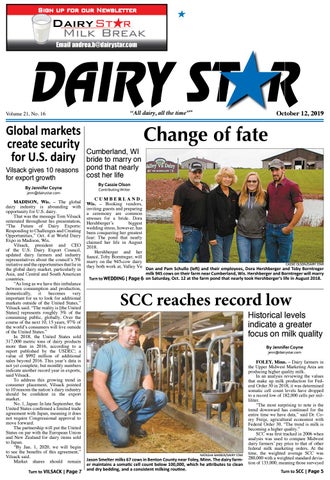
Global markets create security for U.S. dairy Vilsack gives 10 reasons for export growth By Jennifer Coyne jenn@dairystar.com
MADISON, Wis. – The global dairy industry is abounding with opportunity for U.S. dairy. That was the message Tom Vilsack reiterated throughout his presentation, “The Future of Dairy Exports: Responding to Challenges and Creating Opportunities,” Oct. 4 at World Dairy Expo in Madison, Wis. Vilsack, president and CEO of the U.S. Dairy Export Council, updated dairy farmers and industry representatives about the council’s 5% initiative and the opportunities that lie in the global dairy market, particularly in Asia, and Central and South American countries. “As long as we have this imbalance between consumption and production, domestically, it becomes very important for us to look for additional markets outside of the United States,” Vilsack said. “The reality is [the United States] represents roughly 5% of the consuming public, globally. Over the course of the next 10, 15 years, 97% of the world’s consumers will live outside of the United States.” In 2018, the United States sold 317,000 metric tons of dairy products more than in 2016, according to a report published by the USDEC; a value of $992 million of additional sales beyond 2016. This year’s data is not yet complete, but monthly numbers indicate another record year in exports, said Vilsack. To address this growing trend in consumer placement, Vilsack pointed to 10 reasons the nation’s dairy industry should be condent in the export market. No. 1, Japan: In late September, the United States conrmed a limited trade agreement with Japan, meaning it does not require Congressional approval to move forward. The partnership will put the United States on par with the European Union and New Zealand for dairy items sold to Japan. “By Jan. 1, 2020, we will begin to see the benets of this agreement,” Vilsack said. Market shares should remain Turn to VILSACK | Page 7
October 12, 2019
“All dairy, all the time”™
Volume 21, No. 16
Cumberland, WI bride to marry on pond that nearly cost her life
Change of fate
By Cassie Olson Contributing Writer
CUMBERLAND, Wis. – Booking vendors, inviting guests and preparing a ceremony are common stresses for a bride. Dora Hershberger’s biggest wedding stress, however, has been conquering her greatest fear: The pond that nearly claimed her life in August 2018. Hershberger and her ancé, Toby Borntreger, will marry on the 945-cow dairy CASSIE OLSON/DAIRY STAR they both work at, Valley Vu Dan and Pam Schullo (leŌ) and their employees, Dora Hershberger and Toby Borntreger milk 945 cows on their farm near Cumberland, Wis. Hershberger and Borntreger will marry Turn to WEDDING | Page 6 on Saturday, Oct. 12 at the farm pond that nearly took Hershberger’s life in August 2018.
SCC reaches record low
Historical levels indicate a greater focus on milk quality By Jennifer Coyne jenn@dairystar.com
NATASHA BARBER/DAIRY STAR
Jason Smelter milks 67 cows in Benton County near Foley, Minn. The dairy farmer maintains a somaƟc cell count below 100,000, which he aƩributes to clean and dry bedding, and a consistent milking rouƟne.
FOLEY, Minn. – Dairy farmers in the Upper Midwest Marketing Area are producing higher quality milk. In an analysis reviewing the values that make up milk production for Federal Order 30 in 2018, it was determined somatic cell count levels have dropped to a record low of 182,000 cells per milliliter. “The most surprising to note is the trend downward has continued for the entire time we have data,” said Dr. Corey Freije, agricultural economist with Federal Order 30. “The trend is milk is becoming a higher quality.” SCC was rst tracked in 2006 when analysis was used to compare Midwest dairy farmers’ pay price to that of other federal milk marketing orders. At the time, the weighted average SCC was 280,000 with a weighted standard deviation of 133,000, meaning those surveyed Turn to SCC | Page 5
Page 2 • Dairy Star • Saturday, October 12, 2019
DAIRY ST R www.dairystar.com
ISSN 020355 522 Sinclair Lewis Ave. Sauk Centre, MN 56378 Phone: (320) 352-6303 Fax: (320) 352-5647 Published by Dairy Star LLC General Manager/Editor Mark Klaphake - mark.k@dairystar.com 320-352-6303 (ofďƒžce) 320-248-3196 (cell) 320-352-0062 (home) Ad Composition Nancy Powell 320-352-6303 nancy.p@dairystar.com Amanda Thooft 320-352-6303 amanda.t@dairystar.com Consultant Jerry Jennissen 320-346-2292 Editorial Staff Krista Kuzma - Editor/Wisconsin (507) 259-8159 • krista.k@dairystar.com Andrea Borgerding - Associate Editor (320) 352-6303 • andrea.b@dairystar.com Jennifer Coyne - Assistant Editor (320) 352-6303 • jenn@dairystar.com Danielle Nauman (608) 487-1101 danielle.n@dairystar.com Stacey Smart - Staff Writer (262) 442-6666 • stacey.s@dairystar.com Danna Sabolik - Staff Writer (320) 352-6303 • danna.s@dairystar.com Maria Bichler - Copy Editor 320-352-6303 Advertising Sales Main Ofďƒžce: 320-352-6303 Fax: 320-352-5647 Deadline is 5 p.m. of the Friday the week before publication Sales Manager - Joyce Frericks 320-352-6303 • joyce@dairystar.com Jeff Weyer (Northern MN, East Central MN) 320-260-8505 (cell) jeff.w@dairystar.com Mark Klaphake (Western MN) 320-352-6303 (ofďƒžce) 320-248-3196 (cell) Laura Seljan (National Advertising, SE MN) 507-250-2217 fax: 507-634-4413 laura.s@dairystar.com Jerry Nelson (SW MN, NW Iowa, South Dakota) 605-690-6260 jerry.n@dairystar.com Mike Schafer (Central, South Central MN) 320-894-7825 mike.s@dairystar.com Amanda Hoeďƒ&#x;er (Eastern Iowa) 320-250-2884 • amanda.h@dairystar.com Julie Barnes (SE WI and Northern IL) julie.b@dairystar.com Megan Stuessel (Western Wisconsin) 608-387-1202 • megan.s@dairystar.com Deadlines The deadline for news and advertising in the Dairy Star is 5 p.m. Friday the week before publication. Subscriptions One year subscription $35.00, outside the U.S. $110.00. Send check along with mailing address to Dairy Star, 522 Sinclair Lewis Ave., Sauk Centre, MN 56378. Advertising Our ad takers have no authority to bind this newspaper and only publication of an advertisement shall constitute ďƒžnal acceptance of the advertiser's order. Letters Letters and articles of opinion are welcomed. Letters must be signed and include address and phone number. We reserve the right to edit lengthy letters. The views and opinions expressed by Dairy Star columnists and writers are not necessarily those of the Dairy Star LLC.
The Dairy Star is published semi-monthly by Dairy Star, LLC, 522 Sinclair Lewis Ave., Sauk Centre, MN 56378-1246. Periodicals Postage Paid at Sauk Centre, MN and additional mailing ofďƒžces. POSTMASTER: Send address changes to Dairy Star, 522 Sinclair Lewis Ave., Sauk Centre, MN 56378-1246.
A glance at what’s inside Now that it is mid October, World Dairy Expo is past us. There are several items in this issue that highlight a few happenings at the annual dairy event. Sonny Perdue, United States Secretary of Agriculture, listened to dairy farmers and Tom Vilsack, president and CEO of the U.S. Dairy Export Council, talked to attendees about dairy in international markets. In addition to this, we covered the WDE seminar “Are You Buying Your Milk Production?â€? highlighted on page 6 in second section. This issue’s “From our side of the fenceâ€? also comes from World Dairy Expo. We talked to dairy farmers from across the country asking them about the advantages of dairy farming in their area. Check out their responses on pages 15-16 in ďƒžrst section. For our “A day in the lifeâ€? feature, we visited Poortvliet Dairy near Prinsburg, Minn. A large portion of the day included chopping corn for brothers, Don, Ken and Tim, who milk 600 cows and run 1,000 acres of land. Look for their feature on pages 16, 18-19 in second section. The Van Maanen family shared their gradual expansion and upgrades on their 1,200-cow dairy near Rock Valley, Iowa. Winding Meadows Dairy milks its herd in a double-20 parallel parlor built in 2013 and houses the cows in tunnel ventilated barns. Read more about the farm’s facilities and strategies on pages 3-4 in second section. In Theresa, Wis., the Ehler brothers, Tim and Nick, started their dairy after their parents sold the family’s herd. In re-establishing their dairy, the Ehlers made a switch from milking Holsteins to Jerseys. The breed ďƒžt better into the stalls of their barn along with other beneďƒžts. Read more about what decisions the brothers have made to make their dairying dream continue on pages 14-15 in second section. While many farmers are rushing their harvest for weather reasons, the family and employees at Statz Bros. Farm were hurrying to put forage in the bunker for a different reason. They had to have ďƒželds ready to host country music star Luke Bryan on their 4,500-cow dairy near Marshall, Wis. Read more about the concert on page 3 in third section.
SIMPLICITY. VERSATILITY. QUALITY.
SR 100 GII SERIES SPEEDRAKE
ÂŽ
WHEEL RAKES
• Adjust windrow widths independently to match crop pickup widths Ĺ? 6XSHULRU WHUUDLQ IROORZLQJ ZLWKRXW WKH QHHG IRU K\GUDXOLF Ä RDW • Rear wheels raise last for cleaner windrow ends Ĺ? )DVW HDV\ VZLWFKLQJ EHWZHHQ WUDQVSRUW DQG Ä&#x;HOG SRVLWLRQV 8-, 10- and 12-wheel models 18'10" – 23'4" working widths
ÂŽ INVEST IN QUALITY Q
KuhnNorthAmerica.com m
Roeder Bros. Bellevue, IA
Dee Implement of Waukon Waukon, IA
Dave’s Repair Hills, MN
Miller-Sellner-Slayton Slayton, MN
Kunau Implement DeWitt, IA Preston, IA
Arnold's Glencoe, MN Kimball, MN Sauk Rapids, MN St. Martin, MN
Isaacson Sales & Service Lafayette, MN
Woller Equipment Swanville, MN
Fluegge’s Ag Mora, MN
Jaycox Implement Worthington, MN
Lindell Sales & Service Cannon Falls, MN
Northland Farm Systems Owatonna, MN
Pfeifer Implement Sioux Falls, SD
Beck Implement Elgin, MN
Titan Machinery Pipestone, MN
Mark's Machinery Yankton, SD
Bodensteiner Implement Elkader, IA J P Scherrman Farley, IA Van’s Implement Hull, IA Burco Sales Independence, IA
St. Joseph Equipment Eyota, MN
Visit your local KUHN dealer today!
Dairy Star • Saturday, October 12, 2019 • Page 3
It’s all inside... Minnesota
Columnists Ag Insider
Pages 8-9 First Section
FSA News & Notes
Page 26 First Section
On the Road with Princess Kay Page 27 First Section
Dear County Agent Guy Page 30 First Section
Foley
SCC reaches record low Sauk Centre
Albany
First Section: Pages 1, 5
Pelzer is new CEO for Midwest Dairy First Section: Page 12
LeRoy
Reiland Farms shifting focus to fat-corrected milk
First Section: Pages 18, 20, 22
Foley
Veterinary Wisdom
Page 31 First Section
Making Cents of Dairy
Hastings
Hastings
Page 32 First Section
Family raises layer, broiler chickens in addition to dairy
LeRoy
Come Full Circle
First Section: Pages 34 - 35
Albany
Sauk Centre
Third Section: Pages 8 - 9
First Section: Pages 23, 25
Kids Corner: The Malley Family
Martin takes over family’s farm
Page 33 First Section
The “Mielke” Market Weekly
South Dakota
Pages 10 - 11 Second Section
Big Stone City
Iowa Rock Valley
Ridgeway
Country Cooking
Page 22 Second Section
Zone 1
Big Stone City
Crop and Weather Reports
Rock Valley
Winding Meadows Dairy continues tradition of growth, improvement
Second Section: Pages 26 - 27
For additional stories from our other zone, log on to www.dairystar.com
Ridgeway
Dairy’s Star Youth: Brooke Courtney Third Section: Page 7
Second Section: Pages 3 - 4
Curtains mean cow comfort No matter the weather outside, GEA keeps your cows comfortable, healthy and productive inside. Comfortable cows are the most productive. Just like you, they perform their best when they are cool, calm and content. GEA’s industry-leading curtains and fan systems can be integrated with automation technology to
provide ideal barn temperature, air quality and humidity levels. With our total ventilation solutions, your cows will breathe easier — and so will you. Contact your GEA barn equipment dealer today.
Page 4 • Dairy Star • Saturday, October 12, 2019
WE’RE HERE TO HELP YOU RAISE THE BEST ANIMALS POSSIBLE HAVEN GRAIN SAVER
Free Stalls
PROTEIN LICK TUBS
UTILITY AUGERS
Continuous Rail Mounting System
In Stock - 6 to 21 4” • 4”-6” diameter
ALL BALE FEEDERS $30 OFF! 10% OFF ALL ELECTRICAL INSULATORS
$10 OFF
WE HAVE:
AG BAGS • TWINE • NET WRAP SILO COVERS • PLASTIC WRAP P • BUNKER COVERS
Fan Forced Portable Heater
Ag-Bag Rentals
12999
$
#6971329
Reserve your Machine Today!
Ideal for heifer barns and exterior freestall rows
SEE US FOR YOUR FALL TILLAGE PARTS!
• Provides an open front for generous lunge room • Stall width is adjustable on square mounting rails • Bolt-together construction requires no welding on-site
ROASTED SOYBEANS
We can custom roast your grains including barley, corn, wheat, oats and soybeans.
Gilman Co-op Creamery
FEED & FARM SUPPLY STORE
Gilman, MN 320-387-2770
Call 866-543-5116
Request
Open M-F 7:30-7, Sat. 7:30-5, Sun. 8:30-1
FREE EQUIPMENT GUIDES
Good service - fair prices - every day
sales@sturdybuiltmfg.net
on our Entire Product Line!
WWW.GILMANCREAMERY.COM
BI-WEEKLY NEW FROM
Continuous C ti R Rail il M Mounting ti
260 S. Muddy Creek Rd. Denver, PA 17517
FOOTBATH
KlingonBlue
™
LONG-ACTING FOOTBATH Helps improve hoof health and enhance digital dermis...to promote cow mobility, comfort and overall productivity.
Less Copper Sulphate for Disposal Available in 6.5 gal. concentrated pails
Average Cost/Lost-Profit per case of Digital Dermatitis is $275 OR
MORE!
Stays on Hooves for 2 weeks!
• No Formaldehyde • Anti-biotic Free • Proven to Work • Extended Contact Time • Anti-bacterial and Anti-fungal Properties
FOR MORE INFO - CONTACT ONE OF THESE DEALERS... Advanced Dairy Systems
9 State Rd. 29 • Spring Valley, WI 54767 (715) 772-3201
Anderson Dairy Systems, Inc. 1312 13 1/2 Ave. • Barron, WI 54812 (715) 537-3300
Athman Dairy Inc.
D&D Ag Supply
238 Main Street North • Pierz, MN 56364 (320) 468-2494
133 Atlantic Ave. NE • Pennock, MN 56279 (320) 599-4466
Champion Milking Systems
East Central Dairy Supply
23218 350th Street • Albany, MN 56307 (320) 845-4156
2195 Hwy. 23 • Mora, MN 55051 (320) 679-1029
Eastern Iowa Dairy Systems 105 3rd Ave. NW • Epworth, IA 52045 (563) 876-3087
Fuller’s Milker Center, Inc. 423 U.S. 61 • Lancaster, WI 53813 (608) 723-4634
Gorter’s Clay & Dairy Equipment 1400- 7th St. SE • Pipestone, MN 56164 (507) 825-3271
Lang’s Dairy Equipment, Inc. 2337 Millennium Rd. • Decorah, IA 52101 (563) 382-8722
Leedstone
24260 Cty. Rd. 27 • Plainview, MN 55964 (507) 534-3161
Leedstone
2545 80th Ave • Woodville, WI 54028 (715) 698-4370
Professional Dairy Systems
1449 Homecrest Ave. • Wadena, MN 56482 (218) 632-5416
Tri-County Dairy Supply, Inc.
4107 N US HWY 51 • Janesville. WI 53545 608-757-2697
United Suckow Dairy
12687 Hwy 18 & 52 • Postville, IA 52162 (563) 864-7417 210 N. Industrial Pkwy • West Union, IA 52175 (563) 422-5355
Dairy Star • Saturday, October 12, 2019 • Page 5
ConƟnued from SCC | Page 1 were not necessarily close to the average value. Thirteen years later, SCC continues to decline with a weighted average 98,000 less than in 2006 and a weighted standard deviation of 89,000. State by state, Wisconsin had the lowest SCC for the year at 175,000 followed by South Dakota at 185,000, Minnesota at 190,000 and Iowa at 198,000. “The trend we’re seeing is that everyone is having a lower average herd count, and the spread is more narrow. We’re not seeing big swings,” Freije said. “Everybody is doing a better job.” Jason Smelter milks 67 cows in Benton County, near Foley, Minn. For the duration of his 19-year career dairy farming, Smelter has placed an emphasis on milk quality, particularly with a low SCC. On average, Smelter maintains a SCC below 100,000. “For me, the biggest reason to keep a low SCC is because it’s the easiest to make extra money on the milk check,” Smelter said. “With years like we’ve had, that money is there for the taking and sometimes it’s the only glimmer of hope.” The central Minnesota dairy farmer receives about 55-60 cents per hundredweight through Bongards Creamery. When the creamery rst began issuing premiums on milk quality, Smelter received $1 per cwt., he said. Across the entire federal order, Midwest dairy farmers received an average of 13 cents per cwt., for SCC under 350,000 on $16 milk, according to the analysis. However, if SCC was above the threshold, farmers were penalized and saw a deduction on their milk check. “The penalty is not big, but we always want money coming in,” Freije said. Rewarding dairy farmers for low SCC came in 2009 when the European Union created a standard for milk quality which dropped the United States’ maximum SCC from 750,000 to 400,000. Additionally, for Federal Order 30 to fairly compare to Federal Orders 32 and 33 – Central and Mideast, respectively – milk components need to be evaluated. “We don’t have Class I utilization, so one of the ways we look to see farmers are receiving the federal order minimum is to look at test values and see farmers get paid roughly the same based on quality,” Freije said. “And part of that quality is SCC.”
The formula to create the milk price has since included a small adjuster to consider SCC. “The adjuster is meant to be small,” Freije said. “But, they wanted to create an incentive where if farmers improved the quality of their milk, they would get more money.” While cents on the dollar were miniscule compared to components where butterfat was $9.92 per cwt., and protein was $5.16 per cwt., in 2018, SCC premiums have proven to hold value on dairy operations. “It really comes down to the milk price and present dairy situation,” Smelter said. “What’s left are better dairy managers and an average lower SCC.” In the analysis, Freije categorized SCC by monthly milk production. The report indicated farms producing 5 million pounds of milk or more each month had a lower average SCC. “One of the things larger farms can do is take the infected animal out of the milking string and return her after treatment,” Freije said. “In that regard, because of hospital pens, herd averages go down.” Like many dairy farmers, Smelter works through the occasional spike in SCC caused by chronic mastitis cases often seen in the summer months. He will initially treat a cow and then decide to remove the quarter or cull the animal if problems reoccur. Smelter combats further incidences by maintaining clean, dry stalls for his lactating herd, and also focuses on a consistent milking routine amongst him and his two part-time employees. The herd is bedded with straw, and stalls are coated with an antibacterial powder twice daily before milking. Once a year, Smelter has scheduled maintenance done on the milking equipment and makes repairs when necessary. “When it comes down to it, I look for consistency and hope for the best,” Smelter said. “The incentive to have a low SCC is there, and I’ve found a feasible way to reach that on my farm.” Freije agreed. “If anything, we expected a pause in dropping SCC or bottoming out, but we really aren’t seeing that,” he said. “The management on dairy farms has gotten a lot better.” In the coming years, Freije anticipates similar analysis to indicate the trend continuing with higher quality milk and lower SCC.
Trust the experts Future success starts with today’s nutrition At Famo Feeds, we strive to provide the best support for your operation and work to accommodate your specific needs.
Programs and support for every stage... from calf to cow and everything in between! Our full lines of feed include: •Complete feeds •Starter feeds •Supplements •Concentrates •Vitamins •Minerals •Pre-mixes •Base Mixes •Milk replacers •Animal Health •Preservatives/Inoculants •Tubs •Pet Foods •Specialty and custom feeds to meet your specific needs
320-836-2145 or 800-450-2145 Check out our website to ½nd a Famo Feeds dealer near you!
www.famofeeds.com
Agri-Placement Services, Inc.
A RELIABLE WORKFORCE!
• Guaranteed Placements Entry level – management
• E-verifiable • Visa Recruitment
H-2A seasonal • TN professional
Combine Yield monitors • Yield mapping • Built in GPS
• Leadership
Bilingual (Spanish) Training • I-9 Reviews Regulatory Compliance
www.agri-placement.com (315) 986-4738
Find ou!t More
Auto Steer Guidance Packages • New and used equipment • Great trade in deals available • Solutions for most makes and models Call Justin
218-631-6045 www.infrontag.com
COMPLETE BARN SOLUTIONS WHATEVER YOUR DAIRY NEEDS Daley Farms Pine Island, MN
Before
2x20 Vertical Lift Remodel
Call us to help you make your dairy operation more efficient.
After
www.midwestlivestock.com
PINE ISLAND, MN • 800-233-8937 BEATRICE, NE • 800-342-5657 SIOUX FALLS, SD • 800-705-1447 MENOMONIE, WI • 715-235-5144
Page 6 • Dairy Star • Saturday, October 12, 2019
ConĆ&#x;nued from WEDDING | Page 1
Willmar, MN • 320.231.1470
EXPANDING OR REMODELING YOUR LIVESTOCK OPERATION? LANGE AG SYSTEMS SPECIALIZES IN:
Ĺś NEW FACILITIES
_
NO JOB TOO BIG OR TOO SMALL
Ĺś RETROFITTING & REMODELING Ĺś TURNKEY PROJECTS Ĺś BARN DESIGN Ĺś INSTALLATION, MAINTENANCE & REPAIRS
Ć‹ĆľĹ?ƉžĞŜƚ tÄž KÄŤÄžĆŒÍ— Íť sĞŜĆ&#x;ĹŻÄ‚Ć&#x;ŽŜ &Ä‚ĹśĆ? Íť sĞŜĆ&#x;ĹŻÄ‚Ć&#x;ŽŜ Ĺ˝ĹśĆšĆŒĹ˝ĹŻĆ? Íť WĹ˝Ć?Ĺ?Ć&#x;ǀĞ WĆŒÄžĆ?Ć?ĆľĆŒÄž dĆľÄ?ÄžĆ? Íť ĆľĆŒĆšÄ‚Ĺ?Ĺś ^LJĆ?ƚĞžĆ? Íť DÄ‚ĆŠĆŒÄžĆ?Ć?ÄžĆ? Íť tÄ‚ĆšÄžĆŒÄžĆŒĆ? Íť ^ƚĂůů Ć‹ĆľĹ?ƉžĞŜƚ Íť ,ĞĂĚůŽÄ?ĹŹĆ? Íť DĹ?Ć?Ć&#x;ĹśĹ? ^LJĆ?ƚĞžĆ?
Lange Ag Systems is proud to offer Grain Bags, Silage Bags & Bunker Covers from Up North Plastics and Feed Fresh Silage Covers & Custom Size Bunker Covers from Raven!
t ^ >> E t Θ h^ 'Íł ' Θ < >>z Zz E '' Z^
www.LangeAgSystems.com Esgate Rd., Anamosa Silo 8827 Maquoketa, IA 563-652-5125 Repair, LLC
ž New Silos & Rebuilt Silos w/new staves door frames & doors ž Replasters are hand plastered ž Complete Silo Repair & Service ž Sales & service on all brands of feeding equipment including ValMetal, Jamesway, Van Dale, Hanson & Laidig Bottom unloaders ž Jamesway/ValMetal manure equipment 4 & 6 wheel tanks, lagoon pumps, transfer pumps, alley scrapers, stationary, mobile & vertical mixers ž Electric Motor Repair drop off station ž Metal Culvert Sales
Visit our website for a complete list of available equipment www.jameswayfarmeq.com www.valmetal.com
Repair vs. Replace
Electronic Dairy Board Repair Service
Specializing in: WestfaliaSurge, BouMatic, & DeLaval pulsators & Takeoffs, circuit boards, Mueller milk tank circuit boards. Call: (c) 406-590-7764
www.circuitÀxer.wixsite.com/ boumaticboardrepair
PLAYIN’ IN THE DIRT
SINCE 1965
CASSIE OLSON/DAIRY STAR
Dora Hershberger checks on a cow at Valley Vu Dairy in Cumberland, Wis. She began working at the dairy in March 2016. Now she is the farm’s herdsperson. Dairy, Oct. 12 near Cumberland, Wis. Hershberger began working for farm owners Dan and Pam Schullo in March 2016. According to Dan, she has been a natural ďƒžt for the farm since the start. “Back then, Dora worked [for a restaurant] in Rice Lake, (Wis.,) that our employee’s wife worked at,â€? Dan said. “He said she was a very hard worker and kept saying that she loved cows.â€? Dora began working on the farm by caring for calves with Pam, eventually working her way to her current role as the farm’s herdsperson. “I’ve always loved animals; they understand me better than most people do,â€? Hershberger said. “I didn’t mind the calves, but I wanted to be with the cows.â€? Aug. 17, 2018, began without upset for Dora. It was DHIA test day on the farm, and after helping with testing and serving pizza to everyone on the farm,
“I realized it must be Dora; we all stopped working as they pulled her from the pond.� TOBY BORNTREGER, VALLEY VU DAIRY
PUSHING HING THE LIMITS OF CONSTRUCTION CONS PERFORMANCE
Ready to work, Mustang by Manitou Compact Equipment comes standard with the right power PGGFGF VQ VCEMNG VJG DKIIGUV VCUMU $WKNFKPI KVU ĹżTUV UMKF UVGGT KP /WUVCPI D[ /CPKVQW loaders have pushed the limits of durability, setting new industry standards. CHOOSE G E N U I N E
™
P A R T S
FOR YOUR MUSTANG EQUIPMENT
CALL YOUR AREA MUSTANG BY MANITOU DEALER TODAY!
Implement
inc.
23661 Hwy. 4 , Lake Henry, MN
(320) 243-7411
w w w . m u s t a n g - b y - m a n it o u . co m
she set out to care for the calves before beginning yard work. “That’s the last thing I remember before waking up in a hospital bed,� Dora said. Dan and Pam were on their annual vacation to Sturgis, S.D., at the time. “At 5:40 p.m., Wisconsin time, we checked in with Dora as she was beginning to pull weeds around the pond and told her we would see her when we got home in three days,� Dan said. While pulling weeds, Dora slipped into the 15-foot deep pond. Unable to swim, she began to drown as the farm dog began barking and running around the pond. Thankfully for Dora, Taytlie Smith, a 14-year-old neighbor, noticed the unusual activity and alerted her parents, Riley and Ashley Smith. Toby, the farm’s feed manager, was unaware of what was happening until he came in front of the parlor.
“There was already an ambulance and helicopter landing,â€? Toby said. “I realized it must be Dora; we all stopped working as they pulled her from the pond.â€? Dora was airlifted to a hospital in Eau Claire, Wis., where she did not wake up until two days later. A worker at heart, Dora was confused by her surroundings. “I remember waking up and thinking, ‘I’ve got to go to work,’â€? Dora said. “I had never been in a hospital before, so I was confused and scared at ďƒžrst.â€? Dora spent a total of eight days in the hospital before she was released. Taking things slow, she eased her way back into her daily routine on the farm but remained hesitant of the pond. “As long as I stayed away from the pond, I was OK; I was just happy to be back to work,â€? Dora said. Soon thereafter, Dora and Toby began to take notice of one another. The couple began dating in early February, and Toby soon knew Dora was the one. He proposed in the farm’s calf shed as they cared for the calves during an April snowstorm. As the couple began planning their nuptials, Dora knew the pond was the place to hold the ceremony. “It’s the prettiest place on the dairy, and I always wanted a farm wedding,â€? Dora said. Dan knew having the wedding at the pond meant conquering Dora’s fear. “You cannot live in fear all your life,â€? Dan said. “We would have to meet the fear head on; she just had to let me know when she was ready.â€? This summer, Dora and Dan walked to the pond, facing her fear and coming to terms with her traumatic experience. As her wedding date approaches, Dora’s fear has been replaced with excitement. “We are really excited; just hoping the weather cooperates and everything goes smoothly,â€? Dora said. On the day of the wedding, those involved with her rescue will all be in attendance. The Barron County EMTs, Cumberland Fire Department, Barron County squad cars and the helicopter that transported her will all be attending the ceremony to witness Dora say, “I do.â€? Just 14 months after nearly losing her life, Dora is ready to replace her terrifying memory at the pond with the happiest moment of her life.
Dairy Star • Saturday, October 12, 2019 • Page 7
ConƟnued from VILSACK | Page 1 available and should also grow the cheese market unlike in early 2019 when shares went to competitors. In Japan, cheese consumption has increased by 4% and is expected to grow similarly for the next 10 years. “There is a lot of consumption opportunity there,” Vilsack said. “This agreement will allow us to potentially double the amount of cheese we sell in Japan and triple the value of the cheeses we do sell.” No. 2, China: African swine fever has decimated at least half of the Chinese hog industry. Fortunately, research has shown the use of permeate whey protein will increase and accelerate the growth of piglets to market and help the country rebuild its hog industry, said Vilsack. Subsequently, the country recently announced a reduction in tariffs on whey protein. “This should open up opportunities to reclaim the value and volume we’ve lost because of the tariffs,” Vilsack said. The USDEC is hosting upcoming seminars in China to provide advice and encourage more use of whey protein in the Chinese swine industry. No. 3, Korea: The United States has a relationship with a large-scale grocery store in Korea where American cheeses will be displayed. Additionally, there will be people behind the deli counters of this grocery store chain encouraging customers to choose U.S. cheese. No. 4, Middle East and North Africa: Pop-up stores will soon be available across this region of the globe. These cheese shops will be focused on high volume trafc areas such as shopping centers. “Now, you may wonder why we’re doing business there,” Vilsack said. “Well, the [United Arab Emirates] has roughly 8-10 million people; 85% of those folks were not born there. They come from all over the world. The average family income is $135,000, which means they have a lot of money and are very interested in high-end grocery stores.” For example, Vilsack has witnessed people in this area purchase bulk yogurt and are eager for more. No. 5, Chile: A recent study showed Chile is among the top ve new market opportunities for cheese sales globally. The USDEC now has a full-time staff member in Chile and Peru to look at market availability in that
Scales Available!
Variable Rate Packages
JENNIFER COYNE/DAIRY STAR
Tom Vilsack, president and CEO of the U.S. Dairy Export Council, explains export opportuniƟes for the U.S. dairy industry during a presentaƟon Oct. 4 at World Dairy Expo in Madison, Wis. region of the world. No. 6, Indonesia: The European Union and Indonesia are going through a tiff, where the EU is upset with the environmental damage caused by the production of palm oil in Indonesia. To retaliate, Indonesia has redirected their dairy purchases to the United States. “This is an amusing situation and tremendous market opportunity,” Vilsack said. “At our annual meeting in Chicago, we’re going to have a halal seminar so our folks understand and appreciate the various requirements when you’re doing business in this Muslim-oriented country.” No. 7, South American alliances: With the resources available, the United States has developed alliances with South American countries in international forums. In the past, the EU has had the advantage, typically representing 20-some countries. “Anytime they have a position on the environment
9524 Crop Max - S100 Litter / Lime / Compost
or social and cultural issues as opposed to sciencebased rules, the EU has 27-28 votes. We go in as the U.S. and have a single vote,” Vilsack said. The alliances formed with Central and South American countries will level the playing eld. “These countries are similarly situated to us in these discussions, so we’ll go into these meetings with the same weight and heft the EU has,” Vilsack said. The alliance has already beneted the United States as the group stopped an EU effort to inject cultural and societal issues into Codex – which develops and maintains international standards and guidelines for food production and safety. No. 8, Mexico in the United States-MexicoCanada Agreement: Vilsack said he believes Congress will pass the new trade agreement by the end of the year. The passage of USMCA will lead to preservation of Mexico’s market without restriction. It will also benet the United States with a side letter that lists a series of cheese names that are recognized by Mexico as common names. “This side letter we have will create an opportunity to protect these names from future discussion,” Vilsack said. No. 9, Canada in USMCA: Of all the improvements USMCA will provide for the U.S.-Canada markets, most importantly, it will reduce and eliminate Class 7. “We’ll replace Class 7 with a new classing system that makes it harder to do what they’ve done recently,” Vilsack said. Once the agreement is passed, it has been estimated $300 million in additional business opportunity will become available for U.S. dairy. No. 10, Singapore: A Center of Dairy Excellence headquarters is set to be operating in Singapore by March 2020. This will provide a permanent location and staff working for the U.S. dairy industry in Southeast Asia. “Singapore is an incredibly important hub and the food innovation center for Southeast Asia,” Vilsack said. “This will allow us to display the great story of U.S. dairy to the rest of the world.” These 10 opportunities will facilitate growth of U.S. dairy exports and solidify the nation’s place in the global dairy market.
XI NEW S ! MODEL V-Max, V-Force & SXI Industrial 1,355 - 4,200 gallons
Exceptional Spread Performance! Meyer Manufacturing Corp.
9524 Crop Max S200 MINNESOTA A & C Farm Service, Inc. (TMR Mixer Dealer) Paynesville, MN Fluegge’s Ag, Inc. Mora, MN Gorter’s Clay & Dairy Equip. Pipestone, MN
Dorchester, WI • 800-325-9103
Call or see your local dealer for complete details!
Hammell Equipment Inc. ChatÀeld, MN Eitzen, MN Harmony, MN Rushford, MN Midwest Machinery Co. (Full Line) Glencoe, MN Glenwood, MN Howard Lake, MN Princeton, MN
Money in the Bank!
Visit our website!
meyermfg.com Midwest Machinery Co. (Forage Boxes Only) Alexandria, MN Sauk Centre, MN Werner Implement Co., Inc. Vermillion, MN Wingert Sales & Service Plainview, MN
WISCONSIN Johnson Tractor, Inc. Janesville, WI Price Equipment Sales, Inc. Bloomington, WI
Tractor Central Arcadia, WI Cameron, WI Chippewa Falls, WI Durand, WI Granton, WI Menomonie, WI Mondovi, WI Sheldon, WI West Salem, WI Westby, WI
IOWA Engel Agri Sales Sac City, IA SOUTH DAKOTA Pfeifer Implement Co. Sioux Falls, SD Puthhoff Repair Sales & Service, Inc. Salem, SD
Final DMC enrollment ďƒžgures released Page 8 • Dairy Star • Saturday, October 12, 2019
According to the USDA, more than 22,600 New York, President Donald Trump and Japanese dairy farmers are enrolled in the 2019 Dairy Margin Prime Minister Shinzo Abe announced the ďƒžrst stage Coverage program. That means 78 percent of U.S. of the new trade agreement between the United States dairies with an established production history signed- and Japan. This agreement would level the playing up. In Minnesota, 2,334 or 82 percent of ďƒželd for U.S. agricultural products dairy farmers are enrolled. against competitors. “Japan will open Ag Insider new markets to approximately $7 billion AFBF recommends changes to federal in American agricultural products,â€? milk marketing orders Trump said. “Japanese tariffs will be The American Farm Bureau signiďƒžcantly lower or eliminated entirely Federation is seeking changes in the for U.S. beef, pork, wheat, cheese and federal milk marketing orders. The wine. It’s a huge victory for America’s recommendations include the elimination farmers and ranchers and that’s very of bloc voting by cooperatives for any important to me.â€? The ďƒžrst stage of the changes to milk pricing regulations. Farm agreement is expected to be ďƒžnalized by Bureau also wants more information to January 2020. be made available through mandatory price reporting. A working group has CoBank reviews dairy situation By Don Wick released these recommendations, which In its quarterly rural economic review, will be part of the policy discussion at the CoBank forecast U.S. milk production Columnist American Farm Bureau annual meeting to hold steady to decline slightly in the in January. remaining months of this year. Class III milk prices have hit levels that have not been seen Inching toward a USMCA vote since 2014. The increase in block cheese prices is cited Despite the impeachment inquiry, the House as one reason for the stronger milk check. However, continues to work on the U.S.-Mexico-Canada CoBank says “the ever-widening block-barrel spread Agreement. National Milk Producers Federation continues to stress barrel cheese processors.â€? senior vice president Chris Galen says it is a slow process, but lawmakers are inching closer to a vote. Dairy product report released During August, total U.S. cheese production “We need something to happen in 2020 because who knows what will happen as we get closer to the increased nearly 24 million pounds from last year. election,â€? Galen said. “Given all the other economic Nearly all of that increase was in American cheese uncertainty, including the slowdown in manufacturing production. According to USDA’s Dairy Products and concerns about the global economy, getting Report, butter production went up by nearly 3 million the USMCA would be a big shot in the arm for our pounds; nonfat dry milk increased 3.2 million pounds economy and for agriculture, in particular.â€? On and skim milk powder rose 3.8 million pounds. Dry another trade front, the World Trade Organization has whey supplies increased 5.7 million pounds in August. authorized the United States to move forward with tariffs on $7.5 billion worth of European products. Focus on pasture repair this fall Cold and wet weather conditions prohibited That’s the largest retaliation ďƒžgure ever authorized by the WTO. Galen is pleased EU dairy products are on proper development and timely weed control in pastures this past year. Corteva Agriscience ďƒželd the retaliatory list. scientist Scott Flynn said when soils stay cool and First Stage of United States-Japan Trade saturated, the amount of root development is restricted. “That results in weak stands. In the fall of the year Agreement Announced During the United Nations General Assembly in with weak stands there is an opportunity to tune up
pastures,� Flynn said. “Fertilizer applications in the fall stimulate root growth and tiller development, which builds up the pasture for the coming year.� Flynn notes annual weeds are typically the easiest to gain control of. Fall is an ideal time to tackle thistles, perennial invasive weeds and winter annuals that get in the way of pasture recovery.
New hybrid alfalfa introduced Alfalfa supplies were tight going into this growing season. Dairyland Seed forage leader Sara Hendrickson said adverse weather has not provided much relief to the alfalfa shortage. “Because it was such a wet spring, our hay inventories in May were at an all-time low,â€? Hendrickson said. “Luckily, there were a few guys that were able to get some new seeding in between the rain showers, but it wasn’t enough to compensate for the low hay supplies.â€? Dairyland Seed introduced the world’s ďƒžrst hybrid alfalfa in 2001. The new fourth generation hybrid alfalfa was launched at World Dairy Expo. Hendrickson said the HybriForce-4400 Alfalfa delivered superior establishment performance, even in spring planting conditions that were wetter than normal. Meatless burger gets a trial run at McDonald’s McDonald’s is the latest quick-serve restaurant chain to test plant-based burgers. Beyond Meat produced a special meatless product for McDonald’s and it is being tested in about 30 Canadian stores. The sandwich is called the PLT, which stands for plant, lettuce and tomato. McConkey begins new role as MN Rural Mental Health Specialist Minnesota’s new rural mental health specialist is on the job. Monica McConkey has worked in the mental health ďƒželd for the past 25 years, most recently at Prairie St. Johns and with her consulting business, Eyes on the Horizon. “There’s so much emphasis on preventing suicide with our farmers, but I think it is so much more than that,â€? McConkey said. “It’s helping them not live with so much emotional pain as they deal with stress and the difďƒžcult conditions. I just want to Turn to AG INSIDER | Page 9
Let us help you raise healthy, robust calves! Control Center Assembly Pasteurizer
For larger dairies we offer 120,150, 250 or 250 gallon capacity.
Call for details!
20, 30, 40, 60 and 90 gallons
Dairy Star • Saturday, October 12, 2019 • Page 9
ConƟnued from AG INSIDER | Page 8 be a resource.” McConkey is based at Detroit Lakes and will primarily cover northern Minnesota. The position was funded by the state legislature and is contracted through the AgCentric Farm Business Management program. Trivia challenge Pizza Hut is the largest pizza restaurant chain in the world. That answers our last trivia question. The dairy checkoff partners with the NFL in a special project. What is it? We’ll have
the answer in the next edition of Dairy Star. Don Wick is owner/broadcaster for the Red River Farm Network, based in Grand Forks, North Dakota. Wick has been recognized as the National Farm Broadcaster of the Year and served as president of the National Association of Farm Broadcasting. Don and his wife, Kolleen, have two adult sons, Tony and Sam, and ve grandchildren, Aiden, Piper, Adrienne, Aurora and Sterling.
ed t s a o r r u o y Getting KLC Farms is t a s n a e b y o s
E L P SIM
Pull in unload and reload in just 15 minutes. Every day we have a high quantity of high quality soybeans. Our soybeans have the energy, protein, amino acids and bypass protein for your cows
KLC Farms Roasting, Inc.
Preferred By Bovines Everywhere
1-877-738-2326 Visit www.roastedbeans.com
Quality
Consistency
DHIA: Now MORE than ever Milk Pregnancy from Minnesota DHIA Time Poor this time of year (or all year)? Milk pregnancy testing takes no time out of your cow’s day and seconds out of your day. CONVENIENT TO TEST, DATA ADDED TO YOUR SOFTWARE OR REPORTS
393,000 cows tested and counting Minnesota Dairy Herd Improvement Association 307 Brighton Avenue South Buffalo, MN 55313 1.800.827.3442 www.mndhia.org
Page 10 • Dairy Star • Saturday, October 12, 2019 • Cleaning Drain Tiles, Manure Systems, Sewers, Frozen Lines • Reasonably Priced • 24 hour Service CALL FOR PRICING
Noah VanBeck 320-241-3087 (Cell)
PROTECT AGAINST SLIPS & FALLS • • • •
Traction in all directions Reduce animal stress Aids in heat detection Cost effective & practical
We offer grooving & scarifying
BEST FOOTING CONCRETE GROOVING
Strum, WI
Secretary Perdue listens to industry’s concerns at WDE
715-579-0531
CALL TODAY!
www.bestfootingconcretegrooving.com
Les Kuehl
Repair Service
30+ Years Experience
YOUR CENTRAL MINNESOTA GOLIATH REPAIR SERVICE! • Sealed silo parts & service • All parts needed to service your • Best chains on the market Goliath Unloaders • Used and rebuilt unloaders Not afÀliated with the Harvestore brand • Stainless steel roofs • Stainless steel conveyor chains Call for early maintenance specials
320-760-2909
Eve. 320-762-1827 No Emergency Charges--Ever!
JENNIFER COYNE/DAIRY STAR
Dairy farmer Paul Adams states his concerns with the dairy industry to United States Department of Agriculture Secretary Sonny Perdue during a town hall meeƟng Oct. 1 at World Dairy Expo in Madison, Wis. Adams is an organic farmer from Eau Claire, Wis. tfn
Water ‘em Right
OmniFount
Depend on the superior, impact resistant construction of Ritchie Waterers, even under the most rugged condtions. • Easy to maintain • Large access panel • Heating elements directly under trough for exceptional performance • Tough 304 stainless steel for long life • Mounts securely to concrete pad • Fast reÀll, reliable Ritchie valve
All Ritchie waterers are backed by a industry leading 10-year warranty.
Call D&D Ag Supply for more information
133 Atlantic Ave. NE • Pennock, MN
320-599-4466
Farmers press for change in trade, market policies By Jennifer Coyne jenn@dairystar.com
MADISON, Wis. – All sectors of the dairy industry gathered Oct. 1 to voice their concerns and praises for the industry as United States Department of Agriculture Secretary Sonny Perdue hosted a town hall meeting at World Dairy Expo in Madison, Wis. The event, which kicked off Perdue’s visit to America’s Dairyland, shed light on national and foreign policies weighing heavily on the minds of dairy farmers across the country. “We are truly interested in your prosperity and livelihood,” Perdue said. “Even as an advocate and representative for agriculture to our administration and Congress, I cannot do the job that you (farmers) can do. I want to exhort you all to make your voices heard.” Perdue was joined alongside Brad Pfaff, secretary-designee of the Wisconsin Department of Agriculture, Trade and Consumer Protection, and Brody Staples, an eastern Wisconsin dairy farmer who moderated the meeting. Farmers from across Wisconsin, as well as cooperative representatives speaking on behalf of their farmer members, spoke to Perdue. Many were curious to know how their products are best being marketed on a global scale, given the recent announcement of a trade partnership with Japan and the pending United State Mexico Canada Agreement. While there are continued challenges with the names of dairy products, particularly European cheeses, and tensions in the Chinese market, Perdue was optimistic about the opportunities available currently and in the future for American dairy exports. He spoke of marketplace access in Japan but also other Asia territories in India, Malaysia and Thailand – and even the prospective export market coming from USMCA. “A lot of people are concerned with trade and the economy, and we need to make those expectations known,” Perdue said. “I frankly think that if USMCA was put on the oor today, it would pass both caucuses.”
However, Perdue urged dairy farmers to be patient as agreements are formed with American products at the forefront of discussions. “Based on the productivity of our dairy farmers, I can understand where other countries want to put up barriers,” he said. “But, they can’t expect to come into our country freely and fairly without opening up their markets, and that includes the E.U., India and everywhere else.” The United States is using money from the market access program to grow exports across the globe while resolutions are sought with China. “We need to work ourselves into the market elsewhere,” Perdue said. “I would love the day when we don’t have to become dependent on China, and we can trade fairly and frequently.” Farmers stood up and commended Perdue for his work to address local issues, particularly adjusting the dates for grazing and haymaking on prevented plant acres due to the wet spring. “Loosening of the rules was really nice for farmers to give them exibility in what they were going to plant,” said Amy Penterman, a dairy farmer in Clark County, Wis., and vice president of the Dairy Business Association. “It really helped farmers get a crop and feed their cows through the winter.” Perdue agreed. “The dates we were looking at is something we’re talking about possibly making permanent,” he said. “We think it would be possibly helpful in our livestock industry where cattle and farmers can benet from that. But, I’m also hoping we never have a record-breaking year of prevent plant again.” Ellsworth Cooperative Creamery CEO and President Paul Bauer expressed his concerns for a stable pay price for his dairy farmer members. Bauer delved into the vast spread between block and barrel prices, and the cost of such spreads to dairy farmers in a bullish market. “The federal milk order system has worked for 50 years, … but the USDA has failed to review and ne-tune the system, and it’s been at the cost of dairy farmers as technology and processors have grown,” Bauer said. “It’s time to protect our farmers and food supply as this system was intended.” The concern over milk price was not avoided in the town hall meeting. Turn to PURDUE | Page 11
Dairy Star • Saturday, October 12, 2019 • Page 11
ConĆ&#x;nued from PURDUE | Page 10
Let us help you raise healthy, robust calves! 20, 30, 40, 60 and 90 gallons Control Center Assembly Pasteurizer
For larger dairies we offer 120,150, 250 or 250 gallon capacity. Call for details! JENNIFER COYNE/DAIRY STAR
Secretary Sonny Perdue responds to quesĆ&#x;ons during a private media session following the public town hall meeĆ&#x;ng Oct. 1 at World Dairy Expo in Madison, Wis. According to the United States Dairy Export Council, 2018 was a record year for dairy products traded on the international market. Another report recently showed domestic dairy consumption rising over the last three years.
“We need to look forward, not backward. There has no doubt been economic stress in the dairy industry, but we believe that better days are ahead.� SEC. SONNY PURDUE, UNITED STATES DEPT. OF AG
“Along with those same statistics, my Class III price was around $14.61,â€? said Joe Bragger, Wisconsin dairy farmer. “This year, we’re off 2% in trade, and I’ll come close to $17 by the time we’re done with an average Class III price. Beyond trade, what are we doing so we never experience another ďƒžve
years like this downturn?â€? Perdue quickly pointed to the Dairy Margin Coverage Program and encouraged any dairy farmer who has not yet enrolled to do so. “There’s no doubt dairy farmers had the most stress from the ‘14 farm bill than any other sector. They got it right in the 2018 farm bill. ‌ More dairy farmers will be able to survive with [it] and its risk mitigation measures,â€? Perdue said. “Prices are moving forward and frankly, farmers would rather have a good crop and good milk [production] and a fair price than a government check any day.â€? Perdue concluded his town hall meeting after collecting the feedback from those in attendance and left with a note of encouragement for the dairy industry. “In the dairy industry, we have to understand it’s a new day. ‌ I think with the milk prices and being able to have a risk management, that means something to farmers,â€? Perdue said. “We need to look forward, not backward. There has no doubt been economic stress in the dairy industry, but we believe that better days are ahead.â€?
Majestic View Dairy Sara Recker-Calf Manager Lancaster, WI “W just installed the new Westward Control “We Center a few weeks ago after having our previous one for 12 years. We like using pasteurized milk because we have healthier p calves and it is cost effective. Our new control ca center is also easy to use and takes less time ce to pasteurize than our old one.�
No one knows your equipment better.
Keep It Genuine.
Do You need Fall Forage? • Forage Oats • Spring Triticale • Italian Ryegrass • Fall Triticale
We can also make custom mixes for cover crops!
Your AGCO Parts Dealer has the quality OEM parts you need when you need them. Everything you need from hardware, chain and batteries to tillage, belts and cutting parts are available from your AGCO Parts Dealer. Along with the help of our highly trained service personnel at AGCO Parts to make it allParts comeDealer together, you can rest easy. Stop your AGCO Your AGCO hasso the quality OEM parts youinto need when you Parts Dealer and get the partsyou andneed services need tochain “Keepand youbatteries in the Field� need them. Everything fromyou hardware, to this season. Find out more at AGCOParts.com. tillage, belts and cutting parts are available from your AGCO Parts Dealer. Along with the help of our highly trained service personnel at AGCO Parts Š "($0 $PSQPSBUJPO "($0 UIF "($0 MPHP BSF SFHJTUFSFE USBEFNBSLT PG "($0 $PSQPSBUJPO
DEIKE IMPLEMENT CO.
P.O.Box 834, Waverly, Iowa 50677 • email: information@deikeimplement.com
Sales Phone: 319-352-3731 • General Phone: 319-352-1117
Learn more by contacting us or at www.peakforage.com
608-967-2414 to locate a dealer near you
USED TRACTORS - Low rate ďŹ nance Available MF 8735, 2018, loaded, guidance .............................$192,500 NH T9.560, 16 spd, duals, guidance .........................$168,500 Fendt 720, deluxe, duals, guidance, 1200 hrs ...........$156,500 Allis 9695 FWA, powershift, wts .................................$47,500 AGCO 8785, cab, 32-sp, Cummins .............................$32,500 Kubota L5240, 4x4,cab, hydro,frt.snowblower ...........$27,900 Allis 9170 duals, 18-sp, 2wd.......................................$21,900 IH 560 gas, loader, 3 pt .................................................$4,750 Ford 901, select-o-speed, p.steering.............................$4,250 AC CA wide front, repainted, nice..................................$3,950 AC C, mid-mount mower ........................................ Coming In TILLAGE & PLANTING EQUIPMENT White 8824 24-30, central ďŹ ll, liq.fert., 1-owner .........$75,500 White 8816 16-30 central-ďŹ ll, trashwheels .................$64,500 White 8524 24-30 central ďŹ ll, t.wipers ........................$54,500 White 8202 12-30, 2013, 1-owner ..............................$35,500 White 8222 12-30 ex frame, t.wipers ........................$28,900
Store Hours: Monday-Friday 7:30-5:00 Saturday 7:30-noon
www.deikeimp.com
HARVEST EQUIPMENT AGCO S67, duals, power bin, yield monitor ..............$135,900 AGCO R65, tilt, monitor, 285 hp Cummins,chopper....$89,500 Gleaner 8000 30’; 800 30’ and 25’ Flex Heads ...................Call Gleaner 830 and 630 Hugger Cornheads ...........................Call MISC. EQUIPMENT Wacker WL50 wheel loader, cab, new tires .................$38,500 Kubota ZD331 0-turn, 72� deck, hyd.lift......................$10,250 GCO 2027 diesel 61� deck, 4wd, 3pt, PTO ....................$8,750 Kubota RTV1100 cab, hyd.box, liner...$6,750 Bobcat 72� Soil Conditioner, hyd. angle ........................$5,250 JD X724 gas, all-wheel steer, 54� deck .........................$4,950 Woods RB850 3pt. blade, hyd.......................................$2,350 JD 345, 48� deck, tilt steering, bagger ..........................$2,250 Polaris Ranger 700EFI, cab, heat, blade ...................... Coming New Snowblowers, Blades, Pallet Forks, Bale Spears ........Call NEW Sunower and Landoll Tillage ...................................Call
Page 12 • Dairy Star • Saturday, October 12, 2019
Pelzer is new CEO for Midwest Dairy
Iowan has 35 years of experience with the organization By Krista Kuzma
krista.k@dairystar.com
In a time when dairy farmer morale has taken a hit after years of low milk prices, Molly Pelzer wants to share the good news about dairy. “Although we know milk consumption has continued to decline, dairy product consumption is at its highest in 56 years since 1962,” Pelzer said. “Butter and cheese are at their highest points ever. And 94% of all households in the U.S. buy milk. That’s 117 million households. That’s phenomenal.” Sharing this good dairy news along with continuing to work to establish dairy relationships and facing the challenge of dening healthy food are areas Pelzer wants to focus on as the new chief executive ofcer of Midwest Dairy Association. “I’m dedicated to fullling the role on behalf of our dairy farm families,” Pelzer said. “I’m humbled by the trust.” Pelzer, a 35-year veteran with the organization, began her new leadership role Oct. 1, taking over for Lucas Lentsch. She joined the predecessor organizations of Midwest Dairy in 1984, serving western Illinois and eastern Iowa. As a dietitian, Pelzer worked with health professionals and schools. Pelzer has also worked on the communication side of the organization, and most re-
cently served as chief experience ofcer setting strategies for Midwest Dairy. Pelzer also knows the hard work of farming as she and her husband operate a corn, soybean and hog farm in Iowa. “I have a great afnity for the commitment for feeding the world that our dairy farmers and all farmers make,” Pelzer said. “When I joined the Molly Pelzer dairy council in the CEO, Midwest Dairy mid ‘80s, it (farming) was all about diversifying. That was our inside joke – we had diversied and were now into dairy.” Pelzer knows the checkoff is part of this good news story for dairy. “Cheese and butter consumption is on the rise and a lot of that is thanks in large part to the investment dairy farm families make to the checkoff to do research,” she said. This research has also provided new information about whole fat dairy, which is starting to change consumers’ purchasing behaviors along with what healthcare professionals are recommending, Pelzer said. Pelzer also mentioned more good news about dairy, including that 42% of households that buy plant-based beverage are also buying milk. “They maybe want more variety in their refrigerators,” Pelzer said. And recently, leading medical and nutrition organizations recommended milk or water as the beverages of choice for children under 5 years old.
The new DeLaval VMS V300 milking robot
Attachment rate
Pelzer hopes to do more work, especially in sustainable nutrition. “It would help show how dairy is good for you and good for the planet,” she said. There will also be a few challenges Pelzer will have to face. “The changing denition of healthy foods is paramount in our organization,” Pelzer said. “We know dairy provides a very unique package of nutrients that have some awesome health benets. In the past, that was enough to encourage children, adults, parents and healthcare providers to recommend three servings of dairy a day. Now, the denition of healthy foods also involves consideration of the environment. How does that food impact the air, land and water?” While this can be challenging, Pelzer knows it can be done. “Dairy has a great story to tell,” she said. “We have fantastic information that showcases how we’ve increased our efciency and added back value and reduced our carbon footprint.” However, Pelzer said the dairy community needs to share that message much more openly. “I would encourage dairy farm families to think about telling their story,” Pelzer said. “It really does make a difference. Dairy farmers continue to be a very trusted source among consumers, and using their voice to tell their dairy story helps us amplify those good news message as well as answer consumer questions about what happens. Folks are interested in knowing about their food and knowing about what dairy farming is all about.” It all comes back to Pelzer’s focus of sharing the good news about dairy.
WE GREW UP ON
THE FARM
™
99.8%
“That’s really good news,” Pelzer said. Going forward, Pelzer is focused on Midwest Dairy’s vision and mission. “We’ll continue to bring dairy to life and give consumers an excellent dairy experience,” Pelzer said. “Those two areas will remain the same, building dairy sales and dairy trust.” She is looking forward to doing this through relationships on all levels. “Those relationships with staff and our dairy farmers are going to be quite central to the work I’ve been doing,” Pelzer said. “They help us develop even more creative programs and resources to help build dairy demand and consumer condence in dairy.” Pelzer also hopes to further develop relationships with key partners to make an even stronger dairy impact, including Midwest Dairy’s newest partners of retailers and grocery stores. “We’re focused on helping consumers at point of choice, make that selection at the grocery store for dairy – making more dairy purchases if they are good dairy customers and wooing them into the category if they haven’t been purchasing dairy as often,” Pelzer said. Other key partners include physicians, especially pediatricians; dietitians; tness professionals; processors and manufacturers in the dairy community; and state elected ofcials. “We want to help them understand more about how dairy adds to the economy and provides local value,” Pelzer said. “We can certainly provide insights and information, but we don’t lobby. We are educating only. We are not policy based.” Land grant universities is one place
Up to
7500 lbs milk per day
Up to
50%
SINCE 1859, GEHL HAS CREATED INNOVATIVE SOLUTIONS FOR EQUIPMENT OWNERS AND USERS.
faster attachment time
10
%
Higher capacity
Today, Gehl carries the tradition forward with a complete line of skid loaders, track ORDGHUV DQG DUWLFXODWHG ORDGHUV GHVLJQHG ZLWK SURGXFWLYLW\ DQG HI¿FLHQF\ LQ PLQG Plus a full line of EDGE attachments are available to add more versatility around WKH MREVLWH ZLWK \RXU *HKO HTXLSPHQW CHOOSE G E N U I N E
™
P A R T S
FOR YOUR GEHL EQUIPMENT
CALL YOUR LOCAL GEHL DEALER TODAY! Plain, WI (608) 546-3713
Waunakee, WI (608) 849-5043
www.delaval.com is a registered trademark of Tetra Laval Holdings & Finance S.A. and “DeLaval” is a registered trade/servicemark of DeLaval Holding AB © 2018 DeLaval Inc. DeLaval, 11100 North Congress Avenue, Kansas City, Missouri 64153-1296. All facts and figures are the result of more than two years of data collection from more than 20 test and pilot farms, actual results may vary and are not guaranteed. www.delaval.com
Villard Implement Co. 671 Lincoln Ave. Villard, MN • 320-554-3101• www.villardimplement.com ZZZ JHKO FRP
Dairy Star • Saturday, October 12, 2019 • Page 13
USDA opens 2020 enrollment for DMC Program
BERGMAN Automatic AGRi-Speed HITCH 1
More information The 2018 Farm Bill created DMC, improving on the previous safety net for dairy producers. DMC is one of many programs that FSA and other USDA agencies are implementing to support America’s farmers. For more information on enrolling in DMC and taking advantage of an online dairy decision tool that assists producers in selecting coverage for 2020, visit the DMC webpage. For additional questions and assistance, contact your local USDA service center. To locate your local FSA ofce, visit farmers.gov/service-locator.
3
E A SY a s 1 - 2 - 3 • • • •
• Fast, reliable, safe • Easily pulls more than the D.O.T. allows on the highway • Available for pick-ups, choppers, tractors, wagons, etc.
Simple drawbar mount Easy to operate day or night PTO compatible Increases efÀciency, only need 1 person
Gilman Co-op Creamery FEED & FARM SUPPLY STORE
www.bergmanmfg.com Gilman, MN • 320-387-2770
SEE US FOR ALL YOUR FALL FORAGE NEEDS! All Bale feeders
Silage Innoculants IN STOCK
10% OFF Bunker Covers & Silage bags ALL IN STOCK
Apache Creep Feeder IN STOCK
$3,700
Clean Chute IN STOCK
715-644-2350 Chippewa Valley Dairy Supply
6053 CTY. HWY. G • STANLEY, WI 54768 • Andrew Zimmerman
20
TH
CELEBRATING 20 YEARS
of consistent cow comfort with proven performance. o
$4/bed Rebate OɈer
valid on DCC Waterbeds purchases made Sept 1 - Oct 31, 2019 and
$3/bed Rebate OɈer
valid on DCC Waterbeds purchases
made Nov 1 - Dec 31, 2019 in the U.S. and Canada.
BUY EARLY TO SAVE MORE
For details visit dccwaterbeds.com/rebate Contact a DCC Waterbeds dealer near you: Eastern Iowa Dairy Systems - Epworth, IA Gorter’s Clay & Dairy Equipment - Pipestone, MN Livestock Systems - Charles City, IA Leedstone - Melrose, MN, Glencoe, MN, Plainview, MN & Woodville, WI K&R Equipment - Fountain, MN
Midwest Livestock Systems Pine Island, MN & Sioux Falls, SD United Development LLC- Brookings, SD Bob’s Dairy Supply - Dorchester, WI Field’s - Mount Horeb, WI Fuller’s Milker Center Inc. - Lancaster, WI
Komro Sales & Service Inc. - Durand, WI & Whitehall, WI Nachatelo Construction - Mauston, WI Preston Dairy - Sparta, WI RLS Vinyl & Farm Supply - Hager City, WI Scharine Group - Whitewater, WI Lindstrom Farm Systems - Menomonie, WI
www.DCCWaterbeds.com | (608) 709-2693 Advanced Comfort Technology, Inc. © 2019
CA-May19-1B-JW
Dairy producers can now enroll in the Dairy Margin Coverage (DMC) for calendar year 2020. USDA’s Farm Service Agency (FSA) opened signup today for the program that helps producers manage economic risk brought on by milk price and feed cost disparities. “We know it’s tough out there for American farmers, including our dairy producers,” said Bill Northey, Under Secretary for Farm Production and Conservation. “As Secretary Perdue said, farmers are pretty good at managing through tough times, and we know that more dairy farmers will be able to survive with this 2018 Farm Bill and its risk mitigation measures, like the Dairy Margin Coverage program.” The DMC program offers reasonably priced protection to dairy producers when the difference between the all-milk price and the average feed cost (the margin) falls below a certain dollar amount selected by the producer. The deadline to enroll in DMC for 2020 is Dec. 13, 2019. Dairy farmers earned more than $300 million dollars from the program in 2019 so far. Producers are encouraged to take advantage of this very important risk management tool for 2020. All producers who want 2020 coverage, even those who took advantage of the 25 percent premium discount by locking in the coverage level for ve years of margin protection coverage are required to visit the ofce during this signup period to pay the annual administrative fee. “Dairy producers should denitely consider coverage for 2020 as even the slightest drop in the margin can trigger payments,” said Northey. “Dairy producers should consider enrolling in DMC to guard against what has been, for several years, an extremely unforgiving market.”
2
Page 14 • Dairy Star • Saturday, October 12, 2019
MANURE SEASON IS COMING!
ARE YOU READY?
Artex Spreader with cyclone beaters. Available in sizes 300-700 cu. ft.
SB B Series Seriees
This is, quite simply, the most advanced, bestbuilt manure spreader you’re ever going to see. Now, do you need one this tough? Well, that all depends on how often you like to buy them.
SBX Series Seriess
HYDRA-SPREAD Manufactured by
Sizes Range From m 285-550 Bu..
ProPush 2054 ®
Protwin Prot P ro otwi win in® Side-Discharge Spreader
COMMERCIAL FEED BOXES
Available In Sizes From 760 – 1900 Cu. Ft.
Installation Available. Parts On Hand.
Simple, rugged, reliable manure tanks. These non-steering tanks have less moving parts, therefore there is less maintenance. These tanks are the workhorse of the manure industry.
These multi-purpose units can deliver feed to the bunk or deliver bulk commodities and unload quickly
If y
ou
h
ion .
ing Dealer
Minnesota’s
T TRUCK TRUC MOU MOUNT
LIQUID MANURE TANKS, PUMPS AND AGITATORS Steerable Series Spreaders p
nd l Ha
La rg
SEMI TRAILER
ding and Man e e ur tF s e e
Lagoon Pumps
l
Freestall Tilting Alley Scrapers Powerful PTO Pumps & Agitators To Handle Liquid Manure
ut
so wwave a w.da barn, we have y.com airylandsuppl
Excellent maneuverabilityy and contro control ol o on all types yp of ter terrain. errain.
SAUK CENTRE, OFF I-94 ON THE CORNER OF HWY. 28 & 71 SOUTH
From Our Side Of The Fence
Dairy Star • Saturday, October 12, 2019 • Page 15
U.S. dairy farmers: What are challenges in your region?
Brad Brainard Enid, Okla. Garďƒželd County 115 cows Tell us about your farm. We milk 115 registered Holsteins on our farm, Brainard Dairy, and have had a closed herd since 1965. At the time, my father was milking with my grandmother and completed a new dairy barn that December. He walked 110 cows down the road for 2 miles to the current facility where we have been milking every morning and night since. We are a centennial farm and I am the fourth generation to farm this land. We have around 2,000 acres, using 500-600 acres for pasture and planting the rest. It is easier to hire people on the crop side than the dairy side, so I try to spend more of my time on the dairy and also have a couple employees who help me there. We sell registered breeding bulls to other dairy producers. We used to sell all the way south of Albuquerque, N.M., over to Franklin, La., up to Illinois and over to Ledger, Mont. But with the decrease in dairy farms, I only have one customer now. What is the dairy community like in your area? I am both the largest and the smallest dairy in my county because I am the only dairy left. The closest farm is about 30 miles away. One other guy and I are the only dairy farmers in a 6-county rectangular area, and he milks 25 cows. I believe we are down to 138 dairy farms in the state of Oklahoma. At one time, we had a local co-op that took in 6-8 counties and had over 10,000 producers. This was probably in the late ‘60s or early ‘70s. There used to be two regions of AMPI, and I was in the southern region shipping milk to Gold Spot Cooperative Creamery, which was one of the ďƒžrst four original co-ops to start Dairy Farmers of America. What types of crops do you grow? We grow our own forages and feed a parlor ration inside the barn to balance things out. Our cows receive 25 pounds of grain per day. Outside they eat whatever we can grow. I do not have the labor to grow alfalfa, so I purchase it. We grow the following cash crops: wheat, milo and soybeans. We do a lot of grazing, and our pastures include winter wheat, oats, hay grazer and crabgrass. What are the two biggest challenges to dairy farming in your region? We are on the edge of the city limits. I have land right on the edge, and then my dairy is about 7 miles away from the city. We are in an area that is growing in residential population, therefore, we no longer have neighbors who are dairy farmers. With that comes a whole host of problems. My neighbors manicure their pastures and spray and mow the roadsides with a riding lawn mower so everything looks perfect. That leads them to complain to me because I have thistles growing in my pasture.
Sarah Rocha Tillamook, Ore. Tillamook County 1,000 cows Tell us about your farm. Our farm is operated by my husband and I, our four sons and a nephew. We have been in Tillamook for 27 years after we relocated from California. We have 700 Jerseys and 300 Holsteins. We raise everything at home. What is the dairy community is like in your area? Around us, most of the industry is dairy. There are basically two industries: Dairy and lumber. It’s deďƒžnitely not dwindling away. What types of crops do you grow? We grow corn for feed and also have pasture land. We don’t get a lot of heat, so we don’t grow much. What are the biggest challenges to dairy farming in your region? Manure management is the biggest challenge we deal with constantly. We get 100 inches of rain a year, so we have a lot of restrictions and water quality tests. It’s a lot of rain to deal with. It’s hard on the cows and the people. What advantages does your region have for dairy farming? The cool climate. The cows love it. Also, because of all the rain, we have lots of grass, so we pasture our cows. Why did you come to World Dairy Expo this year? We always go to Louisville, and just had high aspirations this year to attend expo. We are also trying to promote our herd. This year, I sold some embryos to people from Australia, so that’s exciting and we hope to network with more international customers. I’m eager to pursue that market.
Laron Martin Memphis, Mo. Scotland County 50 cows Tell us about your farm. My family milks 50 Holstein cows in a double-4 parlor. We raise all our replacements on the farm. What is the dairy community like in your area? There is not much dairy in our area. I work on a farm about 20 miles away and they have 180 cows, which is the largest around. What types of crops do you grow? We grow corn, soybeans and alfalfa for hay. The corn is for the cows and we sell some of the soybeans. What are the biggest challenges to dairy farming in your region? Depending on the time of year, it is either too wet or too dry. So, managing water is typically a challenge. Usually we don’t have both problems in the same week. What advantages does your region have for dairy farming? We have beautiful rolling hills, and a lot of people pasture their cows. We also don’t have extremely harsh winters like other parts of the country and don’t get too much snow. Why did you come to World Dairy Expo this year? This is my ďƒžfth year here and I like to see the trade show and watch the cattle show. This year we came for two days and I’ve had a great time so far. There is always something to learn from the vendors or showmen. It’s also fun to see all the high-quality cattle.
I explain to them there’s only a limited amount of herbicides I can spray. But every year, I get turned in to the Oklahoma Department of Agriculture for having weeds. Secondly, I own land on both sides of the road, and for years, we walked our cows from one side to the other for a distance of 300 yards. I got complaints, so I shortened it to 30 yards, but I still get complaints. People will call and say, “My new car smells like cow manure.â€? I try to be a good neighbor and work with everyone as well as I can. Finally, I told one neighbor, “Hey, I’ve been here a long time, and when you came out to buy your land, you knew I was here. You knew what I did. If you don’t want to put up with some manure on your road, cows getting out occasionally, noise, dust, or whatever you want to complain about, then don’t live in the country.â€? What advantages does your region have for dairy farming? Oklahoma is a milk deďƒžcit state,
meaning we do not produce enough milk within our border to meet our demand. This area is high class I utilization. I’m about 80 miles from the plant, and my milk goes into the jug at Highland Dairy. Sometimes it goes to Blue Bell Ice Cream. Both are great products. I am told we get paid about 60 cents more per hundredweight because of that. It seems like it is a little slow to trickle down into my milk check though, so I plan on asking some questions at the next meeting. I attended meetings at World Dairy Expo discussing how our milk price is determined, and it stirred up questions I would like to ask. Why did you come to the World Dairy Expo this year? I have been in the dairy industry a long time, but this is only the third opportunity I have had to come to World Dairy Expo. I recently had a neardeath accident and decided to come while I can. I bought the $35 pass for the whole week. Turn to OUR SIDE | Page 16
Trusted People. Trusted Feed. Star Blends has been helping Midwest farm families by providing, high-quality feed, dairy nutrition, and commodity contracting for more than 20 years. Our state of the art mill can accurately blend anything from a custom SUH PL[ WR FRPSOHWH IHHG VSHFL¿F WR \RXU IDUPœV QHHGV 2XU H[SHULHQFHG VWDႇ DUH UHDG\ WR GHOLYHU WKH KLJKHVW TXDOLW\ IHHG at an economical price, assist in balancing diets, or work with your private nutritionist or dairy consultant. Contact Star Blends at: 800-462-4125 or StarBlends.com
Page 16 • Dairy Star • Saturday, October 12, 2019
ConƟnued from OUR SIDE | Page 15 Timothy Coon Amenia, N.Y. Dutchess County 350 cows Tell us about your farm. We live about halfway between Albany and New York City right on the Connecticut border. There’s a lot of very wealthy people around us who have moved and built big homes and bought up a lot of land which has given us the opportunity to farm a lot of land and not have to own it and pay the high taxes. We run 2,000 acres and only own 300 of that. We also raise all of our youngstock on the farm, so we tend to about 500 animals total. What is the dairy community is like in your area? There’s still a bunch of small farms in the area, but there’s a few midsize farms like us, and everybody’s trying to stay ahead of the bill collectors. My family farm ships milk to a small niche market in Poughkeepsie, NY that has done quite well called Hudson Valley Fresh Dairy, and one of the big requirements is to have really high-quality milk with an extremely low somatic cell count. My family milks 100 Guernseys and 250 Holsteins, so they do have high-quality milk. What types of crops do you grow? We farm 2,000 acres. 1,000 acres of corn, about 500 acres of hay and the remainder to wheat and soybeans. What are the biggest challenges to dairy farming in your region? The number one issue is keeping your neighbors happy. The second biggest challenge that we don’t take seriously is educating the public about where their food is from. It’s something we know we need to do because the big co-ops haven’t done it and it’s not something they’re going to do. We need to let people know that without farmers you’re going to go hungry. Farmers have gotten much more efcient than we used to be, but the day will come when the population continues growing and there’s less land and people need us. But, we can’t think just because they need us, we don’t need to tell them why they need us. That’s where we’ve lost our grasp a little bit. What advantages does your region have for dairy farming? It’s a great way to bring up a family. Hardly anybody has a good work ethic anymore but if you grow up on a farm, you should have a good work ethic. You learn about life, and you learn about death. And, if you don’t know there’s a God taking care of everything, you’re in big trouble, and if you don’t realize that farming, I don’t know where else you’ll learn it. Why did you come to World Dairy Expo this year? This is my 43rd year here. A neighboring farm pays me to come take care of their cattle. But, I would come anyway. The best part is the competition. I love competing but win lose or draw, when it’s over it’s over, and I’m looking forward to the next competition.
We Sell and Service Generators! Each WINCO PTO generator is designed using the highest quality components and the best workmanship available.
Tim Seipt Easton, Pa. Northhampton County 60 cows Tell us about your farm. I have a 60 head milking herd and we raise our own replacements, so we have about 150 animals on the farm. It’s a family farm; I farm with my parents and brother and we run about 230 acres of land. What is the dairy community like in your area? There’s not very much dairy in my immediate area. If you travel west about an hour or so, dairy is very prominent in Lancaster and Lebanon Counties. What types of crops do you grow? We grow alfalfa for hay and haylage and corn for corn silage and high moisture shelled corn. We also do a little bit of wheat for straw and grow some rye to chop as well. What are the two biggest challenges to dairy farming in your region? Same as any region, milk price is the biggest challenge right now and not making enough money to be sustainable. The second thing would be land base. The area where I’m at is rural, so there’s not any ground that we don’t farm or our neighbors don’t farm that’s able to be picked up. It’s restrictive that way as far as growth. What advantages does your region have for dairy farming? There’s a great market in our area for niche dairy products or a farm to table store where you can sell raw milk and that kind of stuff. There’s a big push for this in my area and I have a neighbor who has pursued it a bit, even. There’s a great opportunity for that in my region. Why did you come to the World Dairy Expo this year? I come every year because I’m a dairy cow tter on top of all that. So, I’m here to clip cows and get them ready for the show. I also brought a heifer this year to exhibit.
KNOW WHERE TO GO FOR YOUR DAIRY NEWS
Spreading GREAT DEALS!
USED GENERATORS
Katolight 35 KW ........................................... $3,100 Winpower 25 KW ......................................... $2,600 Honda 5500W gas generator ...................... $1,100 Winco 15 KW ............................................... $1,000 Niagra 15 KW w/powershaft ........................... $900 Parmac 5500 Watt portable diesel generator . $800
MOTOR REPAIR
Quick • Dependable • Nearly 40 years experience
WE STOCK FRACTIONAL TO 10 HP SINGLE AND 3-PHASE MOTORS! Baldor 3 HP, 3450 rpm ................................... $200
Baldor 10 HP ............................................ $650 ea.
We also have Hanson Silo Replacement Parts Available!
715.387.3414
AMPS, INC.
HSMFGCO.COM
105 County Rd. 10, Albany, MN
320-845-4690
DAIRYSTAR.COM
Dairy Star • Saturday, October 12, 2019 • Page 17
What’s right for you? DeLaval VMS™ V300
A SYSTEM APPROACH • Contributes to Improved Farm Profitability • Contributes to More Milk per Labor Hour • Contributes to Healthier Cows • Contributes to Highest Milk Quality
Moov Feed Pusher BY
DeLaval Parlor P500
The dairy industry’s only parallel parlor with three cow-Åow control options and no sequence gates in the Åoor. DeLaval P500 features newly developed synchronized milking process with these patented technologies:
Farm Systems is pleased to introduce
• DeLaval SynchroArc™ • DeLaval SynchroSweep™ • DeLaval SynchroControl™ • DeLaval InService™ All-Inclusive (ISAI)
Eric Maynard to our team.
Eric arrives with an extensive dairy background. He was raised on a 40-cow dairy farm in upstate New York, later ran an AI/Embryo transfer business, and recently has been employed at AgSource where he served as a regional manager, and Genex, where he trained in genetics, breeding, and AI. Having this diverse background allows Eric to understand all facets of the cow. In his present position Eric will be leading our company to best maximize our product lines to your needs as our customer. We encourage you to utilize his skills on your farm.
The Moov feed pushing robot is a fully automatic robot so there is no need for wires or steel strips set into the floor.
CF1000A Calf Feeders
Jamesway
Dura Chain Scraper Vertical Pump Prop Agitator Hammermills
DeLaval calf feeder CF1000A features the most powerful computer available for calf feeding - the ALPRO® computer.
Proudly serving you from Brookings, SD; Montgomery, MN; and Melrose, MN. 58 Interstate Drive N.W., Melrose, MN 56352 | 800-636-5581
Page 18 • Dairy Star • Saturday, October 12, 2019
Top Performers
Reiland Farms shifting focus to fat-corrected milk Chris Sukalski and Scott Reiland Reiland Farms LeRoy, Minn., and Spring Valley, Minn. Mower, Fillmore counties 400 cows What is your current herd average, butterfat and protein? Our current rolling herd average is 29,102 pounds of milk with 1,196 pounds (4.1%) of fat and 908 pounds
(3.1%) of protein. About 14% of our herd is Jersey and Holstein-Jersey crossbred along with two Brown Swiss. That portion of the herd has a RHA of 21,128 pounds of milk with 1,055 pounds (4.9%) of fat and 753 pounds (3.4%) of protein. The Holstein portion of the herd has a RHA of 29,784 pounds of milk with 1,208 pounds of fat (4.0%) and 922 pounds (3.1%) of protein.
KRISTA KUZMA/DAIRY STAR
Siblings Chris Sukalski and ScoƩ Reiland milk 400 cows on their dairy near LeRoy, Minn. The herd’s current producƟon is 29,102 pounds of milk with 1,196 pounds of fat and 908 pounds of protein.
KRISTA KUZMA/DAIRY STAR
Jerseys are now a part of the herd as Reiland Farms starts to shiŌ towards higher components.
How many times a day do you milk? We milk three times a day and have done so since 2000. Before that we were on
and off until we gured out labor. Once when we switched back to 2X our neighbors called wondering if we had not
fed the cows that day because they were bellering so bad. Turn to REILAND| Page 20
PACK MAT – the sand saver We agree, sand provides excellent cow comfort and Promat’s Pack Mat can make it even better! All the benefits of deep bedding … but with 50-70% less sand Huge reduction in sand laden manure and equipment issues Payback in under one year based on sand savings alone
1.888.337.6265 | sales@promatinc.com www.Promatinc.com facebook.com/promatinc
@Promat_inc
Dairy Star • Saturday, October 12, 2019 • Page 19
505 West Main Street Marshall, MN 56258
Phone: 806-346-2362 :HVW 0DLQ 6WUHHW
alan@stuhrenterprises.com
THE NO COMPROMISE FABRIC STRUCTURE DAIRY, MACHINERY & HAY STORAGE
Commercial Agri Buildings
The Stuhr Transition-Nutrition Solution
Both research and practical on-farm application demonstrate the consistent results producers see when feeding ANION BOOSTER™ and GLUCOSE BOOSTER™ in the pre-fresh and the early fresh cows. The Stuhr Transition- Nutrition Solution is proven at the University and on the dairy to provide a palatable source of anions and an effective source of glucose precursors to help prevent Hypocalcemia and Ketosis.
For More Information go to: stuhrenterprises.com
WE ALSO SELL REPLACEMENT TARPS!
Single and Truss Arch available from 20’-120’ wide Flo-Coat® Galvanized Steel Tubing Supplied by Allied Tube & Conduit Heaviest gauge steel in the industry Pre-engineered truss buildings
NELSON’S AGRI STRUCTURES
Dean Nelson • Central and Northern Minnesota • Grove City, MN • 320-857-2633, Cell 320-699-3297
RIVERSIDE HOOP BARNS, INC.
US Hwy. 75 At IA/MN Stateline • Steen, MN • 507-392-2870 • Fred A. Tilstra & Sons
LANGE CONSTRUCTION & CONCRETE
Duke Lange • Swanville, MN • 320-290-0859
LAKESIDE HOOP STRUCTURES, LLC
Eastern Minnesota and Wisconsin • Harris, MN • 651-248-6302 • Craig Moline
ASK US ABOUT GOVERNMENT FUNDING FOR HAY STORAGE
“... love it for fresh cows.” — Karen Hawbaker
WARM SPRING DAIRY, Karen Hawbaker 2018 PA Distinguished Dairywoman of the Year CHAMBERSBURG, PENNSYLVANIA 160 cows: RHA 26,500M, SCC 40 - 50,000 “We started Udder Comfort™ 6 years ago on fresh cows and really like the results,” says Karen Hawbaker of Warm Spring Dairy, Chambersburg, Pa. It’s been almost 9 years since losing her husband Rodney in a tragic farm accident. With her faith, passion for dairy and team of positive people, Karen kept the 160-cow dairy going and also helped realize Rod’s dream of a dairy at a children’s home in Bolivia. (https://wp.me/pb1wH7-4X)
Quality Udders Make Quality Milk
Keep the milk in the system
“This is all I ever wanted to do,” Karen says about milking and working with cows, seeing them reach their potential producing high quality milk, she attributes to the basics, attention to details, good employees and clean, simple protocols.
1.888.773.7153 1.613.652.9086 uddercomfort.com
“We don’t have a lot of cows with issues. Udder Comfort is a part of that. We love it for fresh cows for a few days after calving, and for any type of swelling,” she explains. The rolling herd average is 26,500 pounds and SCC is consistently low at 40 to 50,000.
Call to locate a distributor near you. For external application to the udder only after milking, as an essential component of udder management. Always wash and dry teats thoroughly before milking.
Page 20 • Dairy Star • Saturday, October 12, 2019
Con�nued from REILAND | Page 18
Do you contract your milk? We have not contracted consistently, especially in recent years. We have not seen any opportunities to lock in a prot. It is an extra stress to add in the mix that we do not need; however, we are on board with the new dairy assistance programs.
Describe your housing and milking facility. We have two sand bedded head to head freestall barns. One is a 4-row barn and one is a 5.5-row barn. The herd is milked in a double-8 parallel parlor that was retrotted in 1996 into a 1965 tiestall barn by previous owners of the farm. What is your herd health program? All cows get double
ovsynch. We pregnancy check and fetal sex every Monday (ultrasound). Open cows get resynched or ovsynch with CIDR. Our vaccination protocols are pretty typical. The main ones include Endovac, Bovishield and Scourguard. What does your dry cow and transition program consist of? All dry cows are in one group and move to the fresh pen at calving. They stay in that pen for 30 days until they are put in one of three milking groups. In the past year we tried selective antibiotic treatment, using just teat sealant on some cows at dry off after hearing positive research about it; however, we had several good cows calve in with mastitis. They were cows we never had trouble with
KRISTA KUZMA/DAIRY STAR
Chris Sukalski’s husband, Troy, helps on the dairy when not working his full-�me off-the-farm job.
KRISTA KUZMA/DAIRY STAR
Good employees, including (from le�) Seydin, Eladio and Leonel, are a big part of what keeps Reiland Farms working towards its goals. in the past. This summer we decided to go back to antibiotic treatment and teat sealant for all cows at dry off. For the dry cow ration, we use weigh-back from the milking cows. It has really helped reduce our feed waste and has worked well for the dry cows. Our heifers are housed 20 miles away so we don’t have the option to feed weigh-back to them. What is the composition of your ration? The milking cows’ ration consists of BMR corn silage, haylage, corn or high moisture corn, corn gluten pellets and linseed. In June, we started feeding all the milking cows one ration that is fed three to four times a day. Prior
to that, we had been feeding different rations to each of our milking cow groups one or two times a day. Labor-wise, it has been trickier for us, but it has helped keep feed intake up. It also helps us while we are overcrowded. Another change has been feeding ryelage this summer. It helped us stretch our corn silage supply, and it surprised us how well it fed. Although we would like to do it again for next year, we probably will not be able to because it is getting too late in the season to plant. It has been too wet for us to get into the elds.
Through the years you have been farming, what change has created the biggest jump in your herd average? Moving from a stanchion barn to a barn with sand bedded free stalls in 1993. It was a night and day difference in the health of the cows and our cull rate. Although we no longer use it, rBST also was a wonderful tool for getting more milk. It allowed us to milk fewer animals and have less youngstock. We could also keep a cow milking longer if we did not want to breed her back but did not want to sell her yet. Although it did not create a big jump in our Turn to REILAND | Page 22
Complete Supply of Energy EfÀcient Ritchie Waterers IN STOCK
Parts & Service Before, During and After the Sale! “For Quality Service All Year Round”
TOP PRICES PAID & CONTRACTING AVAILABLE
EAST CENTRAL DAIRY SUPPLY 2195 Hwy. 23 • Mora, MN 55051 (320)
679-1029
FARM PLAN AND MAJOR CREDIT CARDS ACCEPTED
Your Market For:
Holstein Steers • Fed Dairy Cows • Lean Dairy Cows Your local area buyer for MN, IA and WI.
Bruce Belter • 507-429-0359
Holstein Steers • Lean Cows • Bulls • Fed Cows
Tyrel Lembke • 877-300-9298 Long Prairie, MN Lean Cows • Bulls
Green Bay Dressed Beef
Dean Derricks • 920-655-4730 Green Bay, WI Holstein Steers • Fed Cows • Lean Cows
Chad McQuade • 605-668-4275 Yankton, SD Lean Cows • Bulls
Mike Baczwaski • 800-445-0042 Gibbon, NE Fed Cows • Lean Cows • Bulls
Long Prairie Buying Station
Cody Ritter • 320-293-5212 • 320-732-8358 Long Prairie, MN
Need help building a web presence? Typical set-up fee: $500 $ 4999/month Hosting Fee
• Price includes monthly updates • SEO (Search Engine Optimization) to help you get found on the web.
• SSL certiÀcate
We are helping the small businessowner, like ourselves, ¿nd a simple,easy, and affordable way to get a professional appearance on the web.
(For a safe and secure site connection)
• Mobile responsive
Now with our website options we can handle all your advertising needs in one stop. From print, on-line, and digital we can help your business succeed.
• Quick turn around time • Local and friendly service
Always a Fair Price • Always Local Service HAVE QUESTIONS? CONTACT YOUR CURRENT DAIRY STAR REP, LAURA OR BRIAN TO LEARN MORE.
LAURA SELJAN
Cell: 507-250-2217 laura.s@dairystar.com
BRIAN DINGMANN
OfÀce: 320-351-7839 brian.d@saukherald.com
Dairy Star • Saturday, October 12, 2019 • Page 21
LOW RATE FINANCING AVAILABLE
See our complete inventory with pictures and descriptions at at:
www.mmcjd.com
Visit one of our 17 locations in Central Minnesota!
AL
AL
E LD
EE
EE
CALL TODAY! (320)365-1653 (1) = GLENCOE 4561 Hwy. 212
(2) = HOWARD LAKE
ST
89,500
(4) = ST. CLOUD 1035 35th Ave. NE
(5) = GLENWOOD 1710 N. Franklin
(6) = SAUK CENTRE 1140 Centre St.
(7) = ALEXANDRIA 320-763-4220 5005 Co. Rd. 82 SE
(8) = PAYNESVILLE 725 Lake Ave. S.
(9) = PRINCETON
3708 Baptist Church Rd.
(10) = LITTLE FALLS 16069 Hwy. 27 E.
(11) = WADENA 62505 US Hwy. 10
(12) = AITKIN 1120 2nd St. NW
(13) = BAXTER 7045 Foley Rd.
(14) = ELBOW LAKE 110 2nd St. NE
(15) = MORRIS 23604 State Hwy. 9
(16) = BENSON 380 Atlantic Ave.
(17) = MADISON 516 1st St. E
EE
JD S690, 2014, 1744 hrs., 1303 sep hrs., #145222
189,500
109,500
49,500
ROUND BALERS 4 JD 854, ‘10, Mega Wide PU, Twine and Surface Wrap, 1000 pto, 5’ bales, 11,400 bales, #159849 .......................$20,900 2 JD 459, ‘13, Twine and Surface Wrap, 540 pto, 4’ bales, 9,000 Bales, #162030 ......................................................$25,500 2 Case IH RBX561, ‘02, Twine and Surface Wrap, 1000 pto, 5’ bales, 9,000 bales, #160144...........................................$9,900 10 JD 375, ‘90, Twine Only, 540 pto, 5’ bales, #161836 ..........$6,200 10 JD 459 Silage Special, ‘14, Mega Wide PU, Twine and Surface Wrap, 540 pto, 4’ bales, 4,000 Bales, #161228 ....$31,500 10 JD 459, ‘16, Mega Wide PU, Twine and Surface Wrap, 540 pto, 4’ bales, 2,185 bales, #161765 ...........................$32,500 10 JD 854, ‘11, Mega Wide PU, Twine and Surface Wrap, 1000 pto, 4’ bales, 8300 Bales, #160884 ..........................$29,500 10 Massey Ferguson 2846A, ‘12, 1,390 bales, #155473 ...$24,900 17 JD 567, ‘01, Mega Tooth PU, Twine Only, 540 pto, 5’ bales, 16,500 bales, #161325 ....................................................$10,900 7 NH Rollbelt 460, ‘17, Twine and Surface Wrap, 1000 pto, 4’ bales, 9,300 bales, #160878 .........................$30,500 7 JD 569, ‘14, Mega Wide PU, Twine and Surface Wrap, 540 pto, 5’ bales , 5,500 bales, #160360 ..........................$38,500 7 JD 854 Silage Special, ‘16, Mega Wide PU, Surface Wrap Only, . 1000 pto, 4’ bales, 250 bales, #156233 ............................$42,900 6 JD 854 Silage Special, ‘16, Mega Wide PU, Twine and Surface Wrap, 540 pto, 4’ bales, 6000 bales, #151149 .....$31,300 1 JD 535, ‘89, Twine and Surface Wrap, 540 pto, 5’ bales, #151310 ............................................................................$8,325 12 NH BR7060, ‘09, Mega Wide PU, Twine Only, 540 pto, 4’ bales, 2,755 bales, #159902 .......................................$17,900 11 Vermeer 555XL, ‘05, Twine Only, 540 pto, 5’ bales, #160364 ............................................................................$9,900 11 Gehl 2580, ‘02, Twine Only, 540 pto, 4’ bales, #162341....$3,599 SKID STEER LOADERS 4 JD 320E, ‘17, Cab w/AC, EH Ctrls, JS, 2 Spd, 72” Bkt, 153 hrs., #144216 ...........................................................$39,500 4 JD 330G, ‘17, Cab w/AC, EH Ctrls, JS, Ride Control, 2 Spd, Self-Leveling, Aux Hyd., 84” Bkt., Reversing Fan, 761 hrs., #152399.............. $46,900 4 JD 324G, ‘18, Cab w/AC, Foot Ctrls, Air Ride Seat, 2 Spd, Self-Leveling, Aux Hyd., Beefy Baby Tires, 78” Bkt, Reversing Fan, 276 hrs., #161893 ....................................$44,500 4 JD 324G, ‘18, Cab w/AC, Cab Enclosure, A/C, EH Ctrls, Air Ride Seat, Ride Control, 2 Spd, Self-Leveling, Aux Hyd, 78” Bkt, Reversing Fan, 259 HRS., #162065 ..................................$45,900 4 NH L225, ‘14, Cab w/AC, Foot Ctrls, Air Ride Seat, 2 Spd, Aux Hyd., 72” Bkt., 1085 hrs., #161493............................$30,900 4 JD 330G, ‘18, Cab w/AC, EH Ctrls, Air Ride Seat, JS, Ride Control, 2 Spd, Self-Leveling, Aux Hydraulics, 84” Bkt, Reversing Fan, 560 hrs., #159949 ....................................$51,900 4 Bobcat S530, ‘16, Cab Enclosure, Foot Ctrls, 2 Spd, Aux Hyd., 66” Bkt, 1076 hrs., #157477.............................$26,900 4 Bobcat S510, ‘16, Cab Enclosure, Foot Ctrls, 2 Spd, Aux Hyd., 66” Bkt, 1037 hrs., #157476.............................$24,900 4 Bobcat S650, ‘13, Cab w/AC, Foot Ctrls, 2 Spd, Aux Hyd., 750 hrs., #155406............................................$37,900 2 JD 326E, ‘15, Cab w/AC, Foot Ctrls, , 2 Spd, Self-Leveling, Aux Hyd, 84” Bkt, Reversing Fan, 780 hrs., #153617 ..............$39,900 2 Case 1845, ‘82, ROPS, Hand Ctrls, 72” Bkt, 832 hrs., #162368 ............................................................................$9,400
L
$
$
2 JD 320E, ‘16, Cab w/AC, EH Controls, Air Ride Seat, JS, Ride Ctrl, 2 Spd, Aux Hyd., 84” Bkt, Reversing Fan, 290 hrs., #153678 ..........................................................................$40,900 10 JD 320E, ‘14, Cab w AC, Foot Ctrls, 2 Spd., Aux Hyd., 72” Bkt., 850 hrs., #152334 .............................................$32,900 10 JD 325, ‘09, ROPS, Cab w/o AC, Cab Enclosure, Foot Ctrls, Hi-Flo, 2 Spd, Less Bucket, 6,795 hrs., #161494 ...............$16,500 10 JD 328D, ‘10, Cab w/AC, Foot Ctrls, Air Ride Seat, 2 Spd., Aux Hyd., 84” Bkt., 1226 hrs., #158311 ................$30,800 10 JD 320E, ‘16, Cab w/AC, Hand Ctrls, 2 Spd, Aux Hyd., 84” Bkt, Reversing Fan, 2516 hrs., #156901 .....................$27,500 10 JD 316GR, ‘16, Cab w/AC, Foot Ctrls, 2 Spd, Self-Leveling, Aux Hyd., 66” Bkt, 186 hrs., #156291...............................$33,000 17 JD 318E, ‘15, Cab w/AC, Foot Ctrls, Air Ride Seat, 2 Spd, 72” Bkt, Reversing Fan, 219 hrs., #148061 .......................$33,900 7 JD 332E, ‘15, Cab w/AC, EH Ctrls, JS, 2 Spd, Self-Leveling, Aux Hyd., 84” Bkt, Reversing Fan, 4620 hrs., #161694 .....$19,900 7 Mustang 2109, ‘08, Cab w/AC, Foot Ctls, 2 Spd, Aux Hyd., 2032 hrs., #161336 .........................................................$27,900 7 JD 324G, ‘18, Cab w/AC, 2 Spd, Aux Hydraulics, 78” Bkt, Reversing Fan, 81 hrs., #158283 .....................................$48,900 6 JD 320D, ‘12, Cab w/AC, Foot Ctrls, 2 Spd, Self-Leveling, Aux Hyd, 72” Bkt, Reversing Fan, 3420 hrs., #162650 .....$20,900 6 JD 326D, ‘12, Cab w/AC, Foot Ctrls, 2 Spd, Aux Hyd., Reversing Fan, 2700 hrs., #157643 ..................................$27,500 6 JD 250, ‘02, Cab w/o AC, Cab Enclosure, Foot Ctrls, 72” Bkt., 545 hrs., #157647 .............................................$13,500 1 JD 320E, ‘16, Cab w/AC, EH Ctrls, EH Ctrls, JS, 2 Spd, Aux Hyd., 76” Bkt., 645 hrs., #151636..............................$38,900 12 JD 326E, ‘16, Cab w/AC, EH Ctrls, Air Ride Seat, 2 Spd, Self-Leveling, 84” Bkt, Reversing Fan, 432 hrs., #126370 $45,900 15 JD 320E, ‘17, Cab w/AC, EH Ctls, JS, 2 Spd, Aux Hyd., Less Bucket, 2883 hrs., #158327......................................$28,900 15 JD 320E, ‘17, Cab w/AC, EH Ctrls, JS, 2 Spd, Aux Hyd., 2660 hrs., #159774 .........................................................$29,900 9 JD 320D, ‘13, Cab w/AC, Foot Ctrls, 2 Spd, Aux Hyd., Reversing Fan, 1426 hrs., #153614 ..................................... 22900 9 JD 324G, ‘18, Cab w/AC, Cab Enclosure, A/C, EH Ctrls, Air Ride Seat, Ride Ctrl, 2 Spd, Self-Leveling, Aux Hyd., 72” Bkt, Reversing Fan, 259 hrs., #162066 .......................$46,900 16 JD 320E, ‘17, Cab w/AC, EH Ctrls, JS, 2 Spd, Aux Hyd., Less Bkt, 2772 hrs., #148971 ...........................................$25,900 13 NH LS170, ‘01, Foot Ctls, 66” Bkt, 3335 hrs., #161834 ....$14,900 13 JD 332E, ‘14, 1001 hrs., #155014 ...................................$42,500 5 JD 332G, ‘16, Cab w/AC, Foot Ctrls, EH Ctrls, Air Ride Seat, JS, Ride Control, 2 Spd, Self-Leveling, Aux Hyd., Wts, 84” Bkt, Reversing Fan, 587 hrs., #153227 ....................................$52,900 5 JD 320E, ‘18, Cab w/AC, EH Ctls, JS, 2 Spd, Aux Hyd., 2 914 hrs., #159775 ...........................................................$28,900 5 JD 326D, ‘11, 1503 hrs., #156532 ...................................$25,500 5 JD 320D, ‘11, Cab w/AC, Foot Ctrls, Air Ride Seat, Aux Hyd, 76” Bkt, 5817 hrs., #157105..............................$15,500 8 JD 326E, ‘16, Cab w/AC, EH Ctrls, Air Ride Seat, Ride Ctrl, 2 Spd, 72” Bkt, Reversing Fan, 574 hrs., #142477 ............$40,900 14 Caterpillar 236D, ‘,17, ROPS, Cab w/AC, Cab Enclosure, EH Ctrls, Air Ride Seat, 2 Spd, 72” Bkt, 563 hrs., #161230 $33,400 14 JD 320E, ‘14, Cab w/AC, Foot Ctrls, 2 Spd, Aux Hyd., 72” Bkt, Reversing Fan, 3626 hrs., #153675 .....................$22,900
L
E
176,000
ARTICULATED 4WD TRACTORS 1 JD 9410R, ‘14, 410 hp, 1609 hrs, #146677 ................$184,900 6 JD 9570R, ‘17, 570 hp, 905 hrs., #150670 .................$299,500 CORN AND ROW CROP HEADERS 7 JD 608C, ‘12, #143875 .................................................$41,900 3 JD 618C, ‘14, #154665 .................................................$79,500 6 JD 1291, ‘05, #152339 ................................................$15,900 COMBINE PLATFORMS 4 JD 620F, ‘12, #152753 .................................................$15,900 6 JD 625F, ‘12, #142196 .................................................$15,900 5 JD 630F, ‘04, #151382 ......................................................$8,900 17 JD 635F, ‘12, #144268 .................................................$17,900 5 JD 635F, ‘10, #142787 .................................................$15,900 COMBINES 4 JD S660, ‘16, 643 hrs., 473 sep, 143510.....................$199,500 6 JD S660, ‘14, 672 hrs., 381 sep., #142203 .................$179,500 11 JD S670, ‘,17, 776 hrs., 496 sep., #146349 .................$269,500 11 JD S670, ‘14, 1758 hrs., 1218 sep., #144313 .............$164,900 2 JD S670, ‘12, 2295 hrs., 1834 sep., #143860 .............$149,500 16 JD S680, ‘15, 1107 hrs., 859 sep., #144326 ................$204,900 16 JD S680, ‘15, 1770 hrs., 1133 sep., #144328 .............$194,900 3 JD S680, ‘13, 1337 hrs., 967 sep, #140845 ................$176,000 17 JD S680, ‘13, 1426 hrs., 1013 sep., #144322 ..............$169,500 3 JD S690, ‘14, 1744 hrs., 1303 sep., #145222 .............$189,500 4 JD 9570 STS, ‘11, 1333 hrs., 971 sep., #154420.........$109,500 7 JD 9600, ‘90, 6778 hrs., 4605 sep, #155273 ................$18,900 17 JD 9660 STS, ‘05, 3538 hrs., 2331 sep., #151601.........$49,500 17 JD 9660 STS, ‘04, 3731 hrs, 2670 sep., #150873..........$49,500 10 JD 9770 STS, ‘09, 2153 hrs., 1649 sep., #144243 ........$89,500 6 JD 9770 STS, ‘08, 2570 hrs., 1508 sep., #146342 ........$82,900 DISKS 14 JD 2625, ‘12, #144464 ................................................$25,900 14 EZEE-ON 8700, ‘10, #145714 ......................................$21,900 MOLDBOARD PLOWS 1 JD 3710, ‘06, #145343 ................................................$18,900 PULL-TYPE SPRAYERS 5 Hardi Commander 1200, ‘02, #150043 ....................$10,900 RIPPERS 14 JD 512, ‘99, #151026.....................................................$9,900 10 Krause 4850-18, ‘07, #152120 ..................................$16,900 15 Case IH 875, ‘14, #150892 ..........................................$51,900 ROW CROP TRACTORS 4 JD 6155M CAB, ‘16, 155 hp, 259 hrs., #142451 .........$109,500 14 JD 6175M, ‘17, 175 hp, 194 hrs., #142667 ................$119,500 4 JD 6175M, ‘17, 175 hp, 241 hrs., #139696 ................$109,500 3 JD 7210R, ‘15, 210 hp, 1351 hrs., #150804 ............$127,200 12 JD 7230R, ‘17, 230 hp, 262 hrs., #143269 .................$159,000 10 JD 8100, ‘96, 185 hp, 7950 hrs., #153955 ....................$39,500 15 JD 8295R, ‘15, 295 hp, 1538 hrs., #144541 ............$181,400 10 JD 8320R, ‘15, 320 hp, 1534 hrs., #143517 ...............$181,400 SHREDDERS 8 Balzer 2000, ‘14, #151862............................................$9,900 SELF-PROPELLED FORAGE HARVESTERS & HEADS 6 JD 770, ‘11, #138381 ..................................................$29,700 6 Claas JAGUAR 890, ‘02, 2749 hrs., #133756 ............$96,000 SELF-PROPELLED SPRAYERS 16 Case IH 4430, ‘13, 2655 hrs., #154198 .....................$179,500
L
EA
D EL
E
ST
STEEL DEALS
L
EA
D EL
JD S680, ‘13, 1337 hrs., 967 sep $ hrs., #140845
EE
ST
JD 9570 STS, 2011, 1333 hrs., 971 sep hrs., #154420
$
E LD
Over 1200 items with pictures updated daily • Go to www.mmcjd.com
EA
ST
AL
E LD
ST
JD 9660 STS, 2005, 3538 hrs., 2331 sep hrs., #151601
$
(3) = STEWART 78412 Co. Rd. 20
ST
JD 9770 STS, 2009, 2153 hrs., 1649 sep hrs., #144243
5845 Keats Ave. SW
AL
E LD
EA
D EL
E
ST
JD S670, 2012, $ 2295 hrs., 1834 sep hrs., #143860
149,500
D EL
E
ST
JD S660, 2014, 672 hrs., 381 sep $ hrs., #142203
179,500
JD S660, 2016, $ 643 hrs., 473 sep hrs., #143510
199,500
Page 22 • Dairy Star • Saturday, October 12, 2019
COW SAVER! Cows Can Be Safe On Concrete
HELP!
Call Smith’s before I break my leg or something!
Blue Hilltop, Inc. Your Mixer, Spreader, Hay Processor Headquarters We carry:
Scabbling makes grooves in your concrete 2” wide and 3/16” deep so your cows ALWAYS have traction.
REFERENCES AVAILABLE UPON REQUEST
Smith’s of Wisconsin
Serving the Midwest over 30 yrs.
1-800-525-9364
www.rotomix.com LLC
Dana Berreau
507-879-3593 / 800-821-7092 Box 116, Lake Wilson, MN 56151
The new DeLaval Parlor P500 milking system
96
”
max ceiling height requirement for DeLaval SynchroArc™
Up to
56
%
reduction in exit cycle time with DeLaval SynchroSweep™
3
cow flow control options
ZERO
obstructions at cow exit
ConƟnued from REILAND | Page 20
production, incorporating BMR corn into our ration more than 15 years ago has been benecial. It allows us to be able to grow more of our own feed since it is more digestible and improves rumen health. What role does genetics play in your production level, and what is your breeding program? Genetics are important to our herd. We are ramping up genomic testing again. We use top bulls from multiple bull studs, looking at net merit, productive life, health traits, good udders, and feet and legs. Although we used to milk only Holsteins, we purchased our rst Jersey about 15 years ago for the kids to show. They are smaller for the kids, and there is a cute factor to them. But ve years ago, we realized the other benets of Jerseys. Even though we’ve focused on reducing stature amongst the Holsteins, most of our black and white herd had gotten unnecessarily tall. We started breeding some of the tallest Holsteins to Jerseys. We also focus more now on fat-corrected milk more than rolling herd average. This is partly because our perpound hauling cost has gone up for our milk. It does not make sense to haul water so we need to be hauling more solids. We have to make more value of every pound. The Jersey ts well with these factors. What type of improvements would you like to make that would increase your rolling herd average even higher? We would like to have less crowding. We need to sell down our herd because we are currently at 150% of capacity. It is probably hurting us, but we are afraid to over cull and lose our base through our cooperative, Land O’Lakes. List three management strategies that have kept you protable and explain. We cannot think of anything that has been protable in recent years, but we do try to treat our employees well and take good care of cows. We have a really good team of people right now. We try to be conservative with spending and look for deals. Much of equipment is bought on online auctions these days. It is always used equipment and usually the same model we already run if we are replacing it. Tell us about your farm. Reiland Farms is a partnership between the brother, sister duo of Chris Sukalski and Scott Reiland. The home farm is near Spring Valley, Minn.; the dairy is near LeRoy, Minn., the farm Chris and her husband, Troy, bought in 2001 after a failed attempt to build a new facility at their farm in Spring Valley, Minn. That battle continues to haunt us to this day. It has resulted in some lost efciencies but also some good aspects.
Cost sharing makes organic certication more affordable
www.delaval.com
Contact one of the following dealers to learn more: IOWA Kramer Bros. Monticello, IA 319-465-5931 Prairie Land Ag Supply Inc. Rock Valley, IA 712-476-9290 United-Suckow Dairy Supply West Union, IA 563-422-5355 Postville, IA 563-864-7417
WISCONSIN Advanced Dairy/Bob’s Dairy Supply Spring Valley, WI 715-772-3201 Ederer Dairy Supply Plain, WI 608-546-3713 Joe’s Refrigeration Inc. Withee, WI 715-229-2321 Mlsna Dairy Supply Inc. Cashton, WI 608-654-5106 Professional Dairy Services Waunakee, WI 608-849-5043
Mondovi Dairy Systems Inc. Mondovi, WI 715-926-5777 West Salem, WI 608-769-2113 The Scharine Group Inc. Whitewater, WI 800 472-2880 Mt Horeb, WI 800-872-3470 MINNESOTA & SOUTH DAKOTA D&D Ag Supply Pennock, MN 320-599-4466
East Central Dairy Supply Mora, MN 320-679-1029 Farm Systems Melrose, MN 320-256-3276 Watertown, MN 605-886-7401 Sioux Falls, SD 800-284-0015 S&S Dairy System LLC St. Charles, MN 507-932-4288 Professional Dairy Systems Wadena, MN 218-632-5416
is a registered trademark of Tetra Laval Holdings & Finance S.A. and “DeLaval” is a registered trade/servicemark of DeLaval Holding AB © 2019 DeLaval Inc. DeLaval, 11100 North Congress Avenue, Kansas City, Missouri 64153-1296. All facts and figures are the result of data collected on test farms and pilot farms. Data compared to DeLaval Champion. Results may vary and are not guaranteed. www.delaval.com
Minnesota organic farmers and processors can apply for a rebate of up to 75 percent of the cost of their organic certication through The Minnesota Department of Agriculture’s (MDA) Organic Cost Share Program. Applications are now being accepted until Oct. 31, 2019. Organic certication is a third-party verication system. It assures consumers the organic products they buy are produced in accordance with federal organic regulations. Organic operations must follow National Organic Standards and are monitored through review of their records and on-site inspections at least once a year. Funds for the cost share program come from a cooperative agreement with the United States Department of Agriculture Farm Service Agency (USDA-FSA). Operations that received certication (or had ongoing certication) between Oct. 1, 2018 and Sept. 30, 2019 are eligible for reimbursement of up to 75 percent of certication-related expenses. The maximum rebate available is $750 per category (crop, livestock, processing/handling, wild harvest). The MDA also offers a similar cost share program for transitioning to organic. To qualify, applicants must be certied organic by a USDA-accredited certifying agency. The MDA has already mailed application packets to all certied organic operations in the state. Any certied organic farmer or processor who did not receive a packet can obtain all the program details and necessary materials on the Organic Agriculture section of the MDA’s website or by contacting Cassie Dahl, Organic Agriculture Specialist, at 651-201-6134 or cassie.dahl@ state.mn.us. Applicants that do not wish to apply with MDA may apply through their local USDA-FSA Ofce.
Dairy Star • Saturday, October 12, 2019 • Page 23
The dairy life for him
Martin takes over family’s farm By Danna Sabolik
danna.s@dairystar.com
SAUK CENTRE, Minn. – Since he was a young boy, Rodney Martin has loved the dairy farming lifestyle. Recently, Martin made a big step in his lifelong dream of being a farmer. “I signed a contract for deed for the 160 acres and building site of the farm from my dad,” Martin said. “It was a big step. It’s something I’ve always wanted to do, so it feels right to be doing it.”
Martin, 27, farms with his father, Gene, wife, Jennifer, and also raises his 2-year-old daughter, Janika. The family mourned the loss of their 4-year-old daughter, Megan, who succumbed to cancer last May. “We sure miss her,” Martin said. “She was a great child.” Martin attended school until eighth grade and then began helping his brother and father full time on the farm.
MARK KLAPHAKE/DAIRY STAR
Rodney and Jennifer MarƟn with daughter, Janika, 2, run a 200-cow dairy in rural Stearns County near Sauk Centre, Minn. MarƟn is in the process of taking over the farm from his father, Gene MarƟn.
DANNA SABOLIK/DAIRY STAR
Rodney MarƟn pushes up feed to begin evening chores Oct. 8. on his farm near Sauk Centre, Minn. MarƟn switched his family’s mostly-Holstein herd to Jerseys in 2016.
“Dad let me start taking over some of the planting and nances, and eventually I’ve come to run the farm,” Martin said. His brother, Shane, moved to South Dakota to farm leaving it in the hands of Martin and his dad. One of the rst major
changes on the farm Martin facilitated was switching the mostly-Holstein herd to Jerseys in 2016. “They t better in our small stalls, and I always wanted Jerseys because they’re easier to handle, have a small feed intake and give decent components,” he said.
Martin typically has 4.7% fat and 3.4% protein for components on each milk check which has been greatly benecial. He gures it adds around $4 per hundredweight above the base price. They have also changed Turn to MARTINS | Page 25
PROTECT YOUR SILAGE INVESTMENT AND MAXIMIZE FEED VALUE! HytiDouble
Black and White
Supplying All Of Your Forage Storage Needs
KSI SUPPLY, INC. WE’VE MOVED!
N6111 COUNTY ROAD OJ PLYMOUTH, WI 53073
• Black side for maximum opacity, white side for sun reflectivity and UV protection • Highly resistant to punctures and tears and safe to walk on • Guaranteed UV stable for 18 months even in the harshest weather
920.449.5361 • 800.472.6422 The only two-in-one bunker cover without any adhesive. Two separate layers folded together with a patented folding process making covering your pile a breeze. Exclusively sold through KSI Supply in the North American Market.
KSI@EXCEL.NET
WWW.KSISUPPLY.COM
Oxygen Barrier The use of a TRUE oxygen barrier, not an underlayment, is estimated to reduce the loss of silage by at least 5%!
DELIVERY AVAILABLE throughout the U.S.
CONTACT US TO FIND A DEALER NEAR YOU! 800.472.6422
Page 24 • Dairy Star • Saturday, October 12, 2019
Ease Your Workload
In Which Areas Do You Need the Most Help? Get the Right Tools for the Job FEEDING
Juno automatic feed pusher
MILKING
Vector automatic feeding system
COW COMFORT & CLEANLINESS
Astronaut A5 robotic tic milking system
Ongoing Service vice & Support FMS SPECIALISTS (Clay Tennant, Dave Houghton, Ron Mehr) - offer ongoing performance analysis, best practices, and help you plan for results to get the most from your equipment and processes.
Discovery Collector 120 mobile barn cleaner
Luna cow brush
A DAIRYMAN’S PERSPECTIVE: We are very happy with our decision to work with Leedstone and Lely. Through our transition to robotic milking to this day, Leedstone supports us any time we have questions on the Herd Management software, the machines or our processes. Marv, Rohe Dairy
PRODUCT SPECIALISTS (Casey Skillings, Dave Mealey, Keith Fuerstneau, Scott Stairs)—with you throughout your installation to ensure your equipment and operations are functioning at their best and communicating as they should. SERVICE TECHNICIANS—20 professionals, here to support and maintain your dairy equipment after installation, with scheduled maintenance for coolers/condensers and robotic equipment; updates to parts as needed, and help when you need it. Leedstone currently supports 85 farm families in their robotic milking and Vector feeding! Our team of experts are here to help you too!
CONTACT OUR EQUIPMENT SALES TEAM FOR DETAILS! MELROSE, MN • Jake Moline | 320.761.9630 | jmoline@Leedstone.com • Don Brower | 320.267.1604 | dbrower@Leedstone.com GLENCOE, MN • Paul Becker | 320.510.0200 | pbecker@Leedstone.com • Chad Janezich | 763.333.4887 | cjanezich@Leedstone.com PLAINVIEW, MN • Mark Jurgenson | 507.259.8047 | mjurgenson@Leedstone.com • Gregg Luebke | 507.696.5518 | gluebke@Leedstone.com WOODVILLE, MN • Scott Stairs | 507.273.8709 | sstairs@Leedstone.com
Animal Health & Pharmacy / Dairy Equipment & Service / Farm Delivery Service Follow Leedstone on Facebook for the latest Lely news and more!
Leedstone.com | 888.267.2697
Dairy Star • Saturday, October 12, 2019 • Page 25
ConƟnued from MARTINS | Page 23
hay and purchase corn for the heifers. “I’m proud to have taken this farm my dad started and continue it,” he said. He also enjoys the solitude and
a dairy farm and would not want to do anything else or raise her family in any other way. The couple’s daughter, Janika, likes
“I also like working with the land and seeing the everyday miracles. You put a tiny seed into the ground and get a 12-foot tall corn plant by the end of summer.” RODNEY MARTIN, DAIRY FARMER
peaceful life on the farm. “After spending quite a bit of time in Minneapolis for my daughter’s treatments as she was in and out of hospitals, I realized how good we have it here,” Martin said. He likes being able to work with his family and see them throughout the day. Martin’s wife also grew up on
to play with kittens and being around the cows. “Megan was always my buddy in the tractor,” Martin said. “That’s made this fall bittersweet as well not having her in the chopper with me.” The Martin family plans to keep farming and raising their family in this way of life for as long as they can.
PHOTO SUBMITTED
Megan MarƟn, daughter of Rodney and Jennifer passed away last May, at the age of 4 due to cancer. She is missed by her parents and sister and remembered every day on the farm. their bedding management and purchase manure solids from Riverview Dairy, of Morris, Minn. One load is delivered per week, and the Martins have seen great improvement from the sawdust bedding used prior. “I denitely wouldn’t go back,” Martin said. “This works so well, it’s just like sand. The cows like it, too.” On a typical day, Martin’s dad and a hired hand begin milking at 6 a.m. in the double-20 milking parlor. While Martin scrapes and feeds, his wife tends to the calves. By 9 a.m., the whole family eats breakfast together and begins the day’s jobs. Martin works with his cousins and
father-in-law for custom chopping; lately their days have been busy. Around 4:30 p.m., Martin begins evening chores of feeding and scraping, while his father and the hired hand milk once again; his wife also feeds the calves in the evening. While his days are full, Martin cannot imagine doing anything else. “It’s nice to be your own boss,” Martin said. “I also like working with the land and seeing the everyday miracles. You put a tiny seed into the ground and get a 12-foot tall corn plant by the end of the summer.” The Martin’s plant 500 acres which is used for feed. They supplement with
Stray voltage can develop at any time on any dairy. Have you noticed the following symptoms in your herd? • Increased somatic cell count • Poor reproductive performance • Decreased milk production Your dairy may have stray voltage! Contact us today and we’ll give your dairy facilities a thorough stray voltage checkup!
STOP THE SHOCKS
Stray Voltage Consulting Over 30 years of experience 605-695-3328 • www.strayvoltageconsulting.org
New Construction or Remodeling Give us a call!
Paynesville, MN 320-243-7815
www.borklumber.com Sales@BorkLumber.com
Bongards’ Creameries
Has been a quality market for MN dairy farmers for over 100 years. MN producers provide one of the country’s most distinctive brands of cheese that is still made using the same Old World craftsmanship and has been combined with cutting-edge technology to produce cheese that delivers unforgettable taste with unparalleled quality. MN Dairy farmers and Bongards, quality that stands the test of time. We offer a competitive base price, premiums, and the best Àeld representatives in the industry. 13200 Co. Rd. 51 Bongards, MN 55368 (952) 466-5521 Fax (952) 466-5556 110 3rd Ave. NE Perham, MN 56573 (218) 346-4680 Fax (218) 346-4684
Page 26 • Dairy Star • Saturday, October 12, 2019
Crop certication deadlines approaching In order to comply with the Farm Service Agency program eligibility requirements, all producers are encouraged to visit their FSA ofce FSA News & Notes to le an accurate crop certication report by the applicable deadline. The following acreage reporting dates are applicable for Minnesota counties: - Nov. 15: Fall-seeded crops intended to by harvested in 2020 (rye, winter wheat, etc.). By Ryan Brunn - Jan. 2, 2020: Stearns Co. Exec. Dir. Apiculture. - Jan. 15, 2020: Apples. - July 15, 2020: All other crops. The following exceptions apply to the above acreage reporting dates: - If the crop has not been planted by the above acreage reporting date, then the acreage must be reported no later than 15 calendar days after planting is completed. - If a producer acquires additional acreage after the above acreage reporting date, then the acreage must be reported no later than 30 calendars days after purchase or acquiring the lease. Appropriate documentation must be provided to the county ofce. - If a perennial forage crop is reported with the intended use of cover only, green manure, left standing, or seed, then the acreage must be reported by July 15. Noninsured Crop Disaster Assistance Program policy holders should note that the acreage reporting date for NAP covered crops is the earlier of the dates listed above or 15 calendar days before grazing or harvesting of the crop begins. For questions regarding crop certication and crop loss reports, contact your FSA ofce. With the weather and farm economics we have experienced this year, there is no doubt farming has been tense and putting strain on all farmers. Reaching out to others can help deal with farm stress. Often, you live where you work. Your co-workers may be your spouse or other family members. While you get to be your own boss, you feel responsible for a lot and can control very little. Financial problems, price and marketing uncertainties, farm transfer issues, production challenges, marital difculties and social pressures can be real sources of stress for farmers and farm family members. Listed below you will nd some of the people and organizations in Minnesota who are ready to help: - Help for stress, anxiety, depression and anger: Minnesota Farm and Rural Helpline 833-6002670, http://www.minnesotafarmstress.com. Free, condential and 24/7. Calls are answered by trained staff and volunteers located in Minnesota. If you or someone you know is struggling with stress, anxiety, depression or suicidal thoughts – call. Sometimes it is easier to talk to somebody you do not know. Translators available. - Ted Matthews, rural mental health counselor: 320-266-2390, http://www.centerofagriculture.org. Matthews works with farmers across the state. No cost; no paperwork. The service is available thanks to funds from the Minnesota Legislature. - Mobile crisis teams: http://www.mn.gov/ dhs. Available in every county, counselors can respond quickly and provide in-person, short-term counseling or mental health services during a crisis or emergency. Farm Service Agency is an Equal Opportunity Lender. Complaints about discrimination should be sent to: Secretary of Agriculture, Washington, D.C. 20250. Visit the Farm Service Agency Web site at: www.fsa.usda.gov/ for necessary application forms and updates on USDA programs.
Giving, receiving gifts
Monahan
HOOF TRIMMING Since 1997
Trimming commercial and show cattle
We use a hydraulic upright chute for less stress. “Our two man crew allows us to complete the job in a timely manner with less disruption of your herd’s daily routine.”
Call Dan at
507-272-3447
2017 FORD F-150 SPORT
2018 RAM 2500 4X4
2016 CHRYSLER 200 LIMITED
UT4165, Heated Seats, Sport, Running Boards!
UT4131, 1 Owner, 6.7L Engine, Lots of Extras!
NOW ONLY 33,999 2009 RAM 1500 BIG HORN
UC4098, Sun Roof, Heated Seats!
NOW ONLY $9,999 2012 FORD EXPLORER LIMITED!
UV2591, Local Trade, Remote Start, Power Doors!
UT4072, 5.7L Engine, Touch Screen Radio!
US2352, Towing Package, Leather, Heated Seats!
NOW ONLY $33,999 2010 CHRYSLER TOWN & COUNTRY
NOW ONLY
8,999
$
$
NOW ONLY $14,999
‘10 Chrysler Town and Country, Gold, UV2590 ........................ $5,999 ‘04 Ford F150 Ext Cab, Blue, UT4005 ............................................ $7,999 ‘10 Chevrolet Camaro, Black, UC4081 .......................................... $9,999 ‘12 Ford Explorer, Med Graystone, US2356 ..............................$11,499 ‘09 Ford Mustang, Black, UC4079.................................................$12,999 ‘13 Kia Sorento Ex, Stone White, US2239..................................$12,999 ‘14 Jeep Cherokee, Deep Cherry, US2400 .................................$12,999 ‘10 Ram 1500, Blue, UT4062 ...........................................................$12,999 ‘12 Ford Explorer, Pearl White, US2352 ......................................$13,499 ‘10 Ram 1500, Red, UT4113 ............................................................$13,999 ‘12 Ford Expedition, Red, US2385 ...............................................$14,999 ‘07 Jeep Wrangler Sahara, Red, US2265 ...................................$15,399 ‘13 Ford F150, Green, UT4046........................................................$15,699 ‘15 Jeep Cherokee, White, US2389 ..............................................$15,999 ‘06 Ram 2500, White, UT4117 ........................................................$15,999 ‘17 Ram 1500, White, UT4128 ........................................................$16,499 ‘10 Ram 1500, Blue, UT4088 ...........................................................$16,999 ‘12 Ram 1500, Silver, UT4118 .........................................................$16,999 ‘16 Jeep Renegade, Granite, US2383 ..........................................$17,999 ‘15 Jeep Renegade, White, US2408 .............................................$18,799 ‘16 Jeep Cherokee, Red, US2390 ..................................................$18,999 ‘14 Jeep Cherokee, Black, US2396 ...............................................$18,999 ‘16 Chevrolet Express, Red, UV2592 ...........................................$18,999 ‘16 Jeep Cherokee, Blue, US2349 .................................................$19,399 ‘16 Jeep Cherokee, Granite, US2372 ...........................................$19,399
34650 225th Ave. - Albany, MN 56307
www.albanyChrysler.com
320-387-2770
Open M-F 7:30-7, Sat. 7:30-5
www.albanyChrysler.com
SPOOKY SAVINGS
NOW ONLY $13,499
‘12 Ram 1500, Stone White, UT4052............................................$19,999 ‘18 Chevrolet Equinox LT, Silver, UX1512 .................................$19,999 ‘18 Dodge Grand Caravan, Billet, UV2593................................$20,399 ’10 Jeep Wrangler, Black, US2339 ................................................$20,999 ‘13 Chevrolet 1500, White, UT4144 .............................................$21,299 ‘12 Ram 1500, Dark Slate, UT4105 ................................................$21,999 ‘16 Ram 1500, Gray, UT4107 ...........................................................$22,799 ‘04 Chevrolet SSR, Red, UT4120 ...................................................$22,799 ‘15 Dodge Charger, Black, UC4103 ..............................................$23,199 ‘16 Dodge Charger SXT Plus, Blue, UC4085 ............................$23,999 ‘17 Dodge Challenger, Yellow, UC3998 .....................................$24,999 ‘17 Ram 1500, Red, UT4136 ............................................................$26,899 ‘17 Ram 1500, Deep Cherry Red, UT4078 ..................................$26,999 ‘18 Ram 1500 Big Horn Quad Cab 4x4, White, UT3679......$27,999 ‘18 Jeep Wrangler Sport, Black, US2343 ...................................$28,299 ‘14 Chevrolet 1500, White, UT4114 .............................................$29,999 ‘17 Chrysler Pacifica Touring L, Maroon, UV2579 .................$30,999 ‘17 RAM 1500, red, UT4100 .............................................................$32,299 ‘16 Ford F150 Super Crew 4x4, UT3940 ...................................$33,999 ‘17 Jeep, Grand C0herokee Trail Hawk, Red, US2406 .........$34,999 ‘19 Ford Explorer, Blue, US2433....................................................$35,699 ‘17 Ram 1500, Gray, UT4075 ...........................................................$35,999 ‘19 Ford Explorer, Black, US2432 ..................................................$38,299 ‘19 Chevrolet Tahoe, Blue, US2425 ..............................................$43,999 ‘18 Ram 2500 Powerwagon, Blue, UT4084 ..............................$44,999 ‘18 Ram 3500, White, UT4140 ........................................................$53,399
320-845-2801 800-392-3426
www.albanyChrysler.com
Gilman Co-op Creamery
FEED & FARM SUPPLY STORE
www.albanyChrysler.com
SALES HOURS: Mon.-Thurs. 8:30 AM - 7:00 PM; Fri. 8:30 AM - 6 PM; Sat. 8:00 AM - 3:00 PM
www.albanyChrysler.com
(Mounting Available)
www.albanyChrysler.com
SERVICE HOURS: Mon.-Fri. 7:00 AM-6:00 PM; Sat. 7:00 AM - 1:00 PM
www.albanyChrysler.com
Skid loader & Implement
www.albanyChrysler.com
Minnesota livestock farmers and ranchers seeking to improve their livestock operations are encouraged to apply for the Agricultural Growth, Research and Innovation (AGRI) Livestock Investment Grant program. The Minnesota Department of Agriculture (MDA) anticipates awarding up to $768,000 using a competitive review process. The AGRI Program’s Livestock Investment Grants encourage long-term industry development in Minnesota’s $7 billion livestock industry through investment in facilities, infrastructure, and equipment. The program encourages new farmers and generational transitions in order to sustain the livestock industry in the state. Funding for the grants was established through the AGRI Program to advance Minnesota’s agricultural and renewable energy industries. Applicants may apply for up to 10 percent of their project’s total cost. Grant awards can range in size from $400 to $25,000. Each livestock operation is eligible to receive a lifetime maximum of $50,000 from this grant program. To be eligible for reimbursement by this grant, you must be invoiced and pay for all project materials and services between January 1, 2020 and June 30, 2021. We must receive your proposal no later than 4 p.m. CST on Wednesday, Dec. 18, 2019 for it to be considered. We encourage you to use our online application. If you cannot apply online, you can ll out the application at the end of the Request for Proposals, which can be found on the AGRI Livestock Investment website.
www.albanyChrysler.com www.albanyChrysler.com www.albanyChrysler.com www.albanyChrysler.com www.albanyChrysler.com
TIRES
Grants available for updates to livestock operations
a week after the Minnesota State Fair, I was at the Washington County Breakfast on the Farm hosted by the Miron family. It was a wonderful opportunity for kids and families to experience what a dairy farm is like while having fun along the way. I met kids and their families by giving them cow hats and taking pictures with them. I also was at the Minnesota Vikings game Sept. 22 with Fuel Up To Play 60. Besides being my rst ever Minnesota Vikings game to attend, it was a special opportunity to meet the amazing FUTP60 kids who have learned so much through FUTP60 about healthy living. As I continue this year long reign, I wish I could meet each one of you. If I do not meet you, I hope you meet me through this article and the ones in the following months. I hope these updates can be a gift of encouragement to you throughout the year that good work is being done on your behalf. Last, but not least, thank you for the gift of representing you and the dairy community as your Princess Kay of the Milky Way. Princess Kay of the Milky Way, Amy Kyllo, serves as the Minnesota dairy community’s goodwill ambassador. Throughout the year, Princess Kay helps people understand the dedication of dairy farmers to wholesome and nutritious food, and the way milk is produced. Princess Kay does many school presentations, represents dairy farmers at the Fuel Up To Play 60 events that are held in conjunction with the Minnesota Vikings, and is very active during June Dairy Month sharing the importance of dairy farming and dairy foods. Amy grew up in Byron, MN living and working on her family’s dairy farm. She is a senior at the Association Free Lutheran Bible School. She enjoys music, loves to read and is an avid Minnesota Twins baseball fan.
www.albanyChrysler.com www.albanyChrysler.com www.albanyChrysler.com www.albanyChrysler.com www.albanyChrysler.com
Have you ever been given an amazing gift; something unexpected, yet something you have dreamed of? When the crown touched my head Aug. 21, I was given an amazing gift. I want this article today to be about gifts. One of my goals as Princess Kay is to On the Road with be a bridge. In today’s Princess Kay world, we so often look for the things that divide us, whether it is among the farming community or beyond. As a bridge, I want to look beyond the things that divide us and to be someone who brings us together. I want to bridge the urban rural divide, the farmer versus non-farmer By Amy Kyllo 66th Princess Kay of the divide and even the farmer to farmer divide. Milky Way I want to be someone whom everyone nds a connection with. As Princess Kay, I hope the interactions I have bring the gift of a smile to the faces of those I connect with. I hope as I spend time with each and every person I meet this year, they will walk away with a sense of increased condence in the dairy community. As your Princess Kay, I want to introduce myself so you all get to know me better. I am the youngest of four sisters. My sisters are Rachel (Isaac), Carolyn and Annette. My sister Rachel and her husband also have a little girl named Lisbeth who at only 8 months is the pride and joy of all of our lives. I am in my second year of college at the Association Free Lutheran Bible School. I am in the eld of biblical studies, and I will graduate with an associate degree this spring. I was homeschooled from Kindergarten through 12th grade. Homeschooling t our family in the way we were able to balance farm, education and family. As a person, I love the color blue, reading and listening to the Twins. I also play piano, sing and enjoy cooking. I feed calves, milk cows and am a hauler during haylage and corn silage harvest. Our farm is situated in rolling hills, woods and a river. None of this topography is particularly handy for farming, but I love the beauty of it all. We have about 400 acres and raise about 75% of our cow’s feed ourselves. We milk around 95 cows and raise all of our heifers. My parents, Paul and Susan, have been farming for 39 years and farming on our current farm for the last 32 years. My family and our farm are good gifts I have been blessed with my entire life. As far as staying busy as Princess Kay, less than
Dairy Star • Saturday, October 12, 2019 • Page 27
Page 28 • Dairy Star • Saturday, October 12, 2019 Joe Armstrong armst225@umn.edu 612.624.3610 Luciano Caixeta lcaixeta@umn.edu 612-625-3130 Hugh Chester-Jones chest001@umn.edu 507-835-3622
www.extension.umn.edu/dairy
Gerard Cramer gcramer@umn.edu 612-625-8184 Marcia Endres miendres@umn.edu 612-624-5391 Sandra Godden godde002@umn.edu 612-625-8177 Joleen Hadrich jhadrich@umn.edu 612-626-5620 Les Hansen hanse009@umn.edu 612-624-2277 Brad Heins hein0106@umn.edu 320-589-1711 Nathan Hulinsky huli0013@umn.edu 320-203-6104 Kevin Janni kjanni@umn.edu 612-625-3108 Karen Johnson ande9495@umn.edu 320-484-4334 Claire LaCanne lacanne@umn.edu 507-332-6109 Brenda Miller nels4220@umn.edu 320-732-4435 Kota Minegishi kota@umn.edu 612-624-7455 Erin Royster royster@umn.edu Jim Salfer salfe001@umn.edu 320-203-6093 Mike Schutz mschutz@umn.edu 612-624-1205 M. Scott Wells mswells@umn.edu 612-625-3747 Emily Wilmes krek0033@umn.edu 320-255-6169
FARM 4.0: Are you ready?
The FARM Animal Care Program has been in the United States for 10 years. In 2009, we hosted a FARM program meeting for all the Midwest National Milk Producers Federation members in the Midwest so everyone could hear from FARM program staff on what was going to be implemented in January 2010. There was a lot of discussion but also an understanding that an assurance program on animal care was something necessary in order to have market access for dairy products. Fast forward to 2019 and a new version of the program – version 4.0. Every three years, the guidelines and requirements are updated by FARM staff with help from the technical writing group and, in 2019, with additional input from the farmer advisory committee. The committee includes 20 farmers representing all herd sizes and systems. The draft document was made available for public comment and about 400 responses were received. The nal draft was then By Marcia Endres revised by the NMPF Animal Well Being ComU of M mittee. Their revised document was submitted to NMPF Board of Directors to vote on the nal version that will be implemented and used on farms starting Jan. 1, 2020. About 60% of board members are dairy producers. There are 130 FARM participants (co-ops, processor and direct shipment), more than 98% of U.S. milk supply has been certied, more than 60,000 second party evaluations have been completed and more than 450 professionals have been certied as FARM Animal Care evaluators. The FARM program has increased its level of assurance by implementing mandatory corrective action plans (MCAP) and continuous improvement plans (CIP) in order for farms to maintain their FARM certication status. The FARM Program Animal Care Version 4.0 corrective actions were approved by the NMPF Board of Directors in June 2019 and will be in place from January 2020 to December 2022. The MCAP will require that the standard be met within nine months or less as determined by the program participant. Requirements included are: - Demonstration of veterinarian involvement by providing a written Veterinarian Client Patient Relationship (VCPR) that is signed by the farm owner and veterinarian of record annually and a written herd health plan reviewed and signed annually by the veterinarian of record. - Pre-weaned calf practices of disbudding prior to 8 weeks of age and feed and water access by 3 days of age. - Pre-weaned calf protocols for moving calves, colostrum management, provision of feed and water, and disbudding. - Acceptable non-ambulatory animal practices. - Non-ambulatory animal protocol. - Acceptable euthanasia practices. - Euthanasia protocol. - Acceptable tness for transport protocol. - Feed access for all age classes. - Water access for all age classes. - Signed cow care agreement for any non-family employees with
animal care responsibilities. - Continuing education for non-family employees on topics related to animal care and handling and job specic responsibilities. CIP will require action be taken to meet the standard within three years or less as determined by the program participant. Requirements included are: - Meeting animal observation benchmarks for body condition score, hock/knee lesions, locomotion and broken tails. - Pain management practice and protocol for disbudding; pain mitigation is expected to be used when disbudding calves with any method (including caustic paste). - Maintaining permanent written or electronic drug treatment records. - Signed cow care agreement by any family employees with animal care responsibilities. - Continuing education on animal care and handling and on job specic responsibilities for family employees. One item was moved from MCAP in Version 3.0 to immediate corrective action in Version 4.0 which the farm needs to resolve within 48 hours or less: the facility complies with the ban on routine tail docking. The guidelines include other items related to animal care that are not MCAP or CIP standards, but they are all important for continuous improvement for animal care on the farm. There are a lot of resources on the FARM program website (nationaldairyfarm.com/animal care) that can help you prepare for the Version 4.0 animal care assessment. It would be good to start working with your veterinarian this fall to make sure all documents are ready, and run a self-assessment of your dairy to check if requirements are being met. If some are not being met, work with your veterinarian, consultants and others to help with these issues prior to your farm being assessed. At a recent FARM update session at the World Dairy Expo, there were a lot of questions related to the pain management for disbudding CIP – what is acceptable practice. The FARM staff indicated they are following the American Association of Bovine Practitioners guidelines. These guidelines indicate that pain mitigation needs to be used for all methods of disbudding, including caustic paste. A session participant asked about education on how to reduce hock lesions on farms with mattresses. The answer to these and other questions was that resources are and will be included in the Animal Care Manual and posted on the FARM program website. Many of the requirements on the FARM program are things most dairy farms are already doing. For the smaller farms, having all the protocols available can be challenging. The FARM website provides protocol templates you could start with and then adapt to your farm needs. Templates are also available for drug treatment record keeping. In addition, the website includes continuing education materials that can be used by employees to meet the continuing education requirement. There are also online resources available from sources such as universities and the Beef Quality Assurance program (bqa.org) and in-person workshops in your area that can also be used to meet the continuing education requirement. Feel free to reach out to me if you have any questions or need resources. Thank you for the good care you provide to your animals.
E. Rissler Mfg. LLC
OMNIFOUNT SERIES O
MANUFACTURING IN PENNSYLVANIA SINCE 1971
• Easy to maintain and clean • Large access panel for ease in maintenance • Heating elements are located directly under the stainless steel trough for exceptional performance and overall heat coverage • Cable heater provides extra valve and supply line protection • Durable insulated with energy efficient polyurethane foam • 304 Stainless steel trough for guaranteed long life • Built in anchor pocket, mounts securely to concrete pad • UL/CUL approved
New Enterprise, PA
814-766-2246
Call For Your Local Dealer:
Maki Farm Service Curtis, WI Podevels Sales & Service MarshÀeld, WI Reinke Sales Green Bay, WI Swiderski’s Antigo, WI
See us at Booths 82-83
V&M Distributing 800-648-6507
Visit us on the web:
www.vandminc.com
E-mail: ritchieinfo@vandminc.com • See us on Facebook!
Now is the time to plan your winter forage needs This has been a challenging growing year to say the least. This spring there were large areas of alfalfa winterkill throughout the Midwest. Hay prices have remained high in spite of low milk prices. Hay amounts and quality this year have been variable, and corn silage tonBy Jim Salfer nage is expected University of MN to be lower than average. To maximize dairy prots, it is important to plan for the amount and quality of forage needed by the herd. Forward planning minimizes the risk of running out of forage and having to buy at inopportune times. Hay prices usually go up in late winter and spring due, in part, to an increase in demand caused by livestock producers not anticipating their forage needs. A total forage inventory should be done at least quarterly. The forage inventory should be updated with the new amounts and inventoried by quality after each specic crop is harvested. It is especially important to determine and plan for winter forage purchasing needs as fall approaches. This will help avoid dramatic ration changes caused by poor allocation of forage. It is better to make small adjustments in rations than to run out and make a drastic change. Cows do not adjust well to extreme ration changes. Each summer, I get calls from farmers who have run out of haylage or corn silage and are exploring their options or wanting to know the minimum time corn silage needs to be in storage before feeding. Hay crop silages need at least three weeks for the fermentation to be complete. Research has shown that corn silage should be in the silo at least four months to maximize starch digestibility. Regularly calculating forage inventories allows for the anticipation of shortages and gives farmers time to explore options. If shortages are discovered early, options exist to remedy the situation. These include: purchase hay or other forage; reduce animal numbers; re-balance rations substituting some high ber co-products for a portion of the forage; and re-balance rations, reallocating forages based on availability.
In addition to determining total amounts of forage, segregating forages by quality, especially in a year when forage is expensive, may help increase farm protability. Recommended forage quality for classes of dairy animals is shown in Figure 1. The best practice is to sample and analyze forages during harvest. Bags or wrapped bales can be labeled by quality and cutting using spray paint. Five basic questions relate to developing a forage inventory: - How much total forage do I have available? - How much forage is required for all my animals? - How does the forage inventory quality match the requirement for my animals? - Can a feeding program be developed based on the forage supply available and the forage needs of the animals? - Should I change my cropping strategy next year to better match my forage requirements? One challenge with getting accurate inventories is forage density. The University of Wisconsin sampled 87 hay crop bunkers that averaged 15 pounds of dry matter per cubic foot but the range was 6.6 to 27.1 pounds. Corn silage bunkers averaged 14.5 pounds of dry matter per cubic feet and the variation was 7.8 to 23.6 pounds. Another challenge is accurately determining shrink. This also varies widely depending on storage location, type, sealing and feed-out management. These are important reasons why forage inventories need to be done frequently. Many excellent feed management software packages allow users to manage and monitor feeding accuracy as well as track feed inventories. Most nutritionists have spreadsheets and can help calculate forage inventory by class of forage (hay and corn silage) and the forage requirement. Many are available free on the internet. The purpose of regularly inventorying the forage is to determine the quantities of forage available on the farm. Matched with animal numbers, decisions regarding an adequate supply of forage for the intended feeding period can be made. Because there can be a large variation in forage density and dry matter intake, inventories should be updated every three months.
Dairy Star • Saturday, October 12, 2019 • Page 29
We’re here for you with the services to complete your toolbox.
Feed & Nutrition
Data & Analytics
Visit www.formafeed.com to learn about Form-A-Feed’s dairy services!
Coaching & Training
800.422.3649 • www.formafeed.com
www.formafeed.com • (800) 422-3649 CUSTOM SOLUTIONS FOR YOUR OPERATION.
BEFORE YOU KNOW IT,
WINTER WILL BE HERE! Ask us about our winter teat dips today! Triumph
Developed to address harsh conditions. Fast drying. 50% Glycerin keeps skin smooth, 1 % Iodine broad spectrum mastitis control.
Lactisan Winter
Lactic Acid natural active ingredient. Lactisan pre-post concentrated formula with 5% emollient. Lactisan Winter formula 50% em.
Bovadine
1 % Iodine 10% emollient with 12-16 ppm free iodine. ltech II & ACT technologiesGentle on skin.
Blockade
Vanquish Pre-post and Barrier Chlorine dioxide - an effective germicide against contagious and environmental mastitis. Contains lactic acid to help exfoliate the skin. Contains 7.5% emollients to help promote smooth health skin.
OceanBlu Pre-post and Barrier Glycolic acid based active ingredient (GlyTec Technology) achieves greater than 5 Log kill for the major mastitis causing bacteria in 15 seconds while supporting excellent teat skin condition. OceanBlu is offered in both a Pre-Post and Barrier products.
Excellent Barrier protection with 12% emollient. ACT & ltech II technology with fast broad spectrum kill of mastitis causing pathogens.
United-Suckow Dairy Supply 563-422-5355 West Union, IA
563-864-7417 Postville, IA
The fresh prince Page 30 • Dairy Star • Saturday, October 12, 2019
One day our youngest son, who was a freshman in high school at the time, came to me with an air of anxiousness. This was not surprising; after all, his life brimmed with such worries as tting in at school and deciding which kind of hair gel to use. I was reading a newspaper when the boy quietly asked, “Dad? Do you know what girls want?” I quickly put down the newspaper and glanced around to determine if his mother was nearby. Seeing that she was not, I replied, “No. Why do you ask? What did you nd out? Tell me! C’mon, give your old man a break.” “That’s not what I meant. Suppose there’s a certain girl who told her best friend that she likes a certain boy. Then the friend tells the boy. What should I, um, I mean, the boy, do?” I leaned back and savored the moment. This was the kind of situation every father dreams of, namely, an
excuse to recycle some of his unfortunate experiences as wisdom and foist his putative sagacity onto his offspring. An illustrative parable was in order, so here is what I told the lad. Once upon a time there was an impoverished yet handsome young prince who decided to become a dairy farmer. To that end, the young prince leased a ramshackle little farm and assembled a small herd of Holsteins. At rst, the handsome young prince was thoroughly contented with his life as a bovine husbandman. But ere long, a vague yearning overtook him. There arose within his breast a longing for companionship, specically, the type of companionship that is associated with an individual of the opposite gender. The young prince set out upon a quest to locate such a person. He eventually found a young damsel who met his stringent requirements, that is, she was
BODENSTEINER IMPLEMENT CO. www.bodimp.com
DISCOUNTED PRICING! #49125 2018 JD S780 455/305 HRS. WARRANTY , $375,000 NH
#47706 2016 JD S680 544/399, $304,000 MON
#44978 2015 JDS680 DUALS, 1158/783 $239,000 ROW
#44245 2012 JD S680 HILLCO 1598/1031 $209,000 DYE
#48386 2016 JD S680 DUALS, 854 HRS $310,000 DYS
#48162 2016 JD S660 300/232 HRS, $283,000 ELK
#49358 2013 CASE IH 2162 35’ DRAPER W/ 2 NEW BELTS $49,000 ROW
#49522 2016 JD 635FD W/AIR TUBE $82,000 DEC
#46366 2015 JD 8600 FORAGE HARVESTER, 1239 HRS, $279,900 WAU
#48851 2008 JD 7930 MFWD, DUALS $112,000 DYS
#45322 2012 CASE IH QUADTRAC 600 4 NEW TRACKS $214,000 CRE
#49767 2014 CASE IH 3162-35' FLEX DRAPER, $49,000 MON
#48727 2012 BRENT 1194 $43,500 CRE
#45413 2016 JD 8600 FORAGE HARVESTER, 1422 HRS, $297,000 DEC #44259 2014 JD 8295R PS, W/ILS, MFWD $168,500 MON #49560 2017 UNVERFERTH 530 TARP FENDERS, $13,900 WAU
#48263 2015 JD 9420R 2586 HRS, PS, 5 REAR REMOTE SCVS $198,000 DEC #49597 2008 BRENT 880, SCALE, 2 CAMERAS, 1000 PTO $28,000 DEC
For complete info on all our used equipment log on to bodimp.com Elkader (ELK) ........563-245-2470 Clermont (CLE) ......563-423-5206 Cresco (CRE) .......... 563-547-2152 Decorah (DEC) ....... 563-382-2961 Dyersville (DYE) ..... 563-875-2724
Monticello (MON) ...319-465-3515 New Hampton (NH)...641-394-3061 Oelwein (OEL) ......... 319-283-4371 Rowley (ROW) ........ 319-938-2222 Waukon (WAU) ......563-568-3463
willing to go out with him. He secretly thought she looked a lot like Scarlett Johansson. The young prince, in an effort to impress the young damsel, invited her to his farm. He and the damsel were taking a perambulatory tour Dear County Agent Guy of his dairy when she stepped in fresh cow op. The young prince guffawed, perceiving it as an attempt at buffoonery. The damsel became quite upset and used some very unladylike language. Hoping to smooth things over, the young prince suggested By Jerry Nelson a romantic motor Columnist excursion to the pasture in his pickup. This, too, did not go well. The young damsel thumped her head on the roof of the pickup’s cab when the prince hit a large bump at high speed. Expletives tumbled from the damsel’s lips at quantities commonly associated with Niagara Falls. The young prince privately noted how much she resembled Joan Rivers. The handsome young prince, desperate to salvage the evening, suggested they take a tour of his rickety old farmhouse. The young damsel grufy rebuffed this idea and harshly commanded she be returned to her abode posthaste. His hopes dashed, the young prince went to start his pickup and ... nothing. Inspection revealed its battery had tipped over, rendering the starter powerless. Their only option, said the prince, was for the damsel to spend the night. She forthwith denounced the prince as “fresh” and forcefully uttered a multitude of unprintable words and phrases. She further avowed she would rather walk home. This deeply wounded the prince’s sense of chivalry. He suggested he could convey the damsel to her domicile upon his tractor. She agreed, but only after the prince assured her that no chicanery would take place. And so, the young prince found himself jostling along on a nighttime country road in the cab of his trusty 4020 with the young damsel sharing the crowded tractor seat. The damsel screeched something unintelligible over the roar of the engine. The prince sensed she was saying something about a discomfort in her posterior. He noted how closely she resembled Roseanne. Upon arriving safely at her dormitory, the young prince leapt from the tractor cab and gallantly assisted the damsel as she dismounted. For a brief, shining moment, they looked deeply into each other’s eyes. The young prince leaned toward the damsel whereupon she gave him an inelegant shove and said, “Don’t even think about it.” She then turned on her heel and stomped off. The young prince returned to his lonesome dairy farm but deemed himself fortunate for upon further reection he realized that the damsel was a dead ringer for Steve Buscemi. “Is there a moral to that story?” asked our son. “Just that you can never predict what a girl wants. Because you never know who she might be.” Jerry is a recovering dairy farmer from Volga, S.D. He and his wife, Julie, have two grown sons and live on the farm where Jerry’s great-grandfather homesteaded over 110 years ago. Jerry currently works full time for the Dairy Star as a staff writer/ad salesman. Feel free to E-mail him at: jerry.n@ dairystar.com.
ABRAHAM’S FARM REPAIR r Call us fo & New ts s U ed Par
WE CAN REPAIR YOUR SILOS AND UNLOADERS
Bill Abraham - Over 20 years experience
320-864-6821 Leave message
How much time do you have for down cows?
Dairy Star • Saturday, October 12, 2019 • Page 31
For most of us, down cows are a downer. We do not like to see them. We feel bad for the animals; we worry they will never get up again, and we know that moving and caring for them will take extra work. Yet, we know that sooner or Veterinary Wisdom later every farm will have one. Every farm needs to be equipped to handle down cows, and needs to have time to care and handle them properly. Veterinarians see quite a few down cows. We may be called to examine or treat them. We may notice them in a pen while we are on the farm. Because we see a By Jim Bennett lot of them, we see a wide Columnist range of how they are handled and treated. On one end of the spectrum, we see farmers who spend time and work hard to help down cows recover even when the prognosis is poor. On the other end, we see farmers who euthanize cows not long after they are determined to be down. Most farms have an approach somewhere between these two. There is no perfect approach or system, but there are some principles we should be able to agree upon. Added together they answer the question: Do you have time, facilities and systems for dealing with down cows? The rst consideration is moving. Do you have a method to humanely and safely move a down cow? If not, then euthanasia is the preferred option. Cows can get themselves in some awful predicaments on farms, and sometimes it may not be possible to accomplish safe and humane moving. This also applies to moving down cows off the farm when they are not going to be slaughtered for human consumption. If, for some reason, they cannot be euthanized before leaving, there must be a humane way to get them on and off of the trailer, the trailer needs to have a soft or well bedded oor, and they should be protected from other ambulatory cows while on the trailer.
Prognosis is another consideration. Sometimes it For example, a proper place means a soft surface, not is obvious that an animal will not recover. For example, a bare concrete oor. Can the cow be isolated from a cow with a broken leg should be euthanized as soon signicant numbers of ambulatory cows? Is there a as possible. On the other hand, a cow with a very good way to make sure she always has water and feed? A 5 to excellent prognosis probably deserves some time gallon bucket will almost always be tipped soon after to try to recover. Many times, though, the prognosis presented to a down cow. Is there someone available is somewhere between or or assigned to take care of unknown. In these cases, her? If no one is in charge, one should devise a plan. Y Yes, down d cows are d downers, or no one has time, down For example, one might animals will suffer. decide to wait another 24 but they are a fact of dairy FARM 4.0 hours and reassess. There farming, and they deserve recognizes that down cows is nothing wrong with are a potential animal delaying euthanasia for a extra time and care. welfare concern and cow that does not have a requires that all farmers great chance of recovery if practice acceptable handling she is well cared for and not suffering signicant pain of down cows, have written protocols to that effect if one is willing to provide for her care. But, there and have criteria to determine when to euthanize an should be a plan, and part of the plan should include animal. Yes, down cows are downers, but they are a steps to take if her prognosis changes. fact of dairy farming, and they deserve extra time and A third consideration is pain and discomfort. care. If we do not have the extra time, or we cannot While it can be hard to assess pain, good cow people provide needed care, then euthanasia becomes the can use observations about appetite, water intake, cud best option and should be done as soon as possible. chewing and the like to determine whether animals are Bennett is one of four dairy veterinarians at in signicant pain. Cows suffering from signicant Northern Valley Dairy Production Medicine Center in pain that cannot be relieved in a reasonable amount of Plainview, Minn. He also consults on dairy farms in time should be euthanized. other states. He and his wife, Pam, have four children. Proper care, feeding and housing are another. Jim can be reached at bennettnvac@gmail.com with Is there an appropriate place to house a down cow? comments or questions.
Midwest Grooving We’re groovin’ for your cows’ safety
Barn alleys, freestalls, barn yards, holding areas specializing in diamond pattern and diagonal grooves
M G
DAVE VANDEN BOSCH Protecting your investment
Your one-stop-shop for all agricultural building, welding, barn parts & equipment needs!
Owner/Operator Kaukauna, WI
We BUY, SELL, TRADE used dairy equipment and milk tanks WE SPECIALIZE IN USED DAIRY EQUIPMENT.
Milking machine equipment, bulk milk tanks and cooling equipment. Give us a call, we will be glad to help you with any of your milking machine or bulk tank needs.
We also BUY your used equipment and milk tanks.
920-450-7246
midwestgrooving.com midwestgrooving@gmail.com
SALVAGE HOUSE
424 Third Street, Fullerton, NE 68638 • 800-844-5427
WATER TANKS
Build with the Best!
320-836-2284 • 1-888-276-1751
29033 Co. Rd. 17 • Freeport, MN • In St. Rosa
www.strosalumber.com • www.arnzenconstructioninc.com
ATTENTION FARMERS... Are rocks, re-rod or holes showing in your bunker silo?
WE CAN RESTORE YOUR BUNKER TO LIKE NEW CONDITION! BUNKER SILO RESTORATION/REPAIR WITH JETCRETE Approximately 1” of steel reinforced material added to bunker walls.
• High pressure water blasting of walls for excellent bonding. • 6 gage heavy duty wire mesh installed • Jetcrete -phnuematically applied concrete.
SILO RELINING WITH “JETCRETE”
BARN WALL & BASEMENT RESTORATION WITH “JETCRETE” B (Limestone, rock, block & concrete wall)
GUARENTEED BEST PRICING
SERVING IA, MN, WI, IL AND SD CONTACT:
800-866-7327
AVAILABLE IN 3 SIZES: 218 GALLON 866 GALLON 1317 GALLON
Also Available:
x Bunker Silos x Manure Storage x Feed Bunks x Grain Storage x Cattle Guards x Foot Baths
1-800-325-8456 LIKE US ON FACEBOOK!
Visit us on the web: www.wieserconcrete.com
Why we culled the perfect cow Page 32 • Dairy Star • Saturday, October 12, 2019
All dairy farmers sell off their poorer cows so at the older cows we move into the regular milking they can replace those poor cows with younger, string. If I see a cow that will not be able to carry better cows. We all have culling criteria that usually another calf next year because of her age and udder starts with milk production levels below a certain conformation, I code her in the computer as “do not threshold that creates an unproďƒžtable cow. A non- breed.â€? Then, we milk her that year until she reaches pregnant cow milking below 60 pounds a day might our low milk threshold, and we sell her. This saves be an example of a potential money on insemination cull cow. A pregnant cow costs and drastically in late lactation and due to IIt was lik like a 48 h hour mystery lowers our involuntary calve again in 90 days or death loss because older less can be down to 40-50 television show that goes on cows cannot handle that pounds a day of milk, and forever. one last pregnancy. she is perfectly safe from So, why on earth getting a trailer ride to would we suddenly cull a hamburger heaven. pregnant late lactation 2 There are multiple reasons cows leave the herd. year old cow milking 74 pounds a day? She looks When Eddie and I milk the fresh cows every morning perfect, would probably score 83 points with the in the fresh cow parlor, one of my priorities is to look Holstein classiďƒžer, and she is easy and fast milking
PROGRESSIVE GENETICS
for Modern Dairies
Target your genetic selection for reproductive efficiency with the Fertility and Fitness (FYFT$) sub-index from GENEX’s Ideal Commercial Cow™ (ICC$™) index. Bulls with high FYFT$ rankings result in optimal age at first calving, reduced days open and shorter calving intervals. 55% Daughter Pregnancy Rate
38% Heifer Conception Rate
5% Polled Genotype
2% Fertility Haplotypes
in the parlor. She does not threaten the workers’ or other cows’ safety and does not lap water all day at the water fountain. Joe, Bry and I all agreed she had to go, Making Cents of Dairy and we did not even know which cow she was right away. It was like a 48 hour mystery television show that goes on forever. I even offered a $100 bonus to any employee who could positively identify her with an accompanying video that would prove her By Dave Vander Kooi devious actions. Columnist It all started in pen No. 13 about a month ago. Cows in that pen were suddenly missing one or both ear tags that they had worn since birth. They retained their small RFID tag so we could cross reference them on the computer and retag them with new large number tags. The problem was, in a day or two, those same cows would be missing both tags again, and we would ďƒžnd the tags laying on the concrete by the water crossovers. None of the innocent cows were losing their yellow, high priced button tags or had their ears ripped open at all. They just had the small empty hole of a normal ear piercing. We knew one devious cow was doing this to the other cows, but we did not know who or how. For anyone reading this not familiar with cow anatomy, cows only have teeth on the bottom with hard gums on top. I can stick my hand into a cow’s mouth and she may bite down, and it will hurt a bit, but my ďƒžngers will come out intact. So, for a cow to bite off another cow’s tag in a matter of minutes was hard to fathom. As part of normal sorting of pens, a few weeks ago, 20 cows were moved from pen No. 13 to pen No. 4. Pen No. 4 is a super pen, holding 240 cows instead of the normal 120 cows. As our luck would have it, the perpetrator happened to be one of the 20 moved. We ďƒžgured this out in a day because suddenly we were losing tags in pen No. 4 instead of pen No. 13. We were retagging up to 25 cows per day, and nobody could catch the evil perpetrator. Every day, the words describing that cow got worse and worse, and evil is the worst word I can use in print. I walked the pen personally many times, and all the employees wanted to catch her doing the dirty deed so they could collect the $100 bounty. We knew she was one of the 20 cows we moved, and we also knew she probably had both her original factory printed tags in her ears because she obviously could not chew off her own tags. Finally, Guillermo, our breeder, caught her on video chewing on another cow’s tag. We were not absolutely positive, but we put her in with ďƒžve other cows in our cull pen anyway. Within 5 minutes of no one around watching, she had removed a tag from another one of those ďƒžve cows in that pen. Needless to say, she was loaded on the trailer and sent to Iowa. Now some might say we did the wrong thing, and we should have given her a special pen by herself. By that time, the only special pen I would consider would have been solitary conďƒžnement in the dungeon of San Quentin penitentiary. Vander Kooi operates a 1,800-cow, 4,500 acre farm with his son, Joe, and daughter-in-law, Rita, near Worthington, Minn. Send him feedback at davevkooi@icloud.com. Follow him on Instagram, @davevanderkooi.
" %
888.333.1783 // www.genex.coop
Barn Lighting, Sheds, Fans, Trenching, Irrigation, Homes & More!
Master Electrician, Owner Lic. #CA03435
Š 2019 Genex Cooperative. All rights reserved.
A-21818-19
CDCB/8-19, HA-USA/8-19, IB-M/USA/8-19, HA-M/USA/8-19, CDN/8-19, GENEX/8-19.
C
.M. ELEC E.A Bob Meyer TRI . B
For the complete lineup, download the GENEX Dairy Bull Search App.
We Offer the Following Agricultural Services:
!
Need an Electrician?
E lectric Cell:
320-761-1042 Serving Central Minnesota
Your story to tell
Stories have always been an important part of my life. As a child and the youngest by nine years of ve children, my older siblings read storybooks to me every day. Growing up, reading books and listening to stories on records was how I entertained myself while my older siblings were off and busy in high school and college. My aunt, Helen, who taught rst grade in St. Paul, Minn., shared Scholastic books with me from her classroom. Helen also gave us the gift of tickets for plays and musicals throughout the years. Our entire family could attend because the matinees were in between chore times. I remember loving the stories told in, “The Sound of Music,” and “The Music Man,” and seeing my parents relax and laugh. My paternal grandmother served as the local Point Douglas News columnist. I remember listening to her make the phone calls Come Full Dairy Circle to acquire the news from her rural Wisconsin and Minnesota neighbors who lived where the St. Croix River owed into the Mississippi. She jotted things in a notebook and then submitted her weekly column to inform others of who entertained, had a birthday, got married or maybe fell ill. Her news gathering and writing skills must have impressed me. All of these early life experiences likely helped to shape what I enjoyed and what I studied once I could make those choices. Learning about people’s stories and then writing them for others to enjoy was fun. Agricultural journalism was a natural profession for By Jean Annexstad me. Now I enjoy encouraging others to write the Columnist stories as it is tough for me to take time off the farm. This monthly column is an outlet and a joy for me to express some of my thoughts. Today, news and stories are so easy to share. We have instant online access at all times if we want. There is no waiting for that monthly magazine to arrive in the mailbox. Instead there are tweets, blogs and YouTube. I will admit I like to spend time keeping up with posts of cow show photos and the World Dairy Expo live stream. The showcase of beautiful cattle of all breeds is fun to read about or watch online, all without leaving your farm. But, sometimes you cannot beat being there in person. Rolf and I have been able to attend the Dairy Shrine Banquet held at the Expo for the past few years. Besides scholarships presented to dairy students, also included in this event are honored pioneers, breeders of the year and a guest of honor. Stories are told of their worthwhile contributions to, and impact on, our industry. To sit and listen is a great honor and good use of our time. It is interesting to hear about the accomplishments of these people, some of whom I used to contact and interview for my dairy magazine articles. I love to hold a paper or a magazine in my hands and spend time focusing on the stories written there. My family teases me about my dairy magazine reading habits and how I share articles with others who I think might enjoy reading them. Now, social media is a great way to learn about other’s stories and to tell your own. As an industry, we can shape the narrative about how we take care of our animals, land, water and air by telling our story to others. There is incredible opportunity Whichever Whi h way works k ffor you, an to share our practices with be encouraged to tell your others who do not know what we do. dairy farm story... An example from the folks at the Dairy Management Inc. “Undeniably Dairy” booth that I saw at Expo are videos shot at dairy farms. In one video, a dairy woman tells how she up-cycles food waste by including it in her cows’ ration. It was a simple, brief message depicted in a very fun video to watch. She is on her farm with her cows eating in the background. Shared on social media, the videos easily inform people who would not otherwise know about our on-farm practices. We do not all have the time or ability to shoot professional videos and get them on social media. Think about what you can do. Maybe it is as simple as telling your neighbors, friends or someone you sit next to at a meeting about what is happening on your dairy. Maybe it is saying yes to giving a farm tour or agreeing to be interviewed for a news story on a local media outlet. Maybe it is catching your non-farm relatives up on how your harvest went during the family holiday gatherings to come. Whichever way works for you, be encouraged to tell your dairy farm story because people want to know what you do and why. We all have a voice and a stake in telling others. Jean dairy farms with her husband, Rolf, and brother-in-law, Mike, and children Emily, Matthias and Leif. They farm near St. Peter, in Norseland, where she is still trying to t in with the Norwegians and Swedes. They milk 200 cows and farm 650 acres. She can be reached at jeanannexstad@gmail.com.
Dairy Star • Saturday, October 12, 2019 • Page 33
GENERATORS for small to large dairies.
Over 200 units currently on hand … 30kw up to 1000kw. Call Jay for your generator needs. 712-348-7119
PEAK LOAD SHAVING COMPLIANT UNITS AVAILABLE. “We have had the generator for about 1 year and so far it has been trouble free! It is important that it is reliable and so far it has been just that!”
- Jeremy VanEss
HoÁand Enterprises Inc.
3189 Silver Ave., Sanborn, IA 51248 • corner of Hwy.18 and 59 South
DK 10
45-55 HP
For a Įrst Ɵme tractor buyer, the KIOTI® DK10 can look preƩy inƟmidaƟng. Especially when you see it liŌ, pull, cut and dig. But relax, it’s made to be comfortable to drive and super easy to use. Top this deal oī with KIOTI’s 6 year unlimited hour* industry leading warranty and you can’t beat it. Learn more about the DK10 Series at your Authorized KIOTI Tractor Dealer. *6 Year Warranty for Non-Commercial, residenƟal use only. 6 Year Warranty applies to CS, CK10, DK10 and NX model KIOTI tractors and must be purchased and registered between September 1, 2016 – January 1, 2020. Oīer valid only at parƟcipaƟng Dealers. Oīer subject to change without noƟce. See your dealer for details. © 2019 KIOTI Tractor Company a Division of Daedong-USA, Inc.
Target Your Customers!
Advertise Online at www.dairystar.com If you would like to advertise, call 320-352-6303 for more information.
I F A
Roller-Grinder
More milk less feed with uniform Àne-grind Solid cast rolls All belt-electric drive Single or double mills USA & International sales Replacement rolls available for most mills Used mills and tumble mixers on hand Hammer Mills
Phone: (319) 634-3849 • Toll Free: (800) 426-0261 web: www.ifamill.com • email: ifamill@netins.net
A&C Farm Service, Inc. Jct. Hwys. 55 & 23 • Paynesville
320-243-3736 www.acfarmservice.com
Page 34 • Dairy Star • Saturday, October 12, 2019
Eggs, milk go hand in hand for Schaffers
Family raises layer, broiler chickens in addition to dairy By Krista Kuzma
krista.k@dairystar.com
MIESVILLE, Minn. – For Jeff and Nikki Schaffer, eggs and milk are staples in their family. Nikki and Jeff, along with their three daughters, Brooke, 6, Alexis, 4, and Taylor, 1, raise 500 layer and 500 broiler chickens every year on Jeff’s family’s farm near Miesville, Minn. Along with raising chickens,
Jeff dairies with his dad, uncle and brothers, milking 140 cows. Poultry has been a venture for the Schaffers for the past six years. They rst bought 25 hens when a friend of Jeff’s knew someone looking for fresh eggs for a high protein diet, “We realized there was a market for them, and I like eggs for breakfast so we decided to get some chickens,” Jeff said. Their customer base grew from word of mouth and the demand for eggs quickly began to pick up at the farm. In 2016, the Schaffers expanded sales into one grocery store in Hastings, Minn. Now, the family sells eggs in seven stores and restaurants within a 30-mile radius in addition to off-farm sales. “Being in grocery stores
KRISTA KUZMA/DAIRY STAR
Nikki and Jeff Schaffer along with two of their three daughters, Alexis, 4, and Taylor, 1, raise layer and broiler chickens on their family’s farm near Has�ngs, Minn. Jeff milks 140 cows with his dad, uncle and brothers.
KRISTA KUZMA/DAIRY STAR
The Schaffers raise 500 laying hens every year, selling the eggs to nearby grocery stores and restaurants along with customers at the farm.
and restaurants gives our sales a little more consistency throughout the year,” Nikki said. Their growth allowed them to build a new hoop barn last year. “We’re slowly growing year to year, and we are starting a legacy for our three little chicks we hope will some day
take over,” Nikki said. The new facility includes automatic feeders and waterers. It also has rollaway nesting boxes where the eggs laid will roll from the nesting boxes onto a conveyer belt. Each day, the Schaffers turn on the conveyor to gather the eggs on a central sorting table in a packaging
room on one end of the barn. With the new space, the Schaffers increased their ock from 300 to 500 hens; however, the barn has room to hold up to 800 hens. Even with the increase of birds, the number of Turn to SCHAFFERS | Page 35
SMARTPHONE FARMING
SM
Alma Pro
Automatic Calf Feeder
MilkShuttle
Automatic Milk Transport & Pasteurizer
FOR THE NEXT GENERATION OF DAIRY FARMERS.
We offer 21st century whole-barn solutions through Smartphone Farming. Put your farm operation literally at your fingertips: control milking, calf feeding, cleaning, etc. all from your phone, tablet or PC. AMS GALAXY USA is committed to supporting our customers — from small family farms to large-herd operations — with efficient, affordable, reliable and cow-friendly automatic milking systems, specialized stress-free calf feeding systems, and other automation solutions for dairy farms. For more information, contact your Authorized Dealer or AMS Galaxy USA:
MIDWEST DAIRY ROBOTICS Shawn: 320-345-1445 Bob:320-894-0433 mwdrobotics@yahoo.com AMS GALAXY USA Kutztown, PA 484-648-1365
AMSGalaxyUSA.com ROBOTIC MILKING. AUTOMATIC CALF FEEDING. ROBOTIC BEDDING. ROBOTIC FEED PUSHING. TOTAL FARM AUTOMATION.
Dairy Star • Saturday, October 12, 2019 • Page 35
Con�nued from SCHAFFERS | Page 34
BUNKER SILOS
Height Available: 5’, 8.6’ & 12’
ALSO AVAILABLE:
AL’S
AVAILABLE IN ONE OR MULTIPLE BAY DESIGN
The Schaers have rollaway nesďż˝ng boxes for their laying hens. hours needed to take care of the hens has stayed the same. “Now it’s a lot more efďƒžcient,â€? Nikki said. Before, the Schaffers housed the hens in two small barns. Every day, the Schaffers had to feed and water the birds, and collect eggs by hand. Now, the Schaffers ďƒžll the feed hopper every two to three days, and the chickens are fed on a timed schedule. Eggs are collected once a day and packaged. In addition to the laying hens, the Schaffers raise two groups for a total of 500 broiler chickens for meat each year. “People who bought our eggs started asking if we had meat for sale, too,â€? Jeff said. The Schaffers feel the chickens have been a good addition to the farm. Each day, the hens are given time outside. “They get let outside daily, roaming free with no limits and eating grass and bugs,â€? Nikki said. “It makes the eggs really ďƒ&#x;avorful. Lots of people comment about the Schaffer ďƒ&#x;avor of our eggs.â€? Jeff agreed. “We call them the clean up crew,â€? Jeff said. “If there is any spilled grain outside, it will be gone by the end of the day. They go out and eat it. They’re like little red vacuums.â€? At ďƒžrst, the Schaffers raised the layer hens starting as chicks. But waiting nearly ďƒžve months for the chicks to mature and start laying eggs put a lag time on their egg sales. “Plus, there was the added expense of raising them – housing them, feeding them and bedding them,â€? Jeff said. Now, the Schaffers buy their birds at 19 weeks old. Within about one month, the hens are mature enough to be laying extra large sized eggs. “It’s just more efďƒžcient to do it this way,â€? Jeff said. “Our demand got so big so fast. We got smarter and ordered older birds to start them laying eggs sooner.â€? While most birds lay extra large sized eggs, occasionally a few chickens will lay a jumbo sized egg with double yolks. The Schaffers set those aside for customers who speciďƒžcally ask for jumbo eggs. Each fall, the Schaffers get a new ďƒ&#x;ock so the birds will be in peak production during the busy holiday baking season. They have Hyline Brown layers that lay about one egg a day. “From Christmas until Easter, we can’t keep enough eggs to our customers,â€? Jeff said. As summer approaches, the demand
PHOTO SUBMITTED
• Feed Bunks • Cattle Slats • Holding Tanks • Cattle Guards
CONCRETE PRODUCTS 1-800-982-9263
Serving Minnesota, Iowa and Wisconsin Since 1965
www.alsconcreteproducts.com
MAKE YOUR NEXT PROJECT
BRENTON BUILT
Lensing Dairy, Calmar IA
Dairy Facilities & Beef Confinements are Brenton Buildings Specialty, from • New Freestall Construction 50 cow expansions to multi-million • General Contracting dollar facilities click below to see what • Material only or Turn-Key Packages Brenton Buildings can do for you.
BRENTON BUILDINGS 206 W Center St., Monona, IA 52159
563-539-4450
FAX: 563-539-4545 • www.brentonbuildings.com
KRISTA KUZMA/DAIRY STAR
This shows the dierence in size of a jumbo egg compared to one from a hen that has not reached full maturity. for the eggs start to slow down, and as the Schaffers’ birds get close to 9-12 months old, their egg production starts decreasing, too. “I ride the wave of peak production,â€? Jeff said. One of the biggest challenges is the weather. In the summer, the Schaffers roll up the curtain sides of the hoop barn to let a breeze through; however, they said the barn is hard to properly ventilate in the winter because the curtains are rolled down to keep the chickens warmer. “It’s hard to get the moisture out,â€? Jeff said. “We have to bed a lot more.â€? But the Schaffers know it is all done to keep the chickens healthy and to produce good eggs. Sharing egg knowledge with others and creating relationships with customers are the most enjoyable parts of the job for Nikki. “I deliver the eggs to the stores and restaurants with our girls,â€? Nikki said. “Everyone likes seeing the faces and the family behind the eggs. They enjoy knowing where their food comes from. When they buy our eggs, they’re supporting a real family and helping a small local business grow.â€? The couple likes that the enterprise is family-oriented. “The girls help us out with everything,â€? Jeff said. “They love being out here, picking up any eggs off the ground and helping to sort the eggs into cartons.â€? Plus, they like making quality eggs and milk for others – a staple in the kitchen for many families.
FASTER UNLOADING, IMPROVED MATERIAL BREAKUP
SLC 100 SERIES PROTWINÂŽ SLINGERÂŽ
SLC 100 Series Protwin Slinger
SIDE-DISCHARGE SPREADER
r #FLWUVCDNG JCOOGT UJTQWF HQT HCUVGT CPF OQTG EQPUKUVGPV URTGCFKPI r 6YKP CWIGT FGUKIP GNKOKPCVGU OCVGTKCN DTKFIKPI ÂŽ r (WNN[ GPENQUGF QKN DCVJ HQT NQY OCKPVGPCPEG CPF NQPI NKHG r 1RVKQPCN UECNGU HQT RTGEKUG OQPKVQTKPI CPF PWVTKGPV VTCEMKPI
INVEST IN QUALITYÂŽ
ÂŽ
SIDE-DISCHARGE SPREADER
• Adjustable hammer shroud for faster and more consistent spreading • Twin-auger design eliminates material bridging • Fully enclosed oil bath for low maintenance and long life • Optional scales for precise monitoring and nutrient tracking 3200, 4100 and 5000 gallon capacities • truck & trailer models
WE HAVE A GOOD SELECTION OF NEW AND USED KNIGHT SLINGERS ON HAND!
KuhnNorthAmerica.com
Blue Hilltop, Inc. 507-879-3593 – 800-821-7092
Box Box 116, 116, Lake Lake Wilson, Wilson, MN MN 56151 56151 –– www.bluehilltop.com www.bluehilltop.com
Page 36 • Dairy Star • Saturday, October 12, 2019
Women In Dairy Madeline Schmidt Tomah, Wis. Monroe County 40 cows Family: Bronson Schultz and myself. We are both rst-generation farmers and lucky to have the support of both our families. Tell us about your farm. Bronson started How-Law Holsteins in 2015, and I came on full time about two years ago after I graduated from University of Wisconsin-Platteville with a degree in dairy science. What is the busiest time of day for you? All day is busy as I work another job off the farm during the week. The nights are busy as we are nishing up projects from the day and getting Bronson off to work. When you get a spare moment what do you do? The rare down time I get, I usually do not stray too far away from the cows as I try to get things ready for the next show or take some time out to work with them. Tell us about your most memorable experience working on the farm. I love seeing what has changed and improved since we started the farm in 2015, and that feeling of growing and creating something new. Bronson started with 20 registered cows he had collected and lled the rest of the barn with grades and crossbreds. We are now about 80% registered. What have you enjoyed most about dairy farming or your tie to the dairy industry? I love the community of the industry. You can go to an event like World Dairy Expo and know so many people. I also love being able to mentor youth and help create a passion for the industry in them. We have two girls who have gotten involved in our farm about three years ago and enjoy showing. They are denitely a bright spot. They are so interested, and it is so cool to watch their interest, passion and knowledge grow. They are a blessing.
How do you stay connected with others in the industry? I stay connected through my job. I work with dairy producers on a daily basis. I also keep connected with others in the industry by going to cattle shows and meeting new people there. Who is someone in the industry who has inspired you? Bob and Ryan Olson were the ones who got me into Brown Swiss and also gave me the opportunity to start my herd. Bob was the person that taught me how to raise heifers and also gave the greatest life advice at the perfect times. If you could give a tour of your farm to a prominent woman in today’s society, who would it be? I would love to invite Ellen DeGeneres to our farm so she could see the truth about what dairy farming is, the commitment and how deeply farmers care for their animals. I would love her to see how passionate the girls are about their animals and all the things they are learning while working with those animals, not only in terms of animal husbandry but lessons that apply to life and make them better people. What is the best vacation you have ever taken? I have never actually taken a vacation that was not going to a cow shows; but the best show, where we have had the most fun and that we have enjoyed, was the Central Wisconsin State Fair in Marsheld, Wis. It was competitive but relaxed. We got there not knowing many people and left with so many new friends and connections. It was a great experience, and I would highly recommend it to anyone.
FARM INFORMATION STATION Joe Gill • Farm Director
SERVING CENTRAL MINNESOTA FOR OVER 50 YEARS Catch the Dairy Star’s Mark Klaphake with Joe Gill at 6:45 a.m. the 2nd & 4th Fridays of the month on KASM!
PO Box 160, Albany, MN • (320) 845-2184 • Fax (320) 845-2187
tfn
What are some words you like to live by? “It is what it is.” I am usually a planner, but what is planned is usually not what happens on the farm. You have to learn to roll with the punches and take each day as it comes along. Everything will typically work out in the end, and we all go on to live another day.
WHICH BARN IS BEST FOR YOUR HERD?
Birds just love this barn. The webs in these trusses are easy nest areas for birds. They also restrict air flow which leads to poor ventilation and moisture buildup in the building.
Starwood Rafters Uses Pole Sheds • Free Stalls Riding Arenas Pavilion Shelters Machinery Storage
712-722-3626
The arched rafters create a more open barn allowing better ventilation. Also since there are no open webs in the trusses, there are no places for birds to nest.
• Spans up to 72 ft. • Up to 12’ spacing depending on the load you desire • Bird nesting control • Better ventilation & visability • No feed alley post obstruction • Additional ceiling height
Starwood Rafters Lam-Ply Truss
SERVICE AFTER THE SALE Q-Catch 8500V Vet Squeeze Chute
ANOTHER QUALITY PRODUCT FROM STARWOOD RAFTERS
STARWOOD RAFTERS, INC. 715-985-3117
W24141 Starwood Ln. • Independence, WI 54747 Website: www.starwoodrafters.com
888-525-5878
Easy Cattle Handling
Cowpower 1050 hyd. chute
Dairy Star • Saturday, October 12, 2019 • Page 37
Rohlfs thrives despite childhood farm accident
STACEY SMART/DAIRY STAR
John Rohlfs milks 90 cows and farms 200 acres with his sister and brother-inlaw, Julie and Tim Narges, and their children in Eden, Wis. Rohlfs lost his arm in a farm accident when he was 3 years old and grew up learning how to do chores with one hand.
6$8. &(175( 01 ZZZ PPFMG FRP
8700, 2017, 549 Hrs, RWA ..$389,000 8600, 2016, 785 Hrs, RWA ..$359,000 8500, 2017, 103 Hrs, RWA ..$429,000 8500, 2017, 92 Hrs, RWA ....$395,000 8500, 2016, 665 Hrs, RWA ..$329,000 8500, 2016, 588 Hrs, RWA . $315,000 8500, 2016, 900 Hrs, RWA ..$287,000 8300, 2017, 350 Hrs, RWA ..$336,400
By Stacey Smart
EDEN, Wis. – John Rohlfs was just 3 years old when he lost one of his arms in a farm accident. On a fall morning in 1974 during corn harvest, Rohlfs’ left arm got caught in a feed grinder and was severed just below the shoulder. “I was supposed to be in the barn with my mom, but instead, I ran off to see what my dad was doing,� Rohlfs said. “My dad picked me up, and while he was holding me, I stuck my arm in the opening between the two augers. In that split second, the feed sucked my hand down into the auger and cut off my arm.� Because he was so young, Rohlfs has no memory of the event other than hearing his dad yell for his mom while wrapping Rohlfs in towels to control the bleeding. “They didn’t stop to call 911 and just took me straight to the hospital themselves,� Rohlfs said. “That’s the only thing I remember from my prekindergarten days.� Agriculture is consistently ranked one of the most dangerous industries. According to the United States Bureau of Labor Statistics, 581 people died in farm accidents in 2017, which is equal to 23 deaths per 100,000 workers. Thousands more were injured. Since 1944, the third week of September has been declared National Farm Safety and Health Week. Designed to increase awareness of safety issues on the farm and make farmers and farm workers more safety-conscious, this year’s Farm Safety Week will take place Sept. 15-21. Promoting safe and healthy practices that prevent accidents is the goal. Rohlfs, who has farmed his entire life with one arm, milks 90 cows and farms about 200 acres with his sister and brother-in-law, Julie and Tim Narges, and their children, Austin, Nick and Shayley. The farm has been in the family since 1896, and Rohlfs purchased it from his parents in 1994 at the age of 23. “Doing stuff with one arm comes natural to me,� said Rohlfs, who grew up feeding calves and doing other farm chores with one hand. “I grew up doing everything that way.� Rohlfs never let the fact he only has one arm slow him down. As a kid, he
did everything other kids did, including playing sports like baseball, basketball and football. Rohlfs was even the point guard in basketball because he was such a good ball handler. Sports became lifelong interests of Rohlfs, who played basketball until he was 30 years old and baseball until just recently. “Sports were a big thing when I was younger to get me doing stuff,â€? Rohlfs said. “I wasn’t any better than the other kids, but I wasn’t any worse either. My football coach told me that he would never forget what my dad once told him: ‘Don’t give John any special treatment because he has one arm.’ But my coach said he didn’t have to because I was right there with everyone else in my ability.â€? Rohlfs used to wear a prosthetic arm to school and church but found it to be more of a hindrance than a beneďƒžt and stopped using it when he was in the seventh grade. Losing a limb as a young child required Rohlfs to have his upper arm bone shortened to prevent it from growing out of the skin – a grueling procedure he sometimes endured on a yearly basis. “That was the worst part of it all,â€? Rohlfs said. When Rohlfs was 14 years old, a new type of procedure put an end to these regular operations. The UW-Madison hospital performed a procedure on Rohlfs in which they removed cartilage from his hip and placed it on the end of his arm bone. “They zigzagged it in, and that was the last surgery I ever needed, even after growing more than a foot during high school,â€? Rohlfs said. Rohlfs is good at adapting and ďƒžnding innovative ways to do things onehanded. For example, Rohlfs can easily tie his shoes with one hand and is currently teaching a neighbor’s kid who also has one arm how to do the same. Rohlfs also has no problem milking cows. “Milking is easy,â€? said Rohlfs, who mastered the technique of milking with one hand when he was 16 years old. “I do it every day.â€? Rohlfs is in the process of building a milking parlor after a tornado ripped through his farm on Aug. 28, 2018. The tiestall barn suffered major damage and is being replaced by a swing-12 parlor. Turn to ROHLFS | Page 37
7780, 2014, 1301 Hrs, RWA $239,000 7550, 2008, 1442 Hrs, RWA $132,900 7700, 2007, 1570 Hrs, RWA $169,500 6810, 1996, 4925 Hrs, 2WD ..$29,500 5830, 1990, 4569 Hrs, RWA ..$35,900 5460, 1978, 4542 Hrs, RWA. .$16,500 Claas 890, 2002, 2290 Hrs .. $96,000 NH FR9090, 2008,1998 Hrs $139,000 All hours listed are “cutter hours�.
7780
Eden farmer accustomed to life with one arm stacey.s@dairystar.com
3KRQH $VN IRU 5DOSK RU 6WHYH
2014, 1301 Hours, RWA, Kernel Processor, 800R32 tires, Rear Weights, AutoLube, Autotrac and Harvest Lab Ready, Duraline Wear Liners, Pro Drive Transmission,
$239,000
@™™ à Šd@Ăž {ŠÒ dmĂ @Â?™Ö Š¤ ŠÍÒ @Ă–ĂžÂ? m@Ă–m |¤@¤ZÂ?¤„y $âÂ?oĂ” ÂĄA\Â?Â’ÂŚoĂ˜ AĂťA’›AR›o }ÂŤĂ” ›oAĂ˜o AÂ›Ă˜ÂŤĂ‚ 0ĂR™o\â ⍠\Ă”of’â AŸŸÔÝA›Â A›› }ÂŤĂ” foâAÂ’Â›Ă˜Ă‚
We want to get to know you beĆŠer and hear your thoughts about
DAIRY ST R Take our short survey for a chance to win $200!
Scan this code
or visit research.net/r/dairystar
Page 38 • Dairy Star • Saturday, October 12, 2019
ConƟnued from ROHLFS | Page 37
“Learning to milk in the parlor will be a new challenge for me,” Rohlfs said. “But I’m condent I can gure it out.” Pounding in a nail or greasing something with a grease gun are a couple tasks Rohlfs does nd somewhat complicated. “I’ll shove the nail in rst and then start pounding,” Rohlfs said. “I manage to nd a way around most everything and learn how to do it with one hand. I just keep trying until I gure it out.” Rohlfs can also operate all the farm’s equipment but said his skid steer has been specically adapted for use with one hand, featuring modied hand and foot controls. Rohlfs’ accident often puts safety top of mind for the Fond du Lac County dairy farmer. “I worry most about the young ones,” Rohlfs said. “Little kids are so curious, and that can be dangerous.” Rohlfs said machines like the one he was injured in have a cover over the opening now to make them safer. Ever since he was little, Rohlfs has relied on the use of just one arm and hand to complete all kinds of tasks – where most people would require two. “Life with one arm is all I’ve ever known,” Rohlfs said. “To me, it doesn’t even seem like I have just one arm. What I do looks amazing to some people, but to me it’s just normal, everyday stuff. I think with one arm instead of two.”
NICC judging team places rst in Practical Contest
The Northeast Iowa Community College (NICC) Dairy Judging Team won the International Post-Secondary Practical Contest at World Dairy Expo held Sept. 30 at the Alliant Energy Center in Madison, Wis. Dairy Science Technology students competing on the Dairy Judging Team included: Brandon Gilbertson, Elk Mound, Wis.; Derek Littrel, Deer Park, Wash.; Austin Raymond, New Richmond, Wis.; and Collin Wille, Rice Lake, Wis. The team won the Practical Contest and placed third in the International Post-Secondary Dairy Cattle Judging Contest. Placing in the top three of the Dairy
Cattle Judging Contest qualies the team to compete in Scotland, and this is the third time in four years an NICC team has won the Practical Contest, according to Mariah Schmitt, team cocoach and Iowa’s Dairy Center director. “This is a group of talented young minds who are not afraid of putting in the time to succeed. We’ve been practicing dairy cattle judging for a while now, but really honed in on preparing for the Practical Contest in the week leading up to the World Dairy Expo. They have put in many hours on their days off of school, between classes and after class to prepare for the biggest contest of their post-secondary dairy judging
career,” Schmitt expressed. “I am so proud of their achievements, backed by their can-do attitude and willingness to learn. They are a very coachable team and are always striving for improvement. These qualities alone will help them achieve many great things in their future.” Ten teams competed nationally in the Practical Contest at the World Dairy Expo and 14 teams competed in the Dairy Cattle Judging Contest this year. The team is coached by Schmitt, Karla Schmitt, dairy genetic mating specialist for ABS Global, and Dave Lawstuen, NICC Dairy Science instructor.
University of Minnesota team places 3rd in National Intercollegiate Dairy Cattle Judging Contest The University of Minnesota placed 3rd overall in the National Intercollegiate Dairy Cattle Judging Contest on September 30 at World Dairy Expo, Madison, WI. The Minnesota team was only 5 points behind the 1st team overall (2464 versus 2459 points), and was 1st in Holstein, 2nd in Ayrshire, 2nd in Brown Swiss, 5th in Guernsey, and 5th in Jersey. Individually, Rachel Coyne, Spring Valley, Wis., was 2nd overall and Tanner Morrison, Peterson, Minn., was 3rd overall. Furthermore, Coyne placed 4th in Jersey, 9th in Ayrshire, and 9th Brown Swiss, and Morrison was 6th in
Holstein. The two other team members were Sierra Swanson, Hutchinson, Minn., and Kaleb Kruse, Dyersville, Iowa. Coaches for the judging team were Dr. Les Hansen, alumnus Alicia Thurk Hiebert, and graduate students Eric Houdek and Gabriella Sorg. Team rank: 1. Ohio State, 2. Penn State, 3. Minnesota, 4. Iowa State, 5. Michigan State, 6. Oklahoma State, 7. UWMadison, 8. Virginia Tech, 9. Cornell, 10. UW-Platteville, 11. Cal Poly, 12. Aeres–Netherlands, 13. Purdue, 14. Tarleton State, 15. South Dakota State, 16. Kentucky, 17. Kansas State, 18. North Dakota State.
Visit your local J&D dealer: BEATRICE, NE
MENOMONIE, WI
Midwest Livestock Sys. Midwest Livestock Sys. 402-223-5281 715-235-5144 800-742-5748
DURAND, WI
Komro Sales & Serv. 715-672-4263 FREEPORT, MN Arnzen Construction 320-836-2284
VENTILATION AND COMFORT, RIGHT FROM BIRTH Raising healthy calves takes a healthy environment.
FREEPORT, MN
Hartung Sales & Serv. 320-387-2770
GILMAN, MN
Tri-County Dairy Sup. 608-757-2697
LANCASTER, WI Fullers Milker Ctr. 608-723-4634 800-887-4634
MARSHFIELD, WI
• Heat only where needed • Reduce respiratory issues • Comfortable work environment • Reduce mortality by raising body temperature
Northland Farm Sys. 507-451-3131
PENNOCK, MN
D&D Ag Supply & Con. 320-599-4466
PINE ISLAND, MN
Midwest Livestock Sys. 800-233-8937
ROCK VALEY, IA
Prairie Land Ag Supply Gilman Coop Creamery 712-476-9290 320-387-2770
JANESVILLE, WI
Radiant Heating by J&D
OWATONNA, MN
Podevels Farm Serv. 7153846193 800-742-5748
MELROSE, MN Farm Systems 320-256-3276
MENAHAGA, MN
Dairyland Equipment 320-256-3276
MENOMONIE, WI
Lindstrom Farm Sys. 715-231-3168
ST CHARLES. MN S&S Dairy Systems 507-932-4288
SAUK CENTRE, MN Dairyland Supply 320-352-3987 800-338-6455
SIOUX FALLS, SD
Midwest Livestock Sys. 800-705-1447
SPARTA, WI
Preston Dairy Equip. 608-269-3830
WITHEE, WI
Tri-County Equip. 715-229-2000 800-569-6825
Dairy proďƒžle How did you get into farming? My family and I are farming on the farm my dad bought in 1960, so I am the second generation to dairy on the site. I attended the University of WisconsinMadison Farm and Industry Short Course before returning home. I farm together with my brother, Mike. What are your thoughts and concerns about the dairy industry for the next year? Price, not only for milk, but for the crops. With the way the prices have been the last few years, it will take two years to catch up. The weather is a real concern, too. We planted corn in April, but then had to wait to plant more due to wet weather. The last of our corn was planted in June. Our corn we have in the ďƒželds now looks great, but it’s just late and it will be a late harvest. What is the latest technology you implemented on your farm and the purpose for it? In 2013 we put in a computerized calf feeder, which has helped with feeding the calves. In December 2014, we started using a crossventilated barn we built. We love it. It’s a great facility. In August 2015, we started using separated manure solids for bedding. I wouldn’t recommend it for everyone, but it works for us. We like it. What is a management practice you changed in the past year that has beneďƒžted you? We have started using cover crops.
The Most Dependable Waterers on the Market!
Dairy Star • Saturday, October 12, 2019 • Page 39
with Mark Wenger, of Brodhead, Wis.
We planted rye last year for the ďƒžrst time and then sprayed it off when the crop started coming up this spring. We haven’t harvested the corn on that ground yet, but it looks great. What cost-saving steps have you implemented during the low milk price? We cut back where we can. Three years ago we switched from milking three times a day to two times a day. We had to cut back on labor. It hurt our production, but our solids actually went up, which helps our price. Tell us about a skill you possess that makes dairy farming easier for you. I like breeding cows. I enjoy it and it is rewarding to see the outcome from it. We have our cows on a synch program, which has helped reduced the cows’ days in milk. I’m also good at noticing and treating sick cows when they need it.
KRISTA KUZMA/DAIRY STAR
Mark Wenger and his daughters, Flora (leĹŒ) and Bethany, milk 360 cows in Green County near Brodhead, Wis.
What do you enjoy most about dairy farming? I really enjoy each individual cow. I like to walk through the cows in the barn. They will nose around and are curious. I like calm, content cows. They give more milk.
herringbone parlor. I would love to put in a robotic carousel parlor. It is so hard to ďƒžnd labor. That’s why I would look at the robots. What has been the best purchase you’ve ever made on your farm? The cross-ventilated freestall barn and the equipment for the separated manure solids for bedding.
What advice would you give other dairy farmers? If you’re considering implementing anything on your operation, look at others to get an idea of how to do it. We went on a lot of farm tours to get ideas before we built our new facility. Some day we will need to replace our double-9
What has been your biggest accomplishment while dairy farming? The speed at which we can put our crops in with the
modern equipment we have now. It would blow my dad’s mind if he were here to see it. What are your plans for your dairy in the next year and ďƒžve years? In the next year we will not do too much. The prices have been too low to do much right at the moment. But sometime in the next few years we would like to build a calving barn. How do you or your family like to spend time when you are not doing chores? We don’t
get much time off, but we like to go to church every Sunday and we read the Bible every day. The greatest thing God offers us is our salvation. In 2016, we took an awesome vacation out West to Glacier National Park and Yellowstone. And then into Colorado and Nebraska. My wife, Kelly, and I have seven kids: Sam, 24, Flora, 23, Ben, 21, Laura, 19, Miranda, 17, Hans, 16, and Bethany, 13.
WaterMaster Series
EcoFount 1
Visit us at World Dairy Expo booth #AR 470 & 471
EcoFount 2 Cattlemaster Series
OmniFount Series
Thrifty King Series
Russ Pierson
SALES & SERVICE
MUELLER SALES & SERVICE Glencoe, MN • 320-864-3556 OR 888-205-0974
Custom Àt to your new or existing building
Motorized or Manual Options
Highest UV inhibitor and lock stitch style sewing for longer curtain life
The GA-400 Gopher Getter is our standard three-point hitch model.
The GA-300 Gopher Getter attaches to a category 2 or 3 standard or quick hitch.
The GA-700 Gopher Getter is our heavy-duty 3-point model.
Get the full value of air quality control curtains at the touch of a button The GA-800 Gopher Getter is our NEWEST, heavy-duty quick hitch model.
% " !$ %% % ###
minutes
Page 40 • Dairy Star • Saturday, October 12, 2019
Classic 300E Milking Units
GEA Pulsators
IQ & QQ Milking Units
GEA Vacuum Pumps & Variable Speed Drives
ApolloTM MilkSystem Milking Units
GQ Liners & Shells
Stanchion Detachers
Parlor Detachers & Sensors / Meters
Now is a great time to save on GEA milking equipment upgrades Trade out your old milking equipment and immediately benefit by trading up to a better milking performance. Pick one item or upgrade your whole system. Ask your local GEA Milking Equipment Dealer for a quote and take advantage of the special offers going on right now! Your Local GEA Milking Equipment Dealers Advanced Dairy Solutions Centre Dairy Equipment Richland Center, Sauk Centre, MN WI 608-647-4488 • 800-772-4770 320-352-5762 • 800-342-2697
Fuller’s Milker Center, Inc. Monroe WestfaliaSurge Sioux Dairy Equipment, Inc. Fuller’s Milker Center, Inc. Midwest Livestock Systems Lancaster, WI • 800-887-4634 Monroe, WIRock • 608-325-2772 Valley, IA Lancaster, WI • 800-887-4634 Menomonie, WI • 715-235-5144 712-476-5608 • 800-962-4346 Pine Island, MN • 800-233-8937 Leedstone, Inc. Sioux Dairy Equipment, Inc. Colton, SD J. Gile Dairy Equipment, Inc. Sioux Falls, SD • 800-705-1447 Central Ag Supply, Inc. Melrose, MN Rock Valley, Service IA 800-944-1217 Central AgWI Supply, Inc. Cuba City, WI320-256-3303 • 608-744-2661 Beatrice, NE • 800-742-5748 Baraboo, • 608-356-8384 • 800-996-3303 712-476-5608 • 800-962-4346 Edgerton, MN Baraboo, WI • 608-356-8384 Juneau, WI • 920-386-2611 Glencoe, MN SD Chemical Sales 507-920-8626 Monroe WestfaliaSurgeColton, / Juneau, WI • 920-386-2611 Leedstone, Inc. 320-864-5575 • 877-864-5575 Service 800-944-1217 Koehn, Inc. Melrose, MN Centre Dairy Equipment and Supply Inc320-256-3303 Baraboo, WI • 608-356-8384 • 800-996-3303 712-476-5608 Tri • 800-962-4346 County Dairy Supply, Inc. Monroe, WI • 608-325-2772 Eastern Iowa Dairy Systems, Inc. 877-608-3877 • 800-996-3303 Juneau, WI • 920-386-2611 Glencoe, MN Janesville, WI • 800-822-7662 Colton, SD Epworth, IA • 563-876-3087 Glencoe, MN 320-864-5575 • 877-864-5575 Preston Dairy Equipment Service 800-944-1217 Centre Dairy Equipment and Supply Inc. 320-864-5575 • 877-864-5575 Sparta, Fitzgerald, Inc. Plainview, MN Sauk Centre, MN Midwest Livestock Systems, Inc. WI Edgerton, MN 608-269-3830 • 1-888-863-0227 Elkader, IA • 563-245-2560 507-534-3161 • 800-548-2540 320-352-5762 • 800-342-2697 Menomonie, WI • 715-235-5144 Chemical Sales 507-920-8626 Woodville, WI • 866-467-4717
Fitzgerald, Inc. Elkader, IA • 563-245-2560
Owen, WI • 715-229-4740 Pine Island, MN • 800-233-8937 Sioux Falls, MN • 800-705-1447 Beatrice, NE • 800-742-5748