Sign up for our New Newsletter
Dairy St r Milk Break
Email andrea.b@dairystar.com to sign up.
DAIRY ST R “All dairy, all the time”™
Volume 20, No. 23
January 26, 2019
“It’s tough, but you have to stay positive.” – Cody Zidlicky Ven�la�on: Not only a warm weather concern Zidlickys work
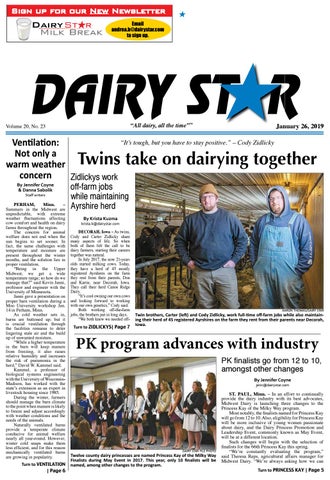
Twins take on dairying together
By Jennifer Coyne & Danna Sabolik Staff writers
PERHAM, Minn. – Summers in the Midwest are unpredictable, with extreme weather uctuations affecting cow comfort and health on dairy farms throughout the region. The concern for animal welfare does not end when the sun begins to set sooner. In fact, the same challenges with temperature and moisture are present throughout the winter months, and the solution lies in proper ventilation. “Being in the Upper Midwest, we get a wide temperature range; so how do we manage that?” said Kevin Janni, professor and engineer with the University of Minnesota. Janni gave a presentation on proper barn ventilation during a Moo University workshop Jan. 14 in Perham, Minn. As cold weather sets in, barns are buttoned up; but it is crucial ventilation through the facilities remains to deter lingering stale air and the build up of unwanted moisture. “While a higher temperature in the barn will keep manure from freezing, it also raises relative humidity and increases the risk of pneumonia in the herd,” David W. Kammel said. Kammel, a professor of biological systems engineering with the University of WisconsinMadison, has worked with the state’s extension as an expert in livestock housing since 1985. During the winter, farmers should manage the barn climate to the point when manure is likely to freeze and adjust accordingly with weather conditions and the needs of the animals. Naturally ventilated barns provide a temperate climate conducive for animal welfare nearly all year-round. However, winter cold snaps make them less efcient, and for this reason mechanically ventilated barns are growing in popularity.
Turn to VENTILATION | Page 6
off-farm jobs while maintaining Ayrshire herd By Krista Kuzma
krista.k@dairystar.com
DECORAH, Iowa – As twins, Cody and Carter Zidlicky share many aspects of life. So when both of them felt the call to be dairy farmers, starting their careers together was natural. In July 2017, the now 21-yearolds started milking cows. Today, they have a herd of 45 mostly registered Ayrshires on the farm they rent from their parents, Don and Karrie, near Decorah, Iowa. They call their herd Canoe Ridge Dairy. “It’s cool owning our own cows and looking forward to working with our own genetics,” Cody said. Both working off-the-farm jobs, the brothers put in long days. “We both knew we needed off-
Turn to ZIDLICKYS| Page 7
AARON THOMAS/DAIRY STAR
Twin brothers, Carter (le�) and Cody Zidlicky, work full-�me off-farm jobs while also maintaining their herd of 45 registered Ayrshires on the farm they rent from their parents near Decorah, Iowa.
PK program advances with industry
PK nalists go from 12 to 10, amongst other changes By Jennifer Coyne jenn@dairystar.com
DAIRY STAR FILE PHOTO
Twelve county dairy princesses are named Princess Kay of the Milky Way Finalists during May Event in 2017. This year, only 10 nalists will be named, among other changes to the program.
ST. PAUL, Minn. – In an effort to continually provide the dairy industry with its best advocates, Midwest Dairy is launching three changes to the Princess Kay of the Milky Way program. Most notably, the nalists named for Princess Kay will go from 12 to 10. Also, eligibility for Princess Kay will be more inclusive of young women passionate about dairy, and the Dairy Princess Promotion and Leadership Event, commonly known as May Event, will be at a different location. Such changes will begin with the selection of nalists for the 66th Princess Kay this spring. “We’re constantly evaluating the program,” said Theresa Reps, agricultural affairs manager for Midwest Dairy. “We’re always asking how we can Turn to PRINCESS KAY | Page 5
Page 2 • Dairy Star • Saturday, January 26, 2019
DAIRY ST R www.dairystar.com
ISSN 020355 522 Sinclair Lewis Ave. Sauk Centre, MN 56378 Phone: (320) 352-6303 Fax: (320) 352-5647 Published by Dairy Star LLC General Manager/Editor Mark Klaphake - mark.k@dairystar.com 320-352-6303 (ofďƒžce) 320-248-3196 (cell) 320-352-0062 (home) Ad Composition Nancy Powell 320-352-6303 nancy.p@dairystar.com Amanda Thooft 320-352-6303 amanda.t@dairystar.com Consultant Jerry Jennissen 320-346-2292 Editorial Staff Andrea Borgerding - Associate Editor (320) 352-6303 • andrea.b@dairystar.com Krista Kuzma - Assistant Editor (507) 259-8159 • krista.k@dairystar.com Jennifer Coyne - Assistant Editor (320) 352-6303 • jenn@dairystar.com Ruth Klossner (507) 240-0048 cowlady@centurylink.net Danielle Nauman (608) 487-1101 danielle.n@dairystar.com Danna Sabolik - Staff Writer (320) 352-6303 • danna.s@dairystar.com Maria Bichler - Copy Editor 320-352-6303 Advertising Sales Main Ofďƒžce: 320-352-6303 Fax: 320-352-5647 Deadline is 5 p.m. of the Friday the week before publication Sales Manager - Jeff Weyer (Northern MN, East Central MN) 320-260-8505 (cell) jeff.w@dairystar.com Mark Klaphake (Western MN) 320-352-6303 (ofďƒžce) 320-248-3196 (cell) Laura Seljan (National Advertising, SE MN) 507-250-2217 fax: 507-634-4413 laura.s@dairystar.com Jerry Nelson (SW MN, NW Iowa, South Dakota) 605-690-6260 jerry.n@dairystar.com Mike Schafer (Central, South Central MN) 320-894-7825 mike.s@dairystar.com Amanda Hoeďƒ&#x;er (Eastern Iowa) 320-250-2884 • amanda.h@dairystar.com Lori Menke (Southern WI) 563-608-6477 • lori.m@dairystar.com Megan Stuessel (Western Wisconsin) 608-387-1202 • megan.s@dairystar.com Deadlines The deadline for news and advertising in the Dairy Star is 5 p.m. Friday the week before publication. Subscriptions One year subscription $35.00, outside the U.S. $110.00. Send check along with mailing address to Dairy Star, 522 Sinclair Lewis Ave., Sauk Centre, MN 56378. Advertising Our ad takers have no authority to bind this newspaper and only publication of an advertisement shall constitute ďƒžnal acceptance of the advertiser's order. Letters Letters and articles of opinion are welcomed. Letters must be signed and include address and phone number. We reserve the right to edit lengthy letters. The views and opinions expressed by Dairy Star columnists and writers are not necessarily those of the Dairy Star LLC.
The Dairy Star is published semi-monthly by Dairy Star, LLC, 522 Sinclair Lewis Ave., Sauk Centre, MN 56378-1246. Periodicals Postage Paid at Sauk Centre, MN and additional mailing ofďƒžces. POSTMASTER: Send address changes to Dairy Star, 522 Sinclair Lewis Ave., Sauk Centre, MN 56378-1246.
North America dealers. A glance at what’s inside
Dairy Proďƒžle brought to you by your
Well, it’s ofďƒžcially winter. It sure feels like it anyway. With teeth-chattering wind chills in the upper Midwest, I think everyone is looking forward to springtime. This cold spurt hopefully won’t last long and before we know it we’ll be back in the ďƒželds wondering where those slower winter days have gone. This issue we’ve put together a variety of stories, from basketball hobbies to the Persian Gulf. In our From Our Side of the Fence feature, we asked dairy farmers about their maternity pens and birthing procedures. Read about their habits and techniques they use on their farms on pages 15 and 16 of the ďƒžrst section. Traveling far and wide, we spoke with a dairy farmer from Revillo, S.D., who sent 102 bred heifers to a small country in By Mark Klaphake the Persian Gulf, called Kuwait. Kevin Souza of Victory Farms Editor learned about the idea from his Select Sires representative, who suggested he work with a broker from North Carolina who was looking for 100 head to export to a dairy farm in Kuwait. You can ďƒžnd that story on page 12 of the ďƒžrst section. We spoke with a dairy farmer from Arlington, Minn. who enjoys his winters because that’s when he coaches elementary school girls basketball. Read about his blue ďƒ&#x;ame and how he keeps all gears grinding this time of year in the third section. After attending the Minnesota Organic Conference on Jan. 11, we wrote up a couple stories about what we heard. David Jones spoke about high-quality forages and the economic impact they have on an operation. Hettenbach presented on recordkeeping - an essential part of being organically certiďƒžed - and offered tips on how to maintain accurate records for organic certiďƒžcation. Read both those stories in the second section. In a previous issue, we did a story about a young girl who wrote a letter to the president and got a response. Per reader’s requests, we’ve included a copy of the letter President Trump wrote to Hannah Olson. You can ďƒžnd that on page 11 of the ďƒžrst section. We featured a large family of seven kids this issue for Kids Corner. Read about this big, happy family and how all the children are involved on the farm in the third section.
Favorite quotes from this issue: “Many dairy farmers might be scared to get out because of the repercussions of pride, criticism or having to deal with the aftermath, but we had to cut the emotional side from the business side.� – Darienne Frickson (First Section, Page 10)
“The goal of the calf program is to not only put weight on the calf, but is to raise a cow.� – Dr. Anne Proctor (First Section, Page 38)
By the Numbers
highest price $17.86: The per hundredweight equivalent Jean-Marc Quiniou, of France, received in 2018. (Second Section, Pages 14-15)
12-14:
Hours in a day cows spend lying down. (Second
Section, Page 20)
A SPREADER FOR EVERY OPERATION NEW! W! PS 200 Series ProSpread ÂŽ Rear-Discharge Spreaders W!
We have a wide range of models and sizes with multiple options to fit any operation. Our innovative, high-quality spreaders provide superior performance with years of low-maintenance service.
1200 Series EasySpread ÂŽ Rear-Discharge Spreaders
2000 Series ProPush ÂŽ Rear-Discharge Spreaders
SL 100 Series ProTwin ÂŽ SlingerÂŽ Side-Discharge Spreaders
SLC 100 Series ProTwin ÂŽ SlingerÂŽ Side-Discharge Spreaders
INVEST IN QUALITY ÂŽ
KuhnNorthAmerica.com m
Lindell Sales & Service Cannon Falls, MN
Blue Hilltop /DNH :LOVRQ 01
Dairyland Supply 6DXN &HQWUH 01
Bodensteiner Implement (ONDGHU ,$
Hammell Equipment &KDWĹľHOG 01 (LW]HQ 01 Harmony, MN 5XVKIRUG 01
Schlauderaff Implement /LWFKĹľHOG 01
Pfeifer Implement Sioux Falls, SD
J. P. Scherrman, Inc. )DUOH\ ,$
Fluegge’s Ag Mora, MN
Burco Sales ,QGHSHQGHQFH ,$
Adkins Equipment 'HWURLW /DNHV 01
Northland Farm Systems Owatonna, MN
Mark's Machinery :DJQHU 6' <DQNWRQ 6'
Northland Dairy Supply (DJOH %HQG 01
Lake Henry Implement 3D\QHVYLOOH 01
Isaacson Sales & Service /DID\HWWH 01
Minnesota Ag Group - Plainview 3ODLQYLHZ 01
Roeder Bros. %HOOHYXH ,$ Mid-State Equipment 'H:LWW ,$ Mark's Tractor & Implement 'XPRQW ,$
Visit your local KUHN Knight dealer today!
Ag Land Implement 1HZ +DPSWRQ ,$ Kunau Implement 3UHVWRQ ,$ Gordy’s Repair & Implement 6WDF\YLOOH ,$ Dee Implement of Waukon :DXNRQ ,$
Dairy Star • Saturday, January 26, 2019 • Page 3
It’s all inside... Columnists Ag Insider
First Section: Pages 1, 7 Kittson Roseau
Marshall
The “Mielke” Market Weekly
Pages 10 - 11 Second Section
Hamlin
nb or n
Kingsbury
n nso
Moody
McCook Minnehaha
Lyon
Murray
Rock
Nobles
Hennepin Carver Scott
Sibley Redwood Brown
Nicollet
First Section: Page 38
Dakota
Rice
Goodhue Wabasha
Cottonwood Watonwan Blue Earth Waseca Steele Dodge Olmsted Jackson
Martin
Faribault
Freeborn
Winona
Fillimore
Mower
Dakota
Houston
LaValla, Fricksons share tips for selling the cows
Hutchinson
Turner
Bon Yankton Homme
Lincoln Clay
Union
Lyon
Osceola Dickinson Emmet
Sioux
O’Brien
Clay
Palo Alto
Kossuth
Winnebago
Worth
Hancock
Cerro Gordo
Mitchell
Floyd
For additional stories from our other zone, log on to www.dairystar.com
aw
as
ick
Ch
Bremer
Plymouth
Zone 1
Howard
Sioux Center
Black Hawk
From Our Side of the Fence
Fayette
Clayton
n
na
ha
c Bu
First Section: Page 10
Allamakee
Charles Mix
Lake
Renville
Yellow Medicine
Anoka
Wright
McLeod
Plainview
Women in Dairy: Karen Timm
Winneshiek
Douglas
Brookings
Meeker
Isanti
Ha
Da
vis
on
Sa
Miner
Deuel
Kandiyohi
Chippewa
Lac Qui Parle
Codington
Clark
Sherburne
go
Swift
Grant
Benton
Stearns
Pope
First Section: Page 39
isa
Big Sto Stone
Douglas
Stevens
Mille Lacs
Morrison
Ch
Roberts
Day
Pine
Todd Grant
New Ulm
Dairy Prole: Dean Binder
sey
Marshall
Page 33 First Section
Carlton
Crow Wing
Washington
First Section: Pages 12 - 13
First Section: Pages 1, 5
Aitkin
Kanabec
Victory Farms sells 102 bred heifers to dairy farm in Kuwait
Cass
PK nalists go from 12 to 10, amongst other changes
r
Dairy Good Life
Revillo
Otter Tail
rse
Page 32 First Section
Tra ve
Just Thinking Out Loud
Becker
Clay
St. Paul
eu
Page 31 First Section
en
nom
Mah
Ra m
Norman
Third Section: Pages 2- 3
Itasca
Hubbard
Polk
First Section: Pages 34 - 35
Wadena
Dunns recognized as Agassiz Ambassadors
Second Section: Pages 5 - 7
Riebe coaches elementary basketball
St. Louis
Red Lake
Clearwater
Osakis
Arlington
Koochiching
Pennington
Wilkin
Something to Ruminate On
Lake of the Woods
Beltrami
St. Cloud
Accurate records essential to maintain organic certication
Second Section: Pages 3- 4
Su
Dear County Agent Guy
O’Brien serves in Big Brothers Big Sisters program
Le
Third Section: Pages 7 - 9
Page 27 First Section
Page 30 First Section
Sauk Centre
Ventilation: Not only a warm weather concern
Kids Corner: The Fraki family
Lincoln
The Transition Pen
Perham
Ottertail
Pipestone
Pages 8-9 First Section
are
law
De
Linn
Dubuque
Jones
First Section: Pages 15 - 16
Decorah
Zidlickys work jobs while maintaining Ayrshire herd
Jackson off-farm
First Section: Pages 1, 6
Comfort and versatility unlike any other Upgrade your barn with GEA’s Single Beam Freestall Mounting System With easy installation and flexible designs,
durability for reduced freestall maintenance.
GEA’s Single Beam Freestall Mounting System
Cows enjoy unobstructed lunge space and lay
can seamlessly integrate with any new or
straighter for cleaner stalls and udders.
existing freestall barn. This state-of-the-art
Fully adjustable stall width and neck rail
mounting system features the patented
height gives you a customized system to fit
cushion cross clamp providing extreme
your herd.
Page 4 • Dairy Star • Saturday, January 26, 2019
THE LEADER IN LED LIGHTING
Cold Weather Calf Headquarters Extra Fat Supplement for Additional Energy
ScrewIn
LED Wall Packs /Flood Lights
Vaccines
CBM LIGHTS ARE:
+ Virtually free of stray voltage + Fully Programmable +Dimmable + DLC approved for rebates on vapor tight units
Inforce™ 3 Bovi-Shield Gold® 5
+ Warranteed for a minimum + Manufactured in of 5 years on drivers and chips North America + Assembled units are U ULL CALL US FOR A FREE listed and approved CONSULTATION
Bovi-Sheild Gold® FP® 5L5
RICHARD PEDERSON Pederson Sales
Cattlemaster® Gold FP™ 5L5
25 & 50 lb.
Calving Pens
220 Schendel St, Box 145 • Blomkest, MN 56216 320.905.3725 (c) • 320.995.6403 (h) (MN, NE, MT, IA, SD, ND)
Calf Insure
- Calf supplment maintains gut health (25 lb. pail or 8 lb. pouch)
Bovine IgG
31ST ANNUAL
FARM TOY SHOW
- Colostrum replacement
Amplifier Max - Calf Milk Replacer
Ear Tags
Z Tags Y-Tex Tags
Metal Strip Lights
SPONSORED BY: Sauk Centre Area Chamber of Commerce
CALF BLANKETS
Sat., February 9, 2019
Doors Open: 9:00 a.m.-3:00 p.m. ElmerZ Event Centre
ELECTROLYTES CALF WARMERS
1225 Timberline Drive Sauk Centre, MN 56378
(Located just off of I-94, next to McDonald’s, Walmart & the AmericInn Lodge & Suites)
Pink & Blue
Gilman Co-op Creamery
FEED & FARM SUPPLY STORE
Music & Food Concessions!
Admission: $4
Children 5 & under are FREE
(Proceeds go to Dollars for Scholars College Scholarships)
SET UP FOR VENDORS: Friday, February 8th • 6:00p.m. – 8:00 p.m. Saturday, February 9th 7:00 a.m. until show starts • Tables for Vendors: $30 each
Gilman, MN 320-387-2770
Open M-F 7:30-7, Sat. 7:30-5, Sun. 8:30-1
FOR MORE INFORMATION CONTACT:
Good service - fair prices - every day
Sauk Centre Area Chamber of Commerce • Phone: 320.352.5201 Email: saukcentrechamber@gmail.com • www.saukcentrechamber.com
WWW.GILMANCREAMERY.COM
BEFORE Exfoliation
TEAT END ISSUES?
AFTER
Exfoliation
OUR TEAT DIPS ARE NPE FREE!
WINTER TEAT DIP
• Dual Germicide: Primary: Chlorine Dioxide promotes a quick kill. Secondary: LAS promotes a long-lasting kill. • Effective against ALL Mastitis-Causing Organisms • Contains Lactic Acid to promote Teat Exfoliation • Teat skin conditioning – 12.4% skin conditioning package • Green coloring for easy identification
78%
Mouth-Piece Vented Triangular Liner
TRI-BLEND SKIN CONDITIONING PACKAGE!
There’s There er a reason 25% of the cows in the U.S. are milked with Impulse Liners!
GERMICIDE: 1.5% HEPTANOIC ACID
Marianne says, “Recover is a very good, economical post winter dip that brings terrific results, especially when releasing cows in the cold winter elements as we do. Cows do very well on it…teats are well conditioned!” Marianne Peterson Pine City, MN • 400 Cows - 3X
Available in a 12mm A Milk Tube!
De Designed to handle higher flow rates and p provide better fit on larger inlet claws.
IMPULSE AIR = BETTER PERFORMANCE! B
FOR MORE INFO - CONTACT ONE OF THESE DEALERS... Advanced Dairy Systems
9 State Rd. 29 • Spring Valley, WI 54767 (715) 772-3201
Anderson Dairy Systems, Inc. 1312 13 1/2 Ave. • Barron, WI 54812 (715) 537-3300
Athman Dairy Inc.
D&D Ag Supply
East Central Dairy Supply
238 Main Street North • Pierz, MN 56364 (320) 468-2494
133 Atlantic Ave. NE • Pennock, MN 56279 (320) 599-4466
Champion Milking Systems
Dairyland Equipment Services, Inc.
Eastern Iowa Dairy Systems
Dairyland Services, LLC
Fuller’s Milker Center, Inc.
23218 350th Street • Albany, MN 56307 (320) 845-4156
24260 Cty. Rd. 27 • Plainview, MN 55964 (507) 534-3161 2545 80th Ave • Woodville, WI 54028 (715) 698-4370
2195 Hwy. 23 • Mora, MN 55051 (320) 679-1029
105 3rd Ave. NW • Epworth, IA 52045 (563) 876-3087 423 U.S. 61 • Lancaster, WI 53813 (608) 723-4634
Gorter’s Clay & Dairy Equipment
1400- 7th St. SE • Pipestone, MN 56164 (507) 825-3271
Professional Dairy Systems
1449 Homecrest Ave. • Wadena, MN 56482 (218) 632-5416
Tri-County Dairy Supply, Inc.
Lang’s Dairy Equipment, Inc.
4107 N US HWY 51 • Janesville. WI 53545 608-757-2697
Mlsna Dairy Supply
12687 Hwy 18 & 52 • Postville, IA 52162 (563) 864-7417 210 N. Industrial Pkwy • West Union, IA 52175 (563) 422-5355
2337 Millennium Rd. • Decorah, IA 52101 (563) 382-8722 1126 Front Street • Cashton, WI 54619 (608) 654-5106
United Suckow Dairy
Dairy Star • Saturday, January 26, 2019 • Page 5
ConƟnued from PRINCESS KAY | Page 1 nd the best advocates for dairy, and that’s where the idea for all of these changes came from.” The reason behind only naming 10 nalists is two-fold – to work with the ample media requests for Princess Kay during the rst day of the Minnesota State Fair, as well as giving the woman carved at the end of the fair the same recognition as her peers earlier in the week. “It’s getting harder and harder to feature the women on the front end and back end of the state fair,” Reps said. Under the new structure, Princess Kay’s butterhead will be carved over the course of the rst two days of the fair. “We receive a lot of media request for Princess Kay during that rst day, which is awesome,” Reps said. “Unfortunately, that puts a time crunch for Linda (the professional carver). In taking two days to carve Princess Kay, we’re getting a lot of media opportunities and getting a great sculpture out of the deal.” Likewise, there will not be a butterhead carved on the last day. This will allow the remaining nalist and her family time to embrace the butterhead before the fair ends. “In the past, if a nalist’s family couldn’t make it to that last day of carving, then they didn’t see it in the butter booth,” Reps said. “The sculpture is usually completed by 5 p.m., and if the fair winds down by 8 p.m., that’s just not a lot of time to enjoy it.” By only naming 10 nalists, the selection of such representatives becomes ever more important for Minnesota’s dairy farmers. Two requirements have been added to the eligibility guidelines for young women vying for Princess Kay of the Milky Way. While current dairy princesses must either come from a dairy farm operated by their parents or siblings, or themselves, their parents or guardians are employed to some capacity on a dairy farm, the guidelines are now expanded to include those who are involved in raising or leasing dairy animals. The exact wording reads, “Either you, your parents or guardians care for and/or custom raise dairy cattle that will return to farms who contribute to the Minnesota dairy promotion checkoff; Either you, your parents or guardians own or lease a dairy animal(s) that are housed on another dairy farm. You participate on that farm without pay in exchange for the care and housing of those animals. The county ADA board must determine that you demonstrate a reasonable commitment throughout the year and could provide verication of such if requested.”
“The caveat with both of these guidelines is that the dairy farm associated with animals and paying into the checkoff must endorse you as a dairy princess,” Reps said. In adding these two eligibility requirements, the program is now open to women who are just as passionate about the dairy industry as dairy farmers’ daughters. “Our goal is to have the best advocates for dairy in front of the consumer,” Reps said. “And right or wrong, the consumers don’t care if they’re dairy farmers’ daughters. They just want to connect with someone who can build their trust in dairy farming and dairy products.” The nal change to the program is the relocation of the May Event. Due to structural changes at the College of St. Benedict’s in St. Joseph, Minn., the weekend-long event will be held at the Courtyard Marriott in St. Cloud, Minn. The Sunday banquet will be held nearby at the St. Cloud River’s Edge Convention Center. While these changes may seem drastic, it is not the rst time the program has been modernized. In the early ‘90s, eligibility was extended to include young women who worked on a farm, or their parents or guardians worked on a farm. Nearly a decade later, the Princess Kay of the Milky Way program went from having 11 regional dairy princesses named as nalists to 12 with the addition of the May Event. When such changes are made to this long-standing Minnesota tradition, they are suggested by dairy farmers and then approved by them, too. Over the course of the past three years, the Princess Kay of the Milky Way Committee – which has been around for over a decade and made up of farmers, county board members and past princesses – reviewed the program and found ways to enhance it. The committee of eight then presented its suggestions to the 22-member Minnesota Division Board of Midwest Dairy. While the changes have been met with mixed reviews, the underlying goal of the improvements is to continue to have young people involved in the dairy industry and to share their passion as dairy leaders, Reps said. “We don’t take changes lightly, and we want to do what is right for the tradition of Princess Kay,” she said. “This is a competitive program, and we’re highlighting it in the best way.” Midwest Dairy is sending out information packets regarding the program to county ADA chairs and county dairy princess coordinators.
IT’S A NEW YEAR! Let Famo Feeds help you make your 2019 goals a reality!
Our full lines of feed include: • Calf starters and growers • Milk Replacers • Vitamin and mineral premixes • Organic mineral packs • Forage inoculants • Lick tubs • And more!
320-836-2145 or 800-450-2145
Check out our newly redesigned website to ½nd a Famo Feeds dealer near you!
www.famofeeds.com
The new DeLaval VMS V300 milking robot ™
99.8% Attachment rate
Up to
7500 lbs milk per day
Up to
50% HARMS MFG. LAND ROLLERS
faster attachment time
10
PTO GENERATORS A RS ATOR
%
Higher capacity
Model 50PTOC-3, 50 kw,
208 amps, 1800 RPM, 540 input spd, 100 input hp
15KW to 150KW STANDARD FEATURES: • 100% Copper Windings • Helical Gears for Smooth Operation • Full Power Receptacle • Square D Mainline Circuit Breakers
• Large 3” Voltage Meter • Full Power Plug Included • Powder Coat Paint • Rodent Screens • Lifting Eyes
12’ - $6,800 14’ - $7,000 16’ - $7,800 24’ - $14,800 32’ - $17,500 42’ - $20,500 Other Sizes From 8’-62’ JD 7000 Corn Planter 2 Row, 3PT. - $1,800 Fertilizer Available - $300 Per Row
Plain, WI (608) 546-3713
Waunakee, WI (608) 849-5043
www.delaval.com
715-234-1993 petestrailersales.com
is a registered trademark of Tetra Laval Holdings & Finance S.A. and “DeLaval” is a registered trade/servicemark of DeLaval Holding AB © 2018 DeLaval Inc. DeLaval, 11100 North Congress Avenue, Kansas City, Missouri 64153-1296. All facts and figures are the result of more than two years of data collection from more than 20 test and pilot farms, actual results may vary and are not guaranteed. www.delaval.com
Page 6 • Dairy Star • Saturday, January 26, 2019
ConƟnued from ZIDLICKYS| Page 1
Willmar, MN • 320.231.1470
EXPANDING OR REMODELING YOUR LIVESTOCK OPERATION? ƋƵŝƉŵĞŶƚ tĞ KīĞƌ͗ ͻ sĞŶƟůĂƟŽŶ &ĂŶƐ ͻ sĞŶƟůĂƟŽŶ ŽŶƚƌŽůƐ ͻ WŽƐŝƟǀĞ WƌĞƐƐƵƌĞ dƵďĞƐ ͻ ƵƌƚĂŝŶ ^LJƐƚĞŵƐ ͻ DĂƩƌĞƐƐĞƐ ͻ tĂƚĞƌĞƌƐ ͻ ^ƚĂůů ƋƵŝƉŵĞŶƚ ͻ ,ĞĂĚůŽĐŬƐ ͻ DŝƐƟŶŐ ^LJƐƚĞŵƐ
LANGE AG SYSTEMS SPECIALIZES IN:
Ŷ NEW FACILITIES
_
NO JOB TOO BIG OR TOO SMALL
Ŷ RETROFITTING & REMODELING Ŷ TURNKEY PROJECTS Ŷ BARN DESIGN Ŷ INSTALLATION, MAINTENANCE & REPAIRS
Lange Ag Systems is proud to offer Grain Bags, Silage Bags & Bunker Covers from Up North Plastics and Feed Fresh Silage Covers & Custom Size Bunker Covers from Raven!
t ^ >> E t Θ h^ 'ͳ ' Θ < >>z Zz E '' Z^
www.LangeAgSystems.com I F A
Roller-Grinder
MANCHESTER Livestock Auction, Inc.
More milk less feed with uniform Àne-grind Solid cast rolls All belt-electric drive Single or double mills USA & International sales Replacement rolls available for most mills Used mills and tumble mixers on hand Hammer Mills
(40 miles west of Dubuque, Iowa on 4 lane Highway 20)
DAIRY SALES 2nd Fridays Monthly at 11:00 AM Selling 150 to 250 Head
Sheep and Goats sell at 9:30 AM
563-927-2540
Phone: (319) 634-3849 • Toll Free: (800) 426-0261 web: www.ifamill.com • email: ifamill@netins.net
www.manchesterauction.com
‘17 John Deere Gator 590i 800.839.5337 Stock # : UA13870 Only 317 Miles, Power Steering, Cab, LED Lights, Perfect Condition
$12,499*
OLIVIA
CHRYSLER CENTER
AARON THOMAS/DAIRY STAR
Cody Zidlicky pets one of the Ayrshires on the dairy he operates with his twin brother near Decorah, Iowa. farm jobs to pay the bills,” Cody said. While Cody drives semi for a feed milling company hauling fertilizer and feed ingredients, Carter is a service technician for a local dairy equipment dealer. It is not uncommon for either one to put in 14-hour days at their non-farm job. “But one of us is always here,” Carter said. Plus, their mom helps with the majority of the milkings while at least one of the twins does the rest of the chores. “On days when you work 7:30 a.m. to 9:30 p.m., plus the farm chores, it makes you question milking cows, but once I’m out there in the barn it’s ne,” Carter said. “The new calves and seeing the herd grow makes it feel worth it.” Since their parents’ farm is only a building site with no crop ground, Carter and Cody source their feed from a neighboring farm. The set-up works for their dairy because they have little time in their schedule for eldwork. The brothers grew up helping their grandparents and parents on their dairy. “We were helping in the barn as soon as we could walk, but we probably were more in the way than anything,” Carter said. Their admiration for dairy drove their participation in the dairy project in 4-H, and they bought their rst three animals at the age of 9 with a $5,000 loan. But in 2009, the Zidlickys’ parents had to sell their 106-cow herd due to the crash of the dairy economy. Three months later, the family started milking again but with a herd of 40 animals. By 2014, they made the decision to sell out for good. “It was painful,” Cody said. “When you work with them everyday, they’re like family. But [with the cows gone] you train yourself to live a different lifestyle.” The two owned a few show cows but had been housing them at other people’s farms. One of those animals, Canoe Ridge Double Barrell Preston, had a successful show season in 2016, including being supreme champion at the Iowa State Fair and reserve intermediate champion of the junior Ayrshire show at World Dairy Expo as a junior 2-year-old. “I didn’t want to part with her and have her at another farm,” Cody said. “That’s what started this whole thing.” After making the decision to begin dairying, the brothers worked together for several months to get their parents’ barn back
in working order. After selling the cows, the Zidlickys had taken out the stalls and converted it into housing for pigs and goats. Their plan was to start slowly with 10 to 15 animals, but that would not work nancially. An Ayrshire herd dispersal came around at the right time, and the brothers bought several animals to start their dairy. They also found descendants from animals in their original herd to grow their dairy. “There’s just something about the breed we love,” Carter said. “They’re interesting.” On July 1, 2017, the brothers turned the milker pump on for the rst time. “It was a relief when we started,” Carter said. But, it was also nerve-wracking. “That rst milking barely hit the agitator in the bulk tank,” Cody said. “Most of the cows were pretty stale when they came in. I was worried we were not going to make milk to pay the bills.” But production slowly went up as cows calved again starting that fall. The Zidlickys’ parents were supportive of the brothers’ decision to begin dairy farming. “They said we were young so now’s the right time to do it,” Carter said. “There were denitely a few people who said we were dumb for doing it. That made me want to do it more.” Cody had the same feeling. “It’s tough, but you have to stay positive,” he said about milking cows in the current state of the dairy economy. “We nd a way to make it work.” Plus they have enjoyed their time in their second career. “I like being outside working with the cows and feeling like I’m being productive,” Cody said. Carter agreed. “I like milking, because I get to be with the cows,” he said. “They’re pretty tame.” In the future, the Zidlickys would like to expand up to 150 cows and have a parlor. They would like to continue to focus their herd on quality genetics that can produce milk and do well at shows. “We want to keep getting our name out there,” Cody said. The twins are glad they started this dairying venture, especially being they can do it together. “There’s denitely stressful times, but at the end of the day we’re on each other’s side,” Carter said.
Blue Hilltop, Inc. Kevin Reineke
Product Specialist
Your Mixer, Spreader, Hay Processor Headquarters We carry:
WE HAVE OVER 30 YEARS OF SALES EXPERIENCE! CONTACT US TODAY! www.rotomix.com
* The advertised price does not include sales tax, vehicle registration fees, other fees required by law, finance charges and any documentation charges. A negotiable administration fee, up to $115, may be added to the price of the vehicle. * Images, prices, and options shown, including vehicle color, trim, options, pricing and other specifications are subject to availability, incentive offerings, current pricing and credit worthiness.
Sign up for our Newsletter
LLC
Dana Berreau
507-879-3593 / 800-821-7092 Box 116, Lake Wilson, MN 56151
DairySt r Milk Break Email andrea.b@dairystar.com
Dairy Star • Saturday, January 26, 2019 • Page 7
Con�nued from VENTILATION | Page 1 Steve Driessen and his family updated their 1991 naturally-ventilated freestall barn to a tunnel-ventilated system about ve years ago. “Before, we were always dealing with frozen teats and frozen manure,” Driessen said. “Now, there are no frozen teats and the manure doesn’t freeze either.” The Driessen family milks 200 cows near Porter, Minn. Since renovating the housing facility, the Driessens have noticed the barn remaining consistently warmer. However, to ensure proper airow, vents are open on the sidewalls to let fresh air in, as well as a vent on top of the barn to let warm air out as it rises through the building. Oftentimes, the trickiest part of managing any housing facility is maintaining a temperature in which the animals can thrive. Within a herd, the temperature range in which an animal is comfortable varies based on age, Janni said. The thermal neutral zone for cows is between 5 and 77 degrees Fahrenheit. For calves, they are comfortable at temperatures ranging between 50 to 77 degrees for those less than 1 month old and 32 to 73 degrees for those older than 1 month. Outside temperatures in the Upper Midwest can vary from minus 20 degrees to more than 100 degrees, so maintaining a consistent climate in the barns is essential. As a benchmark, naturally-ventilated facilities should remain about 5 to 10 degrees greater than the temperature outside to provide minimum air exchange to prevent manure freezing, yet a quality air environment for the cows, Kammel said. “We think the temperature needs to be more than it really does for cows,” he said. “As long as they’re out of the drafts, they can handle it. The key is to manage temperatures to the point where manure would freeze as best as possible.” There are four components of indoor
temperature to consider when determining if the barn is adequately ventilated – relative humidity, temperature-humidityindex, air velocity and ammonia levels. Relative humidity and dew point temperatures both benchmark points in which moisture is in the barn. While both values indicate moisture in the air, relative humidity is the percent saturation at a given temperature. Once the relative humidity reaches 100 percent – the air is entirely saturated – then the dew point is reached. “Personally, as an engineer, I prefer to work in dew point temperatures,” Janni said. “I like to keep relative humidity at a point where no condensation or frost will form in the barn.” Farmers should aim for 50 to 80 percent relative humidity in their housing facilities. If relative humidity and dew point are not managed with effective ventilation, moisture accrues and will pose health risks for the animals. “I was in a calf barn with a metal roof and no ventilation,” Janni said. “The ceiling was frosty in the morning, and as the sun rose and heated the roof, the frost melted and it was raining on the calves.” Adequate air velocity should measure at 60 feet per minute at the calf level. In tunnel-ventilated and cross-ventilated barns, farmers should aim for 528 feet per minute, or 6 miles per hour, whereas the inlet air velocity should be between 800 to 1,000 feet per minute. Aside from numeral benchmarks, the animals within the barn will also show signs of adequate airow. Respiration rates, milk production and cost lost in milk production are all indications something is not right in the barn. “If animals are exposed to high humidity for a long period of time, it can be detrimental to their health,” Kammel said. Janni agreed. “Monitor the cow with the highest production as a baseline,” he said.
PHOTO SUBMITTED
Baffles help direct airow through the Driessens’ barn near Porter, Minn. Proper ven�la�on in the winter is essen�al for providing adequate air quality for the animals, while also controlling the barn temperature at a manageable level. Visual cues in the barn, such as fog or wet trusses, may also indicate there is not enough ventilation. “If the steel surfaces are dripping or frosted, then the humidity is too high and the materials are too cold,” Kammel said. “Same thing if it’s foggy in the barn. You need to open up inlets of the curtains and bring in an exchange of cold, dry air.” Janni agreed. “Air is lazy; it takes the easiest path,” he said. “When trying to manage ventilation with bafes, avoid open aisles or the wind will all go there.” Damp conditions also cause added wear on the facilities, creating weak points in the structural soundness of the barn and impacting the building’s longevity. Wintertime poses its own set of challenges, regardless of barn design. “Everyone brags about cow comfort in the summer and how you don’t lose milk [with tunnel ventilation], but no one
talks about the winter,” Driessen said. “The barn is a lot darker and it does get warm.” Driessen also mentioned that while they no longer see frozen teats, some stalls become lled with snow when the north wind hits the barn. “We’ve made an old barn work with a new system, but it’s tricky,” Driessen said. In the Upper Midwest, there is no easy way to deal with cold temperatures that is conducive for both animal health and farm management. “Cows can tolerate stress from poor air quality for a little while, but eventually it will come at a cost,” Kammel said. “The options are to suffer through frozen manure for a few days or treat pneumonia later on. You have to be ready to deal with manure build up in a different way so that ventilation is at its best for cow health.”
CUSTOMER PROFILE:
Emerald Spring Dairy • Plainview, MN • 1,000 cows Using Daritech’s One Shot Sand Separation System we recover 90% of our sand bedding saving the farm $100,000 in sand bedding costs per year! With maintenance costs under $2,000 annually along with the storage and time savings, this really is the one piece of equipment you need to lift, rinse, and stack quality reusable bedding sand.
Lift, rinse, and stack your sand! Reuse your sand from flush or flush flume manure with low energy and maintenance.
www.daritech.com For more information on creative process flow solutions and our complete product line, contact a local dealer near you ...
Komro Sales
Foxland Harvestore
www.komrosales.com
www.foxlandharvestore.com
Serving West & Central Wisconsin
Serving East & Central Wisconsin
Midwest Livestock
Serving Minnesota, Iowa and South Dakota
www.midwestlivestock.com
Page 8 • Dairy Star • Saturday, January 26, 2019
Trump tells farmers the greatest harvest is yet to come For a second straight year, President Donald increased. The Federal Reserve’s Agricultural Finance Outlook said the year-over-year Trump paid a visit the American Farm Ag Insider volume of operating loans rose more Bureau Federation Convention. Trump than $10 billion, or 22 percent. Due spent most of the speech focused on to the strong demand for farm loans, border security. The Waters of the liquidity at agricultural banks trended United States rule was also addressed. lower and collateral requirements “We’re going to keep federal regulators continued to tighten. Loan delinquency out of your drainage ditches, puddles rates edged higher but remain low from and ponds,â€? Trump said. In closing, a historical perspective. Trump assured the 6,000 Farm Bureau members in attendance that better times USDA extends MFP application are ahead for U.S. agriculture. “To all deadline of the farmers here today and across USDA is extending the deadline to our country, the greatest harvest is yet By Don Wick apply for Market Facilitation Program to come.â€? Columnist payments. The original deadline was Jan. 15 but is being adjusted due to Duvall outlines policy priorities The American Farm Bureau Federation is the government shutdown. According to United celebrating 100 years, with several policy wins States Secretary of Agriculture Sonny Perdue, the for agriculture. At the opening general session, deadline will be extended for a period of time equal American Farm Bureau Federation President to the number of business days FSA ofďƒžces were Zippy Duvall highlighted the policy successes closed. of the organization. While farmers and ranchers faced struggles in 2018, Duvall said the year also New faces coming to the House ag committee House Agriculture Committee Chairman brought great policy change for the future. That work and success will continue this year. “With all Collin Peterson will have a lot of new faces on this discussion about a wall and all this discussion his committee. House Speaker Nancy Pelosi has about immigration reform, we’ve got to solve the announced 12 freshmen members will join the biggest problem facing the American farmer and committee. The new members come from rural and that’s farm labor.â€? Duvall also emphasized trade, urban areas, including Iowa, New York, Connecticut regulatory reform and the need for broadband and California. That list includes Minnesota Second District Representative Angie Craig. technology. Fed releases ag credit outlook In the fourth quarter of 2018, the number of non-real estate farm loans was up 8 percent from a year ago. In addition, the size of individual loans
Dairy policy gets attention in St. Paul It is early in the session, but Minnesota lawmakers are hard at work on policy issues. House Agriculture, Food, Finance and Policy Committee
Save Money and Enhance ProÀtability by Converting Wasted Heat into Free Hot Water!
Chair Jeanne Poppe said the early discussions are focused on agricultural research training and the 2018 farm bill. Moving forward, dairy policy is a priority. “In Minnesota, we’ve been losing dairy farmers quickly,â€? Poppe said. “We need to try and stabilize that so we can continue to have people who are in business stay in business.â€? Dairy robot company to build headquarters in Iowa Lely North America is increasing its presence in North America. The dairy automation company plans to build a new North American headquarters and production facility in the Pella, Iowa area. Lely is based in the Netherlands and has been involved in the U.S. and Canadian dairy market for over 25 years. Paap re-elected to AFBF board Minnesota Farm Bureau Federation President Kevin Paap was reelected to a two-year term on the American Farm Bureau Federation Board of Directors. This will be the eighth year serving on the board for the Garden City, Minn., farmer. Minnesota couple is a ďƒžnalist in AFBF competition Katie and Ted Brenny of Mazeppa, Minn., are among the top 10 ďƒžnalists in the Young Farmers and Ranchers Excellence in Agriculture contest at the Farm Bureau convention. The competition is an opportunity for young farmers and ranchers to share their contributions and involvement in agriculture.
USED EQUIPMENT FROM A NAME YOU CAN TRUST!
CHECK OUT OUR LARGE SELECTION OF HAY EQUIPMENT AND TRACTORS!
USED TRACTORS
‘13 N-H T9.615, 833 hrs, Auto Steer, Cab Susp. $235,000 ‘95 Ford 8970, MFD, 9100 Hours................... $32,500 ‘14 Versatile 310, MFD, 189 Hours .............. $144,900 ‘58 Allis Chalmers D-17, repainted................... $3,450 ‘64 Oliver 1950, Wheatland Edition .................. $8,500 ‘64 Oliver 770................................................... $4,900 ‘10 Case I-H 105U, MFD, 525 Hours .............. $42,900 ‘95 Agco Allis 9650, MFD, 3050 Hours .......... $35,000 ‘74 M-F 1155, Cab, 3301 Hours ....................... $9,000
USED SKIDSTEERS
Made in USA
Fre-Heater Heat Recovery System
‘10 5600 Toolcat, 990 hrs, glass cab w/A/C ..... $22,900 (2) ‘12 T-770, glass cab w/A/C, 1315 hrs & Up ............................Starting at $41,500 ‘11 T-650, glass cab with A/C, 4800 hours .... $29,700 (2) ‘13 T-590, glass cab with A/C, 1100 hours & Up ........................Starting at $33,900 ‘15 MT-55, 660 hours .................................... $15,500 ‘13 N-H C-238, glass cab with A/C, 1300 hrs . $37,500 (2) ‘12 S-770, glass cab w/A/C, 4000 hrs Start at $27,250 ‘11 S-750, glass cab w/A/C, 2 Spd, 2950 hrs. $28,900 (4) S-650, glass cab w/A/C, 2 Spd, 1600 hours & up .........................Starting at $28,500 (2) ‘15 S-590, glass cab w/A/C, 1200 hrs & up .............................Starting at $28,900 ‘13 S-570, glass cab & heater, 2 spd, 1800 hrs . $25,500 ‘10 S-220, glass cab & heater, 1700 hours .... $19,000 ‘10 S-205, glass cab & heater, 2 Spd, 3520 hrs ...$20,900 ‘09 S-185, glass cab & heater, 2 spd, 2560 hrs .$21,900 ‘07 N-H L-175, glass cab & heater, 2 spd, 1815 hrs ...................................................... $21,900 ‘08 N-H L-160, glass cab & heater, 955 hrs ... $19,000 ‘81 N-H L-425 .................................................. $4,950 ‘13 Bobcat 72� Finish Mower ........................... $3,500 Warrior Log Spliter .......................................... $1,999
USED TILLAGE
‘08 W-R Quad X 50’ with Rolling Baskets ...... $39,500 ‘04 W-R Quad X 38’ with Rolling Baskets ...... $27,900
Turn to AG INSIDER | Page 9
Many used & new skidloaders ON HAND
‘93 W-R 3400, 42’ 4 bar harrow..................... $13,500 ‘93 W-R 3400, 38.5’, 5 Bar Spike harrow....... $11,900 ‘04 CIH Tigermate II, 54’, with rolling basket . $32,500 Lindsey 7 Section Spike Harrow ...................... $2,500 ‘97 J-D 3710, 8 Bottom, Onland Hitch ........... $12,500 ‘07 CIH 730C disc ripper, lead shks, levers .... $24,500 ‘12 W-R 513 Soil Pro, 11 Shank, Folding Frame ..$42,500 White 273 Disk, 19’.......................................... $6,500
USED HAY EQUIPMENT
‘03 N-H 1431, 13’ Discbine ............................ $10,900 (2) ‘14 N-H H-7230, 10’ Discbine, Cut less then 500 Acres ..............Starting at $17,750 ‘08 J-D 946, 13’ Discbine............................... $15,000 ‘11 Mac Don R85, 13’ Discbine...................... $11,500 Hesston 1091, 9’ Haybine ................................ $2,750 (2) N-H FP-240, Crop Pro .............Starting at $19,000 J-D 3960. 2 row Cornhead ............................... $3,000 ‘96 H & S 501 Forage Box and Wagon, 14’ ...... $4,950 (2) H & S XL Boxes and Wagons ............Each $1,250 ‘02 N-H BB-940 Large Square, Packer Cutter $29,500 ‘13 N-H BR-7090 Rd Baler, Netwrap & Twine $27,900 ‘00 N-H 688 Rd Baler, Twine Only .................... $6,950 N-H 678 Rd Baler, Twine Only .......................... $9,950 ‘02 N-H 648 Rd Baler, Twine Only .................. $10,900 ‘12 J-D 568 Rd Baler, Netwrap & Twine ......... $27,500 ‘97 J-D 566 Rd Baler, Netwrap & Twine ........... $9,500 ‘04 Gehl 2580 Rd Baler, Net & Twine ............... $6,250 ‘17 H&S AR-3110, 10 Wheel Rake ................... $7,350 ‘08 N-H 258 Rake, Used very little ................... $4,950
USED MISC
‘11 H&S TS-5120 Spreader.............................. $9,750 New Idea 3732 Spreader .................................. $8,950 ‘11 N-H 155 Spreader ...................................... $4,950 ‘08 Red Ball 1000 Gallon Sprayer, 60’ Boom ... $9,950 704 UNI with 2-combines and chopper units ... $6,500 Gehl 125 Mixer Mill .......................................... $8,750 ‘08 Geringhoff 18x22 Cornhead, JD Mounts .. $49,500
Equipment of Norwood LANO A family business since 1946 with the Lanos: Jack, Paul, Bob and Andy 952-467-2181
Dairy Star • Saturday, January 26, 2019 • Page 9
ConƟnued from AG INSIDER | Page 8
Center for Rural Policy and Development has new chairman Steve Wenzel, of Little Falls, Minn., has been elected chairman of the board for the Center for Rural Policy and Development. Wenzel was in the Minnesota State Legislature from 1972 to 2001 and was the Minnesota state director of rural development from 2001-09. Peterson names chief counsel Chairman Collin Peterson has promoted Kellie Adesina as the chief counsel for House Agriculture Committee. Adesina has been the senior counsel for the committee since 2016. Prior to joining the House Agriculture Committee staff, Adesina had a similar role at USDA. Beach hired at Pet Food Institute The Pet Food Institute has named Morgan Beach as its director of government relations. Previously,
Beach was the trade policy manager for the National Milk Producers Federation and the U.S. Dairy Export Council. Trivia challenge Finland leads the world in milk consumption, with average per-person consumption approaching 35 gallons of milk per year. That answers our last trivia question. What is the term for a cheeseburger with the cheese in the middle, rather than on top? We will have the answer in the next edition of Dairy Star. Don Wick is owner/broadcaster for the Red River Farm Network, based in Grand Forks, North Dakota. Wick has been recognized as the National Farm Broadcaster of the Year and served as president of the National Association of Farm Broadcasting. Don and his wife, Kolleen, have two adult sons, Tony and Sam, and ve grandchildren, Aiden, Piper, Adrienne, Aurora and Sterling.
Butterfat & Protein are key to the size of your milk check
840001234567891
8400012
BESSIE
345678
91
DAIS Y
Your highest producing cow may not be your most proĂtable
Prev milk
milk
Fat %
85 58
88 66
4.3 2.9
Prot % Value/day
3.3 3.1
$15.35 $8.94
Cow
Daisy Bessie
Individual Cow Data Matters! Minnesota Dairy Herd Improvement Association 307 Brighton Avenue South Buffalo, MN 55313 1.800.827.3442 www.mndhia.org
DHIA: Now MORE than ever
Target Your Customers!
The Dairy Star is sent only to DAIRY FARMERS!
If you would like to advertise in the DAIRY STAR, call 320-352-6303 for more information.
Keep your Calves Warm this Winter With
What’s your secret to producing so much milk?
I wish my owner did.
ON SALE NOW
5 for 100 Cash $
KLC Farms Roasting, Inc.
1-877-738-2326 Visit www.roastedbeans.com
CALF COATS
My owner feeds us KLC Roasted Soybeans. They help with my production as well as give me energy, protein, amino acids, bypass protein.
Preferred By Bovines Everywhere
Quality
Consistency
Page 10 • Dairy Star • Saturday, January 26, 2019
When the time comes to exit WE HAVE WHAT IT TAKES TO SERVICE YOUR TIRES, INCLUDING A SENSE OF URGENCY.
We are specially trained and equipped to meet your on-farm, in-ďŹ eld tire service and replacement needs. Call us for on-farm deliveries and on-the-spot tire repairs.
DALE’S FARM REPAIR INC. ON-FARM TIRE SERVICE Dale Saehr - Owner Hwy. 25 between Pierz & Genola
320-468-6886
Hours: Mon.-Fri. (555) 5558-5, 5555 Sat. 8-Noon
DAIRY STAR FILE PHOTO
Buyers & Feeders of damaged corn, soybeans, screenings, wet, hot, dry, ďŹ re and silo corn. Trucks available. Z BAR FEED YARDS - -
In this photo taken in 2017, the Fricksons – Darienne holding Jolena and Andy holding Paislee – stand in the ďƒ&#x;at parlor they built on their dairy near Dakota, Minn. The young couple recently sold their cows due to the tough dairy economy.
LaValla, Fricksons share tips for selling the cows By Krista Kuzma
krista.k@dairystar.com
p to are S 1- lf C Ca AcidiÀed electrolyte to conserve hydration for pre-weaned calves
Call Randy for more information.
Calf Warmer • Removable top section • Easy cleaning • Raised slotted à oor • SS support system • Ribbed bottom • Vent/peep hole • Deluxe high performance 110 volt, 2-speed heater
Agron. Petro. Feed Feed: 320-468-6655 Toll Free: 877-468-6655 Agron./Petro: 320-468-2509 Toll Free: 877-438-3378
DAKOTA, Minn. – Although Andy and Darienne Frickson hoped to make milking cows their lifetime career, the downturn in the dairy economy made them change their path, forcing them to sell their herd of 115 dairy cows Jan. 4. “We realized we were burning the candle on both ends,â€? said Andy Frickson from Dakota, Minn. “Last year (in 2018) we went on the hope of the milk price turning around. They didn’t. We said, ‘That’s the end.’ We weren’t willing to risk anymore.â€? They are not the only ones. According to the Minnesota Department of Agriculture, in 2018, Minnesota lost 262 dairy farms, bringing the total in the state to 2,814. What should dairy farmers do if faced with this situation? Having an exit strategy is important, said Jack LaValla, farm business management instructor at Riverland Community College. The ďƒžrst thing to do is have accurate and current ďƒžnancial information available, LaValla said. “Be real about the current situation,â€? he said. “People aren’t enjoying looking at balance sheets, ‌ but we need to know what the numbers are. In the long run, that will be helpful.â€? With this information, LaValla said dairy farmers should then meet with others who have an invested interest in the dairy. This could include lenders, dairy improvement team, silent partners, other family members, farm business management instructors or others deemed capable to help make a decision about the future of the dairy. “Having the key players together is really important,â€? he said. Together, this team of people can look at scenarios for the future of the farm. “Do some projections and run through ‘What if ‌’ situations,â€? LaValla said. “Farmers have a lot to do day-to-day on the dairy. This group can challenge them to come up with other ideas for income.â€? LaValla has seen dairy farmers add beef herds to their dairy or ďƒžnd off-farm income; however, he has seen other producers make a switch from the industry. They have become custom dairy raisers by leasing their facilities or raising animals for others. They have also become crop farmers by selling their forage equipment and investing it to grow a cash grain enterprise. There have been a few dairy farmers who sold their herd and retired.
“Everyone has a different situation and different equity,â€? LaValla said. The Fricksons regularly met with LaValla, who is their FBM instructor, and helped them crunch numbers for their farm. Knowing their cost of production helped them determine the right path for their dairy. “When you put pen to paper and it’s not working anymore, you have to know when to cut the ties,â€? Darienne said. “By selling the cows, we’re still in a positive equity position, and we want to keep it that way.â€? The Fricksons started their dairying career in 2009 with a herd of 10 cows in a rented facility. They added to their herd when they could and upgraded equipment as income allowed. Eventually, they bought their own farm in 2013, and in 2016 built a double-10 ďƒ&#x;at parlor, saving cost by doing work themselves and buying used equipment. Their herd had been milking up to 90 pounds of milk per cow, per day with an average somatic cell count between 50,000 and 80,000. LaValla said this low in the milk price is not like others he has seen in his 17 years as a FBM instructor. “In this most recent downturn, so many people, like the Fricksons, who have done things right are struggling,â€? LaValla said. “How do you get more efďƒžcient when you’re doing things right? The industry is changing. We are seeing what I didn’t think we would see. It’s starting to look like the swine and poultry industries, especially on the size and scale of farms.â€? Even though selling their herd was the right decision, it was not easy for the Fricksons. “There were lots of tears shed,â€? Andy said. “Our whole families were there and it was an honor to have my grandpa be the auctioneer at the sale. The day was a blur.â€? The Fricksons planned their sale for three weeks, making sure to advertise with all records available and getting the cows ready by clipping and hand brushing them. “If you put effort into your sale, it makes a difference what you get for your cows,â€? Darienne said. Now that the cows are gone, the Fricksons are raising steers, adding a beef herd and plan to crop farm their land. Andy has a job as a sprayer applicator at a local agronomy business, and Darienne plans to do childcare for their two daughters, Paislee, 3, and Jolena, 2, along with one other family. “Many dairy farmers might be scared to get out because of the repercussions of pride, criticism or having to deal with the aftermath, but we had to cut the emotional side from the business side,â€? Darienne said. “It’s a business. It’s one of the hardest things we’ve done, but we didn’t give up on agriculture. We are just doing something different.â€?
Dairy Star • Saturday, January 26, 2019 • Page 11
LETTERS TO THE EDITOR
Learn to put the brakes on milk production Dairy farmers, as a lifelong veteran of our great Midwestern dairy industry, I am greatly saddened by what we are witnessing in our rural communities. Many good, hardworking families are choosing, or are being forced, to exit the way of life they had chosen as the way they wanted to support their families. Who can we blame? We are the labor, but we are also responsible for management. Do we really manage, or do we reluctantly react? We hear terms like, “Get big or get out.” Farmers tend to over expand, or quit, neither of which helps our communities. Many times, I have heard the excuse, “When milk is low, farmers need every pound they can get, and when milk is high, they want every pound they can get.” That does not sound like a sound management strategy for the 21st century global market we are in. As independent managers of individual operations, we must learn to expect and manage around market volatility. Dairy farmers have been led to believe that maximum output always leads to the best margins, and since we don’t look at our inputs annually, or seasonally, it is easy to neglect to make market-based input decisions. Minnesota is fortunate to have an excellent farm record system available through farm business management. If people look at the analysis for 2014, when the milk price was high, the high input farms did well, but in 2016, when milk was low, the moderate input farms outperformed those with higher production. I believe more farms would benet from adjusting costs to survive low prices instead of always adding more cows to help recover losses when prices recover. I believe prices crash harder and longer because not enough producers are exible enough to manage their margins by adjusting inputs based on price and not only based on production. Crashes can be reduced if producers learn how and when to apply some brakes. Race cars have big gas pedals right next to the equally important brake pedal. A good example of this is given in an article in the Dairy Star by Dave Vanderkooi. He reacted to market forces by removing cottonseed from the mix. It is not as cheap as it used to be, but milk is. He did a great job of doing the math that proved that less could be more. How many farmers do their own math? Do we eventually react because he have to, or should we learn to manage inputs to protect our margins because we want to? As we engage more in global markets, it becomes more critical we all learn to ex to serve it. When will we learn to serve the market according to demand instead of spending too much on inputs that create an oversupply and small margins? Hopefully, if we learn to use some brakes, we will have some neighbors left in the race when we are done. Joe Borgerding Dairy farmer Belgrade, Minn.
President Trump’s letter to Hannah Olson
The leƩer above was sent to Hannah Olson in response to her leƩer to the President in requesƟng aid for dairy farmers. Dairy Star is prinƟng the leƩer in response to readers’ requests.
WE AGREE, SAND IS A GOOD BEDDING SOLUTION, AND PROMAT’S PACK MAT CAN MAKE IT EVEN BETTER! All the benefits of deep bedding … but with 50-70% less sand Huge reduction in sand laden manure and equipment issues Payback in under one year based on sand savings alone
Please contact us to learn more or to locate your nearest dealer 1.888.337.6265 | sales@promatinc.com | www.Promatinc.com
facebook.com/promatinc
@Promat_inc
Page 12 • Dairy Star • Saturday, January 26, 2019
Sending cattle overseas
Victory Farms sells 102 bred heifers to dairy farm in Kuwait By Jerry Nelson
jerry.n@dairystar.com
REVILLO, S.D. – On the morning of Jan. 6, dairyman Kevin Souza did something unusual. He loaded 102 head of his bred Jersey heifers into waiting trucks, launching them on a journey that would take them to the Persian Gulf emirate of Kuwait. “It was the rst time I had done anything like it,” said Souza, who manages Victory Farms, home to some 4,400 head of Jersey cows near Revillo, S.D.
Victory Farms has three owner/partners, including the Orradre family, the Nuss Family and the Souza family. Souza and his wife, Suzanne, have two daughters. Audrey is studying veterinary science at Iowa State University. Hayley and her husband, Ryan Anderson, work full time at the dairy. The Andersons have two children, Kylyn and Jace. The idea of exporting bred Jersey heifers to Kuwait came to Souza from his Select Sires representative. “My Select Sires rep said that he had been talking to a
JERRY NELSON/DAIRY STAR
Kevin Souza is an owner and partner at Victory Farms, which is home to 4,400 head of Jersey cows near Revillo, S.D. Victory Farms shipped 102 bred heifers Jan. 6 to a dairy farm located in the Persian Gulf emirate of Kuwait.
PHOTO SUBMITTED
Victory Farms’ heifers traveled 17 hours by jet from Chicago to Kuwait with only one fuel stop in Moscow, Russia.
cattle broker in North Carolina who was looking for 100 or so head to export to a dairy farm in Kuwait,” Souza said. “The broker was able to nd only 20-30 head at a time in his area. My rep told him that he knew of a herd where he could get all 100 head at once. That’s what led him to us.”
EFFECTIVE DRAINAGE
Thanks to their aggressive use of modern breeding technology, Victory Farms was easily able to spare 100 bred heifers. Every female animal at Victory Farms is given a genomic test at birth. The top cows in the herd are routinely superovulated and bred with sexed semen. The resulting embryos are implanted
into recipient animals that have been determined to be in the herd’s second tier. The bottom 35 percent of the cows at Victory Farms are bred with beef semen. The reproductive excellence achieved at Victory Farms was recently recognized with a plati-
Turn to VICTORY| Page 13
GENERATORS for small to large dairies.
per ¢ 80 foot
PROFESSIONAL DESIGN. REASONABLE RATES. PRICES STARTING AT:
FFOR OR 4 INCH INCH TTILE ILE
Price includes design, survey, material & installation. Prices are subject to prices of material, depth and quantity.
Price includes design, survey, material & installation. Prices are subject to prices of material, depth and quantity. Bill Pasche, Sales & Design Cell: 320-293-6951 bill@agtechdrainage.com
Gene Mensen, Sales Cell: 320-429-1036
gene@agtechdrainage.com
Brad Herickhoff, Owner Office: 320-351-4872 Cell: 320-293-0882 brad@agtechdrainage.com
S Sam Lange, Sales & Site Manager Cell: 320-232-3102 sam@agtechdrainage.com
Mark Machart, Sales Cell: 320-429-4633
mark@agtechdrainage.com
HELP WANTED FULL-TIME POSITIONS
LABORERS, OPERATORS & POSSIBLE LEAD POSITION To apply, download an application at www.agtechdrainage.com or call 320.351.4872
Over 200 units currently on hand … 30kw up to 1000kw. Call Jay for your generator needs.
712-348-7119
PEAK LOAD SHAVING COMPLIANT UNITS AVAILABLE.
“We have had the generator for about 1 year and so far it has been trouble free! It is important that it is reliable and so far it has been just that!”
- Jeremy VanEss
HoÁand Enterprises Inc.
3189 Silver Ave., Sanborn, IA 51248 • corner of Hwy.18 and 59 South
Dairy Star • Saturday, January 26, 2019 • Page 13
ConƟnued from VICTORY | Page 12
712-722-3626
SERVICE AFTER THE SALE
JERRY NELSON/DAIRY STAR
Victory Farms’ Jerseys test 5.04 percent buƩerfat and 3.8 percent protein, which is ideal for making cheeses and yogurts commonly found in the KuwaiƟs’ diet. num award from the Dairy Cattle Reproduction Council. “We have harvested eggs from heifers that were as young as 9.5 months old,” Souza said. “We recently had a heifer whose genomics were off the charts, so we started harvesting oocytes from her as soon as she reached puberty.” The dairy herd at Victory Farms is housed in a cross-ventilated facility that features free stalls bedded with sand. The herd is milked three times a day in a pair of double-35 parallel milking parlors. After Souza agreed to sell bred heifers, the manager of the Kuwaiti dairy farm came to Victory Farms to inspect the animals. “The manager was originally from Britain,” Souza said. “He was a nice guy. We got along with him really well.” Souza assembled a pool of about 150 eligible animals for the Kuwaiti dairy farm manager to select from. The manager gradually winnowed this pool down to 102 head with a few extra as standbys. “They were looking for a group of heifers that were ve to six months bred,” Souza said. “They wanted them to calve and get bred back before it gets really hot over there.” Kuwait’s hot and arid climate is markedly different than that of the Midwest. On July 21, 2016, a high of 129.2 degrees Fahrenheit was recorded in Mitribah, Kuwait. This was the highest temperature ever reliably recorded on the planet. Kuwait, the world’s seventh wealthiest nation, holds about 10 percent of the planet’s petroleum reserves. Kuwait’s population, which has a median age of 33.5, has grown from 3 million in 2010 to 4.25 million today. The Kuwaiti diet is becoming increasingly westernized, which has resulted in a growing demand for dairy products. “I was told that Kuwaitis eat a lot of cheese and yogurt, so the high components from our Jerseys makes sense for them,” Souza said. The herd at Victory Farms is averaging 5.04 percent butterfat and 3.8 percent protein. “I think that Jerseys can take the heat better than Holsteins,” Souza said. “I understand that our heifers went to a 900cow dairy that does its own processing and wants to grow its production.”
A series of health tests was the next step of the journey for Victory Farm’s heifers. “The cattle all had to be Bangs vaccinated and were tested for tuberculosis, blue tongue and leukosis,” Souza said. “Our vaccination program was better than they expected. Even so, we gave the heifers a nine-way vaccine for good measure before they left. The buyers paid for all of the testing and the veterinary work.” The nal step prior to the heifers leaving Victory Farms was a 30-day quarantine. “We have the capability to quarantine them on our farm,” Souza said. “The heifers had to be kept in a separate pen that was at least 35 feet away from other animals. The objective was to prevent any nose-to-nose contact with our nonquarantined animals.” Once the quarantine was over, the heifers were loaded into trucks and taken to a United States Department of Agriculture inspection facility in Chicago. The next morning the heifers were put into crates that held four to six head apiece. The crates were then lifted into a waiting cargo jet. “They told me that I should go to Chicago and watch the heifers get loaded onto the plane, but I was just too busy,” Souza said. “I wish that I had, though. It might have been a once-in-a-lifetime event.” After crossing the Atlantic, the plane carrying Victory Farm’s heifers landed in Moscow for refueling before continuing onto its nal destination. It took about 17 hours for the cattle to travel from Chicago to Kuwait. “The whole transaction went very smoothly,” Souza said. “We were wired the money for the heifers four days before they left. We got about $250 more per head than if we had sold them to a buyer in the United States. These days, you have to do anything that you can to get the best dollar.” Even after selling 102 head, Victory Farms still has quite a few more replacement heifers than their operation needs. It is entirely possible that more of their heifers could nd new homes overseas. “We are currently looking at a deal that might send some of our heifers to the Cayman Islands,” Souza said.
Lindell Sales & Service 37236 County 56 Blvd., Cannon Falls, MN
651-258-4311 • Mark’s Cell 651-764-4084
We carry... HOULE
Repair vs. Replace
Electronic Dairy Board Repair Service
Specializing in: WestfaliaSurge, BouMatic, & DeLaval pulsators & Takeoffs, circuit boards, Mueller milk tank circuit boards. Call: (c) 406-590-7764
www.circuitÀxer.wixsite.com/ boumaticboardrepair
Check out the newest Hi-Gest® variety! AFX 460 • For FD4-5 Geographies • Patent-pending
Push your alfalfa to a whole new level with At Alforex , we think you should expect more— and get more—from your alfalfa and dairy herd. With a higher leaf-to-stem ratio*, Hi-Gest® alfalfa delivers a 5-10% increase in fiber digestibility and extent of digestion, 3-5% higher crude protein** and more milk per cow per day, all with high yield potential and solid agronomics. Hi-Gest is changing what producers can expect from their alfalfa. Just ask your neighbors to share their Hi-Gest story.
Talk to your dealer today about raising—and meeting—your expectations for higher quality alfalfa with Hi-Gest technology.
(877) 560-5181 | alforexseeds.com * Improved Hi-Gest® alfalfa leafiness, as documented by Alforex Seeds replicated trials at West Salem, WI and Woodland, CA, versus the following commercial alfalfa varieties: America’s Alfalfa Brand AmeriStand 427TQ, Croplan Brands LegenDairy XHD and Artesia Sunrise, Fertizona Brand Fertilac, S&W Brands SW6330, SW7410 and SW10 and W-L Brands WL 319HQ and WL 354HQ. ** The increased rate of fiber digestion, extent of digestion, and crude protein data was developed from replicated research and on-farm testing. During the 2015 growing season at West Salem, WI and Woodland, CA, the following commercial dormant, semi-dormant and non-dormant alfalfa varieties were compared head-to-head with Hi-Gest® alfalfa for rate of digestion, extent of digestion and percent crude protein: America’s Alfalfa Brand AmeriStand 427TQ, Croplan Brands LegenDairy XHD and Artesia Sunrise, Fertizona Brand Fertilac, S&W Seed Brands SW6330, SW7410 and SW10 and W-L Brands WL 319HQ and WL 354HQ. Also during the 2015 growing season, 32 on-farm Hi-Gest hay and silage samples were submitted to Rock River Laboratory, Inc., for forage analysis. The results for rate of digestion, extent of digestion and percent crude protein were averaged and compared to the 60-day and four-year running averages for alfalfa in the Rock River database which included approximately 1,700 alfalfa hay and 3,800 silage 60-day test results and 23,000 hay and 62,000 silage tests results in the four-year average.
Visit us at Corteva.com , Trademarks of DuPont, Dow AgroSciences, Pioneer and affiliated companies or their respective owners. © 2018 Alforex Seeds
Page 14 • Dairy Star • Saturday, January 26, 2019
w e E N q r u a i p e m Y e w n e t N We are more than just Manure spreaders & TMR feed mixers Contact us on your next barn project!
EYS Separator: p A Separator ahead of its time.
ding and Man e e ur tF s e e
ion .
ou
h
l
ut
If y
12” Vertical Pumps and Lagoon Pumps AVAILABLE
ing Dealer
Minnesota’s
nd l Ha
La rg
The EYS Screw Press Separator easily separates solids from liquid portions of fibrous manure. It’s ideal eal for quickly and effectively turning manure into oa valuable and marketable end-product.
Installation Available
so wwave a w.da barn, we have y.com airylandsuppl
SAUK CENTRE, OFF I-94 ON THE CORNER OF HWY. 28 & 71 SOUTH
HYDRA-SPREAD
Manufactured by
SBX Spreader This is, quite simply, the most advanced, best-built manure spreader you’re ever going to see. Now, do you need one this tough? Well, that all depends on how often you like to buy them.
Protwin® Side-Discharge Spreader
NEW MODEL! SB Series
The new KUHN Knight PS 23 235 35 and 242 ProSpread® apron o box spreaders are on non-commercial spreaders that provide an affordable option for producers without sacriÀcing quality.
Sizes Range From 285-550 Bu.
• Dual Endgate Cylinders • Poly Floor/Sides Won’t Rot or Rust • InÀnite Speed Adjustment • Heaviest Frame In The Business • Two Bolts Remove Beater Assembly • Replaceable 3/8” Beater Paddles • High Ground Clearance • Simple Hydraulics • High Lift Endgate
Dairy Star • Saturday, January 26, 2019 • Page 15
From Our Side Of The Fence What is your procedure for delivering calves?
Darrel Nyhof Sioux Center, Iowa Sioux County 500 cows Describe your maternity pen or calving area. We began to use our new dry cow barn last February. It features a 30- by 40-foot bedding pack pen for the close up animals and three 15- by 15-feet pens with head gates for cows that are having trouble. The barn has curtain sidewalls that open in the summertime and fans that turn on when the temperature hits 70 degrees. What is the timeline for cows and heifers entering and exiting the pen? We walk the dry cow barn several times a day and move close up cows into the maternity pen when we begin to see changes. We have cameras over the maternity pen, so I can check on the cows whenever I want with my computer or my smart phone. On average, how many cows are in the pen at a time? That changes daily, but it usually averages four to six head. What is your procedure for delivering calves? When do you intervene? When do you call for help? We leave them alone and monitor progress with the cameras and by walking the barn. We will step in and help a cow if we see that she hasn’t made any progress for an hour. We can handle almost any delivery problems. We have had only two C-sections over the past 30 years. What steps do you take to maintain proper sanitation? We keep a fresh layer of sawdust over the grooved concrete ďƒ&#x;oor and clean the pen whenever necessary. If the bedding is wet enough to stick to the animals, it’s time to change it. After delivery, how do you assist the calf and cow? We let the cow bond with the calf for one to four hours, depending on our milking schedule. Each calf is fed 1 gallon of colostrum within an hour of birth and is given a second feeding 12 hours later. The cows are trailered to our fresh pen so we can harvest colostrum from them for the next set of calves. What is the most important step you take to make a smooth transition for the cow as she enters the lactating herd? Make sure she is as healthy as possible. Cow comfort is our top priority. Since we began using our new dry cow barn, our SCC has dropped to 130,000 from its ďƒžve-year average of 260,000. We recently had a SCC of 93,000. Our ďƒžrst service conceptions are 12 days less and the involuntary cull rate in our fresh pen has dropped down to the single digits on a percentage basis. Tell us about the most unique calving you have ever had. About ďƒžve years ago, one of our cows had a twoheaded calf. She was having trouble, so I reached in and found one nose and then found a second nose. We called our vet, and he managed to get the calf out vaginally. The calf was born dead and had four eyes and three ears. The cow turned out ďƒžne. Tell us about your farm. My wife, Mary, and I have two kids who are both grown and out of the nest. We have three grandkids, and Mary works at our NRCS ofďƒžce. We farm 480 acres that are planted mostly to corn, along with a few acres of soybeans. We purchase 100 percent of our hay. Our herdsman, Jeff Kroese, has been with us for 15 years. He and his wife, Rebecca, raise all of our heifer calves from birth to 6 months. Over the past eight years, Jeff has been working toward building ownership and equity in our herd. Jeff and Rebecca now own 50 of our 500 cows.
Andrew Plumski Quarry Hill Dairy Rollingstone, Minn. Winona County 750 cows Describe your maternity pen or calving area. Our close-up pen consists of 72 sand-bedded freestalls in a tunnel-ventilated barn. We are able to separate the pen into two sections – for springer heifers and cows with two lactations or more – with adjustable gates to accommodate ďƒ&#x;uctuations in numbers from the two sides of the pen. The pen is normally set to be 24 freestalls and headlocks for the springers and 48 freestalls and headlocks for the cows. The pen is closest to the parlor so we are able to have a team-focused approach to monitoring cows going into labor. This allows us to have someone walking through the pen every 30 to 45 minutes. Once a cow has been identiďƒžed as going into labor she is then move to a small bedded pack at the end of the barn to calve. This area includes two separated bedded packs that are cleaned and sanitized one to two times per day, depending on the number of calvings that day. There is also one headlock in this area for when we need to assist the cow. What is the timeline for cows and heifers entering and exiting the pen? Cows and springers are added to the pen once per week and will exit the pen at calving. Cows are added every Wednesday and are 250-256 DCC while our heifers come from an offsite grower and come back in groups of about eight head that are 245-255 DCC on Thursdays. On average, how many cows are in the pen at a time? On the springer side there are usually 14 to 22, and in the cow pen there are 32 to 45 depending on the day of the week. What is your procedure for delivering calves? When do you intervene? When do you call for help? Once the cow has been identiďƒžed in the freestalls as going into labor, she will be moved to the bedded pack area to have the calf. Once moved to the bedded pack area progress is monitored every 20 to 30 minutes. If things are progressing normally, we will not intervene. If no progress is seen after one hour, we will check to make sure the calf is coming properly. If the calf is positioned correctly, the cow is given more time to progress, but if something isn’t right we will provide assistance. What steps do you take to maintain proper sanitation? Our entire team has been trained to always wear a new set of gloves any time they are assisting a cow with calving. The other thing we have is a metal bucket that is designated for the warm water and disinfectant that we use to prep the cow before assisting. After delivery, how do you assist the calf and cow? After delivery, we dip the navel of the calf with iodine, and within an hour we feed the calf colostrum; it usually takes that long for the colostrum to warm up. We feed pooled colostrum that has been pasteurized, cooled and tested to have a brix refractometer reading greater than 22. For the cow, we administer a bovikalc bolus to all cows in their second lactation or greater and then move the cow to the parlor where the ďƒžrst milking of colostrum is collected. Then she is moved to the fresh cow group. What is the most important step you take to make a smooth transition for the cow as she enters the lactating herd? I believe close monitoring is crucial when it comes to transition cows. Feed intakes and urine pH on the close-up group are monitored to ensure the ration is just right. Cows in the fresh pen are monitored through a team effort. We monitor the cows after freshening with daily milk weights, as well as individually checking each cow in the fresh pen
Terry Eick Plainďƒželd, Iowa Bremer County 60 cows Describe your maternity pen or calving area. We have an enclosed, heated and mechanically ventilated pre-fresh/calving barn that is a repurposed hog barn. We also have a 1-acre pasture that is subdivided and rotated to maintain grass cover. The facility has one larger pen with self-locking panels and 150 square feet of resting area per head. There are two adjacent individual calving pens with 200 square feet each and catch gates. Chopped bean straw or sawdust for bedding seems to work best for us. What is the timeline for cows and heifers entering and exiting the pen? Cows enter the pre-fresh pen two to three weeks before their expected due date. Thin cows and those carrying twins, and heifers with female pregnancies, are moved a bit earlier. At ďƒžrst sign of calving, they are moved with as little disruption as possible to adjacent, clean and newly-bedded calving pens. On average, how many cows are in the pen at a time? We have enough room for 10 percent of the herd. The outside lot helps reduce some of the crowding stress. What is your procedure for delivering calves? When do you intervene? When do you call for help? We try not to intervene unless there is an abnormal uterine discharge or lack of progress. We assist once the bridge of the nose is out. We call for help once or twice per year if we think a C-section might be needed. What steps do you take to maintain proper sanitation? We keep cattle outside during good weather and provide plenty of bedding when needed to keep cattle clean. We try to keep udders and ďƒ&#x;anks clipped. Drop buckets and milking equipment are sanitized before use. After delivery, how do you assist the calf and cow? We have a detailed standard operating procedure for transition cows and newborns. We’d like to have the cow up and working on the calf immediately after calving. We provide 10 to 20 gallons of warm water with drinkable calcium drench and plenty of soft grass hay in the calving pen. Our goal is to have the cow milked in the same pen she calves in and the calf tubed with 1 gallon of colostrum within an hour of birth. My daughter and I share night shift. Calves go directly to a hut, but are transitioned with a warming box when outside temp is negative 20 degrees. What is the most important step you take to make a smooth transition for the cow as she enters the lactating herd? We move them to a tiestall immediately after ďƒžrst milking. Observation and cow side checks do not require fetching or headlocks. We’ll provide some extra dry hay for a few days and add 8-16 ounces of propylene glycol/ glycerin to the morning TMR. Tell us about the most unique calving you’ve ever had. A rogue springer and newborn calf in a corn ďƒželd in August. You get the picture. Tell us about your farm. We mix it up a bit with an offfarm job in dairy nutrition in addition to steers, beef, corn, soybeans, horse hay, timber and CRP. We’re blessed to have two adult children who are working at changing the guard. until she is ready to move to the regular milking string, which is usually about two weeks. Tell us about the most unique calving you have ever had. We have had triplets with two black and white calves, and one red and white calf. Tell us about your farm. I am the herdsman at Quarry Hill Dairy, which is owned by John and Connie Meyer and they milk 750 Holsteins between two farm sites.
Trusted People. Trusted Feed. 6WDU %OHQGV KDV EHHQ KHOSLQJ 0LGZHVW IDUP IDPLOLHV E\ SURYLGLQJ KLJK TXDOLW\ IHHG GDLU\ QXWULWLRQ DQG FRPPRGLW\ FRQWUDFWLQJ IRU PRUH WKDQ \HDUV 2XU VWDWH RI WKH DUW PLOO FDQ DFFXUDWHO\ EOHQG DQ\WKLQJ IURP D FXVWRP SUH PL[ WR FRPSOHWH IHHG VSHFL¿F WR \RXU IDUPœV QHHGV 2XU H[SHULHQFHG VWDႇ DUH UHDG\ WR GHOLYHU WKH KLJKHVW TXDOLW\ IHHG DW DQ HFRQRPLFDO SULFH DVVLVW LQ EDODQFLQJ GLHWV RU ZRUN ZLWK \RXU SULYDWH QXWULWLRQLVW RU GDLU\ FRQVXOWDQW &RQWDFW 6WDU %OHQGV DW RU 6WDU%OHQGV FRP
Page 16 • Dairy Star • Saturday, January 26, 2019
ConƟnued from OUR SIDE | Page 15 Becky Schefers Rice, Minn. Stearns County 500 cows Describe your maternity pen or calving area. Our maternity pen is a concrete oored pen that is 2,800 square feet with uorescent lighting and four 52inch fans along with three 36-inch fans. It is opened to the south with the remaining sides having 6-foot concrete walls and an automatic curtain above. We alternate bedding with straw and cornstalks. What is the timeline for cows and heifers entering and exiting the pen? Depending on the calving ow, we try to get them into the maternity pen three weeks prior to calving. Prior to moving heifers into the maternity pen, they receive their booster shot of Scourguard and J-Vac, while cows receive only J-Vac. On average, how many cows are in the pen at a time? We have a combination of 21 in the pen. What is your procedure for delivering calves? When do you intervene? When do you call for help? Our procedure for calving depends on each individual case. If we see that the calf is backwards, showing no feet at all or if it’s a heifer with a huge looking calf, we help her out right away. If we try to help for 15 minutes and are unsuccessful, we call Freeport Vet Clinic. What steps do you take to maintain proper sanitation? We keep fresh bedding in the pen, clean the water fountains daily, remove the manger cleanings daily and upon each birth the calves’ navels are dipped immediately. After delivery, how do you assist the calf and cow? We allow the cow to be with her newborn for 30 minutes. During the winter months, the calf is then placed into a calf warmer for two hours and then receives a calf jacket and is moved into a calf hutch. The fresh cow is brought into the milking parlor where she receives a Bovical pill if needed. She is then moved into the milking pen. The calf is fed her colostrum within the rst two hours of being born. What is the most important step you take to make a smooth transition for the cow as she enters the lactating herd? The most important step to make a smooth transition for the cow entering into the lactating herd is minimizing environmental changes. Tell us about the most unique calving you’ve ever had. When a second calf heifer was struggling and as I reached in to see what I was dealing with, I felt something weird. I had never felt anything like it before, and it was connected to the calf. I was able to turn the calf and pull it out with the help of an employee. As it fell to the ground, we saw the weird thing that I had felt earlier. It happened to be herd check that day, and as soon as the vet arrived we discussed the situation. The calf was born healthy with her intestines outside her body. I was told the chances of her living even if we did surgery were slim. We decided to opt out of surgery. Unfortunately, by the time we were done with herd check the calf had passed even though she did successfully gulp her colostrum down and appeared to be a great looking animal. Tell us about your farm. Our farm includes a double-12 parallel parlor and as six-row freestall barn. We milk three times a day and employ seven full-time employees.
Chris Gibbs Waterville, Iowa Allamakee County 400 cows Describe your maternity pen or calving area. We have a far-off and a close-up area. The far-off area has 22 sand-bedded stalls. The close-up is a corn stalk pen with two maternity pens. The closeup pen has lots of feed rail space. All prefresh are fed a DCAD and amino acid balanced ration. The dry cow/prefresh barn is naturally ventilated with curtain sidewalls. The prefresh area has two LED lights on a dark switch for nighttime checks. What is the timeline for cows and heifers entering and exiting the pen? Cows enter the far-off pen at 18 days prior to due date. Cows are moved from far-off to close-up according to a daily visual inspection. On average, how many cows are in the pen at a time? We try to keep 20 or less in the far-off area. What is your procedure for delivering calves? When do you intervene? When do you call for help? I have learned patience is my best tool. Generally, if no progress is made in 30 to 45 minutes, we sleeve to make sure of proper presentation. If so, we let her work at it longer. We intervene if we see or suspect the calf is in danger, i.e. swelling of the tongue or discoloration of the calf nose or tongue. We have chains and a calf jack in the maternity area if needed. I have a cabinet with needed products, such as sleeves, lube, Nolvasan, towels, etc. We will call for help if we cannot extract the calf ourselves before exhaustion sets in. After delivery we make sure calf is breathing and coughs. That is our sign the calf is OK. We will use a corn husk to tickle the nose if needed. Generally, we make sure the cow gets up and licks after delivery. What steps do you take to maintain proper sanitation? We use sleeves and lube laced with Nolvasan, if needed, to enter the cow. We try to have a second person to hold the tail and assist with delivery, if available. What is the most important step you take to make a smooth transition for the cow as she enters the lactating herd? After a cow calves, she receives a Bovikalc, and we move her to a cornstalk-bedded pen with a few cows in it for one or two days before we move her to the fresh pen. High-risk cows spend an extra day or so in cornstalks. Tell us about the most unique calving you have ever had. The most unique calving was a two-headed calf. It happened to be the rst embryo I put in. It was around 2005. Fortunately, it was born backwards so it delivered OK. Tell us about your farm. We are a family run operation with myself, my brother and our families, along with our parents. Both our wives work off the farm. We grow our own feed and do some cash crop corn and soybeans. We milk around 400 cows three times a day in a double-16 parlor.
Rebecca and Ryan Jopp Mayer, Minn. Carver County 100 cows Describe your maternity pen or calving area. Our pen is 40- by 60-feet in a curtain-sided shed. It houses all our dry cows. We use corn stalks and straw for bedding. What is the timeline for cows and heifers entering and exiting the pen? Cows are dried off 60 days prior to calving, and heifers 30 days prior calving are put into the pen. They are also given two vaccines: Scour guard and Presponse. That way when the cow starts making colostrum the antibodies for pneumonia will be in the milk. On average, how many cows are in the pen at a time? Fifteen to 18 each month. What is your procedure for delivering calves? When do you intervene? When do you call for help? When we notice one is calving, we check on her throughout the day. If she has been pushing for more than one hour and there are no feet showing, we’ll reach in to see what is going on. If something is wrong, we try and x it, or if she needs help by pulling it out at that point we do so. If we feel we can’t help her after doing that, we call the vet. What steps do you take to maintain proper sanitation? The pen is cleaned once a week and bedded with fresh bedding every day. After delivery, how do you assist the calf and cow? After the cow has cleaned the calf off, we bring her into the barn to be milked. The cow gets a Bovikalc bolus, and if it is a second lactation or later, she also gets a bottle of calcium. Twelve hours later, she gets another Bovikalc bolus. The calf is taken to the calf barn to a clean bedded pen. The navel is sprayed with a 7 percent iodine and vaccinated with Inforce 3 and calf guard. Then, the calf is fed the colostrum from the cow. What is the most important step you take to make a smooth transition for the cow as she enters the lactating herd? Making sure she has enough calcium in her system so she doesn’t get milk fever. The Bovikalc boluses help with that. Tell us about the most unique calving you’ve ever had. My dad had triplets that were all born alive. Tell us about your farm. We milk 85 cows and farm 115 acres of corn and 50 acres of alfalfa. We also raise and nish around 30 steers each year. Our farm is 132 years old. I am the fth generation Jopp to milk cows here. My wife, Becca, and I bought the cows from my parents in 2016. We also got married in the fall of that same year. Last April, we welcomed our son, Derek, into the world.
Casey O’Reilly O’Reilly Organic Dairy Goodhue, Minn. Goodhue County 100 cows Describe your maternity pen or calving area. It is about a 20- by 60-foot pen within our freestall barn, which is naturally ventilated with curtain sides. The pen is bedded with straw. What is the timeline for cows and heifers entering and exiting the pen? The timeline varies based on individual animal’s needs. A cow is placed in the pen two to three days prior to calving. She will stay in pen for one to two weeks after calving, depending on her needs. On average, how many cows are in the pen at a time? There are usually about two to ve animals in the pen. What is your procedure for delivering calves? When do you intervene? When do you call for help? I allow cows and heifers to calve naturally unless there are signs of stress that appear. If that’s the case, I will assist by pulling the calf if needed. I don’t usually have to call the vet, but it looks like the cow is really struggling and I can’t get the calf out, I will call. What steps do you take to maintain proper sanitation? I add clean fresh straw regularly and clean out the pen often to ensure cleanliness. After delivery, how do you assist the calf and cow? Once the calf is dry, it is taken to a separate calf shed and provided with an individual pen that has fresh clean straw bedding to be kept warm. In the winter, calves wear calf jackets. The cow will be milked at the next milking and the colostrum will be collected for three days and given to the calf. Newborn calves are fed 2 quarts of milk twice a day. What is the most important step you take to make a smooth transition for the cow as she enters the lactating herd? I make sure she is healthy and off to a good start prior to moving her to the lactating herd. The pen is right outside the parlor so fresh cows are checked frequently. They also received the milking cow ration from day one. Tell us about the most unique calving you’ve ever had. I don’t have any unique calving, but I try to use bulls with calving ease so we don’t have any hard births. Tell us about your farm. I farm together with my wife, Kim, and three sons, Carsyn, Cayden and Jack. We have 100 cows that are milked twice a day with 300 organic certied acres of crop and pasture land while raising all our own youngstock for future replacements. Kim and I both grew up on family farms, and wanted to pass along the same work ethic and family values to our boys.
Keep your cows on their feet!
Get your concrete scabbled and prevent an accident!
Scabbling makes grooves in your concrete 2” wide and 3/16” deep so your cows ALWAYS have traction.
REFERENCES AVAILABLE UPON REQUEST
Smith’s of Wisconsin Serving the Midwest over 30 yrs.
1-800-525-9364
877-394-1186 Snowblowers | Horizontal & Vertical Mixer Wagons
Parts Warehouse
Sioux Falls, SD orders@vandminc.com 1-800-648-6507
• All Poly & Wooden Conveyors • Taper Board Feeders • All Poly Conversions for bottom unloader Priced better than steel • Shuttle Feeder Replacements • Replacement Chains Central Minn.
DAIRYLAND SUPPLY 800-338-6455
Dairy Star • Saturday, January 26, 2019 • Page 17
Page 18 • Dairy Star • Saturday, January 26, 2019
Repro Leaders
Maple Ridge Dairy maintains 38 percent preg rate Maple Ridge Dairy Stratford, Wis. Marathon County 1,700 cows What was your average pregnancy rate last year? Thirty-eight percent. What is your voluntary waiting period for cows? For heifers? Cows are 65 DIM. Heifers are 400 days of age. What is your rst service conception rate? Fifty-seven percent. What is your reproduction program? Do you use a synchronization program? Pre-synch/Ovsynch with double lute. How do you observe for heat? Walk and chalk pens with headlocks. How do you conrm pregnant or open cows? The vet uses ultrasound and does pregnancy checks at about 30, 60 and 200 days since last heat. What is your breeding philosophy? How do you select bulls? What traits do you focus on? Does fertility play a role in bull selection? We breed for a medium sized cow and look at Turn to REPRO LEADERS | Page 20
CASSIE OLSON/DAIRY STAR
The Maple Ridge Dairy reproducƟon team – (from leŌ) Jami Schutze, Jorie Skrzypchak, Dan Preuss, Brian Forrest and Mike MarƟn – helped the herd achieve an average pregnancy rate of 38 percent in 2018. Maple Ridge Dairy milks 1,700 cows near Straƞord, Wis.
Succession planning . . . when her time comes, make sure her performance will be LegenDairy™. ADM’s LegenDairy Calf and Heifer Program provides advanced ADM technologies and precise nutritional balance to meet succession planning goals like optimization of age at first calving, return on investment and maximum lifetime production. Scan to visit our online Dealer Locator.
ADMAnimalNutrition.com • 866-666-7626 • AN_DairyHelp@adm.com ADM Animal Nutrition™, Quincy, IL
Dairy Star • Saturday, January 26, 2019 • Page 19
THE NO COMPROMISE FABRIC STRUCTURE DAIRY, MACHINERY & HAY STORAGE
Commercial Agri Buildings
WE ALSO SELL REPLACEMENT TARPS!
Single and Truss Arch available from 20’-120’ wide Flo-Coat® Galvanized Steel Tubing Supplied by Allied Tube & Conduit Heaviest gauge steel in the industry Pre-engineered truss buildings
Sale! Sale! Sale! January 28 - February 2
Replace your heavy old batteries With light weight high power Lithium FREE 24V
SMART CHARGER
NELSON’S AGRI STRUCTURES
with purchase of battery.
Dean Nelson • Central and Northern Minnesota • Grove City, MN • 320-857-2633, Cell 320-699-3297
RIVERSIDE HOOP BARNS, INC.
US Hwy. 75 At IA/MN Stateline • Steen, MN • 507-392-2870 • Fred A. Tilstra & Sons
LANGE CONSTRUCTION & CONCRETE
Duke Lange • Swanville, MN • 320-290-0859
LAKESIDE HOOP STRUCTURES, LLC
Eastern Minnesota and Wisconsin • Harris, MN • 651-248-6302 • Craig Moline
ASK US ABOUT GOVERNMENT FUNDING FOR HAY STORAGE
Starting at
$595
KM Electric • 641-364-2103
12,000 cows, 160,000 SCC, 7 years with Udder Comfort
“It’s a simple preventive routine.” — Jake Benson
D&J DAIRY, HEREFORD, TEXAS Doug and Jake Benson 12,000 crossbred cows (2x) 65 lbs/cow/day 4.5F 3.5P 160,000 average SCC Dairy Quality Center Sustainability Certification “From the ice cream kids eat, to the milk they drink, we take pride in producing a quality product. Udder Comfort™ is a good tool for quality management: Easy to use, no milk withdrawal, and the best for edema reduction. It’s a simple preventive routine. Our employees like how Udder Comfort makes fresh cows easier to milk,” says Jake Benson. He and his father Doug are partners in D&J Dairy, Hereford, Texas. For 7 years they’ve been using Udder Comfort to start every lactation, spraying all fresh udders for the first 6 to 8 milkings. The 12,000 cows in 3 units together make 4.5F 3.5P 160,000 SCC milk to earn quality premiums and certifications. “We like Udder Comfort. It works. Fresh cows milk better, faster, with higher quality milk ready to go in the tank sooner. And we see fewer back in the hospital,” adds Gustavo, managing the transition unit’s parlor and fresh cows where 1000 calve monthly and begin their lactations with Udder Comfort.
Quality Udders Make Quality Milk
Keep the milk in the system 1.888.773.7153 1.613.652.9086 uddercomfort.com Call to locate a distributor near you. For external application to the udder only after milking, as an essential component of udder management. Always wash and dry teats thoroughly before milking.
Page 20 • Dairy Star • Saturday, January 26, 2019
ConƟnued from REPRO LEADERS | Page 18
milk production, components, fertility and calving ease traits. How are cows and heifers bred? Do you have a different philosophy for breeding both? Heifers get two services of sexed semen. We use conventional and beef semen on cows. What do you do to settle hard breeders? We use beef semen.
How many times do you try to breed a cow before you sell her? Four to ve times. Is there anything you have done or changed that brought about a signicant improvement in your reproductive program? The double lute shot. Tell us about your farm. We milk 1,700 cows three times per day on two locations.
CASSIE OLSON/DAIRY STAR
The 1,700 cows are monitored for heats using the walk-and-chalk method at Maple Ridge Dairy in Straƞord, Wis. This helped them achieve a 38 percent pregnancy rate. CASSIE OLSON/DAIRY STAR
Maple Ridge Dairy uses sexed semen to maintain a replacement herd on their 1,700-cow farm near Straƞord, Wis.
CASSIE OLSON/DAIRY STAR
Dan Preuss reviews and assists with breeding decisions at Maple Ridge Dairy.
ATE! NEW D
Dairy Star • Saturday, January 26, 2019 • Page 21
LOW RATE FINANCING AVAILABLE See our complete inventory with pictures and descriptions at:
www.mmcjd.com
Visit one of our 17 locations in Central Minnesota! (1) = GLENCOE 320-864-5571 4561 Hwy. 212
(2) = HOWARD LAKE 320-543-2170 5845 Keats Ave. SW
(3) = STEWART
Great Plains YP2425, 2007, 24R30, #152236
320-562-2630 78412 Co. Rd. 20
(5) = GLENWOOD 320-634-5151 1710 N. Franklin
(6) = SAUK CENTRE 320-352-6511 1140 Centre St.
(7) = ALEXANDRIA
10 10 1 1 16 16 11 14 14
320-763-4220 5005 Co. Rd. 82 SE
4 4
(8) = PAYNESVILLE
2 10
(9) = PRINCETON
10 10 17
320-243-7474 725 Lake Ave. S.
763-389-3453 3708 Baptist Church Rd.
(10) = LITTLE FALLS 320-632-5469 16069 Hwy. 27 E.
(11) = WADENA 218-631-2311 62505 US Hwy. 10
(12) = AITKIN 218-927-2140 1120 2nd St. NW
(13) = BAXTER 218-829-5356 7045 Foley Rd.
17 7 7 6 1 1 1 1 15 16 16 16 16 16
(14) = ELBOW LAKE 218-685-4438 110 2nd St. NE
(15) = MORRIS 320-589-2011 23604 State Hwy. 9
(16) = BENSON 320-843-2610 380 Atlantic Ave.
(17) = MADISON 320-598-7575 516 1st St. E
16 16 16 11 11 8 8 8 8 14 14 14 14 3 3 17 5 4 4
DISKS White 273, #154578 ................................................................................... $9,500 JD 110, #155401.......................................................................................... $2,000 JD 2623, 2013, 33 ft, #149511 ..................................................................$39,500 Wishek 862-LNT, 2013, #155304 .............................................................$52,900 Wishek 862NT, 2012, 30 ft, #144471 .......................................................$49,500 JD 2625, 2013, 42 ft, Spacing: 11”, #151841 .............................................$38,500 JD 2623, 2014, 25 ft, #126286 ..................................................................$33,900 JD 2625, 2012, 5-Section Folding, Spacing: 11”, #144464 .........................$32,900 EZEE-ON 8700, 2010, 42 ft, #145714 .......................................................$32,900 FIELD CULTIVATORS JD 2210, 2008, 60 ft, 3-Section Folding, #146682....................................$34,500 JD 960, 1994, 36 ft, 3-Section Folding, C-Shank, #148486 ....................................................................................................... $7,500 JD 985, 1993, 48 ft, #138938 ....................................................................$12,900 JD 1010, 25.5 ft, 3-Section Folding, C-Shank, #151724 ....................................................................................................... $3,495 JD 1010, 31 ft, #150876 .............................................................................. $2,825 JD 960, 1994, 26 ft, #148845 ...................................................................... $5,500 JD 2210, 2013, 51 ft, 5-Section Folding, C-Shank, #146726 .....................................................................................................$57,500 JD 2210 LL, 2014, 45.5 ft, 3-Section Folding, C-Shank, #151363 .....................................................................................................$47,500 JD 960, 1988, 44 ft, C-Shank, #150157 ...................................................... $7,215 JD 2230LL, 2018, #154666 ........................................................................$54,900 JD 980, 1996, 41 ft, 5-Section Folding, C-Shank, #148488 .....................................................................................................$14,500 JD 2210, 2011, #155650 ............................................................................$29,900 Case IH 690, 2014, #155651 .....................................................................$18,900 Case IH, 200, 2013, #155652 ....................................................................$33,000 JD 960, 1993, 33 ft, 3-Section Folding, C-Shank, #154535 ........................ $6,500 JD 980, 2001, 45 ft, 3-Section Folding, C-Shank, #144448 ......................$11,300 Case IH TIGERMATE 200, 2012, 42 ft, C-Shank, #151915 .......................$44,500 JD 2210, 2009, 45.5 ft, 5-Section Folding, C-Shank, #151598 .................$32,900 JD 980, 1995, 45 ft, 5-Section Folding, #145326 ......................................$14,000 Case IH TIGERMATE 200, 2014, 60 ft, 5-Section Folding, C-Shank, #154509 .................................................................................... $59,400 Case IH TIGERMATE 200, 2014, 60 ft, 5-Section Folding, C-Shank, #154511 .....................................................................................................$59,400 Case IH TIGERMATE 200, 2014, 60 ft, 5-Section Folding, C-Shank, #154510 .....................................................................................................$59,400 Case IH TIGERMATE 200, 2014, 60 ft, 5-Section Folding, C-Shank, #154507 .....................................................................................................$59,400 Case IH TIGRMATE 200, 2014, 60 ft, 5-Section Folding, C-Shank, #154508 .....................................................................................................$59,400 JD 980 1997, 26 ft, 3-Section Folding, C-Shank, #151565 ........................ $9,900 JD 2210, 2010, 50.5 ft, 5-Section Folding, #146707.................................$49,500 DMI Tigermate, 48 ft, #147786 ...............................................................$14,500 JD 2210, 2009, 53 ft, 5-Section Folding, C-Shank, #154393 ....................$48,000 JD 2210, 2014, 55.5 ft, 5-Section Folding, C-Shank, #154394 .................$58,500 JD 2210, 2009, 50.5 ft, 5-Section Folding, C-Shank, #154537 .................$43,500 JD 980, 1997, 26 ft, 3-Section Folding, C-Shank, #153320 ........................ $9,900 JD 2210, 2009, 54 ft, 5-Section Folding, C-Shank, #153415 ....................$42,500 JD 2210, 2007, 58 ft, 5-Section Folding, C-Shank, #151055 ....................$32,900 JD 980, 1997, 44 ft, #145571 ....................................................................$16,500 JD 980, 1994, 33 ft, 3-Section Folding, C-Shank, #151027 ......................$12,000 JD 2210, 2012, 55 ft, 5-Section Folding, C-Shank, #148753 ....................$54,900 MULCH FINISHERS JD 726, 38 ft, #148373 ..............................................................................$29,500 JD 726, 1997, 30 ft, 3-Section Folding, #148851 ......................................$18,900 PLANTERS: DRAWN JD 1765, 2015, 12R30, Metering System: Vacuum, Hopper: 3.0 Bushel, #138495 .....................................................................................................$69,500 JD 1775NT, 2017, 16R30, Flex Fold, Metering System: Vacuum,
32,900
JD 2210, 2009, $ 3 section, #151598
JD 1775NT, 2018, 16R30, #140328
149,500
$
39,000
Great Plains YP-1625, $ 32 row twin-row planter, #150539
Over 1200 items with pictures updated daily • Go to www.mmcjd.com
(4) = ST. CLOUD 320-252-2010 1035 35th Ave. NE
65,000
$
JD 2210, 2009, 50’6” cultivator, $ 5 section, #154537
Hopper: Central Fill System, Row Command, #150734 .............................$152,500 4 JD 1775NT, 2018, 16R30, Frame: Flex Fold, Metering System: Vacuum, Hopper: Central Fill System, Row Command, #150736 .............................$169,000 17 JD 1765, 2015, #155243 ............................................................................$54,500 7 JD 1760, 1997, 12R30, Frame: Wing Fold, Metering System: Vacuum, Hopper: 3.0 Bushel, #137790......................................................................$28,050 7 JD 7000, 1981, 12R30, Metering System: Finger Pickup, Hopper: 1.6 Bushel, #149569 ...................................................................................................... $7,215 7 White 8180, 2004, #154647 .....................................................................$29,500 6 Great Plains YP2425, 2007, 24R30, Frame: Flex Fold, Metering System: Vacuum, Hopper: Central Fill System, #152236 ..........................................$65,000 15 JD DB66, 2008, #155284 .........................................................................$139,900 16 JD DB44, 2014, 24R22, Frame: Flex Fold, Metering System: Vacuum, Hopper: Central Fill System, Row Command, #151691 .............................$159,000 16 Great Plains YP-1625, 32R30, Frame: Flex Fold, Metering System: Vacuum, Hopper: Central Fill System, #150539 .........................................................$39,000 16 JD DB44, 2017, 24R22, Frame: Flex Fold, Metering System: Vacuum, Hopper: Central Fill System, Row Command, #144422 .............................$189,500 11 JD 1775NT, 2018,16R30, Metering System: Vacuum, Hopper: Central Fill System, Row Command, #140328 .............................$149,500 11 JD 1750, 1999, 6R30, Frame: Rigid, Metering System: Finger Pickup, #153700 .....................................................................................................$19,800 11 White 6100, #155671 ................................................................................. $5,000 8 Wil-Rich 24-22, 2009, 24R22, Metering System: Vacuum, Hopper: 1.6 Bushel, Row Command, #139224 .........................................................$49,500 8 Case IH 900, 12R30, #150606 ..................................................................... $8,900 8 JD 1760, 2012, 12R30, Frame: Flex Fold, Metering System: Vacuum, Hopper: 3.0 Bushel, #154220......................................................................$54,500 14 Kinze, 2000, #155343................................................................................$15,540 14 JD 1780, 1999, #155446 ............................................................................$33,500 14 JD DB44, 2004, 24R22, Frame: Flex Fold, Metering System: Vacuum, Hopper: Central Fill System, #154547 .........................................................$56,000 PLANTERS: INTEGRAL 17 JD 7300, 1988, Row Spacing: 22 in, Frame: Wing Fold, Hopper: 1.6 Bushel, #148843 ....................................................................................................$14,600 6 White 5100, #155511 ................................................................................. $6,700 8 JD DR24, 2018, 24R22, Metering System: Vacuum, Hopper: Central Fill System, Row Command, #150773 .............................$179,500 PULL-TYPE SPRAYERS 4 Hardi NAV 1100, #137543........................................................................$14,000 4 Raven 1000 Gallon, #149597 .................................................................... $6,100 2 Hardi RANGER 2000, 2014, #155294 .......................................................$20,500 10 Fast 7400, #130185 ..................................................................................$18,900 10 Top Air 60, #140416 .................................................................................... $5,000 10 Redball 580, 2006, #151074 ....................................................................$18,900 7 Summers ULTIMATE 120, 2012, #155256 ...............................................$27,900 15 Wil-Rich Blumha, #148336........................................................................ $5,500 15 Top Air TA1200, 2008, #155358................................................................$16,650 5 Hardi Commander 1200, 2002, #150043 ...............................................$14,900 5 Hardi COMMANDER 1200, 2004, #148536 ..............................................$19,900 14 Summers 500, 1996, #145350 ................................................................... $4,500 UTILITY TRACTORS 4 JD 6135E, 2016, Configuration: Standard, Cab, Partial Power Shift, MFWD, Rear PTO: 540, Tire Width: Wide, 60 hrs., #142602 ......................................$72,900 4 JD 6135E, 2016, Configuration: Standard, Cab, Partial Power Shift, MFWD, Tire Width: Wide, 195 hrs., #142599 ...............................................$71,900 4 JD 5115M, 2018, Configuration: Standard, Cab, Partial Power Shift, MFWD, Rear PTO: 540/1000, Tire Width: Mid, Loader, 175 hrs., #143684 ................$78,900 4 JD 6120E, 2018, 100 hrs., #143694 ...........................................................$79,500 4 JD 6135E, 2018, 100 hrs., #143696 ...........................................................$84,900 4 JD 6135E, 2018, 100 hrs., #143698 ...........................................................$84,900 4 JD 5115M, 2018, 304 hrs., #143686 ..........................................................$78,900 4 JD 5100E, 2018, 233 hrs., #143682 ...........................................................$65,900 4 JD 5115M, 2018, 113 hrs., #143688 ..........................................................$71,900 4 JD 6120E, 2018, 36 hrs., #143692 .............................................................$79,500
43,500
137,900
JD 9530, 2008, $ 4162 hrs., #147940
4 JD 6130M, 2018, Configuration: Standard, Cab, Partial Power Shift, MFWD, Rear PTO: 540/1000, Tire Width: Mid, 208 hrs., #143700 ............................$94,900 4 JD 5115M, 2018, 100 hrs., #143690 ..........................................................$71,900 2 JD 6125R, 2014, 779 hrs., #155293 ...........................................................$67,500 10 JD 5065M, 2012, Partial Power Shift, 2WD, Rear PTO: 540, 4975 hrs., #151388 .....................................................................................................$21,900 10 Farmall Super C, 2WD, Rear PTO: 540, #151487......................................... $3,500 10 JD 6120E, 2016, Cab, Partial Power Shift, MFWD, Rear PTO: 540, Tire Width: Wide, Loader, 272 hrs., #124936 ...............................................$69,500 10 JD 6135E, 2016, Cab, Partial Power Shift, MFWD, Rear PTO: 540, Tire Width: Mid, Loader, 131 hrs., #124870..........................................................................$76,900 10 JD 6130R, 2016, Configuration: Narrow, Cab, Partial Power Shift, Guidance-ready: Yes, MFWD, Tire Width, 160 hrs., #124987........................$96,900 10 JD 6120E, 2016, Configuration: Standard, Cab, Partial Power Shift, MFWD, Tire Width, 259 hrs., #124310 .....................................................................$69,500 10 JD 6120E, 2016, Cab, Partial Power Shift, MFWD, Rear PTO: 540, Tire Width: Wide, Loader, 222 hrs., #124867..........................................................................$69,500 10 JD 6130M, 2016, Configuration: Narrow, Cab, Partial Power Shift, MFWD, Rear PTO: 540/1000, Loader, 195 hrs., #124993..........................................$99,500 10 JD 6420, 2002, 6900 hrs., #154564 ...........................................................$52,500 10 JD 3010, 1961, 5059 hrs., #155554 ............................................................. $4,500 17 JD 6110R, 2017, Configuration: Standard, Cab, Partial Power Shift, Guidance-ready, MFWD, Rear PTO: 540/1000, Tire Width: Wide, Loader, 364 hrs., #144495 .$99,500 17 JD 6110R, 2017, Configuration: Standard, Cab, IVT, Guidance-ready, MFWD, Rear PTO: 540/1000, Tire Width: Mid, 257 hrs., #144497 ............................$97,900 6 JD 6135E, 2016, Configuration: Standard, Cab, Partial Power Shift, MFWD, Tire Width: Narrow, 258 hrs., #142600........................................................$74,900 6 JD 6130R, 2016, Cab, Partial Power Shift, Guidance-ready, MFWD, Rear PTO: 540/1000, Tire Width: Mid, 300 hrs., #142596 ............................$99,500 12 JD 5115M, 2017, Cab, Partial Power Shift, MFWD, Rear PTO: 540, 540/1000, Tire Width: Mid, 130 hrs., #140105 .............................................................$71,900 12 JD 6120M, 2016, Configuration: Standard, Cab, Partial Power Shift, MFWD, Rear PTO: 540/1000, Tire Width: Narrow, 116 hrs., #141879 .......................$92,900 15 JD 6110M, 2016, Configuration: Narrow, Cab, Partial Power Shift, MFWD, Rear PTO: 540/1000, 292 hrs., #144493 ......................................................$79,500 15 JD 6110R, 2016, Cab, IVT, MFWD, 338 hrs., #144500 .................................$95,900 15 JD 6130R, 2016, Configuration: Standard, Cab, IVT, MFWD, Rear PTO: 540/1000, 539 hrs., #144507 ....................................................................................$109,500 15 JD 6130R, 2017, Configuration: Standard, Cab, IVT, MFWD w/ Suspension, Rear PTO: 540/1000, Tire Width: Mid, 403 hrs., #144505 ..........................$109,500 15 JD 5100E, 2016, Cab, Power Reverser, MFWD, 2075 hrs., #149334 ............$46,900 9 JD 6125R, 2012, Cab, Partial Power Shift, MFWD, Rear PTO: 540/1000, Tire Width: Wide, Loader, 779 hrs., #150781 ...............................................$89,500 9 JD 5075E, 2012, Syncro, MFWD, Rear PTO: 540, Tire Width: Mid, Loader, 465 hrs., #154217 .....................................................................................................$28,900 5 JD 5100E, 2016, Cab, Power Reverser, MFWD, 1971 hrs., #145220 ............$46,900 11 JD 6110R, 2017, Cab, IVT, MFWD, Rear PTO: 540/1000, 345 hrs., #142813 .....................................................................................................$99,500 11 JD 5115M, 2016, Cab, Power Reverser, MFWD, Rear PTO: 540/1000, Loader, 290 hrs., #149192 .......................................................................................$79,500 11 JD 5065E, 2015, 200 hrs., #155407 ...........................................................$30,000 8 JD 6130R, 2015, Configuration: Standard, Cab, Partial Power Shift, Guidance-ready, MFWD, Rear PTO: 540/1000, Tire Width: Wide, 262 hrs., #142595 ..............$99,500 8 MF 3545, 1983, Cab, Partial Power Shift, MFWD, Rear PTO: 540/1000, Tire Width: Mid, 4279 hrs., #151182 ...........................................................$19,500 8 JD 6130R, 2017, Configuration: Standard, Cab, Partial Power Shift, MFWD, Rear PTO: 540/1000, Loader, 156 hrs., #147778........................................$109,500 14 JD 6130R, 2017, Configuration: Narrow, Cab, IVT, Guidance-ready, MFWD, 213 hrs., #144504 .....................................................................................$106,900 14 JD 6130R, 2017, Configuration: Standard, Cab, Partial Power Shift, Guidance-ready, MFWD, Rear PTO: 540/1000, Tire Width: Wide, 150 hrs., #144503..............$99,500 14 JD 6110R, 2017, Cab, IVT, MFWD, Rear PTO: 540/1000, Loader, 100 hrs., #144499 ...................................................................................................$104,900 14 JD 6110R, 2017, Cab, Partial Power Shift, MFWD, Rear PTO: 540/1000, Loader, 100 hrs., #144496 .......................................................................................$99,500
141,900
JD 6155R, 2017, $ 212 hrs., #144514
Page 22 • Dairy Star • Saturday, January 26, 2019
Wood
Shavings BULK
OR
BAG
S&S Wood Products
35335 Green Street | Independence, WI 54747
800-234-5893 | 715-985-3122
FEED BUNKS
• H-Bunks • Fenceline Bunks • 115 Bu. Steer Stuffer • Individual Yard Bunks • Bunker Silo Backed by over 40 years proven experience!
PRECAST SYSTEMS Hwy. 12, Darwin, MN 55324
1-888-693-8440 • www.darwinconcrete.com
What would you buy with 0% financing? Let us know today.
0%
FINANCING FOR 30 MONTHS* OR
$99/MONTH FOR 6 MONTHS FOLLOWED BY 1.90% FOR 46 MONTHS* MILK ROBOTICALLY FOR AS LOW AS $2,000 PER MONTH1
www.delaval.com
Contact one of the following dealers to learn more: IOWA Kramer Bros. Monticello, IA 319-465-5931 Prairie Land Ag Supply Inc. Rock Valley, IA 712-476-9290 United-Suckow Dairy Supply West Union, IA 563-422-5355 Postville, IA 563-864-7417
WISCONSIN Advanced Dairy/Bob’s Dairy Supply Spring Valley, WI 715-772-3201 Ederer Dairy Supply Plain, WI 608-546-3713 Joe’s Refrigeration Inc. Withee, WI 715-229-2321 Mlsna Dairy Supply Inc. Cashton, WI 608-654-5106 Professional Dairy Services Waunakee, WI 608-849-5043
Mondovi Dairy Systems Inc. Mondovi, WI 715-926-5777 West Salem, WI 608-769-2113 The Scharine Group Inc. Whitewater, WI 800 472-2880 Mt Horeb, WI 800-872-3470 MINNESOTA & SOUTH DAKOTA D&D Ag Supply Pennock, MN 320-599-4466
East Central Dairy Supply Mora, MN 320-679-1029 Farm Systems Melrose, MN 320-256-3276 Watertown, MN 605-886-7401 Sioux Falls, SD 800-284-0015 S&S Dairy System LLC St. Charles, MN 507-932-4288 Professional Dairy Systems Wadena, MN 218-632-5416
*0% interest for 30 months, DeLaval equipment only, on approved credit. 1.90% interest for 46 months, zero down. DeLaval equipment only, on approved credit and minimum deal amount of $30,000 is required to qualify for these rates. Subject to special conditions’ and cannot be combined with other promotional offers. 1Estimate monthly charges in connection with the financing of one VMS to a qualified buyer on approved credit on a 7 year term. Includes a residual to be paid in order to obtain full ownership at the end of the term. Offer good until June 30, 2019. Financial Pacific Leasing, Inc., doing business as Umpqua Bank Vendor Finance, is a subsidiary of Umpqua Bank. Products offered by Financial Pacific Leasing, Inc., are not FDIC insured. is a registered trademark of Tetra Laval Holdings & Finance S.A. and “DeLaval” is a registered trade/servicemark of DeLaval Holding AB © 2019 DeLaval Inc. DeLaval, 11100 North Congress Avenue, Kansas City, Missouri 64153-1296. www.delaval.com
Is your parlor a bottleneck?
On dairy farms, we talk about a lot of things, like “efciency” and “productivity” and “protability” and that magical spot where all of those things come together. I think a really good example of this in the milking parlor. A parlor that runs efciently will have a high throughput and will maximize labor usage. Building on that, efcient labor will also lead to a calm environment for cows, which in turn stimulates milk ow and even production. Add to that the milk quality benets of a well-run parlor, and protability ties into the whole system. Is your parlor running at its most efcient? Is what’s being done in there helping your cows stay healthy and produc- By Emily Wilmes tive? Let’s review some ways University of MN to keep your parlor in tip-top shape. Think about the environment of the parlor itself. Is your parlor a place cows want to go? Is it clean? Is it calm and inviting? Things to consider in your parlor include cleanliness, noise levels, and light. A clean parlor will help manage environmental pathogens and help keep cows and milkers healthy. A quiet, calm parlor will help stimulate milk letdown and reduce potential teat damage from milking machines pumping when little milk is coming out. Loud music or milkers yelling may cause adrenaline release in the cows, which prohibits milk letdown. Lighting in a parlor is often overlooked, but shouldn’t be underestimated. A well-lit parlor benets the cows, as they like to clearly see where they are going and what’s going on. It also benets employees, as they are able to see the udder well and ensure its cleanliness. Good lighting can also aid in the visual examination of milk when stripping the udder during prep. Next, think about the management of the parlor. How are cows brought in? How are they prepped for milking? How long does it take? The ow of your parlor matters, from the moment that pump turns on to the moment it turns off. Cows should be brought in efciently, while still allowing them to move at a comfortable pace. Consider grouping cows by milking speed, or, at the very least, keep your slowest milkers until the end. While prepping cows, are all of the milkers (if there are multiple) doing the same thing? Is the prep pattern always the same? Is it timely? A quick review of important milking preparation times: – The teat skin surface requires 10-20 seconds of stimulation for optimum milk letdown – Teat dip should be on the teats for 30 seconds to effectively kill bacteria on the teat surface – Prep-lag time, or the time it takes from initial stimulation to attachment of the milking machine should be 60-120 seconds Preparation of cows in a timely manner that allows for proper stimulation and contact time is crucial to a well-run parlor. It also has a direct impact on parlor throughput. The environment and management of your parlor play critical roles in ensuring it is efcient, productive, and in the end, protable.
Sign up for our Newsletter DairySt r Milk Break Email andrea.b@dairystar.com
Dairy Star • Saturday, January 26, 2019 • Page 23
Scoring with dairy Stearns County ADA sells ice cream, donates milk at basketball game By Danna Sabolik
danna.s@dairystar.com
EDEN VALLEY, Minn. – The Stearns County ADA brought dairy products to the basketball court. During January, the association sponsored ice cream sales for the Eden Valley-Watkins FFA chapter, of Eden Valley, Minn., during Eden ValleyWatkins High School home basketball games to raise funds. Ice cream cones were sold for 50 cents each. They also donated a gallon of chocolate milk to the home team post-game to promote refueling through dairy protein and essential sugars for muscle repair. The girls varsity team enjoyed chocolate milk Jan. 11 after defeating the team from Holdingford, Minn. The boys basketball team refueled with the drink after winning their game with Holdingford, Jan. 18. At the Jan. 18 game, dairy princess Miranda Breth, daughter of Jerry and Tammy Breth of Albany, Minn., was at the game and helped the FFA serve treats. “I really enjoy being a dairy princess,” Breth said. “I am even Turn to BASKETBALL | Page 25
DANNA SABOLIK/DAIRY STAR
Eden Valley-Watkins FFA members, Stearns County producers and county dairy princess sell ice cream cones for 50 cents during the boys basketball game against Holdingford Jan. 18 in Eden Valley, Minn.
Page 24 • Dairy Star • Saturday, January 26, 2019
“HIGH
MILK PRODUCTION STARTS WITH HIGH-QUALITY FORAGE. THAT’S WHAT KEEPS US IN THE ZONE.�
Kevin Niebur Pioneer Sales Professional Brent Fetzer Dairy Producer
Emily Carolan Pioneer Territory Manager Wade Crosby Pioneer Area Manager
Dairy producers are in the zone when they have the products, UHVRXUFHV DQG VXSSRUW WR JHW UHVXOWV Ăł ULJKW DW WKHLU ĹŽQJHUWLSV 7R VHH ĹŽUVWKDQG DFFRXQWV RI KRZ 7KH 6LODJH =RQHÂŽ resource is helping producers DFKLHYH WKHLU JRDOV \HDU DIWHU \HDU YLVLW pioneer.com/silagestories
TM, ÂŽ, SM
Pioneer ÂŽ brand products are provided subject to the terms and conditions of purchase which are part of the labeling and purchase documents. Trademarks and service marks of Dow AgroSciences, DuPont or Pioneer, and their afďŹ liated companies or their respective owners. Š 2018 PHII. PION8GENL070_TP17
Dairy Star • Saturday, January 26, 2019 • Page 25
ConĆ&#x;nued from BASKETBALL | Page 23 planning to run again for 2019.â€? In addition to royalty, the Eden Valley-Watkins FFA students and a few Stearns County dairy producers pitched in to represent the FFA and promote dairy in the community. “I love advocating for dairy,â€? Breth said. “People are usually confused about what I do when I attend events like these, but after I explain they think it’s a great idea and are interested in why I advocate.â€?
PHOTO SUBMITTED
The Eden Valley-Watkins girls basketball team receives a gallon of chocolate milk from the Stearns County American Dairy AssociaĆ&#x;on aĹŒer their win against Holdingford on Jan. 11. PHOTO SUBMITTED
DANNA SABOLIK/DAIRY STAR
Stearns County Dairy Princess Miranda Breth serves ice cream to basketball fans at the Eden Valley-Watkins boys basketball game Jan. 18 in Eden Valley, Minn.
Stearns County dairy farmers and FFA members – (from leĹŒ) Sidney Kuechle, Art Salzer, Mary McAndrews, Sharon Salzer and Ashley Gruenes – sell ice cream cones at the Eden Valley-Watkins girls basketball game Jan. 11 in Eden Valley, Minn.
CALL YOUR LOCAL GEHL DEALER TODAY! MINNESOTA
• A&C Farm Service Inc. Paynesville, MN • Aldrich Tractor Verndale, MN • Arnold’s St. Martin, Willmar, Kimball, MN • Caledonia Implement Company Caledonia, MN • Mid-Central Equipment Henning, MN • Northland Farm Systems Inc. Owatonna, MN
IOWA (;75$ 6.,' $1' 75$&. /2$'(5 &29(5$*( &20(6 67$1'$5' ' 6LQFH *HKO KDV SXVKHG VNLG ORDGHU LQQRYDWLRQ IRUZDUG 7RGD\ *HKO FRQWLQXHV WKH WUDGLWLRQ ZLWK D FRPSOHWH OLQH RI VNLG ORDGHUV DQG WUDFN ORDGHUV GHVLJQHG ZLWK SURGXFWLYLW\ DQG HIÂżFLHQF\ LQ PLQG 3XUFKDVH D QHZ *HKO 6NLG RU RU 7UDFN /RDGHU DQG UHFHLYH DQ LQFOXGHG \HDU KU ;357 WRWDO IXOO PDFKLQH H (;75$ 6.,' $1' 75$&. /2$'(5 &29(5$*( &20(6 67$1'$5' H[WHQGHG FRYHUDJH SODQ 2IIHU VXEMHFW WR FKDQJH LQTXLUH IRU GHWDLOV 6LQFH *HKO KDV SXVKHG VNLG ORDGHU LQQRYDWLRQ IRUZDUG 7RGD\ *HKO FRQWLQXHV WKH WUDGLWLRQ ZLWK D FRPSOHWH OLQH RI VNLG ORDGHUV DQG WUDFN ORDGHUV GHVLJQHG ZLWK SURGXFWLYLW\ DQG HIÂżFLHQF\ LQ PLQG 3XUFKDVH D QHZ *HKO 6NLG RU RU H 7UDFN /RDGHU DQG UHFHLYH DQ LQFOXGHG \HDU KU ;357 WRWDO IXOO PDFKLQH H[WHQGHG FRYHUDJH SODQ 2IIHU VXEMHFW WR FKDQJH LQTXLUH IRU GHWDLOV ZZZ JHKO FRP
• Baumler Implement West Union, IA • Reiser Implement Waukon, IA
SOUTH DAKOTA
• Lake County International Madison, SD
WISCONSIN • Lindstrom Equipment Mondovi & Menomonie,WI
Page 26 • Dairy Star • Saturday, January 26, 2019
n I v e i r t ’ e u d o ! Y BYRON SEEDS MINNESOTA
FEBRUARY MEETINGS COMING SOON!
OWATONNA Cabela’s
ST. CLOUD Holiday Inn
WADENA Pizza Ranch
3900 Cabela Dr. NW
75 S 37th Ave.
106 Jefferson St. S.
GRANITE FALLS Prairie’s Edge Casino Resort 5616 Prairies Edge Ln.
Tues., Feb. 12
Wed., Feb. 13
Fri., Feb. 15
Thurs., Feb. 14
THIS YEAR’S EXPERT LINE UP OF SPEAKERS INCLUDE: 10 a.m.-11 a.m. Leo Brown, Sorghum Management & Quality 11 a.m.-12 p.m. Ag Resource Consulting, Soil Fertility and Forage Quality Noon
Lunch
1 p.m.-2 p.m.
Dennis Brown, KingFisher Corn & Plot Research
2 p.m.-3 p.m.
Jim Paulson, Economics of High Quality Forage
Sign in at 9:30 for each location. Events run daily from 10 a.m. to 3 p.m.. Lunch served at noon.
FOR INFORMATION CONTACT Rick Tamm 320-267-5021 or rtamm@albanytel.com
SIMPLICITY, DURABILITY AND VERSATILITY
Bale Processors CONTACT US TO LEARN MORE
SIMPLICITY. Load, operate and maintain it with ease. Go to the field ready to process bales smoothly and consistently. DURABILITY. A robust, heavy-duty and reliable bale processor that’s ready to help maximize productivity and prolong machine life. VERSATILITY. Process round or large square bales of varying qualities, and distribute material where and how you want it.
866-841-1819 or 712-753-4757 1809 240th St. • Inwood, IA
605-753-8650
www.fabersfarm.com
443 Pheasant Ridge Drive • Watertown, SD
Checkoff investment in exports presents opportunities for dairy As a member of the United Dairy Industry Association Exports Oversight Committee, I traveled with three fellow dairy farmers and several dairy exporters on a trade mission to Japan and Hong Kong. The experience presented opportunities for dairy and added to my sense of optimism around exports. I would like to share highlights from my experience with the hope that you can see a bright spot for dairy amidst what I know is a challenging time for our industry. The checkoff’s investment in the U.S. Dairy Exports Council, specically as it helps By Lowell Mueller fuel USDEC President Tom Nebraska dairy Vilsack’s next 5 percent initia- farmer tive, shaped the objectives for this trade mission – to explore export opportunities in Asia and to inform U.S. dairy farmers of the checkoff’s investment in exports. Japan, a country whose dairy industry is shrinking while its cheese consumption is increasing, is the world’s largest importer of cheese. During our visit, we spent time at the Hattori College of Nutrition, a school which provides professional culinary training and was founded by Dr. Yukio Hattori, the original iron chef. Specically, we discussed how the college could train its chefs to use U.S. cheese in new, innovative ways. Despite the increased presence of cheese in Japan, there is a general lack of knowledge in how to enjoy American cheese. The opportunity to partner with food service professionals – those who serve food to consumers – to develop programs and recipes that include dairy could further drive the country’s demand for cheese We also met with the CEO of Japan’s Curves, an international tness franchise gym for women. With more than 300,000 of its 800,000 members – all who are ages 40 or older – so far purchasing the chain’s whey protein-based products, yet another opportunity for U.S. exports presents itself. Partnering with Curves, specically helping them promote the health benets of whey protein to it members, could generate increased consumption of, and demand for, its whey products. Hong Kong is home to the sixth largest port. What is more, the port is duty-free, making it easier for exporters to get products into the city. A large percentage of the city’s multinational population speaks English. The standard of living is high, yet space is limited. Most people in Hong Kong live in smaller apartments with limited storage and refrigeration. They shop more frequently, have an appreciation for high-end foods, including cheeses, and the food items they purchase are typically packaged in smaller quantities or amounts, such as a quart of milk instead of a gallon. How can the United States provide dairy products to Hong Kong, which meet the needs and preferences of the people who live there? How can we increase consumer’s knowledge of American-made artisanal cheeses? These are questions we explored as we visited the city’s retail stores. Our trip laid the groundwork for exciting opportunities for U.S. dairy exports, much in part due to the relationships we formed along the way. In addition to spending time with the Hattori and Curves teams, as well as the exporters who traveled with us, we also visited with high-ranking ofcials who have inuence in the global market. I am eager to build on these relationships as I believe they are critical to our success in exports. And, while I also believe exports are a marathon, not a sprint, I am optimistic that in time they will deliver a signicant return on our dairy farmer investment. For more on the trade mission and my outlook on exports, listen to my conversation with Midwest Dairy CEO Lucas Lentsch on the Dairy on the Air podcast. Find it on http://www.midwestdairy.com or on your favorite podcast listening platforms such as iTunes and Stitcher.
Dairy Star • Saturday, January 26, 2019 • Page 27
A quick get a way The Transition Pen
By John Rosenhammer & Laura Scholtz Father/Daughter Farming Duo Some times when glancing through magazines, opportunities to attend events jump out. Looking back, I guess I actually make it to about 10 percent of these events. Of the 10 percent I am able to attend, I usually am drawn by a topic or speaker I nd interesting. Going home, more often than not, my take-home idea is not from the spokesman, but from an attendee who shared valuable information that’s probably not even related to the topic. Many times when I plan to attend workshops that interest me, I plan on going, and at the last minute some thing comes up or another priority arises to extinguish any chance of attending. Such was the case last week. A month ago I noticed the “I-29 Winter Workshops; Benchmarks for Success” meeting on Jan. 15 in Brookings, S.D. I asked Laura if this would interest her, and she quickly responded, “sure.” My underlying plan all along was to take a day off for a quick little get a way; meet other dairy people and learn something; and drive a few more miles and visit Johnny at Lake Area Tech in Watertown. Well on the 14th, the day before, I got a lot done – more than usual because I was attempting to make chores ow swiftly the following morning. We were in the midst of a slug of cows calving – way more than normal. Over night only one calved. Milking went great and things were looking good. Then, Laura checked fresh cows and noticed one that needed to have her stomach pumped. Due to lack of time we discussed waiting, but I told her I would rather pump the cow now than when we get home that night. The twinkle in her eyes expressed agreement, and in record time the cow was treated and on the road to recovery. Next, we noticed a calf that needed to have an IV. Fluids given this way seem to have better and longer lasting results. Laura started the IV and headed to our house to get ready. I remained with the calf and went over my nal list of instructions with Greg. Chores were covered and despite last minute challenges, we were on our way to Brookings. Knowing we were going to be late for the rst session did not dampen our moods because together we overcame challenges to make this little trip possible. Also along with us was Morgan, Laura’s 2-month-old daughter. Morgan won’t remember this trip, but Grandpa will, because here were three generations headed west on Highway 14 for an I-29 dairy meeting. During the last hour of our trip west we experienced quite a bit of fog, reducing our speed to around 45 miles per hour. At around 11 a.m., we pulled in to the Swiftel Center, entered and were met by very accommodating people who quickly got us registered. The format was different, but interesting. The speaker interacted with the people, presented benchmarks that have accumulated from research and why ideas have adapted or evolved over time. This was followed by discussion within each table of eight to 10 people. A sponsor represented each table and that person led the questions. That was followed by an open interaction of the results of each table. Again, no real earth shaking ideas, rather reassurance that we are on the right road and little subtle reminders that quick xes usually don’t have long term success. The speakers were very accessible and very willing to spend time with any producers. Part two of our trip began as we headed north on Interstate 29. We stopped in Clear Lake, S.D., to meet Laura’s college roommate, Rachel Friese. After seven years of college, she is now Rachel Friese, DVM. Johnny met us there around 4 p.m., just in time to witness Rachel working cattle in an outdoor chute with a digital scale at the vet clinic. Johnny likes beef cattle. As the animals entered the chute,
Johnny could guess their weight. Once done with that job, Rachel showed us the interior of the clinic and nally posted a colored calf to determine the cause of its death. Next, we headed to Watertown where Johnny showed me three elds he tilled for a local crop farmer. Johnny worked three to four nights a week for this farmer during harvest. It was his rst taste of driving a track tractor, and I think he was impressed. The amount of acres he could till in an evening is comparable to how many we cover in a couple days at home. Next, he showed me the John Deere dealer, semi trucks for sale and another horse trailer dealer. I think he does a lot of driving around Watertown because he seems to know where everything is located. It’s probably why he traded his truck for a car – to get better gas mileage. Since we were hungry, we ate at Harry’s per Johnny’s recommendation. He said the burgers were good and the food was great. Ashley, another of Laura’s friends, also met us there. Ashley is also a DVM in Watertown. Laura had some pretty smart roommates in college. They provide great support for Laura when she has questions, and I think she is always quizzing them for information. Throughout all the business
and noise, Morgan was a very good baby. It seemed like if she wasn’t eating, she was sleeping. It was her rst time meeting some of Laura’s friends, and I think she left a good impression. The eventful day came to a close as we said our good byes around 9 p.m. I suppose Johnny was a little lost in the conversation with three young ladies doing all of the talking, but a great burger at Harry’s sure beats the usual mac and cheese he’s accustomed to. Knowing I had a three-hour trip home ahead of me, I asked St. Christopher to keep me awake and safe. His help, along with the satisfaction that Laura, Morgan and I had gotten a little get away, an idea or two for the farm, and taken the time to visit Johnny and a few others, made the trip so worthwhile. After dropping Laura off at her house I realized all the effort to make the trip happen. It would have been easier to stay home, but it was very much appreciated by all! John Rosenhammer farms with his daughter, Laura Scholtz, and brother, Greg, on Roseview Dairy near Sleepy Eye, Minn. They milk 200 Holsteins and run 580 acres of cropland.
Target Your Genetic Focus Using ICC$™ Sub-Indexes 1HO11881 PRINCETON daughter Co-op Princeton 40835
Production Efficiency (PREF$) Use the PREF$ sub-index to pinpoint genetics that result in high-yielding cows with lower feed costs. PREF$ emphasizes pounds of components and reverses the trend for taller cows.
PREF$ Leaders
PREF$
CFP
ICC$™
1HO11881 PRINCETON 1HO10396 CABRIOLET
+793 +647
+195 +149
+867 +971
1HO13449 CARUBA-P
+626
+161
+926
1HO13437 SAID
+622
+144 +1062
NEW
1HO13499 PARISH
+621
+161
+1097
NEW
1HO13489 PRINGLE
+620
+181
+1055
1HO13408 CRANE
+615
+166
+966
1HO11955 BEYOND
+611
+139
+1241
NEW
1HO13800 AHNDER
+607
+153
+1088
NEW
1HO13490 KISS
+607
+155
+1084
NEW
1HO13808 KICKER
+607
+158
+994
1HO12965 RADICAL
+598
+159
+890
10% Milk Yield 29% Fat Yield 35% Marginal Feed Costs 26% Protein Yield
PREF$ Sub-Index
WE’RE GROOVIN’ FOR YOUR COWS’ SAFETY Barn alleys, freestalls, barn yards, holding areas specializing in diamond pattern and diagonal grooves
Midwest Grooving
M G
DAVE VANDEN BOSCH
Owner/Operator • Kaukauna, WI
920-450-7246
midwestgrooving.com midwestgrooving@gmail.com PROTECTING YOUR INVESTMENT
Contact your GENEX representative for more information. 888.333.1783 // www.genex.coop
© 2019 Genex Cooperative. All rights reserved.
A-20284-19
CDCB/12-18, HA-USA/12-18, IB-M/USA/12-18, HA-M/USA/12-18, CDN/12-18, GENEX/12-18
Page 28 • Dairy Star • Saturday, January 26, 2019
Luciano Caixeta lcaixeta@umn.edu 612-625-3130 Hugh Chester-Jones chest001@umn.edu 507-835-3622 Gerard Cramer gcramer@umn.edu 612-625-8184 Marcia Endres miendres@umn.edu 612-624-5391 Sandra Godden godde002@umn.edu 612-625-8177 Joleen Hadrich jhadrich@umn.edu 612-626-5620 Les Hansen hanse009@umn.edu 612-624-2277 Brad Heins hein0106@umn.edu 320-589-1711 Kevin Janni kjanni@umn.edu 612-625-3108 Karen Johnson ande9495@umn.edu 320-484-4334 Claire LaCanne lacanne@umn.edu 507-332-6109 Brenda Miller nels4220@umn.edu 320-732-4435 Kota Minegishi kota@umn.edu 612-624-7455 Erin Royster royster@umn.edu Jim Salfer salfe001@umn.edu 320-203-6093 M. Scott Wells mswells@umn.edu 612-625-3747 Emily Wilmes krek0033@umn.edu 320-255-6169
www.extension.umn.edu/dairy
Are your sand lanes freezing? By Kevin Janni & Erin Cortus University of Minnesota
Last winter, we visited a 400-head dairy because they were having problems with their sand lane freezing in cold weather. Another dairy with a sand lane and over 1,300 cows a few miles away did not report having sand lane freezing problems under similar weather conditions. These two cases raise questions, and we need help to learn more before we can attempt to explain why some farms have sand lane freezing problems. This is an opportunity for you to inform future research on this issue. Sand lanes have been used for over 20 years. We have been told that most dairy operations in Minnesota with sand lanes and over 1,000 cows are able to operate the lanes successfully all winter without having freezing problems. Farms with fewer cows, we are told, have sand land freezing problems. So, we are wondering how many dairy operations with sand lanes are having freezing problems. You can help us with this dilemma. We would like to hear from you if you have sand lane freezing problems or not. We set up an online survey for dairy operations with sand lanes. There are nine questions, which are listed in Table 1. You can access the survey by going to https://z.umn.edu/freezingsandlane. If we get more than 25 usable surveys, we will report the survey results in a future column. No farm or producer names will be included in the survey results. Sand bedding is popular with dairy producers because well designed and managed free-stalls bedded with sand can provide a comfortable place for cows to rest. Sand in manure, however, is not as popular. Sand is abrasive and hard on mechanical equipment and pumps. Sand-laden manure collected from manure alleys can simply be stored before being applied to cropland to recycle the nutrients. Larger dairy farms often nd it economical to separate the sand from the manure so that the sand can be recycled as bedding and the manure stored separately before being land applied. Mechanical separators and sand lanes have been around since the mid ‘90s to separate sand from sand-laden manure for sand recycling. Both mechanical separators and sand lanes can do an effective job separating sand from sand-laden manure. One of the challenges with sand separation equipment and systems is that they use water in the separation process. Sand lanes are located outside, and they must have owing water. Water freezes in the winter in Minnesota. But, why do some sand lanes have freezing problems more often than others? What factors impact when sand lanes begin to freeze? We know that adding salt to our roads lowers the temperature at which the water begins to freeze and become ice. There is a limit to salt; it cannot lower the freezing temperature below -6 degrees. We also know that adding ethylene glycol, an important
ingredient in antifreeze, to coolant water prevents it from freezing. An equal mixture of water and ethylene glycol will lower the freezing point of the mixture to -35 degrees. The mixtures of water with salt and antifreeze that lower the freezing temperature cause freezing point depression. Flush umes are used to remove sand-laden manure from barns and transport it to sand lanes. Flumes are designed to have liquid velocities of 5 to 8 feet per second in half lled umes. Barns with similar sized umes will have similar ow rates irrespective of the number of cows in the barn. This means that ume water from a barn with more cows will have more manure than a barn with fewer cows. Does the amount of dairy manure lower the freezing point of water and manure mixtures? What components of the manure cause the depression? Water velocity and turbulence can also impact freezing temperature. This is one reason that rivers do not freeze as early in the winter season as calm ponds at the same temperatures. We tried some simple experiments to measure freezing point depression. The rst tests were done with salt and our results matched published results. Freezing point depression temperatures for manure and water mixtures produced mixed results. Increasing the proportion of manure to water in the test mixtures decreased the freezing temperature, but the results differed between manure sources. This suggests there are other things in the manure that might impact freezing point depression. We need more information to gure out what is causing these differences. We are looking for farms that are not having sand lane freezing problems and farms with sand lane freezing problems. If you have a sand lane, please visit https://z.umn.edu/ freezingsandlane and complete the survey. If sand lane freezing is a big problem, we hope to get grant funding to conduct a study. Your help is appreciated. Freezing sand lane survey questions 1. Do you have a sand lane? Yes / No 2. Do you use your sand lane year round? Yes / No 3. Do you have problems with the sand lane freezing in cold weather? Never, Rarely, Sometimes, Very often, Always 4. If you have freezing problems, at what air temperatures does your sand lane start to freeze? Below -20, -20 to -10; -10 to 0; 0 to 10, 10 to 20 or 20 to 30, Do not know. 5. How many cows supply manure to your sand lane? 6. Are there other sand land problems you have concerns about? 7. What is the zip code where your sand lane is located? 8. Would you be willing to answer more questions about your sand lane, allow a site visit and taking of some manure samples at your convenience in follow-up research? Yes / No / Maybe 9. If the answer to No. 8 is yes or maybe, please provide a name, phone number and email address
LET US HELP YOU COMPLETE ALL OF YOUR WINTER PROJECTS RITCHIE WATERERS & HEATERS
JAMESWAY SILO UNLOADERS & TJ’S FENCING - FIBERGLASS FENCING & GATES MANURE HANDLING EQUIPMENT
(507) 534-3855 WWW.KBSCOMPANIES.COM
CALF-TEL INDOOR CALF PENS
Breeding for A2 milk By Brad Heins & Glenda Pereira University of Minnesota
A2 milk appears to be all the rage in the dairy industry today. In commercials on TV, online, at the grocery store and even on the farm, many people are talking about A2 milk. There have been claims in the popular press that A2 milk is easier for humans to digest, improves health and lowers the risk for some diseases. Many of these claims have not been proven by science. Let us dig a little deeper into this A2 phenomenon. What is A2 milk? Betacasein, which makes up 30 percent of milk protein, exists in two forms: A1 and A2. A2 milk only contains the A2 variant of beta-casein protein. Cows with the A2A2 gene only produce A2 milk. Jersey, Guernsey, Normande and Brown Swiss breeds have a higher percentage of A2 genes than Holstein. Some farmers have transitioned to being A2 herds, but this can take many generations depending on the status of your herd. One way to determine the status of your herd is to genomic test your cows and heifers. If you are already genomic testing, A2 status can be determined for an extra $5 per animal. If you choose to transition to an A2 herd, you can determine which cows and heifers to keep or cull once you receive your genomic results. An A2A2 animal bred to another A2A2 animal will always have an A2 offspring. Cows that are A1A2 or A1A1 will not produce A2 milk. Many A.I. studs have been marketing A2 bulls, and more information can be found online or in published bull catalogs. The University of Minnesota’s research dairy herd at the West Central Research and Outreach Center at Morris, Minn., uses Holstein, Jersey, MontbĂŠliarde, Normande and Viking Red in their breeding program. Table 1 gives the A2 status of the top 25 net merit proven bulls for Holstein and Jersey and the top proven MontbĂŠliarde, Normande and Viking Red bulls available in the United States. For the Normande breed, six bulls have daughters and the other 14 bulls are genomic only bulls. As expected, the Holstein breed has the lowest percentage of A2A2 bulls in the top 25 for net merit. The Jersey and Normande breeds have the highest percentage of A2A2 bulls. During the past year, all cows and heifers were genotyped at the University of Minnesota’s research dairy herd. The A2 status of the cows and heifers in the herd is shown in Table 2. Over 50 percent of the Holsteins in the herd are A2A2, which was not expected because we did not select for this trait. The 1964 genetic line Holsteins had a lower percentage of animals that were A2A2 at 26 percent. The crossbred cows and heifers ranged from 36 to 50 percent of animals that were A2A2. Should you care about A2 milk? Well, if the industry pays a premium for A2 milk, then you might consider selecting your herd for A2A2 animals and even start using A2A2 bulls. However, remember that selecting from the top net merit bulls is essential to maximize farm proďƒžtability, so be sure to check out that list when placing an emphasis on A2 genetics. The future will tell if A2 milk is a fad or if it will permanently have a seat at the table of the dairy industry.
Dairy Star • Saturday, January 26, 2019 • Page 29
Save Money and Enhance ProÀtability by Converting Wasted Heat into Free Hot Water!
Fre-Heater Heat Recovery System TED LANDON
Landon Dairy Farms Lancaster, Wisconsin
“We Ă€rst installed a Mueller Fre-Heater over 10 years ago and found it to be very economical. So, when the old one wore out this past summer, it was an easy choice to buy another. We milk 480 cows 3x/ day and it is great at keeping up with our hot water needs.â€?
Table 1. A2 status of the top genetic bulls by breed Number of bulls A2A2 A1A2 A1A1 ---------- Percentage ---------Holstein 25 20 76 4 Jersey 25 72 28 0 MontbĂŠliarde 17 41 47 12 Normande 20 85 15 0 Viking Red 24 54 42 4 Breed
Table 2. A2 status of the University of Minnesota dairy herd in Morris, Minn. Number of cows A2A2 A1A2 A1A1 ---------- Percentage ---------Holstein 114 56 33 11 1964 Holstein 82 26 48 26 Holstein-sired crossbred 65 49 34 17 Jersey-sired crossbred 51 47 45 8 MontbĂŠliarde-sired crossbred 98 36 47 17 Normande-sired crossbred 56 50 45 5 Viking Red-sired crossbred 136 45 40 15
TOP PRICES PAID & CONTRACTING AVAILABLE Your Market For:
Holstein Steers • Fed Dairy Cows • Lean Dairy Cows Your local area buyer for MN, IA and WI.
Bruce Belter • 507-429-0359
Holstein Steers • Lean Cows • Bulls • Fed Cows
Bill Bartusch • 877-300-9298 Stray voltage can develop at any time on any dairy. Have you noticed the following symptoms in your herd? • Increased somatic cell count • Poor reproductive performance • Decreased milk production
Long Prairie, MN Lean Cows • Bulls
Green Bay Dressed Beef
Yankton, SD Lean Cows • Bulls
Mike Baczwaski • 800-445-0042
Stray Voltage Consulting Over 30 years of experience 605-695-3328 • www.strayvoltageconsulting.org
Green Bay, WI Holstein Steers • Fed Cows • Lean Cows
Jim Ryan • 605-668-4275
Your dairy may have stray voltage! Contact us today and we’ll give your dairy facilities a thorough stray voltage checkup!
STOP THE SHOCKS
Dean Derricks • 920-655-4730
Gibbon, NE Fed Cows • Lean Cows • Bulls
Hutchinson Buying Station
Ricky Schiefelbein • 320-304-2346 Hutchinson, MN
Page 30 • Dairy Star • Saturday, January 26, 2019
Cold wars
It has been known to get a bit chilly in this part of major undertaking during our winters. Getting all those layers zipped up and buckled down makes you the world. There are times when the mere word cold simply feel like an astronaut preparing for a spacewalk. You cannot do the situation justice. We Northerners have quickly learn to be prudent regarding your uid intake. thus concocted sayings like, Dad was always “It’s colder than polar bear prepared for battling the snot” and “It was so frigid Th The simple i l act off venturing i cold. He was a big bethis morning that I saw two liever in thermal undercottontails trying to jump- outdoors can be a major or t’ermerwear as he start a jackrabbit.” undertaking during our winters. wear called it. He would don his Winter is the season that t’ermerwear about the rst tries our souls, not to menof August and kept it on untion our tractors and pickups. When it is deeply cold – when you regret not til half past July. I have never been quite that attached to my keeping your brass monkey indoors last night – we who battle the cold each day nd ourselves fretting t’ermerwear. But during a prolonged cold spell, I can about frozen cattle fountains and the gel point of die- become so habituated to my t’ermerwear that it feels sel fuel. We hope the engine will start even though its like I am skinned when I take it off. This problem has its roots in my childhood. As a oil closely resembles chocolate pudding. The simple act of venturing outdoors can be a youngster, I had to help with the chores on our dairy
1.14.19am
THIS IS OUR MARK. It matters to us because it fuels our farms and airy to tables around our families. It brings our dairy the world. Our mark stands for all the things that bring us together and makee us stronger.
Get to know us at dfamilk.com lk.com
farm. I was outtted with t’ermerwear except with shorter legs. Back in Medieval times, kids were sewn into their winter clothes in the fall and kept in them until spring. This would have suited me ne; it was my par- Dear County Agent Guy ents who insisted I strip down and take a bath every Saturday night even when I did not need one. I recall taking my Saturday night bath as winter winds guttered and moaned outside the window. Looking at that diaphanous pane of glass, I knew that cold – bone-chilling, kidBy Jerry Nelson freezing cold – was mere Columnist inches from my tender nakedness. What if the window suddenly broke? I would be defenseless; by the time my parents discovered what had happened, I would be a kidsicle. And my discomfort did not end there. Come Sunday morning, I had to attend church and Sunday School. This meant I had to wear my Sunday duds, which consisted of blue polyester pants, a complementing polyester shirt and polyester jacket. This torturous ensemble was completed with a necktie that felt like a polyester hangman’s noose. Since it was Sunday, I was not allowed my t’ermerwear. This was because it was the Sabbath and long underwear fell into the everyday clothes category. In the few moments it took to walk from the house to the car, the legs of my polyester pants would turn into crackling plastic tubes. A gust of wind would push a frosty draft up from below, robbing my legs of every last vestige of warmth. It was enough to make me wish we were atheists. Once, as a youngster, I got up in the middle of a frigid winter night to use the bathroom. I paused at an upstairs window and gazed upon a farmstead that was bathed in subzero moonlight. It appeared the entire icy world was hibernating. From down in the barn came the clink of a cow rattling her stanchion. A plume of steam curled silently from the barn’s cupola. A rie-like pop from out in the grove told me a tree trunk had split due to the frost. Moments later I heard the eerie, whinnying cry of a screech owl. I shivered, but not entirely from the cold. We kids had been told that owls are privy to secrets concerning death and ghosts. The owl’s call doubtless meant somebody nearby was about to croak. I crawled back under the covers, wondering who it might be. The next morning, I stepped out into the frozen pre-dawn stillness to begin chores. From directly behind me a booming who-who splintered the brittle silence. The unexpected racket scared the stufng right out of me. After gathering my shattered wits, I looked up to see a great horned owl perched atop our rooftop TV antenna. I was suddenly seized by the urge to go back into the house and put on another layer of t’ermerwear. Because if an owl takes one look at you and gures you for a goner, then baby, it is cold outside. Jerry is a recovering dairy farmer from Volga, S.D. He and his wife, Julie, have two grown sons and live on the farm where Jerry’s great-grandfather homesteaded over 110 years ago. Jerry currently works full time for the Dairy Star as a staff writer/ ad salesman. Feel free to E-mail him at: jerry.n@dairystar.com.
FARM-RITE EQUIPMENT, INC. INTEREST AS LOW AS 0% ON QUALIFYING EQUIPMENT
Please see your Farm-Rite Sales Rep for more details
Visit our website: www.farmriteequip.com
One Of The Largest Skid-Steer Loader Dealers In The State Of Minnesota!
SALES - SERVICE - RENTAL
West Hwy. 12 • Dassel, MN
320-275-2737 • 888-679-4857 1515 West Litchfield Ave. • Willmar, MN
320-235-3672 • 877-484-3211
810 Mayhew Lake Rd. NE • St. Cloud, MN
320-240-2085 • 844-262-2281
Charles Krause | Krause Holsteins | Buffalo Buffalo, Minn Minn. ADVTNL1910
Dairy Star • Saturday, January 26, 2019 • Page 31
Can you feed reduced-lignin alfalfa with BMR corn silage?
High-quality forages are essential to maximize performance in lactating dairy cows, especially if your goal is to feed high-forage diets. With the introduction of reduced-lignin alfalfa, some producers ask if pairing this product with brown midrib (BMR) corn will result in too much digestible ber. While controlled research on feeding both reduced-lignin alfalfa and BMR corn silage is limited, producers are having success Something to Ruminate On with this strategy. The decision and extent to move toward lower-lignin forages are farm-specic. A complex organic compound, lignin binds cellulose bers, and hardens and strengthens plant cell walls. Lignin content increases as plants mature and gives structural support to the plants as they become taller. Lignication is most pronounced in older stems of mature plants and least pronounced in young, developing plants. The increase in lignin in mature plants negatively affects forage quality and interferes with animal digestion rates. In numerous controlled dairy feeding trials from multiple locations and years, BMR corn silage nuBy Barry Visser trient composition improvements have translated Nutritionist into greater dry matter intake and milk yield. Agronomic and yield drag concerns remain in certain locations and growing conditions. Even so, BMR corn silages have become the preferred hybrid choice for many high-producing dairy herds. More recently, reduced-lignin alfalfa varieties have become commercially available. Alfalfa forage with reduced lignin will digest faster in the rumen, allowing for increased intake. This increased rate of digestion can result in greater milk production. Alfalfa forage yield is generally highest at full maturity (full bloom), but forage quality decreases with plant maturity, generally due to the increased lignin content that accumulates as plants mature. The downside to cutting at earlier plant maturities and imposing shorter intervals between cuttings has been reduced alfalfa dry matter yield per acre, more cuttings (and harvest costs) per year and compromised stand longevity. One option with reduced-lignin alfalfa is to simply capture higher-quality forage through greater NDFD at your current harvest maturity and cutting frequency. Another option might be to widen the cutting interval to capture more yield per acre of alfalfa similar in quality to normal-lignin varieties. The latter approach can eliminate a cutting and save associated harvest costs. Reduced-lignin alfalfa varieties are showing 5 to 15 percent reductions in lignin content and up to 15 percent improvement in NDFD compared to normallignin varieties in research trials. The greatest differences have been found with transgenic varieties. By contrast, NDFD is typically about 20 percent greater for BMR corn hybrids relative to non-BMR hybrids. Usage rate for reduced-lignin forages depends on several agronomic factors,
Dairy Revenue Program Questions?
We can help! Servicing All Your Insurance and Financial Needs
including land availability, input costs, rental agreements, geographic locations and soil types. Availability and cost of brous byproduct sources, such as beet pulp, soyhulls and corn gluten feed, can also play into this decision. These byproducts can be as much as 60 percent greater in NDFD compared to normal-lignin forages. Although forages have market value, these byproducts are purchased feeds and can present some handling and logistical concerns. Utilizing BMR and reduce-lignin alfalfa can provide the option to feed higher levels of forages while maintaining desired NDFD levels in your lactating dairy rations. Signicant attention to details may be necessary in situations with major lignin reductions and NDFD increases. Changes may include increasing physically effective NDF through greater dietary forage and forage-NDF content, reducing dietary starch content, and/or lengthening silage chop settings. Cow-side observations of manure consistency, cud chewing and rumination are valuable. Reduced milkfat content or feed efciency, measured as DMI relative to level of milk production, can be good group or herd diagnostic indicators that these types of interventions are necessary. Reduced-lignin alfalfa and BMR corn silage can be combined effectively to feed high-production dairy cows. Work closely with your nutrition and agronomy advisors to determine what is the most strategic and economical combination on your dairy. Barry Visser is a nutritionist for Vita Plus.
Call us to Save Money on your Animal Health Products!
Chippewa Valley Dairy Supply
6053 CTY. HWY. G • STANLEY, WI 54768 • Andrew Zimmerman
Sales with Service Since 1966 Feed Handling Equipment
HOULE
Manure Equipment Pasture Mat & Pac-Mat
Barn Cleaners & Stalls
Kraiburg & Weaverline Products
Let us build you a customized package for all your family and/or business needs.
CONTACT US FOR A COVERAGE AND RATE COMPARISON TODAY.
605-221-6256 driley@juffer.com
Rubber Flooring
Manure Injection & Transfer
Alley Scrapers
Manure Cross Auger
Patz B.C. Parts
ORGANIC WASTE SOLUTIONS
WHERE WE: Focus on your goals Observe your needs Understand the endgame Resolve to succeed
with UPS and Spee-Dee
715-644-2350
Farm • Auto • Home • Business • Commercial Life • Retirement • Estate/Business Continuation We offer multiple companies to get you the best coverage at the best price.
FREE Shipping over $150
Full line of products available
Manure Pumps
TMR Mixers
Double Chain Conveyors
Conveyors & Cow Handling
Waterers
Ventilation & Cow Comfort
SILO DOORS • LADDERS • CHUTES • MOTORS
FIELD’S Your Material Handling Source Trusted sales and service since 1966
Mt. Horeb, WI
608-437-5561
Sales Service Installation
goto¿elds.com
Page 32 • Dairy Star • Saturday, January 26, 2019
On a paper trail
Why do we hold on to stuff? Is it for a bridge between past and future generations? Do we see future potential and purpose in an unused item today? Or, is it a backup plan for when new technology crashes? What is stuff of value and what is worthless junk? The difference depends upon who is telling the story. There is my stuff and Mark’s junk. Mark has a machine shed lled with his saves. There are old paint cans lled with used nails, nuts and bolts. There are piles of wood scraps waiting to be used in future repair projects. There are pieces and parts of old machines lying on a sheet of plywood straddled over two wooden saw horses. I have tried to clean out the shed over the years, but I cannot even make a dent. What I call junk is redened as needed stuff and nds a new storage place back in the shed. We cannot throw it out now because we might need it in the future. We cannot tempt fate because you know the moment you get rid of something, you will nd the perfect use for it a couple of days later. It never seems to fail.
Because I could not make a dent in reorganizing the machine shed, I thought I would refocus my energy on decluttering our house. We moved down to the main farm 15 years ago this spring. I was overwhelmed with all of the closet and storage spaces compared to our old house. There was no way I was going to need all of that space. Well, I found enough stuff to save over the years and everything is full. Of course, most of the stuff being stored belongs to the kids. Totes and boxes lled with mementos from elementary to college days. Whenever they settle down and have their own place, their boxes of stuff will move with them. Until then, I needed to focus on clearing out some of the other junk. I have been keeping the farm record books since we were married. At rst, every transaction was written down in the record book and every column was manually calculated. When we upgraded and moved the bookkeeping to the computer, I still wanted to have a paper trail in case the computer crashed. For the last 20 years, I have
Spring is not far away!
SKID STEER WE ARE TAKING ORDERS for corn, soybeans, oats and ATTACHMENTS Grapple buckets, bale spears, rock buckets etc.
ton s e r Fo
assorted alfalfas/clover/grass mixtures. Dahlman Seed
WE CUSTOM BUILD FEED BUNKS
BIG SAVINGS on bulk oil drums
Fresh Ûoor stock available for all your animal needs
FARMERS CO-OP CREAMERY
YOUR ONESTOP SHOP CO-OP!
MEETING YOUR ANIMAL FEED NEEDS & MORE! FORES T ON, MN • 320-294-57 11 • M-F 8-5PM • S AT 8-NOON WWW.FORES TONCREAMERY.COM
PUSH, PULL OR GET OUT OF THE WAY
LENGTH: 26’ WIDTH: 6’6” WALL HEIGHT: 4’ CAPACITY: 858 CU. FT.
ARTEX SBX800
LOCATIONS:
3115 320th St. • Hull, IA Phone - (712) 439-2081
3516 9th Ave SW • Watertown, SD Phone - (605) 753-0300
www.automatedwastesystems.com
over stuffed accordion les with every receipt and cancelled check stored on shelves underneath the basement stairs. This looked like a great place to start making room. I know I only needed to keep seven years of records for an IRS audit. I will keep 10 to be safe. That means I needed to purge 10 years of stuff. I went through the les and Just Thinking Out Loud started lling a couple of big boxes and bags with receipts, monthly reports and other pieces of paper long faded over time. I moved the boxes and bags to the dining room, tripping over them as a reminder for Mark to go through to see if there was anything he thought we should keep. After a couple of weeks By Natalie Schmitt with no progress, I moved Columnist everything out to the garage for disposal. Mark’s dad, Ralph, always seemed to know what to save over his career. He has handed down papers from when his father started farming this land in the ‘30s to bind the generations. Because he saved things, he was also able to prove his purebred breeding line when the Holstein Association opened up the herd book in the ‘70s. Ralph saved the sales catalog from the St. Cloud Children’s Orphanage Sale where he purchased his rst registered cow in the late ‘50s. Twenty years later with the saved catalog and all the breeding receipts, they were able to prove the lineage of their purebred cattle and started RALMA. So, what do I receive in the mail a week after I moved the receipts out to the garage? A letter regarding a milk powder settlement lawsuit for dairy producers. They estimated we produced just over 2.5 million pounds of milk from January 2002 to June 2007. They were wrong. That was our annual production level. By the third letter, they had corrected our production up to 11 million pounds. I knew this still was not right. All I had to do was pull out our year end statements from the creamery to document our correct production. Now where were those old receipts. The garage. They had disappeared from the garage and were nally disposed. No problem, everything is on the computer now. I called the co-op. Nope, they did not have records for 2002-07 production. They did not keep them that far back. Now I am on a mission. My curiosity is peaked. What was our production during that time? When one road is blocked, there is always another route. I did not have the documentation they listed on their instructions, but I did have the paperwork to support our higher production level. The one thing I did not throw out when I was purging the needless paperwork were all of the DHIA records. I have every test sheet from when they rst started to test the herd in 1974. I also had every annual DHIA state report which listed our production. I found an additional 2.5 million pounds of milk to add to their estimate. Now I do not know if all this extra chasing around will pay off or not. The settlement pot is $40 million to be paid to the lawyers rst for their work over the last nine years. The remainder will be split between the producers based on their production. It will probably be only pennies on the hundredweight. We might be able to buy a couple of pails of ice cream with the settlement but the treasure hunt of seeing those old cows again on the test sheet was worth every penny. Even though cleaning out the clutter caused some anxiety, I have not missed the paperwork. In fact, I saved those old accordion les to reuse because there is still a purpose left in those old les. Natalie, Mark and his brother Al, farm together near Rice, Minn. They milk 100 registered Holsteins under the RALMA prex. Their four children are grown up and all involved in agriculture with hopes of someone returning to the farm. For questions or comments, please e-mail Natalie at mnschmitt@jetup.net.
www.panningbrothers.com
Used Parts • Replacement Parts
FREE NATIONWIDE PARTS LOCATING We Buy Salvage Tractors 25060 651 Ave., Gibbon, MN Toll Free: 1-800-635-0993
Dairy Star • Saturday, January 26, 2019 • Page 33
Assigned seats
There are six chairs around our kitchen table. Each chair corresponds, roughly, with a portion of the table that is referred to by my children as a spot. As in, “That’s my spot! I was sitting there.” More often than not – despite my ongoing efforts to prevent and correct – part of the square footage of our table surface is covered in homework and/or mail. In this case, the chairs get pushed closer to the vacant end of the table and the geometry of each spot is reduced accordingly. Each night when we sit down for supper, my children Dairy Good Life race to see who gets which spot. Daphne covets the round spot on the rounded corner of our rectangular table. (We line three chairs up on each side of the table because there isn’t room in our kitchen for a chair at each end of the table.) If someone else takes Daphne’s spot, she wails, like any proper youngest child. Dan and Monika are usually indifferent to where they sit. But spot deliberations are often complicated by who wants to sit next to Mom or Dad that night. We were enjoying a Christmas visit with neighborhood friends when the topic of kitchen tables and chairs came up. Glen mentioned that when he was a kid, each member of his family had an assigned seat at the kitchen table. “You didn’t dare sit in someone else’s spot,” he said. By Sadie Frericks I had one of those “For real?” moments, as if the conColumnist cept was completely incomprehensible. In my childhood, we sat wherever there was an open seat. Composure regained, I immediately understood why. Assigned seats eliminated all of the “I wanted that spot” suppertime bickering. I then wondered, did other families have assigned seats at the table? Is this a generationsold tradition that has slowly faded? And, then, of course, my mind jumped to the parallels between assigning spots at the table and assigning stalls in the barn. When I was a kid, each cow had her own spot in the barn. Complete with her name written on a card above. Each time the herd came back in the barn, each cow knew where her stall was. One of the rst decisions we made when we moved the cows to our farm was whether or not the cows would have assigned stalls. We reasoned that it would be more trouble than it was worth to train an entire herd all at once to nd their stalls. Especially since Glen was still doing chores at the neighbors, and I was loading the barn by myself. And, so, a generations-old tradition faded away. We were talking about assigned stalls with the kids and their incredulous reactions mirrored mine at the mention of assigned table seats. “So you mean each cow went in the same stall every time?” they asked in wonder. I realized they’re missing out on an opportunity to observe how intelligent cows really are and how much they love routine. I still notice our cows’ tendencies. Even though our cows no longer have assigned stalls, many cows choose the same stall or, at least, the same section of the barn. We can often tell when a cow is in heat or isn’t feeling well because she’s out of place in the barn. Some cows prefer stalls in the front of the barn, while others choose the back. Some stand in south-facing stalls. Others choose north. I suspect this is because cows become accustomed to making either right or left turns. Or sequences of turns. Some cows always take a right out of the entryway and then a left into a stall. If they happen to get jostled or blocked and end up taking a left out of the entryway, they still take a left into a stall. So they tend to stand in kitty-corner sections of the barn. When we milked in a parlor, we noticed that some cows preferred the left side of the parlor, some preferred the right, and some really didn’t give a moo which side they entered. Milking in the parlor also conrmed my theory that cows can count. We milked in a double-4 parlor. Each spot in the parlor had a grain bowl, which allowed us to entice them into the parlor with a small amount of grain and top dress the cows that needed it. Each bowl had a hopper above that was operated with a rope and pulley system. The hopper in the last stall had a sensor on it, which detected when the hopper was empty and then turned on the auger to ll all the hoppers. It didn’t take long for one of our cows, Danka, to learn that if she was the fourth cow into the parlor on any given turn, she would be in the spot with the sensor-equipped hopper. She’d run the lever on the hopper, which emptied the grain into her bowl. She would repeat this until she heard the auger turn on, which would deliver more grain to her hopper. Voilá! Endless buffet in the parlor. After that, without fail, Danka would be the fourth cow into the parlor. Every single time. We quickly learned that we had to turn the feed system off when Danka came into the parlor. I always gured that cows used counting to nd their stalls. As in, my spot is eight stalls down on the right. And, really, I’m OK with cows being able to count. I’m just glad they can’t talk. Seriously, can you imagine the arguing that would take place in a barn without assigned stalls? “That’s my spot!” “Hey, I wanted that stall.” “Get out. I’m just going to wedge myself into this stall with you until you move.”
Contact us for Sales: 147 Edd Joyce Rd. Bell Buckle, TN 37020
931-437-2514
$50.00 • LOW COST! Rebat e Offe • Respects natural feeding habits r* • Mixes warm milk on demand l • Use any kind of milk powdered replacer Lac-Tek • Hundreds of satisfied customers! II • No waste Biotic Automatic Feeders provide an effective solution for large and small-scale calf, lamb or kid farming. Biotic feeders help support the healthy development of calve, lambs and kids through a system that supports their natural feeding instincts – while saving time, reducing costs, and improving their viability.
ID-Tek II (feeds up to 25 calves) Lac-Tek II (feeds up to 120 lambs or kids) Lac-Tek Stainless Steel (feeds up to 60 lambs or kids) *$50.00 Manufacturers Rebate on a machine purchase. Valid Jan 15-Feb 30, 2019 - Visit our website or call us for information.
www.biotic.com
Sadie and her husband, Glen, milk 100 cows near Melrose, Minn. They have three children – Dan, 11, Monika, 8, and Daphne, 5. Sadie also writes a blog at www.dairygoodlife. com. She can be reached at sadiefrericks@gmail.com.
BUNKER SILOS
“OUR SOMATIC CELL COUNT DROPPED WITHIN TWO WEEKS. OUR STALLS ARE CLEANER AND THE MACHINE SAVES US TIME.”
• 8-1/2’ or 12’ high bunkers available • Panels are bolted together and moveable
• Saves both time and labor • Cleans stalls more thoroughly than doing it by hand • Can clean stalls, add new bedding and apply lime all in one pass!
CONCRETE PRODUCTS 1-800-982-9263
Serving Minnesota, Iowa and Wisconsin Since 1965
www.alsconcreteproducts.com
G
Clay & Dairy Equip s ’ r me e n ort of M
t
AL’S
AVAILABLE IN ONE OR MULTIPLE BAY DESIGN
ALSO AVAILABLE: • Feed Bunks • Cattle Slats • Holding Tanks • Cattle Guards
- ADAM McCARTHY STONEY SPRINGS FARM APPLETON, WI
innesota, Inc.
(507) 825-3271
P.O. Box 786, E. Hwy. 30, Pipestone, MN 56164 Fax (507) 825-4052 • E-mail: gorters@iw.net
www.gortersclayanddairy.com
MILKING EQUIPMENT • MANURE EQUIPMENT FEEDING EQUIPMENT • HOUSING • ROUTE SUPPLIES
Page 34 • Dairy Star • Saturday, January 26, 2019
The future of Minnesota
Dunns recognized as Agassiz Ambassadors By Jennifer Coyne & Mark Klaphake Staff writers
OSAKIS, Minn. – Rural communities are the backbone of Minnesota. For small pockets of the state, in areas driven by agriculture, the livelihood of a community is dependent on leaders willing to invest in their neighborhoods, and ultimately that of the North Star State. “Every time you do something and help the people around you, you’re helping the next generation,” Darla Dunn said. “As dairy farmers we don’t have a ton of extra time, but we’ve decided it’s worthwhile to commit to something that is important to us.” Darla and her husband, Levi, are Agassiz Ambassadors of the Red River Valley Emerging Leadership Program, where they represent the future of northwest and west central Minnesota in one of the state’s oldest University of Minnesota
Extension programs. The couple is completing their term as ambassadors on behalf of Douglas County, where they dairy farm near Osakis, Minn. They spent the past two years connecting with other individuals in 19 rural counties as they took part in leadership training, networking between new participants and alumni, and recognizing past participants in local and regional public events. The rst year was spent as participants of the leadership program and the following year has been spent as ambassadors for the program. “We got hooked in right away and were really excited about the program,” Levi said. Darla agreed. “In dairy farming, when do you get the opportunity to do something like that?” she said. In October 2017, after
PHOTO PROVIDED BY JANSSEN PHOTOGRAPHY
Darla and Levi Dunn are Agassiz Ambassadors of the Red River Valley Emerging Leadership Program, represenƟng the future of northwest and west central Minnesota. The Dunns dairy farm near Osakis, Minn. being nominated by a friend and former participant, the Dunns decided they would represent Douglas County as part of the leadership program,
which began a month later. “We went back and forth,” Darla said about getting involved. “How do we commit this time? Who do we get to
milk?” Levi agreed. “[My friend] laid it on thick, and then I thought, he had cows at the time [he was a participant] and made the effort to nd somebody to milk and they really enjoyed it,” he said. “They used it as a way to get off the farm; as a getaway.” Participants spent four separate occasions – three weekend excursions and one during the week – honing their skills as rural leaders. The course took place over the winter months in locations across the 19-county region of Becker, Clay, Clearwater, Douglas, Grant, Kittson, Lake of the Woods, Mahnomen, Marshall, Norman, Otter Tail, Pennington, Polk, Pope, Red Lake, Roseau, Stevens, Traverse and Wilkin counties. “By the time we got to the last session, we didn’t want it to end,” Darla said. “It was just too good. In four session, we developed relationships with people who are now like family.” Following the yearlong program, participants can then Turn to DUNNS | Page 35
Dairy Star • Saturday, January 26, 2019 • Page 35
ConƟnued from DUNNS | Page 34
THUMBHOLE SLEEVE JACKETS Wear your gloves over the top Keeps water from running down your arms Machine wash & dry
MARK KLAPHAKE/DAIRY STAR
Levi and Darla Dunn talk about their involvement in the Emerging Leadership Program Jan. 7 at their farm in Osakis, Minn. The program has given the Dunns more to talk about while they complete farm chores. be nominated to serve as ambassadors for another year – promoting the program and working with staff to train the next class of participants. Traditionally, each class nominates couples to serve as ambassadors. Those who accept the nomination go through an interview process that decides one pair to act as program representatives. “We were really on the fence about doing this and being nominated as ambassadors,” Levi said. “How could we commit to another full year of this?” Despite their slight reservations, the Dunns wanted to be ambassadors and play a larger role in the leadership program. In March 2018, Levi and Darla were appointed as the 2018 Agassiz Ambassadors. Soon after their appointment, the Dunns began traveling across the region, attending county recognition events and meeting new couples as part of the 2018 class and alumni. This spring they will also help with the program’s end-of-year recognition banquet before completing their term as ambassadors. “It was a lot of fun because you meet more people from the program,” said Darla about her and Levi’s role as ambassadors. “You know your classmates who are there and then you meet the new couples and all the other alumni.” Of all the responsibilities as an ambassador, Levi most enjoys the camaraderie he upholds with fellow program participants. “We have built fantastic relationships,” he said. “We’re not afraid to give them a call and say this is what we have going on in our area and what would you do?” While the program is no longer designed solely for those involved in
agriculture, or dairying specically, many are familiar with farming. “It’s people with the same ideas, a very rural mindset, same age and place in life,” Levi said. As the Dunns reect on their time in the Emerging Leadership Program and the short months remaining as Agassiz Ambassadors, they appreciate the tools the program provided them to reconnect as a couple and serve as leaders in rural Minnesota. “It’s given us a lot more to talk about in the barn,” Levi said. The couple now realizes their strengths and how they can best facilitate compromise for local issues. They have also found condence in speaking with state representatives and legislators on issues that directly affect their daily lives, or that of their community. Since participating in the Extension initiative, the greatest step the Dunns have taken to nd purpose in their community is becoming members of a local 4-H club. “In a small manner, you need people to be in those leadership positions,” Darla said. “That’s something we’ve never thought of before, and that’s why we got involved.” Participating in the leadership classes and then facilitating its evolvement as ambassadors has transformed the Dunns into trailblazers for themselves, the local community and that of greater Minnesota. “This program taught us that there is a need for people to step up in leadership roles and get involved,” Levi said. “Previously, I didn’t think leadership was for me, and I didn’t want to take any more time away from my family. Now, I look at it as something I’m doing for my family.”
FARIBAULT 1-800-491-3724 LEWISTON 1-507-429-6731
www.storysalesandservice.com
MANY NEW & USED MIXERS AVAILABLE YOUR AUTHORIZED AREA PATZ DEALER
WATERPROOF WORKWEAR
888.438.8683
uddertechinc.com
Cheaper is NOT Better Do you know how much chemical you should be using? Are you using too much or too little cleaning chemicals? Are you getting a bigger quantity to save money but compromising the strength and quality of that product by exceeding the expiration date?
With a wash analysis, Centre Dairy can tell you exactly how much of each chemical to use to keep your system clean which means more money in your pocket!
Centre Dairy route customers receive a service discount!
You can continue to dump chemical at your dairy or call Centre Dairy about a wash analysis. Jon Stein 320-352-5762 • 1-800-342-2697 Henning Area 218-849-0211
NDE 1552
Patz 420
CALL FOR A DEMO!
Patz 620 Financing Available
DAIRY EQUIPMENT CENTRE AND SUPPLY INC.
40625 State Hwy. 28 • Just West of Hwy. 71 • Sauk Centre, MN
Page 36 • Dairy Star • Saturday, January 26, 2019
Women In Dairy Karen Timm, pictured with her daughter Madalynn Plainview, Minn. Winona County 110 cows Family: My husband, Duane, and I have four children: Rebecca, 27, is a calf manager on a nearby dairy; Brittany, 25, is DMS at MUSC in Charleston, S.C.; Aaron, 23, is a test engineer for Kuhn-Knight in Brodhead, Wis.; and Madalynn, 18, is a freshman at the University of Wisconsin-Madison. Tell us about your farm. We have 400 acres, 240 of which we purchased from Duane’s parents. We milk in a double-8 parallel parlor that Duane and I put in July 2010. We raise our heifers, and our bull calves are sold at weaning. We also have 20 Angus cows. What is the busiest time of day for you? Mornings are the busiest time of day for me. I start by feeding calves in hutches and the youngstock on the farm where we live. I then drive to our dairy down the road and take over milking so Duane can scrape and bed the freestall barn, and mix feed. After cleaning up and taking care of any newborns, I nish feeding the youngstock at another farmsite. When you get a spare moment what do you do? Between morning and evening chores, I run errands, make dinner, do bookwork and household chores, along with yardwork in the summer. I enjoy gardening and reading if time allows. Tell us about your most memorable experience working on the farm. The night we were going to put our cows through the parlor for the rst time, two of our kids each haltered one of their fair cows and walked in on each side of the new parlor. I also have a lot of great memories of milking with our kids. We had a lot of great conversations and spent a lot of time together in the barn.
What have you enjoyed most about dairy farming or your tie to the dairy industry? I enjoy being able to work alongside my family on the dairy, and our kids learning the value of hard work. I enjoy working with the animals and being outdoors. This time of year, I catch some amazing sunrises and sunsets while feeding calves. How do you stay connected with others in the industry? Our children showed dairy cattle at the fair through 4-H, so we got to know a lot of dairy farming families that way. Also, Rebecca and our niece, Mandy, are both active in the dairy industry, so bouncing ideas and questions at them happens frequently. We also try to attend the farm show in Rochester, Minn. Who is someone in the industry who has inspired you? My parents. They showed me it takes hard work and determination to be a dairy farmer. They also showed me that it’s important to take time for the kids, like shooting some baskets on a Sunday afternoon or taking a walk in the woods. If you could give a tour of your farm to a prominent woman in today’s society, who would it be? I would give a tour to Michelle Obama. Her platform to get children to eat healthier and be more active would be the perfect pairing for promoting healthy dairy products.
FARM INFORMATION STATION Joe Gill • Farm Director
What is the best vacation you’ve ever taken? When the kids were younger, we would go to Wisconsin Dells, Wis. We could pack a lot into a two-night stay and be close enough to home to get back quickly if needed.
SERVING CENTRAL MINNESOTA FOR OVER 50 YEARS Catch the Dairy Star’s Mark Klaphake with Joe Gill at 6:45 a.m. the 2nd & 4th Fridays of the month on KASM!
PO Box 160, Albany, MN • (320) 845-2184 • Fax (320) 845-2187
tfn
In Stock
45 ft. Land Roller
23 ft. Supercoulter
Check out the
NEW SUMMERS RENEGADE
Available at Cloverdale!
Call Us At (715) 223-3361 Or visit us on-line at www.cloverdaleequip.com N13835 County Rd. E - Curtiss, WI 54422
What are some words you like to live by? Try to nd laughter and positivity in each day. It’s important to enjoy what you’re doing.
Dairy Star • Saturday, January 26, 2019 • Page 37
From ambassadors to industry leaders Midwest Dairy program hopes to engage college students in dairy community By Krista Kuzma
krista.k@dairystar.com
ST. PAUL, Minn. – After serving one year as a dairy ambassador, Kennedy Haney knows the direction of her future, and it includes being involved in the dairy community. “It totally changed my aspirations,â€? said 21-yearold Haney, a senior dietetics major at St. Catherine University in St. Paul, Minn. Haney is talking about her involvement in the dairy ambassador program through Midwest Dairy. Last year, the program debuted in Minnesota, Iowa, South Dakota, Illinois, Kansas and Missouri. It started in Nebraska ďƒžve years ago. This year, North Dakota is being added to the list. “It’s designed to develop dairy leaders but also give them the opportunity to be out at events, promoting dairy and sharing their dairy story,â€? said Theresa Reps, agricultural affairs manager for Midwest Dairy. Kennedy Haney The year-long program is open to college-aged students who simply have an interest in dairy. “This is an opportunity for all dairy leaders,â€? Reps said. “There’s a need to ďƒžnd people who didn’t grow up on the farm but have an interest and are going to be part of the dairy industry.â€? That is the case with Haney. “I’m here [as a dairy ambassador] because I have a different avenue than most,â€? she said. Although her grandparents lived on a dairy, she had limited exposure to dairy growing up. She learned more about dairy two years ago when she met her boyfriend, who is a dairy, beef and crop farmer; however, she still Becca Hermann was not headed into a career as a clinical dietitian with dairy in mind. When one of her professors suggested the dairy ambassador program, she decided to try it. “Dietetics goes hand in hand with agriculture,â€? Haney said. “After I met [my boyfriend] Dylan, ‌ I see the activist and opposing side of dairy. I wanted to better myself to combat those. What better way than to get involved.â€? After being in the program, Haney now wants to be in dietetics on the food production level. She said she would love to work for Midwest Dairy, a state beef council, the United State Department of Agriculture or a similar organization. There are also many ambassadors, like Becca Hermann, who grew up on dairy farms. Hermann, 21, is studying dairy science technology at North-
east Iowa Community College in Calmar, Iowa. After graduating with a two-year degree, she plans to transfer to South Dakota State University to study dairy manufacturing before returning to her family’s 30cow Guernsey dairy to create an on-farm processing facility near Manchester, Iowa. “I wanted to build trust with consumers and get to know the way consumers think,â€? Hermann said about why she wanted to be a dairy ambassador. “I hope I shed some positive light on the dairy community.â€? Throughout her year, the ambassadors ďƒžrst went through a communication training to prepare for the year. Then they attended events where they interacted with consumers. This included state fairs, farm-totable events, breakfast on the farms, school visits and on-farm open houses. Hermann liked explaining that many farms have similarities, but every farm is different. “It was nice to be more transparent to the public and connecting with them by answering their questions,â€? Hermann said. “They just want to know they have nutritious, good quality food that is safe for them and their kids.â€? Haney had the opportunity to teach a unit about dairy and beef in one of her classes called Current Issue. This was important to Haney because several people in the cohort are vegetarians or vegans. “I had the opportunity to bring dairy to my own campus,â€? she said. “I maybe didn’t change their (the vegan and vegetarians) minds, but I gave them more information.â€? Ambassadors also interacted in the dairy community by attending industry meetings, such as the Dairy Experience Forum and the Central Plains Dairy Expo. They also went on dairy farm tours. “I saw ďƒžrst hand what goes down,â€? Haney said. Hermann said the program was a beneďƒžt to her. “I made a lot of connections with people,â€? she said. Haney also spoke positively about being an ambassador. “They let me go out to events and do things related to dairy nutrition,â€? Haney said. “I tailored it to
Sign up for our Newsletter
11:00 a.m.- 3:00 p.m.
Lunch will be served Held at the Elmdale Community Center
ElmDale Creamery & Locker Milk Marketed with First District Association
320-573-2607
2019 Dairy Ambassadors
Iowa Caitlin Shugart – Iowa State University Derek Littrel – Northeast Iowa Community College Carmen Wille – Iowa State University Katelyn Goldsmith – Iowa State University Ashley Schwartzhoff – Iowa State University Minnesota Emily Annexstad – University of Minnesota Samantha Traxler – University of Wisconsin-River Falls Natalie Barka – University of Minnesota Mackenzie Craig – Ridgewater College Brittany Hirsch – Ridgewater College Isabelle Lindahl – University of Minnesota Ellen Harth – University of Minnesota South Dakota Sanne de Bruijn – South Dakota State University Calissa Lubben – South Dakota State University Brooke Engstrom – South Dakota State University Morgan Kohl – South Dakota State University Shelby Kuechle – South Dakota State University
6$8. &(175( 01 3KRQH $VN IRU 5DOSK RU 6WHYH
ZZZ PPFMG FRP
³Â§à ŒâoĂ”oĂ˜Ă˘ Â’ÂŚAÂŚ\’Œ† ĂťA’›AR›oc Ă? <oAĂ”Ă˜
Dairy St r Milk Break Email andrea.b@dairystar.com
Seed, Feed & Fertilizer Day Tuesday, February 12th
my own passions and Midwest Dairy was 100 percent supportive.â€? Hermann and Haney exemplify the purpose of the program, Reps said. “A unique part of this program is it focuses on the leadership side, ďƒžnding ways for them to network and develop those skills and meet people in the industry,â€? Reps said. “There’s this need to ďƒžnd a way to continue to develop dairy leaders. The ultimate goal is all these dairy ambassadors will be a part of the dairy industry in some way, shape or form and be positive advocates for dairy.â€? Hermann and Haney fulďƒžlled that goal with their future career paths. “Midwest Dairy showed me a side of dairy I never knew before,â€? Haney said.
DISCOUNTS AVAILABLE!
Representatives ep presentative on Hand
FEEDS
8700, 2017, 600 Hrs, RWA, Warranty .............$379,000 8600, 2016, 785 Hrs, RWA, Warranty .............$359,000 8600, 2016, 693 Hrs, RWA, Warranty .............$299,000 8600, 2015, 436 Hrs, RWA, Warranty .............$349,000 8600, 2015, 830 Hrs, RWA, Warranty .............$290,000 8500, 2017, 92 Hrs, RWA, Warranty ...............$395,000 8500, 2016, 665 Hrs, RWA, Warranty .............$329,000 8500, 2016, 188 Hrs, RWA, Warranty .............$375,000 8500, 2016, 588 Hrs, RWA..............................$315,000 8500, 2016, 900 Hrs, RWA..............................$287,000 7780, 2014, 1301 Hrs, RWA............................$239,000 7750, 2011, 2020 Hrs, RWA ............................$175,000 7850, 2008, 1600 Hrs, RWA............................$179,500 7550, 2012, 1825 Hrs, RWA............................$205,000 7550, 2008, 1359 Hrs, RWA............................$189,500 7350, 2008, 2950 Hrs, RWA............................$149,000 Steel Deal 7800, 2007, 1885 Hrs, RWA............................$126,000 Pricing 7700, 2007, 1570 Hrs, RWA............................$169,500 7500, 2005, 2423 Hrs, RWA............................$135,000 Steel Deal Pricing 7500, 2003, 3100 Hrs, RWA..............................$98,000 Steel Deal 7300, 2003, 3637 Hrs, RWA..............................$68,000 Pricing
7250, 2012, 556 Hrs, RWA..............................$195,000 6810, 1996, 4925 Hrs, 2WD ..............................$42,500 6710, 1993, 4006 Hrs, RWA..............................$54,000 5460, 1978, 4542 Hrs, RWA..............................$16,500 Steel Deal Pricing Claas 970, 2008, 1948 Hrs, RWA ...................$127,000 Steel Deal Claas 890, 2002, 2290 Hrs, RWA .....................$96,000 Pricing
All hours listed are “cutter hours�.
8500 900 Hrs, RWA, Kernel Processor, 900R42, Rear Bumper, Refrigerator, Leather, Reconditioned, Powertrain Warranty
$
287,000
@™™ à Šd@Ăž {ŠÒ dmĂ @Â?™Ö Š¤ ŠÍÒ @Ă–ĂžÂ? m@Ă–m |¤@¤ZÂ?¤„y $âÂ?oĂ” ÂĄA\Â?Â’ÂŚoĂ˜ AĂťA’›AR›o }ÂŤĂ” ›oAĂ˜o AÂ›Ă˜ÂŤĂ‚ 0ĂR™o\â ⍠\Ă”of’â AŸŸÔÝA›Â A›› }ÂŤĂ” foâAÂ’Â›Ă˜Ă‚
Page 38 • Dairy Star • Saturday, January 26, 2019
Successful calf weaning hinges on rumen
Proctor, Altman share tips for raising youngstock By Krista Kuzma
krista.k@dairystar.com
WELCH, Minn. – Dr. Anne Proctor said the three weeks before and after weaning can make or break a calf raising program with the success of this transition time revolving around the development of the rumen. Proctor, dairy technical specialist, and Amanda Altman, nutrition and production specialist, shared tips on raising calves during their seminar, “Tips for Top Calf Performance” Jan. 18 during the 2019 FormA-Feed Professional Dairy Conference in Welch, Minn. “If we can hit the sweet spot, we can avoid the post weaning slump and calves will continue to gain after they are weaned, which is the ultimately the end goal,” Altman said. “The sooner we can get them off milk and do it successfully, the sooner they can get into the milking herd.” Proctor started the seminar talking about milk and starter intake. Growth is energy intake minus maintenance costs. Maintenance is when a calf is idle, but it can also be affected by environmental temperature, activity level, immune system and management decisions. As a newborn, milk is a calf’s rst and only source of energy. A calf’s thermoneutral zone is 68 degrees. Cold temperature increases the amount of energy a calf requires. The solution to meeting that energy level can come through increased feedings from twice daily to three times a day, more volume of milk per feeding or higher milk
concentration. Is a higher fat milk replacer the answer? A 20-24 milk replacer will provide a 10 percent energy increase compared to its low-fat counterpart of a 28-15 milk replacer, Proctor said. “A one unit increase in fat content will offset slightly more than 1 degree drop in temperature at a 1 pound feed rate,” Proctor said. “We need to do some other things in addition to changing the fat or energy level of our milk replacer.” Dr. Anne Proctor Research has also shown concerns of a higher fat diet for calves, Proctor said. She said calves do not digest fat well. “As we increase the fat in the diet and there’s more fat and energy in the milk portion, it offsets the starter intake, and we have a net decrease in total energy intake,” Proctor said. Rather than increase fat, Proctor has a different solution. “My personal philosophy is to feed more powder,” she said. Based on her Amanda Altman calculations, Proctor said a 100-pound calf will need 2.27 pounds of 28-15 milk replacer in order to gain 1 pound per day at zero degrees. “The goal of the calf program is to not only put weight on the calf, but is to raise a cow,” Proctor said. “In order to raise a cow, we need rumen development.” In order for the rumen to mature, mi-
crobes are needed in the gut and the rumen’s physiology needs to develop in order to absorb fatty acids. The rumen’s anatomy must also change, developing papili and muscular capacity in order to churn feed. “We’re developing a smaller version of a cow’s digestive system,” Proctor said. “This process begins when we get both starter and water into the rumen of that calf. The milk and starter program interact dramatically. Those two things have to be in agreement with each other that when we start the weaning process, the rumen is ready to sustain the calf and meet her nutritional needs without the contribution from milk.” Starter intake will determine when a calf is ready for weaning. Proctor said the benchmark used to be when a calf eats 2 pounds of starter three days in a row. Now, a calf can be weaned when it consumes at least a quarter pound of starter each day for 21 days in a row, Proctor said. “Average daily gain should increase during and after weaning,” Proctor said. “I want to see better growth on calves after weaning than I do before weaning. The day you take milk away, they ought to still be gaining well. If we do that, we can avoid the post weaning slump where they’re at risk of particularly respiratory disease. We can get that calf through that weaning stress easily if we have the right rumen development.” Altman nished the presentation talking about management pieces that are critical while feeding milk and starter. “We can have the best milk and starter, but if we don’t properly manage it, we can still fail,” she said. A good starter contains starch, she said. “I like to see a whole corn or rough cracked corn, which reduces the amount of nes,” Altman said.
It also should be low in molasses. “There has been research that molasses will hinder intake on calves,” Altman said. One of the most important aspects of starter is that it is available to calves at an early age. “Put starter in front of the calves that rst week of life,” Altman said. … “Give them a handful. Maybe they’ll accidentally eat a little bit, like the taste of it, and they’ll come back tomorrow and eat a couple more bites. Starter is important for rumen development.” Water is also important. It should be warm, clean and fresh. “Even in the winter, calves should still have water … especially if it is colder, and we’re going to increase the amount of powder we feed on a daily basis, we want to have water available for them,” Altman said. Other ways to reduce maintenance energy is having deep bedding and calf jackets in the winter. It is also important to keep the calves as dry as possible and x any holes in their housing that may cause drafts. Healthy calves also reduce energy needs. Use good sanitation and ventilation, and create an up-to-date vaccination protocol with a veterinarian. During transitions, only introduce one stressor at a time. This can include dehorning, vaccination and moving. Try to keep pen sizes small with six to eight animals in the rst few weeks. Also, move groups of animals, not individuals, Altman said. All this will help avoid the post-weaning slump, she said. “The most expensive pound is the one you have to put on twice,” she said. Overall, Proctor and Altman said giving a calf its energy needs through milk and starter along with good management will help grow a good calf to enter the milking herd.
Dairy prole
Dairy Star • Saturday, January 26, 2019 • Page 39
with Dean Binder of New Ulm, Minn.
Dean Binder New Ulm, Minn. Nicollet County 85 cows
It’s always a joy when a good cow comes in and puts out a lot of milk, and she has a nice udder and feet and legs. For as long as I can walk and talk, I’ll have cattle.
How did you get into farming? My dad farmed here. I’ve always been interested in cows, so after college I came back and farmed with my dad. We did that until four years ago when he passed away. He helped until the very end.
What advice would you give other dairy farmers? Farming is different than it was 20 years ago. Don’t borrow a lot of money in case things go south. Take it slow and be careful. Spending money on things is OK, but be careful in case you get out of business.
What are your thoughts and concerns about the dairy industry for the next year? There are going to be a lot of farmers in their 50s calling it quits in the next ve years. It takes a lot of money to keep the owner/operator farms in business. We’ve already seen consolidation starting. My concern is about large herds controlling production and the rest of us hurting. What is the latest technology you implemented on your farm and the purpose for it? We now use soil grid sampling to get a better of idea of where to put manure and know what the elds have in them. We found a few elds with low pH. We’ve always wondered why those spots didn’t do well with alfalfa, and now we know. What is a management practice you changed in the past year that has beneted you? Ten years ago, I was breeding one-fourth of my cows to Angus. Then, when dairy fell out of bed last year I moved that up to half. What cost-saving steps have you implemented during the low milk price? I haven’t bought much new since four
BEST
What has been the best purchase you have ever made on your dairy farm? For days like today, the skidloader with the cab. Otherwise, the slinger spreader. It’s pretty hard to wreck anything, and it takes all kinds of manure. What has been your biggest accomplishment while dairy farming? That I’m still milking cows. When I was in high school, there were 25,000 dairy farmers left in the state and now that’s less than 3,000. It’s no easy job, especially being the owner/operator. It’s a hard grind, and when I’m pushing 40 years, it’s no easy job. years ago. I’ve cut back on what I buy because I’m pretty good at maintenance. I also try to leave money in the bank for hard times like these. It’s been a big help that I don’t have debt. How do you retain a good working relationship with your employees? I have one full-time guy who’s been with me since Dad left. Neither one of us are big ghters or arguers. We get along. He gets paid well, and I give him time off. He grew up on a farm and knows what it takes. Wilrich 657 11 Shank Chisel/ Ripper Combo 2012, 2 Bar Coil & Basket
HAY & FORAGE, STALK CHOPPERS
Case IH RB455, 806 Bales, 2016, Silage Round Baler With Cutter NH BR7070 round baler, cutter, net wrap, 8534 Bales Hesston 4755 Baler 3x3 53,000 Bales, Manual Preservative NH 330 big baler, 2013, 3X3, Manual Applicator, 6,200 Bales Hesston 4570 Small Square Baler w/thrower, very nice MF Hesston 1372 12’ disc mower conditioner, 2013 NH H7230 disc mower conditioner, 2009 H&S 30’ Twin 12’ Merger TRACTORS Miller Pro 1150 Rotary Rake, tandem axle Allis Chalmers 185 Diesel Tractor, Buhler 595 Loader, Bucket/Spear Bush Hog BSR-12 wheel rake w/center kicker Allis Chalmers 200 2WD cab, dsl., 20.8-38 tires, 3,387 hrs. Vermeer Double 10’ bar rake, hyd drive, man. fold Ford 5000 2WD Platform Tractor, dsl, meter reads 3,602, consigned JD HX20 Flex Wing Mower, double blades, chains front, rear JD 8520 FWA w/ILS, 18.4R50 duals Fr & rear, 7,924 hrs., ‘04 Artsway 240C Stalk Chopper, 2015, 20’ Width, Low Acres MF 6615 Dyna 4 FWA,18.4-38, 14.9-28 Loftness 240SH Stalk Chopper, width 20’, very nice MF GC1715 Compact 25 Hp Fwa, w/325 hrs Consigned MC 180 15’ Shredder/Stalk Chopper, 2015 In Good Shape NH T5050 FWA, 226 hrs.m, loader ready, 18.4-34 & 13.6-24, ‘12 H&S 860 Forage Blower, ‘13, very nice cond. Roto-Mix 745 vertical Trailer mixer, new 2013, consigned, scale COMBINES & HEADS Gleaner S77 Combine, 2012, duals, 1,777 sep, 2,325 E. ROW CROP, DRILLS & SPRAYERS Gleaner R75 Combine, 2004, Duals, 1982 Sep, 2719 E, very nice Hardi TR 1000 60’ Boom Flush And Rinse, Triplet Nozzle Bodys Gleaner R75 Combine 2003, Duals, 1438 Sep, 1976 E Hardi Navigator 4000, 2013, 90’ Boom, 120” Axle, ISO Gleaner 8200 ñex head 35’ Crary air reel, consigned sold new ‘16 Hardi Navigator 4000, 2012, 90’ Boom,120” Axle, 5500 rate controler Gleaner 8000 Flex Head 25’ Lateral Tilt, 2004 Melroe 2120-286 14’ Grain Drill with Small Seeds & Fert. Box CIH 2366 Combine, ‘99 2,048 Sep hrs, yield monitor, ðeld tracker Top Air TA112 Sprayer 60’ Boom,ñush and rinse system, raven CIH 1020 ñex head 20’, auto header height control, ‘99 White 8202 12 Row 30” Wing Fold Planter, 2001 With 4,900 Acres CIH 2206 corn head, 6R30” auto header height control GRAIN CARTS & WAGONS Harvestec 4308C Cutter Corn Head 8 Row 30” GL Mounts, Nice Parker 500 grain cart w/23.1-30 tires Harvestec 4308C Cutter Corn Head 8 Row 30” JD Mount Parker 2600 gravity wagon, 300 bu. w/hyd auger & power pack Harvestec 4308C Cutter Corn Head 8 Row 30” Gehl 970 16’ forage box & Gehl 4-wheel gear NH/Case IH Mount ‘08 Miller Pro Dump Box SKID STEERS Pequea 918 Hay Rack With 10 Ton Pequea Running Gear. Nice Case SR220 Skid Steer, Cab, Heat, A/C, 2 Speed JCB 407 Articulating Wheel Loader, ‘15, 3100 hrs, Cab w/Heat/AC MANURE SPREADERS H&S 5126 Topshot, 19LX16.1 tires, 2011 JD 250 skid steer, 4609 hrs, cab w/heat New Holland 3110 manure spreader, tandem axle Mustang 2076, ‘07, 8,365 hrs, (Gehl T-Bar Controls) 1-Owner GRAIN EQUIPMENT New Holland L218, Cab Heat, A/C, 2 Spd, 2016, 1847 Hrs. Good Selection Of Used Augers
S E U L VA
TILLAGE/FIELD CULTIVATORS
John Deere 2600 4-Bottom Plow, Vari-Width Great Plains TC5109 9-shank ripper w/basket, 2013 Wilrich 657 11 Shank Chisel/ Ripper Combo 2014 Wilrich 657 11 Shank Chisel/ Ripper Combo 2013, Used 1 Season
Tell us about a skill you possess that makes dairy farming easier for you. I’m a cow guy. I diagnose most sick cows and only have the vet out for herd checks or a DA, maybe a calving problem I can’t do myself. We don’t have much for sick calves, because I’m pretty meticulous when it comes to feeding. I don’t like to see cattle suffer. What do you enjoy most about dairy farming? Seeing a cow milking well is enjoyable. We have meters in the parlor.
Whether you call it a pole barn, shed, pre-engineered wood and metal building, or a post-frame structure, Wick Buildings and our local builders will do it right.
• Dairy • Equipment Storage & Multi-use • Livestock Confinement • Crop & Bulk Materials Storage
TROUBLE WITH YOUR SILO? We Can Help!
WE REPLACE: Augers • Gear boxes • Blowers • Collector rings • Electric motors We provide great service at reasonable cost!
BELT CONVEYORS • BELT FEEDERS HYDRAULIC MANURE PUMPS We Sell, Install and Service
Bush Hog BBX-65 3-Point Box Blade, Like New, Cat. 1 Farm King 3-Point Blade, 7’ cat. 2., consigned Red Devil 23306 3-pt snowblower, 6’ very nice, hyd. chute rotation SB Select 68 Snow Blower, 3-PT cat. 1, hyd. chute rotation, 2 yrs old
(651) 923-4441
How do you like to spend time when you are not doing chores? I like to read and visit family.
Let us help with your next agricultural building!
MISCELLANEOUS
38241 County 6 Blvd. Goodhue, MN 55027
What are your plans for your dairy in the next year and ve years? In the next year, I’d like to maintain what I have. I should cut back 10 to 15 percent, because I’ve let the animal numbers creep up and now it’s too much work. In ve years, I’ll be 63 and hope to make it until I’m 65.
The Best Service Crews, The Best Replacement Parts, The Best Service... That’s The Osakis Silo Advantage To You!!!
Call Anytime
320-808-3936 300 E Main St., Osakis, MN • 320-859-5340
24 Hours 7 Days A Week
Visit us online at www.osakissilo.com
Page 40 • Dairy Star • Saturday, January 26, 2019
Used Cloverdale 500T, #4240 - $19,900
Used Jaylor 3650, #3754 -$19,900
Used Kuhn Knight 5032, #4210 - $13,900
Used Kuhn Knight 5173, #4055 - $16,900
Used Kuhn Knight VT144, #4307 - $28,900
#4244 -
Used Patz 350, $21,500
#4158 -
Used Patz 420, $18,900
Used Patz 420, #4104 - $19,900
#3223 -
Used Patz 500, #2633 - $27,900
Used Patz 615, #4296 - $26,900
Used Patz 615, #3356 - $27,900
Used Patz V420, #2681 - $26,800
Used Patz V420, #4301 - $21,500
Used Patz V420, #4286 - $25,900
Used Patz V420, #2824 - $15,500
Used Patz V500, #3918 - $19,500
Used Patz V500, #3346 - $25,900
Used Patz V500, #4279 - $18,900
Used Patz V615, #4041 - $24,800
Used Patz V615, #3054 - $26,900
Used Patz V615, #4155 - $22,900
Used Patz V620, #4237 - $36,900
Used Patz V950, #2035 - $24,800
Used Kuhn Knight VT180, #4096 - $35,900
Used Patz 420, $25,900
Used Patz V950, #2214 - $21,000
Used Patz V950, #4366 - $46,500
Used Penta 6720, #4116 - $22,900
Used Roto-Mix 515, #3987 - $21,900
Used Trioliet 1000L, #4342 - $14,900
Used Trioliet SM-10, #3986 - $10,900
Used Trioliet Solomix 1200 ZK, #3305 - $11,900
Used Valmetal V-MIX 575, #3750 - $16,900
Salesmen: Shawn Martin (608) 778-4554 or Joe Ryan (608) 778-2900
4116 Hwy. 80 S. Platteville, WI
Office: (608) 348-9401 or Toll Free: 1(888) BUY-Patz www.steinhartsfarmservice.com
4116 Hwy. 80 S. Platteville, WI