Share your thoughts g about
DAIRY ST R
FOR A CHANCE TO WIN $200! Visit research.net/r/dairystar
DAIRY ST R
Volume 21, No. 23
Could parlor performance make or break a farm?
“All dairy, all the time”™
January 25, 2020
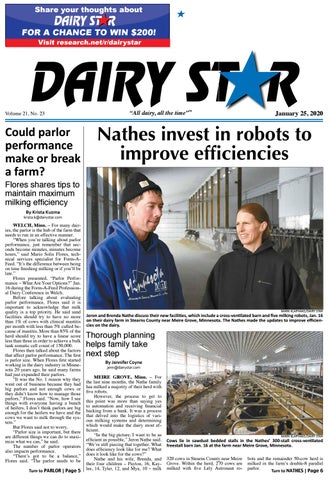
Nathes invest in robots to improve efciencies
Flores shares tips to maintain maximum milking efciency By Krista Kuzma
krista.k@dairystar.com
WELCH, Minn. – For many dairies, the parlor is the hub of the farm that needs to run in an effective manner. “When you’re talking about parlor performance, just remember that seconds become minutes, minutes become hours,” said Mario Solis Flores, technical services specialist for Form-AFeed. “It’s the difference between being on time nishing milking or if you’ll be late.” Flores presented, “Parlor Performance – What Are Your Options?” Jan. 16 during the Form-A-Feed Professional Dairy Conference in Welch. Before talking about evaluating parlor performance, Flores said it is important to acknowledge that milk quality is a top priority. He said sand facilities should try to have no more than 1% of cows with clinical mastitis per month with less than 5% culled because of mastitis. More than 85% of the herd should try to have a linear score less than three in order to achieve a bulk tank somatic cell count of 150,000. Flores then talked about the factors that affect parlor performance. The rst is parlor size. When Flores rst started working in the dairy industry in Minnesota 20 years ago, he said many farms had just expanded their parlors. “It was the No. 1 reason why they went out of business because they had big parlors and not enough cows or they didn’t know how to manage those parlors,” Flores said. “Now, how I see things with everyone having a bunch of heifers, I don’t think parlors are big enough for the heifers we have and the cows we want to milk through the system.” But Flores said not to worry. “Parlor size is important, but there are different things we can do to maximize what we can,” he said. The number of parlor operators also impacts performance. “There’s got to be a balance,” Flores said. “The parlor needs to be Turn to PARLOR | Page 5
MARK KLAPHAKE/DAIRY STAR
Jeron and Brenda Nathe discuss their new facili�es, which include a cross-ven�lated barn and ve milking robots, Jan. 16 on their dairy farm in Stearns County near Meire Grove, Minnesota. The Nathes made the updates to improve efficiencies on the dairy.
Thorough planning helps family take next step By Jennifer Coyne jenn@dairystar.com
MEIRE GROVE, Minn. – For the last nine months, the Nathe family has milked a majority of their herd with ve robots. However, the process to get to this point was more than saying yes to automation and receiving nancial backing from a bank. It was a process that delved into the logistics of various milking systems and determining which would make the dairy most efcient. “In the big picture, I want to be as efcient as possible,” Jeron Nathe said. “We’re still piecing that together. What does efciency look like for me? What does it look like for the cows?” Nathe and his wife, Brenda, and their four children – Payton, 16, Kaylee, 14, Tyler, 12, and Mya, 10 – milk
MARK KLAPHAKE/DAIRY STAR
Cows lie in sawdust bedded stalls in the Nathes’ 300-stall cross-ven�lated freestall barn Jan. 16 at the farm near Meire Grove, Minnesota. 320 cows in Stearns County near Meire Grove. Within the herd, 270 cows are milked with ve Lely Astronaut ro-
bots and the remainder 50-cow herd is milked in the farm’s double-8 parallel parlor. Turn to NATHES | Page 6
Page 2 • Dairy Star • Saturday, January 25, 2020
DAIRY ST R www.dairystar.com
ISSN 020355 522 Sinclair Lewis Ave. Sauk Centre, MN 56378 Phone: (320) 352-6303 Fax: (320) 352-5647 Published by Dairy Star LLC General Manager/Editor Mark Klaphake - mark.k@dairystar.com 320-352-6303 (ofďƒžce) 320-248-3196 (cell) 320-352-0062 (home) Ad Composition Nancy Powell 320-352-6303 nancy.p@dairystar.com Consultant Jerry Jennissen 320-346-2292 Editorial Staff Krista Kuzma - Editor/Wisconsin (507) 259-8159 • krista.k@dairystar.com Andrea Borgerding - Associate Editor (320) 352-6303 • andrea.b@dairystar.com Jennifer Coyne - Assistant Editor (320) 352-6303 • jenn@dairystar.com Danielle Nauman (608) 487-1101 danielle.n@dairystar.com Stacey Smart - Staff Writer (262) 442-6666 • stacey.s@dairystar.com Maria Bichler - Copy Editor 320-352-6303 Advertising Sales Main Ofďƒžce: 320-352-6303 Fax: 320-352-5647 Deadline is 5 p.m. of the Friday the week before publication Sales Manager - Joyce Frericks 320-352-6303 • joyce@dairystar.com Bob Leukam (Northern MN, East Central MN) 320-260-1248 (cell) bob.l@star-pub.com Mark Klaphake (Western MN) 320-352-6303 (ofďƒžce) 320-248-3196 (cell) Laura Seljan (National Advertising, SE MN) 507-250-2217 fax: 507-634-4413 laura.s@dairystar.com Jerry Nelson (SW MN, NW Iowa, South Dakota) 605-690-6260 jerry.n@dairystar.com Mike Schafer (Central, South Central MN) 320-894-7825 mike.s@dairystar.com Amanda Hoeďƒ&#x;er (Eastern Iowa) 320-250-2884 • amanda.h@dairystar.com Julie Barnes (SE WI and Northern IL) julie.b@dairystar.com Megan Stuessel (Western Wisconsin) 608-387-1202 • megan.s@dairystar.com Ashley Curry (Northeast WI and Upper MI) 920-539-7268 • ashley.c@dairystar.com Deadlines The deadline for news and advertising in the Dairy Star is 5 p.m. Friday the week before publication. Subscriptions One year subscription $35.00, outside the U.S. $110.00. Send check along with mailing address to Dairy Star, 522 Sinclair Lewis Ave., Sauk Centre, MN 56378. Advertising Our ad takers have no authority to bind this newspaper and only publication of an advertisement shall constitute ďƒžnal acceptance of the advertiser's order. Letters Letters and articles of opinion are welcomed. Letters must be signed and include address and phone number. We reserve the right to edit lengthy letters. The views and opinions expressed by Dairy Star columnists and writers are not necessarily those of the Dairy Star LLC.
The Dairy Star is published semi-monthly by Dairy Star, LLC, 522 Sinclair Lewis Ave., Sauk Centre, MN 56378-1246. Periodicals Postage Paid at Sauk Centre, MN and additional mailing ofďƒžces. POSTMASTER: Send address changes to Dairy Star, 522 Sinclair Lewis Ave., Sauk Centre, MN 56378-1246.
A glance at the other side
Among all the stories found in our newspaper, it might be hard to believe there are more stories to read each issue. Dairy Star likes to provide local stories, which is why we have two versions of the paper. While the majority of the features are the same, there are many stories in their respective coverage areas that are different. Want to read stories in the other version of the paper? Find full editions on our website, www.dairystar.com and click on the e-edition tab under the Dairy Star header. Here are a few highlights from stories you will not ďƒžnd in this paper, but you can ďƒžnd online in zone 2. Fitness center a perfect ďƒžt When Laurel Hartung and her family set out looking for ofďƒžce space in Shullsburg, Wisconsin, purchasing a ďƒžtness center was not what they had in mind. But after a year of owning the ďƒžtness center alongside dairy farming, the family has reaped several unplanned beneďƒžts from the unique avenue of income diversiďƒžcation and entrepreneurship. The ďƒžtness center also offers Hartung a great deal of ďƒ&#x;exibility in her day as she oversees the center around her on-farm duties. Loving two countries at once Nearly 20 years ago, a young Danish girl came to Stratford, Wisconsin, as a foreign exchange student. During that year, she met her future husband and set a course for the rest of her life. In December 2019, Trine Spindler was sworn in as a U.S. citizen, completing a long journey through the immigration system. She made the decision to retain dual citizenship in both the U.S. and Denmark, which also affords her children dual citizenship. Keeping the family farm alive Aaron Kluck was willing to do whatever it took to keep his family’s farm going – even if it meant working another full-time job to make ends meet while building his herd from scratch. This determined dairyman from Rosholt, Wisconsin, made many sacriďƒžces to get to where he is today. Kluck worked at a foundry and then at a brewery while growing his herd from just one cow to 80. Now at 100 cows, he focuses solely on farming. From cows to goats Lester Sterken thought it would be fun to raise goats, so he bought a couple. Now, he has 1,000 head. This dairy-farmer-turned-goat-farmer milks 600 goats near Delavan, Wisconsin – just down the road from the 600cow operation he owns with his brothers, Doc and Wayne. Sterken has no spare time between caring for his goats and feeding cows, but he loves every minute of it.
A MIXER FOR EVERY OPERATION
VT: Vertical Twin-Auger
VS: Vertical Single-Auger VXL: Triple-Auger Mixer
Botec: 4-Auger Mixer
RA: Reel Mixer
Kuhn North America is committed to creating innovative mixers that will provide a quality INVEST IN QUALITY ration and years of low-maintenance service. From 147 – 1960 cu. ft. mixing capacities. www.kuhn.com Lindell Sales & Service Cannon Falls, MN
Lake Henry Implement 3D\QHVYLOOH 01
Scott Supply 0LWFKHOO 6'
Hammell Equipment &KDWĹľHOG 01 (LW]HQ 01
Minnesota Ag Group 3ODLQYLHZ 01
Grossenburg Implement Philip, SD :LQQHU 6'
Adkins Equipment 'HWURLW /DNHV 01 Isaacson Sales & Service /DID\HWWH 01 Blue Hilltop /DNH :LOVRQ 01 Schlauderaff Implement /LWFKžHOG 01 Fluegge’s Ag 0RUD 01 Northland Farm Systems Owatonna, MN
Diaryland Supply 6DXN &HQWUH 01 Werner Implement 9HUPLOOLRQ 01 UFC Farm Supply :DFRQLD 01 Anderson Bros. (GJHOH\ 1' Duppong's, Inc. *OHQ 8OOLQ 1' Enerbase Cooperative Minot, ND
Pfeifer Implement Sioux Falls, SD Mark's Machinery :DJQHU 6' <DQNWRQ 6' Van-Wall Equipment Albia, IA ,QGLDQROD ,$ .QR[YLOOH ,$ Roeder Bros. %HOOHYXH ,$
Vetter Equipment &ODULQGD ,$ 6KHQDQGRDK ,$ Kunau Implement 'H:LWW ,$ Bodensteiner Implement (ONDGHU ,$ J. P. Scherrman, Inc. )DUOH\ ,$ Nelson Farm Supply +DUODQ ,$ Burco Sales ,QGHSHQGHQFH ,$ Helmuth Repair Kalona, IA
Graber Services /RFNULGJH ,$ Carroll Implement /X9HUQH ,$ Ag Land Implement 1HZ +DPSWRQ ,$ Kunau Implement 3UHVWRQ ,$ Engel Agri-Sales 6DF &LW\ ,$ Gordy’s Repair & Implement 6WDF\YLOOH ,$ Dee Implement of Waukon :DXNRQ ,$
Visit your local KUHN Knight dealer today!
ÂŽ
Dairy Star • Saturday, January 25, 2020 • Page 3
It’s all inside... Columnists
Bon Yankton Homme
Clay
Brookings
Sioux
O’Brien
Plymouth
k ero
n inso Emmet
Clay
Palo Alto
Ida
ca
Po
Sac
t
n mo
Fre
ery
m tgo
Mills
Mon
Page
n Win
ldt
Hu
Kanabec
Washington
ms ey Ra
Worth
Mitchell Howard
Hancock Cerro Gordo
o mb
Floyd
Greene
Bremer
Wright Franklin Butler
Guthrie
Boone
Dallas
Story
all
rsh
Ma
Jasper
Polk
aw
as
ick
Ch
Black Hawk
Grundy un Webster Hamilton Hardin
Au
Pottawattamie Cass
Zone 1
Kossuth
lho
Ca
Crawford Carroll
Harrison Shelby
s
ta
n ho
go
eba
Dick
ee Buena Vista
Ch
Monona
First Section: Pages 23, 25
Hubbard
Osceola
Tama
e
Lyon
Woodbury
Chapter closing in South Dakota
Wadena
Wilkin ln
co
Lin
Houston
iek
Turner
Winona
Fillimore
Mower
ake
Hutchinson
Freeborn
Faribault
Martin
sh
Charles Mix
Jackson
ne
Douglas
Gregory
McCook Minnehaha
Nobles
Wabasha
Cottonwood Watonwan Blue Earth Waseca Steele Dodge Olmsted
am
Tripp
n
Ha
Murray
Rock
Rice
Fayette
e war Dubuque
an
Benton
Jones
Clinton
hn
Jo
Jackson
n Cedar so
Scott
Muscatine
Adair
Adams Taylor
Madison Warren Marion Mahaska Keokuk
Union R
g ing
old
Clarke
Lucas
Decatur Wayne
Monroe Wapello e oos
A
n ppa
Davis
on
rs ffe
Je
Van Buren
Louisa
Henry Des
Moines
Lee
Kenyon
Women in Dairy: Donna Lexvold
Zone 2
Third Section: Page 36
Brookings
For additional stories from our other zone, log on to www.dairystar.com
Third Section: Pages 4, 6
Dela
Linn
Iowa
Save calves with proper sanitation
Clayton
an
ch
Bu
Welch
All
Todd
n so
Moody
Nicollet
Brown
Goodhue
n
Mellette
Miner
Lake
Redwood
Second Section: Pages 6 - 7
Dakota
Scott
gto
Aurora
Sanborn
Brookings
Lyon
W in
Brule
Jerauld
Kingsbury
Carver
Sibley
hin
Lyman
Beadle
McLeod
Renville
Yellow Medicine
Wa s
Hand
Buffalo
Deuel
Hamlin
High stock density grazing boosts soil, plant health
iek
Jones
Hughes
Clark
Hennepin
St. Cloud
sh
Stanley
Hyde
Anoka
Wright
Meeker
Chippewa
Isanti
eu r
Sully
Sherburne Kandiyohi
Pine
Mille Lacs
Benton
Stearns
Pope
Swift
Lac Qui Parle
Codington
Carlton
Morrison
Douglas
Stevens
Grant Spink
Aitkin
Crow Wing
we
Pages 10 - 11 Shannon Bennett Second Section
Faulk
Potter
Big Stone
Day
Cass
Po
Fall River
Edmunds
First Section: Pages 34 - 35
Todd Grant
4-H drives Frenchicks to farm
go
The “Mielke” Market Jackson Weekly
Roberts
Marshall
McPherson
Otter Tail
Paynesville
isa Ch
Haakon
Richland
Sargent
Itasca
Becker
Clay
Brown
Dewey
no
Mah
Ransom
Dickey
men
Cook Lake
Su
Campbell
Walworth
Page 33 First Section Meade
Custer
Cass
LaMoure
McIntosh
Sioux
Corson
Pennington
Bames
Emmons
Dairy Good Life Ziebach
Lawrence
Stutsman
Logan
Perkins
Butte
Kidder
Tra ver se
Burleigh
Morton
Adams
Page 32 First Section
Harding
Norman
Oliver
Just Thinking Out Loud
Polk
Trail
Steele
Koochiching
n
Mercer
Griggs
Lincoln
Bowman
Foster
Pipestone
Slope
Wells
Third Section: Pages 8 - 9
St. Louis
Red Lake
Eddy Sheridan
Beltrami
Pennington
Grand Forks
Kids Corner: The Justin Family
Lake of the Woods
Marshall
Benson
McLean
Page 31 Hettinger First SectionGrant
Roseau
n
Golden Valley
Walsh
Nelson
Something to Ruminate Stark On
Kittson
io
Billings
Pembina
Ramsey
McHenry
Ward
Page 30 First Section Dunn
Cavalier
Towner
Pierce
Dear Mountrail County Agent Guy
Third Section: Pages 12 - 13
Un
McKenzie
Rolette
Da vi so n
Williams
Bottineau
First Section: Pages 37 - 38
Randall
Take the right action with weather damaged property
bo
First Section: Pages 1, 6 - 7
Page 26 Renville First BurkeSection
Divide
Long Prairie
Christensen welcomes grandson to family dairy farm
Nathes invest in robots to improve efciencies
FSA News & Notes
Frazee
Le
Meire Grove
du
Pages 8-9 First Section
Clearwater
Ag Insider
Winter workshops focus on animal welfare, calf care
Second Section: Pages 14 - 15
FROM OUR SIDE OF THE FENCE: La Motte
Wallers raise cows, greyhounds, elk Second Section: Pages 3 - 4
What buildings collapsed on your dairy farm?
First Section: Pages 15 - 16
Give milk production a push GEA’s FRone works around the clock to keep feed at the bunk, maximizing your cows’ production. Could your bunk management routine use a little extra push? GEA’s FRone automated feed pusher provides consistent, high-quality feed available day and night to boost production results from your whole herd. It’s easy to use, charges fast and contains twin batteries for maximum run time. With the help of GEA’s FRone, you can push the limits on your feeding program.
Page 4 • Dairy Star • Saturday, January 25, 2020
Cold Weather Calf Headquarters Vaccines
HEIFER MEETING
Water is very important during the winter
Inforce™ 3 Bovi-Shield Gold® 5 Bovi-Sheild Gold® FP® 5L5 We have Franklin Cattlemaster® Gold FP™ 5L5 Waterers
at Gilman Co-op Creamery
Tues., Feb. 4th at noon
MEETING & LUNCH SPONSORED BY ADM
Ask about the new “smart“ features!
Calf Insure - Calf supplement maintains gut
health (25 lb. pail or 8 lb. pouch) Bovine IgG - Colostrum replacement Ampli²er Max - Calf Milk Replacer
CALVING PENS
KEEP YOUR CALVES WARM AFTER BEING BORN IN THE BITTER COLD! CALF CALF WARMERS BLANKETS
EAR TAGS
ELECTROLYTES
Pink & Blue
Z Tags • Y-Tex Tags
GEA Automated Calf Feeders Healthy feeding of calves with less labor
25 & 50 lb.
Customized, individual feeding is the key to success in modern calf management. With the rugged, programmable DairyFeed J-V600Smart or J-V640Smart automated calf feeding station, you can automate individual calf feeding, and record and monitor every calf from the very day it is born…helping you raise healthier calves with less labor. Spend your valuable time managing your calves, not simply feeding them. Ask about the new CalfApp and CalfCLoud tools today!
TIME TO BOOK YOUR SEED, FERTILIZER & CROP PROTECTION! Extra Fat Supplement for Additional Energy
Early bird discounts! Call 320-387-2770
1-800-887-4634 (608) 723-4634
Visit us at the Central MN Farm Show Feb 25 - 26!
Gilman Co-op Creamery
FEED & FARM SUPPLY STORE
Gilman, MN 320-387-2770
Open M-F 7:30-7, Sat. 7:30-5, Sun. 8:30-1 Good service - fair prices - every day
WWW.GILMANCREAMERY.COM
Achieve Healthier Cows & Calves
Pure 3000 Chlorine Dioxide Technology
A HIGHLY EFFECTIVE WATER INJECTION SYSTEM
Max Protection until the next milking
REDUCES: • Respiratory Issues • Scours • Crypto • Salmonella • E-coli
DUAL GERMICIDE CHLORIDE DIOXIDE
HIGHLY EFFECTIVE AGAINST • Prototheca • Staph Aureus • Mycoplasma
AVAILABLE IN: 5, 15, 30 and 55 gallon drums and 265 gallon totes.
THE PREMIER GERMICIDE ON THE MARKET
TOUGH TIMES CALL FOR PRIME PROTECTION GREEN USE SAVE UP TO 9 EMOLLIENTS COLOR PRE & Ultimate teat $1/GAL. over Iodine
conditioning
POST
for High-Vis Marking
FOR MORE INFO - CONTACT ONE OF THESE DEALERS... Advanced Dairy Systems
9 State Rd. 29 • Spring Valley, WI 54767 (715) 772-3201
Advanced Dairy Solutions
278 W. Court St. • Richland Center, WI 53581 (608) 647-4488
Anderson Dairy Systems, Inc. 1312 13 1/2 Ave. • Barron, WI 54812 (715) 537-3300
Athman Dairy Inc.
East Central Dairy Supply
Gorter’s Clay & Dairy Equipment
Champion Milking Systems
Eastern Iowa Dairy Systems
Lang’s Dairy Equipment, Inc.
238 Main Street North • Pierz, MN 56364 (320) 468-2494 23218 350th Street • Albany, MN 56307 (320) 845-4156
D&D Ag Supply
133 Atlantic Ave. NE • Pennock, MN 56279 (320) 599-4466
2195 Hwy. 23 • Mora, MN 55051 (320) 679-1029
105 3rd Ave. NW • Epworth, IA 52045 (563) 876-3087
Fuller’s Milker Center, Inc. 423 U.S. 61 • Lancaster, WI 53813 (608) 723-4634
1400- 7th St. SE • Pipestone, MN 56164 (507) 825-3271 2337 Millennium Rd. • Decorah, IA 52101 (563) 382-8722 1467 West 5th Street • Winona, MN 55987 (507) 452-5532
Leedstone
24260 Cty. Rd. 27 • Plainview, MN 55964 (507) 534-3161
Leedstone
2545 80th Ave • Woodville, WI 54028 (715) 698-4370
Professional Dairy Systems
1449 Homecrest Ave. • Wadena, MN 56482 (218) 632-5416
Tri-County Dairy Supply, Inc.
4107 N US HWY 51 • Janesville. WI 53545 608-757-2697
United Suckow Dairy
12687 Hwy 18 & 52 • Postville, IA 52162 (563) 864-7417 210 N. Industrial Pkwy • West Union, IA 52175 (563) 422-5355
Dairy Star • Saturday, January 25, 2020 • Page 5
ConƟnued from PARLOR | Page 1 correctly operated with the labor and with the number of cows.” Milking procedure is another factor that inuences parlor performance. “Sometimes we add too many steps to our milking procedure and makes our parlor inefcient,” Flores said. “Sometimes the milking routine we have, if we add more cows, probably needs to be readjusted so we can run those cows in through a good time.” Type of bedding is a factor. If cows are dirtier because of a certain type of bedding or if they aren’t bedded well, there needs to be an added dry wipe step when prepping cows. “That slows down your parlor,” Flores said. “If you have sand, you’re lucky. You can get away with a lot of stuff.” Facility design impacts parlor performance. This affects how fast cows can come in and the ow of work. Parlors bigger than a double-12 should be able to do 4.5 turns per hour, Flores said. “If not, we need to gure out why we can’t,” he said. Flores said the goal is to have cows fully prepped in order to maximize milk output. “We want that cow to release the oxytocin,” Flores said. Farms with milk meters will be able to look at reports to determine if their parlor is running efciently. Flores suggested a few categories to check. Average pounds per minute will tell if employees are doing a good job stimulating cows. Average duration will tell the turn time will be. Milk in the rst two minutes is an important category since Flores said 60% of a cow’s milk is harvest in the rst two minutes. Seconds in low ow should be at 20 or below, Flores said. Reattaches and late rehang are also important numbers to check. “You have to look at the numbers to see if it’s normal, and you have to benchmark it depending on what you’re seeing every day,” Flores said. While it is important for the owner or manager of a farm to know these numbers, it is equally important for the employees, particularly the milking crew, to see the results. “This is one thing I think everyone needs to do a better job of – telling employees what the score board is,” Flores said. “We’re good about monetary
things, but we don’t always give feed back to the employees. They often only hear about it when things are going bad, so we have to do a better job.” When managing a parlor without meters or computers, Flores said it is still possible to monitor parlor performance. Flores said use a stop watch to time procedures and turns within the parlor. Having an in-line milk ow meter is also helpful, he said. “That gives you a lot of information if your milking procedure is consistent or not,” Flores said. “We use an inline meter on a few farms. When we have people trained and doing it right, the difference in milk from shift to shift will be around 300-400 pounds.” If the difference is bigger, Flores said there is a reason and it must be found. Other areas to watch are teat conditions, milk ow, the number of clinical mastitis cases per week and the number of slips of a milking unit. Flores said there should not be more than ve slips for every 100 cows. Flores described one farm he works with where they were able to increase their double-16 parlor’s efciency by closely watching parlor performance. It started at 800 cows milked by 1.5 people with a three-step milking procedure that took 3.4 turns per hour. Over time, the farm made several changes and were able to milk more cows in the same parlor at a better speed. At 1,202 cows, two people operated the parlor using a two-step milking procedure and turning the parlor 5.3 times every hour. That is an increase of 402 cows. “When we got people who knew what they were doing, we started turning that parlor more,” Flores said. Flores also mentioned ne-tuning equipment, such as the vacuum of the system. “When you go past 12 inches, … you have to be careful,” he said. “The more vacuum you use, the more consistent your milking procedures need to be. Otherwise you’re going to be creating a lot of problems – teat end kill, mastitis. Your people better be trained in doing that procedure all the time or you’re going to be disappointed.” Following the procedure is key. “You have to nd that balance between equipment, people and cows,” Flores said.
VanBedaf Dairy Carrington, ND
40,000 gallon Mueller silo
IT’S A NEW YEAR! Let Famo Feeds help you make your 2020 goals a reality!
Our full lines of feed include: • Calf starters and growers • Milk Replacers • Vitamin and mineral premixes • Organic mineral packs • Forage inoculants • Lick tubs • And more!
320-836-2145 or 800-450-2145
Check out our newly redesigned website to ½nd a Famo Feeds dealer near you!
www.famofeeds.com
ANDERSON CALF MILK, INC
Premium line of Milk Replacers Feed made fresh daily • Calf • Goat • Lamb 20% Calf Starter Grain Probiotic Plus • 1st Calf Feeding Electrolyte Plus PALLET DISCOUNT PRICING SPECIAL ORDERS AVAILABLE
Small company with hands on experience located on Hwy 73 in Christie, WI
715-743-4608
04 JD 1293,
12RN 30” corn head
$14,900
Edgewood, IA
(563) 928-6445
COMPLETE BARN SOLUTIONS WHATEVER YOUR DAIRY NEEDS
Mueller’s milk silos provide high-capacity milk cooling and storage where space is at a premium. Five sizes ranging from 10,000 to 40,000 gallons available
Call us to help you make your dairy operation more efficient.
www.midwestlivestock.com
PINE ISLAND, MN • 800-233-8937 BEATRICE, NE • 800-342-5657 SIOUX FALLS, SD • 800-705-1447 MENOMONIE, WI • 715-235-5144
Page 6 • Dairy Star • Saturday, January 25, 2020
ConƟnued from NATHES | Page 1
Willmar, MN • 320.231.1470
EXPANDING OR REMODELING YOUR LIVESTOCK OPERATION? LANGE AG SYSTEMS SPECIALIZES IN:
Ŷ NEW FACILITIES
_
NO JOB TOO BIG OR TOO SMALL
Ŷ RETROFITTING & REMODELING Ŷ TURNKEY PROJECTS Ŷ BARN DESIGN Ŷ INSTALLATION, MAINTENANCE & REPAIRS
ƋƵŝƉŵĞŶƚ tĞ KīĞƌ͗ ͻ sĞŶƟůĂƟŽŶ &ĂŶƐ ͻ sĞŶƟůĂƟŽŶ ŽŶƚƌŽůƐ ͻ WŽƐŝƟǀĞ WƌĞƐƐƵƌĞ dƵďĞƐ ͻ ƵƌƚĂŝŶ ^LJƐƚĞŵƐ ͻ DĂƩƌĞƐƐĞƐ ͻ tĂƚĞƌĞƌƐ ͻ ^ƚĂůů ƋƵŝƉŵĞŶƚ ͻ ,ĞĂĚůŽĐŬƐ ͻ DŝƐƟŶŐ ^LJƐƚĞŵƐ
Lange Ag Systems is proud to offer Grain Bags, Silage Bags & Bunker Covers from Up North Plastics and Feed Fresh Silage Covers & Custom Size Bunker Covers from Raven!
t ^ >> E t Θ h^ 'ͳ ' Θ < >>z Zz E '' Z^
www.LangeAgSystems.com We BUY, SELL, TRADE used dairy equipment and milk tanks WE SPECIALIZE IN USED DAIRY EQUIPMENT.
Milking machine equipment, bulk milk tanks and cooling equipment. Give us a call, we will be glad to help you with any of your milking machine or bulk tank needs.
We also BUY your used equipment and milk tanks.
SALVAGE HOUSE
424 Third Street, Fullerton, NE 68638 • 800-844-5427
Repair vs. Replace
Electronic Dairy Board Repair Service
Specializing in: WestfaliaSurge, BouMatic, & DeLaval pulsators & Takeoffs, circuit boards, Mueller milk tank circuit boards. Call: (c) 406-590-7764
www.circuitÀxer.wixsite.com/ boumaticboardrepair
MARK KLAPHAKE/DAIRY STAR
Jeron Nathe reviews cow data collected from milking robots and acƟvity monitors Jan. 16 at his dairy farm near Meire Grove, Minnesota. The herd rst went through four robots in April 2019, and then another one was added in last November after remodeling part of the old bedded pack barn. “We’ve always paid attention to robots,” Nathe said. “I didn’t really think they were for us until about four years ago.” At that time, Nathe was noticing a trend in his daily routine. He found himself milking more often, which was taking time away from his ability to manage other aspects of the farm. Additionally, the family was looking at their long-term plans for the dairy. Within those plans, one of the top priorities was bringing heifers home from a custom grower.
“We started to think about that and where we were going to put a heifer facility,” Nathe said. “On the same line, we were looking to get to that next level of production. We were in a 25-year-old facility and there were limitations that came with that if we wanted to go up to (3X).” Then, Nathe came up with a different course of action. “I thought, we want the heifers home, but what if we built for the cows instead?” he said. “Housing the heifers in the old milk cow facility would give us a better return. And, it’s a great facility for heifers.” As the Nathes made plans for a Turn to NATHES | Page 7
2000 Series ProPush
®
PUSH BOX MANURE SPREADERS
The 2000 Series ProPush box spreaders are designed with simplicity in mind. The hydraulic push-type design means no apron chains, fewer moving parts, faster unloading and dependable service life. The ProPush box spreaders feature an all-steel welded box construction, solid poly floor and sides, piggyback hydraulic cylinders and removable beaters. • The VertiSpread® vertical beaters are designed for operators who want to spread the toughest solid industrial, dairy or feedlot material with a wider, more consistent spread pattern compared to horizontal beaters. • VertiSpread beaters can spread a high volume of material quickly while still providing a consistent 25’ – 30’ spread pattern. • The all-steel welded ProPush box construction provides a solid framework and includes a reinforced tongue that pulls directly from the full-width axle. • The piggyback hydraulic cylinders are totally protected by a structural tube member. This stops manure from falling directly onto the cylinder which helps prevent premature seal failure.
Blue Hilltop, Inc. 507-879-3593 / 800-821-7092 Lake Wilson, MN • www.bluehilltop.com
Lighting products to answer all your needs 82, Irwin Street, Local #3 Granby (Qc) Canada J2J 2P1 Tel.: 1-888-966-3431 or 1-450-777-2848 Fax: 1-450-777-4872 Email: info@cbmlighting.com / Website: www.cbmlighting.com Eric Haugen Home Farm AG Sales, Milan Mn. 320-226-2504 Haugen02@hotmail.com
Dairy Star • Saturday, January 25, 2020 • Page 7
ConĆ&#x;nued from NATHES | Page 6 300-stall cross-ventilated freestall barn, they kept milking robots in mind. “We wanted to build a barn that could accommodate robots later, but we still wanted to see if we could make our parlor more efďƒžcient,â€? Nathe said. To reach 90-100 pounds of milk per cow, Nathe knew they would have to increase milking to three times each day. But, the family was not convinced milking three times a day would give the dairy much ďƒžnancial gain or them a personal gain. Nathe reviewed the cost of labor, supplies and time when bumping up his parlor activity, and then compared those values to the cost of milking with robots. “We started penciling things out and the expenses to go to milking three times a day weren’t that far off from robots,â€? Nathe said. He also faced a tough labor situation. “I couldn’t expect the kids to run a six-hour milking shift after school,â€? Nathe said. “That would turn them away from farming.â€? Nathe spent a lot of time speaking with his farm business management instructor, a building contractor and banker, trying to develop the best plan for the dairy. A plan that would be ďƒžnancially viable and beneďƒžt both the cows and the Nathe family. “We got to the point where it was do or die,â€? Nathe said. “We knew it was a big risk with a lot of money involved, but everyone was conďƒždent the project would cash ďƒ&#x;ow.â€? The Nathes used conservative numbers – 85 pounds of milk per cow and a $17.50 mailbox price. “We have faith in ourselves we can do better than those numbers, but
MARK KLAPHAKE/DAIRY STAR
A cow is milked in one of ďƒžve Lely Astronaut roboĆ&#x;c milking systems Jan. 16 at the Nathes’ dairy farm near Meire Grove, Minnesota. The Nathes have been using the automated systems for nine months. they’re a good benchmark,â€? Nathe said. “And, this is a long, long term plan. We don’t expect to pay for this in ďƒžve years.â€? In July 2018, the Nathes began construction on their robot barn which now connects to the old bedded pack barn. By November 2019, the farm was fully functioning as planned. A majority of the milking herd is milked with the robots. The adjoined barns allow for heifers and dry cows to easily move
from the old freestall barn and parlor area to the robot barn when they are ready. The old freestall barn is divided into four pens – two of heifers, one for dry cows and one milking pen. Troublesome cows – those being quarter milked or treated, heifers that kick or some on a cull list – are milked in the parlor. Fresh cows are also milked in the parlor for three days before moving to the robot barn.
LET PROMAT HELP YOU MEET YOUR DAIRY PERFORMANCE GOALS
“We milk enough in the parlor to keep the bulk tank going and will continue to do so as we get the barn full. It just makes sense,â€? Nathe said. “Plus, I think that ďƒžrst milking is rough for some heifers and having them milked in the parlor ďƒžrst makes for an easier transition to the robots.â€? With the new setup, Nathe has become less of a laborer and more of a manager, as he had hoped. He works with employees and his children to get the parlor going and then has time to oversee other parts of the dairy. His family is also more involved. Brenda fetches cows for the robots in the morning and evening, and the children help in the parlor, clean pens, feed calves and are learning data entry in the robot systems. “Before, the family balance wasn’t there,â€? Nathe said. “It’s still not entirely there, but we’re working on it.â€? At nine months into this new way of dairy farming, the Nathes are pleased. They have seen their late lactation cows thrive in the robots and like the use of a partial mixed ration to meet every animal’s dietary needs. They anticipate having a better understanding of the operation as a whole after a year’s worth of data has been collected. “It’s still too early. ‌ Once we get more settled, we’ll know our limits and know how to push them,â€? Nathe said. “We’re not there yet, but we’re happy with where we’re heading. And, as a businessman and dairyman, that’s exciting as you ďƒžnd new ways to improve.â€? Mark Klaphake contributed to this article.
It’s a fact, a more comfortable cow is a more productive cow. And nobody offers cow comfort solutions like Promat. Please give us a call to learn more or to locate your nearest Dealer. COMFORT MAT™ PACK MAT - all the the undisputed best foam benefits of deep bedding mattress on the market using up to70% less sand
PASTURE MAT™ enjoyed by over 3 million cows worldwide
Natural & Recycled Interlocking & Straight Cut Mats
Rolled Alley Flooring
Utilizes a flexible polyethylene tube across the bottom portion of the stall loop that acts as a shock absorber
1.888.337.6265 | sales@promatinc.com www.Promatinc.com
facebook.com/promatinc
@Promat_inc
Dairy Parlor Anti-Fatigue Flooring
Senate passes USMCA Page 8 • Dairy Star • Saturday, January 25, 2020
The U.S.-Mexico-Canada Agreement passed Phase one is done the U.S. Senate by an overwhelming vote of 89-10 The U.S. and China have signed phase one of on Jan. 16. The vote came just one day after the a trade agreement. President Donald Trump was United States signed a new trade agreement with joined by Chinese Vice Premier Liu He at the China. Senate Majority Leader Mitch McConnell White House ceremony on Jan. 15. “Today, we take said the USMCA benets all sectors of a momentous step, one that has never Ag Insider the U.S. economy. “Farmers, growers, been taken before with China, toward cattlemen, manufacturers, small future fair and reciprocal trade,” said businesses and big businesses. This is President Trump in opening remarks. a major step for our whole country.” All details are public expect for For agriculture, USMCA is estimated specic purchase amounts. During the to increase U.S. exports by $2 billion. address, Trump veried the phase one Now, the trade deal heads to President agreement includes over $200 billion in Donald Trump for a signature. Chinese purchases of American goods Mexico’s legislature approved the and services over the next two years. trade deal last month and Canada still That includes at least $40 billion in needs to ratify USMCA. The Canadian food, agricultural and seafood products parliament isn’t scheduled to return annually for a total of $80 billion in the By Don Wick until Jan. 27. next two years. Other amounts specied Columnist include $75 billion in manufacturing, Monitor USMCA implementation $50 billion in energy and $40 to $50 With the new U.S.-Mexico-Canada Agreement, billion in nancial services. The president also said Canada’s Class 7 pricing system will be eliminated. he would remove all U.S. tariffs on Chinese imports U.S. Dairy Export Council President and CEO as soon as the two countries completed phase two Tom Vilsack said, “This Class 7 pricing distorted of the agreement, adding “I do not expect there to the export market and distorted the pricing of be a phase three.” (milk) powder. We will want to keep an eye on implementation to make sure our Canadian friends Another dairy processor seeks bankruptcy don’t substitute something that acts like Class 7, protection but isn’t called Class 7.” Vilsack is optimistic that Borden Dairy Company has led for Chapter 2020 will be a better year for dairy farmers. 11 bankruptcy. The dairy processor plans to continue with its normal operations during the Trump touts trade reorganization process. Borden CEO Tony Sarsam For the third consecutive year, President said the company is being impacted by the rising Donald Trump spoke at the American Farm Bureau cost of raw milk and the market challenges facing Federation annual meeting. Trump jumped straight the dairy industry. Borden is the second major U.S. to the point as he approached the podium. “We did dairy processor to seek bankruptcy protection in it,” he exclaimed. “They all said you’ll never get recent months, following Dean Foods which led NAFTA changed or get a deal done with China.” in November. In closing, there was assurance from Trump to the 6,000 Farm Bureau members in attendance that “the best days for farmers and ranchers are yet to come.”
Milk output expected to decline Milk production forecasts declined for 2019 and 2020. The estimate for 2020 is at 222 billion pounds, down 400 million pounds from last month’s report. The Class III milk price was lowered due to slower demand for cheese, butter and whey. USDA released this forecast in its monthly supply/demand report. Unique issues to be debated in St. Paul In the interim period ahead of the Minnesota legislative session, lobbyist Bruce Kleven has three key issues on his radar. The list includes climate change and agency rulemaking. “We are also watching the movement of captive deer as a result of Chronic Wasting Disease. In late 2019, the Minnesota Department of Natural Resources issued an order to stop the movement of deer from farms,” Kleven said. “That’s signicant, because that’s the rst time I can remember the DNR weighing in to what is considered agricultural production.” Kleven said the other deals with testing deer for neonicotinoids. “Just before hunting season without warning, the DNR asked deer hunters to send in spleens for testing. The concern I have with that is if they nd a neonicotinoid in a spleen, what does that mean? Does that mean the DNR will use the same analysis they used on the captive herds and ban the use of seeds, because it’s showing up in the wild deer?” MN GOP releases 2020 vision Minnesota Senate Republicans have announced their agenda for the upcoming legislative session. The so-called Vision 2020 agenda includes more funding for roads and bridges. The agriculture committee is focused on workforce development and tax relief for farmers. The Minnesota legislative session begins Feb. 11. Turn to AG INSIDER | Page 9
You Know Farming, AND SO DO WE. Specializing in Custom-Designed Agricultural Facilities Since 1970. Big or Small, We Design/Build Them All. Designers
| Construction Managers | Builders
400 Brickl Road | West Salem, WI 54669-0125
Toll Free: (800) 658-9030 | Web: BricklBros.com
Dairy Star • Saturday, January 25, 2020 • Page 9
ConƟnued from AG INSIDER | Page 8
Walmart moves into the beef business The world’s largest retailer is entering the beef business, with Walmart opening a new meat processing facility in Thomasville, Georgia. The 200,000- square-foot operation will employ 350 people and is part of the company’s $90 million commitment to supply Angus beef to 500 stores. In April 2019, Walmart partnered with a Texas-based Angus ranch to create its branded beef program. In 2018, Walmart opened a dairy processing plant in Indiana. NFU to elect a new president There are three candidates seeking the presidency of the National Farmers Union. Those candidates are NFU Senior Vice President for Public Policy and Communications Rob Larew, Kansas Farm Bureau President Donn Teske and Pennsylvania Farmers Union board member Mike Eby. NFU President Roger Johnson, who is the former agriculture commissioner in North Dakota, is retiring in March.
Stranz returns to NFU Mike Stranz is the new policy director for the National Farmers Union. Stranz has been part of the farm commodities and risk management subcommittee staff for the House Agriculture Committee. Trivia challenge A gallon of milk weighs 8.6 pounds. That answers our last trivia question. There is a mineral in milk that is essential for healthy bones and teeth. For this week, what is that mineral? We’ll have the answer in the next edition of Dairy Star. Don Wick is owner/broadcaster for the Red River Farm Network, based in Grand Forks, North Dakota. Wick has been recognized as the National Farm Broadcaster of the Year and served as president of the National Association of Farm Broadcasting. Don and his wife, Kolleen, have two adult sons, Tony and Sam, and ve grandchildren, Aiden, Piper, Adrienne, Aurora and Sterling.
DHIA: Now MORE than ever MINNESOTA DHIA WELCOMES CENTRE LABS!
Stearns DHIA Labs is becoming Centre Laboratories in Sauk Centre. Stearns DHIA Labs is joining forces with Minnesota DHIA and will continue to offer milk testing services for your operation along with manure analysis, feed and forage testing and more.
Please call Centre Labs at 800.369.2697 for more information or for manure, milk pregnancy, or feed and forages sample kits. Minnesota Dairy Herd Improvement Association 307 Brighton Avenue South Buffalo, MN 55313 1.800.827.3442 www.mndhia.org
February 25-26, 2020 River’s Edge Convention Center, St. Cloud Tuesday, Feb. 25 - 9 am to 4 pm Wednesday, Feb. 26 - 8 am to 3 pm Special Guest: Minnesota Commissioner of Agriculture, Thom Petersen, will be speaking on Tuesday Free admission • Over 200 exhibitors in over 370 booths Free daily seminars • Topics on the Hour speakers
centralmnfarmshow.com
Do the math when choosing roasted soybeans 1. Increases milk production 2. Maximizes milk components 3. Minimizes feed refusals 4. Properly roasted at the correct temperature 5. Soybeans are steeped for 30+ minutes 6. Soybeans are roasted to the core 7. Energy KLC roasted soybeans... 8. Protein preferred by bovines 9. Amino acids everywhere 10. Bypass protein
GEA Automated Calf Feeders Healthy feeding of calves with less labor Customized, individual feeding is the key to success in modern calf management. With the rugged, programmable DairyFeed J-V600Smart or J-V640Smart automated calf feeding station, you can automate individual calf feeding, and record and monitor every calf from the very day it is born…helping you raise healthier calves with less labor. Spend your valuable time managing your calves, not simply feeding them. Ask about the new CalfApp and CalfCLoud tools today!
0 1 t c e f The Per
KLC Farms Competitively Bids For Raw Beans - Call For Price!
KLC Farms Roasting, Inc.
1-877-738-2326 Visit www.roastedbeans.com
Quality
Ask about the new “smart“ features!
Consistency
“One of the biggest benefits to us of having the automatic calf feeder has been being able to eliminate a person bottle feeding 90-100 calves twice a day. We are also able to wean the calves earlier and still produce larger calves at weaning since switching to the automatic calf feeder. Additionally, we have received great support from Fuller’s Milker Center.” Hardscrabble Farms LLC Jerry Volenec Owner • Mike Spink Herdsman Montfort, WI • Calf Feeder installed April 2017
1-800-887-4634 (608) 723-4634
Page 10 • Dairy Star • Saturday, January 25, 2020
Lindell Sales & Service 37236 County 56 Blvd., Cannon Falls, MN 651-258-4311 • Mark’s Cell 651-764-4084
We carry... HOULE
Bushres another setback in Australia’s dairy industry
We Roast Wet Beans Become your own protein supplier.
Roast your own Beans! Quality Roasted and steeped for
By-pass protein
Value Stop paying trucking, elevator fees, grain bank charges and excessive shrinks Experience We’ve roasted millions of bushels Convenience
Fully equipped with fuel, electricity, boom auger discharge and operator. It only takes minutes to set up and then we roast 10 tons per hour.
PHOTO SUBMITTED
A wild bushre approaches Robert Miller’s dairy farm near Milton, NSW, Australia. Since late December 2019, res have ravaged through drought-stricken southeast Australia.
Farmers to begin long recovery to normalcy By Jennifer Coyne
Quality portable roasting since 1989
800-366-3402
jenn@dairystar.com
316709_9-28-05
midwestgrainroasters.com
p to are S 1- lf C Ca AcidiÀed electrolyte to conserve hydration for pre-weaned calves
BEGA, NSW, Australia – When Norm Pearce returned to his farm untouched by the raging bushres, a feeling of guilt rushed through his body. “Some dairies have just been decimated,” Pearce said. “But, I came home and the cows were waiting to be milked.” Pearce milks 205 cows with his wife, Narelle, and son, Thomas, in a partnership near Bega. Since late December 2019, wild bushres have ravaged through southeast Australia, displacing communities in the country’s Victoria and New South Wales. The disaster has come on the tail of a green drought, where the winter months were the driest they have been in decades. “We’re half way through summer now, but we haven’t had rain since June,” Pearce said. “From Melbourne and up along the coasts, all areas have been affected by this drought. Just a few weeks ago, all irrigators exhausted their irrigation allocation from the state government’s 9,000 megaliter dam. We use that to irrigate 130 acres.”
No precipitation and rising temperatures in the summer months have become a recipe for disaster. On New Year’s Eve, Pearce carefully watched a map that predicted the re’s pathway. It was heading straight to the farm. He and his family brought the cows in from pasture and watched as the re approached the dairy but then veered east to the coast. Two days later, Pearce and his family were again in the re’s pathway. They put all 500 of their animals – heifers, cows and bulls – on irrigated land and then sought shelter in town with family members. “That was a safe haven for us,” Pearce said. “It was hard to think about how the animals were doing and if they were going to be alright.” Others prepared in similar ways. Robert Miller, of Milton, New South Wales, brought his cows in from pasture and ran sprinklers on them. He also built rebreaks, but those were no match for the large ames. “We have never had re on my family’s farm in all of its history, since 1859,” Miller said. “I live in a high rainfall area. Our fence posts rot, not burn.” The rst re hit Miller’s on the same day as Pearce’s re. He then had another re erupt Jan. 4. The dairy is scorched in many places. Miller’s fences are completely wiped out, and he has heifers Turn to BUSHFIRES | Page 11
Call Randy for more information.
Calf Warmer • Removable top section • Easy cleaning • Raised slotted Áoor • SS support system • Ribbed bottom • Vent/peep hole • Deluxe high performance 110 volt, 2-speed heater
Agron. Petro. Feed Feed: 320-468-6655 Toll Free: 877-468-6655 Agron./Petro: 320-468-2509 Toll Free: 877-438-3378
PHOTO SUBMITTED
Dairy farmer Robert Miller picks up fence posts aŌer a bushre went through his farm in early January. Miller is working with neighboring farmers to relocate his youngstock that ed through the broken fencelines when the re approached.
Dairy Star • Saturday, January 25, 2020 • Page 11
LETTERS TO THE EDITOR
ConƟnued from BUSHFIRES | Page 10
Peterson is not a friend of dairy farmers
PHOTO SUBMITTED
A bushre destroys a part of an Australian dairy farm in early January. comingled with neighbors’ stock. His dry cows are aborting after suffering heat stress and shock. “The last few days have been such a blur,” Miller said. “There’s been literally no sleep as we’re trying to feed all the animals and are contending with very few fences and two-thirds of the farm burnt.” As the res have affected most every dairy farmer in some way, communities are banding together. “The community has been so good about getting behind us,” Mark Laity said. “I just hope the support is still there later on, for them to buy product and realize the behind the scenes of what it’s taken to get those dairy products to them.” Laity operates a 160-cow dairy farm near Wiseleigh in the Gippsland region of Victoria. He fought the res for days on end with no water, feed or fences for the cattle. For some time, cows were milked with a generator. “We saw ames your eyes wouldn’t believe,” Laity said. Sallie Jones, co-owner of the small milk processing company Gippsland Jersey, helped coordinate a hay drop to farmers without fodder for their animals. “Farmers got together with 17 semi loads of hay and arrived in a convoy,” Jones said. “Everyone is in a drought, but anyone would give the shirt off their back to someone else. That’s beautiful. Famers helping farmers.” Others have returned to the pastures to help x fence lines. Local businesses and community members have also donated money; they have even provided movie vouchers or activities for children who are out of sorts. The mood is somber across the entire industry as damage is assessed. Industry organizations are working with farmers to move milk off the farm amidst inaccessible roads, and the lack of water and energy. Fodder donations, like what Jones coordinated, are continuing, and herds are being relocated to farms where they can continue being milked.
There is also pressure for dairies in unaffected areas to help support the lost milk volume. “The lost income for many farmers and the impact of lost herds size, pasture and infrastructure will affect Australia in the short term and long term,” said Colin Thompson, dairy committee chair for NSW Farmers. In the long term, farmers will have to establish non-traditional power supply sources, build stronger infrastructure and proactively protect their farms from future res or natural disasters. “We are concerned some farmers may leave the industry rather than rebuild their farm,” Thompson said. Thompson’s organization and others are encouraging the government and industry to develop clear plans for how farmers can rebuild their businesses to full capacity. For those who had signicant losses, rebuilding will not be easy. “There will be many traumatized by their experiences,” Miller said. “The local doctors are already reporting the mental stress many are struggling to come to terms with their loss of homes, friends and simply surviving the re storm.” Jones agreed. “This has been a very traumatic event,” she said. “People are affected by it, and we all need to be sensitive about that and look after each other.” To help, the Gippsland Jersey coowner has provided mental health resources to dairy farmers. “It’s just been one challenge after another – bushres, drought, bad milk prices,” she said. “We just want family farms to be sustainable. That’s the romance of Australia’s dairy industry.” While the risk of re is not over, the industry must begin to move forward. “As we all recover, there is a rebirth of opportunities for our industry,” Jones said. “It’s given us a chance to think about how we do things and how we can do them different. To think outside the box.” Miller agreed. “Recovery will always happen,” he said. “But people will remember we are now in a re zone.”
Joe Schindler Dairy farmer Red Lake Falls, Minnesota In December 2019, Rep. Collin Peterson was in Litcheld, Minnesota, and said the economics of the dairy industry are improving. Despite many dairy farmers retiring and leaving the business, now is a perfect time for young farmers to get into the business because of the farm bill’s safety net, positive markets, available credit, cheap dairy cattle and the availability of empty dairy barns. In my opinion, he doesn’t know what he’s talking about. He is out of touch with reality. There’s a reason why dairy barns are empty. It’s not because dairy farmers are retiring like Collin said. A lot of family dairy farmers are in debt, owing thousands of dollars, causing them to go bankrupt and lose their farms. The reason I believe Collin is so out of touch is because of who he listens to – lobbyists. The lobbyists tell him dairy farmers need illegal immigrants to work on dairy farms. Some dairy farmers hire illegal immigrants on their farms. I call them plantation dairy farmers. It was my understanding that in 2018, Minnesota Milk Producers Association told Collin and other lawmakers that without illegal immigrants to milk cows, there will be few dairies. I agree with them 100 percent. The dairies employing them would be out of business. So, Minnesota Milk wants lawmakers to change the law for the plantation dairy farmers and make it legal to hire illegal immigrants. I’m sure without illegal immigrants these plantation dairy farmers would be out of business. I believe plantation farmers are overproducing and driving the price of milk down. That’s why there are so few family dairy farms left in business thus the empty dairy barns. Collin voted for the farm workforce modernization act which would make it legal to hire illegal immigrants by granting them certied agricultural worker status. If it becomes law, I believe it will be the end of family farms. There will only be plantation farms. In 2018, I called Peterson’s ofce in Washington, D.C., and wanted him to respond to a letter I had written in Dairy Star. He couldn’t even do that. He had a person on his staff call me. I thought that was poor of him. I think the least he could have done is responded by putting something in the newspaper. I have a few questions for Collin: As a law maker, do you believe in the rule of law? If so, shouldn’t the people who are breaking laws be punished? Why did you vote for the farm workforce modernization act? I will call his ofce again and ask for him to respond to this letter by putting it in the newspaper and not waste my time having a person on his staff call. The sugar beet farmers call Collin their champion. Collin has been a champion for both the sugar beet farmers and the plantation dairy farmers. He listens to their lobbyists and does what they want. He has been the honest family farmers’ worst nightmare.
Hydraulic Doors
By the most trusted name in the industry
855.368.9595
Page 12 • Dairy Star • Saturday, January 25, 2020
Take the right action with weather damaged property Waytashek explains preventable measures, handling claims By Jennifer Coyne jenn@dairystar.com
LONG PRAIRIE, Minn. – At the tail end of winter last year, the Upper Midwest was hit with snowstorms that left more than a fair share of precipitation. Many dairy farmers dealt with damaged roofs and barns due to the weight and amount of snow. While preventing such a weather pattern is not doable, there are w a y s f a r m ers can prepare for and RaeAnn Waytashek limit the Licensed insurance amount agent of destruction following a winter storm. “After the heavy snowfall last year, many buildings were damaged by weight of snow and ice,” RaeAnn Waytashek said. “We recommend (farmers) monitor their buildings, and if possible, remove any excess snow from the roofs.” Waytashek is a licensed
insurance agent in property at Advantage One Insurance in Long Prairie. In Waytashek’s 20-year-career, she has spent more than 15 years working with farmers. The winter season has already blanketed farms with snow and ice, and as the season continues, there is no doubt the risk for weather damage will only increase. To prevent as much damage as possible, farmers should evaluate their building structures and remove snow and ice buildup. An estimate of a building’s snow load can be calculated using the following formula from the University of Wisconsin Extension’s factsheet: depth (feet) x density (pounds per square feet per feet depth). The approximate density of light snow is 5-20 pounds per square foot per feet depth; packed snow is 20-40; packed snow with ice is 40-58; and ice is 58. “If a (building) owner suspects a snow load is in excess of the design loading, or if the roof is showing signs of impending collapse, they should
DAIRY STAR FILE PHOTO
The roof of a freestall barn caves in on top of cows at a northern Minnesota dairy farm following a spring snowstorm March 2019. make a plan to remove the snow,” Waytashek said. Buckled or broken rafters of the roof are indications the load is too heavy for the structure and a collapse may be likely. There are many ways snow and ice can be removed from buildings, both done effectively and safely.
DAIRY EXPO
9:00 am 10:15 am
Over 50 Vendors!
10:30 am
9 AM-3:15 PM • CENTRAL HIGH SCHOOL
11:30 am
Session B
“Management Strategies in an Era of High Pregnancy Rates”
“Characteristics of Resilient Minnesota Dairy Farms”
Professor of Dairy Science and Extension Specialist in Dairy Cattle Reproduction, Department of Dairy Science, University of Wisconsin-Madison
Associate Professor and Extension Economist, Department of Applied Economics, University of Minnesota
12:30 pm
Trade Show and Education for Dairy Producers. 3:15 p.m. Grand & Evaluation Dr Prize awings All registered partici pan
grand prize. Must bets are eligible for the present to win. Multiple prizes for com pleting the program evalua and returning tion. Must be present to win .
Online information available at https://z.umn.edu/2020DairyExpo and Facebook: @CarverScottExtension
For Dairy Expo information, please call Carver County Extension (952) 466-5300.
Joleen Hadrich
Greg Vold - Dorrich Dairy, Glenwood, MN Harlan Poppler - Poppler Dairy, Waverly, MN Kevin Solum – Minglewood Dairy, Deer Park, WI
Dairy producers share cow comfort strategies with three different stall surfaces - solids, mattresses and sand. Also addressing stall design, ventilation, feed distribution and more.
531 Morse Street • Norwood Young America, MN
Hosted by University of Minnesota Extension-Carver County and the Carver County Dairy Core Team
Session A
Panel discussion: “Strategies to Maximize Cow Comfort”
(Includes lunch, refreshments and program notes. Cash or Check only.)
Monday, February 17, 2020
Turn to PROPERTY | Page 13
Registration - Trade Show Open until 3:00 p.m. Early Bird Drawing in Trade Show Arena
Paul Fricke
COST: $10/person $5/Student (with ID)
bon monoxide to the building space. Both are poisonous to people and livestock,” Waytashek said. “No one should be allowed in the building when the unvented heater is used. And, before starting, farmers need to make plans for turning
Schedule of Events
28TH ANNUAL
Carver County
If a smaller amount of snowfall is present, farmers should rst consider heating the building to help melt the snow and ice on the roof. This must be done carefully if an unvented heater is used. “Unvented heaters consume oxygen in the building and can contribute to car-
2:15 pm
Enjoy Lunch and the Trade Show Session C
Session D
“Management Barriers to High Fertility”
“Building you Milk Check”
Paul Fricke
Professor of Dairy Science and Extension Specialist in Dairy Cattle Reproduction, Department of Dairy Science, University of Wisconsin-Madison
3:15 pm
Door Prize Drawings - Trade Show Arena
Barry Visser Dairy Specialist Vita Plus
In case of inclement weather, please call the Farm Information Line for event status: 1-800-232-9077
Dairy Star • Saturday, January 25, 2020 • Page 13
ConƟnued from PROPERTY | Page 12 the heater off from outside of the building.” Snow and ice removal can also be done with physical labor. If feasible, the University of Wisconsin Extension advises farmers to hire out this process to experts who use boom trucks and specialized equipment. “This is a really dangerous process,” Waytashek said. “Falling from ladders and the roof is a real possibility.” If the farmer must remove the snow or have employees do so, there are several steps everyone needs to consider for the process to be done safely. To begin, individuals should try to remove the snow from the ground. “Use a snow roof rake,” Waytashek said. “This lets you stand on the ground, but you have to make sure you’re out of the fall zone when scraping.” This method is effective and at a reasonable cost. Most snow roof rakes can be purchased at a hardware or building supply store. Farmers must take caution, though, because removing snow from the edge of a roof poses a risk for a potential mass of snow to come down from higher up on the building. Ladders may also be used for an extended reach while still on the ground. Another possibility is to remove the snow and ice from atop the roof. If this route is taken, individuals should be tied to the roof to prevent falling. The University of Wisconsin Extension advises farmers to remove snow from the most heavily loaded areas rst and to remove snow in narrow strips. Farmers should use plastic shovels or wood roof rakes to remove snow and ice without damaging the roof. Snow blowers should also be avoided for the potential damage they can cause to roof
material. As snow and ice are removed, farmers need to communicate with everyone on the farm of the removal plan and where dangerous zones lie on the property. Falling snow is a risk for injury or death of people and animals, according to the University of Wisconsin Extension. Preventative snow removal is an important part of carrying an insurance policy. “During these harsh winter months, there is potential to sustain damage or collapse to buildings even with prevention,” Waytashek said. “Taking the time to remove snow and ice from your buildings could benet you. Even though you may have the property insured, there are many hidden costs you may not be aware of.” The insurance agent encourages farmers to review their policy and contact their agent to make sure the policy is clearly understood. Oftentimes, policy deductibles and debris removal coverage are areas that need clarity. “Also think about your time,” Waytashek said. “Any downtime of your farming operation is an expense to you.” If damage occurs, farmers should contact their agent immediately while also preventing further damage. “Do this without jeopardizing your safety,” Waytashek said. “If you need to start the clean-up process before an adjuster arrives, take appropriate photos to document the scene.” Farmers should also keep receipts that are associated with the claim. Whether it is someone’s rst time ling a claim or not, they should work closely with their agent and insurance company to ensure the right steps are taken to recapture the losses.
712-722-3626
SERVICE AFTER THE SALE
THE NO COMPROMISE FABRIC STRUCTURE DAIRY, MACHINERY & HAY STORAGE
Commercial Agri Buildings
WE ALSO SELL REPLACEMENT TARPS!
Single and Truss Arch available from 20’-120’ wide Flo-Coat® Galvanized Steel Tubing Supplied by Allied Tube & Conduit Heaviest gauge steel in the industry Pre-engineered truss buildings
NELSON’S AGRI STRUCTURES
Dean Nelson • Central and Northern Minnesota • Grove City, MN • 320-857-2633, Cell 320-699-3297
RIVERSIDE HOOP BARNS, INC.
US Hwy. 75 At IA/MN Stateline • Steen, MN • 507-392-2870 • Fred A. Tilstra & Sons
LANGE CONSTRUCTION & CONCRETE
LAKESIDE HOOP STRUCTURES, LLC
Eastern Minnesota and Wisconsin • Harris, MN • 651-248-6302 • Craig Moline
ASK US ABOUT GOVERNMENT FUNDING FOR HAY STORAGE
FEATURES & BENEFITS
Russ Pierson
SALES & SERVICE
jcb.com/teleskid
A&C Farm Service, Inc.
The Air King M-30 series are extremely versatile and can be used individually in smaller spaces or in multiples for larger areas to establish positive airflow patterns that will enhance the effectiveness of the units. The T-style configuration of these units has inlets on both ends and exhausts the filtered air from the center of this unit.
• Disposable filters • Self-contained • Easy installation & maintenance • Four way louvers
Introducing a truly unique machine with endless possibilities. The new JCB Teleskid is the first and only skid steer and compact track loader with a telescopic boom, making it the most versatile machine you’ve ever seen. It can lift higher, reach further and dig deeper than any other skid steer on the market and can access areas you wouldn’t have thought possible, until now.
• 16 gauge powder coated construction • Filter change indicator (optional) • Multiple filter configuration available • Easily relocated
412 Business 23 S. | Paynesville, MN • 320-243-3736
www.acfarmservice.com
MUELLER SALES & SERVICE Glencoe, MN • 320-864-3556 OR 888-205-0974
*Conditions apply. Contact your local JCB Dealer.
5267
CA-Jan17-1B-MS
Duke Lange • Swanville, MN • 320-290-0859
Page 14 • Dairy Star • Saturday, January 25, 2020
w e E N q r u a i p e m Y e w n e t N We are more than just Manure spreaders & TMR feed mixers Contact us on your next barn project!
EYS Separator: p A Separator ahead of its time.
La rg
Minnesota’s If y
ou
h
ANY BALE, ANY CONDITION! ON! Flat, Frozen, Wet, Hard or Soft, no problem, no matter what condition
ion .
ing Dealer l
so wwave a w.da barn, we have y.com airylandsuppl ut
7800 Series Bale Processors
nd l Ha
ding and Man e e ur tF s e e
The EYS Screw Press Separator easily separates solids from liquid portions of fibrous manure. It’s ideal eal for quickly and effectively turning manure into oa valuable and marketable end-product.
Installation Available
SAUK CENTRE, OFF I-94 ON THE CORNER OF HWY. 28 & 71 SOUTH
HYDRA-SPREAD
Manufactured by
SBX Spreader This is, quite simply, the most advanced, best-built manure spreader you’re ever going to see. Now, do you need one this tough? Well, that all depends on how often you like to buy them.
Protwin® Side-Discharge Spreader
NEW MODEL! SB Series
The new KUHN Knight PS 23 235 35 and 242 ProSpread® apron o box spreaders are on non-commercial spreaders that provide an affordable option for producers without sacriÀcing quality.
Sizes Range From 285-550 Bu.
• Dual Endgate Cylinders • Poly Floor/Sides Won’t Rot or Rust • InÀnite Speed Adjustment • Heaviest Frame In The Business • Two Bolts Remove Beater Assembly • Replaceable 3/8” Beater Paddles • High Ground Clearance • Simple Hydraulics • High Lift Endgate
From Our Side Of The Fence
Dairy Star • Saturday, January 25, 2020 • Page 15
How do you feel better prepared if a building collapse happened again? Steven Landwehr Sauk Centre, Minnesota Stearns County 2,000 cows What buildings collapsed on your dairy last winter? At Union Dairy LLP, we had three buildings that sustained damage due to the excess snowfall and rain in early March 2019. The ďƒžrst barn that partially collapsed happened around 5 p.m. March 9. It was about a 36-by-70 section on our barn directly behind the parlor. Then, at about 10 p.m., we had about another 84-by-60 section collapse on our furthest north barn. Both barns were housing milking cows at the time of the collapses. Then, by the following morning we had another 48-by-60 collapse due to the instability of the north building. By late morning March 10, at our dry cow barn, just down the road, we had a 24-by-56 section of roof collapse. Also, on March 11, we had a 40-by-60 calf barn completely collapse at one of the calf sites. How did the collapse affect your day-to-day operations? When the barn sustained damage, we had between 10-12 employees working on moving debris and shoveling snow of the roofs for three days. After the debris was removed, we had about ďƒžve to six employees shoveling snow for another seven days. Once debris was moved out of the milking pens and the building was deemed safe, we started to utilize the pens where there was roof covering the free stalls. We then started to dry off some cows and sell some of the low producing cows to help ease the stress on the facility. We began rebuilding within three to four weeks. During rebuilding, we tried to move cows to other pens as much as possible to help speed up the rebuilding process. How was the damage covered? The newer buildings were insured fully, so we needed to pay the deductible when the work was completed. The older building that was not eligible for full coverage we had to pay out of our pocket to rebuild it after what was covered by insurance. Loss of income insurance still has not been settled up with for milk revenue loss and animals that were euthanized or suffered from pneumonia due to being trapped in the conďƒžned space of the buildings during the collapse. What did you decide to do with the damaged buildings? What factors played a role in this decision? All damaged buildings were repaired, and during repairs the builders built them to current code. Also, after inspecting the building that did not collapse, we strengthened the rafters with more bracing to reduce the chances of it happening again. How do you feel better prepared if a building collapse were to happen again? I would say it is hard to prepare yourself for an event like that besides doing more inspections of the snow loads on the roofs and communicating with your builders what are acceptable snow loads on your roofs. Otherwise, just addressing the problem safely and timely to prevent it before it happens as best you can. We had an instance on another farm where there was no snow on the
Al Oberstadt Fremont, Wisconsin Winnebago County 300 cows What buildings collapsed on your dairy last winter? A section of our freestall barn (about 100 square feet) went down April 15, 2018. We lost 10 cows as a result. The collapse was due to excessive snowfall. We had received over 30 inches in less than two days. How did the collapse affect your day-to-day operations? It made for longer days as we had to move animals to different places on the farm. How was the damage covered? I called our agent right away, and insurance covered it pretty well. We had snow coverage which was the saving grace. What did you decide to do with the damaged buildings? What factors played a role in this decision? We tore down the whole building and rebuilt it. The rest of the barn had suffered damage, too, even though it did not all go down. It took 11 months to build the new freestall barn. We made some changes with the new building, including making the stalls larger and adding drive-through feeding. The new barn has a few less stalls, but is wider overall. How do you feel better prepared if a building collapse were to happen again? I don’t know how to answer that question because you could never be prepared for something like that. What advice would you give to other farmers in a similar situation? Review your insurance policy and make sure it includes snow coverage which is what saved me. Tell us about your farm. My wife, JoEll, and I milk 300 Holsteins and farm 700 acres on the farm I purchased from my father 30 years ago. Started by my dad, our farm has been a family farm for many years. roof before nightfall and by morning there were 6to 7-foot wet snowdrifts at the peak of the building. Within hours before sunrise the building started to collapse. What advice would you give to other farmers in a similar situation? I would ďƒžrst do better preventative checks before it happens or consult with your builder. If it collapses, call for as much help as possible ďƒžrst and step back and access the safety concerns of the situation. Put one person in charge to watch over the safety of all the people involved and ensure you have the proper tools to do the daunting task ahead. When deemed safe enough to proceed, move the animals that are not trapped to a safer spot or gate the pen off to keep cattle away as far as possible. Tell us about your farm. Our farm is a multifamily operation that started milking 600 cows at Union Dairy in 2003. Over the last 17 years, we have been able to continually expand to 2,000 cows and grow about 30% of our forage. We raise all of our calves to about 4 months of age before sending them to a custom grower.
Scott Herber Altura, Minnesota Winona County 600 cows What buildings collapsed on your dairy last winter? A 140-foot section of a 96 feet by 209 feet freestall barn with 200 free stalls for milking cows collapsed. Two employees heard rafters starting to buckle from the weight of the snow. They ran in to get as many cows as they could out of that section. They were lucky because right after they closed a gate after getting many cows out, the roof collapsed to the ďƒ&#x;oor behind them. How did the collapse affect your day-to-day operations? We spent about two days getting debris out. We crowded the cows while that happened. We started using that freestall area again as soon as it was cleared out, but it didn’t have a roof which made it difďƒžcult when it snowed, rained or was cold during the winter. We also had to shut down our ďƒ&#x;ush system for about six weeks. We had to scrape the barns with skidloaders. Our barns are not designed for that so it made the chore a challenge. The snow from that storm also made it impossible for the milk truck to get to the farm, so we had to dump milk. How was the damage covered? Our build has been covered by insurance, but it has been a very long and tedious process that requires a lot of work and a lot of patience from us. What did you decide to do with the damaged buildings? What factors played a role in this decision? We chose to rebuild. We had to do a complete rebuild due to structural damage. The barn is the same dimensions. One change we made was adding tunnel ventilation rather than using natural ventilation. A large part of the decision to rebuild is because my 18-year-old son, Ross, is interested in coming back to the farm. We are still in the rebuilding process. How do you feel better prepared if a building collapse were to happen again? There is no way to prepare for this. We were lucky to have good people who volunteered to help cleanup. We had a lot of family, friends and neighbors help us. Along with people moving debris and cows, it was helpful to have people like my sister-in-law who made food. She lives in town which is close to the farm so we could get the food easily. Most of us could not leave the farm because there was so much snow. What advice would you give to other farmers in a similar situation? Be patient with your insurance company and ďƒžnd an agent who will stand behind you. Tell us about your farm. My wife, Michelle, and I own the farm. We have three children: Hunter, Ross and Kate. We milk 600 cows, crop 1,300 acres and do our own harvesting and manure hauling. We have lots of great employees who have been very patient during this process. We are appreciative of them while we deal with this mess.
Trusted People. Trusted Feed. Star Blends has been helping Midwest farm families by providing, high-quality feed, dairy nutrition, and commodity contracting for more than 20 years. Our state of the art mill can accurately blend anything from a custom SUH PL[ WR FRPSOHWH IHHG VSHFL¿F WR \RXU IDUPœV QHHGV 2XU H[SHULHQFHG VWDႇ DUH UHDG\ WR GHOLYHU WKH KLJKHVW TXDOLW\ IHHG at an economical price, assist in balancing diets, or work with your private nutritionist or dairy consultant. Contact Star Blends at: 800-462-4125 or StarBlends.com
Page 16 • Dairy Star • Saturday, January 25, 2020
ConƟnued from OUR SIDE | Page 15
Dale and Jason Mill Lewiston, Minnesota Winona County 160 cows What buildings collapsed on your dairy last winter? Our old dairy barn collapsed. It was built in 1969 and was last used for milking in 2005. We remodeled it for youngstock from weaning until conrmed pregnant. It was also used for a little bit of storage. The feed room is also connected to the barn. It was about 44 feet by 160 feet. There were 60 youngstock in the barn at the time of the collapse. We lost ve. About 80 feet of the roof collapsed. The rest was still standing, but rafters were cracked. How did the collapse affect your day-to-day operations? The collapse made every day more work. We moved the biggest animals in the barn to a lot with bred heifers. The rest stayed in the barn. We were bedding them a lot more, and there was a lot more shoveling because part of the roof was gone. It was hard to keep the calves dry. For several weeks, we also cared for injured animals. It interrupted our feeding routine. We could not get the feed out of two silos for at least one week because the conveyers were buried under debris and snow. Luckily, we had made baleage this year and used that to feed the milking herd until we got the conveyers cleared out. We would have been in bad shape without those bales. How was the damage covered? Our insurance covered the rebuild because we had some of the highest coverage. Our insurance was good to work with. What did you decide to do with the damaged buildings? What factors played a role in this decision? We decided to rebuild in the same location. The building is the same dimensions as the previous one. We could have built somewhere else, but we would have had to get a different permit and manure management, and it would have impacted our insurance coverage. So, we chose to rebuild where it was. We did encounter a few problems. We ended up having to redo our foundation. It also took a while to get to the building process since it was hard to nd contractors and insurance appraisers. The build is not done yet. The only thing different is it is higher for more clearance and will have a steeper roof with a 50to 55-pound snow load capacity. How do you feel better prepared if a building collapse were to happen again? We don’t think we could feel prepared for it; however, we do now pay more attention to how much snow is on the roof. What advice would you give to other farmers in a similar situation? Have good insurance coverage and watch how much snow is on your roof. It also helps to have good people around you. Tell us about your farm. My wife, Judy, and I have been here since 1975 and now our son, Jason, farms with us full time. Our herd is registered Jerseys and housed in a compost bedded pack barn. We farm 200 acres of crops. We have two employees who help us with milking and chores.
Amy Penterman Thorp, Wisconsin Clark County 850 cows What buildings collapsed on your dairy last winter? The freestall barn for milking cows. The section that collapsed was roughly 30 feet by 60 feet. How did the collapse affect your day-to-day operations? The open roof caused all the manure in the barn to freeze. We have automatic scrapers that could not run. All the water tanks would freeze up, and we had to thaw them out constantly. We bed with sand and that became frozen and impossible to work with and uncomfortable for the cows. Walkways would freeze up and cause areas of danger for cows moving to and from the parlor. It continued to snow and that blew in the barns. How was the damage covered? We carried insurance that covered snow load, and it was covered. The process went very smoothly. The adjuster was out right away to survey the damage. The builder had an estimate ready almost immediately which helped speed it along. The process was easier than anticipated. What did you decide to do with the damaged buildings? What factors played a role in this decision? Our only choice was to x it. We were fortunate to be one of the rst collapses, and our builder was out the next couple weeks to get the hole covered. How do you feel better prepared if a building collapse were to happen again? Hopefully we never have to go through this again. After this incident, the builders went through the barns and reinforced any weak areas. Our barn was originally built with wider bays that do not have the rafter support newer barns have. We made sure to reinforce those areas. All of our posts were beefed up with extra support. What advice would you give to other farmers in a similar situation? Have an emergency plan; don’t be afraid to call out an SOS to friends and neighbors. We had members of our community rally and come out within minutes of the collapse after a Facebook call for help. Stay calm and get your cows moved away from the danger zone. Make sure you have a map of your breaker boxes and what needs to be shut off immediately. A list of easily accessed phone numbers of your electrician and a builder with tools that can cut through steel. Have a supply of battery-operated ashlights and shovels to remove snow quickly. Stay calm, take a moment to analyze and think through the situation. Lay out your game plan and act. Tell us about your farm. Dutch Dairy is owned and operated by Sander and Amy Penterman. Sander is a rst-generation immigrant from the Netherlands. We milk 850 cows three times per day and raise youngstock to 9 months old and send them to a heifer grower until two months before calving. We raise corn, hay, soybean and winter wheat. Our cows are milked in a double-12 parallel parlor and are bedded with sand. Calves are raised on autofeeders.
Trevor Ekkel Newalta Dairy Pipestone, Minnesota Pipestone County 2,400 cows What buildings collapsed on your dairy last winter? About 84 feet of the roof of a 900foot long freestall barn collapsed. We used the barn to house part of our milking herd. How did the collapse affect your day-to-day operations? In the rst few days after the collapse, we had to gure out where to put the displaced cows by nding room for them in other pens. After the initial cleanup was complete, we were able to put cows back into the pen. There were about 50 free stalls we wouldn’t be able to use for the next four months. How was the damage covered? Our insurance company was great. They came out after the collapse to take photos and paid all of the repair bills as they came in. Our insurance company covered 100 percent of the cost of rebuilding and reimbursed us for the cows that were lost in the collapse. What did you decide to do with the damaged buildings? What factors played a role in this decision? We rebuilt the building to exactly the way it was before the collapse. One thing that we changed was to use at-headed screws to hold down the steel on the roof. We think that at-headed screws will make it easier for snow to slide off the roof. How do you feel better prepared if a building collapse were to happen again? You can’t really be prepared for this sort of thing. You can only get some of the snow off the roof before it becomes too heavy and causes a collapse. We also plan to use atheaded screws on all new construction. What advice would you give to other farmers in a similar situation? A roof collapse is extremely stressful, but things will work out in the end. Remember to stay safe during the cleanup. We had a lot of neighbors who came over to help us in the aftermath of the collapse. You have to keep safety rst when you have a bunch of people and machines working inside of a building that has just suffered a structural failure. Tell us about your farm. My wife, Alisha, and I have three children, John, 4, Ava, 2, and Emerson, 8 weeks. We farm with Alisha’s parents, John and Berlinda Vander Wal. We rent about 600 acres of alfalfa and buy the rest of our inputs from neighboring farmers. Our calves are sent to a calf raiser in Kansas and return to our farm at about two months prior to calving. Alisha’s brother, Ian, will be joining the operation after he graduates from Ridgewater College this spring. We plan to add a new 500-cow freestall barn this summer.
Sign up for our New Newsletter
DairySt r Milk Break Email andrea.b@dairystar.com
Available at Madison Location
Menomonee Falls
W136 N4901 Campbell Dr. Menomonee Falls, WI 53051
le Sca ard d n Sta
Milwaukee
11715 W. Silver Spring Rd. Milwaukee, WI 53225
5 Ye
8,00
FULL
0H
ar
WAR our RAN TY
Madison
7001 Manufacturers Dr. Madison, WI 53704
Hyundai HL940 Wheel Loader *60 Month Walk Away Lease 1,000 Hrs./Year Payment $1,350 .00 Features: Ride Control System Std., Joystick Loader Control with F/R Transmission Control Std., Sears Air Suspension Seat, 156 HP Cummins, Rear View Camera Std., Reversing Fan, Load Weigh System Scale Standard within 1% Accurate, 3 yd Bucket w/ BO Cutting Edge Std., Z-Bar Linkage, and Lifetime Center Pivot Warranty.
3YD Hyundai Wheel Loader
Call Us @ 888-310-3902
*Note lease rate based on 20% down or equivalent trade 1,000 hours/year or 5,000 for term, walk away lease. 5YR-8000HR Warranty on In-Stock Machines Only.
www.YESEquipment.com
Your one-stop shop
• Agricultural Building • Welding • Barn Parts • Equipment 320-836-2284 • 1-888-276-1751
29033 Co. Rd. 17, Freeport, MN In St. Rosa
www.arnzenconstructioninc.com
Dairy Star • Saturday, January 25, 2020 • Page 17
MARCH 25-26, 2020
20 20
e x p o
SIOUX FALLS, SD
WHERE DAIRY COMES TOGETHER! OVER 300 EXHIBITORS | INDUSTRY EXPERTS BREAKOUT SESSIONS | AG PRAYER BREAKFAST AWARD WINNING ENTERTAINMENT
#cpde2020 WELCOME RECEPTION RECEPTIO LIVE IN CONCERT MAR MARCH 24
JOE NICHOLS REGISTER ONLINE
www.centralplainsdairy.com
Page 18 • Dairy Star • Saturday, January 25, 2020
Repro Leaders
Synchronization program drives reproduction at Lake Breeze Dairy
Lake Breeze Dairy Malone, Wisconsin Fond du Lac County 2,950 cows milking, 3,300 cows total
What was your pregnancy rate average last year? 36% What is your voluntary waiting period for cows? For heifers? Seventy days for cows and 13 months for heifers. What is your rst-service conception rate? 49% What is your reproduction program? Do you use a synchronization program? Every cow gets two Lutalyse shots two weeks apart. The rst shot is given at 42 days in milk and the second shot at 56 DIM. Two weeks after that, we start Ovsynch. We give GnRH when a cow reaches 32 days since her last heat. The following Monday, she will receive an ultrasound to determine if she is pregnant. If open, she will be enrolled in our sync program. Our heifers are raised out of state and are bred off of natural heat.
STACEY SMART/DAIRY STAR
The reproducƟon team at Lake Breeze Dairy includes (from leŌ) Filadelfo Lopez, health and reproducƟon manager; Rick Schwenck, Breeze Dairy Group livestock manager; Josh Duchow, Lake Breeze site manager; Jayme Fisher, calving and transiƟon manager and David Mulder, herd manager.
How do you observe for heat? Breeding pens are locked once per day, and cows are tail chalked every morning. Cows marked with green chalk are
conrmed pregnant, and cows marked with orange are open and eligible for breeding. How do you conrm pregnant or open cows? We perform weekly ultrasounds. The rst ultrasound is done
34 days to 40 days post-breeding. If pregnant, she is checked again via ultrasound at 60 days and then again at 200 days carried calf. What is your breeding philosophy? How do you select bulls? What traits
do you focus on? Does fertility play a role in bull selection? Lake Breeze Dairy works closely with Alta Genetics and selects bulls based on production and health traits. Currently, the bulls Turn to LAKE BREEZE DAIRY | Page 20
E L B A I L E R L U F R POWE E C N A M PERFOR TORS
5G SERIES
TRAC 6 CYLINDER
150HP-336HP | CVT AND POWERSHIFT | GERMAN MADE TRACTORS
3 MODELS | 97-120 HP | EXCELLENT VISIBILITY
MINNESOTA’S NEWEST DEUTZ-FAHR DEALER Call Josh 320-573-2341 4054 50th Ave Swanville, MN 56382
Dairy Star • Saturday, January 25, 2020 • Page 19
75P
Rent $100/day or $ 300/week P-Series Post Drivers
Designed to use with auger system
75C
C-Series Post Drivers
Designed to efficiently drive post and break concrete on you skidsteer or excavator, by quickly attaching the adapter that fits your machine with the assistance of 2 pins only
715-644-2350 Chippewa Valley Dairy Supply
6053 CTY. HWY. G • STANLEY, WI 54768 • Andrew Zimmerman
32ND ANNUAL
FARM TOY SHOW SPONSORED BY: Sauk Centre Area Chamber of Commerce
Sat., February 8, 2020
Doors Open: 9:00 a.m.-3:00 p.m. 5 Star Event Center (Formerly Elmerz)
1225 Timberline Drive Sauk Centre, MN 56378
Music & Food Concessions!
Admission: $4 • Children 5 & under are FREE (Proceeds go to Dollars for Scholars Arnie Wiener Memorial College Scholarships)
TO BE A VENDOR OR FOR MORE INFORMATION CONTACT:
Sauk Centre Area Chamber of Commerce • Phone: 320.352.5201 Email: saukcentrechamber@gmail.com BA5-1-B-MT
POST DRIVERS FOR RENT OR SALE
SPONSORSHIPS PROVIDED BY:
“Comfort matters ... gets fresh cows off to a great start.” — Mitch Breunig
MYSTIC VALLEY DAIRY LLC, SAUK CITY, WISCONSIN Home of JENNY-LOU HOLSTEINS, The Breunig Family Mitch, Jacquie, Allie, Lauren and Brayden Breunig 480 Registered Holsteins, BAA 105.8 RHA 31,616M 3.89F 1228F 3.08P 974P Cheese yield 3291, SCC 98-113,000 “Comfort matters. For 7 years, we have used Udder Comfort™ because it gets fresh cows off to a great start with quality udders and low-SCC. Cows that start clean tend to stay clean throughout the lactation. That’s why we spray every fresh udder 2x/day for 3 to 7 days after calving and see their SCCs come down much faster,” says Mitch Breunig, Mystic Valley Dairy, Sauk City, Wisconsin, home of Jenny-Lou Holsteins, founded by his parents Jeanette and Louis. From balanced breeding and their focus on longevity came the legacy of Toystory. Today, this 480-cow freestall herd has more than 60 cows past 150,000M lifetime. The herd has a BAA of 105.8 and makes 100 lbs/cow/day with records to 55,000M.
Quality Udders Make Quality Milk
Keep the milk in the system 1.888.773.7153 1.613.652.9086 uddercomfort.com Call to locate a distributor near you. For external application to the udder only after milking, as an essential component of udder management. Always wash and dry teats thoroughly before milking.
Page 20 • Dairy Star • Saturday, January 25, 2020
ConƟnued from LAKE BREEZE DAIRY | Page 18
being used average over 2,300 pounds of milk and 184 pounds of combined fat and protein. In addition, emphasis is placed on DPR, PL and UC.
her? That varies cow to cow and is decided mainly based on production and days in milk. Generally, we will not breed a cow more than ve times.
How are cows and heifers bred? Do you have a different philosophy for breeding both? All heifers get two units of sexed semen and then move on to beef. Approximately the top 20% of cows get sexed semen; the rest are bred to beef.
Is there anything you have done or changed that brought about a signicant improvement in your reproductive program? We’ve always stressed compliance on synchronization programs. That’s a big driver. Also, good nutrition and a successful transition program for fresh cows are key to reproductive success.
What do you do to settle hard breeders? We do use CIDRs on a few cystic and non-cycling cows, but it only amounts to 6% of annual breedings. How many times do you try to breed a cow before you sell
Tell us about your farm. Lake Breeze is one of three dairies owned by Breeze Dairy Group. We milk 2,950 Holsteins averaging just under 99.5 STACEY SMART/DAIRY STAR
(Above) Cows are tail chalked every morning to aid in heat observaƟon. Cows marked with green chalk are conrmed pregnant and cows marked with orange are open and eligible for breeding.
pounds of ECM per cow with a 120,000 somatic cell count. Cows are milked three times per day in a double-44 parallel
parlor. Stalls are bedded with recycled sand. We do not own any land; therefore, we buy all of our feed.
STACEY SMART/DAIRY STAR
(LeŌ) David Mulder, herd manager, scans a cow’s RFID collar to learn her reproducƟve status. All cows needed for weekly herd health check are scanned for quick and easy idenƟcaƟon.
Dairy Star • Saturday, January 25, 2020 • Page 21
LOW RATE FINANCING AVAILABLE Financing subject to pre-approval through JD Financial. Some restrictions apply. See dealer for details.
127,200
JD 6110R, 2016, 513 hrs., $ # 144500
109,500
JD 1765, 2018, 12R30” #161082
JD 8320R, 2015, 1538 hrs., $ #1 143 4351 517 17 #143517
181,400
JD 7210R, 2015, 1584 hrs., #150804
JD 6135E, 2018, 476 hrs., #143698
84,900
JD 6130R, 2017, 294 hrs., $ #147778
$
$
95,900
JD 6430, 2008, 1050 hrs., $ #1 161 6165 657 65 57 #161657
75,900
JD 1770NT, 2014, 16R30” #156928
$
49,500
89,900
$
Over 1200 items with pictures updated daily • Go to www.mmcjd.com BOX DRILLS
11 11 10 5 8
JD 9400, no till, 10’ width, 6” spacing ........................................................................... $4,750 JD 9400, no till, 10’ width, 6” spacing ........................................................................... $4,750 JD 8300, end wheel, 13’ width, 6” spacing ................................................................... $57,00 JD 455, ‘16, folding, 25’ width, 7.5” spacing................................................................$44,900 JD 455, ‘19, folding, 25’ width, 6” spacing...................................................................$61,900
10 11 10 5 4 7 14
Krause 4991W, 30’, 3-section folding, 9” spacing, #165465 ....................................$14,900 Sunflower 1830, ‘12, 30’, 3-section folding; 11” spacing, #161784.......................... $29,400 JD 2620, ‘16, 26’, 3-section folding, 9” spacing, #165298 ......................................... $38,500 JD 2625, ‘13, 42’, 11” spacing, #151841 ..................................................................... $38,500 JD 2623, ‘13, 33’, #149511 .......................................................................................... $39,500 JD 637, ‘11, 45’, 5-section folding, 9”spacing, #166177 ............................................ $42,000 Lemken Rubin 12, ‘17, 23’, 3-section folding; 11”spacing, #165159 ................... $64,900
14 14 14 14 14 15 4 14 1 15 16 5 8
JD 960, ‘89, 42’, 5-section folding, C-shank, #165959 ...............................................$9,900 JD 980, ‘98, #156455 .................................................................................................. $14,430 Krause 5635, ‘09, 28’, 3-section folding #160777 ................................................... $19,400 Case IH Tigermate 2, ‘00, 5’, 5-section folding, C-shank, #161584...........................$22,000 JD 2200, ‘02, 47’, 5-section folding, C-shank, #161487 .............................................$25,400 JD 2210, ‘08, 50.5’, 5-section folding, C-shank, #159074 ..........................................$33,500 JD 2210, ‘09, 53’, 5-section folding, C-shank, #154393 .............................................$42,900 JD 2210, ‘13, 50.5’, 5-section folding, C-shank, #160879 ..........................................$48,900 JD 2210 LL, ‘14, 45.5’, 5-section folding, C-shank, #165957 ....................................$49,900 Case IH Tigermate 200, ‘14, 60’, 5-section folding, C-shank, #154509..................$51,900 Case IH Tigermate 200, ‘14, 60’, 5-section folding, C-shank, #154510..................$51,900 JD 2210, ‘12, 55.5’, 5-section folding, C-shank, #162453 ..........................................$51,900 JD 2210, ‘14, 55.5’, 5-section folding, C-shank, #154394 ..........................................$58,500
DISKS
FIELD CULTIVATORS
7 10 7 5 14 17 4 17 8 5 10 1 2 4 16 16 14
PLANTERS
JD 7000, 6R30”, rigid, finger pickup, 1.6 bu. hopper, #161201............................................ $4,900 JD 1750, ‘00, 6R30”, rigid, metering system, finger pickup; 1.6 bu. hopper, #166057 ....... $14,500 White 6322, #15684 ......................................................................................................... $18,900 JD 1770, ‘98 , 16R30”, flex fold, metering system, 1.6 bu. hopper, #159037......................... $20,900 JD 1780, ‘99, 24R22”, flex fold, metering system, 3.0 bu. hopper, #155446 ......................... $33,500 JD 1760, ‘12, 12R30”, flex fold, metering system, 3.0 bu. hopper, #166068 ......................... $35,000 JD 1760, ‘13, 12R30”, flex fold, metering system, 3.0 bu. hopper #156200 .......................... $52,500 JD 1765, ‘15, 12R30”, flex fold, metering system, 1.6 bu. hopper, Row Command #155243 $54,500 JD 1765, ‘18, 12R30”, flex fold, metering system, 3.0 bu. hopper, Row Command #161082 $75,900 JD 1790, ‘12, 31R15”, flex fold, metering system, central fill, #161182 ........................... $89,000 JD 1770NT, ‘14, 16R30”, flex fold, metering system, central fill, Row Command, #156928 $89,900 JD DB60, ‘13, 24R30”, flex fold, metering system, central fill, Row Command #161245 $154,000 JD DB60, ‘14, 24R30”, flex fold, metering system, central fill, #156907......................... $159,000 JD 1775NT, ‘18, 16R30”, flex fold, metering system, central fill, Row Command, #150736 $169,000 JD DB60, ’14, 24R30”, flex fold, metering system, central fill, Row Command #160470 $169,500 JD 1775NT, ‘17, 24R30”, wing fold, Exact Emerge; central fill, #160204 ....................... $262,900 JD DB66, ‘18, 36R22”, flex fold, metering system, central fill, Row Command, electric drive, #161783........................................................................................................ $279,500 7 JD DB66, ‘18, 36R22”, flex fold, Exact Emerge; central fill, Row Command, electric drive, #161533 ............................................................................................... $315,400 7 JD DB66, ‘18, 36R22”, flex fold, Exact Emerge; central fill, Row Command, electric drive, #160767 ................................................................................................$369,500 17 JD 7300, ‘90, 12R30”, wing fold, metering system, 3.0 bu. hopper, #157581............. $8,500 16 White 6722, 16R22”, wing fold, metering system, 1.6 bu. hopper, #157535 ..........$11,900
(1) = GLENCOE 4561 Hwy. 212
JD 7200, 24R22”, #159126...........................................................................................$14,900 JD 1730, ‘98, 36R22”, metering system, #159899 ......................................................$16,000 Moore Built, 24R22”, metering system, 3.0 bu. hopper, #159607 ...........................$27,900 JD 1710, 24R22”, wing fold, metering system, 1.6 bu. hopper, Row Command, electric drive, #164780 ...................................................................................................$42,900 14 JD 1725, ‘18, 16R30”, wing fold, Exact Emerge; central fill system, Row Command, electric drive, #164717 ................................................................................................$184,000 10 10 15 7 5 15 2 9
SPRAYERS
Blum 750, ‘79, #158936............................................................................................... $4,900 Miller Pro 750, #159603 ............................................................................................ $6,500 Redball 570, #159261............................................................................................... $12,900 Summers Ultimate, ‘01, #159606 .......................................................................... $13,400 Top Air TA1200, ‘08, #155358 .................................................................................. $16,650 Hardi Ranger 2000, ‘14, #163524 .......................................................................... $17,900 Hardi Ranger 2000, ‘14, #155294 .......................................................................... $20,500 Fast 9518, #158292 ................................................................................................... $25,900
SKID STEER LOADERS
11 New Holland LX565, ‘99, ROPS, foot controls, 66” bucket, 6850 hrs., #166203 .............. $7,900 13 Case 1845, ‘82, ROPS, hand controls, 72” bucket, 835 hrs., #162368 ................................. $9,400 5 Bobcat S250, ‘06, cab w/AC, foot controls, 2 speed, aux. hyd., 72” bucket, 5956 hrs., #166144 ............................................................................................................... $14,900 10 JD 325, ‘09, ROPS, cab w/o AC, cab enclosure, foot controls, Hi-Fl, 2 speed, less bucket, 6795 hrs., #161494 ............................................................................................................... $16,500 4 JD 318D, ‘13, cab w/AC, cab enclosure, A/C, foot controls, 2 speed, aux. hyd., 66” bucket, 5017 hrs., #165911 ............................................................................................ $16,900 15 JD 315, ‘07, ROPS, foot controls, self-leveling, aux. hyd., 60” bucket, 1874 hrs., #165904 $17,900 6 JD 320E, ‘16, cab w/AC, foot controls, air ride seat, 2 speed, aux. hyd., 76” bucket, 3800 hrs., #166219 ............................................................................................ $19,750 5 Gehl 5640E, ‘11, cab enclosure, foot controls, 2 speed, aux. hyd., general purpose bucket, 2884 hrs., #166118 ............................................................................................................... $21,900 16 JD 320E, ‘17, cab w/AC, EH controls, joystick, 2 speed, aux. hyd., less bucket, 2811 hrs., #148971 ............................................................................................................... $23,900 10 JD 328E, ‘13, cab w/AC, foot controls, EH controls, air ride seat, joystick, 2 speed, self-leveling, aux. hyd., flotation tires, 84” bucket, 3324 hrs., #166221.............................. $27,000 8 JD 320E, ‘18, cab w/AC, EH controls, joystick, 2 speed, aux. hyd., 2916 hrs., #159775 ..... $27900 7 JD 326D, ‘13, cab w/AC, cab, A/C, EH controls, air ride seat, joystick, 2 speed, self-leveling, aux. hyd., weights, 76” bucket, 1595 hrs., #166171 ............................................................ $28,500 10 JD 328D, ‘10, cab w/AC, foot controls, air ride seat, 2 speed, aux. hyd., 84” bucket, 1239 hrs., #158311 ................................................................................................................. $28900 15 JD 320E, ‘17, cab w/AC, EH controls, joystick, 2 speed, aux. hyd., 2681 hrs., #159774 ... $28,900 4 New Holland L225, ‘14, cab w/AC, foot controls, air ride seat, 2 speed, aux. hyd., 72” bucket, 1085 hrs., #161493 ............................................................................................ $30,900 5 JD 320E, ‘14, cab w/ AC, foot controls, 2 speed, aux. hyd., 72” bucket, 906 hrs., #161493 $32,900 14 Caterpillar 236D, ‘17, ROPS, cab w/ AC, cab enclosure, EH controls, air ride seat, 2 speed, 72” bucket, 582 hrs., #152334................................................................................ $33,400 4 Bobcat S650, ‘13, cab w/AC, foot controls, 2 speed, aux. hyd., 750 hrs., #155406 ....... $33,900 2 JD 326E, ‘15, cab w/AC, foot controls, air ride seat, 2 speed, self-leveling, aux. hyd., 84” bucket, 780 hrs., #153617 .............................................................................................. $33,900 11 JD 320E, ‘16, cab w/AC, foot controls, air ride seat, 2 speed, self-leveling, aux. hyd., 76” bucket, 765 hrs., #164631 .............................................................................................. $34,900 1 JD 320E, ‘16, cab w/AC, EH controls, EH controls, joystick, 2 speed, aux. hyd., 76” bucket, 645 hrs., #151636 ................................................................................................................. $38,900 4 JD 320E, ‘17, cab w/AC, EH controls, joystick, 2 speed, 72” bucket, 153 hrs., #144216 ... $39,500 13 JD 332E, ‘14, 1028 hrs., #155014 ...................................................................................... $39,500
Visit one of our 17 locations in Central Minnesota! (7) = ALEXANDRIA (9) = PRINCETON (4) = ST. CLOUD 1035 35th Ave. NE
(2) = HOWARD LAKE (5) = GLENWOOD 5845 Keats Ave. SW
1710 N. Franklin
(3) = STEWART
(6) = SAUK CENTRE
78412 Co. Rd. 20
14 5 14 3
1140 Centre St.
320-763-4220 5005 Co. Rd. 82 SE
3708 Baptist Church Rd.
(8) = PAYNESVILLE
16069 Hwy. 27 E.
725 Lake Ave. S.
14 JD 320E, ‘16, cab w/AC, EH controls, air ride seat, joystick, ride control, 2 speed, aux. hyd., 84” bucket, 290 hrs., #153678 ............................................................................. $40,900 4 Bobcat S650, ‘17, cab w/AC, hand controls, foot controls, ride control, 2 speed, aux. hyd., 78” bucket, 321 hrs., #166045 ............................................................................. $42,900 2 JD 324G, ‘18, cab w/AC, foot controls, air ride seat, 2 speed, self-Leveling, aux. hyd., beefy baby tires, 78” bucket, 291 hrs., #161893 .................................................................. $44,500 12 JD 326E, ‘16, cab w/AC, EH controls, air ride seat, 2 speed, self-Leveling, 84” bucket, 432 hrs., #126370 ................................................................................................................. $45,900 7 JD 330G, ‘18, cab w/AC, EH controls, air ride seat, joystick, ride control, 2 speed, self-leveling, aux. hyd., 84” bucket, 570 hrs., #159949 ............................................................................. $48,900 11 JD 332G, ‘18, cab w/AC, EH controls, air ride seat, joystick, ride control, 2 speed, self-leveling, aux. hyd., weights, 84” bucket, 150 hrs., #144002............................................................... $56,900 7 6 11 4 10 10 12 10 10 10 4 4 3 3 5 10 4 12 4 4 10 6 10 6 16 4 8 11 10 16 10 15 4 10 4 8 10 17
CALL TODAY! (320)365-1653 (12) = AITKIN 1120 2nd St. NW
(10) = LITTLE FALLS (13) = BAXTER (11) = WADENA 62505 US Hwy. 10
UTILITY TRACTORS
JD 3020, ‘64, 2WD, p. shift, 540 PTO, singles, 12989 hrs., #165991 .................................... $7,900 JD 2040, ‘79, 2WD, 540 PTO, #15704 ................................................................................ $11,900 Case IH 585, ‘85, syncro, 2WD, 540 PTO, loader, 3515 hrs., #162344.............................. $12,995 JD 5045E, ‘18, syncro, MFWD, 540 PTO, 250 hrs., #163844 .............................................. $23,900 JD 5055E, ‘18, syncro, MFWD, 540 PTO, 7 hrs., #140896 .................................................. $32,900 JD 5065E, ‘18, syncro, MFWD, 540 PTO, 37 hrs., #140790................................................ $33,900 JD 5065E, ‘18, syncro, MFWD, 540 PTO, 12 hrs., #147837 ................................................. $33,900 JD 5075E, ‘18, syncro, MFWD, 540 PTO, 31 hrs., #140875 ................................................ $36,900 JD 5065E, ‘18, p. reverser, MFWD, 40 PTO, loader, 112 hrs., #140897 .............................. $38,900 JD 5075E, 18, cab, p. reverser, MFWD, 540 PTO, 109 hrs., #147838 ................................. $41,900 JD 5075M, ‘18, p. reverser, MFWD, 540/1000 PTO, 250 hrs., #163843 ........................... $42,900 JD 5075E, ‘18, cab, p. reverser, MFWD, 540 PTO, loader, 49 hrs., #151896....................... $48,900 JD 6430, ‘08, cab, p. reverser, 2WD, 540 PTO, 1050 hrs., #161657.................................... $49,500 JD 6430, ‘08, cab, p. reverser, 2WD, 540 PTO, 1050 hrs., #161657.................................... $49,500 Case IH Farmall 110C, ‘15, partial p shift, MFWD, 540/1000 PTO, loader, 694 hrs., #161390 ..................................................................................................... $49,900 JD 5075M, ‘19, p. reverser, MFWD, 540/1000 PTO, 35 hrs., #165471 .............................. $59,500 JD 5100M, ‘18, cab, p. reverser, MFWD, 540/1000 PTO, 300 hrs., #152371 ..................... $61,900 JD 5090E, ‘19, cab, p. reverser, MFWD, 540 PTO, 98 hrs., #153019 ................................... $61,900 JD 5115M, ‘18, cab, p. reverser, MFWD, 540 PTO, loader, 913 hrs., #143690 ................... $69,500 JD 6105E, ‘19, cab, p. reverser, MFWD, 540/1000 PTO, 42 hrs., #151983 ........................ $71,900 JD 5090R, ‘18, cab, partial p. shift, MFWD, 540/1000 PTO, 7 hrs., #147006 .................... $71,900 JD 6135E, ‘16, cab, partial p. shift, MFWD, 399 hrs., #142599 ......................................... $71,900 JD 6125R, ‘13, cab, partial p. shift, MFWD w/suspension, 540/1000 PTO, loader, 3358 hrs., #165924 ................................................................................................... $72,500 JD 6120E, ‘18, 482 hrs. #143694........................................................................................ $79,500 JD 6120E, ‘18, cab, p. reverser, MFWD, 540 PTO, loader, 198 hrs., #143692 .................... $79,500 JD 6135E, ‘19, cab, p. reverser, MFWD, 540 PTO, loader, 150 hrs., #152152 .................... $82,900 JD 6135E, ‘18, 476 hrs. #143698........................................................................................ $84,900 JD 6110M, ‘18, cab, partial p. shift, MFWD, 540/1000 PTO, 97 hrs., #149242 ................. $87,900 JD 6110M, ‘18, cab, partial p. shift, MFWD, 540/1000 PTO, loader, 143 hrs., #149250... $89,500 JD 6110R, ‘17, cab, partial p. shift, MFWD, 540/1000 PTO, loader, 458 hrs. #144496..... $89,500 JD 6120M, ‘18, cab, partial p. shift, MFWD, 540/1000 PTO, 169 hrs., #141903............... $92,900 JD 6110R, ‘16, cab, IVT, MFWD, 516 hrs., #144500........................................................... $95,900 JD 6110M, ‘17, cab, partial p. shift, MFWD, 540/1000 PTO, loader, 178 hrs., #145468... $97,900 JD 6110R, ‘17, cab, partial p. shift, MFWD, 540/1000 PTO, 196 hrs., #145477 ............... $98,900 JD 6130M, 19, cab, partial p. shift, MFWD, 540/1000 PTO, 150 hrs., #152367 ............... $99,500 JD 6130R, ‘16, cab, partial p. shift, MFWD, 540/1000 PTO, 420 hrs., #14596 ................. $99,500 JD 6110R, ‘17, cab, IVT, MFWD, 540/1000 PTO, 271 hrs., #145469 ............................... $106,900 JD 6130R, 17, cab, partial p. shift, MFWD, 540/1000 PTO, loader, 294 hrs., #147778 $109,500
7045 Foley Rd.
(14) = ELBOW LAKE
(16) = BENSON
(15) = MORRIS
(17) = MADISON
110 2nd St. NE
23604 State Hwy. 9
380 Atlantic Ave. 516 1st St. E
SEE OUR COMPLETE INVENTORY WITH PICTURES AND DESCRIPTIONS AT: www.mmcjd.com
Page 22 • Dairy Star • Saturday, January 25, 2020
Wood
Shavings BULK
OR
BAG
S&S Wood Products
35335 Green Street | Independence, WI 54747
800-234-5893 | 715-985-3122
WE’RE GROOVIN’ FOR YOUR COWS’ SAFETY Barn alleys, freestalls, barn yards, holding areas specializing in diamond pattern and diagonal grooves
Midwest Grooving
DAVE VANDEN BOSCH
M G
Owner/Operator • Kaukauna, WI
920-450-7246
midwestgrooving.com midwestgrooving@gmail.com PROTECTING YOUR INVESTMENT
The new DeLaval Parlor P500 milking system
96
”
max ceiling height requirement for DeLaval SynchroArc™
Up to
56
%
reduction in exit cycle time with DeLaval SynchroSweep™
3
cow flow control options
ZERO
obstructions at cow exit
www.delaval.com
Contact one of the following dealers to learn more: IOWA Kramer Bros. Monticello, IA 319-465-5931 Prairie Land Ag Supply Inc. Rock Valley, IA 712-476-9290 United-Suckow Dairy Supply West Union, IA 563-422-5355 Postville, IA 563-864-7417
WISCONSIN Advanced Dairy/Bob’s Dairy Supply Spring Valley, WI 715-772-3201 Ederer Dairy Supply Plain, WI 608-546-3713 Joe’s Refrigeration Inc. Withee, WI 715-229-2321 Mlsna Dairy Supply Inc. Cashton, WI 608-654-5106 Professional Dairy Services Waunakee, WI 608-849-5043
Mondovi Dairy Systems Inc. Mondovi, WI 715-926-5777 West Salem, WI 608-769-2113 The Scharine Group Inc. Whitewater, WI 800-472-2880 Mt Horeb, WI 800-872-3470 Redeker Dairy Equipment Brandon, WI 920-346-5579 MINNESOTA & SOUTH DAKOTA D&D Ag Supply Pennock, MN 320-599-4466
East Central Dairy Supply Mora, MN 320-679-1029 Farm Systems Melrose, MN 320-256-3276 Watertown, SD 605-886-7401 Sioux Falls, SD 800-284-0015 S&S Dairy System LLC St. Charles, MN 507-932-4288 Professional Dairy Systems Wadena, MN 218-632-5416
is a registered trademark of Tetra Laval Holdings & Finance S.A. and “DeLaval” is a registered trade/servicemark of DeLaval Holding AB © 2020 DeLaval Inc. DeLaval, 11100 North Congress Avenue, Kansas City, Missouri 64153-1296. All facts and figures are the result of data collected on test farms and pilot farms. Data compared to DeLaval Champion. Results may vary and are not guaranteed. www.delaval.com
New thinking is focal point of 2020 PDPW Business Conference Event will feature best-in-class education, networking Presented by Professional Dairy Producers® – (PDPW) the 2020 PDPW Business Conference will be held March 18-19 at the Alliant Energy Center in Madison, Wis., The two-day professional development Conference will once again be a gathering place for dairy’s dairy producers and key thought leaders. The 28th annual Conference, themed “Focus 2020,” will bring together farmers, animal scientists, crop advisors, nutritionists, veterinarians, and other agribusiness leaders. Attendees can expect a positive and forward-thinking atmosphere, matched with bestin-class ideas, solutions, resources, and experiences that dairymen and women can take back to the farm immediately and affect the dairy’s bottom line. The all-inclusive event is packed with educational sessions, hands-on wet labs, workshops, a world-class trade show, the Preview Stage showcasing cuttingedge research, and the newly launched talentCONNECT™, which will highlight dairy’s up-and-coming talent, and much more to round out the experience. With over 40 speakers including dairy science experts, researchers, and dairy producer panelists, we are proud to bring 39 unique educational sessions to the event – there is something for everyone. Led by the Conference Emcee Bill Baker, a nationally syndicated radio broadcaster and host of Dairy Radio Now, attendees will hear from 5 keynote speakers, who will challenge our attendees to re-train their brain, innovate, create, and empower team members. They’ll also help attendees differentiate between what can be controlled and what cannot, and that controlling what they can is the place to start. Keynotes include: Doug Hall, founder and chairman of Eureka! Ranch International, was also named one of America’s top innovation experts by Inc. magazine. He’ll share that innovation and creativity is birthed from being pressed and pushed to the limits in his opening session keynote: “Dream. Adapt. Innovate.” on Wednesday, March 18 at 11 a.m. Greg Schwem, is a business humorist, corporate emcee, and nationally syndicated humor columnist for Tribune Content Agency and will help producers relax with friends and reect on some of the silly ways we work, think and act in his evening keynote: “Laugh at yourself!,” on Wednesday, March 18 at 6:30 p.m. Eric Snodgrass, a principal atmospheric scientist, who provides frequent weather updates focused on the inuence of high-impact weather events on global ag productivity, partnered with Dan Basse, well-known ag economist, will join forces and highlight the complexity and interrelated components of ag markets and the increasingly erratic weather patterns faced domestically and globally in their morning keynote: “When weather and markets collide,” on Thursday, March 19 at 10 a.m. Mark Nutsch is an inspirational keynote and former commander of the rst Green Beret unit that went into Afghanistan shortly after the 9/11 bombing. His heroic story inspired the major motion picture “12 Strong” and continues to serve as an effective reminder that perspective plays a powerful role in day-to-day life. Mark will share his story in his closing keynote: “Freedom isn’t free” on Thu., March 19 at 3:30 p.m. “PDPW was built on the desire for continuous education,” Shelly Mayer, dairy producer and PDPW executive director said. “When producers come to the Business Conference, they’re not only saturated with educational resources, they’re also surrounded by people who understand the path they’re walking. Fellow dairy producers help sharpen their saw and ll up the tank. There’s nothing like being with those who are in step with you.” To learn more or register for the 2020 PDPW Business Conference, visit https://pdpw.org/businessconference/ or contact PDPW at 1-800-947-7379.
Dairy Star • Saturday, January 25, 2020 • Page 23
Farewell to South Dakota Dairy Princess
State will celebrate 65-year program Feb. 6 By Krista Kuzma
krista.k@dairystar.com
BROOKINGS, S.D. – Since 1955, the South Dakota Dairy Princess program has crowned one woman to promote the industry in the state; however, the current princess, Ytsje Andringa, will be the last to hold the title. “I was saddened by the news that it was ending, but it’s an honor to be the last (South Dakota) Dairy Princess and be able to leave a mark on the princess program,” said Andringa, daughter of Sietse and Aafke Andringa, who milk 1,800 cows near Clear Lake. To celebrate the program, Midwest Dairy is having a gathering, which will also serve as a reunion for all past princesses and their families. The gathering will be held in conjunction with Midwest Dairy’s annual district meeting and the South Dakota Dairy Producers annual business meeting at 5 p.m. Feb. 6 at the Swiftel Center in Brookings. “We decided we are going to celebrate 65 great years and focus on the great work and the impact the program has had on the industry all these years,” said Char Hovland, South Dakota Dairy Princess program coordinator. The reunion will look back at the
PHOTO SUBMITTED
Lucille (Lee) Reed, the 1960 South Dakota Dairy Princess, stands with South Dakota Governor Ralph Herseth while he signs the document proclaiming June as dairy month in South Dakota in June 1960.
rich history of the state’s program. In attendance will be the sixth South Dakota Dairy Princess, Lucille (Lee) Reed, who reigned in 1960. “It was a highlight of my life,” said Reed, who now lives in Sioux City, Iowa. “I’m not sure what my life would be like without having had that
BRINGING DAIRY
opportunity.” While holding the title, Reed was 18 years old and in her freshman year at South Dakota State College (which is now South Dakota State University) studying to be a nurse. She had grown up on her family’s 20-cow dairy farm near Arlington. Reed still remembers
her family milking by hand, cream separators and when the Surge milkers were installed. “Surge milkers were the big thing,” she said. As a kid, Reed showed dairy animals in 4-H, including their one Jersey cow. “She would add to the butterfat content of the milk we sold to the local creamery,” Reed said. “That was desired at the time.” During her reign, Reed competed in the national dairy princess contest in Chicago where she met young women from California and Florida whose families milked around 200 cows. “That was just unbelievable to me at that time,” she said. “It was an unreal experience for someone my age at the time.” Another great memory during her time wearing the crown includes the National Plowing Contest in Brandon. Since 1960 was a presidential election year, candidates Richard Nixon and John F. Kennedy were there. “It was a very well attended event,” Reed said. “There were so many people in the media who were there whom I recognized from national television.” While Reed was not able to meet either candidate, she did take a picture with Nixon’s wife, Pat. “It all happened so fast, and I didn’t realize the actual experience I was having at that time,” Reed said. “I Turn to SOUTH DAKOTA | Page 25
to Life
2020 District Meetings
FEB 1 – 12:00 PM Tobie’s, Hinckley District 2, Eric Sonnek FEB 7 – 11:30 AM Browerville Comm Center, Browerville District 5, Debi Clasemann FEB 8 – 12:00 PM Hy-Vee, Owatonna District 19, Karen Kasper FEB 11 – 11:30 AM Pizza Ranch, Alexandria District 7, Suzanne Vold
FEB 12 – 11:00 AM – Leadership Meeting 12:00 PM – Midwest Dairy Pizza Ranch, Slayton District 18, Dave Schwartz FEB 14 – 11:30 AM The Oaks, Willmar District 11, Jane Remiger FEB 17 – 11:30 AM Immanuel Lutheran Silo School, Lewiston District 21, Rita Young MAR 4 – 10:00 AM – Extended program with Minnesota Milk 11:30 AM – Midwest Dairy 1:00 PM – DHIA Rochester Events Center District 20, Chris Sukalski
MAR 5 – 10:00 AM –Extended program with Minnesota Milk 11:30 AM – Midwest Dairy Crow River Winery, Hutchinson District 12, Charles Krause District 13, Kevin Buss MAR 11 – 12:00 PM American Legion, Millville District 17, Mindi Arendt MAR 14 – 7:00 PM Goodtimes, Caledonia Houston County ADA, Margaret Johnson MAR 19 – 7:30 PM Branding Iron Restaurant, Preston Fillmore County ADA, Margaret Johnson
No RSVP required. Please call 651-703-1008 or email barnold@midwestdairy.com with any questions. Visit MidwestDairy.com for additional locations and times.
Page 24 • Dairy Star • Saturday, January 25, 2020
NEW EQUIPMENT
#013918 LX Anderson IFX720 Bale Wrapper Call For Price
#012028 LX Kuhn VB3160 Round Baler Call For Price
#009293 LX Kuhn VB3190 Round Baler Call For Price
#002544 EY NH 330P Large Square Baler MUST GO - $89,000!!
#008532
#002529 EY NH Roll-Belt 450 Round Baler $28,900
#005648 EY NEW KUBOTA RTV-X900WL-A $11,900
#006503 EY NH T7.210 Tractor NOW $115,000!
#013126 LX Fendt 1042 Tractor Call for Price
#011570 LX Fendt 828 Tractor Call For Price
#010400 LX CIH Magnum 280 Tractor Call For Price
#010396 LX CIH 150 Maxxum Tractor Priced to Move
#012289 LX CIH 115 Maxxum Tractor Call for Price
#009560 NW CIH Farmall 60A Tractor Call For Price
#007195 LX MF 6713 Tractor Call For Price
#009547 EY Kubota M7-151 Tractor w/Loader Call For Price
#007741 RC Kuhn Knight VT156T TMR Call For Price
#007698 LX Segue SEG6T TMR BLOWOUT PRICED!!
#007700 LX Supreme Segue SEG45 TMR Call For Price
#013586 LX Supreme 800T TMR Call For Price
#013587 LX Supreme 1200T TMR Call For Price
LX NH 560 Round Baler Call For Price
$682/Month
#007652 LX New ‘17 CIH 875ET Disk Ripper $49,995
#009550 EY BRILLION WFPDS34 PULVERIZER CALL
#009001 EY GREAT PLAINS 1800TM TURBO TILL CALL
#3444R EY Sunflower 5135-42 Cultivator $49,152
#008146 EY White 9812VE 12R Planter, Elec. Drive, Hyd., Down Force Call For Price
#011802 LX CIH 2150 12 Row Planter Call For Price
#012480 EY Kubota R630 Wheel Loader Call For Price
#011439 NW Bobcat T650 Track Loader Call For Price
#013340 LX NH L228 Skid Loader Call For Price
#011115 RC Kuhn Knight SLC132 Spreader Call For Price
#012333 NW Meyer 7500 V Force Spreader Call For Price
#008545 LX New Holland 195 Spreader Call For Price
#012334 LX Meyer SX1720T Spreader Call For Price
#013461 NW Bobcat E85 Mini Excavator Call For Price
USED EQUIPMENT REDUCED PRICE!
#014546 LX 2013 CIH Magnum 315 $141,750
0% AVAILABLE!
REDUCED PRICE!
#008687 RC 2014 CIH Magnum 210 Tractor REDUCED $112,985
#008883 LX 2014 CIH Magnum 190 REDUCED $104,985
#010431 LX 2014 CIH 180 Magnum REDUCED $109,985
NICE!!
#013510 EY ‘12 NH T7.200 Tractor $89,900
#2993R2 EY 2012 NH T8.360, Front Sus $129,900
SUPER SHARP!
#011728 LX 2015 CIH 125 Maxxum Pro 30 MPH, Susp. REDUCED $67,500
#012442
#015071 EY 2015 Kubota M8560 HDC12 $42,000
#013417 LX 1999 NH 8160 Tractor $28,900
#015262 NW 1992 CIH 7110 $47,500
NW 2005 CIH MXM190 $42,500
REDUCED PRICE!
#008468 LX 2011 MF 8660 Tractor NOW $94,985 0% FINANCING
4WD
REDUCED PRICE!
#006674 EY 2012 MF 8670 Tractor REDUCED! $109,985
CLEAN!
REDUCED PRICE!
#009489 EY White 2-155 Tractor $9,900
REDUCED PRICE!
#015195 LX CIH 6150 Hillco Combine $329,985
#014471 LX ‘12 CIH 5130 HILLCO COMBINE $179,000
#009442 RC ‘14 CIH 5130 Combine REDUCED $149,985
#014720 LX ‘95 CIH 2166 COMBINE $39,900
#003708 EY ‘12 MF 9560 Combine REDUCED $134,985
#006657 LX ‘03 MF 9790 Combine REDUCED $34,985
#006676 EY ‘12 Geringhoff RD 830 Corn Head $36,985
#007393 EY 2011 NH H7230 Mow/Cond. $15,985
#014333 RC 2013 CIH DC102 Mow/Cond. $14,900
#014432 NW 2017 Trioliet 2-1600L VLC TMR $32,000
#014707 LX 2005 ValMetal V-Mix 400 TMR $12,500
#014427 RC 2009 CIH 1220 6RN Planter $24,900
#013911 LX 2001 JD 1780 6 Row Planter $19,500
#012578 LX ‘12 Great Plains 3000TT $29,500
#013857 LX ‘13 NH FR700 SP Chopper $219,985
#014832 EY ‘11 CASE CX36B EXCAVATOR $28,900
#014333 RC 2013 CIH DC102 Mow/Cond $14,900
#012732 NW ‘18 Bobcat 5600 ToolCat $47,900
#011449 EY 2014 Kubota RTV-X1120DWL $10,900
#014699 RC 2009 Kubota RTV900 $8,900
#009636 EY 2012 NH L220 Skid Loader $19,985
#015075 NW ‘15 Bobcat S650 Skid Loader $26,500
#014502
#013406 RC CIH LBX332 Large Square Baler $29,500
WWW.STJOSEPHEQUIPMENT.COM
EY ‘17 Cat 226D Skid Loader $31,900
Dairy Star • Saturday, January 25, 2020 • Page 25
ConƟnued from SOUTH DAKOTA | Page 23
feel fortunate to be chosen (to be dairy princess) at that time in history.” Other duties as South Dakota Dairy Princess included giving speeches and going to events to promote. She met with leaders, including governor Ralph Herseth, and did media interviews. She also crowned other regional princesses through the state. Reed cherishes the memories she has while promoting dairy in 1960. “It gave me another dimension to my life,” she said. “It gave me condence. It put me sometimes in uncomfortable situations that I found I could actually succeed in.” In recent years, Hovland said the dairy princess receives extensive training for media, public speaking, how to make classroom appearances and how to make a positive impact on others. Hovland said many dairy princesses have gone on to a multitude of career opportunities – scientists at dairy companies, school superintendents, veterinarians and dairy farmers among others. “Many have said what they gained as a dairy princess has really beneted them,” Hovland said. “I think it’s pretty impactful on what it says about what the princess program does for them.” Andringa agreed. “I feel I have a better un-
South Dakota Dairy Princess celebration, reunion When: Thursday, Feb. 6 5 p.m. Where: Swiftel Center Brookings, S.D. For more information, contact Char Hovland 605-695-3131 or char.hovland@gmail.com
PHOTO SUBMITTED
Ytsje Andringa, current South Dakota Dairy Princess, stands with a group of elementary students aŌer she gave them a tour Dec. 17 of her family’s farm, Sunrise Dairy, near Clear Lake, South Dakota. Andringa will be the last South Dakota Dairy Princess.
derstanding of how to communicate with others,” said Andringa, who is studying nursing and business at Calvin University in Grand Rapids, Michigan. In the future, Andringa would like to return to her family’s dairy and has big goals to continue teaching people about dairy long after ending her reign in March.
Reed has also promoted dairy even after giving up the crown. “You live it,” she said. “I nd myself defending dairy even when almond milk and other things have become popular. Milk has so many nutrients. It’s pretty important.” Going forward, South Dakota will continue with its
Can Your Mower Do This?
Since 1998
In less than 60 seconds! No Tools Required! Stop in today to see the stand-up deck for easy under-deck maintenance. Your Local Dealer:
Wingert Sales and Service 21181 E. County Road 8 • Plainview, MN 55964
507-534-2285
Countr yClipper.com
dairy ambassador program, which has been in place since 2018. College-age dairy students are awarded scholarships to promote the industry’s hard work and its products across the state throughout the year. “These students are eager to do it,” Hovland said. “I embrace it whole-heartedly.” The ambassador program
provides more opportunity for promotion. “There are going to be more people involved,” Hovland said. “A dairy princess can’t be at all places at once especially during June Dairy Month.” While promotion will continue to go forward with the ambassador program, Hovland is excited to recognize the importance of the 65 years the South Dakota Dairy Princess program has had in the state. “I am so impressed with the passion and dedication princesses have for the industry,” Hovland said. “I think a lot of it is because they come off the farm, they’re hard working, they know what their parents and grandparents have done, and I have always been impressed with their dedication to the dairy industry.”
Page 26 • Dairy Star • Saturday, January 25, 2020
USDA safety net program enrollment opens for 2019-20
Agricultural producers now can enroll in the Agriculture Risk Coverage and Price Loss Coverage programs – two United States Department of Agriculture safety net programs – for the 2019 and 2020 crop year. ARC provides income FSA News & Notes support payments on historical base acres when actual crop revenue declines below a speciďƒžed guaranteed level. PLC provides income support payments on historical base acres when the effective price for a covered commodity falls below its reference price. The 2018 By Ryan Brunn farm bill reauthorized and Stearns Co. Exec. Dir. updated both programs. Signup for the 2019 crop year closes March 15, 2020, while signup for the 2020 crop year closes June 30, 2020. Producers who have not yet enrolled for 2019 can enroll for both 2019 and 2020 during the same visit to a FSA county ofďƒžce. ARC and PLC have options for the farm operator who is actively farming the land as well as the owner of the land. Farm owners also have a one-time opportunity to update PLC payment yields beginning with crop year 2020. If the farm owner and producer visit the FSA county ofďƒžce together, FSA can also update yield information during that visit. Covered commodities include barley, canola, large and small chickpea, corn, crambe, ďƒ&#x;axseed, grain sorghum, lentil, mustard seed, oat, peanut, dry pea, rapeseed, long grain rice, medium and short grain rice, safďƒ&#x;ower seed, seed cotton, sesame, soybean, sunďƒ&#x;ower seed and wheat. For more information on ARC and PLC, including two online decision tools that assist producers in making enrollment and election decisions speciďƒžc to their operations, visit the ARC and PLC webpage at https://www.fsa.usda.gov/programs-and-services/ arcplc_program/index. When you know what program you want to elect, call your local ofďƒžce for an appointment so they can get you enrolled into the program. Do not wait until the last minute.
Farm Service Agency is an Equal Opportunity Lender. Complaints about discrimination should be sent to: Secretary of Agriculture, Washington, D.C. 20250. Visit the Farm Service Agency Web site at: www.fsa.usda.gov/ for necessary application forms and updates on USDA programs.
Buyers & Feeders of damaged corn, soybeans, screenings, wet, hot, dry, ďŹ re and silo corn. Trucks available. Z BAR FEED YARDS - -
Hydrostatic & Hydraulic Repair
• Repair & Sales • Troubleshooting • Hose Assemblies
• Design • Service Calls • Cylinders
Skidsteer Attachments For Sale www.stoens.com
16084 State Hwy. 29 • Glenwood, MN 56334
320-634-4360
Toll Free 866-634-4360
Dairy Ambassador Program shapes future industry leaders
Dairy Star • Saturday, January 25, 2020 • Page 27
Ensuring a sustainable future for the dairy industry means putting processes into place to pass farms to future generations. It also means investing resources in developing the next generation of industry leaders across the numerous facets of dairy production. As Midwest Dairy continues to focus on our strategic plan to bring dairy to life and give consumers an excellent experience, we continue to build on the success of our Dairy Ambassador By Theresa Reps Program not only to ensure a Midwest Dairy, strong future for the industry but agriculture affairs also to provide a positive return manager on your checkoff investment. The Dairy Ambassador Program began ve years ago as a pilot program in partnership with the University of Nebraska-Lincoln and has since expanded to college and university campuses in Illinois, Iowa, Kansas, Minnesota, Missouri, North Dakota and South Dakota. Through the Dairy Ambassador Program, college students with an interest or background in dairy participate in a variety of dairy-related functions. They learn about dairy farming and dairy nutrition as well as engage with others across the industry during board meetings and other industry events. Dairy ambassadors also participate in trainings to develop their public speaking, writing and social media skills and share their dairy story with consumers at events, including state fairs, on-farm open houses and school activities among others. Dairy ambassadors are compensated for their time and upon completion of the program, there are scholarships available. At the end of the 2019 program, we surveyed our 31 dairy ambassadors across the eight states. Twenty-seven of the dairy ambassadors completed the survey that helps us determine how the experience has impacted them and how to shape the future of the program.
relationships with other ambassadors and industry representatives. As for where they see themselves in ve years, almost all dairy ambassadors envision a career in the agricultural industry. From returning to their family farm to working in agricultural economics, extension or for Midwest Dairy, results suggest the program established or reinforced students’ interest in an agrelated profession with many listing a specic dairy focus. Dairy ambassadors were also given the chance to offer advice to future dairy ambassadors. Comments such as, “Embrace it. This is one of the most
A ffor where As h they h see themselves in five years, almost all dairy ambassadors envision a career in the agriculture g industry. y
benecial opportunities you will receive in college,” demonstrate how advocacy in one class of dairy ambassadors can pass on to the next thus keeping the program in motion. With this year’s program underway, we are excited about working with a new group of dairy ambassadors to shape their communication and leadership skills. Through our ongoing commitment to enhancing the program to best shape their needs, we are paving the way to a strong future for the industry. For more information on Midwest Dairy’s Dairy Ambassador Program, visit http://www.midwestdairy. com.
THE ICC$™ INDEX IS DIFFERENT…
When asked, “How would you rate the overall year-long experience?” On a scale of one to 10, the average score was an impressive 8.7, suggesting dairy ambassadors found the program to be worthwhile. Specically, the dairy ambassadors commented that upon completion of the program, they have a better understanding of dairy’s farm-to-table story and an increased comfort level and ability to interact with a variety of consumers – from dairy skeptic to dairy lover as well as those with extensive dairy farming knowledge to those completely removed from agriculture. In addition, dairy ambassadors stated they honed their networking skills through building
IT IS DESIGNED TO BUILD THE COW OF THE FUTURE. Includes data from multiple sources for a more robust index. The first index to truly merge the idea of maximizing efficient yield.
DIRECTLY TIED TO ECONOMICS.
Focused on traits important for botttom-line profitability.
PTO GENERATORS STANDARD FEATURES: 15KW to • 100% Copper Windings 150KW • Helical Gears for Smooth Operation • Full Power Receptacle • Square D Mainline Circuit Breakers • Large 3” Voltage Meter • Full Power Plug Included www.wincogen.com • Powder Coat Paint • Rodent Screens Model 50PTOC-3, 50 kw, 208 amps, • Lifting Eyes 1800 RPM, 540 input speed, 100 input hp
The only index that selects exclusively for cows that are going to thrive in commercial and progressive environments.
Years of the
888.333.1783 // www.genex.coop
© 2020 Genex Cooperative. All rights reserved.
A-22254-20
Page 28 • Dairy Star • Saturday, January 25, 2020 Joe Armstrong armst225@umn.edu 612.624.3610 Luciano Caixeta lcaixeta@umn.edu 612-625-3130 Hugh Chester-Jones chest001@umn.edu 507-835-3622 Gerard Cramer gcramer@umn.edu 612-625-8184 Marcia Endres miendres@umn.edu 612-624-5391 Sandra Godden godde002@umn.edu 612-625-8177 Joleen Hadrich jhadrich@umn.edu 612-626-5620 Les Hansen hanse009@umn.edu 612-624-2277 Brad Heins hein0106@umn.edu 320-589-1711 Nathan Hulinsky huli0013@umn.edu 320-203-6104 Kevin Janni kjanni@umn.edu 612-625-3108 Karen Johnson ande9495@umn.edu 320-484-4334 Claire LaCanne lacanne@umn.edu 507-332-6109 Brenda Miller nels4220@umn.edu 320-732-4435 Kota Minegishi kota@umn.edu 612-624-7455 Erin Royster royster@umn.edu Jim Salfer salfe001@umn.edu 320-203-6093 Mike Schutz mschutz@umn.edu 612-624-1205 M. Scott Wells mswells@umn.edu 612-625-3747 Emily Wilmes krek0033@umn.edu 320-255-6169
www.extension.umn.edu/dairy
Strategies to build resilient dairies in Minnesota
Success means something different for every dairy farmer. Some producers dene this as maximum milk production; others dene it as increased prot, number of cows milked or acres operated. Even a few identify a one-week vacation as a gauge of success. Regardless, this illustrates an important point; a successful dairy farm is not as simple as following a predened recipe. Rather, farm managers must identify what they want to measure as success for their farm and then continue to build and ne-tune their skillset to achieve their goal. Over the past 18 months, we have created a unique dataset at the University of Minnesota that combines animal health, production and farm nancial data to assist dairy farms By Joleen C. in creating more protable and sustainable Hadrich operations. This was not an easy task, but U of M Extension through this process, we have identied some characteristics that have generated positive discussion surrounding Minnesota’s dairy industry. Before we discuss the results, it is important to rst thank the 87 dairy farms across 29 counties who agreed to share their DHIA and FBM records from 2012-18. This was possible through a multientity collaboration between Minnesota dairy farms, DHIA, Minnesota state colleges and universities Farm Business Management Program, and University of Minnesota Extension. In this project, we dene success as nancial resiliency measured by the adjusted net farm income ratio. Specically, we calculated the proportion of prots the farm was able to retain from revenue generated from farm production after farm expenses were paid. Using this measure, we annually ranked the 87 farms against each other from 2012 to 2018. Then we identied resilient farms as those that ranked in the top 25% for the majority of the years of the study. Using this criterion, 28% or 24 of the participating farms were identied as resilient. We then compared the characteristics of the 24 resilient dairy farms to the remaining 63 farms, which we termed non-resilient. In general, resilient dairy farms were smaller operations with an average herd size of 106 cows that produced approximately 18,000 pounds of milk per cow. In our sample, non-resilient dairy farms had 220 cows that produced 21,000 pounds of milk per cow on average. Eighty-three percent of the resilient farms participated in the Minnesota Dairy Initiative program while only 12% of the non-resilient farms participated. Resilient dairy farms owned a larger percent of their crop acreage (35% compared to 26%) and had a lower interest expense per cow ($142 vs. $208). The average age of the principal operator on resilient dairy farms was 43 years old which was 10 years younger than non-resilient farms. Across the study period, resilient dairy farms consistently obtained a higher average net farm income per cow even with smaller
herd sizes. In 2018, the average resilient dairy farm reported an average net farm income of $500 per cow while non-resilient herds reported a loss on average. Over 73% of the non-resilient farms suffered from negative net farm income in 2018, while only 9% of the resilient dairy farms reported negative net farm income. In 2014, at the height of milk prices, resilient dairy farms reported $2,000 per cow in net farm income while non-resilient dairy farms generated $1,500 per cow in net farm income. The difference between net farm income per cow widened from 2015 to 2018 due to sustained low milk prices. Non-resilient dairy farms were making close to zero prot or negative prot per cow each of those years. In general, the resilient dairy farms were able to manage potential losses while increasing input efciency to have much smaller decreases in net farm income per cow from 2015 ($1,200 per cow) to 2018 ($500 per cow). Resilient dairy farms did lose prot potential each year since 2014, but those decreases were incremental over time, while non-resilient dairy farms were operating slightly above or at break-even from 2015 to 2017 with a consistent negative prot per cow in 2018. Now you may be asking what has caused these differences – in particular, our resilient dairy farms are producing less milk but generating a larger prot per cow than their non-resilient counterparts consistently over time. Looking more closely at the cow level data, we observed resilient dairy farms culled unprotable cows earlier than the non-resilient dairy farms and they tended to keep their protable cows in their herd longer, therefore increasing their return on the cow investment over time. Resilient dairy farms also reported slightly higher total solids. In 2017, resilient farms had an average butterfat of 3.86%, while non-resilient farms had an average of 3.81%. Not all processors were paying premiums for total solids over this time period, but for those farms that were able to receive these premiums, they were able to better maintain prot per cow while overall milk price was on the downturn. These dening characteristics emphasize the farm managers’ ability to mitigate downside risk while improving their prot margin as economic conditions allowed. Resilient dairy farms also placed a greater emphasis on educational opportunities as indicated by their adjustments in cost efciency, productivity and animal health over this time period. Volatile milk prices will continue to be a part of the dairy industry. Having the ability to endure and recover from uctuating milk prices is a strong indicator of success. The main lessons we learned from this project was even though the resilient dairy farms may not have the highest net farm income on a pure dollar basis, they were able to retain a larger portion of the milk sales they received in prot than their non-resilient counterparts due to a combination of nancial and cow management strategies. This article was co-authored with Amber Roberts, AgBusiness Management Extension educator, University of Minnesota.
NOW AVAILABLE AT KBS HEADLOCK BOTTLE FEEDING SYSTEM
52-QUART FEED TROUGH
Perfect Solution for Group Calf Feeding Applications • • • •
All galvanized heavy duty components Completely adjustable Simple to install Universal bottle holder, accommodates 2 qt, 3 qt and 4 qt bottles • Adjustable face shield limits face to face contact while drinking
(507) 534-3855 WWW.KBSCOMPANIES.COM
Durable and Ûts over most fences
Pre-weaning calf health impacts rst lactation, lifetime performance
It takes a special person to enjoy caring for pre-weaned dairy calves. To care for calves well, you have to do the same thing every day at the same time and revel in the monotony of being exact. When things are going well, it should be somewhat boring. For me, the only way I can motivate myself is to know why it matters. Why I feeding calves and dealing with the frustrations that come with the job? Why does it matter if I do it well? The rst answer is straightforward. The better you care for the calves, the less sick calves and the less dead calves you will have. Sick calves and dead calves are a considerable time, resource and emotional drain. Limiting morbidity and mortality is better for the dairy and the caregiver, but there is a bigger picture benet as well. Much of the calf research in the last 10 years has focused on early life care. A fascinating area to me is the effect of preBy Joe Armstrong weaning health on rst lactation and lifetime performance. U of M Extension While calf morbidity and mortality have signicant immediate impacts, studies show the effect is also long term. Several studies show calves treated for pneumonia or scours are more likely to be culled or leave the herd early. Additionally, similar studies showed calves treated for scours are almost three times more likely to calve after 30 months of age. Another study showed heifers that were never treated for respiratory disease were twice more likely to have a calf than treated heifers. These are all important markers of lifetime performance and the success of a dairy operation. But, what if morbidity and mortality are under control? What is the motivation to keep up the excellent work besides keeping morbidity and mortality low? Several studies have reported that pre-weaning average daily gain can signicantly impact later performance. Most notably, a Cornell study from 2012 showed that for every additional pound of average daily gain, an additional 1,100 pounds of milk was expected in rst lactation and an extra 2,280 pounds of milk was expected in the rst three lactations. This effect was linear, meaning the more average daily gain in the preweaning period, the more productive the animal. Similarly, a study in 2016 showed an additional 1,430 pounds of milk in rst lactation for every additional pound of average daily gain pre-weaning. Interestingly, the 2016 study also indicated the effect was true for the total production of fat and protein as well. A University of Minnesota study from 2016 reported similar results with weaning weight and pre-weaning average daily gain, both signicantly correlated to 305-day milk, fat and protein. What do these numbers mean to you? You should strive to eliminate almost everything that hinders growth in the pre-weaning period because it is hindering the lifetime performance of that calf, and you should push to add anything that enhances growth (within economic reason). So now the question is, what do I change? We need to eliminate as much stress as possible for the calf. Anything that takes away energy from growth needs to go, and we need to add things that positively impact growth as long as they are reasonable. The absolute most impactful thing in a calf’s life that predicts average daily gain, health and lifetime performance is colostrum management. Feeding the correct amount of high quality, clean colostrum is the most important thing you can do. Calories fed above maintenance is correlated to average daily gain and calf health. Calves need to be fed the correct amount to encourage growth and maintain fat stores needed for the immune system. Emphasis on special care in the winter is necessary as the cold temperatures cause maintenance requirements to rise. Coming from a veterinarian, this may sound strange. Stop giving so many vaccines pre-weaning. Basic husbandry and colostrum account for almost all of a calf’s health, and we should focus on managing g g those two things g rather than vaccine delivery. Collostrum is there for a reason and matters more than a vacComing C i ffrom a veterinarian, i i cine ever could. Every time this may sound strange. Stop we give a calf a vaccine, there the stress of handling, the giving so many vaccines pre- isinjection site healing and the weaning. need for the immune system tto respond, all of which redduce the energy put towards growth. Now, I am not saying you should not vaccinate. I am saying in many protocols, vaccines should be reduced to the bare minimum necessary to cover gaps in management until those gaps can be lled. Work with your veterinarian to identify which vaccines should stay and which can go. - Colostrum: 1 gallon of quality, clean colostrum fed within the rst four hours of life with 2 quarts of colostrum fed at the second feeding (within 12 hours). - Average daily gain: Doubling birth weight by weaning is a reasonable goal and provides an average daily gain that improves rst lactation and lifetime performance. Usually, this is around 1.5 pounds per day. - Milk: I push calves hard, and the research is there to show the benet. Offer 1 gallon twice per day or 3 quarts three times per day starting on the second day of life. - Vaccine: No injectable vaccines preweaning. Question the benet of all other vaccines and decide how to proceed with the help of your veterinarian. The reason we should care about pre-weaning calf performance is that this period signicantly affects the lifetime performance of the calf and the dairy as a whole. What that calf experiences in the rst 60 days of life matters for the lifetime production. When you are questioning why you are dealing with calf chores, remind yourself that how well you care for those calves is setting up the success of your dairy.
Dairy Star • Saturday, January 25, 2020 • Page 29
WHICH BARN IS BEST FOR YOUR HERD?
Birds just love this barn. The webs in these trusses are easy nest areas for birds. They also restrict air flow which leads to poor ventilation and moisture buildup in the building.
Starwood Rafters Uses Pole Sheds • Free Stalls Riding Arenas Pavilion Shelters Machinery Storage
The arched rafters create a more open barn allowing better ventilation. Also since there are no open webs in the trusses, there are no places for birds to nest.
• Spans up to 72 ft. • Up to 12’ spacing depending on the load you desire • Bird nesting control • Better ventilation & visability • No feed alley post obstruction • Additional ceiling height
Starwood Rafters Lam-Ply Truss
ANOTHER QUALITY PRODUCT FROM STARWOOD RAFTERS
STARWOOD RAFTERS, INC. 715-985-3117
W24141 Starwood Ln. • Independence, WI 54747 Website: www.starwoodrafters.com
888-525-5878
Reduces Somatic Cell NATURALLY. When using the BFP Dairy Bolus, SCC was reduced by
44% within 3 months, without antibiotics!*
Reduce Somatic Cell Count Boost Energy & Healing Increase Reproduction Rates Generate More Viable Eggs... AND INCREASE PROFIT!
TREAT MASTITIS AND LOWER SCC.... WITHOUT ANTIBIOTICS! The DAIRY BOLUS uses low-level embedded frequencies to stimulate and activate cell energy to promote self-healing and regeneration. This in turn treats mastitis while dramatically lowering Somatic Cell Count.
DRAMATICALLY IMPROVES CELLULAR HEALTH FOR INCREASED REPRODUCTION PRODUCTIVITY. The GENETIC BOLUS stimulates and activates cell energy to help generate more viable eggs. Animals with the Genetic Bolus consistently out-perform animals without the bolus .
Buy online or CALL forr SPECIAL SPECIAL PRICING! PRICING! 605-390-5363 | BovineFrequencyProducts FrequencyProducts.com *Visit our website to see all test results and headto-head comparisons!
A chilly stroll
Page 30 • Dairy Star • Saturday, January 25, 2020
The windshield of my pickup suddenly became stranded in their vehicles during previous blizzards a wall of white. At the same moment, I felt an abrupt and had railed against them. “Idiots.” I said to anyone loss of momentum and the cab of the truck began to who would listen. “Stupid fools. It would serve them tilt at a nerve-wracking angle. The pickup’s engine right if they were billed for the full cost of their sputtered and died. The only rescues. We could call it a sound was the unrelenting voluntary imbecile tax.” The di Th distance b back k to M Mom’s ’ roar of the wind. And, now – oh, the My goal had been house was only three-fourths irony – here I was in the simple. I merely wanted to same predicament. drive the 2 miles from my of a mile. Should I attempt to I calmly assessed mom’s farm (where we kept hoof it? the situation. It was darker our dairy herd) back to my than inside of a black cow at house so I could have supper midnight. The temperature with my wife and our two young sons and sleep in my was expected to drop to 20 below zero, and my truck own bed. Not too much to ask, I told myself. And, it was low on gas. On the plus side, I was dressed quite was not except during a nighttime blizzard in South warmly. Even so, I reckoned my ngers and toes Dakota. would be icicles by morning. I had heard stories about people who had become The distance back to Mom’s house was only
THIS IS OUR MARK. It matters to us because it fuels our farms and airy to tables around our families. It brings our dairy the world. Our mark stands for all the things that bring us together and makee us stronger.
Get to know us at dfamilk.com lk.com
three-fourths of a mile. Should I attempt to hoof it? So what if I did not have a ashlight? Didn’t I know the lay of the land like the back of my hand? I thought about my Norse ancestors and how they had left their comfy longhouses to colonize Dear County Agent Guy new territories. Would they have let a little snow and wind stop them? Heck, no. My courage thus steeled, I opened the door and stepped out into the full fury of the storm. The wind. It could rip the very breath from your lungs. The windchill was almost 60 below zero. But, how By Jerry Nelson long could it take to walk Columnist three-fourths of a mile? Ten minutes? Certainly I could endure it for that little while. I set off in the direction of Mom’s house – northward and into the teeth of the storm. My forehead began to throb like an ice cream headache. I held my gloved left hand up by my face to slow the wind. The hand quickly became numb. “Follow the road,” I thought. A simple enough task except that nothing was visible in the snowchoked darkness. Not a single landmark or yard light could be seen. My searching eyes were met by a black, windy void. What if I wandered off the road? I knew what they would say when they found my frozen carcass. “Idiot. Stupid fool. Why was he out walking in a blizzard at night?” As a child, I had feared the dark. I had imagined carnivorous monsters lurking in the shadows, waiting to nab foolish little boys who ventured from their beds for a drink of water. That same all-encompassing darkness clenched me in its suffocating grip. The storm spoke to me in ghostly voices, voices that would now taunt, now beguile. “Idiot,” it screeched. “Even the Vikings knew better than to walk out into a blizzard at night.” The wind whispered seductively as its icy talons sank into my quivering esh. “Stop. Rest for a while. Just lie down for a moment, and you’ll feel refreshed.” I ignored the voices and pressed forward. Would this night, this winter never end? Was I doomed to wander forever in this frozen purgatory? An unseen snowdrift caused me to stumble and almost fall. Or, was the Grim Reaper making a sport of me, grinning with glee as he tripped me with his scythe? Onward I trudged. Surely I should have gotten there by now. How long had I been walking? Was I lost? Lord, I was cold. The wind seemed to gradually subside. Was my imagination playing tricks on me? I lifted my eyes and beheld the most beautiful sight: the milky smudge of the farm’s yard light. I had made it. That was a piece of cake. I nonchalantly walked into Mom’s house, acting as though I had been out for a pleasant evening stroll. As expected, I received a good tongue lashing for causing everyone to worry. I was ordered to call my wife who was described as being beside herself. “That’s the trouble with womenfolk,” I mused to myself as I dialed the phone. “They always imagine the worst.” Jerry is a recovering dairy farmer from Volga, South Dakota. He and his wife, Julie, have two grown sons and live on the farm where Jerry’s great-grandfather homesteaded over 110 years ago. Jerry currently works full time for the Dairy Star as a staff writer/ad salesman. Feel free to E-mail him at: jerry.n@dairystar.com.
I F A
Roller-Grinder
More milk less feed with uniform Àne-grind Solid cast rolls All belt-electric drive Single or double mills USA & International sales Replacement rolls available for most mills Used mills and tumble mixers on hand Hammer Mills
Charles Krause | Krause Holsteins | Buffalo Buffalo, Minn Minn. ADVTNL2009
Phone: (319) 634-3849 • Toll Free: (800) 426-0261 web: www.ifamill.com • email: ifamill@netins.net
Dairy Star • Saturday, January 25, 2020 • Page 31
Build your milk check with components
Milk components have been high the past few months – higher than normal seasonal values – yet, most herds continue to search for additional pounds of milk. Many tend to focus on volume of milk shipped on a cow or herd basis when, in fact, it is the pounds of solids that leave the farm that ultimately pay the bills. The Federal Milk Marketing Order 30 applies to most Dairy Star readers. Pay price within the FMMO 30 on milk protein has been higher than fat since last September. volume contribution Something to Ruminate On The of both still comprises the majority of your milk checks. November FMMO 30 price on protein increased to $3.65 per pound and butterfat settled at $2.20 per pound. These values softened a bit in December but still illustrate the inuence milk solids have on your mailbox pay price. Because of the value By Barry Visser of milk components, Nutritionist many herds track combined fat and protein pounds shipped on a per-cow basis. Target goals are herd specic. Some high-performing herds produce more than 7 pounds combined fat and protein. It is important to calculate your number for your herd and use this as an internal benchmark for improvement. Energy-corrected milk is a calculation that factors in the pounds of fat and protein shipped. This measurement is more valuable than looking at milk volume alone or even fat-corrected milk. For example, a herd milking 85 pounds of milk with 4.1% butterfat and 3.3% protein would yield an energy-corrected milk value of 94.4 pounds. If milk production increased by 5 pounds per cow to 90 pounds of milk, but components dropped to 3.8% butterfat and 3% protein, this dairy would ship the exact same pounds of solids. Inconsistent feeding time or variation in feed distribution can impact meal patterns and promote slug feeding. Cow comfort and stocking density can negatively impact resting time, resulting in lower butterfat. Heat abatement strategies are critical to success in the summer and can promote more consistent intakes and cow comfort. Nutritionally, certain levels of effective ber are necessary to promote cud chewing and rumination. Particle size and digestibility of forage ber impact total intake of neutral detergent ber. Adequate forage NDF intake relates directly to rumen pH, and rumen pH is linked to milk fat. A healthy rumen environment minimizes wide uctuations in rumen pH through balanced carbohydrate nutrition. This leads to the formation of more acetate and butyrate which are volatile fatty acids that serve as precursors to milk fat. Too much vegetable oil has been shown to negatively impact milk fat. As wet corn sources move further into fermentation and starch becomes more available, so does some of the corn oil within the kernel. This can also cause some challenges to milk fat as we move closer to summer. Research conducted by Dr. Kevin Harvatine, Penn State University, has demonstrated the value of rumenavailable methionine sources to milk fat synthesis. Rumen-inert fats high in palmitic acid have shown to have a positive impact on milk fat. Feeding elevated levels of sodium and potassium or rumen modiers, such as yeast and direct-fed microbials, can be benecial to improving milk fat. The concept of amino acid balancing is nothing new to the dairy industry. Lysine and methionine are the two most-limiting amino acids in a lactating dairy cow diet. Feed ingredients, as well as synthetic sources, can contribute lysine and methionine to the diet. However, not all sources are created equal. The bioavailability of these amino acids – and the decision of which feedstuffs provide the most economical return on investment – is a conversation to have with your nutritionist. The primary goal with amino acid balancing is to improve protein efciency. As a result, amino acid balancing often yields an improvement in milk protein output. Improvement in protein efciency also results in less nitrogen excretion which inherently has some environmental benets. Lower nitrogen excretion also results in additional energy that can utilized for body reserves, milk production or other requirements of the cow. Increasing pounds of milk is not necessarily the best way to build up your milk check. Work with your feed team and nutritionist to evaluate feed ingredients and management factors that may contribute to greater milk components. The net results can be improvement in cow health, performance and an economic return to your bottom line. Barry Visser is a nutritionist for Vita Plus.
BETTER MILKING – MAKING A DIFFERENCE Are you ready in the new year to improve the milking performance of your herd?
Tell the advertisers you saw their ad in the Dairy Star!
CONSIDER THE FOLLOWING CUSTOMER COMMENTS: “Our Staph aureus problems seem to be under control which is quite a relief! Our last few herd SCC counts have been in the 60 range! We had a new record of 19 pounds for first 2-minute milk this morning.”
Less mastitis, lower SCC, more pounds milk yield per cow in the first two minutes – what more can you ask for? CALL US TO TRY OUR DEMO UNIT ON YOUR DAIRY AND FIND OUT FOR YOURSELF. CoPulsation™ Milking System 607-849-3880
Twitter @CoPulsation
www.CoPulsation.com www.Facebook.com/CoPulsation www.Youtube.com/CoPulsation
BODENSTEINER IMPLEMENT CO. www.bodimp.com
New Year, New Deals
Same Great
Quality & Service!
#49544 2018 JD 1775NT, 16R30 CCS, ELECTRIC METER, $190,000 WAU
#48986 2011JD DB60, 12ROW, FLEX FOLD, VAC
#49267 2019 JD 1775 NT 16R30, $180,000 MON
#49071 2003 WHITE 8180 16RN $33,500 ELK
#45020 2018 JD R4038 SPRAYER, 319 HRS, 120’BOOM, SF6000 RECEIVER, $295,000 MON
#44455 2012 ROGATOR RG1100, 120’ BOOM, 10” SPACING, HYD TREAD ADJUST $129,500
#49759 2017KUHN KRAUSE800540’, HYD STAR WHLS,RND BAR ROLLING BASKET $82,000DYE
#49741 2018 JD 5125R, 176 HRS., 540/100, 2REAR SCV,2 MID SCV,3PT $89,500 MON
#48238 2012 JD 7200R MFWD 1726 HRS, $119,500 DEC
#48263 2015 JD 9420R 2586 HRS, PS, 5 REAR REMOTE SCVS $189,500 DEC
#49338 2017 JD 8370R 442 HRS, MFWD, PTO $289,000 ROW
#48112 2017 JD 8400R 505 HRS $299,000 ELK #48790 2018 JD 8345R 105 HRS, MFWD $298,000 CRE
#49625 2013 JD 7260R 3814 HRS, NEW RUBBER ALL AROUND $114,000 ELK
#49757 2019 CASE SR210, CAB W/AC, HAND CONTROLS, 76”BUCKET, AUX HYDR. $43,000WAU
#49877 2015 CASE IH MAGNUM 380, 4267 HRS, PTO, CAB, NEW RUBBER $139,000 WAU
#48903 2018 JD 8370R, DUALS, 150 HRS $329,000 CRE #49366 2017 JD 330G, CAB W/AC, EH CONTROLS, JOYSTICK, 84”BUCKET $49,500 ROW
For complete info on all our used equipment log on to bodimp.com Elkader (ELK) ..........................563-245-2470 Clermont (CLE) .........................563-423-5206 Cresco (CRE) .............................563-547-2152 Decorah (DEC) ..........................563-382-2961 Dyersville (DYE) .......................563-875-2724
Monticello (MON) .....................319-465-3515 New Hampton (NH) ..................641-394-3061 Oelwein (OEL) ...........................319-283-4371 Rowley (ROW) ......................... 319-938-2222 Waukon (WAU) .........................563-568-3463
Opportunityisnowhere
Page 32 • Dairy Star • Saturday, January 25, 2020
No; I did not hit random keys for today’s title accurate. The problem for me was when I could nor did I forget to hit the space bar between words. rank all four words in the same line as a four. Once There is a story behind the letters. I will get to that all the words were ranked and the scores totaled, in a moment, but I want to talk about p personality y I am most like an otter. Of course, it is the most and communication styles. social s and people trait At many farm transition Thi of the four. I also see This jjumble bl off lletters h had d meetings we have been to, myself as a beaver either as a buyer and now as such an impact on Austin ... in creatively solving a seller, there are always a Do you see it now? It is about problems, a lion in couple of fun tests to discover taking the lead and your communication and perspective, positive or negative. as a loyal retriever t my family and leadership styles. One such to test compares your style to a friends. f As Austin golden retriever, a lion, a beaver and an otter. You points out, it is not for absolute accuracy but more have to rank four words in a line which describe for a frame to build upon. you best: takes charge, takes risks, loyal and The catch phrase at many of these meetings
FARM-RITE EQUIPMENT, INC.
Les Kuehl
Repair Service
INTEREST AS LOW AS 0% ON QUALIFYING EQUIPMENT
Please see your Farm-Rite Sales Rep for more details
Visit our website: www.farmriteequip.com
30+ Years Experience
YOUR CENTRAL MINNESOTA GOLIATH REPAIR SERVICE!
SALES - SERVICE RENTAL
• Sealed silo parts & service • All parts needed to service your • Best chains on the market Goliath Unloaders • Used and rebuilt unloaders Not afÀliated with the Harvestore brand • Stainless steel roofs • Stainless steel conveyor chains Call for early maintenance specials
One Of The Largest Skid-Steer Loader Dealers In The State Of Minnesota!
West Hwy. 12 • Dassel, MN
320-275-2737 • 888-679-4857
1515 West Litchfield Ave. • Willmar, MN
320-235-3672 • 877-484-3211
810 Mayhew Lake Rd. NE • St. Cloud, MN
320-240-2085 • 844-262-2281 19612 US-71 • Long Prairie, MN
320-732-3715 • 866-514-0982
320-760-2909
Eve. 320-762-1827 No Emergency Charges--Ever!
Cleaning Drain Tiles, Manure Systems, Sewers and Frozen Lines
MATHER’S tfn
MARCUS KRAHN
320-217-9607
Visit us 24/7: www.dairystar.com
(Formerly Noah VanBeck)
No Sunday Calls (Emergency Only)
Contact your local H&S Dealer for more Information on the NEW "BLACK" H&S Forage Box!
is building a team. There used to be a time when you were a one-man, family team. You did it all. There were areas where you easily took the lead, and there were areas where you slogged Just Thinking Out Loud through to the nish line. We cannot do it that way today. We have so many more options. One person cannot know everything in the changing world of technology, nances, animal care, taxes, estate planning and transitioning. We need to build a team By Natalie Schmitt to bring the best ideas Columnist and information to the table to keep moving forward. That also means we may need to bring someone to the table outside of the family. ` We have always been a do-it-yourself kind of farm. This style has worked for us in the past, but we recognize it will not be as effective for us in the future. So, we made a call to the Minnesota Dairy Initiative to help us start pulling a team of experts together. We are reaching out and utilizing available resources to help us take steps in the next direction. At our rst meeting, we took these personality and communication style tests. They were pretty accurate and a spark for starting a conversation of how we view ourselves and how others view us. Leadership personality and communication traits affect how we perceive things and how we are perceived. It is the angle in which we view our situation. Think of how light is refracted through a prism into individual rays of color. As the sun marks time across the horizon, the pattern of light and color dance around the room reecting a different perspective of the sun. The same can be said about our lives, constantly shifting to reect the situation. Just as there are seven colors (that we can see) in the rainbow coming together to make light, different traits in our personality, leadership and communication styles come together to make us who we are. We are not only a beaver or an otter or a lion or a retriever but a wonderful combination of everything. When we recognize our strengths and weaknesses, we are on the road to discovering new opportunities. Now back to the title, “Opportunityisnowhere.” Some FFA members may recognize the title from leadership camps. This jumble of letters had such an impact on Austin when he was in high school; he printed them in a framed picture for his room. Do you see it now? It is about perspective, positive or negative. Look again. What words do you see? As we begin a new month, a new year, a new decade, let us focus on where opportunities are for opportunity is now here. Natalie, Mark and his brother Al, farm together near Rice, Minnesota. They milk 100 registered Holsteins under the RALMA prex. Their four children are grown up and all involved in agriculture with hopes of someone returning to the farm. For questions or comments, please e-mail Natalie at mnschmitt@jetup.net.
Since 1967,
we've been committed to building long-lasting relationships and high performance machinery. As we continue to grow and move forward we want you to farm smarter with our most reliable and innovative farming equipment!
Check out the DEALER LOCATOR on the H&S website for your nearest dealer!
DRIVE-THRU ELECTRIC GATE SPRING LOADED GATE
Adjustable 13’ - 19’ Standard
hsmfgco.com 715.387.3414
Adjustable 18’ - 24’ also available
Call for a FREE Catalog
Watertown, SD
1-800-658-3998
www.koehnmarketing.com
First come, rst served
We’ve rolled diced. We’ve drawn straws. We’ve picked numbers. It’s never easy (or fair, if you ask my kids) to determine who should get which job or which privilege. When my twin cousins passed their driver’s tests and got their much-anticipated farmer’s permits, they were left with one small problem. They had only one car between them. To prevent them from bickering over who got Dairy Good Life the car each day, their father devised a solution: The rst twin out to the parlor for morning milking got to drive the car that day. Even though that was years ago, I still remember the solution as one of the best examples of crafty parenting. I need to nd a similar solution for the problem of who gets to sit in the front seat of the van. Dan has been sitting in the front seat since this summer. Monika recently reached a safe height for the front seat and has been challenging Dan’s assumed rights to the front seat. With school and activity schedules the way they By Sadie Frericks are, it’s not often both Dan and Monika are in the Columnist van at the same time. But now that 4-H project bowl practice has started, there’s been a ght for the front seat each Sunday afternoon. Last year, Dan competed in poultry project bowl, so his practice time was different than Monika’s. This year, after having so much fun with the other dairy kids at the state fair, he decided to try dairy project bowl. I tell them that whoever gets ready and into the van rst gets the front seat, but that hasn’t stopped the bickering. I tried a similar motivational approach last week, and it resulted in not just bickering but sabotage as well. I made millionaire shortbread bars for the rst time, and I wanted to surprise the kids with them. I knew they would love them. The bars are homemade caramel and chocolate ganache layered on top of a shortbread crust. Because they were dallying around instead of getting ready to go outside for chores – which was delaying my opportunity to nish the bars in secret – I told the kids that the rst one out the door gets the rst bar. The incentive worked for about three minutes. Each child accelerated the getting ready process, but then the yammering started. It wasn’t fair because Daphne was already half-dressed. Then Dan threw Monika’s boots down the basement steps, so it ended up taking her longer to get ready. I tell you; I understand why my mother worked off the farm. It was eight less hhours of each day she had to llisten to us kids bicker. I think farm kids have I understand d d why h my mother h twice as many topics to argue worked off the farm. It was about: Whose turn it is to milk, whose turn it is to feed, eight less hours of each day who gets to name the new she had to listen to us kids calf, who gets to claim the new calf. bicker. We had a special little Red aand White heifer calf born two weeks ago. She has adorable markings and a lot of future show ring potential. Daphne was the rst one out to the barn after school that day, so she was the rst one to see the little baby in the calf warmer. Glen told Daphne that because she was the rst one to see the calf, the calf could be hers. A winter calf might be a bit big for a Cloverbud, but I don’t think it will deter Daphne. She told Glen right away that having a really nice calf is really good, because then when she’s done being a Cloverbud, she’ll have a nice cow to show. Somehow I have no doubt that Daphne will be walking a Red and White 2-year-old around the ring as a third grader. Daphne named her calf Daisy and has already commenced training her which is good, because Daisy has a lot of spunk. Every day Daphne goes into Daisy’s pen which prompts Daisy to run and buck around the pen. “Don’t worry, Dad,” Daphne said. “I’m just getting her wiggles out.” I’m rather glad Daphne was the rst one out the barn that afternoon. Both Dan and Monika already have a number of cows and heifers they claim as their show animals. Daphne hasn’t established her own herd yet. And this way, she and Daisy will grow up together. Do you have any examples of crafty parenting? How does your family determine which kid should get which job or privilege? Sadie and her husband, Glen, milk 100 cows near Melrose, Minnesota. They have three children – Dan, 11, Monika, 8, and Daphne, 5. Sadie also writes a blog at www. dairygoodlife.com. She can be reached at sadiefrericks@gmail.com
Dairy Star • Saturday, January 25, 2020 • Page 33
Patz 620 Vertical TMR Mixer - $30,000
Vermeer BP7000 Bale Processor - $7,500
Kuhn Knight 3130 Horizontal TMR Mixer - $10,500
Kuhn Knight 8150 Manure Spreader - $42,500
Cloverdale 550T Vertical TMR Mixer - Call
Patz 350 Vertical TMR Mixer - $16,000
TANKS:
MANURE PUMPS:
• 2011 GEA 9500 • 2008 GEA 7300 • 2007 GEA 7300
• 2) 6” & 2) 8” GEA Super Pumps • 2) 6” GEA 3 PT Pumps • 3) 52’ 8” GEA Lagoon Pumps
1660 Jordan West Rd., Decorah, IA
563-382-4484 www.brynsaas.com
Target Your Customers!
The Dairy Star is sent only to DAIRY FARMERS!
If you would like to advertise in the DAIRY STAR, call 320-352-6303 for more information.
Flex-Hutch
Choice of 2-Unit or 3-Unit
The Next Step Forward in Calf Housing • Simplifies daily chores • Easily sanitize & clean • Front hinged cover opens in one easy movement • Utilize available space more efficiently
Rear vents open and close in a single motion
Flex-Hutch can provide savings in your housing costs per calf as compared with individual hutches. Call or Visit Us Online Today Free Catalog 1-800-472-2341 www.loyal-roth.com
Rugged Equipment... Priced Right... Since 1956!
Page 34 • Dairy Star • Saturday, January 25, 2020
4-H drives Frenchicks to farm
Brothers support dairy with off-farm jobs By Jennifer Coyne jenn@dairystar.com
PAYNESVILLE, Minn. – Like many people in rural America, Josh and Jon Frenchick grew up in 4-H. While the brothers are long out of the showring themselves, the youth organization helped the Frenchicks establish careers in the dairy industry. “It is best described as a 4-H project that got out of hand,” Josh said. “It got to the point we had so many animals we had to either get rid of them or go at it full steam ahead.” Josh, 40, and his younger brother, Jon, 25, manage two herds of Jerseys near Paynesville. Together they have 25 cows that are housed and milked at Josh’s farm, while Jon oversees his parents’ and siblings’ herd of 28 at the family’s home farm nearby. To supplement the farms’ incomes, Jon works at Twin Spruce Farms near Richmond, and Josh is self-employed doing concrete masonry. “When I’m at work, I’m thinking about the farm, and
JENNIFER COYNE/DAIRY STAR
Jon and Josh Frenchick own a herd of 25 cows near Paynesville, Minnesota. The brothers started dairy farming aŌer being exposed to the industry as youth in 4-H. when I’m on the farm, I’m thinking about work,” Josh said. “I really keep busy. Especially in the spring, summer and fall; it’s always push, push, push.” For Jon, having a dairy of his own has always been his priority. He bought his rst cow when he was in third grade.
“Being a dairy farmer was my childhood dream,” he said. “In middle school and high school, I always helped Dad with chores.” Jon went on to study dairy management at Ridgewater College in Willmar, and has worked on farms and in the industry gaining experience in dairy farming.
BUILT STRONGER. LASTS LONGER. Specialized equipment built stronger to execute your agricultural waste handling needs. Screw Separators
Prop Mixers
His days begin at 5:30 when he milks the herd with his mom, Lynda. By 7:30 a.m., Jon is helping his dad, George, feed dry hay before heading to his off-farm job. At his employer’s farm, Jon does breeding work, vaccinations and other tasks that give him a new perspective to dairying.
CHECK OUT OUR LARGE SELECTION OF HAY EQUIPMENT AND TRACTORS!
USED TRACTORS
(2) ‘13 N-H T9.615, 900 Hrs, Auto Steer, Cab Suspension ........................Starting at $199,000 ‘06 N-H TC-55, 2025 Hours ........................Coming In ‘70 Ford 8000, Loader, Diesel .......................... $8,500 ‘95 Ford 7740SLE, MFD, ............................... $16,900 ‘77 White 2-135, Cab, 9100 Hours................... $7,500 ‘71 A-C 180, Diesel .......................................... $6,000 ‘11 T-650, Glass Cab w/A/C, 4900 Hours ....... $29,700 (2) S-770, Glass Cab w/A/C, 2 Spd, 780 Hrs & Up ..... Starting at $28,900 (2) S-750, Glass Cab w/A/C, 2 Spd, 2900 Hrs & Up ............................Starting at $26,500 (4) S-650, Glass Cab w/A/C, 2 Spd, 3000 Hrs & up ............................Starting at $18,000 ‘13 S-300, Glass Cab w/A/C, 2 Spd, 1075 rs .. $29,500 ‘99 N-H LX985,Glass Cab & Heater, 9800 Hrs $10,750 ‘04 N-H LS-170, 1400 Hours ......................... $15,000 Warrior Log Spliter .......................................... $1,999
USED HAY EQUIPMENT
Sludge Thickeners
SALES > SERVICE > TRADE-INS
Ask us about our free 30-day equipment trial.
507.375.5577 dodausa.com
255 16th Street South, St. James, MN
Turn to FRENCHICKS | Page 35
USED EQUIPMENT FROM A NAME YOU CAN TRUST!
USED SKIDSTEERS
Chopper Pumps
“I really like doing a little bit of everything,” Jon said. “It shows me different methods for doing things. Sometimes, I think we get tunnel vision, and it’s important to step back and see how it works for someone else.” For example, Jon now uses CIDR synch on a few hard breeders. Most days Jon is home again at 4:30 to begin afternoon chores. He feeds, milks and beds the cows. During the spring, summer and fall, Jon also helps with eldwork and equipment repairs after afternoon chores. “Unlike everyone else who can do eldwork in the daylight, we have to wait until night, and we’re working through the dark,” Jon said. “Then, this year, you were getting stuck and getting behind. One night we worked until rain came at 4 a.m., went home and took a nap then were back out in the barns.” Josh agreed. “With crops and eldwork, we split it 50/50,” he said. “We just check in with each other each day and talk through what needs to get done.” The Frenchicks rent 100
‘99 NH HW-320, 2300 14’ Header, 1600 Hrs . $29,500 ‘02 NH 1431, 13’ Discbine ............................. $13,500 ‘15 NH H-7230, 10’ Discbine, Drawbar Swivel . $18,000 NH 479, 9’ Haybine .......................................... $2,150 ‘98 J-D 945, 13’ MoCo ..................................... $9,500 ‘11 MacDon R85, 13’ Discbine......................... $9,500 (2) NH FP-240, Crop Pro...............Starting at $19,000 ‘87 Gehl 760 Chopper and Hay Head ............... $1,500 ‘04 H&S 860 Forage Blower ............................. $4,500 ‘08 H&S 7+4, 18’ Box, front & rear unload .... $11,900 (3) Gehl 970 Boxes and wagons ..............Each $2,950 ‘14 NH BB-330P Large Sq, 3792 Bales Only .. $85,000 ‘02 NH BB-940 Large Square, Packer Cutter .. $29,500
Many used & new skidloaders ON HAND
‘16 NH 560 Rd Baler, Net Wrap ...................... $29,500 ‘12 NH BR-7070 Rd Baler, Crop Cutter, 7800 Bales ................................................... $18,500 ‘09 N-H BR-7060 Rd Baler ............................. $12,900 NH 678 Rd Baler, Twine Only ........................... $9,950 (2) ‘02 N-H 648 Rd Baler, Twine OnlyStarting at $9,500 ‘12 J-D 568 Rd Baler, Netwrap & Twine ......... $27,500 ‘91 C-IH 8450 Rd Baler .................................... $4,250 Vermeer 605XL Rd Baler, Netwrap ................... $8,950 ‘90 N-H 570 Baler w/72 Thrower...................... $6,500 ‘95 N-H 565 Baler w/72 Thrower...................... $7,950 NH 273, Chute.................................................. $1,750 JD 327 Baler w/kicker ...................................... $5,950 NH 256 Rake .................................................... $1,995 NH 258 Rake .................................................... $2,500
USED TILLAGE
‘03 W-R XL 30-39’, 4 Bar HD Harrow ............ $26,000 Case IH 4300, 28.5’, 3 Bar Spring Tine Harrow $5,950 JD 2210, 45.5’, 3 Bar Spring Tine Harrow...... $19,500 ‘12 WR 513 Soil Pro, 11 Shank, Folding Frame $39,500 ‘14 WR 513 Soil Pro, 9 Shank........................ $38,500 ‘13 WR 513 Soil Pro, 7 Shank, Used Very Little $33,500 W-R 6600, 4 Shank Ripper .............................. $4,950 ‘07 Case I-H 730C Disc Ripper, Lead Shanks, Levers .......................................................... $19,500 White 588, 4 Bottom, Coulters ......................... $1,250
USED MISC.
‘12 NH 185 Spreader...................................... $10,500 ‘08 Red Ball 1000 Gallon Sprayer, 60’ Boom ... $9,950 ‘11 Demco 850 Grain Cart, Tarp ..................... $23,500 ‘07 Yamaha 660 Grizzly, Plow, Winch, Windshield ..................................................... $3,750
Equipment of Norwood LANO A family business since 1946 with the Lanos: Jack, Paul, Bob and Andy 952-467-2181
Dairy Star • Saturday, January 25, 2020 • Page 35
ConƟnued from FRENCHICKS | Page 34
insulation Single insulation 150 grams JENNIFER COYNE/DAIRY STAR
Jon and Josh Frenchick talk about evening plans as they do aŌernoon chores Jan. 14 at their family’s farm near Paynesville, Minnesota. The brothers talk oŌen about chores between the two dairies. acres. Josh’s days are structured similarly to his younger brother’s. Josh and his girlfriend, Melissa Tessmer, are out of the house at 5:30 a.m. As Melissa feeds, Josh begins milking. His three children – Anna, 15, Paige, 14, and Brighton, 10 – also help feed and water calves. “There is not one person trying to do this,” Josh said. “We all work together.” The Frenchicks’ youngstock and dry cows are housed at Josh’s farm, while the milking cows are in a neighbor’s barn while Josh remodels his. “When it’s all done, I’ll have 28 tie stalls with bigger stalls and a gutter cleaner,” Josh said. “Like anything else, it’s not a cakewalk to get it done.” The brothers started their dairying venture at their parents’ farm, where a three-sided shed was converted into a stanchion barn. The Frenchicks’ father made those renovations in the ‘90s. But, two years ago, the brothers’ parents were bringing their milking herd home after a lease was not renewed. This caused Josh and Jon to relocate their animals to Josh’s farm site and Jon to milk his family’s herd on the home farm.
Over the last couple of years, the Frenchicks have developed herds they are proud of and feel meet their goals as dairy farmers. “It’s been a challenge, but being we didn’t have to start from scratch means we’re years ahead nancially,” Jon said. When the Frenchick brothers look to the future of their herd, they are focusing on both type and production. They want cows that are moderately sized, a good temperament and look nice. “Our ideal cow is one that looks fancy in the barn and doesn’t mind milking,” Jon said. Josh agreed. “Sometimes it’s been hard to nd bulls that t our prole, but we look around and don’t work with only one A.I. company,” he said. The brothers are now freshening 3 year olds that have been bred in line with their breeding philosophy. “This is our rst batch from what we’ve chosen at matings, and it’s really exciting to see how these cows are developing,” Jon said. As the brothers continue pursuing their goals of dairy farming, and Josh’s children keep up with the family tradition of 4-H involvement, it’s clear the Frenchicks will be milking cows for years to come. “I feel we get enough done with our cows and there aren’t too many that we have to be here full time,” Josh said. “We can still have other jobs and not have to count on the farm, especially with how the past couple years have been.” Jon agreed. “I’m a dairy farmer,” he said. “Whether it’s 24 or 400 cows, not many people can JENNIFER COYNE/DAIRY STAR say that.” Jon Frenchick applies lime to the alleyway of his family’s stanchion barn Jan. 14 near Paynesville, Minnesota. Frenchick milks his family’s Jersey herd, while his older brother, Josh, milks their dairy herd at his farm nearby.
Double insulation 300 grams 3 sizes available Quick release buckles
uddertechinc.com 888.438.8683
Machine wash & dry
*3M and Thinsulate are trademarks of 3M
Get your cows ready for Winter WITH A SCHURR COW BRUSH Make sure that it’s Schurr Heavy Duty, German Made
Completely Perfec ct Milk kin ng The highest level of parlor automation with high speed interactive microprocessor to effectively manage your
• Milking • Pulsation • Herd Health • Washing
Call for Details.
Keep It Cold!
Sales • Installation • Service • Dairy Route Supplies • Bulk Milk Coolers • Internal bulk tank repairs • Service all models and makes of dairy equipment and bulk tanks
Call for Demo
Norman N Borntrager, Owner
Cell: 319-330-2084
Tri-County Refrigeration Keep it Cold!
~Ice Machines ~Walk-ins~ Dairy Route Supplies~ Commercial Refrigeration ~Milking Equipment Repair ~ Bulk Milk Coolers ~Sales ~Installation ~Service
641-737-2396
4351 March Ave. • Osage, IA
Fax: 641-737-2380
Quality Animal Bedding! orBags Bulk
952-442-5988
REMEMBER REMEMBER... Clean Cows Are Happy And A Productive!
Page 36 • Dairy Star • Saturday, January 25, 2020
Women In Dairy Donna Lexvold Kenyon, Minnesota Goodhue County 700 cows
Family: My husband, Wayne, and I will be celebrating 39 years of marriage this year. We have ve children: Sheila, who is married to Peter Burfeind, and have two sons, Brooks, 2, and Thomas; Nathan; Drew; Chad, who is married to Abbey, have one child, Eden, 1, and are expecting their second this summer; and Mitchell. Tell us about your farm. We own and operate Bombay Dairy. Nathan and Mitchell are farming with us. My main role is to care for the dry cows (about 100 cows) that are housed on the farmsite Wayne and I bought in 1982 when we rst started dairying. Our farm name at the time was Lexy-Lane. In 1995, we started Bombay Dairy as a partnership with two other partners. Five years ago, we bought out the other partners to become sole owners because we knew our boys wanted to come home to farm. In addition to caring for dry cows, I do all the bookwork and pay roll. I also haul calves to the custom growers when Wayne is not available and run the majority of the errands. All our youngstock is custom raised from newborn to six weeks before rst calving. We sell our bull calves as newborns. What is the busiest time of day for you? Morning, because that is when I do the majority of the dry cow chores. This makes it easier to do other things in the afternoon and evening. When you get a spare moment what do you do? I like to spend time with our grandkids. All of them are fairly close to us. I also like to read and follow high school wrestling. Wayne and each of our boys coach in some capacity. We are also active in our church and on the parish council. Tell us about your most memorable experience working on the farm. I always loved watching our kids showing cows when they were younger. It was fun to see them work together. I think it is part of the reason why they are still close. They spent a lot of time together. They showed at the county and state fair along with World Dairy Expo.
What have you enjoyed most about dairy farming or your tie to the dairy industry? I liked being able to raise our kids on the farm. Although I was working on the farm, I was able to be home and have some exibility in between chores. I could volunteer in the classroom and be available to them if needed. How do you stay connected with others in the industry? I like to go to seminars. Most recently we attended the Minnesota Milk Dairy Conference and Expo, and I participated in Annie’s Project. Who is someone in the industry who has inspired you? All other dairy farm women inspire me. Dairy farming is challenging. Seeing other women and what they have to go through inspires me to keep going. I admire local farm women such as Pam Franz, Barb Liebenstein, Becky Friese and many others. If you could give a tour of your farm to a prominent woman in today’s society, who would it be? Amy Klobuchar. She can inuence what is happening in our state. I want her to see how hard dairy farmers work. What is the best vacation you have ever taken? Taking vacations and getting away from the farm to re-energize has always been important to me. Because of this, we were fortunate enough to take several family trips while the kids were growing up. For four years, we went to a remote cabin on an island in the Canadian wilderness with my sisters and their kids. We made great memories there. Another memorable vacation was taking a train to Glacier National Park. One year we ew into Las Vegas and saw several sights around it – the Grand Canyon, Hoover Dam and Slide Rock State Park. Two years ago, Wayne and I went to Ireland.
FARM INFORMATION STATION Joe Gill • Farm Director
SERVING CENTRAL MINNESOTA FOR OVER 50 YEARS Catch the Dairy Star’s Mark Klaphake with Joe Gill at 6:45 a.m. the 2nd & 4th Fridays of the month on KASM!
PO Box 160, Albany, MN • (320) 845-2184 • Fax (320) 845-2187
tfn
What are some words you like to live by? Endurance strengthens character and character produces hope.
Early Order Discounts in effect now.
(Kernel Processor Rolls not included in discounts)
Call us for your nearest dealer. 717.354.5040 | New Holland, PA
Kernel Processing Rolls
Forage Kernel Processor Units
Row Row-Independent Independent Corn Heads
High-Output Shredder Mills
Compact Roller Mills
A generation gap
Dairy Star • Saturday, January 25, 2020 • Page 37
What’s Your Moo Year’s Resolution? † † † x †
MARK KLAPHAKE/DAIRY STAR
Richard Christensen (leĹŒ) and his grandson, Blake Christensen, stand at the family farm Jan. 20 near Frazee, Minnesota. Blake plans to take over his grandfather’s farm in two years.
Christensen welcomes grandson to family dairy farm By Andrea Borgerding andrea.b@dairystar.com
FRAZEE, Minn. – Richard Christensen looks forward to the weekends. After farming for almost 50 years, Christensen gets a break come Friday nights when his grandson, Blake Christensen, comes home from college. “I try to schedule more work when I know he will be around,â€? Richard said. “But the best thing is that I can take a break from milking.â€? Blake is attending Ridgewater College in Willmar and will be graduating this spring with a degree in farm operations for dairy. His plan is to go back to his grandpa’s farm near Frazee where he milks 35 cows in a stanchion barn. His goal is to purchase the dairy in two years. Until then, he works for his grandpa, doing the evening chores and milking on the weekends. “I’ve always liked cows,â€? Blake said. “Since I was a little kid I said I was going to milk cows someday.â€? Blake was introduced to dairying when his parents moved to the farm as a child with his two siblings. Richard continued to milk while Blake’s father worked off the farm and helped with ďƒželdwork. Blake began showing cattle in seventh grade, solidifying his love for dairy. “I enjoy working with the animals and creating that bond,â€? Blake said. When he graduated from high school, Blake knew he wanted to take over his grandpa’s farm some day. “Grandpa said, ‘OK,’â€? Blake said of when he asked Richard if he could take over the farm. Richard thought it was a great idea. “His dad was going to take over the farm until Blake said he wanted to do it,â€? Richard said. With a generation separating the two, the grandpa and grandson pair work through any obstacles that arise. Blake is eager to learn from his grandpa’s years of experience from working on the dairy. “He’s asking why I do some things the way I do,â€? Richard said. “He’s willing to learn how I do things, and he is enthusiastic about farming.â€?
Blake appreciates the opportunity to learn from his grandpa. “He ďƒžxes a lot of stuff, and he’s willing to teach me,â€? Blake said. If he is not learning from his grandpa, Blake is learning and gathering ideas from college. “I’ve learned a lot about different tools to manage different parts of a dairy farm,â€? Blake said. “We get a lot of ideas of what other people are doing and how they manage their farms.â€? Some ideas he has already brought to his grandpa’s farm including switching from dry hay to haylage and feeding the calves a calf grower feed to accelerate growth. “We have changed a few things,â€? Richard said. “If I see it’s feasible, then I will try his ideas.â€? Blake is counting the days until he can be done with college and move home to the dairy farm. “I’ll be happy to get back to the farm,â€? Blake said. “I don’t like being away from home for long periods of time because I feel like I miss a lot, and I don’t get everything done that I need to get done.â€? Richard keeps Blake updated on what is happening with the cows during the week by sending him text messages. “How often I talk to him depends on how busy I am during the week, but I like to know if a cow calved,â€? Blake said. “I keep checking on that kind of stuff. If a heifer calf is born, he better send me a text.â€? Richard has allowed Blake to start choosing bulls for breeding knowing that someday those calves will be his cows. “The calves being born now are the ones he will be milking someday,â€? Richard said. With all the triumphs that come with dairy farming, Richard is keen to passing along his experience in an unpredictable and challenging industry. “I’ve been in the business long enough that when the prices went way up – they were going to go way down,â€? Richard said. “So I budgeted and had money in reserve during this recent low milk price.â€? Richard admires that Blake wants to farm despite knowing he might never be wealthy. With a budget in mind, the pair discusses every week what needs to be done on the dairy. “We ask ourselves if we really need to replace something or if we should ďƒžx Turn to CHRISTENSEN | Page 38
Eat healthier. Spend more time with family. Go to the gym. Get better business insurance.
Some resolutions are harder to accomplish than others. Check an easy one off your list with a consultation from Marsh & McLennan Agency. Protect your dairy operations with our world class resources, specialized knowledge and local expertise. To learn more contact: Allen Schlenker Risk Management Consultant Allen.Schlenker@MarshMMA.com +1 605 339 3874
6$8. &(175( 01 3KRQH $VN IRU 5DOSK RU 6WHYH
ZZZ PPFMG FRP
2016, 680 Hrs, RWA, Duals, Dohrman Applicator, , Leather seat, Autotrac and Harvest Lab Ready, Air Compressor
$
393,900
8700, 2016, 680 Hrs, RWA .............................. $393,900 8600, 2016, 785 Hrs, RWA .............................. $359,000 8600, 2015, 1197 Hrs, RWA ............................ $262,500 8500, 2017, 103 Hrs, RWA .............................. $429,000 8500, 2016, 665 Hrs, RWA .............................. $329,000 8500, 2016, 588 Hrs, RWA ............................. $315,000 8400, 2015, 1110 Hrs, RWA ............................ $257,400 8300, 2017, 350 Hrs, RWA .............................. $336,400 7980, 2015, 867 Hrs, RWA .............................. $210,000 7780, 2014, 1301 Hrs, RWA ............................ $239,000 7550, 2008, 1442 Hrs, RWA ............................ $132,900 7700, 2007, 1570 Hrs, RWA ............................ $129,500 6810, 1996, 4925 Hrs, 2WD .............................. $29,500 Claas 890, 2002, 2290 Hrs .............................. $96,000 NH FR9090, 2008,1998 Hrs ........................... $139,000 All hours listed are “cutter hours�.
Call today for details on our Easy-Lease financing!
Other machines available for lease also. Subject to credit approval. Call for details.
Page 38 • Dairy Star • Saturday, January 25, 2020
Culturing milk useful for ghting mastitis
Fighting mastitis on your dairy can be a difcult task. For one cow, a treatment will work great and she’s back to normal in a short amount of time. For another cow, that same treatment may have little to no success, and you’re left scratching your head about what to do next to help this cow. This would be the perfect time for you to start doing milk sample bacterial cultures on your cows. Why is this helpful? Well it’s only way to 100% diagnose infectious mastitis, but-more importantly--it identies the causative organism. Back to our cow we can’t clear up the infection on: it’s possible her mastitis was caused by a different pathogen than her herdmate’s was. The mastitis tube you treated the rst cow with may not be effective against the pathogen the second cow has. Milk culturing can be done through the DHIA, and other By Emily Wilmes laboratories. Collecting a sample is easy to do and doesn’t U of M Extension take a lot of extra time; simply milk the sample from a clean, dry teat into a clean and dry tube. After you have collected the sample, keep it cold until it can be picked up or delivered. If you aren’t convinced individual cow culturing is for you, then you can try doing a bulk tank culture. Bulk tank culturing is still a useful tool because it can help determine the general types of bacteria present in cows within a herd, as well as the amount of exposure to environmental bacteria. Bulk tank culturing is a rapid, inexpensive way to determine some types of information when trying to troubleshoot problems in the dairy herd or for monitoring exposure. When collecting a bulk tank sample to send in, you will want to take a sample ve days in a row. This will improve the accuracy of your test result. Each of the ve days, agitate the tank 5-10 minutes before sampling. Be sure you use a clean dipper and don’t be afraid to ask your milk truck driver if you have any questions about the procedure, as they have lots of experience taking tank samples. Since you are taking 5 days’ worth of samples, you will want to freeze each sample to discourage bacteria growth. Milk expands when it freezes, so only ll the sample tube about 2/3 full. If you need to ship the samples yourself, make sure they are packed in a way that will keep them frozen. Labs can only test samples that arrive frozen or cold. Doing a milk sample bacterial culture of your individual cows or even your bulk tank will help you determine what pathogens you are ghting as well as the environmental exposure of your herd. Bulk tank samples especially are very economical, but you will nd individual samples can be cost effective as well, as you won’t be wasting time or money on mastitis tubes that won’t work.
ConƟnued from CHRISTENSENS | Page 37
MARK KLAPHAKE/DAIRY STAR
Richard Christensen grinds feed on his dairy Jan. 20 near Frazee, Minnesota. Christensen milks 35 cows. it,” Richard said. “We look at the feasibility of which way to go.” Implementing a total mixed ration is on Blake’s wish list for the dairy to which Richard is open to, but he would like to see how the milk price holds this spring. “I’d like to get things up to date so that when he takes over he won’t have too much for expenses,” Richard said. When it comes to budgeting, Blake keeps an important lesson he learned from his grandpa in mind. “Don’t get too big too fast and get yourself in debt,” Blake said. “Keep your debt at a minimal. Don’t get more in debt than what’s outside in heifers.” Looking ahead, both grandpa and grandson are working together to reach Blake’s goals of when he buys the farm
in two years. “He wants to get up to 45 cows,” Richard said. “He plans to take out the calf pens in the barn to make room for more cows and eventually build a calf barn. I hope to see him succeed in that.” With his laid back attitude, Richard feels he is able to continue having a lasting relationship with his grandson. “He understands that sometimes we get upset with each other and so do I,” Richard said. “When we get stressed, we crack jokes and try to make each other laugh.” Despite their generation gap, both Richard and Blake have managed to respect both their working and family relationship to make for a lasting partnership in dairying.
Succession planning . . . when her time comes, make sure her performance will be LegenDairy™. ADM’s LegenDairy Calf and Heifer Program provides advanced ADM technologies and precise nutritional balance to meet succession planning goals like optimization of age at first calving, return on investment and maximum lifetime production. Scan to visit our online Dealer Locator.
ADMAnimalNutrition.com • 866-666-7626 • AN_DairyHelp@adm.com
Dairy Star • Saturday, January 25, 2020 • Page 39
Dairy prole
with Kyle Kunze, of Abbotsford, Wisconsin What has been the best purchase you have ever made on your farm? My latest purchase was a new Meyer-V spreader. I have to haul my manure daily so it’s nice to have a spreader I know is not going to break down on me and will work even on the 40 below zero days.
Kyle Kunze Abbotsford, Wisconsin Marathon County 48 cows How did you get into farming? I grew up on a farm, and I’ve always enjoyed farming. What are your thoughts and concerns about the dairy industry for the next year? Not knowing what direction the milk price is going to go. Every day you hear something different and unexpected. I hope we have a good growing year for crops in 2020. What is the latest technology you implemented on your farm and the purpose for it? About two years ago, I bought ve AIC automatic take-off milkers that tell me how much milk the cows are giving, their temperature and if they have a high somatic cell count. What is a management practice you changed in the past year that has beneted you? I have been ov-synching all my cows and heifers to get them bred in a timely fashion. I have been more selective on culling cows that are not being protable. What cost-saving steps have you implemented during the low milk price? I have been working with my nutrition-
DANIELLE NAUMAN/DAIRY STAR
Ashley VanLuven, holding daughter Rosie, and Kyle Kunze milk 48 cows on their dairy farm in Marathon County near Abbotsford, Wiscosnin. ist to make sure I am feeding the cows correctly. I also quit feeding soybean meal and am using canola meal because it is cheaper. I try to x everything myself instead of taking it somewhere to get xed.
any employees.
How do you retain a good working relationship with your employees? I do not have
What do you enjoy most about dairy farming? I enjoy being my own boss. I can be
Tell us about a skill you possess that makes dairy farming easier for you. I am pretty good at detecting when cows are sick or not feeling well.
around my family, having my daughter on the job with me. I like being around all the animals and being outdoors. What advice would you give other dairy farmers? It is not always easy, but it is rewarding. It’s fullling that at the end of every day you have gotten something accomplished.
What has been your biggest accomplishment while dairy farming? Even during the low milk prices, I was able to make improvements on the farm. In 2016, I built a heifer shed on the farm. In 2017, I put tunnel ventilation in the milk barn. In 2018, I remodeled the barn and added eight stalls after tearing pens out and put in pasture mats with three-quarter inch foam pads for the cows to lay on. I also put in a 900-gallon milk tank in because I was overowing our 600-gallon tank. What are your plans for your dairy in the next year and ve years? I would like to buy a TMR mixer and crop some more land. How do you or your family like to spend time when you are not doing chores? We like to go out to eat, go to the movies and go to local parks. My ancé and I also enjoy snowmobiling in the winter.
FULL LINE HAYBUSTER DEALER FOR NORTHEAST IOWA
New Haybuster H1130
2019 model, List $104,115 $
Now
Custom Àt to your new or existing building Motorized or Manual Options
79,500
New Haybuster 3106 Rock-Eze Rock Picker was $31,500
Now $22,000
minutes
Highest UV inhibitor and lock stitch style sewing for longer curtain life Get the full value of air quality control curtains at the touch of a button
2016 Haybuster 2660
Hydraulic deÅector, diverter valve, was $16,500 $
Now
15,500
2011 Haybuster 2655 Bale Processor, New Hammers, Hyd deÅector, was $14,500
Now $13,500
NEW HAMPTON RED POWER 2205 240th St | New Hampton, IA (641) 394-3178 www.redpowerteam.com
Page 40 • Dairy Star • Saturday, January 25, 2020
CONSISTENT PERFORMANCE WHEN BEDDING OR FEEDING
PRIMOR BALE PROCESSOR, BLOWER & FEEDER r 'CUKN[ JCPFNGU TQWPF CPF USWCTG DCNGU WR VQ YKFG r 'ZEGRVKQPCN XGTUCVKNKV[ CPF OCPGWXGTCDKNKV[ r 5YKXGN FKUEJCTIG RTGEKUGN[ FKTGEVU OCVGTKCN WR VQ HGGV r 5GNH NQCFKPI HQT QPG OCP QRGTCVKQP /QWPVGF OQFGN EW HV 6TCKNGF OQFGN EW HV
+08'56 +0 37#.+6;ÂŽ
KuhnNorthAmerica.com
Salesmen: Shawn Martin (608) 778-4554 or Joe Ryan (608) 778-2900
4116 Hwy. 80 S. Platteville, WI
OfďŹ ce: (608) 348-9401 or Toll Free: 1(888) BUY-Patz www.steinhartsfarmservice.com
4116 Hwy. 80 S. Platteville, WI