Sign up for our New Newsletter
Dairy St r Milk Break
Email andrea.b@dairystar.com to sign up.
DAIRY ST R
Volume 19, No. 22
Why are some farmgate pay prices below class III?
“All dairy, all the time”™
January 13, 2018
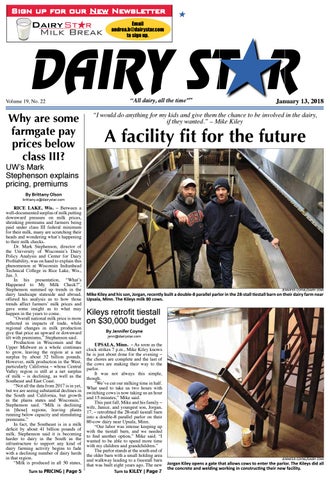
“I would do anything for my kids and give them the chance to be involved in the dairy, if they wanted.” – Mike Kiley
A facility t for the future
UW’s Mark Stephenson explains pricing, premiums By Brittany Olson
brittany.o@dairystar.com
RICE LAKE, Wis. – Between a well-documented surplus of milk putting downward pressure on milk prices, shrinking premiums and farmers being paid under class III federal minimum for their milk, many are scratching their heads and wondering what’s happening to their milk checks. Dr. Mark Stephenson, director of the University of Wisconsin’s Dairy Policy Analysis and Center for Dairy Protability, was on hand to explain this phenomenon at Wisconsin Indianhead Technical College in Rice Lake, Wis., Jan. 3. In his presentation, “What’s Happened to My Milk Check?”, Stephenson summed up trends in the dairy landscape stateside and abroad, offered his analysis as to how those trends affect farmers’ milk prices and gave some insight as to what may happen in the years to come. “Overall national milk price is more reected in impacts of trade, while regional changes in milk production give that price an upward or downward tilt with premiums,” Stephenson said. Production in Wisconsin and the Upper Midwest as a whole continues to grow, leaving the region at a net surplus by about 32 billion pounds. However, milk production in the West, particularly California – whose Central Valley region is still at a net surplus of milk – is declining, as well as the Southeast and East Coast. “Not all the data from 2017 is in yet, but we are seeing substantial declines in the South and California, but growth in the plains states and Wisconsin,” Stephenson said. “Milk is declining in [those] regions, leaving plants running below capacity and stimulating premiums.” In fact, the Southeast is in a milk decit by about 41 billion pounds of milk. Stephenson said it is becoming harder to dairy in the South as the infrastructure to support any kind of dairy farming activity begins to fade with a declining number of dairy herds in that region. “Milk is produced in all 50 states, Turn to PRICING | Page 5
JENNIFER COYNE/DAIRY STAR
Mike Kiley and his son, Jorgan, recently built a double-8 parallel parlor in the 28-stall Ɵestall barn on their dairy farm near Upsala, Minn. The Kileys milk 80 cows.
Kileys retrot tiestall on $30,000 budget By Jennifer Coyne jenn@dairystar.com
UPSALA, Minn. – As soon as the clock strikes 7 p.m., Mike Kiley knows he is just about done for the evening – the chores are complete and the last of the cows are making their way to the parlor. It was not always this simple, though. “We’ve cut our milking time in half. What used to take us two hours with switching cows is now taking us an hour and 15 minutes,” Mike said. This past fall, Mike and his family – wife, Janice, and youngest son, Jorgan, 17, – retrotted the 28-stall tiestall barn into a double-8 parallel parlor on their 80-cow dairy near Upsala, Minn. “Our labor was intense keeping up with the tiestall barn, and we needed to nd another option,” Mike said. “I wanted to be able to spend more time with my children and grandchildren.” The parlor stands at the south end of the older barn with a small holding area and walkway leading to a freestall barn that was built eight years ago. The new Turn to KILEY | Page 7
JENNIFER COYNE/DAIRY STAR
Jorgan Kiley opens a gate that allows cows to enter the parlor. The Kileys did all the concrete and welding working in construcƟng their new facility.
Page 2 • Dairy Star • Saturday, January 13, 2018
DAIRY ST R www.dairystar.com
ISSN 020355 522 Sinclair Lewis Ave. Sauk Centre, MN 56378 Phone: (320) 352-6303 Fax: (320) 352-5647 Published by Dairy Star LLC General Manager/Editor Mark Klaphake - mark.k@dairystar.com 320-352-6303 (ofce) 320-248-3196 (cell) 320-352-0062 (home) Ad Composition Nancy Powell 320-352-6303 nancy.p@dairystar.com Amanda Thooft 320-352-6303 amanda.t@dairystar.com Consultant Jerry Jennissen 320-346-2292 Editorial Staff Andrea Borgerding - Associate Editor (320) 352-6303 • andrea.b@dairystar.com Krista Kuzma - Assistant Editor (507) 259-8159 • krista.k@dairystar.com Jennifer Coyne - Assistant Editor (320) 352-6303 • jenn@dairystar.com Ron Johnson (608) 874-4243 ron.j@dairystar.com Ruth Klossner (507) 240-0048 cowlady@centurylink.net Brittany Olson (320) 352-6303 brittany.o@dairystar.com Danielle Nauman (715) 245-6848 danielle.n@dairystar.com Maria Bichler - Copy Editor 320-352-6303 Advertising Sales Main Ofce: 320-352-6303 Fax: 320-352-5647 Deadline is 5 p.m. of the Friday the week before publication Sales Manager - Jeff Weyer (Northern MN, East Central MN) 320-260-8505 (cell) jeff.w@dairystar.com Mark Klaphake (Western MN) 320-352-6303 (ofce) 320-248-3196 (cell) Laura Seljan (National Advertising, SE MN) 507-250-2217 fax: 507-634-4413 laura.s@dairystar.com Jerry Nelson (SW MN, NW Iowa, South Dakota) 605-690-6260 jerry.n@dairystar.com Mike Schafer (Central, South Central MN) 320-894-7825 mike.s@dairystar.com Lori Menke (Eastern Iowa, Southern WI) 563-608-6477 • lori.m@dairystar.com Megan Stuessel (Western Wisconsin) 608-387-1202 megan.s@dairystar.com Deadlines The deadline for news and advertising in the Dairy Star is 5 p.m. Friday the week before publication. Subscriptions One year subscription $35.00, outside the U.S. $110.00. Send check along with mailing address to Dairy Star, 522 Sinclair Lewis Ave., Sauk Centre, MN 56378. Advertising Our ad takers have no authority to bind this newspaper and only publication of an advertisement shall constitute nal acceptance of the advertiser's order. Letters Letters and articles of opinion are welcomed. Letters must be signed and include address and phone number. We reserve the right to edit lengthy letters.
Note from the StaffNorth America dealers.
Dairy Prole brought to you by your
Happy New Year from Dairy Star!
Thank you for being loyal readers of Dairy Star! As we embark into another year, there are exciting things to note. With the turn of the calendar, we welcome 10 new counties in Wisconsin to our free mailing list. If you are a dairy farmer in the counties of Marathon, Wood, Adams, Juneau, Sauk, Columbia, Fond Du Lac, Dodge, Jefferson or Rock, this issue is your rst. Subscription is free! It has always been our goal to write about what is happening in the barn. Whether we’re speaking with a farmer who recently installed new equipment to a young individual nding their footing in the industry, or perhaps a couple who was engaged with the help of a few cows, the dairy barn is in everything we do. Not only do we write about dairy farmers, but dairy farmers also write for us. Several of our columnists, such as Dave Vander Kooi, Sadie Frericks, Natalie Schmitt and Jacqui Davison, spend their work days on their dairy farm. When we do step out of the barn, we let our talented group of professionals, such as veterinarian Dr. Jim Bennett, and nutritionist Barry Visser, inform us about the topics affecting the industry. Our publication also includes tried-and-true features like From Our Side of the Fence, Women in Jeans and Dairy Prole, which feature dairy farmers in a simple-to-read question and answer format. Dairy Star’s outreach is not limited to the printing press. We also have a free e-newsletter called Milk Break. It is sent out weekly to members of the dairy industry. If you would like to receive this email, send your address to andrea.b@dairystar.com and put “Milk Break” in the subject line. It’s easy to do, and we’ll never release your information. Also, if you haven’t looked at our website (www.dairystar.com) lately, we have a new look and platform. While you are online, check out our searchable Business Directory. This is a great way to nd what you want without having to put up with all the sponsored ads generated on a search engine. As always, we encourage you to shop from our advertisers when you can – they are the main reason we are able to send you our paper twice monthly. Next month, we begin our 20th year bringing you the dairy news from Iowa, Minnesota, South Dakota and Wisconsin. We thank you for letting us into your homes, your barns and your businesses, sharing your stories. We look forward to better times in 2018 and we wish you a healthy and happy year ahead. – The staff at Dairy Star
...Raising The Bar of Excellence! See your H&S Dealer for
"FANTASTIC DEALS" on H&S Equipment! The SINGLE SUSPENSION ACTION Rake is available in 8, 10, & 12 wheel models! HP Manure Spreaders are available in 425 and 550 bushel sizes with your choice of vertical or horizontal beaters.
The 135 bushel GM 170 features a self-contained hydraulic system that controls the intake auger and the unload auger.
The views and opinions expressed by Dairy Star columnists and writers are not necessarily those of the Dairy Star LLC.
The Dairy Star is published semi-monthly by Dairy Star, LLC, 522 Sinclair Lewis Ave., Sauk Centre, MN 56378-1246. Periodicals Postage Paid at Sauk Centre, MN and additional mailing ofces. POSTMASTER: Send address changes to Dairy Star, 522 Sinclair Lewis Ave., Sauk Centre, MN 56378-1246.
!
W NE
Top Shot Manure Spreaders are available in 1286, 1500, 2000, 2600, 3400, & 4200 gallon models.
H&S Manufacturing 715.387.3414 Web: www.hsmfgco.com
Dairy Star • Saturday, January 13, 2018 • Page 3
It’s all inside... Columnists Ag Insider Pages 8-9 1st Section
Sauk Centre
A look back on 2017
Heart attack sets Middendorfs on path to better health
Second Section: Pages 16 - 18
Roseau
Marshall
nb or
n nso
McCook Minnehaha
Redwood
Nicollet Brown
Murray
Rock
Nobles
Rice
Goodhue
Cottonwood Watonwan Blue Earth Waseca Steele Dodge Olmsted Jackson
Martin
Faribault
Freeborn
Dairy’s Star Youth: Brianna Schock Third Section: Pages 3, 8
Third robot boosts production at Heintzes’ farm
Winona
Fillimore
Mower
Hutchinson
First Section: Pages 18, 20
Houston
Turner
Bon Yankton Homme
Lincoln Clay
Union
Lyon
Osceola Dickinson Emmet
Sioux
O’Brien
Clay
Palo Alto
Kossuth
Winnebago
Worth
Hancock
Cerro Gordo
Mitchell
Zone 1
Floyd
Howard
aw
as
ick
Ch
Bremer
Plymouth
Salem
Caledonia
Wabasha
For additional stories from our other zone, log on to www.dairystar.com
FROM OUR SIDE OF THE FENCE:
Black Hawk
Allamakee
Charles Mix
Moody
Lyon
Dakota
Winneshiek
Douglas
Lake
Scott
Sibley
Ha
Da
vis
on
Sa
Miner
Carver
sey
Tra ve Brookings
n
Kingsbury
Hennepin McLeod
Renville
Yellow Medicine
Wright
r
Page 33 1st Section
Deuel
Meeker
First Section: Page 7
go
Hamlin
Kandiyohi
Chippewa
Lac Qui Parle
Isanti
isa
The Next Generation
Benton
Stearns
St. Paul
MN Department of Ag relaunches helpline
Anoka
Swift
Codington
Clark
Mille Lacs
Sherburne
Grant
Page 32
Pine Morrison
Pope
Second Section: Pages 8 - 9
Carlton
Crow Wing
Douglas
Stevens
Fritz making a down-shift
Aitkin
Ch
Big Sto Stone
Roberts
Day
Cologne
Cass
Todd Grant
Page 39
Washington
Otter Tail
rse
Women in Jeans: Marlys Nettinga Marshall
Making Cents of Dairy
Page 29 Second Section
Becker
Wilkin
Hull
Second Section: Page 36
Country Cooking
M
Clay
Page 30
Page 31
en
om ahn
Dairy Prole: Mark Kahn
Itasca
Hubbard
Norman
Second Section: Pages 14 - 15
Rochester, Minn.
Wadena
Dairying Across America
Dear County Agent Guy
Veterinary Wisdom
Koochiching
Clearwater
Polk
Lincoln
Page 27 1st Section
Vinton, Iowa
First Section: Pages 22 - 23
MDA’s strategic plan focuses on consumers
St. Louis
Red Lake
Pipestone
The Transition Pen
Beltrami
Pennington
Page 26
First Section: Pages 1, 7
Kanabec
FSA News & Notes
Albany
Lake of the Woods
Page 25 1st Section
Ra m
Kittson
eu
First Section: Page 12
Upsala
Kileys retrot parlor into tiestall barn
Third Section: Pages 2 - 3
Su
On the Road with Princess Kay
Goodridge
Sandhill Dairy recognized as outstanding conservationists
Le
Perham
Fayette
How have you prepared your farm for the cold weather?
n
na
ha
c Bu
Monticello
Clayton
are
law
De
Linn
Dubuque
Jones
Jackson
Kids Corner: The Ricklefs
Third Section: Pages 10 - 11
Pages 15-16
Give milk production a push GEA’s FRone works around the clock to keep feed at the bunk, maximizing your cows’ production. Could your bunk management routine use a little extra push? GEA’s FRone automated feed pusher provides consistent, high-quality feed available day and night to boost production results from your whole herd. It’s easy to use, charges fast and contains twin batteries for maximum run time. With the help of GEA’s FRone, you can push the limits on your feeding program.
Page 4 • Dairy Star • Saturday, January 13, 2018
A WINNING COMBINATION... PROVIDING THE ULTIMATE IN COW COMFORT THE INDUSTRY’S MOST PROVEN MATTRESS SOLUTIONS
COWCOON - THE HYBRID COW STALL • utilizes a flexible polyethylene tube across the bottom portion of the stall loop that acts as a shock absorbe
PASTURE MAT™ enjoyed by over 3 million cows worldwide
• reduces stress on the cow while continuing to ensure proper positioning
PACK MAT all the benefits of deep bedding while using up to 70% less sand
COMFORT MAT™ the undisputed best foam mattress on the market
Please contact us to learn more or to locate your nearest dealer. 1.888.337.6265 | sales@promatinc.com www.Promatinc.com
facebook.com/promatinc
@Promat_inc
WINTER TEAT DIP
78%
OUR TEAT DIPS ARE NPE FREE! • Dual Germicide: Primary: Chlorine Dioxide promotes a quick kill. Secondary: LAS promotes a long-lasting kill. • Effective against ALL Mastitis-Causing Organisms • Contains Lactic Acid to promote Teat Exfoliation • Teat skin conditioning – 12.4% skin conditioning package • Green coloring for easy identification
TRI-BLEND SKIN CONDITIONING PACKAGE!
BEFORE Exfoliation
TEAT END ISSUES?
AFTER
Exfoliation
GERMICIDE: 1.5% HEPTANOIC ACID Marianne says, “Recover is a very good, economical post winter dip that brings terrific results, especially when releasing cows in the cold winter elements as we do. Cows do very well on it…teats are well conditioned!” Marianne Peterson Pine City, MN • 400 Cows - 3X
Pete said, “I would recommend Recover to any producer that has an extreme cold housing situation. It keeps teats in a good, soft condition.” He also said, “I will begin using Recover on November 1st, to start the conditioning process and will continue using it throughout the entire winter.” Pete Ripka Ogilvie, MN • 175 Cows - 3X
FOR MORE INFO - CONTACT ONE OF THESE DEALERS... Advanced Dairy Systems
9 State Rd. 29 • Spring Valley, WI 54767 (715) 772-3201
Anderson Dairy Systems, Inc. 1312 13 1/2 Ave. • Barron, WI 54812 (715) 537-3300
Athman Dairy Inc.
238 Main Street North • Pierz, MN 56364 (320) 468-2494
Champion Milking Systems
23218 350th Street • Albany, MN 56307 (320) 845-4156
D&D Ag Supply
133 Atlantic Ave. NE • Pennock, MN 56279 (320) 599-4466
Dairyland Equipment Services, Inc.
24260 Cty. Rd. 27 • Plainview, MN 55964 (507) 534-3161
East Central Dairy Supply 2195 Hwy. 23 • Mora, MN 55051 (320) 679-1029
Eastern Iowa Dairy Systems 105 3rd Ave. NW • Epworth, IA 52045 (563) 876-3087
Fuller’s Milker Center, Inc. 423 U.S. 61 • Lancaster, WI 53813 (608) 723-4634
Lang’s Dairy Equipment, Inc. 2337 Millennium Rd. • Decorah, IA 52101 (563) 382-8722
Mlsna Dairy Supply
1126 Front Street • Cashton, WI 54619 (608) 654-5106
Gorter’s Clay & Dairy Equipment Professional Dairy Systems 1400- 7th St. SE • Pipestone, MN 56164 (507) 825-3271
1449 Homecrest Ave. • Wadena, MN 56482 (218) 632-5416
Tri-County Dairy Supply, Inc.
4107 N US HWY 51 • Janesville. WI 53545 608-757-2697
United Suckow Dairy
12687 Hwy 18 & 52 • Postville, IA 52162 (563) 864-7417
Dairy Star • Saturday, January 13, 2018 • Page 5
minimum, while regulated independent plants and creameries must pay federal minimum; Stephenson estimated that 60 to 65 percent of the milk in the United States is regulated under federal milk marketing orders. Fluid milk plants in a federal order must be regulated. However, if a plant makes cheese, they can deregulate, or have the option to partially deregulate if they have separate intakes for raw milk. “Cooperatives have to receive regulated minimum price from a regulated plant, but they don’t have to pay the federal minimum. They can blend their costs back into the pay price, which is what has been happening with hauling costs for milk from Michigan,” Stephenson said. Stephenson described the milk prices farmers are dealing with as a long, slow scrape. “It’s not like 2009 or 2012, and we’ve had cycles the last 10 to 15 years, but by the time this one is done, probably never as long a trough as this,” Stephenson said. “The milk price is just barely scraping along and covering variable costs but not total cost of production for most producers.” He said domestically there is room to grow with cheese and other product demand, but exports are where the real opportunity lies. He also predicted that the dairy industry will begin to shift northward and eastward again after decades of westward movement, as the earth’s surface temperature continues to warm and create more extreme weather patterns. “Improved production efciency per cow has our current national average at 23,000 pounds of milk per cow,” Stephenson said. “A cow milking 30,000 pounds per year generates something like 30 percent more body heat than a cow milking around the national average and a cow like that simply isn’t comfortable in hot and humid climates. However, hot and dry climates such as the West are still hot for a cow.” In short, global export demand inuences class III price, while local and regional changes dictate the tilt of prices via premiums. Stephenson said that, overall, there is simply too much milk in what has become a global marketplace. “We need to produce less milk, and not just in the United States because the European Union is in the driver’s seat of expansive production right now,” Stephenson said.
IT’S A NEW YEAR! Let Famo Feeds help you make your 2018 goals a reality! Our full lines of feed include: •Complete feeds •Starter feeds •Supplements •Concentrates •Vitamins •Minerals •Pre-mixes •Base Mixes •Milk replacers •Animal Health •Preservatives/Inoculants •Tubs •Pet Foods •Specialty and custom feeds to meet your specific needs
320-836-2145 or 800-450-2145
Check out our newly redesigned website to ½nd a Famo Feeds dealer near you!
www.famofeeds.com
N FLOO AR
PREVENT YOUR COWS FROM DOING THE SPLITS PRE
R
but increasingly occurs in more isolated regions and pockets that are located further away from major population centers,” Stephenson said. “The task of the dairy industry is to send products to the places that need them, and they tend to be in different places as dairy tends to move away from populated areas.” Wisconsin, in particular, is so awash in milk that it is taxing plant capacity, and processing capacity is not catching up with milk production. “We are running at the bleeding edge of what Wisconsin can process, and that puts downward pressure on prices,” Stephenson said. “Overall, we are producing an additional 7 million pounds of milk per day in Wisconsin.” Plants can be built to process that additional milk – with some signicant caveats. “We can build plants, but they’re expensive. A new plant can easily cost $250 million or more,” Stephenson said. “Where do we put the plant? What do we make, who are our customers, how do we get the product to them, and how do we move milk? Raw milk is expensive to move.” Raw milk is so expensive to move, which has caused farmers to see their pay price sink below class III, particularly in Michigan where the processing capacity simply doesn’t exist to handle all the extra milk coming in; this is putting pressure on the premiums of farmers in that state and Wisconsin, where much of the excess Michigan milk is going around Lake Michigan into Wisconsin. It is also causing hauling charges to increase. Farmers in the Midwest have typically enjoyed discounted milk hauling, which Stephenson described as another premium, but as milk must be hauled longer distances, hauling costs will continue to rise. “Wisconsin and New York’s premiums have held steady for several years, but Michigan’s premium structure is under real stress,” Stephenson said. “Foremost Farms is building a new plant in that state, which will probably help them more than us by lowering hauling costs, but what will they produce and who is their customer? If they produce cheese, we will be competing for the same customers.” The question looming large for many farmers is this: how can they receive less than class III for their milk? Stephenson explained that cooperatives, which he estimated market 80 percent of the milk in the United States, can pay less than federal
B
ConƟnued from PRICING | Page 1
AND
G
RO
OVI
NG
Holding Pens • Milk Parlors • Yards • Alleys • Free Stalls
• We Double Cut to Prevent Slippage in All Directions • Reasonable Rates We accept credit cards with no additional fees.
No job too big or small, I groove it all!!!
Visiti our website Vi b i at www.PandDBarnFloorGrooving.com P dDB • 608-225-3595 (Doug) g)
COMPLETE BARN SOLUTIONS WHATEVER YOUR DAIRY NEEDS
During
After
Valley Acres Farm 2 • Lewiston, MN • Gene Speltz and Carey Tweten Before
Double 6 herringbone converted to a Double 10 Turner vertical lift parlor with SCR Milk Meters and ID
Call us to help you make your dairy operation more efficient.
www.midwestlivestock.com
PINE ISLAND, MN • 800-233-8937 BEATRICE, NE • 800-342-5657 SIOUX FALLS, SD • 800-705-1447 MENOMONIE, WI • 715-235-5144 OWEN, WI • 715-229-4740
Page 6 • Dairy Star • Saturday, January 13, 2018
ConƟnued from KILEY | Page 1
Willmar, MN • 320.231.1470
EXPANDING OR REMODELING YOUR LIVESTOCK OPERATION? LANGE AG SYSTEMS SPECIALIZES IN:
Ŷ NEW FACILITIES
_
NO JOB TOO BIG OR TOO SMALL
Ŷ RETROFITTING & REMODELING Ŷ TURNKEY PROJECTS Ŷ BARN DESIGN Ŷ INSTALLATION, MAINTENANCE & REPAIRS
ƋƵŝƉŵĞŶƚ tĞ KīĞƌ͗ ͻ sĞŶƟůĂƟŽŶ &ĂŶƐ ͻ sĞŶƟůĂƟŽŶ ŽŶƚƌŽůƐ ͻ WŽƐŝƟǀĞ WƌĞƐƐƵƌĞ dƵďĞƐ ͻ ƵƌƚĂŝŶ ^LJƐƚĞŵƐ ͻ DĂƩƌĞƐƐĞƐ ͻ tĂƚĞƌĞƌƐ ͻ ^ƚĂůů ƋƵŝƉŵĞŶƚ ͻ ,ĞĂĚůŽĐŬƐ ͻ DŝƐƟŶŐ ^LJƐƚĞŵƐ
Lange Ag Systems is proud to offer Grain Bags, Silage Bags & Bunker Covers from Up North Plastics and Feed Fresh Silage Covers & Custom Size Bunker Covers from Raven!
t ^ >> E t Θ h^ 'ͳ ' Θ < >>z Zz E '' Z^
www.LangeAgSystems.com Green Sawdust Available for Purchase
Livestock Auction, Inc.
(40 miles west of Dubuque, Iowa on 4 lane Highway 20)
DAIRY SALES
PICK UP OR DELIVERY AVAILABLE Call for more information.
ADDOCO, INC.
MANCHESTER
563-557-1555
12678 Industrial Court • Peosta, IA 52068
2nd Fridays Monthly at 11:00 AM Selling 150 to 250 Head
Sheep and Goats sell at 9:30 AM
563-927-2540
www.manchesterauction.com
BALEBUSTERS
• Rotor access door gives you easy • Two-stage bale loader that easily access to rotor • Adjustable slug bars allows you picks up bales to easily position the bale from the • Heavy-duty tubular frame rotor and hammers. construction designed to carry • Heavy-duty chain conveyor
heavy bales.
Blue Hilltop, Inc. 507-879-3593 – 800-821-7092
Box 116, Lake Wilson, MN 56151 – www.bluehilltop.com
JENNIFER COYNE/DAIRY STAR
J pans along the interior of the parlor keep the pit clean, while a hand-made neck rail keeps the cows in place as part of Mike Kiley’s new milking facility. setup also includes a maternity pen for cold-weather births. Twice a day, the cows enter the parlor at the north end of the barn and return to the freestall barn following the same path that was previously used for the barn cleaner. The ease of ow allows for one person to manage the parlor. “I love the parlor … it’s so much easier on my back,” said Mike, who does a majority of the milkings. “Before, it took two people milking full time to keep it owing. The cows would come in and be tied up, and then we’d have to switch about half while the other half had milkers on them.” Typically, as Mike continues milking, his business partner, Ken Wielenberg, brings cows into the parlor, taking note of which need to be treated, and helping with fresh cows. For the past three years, Wielenberg has worked with the Kileys and receives a certain percentage of the prots from milk produced. “While the parlor is easier, Ken says he goes up and down those steps too many times to count,” said Mike. In an effort to improve workload, as well as create an enticing environment for the next generation, the Kileys spent the last several years researching different options before deciding to build their own milking facility within an existing building. After visiting with other dairy farmers this past summer, the Kileys knew they wanted to put in a parlor. “Farmers give the best information,” Mike said. “They’ll tell you both the good and the bad.” Unfortunately, with a quote of nearly $130,000, Mike reconsidered his options and found a way to construct a parlor at less than a third of the price. With building concepts gathered from other dairy farm setups, and incorporating key components that would work for his family, Mike developed a plan. “We designed and built it all, making sure the angles were just right and it was running down hill,” said Mike, noting the professional work of Centre Dairy Equipment and Supply, and CAP Enterprises. On Aug. 1, the Kileys broke up concrete from the tiestall barn. The family used Wielenberg’s expertise in welding and concrete work, and then received help from Jorgan’s high school friends to nish the project. To retrot the milking facility in the barn, Mike and Jorgan lled in the gutter with concrete, leveled the stalls and removed three support beams. The ceiling beams were reinforced and one support beam in the pit of the parlor re-
mains. “The boys thought it would be ne without [all those beams] and the barn could support itself,” Mike said. “But I wanted to be more cautious.” Jorgan agreed. “Dad always measures twice and cuts once,” he said. The Kileys took gates that were already on the farm and welded them to t in the walkways leading to and from the parlor. J pans were installed to keep the parlor pit clean from manure and cantilevers were put in place for installing a low-line pipeline in the future. Additionally, a used plate cooler and holding tank for water were installed. The water is used to clean the parlor, as well as provide another drinking source for the cows. By the middle of November, the parlor was operational. “A lot of hard work, shovels, hammers and skidloader hours went into putting this together,” Mike said. “Jorgan’s friends helped a lot, too, when they weren’t busy with football.” While there is no automation to the parlor, with each gate being manually opened and the milking units brought in from the milkhouse, the Kileys and their herd are adapting to the new setup. “The parlor shows you the business end of the cow. There is a cow-human relationship that I can’t get in the parlor, so I make sure to walk through the herd several times a day to check on them,” Mike said. Jorgan agreed. “Because of the setup, there’s not as much liability with other people working with the animals,” Jorgan said. “It makes it easier for my friends to come and help milk.” In the coming months, the Kileys will complete construction on their service room, as well as look into automating the entry and exit gates and installing automatic take-offs. While only two months have passed since the parlor became operational, both Mike and Jorgan are proud of the work they did to improve the family’s dairy. “Grandpa thought the skidloader was a big deal. If he saw this, I don’t think he would believe it,” Jorgan said. Mike agreed. “There’s the right way, the wrong way and our way,” he said. “I would do anything for my kids and give them the chance to be involved in the dairy, if they wanted.” For the Kileys, retrotting their tiestall barn into a low-cost parlor was the right route to take in order to nd a balance between spending time with family and caring for their health, and carrying on the family business.
Dairy Star • Saturday, January 13, 2018 • Page 7
MN Dept. of Ag relaunches helpline By Jennifer Coyne jenn@dairystar.com
ST. PAUL, Minn. – Farming is a tough occupation, both physically and mentally. And without an outlet to talk about the struggles, the occupation can be dangerous for the well being of all involved. With the growing need for a resource for rural farming communities to utilize, the M i n n e s o t a Department of Agriculture launched the Farm Meg Moynihan & Rural Helpline MN Dept. of Ag in October. The program is designed to offer support to callers all day, every day of the week at (833) 600-2670. “This helpline is for anyone involved in farming, whether you’re directly affected or worried about someone else, like a spouse, neighbor or parent. We want to be a source for any person touched by a stressor, whether that’s the agriculture markets, depression, nancial issues…” said Meg Moynihan with the Minnesota Department of Agriculture. Through a contract with Canvas Health, of Minneapolis, Minn., the helpline puts callers in direct contact with a certied counselor who is trained
to listen and help sort out difculties. “It’s entirely condential. They’ll ask for a rst name to call you, but otherwise there’s no identication,” Moynihan said. “There’s no copay, no insurance, just help.” While the counselors may offer advice, they are not capable of solving all problems. If a call is regarding land ownership, for example, and legal advice is needed, the counselor will refer the caller to another source. “We’ve put together a group of agriculture resources so that if a caller needs more help, we have those different resources available to help solve the problem,” Moynihan said. The program launched in early October, and as it has received both ag and non-ag media attention, has become a highly sought-after resource. From October through December, the helpline received 39 calls concerning an array of issues – including depression, anxiety, relationships, business and career problems, as well as loneliness, said Moynihan. “We’re delighted that people are calling,” Moynihan said. “It takes courage to pick up the phone and ask for help.” Previously, the department sponsored a hotline called Crisis Connection. “We wanted to get away from the term ‘crisi’ because in the Upper Midwest, sometimes we don’t feel like our problem is enough of a crisi to bother somebody else with,” Moynihan said.
As the MDA’s old hotline contract was up for renegotiation, coupled with the markets looming over the agriculture industry, it was as if serendipity rebranded the program. Moynihan fully understood the stress farmers were feeling when she took an eight-month leave of absence from her position at the department to run her family’s farm near Belle Plaine, Minn. “They say death can come by a thousand tiny cuts. It’s not necessarily all nancial stress, but the day-today struggles of the markets, labor,”
“Sometimes it’s easier to talk to a stranger and not having to admit those problems to your spouse, family, pastor.” ȃ MEG MOYNIHAN, MN DEPT. OF AG
Moynihan said. “When you bring all that to the table, you’re really struggling and unhappy, and don’t know what to do.” The helpline is structured for individuals to openly share the concerns that are impacting their lives and business. “Sometimes it’s easier to talk to a stranger and not having to admit those problems to your spouse, family,
MF 9870 - Call for details
MF 1754L - SAVE BIG
White 9222 12R planter
Villard Implement Co.
Special Price
Villard, MN • (888) 554-3111
White 8222 - Call
JD 7200, 6 row $7,950
Gehl V-400, low hours $49,500 TRACTORS MF GC2400 w/60” deck ................................$7,000 MF GC1705 w/60” deck ................................ Just In MF 8650 CVT ............................................ Coming In MF 8650 ........................................................$120,000 MF 7497 .......................................................... $95,000 MF 7624, lease return.................................... Just In MF 7618 ..................................................... Coming In MF 7616 ..................................................... Coming In MF 7614 ..................................................... Coming In MF 6614 CVT w/ldr...............................................Call
8
MF 8735
Call for details
Call for details
Call for details
AMINO PLUS SOY ISOLATE WHEAT MIDDS WHEAT GERM MEAL BEET PULP CASEINATES CHEESE SCRAPS SAW DUST FOOD BY-PRODUCTS LACTOSE NONFAT DRY MILK SUGAR/DEXTROSE WHEY PROTEIN POWDER
Farm & Rural Helpline is available 24 hours a day, seven days a week at (833) 600-2670.
MF 4710 w/loader
MF 7724
CANOLA MEAL CORN GLUTEN FEED CORN DISTILLERS GRAINS CORN STARCH LINSEED MEAL FLAX SEED OAT HULLS RICE HULLS SOYBEAN MEAL SOY BEST SOYBEAN HULLS SOY FLOUR SOY PLUS
pastor,” Moynihan said. “And in rural Minnesota, it’s hard to nd that outlet. Now, it’s just a phone call away.” While the program has seen early success, the challenge lies in continually being a known resource. As the helpline is further developed, Moynihan hopes it can become a trusted resource as more and more individuals reach out for help. Not only are farmers able to share their experiences with peers, but Moynihan encourages commodity groups, social clubs and industry partners, such as veterinarians, to be mindful of the resource for their members and clients. “In agriculture, we’re all in this together and we all depend on each other,” Moynihan said. “Strength comes from extending a hand and helping each other.” In difcult times, farmers and those closest to them are most affected. This helpline is available for all. “This is for anyone touched by stressors. We all know someone who can benet from a listening ear,” Moynihan said. Additional resources are available online at www.mda.state.mn.us.
MF 5609 w/ldr............................................... $57,500 MF 1085 w/cab ................................................$7,500 MF 492 w/ldr ............................................ Coming In AGCO DT-220 .......................................... Coming In AGCO DT-200A ............................................. $69,500 AGCO RT-150A CVT w/ldr. ..............................$54,500 AGCO RT-150 w/ldr. ............................... Coming In IH M Farmall......................................................$1,950 White 6195 ................................................Coming in White 6144, FWA ......................................... $36,000 White 140 .................................................. Coming In JD 4630....................................................... Coming In U-Moline, runs good .....................................$1,250 PLANTERS White 9936-22 track planter ..............................Just In White 9108, low acres ..................................Coming In White 8222 12 row w/liquid ..............................Just In White 6108 8 row w/dry fert......................Coming In White 6100 12 row ...............................................$5,900 White 5100 8 row 30” ..........................................$3,500 JD 7200, 6 row, conser planter..................Coming In Case IH 900, 6 row w/dry fert., cross auger .$3,000 Kinze 3700, 24 row 30”..............................................Call White 6180, 16 row .............................................$7,500 White 8524-22 CFS planter .................................. Coming In SKID STEERS & SPREADERS Gehl 4640E .................................................................... Just In Gehl R220 .............................................................. Coming In Gehl R190 ...................................................................... Just In Gehl 6640E, cab/heat ............................................. $24,500
Gehl V-330, 300 hrs. ................................................... Just In Bobcat S650............................................................... $21,500 Meyers 7400 spreader .............................................. Just In MISC. ITEMS JD 4995 Windrower............................................ Coming In JD 2700 ripper .......................................................... $19,500 JD 2700 5-bottom ......................................................$4,950 Case IH 496, 21’ disc ................................................ $10,000 Case 700, 8 bottom ............................................ Coming In IH 490, 32’ ...................................................................... Just In Sunflower 7200-28 soil cond. ................................. Just In Sunflower 4610-9 ripper .......................................... Just In Sunflower 4610 ripper ...................................... Coming In Sunflower 4511-13 disc chisel ....................... Coming In Sunflower 1435-26 disc ............................................ Just In Krause 4900, 30’ disc..................................................$9,500 Soil Pro Wilrich 9 shank .................................... Coming In Gehl 700, 14 wheel rake ...........................................$6,500 Badger 950 forage box .............................................$2,500 MF 2956A baler, carryover.................................. Save Big! MF 2270XD, low bales....................................... Coming In MF 2170XD baler ...................................................$100,000 MF 1375 mower cond ............................................ $17,500 NH 1475 mower cond. ..............................................$8,500 NH 499 ............................................................................$2,750 NH 340 3x3, 2015, only 4500 bales .............. Coming in Vermeer 605SM Cornstalk .................................... $23,500 Vermeer 605M baler ............................................... $15,000 Demco 1050 grain cart, carryover ...........................Save!
Trump touts tax bill and the impact on farmers Page 8 • Dairy Star • Saturday, January 13, 2018
During a Rose Garden event celebrating the the dairy and cotton problems early to make things new tax reform bill, President Donald Trump easier for the next farm bill. “With these other issues acknowledged agriculture. “One thing very important behind us, hopefully, there will be a better ability to for the farmers, the great farmers and the great small focus on the real needs of the 2018 farm bill.â€? business owners that were forced to sell their businesses at bargain basement Dayton offers input on ‘18 farm bill Ag Insider numbers. We have provided, for the most Minnesota Governor Mark part, estate taxes wiped out so they can Dayton has written a letter to the state keep their farms in the family. That’s congressional delegation, outlining his a big factor.â€? The tax bill reduces the farm bill priorities. Dayton supports corporate tax rate from 35 percent to 21 a strong farm safety net, updates for percent. It includes immediate expensing the dairy industry’s Margin Protection and expanded Section 179 deductions. Program and a new animal disease prevention program. Dayton also wants Pay-as-you-go rules waived to see the CRP cap increase to 40 million Congress has passed a stop-gap acres and the ability for states to provide measure that funds the government input on prioritizing program acres. through January 19. The continuing By Don Wick resolution also waives the pay-as-you-go Small increase seen in U.S. milk rules for the tax bill. Without that waiver, production Columnist the government would be forced to make In the 23 major dairy states, signiďƒžcant budget cuts, including the November milk production totaled elimination of all farm program payments. 16.2 billion pounds. That’s up 1.1 percent from last year. In Minnesota, cow numbers declined, but milk Farm program changes included in disaster bill production increased 1.5 percent. South Dakota The House passed a disaster bill that includes milk output was unchanged from November 2016. key provisions for agriculture. It eliminates the Wisconsin milk production increased less than 1 existing $20 million cap on the Livestock Gross percent and California production dropped by just Margin program. National Milk Producers Federation over 1 percent. President and CEO Jim Mulhern said this language provides new risk management options for dairy Dealing with winterkill farmers. The Senate has not taken up the disaster Winterkill is a frequent problem for the alfalfa bill yet. Senators Debbie Stabenow of Michigan crop, but researchers at the University of Minnesota and Patrick Leahy of Vermont are pushing for a are looking for ways to offset those losses. Planting legislative ďƒžx for the Margin Protection Program. annual forage crops into alfalfa with winterkill or There is general consensus in Congress that MPP injury is seen as an option. Extension specialist Scott needs to be improved, but the lack of funding is the Wells has identiďƒžed annual ryegrass as the forage number one hurdle. crop with the highest net returns when planted into terminated alfalfa ďƒželds. Seven different forage crops Focusing on need were tested, but ryegrass was seen as the most viable Combest, Sell and Associates co-founder and option. managing partner Tom Sell said all of the major farm groups have recognized the importance of addressing
Farm and rural helpline available The Minnesota Department of Agriculture is reminding farmers of the farm and rural helpline. MDA Senior Advisor Meg Moynihan emphasizes that the helpline is free, conďƒždential and open 24 hours a day, seven days a week. “When you call, the person on the other end knows you’re calling the helpline. They’ll ask you for your ďƒžrst name, and then it’s up to you to visit with the counselor so they can help you get things off your chest. If you need suggestions for other people talk to, or if you need professional advice, they have resources to suggest, too.â€? Koepen Holding and CRI consider merger The boards of directors of two agriculture businesses have agreed to a plan to merge into one entity. The deal between Koepen Holding and Cooperative Resources International is subject to due diligence and the regulatory process. Koepon Holdings operates Alta Genetics, which serves the beef and dairy industries. Koepen also operates a dairy management software business and a calf nutrition business. CRI is a farmer-owned cooperative that operates the GENEX cattle genetics business. GENEX operates four auction markets, including West Fargo and Albany. If successful, this merger will take place in mid-2018. Skiba appointed to dairy checkoff board Agriculture Secretary Sonny Perdue has announced the appointment of 13 individuals to the National Dairy Promotion and Research Board. From this region, Kathleen Skiba of North Branch, Minn. was reappointed to the board. Ridgewater earns national honors The National Association of Agricultural Educators has recognized the Ridgewater College Agriculture Department as the 2017 Outstanding Postsecondary/Adult Agricultural Education Program. Ridgewater, which has campuses in Willmar and Hutchinson, Minn., was one of ďƒžve programs honored with this NAAE award. Turn to AG INSIDER | Page 9
Cooling the World’s Milk
Cut Your Refrigeration Needs in Half with a Accu-Therm Plate Cooler!
INSTANT COOLtant WELL WATER AND CHILLED WATER
• 98° to 36° F milk in seconds • Up to 50% milk cooling with well water • Milk within 3–5° F of well water before entering chilled section • Counterflow milk vs. well • More cooling with less well water • Easy-to-wash configuration • Customized to your needs • Built to meet commercial dairy demands
Bongards’ Creameries
Has been a quality market for MN dairy farmers for over 100 years. MN producers provide one of the country’s most distinctive brands of cheese that is still made using the same Old World craftsmanship and has been combined with cutting-edge technology to produce cheese that delivers unforgettable taste with unparalleled quality. MN Dairy farmers and Bongards, quality that stands the test of time. We offer a competitive base price, premiums, and the best Àeld representatives in the industry. 13200 Co. Rd. 51 Bongards, MN 55368 (952) 466-5521 Fax (952) 466-5556 110 3rd Ave. NE Perham, MN 56573 (218) 346-4680 Fax (218) 346-4684
Possible Rebates Available! 1-800-MUELLER
DFE.PAULMUELLER.COM
% " !$ %% % ###
Dairy Star • Saturday, January 13, 2018 • Page 9
ConƟnued from AG INSIDER | Page 8 Zenk joins MDA as farm advocate The Minnesota Department of Agriculture said retired farm business management instructor Steve Zenk has joined the ranks as an MDA farm advocate. Farm advocates provide free one-on-one assistance and counseling to Minnesota farmers who are facing nancial hardships. Zenk said the farm advocates are there to help farmers and their families nd a way through the unique challenges they face.
Trivia challenge The normal temperature for an adult cow is 101.5 degrees Fahrenheit. That answers our last trivia question. For this week, how many pounds of milk are needed to produce one pound of cheese? We’ll have the answer in the next edition of Dairy Star.
MINNESOTA DHIA
Would like to introduce our newly certified field reps:
Don Wick is owner/broadcaster for the Red River Farm Network, based in Grand Forks, North Dakota. Wick has been recognized as the National Farm Broadcaster of the Year and served as president of the National Association of Farm Broadcasting. Don and his wife, Kolleen, have two adult sons, Tony and Sam, and ve grandchildren, Aiden, Piper, Adrienne, Aurora and Sterling.
Kristin Duden
N10828 Cty Hwy O | Greenwood, WI 715.267.1416 | www.greenwoodsilo.com Email: sales@greenwoodsilo.com
Princeton, MN
763-260-3796
Leon Sexton
Becky Suchy
Millville, MN
Parkers Prairie, MN
507-696-4712
320-815-1426
SEALED SILO SERVICES: BOTTOM UNLOADERS: • CONSTRUCTION • MAINTENANCE • PRESSURE CHECKING • RESEALING • REPLACEMENT ROOFS
• GREENLINE UNLOADERS D-SERIES (FORAGE) B-SERIES (SNAPLAGE & GRAIN) • USED UNLOADERS • UNLOADER PARTS • FULLY EQUIPPED SERVICE CREW
Kari Welle Royalton, MN • 320-630-4786
SUPERIOR FEED VALUE THROUGH SEALED SILOS
Minnesota Dairy Herd Improvement Association 307 Brighton Avenue South Buffalo, MN 55313 1.800.827.3442 www.mndhia.org
We are not affiliated with A.O. Smith Harvestore®, E.S.P.C. or C.S.T.
BERGMAN Automatic AGRi-Speed HITCH 1
2
3
Professional design. Reasonable rates.
E A SY a s 1 - 2 - 3 • Fast, reliable, safe • Easily pulls more than the D.O.T. allows on the highway • Available for pick-ups, choppers, tractors, wagons, etc.
Simple drawbar mount Easy to operate day or night PTO compatible Increases efÀciency, only need 1 person
Gilman Co-op Creamery FEED & FARM SUPPLY STORE
www.bergmanmfg.com Gilman, MN • 320-387-2770
CA-May19-1B-JW
• • • •
Do the math when choosing roasted soybeans 1. Increases milk production 2. Maximizes milk components 3. Minimizes feed refusals 4. Properly roasted at the correct temperature 5. Soybeans are steeped for 30+ minutes 6. Soybeans are roasted to the core 7. Energy KLC roasted soybeans... 8. Protein preferred by bovines 9. Amino acids everywhere 10. Bypass protein
effective drainage. Offering r site prep fso, building bins and lagoons
1-877-738-2326 Visit www.roastedbeans.com
Quality
80
FOR 4 INCH TILE
Price includes design, survey, material & installation*
Bill Pasche, Sales & Design Cell: 320-293-6951 bill@agtechdrainage.com
KLC Farms Competitively Bids For Raw Beans - Call For Price!
KLC Farms
¢ per ft.
PRICES STARTING AT:
0 1 t c e f The Per Roasting, Inc.
Paige Schlauderaff Detroit Lakes, MN • 218-234-0720
Consistency
Gene Mensen, Sales Cell: 320-429-1036
gene@agtechdrainage.com
Brad Herickhoff, Owner Office: 320-351-4872 Cell: 320-293-0882 brad@agtechdrainage.com
S Sam Lange, Sales & Site Manager Cell: 320-232-3102 sam@agtechdrainage.com
Mark Machart, Sales Cell: 320-429-4633
mark@agtechdrainage.com
* Prices are subject to prices of material, material depth and quantity. quantity
Page 10 • Dairy Star • Saturday, January 13, 2018
Watch what you’ve been missing in your barn!
BARN CAMERAS
Closed circuit video monitoring for your barn, ofÛce and parlor. Wireless System for metal, W Stone or Block barns.
Stop in and see the working in-store display!
News that shook the industry in 2017
Markets, dairy policy made greatest impact By Jennifer Coyne jenn@dairystar.com
Buyers & Feeders of damaged corn, soybeans, screenings, wet, hot, dry, ďŹ re and silo corn. Trucks available. Z BAR FEED YARDS - - The next issue of the Dairy Star is published January 27th.
FARM-RITE EQUIPMENT, INC.
www.farmriteequip.com
It’s hard to believe the best can be even better. But with extensive feature upgrades, increased visibility and a more comfortable cab, BobcatŽ 500 platform loaders defy the odds. Dassel, MN
320-275-2737 888-679-4857
Willmar, MN
320-235-3672 877-484-3211
St. Cloud, MN 320-240-2085 844-262-2281
SICK COWS? WE CAN HELP!
Pierz Co-op offers pellets and crumbles to assist your calves and youngstock battle against illness during the cold Minnesota winters.
For Maintenance of weight gain in the presence of respiratory disease
AS 700 pellets 25 gram crumbles 10 gram crumbles 4 gram crumbles For the treatment of bacterial enteritis and pneumonia we offer:
Aureo 10GM These additives and all medicated feed require vet approval per the 2017 VFD requirements.
Agron. Petro. Feed Feed: 320-468-6655 Toll Free: 877-468-6655 Agron./Petro: 320-468-2509 Toll Free: 877-438-3378
This past year was tumultuous for the dairy industry with several matters affecting many producers’ bottom lines – from weather to government policy. As the year came to a close, Dairy Star reviewed the topics that greatly impacted the dairy industry in 2017 and how they might inďƒ&#x;uence the next 12 months. Milk markets disrupted by supply, demand Despite the third consecutive year of poor milk prices, milk production steadily grew in 2017, with the United States Department of Agriculture noting a 1-2 percent increase month over month from the year prior. Unfortunately, the swelling supply could not be resolved with demand, neither domestically nor internationally, and the results were seen throughout the industry. Last May, nearly 75 producers across Minnesota and Wisconsin were dropped from their processor, Grassland Dairy Products, Inc., due to a change in Canadian dairy pricing policies that halted the country’s import of ultra-ďƒžltered milk from U.S. dairies. The policies affected the distribution of nearly 1 million pounds of product, said a representative with the Wisconsin-based processor. Of the farmers whose contracts were eliminated, Richard Johnson had been selling milk to the company for a handful of years. “We received our letter at the beginning of April and had 30 days to ďƒžnd a new processor,â€? Johnson said. “Just two days before our contract ended, we were picked up by Agropur, and we’ve been fortunate with how things have worked out.â€? To encourage already-full processors to take on patrons who lost their contracts, dairy farmers began a social media campaign asking processors to “just take ďƒžveâ€? farmers whose milk needed a home by May. Over the last year, the entire food industry saw a sharp decline in demand, despite a strong U.S. economy. Phil Plourd, of Blimling and Associates, explored the reasoning behind this trend hitting the food sector and provided examples of how companies are rebranding their products to appeal to the American consumer. In the cheese business, individual snack-sized portions of the dairy product are inďƒžltrating grocery store dairy cases. “Ultimately, we’re still eating, but how we’re eating, where we’re eating and what we’re eating is different,â€? Plourd said. Phil Plourd A revived marketing Blimling and platform, however, has not helped Associates the markets rebound, alone. Experts suggested the solution lies in exports. “The reality is we do an incredibly good job at producing milk,â€? said CEO and president of the U.S. Dairy Export Council (USDEC) Tom Vilsack during a meeting in October. “No matter how well we do on the domestic side of consumption, we’re still going to have to have strong exports in order to stabilize the markets.â€? Currently, the United States exports 15 percent of the nation’s dairy sales, according to USDEC. To grow the international trade by 5 percent, Vilsack and CEO of Dairy Management Inc. Tom Gallagher presented an opportunity to reach dairy markets in neighboring countries, as well as those in Asia, the Middle East and Africa over the next few years. Policies setback, propelled industry Two years ago, the nation was politically charged as individuals vied for the 45th presidency. When Donald Trump was elected and then sworn into ofďƒžce last January, many of his campaign promises showed
relief to the dairy industry, but also posed threats. As President Trump’s agenda developed through 2017, so did the concern for crucial international partnerships, such as the North American Free Trade Agreement (NAFTA) between the United States, Canada and Mexico. Negotiations were conducted throughout the year, but an agreement was not made by year-end, as planned. With the United States being the largest exporter of dairy products to Mexico, with nearly 75 percent of Mexico’s dairy supply being provided by their northern neighbor, the U.S. industry cannot afford to have the agreement dissolved. Canada, Mexico and United States ofďƒžcials will continue with negotiations through the ďƒžrst quarter of 2018. The administration’s intentions also threatened the dairy industry’s labor force – an already difďƒžcult aspect of farming. To combat the loss of a labor force, Maristela Rovai and her team at South Dakota State University developed a program that could secure a legal labor force for dairy farmers. The Upper Midwest-Puerto Rico Educational Collaborative was designed to expose job candidates to real on-farm scenarios through extensive training before the individuals seek job positions. “In May, I traveled to Puerto Rico and headed up the training of several individuals,â€? Rovai said, who noted three trainees are now working on dairy farms in Michigan and Wisconsin. With Hurricane Maria toppling the island this past fall, however, the program is at a current standstill. Although labor was addressed, industry woes were far from resolved. Last spring, processors across the Midwest urged dairy farmers to discontinue Maristela Rovai the use of the synthetic growth SDSU hormone recombinant bovine somatotropin (rbST), effective Dec. 1, 2017. Throughout the year, farmers across the region re-evaluated their herd management protocols and nutrition to recoup the loss in milk production expected with eliminating rbST. “This next year, we will continue making management changes that we think will soften the blow of the loss of production,â€? said Marianne Peterson, who milks 400 cows with her family near Pine City, Minn. The removal of rbST from dairymen’s toolbox was one in a series of cries for industry support. Last spring, Minnesota lawmakers approached the legislative session with two pieces of legislation to provide relief for milk truck drivers. The push for such changes came from a coalition of cooperatives and the Minnesota Milk Producers Association. The ďƒžrst bill was nestled within the Minnesota Department of Transportation bill, which would allow semi-trailer milk truck drivers the ability to receive a permit to go over the current 80,000-pound limit. Rep. Steve Drazkowski (R-Mazeppa) and Sen. Michael Goggin (R-Red Wing) also authored a bill to allow a 10 percent allowance on weight restrictions for straight-unit milk trucks. Both pieces of legislation were approved in the 2017 session. Also in the last Minnesota legislative session, 40 Square Cooperative Solutions was legally granted permission to offer healthcare coverage to participating members in the 2017 open enrollment period last fall. This option for healthcare coverage provided many dairy farming families with the opportunity to explore more affordable choices than what was previously available. With government approval, noted by Gov. Mark Dayton’s signature, 40 Square developed the 40 Square Consortium Health Plan for individuals in rural Minnesota. To date, 1,050 farm families and those involved in agriculture communities are enrolled. On the national level, U.S. Sen. Tammy Baldwin (D-Wisconsin) pushed for proper labeling of dairy Turn to 2017 INDUSTRY NEWS | Page 11
Dairy Star • Saturday, January 13, 2018 • Page 11
ConƟnued from 2017 INDUSTRY NEWS | Page 10 products, as enforced through the Food and Drug Administration’s (FDA) regulation to label milk and dairy products. Her DAIRY PRIDE Act was rst presented in January last year, and is currently being reviewed. If placed into law, the act will require the FDA to issue guidance for products improperly labeled as dairy and hold the agency accountable through Congress. Baldwin’s bill mimics efforts made through Dairy Management Inc. (DMI) to encourage dairy condence and consumption. On June 1, DMI launched the Undeniably Dairy campaign – a movement that incorporates multiple facets of the industry in a unique and fun way. “Our objective is to really loudly and proudly, and in a consistent manner, engage with consumers in a way that we build trust and relevance over time,” said Beth Engelmann with DMI. The campaign is expected to evolve in the coming years. Companies merge in effort to better serve customers Consolidation within the dairy industry was rst noticed prior to 2017, but two large mergers this past year captured the attention of farmers and industry partners, alike. At the beginning of the year, Swiss Valley Farms and Prairie Farms announced their intention to become a joint cooperative. The announcement was met with an outpouring of support, and the two cooperatives merged to form Prairie Farms Dairy, Inc., March 31, 2017. The merger affected more than 1,200 dairy farmers between the two cooperatives. While the cooperatives now operate under one name, they each retained their brand identity. No more than a few months later, the breeding sector of the industry faced a similar situation as Accelerated Genetics and Select Sires Inc. became one cooperative. Effective July 1, 2017, Select Sires acquired all assets of Accelerated Genetics, which allowed for both companies to further their goals of providing better services for their customers and dairy farmers. With the merger, members of Accelerated Genetics became members of Select Sires and retained full voting membership of the cooperative. Weather troubles persisted yearround From record droughts in one state to extreme cold and ample rainfall in the next, and terrorizing hurricanes, weather played a prominent role in this year’s crop production. Troubles began last January, as moisture ceased in parts of North Dakota. As the year went on, and the drought was established, it traveled south, affecting livestock and crop farmers in the northwest corner of South Dakota and on both sides of the Missouri River. The past year easily became one of the driest years on record, with accumulative rainfall reaching 4.47 inches from March 1 to July 20, according to North Dakota State University Extension Service. Some relief was provided to farmers as United States Secretary of Agriculture Sonny Perdue authorized the use of Conservation Reserve Program lands for emergency grazing and haying. Then, in August the dry spell broke. “We got 6 inches of rain and that allowed for us to make just enough silage corn,” said Gregg Klusmann, who
milks about 80 cows near New Salem, N.D. “We did have to sell some cows and we’re still a little short on hay, but that August rain saved us.” As the Dakotas pleaded for rainfall, the remainder of the Midwest could not catch a break. Much of Minnesota and Wisconsin endured heavy bouts of rainfall and unusually cold temperatures throughout the growing season and well into harvest. The conditions resulted in many dairy farmers harvesting up until December, some leaving elds untouched. In hopes of nishing harvest, the Capkos – brothers Larry and Jerry, and Jerry’s son, Jared – purchased tracks for their combine. The Capkos run 1,500 acres of row crops on their 250-cow dairy near Swanville, Minn. “We used the tracks until the ground froze and we were able to put the tires back on. We nished harvest Dec. 5, but have about 90 percent of our elds to plow this spring,” Jared said. Drew Schefers Jared Capko agreed. Dairy farmer “Just a couple weeks ago we custom chopped earlage with the ground frozen, but we’ll be a little further behind this spring catching up on tillage,” said Schefers who milks 80 cows near Foley, Minn. If crops could be removed from elds, challenges remained with nishing fall eldwork, and caused a growing shortage for corn stalk bedding. “I don’t remember demand being so great, and that’s reecting in the price of corn stalks, as well as alternative bedding sources,” said Randy Kath with Steffes Group, Inc. A moderate spring season could hold the potential for harvesting any remaining 2017 crops. Optimism on the horizon With 2017 in the rearview mirror, the upcoming year poses its own challenges. “We do expect volatility in 2018, but it won’t be bad if you can act accordingly,” said president of AgResource Company Dan Basse during a Professional Dairy Producers of Wisconsin webinar Dec. 20. As the United States continues to hold a strong dollar, productivity improving with technology, and other key dairy regions, such as New Zealand and the European Union, slowly expanding their dairy herds, the market outlook for 2018 seems stagnant. For the rst half of the new year, milk prices will remain in the $13.25$17 range, Basse said. However, there is optimism for 2018. If the U.S. dollar weakens and China can become an even greater importer of powder and cheese with their strengthening currency, the markets could bottom on a long-term basis this spring. Additionally, cull rates are expected to be the highest in the rst quarter and predictions indicate the milk market leveling off after the spring ush, most likely in June. “Don’t get excited about a runaway bull market, but we are setting the seeds for more bullish markets due to reduced cow numbers, a little bit better export demand, and less milk supply on down the road,” Basse said. “There is reason for optimism as we look towards the second half of the year.”
“High-end system at an affordable price.” Nate and Jenny Landon LANCASTER, WI INSTALLED J&D HEADLOCKS, STALLS, FANS AND CURTAINS
“We love the headlocks for ease of breeding and herd health work. The fans increased our milk production and conception rate. The stalls for more comfortable and keeps our cows clean. The curtains are a high-end system with an affordable price.”
OU TO FIND
T MORE, CONTACT : 1-800-887-4634 (608) 723-4634
MAKE QUICK WORK OF MOVING ALL TYPES OF SNOW – POWDER, CRUSTED, ICY OR WET WOODS SNOW BLOWERS Standard to heavy duty
Choose from Woods Standard Series for sub-compact and compact tractors, or Heavy Duty snow blowers with tractor range of 60 - 175 hp.
Throw that snow
Models are available in 6 working widths from 54 to 108 inches with a 2-stage design that gives you more throwing force with less hp.
NEW SNOWBLOWERS
IN STOCK
Wide variety of new in stock, all sizes available!
Page 12 • Dairy Star • Saturday, January 13, 2018
Sandhill Dairy recognized as outstanding conservationists Dombecks receive award from state association By Jennifer Coyne jenn@dairystar.com
PERHAM, Minn. – When one thinks of land stewards who are consciously making decisions to not only better a farming operation, but also better the environment, the Dombecks t the bill. “It’s been a part of my own personal undertaking to improve our practices,” said Bob Dombeck, who milks 350 cows in a partnership with his dad, Mark, brother, Steve, and brother-in-law, Jeremy Lachowitzer, at Sandhill Dairy near Perham, Minn. The family also runs 2,000 acres of irrigated elds as part of Toad River Farms. They were recognized as the 2017 Outstanding Conservationists on behalf of the Minnesota Association of Soil and Water Conservation Districts (MASWCD) at the 81st annual MASWCD meeting in Bloomington, Minn., Dec. 5. “The Dombecks are environmentally conscious, they make an effort to do the best they can to protect our resources. … They are doing a lot of different things that make them good candidates and representatives of the award,” Darren Newville said. Newville is the district manager for East Otter Tail County’s Soil and Water Conservation District (SWCD). “We were all really excited to nd out we had received this award,” Dombeck said. “There were a lot of other good qualiers and all deserving.” Over the years, Dombeck and his family have improved the farm’s management practices with minimal environmental effects. As a family, they make these decisions, however, each partner plays a different role. Dombeck oversees much of
PHOTO SUBMITTED
Partners at Sandhill Dairy (from le�) – Bob Dombeck, Jeremy Lachowitzer, Mark Dombeck and Steve Dombeck – accept a sign indica�ng the farm is cer�ed under the Minnesota Ag Quality Water Cer�ca�on Program. The family was awarded the 2017 Outstanding Conserva�onists for their efforts in protec�ng the environment on their 350-cow dairy near Perham, Minn. the dairy operation and ofce work, while his brother maintains shop work and is responsible for planting and fertilizing. Dombeck’s brother-in-law is in charge of feed management at the dairy, as well as other tasks that come about. “I came back to the farm in 1998, and the others joined in the early 2000s. We’ve been farming together ever since,” said Dombeck, who mentioned his father is now transitioning out of the partnership. From implementing a cover crop system to using nutrient stabilizers in the soil to following conservation tillage practices, the Dombecks have become a triedand-true example of stewardship. Currently, Sandhill Dairy uses cereal rye as a cover crop, which followed kidney beans, potatoes and corn silage harvest this fall. “We thought we’d try cereal rye because of its winter hardiness, and it seems to be growing pretty well,” Dombeck said. “Rye is also a nitrogen scavenger, so it should pick up the nutrient. Come spring, we can reuse that nutrient in the soil with our crops.” This was the rst season Dombeck and his family have fully experimented with cover cropping. “We’ve dabbled with it in the past, but this was the rst year we went all in,” Dombeck said.
“We are considering different cover crops, like radishes, but we wanted to get the rye gured out rst.” Additionally, Dombeck and his family most recently eliminated fall tillage from their farming protocols. “We used to do quite a bit of tillage in the fall, but now we’re waiting to do it all in the spring. That’s been the biggest change we’ve made on the farm,” Dombeck said. The corn stubble remains on the elds through winter, and then when spring arrives, the Dombecks use conservation tillage to keep the residue above
ground. Both cover cropping and conservation tillage have become benecial practices paired with the Dombecks’ long-time use of nutrient stabilizers within the manure waste and soils. “We’ve been using stabilizers for quite a while,” Dombeck said. Located in a region of the state where sandy soils are overwhelmingly present, the Dombecks have incorporated a nitrogen stabilizer into the manure in an effort to eliminate leaching. “With sandy soils and heavy rains, it can be pretty easy
PHOTO SUBMITTED
Bob and Tiffany Dombeck and their daughters (from le�) – Karlie, Taylor and Morgan – accept the family’s award for outstanding conserva�onist at a banquet Dec. 5 in Bloomington, Minn.
for anything to leach away,” Dombeck said. “We don’t spread manure in the fall, unless we absolutely must. It’s important that when we put it on in the spring, it’s not leaching before the spring crops.” In the spring, urea is also applied to the soils, and additional nutrients are added during the growing season, as needed. “It’s not leaching as much and we’re using less,” Dombeck said. “We’ve spread out the application and that has helped a lot to minimize any risks.” The family routinely tests their soil for nutrient content. “We also sample our soil to see that pH and other nutrients are in line, and that we’re not over applying the elds,” Dombeck said. Dombeck and his family became more conscious of their farming practices a few years ago when they were encouraged to become certied under the Minnesota Ag Quality Water Certication Program as board members of the Minnesota Milk Producers Association. “It’s a good deal,” Dombeck said. “We make sure all of the water stays good. We use the same water, and we want to keep it in good condition for future generations.” Newville agreed. “The Toad River has a brown water quality issue, and the Dombecks are helping change that,” he said. Through the various conservation practices the Dombecks have implemented, they have improved soil, limited fertilizer use and are using less water. However, Dombeck credits their success to the help his family received from Newville and the East Otter Tail SWCD staff. “It’s a pretty simple process, but they help with funding the practices,” Dombeck said. As the Dombecks reect on the conservation progress they have made, they are grateful for the recognition they have received and look forward to the work they hope to accomplish in the years ahead.
“I didn’t even think we had stray voltage!” Roger Lange milks 100 head on his family dairy at Crofton, Nebraska. Until recently he was often forced to sell his fresh heifers because they wouldn t let down their milk.
Autovent Curtain System State of the art ventilation for high sidewall dairy barns
320-836-2284 • 1-888-276-1751 29033 Co. Rd. 17, Freeport, MN In St. Rosa
www.arnzenconstructioninc.com
Q
Q Q Q
Top curtain rolls up and down for weather ventilation. Both curtains roll up for storage. Complete automation with temperature sensors. Minimum air restrictions. Maximum air flow.
“We called Stray Voltage Consulting, and Jerry found the problem within half an hour.” Roger said. “I was very impressed with Jerry. He’s a former REA guy, so he understands both the farmer and the electric company. Being able to work with both sides is a key component to his success.” “I haven’t had a single problem with our fresh heifers since Jerry corrected our stray voltage problem. I would highly recommend Stray Voltage Consulting to anyone who thinks they might have stray voltage!”
STOP THE SHOCKS
Stray Voltage Consulting Over 30 years of experience
605-695-3328 •
www.strayvoltageconsulting.org
Dairy Star • Saturday, January 13, 2018 • Page 13
WE STOCK FRACTIONAL TO 10 HP SINGLE AND 3-PHASE MOTORS! Used Leeson 1.5 HP motor, instant reversing ................. $250 Baldor 3 HP, 3450rpm .......... $200 Baldor 5 HP .......................... $325
We also have Hanson Silo Replacement Parts Available!
CUSTOMER APPRECIATION
MOTOR REPAIR • quick • dependable • nearly 40 years experience
MEETINGS
We Sell and Service W Generators! USED GENERATORS
O Onan 15 KW w/powershaft ............................. $900 Niagra 15 KW w/powershaft ........................... $900 Pincor 16 KW w/trailer & powershaft ........... $1,300 Winpower 12 PT2 generator w/powershaft .... $700 W Winpower 35/20 PT3J 20KW cont. W w/PTO & trailer .......................................... $1,800 Honda EB5000X gas portable generator..... $1,100 Parmac 5500 Watt portable diesel generator . $800
AMPS, INC. 105 County Rd. 10, Albany, MN • 320-845-4690
USED TRACTORS
CIH 530B ripper w/lead shanks ...................$17,000 CIH 496 21’ cushion disc ...................................Call CIH 496 cushion gang w/mulcher ...............$13,500 CIH 496, 25’ cushion gang, no mulcher ......$11,000 CIH 3900 19’ cushion gang disc ................$13,500 JD 714, 11 shank ..........................................$9,500 JD 712, 11 shank disc chisel ........................$8,500 Wilrich 24’ 3400 field cultivator ....................$5,500
CIH MX200, 2WD........................................$56,000 CIH 9370, 4200 hrs., PS .............................$77,000 CIH 8920, 2WD, 2300 hrs. ..........................$71,000 CIH 7240 Magnum, 2350 hrs......................$71,000 CIH 7230, 2WD, 4300 hrs ...........................$53,000 CIH 7230, 3500 hrs., new rubber, nice........$71,000 CIH 7220, 2WD, 2300 hrs, 18.4x42 ............$71,000 ‘96 CIH 7220, 2WD, 540/1000 PTO, 6700 hrs, nice ...........................................$42,000 CIH 7210 Magnum, FWA, 5700 hrs ............$56,000 CIH 7150, FWA, new motor.........................$58,000 CIH 5240 Maxxum, FWA w/loader ..............$48,000 IH 5288, 2WD, 540/1000 pto, sharp ...........$22,000 IH 3088, cab, nice, 5300 hrs .......................$17,500 IH 1086, new motor, new TA, nice ..............$19,500 IH 766, new motor, cab ...............................$12,500 IH 856 w/cab.................................................$9,500 Allis Chalmers 8070, restored, new motor & tires, 540-1000 pto, FWA ......................$36,000 JD 4630 ......................................................$15,000
HAYING & FORAGE EQUIP.
Vermeer R2800, 28’ basket rake .................$21,500 Sitrex QR12 rake ...............................................New NH 1465 haybine ..........................................$9,500 Many sizes of rakes available CIH 600 blower .............................................$3,500
for Prairie State/Select Sires Prairie State/Select Sires would like to invite all Northeast Iowa dairymen to our upcoming customer appreciation meetings the first week of February. Our program will feature Joel Mergler, Select Sires Global Sales Training Manager. Joel will share an update from Select Sires and feature his international travels to dairies throughout the world. Come join us for dinner and take part in special promotional opportunities. We look forward to seeing you there!
February 6 7:00 p.m.
Old Rossville Store
Rossville, Iowa
February 7 11:45 a.m. Elma Memorial Hall Elma, Iowa February 7 7:30 p.m.
Mabe s Pizza
Decorah, Iowa
Please RSVP by calling our ofÚce at
(888) 464-5282
GRAVITY BOXES
VARIOUS SIZES OF GRAVITY BOXES ON HAND Demco 550 .................................................$11,500 Demco 450 ...................................................$9,500 4) Demco 365 .................................... $4,500-5,500 Unverferth 430 ..............................................$9,500 All sizes of used Demco gravity boxes avail.
MISCELLANEOUS
TILLAGE
Midsota 5510 rock trailers ......................... In Stock Various sizes of New Agrotrend snowblowers ...Call
CIH Tigermate II, 28’ ...................................$18,000 CIH 6750 disc ripper ...................................$12,500 CIH 4800, 28’ & 26’ ......................................$8,500 CIH 4800, 28’ w/IH mulcher..........................$8,500 CIH 4300, 36’ ..............................................$10,500 CIH 4300, 30’ ................................................$9,500 CIH 3950, 25’, nice shape ...........................$17,500
NEW MANDAKO LAND ROLLERS IN STOCK
FARM OYL PRODUCTS AVAILABLE
GREENWALD FARM CENTER Greenwald, MN • 320-987-3177
WWW.GREENWALDFARMCENTER.COM
“OUR SOMATIC CELL COUNT DROPPED WITHIN TWO WEEKS. OUR STALLS ARE CLEANER AND THE MACHINE SAVES US TIME.” - ADAM McCARTHY STONEY SPRINGS FARM APPLETON, WI
• Saves both time and labor • Cleans stalls more thoroughly than doing it by hand • Can clean stalls, add new bedding and apply lime all in one pass!
of M
t
G
ay & Dairy Equi pm r’s Cl e t en or innesota, Inc.
(507) 825-3271
P.O. Box 786, E. Hwy. 30, Pipestone, MN 56164 Fax (507) 825-4052 • E-mail: gorters@iw.net
www.gortersclayanddairy.com
MILKING EQUIPMENT • MANURE EQUIPMENT FEEDING EQUIPMENT • HOUSING • ROUTE SUPPLIES
www.advanceddairy.com
Page 14 • Dairy Star • Saturday, January 13, 2018
More Choices for Your Operation Needs!
d n E e n
In O
Reel Auggie Mixer
W SINGLE SCRE RS E TRAILER MIX
Penta Mixers...The Best Mixing, Heaviest Mixer You Can Buy
414 Rotomix Generation II
ROTO-MIX consistently produces premium quality feed!
ers
VTC Vertical Maxx Mix
• low horsepower requireme nt • uses less fuel for more economical operation • lowered right side for easier loading.
EACH SUPREME MIXER IS CUSTOM DESIGNED AND BUILT TO ORDER!
A faster mix for less fuel & wear.
-end build with high have a rugged r commercial s el od m e es Th e designed fo features and ar e feeding around the clock. ar ho w s producer
SSB r s Serie
e h T t Our!
Othe
All Types d a re p S s k n a T d Manure quid Of Liq
or: parattim EYS Se e... its r ahead of A Separato
The EYS Screw Press Separator easily separates solids from liquid portions of fibrous manure.
Our service doesn’t end after the sale. We back our products with knowledgeable and friendly staff so that when you need parts and information, you have only one place to go.
ding and Man e e ur tF s e e
h
ou
Mike, Warren, Lashana, Gordon
• Steers w atly steering gre • Precision s tire wear reduce chnology • Proven te
If y
ated The Only Dedic TMR Mixer esota Minn Service Truck In
In Stock!
TEER ELECTRA-S INE L SPREAhDileEbR acking up
ing Dealer
We stock a large selection of PTOs, bearings, belts, chains, and sprockets to keep your operation going.
2054 Propush® Box Spreaders
nd l Ha
Dairyland Supply also has the Parts & Service Knowledge to Keep Your Operation Running
The redesigned Kuhn Knight SLC 100 Series ProTwin Slinger Commercial manure spreaders set the standard for fast, efficient spreading to give you maximum return for your equipment dollars.
ion .
• 60’ wide spread pattern • Use for poultry lt litter
Deliv
Protwin® Slinger®Commercial SLC 100 Series
l
ut
Model
La rg
SBX Spreader
PREAD HYDRA-Ser s Performance
900T 9
Minnesota’s
Cyclone Discharge
Designed to Suit your Needs
so wwave a w.da barn, we have y.com airylandsuppl
From Our Side Of The Fence
Dairy Star • Saturday, January 13, 2018 • Page 15
How have you prepared your animals, farm for the cold weather? Jerome Weidert Lismore, Minn. Nobles County 500 cows How have you prepared your animals and farm for the cold weather? We do everything we can to make sure that all of our animals have plenty of dry bedding and that their water fountains are kept open. Our dry cows are kept in an open lot, and we reduce the effects of the wind on them by using large round bales to build windbreaks. We also have bridge guard rail fences that help reduce the wind. What have been major problems on your farm during cold weather? How have you overcome them? One of the major problems during cold weather is the effect it has on the cows’ appetites. They don’t eat as well as they should and this can lead to them developing a DA. This most often happens among our fresh cows. If a cow develops a DA, our vet has to perform surgery on the animal to correct it. What is a handy tool or strategy you have developed to help protect your herd from the cold weather? We keep the lactating herd inside of our freestall barn at all times when it’s cold. We make sure their bedding is dry and bed them more often. We use a combination of straw and sawdust for bedding. What apparel would you not leave the house without during cold snaps? A hooded sweatshirt or jacket and heavy-duty insulated coveralls. If you could get away from winter and go anywhere, where would it be? I would like to visit Florida. I have never been there and it would be fun to see it once. It would be great if we could bring our whole family along, but that would be quite a feat. My wife, Mary, and I have seven children, 25 grandchildren and ve great-grandchildren. Describe the toughest winter you remember. One winter in the early 1980s was tough and seemed to go on forever. On April 6 of that year, we were hit by a snow and ice storm. We had no electrical power for several days. The only way we could water the cows was to carry snow into the barn. The roads were plugged by deep drifts, so we took our kids across the section in the cab of a tractor so that they could get to town where they had power and could stay warm. Tell us about your farm. My wife, Mary, and I will celebrate our 57th wedding anniversary on Jan. 28. We have ve sons, Jeff, Jim, Joe, John and Jerry. All of our sons work with us on the farm. Our daughter, Jean, lives in the Twin Cities and our daughter, Joan, lives on a farm near Balaton. We began dairy farming in 1962 with 240 acres, 10 Holstein cows, a pair of Surge belly buckets and a 150-gallon attop milk tank. Over the years, we expanded our stanchion barn to where it could hold 48 cows. In 2000, we built a new freestall and parlor facility that can hold 500 head. We currently farm 700 acres where we raise corn, alfalfa, soybeans and oats.
Don’t Fiddle Around With Your Advertising Dollars! 522 Sinclair Lewis Ave. • Sauk Centre, MN 56378 (320) 352-6303 • Fax: (320) 352-5647
Roger Trosen Clarissa, Minn. Todd County 250 cows How have you prepared your animals and farm for the cold weather? We have a curtain-sided freestall barn for the milk cows, and the dry and close-up cows are in the old tiestall barn to keep them out of the weather. The heifers have a shed to get out of the weather, if needed. All of our waterers are insulated and heated. We keep the animals well fed, too. What have been major problems on your farm during cold weather? How have you overcome them? Getting the skidloader and tractor started every day for feeding. We keep those two pieces of equipment in the feed alley so they stay warm. They are the two pieces we need every day. We use the old tiestall barn for calving and the milkhouse is heated. We’ve never had major problems, but we take precautions. What is a handy tool or strategy you have developed to help protect your herd from the cold weather? We have a calf warmer in the milkhouse. When calves are born in the winter, every one of them is run through the calf warmer and dried off good. What apparel would you not leave the house without during cold snaps? When it’s really cold out, I always wear coveralls. They keep the wind from blowing up my back. If you could get away from winter and go anywhere, where would it be? I’d go south somewhere. It would be nice to get a break and go to Arizona or Texas for a while. Describe the toughest winter you remember. It was the winter of ‘96. There was a lot of snow and really cold, -40 and a wind chill of -80. That was when we used a tractor and loader without a cab. We plowed the road to get the milk truck on to the farm, and then we had to plow it again to get him out. Then, the clutch went out on the tractor and we had to hire a local company with a payloader to feed and plow the driveway for a week. The snowdrifts were 4 feet high. That weather was nasty and the worst winter I remember. Tell us about your farm. My wife, Bev, and I milk 250 cows and raise all of our replacements. We run about 500 acres of tillable land and grow corn and soybeans. This spring, Bev and I will be married for 30 years.
Tell the advertisers you saw their ad in the Dairy Star!
Lindell Sales & Service 37236 County 56 Blvd., Cannon Falls, MN 651-258-4311 • Mark’s Cell 651-764-4084
We carry... HOULE
Al Schaffer Elmegca Farm Miesville, Minn. Dakota County 150 cows How have you prepared your animals and farm for the cold weather? Bedding, bedding and more bedding for the animals. We also give them extra grain for energy in their feed ration. What have been major problems on your farm? How have you overcome them? Getting tractors to start in the cold and keeping the diesel fuel from gelling up has been an issue during the cold. To help with this, we use a lighter fuel (No. 1 diesel) and a fuel additive. What is a handy tool or strategy you have developed to help protect your herd from the cold weather? We just make sure the keep lots of dry bedding in the sheds, keep them well fed and keep them out of the wind. What apparel would you not leave the house without during cold snaps? My Carhartts. You cannot live in this state without them. If you could get away from winter and go anywhere, where would it be? I would go to Florida where there is sunshine, warm weather and cold beer. Describe the toughest winter you remember. The winter of 1977-78 was tough because there was a 30-day stretch of below zero temperatures. The winter of 2013-14 wasn’t good, either. Our freestall shed was so cold we could not pump manure most of the winter. It had to be hauled out daily. Tell us about your farm. I am the fourth generation on the farm with my three boys buying into it to become the fth. We raise soybeans, hay and canning crops under irrigation. Along with our milking herd, we raise all our youngstock.
Sales & Installation of HiTensile Fence
ELECTRIC • WOVEN • RAIL (320) 360-6308 Browerville, MN The Right Fence... Built RIGHT
Wood
Shavings BULK
OR
BAG
S&S Wood Products
35335 Green Street | Independence, WI 54747
800-234-5893 | 715-985-3122
Page 16 • Dairy Star • Saturday, January 13, 2018
ConƟnued from FENCE | Page 17 Shane Schumacher Houston, Minn. Houston County 50 Cows
Mark Rueth Oxford, Wis. Adams County 30 cows
Terry Molitor (pictured with his son, Pat) Sauk Rapids, Minn. Benton County 125 cows How have you prepared your animals and farm for the cold weather? We feed more silage and grain to any of the animals (heifers and dry cows) outside because they have to eat more to maintain. In the summer months, they don’t get grain. We also feed them better hay during the cold spells. We don’t change our cows ration because they stay in all day. What have been major problems on your farm during cold weather? How have you overcome them? We’ve had some scours and pneumonia with the calves. They are housed inside in the old barn, but it’s still cold. We try to keep them dry and well bedded, and we watch them closely when it’s really cold. What is a handy tool or strategy you have developed to help protect your herd from the cold weather? We try to get the new born calves dry and get them fed right away so they have something in them. For the bigger cattle, we try to bed them better; they have a pack and a shed. What apparel would you not leave the house without during cold snaps? Long johns are the key; they keep you warm. I also wear a stocking hat. If you could get away from winter and go anywhere, where would it be? I would go to Arizona for a week or two. I couldn’t go longer than that because as a farmer you aren’t used to much vacation, and it would drive me nuts. Describe the toughest winter you remember. The most recent one I remember was in 2013. It was a cold winter with lots of snow. I remember the milk truck getting stuck, and we had to pull him out. It was up on the ridge near the end of the driveway and the snow banks were high. Tell us about your farm. I farm with my son, Pat, and we milk 125 cows in a tiestall barn. We also have a nephew, Dale Prom, who works for us full-time. We farm 700 acres and grow corn, soybeans and alfalfa.
How have you prepared your animals and farm for the cold weather? I believe every farmer has to be a weather man year-round. You always have to be looking a week or two ahead to see any changes coming. It’s better to be prepared. We bed with mostly shavings, but when very cold weather comes, we use straw because its warmer and cattle can nestle down in it. My wife, Nicky, also feeds calves milk three times a day. We feed a lot of hay, so I try to get a good supply close to the barn so it’s easier when weather is bad. Cattle can handle cold better than they can handle wind, so I may put up some wind blocks for calves and cattle outside. We also check waterers outside to make sure heaters are working and set oats so the smallest amount of water is in it so heaters work better and water keeps owing. We let the motors in the equipment warm up before using the equipment, and we plug tractors and loaders in at night. I also crank silo loaders up to start easier. What have been major problems on your farm during cold weather? How have you overcome them? Some of the biggest problems have been keeping silos going with frozen build up on walls. Also, adjusting ventilation in the barn to keep fresh air but not freezing water lines can be challenging. We just have to take things a little slower. We are never in a rush in cold weather. You don’t want to be xing stuff in the cold. What is a handy tool or strategy you have developed to help protect your herd from the cold weather? The calves have blankets or jackets for the rst few weeks, and are fed three times a day. The calves are in hutches, so we ensure good bedding and that they are out of the wind. We keep the older calves out of the wind and increase their feed consumption. The cows are in the barn, and kept well bedded and fed.
What is a handy tool or strategy you have developed to help protect your herd from the cold weather? We use a dry post dip in the winter. I tend to go a little overkill with it. Anytime it gets below 27 degrees, I start using it. It’s better to be proactive than be reactive and have frozen teats. Other than that, we make sure to have good nutrition along with lots of bedding and keep fresh air in conned spaces even if it’s really cold. Plus, a good vaccination schedule helps, too. If you have the basics along with the smaller details, the cows will take care of themselves. What apparel would you not leave the house without during cold snaps? My long johns, wool socks and sheep skin mittens. When my hands and feet get cold, it’s over, and I usually have to go in the house to get them warmed up. If you could get away from winter and go anywhere, where would it be? I would go to Arizona. I can still nd cattle there, and I’m sure I could nd a farm to help.
If you could get away from winter and go anywhere, where would it be and why? We show cattle and in January is the Swiss Expo in Switzerland. It is a great cattle show, and I am wishing I was there this week. But you hate to leave the farm when the weather is bad because lots of things can go wrong.
Describe the toughest winter you remember. Last winter there was so much ice. It got to the point where you couldn’t walk between the buildings. Usually feeding cows would take 20 minutes, but it took an extra hour because of the inch of ice that was all over the farm yard. Cows tolerated it better than we did. None of them fell, but we got our share of bumps and bruises from falling on the ice.
Describe the toughest winter you remember. Without a doubt a few years ago with the polar vortex was brutal with a lot of snow and very cold weather. We had water lines that froze underground. The water line to the calf hutches did not thaw out until Mother’s Day.
Tell us about your farm. My grandpa bought this farm in the late 1940s after he got out of the service. In 1991, my dad took over. In the fall of 2013, I came back full time. In addition to our dairy herd, we have a beef herd of about 30 head along with 200 acres of corn and hay. In addition to dairy farming, I haul milk on the weekends as a relief hauler and sell seed corn.
ATTENTION FARMERS... Are rocks, re-rod or holes showing in your bunker silo?
Pasture Gel Mat
™
WE CAN RESTORE YOUR BUNKER TO LIKE NEW CONDITION!
Linking scientific technology with cow comfort. MUELLER SALES & SERVICE
Glencoe, MN 320-864-3556 888-205-0974 Russ Pierson
What have been major problems on your farm during cold weather? How have you overcome them? Cows calving out in the open. Even when we give them lots of bedding outside, some of them still want to calve where there is no bedding. Now, we use an enclosed shed for calving.
What apparel would you not leave the house without during cold snaps? I like my boot heater, so my boots are warm. Also, a vest that covers my neck and a good hat with a face mask on it.
Tell us about your farm. Our farm has had a few changes this past year. We sold the majority of our breeding herd in March. Now we are housing some nicer cattle for the show industry, and we kept a small nucleus of our herd for ourselves.
Introducing the Revolutionary
How have you prepared your animals and farm for the cold weather? For the farm, we make sure our tractors have No. 1 diesel in them and we check their antifreeze so they don’t gel up. We also check the temperature on the cattle waterers and turn them up so they don’t freeze. For the cows, we meet with our nutritionist to add calories and energy to the ration. We make sure all the animals have plenty of bedding. We house our milking herd outside so having good bedding is important. During cold snaps, we also keep a closer eye on all the animals. We make sure to take a couple extra minutes to look them over and watch for any problems.
SALES & SERVICE
BUNKER SILO RESTORATION/REPAIR WITH JETCRETE Approximately 1” of steel reinforced material added to bunker walls.
• High pressure water blasting of walls for excellent bonding. • Reinforced heavy duty wire mesh installed. • Jetcrete -phnuematically applied concrete.
SILO RELINING WITH “JETCRETE”
The World Leader in Animal Comfort
THE MILK COOLING SYSTEMS SPECIALISTS
™
BARN WALL & BASEMENT RESTORATION WITH “JETCRETE” B (Limestone, rock, block & concrete wall)
SERVING IA, MN, WI, IL AND SD CONTACT:
800-866-7327
Dairy Star • Saturday, January 13, 2018 • Page 17
Manure challenges are no match
for FARM SYSTEMS! Make you manure handling easier and more p proÄtable!
BIG JOHN
Genuine Augers, screens and parts
BEDDING SEPARATOR
Proven again and again to achieve 36-39.4% dry matter
FEATURES
• SMART control panel technology • Automatic weight control arms • New HD basket with screen • Reduce bedding costs • Increase liquid storage capacity • Environmentally friendly • Readily available bedding materials on a daily basis
Systems from 90 to 6,000 cows Over 80 local installations Over 4,000 working installations worldwide
SEPARATOR
Moov Feed Pusher
The Moov feed pushing robot is a fully automatic robot so there is no need for wires or steel strips set into the floor. BY
DURA-CHAIN
DURA-CHAIN Drive Unit
Gentle “pocket-type chain sprocket.
The Newest Barn Cleaning Technology
Rotary Parlors
• Milk more cows per hour • Fast entry, fast exit • High throughput • 40-106 cow systems
Proudly serving you from Brookings, SD; Montgomery, MN; and Melrose, MN. 58 Interstate Drive N.W., Melrose, MN 56352 | 800-636-5581
Page 18 • Dairy Star • Saturday, January 13, 2018
Top Performers
Third robot boosts production at Heintzes’ farm Heintz Badger Valley Farm Doug, Julie and Dayne Heintz Caledonia, Minn. Houston County 210 cows
3X a day, have you tried it in the past? The average number of milkings ranges from 2.9 to 3.1 depending on how many cows are in the barn.
What is your current herd average, butterfat and protein? Our current rolling herd average is 29,262 pounds of milk with 1,040 pounds of fat and 912 pounds of protein. Our somatic cell count runs between 110,000 and 126,000.
Do you contract your milk? Has it been successful for you? We have done a little bit in the past, but have not contracted milk for at least four years.
How many times a day do you milk? If you don’t milk
Describe your housing and milking facility. We have three robots. We built the free ow facility nine years ago.
KRISTA KUZMA/DAIRY STAR
Doug Heintz and his son, Dayne, milk 210 cows on their dairy, Heintz Badger Valley Farm, near Caledonia, Minn. Their herd is milked by three roboƟc milking units and has a current rolling herd average of 29,262 pounds of milk with 1,040 pounds of fat and 912 pounds of protein.
KRISTA KUZMA/DAIRY STAR
A laser on a robot detects a cows teat during milking unit attachment. Adding a third robot to their farm helped the Heintz family boost their herd’s producƟon.
At that time, we only had two robots. We added on to the robot room to accommodate a third (used) robot in July 2014. The housing is a threerow sand bedded freestall barn with 115 stalls. There is only one group, so all cows have access to all three robots. To accommodate our growing herd and an increasing number
of youngstock, we converted a shed to a heifer barn and added a lean-to with headlocks to another barn. What is the composition of your ration? What has been one of your most recent changes that has been successful for you? The cows are given a high forage diet with
corn silage, baleage, dry corn and soybean meal. In the robot, cows are fed a high palatable pellet based on production – one pound of pellets for every 10 pounds of milk. We have had nearly no changes with the pellet from day one. In the rest of the ration, the most recent change was balancing for lysine, which we started Turn to HEINTZ | Page 20
BYRON SEEDS Presents 2018 Winter Forage Seminars Don’t Miss It!
Iowa Seminars Featuring:
• Ev Thomas - Retired Forage Agronomist for the WH Miner Institute • Jim Paulson - Retired Extension Dairy Educator These are Educational Seminars, not sales pitches, free to all Livestock Owners, Nutritionists and Agronomists. These sessions will be worth your time!
Tuesday, Feb. 13, 2018
Feb. 14, 2018
Feb. 15, 2018
New Haven Community Center
Cam Building
Country Junction Restaurant
Burkholder Seeds
Rick Tamm
NW Territory Manager
320-267-5021 Brad DeBauche
NC Territory Manager
920-660-7974 Larry Hawkins 608-516-0101
507-279-0292 Justin 507-456-0006
Gerard Becker
Long Prairie, MN (320) 290-9261
Hy View Feeds 507-493-5564 Mabel, MN
Valley View Ag Russ Funke Dyersville, IA (563) 590-6939
Schueler Farms
Luxemburg, MN (320) 252-1513
913 15th Ave. Dyersville, IA
For more details, call Brad DeBauche, NC Territory Manager at 920-660-7974 Greenwald Elevator
Jack Stamschror Kellogg, MN (507) 259-0269
Timberline Dairy Service Joe Graber Kalona, IA (319) 656-3527
Thursday,
All seminars start promptly at 10 a.m. and end exactly at 3 p.m. Lunch is provided.
Sherman Schueler 330-987-3159 Willmar, MN John Dockendorf (320) 894-4808 Greenwald, MN (320) 290-1240 Cleeson Mill Travis Schlosser Altura, MN Miltona, MN (507) 458-5907 218-639-1727
Luxemburg Feed Service
1006 Nutmeg Ave. Kalona, IA
3000 360th St. Osage, IA
Don’t worry - our Minnesota Seminars will be March 20-23, 2018 For more info or dealer Claremont, MN inquiries - please call: Dwight
Wednesday
Dale Ommodt, CCA Crop & Livestock Nutrition Atwater, MN (320) 212-3190
Winscher Seeds Mike Winscher 320-282-6748 Shawn Winscher Royalton, MN (320) 420-4516
Lee Kurtenbach
Mechanicksville, IA (319) 241-5105
Peak Forage Products LLC
Benjamin Arlt
Natures Best
Tim Huffman 608-574-7918 Nelson Horst Adam Decker 608-988-6855 Canton S.D. Kevin Zimmerman (605) 359-0765 608-574-7918
Natures Best
Big Stone City S.D. (651) 331-8865
Jason Mickelson Frazee, MN 218-849-3137
Mervin Beachy St. Ansgar, IA (641) 381-0054
DJ Cattle Co.
Daryn Yoder Leon, IA (641) 344-6002
Chad Tesch Canton S.D. (605) 759-5622 Dan (Boone) Uphoff, Sioux Falls S.D. (605) 321-1862
Natures Best Roger TeSlaa
Inwood, IA
(605) 370-2249
Dairy Star • Saturday, January 13, 2018 • Page 19
Dairy Equipment By
THE NO COMPROMISE FABRIC STRUCTURE DAIRY, MACHINERY & HAY STORAGE
Commercial Agri Buildings
Specializing In: • Hot Dipped Galvanized Gating • Fiberglass Gates • Crowd Gates • Parlor Stalls • Free Stalls • Parlor Floors• Parlor Remodels
www.stormsweldingmfg.com 952-466-3343 • 513 W. Lake St., Cologne, MN
WE ALSO SELL REPLACEMENT TARPS!
Single and Truss Arch available from 20’-120’ wide Flo-Coat® Galvanized Steel Tubing Supplied by Allied Tube & Conduit Heaviest gauge steel in the industry Pre-engineered truss buildings
NELSON’S AGRI STRUCTURES
Dean Nelson • Central and Northern Minnesota • Grove City, MN • 320-857-2633, Cell 320-699-3297
RIVERSIDE HOOP BARNS, INC.
US Hwy. 75 At IA/MN Stateline • Steen, MN • 507-392-2870 • Fred A. Tilstra & Sons
LANGE CONSTRUCTION & CONCRETE
Duke Lange • Swanville, MN • 320-290-0859
LAKESIDE HOOP STRUCTURES, LLC
Eastern Minnesota and Wisconsin • Harris, MN • 651-248-6302 • Craig Moline
ASK US ABOUT GOVERNMENT FUNDING FOR HAY STORAGE
“ ... tough on swelling, tender on skin.” — Graisson Schmidt
RUANN GENETICS, RuAnn and Maddox Dairies Steve and Pat Maddox, RIVERDALE, CALIFORNIA 5000 registered Holsteins 27,200M 3.7 1007F, SCC 150,000 Reserve Grand Champion Holstein 2017 NAILE
Photo credit: Bullvine
“Udder Comfort™ gives us an edge, used for fresh cow edema and hard quarters. At home, we like the blue, to know our milkers use it,” say Pat and Steve Maddox, Riverdale, Calif. Together, their RuAnn and Maddox Dairies milk 5000, all registered Holsteins. Breeders of elite Holsteins, including over 700 EX and 7000 VG, RuAnn Genetics sell worldwide, building on the record of their late father Doug, a Dairy Shrine Distinguished Dairy Cattle Breeder. At the 2017 World Dairy Expo, homebred Ruann Doorman Jean was 2nd fall yearling, and 4-yr-old Claquato-RH Eve-ET was 8th of 33. She was reserve grand in Louisville. “Our show cows get Udder Comfort after bagging. It’s all about blood flow and supporting the cow. We use it on fresh cows at home under the same principle.
“Udder Comfort quickly eliminates swelling to bring quality back to the udders, and it helps with milk quality,” adds herdsman Graisson Schmidt. “I’ve been using it forever, choosing it over other brands because it gives us the right combination: tough on swelling, tender on skin.”
Quality Udders Make Quality Milk
Keep the milk in the system 1.888.773.7153 1.613.652.9086 uddercomfort.com Call to locate a distributor near you. For external application to the udder only after milking, as an essential component of udder management. Always wash and dry teats thoroughly before milking.
Page 20 • Dairy Star • Saturday, January 13, 2018
ConƟnued from HEINTZ | Page 18
about two years ago. We seemed to get a good response from it. We also pulled cottonseed three years ago to try to cut cost. We were worried about taking it out, but we didn’t seem to see a change in production. We are constantly trying to make the best quality alfalfa we can. Through the years you’ve been farming, what change has created the biggest jump in your herd average? The biggest change was when we added the third robot. At that time, we knew the heifers were struggling, partly because we were running too many cows per robot. Within the rst week of having the third robot, the number of milkings with the heifers jumped from 2.1 to 3.1. That rst year with three robots, the total pounds of milk per cow increased 9 pounds. We had no intention of adding another robot, but it helped our herd. What is your herd health program? We do a herd check once a month. We have found that the less we do in the barn to stir up the cows, the better they are. It is part of our robot theory. We have realized Sundays are our best days of production because we disturb the cows in the pen the least that day. We pregnancy check cows at 28 days and again at 60 days. What does your dry cow and transition program consist of? We have one group of dry cows. We did this because every time a cow is moved to a new pen, it puts stress on her. Every day, we sort out the cows in the dry cow pen that are due in 21 days or less in order to give them ionic salt on top of dry corn. We feel that helps them in the transition period. The length of a
dry period will depend on how much a cow is milking and the number of cows milking in the barn. Typically, it is between 45-60 days, with a target of 55 days. The dry period is when we do hoof trimming, and we make sure they have the appropriate vaccines. At calving, cows are given Bovikalc and Imrestor, a product that helps build the immune system. For the rst 28 days in their lactation, cows are also given a liquid glucose product in the robot. We try to target the dry cows so they can hit the ground running and not have any problems with starting their lactation. What role does genetics play in your production level and what is your breeding program? Our herd has been AI bred and mated for over 35 years. We have a closed herd and all our animals are home bred. We do not use genomics – only proven sires. We look at type, specically udders along with feet and legs, and production. We watch rear teat placement with our matings because it takes longer for the robots to attach if the teats are too close. The robots give us activity and also tell us optimum breeding time. For our heifers, our herdsman, Matt Feldmeier, does tail chalking. Because of this, we are able to have a pregnancy rate of 31 percent with conception at rst breeding at 54 percent. We are quick to use CIDRs on open cows so we do not have to keep rebreeding and do not have to disturb them. Matt takes care of the breeding during the week and our son-in-law, Paul McCormick, does the breeding on the weekends. When either one of those two can’t, Dayne and I (Doug) do it. Recently, we started using a combination of sexed semen and Red Angus. We like the barn to stay at 165
What would you say are the three most important factors for you that helped you attain your current herd average? The rst is a great environment with sand bedded free stalls. The cows are comfortable so they produce. The second is consistency – both in feed and in milking. The third is reproduction. We are getting our cows pregnant, but we’re also taking care of them when they do get pregnant. Plus, we are getting them a great start when they freshen.
KRISTA KUZMA/DAIRY STAR
A high palatable pellet is fed in the robots. The amount given to each cow depends on producƟon – one pound of pellets is fed for every 10 pounds of milk the cow produces. cows, but we have times it gets more or less than that because of the number of cows having calves at certain times. If it is nine months from the time we want more cows in the barn, we use sexed semen. If it is nine months from a time we want fewer cows in the barn, we use Red Angus. What type of improvements would you like to make that would increase your rolling herd average even higher? Either more bunk space and more stalls or fewer cows. Right now, we are over capacity. With the robots, we have found that we can run more cows in our barn than a parlor setup because cows are up moving around to get milked. Our magic number is 165 cows in the freestall barn.
Tell us about your farm. In addition to our dairy, we farm 450 acres of corn and alfalfa. Half of the corn is chopped for silage. We raise all our own replacement heifers. We all have our jobs: Doug mixes the feed, watches for cows calving, and takes care of the fetch groups in the evening and weekends. Julie does the bookwork. Dayne has always helped on the farm even while in school and working full-time off the farm with robot start ups; however, he returned to the farm full-time one year ago. His main responsibilities are calves, eldwork, and robot and machinery maintenance. Our daughter, Jackie, is a teacher for the local school district, and her husband, Paul McCormick, is our nutritionist. Our herdsman, Matt Feldmeier, has been working for us for 14 years. He works part-time in the mornings on weekdays. He is in charge of breeding and drying off cows along with other herd health tasks. He also takes all our bulls and raises them on his farm as steers. We have recently started the process of transition planning as we bring in the next generation.
GRAND HARVEST TWINE NOW AVAILABLE NEW
4000/440 ECO O
NEW
The newest, lightest, strongest and most cost effective 440 40 on the Midwest market.
5300/440 UNI 5 Yo standard 440 Your with an extra 1,300 w feet, making baling fe a breeze!
Ultra Grip 4000/550 • 80% Higher Grip than any standard Twine • Available in Giant Spools to reduce down time • Guaranteed average Knot Strength – 550 lbf
NEW
Maxxcord 3750/600 Knotter friendly, reduced knot slippage, high visibility – the ultimate twine for HD balers.
NET WRAP PRICING LOWER THAN YOU HAVE EVER SEEN BEFORE!
DELIVERY AVAILABLE
throughout the U.S.
Supplying All Of Your Forage Storage Needs
KSI SUPPLY, INC.
CONTACT US TO FIND A DEALER NEAR YOU!
920.467.2454 • 800.472.6422
800.472.6422
904A MONROE ST. SHEBOYGAN FALLS, WI KSI@EXCEL.NET
WWW.KSISUPPLY.COM
Dairy Star • Saturday, January 13, 2018 • Page 21
1.9% for 60 Months on qualiÀed self-propelled forage harvesters* *Followed by standard qualified rate, approval through John Deere Financial, some restrictions apply, see dealer for details. Offer ends January 31, 2018.
See our complete S l t iinventory t with ith pictures i t and dd descriptions i ti at: t
www.mmcjd.com
Visit one of our 17 locations in Central Minnesota! (1) = GLENCOE 320-864-5571 4561 Hwy. 212
(2) = HOWARD LAKE 320-543-2170 5845 Keats Ave. SW
(3) = STEWART
233,000
(5) = GLENWOOD 320-634-5151 1710 N. Franklin
(6) = SAUK CENTRE 320-352-6511 1140 Centre St.
(7) = ALEXANDRIA 320-763-4220 5005 Co. Rd. 82 SE
5 7 6 3 7 10 3 6 8 5 3 5 7
(8) = PAYNESVILLE 320-243-7474 725 Lake Ave. S.
(9) = PRINCETON
763-389-3453 3708 Baptist Church Rd.
(10) = LITTLE FALLS 320-632-5469 16069 Hwy. 27 E.
(11) = WADENA 218-631-2311 62505 US Hwy. 10
(12) = AITKIN 218-927-2140 1120 2nd St. NW
(13) = BAXTER 218-829-5356 7045 Foley Rd.
(14) = ELBOW LAKE 218-685-4438 110 2nd St. NE
(15) = MORRIS 320-589-2011 23604 State Hwy. 9
(16) = BENSON 320-843-2610 380 Atlantic Ave.
(17) = MADISON 320-598-7575 516 1st St. E
JD 9410R, 2013, $ 1760 hrs., #143197
JD 9620RX, 2017, $ 255 hrs., #135324
Over 1200 items with pictures updated daily • Go to www.mmcjd.com
(4) = ST. CLOUD 320-252-2010 1035 35th Ave. NE
209,500
459,000
$
JD 9460R, 2014, 2656 hrs., #141947
320-562-2630 78412 Co. Rd. 20
7 2 11 8 11 2 2 4 11 4 8 13 8 4 7 2 13 7 2 13 8 1 2 2 8 2 6 9 6 7 5 4 12 2 5 7 6 5 7 8 4 12 4 12 4 9 3 7 8 4 4
ARTICULATED 4WD TRACTORS Versatile 485, 2011, 1825 hrs., #143384 ..... $134,900 JD 8640, 1987, 10435 hrs., #137151 ...............$20,350 JD 9400, 1996, 6332 hrs., #134367 .................$69,500 JD 9400, 1997, 6450 hrs., #143813 .................$73,000 JD 9620, 2006, 6120 hrs., #138706 .................$99,500 JD 9410R, 2013, 1760 hrs., #143197............ $209,500 JD 9410R, 2014, 1525 hrs., #143772............ $230,000 JD 9460R, 2014, 2656 hrs., #141947............ $233,000 JD 9520R, 2017, 350 hrs., #142212 .............. $329,500 JD 9620R, 2015, 561 hrs., #137678 .............. $365,000 JD 9620R, 2015, 693 hrs., #125913 .............. $365,000 Caterpillar MT945C, 2009, 2805 hrs., #143742 ................................................................ $159,000 NH T9020, 2009, 2700 hrs., #142873 ........... $129,000 BOX DRILLS JD 455, 1992, #143815 .......................................$18,900 JD 455, 1996, #132155 .......................................$19,500 JD 455, 2004, #141660 .......................................$20,700 JD 455, 2017, #139188 .......................................$55,900 JD 455, 2016, #131015 .......................................$62,900 JD 1590, 2007, #143037 .....................................$31,900 JD 455, 1992, #137165 .......................................$14,500 COMPACT LOADERS JD 304K, 2015, 346 hrs., #137480 ...................$69,900 JD 324K, 2015, 530 hrs., #132149 ...................$86,900 JD 324K, 2016, 488 hrs., #134263 ...................$87,900 JD 324K, 2016, 609 hrs., #143799 ...................$89,000 COMPACT TRACK LOADERS JD 323E, 2016, 152 hrs., #137785 ....................$54,900 JD 323E, 2017, 317 hrs., #140018 ....................$56,500 JD 329E, 2014, 313 hrs., #131459 ....................$56,900 JD 333E, 2014, 894 hrs., #133945 ....................$54,900 JD 333E, 2014, 942 hrs., #135021 ....................$59,900 JD 333E, 2015, 352 hrs., #134320 ....................$68,900 JD 333E, 2016, 327 hrs., #134167 ....................$68,900 JD 333G, 2016, 198 hrs., #143181 ...................$71,000 JD 333G, 2017, 429 hrs., #142769 ...................$71,900 NH C227, 2011, 1000 hrs., #140112 ................$27,500 FIELD CULTIVATORS JD 980, 1998, #143425 .......................................$14,900 JD 985, 1993, #138938 .......................................$15,000 JD 985, 1995, #130971 .......................................$18,000 JD 985, 1998, #135905 .......................................$21,500 JD 985, 1998, #138937 .......................................$15,000 JD 2200, 2003, #142441 .....................................$26,000 JD 2210, 2005, #120515 .....................................$39,500 JD 2210, 2009, #143803 .....................................$43,500 JD 2210, 2013, #140858 .....................................$59,500 JD 2210, 2013, #143827 .....................................$29,000 JD 2210, 2015, #143511 .....................................$49,000 International Harvester 45, #124448 .................$1,995 Case 4800, 1988, #142790...................................$8,350 Wil-Rich QUAD X, 2005, #138553....................$20,900 Wil-Rich QUAD X2, 2011, #138552 .................$38,695 CIH 200, 2011, #129150 .....................................$55,000 CIH 200, 2012, #135767......................................$52,000 CIH 200, 2012, #135951 .....................................$53,000 CIH TIGERMATE 200, 2010, #140723 ..............$45,000 PLANTERS: DRAWN JD 1750, 1998, #142760 .....................................$13,000 JD 1750, 2009, #138391 .....................................$13,900 JD 1750, 1998, #143368 .....................................$17,600 JD 1750, 2001, #127462............................... $20,500 JD 1750, 2014, #141859 .....................................$32,000 JD 1750, 2013, #131524 .....................................$33,000 JD 1760, 1996, #140452 .....................................$27,500 JD 1760, 1997, #137790 .....................................$28,050 JD 1765, 2015, #140333 .....................................$72,900 JD 1765, 2015, #138495 .....................................$79,900 JD 1770, 2011, #132629 .....................................$72,500
5 7 12 10 8 11 8 9 1 9 8 5 5 3 8 3 7 9 8 3 10 5 5 4 5 7 3 4 10 11 8 4 7 7 11 2 4 7 4 8 8 4 8 6 6 3 5 4 8 4 8 8 8 5 4 7 4 8 12 10 13 4 9 6 10 11
JD 1790, 2011, #143812 .....................................$79,000 JD 1790, 2013, #140721 .................................. $104,900 JD 7200, #132029 .................................................$13,900 JD 7200, 1986, #136880 .....................................$14,985 White 8200, 2013, #137538 ...............................$49,900 White 8524, 2013, #140624 ...............................$79,500 JD 1770NT, 2006, #135018 ................................$64,000 JD 1770NT, 2010, #131019 ................................$75,000 JD 1770NT, 2014, #140214 ............................. $109,000 JD 1770NT CCS, 2013, #142692 .................... $103,000 Wil-Rich 24-22, 2009, #139224 .........................$53,900 JD 24R22, 2005, #143814 ..................................$39,000 JD DB44, 2017, #141612 ................................. $255,000 JD DB60, 2010, #140814 ................................. $135,000 JD DB60, 2016, #138733 ................................. $266,000 JD DB66, 2005, #141473 ................................. $125,000 JD DB66, 2016, #140442 ................................. $239,500 PLANTERS: INTEGRAL White 8186, 2005, #139731 ...............................$34,000 JD DR24, 2017, #138592 ................................. $189,500 PULL-TYPE SPRAYERS Redball 580, 2006, #136873 ..............................$17,500 Fast 7400, #130185 ..............................................$21,500 Fast 9518T, 2013, #140445 ................................$44,000 Hardi COMMANDER 4400, 2011, #135264 ...$37,900 Hardi NAV 1100, #137542 ..................................$17,000 Hardi NAVIGATOR 4000, 2012, #138223 ......$30,900 Summers ULTIMATE, 2012, #143706 ...............$31,350 ROW CROP TRACTORS JD 4430, 1976, 6250 hrs., #143382 .................$18,000 JD 4555, 1990, 8384 hrs., #140253 .................$45,000 JD 4955, 1990, 13645 hrs., #142214 ...............$34,500 JD 4960, 1993, 10115 hrs., #141012 ...............$43,900 Case 5088, 1983, #143666 ................................$18,500 JD 7420, 2007, 5301 hrs., #134042 .................$58,900 JD 7810, 1997, 6801 hrs., #137231 .................$59,500 JD 6140R, 2013, 2059 hrs., #139642...............$91,900 JD 6145R, 2015, 426 hrs., #120191 .............. $122,900 JD 6155R, 2015, 242 hrs., #134317 .............. $129,900 JD 6155R, 2016, 236 hrs., #127619 .............. $142,900 JD 6170R, 2013, 1165 hrs., #139818............ $134,900 JD 6195R, 2017, 302 hrs., #134688 .............. $169,500 JD 7210R, 2015, 445 hrs., #141371 .............. $169,500 JD 7215R, 2012, 1992 hrs., #142529............ $139,500 JD 7230R, 2015, 195 hrs., #125073 .............. $189,500 JD 7230R, 2017, 130 hrs., #143269 .............. $209,000 JD 7430 PREMIUM, 2010, 3710 hrs., #142442 ................................................................ $101,000 JD 8245R, 2010, 2086 hrs., #140015............ $136,900 JD 8245R, 2017, 534 hrs., #142213 .............. $209,500 JD 8270R, 2010, 5140 hrs., #140901............ $114,900 JD 8270R, 2016, 1145 hrs., #143513............ $170,000 JD 8270R, 2017, 85 hrs., #143239................. $249,000 JD 8285R, 2013, 453 hrs., #137303 .............. $206,000 JD 8295R, 2017, 501 hrs., #141853 .............. $239,500 JD 8295R, 2017, 263 hrs., #133820 .............. $249,500 JD 8310R, 2012, 1595 hrs., #142757............ $210,000 JD 8320R, 2014, 2305 hrs., #127013............ $199,500 JD 8320R, 2015, 1264 hrs., #143520............ $209,000 JD 8345R, 2015, 918 hrs., #136799 .............. $239,500 JD 8345R, 2015, 667 hrs., #137679 .............. $249,500 JD 8345R, 2017, 100 hrs., #143653 .............. $312,000 SKID STEER LOADERS JD 240, 2000, 1383 hrs., #138075 ....................$14,900 JD 320, 2007, 1045 hrs., #142698 ....................$22,500 JD 325, 2008, 3136 hrs., #138043....................$19,900 JD 318D, 2012, 2346 hrs., #143720 .................$23,500 JD 318D, 2013, 890 hrs., #135024....................$29,500 JD 318E, 2015, 2811 hrs., #140525..................$25,900 JD 318E, 2015, 2297 hrs., #135979..................$26,500 JD 318E, 2014, 762 hrs., #135937 ....................$33,500
8 8 11 7 5 5 4 6 4 11 3 7 6 12 4 4 1 5 10 7 11 8 11 7 9 11 4 3 4 8 1 3 6 4 3 5 9 2 2 4 12 11 10 5 4 4 4 6 10 4 2 9 10 6 4 4 10 11 4 8 4 4 6 10
JD 318E, 2015, 478 hrs., #136780 ....................$33,500 JD 318E, 2015, 335 hrs., #142491 ....................$34,000 JD 320D, 2013, 1023 hrs., #133492 .................$28,900 JD 320E, 2015, 1734 hrs., #134169..................$30,900 JD 320E, 2014, 1101 hrs., #135139..................$34,900 JD 320E, 2014, 470 hrs., #142118 ....................$35,900 JD 320E, 2015, 145 hrs., #142683 ....................$38,500 JD 320E, 2016, 79 hrs., #140280.......................$39,900 JD 320E, 2015, 260 hrs., #143386 ....................$42,900 JD 324E, 2016, 104 hrs., #137786 ....................$45,000 JD 326D, 2012, 250 hrs., #135015....................$38,500 JD 326D, 2012, 210 hrs., #135673....................$40,500 JD 326E, 2016, 1105 hrs., #141601..................$38,900 JD 326E, 2015, 387 hrs., #118578 ....................$40,900 JD 326E, 2016, 347 hrs., #138363 ....................$42,000 JD 326E, 2016, 120 hrs., #142477 ....................$46,000 JD 328D, 2010, 410 hrs., #141011....................$38,900 JD 330G, 2016, 600 hrs., #140027 ...................$53,000 JD 332D, 2012, 812 hrs., #127231....................$41,900 JD 332E, 2014, 1359 hrs., #132664..................$38,900 JD 332E, 2015, 122 hrs., #135560 ....................$49,500 JD 332E, 2016, 390 hrs., #139118 ....................$54,500 NH L230, 2011, 3300 hrs., #139121.................$27,300 Bobcat S185, 2003, 1550 hrs., #141064..........$18,900 Bobcat S300, 2004, 3050 hrs., #142625..........$20,900 Bobcat S650, 2013, 859 hrs., #140188 ............$37,500 Bobcat S850, 2013, 550 hrs., #140039 ............$48,900 Gehl SL4835SXT, 2003, 1685 hrs., #143757 ..$14,850 TRACK TRACTORS JD 8335RT, 2012, 3200 hrs., #143521 .......... $169,000 JD 8370RT, 2017, 408 hrs., #143196 ............ $315,000 Caterpillar 85E, 2000, 3019 hrs., #143743 .....$69,500 JD 9510RT, 2013, 1490 hrs., #141091 .......... $249,500 JD 9510RT, 2014, 1293 hrs., #142684 .......... $262,500 JD 9520RX, 2016, 946 hrs., #143518 ........... $369,000 JD 9560RT, 2012, 2093 hrs., #140934 .......... $229,500 JD 9620RX, 2016, 350 hrs., #142273 ........... $459,000 Caterpillar MT765C, 2012, 1779 hrs., #136810 ................................................................ $163,000 Challenger MT865, 2003, 5791 hrs., #138939 ................................................................ $120,000 UTILITY TRACTORS CIH 95, 2010, 972 hrs., #143823 .......................$37,900 JD 2840, 1979, #137677 .....................................$13,000 JD 5320, 2004, 449 hrs., #143775 ....................$27,900 JD 5400, 1992, 5917 hrs., #143385 .................$18,500 JD 6200, 1997, 9911 hrs., #141979 .................$28,600 JD 6420, 2002, 7725 hrs., #143373 .................$37,900 CIH 115C, 2014, 425 hrs., #142395 ..................$63,800 JD 5045E, 2015, 150 hrs., #143514..................$21,900 JD 5075M, 2015, 175 hrs., #143519 ................$37,500 JD 5100E, 2016, 542 hrs., #124826..................$54,900 JD 6105E, 2016, 313 hrs., #124869..................$65,900 JD 6105M, 2014, 396 hrs., #132099 ................$66,900 JD 6105R, 2013, 454 hrs., #135169 .................$91,500 JD 6110R, 2015, 176 hrs., #119898 .................$94,900 JD 6110R, 2017, 198 hrs., #132073 .................$99,500 JD 6110R, 2016, 193 hrs., #133619 .............. $112,000 JD 6110R, 2017, 140 hrs., #142813 .............. $116,000 JD 6120R, 2015, 280 hrs., #124875 .............. $106,900 JD 6125R, 2013, 1500 hrs., #143649...............$92,500 JD 6125R, 2014, 1527 hrs., #142739...............$94,500 JD 6125R, 2013, 600 hrs., #134131 .............. $103,000 JD 6130M, 2016, 217 hrs., #127623 ................$94,900 JD 6130R, 2016, 170 hrs., #138428 .............. $110,000 JD 6135E, 2017, 92 hrs., #134655 ....................$84,900 JD 6430 PREMIUM, 2007, 3725 hrs., #143744 ...................................................................$68,000 CIH MAXXUM 140, 2014, 914 hrs., #140549 ...................................................................$78,500
e
e
rg me
ctE
ctE
Exa
JD 455, 2017, #139188
55,900
$
rg me
Exa
255,000
JD DB44, $ 2017, #141612
239,500
JD DB66, $ 2016, #140442
266,000
JD DB60, $ 2016, #138733
Page 22 • Dairy Star • Saturday, January 13, 2018
SEED CORN SAVINGS!
CALF WARMER
SAVING ONE CALF PAYS FOR YOUR INVESTMENT!
Proven high yield, national hybrids
Only 121 per bag!
• Calf warmer comes complete with Turbo Heater, 10 ft. Tow Rope and 2 grates • 50” long, 26” wide 43” high. 85 lbs
$
(Conventional hybrids, 77-103 day mat., 20 unit minimum order placed by Jan. 31, 2017)
FREE CATALOG: 320-237-7667
Call for a FREE Catalog
MIDSTATE GENETICS/KLEENACRES
Watertown, SD
1-800-658-3998
www.koehnmarketing.com
Are you at the table? MDA’s strategic plan focuses on consumers By Jennifer Coyne jenn@dairystar.com
Put the PLUS+ in your farm
™
with milk quality, herd health and productivity
+ +
™
OceanBlu™ Pre-post & Barrier Teat Dips Activity Monitoring System
“Our efforts to improve transparency are becoming increasingly important.”
Your partners in dairy production We offer a complete range of products to our customers. We service what we sell to help keep your farm in top shape. Our goal is to make you more profitable and more efficient through innovative equipment, aftermarket solutions, scheduled maintenance and 24 hour emergency services.
www.delaval.com
Contact one of the following dealers to learn more: IOWA Kramer Bros. Monticello, IA 319-465-5931 Prairie Land Ag Supply Inc. Rock Valley, IA 712-476-9290 United-Suckow Dairy Supply West Union, IA 563-422-5355 Postville, IA 563-864-7417
WISCONSIN Advanced Dairy/Bob’s Dairy Supply Spring Valley, WI 715-772-3201 Ederer Dairy Supply Plain, WI 608-546-3713 Joe’s Refrigeration Inc. Withee, WI 715-229-2321 Mlsna Dairy Supply Inc. Cashton, WI 608-654-5106 Professional Dairy Services Waunakee, WI 608-849-5043
Mondovi Dairy Systems Inc. Mondovi, WI 715-926-5777 West Salem, WI 608-769-2113 The Scharine Group Inc. Whitewater, WI 800 472-2880 Mt Horeb, WI 800-872-3470 MINNESOTA & SOUTH DAKOTA D&D Ag Supply Pennock, MN 320-599-4466
ALBANY, Minn. – “Where are you sitting at the table?” That was the question Lucas Sjostrom proposed to a room full of dairy farmers during the Midwest Dairy Association (MDA) Minnesota division’s District 8 and 9 annual meeting Jan. 5 in Albany, Minn. “We’re at a table with our consumers – are you at the head of the table? Sitting across from [the consumers]? We need to be sitting next to them, sharing our same values,” said Sjostrom, industry relations director for the Minnesota division of MDA. As the annual district meetings get underway, the dairy promotion organization is encouraging dairy farmers to rethink ways they share their thoughts about food with consumers. To facilitate this goal, MDA is restructuring their strategic plan to better interact with consumers and share dairy’s unique and exciting story. Their vision is to bring dairy to life by following the mission of giving consumers an excellent dairy experience. “We’ve all met that guy who is selling food, but doesn’t know anything about the food he is selling. He’s short, he’s tall. He has tattoos, he doesn’t have tattoos … he may be someone’s only connection to the food they’re purchasing,” Sjostrom said. “Our efforts to improve transparency are becoming increasingly important.” With the organization’s newly directed vision and mission, Sjostrom and his colleagues hope to further bridge the gap between farmers and consumers, beginning with conversation. For too long, the industry has promoted a farmerrst point of view when speaking with consumers. “In previous interactions, how many questions did you ask the consumer? Likely, you didn’t ask many and that doesn’t offer any room for conversation,” Sjostrom said.
East Central Dairy Supply Mora, MN 320-679-1029 Genex Farm Systems Melrose, MN 320-256-3276 Watertown, MN 605-886-7401 Sioux Falls, SD 800-284-0015 S&S Dairy System LLC St. Charles, MN 507-932-4288 Professional Dairy Systems Wadena, MN 218-632-5416
is a registered trademark of Tetra Laval Holdings & Finance S.A. and “DeLaval” is a registered trade/servicemark of DeLaval Holding AB © 2018 DeLaval Inc. DeLaval, 11100 North Congress Avenue, Kansas City, Missouri 64153-1296. www.delaval.com
� LUCAS SJOSTROM, MIDWEST DAIRY ASSOCIATION
By changing the narrative, dairy farmers can nd greater connections between them and consumers. Over the last year, MDA has been a part of several unique initiatives that have helped foster their vision and mission. In May, Dairy Management Inc. launched Undeniably Dairy and caught the attention of nearly 13 million views through traditional media outlets and nearly 5 million views from social media, according to Shannon Seifert, MDA Minnesota’s division industry relations manager. Throughout the summer, MDA staff and farmers hosted events across the state that catered to the four pillars Undeniably Dairy is built upon – dairy products are responsibly produced, locally driven, nutrient rich and provide real enjoyment. “This campaign has allowed us to share with consumers the industry’s latest innovations and how that is helping us provide food for their table,” Seifert said. “With high levels of protein, dairy is here to deliver, and dairy is fun whether sour cream on a potato chip or a bowl of ice cream.” In a local effort, MDA touted Undeniably Dairy through an online photo contest and at the Minnesota State Fair. Farmers also hosted several guided tours to culinary experts from General Mills, Target and other large businesses, dietitians, nutritionists, teachers and older students. “If we can show consumers how we care for Turn to MDA | Page 23
Dairy Star • Saturday, January 13, 2018 • Page 23
ConƟnued from MDA | Page 22 the cows and the land, they feel better about how milk is produced and prepared,” Seifert said. “We’re creating a trust between farmers and consumers.” Perhaps the most notable impact the industry has made this past year came from a joint effort between the Minnesota Super Bowl Host Committee, General Mills and the Midwest Dairy Council as part of the 52 Weeks of Giving. Across the state, 54 schools in 27 districts received $10,000 grants as participants of the Super School Breakfast program. The grants helped cover the costs of kitchen equipment to store or produce dairy breakfast foods, such as smoothie machines and milk coolers.
“In St. Paul, grab bags were made available for each student to have breakfast before school started. The teachers noted a 50 percent decrease in behavioral issues because of breakfast,” Seifert said. “Kids need that nourishment before they start the day.” District 8 representative Corrine Lieser agreed. “Of the Fuel Up to Play 60 schools across the United States, breakfast is made up of more than 830 million pounds of milk for uid milk, cheese and yogurt,” she said. “Dairy has proven remarkably well as a large part of breakfast.” Dairy’s presence in the Super Bowl will not end once the grants have all been dispersed. MDA is exhibiting at the
JENNIFER COYNE/DAIRY STAR
Stearns County American Dairy AssociaƟon board chairs Mike and Kate McAndrews recall various events the associaƟon parƟcipated in throughout 2017 during the annual district meeƟng Jan. 5 held in Albany, Minn.
JENNIFER COYNE/DAIRY STAR
Midwest Dairy AssociaƟon Minnesota division’s industry relaƟons director Lucas Sjostrom highlights the associaƟon’s new strategic plan during the District 8 and 9 meeƟngs Jan. 5 in Albany, Minn. Super Bowl Experience Driven by Genesis Jan. 27 through Feb. 3 at the Minneapolis Convention Center. It is the National Football League’s interactive theme park where more than 50,000 people are expected to attend. “Companies like Toyota will be there, and MDA has a booth,” Sjostrom said. “It’s an opportunity for us to interact with thousands of people. We’ll have virtual reality with Fuel Up to Play 60 and NFL players.” At the event, 44 farmers are signed up to work in the booth. The presence of dairy
at the national event will continue with a salute to dairy during the tailgate event, the Land O’Lakes Farm Bowl, as well as the Fuel Up to Play 60 national correspondent coming from Rochester, Minn. Through upcoming events, both large and small, MDA is focused on bringing dairy farmers to the table and connecting with consumers. District representatives seek input for princess program During the annual district meeting, Lieser sought input from her peers regarding the Princess Kay of the Milky Way program, of which Lieser has
been a part of since the early 1990s. District representatives are meeting in April to discuss the program and how it will be structured in the future. “Every year, dairy princess numbers get lower,” Lieser said. “We’re not making any changes yet, but we have to think about what the future of the program looks like. Does it include girls who are associated with the industry, but not directly a dairy farm?” Any input is to be directed to the local dairy princess coordinator or district representative.
Page 24 • Dairy Star • Saturday, January 13, 2018
Advanced Dairy Solutions - Richland Center, WI Centre Dairy Equipment - Sauk Centre, MN Coulee Ridge Robotics - Sparta, WI Eastern Iowa Dairy Systems - Epworth, IA Ederer’s Dairy Supply - Plain, WI , Blanchardville, WI, Dodgeville, WI Fullers Milker Center - Lancaster, WI Glencoe Co-Op Assn. - Glencoe, MN Gorter’s Clay & Dairy Equipment - Pipestone, MN J Gile Dairy Equipment - Cuba City, WI
Koehn Inc (Monroe Westfalia Surge) - Monroe, WI Leedstone - Melrose, MN, Glencoe, MN Midwest Livestock Systems - Pine Island, MN, Owen, WI, Menomonie, WI, Sioux Falls, SD, Beatrice, NE Professional Dairy Services - Madison, WI S&S Dairy Systems - St. Charles, MN Sioux Dairy Equipment - Rock Valley, IA, Colton, SD Tri-County Dairy Supply - Janesville, WI United Suckow Dairy - Postville, IA, West Union, IA
New year, new opportunities, same traditions
Dairy Star • Saturday, January 13, 2018 • Page 25
The holiday season is lled with traditions. Midwest Dairy helped to capture some of these traditions with their Dairy Traditions Instagram photo challenge. I enjoyed sharing my own photos on the Princess Kay On the Road with Instagram page, including a Christmas tree decorated Princess Kay with cow ornaments and holiday baking with plenty of butter. Many traditions in my family are centered around food. A couple of these Christmas traditions include lutesk (with plenty of melted butter) and lefse (also with lots of butter). Sometimes, these traditions are special By Emily Annexstad because of the reasons behind them. My family’s 64th Princess Kay of the Milky Way Norwegian heritage and love for all things dairy are what make the lefse, lutesk and butter that goes along with them special to my family and part of our Christmas celebration. Other times, traditions are special simply because they are done year after year. This is the case for one of my favorite family traditions – eating ice cream on our oatmeal. Yes, you read that correctly. My family puts ice cream on our oatmeal to cool it down. Because of this, oatmeal quickly became one of my favorite breakfast foods growing up. I mean, how often does your mom let you have ice cream for breakfast? I had no idea why my family started putting ice cream on our oatmeal, or who came up with the tradition, but that didn’t stop me from partaking in it. This was even one of my go to fun facts about myself before I had a 90-pound butter sculpture of my likeness to talk about. This fall, I discovered the origin of this tradition while talking to my great aunt, Rachel. In college, Rachel was friends with the then current Princess Kay.
This Princess Kay had arrived back from an event one serves as the Minnesota dairy community’s goodwill day, and told Rachel how she had served ice cream ambassador. Throughout the year, Princess Kay helps on oatmeal at the event. Rachel tried it for herself, people understand the dedication of dairy farmers to and decided it was a recipe worth keeping. When wholesome and nutritious food, and the way milk is she married my great uncle, my grandma’s brother, produced. Princess Kay does many school presentations, represents dairy farmers at it soon became a part of my the Fuel Up To Play 60 events family’s traditions, too. ki fforward d to that are held in conjunction I love this story, not I am llooking with the Minnesota Vikings, only because it involves ice continuing to share the story and is very active during cream and Princess Kay, but June Dairy Month sharing also because it shows how of Minnesota’s dairy farmers the importance of dairy what we share with others throughout the state in the farming and dairy foods. can make an impression. Emily and her family own One of my favorite parts new year. about being Princess Kay and operate a dairy farm in is having the opportunity to St. Peter, Minnesota. She is share my dairy story with others. However, you don’t a sophomore at the University of Minnesota studying have to be Princess Kay to talk about dairy. Sharing animal science and agricultural communications and your favorite dairy tradition on social media, giving marketing. She enjoys reading, playing and watching tours of your farm or having a conversation about sports, and showing cattle. the goodness of dairy in the dairy aisle of the grocery store, are all ways you can help make a positive impression about dairy. Conversations or actions that we may nd common or simple may have a huge impact on someone else. For example, the Princess Kay who served the ice cream and oatmeal would not have expected it to become another Princess Kay’s family tradition. Since 1997 I am looking forward to continuing to share the Trimming story of Minnesota’s dairy farmers throughout the commercial and state in the new year. My rst few events in January show cattle are visiting preschool and elementary school children. I am excited to see their faces when I show them what We use a hydraulic upright chute for less stress. a calf bottle looks like and answer their enthusiastic questions. In the new year, I hope that you will “Our two man crew allows us to complete the embrace the opportunities given to share your dairy job in a timely manner story and create a positive impression. Maybe some with less disruption of your of your dairy traditions will even spark others to start herd’s daily routine.” dairy traditions of their own. I hope that 2018 brings you much happiness, new opportunities to share your Call Dan at story and ice cream on your oatmeal. 507-272-3447 Princess Kay of the Milky Way, Emily Annexstad,
GENERATORS for small to large dairies.
Over 200 units currently on hand … 30kw up to 1000kw.
PEAK LOAD SHAVING COMPLIANT UNITS 712-348-7119 AVAILABLE.
Call Jay for your generator needs.
“We have had the generator for about 1 year and so far it has been trouble free! It is important that it is reliable and so far it has been just that!” - Jeremy VanEss
HoÁand Enterprises Inc.
3189 Silver Ave., Sanborn, IA 51248 • corner of Hwy.18 and 59 South
Monahan
HOOF TRIMMING
Page 26 • Dairy Star • Saturday, January 13, 2018
Direct loans available
FSA offers direct farm ownership and direct farm operating loans to producers who want to establish, maintain or strengthen their farm or ranch. FSA loan ofcers process, approve and service direct loans. Direct farm operating loans can be used to purchase livestock and feed, farm equipment, fuel, farm FSA News & Notes chemicals, insurance and other costs including family living expenses. Operating loans can also be used to nance minor improvements or repairs to buildings and to renance some farm-related debts, excluding real estate. Direct farm ownership loans can be used to purchase farmland, enlarge an By Ryan Brunn existing farm, construct and Stearns Co. Exec. Dir. repair buildings and to make farm improvements. The maximum loan amount for both direct farm ownership and operating loans is $300,000 and a down payment is not required. Repayment terms vary depending on the type of loan, collateral and the producer’s ability to repay the loan. Operating loans are normally repaid within seven years and farm ownership loans are not to exceed 40 years. With the recent economic hardships, interest in these loans are increasing so it is important to act today. Contact your FSA ofce for more information or to apply for a direct farm ownership or operating loan. FSA offers text alerts FSA farmers and ranchers can now can receive notications through text messages on their cell phone. Whether producers are in the eld, on a tractor or even on horseback, this service enables FSA customers and stakeholders to receive notications while on the go. Producers will receive text messages regarding important program deadlines, reporting requirements, outreach events and updates. Producers can text MNStearns to FSANOW (372669) to subscribe to text message alerts from Stearns County. If you would like to receive text message alerts from another county, please text MNXXXXX where XXXXX is the full county name in which you are interested to FSANOW (372-669). For example, MNMeeker, MNMorrison, MNBenton, etc. Standard text messaging rates apply. Contact your wireless carrier for details associated with your particular data plan. Participants may unsubscribe at any time. Please contact your FSA ofce if you have questions regarding FSA’s email news service or the new text message option.
Farm Service Agency is an Equal Opportunity Lender. Complaints about discrimination should be sent to: Secretary of Agriculture, Washington, D.C. 20250. Visit the Farm Service Agency Web site at: www.fsa.usda.gov/ for necessary application forms and updates on USDA programs.
To Keep Those Winter Projects on Schedule, We ! u Man facture
26 ga......................SR100 28 ga......................SR100 29 ga........................SR60 21 colors plus 9 textured!
40 yr. warranty with 10 oz. of zinc for max rust protection!
Call us for a quick turnaround on your orders!
We stock a full line of dimensional lumber & treated.
N14685 Copenhaver Avenue Stanley, WI 54768 1.8.18am
(715) 644-0765 Fax (715) 644-4931
Bringing in the new year The Transition Pen
By Laura Scholtz & John Rosenhammer Father/Daughter Farming Duo With the dawn of a new year, another chapter of our life is about to begin. The last 22 years of our lives revolved around our children and their involvement with our school. We attended piano recitals, band concerts, school plays and parent-teacher conferences. Saturdays were lled with basketball tournaments, working concession stands and keeping score of free throws at local Knights of Columbus competition events. We found ourselves at many boys’ basketball games because all three girls were involved with dance line or cheerleading. We became experts at making popcorn and salted pretzels. It was either putting up decorations for prom or taking them down. We would help build sets for the school play. The Christmas programs evolved into musicals and creative homecoming skits. In our spare time, there were the FFA fruit sales in fall followed by 4-H fruit sales in the spring. Laura set the bar too high with FFA sales by setting up a stand at basketball games and selling record dollars worth of fruit. The ip side result of that meant delivering fruit to people that we had no idea where they lived. And then each sibling would try to surpass Laura’s record. In high school, home games on Friday nights were just a beginning to the evening. Parents graciously took turns hosting players, coaches and other parents right into their living rooms where solutions instantly appeared to all of the world’s problems. And when it was our turn to host, the house and garage never looked better. As you can see, for over 20 years our lives were structured and laid out before us. When you know that you have to be somewhere, you know that chores must come rst and develop a plan to accomplish that priority task. Many parents appeared relieved that their children had graduated and nally, in a small way, moved on. For me, there was a void in my life. Something was missing, almost depressing really. Along this new journey God blessed us with Laura’s beautiful wedding and gave us a son-inlaw, Chris, who has been a wonderful addition to our family. We have been also blessed by a healthy and beautiful grand daughter, Ava Leona. She is the center of any activity that occurs in our house. Her innocent smiles are so genuine and those big blue eyes give us so much to appreciate in the beauty of God’s creation. With each day, we get to experience her new accomplishments and help in a small way to shape and be a part of her life. After a year-end tax appointment, Laura and I got to spend the next few hours together for a few last-minute gifts. The conversations that followed remind me that, “Once a father, always a
Novak Welding & Repair
father.” She expressed to me how the accountant’s perspective and visions were so different than what we were experiencing from our side of the fence. She expressed to me the different concerns and challenges that she is experiencing. Some of them I suspected, and others I was not even aware of. Her sharing and ultimately asking of advice showed me that she has a void and is also searching for answers. She even shared with me that she went out to the cemetery to visit her great-grandmother, Leona’s, grave. Grandma was always a source of comfort, understanding and sound, faithful advice. I did not tell her what to do, but I shared my thoughts as to why and how I handle different situations in the manner that I do. It seems that in my life, God has put people in place to help me in my times of need. Our task is to recognize this help and to be open and trust that He is taking care of us. We have to allow Him to walk with us.
• Gates and fencing for livestock facilities, parlors & loading areas • Access to high quality headlocks and freestalls
JEFF NOVAK 608-929-1161
Priced Right!
4736 State Rd., 80 Highland, WI 53543
So, with the new year ahead of us, we must nd ways to connect and develop relationships with others. Making time is important, but having conversations with those closest is always the rst to get postponed and taken for granted. Setting up a specic time to listen and share what is on everyone’s mind is on top of my resolution list. All too often those closest to us are the most hurt by our actions and words. Not intentionally, but as a result of our human nature and the daily grind. The feeling of receiving a compliment or of helping someone else in need may be the extra boost we need to face another year of challenging milk prices. Happy and a blessed new year to all. John Rosenhammer farms with his daughter, Laura Scholtz, on Roseview Dairy near Sleepy Eye, Minn. They milk 200 Holsteins and run 580 acres of cropland.
WE HAVE THE SILO UNLOADER THAT FITS YOUR NEEDS!
CONTACT THESE DEALERS FOR MORE INFORMATION: ALTHOFF SALES & SERVICE, INC. Bangor, WI • 608-486-2032 ANAMOSA SILO REPAIR LLC Maquoketa, IA • 563-652-5125 ANIBAS SILO & EQUIPMENT, INC. Arkansaw, WI • 715-285-5317
by
BINDL SALES & SERVICE Reedsburg, WI • 608-524-6339
F FROSTBUSTER 2610 SILO UNLOADER S
BLUE RIVER HARVESTOR REPAIR, INC. Blue River, WI • 1-800-932-4749 CHIPPEWA FARM SERVICE LLC Chippewa Falls, WI • 715-382-5400
TWINTRAC
D&D FARM SUPPLY, INC. Arcadia, WI • 608-323-7001 D&K SALES & SERVICE Ossian, IA • 563-380-7006 DAIRYLAND SUPPLY INC. Sauk Centre, MN • 800-338-6455 EASTERN IOWA STRUCTURE SERVICES Ft. Atkinson, IA • 1-888-303-4445
CENTRAL SILO UNLOADER
ELMA SILO Elma, IA • 641-393-8421
V-2000
FIELD SILO & EQUIPMENT, INC. Mt. Horeb, WI • 608-437-5561 www.fieldsilo.com FLUEGGE’S BADGER SALES Mora, MN • 320-679-2981 HANSON SILO COMPANY Lake Lillian, MN • 1-800-843-7456 www.hansonsilo.com
GRAIN-O-MATIC
HIGHWAY 48 FARM SERVICE, INC. Rice Lake, WI • 715-234-6788 HOOVER SILO REPAIR LLC Withee, WI • 715-229-2527
BOTTOM UNLOADING
K & R EQUIPMENT, INC. Fountain, MN • 507-268-4425
THE LARGEST FEEDING LINE IN NORTH AMERICA
TOMAH, WI 608 374-2206
REMODELING • RETROFIT • CUSTOM • Portable Welding
Dairy Star • Saturday, January 13, 2018 • Page 27
info@valmetal.com
valmetal.com FOLLOW US
MAKI FARM SERVICES HORTONVILLE Curtiss, WI • MINNESOTA Edgar, WI Knuth Farm Equipment, LLC 715-613-7308 MORA, MN 920-757-6995 Fluegges Ag.
KAUKAUNA RISTAU FARM320-679-2981 SERVICE Foxland Preston, Harvestore, Inc. MN • 507-765-3873 IOWA 920-766-3783 RUF’S FARM SERVICE, INC. MAQUOKETA KAUKAUNA Anamosa Silo Repair, LLC L&L Sales & Service WI • 608-776-4048 Darlington, 920-766-0603
563-652-5125
Page 28 • Dairy Star • Saturday, January 13, 2018
Betty Berning bberning@umn.edu 320-203-6104 Luciano Caixeta lcaixeta@umn.edu 612-625-3130 Hugh Chester-Jones chest001@umn.edu (507) 835-3622 Gerard Cramer gcramer@umn.edu 612-625-8184 Marcia Endres miendres@umn.edu (612) 624-5391 Sandra Godden godde002@umn.edu 612-625-8177 Les Hansen hanse009@umn.edu 612-624-2277 Brad Heins hein0106@umn.edu (320) 589-1711 Kevin Janni kjanni@umn.edu (612) 625-3108 Karen Johnson ande9495@umn.edu 320-484-4334 Claire LaCanne Extension Educator 507-332-6109 lacanne@umn.edu Brenda Miller nels4220@umn.edu (320) 732-4435 Kota Minegishi kota@umn.edu 612-624-7455 Randy Pepin pepin019@umn.edu (320) 333-1369 Erin Royster royster@umn.edu Jim Salfer salfe001@umn.edu (320) 203-6093 M. Scott Wells mswells@umn.edu 612-625-3747 Emily Wilmes krek0033@umn.edu (320) 255-6169
www.extension.umn.edu/dairy
Renewable energy systems for dairy production
The typical dairy farm uses a large amount of energy during milking activities. This is due to the frequency of milking and the energy intensive nature of harvesting milk, keeping it cool and cleaning the equipment with hot water. Renewable energy systems generally become more efcient as the amount of energy used increases, making dairy farms a great place to incorporate renewable energy. The dairy operation at the University of Minnesota West Central Research and Outreach Center (WCROC) in Morris milks between 200 and 275 cows twice daily and is representative of a mid-size Minnesota dairy farm. The cows are split almost evenly between a conventional and a certied organic grazing By Brad Heins herd, and all cows spend the winter outside in U of M Extension lots near the milking parlor. The existing dairy equipment is typical for similarly sized dairy farms and includes none of the commonly recommended energy efciency enhancements such as a plate cooler, refrigeration heat recovery or variable frequency drives for pump motors. The WCROC dairy provides an ideal testing opportunity to evaluate and demonstrate the effect of on-site renewable energy generation and energy efcient upgrades on fossil fuel consumption and greenhouse gas emissions. A data logger was installed in the utility room of the milking parlor in August 2013 and has monitored 18 individual electric loads, 12 water ow rates, 13 water temperatures and two air temperatures. Average values were recorded every 10 minutes for the last four years. The milking parlor has gas and electric meters that measure the total consumption of natural gas and electricity within the parlor. The data helped us evaluate energy and water usage of various milking appliances. Some small energy loads were not measured in unused parts of the barn or were not directly related to the milking operation. During the fall of 2016, we installed a TenKSolar Reect XTG 50 kW DC array. The annual production from this solar PV system is projected to be 70,000 kWh. The total solar system cost was $138,000 ($2.77/W), which is a 19.7-year simple pay back without incentives. However, if the Made in Minnesota incentives are added, the system would have an 8.6 year pay back. In 2017, we installed two 10 kW VT10 wind turbines from Ventera. These turbines are a three-blade, downwind turbine model. The annual predicted generation for each turbine is 22,400 kWh. The total wind system cost was $78,400 per tower with a 35-year simple pay back without incentives. With the 30 percent federal credit each turbine would have a 24.5 year pay back. Our study suggests that fossil energy use per unit of milk
PHOTO SUBMITTED
A 50 kW solar array is used at the University of Minnesota WCROC dairy in Morris, Minn. could be greatly reduced by replacing older equipment with new, more efcient technology or substituting renewable sources of energy into the milk harvesting process. To improve energy efciency, begin with an audit to gather data and identify energysaving opportunities. Some energy efciency options that may be installed on dairy farms include refrigeration heat recovery, variable frequency drives, plate coolers and efcient lighting and fans. A majority of these upgrades have immediate to two- to veyear paybacks. Make all electrical loads as efcient as possible, yet practical. Consider converting all thermal loads to electricity by the use of heat pumps that allow for cooling of milk. In the future, we have plans to harvest energy from our manure lagoon and store electricity as heat by use of heat pumps. Renewable energy options also can improve energy efciency. We have developed a Dairy Energy Efciency Decision Tool to help provide producers a quick way to estimate possible energy and cost savings from equipment efciency upgrades. The tool can be used to quickly see what areas of a dairy operation may provide the best return on investment. Furthermore, we have developed the University of Minnesota Guidebook on Optimizing Energy Systems for Midwest Dairy Production. This guidebook provides additional information about the topics that were discussed in this article, as well as the decision tool. More information may be found at https://wcroc.cfans.umn.edu/energy-dairy.
M&D TRUCK AND EQUIPMENT
AUTHORIZED DEALERS IN IA, MN & WI KM Electric Charles City, IA 641-364-2103
2012 Hydrema 912HM, E-ROPS w/Air, 141Hp, Perkins Diesel, Multi-Tip Dump Bed, 12-Ton Load Caps. - $86,500
2005 Case 621B, E-ROPS w/Heat, 148Hp, ACS Coupler, 3-Valve, New Tires, 2-1/2 Yd Bkt, w/ Hydraulic Side Wing - $28,500
2006 Bobcat 442, E-ROPS w/Air, Pattern Changer, 73Hp, Deutz Diesel, Hydraulic Thumb, 14’ Digging Depth $34,900
2014 Caterpillar TL943C, E-ROPS w/Air, 99Hp, 9,000# Lift Cap, 43’ Max Height, Fork Tilt, 48” Forks - $74,900
2013 John Deere 333D, E-ROPS w/Heat, 2-Spd, 95Hp, 3,300# Lift Cap., 25GPM Standard Flow, 80” Bkt $34,900
2012 Land Tamer XHD 8x8, E-ROPS, 2-Spd, 8x8, Over Tire Tracks, 3-Point, Winch, 150’ Hose Reel w/ Power Rewind - $26,900
201 N 29th Ave. Monroe, WI 53566
608-325-3810 1-888-811-2525 www.mdtruckequipment.com
www.skidloadersource.com
TMR Feed Carts
Maki Farm Svc LLC Curtiss, WI 715-613-7308 Hartung Sales & Service Freeport, MN 320-836-2697 Hanson Silo Lake Lillian, MN 320-664-4171
Round Bale Unrollers Stationary TMR Mixers
Melrose Imp. Melrose, MN 320-256-4253 Zabel Equip. Eastman, WI 608-874-4105
Optimizing components key to maximizing proďƒžt
In June of 2014, Time magazine’s cover was “Eat Butter.â€? The article was subtitled, “Scientists labeled fat the enemy: Why they were wrong.â€? Since then, McDonald’s has eliminated margarine and American consumers have drastically increased the consumption of higher fat dairy products. This trend is expected to continue and is having an effect on mailbox milk prices. A milk plant ďƒželd representative recently mentioned there was nearly a $3 difference in pay price among his patrons’ farms (all Holsteins). This difference was primarily due to butterfat and protein tests and also somatic cell count. As an example, for a herd averaging 80 pounds of milk per day, a $2 difference in pay price is a $1.60 difference in daily income per cow. This is over $58,000 income per 100 cows annually. Many farms are able to achieve high components and high milk production. There are farms that are achieving over 90 pounds of milk daily with over 3.9 percent butterfat and 3.1 percent protein. By Jim Salfer Research from Cornell University and the Miner Institute U of M Extension provides insight into this wide variation in component tests. Some milk butterfat is made in the udder tissue. These are called De novo fatty acids and are less than 16 carbons long. The mammary tissue uses volatile fatty acids produced in the rumen to synthesize these De novo fatty acids. The fatty acids longer than 16 carbons are absorbed whole from the blood and are called preformed fatty acids. Fatty acids that are 16 carbons long can come from either source and are called mixed fatty acids. Dr. Barbano and colleagues from Cornell University analyzed bulk tank fat and protein tests on 40 dairy farms in Vermont and New York. They discovered that as the De novo and mixed fatty acid levels increased, so did the herd’s butterfat and protein tests (Figures 1 and 2). The preformed fatty acids were not nearly as well correlated to butterfat and protein test (Figure 3). This shows the importance of a well-functioning rumen to achieve high fat and protein milk. The ration and feeding management strategies both affect rumen health. They followed up by visiting farms to understand the management strategies that might be affecting these differences. Below are some of the factors they discovered and other factors that affect rumen function: 1. Feed a well-balanced diet focusing on highly digestible ďƒžber. Of particular importance is physically effective ďƒžber that promotes cud chewing. 2. Diets higher in fat had lower De novo fat content. 3. Herds with high levels of anti-nutritional factors such as mycotoxins or wild yeast may have low De novo fat content. 4. Herds that have empty bunks for extended periods of time had lower De Novo fat content. 5. Feed bunk space less than 18 inches per cow was associated with lower De novo fat synthesis and lower fat and protein test. 6. Stocking density of greater than 110 percent was associated with lower De novo fat content and lower fat and protein test. Research shows that cows without adequate bunk and lying space eat faster and consume fewer meals. This may negatively affect rumen fermentation. Cows without adequate lying time may also have decreased rumination. Both Minnesota DHI labs are able to analyze milk samples for fatty acids and will provide an FIGURE 1 i n t e r p r e t a t i o n The relaĆ&#x;onship between De novo fat synthesis and bulk of the results. Contact them for tank fat test.1 1 proper sampling Barbano and Melilli procedures. It is also important to note that samples come from the herd or larger groups, not individual cows. These relationships can only be applicable to groups from 150 to 220 days in milk. Early lactation groups will be different because cows are in a negative energy balance. If your herd’s components are low, this tool might provide some insight to you and your nutritionist as to the cause of the problem. " %
Barn Lighting, Sheds, Fans, Trenching, Irrigation, Homes & More!
Master Electrician, Owner Lic. #CA03435
C
.M. ELEC E.A Bob Meyer TRI . B
We Offer the Following Agricultural Services:
!
Need an Electrician?
E lectric Cell:
320-761-1042 Serving Central Minnesota
Call 320-352-6303 to place your classiďƒžed or mail to: Dairy Star, 522 Sinclair Lewis Ave., Sauk Centre, MN 56378.
Dairy Star • Saturday, January 13, 2018 • Page 29
COMFORTFEEDS
™
Dairy & Beef DFM
seAg introduces
DIRECT FED MICROBIAL
Healthy Farms by Bioverse
A full line of Direct Fed Microbials for all livestock • Highly effective formulation • Natural products for natural production • Formulated for results
• Highly digestible • Species-speciƓc formulas • Best value – priced to use
ComfortFeeds DFM products for Dairy & Beef, Swine & Poultry and Swine (GI-Stress) ComfortFeeds – DFM is a proprietary product manufactured by Bioverse, Inc., Worthington, Minnesota. For technical support and to order call Bioverse at 1-877-948-0303.
770’ curtain
Vagts Dairy - Mark & Andrew Vagts, West Union, IA 4176’ of curtain
Larson Acres, Evansville, WI
Stempà e Holsteins, Maynard, IA Custom Àt to your new or existing building Motorized or Manual Options Highest UV inhibitor and lock stitch style sewing for longer curtain life Get the full value of air quality control curtains at the touch of a button
minutes
Cold weather memories Page 30 • Dairy Star • Saturday, January 13, 2018
It looks like it’s going to be another one of those winters. This is the type of winter where divorce lawyers do a booming business due to the innumerable arguments that erupt over the issue of blanket hogging. It’s the kind of season where dogs become frozen to re hydrants and tow truck operators are able to pay for their Florida condos in a matter of days. A winter that’s so cold, a person might be tempted to climb into his refrigerator in the hopes of warming up. During a winter such as this, my wife asks (almost daily) why we don’t live somewhere closer to the equator such as Hawaii instead of here, in the very shadow of the North Pole. I have a ready answer whenever that question pops up: This is the type of weather that keeps out the riffraff. Think about it. Have you ever heard of someone chucking rocks at cars from an overpass when the
wind chill is -50? How can there be any drive-by shootings when no one in their right mind would even consider rolling down their car window? And forget about ashers. Any guy foolish enough to expose himself when exposed esh freezes almost instantly gets exactly what he deserves. I understand that there is an exclusive fraternity in Antarctica called the 300 Club. It seems that during one particularly nasty austral winter, some scientists at a remote research station were struck by a grand idea. I suspect that large quantities of vodka were involved. Their idea went something like this: Let’s wait until it’s really cold outside (our Midwestern winters are scorching compared to those in Antarctica), go into the sauna and crank the thermostat to hot enough to bake a turkey. Then comes the fun but deadly part. Once a 300
The Deal on the
Ideal Commercial Cow Index
The optimal selection tool for creating ideal commercial cows.
Multiple Sources: Data sources include the Council on Dairy Cattle Breeding (CDCB), Canadian Dairy Network (CDN) and the CRI dairy research database.
Economic Based: Data and traits used are directly tied to economic impact on the farm.
Real-time and Flexible: Can be modified to reflect economic changes, to address emerging trends or to add new traits of economic impact.
5 Easy-to-use Sub-indexes: Sub-indexes enable you to narrow genetic emphasis to specific areas of farm management.
Club hopeful becomes thoroughly hot and sweaty, he strips naked and trots outdoors wearing nothing but his mukluks. He takes a short jog around the geographic South Pole and has his photo taken beside a large outdoor thermometer. You can only become Dear County Agent Guy a bona de member of this club if the temperature difference between the sauna and the outdoors is at least 300 degrees. Brr! Certain parts shrivel at the mere thought. When I was a young and struggling dairy farmer, we had By Jerry Nelson a winter similar to Columnist this one, except it was much worse. The wind chills almost made it possible to become a member of the 300 Club. My loader tractor at that time was a 1944 Farmall “M.” This meant that I was dealing with World War IIera technology and that the tractor had no cab. But the old “M” was all that stood between my 30 Holsteins and starvation. Daily I perched upon the “M’s” icy seat and whispered a prayer, its starter growling ominously as it slowly cranked the engine. Daily the engine would tease me with tentative coughs and sputters as each cylinder voted on whether or not it would re. And daily the engine would catch and I would rejoice. Once again, my cows would eat; once again I could hack away at the glacier that was forming on my driveway. One morning it appeared as though the trusty “M” might let me down. The weather had turned unfathomably cold and a murderous northwest wind was screeching across the prairie. The wind chill was a clear and present danger to any exposed appendage. To say that I dressed warmly that morning would be an understatement. I donned nearly every piece of clothing I owned. I wore thermal underwear, three pairs of socks, two pairs of jeans and my heaviest insulated coveralls. As I dressed, I felt much like an astronaut preparing to step into the cold, empty vacuum of space. After fortifying myself with several cups of hot java – coffee that was strong enough to stop a charging mastodon – I stepped onto my Arctic farmstead. Every trick known to mankind was used to coax the old “M” to life. I poured boiling water over its carburetor. I hooked its battery to the charger and cranked it to “Nuclear Reactor Meltdown.” I even gave the “M” a shot of ether, that mystic elixir renowned for resurrecting even the deadest engine. Nothing. Standing beside the old “M” with a gallon of coffee rocketing through my kidneys, I was suddenly seized by an inexorable urge. The urge to answer the call of nature. As my numb ngers fumbled with innumerable buttons and zippers, I discovered why there are no ashers here in the northland. Because it’s pretty much impossible to leap out and surprise anyone when it takes half an hour to undress. Jerry is a recovering dairy farmer from Volga, S.D. He and his wife, Julie, have two grown sons and live on the farm where Jerry’s great-grandfather homesteaded over 110 years ago. Jerry currently works full time for the Dairy Star as a staff writer/ad salesman. Feel free to E-mail him at: jerry.n@ dairystar.com.
Dairyland Pest Control Specializing In Farm Fly, Rodent & Bird Control FARM • COMMERCIAL RESIDENTIAL
888.333.1783 // www.crinet.com © 2018 Genex Cooperative, Inc. All rights reserved.
A-17331-18w
Toll 507-359-1123 Free 800-826-7380 • New Ulm, MN Dayle Besemer, owner/operator
tfn
WHO seeks to end antibiotic use without disease
The World Health Organization (WHO) published guidelines in November 2017 that state livestock industries should stop using antimicrobials to prevent disease or improve production in livestock. WHO also advocates reducing overall antimicrobial use in livestock, especially use of medically important drugs in human medicine. The guidelines contend that the potential human health benets of lowering the prevalence of antimicrobial resistance in humans outweighs any harm of limiting antimicrobial use. (JAVMA Veterinary Wisdom potential news bulletin, December 2017) Most people in the United States would probably think this all sounds reasonable. However, in reality, these statements are confusing, make some assumptions that have little basis in science or facts and could lead to harm. First of all, there is a difference between using antimicrobials to prevent disease or improve production. In the United States using antimicrobials to improve production is no longer allowed. An example of preventing disease might be giving a pen of calves an antibiotic injection to prevent a By Jim Bennett pneumonia outbreak when moving into a new pen, or arriving on a new farm, for example, and this type Columnist of use is medically appropriate, and can signicantly reduce animal suffering and disease. Lumping these two different types of use confuses the public and does not advance the cause of appropriate antimicrobial use. Second, while it is true that lowering the prevalence of antimicrobial resistance in humans could likely have human health benets, it is not necessarily true that broadly limiting antimicrobial use in animals will reduce antimicrobial resistance in human disease. Antimicrobial resistance is a very complicated subject. Efforts to reduce resistance in humans need to be targeted toward specic actions. A recent summary of antimicrobial use in food animals for 2016 published by the Food and Drug Administration offers some insight why this is true. FDA classies antimicrobials into two broad classes: medically important (for human medicine) and not medically important. FDA is concerned about developing drug resistance to medically important antimicrobials, not necessarily all antimicrobials. In 2016, medically important antimicrobials accounted for only 60 percent of all sales to the livestock industry. Blanket statements about antimicrobial use in livestock almost never consider this fact. Not medically important products are mostly ionophores (82 percent). While it is technically correct to call ionophores such as Bovatec and Rumensin antimicrobials, they really have nothing to do with antimicrobial resistance in humans, and including them in the discussion makes no sense. Second, there is a difference between antimicrobial resistance to different antimicrobials. If we again look at the FDA summary, we nd that 70 percent of all sales of medically important antimicrobials was for tetracyclines. Oxytetracycline, Tetracycline and Chlortetracycline are the specic compounds used in agriculture. Most of us will recognize oxytetracycline as the product in LA 200, and chlortetracycline as the product in Aureomycin crumbles. While it is important to minimize resistance to tetracyclines in humans, it is not accurate to blame resistance to newer antimicrobials that are critically important to human medicine, e.g. uoroquinolones, or cephalosporins on tetracycline use in livestock. According to the FDA report, uoroquinolones and cephalosporins each accounted for less than 1 percent of sales of medically important antibiotics in 2016. Again broad statements about overall antimicrobial use in livestock are not helpful and do not focus efforts toward solutions that FDA classifies l ifi antimicrobials i i bi l actually could promote better human health. For example, into two broad classes: some years ago Denmark introduced a requirement medically important (for for mandatory reduction of human medicine) and not antimicrobial use. Many dairy farmers stopped using medically important. dry cow antibiotic treatments as a result. While it is true that blanket dry cow therapy may not be necessary in well managed dairy herds, and implementing selective or no dry cow therapy could be considered responsible antimicrobial use, it is pretty clear that dry therapy represents a tiny fraction of antimicrobial use, and that its contribution to antimicrobial resistance to medically important human antimicrobials is probably miniscule. There are some other interesting statistics in the FDA report. First, total sales of approved antimicrobials decreased by 10 percent from 2015 to 2016. Total sales of medically important antimicrobials declined by 14 percent in 2016. The new Veterinary Feed Directive rule did not go into full effect until Jan. 1, 2017, so it is likely overall sales will decline even more in 2017. Second, the percentage of sales of medically important antimicrobials that were for improvement of production was 69 percent. This use will largely go away with the new VFD rule, so we can expect signicant reductions in total sales for 2017. It would be helpful if discussions of antimicrobial use in livestock and its relation to antimicrobial resistance in humans would always start with understanding of facts about actual antimicrobial use in animals. Animal agriculture needs to be at the table of discussion regarding antimicrobial resistance, but opinions should be based on actual, specic use of antimicrobials rather than just citing overall use, or even overall use of medically important products. Jim Bennett is a dairy veterinarian at Northern Valley Dairy Production Medicine Center in Plainview, Minn. He and his wife, Pam, have four children. Jim can be reached at bennettnvac@gmail.com with comments or questions.
Dairy Star • Saturday, January 13, 2018 • Page 31
TRACTORS
JD 9460R, 2013 ..................................$229,900 JD 8285R, IVT, 1333 hrs ....................$169,900 JD 8235R, 2013, 1650 hrs...................$139,900 JD 8235R, 2012, 2416 hrs...................$134,900 JD 8235R, ‘12, 2213 hrs. ....................$134,900 JD 8120, 10,000 hrs ..............................$69,900 OLD3275 hrs ..........................$44,000 JD 4955,S‘91, JD 6170R w/loader .............................$114,900 JD 6170R, IVT ....................................$109,900 JD 6145M, ‘16, ldr., MFWD.................$89,900 JD 6145M MFWD, cab, loader ready...$79,900 JD 6140M..............................................$74,900 JD 6130R, ‘16, ldr., MFWD .................$94,900 JD 5065M, loader, cab, MFWD ............$42,900 JD 4440 1982, PS..................................$22,900 JD 7810, MFWD, ‘97, PS .....................$54,900 JD 2750 W/loader, MFWD ...................$15,900 JD 2750, 2-wheel ..................................$13,900 JD 2040, MFWD w/loader....................$14,900 NH T8030, front duals ..........................$89,900 CASE 1570, cab, duals, PS trans ..........$10,900 IH 966, cab, loader, 5560 hrs. ...............$10,900
COMBINES
LD hrs., 2013 ....................$229,900 JD S670,SO 1018 JD S670, 1756 hrs., 2012 ....................$169,000 JD S660, 2014 .....................................$239,900 JD S660, 870 hrs., 2014 ......................$214,900 JD 9660, 2006, RWA.............................$99,900 JD 9660, 2WD, 2006 ............................$84,900
1947-2018 71 Years of Excellent Service!
Watkins, MN
320-764-5310
JD 9560, ‘04, 2WD ...............................$79,900 JD 9600, singles, clean..........................$29,900 JD 9500, ‘01, 2WD ...............................$23,900 Many heads to choose from ....................... Call
HAY EQUIPMENT
JD W235, 14’, rubber..........................$136,900 JD W235R, 16’, tri lobe, 160 hrs ........$139,900 MacDon R80, 13’, steel rolls ................$21,900 2) JD 569 Premium ........... Starting at $29,900 3) JD 569, sruface wrap, big tires............................ Starting at $29,900 3) JD 568, twine ................ Starting at $16,900 JD 530, twine ..........................................$4,500 JD 469 Premium, 2014 .........................$38,000 4) JD 469 SP, wrap, big tires Starting at $29,900 JD 459 w/wrap ......................................$28,900 JD 468 w/wrap ......................................$22,900 Case IH 464, twine................................$15,900 2) Vermeer 605SM , 2013 .....................$25,900 NH BR780A, wrap................................$12,900 NH 330 big square, 2013 ......................$89,900 JD 3955, 2007 .......................................$12,900 New & Used heads to choose from............ Call
PLANTERS
JD 1770, 16 row, 3 bu., liq. fert. ...........$29,900 JD 1770, 16 row, no fert........................$23,900 JD 1760 NT, 2012, row shut off, Vari. ..$56,900 JD 1760, 2003, 12 row, VAC, Liq Fert .$39,900 JD 1760, 1996, 12 row, 2x2, Liq Fert ...$33,900 JD 1750, 1998, 8 row, Dry Fert ............$15,900 JD 1750, 8 row, dry, 2014 .....................$39,900 JD 1750, 8 row, low acres, dry fert .......$28,900 JD 1750, 1998, 8-row, dry fert ..............$15,900 JD 1750, 6Srow, OLDliq. fert ........................$13,900 JD 7200, 12 row, 3 bu., liq. fert ............$18,900 JD 7000, liq. fert, 8 row ..........................$5,900 JD 7000, 6Srow, OLDdry fert ..........................$6,900
IInventory changing daily at miesoutland.com
1-800-324-8269
As the sun sets on another hard and rewarding day, know that we respect and admire the work you do and the sacrifices you make. It is in the earth where you pour your heart and soul, and for that we are truly blessed.
Thank you.
1.800.247.1922 | stearnsbank.com | follow us
Forget 2017
Page 32 • Dairy Star • Saturday, January 13, 2018
Will 2017 go down as one of those forgettable she can tie her shoes one handed. years? In some ways, yes. But, forgettable years Spring of 2017 started out on the cool and wet sometimes mean more good things happened than bad. side and stayed that way until it quit raining at the end Family – good; crops – good; health – pretty good; of June. It never rained again all of July or the ďƒžrst cows – average; proďƒžts – 10 days of August. The corn fair; projects completed – went into shut down mode But, fforgettable B bl years some- by Aug. 1, and third crop excellent. Our oldest grandson times mean more good things hay was quite light. County became a teenager, our fair time rolled around on youngest granddaughter happened than bad. the 10th of August and the is 4 months old, and there rains came. The corn perked are 13 in between those right up and turned into two. Eight boys and seven girls in all, we can go to a bumper crop, fourth crop hay was great, and the school programs and athletic events for a long time. soybeans were average. I asked my agronomist if the Granddaughter Ava can use her right arm to hold corn was so good because of our precision plant picket things against her body or hold paper on a desk, but so fence stand, the good genetics in the seed nowadays, far does not have ďƒžnger movement in her right hand. the urea we side dressed in June, or the fact that it She is busy in kindergarten learning how to read, and never got really hot during the drought? His answer
was all of the above. Almost everyone in the Midwest had a great corn crop, so I’m thinking it was a higher power and nothing we did that was special. My only health issue that I know about Making Cents of Dairy is my troublesome left foot. Foot doctors call it weak tendons, ďƒ&#x;at foot, arthritic, etc. I have learned to use Tylenol 8-hour arthritis pills and a Velcro brace to make it through a long day of farm work. My grandkids also like to stand on Grandpa’s electric foot massager By Dave Vander Kooi that I use when reading Columnist Dairy Star. It tickles their feet, and they start giggling. I say the cows are doing average. That would be true at 85 pounds per day. Components have been excellent, though, and that helps pay the bills. Our SCC count continues to improve. We hope that can continue in that direction through the summer months when we see challenges. Getting heifers pregnant has been a problem for the last six months, and that problem magniďƒžes when breeding pens become overcrowded and there are not enough headlocks for all the heifers. We had about 200 cows on BST at the beginning of 2017, or about 13 percent of 1,500 cows milking. We have slowly reduced that number to zero during 2017, and we are quite current on our cull list. Sometimes, I think with all the little things we try every year that supposedly get us 2-3 pounds more milk, we should have a 100-pound tank average. Proďƒžts on the dairy and cropping have been tough to come by. Going forward into early 2018 sounds like it could be even tougher. I’m going to go out on a limb and say national milk production will ďƒ&#x;atten out very soon, due to lack of BST, low prices, higher cull cow prices going into spring and higher than average sellouts. If we get a hot summer, milk prices will rebound nicely by August. Save this paragraph and call me an idiot if I’m wrong. The year 2017 was a success in terms of projects we completed. The south barn addition is ďƒžnished and full of cows. We pattern tiled 270 acres this fall. We are in the process of redoing our ofďƒžce and bathrooms, and are straightening freestalls in the north barn. We also are replacing all 66 of our belt drive fans in the cross-vent barn with direct drive fans. I wish all of you a blessed 2018, and I’ll keep writing if you keep reading. Vander Kooi operates a 1,800-cow, 4,500 acre farm with his son, Joe, and daughter-in-law, Rita, near Worthington, Minn. Send him feedback at davevkooi@ icloud.com. Follow him on Instagram, @davevanderkooi.
,OWER COST THAN SORTED SEMEN HEIFER CALVES "OOSTS FERTILITY *UST MIX INSEMINATE
(%)&%20,53¸ Sex the bull of your choice! .OW AVAILABLE IN SINGLE AND MULTI DOSE VIALS
HTTP YOUTU BE . :S1Y XUK
Mfg. by EMLAB GENETICS WWW EMLABGENETICS COM
Blue Hilltop, Inc. Your Mixer, Spreader, Hay Processor Headquarters We carry:
www.rotomix.com LLC
Dana Berreau
507-879-3593 / 800-821-7092 Box 116, Lake Wilson, MN 56151
An incredible reason to smile
Dairy farming is tough, especially now. Cold weather often makes chores more challenging. Our wonderful full-time employee took a different job, so we are without regular help at the moment. And, dread doesn’t even begin to describe our feeling about the price forecast for the rst-half 2018. But, we’re dairy farmers. We are tough. We’ll persevere. And, one thing that keeps us going is nding joy in what we do. Here’s a story that will keep us smiling for a long time. Dairy Good Life Several years ago, our cow, Sassy, gave birth to a set of twin heifer calves. On the day she calved, the sky was literally divided between sunshine and storm clouds. We named her twins Sunny and Stormy; Sunny was the white twin and Stormy was the black twin. Sunny and Stormy grew up to be completely different cows, but both were beautiful in their own way. And in the interesting way genetics work, Sunny’s rst heifer calf, Shine, turned out to look just like Stormy. Stormy’s rst heifer calf, Spring, looks By Sadie Frericks more like Sunny. Columnist After that rst heifer calf, Sunny went on to have a couple of bull calves. Then, in her third lactation, she settled with twins. When it came time to dry Sunny off, we decided to keep her with the milk cows instead of moving her to the dry cow pasture. We wanted her to have access to a higher-calorie diet; it takes a lot of energy to grow twins. One day during milking, we could clearly see Sunny’s twins wrestling inside of her. The prenatal kicks continued for quite a while. I took a short video of the kicking and shared it on social media. The response to the video was crazy. Several of the video’s viewers asked if I would share the birth of Sunny’s twins, as well. I promised I would, provided we were around when she calved. I wasn’t about to stage an all-night watch party just to capture the birth on lm. Sunny cooperated and delivered her twins at lunchtime on a mid-June day, under the shade of the oak trees in the pasture. Between checking calf positions and assisting, I took a few photos and videos of the process. It truly was a pictureperfect twin birth. The only unfortunate part was that Sunny’s twins were a male and a female. I had hoped that these already-famous calves would have a future in our herd. Alas, it wasn’t meant to be. However, when it came time to sell the next group of bull calves, Glen couldn’t bring himself to send Sunny’s heifer calf along. He liked how she looked so much – and knew that she was out of a very promising bull – so he decided we should double check to make sure she was truly a freemartin before we sold her. In the rst years we were farming, we tested a couple of twins, but they were always conrmed to be freemartins. Plus, we have an abundance of replacements. So we stopped testing. We asked our vet about the blood test. He offered that, instead of the blood test, we could wait until she was about 400 pounds and then check her reproductive tract via ultrasound. We decided to go with the ultrasound. Sunny’s twin graduated from the calf feeder pen and moved out to the heifer yard. We never gave her a name. We didn’t enter her in the computer. We didn’t even put an ear tag in her. I guess we were doubtful that she’d be on the right side of the odds. As it was, we never got around to having the vet out to ultrasound Sunny’s twin. But lo and behold, the heifer started coming into heat. So, one day when we had the heifers in the headlocks, Glen palpated Sunny’s twin himself and declared that it felt like all of the right parts were there. We crossed W d our fi fingers that h In October, Sunny’s twin was bred. she’d settle. A pregnancy for Now she needed a name Smile would be all the more so we could at least record her service in the breeding chart. special because we had said Glen named her Smile. goodbye to Sunny in September. We crossed our ngers that she’d settle. A pregnancy for Smile would be all the more special because we had said goodbye to Sunny in September. After a longer than normal open period, Sunny had settled and was due to calve in the fall. We dried her up a little early and sent her to one of our remote pastures with the heifers. We’ve found that sending a gentle, old mama cow along helps to keep the heifers from running amok when they’re rst introduced to pasture. Unfortunately, the pasture owner called a couple weeks later to tell us that it looked like Sunny had lost her calf. Glen drove over to the pasture to check on Sunny. Sure enough, the worst was true. Sunny looked content and unstressed, but had denitely lost her calf. We suspect that she might have been pregnant with twins again, thus the early calving. We left Sunny with the heifers for the rest of the summer. But when the heifers came home from pasture, we said farewell to Sunny. In December, we sent the blood sample in to check Smile’s reproductive status. We all smiled real big when she came back pregnant. If all goes as it should, Smile will calve in July. She’ll be our rst ever twin-toa-male to become a cow. You can bet I’ll be right there to photograph her delivery, smiling the whole time. Sadie and her husband, Glen, milk 100 cows near Melrose, Minn. They have three children – Dan, 11, Monika, 8, and Daphne, 5. Sadie also writes a blog at www.dairygoodlife.com. She can be reached at sadiefrericks@gmail.com
Dairy Star • Saturday, January 13, 2018 • Page 33
TOP PRICES PAID & CONTRACTING AVAILABLE Your Market For:
Holstein Steers • Fed Dairy Cows • Lean Dairy Cows Your local area buyer for MN, IA and WI.
Bruce Belter • 507-429-0359
Holstein Steers • Lean Cows • Bulls • Fed Cows
Bill Bartusch • 877-300-9298 Long Prairie, MN Lean Cows • Bulls
Green Bay Dressed Beef
Dean Derricks • 920-655-4730 Green Bay, WI Holstein Steers • Fed Cows • Lean Cows
Jim Ryan • 605-668-4275 Yankton, SD Lean Cows • Bulls
Mike Baczwaski • 800-445-0042 Gibbon, NE Fed Cows • Lean Cows • Bulls
Hutchinson Buying Station
Ricky Schiefelbein • 320-304-2346 Hutchinson, MN
866-841-1819 or 712-753-4757 1809 240th St. Inwood, IA
605-753-8650
443 Pheasant Ridge Drive, Watertown, SD
www.fabersfarm.com
Page 34 • Dairy Star • Saturday, January 13, 2018
Bigger, stronger calves raised with less labor Liquid Coin Dairy enjoys benets of robotic feeders By Danielle Nauman danielle.n@dairystar.com
MILLADORE, Wis. – Labor issues sent Scott and Joyce Karl searching for other options for calf care on their family’s Liquid Coin Dairy in Wood County near the town of Milladore, Wis. The answer that best t their needs was building a barn to house an automated calf feeding system. Since October 2015, Liquid Coin Dairy has used an automatic feeding system to give its calves milk. The dairy is a partnership consisting of the Karls along with Joyce’s parents, Leroy and Leiann Altmann, and her brother, Pat, and his wife, Jill. Scott and Joyce are in charge of the 500cow dairy herd and Leroy and Pat work together to run the crop and machinery aspect of the farm. Scott and Joyce’s children, Cheyenne, Tyler and Christopher, and Pat and Jill’s sons, Dylan and Noah, all work on the farm. The need to change their calf program came about three and a half years ago. Cheyenne left to attend the University of Wisconsin-Madison’s Farm and Industry Short Course, and
DANIELLE NAUMAN/DAIRY STAR
The Karls (from leŌ) – Cheyenne, Joyce and ScoƩ – manage the dairy herd at Liquid Coin Dairy near Milladore, Wis., in Wood County. In October 2015, the Karls built a new facility to house a automaƟc calf feeding system. another employee left to take a job off the farm. “It was going to be just me feeding calves,” Joyce said. “We needed to either do this or hire more employees.” The rst calves were moved into the new barn on Oct. 2, 2015, and now there are over 150 calves on milk at any given time. Calves are kept in four groups. “We started with just bottle calves going on to the robots,”
Joyce said. “The ones that were on pails in the hutches stayed there until they were weaned.” The Karls had a smooth transition into using the new system, and they are now calving in the rst groups of heifers that were raised on the robotic feeding system. “We denitely see a difference in those heifers, especially in increased milk production as young 2-yearolds,” Scott said. “They are
bigger heifers.” The Karls attribute that growth to the increased feedings calves receive compared to when they raised the calves in the hutches. “We fed twice a day in the hutches,” Joyce said. “Now they can go to the feeder ve times a day.” Two Urban calf feeder systems were installed into the barn and four groups are raised on each feeder. There
are 15 to 17 calves per group, all born within a two to three week period. Calves spend the rst ve to seven days of life in individual pens in the nursery before being transitioned to the group pen and trained to use the robot. “Each group is all-in, allout,” Joyce said. “When a group is weaned and moved out, we clean the entire pack out and the pen is foamed and sanitized. While the calves live in the pen, the packs are cleaned out weekly.” The calves spend about 63 days on the robots. Each calf has a button tag that the robot reads to determine the amount of milk that calf is to receive, based on her date of birth entered in the computer system. “At the peak, each calf is getting 11 liters of milk a day,” Scott said. “They start out at about ve liters and ramp up to the peak, and then slowly decrease as they are getting ready to be weaned.” Milk replacer is fed through the robots, and they work with a calf nutritionist to ensure the proper rate of mixing. Calves are fed a 22 percent texturized calf starter on a free choice basis. The Karls notice that the calves are eating starter earlier than they were in the hutches. Turn to KARLS | Page 35
Dairy Star • Saturday, January 13, 2018 • Page 35
ConƟnued from KARLS | Page 34 “We don’t see any scour issues with the robots,” Scott said. “The biggest challenge with the group pens is respiratory issues, ensuring that we have clean air. We had to change our vaccination program a little moving in here, but our vet worked with us to make sure everything was taken care of. We overcame the rst year issues pretty well.” The Karls stress that having a robotic calf feeding system doesn’t decrease the management work involved with raising calves. “You can’t just think you don’t have to do anything with the calves because they are on
a robot,” Joyce said. “Besides managing the calves, you have to manage the robots, too. The plus side to the system is that one person can run this building, as opposed to needing several people to care for this many calves in hutches.” A local refrigeration company works with the Karl family to keep the automated feeders running efciently. The machines are fully serviced once a year. Each month, they are calibrated to ensure the water is the correct temperature and the correct amounts of milk powder, water and additives are being used and dispensed each time a calf
DANIELLE NAUMAN/DAIRY STAR
Calves are housed in groups pen in Liquid Coin Dairy’s automaƟc calf feeder barn.
DANIELLE NAUMAN/DAIRY STAR
Cheyenne Karl feeds a newborn calf in the nursery room of the calf barn, where calves live for the rst 5 to 7 days before going on the automaƟc calf feeder.
visits the feeders. Each day, the nipples on the machines are removed and washed manually. The machines themselves are cleaned twice daily, once manually and once on an automatic cycle. Hoses are changed weekly. During the recent extreme cold in central Wisconsin, the Karls have had no cold-related issues with the feeding systems. There have been some adjustments that the Karls have had to make since moving calves onto the robots. “We’ve changed the
nipples we use to ones with smaller openings,” Scott said. “We had some trouble at rst with them being too fast and getting some in the lungs.” Despite these adjustments, the Karls have been pleased with their decision and say they would do it again in a heartbeat. “We see a difference in our calves since we’ve moved in here,” Scott said. “Especially in the strength and the rib structures. We always felt like we had trouble putting rib on our heifers. Our vet has commented on our 2-year-
olds, too. I feel like they are reaching their full growth potential now.” With increased labor issues that dairy farmers are facing, the Karls feel more people will begin using automatic calf feeders. “The technology keeps improving and becoming more advanced and more affordable,” Scott said. “Raising calves in hutches is much more labor intensive, and it’s hard to nd enough good reliable help these days.”
Get the Ultimate in Protection! Bird and animal damage can cause VLJQL¿FDQW VSRLODJH DQG IHHG ORVV.
WůĂƐƟĐ ƉƌŽƚĞĐƟŽŶ ĨƌŽŵ ŚĂŝů͕ ďŝƌĚƐ͕ ĚĞĞƌ ĂŶĚ ŽƚŚĞƌ ĂŶŝŵĂůƐ ZĞƵƐĂďůĞ ǁŝƚŚ Ă ϭϬ LJĞĂƌ hs ǁĂƌƌĂŶƚLJ ^ŝnjĞƐ ĨŽƌ ĂŶLJ ƐŝůĂŐĞ ďĂŐ͕ ŐƌĂŝŶ ďĂŐ Žƌ ďĂůĞ ƚƵďĞ 634 County Rd T Hammond, WI 54015 800-796-5333 | info@afsBagMan.com | www.afsBagMan.com
Page 36 • Dairy Star • Saturday, January 13, 2018
Women In Jeans Marlys Nettinga Hull, Iowa Sioux County 100 cows
Family: Merrill is my husband of 32 years. We have two sons. Mitch is our oldest and is the CPA at the Hull Co-op Elevator, and Michael is a farm management support specialist with Gorter’s Clay Dairy Equipment, supporting their Lely robotic dairies. Tell us about your farm. We farm 850 acres consisting of corn and beans. We milk 100 cows in a double-6 herringbone parlor. We have around 100 young heifers and calves. We milk twice a day. We have one high school student who comes to do the afternoon milking a few times a week. What’s the busiest time for you? I work in town in an ofce doing bookwork so I don’t get to help out with the daily chores as much as I would like, but I do take time off at harvest to help bring the harvest to town and to ll our grain bins. I put many miles on hauling loads to town with the tractor and wagons. It is a beautiful time of year, but it is also lled with stressful days, trying to balance all that is going on. I also take care of the bookwork for our dairy. When you get a spare moment what do you do? I enjoy decorating outside on our farm for the seasons. I plant pumpkins in the spring, so I do use a lot of pumpkins in the fall to decorate with. I also do mowing in the spring and summer. I spend many hours on the mower, but it gives me time to reect and think. Tell us about your most memorable experience working on the farm. Farm accidents can happen quickly, and they do not fade from our memory. My husband and I have both had a farm accident scare, and by God’s grace, we are both still here. I had an incident while we were chopping corn and was pinned under a tractor. My husband had the leg of his jeans get caught in a bin auger while unloading the bin. These incidents remind us of how important it is to keep teaching our children and those not used to being around farm equipment the dangers and how quickly something can happen. We had to humble ourselves in these situations to let others help us. It’s much easier to be the helper than the receiver but the importance of good friends, family and neighbors was showered upon our family.
What have you enjoyed most about dairy farming or your tie to the dairy industry? I have enjoyed watching our boys grow up on a dairy farm, helping out and experiencing all that the dairy and farming has to offer and then having them keep that love to be involved with industries that support dairy as adults. How do you stay connected with others in the industry? By following dairy news in the publications that are printed, attending our dairy banquet, attending our annual Land O’Lakes meeting and being part of the Western Iowa Dairy Alliance. We also tour dairy farms if given the opportunity. We also have friends who are dairy farmers and like to visit with them over meals and especially ice cream. In your opinion, what’s the importance of women in today’s dairy industry and how have you seen that change over the years? I feel that the dairy wife has become more of a partner in making the decisions for the dairy and has more input on how things are run. The dairy woman is invited along to the farm marketing meetings and visits with the banker, where in years past this was just something that the men attended. It is important for the dairy wife to be a part of this decision making. If you could give a tour of your farm to a prominent woman in today’s society, who would it be? I would love to show Joni Ernst, a senator from Iowa, around our dairy. She is the rst woman to represent Iowa in the United States Congress and is the chairperson of the Agriculture, Nutrition and Forestry Committee with many subcommittees under her direction that deal with rural development. I would like to share with her the importance of the dairy industry and some of the struggles that we are having with supply and demand, consumers using dairy alternatives in their eating habits and the nancial uncertainty with the markets and government regulations.
FARM INFORMATION STATION
What is the best vacation you’ve ever taken? As dairy farmers, vacation is rare. We were invited to Wisconsin Dells by our feed nutrition specialist many years ago when our boys were younger. Our specialist had put together a few days of learning and relaxing at the Dells. My family loved all the dairy related things that Wisconsin had to offer along with the usual water park activities and tourist stops along the way.
Joe Gill • Farm Director
SERVING CENTRAL MINNESOTA FOR OVER 50 YEARS Catch the Dairy Star’s Mark Klaphake with Joe Gill at 6:45 a.m. the 2nd & 4th Fridays of the month on KASM!
PO Box 160, Albany, MN • (320) 845-2184 • Fax (320) 845-2187
tfn
What are some words you like to live by? Be kind, work hard, stay humble, smile often, stay loyal, be honest, never stop learning, be thankful always and love.
CALL NOW TO GET STARTED ON YOUR 2018 PROJECTS:
Minnesota farm numbers down, production up By Maria Bichler Sta Writer
The dairy industry’s decades-long trend of fewer farms, more cows and greater milk production held true in 2017, with no deviation predicted for the near future. Minnesota’s dairy climate is no different. The number of farms in Minnesota continued to decline in 2017, while animal units and milk production held steady and increased, respectively. “In February or March of this year, we will have, for the ďƒžrst time in Minnesota, less than 3,000 dairy farms,â€? said Marin Bozic, University of Minnesota-Twin Cities assistant professor of applied economics and associate director of the Midwest Dairy Foods Research Center. As of Jan. 1, 2018, dairy farms in Minnesota totaled 3,019, according to the Minnesota Department of Agriculture. At this time last year, the state had 3,164 – a loss of 145 farms. “This is a trend that is not speciďƒžc to our state and one that is long-standing, dating back to World War II,â€? said Bozic. “We see a 3 to 6 percent loss of dairy farms annually.â€? One reason for the continuous decline in farm numbers is the individual family farm’s inability to reap the beneďƒžts of economies of scale, meaning a proportionate saving in costs gained by an increased level of production. “Over the last two decades, we have had an emergence of a different type of dairy farm – multiple family partnerships,â€? said Bozic. ‌ “They are solving the problem of not capturing the economies of scale by coming together, mustering enough ďƒžnancial resources to build a farm that can fully capture the beneďƒžts.â€? Bozic noted the example of Riverview, LLP in Morris, Minn., where a family-owned farm morphed into an extensive agricultural partnership. The decline in farm numbers may also be attributed to lack of interest in the next generation and poor milk prices. “The dairy industry is a complex industry to enter, with a very steep learning curve and high capital requirements,â€? Bozic said. “The knowhow is almost impossible to gain unless
you have been working in the sector for a number of years.â€? Even considering the decline in farms, Minnesota cow numbers have followed the upward trend, despite a slight dip this year. “The number of cows in the state continues to hold steady at 457,000 dairy cows which is down slightly from a year ago (461,000),â€? said David Weinand, Minnesota Department of Agriculture ag marketing and development supervisor. Bozic agreed. “The cow numbers in Minnesota aren’t going to be consistently down,â€? he said. “We have enough momentum to remain where we are. They may vary month to month and even year to year, but I don’t anticipate any consistent reduction in dairy cow numbers.â€? The average herd size in Minnesota also increased slightly for the year, and these cows produced more milk than in 2016. Fourth quarter milk production numbers were not available at press time, but Weinand said the state’s milk production is up almost 2 percent from the previous year. “Farmers continue to become more and more efďƒžcient every year. As feed quality and genetics improve, so does milk production,â€? Weinand said. “Dairy farmers consistently provide comfortable environments for their cattle which helps improve the overall quality of the product they produce and improves the health and well-being of the animals.â€? Bozic said despite falling farm numbers, the I-29 corridor of Minnesota, North and South Dakota, Iowa and Nebraska will see a signiďƒžcant growth in dairy cow numbers in the next two to three years. “We have a number of dairy processors in our region who expanded or plan to expand,â€? he said. “This will lead to more cows.â€? Even so, there looms a threat to the family farm. “The long-term trend concerning me is that reduction in milk price premiums will lead to consolidation rates increasing and a faster decline in the number of farms in Minnesota,â€? Bozic said. “I would urge all families to think in the direction of a partnership.â€?
Dairy Star • Saturday, January 13, 2018 • Page 37
6$8. &(175( 01 ZZZ PPFMG FRP
3KRQH $VN IRU 5DOSK RU 6WHYH
³Â§à ŒâoĂ”oĂ˜Ă˘ Â’ÂŚAÂŚ\’Œ† ĂťA’›AR›oc Ă? <oAĂ”Ă˜
8600, 2016, 148 Hrs, RWA, Warranty ......$409,500 8600, 2015, 436 Hrs, RWA .......................$349,000 8500, 2016, 248 Hrs, RWA .......................$335,000 8100, 2016, 250 Hrs, RWA, Warranty ......$259,000 7780, 2014, 1301 Hrs, RWA .....................$239,000 7580, 2013, 610 Hrs, RWA, Warranty ......$274,900 7950, 2012, 694 Hrs, RWA .......................$274,900 7850, 2008, 1600 Hrs, RWA .....................$179,500 7550, 2012, 1825 Hrs, RWA .....................$205,000 7550, 2010, 1344 Hrs, RWA .....................$209,500 7550, 2008, 1359 Hrs, RWA .....................$189,500 7450, 2009, 1550 Hrs, RWA .....................$189,500 7450, 2010, 2985 Hrs, RWA .....................$139,000 7350, 2008, 2950 Hrs, RWA .....................$149,000 7800, 2007, 1885 Hrs, RWA .....................$159,500 7700, 2007, 1570 Hrs, RWA .....................$169,500 7500, 2005, 2423 Hrs, RWA .....................$135,000 7500, 2003, 3100 Hrs, RWA .....................$128,000 7400, 2004, 2918 Hrs, RWA .....................$124,900 7300, 2003,3637 Hrs, RWA ........................$79,000 6850, 1999, 3120 Hrs, RWA .......................$79,500 6850, 1998, 3100 Hrs, 2WD .......................$74,500
6710, 1995, 2908 Hrs, RWA .......................$68,500 5830, 1991, 3700 Hrs, RWA .......................$39,900 5730, 1986, 4980 Hrs, RWA .......................$35,900 Claas 970, 2011, 1050 Hrs, RWA......... Coming In! Claas 970, 2008, 3000 Hrs, RWA ............$175,000 Claas 900, 2005, 2848 Hrs ...................... $115,000 Claas 890, 2002, 2290 Hrs, RWA ............$129,000 All hours listed are “cutter hours�.
8500
2016, 248 Hrs, RWA, KP, Rear Bumper, Premium Light Package, Stone Detection
$335,000
@™™ à Šd@Ăž {ŠÒ dmĂ @Â?™Ö Š¤ ŠÍÒ @Ă–ĂžÂ? m@Ă–m |¤@¤ZÂ?¤„y $âÂ?oĂ” ÂĄA\Â?Â’ÂŚoĂ˜ AĂťA’›AR›o }ÂŤĂ” ›oAĂ˜o AÂ›Ă˜ÂŤĂ‚ 0ĂR™o\â ⍠\Ă”of’â AŸŸÔÝA›Â A›› }ÂŤĂ” foâAÂ’Â›Ă˜Ă‚
LOOKING TO ADVERTISE? In Northern/East Central Minnesota Call: Jeff Weyer
OfÀce 320-352-6303 Cell: 320-260-8505 jeff.w@dairystar.com
In Central, South Central Minnesota Call: Mike Schafer
320-894-7825 mike.s@dairystar.com
In Southeast Minnesota Call: Laura Seljan
507-250-2217 laura.s@dairystar.com
In Southwest Minnesota, Northwest Iowa, South Dakota Call: Jerry Nelson
605-690-6260 jerry.n@dairystar.com
SUBMITTED BY MARIN BOZIC, UNIVERSITY OF MINNESOTAÍłTWIN CITIES
This ďƒžgure depicts the Minnesota dairy farm count (red line) vs. the Minnesota daily milk producĆ&#x;on (blue line) per day since 2007, showing a conĆ&#x;nuous decrease in farms while an increase in milk producĆ&#x;on.
In Eastern Iowa Call: Lori Menke
563-608-6477 lori.m@dairystar.com
DAIRY ST R
Page 38 • Dairy Star • Saturday, January 13, 2018
WE’VE MADE THE BEST EVEN BETTER
SILO-KING
®
ON-FARM RESULTS
‡ ,PSURYHG UXPLQDO GLJHVWLRQ ‡ *UHDWHU QXWULHQW DEVRUSWLRQ ‡ 0RUH DYDLODEOH HQHUJ\ ‡ %HWWHU DQLPDO SHUIRUPDQFH
'D\
'D\
,9'0'
$W D ODUJH GDLU\ LQ FHQWUDO :LVFRQVLQ in vitro GU\ PDWWHU GLJHVWLELOLW\ RI PHGLXP TXDOLW\ FRUQ VLODJH LQFUHDVHG ZKHQ WUHDWHG ZLWK WKH QHZ EOHQG RI 6LOR .LQJ‹ :KDW GR PRUH GLJHVWLEOH IRUDJHV PHDQ IRU \RXU IDUP"
IVDMD OF CORN SILAGE TREATED WITH NEW SILO-KING®
'D\
'D\
ͺͲͲǧͶ͵ͷǧͻͷ͸Ͳ AGRIKING.COM
Central Minnesota Regional Manager 5LFK /DXHU 3$6
East Stearns Co., Minn. 'XVWLQ 9DQGHUP\GH
Dakota, Houston, Rice, LeSueur Co., Minn./Buffalo, Dunn, Pepin, Pierce Co., Wis. .\OH %DUWVFK 5$6
Winona and Wabasha Co., Minn. $DURQ /HH
ULFK ODXHU#DJULNLQJ FRP
N\OH EDUWVFK#DJULNLQJ FRP
GXVWLQ YDQGHUP\GH# DJULNLQJ FRP
DDURQ OHH#DJULNLQJ FRP
South/SW, West, and North/NW Minn. 'DOH 2PPRGW &&$ 5$6 GDOH RPPRGW#DJULNLQJ FRP
Houston Co., Minn./ Buffalo, La Crosse, Jackson and Trempealeau Co., Wis. -RKQ .LHVH 5$6 MRKQ NLHVH#DJULNLQJ FRP
NE Neb., N.D. and S.D. 5RJHU )ULHOHU 5$6
NW Iowa .HQWRQ :LWW 3$6
NE Iowa /RUL .LQW]OH %6 3$6
URJHU IULHOHU#DJULNLQJ FRP
NHQWRQ ZLWW#DJULNLQJ FRP
ORUL NLQW]OH#DJULNLQJ FRP
Fillmore Co., Minn./ Allamakee, Howard and Winneshiek Co., Iowa 0DUN +ROWKDXV 5$6
La Crosse, Monroe and Vernon Co., Wis. 6WHYHQ 6HQGHOH
Barron and Polk Co., Wis. -RVK &]HNDOVNL
PDUN KROWKDXV#DJULNLQJ FRP
VWHYHQ VHQGHOH#DJULNLQJ FRP
MRVKXD F]HNDOVNL#DJULNLQJ FRP
Dairy prole
Dairy Star • Saturday, January 13, 2018 • Page 39
sponsored by
Mark Kahn Rochester, Minn. Olmsted County 160 cows How did you get into farming? My grandparents and dad did it before me, so I followed suit. I started dairy farming before I graduated high school. I have been running the herd since I was 15. I have made feed, milking and breeding decisions for the past 28 years. What are your thoughts and concerns about the dairy industry for the next year? I anticipate the margins will be even tighter than they have been. I don’t see prices changing much for a few years. What is the latest technology you implemented on your farm and the purpose for it? We got a bigger TMR mixer, which allowed us to feed once a day rather than twice. A few years ago, we were dealing with a snowstorm. Instead of feeding in the morning and in the evening, we fed in the morning twice. We decided we liked doing it that way, so we kept doing it before nally getting a bigger mixer. It actually increased the average daily milk production about four pounds per cow. We also recently got a newer automatic washer and a more efcient compressor for our bulk tank. What is a management practice you changed in the past year that has beneted you? We have a freestall barn, but still milk in our 32-stall stanchion barn. The cows have to walk outside, so during the winter, we were having issues with frostbit teats. Several years ago, I eliminated post dipping and it took care of the frostbit teat issue and also helped lower our somatic cell count. Another one is buying hay from South Dakota instead of locally. The hay from South Dakota is crispier and doesn’t give our cows as many displaced abomasum problems. How do you retain a good working relationship with your employee or employees? We are mostly all related. I farm together with my wife, Jody, and parents, Johnny and Bernice. My cousin also relief milks for us.
Tell us about a skill you possess that makes dairy farming easier for you. I’m good at milking cows. What do you enjoy most about dairy farming? I like milking cows, moldboard plowing and cutting hay.
What are your plans for your dairy in the next year and ve years? Mostly maintain, but we would like to put in automatic take offs because we still milk in a stanchion barn. Dad is also thinking about building a bigger machine shed.
What advice would you give other dairy farmers? Don’t dream further than your billfold can reach.
How do you or your family like to spend time when you are not doing chores? We like going to tractor
pulls. We watch pulls that are within 100 miles so we can get back home in time for chores. Tell us about your farm. I am the fth generation on my family’s farm. We own 80 acres and rent another 280 acres. We buy our dry hay from South Dakota and a little grain for the heifers. We raise all our own heifers.
What has been the best purchase you’ve ever made on your farm? A payloader, which helps bust manure in the winter. I can move a lot a manure in one day with that thing. Also, a different head for the combine that chops the stalks along with a roundbaler so we don’t have to hire it done. What has been your biggest accomplishment while dairy farming? That I’m still here. Also, over the 28 years I have been dairy farming, I have improved production from about 40 pounds then to about 80 pounds per cow per day. During that same time, somatic cell count decreased from over 300,000 to the low 100,000s, along with gaining in cow numbers and decreasing health issues.
Star Blends is a full service feed manufacturing facility. We provide custom complete feeds, supplements and minerals. We utilize modern technology to produce your needed products on demand with the highest quality feeds at the best cost. We also offer a wide selection of commodities, ingredients and additives. We are focused on dairy, efficiently delivering to farms in Western Wisconsin. Give us a call, we’d be happy to discuss our commodities or custom products and services with you and your nutritionist.
1919 Riley Road Sparta, WI 54656 | 800.462.4125
Page 40 • Dairy Star • Saturday, January 13, 2018
Save up
to
15%
t Dip a e T r e t Win with the s Program Saving or rf EA Deale G r u o y Ask ! e details complet
Protect Your Cows, Even in the Worst Winter Weather Derma Sept® and Derma-Kote® You unconditionally care for your herd all year long. As temperatures drop, caring for your cows’ teats is more important than ever. Choose DermaSept® or Derma-Kote® winter teat dip s from GEA to heal, protect and condition your cows’ teats while killing mastitis-causing bacteria on contact. Contact your GEA dealer today to develop a winter teat health program for your herd.
Your Local GEA Milking Equipment Dealers Centre Dairy Equipment Sauk Centre, MN 320-352-5762 • 800-342-2697 Eastern Iowa Dairy Systems Epworth, IA • 563-876-3087 Fitzgerald, Inc. Elkader, IA • 563-245-2560 Fuller’s Milker Center, Inc. Lancaster, WI • 800-887-4634 Hobert Sales, Inc. Cokato, MN • 320-286-6284
J. Gile Dairy Eqpt, Inc Cuba City, WI • 608.744.2661
Monroe WestfaliaSurge Monroe, WI • 608-325-2772
Leedstone, Inc. Melrose, MN 320-256-3303 • 800-996-3303 Glencoe, MN 320-864-5575 • 877-864-5575
Preston Dairy Equipment, Inc. Sparta, WI • 608-269-3830 • 888-863-0227
Midwest Livestock Systems Menomonie, WI • 715-235-5144 Owen, WI • 715-229-4740 Pine Island, MN • 800-233-8937 Sioux Falls, MN • 800-705-1447 Beatrice, NE • 800-742-5748
Sioux Dairy Equipment, Inc. Rock Valley, IA 712-476-5608 • 800-962-4346 Colton, SD Service 800-944-1217 Edgerton, MN Chemical Sales 507-920-8626 Tri County Dairy Janesville, WI • 608 757.2697